THE DINING-ROOM. (continued 2)
Reading edition
Breakfast.—Before you begin to lay your cloth, look to the fire, that it is not in a half-lighted and half-dying condition. If there is one time more than another in which we value a good clear fire, it is in the early morning, when the members of a family come down cold and hungry; but how miserable to descend to a hearth scattered over with half-burned wood and paper, and a cold fire with a hollow in the middle. A good stir, a little more coal, a good sweeping up of bars and hearth ought to be done before the cloth is laid.
The sideboard for breakfast in a small household of 2 or 3 servants ought to have a sideboard cloth, with a joint or a ham on it, with a pile of plates on it according to the number of the family; 2 knife rests, a carving knife and fork, and small knives and forks arranged in stiff rows on each side of the pile of plates, which at breakfast ought to be in the middle of the sideboard, in front of the joint. On the right side should stand the bread board, with white and brown bread, and a bread knife; and on the left side a silver tray, for handing letters when they arrive, and also if the bell has to be rung for anything needed or forgotten, the tray is there ready. In larger households there ought to be a side table, with different cold comestibles, of course a much larger variety than in a smaller establishment; but the same rule holds good, that a sideboard and a side table ought to be straightly and stiffly laid for breakfast.
For the table it is quite absurd to put tablespoons at the corners with saltcellars. Put any tablespoons that are needed at the right side of the dish whose contents require one, or in front of the dish. For each person lay 2 small silver forks, 1 small steel knife, and 1 silver knife. It is a very slovenly way to put only 1 steel knife to each person, for after eating bacon or any meat with the steel knife, it is very nasty to use the same knife for marmalade or butter. Small second-hand silver knives are not expensive to buy for breakfast or for meat teas; keep them for that purpose, and for children’s fruit at lunch, and it saves the nicer dessert knives and forks being used.
In laying your cloth take the greatest care that your tablecloth is exactly in the centre, if not your whole table is thrown out. The laundress ought to be taught to fold the cloths with 2 outside seams and 1 inside fold, not in half and in half again. The former way makes them set so much better. Measure with your apron the distance of the side folds from the edge of the table. The distances ought to be exact.
Be careful before arranging your table for every and any meal to think what will be the general effect on entering the room. Think of what it will look like from the door, which is almost without exception farthest from the head of the table, and therefore so arrange the articles of china and silver that the tallest are nearest to the hand, and thus the effect of each thing is seen as it slopes down to the bottom of the table.
One thing has always to be taught to a new servant, and that is to put knives, forks, and spoons an inch on the table, I. e. to leave 1 in. between the edge of the table and the handles. It is wretched to see the handles over the edge, and the least touch in passing swings them round, to say nothing of the untidy effect. Do not leave a straggling space between the knives and forks for each person, only sufficient for the width of a plate, and let the prongs and handles be exactly and precisely together top and bottom. Care in these details makes such a very great difference in the whole look of a table. If there are flowers in the centre there will not be room for large casters. It is quite the proper thing to have casters on the table for breakfast and lunch, as at these meals every one waits on himself, except in a few uncomfortably grand houses, and, therefore, though it is a vulgarity to put the casters on a dinner table, it is quite right to put them on a breakfast or luncheon table.
After you have arranged your table so far, see that marmalade or honey, or both, rolled butter, sardines, and all cold things, are arranged on the table before you bring up the urn, or coffee or tea, or any hot things. Also have all your sideboard and side table arranged before any hot things come up. Then remember that it is very bad style to bring them in in a straggling and single way. After the urn or kettle and the coffee and tea have been placed on the table, wait until the cook has placed everything on your tray—eggs, muffins, or rolls or buttered toast, bacon, fish, hot milk, &c.—and bring it all up at once, and place them one after the other quickly on the table. In arranging your table take this simple rule—let nothing touch another, be able to pass your finger at least round each article, and place the coffee-pot, teapot, milkjugs, sugar basins, and slop basin so that each is seen, and has its clear and distinct place. Let marmalade and butter correspond, and saltcellars occupy a rather central position at a breakfast table. If small casters are used, containing salt, pepper, and mustard, they can, of course, be placed at corners.
Have perfectly clean and freshly made mustard for each meal. Nothing is worse than to open the lid of a mustard-pot, and see the inside and the spoon clogged with old dry mustard. Cast your salt in an old wineglass, and turn it out in a shape. Place a toast-rack always on a large plate, or else the crumbs make the cloth untidy.
Put a table napkin to each person, and see that your moist-sugar spoon is not clogged with sugar, but thoroughly clean. If you place a knife and fork in front of a breakfast dish, or a spoon and fork, place them so that they meet top and bottom—i.e. let the bowl of the spoon meet the end of the handle of the fork, and the prongs of the fork meet the handle of the spoon; the same with a knife and fork. Do not put a spoon on the preserve glass, but at the side; the same with a butter knife.
To each person at the breakfast table there ought to be, in addition to the usual plate, an extra one, very small, for eggs. In buying a breakfast service, it is better to get more plates and dishes than are usually sold with a set, otherwise the cook is fond of sending up dinner plates and dishes, which make an ugly conglomeration. When it is time to remove the breakfast things, whether it is done by the cook, parlour-maid, or man-servant, it is a most painful ordeal to a methodical mistress unless she teaches them how to do it. A tin tray, not too clean underneath, popped down on the white damask cloth, and everything put upon it promiscuously, plates upon plates with forks and knives left in them, others ditto on the top of that, silver mixed up with knives, delicate glass butter-dishes smashed in among bacon dishes, &c.
Now for the proper method—a much easier one in the end, both as regards the comfort of any one sitting in the room, and of the servant when she deposits the things in the pantry. First take away the silver; take the slop basin in your left hand, and go round the table and put into it each dirty teaspoon, fork, eggspoon, and tablespoon, and put the slop basin on the tray, which should be on a table outside the door. On the same tray put every other silver article except the urn, and carry down this tray and leave it, and bring up another. Then remove the urn; then on the tray take down bread, meat, and dirty dishes, and take the large plate that the toast rack has stood on, and place on it every dirty knife, placing the handles in the plate, which makes less rattling. Then collect plates neatly in piles, and all the saucers in piles, the cups two together, and you will see how much less room they occupy. When the last tray has been removed, bring up your dust shovel and brush, your hearth brush, crumb brush, or towel and a duster. Brush the cloth free from crumbs, and fold it up on the table; also the sideboard cloth, in their exact folds. Leave them on the table and brush up the hearth, brush up the crumbs under the table, and dust the top of the sideboard and mantelpiece, arrange the chairs, and, if allowed, open the window to get rid of the odours of breakfast, and you thus leave the room neat and ready for morning occupation.
A servant can be trained to do all this in ¼ hour from the time she enters the room until the dusting is finished. When she goes into the pantry to wash up, instead of finding everything mixed up, and thus leading to a general washing up of greasy plates and silver spoons in one greasy water, she ought first to wipe the knives, and put them away ready for cleaning, and thus secure them from lying about getting splashed over and rusted. Then all the china should be washed up, first in warm water and soap—no soda, as soda eats away the glaze and the pattern—and then rinsed in cold water, and put away in their places. The eatables ought never to be taken into the pantry at all, but placed at once in the larder—the bread in the breadpan, and the meat on larder dishes, not dining-room dishes left in the larder. The silver ought to be washed up in a quite separate tub, and if servants would only wash up silver in a proper manner, very little plate cleaning would be required. It makes one shudder to see and hear heaps of silver being tumbled higgledy-piggledy into a tub, and when it has been roughly banged about and gloriously scratched, it is equally roughly tumbled out again and left to drain, the very thing that ought not to be done. In washing up silver, take each article singly, wash it well in hot water and plenty of soap; when it is washed leave it in the water, and go on in this way until all is washed. A very good mixture for washing silver in is a lump of soft soap and a lump of whiting put into hot water, and beaten up to a lather with an egg whisk. The great secret in making silver look well is the way in which you dry it. Take each thing out separately, leaving the others in the water; dry it as dry as a bone; dry it as if your glass cloth or plate cloth were a polishing leather, and do not put it down as finished until it is quite hot with friction. This simple rule is sufficient to make silver always ready for table.
You require two cloths, one for the first wet, the other to finish with; but remember to finish off each thing thoroughly at once. If you leave silver to drain, or half finished, there is always a film and a stickiness about it. Before the servant commences any washing up, she ought to put the tablecloth and sideboard cloth in the screw press. If you leave any crumbs in a cloth, they stain it, and 2 or 3 washings will sometimes not remove the stain. In addition to your screw press, have 2 deal boards with spliced ends, and beautifully smooth, and a shade smaller than your press. Lay your cloths between these boards, and it keeps them clean. Take the boards out each time, and after breakfast put the breakfast cloth at the bottom, and the luncheon cloth at the top. Once a week have these boards scrubbed, and your cloths will always be clean.
A great addition to a breakfast table is stewed fruit; it not only looks pretty, and gives an air of refinement to the table, but it is really necessary for health. As the old Spanish proverb says: “Fruit is medicine in the morning, food at noon, and poison at night”; and another version says: “It is gold in the morning, silver at noon, and lead at night.” We do not eat half enough fruit in England, and fruit is much dearer than it ought to be. With proper management a lady can lay in every Saturday a week’s store of fruit—not, of course, the small summer fruits, which must be bought daily. But apples and pears for stewing will keep both before and after cooking, and there are prunes, oranges, melons, all of which are most excellent and wholesome if eaten early in the morning.
Luncheon.—The luncheon table is never 2 days alike, and it is a meal that perhaps is the prettiest of the 3, and certainly calls for taste and management. The proper way to lay the different places for people and the way to arrange the silver and knives on the sideboard is always the same, but the disposition of dishes is almost each day different. For the sideboard, let it be stiffly laid, but of a different stiffness from a sideboard for breakfast. Instead of arranging small knives and forks tightly on each side of the plates as for breakfast, they must be spread out, but straight and stiff. Place in even rows a few tablespoons, dessert spoons and forks, also small knives. Knives ought never to appear on the sideboard for a late dinner, but for breakfast and lunch, because the family wait on themselves at these meals.
Some large and some small plates ought to be put in piles, the former separate from the latter. Sufficient small plates ought to be put for the different sweets and for cheese. The fashion that has of late prevailed of having only large plates, is better omitted than observed, like many other fashions; taste and suitability ought to be the guides and the reasons for fashions. Unfortunately, the only reasons for adopting many fashions is merely because some one with a title has done it.
On the sideboard at luncheon there ought to be the bread trencher, but it is quite wrong to put it for dinner. On the sideboard ought also to be any cold meat, for which there may not be room on the table. A butler’s tray and stand are not necessary or suitable for breakfast or luncheon, especially where there is a dinner waggon and side table.
The first thing in laying your lunch table, is to make it as pretty as you can; and sifted sugar in a coloured basket, wine, fruit, sweets, and rather fanciful glass, all being put on from the beginning, make a lunch table a very pretty sight. With regard to the laying of the table; for lunch put for each person a large and small knife, and 2 large and 1 small forks, and a dessertspoon. You may either place the dessertspoon between the large knife and the small knife, and the small fork between the two large ones, taking care that the end of each handle is even, and an inch off the edge of the table, or you may put the dessert spoon and fork in front of each plate, making the handle of the spoon even with the prongs of the forks. It is quite wrong to put a dessert spoon and fork on the table for a late dinner, because at dinner we are properly waited on; and therefore where it would be bad style to place them for dinner, it is equally out of taste and common sense not to place them for luncheon. It is quite correct to place casters on the table for lunch, either in the middle, or, if small ones, at the corners, or on each side of the centre of the table. Flowers being generally in the middle, the table must be arranged accordingly.
With regard to the way of placing tablespoons, every servant and every mistress has a different way; but the best style, if you have the room, is to let the saltcellars be on a line with the top of the large silver forks, and as far from the edge of the table as the length of the handle of a large silver fork. Then place your tablespoons on each side of the saltcellar, so that the bowls of the spoons are clear of the saltcellar; and thus the handles can be closer together, for compactness in every detail is the very foundation of good service at table. It is not of any great moment if the tablespoons are put at cross corners or not; and sometimes to put them across the corner is a convenience, especially for a lunch table; but, if they are put across corners, then one spoon should be turned one way, and the other another way. If they are arranged the first way, then the water bottles should stand just off the tip of the inside spoon, a little towards the inside of the table. The salt ought to be moulded out of a wineglass. If the spoons and salt are arranged the latter-mentioned way, then the water bottles should be placed in front of the middle part of the inside tablespoon. Meat and vegetables and cold sweets are all put on together at luncheon.
Sometimes servants do not wait at all at lunch, but the more general way is, after the bell or gong has sounded, to come in to remove the covers, and sometimes to hand round the first plates and vegetables; but, unless there are young children, the middle course is best—that the servant should follow the family into the room, remove the covers, and depart. Every one prefers waiting on himself at luncheon, as chatty gossip is more usual than at dinner; and besides, the servants cannot dine at 12.30, unless there is a full establishment, and the luncheon hour of the family is in 9 families out of 10 the dinner hour of the servants, and it is our bounden duty to them to give them peace and rest at their dinner-time.
Unless there is a hot pudding that will spoil, if not served just when it is wanted, there is no need to ring the bell until lunch is finished; and a thoughtful woman will order luncheon with a regard to her servants not having to be rung up.
For lunch, tumblers as well as wineglasses ought to be placed for each person. It is quite wrong to place tumblers for the late dinner on the table, but at lunch it is quite right, because there is no waiting. The wineglasses, either 2 or 3, should be grouped close together, the tallest a little from the right side of the tip of the large knife, and the tumbler below the wineglasses.
The wine decanters for lunch ought to be quarts, and, if possible, placed on each side of the centre crease of the tablecloth, either behind the top dish or the bottom dish. If this is not possible on account of the varying rules for arranging the lunch table, then put them at the corners.
Sometimes for luncheon 2 water bottles are enough, and then cut cheese, or sifted sugar, or rolled butter, or preserves can be put at cross corners opposite the water bottles. Ale, either in a jug, or bottled ale, can be placed on the sideboard; and it is not at all the wrong thing to place it on the table, for ale jugs can be very ornamental, and, if it is bottled beer, the cork ought to be drawn if it is the habit of the family to drink beer; an ornamental cork should be put in, and the bottle placed in a silver hock-stand, either on the sideboard or the table. An ale bottle ought to be washed before drawing it, so should a claret bottle, or any other bottle that is not to be decanted, champagne included.
In pouring out bottled ale, if you will only rest it on the edge of the tumbler where the last rib of the neck of the bottle is, and keep it straight, not tilting it, except in the most gradual way, there would be a proper supply of drinkable ale in the tumbler, and not all froth.
Before laying the lunch table the servant ought to prepare the room, by making up the fire, sweeping up the hearth, and dusting the mantelpiece and sideboard. This ought to be done before the parlour-maid or man-servant dresses for lunch. There is a habit in many families of using the dining room in the morning, but it does look so unrefined to sit down to meals with newspapers, books, workboxes, and writing materials scattered about on chairs and side tables. When luncheon time arrives all such things should be removed, either to a morning room or the back dining room, and put in their proper places.
After washing up the breakfast things the servant ought to prepare for lunch, by setting on a tray everything needed for the table, and also the knives ought to be cleaned, both for the early and late dinner. The French way of cleaning knives is excellent. Wipe the dirty knives clean, not by washing, but with a piece of paper, then lay the knife on a knifeboard, and take a cork and dip the end of it in emery powder, and rub it well up and down the blade with this, and then wipe clean.
Where there are young children whose dinner is at lunch time, the arrangements must of course be different. These arrangements depend so entirely on the numbers in the household, and the ages of the children, that no decided rules can be laid down. But in every case an early dinner ought always to be laid luncheon fashion, as otherwise it can never be laid prettily. What can be more bare and ungraceful than an early dinner laid in most respects as a dinner, yet with none of the accessories that make either lunch or dinner pretty. If the children are very young they require waiting on; but for older school-room children who, with their governess, have dinner at lunch time, unless there is a sufficient staff of servants, waiting is not necessary.
Sometimes it is necessary that hot puddings should come up after lunch has been half finished, and in bringing the pudding, and removing other things, of course a little rearrangement of the table is required. Supposing, too, that the meat was to go down to the kitchen as soon as every one is helped, then the servant should not leave the place vacant that the meat has occupied, but rearrange the dishes so that some other fills its place before she leaves the room.
In taking away the things after lunch is finished, there should be a proper order observed. All silver articles should be kept separate, and the double basket should be brought in, to remove the knives and forks properly, putting each by themselves on each side of the division. After everything is removed, the crumbs ought to be swept up, the carving chairs pushed close up to the table, all the other chairs put in their places, and the window opened. A servant ought to be taught that it is disrespectful to keep a room in a disorderly and unfinished condition, by taking away in a dawdling and unmethodical fashion. Before the last trayful is taken down to the pantry, leave it outside, and return to sweep up the crumbs and finish the room.
It is very good for young people to wait on themselves and their elders at the early dinner, and this can be done without any undue disturbing of their hungry young selves. A good way is to let them take turns day by day to change the plates, and they should be taught not to put the plates upon each other without removing the knife and fork on each, and placing them gently, and without soiling their fingers, in the double basket, which ought to be in the room, as well as the basket for dirty plates.
A butler’s tray is not necessary for luncheon.
Fresh fruit is a great ornament on the lunch table, or on the sideboard, and the dessert plates should be placed there in a pile, or on the dinner waggon, with the silver knives and forks stiffly placed on each side of the plates, and close together. No finger glasses or d’oyleys are used at lunch.
Dinner.—The dining room ought to be the right heat by attending to the fire at 4 o’clock in the afternoon through the winter, or by letting it out if the room is over the kitchen. The intelligent care of the dining-room fire evinced by so many servants in throwing some black coals on just as dinner is ready, is too delightful. If the under bar is well raked out at 4 o’clock in the afternoon, or 5 according to the dinner hour, and well but moderately made up with first a layer of coke, and then coal, the fire will be what it ought to be when the time comes to lay the cloth. Then before bringing in the cloth or anything else for the table, stir the fire, sweep the bars and grate, and dust the mantelpiece, sideboard, and dinner waggon. This is a rule very much neglected by servants, both before luncheon and dinner, but it is a most necessary one, for it is really a dirty trick to throw the tablecloth, sideboard cloth, &c., on a sideboard covered with dust, and an undusted mantelpiece and ornaments on it are unsightly.
The laying of the table for dinner should not be put off, as it so often is, until the servant has barely time to scramble through it; this applies also to all the meals, and there should always be a comfortable margin of time left, so that a servant can wash her hands, and change her apron and cuffs and collar, or a footman make a suitable freshening of himself for waiting at table. To prepare properly in the butler’s pantry is the great secret for a methodical and well-trained manner of laying a dinner table. Not one tray, but two or three if necessary must first be prepared, so that every requisite for the table is brought up before the servant commences to lay the cloth. Silver, knives, glass, cold plates, water bottles, cheese, butter, bread, dessert, finger glasses, &c., ought all to be prepared, and put into the dining room before commencing to lay the cloth. Either in laying a table or in cleaning a room, a well-bred servant ought to shut herself up in the room in which she is busy, surrounded with all her tools.
Before beginning to lay a cloth, a large clean apron ought to be tied on, whether it be a man or a woman servant, so that the dress does not soil the cloth. The thicker the under-cloth the better the white cloth looks. Have your white cloth most exactly in the centre, so that the side folds are at equal distances from the edge of the table, and smooth and stroke and pull your cloth well before you place anything on it. (Wash your hands well before beginning.) Then to each person put 2 large knives and 2 large silver forks, both to be an inch from the edge of the table, and the handles close together and perfectly even. At the top, just to the right of the end of the outside large knife, put your tallest and largest wineglass, and then group the others below, but always slanting a little towards the right, and close together. Unless you place them in this manner, it would inconvenience the person using them. Place sherry, hock, claret, and champagne glasses in this way. Of course this is an extreme of wineglasses, but these are the wines drunk during dinner. Generally for every-day use sherry and claret are sufficient, or sherry, hock, and claret, and if there is champagne, hock may not be needed. Do not put any tumblers on the table for a late dinner, nor any port-wine glasses. Unless there is a good staff of servants, you must lay your table for a dish of each course to be placed at the bottom o£ the table. To attempt to have everything carved at a side table, unless you can do it properly, is simply vulgar pretension. The table can be laid prettily with fruit and flowers, and yet have the soup, then the fish, then the joint placed at the bottom.
If, when there is only one servant to wait at table, the carving is done by her at a side table, either the first person she helps must wait for vegetables, sauce, &c., while she is carving for others, or they must wait for their fish or meat. The sideboard for the late dinner must be laid fancifully and prettily, and with such a disposition of the tallest articles, that all the rest are shown to good effect. No knives should be seen, all should be silver and glass. Never turn a tumbler or a wineglass upside down in arranging a sideboard or a table—it is a vulgarity. At an hotel or restaurant it is reasonable to do so, where tables are really laid for hours, as it keeps out the dust; and on the washing-stand of a bedroom it is proper to turn medicine glasses and tumblers upside down for the same reason, but not in preparing meals in a private house, where the glasses are going to be immediately used. Neither should any spoon or fork be turned upside down, only saltspoons, because otherwise they would not lie on the top of the saltcellars. Arrange on the sideboard dessert spoons and forks, some large spoons and forks, sauce ladles, gravy spoon, fish slice—in short, all of silver that will be required during the different courses. Lay them out in a tasty manner, not too straggling, never in bundles as you would keep them in a plate basket. This is only admissible when there is a large dinner or ball supper, and then you must of course have a reserve in bundles, in addition to those you lay out ornamentally.
In laying the table do not place a soup ladle, a gravy spoon, and a fish slice, or fish knife and fork altogether at the bottom of the table, as so many servants do. Keep the fish knife and the gravy spoon on the sideboard until they are wanted. It is quite right to place the carving knife and fork from the beginning at the bottom of the table, it is then ready, and yet does not make a confusion; in fact it would make more of a confusion if you were to place it only when it was wanted; but remember in laying them to let the bottom of their handles correspond exactly with the bottom of the handles of the two large knives, and let the ends lie on the knife rests. Put 4 saltcellars, one at each corner, or a small one to each person as the custom of the family may be. Place the tablespoons on each side of the saltcellars, so that the handles are in a line; and if you prefer to place your tablespoons straight, let the saltcellars be on a line with the ends of the large knives, but if you prefer to put your tablespoons at cross corners, they ought to be nearer to the edge of the table. If you place the tablespoons straight, the water bottles ought to stand off a little from the tip of the inside tablespoon. If the tablespoons are at cross corners the water bottles must stand across the middle of the inside tablespoon, and in this case you may turn the handle of one tablespoon one way, and that of the other spoon the other way; but when you place them straight, it is better style to have both handles in a row. You may either place 4 water bottles, or 2 water bottles and 2 pint decanters of dinner sherry, letting them correspond at cross corners. Pint decanters have gone very much out of fashion, in these days of handing everything, but they look pretty and cosy. As a guide how far apart you should place the knives and forks for each person, put a plate down between; the edges of a large plate should go over the knives and forks, a small plate should not. Salt ought to be moulded in a little hillock, either out of a small china eggcup, or a wineglass that has lost its stem, and then turned out into the saltcellar. Remember to place knife rests. The butler’s tray is a very ugly object unless a clean tray cloth is put over it; but it is a very necessary relief to the sideboard, as it holds the pudding and cheese plates, knives, and cheese, which ought all to be arranged there during the laying of the cloth, and room left for 2 vegetable dishes—if the family is small; if not, a large side table is needed. The dinner waggon should only be used for dessert plates, and such dessert dishes as cannot be put on the table until dinner is over. Wines for dessert ought also to be placed in the dinner waggon. Each dessert plate ought to be arranged quite ready for placing, with its d’oyley, finger glass, knife, fork, and spoon. The finger glass ought not to be even half full of water. If dessert plates are used without a d’oyley or a finger glass, then place your dessert knife and fork handles on the plates, and let the points go over the plate; this prevents their falling or straggling. The arrangement of the dessert ought always to be the care of the mistress, unless she has a housekeeper, and even then it requires her supervision. It is a thing that requires a lady’s taste and touch. Each day the dishes require wiping, the papers rearranging; and once a week, at least, the dishes want washing. Nothing is worse than to see an old dessert from yesterday put on the table without to-day’s restoration; better go without. Nothing is better than a pretty and fresh dessert paper. For strawberries or any of the small summer fruits that stain in the helping, it is better taste to place them on the bare dish, unless you use the leaves that belong to the fruit; but do not use too many, and be sure to wash them. Never use artificial leaves or flowers to decorate dessert; in fact, never use flowers at all to decorate fruit, it is not true taste. For all winter and dried fruits dessert papers are best, also for biscuits and cake. Do not overload any dessert dish, and never put out ginger either wet or dry, or guava, &c., on a dessert dish, but on a small glass one, and place this on the dish, with a dessert paper under.
Small crystallised fruits are pretty arranged in ornamental paper cups especially made for dessert. Fill each with a different kind, and by leaning them against each other you can make a sort of pyramid. If only one dish of meat is put on at each course, a water dessert jug and goblets can be placed at the top of the table. It is impossible to give more detailed directions as to how the dessert dishes should be arranged on the table, only taking care there be not too many dishes. If the door of the dining room is farthest from the head of the table, let your tallest ornaments be near the head of the table. If you have occasion to bring in any odd chairs for a dinner or supper, do not put them on the side of the table opposite the door. If these two last hints are remembered, you do not spoil the general effect.
After removing the meat course, and all that belongs to it, remembering to turn out also the plates, so that the cook can be going on with her washing-up, return to the room, and shut the door.
If there is a tart, go to the sideboard, and place on a tray 2 clean knife rests, and a knife and fork—the latter, of course, to be silver. Place these to the right and left of your master, the handles an inch from the edge of the table; then put a tablespoon to the right of where the tart dish will be, not by the side of the knife. Look round, and remove unsightly articles, such as tumblers that have been used for beer, and remove also any large knives that have not been used during the meat course; also put the saltcellars in their places, and water bottles. These little matters are easily and quickly done, and give a much more suitable and refined appearance to the dinner table for the serving of the sweets; for, naturally, the table gets a little disordered during the meat course from people using salt, mustard, cayenne, water, &c.
However small the article may be, always bring it to the table on a tray, or take it off in the same way. Now bring in and place before your master the tart or pudding and put the other sweets on the side table. Take in your right hand the sugar basin, and hold a pudding plate in your left. If your master puts the first helping on the plate that is before him, then the one you have in your hand does to replace it, and if there is only one servant waiting, of course this is the best way, but if two are waiting, then one can always hold a plate for a helping to be put on it. If two servants are waiting, the second follows with the sugar and sauce, if the latter be needed. When every one has had pudding or tart, remove it before handing the other sweets, or, if it is merely an every-day family dinner, you may hand the sweets to those that refuse pudding. As you remove a pudding plate that has been used, replace it with a clean one, with a fork upon it, with the handle on the plate and the prongs over the edge to keep it steady. Then hand the other sweets, holding the dishes with your hand underneath and very firm. If it should be jelly, blancmange, or cream, a tablespoon is sufficient, but for pastry a large fork as well as a spoon is needed. In handing entrées or sweets that require cutting, the first cutting should be done by the servant at the sideboard before she hands the dish. In dishing sweets, never decorate them either with flowers or anything else, except their own cooking belongings. It is very bad taste simply because it is without any reason. A glass dish set in a silver one is the best, with a fringed d’oyley between, barely showing, but just enough to prevent a hard look. If there are not any silver dishes, then hand the glass dish by itself. Inexperienced servants commit the mistake of offering sweets to people who have already some of another kind on their plate. You must wait, and give a clean and separate plate for each sweet. Not only is it better taste and style, but your own sense will tell you that one sweet will spoil another, if eaten together. If there is game, it comes in before the sweets, and without any vegetables. In the case of a game course following the entrée and meat course, do not trouble to rearrange the table so exactly as before the sweet course, but still, a sharp natty servant will always give some touches before each. The bread-sauce ought to be in one tureen and the gravy in another, if it is game that requires gravy, and the breadcrumbs should be handed on a flat dish, as you would cut toast for soup. To all game hand cayenne pepper but no sauces, as the game flavour would be destroyed. If the game should be wild duck, it ought to be dished quite dry, and, as soon as you have placed it before your master, place by his side a cut lemon, cayenne pepper, and the sauce, which should be poured over the breast after it has been cut. In the same way, if, at the meat course the dish should be a fore-quarter of lamb, you must place by the side some butter, lemon, and cayenne pepper, and you must have ready in your hand a small dish on which to receive the shoulder when it is removed. The lemon, butter, and cayenne should be put in between the shoulder and the ribs after it is cut and before removing the former.
Another hint for beefsteak puddings, if that dish should happen to represent the meat course. Have a hot-water jug, with boiling water; place it by the side on a little china stand. The pudding should be carved by cutting a round out of the top, and then pour plenty of the boiling water in; make an incision at the bottom of the pudding, and rich gravy will rush out; take a tablespoon, and ladle it into the pudding several times. This by no means impoverishes the pudding, but improves it, especially if there are kidneys in it.
To prepare for the cheese course. Remove everything belonging to the sweet course, and then return to the room, and shut the door. There is so much less rule observed nowadays, and so much more carelessness indulged in, that the proper rules will soon be lost sight of, and there is not one house in 20 where one sees the cheese course properly done. The proper rule is this—before cheese is brought in everything should be removed, except water and salt—because these are the only things that are required with cheese, so far as the things on the table are concerned. The port wine and ale are on the sideboard, and so are the tumblers and wineglasses in which they ought to be handed. As you remove the dirty pudding plates, replace them with cheese plates, with a small knife and fork on each, with the handles resting in the plate. Never place a cheese plate with only a knife. Half the reason why it is popularly supposed to be unladylike to eat cheese, is that it has been so generally eaten with only a knife, and this is done away with if a silver fork is used. In fact a fork is sufficient without a knife. If two servants are waiting, the second holds the tray while the other places everything on it; but if there is only one, she has to use a smaller tray, and then it is a better method to remove all the silver together, and then all the glass. If any one has used a tumbler to drink water out of during dinner, do not remove it, but leave it for the same use during cheese. There are many ways of handing cheese, the most refined being to hand it, cut in squares from which the rind has been removed, on a round glass dish or small tazza, and some rolled butter on another; or it may be handed in a china dish with 3 divisions—for butter, for biscuits, and for cheese. This latter is the more convenient where there is only one servant. But many people like to have the cheese placed on the table when they are alone; and in that case you must place your cheese scoop or knife ready to the right before you place the cheese on the table, and remember to bring it on a tray. If the cheese is put on the table, you must stand at your master’s left side with a spare cheese plate in your hand. Several squares of cheese are cut, and you must place on this a small silver fork, and hand it round to each person, as you would a dish, and each takes a piece on to their own plate with the fork. Then hand bread, or biscuits, or oat cake, or pulled bread, and butter. Then go to the sideboard and pour out, in a port-wine glass, some port wine, not to the brim, and 2 tumblers of ale. (This is supposing that there are 3 gentlemen at the table.) Hand these on a small round tray; if a gentleman takes the port wine, return to the sideboard with your tray and pour out another glass, and hand with the ale.
Now remove the cheese course, but if cheese straws or cheese pudding or cheese soufflé are eaten instead of plain cheese, you must observe the same rules, the only thing you have to remember is to hand cayenne with these.
There is only one proper way to wait at table, and the foundation of good waiting is, that there is a reason and a suitableness in every rule, there is also a graceful simplicity in good waiting. And by clearing as you go, which is the key-note of all these directions, it is a help to every one. Firstly, the family comfort and refinement are more attended to, the cook gets her dishes and plates, and has not a general descent upon her of greasy things, muddled up with others, and the things can be taken to the butler’s pantry in a more methodical manner.
Having a proper table in the hall for placing dishes on greatly facilitates their removal down stairs. A flap table with strong supports is the best for a narrow hall, or a trestle table, which should not be put out until the first course has begun.
Now, to prepare for dessert. Having followed the rules, you will find there is very little left to remove. Having cleared the table, remove the slip cloth from the bottom, and take all the crumbs away. A scraper with a handle is best, as a brush is not often enough washed; always use a pudding plate—a clean one, of course—to scrape the crumbs into. First bring a fork to take away the pieces of bread with, and then scrape the cloth very carefully, for nothing stains damask more than breadcrumbs, if the cloth is screwed down in a press with crumbs left in it. Never bring a dessert plate to the table until you have quite cleared it of crumbs. Spread out your dessert dishes, and fill up the spaces with others, that you have kept on the dinner waggon. After you have placed spoons to the right of each dish, place to each person the proper wineglasses, and lastly, the wine, before your master, and if you have used other decanters during dinner, the dessert decanters are nice and bright. See that the sifted sugar basin that has been used at the pudding course is wiped, and the sifter clean before putting it on the table.
Where there is only a house and parlour maid, it is absurd to expect her to hand the dessert dishes; and even if two are waiting, it is rather a bore in every-day life. It is kinder to the servants to let them go to their washing-up, and pleasanter to oneself to be without them.
One of the untidy customs of nowadays is to leave the sideboard half-cleared, and for the servants to withdraw, leaving many things about there that have nothing to do with dessert, and which had much better be cleared away and put in their proper places, including the sideboard cloth, while the family are at dessert.
As soon as the servants have left the room, the fire in the drawing-room ought to be attended to if it is winter, and any little touches the room requires; and before the lady of the house leaves the dining room it is a good plan to ring the bell, as a hint to the cook to look to the coffee, which should either be brought in when the drawing-room bell rings, or at a regular hour. (II. Burleigh.)
Folding Serviettes.—A few examples only are given. Those wishing for more are referred to the ‘Book of Dinner Serviettes,’ published at the Queen office.
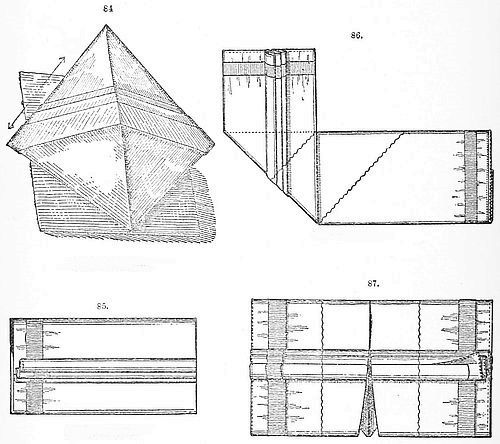
84. Dinner Serviette. 86. Dinner Serviette. 85. Dinner Serviette. 87. Dinner Serviette.
The accompanying figures illustrate how to fold serviettes, and present details as to the manner of folding them. Fig. 84 is a dinner serviette (folded) with bread inside. Fig. 85 shows first detail of folding, half the length of serviette. Fold the serviette in 3 thicknesses lengthwise, and turn back one half of the top flap in 3 plaits along the centre line. Fig. 86 shows second detail of folding, whole length of serviette. Proceed by folding the serviette at right angles from the centre. Then trace the dotted line and the waved line which equally divides the triangle formed by the second folding. You will then have Fig. 87, third detail of folding. Trace the two waved lines shown, and fold from the outside towards the centre to form a square underneath the triangle, as shown in Fig. 88, fourth detail of folding. Finish by folding back the corners as indicated by the arrows.
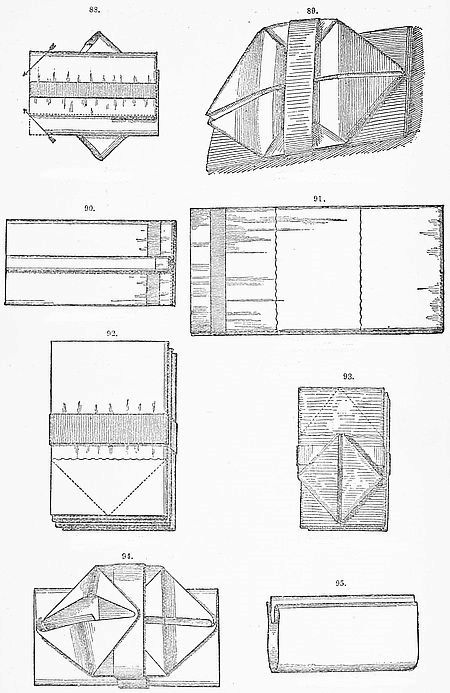
88. Dinner Serviette. 89. Breakfast Serviette. 90. Breakfast Serviette. 91. Breakfast Serviette. 92. Breakfast Serviette. 93. Breakfast Serviette. 94. Breakfast Serviette. 95. Marie Louise Serviette.
Fig. 89 is a breakfast serviette (folded), with bread inside. Fig. 90 shows first detail of folding, half the length of serviette. Commence by folding the serviette in 3 thicknesses, and form one half of the top flap into a centre plait. Fig. 91 shows second detail of folding. Turn over and fold the serviette in halves as shown in Fig. 91, and trace the waved lines. Then fold from right and left. You will then have Fig. 92, third detail of folding. Take up the top layer, and fold as indicated by the dotted lines of the triangle. Thus you come to Fig. 93, fourth detail of folding, and Fig. 94, fifth detail of folding. The same manipulation is repeated from the opposite side, and the corners placed under the centre plait. To arrive at a satisfactory result the folding must be done very carefully, and serviettes ought to be very slightly starched by the laundress.
The Marie Louise Serviette.—Open the serviette before you; fold it in half, with the edges at the top; plait 4-5 in. of the damask upwards to within 1 in. of the top, as described in Fig. 95; turn the serviette over, and make a similar plait on this side (see Fig. 96); plait this up crossways in the manner of a closed fan, and with the finger and thumb draw out the points between the folds, as described on the left-hand side of Fig. 97; place the lower part of the fan in a wineglass or serviette ring; it will then assume the appearance represented in Fig. 98.
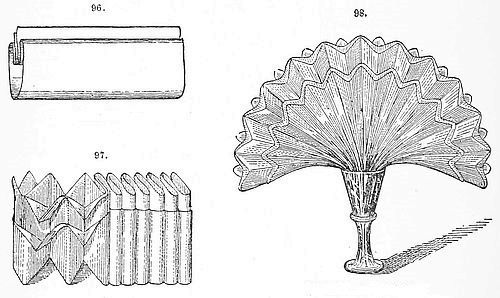
96. Marie Louise Serviette. 98. Marie Louise Serviette. 97. Marie Louise Serviette.
Carving
Carving.—The following excellent instructions are summarised from a series of articles by D. Q. P., published in the Queen some time since.
Fish.—It is scarcely necessary to state that the duties of the carver do not commence until the fish is on the table; but, granting that fish may be easy to cut up, yet it is quite as possible to mangle and destroy its appearance as it is to destroy the look and flavour of a fowl. Fish requires in its way the same qualities and skill. There should be the same knowledge of the general anatomy, and of the choice and ordinary parts. Delicacies and tit-bits abound in all fish. A fish slice should always be used, and the best form for it may be likened to the sole of a Turkish slipper, the pointed toe turning a little upwards, and the handle springing from the centre of the heel. The fork usually accompanying the fish slice is not by some people considered an absolute necessity, an ordinary dinner fork doing such service as is required.
If a spoon or ladle has to be used, care must be taken never to spill, or make a mess, or heap up a great quantity of what is being helped upon a plate at a time. Avoid jerking, or the slipping of knife, fork, or slice, always keeping the elbows well into the sides, and letting the strength necessary to be exercised come from the hands and wrists. Never, either, grasp your carving implements too near the hilt; rather hold them, as well for the sake of appearance as for cleanliness and neatness, as much at the end of the handle as possible.
Cod.—With regard to codfish, the flaky system of apportionment should generally be adopted, though, under certain circumstances, what applies to the cutting up of salmon may be remembered, with the addition that the liver and the sound of cod, playing as they do very important parts, must be dispensed in fair quantities with each helping of the solid. Very requisite, in dealing with these little adjuncts, is it for the carver to calculate to a nicety the proportions which will allow a taste for everybody at the board.
Cod’s head and shoulders is looked upon by some as a vulgar dish. After delicately slicing away in one or two unbroken flakes a small portion of the solid shoulder, a piece of the gelatinous flesh in and about the jowl should also be placed upon the plate, as this is a particularly nutritious and succulent substance. It is impossible to do much more than to dig out this rather unmanageable substance, clearing away the jaw and other bones, and leaving them upon the dish; though, despite the readiness with which the flesh comes away, it is not always easy to get rid of them entirely, and a few may inevitably adhere to the portions distributed. But, as the characteristic of these helpings must be a certain amount of unsightliness, the bones are of little consequence, and must be expected.
Flounders.—Fried flounders are not by any means to be despised; but of course, like fillets, fried or stewed eels, flounder souchet, smelts, whitebait, and such small fry, need no carving; though “helping” must always be considered as a very material element in the carver’s art.
Gurnet.—The gurnet is not so common as either of the foregoing; it is treated with the fish slice precisely upon the same principles as those prescribed for the haddock.
Haddock.—The haddock, which is generally cooked and served in a curled posture, will best recommend itself to the carver who has an eye to excellence in quality and cookery; the flakes should fall right and left, with a creamy suffusion upon the slightest touch of the fish-knife’s point as it is run down the spine. The thickest or shoulder end of the fish is the best; and if there be a preference, the inner side is likely to be the more delicate, and, therefore, suited to the special or appreciative friend, for whom the carver should always have a thought.
Herring.—The last remark also applies to the fresh herring, when of too great dimensions to form one portion by himself; he, like the red mullet, is more delicate when small in size, just enough for one.
John Dory.—The John Dory is to be carved upon precisely the same principles as the turbot, with additional emphasis laid on the importance of the fin, whilst the skin is in itself an exquisite delicacy—never to be tampered with by the carver. The wart-like growths which mar to some extent the back of the turbot are absent in the John Dory, which may be said to be always the better, the larger he is. His head, important as it looks, does not recommend itself, and, as a rule, being filled with parsley, should be left untouched upon the dish.
Mackerel.—Mackerel, though a simple dish for the carver to attack, must not be passed over without a word. When boiled, it should never be hacked by an attempt to divide it through and through; but the fish slice should be inserted from his tail upwards, to his gills, reserving for a special friend the tail quarter, and, if the fish be in roe, perhaps just a suggestion of an unfair share of the latter. The head and backbone are easily disengaged from the remaining underneath side upon the dish, and there is no question that it is better not to turn it over when this part is to be helped. A broiled mackerel, on the contrary, being split, should be cut through and through, bone and all.
Mullet.—The red mullet, again, makes very little demand upon dexterity, nothing being requisite beyond a fair division, longitudinally, into 2 parts, if the fish be too large for one. The so-called liver, usually just visible under the opening of the gill, is a most precious morsel, and must fairly be apportioned, whilst the head itself presents much pretty picking, the brain not being the least. Small red mullet, however, besides being superior in quality to the large, have the advantage of forming just sufficient for a single portion.
Salmon.—Salmon is a fish which offers very little difficulty to the carver, and so long as a due proportion of thick and thin be neatly cut—again in oblong squares—from the side lying uppermost, nothing remains to be attended to. The thick, however, must always predominate in quantity, and it is better to begin cutting from the left, and also better, as in the case of the turbot, to raise the bone when the upper side is gone than to attempt to turn the fish over to get at the remaining lower side. The head and tail, though usually despised, and rarely seen at table, have nevertheless some very succulent picking on them, but do not offer much of a field for the carver to display his skill upon. He has but “to help” them as neatly as may be. Equally, this is pretty much all he has to do when the fish is brought to table in slices; he has usually but to make an equal division of the slice, taking care, of course, that each half is made up of thick and thin together.
Shell-fish.—Shell-fish likewise only generally has to be “helped,” being usually cut up before it is sent to table, and therefore does not need more than a word of recognition here; but it maybe permissible to add that the lobster has no part, not even the minutest tendril, that is unworthy of attention.
Sole, &c.—In speaking of the turbot and dory, nearly all has been said that is necessary to guide the carver in his handling of brill, large sole, and plaice.
Turbot.—Lying flat upon its back, plunge the point of the fish slice at once into its thickest folds just below the jowl, and run it down in an imaginary central line to the tail; then split the flesh into oblong squares, each terminating with a due proportion of fin; for remember the fin of the turbot is a delicacy which should never be overlooked. A careful eye should be had to the number of guests to be helped; for if recourse must be had to the under side of the fish, it is well to bear in mind that here the carver will find himself amongst a shoal of starry wart-like growths, by no means agreeable to the masticatory functions. Still, of course, when these are eliminated, there is plenty of good eating on this under side or back of the waistcoat, and it is better to lift the bone away from it (in doing which there is no difficulty, if the fish be well cooked) than to attempt to turn him over when the white front has disappeared.
Whiting.—Fried whiting served in this same form should be very large to be so manipulated; but it is a fairer plan for the consumer than cutting the fish deliberately in half. Thus, both the haddock and the whiting should be helped in portions made up of the largest flakes obtainable, and, if the former be stuffed, naturally some of the stuffing must be placed on each plate.
Meat.—The edge of the knife must be of preternaturally dangerous sharpness, and the fork must not have been used too persistently as an instrument for the extraction of corks. Bright, straight, sharp-pointed prongs, and keen-edged flashing blades, are indispensable for good carving. The round form, slight curve, and rather rough surface common to buckhorn handles, afford a grip and purchase absent from the ordinary straight bevel-edged ones of ivory or bone. Remember that for carving joints the handles of the knife and fork are to be short and the blades and prongs long, and that for game and poultry the very reverse of this is necessary, greater firmness of blade and point in the latter case being requisite.
Beef.—First the sirloin. The fillet or under-cut, being always better when eaten hot than cold, should generally claim first attention. It must be cut transversely into thick slices, like a tongue; as also should be the fat at the thinner end, a portion of which should go with each slice of lean from the thicker. The joint must be turned over, to enable the carver to get at it conveniently; and, according to the number of persons to be helped, he should cut so many slices at once, before setting the bone up in its proper position again. By this means he can, when helping from the main bulk of the joint, give a portion of the fillet to each, without having constantly to turn the joint from one side to the other. Some people prefer that both upper and under side of a sirloin should be cut alike—that is, transversely—and, though generally considered an extravagant way, it is not without its advantages; the chief of these notably being that each slice has an equalisation of brown and juicy meat—there being, so to speak, no outside cut, each help having, in a section, brown and underdone in the same slice. A piece of the fat from the flap or lower end of the joint must, of course, accompany every portion, as in the case of the fillet, and it should be remembered that these two sorts of fat are very different in quality; the under, or fillet, being of a far more juicy, delicate, and tender quality than the upper, especially when hot. The upper, however, accompanied as it is by the crackly edge of skin, is exceedingly toothsome, with a flavour peculiarly its own.
The ordinary plan of carving the sirloin, however, recommends itself to most housewives as the better, from the fact that lean and fat go together necessarily with each slice. It is generally advised that, before slices are cut, the point of the knife should be inserted a short distance between the meat and the bone, both of the chine (or short upright bone) and the rib (or long bone). Then the knife has but to be passed dexterously down the face of the meat, and each slice comes away easily and clean from the edges. Only, of course, those who are helped first, in this instance, get the brown or well-done outside, and those later on the under-done or juicy. Therefore it is always necessary for the carver, as an act of common civility, to ask those whom he is helping whether their preference be for well or under done. Slices of roast beef from the upper side cannot well be cut too thin, when carved in the ordinary fashion, excepting perhaps the first or outside slice, which admits, from its crispness, of having a little more substance. The joint should be kept perfectly straight upon the dish—that is to say, at right angles with the line of sight of the carver—nothing looking worse or more awkward than for the meat to be twisted all awry; and in fact no real facility is afforded by doing so, for, if the carver does but stretch his arms out far enough to bring his right hand and wrist well above the joint, he will find that by holding the knife almost perpendicularly, and cutting downwards, he has, with the support from the fork, all the purchase necessary. On no account, either, may he stand up, set his arms akimbo, or bow his back; all the strength requisite can be exercised from his chair, by inclining the body sufficiently forward. The muscular exertion demanded is seldom greater than most ladies, with practice, can supply, and they should not be deterred by any slight sense of fatigue in the early days of their carving career, as it will prove a gentle exercise well calculated to strengthen their hands and wrists, without in any way disfiguring them.
During all pauses in the carving, the knife and fork should be placed on the knife rests, and never thrust and left under the joint; nor, while the carver adds the gravy to the plate of meat in front of him, with the spoon in his right hand, is it well for him to hold both knife and fork in a bunch, as it were, in his left. To do this gives a slovenly, hasty, eating-house sort of effect to the process, especially if, at the same time, the dish be tilted with the left hand, for the easier filling of the spoon. This is always an inelegant proceeding, calculated to endanger the purity of the tablecloth, by the sluicing of the gravy over the edge of the dish, or, even worse, by the capsizing of the joint itself. A carver cannot be too careful never to make a mess; and if every meat dish has, as it should have, a well, there is no excuse for his doing so. A tiny crust of bread put under one end of the dish to cant it a little, in the absence of a gravy well, is at the most all that can be pardoned in the way of disturbing the equilibrium of the dish. If a portion of the garnish of horse-radish is to go with each helping, it must be dispensed with the points of the fork. The gravy spoon should always be put in a vessel of hot water, and placed at the right hand of the dish, up to the moment of using. So essential, too, are hot plates to a perfect condition of roast meat, that a second plate, for a second helping, is strongly to be advocated; and for the same reason, though a dignified calm should characterise the carver’s behaviour, there should be, on the other hand, no approach to dawdling.
Attention to simple details like these distinguishes the good from the bad carver, and renders the execution of the task rather a graceful act than otherwise. In carving the sirloin and similar ribbed joints, a too pliant blade is not desirable. When, however, we are dealing with a round of beef lying flat before us, or the boiled silver side, or a piece of roast so-called boned beef, the knife cannot well be too yielding, nor, again, the slices cut too thin. Never either omit with this sort of joint, where one has to cut directly towards the fork, to raise its finger guard, for, if the knife slip, it will run straight up over the bow of the prongs, to the imminent peril of the carver’s hand. For, of course, in manipulating a piece of meat with the surface to be cut lying uppermost, the left or fork hand is higher than the right or knife hand—nearly the reverse of the position necessary in carving a joint standing upright. In this case the knife is held nearly perpendicularly, the fork nearly horizontally—just, indeed, the contrary to the manner of using the tools for a flat joint.
With the aitch-bone, as with the round of beef, it may be desirable to cut rather a thick slice from the outside before beginning to help; but the habit is wasteful, and should be adopted with judgment. These are not difficult joints to carve, if it be always remembered that a knife with a thin pliant blade is absolutely necessary. Of course a delicate morsel of the fat must go with each serving. The brisket of beef is not a joint very usually to be met with; but it has its merits, and has only to be cut neatly across the bones, to prevent its having a jagged, untidy look on its reappearance at table. What has been said concerning the carving of the sirloin of beef applies in all respects to the carving of the ribs, except that, these having no under-cut, the task is rendered less diversified. The beef tongue must likewise be carved precisely upon the same principles as the sirloin, when that joint is cut transversely, like its fillet; the fat at the root of the tongue, of course, not being overlooked.
Mutton.—All details about knife, fork, spoon, dish, position of joint, and of the body, arms, and hands of the carver—referred to when speaking of beef—are equally necessary with regard to haunch and saddle of mutton. The first thing to be done in carving the former being to make at the knuckle end a deep cut across, down to the bone, with the point of the knife, this forms a basis for a well, into which the gravy will run from every succeeding cut, which ought to pass at right angles to the first incision—that is, all along, in continuous and thick (but not too thick) slices—the whole length of the joint. The moment room at the knuckle end, where the first cut was made, is obtained for the insertion of the spoon, a modicum of the gravy which has accumulated in the hollow should be distributed with each helping, as, of course, it is the richest, being absolutely pure essence of meat. Care too must be taken never to forget putting a little extra fat upon each plate, as the haunch of mutton fat is highly prized; and whoever is most expeditious in assisting the guests may be counted the best carver of mutton, for that it should be piping hot is indispensable.
Saddle should be cut very much upon the same principles as the haunch, and presents no great obstacles to the carver. If a preference be given to carving the slices obliquely instead of straight, the thin end of the saddle should then be on the right of the carver. Each side of the chine or backbone is to be dealt with alike, the first slice always taken from as close to the bone as possible. As the fat lying in the region of the kidneys is held in great estimation, a portion of it should go with every helping; and therefore it is advisable for the carver directly the cover is taken off the joint to tilt the saddle a little on one side, and cut away at once from underneath it as much of this same fat as will be required to go the whole round of the table. He should then slip it all into the gravy well, and thus it will be quite ready for him to help from, otherwise, if this be not done at starting, and attempts are made to get at it after he has begun to cut into the joint, he will in all probability spill the rich gravy settling in the channel made by his first incisions—an unpardonable wasting of good stuff—or he will overlook the kidney fat altogether, to the disappointment of everybody concerned; and the fat is not nearly so good cold as hot.
The popular leg of mutton owes perhaps a great deal of its popularity to the ease with which it may be cut up. Little has to be done, save to pass the knife straight down at right angles with the bone, and not obliquely, as one would carve a ham. Then, according to the preference of the guests, tolerably thick slices from either the knuckle or the upper end may be distributed, the knuckle end being always the better done, though not always perhaps the choicest in flavour. Many little fancies and predilections for certain tit-bits will be met with: 2 quaint pieces of brownish, crisply-roasted fat, like ears or little wings, protruding from the upper end of the joint, being, with the Pope’s-eye, notable instances. Some are fond of having this joint dished with the under side uppermost, so as to get at the finely grained meat lying under the Pope’s-eye; but this is an extravagant fashion, and one that will hardly find favour in the eyes of economical housewives.
On the butcher’s proper attention to the process known as “jointing” depends mainly the facility with which a loin of mutton is cut up, and we must not attribute blame to the carver who has to struggle against the neglect by that functionary of this important matter. If it has been rightly attended to, the carving knife can be made easily to find its way between the chine bone, and can then, without any let or hindrance, be passed down through the ribs, separating them one after another, again reserving the outside chop for those who prefer the meat brown and well done. The fat and lean go together with each bone, in common sequence, demanding little or no thought from the carver, save perhaps here and there, where an ugly or rugged bit of skin requires to be trimmed off neatly.
Next to the loin of mutton comes the shoulder, as the joint offering the least difficulty to the carver. The knife has but to be passed from the outer edge of the shoulder across the meat towards the carver, until the bone is reached. Take away slice after slice in this direction, and then resorting to the meat lying on either side of the blade bone, according to the quantity required, in this instance cutting lengthways of the joint. When no more can be obtained from the upper side of the joint, it must be turned, and there are many people who do not consider that they have had the best of a shoulder of mutton until this side is attacked. It will now present almost the appearance of a new joint, being quite flat, and offering a succession of juicy slices along its entire length. These have to be dexterously removed, very much upon the principles recommended when flat joints were spoken of. These slices are preferred for hashing, however, by those who think that the quality of the grain of the meat from this part of the joint renders it inferior at the first cooking to the upper.
It is not necessary, with one exception, to say anything about joints of lamb, for they only have to be manipulated according to the rules laid down for mutton. The exception is a fore-quarter of lamb. In removing the shoulder from the breast—the first point to which he directs his attention—hold the shoulder firmly with the fork, and proceed with the point of the knife to cut through the smoking crisp brown skin in a circular line, at the junction of the two joints. Following the same line for a second time, and now thrusting the knife farther into the meat, a very little exertion with the left hand makes it easy to raise the shoulder from the breast, whilst a pat of butter, a little cayenne pepper, some salt, and a good squeeze of lemon are placed between them by the carver. When, in a moment or two, these ingredients have assimilated with the gravy, it is sometimes, for the sake of convenience, thought desirable to place the shoulder upon another dish, hot, and standing ready at the carver’s left hand, or held there by a servant. This done, inquiry is made of those about to be helped as to their preference for brisket, ribs, or a piece of the shoulder. The brisket should be separated from the ribs by one long cut from left to right, and then subdivided at the distance of one or two bones, by cuts at right angles with the line which separated the brisket from the ribs. These again, in like manner, are divided into chops by carving them similarly to the shorter bones of the brisket, and upon the same principle as when cutting up a loin of mutton.
Venison.—Those who have any experience in carving haunches or saddles of mutton have very little to learn with regard to venison; the principles which guide them in dealing with the former have only to be followed out in the latter. A haunch of venison is carved exactly like a haunch of mutton; but, being somewhat larger, it is advised by some authorities that the broad end of the haunch, instead of the side, should be turned towards the carver for the purpose of giving him greater command over the joint. This system leads to an entire disturbance of the appearance and general arrangement of the table; and a skilled carver should be independent of such twistings to meet his convenience, except under great emergencies. Epicures pretend that there is a vast difference between the flavour of the slices cut close to the vertebræ and those farther removed, and the carver must make concessions to such notions, and give those whom he is helping their slice from the region which they prefer. Never either must he omit to give a dip of the rich gravy always accumulating in the channel whence the slices are taken, nor an ample portion of fat with the lean. Expedition, but without hurry, is essential in carving venison, as, like mutton, it chills very rapidly: but, as on the whole a haunch of venison is not a difficult dish to deal with, there never should be anything to complain of on the score of delay. As the shoulder of venison is usually sent to table stewed and rolled, the bone having been removed, it presents no difficulty whatever to the carver, and being, so to speak, a fat joint, has to be dealt with according to the principles already laid down. Sometimes, however, the shoulder is roasted, as is also the neck; but these—with braised brisket, fillets, and steaks—do not demand any special comment as to their carving; for what has been learned about cutting up sheep should prove sufficient for the comparatively rare occasions when the carver is called upon to discuss deer.
Veal.—The commonest form in which veal offers itself is perhaps a roast breast, and if a carver has had any experience in cutting up fore-quarter of lamb, he will at once recognise the similarity between a breast of veal and the aforesaid joint of lamb after the shoulder has been removed. Like it, the veal is composed of ribs and brisket, and may be cut accordingly, that is, first, by separating in one long incision the ribs from the brisket, and then the rib bones one by one, after the manner of chops generally. The gristly brisket may be cut in squarish portions, inquiring of course always of the guests whether they prefer the latter or the former. The brown, well-cooked parts in veal are usually most esteemed; and if the sweetbread, as it sometimes is, be sent to table with the joint, it ought naturally to be fairly distributed. Once more, in manipulating the roast fillet of veal, the carver has only to remember what has been said respecting a round of beef, with the addition that a portion of the stuffing, which is inserted between the flap and the main bulk of the meat, be served with each helping, and that the brown outside, or first slice, is considered a very choice morsel.
A knuckle of veal, being in shape somewhat like the knuckle end of a leg of mutton when it has been divided, needs but few directions for carving. The slices from the thicker end are the best; that would be to the right of the first incision into the meat.
The butcher is mainly responsible for the good carving of a loin of veal, for if he have not done his jointing properly, it is hardly possible to cut it up decently; whereas, if he has done his work well, the carver has but to feel his way with the point of the knife, on lines already laid down, to be able to disengage the separate portions—never, by the way, overlooking the kidney, and the kidney fat, lying on the under side of the joint.
It is not very easy to describe the exact method of carving calf’s head, but a little experience and examination of its organic development soon suggests what has to be done. When upon the dish, the nose and mouth should be to the right of the carver, and the first incision should be made right down to the bone, and running all along from the back of the nearest ear down towards the nose, and slices be cut away in the same direction. With each of these should go a piece of what is called the sweetbread of the throat, a substance to be found under the ear, and, so to speak, at right angles with the line of the first incision, and it should be cut towards the carver in the direction in which it lies. Calf’s head has a multitude of succulent morsels, to wit, the ears, the flesh round the eyes, and the eyes themselves. Also the palate, which, lying under the head, is to be got at when the jaw bone is removed; and where, likewise, some nice lean becomes accessible. On a separate dish, of course, the tongue and brains are served, of which every one is invited to partake.
Sheep’s head is held to be a very vulgar dish, and a lamb’s head, perhaps, only one degree less so. Still he who is unfortunate enough at any time to find himself with the responsibility of carving or helping such viands may take courage if he has any knowledge of what is demanded of him when similarly situated with a calf’s head, the heads of the smaller animals being then very easy of manipulation.
Pork.—Like calf’s head, a sucking pig seems at first sight to be rather an appalling dish, and undoubtedly a little experience is requisite before one becomes quite au fait with the business. But the whole substance is so tender, and yields so readily to the knife, that after a slight knowledge of the anatomy of the animal has been acquired, all difficulties vanish. The little piglet generally appears upon the board divided into four parts; the head, like the body, being cloven in twain, a cheek being placed at either end of the carcase. In dealing with the latter, the shoulder has first to be removed by passing the knife circularly round its junction with the body, pretty much as one does with fore-quarter of lamb. The leg is then treated after the same fashion, when the ribs will be open to view, for gentle division. Each side of the animal is disposed of in the same way; the larger joints being considered, perhaps, the least delicate (if, where all is delicacy, there can be a “least”) are usually offered to the robuster appetites at table. As in the case of all dishes abounding in choice morsels, the epicure is sure to have his fancies about sucking pig—one preferring the ribs, another the neck, and a third the meat from the shoulder.
Concerning leg of pork, really little or nothing additional has to be said. The knife only needs to be carried straight down through the crackling to the very bone; as each slice is taken away, such stuffing, gravy, &c., as accompany it, is distributed either from the joint itself or from sauceboats. Allowing for a slight difference in form, it has to be treated like most of the leg joints that come to table, and the same may be said of the loin. As you dispose of a loin of mutton, so do you of a loin of pork, the due value of the crackling, fat, and brown tit-bits being kept in mind. The butcher here again is responsible for the jointing, and the cook for the judicious scoring of the crackling.
Ham alone remains to be noticed in this part of our subject, and according as one wishes to have fine or economical slices, must it be carved. In the first case, the start is made upon the prime part at once; in the second, from quite the lower end of the knuckle, advancing gradually at a gentle angle towards the thicker and prime part of the meat. A pliant, very sharp knife is indispensable, as the slices cannot well be too thin, or too evenly and smoothly cut. It is of little concern to the carver whether the ham be hot or cold, and the same may be said of joints generally.
Odd Dishes.—Very little need be said about “helping” dishes of meat, as part of the carver’s duty, even where no actual knife and fork execution is required. A rump steak, for instance, hardly needs to be carved, but it has to be cut and helped very neatly, and not distributed in irregular mis-shapen hunks, but rather, as a rule, in oblong finger-shaped pieces, with a nice modicum of fat attached, if possible, but certainly going with each portion of lean. And because meat pies again have to be cut and helped, not carved, the carver, so called, must not look upon them as beneath his consideration.
If he thinks that hashes, curries, ragouts, what-not, do not give him a fair field for the display of his skill with knife and fork, and that, therefore, it does not signify how they are helped, he will be grievously mistaken.
Except where a great number of portions have to be served, avoid the use of the knife sharpener at table: it has always an eating-house effect about it. It is disagreeable to the ear and if executed with the flourish of dexterity, not unfrequently is likely to splash right and left; for unless the knife be wiped previously, and this is a very awkward and unsightly process, some of the juices of the meat inevitably cling to it, to be scraped off against the sharpener, which in its turn is made greasy, and therefore jeopardises the purity of the tablecloth. If, however, a sharpener has to be brought into play, the simplest and most efficacious is the ordinary round butcher’s steel, always supposing the power of using it properly in conjunction with the knife has been acquired. Short of this, the little contrivance consisting of a series of discs overlapping each other, so as to form a wedge-shaped socket with the finest of thin edges conceivable, into which the edge of the knife is dropped and then pushed gently backwards and forwards, is very useful, and may be recommended as fully answering its purpose, and if carefully manipulated entirely without risk. It also is cleaner, less unsightly, and creates less unpleasant noise than the common steel, whilst a child might manage it. At any rate, ladies should always use it in preference to any other sharpening instrument. The habit of feebly drawing the edge of the carving knife downwards, to and fro, against the back edge of another knife, should only be thought of under very pressing circumstances; it is an extremely inelegant action.
Poultry.—Once learn its anatomy and the best method of separating its limbs, and very little more knowledge will enable you to manipulate skilfully any of the feathered tribe. The chicken should lie upon its back at right angles with our line of sight, and its tail end to our left hand. The fine plump breast tempts naturally the insertion of the fork, which should be driven firmly, but delicately, and almost perpendicularly into it, a little to the left of the centre, a prong on either side of the ridge of the breast bone. Secure hold should be at once got by this process of the whole carcase, for if it be intended to cut up the entire fowl at once it may be, and should be all but done without once removing the fork. The next process is to separate the wing, or both wings, and this is done by passing the knife sharply along the line of the breast, as far outside the breast bone as will leave a fair share of meat attached to it, and yet give an ample portion to the wing. Thus, cutting from left to right, and downwards, as we approach the right extremity of the bird, let the knife diverge a little farther outwards, so as to clear the merrythought, and strike the joint of the wing. Unless the creature be of preternatural antiquity, the junction is easily severed, and bone and flesh come away almost with a touch. Having removed both wings in this way, lower the fork hand so as to cant the chicken a little on to its side, and then pass the blade of the knife under the projecting elbow, as we may call it, of the leg, and, forcing it outwards, disengage it too from the body by severing with the point of the knife the joint by which it is still slightly held. Then turn the bird bodily over on to its other side, without removing the fork, and dispose of the second leg in a similar fashion. Restoring then the chicken to its original position, pass the knife transversely across the breast a little to the right of the highest point of the breast bone. Cut down gently, inclining the edge of the blade to the right, press outwards and upwards slightly, and the merrythought comes away. There must be no tearing of the skin; every incision of the knife must go clean through that, for nothing looks worse than to see one portion with the skin half torn away, and hanging in a long ribbon from another. The merrythought is now disposed of by just separating the little joints by which it is still attached when the upper end of its bone has been separated from the breast, and having a nice clean edged covering of skin. Again turn the carcase on to its side, and by an action with the knife, similar to that by which you removed the legs, force away by an upward pressure the two side bones one after the other, that is the two bones which the removal of the merrythought has revealed. There is nothing now to prevent the knife being swept clean through the ribs, and so disengage breast and back. At this stage the fork is withdrawn from the breast, which has now become a trim, tempting, and oblong portion; the back only remains to be dealt with. Turning it over, press the knife firmly down upon the right end of it, and holding it so steadily, lift the left extremity with the fork, and the back is immediately dislocated near the centre; complete the separation by severing with the knife such portions of skin and flesh as may yet cause the joints still to adhere one to the other. Arrange then all these various portions neatly on the dish, and still assuming that the demolition of the whole bird was necessary, it will be ready to serve, remembering that a piece of the liver should go with that wing which has it not. On some occasions—carving for a large number of children to wit—it may be necessary to divide each leg into two portions by severing the thigh bone from the drumstick, as it is called.
Boiled or roast, such is the mode of cutting up a fowl. Supposing, however, that some special part alone is wanted, say the merrythought, it can hardly be got at without first cutting the wing, or wings; not perhaps disengaging them entirely, but certainly so far as to get at the particular joint required. It ensures neatness in the long run, and it is highly essential that a bird, if it reappears at table, should look neither hacked nor mangled. If a fowl approach the proportions of a capon, it will seldom be well to drive the fork into the breast at starting, because then the first thing to be done is to make the breast yield the utmost number of slices; these should be cut, to begin with, from as close to the wing as possible, working upwards on either side till the breast bone be reached. Only when these, the choicest parts of the bird, are distributed, will it be necessary to go into the dissection of the carcase as aforesaid; and it must not be forgotten that under this method the wings are reduced to what may be called a mere picking.
Very special fancies are found to predominate amongst all who partake of poultry, and it is essential that the carver does not neglect to consult each individual’s predilections. A very little experience, too, will show how indispensable it is to have poultry carving knife and fork in exquisite order. The knife must be firm and sharp-pointed, or it will never disengage anything like stubborn joints.
Duck.—The anatomy of the fowl once mastered, that of the duck or duckling becomes immediately patent to the most casual observer. The slight difference which exists in their general conformation, and which arises chiefly from the legs of the duck being set farther back on the body, is not sufficient to require much additional comment; but it may be said that, whereas the wing of the “flyer” is held in the highest repute, so is the leg of the “swimmer”; and when a very small and tender duckling is under the knife, one wing and leg taken off together, without division, will be no more than enough for one portion. The stuffing is got at by cutting open at its lower end, by a semicircular incision, the little apron of skin just below the breast. This should be done so neatly that it falls back into its place when the spoon is withdrawn, and must on no account be left jagged. Nevertheless, the carver should never put any of the stuffing upon a plate without first asking whether it will be agreeable. Some housewives, when a pair of ducks or ducklings appear, allow only one of them to be stuffed, and this is perhaps wise. As with a large chicken, so with a large duck, the most must be made of its breast by cutting the utmost number of long and delicate slices that it will yield, commencing always as close to the wing as possible. Very marked will be the difference in the apparent amount of separate portions which will be got off a duck by a good and a bad carver; and it is only a little exaggeration to say that the good one will make the bird go twice as far as the bad. All sorts of odd out-of-the-way tit-bits can be got off the carcase by any one who has had the wit to keep a watchful eye on a dexterous knight of the carving knife and fork—for practical carving is learned more thoroughly by watching an expert than by any other means. Amongst the tit-bits of a duck some people look upon the feet as very pretty picking, and they should always appear at table, not only for the above reason, but as giving a character to the dish.