Chapter VI · CLASSIFICATION OF THE CORRESPONDENCIES AND PARALLELISMS OF SHAKESPEARE WITH EMBLEM WRITERS.
Reading edition
HAVING established the facts that Shakespeare invented and described Emblems of his own, and that he plainly and palpably adopted several which had been designed by earlier authors, we may now, with more consistency, enter on the further labour of endeavouring to trace to their original sources the various hints and allusions, be they more or less express, which his sonnets and dramas contain in reference to Emblem literature. And we may bear in mind that we are not now proceeding on mere conjecture; we have dug into the virgin soil and have found gold that can bear every test, and may reasonably expect, as we continue our industry, to find a nugget here and a nugget there to reward our toil.
But the correspondencies and parallelisms existing in Shakespeare between himself and the earlier Emblematists are so numerous, that it becomes requisite to adopt some system of arrangement, or of classification, lest a mere chaos of confusion and not the symmetry of order should reign over our enterprise. And as “all Emblemes for the most part,” says Whitney to his readers, “maie be reduced into these three kindes, which is Historicall, Naturall, & Morall,” we shall make that division of his our foundation, and considering the various instances of imitation or of adaptation to be met with in Shakespeare, shall arrange them under the eight heads of—1, Historical Emblems; 2, Heraldic Emblems; 3, Emblems of Mythological Characters; 4, Emblems illustrative of Fables; 5, Emblems in connexion with Proverbs; 6, Emblems from Facts in Nature, and from the Properties of Animals; 7, Emblems for Poetic Ideas; and 8, Moral and Æsthetic, and Miscellaneous Emblems.
Section I. HISTORICAL EMBLEMS.
AS soon as learning revived in Europe, the great models of ancient times were again set up on their pedestals for admiration and for guidance. Nearly all the Elizabethan authors, certainly those of highest fame, very frequently introduce, or expatiate upon, the worthies of Greece and Rome,—both those which are named in the epic poems of Homer and Virgil, and those which are within the limits of authentic history. It seemed enough to awaken interest, “to point a moral, or adorn a tale,” that there existed a record of old.
Shakespeare, though cultivating, it may be, little direct acquaintance with the classical writers, followed the general practice. He has built up some of the finest of his Tragedies, if not with chorus, and semi-chorus, strophe, anti-strophe, and epode, like the Athenian models, yet with a wonderfully exact appreciation of the characters of antiquity, and with a delineating power surprisingly true to history and to the leading events and circumstances in the lives of the personages whom he introduces. From possessing full and adequate scholarship, Giovio, Domenichi, Claude Mignault, Whitney, and others of the Emblem schools, went immediately to the original sources of information. Shakespeare, we may admit, could do this only in a limited degree, and generally availed himself of assistance from the learned translators of ancient authors. Most marvellously does he transcend them in the creative attributes of high genius: they supplied the rough marble, blocks of Parian perchance, and a few tools more or less suited to the work; but it was himself, his soul and intellect and good right arm, which have produced almost living and moving forms,—
“See, my lord,
Would you not deem it breath’d? and that those veins
Did verily bear blood?”
Winter’s Tale, act v. sc. 3, l. 63.
For Medeia, one of the heroines of Euripides, and for Æneas and Anchises in their escape from Troy, Alciat (Emblem 54), and his close imitator Whitney (p. 33), give each an emblem.
To the first the motto is,—
“Ei qui semel sua prodegerit, aliena credi non oportere,”—
“To that man who has once squandered his own, another person’s ought not to be entrusted,”—
similar, as a counterpart, to the Saviour’s words (Luke xvi. 12), “If ye have not been faithful in that which is another man’s, who shall give you that which is your own.”
The device is,—
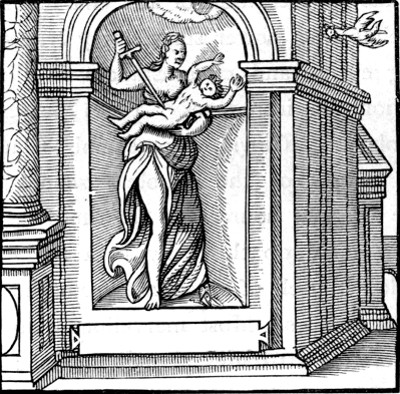
Alicat, 1581.
with the following Latin elegiacs,—
Colchidos in gremio nidum quid congeris? eheu
Neſcia cur pullos tam malè credis auis?
Dira parens Medea ſuos ſæuiſſima natos
Perdidit; & ſperas parcat vt illa tuis?
Which Whitney (p. 33) considerably amplifies,—
“Medea loe with infante in her arme,
Whoe kil’de her babes, shee shoulde haue loued beste:
The swallowe yet, whoe did suspect no harme,
Hir Image likes, and hatch’d vppon her breste:[108]
And lifte her younge, vnto this tirauntes guide,
Whoe, peecemeale did her proper fruicte deuide.
Oh foolishe birde, think’ste thow, shee will haue care,
Vppon thy yonge? Whoe hathe her owne destroy’de,
And maie it bee, that shee thie birdes should spare?
Whoe slue her owne, in whome shee shoulde haue ioy’d.
Thow arte deceau’de, and arte a warninge good,
To put no truste, in them that hate theire blood.”
And to the same purport, from Alciat’s 193rd Emblem, are Whitney’s lines (p. 29),—
“Medea nowe, and Progne, blusshe for shame:
By whome, are ment yow dames of cruell kinde
Whose infantes yonge, vnto your endlesse blame,
For mothers deare, do tyrauntes of yow finde:
Oh serpentes seede, each birde, and sauage brute,
Will those condempne, that tender not theire frute.”
The stanza of his 194th Emblem is adapted by Alciat, and by Whitney after him (p. 163), to the motto,—
Pietas filiorum in parentes,—
“The reverence of sons towards their parents.”
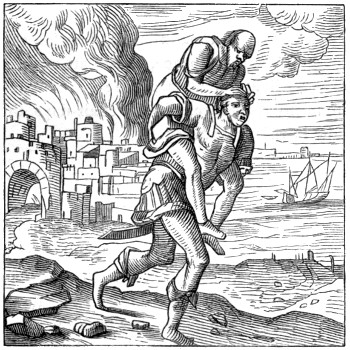
Alicat, 1581.
Per medios hoſteis patriæ cùm ferret ab igne
Aeneas humeris dulce parentis onus:
Parcite, dicebat: vobis ſene adorea rapto
Nulla erit, erepto ſed patre ſumma mihi.
“Aeneas beares his father, out of Troye,
When that the Greekes, the same did spoile, and sacke:
His father might of suche a sonne haue ioye,
Who throughe his foes, did beare him on his backe:
No fier, nor sworde, his valiaunt harte coulde feare,
To flee awaye, without his father deare.
Which showes, that sonnes must carefull bee, and kinde,
For to releeue their parentes in distresse:
And duringe life, that dutie shoulde them binde,
To reuerence them, that God their daies maie blesse:
And reprehendes tenne thowsande to their shame,
Who ofte dispise the stocke whereof they came.”
The two emblems of Medeia and of Æneas and Anchises, Shakespeare, in 2 Henry VI. (act. v. sc. 2, l. 45, vol. v. p. 218), brings into close juxta-position, and unites by a single description; it is, when young Clifford comes upon the dead body of his valiant father, stretched on the field of St. Albans, and bears it lovingly on his shoulders. With strong filial affection he addresses the mangled corpse,—
“Wast thou ordain’d, dear father,
To lose thy youth in peace, and to atchieve
The silver livery of advised age;
And, in thy reverence, and thy chair-days, thus
To die in ruffian battle?”
On the instant the purpose of vengeance enters his mind, and fiercely he declares,—
“Even at this sight,
My heart is turn’d to stone; and, while ’tis mine,
It shall be stony. York not our old men spares;
No more will I their babes: tears virginal
Shall be to me even as the dew to fire;
And beauty, that the tyrant oft reclaims,
Shall to my flaming wrath be oil and flax.
Henceforth I will not have to do with pity:
Meet I an infant of the house of York,
Into as many gobbets will I cut it,
As wild Medea young Absyrtus did:
In cruelty will I seek out my fame.”
Then suddenly there comes a gush of feeling, and with most exquisite tenderness he adds,—
“Come, thou new ruin of old Clifford’s house:
As did Æneas old Anchises bear,
So bear I thee upon my manly shoulders:
But then Æneas bare a living load,
Nothing so heavy as these woes of mine.”
The same allusion, in Julius Cæsar (act. i. sc. 2, l. 107, vol. vii. p. 326), is also made by Cassius, when he compares his own natural powers with those of Cæsar, and describes their stout contest in stemming “the troubled Tyber,”—
“The torrent roar’d, and we did buffet it
With lusty sinews, throwing it aside
And stemming it with hearts of controversy;
But ere he could arrive the point proposed,
Cæsar cried, ‘Help me, Cassius, or I sink!’
I, as Æneas our great ancestor
Did from the flames of Troy upon his shoulder
The old Anchises bear, so from the waves of Tiber
Did I the tired Cæsar: and this man
Is now become a god, and Cassius is
A wretched creature, and must bend his body
If Cæsar carelessly but nod on him.”
Aneau, 1552.
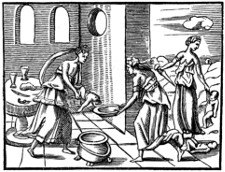
Progne, or Procne, Medeia’s counterpart for cruelty, who placed the flesh of her own son Itys before his father Tereus, is represented in Aneau’s “Picta Poesis,” ed. 1552, p. 73, with a Latin stanza of ten lines, and the motto, “Impotentis Vindictæ Foemina,”—The Woman of furious Vengeance. In the Titus Andronicus (act. v. sc. 2, l. 192, vol. vi. p. 522) the fearful tale of Progne enters into the plot, and a similar revenge is repeated. The two sons of the empress, Chiron and Demetrius, who had committed atrocious crimes against Lavinia the daughter of Titus, are bound, and preparations are made to inflict such punishment as the world’s history had but once before heard of. Titus declares he will bid their empress mother, “like to the earth swallow her own increase.”
“This is the feast that I have bid her to,
And this the banquet she shall surfeit on;
For worse than Philomel you used my daughter,
And worse than Progne I will be revenged.”
’Tis a fearful scene, and the father calls,—
“And now prepare your throats. Lavinia, come,
[He cuts their throats.
Receive the blood: and when that they are dead,
Let me go grind their bones to powder small,
And with this hateful liquor temper it;
And in that paste let their vile heads be baked.
Come, come, be every one officious
To make this banquet; which I wish may prove
More stern and bloody than the Centaurs’ feast.”
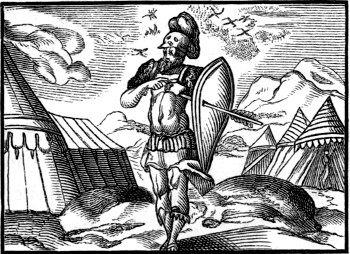
A character from Virgil’s Æneid (bk. ii. lines 79–80; 195–8; 257–9),[109] frequently introduced both by Whitney and Shakespeare, is that of the traitor Sinon, who, with his false tears and lying words, obtained for the wooden horse and its armed men admission through the walls and within the city of Troy. Asia, he averred, would thus secure supremacy over Greece, and Troy find a perfect deliverance. It is from the “Picta Poesis” of Anulus (p. 18), that Whitney (p. 141) on one occasion adopts the Emblem of treachery, the untrustworthy shield of Brasidas,—
Perfidvs familiaris,—
“The faithless friend.”
Aneau, 1552.
Per medium Brasidas clypeum traiectus ab hoſte:
Quóque foret læſus ciue rogante modum.
Cui fidebam (inquit) penetrabilis vmbo fefellit.
Sic cvi ſæpe fides credita: proditor eſt.
Thus rendered in the Choice of Emblemes,—
“While throughe his foes, did boulde Brasidas thruste,
And thought with force, their courage to confounde:
Throughe targat faire, wherein he put his truste,
His manlie corpes receau’d a mortall wounde.
Beinge ask’d the cause, before he yeelded ghoste:
Quoth hee, my shielde, wherein I trusted moste.
Euen so it happes, wee ofte our bayne doe brue,
When ere wee trie, wee trust the gallante showe:
When frendes suppoas’d, do prooue them selues vntrue.
When Sinon false, in Damons shape dothe goe:
Then gulfes of griefe, doe swallowe vp our mirthe,
And thoughtes ofte times, doe shrow’d vs in the earthe.
* * * * * *
But, if thou doe inioye a faithfull frende,
See that with care, thou keepe him as thy life:
And if perhappes he doe, that may offende,
Yet waye thy frende: and shunne the cause of strife,
Remembringe still, there is no greater crosse;
Then of a frende, for, to sustaine the losse.
Yet, if this knotte of frendship be to knitte,
And Scipio yet, his Lelivs can not finde?
Content thy selfe, till some occasion fitte,
Allot thee one, according to thy minde:
Then trie, and truste: so maiste thou liue in rest,
But chieflie see, thou truste thy selfe the beste?”
Sambucus, 1564.
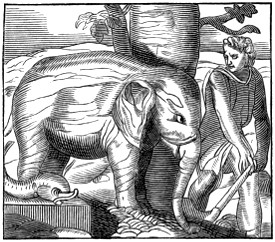
And again, adopting the Emblem of John Sambucus, edition Antwerp, 1564, p. 184,[110] and the motto,
Nusquam tuta fides,—
“Trustfulness is never sure,”
with the exemplification of the Elephant and the undermined tree, Whitney writes (p. 150),—
“No state so sure, no seate within this life
But that maie fall, thoughe longe the same haue stoode:
Here fauninge foes, here fained frendes are rife.
With pickthankes, blabbes, and subtill Sinons broode,
Who when wee truste, they worke our ouerthrowe,
And vndermine the grounde, wheron wee goe.
The Olephant so huge, and stronge to see,
No perill fear’d: but thought a sleepe to gaine
But foes before had vndermin’de the tree,
And downe he falles, and so by them was slaine:
First trye, then truste: like goulde, the copper showes:
And Nero ofte, in Nvmas clothinge goes.”
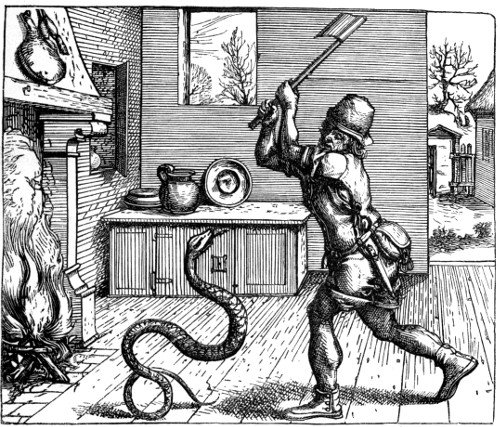
Freitag’s “Mythologia ethica,” pp. 176, 177, sets forth the well-known fable of the Countryman and the Viper, which after receiving warmth and nourishment attempted to wound its benefactor. The motto is,—
Maleficio beneficium compensatum,—
“A good deed recompensed by maliciousness.”
Freitag, 1579.
“Qui reddit mala pro bonis, non recedet malum de domo eius.”—Prouerb, 17, 13.
“Whoso rewardeth evil for good, evil shall not depart from his house.”
Nicolas Reusner, also, edition Francfort, 1581, bk. ii. p. 81, has an Emblem on this subject, and narrates the whole fable,—
Merces anguina,—“Reward from a serpent.”
“Frigore confectum quem rusticus inuenit anguem
Imprudens fotum recreat ecce sinu.
Immemor hic miserum lethale sauciat ictu:
Reddidit hìc vitam; reddidit ille necem.
Si benefacta locis malè, simplex mente, bonusq.:
Non benefacta quidem, sed malefacta puta.
Ingratis seruire nefas, gratisq. nocere:
Quod benè fit gratis, hoc solet esse lucro.”[111]
In several instances in his historical plays, Shakespeare very expressly refers to this fable. On hearing that some of his nobles had made peace with Bolingbroke, in Richard II. (act. iii. sc. 2, l. 129, vol. iv. p. 168), the king exclaims,—
“O villains, vipers, damn’d without redemption!
Dogs, easily won to fawn on any man!
Snakes, in my heart blood warm’d that sting my heart!”
In the same drama (act. v. sc. 3, l. 57, vol. iv. p. 210) York urges Bolingbroke,—
“Forget to pity him, lest thy pity prove,
A serpent that will sting thee to the heart.”
And another, bearing the name of York, in 2 Henry VI. (act. iii. sc. 1, l. 343, vol. v. p. 162), declares to the nobles,—
“I fear me, you but warm the starved snake,
Who, cherish’d in your breasts, will sting your hearts.”
Also Hermia, Midsummer Night’s Dream (act. ii. sc. 2, l. 145, vol. ii. p. 225), when awakened from her trance-like sleep, calls on her beloved,—
“Help me, Lysander, help me! do thy best
To pluck this crawling serpent from my breast.”
Whitney combines Freitag’s and Reusner’s Emblems under one motto (p. 189), In sinu alere serpentem,—“To nourish a serpent in the bosom,”—but applies them to the siege of Antwerp in 1585 in a way which Schiller’s famous history fully confirms:[112]—“The government of the citizens was shared among too many hands, and too strongly influenced by a disorderly populace to allow any one to consider with calmness, to decide with judgment, or to execute with firmness.”
The typical Sinon is here introduced by Whitney,—
“Thovghe, cittie stronge the cannons shotte dispise,
And deadlie foes, beseege the same in vaine:
Yet, in the walles if pining famine rise,
Or else some impe of Sinon, there remaine.
What can preuaile your bulwarkes? and your towers,
When, all your force, your inwarde foe deuoures.”
In fact, Sinon seems to have been the accepted representative of treachery in every form; for when Camillus, at the siege of Faleria, rewarded the Schoolmaster as he deserved for attempting to give up his scholars into captivity, the occurence is thus described in the Choice of Emblemes, p. 113,—
“With that, hee caus’de this Sinon to bee stripte,
And whippes, and roddes, vnto the schollers gaue:
Whome, backe againe, into the toune they whipte.”
Shakespeare is even more frequent in his allusions to this same Sinon. The Rape of Lucrece, published in 1594, speaks of him as “the perjured Sinon,” “the false Sinon,” “the subtle Sinon,” and avers (vol. ix. p. 537, l. 1513),—
“Like a constant and confirmed devil,
He entertain’d a show so seeming just,
And therein so ensconc’d his secret evil,—
That jealousy itself could not mistrust,
False creeping craft and perjury should thrust
Into so bright a day such black-faced storms,
Or blot with hell-born sin such saint-like forms.”
Also in 3 Henry VI. (act. iii. sc. 2, l. 188, vol. v. p. 285), and in Titus Andronicus (act. v. sc. 3, l. 85, vol. vi. p. 527), we read,—
“I’ll play the orator as well as Nestor,
Deceive more slyly than Ulysses could,
And like a Sinon, take another Troy;”
and,—
“Tell us what Sinon hath bewitch’d our ears,
Or who hath brought the fatal engine in
That gives our Troy, our Rome, the civil wound.”
But in Cymbeline (act. iii. sc. 4, l. 57, vol. ix. p. 226), Æneas is joined in almost the same condemnation with Sinon. Pisano expostulates with Imogen,—
“Pis.Good madam, hear me.
Imo. True honest men being heard, like false Æneas,
Were in his time thought false; and Sinon’s weeping
Did scandal many a holy tear, took pity
From most true wretchedness: so thou, Posthumus,
Wilt lay the leaven on all proper men;
Goodly and gallant shall be false and perjured
From thy great fail.”
Doubtless it will be said that such allusions to the characters in classical history are the common property of the whole modern race of literary men, and that to make them implies no actual copying by later writers of those who preceded them in point of time; still in the examples just given there are such coincidences of expression, not merely of idea, as justify the opinion that Shakespeare both availed himself of the usual sources of information, and had read and taken into his mind the very colour of thought which Whitney had lately spread over the same subject.
The great Roman names, Curtius, Cocles, Manlius and Fabius gave Whitney the opportunity for saying (p. 109),—
“With these, by righte comes Coriolanus in,
Whose cruell minde did make his countrie smarte;
Till mothers teares, and wiues, did pittie winne.”
And these few lines, in fact, are a summary of the plot and chief incidents of Shakespeare’s play of Coriolanus, so that it is far from being unlikely that they may have been the germ, the very seed-bed of that vigorous offset of his genius. Almost the exact blame which Whitney imputes is also attributed to Coriolanus by his mother Volumnia (act. v. sc. 3, l. 101, vol. vi. p. 407), who charges him with,—
“Making the mother, wife and child, to see
The son, the husband and the father, tearing
His country’s bowels out.”
And when wife and mother have conquered his strong hatred against his native land (act. v. sc. 3, l. 206, vol. vi. p. 411), Coriolanus observes to them,—
“Ladies, you deserve
To have a temple built you: all the swords
In Italy, and her confederate arms,
Could not have made this peace.”
The subject of Alciat’s 119th Emblem, edition 1581, p. 430, is the Death of Brutus, with the motto,—
Fortuna virtutem superans,—
“Fortune overcoming valour.”
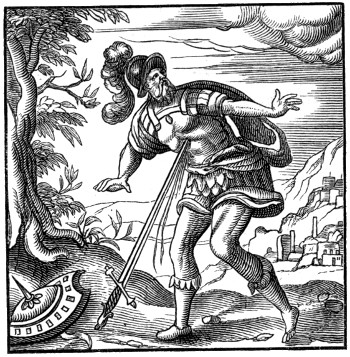
Alicat, 1581.
Cæsareo poſtquàm ſuperatus milite, vidit
Ciuili vndantem ſanguine Pharſaliam;
Jam iam ſtricturus moribunda in pectora ferrum,
Audaci hos Brutus protulit ore ſonos:
Infelix virtus; & ſolis prouida verbis,
Fortunam in rebus cur ſequeris dominam?
On the ideas here suggested Whitney enlarges, p. 70, and writes,—
“When Brvtvs knewe, Avgvstvs parte preuail’de,
And sawe his frendes, lie bleedinge on the grounde,
Such deadlie griefe, his noble harte assail’de,
That with his sworde, hee did him selfe confounde:
But firste, his frendes perswaded him to flee,
Whoe aunswer’d thus, my flighte with handes shalbee.
And bending then to blade, his bared breste,
Hee did pronounce, theise wordes with courage great:
Oh Prowes vaine, I longe did loue thee beste,
But nowe I see, thou doest on fortune waite.
Wherefore with paine, I nowe doe prouue it true,
That fortunes force, maie valiant hartes subdue.”
So, in the Julius Cæsar (act. v. sc. 5, l. 25, vol. vii. p. 413), the battle of Philippi being irretrievably lost to the party of the Republic, and Marcus Cato slain, Brutus, meditating self-destruction, desires aid from one of his friends that he may accomplish his purpose,—
“Good Volumnius,
Thou know’st that we two went to school together:
Even for that our love of old, I prithee,
Hold thou my sword-hilts, whilst I run on it.
Vol. That’s not an office for a friend, my lord.”
The alarum continues,—the friends of Brutus again remonstrate, and Clitus urges him to escape (l. 30),—
“Cli. Fly, fly, my lord; there is no tarrying here.
Bru. Farewell to you; and you; and you, Volumnius.
Strato, thou hast been all this while asleep;
Farewell to thee, too, Strato. Countrymen,
My heart doth joy that yet in all my life
I found no man but he was true to me.
I shall have glory by this losing day,
More than Octavius and Mark Antony
By this vile contest shall attain unto.
So, fare you well at once; for Brutus’ tongue
Hath almost ended his life’s history:
Night hangs upon mine eyes; my bones would rest,
That have but labour’d to attain this hour.”
Once more is the alarum raised,—“Fly, fly, fly.” “Hence, I will follow thee,” is the hero’s answer; but when friends are gone, he turns to one of his few attendants, and entreats (l. 44),—
“I prithee, Strato, stay thou by thy lord:
Thou art a fellow of a good respect;
Thy life hath had some smatch of honour in it:
Hold then my sword, and turn away thy face,
While I do run upon it. Wilt thou, Strato?
Stra. Give me your hand first: fare you well, my lord.
Bru. Farewell, good Strato. [Runs on his sword.] Cæsar, now be still:
I kill’d not thee with half so good a will.[Dies.]”
In the presence of the conquerors Strato then declares,—
“The conquerors can but make a fire of him;
For Brutus only overcame himself,
And no man else hath honour by his death.
Lucil. So Brutus should be found. I thank thee, Brutus,
That thou hast proved Lucilius’ saying true.”
And we must mark how finely the dramatist represents the victors at Philippi testifying to the virtues of their foe (l. 68),—
“Antony. This was the noblest Roman of them all:
All the conspirators, save only he,
Did that they did in envy of great Cæsar;
He only, in a general honest thought
And common good to all, made one of them.
* * * * * *
Octavius.[113] According to his virtue let us use him,
With all respect and rites of burial.
Within my tent his bones to-night shall lie,
Most like a soldier, order’d honourably.”
The mode of the catastrophe differs slightly in the two writers; and undoubtedly, in this as in most other instances, there is a very wide difference between the life and spiritedness of the dramatist, and the comparative lameness of the Emblem writers,—the former instinct with the fire of genius, the latter seldom rising above an earth-bound mediocrity; yet the references or allusions by the later poet to the earlier can scarcely be questioned; they are too decided to be the results of pure accident.
In one instance Whitney (p. 110, l. 32) hits off the characteristics of Brutus and Cassius in a single line,—
“With Brutus boulde, and Cassius, pale and wan.”
It is remarkable how Shakespeare amplifies these two epithets, “pale and wan” into a full description of the personal manner and appearance of Cassius. Cæsar and his train have re-entered upon the scene, and (act. i. sc. 2, l. 192, vol. vii. p. 329) the dictator haughtily and satirically gives order,—
“Cæs. Let me have men about me that are fat,
Sleek-headed men, and such as sleep o’ nights:
Yond Cassius has a lean and hungry look;
He thinks too much: such men are dangerous.
Ant. Fear him not, Cæsar; he’s not dangerous;
He is a noble Roman, and well given.
Cæs. Would he were fatter! but I fear him not:
Yet if my name were liable to fear,
I do not know the man I should avoid
So soon as that spare Cassius. He reads much;
He is a great observer, and he looks
Quite through the deeds of men: he loves no plays,
As thou dost, Antony; he hears no music;
Seldom he smiles, and smiles in such a sort
As if he mock’d himself and scorn’d his spirit
That could be moved to smile at any thing.
Such men as he be never at heart’s ease
Whiles they behold a greater than themselves,
And therefore are they very dangerous.”
“Pale and wan,”—two most fruitful words, certainly, to bring forth so graphic a description of men that are “very dangerous.”
Of names historic the Emblem writers give a great many examples, but only a few, within the prescribed boundaries of our subject, that are at the same time historic and Shakespearean.
Vel post mortem formidolosi,—“Even after death to be dreaded,”—is the sentiment with which Alciatus (Emblem 170), and Whitney after him (p. 194), associate the noisy drum and the shrill-sounding horn; and thus the Emblem-classic illustrates his device,—
“Cætera mutescent, coriumq. silebit ouillum,
Si confecta lupi tympana pelle sonent.
Hanc membrana ouium sic exhorrescit, vt hostem
Exanimis quamuis non ferat exanimem.
Sic cute detracta Ziscas, in tympana versus,
Boëmos potuit vincere Pontifices.”
Literally rendered the Latin elegiacs declare,—
“Other things will grow dumb, and the sheep-skin be silent,
If drums made from the hide of a wolf should sound.
Of this so sore afraid is the membrane of sheep,
That though dead it could not bear its dead foe.
So Zisca’s skin torn off, he, changed to a drum,
The Bohemian chief priests was able to conquer.”
These curious ideas Whitney adopts, and most lovingly enlarges,—
“A Secret cause, that none can comprehende,
In natures workes is often to bee seene;
As, deathe can not the ancient discorde ende,
That raigneth still, the wolfe and sheepe betweene;
The like, beside in many thinges are knowne,
The cause reueal’d, to none, but God alone.
For, as the wolfe, the sillye sheepe did feare,
And make him still to tremble, at his barke:
So beinge dead, which is most straunge to heare,
This feare remaynes, as learned men did marke;
For with their skinnes, if that two drommes bee bounde,
That, clad with sheepe, doth iarre; and hathe no sounde.
And, if that stringes bee of their intrailes wroughte,
And ioyned both, to make a siluer sounde:
No cunninge care can tune them as they oughte,
But one is harde, the other still is droun’de:
Or discordes foule, the harmonie doe marre;
And nothinge can appease this inward warre.
So, Zisca thoughte when deathe did shorte his daies,
As with his voice, hee erste did daunte his foes;
That after deathe hee shoulde new terror raise,
And make them flee, as when they felte his bloes.
Wherefore, hee charg’d that they his skinne shoulde frame,
To fitte a dromme, and marche forth with the same.
So, Hectors sighte greate feare in Greekes did worke,
When hee was showed on horsebacke, beeinge dead:
Hvniades, the terrour of the Turke,
Thoughe layed in graue, yet at his name they fled:
And cryinge babes, they ceased with the same,
The like in France, sometime did Talbots name.”
The cry[114] “A Talbot! a Talbot!” is represented by Shakespeare as sufficient in itself to make the French soldiers flee and leave their clothes behind; 1 Henry VI. (act ii. sc. 1, l. 78, vol. v. p. 29),—
Sold.i> I’ll be so bold to take what they have left.
The cry of Talbot serves me for a sword;
For I have loaden me with many spoils
Using no other weapon but his name.”
And in the same play (act ii. sc. 3, l. 11, vol. v. p. 32), when the Countess of Auvergne is visited by the dreaded Englishman, the announcement is made,—
“Mess. Madam,
According as your ladyship desired,
By message craved, so is Lord Talbot come.
Count. And he is welcome. What! is this the man?
Mess. Madam, it is.
Count. Is this the scourge of France?
Is this the Talbot, so much fear’d abroad
That with his name the mothers still their babes?”
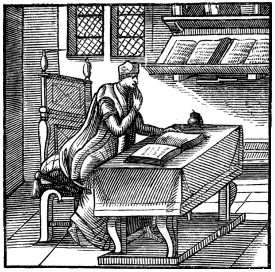
Whitney, 1586.
Five or six instances may be found in which Shakespeare introduces the word “lottery;” and, historically, the word is deserving of notice,—for it was in his boyhood that the first public lottery was set on foot in England; and judging from the nature of the prizes, he appears to have made allusion to them. There were 40,000 chances,—according to Bohn’s Standard Library Cyclopædia, vol. iii. p. 279,—sold at ten shillings each: “The prizes consisted of articles of plate, and the profit was employed for the repair of certain harbours.” The drawing took place at the west door of St. Paul’s Cathedral; it began “23rd January, 1569, and continued incessantly drawing, day and night, till the 6th of May following.”[115] How such an event should find its record in a Book of Emblems may at first be accounted strange; but in addition to her other mottoes, Queen Elizabeth had, on this occasion of the lottery, chosen a special motto, which Whitney (p. 61) attaches to the device,—
Silentium,—“Silence,”—
which, after six stanzas, he closes with the lines,—
“Th’ Ægyptians wise, and other nations farre,
Vnto this ende, Harpocrates deuis’de,
Whose finger, still did seeme his mouthe to barre,
To bid them speake, no more than that suffis’de,
Which signe thoughe oulde, wee may not yet detest,
But marke it well, if wee will liue in reste.”

Written to the like effecte, vppon
Video, & taceo.
Her Maieſties poëſie, at the great Lotterie in London,
begon M.D.LXVIII. and ended M.D.LXIX.
I See, and houlde my peace: a Princelie Poëſie righte,
For euerie faulte, ſhoulde not provoke, a Prince, or man of mighte.
For if that Iove ſhoulde ſhoote, ſo ofte as men offende,
The Poëttes ſaie, his thunderboltes ſhoulde ſoone bee at an ende.
Then happie wee that haue, a Princeſſe ſo inclin’de.
That when as iuſtice drawes hir ſworde, hath mercie in her minde,
And to declare the ſame, howe prone ſhee is to ſaue:
Her Maieſtie did make her choice, this Poëſie for to haue.
Sed piger ad pœnas princeps, ad prœmia velox:
Cuique dolet, quoties cogitur eſſe ferox.[116]
Lines from Ovid, 2 Trist., are in the margin,—
“Si quoties peccãt homines sua fulmina mittat
Jupiter, exiguo tempore inermis erit.”[117]
Silence, also, was represented by the image of the goddess Ageniora. In an Emblem-book by Peter Costalius, Pegma, edition Lyons, 1555, p. 109, he refers to her example, and concludes his stanza with the words, Si sapis à nostra disce tacere dea,—“If thou art wise, learn from our goddess to be silent.”
That Casket Scene in the Merchant of Venice (act i. sc. 2, l. 24),—from which we have already made long extracts,—contains a reference to lotteries quite in character with the prizes, “articles of plate and rich jewelry.” Portia is deeming it hard, that according to her father’s will, she “may neither choose whom she would, nor refuse whom she disliked.” “Is it not hard, Nerissa, that I cannot choose one, nor refuse none?”
“Ner. Your father was ever virtuous; and holy men, at their death, have good inspirations: therefore, the lottery, that he hath devised in these three chests of gold, silver, and lead,—whereof who chooses his meaning chooses you—will, no doubt, never be chosen by any rightly, but one who shall rightly love.”
The Prince of Morocco (act ii. sc. 1, l. 11) affirms to Portia,—
“I would not change this hue,
Except to steal your thoughts, my gentle queen;”
and Portia answers,—
“In terms of choice I am not solely led
By nice direction of a maiden’s eyes;
Besides the lottery of my destiny
Bars me the right of voluntary choosing.”
The prevalence of lotteries, too, seems to be intimated by the Clown in All’s Well that Ends Well (act i. sc. 3, l. 73, vol. iii. p. 123), when he repeats the song,—
“Among nine bad if one be good,
Among nine bad if one be good,
There’s yet one good in ten;”
and the Countess reproving him says,—
“What, one good in ten? you corrupt the song, sirrah.
Clo. One good woman in ten, madam; which is a purifying o’ the song: would God would serve the world so all the year! we’d find no fault with the tithe-woman, if I were the parson: one in ten, quoth a’! an’ we might have a good woman born but one every blazing star, or at an earthquake, ’twould mend the lottery well: a man may draw his heart out, ere a’ pluck one.”
Shakespeare’s words will receive a not inapt illustration from the sermon of a contemporary prelate, Dr. Chatterton, Bishop of Chester from 1579 to 1595, and to whom Whitney dedicated the Emblem on p. 120, Vigilantia et custodia,—“Watchfulness and guardianship.”[118] He was preaching a wedding sermon in Cambridge, and Ormerod, i. p. 146, quoting King’s Vale Royal, tells us,—
“He used this merry comparison. The choice of a wife is full of hazard, not unlike to a man groping for one fish in a barrel full of serpents: if he escape harm of the snakes, and light on the fish, he may be thought fortunate; yet let him not boast, for perhaps it may be but an eel.”
That “good woman” “to mend the lottery well,” that “one fish in a barrel full of serpents,” came, however, to the chance of one of Cæsar’s friends. Even when Antony (Antony and Cleopatra, act ii. sc. 2, l. 245, vol. ix. p. 40) was under the witchery of the “rare Egyptian queen,” that “did make defect, perfection,” the dramatist says,—
“If beauty, wisdom, modesty, can settle
The heart of Antony, Octavia is
A blessed lottery to him.”
The Emblems applicable to Shakespeare’s historical characters are only a few among the numbers that occur in the Emblem writers, as Alciat, Cousteau, Giovio, Symeoni, &c.: but our choice is limited, and there would be no pertinency in selecting devices to which in the dramas of our author there are no corresponding expressions of thought, though there may be parallelisms of subject.
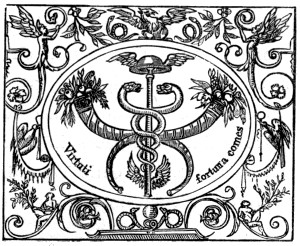
Alciat’s Arms (Giovio, ed. 1562).
Section II. HERALDIC EMBLEMS, OR EMBLEMS APPLIED TO HERALDRY.
KNOTTED together as are Emblems and the very language of Heraldry, we must expect to find Emblem writers devoting some at least of their inventions to heraldic purposes. This has been done to a very considerable extent by the Italians, especially by Paolo Giovio, Domenichi, Ruscelli, and Symeoni; but in several other authors also there occur heraldic devices among their more general emblems. These are not full coats of arms and the complete emblazonnes of “the gentleman’s science,” but rather cognizances, or badges, by which persons and families of note may be distinguished. In this respect Shakespeare entirely agrees with the Emblem writers; neither he nor they give us the quarterings complete, but they single out for honourable mention some prominent mark or sign.
I attempt not to arrange the subject according to the Rules of the Art, but to exhibit instances in which Shakespeare and the Emblematists agree, of Poetic Heraldry, the Heraldry of Reward for Heroic Achievements, and the Heraldry of Imaginative Devices.
Of Poetic Heraldry the chief type is that bird of renown, which was a favourite with Shakespeare, and from which he has been named by general consent, “the Swan of Avon.” A white swan upon a shield occurs both in Alciat and in Whitney, and is expressly named Insignia Poetarum,—“The poets’ ensigns.”
The swan, in fact, was sacred to Apollo and the Muses; and hence was supposed to be musical. Æschylus, in his Agamemnon, makes Cassandra speak of the fable, when the Chorus bewail her sad destiny (vv. 1322, 3),—
“Ἃπαξ ἔπ’ εἰπεῖν ῥῆσιν ἢ θρῆνον θέλω
ἐμὸν τὸν αὐτῆς.”
i.e.,—“Yet once again I wish for her to speak forth prophecy or lamentation, even my own,”—and Clytæmnēstra mentions the singing of the swan at the point of death (vv. 1444–7),—
“Ὁ μὲν γὰρ οὕτως· ἡ δέ τοι κύκνου δίκην
τὸν ὓστατον μέλψασα θανάσιμον γόον
κεῖται φίλητωρ, τοῦδ’, ἐμοὶ δ’ ἐπηγαγεν
εὐνης παροψώνημα τῆς ἐμῆς χλιδῆς.”
Which is to this effect: that when she has sung the last mortal lamentation, according to the custom of the swan, she lies down as a lover, and offers to me the solace of the bed of my joy.
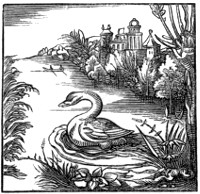
Horapollo, ed. 1551.
This notion of the singing of the swan is to be traced even to the hieroglyphics of Egypt. In answer to the question, “Πῶς γέροντα μουσικόν·”—how to represent “an old man musical?”—Horapollo, edition Paris, 1551, p. 136, replies,—
“Ιἐροντα μουσικὸν βουλόμενοι σημῇναι, κύκνον ζωγραφοῦσιν. οὑ~τος γαρ ἡδύτατον μέλος ᾅδει γηράσκων.”
i.e.—“Wishing to signify an old man musical, they paint a swan; for this bird sings its sweetest melody when growing old.” Virgil frequently speaks of swans, both as melodious and as shrill voiced. Thus in the Æneid, vii. 700–3; xi. 457,—
“Cum sese è pastu referunt, et longa canoros
Dant per colla modos: sonat amnis et Asia longè
Pulsa palus.”
i.e.—“When they return from feeding, and through their long necks give forth melodious measures; the river resounds and the Asian marsh from far.”
“Piscosóve amne Padusæ
Dant sonitum rauci per stagna loquacia cycni.”[119]
i.e.—“Or on the fish-abounding river Po the hoarse swans give forth a sound through the murmuring pools.”
Horace, Carm. iv. 2. 25, names Pindar Dircæum cycnum,—“the Dircæan swan;” and Carm. ii. 20. 10, likens himself to an album alitem,—“a white-winged creature;” which a few lines further on he terms a canorus ales,—“a melodious bird,”—and speaks of his apotheosis to immortal fame.[120]
Anacreon is called by Antipater of Sidon, Anthol. Græc. Carm. 76, κύκνος Τηϊος,—“the Teïan swan.”
Poets, too, after death, were fancifully supposed to assume the form of swans. It was believed also that swans foresaw their own death, and previously sang their own elegy. Thus in Ovid, Metam. xiv. 430,—
“Carmina jam monens canit exequialia Cygnus,”—
“Now dying the Swan chants its funereal songs.”
Very beautifully does Plato advert to this fiction in his account of the conversation of Socrates with his friends on the day of his execution. (See Phædon, Francfort edition, 1602, p. 77, 64A.) They were fearful of causing him trouble and vexation; but he reminds them they should not think him inferior in foresight to the swans; for these,—
“Fall a singing, as soon as they perceive that they are about to die, and sing far more sweetly than at any former time, being glad that they are about to go away to the God whose servants they are.... They possess the power of prophesying, and foreseeing the blessings of Hades they sing and rejoice exceedingly. Now I imagine that I am also a fellow-servant with the Swans and sacred to the same God, and that I have received from the same Master a power of foresight not inferior to theirs, so that I could depart from life itself with a mind no more cast down.”
Thus the melodious dirge of the swan was attributed to the same kind of prescience which enables good men to look forward with delight to that time “when this mortal shall put on immortality.”
The “Picta Poesis,” p. 28, adopts the same fancy of the swan singing at the end of life, but makes it the emblem of “old age eloquent.” Thus,—
“Facvnda Senectvs.
“Candida Cygnus auis suprema ætate canora est:
Inquam verti homines tabula picta docet,
Nam sunt canitie Cygni dulciq. canore,
Virtute illustres, eloquioque senes.
Dulce vetus vinum: senis est oratio dulcis,
Dulcior hoc ipso quò sapientior est.”
i.e.—“At the end of life tuneful is the bird, the white swan, into which the painted tablet teaches that men are changed, for swans are illustrious from hoariness and the sweet singing, old men illustrious for virtue and for eloquence. Old wine is sweet; of an old man sweet is the speech; sweeter, for this very cause, the wiser it is.”
Shakespeare himself adopts this notion in the Merchant of Venice (act i. sc. 2, l. 24, vol. ii. p. 286), when he says, “Holy men at their death have good inspirations.”
Reusner, however, luxuriating in every variety of silvery and snowy whiteness, represents the swan as especially the symbol of the pure simplicity of truth. (Emblemata, lib. ii. 31, pp. 91, 92, ed. 1581.)
Simplicitas veri ſana.
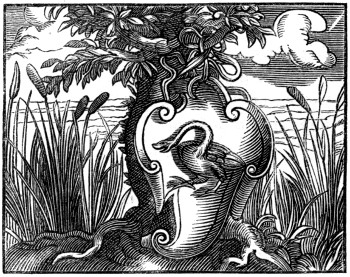
Reusner, 1581.
EMBLEMA XXXI.
“Albo candidius quid est olore,
Argento, niue, lilio, ligustro?
Fides candida, candidiq’ mores,
Et mens candida, candidi sodalis.
Te Schedi niueam fidem Melisse,
Moratum benè, candidamq’ mentem
Possidere sodalis integelli:
Ligustro niueo nitentiorem:
Argento niueo beatiorem:
Albis liliolis fragrantiorem:
Cygnis candidulis decentiorem:
Armorum niueus docet tuorum
Cygnus: liliolis decorus albis:
Phœbea redimitus ora lauro.
Albo candidior cygnus ligustro:
Argento preciosior beato:
Cui nec par eboris decus, nec auri,
Nec gemmæ valor est, nitorq’ pulcræ:
Et si pulcrius est in orbe quicquam.”
i.e.—“Than a white swan what is brighter,—than silver, snow, the lily, the privet? Bright faith and bright morals,—and the bright mind of a bright companion. That thou of good morals, O Schedius Melissus, dost possess snow-like faith, and the bright mind of an uncorrupted companion;—that (thou art) more fair than the snowy privet,—more blessed than the snowy silver,—more fragrant than the white lilies,—more comely than the little bright swans,—the snowy swan on thy arms doth teach: a swan handsome with white lilies, encircled as to its features with the laurel of Phœbus; a swan brighter than the white privet,—more precious than the blessed silver; to which cannot be equalled the comeliness of ivory, or of gold; nor the worth and the splendour of a beautiful gem: and if in the world there is any thing more beautiful still.”
To a short, but very learned dissertation on the subject, and to the device of a swan on a tomb, in his work, De Volatilibus, edition 1595, Emb. 23, Joachim Camerarius affixes the motto, “Sibi canit et orbi,”—It sings for itself and for the world,—
“Ipsa suam celebrat sibi mens bene conscia mortem,
Vt solet herbiferum Cygnus ad Eridanum.”
i.e.—“The mind conscious of good celebrates its own death for itself; as the swan is accustomed to do on the banks of the grassy Eridanus.”[121]
Shakespeare’s expressions, however, as to the swan, correspond more closely with the stanzas of Alciat (edition Lyons, 1551, p. 197) which are contained in the woodcut on next page.
Whitney (p. 126) adopts the same ideas, but enlarges upon them, and brings out a clearer moral interpretation, fortifying himself with quotations from Ovid, Reusner, and Horace,—
“The Martiall Captaines ofte, do marche into the fielde,
With Egles, or with Griphins fierce, or Dragons, in theire shielde.
But Phœbus sacred birde, let Poëttes moste commende.
Who, as it were by skill deuine, with songe forshowes his ende.
And as his tune delightes: for rarenes of the same.
So they with sweetenes of theire verse, shoulde winne a lasting name.
And as his colour white: Sincerenes doth declare.
So Poëttes must bee cleane, and pure, and must of crime beware.
For which respectes the Swanne, should in their Ensigne stande.
No forren fowle, and once suppos’de kinge of Ligvria Lande.”
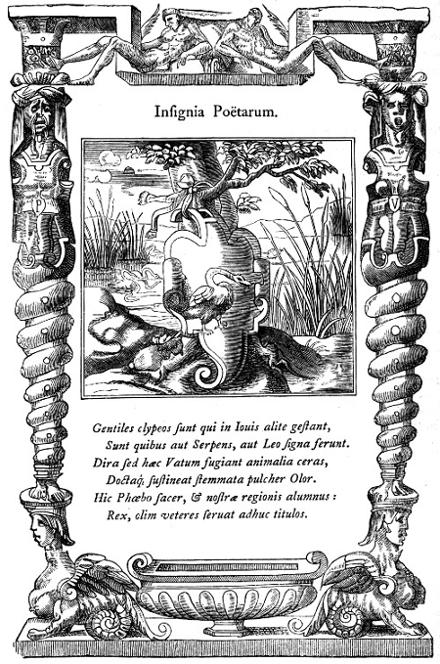
Alciat, Lugd. 1551, p. 197.
In the very spirit of these Emblems of the Swan, the great dramatist fashions some of his poetical images and most tender descriptions. Thus in King John (act v. sc. 7, lines 1–24, vol. iv. p. 91), in the Orchard Scene at Swinstead Abbey, the king being in his mortal sickness, Prince Henry demands, “Doth he still rage?” And Pembroke replies,—
“He is more patient
Than when you left him; even now he sung.
P. Hen. O vanity of sickness! fierce extremes
In their continuance will not feel themselves.
Death, having prey’d upon the outward parts,
Leaves them invisible, and his siege is now
Against the mind, the which he pricks and wounds
With many legions of strange fantasies,
Which in their throng and press to that last hold,
Confound themselves. ’Tis strange that death should sing.
I am the cygnet to this pale faint swan,
Who chants a doleful hymn to his own death,
And from the organ pipe of frailty sings
His soul and body to their lasting rest.”
To the same purport, in Henry VIII. (act iv. sc. 2, l. 77, vol. vi. p. 88), are the words of Queen Katharine, though she does not name the poet’s bird,—
“I have not long to trouble thee. Good Griffith,
Cause the musicians play me that sad note
I named my knell, whilst I sit meditating
On that celestial harmony I go to.”
And in the Casket Scene, so often alluded to (Merchant of Venice, act iii. sc. 2, l. 41, vol. ii. p. 325), when Bassanio is about to try his fortune, Portia thus addresses him,—
“If you do love me, you will find me out.
Nerissa and the rest, stand all aloof.
Let music sound while he doth make his choice;
Then, if he lose, he makes a swan-like end,
Fading in music: that the comparison
May stand more proper, my eye shall be the stream,
And watery death-bed for him. He may win;
And what is music then? Then music is
Even as the flourish when true subjects bow
To a new-crowned monarch: such it is
As are those dulcet sounds in break of day
That creep into the dreaming bridegroom’s ear
And summon him to marriage.”
In the sad ending, too, of the Moor of Venice (act v. sc. 2, l. 146, vol. viii. p. 581), after Othello had said of Desdemona,—
“Nay, had she been true,
If heaven would make me such another world
Of one entire and perfect chrysolite,
I’d not have sold her for it:”
and the full proof of innocence having been brought forward, Emilia desires to be laid by her dead “Mistress’ side,” and inquires mournfully (l. 249, p. 586),—
“What did thy song bode, lady?
Hark, canst thou hear me? I will play the swan,
And die in music. [Singing.] Willow, willow, willow.
Moor, she was chaste; she loved thee, cruel Moor,
So come my soul to bliss, as I speak true;
So speaking as I think, I die, I die. [Dies.]”
After this long dissertation anent swans, there may be readers who will press hard upon me with the couplet from Coleridge,—
“Swans sing before they die: ’twere no bad thing,
Should certain persons die before they sing.”
From Heraldry itself the Midsummer Night’s Dream (act iii. sc. 2, l. 201, vol. ii. p. 239) borrows one of its most beautiful comparisons; it is in the passage where Helena so passionately reproaches Hermia for supposed treachery,—
“O, is all forgot?
All school-days’ friendship, childhood innocence?
We, Hermia, like two artificial gods,
Have with our needles created both one flower,
Both on one sampler, sitting on one cushion,
Both warbling of one song, both in one key;
As if our hands, our sides, voices, and minds,
Had been incorporate. So we grew together,
Like to a double cherry, seeming parted;
But yet an union in partition,
Two lovely berries moulded on one stem;
So, with two seeming bodies, but one heart;
Two of the first, like coats in heraldry,
Due but to one, and crowned with one crest.”
In speaking of the Heraldry of Heroic Achievements, we may refer to the “wreath of chivalry” (p. 168), already described from the Pericles. There were, however, other wreaths which the Romans bestowed as the rewards of great and noble exploits. Several of these are set forth by the Emblem writers; we will select one from Whitney (p. 115), Fortiter & feliciter,—“Bravely and happily.”
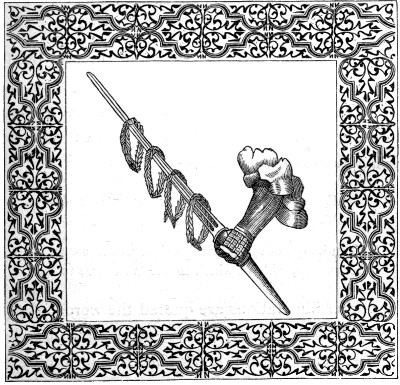
Whitney, 1586.
To this device of an armed hand grasping a spear, on which are hanging four garlands or crowns of victory, the stanzas are,—
“Marc Sergivs nowe, I maye recorde by righte,
A Romane boulde, whome foes coulde not dismaye:
Gainste Hannibal hee often shewde his mighte,
Whose righte hande loste, his lefte hee did assaye
Vntill at lengthe an iron hande hee proou’d:
And after that Cremona siege remoou’d.
Then, did defende Placentia in distresse,
And wanne twelue houldes, by dinte of sworde in France,
What triumphes great? were made for his successe,
Vnto what state did fortune him aduance?
What speares? what crounes? what garlandes hee possest;
The honours due for them, that did the beste.”
Of such honours, like poets generally, Shakespeare often tells. After the triumph at Barnet (3 Henry VI., act v. sc. 3, l. 1, vol. v. p. 324), King Edward says to his friends,—
“Thus far our fortune keeps an upward course,
And we are grac’d with wreaths of victory.”
Wreaths of honour and of victory are figured by Joachim Camerarius, “Ex Re Herbaria,” edition 1590, in the 99th Emblem. The laurel, the oak, and the olive garlands are ringed together; the motto being, “His ornari avt mori,”—With these to be adorned or to die,—
“Fronde oleæ, lauri, quercus contexta corolla
Me decoret, sine qua viuere triste mihi,”—
i.e.
“From bough of olive, laurel, oak, a woven crown
Adorns me, without which to live is sadness to me.”
Among other illustrations are quoted the words of the Iliad, which are applied to Hector, τεθνάτω, οὔ οἱ ἀεικὲς ἀμυνομένω περὶ πάτρης,—“Let death come, it is not unbecoming to him who dies defending his country.”
Of the three crowns two are named (3 Henry VI., act iv. sc. 6, l. 32, vol. v. p. 309), when Warwick rather blames the king for preferring him to Clarence, and Clarence replies,—
“No, Warwick, thou art worthy of the sway,
To whom the heavens in thy nativity
Adjudged an olive branch and laurel crown,
As likely to be blest in peace and war,
And therefore I yield thee my free consent.”
The introduction to King Richard III. (act i. sc. 1, l. 1, vol. v. p. 473) opens suddenly with Gloster’s declaration,—
“Now is the winter of our discontent
Made glorious summer by this sun of York;
And all the clouds, that lour’d upon our house,
In the deep bosom of the ocean bury’d.”
“Sun of York” is a direct allusion to the heraldic cognizance which Edward IV. adopted, “in memory,” we are told, “of the three suns,” which are said to have appeared at the battle which he gained over the Lancastrians at Mortimer’s Cross. Richard then adds,—
“Now are our brows bound with victorious wreaths,
Our bruised arms hung up for monuments;
Our stern alarums changed to merry meetings,
Our dreadful marches to delightful measures.”
We meet, too, in the Pericles (act ii. sc. 3, l. 9, vol. ix. p. 345) with the words of Thaisa to the victor,—
“But you, my knight and guest;
To whom this wreath of victory I give,
And crown you king of this day’s happiness.”
But in the pure Roman manner, and according to the usage of Emblematists, Shakespeare also tells of “victors’ crowns;” following, as would appear, “Les Devises Heroiqves” of Paradin, edition Anvers, 1562, f. 147 verso, which contains several instances of garlands for noble brows. Of these, one is entitled, Seruati gratia ciuis,—“For sake of a citizen saved.”
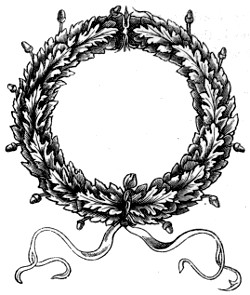
The garland is thus described in Paradin’s French,—
“La Courõne, apellee Ciuique, eſtoit dõnee par le Citoyẽ, au Citoyẽ qu’il auoit ſauué en guerre: en repreſentatiõ de vie ſauuee. Et eſtoit cete Courõne, tiſſue de fueilles, ou petis rameaus de Cheſne: pour autãt qu’au Cheſne, la vielle antiquité, ſouloit prẽdre ſa ſubſtãce, ſõ mãger, ou sa nourriture.”
i.e.—“The crown called Civic was given by the Citizen to the Citizen[122] whom he had saved in war; in testimony of life saved. And this Crown was an inweaving of leaves or small branches of Oak; inasmuch as from the Oak, old antiquity was accustomed to take its subsistence, its food, or its nourishment.”
“Among the rewards” for the Roman soldiery, remarks Eschenburg (Manual of Classical Literature, p. 274), “golden or gilded crowns were particularly common; as, the corona castrensis, or vallaris, to him who first entered the enemy’s entrenchments; corona muralis, to him who first scaled the enemy’s walls; and corona navalis, for seizing a vessel of the enemy in a sea-fight; also wreaths and crowns formed of leaves and blossoms; as the corona civica, of oak leaves, conferred for freeing a citizen from death or captivity at the hands of the enemy; the corona obsidionalis, of grass, for delivering a besieged city; and the corona triumphalis, of laurel, worn by a triumphing general.”
Shakespeare’s acquaintance with these Roman customs we find, where we should expect it to be, in the Coriolanus and in the Julius Cæsar. Let us take the instances; first, from the Coriolanus, act i. sc. 9, l. 58, vol. vi. p. 304; act i. sc. 3, l. 7, p. 287; act ii. sc. 2, l. 84, p. 323; and act ii. sc. 1, l. 109, p. 312. Cominius thanks the gods that “our Rome hath such a soldier” as Caius Marcius, and declares (act i. sc. 9, l. 58),—
“Therefore, be it known,
As to us, to all the world, that Caius Marcius
Wears this war’s garland: in token of the which,
My noble steed, known to the camp, I give him,
With all his trim belonging; and from this time.
For what he did before Corioli, call him,
With all the applause and clamour of the host,
Caius Marcius Coriolanus. Bear
The addition nobly ever!”
With most motherly pride Volumnia rehearses the brave deed to Virgilia, her son’s wife (act i. sc. 3, l. 7),—
“When, for a day of kings’ entreaties, a mother should not sell him an hour from her beholding; I, considering how honour would become such a person; that it was no better than picture-like to hang by the wall, if renown made it not stir, was pleased to let him seek danger where he was like to find fame. To a cruel war I sent him; from whence he returned, his brows bound with oak. I tell thee, daughter, I sprang not more in joy at first hearing he was a man-child than now in first seeing he had proved himself a man.”
And the gaining of that early renown is most graphically drawn by Cominius, the consul (act ii. sc. 2, l. 84),—
“At sixteen years,
When Tarquin made a head for Rome, he fought
Beyond the mark of others: our then dictator,
Whom with all praise I point at, saw him fight,
When with his Amazonian chin he drove
The bristled lips before him: he bestrid
An o'er press’d Roman, and i’ the consul’s view
Slew three opposers: Tarquin’s self he met,
And struck him on his knee: in that day’s feats,
When he might act the woman in the scene,
He proved best man i’ the field, and for his meed
Was brow-bound with the oak. His pupil age
Man-enter’d thus, he waxed like a sea;
And, in the brunt of seventeen battles since,
He lurch’d all swords of the garland.”
The successful general is expected in Rome, and this dialogue is held between Menenius, Virgilia, and Volumnia (act ii. sc. 1, l. 109, p. 312),—
“Men. Is he not wounded? he was wont to come home wounded.
Vir. O, no, no, no.
Vol. O, he is wounded; I thank the gods for’t.
Men. So do I too, if it be not too much: brings a’ victory in his pocket? The wounds become him.
Vol. On’s brows: Menenius, he comes the third time home with the oaken garland.”
Next, we have an instance from the Julius Cæsar (act v. sc. 3, l. 80, vol. vii. p. 409), on the field of Philippi, when “in his red blood Cassius’ day is set,” Titanius asks,—
“Why didst thou send me forth, brave Cassius?
Did I not meet thy friends? and did not they
Put on my brows this wreath of victory,
And bid me give it thee? Didst thou not hear their shouts?
Alas, thou hast misconstrued every thing!
But, hold thee, take this garland on thy brow;
Thy Brutus bid me give it thee, and I
Will do his bidding.”
The heraldry of honours from sovereign princes, as testified to, both by Paradin in his “Devises Heroiqves,” edition Antwerp, 1562, folio 12v, and 25, 26, and by Shakespeare, embraces but two or three instances, and is comprised in the magniloquent lines (1 Henry VI., act iv. sc. 7, l. 60, vol. v. p. 80) in which Sir William Lucy inquires,—
“But where’s the great Alcides of the field,
Valiant Lord Talbot, Earl of Shrewsbury,
Created, for his rare success in arms,
Great Earl of Washford, Waterford and Valence;
Lord Talbot of Goodrig and Urchinfield,
Lord Strange of Blackmere, Lord Verdun of Alton,
Lord Cromwell of Wingfield, Lord Furnival of Sheffield,
The thrice-victorious Lord of Falconbridge:
Knight of the noble order of Saint George,
Worthy Saint Michael and the Golden Fleece;
Great marshal to Henry the Sixth
Of all his wars within the realm of France?”
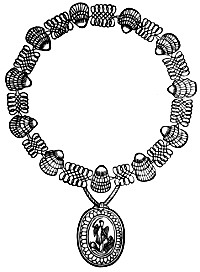
Paradin, ed. 1562, p. 12v.
From Paradin we learn that the Order of St. Michael had for its motto Immensi tremor Oceani,—“The trembling of the immeasurable ocean,”—and for its badge the adjoining collar.—
“This order was instituted by Louis XI., King of France, in the year 1469.[123] He directed for its ensign and device a collar of gold, made with shells laced together in a double row, held firm upon little chains or meshes of gold; in the middle of which collar on a rock was a gold-image of Saint Michael, appearing in the front. And this the king did (with respect to the Archangel) in imitation of King Charles VII. his father; who had formerly borne that image as his ensign, even at his entry into Rouen. By reason always (it is said) of the apparition, on the bridge of Orleans, of Saint Michael defending the city against the English in a famous attack. This collar then of the royal order and device of the Knights of the same is the sign or true ensign of their nobleness, virtue, concord, fidelity and friendship; Pledge, reward and remuneration of their valour and prowess. By the richness and purity of the gold are pointed out their high rank and grandeur; by the similarity or likeness of its shells, their equality, or the equal fraternity of the Order (following the Roman senators, who also bore shells on their arms for an ensign and a device); by the double lacing of them together, their invincible and indissoluble union; and by the image of Saint Michael, victory over the most dangerous enemy. A device then instituted for the solace, protection and assurance of this so noble a kingdom; and, on the contrary, for the terror, dread and confusion of the enemies of the same.”
Precium non vile laborum,—
“No mean reward of labours.”
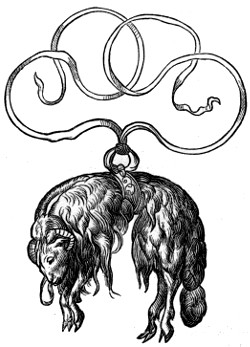
Paradin, 1562.
Paradin (f. 25) is also our authority with respect to the Order of the Golden Fleece, its motto and device being thus presented:—
“The order of the Golden Fleece,” says Paradin, “was instituted by Philip, Duke of Burgundy, styled the Good, in the year 1429, for which he named[124] twenty-four Knights without reproach, besides himself, as chief and founder, and gave to each one of them for ensign of the said Order a Collar of gold composed of his device of the Fusil, with the Fleece of gold appearing in front; and this (as people say) was in imitation of that which Jason acquired in Colchis, taken customarily for Virtue, long so much loved by this good Duke, that he merited this surname of Goodness, and other praises contained on his Epitaph, where there is mention made of this Order of the Fleece, in the person of the Duke saying,—
'Pour maintenir l’Eglise, qui est de Dieu maison,
J’ai mis sus le noble Ordre, qu’on nomme la Toison.'”
The expedition of the Argonauts, and Jason’s carrying off of the Golden Fleece may here be appropriately mentioned; they are referred to by the Emblem writers, as well as the exploit of Phrixus, the brother of Helle, in swimming across the Hellespont on the golden-fleeced ram. The former Whitney introduces when describing the then new and wonderful circumnavigation of the globe by Sir Francis Drake (p. 203),—
“Let Græcia then forbeare, to praise her Iason boulde?
Who throughe the watchfull dragons pass’d, to win the fleece of goulde.
Since by Medeas helpe, they weare inchaunted all,
And Iason without perrilles, pass’de: the conqueste therfore small?
But, hee, of whome I write, this noble minded Drake,
Did bringe away his goulden fleece, when thousand eies did wake.”
Diues indoctus.
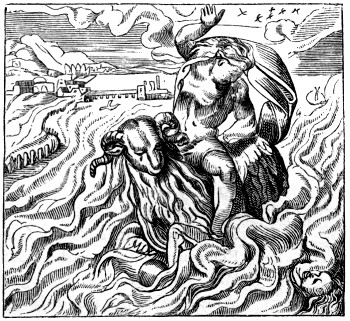
Alciat, 1551.
Tranat aquas reſidẽs precioſo in vellere Phrixus,
Et flauam impauidus per mare ſcandit ouem.
Ecquid id est? vir ſenſu hebeti, ſed diuite gaza,
Coniugis aut ſerui quem regit arbitrium.
The latter forms the subject of one of Alciat’s Emblems, edition Antwerp, 1581, Emb. 189, in which, seated on the precious fleece, Phrixus crosses the waters, and fearless in the midst of the sea mounts the tawny sheep, the type of “the rich man unlearned.” Whitney (p. 214) substitutes In diuitem, indoctum,—“To the rich man, unlearned,”—and thus paraphrases the original,—
“On goulden fleece, did Phryxus passe the waue,
And landed safe, within the wished baie:
By which is ment, the fooles that riches haue,
Supported are, and borne throughe Lande, and Sea:
And those enrich’de by wife, or seruauntes goodds,
Are borne by them like Phryxus through the floodds.”
In a similar emblem, Beza, edition Geneva, 1580, Emb. 3, alludes to the daring deed of Phrixus,—
“Aurea mendaci vates non vnicvs ore
Vellera phrixeæ commemorauit ouis.
Nos, te, Christe, agnum canimus. Nam diuite gestas
Tu verè veras vellere solus opes.”
Thus rendered in the French version,—
“Maint poete discourt de sa bouche menteuse
Sur vne toison d’or. Nous, à iuste raison,
Te chantons, Christ, agneau, dont la riche toison
Est l’vnique thresor qui rend l’Eglise heureuse.”
The Merchant of Venice (act. i. sc. 1, l. 161, vol. ii. p. 284) presents Shakespeare’s counterpart to the Emblematists; it is in Bassanio’s laudatory description of Portia, as herself the golden fleece,—
“In Belmont is a lady richly left;
And she is fair, and, fairer than that word,
Of wondrous virtues: sometimes from her eyes
I did receive fair speechless messages:
Her name is Portia; nothing undervalued
To Cato’s daughter, Brutus’ Portia:
Nor is the wide world ignorant of her worth;
For the four winds blow in from every coast
Renowned suitors: and her sunny locks
Hang on her temples like a golden fleece:
Which makes her seat of Belmont Colchos strand,
And many Jasons come in quest of her.”
To this may be added a line or two by Gratiano, l. 241, p. 332,—
“How doth that royal merchant, good Antonio?
I know he will be glad of our success;
We are the Jasons, we have won the fleece.”
The heraldry of Imaginative Devices in its very nature offers a wide field where the fancy may disport itself. Here things the most incongruous may meet, and the very contrariety only justify their being placed side by side.
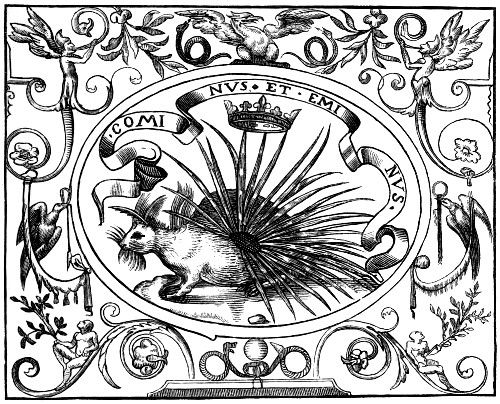
Let us begin with the device, as given in the “Tetrastichi Morali,” p. 56, edition Lyons, 1561, by Giovio and Symeoni, used between 1498 and 1515; it is the device
DI LVIGI XII. RE
DI FRANCIA.
Giovio and Symeoni, 1561.
to the motto, “Hand to hand and afar off”—
Cominus & eminus.
Di lontano & da preſſo il Re Luigi,
Feri’l nimico, & lo riduſſe à tale,
Che dall’ Indico al lito Occidentale
Di ſua virtù ſi veggiono i veſtigi.
A Porcupine is the badge, and the stanza declares,—
“From far and from near the King Louis,
Smites the enemy and so reduces him,
That from the Indian to the Western shore,
Of his valour the traces are seen.”
Camerarius with the same motto and the like device testifies that this was the badge of Louis XI., king of France, to whose praise he also devotes a stanza,—
“Cominus ut pugnat jaculis, atq. eminus histrix,
Rex bonus esto armis consiliisque potens.”
i.e.
“As close at hand and far off the porcupine fights with its spines,
Let a good king be powerful in arms and in counsels.”
It was this Louis who laid claim to Milan, and carried Ludovic Sforza prisoner to France. He defeated the Genoese after their revolt, and by great personal bravery gained the victory of Agnadel over the Venetians in 1509. At the same time he made war on Spain, England, Rome, and Switzerland, and was in very deed the porcupine darting quills on every side.
The well known application in Hamlet (act. i. sc. 5, l. 13, vol. viii. p. 35) of the chief characteristic of this vexing creature is part of the declaration which the Ghost makes to the Prince of Denmark,—
“But that I am forbid
To tell the secrets of my prison-house,
I could a tale unfold whose lightest word
Would harrow up thy soul, freeze thy young blood,
Make thy two eyes, like stars, start from their spheres,
Thy knotted and combined locks to part
And each particular hair to stand an end,
Like quills upon the fretful porpentine.”
And of “John Cade of Ashford,” in 2 Henry VI. (act. iii. sc. 1, l. 360, vol. v. p. 162), the Duke of York avers,—
“In Ireland I have seen this stubborn Cade
Oppose himself against a troop of kernes;
And fought so long, ’till that his thighs with darts
Were almost like a sharp-quill’d porcupine.”
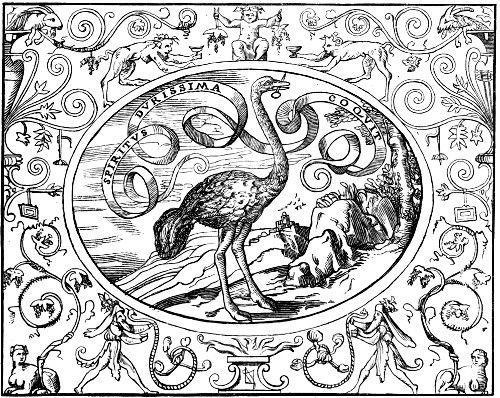
From the same source, Giovio’s and Symeoni’s “Sententiose Imprese,” Lyons, 1561, p. 115, we also derive the cognizance,—
DEL CAPITANO GIROLAMO
MATTEI ROMANO.
Giovio and Symeoni, 1561.
Diuora il ſtruzzo con ingorda furia
Il ferro, & lo ſmaltiſce poi pian piano,
Coſi (come dipinge il buon Romano)
Smaltir fa il tempo ogni maggiore ingiuria.
Spiritus duriſſima
coquit.
To this Ostrich, with a large iron nail in its mouth, and with a scroll inscribed, “Courage digests the hardest things,” the stanza is devoted which means,—
“Devour does the ostrich with eager greediness
The iron, and then very easily digests it,
So (as the good Romano represents)
Time causes every injury to be digested.”
Camerarius, to the same motto, Ex Volatilibus (ed. 1595, p. 19), treats us to a similar couplet,—
“Magno animo fortis perferre pericula suevit,
Vllo nec facile frangitur ille metu.”
i.e.
“With mighty mind the brave grows accustomed to bear dangers,
Nor easily is that man broken by any fear.”
Shakespeare’s description of the ostrich, as given by Jack Cade, 2 Henry VI. (act iv. sc. 10, l. 23, vol. v. p. 206), is in close agreement with the ostrich device,—
“Here’s the lord of the soil,” he says, “come to seize me for a stray, for entering his fee-simple without leave. Ah, villain, thou wilt betray me, and get a thousand crowns of the king for carrying my head to him; but I’ll make thee eat iron like an ostrich, and swallow my sword like a great pin, ere thou and I part.”
Note the iron pin in the ostrich’s mouth.
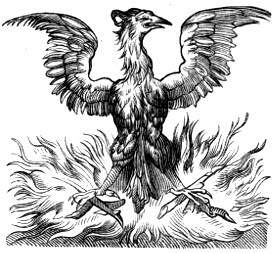
Sola facta ſolum Deum ſequor.
Paradin, 1562.
“My Lady Bona of Savoy,” as Paradin (ed. 1562, fol. 165) names her, “the mother of Ian Galeaz, Duke of Milan, finding herself a widow, made a device on her small coins of a Phœnix in the midst of a fire, with these words, ‘Being made lonely, I follow God alone.’ Wishing to signify that, as there is in the world but one Phœnix, even so being left by herself, she wished only to love conformably to the only God, in order to live eternally.”[125]
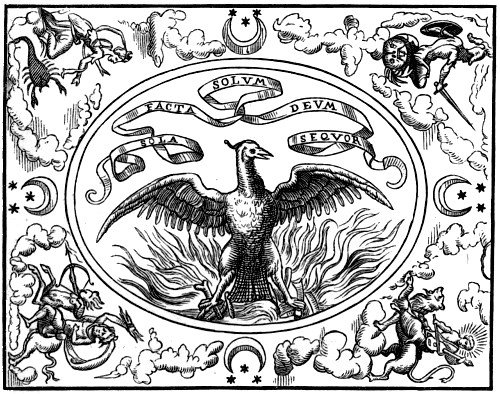
The “Tetrastichi Morali” presents the same Emblem, as indeed do Giovio’s “Dialogo dell’ Imprese,” &c., ed. Lyons, 1574, and “Dialogve des Devises,” &c., ed. Lyons, 1561;
DI MADAMA BONA
DI SAVIOA.
Giovio, 1574 (diminished).
with the same motto, and the invariable Italian Quatrain,—
Sola facta solũ
Deũ sequor.
Perduto ch’ hebbe il fido ſuo conſorte
La nobil Donna, qual Fenice ſola,
A Dio volſe ogni priego, ogni parola,
Dando vita al penſier con l’ altrui morte.
In English,—
“Lost had she her faithful consort,
The noble Lady, as a Phœnix lonely,
To God wills every prayer, every word
Giving life to consider death with others.”
The full description and characteristics of the Phœnix we reserve for the section which treats of Emblems for Poetic Ideas; but the loneliness, or if I may use the term, the oneliness of this fabulous bird Shakespeare occasionally dwells upon.
In the Cymbeline (act i. sc. 6, l. 12, vol. ix. p. 183), Posthumus and Iachimo had made a wager as to the superior qualities and beauties of their respective ladies, and Iachimo takes from Leonatus an introduction to Imogen; the Dialogue thus proceeds,—
“Iach. The worthy Leonatus is in safety,
And greets your highness dearly. [Presents a letter.
Imo. Thanks, good sir:
You're kindly welcome.
Iach. [Aside.] All of her that is out of door most rich!
If she be furnish’d with a mind so rare,
She is alone the Arabian bird, and I
Have lost the wager.”
Rosalind, in As You Like It (act iv. sc. 3, l. 15, vol. ii. p. 442), thus speaks of the letter which Phebe, the shepherdess, had sent her,—
“She says I am not fair, that I lack manners;
She calls me proud, and that she could not love me,
Were man as rare as phœnix.”
The oneliness of the bird is, too, well set forth in the Tempest (act iii. sc. 3, l. 22, vol. i. p. 50),—
“In Arabia
There is one tree, the phœnix' throne; one phœnix
At this hour reigning there.”
To the Heraldry of Imaginative Devices might be referred the greater part of the coats of arms, badges and cognizances by which noble and gentle families are distinguished. To conclude this branch of our subject, I will name a woodcut which was probably peculiar to Geffrey Whitney at the time when Shakespeare wrote, though accessible to the dramatist from other sources; it is the fine frontispiece to the Choice of Emblemes, setting forth the heraldic honours and arms of Robert, Earl of Leycester, and in part of his brother, Ambrose, Earl of Warwick. Each of these noblemen bore the same crest, and it was, what Shakespeare, 2 Henry VI. (act v. sc. 1, l. 203, vol. v. p. 215), terms “the rampant bear chained to the ragged staff.”
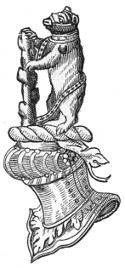
Whitney, 1586.
How long this had been the cognizance of the Earls of Warwick, and whether it was borne by all the various families of the Saxon and Norman races who held the title,—by the Beauchamps, the Nevilles, and the Dudleys, admits of doubt; but it is certain that such was the cognizance in the reign of Henry VI. and in that of Elizabeth.
According to Dugdale’s Antiquities of Warwickshire, edition 1730, p. 398, the monument of Thomas Beauchamp, Earl of Warwick in Edward III.’s time, has a lion, not a bear; and a lamb for his Countess, the Lady Katherine Mortimer. Also on the monument of another Earl (p. 404), who died in 1401, the bear does not appear; but on the monument of Richard Beauchamp, who died “the last day of Aprill, the year of our lord god 1434,” the inscriptions are crowded with bears, instead of commas and colons; and the recumbent figure of the Earl has a muzzled bear at his feet (p. 410). The Nevilles now succeeded to the title, and a limner’s or designer’s very curious bill, of the fifteenth year of Henry VI., 1438, shows that the bear and ragged staff were then both in use and in honour,—
“First CCCC Pencels bete with the Raggidde staffe of silver
pris the pece v d. 08l. 06s. 00
Item for a grete Stremour for the Ship of XI yerdis length and
IIII yerdis in brede, with a grete Bere and Gryfon holding
a Raggid staffe, poudrid full of raggid staves; and for a
grate Crosse of S. George for the lymmynge and portraying 01 . 06 . 08
Item XVIII Standardes of worsted, entretailled with the
Bere and a Chayne, pris the pece xii d. 00 . 18 . 00”
Among the monuments in the Lady Chapel at Warwick is a full length figure of “Ambrose Duddeley,” who died in 1589, and of a muzzled bear crouching at his feet. Robert Dudley, Earl of Leycester, his brother, died in 1588; and on his magnificent tomb, in the same chapel, is seen the same cognizance of the bear and ragged staff. The armorial bearings, however, are a little different from those which Whitney figures.
If, according to the Cambridge edition of Shakespeare’s works, 1863–1866, vol. v. p. vii., “the play upon which the Second part of Henry the Sixth was founded was first printed in quarto, in 1594;” or if, as some with as much reason have supposed,[126] it existed even previous to 1591, it is not likely that these monuments of elaborate design and costly and skilled workmanship could have been completed, so that from them Shakespeare had taken his description of “old Nevil’s crest.” Nathan Drake’s Shakspeare and his Times (vol. i. pp. 410, 416) tells us that he left Stratford for London “about the year 1586, or 1587;” yet “the family residence of Shakspeare was always at Stratford: that he himself originally went alone to London, and that he spent the greater part of every year there alone, annually, however, and probably for some months, returning to the bosom of his family, and that this alternation continued until he finally left the capital.”
Of course, had the monuments in question existed before the composition of the Henry VI., his annual visits to his native Warwickshire would have made them known to him, and he would thus have noted the family cognizance of the brother Earls; but reason favours the conjecture that these monuments in the Lady Chapel were not the sources of his knowledge.
Common rumour, indeed, may have supplied the information; but as Geffrey Whitney’s book appeared in 1586, its first novelty would be around it about the time at which Shakespeare was engaged in producing his Henry VI. That Emblem-book was dedicated to “Robert Earle of Leycester;” and, as we have said, contains a drawing, remarkably graphic, of a bear grasping a ragged staff, having a collar and chain around him, and standing erect on the helmet’s burgonet. There is also a less elaborate sketch of the same badge on the title-page to the second part of Whitney’s Emblemes, p. 105.
Most exactly, most artistically, does the dramatist ascribe the same crest, in the same attitude, and in the same standing place, to Richard Nevil, Earl of Warwick, the king-setter-up and putter-down of History. In the fields between Dartford and Blackheath, in Kent, the two armies of Lancaster and York are encamped; in the Dialogue, there is almost a direct challenge from Lord Clifford to Warwick to meet upon the battle-field. York is charged as a traitor by Clifford (2 Henry VI., act v. sc. 1, l. 143, vol. v. p. 213), but replies,—
“I am the king, and thou a false-heart traitor.
Call hither to the stake my two brave bears,
That with the very shaking of their chains
They may astonish these fell-lurking curs:
Bid Salisbury and Warwick come to me.
Enter the Earls of Warwick and Salisbury.
Clif. Are these thy bears? we’ll bait thy bears to death,
And manacle the bear-ward in their chains,
If thou darest bring them to the baiting place.
Rich. Oft have I seen a hot o’erweening cur
Run back and bite, because he was withheld;
Who, being suffer’d with the bear’s fell paw,
Hath clapp’d his tail between his legs and cried:
And such a piece of service will you do,
If you oppose yourselves to match Lord Warwick.”
The Dialogue continues until just afterwards Warwick makes this taunting remark to Clifford (l. 196),—
“War. You were best to go to bed and dream again,
To keep thee from the tempest of the field.
Clif. I am resolved to bear a greater storm
Than any thou canst conjure up to-day;
And that I’ll write upon thy burgonet,
Might I but know thee by thy household badge.
War. Now, by my father’s badge, old Nevil’s crest,
The rampant bear chain’d to the ragged staff,
This day I’ll wear aloft my burgonet,
As on a mountain top the cedar shows
That keeps his leaves in spite of any storm,
Even to affright thee with the view thereof.
Clif. And from thy burgonet I’ll rend thy bear
And tread it underfoot with all contempt,
Despite the bear-ward that protects the bear.”
A closer correspondence between a picture and a description of it cannot be desired; Shakespeare’s lines and Whitney’s frontispiece exactly coincide;
“Like coats in heraldry
Due but to one, and crowned with one crest.”
By Euclid’s axiom, “magnitudes which coincide are equal;” and though the reasonings in geometry and those in heraldry are by no means of forces identical, it may be a just conclusion; therefore, the coincidences and parallelisms of Shakespeare, with respect to Heraldic Emblems, have their original lines and sources in such writers as Giovio, Paradin, and Whitney. It was not he who set up the ancient fortifications, but he has drawn circumvallations around them, and his towers nod over against theirs, though with no hostile rivalry.
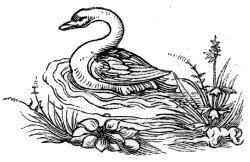
Horapollo, ed. 1551.
Section III. EMBLEMS FOR MYTHOLOGICAL CHARACTERS.
ECHO has not more voices than Mythology has transmutations, eccentricities, and cunningly devised fancies,—and every one of them has its tale or its narrative—its poetic tissues woven of such an exquisite thinness that they leave no shadows where they pass. The mythologies of Egypt and of Greece, of Etruria and of Rome, in all their varying phases of absolute fiction and substantial truth, perverted by an unguarded imagination, were the richest mines that the Emblem writers attempted to work; they delighted in the freedom with which the fancy seemed invited to rove from gem to gem, and luxuriated in the many forms into which their fables might diverge. Now they touched upon Jove’s thunder, or on the laurel for poets’ brows, which the lightning’s flash could not harm—then on the beauty and gracefulness of Venus, or on the doves that fluttered near her car;—Dian’s severe strictness supplied them with a theme, or Juno with her queenly birds; and they did not disdain to tell of Bacchus and the vine, of Circe, and Ulysses, and the Sirens. The slaying of Niobe’s children, Actæon seized by his hounds, and Prometheus chained to the rock, Arion rescued by the dolphin, and Thetis at the tomb of Achilles,—these and many other myths and tales of antiquity grew up in the minds of Emblematists, self-sown—ornaments, if not utilities.
Though the great epic poems are inwrought throughout with the mosaic work of fables that passed for divine, and of exploits that were almost more than human, Ovid’s Metamorphoses, printed as early as 1471, and of which an early French edition, in 1484, bears the title La Bible des poetes, may be regarded as the chief storehouse of mythological adventure and misadventure. The revival of literature poured forth the work in various forms and languages. Spain had her translation in 1494, and Italy in 1497; and as Brunet informs us (vol. iv. c. 277), to another of Ovid’s books, printed in Piedmont before 1473, there was this singularly incongruous subscription, “Laus Deo et Virgini Mariæ Gloriosissimæ Johannes Glim.” Caxton, in England, led the way by printing Ovid’s Metamorphoses in 1480, which Arthur Golding may be said to have completed in 1567 by his English Metrical Version.
Thus everywhere was the storehouse of mythology open; and of the Roman fabulist the Emblem writers, as far as they could, made a Book of Emblems, and often into their own works transported freely what they had found in his.
And for a poet of no great depth of pure learning, but of unsurpassed natural power and genius, like Shakespeare, no class of books would attract his attention and furnish him with ideas and suggestions so readily as the Emblem writers of the Latin and Teutonic races. “The eye,” which he describes, “in a fine phrensy rolling,” would suffice to take in at a single glance many of the pictorial illustrations which others of duller sensibilities would only master by laborious study; and though undoubtedly, from the accuracy with which Shakespeare has depicted ancient ideas and characters, and shown his familiarity with ancient customs, usages, and events, he must have read much and thought much, or else have thought intuitively, it is a most reasonable conjecture that the popular literature of his times—the illustrated Emblem-books, which made their way of welcome among the chief nations of middle, western, and southern Europe—should have been one of the fountains at which he gained knowledge. Nature, indeed, forms the poet, and his storehouses of materials on which to work are the inner and outer worlds, first of his own consciousness, and next of heaven and earth spread before him. But as a portion of this latter world we may name the appliances and results of artistic skill in its delineations of outward forms, and in the fixedness which it gives to many of the conceptions of the mind. To the artist himself, and to the poet not less than to the artist, the pictured shapes and groupings of mythological or fabulous beings are most suggestive, both of thoughts already embodied there, and also of other thoughts to be afterwards combined and expressed.
Hence would the Emblem-books, on some of which the foremost painters and engravers had not disdained to bestow their powers, become to poets especially fruitful in instruction. A proverb, a fable, an old world deity is set forth by the pencil and the graving tool, and the combination supplies additional elements of reflection. Thus, doubtless, did Shakespeare use such works; and not merely are some of his thoughts and expressions in unison with them, but moulded and modified by them.
For much indeed of his mythological lore he was indebted to Ovid’s Metamorphoses, or, rather, I should say, to “Ovid’s Metamorphoses translated out of Latin in English metre by Arthur Golding, gent. A worke very pleasaunt and delectable; 4to London 1565.” That he did attend to Golding’s couplet,—
“With skill, heed, and judgment, thys work must be red,
For els too the reader it stands in small stead,”—
will appear from some few instances; as,—
“Thy promises are like Adonis’ gardens
That one day bloom’d, and fruitful were the next.”—
1 Hen. VI., act i. sc. 6, l. 6.
“Apollo flies and Daphne holds the chase,
The dove pursues the griffin; the mild hind
Makes speed to catch the tiger.”—
Midsummer Night’s Dream, act ii. sc. 1, l. 231.
“We still have slept together,
Rose at an instant, learn’d, play’d, eat together,
And wheresoe’er we went, like Juno’s swans,
Still we went coupled and inseparable.”
As You Like It, act i. sc. 3, l. 69.
“Approach the chamber and destroy your sight
With a new Gorgon.”
Macbeth, act ii. sc. 3, l. 67.
“I’ll have no worse a name than Jove’s own page;
And therefore look you call me Ganymede.”
As You Like It, act i. sc. 3, l. 120.
and,—
“O Proserpina,
For the flowers now, that frighted thou let’st fall
From Dis’s waggon! daffodils,
That come before the swallow dares, and take
The winds of March with beauty; violets dim
But sweeter than the lids of Juno’s eyes
Or Cytherea’s breath; pale primroses,
That die unmarried, ere they can behold
Bright Phœbus in his strength, a malady
Most incident to maids; bold oxlips and
The crown imperial; lilies of all kinds,
The flower-de-luce being one! O, these I lack
To make you garlands of; and my sweet friend
To strew him o'er and o'er!”
Winter’s Tale, act iv. sc. 4, l. 116.
Yet from the Emblem writers as well he appears to have derived many of his mythological allusions and expressions; we may trace this generally, and with respect to some of the Heathen Divinities,—to several of the ancient Heroes and Heroines, we may note that they supply him with most beautiful personifications.
Generally, as in Troilus and Cressida (act ii. sc. 3, l. 240), the expression “bull-bearing Milo” finds its device in the Emblemata of Lebeus Batillius, edition Francfort, 1596, where we are told that “Milo by long custom in carrying the calf could also carry it when it had grown to be a bull.” In Romeo and Juliet (act ii. sc. 5, l. 8) the lines,—
“Therefore do nimble-pinion’d doves draw love
And therefore hath the wind swift Cupid wings.”
We have the scene pictured in Corrozet’s Hecatomgraphie, Paris, 1540, leaf 70, with, however, a very grand profession of regard for the public good,—
“Ce n’est pas cy Cupido ieune enfant
Que vous voier au carre triumphant,
Mais c’est amour lequel tiẽt en sa corde
Tous les estatz en grãd paix & cõcorde.”
In Richard II.(act iii. sc. 2, l. 24) Shakespeare seems to have in view the act of Cadmus, when he sowed the serpent’s teeth,—
“This earth shall have a feeling and these stones
Prove armed soldiers, ere her native king
Shall falter under foul rebellion’s arms.”
And the device which emblematizes the fact occurs in Symeoni’s abbreviation of the Metamorphoses into the form of Italian Epigrams (edition Lyons, 1559, device 41, p. 52).
And lastly, in 3 Henry VI. (act v. sc. 1, l. 34), from a few lines of dialogue between Warwick and King Edward, we read,—
“War. ’Twas I that gave the kingdom to thy brother.
K. Edw. Why then ’tis mine, if but by Warwick’s gift.
War. Thou art no Atlas for so great a weight;
And weakling, Warwick takes his gift again.”
But a better comment cannot be than is found in Giovio’s “Dialogve,” edition Lyons, 1561, p. 129, with Atlas carrying the Globe of the Heavens, and with the motto, “Svstinet nec fatiscit,”—He bears nor grows weary.
The story of Jupiter and Io is presented in the Emblem-books by Symeoni, 1561, and by the Plantinian edition of Ovid’s Metamorphoses, Antwerp, 1591, p. 35. From the latter, were it needed, we could easily have added a pictorial illustration to the Taming of the Shrew (Induction, sc. 2, l. 52),—
“We'll show thee Io as she was a maid
And how she was beguiled and surprised,
As lively painted as the deed was done.”
The Antony and Cleopatra (act ii. sc. 7, l. 101, vol. ix. p. 60), in one part, presents the banquet, or, rather, the drinking bout, between Cæsar, Antony, Pompey, and Lepidus, “the third part of the world.” Enobarbus addresses Antony,—
“Eno. [To Antony.] Ha, my brave emperor!
Shall we dance now the Egyptian Bacchanals,
And celebrate our drink?
Pom. Let’s ha’t, good soldier.
Ant. Come, let’s all take hands,
Till that the conquering wine hath steep’d our sense
In soft and delicate Lethe.
Eno. All take hands.
Make battery to our ears with the loud music:
The while I’ll place you: then the boy shall sing;
The holding every man shall bear as loud
As his strong sides can volley.
[Music plays, Enobarbus places them hand in hand.
The Song.
“Come, thou monarch of the vine,
Plumpy Bacchus with pink eyne!
In thy fats our cares be drown’d,
With thy grapes our hairs be crown’d:
Cup us, till the world go round,
Cup us, till the world go round!”
Now, the figures in Alciat, in Whitney, in the Microcosmos,[127] and especially in Boissard’s “Theatrvm Vitæ Humanæ,” ed. Metz, 1596, p. 213, of a certainty suggest the epithets “plumpy Bacchus” “with pink eyne,” a very chieftain of “Egyptian Bacchanals.” This last depicts the “monarch of the vine” approaching to mellowness.
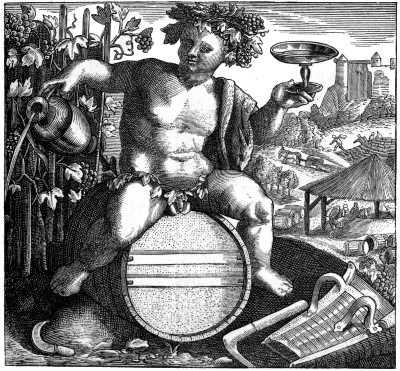
Boissard, 1596.
The Latin stanzas subjoined would, however, not have suited Enobarbus and the roistering triumvirs of the world,—
“Suave Dei munus vinum est: hominumque saluti
Conducit: præsit dummodò sobrietas.
Immodico sed si tibi proluat ora Lyæo,
Pro dulci potas tetra aconita mero.”
i.e.
“Wine is God’s pleasant gift, and for men’s health
Conduces, when sobriety presides;
But if excessive drained Lyæan wealth,
For liquor sweet black aconite abides.”
The phrase, “rempli de vin dont son visage est teint,” in “Le Microcosme,” Lyons, 1562, suggests the placing the stanzas in which it occurs, in illustration of Shakespeare’s song; they are,—
“Le Dieu Bacchus d’ordinaire on depeint
Ayant en main vn chapelet de lierre,
Tenant aussi vne couppe ou vn verre
Rempli de vin dont son visage est teint.
Des deux costes son chef on void aislé,
Et pres de luy d’vne pasture belle
Le genereux Pegasus à double aisle
Se veut guinder vers le ciel estoilé.”
In ſtatuam Bacchi.
Dialogismvs.
XXV.
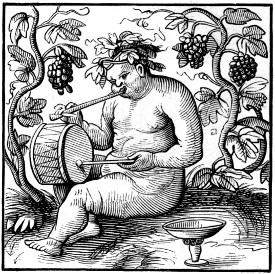
Alciat, 1581.
It may give completion to this sketch if we subjoin the figured Bacchus of Alciat (edition Antwerp, 1581, p. 113), and present the introductory lines,—
“Bacche pater quis te mortali lumine nouit,
Et docta effinxit quis tua membra manu?
Praxiteles, qui me rapientem Gnossida vidit,
Atque illo pinxit tempore, qualis eram.”
Of Alciat’s 36 lines, Whitney, p. 187, gives the brief yet paraphrastic translation,—
“The timelie birthe that Semele did beare,
See heere, in time howe monstêrous he grewe:
With drinkinge muche, and dailie bellie cheare,
His eies weare dimme, and fierie was his hue:
His cuppe, still full: his head, with grapes was croun’de;
Thus time he spent with pipe, and tabret sounde.[128]
Which carpes all those, that loue to much the canne,
And dothe describe theire personage, and theire guise:
For like a beaste, this doth transforme a man,
And makes him speake that moste in secret lies;
Then, shunne the sorte that bragge of drinking muche,
Seeke other frendes, and ioyne not handes with suche.”
On the same subject we may refer to Love’s Labour’s Lost (act iv. sc. 3, l. 308, vol. ii. p. 151), to the long discourse or argument by Biron, in which he asks,—
“For where is any author in the world
Teaches such beauty as a woman’s eye?”
The offensiveness of excess in wine is then well set forth (l. 333),—
“Love’s feeling is more soft and sensible,
Than are the tender horns of cockled snails;
Love’s tongue proves dainty Bacchus gross in taste.”
On these words the best comment are two couplets from Whitney (p. 133), to the sentiment, Prudentes vino abstinent,—“The wise abstain from wine.”
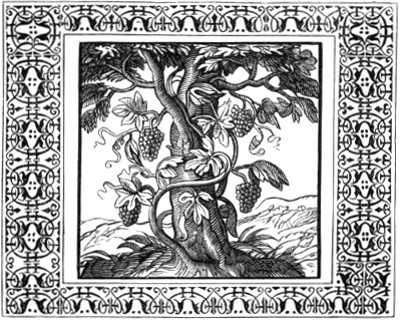
Whitney, 1586.
Loe here the vine dothe claſpe, to prudent Pallas tree,
The league is nought, for virgines wiſe, doe Bacchus frendſhip flee.
Alciat.
Quid me vexatis rami? Sum Palladis arbor,
Auferte hinc botros, virgo fugit Bromium.
Engliſhed ſo.
Why vexe yee mee yee boughes? ſince I am Pallas tree:
Remoue awaie your cluſters hence, the virgin wine doth flee.
Not less degrading and brutalising than the goblets of Bacchus are the poisoned cups of the goddess Circe. Her fearful power and enchantments form episodes in the 10th book of the Odyssey, in the 7th of the Æneid, and in the 14th of the Metamorphoses. So suitable a theme for their art is not neglected by the Emblem writers. Alciat adopts it as a warning against meretricious allurements (edition 1581, p. 184),—
ANDREAE ALCIATI
Cauendum à meretricibus. Emblema lxxvi.
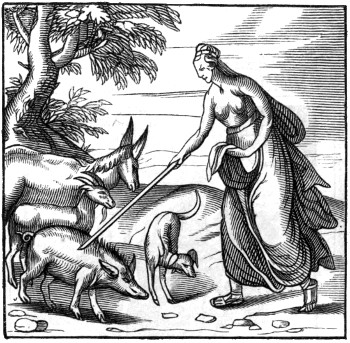
Alciat, 1581.
Sole ſatæ Circes tam magna potentia fertur,
Verterit vt multos in noua monſtra viros.
Teſtis equûm domitor Picus, tum Scylla biformis,
Atque Ithaci poſtquàm vina bibere sues.
Indicat illustri meretricem nomine Circe,
Et rationem animi perdere, quiſquis amat.
Adopting another motto, Homines voluptatibus transformantur,—“Men are transformed by pleasures,”—Whitney (p. 82) yet gives expression to Alciat’s idea,—
“See here Vlisses men, transformed straunge to heare:
Some had the shape of Goates, and Hogges, some Apes, and Asses weare.
Who, when they might haue had their former shape againe,
They did refuse, and rather wish’d, still brutishe to remaine.
Which showes those foolishe sorte, whome wicked loue dothe thrall,
Like brutishe beastes do passe theire time, and haue no sence at all.
And thoughe that wisedome woulde, they shoulde againe retire,
Yet, they had rather Circes serue, and burne in theire desire.
Then, loue the onelie crosse, that clogges the worlde with care,
Oh stoppe your eares, and shutte your eies, of Circes cuppes beware.”
The striking lines from Horace (Epist. i. 2) are added,—
“Sirenum voces, & Circes pocula nosti:
Quæ si cum sociis stultus, cupidusq’ bibisset,
Sub domina meretrice fuisset turpis, & excors,
Vixisset canis immundus, vel amica luto sus.”
i.e.
“Of Sirens the voices, and of Circe the cups thou hast known:
Which if, with companions, anyone foolish and eager had drunk,
Under a shameless mistress he has become base and witless,
Has lived as a dog unclean, or a sow in friendship with mire.”
Circe and Ulysses are also briefly treated of in The Golden Emblems of Nicholas Reusner, with Stimmer’s plates, 1591, sign C. v.
Bellua dira libido
Pulcra facit Circe meretrix excordia corda:
Fortis Vlyſseâ, qui ſapit, arte domat.
Ins Bieh verzäubert Circe vil,
Schlägt hurn von sich, mer weiß sein will.
Reusner (edition 1581, p. 134), assuming that “Slothfulness is the wicked Siren,” builds much upon Virgil and Horace, as may be seen from the epithets he employs. We give only a portion of his Elegiacs, and the English of them first,—
“Through various chances, through so many dangerous things,
While again and again the Ithacan pursues the long ways:
The voices of Sirens, and of Circe the kingdoms he forsakes:
Nor does the bland Atlantis his journey retard.
But as Circe to his companions supplies the potations foul,
Witless and shameless this becomes a sow and that a dog.”
Improba Siren deſidia.
Emblema xxiv.
Ad Vuolfgangum, & Carolum Rechlingeros,
Patr. Auguſtanos.
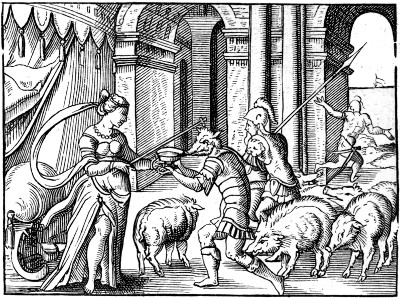
Reusner, 1581.
PEr varios caſus, per tot diſcrimina rerum,
Dum longas Ithacus itq́₃que, reditq́₃que vias:
Sirenum voces, & Circes regna relinquit:
Blanda nec Atlantis tunc remoratur iter.
At ſocijs Circe dum pocula fœda miniſtrat:
Excors, & turpis ſus fit hic, ille canis.
Now, Shakespeare’s allusions to Circe are only two. The first, in the Comedy of Errors (act v. sc. 1, l. 269, vol. i. p. 455), when all appears in inextricable confusion, and Antipholus of Ephesus demands justice because of his supposed wrongs. The Duke Solinus in his perplexity says,—
“Why what an intricate impeach is this!
I think you all have drunk of Circe’s cup.”
The second, in 1 Henry VI. (act v. sc. 3, l. 30, vol. v. p. 86). On fighting hand to hand with the Maid of Orleans, and taking her prisoner, the Duke of York, almost like a dastard, reproaches and exults over her noble nature,—
“Damsel of France I think, I have you fast:
Unchain your spirits now with spelling charms
And try if they can gain you liberty.
A goodly prize, fit for the devil’s grace!
See, how the ugly witch doth bend her brows,
As if, with Circe, she would change my shape!”
So closely connected with Circe are the Sirens of fable that it is almost impossible to treat of them separately. As usual, Alciat’s is the Emblem-book (edition 1551) from which we obtain the illustrative print and the Latin stanzas.
Sirenes.
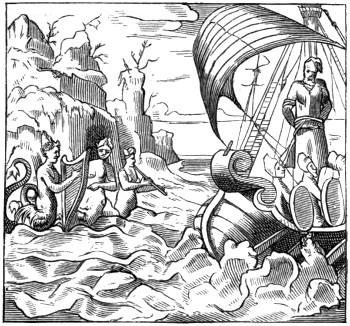
Alciat, 1551.
Abſque alis volucres, & cruribus abſque puellas,