Chapter VI · CLASSIFICATION OF THE CORRESPONDENCIES AND PARALLELISMS OF SHAKESPEARE WITH EMBLEM WRITERS. (continued 4)
Reading edition
“Beyond all birds the Pelican is fond of her young. The female sits on the nest, guarding her offspring, and cherishes and caresses them and wounds them with loving; and pierces their sides and they die. After three days the male pelican comes and finds them dead, and very much his heart is pained. Driven by grief he smites his own side, and as he stands over the wounds of the dead young ones, the blood trickles down, and thus are they made alive again.”
Reusner and Camerarius both adopt the Pelican as the emblem of a good king who devotes himself to the people’s welfare. For Law and for Flock, is the very appropriate motto they prefix; Camerarius simply saying (ed. 1596, p. 87),—
“Sanguine vivificat Pelicanus pignora, sic rex
Pro populi vitæ est prodigus ipse suæ.”
“By blood the Pelican his young revives; and so a king
For his people’s sake himself of life is prodigal.”
Reusner (bk. ii. p. 73) gives the following device,—
Pro lege, & grege.
Emblema xiv.
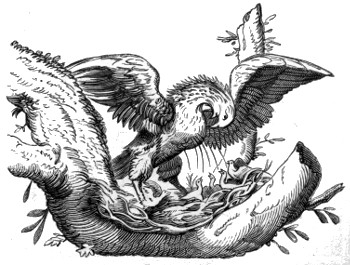
Reusner, 1581.
And tells how,—
“Alphonsus the wise and good king of Naples, with his own honoured hand painted a Pelican which with its sharp beak was laying open its breast so as with its own blood to save the lives of its young. Thus for people, for law, it is right that a king should die and by his own death restore life to the nations. As by his own death Christ did restore life to the just, and with life peace and righteousness.”
He adds this personification of the Pelican,—
“For people and for sanctioned law heart’s life a king will pour;
So from this blood of mine do I life to my young restore.”
The other motto, which Hadrian Junius and Geffrey Whitney select, opens out another idea, Quod in te est, prome,—“Bring forth what is in thee.” It suggests that of the soul’s wealth we should impart to others.
Junius (Emb. 7) thus addresses the bird he has chosen,—
“By often striking, O Pelican, thou layest open the deep recesses of thy breast and givest life to thy offspring. Search into thine own mind (my friend), seek what is hidden within, and bring forth into the light the seeds of thine inner powers.”
And very admirably does Whitney (p. 87) apply the sentiment to one of the most eminent of divines in the reign of Queen Elizabeth,—namely, to Dr. Alexander Nowell, the celebrated Dean of St. Paul’s, illustrious both for his learning and his example,—
“The Pellican, for to reuiue her younge,
Doth peirce her brest, and geue them of her blood:
Then searche your breste, and as yow haue with tonge,
With penne proceede to doe our countrie good:
Your zeale is great, your learning is profounde,
Then helpe our wantes, with that you doe abounde.”
The full poetry of the thoughts thus connected with the Pelican is taken in, though but briefly expressed by Shakespeare. In Hamlet (act iv. sc. 5, l. 135, vol. viii. p. 135), on Laertes determining to seek revenge for his father’s death, the king adds fuel to the flame,—
“King. Good Laertes,
If you desire to know the certainty
Of your dear father’s death, is’t writ in your revenge,
That, swoopstake, you will draw both friend and foe,
Winner and loser?
Laer. None but his enemies.
King. Will you know them then?
Laer. To his good friends thus wide I’ll ope my arms;
And like the kind life-rendering pelican,
Repast them with my blood.”[167]
From Richard II. (act ii. sc. 1, l. 120, vol. iv. p. 140) we learn how in zeal and true loyalty John of Gaunt counsels his headstrong nephew, and how rudely the young king replies,—
“Now, by my seat’s right royal majesty,
Wert thou not brother to great Edward’s son,
This tongue that runs so roundly in thy head
Should run thy head from thy unreverent shoulders.
Gaunt. O, spare me not, my brother Edward’s son,
For that I was his father Edward’s son;
That blood already, like the pelican,
Hast thou tapp’d out and drunkenly caroused.”
The idea, indeed, almost supposes that the young pelicans strike at the breasts of the old ones, and forcibly or thoughtlessly drain their life out. So it is in King Lear (act iii. sc. 4, l. 68, vol. viii. p. 342), when the old king exclaims,—
“Death, traitor! nothing could have subdued nature
To such a lowness but his unkind daughters.
Is it the fashion that discarded fathers
Should have thus little mercy on their flesh?
Judicious punishment! ’twas this flesh begot
Those pelican daughters.”
And again (2 Henry VI., act iv. sc. 1, l. 83, vol. v. p. 182), in the words addressed to Suffolk,—
“By devilish policy art thou grown great,
And, like ambitious Sylla, over-gorged
With gobbets of thy mother’s bleeding heart.”
The description of the wounded stag, rehearsed to the banished duke by one of his attendants, is as touching a narrative, as full of tenderness, as any which show the Poet’s wonderful power over our feelings; it is from As You Like It (act ii. sc. 1, l. 29, vol. ii. p. 394),—
“To-day my Lord of Amiens and myself
Did steal behind him [Jaques] as he lay along
Under an oak whose antique root peeps out
Upon the brook that brawls along this wood:
To the which place a poor sequester’d stag,
That from the hunter’s aim had ta’en a hurt,
Did come to languish, and indeed, my lord,
The wretched animal heaved forth such groans,
That their discharge did stretch his leathern coat
Almost to bursting, and the big round tears
Coursed one another down his innocent nose
In piteous chase; and thus the hairy fool,
Much marked of the melancholy Jacques,
Stood on the extremest verge of the swift brook,
Augmenting it with tears.”
Graphic and highly ornamented though this description may be, it is really the counterpart of Gabriel Symeoni’s Emblem of love incurable. The poor stag lies wounded and helpless,—the mortal dart in his flank, and the life-stream gushing out. The scroll above bears a Spanish motto, This holds their Remedy and not I; and it serves to introduce the usual quatrain.
D’VN AMORE.
INCVRABILE.
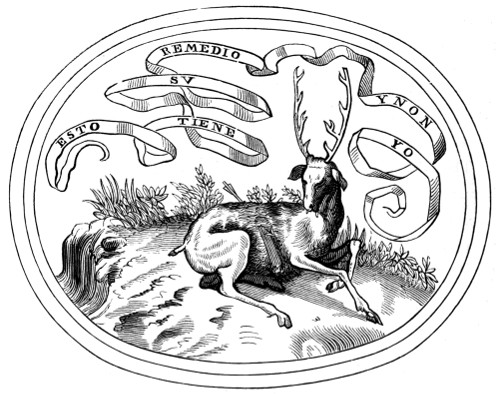
Giovio and Symeoni, 1562.
Troua il ceruio ferito al ſuo gran male
Nel dittamo Creteo fido ricorſo,
Ma laſſo (io’lsò) rimedio ne ſoccorſo
All’ amoroſo colpo alcun non vale.
Eſto tiene ſu remedio, y non yo.
“The smitten stag hath found sad pains to feel,
No trusted Cretan dittany[168] is near,
Wearied, for succour there is only fear,—
The wounds of love no remedy can heal.”
To the same motto and the same device Paradin (fol. 168) furnishes an explanation,—
“The device of love incurable,” he says, “may be a stag wounded by an arrow, having a branch of Dittany in its mouth, which is a herb that grows abundantly in the island of Crete. By eating this the wounded stag heals all its injuries. The motto, ‘Esto tienne su remedio, y no yo,’ follows those verses of Ovid in the Metamorphoses, where Phœbus, complaining of the love for Daphne, says, ‘Hei mihi, quòd nullis amor est medicabilis herbis.’”
The connected lines in Ovid’s Metamorphoses (bk. i. fab. 9), show that even Apollo, the god of healing, whose skill does good to all others, does no good to himself. The Emblems of Otho Vænius (p. 154) gives a very similar account to that of Symeoni,—
“Cerua venenato venantûm saucia ferro
Dyctamno quærit vulneris auxilium.
Hei mihi, quod nullis sit Amor medicabilis herbis,
Et nequeat medicâ pellier arte malum.”
The following is the English version of that date,—
“No help for the louer.”
“The hert that wounded is, knowes how to fynd relief,
And makes by dictamon the arrow out to fall,
And with the self-same herb hee cures his wound withall,
But love no herb can fynd to cure his inward grief.”
In the presence of those who had slain Cæsar, and over his dead body at the foot of Pompey’s statue, “which all the while ran blood,” Marc Antony poured forth his fine avowal of continued fidelity to his friend (Julius Cæsar, act iii. sc. 1, l. 205, vol. vii. p. 368),—
“Pardon me, Julius! Here wast thou bay’d, brave hart;
Here didst thou fall, and here thy hunters stand,
Sign’d in thy spoil and crimson’d in thy lethe.
O world! thou wast the forest to this hart;
And this, indeed, O world, the heart of thee.
How like a deer strucken by many princes
Dost thou here lie!”
The same metaphor from the wounded deer is introduced in Hamlet (act iii. sc. 2, l. 259, vol. viii. p. 97). The acting of the play has had on the king’s mind the influence which Hamlet hoped for; and as in haste and confusion the royal party disperse, he recites the stanza,—
“Why, let the stricken deer go weep,
The hart ungalled play;
For some must watch, whilst some must sleep:
Thus runs the world away.”
The very briefest allusion to the subject of our Emblem is also contained in the Winter’s Tale (act i. sc. 2, l. 115, vol. iii. p. 323). Leontes is discoursing with his queen Hermione,—
“But to be paddling palms and pinching fingers,
As now they are, and making practised smiles,
As in a looking glass, and then to sigh, as ’twere
The mort o’ the deer; O, that is entertainment
My bosom likes not, nor my brows!”
The poetical epithet “golden,” so frequently expressive of excellence and perfection, and applied even to qualities of the mind, is declared by Douce (vol. i. p. 84) to have been derived by Shakespeare either from Sidney’s Arcadia (bk. ii.), or from Arthur Golding’s translation of Ovid’s Metamorphoses (4to, fol. 8), where speaking of Cupid’s arrows, he says,—
“That causeth love is all of golde with point full sharp and bright.
That chaseth love, is blunt, whose steele with leaden head is dight.”
This borrowing and using of the epithet “golden” might equally well, and with as much probability, have taken place through the influence of Alciat, or by adoption from Whitney’s very beautiful translation and paraphrase of Joachim Bellay’s Fable of Cupid and Death. The two were lodging together at an inn,[169] and unintentionally exchanged quivers: death’s darts were made of bone, Cupid’s were “dartes of goulde.”
The conception of the tale is admirable, and the narrative itself full of taste and beauty. Premising that the same device is employed by Whitney as by Alciat, we will first give almost a literal version from the 154th and 155th Emblems of the latter author (edition 1581),—
“Wandering about was Death along with Cupid as companion,
With himself Death was bearing quivers; little Love his weapons;
Together at an inn they lodged; one night together one bed they shared;
Love was blind, and on this occasion Death also was blind.
Unforeseeing the evil, one took the darts of the other,
Death the golden weapons,—those of bone the boy rashly seizes.
Hence an old man who ought now to be near upon Acheron.
Behold him loving,—and for his brow flower-fillets preparing.
But I, since Love smote me with the dart that was changed,
I am fainting, and their hand the fates upon me are laying.
Spare, O boy; spare, O Death, holding the ensigns victorious,—
Make me the lover, the old man make him sink beneath Acheron.”
And carrying on the idea into the next Emblem (155),—
“Why, O Death, with thy wiles darest thou deceive Love the boy,
That thy weapons he should hurl, while he thinks them his own?”
Whitney’s “sportive tale, concerning death and love,” possesses sufficient merit to be given in full (p. 132),—
De morte, & amore: Iocoſum.
To Edward Dyer, Eſquier.
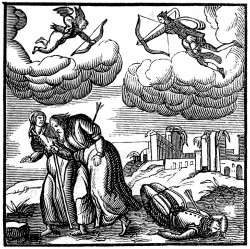
Whitney, 1586.
“While furious Mors, from place, to place did flie,
And here, and there, her fatall dartes did throwe:
At lengthe shee mette, with Cupid passing by,
Who likewise had, bene busie with his bowe:
Within one Inne, they bothe togeather stay’d,
And for one nighte, awaie theire shooting lay’d.
The morrowe next, they bothe awaie doe haste,
And eache by chaunce, the others quiuer takes:
The frozen dartes, on Cupiddes backe weare plac’d.
The fierie dartes, the leane virago shakes:
Whereby ensued, suche alteration straunge,
As all the worlde, did wonder at the chaunge.
For gallant youthes, whome Cupid thoughte to wounde,
Of loue, and life, did make an ende at once.
And aged men, whome deathe woulde bringe to grounde:
Beganne againe to loue, with sighes, and grones;
Thus natures lawes, this chaunce infringed soe:
That age did loue, and youthe to graue did goe.
Till at the laste, as Cupid drewe his bowe,
Before he shotte: a younglinge thus did crye,
Oh Venus sonne, thy dartes thou doste not knowe,
They pierce too deepe: for all thou hittes, doe die:
Oh spare our age, who honored thee of oulde,
Theise dartes are bone, take thou the dartes of goulde.
Which beinge saide, a while did Cupid staye,
And sawe, how youthe was almoste cleane extinct:
And age did doate, with garlandes freshe, and gaye,
And heades all balde, weare newe in wedlocke linckt:
Wherefore he shewed, this error vnto Mors,
Who miscontent, did chaunge againe perforce.
Yet so, as bothe some dartes awaie conuay’d,
Which weare not theirs: yet vnto neither knowne,
Some bonie dartes, in Cupiddes quiver stay’d,
Some goulden dartes, had Mors amongst her owne.
Then, when wee see, vntimelie deathe appeare:
Or wanton age: it was this chaunce you heare.”
For an interlude to our remarks on the “golden,” we must mention that the pretty tale Concerning Death and Cupid was attributed to Whitney by one of Shakespeare’s contemporaries; and, if known to other literary men of the age, very reasonably may be supposed not unknown to the dramatist. Henry Peacham, in 1612, p. 172 of his Emblems, acknowledges that it was from Whitney that he derived his own tale,—
“De Morte, et Cupidine.”
“Death meeting once, with Cvpid in an Inne,
Where roome was scant, togeither both they lay.
Both weariè, (for they roving both had beene,)
Now on the morrow when they should away,
Cvpid Death’s quiver at his back had throwne,
And Death tooke Cvpids, thinking it his owne.
By this o’re-sight, it shortly came to passe,
That young men died, who readie were to wed:
And age did revell with his bonny-lasse,
Composing girlonds for his hoarie head:
Invert not Nature, oh ye Powers twaine,
Giue Cvpid’s dartes, and Death take thine againe.”
Whitney luxuriates in this epithet “golden;”—golden fleece, golden hour, golden pen, golden sentence, golden book, golden palm are found recorded in his pages. At p. 214 we have the lines,—
“A Leaden sworde, within a goulden sheathe,
Is like a foole of natures finest moulde,
To whome, shee did her rarest giftes bequethe,
Or like a sheepe, within a fleece of goulde.”
We may indeed regard Whitney as the prototype of Hood’s world-famous “Miss Kilmansegg, with her golden leg,”—
“And a pair of Golden Crutches.” (vol. i. p. 189.)
Shakespeare is scarcely more sparing in this respect than the Cheshire Emblematist; he mentions for us “golden tresses of the dead,” “golden oars and a silver stream,” “the glory, that in gold clasps locks in the golden story,” “a golden casket,” “a golden bed,” and “a golden mind.” Merchant of Venice (act ii. sc. 7, lines 20 and 58, vol. ii. p. 312),—
“A golden mind stoops not to shows of dross.
. . . . . .
But here an angel in a golden bed
Lies all within.”
And applied direct to Cupid’s artillery in Midsummer Night’s Dream (act i. sc. 1, l. 168, vol. ii. p. 204), Hermia makes fine use of the epithet golden,—
“My good Lysander!
I swear to thee by Cupid’s strongest bow,
By his best arrow with the golden head.”
So in Twelfth Night (act i. sc. 1, l. 33, vol. iii. p. 224), Orsino, Duke of Milan, speaks of Olivia,—
“O, she that hath a heart of that fine frame
To pay the debt of love but to a brother,
How will she love, when the rich golden shaft
Hath kill’d the flock of all affections else
That live in her; when liver, brain and heart
These sovereign thrones, are all supplied, and fill’d
Her sweet perfections with one self king!”
And when Helen praised the complexion or comeliness of Troilus above that of Paris, Cressida avers (Troilus and Cressida, act i. sc. 2, l. 100, vol. vi. p. 134),—
“I had as lief Helen’s golden tongue had commended Troilus for a copper nose.”
Plate 14
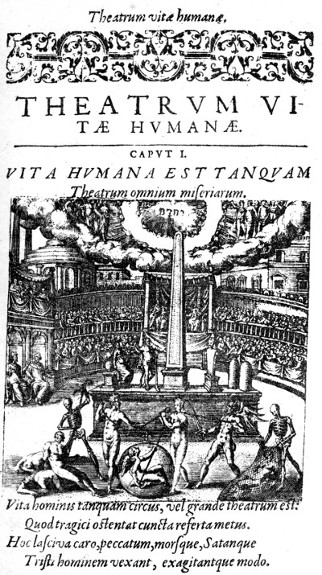
Life as a Theatre, from Boissards Theatrum 1596.
As Whitney’s pictorial illustration represents them, Death and Cupid are flying in mid-air, and discharging their arrows from the clouds. Confining the description to Cupid, this is exactly the action in one of the scenes of the Midsummer Night’s Dream (act ii. sc. 1, l. 155, vol. ii. p. 216). The passage was intended to flatter Queen Elizabeth; it is Oberon who speaks,—
“That very time I saw, but thou couldst not,
Flying between the cold moon and the earth,
Cupid all arm’d: a certain aim he took
At a fair vestal throned by the west,
And loosed his love-shaft smartly from his bow,
As it should pierce a hundred thousand hearts:
But I might see young Cupid’s fiery shaft
Quench’d in the chaste beams of the watery moon,
And the imperial votaress passed on,
In maiden meditation, fancy free.
Yet mark’d I where the bolt of Cupid fell:
It fell upon a little western flower,
Before milk-white, now purple with love’s wound,
And maidens call it love-in-idleness.”
Scarcely by possibility could a dramatist, who was also an actor, avoid the imagery of poetic ideas with which his own profession made him familiar. I am not sure if Sheridan Knowles did not escape the temptation; but if Shakespeare had done so, it would have deprived the world of some of the most forcible passages in our language. The theatre for which he wrote, and the stage on which he acted, supplied materials for his imagination to work into lines of surpassing beauty.
Boissard’s “Theatrvm Vitæ Humanæ” (edition Metz, 4to, 1596) presents its first Emblem with the title,—Human life is as a Theatre of all Miseries. (See Plate XIV.)
“The life of man a circus is, or theatre so grand:
Which every thing shows forth filled full of tragic fear;
Here wanton sense, and sin, and death, and Satan’s hand
Molest mankind and persecute with penalties severe.”
The picture of human life which Boissard draws in his “Address to the Reader” is gloomy and dispiriting; there are in it, he declares, the various miseries and calamities to which man is subject while he lives,—and the conflicts to which he is exposed from the sharpest and cruellest enemies, the devil, the flesh, and the world; and from their violence and oppression there is no possibility of escape, except by the favour and help of God’s mercy.
Very similar ideas prevail in some of Shakespeare’s lines; as “the thousand natural shocks that flesh is heir to” (Hamlet, act iii. sc. 1, l. 62, vol. viii. p. 79); “my heart all mad with misery beats in this hollow prison of my flesh” (Titus Andronicus, act iii. sc. 2, l. 9, vol. vi. p. 483); and, “shake the yoke of inauspicious stars from this world-wearied flesh” (Romeo and Juliet, act v. sc. 3, l. 111, vol. vii. p. 126).
But more particularly in As You Like It (act ii. sc. 7, l. 136, vol. ii. p. 409),—
“Thou seest we are not all alone unhappy:
This wide and universal theatre
Presents more woeful pageants than the scene
Wherein we play in.”
Also in Macbeth (act v. sc. 5, l. 22, vol. vii. p. 512),—
“And all our yesterdays have lighted fools
The way to dusty death. Out, out, brief candle!
Life’s but a walking shadow, a poor player
That struts and frets his hour upon the stage
And then is heard no more: it is a tale
Told by an idiot, full of sound and fury
Signifying nothing.”
And when the citizens of Angiers haughtily closed their gates against both King Philip and King John, the taunt is raised (King John, act ii. sc. 1, l. 373, vol. iv. p. 26),—
“By heaven, these scroyles of Angiers flout you, kings,
And stand securely on their battlements,
As in a theatre, whence they gape and point
At your industrious scenes and acts of death.”
Plate 15
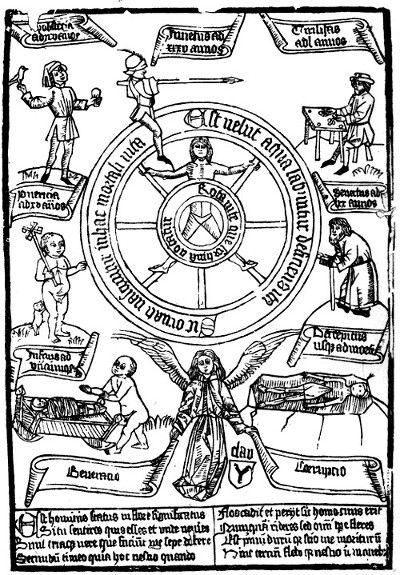
Seven Ages of Life from an early Block Print in the British Museum
The stages or ages of man have been variously divided. In the Arundel MS., and in a Dutch work printed at Antwerp in 1820, there are ten of these divisions of Man’s Life.[170] The celebrated physician Hippocrates (B.C. 460–357), and Proclus, the Platonist (A.D. 412–485), are said to have divided human life, as Shakespeare has done, into seven ages. And a mosaic on the pavement of the cathedral at Siena gives exactly the same division. This mosaic is very curious, and is supposed to have been executed by Antonio Federighi in the year 1476. Martin’s “Shakspere’s Seven Ages,” published in 1848, contains a little narrative about it, furnished by Lady Calcott, who shortly before that time had been travelling in Italy,—
“We found,” she says, “in the cathedral of Sienna a curious proof that the division of human life into seven periods, from infancy to extreme old age with a view to draw a moral inference, was common before Shakspeare’s time: the person who was showing us that fine church directed our attention to the large and bold designs of Beccafumi, which are inlaid in black and white in the pavement, entirely neglecting some works of a much older date which appeared to us to be still more interesting on account of the simplicity and elegance with which they are designed. Several of these represent Sibyls and other figures of a mixed moral and religious character; but in one of the side chapels we were both suprised and pleased to find seven figures, each in a separate compartment, inlaid in the pavement, representing the Seven Ages of Man.”
Lord Lindsay notices the same work, and in his “Christian Art,” vol. iii. p. 112, speaking of the Pavement of the Duomo at Siena, says,—“Seven ages of life in the Southern Nave, near the Capella del Voto.”
Of as old a date, even if not more ancient, is the Representation of the Seven Ages from a Block-Print belonging to the British Museum, and of which we present a diminished facsimile (Plate XV.), the original measuring 15½ in. by 10½ in.
The inscription on the centre of the wheel, Rota vite que septima notatur,—“The wheel of life which seven times is noted:” on the outer rim,—Est velut aqua labuntur deficiens ita. Sic ornati nascuntur in hac mortali vita,—“It is as water so failing, they pass away. So furished are they born in this mortal life.” The figures for the seven ages are inscribed, Infans ad vii. annos,—“An infant for vii. years.” Pueritia[171] ad xv. años,—“Childhood up to xv. years.” Adolescẽtia ad xxv. años,—“Youthhood to xxv. years.” Iuvẽtus ad xxxv. annos,—“Young manhood to xxxv. years.” Virilitas ad l. annos,—“Mature manhood to 50 years.” Senatus ad lxx. annos,—“Age to 70 years.” Decrepitus usque ad mortem,—“Decrepitude up to death.” The angel with the scrolls holds in her right hand that on which is written Beuerano, in her left, Corruptio,—“Corruption;” below her left, clav, for clavis, “a key.”
Some parts of the Latin stanzas are difficult to decipher; they appear, however, to be the following, read downward,—
“Est hominis status in flore significatus
Situ sentires quis esses et unde venisses
Sunt triaque vere quæ faciunt me sæpe dicere,
Secundum timeo quia hoc nescio quando
Flos cadit et periit sic homo cinis erit
Nunquam rideres sed olim sæpe fleres
Est primo durum quare scio me moriturum
Hinc ternum flebo quare nescio ut manebo.”
The lines, however, are to be read across the page,—
“Est hominis status in flore significatus, Flos cadit et periit sic homo cinis erit.
Situ sentires quis esses et unde venisses, Nunquam rideres sed olim sæpe fleres.
Sunt triaque vere quæ faciunt me sæpe dicere, Est primo durum quare scio me moriturum.
Secundum timeo quia hoc nescio quando, Hinc ternum flebo quare nescio ut manebo.”
They are only doggerel Latin, and in doggerel English may be expressed,—
“Lo here is man’s state—in flowers significate:
The flower fades and perishes,—so man but ashes is;
Who mayst be thou feelest,—whence com’st thou revealest;
Laugh shouldst thou never,—but be weeping for ever;
Three things there are truly,—which make me say duly,
The first hard thing ’tis to know,—that to death I must go;
The second I fear then,—since I know not the when;—
The third again will I weep,—for I know not in life to keep.”
The celebrated speech of Jaques to his dethroned master, “All the world’s a stage,” from As You Like It (act ii. sc. 7, lines 139–165, vol. ii. p. 409), is closely constructed on the model of the Emblematical Devices in the foregoing Block-print. The simple quoting of the passage will be sufficient to show the parallelism and correspondence of the thoughts, if not of the expressions,—
“Jaques.All the world’s a stage,
And all the men and women merely players:
They have their exits and their entrances;
And one man in his time plays many parts,
His acts being seven ages. At first the infant,
Mewling and puking in the nurse’s arms.
Then the whining school-boy, with his satchel
And shining morning face, creeping like snail
Unwillingly to school. And then the lover,
Sighing like furnace, with a woeful ballad
Made to his mistress’ eyebrow. Then a soldier,
Full of strange oaths, and bearded like the pard,
Jealous in honour, sudden and quick in quarrel,
Seeking the bubble reputation
Even in the cannon’s mouth. And then the justice,
In fair round belly with good capon lined,
With eyes severe and beard of formal cut,
Full of wise saws and modern instances;
And so he plays his part. The sixth age shifts
Into the lean and slipper’d pantaloon,
With spectacles on nose and pouch on side,
His youthful hose, well saved, a world too wide
For his shrunk shank; and his big manly voice,
Turning again toward childish treble, pipes
And whistles in his sound. Last scene of all,
That ends this strange eventful history,
Is second childishness and mere oblivion,
Sans teeth, sans eyes, sans taste, sans every thing.”
In far briefer phrase, but with a similar comparison, in reply to the charge of having “too much respect upon the world,” Antonia (Merchant of Venice, act i. sc. 1, l. 77, vol. ii. p. 281) remarked,—
“I hold the world but as the world, Gratiano;
A stage, where every man must play a part,
And mine a sad one.”
The pencil and the skill alone are wanting to multiply the Emblems for the Poetic Ideas which abound in Shakespeare’s dramas. His thoughts and their combinations are in general so clothed with life and with other elements of beauty, that materials for pictures exist in all parts of his writings. Our office, however, is not to exercise the inventive faculty, nor, even when the invention has been perfected for us by the poet’s fancy, to give it a visible form and to portray its outward graces. We have simply to gather up the scattered records of the past, and to show what correspondencies there really are between Shakespeare and the elder Emblem artists, and, when we can, to point out where to him they have been models, imitated and thus approved. Though, therefore, we might draw many a sketch, and finish many a picture from ideas to be supplied from this unexhausted fountain, we are mindful of the humbler task belonging to him who collects, and on his shelf of literary antiquities places, only what has the stamp of nearly three centuries upon them.
Boissard, 1596.
Section VIII. MORAL AND ÆSTHETIC EMBLEMS.
REJOICING much if the end should crown the earlier portions of our work, we enter now on the last and most welcome section of this chapter,—on the Emblems which depict moral qualities and æsthetical properties,—the Emblems which concern the judgments and perceptions of the mind, and the conduct of the heart, the conscience, and the life.
Quæ ante pedes.
Whitney, 1586.
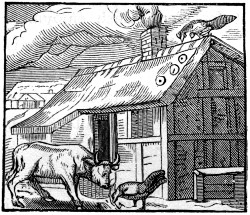
We will initiate this division by the motto and device which Whitney (p. 64) adopts from Sambucus (edition 1564, p. 30),—“Things lying at our feet,”—that is, of immediate importance and urgency. The Emblems are warnings from the hen which is eating her own eggs, and from the cow which is drinking her own milk.
The Hungarian poet thus sets forth his theme,—
“The hen which had seen the eggs to her care entrusted,
Is here sucking them, and hope she holds forth by no pledge.
It is herself she serves and not others,—of future days heedless,
No sense of feeling has she for the good of posterity.
This a fault is in many,—things gained without labour
Thoughtless they waste, unmindful of times that are coming.
So cows suck their own udders,—the milk proper for milk pails
They pilfer away,—and why bear to them the rich fodder?
Not alone for ourselves do we live,—we live from the birth hour
For our friends and our country, and whom the ages shall bring.”
The sentiment is admirable, and well placed by Whitney in the foremost ground,—
“Not for our selues, alone wee are create,
But for our frendes, and for our countries good:
And those, that are vnto theire frendes ingrate,
And not regarde theire ofspringe, and theire blood,
Or hee, that wastes his substance till he begges,
Or selles his landes, which seru’de his parentes well:
Is like the henne, when shee hathe lay’de her egges,
That suckes them vp and leaues the emptie shell,
Euen so theire spoile, to theire reproche, and shame,
Vndoeth theire heire, and quite decayeth theire name.”
These two, Sambucus and Whitney, are the types, affirming that our powers and gifts and opportunities were all bestowed, not for mere selfish enjoyments, but to be improved for the general welfare; Shakespeare is the antitype: he amplifies, and exalts, and finishes; he carries out the thought to its completion, and thus attains absolute perfection; for in Measure for Measure (act i. sc. 1, l. 28, vol. i. p. 296), Vincentio, the duke, addresses Angelo,—
“There is a kind of character in thy life,
That to th’ observer doth thy history
Fully unfold. Thyself and thy belongings
Are not thine own so proper, as to waste
Thyself upon thy virtues, they on thee.
Heaven doth with us as we with torches do,
Not light them for ourselves; for if our virtues
Did not go forth of us, ’twere all alike
As if we had them not. Spirits are not finely touch’d
But to fine issues; nor Nature never lends
The smallest scruple of her excellence,
But, like a thrifty goddess, she determines
Herself the glory of a creditor,
Both thanks and use.”
Now, there is beauty in the types, brief though they be, and on a very lowly subject: but how admirable is the antitype! It entirely redeems the thought from any associated meanness, carries it out to its full excellence, and clothes it with vestments of inspiration. Such, in truth, is Shakespeare’s great praise;—he can lift another man’s thought out of the dust, and make it a fitting ornament even for an archangel’s diadem.
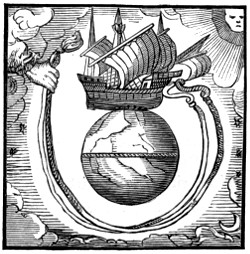
One of Whitney’s finest Emblems, in point of conception and treatment, and, I believe, peculiar to himself, one of those “newly devised,” is founded on the sentiment, “By help of God” (p. 203).
Auxilio diuino.
To Richarde drake, Eſquier, in praiſe of
Sir Francis Drake Knight.
Whitney, 1586.
The representation is that of the hand of Divine Providence issuing from a cloud and holding the girdle which encompasses the earth. With that girdle Sir Francis Drake’s ship, “the Golden Hind,” was drawn and guided round the globe.
The whole Emblem possesses considerable interest,—for it relates to the great national event of Shakespeare’s youth,—the first accomplishment by Englishmen of the earth’s circumnavigation. With no more than 164 able-bodied men, in five small ships, little superior to boats with a deck, the adventurous commander set sail 13th December, 1577; he went by the Straits of Magellan, and on his return doubled the Cape of Good Hope, the 15th of March, 1580, having then only fifty-seven men and three casks of water. The perilous voyage was ended at Plymouth, September the 26th, 1580, after an absence of two years and ten months.
These few particulars give more meaning to the Poet’s description,—
“Throvghe scorchinge heate, throughe coulde, in stormes, and tempests force,
By ragged rocks, by shelfes, & sandes: this Knighte did keepe his course.
By gapinge gulfes hee pass’d, by monsters of the flood,
By pirattes, theeues, and cruell foes, that long’d to spill his blood.
That wonder greate to scape: but, God was on his side,
And throughe them all, in spite of all, his shaken shippe did guide.
And, to requite his paines: By helpe of Power deuine.
His happe, at lengthe did aunswere hope, to finde the goulden mine.
Let Græcia then forbeare, to praise her Iason boulde?
Who throughe the watchfull dragons pass’d, to win the fleece of goulde.
Since by Medeas helpe, they weare inchaunted all,
And Iason without perrilles, pass’de: the conqueste therefore small?
But, hee, of whome I write, this noble minded Drake,
Did bringe away his goulden fleece, when thousand eies did wake.
Wherefore, yee woorthie wightes, that seeke for forreine landes:
Yf that you can, come alwaise home, by Ganges goulden sandes.
And you, that liue at home, and can not brooke the flood,
Geue praise to them, that passe the waues, to doe their countrie good.
Before which sorte, as chiefe: in tempeste, and in calme,
Sir Francis Drake, by due deserte, may weare the goulden palme.”
How similar, in part at least, is the sentiment in Hamlet (act v. sc. 2, l. 8, vol. viii. p. 164),—
“Our indiscretion sometimes serves us well
When our deep plots do pall; and that should learn us
There’s a divinity that shapes our ends,
Rough-hew them how we will.”
In the Emblem we may note the girdle by which Drake’s ship is guided; may it not have been the origin of Puck’s fancy in the Midsummer Night’s Dream (act ii. sc. 1, l. 173, vol. ii. p. 216), when he answers Oberon’s strict command,—
“And be thou here again
Ere the Leviathan can swim a league.
Puck. I’ll put a girdle round about the earth
In forty minutes.”
Besides, may it not have been from this voyage of Sir Francis Drake, and the accounts which were published respecting it, that the correct knowledge of physical geography was derived which Richard II. displays (act iii. sc. 2, l. 37, &c. vol. iv. p. 165)? as in the lines,—
“when the searching eye of heaven is hid,
Behind the globe, that lights the lower world.
. . . . . .
when from under this terrestrial ball
He fires the proud tops of the eastern pines
And darts his light through every guilty hole.
. . . . . .
revell’d in the night
Whilst we were wandering with the antipodes.”
A mere passing allusion to the same sentiment, a hint respecting it, a single line expressing it, or only a word or two relating to it, may sometimes very decidedly indicate an acquaintance with the author by whom the sentiment has been enunciated in all its fulness. Thus, Shakespeare, in speaking of Benedick, in Much Ado about Nothing (act v. sc. 1, l. 170, vol. ii. p. 75), makes Don Pedro say,—
“An if she did not hate him deadly, she would love him dearly: the old man’s daughter told us all.”
To which Claudius replies,—
“All, all; and, moreover, God saw him when he was hid in the garden.”
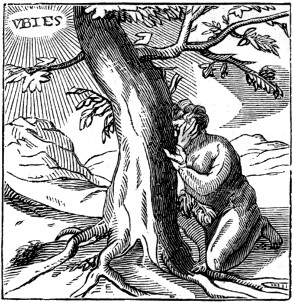
Now, Whitney (p. 229) has an Emblem on this very subject; the motto, “God lives and sees.” It depicts Adam concealing himself, and a divine light circling the words, “Vbi es?”—Where art thou?
Dominus viuit & videt.
Whitney, 1586.
“Behinde a figtree great, him selfe did Adam hide:
And thought from God hee there might lurke, and should not bee espide.
Oh foole, no corners seeke, thoughe thou a sinner bee;
For none but God can thee forgiue, who all thy waies doth see.”[172]
With the same motto, “Vbi es?” and a similar device, Georgette de Montenay (editions 1584 and 1620) carries out the same thought,—
“Adam pensoit estre fort bien caché,
Quand il se meit ainsi souz le figuier.
Mais il n’y a cachetté̩[e/]̩ où le peché
Aux yeux de Dieu se puisse desnier.
Se vante donc, qui voudra s’oublier,
Que Dieu ne void des hommes la meschance,
Je croy qu’ à rien ne sert tout ce mestier
Qu’ à se donner à tout peché licence.”
The similarity is too great to be named on Shakespeare’s part an accidental coincidence; it may surely be set down as a direct allusion, not indeed of the mere copyist, but of the writer, who, having in his mind another’s thought, does not quote it literally, but gives no uncertain indication that he gathered it up he cannot tell where, yet has incorporated it among his own treasures, and makes use of it as entirely his own.
From Corrozet, Georgette de Montenay, Le Bey de Batilly, and others their contemporaries, we might adduce various Moral and Æsthetical Emblems to which there are similarities of thought or of expression in Shakespeare’s Dramas, but too slight to deserve special notice. For instance, there are ingratitude, the instability of the world, faith and charity and hope, calumny, adversity, friendship, fearlessness,—but to dwell upon them would lengthen our statements and remarks more than is necessary.
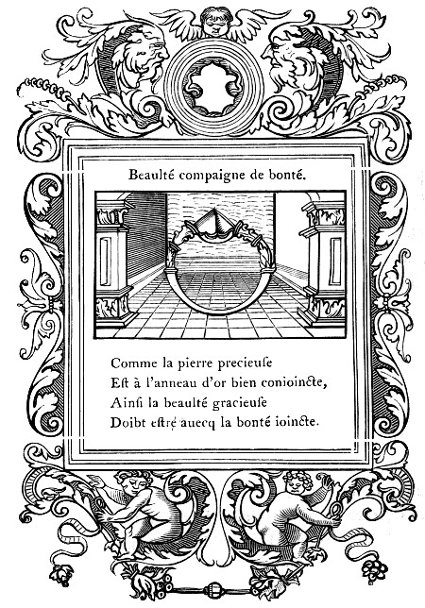
We will, however, make one more extract from Corrozet’s “Hecatomgraphie” (Emb. 83); to the motto, Beauty the companion of goodness; which might have been in Duke Vincentio’s mind (Measure for Measure, act iii. sc. 1, l. 175, vol. i. p. 340) when he addressed Isabel,—
“The hand that hath made you fair hath made you good; the goodness that is cheap in beauty makes beauty brief in goodness; but grace, being the soul of your complexion, shall keep the body of it ever fair.”
Corrozet, 1540.
La pierre bonne
A l’homme donne
Ioyeuseté,
Quand la personne
A voir ſ’adonne
Sa grand clarté,
Mais ſa beaulté
Et dignité
Augmente quand l’or l’enuironne
Que ie comparé̩[e/]̩ à la bonté
Pour ſa treſgrande vtilité
Qui à telle vertu conſonne.
* Formé̩[e/]̩ elegante
Beaulté patente
De personnage
Du tout augmente
Se rend luyſante
Quand il est ſage
Non au viſage,
Mais au courage
Reluyct la bonté excellente
Et alors c’eſt vng chef d’ouurage
Quand on eſt tresbeau de corſage
Et qu’au cueur eſt vertu latente.
The French verse which immediately follows the Emblem well describes it,—
“As, for the precious stone
The ring of gold is coin’d;
So, beauty in its grace
Should be to goodness join’d.”
The dramas we have liberty to select from furnish several instances of the same thought. First, from the Two Gentlemen of Verona (act iv. sc. 2, l. 38, vol. i. p. 135), in that exquisitely beautiful little song which answers the question, “Who is Silvia?”—
“Who is Silvia? what is she,
That all our swains commend her?
Holy, fair, and wise is she;
The heaven such grace did lend her,
That she might admired be.
Is she kind as she is fair?
For beauty lives with kindness.
Love doth to her eyes repair,
To help him of his blindness,
And, being help’d, inhabits there.
Then to Silvia let us sing,
That Silvia is excelling;
She excels each mortal thing
Upon the dull earth dwelling:
To her let us garlands bring.”
But a closer parallelism to Corrozet’s Emblem of beauty joined to goodness occurs in Henry VIII. (act ii. sc. 3, lines 60 and 75, vol. vi. pp. 45, 46); it is in the soliloquy or aside speech of the Lord Chamberlain, who had been saying to Anne Bullen,—
“The king’s majesty
Commends his good opinion of you, and
Does purpose honour to you no less flowing
Than Marchioness of Pembroke.”
With perfect tact Anne meets the flowing honours, and says,—
“Vouchsafe to speak my thanks and my obedience,
As from a blushing handmaid to his highness,
Whose health and royalty I pray for.”
In an aside the Chamberlain owns,—
“I have perused her well;
Beauty and honour in her are so mingled
That they have caught the king: and who knows yet
But from this lady may proceed a gem
To lighten all this isle?”
So on Romeo’s first sight of Juliet (Romeo and Juliet, act i. sc. 5, l. 41, vol. vii. p. 30), her beauty and inner worth called forth the confession,—
“O, she doth teach the torches to burn bright!
It seems she hangs upon the cheek of night
Like a rich jewel in an Ethiope’s ear;
Beauty too rich for use, for earth too dear.”
And the Sonnet (CV. vol. ix. p. 603, l. 4) that represents love,—
“Still constant in a wondrous excellence;”
also tells us of the abiding beauty of the soul,—
“‘Fair, kind, and true,’ is all my argument,
‘Fair, kind, and true,’ varying to other words;
And in this change is my invention spent,
Three themes in one, which wondrous scope affords.
‘Fair, kind, and true,’ have often lived alone,
Which three till now never kept seat in one.”
The power of Conscience, as the soul’s bulwark against adversities, has been sung from the time when Horace wrote (Epist. i. 1. 60),—
“Hic murus aëneus esto,
Nil conscire sibi, nulla pallescere culpa,”—
“This be thy wall of brass, to be conscious to thyself of no shame, to become pale at no crime.”
Or, in the still more popular ode (Carm. i. 22), which being of old recited in the palaces of Mæcenas and Augustus at Rome, has, after the flow of nearly nineteen centuries, been revived in the drawing rooms of Paris and London, and of the whole civilized world;—
“Integer vitæ, scelerisque purus,
Non eget Mauris jaculis, neque arcu,
Non venenatis gravida sagittis,
Fusce, pharetra,”—
“He, sound in his life, from all transgression free,
Doth need no Moorish javelins, nor bended bow,
Nor of arrows winged with poisons a quiver-tree,
Fuscus, to strike his foe.”[173]
Both these sentiments of the lyric poet have been imitated or adapted by the dramatic; as in 2 Henry VI. (act iii. sc. 2, l. 232, vol. v. p. 171), where the good king exclaims,—
“What stronger breast-plate than a heart untainted!
Thrice is he arm’d, that hath his quarrel just,
And he but naked, though lock’d up in steel,
Whose conscience with injustice is corrupted.”
And again, in Titus Andronicus (act iv. sc. 2, l. 18, vol. vi. p. 492), in the words of the original, on the scroll which Demetrius picks up,—
“Dem. What’s here? A scroll, and written round about!
Let’s see:
[Reads.] ‘Integer vitæ, scelerisque purus,
Non eget Mauri jaculis, nec arcu.’
Chi. O, ’tis a verse in Horace; I know it well:
I read it in the grammar long ago.
Aar. Ay, just; a verse in Horace; right, you have it.
[Aside.] Now, what a thing it is to be an ass!
Here’s no sound jest: the old man hath found their guilt,
And sends them weapons wrapp’d about with lines,
That wound, beyond their feeling, to the quick.”
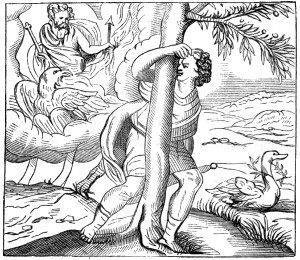
Several of the Emblem writers, however, propound a sentiment not so generally known, in which Apollo’s favourite tree, the Laurel, is the token of a soul unalarmed by threatening evils. Sambucus and Whitney so consider it, and illustrate it with the motto,—The pure conscience is man’s laurel tree.
Conſcientia integra, laurus.
Sambucus, 1564.
The saying rests on the ancient persuasion that the laurel is the sign of joy, victory and safety, and that it is never struck even by the bolts of Jove. Sambucus, personifying the laurel, celebrates its praise in sixteen elegiac lines beginning,—
“Prona virens cælum ſpecto, nec fulmina terrent,
Ob ſcelus excelſa quæ iacit arce pater,” &c.
“Spread out flourishing heaven I survey, nor do lightnings terrify,
Though for crime’s sake the father hurls them from citadels on high,
Yea even with my leaves I crackle, and although burnt
Daphne I name, whom the master’s love so importuned.
So conscious virtue strengthens, and placed far from destruction
Pleasing my state is to powers above, and long time is flourishing.
Men’s voices he never fears, nor the weapons of fire,
Who hath girded his mind round with snow-bright love.
This mind the raging Eumenides will not distress, nor the home
For the sad and the guiltless overturn’d without cause.
Even the hoary swan worn out in inactive old age
Gives forth admonitions, as it sings from a stifling throat;
Pure of heart with its mate conversing, it washes in water,
And morals of clearest hue in due form rehearses.
Who repents of unlawful life, and whom conscious errors
Do not oppress,—that man sings forth hymns everlasting.”
These thoughts in briefer and more nervous style Whitney rehearses to the old theme, A brazen wall, a sound conscience (p. 67),—
Murus æneus, ſana conſcientia.
To Miles Hobart Eſquier.
“Bothe freshe, and greene, the Laurell standeth sounde,
Thoughe lightninges flasshe, and thunderboltes do flie:
Where, other trees are blasted to the grounde,
Yet, not one leafe of it, is withered drie:
Euen so, the man that hathe a conscience cleare.
When wicked men, doe quake at euerie blaste,
Doth constant stande, and dothe no perrilles feare,
When tempestes rage, doe make the worlde agaste:
Suche men are like vnto the Laurell tree,
The others, like the blasted boughes that die.”
But a much fuller agreement with the above motto does Whitney express in the last stanza of Emblem 32,—
“A conscience cleare, is like a wall of brasse,
That dothe not shake, with euerie shotte that hittes;
Eauen soe there by, our liues wee quiet passe,
When guiltie mindes, are rack’de with fearful fittes:
Then keepe thee pure, and soile thee not with sinne,
For after guilte, thine inwarde greifes beginne.”
The same property is assigned to the Laurel by Joachim Camerarius (“Ex Re Herbaria,” p. 35, edition 1590). He quotes several authorities, or opinions for supposing that the laurel was not injured by lightning. Pliny, he says, supported the notion; the Emperor Tiberius in thunder storms betook himself to the shelter of the laurel; and Augustus before him did the same thing, adding as a further protection a girdle made from the skin of a sea-calf. Our modern authorities give no countenance to either of these fancies.
Now, combining the thoughts on Conscience presented by the Emblems on the subject which have been quoted, can we fail to perceive in Shakespeare, when he speaks of Conscience and its qualities, a general agreement with Sambucus, and more especially with Whitney?
How finely, in Henry VIII. (act iii. sc. 2, l. 372, vol. vi. p. 76), do the old Cardinal and his faithful Cromwell converse,—
“Enter Cromwell, and stands amazed.
Wol. Why, how now, Cromwell!
Crom. I have no power to speak, sir.
Wol. What, amazed
At my misfortunes? can thy spirit wonder
A great man should decline? Nay, an you weep,
I am fall’n indeed.
Crom. How does your grace?
Wol. Why, well:
Never so truly happy, my good Cromwell.
I know myself now; and I feel within me
A peace above all earthly dignities,
A still and quiet conscience.
. . . . . . . .
I am able now, methinks,
Out of a fortitude of soul I feel,
To endure more miseries and greater far
Than my weak-hearted enemies dare offer.”
And, on the other hand, the stings of Conscience, the deep remorse for iniquities, the self-condemnation which lights upon the sinful, never had expounder so forcible and true to nature. When Alonso, as portrayed in the Tempest (act iii. sc. 3, l. 95, vol. i. p. 53), thought of his cruel treachery to his brother Prospero, he says,—
“O, it is monstrous, monstrous!
Methought the billows spoke, and told me of it:
The winds did sing it to me; and the thunder.
That deep and dreadful organ-pipe, pronounced
The name of Prosper: it did bass my trespass.”
And the King’s dream, on the eve of Bosworth battle (Richard III., act v. sc. 3, lines 179, 193, and 200, vol. v. p. 625), what a picture it gives of the tumult of his soul!—
“O coward conscience, how dost thou affright me!
. . . . . . . .
My conscience hath a thousand several tongues,
And every tongue brings in a several tale,
And every tale condemns me for a villain.
. . . . . . . .
There is no creature loves me;
And, if I die, no soul shall pity me:—
Nay, wherefore should they? since that I myself,
Find in myself no pity to myself.
Methought, the souls of all that I had murder’d
Came to my tent; and everyone did threat
To-morrow’s vengeance on the head of Richard.”
Various expressions of the dramatist may end this notice of the Judge within us,—
“The worm of conscience still begnaw thy soul.”
“Every man’s conscience is a thousand swords
To fight against that bloody homicide.”
“I’ll haunt thee, like a wicked conscience still,
That mouldeth goblins swift as frenzy thought.”
“Thus conscience doth make cowards of us all.”
In some degree allied to the power of conscience is the retribution for sin ordained by the Divine Wisdom. We have not an Emblem to present in illustration, but the lines from King Lear (act v. sc. 3. l. 171, vol. viii. p. 416),—
“The gods are just, and of our pleasant vices
Make instruments to plague us,”—
are so co-incident with a sentiment in the Confessions (bk. i. c. 12, § 19) of the great Augustine that they deserve at least to be set in juxta-position. The Bishop is addressing the Supreme in prayer, and naming the sins and follies of his youth, says,—
“De peccanti meipso justè retribuebas mihi. Jusisti enim, & sic est, ut pœna sua sibi sit omnis inordinatus animis.”
i.e. “By my own sin Thou didst justly punish me. For thou hast commanded, and so it is, that every inordinate affection should bear its own punishment.”[174]
“Timon of Athens,” we are informed by Dr. Drake (vol. ii. p. 447), “is an admirable satire on the folly and ingratitude of mankind; the former exemplified in the thoughtless profusion of Timon, the latter in the conduct of his pretended friends; it is, as Dr. Johnson observes,—
“‘A very powerful warning against that ostentatious liberality, which scatters bounty, but confers no benefits, and buys flattery but not friendship.’”
There is some doubt whether Shakespeare derived his idea of this play from the notices of Timon which appear in Lucian, or from those given by Plutarch. The fact, however, that the very excellent work by Sir Thomas North, Knight, The Lives of the Noble Grecians and Romaines, &c., was published in 1579,—and that Shakespeare copies it very closely in the account of Timon’s sepulchre and epitaph, show, I think, Plutarch to have been the source of his knowledge of Timon’s character and life.
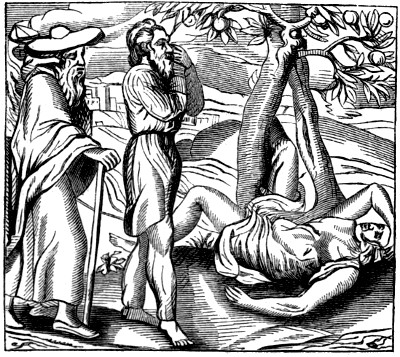
One of the Emblem writers, Sambucus, treated of the same subject in eighteen Latin elegiacs, and expressly named it, Timon the Misanthrope. The scene, too, which the device represents, is in a garden, and we can very readily fancy that the figure on the left is the old steward Flavius come to reason with his master,—
Μισάνθρωπ Τίμων.

Ad Hieron. Cardanum.
Sambucus, 1584.
Oderat hic cunctos, nec ſe, nec amabat amicos,
Μισῶν ἀνθρώπους nomina digna gerens.
Hoc vitium, & morbus de bili naſcitur atra,
Anxiat hæc, curas ſuppeditatq́₃que graues.
Quapropter cecidiſſe piro, fregiſſeq́₃que crura
Fertur, & auxilium non petiiſſe malo.
Suauibus à sociis, & conſuetudine dulci
Qui se ſubducunt, vulnera ſæua ferunt.
Conditio hæc miſera eſt, triſtes ſuſpiria ducunt,
Cumq́₃que nihil cauſæ eſt, occubuiſſe velint.
At tu dum poteris, noto ſociere ſodali,
Subleuet vt preſſum, corq́₃que dolore vacet.
Quos nulla attingunt prorſus commercia grato
Atque ſodalitio, ſubſidiisq́₃que carent:
Aut Dij ſunt proprij, aut falſus peruertit inanes
Senſus, vt hos ſtolidos, vanaq́₃que corda putes.
Tu verò tandem nobis dialectica ſponte
Donata, in lucem mittito, ſi memor es.
In this case we have given the Latin of Sambucus in full, and append a nearly literal translation,—
“All men did he hate, nor loved himself, nor his kindred,—
One hating mankind was the name, worthy of him, he bore.
This faultiness and disease from the black bile arise,
When freely it flows heavy cares it increases.
Wherefore from a pear tree he is said to have fallen,
To have broken his legs, nor help to have sought for the evil.
From pleasant companions, and sweet conversation
They who withdraw themselves, cruel wounds have to bear.
Wretched this state of theirs, sorrowful what sighs they draw,
And though never a cause arise, ’tis their wish to have died.
But thou, while the power remains, join thy well-known companion,
Thee overwhelmed he strengthens, and free sets the heart from its grief.
Whom, with a friend that is pleasing, never intercourse touches,
Without companionship, long without assistance they remain.
Either the gods are our own, or false feeling perverteth the soul,
And you fancy men stupid, and their hearts all are vain.
To us at length reasoning power freely being granted,
Into light do thou send them, if of light thou art mindful.”
The character here sketched is deficient in the thorough heartiness of hatred for which Shakespeare’s Timon is distinguished, yet may it have served him for the primal material out of which to create the drama. In Sambucus there is a mistiness of thought and language which might be said almost to prefigure the doubtful utterances of some of our modern philosophers, but in Shakespeare the master himself takes in hand the pencil of true genius, and by the contrasts and harmonies, the unmistakeable delineations and portraitures, lays on the canvas a picture as rich in its colouring as it is constant in its fidelity to nature, and as perfect in its finish as it is bold in its conceptions.
The extravagance of Timon’s hatred may be gathered from only a few of his expressions,—
“Burn, house! sink, Athens! henceforth hated be
Of Timon man and all humanity.”
Timon of Athens, act iii. sc. 6, l. 103
“Timon will to the woods, where he shall find
The unkindest beast more kinder than mankind
The gods confound—hear me, you good gods all!—
The Athenians both within and out that wall!
And grant, as Timon grows, his hate may grow
To the whole race of mankind, high and low!
Amen.”
Act iv. sc. 1, l. 35.
“All is oblique;
There’s nothing level in our cursed natures
But direct villany. Therefore be abhorr’d
All feasts, societies and throngs of men.”
Act iv. sc. 3, l. 18
“I am misanthropos, and hate mankind.
For thy part, I do wish thou wert a dog,
That I might love thee something.”
Act iv. sc. 3, l. 51
“I never had honest man about me, I; all
I kept were knaves, to serve in meat to villains.”
Act iv. sc. 3, l. 475
And so his ungoverned passion of hatred goes on until it culminates in the epitaph placed on his tomb, which he names his “everlasting mansion,”—
“Upon the beached verge of the salt flood.”
That epitaph as given by Shakespeare, from North’s Plutarch (edition 1579, p. 1003), is almost a literal rendering from the real epitaph recorded in the Greek Anthology (Jacobs, vol. i. p. 86),—
“Ἐνθάδ’ ἀποῤῥηξας ψυχὴν βαρυδαίμονα κεῖμαι,
Τοὔνομα δ’ οὐ πεύσεσθε, κακοὶ δὲ κακῶς ἀπόλοισθε.”
Of which a very close translation will be,—
“Here, having rent asunder a dæmon oppressed soul, I lie;
The name ye shall not inquire, but ye bad ones badly shall perish.”
The epitaph of the drama (Timon of Athens, act v. sc. 4, l. 69, vol. vii. p. 305) is thus read by Alcibiades from the wax impression taken at the tomb,—
“Here lies a wretched corse, of wretched soul bereft:
Seek not my name: a plague consume you wicked caitiffs left!
Here lie I, Timon; who, alive, all living men did hate:
Pass by and curse thy fill: but pass and stay not here thy gait.”
Plutarch[175] introduces a mention of Timon into the life of Marc Antony, whom he compares in some respects to the misanthrope of Athens. He gives the same epitaph as that of the Anthology above quoted, except a letter or two,—
“Ἐνθαδ’ ἀποῤῥήξας ψυχὴν βαρυδαίμονα κεῖμαι,
Τοὔνομα δ’ οὐ πευσοισθε, κακοὶ δὲ κακῶς ἀπόλοισθε.”
Plutarch avers, “καὶ τοὺτο μὲν αὐτὸν ἔτιζῶντα πεποιηκέναι λέγουσι,”—“And people say that during his life he himself made this epitaph.” The narrator then adds, “τοὺτο δε περιφερόμενον, Καλλιμάχου εστι,”—“But this round the margin is by Callimachus,”—
“Τίμων μισάνθρωπος ἐσοικέω· ἀλλα πάρελθε
Οἰμώζειν εἴπας πολλὰ, πάρελθε μόνον.”
“I, Timon the manhater dwell within: but pass by,
To bewail me thou hast spoken many things;—only pass by.“
The two epitaphs Shakespeare has combined into one, showing indeed his acquaintance with the above passage through North’s Plutarch, but not discriminating the authorship of the two parts. North’s translation of the epitaphs is simple and expressive, but the Langhornes, in 1770, vulgarise the lines into,—
“At last I’ve bid the knaves farewell
Ask not my name, but go to hell.”
“My name is Timon: knaves begone,
Curse me, but come not near my stone.”
How Wrangham, in his edition of the Langhornes, 1826, could without notice let this pass for a translation, is altogether unaccountable!
Shakespeare’s, adapted as it is by Sir Thomas North in 1612, may certainly be regarded as a direct version from the Greek, and might reasonably be adduced to prove that he possessed some knowledge of that language. Probably, however, he collected, as he could, the general particulars respecting the veritable and historical Timon, and obtained the help of some man of learning so as to give the very epitaph which in the time of the Peloponnesian war had been placed on the thorn-surrounded sepulchre of the Athenian misanthrope.
To conclude this notice we may observe that the breaking of the legs, which Sambucus mentions, is said to have been the actual cause of the real Timon’s death; for that in his hatred of mankind he even hated himself, and would not allow a surgeon to attempt his cure.
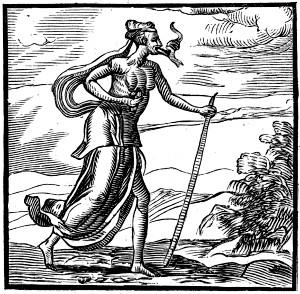
Envy and Hatred may be considered as nearly allied, the latter too often springing from the former. Alciat, in his 71st Emblem, gives a brief description of Envy,—
“Sqvallida vipereas manducans femina carnes,
Cuiq. dolent oculi, quæq. suum cor edit,
Quam macies & pallor habent, spinosaq. gestat
Tela manu: talis pingitur Inuidia.”
Thus amplified with considerable force of expression by Whitney (p. 94),[176]—
Inuidiæ deſcriptio.
Whitney, 1586.
“What hideous hagge with visage sterne appeares?
Whose feeble limmes, can scarce the bodie staie:
This, Enuie is: leane, pale, and full of yeares,
Who with the blisse of other pines awaie.
And what declares, her eating vipers broode?
That poysoned thoughtes, bee euermore her foode.
What meanes her eies? so bleared, sore, and redd:
Her mourninge still, to see an others gaine.
And what is mente by snakes vpon her head?
The fruite that springes, of such a venomed braine.
But whie, her harte shee rentes within her brest?
It shewes her selfe, doth worke her owne vnrest.
Whie lookes shee wronge? bicause shee woulde not see,
An happie wight, which is to her a hell:
What other partes within this furie bee?
Her harte, with gall: her tonge, with stinges doth swell.
And laste of all, her staffe with prickes aboundes:
Which showes her wordes, wherewith the good shee woundes.”
The dramatist speaks of the horrid creature with equal power. Among his phrases are,—
“Thou makest thy knife keen; but no metal can,
No, not the hangman’s axe, bear half the keenness
Of thy sharp envy.”
Merchant of Venice, act iv. sc. 1, l. 124
“And for we think the eagle-winged pride
Of sky-aspiring and ambitious thoughts,
With rival-hating envy, set on you
To wake our peace.”
Richard II., act i. sc. 3, l. 129
“Would curses kill, as doth the mandrake’s groan,
I would invent as bitter-searching terms,
As curst, as harsh and horrible to hear,
Deliver’d strongly through my fixed teeth,
With full as many signs of deadly hate,
As lean-faced Envy in her loathsome cave.”
2 Hen. VI., act iii. sc. 2, l. 310
“’tis greater skill
In a true hate, to pray they have their will:
The very devils cannot plague them better.”
Cymbeline, act ii. sc. 5, l. 33
“Men that make
Envy and crooked malice nourishment
Dare bite the best.”
Hen. VIII., act v. sc. 3, l. 43
“That monster envy.”
Pericles, act iv. Introd., l. 12
The ill-famed Thersites, that railer of the Grecian camp, may close the array against “the hideous hagge with visage sterne” (Troilus and Cressida, act ii. sc. 3, l. 18, vol. vi. p. 169),—
“I have said my prayers; and devil Envy say Amen.”
The wrong done to the soul, through denying it at the last hour the consolations of religion, or through negligence in not informing it of its danger when severe illness arises, is set forth with true Shakespearean power in Holbein’s Simulachres & Historiees faces de la Mort (Lyons, 1538), on sign. Nij,—
“O si ceulx, qui font telles choses, scauoient le mal qu’ilz font, ilz ne cõmettroient iamais vne si grande faulte. Car de me oster mes biens, persecuter ma personne, denigrer ma renommée, ruyner ma maison, destruire mõ parẽtaige, scãdalizer ma famille, criminer ma vie, ces ouures sõt dũg cruel ennemy. Mais d’estre occasion, q̃ ie perde mõ ame, pour nõ la cõseiller au besoing, c’est vne oeuure dũg diable d’Enfer. Car pire est q̃ vng diable l’hõme, qui trompe le malade.”
It is in a similar strain that Shakespeare in Othello (act iii. sc. 3, lines 145 and 159, vol. viii. pp. 512, 513) speaks of the wrong done by keeping back confidence, and by countenancing calumny,—
“Oth. Thou dost conspire against thy friend, Iago,
If thou but think’st him wrong’d and mak’st his ear
A stranger to thy thoughts.
. . . . . . . .
Iago. It were not for your quiet nor your good,
Nor for my manhood, honesty, or wisdom,
To let you know my thoughts.
Oth. What dost thou mean?
Iago. Good name in man and woman, dear my lord,
Is the immediate jewel of their souls:
Who steals my purse steals trash; ’tis something, nothing;
’Twas mine, ’tis his, and has been slave to thousands;
But he that filches from me my good name
Robs me of that which not enriches him
And makes me poor indeed.”
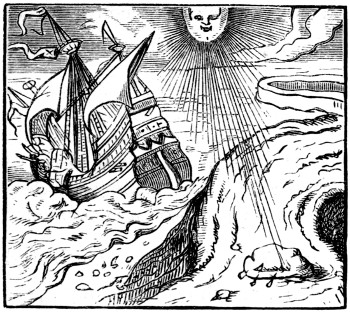
The gallant ship, courageously handled and with high soul of perseverance and fearlessness guided through adverse waves, has for long ages been the type of brave men and brave women struggling against difficulties, or of states and nations amid opposing influences battling for deliverance and victory. Even if that gallant ship fails in her voyage she becomes a fitting type, how “human affairs may decline at their highest.” So Sambucus, and Whitney after him (p. 11), adapt their device and stanzas to the motto,—
Res humanæ in ſummo declinant.
Sambucus, 1584.
In medio librat Phœbus dum lumina cælo,
Diſſoluit radiis, quæ cecidere, niues.
Cùm res humanæ in ſummo ſtant, ſæpe liqueſcunt:
Et nihil æternum, quod rapit atra dies.
Nil iuuat ingentes habitare palatia Reges,
Conditio miſeros hæc eadémque manet.
Mors æquat cunctos, opibus nec parcit in horam,
Verbáque dum Volitant, ocyus illa venit.
Heu, leuiter ventus pellit nos omnis inermes,
Concidimus citiùs quàm leuat aura roſas.
“The gallante Shipp, that cutts the azure surge,
And hathe both tide, and wisshed windes, at will:
Her tackle sure, with shotte her foes to vrge,
With Captaines boulde, and marriners of skill,
With streamers, flagges, topgallantes, pendantes braue,
When Seas do rage, is swallowed in the waue.
The snowe, that falles vppon the mountaines greate,
Though on the Alpes, which seeme the clowdes to reache,
Can not indure the force of Phœbus heate,
But wastes awaie, Experience doth vs teache:
Which warneth all, on Fortunes wheele that clime
To beare in minde how they haue but a time.”
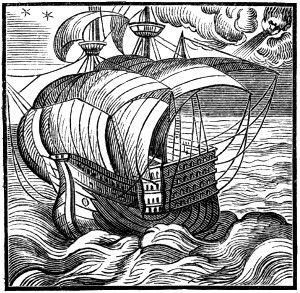
But with brighter auguries, though from a similar device, Alciat (Emb. 43) shadows forth hope for a commonwealth when dangers are threatening. A noble vessel with its sails set is tossing upon the billows, the winds, however, wafting it forward; then it is he gives utterance to the thought, Constancy the Companion of Victory; and thus illustrates his meaning,[177]—
“By storms that are numberless our Commonwealth is shaken,
And hope for safety in the future, hope alone is present:
So a ship with the ocean about her, when the winds seize her,
Gapes with wide fissures ’mid the treacherous waters.
What of help, the shining stars, brothers of Helen, can bring:
To spirits cast down good hope soon doth restore.”
Whitney (p. 37), from the same motto and device, almost with a clarion’s sound, re-echoes the thought,—
Constantia comes victoriæ.
To Miles Corbet Esſquier.
Whitney, 1586.
“The shippe, that longe vppon the sea dothe saile,
And here, and there, with varrijng windes is toste:
On rockes, and sandes, in daunger ofte to quaile.
Yet at the lengthe, obtaines the wished coaste:
Which beinge wonne, the trompetts ratlinge blaste,
Dothe teare the skie, for ioye of perills paste.
Thoughe master reste, thoughe Pilotte take his ease,
Yet nighte, and day, the ship her course dothe keepe:
So, whilst that man dothe saile theise worldlie seas,
His voyage shortes: althoughe he wake, or sleepe.
And if he keepe his course directe, he winnes
That wished porte, where lastinge ioye beginnes.”
To a similar purport is the “Finis coronat opvs,” The end crowns the work,—of Otho Vænius (p. 108), if perchance Shakespeare may have seen it. Cupid is watching a sea-tossed ship, and appears to say,—
“Ni ratis optatum varijs iactata procellis
Obtineat portum, tum perijsse puta.
Futilis est diuturnus amor, ni in fine triumphet,
Nam benè cœpit opus, qui benè finit opus.”
i.e.
“Unless the raft though tossed by various storms
The port desired obtains, think that it perishes;
Vain is the daily love if it no triumph forms,
For well he work begins, who well work finishes.”
Thus, however, rendered at the time into English and Italian,—
“Where the end is good all is good.”
“The ship toste by the waues doth to no purpose saile,
Vnlesse the porte shee gayn whereto her cours doth tend.
Right so th’ euent of loue appeereth in the end,
For losse it is to loue and neuer to preuaile.”
“Il fine corona l’opere.”
“Inutile è la naue, che in mar vaga
Senza prender giamai l’amato porto:
Impiagato d’Amor quel cor’ è à torto,
Che con vano sperar mai non s’appaga.”
Messin in his translation of Boissard’s Emblems (edition 1588, p. 24), takes the motto, “Av Navire agité semble le jour de l’homme,” and dilates into four stanzas the neatly expressed single stanza of the original.
“Vita hæc est tanquam pelago commissa carina,
Instanti semper proxima naufragio.
Optima res homini est non nasci: proxima, si te
Nasci fata velent, quàm citò posse mori.”
i.e.
“This life is as a keel entrusted to the sea,
Ever to threatening shipwreck nearest.
Not to be born for man is best; next, if to thee
The fates give birth, quick death is dearest.”
Shakespeare takes up these various ideas of which the ship in storm and in calm is typical, and to some of them undoubtedly gives utterance from the lips of the dauntless Margaret of Anjou (3 Henry VI., act v. sc. 4, l. 1, vol. v. p. 325),—
“Great lords, wise men ne’er sit and wail their loss,
But cheerly seek how to redress their harms.
What though the mast be now blown overboard,
The cable broke, our holding-anchor lost,
And half our sailors swallow’d in the flood?
Yet lives our pilot still: Is’t meet that he
Should leave the helm and like a fearful lad
With tearful eyes add water to the sea
And give more strength to that which hath too much;
Whiles, in his moan, the ship splits on the rock,
Which industry and courage might have saved?
Ah, what a shame! ah, what a fault were this!
Say, Warwick was our anchor; what of that?
And Montague our top-mast; what of him?
Our slaughter’d friends the tackles; what of these?
Why, is not Oxford here another anchor?
And Somerset another goodly mast?
The friends of France our shrouds and tacklings?
And, though unskilful, why not Ned and I
For once allow’d the skilful pilot’s charge?
We will not from the helm to sit and weep,
But keep our course, though the rough wind say,—no,
From shelves and rocks that threaten us with wreck.
As good to chide the waves as speak them fair.
And what is Edward but a ruthless sea?
What Clarence but a quicksand of deceit?
And Richard but a rugged fatal rock?
All these the enemies to our poor bark.
Say, you can swim; alas, ’tis but a while:
Tread on the sand; why, there you quickly sink:
Bestride the rock; the tide will wash you off,
Or else you famish; that’s a threefold death.
This speak I, lords, to let you understand,
If case some one of you would fly from us,
That there’s no hoped-for mercy with the brothers
More than with ruthless waves, with sands and rocks.
Why, courage then! what cannot be avoided
’Twere childish weakness to lament or fear.”
Well did the bold queen merit the outspoken praises of her son,—
“Methinks, a woman of this valiant spirit
Should, if a coward heard her speak these words,
Infuse his breast with magnanimity,
And make him, naked, foil a man at arms.”
And in a like strain, when Agamemnon would show that the difficulties of the ten years’ siege of Troy were (l. 20),—
“But the protractive trials of great Jove
To find persistive constancy in men;”
the venerable Nestor, in Troilus and Cressida (act i. sc. 3, l. 33, vol. vi. p. 142), enforces the thought by adding,—
“In the reproof of chance
Lies the true proof of men: the sea being smooth,
How many shallow bauble boats dare sail
Upon her patient breast, making their way
With those of nobler bulk!
But let the ruffian Boreas once enrage
The gentle Thetis, and anon behold
The strong-ribb’d bark through liquid mountains cut,
Bounding between the two moist elements
Like Perseus’ horse.
. . . . . . . .
Even so
Doth valour’s show and valour’s worth divide
In storms of fortune: for in her ray and brightness
The herd hath more annoyance by the breese
Than by the tiger; but when the splitting wind
Makes flexible the knees of knotted oaks,
And flies fled under shade, why then the thing of courage
As roused with rage with rage doth sympathize,
And with an accent tuned in selfsame key
Retorts to chiding fortune.”
To the same great sentiments Georgette Montenay’s “Emblemes Chrestiennes” (Rochelle edition, p. 11) supplies a very suitable illustration; it is to the motto, Quem timebo?—“Whom shall I fear?”—
“Du grand peril des vens & de la mer,
C’est homme a bien cognoissance très claire,
Et ne craind point de se voir abismer
Rusque son Dieu l’adresse et luy esclaire.”
The device itself is excellent,—a single mariner on a tempestuous sea, undaunted in his little skiff; and the hand of Providence, issuing from a cloud, holds out to him a beacon light.
“On a student entangled in love,” is the subject of Alciat’s 108th Emblem. The lover appears to have been a jurisconsult, whom Alciat, himself a jurisconsult, represents,—
“Immersed in studies, in oratory and right well skilled,
And great especially in all the processes of law,
Haliarina he loves; as much as ever loved
The Thracian prince his sister’s beauteous maid.
Why in Cyprus dost thou overcome Pallas by another judge?
Sufficient is it not to conquer at Mount Ida?”
The unfinished thoughts of Alciat are brought out more completely by Whitney, who thus illustrates his subject (p. 135),—
Jn ſtudioſum captum amore.
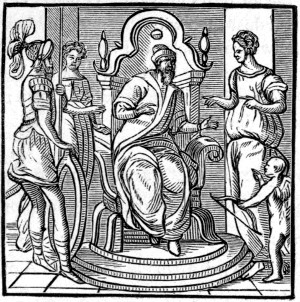
Whitney, 1586.
“A Reuerend sage, of wisedome most profounde,
Beganne to doate, and laye awaye his bookes:
For Cvpid then, his tender harte did wounde,
That onlie nowe, he lik’de his ladies lookes?
Oh Venvs staie? since once the price was thine,
Thou ought’st not still, at Pallas thus repine.”
Note, now, how the thoughts of the Emblematists, though greatly excelled in the language which clothes them, are matched by the avowals which the severe and grave Angelo made to himself in Measure for Measure (act ii. sc. 4, l. 1, vol. i. p. 327). He had been disposed to carry out against another the full severity of the law, which he now felt himself inclined to infringe, but confesses,—
“When I would pray and think, I think and pray
To several subjects. Heaven hath my empty words:
Whilst my invention, hearing not my tongue,
Anchors on Isabel: Heaven in my mouth,
As if I did but only chew his name;
And in my heart the strong and swelling evil
Of my conception. The state, whereon I studied,
Is like a good thing, being often read,
Grown fear’d and tedious; yea, my gravity,
Wherein—let no man hear me—I take pride,
Could I with boot change for an idle plume,
Which the air beats for vain. O place, O form,
How often dost thou with thy case, thy habit,
Wrench awe from fools, and tie the wiser souls
To thy false seeming! Blood, thou art blood:
Let’s write good angel on the devil’s horn;
’Tis not the devil’s crest.”
But the entire force of this parallelism in thought is scarcely to be apprehended, unless we mark Angelo’s previous conflict of desire and judgment. Isabel utters the wish, “Heaven keep your honour safe!” And after a hearty “Amen,” the old man confesses to himself (p. 324),—
“For I am that way going to temptation,
Where prayers cross.”
Act ii. sc. 2, l. 158.
“What’s this, what’s this? Is this her fault or mine?
The tempter or the tempted, who sins most?
Ha!
Not she; nor doth she tempt: but it is I
That, lying by the violet in the sun,
Do as the carrion does, not as the flower,
Corrupt with virtuous season. Can it be
That modesty may more betray our sense
Than woman’s lightness.”
Act ii. sc. 2, l. 162.
“What, do I love her,
That I desire to hear her speak again,
And feast upon her eyes? What is’t I dream on?
O cunning enemy, that, to catch a saint,
With saints dost bait thy hook! Most dangerous
Is that temptation that doth goad us on
To sin in loving virtue.”
Act ii. sc. 2, l. 177
There is an Emblem by Whitney (p. 131), which, though in some respects similar to one at p. 178 of the “Pegma” by Costalius, 1555, entitled “Iron,” “on the misery of the human lot,” is to a very great degree his own, and which makes it appear in a stronger light than usual, that a close resemblance exists between his ideas and even expressions and those of Shakespeare. The subject is “Writings remain,” and the device the overthrow of stately buildings, while books continue unharmed.
Scripta manent.
To Sir Arthvre Manwaringe Knight.
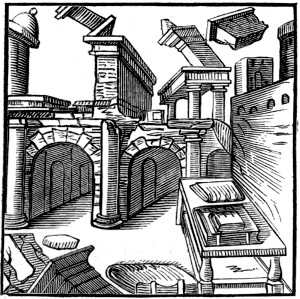
Whitney, 1586.
“If mightie Troie, with gates of steele, and brasse,
Bee worne awaie, with tracte of stealinge time:
If Carthage, raste: if Thebes be growne with grasse.
If Babel stoope: that to the cloudes did clime:
If Athens, and Nvmantia suffered spoile:
If Ægypt spires, be euened with the soile.
Then, what maye laste, which time dothe not impeache,
Since that wee see, theise monumentes are gone:
Nothinge at all, but time doth ouer reache,
It eates the steele, and weares the marble stone:
But writinges laste, thoughe yt doe what it can,
And are preseru’d, euen since the worlde began.
And so they shall, while that they same dothe laste,
Which haue declar’d, and shall to future age:
What thinges before three thousande yeares haue paste,
What martiall knightes, haue march’d vppon this stage:
Whose actes, in bookes if writers did not saue,
Their fame had ceaste, and gone with them to graue.
Of Samsons strengthe, of worthie Iosvas might.
Of Davids actes, of Alexanders force.
Of Cæesar greate; and Scipio noble knight,
Howe shoulde we speake, but bookes thereof discourse:
Then fauour them, that learne within their youthe:
But loue them beste, that learne, and write the truthe.”
La vie de Memoire, and Vine ut viuas,—“Live that you may live,”—emblematically set forth by pen, and book, and obelisk, and ruined towers, in Boissard’s Emblems by Messin (1588, pp. 40, 41), give the same sentiment, and in the Latin by a few brief lines,—
“Non omnis vivit, vitâ qui spirat in istâ:
Sed qui post fati funera vivit adhuc:
Et cui posteritas famæ præconia servat
Æternum is, calamo vindice, nomen habet.”
Thus having the main idea taken up in the last of the four French stanzas,—
“Mais qui de ses vertus la plume a pour garand:
Celuy centre le temps invincible se rend:
Car elle vainc du temps & l’effort, & l’injure.”
In various instances, only with greater strength and beauty, Shakespeare gives utterance to the same sequences of thought. When, in Love’s Labour’s Lost (act i. sc. 1, l. 1, vol. ii. p. 97), fashioning his court to be,—
“A little Academe,
Still and contemplative in living art,”
Ferdinand, king of Navarre, proclaims,—
“Let Fame, that all hunt after in their lives,
Live register’d upon our brazen tombs,
And then grace us in the disgrace of death;
When, spite of cormorant devouring Time,
The endeavour of this present breath may buy
That honour which shall bate his scythe’s keen edge,
And make us heirs of all eternity.”
In his Sonnets, more especially, Shakespeare celebrates the enduring glory of the mind’s treasures. Thus, the 55th Sonnet (Works, vol. ix. p. 578) is written almost as Whitney wrote,—
“Not marble, nor the gilded monuments
Of princes, shall outlive this powerful rhyme;
But you shall shine more bright in these contents,
Than unswept stone, besmear’d with sluttish lime.
When wasteful war shall statues overturn,
And broils root out the work of masonry.
Nor Mars his sword, nor war’s quick fire shall burn
The living record of your memory.
’Gainst death and all-oblivious enmity,
Shall you pace forth; your praise shall still find room,
Even in the eyes of all posterity
That wear this world out to the ending doom.
So, till the judgment that yourself arise,
You live in this, and dwell in lovers’ eyes.”
But the 65th Sonnet (p. 583) is still more in accordance with Whitney’s ideas,—not a transcript of them, but an appropriation,—
“Since brass, nor stone, nor earth, nor boundless sea,
But sad mortality o’ersways their power,
How with this rage shall beauty hold a plea,
Whose action is no stronger than a flower?
O how shall summer’s honey breath hold out
Against the wreckful siege of battering days,
When rocks impregnable are not so stout,
Nor gates of steel so strong, but Time decays?
O fearful meditation! where, alack!
Shall Time’s best jewel from Time’s chest lie hid?
Or what strong hand can hold his swift foot back?
Or who his spoil of beauty can forbid?
No one, unless this miracle have might,
That in black ink my love may still shine bright.”
How closely, too, are these thoughts allied to some in that Emblem (p. 197) in which Whitney, following Hadrian Junius, so well celebrates “the eternal glory of the pen.”
Pennæ gloria immortalis.
Ad Iacobum Blondelium.
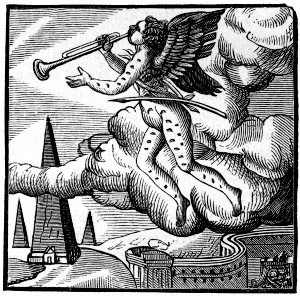
Junius, 1565.[178]
He has been telling of Sidney’s praise, and in a well-turned compliment to him and to his other friend, “Edwarde Dier,” makes the award,—
“This Embleme lo, I did present, vnto this woorthie Knight.
Who, did the same refuse, as not his proper due:
And at the first, his sentence was, it did belonge to you.
Wherefore, lo, fame with trompe, that mountes vnto the skye:
And, farre aboue the highest spire, from pole, to pole dothe flye,
Heere houereth at your will, with pen adorn’d with baies:
Which for you bothe, shee hath prepar’d, vnto your endlesse praise.
The laurell leafe for you, for him, the goulden pen;
The honours that the Muses giue, vnto the rarest men.
Wherefore, proceede I praye, vnto your lasting fame;
For writinges last when wee bee gonne, and doe preserue our name.
And whilst wee tarrye heere, no treasure can procure,
The palme that waites vpon the pen, which euer doth indure.
Two thousand yeares, and more, Homervs wrat his books;
And yet, the same doth still remayne, and keepes his former looke.
Wheare Ægypte spires bee gonne, and Rome doth ruine feele,
Yet, both begonne since he was borne, thus time doth turne the wheele.
Yea, thoughe some Monarche greate some worke should take in hand,
Of marble, or of Adamant, that manie worldes shoulde stande,
Yet, should one only man, with labour of the braine,
Bequeathe the world a monument, that longer shoulde remaine,
And when that marble waules, with force of time should waste;
It should indure from age, to age, and yet no age should taste.”
“Ex malo bonum,”—Good out of evil,— contains a sentiment which Shakespeare not unfrequently expresses. An instance occurs in the Midsummer Nights Dream (act i. sc. 1, l. 232, vol. ii. p. 206),—
“Things base and vile, holding no quantity,
Love can transpose to form and dignity.”
Also more plainly in Henry V. (act iv. sc. 1, l. 3, vol. iv. p. 555),—
“God Almighty!
There is some soul of goodness in things evil,
Would men observingly distil it out.
For our bad neighbour makes us early stirrers,
Which is both healthful and good husbandry:
Besides they are our outward consciences,
And preachers to us all, admonishing
That we should dress us fairly for our end.
Thus we may gather honey from the weed,
And make a moral of the devil himself!”
So in Georgette Montenay’s Christian Emblems we find the stanzas,—
“On tire bien des epines poignantes
Rose tres bonné̩[e/]̩ & pleine de beauté.
Des reprouuer & leurs œuures meschantes
Dieu tiré̩[e/]̩ aussi du bien par sa bonté,
Faisant seruir leur fausse volonté
A sa grand’ gloiré̩[e/]̩ & salut des esleuz,
Et par iusticé̩[e/]̩, ainsi qu’ a decreté,
Dieu fait tout bien; que nul n’en doute plus.”
As we have mentioned before (pp. 242, 3), Ovid’s Metamorphoses are the chief source to which, from his time downwards, poets in general have applied for their most imaginative and popular mythic illustrations; and to him especially have Emblem writers been indebted. For a fact so well known a single instance will suffice; it is the description of Chaos and of the Creation of the World (bk. i. fab. 1),—
“Ante mare et terras, et quod tegit omnia, cœlum,
Unus erat toto naturæ vultus in orbe,
Quem dixêre Chaos: rudis indigestaque moles.”
An early Italian Emblematist, Gabriel Symeoni, in 1559, presents on this subject the following very simple device in his Vita et Metamorfoseo d’Ovidio (p. 12), accompanied on the next page by “The creation and confusion of the world,”—
Il Caos.
Symeoni, 1559.
“Prima fuit rerum confusa sine ordine moles,
Vnaq. erat facies sydera, terra, fretum.”
i.e.
“First was there a confused mass of things without order,
And one appearance was stars, earth, sea.”
But Ovid’s lines are applied in a highly figurative sense, to show the many evils and disorders of injustice. A wild state where wrong triumphs and right is unknown,—that is the Chaos which Anulus sets forth in his “Picta Poesis” (p. 49); Without justice, confusion.
SINE IVSTITIA, CONFVSIO.
Aneau, 1555.
Si terrae Cœlum ſemiſceat: & mare cœlo.
Sol Erebo. Tenebris lumina, Terra Polo.
Quattuor & Mundi mixtim primordia pugnent.
Arida cum ſiccis, algida cum calidis.
In Chaos antiquum omnia denique confundantur:
Vt cùm ignotus adhuc mens Deus orbis erat.
Eſt Mundanarum talis confuſio rerum.
Quo Regina latet Tempore Iuſtitia.
i.e.
“If with earth heaven should mingle and the sea with heaven,
The sun with Erebus, light with darkness, the earth with the pole,
Should the four elements of the world in commixture fight,
Dry things with the moist and cold things with the hot,
Into ancient chaos at last all things would be confounded
As when God as yet unknown was the soul of the globe.
Such is the confusion of all mundane affairs,
At what time soever Justice the queen lies concealed.”
Whitney (p. 122), borrowing this idea and extending it, works it out with more than his usual force and skill, and dedicates his stanzas to Windham and Flowerdewe, two eminent judges of Elizabeth’s reign,—but his amplification of the thought is to a great degree peculiar to himself. Ovid, indeed, is his authority for representing the elements in wild disorder, and the peace and the beauty which ensued,—
“When they weare dispos’d, eache one into his roome.”
The motto, dedication, and device, are these,—
Sine iuſtitia, confuſio.
Ad eoſdem Iudices.
Whitney, 1586.
“When Fire, and Aire, and Earthe, and Water, all weare one:
Before that worke deuine was wroughte, which nowe wee looke vppon.
There was no forme of thinges, but a confused masse:
A lumpe, which Chaos men did call: wherein no order was.
The Coulde, and Heate, did striue: the Heauie thinges, and Lighte.
The Harde, and Softe, the Wette, and Drye, for none had shape arighte.
But when they weare dispos’d, eache one into his roome:
The Fire, had Heate: the Aire, had Lighte: the Earthe, with fruites did bloome.
The Sea, had his increase: which thinges, to passe thus broughte:
Behoulde, of this vnperfecte masse, the goodly worlde was wroughte.”
Whitney then celebrates “The goulden worlde that Poëttes praised moste;” next, “the siluer age;” and afterwards, “the age of brasse.”
“The Iron age was laste, a fearefull cursed tyme:
Then, armies came of mischiefes in: and fil’d the worlde with cryme.
Then rigor, and reuenge, did springe in euell hower:
And men of mighte, did manadge all, and poore opprest with power.
And hee, that mightie was, his worde, did stand for lawe:
And what the poore did ploughe, and sowe: the ritch away did drawe.
None mighte their wiues inioye, their daughters, or their goodes,
No, not their liues: such tyraunts broode, did seeke to spill their bloodes.
Then vertues weare defac’d, and dim’d with vices vile,
Then wronge, did maske in cloke of righte: then bad, did good exile.
Then falshood, shadowed truthe: and hate, laugh’d loue to skorne:
Then pitie, and compassion died: and bloodshed fowle was borne.
So that no vertues then, their proper shapes did beare:
Nor coulde from vices bee decern’d, so straunge they mixed weare.
That nowe, into the worlde, an other Chaos came:
But God, that of the former heape: the heauen and earthe did frame.
And all thinges plac’d therein, his glorye to declare:
Sente Ivstice downe vnto the earthe: such loue to man hee bare.
Who, so suruay’d the world, with such an heauenly vewe:
That quickley vertues shee aduanc’d: and vices did subdue.
And, of that worlde did make, a paradice, of blisse:
By which wee doo inferre: That where this sacred Goddes is.
That land doth florishe still, and gladnes, their doth growe:
Bicause that all, to God, and Prince, by her their dewties knowe.
And where her presence wantes, there ruine raignes, and wracke:
And kingdomes can not longe indure, that doe this ladie lacke.
Then happie England most, where Ivstice is embrac’d:
And eeke so many famous men, within her chaire are plac’d.”
With the description thus given we may with utmost appropriateness compare Shakespeare’s noble commendation of order and good government, into which, by way of contrast, he introduces the evils and miseries of lawless power. The argument is assigned to Ulysses, in the Troilus and Cressida (act i. sc. 3, l. 75, vol. vi. p. 144), when the great chieftains, Agamemnon, Nestor, Menelaus, and others are discussing the state and prospects of their Grecian confederacy against Troy. With great force of reasoning, as of eloquence, he contends,—
“Troy, yet upon his basis, had been down,
And the great Hector’s sword had lack’d a master.
But for these instances.
bloodes.
The specialty of rule hath been neglected:
And, look, how many Grecian tents do stand
Hollow upon this plain, so many hollow factions.
When that the general is not like the hive,
To whom the foragers shall all repair,
What honey is expected? Degree being vizarded,
The unworthiest shows as fairly in the mask.
The heavens themselves, the planets and this centre,
Observe degree, priority and place,
Insisture, course, proportion, season, form,
Office and custom, in all line of order:
And therefore is the glorious planet Sol
In noble eminence enthroned and sphered
Amidst the other;
. . . . . .
but when the planets
In evil mixture to disorder wander,
What plagues and what portents, what mutiny,
What raging of the sea, shaking of earth,
Commotion in the winds, frights, changes, horrors,
Divert and crack, rend and deracinate
The unity and married calm of states
Quite from their fixure! O, when degree is shaked,
Which is the ladder to all high designs,
Then enterprise is sick! How could communities,
Degrees in schools and brotherhoods in cities,
Peaceful commerce from dividable shores,
The primogenitive and due of birth,
Prerogative of age, crowns, sceptres, laurels.
But by degree, stand in authentic place?
Take but degree away, untune that string,
And, hark, what discord follows! each thing meets
In mere oppugnancy: The bounded waters
Should lift their bosoms higher than the shores,
And make a sop of all this solid globe:
Strength should be lord of imbecility,
And the rude son should strike his father dead:
Force should be right; or rather, right and wrong,
Between whose endless jar justice resides,
Should lose their names, and so should justice too.
Then everything includes itself in power,
Power into will, will into appetite;
And appetite, an universal wolf.
So doubly seconded with will and power,
Must make perforce an universal prey,
And last eat up himself. Great Agamemnon,
This chaos, when degree is suffocate,
Follows the choking.
And this neglection of degree it is
That by a pace goes backward, with a purpose
It hath to climb. The general’s disdain’d
By him one step below; he, by the next;
That next by him beneath: so every step,
Exampled by the first pace that is sick
Of his superior, grows to an envious fever
Of pale and bloodless emulation:
And ’tis this fever that keeps Troy on foot,
Not her own sinews. To end a tale of length,
Troy in our weakness stands, not in her strength.”
At a hasty glance the two passages may appear to have little more connection than that of similarity of subject, leading to several coincidences of expression; but the Emblem of Chaos, given by Whitney, represents the winds, the waters, the stars of heaven, all in confusion mingling, and certainly is very suggestive of the exact words which the dramatic poet uses,—
“What raging of the sea? shaking of earth?
Commotion in the winds?
. . . . . .
The bounded waters
Should lift their bosoms higher than the shores,
And make a sop of all this solid globe.”
Discord as one of the great causes of confusion is also spoken of with much force (1 Henry VI., act iv. sc. 1, l. 188, vol. v. p. 68),—
“No simple man that sees
This jarring discord of nobility,
This should’ring of each other in the court,
This factious bandying of their favourites,
But that he doth presage some ill event.
’Tis much, when sceptres are in children’s hands;
But more when envy breeds unkind division;
There comes the ruin, there begins confusion.”
The Paris edition of Horapollo’s Hieroglyphics, 1551, subjoins several to which there is no Greek text (pp. 217–223). Among them (at p. 219) is one that figures, The thread of life, a common poetic idea.
Horapollo, ed. 1551.
Quo pacto mortem ſeu hominis
exitum.
Hominis exitum innuentes, fuſum pingebant, & fili extremum reſectum, quaſi à colo diuulſum, finguntur ſiquidem à poetis Parcæ hominis vitam nere: Clotho quidem colum geſtans: Lacheſis quæ Sors exponitur, nens: Atropos verò inconuertibilis ſeu inexorabilis Latinè redditur, filum abrumpens.
The question is asked, “How do they represent the death or end of man?” Thus answered,—“To intimate the end of man they paint a spindle, and the end of the thread cut off, as if broken from the distaff: so indeed by the poets the Fates are feigned to spin the life of man: Clotho indeed bearing the distaff; Lachesis spinning whatever lot is declared; but Atropos, breaking the thread, is rendered unchangeable and inexorable.”
This thread of life Prospero names when he speaks to Ferdinand (Tempest, act iv. sc. 1, l. 1, vol. i. p. 54) about his daughter,—
“If I have too austerely punish’d you,
Your compensation makes amends; for I
Have given you here a thread[179] of mine own life
Or that for which I live.”
“Their thread of life is spun,” occurs in 2 Henry VI. (act iv. sc. 2, l. 27).
So the “aunchient Pistol,” entreating Fluellen to ask a pardon for Bardolph (Henry V., act iii. sc. 6, l. 44, vol. iv. p. 544). says,—
“The duke will hear thy voice;
And let not Bardolph’s vital thread be cut
With edge of penny cord and vile reproach.
Speak, captain, for his life, and I will thee requite.”
The full application of the term, however, is given by Helena in the Pericles (act i. sc. 2, l. 102, vol. ix. p. 325), when she says to the Prince of Tyre,—
“Antiochus you fear,
And justly too, I think, you fear the tyrant,
Who either by public war or private treason
Will take away your life.
Therefore, my lord, go travel for a while,
Till that his rage and anger be forgot,
Or till the Destinies do cut his thread of life.”
The same appendix to Horapollo’s Hieroglyphics (p. 220) assigns a burning lamp as the emblem of life; thus,—
Horapollo, ed. 1551.
Quo modo vitam.
Vitam innuentes ardentem lampada pingebant: quòd tantiſper dum accenſa lampas eſt, luceat, extincta verò tenebras offundat, ita & anima corpore ſoluta, & aſpectu & luce caremus.
“To intimate life they paint a burning lamp; because so long as the lamp is kindled it gives forth light, but being extinguished spreads darkness; so also the soul being freed from the body we are without seeing and light.”
This Egyptian symbol Cleopatra names just after Antony’s death (Antony and Cleopatra, act iv. sc. 15, l. 84, vol. ix. p. 132),—
“Ah, women, women, look
Our lamp is spent, it’s out.”
Similar the meaning when Antony said (act iv. sc. 14, l. 46, vol. ix. p. 123),—
“Since the torch is out,
Lie down and stray no farther.”
Of the Emblems which depict moral qualities and æsthetical principles, scarcely any are more expressive than that which denotes an abiding sense of injury. This we can trace through Whitney (p. 183) to the French of Claude Paradin (fol. 160), and to the Italian of Gabriel Symeoni (p. 24). It is a sculptor, with mallet and chisel, cutting a memorial of his wrongs into a block of marble; the title, Of offended Poverty, and the motto, “Being wronged he writes on marble.”