Chapter VI · CLASSIFICATION OF THE CORRESPONDENCIES AND PARALLELISMS OF SHAKESPEARE WITH EMBLEM WRITERS. (continued 5)
Reading edition
DI POVERTA
OFFESA.
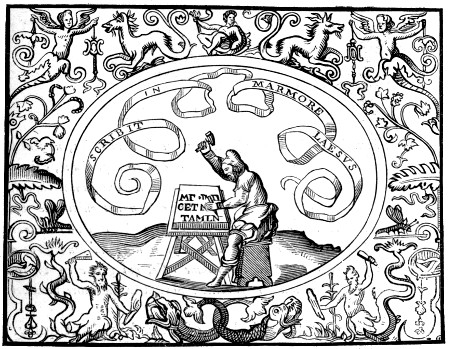
Giovio and Symeoni, 1562.
Scribit in marmore læſus.
Tempri l’ ira veloce ogniun, che viue,
Et per eſſer potente non ha cura,
Di far’ altrui talhor danno o paura,
Che l’offeſo l’ingiuria in marmo ſeriue.
Like the other “Imprese” of the “Tetrastichi Morali,” the woodcut is surrounded by a curiously ornamented border, and manifests much artistic skill. The stanza is,—
“Each one that lives may be swift passion’s slave,
And through a powerful will at times delight
In causing others harm and terror’s fright:
The injured doth those wrongs on marble grave.”
The “Devises Heroiqves” adds to the device a simple prose description of the meaning of the Emblem,—
Scribit in marmore leſus.
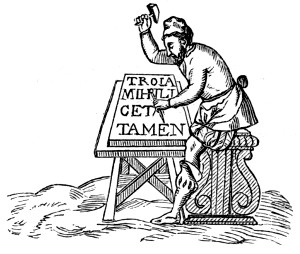
Paradin, 1562.
Certains fols éuentés s’ aſſeurans trop ſus leur credit & richeſſes, ne font point cas d’iniurier ou gourmander de faict & de paroles une pauure perſonne, eſtimans que à faute de biens, de faueur, de parens, ou d’amis elle n’aura jamais le moyen de ſe venger, ou leur rẽdre la pareille, ains qu’elle doiue lien toſt oublier le mal qu’elle a receu. Or combien ces Tirans (c’eſt leur propre nom) ſoyent abuſez de leur grande folie & ignorance, l’occaſion & le temps le leur fera à la fin connoiſtre, apres les auoir admoneſtez par ceſte Deuiſe d’un homme aſſis, qui graue en un tableau de marbre ce qu’il a en memmoire auec ces parolles: Scribit in marmore læsus. (f.160.)
The word here propounded is of very high antiquity. The prophet Jeremiah (xvii. 1 and 13) set forth most forcibly what Shakespeare names “men’s evil manners living in brass;” and Whitney, “harms graven in marble hard.” “The sin of Judah is written with a pen of iron, and with the point of a diamond: it is graven upon the table of their heart, and upon the horns of your altars.” And the writing in water, or in the dust, is in the very spirit of the declaration, “They that depart from me shall be written in the earth,”—i.e., the first wind that blows over them shall efface their names,—“because they have forsaken the Lord, the fountain of living waters.”
Some of Shakespeare’s expressions,—some of the turns of thought, when he is speaking of injuries,—are so similar to those used by the Emblem writers in treating of the same subject, that we reasonably conclude “the famous Scenicke Poet, Master W. Shakespeare,” was intimate with their works, or with the work of some one out of their number; and, as will appear in a page or two, very probably those expressions and turns of thought had their origin in the reading of Whitney’s Choice of Emblemes rather than in the study of the French and Italian authors.
Of the same cast of idea with the lines illustrative of Scribit in marmore læsus, are the words of Marc Antony’s oration over Cæsar (Julius Cæsar, act iii. sc. 2, l. 73, vol. vii. p. 375),—
“I come to bury Cæsar, not to praise him.
The evil that men do lives after them;
The good is oft interred with their bones;
So let it be with Cæsar.”
A sentiment, almost the converse of this, and of higher moral excellence, crops out where certainly we should not expect to find it—in the Timon of Athens (act iii. sc. 5, l. 31, vol. vii. p. 254),—
“He’s truly valiant that can wisely suffer
The worst that man can breathe, and make his wrongs
His outsides, to wear them like his raiment, carelessly,
And ne’er prefer his injuries to his heart,
To bring it into danger.
If wrongs be evils and enforce us kill,
What folly ’tis to hazard life for ill!”
In that scene of unparalleled beauty, tenderness, and simplicity, in which there is related to Queen Katharine the death of “the great child of honour,” as she terms him, Cardinal Wolsey (Henry VIII., act iv. sc. 2, l. 27, vol. vi. p. 87), Griffith describes him as,—
“Full of repentance,
Continual meditations, tears and sorrows,
He gave his honours to the world again,
His blessed part to heaven, and slept in peace.”
And just afterwards (l. 44), when the Queen had been speaking with some asperity of the Cardinal’s greater faults, Griffith remonstrates,—
“Noble Madam,
Men’s evil manners live in brass; their virtues
We write in water. May it please your highness
To hear me speak his good now?”
How very like to the sentiment here enunciated is that of Whitney (p. 183),—
“In marble harde our harmes wee alwayes graue,
Bicause, wee still will beare the same in minde:
In duste wee write the benifittes wee haue,
Where they are soone defaced with the winde.
So, wronges wee houlde, and neuer will forgiue,
And soone forget, that still with vs shoulde liue.”
Lavinia’s deep wrongs (Titus Andronicus, act iv. sc. 1, l. 85, vol. vi. p. 490) were written by her on the sand, to inform Marcus and Titus what they were and who had inflicted them; and Marcus declares,—
“There is enough written upon this earth
To stir a mutiny in the mildest thoughts
And arm the minds of infants to exclaims.”
Marcus is for instant revenge, but Titus knows the power and cruel nature of their enemies, and counsels (l. 102),—
“You are a young huntsman, Marcus; let alone;
And, come, I will go get a leaf of brass.
And with a gad of steel will write these words,
And lay it by: the angry northern wind
Will blow these sands, like Sibyl’s leaves, abroad.
And where’s your lesson then?”
The Italian and French Emblems as pictures to be looked at would readily supply Shakespeare with thoughts respecting the record of “men’s evil manners,” and of “their virtues,” but there is a closer correspondence between him and Whitney; and allowing for the easy substitution of “brass” and of “water” for “marble” and “dust,” the parallelism of the ideas and words is so exact as to be only just short of being complete.
We must not, however, conceal what may have been a common origin of the sentiment for all the four writers,—for the three Emblematists and for the dramatist, namely, a sentence written by Sir Thomas More, about the year 1516, before even Alciatus had published his book of Emblems. Dr. Percy, as quoted by Ayscough (p. 695), remarks that, “This reflection bears a great resemblance to a passage in Sir Thomas More’s History of Richard III., where, speaking of the ungrateful turns which Jane Shore experienced from those whom she had served in her prosperity, More adds, ‘Men use, if they have an evil turne, to write it in marble, and whoso doth us a good turne, we write it in duste.’”
But the thought is recorded as passing through the mind of Columbus, when, during mutiny, sickness, and cruel tidings from home, he had, on the coast of Panama, the vision which Irving describes and records. A voice had been reproving him, but ended by saying, “Fear not, Columbus, all these tribulations are written in marble, and are not without cause.”
“To write in dust,” however, has sometimes a simple literal meaning in Shakespeare; as when King Edward (3 Henry VI., act v. sc. 1, l. 54, vol. v. p. 319), uses the threat,—
“This hand, fast wound about thy coal-black hair,
Shall, while thy head is warm and new cut off,
Write in the dust this sentence with thy blood,—
Wind-changing Warwick now can change no more.”
But in the Titus Andronicus (act iii. sc. 1, l. 12, vol. vi. p. 472), the phrase is of doubtful meaning: it may denote the oblivion of injuries or the deepest of sorrows,—
“In the dust I write
My heart’s deep languor, and my soul’s sad tears.”
Whitney also has the lines to the praise of Stephen Limbert, Master of Norwich School (p. 173),—
“Our writing in the duste, can not indure a blaste;
But that which is in marble wroughte, from age to age, doth laste.”
It is but justice to Shakespeare to testify that at times his judgment respecting injuries rises to the full height of Christian morals. The spirit Ariel avows, that, were he human, his “affections would become tender” towards the shipwrecked captives on whom his charms had been working (Tempest, act v. sc. 1, l. 21, vol. i. p. 64); and Prospero enters into his thought with strong conviction,—
“Hast thou, which art but air, a touch, a feeling
Of their afflictions, and shall not myself,
One of their kind, that relish all as sharply,
Passion as they, be kindlier moved than thou art?
Though with their high wrongs I am struck to the quick,
Yet with my nobler reason ’gainst my fury
Do I take part: the rarer action is
In virtue than in vengeance: they being penitent,
The sole drift of my purpose doth extend
Not a frown further.”
The subject in this connection finds a fitting conclusion from the words of a later writer, communicated to me by the Rev. T. Walker, M.A., formerly of Nether Tabley, in which a free forgiveness of injuries is ascribed to the world’s great and blessed Saviour,—
“Some write their wrongs on marble, He more just
Stoop’d down serene, and wrote them in the dust,
Trod under foot, the sport of every wind,
Swept from the earth, quite banished from his mind,
There secret in the grave He bade them lie,
And grieved, they could not ’scape the Almighty’s eye.”
Whitney. Reprint, 1866, p. 431.