Chapter II · SKETCH OF EMBLEM-BOOK LITERATURE PREVIOUS TO A.D. 1616.
Reading edition
Section I. EXTENT OF THE EMBLEM LITERATURE TO WHICH SHAKESPEARE MIGHT HAVE HAD ACCESS.
IN the use of the word Emblem there is seldom a strict adherence observed to an exact definition,—so, when Emblem Literature is spoken of, considerable latitude is taken and allowed as to the kind of works which the terms shall embrace. In one sense every book which has a picture set in it, or on it, is an emblem-book,—the diagrams in a mathematical treatise or in an exposition of science, inasmuch as they may be, and often are, detached from the text, are emblems; and when to Tennyson’s exquisite poem of “Elaine,” Gustave Doré conjoins those wonderful drawings which are themselves poetic, he gives us a book of emblems;—Tennyson is the one artist that out of the gold of his own soul fashioned a vase incorruptible,—and Doré is that second artist who placed about it ornaments of beauty, fashioned also out of the riches of his mind.
Yet by universal consent, these and countless other works, scientific, historical, poetic, and religious, which artistic skill has embellished, are never regarded as emblematical in their character. The “picture and short posie, expressing some particular conceit,” seem almost essential for bringing any work within the province of the Emblem Literature;—but the practical application of the test is conceived in a very liberal spirit, so that while the small fish sail through, the shark and the sea-dog rend the meshes to tatters.
A proverb or witty saying, as, in Don Sebastian Orozco’s “Emblemas Morales” (Madrid 1610), “Divesqve miserqve,” both rich and wretched, may be pictured by king Midas at the table where everything is turned to gold, and may be set forth in an eight-lined stanza, to declare how the master of millions was famishing though surrounded by abundance;—and these things constitute the Emblem. Some scene from Bible History shall be taken, as, in “Les figures du vieil Testament, & du nouuel” (at Paris, about 1503), Moses at the burning bush; where are printed, as if an Emblem text, the passage from Exodus iii. 2–4, and by its side the portraits of David and Esaias; across the page is a triplet woodcut, representing Moses at the bush, and Mary in the stable at Bethlehem with Christ in the manger-cradle; various scrolls with sentences from the Scriptures adorn the page:—such representations claim a place in the Emblem Literature. Boissard’s Theatrum Vitæ Humanæ (Metz, 1596) shall mingle, in curious continuity, the Creation and Fall of Man, Ninus king of the Assyrians, Pandora and Prometheus, the Gods of Egypt, the Death of Seneca, Naboth and Jezabel, the Advent of Christ and the Last Judgment;—yet they are all Emblems,—because each has a “picture and a short posie” setting forth its “conceit.” To be sure there are some pages of Latin prose serving to explain or confuse, as the case may be, each particular imagination; but the text constitutes the emblem, and however long and tedious the comment, it is from the text the composition derives its name.
“Stam und Wapenbuch hochs und niders Standts,”—A stem and armorial Bearings-book of high and of low Station,—printed at Frankfort-on-Mayne, 1579, presents above 270 woodcuts of the badges, shields and helmets, with appropriate symbols and rhymes, belonging as well to the humblest who can claim to be “vom gutem Geschlecht,” of good race, as to the Electoral Princes and to the Cæsarean Majesty of the Holy Roman Empire. Most of the figures are illustrated by Latin and German verses, and again “picture and short posie” vindicate the title,—book of Emblems.
And of the same character is a most artistic work by Theodore de Bry, lately added to the treasure-house at Keir; it is also a Stam und Wapenbuch, issued at Frankfort in 1593, with ninety-four plates all within most beautiful and elaborate borders. Its Latin title, Emblema Nobilitate et Vulgo scitu digna, &c., declares that these Emblems are “worthy to be known both by nobles and commons.”
And so when an Emperor is married, or the funeral rites of a Sovereign Prince celebrated, or a new saint canonized, or perchance some proud cardinal or noble to be glorified, whatever Art can accomplish by symbol and song is devoted to the emblem-book pageantry,—and the graving tool and the printing press accomplish as enduring and wide-spread a splendour as even Titian’s Triumphs of Faith and Fame.
Devotion that seeks wisdom from the skies, and Satire that laughs at follies upon the earth, both have claimed and used emblems as the exponents of their aims and purposes.
Plate 2
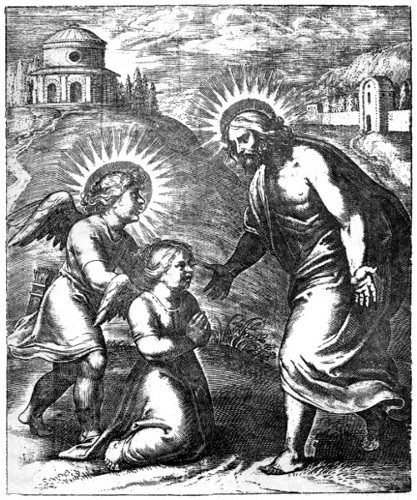
Christ’s adoption of the Human Soul Otho Vænius 1615
With what surpassing beauty and nobleness both of expression and of sentiment does Otho Vænius in his “Amoris Divini Emblemata,” Antwerp, 1615, represent to the mind as well as to the eye the blessed Saviour’s adoption of a human soul, and the effulgence of love with which it is filled! (See Plate II.) They are indeed divine Images portrayed for us, and the great word is added from the beloved disciple,—“Behold, what manner of love the Father hath bestowed upon us, that we should be called the sons of God.” And the simple Refrain follows,—
“C’est par cet Amour que les hommes
Sont esleuez de ce bas lieu;
C’est par cet Amour que nous sommes
Enfans legitimes de Dieu:
Car l’Ame qui garde en la vie
De son Pere la volonté,
Doit au Pere ès cieux estre vnie
(Comme fille) en eternité.”
And that clever imitation of the “Stultifera Nauis,” the Fool-freighted Ship, of the fifteenth century, namely, the “Centifolium Stultorum,” edition 1707, or Hundred-leaved Book of Fools of the eighteenth, proves how the Satirical may symbolize and fraternize with the Emblematical. The title of the book alone is sufficient to show what a vehicle for lashing men’s faults the device with its stanzas and comment may be made; it is, “A hundred-leaved book of Fools, in Quarto; or an hundred exquisite Fools newly warmed up, in Folio,—in an Alapatrit-Pasty for the show-dish; with a hundred fine copper engravings, for honest pleasure and useful pastime, intended as well for frolicsome as for melancholy minds; enriched moreover with a delicate sauce of many Natural Histories, gay Fables, short Discourses, and edifying Moral Lessons.”
Among the one hundred distinguished characters, we might select, were it only in self-condemnation, the Glass and Porcelain dupe, the Antiquity and Coin-hunting dupe, and especially the Book-collecting dupe. These are among the best of the devices, and the stanzas, and the expositions. Dupes of every kind, however, may find their reproof in the six simple German lines,—p. 171,
“Wer Narren offt viel predigen will,
Ben ihnen nicht wird schaffen viel:
Dann all’s was man am besten redt,
Der Narr zum ärgsten falsch versteht,
Ein Narr, ein Narr, bleibt ungelehrt,
Wann man ihn hundert Jahr schon lehrt.”
meaning pretty nearly in our vernacular English,
“Whoso to fools will much and oft be preaching,
By them not much will make by all his teaching.
For though we of our very best be speaking,
Falsely the fool the very worst is seeking.
Therefore the fool, a fool untaught, remains,
Though five score years we give him all our pains.”
But Politics also have the bright, if not the dark, side of their nature presented to the world in Emblems. Giulio Capaccio, Venetia, 1620, derives “Il Principe,” The Prince, from the Emblems of Alciatus, “with two hundred and more Political and Moral Admonitions,” “useful,” he declares, “to every gentleman, by reason of its excellent knowledge of the customs, economy, and government of States.” Jacobus à Bruck, of Angermunt, in his “Emblemata Politica,” A.D. 1618, briefly demonstrates those things which concern government; but Don Diego Saavedra Faxardo, who died in 1648, in a work of considerable repute,—“Idea de vn Principe Politico-Christiano, representada en cien Empresas,”—Idea of a Politic-Christian Prince, represented in one hundred Emblems (edition, Valencia, 1655), so accompanies his Model Ruler from the cradle to maturity as almost to make us think, that could we find the bee-bread on which Kings should be nourished, it would be no more difficult a task for a nation to fashion a perfect Emperor than it is for a hive to educate their divine-right ruling Queen.
Plate 3
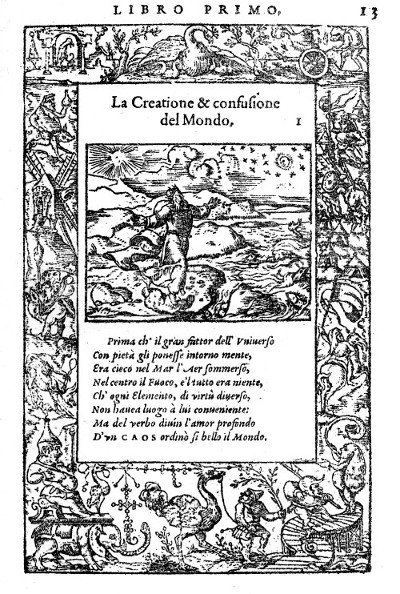
Creation, Symeoni 1559
But, so great is the variety of subjects to which the illustrations from Emblems are applied, that we shall content ourselves with mentioning one more, taking out the arguments, as they are named, from celebrated classic poets, and converting them into occasions for pictures and short posies. Thus, like the dust of Alexander, the remains of the mighty dead, of Homer and Virgil, of Ovid and Horace, have served the base uses of Emblem-effervescence, and in nearly all the languages of Europe have been forced to misrepresent the noble utterances of Greece and Rome. Many of the pictures, however, are very beautiful, finely conceived, and skilfully executed;—we blame not the artists, but the false taste which must make little bits of verses where the originals existed as mighty poems.
Generally it is considered that the Ovids of the fifteenth century were without pictorial illustrations, and could not, therefore, be classed among books of Emblems; but the Blandford Catalogue, p. 21, records an edition, “Venetia, 1497,” “cum figuris depictis,”—with figures portrayed. Without discussing the point, we will refer to an undoubted emblematized edition of the Metamorphoses of Ovid, “Figurato & abbreviato in forma d’Epigrammi da M. Gabriello Symeoni,”—figured and abbreviated in form of Epigrams by M. Gabriel Symeoni. The volume is a small 4to of 245 pages, of which 187 have each a title and device and Italian stanza, the whole surrounded by a richly figured border. The volume, dedicated to the celebrated “Diana di Poitiers, Dvchessa di Valentinois,” was published “A Lione per Giouanni di Tornes nella via Resina, 1559.” An Example, p. 13, (see Plate III.,) will show the character of the work, of which another edition was issued in 1584. The Italian stanzas are all of eight lines each, and the passages of the original Latin on which they are founded are collected at the end of the volume. Thus, for “La Creatione & confusione del Mondo,” the Latin lines are,
“Ante mare & terras & quod tegit omnia, cœlum.
. . . . . . . Nulli sua forma manebat.
Hanc Deus, & melior litem natura diremit.”
Of the devices several are very closely imitated in the woodcuts of Reusner’s Emblems, published at Frankfort, in 1581. The engravings in Symeoni’s Ovid are the work of Solomon Bernard, “the little Bernard,” a celebrated artist born at Lyons in 1512; who also produced a set of vignettes for a French translation of Virgil, L’Eneide de Virgile, Prince des Poetes latins, printed at Lyons in 1560.
“Qvinti Horatii Flacci Emblemata,” as Otho Vænius names one of his choicest works, first published in 1607, is a similar adaptation of a classic author to the prevailing taste of the age for emblematical representation. The volume is a very fine 4to of 214 pages, of which 103 are plates; and a corresponding 103 contain extracts from Horace and other Latin authors, followed, in the edition of 1612, by stanzas in Spanish, Italian, French and Flemish. An example of the execution of the work will be found as a Photolith, Plate XVII., near the end of our volume; it is the “Volat irrevocabile tempus,”—Irrevocable time is flying,—so full of emblematical meaning.
From the office of the no less celebrated Crispin de Passe, at Utrecht, in 1613, issued, in Latin and French verse, “Specvlvm Heroicvm Principis omnium temporum Poëtarum Homeri,”—The Heroic Mirror of Homer, the Prince of the Poets of all times. The various arguments of the twenty-four books of the Iliad have been taken and made the groundwork of twenty-four Emblems, with their devices most admirably executed. The Latin and French verses beneath each device unmistakeably impress a true emblem-character on the work. The author, “le Sieur J. Hillaire,” appends to the Emblems, pp. 69–75, “Epitaphs on the Heroes who perished in the Trojan War,” and also “La course d’Vlisses, son tragitte retour, & deffaicte des amans qui poursuivoient la chaste & vertueuse Penelope.”
What might not in this way be included within the wide-encompassing grasp of the determined Emblematist it is almost impossible to say; and therefore it ought to be no matter of surprise to find there is practically a greater extent given to the Literature of Emblems than of absolute right belongs to it. We shall not go much astray if we take Custom for our guide, and keep to its decisions as recorded in the chief catalogues of Emblem works.
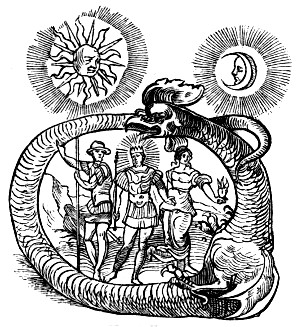
Horapollo, 1551.
Section II. EMBLEM WORKS AND EDITIONS DOWN TO THE END OF THE FIFTEENTH CENTURY.
LEAVING for the most part out of view the discussions which have taken place as to the exact time and the veritable originators of the arts of printing by fixed or moveable types, and of the embellishing of books by engravings on blocks of wood or plates of copper, we are yet—for the full development of the condition and extent of the Emblem Literature in the age of Shakespeare—required to notice the growth of that species of ornamental device in books which depends upon Emblems for its force and meaning. We say advisedly “ornamental device in books,” for infinite almost are the applications of Symbol and Emblem to Architecture, Sculpture, and Painting, as is testified by the Remains of Antiquity in all parts of the world, by the Pagan tombs and Christian catacombs of ancient Rome, by nearly every temple and church and stately building in the empires of the earth, and especially in those wonderful creations of human skill in which form and colour bring forth to sight nearly every thought and fancy of our souls.
Long before either block-printing or type-printing was practised, it is well known how extensively the limner’s art was employed “to illuminate,” as it is called, the Manuscripts that were to be found in the rich abbeys or convents, and in the mansions of the great and noble. For instance, the devices in the Dance of Macaber, undoubtedly an Emblem Manuscript of the fourteenth century, were of painter’s workmanship, and afterwards employed by the wood-engravers to embellish type-printed volumes of a devotional character. To this Brunet, in his Manuel du Libraire, vol. v. c. 1557–1560, bears witness, when speaking of the printer Philip Pigouchet, and of the bookseller Simon Vostre, who “furent les premiers à Paris qui surent allier avec succès la gravure à la typographie;” and adds in a note, “La plus ancienne édition de la Danse macabre que citent les bibliographes est celle de Paris, 1484; mais, plus d’un siècle avant cette date, des miniaturistes français avaient déjà figuré, sur les marges de plusieurs Heures manuscrites, des Danses de morts, représentées et disposées à peu près comme elles l’ont été depuis dans les livres de Simon Vostre; c’est ce que nous avons pu remarquer dans un magnifique manuscrit de la seconde moitié du quatorzième siècle, enrichi de nombreuses et admirables miniatures qui, après avoir été conservé en Angleterre dans le cabinet du docteur Mead, à qui le roi Louis XV. en avait fait présent, est venu prendre place parmi les curiosités de premier ordre réunies dans celui de M. Ambr. Firmin Didot.”
From Brunet, v. 1559.
A strictly emblematical work in English is the following, “from a finely written and illuminated parchment roll, in perfect preservation, about two yards and three quarters in length,” “The Five Wounds of Christ.” “By William Billyng;” “Manchester: Printed by R. and W. Dean, 4to, 1814.” The date is fixed by the editor, William Bateman, “between the years 1400 and 1430;” and the poem contains about 120 lines, with six illuminated devices. We give here, on page 40, in outline, the Device of “The Heart of Jesus the Well of everlasting Lyfe.”
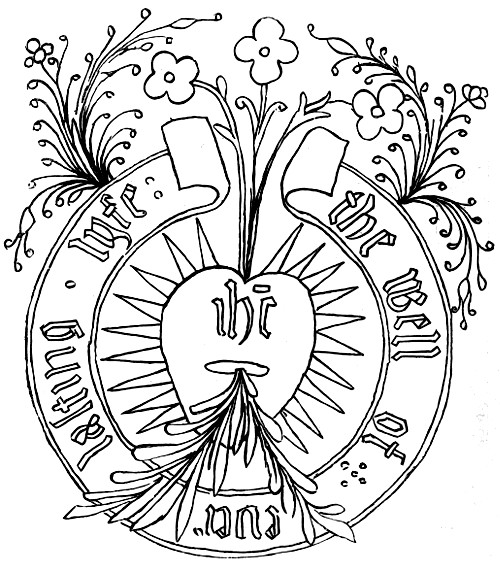
Five wounds of Christ, 1400–1430.
There follows, as to each of the Emblems, a Prayer, or Invocation; the Device in question has these lines,—
“Hayle welle and cõdyte of eu̾lastyng lyffe
Thorow launced so ferre wtyn my lordes syde
The flodys owt traylyng most aromatys
Hayle prious ♥ wounded so large and wyde
Hayle trusty treuloue our joy to provide
Hayle porte of glorie wt paynes alle embrued
On alle I sprynglyde lyke purpul dew enhuede.”
An Astronomical Manuscript in the Chetham Library, Manchester, the eclipses in which are calculated from A.D. 1330 to A.D. 1462, contains emblematical devices for the months of the year, and the signs of the zodiac; these are painted medallions at the beginning of each month; and to each of the months is attached a metrical line explanatory of the device.
Januarius. Ouer yis feer I warme myn handes.
Februarius. Wyth yis spade I delve my londes.
Martius. Here knitte I my vynes in springe.
Aprilis. So merie I here yese foules singe.
Mayus. I am as Joly as brid on bouz.
Junius. Here wede I my corn, clene I houz.
Julius. Wyth yis sythe my medis I mowe.
Augustus. Here repe I my corn so lowe.
September. Wyth ys flayll I yresche my bred.
October. Here sowe I my Whete so reed.
November. Wyth ys knyf I steke my swyn.
December. Welcome cristemasse Wyth ale and Wyn.
This manuscript contains, as J. O. Halliwell says of it, “an astrological volvelle—an instrument mentioned by Chaucer: it is the only specimen, I believe, now remaining in which the steel stylus or index has been preserved in its original state.”
Doubtless it is a copy of the Kalendrier des Bergers, which with the Compost des Bergers, has in various forms been circulated in France from the fourteenth century almost, if not quite, to the present day. An edition in 4to, of 144 pages, printed at Troyes, in 1705, bears the title, Le Grand Calendrier et Compost des Bergers; composé par le Berger de la grand Montagne.
Kindred works issued from the presses of Venice, of Nuremberg, and of Augsburg, between 1475 and 1478, in Latin, Italian, and German, and are ascribed to John Muller, more known under the name of Regiomontanus, a celebrated astronomer, born in 1436, at Koningshaven, in Franconia, and who died at Rome in 1476. One of these editions, in folio, was printed at Augsburg in 1476 by Erhard Ratdolt, being the first work he sent forth after his establishment in that city. (See Biog. Univ., vol. xxx. p. 381, and vol. xxxvii. p. 25.) But the most thoroughly emblematical work from Ratdolt’s press was an “Astrolabium planũ in tabulis,” “wrought out anew by John Angeli, master of liberal arts, MCCCCLXXXVIII.” There are 414 woodcuts, and all of them emblematical. The library at Keir contains a perfect copy, 4to, in most admirable condition. Brunet, i. c. 290, names a Venice edition in 1494, and refers to other astronomical works by the same author.
In its manuscript form, too, the celebrated “Speculum Humanæ Salvationis,” Mirror of Human Salvation, exhibits throughout the emblem characteristics. Of this work, both as it exists in manuscript and in the earliest printed form by Koster of Haarlem, about 1430, specimens are given in “A History of the Art of Printing from its invention to its wide spread developement in the middle of the sixteenth century;” “by H. Noel Humphreys,” “with one hundred illustrations produced in Photo-lithography;” folio: Quaritch, London, 1867. Pl. 8 of Humphreys’ learned and magnificent volume exhibits “a page from a manuscript copy of the Speculum Humanæ Salvationis, executed previous to the printed edition attributed to Koster;” and pl. 10, “A page from the Speculum Humanæ Salvationis attributed to Koster of Haarlem, in which the text is printed from moveable types.”
The inspection of these plates, and the assurance by Humphreys, p. 60, that “the illustrations, though inferior to Koster’s woodcuts, are of similar arrangement,” may satisfy us that the Speculum Humanæ Salvationis, and all its kindred works, in German, Dutch, and French, amounting to many editions previous to the year 1500,[35] are truly books that belong to the Emblem literature. Thus pl. 8, “though without the decorative Gothic framework which separates, and, at the same time, binds together the double illustrations of the xylographic artist,” exhibits to us the exact character of “the double pictures of the Speculum.” “These double pictures,” p. 60 of Humphreys, “illustrate first a passage in the New Testament, and secondly the corresponding subject of the Old, of which it is the antitype. In the present page we have Christ bearing His cross (Christus bajulat crucem) typified by Isaac carrying the wood for his own sacrifice (Isaac portat ligna sua).” “The engravings,” p. 58, “i.e., of Koster’s first great effort, occur at the top of each leaf, and the rest of the page is filled with two columns of text, which, in the supposed first edition, is composed of Latin verse
(or, rather, Latin prose with rhymed terminations to the lines, as the lines do not scan); and in later editions, in Dutch prose.” “This specimen,” pl. 8, p. 60, “will enable the student to understand precisely the kind of manuscript book which Koster reproduced in a cheaper form by xylography, to which he eventually allied the still more important invention of moveable types.”
From a very fine MS. copy of the Speculum Humanæ Salvationis, belonging to Mr. Henry Yates Thompson, our fac-simile Plates IV. and V., though on a smaller scale, present the Title and the first Pair of devices with their text. The work is in twenty-nine chapters, and to each there are four devices in four columns, with appropriate explanations in Latin verse, and at the foot of the columns are the references to the Old or the New Testament.
The manuscript entitled “De Volueribus, sive de tribus Columbis,”—Concerning Birds, or the Three Doves, in the library “du Grand Seminaire,” at Bruges, is also an emblem-book. It is excellently illuminated, and the workmanship is probably of the thirteenth century. (See the Whitney Reprint, p. xxxii.)
Plate 4
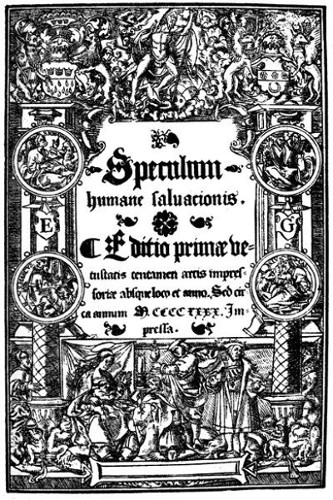
Title Page from a M.S.: “Speculum Humanæ Salvationis”
Plate 5
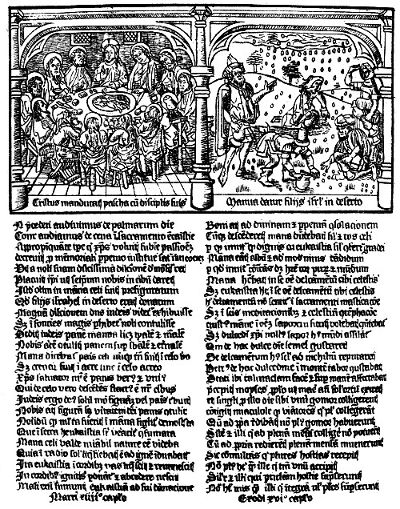
Leaf 31 from a M.S. “Speculum Humanæ Salvationis”
The illuminated Missal,[36] executed in 1425 for John, Duke of Bedford and regent of France, according to the account published of it by Richard Gough, 4to, London, 1794, and by others, abounds in emblem devices. It contains “fifty-nine large miniatures, which nearly occupy the page, and above a thousand small ones in circles of about an inch and half diameter, displayed in brilliant borders of golden foliage, with variegated flowers, &c. At the bottom of every page are two lines in blue and gold letters, which explain the subject of each miniature.” “The Missal,” says Dibdin, “frequently displays the arms of these noble personages,” (John, Duke of Bedford, and of his wife Jane, daughter of the Duke of Burgundy,) “and also affords a pleasing testimony of the affectionate gallantry of the pair: the motto of the former being ‘A VOUS ENTIER;’ that of the latter, ‘J’EN SUIS CONTENTE.’” Among its ornaments are emblems or symbols of the twelve months, and a large variety of paintings derived from the Sacred Scriptures, many of which possess an emblematical meaning.
Not aiming at any exhaustive method in the information we gather and impart respecting Emblem works and editions previous to the year A.D. 1500, we pass by the very numerous other instances in support of our theme which a search into manuscripts would supply. The “Block-Books,”[37] which, in the main, are especially emblematical, we next consider. We select two instances as representative of the whole set;—namely, the “Biblia Pauperum,” Bibles of the Poor, and the “Ars Memorandi,” The Art of Remembering.
In his “Bibliographical Decameron,” vol. i. p. 160, Dibdin tells us, “The earliest printed book, containing text and engravings illustrative of scriptural subjects, is called the Histories of Joseph, Daniel, Judith, and Esther. This was executed in the German language, and was printed by Pfister at Bamberg in 1462. It is among the rarest of typographical curiosities in existence.” Dibdin’s dictum is considerably modified, if not set aside, by Noel Humphreys; who, though affirming, p. 41, that “a late German edition of the Biblia Pauperum has the date 1475, but that before that period editions had been printed at the regular press with moveable types, as, for instance, that of Pfister, printed at Bamberg in 1462,”—yet had previously declared, p. 39, “many suppose that Laurens Koster, of Haarlem, who afterwards invented moveable types, was one of the earliest engravers of Block-books, and that in fact the Biblia Pauperum was actually his work.” “The period of its execution may probably be estimated as lying between 1410 and 1420: probably earlier, but certainly not later.”
The earliest editions of these Biblia Pauperum contain forty leaves, the later editions fifty, printed only on one side. Opposite to p. 40, Noel Humphreys gives, pl. 2, “A Page from the Biblia Pauperum generally supposed to be one of the earliest block-books.”
Plate 6
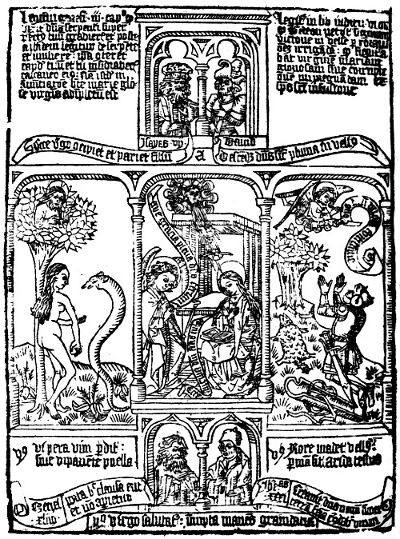
A Page from the “Biblia Pauperum” generally supposed one of the earliest Block Books
Availing ourselves of the Author’s remarks, p. 40, we yet prefer, on account of some inaccuracies in his decyphering the Latin contractions, giving our own description of this plate. The page is in three divisions, all in the Gothic decorative style, with separating archways between the subjects. In the upper division, in the centre, are seated, each in his niche, “Isaya” and “Dauid.” (See Plate VI.) In the upper corners, on the right hand of the first, and on the left hand of the second, are Latin inscriptions,—the former relating to Eve’s seed bruising the serpent’s head, Genesis iii. c., and the latter to Gideon’s fleece saturated with dew, Judges vi. c. The middle compartment is a triptych, consisting of Eve’s Temptation, the Annunciation by the Angel to the Blessed Virgin; and Gideon in his armour, on his knees, with his shield on the ground, watching the fleece. Over Eve’s Temptation there is a scroll issuing from Isaiah’s niche, and having this inscription: “Ecce virgo concipiet et pariet filium,”—Behold a virgin shall conceive and bear a son, Is. vii. 14; Eve stands near the tree of life, emblematized by God the Father among the branches,—and erect before her is the serpent, almost on the tip of its tail, with its body slightly curved. In the Annunciation appears a ray of light breathed upon the Virgin from God the Father seated in the clouds, and in the ray are the dove, the emblem of the Holy Spirit, descending, and an infant Christ bearing his cross; the Angel stands before Mary addressing to her the salutation, “Ave gratiâ plena, dominus tecum,”—Hail full of grace, the Lord is with thee, Luke i. 28; and Mary, seated with a book on her knees, and her hands devoutly crossed on her breast, replies, “Ecce, ancilla domini, fiat mihi,”—Behold, the handmaid of the Lord, be it unto me, Luke i. 38. Of Gideon and the fleece little needs be said, except that over him from the niche of David issues a scroll with the words “Descendet dominus sicut pluvia in vellus,” in the Latin Vulgate, Ps. lxxi. 6, i.e. The Lord shall descend as rain upon the fleece; but in the English version, Ps. lxxii. 6, He shall come down like rain upon the mown grass. The Angel also addressing Gideon bears a scroll, not quite legible, but evidently meaning, “Dominus tecum virorum fortissime,” Judges vi. 12,—English version, The Lord is with thee, thou mighty man of valour. The lower compartment, like the upper, has in the centre two arched niches, which contain, the one Ezekiel, the other Jeremiah; beneath Eve’s temptation and Gideon’s omen are the alliterative and rhyming couplets
“Vipera vim perdet,
Sine vi pariente puella.”
and
“Rore madet vellus
Permansit arida tellus;”[38]
and beneath the Annunciation, “Virgo salutatur, Innupta manens gravidatur.”
From Ezekiel’s niche issues the scroll, Ez. xliv. 2, “Porta hæc clausa erit, et non aperietur;” and from Jeremiah’s, xxxi. 22, “Creavit dominus novum super terram, femina circumdabit virum.”
It requires no argument to prove the emblematical nature of the middle compartment of this page from the Biblia Pauperum; and the texts on scrolls are but the accessories to the devices, and serve only the more clearly to mark this Block-book as an Emblem-book.
Plate 7
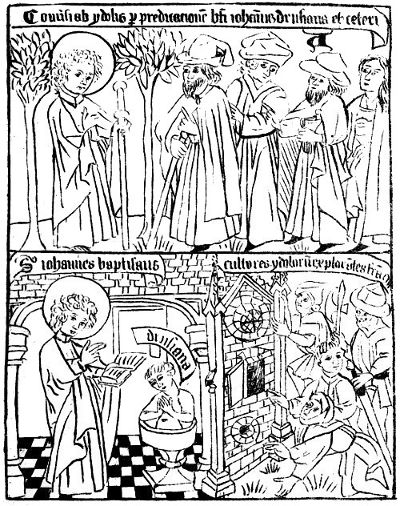
S. John the Evangelist. 1st edition Block Book from the Corser Collection.
Plate 8
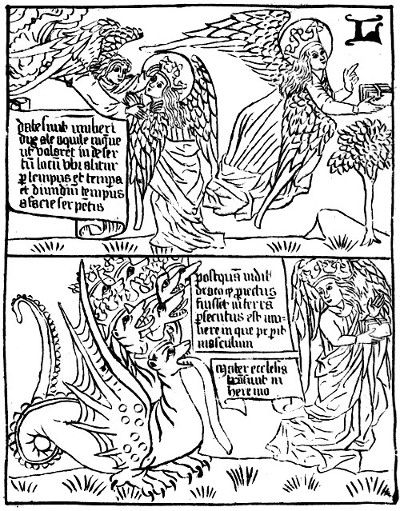
A Page of the Apocalypse from Block Book in the Corser Collection.
Passing by similar Block-books, as The Book of Canticles, and The Apocalypse of St. John, we will conclude the subject with a notice of Humphreys’ pl. 5, following p. 42 of his text; it is “A Subject from the Block-book entitled ‘Ars memorandi,’ executed probably at the beginning of the fifteenth century.”
“The entire work,” we are informed, p. 42, “consists of the symbols of the four evangelists, each occupying a page, and being most grotesquely treated, the bull of St. Luke and the lion of St. Mark standing upright on their hind legs. These symbols are surrounded with various objects, calculated to recall the leading events in their respective Gospels.”
But the whole passage in explanation of the Plate is so much to our purpose, that we ask pardon of the author for inserting it entire. He says:—
“The page I have selected for reproduction is the fourth ‘image or symbol’ of St. Matthew—the Angel. The objects grouped around are many of them very curious, and, without the assistance of the accompanying explanations, would certainly not serve to aid the memory of the modern Biblical students. The symbolic Angel holds in the left hand objects numbered 18, which by the explanation we learn to be the sun and moon, accompanied by an unusual arrangement of stars and planets; intended to recall the passage, ‘there were signs in the sun and moon’—erant signa in sole et luna. I give the text of monkish explanation in MS. No. 19, the clasped hands, represents marriage, in reference to the generations of the Ancestors of Christ as enumerated by St. Matthew. No. 20, the cockle shell and the bunch of grapes are emblems of travelling and pilgrimage, and appear to represent the flight into Egypt; 21, the head of an ass, is intended to recall the entrance of Christ into Jerusalem riding on an ass; 22, a table, with bread-knife and drinking cup, recalls the Last Supper (Cæna magna); and the accompanying symbol, without a number, represents the census rendered to Cæsar.”[39]
With great kindness Mr. Corser, of Stand, offered me, in the spring of 1868, the use of a very choice Block-book, soon after sold for £415, entitled Historia S. Joan. Euangelist. per Figuras, and which is, I believe, the very copy from which Sotheby’s specimens of the work are taken. Whether it be the “editio princeps,” as a former owner claimed it to be, is doubted on merely conjectural grounds; but a most precious copy it is, internally vindicating its claim to priority. The volume measures 2.82 decimetres by 2.14; or 11 inches by 8.42. There are forty-eight leaves, in perfect preservation, printed on one side. The figures, all coloured, relate either to the traditions and legends of the Evangelist, or to the visions of the Apocalypse, the former being simply pictorial, the latter emblematical.
The two Plates uncoloured (Plate VII. and Plate VIII.) very clearly show the difference between the mere drawing and the device. The pictures of the Evangelist preaching, of Drusiana being baptized, and of the search after John, have no meaning beyond the historical or legendary event;—but the two wings of an eagle given to the woman, of the angel flying with a book above the tree of life, of the dragon persecuting the woman, and of the mother-church passing into the desert: these have a meaning beyond that of the figures delineated;—they are emblematical of hidden truths;—so are all the other plates of this Block-book which represent the visions of the Apocalypse. The date is probably 1420 to 1425.
The Bodleian Library at Oxford is very rich in this particular Block-book, possessing no fewer than three copies of the History of S. John the Evangelist. Among its treasures, however, is a MS. on the same subject, worth them all by reason of its beauty and exquisite finish, which the Block-books certainly do not claim. This MS., on fine vellum and finely drawn and illuminated, is said to have been written in the twelfth century, and to have belonged to Henry II.
But the printing with moveable types is firmly established, and Emblem-books are among its earliest productions. At Bamberg, a city on the Regnitz, near its influx into the Main, the first purely German book was printed in 1461, by the same Pfister who published an edition of the Biblia Pauperum, and who probably learned his art at Mayence with Guttenberg himself. The work in question was a Collection of eighty-five Fables in German, with 101 vignettes cut on wood, each accompanied by a German text of rhyming verses. The first device, says Brunet, vol. i. p. 1096, represents three apes and a tree, and the verses begin with—
“Once on a time came an ape (gerãt) upright.”
The colophon, or subscription, at the end informs us,
“At Bamberg this little book ended is
After the birth of our Lord Jesus Christ,
When one counts a thousand four hundred year,
And to it, as truth, one and sixty more,
On the day of holy Valentine;
God shield us from the wrath divine. Amen.”
The fables were collected by Ulric Boner, a Dominican friar of Bonn, in the thirteenth or at the beginning of the fourteenth century. Their chief value is that they present the most precious remains of the Minnesingers, or German Troubadours, and possess much grace, and “une moralité piquante.” See Biographie Universelle, vol. v. pp. 97, 98: Paris, 1812; and vol. xxxiii. p. 584: Paris, 1823.
Of Æsop’s Fables in Greek, the Milan edition, about A.D. 1480, was the earliest. There had been Latin versions, previously at Rome in 1473, at Bologna and Antwerp in 1486, and elsewhere. The German translation appeared in 1473, the Italian in 1479, the French and the English in 1484, and the Spanish in 1489. Besides these there were at least thirty other editions previous to the year 1500.
It has been doubted if Fables should be classed among the Emblem Literature,—but whether nude, as other emblems have been named when unclothed in the ornaments of wood or copper engravings, or adorned with richly embellished devices, they are, as Whitney would name them, naturally emblematical. Apart from whatever artistic skill can effect for them, they have in themselves meanings to be evolved different from those which the words convey. The Lion, the Fox, and the Ass are not simply names for the veritable animals, but emblems of different characters and qualities among the human race; they symbolize moral sentiments and actions, and when we add the figures of the creatures, though we may make pleasing and significant pictures, we do little for the real development of the emblems.
Books of Fables, however, are so numerous that they and their editors may be counted by hundreds; and as Dibdin intimates, the Bibliomaniac who had gathered up all the editions of Æsop in nearly all the languages of the civilized world, would have formed a very considerable library. Only on a few occasions therefore shall we make mention of books of Fables in our present inquiries.
We shall not however pass unnoticed, since it belongs especially to this period, the “Dyalogus Creaturarum,” or, Dialogues of the Creatures, a collection of Latin Fables, attributed in the fourteenth century to Nicolas Pergaminus, first printed at Gouda in Holland by Gerard Leeu in 1480, and at Stockholm by John Snell in 1483. (See Brunet, vol. ii. p. 674.) A French version, by Colard Mansion, was issued at Lyons in 1482, Dialogue des Creatures moralizie; and an English version, about 1520, by J. Rastall, “Powly’s Churche,” London, namely, “The Dialogue of Creatures moralyzed, of late translated out of latyn in to our English tonge.”
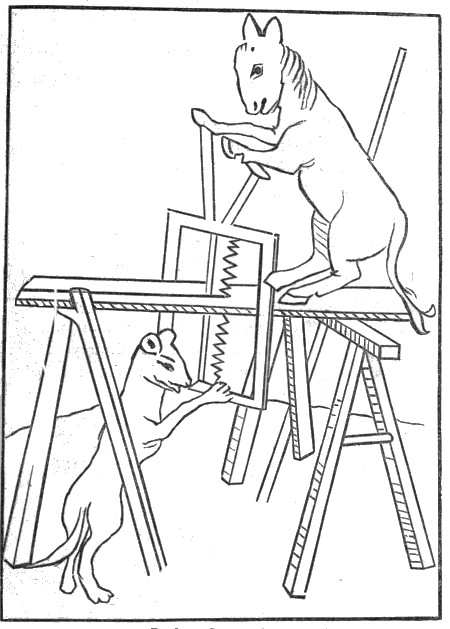
Dyalogus Creat., ed. 1480.
There were various editions and modifications of the work,[40] but perhaps the contrast between them cannot be better pointed out than by selecting the Fable of the Wolf and the Ass from the Gouda edition of 1480, and also from the Antwerp edition of 1584. The original edition, with the woodcut on the next page in mere outline, tells in simple Latin prose how a wolf and an ass were sawing a log of wood together. From good nature the ass worked up above, the wolf through maliciousness down below, desiring to find an opportunity for devouring the ass; therefore he complained that the ass was sending the sawdust into his eyes. The ass replied, “It is not I who am doing this,—I only guide the saw. If you wish to saw up above I am content,—I will work faithfully down below.” And so they talked on, until the wolf threatening revenge drew back, and the fissure in the beam being suddenly widened, the wedge fell upon the wolf’s head, and the wolf himself was killed.
The Antwerp edition of 1584[41] changes the simple Latin prose into the elegant Latin elegiacs of John Moerman, and the outline woodcuts of an unknown artist into the copperplate engravings of Gerard de Jode, the eldest of four generations of engravers. The Wolf and the Ass are made to emblematize, “scelesti hominis imago et exitus,”—the image and end of a wicked man. Moerman’s Latin may thus be rendered, from leaf 54, ed. 1584:—
“The Wolf and careless Ass a treaty made,
Both studious with a saw a beam to rive;—
The ready Ass above directs the blade,
The Wolf doth down below deceit contrive.
He seeks for cause the wretched Ass to slay,
And cries,—‘With sawdust much thou troublest me,—
The trouble check, or with these teeth, I say,
My spoil to be devoured thou straight shalt be.’
To this the Ass,—‘Friend Wolf, be not annoyed;
Guileless the saw I guide with might and main.’
But soon the long-eared brute would be destroyed,
When falls the wedge;—ah! ’tis the Wolf is slain.”
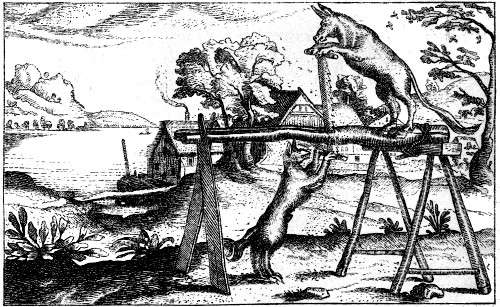
Apologi Creaturarum, 1584.
Moral.
“Insonti qui insidias struit, ipse perit.”
“Who for the innocent spreads snares,
Himself shall perish unawares.”
“The wicked man his nets doth spread
The innocent to take the while;
But who would harm his brother’s head
Doth perish from his selfish guile.
God will not deem him innocent,
Nor raise him to the stars above,
Who on unrighteous thoughts is bent,
Or neighbours serves with feigned love.
But after death to the fiery marsh
Of Phlegethon shall he be hurled,
Where Tartaræan Pluto harsh
With hated sceptres rules a world.”
As in the Blandford Catalogue, it has been usual to count among Emblem-books the “Ecatonphyla,” printed at Venice in 1491. The French translation of 1536 describes the title as, “signifiãt centiesme amour, sciemment appropriees a la dame ayãt en elle autant damour que cent aultres dames en pouroient comprendre,” signifying a hundredth love, knowingly appropriated to the lady having in her as much love as a hundred other ladies could possibly comprehend. (Brunet’s Manuel, i. c. 131, 132.) The author of this work, of which there are several editions, was the celebrated Italian architect, Leoni-Baptista Alberti, born of a noble family of Florence in 1398, and living as some suppose up to 1480. He was a universal scholar, a doctor of laws, a priest, a painter, and a good mechanic.
We are inclined to ask whether Gli Trionfi del Petrarcha, printed at Bologna in 1475,—especially, when as in the Venice editions of 1500 and 1523 they were adorned by the vignettes and wood engravings of Zoan Andrea Veneziano,—whether these “Triumphs of Love, Chastity, and Death” may not, from their highly allegorical character, be included among the Emblem-books of this age?[42] The same question we might ask respecting “Das Heldenbuch,”—The Book of Heroes,—printed at Augsburg, in 1477, by Gunther Zainer, who had first been a printer at Cracow about 1465; and also concerning the “Libri Cronicarum cũ figuris et imaginibus ab inicio mũdi,” a large folio known as the Chronicles of Nuremberg, which with its 2000 fine wood engravings, attributed to Michael Wohlgemuth, was published in that city in 1493.[43]
The original “Todtentanz,” or Dance of Death, painted as a memorial of the plague which raged during the Council of Bâle, held between 1431 and 1446 (Bryan, p. 335), certainly was not the work of either of the Holbeins. There are several representations of a Death-dance in the fifteenth century, between 1485 and 1496 (Brunet, v. 873, 874); and there can be little doubt of their emblematical character. The renowned Dance of Death by Hans Holbein the younger we will reserve for its proper place in the next section.
We must not however leave unmentioned The Dance of Macaber, especially as it is presented to us in an English form by John Lydgate, a monk of the Benedictine abbey of Bury St. Edmunds, who was born about 1375, and attained his greatest eminence about 1430. His own power for supplying the materials for an Emblem-device we observe in the lines on “God’s Providence.”
“God hath a thousand handés to chastise;
A thousand dartés of punicion;
A thousand bowés made in divers wise;
A thousand arlblasts bent in his dongèon.”
For an account of Lydgate’s Dance of Macaber, and indeed for his version in English, we should do well to consult the remarks by Francis Douce, in Wenceslaus Hollar’s Dance of Death, published about the year 1790, and more particularly the remarks in Douce’s Dissertation, edition 1833.
Plate 9
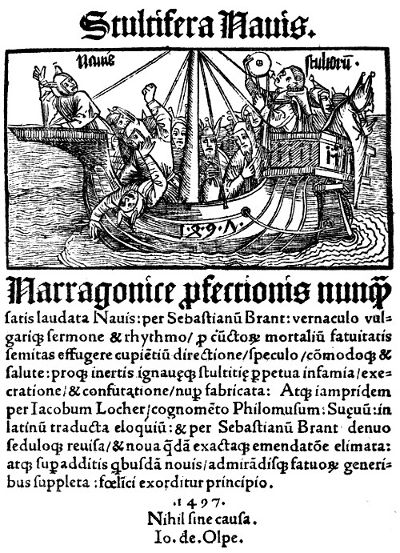
Title of Brandts Stultifera Navis edition, 1497.
The earliest known edition of La Danse Macabre, originally composed in German, is dated at Paris, 1484, but before the completion of the century there were seven or eight other reprints, some with alterations and others with additions. It was a most popular work, issued at least eight or ten times during the sixteenth century, and still exciting interest.[44] At p. 39 may be seen copies of some of the devices as used by Verard.
The chief Emblem deviser and writer towards the end of the century was Sebastian Brandt, born at Strasburg in 1458, and after a life of great usefulness and honour dying at Bâle in 1520. The publication in German Iambic verse of his “Narren Schyff,” Bâle, Nuremberg, Rüttlingen, and Augsburg, A.D. 1494, forms quite an epoch in Emblem-book literature. Previous to A.D. 1500, Locher, crowned poet laureate by the Emperor Maximilian I., translated the German into Latin verse, with the title “Stultifera Nauis” (see Plate IX.); Riviere of Poitiers, the Latin into French verse, “La Nef des Folz du Monde;” and Droyn of Amiens, into French prose, “La grãt Nef des Folz du Monde.” Early in the next century, 1504, or even in 1500, there was a Flemish version; and in 1509 two English versions,—one translated out of French, “The Shyppe of Fooles,” by Henry Watson, and printed by “Wynkyn de Worde, MCCCCCIX.” (see Dibdin’s Tour, ii. p. 103); the other,—“Stultifera Nauis,” or “The Shyp of Folys of the Worlde;” “Inprentyd in the Cyte of London, by Richard Pynson, M.D.IX.” (Dibdin’s Typ. Ant. ii. p. 431.) This latter was “translated out of Latin, French, and Duch into Englishe, by Alexander Barclay, Priest;” and reprinted in 1570, during Shakespeare’s childhood by the “Printer to the Queenes Maiestie.” At the same time, 1570, another work by Barclay was published, which, although without devices, partakes of an allegorical or even of an emblematical character; it is The Mirrour of good Maners; “conteining the foure Cardinal Vertues.”
Dibdin, in his Bibliographical Antiquarian, iii. p. 101, mentions “a pretty little volume—‘as fresh as a daisy,’ the Hortulus Rosarum de Valle Lachrymarum, ‘A little Garden of Roses from the Valley of Tears’ (to which a Latin ode by S. Brandt is prefixed), printed by J. de Olpe in 1499,”—but he gives no intimation of its character; conjecturing from its title and from the woodcuts with which it is adorned, it will probably on further inquiry be found to bear an emblematical meaning.
Dibdin also, in the same work, iii. p. 294, names “a German version of the ‘Hortulus Animæ’ of S. Brant,” in manuscript; “undoubtedly,” he says, “among the loveliest books in the Imperial Library.” The Latin edition was printed at Strasburg in 1498, and is ornamented with figures on wood; many of these are mere pictures, without any symbolical meaning,—but it often is the case that the illuminated manuscripts, especially if devotional, and the early printed books of every kind that have pictorial illustrations in them, present various examples of symbolical and emblematical devices.
The last works we shall name of the period antecedent to A.D. 1501, are due to the industry and skill of John Sicile, herald at arms to Alphonso King of Aragon, who died in 1458. Sicile, it seems, prepared two manuscripts, one the Blazonry of Arms,—the other, the Blazonry of Colours. Of the former there was an edition printed at Paris in 1495, Le Blason de toutes Armes et Ecutz, &c.—and of the latter at Lyons early in the sixteenth century, Le Blason des Couleurs en Armes, Liurees et deuises. Within an hundred years, ending with 1595, above sixteen editions of the two works were issued.
Several other authors there are belonging to the period of which we treat,—but enough have been named to show to what an extent Emblem devices and Emblem-books had been adopted, and with what an impetus the invention of moveable types and greater skill in engraving had acted to multiply the departments of the Emblem Literature. It was an impetus which gathered new strength in its course, and which, previous to Shakespeare’s youth and maturity, had made an entrance into almost every European nation. Already in 1500, from Sweden to Italy and from Poland to Spain, the touch was felt which was to awaken nearly every city to the west of Constantinople, to share in the supposed honours of adding to the number of Emblem volumes.
Picta Poesis, 1552.
Section III. OTHER EMBLEM WORKS AND EDITIONS BETWEEN A.D. 1500 AND 1564.
LABORIOUS in some degree is the enterprise which the title of this Section will indicate before it shall be ended. Perchance we shall have no myths to perplex us, but the demands of sober history are often more inexorable than those flexible boundaries within which the imagination may disport amid facts and fictions.
Better, as I trust, to set this period of sixty-three years before the mind, it may be well to take it in three divisions: 1st, the twenty-one years before Alciatus appeared, to conquer for himself a kingdom, and to reign king of Emblematists for about a century and a half; 2nd, the twenty-one years from the appearance of the first edition of Alciat’s Emblems in 1522 at Milan, until Hans Holbein the younger had introduced the Images and Epigrams of Death, and La Perriere and Corrozet, the one his Theatre of good Contrivances in one hundred Emblems, and the other his Hecatomgraphie, or descriptions of one hundred figures; 3rd, the twenty-one years up to Shakespeare’s birth, distinguished towards its close chiefly by the Italian writers on Imprese, Paolo Giovio, Vincenzo Cartari, Girolamo Ruscelli, and Gabriel Symeoni.
Stulte̦ gustationis scapha.
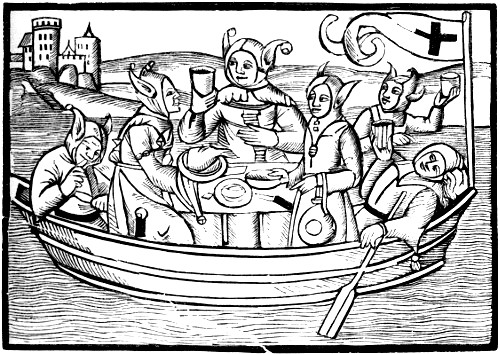
Badius, 1502.
I.—A Fool-freighted Ship was the title of almost the last book of the fifteenth century,—by a similar title is the Emblem-book called which was launched at the beginning of the sixteenth century; it is, “Jodoci Badii ascēsii Stultifere̦ nauicule̦ seu scaphe̦ Fatuarum mulierum: circa sensus quinq̃ exteriores fraude nauigantium,”—The Fool-freighted little ships of Josse Badius ascensius, or the skiffs of Silly women in delusion sailing about the five outward senses,—“printed by honest John Prusz, a citizen of Strasburg, in the year of Salvation M.CCCCC.II.” There was an earlier edition in 1500,—but almost exactly the same. From that before us we give a specimen of the work, The Skiff of Foolish Tasting. A discourse follows, with quotations from Aulus Gellius, Saint Jerome, Virgil, Ezekiel, Epicurus, Seneca, Horace, and Juvenal; and the discourse is crowned by twenty-four lines of Latin elegiacs, entitled “Celeusma Gustationis fatue̦,”—The Oarsman’s cry for silly Tasting,—thus exhorting—
“Slothful chieftains of the gullet!
Offspring of Sardanapálus!
In sweet sleep no longer lull it,—
Rouse ye, lest good cheer should fail us.
Gentle winds to pleasures calling
Waft to regions soft and slow;
On a thousand dishes falling,
How our palates burn and glow!
Suppers of Lucillus name not,
Ancient faith! nor plate of veal;
Ancient faith to luncheon came not
Crowned with flowers that age conceal.
Let none boast of pontiff’s dishes,—
Nor Mars’ priests their suppers spread;
Alban banquets bless our wishes,—
Cæsar’s garlands deck our head.
Now the dish of Æsop yielding,
Apicius all his luxuries pours;
And Ptolomies the sceptres wielding
Richest viands give in showers.”
And so on, until in the concluding stanza Badius declares—
“If great Jove himself invited
At our feasting takes his seat,
Jove would say, ‘I am delighted,
Not in heaven have I such meat.’
Therefore, stupids! what of summer
Enters now our pinnace gay,—
Onward in three hours ’twill bear us
Where kingdoms blessed bid us stay.”[45]
The same work was published in another form, “La nef des folles, selon les cinq sens de nature, composé selon levangile de monseigneur saint Mathieu, des cinq vierges qui ne prindrent point duylle avec eulx pour mectre en leurs lampes:” Paris 4to, about 1501.
Of Badius himself, born in 1462 and dying in 1535, it is to be said that he was a man of very considerable learning, professor of “belles lettres” at Lyons from 1491 to 1511, when he was tempted to settle in Paris. There he established the famous Ascensian Printing Press,—and like Plantin of Antwerp, gave his three daughters in marriage to three very celebrated printers: Michel Vascosan, Robert Etienne, and Jean de Poigny. He was the author of several works besides those that have been mentioned. (Biog. Univ. vol. iii. p. 201.)
Symphorien Champier, Doctor in Theology and Medicine, a native of Lyons, who was physician to Anthony Duke of Lorraine when he accompanied Louis XII. to the Italian war, graduated at Pavia in 1515, and, after laying the foundations of the Lyons College of Physicians, and enjoying the highest honours of his native city, died about 1540. (Aikin’s Biog. ii. 579.) His medical and other works are of little repute, but among them are two or three which may be regarded as imitations of Emblem-books. We will just name,—Balsat’s work with Champier’s additions, La Nef des Princes et des Batailles de Noblesse, &c. (Lyons, 4to goth. with woodcuts, A.D. 1502.); also, La Nef des Dames vertueuses cōposee par Maistre Simphoriē Champier, &c. (Lyons, 4to goth. with woodcuts, A.D. 1503.)
“Bible figures,” too, again have a claim to notice. A very fine copy of “Les figures du vieil Testament, & du nouuel,” which belonged to the Rev. T. Corser, Rector of Stand, near Manchester, supplies the opportunity of noticing that it is decidedly an Emblem work. It is a folio, of 100 leaves, containing forty-one plates, of which one is introductory, and forty are on Scriptural subjects, unarranged in order either of time or place. The work was published in Paris in 1503 by Anthoine Verard, and is certainly, as Brunet declares, ii. c. 1254, “une imitation de l’ouvrage connu sous le nom de Biblia Pauperum.” There are forty sets of figures in triptychs, the wood engravings being very bold and good. Each is preceded or followed by a French stanza of eight lines, declaring the subject; and has appended two or three pages of Exposition, also in French. The Device pages, each in three compartments, are in Latin, and may thus be described. At the top to the left hand, a quotation from the Vulgate appropriate to the pictorial representation beneath it; in the centre two niches, of which David always occupies one, and some writer of the Old Testament the other, a scroll issuing from each niche. The middle compartment is filled by a triptych, the centre subject from the New Testament, the right and left from the Old. At the bottom are Latin verses to the right and left, with two niches in the centre occupied by biblical writers. The Latin verses are rhyming couplets, as on fol. a. iiij, beneath Moses at the burning bush, “Lucet et ignescit, sed non rubus igne calescit,”—It shines and flames, but the bush is not heated by the fire. In triptych, on p. i. rev. are, Enoch’s Translation, Christ’s Ascension, and the Translation of Elijah.
The Aldine press at Venice, A.D. 1505, gave the world the first printed edition of the “Hieroglyphica” of Horapollo. It was in folio, having in the same volume the Fables of Æsop, of Gabrias, &c. See Leemans’ Horapollo, pp. xxix-xxxv. A Latin version by Bernard Trebatius was published at Augsburg in 1515, at Bale in 1518, and at Paris in 1521; and another Latin version by Phil. Phasianinus, at Bologna in 1517. Previous to Shakespeare’s birth there were translations into French in 1543, into Italian in 1548, and into German in 1554,—and down to 1616 sixteen other editions may readily be counted up.
John Haller, who had introduced printing into Cracow in 1500, published in 1507 the first attempt to teach logic by means of a game of cards; it was in Murner’s quarto entitled, “Chartiludium logice̦ seu Logica poetica vel memorativa cum jocundo Pictasmatis Exercimento,”—A Card-game of Logic, or Logic poetical or memorial, with the pleasant Exercise of pictured Representation. It is a curious and ingenious work, and reprints of it appeared at Strasburg in 1509 and 1518; at Paris, by Balesdens, in 1629; and again in 1650, 4to, by Peter Guischet. As an imitation of Brandt’s Ship of Fools, so far as it relates to the follies and caprices of mankind, mention should also be made of Murner’s “Narren Beschwoerung,”—Exorcism of Fools,—Strasburg, 4to, 1512 and 1518; which certainly at Francfort, in 1620, gave origin to Flitner’s “Nebvlo nebvlonvm,”—or, Rascal of Rascals.
“Speculū Paciētierum theologycis Consolationibus Fratris Ioannis de Tambaco,”—The Mirror of Patience with the theological Consolations of Brother John Tambaco,—Nuremberg, MCCCCCIX., 4to, is a work of much curiousness. On the reverse of the title is an Emblematical device of Job, Job’s wife, and the Devil, followed by exhortations to patience; and on the reverse of the introduction to the second part, also an Emblematical device,—the Queen of Consolation, with her four maidens by her side, and two men kneeling before her. The chapters on consolation are generally in the form of sermonettes, in which the maidens, three or four, or even a dozen, expatiate on different subjects proper for reproof, exhortation, and comfort. The devices in this volume are understood to be from the pencil of Albert Durer.
This same year, 1509, witnessed two English translations, or paraphrases, of Brandt’s “Narren Schif,”—the one The Shyppe of Fooles, taken from the French by Henry Watson, and printed by De Worde;—the other rendered out of Latin, German, and French, The Ship of Fooles, by Alexander Barclay, and printed by Pinson. Of Watson little, if anything, is known, but Barclay is regarded as one of the improvers of the English tongue, and to him it is chiefly owing that a true Emblem-book was made popular in England.
Of the “Dyalogus Creaturarum,” written in the fourteenth century by Nicolas Pergaminus, and printed by Gerard Leeu, at Gouda, in 1480, an English version appeared about 1520,—“The dialogue of Creatures moralyzed, of late translated out of Latyn in to our English tonge.”
The famous preacher and the founder of the first public school in Strasburg was John Geyler, born in 1445. He was highly esteemed by the Emperor Maximilian, and after a ministry of about thirty years, died in 1510. Two Emblem-books were left by him, both published in 1511 by James Other;—the one “Navicula sive Speculũ Fatuorum,”—The little Ship or Mirror of Fools; the other, “Navicula Penitentie,”—The little Ship of Penitence. To the first there are 110 emblems and 112 devices, each having a discourse delivered on one of the Sabbaths or festivals of the Catholic Church—the text always being, Stultorum infinitus est,—“Infinite is the number of fools.” The second, not strictly an Emblem-book, is devoted “to the praise of God and the salvation of souls in Strasburg,” and consists really of a series of sermons for Lent and other seasons of the year, but all having the same text, Ecce ascendimus Hierosolimam,—“Behold we go up to Jerusalem.” There were several reprints of both the works, and two German translations; and the edition of 1520, folio, with wood engravings, is remarkable for being the first book to which was granted the “Imperial privilege.” It is said that the rhymes of Brandt’s Ship of Fools which Geyler had translated into Latin in 1498, not unfrequently served him for texts and quotations for his sermons. Alas! we have no such lively preachers in these sleepy days of perfect propriety of phrase and person. Our prophets, in putting away “locusts and wild honey,” too often forget to cry, “Repent, for the kingdom of heaven is at hand.”
Next, however, to the famous preacher, we name a notorious prophet, the Abbot Joachim, who died between the years 1201 and 1202, but whose works, if they really were his, did not appear in print, until the folio edition was issued about 1475,—Revelations concerning the State of the chief Pontiffs. An Italian version, “Prophetia dello Abbate Joachimo circa li Pontefici & Re,” appeared in 1515; and another Latin edition, with wood engravings, by Marc-Antoine Raimondi, in 1516.[46] Many tales are related of the Abbot and of his followers; suffice it to say, that they maintained the Gospel of Christ would be abolished A.D. 1260; and thenceforward Joachim’s “true and everlasting Gospel” was to be prevalent in the world.
According to the Blandford Catalogue, p. 6, we should here insert P. Dupont’s Satyriques Grotesques (Desseins Orig.), 8vo, Paris, 1513; but it may be passed over with the simplest notice.
If we judge from the wonderfully beautiful copy on finest vellum in the Hunterian Museum at Glasgow, the next Emblem-book surpasses all others we have named; it is the “Tewrdannckh”—or, Dear-thought,—usually attributed to Melchior Pfintzing, a German poet, born at Nuremberg in 1481, and who at one time was secretary to the Emperor Maximilian. The poem is allegorical and chivalric, and adorned with 118 plates, some of which are considered the workmanship of Albert Durer.[47]
The Tewrdanck was intended to set forth the dangers and love adventures of the emperor himself on occasion of his marriage to the great heiress of that day, Mary of Burgundy. There are some who believe that Maximilian was the author, or at least that he sketched out the plan which Pfintzing executed. As, however, the espousals took place in 1479, before the poet was born, and Mary had early lost her life from a fall,—the probability is that the emperor supplied some of the incidents and suggestions, and that his secretary completed the work. The splendid volume was dedicated to Charles V. in 1517, and published the same year, a noble monument of typographic art.
Of a later work known under the name of “Turnierbuch,”—The Tournament-book,—by George Rüxner, namely, Beginning, Source, and Progress of Tournaments in the German nation (Siemern, S. Rodler, 1530, folio, pp. 402), Brunet informs us (Manuel, vol. iv. c. 1471), “There are found for the most part in this edition printed at the castle of Simmern” (about twenty-five miles south of Coblentz) “in 1530, the characters already employed in the two editions of the Tewrdannckh of 1517 and 1519; there may also be remarked numerous engravings on wood of the same kind as those of the romance in verse we have just cited.” The edition of 1532 “printed at the same castle,” is not in the same characters as that of 1530.
Cebes, the Theban, the disciple of Socrates, though mentioned at pp. 12, 13, must again be introduced, for an edition of his little work in Latin had appeared at Boulogne in 1497, and at Venice in 1500; also at Francfort, “by the honest men Lamperter and Murrer,” in 1507, with the letter of John Æsticampianus; the Greek was printed by Aldus in 1503, and several other editions followed up to the end of the century;—indeed there were translations into Arabic, French, Italian, German, and English.[48]
Plate 1b
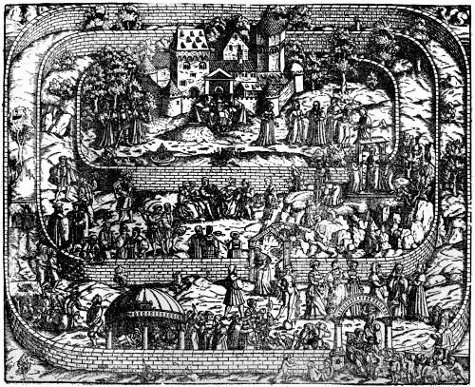
Tableau of Human Life from Cebes. B.C. 390.
II.—Andrew Alciat, the celebrated jurisconsult, remarkable, as some testify, for serious defects, as for his surpassing knowledge and power of mind, is characterized by Erasmus as “the orator best skilled in law,” and “the lawyer most eloquent of speech;”—of his composition there was published in 1522, at Milan, an Emblematum Libellus, or “Little Book of Emblems.”[49] It established, if it did not introduce, a new style for Emblem Literature, the classical in the place of the simply grotesque and humorous, or of the heraldic and mythic. It is by no means certain that the change should be named an unmixed gain. Stately and artificial, the school of Alciat and his followers indicates at every stanza its full acquaintance with mythologies Greek and Roman, but it is deficient in the easy expression which distinguishes the poet of nature above him whom learning chiefly guides: it seldom betrays either enthusiasm of genius or depth of imaginative power.
Nevertheless the style chimed in with the taste of the age, and the little book,—at least that edition of it which is the earliest we have seen, Augsburg, A.D. 1531,[50] contained in eighty-eight pages, small 8vo, with ninety-seven Emblems and as many woodcuts,—won its way from being a tiny volume of 11.5 square inches of letterpress on each of eighty-eight pages, until with notes and comments it was comprised only in a large 4to of 1004 pages with thirty-seven square inches of letter-press on each page. Thus the little one that had in it only 1012 square inches of text and picture became a mountain, a monument in Alciat’s honour, numbering up 37,128 square inches of text, picture, and comment. The little book of Augsburg, 1531, may be read and digested, but only an immortal patience could labour through the entire of the great book of Padua, 1621. In that interval of ninety years, however, edition after edition of the favourite emblematist appeared; with translations into French 1536, into German 1542, into Spanish and Italian in 1549, and, if we may credit Ames’ Antiquities of Printing, Herbert’s edition, p. 1570, into English in 1551. The total number of the editions during that period was certainly not less than 130, of seventy of which a pretty close examination has been made by the writer of this sketch. The list of editions, as far as completed, numbers up about 150, and manifests a persistence in popularity that has seldom been attained.
The earliest French translator was John Lefevre, an ecclesiastic, born at Dijon in 1493,—Les Emblemes de Maistre Andre Alciat: Paris, 1536. He was secretary to Cardinal Givry, whose protection he enjoyed, and died in 1565. Bartholomew Aneau, himself an emblematist, was the next translator into French, 1549; and a third, Claude Mignault, appeared in 1583. Wolfgang Hunger, a Bavarian, in 1542,[51] and Jeremiah Held of Nördlingen, were the German translators; Bernardino Daza Pinciano, in 1549, Los Emblemas de Alciato, was the Spanish; and Giovanni Marquale, in 1547, the Italian,—Diverse Imprese.
The notes and comments upon Alciat’s Emblems manifest great research and very extensive learning. Sebastian Stockhamer supplied commentariola, short comments, to the Lyons edition of 1556. Francis Sanctius, or Sanchez, one of the restorers of literature in Spain, born in 1523, also added commentaria to the Lyons edition of 1573. Above all we must name Claude Mignault, whose praise is that “to a varied learning he joined a rare integrity.” He was born near Dijon about 1536, and died in 1606. His comments in full appeared in Plantin’s[52] Antwerp edition, 8vo, of 1573, and may be appealed to in proof of much patient research and extensive erudition. Lorenzo Pignoria, born at Padua in 1571, and celebrated for his study of Egyptian antiquities, also compiled notes on Alciat’s Emblems in MDCXIIX.[53] The results of the labours of the three, Sanchez, Mignault, and Pignorius, were collected in the Padua editions of 1621 and 1661. It is scarcely possible that so many editions should have issued from the press, and so much learning have been bestowed, without the knowledge of Alciat’s Emblems having penetrated every nook and corner of the literary world.
With a glance only at the “Prognosticatio,” of Theophrastus Paracelsus, the alchemist and enthusiast, written in 1536, and expressed in thirty-two copperplates, we pass at once to the Dance of Death, by Hans Holbein, which Bewick, 1789, and Douce, 1833, in London, and Schlotthauer and Fortoul, 1832, in Munich and Paris, have made familiar to English, German, and French readers. Of Holbein himself, it is sufficient here to say that he was born at Bâle in 1495, and died in London in 1543.
Mr. Corser’s copy of the first edition of the Dance of Death, and which was the gift of Francis Douce, Esq., to Edward Vernon Utterson, supplies the following title, “Les simulachres & Historiees faces de la Mort, avtant elegammēt pourtraictes, que artificiellement imaginées: A Lyon, soubz l’escu de Coloigne, M.D.XXXVIII.” The volume is a small quarto of 104 pages, unnumbered, dedicated to Madame Johanna de Touszele, the Reverend Abbess of the convent of Saint Peter at Lyons. There are forty-one emblems, each headed by a text of scripture from the Latin version; the devices follow, with a French stanza of four lines to each; and there are sundry Dissertations by Jean de Vauzelles, an eminent divine and scholar of the same city. But who can speak of the beauty of the work? The designs by Holbein are many of them wonderfully conceived,—the engravings by Hans Lützenberge, or Leutzelburger, as admirably executed.[54]
Rapidly was the work transferred into Latin and Italian, and before the end of the century at least fifteen editions had issued from the presses of Lyons, Bâle, and Cologne.
Scarcely less celebrated are Holbein’s Historical Figures of the Old Testament, which Sibald Beham’s had preceded in Francfort by only two years. Beham’s whole series of Bible Figures are contained in 348 prints, and were published between 1536 and 1540. Dibdin’s Decameron, vol. i. pp. 176, 177, will supply a full account of Holbein’s “Historiarum Veteris Instrumenti icones ad vivum expressæ una cum brevi, sed quoad fieri potuit, dilucida earundem expositione:” Lyons, small 4to, 1538. The edition of Frellonius, Lyons, 1547, is a very close reprint of the second edition, and from this it appears that the work is contained in fifty-two leaves, unnumbered, and that there are ninety-four devices, which are admirable specimens of wood-engraving. The first four are from the Dance of Death, but the others appropriate to the subjects, each being accompanied by a French stanza of four lines.
A Spanish translation was issued in 1543; and in 1549, at Lyons, an English version, “The Images of the Old Testament, lately expressed, set forthe in Ynglishe and Frenche, vuith a playn and brief exposition.” All the editions of the century were about twelve.
Hans Brosamer, of Fulda, laboured in the same mine, and between 1551 and 1553, copying chiefly from Holbein and Albert Durer, produced at Francfort his “Biblische Historien kunstlich fürgemalet,”—Bible Histories artistically pictured (3 vols. in 1).
We will, though somewhat earlier than the exact date, continue the subject of Bible-Figure Emblem-books by alluding to the Quadrins historiques de la Bible,—“Historic Picture-frames of the Bible,”—for the most part engraved by “Le Petit Bernard,” alias Solomon Bernard, who was born at Lyons in 1512. Of these works in French, English, Spanish, Italian, Latin, Flemish, and German, there were twenty-two editions printed between 1553 and 1583. Their general nature may be known from the fact that to each Scripture subject there is a device, in design and execution equally good, and that it is followed or accompanied by a Latin, Italian, &c. stanza, as the case may be. In the Italian version, Lyons, 1554, the Old Testament is illustrated by 222 engravings, and the New by ninety-five.
The first of the series appears to be Quadrins historiques du Genèse, Lyons, 1553; followed in the same year by Quadrins historiques de l’Exode. There is also of the same date (see Brunet, iv. c. 996), “The true and lyuely historyke Pvrtreatures of the woll Bible (with the arguments of eache figure, translated into english metre by Peter Derendel): Lyons; by Jean of Tournes.”
To conclude, there were Figures of the Bible, illustrated by French stanzas, and also by Italian and by German; published at Lyons and at Venice between 1564 and 1582. (See Brunet’s Manuel, ii. c. 1255.) Also Jost Amman, at Francfort, in 1564; and Virgil Solis, from 1560 to 1568, contributed to German works of the same character.
Two names of note among emblematists crown the years 1539 and 1540, both in Paris: they are William de la Perrière, and Giles Corrozet; of the former we know little more than that he was a native of Toulouse, and dedicated his chief work to “Margaret of France, Queen of Navarre, the only sister of the very Christian King of France;” and of the latter, that, born in Paris in 1510, and dying there in 1568, he was a successful printer and bookseller, and distinguished (see Brunet’s Manuel, ii. cc. 299–308) for a large number of works on History, Antiquities, and kindred subjects.
La Perrière’s chief Emblem-work is Le Theatre des bons Engins, auquel sont contenus cent Emblemes: Paris, 8vo, 1539. There are 110 leaves and really 101 emblems, each device having a pretty border. His other Emblem-works are—The Hundred Thoughts of Love, 1543, with woodcuts to each page; Thoughts on the Four Worlds, “namely, the divine, the angelic, the heavenly, and the sensible,” Lyons, 1552; and “La Morosophie,”—The Wisdom of Folly,—containing a hundred moral emblems, illustrated by a hundred stanzas of four lines, both in Latin and in French.
Corrozet’s “Hecatomgraphie,” Paris, 1540, is a description of a hundred figures and histories, and contains Apophthegms, Proverbs, Sentences, and Sayings, as well ancient as modern. Each page of the 100 emblems is surrounded by a beautiful border, the devices are neat woodcuts, having the same borders with La Perrière’s Theatre of good Contrivances. There is also to each a page of explanatory French verses.
It requires a stricter inquiry than I have yet been able to make in order to determine if Corrozet’s Blasons domestiques; Blason du Moys de May; and Tapisserie de l’Eglise chrestienne & catholique, bear a decided emblematical character; the titles have a taste of emblematism, but are by no means decisive of the fact.
III.—Maurice Sceve’s Delie, Object de plus haulte Vertu, Lyons, 1544, with woodcuts, and 458 ten-lined stanzas on love, is included in the Blandford Catalogue; and in the Keir Collection are both The very admirable, very magnificient and triumphant Entry of Prince Philip of Spain into Antwerp in 1549,[55] by Grapheus, alias Scribonius; edition 1550: and Gueroult’s Premier Livre des Emblemes; Lyons, 1550. The same year, 1550, at Augsburg, has marked against it “Geschlechtes Buch,”—Pedigree-book,—which recurs in 1580.
Claude Paradin, the canon of Beaujeu, a small town on the Ardiere, in the department of the Rhone, published the first edition of his simple but very interesting Devises heroiques, with 180 woodcuts, at Lyons in 1557. It was afterwards enlarged by gatherings from Gabriel Symeoni and other writers; but, either under its own name or that of Symbola heroica (edition 1567) was very popular, and before 1600 was printed at Lyons, Antwerp, Douay, and Leyden, not fewer than twelve times. The English translation, with which it is generally admitted that Shakespeare was acquainted, was printed in London, in 12mo, in 1591, and bears the title, The Heroicall Devises of M. Clavdivs Paradin, Canon of Beauieu, “Whereunto are added the Lord Gabriel Symeons and others. Translated out of Latin into English by P.S.”
To another Paradin are assigned Quadrins historiques de la Bible, published at Lyons by Jean de Tournes, 1555; and of which the same publisher issued Spanish, English, Italian, German, and Flemish versions.
The rich Emblem Collection at Keir furnishes the first edition of each of Doni’s three Emblem-works, in 4to, printed by Antonio Francesco Marcolini at Venice in 1552–53; they are: 1. “I Mondi,”—i.e., The Worlds, celestial, terrestrial, and infernal,—2 parts in 1, with woodcuts. 2. “I Marmi,”—The Marbles,—4 parts in 1, a collection of pleasant little tales and interesting notices, with woodcuts by the printer; who also, according to Bryan, was an engraver of “considerable merit.” 3. “La Moral Filosofia,”—Moral Philosophy drawn from the ancient Writers,—2 parts in 1, with woodcuts. In it are abundant extracts from the ancient fabulists, as Lokman and Bidpai, and a variety of little narrative tales and allegories.
Of an English translation, two editions appeared in London in 1570 and 1601, during Shakespeare’s lifetime; namely, “The Morall Philosophie of Doni, englished out of italien by sir Th. North,”[56] 4to, with engravings on wood.
Under the two titles of “Picta Poesis,” and “Limagination poetique,” Bartholomew Aneau, or Anulus, published his “exquisite little gem,” as Mr. Atkinson, a former owner of the copy which is now before me, describes the work. It appeared at Lyons in 1552, and contains 106 emblems, the stanzas to which, in the Latin edition, are occasionally in Greek, but in the French edition, “vers François des Latins et Grecz, par l’auteur mesme d’iceux.”
Achille Bocchi, a celebrated Italian scholar, the founder, in 1546, of the Academy of Bologna, Virgil Solis, of Nuremberg, an artist of considerable repute, Pierre Cousteau, or Costalius, of Lyons, and Paolo Giovio, an accomplished writer, Bishop of Nocera, give name to four of the Emblem-books which were issued in the year 1555. That of Bocchius is entitled “Symbolicarvm Qvaestionvm, libri qvinqve,” Bononiæ, 1555, 4to; and numbers up 146, or, more correctly, 150 emblems in 340 pages: the devices are the work of Giulio Bonasone, from copper-plates of great excellence. In 1556, Bononiæ Sambigucius put forth In Hermathenam Bocchiam Interpretatio, which is simply a comment on the 102nd emblem of Bocchius. Virgil Solis published in 4to, at Nuremberg, the same year, “Libellus Sartorum, seu Signorum publicorum,”—A little Book of Cobblers, or of public Signs. Cousteau’s “Pegma,”[57] which some say appeared first in 1552, is, as the name denotes, a Structure of emblems, ninety-five in number, with philosophical narratives,—each page being surrounded by a pretty border. And Giovio’s “Dialogo dell’ Imprese Militari et Amore,”—Dialogue of Emblems of War and of Love; or, as it is sometimes named, “Ragionamento, Discourse concerning the words and devices of arms and of love, which are commonly named Emblems,”—is probably the first regular treatise on the subject which had yet appeared, and which attained high popularity.
Its estimation in England is shown by the translation which was issued in London in 1585, entitled, “The Worthy tract of Paulus Iouius, contayning a Discourse of rare inuentions, both Militarie and Amorous, called Imprese. Whereunto is added a Preface contay-ning the Arte of composing them, with many other notable deuises. By Samuell Daniell late Student in Oxenforde.”
Intimately connected with Giovio’s little work, indeed often constituting parts of the same volume, were Ruscelli’s “Discorso” on the same subject, Venice, 1556; and Domenichi’s “Ragionamento,” also at Venice, in 1556. From the testimony of Sir Egerton Brydges (Res Lit.), “Ruscelli was one of the first literati of his time, and was held in esteem by princes and all ranks of people.”
Very frequently, too, in combination with Giovio’s Dialogue on Emblems, are to be found Ruscelli’s “Imprese illvstri,” Venice, 1566; or Symeoni’s “Imprese heroiche et morali,” Lyons, 1559; and “Sententiose Imprese,” Lyons, 1562.
Roville’s Lyons edition, of 1574, thus unites in one title-page Giovio, Symeoni, and Domenichi, “Dialogo Dellimprese militari et amorose, De Monsignor Giouio Vescouo di Nocera Et del S. Gabriel Symeoni Fiorentino, Con vn ragionamento di M. Lodouico Domenichi, nel medesimo soggetto.”
Taking together all the editions in Italian, French, and Spanish, of these four authors, single or combined, which I have had the opportunity of examining, there are no less than twenty-two between 1555 and 1585, besides five or six other editions named by Brunet in his Manuel du Libraire. Roville’s French edition, 4to, Lyons, 1561, is by Vasquin Philieul, “Dialogve des Devises d’Armes et d’Amovrs dv S. Pavlo Iovio, Auec vn Discours de M. Loys Dominique—et les Deuises Heroiques et Morales du Seigneur Gabriel Symeon.”
At this epoch we enter upon ground which has been skilfully upturned and cultivated by Claude Francis Menestrier, born at Lyons in 1631, and “distinguished by his various works on heraldry, decorations, public ceremonials, &c.” (Aikin’s Gen. Biog. vii. p. 41.) In his “Philosophia Imaginum,”—Philosophy of Images,—an octavo volume of 860 pages, published at Amsterdam, 1695, he gives, in ninety-four pages, a “Judicium,” i.e., a judgment respecting all authors who have written on Symbolic Art; and of those Authors whom we have named, or may be about to name, within the Period to which our Sketch extends, he mentions that he has examined the works of
A.D.
1555.[58] Paulus Jovius, p. 1.
1556. Ludovicus Dominicus, p. 3.
” Hieronymus Ruscellius, p. 4.
1561. Alphonsus Ulloa, ibid.
1562. Scipio Amiratus, p. 5.
1571. Alexander Farra, p. 6.
” Bartholoæmus Taëgius, p. 7.
1574. Lucas Contile, p. 9.
1577. Johannes Andreas Palatius, p. 10.
1578. Scipio Bergalius, p. 12.
1580. Franciscus Caburaccius, p. 12.
1588. Abrahamus Fransius, p. 15.
1591. Julius Cæsar Capacius, ibid.
” D. Albertus Bernardetti, p. 17.
1594. Torquatus Tassus, p. 14.
1600. Jacobus Sassus, p. 18.
1601. Andreas Chioccus, ibid.
1612. Hercules Tassus, p. 19.
” P. Horatius Montalde, p. 23.
” Johannes Baptista Personé, ib.
1620. Franciscus d’Amboise, ibid.
It may also be gathered from the “Judicium” that Menestrier had read with care what had been written on Emblems by the following authors:—
A.D.
1551. Gabriel Simeoni, p. 63.
1557. Claudius Paradinus, p. 68.
1562. Mauritius Sevus, p. 55.
1565. J. Baptista Pittonius, p. 70.
1573. Claudius Minos, p. 54.
1588. Bernardinus Percivalle, p. 64.
” Principius Fabricius, p. 76.
1600. Johannes Pinedi, p. 60.
1609. Jacobus Le Vasseur, p. 91.
1613. J. Franciscus de Villava, p. 55.
Excluding the editions before enumerated, the books of emblems which I have noted from various sources as assigned to the authors in the above lists from Menestrier, amount to from twenty-five to thirty, with the titles of which there is no occasion to trouble the reader.
Returning from this digression, Vincenzo Cartari should next be named in order of time. At Venice, in 1556, appeared his “Imagini Dei Dei degli Antichi,”—Images of the Gods of the Ancients,—4to, of above 500 pages. It contains an account of the Idols, Rites, Ceremonies, and other things appertaining to the old Religions. It was a work often reprinted, and in 1581 translated into French by Antoine du Verdier, the same who, in 1585, gave in folio a Catalogue of all who have written or translated into French up to that time.
A folio of 1100 pages, which within the period of our sketch was reprinted four times, issued from Bâle in 1556; it is, “Hieroglyphica,”—Hieroglyphics, or, Commentaries on the Sacred Literature of the Egyptians,—by John Pierius Valerian, a man of letters, born in extreme poverty at Belluno in 1477, and untaught the very elements of learning until he was fifteen. (Aikin’s Gen. Biog. ix. 537.) He died in 1558. As an exposition of the Egyptian hieroglyphics, his very learned work is little esteemed; but it contains emblems innumerable, comprised in fifty-eight books, each book dedicated to a person of note, and treating one class of objects. The devices—small woodcuts—amount to 365.
Etienne Jodelle, a poet, equally versatile whether in Latin or in French, was skilled in the ancient languages, and acquainted with the arts of painting, sculpture, and architecture, as well as dexterous in the use of arms. He published, in 1558, a thin quarto “Recueil,” or Collection of the inscriptions, figures, devices, and masks ordained in Paris at the Hôtel de Ville. The same year, and again in 1569 and 1573, appeared the large folio volume, in five parts, “Austriacis Gentis Imagines,”—Portraits of the Austrian family,—full lengths, engraved by Gaspar ab Avibus, of Padua. At the foot of each portrait are a four-lined stanza, a brief biographical notice, and some emblematical figure. Of similar character, though much inferior as a work of art, is Jean Nestor’s Histoire des Hommes illustres de la Maison de Medici; a quarto of about 240 leaves, printed at Paris in 1564. (See the Keir Catalogue, p. 143.) It contains “twelve woodcuts of the emblems of the different members of the House of Medici.”
Hoffer’s “Icones catecheseos,” or Pictures of instruction, and of virtues and vices, illustrated by verses, and also by seventy-eight figures or woodcuts, was printed at Wittenberg in 1560. The next year, 1561—if not in 1556 (see Brunet’s Manuel, vol. ii. cc. 930, 931)—John Duvet, one of the earliest engravers on copper in France, at Lyons, published in twenty-four plates, folio, his chief work, “Lapocalypse figuree;” and in 1562, at Naples, the Historian of Florence, Scipione Ammirato, gave to the world “Il Rota overo dell’ Imprese,” or, Dialogue of the Sig. Scipione Ammirato, in which he discourses of many emblems of divers excellent authors, and of some rules and admonitions concerning this subject written to the Sig. Vincenzo Carrafa.
Were it less a subject of debate between Dutch and German critics as to the exact character of the “Spelen van sinne,”[59] which were published by the Chambers of Rhetoric at Ghent in 1539, and by those of Antwerp in 1561 and 1562 (see Brunet’s Manuel, vol. v. c. 484), we should claim these works for our Emblem domain. But whether claimed or not, the exhibitions and amusements of the Chambers of Rhetoric, especially at their great gatherings in the chief cities of the Netherlands, were often very lively representations by action and accessory devices of dramatic thought and sentiment, from “King Herod and his Deeds,” “enacted in the Cathedral of Utrecht in 1418,” to what Motley, in his Dutch Republic, vol. i. p. 80, terms the “magnificent processions, brilliant costumes, living pictures, charades, and other animated, glittering groups,”—“trials of dramatic and poetic skill, all arranged under the superintendence of the particular association which in the preceding year had borne away the prize.”
“The Rhetorical Chambers existed in the most obscure villages” (Motley, i. p. 79); and had regular constitutions, being presided over by officers with high-sounding titles, as kings, princes, captains, and archdeacons,—and each having “its peculiar title or blazon, as the Lily, the Marigold, or the Violet, with an appropriate motto.” After 1493 they were “incorporated under the general supervision of an upper or mother-society of Rhetoric, consisting of fifteen members, and called by the title of ‘Jesus with the balsam flower.’”
As I have been informed by Mr. Hessells, Siegenbeek, in his Geschiedenis der Nederlandsche Letterkunde, says,—“Besides the ordinary meetings of the Chambers, certain poetical feasts were in vogue among the Rhetor-gevers, whereby one or other subject, to be responded to in burdens or short songs (liedekens), according to the contents of the card, was announced, with the promise of prizes to those who would best answer the proposed question. But the so-called Entries deserve for their magnificence, and the diversity of poetical productions which they give rise to, especially our attention.
“It happened from time to time that one or other of the most important Chambers sent a card in rhyme to the other Chambers of the same province, whereby they were invited to be at a given time in the town where the senders of the card were established, for the sake of the celebration of a poetical feast. This card contained further everything by which it was desired that the Chambers, which were to make their appearance, should illustrate this feast, viz., the performance of an allegorical play (zinnespel) in response to some given question;[60] the preparation of esbatementez (drawings), facéties (jests), prologues; the execution of splendid entries and processions; the exhibitions of beautifully painted coats of arms, &c. These entries were of two kinds, landiuweelen, and haagspelen>;—the landjewels were the most splendid, and were performed in towns; the hedge-plays belonged properly to villages, though sometimes in towns these followed the performance of a landjewel.” Originally, landjewel meant a prize of honour of the land; called also landprys (land-prize).
Such were the periodic jubilees of a neighbouring people, their “land-jewels,” as they were termed, when the birthtime of our greatest English dramatist arrived. And as we mark the wide and increasing streams of the Emblem Literature flowing over every European land, and how the common tongue of Rome gave one language to all Christendom, can we deem it probable that any man of genius, of discernment, and of only the usual attainments of his compeers, would live by the side of these streams and never dip his finger into the waters, nor wet even the soles of his feet where the babbling emblems flowed?
Some there have been to maintain that Shakespeare had visited the Netherlands, or even resided there; and it is consequently within the limits of no unreasonable conjecture that he had seen the landjewels distributed, and at the sight felt himself inspirited to win a nobler fame.

Whitney, 1586.
Section IV. EMBLEM WORKS AND EDITIONS BETWEEN A.D. 1564 AND A.D. 1616.
IN the year at which this Section begins, Shakespeare was born, and for a whole century the Emblem tide never ebbed. There was an uninterrupted succession of new writers and of new editions. Many eminent names have appeared in the past, and names as eminent will adorn the future.
The fifty years which remain to the period comprised within the limits of this Sketch of Emblem Literature we divide into two portions of twenty-five years each: 1st, up to 1590, when Shakespeare had fairly entered on his dramatic career; and 2nd, from 1590 to 1615, when, according to Steevens (edition 1785, vol. i. p. 354), his labours had ended with The Twelfth Night, or, What You Will. As far as actual correspondences between Shakespeare and the Emblem Writers demand, our Sketch might finish with 1610, or even earlier: for some time will of necessity intervene, after a work has been issued, before it will modify the thoughts of others, or enter into the phrases which they employ. However, there is nothing very incongruous in making this Sketch and the last of Shakespeare’s dramas terminate with the same date.
I.—In 1564, at Rome, in 4to, the distinguished Latinist, Gabriel Faerno’s Fables were first printed, 100 in number;—it was three years after his death. The plates are from designs which Titian is said to have drawn. Our English Whitney adopts several of Faerno’s Fables among his Emblems, and on this authority we class them with books of Emblems. From time to time, as late as to 1796, new editions and translations of the Fables have been issued. A copy in the Free Library, Manchester, “Romæ Vincentius Luchinus, 1565,” bears the title, Fabvlae Centvm ex antiqvis avctoribvs delectae, et a Gabriele Faerno, Cremonensi carminibvs explicatae.
Virgil Solis, a native of Nuremberg, where he was born in 1514, and where he died in 1570; and Jost Amman, who was born at Zurich in 1539, but passed his life at Nuremberg, and died there in 1591, were both artists of high repute, and contributed to the illustration of Emblem-works. The former, between 1560 and 1568, produced 125 New Figures for the New Testament, and An Artistic little Book of Animals; and the latter, from 1564 to 1586, contributed very largely to books of Biblical Figures, of “Animals,” of “Genealogies,” of “Heraldry,” and of the Habits and Costumes of All Ranks of the Clergy of the Roman Church, and of Women of every “Condition, profession, and age,” throughout the nations of Europe.
From the press of Christopher Plantin, of Antwerp, there issued nearly fifty editions of Emblem-books between 1564 and 1590. Of these, one of the earliest was, “Emblemata cvm aliqvot Nvmmis antiqvis,”—Emblems with some ancient Coins,—4to, 1564, by the Hungarian, John Sambucus, born at Tornau in 1531. A French version, Les Emblemes de Jehan Sambucus, issued from the same press in 1567. Among Emblematists, none bears a fairer name as “physician, antiquary, and poet.” According to De Bry’s Icones, pt. iii., ed. 1598, pp. 76–83, he obtained the patronage of two emperors, Maximilian II. and Rudolph II., under whom he held the offices of counsellor of state and historian of the empire. To him also belonged the rare honour of having his work commented on by one of the great heroes of Christendom, Don John of Austria, in 1572.
Les Songes drolatiqves de Pantagrvel, by Rabelais, appeared at Paris in 1565, but its emblematical character has been doubted. Not so, however, the ten editions of the “Emblemata” of Hadrian Junius, a celebrated Dutch physician, of which the first edition appeared in 1565, and justly claims to be “the most elegant which the presses of Plantin had produced at this period.”
We may now begin to chronicle a considerable number of works and editions of Emblems by Italian writers, which, to avoid prolixity and yet to point out, we present in a tabulated form, giving only the earliest editions:—
Pittoni’s Imprese di diversi principi, duchi, &c. sm.fol. Venice 1566 k.[61]
Troiano’s Discorsi delli triomfi, giostre, &c. 4to Monica 1568 k.
Rime Rime de gli Academici occvlti, &c. 4to Brescia 1568 k.
Farra’s Settenario dell’ humana riduttione ... ... 1571 v.
Dolce’s Le prime imprese del conte Orlando 4to Venice 1572 v.
” Dialogo 8vo Venice 1575 k.
Contile’s Ragionamento—sopra la proprieta delle Imprese, &c. Fol. Pavia 1574 k.
Fiorino’s Opera nuova, &c. 4to Lyons 1577 k.
Palazza’s I Discorsi—Imprese, &c. 8vo Bologna 1577 k.
Caburacci’s Trattato,—dove si dimostra il vero e novo modo di fare le Imprese. 4to Bologna 1580 k.
Guazzo’s Dialoghi piacevoli 4to Venice 1585 k.
Camilli’s Imprese—co i discorsi, et con le figure 4to Venice 1586 k.
Cimolotti’s Il superbi 4to Pavia 1587 k.
Fabrici’s Delle allusioni, imprese & emblemi sopra la vita, &c., di Gregorio XIII. 4to Roma 1588 k.
Rinaldi’s Il mostruosissimo 8vo Ferrara 1588 k.
Porro’s Il primo libro 4to Milano 1589 k.
Pezzi’s La Vigna del Signore—Sacramenti, Paradiso, Limbo, &c. 4to Venetia 1589 t.
Bargagli’s Dell’ Imprese 4to Venetia 1589 v.
So, briefly, in the order of time, may we name several of the French, Latin, and German Emblem-writers of this period, together with the Spanish and English:—
French.
Grevin’s Emblemes d’Adrian La Jeune 16mo Anvers 1568 v.
Vander Noot’s Theatre ... les inconueniens et miseres qui suiuent les mondains et vicieux, &c. 8vo Londres 1568 v.
De Montenay’s Emblêmes ou devises chrestiennes 4to Lyon 1571 k.
Chartier’s Les Blasons de vertu par vertu 4to Aureliæ 1574 v.
Droyn’s[62] La Grand nef des fols du monde fol. à Lyon 1579 c.
Goulart’s Les Vrais Pourtraits des Hommes illustres. 4to Genue 1581 k.
Verdier’s Les images des anciens dieux (par V. Cartari). 4to Lyon 1581 v.
Anjou La joyeuse et magnif. entrée de Mons. Françoys, duc de Brabant, Anjou, &c., en ville d’Anvers. fol. à Anvers 1582 k.
L’Anglois Discours des hierog. égyptiens, emblêmes, &c. 4to Paris 1583 k.
Messin Emblêmes latins de J.J. Boissard, avec l’interpretation françoise. 4to Metis 1588 c.
Of these works, Vander Noot’s was translated into English, says Brunet, (v. c. 1072,) by Henry Bynneman, 1569, and is remarkable for containing (see Ath. Cantab. ii. p. 258) certain poems, termed sonnets, and epigrams, which Spenser wrote before his sixteenth year. Mademoiselle Georgette de Montenay was a French lady of noble birth, and dedicated her 100 Emblems “to the very illustrious and virtuous Princesse, Madame Jane D’Albret, Queen of Navarre.” Chartier, a painter and engraver, flourished about 1574; L’Anglois is not mentioned in the Hieroglyphics of Dr. Leemans, nor do I find any notice of Messin.
Latin.
Schopperus Πανοπλία, omnium illiberalium mechanicarum, &c. 8vo Francof 1568 v.
” De omnibus illiberalibus sive mechanicis artibus. 8vo Francof 1574 t.
Arias Montanus Humanæ salutis monumenta, &c. 4to Antverpiæ 1572 k.
Sanctius Commentaria in A. Alciati Emblemata. 8vo Lugduni 1573 k.
Furmerus De rerum usu et abusu 4to Antverpiæ 1575 t.
Lonicer, Ph. Insignia sacræ Cæsareæ, maj. &c. 4to Francof 1579 k.
Estienne, Henri Anthologia gnomica 8vo Francof 1579 k.
Freitag Mythologia ethica 4to Antverpiæ 1579 t.
Microcosm Μικροκοσμος, parvus mundus, &c. 4to ... 1579 v.
ΜΙΚΡΟΚΟΣΜΟΣ Parvus Mundus 4to Antverpiæ 1592 k.
Beza Icones—accedunt emblemata 4to Genevæ 1581 c.
Hesius, G. Emblemata sacra 4to Francof 1581 v.
Reusner Emblemata—partim ethica et physica, &c. 4to Francof 1581 k.
” Aureolorum Emblem. liber singularis. 8vo Argentor 1591 t.
Lonicer, J.A. Venatus et Aucupium Iconibus artif. 4to Francof 1582 c.
Moherman Apologi Creaturarum 4to Antverpiæ 1584 t.
Emblemata Emblemata Evangelica ad XII. signa, &c. fol. ... 1585 k.
Bol. Emblemata Evang. ad. XII. Signa cœlestia. 4to Francof 1585 v.
Hortinus Icones operum, &c. 4to Romæ 1585 k.
Modius Liber—ordinis Ecclesiastici origo, &c. 8vo Francof 1585 t.
” Pandectæ triumphales, &c. fol. Francof 1586 k.
Fraunce Insignium, Armorum, Emblematum, Hierogl., &c. 4to Londini 1588 t.
Zuingerus Icones aliquot clarorum Virorum, &c. 8vo Basileæ 1589 t.
Cælius (S.S.) Emblemata Sacra 8vo Romæ 1589 v.
Hortinus Emblemata Sacra 4to Trajecti 1589 v.
Camerarius Symbolorum et Emblematum, &c. 4to Norimberg 1590 k.
Arias Montanus, born in Estremadura in 1527, was one of the very eminent scholars of Spain; Furmerus, a Frieslander, flourished during the latter half of the sixteenth century, and his work was translated into Dutch by Coörnhert in 1585; Henri Estienne, one of the celebrated printers of that name, was born in Paris in 1528, and died at Lyons in 1598; a list of his works, many of them of high scholarship, occupies eight pages in Brunet’s Manuel du Libraire. The name of Beza is of similar renown;—both Etienne and he had to seek safety from persecution; and when Etienne’s effigy was being burnt, he pleasantly said “that he had never felt so cold as on the day when he was burning.” Laurence Haechtanus was the author of the Parvus Mundus, 1579, which Gerardt de Jode den liefhebbers der consten, the lover of art, has so admirably adorned. Nicolas Reusner was a man of extensive learning, to whom the emperor Rudolph II. decreed the poetic crown. Francis Modius was a Fleming, a learned jurisconsult and Latinist, who died at Aire in Artois, in 1597, at the age of sixty-one; Theodore Zuinger was a celebrated physician of Bâle; and Joachim Camerarius, born at Nuremberg in 1534, also a celebrated physician, one of the first to form a botanical garden, “attained high reputation in his profession, and was consulted for princes and persons of rank throughout Germany.”
An edition of a work reputed to be emblematic belongs to this period—to 1587; it is the Physiologist, by S. Epiphanius, to whom allusion has been made at p. 28.
German.
Stimmer Neue Kunstliche Figuren Biblischen, &c. 4to Besel 1576 t.
Feyrabend Stam und Wapenbuch 4to Franckfurt 1579 k.
Schrot Wappenbuch 8vo Munich 1581 k.
Lonicer, J. A. Stand und Orden der heiligen Römischen Catholischen Kirchen. 4to Francfurt 1585 v.
Clamorinus Thurnier-buch 4to Dresden 1590 k.
Tobias Stimmer was an artist, born at Schaffhausen in 1544, and in conjunction with his younger brother, John Christopher Stimmer, executed part of the woodcuts in the Bible of Basle, 1576 and 1586. The younger brother also prepared the prints for a set of Emblems, Icones Affabræ, published at Strasburg in 1591. Sigismund Feyrabend is a name of great note as a designer, engraver on wood, and bookseller, at Francfort, towards the end of the sixteenth century. Who Martin Schrot was, does not appear from the Biographie Universelle; and Clamorinus may probably be regarded as only the editor of a republication of Rüxner’s Book of Tournaments that was printed in 1530.