Chapter VI · CLASSIFICATION OF THE CORRESPONDENCIES AND PARALLELISMS OF SHAKESPEARE WITH EMBLEM WRITERS. (continued 3)
Reading edition
Near Mortimer’s Cross, in Herefordshire, a messenger relates how “the noble Duke of York was slain” (3 Henry VI., act ii. sc. 1, l. 50, vol. v. p. 252), and employs a similar, almost an identical, proverb,—
“Environed he was with many foes,
And stood against them, as the hope of Troy
Against the Greeks that would have enter’d Troy.
But Hercules himself must yield to odds;
And many strokes, though with a little axe,
Hew down and fell the hardest-timber’d oak.”
This is almost the coincidence of the copyist, and but for the necessities of the metre, Whitney’s words might have been literally quoted.
“Manie droppes pierce the stone,” has its parallel in the half-bantering, half-serious, conversation between King Edward and Lady Grey (3 Henry VI., act iii. sc. 2, l. 48, vol. v. p. 280). The lady prays the restoration of her children’s lands, and the king intimates he has a boon to ask in return,—
“King Edw. Ay, but thou canst do what I mean to ask.
Grey. Why then I will do what your grace commands.
Glou. [Aside to Clar.] He plies her hard; and much rain wears the marble.
Clar. [Aside to Glou.] As red as fire! nay, then her wax must melt.”
In Otho Vænius (p. 210), where Cupid is bravely working at felling a tree, to the motto, “By continuance,” we find the stanza,—
“Not with one stroke at first the great tree goes to grownd,
But it by manie strokes is made to fall at last,
The drop doth pierce the stone by falling long and fast,
So by enduring long long sought-for loue is found.”
“To clip the anvil of my sword,” is an expression in the Coriolanus (act iv. sc. 5, lines 100–112, vol. vi. p. 380) very difficult to be explained, unless we regard it as a proverb, denoting the breaking of the weapon and the laying aside of enmity. Aufidius makes use of it in his welcome to the banished Coriolanus,—
“O Marcius, Marcius!
Each word thou hast spoke hath weeded from my heart
A root of ancient envy. If Jupiter
Should from yond cloud speak divine things,
And say ‘’Tis true,’ I’d not believe them more
Than thee, all noble Marcius. Let me twine
Mine arms about that body, where against
My grained ash an hundred times hath broke,
And scarr’d the moon with splinters: here I clip
The anvil of my sword, and do contest
As hotly and as nobly with thy love
As ever in ambitious strength I did
Contend against thy valour.”
To clip, or cut, i.e., strike the anvil with a sword, is exhibited by more than one of the Emblem writers, whose stanzas are indeed to the same effect as those of Massinger in his play, The Duke of Florence (act ii. sc. 3),—
“Allegiance
Tempted too far is like the trial of
A good sword on an anvil; as that often
Flies in pieces without service to the owner;
So trust enforced too far proves treachery,
And is too late repented.”
In his 31st Emblem, Perriere gives the device, and stanzas which follow,—
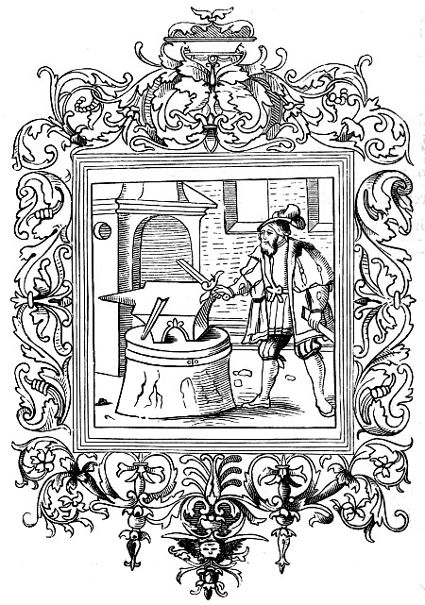
Perriere, 1539.
XXXI.
En danger eſt de rompre ſon eſpée
Qui ſur l’enclumé̩[e/]̩ en frappe rudement.
Auſſi l’amour eſt bien toſt ſincoppée,
Quand ſon amy on preſſe follement.
Qui le fera, perdra ſubitement
Ce qu’il deburoit bien cheremẽt garder
De tel abus, ſe fault contregarder,
Cõmé̩[e/]̩ en ce lieu auõs doctriné̩[e/]̩ expreſſe.
A tel effort, ne te fault hazarder
De perdré̩[e/]̩ amy, quãd ſouuẽt tu le preſſe.
But the meaning is, the putting of friendship to too severe a trial: “As he is in danger of breaking his sword who strikes it upon an anvil, so is love very soon cut in pieces when foolishly a man presses upon his friend.” So Whitney (p. 192), to the motto, Importunitas euitanda,—“Want of consideration to be avoided,”—
“Who that with force, his burnish’d blade doth trie
On anuill harde, to prooue if it be sure:
Doth Hazarde muche, it shoulde in peeces flie,
Aduentring that, which else mighte well indure:
For, there with strengthe he strikes vppon the stithe,
That men maye knowe, his youthfull armes have pithe.
Which warneth those, that louinge frendes inioye,
With care, to keepe, and frendlie them to treate,
And not to trye them still, with euerie toye,
Nor presse them doune, when causes be too greate,
Nor in requests importunate to bee:
For ouermuche, dothe tier the courser free?”
Touchstone, the clown, in As You Like It (act ii. sc. 4, l. 43, vol. ii. p. 400), names the various tokens of his affections for Jane Smile, and declares, “I remember, when I was in love I broke my sword upon a stone and bid him take that for coming a-night to Jane Smile: and I remember the kissing of her batlet and the cow’s-dugs that her pretty chopt hands had milked.”
It may, however, from the general inaccuracy of spelling in the early editions of Shakespeare, be allowed to suppose a typographical error, and that the phrase in question should read, not “anvil of my sword,” but “handle;”—I clip, or embrace the handle, grasp it firmly in token of affection.
The innocence of broken love-vows is intimated in Romeo and Juliet (act ii. sc. 2, l. 90, vol. vii. p. 42),—
“Dost thou love me? I know thou wilt say ‘Ay,’
And I will take thy word: yet if thou swear’st,
Thou mayst prove false: at lovers’ perjuries,
They say, Jove laughs.”
And most closely is the sentiment represented in the design by Otho van Veen (p. 140), of Venus dispensing Cupid from his oaths, and of Jupiter in the clouds smiling benignantly on the two. The mottoes are, “Amoris ivsivrandvm pœnam non habet,”—Love excused from periurie,—and “Giuramento sparso al vento.”
In Callimachus occurs Juliet’s very expression, “at lovers’ perjuries Jove laughs,”—
“Nulla fides inerit: periuria ridet amantum
Juppiter, & ventis irrita ferre iubet:”
and from Tibullus we learn, that whatever silly love may have eagerly sworn, Jupiter has forbidden to hold good,—
“Gratia magna Ioui: vetuit pater ipse valere,
Iurasset cupidè quidquid ineptus Amor.”
The English lines in Otho van Veen are,—
“The louer freedome hath to take a louers oth,
Whith if it proue vntrue hee is to be excused,
For venus doth dispence in louers othes abused,
And loue no fault comitts in swearing more than troth.”
The thoughts are, as expressed in Italian,—
“Se ben l’amante assai promette, e giura,
Non si da pena à le sue voci infide,
Anzi Venere, e Giove se ne ride.
l’Amoroso spergiuro non si cura.”
To such unsound morality, however, Shakespeare offers strong objections in the Friar’s words (Romeo and Juliet, act iii. sc. 3, l. 126),—
“Thy noble shape is but a form of wax,
Digressing from the valour of a man;
Thy dear love sworn, but hollow perjury,
Killing that love which thou hast vow’d to cherish.”
“Labour in vain,”—pouring water into a sieve, is shown by Perriere in his 77th Emblem,—
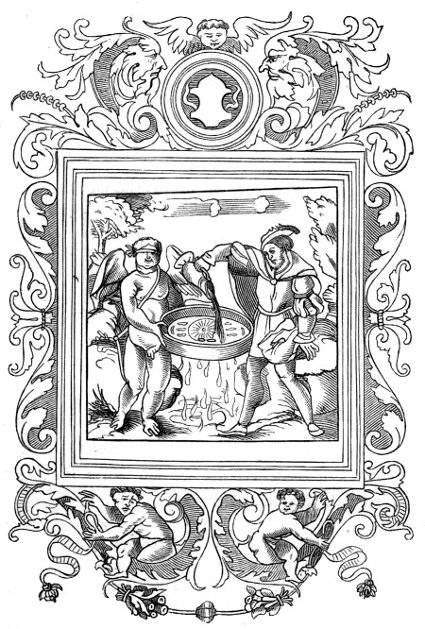
Perriere, 1539.
where however it is a blind Cupid that holds the sieve, and lovers’ gifts are the waters with which the attempt is made to fill the vessel.
LXXVII.
Qvi plus mettra dans le crible d’amours,
Plus y perdra, car choſe n’y profitte:
Le temps ſi pert, biens, bagues & atours,
Sa douleur eſt en tout amer confitte.
Folle ieuneſſé̩[e/]̩ & franc vouloir incite
A tel deſduict deſpendre groſſe ſomme:
Sur ce pẽser doibuent biẽ ieunes hõmes,
Que de ce fait meilleurs n’ẽ peuuẽt eſtre:
Et quãd naurõt le vaillãt de deux põmes,
Ne ſera temps leur erreur recognoiſtre.
We have endeavoured to interpret the old French stanza into English rhyme,—
“Who in love’s tempting sieve shall place his store,
Since nothing profits there, will lose the more;
Lost are his time, goods, rings and rich array,
Till grief in bitterness complete his day.
Folly of youth and free desire incite
Great sums to lavish on each brief delight.
Surely young men on this ought well to ponder,
That better cannot be, if thus they wander;
And when remains two apples’ worth alone,
’Twill not the time be their mistake to own.”
Shakespeare presents the very same thought and almost the identical expressions. To the Countess of Rousillon, Bertram’s mother, Helena confesses love for her son, All’s Well that Ends Well (act i. sc. 3, l. 182, vol. iii. p. 127),—
“Then, I confess,
Here on my knee, before high heaven and you,
That before you, and next unto high heaven,
I love your son.
My friends were poor, but honest; so’s my love:
Be not offended; for it hurts not him
That he is loved of me: I follow him not
By any token of presumptuous suit;
Nor would I have him till I do deserve him;
Yet never know how that desert should be.
I know I love in vain, strive against hope;
Yet, in this captious and intenible sieve,
I still pour in the waters of my love,
And lack not to lose still: thus, Indian-like,
Religious in my error, I adore
The sun, that looks upon his worshipper,
But knows of him no more.”
How probable do the turns of thought, “captious and intenible sieve,” “the waters of my love,” render the supposition that Perriere’s Emblem of Love and the Sieve had been seen by our dramatist. Cupid appears patient and passive, but the Lover in very evident surprise sees “the rings and rich array” flow through “le crible d’amours.” Cupid’s eyes, in the device, are bound, and the method of binding them corresponds with the lines, Romeo and Juliet(act i. sc. 4, l. 4, vol. vii. p. 23),—
“We’ll have no Cupid hoodwink’d with a scarf,
Bearing a Tartar’s painted bow of lath,
Scaring the ladies like a crow-keeper.”
Again, though not in reference to the same subject, there is in Much Ado About Nothing (act v. sc. 1, l. 1, vol. ii. p. 69), the comparison of the sieve to labour in vain. Antonio is giving advice to Leonato when overwhelmed with sorrows,—
“Ant. If you go on thus you will kill yourself;
And ’tis not wisdom thus to second grief
Against yourself.
Leon. I pray thee, cease thy counsel,
Which falls into mine ears as profitless
As water in a sieve: give not me counsel;
Nor let no comforter delight mine ear
But such a one whose wrongs do suit with mine.”
By way of variation we consult Paradin’s treatment of the same thought (fol. 88v), in which he is followed by Whitney (p. 12), with the motto Frustrà.
Hac illac perfluo.
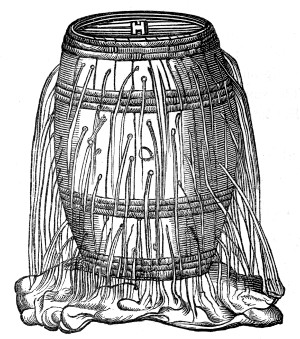
Paradin, 1562.
“The Poëttes faine, that Danavs daughters deare,
Inioyned are to fill the fatall tonne:
Where, thowghe they toile, yet are they not the neare,
But as they powre, the water forthe dothe runne:
No paine will serue, to fill it to the toppe,
For, still at holes the same doth runne, and droppe.”
“Every rose has its thorn,” or “No pleasure without pain,” receives exemplification from several sources. Perriere (Emb. 30) and Whitney (p. 165) present us with a motto implying No bitter without its sweet, but giving the gathering of a rose in illustration; thus the former writer,—
“Post amara dulcia.”
“Qvi veult la rosé̩[e/]̩ au vert buysson saisir
Esmerueiller ne se doibt s’il se poinct.
Grãd biẽ na’uõs, sãs quelque desplaisir,
Plaisir ne vient sans douleur, si apoint.
Conclusion sommaire, c’est le point,
Qu’ apres douleur, on ha plaisir: souuẽt
Beau tẽps se voit, tost apres le grãt vẽt,
Grãd biẽ suruiẽt apres quelque maleur.
Parquoy pẽser doibt tout hõme scauãt,
Que volupté n’est iamais sans douleur.”
So Whitney (p. 165),—
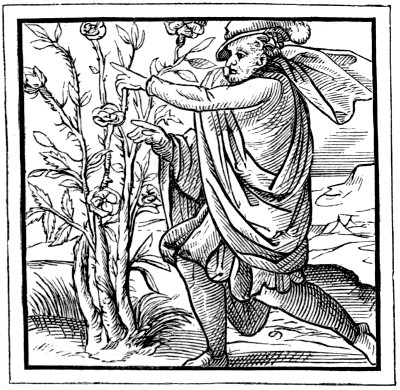
Whitney, 1586.
“Sharpe prickes preserue the Rose, on euerie parte,
That who in haste to pull the same intendes,
Is like to pricke his fingers, till they smarte?
But being gotte, it makes him straight amendes
It is so freshe, and pleasant to the smell,
Thoughe he was prick’d, he thinkes he ventur’d well.
And he that faine woulde get the gallant rose,
And will not reache, for feare his fingers bleede;
A nettle, is more fitter for his nose?
Or hemblocke meete his appetite to feede?
None merites sweete, who tasted not the sower,
Who feares to climbe, deserues no fruicte, nor flower.”
In the Emblems of Otho Vænius (p. 160), Cupid is plucking a rose, to the motto from Claudian, “Armat spina rosas, mella tegunt apes,”—Englished, “No pleasure without payn.”
“In plucking of the rose is pricking of the thorne,
In the attayning sweet, is tasting of the sowre,
With ioy of loue is mixt the sharp of manie a showre,
But at the last obtayned, no labor is forlorne.”
The pretty song from Love’s Labours Lost (act iv. sc. 3, l. 97, vol. ii. p. 144), alludes to the thorny rose,—
“On a day—alack the day!
Love, whose month is ever May,
Spied a blossom passing fair
Playing in the wanton air:
Through the velvet leaves the wind.
All unseen, can passage find;
That the lover, sick to death,
Wish himself the heaven’s breath.
Air, quoth he, thy cheeks may blow;
Air, would I might triumph so!
But, alack, my hand is sworn
Ne’er to pluck thee from thy thorn.”
The scene in the Temple-garden; the contest in plucking roses between Richard Plantagenet and the Earls of Somerset, Suffolk, and Warwick (1 Henry VI., act ii. sc. 4, lines 30–75, vol. v. pp. 36, 37), continually alludes to the thorns that may be found. We may sum the whole “brawl,” as it is termed, into a brief space (l. 68),—
“Plan. Hath not thy rose a canker, Somerset?
Som. Hath not thy rose a thorn, Plantagenet?
Plan. Ay, sharp and piercing, to maintain his truth;
Whiles thy consuming canker eats his falsehood.”
“True as the needle to the pole,” is a saying which of course must have originated since the invention of the mariner’s compass. Sambucus, in his Emblems (edition 1584, p. 84, or 1599, p. 79), makes the property of the loadstone his emblem for the motto, The mind remains unmoved.
Mens immota manet.
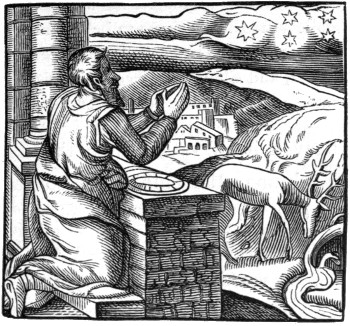
Sambucus, 1584.
Dicitvr interna vi Magnes ferra mouere:
Perpetuò nautas dirigere inq́₃que viam.
Semper enim ſtellam firmè aſpicit ille polærem.
Indicat hac horas, nos variéque monet.
Mens vtinam in cælum nobis immota maneret,
Nec ſubitò dubiis fluctuet illa malis.
Pax coëat tandem, Chriſte, vnum claudat ouile,
Liſque tui verbi iam dirimatur ope.
Da, ſitiens anima excelſas ſic appetat arces:
Fontis vt ortiui ceruus anhelus aquas.
In the latter part of his elegiacs Sambucus introduces another subject, and gives a truly religious turn to the device,—
“Gather’d one fold, O Christ, let peace abound,
Be vanquish’d by thy word, our jarring strife;
Then thirsting souls seek towers on heavenly ground,
As pants the stag for gushing streams of life.”
The magnet’s power alone is kept in view by Whitney (p. 43),—
“By vertue hidde, behoulde, the Iron harde,
The loadestone drawes, to poynte vnto the starre:
Whereby, wee knowe the Seaman keepes his carde,
And rightlie shapes, his course to countries farre:
And on the pole, dothe euer keepe his eie,
And withe the same, his compasse makes agree.
Which shewes to vs, our inward vertues shoulde,
Still drawe our hartes, althoughe the iron weare:
The hauenlie starre, at all times to behoulde,
To shape our course, so right while wee bee heare:
That Scylla, and Charybdis, wee maie misse,
And winne at lengthe, the porte of endlesse blisse.”
The pole of heaven itself, rather than the magnetic needle, is in Shakespeare’s dramas the emblem of constancy. Thus in the Julius Cæsar (act iii. sc. 1, l. 58, vol. vii. p. 363), Metellus, Brutus, and Cassius are entreating pardon for Publius Cimber, but Cæsar replies, in words almost every one of which is an enforcement of the saying, “Mens immota manet,”—
“I could be well moved, if I were as you;
If I could pray to move, prayers would move me:
But I am constant as the northern star,
Of whose true-fix’d and resting quality
There is no fellow in the firmament.
The skies are painted with unnumber’d sparks;
They are all fire and every one doth shine;
But there’s but one in all doth hold his place:
So in the world; ’tis furnish’d well with men,
And men are flesh and blood, and apprehensive;
Yet in the number I do know but one
That unassailable holds on his rank.
Unshak’d of motion: and that I am he,
Let me a little show it, even in this;
That I was constant Cimber should be banish’d,
And constant do remain to keep him so.”
The Midsummer Night’s Dream (act i. sc. I, l. 180, vol. ii. p. 205), introduces Hermia greeting her rival Helena,—
“Her. God speed fair Helena! whither away?
Hel. Call you me fair? that fair again unsay.
Demetrius loves you fair: O happy fair!
Your eyes are lode-stars.”
The scene changes, Helena is following Demetrius, but he turns to her and says (act ii. sc. 1, l. 194, vol. ii. p. 217),—
“Hence, get thee gone, and follow me no more.
Hel. You draw me, you hard-hearted adamant;
But yet you draw not iron, for my heart
Is true as steel: leave but your power to draw,
And I shall have no power to follow you.”
The averment of his fidelity is thus made by Troilus to Cressida (act iii. sc. 2, l. 169. vol. vi. p. 191),—
“As true as steel, as plantage to the moon,
As sun to day, as turtle to her mate,
As iron to adamant, as earth to the centre.
Yet after all comparisons of truth,
As truth’s authentic author to be cited,
‘As true as Troilus’ shall crown up the verse
And sanctify the numbers.”
So Romeo avers of one of his followers (act ii. sc. 4, l. 187, vol. vii. p. 58),—
“I warrant thee, my man’s as true as steel.”
“Ex maximo minimvm,”—Out of the greatest the least,—is a saying adopted by Whitney (p. 229), from the “Picta Poesis” (p. 55) of Anulus,—
EX MAXIMO MINIMVM.
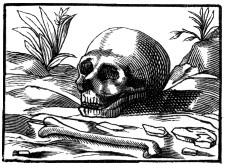
Aneau, 1555.
Hae Sunt Relliquiæ Sacrarij, in quo
Fertur viua Dei fuiſse imago.
Hæc eſt illius, & domus ruina,
In qua olim Ratio tenebat arcem.
At nunc horribilis figura Mortis.
Ventoſum caput, haud habens cerebrum.
Both writers make the proverb the groundwork of reflexions on a human skull. According to Anulus, “the relics of the charnel house were once the living images of God,”—“that ruin of a dome was formerly the citadel of reason.” Whitney thus moralizes,—
“Where liuely once, Gods image was expreste,
Wherin, sometime was sacred reason plac’de,
The head, I meane, that is so ritchly bleste,
With sighte, with smell, with hearinge, and with taste.
Lo, nowe a skull, both rotten, bare, and drye,
A relike meete in charnell house to lye.”
The device and explanatory lines may well have given suggestion to the half-serious, half-cynical remarks by Hamlet in the celebrated grave-yard scene (Hamlet, act v. sc. 1, l. 73, vol. viii. p. 153). A skull is noticed which one of the callous grave-diggers had just thrown up upon the sod, and Hamlet says (l. 86),—
“That skull had a tongue in it, and could sing once: how the knave jowls it to the ground, as if it were Cain’s jaw-bone, that did the first murder!”
And a little further on,—
“Here’s a fine revolution, an we had the trick to see’t. Did these bones cost no more the breeding, but to play at loggats with ’em? mine ache to think on’t.”[150]
And when Yorick’s skull is placed in his hand, how the Prince moralizes! (l. 177),—
“Here hung those lips, that I have kissed I know not how oft. Where be your gibes now? your gambols? your songs? your flashes of merriment, that were wont to set the table on a roar? Not one now, to mock your own grinning? quite chap-fallen? Now get you to my lady’s chamber, and tell her, let her paint an inch thick, to this favour she must come; make her laugh at that.”
And again (lines 191 and 200),—
“To what base uses we may return. Horatio!
. . . . . . .
Imperial Cæsar, dead, and turn’d to clay,
Might stop a hole to keep the wind away.”
Of the skull Anulus says, “Here reason held her citadel;” and the expression has its parallel in Edward’s lament (3 Henry VI., act ii. sc. 1, l. 68, vol. v. p. 252),—
“Sweet Duke of York, our prop to lean upon;”
when he adds (l. 74),—
“Now my soul’s palace is become a prison;”
to which the more modern description corresponds,—
“The dome of thought, the palace of the soul.”
A far nobler emblem could be made, and I believe has been made, though I cannot remember where, from those lines in Richard II. (act ii. sc. 1, l. 267, vol. iv. p. 145), which allude to the death’s head and the light of life within. Northumberland, Ross and Willoughby are discoursing respecting the sad state of the king’s affairs, when Ross remarks,—
“We see the very wreck that we must suffer:
And unavoided is the danger now,
For suffering so the causes of our wreck.”
And Northumberland replies in words of hope (l. 270),—
“Not so; even through the hollow eyes of death
I spy life peering.”
It is a noble comparison, and most suggestive,—but of a flight higher than the usual conceptions of the Emblem writers. Supplied to them they could easily enough work it out into device and picture, but possess scarcely power enough to give it origin.[151]
“A snake lies hidden in the grass,” is no unfrequent proverb; and Paradin’s “Devises Heroiqves” (41) set forth both the fact and the application.
Latet anguis in herba.
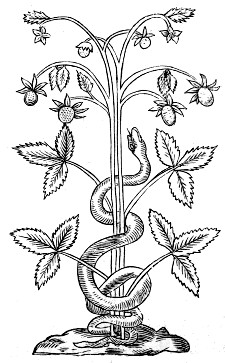
Paradin, 1562.
En cueillant les Fleurs, & les Fraizes des champs, ſe faut d’autant garder du dangereus Serpent, qu’il nous peut enuenimer, & faire mourir nos corps. Et auſsi en colligeant les belles autoritez, & graues ſentences des liures, faut euiter d’autant les mauuaiſes opinions, qu’elles nous peuuent peruertir, damner, & perdre nos ames.
From the same motto and device Whitney (p. 24) makes the application to flatterers,—
“Of flattringe speeche, with sugred wordes beware,
Suspect the harte, whose face doth fawne, and smile,
With trusting theise, the worlde is clog’de with care,
And fewe there bee can scape theise vipers vile:
With pleasinge speeche they promise, and proteste,
When hatefull hartes lie hidd within their brest.”
According to the 2nd part of Henry VI. (act iii. sc. 1, l. 224, vol. v. p. 158), the king speaks favourably of Humphrey, Duke of Gloucester, and Margaret the queen declares to the attendant nobles,—
“Henry my lord is cold in great affairs,
Too full of foolish pity, and Gloucester’s show
Beguiles him as the mournful crocodile
With sorrow snares relenting passengers,
Or as the snake roll’d in a flowering bank,
With shining checker’d slough, doth sting a child,
That for the beauty thinks it excellent.”
In Lady Macbeth’s unscrupulous advice to her husband (Macbeth, act i. sc. 5, l. 61, vol. vii. p. 438), the expressions occur,—
“Your face, my thane, is as a book where men
May read strange matters. To beguile the time,
Look like the time; bear welcome in your eye,
Your hand, your tongue: look like the innocent flower,
But be the serpent under’t.”
Romeo slays Tybalt, kinsman to Julia, and the nurse announces the deed to her (Romeo and Juliet, act iii. sc. 2, l. 69, vol. vii. p. 75),—
“Nurse. Tybalt is gone, and Romeo banished;
Romeo that kill’d him, he is banished.
Jul. O God! did Romeo’s hand shed Tybalt’s blood?
Nurse. It did, it did; alas the day, it did!
Jul. O serpent heart, hid with a flowering face!
Did ever dragon keep so fair a cave?
Beautiful tyrant! fiend angelical!
Dove-feather’d raven! wolvish-ravening lamb!”
Though not illustrative of a Proverb, we will here conclude what has to be remarked respecting Serpents. An Emblem in Paradin’s “Devises Heroiqves” (112) and in Whitney (p. 166), represents a serpent that has fastened on a man’s finger, and that is being shaken off into a fire, while the man remains unharmed; the motto, “Who against us?”—
Quis contra nos?
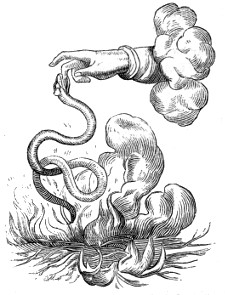
Paradin, 1562.
The scene described in the Acts of the Apostles, chap, xxviii. v. 3–6, Paradin thus narrates,—
“Saint Paul, en l’ iſle de Malte fut mordu d’vn Vipere: ce neantmoins (quoi que les Barbares du lieu le cuidaſſent autrement) ne valut pis de la morsure, secouant de sa main la Beste dans le feu: car veretablement à qui Dieu veut aider, il n’y a rien que puiſse nuire.”
Whitney, along with exactly the same device, gives the full motto,—
“Si Deus nobiscum, quis contra nos?”
“His seruantes God preserues, thoughe they in danger fall:
Euen as from vipers deadlie bite, he kept th’ Appostle Paule.”
The action figured in this Emblem is spoken of in the Midsummer Night’s Dream (act iii. sc. 2, l, 254, vol. ii. p. 241). Puck has laid the “love-juice” on the wrong eyes, and in consequence Lysander avows his love for Helen instead of for Hermia; and the dialogue then proceeds,—
Dem. I say I love thee more than he can do.
Lys. If thou say so, withdraw, and prove it too.
Dem. Quick, come!
Her. Lysander, whereto tends all this?
Lys. Away, you Ethiope!
Dem. No, no; he’ll ...
Seem to break loose; take on as you would follow,
But yet come not: you are a tame man, go!
Lys. Hang off, thou cat, thou burr! vile thing, let loose,
Or I will shake thee from me like a serpent!”
Cardinal Pandulph, the Pope’s legate, in King John (act iii. sc. 1, l. 258, vol. iv. p. 42), urges King Philip to be champion of the Church, and says to him,—
“France, thou mayst hold a serpent by the tongue,
A chafed lion by the mortal paw,
A fasting tiger safer by the tooth,
Than keep in peace that hand which thou dost hold.”
King Richard’s address to the “gentle earth,” when he landed in Wales (Richard II., act iii. sc. 2, l. 12, vol. iv. p. 164), calls us to the Emblem of the snake entwined about the flower,—
“Feed not thy sovereign’s foe, my gentle earth,
Nor with thy sweets comfort his ravenous sense;
But let thy spiders, that suck up thy venom,
And heavy-gaited toads lie in their way,
Doing annoyance to the treacherous feet
Which with usurping steps do trample thee:
Yield stinging nettles to mine enemies;
And when they from thy bosom pluck a flower,
Guard it, I pray thee, with a lurking adder
Whose double tongue may with a mortal touch
Throw death upon thy sovereign’s enemies.”
“The Engineer hoist with his own petar” may justly be regarded as a proverbial saying. It finds its exact correspondence in Beza’s 8th Emblem (edition 1580), in which for device is a cannon bursting, and with one of its fragments killing the cannonier.
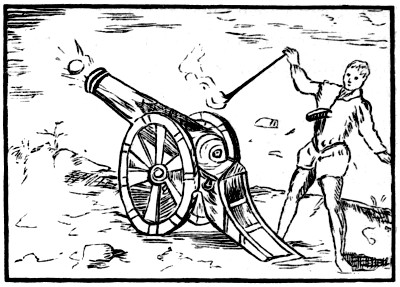
Beza, 1580.
“Cernis ut in cœlum fuerat quæ machina torta,
Fit iaculatori mors properata suo?
In sanctos quicunque Dei ruis impie seruos,
Conatus merces hæc manet vna tuas.”
Thus rendered into French in 1581,—
“Vois tu pas le canon braqué contre les cieux,
En se creuant creuer celui la qui le tire?
Le mesme t’aduiendra, cruel malicieux,
Qui lasches sur les bons les balles de ton ire.”
The sentiment is the same as that of the proverb in the motto which Lebeus-Batillius prefixes to his 18th Emblem (edition 1596), “Qvibvs rebvs confidimvs, iis maxime evertimvs,”—To whatever things we trust, by them chiefly are we overthrown. The subject is Milo caught in the cleft of the tree which he had riven by his immense strength; he is held fast, and devoured by wolves.
The application of Beza’s Emblem is made by Hamlet (act iii. sc. 4, l. 205, vol. viii. p. 117), during the long interview with his mother, just after he had said,—
“No, in despite of sense and secrecy,
Unpeg the basket on the house’s top,[152]
Let the birds fly, and like the famous ape,
To try conclusions, in the basket creep,
And break your own neck down.”
Then speaking of his plot and of the necessity which marshals him to knavery, he adds,—
“Let it work;
For ’tis the sport to have the enginer
Hoist with his own petar: and ’t shall go hard
But I will delve one yard below their mines,
And blow them at the moon: O, ’tis most sweet
When in one line two crafts directly meet.”
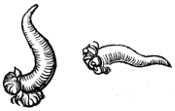
Horapollo, ed. 1551.
Section VI. EMBLEMS FROM FACTS IN NATURE, AND FROM THE PROPERTIES OF ANIMALS.
EMBLEM writers make the Natural, one of the divisions of their subject, and understand by it, in Whitney’s words, the expressing of the natures of creatures, for example, “the loue of the yonge Storkes to the oulde, or of such like.” We shall extend a little the application of the term, taking in some facts of nature, as well as the natural properties and qualities of animals, but reserving in a great degree the Poetry, with which certain natural things are invested, for the next general heading, “Emblems for Poetic Ideas.”
There is no need to reproduce the Device of Prometheus bound, but simply to refer to it, and to note the allusions which Shakespeare makes to the mountain where the dire penalty was inflicted, “the frosty Caucasus.” From the Titus Andronicus we have already (p. 268) spoken of Tamora’s infatuated love,—
“faster bound to Aaron’s charming eyes
Than is Prometheus ty’d on Caucasus.”
John of Gaunt, Duke of Lancaster, endeavours, in Richard II. (act i. sc. 3, lines 275, 294, vol. iv. pp. 130, 131), to reconcile his son Henry Bolingbroke to the banishment which was decreed against him, and urges,—
“All places that the eye of heaven visits
Are to a wise man ports and happy havens.
Teach thy necessity to reason thus;
There is no virtue like necessity.
Think not the king did banish thee,
But thou the king.”
Bolingbroke,however, replies,—
“O, who can hold a fire in his hand
By thinking on the frosty Caucasus?”
The indestructibility of adamant by force or fire had for ages been a received truth.
QVEM NVLLA PERICVLA, TERRENT.
Le Bey de Batilly, 1596.
“Whom no dangers terrify,” is a fitting motto for the Emblem that pertains to such as fear nor force nor fire.
Speaking of the precious gem that figures forth their character, it is the remark of Lebeus-Batillius (Emb. 29), “Duritia ineharrabilis est, simulque ignium victrix naturâ & nunquam incalescens,”—for which we obtain a good English expression from Holland’s Pliny (bk. xxxvii. c. 4): “Wonderfull and inenarrable is the hardnesse of a diamant; besides it hath a nature to conquer the fury of fire, nay, you shall never make it hote.”
The Latin stanzas in illustration close with the lines,—
“Qualis, non Adamas ullo contunditur ictu,
Vique sua ferri duritium superat.”
i.e.
“As by no blow the Adamant is crushed,
And by its own force overcomes the hardness of iron.”
When the great Talbot was released from imprisonment (1 Henry VI., act i. sc. 4, l. 49, vol. v. p. 20), his companions-in-arms on welcoming him back, inquired, “How wert thou entertained?” (l. 39)—
“With scoffs and scorns and contumelious taunts.
. . . . . . . .
In iron walls they deem’d me not secure;
So great fear of my name ’mongst them was spread
That they supposed I could rend bars of steel
And spurn in pieces posts of adamant.”
The strong natural affection of the bear for its young obtained record nearly three thousand years ago (2 Samuel xvii. 8),—“mighty men, chafed in their minds” are spoken of “as a bear robbed of her whelps in the field.”[153] Emblems delineated by Boissard and engraved by Theodore De Bry in 1596, at Emb. 43 present the bear licking her whelp, in sign that the inborn force of nature is to be brought into form and comeliness by instruction and good learning. At a little later period, the “Tronvs Cvpidinis,” or “Emblemata Amatoria” (fol. 2), so beautifully adorned by Crispin de Passe, adopts the sentiment, Perpolit incultum paulatim tempus amorem,—that “by degrees time puts the finish, or perfectness to uncultivated love.” The device by which this is shown introduces a Cupid as well as the bear and her young one,—
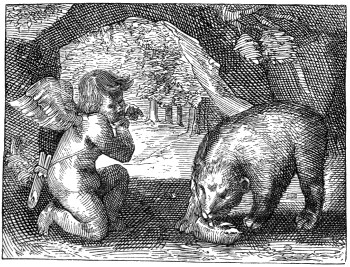
De Passe, 1596.
and is accompanied by Latin and French stanzas,—
“Vrsa novum fertur lambendo fingere fœtum
Paulatim & formam, quæ decet, ore dare;
Sic dominam, vt valde sic cruda sit aspera Amator
Blanditiis sensim mollet & obsequio.”
Peu à peu.
“Ceste masse de chair, que toute ourse faonne
En la leschant se forme à son commencement.
Par seruir: par flatter, par complaire en aymant,
L’amour rude à l’abord, à la fin se façonne.”
The sentiment of these lines finds a parallel in the Midsummer Night’s Dream (act i. sc. 1. l. 232, vol. ii. p. 206),—
“Things base and vile, holding no quantity,
Love can transpose to form and dignity:
Love looks not with the eyes, but with the mind;
And therefore is wing’d Cupid painted blind.”
Perchance, too, it receives illustration from the praise accorded to the young Dumain by Katharine, in Love’s Labour’s Lost (act ii. sc. 1, l. 56, vol. ii. p. 114),—
“A well accomplish’d youth,
Of all that virtue love for virtue loved:
Most power to do most harm, least knowing ill;
For he hath wit to make an ill shape good,
And shape to win grace, though he had no wit.”
To the denial of natural affection towards himself Gloucester (3 Henry VI., act iii. sc. 2, l. 153, vol. v. p. 284) deemed it almost a thing impossible for him to “make his heaven in a lady’s lap,”—
“Why, love forswore me in my mother’s womb:
And, for I should not deal in her soft laws,
She did corrupt frail nature with some bribe,
To shrink mine arm up like a wither’d shrub;
To make an envious mountain on my back,
Where sits deformity to mock my body;
To shape my legs of an unequal size;
To disproportion me in every part.
Like to a chaos, or an unlick’d bear-whelp
That carries no impression like the dam.”
Curious it is to note how slowly the continent which Columbus discovered became fully recognised as an integral portion of what had been denominated, ἡ οἰκουμένη,—“the inhabited world.” The rotundity of the earth and of the water was acknowledged, but Brucioli’s “Trattato della Sphera,” published at Venice, D.M.XLIII., maintains that the earth is immovable and the centre of the universe; and in dividing the globe into climates, it does not take a single instance except from what is named the old world; in fact, the new world of America is never mentioned.
Somewhat later, in 1564, when Sambucus published his Emblems, and presented Symbols of the parts of the Inhabited Earth, he gave only three; thus (p. 113),—
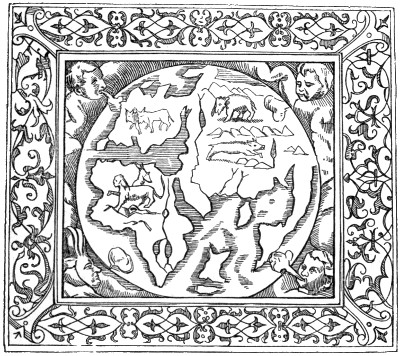
Partium τῆς οικουμένης ſymbola.
Sambucus, 1564.
Est regio quæuis climate certo
Aëre diſtincta, & commoditate.
Quælibet haud quidius terra feretq́ue.
Africa monſtroſa eſt ſemper habendo
Antea quod nemo viderat vſquam.
Fert Aſia immanes frigidiore
Nempe ſolo apros, & nimbigera vrſos:
Sed reliquas vincit viribus omnes
Belua, quam Europæ temperat aër.
Taurus vt eſt fortis, bufalus vnà.
Ergo ſit Europæ taurus alumnus,
Africæ at inſigne ſitq́ue Chimæra.
Sint Aſiæ immites vrſus, aperq́ue.
The Bull is thus set forth as the alumnus, or nursling of Europe; of Africa the Chimæra is the ensign; and to Asia belong the untamed Bear and Boar; America and the broad Pacific, from Peru to China, have neither token nor locality assigned.
Shakespeare’s geography, however, though at times very defective, extended further than its “symbols” by Sambucus. In the humorous mapping out, by Dromio of Syracuse, of the features of the kitchen-wench, who was determined to be his wife (Comedy of Errors, act iii. sc. 2, l. 131, vol. i. p. 429), the question is asked,—
“Ant. S. Where America, the Indies?
Dro. S. Oh, sir, upon her nose, all o’er embellished with rubies, carbuncles, sapphires, declining their rich aspect to the hot breath of Spain.
In Twelfth Night (act iii. sc. 2, l. 73, vol. iii. p. 271) Maria thus describes the love-demented steward,—
“He does smile his face into more lines than is in the new map with the augmentation of the Indies; you have not seen such a thing as ’tis.”
And in the Merry Wives of Windsor (act i. sc. 3, l. 64, vol. i. p. 177), Sir John Falstaff avers respecting Mistress Page and Mistress Ford,—
“I will be cheaters to them both, and they shall be exchequers to me; they shall be my East and West Indies, and I will trade to them both.”
Yet in agreement with the map of Sambucus, with the three capes prominent upon it, of Gibraltar Rock, the Cape of Good Hope, and that of Malacca, Shakespeare on other occasions ignores America and all its western neighbours. At the consultation by Octavius, Antony, and Lepidus, about the division of the Roman Empire (Julius Cæsar, act iv. sc. 1, l. 12, vol. vii. p. 384), Antony, on the exit of Lepidus, remarks,—
“This is a slight unmeritable man,
Meet to be sent on errands: is it fit,
The three-fold world divided, he should stand
One of the three to share it?”
And when the camp of Octavius is near Alexandria (Antony and Cleopatra, act iv. sc. 6, l. 5, vol. ix. p. 109), and orders are issued to take Antony alive, Cæsar declares,—
“The time of universal peace is near:
Prove this a prosperous day, the three-nook’d world
Shall bear the olive freely.”
Plate 13
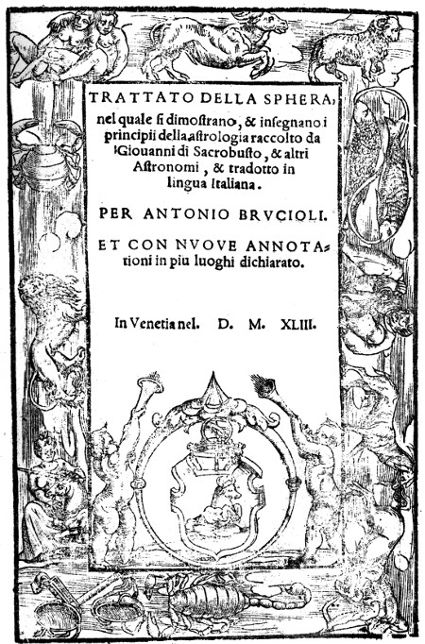
The Zodiac from a Title page - Brucioli 1543
The Signs of the Zodiac, or, rather, the figures of the animals of which the zodiac is composed, were well known in Shakespeare’s time from various sources; and though they are Emblems, and have given name to at least one book of Emblems that was published in 1618,[154]—almost within the limits to which our inquiries are confined,—some may doubt whether they strictly belong to Emblem writers. Frequently, however, are they referred to in the dramas of which we are speaking; and, therefore, it is not out of place to exhibit a representation of them. This we do from the frontispiece or title page of an old Italian astronomical work by Antonio Brucioli (see Plate XIII.), who was banished from Florence for his opposition to the Medici, and whose brothers, in 1532, were printers in Venice. It is not pretended that Shakespeare was acquainted with this title page, but it supplies an appropriate illustration of several astronomical phenomena to which he alludes.
The zodiac enters into the description of the advancing day in Titus Andronicus (act ii. sc. 1, l. 5, vol. vi. p. 450),—
“As when the golden sun salutes the morn,
And, having gilt the ocean with his beams,
Gallops the zodiac in his glistering coach,
And overlooks the highest-peering hills;
So Tamora.
Upon her wit doth earthly honour wait,
And virtue stoops and trembles at her frown.”
It also occupies a place in a homely comparison in Measure for Measure (act i. sc. 2, l. 158, vol. i. p. 303), to point out the duration of nineteen years, or the moon’s cycle,—
“This new governor
Awakes me all the enrolled penalties
Which have, like unscour’d armour, hung by the wall
So long, that nineteen zodiacs have gone round.
And none of them been worn; and for a name
Now puts the drowsy and neglected act
Freshly on me: ’tis surely for a name.”
The archery scene in Titus Andronicus (act iv. sc. 3, l. 52, vol. vi. p. 501) mentions several of the constellations and the figures by which they were known. The dialogue is between Titus and Marcus,—
“Tit. You are a good archer, Marcus;
[He gives them the arrows.
‘Ad Jovem,’ that’s for you: here, ‘Ad Apollinem:’
‘Ad Martem,’ that’s for myself:
Here, boy, to Pallas: here, to Mercury:
To Saturn, Caius, not to Saturnine;
You were as good to shoot against the wind.
To it, boy! Marcus, loose when I bid.
Of my word, I have written to effect;
There’s not a god left unsolicited.
Marc. Kinsmen, shoot all your shafts into the court:
We will afflict the emperor in his pride.
Tit. Now, masters, draw, [They shoot.] O, well said, Lucius!
Good boy, in Virgo’s lap; give it Pallas.
Marc. My Lord, I aim a mile beyond the moon;
Your letter is with Jupiter by this.
Tit. Ha, ha!
Publius, Publius, what hast thou done?
See, see, thou hast shot off one of Taurus’ horns.
Marc. This was the sport, my lord: when Publius shot,
The Bull, being gall’d, gave Aries such a knock
That down fell both the Ram’s horns in the court.”
In allusion to the old medico-astrological idea that the different members of the human body were under the influence of their proper or peculiar constellations, the following dialogue occurs in the Twelfth Night (act i. sc. 3, l. 127, vol. iii. p. 231),—
“Sir And. Shall we not set about some revels?
Sir Toby. What shall we do else? were we not born under Taurus?
Sir And. Taurus! That’s sides and heart.
”Toby. No sir; it is legs and thighs. Let me see thee caper: ha!
higher: ha, ha! excellent!”
Falstaff, in the Merry Wives of Windsor (act ii. sc. 2, l. 5, vol. i. p. 190), vaunts of the good services which he had rendered to his companions: “I have grated upon my good friends for three reprieves for you and your coach-fellow Nym: or else you had looked through the grate, like a geminy of baboons.”
In telling of the folly of waiting on Achilles (Troilus and Cressida, act ii. sc. 3, l. 189, vol. vi. p. 175), Ulysses declares,—
“That were to enlard his fat-already pride,
And add more coals to Cancer when he burns
With entertaining great Hyperion.”
The figure of the ninth of the zodiacal constellations, Sagittarius, is named in Troilus and Cressida (act v. sc. 5, l. 11, vol. vi. p. 253),—
“Polixenes is slain,
Amphimachus and Thaos deadly hurt;
Patroclus ta’en or slain; and Palamedes
Sore hurt and bruised: the dreadful sagittary
Appals our number.”
If it be demanded why we do not give a fuller account of these constellations, we may almost remark as the fool does in King Lear (act i. sc. 5, l. 33, vol. viii. p. 295)—“The reason why the seven stars are no more than seven, is a pretty reason.
Lear. Because they are not eight?
Fool. Yes, indeed: thou wouldst make a good fool.”
How soon the American bird, which we name a Turkey, was known in England, is in some degree a subject of conjecture. It has been supposed that its introduction into this country is to be ascribed to Sebastian Cabot, who died in 1557, and that the year 1528 is the exact time; but if so, it is strange that the bird in question should not have been called by some other name than that which indicates a European or an Asiatic origin. Coq d’Inde, or Poule d’Inde, Gallo d’India, or Gallina d’India, the French and Italian names, point out the direct American origin, as far as France and Italy are concerned; for we must remember that the term India, at the early period of Spanish discovery, was applied to the western world. But most probably the Turkey fleet brought the bird into England, by way of Cadiz and Lisbon, and hence the name; and hence also the reasonableness of supposing that its permanent introduction into this country was not so early as the time of Cabot. A general knowledge of the bird was at any rate spread abroad in Europe soon after the middle of the sixteenth century, for we find it figured in the Emblem-books; one of which, Freitag’s Mythologia Ethica, in 1579, p. 237, furnishes a most lively and exact representation to illustrate “the violated right of hospitality.”[155]
Ius hoſpitalitatis violatum.
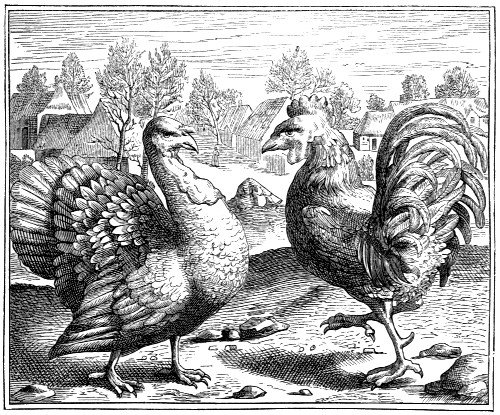
Freitag, 1579.
Si habitauerit aduena in terra veſtra, & moratus fuerit inter vos, non exprobretis ei.
Lev. 19. 33.
i.e.
“And if a stranger sojourn with thee in your land, ye shall not vex him.”
Shakespeare, no doubt, was familiarly acquainted with the figure and habits of the Turkey, and yet may have seized for description some of the expressive delineations and engravings which occur in the Emblem writers. Freitag’s turkey he characterises with much exactness, though the sentiment advanced is more consistent with the lines from Camerarius. In the Twelfth Night (act ii. sc. 5, lines 15, 27, vol. iii. p. 257), Malvolio, as his arch-tormenter Maria narrates the circumstance, “has been yonder i’ the sun practising behaviour to his own shadow this half hour;” he enters on the scene, and Sir Toby says to Fabian, “Here’s an overweening rogue!” to which the reply is made, “O peace! Contemplation makes a rare turkey-cock of him; how he jets under his advancing plumes!”
The same action is well hit off in showing the bearing of the “pragging knave, Pistol,” as Fluellen terms him (Henry V., act v. sc. 1, l. 13, vol. iv. p. 591),—
“Gow. Why here he comes, swelling like a turkey-cock.
Flu. ’Tis no matter for his swellings, nor his turkey-cocks. God pless you, Aunchient Pistol! you scurvy, lousy knave, God pless you!”
Referring again to the “Prometheus ty’d on Caucasus,” the Vulture may be accepted as the Emblem of cruel retribution. So when Falstaff expresses his satisfaction at the death of Henry IV. (2nd part, act v. sc. 3, l. 134, vol. iv. p. 474), “Blessed are they that have been my friends; and woe to my lord chief-justice;” Pistol adds,—
“Let vultures vile seize on his lungs also!”
And Lear, telling of the ingratitude of one of his daughters (King Lear, act ii. sc. 4, l. 129. vol. viii. p. 320). says,—
“Beloved Regan,
Thy sister’s naught: O Regan, she hath tied
Sharp-tooth’d unkindness, like a vulture, here.”
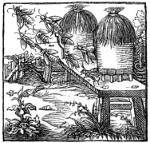
Horapollo, 1551.
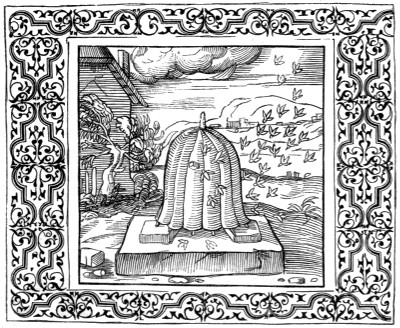
A remarkable instance of similarity between Whitney and Shakespeare occurs in the descriptions which they both give of the Commonwealth of Bees. Whitney, it may be, borrowed his device (p. 200) from the “Hieroglyphica” of Horus Apollo (edition 1551, p. 87), where the question is asked, Πῶς λαὸν πειθήνιον βασιλεῖ;—
“How to represent a people obedient to their king? They depict a BEE, for of all animals bees alone have a king, whom the crowd of bees follow, and to whom as to a king they yield obedience. It is intimated also, as well from the remarkable usefulness of honey as from the force which the animal has in its sting, that a king is both useful and powerful for carrying on their affairs.”
It is worthy of remark that several, if not all, of the Greek and Roman authors name the head of a hive not a queen but a king. Plato, in his Politics (Francfort edition, 1602, p. 557A). writes,—
“Νὺν δὲ γε ὃτε οὐκ ἔστι γιγνόμενος, ὡς δὴ φαμὲν, ἔν ταῖς πόλεσι βασιλεὺς, οἱ~υς ἐν σμήνεσιν, εμφυέται, τό,τε σῶμα εὐθὺς καὶ τὴν ψυχὴν διαφέρων,” κ. τ. λ.
“There is not born, as we say, in cities a king such as is naturally produced in hives, decidedly differing both in body and soul.”
Xenophon’s Cyropædia (bk. v. c. 1, § 23) declares of his hero,—
“Βασιλεὺς μὲν γὰρ ἔμοιγε δοκεῖς σὺ φυσεί πεφυκέναι, οὐδὲν ἤττον η ἐν τῳ σμῆνει φυόμενος τῶν μελιττῶν ἡγεμών.”
“Thou seemest to me to have been formed a king by nature, no less than he who in the hive is formed general of the bees.”
In his Georgics Virgil always considers the chief bee to be a king, as iv. 75,—
“Et circa regem atque ipsa ad prætoria densæ
Miscentur, magnisque vocant clamoribus hostem.”[156]
“And thick around the king, and before the royal tent
They crowd, and with mighty din call forth the foe.”
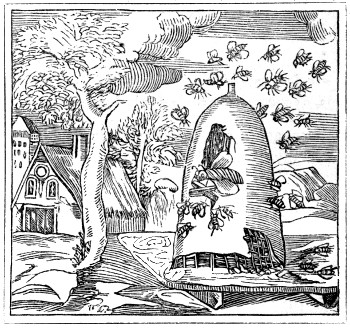
Alciat’s 148th Emblem (edition 1581, p. 528, or edition 1551, p. 161) sets forth the clemency of a prince; but the description relates to wasps, not bees,—
Principis clementia.
Alciat, 1551.
Veſparũ quòd nulla vnquam Rex ſpicula figet:
Quodq́₃que aliis duplo corpore maior erit.
Arguet imperium clemens, moderataq́₃que, regna,
Sanctaq́₃que indicibus credita iura bonis.
“That the king of the wasps will never his sting infix;
And that by double the size of body he is larger than others,
This argues a merciful empire and well-ordered rule,
And sacred laws to good judges entrusted.”
Whitney’s stanzas (p. 200), dedicated to “Richard Cotton, Esquier,” of Combermere, Cheshire, are original writing, not a translation.
We will take the chief part of them; the motto being, “To every one his native land is dear.”
Patria cuique chara.
To Richarde Cotton Eſquier.
Whitney, 1586.
“The bees at lengthe retourne into their hiue,
When they haue suck’d the sweete of Floras bloomes;
And with one minde their worke they doe contriue,
And laden come with honie to their roomes:
A worke of arte; and yet no arte of man,
Can worke, this worke; these little creatures can.
The maister bee, within the midst dothe liue,
In fairest roome, and most of stature is;
And euerie one to him dothe reuerence giue,
And in the hiue with him doe liue in blisse:
Hee hath no stinge, yet none can doe him harme,
For with their strengthe, the rest about him swarme.
Lo, natures force within these creatures small,
Some, all the daye the honie home doe beare.
And some, farre off on flowers freshe doe fall,
Yet all at nighte vnto their home repaire:
And euerie one, her proper hiue doth knowe
Althoughe there stande a thousande on a rowe.
A Common-wealthe, by this, is right expreste:
Bothe him, that rules, and those, that doe obaye:
Or suche, as are the heads aboue the rest,
Whome here, the Lorde in highe estate dothe staye:
By whose supporte, the meaner sorte doe liue,
And vnto them all reuerence dulie giue.
Which when I waied: I call’d vnto my minde
Your Cvmbermaire, that fame so farre commendes:
A stately seate, whose like is harde to finde,
Where mightie Iove the horne of plentie lendes:
With fishe, and foule, and cattaile sondrie flockes,
Where christall springes doe gushe out of the rockes.
There, fertile fieldes; there, meadowes large extende:
There, store of grayne: with water, and with wood.
And, in this place, your goulden time you spende,
Vnto your praise, and to your countries good:
This is the hiue; your tennaunts, are the bees:
And in the same, haue places by degrees.”
By the side of these stanzas let us place for comparison what Shakespeare wrote on the same subject,—the Commonwealth of Bees,—and I am persuaded we shall perceive much similarity of thought, if not of expression. In Henry V. (act i. sc. 2, l. 178, vol. iv. p. 502), the Duke of Exeter and the Archbishop of Canterbury enter upon an argument respecting a well-governed state,—
“Exe. While that the armed hand doth fight abroad,
The advised head defends itself at home;
For government, though high and low and lower,
Put into parts, doth keep in one consent,
Congreeing in a full and natural close,
Like music.
Cant. Therefore doth heaven divide
The state of man in divers functions,
Setting endeavour in continual motion:
To which is fixed, as an aim or butt,
Obedience: for so work the honey-bees,
Creatures that by a rule in nature teach
The act of order to a peopled kingdom.
They have a king[157] and officers of sorts;
Where some, like magistrates, correct at home,
Others, like merchants, venture trade abroad,
Others, like soldiers, armed in their stings,
Make boot upon the summer’s velvet buds,
Which pillage they with merry march bring home
To the tent-royal of their emperor;
Who, busied in his majesty, surveys
The singing masons building roofs of gold,
The civil citizens kneading up the honey,
The poor mechanic porters crowding in
Their heavy burdens at his narrow gate,
The sad-eyed justice, with his surly hum.
Delivering o’er to executors pale
The lazy yawning drone.”
Again, in the Troilus and Cressida (act i. sc. 3, l. 75, vol. vi. p. 144), Ulysses draws from the unsuitableness of a general, as he terms the ruling bee, over a hive, an explanation of the mischiefs from an incompetent commander,—
“Troy, yet upon his basis, had been down,
And the great Hector’s sword had lack’d a master,
But for these instances.
The specialty of rule hath been neglected:
And, look, how many Grecian tents do stand
Hollow upon this plain, so many hollow factions.
When that the general is not like the hive
To whom the foragers shall all repair.
What honey is expected?”
The Dramatist’s knowledge of bee-life appears also in the metaphor used by Warwick (2 Henry VI., act iii. sc. 2, l. 125, vol. v. p. 168),—
“The commons, like an angry hive of bees,
That want their leader, scatter up and down,
And care not who they sting in his revenge.”
In an earlier play, 2 Henry IV. (act iv. sc. 5, l. 75, vol. iv. p. 454), the comparison is taken from the bee-hive,—
“When, like the bee, culling from every flower
The virtuous sweets,
Our thighs pack’d with wax, our mouths with honey,
We bring it to the hive; and like the bees,
Are murdered for our pains.”
In the foregoing extracts on the bee-king, the plea is inadmissible that Shakespeare and Whitney went to the same fountain; for neither of them follows Alciatus. The two accounts of the economy and policy of these “creatures small” are almost equally excellent, and present several points of resemblance, not to name them imitations by the more recent writer. Whitney speaks of the “Master bee,” Shakespeare of the king, or “emperor,”—both regarding the head of the hive not as a queen, but a “born king,” and holding forth the polity of the busy community as an admirable example of a well-ordered kingdom or government.
The conclusion of Whitney’s reflections on those “that suck the sweete of Flora’s bloomes,” conducts to another parallelism; and to show it we have only to follow out his idea of returning home after “absence manie a yeare,” “when happe some goulden honie bringes.” Here is the whole passage (p. 201),—
“And as the bees, that farre and neare doe straye,
And yet come home, when honie they haue founde:
So, thoughe some men doe linger longe awaye,
Yet loue they best their natiue countries grounde.
And from the same, the more they absent bee,
With more desire, they wishe the same to see.
Euen so my selfe; throughe absence manie a yeare,
A straunger meere, where I did spend my prime.
Nowe, parentes loue dothe hale mee by the eare,
And sayeth, come home, deferre no longer time:
Wherefore, when happe, some goulden honie bringes?
I will retorne, and rest my wearie winges.
Ouid. 1. Pont. 4.
Quid melius Roma? Scythico quid frigore peius?
Huc tamen ex illa barbarus vrbe fugit.”
The parallel is from All’s Well that Ends Well (act i. sc. 2, 1. 58, vol. iii. p. 119), when the King of France speaks the praise of Bertram’s father,—
“‘Let me not live,’ quoth he,
‘After my flame lacks oil, to be the snuff
Of younger spirits, whose apprehensive senses
All but new things disdain; whose judgments are
Mere fathers of their garments; whose constancies
Expire before their fashions.’ This he wish’d:
I after him do after him wish too,
Since I nor wax nor honey can bring home,
I quickly were dissolved from my hive,
To give some labourers room.”
The noble art and sport of Falconry were long the recreation, and, at times, the eager pursuit of men of high birth or position. Various notices, collected by Dr. Nathan Drake, in Shakespeare and his Times (vol. i. pp. 255–272), show that Falconry was—
“During the reigns of Elizabeth and James, the most prevalent and fashionable of all amusements;... it descended from the nobility to the gentry and wealthy yeomanry, and no man could then have the smallest pretension to the character of a gentleman who kept not a cast of hawks.”
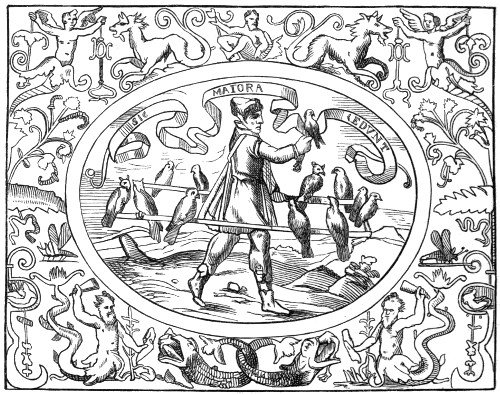
From joining in this amusement, or from frequently witnessing it, Shakespeare gained his knowledge of the sport and of the technical terms employed in it. We do not even suppose that our pictorial illustration supplied him with suggestions, and we offer it merely to show that Emblem writers, as well as others, found in falconry the source of many a poetical expression.[158] The Italian we quote from, Giovio’s “Sententiose Imprese” (Lyons, 1562, p. 41), makes it a mark “of the true nobility;” but by adding, “So more important things give place,” implies that it was wrong to let mere amusement occupy the time for serious affairs.
DELLA VERA.
NOBILTÀ.
Giovio, 1562.
Lo ſparbier ſol tra piu falcon portato.
Franchi gli fa paſſar per ogni loco,
Et par che dica all’ huom triſto & da poco,
Nobil’ è quel, ch’ è di virtù dotato.
Thus we interpret the motto and the stanza,—
“Many falcons the falconer carries so proud
Through every place he makes them pass free;
And says to men sorrowing and of low degree,
Noble is he, who with virtue’s endowed.”
Falconers form part of the retinue of the drama (2 Henry VI., act ii. sc. 1, l. 1, vol. v. p. 132), and the dialogue at St. Albans even illustrates the expression, “Nobil’ è quel, ch’ è di virtù dotato,”—
“Q. Marg. Believe me, lords, for flying at the brook,
I saw not better sport these seven years’ day:
Yet, by your leave, the wind was very high;
And, ten to one, old Joan had not gone out.
K. Henry. But what a point, my lord, your falcon made,
And what a pitch she flew above the rest!
To see how God in all his creatures works!
Yea, man and birds are fain of climbing high.
Suf. No marvel, an it like your majesty,
My lord protector’s hawks do tower so well;
They know their master likes to be aloft,
And bears his thoughts above his falcon’s pitch.
Glo. My lord, ’tis but a base ignoble mind
That mounts no higher than a bird can soar.”
On many other occasions Shakespeare shows his familiarity with the whole art and mysteries of hawking. Thus Christophero Sly is asked (Taming of the Shrew, Introduction, sc. 2, l. 41, vol. iii. p. 10),—
“Dost thou love hawking? Thou hast hawks will soar
Above the morning lark.”
And Petruchio, after the supper scene, when he had thrown about the meat and beaten the servants, quietly congratulates himself on having “politicly began his reign” (act iv. sc. 1, l. 174, vol. iii. p. 67),—
“My falcon now is sharp and passing empty,
And till she stoop she must not be full-gorged;
For then she never looks upon her lure.
Another way I have to man my haggard,
To make her come and know her keeper’s call,
That is, to watch her, as we watch these kites
That bate and beat and will not be obedient.”
Touchstone, too, in As You Like It (act iii. sc. 3, 1. 67, vol. ii. p. 427), hooking several comparisons together, introduces hawking among them: “As the ox hath his bow, sir, the horse his curb, and the falcon her bells, so man hath his desires; and as pigeons bill, so wedlock will be nibbling.”
Also in Macbeth (act ii. sc. 4, l. 10, vol. vii. p. 459), after “hours dreadful and things strange,” so “that darkness does the face of earth entomb, when living light should kiss it,” the Old Man declares,—
“’Tis unnatural.
Even like the deed that’s done. On Tuesday last
A falcon towering in her pride of place
Was by a mousing owl hawk’d at and kill’d.”
To renew our youth, like the eagle’s, is an old scriptural expression (Psalms, ciii. 5); and various arc the legends and interpretations belonging to the phrase.[159] We must not wander among these,—but may mention one which is given by Joachim Camerarius, Ex Volatilibus (Emb. 34), for which he quotes Gesner as authority, how in the solar rays, hawks or falcons, throwing off their old feathers, are accustomed to set right their defects, and so to renew their youth.
RENOVATA
IVVENTVS.
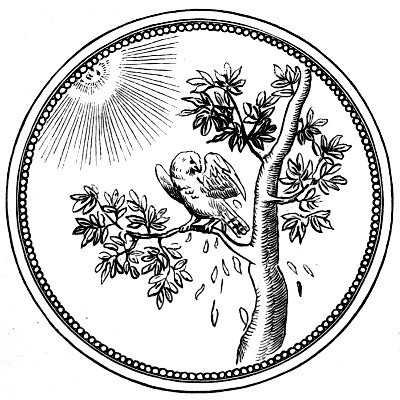
Camerarius, 1596.
Exuviis vitii abjectis, decus indue recti,
Ad ſolem ut plumas accipiter renovat.
i.e.
“Sin’s spoils cast off, man righteousness assumes,
As in the sun the hawk renews its plumes.”
The thought of the sun’s influence in renovating what is decayed is unintentionally advanced by the jealousy of Adriana in the Comedy of Errors (act ii. sc. 1, l. 97, vol. i. p. 411), when to her sister Luciana she blames her husband Antipholus of Ephesus,—
“What ruins are in me that can be found
By him not ruin’d? then is he the ground
Of my defeatures. My decayed fair
A sunny look of his would soon repair.”
In the Cymbeline (act i. sc. 1, l. 130, vol. ix. p. 167), Posthumus Leonatus, the husband of Imogen, is banished with great fierceness by her father, Cymbeline, King of Britain. A passage between daughter and father contains the same notion as that in the Emblem of Camerarius,—
“Imo. There cannot be a pinch in death
More sharp than this is.
Cym. O disloyal thing,
That shouldst repair my youth, thou heap’st
A year’s age on me!”
Nil penna, ſed vſus.
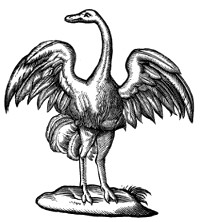
Paradin, 1562.
The action of the ostrich in spreading out its feathers and beating the wind while it runs, furnished a device for Paradin (fol. 23), which, with the motto, The feather nothing but the use, he employs against hypocrisy.
Whitney (p. 51) adopts motto, device, and meaning,—
“The Hippocrites, that make so great a showe,
Of Sanctitie, and of Religion sounde,
Are shaddowes meere, and with out substance goe,
And beinge tri’de, are but dissemblers founde.
Theise are compar’de, vnto the Ostriche faire,
Whoe spreades her winges, yet sealdome tries the aire.”
A different application is made in 1 Henry IV. (act iv. sc. 1, l. 97, vol. iv. p. 317), yet the figure of the bird with outstretching wings would readily supply the comparison employed by Vernon while speaking to Hotspur of “the nimbled-footed madcap Prince of Wales, and his comrades,”—
“All furnish’d, all in arms;
All plumed like estridges that with the wind
Baited like eagles having lately bathed.”
It must, however, be conceded, according to Douce’s clear annotation (vol. i. p. 435), that “it is by no means certain that this bird (the ostrich) is meant in the present instance.” A line probably is lost from the passage, and if supplied would only the more clearly show that the falcon was intended,—“estrich,” in the old books of falconry, denoting that bird, or, rather, the goshawk. In this sense the word is used in Antony and Cleopatra (act iii. sc. 13, l. 195, vol. ix. p. 100),—
“To be furious
Is to be frighted out of fear; and in that mood
The dove will peck the estridge.”
Though a fabulous animal, the Unicorn has properties and qualities attributed to it which endear it to writers on Heraldry and on Emblems. These are well, it may with truth be said, finely set forth in Reusner’s Emblems (edition 1581, p. 60), where the creature is made the ensign for the motto, Faith undefiled victorious.
Victrix casta fides.
Emblema IV.
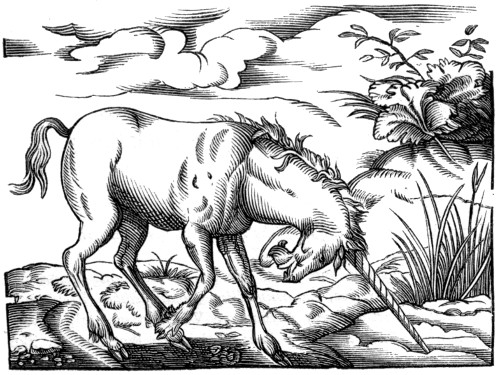
Reusner, 1581.
Caſta pudicitiæ defenſtrix bellua: cornu
Vnum quæ media fronte, nigrumq́₃que gerit:
Theſauros ornans regum, preciumq́₃que rependens:
(Nam cornu præſens hoc leuat omne malum)
Fraude capi nulla, nulla valet arte virorum
Callida: nec gladios, nec fera tela pauet:
Solius in gremio requieſcens ſpontè puellæ:
Fœminea capitur, victa ſopore, manu.
i.e.
“This creature of maiden modesty protectress pure.
In the mid-forehead bears one dark black horn,
Kings’ treasures to ornament, and equalling in worth:
(For where the horn abides, no evil can be born).
Captured nor by guile, nor by crafty art of man,
Trembling nor at swords nor iron arms, firm doth it stand;
Of choice reposing in the lap of a maiden alone,[160]
Should sleep overpower, it is caught by woman’s hand.”
A volume of tales and wonders might be collected respecting the unicorn; for a sketch of these the article on the subject in the Penny Cyclopædia (vol. xxvi. p. 2) may be consulted. There are the particulars given which Reusner mentions, and the medical virtues of the horn extolled,[161] which, at one time, it is said, made it so estimated that it was worth ten times its weight in gold. It is remarkable that Shakespeare, disposed as he was, occasionally at least, to magnify nature’s marvels, does not dwell on the properties of the unicorn, but rather discredits its existence; for when the strange shapes which Prospero conjures up to serve the banquet for Alonso make their appearance (Tempest, act iii. sc. 3, l. 21, vol. i. p. 50), Sebastian avers,—
“Now I will believe
That there are unicorns; that in Arabia
There is one tree, the phœnix’ throne; one phœnix
At this hour reigning there.”
Timon of Athens (act iv. sc. 3, 1. 331, vol. vii. p. 281) just hints at the animal’s disposition: “Wert thou the unicorn, pride and wrath would confound thee, and make thine own self the conquest of thy fury.”
Decius Brutus, in Julius Cæsar (act ii. sc. 1, l. 203, vol. vii. p. 347), vaunts of his power to influence Cæsar, and among other things names the unicorn as a wonder to bring him to the Capitol. The conspirators doubt whether Cæsar will come forth;—
“Never fear that: if he be so resolved,
I can o’ersway him; for he loves to hear
That unicorns may be betray’d with trees,
And bears with glasses, elephants with holes,
Lions with toils, and men with flatterers.”
The humorous ballad in the Percy Reliques (vol. iv. p. 198), written it is supposed close upon Shakespeare’s times, declares,—
“Old stories tell, how Hercules
A dragon slew at Lerna,
With seven heads and fourteen eyes
To see and well discern-a:
But he had a club, this dragon to drub,
Or he had ne’er done it. I warrant ye.”
It is curious that the device in Corrozet’s Hecatomgraphie of the Dragon of Lerna should figure forth, in the multiplication of processes or forms, what Hamlet terms “the law’s delay.”
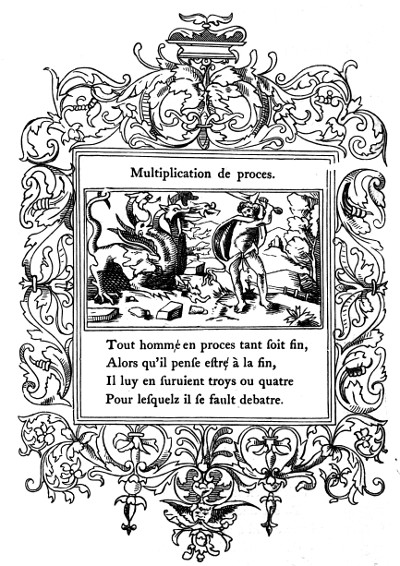
Corrozet, 1540.
That is the very subject against which even Hercules,—“qu’ aqerre honneur par ses nobles conquestes,”—is called into requisition to rid men of the nuisance. We need not quote in full so familiar a narrative, and which Corrozet embellishes with twenty-four lines of French verses,—but content ourselves with a free rendering of his quatrain,—
“All clever though a man may be in various tricks of law,
Though he may think unto the end, his suit contains no flaw,
Yet up there spring forms three or four with which he hardly copes,
And lawyers’ talk and lawyers’ fees dash down his fondest hopes.”
It is not, however, with such speciality that Shakespeare uses this tale respecting Hercules and the Hydra. On the occasion serving, the questions may be asked, as in Hamlet (act v. sc. 1, l. 93, vol. viii. p. 154), “Why may not that be the skull of a lawyer? Where be his quiddities now, his quillets, his cases, his tenures, and his tricks? why does he suffer this rude knave now to knock him about the sconce with a dirty shovel, and will not tell him of his action of battery?”
But simply by way of allusion the Hydra is introduced; as in the account of the battle of Shrewsbury (1 Henry IV. act v. sc. 4, l. 25, vol. iv. p. 342), Douglas had been fighting with one whom he thought the king, and comes upon “another king:” “they grow,” he declares, “like Hydra’s heads.”
In Othello (act ii. sc. 3, l. 290, vol. vii. p. 498), some time after the general had said to him (l. 238),—
“Cassio, I love thee;
But never more be officer of mine,”—
Cassio says to Iago,—
“I will ask him for my place again; he shall tell me I am a drunkard!
Had I as many mouths as Hydra, such an answer would stop them all.”
So of the change which suddenly came over the Prince of Wales (Henry V., act i. sc. 1, l. 35, vol. iv. p. 493), on his father’s death, it is said,—
“Never Hydra-headed wilfulness
So soon did lose his seat and all at once
As in this king.”
This section of our subject is sufficiently ample, or we might press into our service a passage from Timon of Athens (act iv. sc. 3, l. 317, vol. vii. p. 281), in which the question is asked, “What wouldst thou do with the world, Apemantus, if it lay in thy power?” and the answer is, “Give it the beasts, to be rid of the men.”
In the wide range of the pre-Shakespearean Emblematists and Fabulists we might peradventure find a parallel to each animal that is named (l. 324),—
“If thou wert the lion, the fox would beguile thee: if thou wert the lamb, the fox would eat thee: if thou wert the fox, the lion would suspect thee when peradventure thou wert accused by the ass: if thou wert the ass, thy dulness would torment thee, and still thou livedst but as a breakfast to the wolf: if thou wert the wolf, thy greediness would afflict thee, and oft thou shouldst hazard thy life for thy dinner[162] ... wert thou a bear, thou wouldst be killed by the horse: wert thou a horse, thou wouldst be seized by the leopard: wert thou a leopard, thou wert german to the lion, and the spots of thy kindred were jurors on thy life: all thy safety were remotion, and thy defence absence.”
And so may we take warning, and make our defence for writing so much,—it is the absence of far more that might be gathered,—
“Letting ‘I dare not’ wait upon ‘I would,’
Like the poor cat i’ the adage.”
Macbeth, act i. sc. 7, l. 44.
Aneau, 1552.
Section VII. EMBLEMS FOR POETIC IDEAS.
ALTHOUGH many persons may maintain that the last two or three examples from the Naturalist’s division of our subject ought to be reserved as Emblems to illustrate Poetic Ideas, the animals themselves may be inventions of the imagination, but the properties assigned to them appear less poetic than in the instances which are now to follow. The question, however, is of no great importance, as this is not a work on Natural History, and a strictly scientific arrangement is not possible when poets’ fancies are the guiding powers.
How finely and often how splendidly Shakespeare makes use of the symbolical imagery of his art, a thousand instances might be brought to show. Three or four only are required to make plain our meaning. One, from All’s Well that Ends Well (act i. sc. 1, l. 76, vol. iii. p. 112), is Helena’s avowal to herself of her absorbing love for Bertram,—
“My imagination
Carries no favour in’t but Bertram’s.
I am undone: there is no living, none,
If Bertram be away. ’Twere all one
That I should love a bright particular star
And think to wed it, he is so above me:
In his bright radiance and collateral light
Might I be comforted, not in his sphere.
The ambition in my love thus plagues itself:
The hind that would be mated by the lion
Must die of love. ’Twas pretty, though a plague,
To see him every hour; to sit and draw
His arched brows, his hawking eye, his curls,
In our heart’s table; heart too capable
Of every line and trick of his sweet favour:
But now he’s gone, and my idolatrous fancy
Must sanctify his reliques.”
Another instance shall be from Troilus and Cressida (act iii. sc. 3, l. 145, vol. vi. p. 198). Neglected by his allies, Achilles demands, “What, are my deeds forgot?” and Ulysses pours forth upon him the great argument, that to preserve fame and honour active exertion is continually demanded,—
“Time hath, my lord, a wallet at his back
Wherein he puts alms for oblivion,
A great-sized monster of ingratitudes:
Those scraps are good deeds past, which are devour’d
As fast as they are made, forgot as soon
As done: perseverance, dear my lord,
Keeps honour bright: to have done, is to hang
Quite out of fashion, like a rusty mail
In monumental mockery.”
And so on, with inimitable force and beauty, until the crowning thoughts come (l. 165),—
“Time is like a fashionable host
That slightly shakes his parting guest by the hand,
And with his arms outstretch’d, as he would fly,
Grasps in the comer: welcome ever smiles,
And farewell goes out sighing. O, let not virtue seek
Remuneration for the thing it was;
For beauty, wit,
High birth, vigour of bone, desert in service,
Love, friendship, charity, are subjects all
To envious and calumniating time.
One touch of nature makes the whole world kin;
That all with one consent praise new-born gawds,
Though they are made and moulded of things past,
And give to dust that is a little gilt
More laud than gilt o’er-dusted.”
As a last instance, from the Winter’s Tale (act iv. sc. 4, l. 135, vol. iii. p. 383), take Florizel’s commendation of his beloved Perdita,—
“What you do
Still betters what is done. When you speak, sweet,
I’ld have you do it ever: when you sing,
I’ld have you buy and sell so, so give alms.
Pray so; and, for the ordering your affairs,
To sing them too: when you do dance, I wish you
A wave o’ the sea, that you might ever do
Nothing but that; move still, still so,
And own no other function: each your doing.
So singular in each particular,
Crowns what you are doing in the present deeds,
That all your acts are queens.”
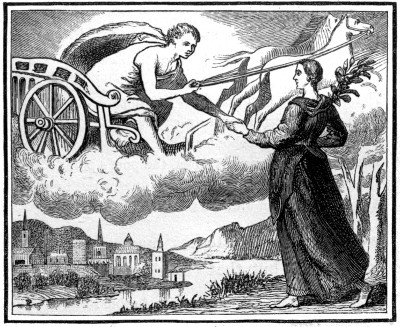
Our Prelude we may take from Le Bey de Batilly’s Emblems (Francofurti 1596, Emb. 51), in which with no slight zeal he celebrates “The Glory of Poets.” For subject he takes “The Christian Muse” of his Jurisconsult friend, Peter Poppæus of Barraux, near Chambery.
POETARVM GLORIA.
De Batilly, 1596.
With the sad fate of Icarus, Le Bey contrasts the far different condition of Poets,—
“Quos Phœbus ad aurea cœli
Limina sublimis Iouis omnipotentis in aula
Sistit, & ætherei monstrat commercia cœtus;
Et sacri vates & Diuûm cura vocantur.
Quos etiam sunt qui numen habere putent.”
i.e.
“Whom at heaven’s golden threshold,
Within the halls of lofty Jove omnipotent
Phœbus doth place, and to them clearly shows
The intercourses of ethereal companies.
Both holy prophets and the care of gods
Are poets named; and those there are who think
That they possess the force of power divine.”
In vigorous prose Le Bey declares “their home of glory is the world itself, and for them honour without death abides.” Then personally to his friend Poppæus he says,—
“Onward, and things not to be feared fear not thou, who speakest nothing little or of humble measure, nothing mortal. While the pure priest of the Muses and of Phœbus with no weak nor unpractised wing through the liquid air as prophet stretches to the lofty regions of the clouds. Onward, and let father Phœbus himself bear thee to heaven.”
Now by the side of Le Bey’s laudatory sentences, may be placed the Poet’s glory as sung in the Midsummer Night’s Dream (act v. sc. 1, l. 12, vol. ii. p. 258),—
“The poet’s eye, in a fine frenzy rolling,
Doth glance from heaven to earth, from earth to heaven;
And as imagination bodies forth
The forms of things unknown, the poet’s pen
Turns them to shapes, and gives to airy nothing
A local habitation and a name.”
The Swan of silvery whiteness may have been the heraldic badge of the Poets, but that “bird of wonder,” the Phœnix, which,—
“Left sweete Arabie:
And on a Cædar in this coast
Built vp her tombe of spicerie,”[163]—
is the source of many more Poetic ideas. To the Emblem writers as well as to the Poets, who preceded and followed the time of Shakespeare, it really was a constant theme of admiration.
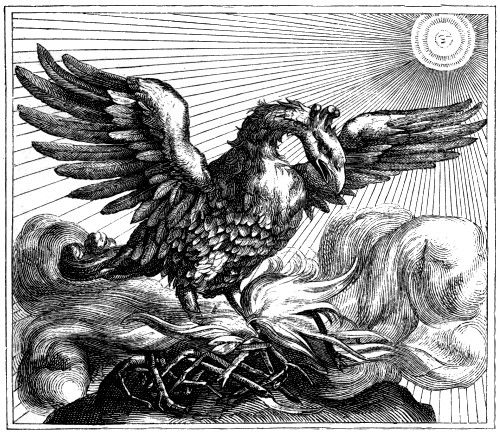
One of the best pictures of what the bird was supposed to be occurs in Freitag’s “Mythologia Ethica” (Antwerp, 1579). The drawing and execution of the device are remarkably fine; and the motto enjoins that “youthful studies should be changed with advancing age,”—
Iuuenilia ſtudia cum prouectiori
ætate permutata.
Freitag, 1579.
“Deponite vos, ſecundum priſtinam conuerſationem, veterem hominem, qui corrumpitur ſecundum deſideria erroris.”—Epheſ. 4. 22.
After describing the bird, Freitag applies it as a type of the resurrection from the dead; but its special moral is,—
“That ye put off concerning the former conversation the old man, which is corrupt according to the deceitful lusts.”
Ancient authors, as well as the comparatively modern, very gravely testify to the lengthened life, and self-renovating power, and splendid beauty of the Phœnix. In the “Euterpe” of Herodotus (bk. ii. 73) we meet with the following narrative,—
“Ἔστι δε καὶ ἄλλος ὄμνις,” κ. τ. λ. “There is another sacred bird, named the Phœnix, which I myself never saw except in picture; for according to the people of Heliopolis, it seldom makes its appearance among them, only once in every 500 years. They state that he comes on the death of his sire. If at all like the picture, this bird may be thus described both in size and shape. Some of his feathers are of the colour of gold; others are red. In outline he is exceedingly similar to the Eagle, and in size also. This bird is said to display an ingenuity of contrivance which to me does not seem credible: he is represented as coming out of Arabia and bringing with him his father, embalmed in myrrh, to the temple of the Sun, and there burying him. The following is the manner in which this is done. First of all he sticks together an egg of myrrh, as much as he can carry, and then if he can bear the burden, this experiment being achieved, he scoops out the egg sufficiently to deposit his sire within; next he fills with fresh myrrh the opening in the egg, by which the body was enclosed; thus the whole mass containing the carcase is still of the same weight. The embalming being completed, he transports him into Egypt and to the temple of the Sun.”
Pliny’s account is brief (bk. xiii. ch. iv.),—
“The bird Phœnix is supposed to have taken that name from the date tree, which in Greek is called φοῖνιξ; for the assurance was made me that the said bird died with the tree, and of itself revived when the tree again sprouted forth.”
Numerous indeed are the authorities of old to the same or a similar purport. They are nearly all comprised in the introductory dissertation of Joachim Camerarius to his device of the Phœnix, and include about eighteen classic writers, ten of the Greek and Latin Fathers, and three modern writers of the sixteenth century.
Appended to the works of Lactantius, an eloquent Christian Father of the latter part of the third century, there is a Carmen De Phœnice,—“Song concerning the Phœnix,”—in elegiac verse, which contains very many of the old tales and legends of “the Arabian bird,” and describes it as,—
“Ipsa sibi proles, suus est pater, & suus hæres:
Nutrix ipsa sui, semper alumna sibi.”
“She to herself offspring is, and her own father, and her own heir:
Nurse is she of herself, and ever her own foster daughter.”
(See Lactantii Opera, studio Gallæi, Leyden, 8vo. 1660, pp. 904–923.)
Besides Camerarius, there are at least five Emblematists from whom Shakespeare might have borrowed respecting the Phœnix. Horapollo, whose Hieroglyphics were edited in 1551; Claude Paradin and Gabriel Symeoni, whose Heroic Devises appeared in 1562; Arnold Freitag, in 1579; Nicholas Reusner, in 1581; Geffrey Whitney, in 1586, and Boissard, in 1588,—these all take the Phœnix for one of their emblems, and give a drawing of it in the act of self-sacrifice and self-renovation. They make it typical of many truths and doctrines,—of long duration for the soul, of devoted love to God, of special rarity of character, of Christ’s resurrection from the dead, and of the resurrection of all mankind.
There is a singular application of the Phœnix emblem which existed before and during Shakespeare’s time, but of which I find no pictorial representation until 1633. It is in Henry Hawkins’ rare volume, “Η ΠΑΡΘΕΝΟΣ,”—The Virgin—“Symbolically set forth and enriched with piovs devises and emblemes for the entertainement of Devovt Sovles.” This peculiar emblem bestows upon the bird two hearts, which are united in closest sympathy and in entire oneness of affection and purpose; they are the hearts of the Virgin-Mother and her Son.
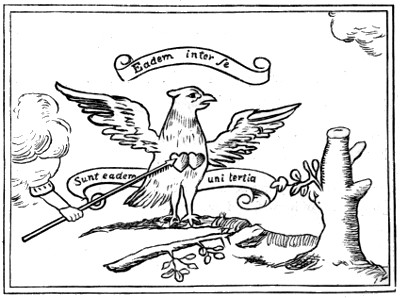
Hawkins’ Parthenos, 1633.
“Behold, how Death aymes with his mortal dart,
And wounds a Phœnix with a twin-like hart.
These are the harts of Jesus and his Mother
So linkt in one, that one without the other
Is not entire. They (sure) each others smart
Must needs sustaine, though two, yet as one hart.
One Virgin-Mother, Phenix of her kind,
And we her Sonne without a father find.
The Sonne’s and Mothers paines in one are mixt,
His side, a Launce, her soule a Sword transfixt.
Two harts in one, one Phenix loue contriues:[164]
One wound in two, and two in one reuiues.”
Whitney’s and Shakespeare’s uses of the device resemble each other, as we shall see, more closely than the rest do,—and present a singular coincidence of thought, or else show that the later writer had consulted the earlier.
“The Bird always alone,” is the motto which Paradin, Reusner, and Whitney adopt. Paradin (fol. 53), informs us,—
Vnica ſemper auis
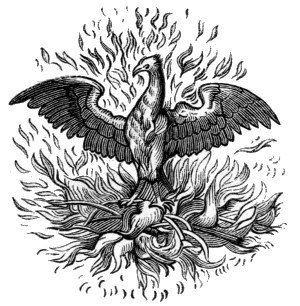
Paradin, 1562.
Comme le Phenix eſt à jamais ſeul, & vnique Oiſeau au monde de ſon eſpece. Auſſi ſont les tresbonnes choſes de merueilleuſe rarité, & bien cler ſemees. Deuiſe que porte Madame Alienor d’ Auſtriche, Roine Douairiere de France.
Theophraſte.
i.e. “As the Phœnix is always alone, and the only bird of its kind in the world, so are very good things of marvellous rarity and very thinly sown. It is the device which Madam Elinor of Austria bears, Queen Dowager of France.”
The Phœnix is Reusner’s 36th Emblem (bk. ii. p. 98),—
Vnica ſemper auis
Emblema xxxvi.
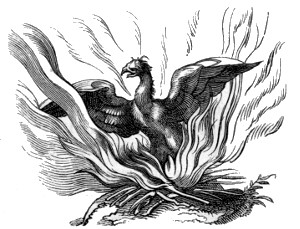
Reusner, 1581.
Quæ thuris lacrymis, & ſucco viuit amomi:[165]
Fert cunas Phœnix, buſta paterna, ſuas.
Sixteen elegiac lines of Latin are devoted to its praise and typical signification, mixed with some curious theological conjectures,—
“On tears of frankincense, and on the juice of balsam lives
The Phœnix, and bears its cradle, the coffin of its sire.
Always alone is this bird;—itself its own father and son,
By death alone does it give to itself a new life.
For oft as on earth it has lived the ten ages through,
Dying at last, in the fire it is born of its own funeral pile.
So to himself and to his, Christ gives life by his death,
Life to his servants, whom in equal love he joins to himself.
True Man is he, the one true God, arbiter of ages,
Who illumines with light, with his spirit cherishes all.
Happy, who by holy baptisms in Christ is reborn,
In the sacred stream he takes hold of life,—in the stream he obtains it.”
And again, in reference to the birth unto life eternal,—
“If men report true, death over again forms the Phœnix,
To this bird both life and death the same funeral pile may prove.
Onward, executioners! of the saints burn ye the sainted bodies;
For whom ye desire perdition, to them brings the flame new birth.”
Whitney, borrowing his woodcut and motto from Plantin’s edition of “Les Devises Heroiqves,” 1562, to a very considerable degree makes the explanatory stanzas his own both in the conception and in the expression. The chief town near to his birth-place had on December 10, 1583, been almost totally destroyed by fire, but through the munificence of the Queen and many friends, by 1586, “the whole site and frame of the town, so suddenly ruined, was with great speed re-edified in that beautifull manner,” says the chronicler, “that now it is.” The Phœnix (p. 177) is standing in the midst of the flames, and with outspreading wings is prepared for another flight in renewed youth and vigour.
Vnica semper auis.
To my countrimen of the Namptwiche in Cheshire.
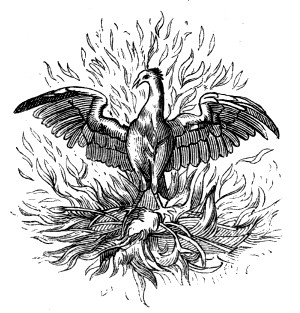
Whitney, 1586.
“The Phœnix rare, with fethers freshe of hewe,
Arabias righte, and sacred to the Sonne:
Whome, other birdes with wonder seeme to vewe,
Dothe liue vntill a thousande yeares bee ronne:
Then makes a pile: which, when with Sonne it burnes,
Shee flies therein, and so to ashes turnes.
Whereof, behoulde, an other Phœnix rare,
With speede dothe rise most beautifull and faire:
And thoughe for truthe, this manie doe declare,
Yet thereunto, I meane not for to sweare:
Althoughe I knowe that Aucthors witnes true,
What here I write, bothe of the oulde, and newe.
Which when I wayed, the newe, and eke the oulde,
I thought vppon your towne destroyed with fire:
And did in minde, the newe Nampwiche behoulde,
A spectacle for anie mans desire:
Whose buildinges braue, where cinders weare but late,
Did represente (me thought) the Phœnix fate.
And as the oulde, was manie hundreth yeares,
A towne of fame, before it felt that crosse:
Euen so, (I hope) this Wiche, that nowe appeares,
A Phœnix age shall laste, and knowe no losse:
Which God vouchsafe, who make you thankfull, all:
That see this rise, and sawe the other fall.”
The Concordance to Shakespeare, by Mrs. Cowden Clarke, for thoroughness hitherto unmatched,[166] notes down eleven instances in which the Phœnix is named, and in most of them, with some epithet expressive of its nature. It is spoken of as the Arabian bird, the bird of wonder; its nest of spicery is mentioned; it is made an emblem of death, and employed in metaphor to flatter both Elizabeth and James.
Besides the instances already given (p. 236), we here select others of a general nature; as:—When on the renowned Talbot’s death in battle, Sir William Lucy, in presence of Charles, the Dauphin, exclaims over the slain (1 Hen. VI., act iv. sc. 7, l. 92),—
“O that I could but call these dead to life!
It were enough to fright the realm of France:”
his request for leave to give their bodies burial is thus met,—
“Pucelle. I think this upstart is old Talbot’s ghost,
He speaks with such a proud commanding spirit.
For God’s sake, let him have ’em....
Charles. Go, take their bodies hence.
Lucy. I’ll bear them hence; but from their ashes shall be rear’d
A phœnix, that shall make all France afeard.”
And York, on the haughty summons of Northumberland and Clifford, declares (3 Hen. VI., act i. sc. 4, l. 35),—
“My ashes, as the Phœnix, may bring forth
A bird that will revenge upon you all.”
In the Phœnix and the Turtle (lines 21 and 49, vol. ix. p. 671), are the lines,—
“Here the anthem doth commence:
Love and constancy is dead;
Phœnix and the turtle fled
In a mutual flame from hence.
. . . . . .
Whereupon it made this threne
To the phœnix and the dove,
Co-supremes and stars of love,
As chorus to their tragic scene.”
The “threne,” or Lamentation (l. 53, vol. ix. p. 672), then follows,—
“Beauty, truth and rarity
Grace in all simplicity,
Here enclosed in cinders lie.
Death is now the phœnix’ nest;
And the turtle’s loyal breast
To eternity doth rest.”
The Maiden in The Lover’s Complaint (l. 92, vol. ix. p. 638) thus speaks of her early love,—
“Small show of man was yet upon his chin;
His phœnix down began but to appear,
Like unshorn velvet, on that termless skin,
Whose bare out-bragg’d the web it seem’d to wear.”
Some of the characteristics of the Phœnix are adduced in the dialogue, Richard III. (act iv. sc. 4, l. 418, vol. v. p. 606), between Richard III. and the queen or widow of Edward IV. The king is proposing to marry her daughter,—
“Q. Eliz. Shall I be tempted of the devil thus?
K. Rich. Ay, if the devil tempt thee to do good.
Queen. Shall I forget myself, to be myself?
K. Rich. Ay, if yourself’s remembrance wrong yourself.
Queen. But thou didst kill my children.
K. Rich. But in your daughter’s womb I bury them:
Where in that nest of spicery, they shall breed
Selves of themselves, to your recomforture.”
Another instance is from Antony and Cleopatra (act iii. sc. 2, l. 7, vol. ix. p. 64). Agrippa and Enobarbus meet in Cæsar’s ante-chamber, and of Lepidus Enobarbus declares,—
“O how he loves Cæsar!
Agrip. Nay, but how dearly he adores Marc Antony!
Enob. Cæsar? Why, he’s the Jupiter of men.
Agrip. What’s Antony? The god of Jupiter.
Enob. Speak you of Cæsar? How? the nonpareil!
Agrip. O Antony! O thou Arabian bird!”
And in Cymbeline (act i. sc. 6, l. 15, vol. ix. p. 183), on being welcomed by Imogen, Iachimo says, aside,—
“All of her that is out of door most rich!
If she be furnish’d with a mind so rare.
She is alone th’ Arabian Bird, and I
Have lost the wager.”
But the fullest and most remarkable example is from Henry VIII. (act v. sc. 5, l. 28, vol. vi. p. 114). Cranmer assumes the gift of inspiration, and prophesies of the new-born child of the king and of Anne Bullen an increase of blessings and of all princely graces,—
“Truth shall nurse her,
Holy and heavenly thoughts still counsel her:
She shall be loved and fear’d: her own shall bless her;
Her foes shake like a field of beaten corn,
And hang their heads with sorrow. Good grows with her:
In her days every man shall eat in safety,
Under his own vine, what he plants, and sing
The merry songs of peace to all his neighbours:
God shall be truly known; and those about her
From her shall read the perfect ways of honour,
And by these claim their greatness, not by blood.
Nor shall this peace sleep with her; but, as when
The bird of wonder dies, the maiden phœnix,
Her ashes new create another heir,
As great in admiration as herself,
So shall she leave her blessedness to one—
When heaven shall call her from this cloud of darkness—
Who from the sacred ashes of her honour
Shall star-like rise, as great in fame as she was,
And so stand fix’d.”
There is another bird, the emblem of tranquillity and of peaceful and happy days; it is the King-fisher, which the poets have described with the utmost embellishment of the fancy. Aristotle and Pliny tell even more marvellous tales about it than Herodotus and Horapollo do about the Phœnix.
The fable, on which the poetic idea rests, is two-fold; one that Alcyone, a daughter of the wind-god Æolus, had been married to Ceyx; and so happily did they live that they gave one another the appellations of the gods, and by Jupiter in anger were changed into birds; the other narrates, that Ceyx perished from shipwreck, and that in a passion of grief Alcyone threw herself into the sea. Out of pity the gods bestowed on the two the shape and habit of birds. Ovid has greatly enlarged the fable, and has devoted to it, in his Metamorphoses (xi. 10), between three and four hundred lines. We have only to do with the conclusion,—
“The gods at length taking compassion
The pair are transformed into birds; tried by one destiny
Their love remained firm; nor is the conjugal bond
Loosened although they are birds; parents they become,
And through a seven days’ quietness in midwinter
In nests upborne by the sea the King-fishers breed.
Safe then is the sea-road; the winds Æolus guards,
Debarring from egress; and ocean’s plain favours his children.”
According to Aristotle’s description (Hist. Anim. ix. 14),—
“The nest of the Alcyon is globular, with a very narrow entrance, so that if it should be upset the water would not enter. A blow from iron has no effect upon it, but the human hand soon crushes it and reduces it to powder. The eggs are five.”
“The halcyones,” Pliny avers, “are of great name and much marked. The very seas, and they that saile thereupon, know well when they sit and breed. This bird, so notable, is little bigger than a sparrow; for the more part of her pennage, blew, intermingled yet among with white and purple feathers; having a thin small neck and long withal they lay and sit about mid-winter, when daies be shortest; and the times while they are broodie, is called the halcyon daies; for during that season the sea is calm and navigable, especially on the coast of Sicilie.”—Philemon Holland’s Plinie, x. 32.
We are thus prepared for the device which Paolo Giovio sets before his readers, with an Italian four-lined stanza to a French motto, We know well the weather. The drawing suggests that the two Alcyons in one nest are sailing “on the coast of Sicilie,” in the straits of Messina, with Scylla and Charybdis on each hand—but in perfect calmness and security,—
DE I MEDESIMI.
Giovio, 1562.
San gl’ Alcionij augei il tempo eletto,
Ch’ al nido; e all’ oua lor non nuoca il mare.
Infelice quell’ huom, ch’el dí aſpettare
Non ſa, per dare al ſuo diſegno effetto.
Nous ſauons bien le temps.
“Happy the Alcyons, whom choice times defend.
Nor in the nest nor egg the sea can harm;
But luckless man knows not to meet alarm,
Nor to his purpose gives the wished for end.”
The festival of Saint Martin, or Martlemas, is held November 11th, at the approach of winter, and was a season of merriment and good cheer. It is in connection with this festival that Shakespeare first introduces a mention of the Alcyon (1 Henry VI., act i. sc. 2, l. 129, vol. v. p. 14). The Maid of Orleans is propounding her mission for the deliverance of France to Reignier, Duke of Anjou,—
“Assign’d I am to be the English scourge.
This night the siege assuredly I’ll raise:
Expect Saint Martin’s summer, halcyon days,
Since I have enter’d into these wars.”
It was, and I believe still is, an opinion prevalent in some parts of England, that a King-fisher, suspended by the tail or beak, will turn round as the wind changes. To this fancy, allusion is made in King Lear (act ii. sc. 2, l. 73, vol. viii. p. 307),—
“Renege, affirm and turn their halcyon beaks
With every gale and vary of their masters,
Knowing nought, like dogs, but following.”
The Poet delights to tell of self-sacrificing love; and hence the celebrity which the Pelican has acquired for the strong natural affection which impels it, so the tale runs, to pour forth the very fountain of its life in nourishment to its young. From Epiphanius, bishop of Constantia in the island of Cyprus, whose Physiologvs was printed by Plantin in 1588, we have the supposed natural history of the Pelicans and their young, which he symbolizes in the Saviour. His account is accompanied by a pictorial representation, “ΠΕΡΙ ΤΗΣ ΠΕΛΕΚΑΝΟΣ,”—Concerning the Pelican (p. 30).
Epiphanius, 1588.
The good bishop narrates as physiological history the following,—