Chapter VI · CLASSIFICATION OF THE CORRESPONDENCIES AND PARALLELISMS OF SHAKESPEARE WITH EMBLEM WRITERS. (continued 2)
Reading edition
Roſtro abſq́₃que, & piſces, qui tamen ore canant:
Quis putet eſſe vllos? iungi hæc natura negauit
Sirenes fieri ſed potuiſſe docent.
Illicitum eſt mulier, quæ in piſcem deſinit atrum,
Plurima quòd ſecum monſtra libido vehit.
Aſpectu, verbis, animi candore, trahuntur,
Parthenope, Ligia, Leucoſiaq́₃que viri.
Has muſæ explumant, has atque illudit Vlyſſes.
Scilicet eſt doctis cum meretrice nihil.
It is Whitney who provides the poetic comment (p. 10),—
“Withe pleasaunte tunes, the Syrenes did allure
Vlisses wise, to listen to theire songe:
But nothinge could his manlie harte procure,
Hee sailde awaie, and scap’d their charming stronge,
The face, he lik’de, the nether parte, did loathe:
For womans shape, and fishes had they bothe.
Which shewes to vs, when Bewtie seekes to snare
The carelesse man, whoe dothe no daunger dreede,
That he shoulde flie, and shoulde in time beware,
And not on lookes, his fickle fancie feede:
Such Mairemaides liue, that promise onelie ioyes:
But hee that yeldes, at lengthe him selffe distroies.”
The Dialogue, from the Comedy of Errors (act iii. sc. 2, lines 27 and 45, vol. i. pp. 425, 6), between Luciana and Antipholus of Syracuse, maintains,—
“’Tis holy sport, to be a little vain,
When the sweet breath of flattery conquers strife;”
and the remonstrance urges,—
“O train me not, sweet mermaid, with thy note,
To drown me in thy sister flood of tears:
Sing, siren, for thyself, and I will dote:
Spread o'er the silver waves thy golden hairs,
And, as a bed I'll take them, and there lie;
And, in that glorious supposition, think
He gains by death that hath such means to die.”
And in the Titus Andronicus (act ii. sc. 1, l. 18, vol. vi. p. 451), Aaron, the Moor, resolves, when speaking of Tamora his imperial mistress,—
“Away with slavish weeds and servile thoughts!
I will be bright, and shine in pearl and gold,
To wait upon this new-made empress.
To wait, said I? to wanton with this queen,
This goddess, this Semiramis, this nymph.
This siren, that will charm Rome’s Saturnine,
And see his shipwreck and his commonweal’s.”[129]
To recommend the sentiment that “Art is a help to nature,” Alciatus (edition 1551, p. 107) introduces the god Mercury and the goddess Fortune,—
Ars Naturam adiuuans.
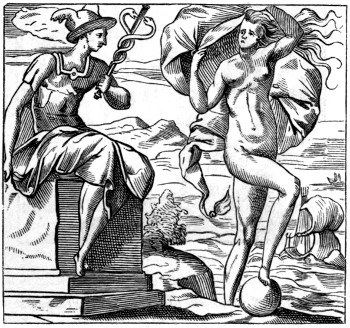
Alciat, 1551.
Vt sphæræ Fortuna, cubo ſic inſidet Hermes:
Artibus hic, varijs caſibus illa præeſt.
Aduerſus vim Fortunæ eſt ars facta: ſed artis
Cùm fortuna mala eſt, ſæpe requirit opem.
Diſce bonas artes igitur ſtudioſa iuuentus,
Quæ certæ ſecum commoda ſortis habent.
i.e.
“As on a globe Fortune rests, so on a cube Mercury:
In various arts this one excells, that in mischances.
Against the force of Fortune art is used; but of art,
When Fortune is bad, she often demands the aid.
Learn good arts then ye studious youth,
Which being sure have with themselves the advantages of destiny.”
Sambucus takes up the lyre of some Emblem Muse and causes Mercury to strike a similar strain to the saying, “Industry corrects nature.”
Induſtria naturam corrigit.
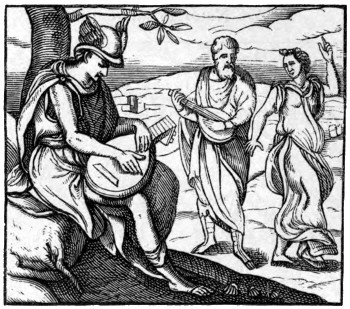
Sambucus, 1564.
Tam rude & incultum nihil eſt, induſtria poſſit
Naturæ vitium quin poliiſſe, labor.
Inuentam caſu cochleam, temereq́ue iacentem
Inſtruxit neruis nuntius ille Deûm.
Informem citharam excoluit: nunc gaudia mille,
Et reddit dulces pectine mota ſonos.
Cur igitur quereris, naturam & fingis ineptam?
Nónne tibi ratio eſt? muta loquuntur, abi.
Ritè fit è concha teſtudo, ſeruit vtrinque:
In venerem hæc digitis, ſæpiùs illa gula.
The god is mending a broken or an imperfect musical instrument, a lyrist is playing, and a maiden dancing before him. Whitney thus performs the part of interpreter (p. 92),—
“The Lute, whose sounde doth most delighte the eare
Was caste aside, and lack’de bothe striges, and frettes:
Whereby, no worthe within it did appeare,
Mercvrivs came, and it in order settes:
Which being tun’de, such Harmonie did lende,
That Poëttes write, the trees theire toppes did bende.
Euen so, the man on whome dothe Nature froune,
Wereby, he liues dispis’d of euerie wighte,
Industrie yet, maie bringe him to renoume,
And diligence, maie make the crooked righte:
Then haue no doubt, for arte maie nature helpe.
Thinke howe the beare doth forme her vgly whelpe.”
The cap with wings, and the rod of power with serpents entwined, are almost the only outward signs of which Shakespeare avails himself in his descriptions of Mercury, so that in this instance there is very little correspondence of idea or of expression between him and our Emblem authors. Nevertheless, we produce it for what it is worth.
In King John (act iv. sc. 2, l. 170, vol. iv. p. 67), the monarch urges Falconbridge’s brother Philip to inquire respecting the rumours that the French had landed,—
“Nay, but make haste; the better foot before.
O, let me have no subject enemies,
When adverse foreigners affright my towns
With dreadful pomp of stout invasion!
Be Mercury, set feathers to thy heels
And fly like thought from them to me again.”
One of Shakespeare’s gems is the description which Sir Richard Vernon gives to Hotspur of the gallant appearance of “The nimble-footed madcap Prince of Wales” (1 Henry IV., act iv. sc. 1, l. 104, vol. iv. p. 318),—
“I saw young Harry, with his beaver on,
His cuisses on his thighs, gallantly arm’d,
Rise from the ground like feather’d Mercury,
And vaulted with such ease into his seat,
As if an angel dropp’d down from the clouds,
To turn and wind a fiery Pegasus
And witch the world with noble horsemanship.”
The railer Thersites (Troilus and Cressida, act ii. sc. 3, l. 9, vol. vi. p. 168) thus mentions our Hermes,—
“O thou great thunder-darter of Olympus, forget that thou art Jove the king of gods; and Mercury, lose all the serpentine craft of thy caduceus.”
And centering the good qualities of many into one, Hamlet (act iii. sc. 4, l. 55, vol. viii. p. 111) sums up to his mother the perfections of his murdered father,—
“See what a grace was seated on this brow;
Hyperion’s curls, the front of Jove himself,
An eye like Mars, to threaten and command;
A station like the herald Mercury
New lighted on a heaven-kissing hill;
A combination and a form indeed,
Where every god did seem to set his seal
To give the world assurance of a man.”
Personifications, or, rather, deifications of the powers and properties of the natural world, and of the influences which presided over them, belong especially to the ancient Mythology. Of these, there is one from the Emblem writers decidedly claiming our notice, I may say, our admiration, because of its essential truth and beauty;—it is the Personification of Fortune, or, as some writers name the goddess, Occasion and Opportunity; and it is highly poetical in all its attributes.
From at least four distinct sources in the Emblem-books of the sixteenth century, Shakespeare might have derived the characteristics of the goddess; from Alciat, Perriere, Corrozet, and Whitney.
Perriere’s “Theatre des Bons Engins,” Paris, 1539, presents the figure with the stanzas of old French here subjoined,—
“Qvel est le nõ de la presenté̩[e/]̩ image?
Occasion ce nõme pour certain.
Qui fut l’autheur? Lysipus fist l’ouurage:
Et que tient ellé̩[e/]̩? vng rasoir en sa main.
Pourquoi? pourtãtque tout trâche souldain.
Ellé̩[e/]̩ a cheueulx deuât & non derriere?
Cest pour mõstrer quelle tourne ẽ arriere
Sõ fault le coup quãd on la doibt tenir
Aulx talons a dis esles? car barriere
(Quellesque soit) ne la peult retenir.”
These French verses may be accepted as a translation of the Latin of Alciat, on the goddess Opportunity; as may be seen, she is portrayed standing on a wheel that is floating upon the waves; and as the tide rises, there are apparently ships or boats making for the shore. The figure holds a razor in the right hand, has wings upon the feet, and abundance of hair streaming from the forehead.
In occaſionem.
Διαλογισικῶς.
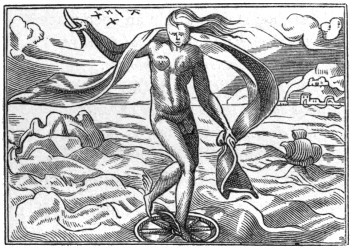
Alciat, 1551.
Lyſippi hoc opus eſt, Sycion cui patria. Tu quis?
Cuncta domans capti temporis articulus.
Cur pinnis ſtas? vſque rotor. Talaria plantis
Cur retines? Paſſim me leuis aura rapit.
In dextra eſt tennis dic vnde nouacula? Acutum
Omni acie hoc ſignum me magis eſſe docet.
Cur in frõte coma? Occurrẽs vt prẽdar. At heus tu
Dic cur pars calua eſt poſterior capitis?
Ne ſemel alipedem si quis permittat abire,
Ne poſſim apprehenſo poſtmodo crine capi.
Tali opifex nos arte, tui cauſa, edidit hoſpes.
Vtq́₃que omnes moneam: pergula aperta tenet.
Whitney’s English lines (p. 181) sufficiently express the meaning, both of the French and of the Latin stanzas,—
“What creature thou? Occasion I doe showe.
On whirling wheele declare why doste thou stande?
Bicause, I still am tossed too, and froe.
Why doest thou houlde a rasor in thy hande?
That men maie knowe I cut on euerie side,
And when I come, I armies can deuide.
But wherefore hast thou winges vppon thy feete?
To showe, how lighte I flie with little winde.
What meanes longe lockes before? that suche as meete,
Maye houlde at firste, when they occasion finde.
Thy head behinde all balde, what telles it more?
That none shoulde houlde, that let me slippe before.
Why doest thou stande within an open place?
That I maye warne all people not to staye,
But at the firste, occasion to imbrace,
And when shee comes, to meete her by the waye.
Lysippus so did thinke it best to bee,
Who did deuise mine image, as you see.”
The correspondent part to the thought contained in these three writers occurs in the Julius Cæsar (act iv. sc. 3, l. 213, vol. vii. p. 396), where Brutus and Cassius are discussing the question of proceeding to Philippi and offering battle to “young Octavius and Marc Antony;” it is decided by the argument which Brutus urges with much force,—
“Our legions are brim-full, our cause is ripe:
The enemy increaseth every day;
We, at the height, are ready to decline.
There is a tide in the affairs of men
Which taken at the flood leads on to fortune;
Omitted, all the voyage of their life
Is bound in shallows and in miseries.
On such a full sea are we now afloat,
And we must take the current when it serves,
Or lose our ventures.”
These lines, we may observe, are an exact comment on Whitney’s text; there is the “full sea,” on which Fortune is “now afloat;” and people are all warned, “at the first occasion to embrace,” or “take the current when it serves.”
The “images,” too, of Fortune and of Occasion in Corrozet’s “Hecatomgraphie,” Embs. 41 and 84, are very suggestive of the characteristics of the “fickle goddess.”
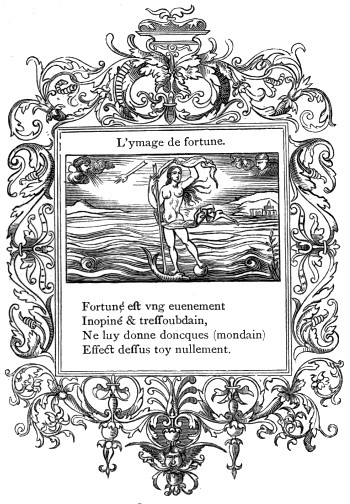
Corrozet, 1540.
Fortune is standing upright upon the sea; one foot is on a fish, the other on a globe; and in the right hand is a broken mast. Occasion is in a boat and standing on a wheel; she has wings to her feet, and with her hands she holds out a swelling sail; she has streaming hair, and behind her in the stern of the boat Penitence is seated, lamenting for opportunities lost. The stanzas to “Occasion” are very similar to those of other Emblem writers; and we add, therefore, only the English of the verses to “Fortune,”—The Image of Fortune.
“A strange event our Fortune is,
Unlocked for, sudden as a shower;
Never then, worldling! give to her
Right over thee to wield her power.”
A series of questions follow,—
“Tell me, O fortune, for what end thou art holding the broken mast wherewith thou supportest thyself? And why also is it that thou art painted upon the sea, encircled with so long a veil? Tell me too why under thy feet are the ball and the dolphin?”
As in the answers given by Whitney, there is abundant plainness in Corrozet,—
“It is to show my instability, and that in me there is no security. Thou seest this mast broken all across,—this veil also puffed out by various winds,-beneath one foot, the dolphin amid the waves; below the other foot, the round unstable ball;—I am thus on the sea at a venture. He who has made my portraiture wishes no other thing to be understood than this, that distrust is enclosed beneath me and that I am uncertain of reaching a safe haven;—near am I to danger, from safety ever distant: in perplexity whether to weep or to laugh,—doubtful of good or of evil, as the ship which is upon the seas tossed by the waves, is doubtful in itself where it will be borne. This then is what you see in my true image, hither and thither turned without security.”
A description, very similar to this, occurs in the dialogue between Fluellen, a Welsh captain, and “an aunchient lieutenant” Pistol (Henry V., act iii. sc. 6, 1. 20, vol. iv. P. 543),—
“ Pist. Captain, I thee beseech to do me favours:
The Duke of Exeter doth love thee well.
Flu. Ay, I praise God; and I have merited some love at his hands.
Pist. Bardolph, a soldier, firm and sound of heart.
And of buxom valour, hath, by cruel fate,
And giddy Fortune’s furious fickle wheel,
That goddess blind,[130]
That stands upon the rolling, restless stone—
Flu. By your patience, Aunchient Pistol, Fortune is painted blind, with a muffler afore her eyes, to signify to you that fortune is blind; and she is painted also with a wheel, to signify to you, which is the moral of it, that she is turning, and inconstant, and mutability, and variation: and her foot, look you, is fixed upon a spherical stone, which rolls, and rolls, and rolls: in good truth, the poet makes a most excellent description of it: Fortune is an excellent moral.”
Fortune on the sphere, or “rolling, restless stone,” is also well pictured in the “ΜΙΚΡΟΚΟΣΜΟΣ,” editions 1579 and 1584. The whole device is described in the French version,—
“L’oiseau de Paradis est de telle nature
Qu’en nul endroit qui soit on ne le void iucher,
Car il n’a point de pieds, & ne peut se rucher
Ailleurs qu’en l’air serein dont il prend nourriture.
En cest oiseau se void de Fortune l’image,
En laquelle n’y a sinon legreté:
Iamais son cours ne fut egal & arresté,
Mais tousiours incertain inconstant & volage.
Pour la quelle raison on souloit la pourtraire,
Tenant vn voile afin d’aller au gré du vent,
Des aisles aux costez pour voler bien auant,
Ayant les pieds coupez, estant sur vne sphære;
Et pourtant cestuy la qui se fie en Fortune,
Au lieu de fier au grand Dieu souuerain,
Est bien maladuisé, & se monstre aussi vain
Que celuy qui bastit sur le dos de Neptune.”
The ideas of the Emblematists respecting the goddess “Occasion” are also embodied by Shakespeare two or three times. Thus on receiving the evil tidings of his mother’s death and of the dauphin’s invasion, King John (act iv. sc. 2, l. 125, vol. iv, p. 65) exclaims,—
“Withhold thy speed, dreadful Occasion!
O make a league with me, till I have pleased
My discontented peers!”
In 2 Henry IV. (act iv. sc. 1, l. 70, vol. iv. p. 431) the Archbishop of York also says,—
“We see which way the stream of time doth run,
And are enforced from our most quiet there
By the rough torrent of occasion.”
Most beautiful too, and forcible are the stanzas on Occasion, or Opportunity from Lucrece (lines 869–882, vol. ix. p. 515),—
“Unruly blasts wait on the tender spring;
Unwholesome weeds take root with precious flowers;
The adder hisses where the sweet birds sing;
What virtue breeds iniquity devours:
We have no good that we can say is ours
But ill-annexed Opportunity
Or kills his life or else his quality.
O Opportunity, thy guilt is great!
’Tis thou that executes! the traitor’s treason;
Thou set’st the wolf where he the lamb may get;
Whoever plots the sin, thou point’st the season;
’Tis thou that spurn’st at right, at law, at reason,
And in thy shady cell, where none may spy him,
Sits Sin, to seize the souls that wander by him.”[131]
Dvm Tempvs labitvr, Occasionē fronte capillatā remorātvr. 7.
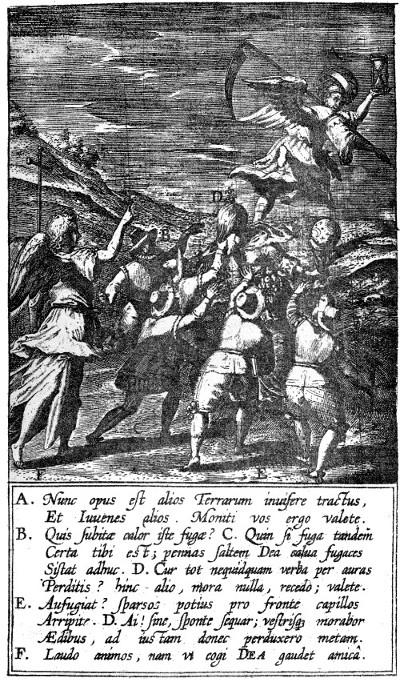
From David’s “Occasio arrepta neglecta &c” 1605
Very appropriately in illustration of these and other passages in Shakespeare may we refer to John David’s work, “Occasio arrepta neglecta” (4to, Antwerp, 1605),—Opportunity seized or neglected. It contains twelve curiously beautiful plates by Theodore Galle, showing the advantages of seizing the Occasion, the disadvantages of neglecting it. We choose an example, it is Schema 7, cap. 1, p. 117. (See Plate XII.)
“While Time is passing onward men keep Occasion back by seizing the hair on her forehead.”
Various speakers are introduced,—
“Time. Now the need is to visit other climes of earth
And other youths. Ye warned then, bid farewell.
B. What this heat of sudden flight?
C. If flight indeed at length
For thee is fix’d, her swift wings let the bald goddess
At least rest here.
Occasion. Why to no purpose words in air
Waste ye? hence elsewhere, no delay, I go; farewell.
E. Should she flee? rather her scattered locks in front
Seize hold of.
Occasion. Alas! freely I follow, at your own homes
Will tarry, till in just measure I prolong my stay.
Faith. I praise your spirit, for by friendly force the goddess
Rejoices to be compelled.”
The line, “her scattered locks in front seize hold of,” has its parallel in Othello (act iii. sc. 1, l. 47, vol. viii. p. 505),—
“he protests he loves you,
And needs no other suitor but his likings
To take the safest occasion by the front
To bring you in again.”
Classical celebrities, whether hero or heroine, wrapt round with mystery, or half-developed into historical reality, may also form portion of our Mythological Series.
The grand character in Æschylus, Prometheus Bound, is depicted by at least four of the Emblematists. The hero of suffering is reclining against the rock on Caucasus, to which he had been chained; a vulture is seated on his broad chest and feeding there. Alciat’s Emblem, from the Lyons edition of 1551, or Antwerp, 1581, number 102, has the motto which reproves men for seeking the knowledge which is beyond them: Things which are above us, are nothing to us,—they are not our concern. The whole fable is a warning.
Quæ ſupra nos, nihil ad nos.
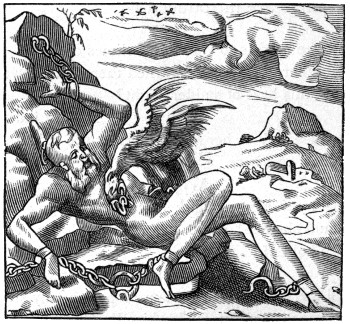
Alciat, 1551.
Caucaſi a æternùm pendens in rupe Prometheus
Diripitur ſacri præpetis vngue iecur.
Et nollet feciſſe hominem: figulosq́₃que peroſus
Accenſam rapto damnat ab igne facem.
Roduntur variis prudentum pectora curis,
Qui cœli affectant ſcire, deûmqúe vices.
“On the Caucasian rock Prometheus eternally suspended,
Has his liver torn in pieces by talons of an accursed bird.
And unwilling would he be to have made man; and hating the potters
Dooms to destruction the torch lighted from stolen fire.
Devoured by various cares are the bosoms of the wise,
Who affect to know secrets of heaven, and courses of gods.”
Similarly as a dissuasive from vain curiosity, Anulus, in his “Picta Poesis” (Lyons, 1555, p. 90), sets up the notice,—
CVRIOSITAS FVGIENDA.
“Curiosity must be shunned.”
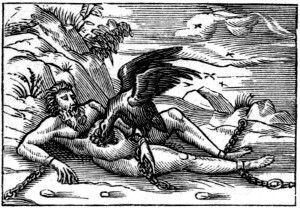
Aneau, 1555.
Mitte arcana Dei cœlumq́₃que inquirere quid ſit.
Nec ſapias pluſquàm debet homo ſapere.
Caucaſeo vinctus monet hoc in rupe Prometheus
Scrutator cœli, fur & in igne Iouis.
Cui cor edax Aquila in rediuiuo vulnere rodit.
Materia pœnis ſufficiente ſuis.
Ἣ δὲ προμηθέι’ ἂχ δάκνει κέαρ ἔντερον ἔνδον

Καρδιοβρόσκ ὃμως ἂετ ἐσθὶν ἂχ.
The device is almost the same with Alciat's,—the stanzas, however, are a little different,—
“Forbear to inquire the secrets of God, and what heaven may be.
Nor be wise more than man ought to be wise.
Bound on Caucasian rock this does Prometheus warn,
Scrutator of heaven and thief in the fire of Jove.
His heart the voracious Eagle gnaws in ever reviving wound,
Material sufficient this for all his penalties.”—
“As for Prometheus pain gnaws his heart the bosom within,
So is pain the eagle that consumes the heart.”
The “Microcosme,” first published in 1579, fol. 5, celebrates in French stanzas Prometheus and his cruel destiny; a fine device accompanies the emblem, representing him bound not to Caucasus, but to the cross.
“Promethee s’ estant guindé iusques aux cieux
Pour desrober le feu des redoubables Dieux,
Pour retribution de ceste outrecuidance
Fut par eux poursuiui d’une rude vengeance.
Il fut par leur decret à la croix attaché,
La ou pour expier deuenant son peché,
L'Aigle de Iupiter le becquetoit sans cesse,
Si que ce patient estoit en grand oppressé.”
But Reusner’s Emblems (bk. i. Emb. 27, p. 37, edition 1581), and Whitney’s (p. 75), adopt the same motto, O vita misero longa,—“O life, how long for the wretched.” The stanzas of the latter may be accepted as being in some degree representative of those of the former,—
“To Caucasus, behoulde Promethevs chain’de,
Whose liuer still, a greedie gripe dothe rente:
He neuer dies, and yet is alwaies pain’de,
With tortures dire, by which the Poëttes ment,
That hee, that still amid misfortunes standes,
Is sorrowes slaue, and bounde in lastinge bandes.
For, when that griefe doth grate vppon our gall,
Or surging seas, of sorrowes moste doe swell,
That life is deathe, and is no life at all,
The liuer rente, it dothe the conscience tell:
Which being launch’de, and prick’d, with inward care,
Although wee liue, yet still wee dyinge are.”
How Shakespeare applies this mythic story appears in the Titus Andronicus (act ii. sc. 1, l. 14, vol. vi. p. 451), where Aaron, speaking of his queen, Tamora, affirms of himself,—
“Whom thou in triumph long
Hast prisoner held, fetter’d in amorous chains,
And faster bound to Aaron’s charming eyes
Than is Prometheus tied to Caucasus.”
And still more clearly is the application made, 1 Henry VI. (act iv. sc. 3, l. 17, vol. v. p. 71), when Sir William Lucy thus urges York,—
“Thou princely leader of our English strength,
Never so needful on the earth of France,
Spur to the rescue of the noble Talbot,
Who now is girdled with a waist of iron
And hemm’d about with grim destruction:”
and at York’s inability, through “the vile traitor Somerset,” to render aid, Lucy laments (l. 47, p. 72),—
“Thus, while the vulture of sedition
Feeds in the bosoms of such great commanders,
Sleeping neglection doth betray to loss
The conquest of our scarce cold conqueror,
That ever living man of memory,
Henry the Fifth.”
It may readily be supposed that in writing these passages Shakespeare had in memory, or even before him, the delineations which are given of Prometheus, for the vulture feeding on the heart belongs to them all, and the allusion is exactly one of those which arises from a casual glance at a scene or picture without dwelling on details.
This casual glance indeed seems to have been the way in which our Dramatist appropriated others of the Emblem sketches. In the well-known quarrel scene between Brutus and Cassius, in Julius Cæsar (act iv. sc. 3, l. 21, vol. vii. p. 389), Brutus demands,—
“What, shall one of us,
That struck the foremost man of all this world
But for supporting robbers, shall we now
Contaminate our fingers with base bribes,
And sell the mighty space of our large honours
For so much trash as may be grasped thus?
I had rather be a dog, and bay the moon,
Than such a Roman.”
The expression is the perfect counterpart of Alciat’s 164th Emblem (p. 571, edition Antwerp, 1581); the motto, copied by Whitney (p. 213), is, Inanis impetus,—“A vain attack.”
“By night, as at a mirror, the dog looks at the lunar orb:
And seeing himself, believes another dog to be on high,
And barks: but in vain is his angry voice driven by winds,
The silent Diana ever onward goes in her course.”[132]
The device engraved on Alciat’s and Whitney’s pages depicts the full moon surrounded by stars, and a large dog baying. Whitney’s stanzas give the meaning of Alciat's, and also of Beza's, which follow below,—
“By shininge lighte, of wannishe Cynthias raies,
The dogge behouldes his shaddowe to appeare:
Wherefore, in vaine aloude he barkes, and baies,
And alwaies thoughte, an other dogge was there:
But yet the Moone, who did not heare his queste,
Hir woonted course, did keep vnto the weste.
This reprehendes, those fooles which baule, and barke,
At learned men, that shine aboue the reste:
With due regarde, that they their deedes should marke,
And reuerence them, that are with wisedome bleste:
But if they striue, in vaine their winde they spende,
For woorthie men, the Lorde doth still defende.”
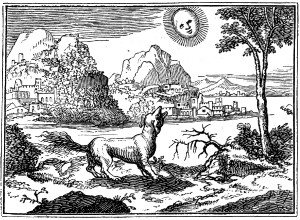
Beza, ed. 1580.
The same device to a different motto, “Despicit alta canis,”—The dog despises high things,—is adopted by Camerarius, Ex Anim. quadrup., p. 63, edition 1595,—
“Why carest thou for the angry thorns of a vain speaking tongue?
Diana on high cares not for the loud-barking dog.”[133]
We will conclude our “baying” with Beza’s 22nd Emblem. The Latin stanza is sufficiently severe,—
“Luna velut toto collustrans lumine terras,
Frustra allatrantes despicit alta canes:
Sic quisquis Christum allatrat Christíve ministros,
Index stultitiæ? spernitor vsque suæ.”
i.e.
“As the moon with full light shining over the lands,
From on high doth despise dogs barking in vain:
So whoso is barking at Christ or Christ’s ministers,
The scorner is the pointer out even of his own folly.”
In connection with the power of music Orpheus is named by many writers of the sixteenth century; and among the Emblematists the lead may be assigned to Pierre Coustau in “Le Pegme” (Lyons, 1560, p. 389),—
Sur la harpe d’Orpheus.
La force d’Eloquence.
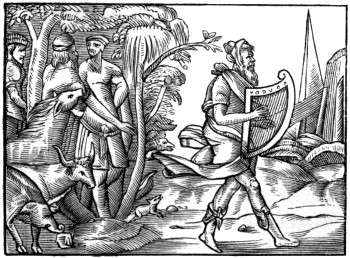
Coustau, 1560.
De ſon gentil & fort melodieux
D'vn inſtrument, Orpheus feit mouuoir
Rocs & patitz de leur places & lieux.
C’eſt eloquence ayant force & pouuoir
D’ẽbler les cueurs de tous part son ſçavoir;
C’eſt l’orateur qui au fort d’eloquence,
Premierement ſouz méme demourance
Gens beſtiaulx, & par ferocité, &c.
“On the Harp of Orpheus.
The Power of Eloquence.
“With sound gentle and very melodious
Of an instrument Orpheus caused to move
Rocks and pastures from their place and home.
It is eloquence having force and power
To steal the hearts of all his learning shows,
It is the orator who by strength of eloquence
First brings even under influence
Brutal people, and from fierceness
Gathers them; and who to benevolence
From fierceness then reclaims.
A Narration Philosophique follows for three pages, discoursing on the power of eloquence.
Musicæ, & Poeticæ vis,—“The force of Music and Poetry,”—occupies Reusner’s 21st Emblem (bk. iii. p. 129), oddly enough dedicated to a mathematician, David Nephelite. Whitney’s stanzas (p. 186), Orphei Musica,—“The Music of Orpheus,”—bear considerable resemblance to those of Reusner, and are sufficient for establishing the parallelism of Shakespeare and themselves.
“Lo, Orphevs with his harpe, that sauage kinde did tame:
The Lions fierce, and Leopardes wilde, and birdes about him came.
For, with his musicke sweete, their natures hee subdu’de:
But if wee thinke his playe so wroughte, our selues wee doe delude.
For why? besides his skill, hee learned was, and wise:
And coulde with sweetenes of his tonge, all sortes of men suffice.
And those that weare most rude, and knewe no good at all:
And weare of fierce, and cruell mindes, the worlde did brutishe call.
Yet with persuasions sounde, hee made their hartes relente,
That meeke, and milde they did become, and followed where he wente.
Lo, these, the Lions fierce, these, Beares, and Tigers weare:
The trees, and rockes, that lefte their roomes, his musicke for to heare.
But, you are happie most, who in suche place doe staye:
You neede not Thracia seeke, to heare some impe of Orphevs playe.
Since, that so neare your home, Apollos darlinge dwelles;
Who Linvs, & Amphion staynes, and Orphevs farre excelles.
For, hartes like marble harde, his harmonie dothe pierce:
And makes them yeelding passions feele, that are by nature fierce.
But, if his musicke faile: his curtesie is suche,
That none so rude, and base of minde, but hee reclaimes them muche.
Nowe since you, by deserte, for both, commended are:
I choose you, for a Iudge herein, if truthe I doe declare.
And if you finde I doe, then ofte therefore reioyce:
And thinke, I woulde suche neighbour haue, if I might make my choice.”
In a similar strain, from the Merchant of Venice (act v. sc. 1, l. 70, vol. ii. p. 361), we are told of the deep influence which music possesses over—
“a wild and wanton herd
Or race of youthful and unhandled colts.”
The poet declares,—
“If they but hear perchance a trumpet sound,
Or any air of music touch their ears,
You shall perceive them make a mutual stand,
Their savage eyes turn’d to a modest gaze
By the sweet power of music: therefore the poet[134]
Did feign that Orpheus drew trees, stones and floods;
Since nought so stockish, hard and full of rage,
But music for the time doth change his nature.
The man that hath no music in himself,
Nor is not moved with concord of sweet sounds,
Is fit for treasons, stratagems and spoils:
The motions of his spirit are dull as night,
And his affections dark as Erebus:
Let no such man be trusted.”
And in the Two Gentlemen of Verona (act iii. sc. 2, l. 68, vol. i. p. 129), the method is developed by which Silvia, through the conversation of Proteus, may be tempered “to hate young Valentine” and Thurio love. Proteus says,—
“You must lay lime to tangle her desires
By wailful sonnets, whose composed rhymes
Should be full-fraught with serviceable vows.
Duke. Ay,
Much is the force of heaven-bred poesy.
Pro. Say that upon the altar of her beauty
You sacrifice your tears, your sighs, your heart:
Write till your ink be dry, and with your tears
Moist it again; and frame some feeling line
That may discover such integrity:
For Orpheus’ lute was strung with poets’ sinews;
Whose golden touch could soften steel and stones.
Make tigers tame, and huge leviathans
Forsake unsounded deeps to dance on sands.”[135]
Again, in proof of Music’s power, consult Henry VIII. (act iii. sc. 1, l. 1, vol. vi. p. 56), when Queen Katharine, in her sorrowfulness, says to one of her women who were at work around her,—
“Take thy lute, wench: my soul grows sad with troubles;
Sing and disperse ’em if thou canst: leave working.”
The sweet simple song is raised,—
“Orpheus with his lute made trees
And the mountain tops that freeze,
Bow themselves when he did sing:
To his music plants and flowers
Ever sprung, as sun and showers
There had made a lasting spring.
Everything that heard him play,
Even the billows of the sea,
Hung their heads, and then lay by.
In sweet music is such art,
Killing care and grief of heart
Fall asleep, or hearing die.”
How splendidly does the dramatic poet’s genius here shine forth! It pours light upon each Emblem, and calls into day the hidden glories. His spirit breathes upon a dead picture, and rivalling Orpheus himself, he makes the images breathe and glance and live.
The mythic tale of Actæon transformed into a stag, and hunted by hounds because of his rudeness to Diana and her nymphs, was used to point the moral of widely different subjects. Alciatus (Emb. 52, ed. 1551, p. 60) applies it “to the harbourers of assassins” and makes it the occasion of a very true but very severe reflection.
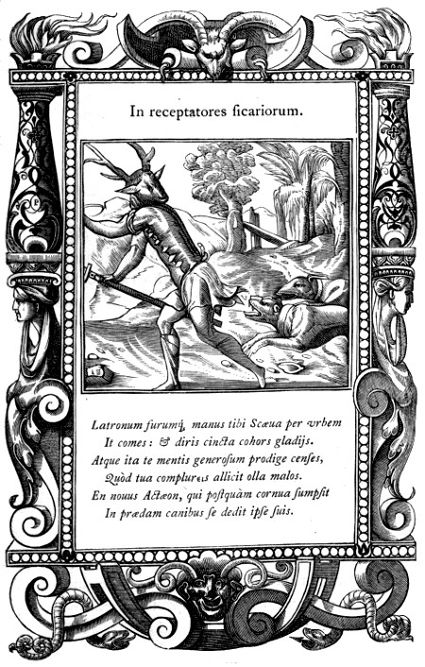
Alciat, 1551.
“Of thieves and robbers evil-omen’d bands the city through
Go thy companions; and a cohort girded with dreadful swords.
And so, O prodigal, thou thinkest thyself of generous mind,
Because thy cooking pot allures very many of the bad ones.
Lo, a new Actæon, who after he assumed the horns,
Himself gave himself a prey to his own dogs.”
The device is graphically drawn: Actæon is in part embruted; he is fleeing with the dogs close upon him. Supposing Shakespeare to have seen this print, it represents to the life Pistol’s words in the Merry Wives of Windsor (act ii. sc. 1, l. 106, vol. i. p. 186),—
“Prevent, or go thou,
Like Sir Actæon he, with Ringwood at thy heels.”
“Ex domino servus,”—The slave out of the master,—is another saying which the tale of Actæon has illustrated. The application is from Aneau’s “Picta Poesis,” fol. 41. On the left hand of the tiny drawing are Diana and her nymphs, busied in the bath, beneath the shelter of an overhanging cliff,—on the right is Actæon, motionless, with a stag’s head; dogs are around him. The verses translated read thus,—
“Horns being bestowed upon Actæon when changed to a stag,
Member by member his own dogs tore him to pieces.
Alas! wretched the Master who feeds wasteful parasites;
A ready prepared prey he is for his fawning dogs!
It suggests, he is mocked by them and devoured,
And out of a master is made a slave, bearing horns.”
But Sambucus in his Emblems (edition 1564, p. 128), and Whitney after him (p. 15)—making use of the same woodcut, only with a different border—adapt the Actæon-tragedy to another subject and moral, and take the words, Pleasure purchased by anguish.
Voluptas ærumnoſa.
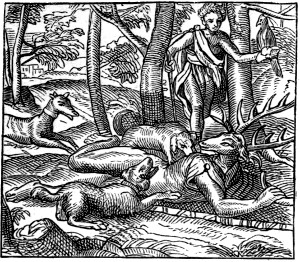
Sambucus, 1564.
Qvi nimis exercet venatus, ac ſine fine
Haurit opes patrias, prodigit inque canes:
Tantus amor vani, tantus furor vſque recurſat,
Induat ut celeris cornua bina feræ.
Accidit Actæon tibi, qui cornutus ab ortu,
À canibus propriis dilaceratus eras.
Quàm multos hodie, quos paſcit odora canum vis.
Venandi ſtudium conficit, atque vorat.
Seria ne ludis poſtponas, commoda damnis,
Quod ſupereſt rerum ſic ut egenus habe.
Sæpe etiam propria qui interdum vxore relicta
Deperit externas corniger iſta luit.
Stanzas which may thus be rendered,—
“Whoever too eagerly hunting pursues, and without moderation
Drains paternal treasures and lavishes them on dogs:
So great the love of the folly, so strong does the passion return
That it clothes him in the twin horns of the swift stag.
It happened, Actæon, to thee, who though horned from thy birth,
By thy own dogs into pieces wast torn.
At this day how many, whom the dogs’ quick scent delights,
The strong passion for hunting wastes and devours.
Put not off serious things for sports,—advantages for losses:
As one in need so hold fast whatever things remain:
Often even the horn bearer, his own wife forsaken,
Loves desperately strangers, and pays penalties for crimes.”
We here see that Sambucus has adopted the theory of the old grammarian or historian of Alexandria, Palæphatus, who informs us,—
“Actæon by race was an Arcadian, very fond of dogs. Many of them he kept, and hunted in the mountains. But he neglected his own affairs, for men then were all self-workers; they had no servants, but themselves tilled the earth; and that man was the richest, who tilled the earth and was the most diligent workman. But Actæon being careless of domestic affairs, and rather going about hunting with his dogs, his substance was wasted. And when he had nothing left, people kept saying: the wretched Actæon was eaten up by his own dogs.”
A very instructive tale this for some of our Nimrods, mighty hunters and racers in the land; but it is not to be pressed too strictly into the service of the parsimonious.
From the same motto Whitney (p. 15) keeps much closer to the mythological narrative,[136]—
“Actæon heare, vnhappie man behoulde,
When in the well, hee sawe Diana brighte,
With greedie lookes, hee waxed ouer boulde,
That to a stagge hee was transformed righte,
Whereat amasde, hee thought to runne awaie,
But straighte his howndes did rente hym, for their praie.
By which is ment, That those whoe do pursue
Theire fancies fonde, and thinges vnlawfull craue,
Like brutishe beastes appeare vnto the viewe,
And shall at lengthe, Actæons guerdon haue:
And as his houndes, soe theire affections base,
Shall them deuowre, and all their deedes deface.”
Very beautifully, in Twelfth Night (act i. sc. 1, l. 9, vol. iii. p. 223), is this idea applied by Orsino, duke of Illyria,—
“O spirit of love, how quick and fresh art thou!
That, notwithstanding thy capacity
Receiveth as the sea, nought enters there,
Of what validity and pitch soe’er,
But falls into abatement and low price,
Even in a minute! so full of shapes is fancy
That it alone is high fantastical.
Cur. Will you go hunt, my lord?
Duke.What, Curio?
Cur. The hart.
Duke. Why, so I do, the noblest that I have:
O, when mine eyes did see Olivia first,
Methought she purged the air of pestilence!
That instant was I turn’d into a hart;
And my desires, like fell and cruel hounds,
E’er since pursue me.”
The full force and meaning of the mythological tale is, however, brought out in the Titus Andronicus (act ii. sc. 3, l. 55, vol. vi. p. 459), that fearful history of passion and revenge. Tamora is in the forest, and Bassianus and Lavinia make their appearance,—
“Bass. Who have we here? Rome’s royal empress,
Unfurnish’d of her well-beseeming troop?
Or is it Dian, habited like her,
Who hath abandoned her holy groves,
To see the general hunting in this forest?
Tam. Saucy controller of my private steps!
Had I the power that some say Dian had,
Thy temples should be planted presently
With horns, as was Actæon’s, and the hounds
Should drive upon thy new-transformed limbs,
Unmannerly intruder as thou art!”
Arion rescued by the Dolphin is another mythic tale in which poets may well delight. Alciatus (Emblem 89, edition 1581), directs the moral, “against the avaricious, or those to whom a better condition is offered by strangers.” Contrary to the French writers of time and place, the emblem presents in the same device the harpist both cast out of the ship and riding triumphantly to the shore.
In auaros, vel quibus melior conditio ab
extraneis offertur.
Emblema LXXXIX.
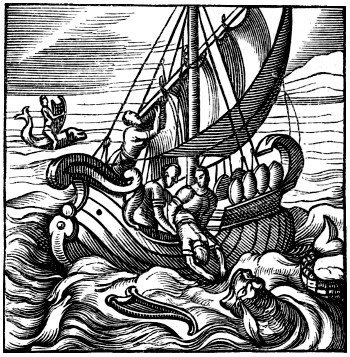
Alciat, 1581.
Delphini inſidens vada cærula ſulcat Arion,
Hocʠ3 aures mulcet, frenat & ora ſono.
Quàm ſit auari hominis, non tam mens dira ſerarũ est;
Quiʠ3 viris rapimur, piſcibus eripimur.
i.e.
“On the dolphin sitting Arion ploughs cerulean seas,
With a sound he soothes the ears, with a sound curbs the mouth.
Of wild creatures not so dreadful is the mind, as of greedy man;
We who by men are pillaged, are by fishes rescued.”
With this thought before him Whitney (p. 144) at the head of his stanzas has placed the strong expression, “Man is a wolf to man.”[137] Cave canem,—“Beware of the dog,”—is certainly a far more kindly warning; but the motto, Homo homini lupus, tallies exactly with the conduct of the mariners.
“No mortall foe so full of poysoned spite,
As man, to man, when mischiefe he pretendes:
The monsters huge, as diuers aucthors write,
Yea Lions wilde, and fishes weare his frendes:
And when their deathe, by frendes suppos’d was sought,
They kindnesse shew’d, and them from daunger brought.
Arion lo, who gained store of goulde,
In countries farre: with harpe, and pleasant voice:
Did shipping take, and to Corinthvs woulde,
And to his wishe, of pilottes made his choise:
Who rob’d the man, and threwe him to the sea,
A Dolphin, lo, did beare him safe awaie.”
A comment from St. Chrysostom, super Matth. xxii., is added,—
“As a king is honoured in his image, so God is loved and hated in man. He cannot hate man, who loves God, nor can he, who hates God, love men.”
Reference is also made to Aulus Gellius (bk. v. c. 14, vol. i. p. 408), where the delightful story is narrated of the slave Androclus and the huge lion whose wounded foot he had cured, and with whom he lived familiarly for three years in the same cave and on the same food. After a time the slave was taken and condemned to furnish sport in the circus to the degraded Romans. That same lion also had been taken, a beast of vast size, and power and fierceness. The two were confronted in the arena.
“When the lion saw the man at a distance,” says the narrator, “suddenly, as if wondering, he stood still; and then gently and placidly as if recognising drew near. With the manner and observance of fawning dogs, softly and blandly he wagged his tail and placed himself close to the man’s body, and lightly with his tongue licked the legs and hands of the slave almost lifeless from fear. The man Androclus during these blandishments of the fierce wild creature recovered his lost spirits; by degrees he directed his eyes to behold the lion. Then, as if mutual recognition had been made, man and lion appeared glad and rejoicing one with the other.”
Was it now, from having this tale in mind that, in the Troilus and Cressida (act v. sc. 3, l. 37, vol. vi. p. 247), these words were spoken to Hector?—
“Brother, you have a vice of mercy in you,
Which better fits a lion than a man.”
Arion sauué par vn Dauphin, is also the subject of a well executed device in the “ΜΙΚΡΟΚΟΣΜΟΣ” (edition Antwerp, 1592),[138] of which we give the French version (p. 64),—
“Arion retournant par mer en sa patrie
Chargé de quelque argẽt, vid que les mariniers
Animéz contre luy d’une auare furie
Pretendoyent luy oster sa vie & ses deniers.
Pour eschapper leurs mains & changer leur courage,
Sur la harpe il chanta vn chant melodieux
Mais il ne peut fleschir la nature sauuage
De ces cruels larrons & meurtriers furieux.
Estant par eux ietté deans la mere profonde,
Vn Dauphin attiré au son de l’instrument,
Le chargea sur son dos, & au trauers de l’onde
Le portant, le sauua miraculeusement.
Maintes fois l’innocent à qui on fait offense
Trouue plus de faueur es bestes qu’es humains:
Dieu qui aime les bons les prend en sa defense,
Les gardant de l’effort des hommes inhumains.”
To the Emblems we have under consideration we meet with this coincidence in Twelfth Night (act i. sc. 2, l. 10, vol. iii. p. 225); it is the Captain’s assurance to Viola,—
“When you and those poor number saved with you
Hung on our driving boat, I saw your brother,
Most provident in peril, bind himself,
Courage and hope both teaching him the practice,
To a strong mast that lived upon the sea;
Where, like Arion on the dolphin’s back,
I saw him hold acquaintance with the waves
So long as I could see.”
As examples of a sentiment directly opposite, we will briefly refer to Coustau’s Pegma (p. 323, edition Lyons, 1555), where to the device of a Camel and his driver, the noble motto is recorded and exemplified from Plutarch, Homo homini Deus,—“Man is a God to man;” the reason being assigned,—
“As the world was created for sake of gods and men, so man was created for man’s sake;” and, “that the grace we receive from the immortal God is to be bestowed on man by man.”
Reusner, too, in his Emblemata (p. 142, Francfort, 1581), though commenting on the contrary saying, Homo homini lupus, declares,—
“Aut homini Deus est homo; si bonus: aut lupus hercle,
Si malus: ô quantum est esse hominem, atq. Deum.”
i.e.
“Or man to man is God; if good: or a wolf in truth,
If bad: O how great it is to be man and God!”[139]
Was it in reference to these sentiments that Hamlet and Cerimon speak? The one says (Hamlet, act iv. sc. 4, l. 33. vol. viii. p. 127),—
“What is a man,
If his chief good and market of his time
Be but to sleep and feed? a beast, no more.
Sure, he that made us with such large discourse,
Looking before and after, gave us not
That capability and god-like reason
To fust in us unused.”
And again (act ii. sc. 2, l. 295, vol. viii. p. 63),—
“What a piece of work is a man! how noble in reason! how infinite in faculty! in form and moving how express and admirable! in action how like an angel! in apprehension how like a god!”
So in the Pericles (act iii. sc. 2, l. 26, vol. ix. p. 366), the fine thought is uttered,—
“I hold it ever,
Virtue and cunning were endowments greater
Than nobleness and riches: careless heirs
May the two latter darken and expend,
But immortality attends the former,
Making a man a god.”
The horses and chariot of Phœbus, and the presumptuous charioteer Phaëton, who attempted to drive them, are celebrated with great splendour of description in Ovid’s Metamorphoses (bk. ii. fab. 1), that rich storehouse of Mythology. The palace of the god has lofty columns bright with glittering gold; the roof is covered with pure shining ivory; and the double gates are of silver. Here Phœbus was throned, and clothed in purple;—the days and months and years,—the seasons and the ages were seated around him; Phaëton appears, claims to be his son, and demands for one day to guide the glorious steeds. At this point we take up the narrative which Alciat has written (Emb. 56), and inscribed, “To the rash.”[140]
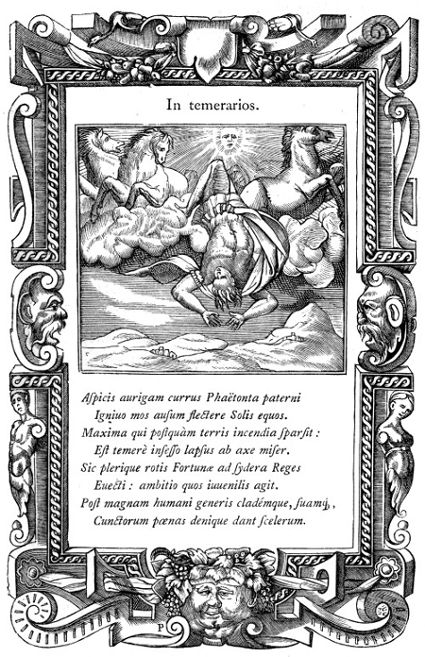
Alciat, 1551.
“You behold Phaëton the driver of his father’s chariot,—
Who dared to guide the fire breathing horses of the sun.
After over the lands mightiest burnings he scattered,
Wretched he fell from the chariot where rashly he sat.
So many kings, whom youthful ambition excites,
On the wheels of Fortune are borne to the stars.
After great slaughter of the human race and their own,
For all their crimes at last the penalties they pay.”
Shakespeare’s notices of the attempted feat and its failure are frequent. First, in the Two Gentlemen of Verona (act iii. sc. 1, l. 153, vol. i. p. 121), the Duke of Milan discovers the letter addressed to his daughter Silvia, with the promise,—
“Silvia, this night will I enfranchise thee,”—
and with true classic force denounces the folly of the attempt,—
“Why, Phaethon,—for thou art Merops’ son,—
Wilt thou aspire to guide the heavenly car,
And with thy daring folly burn the world?
Wilt thou reach stars because they shine on thee?”
In her impatience for the meeting with Romeo (Romeo and Juliet, act iii. sc. 2, l. 1, vol. vii. p. 72), Juliet exclaims,—
“Gallop apace, you fiery-footed steeds,
Towards Phœbus’ lodging: such a waggoner
As Phaethon would whip you to the west
And bring in cloudy night immediately.”
The unfortunate Richard II. (act iii. sc. 3, l. 178, vol. iv. p. 179), when desired by Northumberland to meet Bolingbroke in the courtyard (“may’t please you to come down”), replies,—
“Down, down, I come; like glistering Phaeton
Wanting the manage of unruly jades.”
And he too, in 3 Henry VI. (act i. sc. 4, l. 16, vol. v. p. 244), Richard, Duke of York, whose son cried,—
“A crown, or else a glorious tomb!
A sceptre or an earthly sepulchre!”—
when urged by Northumberland (l. 30),—
“Yield to our mercy, proud Plantagenet;”
had this answer given for him by the faithful Clifford,—
“Ay, to such mercy, as his ruthless arm,
With downright payment, shew’d unto my father.
Now Phaethon hath tumbled from his car,
And made an evening at the noontide prick.”
That same Clifford (act ii. sc. 6, l. 10, vol. v. p. 271), when wounded and about to die for the Lancastrian cause, makes use of the allusion,—
“And who shines now but Henry’s enemy?
O Phœbus! hadst thou never given consent
That Phaëthon should check thy fiery steeds,
Thy burning car had never scorch’d the earth!
And, Henry, hadst thou sway’d as kings should do,
Or as thy father and his father did,
Giving no ground unto the house of York,
They never then had sprung like summer flies;
I and ten thousand in this luckless realm
Had left no mourning widows for our death;
And thou this day hadst kept thy chair in peace.”
In the early heroic age, when Minos reigned in Crete and Theseus at Athens, just as Mythology was ripening into history, the most celebrated for mechanical contrivance and for excellence in the arts of sculpture and architecture were Dædalus and his sons Talus and Icarus. To them is attributed the invention of the saw, the axe, the plumb-line, the auger, the gimlet, and glue; they contrived masts and sailyards for ships; and they discovered various methods of giving to statues expression and the appearance of life. Chiefly, however, are Dædalus and Icarus now known for fitting wings to the human arms, and for attempting to fly across the sea from Crete to the shore of Greece. Dædalus, hovering just above the waves, accomplished the aërial voyage in safety; but Icarus, too ambitiously soaring aloft, had his wings injured by the heat of the sun, and fell into the waters, which from his death there were named the Icarian sea.
From the edition of Alciat’s Emblems, 1581, we select a drawing which represents the fall of Icarus; it is dedicated “To Astrologers,” or fortune tellers. The warning in the last two lines is all we need to translate,—
“Let the Astrologer take heed what he foretells; for headlong
The impostor will fall though he fly the stars above.”
In aſtrologos.
Emblema ciii.
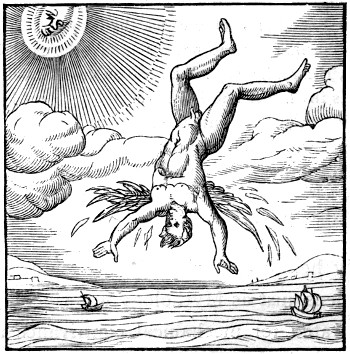
Alciat, 1581.
Icare, per ſuperos qui raptus & aëra, donec
In mare præcipitem cera liquata daret,
Nunc te cera eadem, feruensq́₃que reſuſcitat ignis,
Exemplo vt doceas dogmata certa tuo.
Aſtrologus caueat quicquam prædicere: præceps
Nam cadet impoſtor dum ſuper aſtra volat.
Whitney, however (p. 28), will supply the whole,—
“Heare, Icarvs with mountinge vp alofte,
Came headlonge downe, and fell into the Sea:
His waxed winges, the sonne did make so softe,
They melted straighte, and feathers fell awaie:
So, whilste he flewe, and of no dowbte did care,
He moou’de his armes, but loe, the same were bare.
Let suche beware, which paste theire reache doe mounte,
Whoe seeke the thinges, to mortall men deny’de,
And searche the Heauens, and all the starres accoumpte,
And tell therebie, what after shall betyde:
With blusshinge nowe, theire weakenesse rightlie weye,
Least as they clime, they fall to theire decaye.”
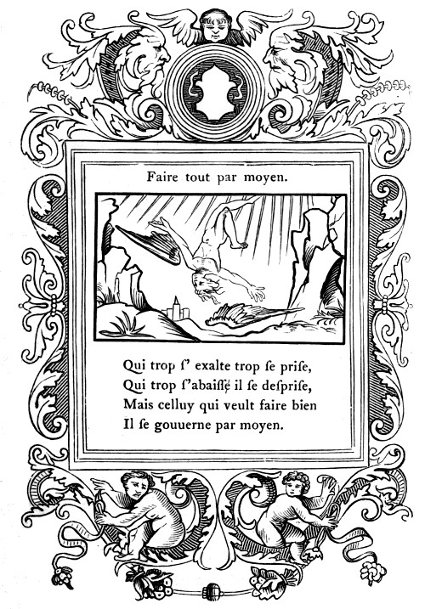
Corrozet, 1540.
Fol Icarus que t’eſt il aduenu?
Tu as treſmal le conſeil retenu
De Dedalus ton pere qui t’apprint
L’art de voler, lequel il entreprint
Pour eſchapper de Minos la priſon
Ou vous eſtiez enfermez, pour raiſon
Qu’il auoit faict & baſty vne vache
D’ung boys leger ou Paſiphe ſe cache.
Ce Dedalus nature ſurmonta
A toy & luy des ælles adiouſta
Aux bras & piedz, tant que pouiez voler
Et en volant il ſe print à parler
A toy diſant: mon filz qui veulx pretendre
De te ſauluer, vng cas tu doibs entendre
Que ſi tu veulx à bon port arriuer
Il ne te fault vers le ciel eſleuer.
Car le Soleil la cire fonderoit,
Et par ainſi ta plume tomberoit,
Sy tu vas bas l’humidité des eaulx
Te priuera du pouoir des oyſeaulx,
Mais ſi tu vas ne hault ne bas, adoncques
La voyé̩[e/]̩ eſt ſeuré̩[e/]̩ & ſans dangers quelzconques:
O pauure ſot le hault chemin tu prins
Trop hault pour toy car mal il t’en eſt prins
La cire fond, & ton plumage tumbe
Et toy auſſi preſt à mettre ſoubz tumbe.
We use this opportunity to present two consecutive pages of Corrozet’s “Hecatomgraphie” (Emb. 67), that the nature of his
devices, and of their explanations may be seen. There is a motto,—“To take the middle way,”—and these lines follow—
“Who too much exalts himself too much values himself,
Who too much abases himself, he undervalues himself,
But that man who wills to do well,
He governs himself the medium way.”
In the page of metrical explanation subjoined, the usual mythic narrative is closely followed.
The full idea is carried out in 3 Henry VI. (act v. sc. 6, l. 18, vol. v. p. 332), Gloucester and King Henry being the speakers,—
“Glou. Why, what a peevish fool was that of Crete,
That taught his son the office of a fowl!
And yet for all his wings, the fool was drown’d.
K. Hen. I, Dædalus; my poor boy, Icarus;
Thy father, Minos, that denied our course;
The sun that sear’d the wings of my sweet boy
Thy brother Edward, and thyself the sea
Whose envious gulf did swallow up his life.
Ah, kill me with thy weapon, not with words!
My breast can better brook thy dagger’s point
Than can my ears that tragic history.”
In the 1st part also of the same dramatic series (act iv. sc. 6, l. 46, vol. v. p. 78), John Talbot, the son, is hemmed about in the battle near Bourdeaux. Rescued by his father, he is urged to escape, but the young hero replies,—
“Before young Talbot from old Talbot fly,
The coward horse that bears me fall and die!
And like me to the peasant boys of France,
To be shame’s scorn and subject of mischance!
Surely, by all the glory you have won,
An if I fly, I am not Talbot’s son:
Then talk no more of flight, it is no boot;
If son to Talbot, die at Talbot’s foot.
Tal. Then follow thou thy desperate sire of Crete,
Thou Icarus; thy life to me is sweet:
If thou wilt fight, fight by thy father’s side;
And, commendable proved, let’s die in pride.”
The tearful tale of Niobe, who that has read Ovid’s Metamorphoses (bk. vi. fab. 5) could not weep over it! Seven stalwart sons and seven fair daughters clustered round the haughty dame, and she gloried in their attendance upon her; but at an evil hour she dared to match herself with Latona, and at a public festival in honour of the goddess to be the only one refusing to offer incense and prayers. The goddess called her own children to avenge the affront and the impiety; and Apollo and Diana, from the clouds, slew the seven sons as they were exercising on the plain near Thebes. Yet the pride of Niobe did not abate, and Diana in like manner slew also the seven daughters. The mother’s heart was utterly broken; she wept herself to death, and was changed to stone. Yet, says the poet, Flet tamen,—“ Yet she weeps,”—
Liquitur, et lacrymas etiam nunc marmora manant,—
i.e.
“It melts, and even now the marble trickles down tears.”
Alciat adopts the tale as a warning; Pride he names his 67th Emblem.
Superbia.
Emblema lxvii
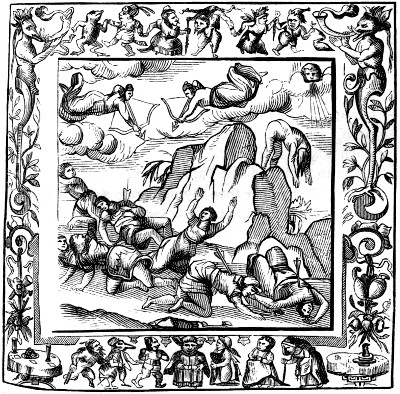
Alciat, 1581
En ſtatuæ ſtatua, & ductum de marmore marmor,
Se conferre Deis auſa procax Niobe.
Eſt vitium muliebre ſuperbia, & arguit oris
Duritiem, ac ſenſus, qualis ineſt lapidi.
As we look at the device we are sensible to a singular incongruity between the subject and the droll, Punch-like figures, which make up the border. The sentiment, too, is as incongruous, that “Pride is a woman’s vice and argues hardness of look and of feeling such as there is in stone.”
Making a slight change in the motto, Whitney (p. 13) writes. Superbiæ vltio,—“Vengeance upon pride,”—
“Of Niobe, behoulde the ruthefull plighte,
Bicause shee did dispise the powers deuine:
Her children all, weare slaine within her sighte,
And, while her selfe with tricklinge teares did pine,
Shee was transform’de, into a marble stone,
Which, yet with teares, dothe seeme to waile, and mone.
This tragedie, thoughe Poëtts first did frame,
Yet maie it bee, to euerie one applide:
That mortall men, shoulde thinke from whence they came,
And not presume, nor puffe them vp with pride,
Leste that the Lorde, whoe haughty hartes doth hate,
Doth throwe them downe, when sure they thinke theyr state.”
Shakespeare’s notices of Niobe are little more than allusions; the mode in which Apollo and Diana executed the cruel vengeance may be glanced at in All’s Well (act v. sc. 3, l. 5, vol. iii. p. 201), when the Countess of Rousillon pleads for her son to the King of France,—
“Count. ’Tis past, my liege;
And I beseech your majesty to make it
Natural rebellion, done i’ the blaze of youth;
When oil and fire, too strong for reason’s force,
O’erbears it and burns on.
King. My honour’d lady,
I have forgiven and forgotten all;
Though my revenges were high bent upon him,
And watch’d the time to shoot.”
Troilus (act v. sc. 10, l. 16, vol. vi. p. 261), anticipating Priam’s and Hecuba’s mighty grief over the slain Hector, speaks thus of the fact,—
“Let him that will a screech-owl aye be call’d
Go into Troy, and say there, ‘Hector’s dead:’
There is a word will Priam turn to stone,
Make wells and Niobes of the maids and wives,
Cold statues of the youth, and in a word,
Scare Troy out of itself.”
Hamlet, too (act i. sc. 2, l. 147, vol. viii. p. 17), in his bitter expressions respecting his mother’s marriage, speaks thus severely of the brevity of her widowhood,—
“A little month, or ere those shoes were old
With which she follow’d my poor father’s body.
Like Niobe, all tears:—why she, even she,—
O God! a beast that wants discourse of reason.
Would have mourn’d longer;—within a month;
Ere yet the salt of most unrighteous tears
Had left the flushing in her galled eyes,
She married.”
Tiresias, the blind soothsayer of Thebes, had foretold that the comely Narcissus would live as long as he could refrain from the sight of his own countenance,—
“But he, ignorant of his destiny,” says Claude Mignault, “grew so desperately in love with his own image seen in a fountain, that he miserably wasted away, and was changed into the flower of his own name, which is called Narce, and means drowsiness or infatuation, because the smell of the Narcissus affects the head.”
However that may be, Alciatus, edition Antwerp, 1581, exhibits the youth surveying his features in a running stream; the flower is behind him, and in the distance is Tiresias pronouncing his doom. “Self love” is the motto.
Φιλαυτία
Emblema lxix.
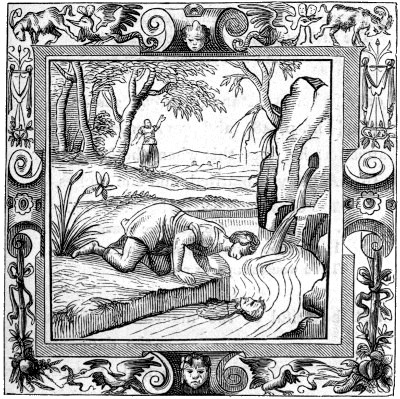
Alciat, 1581.
Qvod nimium tua forma tibi Narciſſe placebat,
In florem, & noti eſt verſa ſtuporis olus.
Ingenij eſt marcor, cladesq́₃que. Φιλαυτία, doctos
Quæ peſſum plures datq́₃que, deditq́₃que viros:
Qui veterum abiecta methodo, noua dogmata quærunt,
Nilq́₃que ſuas præter tradere phantaſias.
Anulus also, in the “Picta Poesis” (p. 48), mentions his foolish and vain passion,—
Contemnens alios, arsit amore sui,—
i.e.
“Despising others, inflamed he was with love of himself.”
From Alciat and Anulus, Whitney takes up the fable (p. 149), his printer Rapheleng using the same wood-block as Plantyn did in 1581. Of the three stanzas we subjoin one,—
“Narcissvs lou’de, and liked so his shape,
He died at lengthe with gazinge there vppon:
Which shewes selfe loue, from which there fewe can scape,
A plague too rife: bewitcheth manie a one.
The ritche, the pore, the learned, and the sotte,
Offende therein: and yet they see it not.”
It is only in one instance, Antony and Cleopatra (act ii. sc. 5, l. 95, vol. ix. p. 48), and very briefly, that Shakespeare names Narcissus; he does this when the Messenger repeats to Cleopatra that Antony is married, and she replies,—
“The Gods confound thee!...
... Go, get thee hence:
Hadst thou Narcissus in thy face, to me
Thou wouldst appear most ugly.”
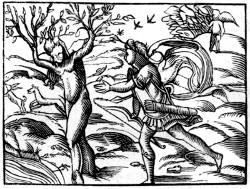
Aneau, 1551.
Ille amat, hæc odit, fugit hæc: ſectatur at ille
Dúmque fugit: Laurus facta repentè ſtetit.
Sic amat, & fruſtra, nec Apollo potitus amore eſt.
Vltus Apollinis eſt, ſic Amor opprobrium.
Haecine doctorum ſors eſt inimica virorum,
Vt iuuenes quamuis non redamentur ament?
Exoſoſque habeat prudentes ſtulta iuuentus
His ne iungatur ſtipes vt eſſe velit.
The most beautiful of the maidens of Thessaly, Daphne, the daughter of the river-god Peneus, was Apollo’s earliest love. He sought her in marriage, and being refused by her, prepared to force consent. The maiden fled, and was pursued, and, at the very moment of her need invoked her father’s aid, and was transformed into a laurel.
At this instant the device of Anulus represents her, in the “Picta Poesis” (P. 47).[141]
“He loves, she hates; she flees, but he pursues,
And while she flees, stopped suddenly, to laurel changed.
So loves Apollo, and in vain; nor enjoys his love.
So love has avenged the reproach of Apollo.
This very judgment of learned men is it not hostile,
That youths should love though not again be loved?
Hated should foolish youth account the wise
Lest by these the log be not joined as it wishes to be.”
The Midsummer Night’s Dream (act ii. sc. 1, l. 227, vol. ii. p. 218) reverses the fable; Demetrius flees and Helena pursues,—
“Dem. I’ll run from thee and hide me in the brakes,
And leave thee to the mercy of wild beasts.
Hel. The wildest hath not such a heart as you.
Run when you will, the story shall be changed:
Apollo flies, and Daphne holds the chase:
The dove pursues the griffin; the mild hind
Makes speed to catch the tiger; bootless speed,
When cowardice pursues, and valour flies.”
There is, too, the quotation already made for another purpose (p. 115) from the Taming of the Shrew (Introd. sc. 2, l. 55),—
“Or Daphne roaming through a thorny wood,
Scratching her legs that one shall swear she bleeds,
And at that sight shall sad Apollo weep,
So workmanly the blood and tears are drawn.”
And Troilus (act i. sc. 1, l. 94, vol. vi. p. 130) makes the invocation,—
“Tell me, Apollo, for thy Daphne’s love
What Cressid is, what Pandar, and what we?”
Among Mythological Characters we may rank Milo, “of force unparalleled;” to whom with crafty words of flattery Ulysses likened Diomed; Troilus and Cressida (act ii. sc. 3, l. 237),—
“But he that disciplined thine arms to fight,
Let Mars divide eternity in twain,
And give him half: and for thy vigour,
Bull-bearing Milo his addition yield
To sinewy Ajax.”
Milo’s prowess is the subject of a fine device by Gerard de Jode, in the “ΜΙΚΡΟΚΟΣΜΟΣ” (p. 61), first published in 1579, with Latin verses. Respecting Milo the French verses say,—
“La force de Milon a esté nompareille,
Et de ses grands efforts on raconte merueille:
S’il se tenoit debout, il ne se trouuoit pas
Homme aucun qui le peust faire bouger d’un pas.
A frapper il estoit si fort & si adestre
Que d’un seul coup de poing il tua de sa dextre
Vn robuste taureau, & des ses membres forts
Vne lieue le porta sans se greuer le corps.
Mais se fiant par trop en ceste grande force,
Il fut en fin saisi d’une mortelle entorce:
Car il se vid manger des bestes, estant pris
A l’arbre qu’il auoit de desioindre entrepris.
Qui de sa force abuse en chase non faisable
Se rend par son effort bien souuent miserable,
Le fol entrepreneur tombe en confusion
Et s’expose à chacun en grand derision.”
The famous winged horse, Pegasus, heroic, though not a hero, has a right to close in our array of mythic characters. Sprung from the blood of Medusa when Perseus cut off her head, Pegasus is regarded sometimes as the thundering steed of Jove, at other times as the war-horse of Bellerophon; and in more modern times, under a third aspect, as the horse of the Muses. Already (at p. 142) we have spoken of some of the merits attributed to him, and have presented Emblems in which he is introduced. It will be sufficient now to bring forward the device and stanza of Alciat, in which he shows us how “by prudence and valour to overcome the Chimæra, that is, the stronger and those using stratagems.”
Conſilio & virtute Chimæram ſuperari, id est,
fortiores & deceptores.
Emblema xiiii.
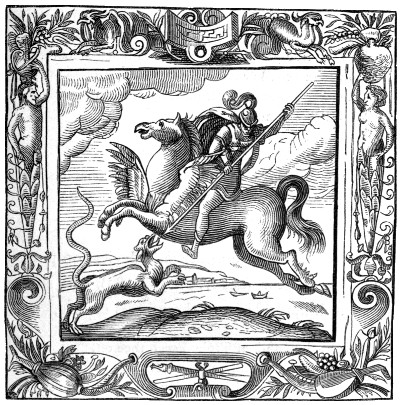
Alciat, 1581.
Bellerophon ut fortis eques ſuperare Chimæram,
Et Lycij potuit ſternere monſtra ſoli:
Sic tu Pegaſeis vectus petis æthera pennis,
Conſilioq́₃que animi monſtra ſuperba domas.
i.e.
“As the brave knight Bellerophon could conquer Chimæra,
And the monsters of the Lycian shore stretch on the ground:
So thou borne on the wings of Pegasus seekest the sky,
And by prudence dost subdue proud monsters of the soul.”
Shakespeare recognises neither Bellerophon nor the Chimæra, but Pegasus, the wonderful creature, and Perseus its owner.
The dauphin Lewis (see p. 141) likens his own horse to Pegasus, “with nostrils of fire,”—
It is a beast for Perseus: he is pure air and fire ... he is indeed a horse.
In the Grecian camp (see Troilus and Cressida, act i. sc. 3, l. 33, vol. vi. p. 142), Nestor is urging the worth of dauntless valour, and uses the apt comparison,—
“In the reproof of chance
Lies the true proof of men: the sea being smooth,
How many shallow bauble boats dare sail
Upon her patient breast, making their way
With those of nobler bulk!
But let the ruffian Boreas once enrage
The gentle Thetis, and anon behold
The strong-ribb’d bark through liquid mountains cut,
Bounding between the two moist elements,
Like Perseus’ horse.”
The last lines are descriptive of Alciat’s device, on p. 299.
It is the same Nestor (act iv. sc. 5, l. 183), who so freely and generously compliments Hector, though his enemy,—
“I have, thou gallant Trojan, seen thee oft,
Labouring for destiny, make cruel way
Through ranks of Greekish youth; and I have seen thee,
As hot as Perseus, spur thy Phrygian steed,
Despising many forfeits and subduements,
When thou hast hung thy advanced sword i’ the air,
Nor letting it decline on the declined,
That I have said to some my standers by,
‘Lo, Jupiter is yonder, dealing life!’”
Young Harry’s praise, too, in 1 Henry IV., act iv. sc. 1. l. 109, vol. iv. p. 318, is thus celebrated by Vernon,—
“As if an angel dropp’d down from the clouds
To turn and wind a fiery Pegasus,
And witch the world with noble horsemanship.”
For nearly all the personages and the tales contained in this section, authority may be found in Ovid, and in the various pictorially illustrated editions of the Metamorphoses or of portions of them, which were numerous during the actively literary life of Shakespeare. It is, I confess, very questionable, whether for his classically mythic tales he was indeed indebted to the Emblematists; yet the many parallels in mythology between him and them justify the pleasant labour of setting both side by side, and, by this means, of facilitating to the reader the forming for himself an independent judgment.
David, ed. 1601.
Section IV. EMBLEMS ILLUSTRATIVE OF FABLES.
SIMILITUDES and, in cases not a few, identities have often been detected between the popular tales of widely distant nations, intimating either a common origin, or a common inventive power to work out like results. Fables have ever been a floating literature,—borne hither and thither on the current of Time,—used by any one, and properly belonging to no one. How they have circulated from land to land, and from age to age, we cannot tell; whence they first arose it is impossible to divine. There exist, we are told, fables collected by Bidpai in Sanscrit, by Lokman in Arabic, by Æsop in Greek, and by Phædrus in Latin; and they seem to have been interchanged and borrowed one from the other as if they were the property of the world,—handed down from the ancestorial times of a remote antiquity.
Shakespeare’s general estimation of fables, and of those of Æsop in particular, may be gathered from certain expressions in two of the plays,—in the Midsummer Night’s Dream (act v. sc. 1, l. 1, vol. ii. p. 258) and in 3 Henry VI. (act v. sc. 5, l. 25, vol. v. p. 329). In the former the speakers are Hippolyta and Theseus,—
“Hip. ’Tis strange, my Theseus, that these lovers speak of.
The. More strange than true: I never may believe
These antique fables, nor these fairy toys.
Lovers and madmen have such seething brains
Such shaping fantasies, that apprehend
More than cool reason ever comprehends.”
In the latter Queen Margaret’s son in reproof of Gloucester, declares,—
“Let Æsop fable in a winter’s night;
His currish riddles sort not with this place.”
The year of Shakespeare’s birth, 1564, saw the publication, at Rome, of the Latin Fables of Gabriel Faerni; they had been written at the request of Pope Pius IV., and possess a high degree of excellence, both for their correct Latinity and for the power of invention which they display. Roscoe, in his Life of Leo X. (Bohn’s ed. ii. p. 172), even avers that they “are written with such classical purity, as to have given rise to an opinion that he had discovered and fraudulently availed himself of some of the unpublished works of Phædrus.” This opinion, however, is without any foundation.
The Dialogues of Creatures moralised preceded, however, the Fables of Faerni by above eighty years. “In the Latin and Dutch only there were not less than fifteen known editions before 1511.”[142] An edition in Dutch is named as early as 1480, and one in French in 1482; and the English version appeared, it is likely, at nearly as early a date. These and other books of fables, though by a contested claim, are often regarded as books of Emblems. The best Emblem writers, even the purest, introduce fables and little tales of various kinds; as Alciat, Emb. 7, The Image of Isis, the Ass and the Driver; Emb. 15, The Cock, the Lion, and the Church; Emb. 59, The Blackamoor washed White, &c.: Hadrian Junius, Emb. 4, The caged Cat and the Rats; Emb. 19, The Crocodile and her Eggs: Perriere, Emb. 101, Diligence, Idleness, and the Ants. They all, in fact, adopted without scruple the illustrations which suited their particular purpose; and Whitney, in one part of his Emblemes, uses twelve of Faerni’s fables in succession.
Of the fables to which Shakespeare alludes some have been quoted in the former part of this work;—as The Fly and the Candle; The Sun, the Wind, and the Traveller; The Elephant and the undermined Tree; The Countryman and the Serpent. Of others we now proceed to give examples.
The Hares biting the dead Lion had, perhaps, one of its earliest applications, if not its origin, in the conduct of Achilles and his coward Greeks to the dead body of Hector, which Homer thus records (Iliad, xxii. 37),—
“The other sons of the Greeks crowded around;
And admired Hector’s stature and splendid form;
Nor was there one standing by who did not inflict a wound.”
Claude Mignault, in his notes to Alciatus (Emb. 153), quotes an epigram, from an unknown Greek author, which Hector is supposed to have uttered as he was dragged by the Grecian chariot,—
“Now after my death ye pierce my body;
The very hares are bold to insult a dead lion.”
The Troilus and Cressida (act v. sc. 8, l. 21, vol. vi. p. 259) exhibits the big, brutal Achilles exulting over his slain enemy, and giving the infamous order,—
“Come, tie his body to my horse’s tail;
Along the field I will the Trojan trail.”
And afterwards (act v. sc. 10, l. 4, vol. vi. p. 260) the atrocities are recounted to which Hector’s body was exposed,—
“He’s dead, and at the murderer’s horse’s tail
In beastly sort dragg’d through the shameful field.”
The description thus given accords with that of Alciatus, Reusner, and Whitney, in reference to the saying, “We must not struggle with phantoms.” Alciat’s stanzas (Emb. 153) are,—
Cum laruis non luctandum.
Æacidæ moriens percussu cuspidis Hector
Qui toties hosteis vicerat ante suos;
Comprimere haud potuit vocem, insultantibus illis,
Dum curru & pedibus nectere vincla parant.
Distrahite vt libitum est: sic cassi luce leonis
Conuellunt barbam vel timidi lepores.
Thus rendered by Whitney (p. 127), with the same device,—
Cùm laruis non luctandum.
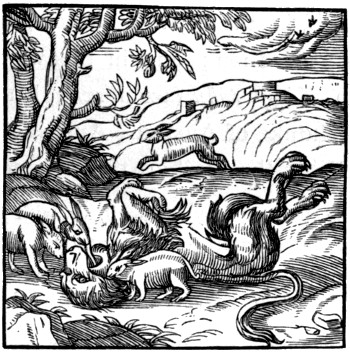
Whitney, 1586.
“When Hectors force, throughe mortall wounde did faile,
And life beganne, to dreadefull deathe to yeelde:
The Greekes moste gladde, his dyinge corpes assaile,
Who late did flee before him in the fielde:
Which when he sawe, quothe hee nowe worke your spite,
For so, the hares the Lion dead doe byte.
Looke here vpon, you that doe wounde the dead,
With slaunders vile, and speeches of defame:
Or bookes procure, and libelles to be spread,
When they bee gone, for to deface theire name:
Who while they liu’de, did feare you with theire lookes,
And for theire skill, you might not beare their bookes.”
Reusner’s lines, which have considerable beauty, may thus be rendered,—
“Since man is mortal, the dead it becomes us
Neither by word nor reproachful writing to mock at.
Theseus, mindful of mortal destiny, the bones of his friends
Both laves, and stores up in the tomb, and covers with earth.
’Tis the mark of a weak mind, to wage war with phantoms,
And after death to good men insult to offer.
So when overcome by the strength of Achilles
The scullions of the camp struck Hector with darts.
So whelps bite the lion laid prostrate by death;
So his weapon any one bloods in the boar that is slain.
Better ’tis, ye gods, well to speak, of those deserving well;
And wickedness great indeed, to violate sacred tombs.”
The device itself, in these three authors, is a representation of Hares biting a dead Lion; and in this we find an origin for the words used in King John (act ii. sc. 1, l. 134, vol. iv. p. 17), to reprove the Archduke of Austria. Austria demands of Philip Faulconbridge, “What the devil art thou?” and Philip replies,—
“One that will play the devil, sir, with you,
An a’ may catch your hide and you alone:
You are the hare of whom the proverb goes,
Whose valour plucks dead lions by the beard.”
Immediately references follow to other fables, or to their pictorial representations,—
“I’ll smoke your skin-coat, an I catch you right:”
in allusion to the fable of the fox or the ass hunting in a lion’s skin. Again (l. 141),—
“Blanch. O, well did he become that lion’s robe
That did disrobe the lion of that robe.
Bast. It lies as sightly on the back of him
As great Alcides’ shows upon an ass:”
a sentiment evidently suggested to the poet’s mind by some device or emblem in which the incongruity had found a place. Farther research might clear up this and other unexplained allusions in Shakespeare to fables or proverbs; but there is no necessity for attempting this in every instance that occurs.
“Friendship enduring even after death,” might receive a variety of illustrations. The conjugal relation of life frequently exemplifies its truth; and occasionally there are friends who show still more strongly how death hallows the memory of the departed, and makes survivors all the more faithful in their love. As the emblem of such fidelity and affection Alciat (Emb. 159) selects the figures of the elm and the vine.[143]
Amicitia etiam poſt mortem durans.
Emblema clix.
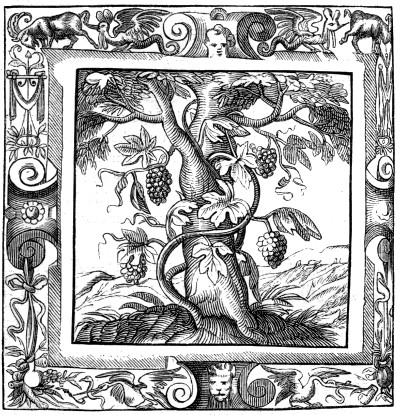
Alciat, 1581.
The consociation in life is not forgotten; and though the supporting tree should die, the twining plant still grasps it round and adorns it with leaves and fruit.
Arentem ſenio, nudam quoque frondibus vlmum,
Complexa eſt viridi vitis opaca coma:
Agnoſcitq́₃que vices naturæ, & grata parenti
Officij; reddit mutua iura ſuo.
Exemploq́₃que monet, tales nos quærere amicos,
Quos neque disſiungat fædere summa dies.
To which lines Whitney (p. 62) gives for interpretation the two stanzas,—
“A Withered Elme, whose boughes weare bare of leaues
And sappe, was sunke with age into the roote:
A fruictefull vine, vnto her bodie cleaues,
Whose grapes did hange, from toppe vnto the foote:
And when the Elme, was rotten, drie, and dead,
His braunches still, the vine abowt it spread.
Which showes, wee shoulde be linck’de with such a frende,
That might reuiue, and helpe when wee bee oulde:
And when wee stoope, and drawe vnto our ende,
Our staggering state, to helpe for to vphoulde:
Yea, when wee shall be like a sencelesse block,
That for our sakes, will still imbrace our stock.”
The Emblems of Joachim Camerarius,—Ex Re Herbaria (edition 1590, p. 36),—have a similar device and motto,—
“Quamlibet arenti vitis tamen hæret in ulmo,
Sic quoque post mortem verus amicus amat.”
i.e.
“Yet as it pleases the vine clings to the withered elm,
So also after death the true friend loves.”
And in the Emblems of Otho Vænius (Antwerp, 1608, p. 244), four lines of Alciat being quoted, there are both English and Italian versions, to—
“Loue after death.”
“The vyne doth still embrace the elme by age ore-past,
Which did in former tyme those feeble stalks vphold,
And constantly remaynes with it now beeing old,
Loue is not kil’d by death, that after death doth last.”
And,—
“Ne per morte muore.”
“s’Auiticchia la vite, e l’olmo abbraccia,
Anchor che il tempo secchi le sue piante;
Nopo morte l’Amor tiensi constante.
Non teme morte Amore, anzi la scaccia.”
It is in the Comedy of Errors (act ii. sc. 2, l. 167, vol. i. p. 417) that Shakespeare refers to this fable, when Adriana addresses Antipholus of Syracuse,—
“How ill agrees it with your gravity
To counterfeit thus grossly with your slave,
Abetting him to thwart me in my mood!
Be it my wrong, you are from me exempt,
But wrong not that wrong with a more contempt.
Come, I will fasten on this sleeve of thine:
Thou art an elm, my husband, I a vine,
Whose weakness, married to thy stronger state,
Makes me with thy strength to communicate.”
With a change from the vine to the ivy a very similar comparison occurs in the Midsummer Night’s Dream (act iv. sc. 1, l. 37, vol. ii. p. 250). The infatuated Titania addresses Bottom the weaver as her dearest joy,—
“Sleep thou, and I will wind thee in my arms.
Fairies begone, and be all ways away.
So doth the woodbine the sweet honeysuckle
Gently entwist; the female ivy so
Enrings the barky fingers of the elm.
O, how I love thee! how I dote on thee!”
The fable of the Fox and the Grapes is admirably represented in Freitag’s Mythologia Ethica (p. 127), to the motto, “Feigned is the refusal of that which cannot be had,”—
Ficta eius quod haberi nequit
recuſatio.
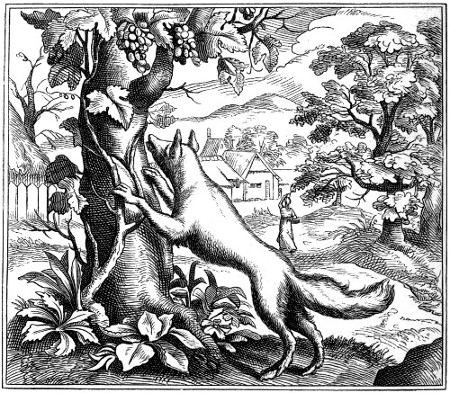
Freitag, 1579.
Fatuus ſtatim indicat iram ſuam: qui autem diſſimulat iniuriam, callidus eſt.
Prouerb. 12, 16.
“A fool’s wrath is presently known: but a prudent man covereth shame.”
The fable itself belongs to an earlier work by Gabriel Faerni, and there exemplifies the thought, “to glut oneself with one’s own folly,”—
“Stultitia sua seipsum saginare.”
“Vulpes esuriens, alta de vite racemos
Pendentes nulla quum prensare arte valeret,
Nec pedibus tantum. aut agili se tollere saltu.
Re infecta abscedens, hæc secum, Age, desine, dixit.
Immatura vva est, gustuque insuavis acerbo.
Consueuere homines, eventu si qua sinistro
Vota cadunt, iis sese alienos velle videri.”
Whitney takes possession of Faerni’s fable, and gives the following translation (p. 98), though by no means a literal one,—
“The Foxe, that longe for grapes did leape in vayne,
With wearie limmes, at lengthe did sad departe:
And to him selfe quoth hee, I doe disdayne
These grapes I see, bicause their taste is tarte:
So thou, that hunt’st for that thou longe hast mist,
Still makes thy boast, thou maist if that thou list.”
Plantin, the famed printer of Antwerp, had, in 1583, put forth an edition of Faerni’s fables,[144] and thus undoubtedly it was that Whitney became acquainted with them; and from the intercourse then existing between Antwerp and London it would be strange if a copy had not fallen into Shakespeare’s hands.
Owing to some malady, the King of France, in All’s Well that Ends Well (act ii. sc. 1, l. 59, vol. iii. p. 133), is unable to go forth to the Florentine war with those whom he charges to be “the sons of worthy Frenchmen.” Lafeu, an old lord, has learned from Helena some method of cure, and brings the tidings to the king, and kneeling before him is bidden to rise,—
“King. I’ll fee thee to stand up.
Laf. Then here’s a man stands, that has brought his pardon.
I would you had kneel’d, my lord, to ask me mercy;
And that at my bidding you could so stand up.
King. I would I had; so I had broke thy pate,
And ask’d thee mercy for’t.
Laf. Good faith, across: but, my good lord, ’tis thus;
Will you be cured of your infirmity?
King. No.
Laf. O, will you eat no grapes, my royal fox?
Yes, but you will my noble grapes, an if
My royal fox could reach them: I have seen a medicine
That’s able to breathe life into a stone,
Quicken a rock, and make you dance canary
With spritely fire and motion.”
The fox, indeed, has always been a popular animal, and is the subject of many fables which are glanced at by Shakespeare;—as in the Two Gentlemen of Verona (act iv. sc. 4, l. 87, vol. i. p. 143), when Julia exclaims,—
“Alas, poor Proteus! thou hast entertained
A fox to be the shepherd of thy lambs.”
Or in 2 Henry VI. (act iii. sc. 1, l. 55, vol. v. p. 153), where Suffolk warns the king of “the bedlam brain-sick duchess” of Gloucester,—
“Smooth runs the water where the brook is deep.”
“The fox barks not when he would steal the lamb.”
And again, in 3 Henry VI. (act iv. sc. 7, l. 24, vol. v. p. 312), the cunning creature is praised by Gloucester in an “aside,”—
“But when the fox hath once got in his nose,
He’ll soon find means to make the body follow.”
The bird in borrowed plumes, or the Jackdaw dressed out in Peacock’s feathers, was presented, in 1596, on a simple device, not necessary to be produced, with the motto, “Qvod sis esse velis,”—Be willing to be what thou art.
“Mutatis de te narratur fabula verbis,
Qui ferre alterius parta labore ſtudes.”
i.e.
“By a change in the words of thyself the fable is told,
Who by labour of others dost seek to bear off the gold.”
It is in the Third Century of the Symbols and Emblems of Joachim Camerarius (No. 81), and by him is referred to Æsop,[145] Horace, &c.; and the recently published Microcosm, the 1579 edition of which contains Gerard de Jode’s fine representation of the scene.
Shakespeare was familiar with the fable. In 2 Henry VI. (act iii. sc. 1, l. 69, vol. v. p. 153), out of his simplicity the king affirms,—
“Our kinsman Gloucester is as innocent
From meaning treason to our royal person
As is the sucking lamb or harmless dove.”
But Margaret, his strong-willed queen, remarks (l. 75),—
“Seems he a dove? his feathers are but borrow’d,
For he’s disposed as the hateful raven.
Is he a lamb? his skin is surely lent him,
For he’s inclined as is the ravenous wolf.”
In Julius Cæsar (act i. sc. 1, l. 68, vol. vii. p. 322), Flavius, the tribune, gives the order,—
“Let no images
Be hung with Cæsar’s trophies;”
and immediately adds (l. 72),—
“These growing feathers pluck’d from Cæsar’s wing
Will make him fly an ordinary pitch,
Who else would soar above the view of men
And keep us all in servile fearfulness.”
But more forcibly is the spirit of the fable expressed, when of Timon of Athens (act ii. sc. 1, l. 28, vol. vii. p. 228) a Senator, who was one of his importunate creditors, declares,—
“I do fear,
When every feather sticks in his own wing,
Lord Timon will be left a naked gull,
Which flashes now a phœnix.”
The fable of the Oak and the Reed, or, the Oak and the Osier, has an early representation in the Emblems of Hadrian Junius, Antwerp, 1565, though by him it is applied to the ash. “Εἴξας νικᾶ,” or, Victrix animi equitas,—“By yielding conquer,” or, “Evenness of mind the victrix,”—are the sentiments to be pictured forth and commented on. The device we shall take from Whitney; but the comment of Junius runs thus (p. 49),—
“Ad Victorem Giselinum.”
“Vis Boreæ obnixas violento turbine sternit
Ornos: Arundo infracta eandem despicit.
Fit victor patiens animus cedendo furori:
Insiste, Victor, hanc viam & re, & nomine.”
i.e.
“The stout ash trees, with violent whirl
The North-wind’s force is stretching low;
The reeds unbroken rise again
And still in full vigour grow.
Yielding to rage, the patient mind
Victor becomes with added fame;
That course, my Victor, thou pursue
Reality, as well as name.”
Whitney adopts the same motto (p. 220), “He conquers who endures;” but while retaining from Junius the ash-tree in the pictorial illustration, he introduces into his stanzas “the mightie oke,” instead of the “stout ash.” From Erasmus (in Epist.) he introduces an excellent quotation, that “it is truly the mark of a great mind to pass over some injuries, nor to have either ears or tongue ready for certain revilings.”
Vincit qui patitur.
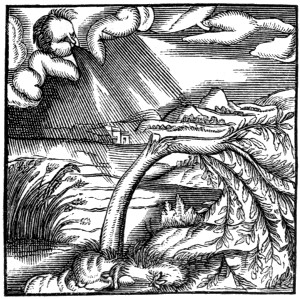
Whitney, 1586.
“The mightie oke, that shrinkes not with a blaste.
But stiflie standes, when Boreas moste doth blowe,
With rage thereof, is broken downe at laste,
When bending reedes, that couche in tempestes lowe
With yeelding still, doe safe, and sounde appeare:
And looke alofte, when that the cloudes be cleare.
When Enuie, Hate, Contempte, and Slaunder, rage:
Which are the stormes, and tempestes, of this life;
With patience then, wee must the combat wage,
And not with force resist their deadlie strife:
But suffer still, and then wee shall in fine,
Our foes subdue, when they with shame shall pine.”
On several occasions Shakespeare introduces this fable, and once moralises on it quite in Whitney’s spirit, if not in his manner. It is in the song of Guiderius and Arviragus from the Cymbeline (act iv. sc. 2, l. 259, vol. ix. p. 257),—
“Gui. Fear no more the heat o’ the sun,
Nor the furious winter’s rages;
Thou thy worldly task hast done,
Home art gone and ta’en thy wages:
Golden lads and girls all must,
As chimney-sweepers, come to dust.
Arv. Fear no more the frown o’ the great;
Thou art past the tyrant’s stroke;
Care no more to clothe and eat;
To thee the reed is as the oak:
The sceptre, learning, physic, must
All follow this and come to dust.”
Less direct is the reference in the phrase from Troilus and Cressida (act i. sc. 3, l. 49, vol. vi. p. 143),—
“when the splitting wind
Makes flexible the knees of knotted oaks.”
To the same purport are Cæsar’s words (Julius Cæsar, act i. sc. 3, l. 5, vol. vii. p. 334),—
“I have seen tempests, when the scolding wings
Have rived the knotty oaks.”
In Love’s Labour’s Lost (act iv. sc. 2, l. 100, vol. ii. p. 138), the Canzonet, which Nathaniel reads, recognises the fable itself,—
“If love make me forsworn, how shall I swear to love?
Ah, never faith could hold, if not to beauty vow’d!
Though to myself forsworn, to thee I’ll faithful prove;
Those thoughts to me were oaks, to thee like osiers bow’d.”
We have, too, in Coriolanus (act v. sc. 2, l. 102, vol. vi. p. 403) the lines, “The worthy fellow is our general: He is the rock; the oak not to be wind shaken.”
This phrase is to be exampled from Otho Vænius (p. 116), where occur the English motto and stanza, “Strengthened by trauaile,”—
“Eu’n as the stately oke whome forcefull wyndes do moue,
Doth fasten more his root the more the tempest blowes,
Against disastres loue or firmness greater growes,
And makes each aduers change a witness to his loue.”
In several instances it is difficult to determine whether expressions which have the appearance of glancing at fables really do refer to them, or whether they are current sayings, passing to and fro without any defined ownership. Also it is difficult to make an exact classification of what belongs to the fabulous and what to the proverbial. Of both we might collect many more examples than those which we bring forward; but the limits of our subject remind us that we must, as a general rule, confine our researches and illustrations to the Emblem writers themselves. We take this opportunity of saying that we may have arranged our instances in an order which some may be disposed to question; but mythology, fable, and proverb often run one into the other, and the knots cannot easily be disentangled. Take a sword and cut them; but the sword though sharp is not convincing.
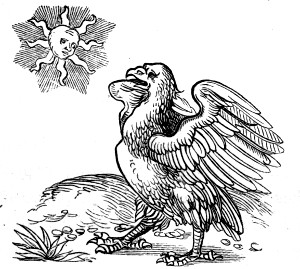
Horapollo, ed. 1551.
Section V. EMBLEMS IN CONNEXION WITH PROVERBS.
PROVERBS are nearly always suggestive of a little narrative, or of a picture, by which the sentiment might be more fully developed. The brief moral reflections appended to many fables partake very much of the nature of proverbs. Inasmuch, then, as there is this close alliance between them, we might consider the Proverbial Philosophy of Shakespeare only as a branch of the Philosophy of Fable; still, as there are in his dramas many instances of the use of the pure proverb, and instances too of the same kind in the Emblem writers, we prefer making a separate Section for the proverbs or wise sayings.
Occasionally, like the Sancho Panza of his renowned contemporary, Michael de Cervantes Saavedra, 1549–1616,[146] Shakespeare launches “a leash of proverbial philosophies at once;” but with this difference, that the dramatist’s application of them is usually suggestive either of an Emblem-book origin, or of an Emblem-book destination. The example immediately in view is from the scene (3 Henry VI., act i. sc. 4, l. 39, vol. v. p. 245) in which Clifford and Northumberland lay hands of violence on Richard Plantagenet, duke of York; the dialogue proceeds in the following way, York exclaiming,—
“Why come you not? what! multitudes, and fear?
Clif. So cowards fight, when they can fly no further.
So doves do peck the falcon’s piercing talons.”
The queen entreats Clifford, “for a thousand causes,” to withhold his arm, and Northumberland joins in the entreaty,—
“North. Hold, Clifford! do not honour him so much,
To prick thy finger, though to wound his heart:
What valour were it, when a cur doth grin,
For one to thrust his hand between his teeth,
When he might spurn him with his foot away?”
Clifford and Northumberland seize York, who struggles against them (l. 61),—
“Clif. Ay, ay, so strives the woodcock with the gin.[147]
North. So doth the cony struggle in the net.”
York is taken prisoner, as he says (l. 63),—
“So triumph thieves upon their conquer’d booty;
So true men yield, with robbers so o’ermatch’d.”
The four or five notions or sayings here enunciated a designer or engraver could easily translate into as many Emblematical devices, and the mind which uses them, as naturally as if he had invented them, must surely have had some familiarity with the kind of writing of which proverbs are the main source and foundation.
In this connection we will quote the proverb which “Clifford of Cumberland” (2 Henry VI., act v. sc. 2, l. 28, vol. vi. p. 217) utters in French at the very moment of death, and which agrees very closely with similar sayings in Emblem-books by French authors,—Perriere and Corrozet,—and still more in suitableness to the occasion on which it was spoken, the end of life.
York and Clifford,—it is the elder of that name,—engage in mortal combat (l. 26),—
“Clif. My soul and body on the action both!
York. A dreadful lay! address thee instantly.”
[They fight, and Clifford falls.
At the point of death Clifford uses the words (l. 28), La fin couronne les œuvres.[148]—“The end crowns the work.” It was, no doubt, a common proverb; but it is one which would suggest to the Emblem writer his artistic illustration, and, with a little change, from some such illustration it appears to have been borrowed. Whitney (p. 130) records a resemblance to it among the sayings of the Seven Sages, dedicated “to Sir Hvghe Cholmeley Knight,”—
“And Solon said, Remember still thy ende.”
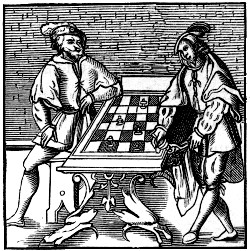
Perriere, 1539.
The two French Emblems alluded to above are illustrative of the proverb, “The end makes us all equal,” and both use a very appropriate and curious device from the game of chess. Take, first, Emb. 27 from Perriere’s Theatre des Bons Engins: Paris, 1539,—
XXVII.
Le Roy d’eſchez, pendant que le ieu dure,
Sur ses ſubiectz ha grande preference,
Sy l’on le matté̩[e/]̩, il conuiẽt qu’il endure
Que l’on le metté̩[e/]̩ au ſac ſans difference.
Cecy nous faict notable demonſtrance,
Qu’ apres le ieu de vie tranſitoire,
Quãd mort nous a mis en ſõ repertoire,
Les roys ne ſõt pluſgrãs que les vaſſaulx;
Car dans le ſac (cõmé̩[e/]̩ à tous eſt notoire),
Roys & pyons en hõneur ſont eſgaulx.
The other, from Corrozet, is in his “Hecatomgraphie:” Paris, 1540,—
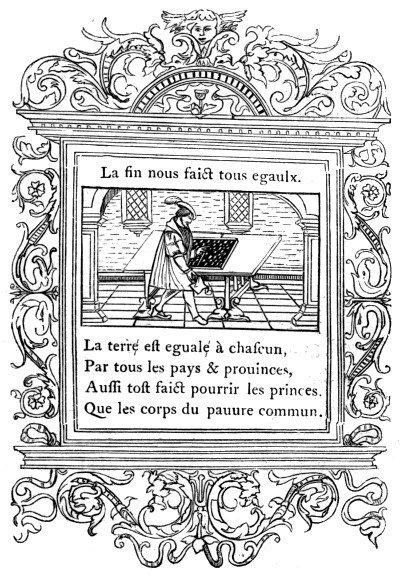
Corrozet, 1540.
Svr l’eſchiquier ſont les eſchez aſſis,
Tous en leur rẽg par ordre biẽ raſſis,
Les roys en hault pour duyre les combatz,
Les roynes pres, les cheualiers plus bas,
Les folz deſſoubz, puis apres les pions,
Les rocz auſſy de ce ieu champions.
Et quand le tout eſt aſſis en ſon lieu
Subtilement ou commence le ieu.
* Or vault le roy au ieu de l’eſchiquier,
Mieulx que la royné̩[e/]̩ & moins le cheualier.
Chaſcun pion de tous ceulx la moins vault,
Mais quand c’eſt faict & que le ieu deffault
Il n’ya roy, ne royne, ne le roc,
Qu’ enſemblement tout né̩[e/]̩ ſoit à vng bloc,
Mis dans vng ſac, ſans ordre ne degré,
Et ſans auoir l’ung plus que l’aultre à gré.
Ainſi eſt il de nous pauures humains,
Aulcuns ſont grands Empereurs des Romains,
Les aultres roys, les aultres ducz & comtes,
Aultres petis dont on ne faict grandz comptes.
Nous iouons tons aux eſchez en ce monde,
Entre les biens ou l’ung plusqu’ aultré̩[e/]̩ abonde,
Mais quand le iour de la vié eſt paſſe,
Tout corps humain eſt en terre muſſé,
Autant les grands que petis terre cœurre,
Tant ſeulement nous reſte la bonné̩[e/]̩ œuure.
Corrozet’s descriptive verses conclude with thoughts to which old Clifford’s dying words might well be appended: “When the game of life is over,[149] every human body is hidden in the earth; as well great as little the earth covers; what alone remains to us is the good deed.” “La fin couronne les œuvres.”
But Shakespeare uses the expression, “the end crowns all,” almost as Whitney (p. 230) does the allied proverb, “Time terminates all,”—
Tempus omnia terminat.
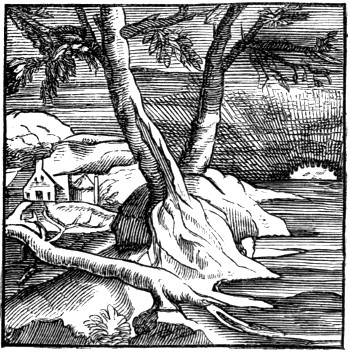
Whitney, 1586.
The longeſt daye, in time reſignes to nighte.
The greateſt oke, in time to duſte doth turne:
The Rauen dies, the Egle failes of flighte.
The Phœnix rare, in time her ſelfe doth burne.
The princelie stagge at lengthe his rave doth ronne.
And all muſt ende, that euer was begonne.
A sentiment this corresponding nearly with Hector’s words, in the Troilus and Cressida (act iv. sc. 5, l. 223, vol. vi. p. 230),—
“The fall of every Phrygian stone will cost
A drop of Grecian blood: the end crowns all,
And that old common arbitrator, Time,
Will one day end it.”
Prince Henry (2 Henry IV., act ii. sc. 2, l. 41, vol. iv. p. 392), in reply to Poins, gives yet another turn to the proverb: “By this hand, thou thinkest me as far in the devil’s books as thou and Falstaff for obduracy and persistency; let the end try the man.”
In Whitney’s address “to the Reader,” he speaks of having collected “sondrie deuises” against several great faults which he names, “bycause they are growẽ so mightie that one bloe will not beate them downe, but newe headdes springe vp like Hydra, that Hercules weare not able to subdue them.” “But,” he adds, using an old saying, “manie droppes pierce the stone, and with manie blowes the oke is ouerthrowen.”