Chapter VII · MISCELLANEOUS EMBLEMS; RECAPITULATION, AND CONCLUSION.
Reading edition
Emblems Miscellaneous will include some which have been omitted, or which remain unclassified from not belonging to any of the foregoing divisions. They are placed here without any attempt to bring them into any special order.
Several words and forms of thought employed by the Emblem writers, and especially by Whitney, have counterparts, if not direct imitations, in Shakespeare’s dramas; he often treats of the same heroes in the same way.
Thus, in reference to Paris and Helen, Whitney utters his opinion respecting them (p. 79),—
“Thoughe Paris, had his Helen at his will,
Thinke howe his faite, was Ilions foule deface.”
And Shakespeare sets forth Troilus (Troilus and Cressida, act ii. sc. 2, l. 81, vol. vi. p. 164) as saying of Helen,—
“Why, she is a pearl,
Whose price hath launch’d above a thousand ships,
And turn’d crown’d kings to merchants.”
And then, as adding (l. 92),—
“O, theft most base,
That we have stol’n what we do fear to keep!
But thieves unworthy of a thing so stol’n.
That in their country did them that disgrace,
We fear to warrant in our native place!”
Whitney inscribes a frontispiece or dedication of his work with the letters, D. O. M.,—i.e., Deo, Optimo, Maximo,—“To God, best, greatest,”—and writes,—
D. O. M.
Since man is fraile, and all his thoughtes are sinne,
And of him ſelfe he can no good inuent,
Then euerie one, before they oughte beginne,
Should call on God, from whome all grace is ſent:
So, I beſeeche, that he the ſame will ſende,
That, to his praiſe I maie beginne, and ende.
Very similar sentiments are enunciated in several of the dramas; as in Twelfth Night (act iii. sc. 4, l. 340, vol. iii. p. 285),—
“Taint of vice, whose strong corruption
Inhabits our frail blood.”
In Henry VIII. (act v. sc. 3, l. 10, vol. vi. p. 103), the Lord Chancellor says to Cranmer,—
“But we all are men,
In our own nature frail and capable
Of our flesh; few are angels.”
Even Banquo (Macbeth, act ii. sc. 1, l. 7, vol. vii. P. 444) can utter the prayer,—
“Merciful powers,
Restrain in me the cursed thoughts that nature
Gives way to in repose!”
And very graphically does Richard III. (act iv. sc. 2, l. 65, vol. v. p. 583) describe our sinfulness as prompting sin,—
“But I am in
So far in blood that sin will pluck on sin.”
Or as Romeo puts the case (Romeo and Juliet, act v. sc. 3, l. 61, vol. vii. p. 124),—
“I beseech thee, youth,
Put not another sin upon my head,
By urging me to fury.”
Coriolanus thus speaks of man’s “unstable lightness” (Coriolanus, act iii. sc. 1, l. 160, vol. vi. p. 344),—
“Not having the power to do the good it would,
For the ill which doth control ’t.”
Human dependence upon God’s blessing is well expressed by the conqueror at Agincourt (Henry V., act iv. sc. 7, l. 82, vol. iv. p. 582),—“Praised be God, and not our strength, for it;” and (act iv. sc. 8, l. 100),—
“O God, thy arm was here!
And not to us, but to thy arm alone
Ascribe we all.”
And simply yet truly does the Bishop of Carlisle point out that dependence to Richard II. (act iii. sc. 2, l. 29, vol. iv. p. 164),—
“The means that heaven yields must be embraced,
And not neglected; else, if heaven would,
And we will not, heaven’s offer we refuse,
The proffer’d means of succour and redress.”
The closing thought of Whitney’s whole passage is embodied in Wolsey’s earnest charge to Cromwell (Henry VIII., act iii. sc. 2, l. 446, vol. vi. p. 79),—
“Be just, and fear not:
Let all the ends thou aim’st at be thy country’s,
Thy God’s, and truth’s; then if thou fall’st, O Cromwell,
Thou fall’st a blessed martyr!”
The various methods of treating the very same subject by the professed Emblem writers will prove that, even with a full knowledge of their works, a later author may yet allow scarcely a hint to escape him, that he was acquainted, in some particular instance, with the sentiments and expressions of his predecessors; indeed, that knowledge itself may give birth to thoughts widely different in their general character. To establish this position we offer a certain proverb which both Sambucus and Whitney adopt, the almost paradoxical saying, We flee the things which we follow, and they flee us,—
Quæ ſequimur fugimus, nosq́ue fugiunt.
Ad Philip. Apianum.
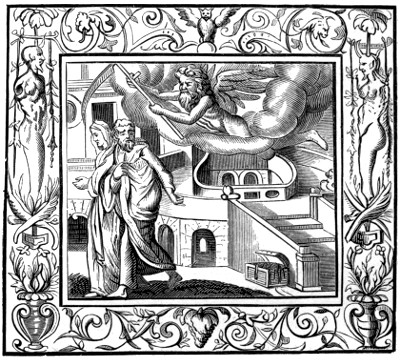
Sambucus, 1564.
Qvid ſemper querimur deeſſe nobis?
Cur nunquam ſatiat fames perennis?
Haud res nos fugiunt, loco ſolemus
Ipſi cedere ſed fugaciore.
Mors nos arripit antè quàm lucremur
Tantum quod cupimus, Deum & precamur,
Vel ſi rem fateare confitendam,
Res, & nos fugimus ſimul fugaces.
Ne ſint diuitiæ tibi dolori:
Ac veram ſtatuas beatitatem
Firmis rebus, in aſperaq́ue vita.
In both instances there is exactly the same pictorial illustration, indeed the wood-block which was engraved for the Emblems of Sambucus, in 1564, with simply a change of border, did service for Whitney’s Emblems in 1586. The device contains Time, winged and flying and holding forward a scythe; a man and woman walking before him, the scythe being held over their heads threateningly,—the man as he advances turning half round and pointing to a treasure-box left behind. Sambucus thus moralizes,—
“What do we querulous always deem our want?
Why never to hunger sense of fulness grant?
Wealth flees us not,—but we accustomed are
By our own haste its benefits to mar.
Death takes us off before we reach the gain
Great as our wish; and vows to God we feign
For wealth which fleeing at the time we flee,
Even when wealth around we own to be.
O let not riches prove thy spirit’s bane!
Nor shall thou seek for happiness in vain,—
Though rough thy paths of life on every hand,
Firm on its base thy truest bliss shall stand.”
Now Whitney adopts, in part at least, a much more literal interpretation; he follows out what the figure of Time and the accessory figures suggest, and so improves his proverb-text as to found upon it what appears pretty plainly to have been the groundwork of the ancient song,—“The old English gentleman, one of the olden time.” The type of that truly venerable character was “Thomas Wilbraham Esquier,” an early patron of Lord Chancellor Egerton. Whitney’s lines are (p. 199),—
“Wee flee, from that wee seeke; & followe, that wee leaue:
And, whilst wee thinke our webbe to skante, & larger still would weaue,
Lo, Time dothe cut vs of, amid our carke: and care.
Which warneth all, that haue enoughe, and not contented are.
For to inioye their goodes, their howses, and their landes:
Bicause the Lorde vnto that end, commits them to their handes.
Yet, those whose greedie mindes: enoughe, doe thinke too small:
Whilst that with care they seeke for more, oft times are reu’d of all,
Wherefore all such (I wishe) that spare, where is no neede:
To vse their goodes whilst that they may, for time apace doth speede.
And since, by proofe I knowe, you hourde not vp your store;
Whose gate, is open to your frende: and purce, vnto the pore:
And spend vnto your praise, what God dothe largely lende:
I chiefly made my choice of this, which I to you commende.
In hope, all those that see your name, aboue the head:
Will at your lampe, their owne come light, within your steppes to tread.
Whose daily studie is, your countrie to adorne:
And for to keepe a worthie house, in place where you weare borne.”
In the spirit of one part of these stanzas is a question in Philemon Holland’s Plutarch (p. 5). “What meane you, my masters, and whither run you headlong, carking and caring all that ever you can to gather goods and rake riches together?”
Similar in its meaning to the two Emblems just considered is another by Whitney (p. 218), Mulier vmbra viri,—“Woman the shadow of man,”—
“Ovr shadowe flies, if wee the same pursue:
But if wee flie, it followeth at the heele.
So, he throughe loue that moste dothe serue, and sue,
Is furthest off his mistresse harte is steele.
But if hee flie, and turne awaie his face,
Shee followeth straight, and grones to him for grace.”
This Emblem is very closely followed in the Merry Wives of Windsor (act ii. sc. 2, l. 187, vol. i. p. 196), when Ford, in disguise as “Master Brook,” protests to Falstaff that he had followed Mrs. Ford “with a doting observance;” “briefly,” he says, “I have pursued her as love hath pursued me; which hath been on the wing of all occasions,”—
“Love like a shadow flies when substance love pursues;
Pursuing that that flies, and flying what pursues.”
Death in most of its aspects is described and spoken of by the great Dramatist, and possibly we might hunt out some expressions of his which coincide with those of the Emblem writers on the same subject, but generally his mention of death is peculiarly his own,—as when Mortimer says (1 Henry VI., act ii. sc. 5, l. 28, vol. v. p. 40),—
“The arbitrator of despairs,
Just death, kind umpire of men’s miseries,
With sweet enlargement doth dismiss me hence.”
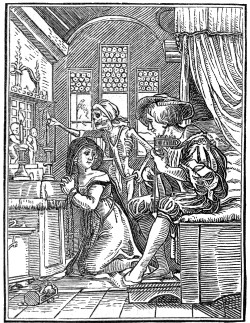
Holbein’s Simulachres, 1538.
In his beautiful edition of Holbein’s Dance of Death, Noel Humphreys (p. 81), in describing the Canoness, thus conjectures,—“May not Shakespeare have had this device in his mind when penning the passage in which Othello” (act v. sc. 2, l. 7, vol. viii. p. 574), “determining to kill Desdemona, exclaims, ‘Put out the light—and then—put out the light?’”
The way, however, in which Shakespeare sometimes speaks of Death and Sleep induces the supposition that he was acquainted with those passages in Holbein’s Simulachres de la Mort (Lyons, 1538) which treat of the same subjects by the same method. Thus,—
“Cicero disoit bien: Tu as le sommeil pour imaige de la Mort, & tous les iours tu ten reuestz. Et si doubtes, sil y à nul sentiment a la Mort, combien que tu voyes qu’ en son simulachre il n’y à nul sentimẽt.” Sign. Liij verso. And again, sign. Liiij verso, “La Mort est le veritable reffuge, la santé parfaicte, le port asseure, la victoire entiere, la chair sans os, le poisson sans espine, le grain sans paille.... La Mort est vng eternel sommeil, vne dissolution du Corps, vng espouuẽtement des riches, vng desir des pouures, vng cas ineuitable, vng pelerinaige incertain, vng larron des hõmes, vne Mere du dormir, vne vmbre de vie, vng separement des viuans, vne compaignie des Mortz.”
Thus the Prince Henry by his father’s couch, thinking him dead, says (2 Hen. IV., act iv. sc. 5, l. 35, vol. iv. p. 453),—
“This sleep is sound indeed; this is a sleep,
That from this golden rigol hath divorced
So many English kings.”
And still more pertinently speaks the Duke (Measure for Measure, act iii. sc. 1, l. 17, vol. i. p. 334),—
“Thy best of rest is sleep,
And that thou oft provokest; yet grossly fear’st
Thy death, which is no more.”
Again, before Hermione, as a statue (Winter’s Tale, act v. sc. 3, l. 18, vol. iii. p. 423),—
“prepare
To see the life as lively mock’d as ever
Still sleep mock’d death.”
Or in Macbeth (act ii. sc. 3, l. 71, vol. vii. p. 454), when Macduff raises the alarm,—
“Malcolm! awake!
Shake off this downy sleep, death’s counterfeit,
And look on death itself! up, up, and see
The great doom’s image.”[180]
Finally, in that noble soliloquy of Hamlet (act iii. sc. 1, lines 60–69, vol. viii. p. 79),—
“To die: to sleep;
No more; and by a sleep to say we end
The heart-ache, and the thousand natural shocks
That flesh is heir to; ’tis a consummation
Devoutly to be wished. To die, to sleep:
To sleep: perchance to dream: ay, there’s the rub;
For in that sleep of death what dreams may come,
When we have shuffled off this mortal coil,
Must give us pause: there’s the respect
That makes calamity of so long life.”
So the Evils of Human Life and the Eulogy on Death, ascribed in Holbein’s Simulachres de la Mort to Alcidamus, sign. Liij verso[181] may have been suggestive of the lines in continuation of the above soliloquy in Hamlet, namely (lines 70–76),—
“For who would bear the whips and scorns of time,
The oppressor’s wrong, the proud man’s contumely,
The pangs of despised love, the law’s delay,
The insolence of office, and the spurns
That patient merit of the unworthy takes,
When he himself might his quietus make
With a bare bodkin?”
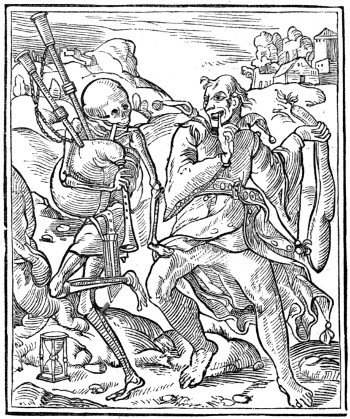
Holbein’s Imagines, Cologne, 1566.
To another of the devices of the Images of Death (Lyons, 1547), attributed to Holbein, we may also refer as the source of one of the Dramatist’s descriptions, in Douce’s Dance of Death, (London, 1833, and Bonn’s, 1858); the device in question is numbered XLIII. and bears the title of the Idiot Fool. Woltmann’s Holbein and his Time (Leipzig, 1868, vol. ii. p. 121), names the figure “Narr des Todes,”—Death’s Fool,—and thus discourses respecting it. “Among the supplemental Figures,”—that is to say, in the edition of 1545, supplemental to the forty-one Figures in the edition of 1538,—“is found that of the Fool, which formerly in the Spectacle-plays of the Dance of Death represented by living persons played an important part. Also as these were no longer wont to be exhibited, the Episode of the contest of Death with the Fool was kept separate, and for the diversion of the people became a pantomimic representation. From England expressly have we information that this usage maintained itself down to the former century. The Fool’s efforts and evasions in order to escape from Death, who in the end became his master, form the subject of the particular figures. On such representations Shakespeare thought in his verses in Measure for Measure” (act iii. sc. 1, lines 6–13, vol. i. p. 334). Though Woltmann gives only three lines, we add the whole passage better to bring out the sense,—
“Reason thus with life:
If I do lose thee, I do lose a thing
That none but fools would keep: a breath thou art,
Servile to all the skyey influences,
That dost this habitation, where thou keep’st,
Hourly afflict: merely, thou art death’s fool;
For him thou labour’st by thy flight to shun,
And yet runn’st toward him still.”
The action described by Shakespeare is so conformable to Holbein’s Figures of Death and the Idiot Fool that, without doing violence to the probability, we may conclude that the two portraits had been in the Poet’s eye as well as in his mind.
Woltmann’s remarks in continuation uphold this idea. He says (vol. ii. p. 122),—
“Also in the Holbein picture the Fool is foolish enough to think that he can slip away from Death. He springs aside, seeks through his movements to delude him, and brandishes the leather-club, in order unseen to plant a blow on his adversary; and this adversary seems in sport to give in, skips near him, playing on the bag-pipe, but unobserved has him fast by the garment, in order not again to let him loose.”
Old Time is a character introduced by way of Chorus into the Winter’s Tale (act iv. sc. 1, l. 7, vol. III. p. 371), and he takes upon himself “to use his wings,” as he says,—
“It is in my power
To o’erthrow law and in one self-born hour
To plant and o’erwhelm custom. Let me pass
The same I am, ere ancient’st order was
Or what is now received: I witness to
The times that brought them in; so shall I do
To the freshest things now reigning, and make stale
The glistering of this present.”
Something of the same paradox which appears in the Emblematist’s motto, “What we follow we flee,” also distinguishes the quibbling dialogue about time between Dromio of Syracuse and Adriana (Comedy of Errors, act iv. sc. 2, l. 53, vol. i. p. 437),—
“Dro. S. ’Tis time that I were gone:
It was two ere I left him, and now the clock strikes one.
Adr. The hours come back! that did I never hear.
Dro. S. O, yes; if any hour meet a sergeant, a’turns back for very fear.
Adr. As if Time were in debt! how fondly dost thou reason!
Dro. S. Time is a very bankrupt, and owes more than he’s worth to season.
Nay, he’s a thief too: have you not heard men say,
That Time comes stealing on by night and day?
If Time be in debt and theft, and a sergeant in the way,
Hath he not reason to turn back an hour in a day?”
Almost of the same complexion are some of the other strong contrasts of epithets which Shakespeare applies. Iachimo, in Cymbeline (act i. sc. 6, l. 46, vol. ix. p. 185), uses the expressions,—
“The cloyed will,
That satiate yet unsatisfied desire, that tub
Both fill’d and running, ravening first the lamb,
Longs after for the garbage.”
But “old fond paradoxes, to make fools laugh i’ the ale-house,” are also given forth from the storehouse of his conceits. Desdemona and Emilia and Iago play at these follies (Othello, act ii. sc. 1, l. 129, vol. viii. p. 477), and thus some of them are uttered,—
“Iago. If she be fair and wise, fairness and wit,
The one’s for use, the other useth it.
Des. Well praised! How if she be black and witty?
Iago. If she be black, and thereto have a wit,
She’ll find a white that shall her blackness fit.
. . . . . .
Des. But what praise couldst thou bestow on a deserving woman indeed?
one that, on the authority of her merit, did justly put on the vouch of very
malice itself?
Iago. She that was ever fair, and never proud,
Had tongue at will, and yet was never loud.
Never lack’d gold, and yet went never gay,
Fled from her wish, and yet said, now I may;
. . . . . .
She was a wight, if ever such wight were,—
Des. To do what?
Iago. To suckle fools, and chronicle small beer.”
We thus return, by a wandering path indeed, to the paradoxical saying with which we set out,—concerning “fleeing what we follow;” for Iago’s paragon of a woman,—
“Fled from her wish, and yet said, now I may.”
Taken by itself, the coincidence of a few words in the dedications of works by different authors is of trifling importance; but when we notice how brief are the lines in which Shakespeare commends his “Venus and Adonis” to the patronage of the Earl of Southampton, it is remarkable that he has adopted an expression almost singular, which Whitney had beforehand employed in the long dedication of his Emblems to the Earl of Leycester. “Being abashed,” says Whitney, “that my habillitie can not affoorde them such, as are fit to be offred vp to so honorable a suruaighe” (p. xi); and Shakespeare, “I leave it to your honourable survey, and your Honour to your heart’s content.” Whitney then declares, “yet if it shall like your honour to allowe of anie of them, I shall thinke my pen set to the booke in happie hour; and it shall incourage mee, to assay some matter of more momente, as soon as leasure will further my desire in that behalfe;” and Shakespeare, adopting the same idea, also affirms, “only if your Honour seem but pleased, I account myself highly praised and vow to take advantage of all idle hours, till I have honoured you with some graver labour.” Comparing these passages together, the inference appears not unwarranted, that Whitney’s dedication had been read by Shakespeare, and that the tenor of it abided in his memory, and so was made use of by him.
From the well-known lines of Horace (Ode ii. 10),—
“Sæpius ventis agitatur ingens
Pinus; et celsæ graviore casu
Decidunt turres; feriuntque summos
Fulgura montes,”—
several of the Emblem writers, and Shakespeare after them, tell of the huge pine and of its contests with the tempests; and how lofty towers fall with a heavier crash, and how the lightnings smite the highest mountains. Sambucus (edition 1569, p. 279) and Whitney (p. 59) do this, as a comment for the injunction, Nimium rebus ne fide secundis,—“Be not too confident in prosperity.” In this instance the stanzas of Whitney serve well to express the verses of Sambucus,—
Nimium rebus ne fide secundis.
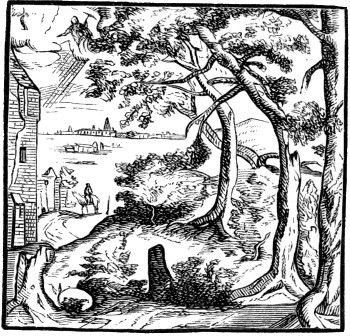
Whitney. 1586.
“The loftie Pine, that on the mountaine growes,
And spreades her armes, with braunches freshe, & greene,
The raginge windes, on sodaine ouerthrowes,
And makes her stoope, that longe a farre was seene:
So they, that truste to muche in fortunes smiles,
Thoughe worlde do laughe, and wealthe doe moste abounde,
When leste they thinke, are often snar’de with wyles,
And from alofte, doo hedlonge fall to grounde:
Then put no truste, in anie worldlie thinges,
For frowninge fate, throwes downe the mightie kinges.”
Antonio, in the Merchant of Venice (act iv. sc. 1, l. 75, vol. ii. p. 345), applies the thought to the fruitlessness of Bassanio’s endeavour to soften Shylock’s stern purpose of revenge,—
“You may as well forbid the mountain pines
To wag their high tops, and to make no noise
When they are fretten with the gusts of heaven.”
And when “dame Eleanor Cobham, Gloster’s wife,” is banished, and her noble husband called on to give up the Lord Protector’s staff of office (2 Henry VI., act ii. sc. 3, l. 45, vol. v. p. 145), Suffolk makes the comparison,—
“Thus droops this lofty pine, and hangs his sprays;
Thus Eleanor’s pride dies in her youngest days.”
So, following almost literally the words of Horace, the exiled Belarius, in Cymbeline (act iv. sc. 2, l. 172, vol. ix. p. 253), declares of the “two princely boys,” that passed for his sons,—
“They are as gentle
As zephyrs blowing below the violet,
Not wagging his sweet head; and yet as rough,
Their royal blood enchafed, as the rudest wind
That by the top doth take the mountain pine
And make him stoop to the vale.”
Words, which, though now obsolete, were in current use in the days of Surrey, Sidney, Spenser, and Shakespeare, cannot of themselves be adduced in evidence of any interchange of ideas; but when the form of the sentence and the application of some peculiar term agree, we may reasonably presume that it has been more than the simple use of the same common tongue which has caused the agreement. When, indeed, one author writes in English, and the others in Latin, or Italian, or French, we cannot expect much more than similarity of idea in treating of the same subject, and a mutual intercommunion of thought; but, in the case of authors employing the same mother tongue, there are certain correspondencies in the use of the same terms and turns of expression which betoken imitation.
Such correspondencies exist between Whitney and Shakespeare, as may be seen from the following among many other instances. I adopt the old spelling of the folio edition of Shakespeare, 1632,—
Abroach Whitney, p. 7 And bluddie broiles at home are set abroache.
Rom. and J. i. 1. l. 102 Who set this ancient quarrell new abroach?
2 Hen. IV. iv. 2, 14 Alacke, what Mischeifes might be set abroach.
a-worke Whitney, p. vi. They set them selues a worke.
2 Hen. IV. iv. 3, 107 Skill in the Weapon is nothing, without Sacke (for that sets it a-worke).
K. Lear, iii. 5, 5 — a provoking merit set a-worke by a reprovable badnesse in himselfe.
Banne Whitney, p. 189 The maide her pacience quite forgot
And in a rage, the brutishe beaste did banne.
Hamlet, iii. 2, 246 With Hecats ban, thrice blasted, thrice infected.
1 Hen. IV. v. 3, 42 Fell banning Hagge, Inchantresse hold thy tongue.
2 Hen IV. ii. 4, 25 And banne thine Enemies, both mine and thine.
Cates Whitney, p. 18 Whose backe is fraughte with cates and daintie cheere.
C. Errors, iii. 1, 28 But though my cates be meane, take them in good part.
1 Hen. IV. iii. 1, 163 I had rather live
With Cheese and Garlike in a Windmill far
Then feed on Cates, and have him talke to me
In any Summer House in Christendome.
create Whitney, p. 64 Not for our selues alone wee are create.
M. N. Dr. v. 1, 394 And the issue there create
Ever shall be fortunate.
K. John, iv. 1, 106 The fire is dead with griefe
Being create for comfort.
Hen. V. ii. 2, 31 With hearts create of duty and of zeal.
Erksome Whitney, p. 118 With erksome noise and eke with poison fell.
T. of Shrew, i. 2, 182 I know she is an irkesome brawling scold.
2 Hen. VI. ii. 1, 56 How irkesome is this Musicke to my heart!
Ingrate Whitney, p. 64 And those that are vnto theire frendes ingrate.
T. of Shrew, i. 2, 266 Will not so gracelesse be, to be ingrate.
Coriol. v. 2, 80 Ingrate forgetfulness shall poison rather.
Prejudicate Whitney, xiii. The enuious who are alwaies readie with a prejudicate opinion to condempe.
All’s Well, i. 2, 7 wherein our deerest friend
Prejudicates the businesse.
Ripes Whitney, p. 23 When autumne ripes the frutefull fields of grane.
K. John, ii. 1, 472 — yon greene Boy shall haue no Sunne to ripe
The bloome that promiseth a mighty fruit.
Vnrest Whitney, p. 94 It shewes her selfe doth worke her own vnrest.
Rich. II. ii. 4, 22 Witnessing Stormes to come, Woe and Vnrest.
T. An. ii. 3, 8 And so repose sweet Gold for their unrest.
vnsure Whitney, p. 191 So, manie men do stoope to sightes vnsure.
Hamlet, iv. 4, 51 Exposing what is mortal and unsure.
Macbeth, v. 4, 19 Thoughts speculative their unsure hopes relate.
vnthrifte Whitney, p. 17 And wisdome still, against such vnthriftes cries.
Rich. II. ii. 3, 120 my Rights and Royalties
Pluckt from my armes perforce, and giuen away
To upstart Vnthriftes.
Timon, iv. 3, 307 What man didd’st thou euer knowe unthrifte that was beloved after his meanes?
M. Venice, v. 1, 16 And with an unthrift love did run from Venice
As far as Belmont.[182]
So close are some of these correspondencies that they can scarcely be accounted for except on the theory that Shakespeare had been an observant reader of Whitney’s Emblems.
There are also various expressions, or epithets, which the Emblem-books may be employed to illustrate, and which receive their most natural explanation from this same theory that Shakespeare was one of the very numerous host of Emblem students or readers. Perriere’s account of a man attempting to swim with a load of iron on his back (Emb. 70), is applied by Whitney with direct reference to the lines in Horace, “O cursed lust of gold, to what dost thou not compel mortal bosoms?” He sets off the thought by the device of a man swimming with “a fardle,” or heavy burden (p. 179),—
Auri ſacra fames quid non?
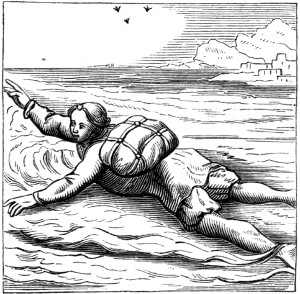
Whitney, 1586.
“Desire to haue, dothe make vs muche indure.
In trauaile, toile, and labour voide of reste:
The marchant man is caried with this lure,
Throughe scorching heate, to regions of the Easte:
Oh thirste of goulde, what not? but thou canst do:
And make mens hartes for to consent thereto.
The trauailer poore, when shippe doth suffer wracke,
Who hopes to swimme vnto the wished lande,
Dothe venture life, with fardle on his backe,
That if he scape, the same in steede maye stande.
Thus, hope of life, and loue vnto his goods,
Houldes vp his chinne, with burthen in the floods.”
In the Winter’s Tale, the word “fardel” occurs several times; we will, however, take a familiar quotation from Hamlet (act iii. sc. 1, l. 76, vol. viii. p. 80),—
“Who would fardels bear,
To grunt and sweat under a weary life,
But that the dread of something after death,
The undiscover’d country from whose bourn
No traveller returns, puzzles the will,
And makes us rather bear those ills we have
Than fly to others that we know not of?”
The Bandogs, which Sir Thomas More and Spenser describe, appear to have been different from those of Sambucus and Whitney, or, rather, they were employed for a different purpose. “We must,” writes the worthy Chancellor (p. 586), “haue bande dogges to dryue them (the swine) out of the corne with byting, and leade them out by the ears;” and Spenser, in Virgil’s Gnat (l. 539), speaks of—
“greedie Scilla, under whom there lay
Manie great bandogs, which her gird about.”
These dogs were mastiffs, and their banning was barking or braying; but the dogs entitled bandogs in Whitney, though also mastiffs, were fastened by a band to a small cart, and trained to draw it. A large species of dog may be seen at this day in the towns of Belgium performing the very same service to which their ancestors had been accustomed above three centuries ago. Sambucus heads his description of the bandog’s strength and labours with the sentence,—“ The dog complains that he is greatly wronged.”
Canis queritur nimium nocere.
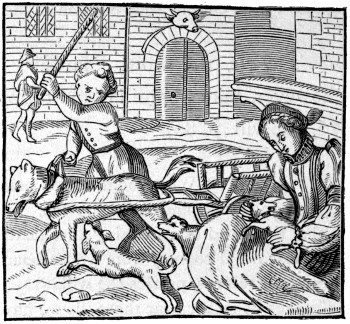
Sambucus, 1584.
Non ego furaces nec apros inſector & vrſos,
Applaudit nec hero blandula cauda dolo:
Sub iuga ſed mittor validus, traho & eſſeda collo,
Quæq́₃que leuant alios viribus vſque premor.
Per vicos ductum me alij latratibus vrgent,
Miratur caſus libera turba meos.
Quàm fueram charus dominæ, ſi paruulus eſſem,
Non menſsa, lecto nec caruiſſe velim.
Sic multis vires, & opes nocuere ſuperbæ:
Contentum modico & profuit eſſe ſtatu.
Seated near the toiling mastiff is a lady with two or three pet curs, and the large dog complains,—
“Were I a little whelp, to my lady how dear I should be; Of board and of bed I never the want should see.”[183]
Whitney, using the woodcut which adorns the editions of Sambucus both in 1564 and 1599, prefixes a loftier motto (p. 140),—Feriunt summos fulmina montes,—“Thunderbolts strike highest mountains;” and thus expatiates he,—
“The bandogge, fitte to matche the bull, or beare,
With burthens greate, is loden euery daye:
Or drawes the carte, and forc’d the yoke to weare:
Where littell dogges doe passe their time in playe:
And ofte, are bould to barke, and eeke to bite,
When as before, they trembled at his sighte.
Yet, when in bondes they see his thrauled state,
Eache bragginge curre, beginnes to square, and brall:
The freër sorte, doe wonder at his fate,
And thinke them beste, that are of stature small:
For they maie sleepe vppon their mistris bedde,
And on their lappes, with daynties still bee fedde.
The loftie pine, with axe is ouerthrowne,
And is prepar’d, to serue the shipmans turne:
When bushes stande, till stormes bee ouerblowne,
And lightninges flashe, the mountaine toppes doth burne.
All which doe shewe that pompe, and worldlie power,
Makes monarches, markes: when varrijnge fate doth lower.”
The mastiff is almost the only dog to which Shakespeare assigns any epithet of praise. In Henry V. (act iii. sc. 7, l. 130, vol. iv. p. 552), one of the French lords, Rambures, acknowleges “that island of England breeds very valiant creatures; their mastiffs are of unmatchable courage.” It is the same quality in Achilles and Ajax on which Ulysses and Nestor count when “the old man eloquent,” in Troilus and Cressida (act i. sc. 3, l. 391, vol. vi. p. 155), says of the two warriors,—
“Two curs shall tame each other: pride alone
Must tarre[184] the mastiffs on, as ’twere their bone.”
It is, however, only in a passing allusion that Shakespeare introduces any mention of the bandog. He is describing the night “when Troy was set on fire” (2 Henry VI., act i. sc. 4, l. 16, vol. v. p. 129), and thus speaks of it,—
“The time when scritch-owls cry, and ban-dogs howl,
When spirits walk, and ghosts break up their graves.”
We are all familiar with the expression “motley’s the only wear,” and probably we are disposed simply to refer it to the way in which that important personage was arrayed who exercised his fun and nonsense and shrewd wit in the courts of the kings and in the mansions of the nobles of the middle ages. The pictorial type exists in the Emblems both of Sambucus and of his copyist Whitney (p. 81), by whom the sage advice is imparted,—“Give trifles in charge to fools.”
Fatuis leuia commitito.
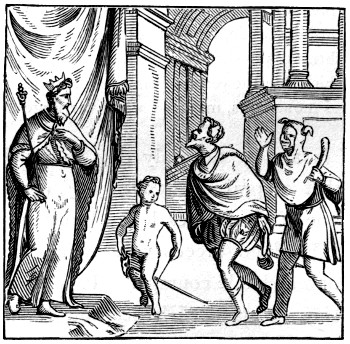
Whitney, 1586.
“The little childe, is pleas’de with cockhorse gaie,
Althoughe he aske a courser of the beste:
The ideot likes, with bables for to plaie,
And is disgrac’de, when he is brauelie dreste:
A motley coate, a cockescombe, or a bell,
Hee better likes, then Iewelles that excell.
So fondelinges vaine, that doe for honor sue,
And seeke for roomes, that worthie men deserue:
The prudent Prince, dothe give hem ofte their due,
Whiche is faire wordes, that right their humors serue:
For infantes hande, the rasor is vnfitte,
And fooles vnmeete, in wisedomes seate to sitte.”
The word “motley” is often made use of in Shakespeare’s plays. Jaques, in As You Like It (act ii. sc. 7, lines 12 and 42, vol. ii. pp. 405, 406), describes the “motley fool” “in a motley coat,”—
“I met a fool i’ the forest,
A motley fool; a miserable world!
As I do live by food, I met a fool;
Who laid him down and bask’d him in the sun,
And rail’d on Lady Fortune in good terms,
In good set terms, and yet a motley fool.
. . . . . .
O that I were a fool!
I am ambitious for a motley coat.”
The Prologue to Henry VIII. (l. 15) alludes to the dress of the buffoons that were often introduced into the plays of the time,—
“a fellow
In a long motley coat, guarded with yellow.”
The fool in King Lear (act i. sc. 4, 1. 93, vol. viii. p. 280) seems to have been dressed according to Whitney’s pattern, for, on giving his cap to Kent, he says,—
“Sirrah, you were best take my coxcomb.
Kent. Why, fool?
Fool. Why, for taking one’s part that’s out of favour: nay, an thou canst not smile as the wind sits, thou’lt catch cold shortly: there, take my coxcomb: why, this fellow hath banished two on’s daughters, and done the third a blessing against his will; if thou follow him, thou must needs wear my coxcomb.”
Drant’s translations[185] from Horace, published in 1567, convey to us a pretty accurate idea of the fool’s attire,—
“Well geue him cloth and let the fool
Goe like a cockescome still.”
Perchance we know the lines in the “Faerie Queene” (vi. c. 7, 49, 1. 6),—
“And other whiles with bitter mockes and mowes
He would him scorne, that to his gentle mynd
Was much more grievous then the others blowes:
Words sharpely wound, but greatest griefe of scorning growes.”
But probably we are not prepared to trace some of the expressions in these lines to an Emblem-book origin. The graphic “mockes and mowes,” indeed, no Latin nor French can express; but our old friend Paradin, in the “Devises Heroiqves” (leaf 174), names an occasion on which very amusing “mockes and mowes” were exhibited; it was, moreover, an example that,—
“Things badly obtained are badly scattered.” As he narrates the tale,— “One day it happened that a huge ape, nourished in the house of a miser who found pleasure only in his crowns, after seeing through a hole his master playing with his crowns upon a table, obtained means of entering within by an open window, while the miser was at dinner. The ape took a stool, as his master did, but soon began to throw the silver out of the window into the street. How much the passers by kept laughing and the miser was vexed, I shall not attempt to say. I will not mock him among his neighbours who were picking up his bright crowns either for a nestegg, or for a son or a brother,—for a gamester, a driveller or a drunkard,—for I cannot but remember that fine and true saying which affirms, ‘Things badly gained are badly scattered.’”
This tale, derived by Paradin from Gabriel Symeoni’s Imprese Heroiche et Morali, is assumed by Whitney as the groundwork of his very lively narrative (p. 169), Against Userers, of which we venture to give the whole.
Malè parta malè dilabuntur.
In fæneratores.
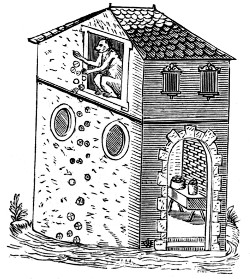
Whitney, 1586.
“An vserer, whose Idol was his goulde,
Within his house, a peeuishe ape retain’d:
A seruaunt fitte, for suche a miser oulde,
Of whome both mockes, and apishe mowes, he gain’d.
Thus, euerie daie he made his master sporte,
And to his clogge, was chained in the courte.
At lengthe it hap’d? while greedie graundsir din’de?
The ape got loose, and founde a windowe ope:
Where in he leap’de, and all about did finde,
The God, wherein the Miser put his hope?
Which soone he broch’d, and forthe with speede did flinge,
And did delighte on stones to heare it ringe?
The sighte, righte well the passers by did please,
Who did reioyce to finde these goulden crommes:
That all their life, their pouertie did ease.
Of goodes ill got, loe heere the fruicte that commes.
Looke herevppon, you that have Midas minte,
And bee posseste with hartes as harde as flinte.
Shut windowes close, leste apes doe enter in,
And doe disperse your goulde, you doe adore.
But woulde you learne to keepe, that you do winne?
Then get it well, and hourde it not in store.
If not: no boultes, nor brasen barres will serve,
For God will waste your stocke, and make you sterue.”
Poor Caliban, in the Tempest (act ii. sc. 2, l. 7, vol. i. p. 36), complains of Prospero’s spirits that,—
“For every trifle are they set upon me;
Sometimes like apes, that mow and chatter at me,
And after bite me.”
And Helena, to her rival Hermia (Midsummer Night’s Dream, act iii. sc. 2, l. 237, vol. ii. p. 240), urges a very similar charge,—
“Ay, do, persever, counterfeit sad looks,
Make mouths upon me when I turn my back;
Wink each at other; hold the sweet jest up.”
There is not, indeed, any imitation of the jocose tale about the ape[186] and the miser’s gold, and it is simply in “the mockes and apishe mowes” that any similarity exists. These, however, enter into the dialogue between Imogen and Iachimo (Cymbeline, act i. sc. 6, l. 30, vol. ix. p. 184); she bids him welcome, and he replies,—
“Iach. Thanks, fairest lady.
What, are men mad? Hath nature given them eyes
To see this vaulted arch and the rich crop
Of sea and land, which can distinguish ’twixt
The fiery orbs above and the twinn’d stones
Upon the number’d beach, and can we not
Partition make with spectacles so precious
’Twixt fair and foul?
Imo. What makes your admiration?
Iach. It cannot be i’ the eye; for apes and monkeys,
’Twixt two such shes, would chatter this way and
Contemn with mows the other.”
There is a fine thought in Furmer’s Use and Abuse of Wealth, first published in Latin in 1575, and afterwards, in 1585, translated into Dutch by Coornhert; it is respecting the distribution of poverty and riches by the Supreme wisdom. The subject (at p. 6) is Undeserved Poverty,—“The Lord maketh poor, and enriches.” (See Plate XVI.)
“The riches which Job had as God bestows,
So giver of poverty doth God appear.
Who thinks each good because from God each flows,
Shall always each with bravest spirit bear.”
Plate 16
IIII.
Pavpertas immerita.
Dominus pauperem facit & ditat.
1. Regum 2, 7.
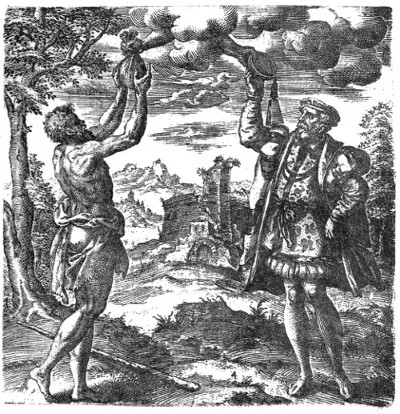
Vt Deus auctor opum quas olim Iobus habebat,
Sic paupertatis tum Deus auctor erat.
Qui bonum vtrumq́₃que putat, Dominus quia donat vtrumque,
In animo forti ſemper vtrumque feret.
Providence making Rich and making Poor Coörnhert, 1585.
In the device, the clouds are opened to bestow fulness upon the poor man, and emptiness upon the rich. By brief allusion chiefly does Shakespeare express either of these acts; but in the Tempest (act iii. sc. 2, l. 135, vol. i. p. 48), Caliban, after informing Stephano that “the isle is full of noises,” and that “sometimes a thousand twangling instruments will hum about mine ears,” adds,—
“And then, in dreaming,
The clouds methought would open, and show riches
Ready to drop upon me; that when I waked,
I cried to dream again.”
A very similar picture and sentiment to those in Coornhert are presented by Gloucester’s words in King Lear (act iv. sc. 1, l. 64, vol. viii. p. 366),—
“Here, take this purse, thou whom the heavens’ plagues
Have humbled to all strokes: that I am wretched
Makes thee the happier. Heavens, deal so still!
Let the superfluous and lust-dieted man,
That slaves your ordinance, that will not see
Because he doth not feel, feel your power quickly;
So distribution should undo excess,
And each man have enough.”
Coornhert’s title, “Recht Ghebruyck ende Misbruyck vantydlycke have,”—The right use and misuse of worldly wealth,—and, indeed, his work, have their purport well carried out by the king in 2 Henry IV. (act iv. sc. 4, l. 103, vol iv. p. 450),—
“Will Fortune never come with both hands full,
But write her fair words still in foulest letters?
She either gives a stomach and no food;
Such are the poor, in health; or else a feast
And takes away the stomach; such are the rich.
That have abundance and enjoy it not.”
The fine thoughts of Ulysses, too, in Troilus and Cressida (act iii. sc. 3, l. 196, vol. vi. p. 201), have right and propriety here to be quoted,—
“The providence that’s in a watchful state
Knows almost every grain of Plutus’ gold,
Finds bottom in the uncomprehensive deeps,
Keeps place with thought and almost like the gods
Does thoughts unveil in their dumb cradles.
There is a mystery, with whom relation
Durst never meddle, in the soul of state;
Which hath an operation more divine
Than breath or pen can give expressure to.”
Petruchio’s thought, perchance, may be mentioned in this connection (Taming of the Shrew, act iv. sc. 3, l. 165, vol. iii. p. 78), when he declares his will to go to Kate’s father,—
“Even in these honest mean habiliments:
Our purses shall be proud, our garments poor;
For ’tis the mind that makes the body rich:
And as the sun breaks through the darkest clouds,
So honour peereth in the meanest habit.”
Plate 17.
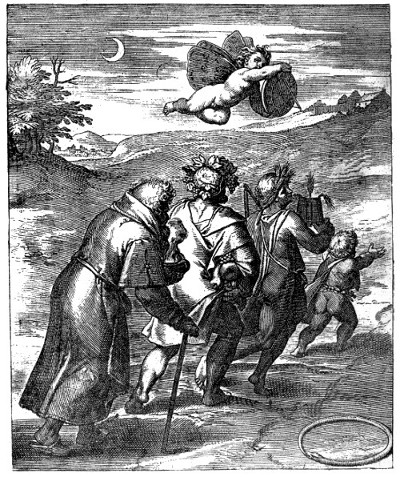
Time Flying from “Emblemata” by Otho Vænius p 206 ed 1612
The Horatian thought, “Time flies irrevocable.” so well depicted by Otho Vænius in his Emblemata (edition 1612, p. 206), has only general parallels in Shakespeare; and yet it is a thought with which our various dissertations on Shakespeare and the Emblematists may find no unfitting end. The Christian artist far excels the Heathen poet. Horace, in his Odes (bk. iv. carmen 7), declares,—
“Immortalia ne speres, monet annus & almum
Quæ rapit hora diem:
Frigora mitescunt Zephyris: Ver proterit Æstas
Interitura, simul
Pomifer Autumnus fruges effuderit: & mox
Bruma recurrit iners.”
i.e. “Not to hope immortal things, the year admonishes, and the hour
which steals the genial day. By western winds the frosts grow mild; the
summer soon to perish supplants the spring, then fruitful autumn pours forth
his stores, and soon sluggish winter comes again.”
These, however, the artist makes (Henry V., act iv. sc. 1, l. 9, vol. v. p. 555),—
“Preachers to us all, admonishing
That we should dress us fairly for our end.”
Youthful Time (see Plate XVII.) is leading on the seasons,—a childlike spring, a matured summer wreathed with corn, an autumn crowned with vines, and a decrepid winter,—and yet the emblem of immortality lies at their feet; and the lesson is taught, as our Dramatist expresses it (Hamlet, act i. sc. 2, l. 71, vol. viii. p. 14),—
“All that lives must die
Passing through nature to eternity.”
The irrevocable time flies on, and surely it has its comment in Macbeth (act v. sc. 5, l. 19, vol. vii. p. 512),—
“To-morrow, and to-morrow, and to-morrow,
Creeps in this petty pace from day to day
To the last syllable of recorded time;
And all our yesterdays have lighted fools
The way to dusty death.”
Or, in Hotspur’s words (1 Henry IV., act v. sc. 2, l. 82, vol. iv. p. 337),—
“O gentlemen, the time of life is short!
To spend that shortness basely were too long,
If life did ride upon a dial’s point,
Still ending at the arrival of an hour.”
And for eternity’s Emblem,[187] the Egyptians, we are told (Horapollo, i. 1), made golden figures of the Basilisk, with its tail covered by the rest of its body; so Otho Vænius presents the device to us. But Shakespeare, without symbol, names the desire, the feeling, the fact itself; he makes Cleopatra exclaim (Antony and Cleopatra, act v. sc. 2, l. 277, vol. ix. p. 150), “I have immortal longings in me,” “I am fire and air; my other elements I give to baser life.”
When Romeo asks (Romeo and Juliet, act v. sc. 1, l. 15, vol. vii. p. 117),—
“How fares my Juliet? that I ask again;
For nothing can be ill, if she be well;”
with the force of entire faith the answer is conceived which Balthasar returns,—
“Then she is well, and nothing can be ill:
Her body sleeps in Capel’s monument,
And her immortal part with angels lives.”
We thus know in what sense to understand the words from Macbeth (act iii. sc. 2, l. 22, vol. vii. p. 467),—
“Duncan is in his grave;
After life’s fitful fever he sleeps well;
Treason has done his worst: nor steel, nor poison,
Malice domestic, foreign levy, nothing,
Can touch him further.”
Therefore, in spite of quickly fading years, in spite of age irrevocable, and (Love’s Labours Lost, act i. sc. 1, l. 4, vol. ii. p. 97),—
“In spite of cormorant devouring Time,
The endeavour of this present breath may buy
That honour which shall bate his scythe’s keen edge,
And make us heirs of all eternity.”
A brief resumé, or recapitulation, will now place the nature of our argument more clearly in review.
When writing and its kindred arts of designing and colouring were the only means in use for the making and illustrating of books, drawings of an emblematical character were frequently executed both for the ornamenting and for the fuller explanation of various works.
From the origin of printing, books of an emblematical character, as the Bibles of the Poor and other block-books, were generally known in the civilised portions of Europe; they constituted, to a considerable degree, the illustrated literature of their age, and enjoyed wide fame and popularity.
Not many years after printing with moveable types had been invented, Emblem works as a distinct species of literature appeared; and of these some of the earliest were soon translated into English.
It is on undoubted record that the use of Emblems, derived from German, Latin, French, and Italian sources, prevailed in England for purposes of ornamentation of various kinds; that the works of Brandt, Giovio, Symeoni, and Paradin were translated into English; and that there were several English writers or collectors of Emblems within Shakespeare’s lifetime,—as Daniell, Whitney, Willet, Combe, and Peacham.
Shakespeare possessed great artistic powers, so as to appreciate and graphically describe the beauties and qualities of excellence in painting, sculpture, and music. His attainments, too, in the languages enabled him to make use of the Emblem-books that had been published in Latin, Italian, and French, and possibly in Spanish.
In everything, except in the actual pictorial device, Shakespeare exhibited himself as a skilled designer,—indeed, a writer of Emblems; he followed the very methods on which this species of literary composition was conducted, and needed only the engraver’s aid to make perfect designs.
Freest among mortals were the Emblem writers in borrowing one from the other, and from any source which might serve the construction of their ingenious devices; and they generally did this without acknowledgment. An Emblem once launched into the world of letters was treated as a fable or a proverb,—it became for the time and the occasion the property of whoever chose to take it. In using Emblems, therefore, Shakespeare is no more to be regarded as a copyist than his contemporaries are, but simply as one who exercised a recognised right to appropriate what he needed of the general stock of Emblem notions.
There are several direct References in Shakespeare, at least six, in which, by the closest description and by express quotation, he identifies himself with the Emblem writers who preceded him.
But besides these direct References, there are several collateral ones, in which ideas and expressions are employed similar to those of Emblematists, and which indicate a knowledge of Emblem art.
And, finally, the parallelisms and correspondencies are very numerous between devices and turns of thought, and even between the words of the Emblem writers and passages in Shakespeare’s Sonnets and Dramas; and these receive their most appropriate rationale on the supposition that they were suggested to his mind through reading the Emblem-books, or through familiarity with the Emblem literature.
Now, such References and Coincidences are not to be regarded as purely accidental, neither can all of them be urged with entire confidence. Some persons even may be disposed to class them among the similarities which of necessity arise when writers of genius and learning take up the same themes, and call to their aid all the resources of their memory and research.
I presume not, however, to say that my arguments and statements are absolute proofs, except in a few instances. What I maintain is this: that the Emblem writers, and our own Whitney especially, do supply many curious and highly interesting illustrations of the Shakespearean dramas, and that several of them, probably, were in the mind of the Dramatist as he wrote.
To show that the theory carried out in these pages is neither singular nor unsupported by high authorities, it should not be forgotten that the very celebrated critic, Francis Douce, in his Illustrations of Shakespeare (pp. 302, 392), maintains that Paradin was the source of the torch-emblem in the Pericles (act ii. sc. 2, l. 32): the “wreath of victory,” and “gold on the touchstone,” have also the same source. To Holbein’s Simulachres Noel Humphreys assigns the origin of the expression in Othello, “Put out the light—and then, put out the light;” and in the same work, Dr. Alfred Woltmann, in Holbein and his Times (vol. ii. p. 121), finds the origin of Death’s fool in Measure for Measure: and Shakespeare’s comparisons of “Death and Sleep” may be traced to Jean de Vauzelle, who wrote the Dissertations for Les Simulachres. Charles Knight, also, in his Pictorial Shakspere (vol. i. p. 154), to illustrate the lines in Hamlet (act iv. sc. 5, l. 142) respecting “the kind life-rendering pelican,” quotes Whitney’s stanza, and copies his woodcut, as stated ante, p. 396, note.
Though not a learned man, as Erasmus or Beza was, Shakespeare, as every page of his wonderful writings shows, must have been a reading man, and well acquainted with the current literature of his age and country. Whitney’s Emblemes were well known in 1612 to the author of “Minerva Britanna,” and boasted of in 1598 by Thomas Meres, in his Wit’s Commonwealth, as fit to be compared with any of the most eminent Latin writers of Emblems, and dedicated to many of the distinguished men of Elizabeth’s reign; and they could scarcely have been unknown to Shakespeare even had there been no similarities of thought and expression established between the two writers.
Nor after the testimonies which have been adduced, and comparing the picture-emblems submitted for consideration with the passages from Shakespeare which are their parallels, as far as words can be to drawings, are we required to treat it as nothing but a conjecture that Shakespeare, like others of his countrymen, possessed at least a general acquaintance with the popular Emblem-books of his own generation and of that which went before.
The study of the old Emblem-books certainly possesses little of the charm which the unsurpassed natural power of Shakespeare has infused into his dramas, and which time does not diminish; yet that study is no barren pursuit for such as will seek for “virtue’s fair form and graces excellent,” or who desire to note how the learning of the age disported itself at its hours of recreation, and how, with few exceptions, it held firm its allegiance to purity of thought, and reverenced the spirit of religion. Should there be any whom these pages incite to gain a fuller knowledge of the Emblem literature, I would say in the words of Arthur Bourchier, Whitney’s steady friend,—
“Goe forwarde then in happie time, and thou shalt surely finde,
With coste, and labour well set out, a banquet for thy minde,
A storehouse for thy wise conceiptes, a whetstone for thy witte:
Where, eache man maye with daintie choice his fancies finely fitte.”
So much for the early cultivators of Emblematical mottoes, devices, and poesies, and for him whom Hugh Holland, and Ben Jonson, and “The friendly Admirer of his Endowments,” salute as “The Famous Scenicke Poet,” “The Sweet Swan of Avon,” “The Starre of Poets,”—
“Soule of the Age!
The applause! delight! the wonder of our stage!”
“To the memory of my beloved, the Author, Mr. William Shakespeare: and what he has left us;”—such the dedication when Jonson declared,—
“Thou art a Moniment without a tombe.
. . . . . .
And art aliue still, while thy Booke doth liue
And we haue wits to read, and praise to giue.”
Giovio, ed. 1556.
I.
COINCIDENCES BETWEEN SHAKESPEARE AND WHITNEY IN THE USE AND APPLICATION OF WORDS NOW OBSOLETE, OR OF OLD FORM.
N.B. After the words the References are to the pages and lines of Whitney’s Emblems; in the Dramas to the act, scene, and line, according to the Cambridge Edition, 8vo, in 9 vols. 1866.
Accidentes p. vi. line 2 yet they set them selues a worke in handlinge suche accidentes, as haue bin done in times paste.
p. vii. l. 21 this present time behouldeth the accidentes of former times.
Tempest, v. 1. 305 And the particular accidents gone by.
1 Hen. IV. i. 2, 199 And nothing pleaseth but rare accidents.
W. Tale, iv. 4, 527 As the unthought-on accident is guilty.
affectioned p. vi. l. 5 one too much affectioned, can scarce finde an ende of the praises of Hector.
Twelfth N. ii. 3, 139 An affectioned ass.
L. L. Lost, i. 2, 158. I do affect the very ground.
aie, or aye p. 21, l. 7 With theise hee lines, and doth rejoice for aie.
p. 111, l. 12 Thy fame doth liue, and eeke, for aye shall laste.
M. N. Dr. i. l. 71 For aye to be in shady cloister mew’d.
Pericles, v. 3, 95 The worth that learned charity aye wears.
Tr. and Cr. iii. 2, 152 To feed for aye her lamp and flames of love.
alder, or elder p. 120, l. 5 And why? theise two did alder time decree.
2 Hen. VI. i. l. 28 With you my alder, liefest sovereign.
Tr. and Cr. ii. 2, 104 Virgins and boys, mid-age and wrinkled eld.
Rich. II. ii. 3, 43 — which elder days shall ripen.
amisse p. 211, l. 16 That all too late shee mourn’d, for her amisse.
Hamlet iv. 5, 18 Each toy seems prologue to some great amiss.
Sonnet cli. 3 Then gentle cheater urge not my amiss.
Sonnet xxxv. 7 Myself corrupting, salving thy amiss.
annoyes p. 219, l. 9 His pleasures shalbee mated with annoyes.
Rich. III. v. 3, 156 Guard thee from the boar’s annoy!
Tit. An. iv. 1, 50 — root of thine annoy.
3 Hen. VI. v. 7, 45 — farewell, sour annoy!
assaie p. 34, l. 13 But when the froste, and coulde, shall thee assaie.
p. 40, l. 3 With reasons firste, did vertue him assaie.
1 Hen. IV. v. 4, 34 I will assay thee; so defend thyself.
Hamlet, ii. 2, 71 Never more to give the assay of arms against your majesty.
a worke p. vi. l. 2 They set them selues a worke in handlinge.
2 Hen. IV. iv. 3, 108 for that sets it a-work.
K. Lear, iii. 5, 6 set a-work by a reproveable badness.
Baie, or baye p. 213, l. 3 Wherefore, in vaine aloude he barkes and baies.
p. 191, l. 4 And curteous speeche, dothe keepe them at the baye.
Cymb. v. 5, 222 — set the dogs o’ the street to bay me.
J. Cæs. iv. 3, 27 I had rather be a dog, and bay the moon.
T. of Shrew, v. 2, 56 Your deer does hold you at a bay.
2 Hen. IV. i. 3, 80 — baying him at the heels.
bale p. 180, l. 7 A worde once spoke, it can retourne no more,
But flies awaie, and ofte thy bale doth breede.
p. 219, l. 16 Lo this their bale, which was her blisse you heare.
1 Hen. VI. v. 4, 122 By sight of these our baleful enemies.
Coriol. i. 4, 155 Rome and her rats are at the point of battle;
The one side must have bale.
bane or bayne p. 141, l. 7 Euen so it happes, wee ofte our bayne doe brue.
p. 211, l. 14 Did breede her bane, who mighte haue bath’de in blisse.
Tit. An. v. 3, 73 Lest Rome herself be bane unto herself.
M. for M. i. 2, 123 Like rats that ravin down their proper bane.
Macbeth, v. 3, 59 I will not be afraid of death and bane.
banne p. 189, l. 10 And in a rage, the brutishe beaste did banne.
Hamlet, iii. 2, 246 With Hecate’s ban thrice blasted.
1 Hen. VI. v. 4, 42 Fell, banning hag, enchantress, hold thy tongue!
2 Hen. VI. iii. 2, 319 Every joint should seem to curse and ban.
betide p. 9, l. 2 Woulde vnderstande what weather shoulde betide.
3 Hen. VI. iv. 6, 88. A salve for any sore that may betide.
T. G. Ver. iv. 3, 40. Recking as little what betideth me.
betime p. 50, l. 1 Betime when sleepe is sweete, the chattringe swallowe cries.
Hamlet, iv. 5, 47 All in the morning betime.
2 Hen. VI. iii. 3, 285 And stop the rage betime.
bewraye p. v. l. 30 bewrayeth it selfe as the smoke bewrayeth the fire.
p. 124, l. 5 Theire foxes coate, theire fained harte bewraies.
1 Hen. VI. iv. 1, 107 Bewray’d the faintness of my master’s heart.
K. Lear, ii. 1, 107 He bewray his practice.
3 Hen. VI. i. 1, 211 Whose looks bewray her anger.
bleared p. 94. l. 7 What meanes her eies? so bleared, sore, and redd.
T. of Shrew, v. 1, 103 While counterfeit supposes blear’d thine eyne.
M. Venice, iii. 2, 58 Dardanian wives with blear’d visages.
bloodes p. 99, 1. 18 Can not be free, from guilte of childrens bloodes.
Cymb. i. 1, 1 Our bloods no more obey the heavens than our courtiers.
broache p. 7, l. 2 And bluddie broiles, at home are set a broache.
Rom. and J. i. 1, 102 Who set this ancient quarrel new abroach?
2 Hen. IV. iv. 2, 14 Alack what mischiefs might he set a broach.
budgettes p. 209, l. 10 The quicke Phisition did commaunde that tables should be set
About the misers bed, and budgettes forth to bring.
W. Tale, iv. 3, 18 If tinkers may have leave to live,
And bear the sow-skin budget.
Carle p. 209, l. 5 At lengthe, this greedie carle the Lythergie posseste.
Cymb. v. 2, 4 — this carl, a very drudge of nature’s.
As Like it, iii. 5, 106 And he hath bought the cottage and the bounds
That the old carlot once was master of.
carpes p. 50, 1. 3 Which carpes the pratinge crewe, who like of bablinge beste.
K. Lear, i. 4, 194 — your insolent retinue do hourly carp and quarrel.
1 Hen. VI. iv. 1, 90 This fellow here, with envious carping tongue.
catch’de p. 77, l. 6. Yet, with figge leaues at lengthe was catch’de, & made the fisshers praie.
Rom. and J. iv. 5, 47 But one thing to rejoice and solace in,
And cruel death hath catch’d it from my sight!
cates p. 18, l. 9 Whose backe is fraighte with cates and daintie cheare.
p. 202, l. 12 And for to line with Codrvs cates: a roote and barly bonne.
T. of Shrew, ii. 1, 187 My super-dainty Kate, all dainties are all Kates.
1 Hen. VI. ii. 3, 78 That we may taste of your wine, and see what cates you have.
C. Errors, iii. 1, 28 But though my cates be mean, take them in good part.
caytiffe p. 95, l. 19 See heare how vile, theise caytiffes doe appeare.
Rom. and J. v. 1, 52 Here lives a caitiff wretch.
Rich. II. i. 2, 53 A caitiff recreant to my cousin Hereford.
clogges p. 82, l. 9. Then, lone the onelie crosse, that clogges the worlde with care.
Macbeth, iii. 6, 42 You’ll rue the time that clogs me with this answer.
Rich. II. i. 3, 200 Bear not along the clogging burden of a guilty soul.
cockescombe p. 81, l. 5 A motley coate, a cockescombe, or a bell.
M. Wives, v. 5, 133 Shall I have a coxcomb of frize?
K. Lear, ii. 4, 119 She knapped ’em o’ the coxcombs with a stick.
consummation p. xi. l. 23 wee maie behoulde the consummatiõ of happie ould age.
Cymb. iv. 2, 281 Quiet consummation have.
Hamlet, iii. 1, 63 ’Tis a consummation devoutly to be wish’d.
corrupte p. xiv. l. 19 too much corrupte with curiousnes and newfanglenes.
1 Hen. VI. v. 4, 45 Corrupt and tainted with a thousand vices.
Hen. VIII. i. 2, 116 the mind growing once corrupt,
They turn to vicious forms.
corse p. 109, l. 30 But fortie fiue before, did carue his corse.
W. Tale, iv. 4, 130 Like a bank, for love to lie and play on; not like a corse.
Rom. and J. v. 2, 30 Poor living corse, clos’d in a dead man’s tomb.
create p. 64, l. 1 Not for our selues alone wee are create.
Hen. V. ii. 2, 31 With hearts create of duty and of zeal.
K. John, iv. 1, 107 Being create for comfort.
Deceaste p. 87, l. 13 Throughe Aschalon, the place where he deceaste.
Cymb. i. 1, 38 His gentle lady—deceas’d as he was born.
delight p. xiii l. 37 Lastlie, if anie deuise herein shall delight thee.
Hamlet, ii. 2, 300 Man delights not me.
Much Ado, ii 1, 122 None but libertines delight him.
dernell p. 68, l. 2 The hurtfull tares, and dernell ofte doe growe.
1 Hen. VI. iii. 2, 44 ’Twas full of darnel; do you like the taste?
K. Lear, iv. 4, 4 Darnel, and all the idle weeds that grow.
determine p. x. l. 9 healthe and wealthe—determine with the bodie.
Coriol. iii. 3, 43 Must all determine here?
Coriol. v. 3, 119 I purpose not to wait,—till these wars determine.
distracte p. 102, l. 17 Which when hee sawe, as one distracte with care.
K. Lear, iv. 6, 281 Better I were distract: so should my thoughts be severed from my griefs.
2 Hen. VI. iii. 3, 318 My hair be fix’d on end as one distract.
doombe p. 30, l. 4 Wronge sentence paste by Agamemnons doombe.
As Like it, i. 3, 79 Firm and irrevocable is my doom, which I have pass’d upon her.
Rom. and J. iii. 2, 67 Then, dreadful trumpet, sound the general doom.
doubt p. 148, l. 3 The boye no harme did doubt, vntill he felt the stinge.
Rich. II. iii. 4, 69 ’Tis doubt he will be.
Coriol. iii. 1, 152 More than you doubt the change on’t.
dulcet p. 128, l. 11 And biddes them feare, their sweet and dulcet meates.
As Like it, v. 4, 61 According to the fool’s bolt, Sir, and such dulcet diseases.
Twelfth N. ii. 3, 55 To hear by the nose is a dulcet in contagion.
dull p. 103, l. 12 For ouermuch, dothe dull the finest wittes
Hen. V. ii. 4, 16 For peace itself should not so dull a kingdom.
Sonnet ciii. l. 8 Dulling my lines and doing me disgrace.
Eeke, or eke p. 2, l. 8 Before whose face, and eeke on euerye side.
p. 45, l. 10 And eke this verse was grauen on the brasse.
M. N. Dr. iii. l. 85 Most brisky juvenal, and eke most lovely Jew.
All’s Well, ii. 5, 73 With true observance seek to eeke out that.
M. Wives, ii. 3, 67 And eke Cavaleiro Slender.
englished Title, l. 5 Englished and Moralized.
M. Wives, i. 3, 44 — to be English’d rightly, is, I am Sir John Falstaff’s.
ercksome p. 118, l. 4 With ercksome noise, and eke with poison fell.
T. of Shrew, i. 2, 181 I know she is an irksome brawling scold.
2 Hen. VI. ii. 1, 56 Irksome is this music to my heart.
erste p. 194, l. 20 As with his voice hee erste did daunte his foes.
As Like it, iii. 5, 94 Thy company, which erst was irksome to me.
2 Hen. VI. ii. 4, 13 That erst did follow thy proud chariot wheels.
eschewed p. vii. l. 19 examples—eyther to bee imitated, or eschewed.
M. Wives, v. 5, 225 What cannot be eschew’d, must be embraced.
eternised p. ii. l. 32 — learned men haue eternised to all posterities.
2 Hen. VI. v. 3, 30 Saint Alban’s battle won by famous York
Shall be eterniz’d in all age to come.
euened p. 131, l. 6 If Ægypt spires, be euened with the soile.
K. Lear, iv. 7, 80 To make him even o’er the time he has lost.
Hamlet, v. 1, 27 Their even Christian.
extincte p. iv. l. 32 deathe—coulde not extincte nor burie their memories.
Othello, ii. 1, 81 Give renew’d fire to our extincted spirits.
Rich. II. i. 3, 222 — be extinct with age.
Facte p. 79, l. 22 Thinke howe his facte, was Ilions foule deface.
M. for M. v. 1, 432 Should she kneel down in mercy of this fact.
2 Hen. VI. i. 3, 171 A fouler fact did never traitor in the land commit.
fardle p. 179, l. 9 Dothe venture life, with fardle on his backe.
Hamlet, iii. 1, 76 Who would fardels bear, to groan and sweat under a weary life?
W. Tale, v. 2, 2 I was by at the opening of the fardel.
falls p. 176, l. 7 Euen so, it falles, while carelesse times wee spende.
J. Cæs. iii. 1, 244 I know not what may fall; I like it not.
feare p. 127, l. 11 Who while they liu’de did feare you with theire lookes.
Ant. and C. ii. 6, 24 Thou canst not fear us, Pompey, with thy sails.
M. for M. ii. 1, 2 Setting it up to fear the birds of prey.
fell p. 3, l. 12 Hath Nature lente vnto this Serpent fell.
M. N. Dr. v. 1, 221 A lion-fell, nor else no lion’s dam.
2 Hen. VI. iii. 1, 351 This fell tempest shall not cease to rage.
filed p. 30, l. 5 But howe? declare, Vlysses filed tonge
Allur’de the Iudge, to giue a Iudgement wronge.
Macbeth, iii. 1, 63 If’t be so, for Banquo’s issue have I fil’d my mind.
fittes p. 103, l. 11 Sometime the Lute, the Chesse, or Bowe by fittes.
Tr. and Cr. iii. 1, 54 Well, you say so in fits.
floate p. 7, l. 10 This, robbes the good, and setts the theeues a floate.
J. Cæs. iv. 3, 220 On such a full sea are we now afloat.
Macbeth, iv. 2, 21 But float upon a wild and violent sea.
foile p. 4, l. 10 And breake her bandes, and bring her foes to foile.
Tempest, iii. 1, 45 Did quarrel with the noblest grace she ow’d,
And put it to the foil.
fonde p. 223, l. 7 Oh worldlinges fonde, that ioyne these two so ill.
M. for M. v. 1, 105 Fond wretch, though know’st not what thou speak’st.
M. N. Dr. iii. 2, 317 How simple and how fond I am.
forgotte p. 5, l. 7 Yet time and tune, and neighbourhood forgotte.
Othello, ii. 3, 178 How comes it, Michael, you are thus forgot?
Rich. II. ii. 3, 37 That is not forgot which ne’er I did remember.
foyles p. xvii. l. 18 Perfection needes no other foyles, suche helpes comme out of place.
1 Hen. IV. iv. 2, 207 That which hath no foil to set it off.
fraies p. 51, l. 6 Unto the good, a shielde in ghostlie fraies.
1 Hen. IV. i. 2, 74 To the latter end of a fray, and the beginning of a feast.
M. Venice, iii. 4, 68 And speak of frays, like a fine bragging youth.
frende p. 172, l. 14 As bothe your Towne, and countrie, you maye frende.
Macbeth, iv. 3, 10 As I shall find the time to friend.
Hen. VIII. i. 2, 140 Not friended by his wish.
frettes p. 92, l. 1 The Lute ... lack’de bothe stringes, and frettes.
T. of Shrew, ii. 1, 148 She mistook her frets.
fustie p. 80, l. 6 Or fill the sacke, with fustie mixed meale.
Tr. and Cr. i. 3, 161 at this fusty stuff,
The large Achilles ... laughs out a loud applause.
Gan p. 156, l. 3 At lengthe when all was gone, the pacient gan to see.
Macbeth, i. 2, 54 The thane of Cawdor began a dismal conflict.
Coriol. ii. 2, 112 — the din of war gan pierce his ready sense.
ghoste p. 141, l. 5 Beinge ask’d the cause, before he yeelded ghoste.
1 Hen. VI. i. 1, 67 — cause him once more yield the ghost.
Rich. III. i. 4, 36 — often did I strive to yield the ghost.
ginnes p. 97, l. 3 For to escape the fishers ginnes and trickes.
Twelfth N. ii. 5, 77 Now is the woodcock near the gin.
2 Hen. VI. iii. 1 Be it by gins, by snares.
gladde p. 198, l. 10 And Codrvs had small cates, his harte to gladde.
3 Hen. VI. iv. 6, 93 — did glad my heart with hope.
Tit. An. i. 2, 166 The cordial of mine age to glad my heart!
glasse p. 113, l. 6 An acte moste rare, and glasse of true renoume.
Twelfth N. iii. 4, 363 I my brother know yet liuing in my glasse.
C. Errors, v. 1, 416 Methinks you are my glass, and not my brother.
J. Cæs. i. 2, 68 So well as by reflection, I, your glass.
Rich. II. i. 3, 208 Even in the glasses of thine eyes I see thy grieved heart.
glosse p. 219, l. 17 O loue, a plague, thoughe grac’d with gallant glosse.
L. L. Lost, ii. 1, 47 The only soil of his fair virtue’s gloss.
Hen. VIII v. 3, 71 Your painted gloss discovers,—words and weakness.
gripe p. 75, l. 2 Whose liuer still, a greedie gripe dothe rente.
p. 199, l. 1, 2 If then, content the chiefest riches bee,
And greedie gripes, that doe abounde be pore.
Cymb. i. 6, 105 Join gripes with hands made hard with hourly falshood.
Hen. VIII. v. 3, 100 Out of the gripes of cruel men.
guerdon p. 15, l. 10 And shall at lenghte Actæons guerdon haue.
Much Ado, v. 3, 5 Death in guerdon of her wrongs.
1 Hen. VI. iii. 1, 170 — in reguerdon of that duty done.
guide p. 33, l. 5 And lefte her younge, vnto this tirauntes guide.
Timon, i. 1, 244 Pray entertain them; give them guide to us.
Othello, ii. 3, 195 My blood begins my safer guides to rule.
guise p. 159, l. 9 Inquired what in sommer was her guise.
Macbeth, v. 1, 16 This is her very guise; and, upon my life, fast asleep.
Cymb. v. 1, 32 To shame the guise o’ the world.
Hale, hal’de p. 71, l. 2 In hope at lengthe, an happie hale to haue.
p. 37, l. 10 And Ajax gifte, hal’de Hector throughe the fielde.
1 Hen. VI. v. 4, 64 Although ye hale me to a violent death.
Tit. An. v. 3, 143 Hither hale that misbelieving Moor.
1 Hen. VI. ii. 5, 3 Even like a man new haled from the rack.
happe p. 147, l. 13 So ofte it happes, when wee our fancies feede.
p. 201, l. 29 Wherefore, when happe, some goulden honie bringes?
T. of Shrew, iv. 4, 102 Hap what hap may, I’ll roundly go about her.
Rom. and J. ii. 2, 190 His help to crave, and my dear hap to tell.
harmes p. 183, l. 7 In marble harde our harmes wee always graue.
1 Hen. VI. iv. 7, 30. My spirit can no longer bear these harms.
Rich. III. ii. 2, 103. None can cure their harms by wailing.
hatche p. 180, l. 9 A wise man then, selles hatche before the dore.
K. John, i. 1, 171 In at the window, or else o’er the hatch.
K. Lear, iii. 6, 71 Dogs leap the hatch and all are fled.
haughtie p. 53, l. 7 In craggie rockes, and haughtie mountaines toppe.
1 Hen. VI. iv. 1, 35 Valiant and virtuous, full of haughty courage.
hauocke p. 6, l. 6 Till all they breake, and vnto hauocke bringe.
J. Cæs. iii. 1, 274 Cry “Havock,” and let slip the dogs of war.
K. John, ii. 1, 220 Wide havock made for bloody power.
heste p. 87, l. 10 And life resigne, to tyme, and natures heste.
Tempest, i. 2, 274 Refusing her grand hests,
Tempest, iii. 1, 37 I have broke your hest to say so.
hidde p. 43, l. 1 By vertue hidde, behoulde, the Iron harde.
Much Ado, v. 1, 172 Adam, when he was hid in the garden.
M. Venice, i. 1, 115 Two grains of wheat hid in two bushels of chaff.
Impe p. 186, l. 14 You neede not Thracia seeke, to heare some impe of Orphevs playe.
p. 19, l. 9. But wicked Impes, that lewdlie runne their race.
2 Hen. IV. v. 5, 43 The heavens thee guard and keep, most royal imp of fame.
L. L. Lost, v. 2, 581 Great Hercules is presented by this imp.
indifferencie p. xiv. l. 29 those that are of good iudgemente, with indifferencie will reade.
K. John, ii. 1, 579 Makes it take head from all indifferency.
2 Hen. IV. iv. 3, 20 An I had but a belly of any indifferency.
ingrate p. 64, l. 3 And those, that are vnto theire frendes ingrate.
T. of Shrew, i. 2, 266 — will not so graceless be, to be ingrate.
1 Hen. IV. i. 3, 137 As this ingrate and canker’d Bolingbroke.
ioye p. 5, l. 5 And bothe, did ioye theire iarringe notes to sounde.
T. of Shrew, Ind. 2, 76 Oh, how we joy to see your wit restored.
2 Hen. VI. iii. 2, 364 Live thou to joy thy life.
Kinde p. 49, l. 16 And spend theire goodes, in hope to alter kinde.
p. 178, l. 8 And where as malice is by kinde, no absence helpes at all.
Ant. and C. v. 2, 259 Look you, that the worm will do his kind.
J. Cæs. i. 3, 64 Why birds and beasts, from quality and kind.
As Like it, iii. 2, 93 If the cat will after kind,
So, be sure, will Rosalind.
knitte p. 76, l. 2 And knittes theire subiectes hartes in one.
M. N. Dr. iv. 1, 178 These couples shall eternally be knit.
Macbeth, ii. 2, 37 Sleep that knits up the ravell’d sleave of care.
knotte p. 142, l. 10 Yet, if this knotte of frendship be to knitte.
Cymb. ii. 3, 116 To knit their souls ... in self-figur’d knot.
M. Wives, iii. 2, 64 He shall not knit a knot in his fortune.
Launch’de p. 75, l. 11 Which being launch’de and prick’d with inward care.
Rich. III. iv. 4, 224 Whose hand soever lanced their tender hearts.
Ant. and C. v. 1, 36 We do lance diseases in our bodies.
leaue p. 50, l. 5 For noe complaintes, coulde make him leaue to steale.
Tr. and Cr. iii. 3, 132 What some men do, while some men leave to do!
let p. 89, l. 8 But Riuers swifte, their passage still do let.
p. 209, l. 9 But, when that nothinge coulde Opimivs sleepinge let.
Hamlet, i. 4, 85 By heaven, I’ll make a ghost of him that lets me.
T. G. Ver. iii. 1, 113 What lets, but one may enter at her window.
like p. xi. 1. 14 if it shall like your honour to allowe of anie of them.
K. Lear, ii. 2, 85 His countenance likes me not.
T. G. Ver. iv. 2, 54 The music likes you not.
linke, linckt p. 226, l. 8 Take heede betime: and linke thee not with theise.
p. 133, l. 4 And heades all balde, weare newe in wedlocke linckt.
1 Hen. VI. v. 5, 76 Margaret, he be link’d in love.
Hamlet, i. 5, 55 though to a radiant angel linked.
liste p. 63, l. 3 And with one hande, he guydes them where he liste.
T. of Shrew, iii. 2, 159 Now take them up, quoth he, if any list.
lobbe p. 145, l. 6 Let Grimme haue coales: and lobbe his whippe to lashe.
M. N. Dr. ii, 1, 16 Farewell, thou lob of spirits; I’ll be gone.
lotterie p. 61 Her Maiesties poesie, at the great Lotterie in London.
M. Venice, i. 2, 25 The lottery—in these three chests of gold, silver and lead.
All’s Well, i. 3, 83 — ’twould mend the lottery well.
lustie p. 9, l. 1 A YOUTHEFVLL Prince, in prime of lustie yeares.
As Like it, ii. 3, 52 Therefore my age is as a lusty winter.
T. G. Ver. iv. 2, 25 Let’s tune, and to it lustily a while.
Meane p. 23, l. 12 The meane preferre, before immoderate gaine.
M. Venice, i. 2, 6 It is no mean happiness, therefore, to be seated in the mean.
mid p. 160, l. 1 A Satyre, and his hoste, in mid of winter’s rage.
Rich. III. v. 3, 77 About the mid of night come to my tent.
misliked p. xiv. l. 22 Some gallant coulours are misliked.
2 Hen. VI. i. 1, 135 ’Tis not my speeches that you do mislike.
3 Hen. VI. iv. 1, 24 Setting your scorns and your mislike aside.
misse p. 149, l. 15 Or can we see so soone an others misse.
1 Hen. IV. v. 4, 105 O, I should have a heavy miss of thee.
mockes and mowes p. 169, l. 4 Of whome both mockes, and apishe mowes he gain’d.
Othello v. 2, 154 O mistress, villainy hath made mocks of love!
Cymb. i. 7, 40 — contemn with mows.
motley p. 81, l. 5 A motley coate, a cockes combe, or a bell.
Hen. VIII. Prol. 15 A fellow in a long motley coat, guarded with yellow.
As Like it, ii. 7, 43 I am ambitious for a motley coat.
muskecattes p. 79, l. 1, 2 Heare Lais fine, doth braue it on the stage,
With muskecattes sweete, and all shee coulde desire.
All’s Well, v. 2, 18 — fortune’s cat,—but not a musk-cat.
Neare p. 12, l. 3 Where, thowghe they toile, yet are they not the neare.
Rich. II. v. 1, 88 Better far off, than—near, be ne’er the near.
newfanglenes p. xiv. l. 19 too much corrupte with curiousnes and newfanglenes.
L. L. Lost, i. 1, 106 Than wish a snow in May’s new fangled shows.
As Like it, iv. 1, 135 — more new-fangled than an ape.
nones p. 103, l. 10 And studentes muste haue pastimes for the nones.
Hamlet, iv. 7, 159 I’ll have prepared him a chalice for the nonce.
1 Hen. IV. i. 2, 172 I have cases of buckram for the nonce.
Occasion p. 181, l. 1 What creature thou? Occasion I doe showe.
K. John, iv. 2, 125 Withhold thy speed, dreadful occasion.
2 Hen. IV. iv. 1, 71 And are enforced from our most quiet there,
By the rough torrent of occasion.
ope p. 71, l. 9 Let Christians then, the eies of faithe houlde ope.
C. Errors, iii. 1, 73 I’ll break ope the gate.
2 Hen. VI. iv. 9, 13 Then, heaven, set ope thy everlasting gates.
Packe p. 42, 1. 9 Driue Venvs hence, let Bacchvs further packe.
C. Errors, iii. 2, 151 ’Tis time, I think, to trudge, pack and be gone.
T. of Shrew, ii. 1, 176 If she do bid me pack, I’ll give her thanks.
paine p. 85, l. 8 The Florentines made banishement theire paine.
M. for M. ii. 4, 86 Accountant to the law upon that pain.
Rich. II. i. 3, 153 — against dice upon pain of life.
pelfe p. 198, 1. 8 No choice of place, nor store of pelfe he had.
Timon, i. 2 Immortal gods, I crave no pelf,
I pray for no man but myself.
personage p. 187, l. 8 And dothe describe theire personage, and theire guise.
Twelfth N. i. 5, 146 Of what personage and years is he?
M. N. Dr. iii. 2, 292 And with her personage, her tall personage.
pickthankes p. 150, l. 4 With pickthankes, blabbes, and subtill Sinons broode.
1 Hen. IV. iii. 2, 24 By smiling pick-thanks, and base news mongers.
pikes p. 41, l. 17. And thoughe long time, they doe escape the pikes.
Much Ado, v. 2, 18 You must put in the pikes with a vice.
3 Hen. VI. i. 1, 244 The soldiers should have toss’d me on their pikes.
pill p. 151, l. 4 His subiectes poore, to shaue, to pill, and poll.
Timon, iv. 1, 11 Large handed robbers your grave masters are
And pill by law.
pithie p. x. l. 31 a worke both pleasaunte and pithie.
T. of Shrew, iii. 1, 65 To teach you gamut in a briefer sort,
More pleasant, pithy, and effectual.
poastes p. 39, l. 7 And he that poastes, to make awaie his landes.
Tr. and Cr. i. 3, 93 And posts, like the commandment of a king.
prejudicate p. xiii. l. 44 with a preiudicate opinion to condempne.
All’s Well, i. 2, 7 Wherein our dearest friend prejudicates the business.
proper p. iv. l. 7 that which hee desired to haue proper to him selfe.
M. for M. v. 1, 110 Faults proper to himself: if he had so offended.
purge p. 68, l. 5. When graine is ripe, with siue to purge the seede.
M. N. Dr. iii. 1, 146 I will purge thy mortal grossness so.
Rom. and J. v. 3, 225 And here I stand, both to impeach and purge
Myself condemned and myself excused.
Quaile p. 111, l. 5 No paine, had power his courage highe to quaile.
Ant. and C. v. 2, 85 But when he meant to quail and shake the orb.
3 Hen. VI. ii. 3, 54 This may plant courage in their quailing breasts.
queste p. 213, l. 5 But yet the Moone, who did not heare his queste.
M. for M. iv. 1, 60 Run with these false and most contrarious quests.
C. Errors, i. 1, 130 Might bear him company in the quest of him.
Reaue p. 25, l. 3 Or straunge conceiptes, doe reaue thee of thie rest.
All’s Well, v. 3, 86 To reave her of what should stead her most.
2 Hen. VI. v. 1, 187 To reave the orphan of his patrimony.
rente p. 30, l. 3 What is the cause, shee rentes her goulden haire?
Tit. An. iii. 1, 261 Rent off thy silver hair (note).
2 Hen. VI. i. 1, 121 torn and rent my very heart.
ripes p. 23, l. 1 When autumne ripes, the frutefull fieldes of graine.
As Like it, ii. 7, 26 We ripe and ripe and then.
2 Hen. IV. iv. 1, 13 He is retired, to ripe his growing fortunes.
roomes p. 186, l. 12 the trees, and rockes, that lefte their roomes, his musicke for to heare.
3 Hen. VI. iii. 2, 131 the unlook’d for issue—take their rooms, ere I can place myself.
Rom. and J. i. 5, 24 — give room! and foot it, girls.
ruthe p. 4, l. 1 Three furies fell which turne the worlde to ruthe.
Rich. II. iii. 4, 106 Rue even for ruth.
Coriol. i. 1, 190 Would the nobility lay aside their ruth.
ruthefull p. 13, l. 1 Of Niobe, behoulde the ruthefull plighte.
3 Hen. VI. ii. 5, 95 O, that my death would stay these ruthful deeds.
Tr. and Cr. v. 3, 48 Spur them to ruthful work, rein them from ruth!
Sauced p. 147, l. 4 He founde that sweete, was sauced with the sower.
Tr. and Cr. i. 2, 23 His folly sauced with discretion.
Coriol. i. 9, 52 — dieted in praises sauced with lies.
scanne p. 95, l. 6 Theise weare the two, that of this case did scanne.
Othello, iii. 3, 248 I might entreat your honour to scan this thing no further.
Hamlet, iii. 3, 75 That would be scann’d; a villain kills my father.
scape p. 24, l. 4 And fewe there be can scape theise vipers vile.
K. Lear, ii. 1, 80 the villain shall not scape.
sillye p. 194, l. 7 For, as the wolfe, the sillye sheep did feare.
3 Hen. VI. ii. 5, 43 — looking on their silly sheep.
Cymb. v. 3, 86 there was a fourth man in a silly habit.
sith p. 109, l. 3 And sithe, the worlde might not their matches finde.
3 Hen. VI. i. 1, 110 Talk not of France, sith thou hast lost it all.
Othello, iii. 3, 415 But, sith I am enter’d in this cause so far.
sithe p. 225, l. 6 For, time attendes with shredding sithe for all.
L. L. Lost, i. 1, 6 That honour which shall bate his scythe’s keen edge.
Ant. and C. iii. 13, 193 I’ll make death love me, for I will contend
Even with his pestilent scythe.
skante p. 199, l. 8 And, whilst wee thinke our webbe to skante.
Ant. and C. iv. 2, 21 Scant not my cups.
K. Lear, iii. 2, 66 Return, and force their scanted courtesy.
skap’d p. 153, l. 1 The stagge, that hardly skap’d the hunters in the chase.
3 Hen. VI. ii. 1, 1 I wonder how our princely father scap’d.
Hamlet, i. 3, 38 Virtue itself ’scapes not calumnious strokes.
soueraigne p. 161, l. 8 But that your tonge is soueraigne, as I heare.
Coriol. ii. 1, 107 The most sovereign prescription in Galen is but empyric.
spare p. 60, l. 5 Vlysses wordes weare spare, but rightlie plac’d.
As Like it, iii. 2, 18 As it is a spare life look you.
2 Hen. IV. iii. 2, 255 O give me the spare men, and spare me.
square p. 140, l. 8 Each bragginge curre, beginnes to square, and brall.
Ant. & C. iii. 13, 41 Mine honesty and I begin to square.
Tit. An, ii. 1, 99 And are you such fools to square for this?
stall’d p. 38, l. 10 And to be stall’d, on sacred iustice cheare.
All’s Well, i. 3, 116 Leave me; stall this in your bosom.
Rich. III. i. 3, 206 Deck’d in thy rights, as thou art stall’d in mine.
starke p. ix. l. 31 whose frendship is frozen, and starke towarde them.
1 Hen. IV. v. 3, 40 Many a nobleman lies stark and stiff.
Rom. and J. iv. 1, 103 Shall stiff, and stark and cold, appear like death.
stithe p. 192, l. 5 For there with strengthe he strikes vppon the stithe.
Hamlet, iii. 2, 78 And my imaginations are as foul as Vulcan’s stithy.
Tr. and Cr. iv. 5, 255 By the forge that stithied Mars his helm.
swashe p. 145, l. 5 Giue Pan, the pipe; giue bilbowe blade, to swashe.
Rom, and J. i. 1, 60 Gregory, remember thy swashing blow.
As Like it, i. 3, 116 We’ll have a swashing and a martial outside.
Teene p. 138, l. 14 Not vertue hurtes, but turnes her foes to teene.
L. L. Lost, iv. 3, 160 Of sighs, of groans, of sorrow, and of teene.
Rom. and J. i. 3, 14 To my teen be it spoken.
threate p. 85, l. 11 And eke Sainct Paule, the slothful thus doth threate.
Rich. III. i. 3, 113 What threat you me with telling of the king?
Tit. An. ii. 1, 39 Are you so desperate grown to threat your friends?
Vndergoe p. 223, l. 3 First, vndergoes the worlde with might, and maine.
Much Ado, v. 2, 50 Claudio undergoes my challenge.
Cymb. iii. 5, 110 — undergo those employments.
vnmeete p. 81, l. 12 And fooles vnmeete, in wisedomes seate to sitte.
M. for M. iv. 3, 63 A creature unprepar’d, unmeet for death.
Much Ado, iv. 1, 181 Prove you that any man convers’d with me at hours unmeet.
vnneth p. 209, l. 5, 6 At lengthe, this greedie carle the Lethergie posseste:
That vnneth hee could stere a foote.
2 Hen. VI. ii. 4, 8 Uneath may she endure the flinty streets.
vnperfecte p. 122, l. 10 Behoulde, of this vnperfecte masse, the goodly worlde was wroughte.
Othello, ii. 3, 284 One unperfectness shews me another.
vnrest p. 94, l. 12 It shewes her selfe, doth worke her owne vnrest.
Rich. III. iv. 4, 29 Rest thy unrest on England’s lawful earth.
Rich. II. ii. 4, 22 Witnessing storms to come, woe and unrest.
vnsure p. 191, l. 3 So, manie men do stoope to sightes vnsure.
Macbeth, v. 4, 19 Thoughts speculative their unsure hopes relate.
Hamlet, iv. 4, 51 Exposing what is mortal and unsure.
vnthriftes p. 17, l. 18 And wisedome still, againste such vnthriftes cries.
Rich. II. ii. 3, 120 My rights and royalties—given away to upstart unthrifts.
M. Venice, v. 1, 16 And with an unthrift love did run from Venice.
Wagge p. 148, l. 14 The wanton wagge with poysoned stinge assay’d.
L. L. Lost, v. 2, 108 Making the bold wag by their praises bolder.
W. Tale, i. 2, 65 Was not my lord the verier wag of the two.
weakelinges p. 16, l. 10 Wee weakelinges prooue, and fainte before the ende.
3 Hen. VI. v. 1, 37 And, weakling, Warwick takes his gift again.
wighte p. 24, l. 7 The faithfull wighte, dothe neede no collours braue.
M. Wives, i. 3, 35 I ken the wight: he is of substance good.
Othello, ii. 1, 157 She was a wight, if ever such wight were.
Yerke p. 6, l. 5 They praunce, and yerke, and out of order flinge.
Hen. V. iv. 7, 74 With wild rage, yerk out their armed heels.
Othello, i. 2, 5 I had thought to have yerked him here under the ribs.
younglinge p. 132, l. 20 Before he shotte: a younglinge thus did crye.
T. of Shrew, ii. 1, 329 Youngling! thou canst not love so dear as I.
Tit. An. iv. 2, 93 I tell you, younglings, not Enceladus.
Sambucus, 1564. p. 15.
II.
SUBJECTS OF THE EMBLEM-IMPRESE AND ILLUSTRATIONS, WITH THEIR MOTTOES AND SOURCES.
The * denotes there is no device given in our volume.
DEVICE. PAGE. MOTTO. SOURCE.
Actæon and Hounds 275 In receptatores sicariorum Alciat, Emb. 52, Ed. 1551, p. 60.
276 Ex domino servus Aneau’s Picta Poesis, Ed. 1552, f. 41.
277 Voluptas ærumnosa Sambucus, Ed. 1564, p. 128.
278 ” ” Whitney’s Emb. Ed. 1586, p. 15.
Adam hiding in the Garden 416 Dominus viuit & videt Whitney’s Emb. Ed. 1586, p. 229.
416 Vbi es? Montenay’s Emb. Ed. 1584.
416 Vbi es? Stamm Buch, Emb. 65, Ed. 1619, p. 290.
Adam’s Apple. Pl. X. 132 Vijt Adams Appel Sproot Ellende Zonde en Doodt. Vander Veen’s Zinne-beelden, Ed. 1642.
Adamant on the Anvil 347 Qvem nvlla pericvla terrent Le Bey de Batilly’s Emb. 29, Ed. 1596.
Æneas bearing Anchises 191 Pietas filiorum in parentes Alciat, Emb. 194, Ed. 1581.
191 ” ” Whitney’s Emb. Ed. 1586, p. 163.
Alciat’s Device 211 Virtuti fortuna comes Giovio, Dev. &c. Ed. 1561.
*Annunciation of the Virgin Mary 124 Fortitudo ejus Rhodum tenuit Drummond’s Scotland, Ed. 1665.
Ants and Grasshopper 149 Contraria industriæ ac desidiæ præmia. Freitag’s Myth. Eth. Ed. 1579, p. 29.
148 Dum ætatis ver agitur: consule brumæ. Whitney’s Emb. Ed. 1586, p. 159.
Ape and Miser’s Gold 128, 487 Malè parta malè dilabuntur Whitney’s Emb. Ed. 1586, p. 169.
486 ” ” Paradin’s Dev. Her. Ed. 1562, f. 174.
128 Ut parta labuntur Cullum’s Hawsted, Ed. 1813, p. 159.
486 Symeoni’s Imprese, & c.
Apollo receiving the Christian Muse 379 Poetarum gloria Le Bey de Batilly’s Emb. 51, Ed. 1596.
*Apple-tree on a Thorn 123 Per vincula crescit Drummond’s Scotland, Ed. 1665.
Arion and the Dolphin 280 In auaros, vel quibus melior conditio ab extraneis offertur. Alciat, Emb. 89, Ed. 1581, p. 323.
280, 281 Homo homini lupus Whitney’s Emb. Ed. 1586, p. 144.
*Arrow through three Birds 123 Dederit ne viam Casusve Deusve. Drummond’s Scotland, Ed. 1665.
Arrow wreathed on a Tomb 183 Sola viuit in illo Paradin’s Dev. Her. Ed. 1562, f. 30.
126 ” ” Gent. Mag. Nov. 1811, p. 410.
Ass and Wolf 53 Dyalogus Creaturarum, Ed. 1480.
54 Scelesti hominis imago, et exitus. Apologi Creat. Ed. 1584, f. 54.
Astronomer, Magnet, and Pole-star. 335 Mens immota manet Sambucus’ Emb. Ed. 1584, p. 84.
335 ” ” Whitney’s Emb. Ed. 1586, p. 43.
Athenian Coin 8 ΑΘΕ Eschenburg’s Man. Ed. 1844, p. 351.
*Atlas 245 Sustinet nec fatiscit Giovio’s Dialogue, Ed. 1561, p. 129.
Bacchus 247 Ebrietas Boissard’s Theat. V. H. Ed. 1596, p. 213.
247, 248 rLe Microcosme, Ed. 1562.
248 In statuam Bacchi Alciat, Emb. Ed. 1581, p. 113.
248 ” ” Whitney’s Emb. Ed. 1586, p. 187.
Ban-dog 482 Canis queritur nimium nocere. Sambucus’ Emb. Ed. 1599, p. 172.
483 Feriunt summos fulmina montes. Whitney’s Emb. Ed. 1586, p. 140.
Barrel full of Holes 332 Hac illac perfluo Paradin’s Dev. Her. Ed. 1562, f. 88.
331 Frustrà Whitney’s Emb. Ed. 1586, p. 12.
Bear and Ragged Staff 236 Whitney’s Emb. Ed. 1586, Frontispiece.
Bear, Cub, and Cupid 348 Perpolet incultum paulatim tempus amorem. Tronus Cupid. Ed. about 1598, f. 2.
349 Boissard’s Emb. 43, Ed. 1596.
Bees types of a well-governed People. 358 Πῶς λαοῦ πειθήνιου βασιλεῖ Horapollo, Ed. 1551, p. 87.
360 Principis clementia Alciat, Emb. 148, Ed. 1551, p. 161.
Bees types of Love for our Native Land. 361 Patria cuique chara Whitney’s Emb. Ed. 1586, p. 200.