Chapter IV · THE KNOWLEDGE OF EMBLEM-BOOKS IN BRITAIN, AND GENERAL INDICATIONS THAT SHAKESPEARE WAS ACQUAINTED WITH THEM.
Reading edition
MONUMENTS, or memorial stones, with emblematical figures and characters carved upon them, are of ancient date in Britain as elsewhere—probably antecedent even to Christianity itself. Manuscripts, too, ornamented with many a symbolical device, carry us back several hundred years. These we may dismiss from consideration at the present moment, and simply take up printed books devoted chiefly or entirely to Emblems.
I.—Of printed Emblem-books in the earlier time down to 1598, when Willet’s Century of Sacred Emblems appeared, though there were several in the English language, there were only few of pure English origin. Watson and Barclay, in 1509, gave English versions of Sebastian Brant’s Fool-freighted Ship. Not later than 1536, nor earlier than 1517, The Dialogue of Creatures moralysed was translated “out of latyn in to our English tonge.” In 1549, at Lyons, The Images of the Old Testament, &c., were “set forthe in Ynglishe and Frenche;” and in 1553, from the same city, Peter Derendel gave in English metre The true and lyvely historyke Portreatures of the woll Bible.
The Workes of Sir Thomas More Knyght, sometyme Lorde Chauncellour of England, were published in small folio, London, 1557, and in them at the beginning (signature C ijv—C iiij) are inserted what the author names “nyne pageauntes,” which, as they existed in his father’s house about A.D. 1496, were certainly Emblems. To this list Sir Thomas North, in London, 1570, added The Morall Philosophie of Doni, “out of Italien;” Daniell, in 1585, The worthy Tract of Paulus Jovius, which Whitney, in 1586, followed up by A Choice of Emblemes, “Englished and moralized;” and Paradin’s Heroicall Devises were “Translated out of Latin into English,” London, 1591.
To vindicate something of an English origin for a few emblems at least, reference may again be made to the fact that about the year 1495 or 6, “Mayster Thomas More in his youth deuysed in hys fathers house in London, a goodly hangyng of fyne paynted clothe, with nyne pageauntes,[73] and verses ouer of euery of those pageauntes: which verses expressed and declared, what the ymages in those pageauntes represented: and also in those pageauntes were paynted, the thynges that the verses ouer them dyd (in effecte) declare.” In 1592, Wyrley published at London The true use of Armories, &c.; soon after appeared Emblems by Thomas Combe, which, however, are no longer known to be in existence; and then, in 1598, Andrew Willet’s Sacrorvm Emblematvm Centvria vna, &c.,—“A Century of Sacred Emblems.” Guillim, in 1611, supplied A Display of Heraldry; and Peacham, in 1612, A Garden of Heroical Devices. There were, too, in MSS., several Emblem-works in English, some of which have since been edited and made known.
Yet we must not suppose that the knowledge of Emblem-books in Britain depended on those only of which an English version had been achieved. To men of culture, the whole series was open in almost its entire extent. James Hamilton, Earl of Arran, had resided in France, and in 1555, being high in the favour of Henry II., “was made captain of his Scotch life-guards.” A few years before, namely, in 1549, as we have mentioned, p. 108, Aneau’s French translation of Alciat’s Emblems had been dedicated to him as, “filz de tres noble Prince Jacque Due de Chastel le herault, Prince Gouverneur du Royaume d’Escoce.”
Among the rare books in the British Museum is Marquale’s Italian Version of Alciat’s Emblems, printed at Lyons in 1549; a copy of it, a very lovely book, in the original binding, bears on the back the royal crown, and at the foot the letters “E. VI. R.,”—Edwardus Sextus Rex; and, as he died in 1553, we thus have evidence at how early a date the work was known in England. To the young king it would doubtless be a book “for delight and for ornament.”
Of Holbein’s Imagines Mortis, Lyons, 1545, by George Æmylius, Luther’s brother-in-law, a copy now in the British Museum “was presented to Prince Edward by Dr. William Bill, accompanied with a Latin dedication, dated from Cambridge, 19th July, 1546, wherein he recommends the prince’s attention to the figures in the book, in order to remind him that all must die to obtain immortality; and enlarges on the necessity of living well. He concludes with a wish that the Lord will long and happily preserve his life, and that he may finally reign to all eternity with his most Christian father. Bill was appointed one of the king’s chaplains in ordinary, 1551, and was made the first Dean of Westminster in the reign of Elizabeth.”—Douce’s Holbein, Bohn’s ed., 1858, pp. 93, 94.
In 1548, Mary of Scotland was sent into France for her education (Rapin, ed. 1724, vol. vi. p. 30), and here imbibed the taste for, or rather knowledge of, Emblems, which afterwards she put into practice. To her son, in his fourteenth year, emblems were introduced by no less an authority than that of Theodore Beza. A copy indeed of the works of Alciatus was bound for him when he became King of England,—it is a folio edition, in six volumes or parts, and is still preserved in the British Museum; the royal arms are on the cover, front and back, and fleurs-de-lis in the corners. It was printed at Lyons in 1560, and possibly the Emblems in vol. vi., leaves 334–354, with their very beautiful devices, may have been the companions of his boyhood and early years. By the Emblem-works of Beza and of Alciat probably was laid the foundation of the king’s love for allegorical representations, which, under the name of masques, were provided by Jonson for the Court’s amusement. The king’s weakness in this respect is wittily set forth in the French epigram soon after his death (Rapin’s History, 4to, vol. vii. p. 259):—
“Tandis qu’ Elisabeth fut Roi,
L’Anglois fut d’Espagne l’effroi;
Maintenant, dévise & caquette,
Régi par la Reine Jaquette.”[74]
To English noblemen, in 1608, Otho van Veen, from Antwerp, commends his Amorum Emblemata,—“Emblems of the Loves,”—with 124 excellent devices. Thus the dedication runs: “To the moste honorable and woerthie brothers, William Earle of Pembroke, and Philip Earle of Mountgomerie, patrons of learning and cheualrie.” In England, therefore, as in Scotland, there were eminent lovers of the Emblem literature.
But an acquaintance with that literature may be regarded as more spread abroad and increased when Emblem-books became the sources of ornamentation for articles of household furniture, and for the embellishment of country mansions. A remarkable instance is supplied from The History of Scotland, edition London, 1655, “By William Drummond of Hauthornden.” It is in a letter “To his worthy Friend Master Benjamin Johnson,” dated July 1, 1619, respecting some needle-work by Mary Queen of Scots, and shows how intimately she was acquainted with several of the Emblem-books of her day, or had herself attained the art of making devices. The whole letter, except a few lines at the beginning, is most interesting to the admirers of Emblems. Drummond thus writes:—
“I have been curious to find out for you the Impresaes and Emblemes on a Bed of State[75] wrought and embroidered all with gold and silk by the late Queen Mary, mother to our sacred Sovereign, which will embellish greatly some pages of your Book, and is worthy your remembrance; the first is the Loadstone turning towards the pole, the word her Majesties name turned on an Anagram, Maria Stuart, sa virtu, m’attire, which is not much inferiour to Veritas armata. This hath reference to a Crucifix, before which with all her Royall Ornaments she is humbled on her knees most liuely, with the word, undique; an Impresa of Mary of Lorrain, her Mother, a Phœnix in flames, the word,[76] en ma fin git mon commencement. The Impressa of an Apple-Tree growing in a Thorn, the word, Per vincula crescit. The Impressa of Henry the second, the French King, a Cressant, the word, Donec totum impleat orbem. The Impressa of King Francis the first, a Salamander crowned in the midst of Flames, the word, Nutrisco et extinguo. The Impressa of Godfrey of Bullogne, an arrow passing through three birds, the word, Dederit ne viam Casusve Deusve. That of Mercurius charming Argos, with his hundred eyes, expressed by his Caduceus, two Flutes, and a Peacock, the word, Eloquium tot lumina clausit. Two Women upon the Wheels of Fortune, the one holding a Lance, the other a Cornucopia; which Impressa seemeth to glaunce at Queen Elizabeth and herself, the word, Fortunæ Comites. The Impressa of the Cardinal of Lorrain her Uncle, a Pyramid overgrown with ivy, the vulgar word, Te stante virebo; a Ship with her Mast broken and fallen in the Sea, the word, Nusquam nisi rectum. This is for herself and her Son, a Big Lyon and a young Whelp beside her, the word, Unum quidem, sed Leonem. An embleme of a Lyon taken in a Net, and Hares wantonly passing over him, the word, Et lepores devicto insultant Leone. Cammomel in a garden, the word, Fructus calcata dat amplos. A Palm Tree, the word, Ponderibus virtus innata resistit. A Bird in a Cage, and a Hawk flying above, with the word, Il mal me preme et me spaventa a Peggio. A triangle with a Sun in the middle of a Circle, the word, Trino non convenit orbis. A Porcupine amongst Sea Rocks, the word, Ne volutetur. The Impressa of king Henry the eight, a Portculles, the word, altera securitas. The Impressa of the Duke of Savoy, the annunciation of the Virgin Mary, the word, Fortitudo ejus Rhodum tenuit. He had kept the Isle of Rhodes. Flourishes of Armes, as Helms, Launces, Corslets, Pikes, Muskets, Canons, the word, Dabit Deus his quoque finem. A Tree planted in a Church-yard environed with dead men’s bones, the word, Pietas revocabit ab orco. Ecclipses of the Sun and the Moon, the word, Ipsa sibi lumen quod invidet aufert, glauncing, as may appear, at Queen Elizabeth. Brennus Ballances, a sword cast in to weigh Gold, the word, Quid nisi Victis dolor! A Vine tree watred with Wine, which instead to make it spring and grow, maketh it fade, the word, Mea sic mihi prosunt. A wheel rolled from a Mountain in the Sea, the word, Piena di dolor voda de Sperenza. Which appeareth to be her own, and it should be, Precipitio senza speranza. A heap of Wings and Feathers dispersed, the word, Magnatum Vicinitas. A Trophie upon a Tree, with Mytres, Crowns, Hats, Masks, Swords, Books, and a Woman with a Vail about her eyes or muffled, pointing to some about her, with this word, Ut casus dederit. Three crowns, two opposite and another above in the Sea, the word, Aliamque moratur. The Sun in an Ecclipse, the word, Medio occidet Die.”
“I omit the Arms of Scotland, England, and France severally by themselves, and all quartered in many places of this Bed. The workmanship is curiously done, and above all value, and truely it may be of this Piece said, Materiam superabat opus.”[77]
It would be tedious to verify, as might be done in nearly every instance, the original authors of these twenty-nine Impreses and Emblems. Several of them are in our own Whitney, several in Paradin’s Devises heroiques, and several in Dialogve des Devises d’armes et d’amovrs dv S. Pavlo Jovio, &c., 4to, A Lyon, 1561.
From the last named author we select as specimens two of the Emblems with which Queen Mary embellished the bed for her son;—the first is “the Impressa of King Francis the First,” who, as the Dialogue, p. 24, affirms, “changea la fierté des deuises de guerre en la douceur & ioyeuseté amoureuse,”—“And to signify that he was glowing with the passions of love,—and so pleasing were they to him, that he had the boldness to say that he found nourishment in them;—for this reason he chose the Salamander, which dwelling in the flames is not consumed.” (See woodcut next page.) The second, p. 25, is “the Impressa of Henry the second, the French King,” the son and successor of Francis in 1547. (See woodcut, p. 127.)
He had adopted the motto and device when he was Dauphin, and continued to bear them on his succession to the throne;—in the one case to signify that he could not show his entire worth until he arrived at the heritage of the kingdom; and in the other that he must recover for his kingdom what had been lost to it, and so complete its whole orb.
It may appear almost impossible, even on a “Bed of State,” to work twenty-nine Emblems and the arms of Scotland, England, and France, “severally by themselves and all quartered in many places of the bed,”—but a bed, probably of equal antiquity, was a few years since, if not now, existing at Hinckley in Leicestershire, on which the same number “of emblematical devices, and Latin mottoes in capital letters conspicuously introduced,” had found space and to spare. All these emblems are, I believe, taken from books of Shakespeare’s time, or before him; as, “An ostrich with a horseshoe in the beak,” the word, Spiritus durissima coquit; “a cross-bow at full stretch,” the word, Ingenio superat vires. “A hand playing with a serpent,” the word, Quis contra nos? “The tree of life springing from the cross on an altar,”[78] the word, Sola vivit in illo. (See Gentleman’s Magazine, vol. lxxxi. pt. 2, p. 416, Nov. 1811.)
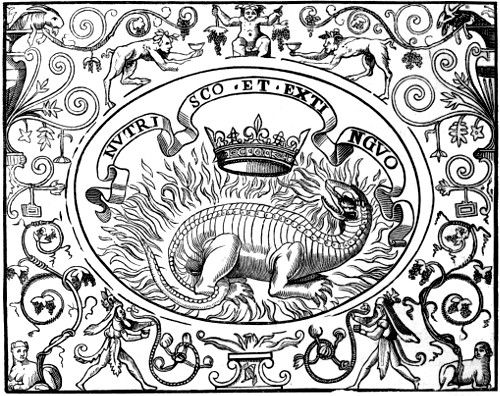
Paolo Jovio, 1561.
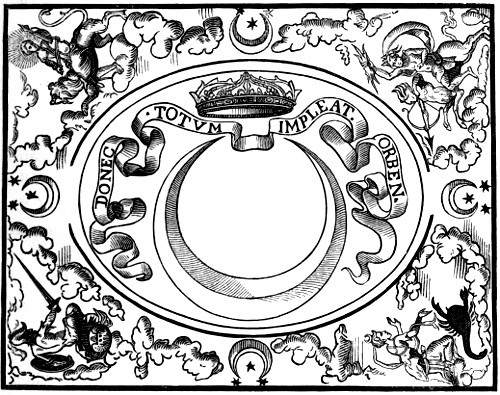
Paolo Jovio, 1561.
Of the use of Emblematical devices in the ornamenting of houses, it will be sufficient to give the instance recorded in “The History and Antiquities of Hawsted and Hardwick, in the county of Suffolk, by the Rev. Sir John Cullum, Bart:” the 2nd edition, royal 4to, London, 1813, pp. 159–165. This History makes it evident that in the reign of James I., if not earlier, Emblems were so known and admired as to have been freely employed in adorning a closet for the last Lady Drury. “They mark the taste of an age that delighted in quaint wit, and laboured conceits of a thousand kinds,” says Sir John; nevertheless, there were forty-one of them in “the painted closet” at Hawsted, and which, at the time of his writing, were put up in a small apartment at Hardwick. To all of them, as for King James’s bed, and for the “very antient oak wooden bedstead, much gilt and ornamented,” at Hinckley, there were a Latin motto and a device. Some of them we now present to the reader, adding occasionally to our author’s account a further notice of the sources whence they were taken:
Emblem 1. Ut parta labuntur,—“As procured they are slipping away.” “A monkey, sitting in a window and scattering money into the streets, is among the emblems of Gabriel Simeon:” it is also in our own English Whitney, p. 169, with the word, Malè parta malè delabuntur,—“Badly gotten, badly scattered.”
Emblem 5. Quò tendis?—“Whither art thou going?” “A human tongue with bats’ wings, and a scaly contorted tail, mounting into the air,” “is among the Heroical Devises of Paradin:” leaf 65 of edition Anvers, 1562.
Emblem 8. Jam satis,—“Already enough.” “Some trees, leafless, and torn up by the roots; with a confused landscape. Above, the sun, and a rainbow;” a note adds, “the most faire and bountiful queen of France Katherine used the sign of the rainbow for her armes, which is an infallible sign of peaceable calmeness and tranquillitie.”—Paradin. Paradin’s words, ed. 1562, leaf 38, are “Madame Catherine, treschretienne Reine de France, a pour Deuise l’Arc celeste, ou Arc en ciel: qui est le vrai signe de clere serenité & tranquilité de Paix.”
Emblem 20. Dum transis, time,—“While thou art crossing, fear.” “A pilgrim traversing the earth: with a staff, and a light coloured hat, with a cockle shell in it.” In Hamlet, act iv. sc. 5, l. 23, vol. viii. p. 129,—
“How should I your true love know
From another one?
By his cockle hat and staff,
And his sandal shoon.”
“Or,” remarks Sir John Cullum, “as he is described in Greene’s Never too Late, 1610;”—
“With Hat of straw, like to a swain,
Shelter for the sun and rain,
With scallop-shell before.”
Emblem 24. Fronte nulla fides,—“No trustworthiness on the brow.” The motto with a different device occurs in Whitney’s Emblems, p. 100, and was adopted by him from the Emblems of John Sambucus; edition Antwerp, 1564, p. 177. The device, however, in “the painted closet” was “a man taking the dimensions of his own forehead with a pair of compasses;” “a contradiction,” inaptly remarks Sir J. Cullum, “to a fancy of Aristotle’s that the shape and several other circumstances, relative to a man’s forehead, are expressive of his temper and inclination.”
POVR CONGNOISTRE
VN HOMME.
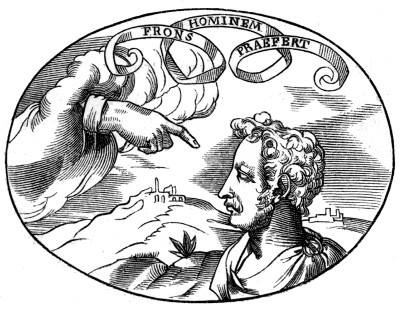
Symeoni, 1561.
Upon this supposition Symeon,[79] before mentioned, has invented an Emblem, representing a human head and a hand issuing out of a cloud, and pointing to it, with this motto, Frons hominem præfert,—“The forehead shows the man.”
Emblem 33. Speravi et perii,—“I hoped and perished;”—the device, “A bird thrusting its head into an oyster partly open.” A very similar sentiment is rather differently expressed by Whitney, p. 128, by Freitag, p. 169, and by Alciat, edition Paris, 1602, emb. 94, p. 437, from whom it was borrowed. Here the device is a mouse invading the domicile of an oyster, the motto, Captivus ob gulam,—“A prisoner through gluttony;” and the poor little mouse—
“That longe did feede on daintie crommes,
And safelie search’d the cupborde and the shelfe:
At lengthe for chaunge, vnto an Oyster commes,
Where of his deathe, he guiltie was him selfe:
The Oyster gap’d, the Mouse put in his head,
Where he was catch’d, and crush’d till he was dead.”
Now, since so many Emblems from various authors were gathered to adorn a royal bed,[80] “a very antient oak wooden bed,” and “a lady’s closet,” in widely distant parts of Britain, the supposition is most reasonable that the knowledge of them pervaded the cultivated and literary society of England and Scotland; and that Shakespeare, as a member of such society, would also be acquainted with them. The facts themselves are testimonies of a generally diffused judgment and taste, by which Emblematic devices for ornaments would be understood and appreciated.
And the facts we have mentioned are not solitary. About the period in question, in various mansions of the two kingdoms, Device and Emblem were employed for their adorning. In 1619, close upon Shakespeare’s time, and most likely influenced by his writings, there was set up in the Ancient Hall of the Leycesters of Lower Tabley, Cheshire, a richly carved and very curious chimney-piece, which may be briefly described as emblematizing country pursuits in connection with those of heraldry, literature, and the drama. In high relief, on one of the upright slabs, is a Lucrece, as the poet represents the deed, line 1723,—
“Even here she sheathed in her harmless breast
A harmful knife, that thence her soul unsheathed.”
On the other slab is a Cleopatra, with the deadly creature in her hand, though not at the very moment when she addressed the asp;—act. v. sc. 2, l. 305, vol. ix. p. 151,—
“Peace, peace!
Dost thou not see my baby at my breast,
That sucks the nurse asleep?”
The cross slab represents the hunting of stag and hare, which with the hounds have wonderfully human faces. Here might the words of Titus Andronicus, act. ii. sc. 2, l. 1, vol. vii. p. 456, be applied,—
“The hunt is up, the moon is bright and gray,
The fields are fragrant, and the woods are green;
Uncouple here, and let us make a bay,
And wake the emperor and his lovely bride,
And rouse the prince, and ring a hunter’s peal
That all the court may echo with the noise.”
The heraldic insignia of the Leycesters surmount the whole, but just below them, in a large medallion, is an undeniable Emblem, similar to one which in 1624 appeared in Hermann Hugo’s Pia Desideria, bk. i. emb. xv. p. 117; Defecit in dolore vita mea et anni mei in gemitibus (Psal. xxx. or rather Psal. xxxi. 10),—“My life is spent with grief, and my years with sighing.” Appended to Hugo’s device are seventy-six lines of Latin elegiac verses, and five pages of illustrative quotations from the Fathers; but the character of the Emblem will be seen from the device presented.
Drayton in his Barons’ Wars, bk. vi., published in 1598, shows how the knowledge of our subject had spread and was spreading; as when he says of certain ornaments,—
“About the border, in a curious fret,
Emblems, impressas, hieroglyphics set.”
There is, however, no occasion to pursue any further this branch of our theme, except it may be by a short continuation or extension of our Period of time, to show how Milton’s greater Epic most curiously corresponds with the title-page of a Dutch Emblem-book, which appeared in 1642, several years before Paradise Lost was written. (See Plate X.) The book is, Jan Vander Veens Zinne-beelden, oft Adams Appel,—“John Vander Veen’s Emblems, or Adam’s Apple,”—presenting some Dutch doggerel lines, of which this English doggerel contains the meaning,—
“When wounded Adam lay from the sin and the fall,
Out of the accursed wound flowed corruption and gall;
Hence is all wickedness and evil bred,
As here in print ye see the Devil fashioned.”
And again,—
“Out of Adam’s Apple springs
Misery, Sin, and deadly things.”
Singularly like to Milton’s Introduction (bk. i. lines 1–4),—
“Of Man’s first disobedience, and the fruit
Of that forbidden tree, whose mortal taste
Brought death into the world, and all our woe,
With loss of Eden.”
Plate 10
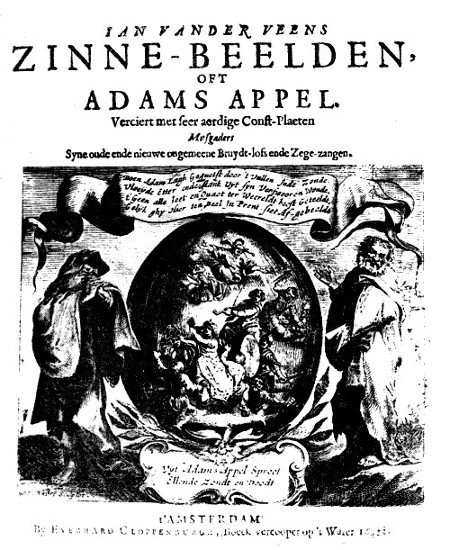
Title of “Adam’s Appel” Vander Veen 1642
Plate 11
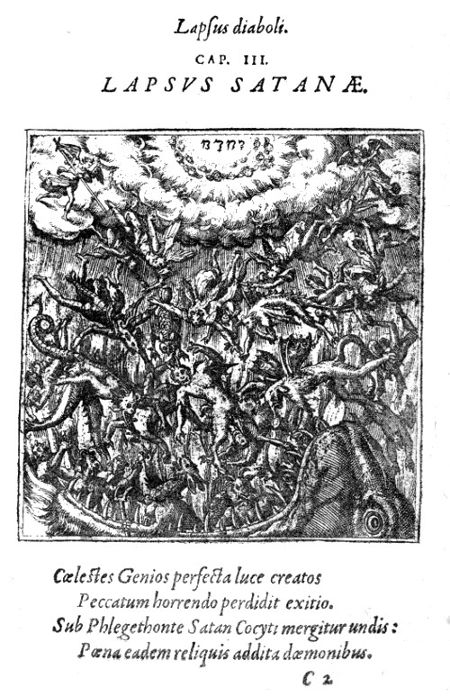
Fall of Satan from Boissard’s “Theatrum Vitæ Humanæ,” 1596
With equal singularity appears in Boissard’s Theatrum Vitæ Humanæ,—“Theatre of Human Life,”—edition Metz, 1596, p. 19, the coincidence with Milton’s Fall of the rebel Angels. We have here pictured and described the Fall of Satan (see Plate XI.) almost as in modern days Turner depicted it, and as Milton has narrated the terrible overthrow (Paradise Lost, bk. vi.), when they were pursued
“With terrors, and with furies, to the bounds
And crystal wall of heaven; which, opening wide,
Roll’d inward, and a spacious gap disclosed
Into the wasteful deep: the monstrous sight
Struck them with horror backward, but far worse
Urged them behind: headlong themselves they threw
Down from the verge of heaven....
Nine days they fell: confounded Chaos roar’d,
And felt tenfold confusion in their fall
Through his wild anarchy.”[81]
That same Theatre of Human Life, p. 1 (see Plate XIV.), also contains a most apt picture of Shakespeare’s lines, As You Like It, act. ii. sc. 7, l. 139, vol. ii. p. 409,—
“All the world’s a stage,
And all the men and women merely players:
They have their exits and their entrances;
And one man in his time plays many parts,
His acts being seven ages.”
The same notion is repeated in the Merchant of Venice, act. i. sc. 1, l. 77, vol. ii. p. 281, when Antonio says,—
“I hold the world but as the world, Gratiano;
A stage where every man must play a part,
And mine a sad one.”
In England, as elsewhere, emblematical carvings and writings preceded books of Emblems, that is, books in which the art of
the engraver and the genius of the poet were both employed to illustrate one and the same motto, sentiment, or proverbial saying. Not to repeat what may be found in Chaucer and others, Spenser’s Visions of Bellay,[82] alluded to in the fac-simile reprint of Whitney, pp. xvi & xvii, needed only the designer and engraver to make them as perfectly Emblem-books as were the publications of Brant, Alciatus and Perriere. Those visions portray in words what an artist might express by a picture. For example, in Moxon’s edition, 1845, p. 438, iv.,—
“I saw raisde vp on pillers of Iuorie,
Wereof the bases were of richest golde,
The chapters Alabaster, Christall frises,
The double front of a triumphall arke.
On eche side portraide was a Victorie,
With golden wings, in habite of a nymph
And set on hie vpon triumphing chaire;
The auncient glorie of the Romane lordes.
The worke did shew it selfe not wrought by man,
But rather made by his owne skilfull hands
That forgeth thunder dartes for Ioue his sire.
Let me no more see faire thing vnder heauen,
Sith I haue seene so faire a thing as this,
With sodaine falling broken all to dust.”
Now what artist’s skill would not suffice from this description to delineate “the pillers of Iuorie,” “the chapters of Alabaster,” “a Victorie with golden wings,” and “the triumphing chaire, the auncient glorie of the Romane lordes;” and to make the whole a lively and most cunning Emblem?
FEBRVARIE.
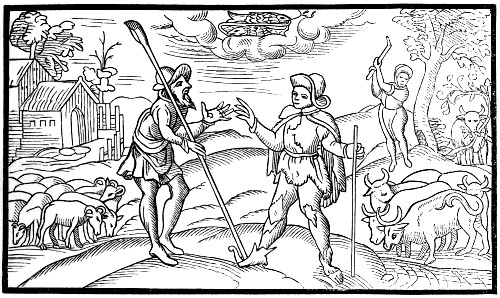
Spenser, 1616.
In his Shepheards Calender, indeed, to each of the months Spenser appends what he names an “Emblem;” it is a motto, or device, from Greek, Latin, Italian, French, or English, expressive of the supposed leading idea of each Eclogue, and forming a moral to it. The folio edition of Spenser’s works, issued in 1616, gives woodcuts for each month, and so approaches very closely to the Emblematists of a former century. In the month “FEBRVARIE,” there is introduced a veritable word-picture of “the Oake and the Brier,” and also a pictorial illustration, with the sign of the Fishes in the clouds, to indicate the season of the year. The oak is described as “broughten to miserie:” l. 213,—
“For nought mought they quitten him from decay,
For fiercely the goodman at him did laye.
The blocke oft groned under the blow,
And sighed to see his neere overthrow.
In fine, the steele had pierced his pith,
Tho downe to the earth hee fell forthwith.”
The Brier, “puffed up with pryde,” has his turn of adversity: l. 234,—
“That nowe upright hee can stand no more;
And, being downe, is trod in the durt
Of cattel, and brouzed, and sorely hurt.”
The whole Eclogue, or Fable, is rounded off by the curious Italian proverbs, to which Spenser gives the name of Emblems,—
Thenots Embleme.
“Iddio, perche é vecchio,
Fa suoi al suo essempio.”
Cuddies Embleme.
“Niuno vecchio
Spaventa Iddio.”
i.e., “God, although he is very aged, makes his friends copies of himself,” makes them aged too; but the biting satire is added. “No old man is ever terrified by Jove.”
IVNE
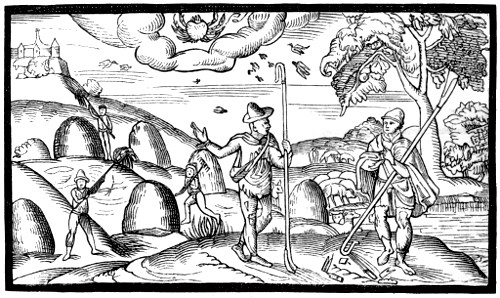
Spenser, 1616.
The Emblem for June represents a scene which the poet does not describe; it is the field of the haymakers, with the zodiacal sign of the Crab, and appropriate to the characters of Hobbinoll and Colin Clout,— but it certainly does not translate into pictures what the poet had delineated in words of great beauty:
“Lo! Colin, here the place whose plesaunt syte
From other shades hath weaned my wandring minde,
Tell mee, what wants mee here to worke delyte?
The simple ayre, the gentle warbling winde,
So calme, so coole, as nowhere else I finde;
The grassie grounde with daintie daysies dight,
The bramble bush, where byrdes of every kinde
To the waters fall their tunes attemper right.”
No more needs be said respecting the knowledge of Emblem-books in Britain, unless it be to give the remarks of Tod, the learned editor of Spenser’s works, edition 1845, p. x. “The Visions are little things, done probably when Spenser was young, according to the taste of the times for Emblems.[83] The Theatre of Wordlings, I must add, evidently presents a series of Emblems.”
II. We will now state some of the general indications that Shakespeare was acquainted with Emblem-books, or at least had imbibed “the taste of the times.”
Here and there in Shakespeare’s works, even from the way in which sayings and mottoes, in Spanish, as well as in French and Latin, are employed, we have indications that he had seen and, it may be, had studied some of the Emblem-writers of his day, and participated of their spirit. Thus Falstaff’s friend, the ancient Pistol, 2 Henry IV. act. ii. sc. 4, l. 165, vol. iv. p. 405, quotes the doggerel line, as given in the note, Si fortuna me tormenta, il sperare me contenta,—“If fortune torments me, hope contents me,”—which doubtless was the motto on his sword, which he immediately lays down. As quoted, the line is Spanish; a slight alteration would make it Italian; but Douce’s conjecture appears well founded, that as Pistol was preparing to lay aside his sword, he read off the motto which was upon it. Such mottoes were common as inscriptions upon swords; and Douce, vol. i. pp. 452, 3, gives the drawing of one with the French line, “Si fortune me tourmente, L’esperance me contente.”
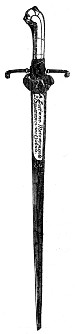
Douce, 1807.
He gives it, too, as a fact, that “Haniball Gonsaga being in the low-countries overthrowne from his horse by an English captaine and commanded to yeeld himselfe prisoner, kist his sword, and gave it to the Englishman, saying, ‘Si fortuna me tormenta, il speranza me contenta.’” Allow that Shakespeare served in the Netherlands, and we may readily suppose that he had heard the motto from the very Englishman to whom Gonsaga had surrendered.
The Clown in Twelfth Night, act. i. sc. 5, l. 50, vol. iii. p. 234, replies to the Lady Olivia ordering him as a fool to be taken away,—“Misprision in the highest degree! Lady, cucullus non facit monachum, [—it is not the hood that makes the monk,]—that’s as much to say as I wear not motley in my brain.” The saying is one which might appropriately adorn any Emblem-book of the day;—and the motley-wear receives a good illustration from a corresponding expression in Whitney, p. 81:
“The little childe, is pleas’de with cockhorse gaie,
Although he aske a courser of the beste:
The ideot likes, with bables for to plaie,
And is disgrac’de when he is brauelie dreste:
A motley coate, a cockescombe, or a bell,
Hee better likes, than Jewelles that excell.”
So, during Cade’s rebellion, when the phrase is applied by Lord Say, in answer to Dick the butcher’s question, “What say you of Kent?” 2 Henry VI. act. iv. sc. 7, l. 49, vol. v. p. 197,—
“Nothing but this: ’Tis bona terra, mala gens;”
or when falling under the attack of York on the field of St. Alban’s, Lord Clifford exclaims, La fin couronne les œuvres (2 Henry VI. act. v. sc. 2, l. 28, vol. v. p. 217); these again are instances after the methods of Emblem-writers; and if they were carried out, as might be done, would present all the characteristics of the Emblem, in motto, illustrative woodcut, and descriptive verses.
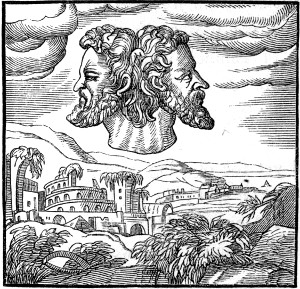
It is but an allusion, and yet the opening scene, act. i. sc. 1, l. 50, vol. ii. p. 280, of the Merchant of Venice might borrow that allusion from an expression of Alciatus, edition Antwerp, 1581, p. 92, Jane bifrons,—“two-headed Janus.” (See woodcut, p. 140.)
Iane bifrons, qui iam transacta futuraq̃ calles,
Quiq̃ retro sannas, sicut & ante, vides;—
“Janus two-fronted, who things past and future well knowest,
And who mockings behind, as also before dost behold.”[84]
The friends of Antonio banter him for his sadness, and one of them avers,—
“Now by two-headed Janus,
Nature hath framed strange fellows in her time:
Some that will evermore peep through their eyes,
And laugh like parrots at a bag-piper;
And other of such vinegar aspect
That they’ll not show their teeth in way of smile,
Though Nestor swear the jest be laughable.”
Alciat, 1581.
Even if Shakespeare understood no Latin, the picture itself, or a similar one, would be sufficient to give origin to the phrase “two-headed Janus.” He adopts the picture, but not one of the sentiments; these, however, he did not need: it was only as a passing illustration that he named Janus, and how the author described the god’s qualities was no part of his purpose.
Or if the source of the phrase be not in Alciatus, it may have been derived either from Whitney’s Choice of Emblemes, p. 108, or from Perriere’s Theatre des Bons Engins, Paris, 1539, emb. i., reproduced in 1866 to illustrate pl. 30 of the fac-simile reprint of Whitney. Perriere’s French stanza is to this effect:—
“In old times the god Janus with two faces
Our ancients did delineate and portray,
To demonstrate that counsels of wise races
Look to a future, as well as the past day;
In fact all time of deeds should leave the traces,
And of the past recordance ever have;
The future should foresee like providence,
Following up virtue in each noble quality,
Seeking God’s strength from sinfulness to save.
Who thus shall do will learn by evidence
That he has power to live in great tranquillity.”[85]
Another instance of Emblem-like delineation, or description, we have in King Henry V. act iii. sc. 7, lines 10–17, vol. iv. p. 549. Louis the Dauphin, praising his own horse, as if bounding from the earth like a tennis ball (see woodcut on next page), exclaims,—
“I will not change my horse with any that treads but on four pasterns. Ça, ha! he bounds from the earth, as if his entrails were hairs; le cheval volant, the Pegasus, chez les narines de feu! When I bestride him, I soar, I am a hawk: he trots the air; the earth sings when he touches it; the basest horn of his hoof is more musical than the pipe of Hermes.[86]
Orl. He’s of the colour of the nutmeg.
Dau. And of the heat of the ginger. It is a beast for Perseus: he is pure air and fire; and the dull elements of earth and water never appear in him, but only in patient stillness, while his rider mounts him: he is indeed a horse; and all other jades you may call beasts.
Con. Indeed, my lord, it is a most absolute and excellent horse.
Dau. It is the prince of palfreys; his neigh is like the bidding of a monarch, and his countenance enforces homage.”
Bocchius, 1555.
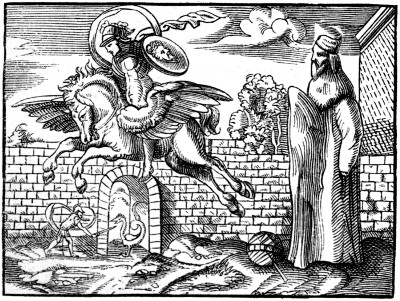
This lively description suits well the device of a Paris printer, Christian Wechel, who, in 1540,[87] dwelt “a l’enseigne du Cheval volant;” or that of Claude Marnius of Francfort, who, before 1602, had a similar trade-mark. At least three of Reusner’s Emblems, edition Francfort, 1581, have the same device; and the Dauphin’s paragon answers exactly to a Pegasus in the first Emblem, dedicated to Rudolph II., who, on the death of his father, Maximilian, became Emperor of Germany.
ΣΥΝ ΔΥΩ ΕΡΧΟΜΕΝΩ.
Non abſque Theſeo.
EMBLEMA I.
Reusner, 1581.
Ad Diuum Rudolphum Secundum
Cæſarem Romanum.
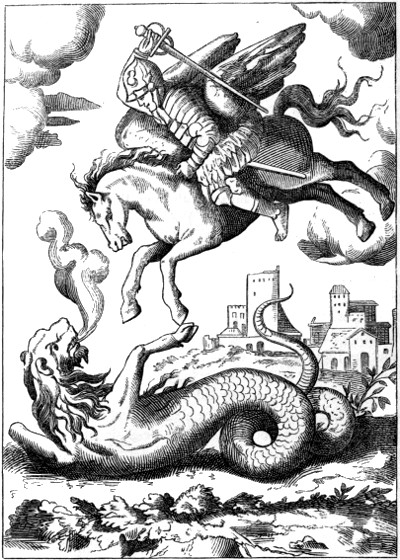
Here[88] we have a Pegasus like that which Shakespeare praises; it has a warrior on its back, and bounds along, trotting the air. In other two of Reusner’s Emblems, the Winged Horse is standing on the ground, with Perseus near him; and in a third, entitled Principis boni imago,—“Portrait of a good prince,”—St. George is represented on a flying steed[89] attacking the Dragon, and delivering from its fury the Maiden chained to a rock, that shadows forth a suffering and persecuted church. Shakespeare probably had seen these or similar drawings before he described Louis the Dauphin riding on a charger that had nostrils of fire.
The qualities of good horsemanship Shakespeare specially admired. Hence those lines in Hamlet, act iv. sc. 7, l. 84, vol. viii. p. 145,—
“I’ve seen myself, and served against, the French,
And they can well on horseback: but this gallant
Had witchcraft in’t; he grew unto his seat,
And to such wondrous doing brought his horse,
As he had been incorpsed and demi-natured
With the brave beast.”
An emblem in Alciatus, edition 1551, p. 20, also gives the mounted warrior on the winged horse;—it is Bellerophon in his contest with the Chimæra. The accompanying stanza has in it an expression like one which the dramatist uses,—
“Sic tu Pegaseis vectus petis æthera pennis,”—
“So thou being borne on the wings of Pegasus seekest the air.”
Equally tasting of the Emblem-writers of Henry’s and Elizabeth’s reigns is that other proverb in French which Shakespeare places in the mouth of the Dauphin Louis. The subject is still his “paragon of animals,” which he prefers even to his mistress. See Henry V. act iii. sc. 7, l. 54, vol iv. p. 550. “I had rather,” he says, “have my horse to my mistress;” and the Constable replies, “I had as lief have my mistress a jade.”
“Dau. I tell thee, constable, my mistress wears his own hair.
Con. I could make as true a boast as that, if I had a sow to my mistress.
Dau. Le chien est retourné à son propre vomissement, et la truie lavée au bourbier. Thou makest use of anything.” [“The dog has returned to his vomit, and the sow that had been washed, to her mire.”]
Though the French is almost a literal rendering of the Latin Vulgate, 2 Pet. ii. 23, “Canis reversus ad suum vomitum: & sus lota in volutabro luti;” the whole conception is in the spirit of Freitag’s Mythologia Ethica, Antwerp, 1579, in which there is appended to each emblem a text of Scripture. A subject is chosen, a description of it given, an engraving placed on the opposite page, and at the foot some passage from the Latin vulgate is applied.
It may indeed be objected that, if Shakespeare was well acquainted with the Emblem literature it is surprising he should pass over, almost in silence, some Devices which partake peculiarly of his general spirit, and which would furnish suggestions for very forcible and very appropriate descriptions. Were we to examine his works thoroughly, we should discover some very remarkable omissions of subjects that appear to be exactly after his own method and perfectly natural to certain parts of his dramas. We may instance the almost total want of commendation for the moral qualities of the dog, whether “mastiff, greyhound, mongrel grim, hound or spaniel, brach or lym, or bob-tail tike, or trundle-tail.” The whole race is under a ban.
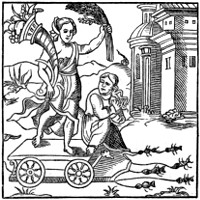
Perriere, 1539.
So industry, diligence, with their attendant advantages,—negligence, idleness, with their disadvantages, are scarcely alluded to, and but incidentally praised or blamed.
We may take one of Perriere’s Emblems, the 101st of Les Bons Engins, as our example, to show rather divergence than agreement,—or, at any rate, a different way of treating the subject.
“En ce pourtraict pouuez veoir diligence,
Tenant en main le cornet de copie:
Elle triumphé̩[e/]̩ en grand magnificence:
Car de paressé̩[e/]̩ one ne fut assoupie:
Dessoubz ses piedz tiẽt faminé̩[e/]̩ acroupie
Et attachéé̩[e/]̩ en grand captiuité:
Puis les formys par leur hastiuité
Diligemment tirent le tout ensemble:
Pour demonstrer qu’ auec oysiuité,
Impossiblé̩[e/]̩ est que grãdz biẽs l’õ assẽble.”
“A portrait here you see of diligence
Bearing in hand full plenty’s horn,
Triumphant in her great magnificence,
And ever holding laziness in scorn;
Crouching beneath her feet famine forlorn
In fetters bound of strong captivity.
And then the ants with their activity
The whole most diligently along do draw,—
A demonstration clear that idleness
Finds it impossible by nature’s law
With stores of goods her poverty to bless.”
Under the motto, Otiosi semper egentes,—“The idle always destitute,”—Whitney, p. 175, describes the same conditions,—
“Here, Idlenes doth weepe amid her wantes,
Neare famished: whome, labour whippes for Ire:
Here, labour sittes in chariot drawen with antes:
And dothe abounde with all he can desire.
The grashopper, the toyling ante derides,
In Sommers heate, cause she for coulde prouides.”
The idea is in some degree approached in the Chorus of Henry V. act i. l. 5, vol. iv. p. 491,—
“Then should the warlike Harry, like himself
Assume the port of Mars; and at his heels,
Leash’d in like hounds, should famine, sword, and fire
Crouch for employment.”
The triumph of industry may also be inferred from the marriage blessing which Ceres pronounces in the Masque of the Tempest, act iv. sc. 1, l. 110, vol. i. p. 57,—
“Earth’s increase, foison plenty,
Barns and garners never empty;
Vines with clustering bunches growing;
Plants with goodly burthen bowing;
Spring come to you at the farthest
In the very end of harvest!
Scarcity and want shall shun you,
Ceres’ blessing so is on you.”
Yet for labour, work, industry, diligence, or by whatever other name the virtue of steady exertion may be known, there is scarcely a word of praise in Shakespeare’s abundant vocabulary, and of its effects no clear description. We are told in Cymbeline, act iii. sc. 6, l. 31, vol. ix. p. 240,—
“The sweat of industry would dry and die,
But for the end it works to.... Weariness
Can snore upon the flint, when resty sloth
Finds the down pillow hard.”
And in contrasting the cares of royalty with the sound sleep of the slave, Henry V. (act iv. sc. 1, l. 256, vol iv. p. 564) declares that the slave,—
“Never sees horrid night, the child of hell;
But like a lacquey, from the rise to set,
Sweats in the eye of Phœbus, and all night
Sleeps in Elysium; next day, after dawn,
Doth rise, and help Hyperion to his horse;
And follow so the ever running year
With profitable labour to his grave;”
but the subject is never entered upon in its moral and social aspects, unless the evils which are ascribed by the Duke of Burgundy (Henry V. act v. sc. 2, l. 48, vol. iv. p. 596) to war, are also to be attributed to the negligence which war creates,—
“The even mead, that erst brought sweetly forth
The freckled cowslip, burnet and green clover,
Wanting the scythe, all uncorrected, rank,
Conceives by idleness; and nothing teems
But hateful docks, rough thistles, kecksies, burs,
Losing both beauty and utility.”
Another instance we may give of that Emblem spirit, which often occurs in Shakespeare, and at the same time we may supply an example of Freitag’s method of illustrating a subject, and of appending to it a scriptural quotation. (See Mythologia Ethica, Antwerp, 1579, p. 29.) The instance is from King Lear, act ii. sc. 4, l. 61, vol. viii. p. 317, and the subject, Contraria industriæ ac desidiæ præmia—“The opposite rewards of industry and slothfulness.”
When Lear had arrived at the Earl of Gloster’s castle, Kent inquires,—
“How chance the king comes with so small a train?
Fool. An thou hadst been set i’ the stocks for that question, thou hadst well deserv’d it.
Gent. Why, fool?
Fool. We’ll set thee to school to an ant to teach thee there’s no labouring in the winter.”
That school we have presented to us in Freitag’s engraving (see woodcut on next page), and in the stanzas of Whitney, p. 159. There are the ne’er-do-well grasshopper and the sage schoolmaster of an ant, propounding, we may suppose, the wise saying, Dum ætatis ver agitur: consule brumæ,—“While the spring of life is passing, consult for winter,”—and the poet moralizes thus:
“In winter coulde, when tree, and bushe, was bare,
And frost had nip’d the rootes of tender grasse:
The antes, with ioye did feede vpon their fare,
Which they had stor’de, while sommers season was:
To whome, for foode the grashopper did crie,
And said she staru’d, if they did helpe denie.
Whereat, an ante, with longe experience wise?
And frost, and snowe, had manie winters seene:
Inquired, what in sommer was her guise.
Quoth she, I songe, and hop’t in meadowes greene:
Then quoth the ante, content thee with thy chaunce,
For to thy songe, nowe art thou light to daunce?”
Contraria induſtriae ac deſidiæ præmia.
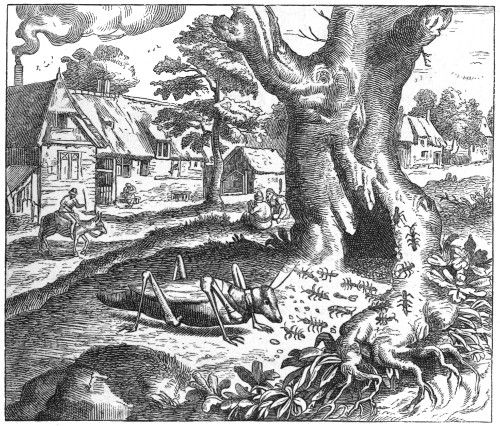
Freitag, 1579.
Propter frigus piger arare noluit: mendicabit ergo æſtate, & non dabitur illi.
Prouerb. 20, 4.
“The sluggard will not plow by reason of the cold; therefore shall he beg in harvest, and have nothing.”
Freitag’s representation makes indeed a change in the season at which the “ante, with longe experience wise,” administers her reproof; but it is equally the school for learning in the time of youth and strength, to provide for the infirmities of age and the adversities of fortune.
And more than similar in spirit to the Emblem writers which preceded, almost emblems themselves, are the whole scenes from the Merchant of Venice, act ii. sc. 7 and 9, and act iii. sc. 2, where are introduced the three caskets of gold, of silver, and of lead, by the choice of which the fate of Portia is to be determined,[90]—
“The first, of gold, who this inscription bears,
‘Who chooseth me shall gain what many men desire;’
The second, silver, which this promise carries,
‘Who chooseth me shall get as much as he deserves;’
This third, dull lead, with warning all as blunt,
‘Who chooseth me must give and hazard all he hath.’”
Act ii. sc. 7, lines 4–9.
And when the caskets are opened, the drawings and the inscriptions on the written scrolls, which are then taken out, examined and read, are exactly like the engravings and the verses by which emblems and their mottoes are set forth. Thus, on unlocking the golden casket, the Prince of Morocco exclaims,—
“O hell! what have we here?
A carrion Death, within whose empty eye
There is a written scroll! I’ll read the writing. [Reads.]
All that glisters is not gold;
Often have you heard that told:
Many a man his life hath sold
But my outside to behold:
Gilded tombs do worms infold.
Had you been as wise as bold,
Young in limbs, in judgment old,
Your answer had not been inscroll’d:
Fare you well; your suit is cold.”
Act ii. sc. 7, lines 62–73.
The Prince of Arragon, also, on opening the silver casket, receives not merely a written scroll, as is represented in Symeoni’s “Distichi Morali,”—Moral Stanzas,—but what corresponds to the device or woodcut of the Emblem-book; “The portrait of a blinking idiot,” who presents to him “The schedule,” or explanatory rhymes,—
“The fire seven times tried this:
Seven times tried that judgment is,
That did never choose amiss.
Some there be that shadows kiss;
Such have but a shadow’s bliss:
There be fools alive, I wis,
Silver’d o’er; and so was this.
Take what wife you will to bed,
I will ever be your head:
So be gone: you are sped.”
Act ii. sc. 9, lines 63–72.
These Emblems of Shakespeare’s are therefore complete in all their parts; the mottoes, the pictures, “a carrion Death” and “a blinking idiot,” and the descriptive verses.
Coſi viuo Piacer conduce à morte.
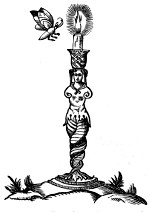
Paradin, 1562.
The words of Portia (act. ii. sc. 9, l. 79, vol. ii. p. 319), when the Prince of Arragon says,—
“Sweet adieu, I’ll keep my oath,
Patiently to bear my wroth;”
are moreover a direct reference to the Emblems which occur in various authors. Les Devises Heroiqves, by Claude Paradin, Antwerp, 1562, contains the adjoining Emblem, Too lively a pleasure conducts to death.
And Giles Corrozet in his “Hecatomgraphie, C’est à dire, les descriptions de cent figures, &c.,”[91] adopting the motto, War is sweet only to the inexperienced, presents, in illustration, a butterfly fluttering towards a candle.
La guerre doulce aux inexperimentez.
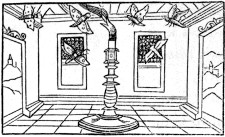
Corrozet, 1540.
Les Papillons ſe vont bruſler
A la chandelle qui reluyct.
Tel veult à la bataillé̩[e/]̩ aller
Qui ne ſcaict combien guerre nuyct.
“The Butterflies themselves are about to burn,
In the candle which still shines on and warms;
Such foolish, wish to battle fields to turn,
Who know not of the war, how much it harms.”
This device, in fact, was one extremely popular with the Emblem literati. Boissard and Messin’s Emblems, 1588, pp. 58, 59, present it to the mottoes, “Temerité dangereuse,” or Temere ac Pericvlose,—“rashly and dangerously.” Joachim Camerarius, in his Emblems Ex Volatilibus et Insectis (Nuremberg, 4to, 1596), uses it, with the motto, Brevis et damnosa Voluptas—“A short and destructive pleasure,”—and fortifies himself in adopting it by no less authorities than Æschylus and Aristotle. Emblemes of Love, with Verses in Latin, English, and Italian, by Otho Vænius, 4to, Antwerp, 1608, present Cupid to us, at p. 102, as watching the moths and the flames with great earnestness, the mottoes being, Brevis et damnosa voluptas,—“For one pleasure a thousand paynes,”—and Breue gioia,—“Brief the gladness.”
There is, too, on the same subject, the elegant device which Symeoni gives at p. 25 of his “Distichi Morali,” and which we repeat on the next page.
The subject is, Of Love too much; and the motto, “Too much pleasure leads to death,” is thus set forth, almost literally, by English rhymes:—
“In moderation Love is praised and prized,
Loss and dishonour in excess it brings:
In burning warmth how fail its boasted wings,
As simple butterflies in light chastised.”
D’AMOR SOVERCHIO.
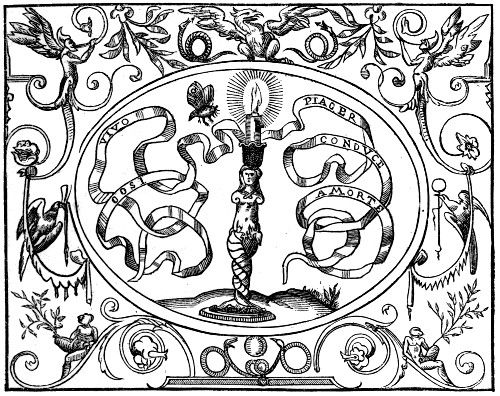
Giovio and Symeoni, 1561.
Il moderato amor ſi loda & prezza,
Ma il troppo apporta danno & diſhonore,
Et ſpeſſo manca nel ſouerchio ardore,
Qual ſemplice farfalla al lume auuezza.
Coſi piacer conduce à morte.
Now can there be unreasonableness in supposing that out of these many Emblem writers Shakespeare may have had some one in view when he ascribed to Portia the words,—
“Thus hath the candle singed the moth.
O, these deliberate fools! when they do choose,
They have the wisdom by their wit to lose.”
Act ii. sc. 9, lines 79–81.
The opening of the third of the caskets (act. iii. sc. 2, l. 115, vol. ii. p. 328), that made of lead, is also as much an Emblem delineation as the other two, excelling them, indeed, in the beauty of the language as well as in the excellence of the device, a very paragon of gracefulness. “What find I here?” demands Bassanio; and himself replies,—
“Fair Portia’s counterfeit! What demi-god
Hath come so near creation? Move these eyes?
Or whether, riding on the balls of mine
Seem they in motion? Here are sever’d lips,
Parted with sugar breath: so sweet a bar
Should sunder such sweet friends. Here in her hairs
The painter plays the spider, and hath woven
A golden mesh to entrap the hearts of men,
Faster than gnats in cobwebs:[92] but her eyes,—
How could he see to do them? Having made one,
Methinks it should have power to steal both his,
And leave itself unfurnish’d. Yet look, how far
The substance of my praise doth wrong this shadow
In underprizing it, so far this shadow
Doth limp behind the substance. Here’s a scroll,
The continent and summary of my fortune.
[Reads] You that choose not by the view,
Chance as fair, and choose as true!
Since this fortune falls to you,
Be content and seek no new.
If you will be pleased with this,
And hold your fortune for your bliss,
Turn you where your lady is,
And claim her with a loving kiss.”
In these scenes of the casket, Shakespeare himself, therefore, is undoubtedly an Emblem writer; and there needs only the woodcut, or the engraving, to render them as perfect examples of Emblem writing as any that issued from the pens of Alciatus, Symeoni, and Beza. The dramatist may have been sparing in his use of this tempting method of illustration, yet, with the instances before us, we arrive at the conclusion that Shakespeare knew well what Emblems were. And surely he had seen, and in some degree studied, various portions of the Emblem literature which was anterior to, or contemporary with himself.
Cebes, ed. 1552. Motto from Plate