XVII THE LAST HOUR
Reading edition
The end was at hand when Bonaparte crossed the river Po. One is apt to forget that he had already showed himself to be much more than a victorious
1796. Rom. ix. 284.
general, and that throughout the campaign he displayed that marvellous skill in dealing with men which so often ensured him an enthusiastic reception in places where he could not have been expected to be welcome.
He had soon realised the horrible impression produced everywhere outside of France by the Revolution, the Terror, and the Committee of Public Safety, and he hastened, by his numberless agents, to exalt the virtues of the Directory. They were not a herd of bloodthirsty ruffians, he taught, but an assemblage of the future saviours of mankind, who were to emancipate the world from all those ancient political and social prejudices which had so long held it in bondage.
He could not unteach the scum of the Italian populace what the agents of the Revolution had taught it with such lavish expenditure in disreputable taverns and worse resorts, but he could control the teachers and gradually change the direction of the education. The Venetian gondoliers could be taught something, too, and the Venetian Barnabotti could be bribed to learn anything, and to impart what they learned.
‘No organisation,’ says Bonnal, ‘was ever superior to his (Bonaparte’s), no revolutionary organisation was ever more formidable. We mean “revolutionary” as regards the legitimate governments
Bonnal, Chute d’une République, 273-274.
existing in Italy, with which we were not at war, and as regards the means used.... It was at Milan that his system became a definite official service, both political and military. Thence arose two principal offices exactly answering the aim he was pursuing, that is, the political propaganda and the military propaganda. By means of the political propaganda he sought to bring about either the substitution of one domination for another, or the modification of the forms of government.... Lombardy is an example of the first case, the Italian Duchies of the second. By his military propaganda he roused the populations to arms, sometimes against the legitimate sovereign, as happened in Venice and Parma, sometimes against a foreign power, as at Milan.’
Once more, as in the war of the Spanish succession, the Venetian territory became a refuge and a provision market for two hostile armies. The fortresses, as has been seen, were really at the mercy of any one who chose to occupy them. On the ninth of May the Imperial troops, yielding to the request of Contarini the Governor of Crema, and supposing the place to be capable of defence, consented to pass by the city without entering it. If they had insisted no one could have hindered them, and the letter Contarini afterwards wrote to the Venetian government disturbed even the astounding optimism of the Savi. The latter were shocked when they thought of the risk they had run, and by way of getting rid of all further responsibility they appointed a Provveditor to watch over the safety of the Venetian territory. More than this their worst enemies could not have expected them to do. They selected a Foscarini for the office, and were particularly careful to admonish him that he must ‘preserve intact the tranquillity of the Republic, and administer comfort and consolation to its subjects.’ I translate literally the phrase, which sounds like the drivelling of an old man in second childhood.
The imperial troops were barely out of sight of
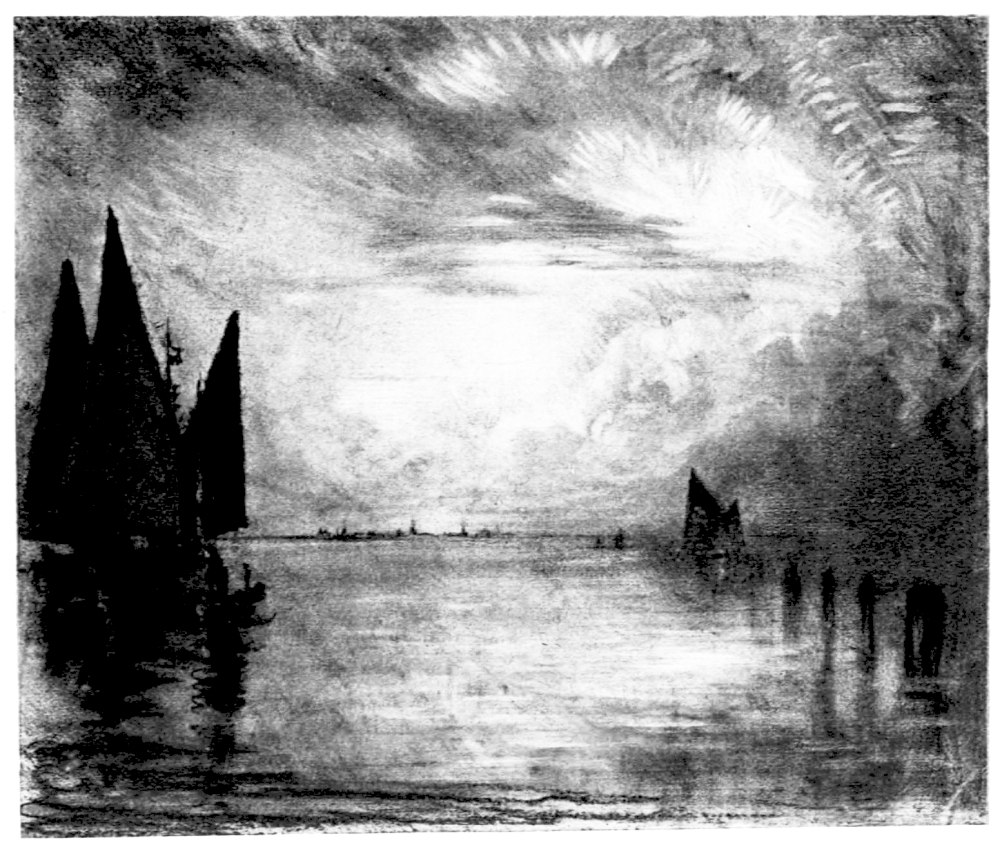
OUT IN THE LAGOON
Crema when the French appeared, and Contarini renewed his request that the city might not be entered. Berthier consented, but requisitioned provisions and forage. Soon afterwards came Bonaparte himself and he also consented to pass on, but not until he had squeezed every particle of available information out of the governor, whose letter narrating the interview gives a remarkably clear idea of the great young man’s conversation.
The Senate wrote to the Commander of the fortress of Peschiera not to allow any foreign soldiers to enter under any circumstances. I have described the condition of the place elsewhere, and the unlucky colonel at once answered, inquiring what in the world he was to do in order to prevent the passage of the Imperial troops.
The Austrian general Liptay found it convenient to install himself in Peschiera for some time, and when the Republic protested, he answered with admirable coolness and much truth that the place was not a fortress at all, and that he was encamped there as the French were in the fields towards Brescia.
Even Bonaparte understood the absurdity of this case. ‘The truth about the affair of Peschiera,’ he wrote to the Directory, ‘is that the Venetians
Rom. ix. 297-299.
have been duped by Beaulieu; he asked leave to pass with fifty men and then made himself master of the city.’
In spite of this conviction, Bonaparte took advantage of the incident to declare to the Provveditor Foscarini that he would burn Verona to punish the Venetians for having favoured the Austrian troops; and Foscarini, obliged to act on the spur of the moment and without consulting the government, opened the gates of Verona to Masséna on receiving the latter’s assurance that the city should not be burned. He probably fancied that he had obtained a great concession, and did not understand that Verona was absolutely necessary to the French as a base from which to advance on Mantua, held by the Imperial troops.
The news of the occupation of Verona produced the utmost alarm in Venice, yet the Great Council was not summoned, nor was there a regular sitting of the Senate. The days had gone by when the great bell of Saint Mark’s was rung backward to call every fighting man to arms, and every aged Senator to the Council. The handful of scared and vacillating men who had steered Venice to her end met stealthily by night in the Casino Pesaro, more like conspirators than defenders of their country. Most of them fancied the French already in the lagoons, if not in the city; some, forgetting that they had neither troops nor captains, were for defence to the death; some, who had secretly adopted revolutionary ideas and principles, rejoiced at heart because the end was so near.
Such a meeting of such men could come to nothing; and nothing was decided except that Foscarini, the Provveditor, should be assisted by two other nobles, commissioned to negotiate with Bonaparte.
They went and found him apparently in the mildest and most friendly humour, but the report of their interview with him reached the Senate together with a communication from the Inquisitors explaining Bonaparte’s plan for taking possession of the fort of
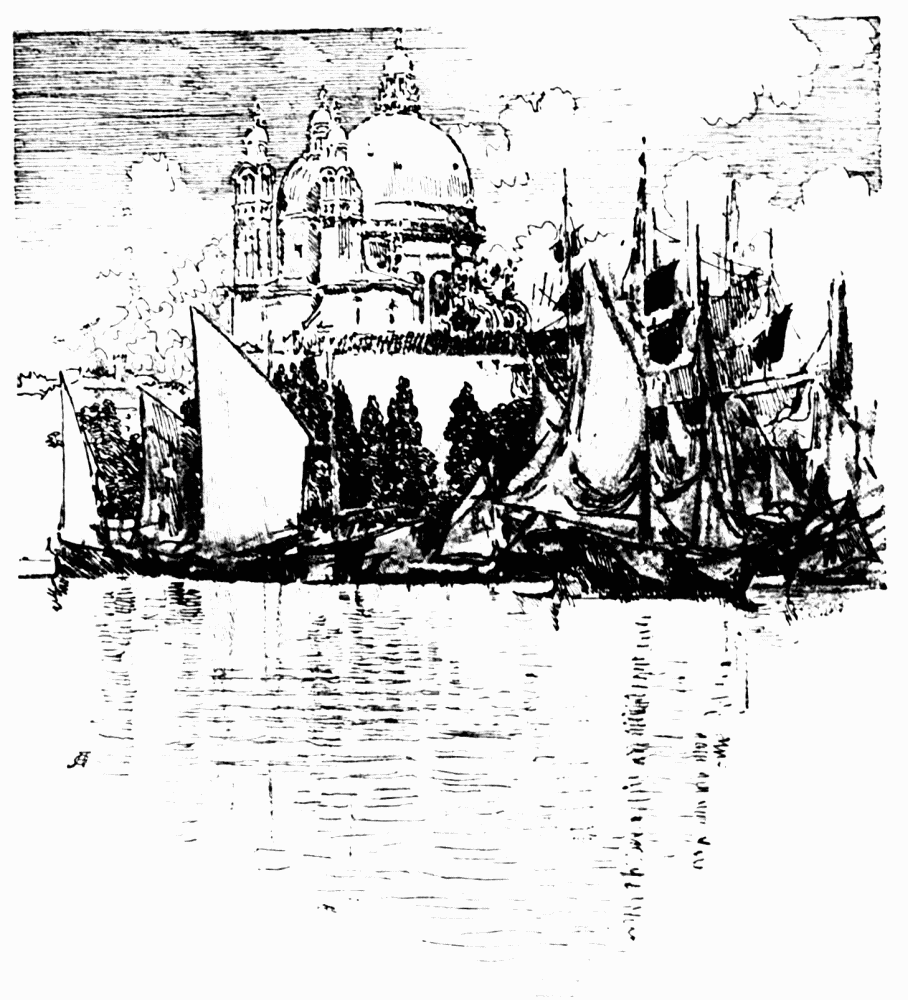
THE SALUTE FROM THE LAGOON
Legnago, making sure of the free navigation of the Adige, and threatening to destroy Venice in order to extort a sum of five or six millions of francs.
So Venice, still theoretically neutral, was driven to collect such poor forces as she had by land and sea, in order to defend herself against the depredations of the combatants. She had not a single general to direct her men, or to plan a defence. Three nobles were in charge of her boundaries on the mainland; another was made responsible for the capital, and two were placed in charge of the lagoons. A war-tax was levied, too, and it is due to the citizens of the dying State to say that they were generous to their country to the last. Many citizens of all classes gave large sums of their own free will to help the defence, and not in Venice only; the cities of Friuli and Dalmatia, and even small communities at a great distance, made heavy sacrifices spontaneously for the public safety.
The historian Romanin was of opinion that even at that moment, if the government had found resolution enough to sacrifice all her possessions on
Rom. ix. 321.
the mainland, as at the time of the League of Cambrai, a clever diplomacy might yet have saved the State. But he was a Venetian and a most patriotic one, and he could not understand that it needed something more than skill to keep Venice alive, that it needed life itself, the life that was all spent, at last, after more than a thousand years.
The Provveditor for the lagoons, Giacomo Nani, wrote to the Doge the courageous words: ‘A State has not the right to possess provinces which it cannot defend.’ He, too, remembered the League of Cambrai. But the Doge was not to be roused; it was no longer vacillation, it was paralysis of the will that made him follow the Senate. Yet Nani’s letters determined the Savi to look about for some general into whose hands the whole defence might be given. It was the old tradition of employing the condottiero; but there was only one man alive just then who had the genius and the conviction that save a cause all but lost; he was a man who could have stopped a host with Falstaff’s ragged company, and he was at the gates of Venice. The Savi hit upon the Prince of Nassau as a possible captain, but Austria stepped in and forbade that he should be called.
The King of Naples now signed an armistice with the French, and Bonaparte made himself at home on the Venetian mainland, quartering his troops at Bergamo, Brescia, and Crema without ceremony, and merely notifying the Venetian Senate that he did so, as if no excuse were needed. He took the Venetian guns he found at Legnago and used them at the siege of Mantua as if they were his own. Bonaparte was well aware of the truth of what Nani had written to the Doge, and he took full advantage of the axiom. If the governors of the cities in which he chose to stop did not please him, he wrote them notes like the following:—
... I beg you, Sir, to let me know what game we are playing, for I do not believe you will allow your brothers in arms [the French soldiers!] to die without help
Rom. ix. 341.
within the walls of Brescia, or to be murdered on the highroad. If you are not able to keep order in your country, and to make the city of Brescia furnish what is needed for establishing hospitals and for the wants of the troops, I shall have to take more efficient measures.—Believe me, with feelings of esteem and consideration,
Bonaparte.
Bonnal says of him that he avenged legitimate complaints with a host of accusations and denials, and with unmistakable threats; and the Venetians
Bonnal, 275.
made excuses. Whereupon Bonaparte answered that he would ‘beat the Austrians and make the Venetians pay for the war.’ Which he did.
At the same time he was writing to the Directory:—
... I am obliged to be indignant with the Provveditor, to exaggerate the number of assassinations, etc., in order that he, to calm my fury, may furnish me everything I
Rom. ix. 351.
need; they will continue to give us what we want, willingly or by force, until Mantua is taken, after which I shall demand of them such contribution as you may order me, which will not be in the least difficult.
If Bonaparte could find pretexts for accusing the Venetians of helping the Austrians, the latter had excellent reasons for complaining that Venice helped the French. Austria and France were the two stools between which half measures had led the Republic, and between which she fell.
The position of the French army was not enviable at that time, and the alliance of Venice would really have been worth having, which was the reason why her obstinate efforts at neutrality exasperated Bonaparte to such a degree. At last his patience gave out and he ordered General Baraguay d’Hilliers, the father of the marshal of that name who died in 1878,
Twenty-fifth of December 1796.
to occupy Bergamo, not as a guest, but as master. The Austrians at once replied by seizing Palma and Osopo.
The peasants and the small communities were now driven to extremities; for the Government had left them to their fate, and they were plundered alike by the French and the Austrians. Discontent spread rapidly, and the rural population may be supposed to have been in the best possible disposition to receive the revolutionary doctrines by which Bonaparte had already called into existence the Cispadane Republic. That short-lived affair was made up of the cities and territories of Ferrara, Bologna, Modena, and Reggio d’Emilia, and was momentarily the headquarters of republicanism. In spite of all that the remnant of government in Venice could do against it, its influence was felt on Venetian territory. Behind all, the propaganda of Milan worked
Rom. x. 12.
steadily to carry out Bonaparte’s plan under General Landrieux, whom he had deputed to take charge of that end of it.
Bergamo was the first city to rise and drive out the Venetian governor, in order to join the Cispadane Republic; the city of Brescia followed,
Molmenti, Nuovi Studi, 356.
naturally enough. But the country people of the two provinces still remained faithful to the Republic, and the peasants about Brescia were so indignant with the city for its defection that they would have marched upon it to burn it down if they had not been hindered by their Bishop, Dolfin. At Vallesabbia, certain emissaries of the republicans from the city were so ill received that they fled precipitately in fear of their lives.
Two days after the latter incident, the inhabitants of the villages of the valley met in a field
March 1797.
near Nozze, and drew up the following declaration, which was approved with absolute unanimity.
Vallesabbia, March 27th, 1797.
In order to record its own fidelity and obedience to its beloved Prince of Venice, and taking oath of perpetual loyalty and adherence to the said Prince, this body votes that if persons of any class or condition are found in this Valley having the cockade of rebels against the Prince of Venice, and actually having that cockade on their hats, any one shall be free to arrest them, and let him have a prize of three hundred lire piccole for each one, of [the funds of] the Valley.
And let this present vote be made known in every commune and put up in the usual and habitual places for public notices; and it is not to go into effect for three days, within which the parish priests in their parishes shall publicly give notice of it to the people. And if gangs of rebels against the Prince of Venice, or troops of theirs, enter the Valley, the communities comprising the Valley shall ring the bells with a hammer [meaning to ring them out, and not to ‘chime’ them only]; and whosoever is between sixteen and sixty years old, and whosoever else will volunteer, is to take arms in the name of the Valley to arrest them [rebels or troops], and may also kill them; and whoever refuses shall be punished by confiscation of all his goods.
The government might have done something to encourage people capable of such devotion; it might at least have ordered them to send deputations to the capital to give information of the state of the country. This the province of Verona asked to be allowed to do, through the Marchese Scipione Maffei, in a petition which the Savi suppressed, without even
Rom. x. 32.
presenting it to the Great Council, because they considered that it might lead to dangerous discussion. They confined themselves to recommending every subject of the most Serene Republic to act with the greatest circumspection towards all the French, as the Venetians had no means of defending themselves against the latter’s pretensions.
In spite of the bad impression made by such weakness, more than thirty thousand men from the provinces volunteered to put down the republican rising, but they had to be sent home for lack of funds and weapons. One hundred young men of the burgher class offered to arm and support themselves at their own expense. From all this it is clear enough that, at the very last, the descendants of the nobles who had made Venice were responsible
Nievo, Memorie d’un ottuagenario, 262.
for her fall. Ippolito Nievo said pithily, that the Venetian aristocracy was a corpse that could not revive, while the Venetian people were a living race shut up with it in the tomb.
The republican revolution thus progressed almost without finding any resistance and practically aided and abetted by the French troops. Bonaparte was so sure of his plan that he did not even make a mystery of it to the envoys of the Venetian Republic who met him at Goritz. He actually offered to pacify the Venetian provinces for the modest sum of a million of francs monthly for six months, which was generous, considering that he alone had caused all the disturbance. A Venetian noble of the fifteenth century would certainly have got the better of him in such a matter of business, but he was too much for the two nobles with whom he had to deal. The monthly million was granted, but on condition that he was not to interfere in the civil discord that distracted the Republic, and not to hinder the government in its efforts to reduce the rebellious cities to subordination.
Such an attempt was made, and the insurgents were beaten more than once, and some of the ringleaders were brought to Venice. In other times
Rom. x. 56.
they would have been tried by the Council of Ten and hanged within twenty-four hours; now they were merely confined in the fort on the Lido, in charge of two nobles, Tommaso Soranzo and Domenico Tiepolo, who were recommended ‘to treat them charitably.’
But these successes so greatly encouraged the reaction against the insurrection that Bonaparte feared lest he should lose some of the fruits of
Molmenti, Nuovi St. 356, 357.
his industrious propaganda. Accordingly, by his instructions, General Landrieux accused the Venetian troops of threatening the French army in the valleys of Bergamo, and ordered the Venetian Governor, Battaglia, to be put in irons, and his ‘accomplices’ to be hanged. These were mere threats, of course, but after that the rebels were openly supported by the French. On the other hand, the communities that meant to remain faithful to the Republic invoked its help a last time before returning the weapons they had taken from the insurgents, and swore that if they were only given a leader they would die to a man in defence of Venice. Even after the French had occupied the whole Venetian territory the Senate still received loyal letters from Vallesabbia; one of these ended with these words: ‘Our hearts will always be for Saint Mark, and we therefore swear to break any promise that may be before long got from us by force, at the first sight of the Venetian standard we love.’
The truce of Judenburg between France and Austria was destined in Bonaparte’s opinion to decide the destinies of the Republic. Junot appeared suddenly in Venice on Good Friday, bringing a despatch from Bonaparte dated the ninth of April. A more violent and theatrical document can hardly be imagined. The general accuses the Venetians of rousing the country people to murder the French and ordering a perfect Massacre of the Innocents. His magnificent generosity has met with ‘impious perfidy’ on the part of the Senate. His adjutant offers peace or war, and war is declared if the authors of the massacres are not delivered. Observe, that as there had been no massacres, no authors of them could be given up, and therefore the declaration of war was made; Bonaparte was always logical. He was ‘not a Turk,’ he adds; he was not even an enemy. These were ‘not the days of Charles VIII.,’ and he gave the Venetians twenty-four hours to realise the fact or perish. But he would not come like their ‘assassins,’ to ‘lay waste the lands of an innocent and unhappy people.’ He came to protect. The people would ‘one day bless even the crimes which had obliged the French army to free them from the tyranny of Venice.’
Bonaparte’s name is still execrated throughout Italy, and in a large part of the south ‘French’ means ‘abominable.’ Even the southern sailors call a dangerous storm ‘French weather.’
Junot had been informed that the government could transact no business till after Holy Week, but he insisted on being received, and read the despatch before the Doge and the Signory in an imperious tone. Bonaparte possessed a marvellous dramatic sense, and he trained his men to act his comedies to perfection. In the part of the Avenging Angel, Junot was terribly impressive.
It may be supposed that even then Venice had a choice: she might submit, or perish bravely in self-defence. But such men as Ludovico Manin and the Savi were not free to choose. No weak man is when the strong man has him by the collar. The Signory was used to humiliation, and was past shame, and it followed to the end the path it had chosen.
The truce between France and Austria continued, but only the possession of Venice could be the basis of a durable peace. Bonaparte’s plan was to exasperate the Venetians till they really violated their neutrality, and then to seize the city. No one ever comments on the morality of conquerors nowadays. Virtue has nothing to do with the greatness of princes. Bonaparte’s scheme was odious, of course, but it succeeded.
It had been part of the comedy to christen a ship of the French fleet ‘the Liberator of Italy.’ With this vessel a certain commander, Laugier,
Rom. x. 112 sqq.
was despatched to carry out Bonaparte’s stratagem. The ship sailed up towards the Lido, stopped a fishing-boat, and took an old
April twentieth, 1797.
fisherman for a pilot. The man protested that foreign war vessels were not allowed to enter the harbour. Laugier threatened to hang him, and set him to con the wheel, after asking him many questions as to the vessels of which Venice disposed.
When the ship was opposite the Lido she saluted, and the guns of the San Nicola Fort answered; as Laugier did not bring to, the commander of the fort, Domenico Pizzamano, sent two boats alongside him to warn him not to enter, yet the French captain took no notice. Other French vessels were following at a distance; Pizzamano fired two shots to warn them off, and they bore away. Laugier now said he was going to anchor, though he did not clew up his top-gallant sails nor otherwise shorten sail; it is clear that there was only a very light breeze on that day.
A Venetian galley lay at her moorings in the Lido harbour, and Laugier proceeded to foul her, intentionally without doubt, for he evidently knew his business. This was enough. The two vessels were close alongside, and their crews were fighting one another in an instant. At the same time the cannon from Fort Sant’ Andrea chimed in, and an indescribable confusion followed. Laugier was killed by a ball; the old fisherman who had steered him in was wounded, and died soon afterwards. The Venetians got the better of the fight, and plundered the French war vessel in spite of Pizzamano’s desperate efforts to prevent it. The French officers and crew were handed over to the ‘benevolent custody’ of Tommaso Soranzo and Domenico Tiepolo.
The account of the affair sent by the Minister, Lallement, to the Directory was wholly untrue, of course; but Bonaparte had what he wanted.
He was so sure of it that by the preliminary treaty of Leoben, preceding the treaty of Campo-Formio, he had already ceded to Austria all the
April eighteenth. Rom. x. 121, and Document at 377.
Venetian provinces that lay between the Po, the Oglio, and the Adriatic; it was pretended that in compensation for these she was to receive the three legations of Romagna, Ferrara, and Bologna.
Much of this preliminary agreement had been kept secret; but the Venetian Ambassador in Vienna, Grimani, knew of the general tenor of the document, and warned the Senate that it was intended to dismember the Venetian territory.
The Senate was roused from its apathy when it was
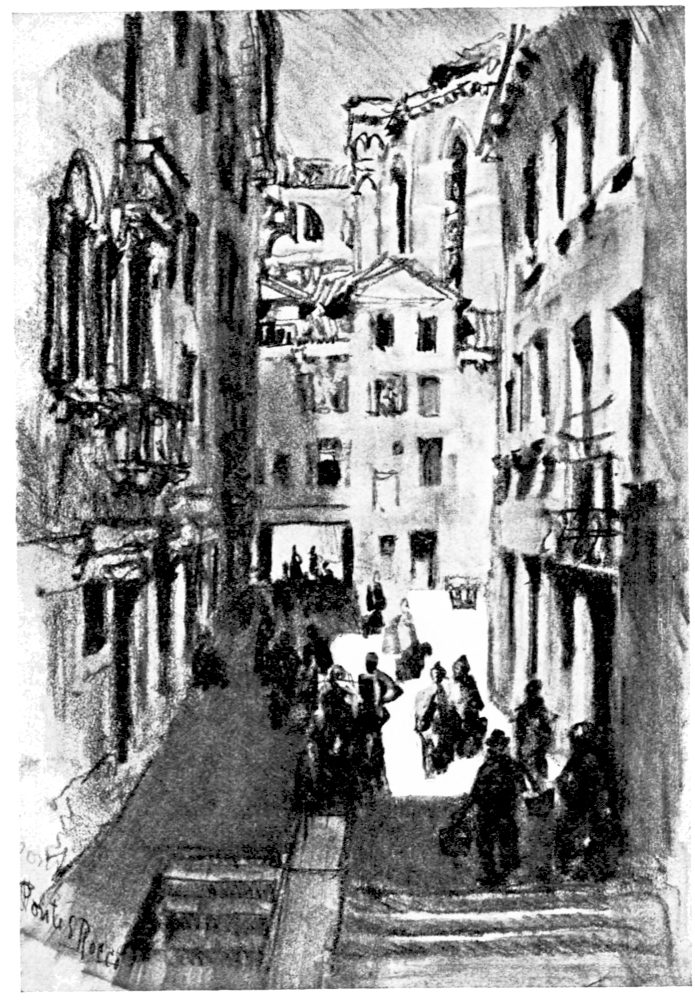
FROM THE PONTE S. ROCCO
too late, and now sat permanently. Orders were given that no stranger was to be allowed to enter the city unless bearing official letters, and no ship was to pass into the lagoons that did not fly the Venetian flag. Some attempt was made to get more vessels ready for sea.
The French had not wasted time, and a general insurrection had broken out under their management in all the cities of the mainland. Within twenty-four hours the governors of Padua, Verona, and other important places came in for refuge, as also the Provveditors of the army, whose occupation was gone.
Meanwhile two nobles, Francesco Donà and Leonardo Giustiniani, had been sent in haste to Gratz, after Junot’s appearance, and they were received by Bonaparte on the twenty-fifth of April. The interview that followed is highly characteristic of the man when it suited his ends to work himself into a fury. The political prisoners were to be liberated, or he would ‘come and break down the Piombi; he would have no Inquisition, no antique barbarities.’ He spoke of the imaginary massacre of his innocent troops. ‘His army cried vengeance, and he could not refuse it.’ ‘If all the culprits were not punished, if the English Minister were not driven away, if the people were not disarmed, if all the prisoners were not set free, if Venice would not choose between France and England, he declared war.’ ‘He would have no Inquisition, no Senate, he would be an Attila to the Venetian State.’ And much more to the same effect, all of which is on record. The two Venetians answered sensibly, when they could get in a word, but Bonaparte meant war, and when he meant that he would listen to no one.
Having acted his scene, he asked the two to dinner and proceeded to extract information from them, after his manner. His inquiries chiefly concerned the horrors attributed to the aristocratic government by the very imaginative French democratic mind; for the lower classes, being nearer to nature, have always had much more imagination than their social betters, which explains their belief in ghost stones, hidden treasures, and the rights of man.
After dinner Bonaparte condescended to state his demands. He wanted twenty-two millions from the Venetian mint and all English drafts deposited in Venice. That was all. There was no mention of the Duke of Mantua’s treasure, from which the envoys suspected that it was included in the secret treaty of Leoben, but I find no mention of it in that curious document, though it may have been tacitly included in Article VI. which provided for the restitution of Mantua and other places to Austria.
Having thus expressed himself, Bonaparte left the envoys to their reflections and went off to Bruck. Almost at the same time they received news of the fighting at the Lido, with instructions to inform Bonaparte of the death of Laugier, with all the caution possible; they did so by letter, and probably congratulated themselves on not being materially able to convey the news by word of mouth; but they nevertheless really asked another audience. He answered in a fury, called Laugier’s death an assassination, and spoke of them and the Venetian Senate as ‘dripping with French blood.’ If they had anything new to tell him, he would receive them, he said, after writing on the same page that he would not.
They went before him again, poor men, and listened once more to his furious language. ‘Not a hundred millions of money, not all the gold of Peru, would now prevent him from avenging the blood of his men,’ and so forth, and so on. This was the truth, as he had purposely risked shedding it for the very purpose of being revenged.
On the twenty-ninth of April, French troops occupied the Venetian frontiers, and General Baraguay d’Hilliers entered the capital with perfect assurance—and, it must be added, with perfect fearlessness—and installed himself in the best hotel. The Senate tried in vain to ascertain from him Bonaparte’s intentions; the soldier answered that he was accustomed to obey his chiefs without question and that he knew nothing of their plans. He had been told to come to Venice and he had come.
On learning that Bonaparte so very particularly detested them, the Savi agreed that it was no longer safe to meet publicly, and they held their sittings in the Doge’s private apartments in the presence of the Counsellors, and the ‘Savi of the Mainland,’ ‘Savi of Orders,’ ‘Savi of Writings,’—Savi of every species. To all these were added the three Heads of the Ten. This last assembly was a sort of amplification of the Black Cabinet already explained.
They have been described as the sextons of the Republic, met together to arrange the details of the funeral. Their acts and resolutions can only excite pity. The first question discussed on the night of April thirtieth was whether a supposed intimate friend of Bonaparte’s (Haller, at one time French Minister of Finance) should be treated with in order to calm his master’s anger. The next question was, whether this proposition might be discussed at once, or whether eight days must be allowed to pass before beginning the debate, according to the law. A third question asked what measures should be taken to inform the Great Council of what was happening.
Several hours had been consumed in these miserable quibbles, during which no attention was paid to the distant booming of guns from the direction
Rom. x. 138.
of Fusina, when a messenger brought a letter for the ‘Savio on Writings.’ He passed it on anxiously to the Savio of the week, who opened it with evident emotion. It was a message from Condulmer, in command of the flotilla of the lagoons, to say that the French had begun operations for improving the approaches to Venice, and that he was going to attempt to destroy what they did as fast as they worked. It was at this moment that the Assembly first noticed the sound of artillery. In the frightened silence the Doge walked up and down the room. ‘To-night we are not safe even in our beds,’ he said.
The Procurator, Pesaro, turned to the Secretary: ‘I see that it is all over with my country,’ he said, in broad Venetian dialect. ‘I can certainly be of no assistance. To an honest man, every place is his country; one may easily occupy oneself in Switzerland.’
He rose as he finished this remarkable speech, apparently with the intention of proceeding to Switzerland at once, but his colleagues ‘comforted’ him, he took snuff, and sat down again to help Valeressi in framing a measure for calling the Great Council together on the morrow. These curious details can be trusted. Pesare was afterwards, in fact, the first to make his escape to Istria and Vienna.
During the remainder of the meeting it was debated whether it might not be possible and advisable to give Venice a democratic form of government likely to please Bonaparte, and the majority adopted the idea of introducing any modifications which he might suggest.
It was hoped by this means that he would be moved to forgive the Inquisitors and the captain of the Lido, whose punishment he had demanded, and to excuse the Venetian banks from handing over the English drafts.
The next day was the first of May, the anniversary on which the Doge had always paid his annual visit to the Convent of the Vergini, since the days of Pier Candiano, a ceremony which was always the occasion of great festivities in the city. But to-day, instead, the bell of the Grand Council was ringing, and the nobles assembled anxiously. The Doge explained in broad dialect the situation of the Republic with regard to France. Peace, he said, must be made with Bonaparte
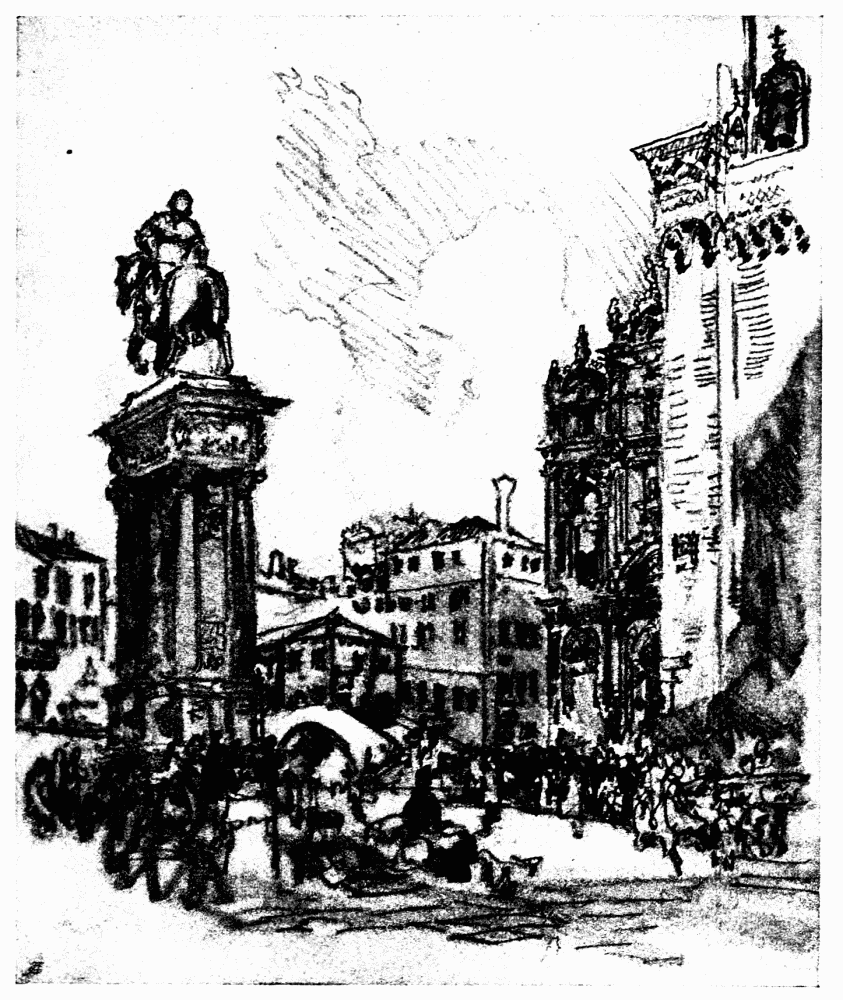
CAMPO SS. GIOVANNI E PAOLO
at any price, and the best thing the members of the Council could do was to say their prayers and ask the help of Heaven in their supreme danger.
Heaven, as usual in such circumstances, did not help those who would not help themselves. The Council thought it had done wonders when it voted by 598 to 21 that two deputies should be sent to Bonaparte with power to discuss radical changes in the Venetian constitution. The envoys chosen were Angelo Giacomo Giustiniani, who had been Provveditor extraordinary in Treviso since the second of April, Alvise Mocenigo, the Governor of Udine, and Francesco Donà. They were given regular credentials, and were, as usual, exhorted to use the utmost caution in all they said.
On the same day Bonaparte declared war against Venice in his most furiously bombastic style. The document must be read, not to be believed, as most of the statements it contains were totally untrue, but to appreciate the marvellous gifts of the man of genius who composed it. It is long, and I have not space for it; I can only say that it altogether outdid the former letters and speeches I have referred to.
The deputation found Bonaparte in Treviso. To the eternal glory of the family that had lost an hundred of its name in one campaign, Giustiniani quietly faced Bonaparte on every point, reproached him with the shallowness of the pretexts under which he justified his acts of violence, swore to the sincerity of the Venetian government when it had protested that it had no intention of doing any injury to the French, and concluded by saying that if Bonaparte required a hostage or a victim he, Giustiniani, was there to give his life.
Bonaparte was everything except a coward. He was a conqueror and a comedian, a brutal dictator and a subtle diplomatist; he was a great commander and he was the Little Corporal. He was also as brave as the bravest man in any of his armies. Giustiniani’s speech affected him strangely, for he well knew what terror he inspired in most people. His sudden admiration for the Venetian patriot was as boundless as everything else in his nature, and broke out in words of praise. He concluded by promising that even if he confiscated the property of every noble in Venice, whatsoever belonged to Giustiniani should be respected. There spoke the man of the middle class that Bonaparte always was. The gentleman answered proudly that he had not come to promote his own interests when those of his country were so desperately at stake.
A truce of four days was signed, within which time the three Inquisitors of State and the commander of the Lido fort were to be arrested and punished, and all political prisoners were to be set at liberty.
On the fourth of May the Doge had the courage, or the cowardice, to propose to the Great Council the arrest of the Inquisitors and their impeachment as required by Bonaparte. There
Rom. x. 159.
was no hope for Venice in any other course, he said.
This dastardly measure was voted by 704 votes to 27. The Inquisitors and the commander of the Lido were arrested and taken to San Giorgio Maggiore, and all the political prisoners were released from the Piombi, the Pozzi, and the other prisons of the city. On the following day, two hundred and eighty-eight Frenchmen who had been taken with weapons in their hands during the insurrections in the provinces were handed over to Baraguay d’Hilliers in Venice.
Bonaparte was now sure that he had only to show himself in order to be master of the city. The Venetians also made haste to present Bonaparte’s ‘friend,’ Haller, with a little present of six thousand sequins in bullion, in the hope that he would use his kind offices with the great man.
‘I beg you,’ Bonaparte wrote about that time to the Directory, ‘to order the citizen Haller, a scoundrel who
Bonnal, Chute, 287.
has come here to steal, to present his accounts to the head manager’ (‘ordonnateur en chef’).
So much for Bonaparte’s ‘friend.’ The Republic also offered the most profuse hospitality to Madame Baraguay d’Hilliers, in the hope that she would soften her husband’s harsh temper.
By this time Bonaparte knew as well as Condulmer himself that the Venetian fleet was miserably manned, and that the city must yield at once if besieged, and he thought it quite useless to receive any more envoys. Besides, he knew that his propaganda had succeeded in the capital itself; his paid agents had done their work well, and it had been bravely seconded by the manifest incompetence of the government which had exasperated all classes. It is said that there were fifteen thousand republicans ready to answer the first signal as soon as it should be given by Villetard, the Secretary of the French Legation. These were not by any means all of the people, for many ladies of the nobility had been
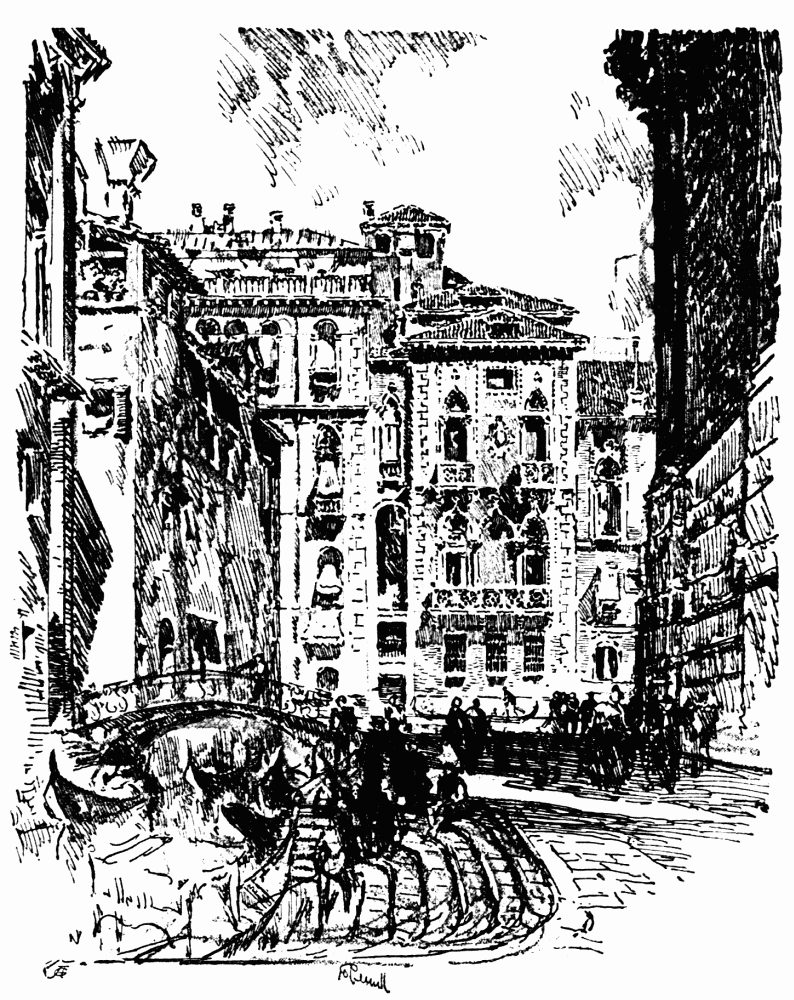
SO-CALLED HOUSE OF DESDEMONA
spending their time in making tricolour cockades, and the government knew it.
The French no longer took the trouble to conceal the preparations they were making for a revolution. A wholesale grocer who played a very suspicious part in the whole affair, Tommaso Zorzi, was dining with Villetard, and heard several Frenchmen speaking of the revolution that was arranged for the next day; it was intended to set up a tree of liberty in the Square of Saint Mark’s and to declare the fall of the aristocratic government. When every one else was gone, Zorzi implored Villetard to put off firing the train, and explained that a large part of the populace would side with their old masters. The French Secretary would promise nothing, and on leaving him Zorzi hastened to the ducal palace and was received by the Doge in spite of the late hour.
He told what he had heard. The Doge sent at once for Pietro Donà, and the two bade Zorzi obtain from Villetard a written declaration of the conditions on which he would consent to give up the revolution. On the following day Zorzi and his friend Spada appeared before the Savi with a paper which they said they had drawn up in the presence of Villetard, who had refused to write anything himself.
The impression one gets in reading this document is that Zorzi and his shadow were in the trick with Villetard. The paper calls them ‘mediators,’
Rom. x. 386 for the text.
talks of ‘pacifically changing the aristocratic forms of government,’ ‘leaving open to the sight of the public the prisons called the Piombi and Pozzi,’ abolishing capital punishment, setting up a tree of liberty in the Square of Saint Mark’s, publicly burning the insignia of the old government, a universal amnesty, and a Te Deum in Saint Mark’s, where the image of the Virgin Mary was to be exhibited.
The paper also named the provisional government, in which the grocer and his shadow were to occupy high positions.
This stuff was not read by Zorzi before the assembly. The Doge deputed Pietro Donà and Francesco Battagia to hear him in a neighbouring room. Donà dismissed him with the remark that the government would wait to discuss such propositions until they were officially laid before the Venetian envoys by Bonaparte himself.
Then Donà returned to the hall and communicated the contents of Zorzi’s paper to the government. The effect was terrific. A few voices protested that no attention should be paid to such an informal proposition, but terror prevailed, and Donà and Battagia were charged to go at once to Villetard to ask him to put off his revolution till the envoys should return from their interview with Bonaparte. Villetard, for reasons known to himself, granted the government a respite of four days.
Meanwhile it was thought wise to dismiss the Slavonic troops, yielding in this to one of the demands expressed in Zorzi’s paper. Their presence ‘irritated’ Villetard. They were accordingly ordered home under the command of Niccolò Morosini, but they did not leave at once.
On the twelfth of May the Great Council met. Early in the morning Villetard had informed Battagia that the Venetian envoys sent to Bonaparte had refused to accept a democratic and representative government, but that the French meant to obtain it by force unless the aristocracy would resign its powers. It was Haller who had brought the news to Villetard after accepting a bribe of six thousand sequins a few days earlier. An American politician once defined a scoundrel as ‘a man who will not stay bought.’
Donà came back with an official letter from Villetard to the Doge, which contained Bonaparte’s ultimatum. The city was in a state of nervous excitement that must break into action before long; the members of the Council were already in terror of their lives while they stood waiting for the hour of meeting. Even then, everything had to be done according to tradition. The patricians were, no doubt, devising more concessions to be made to Bonaparte, as they moved towards the ducal palace, and most of them were ready to sacrifice everything, including their honour, in exchange for personal safety. The last of the Slavonic soldiers were embarking under the direction of the Arsenal men; there were republican conspirators everywhere, and they found their way even to the Doge’s private apartments.
The Council met at the usual hour, and the roll was called. Only 537 members were present, whereas 600 constituted a quorum. It is possible that the many absent members had hoped to obstruct all proceedings by keeping away, for to the last the minutest rules had been observed. But the members who had assembled decided that they had a right to act.
The Doge opened the sitting, pale and overcome. Painfully, and in his Venetian dialect, he recapitulated the acts of the Consulta of Savi and others, who had taken charge of affairs on the thirtieth of April. His miserable speech was followed by the reading of the report of Donà and Battagia, Haller’s letter, and other documents.
The Secretary, Valentin Marin, then read the measure which was brought before the Council.
The Bill had the old sanctimonious tone. ‘The principal purpose of preserving religion,’ etc., were the first words; the measure was, that the Great Council should accept ‘the proposed provisional representative government.’
The Secretary had finished reading the Bill, and was just beginning his comments on it, when the sound of a discharge of musketry rang sharply through the ancient hall. The patricians rushed to the doors. One voice called them back.
‘Divide! Divide!’ it cried, above the din.
To the last gasp formality bound them. Hastily, but not informally, they went through the form of voting. The Bill to accept the democratic government was passed by 512 yeas to 30 nays and 5 blanks.
Then, in the twinkling of an eye, the
1797, May twelfth.
hall was silent and empty.
SAILS