III VENETIAN DIPLOMACY
Reading edition
Before quitting the subject of Venetian official life, I must devote a few pages to the diplomacy of the Republic, which has remained famous in history.
The kings of France often confided diplomatic missions to the clergy, but the Venetian diplomatists were always laymen, without a single exception. The Signory constantly professed the most devout faith in Catholic dogma, and as constantly exhibited the most profound distrust of the popes. The Vatican was, indeed, the chief object of the government’s suspicion. From the fifteenth century onward, any noble who entered holy orders lost his seat in the Great Council, and I have already explained that during the discussion of matters relating to Rome,
Cecchetti, Corte Romana.
all the ‘papalisti’ were ordered to withdraw. When Sixtus V. was elected Pope in 1585, and the Republic sent four ambassadors together to congratulate him, the sixteen nobles who attended the mission were most carefully chosen from among those who never could be ‘papalisti.’
In answer to any criticism of her methods, Venice was almost always able to bring forward the unanswerable argument of success; but the pages which record her diplomatic relations with other powers are not the fairest in her history. Her dealings with her neighbours were regulated by strictly business principles; and ‘business’ is, I believe, the art of becoming legally possessed of that which is not our own.
The marvellous accuracy with which the Venetian ambassadors related to their government the details of what they observed abroad is proverbial, and has been a godsend to students of history, such as M. Yriarte, to whom the world is so much indebted for his study of Marcantonio Barbaro.
The post of foreign representative was a most honourable one, but there were overwhelming responsibilities connected with it. In early times, when diplomatic relations were less close and less continuous, the Republic had sent permanent embassies only to Rome and Constantinople; to other capitals special envoys were only despatched when some matter was to be discussed. But in the sixteenth century Venice had ambassadors everywhere, and each week brought long letters from all countries teeming with details, not only of political or military events, but concerning social festivities, manners, customs, court intrigues, and every sort of gossip.
These letters were read aloud on Saturday to the Senate, which thus assisted at a sort of consecutive series of lectures on the history of the times; and as it was customary to choose the ambassadors from among the senators, it was tolerably sure that when chosen they would always be well informed, up to the latest moment.
The missions of the Republic were limited to a residence of two years in any one foreign capital; but this short time was amply sufficient to bring about the financial ruin of the ambassador if he was not very rich. It was his duty to display the most boundless magnificence for the greater glory of the Republic, and his expenses bore no proportion to his salary.
The following instructions, according to M. Yriarte, were given to Marcantonio Barbaro on his departure for the court of France:—
‘You are to keep eleven horses for your service, including those of your secretary and his servant, and four mounted messengers. You will
Yriarte, Vie d’un Patricien.
receive for your expenses two hundred gold ducats monthly (about £1800 yearly), of which you are not required to render an account. You will receive a thousand gold ducats for presents, and three hundred for the purchase of horses, harness, and saddle cloths.’
The Secretary of Embassy was also named by the Senate, and though the attachés might be chosen by the ambassador, his choice had to be confirmed by the government. He was not allowed to take his wife with him, as her presence might have distracted him from business, and also because it might possibly have been a little prejudicial to the keeping of secrets; but he was allowed to take his cook. These same instructions appear as early as the thirteenth century.
Modern diplomatists, and especially Americans, will be interested to know that the post of ambassador was so little desired as to make it necessary to impose a heavy fine on any noble who refused it when he was appointed; and it actually happened more than once that men paid the fine rather than ruin themselves altogether in the service of their sordid government. Once having left Venice, however, no resignation was allowed, and the ambassador dared not return unless he was ordered to do so. Requests for leave were very rare, and were only made under the pressure of some very exceptional circumstances. Such a petition was considered so serious a matter that when one arrived from abroad all persons related to the ambassador were ordered to leave the Senate, lest their presence should interfere with the freedom of discussion; but the request was never granted unless two members of the family would swear that the reasons alleged in the petition were genuine.
Legend assures us that each ambassador received, together with his credentials, a box full of gold coin and a small bottle of deadly poison. This is childish nonsense, of course, so far as the portable realities were concerned, but ambassadors were instructed to hesitate at nothing which could accomplish the purpose of the State, neither at spending large sums which would be placed at their disposal when necessary, nor at what the Senate was good enough to call measures of exceptional severity—namely, murder.
The most important post in Venetian diplomacy was the embassy at Constantinople, where the chief of the mission enjoyed the title of Bailo, together with the chance of making a fortune instead of losing one. The Bailo of Constantinople and the ambassador to the Pope took precedence over all other Venetian diplomatists, and they were expected to make an even greater display, especially at the pontifical court. The four ambassadors sent to congratulate Sixtus V. on his election had each four noble attachés, four armed footmen, and five-and-twenty horses, and the one of the four who was already the resident in Rome was indemnified for his expenses in order that he might appear as magnificently as his three newly arrived colleagues.
On their return from a foreign mission the envoys of the Republic were bound to appear at the chancery of the ducal palace, and to inscribe their names there in a special register; and within a fortnight they were required to render an account of what they had seen and learnt abroad, and of the affairs with which they had dealt. These accounts, called ‘relazioni,’ were brief recapitulations of their weekly letters to the Senate; the first phrases were always written in Latin, but the body of the discourse might be in Italian, or even in dialect. The ambassador presented himself in full dress, wearing his crimson velvet mantle and bringing the manuscript of his speech, which he afterwards handed to the High Chancellor; for as early as the fifteenth century all public speeches were required to be written out, in order that they might be preserved exactly as they had been spoken, or rather read, for it was not even allowable to recite them by heart. I need hardly add that no stranger was ever admitted to hear an ambassador’s account of his mission, and the senators swore a special oath of secrecy for the occasion, even with regard to the most insignificant details.
Any one who examines a number of these documents will soon see that they all begin with a portrait of the sovereign to whom the envoy was accredited, and there is often a great deal about the royal family, its surroundings, tastes, and habits. Almost invariably also the account ends with a list of the presents and titles or decorations bestowed upon the ambassador at the close of his mission, and all these he was required to hand over intact to the Signory. Not uncommonly, however, the presents were returned to him; but as no foreign titles could be borne by Venetians, the recipient of them was usually created a Knight of the Golden Stole, the only heraldic order recognised by the Republic and in the gift of the government.
It would be curious to examine into the first causes
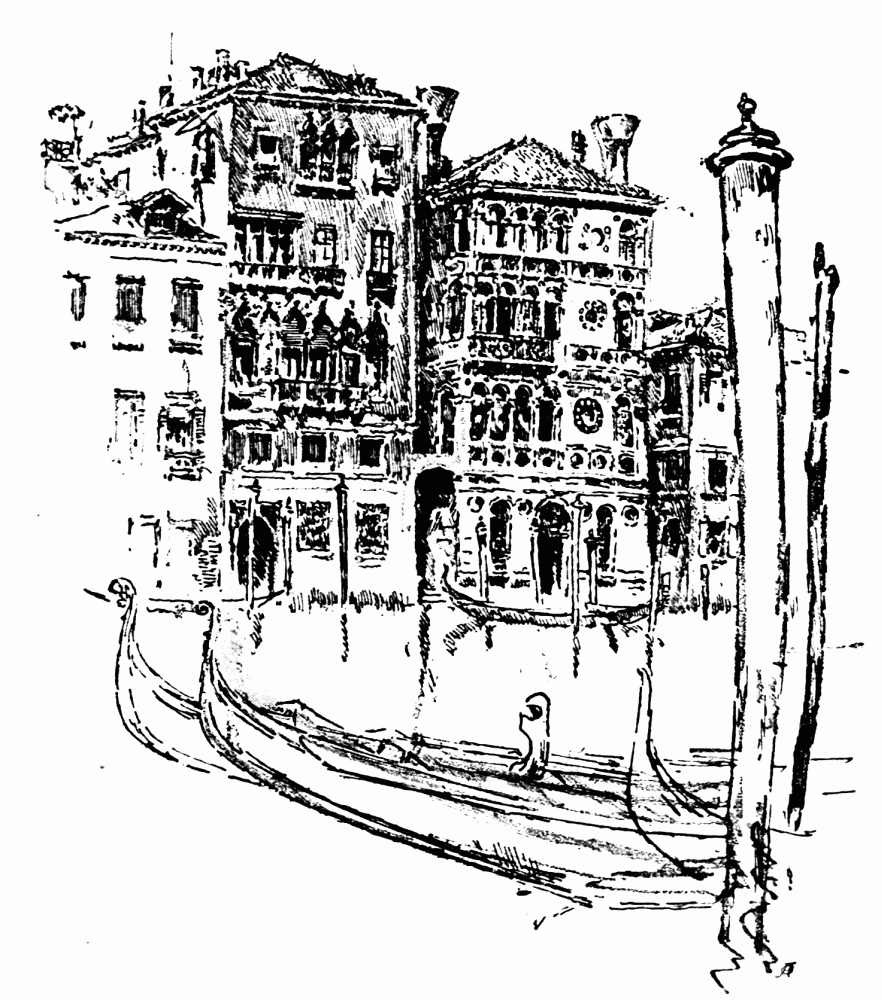
PALAZZO DARIO
of the relations between Venice and the other European states. It was the exchange of raisins for wool which obliged England and Venice to send each other permanent diplomatic missions. Up to that time only occasional special envoys had been necessary. The first time that England addressed a letter to the Signory she employed as her official agent a Neapolitan monk, the Bishop of Bisaccia, chaplain to King Robert, and this was in 1340. The envoy came to say that King Edward the Third of England had the honour to inform the Doge Gradenigo that he had defied Philippe de Valois to say that he was the anointed of the Lord. The envoy further stated that the two rivals were about to invoke the judgment of God, either by going unarmed into a den of wild beasts, who would of course respect the Lord’s anointed and promptly devour the pretender, or else by ‘touching for King’s Evil.’ Beginning in the
Rawdon Brown, Archives.
fifteenth century there is a long list of English ambassadors and ministers resident in Venice. The last English diplomatic representative in Venice was Sir Richard Worsley, of whom I shall have occasion to speak hereafter.
All the foreign diplomatists in Venice were constantly on the look-out for the arrival of the special mounted messengers attached to each foreign embassy. These were celebrated throughout Europe for their speed and discretion. In the fifteenth century they were thirty-two in number, and formed a small guild which was under the protection of Saint Catharine; and they were almost all natives of Bergamo, a city which is still singularly noted for the honesty and faithfulness of its inhabitants, and which even now furnishes Venice with trusty house-porters and other servants of whom responsibility is required.
CALLE BECCHERIA
In the Souvenirs of M. Armand Baschet, I find that the courier who brought the news of the signing of the treaty of Cambrai from Blois to Venice covered the distance in eight days, the best previous record to Paris, which is about the same distance, having been nine, and the usual time employed being fifteen. The employment of State courier could be bought and could be left by will.
Each ambassador of the Republic seemed to possess a part of the marvellously universal vision that belonged to the Council of Ten. Mr. Rawdon Brown made a special study of the weekly letters of the Venetian ambassadors in England, and found, for instance, that one of the Republic’s representatives succeeded in regularly copying the letters which Queen Elizabeth wrote to her lovers, which were therefore read aloud to the Senate with the greatest regularity, together with many other curious details of English court life.
I shall give two specimens, translated from the weekly letters in the Albèri collection. In 1531 the patrician Ludovico Falier came to render an account of his mission to the Court of Henry VIII. He expresses himself as follows, concerning that King and the English:—
In order that my discourse may be better understood I shall divide it into two chief parts, of which the one concerns my journey, and the other the most puissant King Henry VIII., and the manners and customs of his country from the year 1528 to 1531.... On the tenth of December I reached Calais [he had left Venice in the middle of October, but had travelled by short stages with a numerous suite]; it is a city of the French coast which belongs to the most serene King of England, as I shall have occasion to repeat hereafter. There I went on board a vessel to cross the ocean, which after behaving furiously during the passage at last threw me upon the English shore. I therefore arrived at Dover much more tired by these few hours of navigation than by a journey of ninety days on dry land. Having rested a little at Dover I got on horseback to go to London. At St. George’s I met my most illustrious predecessor Venier with several personages of the Court, including the most reverend the Cardinal (Thomas Wolsey), and we all entered the city together, and they accompanied me to my house. I was ordered almost at once to go to the Cardinal, in order to kiss his hand, for this ceremony always preceded that of an audience with the King; such is the power of this prince [of the Church]. On leaving his apartment I was conducted to his most serene Majesty, with whom I then had the interview which I described in detail in my letter to your Signory and to this glorious Senate.
The ambassador goes on to speak in the past tense of Cardinal Wolsey, who had fallen into disgrace in the interval. He goes on to speak of the Queen, who was then Catharine of Aragon.
My lady the Queen is small of stature, and plump, and has an honest face; she is good and just, affable and pious. She speaks fluently Spanish, Flemish, French, and English. Her subjects love her more than they ever loved any Queen; she is five and forty years old, and she has already lived thirty-five years in England.
The ambassador speaks of the King next.
God has united in King Henry VIII. beauty of soul with beauty of body, so that every one is astonished by such wonders ... he has the face of an angel, for it would not be enough to say that he is handsome; he resembles Cæsar, his look is calm, and contrary to English fashion, he wears his beard; who would not admire so much beauty accompanied with so much strength and grace? He rides very well, jousts and handles a lance with great skill; he is a very good shot and an excellent tennis player. He has always cultivated the extraordinary qualities with which nature has adorned him from his birth, for he thinks that nothing is more unnatural than a sovereign who cannot dominate his people by his moral and physical qualities.
And here the ambassador seems to have thought that he had gone rather far, for he finds something to say about Henry’s less admirable characteristics.
Unhappily this prince, so intelligent and reasonable, is given up to idleness, has allowed himself to be led away by his passions, and has left the government of the State in the hands of a few favourites, the most powerful of whom was the Cardinal, until he fell into total disgrace. Since then, from having been generous, he has become miserly, and whereas formerly all those who treated of affairs with him went away satisfied and covered with gifts, he now allows all to leave the Court with discontent. He makes a show of great piety, hears two low masses every day, and high mass also, on feast days. He gives to the poor, to orphans, widows, young girls, and infirm persons, and for these charities he gives his almoner ten thousand ducats yearly. He is beloved by all. He is forty years of age and has reigned twenty-two.
Falier speaks next of the climate of Great Britain and the products of the country, and gives a long description of a brewery. He briefly but sufficiently describes the Universities of Oxford and Cambridge, and gives some account of the British Constitution. He gives also a statement of the King’s sources of income with their amount, and the accuracy of the figures suggests that he must have got access to papers not intended for his perusal.
His Majesty may count upon over five hundred thousand ducats [£375,000] a year, divided as follows:—
Ducats.
From the Crown (Lands)190,000
Customs150,000
Vacant Benefices40,000
Privy Seal10,000
Rebels (Confiscations, etc.)50,000
Lands on the Continent10,000
Fines for Crimes25,000
Royal Guards50,000
Total525,000
I cannot tell exactly what he gets from taxes, but from information which I have endeavoured to obtain from grave and experienced persons, His Majesty exacts from his subjects about a million of ducats; for the six millions of ducats which he had inherited from his father were all spent in the wars with France, Flanders, and Scotland. His Majesty usually spends 425,000 ducats for his Court, which consists of five hundred men; namely, twenty-six chamberlains, of whom one is Treasurer of the Chamber [keeper of the privy purse?], one is a Majorduomo called a ‘Steward,’ his assistant, who carries a little white stick as a sign of his dignity; the Treasurer General, who pays all accounts; the accountant who distributes [the payments]; the ‘cofferers’ in charge of the said accounts; the Master of the Horse who has the management of the royal stables. There are three hundred horses, between Arabs, Turkish horses and racers, hackneys and others. His Majesty has also eight chaplains, of whom one distributes his charities, and there are many persons for his service of whom I do not speak in detail lest I should fatigue Your Serenity. His Majesty has always in his pay three hundred halberdiers who are on guard by tens at a time for the King’s person, and pass the night in the private antechamber.
His Majesty spends as follows:—
Ducats.
For the Maintenance of his Court100,000
Presents120,000
Horses20,000
Parks, and Packs of Hounds50,000
Soldiers who guard the Fortresses30,000
His Majesty’s Chamber (Privy Purse)30,000
Buildings10,000
Charities10,000
Embassies and King’s Messengers40,000
Expenses of the Queen (Catharine of Aragon), and the Princess (Mary)30,000
Total440,000
In case of war his Majesty could arm four thousand light horse and sixty thousand infantry. The latter would fight in the old-fashioned way, with bow, sword, shield, helmet, and with pikes of one or two points which are excellent against charges of cavalry. They are now beginning to use guns and artillery. The English do not fear death. As soon as the battle commences, they provoke the enemy and charge furiously; in very quick engagements they are generally victorious, but they often yield if the war drags on. They have not the slightest fear of Frenchmen, but they are much afraid of the Scotch.
During forty days they are obliged to serve in the army without receiving pay; after that time they receive three crowns and a half for a period of service determined beforehand. The fleet consists of one hundred and fifty vessels.
It now only remains for me to tell you who are the friends of the King, and what consequences his divorce might have, and I shall then add a few words on the most Reverend the Cardinal York.
Since the affair of the divorce has come up [Falier is writing in 1531, and Henry VIII. married Anne Boleyn the next year] the Pope [Clement VII.] is not in his Majesty’s good graces. If the Holy Father will not grant the King permission to divorce, the result will be a very great advantage for the English crown, and a great danger to the Roman Church, for the King will detach himself from the latter, and will seize all the revenues of the ecclesiastical benefices; this will yield the Crown more than six million ducats [£4,500,000].
Falier was not mistaken, unless, perhaps, in his figures. He proceeds to speak of the relations between England and all the other European states, after which he returns to the question of the divorce, expressing himself in a very singular way for a Catholic. It must be remembered, however, that he was a Venetian, and therefore a man of business first, and a baptized Christian afterward.
The Englishman [Henry VIII.] must necessarily divorce, for he wishes to have a legitimate son, and he has lost all hope of one being born to him by the Lady Catharine [of Aragon]. He will therefore marry his favourite [Anne Boleyn] the daughter of the Earl of Vuilcer (sic) [Wiltshire—note the Venetian’s phonetic spelling!] as soon as possible. He will have trouble, for the faction that is for the Queen will rise.
It is quite clear that Venetian diplomatists did not indulge themselves in sentiment, and the information they presented to the Senate was as brutally frank and coldly precise as a medical diagnosis. They sought for facts and did not philosophise about them. Here is Falier’s opinion of Cardinal Wolsey:—
The King and the kingdom were in his hands, and he disposed of everything as the King himself might have done, or the Pope. All the princes were obliged to bow down to him. He received one hundred and fifty thousand ducats yearly over and above the gifts which he had from the English and the foreign princes. He counted much on France, with which kingdom he kept up extremely affectionate relations. His court was magnificent, more magnificent than the King’s. He spent all his income, he was very proud, and he wished to be adored like a god rather than respected as a prince.
In connection with the great Cardinal, I shall translate a passage of the letter in which Falier had informed the Senate of his disgrace. The fragment has some value also, from the light it throws on the comparative values of coins at that time. It must be remembered that the value of the gold ducat never changed to the last, while that of all other European coins varied greatly.
The King of England has had the Cardinal put in prison, has deprived him of the government, and has confiscated all his property. His fortune is valued at forty thousand pounds English, equal to twenty thousand of our grossi [the silver mark], or two hundred thousand [silver] ducats; in these forty thousand pounds must be included thirty thousand pounds English in cash, that is, fifteen thousand of ours or one hundred and fifty thousand [silver] ducats. His real estate has also been confiscated, consisting of his Archbishopric, which brought him a very large sum.
At the risk of wearying my readers I give a short extract from the report of another ambassador to England, Jacopo Soranzo, which was read before the Senate on the ninth of August 1554 (Queen Mary then reigning). The Venetian expresses his surprise at the way in which trials by jury were conducted in England.
Crimes are tried before twelve judges who may not leave the court, nor eat, nor drink, until they all agree, without one exception, on the sentence to be passed.... When sentence has been passed, the judges execute it immediately, but without ever resorting to the mutilation of a member or exile. If the accused is innocent, he is acquitted; if he is guilty, he is condemned to death.
I need not lay stress on the defective form of such trials; your Lordships see for yourselves how reprehensible such a mode of procedure is, for it often happens that eleven persons who wish to acquit the accused decide to condemn him to death in order to be of the opinion of the twelfth, who is determined to bear starvation till this verdict is given.
Before closing this chapter it is worth while to note that if the Venetian ambassadors abroad succeeded in knowing almost everything that was happening, the
A. Bashet, Archives.
government took good care that foreign representatives residing in Venice should not follow their example. They were never told anything in the way of news, and though honours and privileges were heaped upon them, they were kept at arm’s length. As far back as the fourteenth century there was a law forbidding all patricians to have any acquaintance or social intercourse with any foreign representative except under the most exceptional circumstances, and M. Baschet has found material in the Archives sufficient to prove that the foreign ambassadors lived in something very like the seclusion of exile, and were altogether banished from all intercourse with the upper classes. The same writer adds that the diplomatists resented this rude exclusion, and that the practice of it made the Republic not a few enemies.
To such a criticism Venice would have answered, as usual, by the argument of success on the whole during many centuries. Those who care to examine the point more closely may read M. Baschet’s interesting work on the Secret Chancery.
PONTE DEL CRISTO