XV THE LAST SOLDIERS
Reading edition
During the eighteenth century Venetian diplomacy succeeded in preserving the Republic’s neutral position in spite of the great wars that agitated Europe. Her only war was with the Turks, and it was disastrous.
Early in the century the Turks attacked the Peloponnesus, and Venice lost her richest colonies in rapid
1715.
succession. Her navy was no longer a power, and she was almost without allies, for the European powers were exhausted by the recent war of the Spanish succession, and though Malta and the Pope befriended her, the help they could give was insignificant. It was not until the Turks attacked Hungary that she received any efficient assistance; by uniting her forces with those of the Empire she obtained some success, and the desperate courage of Marshal Count von Schulenburg, a Saxon general in the Venetian service, saved Corfu. The Turks, beaten at sea by the Venetians, and on the Danube by the Hungarians at Temesvar, made peace, and the treaty of Passarowitz put an end to the war.
1718.
But Venice had for ever lost the Peloponnesus, Crete, and other valuable possessions.
After this disastrous struggle, it was impossible to preserve any further illusions as to the future. Venice felt that she was in full decadence, and only endeavoured to hide its outward signs. Instead of trying to beat against the current, she allowed herself to drift; things went from bad to worse, and before long the army, the navy, and the Arsenal were completely disorganised, though their expenses had not in the least diminished. A contemporary says that a regiment looked like a company, and a
Mutinelli, Ult. 150 sqq.
company like a corporal’s guard, whereas the Republic was paying for regiments with their full complement of men.
The service of the hired troops was beneath contempt. In Padua the students of the
Mutinelli, Ult. 176.
University defied the garrison. On one occasion, in a hideous orgy, they accidentally or intentionally did to death a pretty beggar girl; but when a detachment of Croatian soldiers attempted to arrest the culprits, the students treated them with such utter contempt that their commander was terrified, fled with his men to the safety of the barracks, and bolted and barred the doors.
If such things happened on Venetian territory one may fancy what the state of things was in the colonies. Corfu was supposed to be defended by a company of Venetian soldiers and two companies of Albanians. From 1724 to 1745 the latter were represented by two men, a major and a captain, whose sole business was to draw the pay of the whole force. The two officers embezzled the sums allowed for the men’s food and uniforms, and the pay was sent to the soldiers, who lived in their own homes in the mountains. No trouble was taken even to identify them, and when one died it was customary for another to take his name and receive his pay. The two companies thus literally earned immortality, and the names on the rolls never changed. Several Albanians who drew their pay as Venetian mercenaries enrolled themselves also in the so-called ‘Royal Macedonian’ regiment, in the service of the King of Naples, and were never found out by the Republic. In twenty-one years these imaginary troops cost Venice 54,300 sequins, or over £40,000.
The colonial garrisons economised their gunpowder by abolishing all target practice, and consisted chiefly of utterly untrained old men who were absent most of the time. The fortresses were not more serviceable than the troops that were supposed to defend them. On the mainland, the frontier fort of Peschiera was half dismantled, the drawbridges had
Mutinelli, Ult. and Tassini, under ‘Bombardiere.’
long rusted in their positions and could, not be raised, and the ramparts were so overgrown with trees and shrubs as to be impassable; at one time the fort did not even possess a flag to show its nationality. Ninety of its guns had no carriages; the gunners lived quietly at their homes in Venice, and if they ever remembered that they were supposed to be soldiers it was because the government dressed them up on great occasions as a guard of honour for the ducal palace. Their number was between four and five hundred.
As for the fort of Corfu, it was robbed by a common thief. In 1745, a certain Vizzo Manducchiollo promised the Turks two good guns, one of
Mutinelli, Ult. 169.
bronze and one of iron. With the help of his gang he scaled the wall of the Raimondo Fort one night, carried off the cannon, and sold them to the Turks for twenty-seven sequins.
The workmen of the Arsenal in Venice, who had formerly been the best-organised body of men in the Republic, had completely come to grief in the eighteenth century. The Arsenal was supposed to be governed by a voluminous code of laws, most of which were now either altogether disregarded, or were administered with culpable leniency. The disorder was incredible. Every son of a workman in the Arsenal had an hereditary right to be employed there, but the officials who were in command did not take any means of checking the men’s attendance; they paid so much a head for every workman on the payroll, according to his age, whether he ever appeared except on pay-days or not. In this way the State paid out vast sums to men who only entered the gates once a month to draw their wages for doing nothing. Many of them had other occupations, at which they worked regularly and industriously. Some were even actors, and one of the cleverest ‘Pantaloons’ was officially known as one of the best-paid Arsenal hands. The six hundred apprentices who were supposed to attend the technical schools attached to the different departments of the yard, only looked in now and then. When the time came for them to pass for the certificate of master workman they paid the sum of thirty-four Venetian lire, in consideration of which the Examiners pronounced them competent. In this way, as Mutinelli
Mutinelli, Ult. 145, 153.
truly says, ignorance became hereditary, as employment in the Arsenal already was, and the yard became a mere monument of former generous initiative, very expensive to maintain.
At the fall of the Republic, Bonaparte seized and sent to France a large number of vessels. When the Arsenal was sacked in 1797 it was
Rom. x. 162, note 2, and 304.
found to contain 5293 pieces of artillery, of which 2518 were of bronze, and the rest of iron; and at the last there were brought from the docks ten ships of seventy guns, eleven of seventy-six, one of fifty-five, thirteen of forty-two, two of thirty-two, twenty-three galleys, one floating howitzer battery, two ‘cutters,’ whatever the Italian writer may have meant,
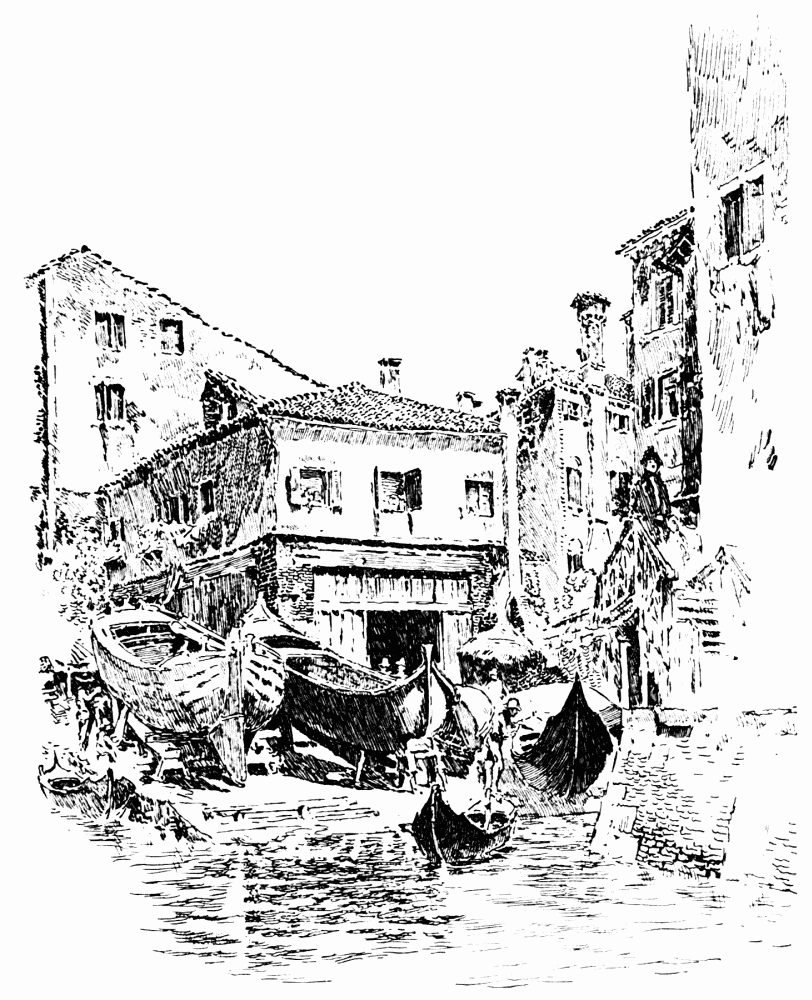
BOAT-BUILDERS
twelve gunboats, three brigs of sixteen to eighteen guns, one fore-and-aft schooner, seven galleons and as many ‘zambecchi,’ five feluccas, many boats armed with grenade mortars, ten floats with two guns, and one floating-battery of seven guns.
If these vessels were not all badly built, they were certainly badly fitted out and badly sailed when they went to sea. The Provveditori and Inquisitors Extraordinary, sent from time to time by the Senate to inspect the fleet, complained that they found neither good carpenters nor good sailors. One frigate, which had a nominal crew of one hundred and fifty-seven men, the Concordia, was found to have barely thirty, and not able seamen at that. As for the convicts who pulled the oars on the war-galleys, they were kept half-clothed and shelterless when ashore; but being only carelessly guarded they often ran away, and not unfrequently succeeded in finding employment, under assumed names, in the smaller ports of the Republic. Some are known to have become house-servants. Nevertheless the overseer of each gang regularly pocketed the money allowed for their food and clothing.
In 1784 it was proved that for a long time from sixty to seventy thousand fagots of wood and an immense number of barrel staves had disappeared yearly, no one knew how. The workmen of the Arsenal did not think it necessary to buy firewood when it could be had for nothing.
In 1730, the Provveditor Erizzo was ordered to one of the Eastern colonies on an important mission, with several large vessels. Almost at the moment of starting, the officers of one of these galleys came and begged him to give them a captain not belonging to the
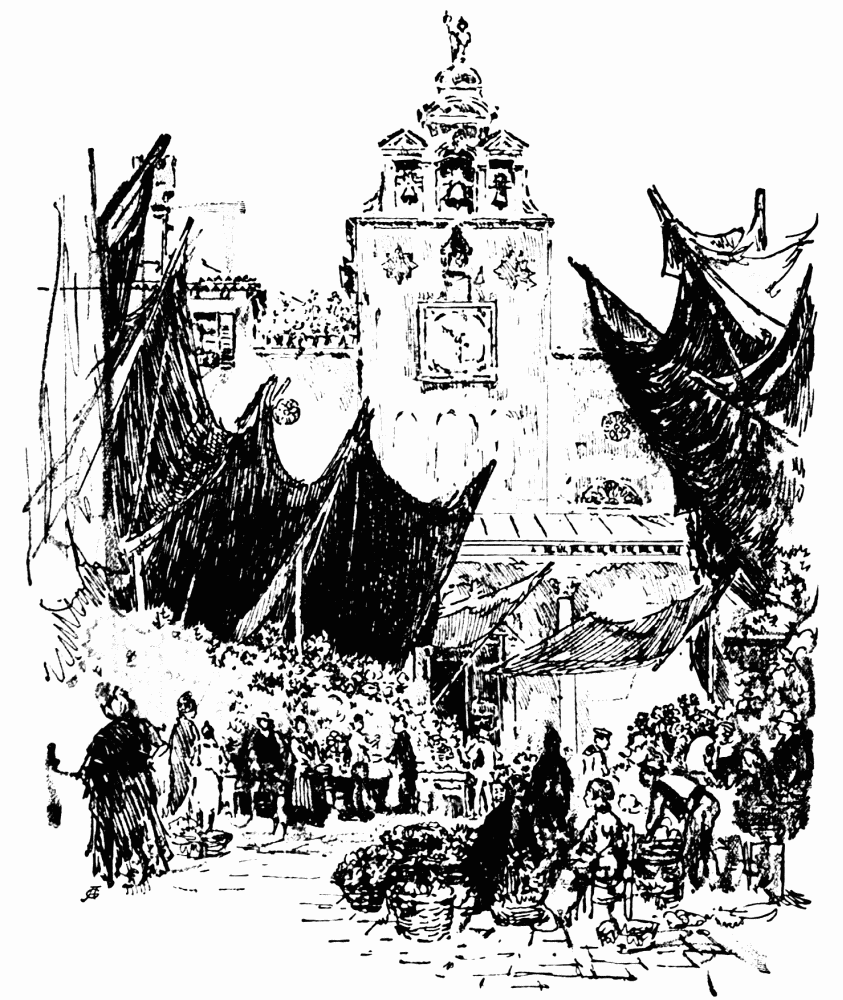
THE VEGETABLE MARKET
navy, as they should not otherwise feel safe to go to sea.
Yet at this very time Goldoni wrote that every one sang in Venice: ‘They sing in the squares, in the streets, on the canals; the shopkeepers
Goldoni, i. chap. xxxv.
sing as they sell their wares; the workmen sing as they leave their work; the gondolier sings while he waits for his master. The characteristic of the nation is its gaiety.’
In the midst of this laughing decadence, in the very depth of this gay and careless disintegration of a country’s body and soul, we come across one devoted, energetic character, a fighting man of the better days, who reminds us of what Venice was in her greatness.
Angelo Emo was great, considering the littleness of Venice in his time. If we compare him with Vittor Pisani, Carlo Zeno, or Sebastian Venier, he seems small as a leader; but as a plain, brave man, he is not dwarfed by comparison with men who were colossal in an age of giants.
He was born in 1731, and was brought up by his father to dream of older and greater times, and to know more of his country’s history than most
Rom. viii. 289.
youths of his day. He travelled early and far, often employed on business of the State, and he was able to compare the condition of Venice with that of other European countries, especially England and France, in regard to military and naval matters.
He was not yet thirty years old when the government sent him to Portugal to study the means of reviving the commercial relations between that kingdom and Venice. Sailing down the Adriatic, he put into Corfu, probably for fresh provisions; but on learning
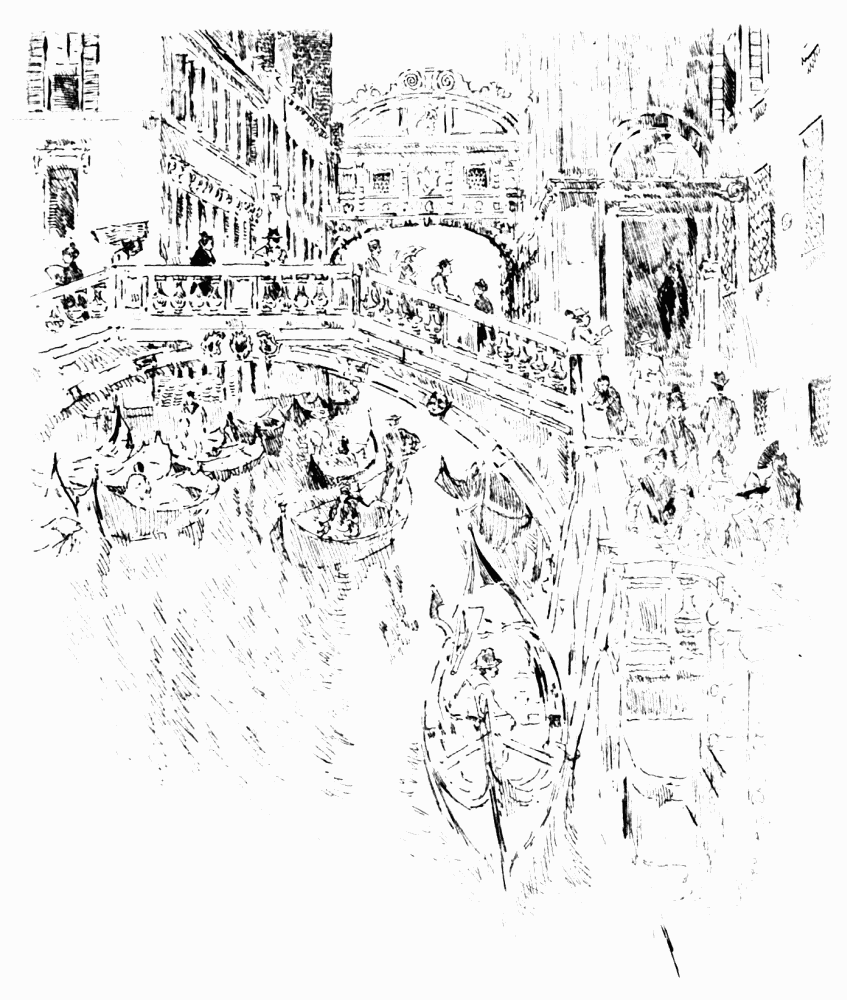
PONTE CANONICA
that many intrigues were already on foot to deprive
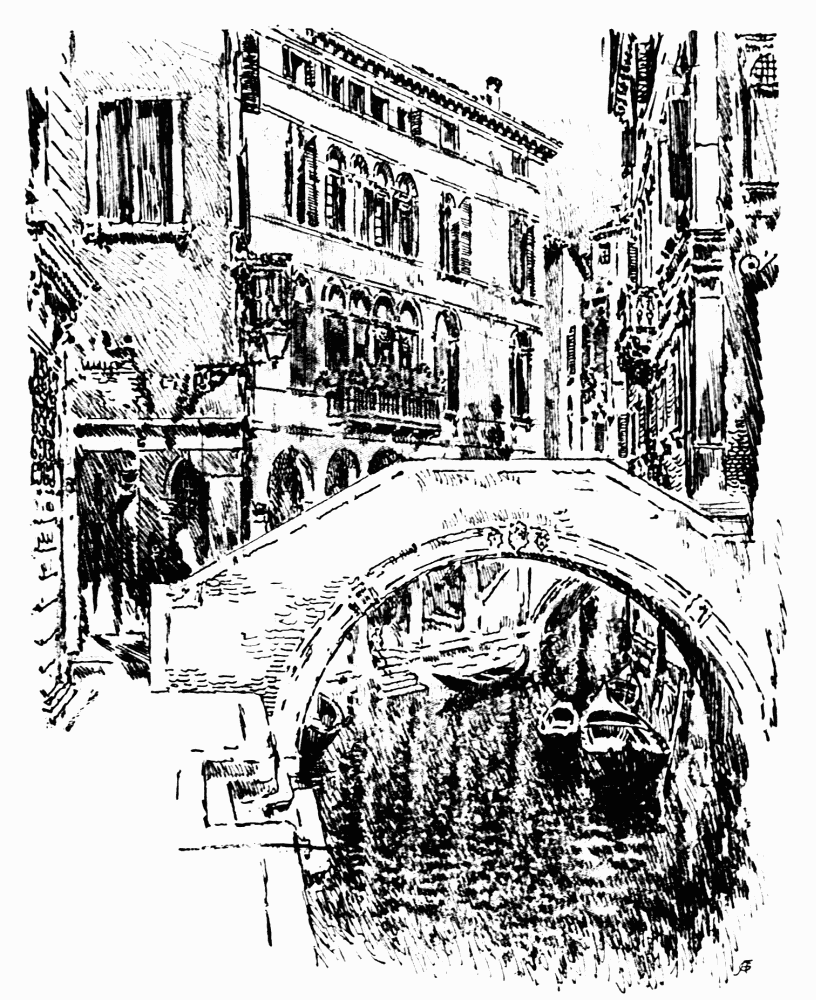
FONDAMENTA WEIDERMANN
him of his mission, he set sail again at once for the Mediterranean in order to be beyond reach of recall. He passed the Straits of Gibraltar, but fell in with a gale of wind in the ocean which nearly put an end to his sailing for ever. The Venetian vessels were not remarkable for their seaworthiness at best, and ocean weather was almost too much for Emo’s ship. He himself describes the frightful confusion in the storm, and the difficulty he had in managing his men. To make matters worse, the freshwater tanks were sprung and most of the supply was lost, so that water was served out in rations, while the food consisted principally of what the British sailor terms ‘salt horse.’ Then the vessel lost her rudder, and things looked badly; but the gale moderated and died out at last, and the ship brought to near a wooded coast, whence Emo was able before long to get a tree, which was rough hewn to serve as a rudder, and he got his vessel into port at last, ‘with the admiration and applause of every one,’ says Romanin, after describing the affair of the jury-rudder as only a landsman can describe an accident at sea.
His mission to Portugal was successful, and Emo returned to Venice; but when he tried to direct the attention of the government to reforms of which the army and navy stood in urgent need, he could obtain no practical result, so that when he was
1784.
placed in command of a fleet, with orders to punish the Bey of Tunis and the Algerian pirates, he was well aware that his force was by no means what it appeared to be to the inexperienced public. In the course of the campaign his largest ship, La Forza, ill-equipped and worse officered, sank before his eyes off Trapani, and none of the other vessels could be relied on to do any better. Yet with such material and such men he sustained a conflict that lasted three years, and if he was unable to destroy the Bey of Tunis, he at least humbled him, brought
Mutinelli, Ult. 150, and Rom. viii. 294.
him to terms, and obtained from him a formal treaty engaging to put down piracy on the African coast. France profited much by the result of this expedition, and one of the last documents signed by Louis XVI. before he fell was a letter to the Doge Manin, in which Angelo Emo was praised to the skies for the good work he had done.
The Admiral was rewarded with the title of Cavaliere, the only one the Republic ever conferred, and with the office of Procurator of Saint Mark’s, but I cannot find that his advice as to reforms was ever listened to. A few years later, the Bey of Tunis broke his promise in regard to piracy, and Emo was again sent with a fleet to chastise him, but was suddenly taken ill in Malta, and died in a few days. He was poisoned, it is said, by Condulmer, his principal lieutenant, who at once succeeded him as admiral.
The last Venetian fighting man was of average height and lean, and stooped a little; he
Statue of Emo, Canova; Arsenal.
was pale, his forehead was broad, and he had blue eyes and black eyebrows, particularly thick and bushy. His mouth was strong, but the lips were thick and coarse.
His remains were carefully embalmed in Malta and were brought home to Venice on his flagship, the Fama—‘fame’—which came to anchor on the twenty-fourth of May 1792. The body was followed from the mole to Saint Mark’s by the clergy, the schools, the magistracies, and a vast concourse of people. The funeral mass was sung in the presence of the Doge, and the vast procession wended its way to the church of the Serviti. To the martial sound of drums and the solemn roar of the minute gun, Venice laid her last captain to rest beside his fathers.
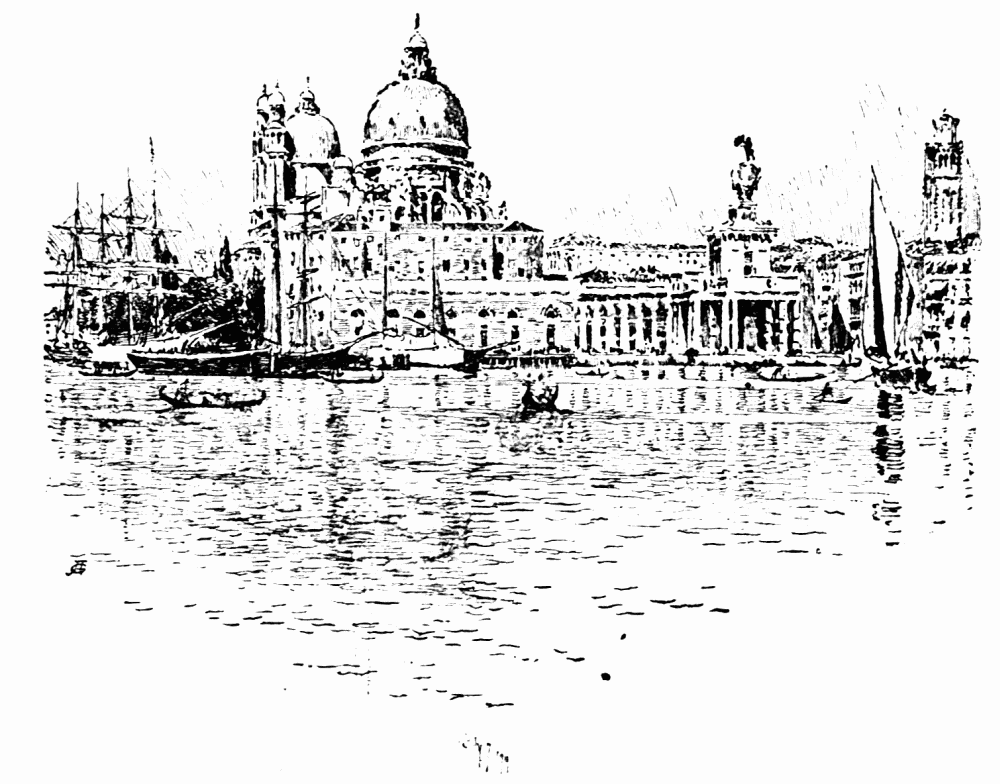
THE SALUTE FROM S. GIORGIO