V CONCERNING SOME LADIES OF THE SIXTEENTH CENTURY
Reading edition
The clever modern Italian playwright, Signor Martini, makes one of his witty characters say that there are ‘women,’ but that there is no such thing
Martini, ‘Chi sa il giuoco non l’ insegni.’
as ‘woman’ in the abstract. In other words, ‘women’ are a fact, but ‘woman’ is a myth. Though this may be a little paradoxical, there are certainly distinct types of women in each class of life. The smart society woman of to-day and the labourer’s wife, like the Venetian patrician lady of the sixteenth century and the fisher-wives of Chioggia, have in common only their sex, their weaknesses and their sufferings; there is very little resemblance between their virtues, and none at all between their joys.
The noble ladies of Venice in the sixteenth century were as idle and frivolous as Orientals. The fact must be admitted by any one who studies the times; and if it is not of a nature to please those who idealise that period, it may be partly excused by the consideration that the Venetian nobleman treated his womankind very much as a Turk treats his harem. He was not jealous, as lovers understand jealousy; granted a certain degree of beauty and a dowry of a certain value, he cared very little whom he married. When Kugler, the famous art critic, says of Titian’s picture of the Schiava, the Slave, in the Barberini Gallery in Rome, that the name is utterly meaningless, he shows that he knew nothing of Venetian life. The slave in the sixteenth century not seldom meant everything, where the wife meant nothing; and if the wives were idle and frivolous, we must remember that when they were young and good-looking, they often found themselves in competition with beautiful Georgian and Circassian women for their masters’ favour. Where women are plentiful, beautiful, and not clever, the men who love them are rarely jealous. But those grave and magnificent Venetians, who had not a scruple in politics, nor in matrimony, were excessively sensitive about anything which touched their technical honour, and it seemed to them altogether safer and wiser to teach their wives and daughters what they were pleased to call ‘habits of domestic seclusion.’ To be plain, they encouraged them to stay at home; and sometimes, by way of making obedience easier, they locked them up. M. Yriarte says with partial truth that their ‘seclusion’ was that of the harem, not that of the classic gynaeceum; he did not realise that the latter was nothing but a harem too, and that if the Greeks kept their wives at home, it was that they might sup undisturbed in the society of Phryne.
The influence of the East on everything connected with private life in Venice increased with the Renascence, and is even more perceptible then than during the nominal domination of the Byzantine Empire, when Roman traditions still had great force, and new currents of thought reached Venice from the Lombards.
Yet in one respect there was nothing oriental about the Venetian noble of the sixteenth century. When he ordered his women to appear in public at all, he sent them out adorned like those miraculous images which are covered with ‘ex voto’ offerings, and they mixed in the crowd that filled the Piazza of Saint Mark’s, shoulder to shoulder with the shameless free.
The Venetian gentleman, so sensitive about his technical honour, was not even displeased when the chronicler, the reporter of his day, confounded ladies and courtesans in pompous praise of their beauty and dress. One of the nobleman’s principles seems to have been that a woman was never in danger in public, nor when her door was locked on the outside and the key was in her husband’s pocket, but that any intermediate state of partial liberty was fraught with peril.
At home the Venetian ladies suffered the pains of boredom in common with the Georgians and Circassians, who not infrequently lived under the same roof, but who presumably saw something more of their masters. The young mother had not even a resource in her children, for it was necessary that the latter should be brought up to be precisely like their fathers and mothers, and in order to accomplish this the fathers kept the boys with themselves, and made them serve in the Senate when they were still quite small; whereas it seems that the girls were brought up largely in convents, such as that of the Vergini, lest they should learn too well from their mothers what it meant to be the wife of a member of the Great Council.
Does any one remember, in all the portraits of Venetian ladies by Carpaccio, Tintoretto, Veronese, or Titian, to have seen a mother accompanied by her little child? There is the conventional flower, there is the jewel, there is often the lap-dog; but the child is as conspicuously absent as the effigy of Brutus at Junia Tertia’s funeral. Children were born and were splendidly baptized; but after that they had no part in their mothers’ lives. And the ladies themselves had no great part in Venetian social life, except on its great occasions of baptisms, marriages, and funerals, or in public ceremonies, when they appeared in a body, by order of the Ten, in their richest clothes and as a part of the decoration. It is no wonder that they had few friends and were bored to extinction.
As a specimen of what a young and noble Venetian girl could become if emancipated, one cannot do better than take Bianca Cappello. She was
Mutinelli, Annali.
born in 1548 in the magnificent palace which her father, Bartolommeo Cappello, had built for himself near the Ponte Storto. Her mother died when Bianca was a little child, a misfortune which probably had no very great influence on the girl’s education or character, seeing how little the Venetian ladies occupied themselves with their children. She received the usual teaching, and learned to read and write after a fashion, and such of her letters as have been preserved show that her writing was anything but good. No doubt she had the usual number of pet birds and lap-dogs to play with, and plenty of sweetmeats, and when she was sixteen she was very like other girls of her class and age.
In Italy young girls are taught not to look out of the window in town. Bianca was terribly bored, and she looked out of the window. Opposite her father’s palace was a house occupied by two Florentine burghers, uncle and nephew, Bonaventuri by name, who represented the great Tuscan banking-house of Salviati.
Bianca looked out of her window, dreaming, no doubt, of the dancing lessons which she would be allowed to have when she should be married, and of other similar and harmless frivolities; and young Pietro Bonaventuri also looked out of the window, neglecting his ledgers.
The girl was very lonely and excessively bored. She never left the palace except to go with her father
Galliccioli, iii. 210.
to their villa in Murano for a few weeks in the fine season. She was not even taken to church, because, some eighty years, earlier, a young girl called Giovanna di Riviera, when going to mass with her mother on the morning of the third of March 1482, had been picked up and literally carried off by a too enterprising lover. After that, young girls of good birth were not allowed to go to church, and mass was said for them in a little chapel at home.
Bianca was so terribly bored that she began to make signs to Pietro from her window. She had nothing else to do. One of her most important occupations was to sun her hair on the high ‘altana.’ That was a real pleasure, for the palace was gloomy, though it was new, and her room felt like a prison cell; but she could not be always sunning her hair.
The young banker’s clerk responded to her signals of distress with alacrity, and a dumb love affair began, apparently highly approved by the youth’s uncle, who was a man of business. On the night
1564.
between the twenty-eighth and the twenty-ninth of December the two eloped and got away from Venice without being caught.
Bartolommeo Cappello’s appeal to the Council of Ten is extant. I give the most interesting part of it:—
‘I shall here expose, and not without tears, the cruel and atrocious deed of which I was the victim on the night of December the twenty-ninth. The scoundrel Pietro Bonaventuri, with the consent of his uncle, Giovanni Battista, and of accomplices whom I know not ... entered my house, which is almost opposite his, and carried off my only daughter, sixteen years old; he first took her to his house and then hid her from place to place, to my great dishonour and that of all my family.’
The document goes on in a strain of lamentation, and ends with the request that the Council of Ten should set a price on the head of the seducer, and bring the girl back to be locked up in a convent; and the unhappy father offered a prize of six thousand lire to any one who would bring him Pietro Bonaventuri, alive or dead. The letter expresses more hatred of the lover than sorrow for the lost child.
The Ten proceeded in the matter without delay; Pietro’s uncle was thrown into prison, and died there soon afterwards of a putrid fever. Bianca’s woman-servant and the latter’s husband, who was a gondolier, and who had, of course, both been acquainted with the plan of her flight, were arrested and tortured; as for Pietro and Bianca, they had been already some time in Florence, where they learned that they had both been condemned to death by default. The Ten had proceeded against the insignificant banker’s clerk with terrible energy.
But Bianca, who had been so dreadfully bored, now had too much to do. Pietro’s affairs did not prosper, and after selling the jewels she had brought with her, she was obliged to work with her hands in his house, which was not at all what she had bargained for. Chance favoured her, however, and she helped chance as well as she could, and succeeded in attracting the notice of Francesco de’ Medici. He was the son of Cosmo, the Grand Duke, and the brother of Isabella, then not yet drowned in her own basin by Paolo Giordano Orsini, and of Cardinal Ferdinando, who afterwards poisoned his brother and became Grand Duke. Francesco lost his heart to the beautiful Bianca, and she had no objection to winning it; Pietro Bonaventuri, who was a man of business instincts, but not sufficiently cautious, had no objection either. But old Cosmo, the Duke, was much scandalised by his son’s behaviour, though he himself had been accused of nothing less than loving his own daughter Isabella, and he remonstrated with Francesco.
‘You know,’ he said, ‘that I do not wish to weary you with preaching, but when things go too far you must learn what I think of you.’
Francesco learned, but does not seem to have been much affected by the knowledge, for he presently installed Bianca and her complaisant husband almost under the same roof with his wife. Pietro, however, was really so superfluous that he was soon suppressed, after which his widow occupied an official position in
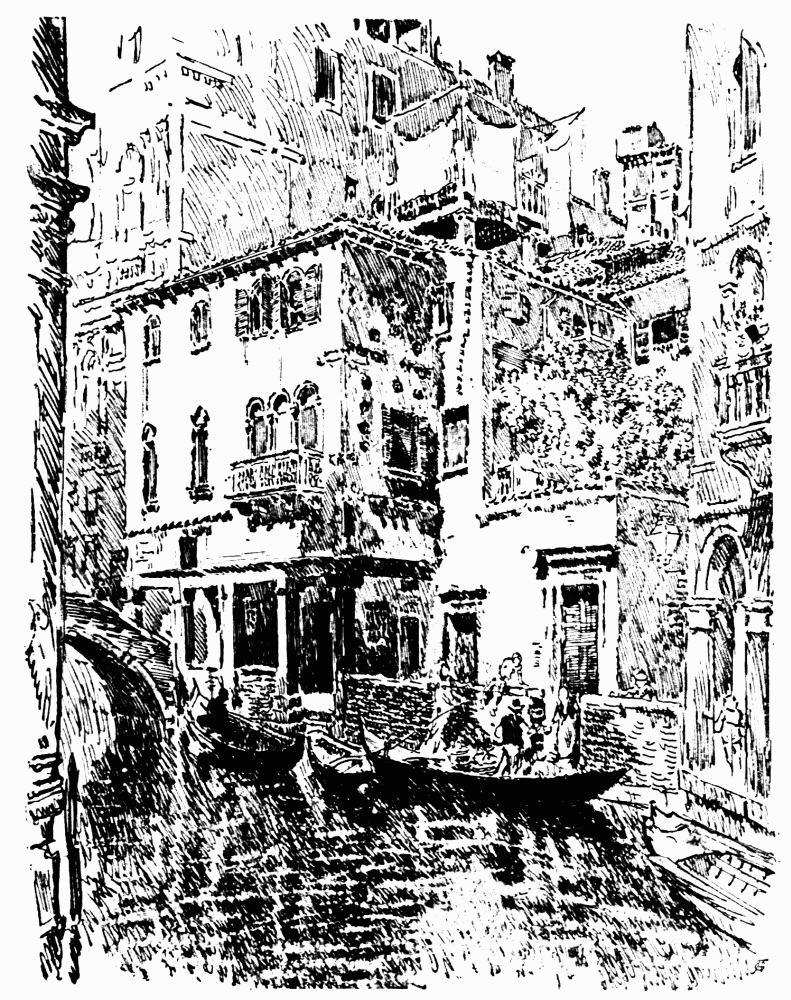
CASA WEIDERMANN
the court of Tuscany as the acknowledged mistress of the heir to the throne. Francesco now attempted to get a reversal of the sentence passed on Bianca by the Council of Ten, and employed an influential person to plead the cause; but it was thought improper that such a case should be treated in the name of old Cosmo while he insisted on ignoring Bianca’s existence. Cosmo died in 1574, but still nothing was done.
It may be doubted whether any woman in Bianca’s situation ever went to such extremes of treachery and effrontery. Her victim, the gentle Archduchess Giovanna of Austria, Francesco’s wife, died at last in 1578, possibly without being helped out of the world, and Francesco married Bianca secretly two months later; but the marriage was not announced to the people until the year of mourning was over. Bianca was Grand Duchess of Tuscany.
The effect of the news in Venice was magical. The Senate made the following curious declaration:—
‘The Grand Duke of Tuscany having deigned to choose as his consort the lady Bianca Cappello, of noble Venetian family, endowed with such great qualities that we judge her worthy of that dignity, it is but right that our Republic should exhibit its satisfaction at the honour conferred upon it by this important and prudent decision of the said Grand Duke. We therefore decree that the aforesaid illustrious and puissant lady, Bianca Cappello, Grand Duchess of Tuscany, be declared the adopted and beloved daughter of our Republic.’
Bianca’s father, who, being a good Venetian, was almost as good a man of business as Salviati’s murdered clerk, and much more prudent, wrote a letter full of touchingly tender feeling to the daughter whom he had cursed so loudly and so long; he and his sons, Bianca’s brothers, were made Knights of the Golden Stole, and all the records of the scandalous trial that had taken place fifteen years earlier were burnt. Bianca’s public marriage and coronation took place on the twelfth of October 1579, and the Republic sent two ambassadors and the patriarch Grimani to show the Grand Duchess that all old scores were forgotten. She was thirty-one years old.
We know even more than is necessary of Bianca’s life and intrigues. She survived her triumph eight years, till she and her ill-gotten husband died of poison within a few hours of each other; but whether the drug was administered by the Cardinal Ferdinando, Francesco’s brother, or whether the two meant to give it to him and took it by mistake, is not clear. He himself declared that he had not poisoned anybody. It is at least certain that he would not allow Bianca to be interred in the Medici vault, but had her privately buried in the crypt of San Lorenzo.
The Venetian Republic did not go into mourning for its ‘well-beloved adopted daughter,’ since it was best not to quarrel with the Cardinal Grand Duke, who had probably suppressed her, though his physician made an autopsy and assured the public that she had died of frightful excesses of all sorts.
The moral of this unpleasing tale is that the manner of bringing up Venetian girls in the sixteenth century was not of a kind to develop their better instincts, for there is nothing to show that Bianca Cappello was very different from other girls of her time, except in the great opportunities for doing harm which fell to her share.
Probably the most enjoyable weeks of a noble Venetian girl’s life were those which preceded her marriage, and were chiefly spent in the preparation of her wedding outfit. The age was eccentric as to dress; it was the time of the huge Elizabethan ruffle and hoops; in Venice it was especially the time of clogs.
The latter had been introduced in the fourteenth century on account of the mud in the still unpaved
Urbain de Gheltof, Calzature.
streets, and they continued to be worn and grew to monstrous dimensions after their usefulness had very much decreased. It became the rule that the greater the lady was, the higher her clogs must be, till they turned into something like stilts, and she could no longer walk except leaning on the shoulders of two servants. In China, the Chinese men, as distinguished from the Tartars, encourage the barbarous breaking of girls’ feet, because it makes it impossible for them to gad about the town when they are older, and still less to run away. The Venetian noblemen approved of clogs for the same reason.
M. Yriarte tells how a foreign ambassador, who was once talking with the Doge and his counsellors in 1623, observed that little shoes would be far more convenient than the huge clogs in fashion. One of the counsellors shook his head in grave disapproval as he answered: ‘Far too convenient, indeed! Far too much so.’
The civic museum in Venice contains two pairs of clogs, one of which is twenty inches in height, the other seventeen. Some were highly ornamented, and the Provveditori alle Pompe made sumptuary regulations against adorning them with over-rich embroidery or with fine pearls. At the same time, shoemakers were warned that they would be liable to a fine of twenty-five lire for any pair of clogs not of proper dimensions and becoming simplicity. Yet they continued to be worn of extravagant size and excessively ornamented till the end of the seventeenth century, when they suddenly sank to nothing, so that a clever woman of the time complained that the Venetian ladies were beginning to wear shoes no thicker than a footman’s.
They were especially affected by the nobles, for the burgher class wore them of much more moderate size. Altogether the life of the burghers’ wives was far more enjoyable; they occupied themselves with music and painting; they held gatherings at which men and women really exchanged ideas, and ‘academies’ at which women with a turn for poetry or science could compare themselves with the most gifted men of Venice.
The most alive of the noble women of the sixteenth century, the one of whom we have the most vivid impression, was assuredly Bianca Cappello, who was a monster of iniquity. The others, who had not her opportunities for great crime, all seem like lay figures, or common odalisques, who lived a sensuous existence that was never disturbed by an idea. But the burgher women amused themselves, and thought, and wrote, and sometimes even allowed themselves a little sentiment.
As for the women of the people, we know nothing about them, as there are no documents regarding them, but it seems probable that they were, on the whole, both happy and honest.
There was one more category of women in Venice, as elsewhere, a class that numbered eleven thousand six hundred and fifty-four members, towards the end of the century, all young, many of them fair, all desirous of pleasing, and all, strange to say, present at every public festival—the class of those who were outside of class, the gay and shameless free. A Venetian of those days made a catalogue ‘of all the chief and most honoured courtesans of Venice ... their names ... the lodgings where they live ... and also the amount of the money to be paid by noblemen and others who desire to enter into their good graces.’ This list is dedicated ‘to the most magnificent and gracious Madam Livia Azzalina, my most respected patroness and lady ... the princess of all Venetian courtesans.’ Moreover, at the end of the pompous dedication, the writer, who signs only his initials, adds that he kisses the gay lady’s ‘honoured hands.’
Some authors, taking this for a catalogue made out by the government, inform us that the Venetian Senate always gave courtesans the title of ‘deserving.’ Lord Orford refuted this calumny in a curious pamphlet quoted by Mr. Horatio Brown in his valuable and delightful Venetian Studies. The catalogue contains two hundred and fifteen names; at number two hundred and four stands the name of the famous Veronica Franco—‘that skilled writer of the sonnet and curiously polished verses which say so little and say it so beautifully,’ says Mr. Brown.
Tassini tells an anecdote in point. Two gentlemen were walking one day over the bridge near the Church of Saint Pantaleo, and they were confiding to each other their conjugal troubles. ‘Do you know who is the only honest woman in Venice?’ asked one of them. ‘There she is!’ He painted to a little marble head which is still visible in the front of a house below the bridge. The story went the rounds, and the bridge itself was re-christened ‘Il Ponte di Donna Onesta.’
The elegance of the gay ladies was incredible, and it was in order to be distinguished from them that respectable women little by little adopted the black silk gown and veil which they wore to the end of the Republic. The veil was black for married women and white for young girls.
I find in some statistics for the year 1581 the following statement as to the women of the better classes. There were 1659 patrician ladies, 1230 noble girls, 2508 nuns, and 1936 women of the burgher class. What could they do against 11,654? The note adds that all the others were women of the people.
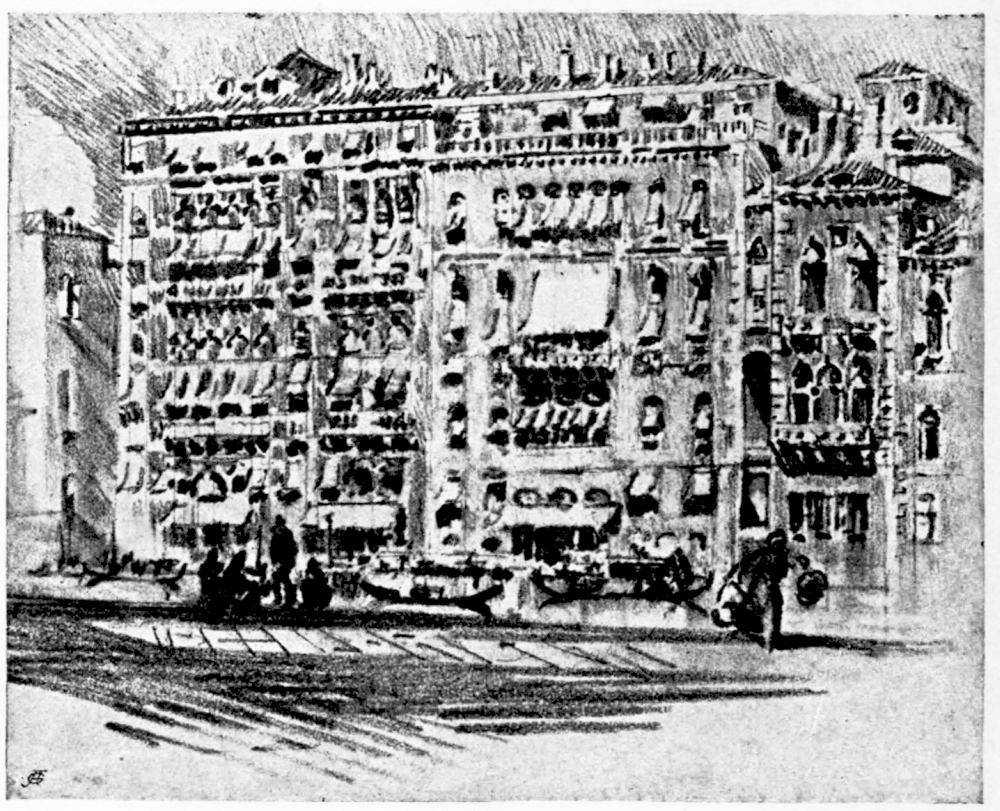
THE GRAND CANAL IN SUMMER