XII THE LAST MAGISTRATES
Reading edition
The philosophical reader will naturally ask what elements composed the Great Council of the Venetian Republic at a time when France was on the brink of the Revolution, and all Europe was about to be shaken by the explosion of the first new idea that had dawned on mankind since Christianity. I shall try to answer the question.
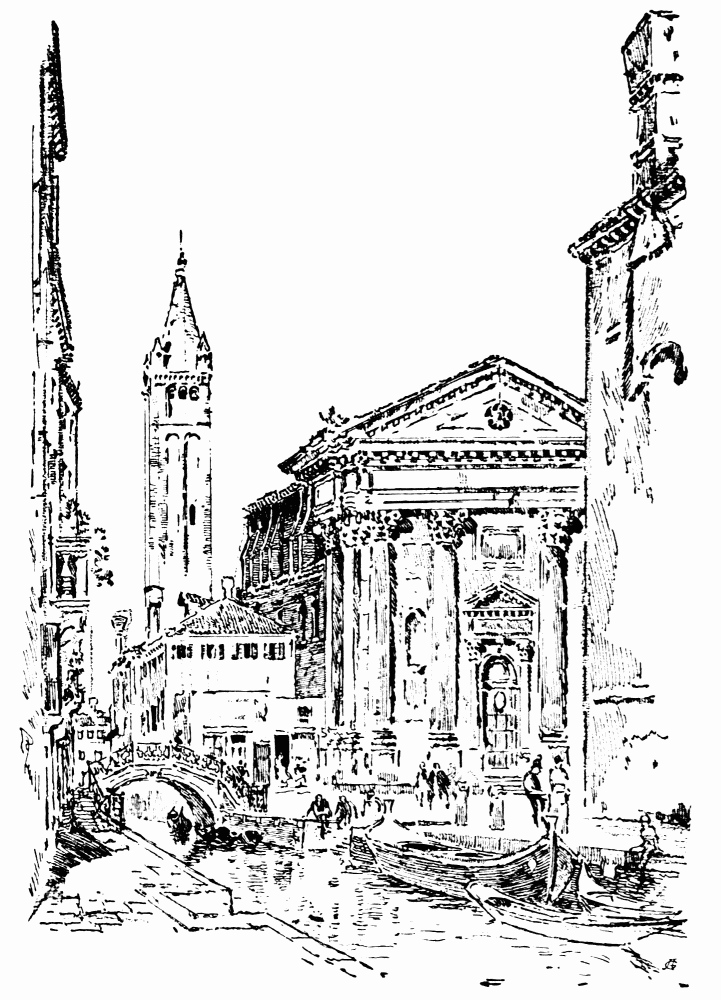
S. BARNABÒ
There were three classes of men in the Council: first, the ancient aristo-plutocracy which, though with a few
Rom. ix. 7.
additions to its numbers, and though itself divided into two parties, had on the whole steered the Republic through eleven hundred years of history; secondly, a number of families, mostly of ‘new men,’ though they had sat in the Council four hundred years and more, but who had all been more or less occupied with the legal profession since they had existed; thirdly and lastly, the poor nobles called the ‘Barnabotti,’ from the quarter of San Barnabò, where most of them were lodged at the public expense.
The first category generally held the posts of highest dignity, many of which implied a salary by no means small, but never sufficient to pay for the display which the position required, according to accepted customs. The traditional splendour which the Venetian ambassadors of the fifteenth and sixteenth centuries had inaugurated was dear to the Senate, and had come to be officially required, if not actually prescribed in so many words. These great families had long been accustomed to play the leading parts, and as the business spirit which had made Venice the richest power in Europe died out, their pride was often greater than their sense of responsibility. These and many other causes lowered the standard according to which young Venetians had been brought up during centuries to understand the administration of their country; and the result was that they were not fit to fill the offices to which they were called, and therefore handed over their work to private secretaries, who were generally ambitious and intriguing men. To be a member of the Great Council had now only a social value, like those hereditary coats of arms in which there had once been such deep meaning. Throughout ages the aristocracy of Venice had differed altogether from the nobility of other countries, but as decadence advanced to decay, and decay threatened destruction, the Venetian senator grew more and more like the French marquis of the same period.
In an access of greatness Louis XIV. is reported to have said, ‘L’état c’est moi!’ but the State continued to exist without him. The Venetian nobles might have said with much more truth, and perhaps with more reasonable pride, ‘We nobles are the Republic!’ For when they degenerated into dolls, the Republic soon ceased to exist.
The second category of nobles comprised by far the sanest and most intelligent part of the aristocracy, and it was generally from their ranks that the Quarantie were chosen, as well as the ‘Savi,’ and those magistrates from whom special industry and intelligence were required, or at least hoped.
The Barnabotti had nothing in common with the two other classes, except their vanity of caste, which was so infinitely far removed from pride. As I have said, they owed their name to the parish
Molmenti, Nuovi Studi, 308.
which most of them inhabited. Their nobility was more or less recent and doubtful, and almost all had ruined themselves in trying to rival the richer families. The majority of them had nothing but a small pension, paid them by the government, and barely sufficient to lift them out of actual misery. It was especially for them
Horatio Brown, Venice, 109; Rom. ix. 7.
that the College of Nobles had been founded, in which their sons were educated for nothing, with all the usual imperfections of gratuitous education. Like the ‘New Men’ of the fourteenth century, they felt that an insurmountable barrier separated them from the older and richer classes, and the humiliations to which they were often exposed by the latter kept alive in them the sort of hatred which was felt in other parts of Europe by the agricultural population for the owners of the land. Their poverty and rancorous disposition made them especially the objects of bribery when any party in the Great Council needed the assistance of their votes against another.
The better sort of Venetians were well aware of the evils that were destroying the governing body. In 1774 a member of the Council made a speech on the subject, in which he said that the greatest damage the Republic had suffered had been caused by the action of time; it lay in the already very sensible diminution in the numbers of the Great Council, which was, in fact, the government itself. He pointed out that within one century a large number of patrician families had become
Cecchetti, quoting Arch. Ven. iii. 435.
extinct, and that the condition of the aristocracy must clearly continue to go from bad to worse. It could not be otherwise, since marriages were yearly becoming less numerous. A family was looked upon as a calamity, because it meant a division of fortune, and therefore interfered with those ancient traditions of almost royal
INSTITUTO BON, GRAND CANAL
magnificence which appealed to the vanity of younger men.
The speech to which I have alluded was delivered not very many years after the time when a number of seats in the Grand Council had been sold in order to meet the expenses of the Turkish war. In 1775, in order to increase the numbers of the Council, it was proposed to admit to it forty noble families from the provinces, provided they could prove that they had a yearly income of ten thousand ducats. The proposal was energetically opposed by a Contarini. If the sons of ancient families showed so little zeal for the public welfare, he argued, what could be expected of strangers? Was it wise to display to all Europe the evils from which the Republic was suffering? Moreover, even if the bill were passed, would it be easy to find forty families willing to leave their homes and establish themselves in the capital to the great damage of their fortunes? And if they were found, would their admission not result in impoverishing the provinces by the amount of their incomes which would be spent in Venice? It was luxury and extravagance that were ruining the country, he said.
A lively discussion followed. ‘Beloved sons,’ cried one old noble, ‘for us who are old there may be a little of the Republic left, but for you children it is completely finished!’ The bill passed, but Contarini had been right; only about ten families asked to be inscribed in the Golden Book.
Satirists and lampooners made merry with the proceedings of the Great Council. After the stormy sittings just referred to, the caricatures of the five patricians entrusted with framing measures of reform were to be seen everywhere in the city, and a copy of the cut is still in the Archives. It
Rom. viii. 211.
represents the most eloquent and zealous of the committee, Alvise Emo, urging his horse against an enormous marble column; two of his colleagues follow him in a post-chaise and observe his movements with a spy-glass; a fourth, who is lame, is trying to follow the carriage on foot, and the fifth comes after him, beating him to make him mend his pace.
On the twenty-second of May 1779 the secretary of the Inquisitors of State wrote to his brother Giuseppe Gradenigo, then in France: ‘If these gentlemen do not seriously think of taking measures to meet the events which are brewing, if they do not introduce some order into the affairs of the army and navy, the Republic will be lost as soon as an enemy appears on land or by sea.’
This letter was prophetic. The idleness and indolence of the nobility were such that it was hard to obtain an attendance at meetings of the Great Council or the Senate. The members were accustomed to spend their nights in gambling-dens and cafés, and it was a hard matter for them to get up in the morning. Their physicians recommended rest, which they indeed needed; and as they could not take any at night, they devoted a large part of the day to following the doctor’s advice. Yet as it was necessary that the government should go on in some way, it became habitual to leave everything to the Savi of the Council, who on their part fell into the habit of not always rendering an account of what they did. By obligingly saving their colleagues the trouble of getting out of bed, they made themselves the arbiters of the Republic’s final destiny.
With regard to the other magistracies, a few anecdotes will give a good idea of what they had become. My readers know that the Avogadori enjoyed very great consideration, and that it was their business to see that all the tribunals did their work smoothly and regularly. One of these important officers, Angelo Quirini, who was at the same time one of the most distinguished members of the Senate, exhibited his power and courage by banishing from Venice a little milliner who had made a mistake in trimming certain caps for a great lady in whom he was interested. From her exile the woman wrote a protest to the Inquisitors of State, who did her justice and recalled her. Quirini now lost his temper with these gentlemen and swore that they were encroaching upon his rights, just at this time a
Rom. viii. 104.
rich member of the parish of San Vitale departed this life, and the sacristans prepared to bury his body; but the deceased belonged to a confraternity called La Scuola Grande della Carità, and his brethren claimed the right of burying him to the exclusion of the parish sacristans. The Inquisitors of State and the Council of Ten took the matter up; the Provveditori alla Sanità, who were the health officers, declared that the matter concerned them only; the elders and judges of the guilds and corporations took part in the discussion, and a general quarrel ensued, which was only brought to a close by the authority of the Council of Ten. But this did not please Angelo Quirini, who violently attacked the Council and began to give himself the airs of a popular tribune, though not possessing the popularity which is essential for the position. The people, in fact, would have none of him. One night the Council of Ten caused him to be quietly taken from his palace and carried off under a good escort to the fortress of Verona. The matter now had to be brought before the Great Council, and a regular trial was held to ascertain how the Council of Ten and the Inquisitors were in the habit of performing their duties.
Rom. viii. 108.
During several days the Corregitori received all the complaints that were handed in, and examined the archives of the two tribunals. Those of the Ten were found to be in perfect order, but those of the Inquisitors were in the utmost confusion.
Rom. viii. 114.
The whole city discussed the affair excitedly, and nothing else was spoken of in the streets, in the cafés, and in drawing-rooms. It was the first time in history that the tribunal of the Inquisitors of State had been put under an inquiry, and this tremendous result had been produced because a little milliner had made a cap that did not fit.
Endless discussions followed. A number of patricians declared that if the Council of Ten and the Inquisitors of State were abolished, they themselves would not stay another day in Venice, as there would no longer be any check on the violence and the intrigues of men of their own class: a confession which suddenly exhibits the whole aristocracy in its true light.
Others proved beyond all question that a tribunal which was particularly charged with the preservation of the State from danger could not always
1762.
do its work with the miserable tardiness of the other magistracies, and they recalled the many cases in which the Ten had saved Venice.
Rom. viii. 136-137.
One of the debates was prolonged for five consecutive hours. At last the Conservative party carried the day.
The wild enthusiasm of the population, on learning that the Ten and the Inquisitors were to remain in existence, shows well enough what the people thought; their only protection against the nobles lay in the two tribunals. Six thousand persons waited in the Square of Saint Mark’s to learn the result of the contest, and when it was known proceeded to burn fireworks before the palaces of the nobles who had been the chief speakers in defence of the Ten—Foscarini, Marcello, and Grimani. The populace then declared that it would set fire to the houses of the nobles who had tried to do away with the only institution they still feared, and the palaces of the Zen and the Renier were only saved from fire and pillage by the energetic intervention of the Inquisitors of State, whose office those aristocrats had attempted to abolish.
I know of no more convincing answer to the numerous dilettante historians who have accused the Council of Ten of oppressing the people.
If the Council and the Inquisitors were in need of an excuse for occasionally overstepping their powers in order to act quickly, they had a good one in the absurdly cumbrous system of the magistracies, as they existed in the eighteenth century. As a curiosity,
Rom. viii. 399.
I give a list or the principal magistracies, taken by Romanin from an almanack of 1796, the last year of the Republic:—
The Doge’s Counsellors6
Savi of the Council16
Procurators of Saint Mark9
‘Criminal’ Quarantia40
‘Old’ Civil Quarantia40
‘New’ Civil Quarantia40
Colleges of the XXV. and the XV.40
Senate60
‘Zonta,’ supplementary to Senate60
Council of Ten10
Inquisitors (of Ten)3
Avogadori of the Commonwealth3
Total327
besides the whole of the Great Council, which consisted of all nobles over twenty-five years of age, and of the younger men chosen by lot to sit without a vote.
And these are only the principal magistracies. The secondary ones comprised over five hundred officials, divided between something like one hundred and thirty offices, such as Provveditors, or inspectors of some forty different matters, from artillery to butchers’ shops, from ‘Ancient and Modern Justice’ to oats: Savi, Inquisitors of all matters except religion, Auditors, Executors, Correctors, Reformers, Deputies, and Syndics; a perfect ant-hill of officials who were perpetually in one another’s way.
Here is an instance of the manner in which ordinary justice was administered, even by the Council of Ten.
WHEN THE ALPS SHOW THEMSELVES, FONDAMENTA NUOVE
On the sixth of March 1776 a patrician called Semitecolo, who was a member of one of the Quarantie, and therefore a magistrate, was walking in the Fondamenta Nuove when he saw a big butcher named Milani unmercifully beating a wretched peddler of old books. He stopped and expostulated; the butcher took his interference ill, and delivered a blow with his fist which caused the blood to gush abundantly from the magistrate’s nose. Semitecolo was taken into a neighbouring house, and the butcher walked off.
Still covered with blood, Semitecolo hastened to lay the matter before the Council of Ten, demanding the
CAFÉ ON THE ZATTERE
arrest of Milani. But Pier Barbarigo, who was one of the Capi for the week, while sympathising deeply, excused himself from arresting the culprit, on the ground that a detailed account of the affair signed by witnesses must be laid before the Council; and, moreover, the Council was busy just then, he said, owing to the arrival of the Pope’s Nuncio, and there would be no meeting on the next day. Semitecolo could not even get an order to have the butcher watched by the police, and the culprit had full time and liberty to leave Venice before anything was done. Note that he himself did not expect impunity, but only a very long delay before his arrest was ordered.
The public followed the affair and was indignant, and freely criticised the Ten in public places; whereupon the Inquisitors ordered all the cafés to be closed two hours after dark. This was especially galling to the Venetians, who were fond of sitting up late, and loved the bright lights of the cafés.
One morning a notice appeared on the walls, drawn up in the following terms:—
‘The Guild of the Night-Thieves wishes to thank his Excellency the “Capo” Barbarigo for having provided them with much more sufficient and convenient
Rom. viii. 399.
means of earning their bread during the present hard times.’
The Inquisitors’ ordinance was soon modified so as to allow the cafés to remain open till midnight.
As for the minor courts, Goldoni, who was brought up to be a lawyer, says that there were nearly as many different ones as there were different kinds of suits possible. They paralysed each other, and could not have worked well even if they had been honest.
But they were not. An Avogador acquitted a man accused of theft. The Signors of the
Mutinelli, Ult. 143.
Night—the chiefs of police—who had committed the accused for trial believed him guilty and determined to examine the papers relating to the trial.
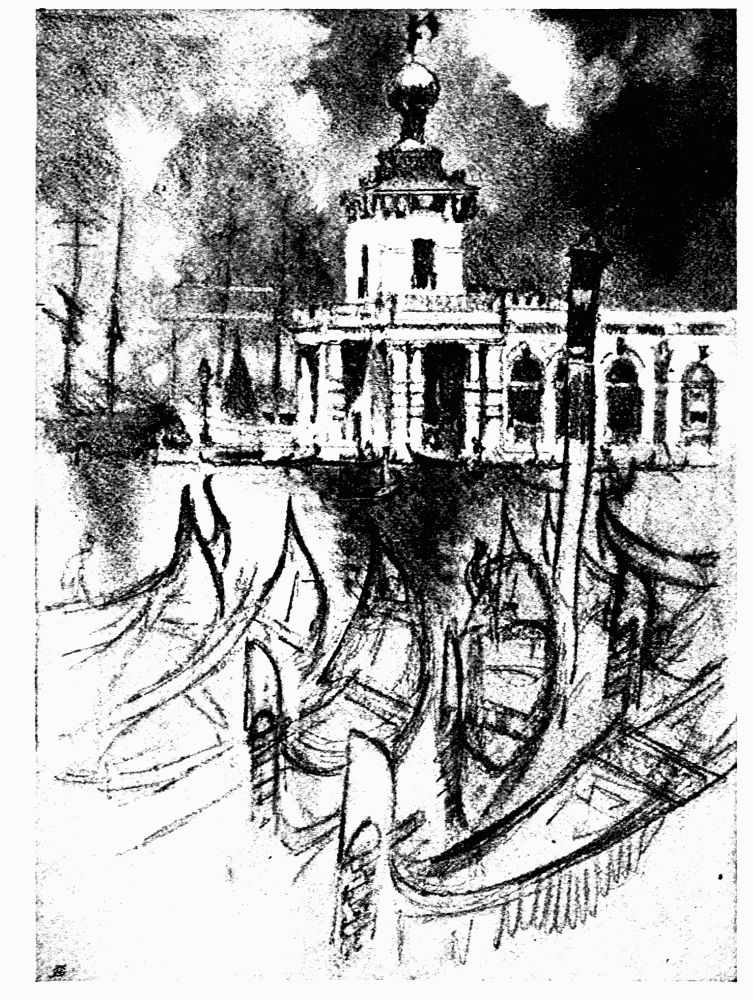
THE DOGANA
With this intention they made a search in the house of the Avogador and confiscated the private accounts in which he set down the profit and loss of his judicial industry; for he was a very careful man. Surely enough, the Signors found an entry of one hundred and fifty sequins (£112. 10s.) received for acquitting the thief.
About the same time there was a very beautiful dancer called the Cellini at the theatre of San Cassian.
Mutinelli, Ult. 144.
A magistrate who exercised the righteous functions of an ‘Executor against Blasphemy’ became anxious to get into her good graces, but as she would have nothing to do with him, he brought an accusation against her in his own court, tried her, and condemned her to a severe penalty. But she appealed to the Council of Ten, proved her innocence, and was acquitted. Thereupon the Venetians began to swear ‘by the holy Virgin Cellini.’
With such a state of things in Venice, it was only to be expected that the condition of justice in the provinces should be still worse. When
Mut. Ult.
Goldoni was Secretary to the Chancery of Feltre, in the Venetian territory, there was a huge scandal about a whole forest cut down and sold without any order or authority from the government. An inquiry was attempted and begun; it was found that more than two hundred persons were implicated, and as it soon became apparent that the same thing had been done before them, within the century, it was judged better to draw a veil over the whole affair.
This naturally encouraged others. In 1782 the Provveditor Michiel informed the Senate that the Podestà of the city of Usmago had calmly pocketed the price of an oak forest, which he had asked leave to cut down on pretence of using the funds for repairing his official residence.
Finally, a number of posts, especially in the ducal household, were openly sold; in the last years of the Republic even the office of a procurator of Saint Mark could be bought.
In close connection with the magistracies and the legal profession generally, I give the following amusing extract from Goldoni’s memoirs.
He begins by telling us that although he had been entered at a lawyer’s office for two years, he left it fitted for the profession in eight months,
Goldoni, i. 23.
because the administration interpreted the two years to mean the dates of two consecutive years, without any regard to the months. Young Goldoni then took a lodging in the lawyers’ quarter near San Paterniano, and his mother and aunt lived with him.
I put on the toga belonging to my new station (he continues), and it is the same as that of the Patricians; I smothered my head in an enormous wig and impatiently awaited the day of my presentation in the Palace. The novice must have two assistants who are called in Venice Compari di Palazzo [‘Palace godfathers’]. The young man chooses them amongst those of the old lawyers who are most friendly to him....
So I went between my two sponsors to the foot of the grand staircase in the great courtyard of the Palace, and for an hour and a half I made so many bows and contortions that my back was broken and my wig was like a lion’s mane. Every one who passed before me gave his opinion of me; some said, Here is a youth of good character; others said, Here is another Palace sweeper; some embraced me, some laughed in my face. To be short, I went up the stairs and sent the servant to find a gondola, so as not to show myself in the street in such a dishevelled state, naming as a place of meeting the Hall of the Great Council, where I sat down on a bench whence I could see every one pass without being seen by any one. During this time, I reflected on the career I was about to embrace. In Venice there are generally two hundred and forty lawyers entered on the register; there are ten or twelve of the first rank, about twenty who occupy the second; all the others are hunting for clients; and the poorer Procurators gladly act as their dogs on condition of sharing the prey....
While I was thus alone, building castles in the air, I saw a woman of about thirty approaching me, not disagreeable in face, white, round, and plump, with a turned-up nose and wicked eyes, a great deal of gold on her neck, her ears, her arms, her fingers, and in a dress which proclaimed that she was a woman of the common class, but pretty well off. She came over and saluted me.
‘Sir, good day!’
‘Good day, Signora!’
‘Will you allow me to offer you my congratulations?’
‘For what?’
‘On your entrance into the Forum; I saw you in the courtyard when you were making your salaams. Per Bacco! Sir, your hair is nicely done.’
‘Isn’t it? Am I not a handsome young fellow?’
‘But it makes no difference how your hair is done; Signor Goldoni always cuts a good figure.’
‘So you know me, Signora?’
‘Did I not see you four years ago in the land of the lawyers, in a long wig and cloak?’
‘True; you are right, for I was then in the house of the Procurator.’
‘Just so; in the house of Signor Indrie’ [Goldoni’s uncle].
‘So you know my uncle too?’
‘In this part of the world I know every one, from the Doge to the last copyist of the Courts.’
‘Are you married?’
‘No.’
‘Are you a widow?’
‘No.’
‘Oh—I do not dare ask more!’
‘All the better.’
‘Have you any business?’
‘No.’
‘From your appearance I took you for a well-to-do person.’
‘I really am.’
‘Then you have investments?’
‘None at all.’
‘But you are very well fitted out; how do you manage to do it?’
‘I am a daughter of the Palace, and the Palace supports me.’
‘That is very strange! You say you are a daughter of the Palace?’
‘Yes, sir; my father had a position in it.’
‘What did he do?’
‘He listened at the doors and then went to take good news to those who were expecting pardons, or verdicts, or favourable judgments; he had capital legs and always got there first. As for my mother, she was always here, as I am. She was not proud, she took her fee, and undertook some commissions. I was born and brought up in these gilded halls, and, as you see, I also have gold on me.’
‘Yours is a most singular story. Then you follow in your mother’s footsteps?’
‘No, sir. I do something else.’
‘That is to say?’
‘I push lawsuits.’
‘Push lawsuits? I do not understand.’
I am as well known as Barabbas. It is very well understood that all the lawyers and all the Procurators are my friends, and a number of people apply to me to obtain advice for them and counsel for defence. Those who come to me are generally not rich, and I look about amongst the novices and the unemployed [lawyers] who want nothing but work in order to make themselves known. Do you know, sir, that though you see me as I am, I have made the fortunes of a round dozen of the most famous lawyers in the profession. Come, sir, courage, and if you are willing, I shall make yours too.’
It amused me to listen to her, and as my servant did not come, I continued the conversation.
‘Well, Signorina, have you any good affairs on hand now?’
‘Yes, sir, I have several, indeed I have some excellent ones. I have a widow who is suspected of having occultated her monkey; another who wishes to prove a marriage contract got up after the fact; I have girls who are petitioning for a dowry; I have women who wish to bring suits for annulment of marriage; I have sons of good families who are persecuted by their creditors; as you see, you need only choose.’
‘My good woman,’ I said, ‘so far I have let you talk; now it is my turn. I am young, I am about to begin my career, and I desire occasions for showing myself and obtaining occupation; but no love of work nor fancy for litigation could make me begin with the disgraceful suits you offer me.’
‘Ha, ha!’ she laughed, ‘you despise my clients because I warned you that there was nothing to earn; but listen! My two widows are rich, you will be well paid, and shall be even paid in advance, if you wish.’
I saw my servant coming in the distance; I rose and answered the chattering woman in a fearless and resolute tone.
‘No, you do not know me, I am a man of honour....’
Then she took my hand and spoke gravely.
‘Well done! Continue always in the same mind.’
‘Ah!’ I exclaimed, ‘you change your tone now?’
‘Yes,’ she replied, ‘and the tone I take now is much better than the one I have been using. Our conversation has been somewhat mysterious; remember it and see that you speak to no one about it. Good-bye, sir. Always be wise, be always honourable, and you will be satisfied with the result.’
She went away, and I was left in the greatest astonishment. I did not know what all this meant; but I learned later that she was a spy and had come to sound me; yet I never knew, nor wished to know, who sent her to me.
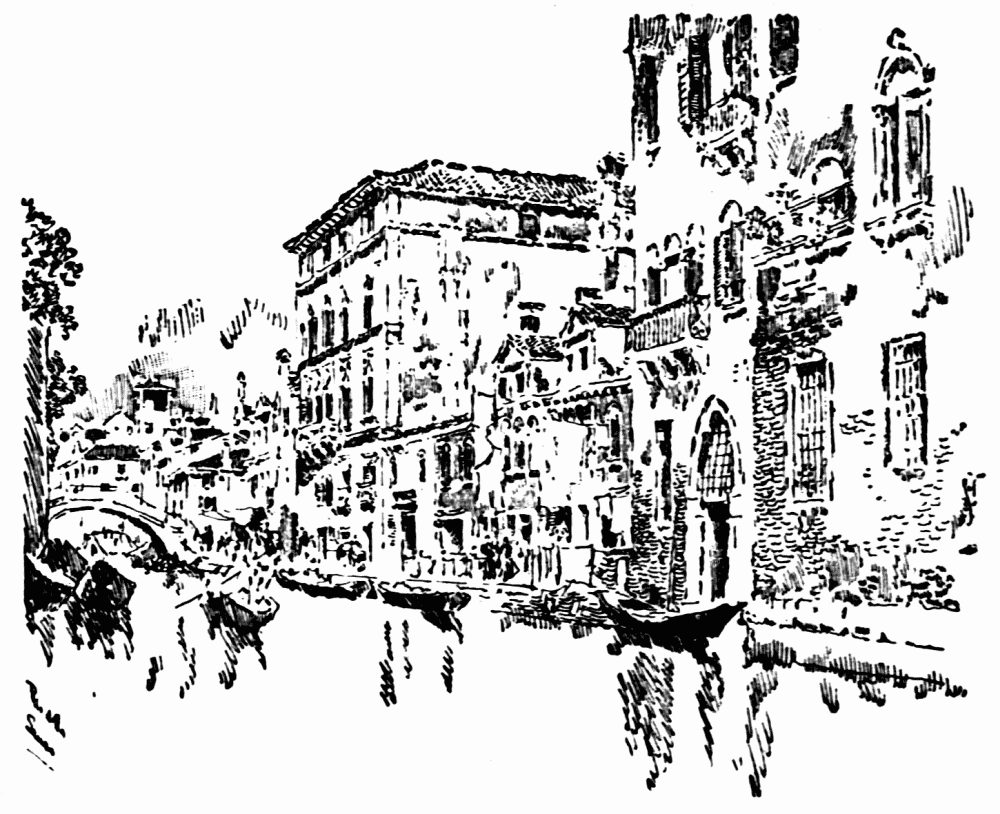
RIO DELLA SENSA