XIV THE LAST DOGES
Reading edition
Between the beginning of the eighteenth century and the end of the Republic eleven Doges occupied the throne. Of these the only one who might
1700-1797.
have saved the government or retarded its fall was the very one who reigned the shortest time. Let us say that if he had lived, he might have so far restored the strength of the ancient aristocracy as to admit of its perishing in a struggle instead of dying of old age.
This Doge was Marco Foscarini, who was elected on the thirty-first of May 1762, and died on the thirty-first of the following March. He was a man whose integrity was never questioned, even by
Rom. viii. 142.
the revolutionaries, and he accepted the Dogeship with the greatest regret. He was a man of letters, and the endless empty ceremonial of the ducal existence obliged him to leave unfinished his noble work on Venetian literature. Even had the Doge’s action not been hopelessly paralysed by the hedge of petty regulations that bristled round him, Foscarini’s experience of affairs in the course of occupying many exalted posts had left him few illusions as to the
Rom. viii. 302.
future of his country. ‘This century will be a terrible one for our children and grandchildren,’ he wrote some time after his election.
Like many of the Doges he was a very old man when he was elected, and was over eighty-eight years of age when he died, apparently much surprised at finding himself at his end, though not unprepared for it. He complained that his physicians had not told him how ill he was, and he asked for a little Latin book, De modo bene moriendi, which had been given him by his friend Cardinal Passionei; presently he tried to dictate a few reflections to his doctor, but was too weak, and expired whispering, ‘My poor servants!’ He had apparently not provided for them as he would have done if he had not been taken unawares.
His successor was Aloise IV. Mocenigo, who had been Ambassador to Rome and to Paris. His election was celebrated in a manner that recalled the festivities of the sixteenth century. A secretary was sent to the Mocenigo palace to announce the news to
1763.
his family, and the Dogess took four days in which to complete her preparations, after which she came to the ducal palace accompanied by her two married nieces, her sisters, her mother, all her own female cousins, and all those of her husband; and this battalion of noble women in their gondolas was followed down the Grand Canal by an innumerable fleet of gondolas and boats. All the male relations were waiting at the landing of the Piazzetta to escort the ladies to the palace, where the Dogess, seated on a throne, received the homage of the electors and of all the nobility. She did not wear the ducal insignia on that day. In the evening there was a ball, which she opened with one of the Procurators of Saint Mark.
A series of festivities began on the following day, at which she appeared in a memorably magnificent dress: a long mantle of cloth of gold, like the Doge’s own, with wide sleeves lined with white lace, opened to show a skirt and body all of gold lace-work; a girdle of diamonds encircled her waist; her head-dress was a veil, arranged like a cap, but the two ends hung down to her shoulders, and were picked up and fastened to her back hair by two diamond clasps.
On three consecutive evenings there were balls at the palace, and at each the Dogess danced only one minuet, with a Procurator of Saint Mark,
Rom. viii. 148.
as etiquette required when there were no foreign princes in Venice.
This reminds one of old times; it is even true that in some ways the display at the ducal palace was greater than it had ever been. The banquets especially took the importance of
G. R. Michiel, i. 289.
public spectacles, and were always five in number, given at the feasts of Saint Mark, the Ascension, Saint Vitus, Saint Jerome, and Saint Stephen, after the last of which the distribution of the ‘oselle’ took place, representing the ducks of earlier days, as the reader will remember. At these great dinners there were generally a hundred guests; the Doge’s counsellors, the Heads of the Ten, the Avogadors and the heads of all the other magistracies had a right to be invited, but the rest of the guests were chosen among the functionaries at the Doge’s pleasure.
In the banquet-hall there were a number of sideboards on which was exhibited the silver, part of which belonged to the Doge and part to the State, and this was shown twenty-four hours before the feast. It was under the keeping of a special official. The glass service used on the table for flowers and for dessert was of the finest made in Murano. Each service, though this is hard to believe, is said to have been used in public only once, and was designed to recall some important event of contemporary history by trophies, victories, emblems, and allegories. I find this stated by Giustina Renier Michiel, who was a contemporary, was noble, and must have often seen these banquets.
The public was admitted to view the magnificent spectacle during the whole of the first course, and the ladies of the aristocracy went in great numbers. It was their custom to walk round the tables, talking with those of their friends who sat among the guests, and accepting the fruits and sweetmeats which the Doge and the rest offered them, rising from their seats to do so. The Doge himself rose from his throne to salute those noble ladies whom he wished to distinguish especially. Sovereigns passing through Venice at such times did not disdain to appear as mere spectators at the banquets, which had acquired the importance of national anniversaries.
Between the first and the second courses, a majestic chamberlain shook a huge bunch of keys while he walked round the hall, and at this hint all visitors disappeared. The feast sometimes lasted several hours, after which the Doge’s squires presented each of the guests with a great basket filled with sweetmeats, fruits, comfits, and the like, and adorned with the ducal arms. Every one rose to thank the Doge for these presents, and he took advantage of the general move to go back to his private apartments. The guests accompanied him to the threshold, where his Serenity bowed to them without speaking, and every one returned his salute in silence. He disappeared within, and all went home.
During this ceremony of leave-taking, the gondoliers of the guests entered the Hall of the banquet and each carried the basket received by his master
G. R. Michiel, Origini i. 302.
to some lady indicated by the latter. ‘One may imagine,’ cries the good Dame Michiel, ‘what curiosity there was about the destination of the baskets, but the faithful gondoliers regarded mystery as a point of honour, though the basket was of such
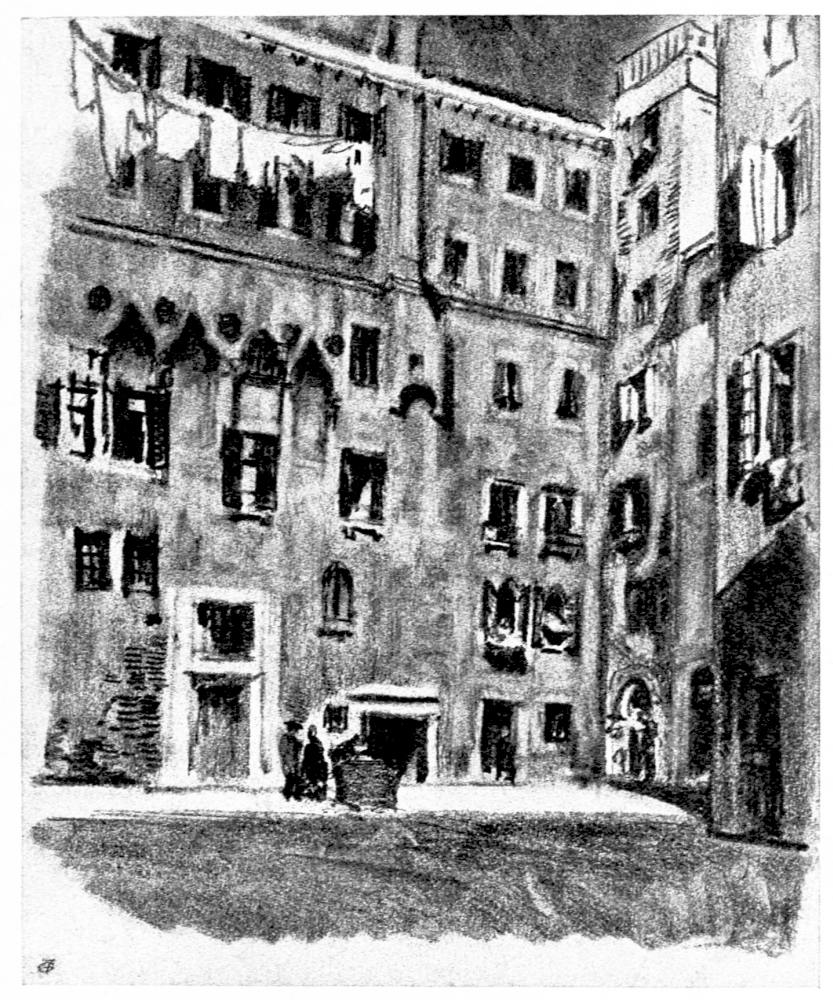
MARCO POLO’S COURT
dimensions that it was impossible to take it anywhere unobserved; happy were they who received these evidences of a regard which at once touched their feelings and flattered their legitimate pride! The greatest misfortune was to have to share the prize with another.’
The reign of Aloise Mocenigo was the one in which the question of reforms was the most fully discussed, but many of the discussions turned on theories, and though a few led to the passage of measures which somewhat affected commerce and public instruction, no real result was produced. The Republic, I repeat, was dying of old age, which is the only ill that is universally admitted to be incurable.
At the death of Mocenigo, three candidates were proposed for the ducal throne, namely, Andrea Tron, Girolamo Venier, and Paolo Renier. If the people had been consulted, Venier would have been acclaimed, though I do not pretend to say that his election would have retarded the end. Nothing is easier than to speculate about what ‘the people’ might have done at any given point in history; nothing is harder than to guess what they are going to do; nothing, on the whole, is more certain than that the voice of the people never yet turned the scale at a great moment in a nation well out of its infancy. No one pretends nowadays that the French revolution was made by ‘the people.’
The many in Venice were vastly surprised to hear of Paolo Renier’s candidacy, for he had a very indifferent reputation; to be accurate, the trouble was that it was not indifferent, but bad. He was, indeed, a man of keen penetration, rarely eloquent, and a first-rate scholar. He knew Homer by heart, and he had translated Plato’s Dialogues, which latter piece of work might partly explain, without excusing,
R. viii. 240, 241; Mutinelli, Ult.
his deplorable morals; but it was neither from Plato nor from Homer that he had learned to plunder the government of his country. One of his contemporaries, Gratarol, described him as possessing ‘the highest of talents, the most arrogant of characters, and the most deceptive of faces.’
It was commonly reported in Venice that when he had been Bailo at Constantinople he had taken advantage of the war between Turkey and Russia, under Catherine the Great, to enrich himself in a shameful manner, and the ninety thousand sequins he made on that occasion afterwards served him, according to popular report, for bribing the Barnabotti in the Great Council in order that the forty-one electors chosen might be favourable to him. He was certainly not the inventor of this plan, but he is generally said to have just outdone his predecessors in generosity, without overstepping the limits of strict economy. The general belief is that he bought three hundred votes at fifteen sequins each, which was certainly not an excessive price. It appears, too, that he distributed money to the people in order to soothe the irritation his candidacy caused. If all these accusations were not clearly proved, they were at least the subject of contemporary satire.
A certain priest in particular wrote biting verses on him, in Venetian dialect, describing the righteous anger of the late Marco Foscarini’s ghost at the election of such a successor. The shade of the honourable
Malamani.
man tears off the ducal insignia in disgust, and bitterly reproaches Venice.
‘Ah, foolish Venice!’ it exclaims, ‘a Renier is Doge of our country, one who with ribald heart and iniquitous words sought to undo that tribunal which defends our country from all evil! Ah, mad Venice! Now indeed I do repent me of having been Doge one year! Strike my name from the series of the Doges, for I disdain to stand among traitors.’
After his election Paolo Renier had his first ‘osella’ coined with a peculiarity in the superscription which irritated the public. The words ran: ‘Paulus Reinerius principis munus,’ his name being in the nominative case, a grammatical mistake which had always been regarded as the special privilege of kings and emperors.
He made money of everything, by selling posts, franchises, and licenses to beg at the door of the Basilica of Saint Mark. The Dogess was
Mutinelli, Ult.
not a person likely to increase her husband’s popularity, for she had been a rope-dancer, and never appeared at public ceremonies. As I have explained elsewhere, it was the Doge’s niece who did the honours of the palace, Dame Giustina, who was beloved and esteemed by all Venetians, but ‘the Delmaz,’ as the Doge’s wife was called, interfered in a hundred details of the administration.
It is told, for instance, that the priest of the church of San Basso used to have the bell rung for mass very early in the morning, and that it had a peculiarly harsh and shrill tone which disturbed the Dogess’s slumbers. She sent for
Tassini, under ‘San Basso’; also Molmenti, Vecchie Storie.
him and promised to make him a canon of Saint Mark’s if he would only have the bell moved, or not rung. The good man promised and went away delighted, but when, after a time, the canonry was not given to him, he began ringing again, and doubtless enjoyed the thought that every stroke set the faithless Dogess’s teeth on edge.
The people revenged themselves on the Renier family for its many misdeeds in scathing epigrams, and when at last the Doge lay dying in long agony, the
Mutinelli, Ult.
gondoliers said that his soul refused to leave without being paid. The truth is that as his death took place in Carnival week, on February eighteenth, 1789, it was decided to keep his death a secret not only over Ash Wednesday, but until the first Monday in Lent, in order not to disturb the merrymaking,
Rom. viii. 300.
nor the reaction which was supposed to follow it; and he was buried without much ceremony and with no display in the church of the Tolentini.
The candidates proposed for election to succeed him were numerous, but not of good quality. One of them, Sebastiano Mocenigo, was such a bad
Rom. viii, 301.
character that when he had been in Vienna as Ambassador the Empress Maria Teresa had asked the Republic to recall him. The truth was that the few who were fit for the Dogeship would not accept it, or were opposed by the whole body of the corruptible.
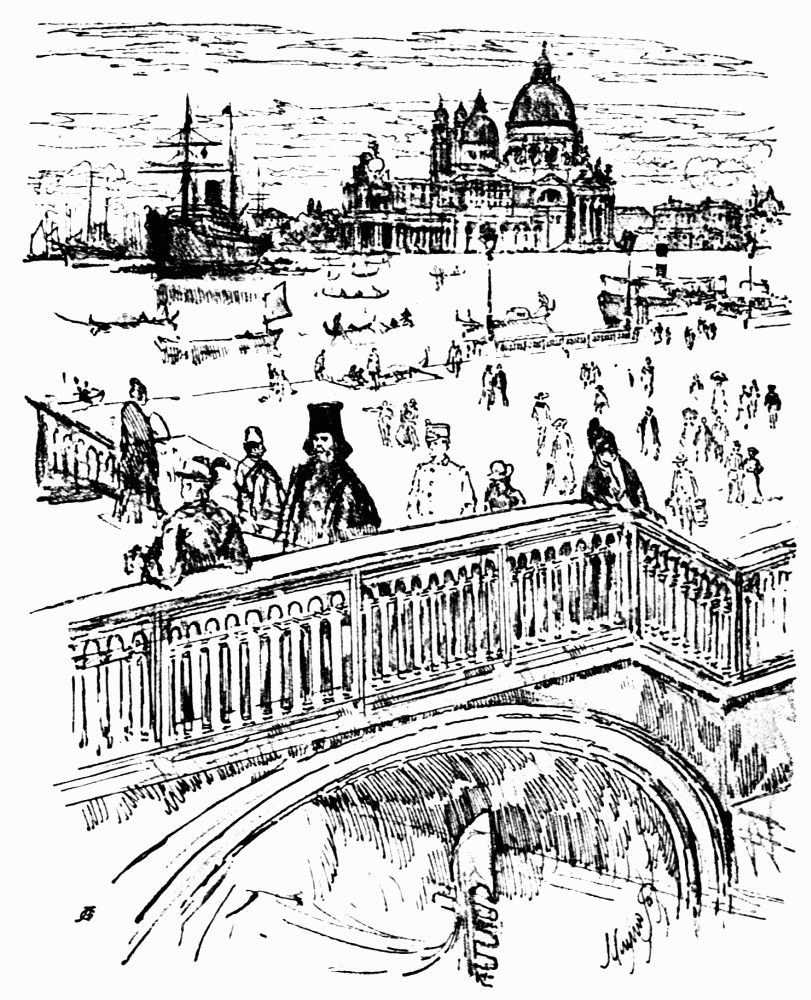
PONTE DELLA PIETÀ
As a specimen of what went on during the election of the last Doge of Venice, I subjoin an official list of what were considered the legitimate expenses of the electors. The figures are from Mutinelli
Mutinelli, Ult.
and may be trusted. They are given in Venetian ‘lire,’ one of which is considered to have been equal to half a modern Italian ‘lira,’ or French franc.
Ven. Lire.
Bread, wine, oil, and vinegar29,421
Fish24,410
Meat, poultry, game20,370
Sausages, large and small3,980
Preserved fruits and candles47,670
Wines, liquors, coffee63,845
Spices, herbs, fruit, flowers6,314
Wood and charcoal31,851
Utensils hired, worn, and lost41,624
Small expenses45,327
Given to footmen and to workmen of the guilds63,583
Tobacco and snuff4,931
Poem ‘La Scaramuccia’ (The Skirmish)48
Almanacks8
Game of Rocambole (said to have been a kind of Ombre)550
Nightcaps450
Felt caps56
Socks16
Black silk wig-bags48
French, German, and Spanish snuff-boxes3,077
Combs ‘à la royale,’ for wigs, and for caps2,150
Essence of rose, carnation, lavender, and vanilla; olive gum and gold powder;173
Rouge9
One rosary15
Total389,926
Romanin, probably with another copy of the account which he does not give in items, and writing earlier than Mutinelli, makes the sum a little smaller. In any case it is certainly one of the most extraordinary bills ever brought in by a Republic for electing its chief.
In view of modern methods it will interest some
Rom. viii. 302, note.
of my readers to see how the expenses of Venetian elections increased towards the end, according to Romanin:—
Ven. Lire.
Election ofCarlo Ruzziniin173268,946
“Aloise Pisani“173470,629
“Pietro Grimani“174170,667
“Francesco Loredan“1752134,290
“Marco Foscarini“1762120,868
“Aloise Mocenigo“1763125,234
“Paolo Renier“1779222,410
“Ludovico Manin“1789378,387
Greatly increased expenditure for successive elections during half a century can only mean one of two things, the approach of a collapse, or the imminence of a tyranny. The greater the proportionate increase from one election to the next, the nearer is the catastrophe. The election of the last Doge of Venice cost five and a half times as much as that of Carlo Ruzzini. It would be interesting to know what proportion Julius Cæsar’s enormous expenses, when he was elected Pontifex Maximus, bore to those of a predecessor in the same office fifty years earlier.
The Venetian electors who managed to consume, or make away with, nearly eight thousand pounds’ worth of food, drink, tobacco, and rose-water in nineteen days, chose an honest man, though a very incompetent one, and the public showed no enthusiasm for the new Doge, in spite of the great festivities held for his coronation. The Venetian people, too, preserved their artistocratic tendencies to the very last, and always preferred a Doge of ancient lineage to one who, like Manin, came of the ‘New men.’
He was not fortunate in his choice of a motto for his first ‘osella.’ He, who was to dig the grave of Venetian liberty, chose the single word ‘Libertas’ for the superscription on his first coin; and on that which appeared in the last year but one of the independence of Venice were the words ‘Pax in virtute tua,’ which, as Mr. Horatio Brown has pointedly observed, ‘reads like a mocking epitaph upon the dying Republic.’
Manin was a weak and vacillating man, though truthful, generous to a fault, and not a coward. As Doge, he was bound hand and foot, and only a man of great character could have broken through such bonds to strike out an original plan that might have prolonged his country’s life. He gave his fortune without stint, but the idea of giving anything else did not occur to him. Before the tremendous storm of change that broke with the French revolution and raged throughout Europe for years, he bowed his head, and Venice went down. No man is to be blamed for not being born a hero; nor is the mother of heroes in fault when she is old and can bear them no more.
FROM THE PUBLIC GARDEN AT SUNSET