VIII THE HOSE CLUB—VENETIAN LEGENDS
Reading edition
In the fourteenth century, life in Venice was simple and vigorous, and found its civic expression in the formation of the Guilds which united in
Molmenti, Vita Privata. Sansovino. Galliccioli, ii. 267, 269. Mutinelli, Lessico.
close and brotherly bonds men of grave and energetic character, devoted to their country and to its advantage. In the fifteenth and sixteenth centuries the tendencies of the later Venetians took visible shape in brotherhoods of joyous and not harmless amusement, and chiefly in that known as the ‘Compagnia della Calza,’ in plain English the ‘Hose Club.’
The learned Professor Tomassetti of the University of Rome, whose authority in all that concerns the Middle Ages in Italy is indisputable, informs me that he believes the right of wearing hose of two or more colours, as one leg white and one leg red, or quartered above and below the knee, belonged exclusively to free men, and that the fashion was adopted by them in order that they might be readily distinguished from the serf-born, in crowds and in public places. This is, indeed, the only reasonable explanation of the practice which has ever been offered, and is borne out by a careful examination of the pictures of the time. The ‘Hose Club’ distinguished themselves and recognised one another by their hose, which were of two colours, one leg having at first a peacock embroidered on it, whence the whole company was sometimes nicknamed ‘The Peacocks.’
The Doge Michel Steno, who painted his four hundred horses yellow, and had been concerned in the libel against the nephew of Marin Faliero,
1400.
had been counted among the gayest youths of his day; and when he was elected the rich young men of Venice, knowing by hearsay from their fathers that he had been wild in his youth, determined to celebrate the accession of a former dandy in a manner suited to their own tastes. They agreed upon the dress which afterwards became famous, and each paid a sum of two thousand ducats into a general fund which was entirely spent in pageantry, banqueting, and masquerades.
They had not at first intended the Club to be permanent, but when the anniversary of the Doge’s coronation came round in the following year, they met again to consider the advisability of prolonging an institution which made such an agreeable contrast to the general gravity of Venetian life.
They now composed a sort of charter or constitution, which would have made the heads of the artisan Guilds tremble with indignation, and might
1401.
well have caused the fathers of Venetian families to look even more grave than usual.
The Club was to be always a Company of twenty members, chosen for four years only; for as soon as a young Venetian married, or took his seat in the Great Council, he put on the long gown of older years and more dignified habits, which effectively eclipsed his brilliant legs from the public gaze. Each Company was to choose its name, an emblem, and a motto. There were to be officers, a president, a secretary, and a treasurer; and as the Venetians had a mania for sanctioning even the most frivolous doings by means of some religious exercise, each Company was to have a chaplain to celebrate a solemn mass at the admission of each young scapegrace who joined. The chaplain also administered the oath which every Companion was bound to take on admission.
The smallest infraction of the rules entailed a heavy fine, and the fines were, of course, periodically spent in riotous amusements. As for the dress, the hose always remained a part of it, but the greatest latitude was allowed in the matter of colour and embroidery, or other ornamentation.
The formation of the joyous Companies was a natural reaction after the huge efforts, the strenuous labours, the awful dangers that had filled the fourteenth century, and had placed Venice high among the European powers. From the foundation of the first of the Company, that of the ‘Peacocks,’ to the dispersion of the ‘Accesi,’ the ‘Ardent,’ which was the last, a hundred and eighty-six years went by, which may be called six generations, during which forty-three Companies succeeded each other, and the ‘Hose Club’ became famous throughout Europe for its extravagance, and for the fertility of its festive inventions.
It made it its especial business to adorn with its presence in a body the public baptisms of noble children, and important weddings, the visits of illustrious personages, and even elections where there was much at stake. When a foreign sovereign stopped in Venice, he asked to be made an honorary member of the Company, he sometimes adopted its dress, and he took home with him its emblem and its motto.
The most famous of all the Companies was that of the ‘Reali,’ the ‘Royals,’ which was in existence about the year 1530. The members wore a red
Cicogna, Iscr. iii. 366.
stocking on the right leg, and a blue one on the left, which was embroidered on one side with large flowers of violet colour, and on the other the emblem of the Company, which was a cypress, over which ran the motto, ‘May our glorious name go up
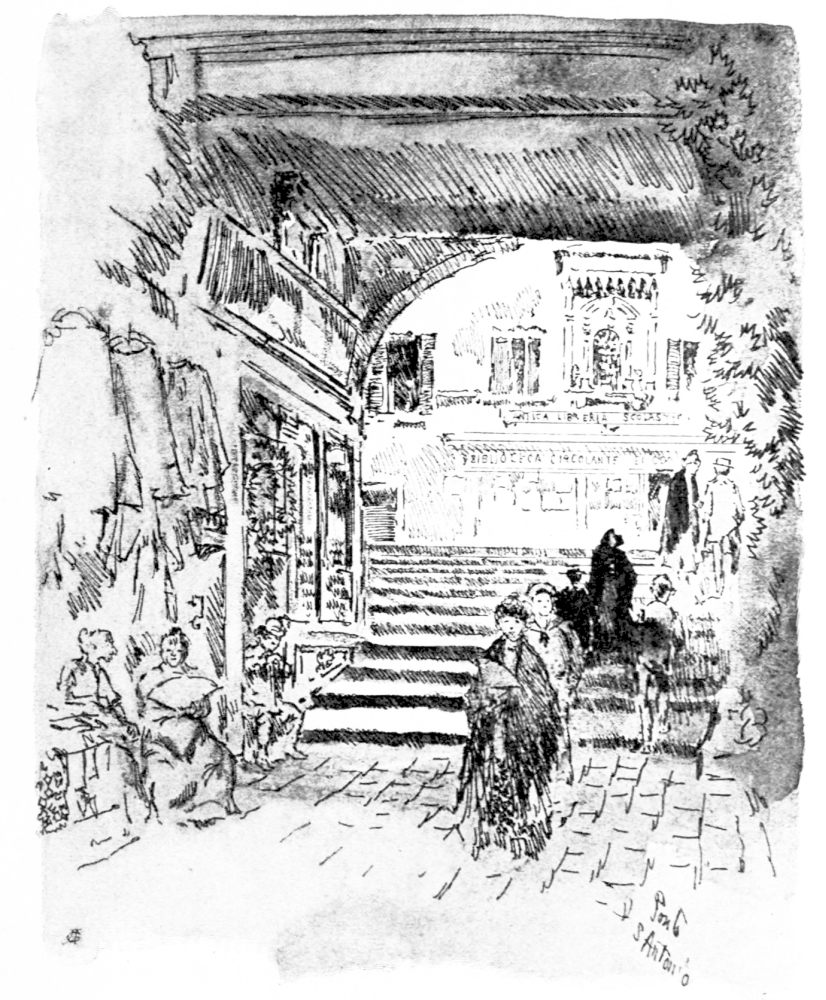
PONTE S. ANTONIO
to heaven.’ The members wore a vest of velvet embroidered with gold and fine pearls, and the sleeves were fastened on by knots of ribband of different colours, a fashion permitting the wearer to display his shirt of gossamer linen, exquisitely embroidered.
A leathern or a gilded girdle was worn too, ornamented with precious stones, and over the shoulder was carelessly thrown a short mantle of cloth of gold, or damask, or brocade, with a hood thrown back, in the lining of which was seen again the emblematic cypress.
Last of all the ‘toga,’ the great cloak, was red, and was fastened at the neck by a small golden chain, from the end of which a handsome jewel hung down below the ear, over one shoulder. The boots were of embroidered or cut leather, and were made with very thin soles.
Venice had to thank the Companions of the Hose Club for some of the first real theatrical performances ever given, which gradually led to the creation of the ‘ridotti,’ and were more or less aristocratic gambling clubs in connection with the theatres. We read that in 1529 the Companions played a comedy with immense success in the house of one of the Loredan family. In the following year the Duke of Milan visited the city, and the Club determined to out-do all its previous festivities. A Giustiniani was then the president of the ‘Royals,’ and he appeared with a deputation before the Doge and the Signory. After announcing that the Club had determined to produce the spectacle of a naval combat, he requested the government to lend for the purpose forty of the light war-pinnaces from the Arsenal. As if this were nothing unusual, he went on to ask for the use of the hall of the Great Council for a dance, of the Library for a supper, and of the Square of Saint Mark’s for a stag-hunt.
The Hose Club evidently had large ideas. The Doge, however, granted all that was necessary for the naval show, but said that he should have to think over the other requests!
It is needless to say that the ladies of Venice had their share in the gay doings of the Club, first as invited guests only, but later as honorary Companions, wearing the emblem embroidered on their sleeves and on the scarlet ‘felse’ of their gondolas, until the sumptuary laws interfered.
There were times when the Signors of the Night and the Council of Ten thought fit to limit the Club’s excessive gaiety, and it was found necessary to issue a decree which strictly prohibited any of the eleven thousand light ladies of the city from being received as Companions, or asked to its entertainments; for, oddly enough, the reputables do not seem to have resented the presence of the disreputables in the sixteenth century.
Now and then the Companions fell out among themselves. Marin Sanudo, in his diary, mentions that in February 1500 the Companions
Marin Sanudo, iii. I, 39.
dined in the house of Luca Gritti, son of late Omobono; and after dinner Zuan Moro, the treasurer of the Club, went out with Angelo Morosini, Andrea Vendramin, and Zacaria Priuli; and they quarrelled about a matter concerning which I refer my scholarly reader to his Muratori, and Zuan Moro was wounded in the face, and turned and gave his assailants as good as he had got, to the infinite scandal of the whole city, for these Companions were all the young husbands of beautiful women, and they disfigured each other!
We learn also from Sanudo that the Companions frequented the parlours of nunneries as well as the palaces of their noble relations and friends, and that in 1514, for instance, they played a comedy by Plautus in the convent of Santo Stefano. The Company of the ‘Sempiterni,’ the ‘Eternals,’ wished to give a performance of Pietro Aretino’s ‘Talanta’ in one of the monasteries, but this was more than the monks could endure, which will not surprise any one who has read Aretino’s works; they might as well have proposed to give one of Giordano Bruno’s obscene comedies; and perhaps they would, if he had then already lived and written. Refused by the monks, the Companions hired a part of an unfinished palace on the Canarregio for their performance.
At first sight, what surprises us is the impunity enjoyed by these young gentlemen of pleasure, and we ask what the three ‘Wise Men on Blasphemy’ were doing. They were the Censors of the Republic, and it is amusing to note that they acted in regard to licensing plays precisely as the modern English government censorship does, for whereas they allowed a scandalous piece by Aretino to be performed unchallenged, they most strictly forbade the presentation of any biblical personage or subject on the stage. The stories of Judith, of Jephthah’s daughter, and of Samson were those of which the wise magistrates most particularly disapproved, I know not why.
The first theatre Venice had was built by the Companions
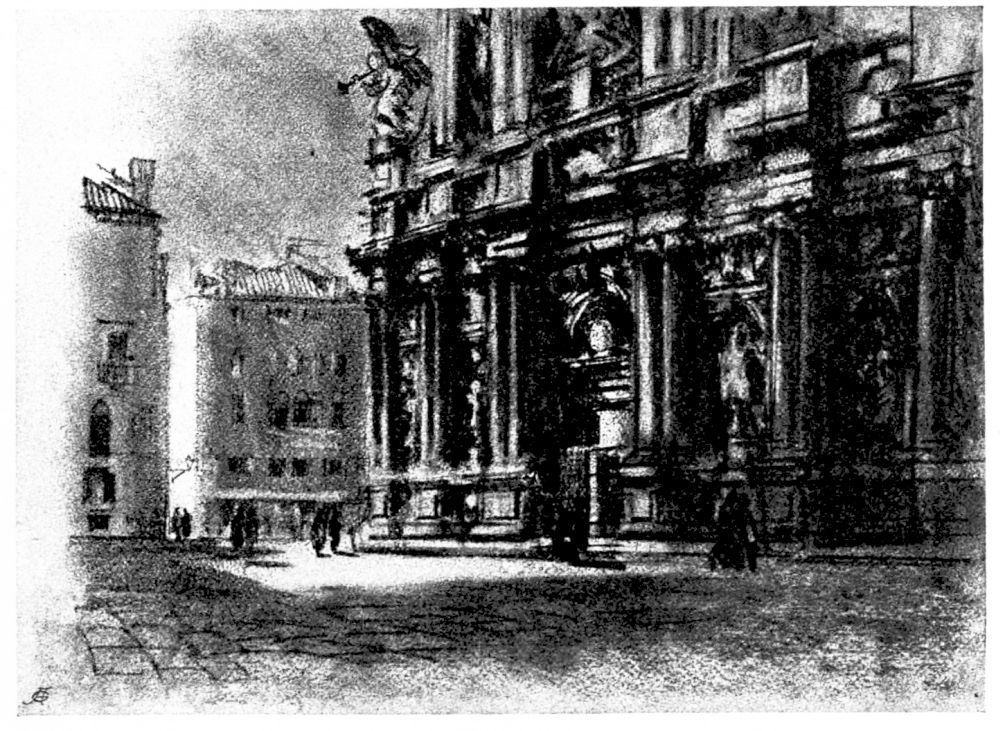
S. ZOBENIGO
in 1560 after the designs of Palladio, of wood, in the court of the monastery of the Carità, but after a few years it took fire, and the monastery itself was destroyed with it.
I find that the Companions were great ‘racket’ players; but I apprehend that by ‘rackets’ the chroniclers intended to describe court tennis, which was played in Venice, whereas in most other Italian cities the game of ‘Pallone’ was the favourite, and has survived to our own time. It is played with a heavy ball which the player strikes with a sort of wooden glove, studded with blunt wooden pins and covering most of the forearm.
To return to the question of the large freedom and impunity granted to the Club by the government, the reason of such license is not far to seek. Young men who spend their time in a ceaseless round of amusement do not plot to overthrow the government that tolerates them. The Signory, on the whole, protected the Companions even in their wildest excesses, and no doubt believed them to be much more useful members of society than they thought themselves, since their irrepressible gaiety and almost constant popularity helped to keep the people in a good humour in times of trouble and disturbance.
At the time of the league of Cambrai, for instance, when Pope Julius II., the Emperor Maximilian, Louis XII. of France, and Ferdinand of Aragon agreed to destroy the Venetian Republic, and when it looked as if they must succeed, the Company of the ‘Eternals’ produced a mummery which was highly appreciated both by the government and the population.
They gave a sumptuous feast, after which the dining-hall was, as by magic, turned into an improvised theatre. In the middle of the stage
1510. Rom. v. 246.
sat a young noble who personated the King, splendidly arrayed in the Byzantine fashion, and attended by his counsellors, his chancellor, and his interpreter. Before him there came in state one who played the Papal Legate, dressed as a bishop in silk of old-rose colour, and he presented a brief and his credentials; whereupon, after crowning and blessing the King, he observed that he should like to see a little dancing, and two of the Companions at once danced for him with two of the fairest ladies. The Legate was followed by the Ambassador of the Holy Roman Empire, and the Ambassadors of France, Spain, Hungary, and Turkey arrived in turn; each spoke in the language of his country, and his speech was interpreted to the King. Last of all came the Ambassador of the Pigmies mounted on a tiny pony accompanied by four dwarfs and the professional buffoon Zanipolo. We must suppose the speeches to have been very witty, and the dwarfs and buffoons highly comic, since this incomprehensible nonsense was a stupendous success and was talked of long afterwards.
The taste for these ‘momarie,’ literally ‘mummeries,’ grew in Venice. Marin Sanudo describes one which was produced in the Square of Saint Mark’s on the Thursday before Lent in 1532. I translate a part of the list of the masks, to give an idea of the whole.
First, the goddess Pallas Athene with her shield and a book in her hand, riding on a serpent.
Second, Justice riding on an elephant, with sword, scales, and globe.
Third, Concord, on a stork with sceptre and globe.
Fourth, Victory on horseback, with sword, shield, sceptre, and palm.
Fifth, Peace riding a lamb, and holding a sceptre with an olive branch.
And so on. Then Ignorance, riding an ass, and holding on by the tail, met Wisdom and fought and was beaten. And Violence appeared on a serpent, and Mars on a horse, and Want on a dog with a horn full of straw for its emblem. And Violence was soundly beaten by Justice, Discord by Concord, and Mars by Victory, and Abundance drove Want from the field.
Such were the shows that amused the Venetians, while written comedy was slowly growing out of infancy.
The Companions of the Hose Club revenged themselves cruelly on any one of their own number who
Tassini, under Osteria della Campana.
showed signs of meanness. Sanudo tells the following anecdote. Alvise Morosini, one of the ‘Eternals,’ on the occasion of his marriage with a daughter of the noble house of Grimani, gave his fellow-Companions a very meagre dinner. Not long afterwards they got into the Grimani palace and carried off two magnificent silver basins; these were placed in the hands of professional buffoons who paraded the city with them, informing the public that the bridegroom meant to pawn them to pay for the dinner which the Companions were going to eat at the sign of the Campana instead of the dinner which they should have eaten at the Palazzo Morosini, and also to pay for wax torches for taking home the fair ladies who were to be asked to the feast.
The paternal and business-like government of Venice, seeing how much the Companions contributed to the national gaiety, allowed them to transgress the sumptuary laws which were so binding on every one else. For instance, ordinary mortals were forbidden to ask guests to more than one meal in the twenty-four hours, but the Companions eluded the law—with the consent of the police—by keeping an open table all night, so that breakfast appeared to be only the end of supper. Even in the matter of the gondolas, the rule was that the ‘felse’ should be of black cloth, yet the Companions covered theirs with scarlet silk and the Provveditori delle Pompe had nothing to say.
Then, suddenly, the government had a fit of morality, and in 1586 the Hose Club was abolished by law, all privileges were revoked, and the decree was enforced. Venice lost some amusement and much beautiful pageantry, and gained nothing in morality. It was not very long before the grave senators who objected to the Companions were seen in their scarlet togas presiding over authorised gambling establishments in the ‘ridotti.’
The Venetians were an imaginative people who delighted in fables, amusing, terrible, or pious, as the case might be. Their stories differ from those of other European races in the Middle Ages by the total absence of the element of chivalry upon which most other peoples largely depended for their unwritten fiction. One can make almost anything of a business man except a knight.
Near the Ponte dell’ Angelo in the Giudecca stands a house which shows great age in spite of much
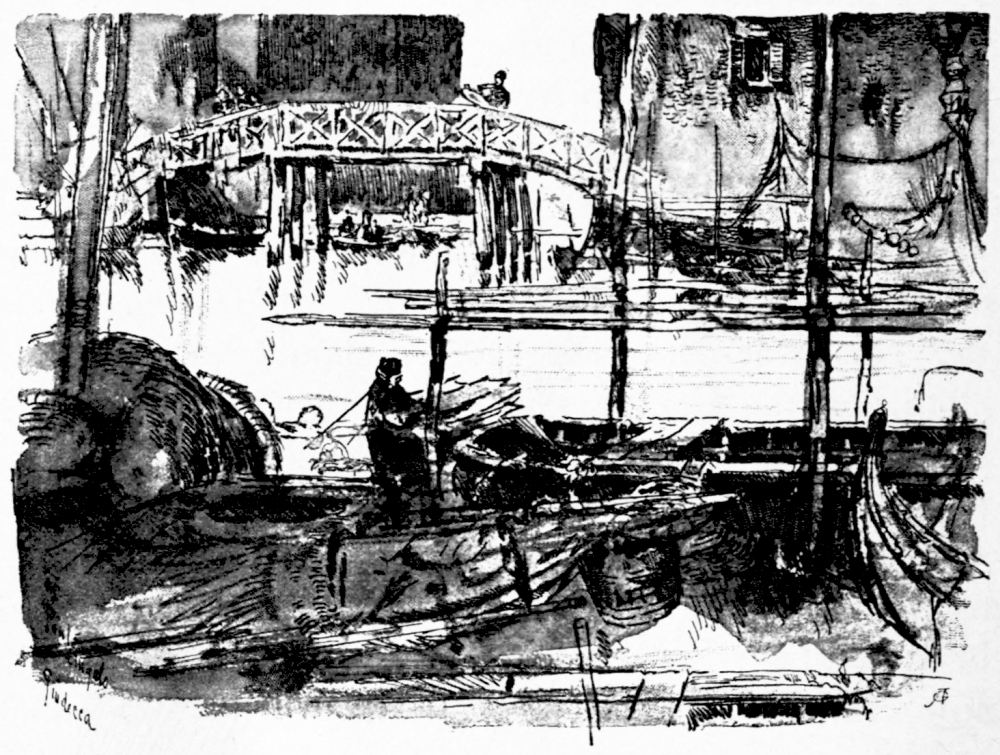
PONTE DELL’ ANGELO, GIUDECCA, OLD WOODEN BRIDGE
modern plastering. The windows are gothic, of the
Tassini, under ‘Angelo.’
ogival design, and on the façade there is an image of the Virgin with the infant Christ in her arms. Higher up, a bas-relief represents an angel standing with outstretched wings as if he were about to fly away after blessing with his right hand the globe he holds in his left.
In the year 1552 this house was inhabited by a barrister of the ducal court who professed unbounded devotion to the Madonna, and practised the most indelicate methods of improving his fortunes.
One day the lawyer asked to dinner a holy Capuchin monk who enjoyed the highest reputation for sanctity. Before sitting down to table he explained to the good friar that he had a most wonderful servant in the shape of a learned ape, that kept his house clean, cooked for him, and did his errands. The holy man at once perceived that the ape was no less a personage than the Devil in disguise, and asked to see him; but Satan, suspecting trouble, hid himself till at last he was found curled up in his master’s bed, trembling with fright.
‘I command thee,’ said the monk, ‘in the name of God, to say why thou hast entered this house.’
‘I am the Devil,’ answered the ape, seeing that prevarication would be useless, ‘and I am here to take possession of this lawyer’s soul, which is mine on several good grounds.’
The monk inquired why the Devil had not flown away with the soul long ago, but the fiend replied that so far it had not been possible, because the lawyer said ‘Hail, Mary,’ every night before going to bed. Thereupon the Capuchin bade the Devil leave the house at once; but the Devil said that if he went he would do great damage to the building, as the heavenly powers had authorised him to do. But the monk was a match for him.
‘The only damage you shall do,’ said the friar, ‘shall be by making a hole in the wall as you leave, which shall be a witness of the truth of what we have seen and heard and of the story we shall tell.’
The Devil obeyed with alacrity and disappeared through the wall with a formidable crash, after which the lawyer and his guest sat down to table, and the monk discoursed of leading a good life; and at last he took the table-cloth and wrung it with both hands, and a quantity of blood ran out of it which he said was the blood the lawyer had wrung from his clients. Then the sinner began to shed tears and promised to make full reparation, and he told the monk that if the hole in the wall were not stopped up, he feared the Devil would come in by it again. So the friar advised him to place a statue of the Madonna before the hole and an angel over it, to scare the Devil away. And so he did.
Another Venetian legend of slightly earlier date tells how there was once in the confraternity of Saint John
Tassini, under ‘San Lio.’
the Evangelist a man who led a bad life, to the great scandal of all who knew him. One of the brethren having died, the Superior hoped to touch the heart of that wicked man by asking him to bear the Cross in the funeral procession. ‘I will neither walk in the procession to-day,’ answered the sinner, ‘nor do I wish to be so accompanied when the Devil carries me off.’ After some time he died, and the brethren proceeded to bury him, walking in procession after the Cross; but when they reached the bridge of San Lio it became so heavy that it was impossible to lift it from the ground, much less to carry it. The Superior now remembered the words of the blasphemer, and told the story to the brethren while
Picture representing the scene, Mansueti; Accademia delle belle Arti.
they halted. So they all decided that the Cross must not follow the procession, and thereupon it instantly became light again, and was carried back to the chapel of Saint John the Evangelist.
The fireside is the natural place for telling stories, and there is certainly some connection in the human mind between firelight and the fabulous. Dante tells that in his time the women of Venice consulted the fire in order to know the future. When a girl was engaged to be married she appealed to one of the burning logs, and decided from the augury whether she was to be happy or unhappy. Those who wanted money struck the log with the tongs, calling out softly, ‘Ducats! ducats!’ If the sparks flew out abundantly there was some hope that a rich relation might die and leave the inquirer a legacy. When the sparks were few and faint, poverty was prophesied.
Unlike all other Italians, who believe that hunchbacks bring good luck, the Venetians feared them excessively. A Venetian proverb says, ‘Leave three steps between thyself and those whom God has marked, eight if it is a hunchback, and twenty-eight if the man be lame.’
One of the pretty superstitions of Venetian mothers was that if they took their little children out before dawn on Saint John’s Day, the twenty-fourth of June, so that the morning dew might dampen their cheeks and hair, they would have lovely complexions and golden locks. There are old Venetian lullabies that promise babies the midsummer dew.
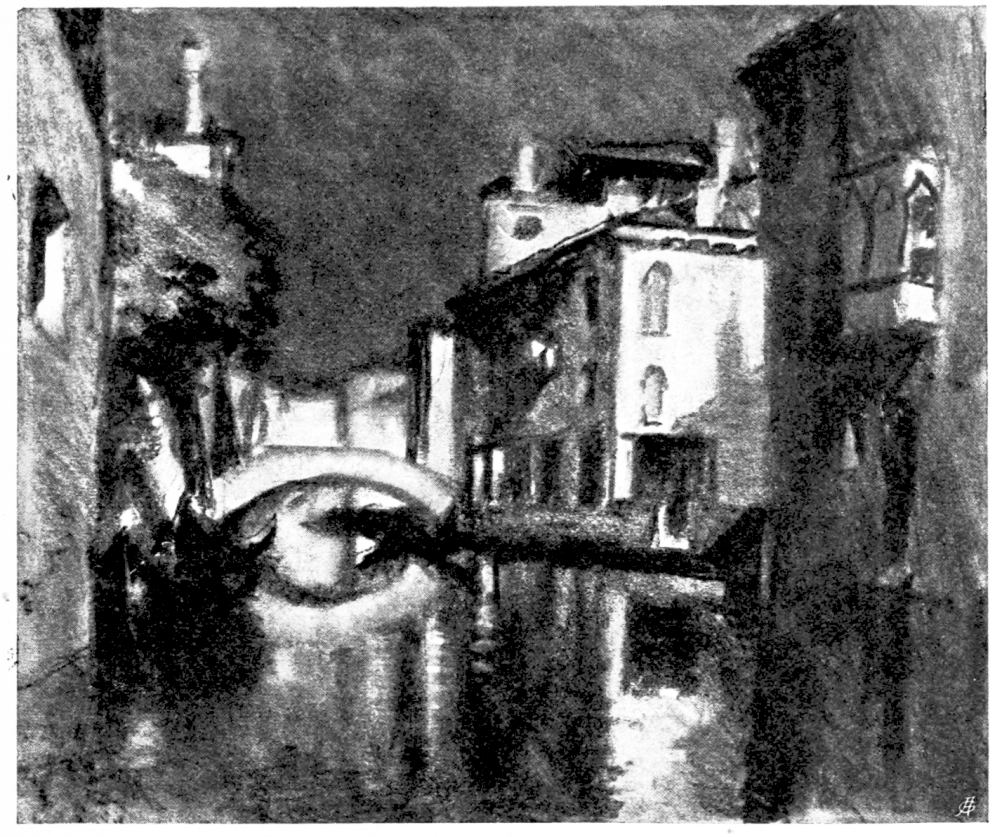
RIO S. SOFIA, NIGHT