II GLEANINGS FROM VENETIAN CRIMINAL HISTORY
Reading edition
The records of the different tribunals of Venice are a mine of interesting information, and it is to be wondered that no student has devoted a separate volume to the subject. I shall only attempt to offer the reader a few gleanings which have come under my hand, and which may help to give an impression of the later days of the Republic.
There were two distinct classes of criminals in Venice, as elsewhere—namely, professional criminals, who helped each other and often escaped justice; and, on the other hand, those who committed isolated crimes under the influence of strong passions, and who generally expiated their misdeeds in prison or on the scaffold.
Though the professionals were infinitely more dangerous than the others, it is a remarkable fact that they enjoyed the same sort of popularity which was bestowed upon daring highwaymen in England in the coaching days. They were called the ‘Bravi,’ they were very rarely Venetians by birth, and they had the singular audacity to wear a costume of their own, which was something between a military uniform and a mediæval hunting-dress. One might almost call them condottieri in miniature. They sold their services to cautious persons who wished to satisfy a grudge without getting into trouble with the police, and they drew round them all the good-for-nothings in the country. ‘Bandits’—that is, in the true interpretation of the word, those persons whom the Republic had banished from Venetian territory—frequently returned, and remained unmolested during some time under the protection of one of these bravi. The most terrible and extravagant crimes were committed in broad day, and the popular fancy surrounded its nefarious heroes with a whole cycle of legends calculated to inspire terror.
The government cast about for some means of checking the evil, and hit upon one worthy of the Inquisitors of State. The simple plan consisted in giving a free pardon for all his crimes to any bravo who would kill another. We even find that a patrician of the great house of Quirini, who had been exiled for killing one of Titian’s servants, obtained leave to come back and live peacefully in Venice by assassinating a
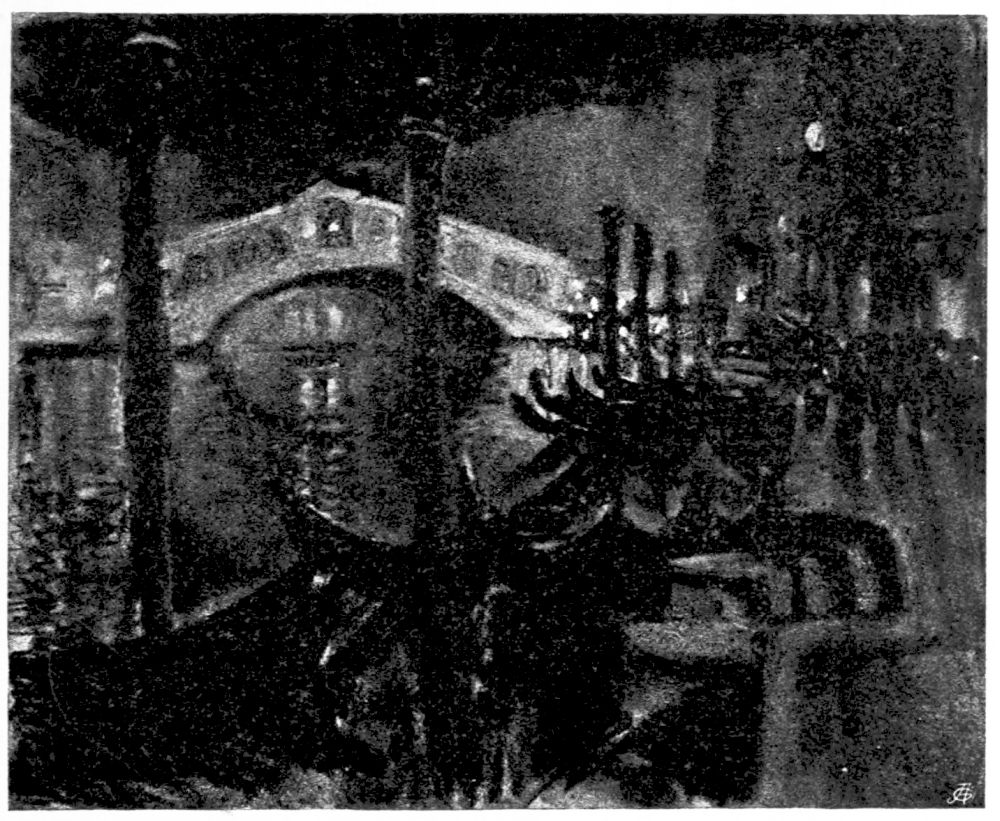
THE RIALTO AT NIGHT
bravo. It is easy to imagine what crimes could be committed under this law, and the government soon recognised the mistake and repealed it in
Pinelli, Raccolta di Leggi Crim.
1549, in order to protect ‘the dignity of the Republic, and the goods and lives of its subjects.’
Thereafter the bravi and the bandits led more quiet lives, and returned to their former occupations.
There existed at that time a statue of a hunchback modelled by the sculptor Pietro di Salò, which had been used to support a ladder, or short staircase, by which the public criers ascended the column of the Rialto, in order to proclaim banns of marriage and other matters
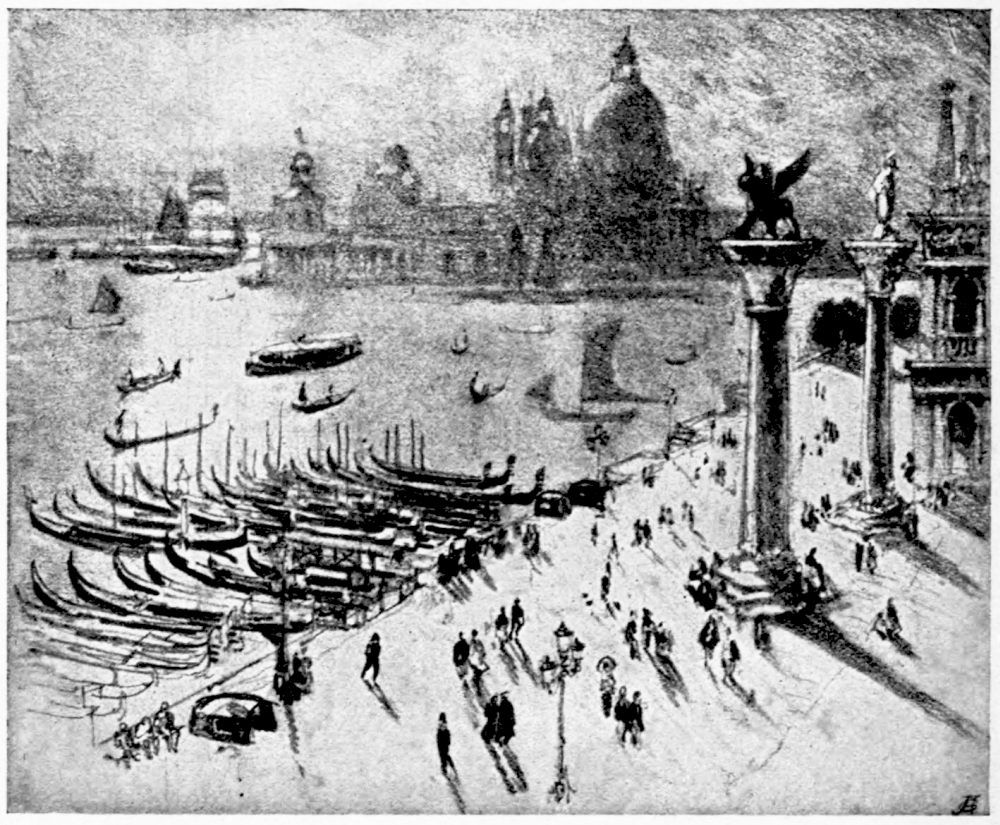
FROM THE BALCONY OF THE DUCAL PALACE
which were to be made public. From 1541 to 1545 thieves were usually sentenced to be flogged through the city from Saint Mark’s to the Rialto, where the ceremony ended by their being obliged to kiss the statue of the hunchback. In order to get rid of this degrading absurdity a small column was set up near by, surmounted by a cross, in order that ‘sinners might undergo their sentence in a Christian spirit.’
On the sixteenth of December 1560, the Council of Ten met to discuss the question of the bravi. It was now admitted that the government no longer had isolated criminals to deal with, but regular bands of ruffians continually
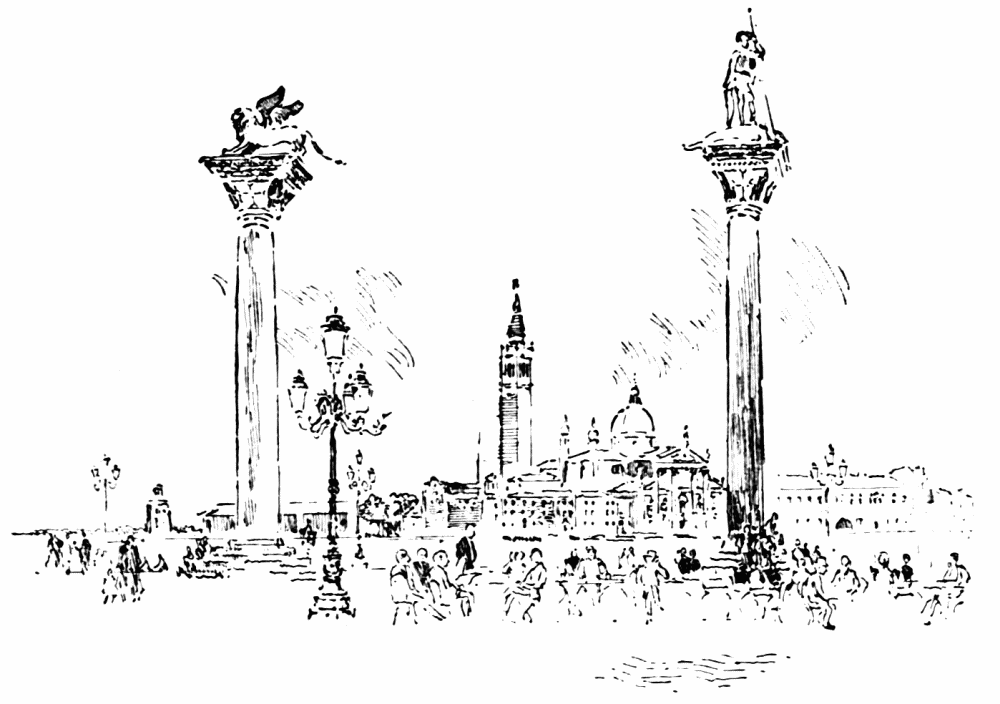
THE COLUMNS, PIAZZETTA
on the look-out for adventures. The Ten published an edict by which all bandits were formally warned that any one who exercised the profession of a bravo, whether a subject of the Republic or not, would be taken and led in irons to the place between the columns of the Piazzetta, where his nose and ears would be carved off. He would then be further sentenced to five years at the oar on board one of the State galleys, unless some physical defect made this impossible for him, in which case he was to have one hand chopped off and to be imprisoned for ten years. In passing, I call
Horatio Brown, Venetian Studies.
attention to the fact that life between decks on a State galley cannot have been pleasant, since five years of it were considered equivalent to the loss of a hand and ten years of imprisonment.
These terrific penalties inspired little or no fear, for the bravi were infinitely quicker and cleverer than the sbirri of the government, and were very rarely caught. Besides, they had powerful supporters and secure refuges from which they could defy justice, for they were sheltered and protected in the foreign embassies, where they knew how to make themselves useful as spies, and occasionally as professional assassins, and it was not an uncommon thing to see a sbirro standing before the French or the Spanish embassy and looking up at a window whence some well-known bravo smiled down on him, waved his hat, and addressed him with ironical politeness. The picture vividly recalls visions of a cat on top of a garden wall, calmly grinning at the frantic terrier below.
Then, too, the bravi were patronised by the ‘signorotti’ of the mainland, a set of rich, turbulent, and licentious land-owners, who could not call themselves Venetian nobles and would not submit to be burghers, but set themselves up as knights, and lived in more or less fortified manors from which they could set the police at defiance. They employed the bravi in all sorts of nefarious adventures, which chiefly tended to the satisfaction of their brutal tastes.
It was a second period of transition, as Molmenti very justly says, and in the beginning of the decadence the knight had already ceased to be knightly. Those rough lordlings were neither without fear nor without reproach, says the learned Italian writer, but were altogether without remorse, and if they were ever bold it was only in breaking the law. From time
Tassini, Condanne Capitali.
to time one of them was caught perpetrating some outrageous crime, and was dragged barefooted, in a long black shirt and black cap, to the scaffold, as an awful example, there to be flogged, hanged, and quartered. Such horrors had long ceased to have any effect in an age that saw blood run in rivers. By way of increasing the disgrace of a shameful death, a gibbet was set up which was so high that the victim had to mount thirty-two steps, and it was painted scarlet. The first miscreant who adorned it was one of the chiefs of the sbirri himself, who had used his position to protect a whole gang of thieves with whom he divided the plunder.
I abridge from Signor Molmenti’s work the following story, in which more than one type of
Molmenti, Banditi e Bravi.
the sixteenth-century criminal makes his appearance.
The village of Illasi is situated in a rich valley in the territory of Verona. At the end of the sixteenth century its castle was inhabited by a certain Count Geronimo and his beautiful lady, Ginevra. From time to time the couple introduced a little variety into their solitude by receiving Virginio Orsini who, though a Roman noble, was in the service of Venice as Governor of Verona. He was, I believe, a first cousin of that Paolo Giordano Orsini who murdered his wife Isabella de’ Medici in order to marry Vittoria Accoramboni. I have told the story at length in another work.
Virginio, the Governor, fell in love with the Countess Ginevra before long; but she, though strongly attracted to him, tried hard to resist him, would not read his letters, and turned a deaf ear to his pleadings.
On a certain Saturday night, when Count Geronimo was away from home and Ginevra sat by the fire in her own chamber, having already supped and said her prayers, the curtain of the door was raised and two men came in. The one was Grifo, the man-at-arms whom the Count trusted and had left to guard her; the other was Orsini. Ginevra sprang to her feet, asking how the Governor dared to cross her threshold.
‘Madam,’ he said, coming near, ‘as you would not answer my letters, I determined to tell you face to face that if you will not hear me you will be my ruin.’
‘Sir,’ answered the Countess, ‘that is not the way to address a lady of my condition. You are basely betraying my noble husband, who entertains for you both friendship and esteem.’
Here Grifo joined in the conversation and began to persuade the Countess that every noble lady of the time had her ‘confederate knight.’ No doubt he knew that she loved Orsini in spite of herself, and when he had done speaking he went away, and the two were alone together in the night.
An hour later Virginio took his leave of her, and now he told her with words of comfort that he would presently send her poison by the hand of Grifo, that she might do away with her husband; for otherwise he must soon learn the truth and avenge himself on them all three. But Ginevra was already stung by remorse.
‘I have dishonoured my husband for you,’ she answered. ‘But I will not do the deed you ask of me. It is better that I should myself die than that I should do murder.’
‘In that case,’ answered Orsini, ‘I myself must put him beyond the possibility of harming you.’
Thereupon he left her; but she was tormented by remorse, until at last she went to her husband and told him all, and entreated him to kill her. He would not believe her, but thought she had gone mad, though she repeated her story again and again; and at last he rose and went and found Grifo, the traitor, and dragged him to her room.
‘Is it true,’ she asked, ‘that you brought the Governor here to my chamber unawares?’
The man denied it with an oath. Then Ginevra snatched up a dagger and set the point at Grifo’s breast. He saw that he was lost, and told the truth, and then and there the woman whose ruin he had wrought did justice on him and was avenged, and stabbed him again and again, that he died.
There ends the story, for that is all we know. After that the chronicle is silent, ominously silent; and when the castle of Illasi was dismantled a walled niche was found in one of the towers, and within the niche there was a woman’s skeleton. That is known, surely; but that the bones were those of the Countess Ginevra there is no proof to show.
I should say that Grifo belonged to the type of the bravi, so that the crimes of passion which his betrayal
Molmenti, Vecchie Storie.
caused were connected, through him, with those of the professional type. But others were committed, then as now, in passion, quick or slow. As an example of them, here is a story from another of Signor Molmenti’s exhaustive works.
It is first mentioned by the Bishop Pietro Bollani in a letter addressed to his noble friend Vincenzo Dandolo, in the month of July 1602:—
‘A certain Sanudo, who lives in the Rio della Croce, in the Giudecca, made his wife go to confession day before yesterday evening; and she was a Cappello by birth. During the following night, at about the fifth hour (one o’clock in the morning at that season according to the old Italian sun-time), he killed her with a dagger-thrust in the throat. He says that she was unfaithful, but every one believes that she was a saint.’
We learn that the poor woman was thirty-six, and that Giovanni Sanudo had been married to her eighteen years. The Council of Ten ordered his arrest, but he had already escaped beyond the frontier, and he was condemned to death in default and a prize of two thousand ducats was offered for his head.
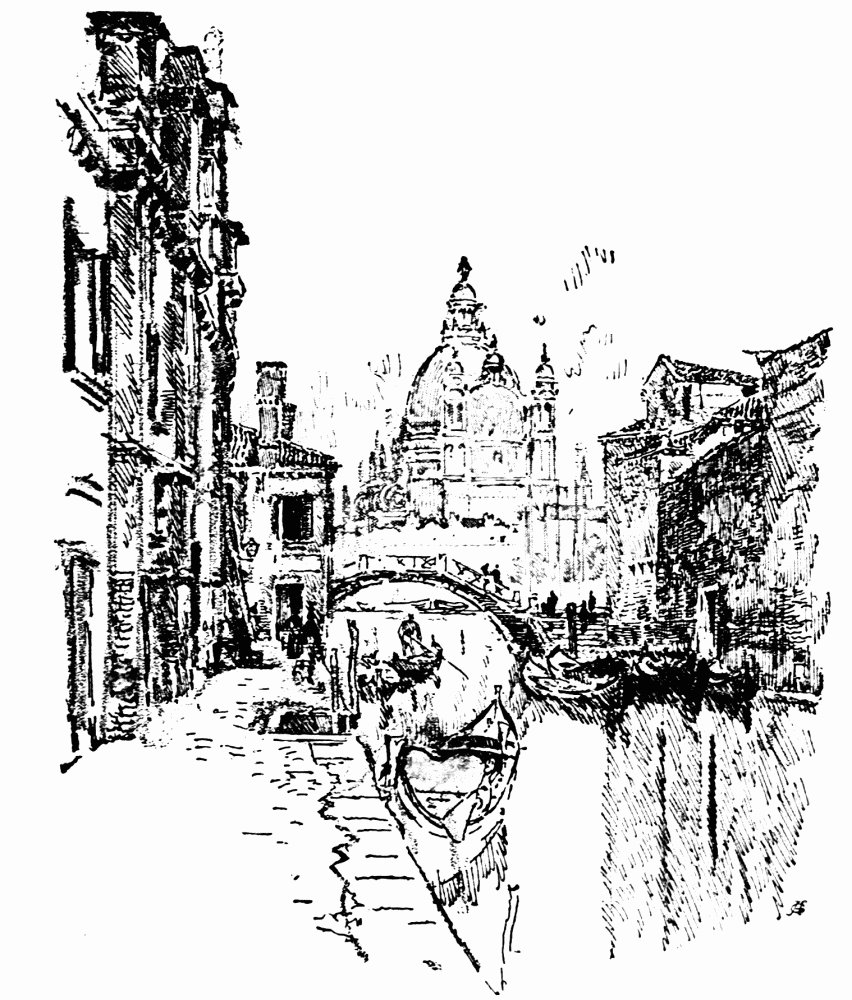
THE SALUTE FROM THE GIUDECCA
He had left five children in Venice, three boys and two girls; and the oldest, a daughter christened Sanuda, addressed a petition to the Ten which is worth translating:—
Most Serene Prince (the Doge), Most Illustrious Sirs (the Ten), and most merciful my Masters (the Counsellors, the High Chancellor, and the Avogadors):
Never did unfortunate petitioners come to the feet of your Serenity and of your most excellent and most clement Council, more worthy of pity than we, Sanuda, Livio, Aloïse, Franceschino and Livio second, the children of Messer Giovanni Sanudo; misfortune has fallen upon our house because our father having been accused of taking our mother’s life, the justice of your Serenity and of your most excellent Council has condemned him to death; wherefore we, poor innocent children, have lost at once our father and our mother, and all our possessions; and we assure you with tears that we should have to beg our bread unless certain charitable souls helped us. Therefore I, the unhappy Sanuda, who have reached the age of eighteen years, and my brothers and sisters who are younger than I, shall all be given over to the most abject poverty and exposed to the greatest dangers unless your Serenity and your most excellent Council will consent to help us for the love of religion and justice. And so, in order to prevent five poor and honest children of noble blood from perishing thus miserably, we prostrate ourselves at the feet of your Serenity and of your most Illustrious Lordships, imploring you, by the Passion of our Lord Jesus Christ, to allow our unhappy father to come back to Venice for two years, that he may provide for the safety of his family and especially of his daughters, whose honour is exposed to such grave peril in that state of neglect in which they are now living. We pray that the good God may grant your Serenity and your Lordships long and happy life.
The Council of Ten was apparently moved by the appeal. It answered the petition by the following resolution:—
‘The case of Sanuda, Livio, Aloïse, Franceschino, and Livio second, brothers and sisters, the children of Giovanni Sanudo, condemned to death by this Council on July twenty-ninth, is so serious; the petition of these poor children is so humble, so honest and so reasonable, that it behooves the piety and clemency of our Council to grant the said Giovanni Sanudo a safe-conduct, good for two years, in order that during this period he may provide for the future of his family.’
Sanudo came back, and before the two years had expired he obtained a prolongation of the grace for two years more, at the end of which time he presented another petition worded in the same manner, which was also granted; and so on from two years to two years until 1621, nineteen years after the crime, he being still technically under sentence of death.
Now, however, he obtained a formal pardon from his wife’s family, the Cappello. This curious document reads as follows:—
In the name of God and of the Holy Trinity, March thirtieth, 1621.
I, Carlo Cappello, son of the late Pietro Cappello, considering the weakness and the lamentable vicissitudes to which humanity is subject, and desirous of forgiving the shortcomings and misdeeds of others, in order that the Lord our God may protect me also, and desiring, too, the full pardon of every sin: do forgive my brother-in-law, Giovanni Sanudo, the offences he may have committed against me, promising henceforth to bear him neither hatred nor malice, and I pray God to grant us both a good Easter and the pardon of every sin.
(Signed) Carlo Cappello. Pietro Cappello. Livio Cappello.
Having obtained forgiveness of his wife’s family, Giovanni Sanudo now looked about for a means of extorting a final pardon from the Council of Ten. There existed in the Venetian states a small town, called Sant’ Omobono, which had received, as the reward of some ancient service rendered to the Republic, the privilege of setting at liberty every year two outlaws or two bravi. Sanudo succeeded in winning the good graces of the municipality, and was then presented by the mayor and aldermen to the Signory as one of the yearly candidates for a free pardon. The Council of Ten then permanently ratified its decree of immunity, and Giovanni Sanudo was once more a free man. Considering the usual character of the Council, it is hard not to surmise that it had found some cause for regretting the sentence it had passed. The poor murdered woman had confessed and received absolution before death: may we not reasonably suppose that, after all, there had been something to confess?
There is ground for believing it possible that Shakespeare may have used the original murder as part of the groundwork of his Othello. If we compare the dates and glance at the history of Italian literature, we may reasonably conclude that Shakespeare, after perhaps planning his tragedy on a tale of Giraldi’s, was much struck by the details of Sanudo’s crime, and especially by the murderer’s wish that his wife should confess before dying.
Mr. Rawdon Brown supposed the poet to have used another incident, related by Marin Sanudo in his voluminous journal, but the hypothesis involves an anachronism. Othello is thought by good authorities to have been first played in London in the autumn of 1602, only a few months after the crime in the Giudecca; whereas Mr. Rawdon Brown’s heroine was not murdered until thirteen years later.
The legend of the Fornaretto belongs to the beginning of the sixteenth century, a hundred years earlier. Travellers will remember being told by their guides how a poor little baker’s boy, who was carrying bread to a customer on a January morning in 1507, stumbled over the body of a noble who had been stabbed by an unknown hand. The sheath of the dagger lay on the pavement, and the boy was imprudent enough to pick it up and put it into his pocket, for it was richly damascened and very handsome. The police found it upon him, it was considered to be conducive circumstantial evidence, the poor boy confessed under torture that he had committed the crime, and he was hanged on his own confession.
A few days later the real murderer was arrested and convicted; and thereafter, in recollection of the tragic injustice that had been done, whenever the magistrates were about to pass a sentence of death, they were admonished to remember the poor Fornaretto.
By way of making the story more complete, the guide usually adds that the little lamp which always burns before an image of the Blessed Virgin on one side of the Basilica was lighted as an offering in expiation of the judicial murder, and that it is for the same reason that a bell is rung during twenty minutes on the anniversary of the baker boy’s execution.
Strangely enough, there is hardly a word of truth in this story. The only record in the archives of the Ten which faintly suggests it is the trial and execution of a baker named Pietro Fusiol, who had murdered a man of the people in January 1507, and there is no reference to any mistake on the part of the court. The ringing of the bell and the little lamp which burns day and night before the image, are a sort of ex voto offerings left by certain seamen in recollection of a terrible storm from which they escaped.
I pass on to speak of the political prisoners of the Republic, who were not by any means all treated alike, since some of them were confined in places of tolerable comfort, whereas others were treated little better than common criminals.
Dr. Heinrich Thode, Der Ring des Frangipane.
The story of Cristoforo Frangipane shows that political delinquents were not judged according to any particular code, and that each case was examined as being entirely independent from any other.
I must recall to the reader that during the league of Cambrai the Emperor Maximilian was commissioned to win back Friuli, Istria, and other provinces annexed by the Republic. Though the league had been formed in great haste, Venice was not taken by surprise, for it had long been apparent that the European powers desired her destruction and dismemberment.
Venice defying Europe, Palma Giovane; Sala dei Pregadi, ducal palace.
During the war which followed the Venetian army was at one time under the orders of Bartolomeo d’ Alviano, and that of the Emperor was commanded by Cristoforo Frangipane. Now the Frangipane family held lands in fee from Venice as well as from the Emperor, and owed feudal service to both; so that the Republic was justified in considering Cristoforo as a traitor according to feudal law, since he was in command of a hostile army.
A learned German student, Doctor Heinrich Thode, has discovered and told with great charm the following story concerning the imperial general. In 1892, Doctor Thode being then in Venice, certain peasants of the village of Osopo, near Pordenone, showed him a gold ring of marvellous workmanship and in the style of the sixteenth century, which they had found in a field. The ring consisted of two spirals, one within the other, which could be taken apart, so that a lock of hair or a relic could be placed between them. On the outer spiral of the ring were engraved the words, ‘Myt Wyllen deyn eygen,’ which may be translated, ‘By mine own will thine own.’ Doctor Thode bought the ring, but for a long time could make nothing of it. At last, however, his industry was rewarded by the discovery of an interesting passage in the almost inexhaustible diary of Marin Sanudo, of which I shall abridge the substance as much as possible.
At the beginning of the sixteenth century the Emperor Maximilian met in Augsburg a very beautiful girl named Apollonia von Lange, with whom he fell deeply in love. He caused her to come to the Court of Vienna, where she behaved so admirably that, according to the chronicler, all the Austrian nobles wished to marry her. As a matter of fact she was married in 1503 to the Count of Lodron, who happens to be the very person whom the Cappelletti of Verona wished to marry to their Juliet in spite of her promise to Romeo Montecchi.
The Count of Lodron died soon after his marriage, leaving no children. The Emperor continued to extend to the young widow his honourable protection, and in 1514 he married her to his favourite general Cristoforo Frangipane. It was no doubt on this occasion that the warrior received from her the ring of which the motto answered a question that had often been on his lips. He might, indeed, reasonably have supposed that she was marrying him in deference to the Emperor’s wishes; he must have asked her if this were true, and no doubt more than once she answered, ‘Of my own will I am thine own.’ The marriage had scarcely taken place when Frangipane was obliged to take command of the imperial army and to leave his wife. The first battle of the campaign was fought near Pordenone in the Venetian territory. Marin Sanudo narrates that on that day Frangipane lost a precious
A GARDEN WALL
relic, a fact which he considered to be of bad augury for the future.
Only a few days later, when reconnoitring the position of the enemy, he was climbing over a boulder which overlooked the valley. It either gave way with him, or else some large piece of stone rolled against him and threw him down. The accident was seen from a distance, and it was at once reported to Venice that he was dead. But he was only wounded, and was carried in a litter to Goritz, whither his wife hastened at once. Under her loving care he soon recovered, but before he was able to ride again the Venetians took the town and made him prisoner. He was conveyed to Venice, and was confined in the tower of the ducal palace which overlooked the Ponte della Paglia. In his confinement he kept up a constant correspondence with his wife, which, it is needless to say, was carefully examined by the government; every letter which came or went was read aloud before the Senate, so that Marin Sanudo had ample opportunity to copy the documents for his journal, as he frequently did.
The beautiful Apollonia was in a state bordering on despair, the grief of the separation preyed upon her mind, and she fell into a state of terrible languor and depression. Amongst many tender messages she makes mention of the ring.
‘As for the ring,’ she wrote, ‘most gracious and beloved husband, let me tell you that the one ordered of John Stephen Maze should be a little smaller than the old one, and on it must be engraved the words with which I answered the question you asked me, and which is graved on the ring I always wear on my finger. I wish you to wear the ring in memory and for love of me, but as we have no good jewellers here, I entreat you to order it yourself.’
In the face of such evidence it is hardly possible to doubt that the ring found at Osopo is the identical one given to Frangipane by his bride, and is the ‘relic’ which he lost in his first engagement with the Venetians.
The correspondence of the loving couple, passionate and sad, continued during six months, at the end of which time Apollonia wrote to the Signory imploring permission to share her husband’s prison; but this was refused her, though her request was supported by the warmest recommendations from the Emperor himself. Exasperated, Frangipane attempted to escape from prison, but his plan was discovered, and he was only the more closely watched. Apollonia now requested the favour of a safe-conduct that she might, at least, come to Venice as a traveller and visit her husband; this also was refused, not once only, but again when she wrote a second time.
There was now but one thing left for her to do, and she determined to risk coming to Venice without a safe-conduct. She arrived in the depth of winter in 1516, with four maids of honour, her chamberlain, her physician, and twenty-two servants. As the Council of Ten was ashamed to imprison her it placed her in the keeping of the patrician Dandolo, who was the general inspector of the ducal prisons, and he placed at her disposal his palace on the Grand Canal, which is now the Hôtel Danieli. She took up her quarters there on the thirteenth of January with her suite, and on the twentieth she appeared before the Doge and his counsellors arrayed in a magnificent silk gown and a black satin mantle lined with sable; a heavy gold chain hung down upon her bosom, and a golden coif was set upon her hair in the German fashion; three young girls dressed in black cloth followed her, one after the other, and an old duenna, the physician, and the chamberlain brought up the rear.
The fair Countess addressed the Doge with feminine eloquence and tact. She began by rendering thanks for the kindness and consideration shown to her husband, and she requested permission to see him twice a week. She argued that this permission was absolutely necessary to her, for she said that she was very ill, and that the treatment ordered by her doctor was of such a nature that she entirely declined to submit to it except in the presence of her husband. The Doge and his counsellors had never had to face such arguments before; they felt themselves absolutely powerless, and yielded at once.
But on the morrow old Dandolo, the inspector of prisons, appeared before them in a condition of indescribable dismay and excitement. He said that when the Countess was at last in her husband’s prison, on the previous evening, she had made such a scene in order to be allowed to stay all night that he, Dandolo, had yielded much against his will and had left the couple together. And now, in the morning, he had found the
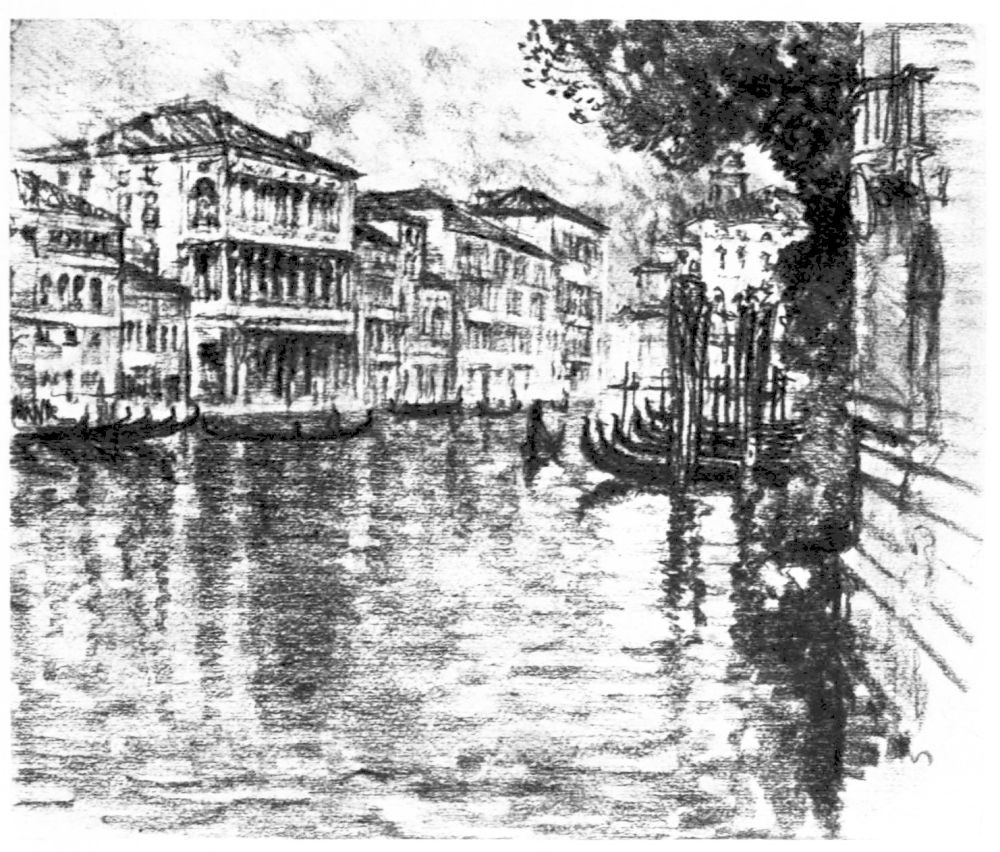
PALAZZO RESSONICO
Countess still in bed, declaring that she was dangerously ill, and demanding that her doctor should be sent to her without delay.
The Doge and his counsellors were in a quandary, and Dandolo was tearing his hair. Sanudo informs us that ‘there was much noise in the council’ that morning, and it is easy to believe that he was telling the truth. Almost half of the grave magistrates were in favour of leaving the Countess with her husband; the rest, with a very small majority, voted that she must quit the prison. The motion passed, but it was one thing to decide what she should do, and quite another thing to make her do it. She declared that since she was inside the tower, no power on earth should get her out of it, and she defied the Doge, the Council of Ten, and all their works. Before such portentous obstinacy the government of Venice retired in stupefaction, and she was left in peace.
But she was human, after all, and under prolonged imprisonment her health broke down, and she was obliged to leave the tower each year to go to the waters of Abano; but even then she refused to go out until a formal promise had been given her that she should be allowed to return immediately after the cure.
No doubt it was owing to her presence that Frangipane’s confinement became by degrees less rigorous, and that he was even allowed to watch the procession of Corpus Domini from the balcony of the Library.
Apollonia had come in January 1516, and the pair were not liberated till more than two years later. Germany, France, and Venice signed a truce of five years, and agreed to exchange prisoners and give hostages on the thirty-first of July 1518. Francis I. asked that Germany should hand him over Frangipane as security for keeping the peace, promising that he should not be imprisoned, but should be merely a prisoner of the King on parole. It was not freedom yet, but such a change was more than welcome, and the negotiations with the Signory for Frangipane’s delivery were completed on the third of September. The words he wrote in the embrasure of the window of his prison may still be read, says Dr. Thode, who copied the inscription which I reproduce:—
Fo inchluso. qua. in. torise ... fina.. terzo zorno de. setembro. del. M.D. XVIII. io. Christoforo. Frangepanibus Chonte. de. Veglia. Senia. et Modrusa Et io. Apollonia. Chonsorte. de sopradicto signor. chonte. Vene. far. chompagnia. a. quelo. adi. XX. Zenar. MDXVI perfina sopra dicto setembro. Chi mal. e. ben. non. sa. patir. a. grande honor. may. poi. venir. anche. ben. ne. mal. de. qui. per. sempre. non. dura.
I translate literally as follows:—
I was shut up here in the Torrisella till the third day of September of 1518, Christopher of the Frangipane, Count of Veglia, Senia, and Modrusa. And I, Apollonia, wife of the aforesaid lord Count, came to keep him company on the twentieth of January 1516 until the said September. ‘Who cannot bear good and ill fate, Will never come to honour great.’ Also, Nor good nor evil lasts for ever here.
Frangipane seems to have written this record during one of his wife’s absences at Abano, being perfectly sure that he was about to be set at liberty. But there had been a hitch in the negotiations. Venice was not ready to hand him over, and meanwhile, when Apollonia came back she was refused admittance. Dandolo again offered her a home in his palace, and did all he could to help her. Frangipane, deprived of her comforting presence, fell ill and went almost mad. Even the Doge himself supported his request to be allowed to be taken to a private dwelling. It was in vain; but Apollonia was at last allowed to return to her husband. They left no means untried to obtain the fulfilment of the treaty, and at last Dandolo became so exasperated with the Council of Ten that he resigned his post of inspector of prisons, telling the councillors to their faces that of twelve thousand prisoners who had been in his keeping, first and last, Frangipane was the only one who had been able to complain of injustice.
The Ten accepted his resignation almost without comment, and replaced him by two nobles. Then the couple tried to escape, but were discovered and again separated. At last the government consented to ask the King of France what was to be done with his hostage, whom he seems to have quite forgotten. He answered by requesting that Frangipane should be sent to Milan and handed over to the French governor, De Lautrec.
The loving pair were allowed to meet in the prison again, two days before the departure, but Apollonia was not permitted to follow her husband to Milan, and a heart-rending farewell took place at Lizzafusina, on the frontier. Having reached his destination, the unlucky Frangipane found himself in a much worse prison than the one he had occupied so long in Venice. Again his faithful wife succeeded in joining him, to share his captivity. But her strength was far spent, and she died on the fourth of September 1519, in the fortress of Milan; and soon afterwards Frangipane succeeded at last in escaping by sawing through the bars of his window and letting himself down by a rope.