I THE ARISTOCRATIC MAGISTRACIES AT THE BEGINNING OF THE SIXTEENTH CENTURY
Reading edition
Like other aristocracies, the Venetian government rarely destroyed or altogether abolished any office or regulation which had existed a long time. When a change was needed the duties or powers of one or more of the Councils were extended, or a committee of the Council of Ten was appointed and presently turned into a separate tribunal, as when the Inquisitors of State were created.
In one sense the government of Venice had now existed in a rigid and unchangeably aristocratic form during two centuries, and that form never changed to the very end. But in another sense no government in the world ever showed itself more flexible under the pressure of events, or better able to provide a new legislative weapon with which to combat each new danger that presented itself. This double character of an administration which inspired awe by its apparent immutability and terror by its ubiquity and energy, no doubt had much to do with its extraordinarily long life; for I believe that no civilised form of government ever endured so long as that of Venice.
It is therefore either frivolous or hypocritical to seek the causes of its ultimate collapse. It died of old age, when the race that had made it was worn out. It would be much more to the point to inquire why the most unscrupulous, sceptical, suspicious, and thoroughly immoral organisation that ever was devised by man should have outlasted a number of other organisations supposed to be founded on something like principles of liberty and justice. Such an inquiry would involve an examination into the nature of freedom, equity, and truth generally; but no one has ever satisfactorily defined even one of those terms, for the simple reason that the things the words are supposed to mean do not anywhere exist; and the study of that which has no real existence, and no such potential mathematical existence as an ultimate ratio, is absolutely futile.
The facts we know about the Venetian government are all interesting, however. It had its origin, like all really successful governments, in the necessities of a small people which held together in the face of great dangers. It was moulded and developed by the strongest and most intelligent portion of that people, and the party that modelled it guessed that each member of the party would destroy it and make himself the master if he could, wherefore the main thing was to render it impossible for any individual to succeed in that. The individual most likely to succeed was the Doge himself, and he was therefore turned into a mere doll, a puppet that could not call his soul his own. The next most probable aspirant to the tyranny would be the successful native-born general or admiral. A machinery was invented whereby the victorious leader was almost certain to be imprisoned, fined, and exiled as soon as his work was done and idleness made him dangerous. Pisani, Zeno, Da Lezze are merely examples of what happened almost invariably. If a Venetian was a hero, any excuse would serve for locking him up.
Next after the generals came the nobles who held office, and lastly those who were merely rich and influential. They were so thoroughly hemmed in by a hedge of apparently petty rules and laws as to their relations with foreigners, with the people, and with each other, that they were practically paralysed, as individuals, while remaining active and useful as parts of the whole. No one ever cared what the people thought or did, for they were peaceable, contented, and patriotic. Every measure passed by the nobles was directed against an enemy that might at any moment arise amongst themselves, or against the machinations of enemies abroad. Of all Italians the Venetians alone were not the victims of that simplicity of which I have already spoken. They believed in nothing and nobody, and they were not deceived. They were not drawn into traps by the wiles of the Visconti as Genoa was, and as many of the principalities were; they were not cheated out of their money by royal English borrowers as the Florentines were; they were not led away out of sentiment to ruin themselves in the Crusades as so many were; on the contrary, their connection with the Crusades was very profitable. For a long time they could be heroes when driven to extremities, but they never liked heroics; they were good fighters at sea, because they were admirable merchant sailors, but on land they much preferred to hire other men to fight for them, whom they could pay off and get rid of when the work was done.
Like other nations, their history is that of their rise, their culmination, and their decline. Like other nations, Venice also resembled the living body of a human being, of which it is not possible to define with absolute accuracy the periods of youth, prime, and old age. But we can say with certainty that each of those stages lasted longer in the life of Venice than in the life of any other European state, perhaps because no one of the three periods was hastened or interrupted by an internal revolution or by the temporary presence of a foreign conqueror.
It can be said, however, that Venice was, on the whole, at the height of her glory about the year 1500, and it would have needed a gift of prophecy to foretell the probable date of the still distant end. At that time the Great Council was more than ever the incarnation of the State, that is, of the aristocracy; and every member of the great assembly had a sort of ‘cultus’ for his own dignity, and looked upon his family, from which he derived his personal privileges, with a veneration that bordered on worship. The safety and prosperity of the patrician houses were most intimately connected with the welfare of the country; a member of the Great Council would probably have considered that the latter was the immediate consequence of the former. As a matter of fact, under the government which the aristocrats had given themselves, it really was so; they were themselves the State.
It was therefore natural that they should guard their race against all plebeian contamination. From time to time it became necessary to open the Golden Book and the doors of the Great Council to certain families which had great claims upon the public gratitude, as happened after the war of Chioggia; but the book was opened unwillingly, and the door of the council-chamber was only set ajar; the newcomers were looked
Rom. iv. 469.
upon as little better than intruders, and the ‘new men,’ while they were invested with the outward distinctions of rank before the law, were not received into anything like intimacy by their colleagues of the older nobility.
It is a law of the Catholic Church that baptism creates a relationship, and therefore a canonical impediment to marriage, between the baptized person or his parents on the one hand, and the godfathers and godmothers on the other, as well as between each of the godparents and all the rest. But it was the custom of Venice to have a great many godfathers and godmothers at baptisms, and the nobles were therefore obliged by law to choose them from the burgher and artisan classes. It was perfectly indifferent that a young patrician should contract a spiritual relationship with a hundred persons—there were sometimes as many godparents as that—if these persons were socially so far beneath him that he must lose caste if he married one of them; but it was of prime importance that the law should forbid the formation of any spiritual bond whereby a possible marriage between two members of the aristocracy might be prevented, or even retarded. Every parish priest was therefore required to ask in a loud voice, when he was baptizing a noble baby, whether there were any persons of the same social condition as the infant amongst the godparents. If he omitted to do this, or allowed himself to be deceived by those present, he was liable to a very heavy fine, and might even be imprisoned for several months.
The Avogadori now replaced their old-fashioned register by the one henceforth officially known as the Golden Book, in which were entered the marriages of the nobles and the births of their children. Every noble who omitted to have his marriage registered within one week, or the birth of his children within the same time, was liable to severe penalties. But the
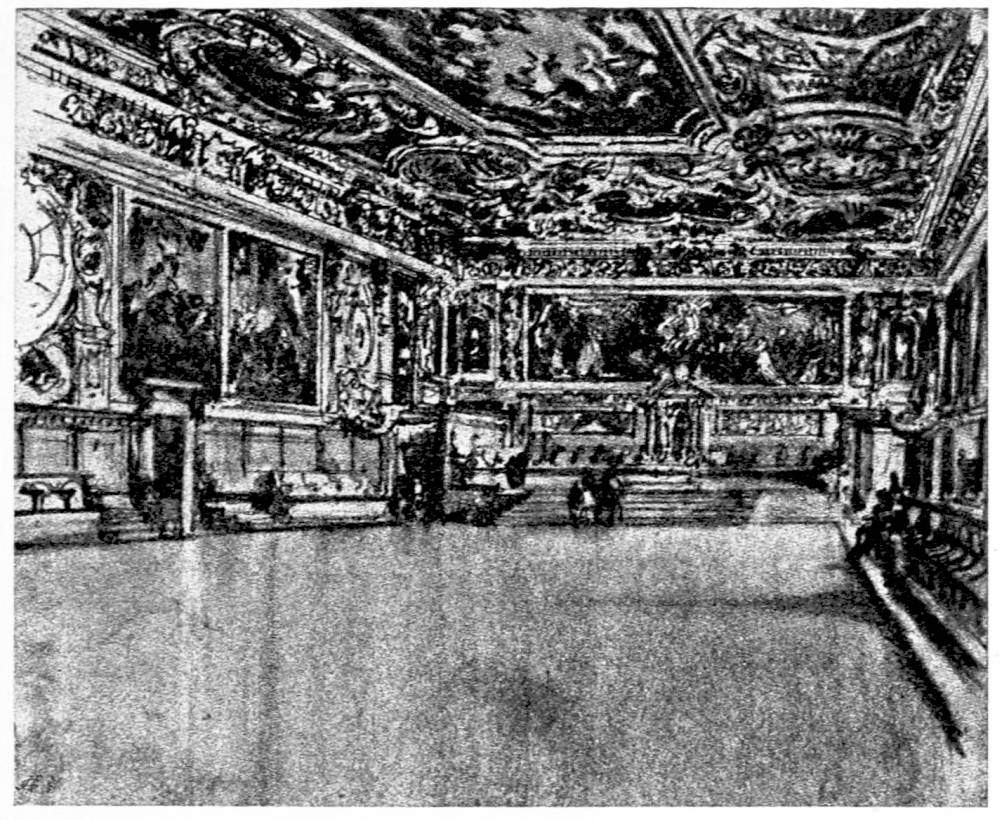
HALL OF THE GREAT CLOCKS, DUCAL PALACE
names of women of inferior condition who married nobles were not entered in those sanctified pages, since the children of a burgher woman could not sit in the Great Council. Nevertheless, it happened now and then that a noble sacrificed the privileges
Molmenti, Dog.
of his descendants for the present advantage of a rich dowry; and as this again constituted a source of anxiety for the State, the amount of a burgher girl’s marriage portion was limited by law to the sum of two thousand ducats.
The young aristocrats received a special education, to fit them for their future duties and offices. We have already seen that young men not yet old enough to sit in the Great Council were admitted to its meetings in considerable numbers, though without a
Yriarte, Vie d’un Patricien de Venise, 67.
vote. The instruction and education of young nobles were conducted according to a programme of which the details were established by a series of decrees, and especially by one dating from 1443; and in the Senate very young noble boys were employed to carry the ballot-boxes, in which office they took turns, changing every three months. There were probably not enough noble children to perform the same duty for the Great Council, which employed for that purpose a number of boys from the Foundling Asylum.
The young nobles were brought up to feel that they and their time belonged exclusively to the State, and when they grew older it was a point of honour with them not to be absent from any meeting of the Councils to which they were appointed. Marcantonio Barbaro, the patrician whose life M. Yriarte has so carefully studied, missed only one meeting of the Great Council in thirty years, and then his absence was due to illness. When one considers that the Great Council met every Sunday, and on every feast day except the second of March and the thirty-first of January, which was Saint Mark’s day, such constant regularity is really wonderful.
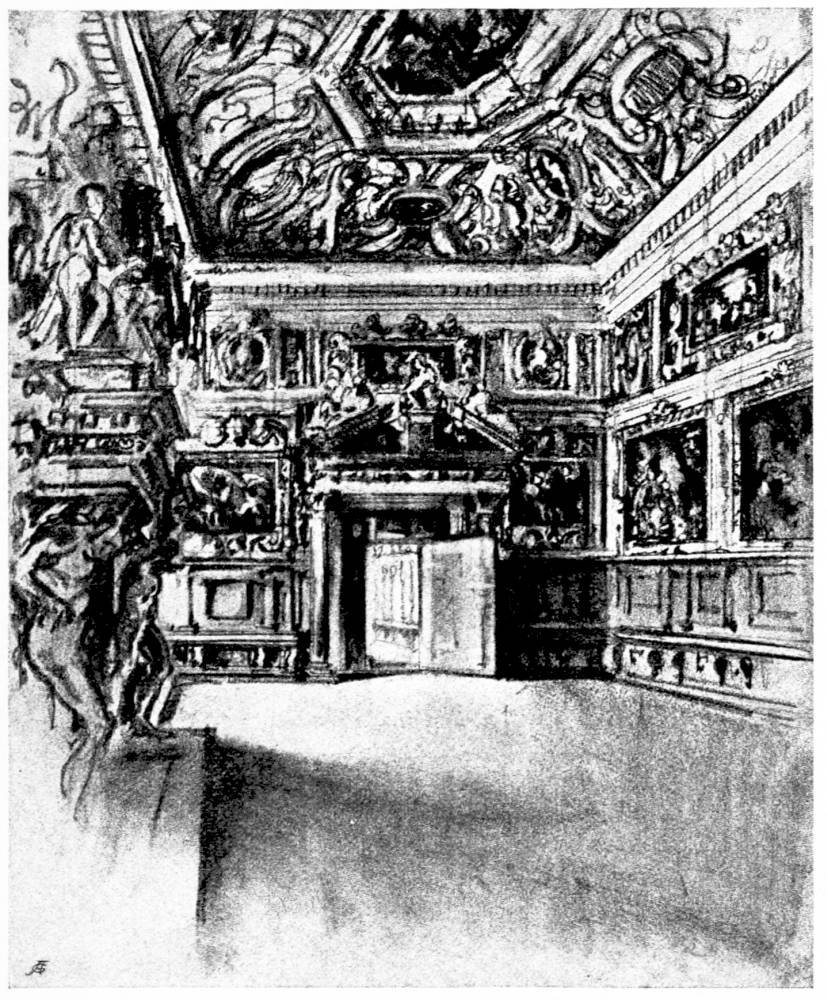
HALL OF THE PICTURES, DUCAL PALACE
During the summer the sittings were held from eight in the morning until noon, in winter from noon to sunset; this, at least, was the ordinary rule, but the Doge’s counsellors could multiply the meetings to any extent they thought necessary, and we know that when a doge was to be elected the Great Council sometimes sat fifty times consecutively.
The public were admitted to the ordinary sittings of the Great Council, and in later times one could even be present wearing a mask, as may be seen in certain old engravings. But no outsiders were admitted when an important subject was to be discussed, and on those occasions a number of members were themselves excluded. If, for instance, the question concerned the Papal Court, all those who had ever avowed their sympathy for the Holy See, or who had any direct relations with the reigning Pope, or who owed him any debt of gratitude, were ordered to leave the hall. Such persons were called ‘papalisti,’ and were frequently shut out of the Great Council in the sixteenth century, a period during which the Republic had many differences with Rome.
In 1526, for instance, the Patriarch of Venice laid before the Great Council a complaint against the Signors of the Night, who refused to set at liberty a certain priest arrested by them, or even to inform the ecclesiastical authorities of the nature of his misdemeanour. That would have been one of the occasions for excluding the ‘papalisti.’ The Patriarch seems to have been a hot-tempered person, for on finding that he could get no satisfaction from the Great Council, he excommunicated the Venetian government and everybody connected with it, and posted the notice of the interdict on the columns of the ducal palace. The matter was patched up in some way, however, for on the morrow the notice disappeared.
The Senate met twice a week, on Wednesdays and Saturdays. I find among their regulations a singular rule by which the beginning of every speech had to be delivered in the Tuscan language, after which the speaker was at liberty to go on in his own Venetian dialect.
Fulin, Studii, Arch. Ven. I. 1871 (unfinished).
I have already spoken at some length of the Council of Ten; it is now necessary to say something of the Inquisitors of State, to whom the Ten ceded a part of their authority in the sixteenth century.
In the first place, the Inquisitors of State never had anything to do with the ‘Inquisition,’ nor with the ‘Inquisitors of the Holy Office,’ a tribunal, oddly enough, which was much more secular than ecclesiastic, and which belongs to a later period.
Secondly, the so-called ‘Statutes of the Inquisitors of State,’ published by the French historian Daru, in good faith, and translated by Smedley, were
Rom. vi.
afterwards discovered to be nothing but an impudent forgery, containing several laughable anachronisms, and a number of mistakes about the nature of the magistracies which prove that the forger was not even a Venetian.
Thirdly, the genuine Statutes have been discovered since, and are given at length by Romanin. They do not bear the least resemblance to the nonsense published by Daru. No one except Romanin would have attempted to whitewash the Inquisitors and the Council of Ten, and even he is obliged to admit that for ‘weighty reasons of state’ they did not hesitate to order secret assassinations; but they were not fools, as the ‘Statutes’ of Daru make them appear.
The proof that the Statutes published by Romanin are genuine consists in the fact that two independent copies of them have been found; the one, written out by Angelo Nicolosi, secretary to the Inquisitors, with a dedication to them dated the twenty-fifth of September 1669; the other, a pocket copy, written out in 1612, with his own hand, by the Inquisitor Niccolò Donà, nephew of the Doge Leonardo Donà. The Statutes in these two copies are identical; the earlier one, which belonged to Donà, contains also a number of interesting memoranda concerning the doings of the tribunal in that year.
Lastly, it is conjectured by Romanin that the author of the forgery that imposed on Daru and others was no less a personage than Count Francesco della Torre, the ambassador of the Holy Roman Empire. He died in Venice in 1695.
These facts being clearly stated, we can pass on to inquire how and why the court of the Inquisitors of State was evoked, it being well understood that although they were not the malignant fiends described by Daru, who seems to have had in his mind the German tales of the ‘Wehmgericht,’ yet, in the picturesque language of their native Italy, ‘they were not shinbones of saints’ either.
Most historians consider that ‘Inquisitors of the Council of Ten’ were first appointed by that Council
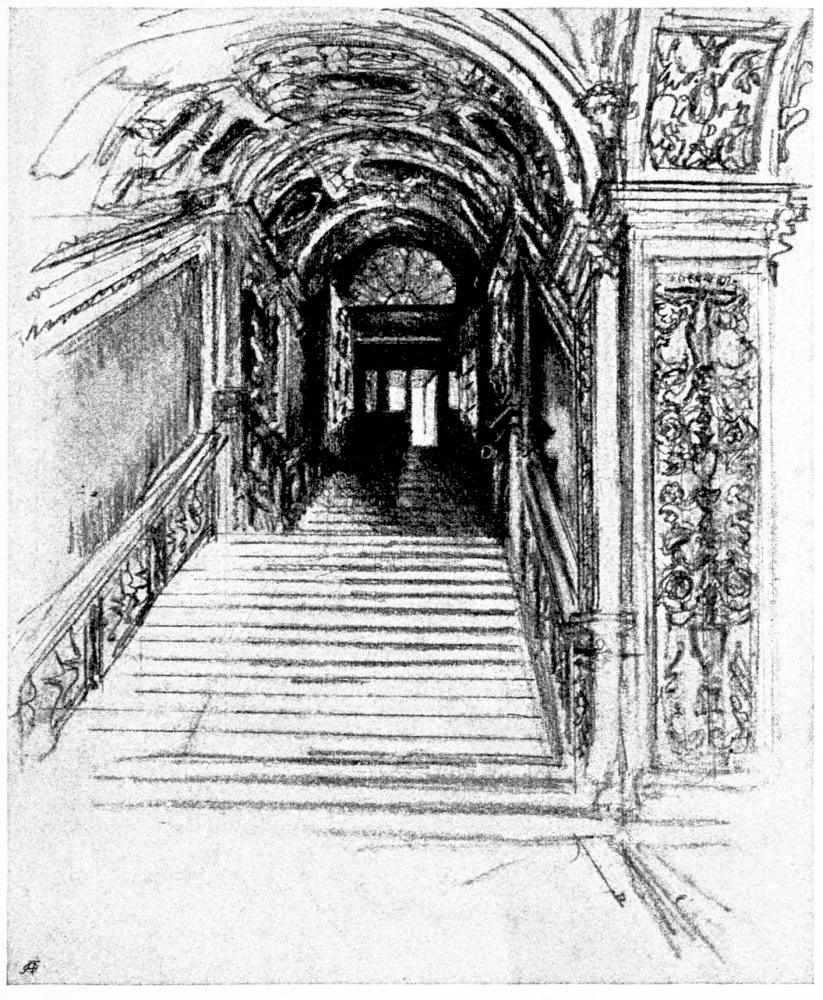
THE STAIR OF GOLD, DUCAL PALACE
in 1314, and it is generally conceded that they did not take the title ‘Inquisitors of State’ and begin to be regarded unofficially as a separate tribunal till 1539. The mass of evidence goes to show that these two dates are, at least, not far wrong, and during more than two hundred years between the two, the members of the committee were called indifferently either the ‘Inquisitors,’ or the ‘Executives’ of the Ten.
They were at first either two, or three; later they were always three, and they were commissioned to furnish proofs against accused persons, and occasionally to make the necessary arrangements for secretly assassinating traitors who had fled the country and were living abroad. At first their commission was a temporary one, which was not renewed unless the gravity of the case required it. Later, when they became a permanent tribunal of three, two of their number were always regular members of the Council of Ten, and were called the ‘Black Inquisitors,’ because the Ten wore black mantles; the third was one of the Doge’s counsellors, who, as will be remembered, were among the persons always present at the meetings of the Ten, and he was called the ‘Red Inquisitor’ from the colour of his counsellor’s cloak.
The fourteenth century was memorable on account of the great conspiracies, and it is at least probable that after 1320 the secret committee of the Ten became tolerably permanent as to its existence, though its members were often changed. Signor Fulin has discovered that during a part of the fifteenth century they were chosen only for thirty days, and that the utmost exactness was enforced on those who vacated the office. A long discussion took place at that time as to whether the month began at the midnight preceding the day of the Inquisitor’s election, or only on the morning of that day; since, in the latter case, an Inquisitor at the end of his term would have the right to act until sunrise on the thirty-first day, whereas, in the other, he would have to resign his seat at the first stroke of midnight. The incident is a good instance of the Venetian manner of interpreting the letter of the law.
So long as the tribunal was merely a committee depending on the Ten it had no archives of its own, and whatever it did appeared officially as the act of the Council, of which the Inquisitors were merely executive agents. They were dismissed at the end of their month of service with a regular formula:—
‘The Inquisitors will come to the Council with what they have found, and the Council will decide what it thinks best with regard to them.’
In those times they received no general authorisation or power to act on their own account, and their office must have been excessively irksome, since a heavy fine was exacted from any one who refused to serve on the committee when he had been chosen. Though they were not, as a rule, men of over-sensitive conscience, they felt their position keenly and served with ill-disguised repugnance, well knowing that they were hated as a body even more than they were feared, and that their lives were not always safe.
In early times their actual permanent power was very limited, though the Ten could greatly extend it for any special purpose. For instance, they could not, of their own will, proceed even to a simple arrest; they could not order the residence of a citizen to be searched; and they could not use torture in examining a witness, without a special authorisation from the Ten on each occasion.
Their work then lay almost wholly in secretly spying upon suspected persons; and it often happened that when such an one was at last arrested the whole mass of evidence against him was already written out and in the hands of the Ten. It also certainly happened now and then that a person was proved innocent by the Inquisitors who had been suspected by the Ten, and who had never had the least idea that he was in danger.
The machinery did not always work quickly, it is true, especially after the accused was arrested and locked up. Trials often dragged on for months, so that when the culprit was at last sentenced to a term of prison, it appeared that he had already served more than the time to which he was condemned. This abuse, however, led to a vigorous reform by a series of stringent decrees, the time of inquiry was limited, for ordinary cases, to three days, and for graver matters to a month, and ruinous fines were imposed on Councillors and Inquisitors who were not present at every sitting of the Court.
It was towards the close of the sixteenth century that the Inquisitors, being then elected for the term of a year, were given much greater power than theretofore. Though they were still closely associated with the Ten, they now had a sort of official independence, including the right to a method of procedure of their own, with secret archives quite separate from those of the Ten. The year 1596 is generally given as the date at which the separate tribunal was definitely created, with permanent instructions to watch over the public safety, and to detect all plots and conspiracies that might threaten the ‘ancient laws and government of Venice.’
It cannot be said that the procedure of the Ten, or of the Inquisitors, was arbitrary, and the supreme Venetian tribunals have not deserved all the obloquy that has been heaped upon them; but at a time when the most inhuman methods were used to obtain evidence, they certainly did not give an example of gentleness.
Signor Fulin, to whose recent researches all students of Venetian history are much indebted, says, with perfect truthfulness, that torture was by no means used with moderation. He cites a document signed by the Ten and the Inquisitors, dated the twenty-fifth of April 1445:—
‘We have received a humble petition from Luigi Cristoforo Spiaciario, sentenced to two years’ imprisonment and ten years of exile for unnatural crimes. The said convict has passed two years in prison according to his sentence, and five years more in the corridors of the prisons, because his feet having been burnt and his arms dislocated by torture, he could not leave Venice. The said convict petitions that, out of regard for so much suffering, he may be pardoned the last five years of his condemnation.’
The same writer also tells us that in spite of the precautions which were supposed to be taken, torture often ended in death; and in the archives of the Ten there are instances of horrible mutilations besides public decapitations, secret stranglings, and hangings and poisonings; there are also some cases of death inflicted by drowning, though these were less frequent than has been supposed; and lastly, the quiet waters of the canals have more than once reflected the blaze of faggots burning round the stake.
Romanin’s industry has left us an exact list of the official drownings that took place between 1551 and 1604, a period of fifty-three years. As it is not long, I append it in full. The list is made out from the register of deaths which is preserved in the church of Saint Mark’s.
In 1551there were secretly drowned2persons
1554““2“
1555““2“
1556““3“
1557““4“
1558““1“
1559““8“
1560““7“
1569““6“
1571““4“
1573““7“
From 1574 to 1584““12“
1584 to 1594““55“
1594 to 1600““50“
1600 to 1604““40“
Total number of drowned 203during 53 years
The last person who suffered death by drowning was a glass-blower of Murano in the eighteenth century.
Before going on to say a word about the prisons in the sixteenth century it is as well to call attention to the fact that the Inquisitors of State twice found themselves in direct relations with the English government; once, in 1587, when they called the attention of England to a conspiracy which was brewing in Spain; and again, a few years later, in connection with the tragedy of Antonio Foscarini in which they played such a deplorable part. Is it not possible that there may be some documents in the English Record Office bearing upon those circumstances, and likely to throw more light upon the tribunal of the Inquisitors?
In connection with the prisons, I take the following details, among many similar ones, from documents found by Signor Fulin in the archives of the Inquisitors of State. He says, in connection with them, that they are by no means exaggerated. One of the most characteristic is a case dated towards the end of the fifteenth century, and it will serve as an example, since it is known that no great changes were made in the management of the prisons until much later.
‘There has been found in the prisons a youth named Menegidio Scutellario, whom the Council of Ten had sentenced to twenty-five blows of the stick, which he received, and to a year’s imprisonment. He was transferred from the new prisons to the one called Muzina, where he contracted an extremely painful inflammatory disease which has produced running sores. He has several on his head, and his face is much
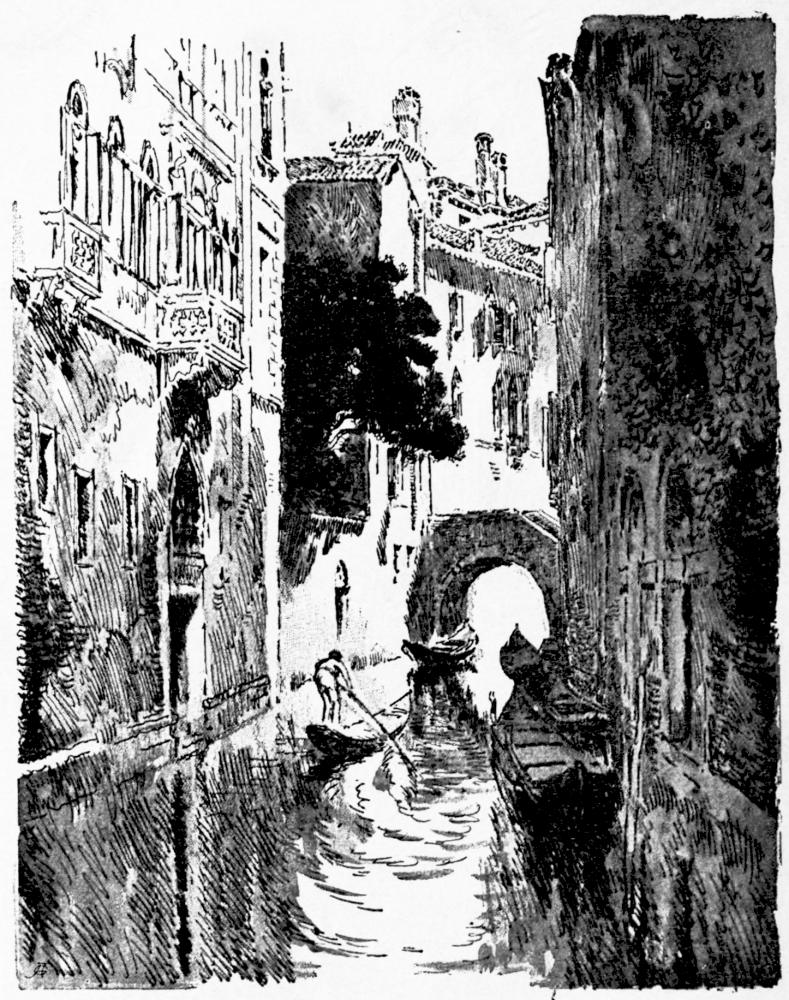
RIO S. ATANASIO
swollen. Moreover, this boy is shut up in the prison with twenty-five men of all ages, which is very dangerous for him from a moral point of view. A widow, who says she is his mother, comes every day to the Palace begging and imploring that her son may not be left in this abominable prison, lest he die there, or at least learn all manner of wickedness in the company of so many criminals. We consequently order that in view of the justice of these complaints the boy be kept in the corridor of the prisons till the end of his year.’
As in the Tower of London, so also in the gloomy dens of the Pozzi, former prisoners have left short records of themselves. For instance:
Mutinelli, Annali Urb.
‘1576, 22 March. I am Mandricardo Matiazzo de Marostega’; ‘Galeazze Avogadro and his friends 1584’; and lower down the following misspelt Latin words, ‘Odie mihi, chras tibi (sic)’—‘My turn to-day, to-morrow yours.’
Occasionally some daring convict succeeded in escaping from those deep and secure prisons. In his journal, under the fifth of August 1497, Marin Sanudo writes:—
It has happened that in the prisons of Saint Mark a number of convicts who were to remain there till they died have plotted to escape; they elected for their chief that Loico Fioravante, who killed his father on the night of Good Friday in the church of the Frari. There was also Marco Corner, sentenced for an unnatural crime; Benedetto Petriani, thief, and many others. On the evening of the fourth, when the jailers were making their usual rounds, the prisoners succeeded in disarming and binding them, and went on from one prison to another, their numbers increasing as they went, till they reached the last (novissima); there they found arrows and other arms, and began to discuss a plan of escape. Now it chanced that two Saracens who were amongst them wished to get out more quickly, without waiting for the deliberations of their comrades. One of them was almost drowned in the canal, the other took fright and began to cry out for help. A boat of the Council of Ten which was just passing picked up the half-drowned man; the fact that he was a Saracen suggested that he might be a fugitive, and he was frightened into confessing. The plot was now revealed and the guard was immediately informed. On the following morning the chiefs of the Ten, Cosimo Pasqualigo, Niccolò da Pesaro, Domenico Beneto, went to the prisons with a good escort, but they could not get in, for the prisoners defended themselves. Then wet straw was brought, and it was lighted in order that the smoke might suffocate them. And they were advised to yield before the order of the Council of Ten was repeated thrice, for otherwise they would all be hanged. Marco Corner was the first to surrender, and after him all the others. They were taken back, each to his prison, under a closer watch.
In Marco Corner’s case the love of liberty must have been strong, for in the same journal of Sanudo we find that in little more than a year after their unsuccessful attempt at flight, he and some companions actually succeeded in getting out and made their exit through the hall of the Piovego, that is to say, through the Doge’s palace. Their numbers were considerable, and six of them were sentenced to imprisonment for life. During the night they reached the monastery of Saint George, and at dawn they were already beyond the confines of Venetian territory.
Having disposed of the Inquisitors of State, I shall now endeavour to explain the position and duties of the Inquisitors of the Holy Office, with whom the ordinary reader is very apt to confound them.
In the first place, the Holy Office in Venice was a much milder and more insignificant affair than it was at that time in other European states. In Venice it seems to have corresponded vaguely to the modern European Ministry of Public Worship. There are some amusing stories connected with it, but no very terrible ones so far as I can ascertain.
The Republic had long resisted the desire of the Popes to establish a branch of the Holy Inquisition in Venice, but by way of showing a conciliatory spirit, while maintaining complete independence, the government had created a magistracy which was responsible for three matters, namely, the condition of the canals, the regulation of usury, and—of all things—cases of heresy. It is perfectly impossible to say why three classes of affairs so different were placed under the control of one body of men. Considering the gravity of the Venetian government we can hardly suppose that it was intended as a piece of ironical wit at the expense of the Holy See. It may, at all events, be considered certain that the Savi all’ Eresia, literally the Wise Men on Heresy, of the thirteenth century, had not accomplished what was expected of them, since in 1289 the government recognised the necessity of establishing a special court to deal with affairs of religion, presided over, at least in appearance, by a person delegated for that purpose from the Vatican. The Holy Office was thereby accepted in Venice, but with restrictions that paralysed it.
Molmenti, Stud. e Ric.
The tribunal was, in principle, composed of three persons, the Apostolic Nuncio, the Patriarch, and the Father Inquisitor, all three of whom had to be approved by the Republic. As a first step towards hindering them from acting rashly, they were strictly forbidden to discuss or decide anything whatsoever, except in the presence of three Venetian nobles, who were appointed year by year, and preserved their ancient title of Wise Men on Heresy. Next,
Rom. ii. 252, and viii. 348.
the Holy Office was not allowed to busy itself about any religious matter except heresy, in the strictest sense; it could not interfere in connection with any violation of the laws of the Church, not even in cases of sorcery or blasphemy, for magicians fell under the authority of the Signors of the Night, and blasphemers were answerable to the Executives against Blasphemy.
These laws had not changed in the sixteenth century, and the Holy Office had less to do than most of the contemporary tribunals. An examination of the documents preserved in its archives shows that from the year 1541 to the fall of the Republic there were three thousand six hundred and twenty trials, of which fifteen hundred and sixty-five fell in the sixteenth century, fourteen hundred and ninety-seven in the seventeenth, and only five hundred and sixty-one in the eighteenth. In the majority of cases the testimony was declared insufficient; in others, the accused hastened to abjure their errors. Sometimes, however, we find long trials in the course of which torture was used as by the other tribunals, and in these cases the end was frequently a sentence of death or a condemnation to the galleys.
Molmenti, Stud. e Ric., and Cecchetti, Corte di Roma.
No heretic was ever burned alive in Venice; death was inflicted by strangling, beheading, or hanging. Each Doge promised, indeed, on his election, to burn all heretics, but it is amply proved that only their dead bodies or their effigies were really given to the flames.
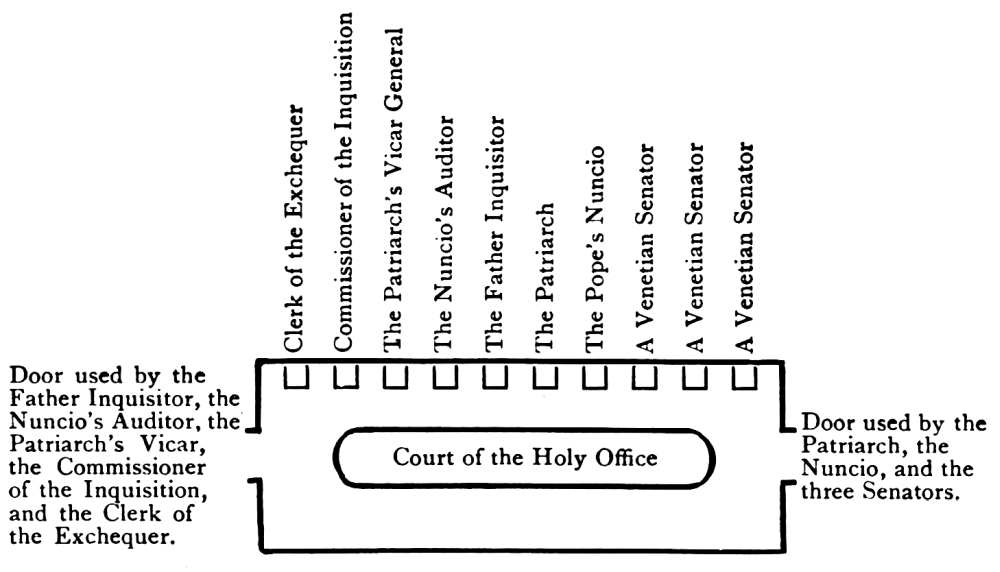
The tribunal of the Holy Office sat in a very low vaulted room in the buildings of Saint Mark’s, which was reached by a narrow staircase after passing through the Sacristy. The Court had no prisons of its own. Persons who were arrested by it, or sentenced by it to terms of imprisonment, were confined in the prisons of the State, probably in those of the Ponte della Paglia. It is likely that the Court had at its disposal two or three cells near its place of sitting, for the detention of the accused during the trials. Signor Molmenti has ascertained precisely how the members of the tribunal were placed, and has published a diagram which I here reproduce for the benefit of those who like such curious details.
As will be seen by the diagram, one half of the personages used one entrance, and the rest came in by the other. Until the year 1560, the Inquisitor himself was a Franciscan monk, but afterwards he was always a Dominican.
The hall was gloomy and ill-lighted, the furniture poor; it did not please the Republic to spend money for the delectation of a court which it did not like.
It was here that two famous trials took place in the sixteenth century, namely, that of Giordano Bruno, the renegade monk, dear to Englishmen who have never read the very scarce volume of his insane and filthy writings, and that of the celebrated painter Paolo Veronese. The contrast between these two documents is very striking, but both go to prove that the Holy Office in Venice was seldom more than a hollow sham, and that its proceedings occasionally degenerated towards low comedy.
Having escaped from Rome, Giordano Bruno left the ecclesiastical career which he had dishonoured in
Previti, Vita di Giordano Bruno.
every possible way, and wandered about in search of money and glory. In the course of time he came to London, where his coarseness and his loose life made him many enemies. Thence he went on to Oxford, where, by means of some potent protection, he succeeded in obtaining the privilege of lecturing on philosophy; but the university authorities were soon scandalised by his behaviour and frightened by the extravagance of his doctrines; in three months he was obliged to leave. He revenged himself by writing a libel called ‘La Cena delle Ceneri,’ in which he described England as a land of dark streets in which one stuck in the mud knee-deep, and of houses that lacked every necessary; the boats on the Thames were rowed by men more hideous than Charon, the workmen and shop-keepers were vulgar and untaught rustics, always ready to laugh at a stranger, and to call him by such names as traitor, or dog. In this pleasing pamphlet the Englishwoman alone escapes the writer’s foul-mouthed hatred, to be insulted by his still more foul-mouthed praise. One may imagine the sort of eulogy that would run from the pen of a man capable of describing woman in general as a creature with neither faith nor constancy, neither merit nor talent, but full of more pride, arrogance, hatred, falseness, lust, avarice, ingratitude and, generally, of more vices than there were evils in Pandora’s box; one might quote many amenities of language more or less senseless, as, for instance, that woman is a hammer, a foul sepulchre, and a quartan fever; and there are a hundred other expressions which cannot be quoted at all.
Towards 1591, the patrician Giovanni Mocenigo, an enthusiastic collector of books, found in the shop of a Dutch bookseller a little volume, entitled Eroici Furori, which contains some astrological calculations and some hints on mnemonics. The purchaser asked who the author might be, learned from the bookseller that it was Giordano Bruno, entered into correspondence with him, and at last invited him to Venice.
Bruno, it is needless to say, accepted the invitation eagerly, as he accepted every thing that was offered to him, but it was not long before Mocenigo regretted his haste to be hospitable. He had begun by calling his visitor his dear master; before long he discovered the man to be a debauchee and a blasphemer. Now it chanced that Mocenigo had sat in the tribunal of the Holy Office as one of the three senators whose business it was to oversee the acts of the Father Inquisitor, and he was not only a devout man, but had a taste for theology. He began by remonstrating with Bruno, but when the latter became insolent, he quietly turned the key on him and denounced him to the Holy Office. A few hours later the renegade monk was arrested and conveyed to prison. He was examined several times by the tribunal, but was never tortured, and as the judges thought they detected signs of coming repentance they granted him a limit of time within which to abjure his errors. But the trial did not end in Venice, for the Republic made an exception in this case and soon yielded to a request from the Pope that the accused should be sent to Rome. He was ultimately burnt there, the only heretic, according to the most recent and learned authorities, who ever died at the stake in Italy. He was in reality a degenerate and a lunatic, who should have ended his days in an asylum.
M. Yriarte has published in the appendix to his study of the Venetian noble in the sixteenth century the verbatim report of the proceedings of the Holy Office on the eighteenth of July 1573. The prisoner at the bar was Paolo Veronese. I quote the following from M. Yriarte’s translation:—
Report of the sitting of the Tribunal of the Inquisition on Saturday July eighteenth, 1573.
This day, July eighteenth, 1573. Called to the Holy Office before the sacred tribunal, Paolo Galliari Veronese residing in the parish of Saint Samuel, and being asked as to his name and surname replied as above.
Being asked as to his profession:—
Answer. I paint and make figures.
Question. Do you know the reasons why you have been called here?
A. No.
Q. Can you imagine what those reasons may be?
A. I can well imagine.
Q. Say what you think about them.
The Supper in the house of Simon, Paolo Veronese; Accademia, Room IX.
A. I fancy that it concerns what was said to me by the reverend fathers, or rather by the prior of the monastery of San Giovanni e Paolo, whose name I did not know, but who informed me that he had been here, and that your Most Illustrious Lordships had ordered him to cause to be placed in the picture a Magdalen instead of the dog; and I answered him that very readily I would do all that was needful for my reputation and for the honour of the picture; but that I did not understand what this figure of Magdalen could be doing
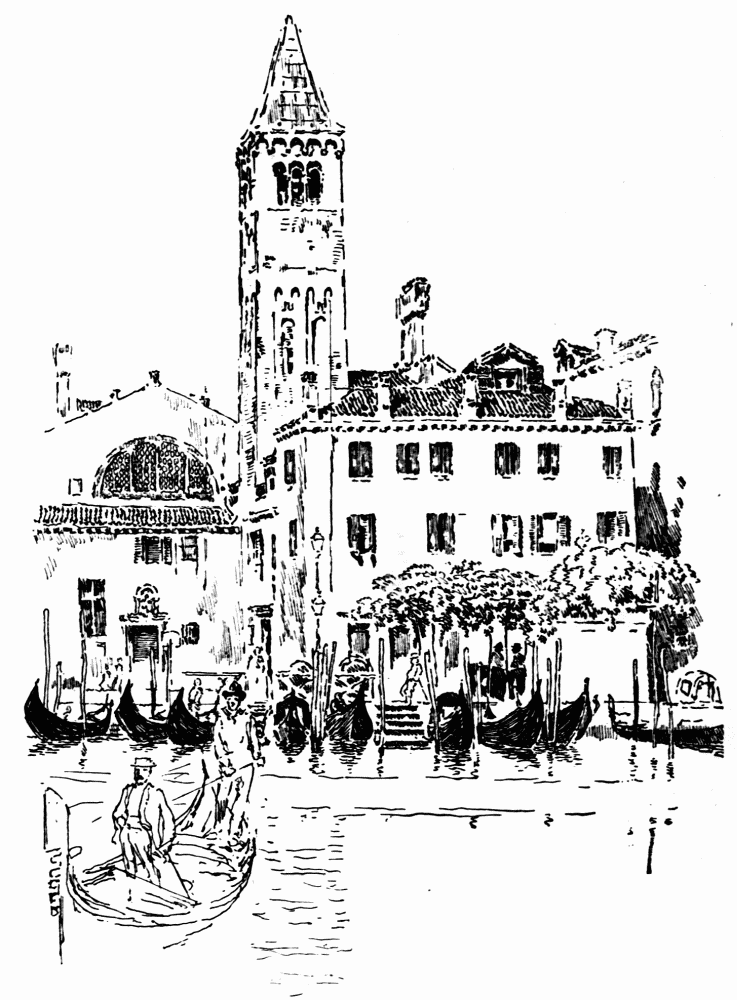
S. SAMUELE
here; and this for many reasons, which I will tell, when occasion is granted me to speak.
Q. What is the picture to which you have been referring?
A. It is the picture which represents the Last Supper of Jesus Christ with His disciples in the house of Simon.
Q. Where is this picture?
A. In the refectory of the monks of San Giovanni e Paolo.
Q. Is it painted in fresco or on wood or on canvas?
A. It is on canvas.
Q. How many feet does it measure in height?
A. It may measure seventeen feet.
Q. And in breadth?
A. About thirty-nine.
Q. In this Supper of our Lord, have you painted (other) persons?
A. Yes.
Q. How many have you represented? And what is each one doing?
A. First there is the innkeeper, Simon; then, under him, a carving squire whom I supposed to have come there for his pleasure, to see how the service of the table is managed. There are many other figures which I cannot remember, however, as it is a long time since I painted that picture.
Q. Have you painted other Last Suppers besides that one?
A. Yes.
Q. How many have you painted? Where are they?
A. I painted one at Verona for the reverend monks of San Lazzaro; it is in their refectory. Another is in the refectory of the reverend brothers of San Giorgio here in Venice.
Q. But that one is not a Last Supper, and is not even called the Supper of Our Lord.
A. I painted another in the refectory of San Sebastiano in Venice, another at Padua for the Fathers of the Maddalena. I do not remember to have made any others.
Q. In this Supper which you painted for San Giovanni e Paolo, what signifies the figure of him whose nose is bleeding?
A. He is a servant who has a nose-bleed from some accident?
Q. What signify those armed men dressed in the fashion of Germany, with halberds in their hands?
A. It is necessary here that I should say a score of words.
Q. Say them.
A. We painters use the same license as poets and madmen, and I represented those halberdiers, the one drinking, the other eating at the foot of the stairs, but both ready to do their duty, because it seemed to me suitable and possible that the master of the house, who as I have been told was rich and magnificent, should have such servants.
Q. And the one who is dressed as a jester with a parrot on his wrist, why did you put him into the picture?
A. He is there as an ornament, as it is usual to insert such figures.
Q. Who are the persons at the table of Our Lord?
A. The twelve apostles.
Q. What is Saint Peter doing, who is the first?
A. He is carving the lamb in order to pass it to the other part of the table.
Q. What is he doing who comes next?
A. He holds a plate to see what Saint Peter will give him.
Q. Tell us what the third is doing.
A. He is picking his teeth with his fork.
Q. And who are really the persons whom you admit to have been present at this Supper?
A. I believe that there was only Christ and His Apostles; but when I have some space left over in a picture I adorn it with figures of my own invention.
Q. Did some person order you to paint Germans, buffoons, and other similar figures in this picture?
A. No, but I was commissioned to adorn it as I thought proper; now it is very large and can contain many figures.
Q. Should not the ornaments which you were accustomed to paint in pictures be suitable and in direct relation to the subject, or are they left to your fancy, quite without discretion or reason?
A. I paint my pictures with all the considerations which are natural to my intelligence, and according as my intelligence understands them.
Q. Does it seem suitable to you, in the Last Supper of our Lord, to represent buffoons, drunken Germans, dwarfs, and other such absurdities?
A. Certainly not.
Q. Then why have you done it?
A. I did it on the supposition that those people were outside the room in which the Supper was taking place.
Q. Do you not know that in Germany and other countries infested by heresy, it is habitual, by means of pictures full of absurdities, to vilify and turn to ridicule the things of the Holy Catholic Church, in order to teach false doctrine to ignorant people who have no common sense?
A. I agree that it is wrong, but I repeat what I have said, that it is my duty to follow the examples given me by my masters.
Q. Well, what did your masters paint? Things of this kind, perhaps?
A. In Rome, in the Pope’s Chapel, Michel Angelo has represented Our Lord, His Mother, St. John, St. Peter, and the celestial court; and he has represented all these personages nude, including the Virgin Mary, and in various attitudes not inspired by the most profound religious feeling.
Q. Do you not understand that in representing the Last Judgment, in which it is a mistake to suppose that clothes are worn, there was no reason for painting any? But in these figures what is there that is not inspired by the Holy Spirit? There are neither buffoons, dogs, weapons, nor other absurdities. Do you think therefore, according to this or that view, that you did well in so painting your picture, and will you try to prove that it is a good and decent thing?
A. No, my most Illustrious Sirs; I do not pretend to prove it, but I had not thought that I was doing wrong; I had never taken so many things into consideration. I had been far from imagining such a great disorder, all the more as I had placed these buffoons outside the room in which Our Lord was sitting.
These things having been said, the judges pronounced that the aforesaid Paolo should be obliged to correct his picture within the space of three months from the date of the reprimand, according to the judgments and decision of the Sacred Court, and altogether at the expense of the said Paolo.
Et ita decreverunt omni melius modo. (And so they decided everything for the best!)
The existing picture proves that Veronese paid no attention to the recommendations of the Court, for I find that it contains every figure referred to.
After this brief review of the more serious offices of the Republic, I pass on to speak of a tribunal which, though in reality much less serious, gave itself airs of great solemnity, and promulgated a great number of laws. This was the Court of the ‘Provveditori delle Pompe,’ established in the sixteenth century to deal with matters of dress and fashion. As far back as the end of the thirteenth century, the ‘Savi,’ the wise men of the government, had feebly deplored the increase of luxury. Their plaintive remarks were repeated at short intervals, and on each occasion produced some new decree against foolish and unreasonable expenditure.
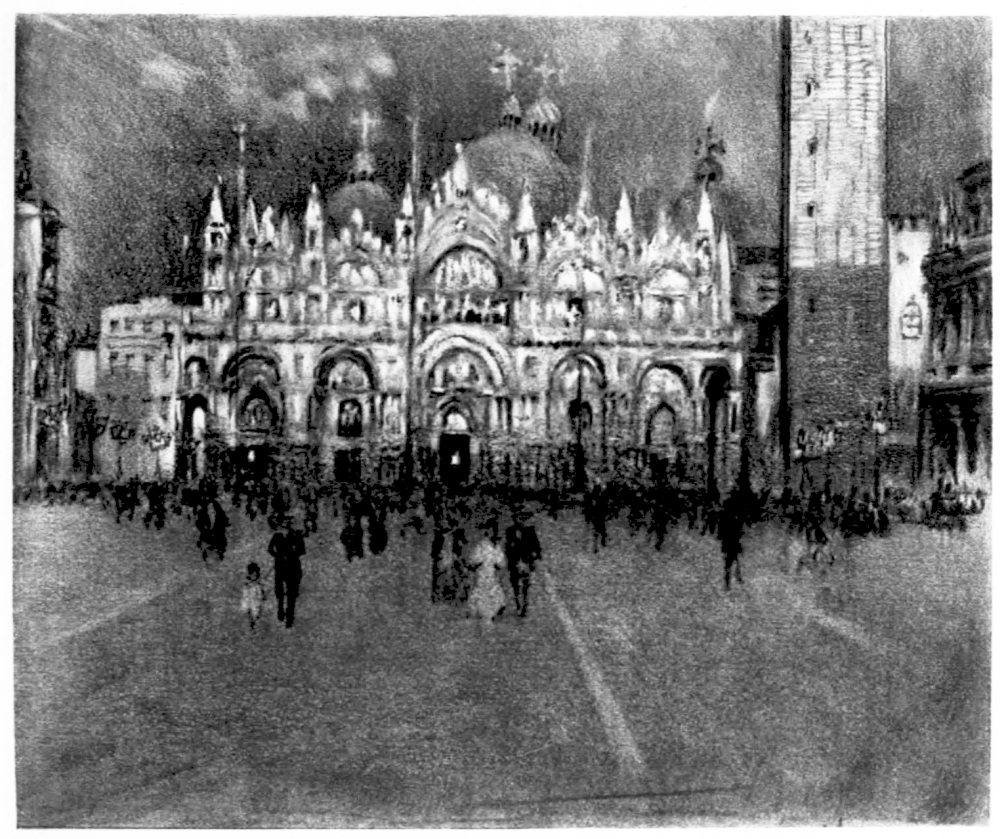
THE LAST RAYS, ST. MARK’S
The length of women’s trains, the size and fulness of people’s sleeves, the adornment of boots and shoes, and all similar matters, had been most minutely studied by these wise gentlemen, and the avogadors had their hands full to make the regulations properly respected. One day a lady was walking in the square of Saint Mark’s, evidently very proud of the new white silk
Molmenti, vita Priv.
gown she wore. She was stopped by two avogadors who gravely proceeded to measure the amount of stuff used in making her sleeves. It was far more than the law judged necessary. The lady and her tailor—there were only male dressmakers in Venice in the fifteenth and sixteenth centuries—were both made to pay a fine heavy enough to make them regret the extravagance of their fancy. I quote this story from Signor Molmenti. Marin Sanudo tells of another similar regulation in his journal under the month of December 1491: ‘All those who hold any office from the State, and those who are finishing their term of service, are forbidden to give more than two dinner-parties to their relations, and each of these dinners shall not consist of more than ten covers.’
At weddings it was forbidden to give banquets to more than forty guests. Some years later another regulation was issued on the same subject. It was decreed ‘that at these wedding dinners there shall not be served more than one dish of roast meats and one of boiled meats, and in each of these courses there shall not be more than three kinds of meat. Chicken and pigeons are allowed.’
For days of abstinence, the magistrates take the trouble to inform people what they may eat, namely, two dishes of roast fish, two dishes of boiled fish, an almond cake, and the ordinary jams. Of fish, sturgeon and the fish of the lake of Garda are forbidden on such days, and no sweets are allowed that do not come under one of the two heads mentioned. Oysters were not allowed at dinners of more than twenty covers. The pastry-cooks who made jumbles and the like, and the cooks who were to prepare a dinner, were obliged to give notice to the provveditors, accompanied by a note of the dishes to be served. The inspectors of the tribunal had a right to inspect the dining-room, kitchen, and pantry, in order to verify all matters that came under their jurisdiction.
As if all this were not enough, considerable fines were imposed on those who should adorn the doors and outer windows of their houses with festoons, or who should give concerts in which drums and trumpets were used. In noting this regulation in his journal, Sanudo observes that the Council of Ten had only succeeded in framing it after meeting on three consecutive days in sittings of unusual length. One is apt to connect the Council of Ten with matters more tragic than these; and one fancies that the Decemvirs may have sometimes exclaimed with Dante—
Le leggi son, ma chi pon mano ad esse?
(‘There are laws indeed, but who enforces them?’)
The Council judged that there was only one way of accomplishing this, namely, to create a new magistracy, whose exclusive business it should be to make and promulgate sumptuary laws. For this purpose three nobles were chosen who received the title of Provveditori delle Pompe.
M. Armand Baschet, whose profound learning in matters of Venetian law is beyond dispute, is of opinion that the new tribunal helped Venice to be great, and hindered her from being extravagant. I shall not venture to impugn the judgment of so learned a writer, yet we can hardly forbear to smile at the thought of those three grave nobles, of ripe age and austere life, who sat down day after day to decide upon the cut of women’s gowns, the articles necessary to a bride’s outfit, and the dishes permissible at a dinner-party.
‘Women,’ said their regulations, ‘shall wear clothes of only one colour, that is to say, velvet, satin, damask, of Persian silk woven of one tint; but exception is made from this rule for Persian silk of changing sheen and for brocades, but such gowns must have no trimming.’
Shifts were to be embroidered only round the neck, and it was not allowed to embroider handkerchiefs with gold or silver thread. No woman was
Mutinelli, Less.
allowed to carry a fan made of feathers worth more than four ducats. No gloves were allowed embroidered with gold or silver; no earrings; no jewellery in the hair. Plain gold bracelets were allowed but must not be worth more than three ducats; gold chains might be worth ten. No low-neck gowns allowed!
Jewellers and tailors and dealers in luxuries did their best to elude all such laws, but during a considerable time they were not successful, and it is probable that the temper of the Venetian ladies was severely tried by the prying and paternal ‘Provveditori.’ The only
Molmenti, vita Privata.
women for whom exceptions were made were the Dogess and the other ladies of the Doge’s immediate family who lived with him in the ducal palace. His daughters and grand-daughters were called ‘dozete,’ which means ‘little dogesses’ in Venetian dialect, and they were authorised to wear what they liked; but the Doge’s more distant female relations had not the same privilege.
At the coronation of Andrea Gritti, one of his nieces appeared at the palace arrayed in a magnificent gown of gold brocade; the Doge himself sent her home to put on a dress which conformed with the sumptuary laws. Those regulations extended to intimate details of private life, and even affected the furnishing of a noble’s private apartments. There were clauses which forbade that the sheets made for weddings and baptisms should be too richly embroidered or edged with too costly lace, or that the beds themselves should be inlaid with gold, mother-of-pearl, or precious stones.
Then the gondola came into fashion as a means of getting about and at once became a cause of great extravagance, for the rich vied with each other in adorning their skiffs with the most precious stuffs and tapestries, and inlaid stanchions, and the most marvellous allegorical figures.
In the thirteenth century the gondola had been merely an ordinary boat, probably like the modern ‘barca’ of the lagoons, over which an awning was rigged as a protection against sun and rain. The gondola was not a development of the old-fashioned
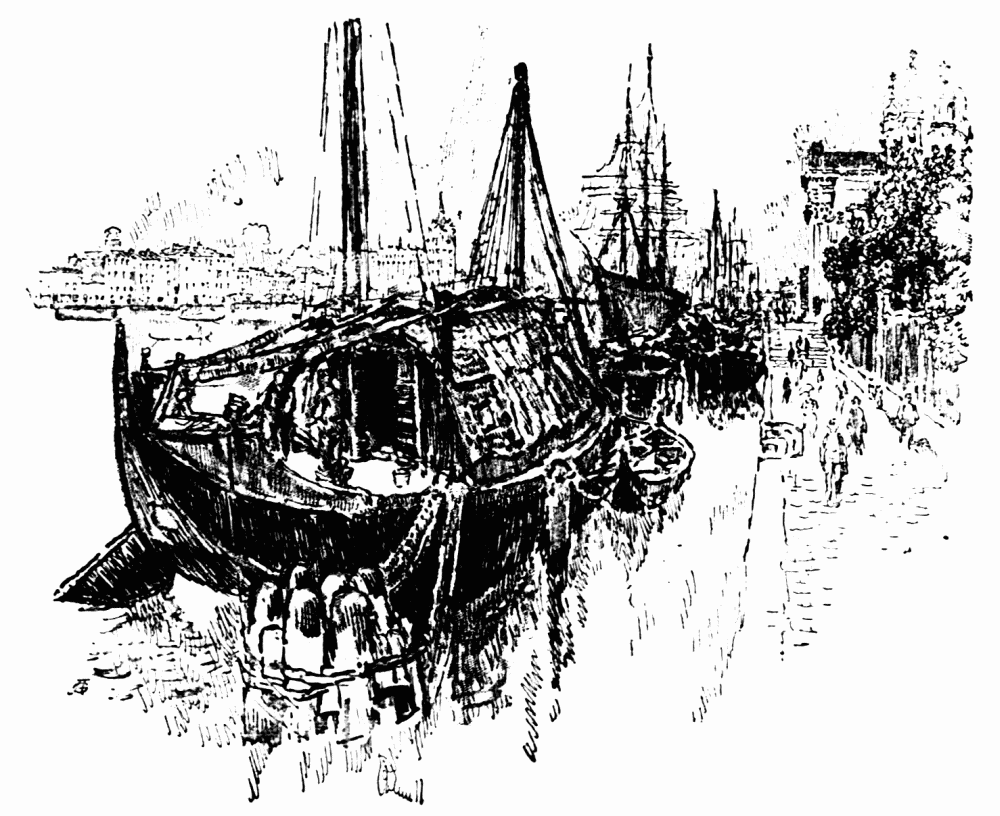
ON THE ZATTERE
boat, any more than the modern racing yacht has developed out of a Dutch galleon or a ‘trabacolo’ of the Adriatic. It had another pedigree; and I have no hesitation in saying, as one well acquainted with both, and not ignorant of boats in general, that the Venetian gondola is the caïque of the Bosphorus, as to the hull, though the former is rowed in the Italian fashion, by men who stand and swing a sweep in a crutch, whereas the Turkish oarsman sits and pulls a pair of sculls of peculiar shape which slide in and out through greased leathern strops. The gondola, too, has the steel ornament on her stem, figuring the beak of a Roman galley, which I suspect was in use in Constantinople before the Turkish conquest, and which must have been abolished then, for the very reason that it was Roman. The ‘felse,’ the hood, is a Venetian invention, I think, for there is no trace of it in Turkey. But the similarity of the two boats when out of water is too close to be a matter of chance, and it may safely be said that the first gondola was a caïque, then doubtless called by another name, brought from Constantinople by some Greek merchant on his vessel.
In early times people went about on horses and mules in Venice, and a vast number of the small canals were narrow and muddy streets; but as the superior facilities of water over mud as a means of transportation became evident, the lanes were dug out and the islands were cut up into an immense number of islets, until the footways became so circuitous that the horse disappeared altogether.
In the sixteenth century there were about ten thousand gondolas in Venice, and they soon became a regular bugbear to the unhappy Provveditori delle
Mutinelli, Less.
Pompe, who were forced to occupy themselves with their shape, their hangings, the stuff of which the ‘felse’ was made, the cushions, the carpets, and the number of rowers. The latter were soon limited to two, and it was unlawful to have more, even for a
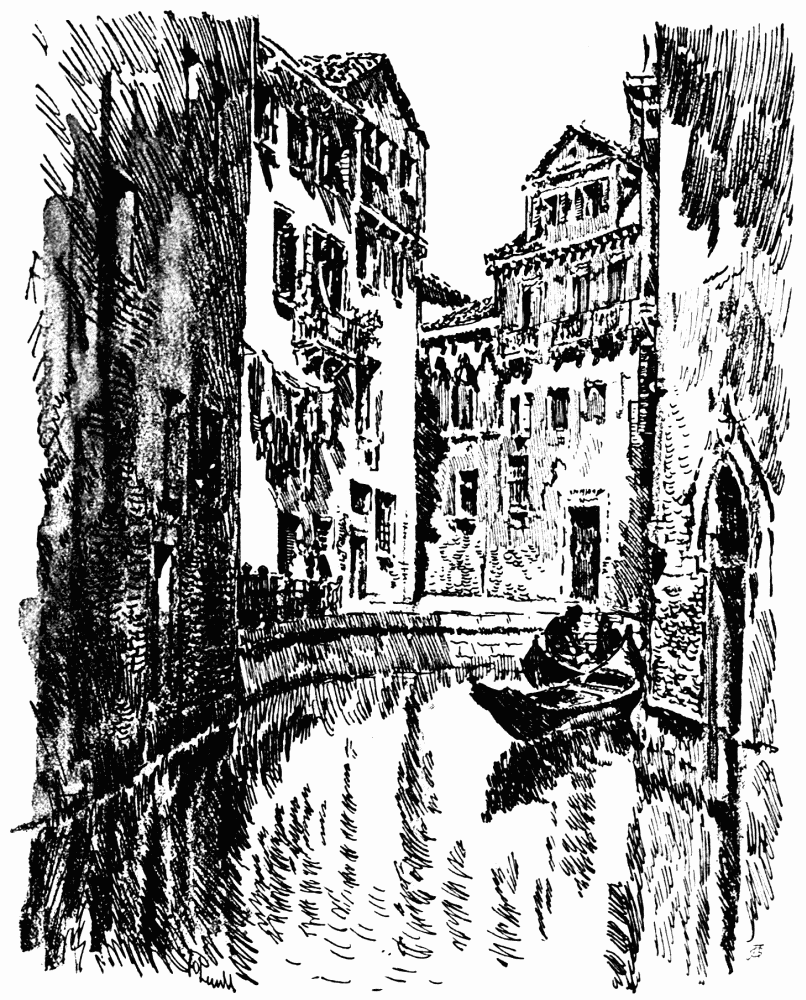
RIO DEL RIMEDIO
wedding. The gondola did not assume its present simplicity and its black colour till the end of the seventeenth century, but it began to resemble what we now see after the edict of 1562.
As usual, a few persons were exempted from the sumptuary law. The Doge went about in a gondola decorated with gold and covered with scarlet cloth, and the foreign ambassadors adorned their skiffs with the richest materials, the representatives of France and Spain, especially, vying with each other in magnificence. To some extent the youths belonging to the Compagnia della Calza—the Hose Club before mentioned—were either exempted from the law, or succeeded in evading it. Naturally enough, the sight of such display was odious to the rich noblemen who were condemned by law to the use of plain black; and on the whole, the study of all accounts of festivities held in Venice, down to the end of the Republic, goes to show that the Provveditori aimed at a most despotic control of dress, habits, and manners, but that the results generally fell far short of their good intentions. They must have led harassed lives, those much-vexed gentlemen, not much better than the existence of ‘Jimmy-Legs’ on an American man-of-war.
Now and then, too, the government temporarily removed all restrictions on luxury, as, for instance, when a foreign sovereign visited Venice; and then the whole city plunged into a sort of orgy of extravagance. This happened when Henry III. of France was the guest of the Republic. Such occasions being known and foreseen, and the nobles being forced by the Provveditori to save their money, they spent it all the more recklessly when they were allowed a taste of liberty—like a child that breaks its little earthenware savings-box when it is full of pennies.
One naturally returns to the Doge after rapidly reviewing such a legion of officials, each of whom was himself a part of the supreme power. What was the Doge doing while these hundreds of noble Venetians were doing everything for themselves, from directing foreign politics to spying upon the wardrobes of each other’s wives and auditing the accounts of one another’s cooks?
It would be hard to ask a question more embarrassing to answer. It would be as unjust to say that he did nothing as it would be untrue to say that he had much to do. Yet the Venetians themselves looked upon him as a very important personage in the Republic. In a republic he was a sovereign, and therefore idle; but he was apparently necessary.
I am not aware that any other republic ever called its citizens subjects, or supported a personage who received royal honours, before whom the insignia of something like royalty were carried in public, and who addressed foreign governments by his own name and title as if he were a king. But then, how could Venice, which was governed by an oligarchy chosen from an aristocracy, which was the centre of a plutocracy, call herself a republic? It all looks like a mass of contradictions, yet the machinery worked without breaking down, during five hundred years at a stretch, after it had assumed its ultimate form. If a modern sociologist had to define the government of Venice, he would perhaps call it a semi-constitutional aristocratic monarchy, in which the sovereign was elected for life—unless it pleased the electors to depose him.
What is quite certain is that when the Doge was a man of average intelligence, he must have been the least happy man in Venice; for of all Venetian nobles, there was none whose personal liberty was so restricted, whose smallest actions were so closely watched, whose lightest word was subject to such a terrible censorship.
Francesco Foscari was not allowed to resign when he wished to do so, nor was he allowed to remain on the throne after the Council had decided to get rid of him. Even after his death, his unhappy widow was not allowed to bury his body as she pleased. Yet his was only an extreme case, because circumstances combined to bring the existing laws into play and to let them work to their logical result.
From the moment when a noble was chosen to fill the ducal throne, he was bound to sacrifice himself to the public service, altogether and till he died, without regret, or possible return to private life, or any compensation beyond what might flatter the vanity of a vulgar and second-rate nature. Yet the Doges were very rarely men of poor intelligence or weak character.
At each election, fresh restrictions were imposed by ‘corrections’ of the ducal oath. M. Yriarte says very justly that the tone of these ‘corrections’ is often so dry and hard that it looks as if the Great Council had been taking measures against an enemy rather than editing rules for the life of the chief of the State. He goes on to say, however, that the principle which dictated those decrees protected both the Doge and the nobility, and that the object at which each aimed was the interest of the State. He asks, then, whether those binding restrictions ever prevented a strong personality from making itself felt, and whether the long succession of Doges is nothing but a list of inglorious names.
It may be answered, I think, with justice, that the Doges of illustrious memory, during the latter centuries of the Republic’s existence, had become famous as individual officers before their elevation to the throne. The last great fighting Doge was Enrico Dandolo, the conqueror of Constantinople, who died almost a hundred years before the closure of the Great Council. In the war of Chioggia, Andrea Contarini’s oath not to return into the city till the enemy was beaten had the force of a fine example, but the man himself contributed nothing else to the most splendid page in Venetian history.
There were Doges who were good historians and writers, others who have been brave generals, others like Giovanni Mocenigo who were good financiers; but the fact of their having been Doges has nothing to do with the reputation they left afterwards. The sovereignty, when it was given to them, was a chain, not a sceptre, and from the day they went up the grand staircase as masters, their personal liberty of thought and action was more completely left behind than if they had entered by another door to spend the remainder of life in the prisons by the Ponte della Paglia, beyond the Bridge of Sighs.
At the beginning of the fifteenth century the Doge Michel Steno was told in open Council to sit down and hold his peace. No change in the manners of the counsellors had taken place sixty years later when
Tassini, under ‘Moro.’ Rom. iv. 319.
the Doge Cristoforo Moro objected to accompanying Pius the Second’s projected crusade in person, and was told by Vittor Cappello that if he would not go of his own accord he should be taken by force.
It is hard to imagine a more unpleasant position than that of the chief of the State. Suppose, for instance, that by the choice of the Council some post or dignity was to be conferred on one of his relatives, or even on one of his friends; he was literally and categorically forbidden to exhibit the least satisfaction, or to thank the Council, even by a nod of the head.
Yriarte, Vie d’un Patricien, 359, and Marin Sanudo.
He was to preside at this, and at many other ceremonies, as a superbly-dressed lay figure, as a sort of allegorical representative of that power with which every member of the government except himself was invested. And as time went on this part he had to play, of the living allegory, was more and more defined. He was even deprived of the title ‘My Lord,’ and was to be addressed merely as ‘Messer Doge,’ ‘Sir Doge.’ From 1501 onward he was forbidden to go out of the city, even for an hour in his gondola, without the consent of the Council, and if he disobeyed he had to pay a fine of one hundred ducats; he was not allowed to write a letter, even to his wife or his children, without showing it to at least one of his six counsellors, and if he disobeyed he was to pay a fine of two hundred ducats, and the person, his wife or his own child, to whom the letter was addressed, was liable to be exiled for five years.
After 1521 the Doge was never allowed to speak without witnesses with any ambassador, neither with the foreign representatives who came to Venice, nor with Venetian ambassadors at home on business or leave; and when he spoke with any of them in public, he was warned only to make commonplace remarks.
The Dogess never had any official position in Venice, but during the fourteenth and fifteenth centuries she was made use of as an ornamental personage at public festivals. After that time she returned to the retirement in which the wives of the early Doges had lived. An outcry was raised against the custom of crowning her when she entered the ducal palace, and from that time forth she never appeared beside her husband on state occasions; and if any foreign ambassador, supposing that he was acting according to the rules of ordinary court etiquette, asked to be presented to her, she was bound to refuse his visit.
Everything in the life of the Doge was regulated by the Great Council. That august assembly once even remonstrated with the so-called sovereign because the Dogess bore him too many children. If any one hesitates to believe these amazing statements he may consult Signor Molmenti’s recent historical work, La Dogaressa, which is beyond criticism in point of accuracy.
At certain fixed times the Doge was allowed the relaxation of shooting, but with so many restrictions and injunctions that the sport must have been intolerably irksome. He was allowed or, more strictly speaking, was ordered to proceed for this purpose, and about Christmas time, to certain islets in the lagoons, where wild ducks bred in great numbers. On his return he was obliged to present each member of the Great Council with five ducks. This was called the gift of the ‘Oselle,’ that being the name given by the people to the birds in question. In 1521, about five thousand brace of birds had to be killed or snared in order to fulfil this requirement; and if the unhappy Doge was not fortunate enough, with his attendants, to secure the required number, he was obliged to provide them by buying them elsewhere and at any price, for the claims of the Great Council had to be satisfied in any case. This was often an expensive affair.
There was also another personage who could not have derived much enjoyment from the Christmas shooting. This was the Doge’s chamberlain, whose duty it was to see to the just distribution of the game, so that each bunch of two-and-a-half brace should contain a fair average of fat and thin birds, lest it should be said that the Doge showed favour to some members of the Council more than to others.
By and by a means was sought of commuting this annual tribute of ducks. The Doge Antonio Grimani
Portrait of Antonio Grimani kneeling before Religion, Titian; Sala delle Quattro Porte.
requested and obtained permission to coin a medal or the value or a quarter or a ducat, equal to about four shillings or one dollar, and to call it ‘a Duck,’ ‘Osella,’ whereby it was signified that it took the place of the traditional bird. He engraved upon his medal figures of Peace and Justice, with the motto ‘Justitia et Pax osculatae sunt,’ ‘Justice and Peace have kissed one another,’ in recollection of the sentence he had undergone nineteen years previously as Admiral of the fleet defeated at Parenzo. In 1575 the Doge Luigi Mocenigo engraved upon his Osella the following inscription referring to the victory of Lepanto: ‘Magnae navalis victoriae Dei gratia contra Turcos’; the reverse bears the arms of the Mocenigo family, a rose with five petals. Later, in 1632, the Doge Francesco Erizzo was the first to replace his own effigy kneeling before Saint Mark by a lion. In 1688 Francesco Morosini coined an Osella bearing on the obverse a sword, with the motto ‘Non abstinet ictu,’ and on the reverse a hand bearing weapons, with the motto ‘Quem non exercuit arcus.’ In 1684 Marcantonio Giustiniani issued an Osella showing a winged lion rampant, bearing in the one paw a single palm, and in the other a bunch of palms, with the motto ‘Et solus et simul,’ meaning that Venice would be victorious either alone or joined with allies.
The successor of Antonio Grimani, Andrea Gritti, chose for his Osella to have himself represented as kneeling
Andrea Gritti, praying, Tintoretto; Sala del Collegio.
before Saint Mark; the reverse bore his name with the date.
But fresh trouble now arose. It came to pass that some nobles sold their medals or used them for money, and disputes even took place as to the true value of the ducal present. The Council of Ten was obliged to examine seriously into the affair. As it appeared certain that it would be impossible to avoid the use of medals as money, it was decided to replace them definitely by a coin having regular currency.
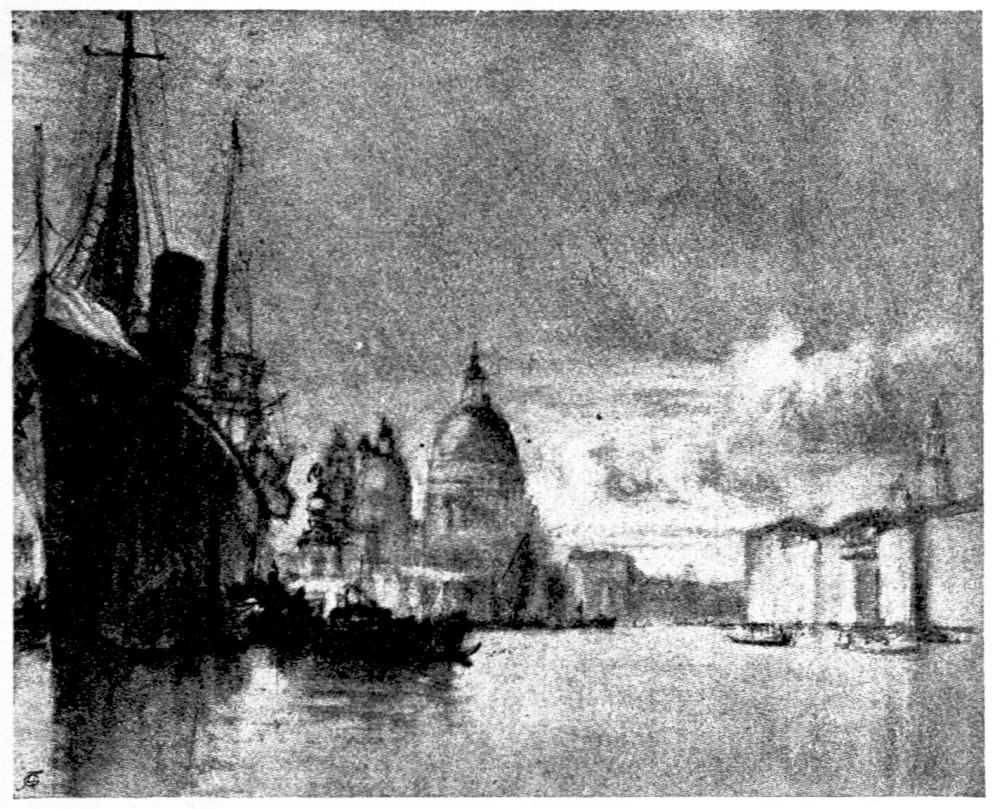
MOUTH OF THE GRAND CANAL