XIII THE LAST SBIRRI
Reading edition
It is worth while to glance at the agents of the police, of the Council of Ten, and of the Inquisitors of State
Mutinelli, Lessico.
at the end of the Republic. The two Councils had six in their service, called the Fanti de’ Cai, the footmen of the Heads, and one of them was at the beck and call of the Inquisitors. This particular one was the famous Cristofolo de’ Cristofoli, whose name is connected alike with all the tragedies and the comic adventures of the last days.
He was a sort of general inspector of freemasons, rope-dancers, circus-riders, antiquaries, bravi, and gondoliers, and he exercised in his manifold functions all the civility of which a detective can dispose. He was a giant in body, a jester and a wit by nature, a combination certainly intended for the stage rather than the police.
His especial bugbear was freemasonry, together with all the secret societies which were then largely in the pay of France, employed by her to promote general revolution. A manuscript preserved in the Museo Correr gives an account of the first discovery of a Lodge.
A patrician named Girolamo Zulian, says this document, when returning one night from a meeting of the Lodge left upon the seat of his gondola a piece of paper on which were drawn certain incomprehensible signs. The gondoliers found the paper, and supposed that the symbols were those of some kind of witchcraft. One of the men took the scrap to a monk he knew and begged him to decipher the signs, or at least to give his advice as to what should be done with the thing, as it might be fatal even to destroy a spell of black magic. The monk told the gondolier to take it to the Inquisitors of State. The man did so, and one of them kept him in a garret of his house, to protect him against any possible vengeance on the part of the secret society, and Cristofolo de’ Cristofoli was commissioned to clear up the mystery. On the following night he raided the house indicated by the gondolier with thirty Sbirri, and found there assembled a large meeting of the brethren, one of whom had the presence of mind to throw into the canal the heavy register containing a complete list of their names. Cristofoli took a quantity of papers, however, together with the paraphernalia of the Lodge, and he afterwards, says the manuscript, dictated from memory the names of the persons he had seen at the meeting. But he must have made mistakes, since several of the persons he designated are known to have been absent from Venice on foreign missions at the date of the raid, May sixth, 1785.
Another manuscript, published by Dandolo, gives a different account of the affair, under the same date. It was copied by the famous Cicogna, and is amusing for its language:—
It was the anniversary of the feast of the principal Protector of this most serene dominion, Saint Mark the Evangelist, April the twenty-fifth, 1785, when it was discovered that the public Arsenal of Venice had been treacherously set on fire; the fire was eventually discovered by a certain woman, who was rewarded for life [i.e. with a pension] by the public munificence; and by the discovery of it, a fire was prevented which might have been fatal to a large part of the city, and which was not to have broken out till the night following the twenty-fifth, but which showed itself after noon on account of an extraordinary wind which had temporarily arisen from the east and which blew with fury all day.
Such an accident, as fatal as its prevention by the Evangelist
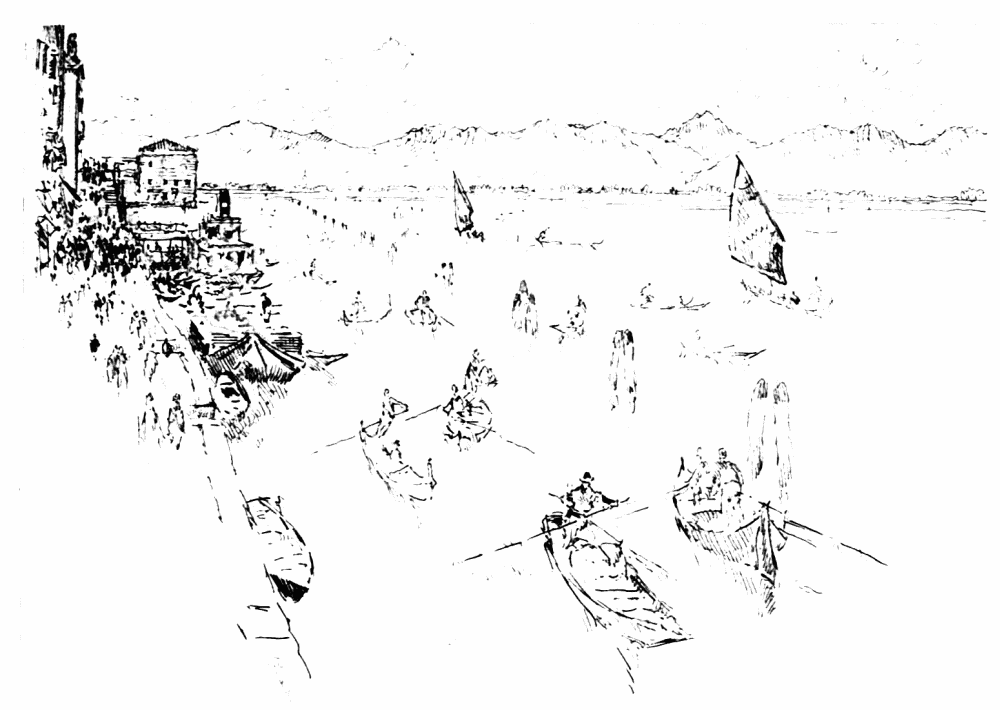
FONDAMENTE NUOVE
Saint Mark was miraculous, not only moved the public vigilance to guard that public edifice under more jealous custody, but also [to watch] all the quarters of the city; to this end multiplying watchmen and spies, in order to discover, if that
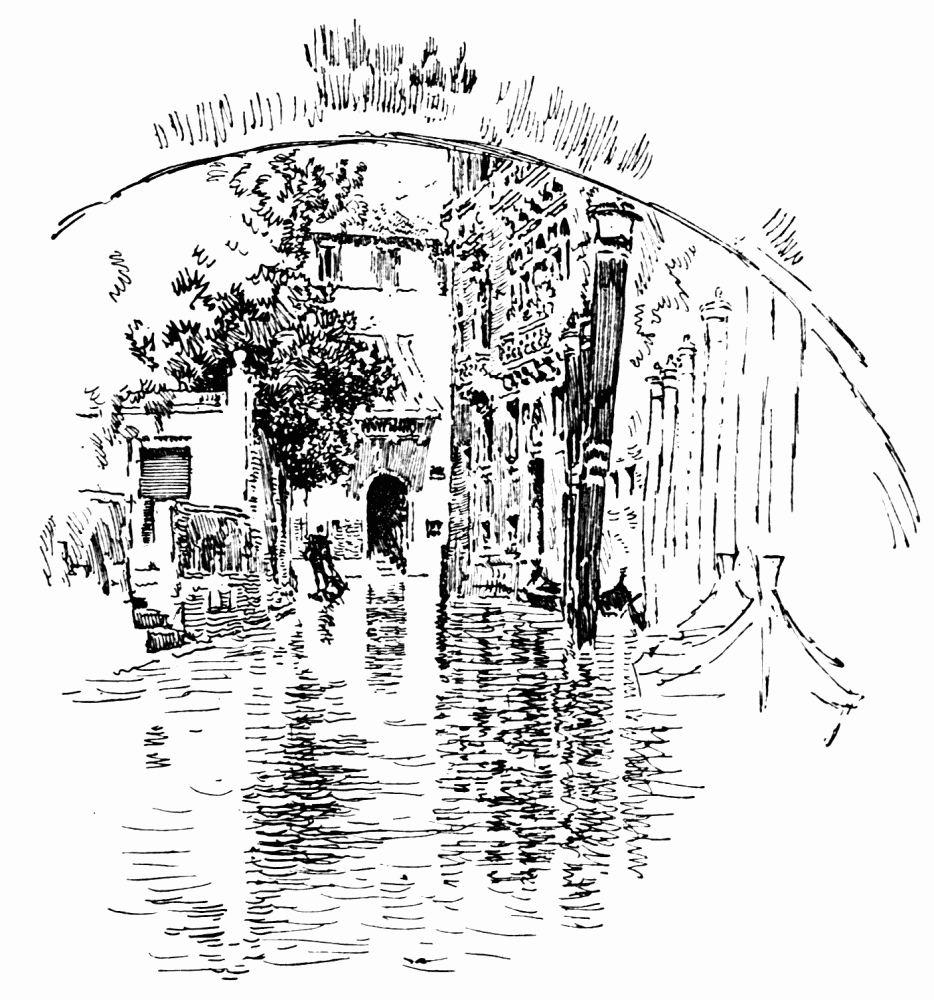
RIO S. STIN
might be possible, the perpetrators of such an horrible and terrifying felony.
In the inquiries, it was observed by trustworthy spies on the night of the [date omitted in the original] May, that a certain palace situated in Riomarin, in the parish of San Simon Grande, was entered from time to time after midnight by respectable-looking persons, for whom the door was opened at the simple signal of a little tap. Information of this being given to the Supreme Tribunal, the latter ordered the most circumspect inquiries; when, on the same morning, information was given to the Secretary of the said Supreme Magistracy by a certain ship’s carpenter that having, on commission of N. N., finished making a large wardrobe, he inquired of that cavalier where he was to bring it in order to set it up properly; and that he had been told to bring it to a certain palace in Riomarin and to leave it in the entrance (gateway) of the same, and that he would be sent for later to place it where it was to go; that seeing several days go by without receiving that notice, and yielding to curiosity, he stole near in the night to see if the wardrobe were still in the entrance of the palace, where he had placed it, and he convinced himself that it had been taken elsewhere; and being displeased with this, because some other workman might have handled his work, and guessing from a hint of the gentleman’s that the wardrobe had been intended to be placed against the windows of a balcony, and observing in this palace a balcony of just about the length of the wardrobe made by him, he tried to get into the apartment above the one where the balcony was [let to some one], explaining to the people who lived in that house that his suspicion induced him to ask their permission to make a hole with a gimlet, in order to see whether his wardrobe had been put up where he guessed it must be; and that he had obtained consent to this request, because the lodgers in that second apartment had conceived some curiosity to know who the persons might be who met there only at night time; that therefore he betook himself to that dwelling on the night of the fourth of May, having previously made a hole, and stopped there till the first-floor apartment was opened, and he saw that after midnight a hall was lighted up which was hung with mourning and furnished with a throne covered with blue cloth and with other symbols of death, and here and there were disposed small lanterns, and persons also sitting here and there, dressed in black robes; so that at this horrid sight he was terrified, and he heard him who sat on the throne say these very words: ‘Brethren, let us suspend our meeting, for we are watched’; and in that room he saw indeed his wardrobe placed against a balcony.
And that he left the lodgers in that second apartment in consternation, and he himself, full of amazement and terror, and still surprised by the novelty of the things, and supposing, in his simplicity, that witchcraft was practised there and the works of the devil, he was scandalised, and went to the parish priest of San Simon Grande, his confessor, and that having told him all he had seen, heard, and observed, he (the priest) advised him to quickly lay before the government all that he had chanced to see and hear.
The good man did so, and told all to the Secretary of the Inquisitors of State. A warrant was therefore issued on that same morning of the sixth of May by the Supreme Tribunal to its own officer Cristofoli, to go thither (to Riomarin), accompanied by the Capitan Grande and twenty-four men. Having entered that apartment, where he surprised a nobleman who guarded the place, he (Cristofoli) discovered a lodge of freemasons.
Emanuele Cicogna [the distinguished historian] copied this on the twenty-fourth of August 1855, from two codices existing in his collection.
On the following day, the Inquisitors publicly burned the black garments, the utensils, the ‘conjuring books,’ as they are described, and
Mutinelli, Ult.
all the booty Cristofoli had confiscated, while the populace, believing that it was all a case of witchcraft, danced round the fire and cheered for Saint Mark.
The persons implicated were treated with the greatest indulgence, and Malamani observes that in the whole affair it was the furniture that got the worst of it.
About the same time Cristofoli made a vain attempt to arrest the notorious Cagliostro.
This man, whose real name was Giuseppe Balsamo, was born in Palermo on the eighth of June 1743. His youth was wild and disreputable. He tried being a monk, but soon tired of it, and threw his frock to the nettles, as the French say, in Caltagirone, in Sicily; after that he lived by theft, by coining false money, and by every sort of imposture. In Rome he married a girl of singular beauty, Lorenza Feliciani, who became his tool in all his intrigues.
The French freemasons made use of the singularly intelligent couple to propagate the doctrines of the revolution. Pretending to change hemp into silk, and every metal into gold, and selling marvellous waters for restoring the aged to youth and beauty, the two got into many excellent houses, changing their names and their disguises whenever they were compromised.
Balsamo arrived in Venice in 1787 or 1788, under the name of Count Cagliostro, and began an active revolutionary campaign, to the great annoyance
Mutinelli, Ult. 31.
of the Inquisitors, who fancied they had suppressed the whole movement when Cristofoli had discovered the famous Lodge. He was less fortunate this time. He tracked the Count everywhere, but could get no substantial evidence against him, till he suddenly came upon positive proof that the impostor had stolen a thousand sequins from a rich merchant of the Giudecca. And then, at the very moment when the great policeman was sure of his game, the man disappeared as into thin air and was next heard of beyond the Austrian frontier.
The chief of the Sbirri had better luck when he raided the Café Ancilotto, which was a favourite place of meeting for the revolutionaries. They
Tassini, under ‘Ancilotto.’
tried to open a reading-room there, furnished with all the latest revolutionary literature, but Cristofoli got wind of the plan, called on the man who kept the café, and informed him that the first person who entered the ‘reading-room’ would be invited to pay a visit to the Inquisitors of State. After that, no one showed any inclination to read the French papers. In connection with Cristofoli, we also come upon the curious fact that he arrested, at the Café
Tassini, under ‘Caffetero.’
of the Ponte dell’ Angelo, a number of Barnabotti, who were preaching suspicious doctrines. As usual, the poor nobles were the class most easily bribed and most ready to betray their country.
Cristofoli was occasionally entrusted with missions more diplomatic than the arrest of revolutionaries. He was sometimes sent to present his respects to great nobles who did not guess that they had attracted the eyes of the police.
It was the business of the Inquisitors to watch over the artistic treasures of the capital. During the last year of the Republic a number of nobles sold precious
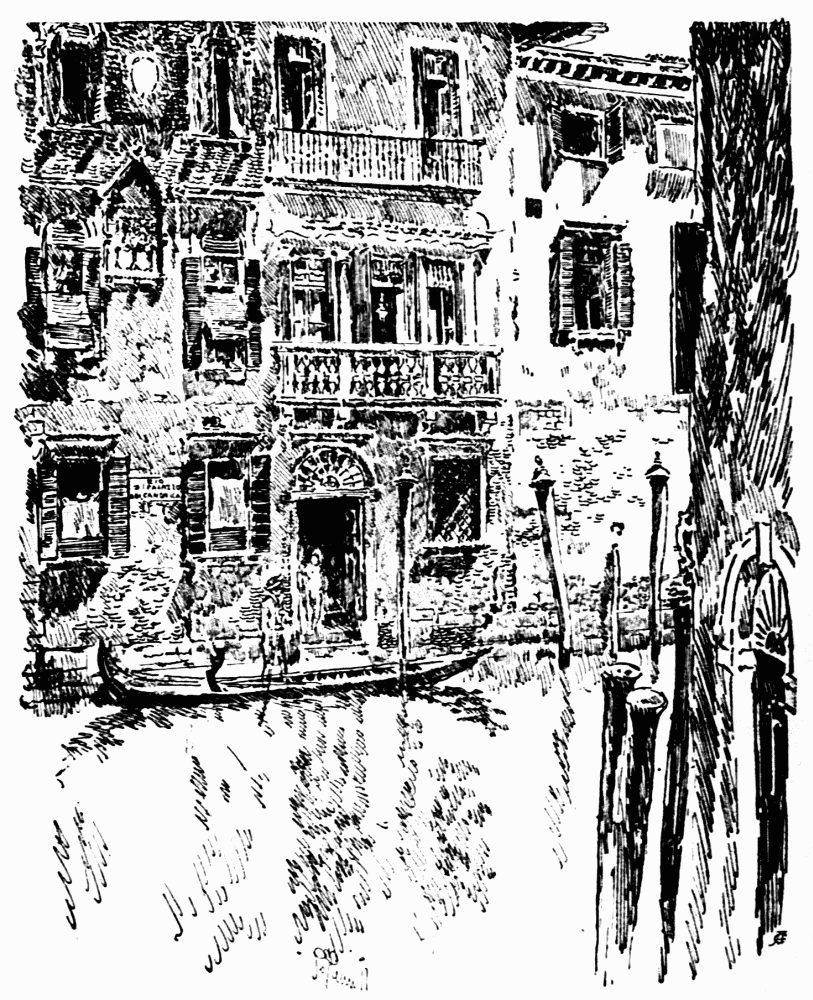
RIO DELLA GUERRA
objects to strangers, such as paintings and statues, of which the government much regretted the loss to the city. A few measures were passed for preventing this dispersion of private collections, but it happened only too often that priceless things were suddenly gone, leaving no trace of their destination, except in the pockets of the former owners.
The Grimani family possessed some magnificent statues and a wonderful library of rare books, inherited from Cardinal Domenico Grimani, who died in 1523. Shortly before the fall of
Statue of M. Agrippa; Museo Correr.
the Republic a foreigner bought the statue of Marcus Agrippa; the boat which was to take it on board an outward bound ship was at the door of the palace, and the men who were to take it down from its pedestal and box it were ready, when Cristofolo Cristofoli appeared at the entrance, gigantic and playful.
He walked straight to the statue, took off his cap to it and bowed gravely before he delivered his message to the marble: ‘The Supreme Tribunal of the Inquisitors, having heard that you wish to leave this city, sends me to wish a pleasant journey, both to you and his Excellency Grimani.’
‘His Excellency Grimani’ did not relish the idea of exile; the workmen disappeared, the boat was sent away, and the statue remained. It was destined to be left as a gift to the city by another Grimani, less avaricious than ‘His Excellency.’
In spite of his good-humour, Cristofoli inspired terror, and his mere name was often
Molmenti, Studi e Ricerche.
used to lend weight to practical jokes. It is related, for instance, of the famous Montesquieu, the author of the Esprit des Lois and the friend of King Stanislaus Leczinski, that when he was making notes in Venice his friend Lord Chesterfield managed to cause a mysterious message to be conveyed to him, warning him to be on his guard, as the Chief of the Ten employed spies to watch him, and Cristofoli was on his track. And thereupon, says the story, the excellent Montesquieu burned all his most compromising notes, and fled straight to Holland with the remainder of his manuscripts.
The Council of Ten and their Sbirri had not yet done with the Bravi. They were numerous in the provinces, and when they were caught they were tried and hanged in Venice. The ‘Signorotti’—the rich landowners, who were not Venetian nobles, but called themselves ‘knights’—were many and prosperous, and were the professional murderers’ best clients. Indeed, the Venetian mainland provinces and much of Lombardy presented a case of arrested development; at the end of the eighteenth century they had not emerged from the barbarism of the early fifteenth.
The lordlings entertained Bravi, and when there was no more serious business on hand, they laid wagers with each other as to the courage of their hired assassins. A bet of this kind was made and settled in 1724 between an Avogadro and a Masperoni, two country ‘knights’ who lived on their estates in the province of Brescia. One evening the two were discussing the character of a ruffian whom Masperoni had just taken into his service. His new master maintained that the fellow was the bravest man in the ‘profession.’ Avogadro, on the other hand, wagered that he would not be able to traverse the road between his master’s castle and Lumezzane, which belonged to Avogadro. Masperoni took the bet, and explained the situation to the man. The latter, feeling that his reputation was at stake, started at once, carrying on his shoulder a basket of fine fruit as a present from Masperoni to his friend, and he took his way across the hills of Valtrompia. When he was a few miles from Lumezzane he was met by two well-armed fellows, who ordered him to turn back, but he was not so easily stopped. He set down his basket, and in the twinkling of an eye killed both his adversaries, after which he quietly pursued his journey.
Avogadro was very much surprised to see him, and asked with curiosity what sort of trip he had made.
‘Excellent,’ he answered. ‘I met a couple of good-for-nothings who wanted to stop me, but I killed them, and here I am.’
Avogadro, filled with admiration, gave him a purse of gold and sent him back to Masperoni with a letter of congratulation.
Molmenti, Banditi, 289.
Incidents of this kind occurred long afterwards, even after the fall of the Republic. The name of Cristofoli is associated with that of Count Alemanno Gambara in a story which could not be believed if the documents that prove it were not all preserved in the various archives, and principally in those of the Inquisitors.
The Gambara family was of Lombard origin, and had always been very influential in the neighbourhood of Brescia. The race had produced fine specimens of all varieties—soldiers, bishops, cardinals, murderers, and one woman poet, besides several bandits, traitors, and highwaymen. In the late sixteenth century two brothers of the family, Niccolò and Lucrezio, had a near relative, Theodora, an orphan girl of fourteen years and an heiress, who was in charge of a guardian. On the twenty-second of January 1569 the two brothers went to the guardian and ordered him to give up the girl. On his refusal they threw him down his own stairs, wounded his people who tried to defend him, broke down the door of the girl’s room, and carried her off.
I only quote this as an instance of the family’s manners. The last scion of the race who lived under the Republic, and who outlived it, was Count Alemanno, a young monster of perversity. He was born after his father’s death at the castle of Pralboino, on a feudal holding belonging to his house. His mother was soon married again to Count Martinengo Cesaresco, and she took the boy with her to her new home. He was naturally violent and unruly; at fifteen he was an accomplished swordsman, and was involved in every quarrel and evil adventure on the country side. When still a mere boy his conduct was such as to give the government real trouble, and the authorities imposed a guardian upon him in the person of a priest of his family, who was instructed to teach him the ordinary precepts of right and wrong; but the clergyman soon announced that he was not able to cope with his young relative, and the Council of Ten learned that the boy’s violent character showed no signs of improvement.
He was now arrested, brought to Venice, and confined in one of the Piombi, his property being administered under the direction of the government. The Inquisitors of State examined the record of the complaints laid against him, and concluded that his faults were due to his extreme youth; they therefore ordered him to reside within the fortress of Verona, but gave him control of his fortune.
The Captain of Verona, knowing the sort of prisoner he had to deal with, and being made responsible for him, sent for an engineer and asked his opinion as to the possibilities of escape for a prisoner who was not locked up in a cell. The engineer wrote out a careful criticism of the fortress, concluding with an extremely practical remark: ‘With good means of escape,’ he observed, ‘a man may escape from any place, but without means it is not possible to escape at all.’
The Captain, only partially reassured, set to work to convert his prisoner, and sent him a good priest to teach him his Catechism and exhort him to the practices of Christianity; but the young Count would have neither exhortation nor religious instruction. The Council of Ten now sent him to the fortress of Palma for a change of air, and the commander of that place inherited the feverish anxiety about his charge which had tormented the Captain of Verona. He did not consult an engineer, however, and one morning the prisoner was not in his room, nor in the fortress, nor anywhere in the neighbourhood of Palma.
The Inquisitors now sent Sbirri in all directions throughout the Venetian territory. They could not catch Alemanno, but he wearied of eluding them, and judged that he could get better terms by submitting to the Inquisitors. He did so, using the offices of his aunt, Countess Giulia Gambara, who was married to a gentleman of Vicenza. The Podestà of the latter city sent an officer and six soldiers to the place designated by Alemanno, and he surrendered, and was taken first to Padua, and then to Venice. As soon as he landed at the Piazzetta he was put in charge of Cristofoli and the Sbirri, who took him before the Inquisitors.
They exiled him to Zara, and wrote to the Governor of Dalmatia: ‘We desire him to have a good lodging.... See that he frequents persons of good habits, thanks to whom he may not wander from the right path on which he has entered, and in which we wish him to continue.’
The Inquisitors, good souls, so mildly concerned for the wild boy’s moral welfare, were soon to learn what Alemanno considered the ‘right path,’ for the Governor of Dalmatia kept them well informed. Before long they learned that a certain fisherman, who had refused to let the Count’s butler, Antonio Barach, have a fine fish which was already sold to another client, had been seized, taken into the Count’s house, and severely beaten.
But the Inquisitors were inclined to be clement and paid no attention to the accounts of his doings. In 1756 he was authorised to return to his domains of
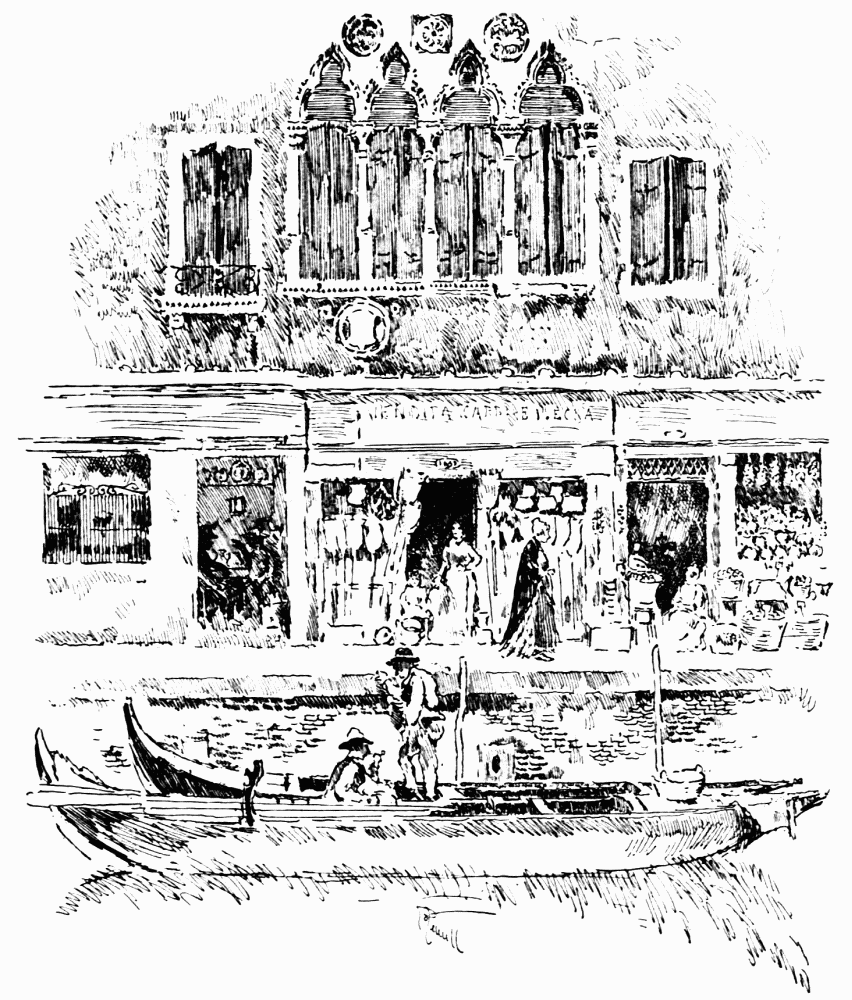
VIA GARIBALDI
Pralboino and Corvione, and his real career began. His first care was to engage as many desperate Bravi as he could find. One of these having had a little difficulty with the police, and having been killed during the argument, Alemanno captured a Sbirro, and so handled him that he sent him back to his post a cripple for life.
Scarcely a year after his return from Zara, he rode through the town of Calvisano, and without answering the Customs officer, whose duty it was to ascertain if he were carrying anything dutiable, he galloped on and escaped recognition. His servant, who followed him at a little distance, was stopped, and as he answered the Customs men very rudely he was locked up in jail. But when the officer in charge learned who the man was, his fright was such that he not only set him at liberty at once, but conversed with him and treated him in the most friendly manner.
The young Count was of course delighted to learn that his name spread terror amongst government officials, and by way of showing what he could do, he sent fifteen of his Bravi to Calvisano with orders to besiege the Customs men. In the fighting that followed, one of the latter was killed and their officer narrowly escaped.
The Council of Ten now interfered, and summoned Count Alemanno Gambara to appear before them, and if he refused, the local authorities were ordered to take him and send him by force. Instead of obeying, he fortified his two castles, increased the numbers of his band of Bravi, and defied the law. With his ruffians at his back he rode through the length and breadth of the Brescian territory as he pleased, and once even traversed
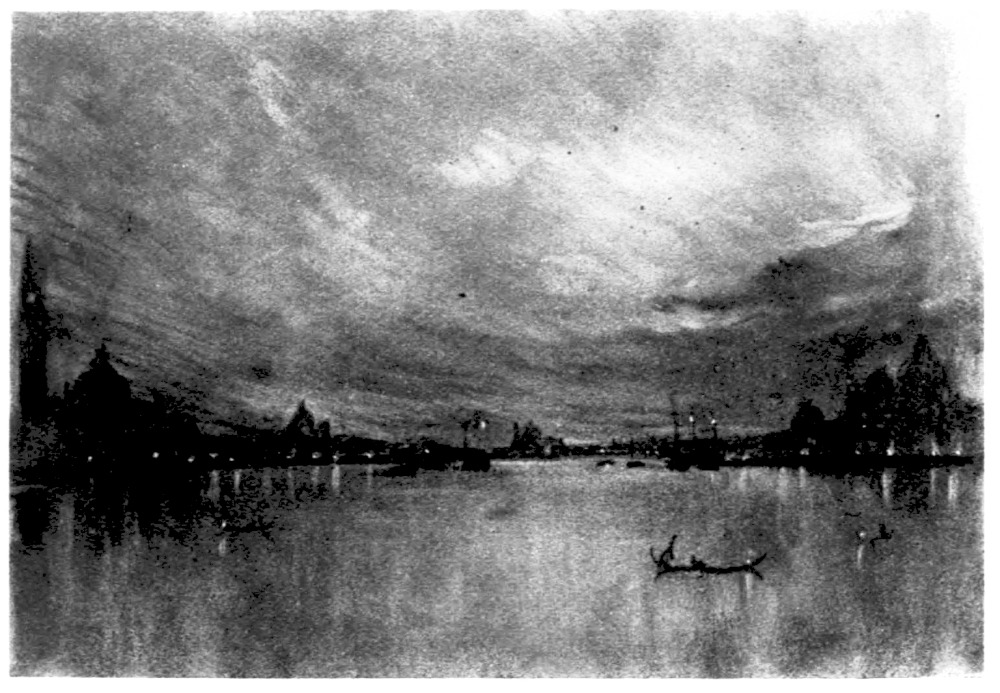
FROM SAN GEORGIO TO THE SALUTE
the city itself with his formidable escort. No one dared to meddle with him. His neighbours in the country were completely terrorised, and he and his head ruffian, Carlo Molinari, committed the wildest excesses.
Alemanno seems to have especially delighted to watch the effect of fright on his victims. One day his men chased a priest of Gottolengo and three friends, who had been shooting in the woods not far beyond the boundary of the estate of Corvione. The fugitives succeeded in reaching the church of Gottolengo, in which they took refuge, barricading the door against their pursuers. But the Bravi starved them out, and they were obliged to surrender unconditionally. They were then led out to a lonely field and were exhorted to commend their souls to God, as they were about to be killed and buried on the spot. Alemanno watched their agony with delight, concealed behind a hedge. When he was tired of the sport, he came out of concealment and ordered his men to beat and kick them back to Gottolengo.
A retired colonel lived quietly on a small estate near one of Gambara’s. His servants accidentally killed one of the Count’s dogs; he had them taken, cruelly beaten, and sent back to their master after suffering every indignity. The colonel thought of lodging a complaint with the Council of Ten, but on reflection he gave up the idea as not safe, for Gambara’s vengeance would probably have been fatal to any one who ventured to give information of his doings. No one was safe within his reach, neither man, nor woman, nor child. A volume might be filled with the list of his crimes.
At last, in 1762, the municipality of the town of Gambara, from which he took his title, resolved to petition the Council of Ten for help and protection against him. When he learned that this was their intention, he rode into the town with his escort, and halting in the market-place addressed the citizens; his threats of vengeance were so frightful, and he was so well able to carry them out, that the chief burghers fell upon their knees before him, weeping and imploring his forgiveness.
One day several Sbirri traversed some of his land in pursuit of a smuggler who sought his protection. He met them smiling, and cordially invited them to spend a night under his roof. With the childlike simplicity which is one of the most endearing characteristics of most Italians, they fell into the trap. On the next day, a cart loaded with greens entered Brescia, and stopped opposite the house of the Venetian Podestà. The horses were taken out and led away, without exciting any remark, and the cart remained where it had been left, till the foul smell it exhaled attracted attention. It was unloaded, and underneath the greens were found the bloody corpses of the Sbirri who had accepted Gambara’s hospitality.
This time the Inquisitors of State took matters seriously, and sent a squadron of cuirassiers and a detachment of Sbirri, under the command of an officer called Rizzi, to arrest him and his henchman Molinari. Rizzi came to Pralboino and broke down the gates, but the two men were already gone, and the expedition ended in the confiscation of a few insignificant letters found in Alemanno’s desk.
He had understood that he must leave Venetian territory for a time, and riding down into the Duchy of Parma he sought the hospitality of his friend, the Marchese Casali, at Monticelli. He next visited Genoa, and judging that it was time to settle in life, he married the Marchesa Carbonare, whom he judged, with some reason, to be a woman worthy of his companionship.
They returned together to Monticelli, where they led a riotous existence for some time. Being one day short of money, Alemanno stopped the messengers who were conveying to Venice the taxes raised in Brescia, and sent them on after giving them a formal receipt for the large sum he had taken from them. But this was too much for the Duke of Parma, who now requested the couple to spend their time elsewhere than in his Duchy.
They consulted as to their chances of getting a free pardon for the crimes the Count had committed on Venetian territory and against the Republic, and the Countess addressed a petition to the Doge which begins as follows: ‘Every penitent sinner who sincerely purposes to mend his life obtains of God mercy and forgiveness; shall I, Marianna Carbonare, the most afflicted wife of Count Alemanno Gambara, not feel thereby encouraged to fall upon my knees before the august Throne of your Serenity?...’ And much more to the same effect.
Another petition signed by both was addressed to the Inquisitors, and a third, signed only by Alemanno, to the Doge and the Inquisitors together. In this precious document he calls them ‘the most perfect image of God on earth, by their power.’
The object of these petitions was that the Count might be sent into exile, anywhere, so long as he were not shut up in a fortress, a sentence which would soon kill him, as he was in bad health.
He had certainly committed many murders and had killed several servants of the Republic in the performance of their duties; and he had stolen the taxes collected in Brescia. Amazing as it may seem, his petition was granted, and he was exiled to Zara for two years, after which he was allowed to come to Chioggia on the express condition that he should not set foot outside the castle, and should see no one but his wife and son. He remained in Chioggia just a year, from the twenty-fifth of September 1777, to the twenty-sixth of September 1778, after which the Inquisitors were kind enough to give him his liberty if he would present himself before their Secretary, which he did with alacrity.
My readers need not be led into a misapprehension by the touching unanimity which the loving couple exhibited in the petitions they signed. They never agreed except when their interests did, and were soon practically separated in their private life. The Countess took Count Miniscalchi of Verona for her lover, while Alemanno showed himself everywhere with the Countess of San Secondo. In the end they separated altogether, and the son, Francesco, remained with his father, who educated him according to his own ideas.
So far as can be ascertained, the man never changed the manner of his life. After his pardon he returned to his estates in the province of Brescia, where he found his old friends, who were few, and the recollections of his youth, which were many. In a short time Pralboino and Corvione were once more dens of murderers and robbers as of old, and as in former days he had been helped in his blackest deeds by Carlo Molinari, his chief Bravo, so now he was seconded by his steward, Giacomo Barchi, who kept the reign of terror alive in the country when it pleased the Count to reside in Venice.
He was sleeping soundly in his apartment in the capital one morning towards the end of March 1782, after having spent most of the night at a gambling house by the Ponte dell’ Angelo—he never slept more than four hours—when he was awakened by an unexpected visit from Cristofolo de’ Cristofoli, who requested him to appear at once before the Secretary of the Inquisitors. An examination of conscience must have been a serious affair for Alemanno, and not to be undertaken except at leisure; and it appears that on this occasion he really did not know what he was to be accused of doing. The Secretary of the Inquisitors merely commanded him not to leave the city on pain of the Tribunal’s anger, and on the morrow he learned that his steward Barchi had also been arrested.
For some reason impossible to explain, nothing was done to either, and before long even the steward was set at liberty. The Inquisitors confined themselves to threatening the two with ‘the public indignation’ and their own severest measures, if the Count did not dismiss his Bravi and ‘reform his conduct.’
After that, history is silent as to his exploits. He was no longer young, and even the zest of murder and rapine was probably beginning to pall on his weary taste. We know that he sincerely mourned the fall of the Republic which had been so consistently kind to him, and he never plotted against the government. He could not but feel that it would have been an exaggeration to accuse it of having been hard on him.
His son Francesco, on the contrary, turned out to be one of the most turbulent of revolutionaries, and helped to lead the insurrection at Bergamo. But for the intervention of Bonaparte himself, he would have been killed by the inhabitants of Salò, who remained faithful to the Republic, when they repulsed the insurgents. He was one of the five delegates whom the city of Brescia sent to Bonaparte, to name him president of the Cisalpine Republic. He died in 1848, after having written a life of his father, which was published eleven years later in Trieste. One cannot but feel that in composing a memoir of his parent, filial piety led him too far.
In concluding this chapter, which has dealt with criminals, I shall take the opportunity of observing that the places in which criminals were confined in Venice shared in the general decay of everything connected with the government. In the seventeenth century and earlier all prisoners had been carefully kept separate according to their misdeeds; in the eighteenth, mere children were shut up with adult criminals, and debtors were confined with thieves. In the women’s prisons lunatics were often imprisoned with the sane, a state of things that led to the most horrible scenes.
The gaolers of the Pozzi and the Piombi did not even keep the prisons clean, and the state of the cells was such that I do not care to disgust the reader by describing it. In the other prisons, or attached to them, a regular tavern was tolerated and perhaps authorised, as a place of gathering for the prisoners, and here games of chance were played, even
Mutinelli, Ult.
such as were forbidden elsewhere in the city. The archives of the Ten show how many crimes were committed in the very places where men were confined to expiate earlier offences. As for the gaolers, they were one and all corruptible. One of the Savi, the patrician Gritti, denounced to the Senate, in 1793, a gaoler who let the healthiest and most airy cells to the highest bidders.
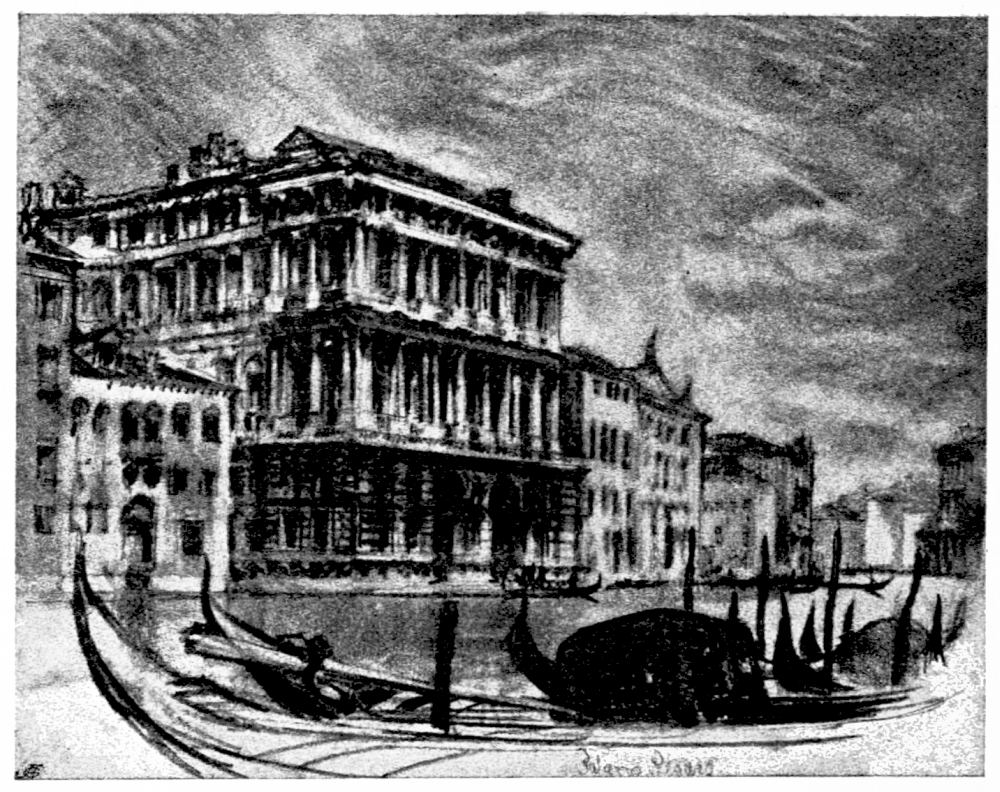
THE PESARO PALACE, GRAND CANAL