IV THE ARSENAL, THE GLASS-WORKS, AND THE LACE-MAKERS
Reading edition
The old Arsenal is such a museum of shadows nowadays that it is hard to realise what it once meant to the Venetians. Six hundred years ago, the sight of it inspired one of Dante’s most vivid descriptions of activity, and I have sometimes wondered whether in his day the three dwelling-houses of the Provveditors were already nick-named Heaven, Purgatory, and Hell, as they were always called at a later date.
The Arsenal was founded in the twelfth century, and from the very first was one of the institutions most jealously watched over by the government. In the sixteenth century it had grown to be a vast enclosure of docks and basins, protected by a crenellated wall, and having but one entrance, which was guarded by sentinels. In the interior, the houses of the Provveditors had grown to be three great palaces, built round a courtyard, each officer occupying one of them during the thirty-two months of his term of office.
The Provveditors were nobles, of course, but they must necessarily have been men who thoroughly understood nautical matters, for it was their duty to oversee all work done in the place, to the minutest details, and they had absolute control of all the vast stores accumulated for building and fitting the fleet of the Republic. Every manufactured article was stamped with the arms of the Republic as soon as it was made or purchased, and not a nail, not a fathom of rope, not a yard of canvas could be brought out of the storehouses without the consent of one of the Provveditors. If anything was found outside the walls of the Arsenal with the public mark on it, the object was considered by law to be stolen, an inquiry was made, and if the culprit who had committed the misdemeanour could be caught, he was condemned to the galleys.
In order to enforce the rigid regulations the government not only required all three Provveditors to inhabit constantly the palaces assigned to them, but insisted that one of them should remain day and night within the
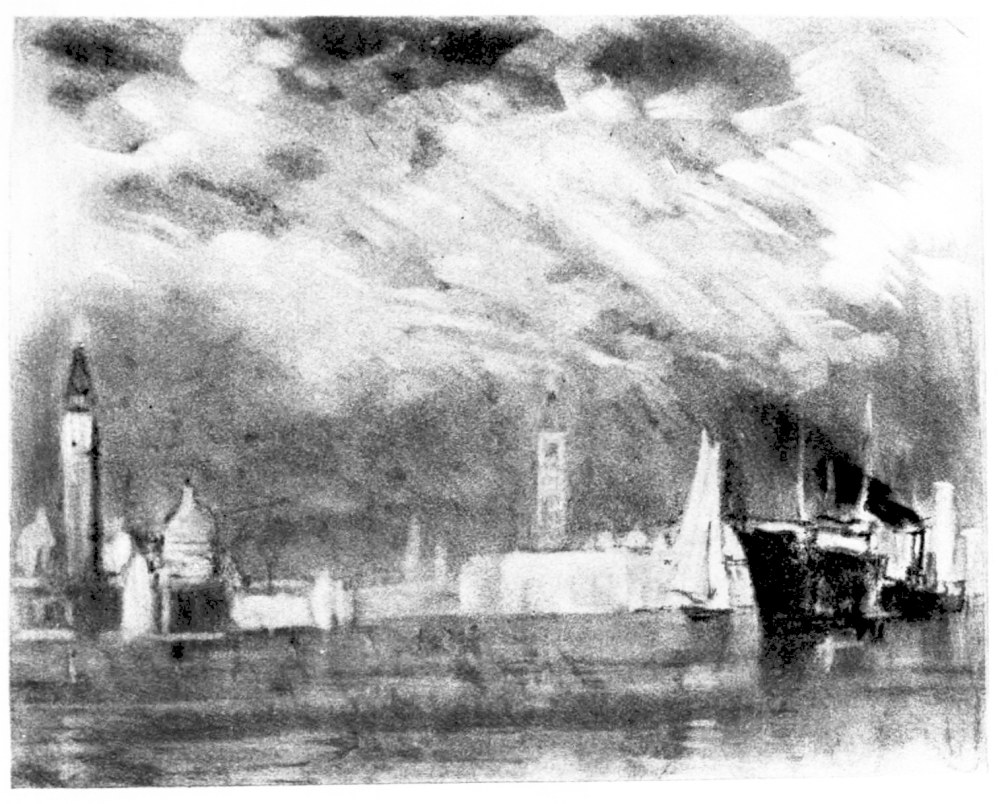
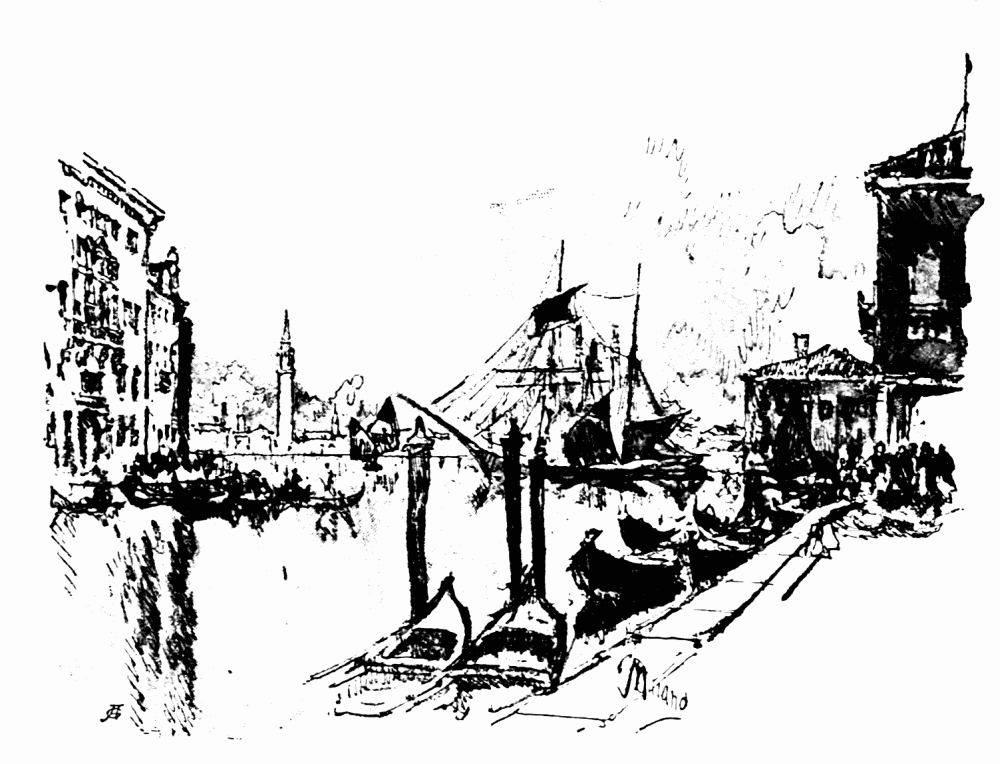
STEAMERS COMING IN
boundaries of the yard, during a fortnight, without going out at all. This service was taken in turn, and the official who was on duty was called the ‘Patron di Guardia.’ Into his hands all the keys were given every evening when work was over.
The artisans of the government ship-yard were the finest set of men in Venice, and their traditions of workmanship and art were handed down in their families from father to son for generations, as certain occupations still are in Italy. I know of a man-servant, for instance, whose direct ancestors have served those of the family in which he is still a servant for more than two hundred years without a break. In the Venetian Arsenal, it sometimes happened that an old man was foreman of a department in which his son was a master smith or carpenter, and his grandson an apprentice.
There was something military in the organisation, which bound the artisans very close together, for they trained themselves in fencing and gymnastics, and also in everything connected with extinguishing fires and saving wrecks or shipwrecked crews, for in any case of public danger it was always the ‘Arsenalotti’ who were called in. They were sober and courageous and excessively proud of their trade, and the government could always count on them. Twice, towards the end of the sixteenth century, the ducal palace took fire, and would have burnt down but for the prodigious energy of the workmen from the government docks. On the first occasion they proudly refused the present of five hundred ducats which the Doge offered them, but gratefully accepted an invitation to dine with him in a body; and as they numbered over fifteen thousand the Doge did not save money by the arrangement. Three years later, all their efforts could not hinder the hall of the Great Council from burning, and priceless works of art by such men as the two Bellini, Titian, Tintoretto, and Pordenone were destroyed in a few moments. But the Arsenalotti saved the rest of the building, and again refused any recompense for their services.
When Henry III. of France came to Venice, the Arsenal employed about sixteen thousand men, and could count on a budget of two hundred and twenty-four thousand gold ducats, of which one hundred and twenty-four went to pay the wages of the workmen, and the rest was expended for materials. Those were large sums in the sixteenth century, but Venice looked upon the Arsenal as the mainspring of her power, and spared nothing to keep it in a state as near perfection as possible. In the long struggle with Genoa, the enemy used every art to bring about its destruction, but always in vain. The men who guarded the docks were absolutely incorruptible. In the sixteenth century it seemed as if the pure blood of the old Venetians ran only in their veins, and as if they alone still upheld the noble traditions of loyalty and simplicity which the founders of the Republic had handed down from braver days.
Next to the construction of her war-ships and merchant fleets, one of the most important matters to the commerce of Venice was the manufacture of glass, which brought enormous profits to the State and to
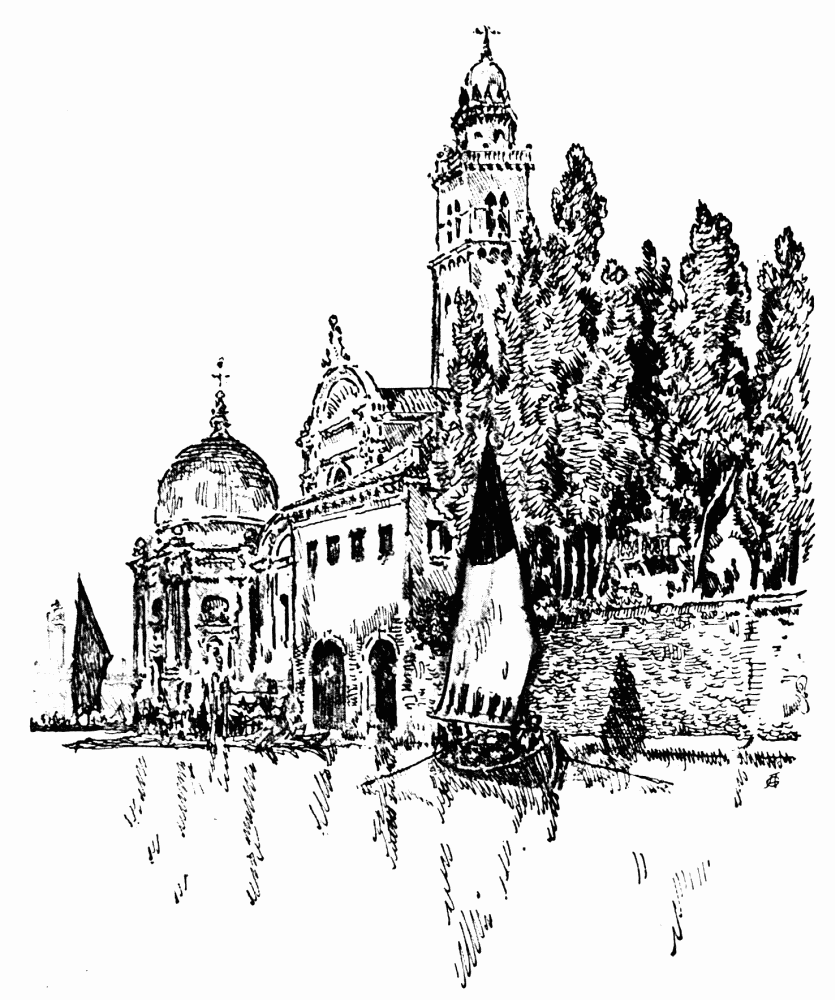
S. MICHELE
individuals, as is usually the case when a valuable product is made out of cheap materials by processes which are secret, and therefore have the effect of a monopoly.
As early as the fourteenth century the government had understood the immense importance of the art, and the glass-blowers of Murano were protected and favoured in a most especial way. As in one part of France, a sort of nobility was inherent in the occupation, and an early law sanctioned the marriage of a master
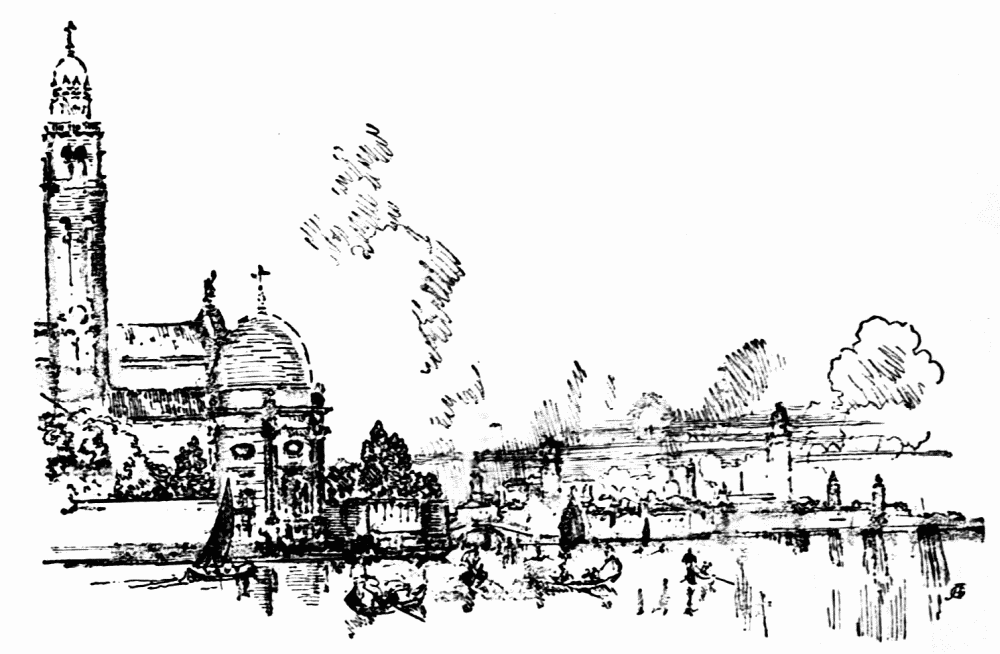
VENICE FROM MURANO
glass-blower’s daughter with a patrician by allowing their children to be entered in the Golden Book.
The glass-works were all established in the island of Murano, as their presence in the city would have caused constant danger of fire at a time when many of the houses were still built of wood, and the whole manufacture was subject to the direct supervision of the Council of Ten, under whose supreme authority Murano governed itself as a separate city, and almost as a separate little republic. Not only were the glass-blowers organised in a number of guilds according to the special
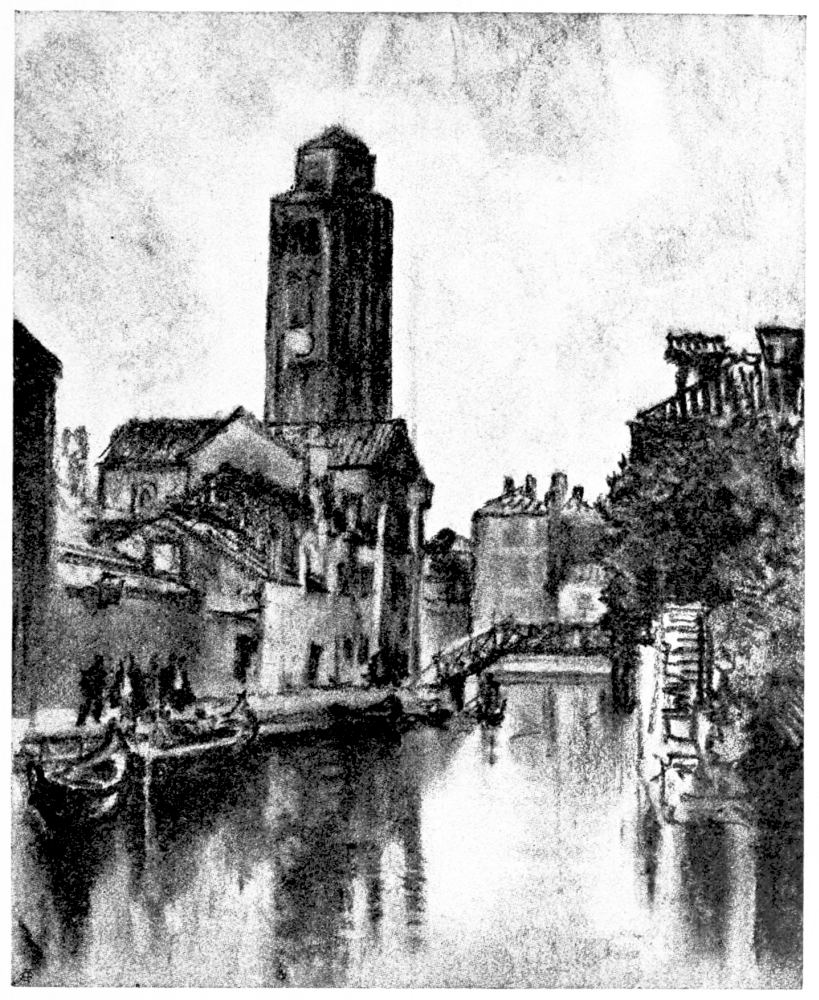
THE DUOMO CAMPANILE, MURANO
branches of the profession, such as bead-making, bottle-blowing, the making of window-panes and of stained glass, each guild having its own ‘mariegola’ or charter; but over these the Muranese had their own Great Council and Golden Book, in which the names of one hundred and seventy-three families were inscribed, and their own Small Council, or Senate. The Ten gave Murano a ‘Podestà,’ but he had not the power which similar officers exercised in the other cities and islands of the Dogato, and it is amusing to see that the people of Murano treated him very much as the Venetians themselves treated their Doge. He was required to be of noble blood; he was obliged by law to spend three days out of four in Murano; he was forbidden to go to Venice when important functions were going on; he could not interfere in any affair without the permission of both the Councils of Murano, and altogether he was much the same sort of figure-head as the Doge himself. On the other hand, Murano supported a sort of consul in Venice with the title of Nuncio, whose business it was to defend the interests of the island before the Venetian government.
Neither the Missier Grande, the chief of the Venetian police, nor the ‘sbirri,’ were allowed to exercise their functions on the island. Offenders were arrested and dealt with by the officers of the Murano government, and were handed over to the Venetian supreme government only in extreme cases, most trials taking place on the island.
The heraldic arms of Murano displayed on an azure field a cock with red legs, wearing a crown of silver.
In the sixteenth century the population was about thirty thousand souls, and the little city had a great reputation for the beauty of its churches and especially of its gardens, in which quantities of exotic plants and flowers were cultivated.
The two most powerful families amongst the glass-blowers were those of Beroviero and Ballarin. I have told at length in the form of a romance the true story
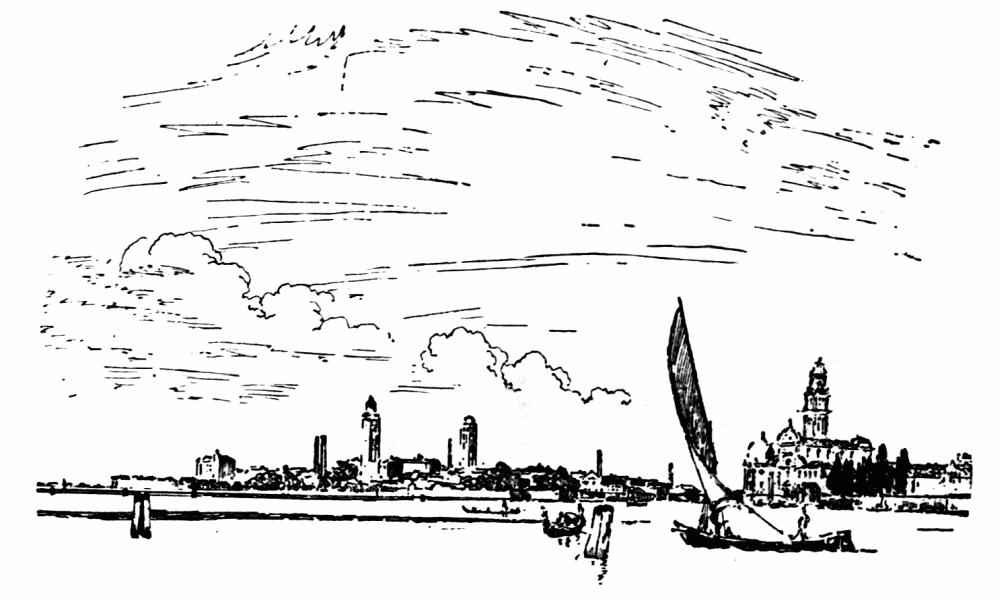
MURANO, LOOKING TOWARDS VENICE
of Zorzi Ballarin and Marietta Beroviero, availing myself only of the romancer’s right to be the apologist of his hero. The facts remain. Angelo Beroviero, a pupil of Paolo Godi, the famous mediæval chemist, worked much alone in his laboratory, noting the results of his experiments in a diary which became extremely valuable. By some means this diary came into the hands of Zorzi Ballarin, so-called by his comrades on account of his lameness. He loved Marietta, and she loved him, but he was poor, and moreover, as far as I have been able to ascertain, he was of foreign birth, and could therefore not become a master glass-blower. When he found himself in possession of the precious
MURANO
secrets, he used his power to extort Beroviero’s consent, he married Marietta, obtained the full privileges of a master, lived a highly honourable life, and became the ancestor of a distinguished family, one of whom was a Venetian ambassador, as may be read in the inscription on his tomb in Murano. Beroviero’s house, with the sign of the Angel, is still standing in Murano, and I think the ancient glass-works nearly opposite were probably his. As for Zorzi Ballarin, I daresay that the process by which he really got possession of the diary was not strictly legal, but love has excused worse misdeeds than that, and Beroviero does not seem to have suffered at all in the end. If there had been any foundation for the spiteful story some chroniclers tell,
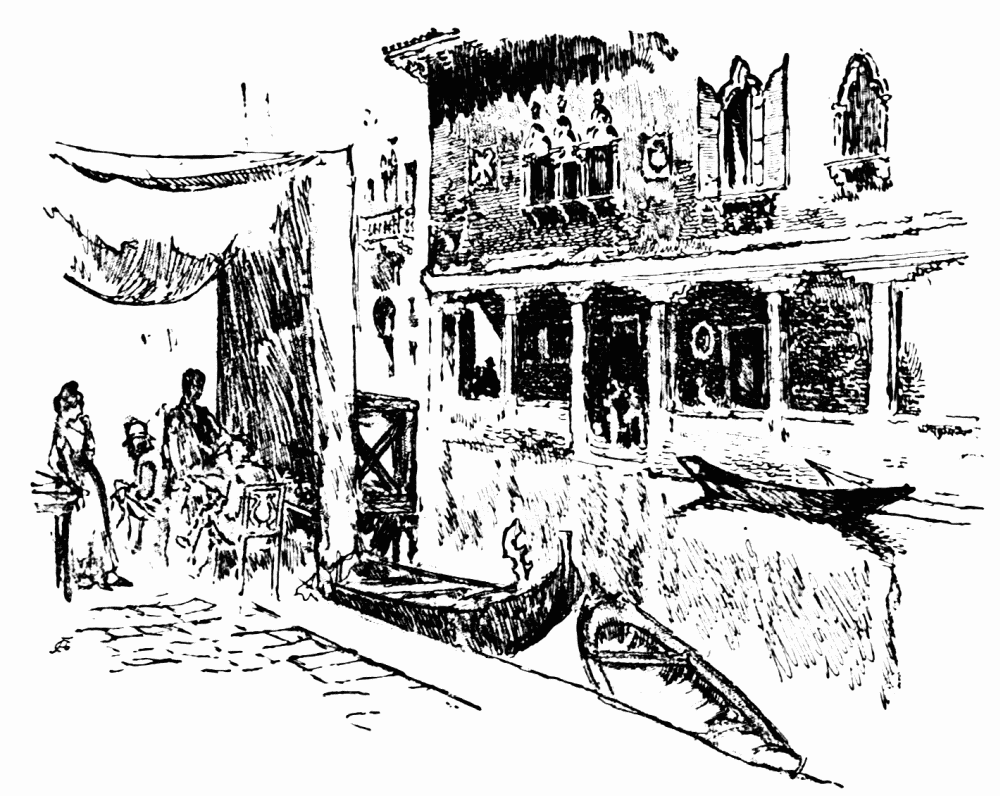
THE HOUSE OF BEROVIERO, MURANO
a man of Beroviero’s power and wealth could have had Zorzi imprisoned, tortured, and exiled without the slightest difficulty.
Venice was almost as famous for her lace as for her glass. On the admittedly doubtful authority of Daru and Laugier, Smedley gives an anecdote of the Emperor Frederick III. for what it is worth. It at least illustrates the fact that all foreigners did not esteem Venetian glass as highly as the Venetians themselves. When Frederick visited the city on his way to Rome, he was most magnificently entertained, and amongst other presents offered to him was a very beautiful service of Murano glass. The Emperor was not pleased with the gift, which, to his barbarous ignorance, seemed of no value; he ordered his dwarf jester to seem to stumble against the table on which the matchless glass was set out, and it was all thrown to the ground and smashed to atoms. ‘If these things had been of gold or silver, they could not have been broken so easily,’ said the imperial boor.
In contrast with this possibly true story of the fifteenth century, I find that the lace collar worn by Louis XIV. at his coronation was made in Venice, and was valued at an enormous sum. He afterwards bribed Murano glass-blowers to settle in France.
In those times, more or less as now, women made lace at home, and brought the results of their long and patient labour to the dealers, who bought and sold it at a fabulous profit. A few specimens of the finest lace of the sixteenth century are still in existence, and are worn on great occasions by Italian ladies whose ancestresses wore them more than three hundred years ago; but the art of making such lace is extinct. Glance only, for instance, at a picture by Carpaccio, in the Museo Civico of Venice, representing two patrician ladies of the fifteenth century, one of whom wears white lace on her gown. It is of the kind known as ‘point coupé’ or cut point, and is the same which Francesco Vinciolo taught the French a hundred years later when it was no longer thought fine enough, in Venice, for ornamenting anything but sheets and pillow-cases. It is inimitable now. Or look at the exquisite lace of network stitch with which Gentile Bellini loved to adorn the women he portrayed. Yet in the sixteenth century still further progress had been made, and the ‘air point’ was created, which surpassed in fineness anything imagined before then, and for which fabulous prices were paid. The collar of Louis XIV. was of this point, and it is said that as no thread could be spun fine enough for it, white human hair was used. There is also a story to the effect that the Emperor Joseph II., who ascended the throne in 1765, ordered a set of air point worth the improbable, though not very great price of 77,777 francs. As neither Austrians nor Venetians used the franc, the story is most likely of French origin.
Another lace greatly valued in Venice was the ‘rose point,’ which is probably the best known of the ancient laces. It was preferred, for collars, both by high officials and great ladies, and the Dogesses often used it for their veils. The Doge Francesco Morosini possessed some wonderful specimens of it, which I am told are still in the possession of his descendants.
One more stitch was invented in the sixteenth century, which oddly enough obtained the generic name of ‘Venetian point.’ There is a pretty story about it. A sailor, says the legend, came home from a long voyage and brought his sweetheart a kind of seaweed known to botanists by the name of Halimedia Opuntia, of which the little branches were so fine that the people called the plant ‘Siren’s hair.’ The man sailed again on another voyage, and the girl, full of loving and anxious thoughts for him, occupied herself by copying the dried plant with her needle, and in so doing created the Venetian point.
The minister Colbert introduced it into France a century later, under Louis XIV., and gave it his own name; and the King and the Republic quietly quarrelled about this French infringement of a Venetian monopoly. In the end, the Inquisitors of State issued a decree which was intended to recall errant and erring Venetian lace-workers and glass-blowers to the security of their homes:—
‘All workmen or artisans who carry on their trade in foreign countries shall be ordered to come back; should they disobey, the members of their families shall be imprisoned, and if they then return, they shall be freely pardoned and again employed in Venice. But if any of them persist in living abroad, messengers shall be sent to kill them, and when they are dead their relations shall be let out of prison.’
The glass-blowers who were to be murdered were men, but the lace-makers were women, and the decree, which was made about 1673, is a fine instance of Venetian business principles, since the killing of men and women by assassination was a measure introduced solely for the protection of trade.
Coloured bobbin lace was also made in Venice, with dyed silk thread and threads of gold, in the fifteenth century, and Richard III. of England desired his queen to wear it on her cloak at their coronation in 1483.
The modern Burano lace was first made after the
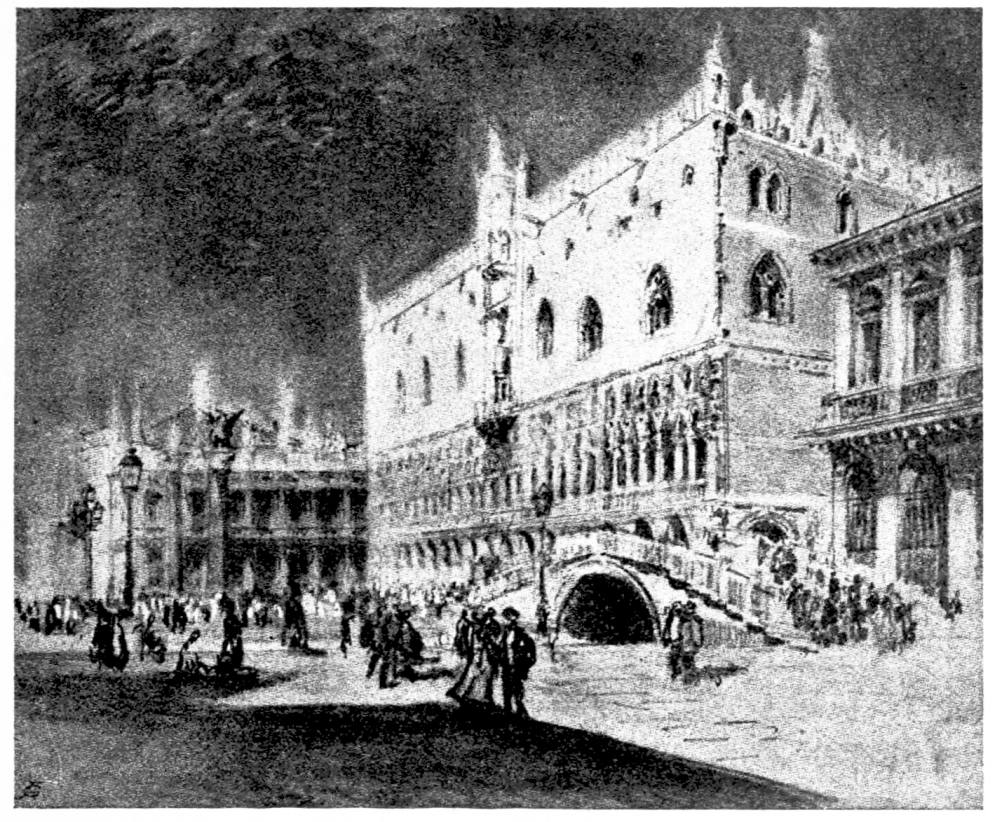
THE PALACES
end of the Republic, and is almost the only sort which is now manufactured in any quantity. Some of the finer points are imitated, it is true, and are vastly advertised, advertisement having taken the place of assassination in business methods as a means of creating a fictitious monopoly; but in spite of some really good pieces of needlework wrought with great care—as advertisements—the mass of the work turned out is of a cheap and commercial character.
The policy of Venice with regard to her manufactures was one of protection, as has been seen, and the result was on the whole very satisfactory to the people as well as to the great merchants. Very heavy duties were levied on almost all imported articles, and among the very few excepted were the silk fabrics from Florence known by the name of ‘ormesini.’ This material was in such common use in Venice that the local silk weavers could not meet the demand for it. One of the reasons why the working people of Venice were always satisfied was that they were almost always prosperous; the price of labour was high, while that of necessities was relatively low, and the people accordingly lived in comfort without excessively hard work.
On the other hand, some of them were always extravagant, as some of the nobles were, and some were unfortunate; and though there was no pauperism, there were many families of hopelessly poor persons. In a measure the hospitals, hospices, and orphan asylums provided for those in want, but in Venice, as in modern cities, the candidates for charity were always just a little more numerous than the shares into which charity could divide herself.
There were also those who, if not exactly poor, were in difficulties, the class that for ever feeds the pawnbroker and the small money-lender. The Republic exercised the strictest supervision over these industries, and few cities in the world ever turned a harder face against the inroads of the Hebrews. It was with the greatest unwillingness and with many precautions that Jews were ever admitted into the city at all, and a special code provided the most extraordinary and cruel penalties for the most ordinary misdemeanours when committed by them. They were forced to wear a special dress with a large patch of yellow on the chest, and they could only follow the meanest occupations. In mediæval Rome it was the business of the Jews to bury the Christian dead, but it often happened that the Pope’s private physician was a Hebrew. I do not find that in Venice they were ever forced to be gravediggers for the poor, but they were forbidden to act as physicians except for their own sick. Both Church and State rigorously forbade their intermarriage with Christians, and, so far as the happy ending of the love story is concerned, Lorenzo and Shylock’s daughter could never have married. More than once, before the sixteenth century, the Jews were expelled from Venice and made to live in Mestre, which seems to have been their regular headquarters, but they were allowed to come into the city during the time of certain public fairs. If they prolonged their stay beyond the limit, however, they became liable to fine or imprisonment. Some of these measures had been partly relaxed by the middle of the sixteenth century, but the Jews never enjoyed anything like equality with the other citizens.
Oddly enough the money-lender of the lower classes in Venice was the wine-seller, whom the people called the Bastionero. In the wine-shop it was customary to pawn objects for wine and money
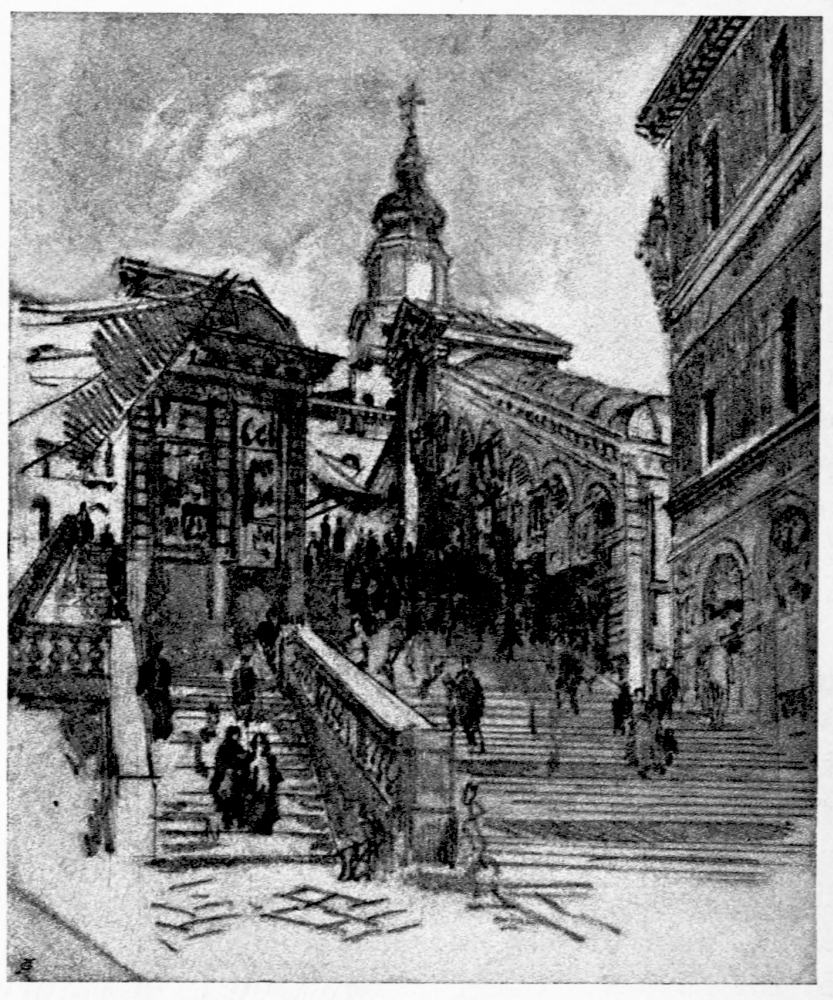
THE RIALTO STEPS
simultaneously, one-third of the value being given in wine, which was generally watered. If the pledge were not redeemed within three months, the amount to be paid for getting it back was increased, and again at the end of the next three months, and so on, until,
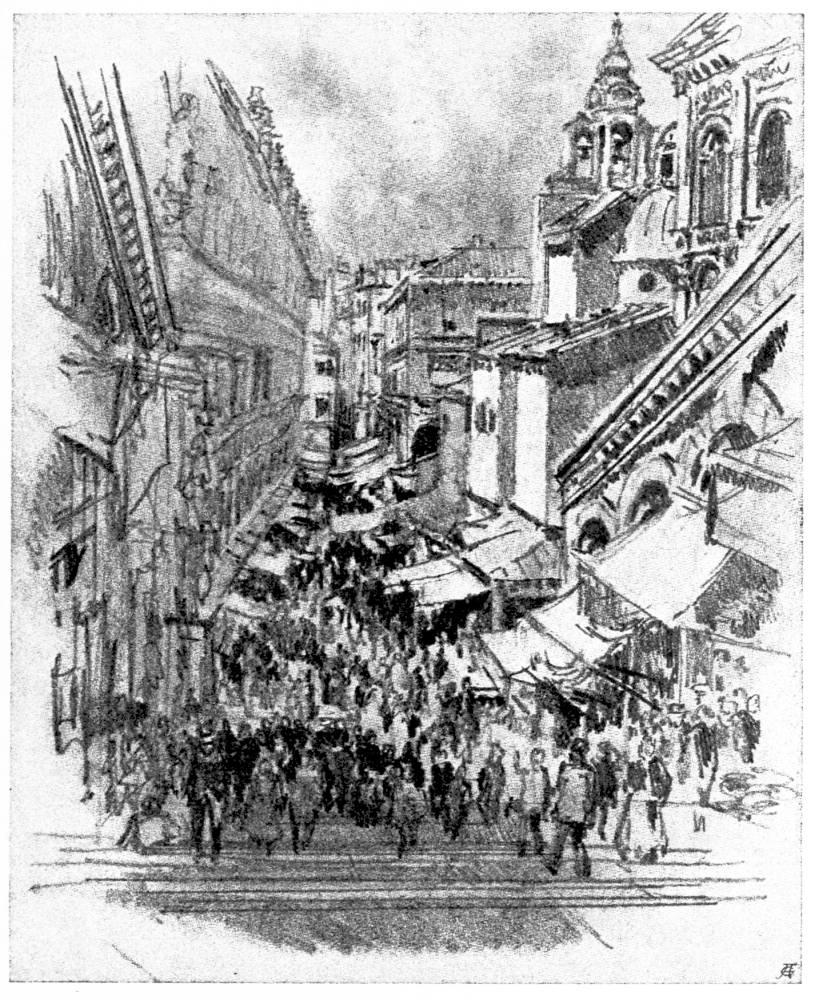
NOON ON THE RIALTO
at the end of the year, the original sum lent was doubled. If it was not paid, the wine-seller had a right to sell the object for what it would bring.
A modern Eastern proverb says that one Greek can cheat any ten Jews, but that one Armenian can cheat ten Greeks. Considering that Venice had a distinctly oriental character during the Middle Ages, and since we know that the small money-lending wine-sellers were not Jews, I suspect that they were principally Greeks and Armenians, the more probably so as we know that great quantities of Greek and Armenian wine were imported into Venice, and that those wines will bear a good deal of watering. The latter is an important point, for it is manifest that when the pledge was redeemed within the first three months, the lender’s profit was the difference between the nominal and the real value of the wine which formed one-third of the loan.
The government which tolerated this ignoble occupation exhibited the most extraordinary prejudice against the government pawnbroking offices which were common in other Italian cities. Historians have in vain endeavoured to discover why this prejudice went so far that, in 1524, the Council of Ten published a decree threatening with death on the scaffold any one who should even propose the creation of such an establishment. Without entering into any ingenious speculation, it seems possible that the Venetians, who were wise if not virtuous, considered that while it was impossible to prevent the poor from borrowing small sums on their little possessions, to authorise such borrowing by making the government the lender would greatly increase the temptations of that more shiftless class to whom borrowing seems to be a prime necessity of existence.
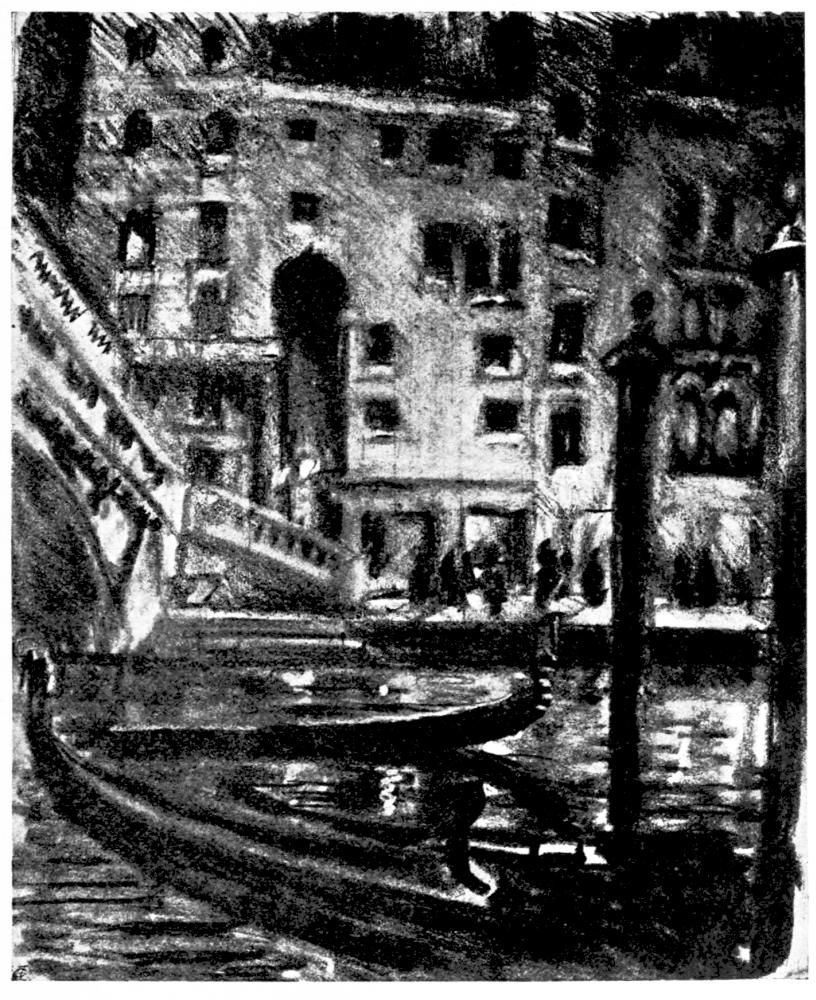
AT THE RIALTO
The centre and heart of all this activity, good and bad, was the bridge of the Rialto. We find it hard to realise that until near the end of the sixteenth century it was still built of wood with a movable drawbridge in the middle to admit the passage of larger vessels. Carpaccio, who lived in the fifteenth century, has left us a faithful representation of it as it remained for nearly a hundred years afterwards. It would be interesting to place beside that picture Turner’s lost painting of the same subject, a very beautiful canvas which I have twice had the good fortune to see in the course of its more than mysterious peregrinations. I last heard of it, though not certainly, as being in the south of France.
The present bridge was begun after infinite hesitation in 1588, and was built after the designs of Antonio da Ponte, whose name was certainly prophetic of his career. Twelve thousand elm piles had to be driven into the soil on each side of the canal to a depth of sixteen feet to make the foundations of the arch. The construction occupied three years, and is said to have cost 250,000 ducats, presumably of silver. The bridge as it stands is a remarkable piece of work, and would be beautiful if the hideous superstructure of shops could be removed. It is interesting to note that fifty years before its completion, Michelangelo offered the Doge Andrea Gritti a plan for a bridge, as is amply proved by the existence of a picture in the Casa Buonarotti in Florence representing the subject.
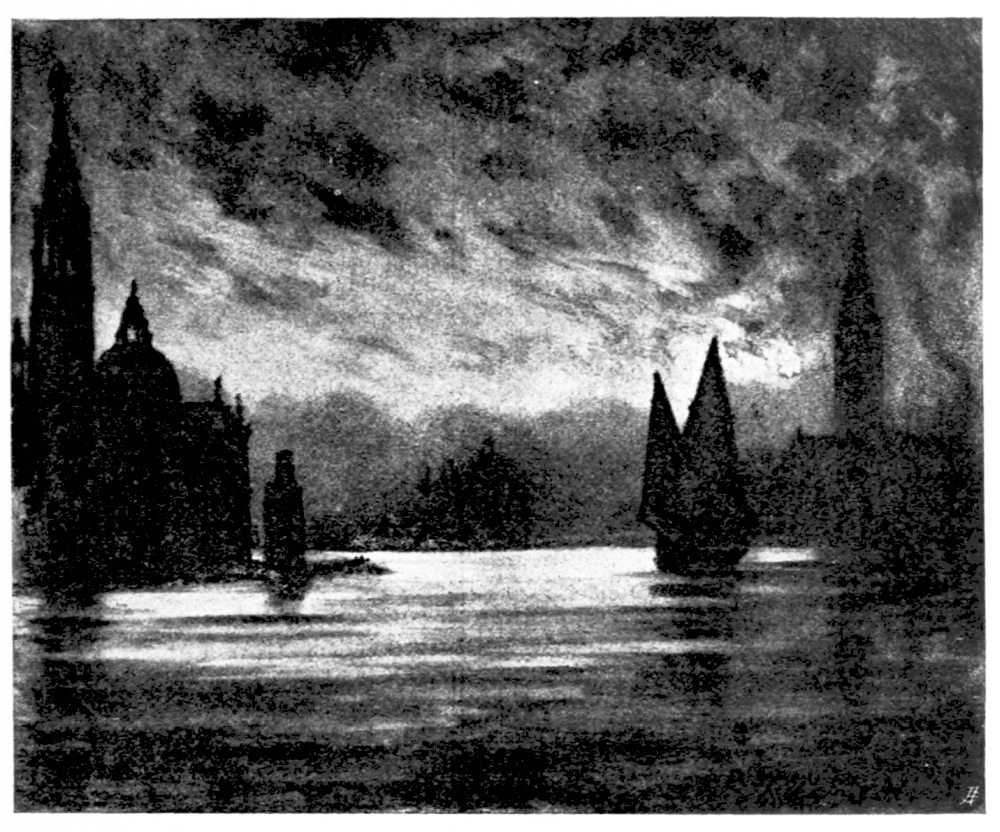
EVENING OFF S. GEORGIO