Volume 1 / Part 7 — PART SEVENTH. THE ORIGIN AND ESTIMATION OF OXIDIZED NITROGEN IN SOILS, RAIN AND DRAINAGE WATERS.
Reading edition
411. Introductory Considerations.—The estimation of oxidized nitrogen in the soil would properly find a place in the preceding part; but on account of the late progress in our knowledge of the source of this indispensable and costly plant food it has become necessary to give it especial attention. The present part will, therefore, be devoted to a brief statement of our present knowledge in respect of the origin of oxidized nitrogen, a description of the nitrifying ferments and methods for their isolation and determination and finally the most approved methods of estimating the ammonia, nitrous, and nitric acids formed thereby both in the soil and the waters pertaining thereto or proceeding therefrom. It is scarcely necessary to caution the reader not to consider this part in any sense a treatise on the bacteria active in soil chemistry. Its object is rather to place in the hands of the soil analyst data which will enable him to intelligently study the soil phenomena depending on these organisms and to determine the extent and character of their biological and chemical functions. These are matters which, up to the present time, have found no place in manuals dedicated to agricultural analysis.
412. Organic Nitrogen in the Soil.—With the exception of the small quantities of nitric acid added to the soil directly by rain water, the whole of the supply of this substance is derived from the products of the oxidation of nitrogenous bodies. These products are either stored as the results of past nitrification or are formed synchronously with their consumption by the growing 452plant. Nitrogenous compounds are present as organic vegetable or animal remains and as humus. All vegetable and animal material deposited in or on the soil contains more or less of these proteid or nitrogenous matters while the amount of nitric acid supplied in this way is probably represented entirely by the quantity in the organism of the plant or animal and unabsorbed at the time of its death. In other words it is not demonstrated that nitrates or nitrites are in any sense a special product of plant growth save in the case of nitrifying organisms themselves which are supposed to be of a vegetable nature. Animal organisms do not in any sense assimilate nitric nitrogen.
With most plants, the quantity of proteid nitrogen which they can deliver to the soil is in no case greater than the sum of organic and nitric nitrogen supplied in their food and they can therefore be regarded only as the carriers and conservers of this substance. On the other hand there are some plants notably those belonging to the leguminous family which permit of the development on their rootlets of colonies of bacteria which have the faculty of rendering atmospheric nitrogen available for plant growth. Whether or not there exist plants other than the micro-organisms mentioned which are capable of directly oxidizing and fixing atmospheric nitrogen is still an unanswered question. It is not probable, however, that the difficult task of oxidizing atmospheric or free nitrogen would be accomplished in nature in only one way. In fact it has already been established that organisms do exist which are capable of oxidizing free nitrogen in a manner wholly independent of other plant life and to produce weighable quantities of nitric acid when developed in media of mineral matters and pure carbohydrates to which free nitrogen has access. It is, therefore, fair to assume that the fixation of free nitrogen is a function of chemical activity quite independent of ordinary plant life and that the leguminous plants take no further part in this process than that of providing in their radical development a favorable nidus for the growth of the nitrifying organism.
By the action of denitrifying organisms a portion of the nitrogen of nitric acid is constantly restored to a free state, a far larger portion, perhaps, than is fixed in the atmosphere itself by the 453action of electricity. Were it not, therefore, for the activity of the nitrifying ferments the stores of nitrogen available for growing plants would constantly become less. Instead of this being the case, however, it is probable that the contrary is true and that, by a wise system of agriculture, the total nitrogen at the disposal of plants may become greater and greater in quantity.
413. Development of Nitric and Nitrous Acids in Soils.—Owing to the solubility of nitrates there can be but little accumulation of them in soils in those countries where there is any considerable amount of rain-fall. On the other hand in arid regions there may be found extensive deposits of nitrates. The occurrence of a certain quantity of nitrates in the soil, however, is essential to the growth of plants. Until within a few years little was known of the origin of nitric acid in the soil. The presence of nitrates in drainage waters was well established, likewise the consumption of nitric acid by the growing plant, but the method of its supply was unknown. In a general way it was said that the nitric acid came from electrical action and the oxidation of the albuminous bodies in the soil, but without specifying the manner in which this change takes place. The researches of Schloesing and Müntz, of Springer, Winogradsky, Frankland, Warington and others have demonstrated the fact that this oxidation is caused by means of bacteria and that the nitrates formed can be consumed and destroyed by other species of this organism. In the one case the process has been called nitrification and in the other denitrification.[274]
The influence of these low organisms both in producing fertility in a soil and maintaining it in a state of fertility is of the highest importance.
414. Conditions Necessary for Nitrification.—In order to properly understand the reasons for many of the steps in investigating a soil for nitrifying organisms, it will be useful to state the general conditions on which nitrification depends.
The nitrifying organism, like every other one, first of all feels the necessity for food. In general, food which is given to microbes of all kinds consists of some organic matter together with the addition of mineral substances necessary to growth. These substances in general are phosphoric acid, potash, and 454lime. Of these articles of bacterial food phosphoric acid seems to be the most important. With the nitrifying organisms, however, it has been found that the organic matter can be omitted. In fact, as will be seen further on, the omission of organic matter supplies the best condition for the proper isolation of the organisms. In other words some forms of the nitrifying organisms have the property of subsisting wholly on mineral substances, i. e., are true vegetables.
The presence of oxygen is also necessary to the growth of the common nitro-organisms. In an atmosphere deprived of oxygen or in which the oxygen is reduced to a very low percentage, the process of nitrification is retarded or stopped as the oxygen diminishes or disappears.
The presence of a base with which the nitrous or nitric acid formed may unite is also essential to the proper conduct of the process. For this reason the nitrification should take place in a solution which is feebly alkaline or in the presence of a base which can be easily decomposed so that no acidity can take place. Calcium carbonate is a base well suited to favor the nitrifying process and its presence in a soil favors the rapid oxidation of proteid matter. The mistake must not be made, however, of supposing that an excess of alkali would favor nitrification. The contrary is true. A slight excess of alkali may prevent nitrification altogether when it is due to the common organisms present in an arable soil. It may be that in soils charged with alkali a different organism exists which is capable of exercising its functions when the alkali is in excess.
The temperature to which the nitrifying body is subjected is also a matter of importance. The nitrifying organisms have the property of remaining active at lower temperatures than most bodies of their class. On the contrary their action is retarded and destroyed by high temperatures. The most favorable temperature for nitrification is about that of blood heat; viz., 37°. At 50° the organism shows very little activity and at 55° its activity ceases altogether. Nitrification, however, according to Warington, cannot be started in a solution if the initial temperature is 40°.
Desiccation has the same retarding influence on nitrification 455that a high temperature has. Even thoroughly air-drying a soil may destroy its nitrifying qualities.
Darkness is also necessary to the proper progress of nitrification. In a strong light, the activity of the organism is very much diminished or destroyed altogether. A bright light like sunshine may even stop nitrification which has set in.
415. Effect of Potassium Salts on Rate of Nitrification.—Dumont and Crochetelle have described some experiments to determine the effect of potassium salts alone and in combination with lime on nitrification.[275]
Soil rich in vegetable mold (18.5 per cent of humus and 0.29 per cent of lime) was treated with varying amounts of potassium sulfate and carbonate and kept for twenty days at 25°. In the untreated soil the amount of nitric acid produced was twenty-five parts per million. When potassium carbonate was applied in quantities of from one-tenth to six per cent the amount of nitric acid increased from forty-seven parts per million to 438 parts when four and one-half per cent of the potassium salt were used. Larger quantities caused a decrease in the amount of nitric acid produced. Very little effect, on the contrary, was produced by the action of potassium sulfate. When one-half per cent was employed the quantity of nitric acid formed rose to fifty parts per million, while with quantities as high as five per cent it fell below the normal; viz., twenty-five parts per million.
When calcium carbonate was added to the soil in conjunction with potassium sulfate there was a marked increase in the amount of nitrogen oxidized. The activity of potassium sulfate in promoting nitrification is therefore increased by the presence of the calcium salt, potassium carbonate and calcium sulfate being formed.
416. Production of Nitrous and Nitric Acids.—In the following pages the study of the methods of isolating the nitrous and nitric ferments will be considered as one process, the final isolation of the two classes of bodies being the result of their synchronous cultivation in appropriate media. The special process of the production of ammonia by oxidation is not so well-known, and will therefore be described in brief.
It is now generally conceded that the action of the nitrous organism is precedent to that of the nitric, but the two processes 456go on so nearly together as to prevent the accumulation of any large quantities of the lower salt in the soil.
Whether or not the formation of ammonia precedes that of nitrous acid is still a subject for experimental demonstration. Chemically, both nitrous acid and ammonia may be produced by the reduction of nitric acid. In nature, the reverse of this process may be the customary method.
417. Production of Ammonia in the Soil by the Action of Microbes.—It is highly probable that organic nitrogen in the soil in passing into the form of nitric acid exists at some period of the process in the form of ammonia.
Marchal has isolated and studied some of these ammonia-making bacteria.[276] Bacillus mycoides is the most active of these organisms. It occurs constantly in surface soils and is present in the air and in natural waters. In decomposing albumen it produces a strongly alkaline solution due to ammonium carbonate. Organic carbon, during this process, is converted chiefly into carbon dioxid, but small quantities of formic, propionic, and butyric acids are also produced. Any organic sulfur which is present is converted into acid. No hydrogen or nitrogen is eliminated in a free state. While slight alkalinity is favorable to the development of this bacterium, yet it may be propagated in a feeble sulfuric acid solution when the acid is less than one per cent.
The greatest activity of this organism is manifested at 30°. Below 5° and above 42° no ammonia is produced. The bacillus will not develop in an atmosphere of hydrogen or carbon dioxid, except in solutions of organic matter and nitrate. In addition to its action on egg albumen it decomposes other proteid bodies as well as leucin, tyrosin, creatin, and asparagin. It, however, does not oxidize urea, nor does it develop in solutions of ammonium salts and nitrates, except as mentioned above. When soluble carbohydrates are present, acids are formed. It is concluded from these experiments that the final oxidation of organic nitrogenous matter is preceded by its conversion into ammonium carbonate.
418. Summary of Statements.—All nitrogenous matters which would be naturally present in the soil may become subject 457to nitrification when the proper conditions are supplied. Munro has also succeeded in nitrifying ethylamin, thiocyanates, and gelatin, urea, asparagin, and the albuminoids of milk and rapeseed.
The products of nitrification are ammonia, nitrous or nitric acid, carbon dioxid, and water. The ammonia and nitrous acid may not appear in soils as the final products of nitrification, as the nitric organism attacks the latter at once and converts it into nitric acid. Nitrous acid and ammonia may also be produced in soils as one of the retrograde steps in denitrification.
To summarize the conditions necessary for nitrification it may be said that first, the proper material must be supplied; viz., an organic or inorganic nitrogenous compound capable of oxidation. In the second place, the medium must be faintly alkaline, the temperature must not be too high, the nitrifying organisms must have abundant food, and the process must take place in the dark.
419. Order of Oxidation.—It is quite definitely determined that activity of the ammoniacal and nitrous organisms is the first step in the process, since the nitric organism appears to have no power whatever to oxidize proteid compounds; while, on the other hand, the nitrous organism can not, in any case, complete the conversion of nitrous into nitric acid.
The conditions which permit certain organisms to oxidize free nitrogen have not been definitely determined. The presence of such bodies in the tubercles attached to the rootlets of certain leguminous plants has been established. Lately, Winogradsky has isolated from the soil a nitrifying organism which is capable of converting free nitrogen into forms suited to nourish plant growth. This organism is cultivated in dextrose with careful exclusion of all nitrogen, save that which exists in the air carefully freed of every trace of ammonia or oxidized nitrogen.
Under the influence of the growth of this organism the sugar undergoes a butyric fermentation, and nitrogen in an oxidized form is assimilated in an amount apparently equal to about one five-hundredth of the sugar consumed.
This result leads Warington[277] to remark that it is a fact of extraordinary interest, both to the physiologist and chemist, 458that a vegetable organism should be able to acquire from the air all the nitrogen it needs.
420. The Nitrification of Ammonia.—The same organism which converts organic nitrogen into nitrous acid acts also on ammonia and its compounds with a similar result. In fact, the formation of ammonia may be regarded as one of the stages on the road from albuminoid to nitric nitrogen.
Data have been collected by Schloesing on the nitrification of ammonia taking place in arable soil, tending to show that this phenomenon is accomplished without appreciable loss of nitrogen in the gaseous state.[278] This, however, does not hold good when the quantity of ammonium carbonate introduced into the earth is largely increased. In two experiments, conducted by Schloesing, with a larger quantity of ammonium carbonate, the loss of nitrogen was very notable. In certain conditions the production of nitrous acid may take place, and it is interesting to know whether the appearance of nitrites has any influence on the disengagement of free nitrogen. In order to determine this question a solution of calcium nitrite was prepared by decomposing silver nitrite with calcium chlorid. From the results of the experiments made it was seen that the nitrites were only the results of a retarded and partially incomplete nitrification. They are, moreover, thus an obstacle to the normal work of the nitrifying organisms. It is also established that when they are present a disengagement of gaseous nitrogen takes place, whether the nitrites are formed during the progress of the experiment, or whether they were originally present. However, it is not best to say that the nitrites themselves have been the cause of the disengagement of the nitrogen. It may happen that the disengagement of the nitrogen and the presence of nitrites are simply simultaneous and due to one and the same cause. The destruction of nitrates in the midst of reducing agents furnishes, according to the nature of these bodies and the circumstances, nitrous acid, nitrogen dioxid, nitrogen protoxid, free nitrogen, and even ammonia.
This destruction of nitrates and the appearance of oxids of nitrogen and of free nitrogen are more likely to be due to the presence of a separate denitrifying ferment as pointed out by 459Springer than to have arisen in the manner mentioned above by Schloesing. In the present state of our knowledge, moreover, we can hardly regard the presence of nitrites as an obstacle to complete nitrification. On the other hand, it seems to be well established that the production of nitrites or ammonia is a necessary step between organic nitrogen and nitric acid.
421. Occurrence of Nitrifying Organisms.—According to the observations of Schloesing and Müntz the nitrifying organisms are widely distributed.[279] Arable soil containing considerable humus seems to be the medium in which they grow most freely and in which they accomplish their most important functions. Sewage waters are also rich in nitrifying ferments, and, in fact, all waters containing organic matter. They are also found in running waters but not in great numbers. They affect chiefly the surface of bodies, and especially are found on the bottom of culture-flasks.
These authors have not found the nitrifying organisms in normal air. They could not seed sterilized flasks by admitting air freely. The absence of these ferments from the air is explained by reason of their sensitiveness to desiccation.
The method used by Schloesing and Müntz for the separation of the organism consisted in the preparation of original and subcultures in sterilized solutions containing nitrifiable matters. The proof of isolation was assumed when a given subculture contained only one kind of organism as seen with the microscope. The appearance of this organism, as described by the authors, was that of the later isolations by Warington and Winogradsky, but the method used could hardly now be regarded as decisive.
422. Determination of Nitrifying Power of Soils.—In studying the distribution of the nitrifying organisms in a soil the general method of procedure is based on the production of nitrification in a convenient solution by the organisms present in a given sample of soil. If the solution seeded with the given portion of soil remain unaffected, it will show that there were no nitrifying organisms present in the seed used. On the other hand, the vigor of the nitrifying process when once it is started, may be taken as an evidence of the number and activity of the organisms in the soil, a sample of which was used for seed.
460423. Composition of the Culture Medium.—The solution recommended by Warington for the culture and isolation of the nitrifying ferments has the following composition:
Ammonium chlorid 80 milligrams.
Sodium potassium tartrate 80 „
Potassium phosphate 40 „
Magnesium sulfate 20 „
calcium carbonate about 200 „
Pure bacteria-free water to make one liter.
424. Apparatus and Manipulation.—The experiments are conducted in short, wide-mouthed bottles. The initial volume of the solution in each bottle is 100 cubic centimeters, and the bottle should be of such size as to give a depth of liquid of from three to five centimeters.
The neck of the bottle is closed with a plug of cotton and this is protected from dust by tying over it a cap of filter paper. Arranged in this way, filtered air has free access to the solution. The bottle with the solution thus protected is placed in a water-oven and kept near the temperature of boiling water for six to eight hours to destroy any organisms present. When cool, the solution is ready for use.
The calcium carbonate used should be prepared by precipitation and added in a moist state. The calcium carbonate solution should be added after the sterilization of the liquid, the precipitated carbonate being boiled just before it is added.
Preparation of Seed.—The seed employed to start the nitrification should be a small quantity of fresh soil, usually about one-tenth of a gram. If a previously nitrified solution be used for seed it should be thoroughly shaken and about one cubic centimeter of the solution removed for seeding the new bottle.
In introducing the nitrifying liquor into the bottle the plug should be lifted slightly and a small pipette inserted by means of which the liquor is added. The operation should be carried on in a room perfectly free from dust and to which no one but the operator has access. The greatest care should be exercised to prevent any particles of matter entering the solution except that which is purposely added. In withdrawing the liquor from the nitrifying solution cotton wool should be pressed around the top of the pipette so that the entering air may be filtered before 461admission to the interior of the bottle. The pipette which is used should be kept in boiling water until it is required for use. After use it should be washed and replaced in boiling water until again required.
After seeding, the bottles should be placed in a dark cupboard and exposed to the ordinary temperature of the laboratory. If a higher or stated temperature be desired, the bottle should be placed in a metal box the temperature of which can be regulated to any degree.
Test of the Commencement of Nitrification.—The beginning of the nitrification can be determined in a solution by testing it with diphenylamin. One cubic centimeter of the solution withdrawn as above indicated, is placed in a small beaker, a drop of solution of diphenylamin sulfate in sulfuric acid added, and then two cubic centimeters of concentrated sulfuric acid and the contents of the beaker well shaken. The development of a violet-blue color shows the presence of nitric or nitrous acid. This test will detect one part of nitric nitrogen in twenty million of water.
Determining the Progress of Nitrification.—The progress of nitrification is determined by repeated examinations for ammonia by nesslerizing, and for nitrous acid with metaphenylenediamin. Each experiment is made with five cubic centimeters of the solution withdrawn as above indicated and placed in test-tubes, always of the same size. The reaction with the nessler solution is then made by adding it in the usual way. The colorations are recorded as, trace, small, moderate, considerable, large, and abundant.
If the change produced by the organism consisted in the formation of nitrites only, the ammonia in the original solution would fall from large to trace, while the nitrous acid would increase from trace to large. If the nitrification consisted in the production of nitrates only, the ammonia would diminish without any corresponding production of nitrous acid. In mother solutions which contain ammonium carbonate instead of sulfate, it should not be forgotten that the ammonia might gradually disappear owing to the volatilization of the carbonate without any corresponding production of free nitrites or nitrates. The 462complete disappearance of the ammonia in the above experiments shows the completion of the process.
425. To Determine the Distribution of the Nitrifying Organism in the Soil.—The principle on which the determination of the distribution of the nitrifying organism in the soil depends, rests upon seeding the growth solutions with samples of soil taken at different depths and carefully protected from the time of sampling until the time of seeding from any admixture of accidental organisms.
The method of Warington is the simplest and best to follow.[280] The samples of soil are taken by digging a pit of convenient depth usually from eight to ten feet. A fresh surface is then cut on one of the sides of the pit at the spot selected for sampling. This surface is scraped with a freshly ignited platinum spatula. The spatula should then be washed, re-ignited, and cooled, and a small portion of the soil, at the depth required, detached with the spatula and transferred at once into one of the growth bottles already described.
The growth solution best suited for the purpose contains four cubic centimeters of urine per liter. Each bottle should also contain some freshly precipitated calcium carbonate. In sterilizing urine solutions the calcium carbonate should be added before the heating instead of afterwards. The quantity of soil taken for each seeding should be about one-tenth of a gram.
Inasmuch as the cotton stopper has to be lifted to introduce the soil, opportunity is given for the entrance of any organisms floating in the air. Experience, however, has shown that air free from soil dust very seldom contains nitrifying organisms. The seeded bottles are placed in a dark cupboard of moderate temperature as already described.
426. Sterilized Urine Solution.—The sterilized urine solution used for the determination of the distribution of the nitrifying organisms in the soil, is made by taking four cubic centimeters of healthy urine, diluting to one liter, adding some freshly precipitated calcium carbonate, stoppering with cotton wool and heating for several hours at the boiling temperature of water.
As a result of Warington’s experiments it was shown that the nitrifying organism in the soil did not exist, at least in portions 463of one-tenth of a gram, to a greater depth than eighteen inches. In only one case was nitrification produced from a sample of soil taken at a greater depth and this may have been due to the accidental introduction of organisms from other sources. It may be assumed that any long delay in the commencement of nitrification under favorable conditions, implies the presence of a very limited quantity of organisms in the solution. Thus a comparative study of the period of incubation and the progress of nitrification in solutions seeded with soils taken at different depths or at different places, becomes a fair index of the number and vitality of the nitrifying organisms contained therein.
427. Depth to Which Micro-Organisms are Found.—Koch states that at the depth of about one meter, the soil is nearly free from every kind of bacteria.[281] These observations have been corroborated by Pumpelly and Smyth who find that no infection of a bacterial nature is produced in a sterilized solution from samples of clay taken at the depth of nine feet below the surface.[282]
It is evident from the nature of the experiments above described that the nitrifying processes go on almost exclusively in those portions of the soil which are subject to cultivation, while in the subsoil and below the processes of nitrification are either retarded or arrested. Any stores of nitrogenous matter, therefore, in an insoluble state, resting in the subsoil, are preserved from oxidation and consequent waste until such time as they may be removed to near the surface.
428. Isolation of the Nitrous and Nitric Organisms in the Soil.—The action of the organisms which produce nitrification either in form of nitrites or nitrates, having been thoroughly established, and the method of testing the soil therefor given, it remains to describe a method by means of which these organisms in the soil may be isolated and obtained in a state of purity. The difficulties attending this process are extremely great on account of the similarity of the two organisms. All earlier attempts to make pure cultures of the two separate organisms were attended with but little success.
According to Winogradsky the method of culture on gelatin so long practiced is not to be relied upon.[283] It is very difficult 464to eliminate by this process the organisms which grow rapidly in gelatin and which mature their colonies in two or three days, but where they require eight or ten days to produce a colony the method is successful. In fact, by the gelatin process as it was at first practiced, a good deal was owing to chance, but sometimes by a happy accident a pure nitro-bacterium might be isolated.
Formerly it was considered that a liquid could be regarded as sterile if it gave no growth upon gelatin. It has, however, now been demonstrated that a liquid may contain large numbers of nitro-bacteria and still produce no growth upon gelatin. However, for the organisms which accompany the nitro-bacteria in soils, it is regarded as certain that if no growth on gelatin is produced by them they are absent. Therefore in the case of a solution which has been seeded with a soil, if it can be brought to such a state as to produce no growth on gelatin, it may be safely assumed that it contains no bacterial organisms save those which are capable of producing nitrites or nitrates. Therefore if such a solution produce nitrification and at the same time no growth upon gelatin, it may be considered as a proof of the isolation of the nitro-organisms from all others.
This method was also worked out independently by Mr. and Mrs. Frankland.[284]
Winogradsky says further he confesses that he has advanced these views only provisionally and without being convinced of their infallibility. Strictly speaking, the proof of seeding gelatin is not sufficient alone because the absence of growth can not be regarded as the exclusive privilege of the nitro-bacteria. Such might be the case sometimes for an accidental mixture of microbes, introduced with any given sample of soil into the cultures, but the criterion is not absolute. Microbes, for example, of a sulfurous or ferruginous nature may be cited, for which the gelatin layer is not only unfavorable but even fatal. It may thus happen that there may be eliminated from the solution all that will grow upon gelatin without freeing it from some special kinds of cultures, refractory like the nitro-bacteria, but which might reappear if they should be resown in some favorable nutritive solution. On account of this fault in the 465process, Winogradsky has been impressed with the necessity of bringing out a better method.
In using the gelatin media it is necessary to find the one that is suited to nourish these organisms, which would evidently be the way promising the greatest success. This having been found, and those organisms which produce colonies being easily recognizable, a great step towards the solution of the problem will have been made and the more so as the medium would be at the same time absolutely unfavorable to other forms of microbes. On account of the slow degree of development of the nitro-organisms, all others would probably have opportunity to grow and strengthen to their exclusion, unless these interfering organisms could be completely removed.
429. The Culture Solution.—The culture-solution, first proposed by Winogradsky, had the following composition:
To ten grams of gelatin or one part of agar-agar in 100 cubic centimeters of water add potassium phosphate, one-tenth of a gram; magnesium sulfate, five-hundredths of a gram; calcium chlorid, trace; and sodium carbonate, half a gram. The solution being sterilized in the usual way by heating, there are added to it a few cubic centimeters of a sterilized solution containing two-tenths per cent of ammonium sulfate. Such a solution has been proved to be very favorable to nitro-organisms. Nevertheless the experiments with such solutions gave no definite results and they were abandoned.
The non-success of this method led Winogradsky to adopt a nitrifying solution which absolutely excluded all organic substances. Instead of using an animal or vegetable gelatinous substance he used one of a mineral nature, first proposed by Graham and Kühne.[285] Two of these gelatinous mineral substances were considered; viz., the aluminum hydroxid and the hydrate of silica. The latter was chosen.
430. Preparation of the Mineral Gelatinous Solution.—The soluble glass which is found in commerce is generally of a thick, sirupy consistence. It is first diluted with three times its volume of water. One hundred cubic centimeters of this liquid are poured with constant stirring into fifty cubic centimeters of dilute hydrochloric acid and the mixture placed in a dialyzer. 466It is useless to employ a standard solution of silica. All that is necessary is to submit to dialysis a liquid with an excess of acid and sufficiently dilute not to be exposed to the danger of being spontaneously gelatinized in the dialyzer. The dialyzer is left for one day in running water and two days in distilled water, often renewed. The solution is then ready for use. This is the case when it is no longer rendered turbid on the addition of silver nitrate, showing that the hydrochloric acid has been entirely extracted. The solution is then to be sterilized by boiling, and preserved in a glass flask closed with a plug of cotton.
More recent instructions by Winogradsky for preparing the gelatinous silica recommend dialyzing the soluble glass after treatment with hydrochloric acid in a parchment tube.[286] The proportions of silicate and acid are 100 cubic centimeters of the silicate solution (1.06 specific gravity) and 100 cubic centimeters of hydrochloric acid (1.1 specific gravity). With a dialyzing tube placed two days in running water and one day in distilled water frequently changed it will be found that the acid is completely removed. One hundred cubic centimeters of the residual liquor giving no reaction for hydrochloric acid are concentrated to twenty cubic centimeters. When cold there is added one cubic centimeter each of a solution of ammonium sulfate and of sodium carbonate, together with corresponding quantities of the other nutrient salts commonly employed. The ammonium sulfate should never exceed two to two and a half, and the sodium carbonate four parts per thousand. To the flask containing the above substances is added one drop of the seed-liquor, which may be a soil water or a drop from some previous culture. The flask is shaken and the mixture poured into a low circular glass dish which is covered by one slightly larger in diameter (Petri double dish). To the liquid in the dish is added a drop of a cold saturated solution of common salt, and it is then stirred with a platinum spatula. The addition of the salt greatly favors the setting of the jelly. The jelly may set in from two to three hours, but a longer time secures better results in the end.
In employing these preparations as seed, after the organisms have grown, it is absolutely necessary to use the isolated cellules and not the aggregated masses (zoöglœæ). The latter are 467rarely free of foreign germs which adhere to their gelatinous envelope. Since the zoöglœæ can not be broken up by any artificial means it is necessary to await their spontaneous disintegration in order to separate the mobile monads. The opalescence of the culture-liquid is a sure index of this separation.
The particles of mineral gelatin to be used as seed for nitrifying are best taken as follows:
A glass tube is drawn out immediately preceding the operation, until the end is as fine as a hair. The surface of the mineral gelatin is magnified by means of a dissecting microscope magnifying 80 to 100, to the proper degree and the preparation table is so arranged as to give a perfect support to the right hand which should hold the filament of glass. The smallest colony is then pricked with the needle and the end of the glass is broken and dropped into the flask which is to be seeded. The seed is thus selected in as small a particle as may be desired, only a few cells, but it can always be ascertained with certainty that some of the particles have been obtained by this operation.
The method of cultivation on mineral jelly is considered by Winogradsky an important resource in the study of the nitrifying organisms. It removes the chief difficulties heretofore existing in discovering and characterizing these organisms among the innumerable micro-organisms of the soil. The long series of cultures necessary to separate the organisms are rendered nugatory. By directly introducing a little of the earth into the silicic jelly the active organisms in nitrification can be at once discovered. It is preferable, however, as indicated below, to previously produce a nitrification in an aqueous solution by a trace of earth and to take from it the seed for impregnating the solid medium. In order to show at once a proof of its nitrifying character, it is only necessary to take a small bit of the mineral jelly, the size of a grain of rye, and to throw it into a little sulfuric acid which has been treated with diphenylamin. There is at once formed a blue spot equal in intensity to a saturated solution of anilin blue.
In regard to the growths which nitro-organisms make in a medium of the kind described, they are far from being so marked as are those produced by ordinary micro-organisms.
468A nitro-bacterium is not capable of the energy of growth which is recognized for the greater number of microbes. The colonies contained in the gelatin always remain small. The largest among them are just visible to the naked eye like white points. Along the striae, on the contrary, there is formed quite a thick white crust. To the naked eye, in general, there is nothing very characteristic in the formation of colonies in a medium of this nature. But this impression changes altogether when the placques are examined with a low magnifying power. The colonies, especially those of the interior surface, reveal then an aspect so curious as to be well remembered when once seen.
This mineral gelatin, as has already been noticed, is very unfavorable to the growth of microbes other than nitro-bacteria and becomes altered only under the action of the air. If the placques be carefully preserved from desiccation the culture of these organisms can be continued for several weeks. Although they do not seem to increase, the colonies, as well as the jelly, are still in a good condition at the end of that time. Nevertheless the expectation that this medium would prevent the formation of any foreign organism has not been realized. Some of the organisms which accompany the nitro-bacteria in soil, also grow upon the silicic jelly; but they do not form colonies, properly so-called, and their growth is extremely slow. They generally make their appearance before the nitro-bacteria and spread exclusively upon the surface in form of white spots, so transparent that without careful examination they would not be discovered. Having reached a certain size the spots do not change during entire weeks. This circumstance renders the operations of isolation somewhat delicate, but does not prevent them.
431. Preparation and Treatment of the Solution to be Nitrified.—The organisms having been grown on the siliceous gelatin in the manner described they are tested for their nitrifying power as follows:
The mineral solution which is to be nitrified with the above preparation is composed of ammonium sulfate, four-tenths gram; magnesium sulfate, half a gram; potassium phosphate, one-tenth 469gram; calcium chlorid, trace; sodium carbonate, six-tenths to nine-tenths gram; and distilled water, 100 cubic centimeters. The sulfates with the calcium chlorid on the one hand, and the phosphate and carbonate on the other, are dissolved separately and the two solutions sterilized separately and mixed after cooling. The seeding is then done as described above.
432. Isolation of the Nitrous and Nitric Organisms.—Instead of proceeding immediately to the isolation of special organisms in the soil, the preliminary period of purification is prolonged by Winogradsky by allowing the free growth to take place of all the organisms which can be maintained in the ordinary medium.[287]
The composition of the culture solution employed is as follows: Distilled water, 1,000 parts; potassium phosphate, one part; magnesium sulfate, half a part; calcium chlorid, trace. Each flask receives besides this some magnesium carbonate, freshly washed with boiling water and added in slight excess.
The flasks thus charged are sterilized, and after sterilization there are added two cubic centimeters of a solution of two per cent of ammonium sulfate, which, when added to fifteen or twenty cubic centimeters of liquid give from two to two and a half parts per thousand.
They are then seeded with soil. The reasons for this preliminary treatment are as follows: First, all the observations upon the enfeeblement of the oxidizing power of these organisms have been made upon cultures seeded simply by the fresh soil, and in cultures derived therefrom. In the second place, the existence of the two forms, one nitrous and the other nitric, prevents at once the isolation of a single organism.
Samples of soil from Europe, Africa, Asia, Australia, and America, were used for seed for the experiments. First, the cultures were made by seeding with a small quantity of each of these samples of soil, and each one of these cultures served as a point of departure for a series of subcultures. The temperature of the cultures should be kept constantly at 30°.
The method of following the nitrification adopted by Winogradsky is essentially that of Warington, the percentage of ammonia remaining at any time being determined by nesslerizing. 470To detect the presence of nitric acid the nitrous acid is decomposed by boiling with ammonium chlorid in excess, or with urea, and then diphenylamin is used as a reagent. By treatment with ammonium chlorid and boiling, the ammonium nitrite is resolved into free nitrogen and water as indicated by the equation NH₄NO₂ = N₂ + 2H₂O. Or the total oxidized nitrogen may be estimated by the Schloesing method or by any of the standard methods hereafter given. The nitrous acid is then determined by potassium permanganate and the nitric acid by difference.
A great difference is to be noted between freshly taken earth and that which has been kept for a long while, especially when sealed. With fresh earth taken near the surface a mere trace is sufficient to produce nitrification. With samples of earth which have been kept for a long while and thoroughly dried, several grams must be added in order to secure perfect nitrification. The period of incubation with the samples of earth ranges from three to twenty days. The beginning of the phenomenon is revealed by the appearance of nitrous acid, of which the quantity is increased very rapidly, but in the end it disappears and is transformed into nitric acid.
433. Statement of the Results.—The method of stating the results of examination of soils for nitrifying organisms is illustrated by the following example:
Soil from Zurich. The culture was seeded on the 11th of October, one gram of soil being taken. On the 20th of October the nitrous acid had reached its maximum of intensity and there was no ammonia left. On the 29th of October the nitrous acid remained almost stationary and there was hardly any nitric acid present. On the 1st of November the reaction for nitrous acid began to decrease. On the 5th of November the reaction for nitric acid was very intense. On the 11th of November the nitrous acid had all disappeared except a mere trace.
The above order of phenomena was observed with all the samples of soil tried, from which it is concluded with certainty that nitrifying organisms transplanted directly from their natural medium in the soil into a liquid easily nitrifiable produce at once nitrous acid in abundance. The phenomenon of nitrification 471is divided into two periods therefore, of which the first is devoted to the production of nitrites, and the second consists in the oxidation of the nitrites, and this does not commence until the total disappearance of the ammonia. Occasionally the formation and oxidation of the nitrites practically go on together, but never equally, the oxidation of the nitrites being always sensibly behind their formation.
434. Method for Subcultures.—From the mother cultures described above, Winogradsky makes subcultures as follows:
The solution to be nitrified is prepared as in the mother cultures. The seeding is accomplished by adding a small quantity of the liquor of the mother culture after shaking. Subcultures can be made in this way to the seventh generation.
In respect of the oxidation of the nitrites the results may be entered as negative if they have not disappeared at the end of two months.
To determine whether the process of oxidizing the nitrites is in progress or not the total nitrous acid is estimated, and the process repeated at the end of eight or ten days. Should there be no diminution of the nitrous acid within this time it may be considered that the further oxidizing action is not taking place.
435. Use of a Solid Medium.—It may be justly claimed that the action of nitrifying organisms in a liquid is not to be compared with their action in a solid medium, such as a soil which is their natural habitat. It might be, therefore, that the inability of the nitrous organism to produce nitrates is due to the nature of the medium in which it is cultivated. Winogradsky in order to determine this question cultivated the organism in a solid medium of two kinds, first a silicate gelatin impregnated with an ammonium salt and second in sterilized earth. The silicate jelly is prepared as follows:
Mix a jelly of silica containing some ammonium sulfate with sterilized soil. The seeding is done with one of the subcultures which no longer has the power of producing nitrates.
In the case of the jelly the seeding is accomplished as follows:
A minute drop of a culture liquid is taken with a capillary glass tube and applied in striae to different parts of the solid jelly; or a minute drop of the culture liquid may be mixed 472with the jelly before solidification. The Petri dishes in which these cultures are made can be preserved in a moist atmosphere and thus the desiccation be easily prevented for a long time. From time to time small pieces of the jelly as large as a pea can be taken and tested for the progress of nitrification.
Results.—The nitrous reaction, both in the prepared jelly and in sterilized soil, will appear in a few days. At the end of from seven to twelve days it will have attained its maximum intensity and will then remain stationary indefinitely. Sterilized soil has no power to generate the nitric from the nitrous ferment. The two organisms are, therefore, of different species.
After a few generations the power of producing nitrates seems to be lost although the nitrous ferment may still be active. This suppression of the power to oxidize the nitrites is not due to any pernicious influence of the culture-medium but to the condition of the successive solutions at the time of taking the seeding samples.
436. Microscopic Examination.—A small particle of the deposit in the culture-liquid is spread on a glass slide and dried. There is then added a drop of very dilute perfectly transparent malachite green solution. Malachite green is Bittermandelölgrün, or tetramethyldiamidotriphenylcarbinol. Use the zinc chlorid double salt or oxalate. In about half a minute it is washed and colored by a very dilute solution of gentian violet which is left to act for some time. The cells then appear distinctly colored on a colorless background.
In examining in this way nitrous cultures under a moderate enlargement there are seen particles of material covered with scattered groups and massive zoöglœæ composed of cells which are, doubtless, identical.
By their round or roundish forms, by their relative size and especially by their numbers and uniformity they are at once distinguished from the other vegetations which are generally of a purely bacillus shape.
With the exception of some shreds of mycelium coming from some oidium in the soil the microscope reveals nothing but the organisms described. The microscopic appearance[288] of the nitrous ferment is shown in Fig. 69.
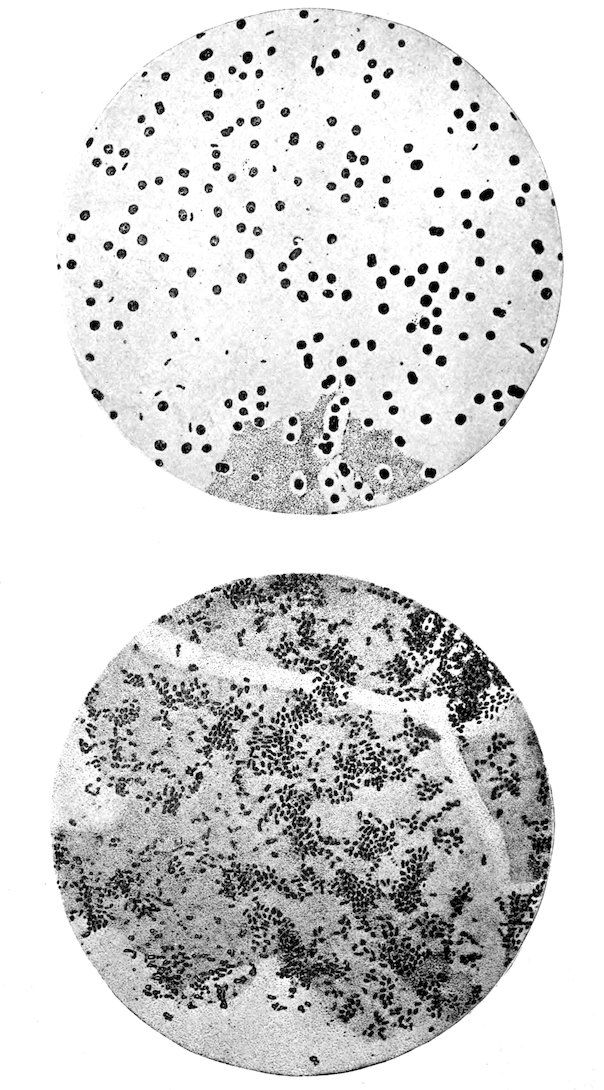
Figure 69. (Upper figure.) Nitrous ferment prepared by Winogradsky from soil from Cito. Figure 70. (Lower figure.) Nitric ferment prepared by Winogradsky from soil from Cito.
473The general conclusions of Winogradsky are:
1. Each soil possesses but one organism capable of oxidizing ammonia.
2. Soils from one locality have always the same kind of nitrifying ferment.
3. Soils from different and distant countries contain nitrifying organisms which differ from one another in some respects so much so that it may be necessary to distinguish a few species or even genera in these bodies.
437. Isolation of the Nitric Ferment in Soils.—The principle of the separation of this ferment as described by Winogradsky rests upon the fact that in culture solutions of a mineral nature free from ammonia the nitrous ferment will not grow, whereas if nitrite or nitrous acid be present the nitric ferment will grow.[289] In a few generations, therefore, the nitrous ferment will be entirely eliminated.
Solution employed:
Distilled water 1,000 grams.
Potassium phosphate 1 gram.
Magnesium sulfate 0.5 „
Calcium chlorid trace.
Potassium nitrite 0.22 gram.
To culture-flasks containing 100 cubic centimeters of the above mixture after sterilization about one-tenth gram of fresh soil is added. In favorable conditions the nitrous acid will disappear in about fifteen days.
Subcultures are made by seeding fresh portions of the sterilized solution with one or two cubic centimeters of the mother culture. The operation is continued until the nitrous ferment is eliminated.
The organisms in the deposit in the culture-flasks are then subjected to microscopic examination in the manner already described for the nitrous ferment; or proceed as follows:
438. Culture on Solid Media.—Take a liquid which has been employed in the culture of a nitrous ferment and evaporate to one third of its bulk. Gelatinize the residue by adding double its volume of the silicic acid solution prepared as already directed.
The jelly is placed in the glass vessels usually employed. The seeding may be done with a few drops of a culture-liquid 474containing the nitric ferment as obtained above. The first reaction will appear in from eight to ten days. In about forty-five days the nitrous acid in the jelly will have entirely disappeared. Two classes of colonies are noticed under the microscope. The first to appear are small colonies which never extend beneath the surface of the jelly. In cultures seeded with these colonies there is no oxidation of nitrous acid. The second class of colonies extends into the interior of the jelly. They are much larger than the first, of a yellowish-gray color and not spherical but rather lenticular in shape. Cultures seeded with these colonies will lose their nitrous acid in about ten days or two weeks.
The growth of these organisms in a liquid scarcely merit the name of cultures. The naked eye can usually distinguish no form of vegetation. The liquid remains clear, the surface is free from any film, no flocks are deposited. Colored and examined in the microscope the organisms found are so puny as to make doubtful their oxidizing power. There is an apparent contradiction between the powerful chemical action that these organisms can produce and their apparent deficiency in physical properties.
These organisms are best found by cultivating them in a very limpid solution. The bottoms of the culture boxes will be found covered with an extremely tenuous gelatinous deposit communicating to the glass a feeble grayish-blue tint. The culture bottle is inclined and the bottom scratched with a recently drawn-out capillary tube. The colonies rise in the tube together with a little of the liquid. The colonies are dried, mounted, and colored as already described and when examined with the microscope are found to be composed exclusively of masses of an organism of extreme minuteness.
The organism remains attached so firmly to the bottom of the culture bottle that it can be washed several times with pure water without danger of detachment and thus rendered more pure.
In old cultures which are sustained by new additions of nitrite an extremely transparent pellicle on the bottom of the flask can be distinguished. By shaking the liquid some fragments may be detached and made to float through the fluid. With a little 475care and patience these flocks can be captured, mounted, and colored. Since they show the nitric organism in its natural state their preparations are of the greatest interest.
The best preparations are made by coloring with malachite green and gentian violet and then coloring again hot with magenta. Afterwards the preparation is washed with warm water at 50°–60° which takes almost the whole of the color from the gelatinous matter. The cells are then clearly presented colored a reddish violet on a rose background. These organisms[290] are shown in figure 70.
The figure shows the cells united by a gelatinous membrane and grouped in small dense masses composed often of a single layer of organisms. The cells are generally elongated, rarely regularly spherical or oval. Their mean length does not exceed half a micromillimeter and their thickness is from two to three times less.
The difference in form of the nitrous and nitric ferments is very marked and leaves no doubt of the existence of these two forms which are as distinct as could be desired in microbic discrimination.
439. Dilution Method of Warington.—The method pursued by Warington in preparing pure cultures of the nitrifying ferment is based on the well-known principle of dilution which may be expressed as follows:[291] In a liquid containing bacterial ferments dilution may be practiced until a drop of the liquid may be taken which will contain no more than a single organism of any one kind. If now proper solutions be seeded with single drops of this solution, some of them may give colonies of pure cultures of any given organism. The solution to be nitrified employed by Warington had the following composition:
Water 1000 parts.
Ammonium carbonate 0.25 „
Ammonium chlorid 0.50 „
Potassium phosphate 0.04 „
Magnesium sulphate 0.02 „
Calcium sulphate 0.02 „
The ammonium chlorid is added to prevent the precipitation of magnesium and calcium phosphates. The solution is kept in wide-mouthed, stoppered bottles to prevent the loss of ammonium 476carbonate, the bottles being only half full. About 100 cubic centimeters are taken for each experiment. These bottles are sterilized and seeded with fresh soil in the ordinary way. They are then covered with paper caps and placed in a dark cupboard at a constant temperature of 22°.
Special Media.—A quantity of arable soil is exhausted of nitrates by washing with cold water under pressure. The soil is then boiled with water and filtered. The clear amber-colored solution obtained may be used instead of water in the above formula.
Solid Media.—(1) Ordinary ten per cent gelatin made with beef broth and peptone. (P)
(2) A ten per cent urine solution solidified with six per cent of gelatin. (U)
(3) A solution of one gram of asparagin, one-half gram sodium acetate, one-half gram potassium phosphate, two-tenths gram magnesium sulfate, two-tenths gram calcium sulfate, and one liter of water solidified with six per cent gelatin. (As)
Other solid media may also be employed for the purpose of favoring, as much as possible, the growth of the nitrifying organisms.
The first culture in the ammonium carbonate solution given above, is always made by seeding with a little unmanured arable soil. Subcultures are seeded from this mother culture by seeding new solutions with a few drops of the original. In all cases tried by Warington the subcultures produced only nitrous fermentation while the original cultures produced the nitric fermentation.
440. Microscopic Examination.—The microscopic examination of the organisms formed is conducted as follows:
The cover glasses for microscopic objects are placed at the bottom of the culture-flask, the cover glasses being previously sterilized. At the end of the nitrification the liquid is removed with a pipette and the flask containing the cover glasses dried at 35°. The cover glasses are then removed and stained. The microscopic appearance of the organisms obtained by the previous cultures showed masses of corpuscles usually of oval shape and having a length generally exceeding one micromillimeter. 477An immersion objective giving a magnification of 800 diameters is suitable for this work.
Other forms of organisms are also met, the whole series being characterized as follows:
(1) The corpuscles already mentioned. Larger ones are frequently rough in outline resembling masses of siliceous sea-sand. The smaller oval corpuscles are regular in form.
(2) Some very small circular organisms often appearing as mere points and staining much more plainly than the preceding.
(3) A few slender bacilli, staining faintly.
All the cultures obtained by the above method give abundant growth on gelatin.
441. Trials with the Dilution Method.—One part of the third subculture in the ammonium carbonate solution described above, is mixed with 500 parts of thoroughly boiled water and one drop from a sterilized capillary tube is added to each of five bottles containing the sterilized ammonium carbonate solution. In Warington’s experiments one of the five bottles was found to have nitrified after forty-one days. After ninety-one days two more were nitrified. Two bottles did not nitrify at all. All three solutions which nitrified gave growths on gelatin. The growths took place more speedily on gelatin U and As than on P.
The organisms obtained on gelatin were seeded in appropriate liquid media but no nitrification was obtained.
A subculture from solution No. 2 of the first dilution mentioned above, was diluted to one one-thousandth, one ten-thousandth, one one-hundred-thousandth, and one one-millionth. Each of these dilutions was used for seeding with five sterilized solutions of ammonium carbonate, using the method of seeding above described. At the end of 190 days not one of these solutions had nitrified.
Warington supposed that the cause of failure in the method just mentioned might be due to the alkalinity of the ammonium carbonate. While this solution could be seeded in the ordinary way with fresh earth it might be that the faint alkalinity which it presented might prevent it altogether from action when the nitrifying agent was reduced to a few organisms.
478He therefore changed the solution to one of the following composition:
Water 1,000 parts.
Ammonium chlorid 0.02 part.
Potassium phosphate 0.06 „
Magnesium sulfate 0.03 „
Calcium sulfate 0.03 „
The solution was divided in twenty stoppered bottles which were half filled. The bottles were divided into four series, A, B, C, D, each one consisting of five bottles, and these were respectively seeded with one drop from dilutions to one one-thousandth, one ten-thousandth, one one-hundred-thousandth, and one one-millionth of a second subculture of No. 3 in the first dilution series.
After 115 days, nitrification had occurred in ten of the bottles. The other ten did not nitrify at all. Each of the nitrifying solutions was spread on gelatin, P and U being employed. Growth took place far more easily on gelatin U than on gelatin P. Of the ten nitrified solutions there were three which gave no growth on gelatin U, either when spread on the surface or introduced into the substance of the jelly. There were therefore secured nitrifying solutions which did not contain organisms capable of growing on gelatin. The supposition is therefore fair that they were pure nitrifying organisms. These fresh, pure organisms had the faculty of converting ammonia into nitrous acid only and not into nitric acid.
With the organisms thus prepared a number of solutions of potassium nitrite containing phosphates and other mineral ingredients were seeded. In no case was any loss of nitrite found, which is proof that the solution contained no organisms capable of oxidizing nitrous acid. The organisms prepared as above, have the power of nitrifying organic substances containing nitrogenous bodies.
The organism isolated as described and examined under the microscope is seen to contain two forms. The first one is nearly spherical in shape, the corpuscles varying in size from mere points to a diameter of one micromillimeter. The form is very striking and easily stained. The second form is oval-shaped and attains a length distinctly exceeding one micromillimeter. 479Sometimes it is a regular oval and sometimes it is egg-shaped. This form is stained less easily than the preceding or spherical form.
442. Method of Staining.—The method of staining employed is as follows:
A drop of the culture-liquid is placed on a glass slide and mixed with the filtered stain by means of a wire. A cover glass is placed on the drop and allowed to stand for half an hour. It is then pressed down on the slide and the liquid which exudes wiped off and hollis glue run around the cover glass. In this way the organism is stained in its own culture-fluid and can be seen in its true form without any possibility of the destruction of its shape by drying. The plate is bright and clear though colored.
If the preparation is to be mounted in balsam a drop of the culture is dried in the center of a cover glass. It is then placed for some minutes in dilute acetic acid to remove matter which would cause turbidity. The cover glass with its contents is then washed, dried, and stained for some hours in methyl violet.
443. Classification of Nitrifying Organisms.—The names proposed by Winogradsky for the various organisms are the following:
For the general group of microbes transforming ammonia into nitric acid, Nitro-bacteria.
For the nitrous ferments of the Old World
Genus, Nitrosomonas:
Species, Nitrosomonas europaea.
Nitrosomonas javanensis.
For the nitrous microbes of the New World:
Genus, Nitrosococcus.
Species, not determined.
For the nitric ferment:
Genus, Nitrobacter.
444. Nitrification in Sterilized Soil.—The process of nitrification in sterilized soil, when seeded with pure cultures, is determined as follows:
Preparation of Sample.—The fresh sample of arable soil is freed from pebbles and vegetable débris and reduced to as fine a 480state of subdivision as is possible in the fresh state. It is placed in quantities of about 800 grams in large crystallizing dishes.
One dish is set aside for use in the natural state, and the other, hermetically closed, is placed in a sterilizing apparatus and subjected to the action of steam for two and a half hours. This treatment is repeated three times on as many successive days.
Seeding of Sample.—Each of the two dishes is moistened with fifty cubic centimeters of pure water containing 500 milligrams of ammonium sulfate. The sterilized portion is then seeded with a preparation of the pure nitrous ferment, produced as before described. The seed is prepared by filtering a few cubic centimeters of the nitrous culture liquid through asbestos. The asbestos is well washed and then thrown into a flask containing a few cubic centimeters of sterilized water and well shaken. The water carrying the filaments of asbestos is poured drop by drop on the surface of the soil in as many places as possible. The two dishes of soil are kept at an even temperature of 20° in a dark place. Winogradsky found that, treated in this way, the unsterilized soil produced only nitrates, while the sterilized portions produced only nitrites.[292]
445. Variation of the Determinations.—To vary the conditions of the experiment Winogradsky uses twelve flasks of the erlenmeyer shape, four having bottoms twelve centimeters in diameter, and eight of them five centimeters in diameter. In each of the four large flasks are placed 100 grams of fresh soil, and in each of the eight small flasks twenty-five grams. The eight small flasks are designated a, b, c, d, and a′, b′, c′, d′, and the four large flasks A, B, C, D.
The flasks a, b, c, d, and a′, b′, c′, d′, are placed in a stove at 30° for several days before use, while A, B, C, and D, are kept at 22°–23° for the same length of time. The soil in the small flasks is, therefore, somewhat drier than that in the large ones.
The flasks are treated as follows:
a, a′, A, contain the soil as prepared above for control.
b, b′, B, are sterilized at 135° and seeded with a drop of the pure nitrous culture.
c, c′, C, sterilized as above and seeded with a little of the unsterilized earth.
481d, d′, D, sterilized as above and seeded with pure nitrous and pure nitric cultures.
After sterilization there was added to the small flasks two cubic centimeters of a twenty per cent sterilized ammonium sulfate solution, and to the large ones six cubic centimeters. At the end of a month or six weeks the contents of the flasks are thrown on a filter and washed with cold water until a drop of the filtrate gives no blue color with diphenylamin. The respective quantities of nitrite and nitrate are then determined in the filtrates by the usual processes, which will be fully described further along.
446. Sterilization.—One of the chief requisites for success in the bacteriological investigation of soils is found in the thoroughness of the sterilizing processes. The value of cultures depends chiefly on the care with which the introduction of foreign germs is prevented. In the following description a mere outline of the method of sterilization is presented, while those who wish to study more carefully the details of the process are referred to the standard works on bacteriology.
447. Sterilization of the Hands.—It is important that the hands of the operator handling apparatus and materials for bacteriological work should be sterilized. The sterilization may be accomplished in the following way:
The nails should be cut short and thoroughly cleaned with soap and brush. The hands are thoroughly washed in hot water with soap. After washing in hot water the hands should be washed in alcohol and ether. They are then dipped in the sterilizing solution.
This liquid may consist of a three per cent solution of carbolic acid, which is the one most commonly employed. A solution of corrosive sublimate, however, is perhaps the best disinfectant. It should contain from one to two parts of the crystallized salt to 1,000 parts of water. It has lately been advised to use the sublimate in an acid solution. Acetic acid or citric acid may be employed, but hydrochloric acid is recommended as the best, in a preparation of one-half part per 1,000. For stronger solutions of sublimate containing more than a half per cent, equal quantities of common salt should be added. The solution should be made with sterilized water.
482After dipping the hands in the sterilizing solution they should be dried with a napkin taken directly from a sterilizing oven, where it has been kept for some time at the temperature of boiling water. Where only ordinary work in bacteriology is contemplated this sterilization of the hands is not necessary. It is practiced chiefly in antiseptic surgery.
448. Sterilizing Apparatus.—With platinum instruments the most effective and easiest way for sterilizing is to hold them in the flame of a bunsen until they are red hot. Steel and copper instruments can not be treated in this way without injury. They are best sterilized by submitting them to dry heat in a drying oven at a temperature of 150°–160° for two hours. Glass and porcelain apparatus can be sterilized best in the same way.
All apparatus and materials employed should be used in a space as free as possible from dust, so that any germs which might be carried in the dust can be excluded from the apparatus in transferring it from one place to another.
449. Methods of Applying Heat.—Sterilization by means of heat may take place in several ways.
First. Submitting the Materials to Dry Heat Without Pressure.—The temperature in sterilization of this kind may vary from the temperature of boiling water at sea-level to 160° obtained by an oil-bath or by an air-oven.
Second. Sterilization in a Liquid Under Pressure.—This form of sterilization may be effected by sealing the liquid in a strong vessel and submitting it to the required temperature. If the temperature required be greater than that of boiling water the vessel can be immersed in a solution of some mineral salt which will raise the boiling-point.
Third. Sterilization in Steam Under Pressure.—This method of sterilization consists in placing the body in a proper receptacle in vessels to which the steam can have access and then admitting steam from a boiler at any required pressure. In the case of small apparatus, such as the autoclave, the steam can be generated in the apparatus itself. The variety of apparatus used in the above method of sterilization is very great, but all the forms of apparatus employed depend upon the principles indicated.
483450. The Sterilizing Oven.—The apparatus for sterilization by means of hot, dry air usually consists of a double-walled vessel made of sheet-iron, usually with a copper bottom. The apparatus is shown in Fig. 71.
The temperature is controlled by means of a thermometer, T, and the gas-regulator, R. This is one of the ordinary gas-regulators by means of which the amount of gas supplied to the lamp is increased if the temperature should fall, and diminished if it should rise above the required degree. The best form of the sterilizing ovens is provided with a means for circulating the hot air so that the temperature may be made uniform throughout the mass. This can be accomplished by introducing a mechanical stirrer, or by the movement of the air itself.
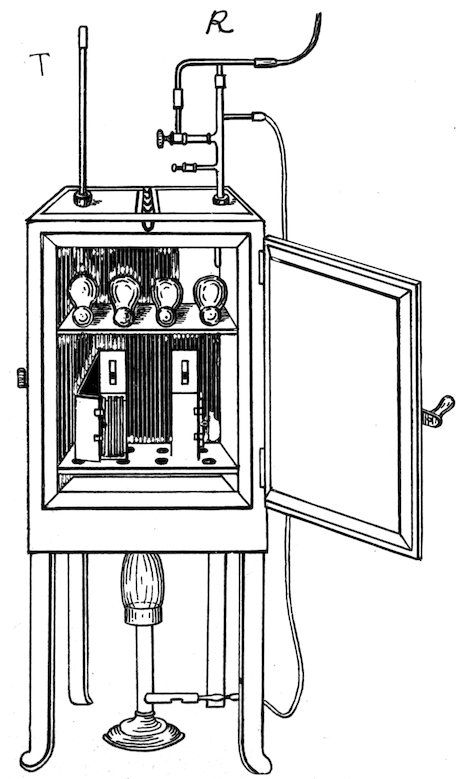
Figure 71. Sterilizing Oven.
Between the walls of the vessel may be placed water, provided the temperature of sterilization be that of boiling water. If it should require a higher temperature than boiling water, a solution 484of salt can be added until the required temperature is reached, or the space between the two walls may be left vacant and hot air made to circulate around the oven.
The exterior of the oven, except at the bottom where the lamp strikes the copper surface, should be protected by thick layers of asbestos or other non-conducting material. To avoid danger of flying filaments, this covering should be coated with some smooth paint which will leave an even surface not easily abraded.
451. Sterilization with Steam at High Pressure.—The apparatus used for this is commonly called an autoclave and is shown in Fig. 72.
The top is movable and held in place by the clamp, a, which is fixed by the screw worked by the lever, b. The vessel itself is double-jacketed and the pressure is obtained from water in the vessel heated by means of the lamp, c. The actual steam pressure is indicated by the index d. The safety-valve, e, allows any excess of steam to escape above the amount required for the maintenance of the pressure. This, however, is best regulated by the lamp. The outer jacket permits the heat from the lamp to circulate around the inner pressure vessel, and the holes near the top, oo, are for the escape of the heated gases. Enough water is placed in the bottom of the inner pressure vessel to supply all the aqueous vapor necessary to produce the required pressure and still leave some water in excess.
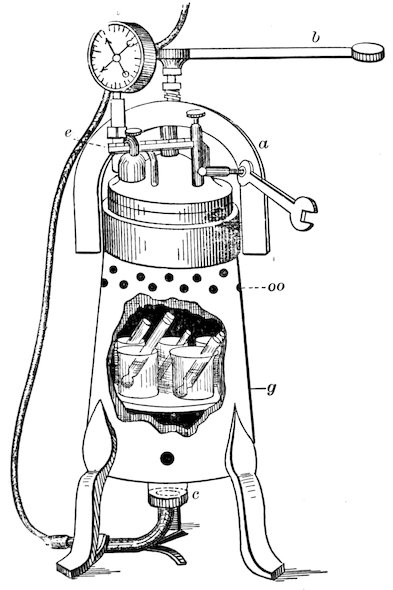
Figure 72. Autoclave Sterilizer.
485The materials to be sterilized are held on the shelves of the stand and the vessels may be of various kinds according to the nature of the material to be sterilized. The vessels containing the material being covered, the steam does not come in actual contact with it. At the end of the operation the safety-valve must not be opened to allow the escape of the steam, otherwise the remaining water would be rapidly converted into vapor and would be projected over the materials on the shelves. The lamp should be extinguished and the apparatus allowed to cool. The autoclave is not only useful for sterilizing purposes but can be made of general use in the laboratory where heat under pressure, as in the estimation of starch, etc., is required.
These two forms of apparatus are sufficient to illustrate the general principles of sterilization by hot air and steam. There are, however, many variations of these forms designed for special use in certain kinds of work. For full descriptions of these, reference is made to catalogues of bacteriological apparatus.
452. Arnold’s Sterilizing Apparatus.—A very simple and cheap steam sterilizer has been devised by Arnold.
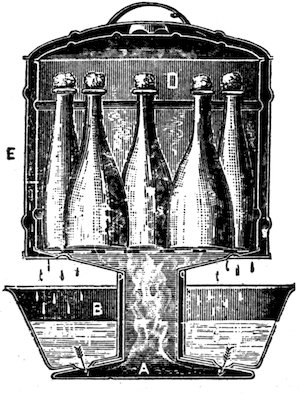
Figure 73. Arnold’s Sterilizer.
Water is poured into the pan or reservoir, B, Fig. 73, whence it passes through three small apertures into the shallow copper vessel, A. It is there converted into steam by being heated with any convenient lamp, and rises through the funnel in the center to the sterilizing chamber. Here it accumulates under moderate pressure at a temperature of 100°. The excess of steam escapes about the cover, becomes imprisoned under the hood, E, and serves to form a steam-jacket between the wall of the sterilizing chamber and the hood. As the steam is forced down from above and meets the air it condenses and drips back into the reservoir. Such an apparatus as this is better suited 486to commercial purposes, as the sterilizing of milk, than for scientific uses.
453. Thermostats for Culture Apparatus.—It is important in the culture of micro-organisms that the temperature should be kept constant during the entire time of growth. Inasmuch as some operations continue for as much as three months it is necessary to have special forms of apparatus by means of which a given temperature, during the time specified, can be maintained. This is secured by means of an oven with an automatic temperature regulator, practically built on the principle of the hot air sterilizing oven already described.
The essential principles of construction are, however, that the regulator for the temperature should be delicate and that the non-conducting medium surrounding the apparatus should be as perfect as possible, so that the variations in temperature from changes in the exterior temperature, are reduced to a minimum. This delicacy is secured by introducing a drop of chloroform-ether into a confined space over the mercury of the regulating apparatus. The doors of the chamber are double, the interior one being of glass so that the exterior door can be opened for inspection of the progress of the bacterial growth without materially interfering with the interior temperature. A convenient form is shown in Fig. 74.
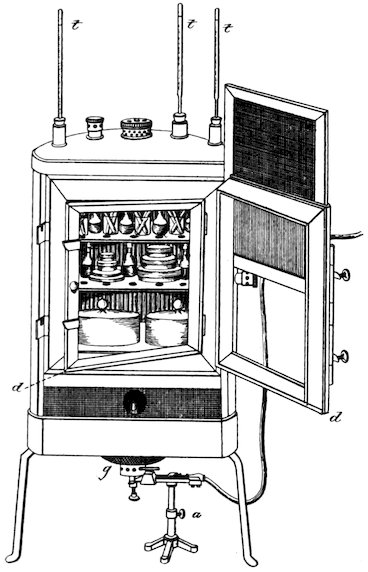
Figure 74. Lautenschläger’s Thermostat.
The apparatus figured, is oval in shape, although circular or other forms are equally as effective. The arrangement of the 487lamp, a, thermometers, t t t, and gas-regulator, g, and the double doors, d d, is shown in the engraving and does not require further description.
The usual temperatures for cultures range from 22° to 35°, and the apparatus once set at any temperature will remain fixed with extremely minute variations for an indefinite time. The apparatus possesses a heat zone which, by the arrangement of the regulator, is kept absolutely constant. The space between the walls of the apparatus being filled with water, the temperature is maintained even in every part. The apparatus, as constructed, is independent not only of the surrounding temperature within ordinary variations, but also of the pressure of the barometer. Three thermometers are employed to determine the temperature of the heating zone, the water space and the inner space. The arrangement of the gas-regulator is of an especial kind, as mentioned above, by means of which the consumption of gas is reduced to a minimum. This apparatus can be regulated to suit the character of the work.
454. Microscopic Apparatus Required.—Any good microscope, capable of accurate observation, of high power, may be used for the bacteriological observations necessary to soil analysis.
Preference should be given to the patterns adapted to receive any additional accessories which may be subsequently required for advanced work. The stage, in addition to being fitted with a sliding bar, should have a large circular or horseshoe opening to facilitate focusing operations. A mechanical stage is a desirable acquisition if really well made, but a plain stage is preferable for many purposes. A rackwork, centering sub-stage is essential for advanced work, and in the absence of the more complete form, there should at least be a fitting beneath the stage to take the diaphragm and condenser. An iris diaphragm will be found more useful than any other kind in practice, since the size of the opening can be increased very gradually at will.
One of the best lamps is known as the paraffin lamp and is fitted with a half-inch wick. This will give even more light than is actually required, and a steady flame, perfectly under control, may be obtained. For the minute details to be observed in high-grade microscopic work, such as is required in the bacteriological 488examination of soils, reference must be had to the standard works on bacteriology and microscopy.
455. General Conclusions.—The nitrogenous food of plants is provided in several ways; viz., (1) By the nitrogen brought to soil in rain and snow. This nitrogen is chiefly in the form of ammonia and nitric acid. The nitrogen gas in solution in rain water has no significance as a plant food. (2) By the action of certain anaerobic organisms herding in the rootlets of leguminous plants, free nitrogen may be oxidized and put into form for assimilation. (3) By the action of certain organisms on nitrogenous compounds pre-existing in the soil, ammonia, nitrous acid, and finally, nitric acid, are produced. It is believed that the plant organism, unaided by the activity of a micro-organism, is unable to assimilate nitrogen unless it be fully oxidized to nitric acid. (4) There exist micro-organisms capable of acting directly on free nitrogen independent of other plant growth, but the significance of this possible source of plant food is, at the present time, unknown. (5) The micro-organisms of importance to agriculture may be isolated and developed to the exclusion of other organisms of a similar character. This isolation is best accomplished in culture-media consisting essentially of a mineral gelatin to which is added only pure carbohydrates and the necessary mineral nourishment. (6) The nitrifying ferments consist probably of several species, of different geographic distribution. Different types of soils probably have nitrifying organisms of different properties. This is illustrated by the fact that nitrification is accomplished in dry alkaline soils under conditions in which the ordinary nitrifying organisms would fail to develop. (7) The study of typical soils in respect of the kind, activity, and vigor of their nitrifying organisms has become as important a factor in soil analysis as the usual determination of physical and chemical composition.
DETERMINATION OF NITRIC AND NITROUS ACIDS IN SOILS.
456. Classification of Methods.—The minute quantities in which highly oxidized nitrogen exists in soils render the operations of its quantitative estimation extremely delicate. On the 489other hand, the easy solubility of these forms of combination and the absence of absorptive powers therefor, in the soil, render the separation of them from the soil a matter of great ease. It is possible, therefore, to secure all the nitrates and nitrites present in a large quantity of earth in a solution which can be concentrated under proper precautions to a volume convenient for manipulation. The method of this extraction is the same for all the processes of determination. The methods of analysis suited to soil extracts, as a rule, may also be used in the determination of the same compounds in rain, drainage, and sewage waters, and for the qualitative and quantitative control of the progress of nitrification. The various processes employed may be classified as follows:
1. The conversion of the nitrogen into the gaseous state and the determination of its volume directly. This is accomplished by combustion with copper oxid and metallic copper.
2. The conversion of the nitrogen into nitric oxid and the volumetric determination thereof. The decomposition of a nitrate with ferrous chlorid in the presence of free hydrochloric acid is an instance of this type of methods.
3. The oxidation of colored organic solutions and the consequent disappearance of the characteristic color, or its change into a different tint. The indigo and indigotin processes are examples of this method.
4. The production of color, in a colorless or practically colorless solution, by the treatment thereof with the nitrate in presence of an acid which decomposes it with the liberation of oxidizing compounds. The depth of color produced is compared with that formed by a known quantity of a pure nitrate solution until the two colorations are alike. The methods depending on the use of carbazol or acid phenol sulfate illustrate this class of reactions.
5. The conversion of the nitrogen into ammonia by moist combustion with sulfuric acid in the presence of certain organic compounds, e. g., salicylic acid, and the collection of the ammonia in standard acid, the excess of which, is determined by titration.
6. The reduction of nitrates to ammonia by nascent hydrogen and the recovery of the ammonia produced by distillation and collection in standard acid.
4907. The reduction of nitrates by electrolytic action and the collection of the ammonia as above.
8. The decomposition of nitrates with the quantitative evolution of a different element, and the direct or indirect measurement of the evolved substance. The quantitative evolution of chlorin on treating a nitrate with hydrochloric acid, the collection of the chlorin in potassium iodid, and the determination of the iodin set free, form a process belonging here.
457. Relative Merit of Methods.—The processes mentioned in the classifications embraced under numbers (1) and (5) of the preceding schedule are sufficiently described in the paragraphs devoted thereto, under soil and fertilizers. In practice at the present time it is rare to determine the nitrogen in nitrates by the copper oxid method. The more rapid and equally exact processes of colorimetric comparison or reduction by nascent hydrogen are in all respects to be preferred.
The indigo methods among the colorimetric processes are not so much in use now as those which depend on the development of a color. Lawes and Gilbert considered them far inferior to the Schloesing method. The developed color methods are especially delicate and are to be preferred in all cases where the detection of the merest traces of nitrates is desired. Where nitrates are present in considerable quantities the reduction method with nascent hydrogen is to be preferred over all others. In all these cases the judgment of the analyst must be exercised. The particular method to be employed in any given case can not be determined save by the intelligent discrimination of the operator.
458. The Extraction of Nitric Acid from the Soil.—The easy solubility of nitric acid and of nitrates in water is taken advantage of in the separation of these bodies from the soil. A convenient quantity, usually about 1,000 grams of the fine soil, is taken for the extraction. Instead of freeing the soil entirely from water, it is better to determine the amount of water in the air-dried or prepared sample, and base the calculation on 1,000 grams of the water-free soil.
All samples of soil, when taken for the purpose of examining for nitrates, should be rapidly dried to prevent the process of 491nitrification from continuing after the sample is taken. For this purpose the soil should be placed in a thin layer in a warm place, 50°–60°, until air-dried. It still contains in this case a little moisture but not enough to permit nitrification to go on.
One thousand grams of soil prepared as above are treated with 2,000 cubic centimeters of distilled water, free of nitric acid, and allowed to stand for forty-eight hours with frequent shaking. One thousand cubic centimeters of the extract are then filtered, corresponding to 500 grams of the dry soil. A small quantity of pure sodium carbonate should be added to the filtrate which is then evaporated on a water-bath to a volume of about 100 cubic centimeters. Should a precipitate be formed during evaporation it should be separated by filtration, the filter washed thoroughly, and the filtrate again evaporated to a volume of 100 cubic centimeters.
In taking a soil for the determination of nitrates, it is well to extend the sampling to a considerable depth. If the sample be taken only to the depth of nine inches, it should be in dry weather when the nitrates are near the surface.
The temperature at which a soil is dried has also an influence on the quality of nitric nitrogen remaining after desiccation.
If a wet soil be dried at 100°, the nitrates present will suffer partial decomposition. This is probably due to deoxidation by organic matter present. On the other hand, ordinary air-drying affords opportunity for continued nitrification, thus increasing the residuum of oxidized nitrogen. The above method is essentially that followed by Warington at Rothamstead.
The method of drying practiced at Rothamstead, in order to secure results as nearly accurate as possible is the following:[293]
The soil is broken up directly after it is taken from the field, and spread on trays in layers one inch deep. The trays are then placed in a room at 55°. The drying is completed in twenty-four hours. After drying, stones and roots are removed, and the soil is finely powdered and placed in bottles.
For extracting the nitrates, a funnel is prepared by cutting off the bottom from a bottle four and a half inches in diameter. A nicely fitting disk of copper gauze is placed in the bottom of this funnel, and this is covered with two filter papers, the upper one 492having a slightly greater diameter than the lower. The paper is first moistened, and then from 200 to 500 grams of the dry powdered soil introduced. The funnel is connected with the receiving flask of a filter pump, and pure water poured on the soil until it is thoroughly saturated. The water is then added in small quantities. When the filtrate amounts to 100 cubic centimeters the process may be discontinued, since all the nitrates in the soil will be found in this part of the filtrate.
The extract obtained above is evaporated to convenient bulk for the determination of nitric nitrogen.
THE NITRIC OXID PROCESS.
459. Method of Schloesing.—The processes for estimating nitrogen by combustion with copper oxid and by moist combustion with sulfuric acid have both been used for the determination of the quantity of nitrogen existing in a highly oxidized state. These processes will be fully discussed under the head of fertilizers. In the case of soil extracts, drainage waters, etc., it will be sufficient to discuss, for the present, only those processes adapted especially to a quick and accurate estimation of oxidized nitrogen.
The principle of the method of Schloesing depends on the decomposition of nitrates in the presence of a ferrous salt and a strong mineral acid.[294] The nitrogen in the process appears as nitric oxid, the volume of which may be directly measured, or it may be converted into nitric acid and titrated by an alkali.
The typical reactions which take place are represented in the following equation:
6FeCl₂ + 2KNO₃ + 8HCl = 3Fe₂Cl₆ + 2KCl + 4H₂O + 2NO.
460. Schloesing’s Modified Method.—The Schloesing method as now practiced by the French chemists is conducted in the apparatus shown in Fig. 75.[295] The carbon dioxid is generated by the action of the hydrochloric acid in F on the fragments of marble in A. After passing the wash-bottle the gas enters the small tubulated retort, C, which contains the nitrate in solution. For ordinary soils 100 grams are placed in an extraction flask, plugged with cotton, and a layer of the same material is placed over the soil for the purpose of securing an even distribution of the extracting liquid. This liquid is 493distilled water containing in each liter one gram of calcium chlorid. The purpose of using the calcium chlorid is to prevent the soil from becoming compacted which would render the extraction of the nitrate difficult. The extracting liquid is allowed to fall drop by drop from a mariotte bottle until the filtrate amounts to 500 cubic centimeters. This volume is concentrated on a sand-bath until it is reduced to ten or fifteen cubic centimeters when it is transferred to a flat-bottomed dish and the evaporation finished over steam, care being taken not to allow the temperature to exceed 100°.
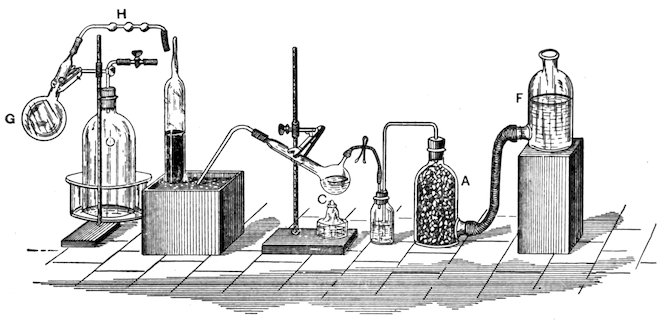
Figure 75. Schloesing’s Apparatus for Nitric Acid.
Another and more rapid method for dissolving the nitrate, may also be practiced. In a flask holding about one liter, place 220 grams of the soil and 660 cubic centimeters of distilled water and shake vigorously, or enough water to make 660 cubic centimeters together with the moisture remaining in the air-dried sample taken. All the nitrates pass into solution. Throw the contents of the flask into a filter and take 600 cubic centimeters of the filtrate which will contain all the nitrates in 200 grams of the sample taken. This filtrate is evaporated as described above.
In the flat dish containing the dried nitrates, pour three or four cubic centimeters of ferrous chlorid solution and stir with a small glass rod until complete solution of the nitrate takes place. By means of a small funnel the solution is poured into C, and the capsule and funnel are well rinsed with two cubic centimeters of hydrochloric acid. The washing is repeated three times 494as above described, and once with one cubic centimeter of water, which is added cautiously so as to form a layer over the surface of the heavier liquid. The tubulated flask is then connected with the carbon dioxid apparatus, previously freed from air, and the gas allowed to flow evenly until the whole of the apparatus is completely air-free. The other details of the method are essentially the same as those adopted by the Commission of French Agricultural Chemists which will be given below.
461. The French Agricultural Method.—The Schloesing method as practiced by the French agricultural chemists is very slightly different from the procedure just described.[296] The process with soils is carried on as follows:
Five hundred grams of the soil are taken and introduced into a flask of about two liters capacity and shaken thoroughly with a liter of distilled water. The whole of the nitrates of the soil is thus passed into solution. The solution is filtered and 400 cubic centimeters of the filtrate are taken, which correspond to 200 grams of the soil. This liquid is evaporated in a flask, adding a fragment of paraffin to prevent foaming, until its volume is reduced to fifteen or twenty cubic centimeters. It is afterwards transferred through a filter into a capsule with a flat bottom in which the evaporation is finished on a steam-bath, taking care that the temperature does not exceed 100°. An important precaution is, not to allow the contact of the water with the soil to be too prolonged, to avoid the reduction of the nitrates which could take place under the influence of the denitrifying organisms which are developed with so great a rapidity in moist earth. The apparatus in which the transformation of the nitrates into nitric oxid takes place is essentially that already described (Fig. 75). The carbon dioxid generator is connected by means of a rubber tube and a small wash-bottle to the small retort in which the reaction takes place, and from which the exit tube leads to a mercury trough. The gas which is disengaged is received under a jar drawn out to a fine point in its upper part, which carries about fifteen cubic centimeters of potash solution containing two parts of water to one of potash.
The operation is conducted as follows:
Into the small capsule which contains the dried matter, three 495or four cubic centimeters of ferrous chlorid are poured. By means of a stirring rod the residue sticking to the sides of the capsule is detached with care and all the matter is thus collected in the bottom. By means of a small funnel the contents of the capsule are introduced into the retort. About two cubic centimeters of hydrochloric acid are used for washing out the materials and this acid is also introduced into the retort. The washing with hydrochloric acid is repeated three or four times, and finally the apparatus is washed with one cubic centimeter of water, which is also poured in by the small funnel with great care, so that this water may form a layer over the surface of the liquid. The apparatus is now connected and filled completely with carbon dioxid. Since it is necessary that this gas should be completely free of air, the flask, which generates it, is first filled with the acidulated water from the acid flask, and the air is thus almost totally displaced by the liquid. The evolution of carbon dioxid gas which follows, completely frees the apparatus from air. When this is accomplished the retort is connected with the rest of the apparatus and the gas allowed to pass for about two minutes until the air is completely driven out of all the connections. The current is arrested for a moment by pinching the rubber tube which conducts the carbon dioxid into the retort, and the vessel which is to receive the gas is then placed over the delivery-tube, this vessel being filled with mercury and a strong solution of potash. The communication between the retort and the carbon dioxid flask is broken and the flask is heated slightly by means of a small lamp. The first bubbles of gas evolved should be entirely absorbed by the potash. This will be an indication of the complete absence of the air. When the liquid is in a state of ebullition the nitrogen dioxid is set free. The boiling is regulated in such a way that the evolution is regular and the liquid of the retort may not, by a too violent boiling, pass into the receiver. The boiling is continued until the larger part of the liquid is distilled and only three or four cubic centimeters remain in the retort. At this time a few bubbles of carbon dioxid are allowed to flow through in order to cause to pass into the receiver the last traces of nitric oxid. The gas received is left for some minutes in contact with the potash.
496Afterward in a small flask, G, the neck of which is drawn out to a fine point, and carrying a bulb-tube, H, and a piece of rubber tubing, there are boiled twenty-five or thirty cubic centimeters of water for five or six minutes in order to drive all the air out of the flask, and while the boiling is continued the rubber tubing is fastened to the drawn-out part of the jar containing the nitric oxid. Within the rubber tubing the drawn-out point is broken and the vapor of water is forced into the jar and drives before it the solution of potash which has filled the capillary part of the drawn-out tube. As soon as the point is broken, the boiling of the flask is stopped and by its cooling the nitric oxid passes into it. It is necessary to press the rubber tubing with the fingers in order that the passage of the gas into the flask be not too rapid. As the solution of potash rises in the bell-jar which contains the nitric oxid near to the point where the rubber tubing covers its drawn-out portion, the fingers are removed and a clamp put in their place. There still remains a little nitric oxid in the flask and to drive this out it is necessary to introduce five or six cubic centimeters of pure hydrogen, which are allowed to pass over into the receiving flask, by releasing the clamp in the same way as the nitric oxid. The hydrogen being introduced in successive portions, finally carries all the nitric oxid into the flask without allowing any of the potash to enter.