Volume 1 / Part 1 — PART FIRST. INTRODUCTION.
Reading edition
1. Definitions.—The term soil, in its broadest sense, is used to designate that portion of the surface of the earth which has resulted from the disintegration of rocks and the decay of plants and animals, and which is suited, under proper conditions of moisture and temperature, to the growth of plants. It consists, therefore, chiefly of mineral substances, together with some products of organic life, and of certain living organisms whose activity may influence vegetable growth either favorably or otherwise. The soil also holds varying quantities of gaseous matter and of water, which are important factors in its functions.
2. Origin Of Soil.—Agriculturally considered, the soil proper is the older and more thoroughly disintegrated superficial layer of the earth, which has been longest exposed to weathering and the influences of organic life. It is usually from six to twelve inches, but occasionally several feet in depth. The subsoil, which lies directly under this, is not as a rule so thoroughly disintegrated, since it is protected in a measure by the overlying soil. It usually contains less organic matter than the soil. There is a freer circulation of air in the soil than in the subsoil, and the metallic elements usually exist therein as higher oxids. There is usually a notable difference in color between the soil and subsoil, and frequently a very sharp color line separating the two.
Geologically considered, the soil is that portion of the earth’s crust which has been more or less thoroughly disintegrated by weathering and other forces from the original 2rock formations, or from the sedimentary rocks, or from the unconsolidated sedimentary material. The soil has, therefore, the same essential constitution as the general mass of the earth, except that this débris has been subjected to the solvent action of water and the influence of vegetable growth.
Preliminary to the proper understanding of the methods of the analysis of soils, there should be some definite knowledge concerning the composition of the earth’s crust, so that the analyst may understand more thoroughly the origin and nature of the material he has to deal with, and thereby be better equipped for his work.
3. The Chemical Elements Present in the Soil.—The chemical elements present in the soil are naturally some or all of those which were present in the original rocks. For analytical purposes relating to agriculture, it is not necessary to take into account the rare elements which may occur in the soil, but only those need be considered which are present in some quantity and which enter as an important factor into plant growth. Of the whole number of chemical elements less than twenty are of any importance in soil analysis. These elements may be grouped into two classes, the non-metals, and the metals as follows:
Non-metals. Metals.
Oxygen, Aluminum,
Silicon, Calcium,
Carbon, Magnesium,
Sulfur, Potassium,
Hydrogen, Sodium,
Chlorin, Iron,
Phosphorus, Manganese,
Nitrogen, Barium.
Fluorin,
Boron.
4. Atomic Masses.—For the purpose of facilitating the calculation of results the latest revised table of atomic masses is given below. All the known elements are included in this table for the convenience of analysts who may have to study some of the rarer elements in the course of their work.
This table represents the latest and most trustworthy results reduced to a uniform basis of comparison with oxygen = 16 as starting point of the system. No decimal places representing large uncertainties are used. When values vary, with equal probability on both sides, so far as our present knowledge goes, as in the case of cadmium (111.8 and 112.2), the mean value is given in the table.
3
Table of Atomic Masses of the Elements.
Revised by F. W. Clarke, Chief Chemist of the United States Geological Survey, to January 1st, 1894.
Name. Symbol. Atomic mass.
Aluminum Al 27
Antimony Sb 120
Arsenic As 75
Barium Ba 137.43
Bismuth Bi 208.9
Boron B 11
Bromin Br 79.95
Cadmium Cd 112
Cesium Cs 132.9
Calcium Ca 40
Carbon C 12
Cerium Ce 140.2
Chlorin Cl 35.45
Chromium Cr 52.1
Cobalt Co 59
Columbium[A] Cb[Nb] 94
Copper Cu 63.6
Erbium Er 166.3
Fluorin F 19
Gadolinium Gd 156.1
Gallium Ga 69
Germanium Ge 72.3
Glucinum[B] Gl[Be] 9
Gold Au 197.3
Hydrogen H 1.008
Indium In 113.7
Iodin I 126.85
Iridium Ir 193.1
Iron Fe 56
Lanthanum La 138.2
Lead Pb 206.95
Lithium Li 7.02
Magnesium Mg 24.3
Manganese Mn 55
Mercury Hg 200
Molybdenum Mo 96
Neodymium Nd 140.5
Nickel Ni 58.7
Nitrogen N 14.03
Osmium Os 190.8
Oxygen[C] O 16
Palladium Pd 106.6
Phosphorus P 31
Platinum Pt 195
Potassium K 39.11
Praseodymium Pr 143.5
Rhodium Rh 103
Rubidium Rb 85.5
Ruthenium Ru 101.6
Samarium Sm 150
Scandium Sc 44
Selenium Se 79
Silicon Si 28.4
Silver Ag 107.92
Sodium Na 23.05
Strontium Sr 87.6
Sulfur S 32.06
Tantalum Ta 182.6
Tellurium Te 125
Terbium Tb 160.0
Thallium Tl 204.18
Thorium Th 232.6
Thulium Tu 170.7
Tin Sn 119
Titanium Ti 48
Tungsten W 184
Uranium U 239.6
Vanadium V 51.4
Ytterbium Yb 173
Yttrium Yt 89.1
Zinc Zn 65.3
Zirconium Zr 90.6
PROPERTIES OF THE ELEMENTS.
Following is a brief description of the most important elements occurring in the earth’s crust in respect of their relations to agriculture.
5. Oxygen exists in the free gaseous state in the atmosphere of which it constitutes about one-fifth by bulk, whilst in combination with other elements it forms nearly half the weight of the solid earth, and eight-ninths by weight of water. It enters into combination with all the other elements, except fluorin, forming what are known as oxids, and with many of the elements it unites in several proportions, forming oxids of different composition. Combined with silicon, carbon, sulfur, and phosphorus, it forms an essential part of the silicates, carbonates, 4sulfates, and phosphates, most of which are very abundant and all of which are very widely distributed in the earth’s crust. In this form it is exceedingly stable and is rarely set free. With the exception of the oxids of silicon these oxids seldom occur uncombined with the metals as constituents of rocks or soils. The oxids of iron very commonly occur as such in rocks and soils, and play a very important part in organic life. The several oxids of iron very frequently determine the color of soils; as the iron in a soil is more or less oxidized, or as it is exposed more or less to access of air, the color of the soil changes. These oxids of iron also play an important part in the absorption capacities of soils for moisture and other physical conditions of soils, and also in the oxidation of organic matters in the soil. Many organic substances, and even the roots of growing plants when deprived of free access of air, can readily secure oxygen from the iron oxid, thus reducing the iron to a lower form of oxidation, the oxygen being used for the oxidation of the organic matter or for the needs of the growing plant; while the lower oxid of iron can more readily take up oxygen of the air and again be converted into a higher oxid, ready again to give up a part of its oxygen and thus serve as a carrier.
6. Silicon never occurs in the free state, but combined with oxygen it forms silica, which constitutes more than one-half of the earth’s crust. The oxid of silicon occurs in the very common form of quartz, and likewise, as silicate of alumina, lime or magnesia. Silicon forms an essential part of many minerals, such as the feldspars, amphiboles, pyroxenes, and the micas, besides being an essential ingredient of many other minerals. Silica is relatively very slightly affected by the ordinary forces concerned in the decay of rocks, and even after the crystals of feldspars, micas, and other common minerals occurring in rocks have been disintegrated the silica remains as hard grains of sand, forming the bulk of most soils. By far the larger part of silicon in soils is in the form of grains of quartz or silica. This form, however, is probably chemically inert in regard to plant growth, but it plays a very important part in the physical structure of soils and in the physical relation of soils to plant growth.
57. Carbon as an elementary substance occurs as diamond and graphite and in an impure form as anthracite and bituminous coals. In peats and mucks carbon is the chief constituent. This substance is also contained in the organic matters of the soil known as humus, and the relation of the carbon to nitrogen often throws important light upon the amount and character of the nitrogenous matters. In composition with oxygen it forms the chief food of growing plants, the carbon of the carbon dioxid of the air being elaborated into the tissue of the plants and the oxygen returned to the atmosphere. The content of carbon dioxid in the air is from three to five parts per thousand by volume. As carbonates this element helps to form some of the most important ingredients of the earth’s crust, namely, limestones, marbles, dolomites, etc., and in an organic form it is found in the shells of the crustaceans. The calcareous matter of the soil, that is, the carbonates of the earths therein found, are of the highest importance from an agricultural point of view. The carbonates in the soil not only favor the process of converting nitrogenous bodies into forms suitable for plant food, but also exert a most potent influence on the physical state of the soil and its capacity for holding water and permitting its flow to and from the rootlets of the plant.
8. Sulfur occurs in nature in both the free and combined state. In the free state it is found in volcanic regions such as Sicily, Iceland, and the western United States. Its usual form of occurrence is in combination with the metals to form sulfids, or with oxygen and a metal to form sulfates. Sulfur and iron combine to form iron pyrites or iron disulfid (FeS₂), while sulfur, oxygen, and calcium are found in gypsum, an important fertilizing compound.
Sulfur plays an important part in the nourishment of plants, being found in them both as sulfuric acid and in organic compounds. Methods for estimating the sulfur in both forms will be found in another part of this manual.
9. Hydrogen is a colorless, invisible gas, without taste or smell. It occurs free in small proportions in certain volcanic gases, and in natural gas, but its most common form is 6in combination with oxygen as water (H₂O), of which it forms 11.13 per cent by weight. It also occurs in combination with carbon to form the hydrocarbons, such as the mineral oils (petroleum, etc.) and gases. Hydrogen is of no importance to agriculture in a free state, but water is the most important of all plant foods.
10. Chlorin occurs free in nature only in limited amounts and in volcanic vents. Its most common form is in combination with hydrogen, forming hydrochloric acid, or with the metals to form chlorids. It combines with sodium to form sodium chlorid or common salt (NaCl), which is the most abundant mineral ingredient in sea water and which can usually be detected in rain and ordinary terrestrial waters. In this form, also, it exists as extensive beds of rock salt, which is mined for commercial purposes.
Chlorin is found uniformly in plants and must be regarded as an essential constituent thereof. Common salt applied to a soil modifies its power of attracting and holding water.
11. Phosphorus never occurs in nature in a free state but exists in combination in greater or less quantities in all soils. Its combinations are also found in large deposits of minerals known as phosphorite and apatite and as so-called pebble deposit and phosphate rock. Phosphorus in some sort of combination is one of the most essential elements in animal and plant food. In animals its compounds form almost all of the mineral matter of the bones, and in plants they are the chief constituents of the ash of seeds.
The mineral deposits of phosphorus, as well as bones, are chiefly tri-calcium phosphate, while the slag compound resulting from the basic treatment of iron ores rich in phosphorus is a tetra-calcium salt.
The pebble deposits and some rock phosphates are supposed to be of organic origin, derived from the remains of marine, terrestrial, and aerial animals.
Cereal crops remove about twenty pounds of phosphoric acid per acre from the soil annually and grass crops about twelve pounds. The total phosphoric acid removed annually by the cereal and grass crops in the United States is nearly four billion pounds.
7Gautier[1] calls attention to the fact that the oldest phosphates are met with in the igneous rocks such as basalt, trachyte, etc., and even in granite and gneiss. It is from these inorganic sources, therefore, that all phosphatic plant food must have been drawn. In the second order in age Gautier places the phosphates of hydro-mineral origin. This class not only embraces the crystalline apatites but also those phosphates of later formation formed from hot mineral waters in the jurassic, cretaceous, and tertiary deposits. These deposits are not directly suited to nourish plants.
The third group of phosphates in order of age and assimilability embraces the true phosphorites containing generally some organic matter. They are all of organic origin. In caves where animal remains are deposited there is an accumulation of nitrates and phosphates.
Not only do the bones of animals furnish phosphates but they are also formed in considerable quantities by the decomposition of substituted glycerids such as lecithin. The ammonia produced by the nitrification of the albuminoid bodies combines with the free phosphoric acid thus produced, forming ammonium or diammonium phosphates. The presence of ammonium phosphates in guanos was first noticed by Chevreul more than half a century ago.
If such deposits overlay a pervious stratum of calcium carbonate, such as chalk, and are subject to leaching a double decomposition takes place as the lye percolates through the chalk. Acid calcium phosphate and ammonium carbonate are produced. By further nitrification the latter becomes finally converted into calcium nitrate. In like manner aluminum phosphates are formed by the action of decomposing organic matter on clay.
Davidson,[2] explains the origin of the Florida phosphates by suggesting that they arose chiefly through the influx of animals driven southward during the glacial period. According to his supposition the waters of the ocean, during the cenozoic period contained more phosphorus than at the present time. The waters of the ocean over Florida were shallow and the shell fish existing therein may have secreted phosphate as well as carbonate 8of lime. This supposition is supported by an analysis of a shell of lingula ovalis, quoted by Dana, in which there were 85.79 per cent of lime phosphate. In these waters were also many fishes of all kinds and their débris served to increase the amount of phosphatic material. As the land emerged from the sea came the great glacial epoch driving all terrestrial animals southward. There was, therefore, a great mammal horde in the swamps and estuaries of Florida. The bones of these animals contributed largely to the phosphatic deposits. In addition to this, the shallow sea contained innumerable sharks, manatees, whales, and other inhabitants of tropical waters, and the remains of these animals added to the phosphatic store.
While these changes were taking place in the quaternary period, the Florida Peninsula was gradually rising, and as soon as it reached a considerable height the process of denudation by the action of water commenced. Then there was a subsidence and the peninsula again passed under the sea and was covered with successive layers of sand. The limestones during this process had been leached by rain water containing an excess of carbon dioxid. In this way the limestones were gradually dissolved while the insoluble phosphate of lime was left in suspension. During this time the bones of the animals before mentioned by their decomposition added to the phosphate of lime present in the underlying strata, while some were transformed into fossils of phosphate of lime just as they are found to-day in vast quantities.
Wyatt,[3] explains the phosphate deposits somewhat differently. According to him, during the miocene submergence there was deposited upon the upper eocene limestones, more especially in the cracks and fissures resulting from their drying up, a soft, finely disintegrated calcareous sediment or mud. The estuaries formed during this period were swarming with animal and vegetable life, and from this organic life the phosphates were formed by decomposition and metamorphism due to the gases and acids with which the waters were charged.
After the disappearance of the miocene sea there were great disturbances of the strata. Then followed the pliocene and tertiary periods and quaternary seas with their deposits and drifts 9of shells, sands, clays, marls, bowlders, and other transported materials supervening in an era when there were great fluctuations of cold and heat.
By reason of these disturbances the masses of the phosphate deposits which had not been infiltrated in the limestones became broken up and mingled with the other débris and were thus deposited in various mounds or depressions. The general result of the forces which have been briefly outlined, was the formation of bowlders, phosphatic débris, etc. Wyatt therefore classifies the deposits as follows:
1. Original pockets or cavities in the limestone filled with hard and soft rock phosphates and débris.
2. Mounds or beaches, rolled up on the elevated points, and chiefly consisting of huge bowlders of phosphate rock.
3. Drift or disintegrated rock, covering immense areas, chiefly in Polk and Hillsboro counties, and underlying Peace River and its tributaries.
Darton,[4] ascribes the phosphate beds of Florida to the transformation of guano. According to this author two processes of decomposition have taken place. One of these is the more or less complete replacement of the carbonate by the phosphate of lime. The other is a general stalactitic coating of phosphatic material. Darton further calls attention to the relation of the distribution of the phosphate deposits as affecting the theory of their origin, but does not find any peculiar significance in the restriction of these deposits to the western ridge of the Florida peninsula.
As this region evidently constituted a long narrow peninsula during early miocene time it is a reasonably tentative hypothesis that during this period guanos were deposited from which was derived the material for the phosphatization of the limestone either at the same time or soon after.
Darton closes his paper by saying that the phosphate deposits in Florida will require careful, detailed geologic exploration before their relations and history will be fully understood.
According to Dr. N. A. Pratt the rock or bowlder phosphate had its immediate origin in animal life and to his view the phosphate bowlder is a true fossil. He supposes the existence 10of some species in former times in which the shell excreted was chiefly phosphate of lime. The fossil bowlder, therefore, becomes the remains of a huge foraminifer which had identical composition in its skeleton with true bone deposits or of organic matter.
Perhaps the most complete exposition of the theory of the recovery of waste phosphates, with especial reference to their deposit in Florida, has been given by Eldridge.[5] He calls attention to the universal presence of phosphates in sea water and to the probability that in earlier times, as during the miocene and eocene geologic periods, the waters of the ocean contained a great deal more phosphate in solution than at the present time. He cites the observations of Bischof, which show the solubility of different phosphates in waters saturated with carbon dioxid. According to these observations apatite is the most insoluble form of lime phosphate, while artificial basic phosphate is the most soluble. Among the very soluble phosphates, however, are the bones of animals, both fresh and old. Burnt bones, however, are more soluble than bones still containing organic matter. Not only are the organic phosphates extremely soluble in water saturated with carbon dioxid, but also in water which contains common salt or chlorid of ammonium. The presence of large quantities of common salt in sea water would, therefore, tend to increase its power of absorbing lime phosphates of organic origin. It is not at all incredible, therefore, to suppose that at some remote period the waters of the ocean, as indicated by these theories, were much more highly charged with phosphates in solution than at the present time.
According to Eldridge, the formation of the hard-rock and soft phosphates may be ascribed to three periods: First, that in which the primary rock was formed; second, that of secondary deposition in the cavities of the primary rock; third, that in which the deposits thus formed were broken up and the resulting fragments and comminuted material were redeposited as they now occur.
“The first of these stages began probably not later than the close of the older miocene, and within the eocene area it may 11have begun much earlier. Whether the primary phosphate resulted from a superficial and heavy deposit of soluble guanos, covering the limestones, or from the concentration of phosphate of lime already widely and uniformly distributed throughout the mass of the original rock, or from both, is a difficult question. In any event, the evidence indicates the effect of the percolation of surface waters, highly charged with carbonic and earth acids, and thus enabled to carry down into the mass of the limestone dissolved phosphate of lime, to be redeposited under conditions favorable to its separation. Such conditions might have been brought about by the simple interchange of bases between the phosphate and carbonate of lime thus brought together, or by the lowering of the solvent power of the waters through loss of carbonic acid. The latter would happen whenever the acid was required for the solution of additional carbonate of lime, or when, through aeration, it should escape from the water. The zone of phosphate deposition was evidently one of double concentration, resulting from the removal of the soluble carbonate thus raising the percentage of the less soluble phosphate, and from the acquirement of additional phosphate of lime from the overlying portions of the deposits.”
“The thickness of the zone of phosphatization in the eocene area is unknown, but it is doubtful if it was over twenty feet. In the miocene area the depth has been proved from the phosphates in situ to have been between six and twelve feet.”
The deposits of secondary origin, according to Eldridge, are due chiefly to sedimentation, although some of them may have been due to precipitation from water. This secondary deposition was kept up for a long period, until stopped by some climatic or geologic change. The deposits of phosphates thus formed in the Florida peninsula are remarkably free from iron and aluminum, in comparison with many of the phosphates of the West Indies.
The third period in the genesis of the hard rock deposits embraces the time of formation of the original deposits and their transportation and storage as they are found at the present time. The geologic time at which this occurred is somewhat uncertain but it was probably during the last submergence of the peninsula.
12In all cases the peculiar formation of the Florida limestone must be considered. This limestone is extremely porous and therefore easily penetrated by the waters of percolation. A good illustration of this is seen on the southwestern and southern edges of Lake Okeechobee. In following down the drainage canal which has been cut into the southwest shore of the lake the edge of the basin, which is composed of this porous material may be seen. The appearance of the limestone would indicate that large portions of it have already given way to the process of solution. The remaining portions are extremely friable, easily crushed, and much of it can be removed by the ordinary dredging machines. Such a limestone as this is peculiarly suited to the accumulation of phosphatic materials, due to the percolation of the water containing them. The solution of the limestone and consequent deposit of the phosphate of lime is easily understood when the character of this limestone is considered.
Shaler, as quoted by Eldridge in the work already referred to, refers to this characteristic of the limestone and says that the best conditions for the accumulation of valuable deposits of lime phosphate in residual débris appear to occur where the phosphatic lime marls are of a rather soft character; the separate beds having no such solidity as will resist the percolation of water through innumerable incipient joints such as commonly pervade stratified materials, even when they are of a very soft nature.
Eldridge is also of the opinion that the remains of birds are not sufficient to account for the whole of the phosphatic deposits in Florida. He ascribes them to the joint action of the remains of birds, of land and marine animals and to the deposition of the phosphatic materials in the waters in the successive subsidences of the surface below the water line.
12. Nitrogen as a mineral constituent of soils, is found chiefly in the form of nitrates, but, owing to their solubility, they can not accumulate in soils exposed to heavy rain-falls. The gaseous nitrogen in the soil is also of some importance, since it is in this material that the anaerobic organisms which accumulate on the rootlets of some plants probably act in the process of the fixation of atmospheric nitrogen in a 13form accessible to plants. Nitrogen in the free state, it is believed, is not directly absorbed into the tissues of plants. It is necessary that it be oxidized in some way to nitric acid before it can be assimilated. The importance of nitrogen as a plant food can not be too highly estimated. It is as necessary to plant growth and development as water, phosphoric acid, lime, and potash, and far more costly. While a large quantity of nitrogen exists in the air in an uncombined state, it is, nevertheless, one of the least abundant of the elements of high importance in plant nutrition.
The conservation and increase of the stores of available nitrogen in the soil is one of the chief problems occupying the attention of agricultural chemistry. Nitrogen, which is not immediately available for the growth of plants, is conserved and restored by natural processes in various ways.
The waste nitrogen finds its way sooner or later to the sea, and is restored therefrom in many forms. Sea-weeds of all kinds are rich in recovered nitrogen. Many years ago Forchhammer[6] pointed out the agricultural value of certain fucoids. Many other chemists have contributed important data in regard to the composition of these bodies.
Jenkins[7] has shown from the analyses of several varieties of sea-weeds that in the green state they are quite equal in fertilizing value to stall manure, and are sold at the rate of five cents per bushel. These data are fully corroborated by Goessmann.[8]
Wheeler and Hartwell[9] give the fullest and most systematic discussion which has been published of the agricultural value of sea-weeds. Sea-weed was used as a fertilizer as early as the fourth century, and its importance for this purpose has been recognized more and more in modern days, especially since chemical investigations have shown the great value of the food materials contained therein.
To show the commercial importance of sea-weed, it is only necessary to call attention to the fact that in 1885 its value as a fertilizer in the State of Rhode Island was $65,044, while the value of all other commercial fertilizers was $164,133. While sea-weed, in a sense, can only be successfully applied to littoral agriculture, yet the extent of agricultural lands bordering on 14the sea is so great as to render its commercial importance of the highest degree of interest.
A large amount of nitrogen is also recovered from the sea in fishes. It is shown by Atwater[10] that the edible part of fishes has an unusually high percentage of protein. In round numbers, about seventy-five per cent of the water free edible parts of fish are composed of albuminoids. Some kinds of fish are taken chiefly for their oil and fertilizing value, as the menhaden. Squanto,[11] an American Indian, first taught the early New England settlers the manurial value of fish.
Immense quantities of waste nitrogen are further secured, both from sea and land, by the various genera of birds. The well-known habit of birds in congregating in rookeries during the night and at certain seasons of the year tends to bring into a common receptacle the nitrogenous matters which they have gathered and which are deposited in their excrement and in the decay of their bodies. The feathers of birds are particularly rich in nitrogen, and the nitrogenous content of the flesh of fowls is also high. The decay of remains of birds, especially if it take place largely excluded from the leaching of water, tends to accumulate vast deposits of nitrogenous matter. If the conditions in such deposits be favorable to the processes of nitrification, the whole of the nitrogen, or at least the larger part of it, which has been collected in this débris, becomes finally converted into nitric acid and is found combined with appropriate bases as deposits of nitrates. The nitrates of the guano deposits and of the deposits in caves arise in this way. If these deposits be subject to moderate leaching the nitrate may become infiltered into the surrounding soil, making it very rich in this form of nitrogen. The bottoms and surrounding soils of caves are often found highly impregnated with nitrates.
While for our purpose, deposits of nitrates only are to be considered which are of sufficient value to bear transportation, yet much interest attaches to the formation of nitrates in the soil even when they are not of commercial importance.
In many of the soils of tropical regions not subject to heavy rain-falls, the accumulation of these nitrates is very great. Müntz and Marcano[12] have investigated many of these soils to 15which attention was called first by Humboldt and Boussingault. They state that these soils are incomparably more rich in nitrates than the most fertile soils of Europe. The samples which they examined were collected from different parts of Venezuela and from the valleys of the Orinoco as well as on the shore of the Sea of Antilles. The nitrated soils are very abundant in this region of South America where they cover large surfaces. Their composition is variable, but in all of them carbonate and phosphate of lime are met with and organic nitrogenous material. The nitric acid is found always combined with lime. In some of the soils as high as thirty per cent of nitrate of lime have been found. Nitrification of organic material takes place very rapidly the year round in this tropical region. These nitrated soils are everywhere abundant around caves, as described by Humboldt, caves which serve as the refuge of birds and bats. The nitrogenous matters, which come from the decay of the remains of these animals, form true deposits of guano which is gradually spread around, and which, in contact with the limestone and with access of air, suffers complete nitrification with the fixation of the nitric acid by the lime.
Large quantities of this guano are also due to the débris of insects, fragments of elytra, scales of the wings of butterflies, etc., which are brought together in those places by the millions of cubic meters. The nitrification, which takes place in these deposits, has been found to extend its products to a distance of several kilometers through the soil. In some places the quantity of the nitrate of lime is so great in the soils that they are converted into a plastic paste by this deliquescent salt.
The theory of Müntz and Marcano in regard to the nitrates of soils, especially in the neighborhood of caves, is probably a correct one, but there are many objections to accepting it to explain the great deposits of nitrate of soda which occur in many parts of Chile. Another point, which must be considered also, is this: That the processes of nitrification can not now be considered as going on with the same vigor as formerly. Some moisture is necessary to nitrification, inasmuch as the nitrifying ferment does not act in perfectly dry soil, and in many localities 16in Chile where the nitrates are found it is too dry to suppose that any active nitrification could now take place.
The existence of these nitrate deposits has long been known.[13] The old Indian laws originally prohibited the collection of the salt, but nevertheless it was secretly collected and sold. Up to the year 1821, soda saltpeter was not known in Europe except as a laboratory product. About this time the naturalist, Mariano de Rivero, found on the Pacific coast, in the Province of Tarapacá, immense new deposits of the salt. Later the salt was found in equal abundance in the Territory of Antofogasta and further to the south in the desert of Atacama, which forms the Department of Taltal.
At the present time the collection and export of saltpeter from Chile is a business of great importance. The largest export which has ever taken place in one year was in 1890, when the amount exported was 927,290,430 kilograms; of this quantity 642,506,985 kilograms were sent to England and 86,124,870 kilograms to the United States. Since that time the imports of this salt into the United States have largely increased.
According to Pissis[14] these deposits are of very ancient origin. This geologist is of the opinion that the nitrate deposits are the result of the decomposition of feldspathic rocks; the bases thus produced gradually becoming united with the nitric acid provided from the air.
According to the theory of Nöllner[15] the deposits are of more modern origin and due to the decomposition of marine vegetation. Continuous solution of soils, gives rise to the formation of great lakes of saturated water, in which occurs the development of much marine vegetation. On the evaporation of this water, due to geologic isolation, the decomposition of nitrogenous organic matter causes generation of nitric acid, which, coming in contact with the calcareous rocks, attacks them, forming nitrate of calcium, which, in presence of sulfate of sodium, gives rise to a double decomposition into nitrate of sodium and sulfate of calcium.
The fact that iodin is found in greater or less quantity in Chile saltpeter is one of the chief supports of this hypothesis of marine origin, inasmuch as iodin is always found in sea 17and not in terrestrial plants. Further than this, it must be taken into consideration that these deposits of nitrate of soda contain neither shells nor fossils, nor do they contain any phosphate of lime. The theory, therefore, that they were due to animal origin is scarcely tenable.
13. Boron occurs chiefly in volcanic regions, but is much more widely distributed in the soil than formerly believed. It is a regular constituent of the ash of many plants,[16] and is, therefore, thought to be a true plant food. It is one of the least abundant of the elements, not occurring in sufficient quantity to find a place in the table showing their relative abundance, which is to follow. Boracic acid is used to some extent as a preservative.
14. Fluorin does not occur free in nature, but it exists chiefly in combination with calcium, forming fluorspar, and traces of it are found in sea water. It occurs in bone, teeth, blood, and the milk of mammals. It is the only element that does not combine with oxygen, and it can be isolated only with the greatest difficulty. Only very small traces of it are found ordinarily and it is usually not considered in the chemical analysis of soils. Fluorin is found, however, in considerable quantities in certain phosphate deposits.
15. Aluminum is, probably, next to oxygen and silicon, the most abundant element of the earth’s crust, of which it is estimated to form about one-twelfth. It has never been found, in nature, in the free state, but commonly occurs in combination with silicon and oxygen, in which form it is an abundant constituent of feldspar, mica, kaolin, clay, slate, and many other rocks and minerals.
By the weathering of feldspar, mica, and other minerals containing aluminum, kaolin or true clay is formed, which is of the greatest importance in the constitution of the soil. The compounds of aluminum are not so important as plant food as they are as the constituents of the soil, forming a large part of its bulk, and modifying in the most profound degree its physical properties. It is the custom of some authors to use the word clay to designate the fine particles of soil which have 18in general the same relations to moisture and tilth as the particles of weathered feldspar, etc. In a strict chemical sense, however, the term clay is applied only to the hydrated silicate of alumina formed as indicated above. The fertility of a soil is largely dependent on the quantity of clay which it contains, its relations to moisture and amenability to culture being chiefly conditioned by its clay content. The determination of the percentage of clay in soils is an operation of the highest utility in forming an opinion of the value of a soil on analytical data alone.
16. Calcium is one of the commonest and most important elements of the earth’s crust, of which it has been estimated to compose about one-sixteenth. It does not occur free in nature, but its most common form is in combination with carbon dioxid, forming the mineral calcite, marble, and the very abundant limestone rocks. In this form it is slightly soluble in water containing carbon dioxid, and hence lime has become a universal component of all soils and is very generally found in natural waters, in which it furnishes the chief ingredient necessary for the formation of the shells and skeletons of the various tribes of mollusca and corals. In combination with sulfuric acid calcium forms the rock gypsum. Lime is not only a necessary plant food, but influences in a marked degree the physical condition of the soil and the progress of nitrification. Many stiff clay soils are rendered porous and pulverulent by an application of lime, and thus made far more productive. On account of its great abundance and low price, it has not commanded the degree of attention from farmers and agricultural chemists which its merits deserve. It forms an essential ingredient of plants and animals, in the latter being collected chiefly in the bones, while in plants it is rather uniformly distributed throughout all the tissues.
17. Magnesium occurs chiefly in combination with carbon dioxid or with lime and carbon dioxid in the mineral dolomite. It is intimately associated with calcium and a trace of it is nearly always found where lime occurs in any considerable quantity. The bitter taste of sea water and some mineral waters is due to the presence of salts of magnesia. In combination 19with silica it forms an essential part of such rocks as serpentine, soapstone, and talc. Magnesia is not of much importance as a plant food nor as a fertilizing material.
18. Potassium combined with silica is an important element in many mineral silicates as, for instance, orthoclase. Granitic rocks usually contain considerable quantities of potassium, and on their decomposition this becomes available for plant food. In the form of chlorid, potassium is found in small quantities in sea water, and as a nitrate it forms the valuable salt known as niter or saltpeter. Potassium, as is the case with phosphorus, is universally distributed in soils, and forms one of the great essential elements of plant food. Under the form of kainite and other minerals large quantities of potassium are used for fertilizing and for the manufacture of pure salts for commercial and pharmaceutical purposes. The ordinary potassium salts are very soluble and for this reason they can not accumulate in large quantities in soils exposed to heavy rain-fall. In the form of carbonate, potassium forms one of the chief ingredients of hard wood ashes, and in this form of combination is especially valuable for fertilizing purposes. Potash salts, being extremely soluble, are likely to be held longest in solution. Some of them, are recovered in animal and vegetable life, but the great mass of potash carried into the sea still remains unaccounted for. The recovery of the waste of potash is chiefly secured by the isolation of sea waters containing large quantities of this salt and their subsequent evaporation. Such isolation of sea waters takes place by means of geologic changes in the level of the land and sea. In the raising of an area above the water level there is almost certain to be an enclosure, of greater or less extent, of the sea water in the form of a lake. This enclosure may be complete or only partial, the enclosed water area being still in communication with the main body of the sea by means of small estuaries. If this body of water be exposed to rapid evaporation, as was doubtless the case in past geologic ages, there will be a continual influx of additional sea water through these estuaries to take the place of that evaporated. The waters may thus become more and more charged with saline constituents. Finally a point is reached in the evaporation 20when the less soluble of the saline constituents begin to be deposited. In this way the various formations of mineral matter, produced by the drying up of enclosed waters, take place.
The most extensive potash deposits known are those in the neighborhood of Stassfurt, in Germany. The following description probably represents the method of formation of these deposits:[17]
“The Stassfurt salt and potash deposits had their origin, thousands of years ago, in a sea or ocean, the waters of which gradually receded, leaving near the coast, lakes which still retained communication with the great ocean by means of small channels. In that part of Europe the climate was then tropical, and the waters of these lakes rapidly evaporated but were constantly replenished through these small channels connecting them with the main body. Decade after decade this continued, until by evaporation and crystallization, the various salts present in the sea water were deposited in solid form. The less soluble material, such as sulfate of lime or ‘anhydrite,’ solidified first and formed the lowest stratum. Then came common rock salt with a slowly thickening layer which ultimately reached 3000 feet, and is estimated to have been 13,000 years in formation. This rock salt deposit is interspersed with lamellar deposits of ‘anhydrite,’ which gradually diminish towards the top and are finally replaced by the mineral ‘polyhalite,’ which is composed of sulfate of lime, sulfate of potash, and sulfate of magnesia. The situation in which this polyhalite predominates is called the ‘polyhalite region’ and after it comes the ‘kieserite region,’ in which, between the rock salt strata, kieserite (sulfate of magnesia) is imbedded. Above the kieserite lies the ‘potash region,’ consisting mainly of deposits of carnallite, a mineral compound of muriate of potash and chlorid of magnesia. The carnallite deposit is from 50 to 130 feet thick and yields the most important of the crude potash salts and that from which are manufactured most of the concentrated articles, including muriate of potash.”
“Overlying this region is a layer of impervious clay which acts as a water-tight roof to protect and preserve the very soluble potash and magnesia salts, which, had it not been for the 21very protection of this overlying stratum, would have been long ages ago washed away and lost by the action of the water percolating from above. Above this clay roof is a stratum, of varying thickness of anhydrite, and still above this a second salt deposit, probably formed under more recent climatic and atmospheric influences or possibly by chemical changes in dissolving and subsequent precipitation. This salt deposit contains ninety-eight per cent (often more) of pure salt, a degree of purity rarely elsewhere found. Finally, above this are strata of gypsum, tenacious clay, sand, and limestone, which crop out at the surface.”
“The perpendicular distance from the lowest to the upper surface of the Stassfurt salt deposits is about 5000 feet (a little less than a mile), while the horizontal extent of the bed is from the Harz Mountains to the Elbe River in one direction, and from the city of Madgeburg to the town of Bernburg in the other.”
According to Fuchs and DeLauny[18] the saline formation near Stassfurt is situated at the bottom of a vast triassic deposit surrounding Madgeburg. The quantity of sea water which was evaporated to produce saline deposits of more than 500 meters in thickness must have been enormous and the rate of evaporation great. It appears that a temperature of 100° would have been quite necessary, acting for a long time, to produce this result.
These authors therefore admit that all the theories so far advanced to explain the magnitude of these deposits are attended with certain difficulties. What, for instance, could have caused a temperature of 100°? The most reasonable source of this high temperature must be sought for in the violent chemical action produced by the double decompositions of such vast quantities of salts of different kinds. There may also have been at the bottom of this basin some subterranean heat such as is found in certain localities where boric acid is deposited.
Whatever be the explanation of the source of the heat it will be admitted that at the end of the permian period there was thrown up to the northeast of the present saline deposits a ridge extending from Helgoland to Westphalia. This dam established throughout the whole of North Germany saline lagoons 22in which evaporation was at once established, and these lagoons were constantly fed from the sea.
There was then deposited by evaporation, first of all a layer of gypsum and afterwards rock salt, covering with few exceptions the whole of the area of North Germany.
But around Stassfurt there occurred at this time geologic displacements, the saline basin was permanently closed and then by continued evaporation the more deliquescent salts, such as polyhalite, kieserite, and carnallite, were deposited.
These theories account with sufficient ease for the deposition of the saline masses, but do not explain why in those days the sea water was so rich in potash and why potash is not found in other localities where vast quantities of gypsum and common salt have been deposited. It may be that the rocks composing the shores of these lagoons were exceptionally rich in potash and that this salt was, therefore, in a certain degree, a local contribution to the products of concentration.
19. Sodium is never found free in nature, but its most common form is in combination with chlorin as common salt, an important ingredient of sea water. Combined with silica sodium is an important element in many silicates. Sodium, although closely related to potassium chemically, cannot in any case be substituted therefor in plant nutrition. In combination with nitrogen it forms soda or Chile saltpeter which is a valuable fertilizer on account of its content of nitric acid.
20. Iron is the most abundant of the heavy metals, and occurs in nature both free and combined with other elements. In the free state it is found only to a limited extent in basaltic rocks and meteorites, but in combination with oxygen it is one of the most widely diffused of metals, and forms the coloring matter of a large number of rocks and minerals. In this form, too, it exists as the valuable ores of iron known as magnetite and hematite. In combination with sulfur it forms the mineral pyrite, FeS₂. The yellow and red colors of soils are due chiefly to iron oxids. It is an important plant food, although not taken up in any great quantity by the tissues of plants.
2321. Manganese, next to iron, is the most abundant of the heavy metals. It occurs in nature only in combination with oxygen, in which form it is associated in minute quantities with iron in igneous rocks or in the forms known mineralogically as pyrolusite, psilomelane and wad. As the peroxid of manganese it occurs in concretionary forms scattered abundantly over the bottom of the deep sea. It is found in the ash of some plants but is not believed to be an essential to plant growth.
22. Barium occurs in nature combined with sulfuric acid, forming the mineral barite, or heavy spar, or with carbon dioxid forming the mineral witherite. It is of small importance from an agricultural standpoint.
23. Relative Abundance of the More Important Chemical Elements.—It will be of interest to the agricultural analyst to know as nearly as possible the relative abundance of the more important chemical elements. This subject has been carefully studied by Prof. F. W. Clarke in a paper read before the Philosophical Society of Washington.[19] The materials considered in these calculations are the atmosphere, the water, and the solid crust of the earth to the depth of ten miles below the sea level. Of these materials the relative quantities of the three constituents named are as follows:
Per cent.
Atmosphere 0.03
Water 7.08
Solid crust of the earth to the depth of ten miles 92.89
According to these calculations the relative abundance of the important elements composing the atmosphere, the water of the ocean and the solid crust of the earth to the depth given is as follows:
Solid crust, ninety-three per cent. Ocean, seven per cent. Mean, including air.
Oxygen 47.29 per cent. 85.79 per cent. 49.98 per cent.
Silicon 27.21 „ „ „ „ 25.30 „ „
Aluminum 7.81 „ „ „ „ 7.26 „ „
Iron 5.46 „ „ „ „ 5.08 „ „
Calcium 3.77 „ „ 0.05 „ „ 3.51 „ „
Magnesium 2.68 „ „ 0.14 „ „ 2.50 „ „
Sodium 2.36 „ „ 1.14 „ „ 2.28 „ „
24Potassium 2.40 „ „ 0.04 „ „ 2.23 „ „
Hydrogen 0.21 „ „ 10.67 „ „ 0.94 „ „
Titanium 0.33 „ „ „ „ 0.30 „ „
Carbon 0.22 „ „ 0.002 „ „ 0.21 „ „
Chlorin 0.01 „ „ 2.07 } „ „ 0.15 „ „
Bromin „ „ 0.008} „ „
Phosphorus 0.10 „ „ „ „ 0.09 „ „
Manganese 0.08 „ „ „ „ 0.07 „ „
Sulfur 0.03+ „ „ 0.09 „ „ 0.04+ „ „
Barium 0.03 „ „ „ „ 0.03 „ „
Nitrogen „ „ „ „ 0.02 „ „
Chromium 0.01 „ „ „ „ 0.01 „ „
100.00 „ „ 100.000 „ „ 100.00 „ „
24. Fluorin is not mentioned in this table but it is stated that its probable percentage is 0.02 to 0.03 making it thus slightly more abundant than nitrogen.
One of the chief points of interest in connection with this table is that the nitrogen which is regarded by most persons as one of the most abundant of the elements is almost the least abundant of those mentioned.
THE MINERALS OCCURRING IN ROCKS.
25. The Soil, as before stated, being comprised almost exclusively of decayed rocks, its characteristics would naturally be determined by the character of the minerals contained in the rocks.
A rock may be composed of a single mineral or an aggregation of several minerals.
According to the authority of the National Museum[20] it may occur, either in the form of stratified beds, eruptive masses, sheets or dikes, or as veins and other chemical deposits of comparatively little importance as regards size and extent. The mineral composition of rocks is greatly simplified by the wide range of conditions under which the commonest minerals can be formed. Thus quartz, feldspar, mica, the minerals of the hornblende, or pyroxene group, can be formed from a mass cooling from a state of fusion; they may be crystallized from solution, or be formed from volatilized products. They are therefore the 25commonest of minerals and are rarely excluded from rocks of any class, since there is no process of rock formation which determines their absence.
Most of the common minerals, like the feldspars, micas, hornblendes, pyroxenes, and the alkaline carbonates possess the capacity of adapting themselves to a very considerable range of compositions. In the feldspars, for example, lime, soda, or potash may replace one another almost indefinitely, and it is now commonly assumed that true species do not exist, but all are but isomorphous admixtures passing into one another by all gradations, and the names albite, oligoclase, anorthite, etc., are to be used only as indicating convenient stopping and starting points in the series. Hornblende or pyroxene, further, may be pure silicate of lime and magnesia, or iron and manganese may partially replace these substances. Lime carbonate may be pure, or magnesia may replace the lime in any proportion.
These illustrations are sufficient to show the reason for the great simplicity of rock masses as regards their chief mineral constituents.
Whatever may be the conditions of the origin of a rock mass, the probabilities are that it will be formed essentially of one or more of a half a dozen minerals in some of their varieties.
But however great the adaptability of these few minerals may be they are, nevertheless, subject to very definite laws of chemical equivalence. There are elements which they cannot take into their composition, and there are circumstances which retard their formation while other minerals may be crystallizing. In a mass of rock of more or less accidental composition formed under these widely varying conditions it may, therefore, be expected that other minerals will form, in considerable numbers, but minute quantities. It is customary to speak of those minerals which form the chief ingredients of any rock, and which may be regarded as characteristic of any particular variety, as the essential constituents, while those which occur in but small quantities, and whose presence or absence does not fundamentally affect its character, are called accessory constituents. The accessory mineral which predominates, and which is, as a rule, present in such quantities as to be recognizable by the unaided 26eye, is the characterizing accessory. Thus a biotite granite is a stone composed of the essential minerals quartz and potash feldspar, but in which the accessory mineral biotite occurs in such quantities as to give a definite character to the rock.
26. Classification Of Minerals.—The minerals of rocks may also be conveniently divided into two groups, according as they are products of the first consolidation of the mass or of subsequent changes. This is the system here adopted. We thus have:
(1) The original or primary constituents, those which formed upon its first consolidation. All the essential constituents are original, but on the other hand all the original constituents are not essential. Thus, in granite, quartz and orthoclase are both original and essential, while beryl and zircon or apatite, though original, are not essential.
(2) The secondary constituents are those which result from changes in a rock subsequent to its first consolidation, changes which are due in great part to the chemical action of percolating water. Such are the calcite, chalcedony, quartz, and zeolite deposits which form in the druses and amygdaloidal cavities, of traps and other rocks.
Below is given a list of the more common, original and secondary minerals occurring in rocks. It will be observed that the same mineral may, in certain cases, occur in both original and secondary forms. The tables following were prepared by Dr. George P. Merrill.
Original Minerals.
1.
Quartz, SiO₂.
2.
The Feldspars: 2a. Orthoclase. Anhydrous silicate of alumina with varying amounts of lime, potash, or soda and rarely barium. 2b. Microcline. 2c. Albite. 2d. Oligoclase. 2e. Andesite. 2f. Labradorite. 2g. Bytownite. 2h. Anorthite.
3.
The Amphiboles: 3a. Hornblende. Anhydrous silicates of lime and magnesia with iron and alumina in the dark varieties. 3b. Tremolite. 3c. Actinolite. 3d. Arfvedsonite. 3e. Glaucophane. 3f. Smaragdite.
4.
The Monoclinic Pyroxenes: 4a. Malacolite. Anhydrous silicates of magnesia and lime with alumina and iron in the dark varieties. 4b. Diallage. 4c. Augite. 4d. Acmite. 4c. Aegerite.
5.
The Rhombic Pyroxenes: 5a. Enstatite (bronzite). Silicates of magnesia and iron. 5b. Hypersthene.
6.
The Micas: 6a. Muscovite. Anhydrous silicates of alumina with potash, soda, and iron. 6b. Biotite. 6c. Phlogopite.
7.
Calcite,
8.
Dolomite.
9.
Gypsum.
10.
Olivine.
11.
Beryl.
12.
Tourmaline.
13.
Garnet, variable common form.
14.
Vesuvianite.
15.
Epidote.
16.
Zoisite.
17.
Allanite.
18.
Andalusite.
19.
Staurolite. 27
20.
Fibrolite.
21.
Cyanite.
22.
Scapolite.
23.
Apatite.
24.
Elaeolite and Nepheline.
25.
Leucite.
26.
Cancrinite.
27.
The Sodalite Group: 27a. Sodalite. 27b. Haüyn (noseau).
28.
Zircon.
29.
Chondrodite.
30.
Cordierite.
31.
Topaz.
32.
Corundum.
33.
Titanite (sphene).
34.
Rutile.
35.
Menaccanite.
36.
Magnetite.
37.
Hematite.
38.
Chromite.
39.
The Spinels: 39a. Pleonast. 39b. Picotite.
40.
Pyrolusite.
41.
Halite (common salt).
42.
Fluorite.
43.
The Elements: 43a. Graphite. 43b. Carbon. 43c. Iron. 43d. Copper.
44.
The Metallic Sulfids: 44a. Galena. 44b. Sphalerite. 44c. Pyrrhotite. 44d. Marcasite. 44e. Pyrite. 44f. Chalcopyrite. 44g. Arsenopyrite.
Secondary Minerals.
1.
Quartz: 1a. Chalcedony. 1b. Opal. 1c. Tridymite.
2.
Albite.
3.
The Amphibole Group: 3a. Hornblende. 3b. Tremolite. 3c. Actinolite. 3d. Uralite.
4.
Muscovite (sericite).
5.
The Chlorites: 5a. Jefferisite. 5b. Ripidolite. 5c. Penninite. 5d. Prochlorite.
6.
Calcite (and aragonite).
7.
Wollastonite.
8.
Scapolite.
9.
Garnet.
10.
Epidote.
11.
Zoisite.
12.
Serpentine.
13.
Talc.
14.
Kaolin.
15.
The Zeolites: 15a. Pectolite. 15b. Laumontite. 15c. Prehnite. 15d. Thomsonite. 15e. Natrolite. 15f. Analcite. 15g. Datolite. 15h. Chabazite. 15i. Stilbite, 15k. Heulandite. 15l. Harmotome.
16.
Magnetite.
17.
Hematite.
18.
Limonite.
19.
Siderite.
20.
Pyrite.
21.
Pyrrhotite.
28
ROCKS AND ROCK DECAY.
27. Types Of Rocks.—Rocks may be divided in reference to their structure into four types: First, crystalline; second, vitreous; third, colloidal; fourth, fragmental.
Of these classes there may be selected, as types of the first order, granite and crystalline limestone.
The second class is typically represented by obsidian. Rocks of this kind are confined to a volcanic origin.
The third class of rocks is completely amorphous in its structure and is less common than the others. It is found only in rocks of chemical origin. Types of this class are the siliceous sinters, opals, flint nodules, and many serpentines.
Of the fourth class of rocks, sandstone is typical, being comprised wholly of fragments of rocks pre-existing. The particles may be held together either by cohesion or by a cement composed of silica, iron oxids, carbonate of lime or clayey matter.
28. The Microscopical Structure of Rocks.—A great deal more light is thrown upon the nature of rock materials by microscopical study than by their study in bulk. The requisites for a microscopical study of rock are that the material should be cut into extremely thin laminae with parallel sides and polished so as to transmit the light freely. The study of the crystalline structure of the material is then conducted by means of a microscope furnished with polarizing and analyzing appliances. The light before passing through the mineral film is polarized by a Nicol prism. After passing through the film it is analyzed by a second Nicol prism. In this way the crystalline structure of the rock as affecting polarized light is distinctly brought out. The thickness of the films examined should be from ¹⁄₅₀₀ to ¹⁄₆₀₀ of an inch.
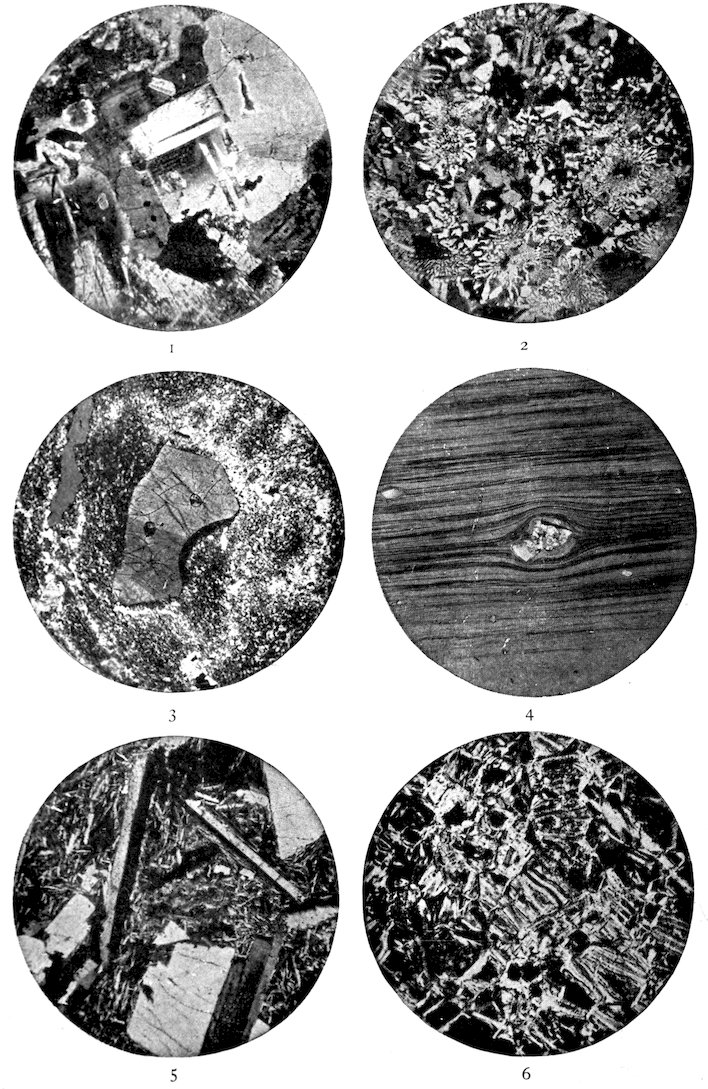
Fig. 1. Microstructure of granite. Fig. 2. Microstructure of micropegmatite. Fig. 3. Microstructure of quartz porphyry. Fig. 4. Microstructure of porphyritic obsidian. Fig. 5. Microstructure of trachyte. Fig. 6. Microstructure of serpentine.
29The method of rock study by thin microscopic sections is one of comparatively recent origin. It is scarcely more than a dozen years since the process was fairly adopted by mineralogists. The value of the method is based upon the fact that every crystalline mineral has certain definite optical properties. Therefore, when a crystalline mineral is distorted or misshapen so as to be incapable of identification by the ordinary method, it can be at once identified by its optical examination in the manner just described. In this way not only can one mineral be distinguished from another, but the crystalline system to which it belongs can be accurately pointed out. The value of the method is well summed up by Merrill,[21] who says that it is not merely an aid in determining the mineralogical composition of a rock, but also, which is often much more important, its structure and the various changes which have taken place in it since its first consolidation. Rocks are not the definite and unchangeable mineral compounds they were once considered, but are rather ever varying aggregates of minerals which even in themselves undergo structural and chemical changes almost without number.
Another valuable result of such a study is illustrated by the discovery that the structural features of a rock are not dependent upon its chemical composition or geologic age, but upon the conditions under which it cooled from the molten magma. Portions of the same rock may vary all the way from a wholly crystalline to a pure vitreous form.
Some typical microstructures of crystalline rocks are shown in the accompanying figures 1–6.[22]
Although this method of study has thus far been confined mainly to crystalline rocks, its efficiency is by no means limited to them. The fragmental rocks and their decomposed débris to which the name soil is given are equally worthy of study by this method. Indeed, the full value of a chemical analysis of any rock or soil can not be ascertained unless such an analysis is accompanied by a microscopic examination. It is desirable to know not merely what there is in any soil, but in what form these compounds exist. To this latter question the chemical analysis as ordinarily made will give no clew. In Germany a beginning has been made in this line of work, and American scientists are beginning to realize its importance. An outline of this method of analysis will be given in the proper place.
3029. Specific Gravity.—Much information in regard to the properties of a rock, or mineral constituent thereof, may be derived from its specific gravity.
The internal structure of a rock may have much to do with its apparent specific gravity. As an instance of this, it may be stated that an obsidian pumice will float upon water, buoyed up by the air contained in its vesicles, while a compact obsidian of the same composition will sink immediately. A careful discrimination must, therefore, be made between apparent and true specific gravity. In general it may be said that crystalline rocks have a higher specific gravity than those of a vitreous nature. The specific gravity is, therefore, largely dependent upon chemical and crystallographic properties; for instance, among siliceous rocks those which contain the largest amount of silica are the lightest, while those with a comparatively small amount, but rich in iron, lime, and magnesia, are heaviest.
30. Chemical Composition of Rocks.—Rocks are often classified with respect to the chief mineral constituent which they contain. Rocks which are composed largely of lime are termed calcareous; of silica, siliceous; of iron, ferruginous; and of clay, argillaceous. In respect of eruptive rocks, it is customary to speak of those which show above sixty per cent of silica as acidic, while those containing less than fifty per cent of silica and a correspondingly larger amount of iron, lime, and magnesia, are spoken of as basic. Illustrations of the classification of rocks on the above principles are given below.[23]
Stratified Rocks.
Kind. Specific Gravity. Composition.
Calcareous:
Compact limestone 2.6 to 2.8 Carbonate of lime.
Crystalline limestone
Compact dolomite 2.8 to 2.95 Carbonate of lime and magnesia.
Crystalline dolomite
Siliceous:
Gneiss 2.6 to 2.7 Same as granite.
Siliceous sandstone 2.6 Mainly silica.
Schist 2.6 to 2.8 60 to 80 per cent silica.
Argillaceous:
Clay slate (argillite) 2.5 Mainly silicate of alumina.
31
Eruptive Rocks.
Specific Gravity. Per cent silica.
Acidic Group:
Granite 2.58 to 2.73 77.65 to 62.90
Liparite 2.53 to 2.70 76.06 to 67.61
Obsidian 2.26 to 2.41 82.80 to 71.19
Obsidian pumice Floats on water. 82.80 to 71.19
Intermediate Group:
Syenite 2.73 to 2.86 72.20 to 54.65
Trachyte 2.70 to 2.80 64.00 to 60.00
Hyalotrachyte 2.4 to 2.5 64.00 to 60.00
Andesite 2.54 to 2.79 66.75 to 54.73
Basic Group:
Diabase 2.66 to 2.88 50.00 to 48.00
Basalt 2.90 to 3.10 50.59 to 40.74
Peridotite 3.22 to 3.29 42.65 to 33.73
Peridotite (iron rich) 3.86 23.00
Peridotite (meteorite) 3.51 37.70
31. Color Of Rocks.—The color of rocks is determined chiefly by the oxids of metals which they contain and the degree of oxidation of the mineral in each particular case. There are, however, many colors of rocks which seem to depend not upon any particular mineral ingredient which they contain, but upon some particular crystalline structure or physical condition.
The chief coloring matters in minerals are those which form colored bases such as iron, manganese, chromium, etc. The yellow, brown, and red colors, common to fragmental rocks, are due almost wholly to free oxids of iron. The gray, green, dull brown, and even black colors of crystalline rocks are due to the presence of free iron oxids or to the prevalence of silicate mineral rich in iron, as augite, hornblende, or black mica. Rarely copper and other metallic oxids than those of iron are present in sufficient abundance to impart their characteristic hues. As a rule, a white or light-gray color denotes an absence of an appreciable amount of iron in any of its forms. The bluish and black colors of many rocks, particularly the limestones and slates, are due to the presence of carbonaceous matter.
In still other cases, and particularly the feldspar-bearing rocks, the color may be due in part to the physical condition of the feldspar.
Inasmuch as the color of rocks is due so largely to metallic 32oxids, it is easy to see that they may undergo changes when exposed to weathering, or the degree of oxidation may change, and either, together with changes in the physical structure of the rock, may cause a distinct change in color. Luster is often considered in connection with color, and is due almost exclusively to physical conditions.
32. Kinds of Rocks.—The rocks which form any essential part of the earth’s crust are grouped under four main heads, the distinction being based upon their origin and structure.[24] Each of the main divisions may be subdivided into groups or families, the distinction being based mainly upon chemical composition, structure, and mode of occurrence. The four chief families are:
First, aqueous rocks, formed mainly through the agency of water as chemical precipitates or as sedimentary beds.
Second, aeolian rocks formed from wind-drifted materials.
Third, metamorphic rocks, changed from their original condition through dynamic or chemical agencies, and which may have been partly of aqueous and partly of igneous origin.
Fourth, igneous or eruptive rocks, which have been brought up from below in a molten condition, and which owe their present structural peculiarities to variations in composition and conditions of solidification.
33. Aqueous Rocks.—Aqueous rocks may be divided into the following general classes:
First, rocks formed as chemical precipitates.
Second, rocks formed as sedimentary deposits and fragmental in structure. The second class may again be subdivided into rocks formed by mechanical agencies and mainly of inorganic materials; and second, rocks composed mainly of the débris of plant and animal life.
In regard to the first form of aqueous rocks, namely, those formed as chemical precipitates, it may be said that while their quantity is not large they are yet of considerable importance from an agricultural point of view. They embrace those substances which, having once been in a condition of vapor or aqueous solution, have been deposited or precipitated, either by 33cooling or by the evaporation of the liquor holding them in solution, or by coming in contact with chemical substances capable of precipitating them. The influence of water as a solvent is perhaps not fully appreciated. Its solvent influence will be noted particularly under the head of weathering or decay of rocks. Its importance, however, in producing stratified rocks has been very great. Water, especially when under great pressure and at a high temperature, has the power of dissolving many minerals. This power is often greatly increased by the mineral matter previously in solution in the water or by the gases which it may contain. As an illustration of the latter property, the solvent action of water charged with carbon dioxid on limestone may be cited.
When mineral matters have been dissolved by the water in the ways mentioned and carried with the water beyond the condition where the solution has taken place, new conditions are found favorable to the precipitation of the dissolved matters. The water, which before may have been very hot, may reach a place where it cools, and being a supersaturated solution, the excess of the material is thrown down as the water cools.
On the other hand, if the solution be due to the presence of carbon dioxid and the water reach a place where it is exposed to the air or where the pressure under which the abundance of the gas has been due is diminished, the carbon dioxid will escape and the mineral matters which have been dissolved thereby will be precipitated.
The incrustations which often appear round the mouth of springs and the occurrence of stalagmites and stalactites in caves are illustrations of this action.
In respect of the formation of rocks as precipitates from a state of vapor we have scarcely any illustrations excepting in volcanic regions. Rocky materials with which we are generally acquainted are practically non-volatile at the highest temperature which can be secured on the earth’s surface, but it is possible that in the interior of the earth the temperature may be so high as to maintain many substances in a state of vapor.
They may, in this case, become disassociated so that the 34compounds or elements exist distinctly in a vaporous condition. Such a vapor transported to regions of diminished temperature would first of all on cooling permit a union of the chemical elements forming new compounds less volatile, which, of course, would be at once precipitated.
The rocks and minerals formed in this way which are of some agricultural importance may be classified as follows:
Oxids, carbonates, silicates, sulfur, sulfids, sulfates, phosphates, chlorids, and hydrocarbon compounds, the most important from an agricultural point of view being the phosphates.
The second group of rocks, namely those formed as sedimentary deposits, differ from those just described in that they are comprised mainly of fragmental materials derived from the breaking down of pre-existing rocks. The formation of fragmental rocks includes, therefore, the same processes as are active in the formation of arable soil. They are deposited from water, and are as a rule distinctly stratified.
Through the action of pressure and the heat thereby generated, or simply through the chemical action of percolating solutions, such rocks pass over into the crystalline sedimentary forms known as metamorphic. All metamorphic rocks, however, are not of a sedimentary origin. For instance, by pressure, heat, and the chemical changes thereby induced, granite may be changed into gneiss and the latter would then be a metamorphic rock.
This group of sedimentary rocks and of sedimentary material, either unchanged or metamorphosed, is of vast extent and includes materials of widely varying chemical and mineralogical nature. They form by far the greater portion of the present surface of the earth, even the mountain ranges being composed mainly of this sedimentary material. Indeed, in the whole of this country there is only a comparatively very small extent of igneous or irruptive rocks. They are of great importance from a purely scientific, as well as agricultural standpoint, since they contain the fossil records of past geologic ages. From them it is possible to study the variations in climate, the meteorological conditions in circumstances and periods far remote, and thus form some idea of the process by which the crust of the earth 35has been modified by natural forces from its original form to the present time.
The sedimentary rocks may be divided, with sufficient accuracy for our purposes, into two great classes: First, rocks formed by mechanical agencies and mainly of inorganic materials. These are subdivided again as follows:
(a) The arenaceous group.
(b) The argillaceous group.
(c) The volcanic group.
The second class of sedimentary rocks is formed largely, or in part at least, by mechanical agencies, but is comprised chiefly of the débris of plant and animal life. It may be subdivided as follows:
(a) The siliceous group, such as infusorial earth.
(b) The calcareous group, fossiliferous formations, limestone, etc.
(c) The carbonaceous group, such as peat, lignite, coals, etc. The different classes of rock described above are distinguished by special qualities represented largely by the name. The first division, the arenaceous group, is composed mainly of the siliceous or coarsely granular materials derived from the disintegration of older crystalline rocks, which have been rearranged in beds of varying thickness through the mechanical agency of water. They are, in short, consolidated or unconsolidated beds of sand and gravel. In composition and texture they vary almost indefinitely. Many of them having suffered little during the process of disintegration and transportation are composed essentially of the same materials as the rocks from which they were derived.
The sandstones, which are the type of these rocks, vary greatly in structure as well as in composition, in some the grains being rounded while in others they are sharply angular.
The microscopic structure of sandstone is shown in figure 7.[24]
The material by which the individual grains of a sandstone are bound together is usually the material of some of the other classes. The calcareous, ferruginous, and siliceous cements being the chief ones. This cementing substance is deposited among the granules forming the sandstone by percolating water.
36The colors of sandstone are dependent usually upon iron oxids. Especially is this true of the red, brown, and yellow colors. In some of the light grey varieties, the color is that of the minerals comprising the stone. Some of the darker colored sandstones contain organic matter.
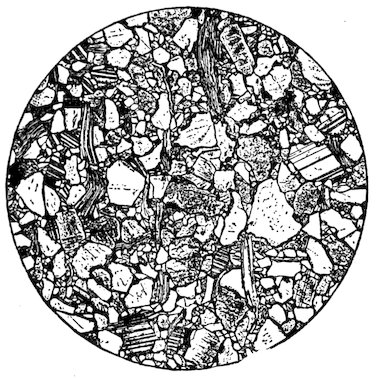
Fig. 7. Microscopic Structure of Sandstone.
The rocks of the argillaceous group are composed essentially of a hydrous silicate of alumina, which is the basis of common clay, and varying amounts of free silica, oxids of iron and manganese, carbonates of lime and magnesia, and small quantities of organic matter. They may have originated in situ from the decomposition of feldspars or as deposits of fine mud or silt at the bottom of large bodies of water. The older formations of these rocks are known as shales, argillites, and slates and the fissile structure which enables this to be split into thin sheets is probably due to the conditions under which they have been formed and not to any properties of the clays themselves.
One of the purest forms of this rock is kaolin, which is almost a pure hydrous silicate of alumina formed from the decomposition of feldspathic rocks from which the alkalies, iron oxids and other soluble constituents have been removed by water.
Under the volcanic group are included the materials ejected 37from volcanic vents in a more or less finely comminuted condition and which through the drifting power of atmospheric currents may be scattered over many miles of territory. Various names are applied to such products, names dependent in large part upon their state of subdivision. Volcanic dust and sand, or ashes, includes the finer dust-like or sand-like materials, and lapilli, or rapilli the coarser. The general name tuff includes the more or less compacted and stratified beds of this material, while trass, peperino, and pozzuolano are local varietal names given to similar materials occurring in European volcanic regions.
The second division, namely sedimentary rocks composed of the débris of plant and animal life includes many forms of great agricultural importance.
The first subdivision of this group is the infusorial or diatomaceous earth. It forms a fine white or yellowish pulverulent rock composed mainly of minute shells, or tests of diatoms, and is often so soft and pliable as to crumble readily between the thumb and fingers. According to Whitney the beds are of comparatively limited extent and for this reason are of little agricultural value, although the weathering of this diatomaceous material gives rise to a light yellow clay forming very fertile agricultural lands.
The second subdivision of this group includes the rocks of a calcareous nature derived from animal life; that is to say, what are properly called limestones. They vary in color, structure, and texture almost indefinitely, and include all possible grades of materials from those which can be used only as a flux, or for lime burning, through ordinary building materials to the finest marbles. These rocks are world-wide in their distribution and limited to no one particular geologic horizon, but are found in stratified beds among rocks of all ages from the most ancient to the most recent.
Owing to the fact that their chief constituent, carbonate of lime, is soluble in ordinary meteoric waters, the rocks have undergone extensive decomposition, their lime being removed, while their less soluble constituents or impurities remain to form soil. A single ton of residual soil represents not infrequently a loss of 100 tons of original rock matter. As this mass of lime 38carbonate is removed by solution the residual soil settles, and as the limestone rocks are more soluble than the adjacent rock formations limestone formations usually form valley lands with ridges on either side. Caves are frequently found in such formations. Furthermore, as the lime is almost all in the form of the easily soluble lime carbonate it can be very completely removed and the fertile “limestone soils” are often very deficient in lime and respond readily to an application of burnt lime, which, not infrequently, is quarried from the same field. From an agricultural standpoint this group is of very great interest and importance.
The third subdivision of this group, namely, that of vegetable origin, includes peat, lignite, coals, etc. Rocks of this group are made up of more or less fragmental remains of plants. In many of them, as the peats and lignites, the traces of plant structure are still apparent. In others, as the anthracite coals, these structures have been wholly obliterated by metamorphisms.
Plants when decomposing on the surface of the ground give off their carbon to the atmosphere in the shape of carbon dioxid gas leaving only the strictly inorganic or mineral matter behind. When, however, they are protected from the oxidizing influence of the air, by water or by other plant growth, decomposition is greatly retarded, and a large portion of the carbonaceous and volatile matters is retained, and by this means together with pressure from the overlying mass, the material becomes slowly converted into coal. When this process goes on near the surface of the earth, and without much pressure, peat or muck is the product.
The fourth subdivision of this group, the phosphatic, forms a class of rocks limited in extent but of the greatest economic importance. Guano, coprolites, and phosphatic rocks (the phosphorites) come under this head.
34. Aeolian Rocks.—This class of rocks is of less importance than the others, either geologically or agriculturally. It is formed from materials drifted by the winds and this material has various degrees of compactness. Usually the components of these drifts form rocks or deposits of a friable texture and of a fragmental nature. The very extensive deposits of 39loess in China, forming their most fertile lands, are admitted now to have been formed in this way, but it is now generally admitted that similar deposits in this country are of subaqueous origin.
Chief among these rocks, are the volcanic ashes which are often carried to a long distance by the wind before they are deposited and consolidated into rock masses. Many loose soils may be carried to great distances by the wind, the deposits forming new aggregates. This is particularly the case in arid regions.
35. Metamorphic Rocks.—This class of rocks includes all sedimentary or eruptive rocks, which, after their deposition and agglomeration, have been changed in their nature through the action of heat, pressure, or by chemical means. Sometimes these changes are so complete that no indication of the character of the original rocks remains. At other times the changes may be found in all the stages of progress, so that they can be traced from the original fragmental or irruptive to the completely metamorphosed deposit. This is especially true of rocks containing large quantities of lime. In those containing silica, the changes are less readily traced.
Fig. 8. Microstructure of Crystalline Limestone. (West Rutland, Vermont.)
40The metamorphic rocks may be divided into two subclasses, namely, stratified or bedded, and foliated or schistose.
The rocks of the first class are represented by the crystalline limestones and dolomites. The microstructure of a crystalline limestone is shown in Fig. 8.[25] When lime and magnesia occur together in combination with carbon dioxid, the substance is known as dolomite. The chemical nature of these rocks and their soil-forming properties are the same as those of the ordinary, non-metamorphosed limestones and dolomites to which reference has already been made. The subject need not, therefore, be further dwelt upon here.
Fig. 9. Microstructure of Gneiss. (West Andover, Massachusetts.) At a a are shown plagioclase crystals broken and rounded by the sheering force producing the foliation.
The second variety of metamorphic rocks is represented by the gneisses and crystalline schists. Gneiss has essentially the same composition as granite and can frequently hardly be distinguished from it, except by a microscopic study of its sections, and even thus it is sometimes difficult to determine. Frequently a number of new minerals is formed in the metamorphic changes. The microstructure of a gneiss is shown in Fig. 9.[26] The schists include an extremely variable class of rocks, of which quartz 41is the prevailing constituent, and which, as a rule, are deficient in potash and other important ingredients.
36. Rocks Formed Through Igneous Agencies, or Eruptive Rocks.—This group includes all those rocks, which, having been at some time in a state of igneous fusion, have been solidified into their present form by a process of cooling. It may be stated, as a general principle, that the greater the pressure under which a rock solidifies and the slower and more gradual the cooling the more perfect will be found the crystalline structure. Hence, it follows that the older and more deep-seated rocks which are forced up in the form of dikes, bosses, or intrusive sheets, into the overlying masses, and which have become exposed only through erosion and removal of the overlying rocks, are the more highly crystalline.
The eruptive rocks are divided into two main groups, viz.:
(a) Intrusive or plutonic rocks, and
(b) Effusive or volcanic rocks.
Among the more important of the first division of the plutonic form, from an agricultural point of view, are the granites. The essential constituents of granite are quartz, potash feldspar, and plagioclase. One or more minerals of the mica, amphibole or pyroxene groups are also commonly present, and in microscopic proportions apatite and particles of magnetic iron. The more valuable constituents, from an agricultural standpoint, are the minerals potash feldspar, and apatite, which furnish by their decomposition the essential potash and phosphoric acid.
In addition to the granites, which have already been mentioned, the group includes the syenites, the nepheline syenites, the diorites, the gabbros, the diabases, the theralites, the peridotites, and the pyroxenites.
The second group, the effusive or volcanic rocks, includes those igneous rocks, which, like the first group, have been forced up through the overlying rocks, but which were brought to the surface, flowing out as lavas. These, therefore, represent, in many cases, only the upper or surface portions of the first group, differing from them structurally, because they have 42cooled under little pressure more rapidly, and hence are not so distinctly crystalline. These comprise the following groups:
(a) Quartz porphyries. (b) Liparites. (c) Quartz-free porphyries. (d) Trachytes. (e) Phonolites. (f) Porphyrites. (g) Andesites. (h) Melaphyrs and augite porphyrites. (i) Basalts. (j) Tephrites and Basanites. (k) Picrite porphyrites. (l) Limburgites and augitites. (m) Leucite rocks. (n) Nepheline rocks. (o) Melilite rocks.
It is, in most cases, impossible to state which of the above classes is of most importance from an agricultural standpoint, since, in the process of soil formation, both chemical and physical processes are involved, whereby the character of the resultant soil is so modified as to but remotely resemble its parent rock. In most soils, the prevailing constituent is but the least soluble one of the rock mass from which it was derived. Thus a limestone soil may contain upwards of ninety per cent of silica and alumina, while the original limestone itself may not have carried more than one or two per cent of these substances. Of course, if a rock mass contains none of the constituents essential to plant growth, its resultant soil must by itself alone be quite barren. It does not absolutely follow, however, that those rocks containing the highest percentages of valuable constituents will yield the most fertile soils, since much depends on the manner in which they have been formed, the amount of leaching, etc., they may have undergone. Nevertheless, the study of the composition of the rocks in their relation to soils, is an extremely interesting and by no means unimportant one.
A comparative table of rock compositions is here given. It will be observed that there is a considerable range of variation even among rocks of the same class, a fact due to the varying abundance of their mineral constituents. The figures given are 43not those of actual analyses on any one particular rock, but are selected from a number of comparatively typical cases; and, it is thought, fairly well represent the composition of the class of rocks indicated.
Composition of Rocks.—The Figures Indicate Parts per Hundred.
SiO₂. Al₂O₃. Fe₂O₃. FeO. MgO. CaO. Na₂O. K₂O. P₂O₅.
Granite Quartz poryhyries} Liparite 63–78 10–15 2–3 0.3–0.5 1–2 2–3 4–5 0.05–0.15
Syenite Orthoclase porphyries} Trachyte 55–73 12–16 5–7 2–6 3–5 2–6 4–7 trace.
Nepheline syenites} Phonolites 54–56 16–22 4–6 0.4–0.88 2–4 3–7 4–6 0.15
Diorites Porphyrites} Andesites 52–65 16–20 7–10 5–7 5–7 2–4 1–2 0.1–0.3
Gabbros Norites} Melaphyrs 48–55 12–20 8–15 2–7 6–10 2–4 0.5–2 0.1–0.33
Theralites Tephrites} Basanites 43–47 15–23 9–18 1–6 6–10 5–7 2–4 trace.
Peridotites Picrite porphyrites} Limburgites 23–43 1–10 10–15 15–45 1–4 0–4 trace. 0.0
Pyroxenites} Augitites 50–55 0.5–4 4–10 20–25 8–15
Leucite rocks 48–50 15–20 7–10 1–2 5–10 3–5 5–7 0.5–2
Nepheline rocks 40–45 8–20 10–20 1–13 4–10 4–8 1–3 0.2
37. Origin of Soils.—The soils in which crops grow and which form the subject of the analytical processes to be hereinafter described have been formed under the combined influences of rock decay and plant and organic growth. The mineral matters of soils have had their origin in the decay of rocks, while the humic and other organic constituents have been derived from living bodies. It is not the object of this treatise to discuss in detail the processes of soil formation, but only to give such general outlines as may bear particularly on the proper conceptions of the principles of soil investigation.
38. The Decay of Rocks.—The origin and composition of rocks are fully set forth in works on geology and mineralogy. Only a brief summary of those points of interest to agriculture has been given in the preceding pages. The soil analyst should be acquainted with these principles, but for practical purposes he has only to understand the chief factors active in securing the decay of rocks and in preparing the débris for plant growth.
44The following outline is based on the generally accepted theories respecting the formation of soils.[7]
The forces ordinarily concerned in the decay of rocks are:
1. Changes of temperature, including the ordinary daily and monthly changes, and the conditions of freezing and thawing.
2. Moving water or ice.
3. Chemical action of water and air.
4. Influence of vegetable and animal life: (a) Shades the rock or soil surface. (b) Penetrates the rock or soil material with its roots, thus admitting air. (c) Solvent action of roots. (d) Chemical action of decaying organic matter.
5. Earth worms.
6. Bacteria.
39. The Action of Freezing and Thawing.—In those parts of a rock stratum exposed near the surface of the earth the processes of freezing and thawing have perhaps had considerable influence in rock decay. The expansive force of freezing water is well known. Ice occupies a larger volume than the water from which it was formed. The force with which this expansion takes place is almost irresistible. The phenomenon of bursted water pipes which have been exposed to a freezing temperature is not an uncommon one. While the increase in volume is not large, yet it is entirely sufficient to produce serious results. The way in which freezing affects exposed rock is easily understood. The effect is unnoticeable if the rock be dry. If, on the other hand, it be saturated with water, the disintegrating effect of a freeze must be of considerable magnitude. This effect becomes more pronounced if the intervals of freezing and thawing be of short duration. The whole affected portion of the rock may thus become thoroughly decayed. But even in the most favorable conditions this form of disintegration must be confined to a thin superficial area. Even in very cold climates the frost only penetrates a few feet below the surface, and therefore the action of ice cannot in any way be connected with those changes at great depths, to which attention has already 45been called. Nevertheless, certain building stones seem very sensitive to this sort of weathering, and the crumbling of the stone in the Houses of Parliament is due chiefly to this cause.
On the whole it appears that the action of ice in producing rock decay has been somewhat overrated, although its power must not by any means be denied. But on the other hand a freeze extending over a long time tends to preserve the rocks, and it therefore appears that the entire absence of frost would promote the process of rock decay.
At best it must be admitted that frost has affected the earth’s crust only to an insignificant depth, but its influence in modifying the arable part of the soil is of the utmost importance to agriculture.
40. The Action of Glaciers.—The action of ice in soil formation is not confined alone to the processes just described. At a period not very remote geologically, a great part of our Northern States was covered with a vast field of moving ice. These seas of ice crept down upon us from more northern latitudes and swept before them every vestige of animal and vegetable life. In their movement they leveled and destroyed the crests of hills and filled the valleys with the débris. They crushed and comminuted the strata of rocks which opposed their flow and carried huge boulders of granite hundreds of miles from their homes. On melting they left vast moraines of rocks and pebbles which will mark for all time the termini of these empires of ice. When the ice of these vast glaciers finally melted the surface which they had leveled presented the appearance of an extended plain. No estimate can be made of the enormous quantities of rock material which were ground to finest powder by these glaciers. This rock powder forms to-day no inconsiderable part of those fertile soils which are composed of glacial drift. The rich materials of these soils probably bear a more intimate relation to the rocks from which they were formed than of any other kinds of soil in the world. The rocks were literally ground into a fine powder, and this powder was intimately mixed with the soils which had already been formed in situ. The melting ice also left exposed to disintegrating forces large surfaces of unprotected rocks in which decay would go 46on much more rapidly than when covered with the débris which protected them before the advent of the ice. The area of glacial action extended over nearly all of New England and over the whole area of the northern tier of States. It extended southward almost to the Ohio river, and in some places crossed it. The effect of the ice age in producing and modifying our soil must never be forgotten in a study of soil genesis. It is not a part of our purpose here to study the causes which produced the age of ice. Even a brief reference to some of the more probable ones might be entirely out of place. Before the glacial period it is certain that a tropical climate extended almost, if not quite, to the North Pole. The fossil remains of tropical plants and animals which have been found in high northern latitudes are abundant proofs of this fact.
In the opinion of Sterry Hunt,[27] rock decay has taken place largely in preglacial and pretertiary times. The decay of crystalline rocks is a process of great antiquity. It is also a universal phenomenon. The fact that the rocks of the southern part of this country seem to be covered with a deeper débris than those further north is probably due to the mechanical translation of the eroded particles towards the south. The decay and softening of the material were processes necessarily preceding the erosion by aqueous and glacial action.
It is possible that a climate may have existed in the earlier geologic ages more favorable to the decay of rocks than that of the present time.
41. Progress of Decay as Affected by Latitude.—Extensive investigations carried on along the Atlantic side of the country show wide differences in the rate of decay in the same kind of rocks in different latitudes. In general, the progress of decay is more marked toward the south. The same fact is observed in the great interior valleys of the country; at least, everywhere except in the arid and semi-arid regions. Wherever there is a deficiency of water the processes of decay have been arrested. Where the rock strata have been displaced from a horizontal position the progress of decay has been more rapid. This is easily understood. The percolation of water is more easy as the displacement approaches a vertical position.
47A most remarkable example of this is seen in the rocks of North Carolina.[28] A kind of rock known as trap is found in layers called dikes in the Newark system of rocks in that State. These dikes have been so completely displaced from the horizontal position they at first occupied as to have an almost vertical dip. The edges thus exposed vary from a few feet to nearly 100 feet in thickness. The trap rock in those localities is composed almost exclusively of the mineral dolerite, which is so hard and elastic in a fresh state as to ring like a piece of metal when struck with a hammer. In building a railroad through this region these dikes were in some places uncovered to a depth of forty feet and more. At this depth they were found completely decomposed and with no indications of having reached the lower limit of disintegration. The original hard bluish dolerite has been transformed into a yellowish clay-like mass that can be molded in the fingers and cut like putty. Similar geologic formations in New Jersey and further North do not exhibit anything like so great a degree of decomposition, thus illustrating in a marked degree the fact that freezing weather for a part of the year is a protection against rock decay. The ice of winter at least protects the rocks from surface infiltration, although it can not stop the subterranean solution which must go on continuously.