Volume 1 / Part 3 — PART THIRD. PHYSICAL PROPERTIES OF SOILS.
Reading edition
92. The Soil as a Mass.—The soil constituted as indicated in the preceding pages, is now brought to the analyst for investigation. The properties with which he first becomes acquainted are those which impress his senses as mass characteristics. There is a perception of color, consistence, weight and other features which the soil possesses as a whole. The several constituents of the soil must first be considered as molecular and mole aggregates. In other words, the soil in its natural state is a mechanical mixture of particles which must first be considered as a whole. The physical properties of the soil, therefore, should engage the attention of the analyst before he proceeds to the investigation of the properties of its several constituents as classified by the relative size or hydraulic value of the particles of which they are composed, or to a chemical determination of the compounds or elements therein contained.
DETERMINATION OF PHYSICAL PROPERTIES.
93. Color.—The color of a soil depends chiefly upon the proportion of organic matter and iron compounds which it contains and the state of subdivision of its particles. When a soil contains a large amount of organic matter, especially when this organic matter is in an advanced state of decay, it assumes more or less a black color when moist. This black color is to be distinguished from the black alkali tint which is produced by 95the action of carbonate of soda on organic matter. The naturally black color of a soil containing a large amount of organic matter depends, however, either upon the action of mineral matters upon this organic matter, as in the case of the black alkali mentioned, or upon the blackish color of carbon resulting from the slow combustion of the organic matter during the period of decay.
The presence of a large amount of ferric oxid in soil gives the well-known red color so well-marked in the soils of southwestern Kentucky and other portions of the United States. The preponderance of sand in a soil tends to produce a light yellow or whitish tint, while certain kinds of clay have a bluish tint probably due to the presence of ferrous salts. The influence of the color of the soil upon the color of the vegetation is also well-marked, the black soils as a rule producing a much deeper green tint of foliage than the light colored soils. This effect should not be attributed to color alone for as a matter of fact highly colored soils are usually very close and very retentive of moisture, which is one reason, probably, for their not being more highly oxidized. Such soils will produce a more vigorous and ranker growth of vegetation, but it is the texture of the soil and the more moist condition which it maintains, rather than the color, which produce the deeper green tint of foliage.
The color of a soil is also used as an index of its fertility, the black and red soils being usually the most fertile.
It may be well to add here the probable reason as given by Whitney for this, viz., that the deeper color shows that the oxids of iron and the organic compounds have less oxygen and indicate that the soils are quite retentive of moisture and rather tend to the exclusion of air, so that part of the oxygen of the iron compounds and of the organic matters has been used up in the oxidation processes within the soil. It is known, for example, that wood oxidizes much more rapidly around a rusty nail than where it is simply exposed to the air, the iron oxid acting as a carrier between the oxygen of the air and the organic matter. In a sandy soil, on the contrary, where there is usually less moisture and much freer circulation of air, the iron compounds have more oxygen and usually have a light yellow color. If this sand is 96heated, however, with the exclusion of air, and especially in the presence of organic matters, part of this oxygen will be given off and there will be the same red color as in the heavier clay soils. It is frequently noticed, also, in compact clays that where air gains access through cracks or root-holes, the color is altogether modified.
94. Determination of Color.—There is no process which will give experimentally and accurately the color of a soil sample. The changes which the color of a soil undergoes in passing from a saturated to an anhydrous state are well-marked. The analyst will have to be content with giving as nearly as possible a description of the color of the sample when taken and the changes which it undergoes in air drying or on heating in a bath to 100°–110°, or in heating to redness with or without exclusion of the air. These changes in color will give some indication of the character of the organic and mineral matters present.
95. Odoriferous Matters in Soil.—It is known that the soil emits a peculiar odor which is not disagreeable except when it has been recently wet, for instance, after a short rain. Several attempts have been made to discover the nature of this odor. These researches have established the fact that the essential principle of this odor resides in an organic compound of a neutral nature of the aromatic family and which is carried by the vapor of water after the manner of a body possessing a feeble tension. The odor is penetrating, almost piquant, and analogous to that of camphorated and quite distinct from other known substances. In regard to the quantity of this substance, it is extremely minute and can be regarded as being only a few millionths of a per cent.
According to Berthelot and André[70] this new principle is neither an acid nor an alkali nor even a normal aldehyd. It is, in a concentrated aqueous solution, precipitable by potassium carbonate with the production of a resinous substance. Heated with potash it develops a sharp odor similar to the aldehyde resin. It does not reduce the ammoniacal nitrate of silver. Treated with potash and iodin it gives an abundant formation of iodoform, which, however, is a property common to a great 97number of substances. For the qualitative and quantitative estimation of the odoriferous matter the following process is employed:
About three kilograms of the soil are mixed with sand containing a small amount of carbonate of lime and some humic substance; after having freed it from all organic débris which is visible, it is placed in a glass alembic. The soil should contain from ten to twelve per cent of water at least. The alembic is placed in a sand bath and is kept at 60° for several hours. The water evaporated is condensed until about seventy-five cubic centimeters are distilled over. This distilled water is again rectified so as to obtain in all about twenty cubic centimeters. The odoriferous matter appears to be nearly all contained in this twenty cubic centimeters. The liquid thus obtained shows an alkaline reaction; it contains some ammonia and reduces ammoniacal silver nitrate. This last reaction is due to some pyridic alkali or analogue thereof, and is cause for it to be distilled anew with a trace of sulfuric acid which gives a neutral liquor deprived of all reducing action but which preserves the odor peculiar to the soil. The twenty cubic centimeters obtained as before are subjected to two additional distillations and in the final one only one cubic centimeter of liquid is distilled over.
The peculiar odor is intensified proportionately as the volume of the liquid is decreased. To this one cubic centimeter, is added some pure crystallized potassium carbonate. The liquor is immediately troubled and some hours are required for it to become clear again. Meanwhile there is formed upon its surface a resinous ring almost invisible, amounting at most to from ten to twenty milligrams of a matter which has not been identified with any known principle. The reactions described above, however, permit of its general character being known. This resinous matter contains the odoriferous principle, the composition of which is not yet definitely known.
96. Specific Gravity.—The density of a soil depends on its composition, the fineness of its particles and upon the packing which it has received. It has in other words an apparent and a real specific gravity. It is easy to see that a soil in good tilth 98would weigh less per cubic foot than one which had been pressed closely together, as in a road or well-pastured field. Ordinary soils in good tilth have an apparent specific gravity of about 1.2, and when entirely free from air, a real specific gravity of about 2.5. If the apparent specific gravity of a soil sample were 1.2 and the air were removed, leaving a vacuum in the interstices of the soil, the apparent specific gravity would not be sensibly increased. The figure 1.2 is the apparent specific gravity of a mixture of soil material which is about 2½ times heavier than water, and of an extremely small proportion by weight of air which is about 1000 times lighter than water. The figure 2.5 is about the true specific gravity of the real soil material, and shows that this material is about 2½ times heavier than an equal volume of water.
The weights of a cubic foot of different kinds of soil as given by Schübler[71] are as follows;
Pounds.
Sand 110
Sand and clay 96
Common arable soil 80 to 90
Heavy clay 75
Vegetable mold 78
Peat 30 to 50
In general the specific gravity of soil decreases inversely as its content of humus.
97. Determination of Specific Gravity.—The ordinary method of proceeding to determine the true specific gravity is by means of a pyknometer. The pyknometer should have a capacity of from twenty-five to fifty cubic centimeters.
From ten to fifteen grams of earth dried to constant weight at 100° are taken, boiled for a time with a few cubic centimeters of water to remove air and poured into the pyknometer. All soil particles are washed out of the vessel in which the boiling took place into the pyknometer with freshly boiled distilled water and after cooling to the temperature at which the calibration took place, the pyknometer is filled with distilled water at the given temperature and weighed. If the soil contain materials soluble in water, alcohol of definitely known specific gravity may be employed 99and the number thus obtained calculated to a water basis.
The calculations when water is used are made as follows:
Grams.
Weight of pyknometer 13.4789
„ „ pyknometer full of distilled water at 20° 62.8934
„ „ water in pyknometer 49.4145
„ „ dry soil taken 10.0000
„ „ pyknometer + dry soil + filled with water at 20° 67.9834
„ „ soil and water 54.5045
„ „ water 44.5045
„ „ water displaced by ten grams soil 4.9100
Then specific gravity = 10.000 ÷ 4.9100 = 2.04.
98. Specific Gravity of Undried Soils.—It is often desirable to determine the specific gravity of an undried portion of the soil. For this purpose a portion of the sample is dried at 100° to determine its percentage of moisture. The specific gravity is then determined on a ten gram sample of the undried soil as just given. The actual weight of soil taken is calculated from the percentage of moisture obtained in the first instance. In the case given if the percentage of moisture at 100° be ten then the actual weight of dry soil taken is nine grams. This number is therefore used in making the calculations. In all statements of specific gravity taken in the manner described the temperature at which the pyknometer is calibrated should be stated and all weighings where water is involved made at that degree.
99. Volume of Soil.—If it be desired to calculate the volume occupied by a soil it is easily done by dividing the weight of water displaced by the weight of one cubic centimeter of water of the temperature at which the determination took place.
In the case given one cubic centimeter of water at 20° weighs 0.998259. Then 4.9100 ÷ 0.998259 = 4.9186 cubic centimeters = volume occupied by ten grams of dry soil excluding interstitial spaces between particles.
100. Volumetric Methods.—The water displaced by a given weight of soil may also be measured volumetrically by the method of Knop.[72]
Place 200 grams of the soil in a flask of from three to five hundred 100cubic centimeters capacity. Add a measured quantity of water, and shake thoroughly to eliminate air, and fill up to the mark from a burette. The quantity of water required to complete the volume subtracted from the number expressing the volume of the flask will give the volume of water displaced by the earth.
Another method consists in thoroughly shaking about thirty grams of the soil in a graduated cylinder with fifty cubic centimeters of water containing a little ammonium chlorid and after twenty-four hours recording the volume occupied by the whole. The increase in volume over fifty cubic centimeters shows the quantity of water displaced. This method may also be used to determine the volume occupied by a soil when saturated with water. The above methods are only to be used when approximately correct results are all that are desired.
101. Apparent Specific Gravity.—The apparent specific gravity of a soil is obtained by dividing its volume, interstitial spaces included, by the weight of an equal volume of water.
The real and apparent specific gravities of six samples of soil are given below.[73]
Real specific gravity 2.5445, 2.6315, 2.6508, 2.6400, 2.7325, 2.6603
Apparent specific gravity of air-dried soil 1.0940, 1.1710, 1.3570, 1.2810, 1.4060, 1.2730
Apparent specific gravity of soil dried at 125° 1.0990, 1.1770, 1.3750, 1.2910, 1.4640, 1.2850
It is to be noted that in computing the apparent specific gravity of a soil dried at 125° the volume occupied by the water is assumed to occupy the same space as if it existed in a free state. The volume of this water is therefore to be subtracted from the contents of the flask before proceeding with the computations.
102. Determination of Apparent Specific Gravity.—Place in small quantity portions of the air-dried sample properly prepared, into an open glass cylinder, holding one liter, and about 170 millimeters high (if the height is exactly the mentioned one, the diameter of the cylinder will be 86.6 millimeters); pack the sample by striking the bottom of the cylinder hard against the palm of the hand after each new filling; close the cylinder thus 101filled by a glass plate and weigh on a balance sensitive to 0.1 gram; deduct the weight of the cylinder and glass plate, and the weight of one liter of soil in approximately similar conditions as it is found on the dry land prepared for cultivation, is thus ascertained. The weight of one liter of the soil in grams multiplied by 2000 will give in kilograms the weight of the surface soil from a hectare (2.47 acres) of the field from which the sample is taken when the depth of this is calculated at twenty centimeters.[74]
RELATION OF THE SOIL TO HEAT.
103. Sources of Soil Heat.—The heat of the soil comes from three sources, viz.: solar heat, as the sun’s rays, heat of chemical and vital action within the soil, and the original heat of the earth’s interior. The latter is sensibly a constant quantity, and of great value to plants. The heat of chemical and vital action is not great in amount except in a few special cases but is often, as in germination, of the greatest importance to plant growth. The sun, therefore, remains the greatest source of heat of practical importance in relation to the production of crops. Dark-colored soils, absorbing most and radiating the fewest rays, must attain the highest temperature. Schübler’s classical researches on soil temperatures, show that there is at times a difference of over 7° in temperature between white and black soils, all other conditions being alike. Schübler’s researches, being made on dry soils in the laboratory, do not, however, apply wholly to conditions in the field.
104. Influence of Specific Heat.—The heat which a soil receives and retains is largely due to the specific heat of the soil. The specific heat of a body is expressed by a number which shows the amount of heat necessary to raise a given weight of the body 1° of temperature, as compared with the amount necessary to raise the same weight of water 1°. The specific heat of the soil is usually between 0.20 and 0.25, while that of water taken as the standard is unity.
105. Influence of Moisture.—The moisture of the soil possesses 102great influence on the soil temperature, so much so that a dry, light-colored soil may attain a greater degree of warmth than a moist, dark-colored one. The action of water in reducing soil temperature is easily explained. In our latitude, we see the water in all its forms, solid, liquid, and gaseous, and we know that these forms are the direct result of temperature. The changing of water from the solid to the liquid or gaseous form is performed at the expense of heat; the more water evaporated from the soil the more heat must be used for the evaporation. Therefore, the more water contained in the soil at any given time the lower must be its temperature during subsequent exposure to sun heat because of the greater evaporation. The experiments of Liebenberg, Pattner, Schübler and Dickenson have practically settled all the questions of soil temperatures. The radiation of heat from the soil, and the consequent cooling propensity of the latter, are directly proportional to the absorptive power of the soil. Two soils of like absorptive power towards heat possess, as a rule, equal radiating power.
In a general way, it can be said the greater the heating capacity and conductivity of a soil the more readily and rapidly does it give off its heat and become cooled.
106. Absorption of Solar Heat.—The quantity of heat absorbed from the sun by the earth is an important factor in the growth of vegetation. As has been established in the physics of heat, a black surface, other things being equal, will absorb a larger amount of heat than one of any other color; so, other things being equal in the physical and chemical composition of a soil, variations in the amount of organic matter producing greater or less black coloration will affect the heat absorption. Thus, black soils, in the conditions above mentioned, will absorb more heat than lighter colored soils. As a result, the vegetation in such soils gets an earlier start in the Spring and matures more rapidly. As an illustration of this it may be noted that the black prairie soils of Iowa produce uniformly crops of maize which are matured before the early frosts, while crops grown on lighter soils much farther South often suffer injury from that source.
103
DETERMINATION OF SPECIFIC HEAT.
107. General Principles.—The quantity of heat stored in any given weight of soil is capable of being measured and compared with the quantity stored in an equal weight of water at the same temperature. The ease, however, with which disturbing influences operate during the determination makes the manipulation somewhat difficult. The specific heat of the containing vessels must be carefully determined. Fortunately this has been done for most materials and the data thus obtained are recorded in standard works on physics. The material operated on must be protected from thermal influences from sources not controlled by the experiment and even the heat of the operator’s body may often disturb the conduct of the work. The general conditions which should control the experiment as well as the details thereof are given in the following method which, however, the ingenious analyst may profitably simplify.
108. Method of Pfaundler.—The process of estimating the specific heat of soils by the method of mixture, is essentially that of Regnault and is described as follows by Pfaundler[75].
The apparatus used is illustrated in Fig. 13.
A and A′ show the heating apparatus. It consists of a vessel of sheet iron in which a test tube E is fixed by means of a cork. The test tube holds the soil whose specific heat is to be determined. The apparatus contains water, which is brought to the boiling point by means of a lamp, and the excess of steam is conducted away, as indicated in the figure, through one of the axes of the apparatus; the opposite axis is, of course, closed. It requires about thirty-five minutes boiling to bring the contents of the test tube to the temperature of the aqueous vapor. The exact temperature at which the water boils is determined by observing the barometer at the time and consulting a table of the boiling temperature of water at different barometric pressures.
The calorimeter is shown in the figures B and B′. It consists of a wooden box closed on one side by a glass plate G and on the other to the heighth F by a small board on which a calorimeter of ordinary construction is placed. The cylinder of the calorimeter is seventy millimeters high and forty-seven millimeters in diameter.
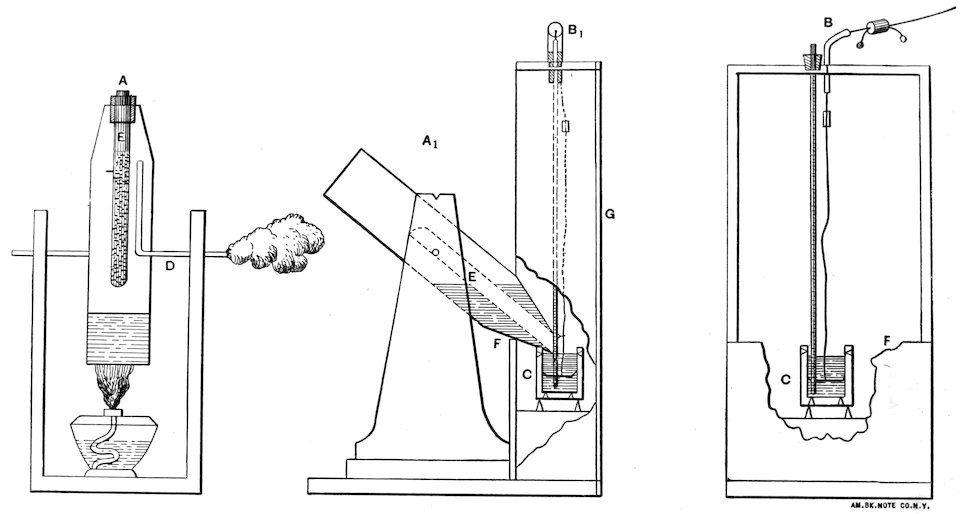
Figure 13. Regnault’s Apparatus for Determining the Specific Heat of Soils.
104This part of the apparatus is supported by triangular pieces of cork. A delicate thermometer is fastened to the top of the box of the calorimeter and the value of the degrees is so arranged that about twelve of them correspond to about one degree C. The scale of the instrument can be arbitrarily fixed and the temperature of any part of it determined by comparison with a delicately graduated thermometer.
Near the thermometer in the calorimeter is a stirrer made of a very thin copper disk with a bent rim. This stirrer is operated by means of a silk cord moved by appropriate machinery.
The reading of the thermometer is made through a glass plate and this should be protected from the heat of the body of the observer by a paper screen.
The test tube E is first filled with the substance, whose specific heat is to be determined, and weighed. It is then placed in the water bath until constant weight is reached. After constant weight has been obtained the apparatus is again dried and the exact weight of the moisture lost thus determined. The test tube is then placed in the apparatus A closed with a well-fitted cork, the top covered with cotton and heated in the aqueous vapor for about one hour. The heating apparatus should be far removed from the calorimeter so that the temperature of the latter cannot be influenced thereby. Meanwhile the calorimeter is filled with water which has stood in the room for a long time until it has acquired, as nearly as possible, the room temperature.
The quantity of water is such that the water value of the whole of the calorimeter together with the immersed portions of the thermometer and stirrer shall amount to exactly 100 grams. A few minutes before bringing the substance into the calorimeter, the stirring apparatus is put in motion and the temperature observations are commenced. These should be at intervals of twenty seconds and should be continued until ten observations have been made. Meanwhile the height of the barometer is also read. A few seconds before the tenth interval the apparatus A is brought quickly to the calorimeter and its contents emptied 105into it at the moment of the tenth interval. The apparatus A should be removed as quickly as possible after its contents are emptied.
After the introduction of the substance and its thorough incorporation with the water of the calorimeter by the stirring apparatus, the thermometer is again read, at intervals of twenty seconds, until its maximum has been reached and as much longer thereafter as may be necessary to show that an appreciable fall of temperature has taken place. The test tube, in which the substance was heated is weighed and the exact quantity of the added substance thus determined.
In order that the sample of soil may be easily removed from the test tube in which it is heated, it is best to have it molded into appropriate forms before being placed in the heating tube. This is easily accomplished by pressing it into molds of convenient shape and of a size so that six or eight pieces (best of cylindrical shape) will be necessary to give the quantity sufficient for the experiment. Since some soils will not retain their shape after molding, the molds may be made of zinc foil whose water values in the calorimeter are previously determined and they can be placed with their contents in the calorimeter thus securing the total immersion of all the particles of soil in the water. With very dusty materials, it is necessary that these little cylinders should be closed with pieces of foil at the ends in order to prevent the particles of dust from escaping and rising to the surface of the water.
Another source of error consists in the solution of the soluble salts which the soil may contain. This is avoided by the use of turpentine instead of water. If the cylinder containing the soil be made water-tight, this danger from the solubility of the salts in water is avoided. Another method of correcting these errors is in making a blank experiment in which a quantity of the earth taken is kept at the temperature of the water in the calorimeter until both are of the same temperature. The earth is then mixed with the water and the change of temperature produced noted. In this way the corrections made necessary by the solution of the salts in water and other causes are determined.
106109. Method of Calculating Results.—Let t represent the mean temperature of the beginning period of the experiment, and v equal the loss in heat per interval. Let t′ and v′ represent the same values for the end period. Let θ₁, θ₂, θ₃, etc., represent the temperature at the end of the first, second and third intervals of the middle period and θ₀ the temperature at the beginning of the middle period and θₙ the end temperature of of the middle period. Let τ₁, τ₂, τ₃, ... τₙ, represent the mean temperature of the single intervals; then τ₁ = Θ₀ + Θ₁ 2; τ₂ = Θ₁ + Θ₂ 2, and τₙ = Θn–1 + Θₙ 2. The constant C represents the correction which must be applied in order to determine the true increase of temperature in the calorimetric system. The expression θₙ − θ₀ + C represents the true temperature increase of the calorimetric system which we may represent by Δθ and θₙ + C represents the true maximum, that is, the end temperature, which by exclusion of external influences is reached. The correction C, as already indicated, is to be added to θₙ − θ₀ when it is positive and is to be subtracted therefrom when it is negative. The numerical value of C is usually very small, and, in the experiments indicated, varied between zero and one division of the thermometer employed, that is it seldom exceeded one degree.
110. Illustration.—The method of determining value of specific heat is best illustrated by an example:
In one determination the water value of the calorimetric system, including stirrer and thermometer was 2.50 grams, the weight of water added was 97.50 grams and the total water value of the system 100 grams. The substance was dried at 100° and weighed in five envelopes:
Total weight 31.423 grams.
The envelopes alone weighed 10.654 „
Weight of the soil taken 20.769 „
The envelopes holding the soil were made of brass with zinc ends, the specific heat of which is 0.0939 and the water value of the whole of the envelopes was 1.0004 grams. Since, however, the ends were soldered on with zinc the true water value was somewhat smaller being equal to 0.8692 gram. The data of the observations were as follows:
Corrected height of barometer 699.6 millimeters.
Intervals between the observations 20 seconds.
107
No. of Observations. Temperature on the arbitrary scale of the thermometer.
First Period { 0 162°.6
{10 162°.9 = θ₀ (Moment of immersion.)
Second Period {11 185°.0
{12 200°.0
{13 206°.1
{14 209°.5
{15 210°.7
{16 211°.3
{17 211°.5 Differences.
{18 211°.5 0
{19 211°.5 0
{20 211°.5 0
{21 211°.5 0
{22 211°.4 –0°.1
= θₙ
–0°.1
–0°.1
Third Period {23 211°.3
{24 211°.2 –0°.1
{25 211°.1 –0°.1
{26 211°.0 –0°.1
{27 210°.9 –0°.1
{28 210°.8 –0°.1
{29 210°.6 –0°.2
{30 210°.5 –0°.1
From the twenty-second interval, the regular fall of temperature begins and 211°.4 is therefore taken as θₙ. The mean temperature of the beginning period is therefore 162°.6 + 162°.9 2 = 162°.75 = t. The value of v is 162°.6 − 162°.9 10 = –0°.03. For the end period the value of t′ is 211°.4 + 210°.5 2 = 210°.95 and the value of v′ is 211.4 − 210.5 8 = + 0.11. Then the sum of the observations from eleven to twenty-one inclusive = Σ′n–1θ = 2280.1
θ₀ + θₙ 2 = 187.15
The sum = 2467.25
nt = 1953.00
Difference 514.25
This difference multiplied by v − v′ = 0.14
gives a product equal to 71.995
This product divided by t′ − t = 48.20
gives a quotient equal to 1.49
nv = –0.36
The sum = 1.13 = C
108Then Δθ = θₙ − θ₀ + C = 211°.4 − 162°.9 + 1°.13 = 49°.63. The true end temperature = θₙ + C = 212°.53. The zero point of the thermometer = 24°.70, and the actual rise of temperature = 187°.83. The rise of temperature due to the proximity of the warming apparatus at the beginning was found by experiment to be equal to 0°.1 of the division of the scale. On comparing the thermometer used with a standard centigrade scale it was found that one division of the calorimetric thermometer was equal to 0°.0858. Converting these numbers into expressions of the centigrade scale we have the following summary:
The true rise of temperature, Δθ = 4°.25
The true end temperature, θₙ + C = 16°.10
The temperature of the steam, as determined by the height of the barometer, was equal to 97°.70
From these data the specific heat is calculated according to the following formula:
Σ = 1 20.769 × (100 × 4.25 97.70 − 16.10 − 0.8692) = 0.2089.
From this formula the following rule for calculating specific heat is deduced:
Multiply the water value of the calorimetric system by the true rise in temperature in degrees Celsius and divide the product by the difference between the temperature of boiling water under the conditions of the experiment and the true end temperature. From the quotient subtract the water value of the envelopes holding the soil sample. Divide the remainder by the weight of soil taken.
111. Variations in Specific Heat.—Different soils deport themselves very differently in respect of specific heat. In a large number of soils examined by Pfaundler, the specific heats were found to vary from 0.19 to 0.51. The highest specific heat was observed in the case of a peaty soil. Next to peaty soils came those soils which were highest in humus, and in general it was found that the specific heat varied directly with the humus content.
109
SOIL THERMOMETRY.
112. General Principles.—The measurement of the temperature of the soil at stated depths is often of use in analytical processes connected with agricultural chemistry and physics. The general principles on which the process rests, depend on bringing the bulb of the thermometer into as intimate contact as possible with the particles of soil at the depth required, disturbing as little as possible the normal state of the soil particles.
In the thermometer chiefly used for this purpose in this country, the stem is strong and carries the degrees figured on the glass. The whole is inclosed in a wooden case which is cut away to expose the face of the scale. The scale is about eleven inches long. The part which enters the soil is of varying lengths, according to the depth at which the temperature is desired.
113. Method of Procedure.—An excellent method of determining soil temperatures and of recording results is well illustrated by Frear.[76]
The thermometers are set in niches cut in a trench, the earth being afterwards carefully tamped about the bulbs to secure a good contact, the trench being filled at the same time. The surface of the soil is freed from vegetation and kept in good tilth.
The depths at which observations are made are at the surface and one, three, six, twelve, and twenty-four inches. The soil tested was moderately dark and loamy to a depth of seven inches and below that a stiff clay. Solid rock existed at from five to seven feet below the surface. Readings were made three times a day.
114. Method of Stating Results.—The individual readings of the thermometers should be entered at the time they are made. At the end of each month the mean of the readings should be determined, together with the maxima and minima, and a comparison made between the mean readings of the temperature of the air and maxima and minima. As a sample of the method of stating these mean results the data are given for the month of May, 1891, for the atmosphere, surface, and for the depths mentioned above:
110
MAY.
T° Fahrenheit.
Atmosphere.
Monthly mean 57.1
Maximum 85.0
Minimum 31.0
Mean daily range 22.5
Greatest daily range 32.0
Least daily range 8.0
Surface.
Monthly mean 56.7
Extremes.
Maximum (10th of month) 77.0
Minimum (5th) 36.0
Mean maximum 65.2
Mean minimum 49.9
Range.
Monthly 41.0
Mean daily 14.9
Greatest daily (19th) 25.0
Least daily (21st) 4.0
One Inch.
Monthly mean 56.8
Extremes.
Maximum (10th) 74.5
Minimum (5th) 36.5
Mean maximum 62.9
Mean minimum 49.5
Range.
Monthly 38.0
Mean daily 11.9
Greatest daily (10 and 19) 20.0
Least daily (23rd) 1.0
Three Inches.
Monthly mean 56.7
Extremes.
Maximum (31st) 71.0
Minimum (6th) 40.0
Mean maximum 60.9
Mean minimum 49.7
Range.
Monthly 31.0
Mean daily 9.3
Greatest daily (19th) 15.5
Least daily (23rd) 1.5
Six Inches.
Monthly mean 56.3
Extremes.
Maximum (31st) 66.0
Minimum (6th and 7th) 43.0
Mean maximum 56.7
Mean minimum 53.2
Range.
Monthly 23.0
Mean daily 4.65
Greatest daily (8 and 19) 8.5
Least Daily (5th) 1.0
Twelve Inches.
Monthly mean 55.6
Extremes.
Maximum (31st) 64.0
Minimum (6th and 7th) 46.0
Mean maximum 56.6
Mean minimum 54.4
Range.
Monthly 18.0
Mean daily 2.18
Greatest daily (8th) 4.5
Least daily (3rd and 20th) 0.0
Twenty-Four Inches.
Monthly mean 53.1
Extremes.
Maximum (31st) 58.0
Minimum (6th and 8th) 48.0
Mean maximum 53.4
Mean minimum 52.8
Range.
Monthly 10.0
Mean daily 0.48
Greatest daily (23rd) 2.0
Least daily (on 12 days) 0.0
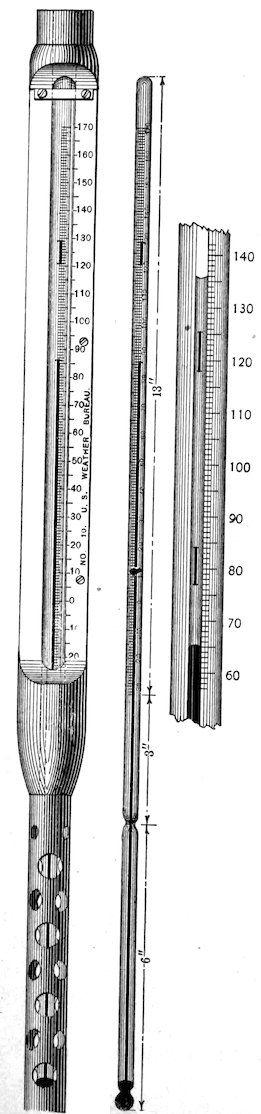
Fig. 14. Soil Thermometer—Whitney and Marvin.
115. Method of Whitney and Marvin.[77]—The thermometer devised by Whitney and Marvin is shown in Fig. 14. The principle on which this modification depends is as follows:
A mercurial thermometer of the ordinary construction is liable to give wrong indications of the temperature because it is difficult to determine the temperature of the column of mercury from the bulb to the surface of the ground. To avoid this source of error the thermometer figured was constructed.
The bulb of the thermometer is made quite small and a slender portion of the stem extends into its spherical portion. The top portion of the thermometer stem does not differ in any essential respect from the stem of an ordinary thermometer.
The bulb is almost wholly filled with alcohol, which acts as the principal thermometric fluid and has the advantages of a high coefficient of expansion. The thermometer bulb and the stem of the thermometer up to a point convenient for graduation, are filled with mercury. In the drawing the mercury is represented by the heavy black marking in and just above the small bulb. The peculiar construction at this point is for the purpose of retaining the mercury about the point of the slender capillary stem inside the bulb and preventing the entrance of alcohol into the stem when the thermometer is horizontal.
In order to register the maximum and minimum temperatures a short column of alcohol is placed in the upper portion of the stem, above the mercury, and within this are arranged two small steel indexes, so constructed that they will not slide in the tube of their own weight, but are easily pushed upward by the mercury column or pulled downward by the top meniscus 111of the alcohol column. The indexes are set by means of a small magnet, the one being drawn down upon the top of the mercurial column and the other raised up against the meniscus of the alcohol column.
The rise of the mercury carries its index upward, leaving it to register the highest point reached, while the alcohol meniscus withdraws the other index and leaves it at a point representing the minimum temperature. It remains only to mention that the graduations are fixed in the usual way, having reference only to the positions of the mercurial column. Beyond the highest point supposed to be reached by the mercury, say about 120°, the graduations are extended in an arbitrary manner. The scale numbers represent temperatures by the mercurial column and are continued in regular sequence beyond the 120°. On this plan the readings for minimum temperatures are on a purely arbitrary scale and are converted into true degrees of temperature by use of a table prepared for each thermometer, which table embodies as well all the corrections for instrumental error.
The arrangement of the alcohol columns above the mercurial column and the indexes are shown enlarged at one side of the illustration. The readings of the maximum temperature are made from the bottom end of the index next to the mercurial column. The minimum temperature is the reading of the top of the uppermost index. Thus in the figure the maximum temperature indicated is 76.5°, and the minimum 125.7°, which, by reference to the table of correction for this thermometer, No. 10, is found to be 53.3°.
The use of mercury in the stem of the thermometer not only admits of the use of the index for registering the maximum temperature, but possesses the additional advantage of reducing the error due to uncertain temperature of the stem to about one-sixth what it would be if alcohol were used. Moreover, if necessary, as in the case with thermometers for greater depths than that figured, the ungraduated portion of the stem can be made of very much finer bore than the graduated portion, the effect of which is to diminish the objectionable error to a comparatively unimportant quantity.
The chief objection to thermometers of this construction is the 112liability of alcohol getting from the bulb into the stem during the processes of construction, graduation and subsequent handling, and the difficulty of safely shipping them.
When once set up, however, there seems to be little or no possibility of derangement and the error common to mercurial thermometers due to rise of the freezing point with age does not apply owing to the high coefficient of expansion of the alcohol used in the bulb.
APPLICATIONS OF SOIL THERMOMETRY.
116. Estimation of the Absorption of Heat by Soils.—A cubical zinc box, six centimeters square, is filled with the sifted air dried soil. The box, one side of which is left open, is encased snugly in a wooden cover, exposing only the open end, and placed for a few hours in the direct rays of the sun. The temperature is then taken at a given depth. The box may be provided with thermometers at different depths, the bulbs thereof extending to the center. In this case the box should be covered with thick felt instead of wood. The temperature of the layers of soils of different depths can thus be read off directly. The air temperature directly above the box should be accurately noted while the experiment continues.
Any other kind of box well protected against all heat save the direct sunlight on the open surface of the soil will answer as well as the one described.
To determine the action of moist earth in similar conditions the soil may be previously moistened; the per cent of moisture being determined in a separate portion of the soil or the amount of water added to the air-dried soil being noted.
117. Estimation of the Conductivity of Soils for Heat.—The bulb of a thermometer is placed in the middle of a mass of fine earth which is then exposed, best in a metallic box painted with lamp black, in a warm place. The time required for the thermometer to reach a certain degree is noted. By reversing the experiment and placing the mass of earth heated to a given degree in a cool place the conductivity can be determined by 113the time required for the mercury in the thermometer to fall to any given point.
The experiment may also be made by packing the soil by gently jolting it in a glass tube six to eight centimeters in diameter. One end of the tube is closed with a piece of metal or fine wire gauze painted with lamp black and is exposed to the source of heat. The bulb of a thermometer is placed at a given distance from the end of the tube and the time for the mercury to be affected observed.
COHESION AND ADHESION OF SOILS.
118. Behavior of Soil After Wetting.—The deportment of a soil when thoroughly wet in respect of its physical state on drying out is a matter of great practical concern to the agronomist. Some soils on becoming dry fall into a pulverulent state and are easily brought into proper tilth; others become hard and tenacious, breaking into clods and resisting ordinary methods of pulverization. The physical laws which determine these conditions depend largely on the principles of flocculation soon to be described. The present task is to describe briefly some of the methods of estimating the force of cohesion and adhesion.
119. General Method.—The fine earth, air-dried, is mixed with enough water to make a paste and molded into forms suitable for trial in a machine for testing strength of cement, etc. The forms most used are cakes three to five centimeters in length and one to two centimeters thick. These are used for determining crushing power. For longitudinal adhesion the paste may be molded in prismatic or cylindrical shape.[78] The prisms should show one to two centimeters in cross section or the cylinder be one to two centimeters in diameter. Before use they are to be exposed for several days until thoroughly air-dried. The force required to separate or crush these prepared pieces will measure the adhesive or cohesive property of the sample. A great number of trials should be made and the mean taken.
120. Method of Heinrich.[79]—This process consists in mixing the air-dried earth with water until its aqueous content is fifty per 114cent of the highest water capacity determined by experiment. The sample is next placed between two pieces of sheet iron of ten centimeters square, each of which in its middle point is provided with a hook. The thickness of the layer between the two pieces of iron should be about five to ten centimeters. The exuding particles of soil are cut off with a knife. The upper piece of sheet iron is next suspended by a cord in such a way that the iron piece occupies a horizontal position. A small basket is attached to the lower surface and sand added thereto, little by little, until the column of earth is separated. The sand basket and iron plate are weighed, and the total weight gives the power necessary to separate a column of soil ten centimeters square in cross section. The iron plates may be roughened so that the adhesion thereto of the soil is greater than its cohesive force.
121. Adhesion of Soil to Wood, Iron, Etc.—The adhesive power of moist soil for wood, iron, etc., is measured by Heinrich[80] in the following way: The soil is mixed with water, as above, until it contains just fifty per cent of its total water-holding content. It is then placed in a large vessel and the upper surface made as smooth as possible. A plate of wood, iron, etc., of ten centimeters square is then pressed on the surface until a complete contact is secured. This plate, by means of a hook and cord passing over a pulley, is then subjected to stress by weighting the cord which carries a basket for that purpose. The basket should be of the same weight as the plate in contact with the soil. The weight added to the basket necessary to separate the plate from the soil is taken to represent the cohesive force. The author of the method appears to take no account of the pressure of the air on the plate caused by the exclusion of the air from its under surface.
THE ABSORPTIVE POWER OF SOILS FOR SALTS IN SOLUTION.
122. General Principles.[81]—It is a fact of every-day observation that soils have a particular property of absorbing certain materials with which they come in contact. If it were not for this property all our wells would soon become unwholesome 115from the reception of decayed animal and vegetable matter carried to them in the drainage water from the surface. It is also a well-known fact that burying dead bodies prevents the gaseous products of decomposition from reaching and vitiating the atmosphere.
Besides this well-known power of soils to absorb the decomposition products of animal and vegetable matter, they also possess a property which is of far greater importance in plant economy; that is, the power of withdrawing and retaining certain mineral constituents from their solutions.
As far back as the sixteenth century mention is made by Lord Bacon of a process for obtaining pure water on the seashore by simply digging a hole in the sand and allowing it to fill with filtered sea water, which by this means is deprived of its salt. Although certain facts were observed by some of the earlier writers in regard to soil absorption, no systematic researches were conducted with a view of demonstrating the extent and cause of this power until within a comparatively few years.
In 1850 Prof. Way published in the Journal of the Royal Agricultural Society of England, the results of a thorough and most excellent investigation of the subject. Since then many distinguished chemists, such as Henneberg, Stohmann, Peters, Heiden, Knop, Ullik, Pillitz, Biedermann, Tuxen, and others have given their attention to this matter.
123. Summary of Data.—If a solution of a soluble sulfate, chloride or nitrate of an alkali or an alkaline-earth metal be placed in contact with a soil, the result is that the soil takes up a part of the base but none of the acid. This absorption of base is attended with the liberation of some other base from the soil which combines with the acid of the solution. Any alkali or alkaline earth base has the power of replacing any other such base. However, if soluble phosphates and silicates of these bases be placed in contact with the soil both the base and the acid are removed from the solution.
Peters[82] has shown that the amount of absorption depends upon the concentration of the solution, the relation between the quantity of solution and the soil and the kind of salt used. He 116treated 100 grams of earth with 250 cubic centimeters of solutions of different potash salts with the following results:
Strength of solution. ⅒ Normal. Grams ¹⁄₂₀ Normal. Grams
Salt Used K₂O absorbed. K₂O absorbed.
KCl 0.3124 0.1990
K₂SO₄ 0.3362 0.2098
K₂CO₃ 0.5747 0.3154
Biedermann[83] proves that, for phosphoric acid at least, the absorption increases with the temperature.
It has also been found that the amount of absorption depends upon the time of contact between the soil and solution. Way found that the absorption of ammonia was complete in half an hour, while Henneberg and Stohmann[84] noticed that the phosphoric acid continued to be fixed after the expiration of twenty-four hours.
It is a very important fact that the absorption of a base is never complete; no matter how dilute the solution it will still carry a small portion of the base with it. Peters states that it requires about 28,000 parts of water to remove one part of absorbed potash and Stohmann found that it required about 10,000 parts of water to remove one part of absorbed ammonia. With phosphoric acid, the resulting compound seems to be much more insoluble.
According to Tuxen[85] the presence of salts of soda and potash in solution decreases the power of a soil to absorb ammonia compounds and the presence of sodium salts decreases the power of a soil to absorb potash. On the other hand the presence of potassium compounds considerably increases the absorption of phosphoric acid. He further affirms that the compounds of potash, phosphoric acid, etc., formed in the soil, are decidedly more soluble in sodium salts than in pure water.
124. Cause of Absorption.—The withdrawing and fixing of phosphoric acid from solutions by the soil is not very difficult to understand as this acid forms insoluble compounds of iron, lime, and magnesium, some or all of which are present in all soils. As to the absorption of the alkalies, the explanation is far more 117difficult as nearly all of their ordinary compounds are readily soluble in water.
As lime is usually found combined with the acid part of an alkali salt, from which the base has been absorbed by the soil, it might naturally be supposed that the absorptive power of the soil would depend upon the amount of lime present. Way found, however, that the addition of chalk in no way influenced the absorption of ammonia by a soil which contained but a small amount of lime. This fact was also confirmed by Knop[86] who found that chalk exerted no influence on the absorption of ammonia salts. These facts would seem to point to the conclusion that lime was present in sufficient quantity in these experiments, or that it is not essential to the phenomena of absorption. However, as any alkali or alkaline-earth base can replace any other such base, the presence of lime in the filtrate is probably more of an accidental occurrence, owing to the comparatively large amount of that substance in most soils, than a necessary condition, as any other base would doubtless answer in the absence of lime.
125. Warington[87] has shown that hydrated oxides of iron and aluminum, and especially the former, are capable of absorbing potash and ammonia, and as more or less of these hydrates exist in nearly all soils, a part, at least, of absorptive phenomena is to be ascribed to them.
126. Way tried to determine which of the constituents of a soil exercised chiefly the absorptive power. He passed a solution of ammonia through tubes containing pure sand and found that it came through apparently unaltered from the first, while a soil treated in the same way removed the ammonia for a considerable time. He concluded from this that the absorptive power does not exist in the sand. He next oxidized the organic matter in a soil with nitric acid and then treated it with ammonia in the same way. The first portions of the filtrate showed no ammonia in any form, hence he concluded that organic matter is not essential to the act of absorption. He further showed that clay alone is capable of causing absorption phenomena, by treating powdered clay tobacco pipes with ammonia.
118Having shown that clay was the main constituent in a soil which caused the absorption of alkalies, he tried next to trace out the particular compound which caused the absorption. Having tried various natural silicates he at last succeeded in producing a hydrated silicate of aluminum and soda which exhibited displacement and absorptive properties very similar to those shown by the soil.
As Way had succeeded in producing an artificial hydrated silicate possessing absorptive properties, Eichorn[88] thought of trying natural hydrated silicates or zeolites and found that they exhibited the same power as Way’s artificial preparation. It has also been shown by Biedermann,[89] Rautlenberg,[90] and Heiden[91] that the absorptive power bears a close relation to the amount of soluble silicates present.
In view of these facts it is now generally accepted that the absorption of salts of the alkalies, accompanied by the change of base, is due chiefly to the presence of decomposed zeolite minerals in the soil.
Besides the purely chemical absorption of salts by the soil, we have a physical absorption of various substances similar to the action of charcoal when used as a filter.
127. Conclusions of Armsby.—The data connected with the absorption of bases by a soil have also been reviewed by Armsby.[92] He shows that the absorption is accompanied by a chemical reaction between the salt whose base is absorbed and some constituent of the soil, and this change seems to be due particularly to certain zeolitic silicates, although Liebig and others were disposed to credit this absorption largely to physical causes.
Knop advances the idea that the soil has the power of disintegrating salts in the presence of some substances like calcium carbonate which can unite with the acid. In experiments made with hydrous silicates it was shown that the absorption resembled in all cases like phenomena in the soil; hence the supposition already advanced in regard to the influence of such silicates is doubtless true.
In respect of absorption in general, the following conclusions were reached:
1191. The absorption of combined bases by the soil consists in an exchange of bases between the salt and the hydrous silicates of the soil.
2. This exchange, which is primarily chemical, is only partial, its extent varying
(a) with the concentration of the solution, and
(b) with the ratio between the volume of the solution and the quality of soil used.
3. The cause of these variations is probably the action of mass or the tendency of resulting compounds to re-form the original bodies, the absorption actually found in any case marking the point where the two forces are in equilibrium.
128. Selective Absorption of Potash.—As a rule more potash is absorbed from the sulfate than from the chlorid. This fact would seem to point to the advisability of using sulfate as a fertilizer in preference to chlorid. However, as with the exception of nitrates, the absorptive power of a soil, for the salts used as fertilizers, is many times greater than it is ever called upon to exert in fixing applied fertilizers, we need not trouble ourselves in regard to the absorption of phosphoric acid, potash or ammonia, in so far as the practical side of the matter is concerned. For example, an acre of soil to the depth of nine inches weighs about 900 tons. Now it has been found by Huston,[93] that 100 parts of a soil experimented upon absorbed over 0.25 part of P₂O₅, hence 900 parts would absorb over 2.25 parts of P₂O₅; or an acre of this soil to the depth of nine inches would absorb over two and one-fourth tons of phosphoric acid. 500 pounds per acre is a large dressing of a phosphatic fertilizer for field crops and 500 pounds of a high grade fertilizer would contain about 100 pounds of P₂O₅; hence the power of such a soil to absorb phosphoric acid is more than forty-five times as great as it is ever likely to be called upon to exert in fixing the phosphoric acid added to it as a fertilizer.
Huston has further shown that an acre of soil nine inches deep will absorb more than 2.7 tons of potash (K₂O) from potassium chlorid from which salt less potash is absorbed than from the sulfate. Now one-tenth ton of potassium chlorid 120per acre would be a large dressing of potash, hence this soil possesses the power of absorbing more than twenty-seven times as much potash as is ever likely to be applied as a fertilizer.
In like manner it may be shown that the power of an acre of soil nine inches deep to absorb ammonia from ammonium sulfate is more than thirty-two times as great as it would be called upon to exert in fixing the ammonia from a dressing of one-quarter ton of ammonium sulfate per acre.
With sodium nitrate, however, there is no absorption; hence great care is necessary in the application of nitrogen as a nitrate, for, if it be put on in large quantities, at a season when the plant is not prepared to assimilate it, or during a period of heavy rains, there must unavoidably result loss from drainage. The best time to apply a nitrate is evidently during the active growing season.
129. Whitney[94] places great emphasis on the surface area of soil particles in respect to their power to absorb solutions of salts. The approximate surface area of a cubic foot of each of the different typical soils of Maryland is as follows:
Pine barrens 23,940 square feet.
Truck lands 74,130 „ „
Tobacco lands 84,850 „ „
Wheat lands 94,540 „ „
River terrace 106,260 „ „
Limestone subsoil 202,600 „ „
It will be seen that there are about 24,000 square feet of surface area in a cubic foot of the subsoil of the pine barrens, no less then 100,000 square feet or two and three-tenths acres of surface area in a cubic foot of the subsoil of the river terrace, and 200,000 square feet of surface area in a cubic foot of the limestone subsoil.
These figures seem vast, but they are probably below rather than above the true values, on account of the wide range of the diameters of the clay group. This great extent of surface and of surface attraction, which has been described as potential, gives the soil great power to absorb moisture from the air, and to absorb and hold back mineral matters from solution. A smooth surface of glass will attract and hold, by this surface attraction, 121an appreciable amount of moisture from the surrounding air. A cubic foot of soil, having 100,000 square feet of surface, should be able to attract and hold a considerably larger amount of moisture.
It might have been added that if the potential of the surface, separating the solution from the soil, be greater than the potential in the interior of the liquid mass, there will be a tendency to concentrate the liquid on this surface of separation. It has been shown that certain fluids have greater density on a surface separating the fluid from a solid. On the other hand, if the potential were low there might be no tendency for this concentration, and even the reverse conditions would prevail and the soluble substance could be readily washed out of the soil.
130. Removal of Organic Matters.—It is probably largely due to this straining power that organic matters are removed from solutions in percolating through the soil. Whitney[95] has observed that the organic matter may be coagulated and precipitated from solution by the soil constituents, and held in the soil in loose flocculent masses, while the liquid passes through nearly free of organic matter.
131. Importance of Soil Absorption.—The importance of the absorptive power of the soil can hardly be overestimated. By means of this power those mineral ingredients of plant food, of which most soils contain but little, are held too closely to allow of rapid loss by drainage, and still sufficiently available to answer the needs of vegetation, provided the store is large enough. The only important plant food liable to be deficient in the soil which does not come under the influence of absorption is nitrogen in the form of salts of nitric acid, and nature has made a wide provision for this element by binding it in the form of organic bodies which nitrify but slowly, and by supplying each year a small quantity from the atmosphere.
By means of the absorptive power of soils the farmer, if he puts on an excess of potash or phosphoric acid as a fertilizer, does not lose it but is able to reap some benefits from it in the next and even in succeeding crops. If it were not for this power the best method for applying fertilizers would be a much more 122complicated problem than it is at present; and it would be necessary to apply them at just the proper season and in nicely regulated amounts to insure against loss.
132. Method of Determining Absorption of Chemical Salts.—The soil which is to be used for this experiment should be treated as has been indicated and passed through a sieve the meshes of which do not exceed half a millimeter in size. From twenty-five to fifty grams of the fine earth may be used for each experiment.
The fine earth should be placed in a flask with 100 to 200 cubic centimeters of the one-tenth to one-hundredth normal solution of the substance to be absorbed. The flask should be well shaken and allowed to stand with frequent shaking twenty-four to forty-eight hours at ordinary temperatures. The whole is then to be thrown upon a folded filter and an aliquot part of the filtrate taken for the estimation. The methods of determining the quantities of the substances used will be found in other parts of this manual. It is recommended to conduct a blank experiment with water under the same conditions in order to determine the amount of the material under consideration abstracted from the soil by the water alone. The difference in the strength of the solution as filtered from the soil, corrected by the amount indicated by the blank experiment, and the original solution will give the absorptive power of the soil for the particular substance under consideration.
If it should be desired to determine the absorptive power of the soil for all the ordinary chemical fertilizing materials at the same time, a larger quantity of the sample should be taken corresponding to the increased amount of the standard solutions used. About 500 cubic centimeters of the mixed salt solution should be shaken with 125 grams of the earth and the process carried on in general as indicated above. The absorption coefficient of an earth for any given salt according to Fesca,[96] is the quantity of the absorbed material expressed in milligrams calculated to a unit of 100 grams of the soil.
133. Method of Pillitz and Zalomanoff.—It is recommended by Pillitz and Zalomanoff[25] to reject the old method, viz., shaking 123the soil with the solution in a flask, and substitute the filtration method both because it gives a more natural process and because the results are more constant. The apparatus is shown in Fig. 15.
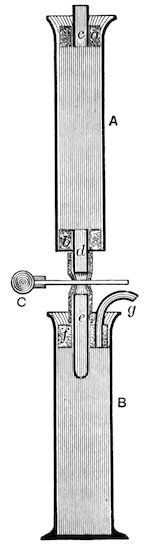
Figure 15. Zalomanoff’s Apparatus for Determining Absorption of Salts by Soils.
Two cylinders are placed vertically, one over the other. The lower cylinder is graduated in cubic centimeters, the upper cylinder is closed at each end by perforated rubber stoppers A and B through the openings of which the glass tubes c and d pass. Within the cylinder A the opening of the small tube d is closed with a disk of Swedish filter paper. The lower part of the small tube is d connected by means of a rubber tube carrying a pinch-cock C, with another small tube e which passes through the stopper f. In carrying out the process the weighed quantity of soil is placed in the upper cylinder and afterwards the measured quantity of the solution, the whole thoroughly mixed and the cylinder closed. The valve C is then opened, a given quantity of the solution, but not all, is made to drop into the lower cylinder and the valve C is then closed. The liquid which has passed into the lower cylinder as well as that which remains in the upper cylinder, is thoroughly stirred and the quantity of the material remaining in both liquids determined and the absorbing power of the soil estimated from their difference. It does not appear that this method of estimation of the absorption power possesses any special advantages over the old and far simpler method of shaking in a flask.
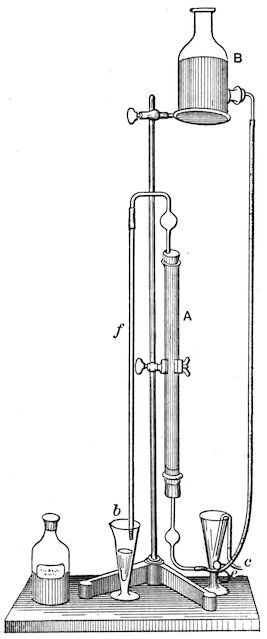
Figure 16. Müller’s Apparatus to Show Absorption of Salts by Soils.
134. Method of Müller.—The method of Müller[97] for illustrating absorption is carried out by means of the apparatus shown in Fig. 16. A glass cylinder A about 750 centimeters long and four to five centimeters wide is closed at each end with rubber stoppers with a single perforation. The cylinder A is for the reception of the soil with which the experiment is to be made. Before using, the lower part of it is filled with glass pearls or broken glass and above this a layer of glass wool is placed about one centimeter thick. The object of this is to prevent the soil from passing into the small tube below. As soon as the soil has all been placed in the cylinder A the upper part of the tube is also filled with glass wool. The cylinder A is connected with the pressure bottle B by means of a rubber tube and the small glass bulb tube shown in the figure. The bottle B should have a content of about two liters. It is filled with the standard solution of the material of which the absorption coefficient is to be determined. At c the rubber tube is connected with a glass T one arm of which is provided with a piece of rubber tubing which can be closed by means of a pinch-cock. At c a screw pinch-cock is placed which can be used to regulate the flow of the solution from B to A. By opening the pinch-cock at e on the short arm of the T piece, a sample of the original liquid can be taken and this can be compared with the part which runs to b. If it is desired for instance, to show that potassium carbonate has been absorbed by the soil the two bulbs shown on the small glass tubes connecting with A can be filled with red litmus paper. This paper will at once be turned blue in the lower bulb while in the upper one it will retain its original color because the liquid in passing through the soil will have lost its alkaline reaction. The solutions used should be very dilute. The apparatus 124is designed for lecture experiments and not for quantitative determinations.
135. Method of Knop.—For rapid determination of the absorption coefficient of the soil Knop’s method may be used.[98]
The fine earth which is employed is that which passes a sieve with meshes of half a millimeter. From 50 to 100 grams of this soil are mixed with from five to ten grams of powdered chalk and with about twice the weight of ammonium chlorid solution of known strength, viz., from 100 to 200 cubic centimeters. The ammonia solution should be of such a concentration that the ammonia by its decomposition for each cubic centimeter of the liquid evolves exactly one cubic centimeter of nitrogen. This solution is prepared by dissolving in 208 cubic centimeters of water one gram of ammonium chlorid. With frequent shaking the solution is allowed to stand in contact with the soil for forty-eight hours. The whole is now allowed to settle and the supernatant clear liquid is poured through a dry filter. From the filtrate twenty to forty cubic centimeters are removed by a pipette, and evaporated to dryness in a small porcelain dish, with the addition of a drop of pure hydrochloric acid. The ammonium chlorid remaining in the porcelain dish is washed with ten cubic centimeters of water into one of the compartments of the evolution flask of the Knop-Wagner azotometer. It is decomposed with fifty cubic centimeters of bromin lye and the nitrogen estimated volumetrically. The difference between the amount of nitrogen in this material and that of the original material will give the amount of absorption exercised by the fine earth. This number, without any further calculation, can be taken as the coefficient of absorption.
136. Method of Huston.—The salt solutions recommended by Huston[99] are sodium phosphate (Na₂HPO₄), potassium chlorid, potassium sulfate, ammonium sulfate and sodium nitrate.
The solutions should be approximately tenth normal, the actual strength in each case being determined by analysis. The phosphorus is determined as magnesium pyrophosphate in the usual way, the potash as potassium platinochlorid, the ammonia by collecting the distillate from soda in half normal hydrochloric 125acid and titrating with standard alkali, and the nitrate by Warington’s modification of Schlösing’s method for gas analysis. The details of these methods of determination will be given later. One hundred grams of the sifted, air-dried soil are placed in a rubber stopped bottle and treated with 250 cubic centimeters of the solution to be tested. The digestion is continued for forty-eight hours in each case, the bottles being thoroughly shaken at the end of twenty-four hours. At the end of the treatment the solutions are filtered and the salts determined in aliquot portions. The details of this method are essentially those already described.
137. Statement of Results.—Duplicate analyses should be made and the tabulation of the data is illustrated in the following analyses by Huston:
Na₂HPO₄ cubic centimeters filtrate taken. Weight of Mg₂P₂O₇ in twenty-five cubic centimeters of the solution. Weight of Mg₂P₂O₇ in filtrate. P₂O₅ absorbed by 100 grams soil. Salt removed per cent.
(a) 25 0.1368 gram 0.0962 gram
(b) 25 0.0963 „ 0.2589 gram 29.6
Mean 0.0963 „
KCl cubic centimeters filtrate taken. Weight of K₂PtCl₆ in twenty-five cubic centimeters of solution. Weight of K₂PtCl₆. K₂O absorbed by 100 grams soil. Salt removed per cent.
(a) 25 0.6154 gram 0.4505 gram
(b) 25 0.4540 „ 0.3161 gram 26.5
Mean 0.4523 „
K₂SO₄ cubic centimeters filtrate taken. Weight of K₂PtCl₆ in twenty-five cubic centimeters of solution. Weight of K₂PtCl₆. K₂O absorbed by 100 grams soil. Salt removed per cent.
(a) 25 0.6113 gram 0.4426 gram
(b) 25 0.4371 „ 0.3324 gram 28.0
Mean 0.4399 „
(NH₄)₂SO₄ cubic centimeters filtrate taken. Number cubic centimeters one-half normal acid neutralized by fifty cubic centimeters of solution. Half normal acid neutralized. N absorbed by 100 grams soil. Salt absorbed per cent.
(a) 50 10.00 7.25 grams
(b) 50 7.25 „ 0.0964 gram 27.5
Mean 7.25 „
126
NaNO₃ cubic centimeters filtrate taken. Number cubic centimeters N₂O₂ afforded by ten cubic centimeters of solution at 0° and 1000 millimeters pressure. Cubic centimeter N₂O₂ at 0° and 1000 millimeters. N absorbed by 100 grams soil. Salt absorbed per cent.
(a) 10 16.63 16.77 grams
(b) 10 16.70 „ none 00.00
Mean 16.73 „
Upon comparing the figures it will be found that the absorption, passing from the greatest to the least, is as follows: phosphoric acid (P₂O₆), potassium sulfate, ammonium sulfate, potassium chlorid and sodium nitrate.
It will be seen that there was no absorption in the case of the nitrate, while with each of the other salts there was quite a marked absorption. It will also be noticed that the percentages of absorption are not very different, and especially is this true of the potassium and ammonium salts, the P₂O₅ being somewhat higher. Whether this fact is merely an accidental occurrence or is due to the law of combination by equivalents could hardly be predicted from the single soil experimented upon; but taking into consideration the possibility of difference in solubility of the resulting compounds in the saline solutions used, and of other varying conditions, the percentages are evidently not far enough apart to exclude the possibility of the bases uniting in equivalent proportions.
138. Preparation of Salts for Absorption.—The salts employed in the foregoing determinations are conveniently prepared, in fractional normal strength.
In grams per liter the following quantities in grams are recommended, viz., 5.35 g NH₄Cl; 10.11 g KNO₃; 16.40 g Ca(NO₃)₂; 24.60 g MgSO₄ + 7H₂O; 23.4 g CaH₄(PO₄)₂, etc.
The ammonium chlorid, potassium nitrate and magnesium sulfate can be weighed as chemically pure salts and the standard solution be directly made up. Calcium nitrate is so hygroscopic that a stronger solution must be made up, the calcium determined and the proper volume taken and diluted to one liter.
Monocalcium phosphate is prepared as follows:
127A solution of sodium phosphate is treated with glacial acetic acid and precipitated with a solution of calcium chlorid. It is then washed with water until all chlorin is removed. The fresh precipitate is saturated with pure, cold phosphoric acid of known strength. After filtering the solution is placed in a warm room and left for two or three weeks until crystallization takes place.
The crystals are pressed between blotting papers and finally dried over sulfuric acid and washed with water-free ether, and again dried. Since this salt is decomposed in strong solutions it should be used only in one hundredth normal strength, viz., 2.34 grams per liter.
POROSITY AND ITS RELATIONS TO MOISTURE.
139. Porosity.—The porosity of a soil depends upon the state of divisibility and arrangement of its particles, and upon the amount of interstitial space within the soil. If a soil be cemented together into a homogeneous mass, its porosity sinks to a minimum; if it be composed, however, of numerous fine particles, each preserving its own physical condition, the porosity of the soil will rise to a maximum. The porosity of a soil may be judged very closely by the percentage of fine particles it yields by the process of silt analysis to be described further on. In general, the more finely divided the particles of a soil, the greater its fertility. This arises from various causes; in the first place, such a soil has a high capacity for absorbing moisture and holding it; thus the dangers of excessive rain-falls are diminished, and the evil effects of prolonged drought mitigated. In the second place, a porous soil permits a freer circulation of the gases found in the soil. The influence of lime in securing the proper degree of porosity of a soil is very great, especially in alluvial deposits and other stiff soils. It prevents the impaction which will necessarily follow in a soil which is too finely divided. In general, the porosity of the soil may be said to depend on three factors, viz.: 1. Upon the state of divisibility or the number of particles per unit volume; 2. Upon the nature and arrangement 128of these particles; 3. Upon how much interstitial space there is in the soil.
140. Influence of Drainage.—Good underdrainage increases the porosity of a soil by removing the excess of water during wet seasons and rendering the soil more suitable to capillary attraction which will supply moisture during dry seasons. The influence of tile drainage on the production of floods has been carefully studied by Kedzie,[100] who shows that surface ditching in conjunction with deforesting may increase floods and contribute to droughts, and that tile-draining may increase flood at the break-up in spring, when the water accumulated in the surface soil by the joint action of frost and soil capillarity during the winter, and the surface accumulations in the form of snow are suddenly set free by a rapid thaw.
He also points out that during the warm months tile-draining tends to prevent flood by enabling the soil to take up the excessive rain-fall and hold it in capillary form, keeping back the sudden flow that would pass over the surface of the soil if not absorbed by it, and it mitigates summer drought by increased capacity of the soil to hold water in capillary form and to draw upon the subsoil water supply.
141. Soil Moisture.—The capacity of a soil to absorb moisture and retain it depends on its porosity and is an important characteristic in relation to its agricultural value.
The following general principles relating to soil moisture are adapted from Stockbridge:[101]
During dry weather plants require a soil which is absorptive and retentive of atmospheric moisture. The amount of this retention is generally in direct ratio to two factors, viz., the amount of organic matter and its state of division. The capillary water of the soil is very closely related to its percolating power, since all waters in the soil are governed in their movements by what is known as capillary force. Liebenberg has shown that this movement may be either upwards or downwards, according as the atmosphere is dry or supplies soil-saturating rain. The water absorbed by the roots passes into the plant circulation, and the greater part is evaporated from the leaves. Where the supply of 129water is insufficient, the plant wilts, and if the evaporation long continue in excess of the supply obtained from the soil, the plant must die. The experiments of Hellriegel have shown that any soil can supply plants with all the water they need, and as fast as they need it, so long as the moisture within the soil is not reduced below one-third of the whole amount that it can hold. The quantity of water required and evaporated by different agricultural plants during the period of growth has been found to be as follows:
One acre of wheat exhales 409,832 pounds of water.
„ „ „ clover „ 1,096,234 „ „ „
„ „ „ sunflowers „ 12,585,994 „ „ „
„ „ „ cabbage „ 5,049,194 „ „ „
„ „ „ grape-vines „ 730,733 „ „ „
„ „ „ hops „ 4,445,021 „ „ „
Dietrich estimates the amount of water exhaled by the foliage of plants to be from 250 to 400 times the weight of dry organic matter formed during the same time. Cultivation conserves soil moisture. It must be remembered that this water contains soil ingredients in solution. Hoffmann has estimated that the quantity of matter dissolved from the soil by water varies from 0.242 to 0.0205 per cent of the dried earth. The experiments of Humphrey and Abbott have shown that about one-sixth of the total sediment of the Mississippi river is soluble in water.
142. Determination of the Porosity of the Soil.—The porosity of the soil is fixed by the relative volume of the solid particles as compared with the interstitial space. It is most easily determined by dividing the apparent by the real specific gravity.
Let the real specific gravity of a soil be 2.5445 and the apparent specific gravity of the same soil be 1.0990.
The porosity is then calculated according to the following ratios, viz.:
2.5445 : 1.099 = 100 : X
Whence X = 43.2 = per cent volume occupied by the solid particles of the soil.
The per cent volume occupied by the interstitial space is therefore 56.8.
130143. Method of Whitney.—The total volume of interstitial space within the soil, in which water and air can enter, is best determined by calculation from the specific gravity and the weight of a known volume of soil. To determine this in the soil in its natural position in the field, a sample is taken in the following way: A brass tube, about two inches in diameter and nine inches long, has a clock spring securely soldered into one end, and this end turned off in a lathe to give a good cutting edge of steel. The area enclosed by this steel edge is accurately determined, and a mark is placed on the side of the tube exactly six inches from the cutting edge. A steel cap fits on top of the brass cylinder to receive the blows of a heavy hammer or wooden mallet. The cylinder is driven into the ground until the six-inch mark is just level with the surface. The whole is then dug out, care being taken to slip a broad piece of steel under the cylinder before it is removed, so as to prevent the soil which it contains from falling out. The cylinder is then carefully laid over on its side, and the soil is cut off flush with the cutting edge of steel. The soil is then removed from the cylinder, carried to the laboratory and properly dried and weighed. The object of the steel inserted in one end of the cylinder is to reduce the friction on the inside of the tube to a minimum, and thus prevent the soil inside the cylinder being forced down below the level of the surrounding earth. The volume of the soil removed with this sampler can readily be determined by calculation, as the area of the end of the tube is known and the sample is six inches deep. In a sampler, such as described here, this volume is about 300 cubic centimeters. From the weight of soil and the volume of the sample, the volume of interstitial space may be found by the following formula:
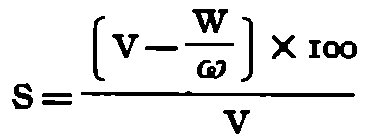
S is the per cent by volume of interstitial space, V is the volume of the tube in cubic centimeters, W is the weight of soil in grams, and ω is the specific gravity of the soil. The specific gravity can be determined for each soil, or the factor 2.65 can be used, which is sufficiently accurate for most work.
131The per cent by volume of interstitial space in the undisturbed subsoil is found to range from about thirty-five for sandy land, to sixty-five or seventy for stiff clay lands.
For the determination of the amount of water an air-dried soil will hold, if all the space within it is completely filled with water, an eight-inch straight argand lamp chimney, with a diameter of about two inches, can be conveniently used. A mark is placed on the side of the tube, six inches from one end, and the volume of the tube up to this mark is found by covering the end with a piece of thin rubber cloth, or by pressing the chimney down firmly on a glass plate, and making a water-tight joint with paraffin or wax. Water is then poured into the tube up to the six-inch mark, and the weight or volume of water determined. The tube can then be dried, a piece of muslin tied tightly over the top and the whole then weighed. Soil is carefully poured in and the tube gently tapped on a soft support until the soil is six inches deep in the tube, and has the desired degree of compactness. The weight and volume of the soil can thus be determined, and the volume of the interstitial space from the formula already given. This can also be determined directly by introducing water from above, or by immersing the cylinder of soil up to the six-inch mark in water, and allowing the water to enter the soil from below. With such a short depth of soil, very little water will flow out when the cylinder is suspended in the air. The amount which will flow out when the cylinder is thus suspended, will depend both upon the texture and the depth of soil. It is impossible, however, by this method, to completely remove the air or to completely fill the space within the soil with water; for as the water enters the soil, a considerable amount of air becomes entangled in the capillary spaces, and this could not be removed except by boiling and vigorous stirring, which would altogether change the texture of the soil. The amount of water held by the soil, or the amount of space within the soil into which water and air can enter, will evidently depend upon the compactness of the soil, and this is best expressed in per cent by volume of space.
144. Capacity of the Fine Soil for Holding Moisture.—The 132soil, as it is taken from the field, may have quite a different water coefficient from the same soil after it has been passed through a fine sieve or been dried at air temperatures or at 100° or 110°. The method of determination which depends upon adding excess of water to a given weight of fine earth, and afterwards eliminating the excess by percolation or filtration, is apt to give misleading results. If, however, the results are obtained by working on the same weight of soil, and in the same conditions, they may have value in a comparative way. The comparison between soils must be made with equal weights, in like apparatus and with the same manipulation, to have any value. These determinations, however, cannot have the same practical value as those made in the samples in a natural condition as has just been described.
145. Method of Wolff Modified by Wahnschaffe.[102]—A cylindrical zinc tube (Fig. 17), sixteen centimeters long and four centimeters internal diameter, is used, the cubical capacity of which is 200 cubic centimeters.
The cylinder is graduated by placing the moist linen disk on the gauze and tying a piece of rubber cloth over the bottom. Water is now poured in until the level is even with the gauze bottom. Add then exactly 200 cubic centimeters of water, mark its surface on the zinc, throw out the water, and file the zinc down to the mark.
The bottom of the tube is closed with a fine nickel-wire gauze. Below this a piece of zinc tubing, of the size of the main tube, is soldered; pierced laterally with a number of holes.
Before using, the gauze bottom of the cylinder is covered with a moist, close fitting linen disk, and the whole apparatus weighed. It is then filled with the fine earth, little by little, jolting the cylinder on a soft substance after each addition of soil to secure an even filling. When filled even full the whole is weighed, the increase in weight giving the weight of soil taken.
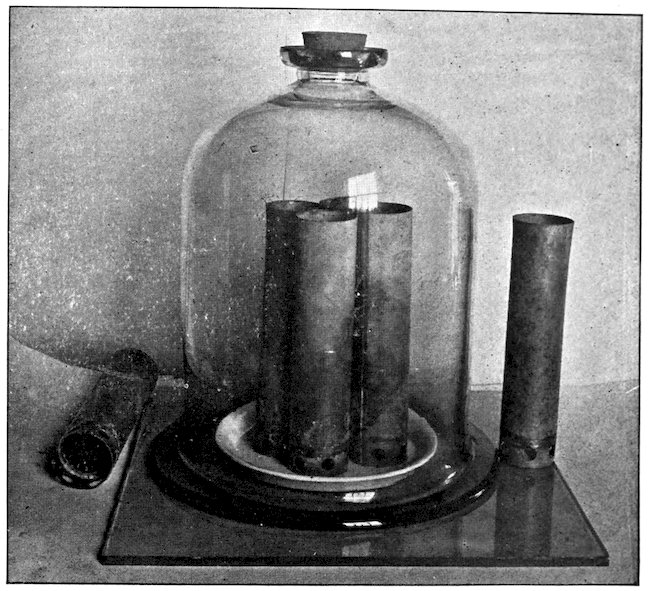
Figure 17. Capacity of the Fine Soil for Holding Moisture. Method of Wolff Modified by Wahnschaffe.
133A large number of cylinders can be filled at once and placed in a large glass crystallizing dish containing water and covered with a bell jar (Fig. 17). The water should cover the gauze bottoms of the cylinders to the depth of five to ten millimeters. More water should be added from time to time as absorption takes place. The cylinders should be left in the water until when weighed at intervals of an hour no appreciable increase in weight takes place. The temperature and barometer reading should be noted in connection with each determination. With increasing temperature the water coefficient is diminished.
The method of Wolff, as practiced in the laboratory of the Chemical Division of the U. S. Department of Agriculture, has given very concordant results. Five determinations were made on a sample of vegetable soil with the Wolff cylinders, which were weighed at intervals of ten, twenty, and thirty days, with the following results:
No. 1. Water absorbed after ten days 106.25 per cent
„ 2. „ „ „ „ „ 105.68 „ „
„ 3. „ „ „ „ „ 105.86 „ „
„ 4. „ „ „ „ „ 106.11 „ „
„ 5. „ „ „ „ „ 105.83 „ „
Mean 105.95 „ „
No. 1. Water absorbed after twenty days 106.44 per cent
„ 2. „ „ „ „ „ 105.98 „ „
„ 3. „ „ „ „ „ 106.56 „ „
„ 4. „ „ „ „ „ 106.52 „ „
„ 5. „ „ „ „ „ 106.38 „ „
Mean 106.38 „ „
No. 1. Water absorbed after thirty days 108.35 per cent
„ 2. „ „ „ „ „ 107.60 „ „
„ 3. „ „ „ „ „ 108.32 „ „
„ 4. „ „ „ „ „ 107.86 „ „
„ 5. „ „ „ „ „ 107.87 „ „
Mean 108.00 „ „
The data obtained show that there was a very slight increase in the amount of moisture absorbed after the tenth day.
As will be seen, however, from the following data, the soil within the cylinder does not contain in all parts the same percentage of moisture, the lower portions of the cylinder containing notably larger proportions than the upper parts. The cylindrical soil column was divided into four equal parts and the moisture determined in each part. Beginning with the top quarter the percentages of moisture were as follows:
134
First quarter 97.52 per cent
Second „ 105.91 „ „
Third „ 112.83 „ „
Fourth „ 116.48 „ „
146. Method of Petermann.[103]—The method of Wolff as practiced by the Belgian Experiment Station, at Gembloux, is essentially the same as described above.
Petermann recommends the use of tared cylinders twenty to twenty-five centimeters long and six to eight centimeters in diameter. The cylinder is to be filled with the fine earth, little by little, with gentle tapping after each addition. The bottom of the cylinder is closed with a perforated rubber stopper on which is spread a moistened disk of linen. The cylinder, thus prepared and filled, is weighed and afterwards placed in a vessel containing distilled water, to such a depth as to secure a water level about two centimeters above the lower surface of the soil in the cylinder. The level of the water is kept constant as the contents of the cylinder are moistened by capillarity. When the earth appears to be thoroughly moistened, as can be told by the appearance of the upper surface, maintain the contact with water for about five or six hours.
The cylinder is then removed, the upper surface covered to avoid evaporation, allowed to drain for a few hours, wiped and weighed. The cylinder is again placed in water to see if any increase in weight takes place. The weight of the fine earth and of the absorbed water being known, the percentage of absorption is easily calculated.
147. Method of A. Mayer.[104]—A glass tube, one and seven-tenths centimeters in diameter, composed of two pieces, seventy-five centimeters and twenty-five centimeters in length, is united by a piece of rubber tubing. The lower free end of the seventy-five centimeter piece is closed with a piece of linen. The tube is filled, with gentle jolting, to the depth of one meter with fine earth, the earth column thus extending twenty-five centimeters above the point of union of the two pieces. Thus prepared, a quantity of water is poured into the upper tube sufficient to temporarily saturate the whole of the soil.
During the sinking of the water in the tube there is thus 135effected a moistening of the material before it is wholly filled with water. After waiting until the water poured on top has disappeared the tube is separated at the rubber tube connection and a sample of the moist soil taken at that point. This is at once weighed and then dried at 100°. The loss in weight gives the water absorbed.
The number thus obtained is calculated to the standard by volume, by use of the number representing the apparent specific gravity of the fine earth.
For sand of different degrees of fineness the following numbers were found:
Degree of fineness 2 3 4
Per cent water absorbed 7.0 13.7 44.6
The numbers thus obtained are taken to represent the absolute water capacity of a mineral substance in powder.
The full water capacity, i. e., the power of holding water when the powder is immersed in water, the excess of which is then allowed to flow away is much greater than the absolute number.
This difference is shown in the following data:
Quartz, size three. Clay, size three.
Full water capacity 49.0 per cent 46.8 per cent
Absolute water capacity 13.7 „ „ 24.5 „ „
In general the absolute is markedly inferior to the full water capacity. Only in the finest dust do the two numbers approach each other.
148. Volumetric Determination.—A convenient apparatus for this determination has been devised by Mr. J. L. Fuelling, of the Chemical Division, Department of Agriculture. It is shown in Fig. 18.
It consists of an ordinary percolator the diameter of which decreases slightly towards the lower end, a thick-wall rubber tube and an ordinary burette, divided in tenths. A rubber stopper is fitted to the mouth of the percolator and perforated twice—in the middle and at the side, the former for a small tube provided with pinch-cock and the latter for the neck of a small funnel. The whole is supported on a convenient stand, the clamp holding the percolator being placed above that supporting the burette, both clamps arranged to slide on the stand-rod.
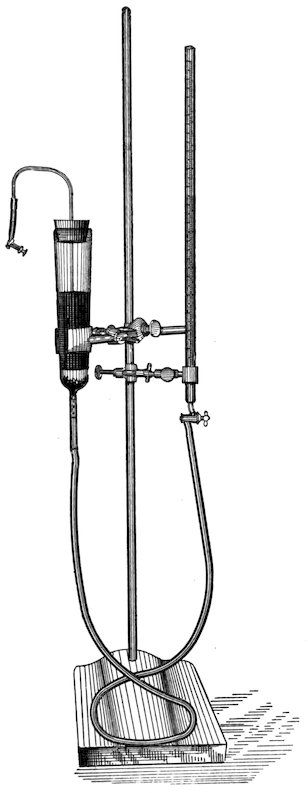
Figure 18. Fuelling’s Apparatus.
The method is as follows:
A mark is placed upon the projecting tube at the lower end of the percolator, and the tube at this point may be drawn out sufficiently to decrease the width of meniscus to one-eighth inch. Into the percolator is first introduced a small disk of wire gauze or perforated porcelain, with heavy wire pendant in the tube. Through the rubber stopper a small glass tube is passed and its lower end pressed firmly upon the wire or porcelain disk, its upper end being curved and supplied with a pinch-cock. Into the percolator is now poured one inch of fine shot (No. 20) and then one inch of fine sand which has been previously digested with hydrochloric acid and well cleaned of dust by washing.
The zero.—After the shot and sand have been shaken even, the burette is filled with water and raised above the level of the sand, wetting the percolator for four inches of its length. The burette is lowered and the shot and sand bed allowed to drain by opening the pinch-cock of the inner tube. The burette is raised and the shot-sand flooded repeatedly until, by lowering the burette until the zero mark of the percolator tube is reached, a uniform reading on the 136burette is secured. Thus the shot-sand bed is completely charged with water. The water level is now made zero on the percolator stem, the burette filled to its zero mark and the apparatus is prepared for introduction of the soil.
The Determination.—From 100 to 200 grams of soil, previously dried free of moisture, are weighed, the burette raised until the water level is three inches above the sand, and the soil gently dropped through a funnel into the water. When the soil has been introduced and wetted completely the water level is raised above the soil and allowed to remain thus two hours. The burette is then lowered and the water allowed to drain from the wetted soil. Four to six hours are usually given the draining, the reading taken on the burette after establishing the zero on the percolator stem, the volume of absorbed water thus ascertained and divided by the weight of soil multiplied by 100; the result expresses the water absorbed per hundred of soil.
Example:
Water required to saturate disk, etc. 0.50 cubic centimeter.
Weight of air-dried soil taken 20.00 grams.
Moisture at 105° therein 14.25 per cent.
Weight water in soil 2.85 grams.
Reading of burette after saturation 10.75 cubic centimeters.
Less water required for disk, etc 9.25 „ „
Temperature 20°.00
Weight of 9.25 cubic centimeters H₂O at 20° 9.22 grams.
Total weight of water retained by soil 12.07 „
Per cent water retained by soil 60.35 per cent.
For general analytical work the correction for variations in the weight of water for different temperatures is of no practical importance.