Volume 1 / Part 4 — PART FOURTH. MECHANICAL ANALYSIS OF SOILS. (continued 2)
Reading edition
Height of column in piezometer. h Velocity in the elutriating cylinder of 4.489 centimeters diameter. v Corresponding diameter of silt particles. d = v(⁷⁄₁₁)0.0314 millimeters.
centimeters. Observed, millimeters. Calculated, millimeters. millimeters.
1.5 0.222 0.220 0.0120
1.6 0.257* 0.252 0.0131
1.7 0.284 0.281 0.0140
1.8 0.306* 0.307 0.0148
1.9 0.323 0.332 0.0155
2.0 0.346 0.355 0.0162
2.5 0.427 0.451 0.0185
3.0 0.531 0.530 0.0210
3.5 0.577 0.599 0.0227
4.0 0.650 0.660 0.0236
2114.5 0.694 0.717 0.0254
5.0 0.751 0.769 0.0265
6.0 0.850 0.864 0.0286
7.0 0.942 0.950 0.0304
8.0 1.050 1.028 0.0320
9.0 1.120 1.101 0.0334
10.0 1.170 1.169 0.0347
15.0 1.490 1.460 0.0400
20.0 1.730 1.710 0.0441
25.0 1.940 1.920 0.0476
30.0 2.100 2.110 0.0506
35.0 2.310 2.290 0.0532
40.0 2.460 2.450 0.0556
45.0 2.610 2.610 0.0578
50.0 2.770 2.750 0.0598
60.0 3.030 3.020 0.0635
70.0 3.290 3.270 0.0667
80.0 3.490* 3.500 0.0697
90.0 3.710 3.710 0.0724
100.0 3.870* 3.920 0.0749
Suppose the problem is by means of the apparatus tested above, to separate into a number of groups a mixture of silt particles, whose hydraulic values are found between the following diameters: 0.01, 0.02, 0.03, 0.04, 0.05, 0.06, 0.07 millimeters. The table will show at once under what pressure of water the piezometer must be placed in order to give the values; viz., 1.4, 2.8, 7.0, 15.0, 29.0, 53.0, and 83.0 centimeters respectively.
The apparatus described above, is adapted for velocities in the elutriating cylinder varying from two-tenths millimeter to four millimeters per second. The largest silt particles which can be separated by the velocities given above, have approximately a diameter of 0.08 millimeter. For the separation of larger particles a sieve can take the place of the silt apparatus. If, however, it be desired to subject larger particles to silt analysis, the dimensions of the elutriating cylinder and of the outlet of the delivery tube must be changed accordingly.
212Preparation of Sample.—The conduct of silt analysis of natural soils must, in certain cases, be preceded by a special treatment of the sample. If the latter be rich in humus the organic substance must previously be separated as completely as possible. With sandy soils this can be accomplished by ignition. With clayey soils, on the contrary, it is to be performed by boiling the soils at least one hour with water which contains from one to two per cent of free alkali. Soils which contain lime must also be subjected to treatment with dilute hydrochloric acid, and the hydrochloric acid must be as carefully removed, as possible before the sample is subjected to elutriation; afterward follows the boiling of the sample in the ordinary way with water. This, of course, can be omitted when it has already been treated with boiling dilute alkali. It is also important to remove the larger particles by a sieve before the elutriation begins. It is well to pass a sample through a sieve after it has been boiled, by which all particles of a larger diameter than 0.2 millimeter are removed. This will usually require about one liter of water and this water should be allowed to rest from one to two hours and poured off with the suspended material which it contains. Only what subsides should be brought into the apparatus. In rinsing the sample as much water must be used as will fill the apparatus up to its cylindrical portion.
After the sample has been placed in the apparatus, the water is allowed slowly to enter, being careful to avoid reaching more than the lowest required velocity, until the outflow begins. The water then is so regulated by the stop-cock as to bring it to the desired height in the piezometer. This being accomplished, the different velocities which have been decided upon for separating the particles of silt are used one after the other, as soon as all the silt which can be removed at each given velocity, has been secured. From three to five liters of water will be required for the separation of each class of particles. Sometimes the reading of the height of the water in the piezometer is difficult; as, for instance, when foam or bubbles accumulate therein. 213These bubbles can be removed by simply blowing into the tube, or dropping into it a little ether. The outflow of water can be received in vessels, beaker glasses, or cylinders, in which it is allowed to subside. The finest particles which remain in suspension in the water are best determined by difference. If it be desired to weigh them directly, the water can be treated with ammonium bicarbonate until it contains from one to two per cent thereof. The precipitation then takes place in a few hours.
The collection and weighing of silt particles are accomplished in the usual way. That which finally remains in the elutriating vessel is taken out after the end of the operation by closing the stop-cock, removing the stoppers with the piezometer tube, pouring the contents of the elutriating vessel into a beaker glass and rinsing out carefully all adhering particles. Examples of the working of the apparatus follow:
The soil was taken from the Imperial Russian Agricultural Experimental Institute at Gorki. It was a fine clay sand and was carefully treated with hydrochloric acid. The results of the analysis are given in the following table:
Velocities employed in millimeters. Largest diameter of the collected particles in millimeters. Percentage of silt product obtained in repeated elutriations.
0.25 0.012 13.4 12.6 11.9
0.5 0.020 9.1 8.7 9.5
1 0.032 21.0 21.4 20.8
2 0.050 30.4 29.8 31.7
3 0.063 16.7 16.1 15.5
4 0.076 5.3 5.5 5.5
Residue 4.2 4.9 3.8
Total 100.0 99.0 98.7
Holthof modifies the apparatus of Schöne by putting into the lower mouth of the elutriator a little mercury so that the particles of earth are deposited upon its surface and are thus better agitated and washed by the current of water.
218. Mayer’s Modification of Schöne’s Method.—An improvement of Schöne’s apparatus in the direction of greater simplicity has been tested by Mayer[150] with satisfactory results:
214The apparatus, (Fig. 34), consists of a glass vessel having a glass stop-cock at the bottom for admitting the water. For a distance of twenty centimeters the sides of the tube are parallel and the diameter about one centimeter. Next for a distance of fifty centimeters the tube is conical expanding at a regular rate until the internal diameter reaches five centimeters. For a distance of ten centimeters the vessel is again strictly cylindrical and it is in this cylindrical portion that the separation of the different constituents takes place. The vessel is then rapidly narrowed until it carries the stopper A two centimeters in diameter. This stopper carries two glass tubes, one F bent downward to conduct the overflow into the receiving vessels, and one H for the purpose of regulating the rate of overflow by the height of the column of water therein. The orifice of the overflow tube F should be so regulated that with a pressure of five centimeters water in H, one liter shall pass over in ten minutes.

Figure 34. Schöne’s Apparatus for Silt Analysis, Modified by Mayer.
If the separation be conducted in an apparatus thus mounted and graduated with a pressure of two centimeters in H all that portion of the soil which can properly be called clay will pass over. The fine earth, that is, earth in which all coarse particles have been removed by proper sifting, is used in ten-gram lots for each experiment. The residue, after the separation is complete, consists of pure sand or at least pure sand mixed with humus. Before the fine earth is placed in the apparatus, the calcium carbonate therein is removed with hydrochloric acid. The treatment with hydrochloric acid, however, is not to be recommended in soil containing many undecomposed particles of calcium carbonate or dolomite for then large additions to the silt output might be made from these particles, which could not be regarded as coming from the soil as it actually exists. For alluvial soil, however, previous treatment with hydrochloric acid is recommended unconditionally.
215219. Schöne’s Method as Practiced by Osborne.—The apparatus used by Osborne[151] was obtained from Germany and was similar to that described by Schöne in his original paper, except that it was furnished with a second elutriating tube as suggested by Orth. The modification made by Orth consists, essentially, of a second elutriating tube with straight sides into which the bulk of the soil is introduced, only the final part being carried over into the Schöne’s tube proper. Water is supplied to the apparatus under constant pressure by means of a Mariotte’s bottle.
The preliminary treatment recommended by Schöne is omitted, as these steps have been shown to be undesirable, on account of affecting the accuracy of the results.
Twenty grams of the air-dried soil are passed, under water, through a sieve of one-fourth millimeter mesh. That part of the soil which remains in suspension after being sifted is placed at once in the Schöne’s tube of the apparatus, the coarser portion being rinsed into the Orth tube. The current is regulated so that the largest particles of quartz carried off have an average diameter of 0.01 millimeter. When all is carried off that can be removed at this rate the current is increased until the largest quartz grains passing off have a diameter of 0.05 millimeter.
As noticed by Hilgard with Schulze’s apparatus, secondary currents are formed during the process of elutriation which descend along the walls of the conical portion of the Schöne’s tube and some distance along the sides of the cylindrical portion. The tendency of these currents is to produce globular aggregates of particles which fall to the bottom. They are broken up from time to time by increasing the velocity of the current but even this method fails to disintegrate a considerable quantity of them.
220. Statement Of Results.—Two samples of soil from the garden of the experiment station analyzed by Schöne’s method gave the following proportions of sediment.
In the table the term clay is used to designate all that part of the soil which has diameters less than 0.01 millimeter and which remains suspended after twenty-four hours standing in water having a depth of 200 millimeters.
216
Soil, from Garden of the Experiment Station.—Not Boiled.
Analyses with the Schöne-Orth Elutriator.
A. B. C.
Above 0.25 millimeter 48.82 48.82 48.82
0.25–0.05 27.36 29.94 22.37
0.05–0.01 millimeter 8.63 6.07 13.70
0.01 millimeter and less depos. 7.36 7.31 7.20
Clay (by difference) 1.00 1.03 1.08
Loss on ignition 6.83 6.83 6.83
100.00 100.00 100.00
The last column C represents the average of three direct beaker elutriations according to the method of Osborne.
The differences which these figures show are found to be due to imperfect separation of the finer grades from the coarser and even when the various fractions separated by the Schöne method are subjected to beaker elutriation and the portions separated from them added to the grades to which they properly belong the Schöne elutriator was found to effect far less exact separations than the beaker method.
Samples of prairie soil from Mercer County, Ill., not boiled, were examined by the two methods with the following results:
Schöne-Orth elutriation. Beaker method.
Above 0.25 millimeter 0.76 0.62
0.25–0.05 millimeter 11.25 2.42
0.05–0.01 millimeter 52.65 43.58
0.01 millimeter and less deposited 14.84 31.58
Clay 4.44 5.81
Loss on ignition 14.49 14.49
98.43 98.50
In this case it is seen that Schöne’s method varies considerably from the beaker method and if the beaker method be regarded as correct the Schöne method is evidently less reliable.
In the next table are given the data of the examination of brick clay from North Haven, Conn., by the two methods.
Brick Clay from North Haven, Conn.
Schöne-Orth elutriation. Beaker method.
Above 0.25 millimeter 1.02 1.02
0.25–0.05 millimeter 3.91 0.76
0.05–0.01 millimeter 29.63 20.95
0.01 millimeter and less 58.58 71.01
Loss on ignition 6.60 6.60
99.74 100.34
217The failure of the Schöne method to give the results obtained by the beaker method is ascribed to the fact that it is impossible for the current of the strength used to disintegrate the clay and further that the particles after they are once separated tend to coalesce by the currents produced by the elutriating process.
221. The Berlin-Schöne Method.—Osborne has also made a study of the Schöne method as modified by the Bodenlaboratorium of Berlin. The directions for the analysis by this laboratory method are as follows:
Five hundred grams of the soil are sifted through a sieve with circular holes two millimeters in diameter. Of the earth passing the sieve from 30 to 100 grams are boiled in water with constant stirring from one-half to one hour or longer, according to the character of the soil. The finer the texture of the soil the smaller the quantity taken and the longer the time of boiling. Treatment with acids or alkalies is not practiced.
The finer portion of the soil remaining suspended in the water, after boiling, is poured into the Schöne tube, the remaining coarse part is rinsed into the Orth tube. The clay, together with the finest sand, is collected in a separate vessel, the water in which it is suspended is evaporated and the residue after drying in the air is weighed. The rest of the operation is carried out as previously described except that the products of elutriation are not ignited but weighed air dried, in order that they may be further examined, chemically if desired. By proceeding in this manner the following results were obtained:
Soil, from Garden of the Experiment Station, Boiled Forty-five Minutes.
Separations by the Berlin-Schöne method.
Air-dried. Ignited.
Above 0.05 millimeter 72.63 71.76
0.05–0.01 millimeter 14.17 12.53
0.01 millimeter and less 12.97 9.38
Loss on ignition 6.83
99.77 99.50
For the sake of comparing the mechanical separation attainable by this procedure with those yielded by other methods, the air-dried products were ignited and again weighed and examined.
218By subtracting from the ignited portion above 0.05 millimeter, 49.37 per cent, the amount of this soil that remained on a 0.25 millimeter sieve, the fraction between 0.25 millimeter and 0.05 millimeter is found, and the separations in this analysis may be compared with those previously obtained by the beaker method as follows:
Soil from Garden of Experiment Station.
Beaker Method.
Berlin-Schöne, boiled forty-five minutes. Boiled twenty-three hours, average of four analyses. Pestled, not boiled. Not boiled nor pestled, average of three analyses.
Above 0.25 millimeter 49.37 47.77 48.82 48.82
0.25–0.05 millimeter 21.39 20.75 22.44 22.37
0.05–0.01 millimeter 12.53 11.18 12.55 13.70
<0.01 clay included 9.38 13.47 9.36 8.28
Loss on ignition 6.83 6.83 6.83 6.83
99.50 100.00 100.00 100.00
Osborne concludes from the above facts that the Berlin-Schöne method, while showing close agreement with the beaker method, does not give results which are identical with that method. On subjecting portions separated by the Berlin-Schöne method to the beaker analysis additional separations were secured. In the case of heavy loams the inability of the Berlin-Schöne method to effect even a rough or approximate separation of the several grades becomes very conspicuous.
222. Method of Hilgard.—Two important principles lie at the foundation of this method; viz., 1, the use only of separating vessels of true cylindrical shape and 2, the employment of a mechanical stirrer to break up the floccules formed during the process of separation. The points in the apparatus to be considered are uniformity of the cross section of the elutriator at every point, exact perpendicularity of position, careful control of the rate of flow and continuous operation of the mechanical stirrer. According to Hilgard’s observations the stirring due to the current of water alone is not sufficient to break up the floccules unavoidably formed during the separation, while any inclination of the sides of the elutriating vessel from the perpendicular due either to a conical shape or false position favors in the highest degree the formation of floccules due to reflex currents formed in the body of the liquid.
219In order to carry out the idea suggested by Türschmidt of substituting for the accidental and indefinite products usually appearing in the statements of silt analyses sediments of known and definite hydraulic value a constant head of water is used, secured by means of a Mariotte’s bottle connecting with the tube delivering the current through a cock provided with an arm moving on a graduated arc.
According to Hilgard the separation of sediments by the method of subsidence does not possess the analytical accuracy of the moving liquid method, especially when the latter is combined with mechanical stirring. The subsidence method requires close and continuous attention and in the case of fine sediments tending to flocculation the difficulties of the method are greatly increased. The views of Hilgard in respect of the laboriousness of the subsidence method lose, however, some of their force since the modifications of Osborne have come into use. The simplicity and cheapness of the apparatus required for subsidence give it at the start many advantages over the more elaborate process with a churn elutriator. For rigid scientific investigation, however, the method of Hilgard is commended as a standard of comparison in all cases.
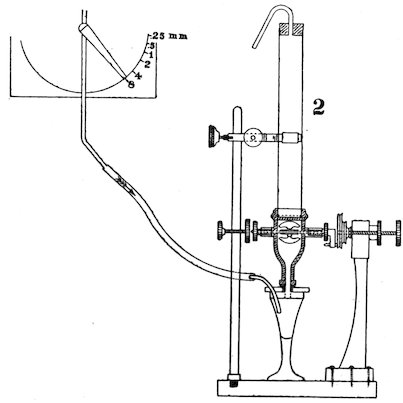
Figure 35. Hilgard’s Churn Elutriator.
223. The Elutriator.—The instrument devised by Hilgard[152] for the purpose of breaking up these flocculent aggregates is shown in figure 35, together with the simpler form, a Schöne’s elutriator, figure 36, which can serve for grain sizes above eight millimeters hydraulic value. The latter is conveniently selected so as to have half the cross-section of the former, so that with the same position of the index lever the velocity 220will be just doubled. The cylindrical glass tube, of about forty-five millimeters inside diameter at its mouth, and 290 to 300 millimeters high, has attached to its base a rotary churn consisting of a brass cup, shaped like an egg with point down, so as to slope rather steeply at base, and triply perforated; viz., at the bottom for connection with the relay reservoir, and at the sides for the passage of a horizontal axis bearing four grated wings. This axis, of course, passes through stuffing boxes, provided with good thick leather washers, saturated with mutton tallow. These washers, if the axis runs true, will bear a million or more revolutions without material leakage. When a beginning is noted additional washers may be slipped on without emptying the instrument, until the analysis is finished. For the finest sediments, from five to six hundred revolutions per minute is a proper velocity, which may be secured by clock work, turbine or electric power. The driving pulley should not be directly connected with the axis, both because it is liable to cause leakage, and because it is necessary to be able to handle the elutriator quickly and independently. This is accomplished by the use of “dogs” on the pulley and churn axis. For the grain sizes of one to eight millimeters hydraulic value lower velocities are sufficient; too low a velocity causes an indefinite duration of the operation and may be recognized by the increase of turbidity as the velocity is increased.
As the whirling agitation caused by the rotation of the dasher would gradually communicate itself to the whole column of water and cause irregularities, a wire screen of 0.8 millimeter aperture is cemented to the lower base of the cylinder.
The relay vessel should be a thick, conical test glass with foot; its object is to serve as a reservoir for the heavy sediments not concerned at the velocity used in the elutriator tube, and whose presence in the latter or in its base, the churn, would only cause abrasion of the grains and changes of current velocity, such as occur in the apparatus of Schöne, and compel the current measurement of the water delivered. It is connected above with the churn by a brass tube about ten millimeters in clear diameter, so as to facilitate the descent of the superfluous sediments, 221which the operator, knowing the proportion of area between the connecting tube and elutriator, can carry to any desired extent; thus avoiding the disturbance of the gauged current velocities, as well as all material abrasion.
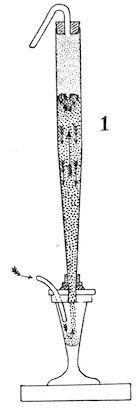
Figure 36. Improved Schöne’s Apparatus with Relay.
A glass delivery tube should extend quite half way down the sides of the relay vessel, to insure a full stirring up of the coarse sediments when required. By means of a rubber hose, not less than twenty inches in length, this delivery tube connects with the siphon carrying the water from near the bottom of the Mariotte’s bottle, a ten-gallon acid carboy. A stop-cock provided with a long, stiff index lever, moving on an empirically graduated arc, regulates the delivery of water through the siphon. Knowing the area of the cross section of the elutriator tube, the number of cubic centimeters of water which should pass through it in one minute, at one millimeter velocity, is easily calculated, and from this the lever positions corresponding to other velocities are quickly determined and marked on the graduated arc. The receiving bottle for the sediments, also shown in the figure, must be wide and tall, so as to allow the sediment to settle while the water flows from the top into the waste pipe. The receiving funnel tube must dip nearly to the bottom of the bottle. Thus arranged, the instrument works very satisfactorily, and by its aid soils and clays may readily be separated into sediments of any hydraulic value desired. But in order to insure correct and concordant results, it is necessary to observe some precautions; viz.,
(1) The tube of the instrument must be as nearly cylindrical as possible and must be placed and maintained in a truly vertical position. A very slight variation from the vertical at once causes the formation of return currents, and hence of molecular aggregates on the lower side.
(2) Sunshine, or the proximity of any other source of heat, must be carefully excluded. The currents formed when the 222instrument is exposed to sunshine will vitiate the results.
(3) The Mariotte’s bottle should be frequently cleansed, and the water used be as free from foreign matters as possible. For ordinary purposes it is scarcely necessary to use distilled water. The quantities used are so large as to render it difficult to maintain an adequate supply, and the errors resulting from the use of any water fit for drinking purposes are too slight to be perceptible, so long as no considerable development of the animal and vegetable germs is allowed. Water containing the slimy filaments of fungoid growths and moss protonema, algae, vorticellae, etc., will not only cause errors by obstructing the stop-cock at low velocities, but these organisms will cause a coalescence of sediments that defies any ordinary churning, and completely vitiates the operation.
(4) The amount of sediment discharged at any time must not exceed that producing a moderate turbidity. Whenever the discharge becomes so copious as to render the moving column opaque, the sediments assume a mixed character, coarse grains being, apparently, upborne by the multitude of light ones whose hydraulic value lies considerably below the velocity used, while the churner also fails to resolve the molecular aggregates which must be perpetually reforming where contact is so close and frequent. This difficulty is especially apt to occur when too large a quantity of material has been used for analysis, or when one sediment constitutes an unusually large portion of it. Within certain limits the smaller the quantity employed the more concordant are the results. Between ten and fifteen grams is the proper amount for an instrument of the dimensions given above.
224. Preparation of the Sample.[153]—In some cases simple sifting will be sufficient to prepare the air-dried soil for the elutriator. In most cases, however, some mechanical aid must be invoked to secure particles of sufficient fineness. Nothing harder than a rubber pestle should be used and care must be taken not to break up any calcareous or ferruginous masses which the particles of fine soil may contain. The use of water in this mechanical attrition should be avoided, if possible, but in some heavy clay and adobe soils wetting becomes necessary. In this case the parts separated by the sieve are collected separately and the 223turbid mass removed by water and dried for further examination.
A sieve of 0.5 millimeter mesh is recommended as the best because that is almost exactly the diameter of the particles passing off at the maximum velocity of sixty-four millimeters per second to which the elutriator is adapted. The particles passing the 0.5 millimeter mesh are called fine earth.
225. Preparation by Boiling.—The method of preparation by boiling may be applied to all samples of fine earth. The fact pointed out by Osborne, that diffusibility of some clays is diminished by long boiling, renders it important to restrict the time of this operation as much as possible. With most soils from eight to fifteen hours will be long enough, occasionally extending to even twenty-four hours. A thin long-necked flask of about one-liter capacity should be used; filled three-quarters full with distilled water and the sample of soil added. The flask is supported over the lamp on a piece of wire gauze at an angle of 45°. It carries a cork with a long condensing tube. At first the boiling goes on smoothly, but after a time violent bumping may supervene, endangering the flask but promoting the object in view.
The contents of the flask are transferred to a beaker and diluted with distilled water to one and a half liters, shaken and allowed to settle for a time necessary to allow all particles of 0.25 millimeter hydraulic value to reach the bottom. The supernatant turbid liquid is decanted and the process repeated with smaller quantities of water until no further turbidity is produced. The united decantations, of which there will be from four to eight liters, are well shaken and a proper time allowed for the 0.25 millimeter hydraulic value sediments to fall. This last step is necessary to remove any such sediments which may have been carried over mechanically in the first separation. The dilution being very great, a fairly perfect separation is thus secured and the sediments are then ready for the elutriator.
226. Separation of Clay and Finest Silt.—The property which pure clay possesses, of remaining suspended almost indefinitely in pure water, affords a ready means of separation from the silt particles of less than 0.25 millimeter hydraulic value. But the finest silt particles subside so slowly that this method of 224separation is too long to become practically applicable to secure a perfect demarcation between the finest silt and so-called colloidal clay.
Hilgard recommends the following procedure: The clay water from the previous separation is placed in a cylindrical vessel of such a diameter as to allow the column of water to be 200 millimeters high where it is allowed to settle for twenty-four hours. When the clay is very abundant a longer time may be allowed; viz., from forty to sixty hours. The line of separation between the dark silt below and the translucent clay above is sharply defined. Finally the clay water is decanted and the remaining liquid poured off leaving the sediment as sharply defined as possible. The sediment is rubbed with a rubber pestle and a few drops of ammonia water added. Distilled water is added, the beaker well shaken or stirred to break up the floccules that may have formed and subsidence permitted as before. This operation is repeated from six to nine times until the water remains quite clear after subsidence or the decanted turbid water fails to be precipitated by brine showing the suspended matter to be fine silt and not clay.
The diameter of the particles of silt thus obtained is from 0.001 to 0.02 millimeter, and it is impossible to obtain it quite free from any admixture with clay.
227. Estimation of the Colloidal Clay.—The importance of the colloidal constituent of the clay is such as to make its direct determination desirable. The volume of the clay waters at this stage of the analysis may amount to twenty liters. One method of determination consists in evaporating an aliquot portion and this method will yield good results if the sample be free from soluble salts and the quantity taken be not too small. At least 500 cubic centimeters should be used for this purpose. A better method consists in precipitating the clay by means of a saline solution. A saturated solution of salt is recommended for this purpose of which fifty cubic centimeters are sufficient to precipitate the clay from one liter of the clay water. The precipitation is hastened by heating. Each portion of the clay water should be precipitated as soon as obtained, the total volume of the precipitate at the end of twenty-four hours is thus reduced 225to a minimum. The clay water from the succeeding separations of the same analysis can be mixed with the precipitate which diffuses therein, thus promoting the precipitation of the rest of the clay inasmuch as the separation takes place more readily where more clay is present. When all the clay is thus collected it can be gathered on a tared filter and washed with weak brine. Pure water may not be used because of the diffusibility of clay therein. After drying at 100° and weighing it is washed with a weak solution of ammonium chlorid until all sodium is removed. The filtrate is evaporated to dryness, ignited at low redness, and weighed. The weight of the sodium chlorid thus obtained plus the weight of the filter deducted from the total weight gives the weight of the clay precipitate. Whenever the clay collected as above will not diffuse in water it may be washed with water and its weight directly obtained. An excess of iron in clay will usually allow of the above treatment.
228. Properties of Pure Clay.—The percentage of pure clay as obtained by the procedure described is about seventy-five in the finest natural clays, forty-five in heavy clay soils, and fifteen in ordinary loamy soils. When freshly precipitated by brine it is gelatinous resembling a mixed precipitate of iron and aluminum oxids. Its volume greatly contracts on drying, clinging tenaciously to the filter, from which it may be freed by moistening. On drying, it becomes hard, infriable, and often resonant. It usually possesses a dark brown tint due to iron oxid. Under the action of water it swells up like glue, the more slowly as the percentage of iron is greater. In the dry state it adheres to the tongue with great tenacity. According to Whitney the finest particles of colloidal clay have a diameter of 0.0001 millimeter. With a magnifying power of 350 diameters, however, Hilgard states that no particles can be discerned.
229. Chemical Nature of the Fine Clay.—The fine particles separated as above consist essentially of hydrous aluminum silicate or kaolinite. It doubtless contains, however, other colloids or hydrogels whose absorptive powers are similar to those of clay. It appears also to contain sometimes free aluminum hydroxid, and colloidal ferric hydroxid, and amorphous zeolitic compounds.
226While the most careful mechanical separation can give at best only approximately the really plastic kaolinite substance, yet it is far closer than that attained by determination of total alumina with boiling sulfuric acid. By the latter treatment all the lime-kaolinite particles are decomposed and the method does not lead to even an approximate estimate of the soil’s plasticity.
230. Separation of the Fine Sediments.—The sediments remaining after the separation of the clay and fine silt are ready for separation in the churn elutriator. The apparatus mounted, as already described, is brought into use by beginning with a low velocity of the water in the upright tube. The rate of flow should be set at from 0.25 millimeter to 0.50 millimeter per second, and the churn put in motion.
When the elutriating tube is partly full of water the sediments should be poured in from a small beaker which is perfectly cleaned by means of a washing flask. The stopper and delivery tube of the elutriator are then put in place. The rate of flow should be so regulated that the sediments shall have had a few seconds of subsidence before the water is within thirty millimeters of the top. At this point the required velocity for the first sedimentation should be turned on; viz., 0.25 millimeter per second. At first the sediment passes off rapidly and the water in the elutriator is distinctly turbid. This excess of turbidity ceases in a few hours and then some attention is necessary in order to determine when the process is complete. In fact it never is completely finished, but where no more than one milligram of silt comes off with one liter of water it may be said to be practically done. The time required for the first operation varies from fifteen to ninety hours. Downward currents in the elutriator are likely to form in spite of all precautions, and floccules of silt adhere to its walls. These should be detached from time to time with a feather in order to bring them again in contact with the churn.
Hilgard has found that, practically, 0.25 millimeter per second is about the lowest velocity available within reasonable limits of time, and that by successively doubling the velocities up to sixty-four millimeters a desirable ascending series of sediments 227is obtained; provided always, that a proper previous preparation has been given to the soil or clay. It would seem that according to the prescription given above for the preliminary sedimentation, no sediment corresponding to 0.25 millimeter velocity should remain with the coarser portion. That such is nevertheless always the case, often to a large percentage, emphasizes the difficulty, or rather impossibility, of entirely preventing or dissolving the coalescence of these fine grain sizes by hand stirring, as in beaker elutriation. It is only by such energetic motion as is above prescribed that this can be fully accomplished, and the delivery of 0.25 and 0.50 millimeter hydraulic value really exhausted.
It is desirable to run off the upper third of the column at intervals of fifteen to twenty minutes by temporarily increasing the velocity. Recent sediments, river alluvium, etc., are more easily separated than soils of more ancient formation. The second, third, etc., separations are naturally accomplished in much less time than the first. The respective velocities of the separations should be 0.25 millimeter, 0.50 millimeter, one millimeter, two millimeters, four millimeters, eight millimeters, sixteen millimeters, thirty-two millimeters, and sixty-four millimeters a second. Below a velocity of four millimeters a second the mechanical stirrer is indispensable. Above this velocity the current of water in the conical base will be sufficient to bring the desired particles into the ascending column. At this velocity also a smaller elutriating tube having one-half or one-quarter the cross-section of the first may be employed to hasten the operation and diminish the quantity of water required. The quantity of water required for a complete separation is from 100 to 120 liters. Any soft water free of organic matter may be used, but distilled water is best. Hard water should be avoided.
The mean time required for the different separations is as follows: 0.25 millimeter hydraulic value, thirty-five hours; 0.50 millimeter hydraulic value, twenty hours; one millimeter hydraulic value, seven and a half hours; two to sixty-four millimeters hydraulic value, eight hours. With proper arrangements for night work, an analysis may be finished in three or four days not counting the time required for the previous separation of the clay.
228231. Weighing the Sediments.—The sediments should be dried at the same temperature used for drying the soils. Hilgard dries both at 100°. Great care should be used in weighing the exceedingly hygroscopic clay sediments. In the case of the sediment of 0.25 millimeter hydraulic value it is allowed to subside as much as possible and after removing the supernatant water the residue, twenty-five to fifty cubic centimeters, is evaporated in a platinum dish and weighed therein. The water can be completely decanted from the other sediments, and they can be dried and weighed without any unusual precautions.
The loss in the separation of clays and subsoils containing but little organic matter is usually from 1.5 to 2 per cent. This loss is partly due to the fine silt which comes off during the whole of the process and which is lost in the decanted waters of the sediments of 0.25 millimeters hydraulic value and above. The procedures indicated above are not strictly applicable to soils rich in humus and other organic matters, but the destruction of these matters by ignition leaves the residual soil in a condition wholly unfit for sedimentary separation.
232. Classification of Results.—A convenient method of stating the results of an analysis may be seen from the following classification. The percentage obtained for each of the classes is to be entered in the column provided for that purpose.
No. Names of Silt Classes. Diameter of grains in millimeters. Velocity of current millimeters hydraulic value. Per cent.
Sieves. 1. Grits 1 –3 2.07
2. Fine grits 0.5–1
Elutriator without churn. 3. Coarse sand 0.50 64 0.55
4. Medium sand 0.30 32
5. Fine sand 0.16 16
Elutriator with churn. 6. Finest sand 0.12 8 0.21
7. Coarse silt 0.072 4 1.21
8. Large silt 0.047 2 2.92
9. Medium silt 0.036 1 7.36
10. Silt 0.025 0.5 8.86
11. Fine silt separated in elutriator 0.016 0.25 7.85
Beaker sedimentation. 12. Fine silt separated from clay water 0.010 <0.25 35.22
13. Clay 0.0001 <0.0023 33.16
Total 99.36
229The measurements of diameters in the above table is of the best formed quartz grains in each class. Naturally the actual size of the particles may vary in each class within the extreme limits of the diameter next above and below. It is not easy to indicate in popular language distinctions not popularly made but the grades of particles designated by the names grits, sand and silt, may serve, at least, to establish uniformity of expression. The term grits is thus applied to all grains above one millimeter in diameter up to gravel. Below one millimeter down to 0.1 millimeter may be called sand and below that silt may designate the particles down to an impalpable powder.
233. Influence of Size of Tube.—The diameter of the elutriating tube exerts a sensible influence on the character of the sediments. The friction against the sides of a small tube is comparatively greater than in a large tube. Strictly speaking, no class of sediments strictly corresponds to the hydraulic value calculated from the cross section of the tube and the quantity of water supplied thereto. The sediments correspond actually to higher velocities, due to the fact that the lateral friction causes a more rapid flow in the center of the water column. This may be demonstrated by slightly diminishing the velocity while a sediment is copiously discharging. The turbid column then remains stationary while clear water is running off.
234. Statement of Results.—A complete silt analysis of a soil, conducted by the method of Hilgard, depends largely for its practical value on an intelligible tabulation. The method of collating results is illustrated in the table of analyses of Mississippi soils shown on page 237.
The character of the soils entering into the given analyses is as follows:
Nos. 248, 206, 209, 397, 219, belong to the end of the drift period.
No. 230 is one of the two chief varieties of soils occurring in what is known as the flat-woods, a level surface bordering on the cretaceous area, having lower tertiary clays near the surface.
No. 165 is a light soil which occurs in the former in irregular strips and patches, is easily tilled, absorbs rain water readily, but is subject to drought and does not hold manure.
230
Silt Analyses of Mississippi Soils and Subsoils.
Designation of Materials. Diameter. Millimeters. Velocity (Hydraulic value). Millimeters per second. DRIFT UPLAND. MISSISSIPPI BOTTOM.
YELLOW LOAM. TERTIARY. Champlain. MODERN.
SANDY. LOAM. CLAY. Swamp River. RIVER DEPOSIT. DELTA.
238 White pipeclay. Tishomingo Co. 248 Tallahoma subsoil Jasper Co. 165 Lt. Flatwoods soil. Chickasaw Co. 206 Pine Hill soil. Smith Co. 209 Pine Hill subsoil. Smith Co. 397 Oxford subsoil. Lafayette Co. 219 Table Land subsoil. Benton Co. 173 Prairie subsoil. Monroe Co. 230 High Flatwoods soil. Pontotoc Co. 246 Red Hills subsoil. Attala Co. 196 Hog Wallow subsoil. Jasper Co. 390 Buckshot soil. Issaquena Co. 237 Loess. Claiborne Co. 365 Tallahatchie soil. Panola Co. 377 Frontland subsoil. Sunflower Co. 395 Dogwood ridge soil. Coahoma Co. Southwest Pass. Plaquemine Par. Southwest mudlump. Plaquemine Par.
1 Coarse grits 1.0 to 3.0 6.94 2.90 0.36 0.36 0.23 2.10 0.33 1.97 0.83 0.09 0.24 0.09
2 Fine „ 0.5 to 1.0 17.65 6.96 2.98 0.83 0.35 1.19 0.05
3 Coarse sand 0.40 6 0.06 18.81 2.81 6.62 6.21 0.79 1.47 0.62 0.72 1.96 0.37 0.04 0.32 0.15 0.18 0.10
4 Medium „ 0.30 32 10.16 4.41 7.75 3.38 2.33 2.32 1.64 0.36 0.61 0.05
5 Fine „ 0.16 16 2.66 3.13 3.01 3.85 1.17 2.09 0.88 0.93 0.21 2.97 0.47 5.02
6 Finest „ 0.12 8 0.08 1.66 2.02 1.59 1.49 0.18 0.78 0.20 0.23 0.70 0.26 0.31 1.65 1.30 2.41 3.74 7.03 3.68
7 Dust „ 0.072 4 0.02 1.02 2.23 1.19 0.64 0.78 0.76 1.26 0.18 1.29 0.19 0.27 1.95 2.68 16.90 21.49 12.38 5.34
8 Coarsest silt 0.047 2 0.04 0.88 5.06 3.56 2.63 3.56 9.79 2.92 1.61 1.81 2.49 1.56 14.25 9.38 19.79 21.83 13.27 10.09
9 Coarse „ 0.036 1 0.08 1.96 9.67 6.50 5.40 13.12 7.26 7.36 2.66 3.60 3.67 2.23 16.20 9.88 13.90 14.01 15.87 5.58
10 Medium „ 0.025 0.5 0.08 7.89 14.18 13.97 7.77 16.64 13.14 8.81 9.13 2.73 5.39 3.68 20.08 20.37 4.27 9.93 8.25 9.54
11 Fine „ 0.015 0.25 2.00 8.40 22.03 14.20 16.65 27.28 15.07 7.85 26.64 13.30 10.31 8.97 5.59 19.79 1.89 9.58 7.26 8.01
12 Finest „ 0.008 <0.25 21.15 15.53 15.62 29.36 37.75 18.87 26.50 35.22 32.35 25.33 24.18 38.19 33.38 25.30 30.08 8.65 19.67 34.46
13 Clay 0.0001 <0.0023 74.65 8.63 7.86 4.58 10.70 17.23 19.19 33.16 25.48 40.25 47.03 44.30 2.51 9.64 5.51 10.35 12.20 18.18
98.16 99.28 98.68 95.67 97.77 98.35 97.65 99.50 97.87 96.11 100.00 100.01 97.74 98.73 98.04 99.72 96.58 100.00
Compactness (resistance to tillage) 97.80 32.56 45.33 48.14 45.10 63.38 60.82 69.77 84.47 78.88 81.52 89.46 41.48 54.63 37.48 28.57 39.13 60.65
Porosity 0.36 59.55 40.40 37.89 47.13 20.23 26.04 17.04 6.40 39.18 10.12 4.87 38.44 23.63 58.25 61.50 49.20 28.81
Hygroscopic Moisture (+7° to +21°) 9.09 1.80 3.36 2.48 7.69 8.79 7.21 11.35 9.33 18.60 14.48 14.31 4.18 6.12 5.68 3.95
Ferric Oxide 0.13 1.10 1.45[G] 1.25 4.15 2.53 5.11 5.42 5.90[G] 10.50 4.00 5.82[G] 3.27 2.58 2.31 2.69
231No. 248 is from a soil stratum three feet thick. The soil is so light that the finer particles of it are carried away by high winds.
Nos. 206 and 209 are typical of the soils producing the long-leaf pine. This soil is much improved by an admixture of the subsoil No. 209, which enables it to hold manure.
No. 219 is a cotton upland soil of the best quality, found in Western Mississippi and Tennessee.
No. 397 is the same soil of a second rate quality. These lands are easily washed into gullies on account of their lack of perviousness to water. They also easily swell up in contact with water, and become thereby readily diffused. The denudations produced by heavy rains are rapidly destroying the lands covered by these soils.
No. 173 is a sedimentary or residual subsoil of the cretaceous prairies of Northeastern Mississippi, forming a stratum from three to seven feet thick.
No. 230 is a residual soil which is formed by the disintegration of the old tertiary clays. It yields good crops only in very favorable years, and is easily injured both by wet and dry seasons.
No. 246 is a soil of the same origin, but is more easily tilled than the foregoing, does not crack, but becomes very hard when dried slowly. Its superiority to the former soil as regards tillage consists in the presence of the large amount of iron and lime.
No. 196 is a typical heavy clay soil; is better suited for the potter than the farmer. It cracks on drying, whence its popular name. On the accession of rain the edges of these cracks crumble and fall, until finally the lumpy surface is produced which is locally known as hog wallows.
No. 390, the richest soil of the Yazoo Bottom, seems to have a physical composition like the preceding one. Its superiority is due not only to the increased quantity of plant food which it contains, but to its property of crumbling on rapid drying. Even when plowed wet, on drying each clod crumbles into a loose pile resembling buck-shot; whence its name. It is strongly calcareous.
232As comparative data, are added the soils 365, 377, and 395, representing alluvial deposits, and two deposits from the Delta of the Mississippi.
235. Comparison of Osborne’s Method with Hilgard’s Method.[154]—The comparative results obtained by Osborne’s method, beaker elutriation, and Hilgard’s method, churn elutriation, are given in the following tables:
Soil From Experiment Station Garden, New Haven, Conn. Surface Soil, Boiled Twenty-Three Hours.
Churn elutriation. Beaker elutriation. Average of four analyses.
Diameter in millimeters. per cent. per cent. per cent.
Removed by sieves 47.77 47.77 47.77
0.25–0.05 22.06 21.95 20.75
0.05–0.01 11.20 11.62 11.18
<0.01 9.82 9.14 10.72
Clay (difference) 2.32 2.69 2.75
Loss on ignition 6.83 6.83 6.83
100.00 100.00 100.00
Subsoil, Boiled Twenty-three Hours.
Churn elutriation. Beaker elutriation.
Diameter in millimeters. per cent. per cent. per cent. per cent.
Removed by sieve 39.33 39.33 39.33 39.33
0.25–0.05 33.61 30.83 32.35 32.95
0.05–0.01 10.91 12.25 10.32 10.37
<0.01 7.05 8.11 8.29 7.64
Clay 5.02 5.40 5.63 5.63
Loss on ignition 4.08 4.08 4.08 4.08
100.00 100.00 100.00 100.00
These analyses agree quite as well as could be expected from two such different methods.
Elutriation of Clayey Soils.—Hilgard found that by churn elutriation no satisfactory results could be obtained on clay without long boiling and subsequent kneading of the finer sediments. Osborne examined a sample of clay by his method after previous boiling for twenty-three hours. When the sediments were examined by the microscope they were found to contain many aggregations of particles which broke into dust under the pressure of the thin glass slide-cover. These sediments were then gently crushed in the beaker with the help of a soft rubber stopper with a glass rod for a handle, the grinding together of the particles being, as much as possible, avoided. This pestling 233was continued with clear water as long as it occasioned turbidity. Comparison of the analyses shows that practically identical results were obtained on this soil whether it was boiled or not and indicates that the sediments are reduced to their elements by gentle pestling alone. For such soils, therefore, it is demonstrated that pestling is a much safer treatment than boiling. The same remark may be applied to the fertile prairie soil of Mercer County, Illinois, where boiling proved quite insufficient and in which the pestling process proved completely successful. The general conclusions arrived at from the results obtained by Osborne are as follows:
1. On sands and silts of pure quartz or similar resistant material Hilgard’s method and beaker elutriation give practically identical results.
2. With coarse sands and silts upon whose grains finer matter has been cemented by silicates, etc., and with soils containing soft slaty detritus, the churn elutriator with preliminary boiling may give results too low for the coarse and too high for the finer grades. In these cases beaker elutriation with pestling yields more correct figures.
3. Some loamy soils containing no large amount of clay or of extremely fine silt, as well as prairie soils rich in humus, cannot be suitably disintegrated by twenty-four hours’ boiling, but are readily reduced by pestling.
4. Beaker elutriation preceded by sifting, gives results in five or six hours with use of two to three gallons of pure water, which, in churn elutriation, require several days and consume eight to ten gallons of pure water.
5. Hilgard found that practically 0.25 millimeter is about the lowest velocity of water current per second available within reasonable limits of time in his elutriator. Such a current carries over particles up to 0.015 millimeter diameter and hence the silts of less dimensions cannot be conveniently separated by churn elutriation. In beaker elutriation there is no difficulty in making good separations at 0.01 millimeter and at 0.005 millimeter.
6. Beaker elutriation requires no tedious boiling or preliminary treatment and with careful pestling of the sediments gives, 234we believe, as nearly as possible, a good separation of adhering particles and at every stage of the process carries with it, in the constant use of the microscope, the means of testing the accuracy of its work and of observing every visible peculiarity of the soil. It is not claimed that pestling may not easily go too far, but in any case a good judgment may be formed of its effects and of the extent to which it is desirable to carry it.
7. In beaker elutriation the flocculation of particles occasions little inconvenience and does not impair the accuracy of the results.
236. Comparison of the Osborne with the Schloesing Method.—Schloesing’s method has been compared by Osborne[155] with the beaker method of elutriation with the following results:
Schloesing’s Method.
Per cent.
Calcium carbonate 4.20
Sand 64.91
Clay 22.65
Humus none
Loss on ignition 6.60
By the Direct Beaker Method.
Per cent.
Above 0.25 millimeter diameter 1.02
0.25–0.05 millimeter diameter 0.76
0.05–0.01 millimeter diameter 20.95
Below 0.01 millimeter diameter 71.01
Loss on ignition 6.60
It is seen by the above that there is little agreement between the results of the two methods.
With the prairie soil from Mercer County, Ill., the following results were obtained working on the original sample and the sand separated by the Schloesing process:
Schloesing’s Method.
Per cent.
Calcium carbonate 0.88
Humus 1.57
Loss at 150° C. 4.42
Sand 82.86
Clay 7.86
97.59
235
Beaker Method.
Schloesing’s sand. Original soil.
Dried at 150°C., per cent. Ignited, per cent. Ignited, per cent.
Above 0.25 millimeter diameter 0.12 0.10 0.92
0.25–0.05 millimeter diameter 3.58 3.55 2.89
0.05–0.01 millimeter diameter 42.69 41.87 42.86
0.01–0 millimeter diameter 23.66 20.47 } 31.44
Clay 12.81 10.14 }
Clay 7.40
Loss on ignition 6.73 14.49
82.86 82.86 100.00
Osborne says the above figures indicate that the treatment with acid has disintegrated the particles of less than 0.01 millimeter diameter so that one-third of this portion appears as clay, according to the Hilgard method of estimating clay, which is the one employed.
As to the humus it may be noted that loss in the analysis by Schloesing’s method; viz., 2.41 per cent, plus loss at 150° = 4.42 per cent, plus humus found = 1.57 per cent, plus carbon dioxid (⁴⁴⁄₅₆ of 0.88 =) 0.69 per cent amounts to 9.09 per cent, while the loss on ignition which represents humus, carbon dioxid and water is 14.49 Per cent. The 5.40 per cent difference must evidently be, for the most part, humus which has escaped estimation by the Schloesing method, having been distributed among the sand and clay.
237. The Mechanical Determination of Clay.—Schloesing’s method for the separation of the clay as stated by Osborne[156] is essentially one of subsidence for twenty hours from a volume of from 200 to 250 cubic centimeters of water, but of no specified height. Hilgard’s conventional method requires the same time and a height of solution of 200 millimeters.
Such methods of separation assume, first, that most of the sand and, second, that little of the clay shall settle within the fixed time. That both of these assumptions are fallacious, the following experiments show. The clay obtained by twenty hours subsidence from thirty grams of brick clay is suspended in four liters of distilled water and allowed to settle out completely, which requires several days. The water is then decanted so as to remove all soluble matters, the jar again filled with distilled 236water, and the clay and fine sand allowed to settle again for several days. The upper three-quarters of the liquid are then decanted and made up to a volume of four liters, and this is allowed to stand several days, when a considerable sediment forms. A decantation is again made as before. The operations are repeated until the clay water has been so far freed from the clay as to become opalescent; then it first ceases to deposit any appreciable sediment. A microscopic examination of the several sediments thus collected shows them all to contain particles of sand. It appears, therefore, that only after the liquid containing the clay has become opalescent does it cease to deposit fine particles of sand as well as of clay.
Furthermore, the character of the true clay itself is so changed under certain conditions that it loses the property of remaining in prolonged suspension in water.
A sample of clay which has been freed from particles of sand exceeding 0.005 millimeter diameter is suspended in water and precipitated from it by freezing. It is then washed by decantation with alcohol and dried in the air. A portion of this clay is shaken with water and allowed to stand a few hours, during which time the greater part of it has settled. After decanting the water and suspended clay and repeating this process a few times, a very considerable part of the clay is left which will subside completely through 100 millimeters in a few hours. After standing under water for several months, only a small part of the clay has regained the quality of prolonged suspension. It has been found, however, that if this clay be pestled, this quality of prolonged suspension is restored to it to a very considerable degree.
It is evident, therefore, that conventional methods depending on simple subsidence can give no accurate results because the ever varying amounts of finest sand and clay in different soils yield variable mixtures of the two when subjected to any simple course of treatment by elutriation and subsidence.
The method of persistent pestling and repeated subsidences and decantations continued until no further separation can be effected, although extremely tedious, is the only one which has so far yielded even approximately good separations on any of the clayey soils examined by Osborne.
237A single subsidence of the clay water for twenty-four hours will free it from all particles of sand having a diameter greater than 0.005 millimeter, but in many cases a considerable amount of finer sand will remain in suspension for many hours or days.
On the other hand, the sediment formed during the twenty-four hours subsidence will not be free from clay, as may be easily seen by suspending it in water a second time and allowing it to stand again for twenty-four hours. Both Hilgard and Schloesing direct attention to these defects, but assume that they do not usually influence the results to a sufficient extent to deprive them of value. In many cases this is undoubtedly true, as, for example, in such soils as that from the garden of the Experiment Station, at New Haven, in which there is but little clay and fine sand; but in soils of the opposite character, as in the North Haven brick clay where exact separations are most desirable, a very considerable error is thus inevitably encountered.
238. Effect of Boiling on the Texture of Clayey Soils.—Most investigators who have worked upon mechanical soil analysis advise boiling with water in order to detach clay and sand from each other and make a good separation of the several mechanical elements practicable or possible. In general, however, the instructions as to the time and manner of boiling are rather indefinite, and no definite research as to the effects of this treatment has been undertaken.
The practice of Hilgard, to boil twenty-four hours or even longer in case of adhesive clays, according to Osborne[157] appears to be objectionable in view of the dehydration and change of physical properties known to occur in case of many hydroxids, especially those of iron and aluminum, which may be present in the soil. It is a familiar fact that the hydroxids above named and many other amorphous substances when precipitated from cold solutions are more bulky and less easily washed upon a filter than when thrown down hot. It is also well known that their properties are considerably changed by warming or boiling with water. Heating with water to boiling for some hours or days gradually converts the bulky brown-red ferric hydroxid, which when precipitated cold and air-dried for eighteen days, 238contains thirty-eight per cent of water, into a much denser, bright red substance containing but two per cent of water. St. Gilles has also observed the partial dehydration of aluminum hydroxid from Al₂O₃.5H₂O to Al₂O₃.2H₂O by prolonged boiling.
The hydrate of silica and the highly hydrated silicates are most probably affected in a similar manner, and if such be the case, boiling would evidently change the constitution of clay in a very essential degree.
The following experiments throw light on this subject:
Ten grams of North Haven brick clay were boiled continuously for nine days with about 700 cubic centimeters of distilled water, in a glass flask of one liter capacity and furnished with a reflux condenser. Fifteen grams were boiled in the same manner for eight and one-half days. When the boiling was concluded, the soil was found to have assumed a granular condition, the clay and fine sand being collected into a mass of small grains resembling coarse sand and settling rapidly. One portion thus boiled was elutriated by the beaker method, the other by Hilgard’s. The pestle was not used on either of those portions as it was desired to determine simply the effect of prolonged boiling. The separations thus accomplished are here compared with the elutriations of the same soil boiled twenty-three hours and of the pestled but unboiled soil.
Hilgard elutriation. Beaker elutriation.
Not pestled. Not pestled. Not Pestled. Pestled.
Boiled twenty-three hours, Boiled nine days, Boiled eight and a half days. Not boiled.
Diameter of particles. per cent. per cent. per cent. per cent.
By sieves 3.36 3.24 3.63 3.49
0.25–0.05 1.21 1.11 1.91 1.29
0.05–0.01 28.27 33.04 33.61 27.02
0.01–0 56.29 48.85 54.78 52.21
Clay 4.92 3.05 1.97 10.15
Loss on ignition 5.95 5.95 5.95 5.95
100.00 95.24 101.85 100.11
Here it is observed that the eight to nine days boiling diminished the clay as determined by Hilgard’s conventional method by seven to eight per cent, increasing the dust by two to three per cent, and the silt by about six per cent.
Under the microscope small, rounded, opaque, brown granules 239were seen in large numbers, which when pressed under the cover glass, broke up into a multitude of very fine particles.
From these experiments it would appear to be conclusively proved that too long boiling precipitates clay and thereby defeats the very object of the operation.
In these experiments the time of boiling was prolonged in order to bring out unmistakably the effects of this operation. If ebullition for eight or nine days reduces clay from ten to two per cent, increasing the 0.05–0.01 millimeter diameter grades by six per cent, it is evident that boiling for one day or a shorter time becomes a questionable treatment.
Further experiments[158] made by boiling clay in a platinum vessel with a platinum condenser showed that this precipitation of the clay was largely if not wholly due to the salts extracted from the soil.
When the clay has once been converted into the granular condition, considerable difficulty is experienced in restoring it to the state in which it is capable of prolonged suspension in water.
The results of the studies herewith reported may be summed up as follows:
1. The Berlin-Schöne method of elutriation gives fairly correct separations with sandy soils containing little clay or matters finer than 0.01 millimeter diameter, but on soils of fine texture, as loams rich in humus and clays, it gives results which are grossly inaccurate, the error on single grades amounting to from eight to fourteen per cent.
2. In respect of rapidity, economy of time, and ease of operation, the Schöne elutriation has no advantage over the beaker method.
3. Schloesing’s method on its mechanical side makes no satisfactory separations, and the chemical treatment it employs is liable to alter seriously the texture of the soil.
4. The determination of clay from a single subsidence from any conventional depth or volume of water, or for any conventional time, is not a process certain to effect even a roughly approximate separation of the finest quartz grains from true clay.
5. Boiling with water must be rejected as a treatment preliminary to mechanical analysis, because it not only abrades and 240reduces the coarser sediments, but may dehydrate and coagulate the true clay and thus alter essentially the texture and grain of the soil.
239. General Conclusions.—The methods of Hilgard and Osborne have been given in detail and largely in the descriptive language used by the authors. The other methods of elutriation in use in other countries have also been described. For practical use the methods of Hilgard and Osborne are to be preferred to all others. For simplicity and speed the Osborne method has the preference over the Hilgard. For rigid control of the work the Hilgard method is to be preferred. The effect of long boiling on clay pointed out by Osborne would suggest that the boiling process preliminary to the Hilgard method be made as short as possible. It would seem that the churn attrition in the Hilgard method might well be regarded as a substitute for the soft pestling of the Osborne process, and any prolonged boiling in the former method might be safely omitted. When carefully carried out, the results of the Hilgard and Osborne method are fairly comparable.
240. Distribution of Soil Ingredients.—The determination of the distribution of the soil ingredients in the sediments obtained in silt analysis is illustrated by the following table:[159]
Hydraulic value Clay <0.25mm 0.25mm. 0.5mm. 1.0mm.
Per cent in soil 21.64 23.56 12.54 13.67 13.11 Other sediments. Total sediments. Original soil.
A B A B A B A B A B
Insoluble residue 15.96 4.35 73.17 17.29 87.96 11.03 94.13 12.72 96.52 12.74 13.76 71.89 70.53
Soluble silica 33.10 7.17 9.95 2.34 4.27 0.53 2.35 0.32 0.36 10.36 12.30
Potash 1.47 0.32 0.53 0.12 0.29 0.04 0.12 0.01 0.49 0.63
Soda (1.70) 0.24 0.06 0.28 0.04 0.21 0.02 0.12 0.09
Lime 0.09 0.03 0.13 0.03 0.18 0.02 0.09 0.01 0.09 0.27
Magnesia 1.33 0.29 0.46 0.11 0.26 0.03 0.10 0.01 0.44 0.45
Manganese 0.30 0.06 0.00 0.00 0.00 0.00 0.00 0.00 0.06 0.06
Ferric oxid 18.76 4.06 4.76 1.11 2.34 0.29 1.03 0.14 5.60 5.11
Alumina 18.19 3.97 4.32 1.04 2.64 0.33 1.21 0.17 5.51 8.09
Phosphoric acid 0.18 0.04 0.11 0.02 0.03 0.00 0.02 0.00 0.06 0.21
Sulfuric acid 0.06 0.01 0.02 0.01 0.03 0.00 0.03 0.00 0.02 0.02
Volatile matter 9.00 1.33 5.61 1.43 1.72 0.23 0.92 0.29 3.64 3.14
Total 100.14 21.64 99.30 23.56 100.00 12.54 100.21 13.67 13.10 98.28 100.63
Total soluble matter. 75.18 20.52 10.32 5.16
„ „ bases 41.84 10.44 5.99 2.76
Soluble silica in crude substance. 0.38 0.01 0.19
A. Calculated on the amount of sediment. B. Calculated on the amount of soil.
241It is seen from the above analyses that the clay is by far the richest in mineral constituents, of all the ingredients separated in silt analysis, the amount in the clay being more than twice that of all the others combined. Its volatile matter is also the largest. The large amount of soda, however, is probably in part due to the sodium chlorid used in the precipitation of the diffused clay. The following points in regard to the distribution of the different ingredients are instructive:
1. The iron and alumina exist in almost identical relative proportions in each sediment, making it probable that they are in some way definitely correlated.
2. Potash and magnesia also exist in almost the same quantities, and their ratio to each other in all the sediments being almost constant seems to indicate that they occur combined, perhaps in some zeolitic silicate which may be a source of supply to plants.
3. Manganese exists only in the clay, a mere trace being found in the next sediment.
4. The lime appears to have disappeared in the clay, having probably been largely dissolved in the form of carbonate by the large quantity of water used in elutriation. Its increase in the coarser portions may be owing to its existence in a crystallized form not so readily soluble.
5. In a summary of the ingredients, it is seen that there is a loss in potash, magnesia and lime in the sediments as compared with the original soil; and this loss is doubtless due to the solution of these bodies in the water of elutriation.
A noteworthy fact shown in this table is the rapid decrease of acid-soluble matter in the coarser sediments; even what is dissolved from so fine a sediment as 1.0 millimeter hydraulic value, equal to a diameter of 0.04 millimeter, is in this case a negligible quantity. This suggests forcibly the inutility of introducing into chemical soil analysis, grains of as large a size as will pass a sieve of one millimeter aperture. The hydraulic value of these grains would be somewhere between 150 and 200 millimeters per second. While the exact results of the above analysis may not be applicable to all soils, yet the range is so wide that the systematic exclusion from chemical analysis of inert material, by means of preliminary mechanical separation, seems likely to 242lead to important improvements in the interpretation of the results.
241. Percentage of Silt Classes in Different Soils.—The adaptation of a soil to different crops depends largely on the sizes of the particles composing it and consequently on the relative percentages of the silt classes.
The following table gives the mechanical analysis of some markedly different types of subsoils:[160]
Diameter, millimeters. Conventional names. Early truck. Truck and small fruit. Tobacco. Wheat. Grass and wheat. Limestone.
1 2 3 4 5 6
2–1 Fine gravel 0.49 0.04 1.53 0.00 0.00 1.34
1–0.5 Coarse sand 4.96 1.97 5.67 0.40 0.23 0.33
0.5–0.25 Medium sand 40.19 28.64 13.25 0.57 1.29 1.08
0.25–0.1 Fine sand 27.59 39.68 8.39 22.64 4.03 1.02
0.1–0.05 Very fine sand 12.10 11.43 14.95 30.55 11.57 6.94
0.05–0.01 Silt 7.74 4.95 28.86 13.98 38.97 29.05
0.01–0.005 Fine silt 2.23 2.02 7.84 4.08 8.84 11.03
0.005–0.0001 Clay 4.40 8.79 14.55 21.98 32.70 43.44
99.70 97.52 95.04 94.20 97.63 94.23
Org. matter, water and loss 0.30 2.48 4.96 5.80 2.37 5.77
242. Description of the Soils.—Number one represents the very early truck lands of southern Maryland. It is a light yellow sand, belonging to the Columbia terrace formation. Under an intense system of cultivation and heavy manuring with organic matter, good crops of garden vegetables are produced which mature very early, at least ten days or two weeks before the crops from any other part of the state. Under the prevailing meteorological and cultural conditions this soil maintains about five or six per cent of moisture, while a heavier wheat and grass soil maintains from twelve to twenty per cent. The truck soil is so loose and open in texture that the rain-fall passes through it very readily, and it is undoubtedly owing to this drier soil that the plant is forced to the early maturity which secures it from competition from other parts of the State and insures a good market price.
Number two represents the later truck and fruit lands of southern Maryland. These lands contain rather more clay than those just described; they are somewhat heavier and closer in texture, 243and are rather more retentive of moisture. This land gives a larger yield per acre than the one just described, and in every way crops make a more vigorous growth and development, but the crop is about a week or ten days later in maturing, and for this reason it brings a lower price in the market. It is much better land than number one for small fruit and peaches. These lands are altogether too light in texture for the profitable production of wheat, and it would cost altogether too much to improve them so that even a moderate yield of wheat could be obtained.
Number three is a tobacco land of southern Maryland. The finest tobacco lands of this locality come between the truck and wheat lands in texture, and contain from ten to twenty per cent of clay. The lighter the texture of the soil and the less clay it contains, the less tobacco it will yield per acre, but the finer the texture of the leaf. The tobacco yields more per acre on the heavier wheat soils, but the leaf is coarse and sappy and cures green and does not take on color. It brings a very low price in the market and does not pay for cultivation. The crop on the lighter lands is of much finer quality; there is a smaller yield per acre but the leaf takes on a fine color in curing, and brings a much better price per pound. Wheat is commonly raised on these tobacco lands to get advantage of the high manuring, and because the rotation is better for the land than where tobacco is grown continuously on the same soil. The finest tobacco lands are, however, too light in texture for the profitable production of wheat. These lands belong to the neocene formation.
Number four is a type of the wheat lands of southern Maryland. These lands represent soil of about the lightest texture upon which wheat can be economically produced under the climatic conditions which there prevail. They contain from eighteen to twenty-five per cent of clay, and are much more retentive of moisture than the best tobacco lands. This type is about the limit of profitable wheat production. These soils will maintain about twelve per cent of water during the dry season. Garden truck is so late in maturing on these lands that there is often a glut in the market when the crop matures, and the crops often do not pay the cost of transportation. The lands are too light in 244texture for a permanent grass sod. They belong to the neocene formation.
Number five represents the heavier wheat lands of southern Maryland, belonging probably to a different horizon of the neocene formation and containing about thirty per cent of clay. This soil is much more retentive of moisture and produces very much larger crops of wheat than the last sample. It is strong enough and sufficiently retentive of moisture to make good grass lands. It is too close in texture and too retentive of moisture for the production of a high grade of tobacco, or to be profitable for market truck.
Number six is from a heavy limestone soil of lower Helderberg formation. It is a strong and fertile wheat and grass land.
243. Interpretation of Silt Analysis.—The primary conceptions upon which the interpretation of the mechanical analysis is based may be briefly stated as follows:[161] The circulation of water in the soil is due to gravity, or the weight of water, acting with a constant force to pull the water downward, and also to surface tension, or the contracting power of the free surface of water (water-air surface), which tends to move the water either up or down, or in any direction, according to circumstances. There is a large amount of space between the grains in all soils in which water may be held, ranging from about thirty per cent in light sandy lands to sixty-five or seventy per cent in stiff clay soils. The relative rate of movement of water through a given depth of soil will depend upon how much space there is in the soil; upon how much this space is divided up, i. e., upon how many grains there are per unit volume of soil; upon the arrangement of the grains of sand and clay; and upon how this skeleton structure is filled in and modified with organic matter. It also appears that the ordinary manures and fertilizers change this surface tension, or pulling power of water; that they also change the arrangement of the grains, and consequently the texture or structure of the soil may be changed and the relation of the soil to water, through the effect of the ordinary manures and fertilizers in causing flocculation or the reverse.
244. Number of Particles in a Given Weight of Soil.—The approximate number of particles in the soil can be calculated 245from the results of the mechanical analysis by the following formula:[162]
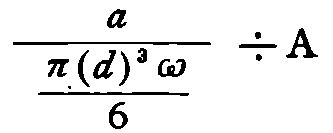
Where a is the weight of each group of particles, d the mean diameter of the particles in the several groups in centimeters, ω is the specific gravity of the soil, and A is the total weight of soil. For the specific gravity of ordinary soils, the constant 2.65 may be used.
In using the formula the per cents are expressed as grams. Thus, if there were twenty per cent of silt, this would be taken as twenty grams, and if the results of the analysis added up ninety-seven per cent the whole weight of soil would be taken as ninety-seven grams. The diameter d is taken as the mean for the extreme diameters taken for any group, for instance, for the silt this would be 0.003 centimeter, which is assumed to be the diameter of the particles in that group. This formula can only give approximate values, as the number of separations in a silt analysis must necessarily be small, amounting usually to not more than eight or ten grades, on account of the time and labor required for closer separations. There is relatively rather a wide range in the diameters of grains within any one of these grades, and absolute values could not be expected without a vast number of separations, so that all the grains in each group would be almost exactly of the same size.
The clay group has relatively the widest limits, which is unfortunate, as this is the most important of all the groups on account of the exceedingly small size of the particles. The figure 0.0001 millimeter is taken as the lowest limit of the diameter of the clay particles. These particles have been heretofore assumed to be ultra-microscopic, but by the use of a microscope of high power with oil-immersion objective and staining fluids, it has been possible to define the clay particles in a turbid liquid which has stood so long as to be only faintly opalescent.
Pending more exact measurements, the figure 0.00255 millimeter has been used as the diameter of the average sized particle in the clay group.
246The following table gives the approximate number of grains per gram in the different types of subsoils calculated from the mechanical analysis of the typical soils already given:
Number of Particles of Each Class in One Gram of Soil.
Silt classes. Diameter (d) in centimeters. No. 1 Early truck. No. 2 Truck and small fruit. No. 3 Tobacco.
0.15 0 0 3
0.075 85 34 102
0.0375 5,511 4,011 1,900
0.0175 37,230 54,610 11,890
0.0075 207,500 199,700 267,900
0.003 2,073,000 1,355,000 8,092,000
0.00075 38,210,000 35,360,000 140,900,000
0.000255 1,915,000,000 3,918,000,000 6,637,000,000
1,955,000,000 3,954,973,355 6,786,273,795
Silt classes. Diameter (d) in centimeters. No. 4 Wheat. No. 5 Grass and wheat. No. 6 Limestone.
0.15 0 0 12
0.075 726 4 60
0.0375 8,273 181 157
0.0175 32,340 5,556 1,456
0.0075 554,100 202,600 125,900
0.003 3,962,000 10,670,000 8,231,000
0.00075 73,990,000 154,900,000 199,900,000
0.000255 10,150,000,000 14,570,000,000 19,430,000,000
10,228,547,439 14,735,778,341 19,638,258,585
245. Estimation of the Surface Area of Soil Particles.—The approximate extent of surface area of the soil grains in one gram of soil can be calculated from the foregoing by the following formula:[163]
π(d)²n
in which d is the mean of the diameters of any group in centimeters, and n is the number of particles in the group.
The following table gives the approximate extent of surface area of the particles in one gram of soil calculated from the preceding table:
Approximate Extent in Square Centimeters, of Surface Area in One Gram of Soil.
Soil number.
————— —————— —————— —————— —————— ——————
Diameter, millimeters. 1 2 3 4 5 6
1.5 0.0 0.0 0.4 0.0 0.0 0.1
0.75 1.8 0.6 1.8 12.8 0.1 0.1
2470.375 24.3 17.7 8.4 36.5 31.0 0.7
0.175 35.8 52.6 11.4 31.1 5.3 1.4
0.075 21.3 35.3 47.3 97.9 35.8 22.2
0.03 218.8 38.3 228.9 112.0 301.4 232.7
0.0075 67.4 62.5 248.9 130.8 273.5 353.4
0.00255 390.8 800.5 1355.0 2072.0 2976.0 3965.0
Total 760.2 1007.5 1902.1 2493.1 3593.1 4575.3
246. Logarithmic Constants.—The following logarithmic constants have been used in the calculation of the approximate number of grains per gram and of the surface area, using 2.65 in all cases as the specific gravity of the soil.
Diameter. (d) Approximate number of grains. Surface area.
log.π(d)³w 6 log.(d)²π
0.15 centimeters \̅3.6703 \̅2.8493
0.075 „ \̅4.7674 \̅2.2473
0.0375 „ \̅5.8641 \̅3.6451
0.0175 „ \̅6.8711 \̅4.9831
0.0075 „ \̅7.7674 \̅4.2473
0.003 „ \̅8.5734 \̅5.4513
0.00075 „ \̅1̅0.7674 \̅6.2473
0.000255 „ \̅1̅1.3616 \̅7.3101
247. Mineralogical Examination of the Particles of Soil Obtained by Mechanical Analysis.—The principal object of the mechanical analysis of soils as has already been set forth is the separation of the soil into portions, the particles of which have the same hydraulic value. It is evident without illustration that particles of the same hydraulic value do not necessarily have the same size. The rate of flow of a liquid carrying certain definite particles does not imply that these particles are of the same dimensions. Of two particles of the same size and shape, that one which has the lower specific gravity, will be carried off at the lower rate of flow. At the end of the operation, therefore, 248the several portions of the soil obtained will be found composed of particles of sizes varying within certain limits, and of these particles the larger ones will tend to be composed of minerals of lower specific gravity, and the smaller ones of minerals of higher specific gravity. Of the same mineral substance, the particles which are most irregular, exposing for a given weight the largest surface will be found to pass over at a lower velocity than those of a more nearly spherical shape. The same law holds good for particles falling through a liquid at rest, i. e., the heavier and more spherical particles, weight for weight, will sooner reach the bottom of the containing vessel. To complete the value of a mechanical analysis, it becomes necessary to submit the several portions of soil obtained not only to a chemical but also to a mineralogical examination. Only the outlines of the methods of examining silt separates for mineral constituents can be given here and special works in petrography must be consulted for greater details.[164]
It is evident that the methods of separation and examination from a mineralogical point of view about to be described can only be applied to silts of the largest size. The finer silts can not be separated into portions of different specific gravities by separating liquids of varying densities on account of the slowness with which they subside, thus tending to adhere to the sides of the separating vessels and to form floccules which are not all composed of the same kind of mineral particles. While, therefore, these processes are more appropriately described in connection with the silts obtained by hydraulic elutriation, they can be applied with greater success to the fine particles passing the different sieves used in the preparation of the soil for analysis or to the finely pulverized soil as a whole.
The minerals which have contributed to soil formation, moreover, are better preserved in the larger silt particles and therefore more easily identified. While the desirability of securing like determinations in the finer silts is not to be denied, in the present state of the art the analyst must be content with the examination of the larger particles.
248. Methods of Investigation.—The chief points to be observed in the examination of the fine particles of soil are the following: 249(1) the size and shape of the particles; (2) measurement of crystal angles; (3) separation into classes of approximately the same specific gravity; (4) separation by means of the magnet; (5) determination of color and transparency; (6) determination of refractive index; (7) examination with polarized light; (8) examination after coloring; (9) chemical separation. For many of the optical studies above noted, it is first necessary to prepare thin laminae of the mineral particles and properly mount them for examination. For the purposes of this manual only those processes will be described which are essentially connected with a proper understanding of the nature of the soil particles. For the more elaborate methods of research the analyst will consult the standard works on mineralogy and petrography.
249. Microscopical Examination.—The direct examination of the silt particles with the microscope should attend the progress of separation. Unless the particles obtained have the same general appearance, the separation is not properly carried on. Especially is the microscope useful to determine that the value of the silt separation is not impaired by flocculation. Unless flocculation be practically prevented during the separation of the finest particles, many of these will be left as aggregates to be brought over subsequently with particles of far different properties. No special directions are necessary in the use of the microscope. The silt particles are removed with a few drops of water by means of a pipette, a drop of the liquid with the suspended particles is placed on the glass, covered and examined with a convenient magnification. A micrometer scale should be employed in order that the approximate sizes of the particles may be determined. A camera lucida may also be conveniently used for the purpose of delineating the form of particles of peculiar interest.
250. Petrographic Microscope.—Any good microscope furnished with polarizing apparatus may be used for the examination of the silt particles and sections. For directions in manipulating microscopes the reader is referred to works on that subject. A special form of microscope for petrographic work is 250made by Bausch and Lomb of Rochester. The stand of this instrument is shown in Fig. 37. The base, upright pillars and arm are made of japanned iron. The stage is made in two forms, first, plain revolving, having silvered graduates at right angles and second, a mechanical stage with silvered graduations on the edge with vernier and graduations for the rectangular movements. The mirror bar is adjustable and graduated and the mirror is of large size, plane and concave. The double chambered box in the main tube carries the upper Nicol prism (analyzer). The lower Nicol prism (polarizer) is mounted in a cylindrical box beneath the stage to which it is held by a swinging arm. It is adjustable also up or down and is provided with a compound lens for securing converged polarized light. In revolving the prism a distinct click shows the position of the crossed Nicols.
Figure 37.
251. Form and Dimensions of the Particles.—In order to study the contour of the fine silt particles, it is well to suspend them in a liquid whose refractive index is markedly lower than that of the particles themselves, and for this purpose pure water 251is commonly used. Care must be taken that not too many particles are found in the drop of water which is to be placed on the object holder and protected with a thin, even glass. The tendency to flocculation in these fine particles will make the study of their form difficult if they are allowed to come too close together. The size of the particles, or linear diameter, is to be determined by means of an eye-micrometer. This consists of a glass plate on which a millimeter scale is engraved with a diamond, or photographed. The millimeter scale is the one usually employed, each millimeter being divided into tenths. On microscopes designed especially for photographic work the micrometer is fastened to the eyepiece, and so adjusted as to read from left to right, or at right angles thereto. Sometimes an eyepiece-micrometer has two scales at right angles so that dimensions may be read in two directions without change. With an eyepiece-micrometer, not the dimensions of the object, but those of its magnified image are read, and the degree of magnification being known, the actual size of the object is easily calculated. The actual measurements may also be obtained by placing in the field of vision, a stage-micrometer and determining directly the relation between that and the eyepiece-scale. If, for example, the stage-micrometer is ruled to 0.01 millimeter, and the eye-micrometer to 0.1 millimeter, and one division of the stage-rule should cover three divisions of the eye-rule, then the one division of the eye-micrometer would correspond to an actual linear distance of 0.0033 millimeter in the object. If the two lines of division in the two micrometers do not fall absolutely together, the calculation may be made as follows: suppose that six divisions, 0.6 millimeter, in the eyepiece correspond to nearly five divisions, 0.25 millimeter, in the stage piece. To get at the exact comparison, take ninety-six divisions of the eye-scale and they will be found to be somewhat longer than eighty-one and somewhat shorter than eighty-two divisions of the stage-scale. It follows therefore that
one division of the eye-scale >0.008438 millimeter, and
„ „ „ „ „ „ <0.008541 „ ;
and, hence, one division of the eye-scale corresponds almost exactly to 0.008489 linear measure.
252. Illustrations of Silt Classes.—In figure 38 are shown the relative sizes and usual forms of a series of silt separates 252made by the Osborne beaker method. The photomicrographs were made by Dr. G. L. Spencer from specimens furnished by Prof. M. Whitney.
The soil represented by the separates is from a truck farm near Norfolk, Virginia.
The particles represented in each class are not all strictly within the limits of size described. For instance, in the largest size (No. 1) are two particles at least which show a diameter of more than one millimeter. The particles in general, however, are within the limits of the class; viz., one-half to one millimeter, and this general observation is true of all the classes. In the case of the finer particles, especially of clay, the tendency to flocculation could not be overcome in the preparation of the slides for the photographic apparatus. The clay particles are so fine as to present but little more than a haze at 150 diameters of magnification. The particles seen are clearly, in most cases, aggregates of the finer clay particles. The larger particles show the rounded appearance due to attrition and weathering. It would have been more instructive to have had the particles of the different classes all photographed on the same scale, but this is manifestly impossible. The lowest power which shows any of the clay particles to advantage is at least 150 diameters, and with the larger particles such a magnification would have been impracticable.
253. Measurement of Crystal Angles.—The fine silt particles rarely retain sufficient crystalline shape to permit of the measurement of angles and the determination of crystalline form thereby. The rolling and attrition to which the silt particles have been subjected have, in most cases, given to the fragments rounded or irregular forms which render, even in the largest silts, the measurement of angles impossible. For the methods of mounting minute crystals and the measurement of microscopic angles, the analyst is referred to standard works on mineralogy and petrography.
254. Determination of the Refractive Index.—For a study of the theory of refraction, works on optics should be consulted. The general principles of this phenomenon which concern the determination of the refractive power of fine earth particles are as follows: if a transparent solid particle is observed in the 253microscope imbedded in a medium of approximately the same refractive power and color, its outlines will not be clearly defined, but the imbedded particle will show in all of its extent the highest possible translucency. If, therefore, the form or perimeter of the particle is to be studied with as much definiteness as possible, it should be held in a medium differing as widely from it as possible in refractive power. For minerals, water is usually the best immersion material. On the other hand, when the internal structure of the particles is the object of the examination, it should be imbedded in oil, resin (Canada balsam), etc., or in some of the liquids mentioned below.
If particles of different refractive powers and the same character of surface be studied in the same medium, they will not all appear equally smooth on the field of the microscope. Some of the surfaces will seem smooth and even, others will appear rough and wrinkled. Those particles whose refractive index is equal to or less than that of the liquid appear smooth, because all the emergent light therefrom can pass at once into the environing medium. On the other hand, the surfaces of those particles which have a higher refractive power than the medium will appear roughened, because, on account of the unavoidable irregularities on the surface, many of the emergent rays of light must strike at the critical angle and so suffer total reflection, and consequently those portions of the surface will be less illuminated, producing the phenomenon of apparent roughness above noted. In the case of any given particle, liquids of increasing refractive power can be successively applied until the change in the appearance of the surface of the particle is noticed. The refractive index of the liquid being known, that of the particle is in this way approximately to be determined.
The following liquids, having the indexes mentioned, are commonly employed:
Substance. Refractive index.
Water 1.333
Alcohol 1.365
Glycerol 1.460
Olive oil 1.470
Canada balsam 1.540
Oil of cinnamon 1.580
254Oil of bitter almonds 1.600
Oil of Cassia 1.606
Concentrated solution of potassium and mercuric iodid 1.733
Concentrated solution of barium and mercuric iodid 1.775
The solution of potassium and mercuric iodid may also be used for all refractive indexes from 1.733 to 1.334 by proper dilution with water.
The mineral particle may also be imbedded in Canada balsam and over it a drop of a liquid of known refractive power placed. By a few trials one of the liquids will be found having practically the refractive index of the particle under examination.
255. Examination with Polarized Light.—The internal structure of a mineral particle can often be determined by its deportment with polarized light. The theory of polarization is fully set forth in works on optics and will not be discussed here. The principle on which the utility of polarized light in the examination of soil particles rests is found in the information it may give in respect of crystalline structure. The structure of mineral particles which make up the bulk of an ordinary soil is, as a rule, so thoroughly disintegrated that all trace of its original form is lost. Some particles may exist, however, in which there is no determinable element of shape and which yet possess an internal crystalline structure which the microscope with polarized light may be able to reveal.
256. Staining Silt Particles.—The finer silts and clays before microscopic examination should be colored or stained. The methods used in staining bacteria may be employed for the clay particles.
Evaporation to dryness with a solution of magenta will often impart a color to the clay particles which is not removed by subsequent suspension in water. The harder and larger silt particles are not easily stained, especially if they be firm and undecomposed. On the other hand, if the particles be broken and seamed, and well decomposed, the stain will be taken up and held firmly in the capillary fissures. Valuable indications are thus obtained respecting the nature of the silt particles. Particles of mica, chlorite and talc are easily distinguished in this way from the firmer and less decomposed quartz grains.
255The staining of the particles after ignition and treatment with acids gives better results than the direct treatment. Particles of carbonate which are stained with difficulty before ignition take the stain easily afterwards on account of the decomposition produced by the loss of carbon dioxid. This is the case also with particles containing water of composition or crystallization.
257. Cleavage of Soil Particles.—A microscopic examination of the cleavage of soil particles may be useful in determining their mineral origin. The course followed by cleavage lines and their mutual position is dependent on the direction in which the separation of the mineral fragment takes place. The character of the microscopic fragments produced by crushing a soil particle is determined primarily by the system of crystallization to which it belongs. Perhaps the most distinguishing cleavage marks in soil particles will be found in fragments of mica and orthoclase. These characteristic forms are shown in Figs. 39 and 40. The first (Fig. 39) shows the pinacoidal cleavage in a fragment of mica. Fig. 40 illustrates the appearance of the cleavage lines in a fragment of orthoclase. Figs. 41 and 42 show the characteristic cleavage lines in fragments of epidote and titanite.
258. Microchemical Examination of Silt.—The methods of quantitative chemical examination of silts will be given in another part of this manual. Certain qualitative and microchemical tests, however, are useful in identifying silt particles. For instance, any soluble iron mineral will be detected, even in minute quantity, by the blue coloration of the solution produced by the addition of potassium ferrocyanid. Manganese will be revealed by fusion with soda and saltpeter on platinum foil, in the oxidizing flame, producing the well-known green coloration due to the sodium manganate formed.
More valuable indications of the character of the fragments examined are obtained by microchemical processes. The best method of decomposing the silt particles for this purpose is by treatment with hydrofluosilicic acid. When the particles are composed of silicates, pure hydrofluoric acid is to be preferred.
The method of treatment is essentially that of Boricky.[165] The slide used is protected by a film of Canada balsam, 256and a few of the silt particles are placed thereon, and fixed in place by slightly warming the balsam. Each particle is then treated with a drop of hydrofluosilicic acid, care being taken not to let the drops flow together. The acid must be pure, leaving no residue on evaporation. The acid should be prepared by the analyst from a mixture of barium fluorid, sulfuric acid and quartz powder, or the commercial article should be purified by distillation before using. The acid should be kept in ceresin or gutta-percha bottles and must be applied with a ceresin or gutta-percha rod. Each particle should be as completely dissolved as possible by the acid, and the rate of solution may be hastened by gentle warming, provided the heat is not great enough to remove the balsam and allow the acid to attack the glass. The bases present in the silt particles crystallize on drying as fluosilicates. In case of a too rapid crystallization, the mass may be dissolved in a drop of water or of very dilute hydrofluosilicic acid, and allowed to evaporate more slowly. Some fragments need more than one treatment with acid to secure complete solution, and particles of mica may even resist repeated applications. In such a case the decomposition may be made in a platinum crucible with hydrofluoric acid, adding afterwards an excess of hydrofluosilicic acid and evaporating to dryness. The crystals may then be dissolved in a little water and a drop of the solution allowed to crystallize on the slide.