Volume 1 / Part 4 — PART FOURTH. MECHANICAL ANALYSIS OF SOILS.
Reading edition
THE FLOCCULATION OF SOIL PARTICLES.
180. Relation of Flocculation to Mechanical Analysis.—The tendency of the fine particles of silt to form aggregates, which act as distinct particles of matter, is the chief difficulty connected with the separation of the soil into portions of equal hydraulic value by the silt method of analysis. This tendency has been discussed fully by Johnson[121] and Hilgard.[122]
181. Illustration of Flocculation.—A sediment, consisting of particles of a hydraulic value, equal to one millimeter per second, is introduced into an ordinary conical elutriating tube placed vertically, in which the current of water entering below performs all the stirring which the particles receive.
A current of water corresponding to a velocity below one millimeter per second will, of course, not carry any of the particles out at the top of the cylindrical tube, but will keep them moving through the conical portion of the tube. If now the current be increased until its velocity is greater than one millimeter per second after having run at the slower velocity for fifteen or twenty minutes, very little of the sediment will pass over, although theoretically the whole of it should. Even at a velocity of five millimeters per second, much of the sediment will remain in the tube. This, of course, is due to the coagulation of the particles into molecular aggregates having a higher hydraulic value even than five millimeters per second. These aggregates can be broken up by violent stirring or moderate boiling, and the sediment reduced again to its proper value. The conclusions which Hilgard derives from a study of the above phenomena are as follows:
1. The tendency to coagulation is, roughly, in an inverse ratio to the size of the particles. With quartz grains it practically 166ceases when their diameter exceeds about two-tenths of a millimeter having a hydraulic value of eight millimeters per second. The size of the aggregates formed follows practically the same law as above. Sediment of 0.25 millimeter hydraulic value will sometimes form large masses like snow-flakes on the sides of the elutriator tube.
2. The degree of agitation which will resolve the aggregates into single grains is inversely as the size of the particles; or, more properly perhaps, inversely as their hydraulic value.
3. The tendency to flocculation varies inversely as the temperature. So much so is this the case that Hilgard at one time contemplated the use of water at the boiling point in the mechanical analysis of soils, in place of mechanical stirring.
4. The presence of alcohol, ether, and of caustic or carbonated alkalies, diminishes the tendency to flocculation, while the presence of acids and neutral salts increases it.
5. As between sediments of equal hydraulic value, but different densities, the tendency to flocculation seems to be greater with the less dense particles.
In regard to the mechanical actions which take place between the particles, Hilgard considers them as irregular spheroids, each of which can at best come in contact at three points with any other particle. The cause of aggregation cannot therefore be mere surface adhesion independent of the liquid, and the particles being submerged there is no meniscus to create an adhesive tension.
Since experiment shows that the flocculative tendency is measurably increased by the cohesion coefficient of the liquid, it seems necessary to assume that capillary films of the latter interposed between the surfaces of solids create a considerable adhesive tension even in the absence of a meniscus.
182. Effect of Potential of Surface Particles.—Whitney suggests that this is due to the potential of the surface particles of solids and liquids.[123] The potential of a single water particle is the work which would be required to pull it away from the surrounding water particles and remove it beyond their sphere of attraction. For simplicity, it may be described as the total force of attraction between a single particle and all other 167particles which surround it. With this definition, it will be seen that the potential of a particle on an exposed surface of water is only one-half of the potential in the interior of the mass, as half of the particles which formerly surrounded and attracted it were removed when the other exposed surface of water was separated from it. A particle on an exposed surface of water, being under a low potential, will therefore tend to move toward the center of the mass where the potential, i. e., the total attraction, is greater, and the surface will tend to contract so as to leave the fewest possible number of particles on the surface. This is surface tension.
If, instead of air, there is a solid substance in contact with the water, the potential will be greater than on an exposed surface of the liquid, for the much greater number of solid particles will have a greater attraction for the water particles than the air particles had. They may have so great an attraction that the water particle on this surface, separating the solid and liquid, may be under greater potential than prevails in the interior of the liquid mass. Then the surface will tend to expand as much as possible, for the particles in the interior of the mass of liquid will try to get out on the surface. This is the reverse of surface tension. It is surface pressure, which may exist on a surface separating a solid and liquid.
Muddy water may remain turbid for an indefinite time, but if a trace of lime or salt be added to the water the grains of clay flocculate, that is, they come together in loose, light flocks, like curdled milk, and settle quickly to the bottom, leaving the liquid above them clear. Ammonia and some other substances tend to prevent this and to keep the grains apart if flocculation has already taken place.
If two small grains of clay, suspended in water, come close together they may be attracted to each other or not, according to the potential of the water particles on the surface of the clay. If the potential of the surface particle of water is less than that of the particle in the interior of the mass of liquid, there will be surface tension, and the two grains will come together and be held with some force, as their close contact will diminish the number of surface particles in the liquid. If, on the other hand, 168the potential of the particle on the surface of the liquid is greater than of the particle in the interior of the mass, the water surface around the grains will tend to enlarge, as there will be greater attraction for the water particles there than in the interior of the mass of liquid, and the grains of clay will not come close together and will even be held apart, as their close contact would diminish the number of surface particles in the liquid around them.
183. Influence of Surface Tension.—Hilgard supposes that the surface tension which is assumed to exist between two liquid surfaces must exert a corresponding influence between the surfaces of solids and liquids, apart from any meniscal action.
It is then to be expected that the adhesion of the particles constituting one of these floccules will be very materially increased whenever the formation of menisci between them becomes possible by the removal of the general liquid mass. Suppose one of the floccules to be stranded, it will, in the first place, remain immersed in a sensibly spherical drop of liquid. As this liquid evaporates, the spherical surface will become pitted with menisci forming between the single projecting particles, and as these menisci diminish their radius by still further evaporation, the force with which they hold the particles together will increase until it reaches a maximum. As the evaporation progresses beyond this point of maximum, the adhesion of the constituent particles must diminish by reason of the disappearance of the smaller menisci, and when finally the point is reached when liquid water ceases to exist between the surfaces, the slightest touch, or sometimes even the weight of the particles themselves, will cause a complete dissolution of the floccule, which then flattens down into a pile of single granules.
In regard to natural deposits from water, Hilgard supposes that they are always precipitated in a flocculated state. The particles of less than two-tenths millimeter diameter are carried down with those of a larger diameter having much higher hydraulic value. Thus the deposition of a pure clay can take place under only very exceptionable circumstances.
Whitney, on the other hand, suggests that grains of sand and clay carry down mechanically the particles of fine silt and clay as they settle in a turbid liquid in a beaker; and it is often difficult 169to wash out a trace of fine material from a large amount of coarse particles, for this reason, although there may be no trace whatever of flocculation.
184. Destruction of Floccules.—The destruction of the natural floccules is seen in the ordinary process of puddling earth or clay. It is also the result of violent agitation of water or of kneading or boiling, or, finally, to a certain extent, of freezing. All these agencies are employed by the workers in clay for the purpose of increasing the plasticity which depends essentially upon the finest possible condition of the material to be worked. As an illustration of this, Hilgard cites the fact that any clay or soil which is worked into a plastic paste with water, and dried, will form a mass of almost stony hardness. If, however, to such a substance one-half per cent of caustic lime be added, a substance which possesses in an eminent degree the property of coagulating clay, the diminution of plasticity will be obvious at once, even when in a wet condition. If now the mass be dried, as in the previous case, it is easily pulverized. This is an illustration of the effect of lime upon stiff lands, rendering them more readily pulverulent and tillable. The conversion of the lime into a carbonate in the above experiment by passing bubbles of carbonic acid through the mass while still suspended in water does not restore the original plasticity, thus illustrating experimentally the fact known to all farmers that the effect of lime on stiff soil lasts for many years, although the whole of the lime in that time has been converted into carbonate.
185. Practical Applications.—The practical application of this is, according to Hilgard, that the loosely flocculated aggregation of the soil particles is what constitutes good tilth. For this reason the perfect rest of a soil, if it is protected from the tamping influence of rains and the tramping of cattle, may produce a condition of tilth which cannot be secured by any mechanical cultivation. As an illustration of this, the pulverulent condition of virgin soils protected in a forest by the heavy coating of leaves may be cited. On the contrary, as pointed out by Hilgard, there are some kinds of soil in which a condition of rest may produce the same effect as tamping. These are soils which consist of siliceous silt without enough clay to maintain 170them in position after drying. In such a case, the masses of floccules collapse by their own weight or by the least shaking, and fall closely together, producing an impaction of the soil. This takes place in some river sediment soils in which the curious phenomenon is presented of injurious effects produced by plowing when too dry, which is the direct opposite of soils containing a sufficient amount of clay and which are injured by plowing too wet.
It is further observed that the longer a soil has been maintained in good tilth, the less it is injured by wet plowing. This is doubtless, according to Hilgard, due to the gradual cementation of the floccules by the soil water which fixes them more or less permanently.
Whitney believes that the arrangement of the grains, or the condition of flocculation in the soil, or the distance apart of the soil grains, is determined, to a large extent, by the potential on the surface of the grains; and he suggests that by changing this the exceedingly fine grains of silt and clay can be pulled together or can be pushed further apart, and so alter the whole texture of the land.
The action of alkaline carbonates in preventing flocculation, and thus rendering tillage difficult or impossible, is pointed out by Hilgard in the case of certain alkali soils of California. The soils which are impregnated with alkaline carbonates are recognized by their extreme compactness. The suggestion of Hilgard to use gypsum on such soils has been followed by the happiest results. This gypsum renders any phosphates present insoluble, and thus prevents loss by drainage, and yet leaves the plant food in a sufficiently fine state as to be perfectly available for vegetation.
186. Suspension of Clay in Water.—The suspension of clay in water and the methods of producing or retarding flocculation and precipitation have also been studied by Durham.[124] His experiment is made as follows:
In a number of tall glass jars fine clay is stirred with water, and the results of precipitation watched. In all cases it will be noticed that the clay rapidly separates into two portions, the greater part quickly settling down to the bottom of the jars, and the smaller part remaining suspended for a greater or less length of time.
171The power which water possesses of sustaining clay is gradually destroyed by the addition of an acid or salt; a very small quantity, for instance, of sulfuric acid, is sufficient to precipitate the clay with great rapidity. In solutions of sulfuric acid and sodium chlorid of varying strengths, suspended clay is precipitated in the order of the specific gravity of the solutions, the densest solutions being the last to clear up. This may be due to the greater viscosity of the denser liquids.
The power which water possesses of sustaining clay is gradually decreased by the addition of small quantities of certain salts and of lime.
187. Effect of Chemical Action—Brewer[125] emphasizes the importance of chemical action in the flocculation of clays. As expressed by him the chemical aspects of the phenomena of sedimentation have either been lightly considered or entirely ignored. Brewer is led to believe that the action of clay thus suspended is analogous to that of a colloidal body. Like a colloid, when diffused in water, the bulk of the mass is very great, shrinking enormously on drying. He therefore concludes that clays probably exist in suspension as a series of hydrous silicates feebly holding different proportions of water in combination and having different properties so far as their behavior to water is concerned.
Some of them he supposes swell up in water much as boiled starch does, and are diffusible in it with different degrees of facility, and that the strata observed on long standing of jars of suspended clay represent different members of this series of chemical compounds which hold their different proportions of combined water very feebly and are stable under a very limited range of conditions.
These compounds are probably destroyed or changed in the presence of acids, salts and various other substances, and are stable only under certain conditions of temperature, those which exist at one temperature being destroyed or changed to other compounds at a different temperature.
188. Theory of Barus.—Brewer’s hypothesis, however, is not in harmony with the demonstration of Barus, who proves that a given particle of clay has the same density in ether as in water.
172The physical and mathematical aspects of sedimentation have also been carefully studied by Barus.[126] The mathematical conditions of a fine particle suspended in a liquid and free from the influences of flocculation are described by Barus in the following equations.
If P be the resistance encountered by a solid spherule of radius r, moving through a viscous liquid at the rate x, and if k be the frictional coefficient, then P = 6πkrx. Again, the effective part of the weight of the particle is P´ = ⁴⁄₃πr³ (ρ-ρ´)g, where g is the acceleration of gravity and ρ and ρ´ the density of solid particle and liquid, respectively. In case of uniform motion P = P´. Hence x = 2 9kr² (ρ-ρ´)g ... (1).
In any given case of thoroughly triturated material the particles vary in size from a very small to a relatively large value; but by far the greater number approach a certain mean figure and dimension. An example of this condition of things may be formulated. To avoid mathematical entanglement let y = Ax³⁄₂e-x² ... (2) where y is the probable occurrence of the rate of subsidence x. If now the turbidity of the liquid (avoiding optical considerations) be defined as proportional to the mass of solid material particles suspended in unit of volume of liquid, then the degree of turbidity which the given ydx particles add to the liquid is, caeteris paribus, proportional to r³ydx, where r is the mean radius. Hence the turbidity, T, at the outset of the experiment (immediately after shaking), is T = T₀∫₀∞r³ydx = T₀, where equations (1) and (2) have been incorporated.
If the plane at a depth d below the surface of the liquid be regarded, then at a time after shaking the residual turbidity is

The equation describes the observed occurrences fairly well.
The phenomena of stratification observed by Brewer are explained by Barus from the above formula: In proportion as the time of subsidence is greater, the tube shows opacity at the bottom, shading off gradually upward, through translucency, into clearness at the top. If, instead of equation (2), there be 173introduced the condition of a more abrupt maximum, if, in other words, the particles be very nearly of the same size, then subsidence must take place in unbroken column capped by a plane surface which at the time zero coincided with the free surface of the liquid. Again, suppose one-half of the particles of this column differ in some way uniformly from the other half. Then at the outset there are two continuous columns coinciding, or, as it were, interpenetrating throughout their extent. But the rate of subsidence of these two columns is necessarily different, since the particles, each for each, differ in density, radius and frictional qualities, by given fixed amounts. Hence the two surfaces of demarcation at the time zero coincided with the free surface. In general, if there be n groups of particles uniformly distributed, then at the time zero n continuous columns interpenetrate and coincide throughout their extent. At the time t, the free surface will be represented by n consecutive surfaces of demarcation below it, each of which caps a column, the particles of which form a distinct group.
From a further discussion of the mathematical condition under which the subsidence of the particles takes place, Barus is of the opinion that Durham’s theory of suspension being only a lower limit of solution is rapidly gaining ground, yet without being attended with concise experimental evidence which will account for the differences in the rate of subsidence. On the contrary, Brewer’s hypothesis of colloidal hydrates is more easily subjected to experimental proof. The test shows that the particles retain their normal density, no matter how they are suspended or circumstanced.
Further, in the explanation of the phenomenon of sedimentation, the following principle may be regarded as determined; namely, if particles of a comminuted solid are shaken up in a liquid, the distribution of parts after shaking will tend to take place in such a way that the potential energy of the system of solid particles and liquid, at every stage of subsidence, is the minimum compatible with the given conditions.
According to Barus it is necessary, in order to pass judgment on the validity of any of the given hypotheses, to have in hand better statistics of the size of the particles relatively to the water 174molecule, than are now available. Inasmuch as the particles in pure water are individualized and granular, it is apparently at once permissible to infer the size of the particles from the observed rates of subsidence. His observations show that the said rate decreases in marked degree with the turbidity of the mixture. Hence the known formulæ for single particles are not rigorously applicable, though it cannot be asserted whether the cause of discrepancy is physical or mathematical in kind. It follows that special deductions must be made for the subsidence of stated groups of particles before an estimate of their mean size can fairly be obtained.
Rowland[127] reaches a closer approximation for the fall of a single particle by showing that the liquid, even at a large distance from the particle, is not at rest.
In the case of water, however, it is noticed that despite the large surface energy of the liquid, subsidence takes place in such a way that for a given mass of suspended sediment the surfaces of separation are a maximum. On the other hand, in case of subsidence in ether or in salt solutions, the solid particles behave much like the capillary spherules of a heavy liquid shaken up in a lighter liquid with which it does not mix. In other words, the tendency here is to reduce surfaces of separation to the least possible value, large particles growing in mass and bulk mechanically at the expense of smaller particles; in other words, exhibiting the phenomenon of flocculation.
189. Physical Explanation of Subsidence.—Whitney[128] thinks that the phenomena of the suspension of clay in water may be explained on purely physical principles, and that neither the partial solution nor hydration hypotheses are necessary, or will explain the suspension of clay in water, for the solution, or hydrated substance, would still have a higher specific gravity than the surrounding liquid. He calls attention in the first place to the fact, that in a turbid liquid, which has been standing for weeks and which is only faintly opalescent, the grains in suspension are still of measurable size, if properly stained as in bacteriological examinations and viewed through an oil emersion objective. He gives a value of 0.0001 millimeter, as the lower limit of the diameters of these particles of “clay,” which are 175usually met with in agricultural soils. He refers to the fact that fine dust and ashes, and even filings of metals, may remain in suspension in the air for days and even months in very apparent clouds, or haze, although they may be a thousand times heavier than the surrounding air. Particles of clay, no smaller than the limits which have been assigned, should remain in suspension in the much heavier fluid, water, for an indefinite time, for the volume or weight of the particles (⁴⁄₃)(πr³) decreases so much more rapidly in proportion than the surface (4πr²), that there is, relatively, a larger amount of surface area in these fine clay particles, and a great deal of surface friction in their movement through a medium, and they would settle very slowly. Under ordinary conditions, however, the mean daily range of temperature is about twenty degrees, the mean monthly range is fifty degrees, and the yearly range 100° F., and the ordinary convection currents, induced by the normal change of temperature, would be sufficient of itself to keep these fine particles in suspension in the liquid for an indefinite time, as it is known that currents of air keep fine particles of dust and ashes in suspension. If the volume or weight of a fine gravel, having a diameter of one and five-tenth millimeters, be taken as unity, then for a particle, having a diameter of 0.00255 millimeter, which is the mean diameter for Whitney’s clay group, the volume decreases in the ratio 1:0.000000004853, and the surface decreases only in the ratio 1:0.000286.
190. Practical Applications.—The action of mineral substances in promoting flocculence has been taken advantage of in later times in the construction of filters for purifying waters holding silt in solution. In these filters the introduction of a small quantity of alum, or some similar substance, into the water usually precedes the mechanical separation of the flocculent material. In the same way the action of iron and other salts on sewage waters has been made use of in their purification and in the collection of the sewage material for fertilizing purposes.
191. Separation of the Soil Into Particles of Standard Size.—The agronomic value of a soil depends largely on the relative size of the particles composing it. The finer the particles, 176within a certain limit, the better the soil. The size of the particles may be estimated in three ways: (1) by passing through sieves of different degrees of fineness; (2) by allowing them to subside for a given time in water at rest; (3) by separating them in water moving at a given rate of speed. The first method is a crude one and is used to prepare in a rough way, the material for the second and third processes.
192. Separation in a Sieve.—The soil should be dry enough to avoid sticking to the fingers or to prevent agglutination into masses when subjected to pressure. It should not, however, be too dry to prevent the easy separation of any agglutinated particles under the pressure of the thumb or of a rubber pestle.
The sieve should have circular holes punched in a sheet of metal of convenient thickness to give it the requisite degree of strength. Sieves made of wire gauze are not so desirable but it is difficult to get the finer meshes as circular perforations. Such sieves cannot give a uniform product on account of the greater diagonal diameter of the meshes and the ease with which the separating wires can be displaced. It is convenient to have the sieves arranged en batterie; say in sets of three. Such a set should have the holes in the three sieves of the following dimensions; viz.,
1st sieve 2 millimeters diameter.
2nd „ 1 millimeter „
3rd „ 0.5 „ „
Coarser single sieves may be used to separate the fragments above two millimeters diameter if such a further classification be desired. Each sieve fits into the next finer one and the separation of a sample into three classes of particles may be effected by a single operation. In most cases, however, it is better to conduct each operation separately in order to promote the passage of agglutinated particles by gentle pressure with the thumb or with a rubber pestle. In no case should a hard pestle be used and the pressure should never be violent enough to disintegrate mineral particles.
There is much difference of opinion concerning the smallest size of particles which should be obtained by the sieve.
Most analytical processes prescribe particles passing a sieve of 177one millimeter mesh (¹⁄₂₅ inch). There is little doubt, however, of the fact that a finer particle would be better fitted for subsequent analysis by the hydraulic method.
For this purpose a sieve of 0.5 millimeter circular mesh is preferred.
193. Sifting with Water.—In soils where the particles adhere firmly the sifting should be done with the help of water. In such cases the soil is gently rubbed with a soft steple or the finger in water. It is then transferred to the sieve or battery of sieves which are held in the water, and rubbed through each of the sieves successively until the separation is complete. After the filtrate has stood for a few minutes the supernatant muddy liquor is poured off, the part remaining on the sieve is added to it and the process repeated until only clean particles larger than 0.5 millimeter are left on the sieve. These particles can be dried and weighed and entered on the note book as sand. The filtrate should be evaporated to dryness at a gentle temperature and when sufficiently dry be rubbed up into a homogeneous mass by a rubber pestle.
The sieve recommended by the Association of Official Agricultural Chemists[129] for the preparation of fine earth for chemical analysis has circular openings ¹⁄₂₅ inch (one millimeter) in diameter.
Wahnschaffe[130] directs that a sieve of two millimeters mesh be used in preparing the sample for silt analysis and that the residue after the silt analysis is finished, which has not been carried over by a velocity of twenty-five millimeters per second, be separated in sieves of one millimeter and 0.5 millimeter meshes respectively.
Hilgard objects to leaving this coarse material in the sample during the process of churn elutriation on account of the attrition which it exerts and therefore directs that it be separated by sieve analysis before the elutriation begins.
194. Method of the German Experiment Stations.[131]—In the method recommended for the German Agricultural Stations an attempt is made to secure even a finer sieve separation than that already mentioned.
178Sieves having the following dimensions are employed; sieve No. 1, square meshes 0.09 millimeter in size, diagonal measure 0.11 millimeter; sieve No. 2, square meshes 0.14 to 0.17 millimeter in diameter, diagonal measure 0.22 to 0.24 millimeter; sieve No. 3, square meshes 0.35 to 0.39 millimeter in diameter, diagonal measure 0.45 to 0.50 millimeter; finally a series of sieves one, two and three millimeters circular perforations.
Five hundred grams of the soil (in the Halle Station only 250) are placed in a porcelain dish with about one liter of water and allowed to stand for some time with frequent stirring, on a water bath. After about two hours, when the soil is sufficiently softened so that with the help of a pestle it can be washed through the sieves, the process of sifting is undertaken in the following manner: Sieve No. 3 is placed over a dish containing water, the moistened soil placed therein and the sieve depressed a few centimeters under the water and the soil stirred by means of a pestle until particles no longer pass through. After the operation is ended the residue in the sieve is washed with pure water and dried. The part passing the sieve is thoroughly stirred and then washed with water into sieve No. 2 and treated as before. The product obtained in this way is brought into sieve No. 1 and carefully washed. All the products remaining on each of the sieves are dried at 100° and weighed. The portion passing sieve No. 1 is either dried with its wash water or estimated by loss by deducting from the total weight taken, the sum of the other weights obtained. If a more perfect separation of the first sieve residue be desired it can be obtained by passing it through sieves of the last series which may have meshes varying in size, viz.: one, two, or three millimeters in diameter. Each sieve of the same class should have holes uniformly of the same size.
The sieve products are characterized as follows: The part passing a three millimeter sieve is called fine earth, while the part remaining is called gravel. The fine earth is separated into the following products: The part that passes through the three millimeters opening and is left by the two millimeters opening is called steinkies. The product from the two millimeters opening and the residue from the one millimeter opening is called 179grobkies. The product from the one millimeter opening and the residue on the sieve No. 3 is called feinkies. The product from the sieve No. 3 and the residue from the sieve No. 2 is called coarse sand. The product from sieve No. 2 and the residue from sieve No. 1 is called fine sand. The product from sieve No. 1 is called dust. The dust can be further separated into sand, dust, and clay. For the examination of the clay the Kühn silt cylinder as modified by Wagner, is recommended. The cylinder has a diameter of eight centimeters and a height of thirty centimeters, and is furnished with a movable exit tube reaching to its bottom.
195. General Classification of the Soil by Sieve Analysis.—The classification recommended by the German chemists is satisfactory but the following one is more simple. All pebbles, pieces of rock, etc., should first be separated by a two millimeters circular mesh sieve, dried at 105° and weighed. The result should be entered as pebbles and coarse sand.
The finer sand may be separated with a sieve of one millimeter circular openings.
The still finer sand is next separated with the sieve of 0.5 millimeter circular openings as indicated above.
The sample may now be classified as follows:
1.
Coarse pebbles, sticks, roots, etc., separated by hand.
2.
Pebbles and coarse sand not passing a two millimeters sieve.
3.
Sand not passing a one millimeter sieve.
4.
Fine sand not passing a 0.5 millimeter sieve.
5.
Fine earth passing a 0.5 millimeter sieve.
196. Classification of Orth.[132]—As fine silt are reckoned those particles which range from 0.02 to 0.05 millimeter; as fine sand the groups from 0.05 to 0.2 millimeter; as medium sized sand those ranging from 0.2 to 0.5 millimeter and for large grained sand those particles ranging from 0.5 to 2 millimeters in diameter. Particles over two millimeters form the last classification.
SEPARATION OF THE EARTH PARTICLES BY A LIQUID.
197. Methods of Silt Analysis.—The further classification of the particles of a soil passing a fine sieve can best be effected by separation in water. The velocity with which the current 180moves or with which the particles subside will cause a separation of the particles into varying sizes. The slower the velocity the smaller the particles which are separated. There is, however, a large and important constituent of a soil which remains suspended in water, or in a state of seeming solution. This suspended matter would still be carried over by a current of water moving at a rate so slow as to make a subclassification of it impossible. This suspended matter passing off at a given velocity may be classed as clay, and it consists in fact chiefly of the hydrated silicate of alumina, or other particles of equal fineness. The laws which govern its deposit have already been discussed.
The apparatus which have been used for silt analysis may be grouped into four classes.
(1) Apparatus depending on the rate of descent of the particles of a soil through water at rest. The apparatus for decanting from a cylinder or a beaker belong to this class.
(2) Apparatus which determine the rate of flow by passing the liquid through a vessel of conical shape. The system of Nöbel is a good illustration of this kind of apparatus.
(3) Apparatus in which the elutriating vessel is cylindrical and the rate of flow determined by a stop-cock or pressure feed apparatus. The system of Schöne represents this type.
(4) Apparatus in which the above system is combined with a device for mechanically separating the particles and bringing them in a free state into the elutriating current. The system of Hilgard is the type of this kind of apparatus.
In practice the use of cylindrical apparatus with or without mechanical stirring and the method by decantation have proved to be the most reliable and satisfactory procedures. Between the beaker and churn methods, of separation there is little choice in regard to accuracy. Which is the superior method, is a question on which the opinions of experienced analysts are divided. The various processes will be described in the order already mentioned.
198. Methods Depending on Subsidence of Soil Particles.—The simplest method of effecting the further separation of the soil particles is without doubt that process which permits them to fall freely in a liquid sensibly at rest. The practical difficulties 181of this method consist in the trouble of securing a perfect separation of the particles, in preventing flocculation after division and in avoiding currents in the liquid of separation.
For the separation of the soil particles for this method boiling and wet pestling are the only means employed. The flocculation of the separated particles may be partially prevented by adding a little ammonia to the water employed. The author has also tried dilute alcohol as the separating liquid but the results of this method are not yet sufficiently definite to find a place in this manual. Evidently the practical impossibility of avoiding convection currents prevents the use of water at a high temperature for this separation, although the tendency to flocculation almost disappears as the temperature approaches 100°. The general method of avoiding the errors due to flocculation in the subsidence method consists in repestling the deposited particles and thus subjecting them as often as may be necessary to resedimentation. These principles are well set forth by Osborne,[133] who states that when a soil is completely suspended in water by vigorous agitation, particles of all the sizes present are to be found throughout the entire mass of liquid. When subsidence takes place, the larger particles will go down more rapidly than the smaller ones, but some of the small particles that are near the bottom will be deposited sooner than some of the larger ones which have a much greater distance to travel. Thus, independently of the fact that the larger particles in their descent are somewhat impeded by the smaller, the smaller being at the same time somewhat hastened by the larger, the sediment that reaches the bottom at any moment is a more or less complex mixture of all the mechanical elements of the soil. The liquid, however, above this sediment at the same moment will have completely deposited all particles exceeding certain dimensions of hydraulic value, determined mainly by the time of subsidence.
If now the aforesaid first sediment be suspended in pure water, and allowed to subside for the same time as before, the larger part of it will be again deposited, but some will remain in suspension, consisting of a considerable part of the finer matter of the first sediment. By pouring off these suspended particles 182with the water and agitating the sediment again with clear water as before, another portion of fine particles will be suspended and may be decanted from it. On continuing this process of repeated decantations it will soon be found that the soil has been separated into two grades.
It is evident that in this way a separation can be made, but it is perhaps not so clear that such a separation would be sharp enough for the purposes of a mechanical soil analysis. If, for instance, the separation is to be made at 0.05 millimeter diameter, it is evident that by repeated decantations all below 0.01 millimeter can be washed out of that above 0.05 millimeter, but it may not appear so probable that all below 0.045 millimeter can be removed without removing some above 0.055 millimeter.
Such a result may be easily attained, however, if the following principle be adhered to:
Make the duration of the subsidence such that the liquid decanted the first few times shall contain nothing larger than the desired diameter. Then decant into another vessel, timing the subsidence so that the sediment shall contain nothing smaller than the chosen diameter. This can not be done without decanting much that is larger than the chosen diameter, but the greater part of the particles greater and less than the chosen diameter can be removed and an intermediate product obtained, the diameters of whose particles are not very far from that desired.
If this intermediate portion be again subjected to the same process, two fractions may be separated from it, one containing particles larger than the chosen diameter and another containing particles smaller than this diameter, while a new intermediate product will remain which is less in amount than that resulting from the first operation. By frequent repetitions of this process this intermediate product can be reduced to a very small amount of substance the particles of which have diameters lying close to the chosen limit and may then be divided between the two fractions.
The principles of the separation described by Osborne set forth with sufficient clearness the purposes to be achieved by the analysis. The chief methods of manipulation practiced will be found below.
183199. Kühn’s Silt Cylinder.—A simple form of apparatus for the determination of silt by the sedimentation process is the one described by Kühn.[134]
The cylinder should be about twenty-eight centimeters high with a diameter of 8.5 centimeters. At the lower end of the cylinder five centimeters from the bottom it carries a tube 1.5 centimeter in diameter furnished with a pinch-cock and held in position by a rubber stopper.
In carrying out the process thirty grams of sifted soil (two millimeters mesh sieve) are boiled with water for an hour and after cooling the soil and water are washed into the separating cylinder. The cylinder is then filled with water with constant shaking.
After standing for ten minutes the stop-cock is opened and the water with its suspended matter allowed to flow into a porcelain dish.
The cylinder is then again filled with water and the process is continued until the water drawn off is practically clear.
The fine particles having been separated in this way the next coarser grade of particles is separated by repeating the process at intervals of five minutes.
By these two operations it is considered that the clay is entirely removed. The residue remaining in the cylinder is dried and weighed. The relative proportions of clay and residue in the sample are thus determined.
The residue is then separated into two portions by sieves of one millimeter and 0.5 millimeter mesh.
The soil is thus separated into the following parts:
1.
By the first sifting coarse quartz larger than two millimeters diameter.
2.
Fine quartz two millimeters, to one millimeter diameter.
3.
Coarse sand one millimeter, to 0.5 millimeter diameter.
4.
Fine sand finer than 0.5 millimeter diameter.
5.
Silt, clay, humus, etc., separated by the water.
200. Knop’s Silt Cylinder.—The cylinder recommended by Knop[135] is essentially that of Kühn being furnished with four lateral tubes instead of one (Fig. 25).
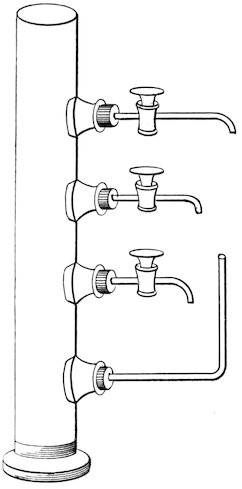
Figure 25. Knop’s Silt Cylinder.
The sample of soil, twenty-five to thirty grams, after passing a two millimeters mesh sieve, and long boiling, is washed through a series of sieves of the following diameters of mesh respectively; viz., one millimeter, 0.5 millimeter, 0.25 millimeter, and 0.1 millimeter. The part which passes the finest sieve is placed in a Knop’s cylinder, the cylinder filled with water one decimeter above upper tube and well shaken. The cylinder is allowed to rest for five minutes when the upper cock is opened and the water drawn off. After five minutes more the next tube is opened and so on with equal intervals for the three upper tubes. The operation is repeated with fresh water until the water drawn off is clear. Finally the lowest tube is opened and all the water poured off of the sandy residue. The space between each tube is one decimeter. The dust remaining is dried and weighed and the weight of material carried over as silt determined by difference.
201. Siphon Silt Cylinder.—Instead of the tubulated cylinder one furnished with a siphon can be employed[136] (Fig. 26).
It should be about forty centimeters high and six centimeters internal diameter. The cylinder first receives twenty-five to thirty grams of the well boiled fine earth and then water until there is but a small space between it and the stopper when the latter is inserted.
The cylinder is marked exactly 200 millimeters below the surface of the water with a narrow strip of paper at a, stoppered, inverted and well shaken. The cylinder being again placed in normal position the soil particles under the influence of gravity tend to sink with greater or less rapidity according to their size. The siphon a b c is filled with water, the cock at c closed and the opened end a placed in the cylinder 184A just at the mark 200 millimeters below the surface of the water, and the water thus transferred to B when desired. If the suspended matter is allowed to stand for 100 seconds the particles of more than two millimeters hydraulic value will have fallen below the open end of the siphon. If allowed to stand 1,000 seconds the silt value of the particles will be 0.2 millimeter per second. Whatever the number of seconds may be, the operation is continued until the water removed is practically clear. The open end of the siphon a should be bent upwards so that no disturbing current may bring the particles below the line into the liquid discharged into B.
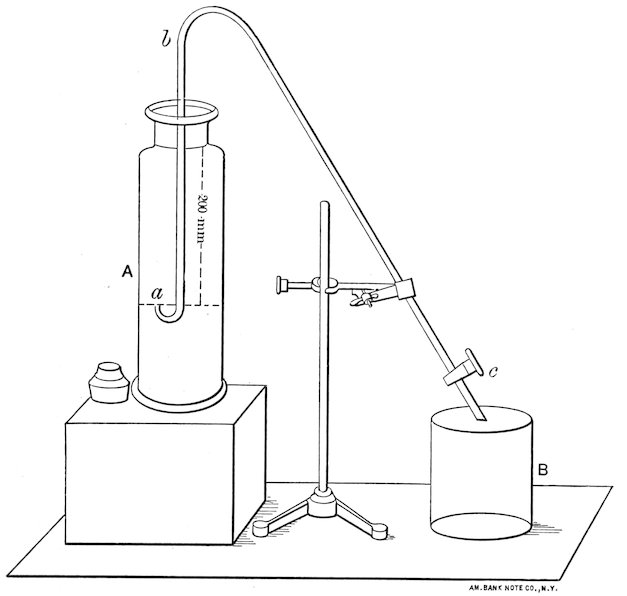
Figure 26. Siphon Cylinder for Silt Analysis.
While the results obtained by this method are satisfactory as compared with other similar processes it cannot be highly recommended because of the time and trouble required to get a 185complete separation and by reason of the difficulty of collecting the separated silt.
202. Wolff’s Method.[137]—As modified by Wolff the Knop process is conducted as follows: Fifty grams of fine earth are boiled with water and then the entire mixture is passed through three sieves with openings of one millimeter, 0.5 millimeter, and 0.25 millimeter in diameter, respectively. The finest part is mixed with water to a height of eighteen centimeters in a bottle twenty centimeters high and having a capacity of one liter and thoroughly agitated, after which it is left to rest, and finally the turbid liquid is drawn off with a siphon, the bottle refilled with water, agitated, and left to rest, and the process repeated as long as the water carries any suspended matter after a definite time.
Wolff proposes for the first three periods of rest one hour, for the second three, a half an hour, for the third three, a quarter of an hour, and for the fourth three, five minutes.
203. Moore’s Modification of Knop’s Method.[138]—The sample of soil is first passed through a sieve having round perforations three millimeters in diameter. The weight of the particles remaining on the sieve is then determined, and likewise that of the portion passing through, which is known as fine earth. The last named portion constitutes the material for all subsequent operations of mechanical and chemical analysis.
Thirty grams of the fine earth are boiled rapidly with water until the lumps are disintegrated and clayey portions separated from the sand. The material is then successively washed through perforated metal sieves, the holes of which are respectively 1, 0.5, and 0.25 millimeter in diameter. The portions retained on the sieves are severally dried, ignited and weighed, and the finest portion, or that passing through the 0.25 millimeter sieve, is then submitted to the following process of separation:
The sediment and water passing through the 0.25 millimeter sieve are placed in a glass cylinder fifty centimeters long and thirty-seven millimeters in internal diameter. The cylinder is closed at the bottom and is provided with a lateral tube inserted 186six centimeters above the bottom. Three other lateral tubes are inserted at intervals of ten centimeters above the first tube, and a ring is etched into the cylinder ten centimeters above the uppermost tube. The lateral tubes are closed with rubber tubes compressed by spring clips. The sediment being placed in the cylinder, water is added to the mark or ring, the cylinder closed with a rubber stopper, and vigorously shaken until the contents are thoroughly mixed. It is then placed upright, the stopper removed, and after standing undisturbed for five minutes the clip on the uppermost tube is opened and the water allowed to flow into a beaker. After five minutes further standing, the second clip is opened and the water drawn off into the same beaker; in the same manner the water is drawn off from the other tubes at intervals of five minutes until the level of the lowest tube is reached. The cylinder is then refilled with water to the mark, thoroughly shaken after inserting the stopper and the water again drawn off at intervals of five minutes, as before; the operation being repeated until the water drawn off is almost free from turbidity. The sediment remaining in the cylinder from this process of washing by subsidence is termed by Knop, fine sand, the material flowing off in suspension in the wash waters, dust, and the process of separation by Knop’s original method ends here.
In order to remedy the imperfect separation into definite particles secured by the above method, Moore proposes the following device:
The fine sand from the first series of subsidences is placed in a separate vessel, the washings are allowed to remain undisturbed for twelve hours, the turbid liquid decanted and the sediment returned to the cylinder. Water is then added to the mark, the whole shaken, and the liquid drawn off at intervals of five minutes, as in the first series. The sediment from this operation is placed in a separate beaker, the washings returned to the cylinder, and again allowed to subside as before; the sediment from this second subsidence is added to that from the preceding operation, and the washings again returned to the cylinder, the operation being repeated as long as any sediment can be obtained from renewed treatment of the washings; the final 187washings are then placed in a separate vessel for subsequent microscopic measurements.
The collective sediments from the last series of operations are then returned to the cylinder and allowed to subside with fresh additions of water, as in the case of the first series; the fine sand thus obtained being added to that from the first series, and the washings being collected in a large beaker. The latter are left at rest for twelve hours, and the sediment returned to the cylinder and treated as before until no further separation can be effected. The fine sand resulting from all of these operations is then dried, ignited and weighed; the weight of the portion removed by the washing being determined by difference, as it is, owing to its excessively slow rate of subsidence, found impracticable to collect it for direct weighing. The size of the particles of fine sand is then determined by micrometric measurement. Similar measurements are made on the material obtained by long subsidence from the washings from the foregoing operations. The average diameter of the largest particles should not exceed 0.01 millimeter.
204. Statement of Results.—The results of the analyses on three soils from the localities indicated in the table, and the method of stating them, are given in the following table:
New Milford, Conn., per cent. Clarksville, Tenn., per cent. Granville, N. C., per cent.
Particles larger in diameter than 3.0 millimeters 8.55 0.32 0.23
Particles of diameter from 3.0 millimeters to 1.0 millimeter 4.96 0.45 15.04
Particles of diameter from 1.0 millimeter to 0.5 millimeter 4.43 0.96 33.43
Particles of diameter from 0.5 millimeter to 0.25 millimeter 11.86 1.25 18.82
Particles of diameter from 0.25 millimeter to 0.01 millimeter 60.54 61.58 23.59
Particles smaller in diameter than 0.01 millimeter 9.66 35.44 8.89
Total 100.00 100.00 100.00
205. Method of Bennigsen.—The silt flasks recommended by Bennigsen[139] are shown in Fig. 27.
188The glass flask b carries a long cylindrical neck a the upper part of which is graduated in cubic centimeters. Ten grams of the fine soil are shaken with water in the flask, the neck of which is closed with a rubber stopper. The flask is then inverted bringing the soil and water into the neck. The flask is hung up and sedimentation is assisted by imparting a pendulous motion to the neck for ten minutes. After an hour the soil particles have separated into a coarse layer below and a fine layer above. The relative volumes of the two layers are then read off in cubic centimeters. While this method may be useful in helping to form a speedy judgment concerning the character of a soil it can lay no claim to being an accurate method of silt separation.
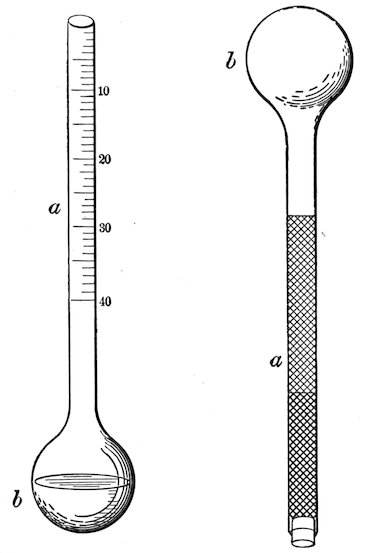
Figure 27. Bennigsen’s Silt Flasks.
206. Method of Gasparin.—The method of Gasparin only gives a very primitive separation of the various components of the earth according to their fineness. It is conducted as follows:
Ten grams of sifted earth are put into a beaker, water is added and strongly agitated; after five minutes the water is decanted into another vessel, the first vessel is filled anew with water, agitated, decanted, and this process is repeated until the liquid remains perfectly clear. Only two portions are weighed, i. e., the pebbles which remain in the sieve and the coarse sand which remains in the beaker; while the argillaceous portion drawn off with the water is determined by the difference.
207. The Italian Method.—The following modification of 189Gasparin’s process is practiced by the Italian chemists:[140]
Twenty grams of earth are passed through a sieve having openings of one millimeter in diameter, then the sifted part is mixed with 100 cubic centimeters of water in a 200 cubic centimeters beaker and left to rest for some hours, then strongly agitated and after ten seconds the turbid liquid is poured into another vessel of half a liter capacity. This manipulation is repeated until the liquid is clear.
The decanted liquid is thoroughly agitated, then left to stand until the movement shall be completely arrested, after which the supernatant liquid is poured into another vessel holding two liters. To the residuum is added more water; it is agitated, decanted, and this process is repeated until the water is no longer turbid.
208. Method of Osborne.—In the foregoing paragraphs the methods of silt separation by subsidence as practiced in different countries have been outlined. The good points of the various methods are combined in the process as carried out by Osborne.[141] The details of this method will be given with sufficient minuteness to make its practice possible by all analysts.
Selecting the Sample.—Several pounds of air-dried, fine earth are secured by passing the soil through a sieve, the holes of which are three millimeters in diameter.
Sifting.—Thirty grams of the above fine earth are stirred with 300 to 400 cubic centimeters of water and then thrown successively upon sieves with circular holes of 1, 0.5, and 0.25 millimeter diameter respectively. By means of successive additions of water and the use of a camel’s hair brush, all the fine material is made to pass through the sieves and these at the last are agitated under water in a shallow dish in such a way that the soil is immersed. The finest sieve should be well wet with water on its lower surface just before using. The finest particles which render the water turbid are easily washed through. The turbid water is kept separated from the clear water which comes off with the last portions that pass the sieves. The turbid water usually does not amount to more than one liter.
Elutriation.—The elutriation should be carried on so as to secure three grades of silt; the diameters of the particles ranging 190in the first grades from 0.25 to 0.05 millimeter, in the second grade from 0.05 to 0.01 millimeter, and in the third grade from 0.01 millimeter to the impalpable powder. The term sand is applied to the first grade, silt to the second, and dust to the third. After the turbid liquid from the sifting has stood a short time it is decanted from the sediment and after standing until a slight deposit is formed, is again decanted and the sediment examined with a microscope. If sand be present, the subsidence of the turbid liquid is continued until no more sand is deposited. As the sand subsides rapidly there is no difficulty in altogether freeing the liquid first decanted from this grade of particles. The sediment thus obtained contains all the sand, a part of the dust and much silt. As only dust and the finest silt render the water turbid the sediment is stirred a few times with a fresh quantity of water and decanted after standing long enough to let all the sand settle. When the water decanted is free from turbidity, the last portions of the soil passing through the sieve with clear water are added to the sediment and the decantations continued so as to remove most of the silt. When no more silt can be easily removed from the sediment without decanting sand, the decantations are made into a different vessel and the subsidences so timed as to remove as much of the silt as possible. By using a little care, at least three-quarters of the sand are thus obtained free from silt. The rest of the sand is mixed with the greater part of the silt which has been decanted into the second vessel. The size of the smallest particles in this vessel is determined with the microscope, to make sure that its contents are free from dust as they usually will be if, after settling for a few moments, they leave the water free from turbidity.
The soil is thus separated into three portions, one containing sand, one sand and silt, and the other silt, dust, and clay. The sand and silt are separated from each other by repeating the subsidences and decantations in the manner just described.
In this way there is removed from the sediment, on the one hand, a portion of silt free from sand and dust, and on the other hand a portion of sand free from silt. Thus is obtained a second intermediate portion consisting of sand and silt, but less in amount than the first and containing particles of diameters much 191more nearly approaching 0.05 millimeter. By repeating this process a few times, this intermediate portion will be reduced to particles whose diameters are very near 0.05 millimeter and which may be divided between sand and silt, according to judgment. The amount of this is usually very small. As soon as portions are separated, which the microscope shows to be pure sand or pure silt, they are added to the chief portions of these grades already obtained.
The same process is applied to the separation of silt from dust. When all the silt has been removed from the dust and clay, the turbid water containing the dust and clay is set aside and allowed to settle in a cylindrical vessel for twenty-four hours. The vessel is filled to a height of 200 millimeters. According to Hilgard, the separation of the dust from clay during a subsidence of twenty-four hours, will give results of sufficient accuracy, although the clay then remaining suspended will not be entirely free from measurable fine particles up to 0.001 or 0.002 millimeter diameter.
Small beakers and small quantities of distilled water are used at first for the decantations, as thus the duration of subsidence is less and more decantations can be made in a given time than when larger quantities of water are employed. Beakers of about 100 cubic centimeters capacity are convenient for the coarser grades, but it is necessary to use larger vessels for the fine sediments from which turbid water accumulates that cannot be thrown away, as may be done with the clear water, from which the coarse sediments settle out completely in a short time.
It is best to keep the amount of water as small as possible in working out the dust since loss is incurred in using too large quantities.
It is also necessary in most cases to subject the various fractions obtained during elutriation, to careful kneading with a soft rubber pestle so that the fine lumps of clay may be broken up and caused to remain suspended in the water. This treatment with the pestle should be done in such a way as to avoid as far as possible all grinding of the particles, the object being merely to pulverize the minute aggregations of clay and extremely fine particles which always form on drying a sample of soil after removing it from the ground.
192Measurement of the Particles.—To determine the size of particles in suspension, a small glass tube is applied to the surface of the liquid in such a way as to take up a single drop which is transferred to a glass slide. This drop will contain the smallest particles in the liquid.
To obtain a sample of the coarsest particles the liquid is allowed to stand long enough to form a very slight sediment and a portion of this sediment is collected with a glass tube.
To determine the diameter of the particles in a sediment it is stirred vigorously with a little water and the pipette at once applied to the surface of the water. On decanting the greater part of the sediment, the large particles remain at the bottom of the beaker and may be easily examined.
Time.—The time required to make the separations, above described, is about two hours for each, so that an analysis including the sittings, is made in five or six hours, exclusive of the time necessary for collecting the dust and separating the clay, for which a subsidence of twenty-four hours is allowed.
Weighing the Sediments.—The sediments are prepared for weighing by allowing them to subside completely, decanting the clear water as far as possible, rinsing them into a weighed platinum dish and igniting. The dish is cooled in a desiccator.
Effect of Boiling.—The analyses show a very decided increase in the particles smaller than 0.01 millimeter diameter at the expense of coarser particles as the result of boiling. The surfaces of the coarser particles are seen to be polished and of a lighter color than those not boiled. The surfaces of the unboiled particles are coated with a film of fine material probably cemented to them by clay. When these coarse particles which have not been boiled, are violently stirred with water for a short time, no fine particles are detached from them; and a careful examination under the microscope fails to reveal in any of the sediments more than an occasional grain exceeding the 0.05 millimeter limit by so much as 0.01 millimeter, or the 0.01 limit by as much as 0.005 millimeter. It would, therefore, appear that these small particles thus set free by long boiling are really a part of the larger ones and should be treated as such in a mechanical analysis of these soils.
193209. The French Method.—The Schloesing method[142] as practiced by the French agricultural chemists[143] differs essentially from those already described in attempting to first free the silt from carbonates and organic matter. It is conducted as follows:
One kilogram of the soil previously dried in the air, is taken and passed through a sieve of which the meshes are five millimeters. The agglomerated particles of earth are broken up by the hand. The pebbles are also taken out and weighed. The pebbles are then treated with hydrochloric acid until all effervescence is over. The insoluble part is dried and again weighed. The difference in weight gives the quantity of calcium carbonate contained on the external surface of the pebbles. The earth which passes the sieve of five millimeters mesh is next passed through a sieve having ten meshes to the centimeter. The masses on the sieve are broken up with the hand or with a pestle, in such a manner as to separate the fine agglomerated particles. The material which remains upon the sieve after being dried at 100°, is weighed. This gives the coarse sand. This is treated with hydrochloric acid as were the pebbles before, washed and the residue dried and weighed. The difference in weight gives the quantity of calcium carbonate adhering to the surface of the coarse sand.
The mechanical analysis is continued with the matter which has passed the sieve with ten meshes to the centimeter and which consists of the soil, properly so-called. Ten grams of this are taken, dried at 100° until no further loss takes place and the moisture thus determined. Another ten grams are taken and placed in a capsule with a flat bottom, and from nine to ten centimeters in diameter. This is moistened with a small quantity of water in such a way as to make a paste. This paste is rubbed with the finger in fifteen cubic centimeters of water. Ten seconds after the stirring is completed the supernatant liquid is poured into a precipitating jar of about 250 cubic centimeters capacity, taking great care not to allow any particles to pass over which have been deposited during that time. This operation is repeated in the same way waiting about ten seconds each time before decanting, until the decanted liquor is almost perfectly clear. In this way the particles of different fineness 194are separated. The decanted portions contain the fine sand and clay. The remaining portion contains the sand and particles of medium fineness. This last part is dried, being kept at 100° until it has a constant weight. It is afterwards treated with dilute nitric acid to dissolve the calcium carbonate. When the carbonate is abundant, it is sufficient to determine it by difference which is done by washing the material, drying and weighing. But when the proportion of carbonate is very small and in consequence when its exact determination acquires a greater importance, it is better to determine the lime directly. For this purpose the part soluble in dilute nitric acid is collected, treated with ammonia and acetic acid and precipitated with ammonium oxalate. Details of this operation will be given in another part of this manual.
In regard to the matter which is insoluble in nitric acid, it is composed chiefly of silica or silicates, and sometimes also of vegetable débris. The vegetable matter is determined by the incineration of the material which has been previously dried. The loss of weight gives the proportion of vegetable or organic débris contained in the soil and of combined water.
The portion which has been decanted, the volume of which should not exceed 500 cubic centimeters, is treated with nitric acid until effervescence ceases. It is then left to digest for some time, in order to permit the whole of the carbonate to dissolve. It is next thrown upon a smooth filter about one decimeter in diameter. After filtration it is washed to secure the complete elimination of the soluble lime salts. The lime is determined in the filtered liquid.
The insoluble portion contains the fine sand, the clay and humus bodies. In order to separate the three elements the precipitate which was received upon the filter, is rubbed with water, the filter is broken and all its contents washed through. The volume of wash water is made up to 200 cubic centimeters; two or three cubic centimeters of ammonia are added and the whole left to digest for two or three hours. The volume of the liquid is then made up to one liter with distilled water, vigorously shaking in such a way as to put all the matter in suspension. It is then left to settle for twenty-four hours. At the 195end of this time the supernatant liquid is decanted by the aid of a siphon. To the residue are added two cubic centimeters of ammonia and one liter of water. The matter is again brought into suspension and allowed to settle for twenty-four hours. The supernatant liquid is again decanted with a siphon, and added to the liquid previously removed. For ordinary soils two decantations are generally sufficient but when the soils contain a large quantity of clay it is convenient to decant three or four times. By an examination of the supernatant liquid it is easy to tell if the washings have been sufficiently prolonged. The decanted liquors contain the organic matter and that which it is convenient to call clay, which is constituted of very fine particles of sand and colloidal clay which play, in arable soil, a rôle somewhat like that of cement.
These matters are estimated in the following manner: The liquor is first treated with nitric acid and the clay and the humic matters are precipitated together. They are collected upon a smooth filter one decimeter in diameter and washed with water. By means of a washing bottle all the solid matters which have stuck to the sides of the filter are finally collected in the bottom of it. Since the last washings pass the filter very slowly, they can be removed after the complete deposition of the matter they contain, by means of a pipette. When all the liquid is removed the filter is placed upon blotting paper, great care being taken to avoid desiccation, having in view only the elimination of the excess of humidity. The folds in the filter are then carefully smoothed out with the finger. The matter which has collected upon the filter is then removed completely with a washing bottle, placed in a dish and dried at 100° and weighed. After weighing, the mass is incinerated in a muffle in order to destroy the humic bodies. The difference in weight before and after incineration, gives the total weight of the humic bodies and since the diminution in weight comprises not only the weight of the humic bodies, but also the weight of the combined water which is lost during the process of incineration, there should be subtracted from the total loss of weight ten per cent of the weight of the residual mineral matter, which represents the water of composition of the hydrated silicate.
196210. Statement of the Analysis.—Schloesing in his original paper[144] recommends that the analysis be commenced with 1,000 grams of soil. The data of the analysis and the method of arrangement are illustrated by the following example.
The physical examination of the earth having been completed as above, the results can be tabulated as follows: taken, 1,000 grams of dry earth, digested in water, thoroughly worked by hand, sifted, and passed through the meshes of the sieve by a stream of water, the meshes having a diameter of one millimeter.
Dry residue, fifty-five grams, contains Pebbles 21 grams.
Gravel 33 „
Organic débris 1 „
Sifted earth by difference, 1000 − 55 = 945 „
1000 grams.
Humidity of the homogeneous paste, twenty-seven per cent. Then 945 grams of the dry sifted earth correspond to 945 1.00 − .27 = 1294.5 of paste.
The analysis, therefore, should be carried on upon this weight or some aliquot part say 0.01 thereof; viz., 12.945 grams.
12.945 grams of the paste after successive kneadings and decantations furnish dry: 1st.—Coarse sand dry giving by treatment with acid and ignition. Noncalcareous sand 3.05 grams.
Calcareous sand 1.19 „
Organic débris 0.08 „
2nd.—Fine elements decanted with the water, their weight calculated by difference, 9.45 − 4.32 = 5.13 grams.
Treatment of the Fine Elements.—Treated by nitric acid until a complete decomposition of the calcareous matter is secured, filtered, washed, the residual matter collected upon a filter, and the liquid received in a two-liter flask, a little ammonia added, allowed to digest, the flask filled with distilled water, left for twenty-four hours at repose, and decanted:
The decantation furnishes 1st.—A deposit of fine calcareous sand weighing dry 3.14 grams.
2nd.—Clayey liquid giving after coagulation by acid, filtration and drying 0.85 grams of clay.
Then: Total fine elements 5.13 grams.
Fine elements determined directly. Fine calcareous sand 3.14 3.99 „
Clay 0.85
Fine calcareous sand by difference 1.14 „
197Calculating these results to the original quantity of 1,000 grams the following data are obtained:
RÉSUMÉ.
One thousand grams of dry earth contain:
Pebbles 21 grams.
Gravel 33 „
Organic débris 1 gram.
Fine earth 945 grams.
Total 1000 „
945 grams of fine earth contain: Coarse sand 432 gms. Noncalcareous sand 305 gms.
Calcareous sand 119 „
Organic débris 8 „
Fine elements 513 gms. Fine, noncalcareous sand 314 gms.
Clay 85 „
Fine calcareous sand 114 „
Total 1000 „
There are counted as clay all the elements which have remained in suspension in the water after a period of repose of twenty-four hours. In fact, these elements comprise a notable proportion of very fine sand which is not deposited during that time. In order that the liquid should become entirely freed from this sand it would be necessary to wait several weeks and even several months. Such a prolongation of the analysis is evidently inadmissible. The period of twenty-four hours of repose therefore has been adopted. This is merely conventional, in the same way that the period of ten seconds adopted for the precipitation of the gravel is conventional. But this convention is justified by the fact that the substance which is called clay presents, when it has a proper degree of humidity and cohesion, a plasticity entirely analogous to that property of natural clay. Moreover, as has already been said, that which is chiefly important in these analyses is the employment of processes always comparable among themselves in their results and generally followed.
211. The Belgian Method.—The method of estimating the percentage of sand and clay practiced at the Gembloux Station[145] is essentially that recommended by Schloesing with a few minor modifications.
With the ball of the thumb or with the finger, 100 grams of 198fine earth are rubbed with water in a porcelain capsule or mortar with a capacity of about 250 cubic centimeters. The suspended particles are poured off with the wash water and the process repeated five or six times, using in all about 200 cubic centimeters of water.
The water containing the sediment is rendered slightly acid (hydrochloric acid) adding the acid in minute particles with constant stirring for about an hour in order to dissolve all the carbonate and to separate the organic acids from the bases with which they are combined.
The liquid is allowed to remain at rest for five or six hours and a part of the liquor decanted to remove any supernatant particles of organic matter which may have passed the sieve in the original preparations of the sample. Filter through a smooth filter about twelve centimeters in diameter, wash until the chlorin has disappeared, and throw the filtrate away.
Break the filter paper over the vessel in which the soil was treated with hydrochloric acid and wash all the contents of the filter into this vessel with as little water as possible (about 100 cubic centimeters), add five cubic centimeters of strong ammonia water, allow to stand for three hours, shaking from time to time and with distilled water make the volume up to 250 cubic centimeters. Stir vigorously with a glass rod or spatula, take this out and wash any adhering particles back, leave at rest for twenty-four hours, siphon the turbid liquid into a two-liter vessel. Make the volume up again to 250 cubic centimeters and treat as above described and repeat the operation until the water becomes clear after standing for twenty-four hours. Usually eight or ten washings are necessary. Wash the residual sand into a weighed dish, evaporate to dryness, ignite and weigh. The weight obtained divided by the weight of the original sample gives the per cent of sand. The sand is separated by sieves of varying fineness into coarse, fine, and pulverulent sand.
Add to the ammoniacal liquor collected in the two-liter flask some powdered potassium chlorid (five grams per liter) to hasten the coagulation and rapid deposit of the clay.
After twenty-four hours siphon the clear liquor, collect the deposited clay in a smaller vessel, allow to remain at rest and 199decant as much of the clear liquor as possible. Pass through a plain tared filter about nine centimeters in diameter, dry at 150° and weigh the clay.
212. The Italian Method.—Schloesing’s method as carried out by the Italian chemists[146] is as follows:
A kilo of earth dried in the air is passed through a sieve the threads of which are separated a distance of five millimeters; and with this the small pebbles are separated.
With another sieve having spaces of one millimeter, the coarse sand is separated. The pebbles and sand are dried, weighed, treated with hydrochloric acid and again weighed in order to find the quantity of calcareous matter contained in them. In ten grams of this fine earth the humidity is determined by drying at 100°.
Ten grams are mixed in a capsule with fifteen to twenty cubic centimeters of water and after eight to ten seconds the supernatant liquid is poured into a beaker having a capacity of 250 cubic centimeters. The same operation is repeated until there are contained in the beaker the fine sand and the clay, while the coarser sand remains in the capsule.
This last is then dried and weighed and the quantity of calcium carbonate determined by treating it with diluted nitric acid. By means of calcination the organic matter is determined. The liquid decanted in the beaker, the volume of which must not surpass 200 to 250 cubic centimeters, is treated with nitric acid, filtered after some time, washed and the calcium is directly determined by precipitating the solution with ammonium oxalate.
The part in the filter which contains the fine sand, the clay, and the humus material is mixed with water to a volume of about 200 cubic centimeters; there are then added to it two to three cubic centimeters of ammonia and after two or three hours it is diluted to a liter and strongly agitated.
After twenty-four hours of rest it is decanted and the residuum is treated a second time with diluted ammonia, decanting after twenty-four hours. Ordinarily these two treatments suffice, if, however, the earth is very argillaceous, this operation should be repeated three and even four times.
200The clay which is found in the liquid suspended in colloidal form coagulates and is precipitated by adding thirty to forty cubic centimeters of a saturated solution of potassium chlorid, while the humus substance, under the influence of the ammonia remains dissolved.
Sestini found that the method of Schloesing was the only one which indicated exactly the quantity of clay in the soil. He modified this method by reducing the time of rest from twenty-four hours, as proposed by Schloesing, to only twelve hours, a reduction which in his opinion does not in the least impair the exactness of the method.
Sestini also proposes twelve treatments instead of six.
SEPARATION OF THE SOIL PARTICLES BY A LIQUID IN MOTION.
213. General Principles.—The laws, already discussed, applying to the subsidence of a solid particle in a liquid, are equally applicable to the separation of the particle by imparting a motion to the liquid at a given rate. If a solid particle subside in a given liquid at the rate of one millimeter per second it follows that this particle will remain at rest if the liquid be set in motion upward with a like velocity. If the velocity be greater the particle will be carried upward and eventually out of the containing vessel. Such a particle is said to have a hydraulic value of one millimeter per second. If there be a perfect separation of a soil into its constituent particles and no subsequent flocculation, all the particles of one millimeter hydraulic value and less will be separated by a current of the velocity mentioned.
The general principles on which the separation rests, therefore, are the securing of the proper granulation of the sample and the maintenance of a fixed velocity of the current until the separation is finished. The separation must be commenced with a period of subsidence so as to remove first of all the suspended clay or impalpable particles. The velocity can then be increased in a certain fixed ratio to secure a separation into particles of any required hydraulic value.
214. Nöbel’s Apparatus.—One of the earliest methods of 201separating the soil particles by a moving liquid is that of Nöbel.[147] The apparatus is shown in Fig. 28. The four separating vessels 1, 2, 3, 4 are of glass, pear shaped, and have a relative capacity of 1³, 2³, 3³, 4³, or 1 : 8 : 27 : 64. No. 4 has an outlet tube leading to the beaker B, of such a capacity as to allow the passage of just nine liters of water in forty minutes, constant pressure being maintained by means of a Mariotte’s bottle or of the constant level apparatus A, a, b, which is connected with the main water supply through the tube a by means of a rubber hose. The reservoir C should hold about ten liters. The sample of soil to be separated should be previously boiled and passed through a sieve having circular openings one millimeter in diameter. The flask in which the sample is boiled is allowed to stand for some time when the muddy supernatant liquid is poured into elutriator No. 2 and the remaining sediment washed into No. 1. No. 1 is filled with water by connecting it with the water supply and opening the pinch-cock p. The water is carefully admitted until the air is all driven out and Nos. 1 and 2 connected. The cock p is then opened and the vessels all filled, and the water allowed to run into B for forty minutes, the level being maintained uniformly at A.
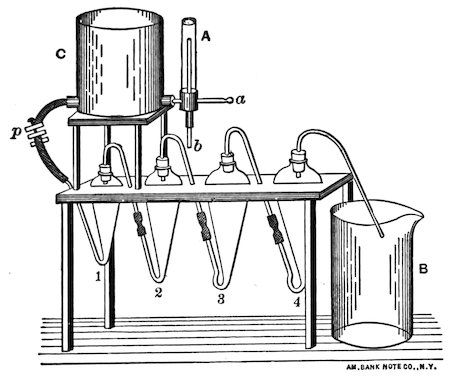
Figure 28. Nöbel’s Elutriator.
Of the water used, four liters are found in the elutriating vessels and nine liters in the receiving vessel No. 5. The apparatus is left standing for an hour until the liquid in the elutriators is clear and the portions in each vessel are received on weighed filters dried at 125°, and the weight of each portion determined.
It is recommended that the loss on ignition of each part be 202also determined. The separated particles thus secured are classified as follows:
No. 1. Débris and gravel. No. 2. Coarse sand. No. 3. Fine sand. No. 4. Clayey sand. No. 5. Finest parts or clay.
Although the method of Nöbel has been much used, the results which it gives are entirely misleading. The convection currents produced in the conical vessels by the passing water and the flocculation of the soil particles prevent any sharp separation into classes of distinct hydraulic value. The process may be useful for a qualitative test, but its chief claim to a place in this manual is in its historic interest arising from its use in the first attempts at silt analysis.
215. Method of Dietrich.[148]—The difficulties attending the silt separation by the Nöbel method, led Dietrich to construct an apparatus in which the sides of the elutriating vessels were parallel, but these vessels, with the exception of the first, were not set in an upright position.
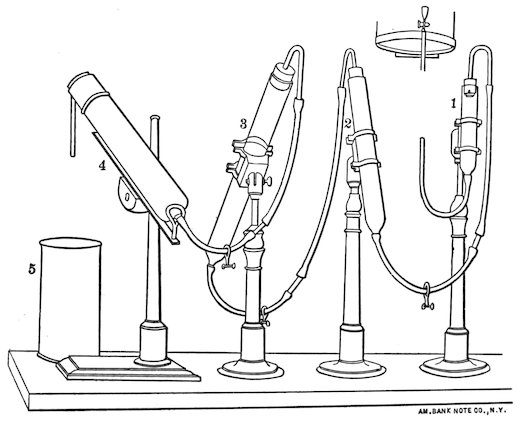
Figure 29. Dietrich’s Elutriator.
The apparatus (Fig. 29) consists of a series of cylindrical vessels connected by rubber tubing.
203The elutriators are of the following dimensions:
No. 1. Seventeen centimeters long, 2.8 centimeters in diameter, position upright.
No. 2. Thirty-four centimeters long, four centimeters in diameter, inclined 67°.5.
No. 3. Fifty-one centimeters long, 5.2 centimeters in diameter, inclined 45°.
No. 4. Sixty-eight centimeters long, 6.4 centimeters in diameter, inclined 22°.5.
The rubber tubes passing from one vessel to the other are furnished with pinch-cocks so that each one of the elutriating vessels can be shut off from the others and independently removed from the circuit.
The stream of water is made to pass through the apparatus under a constant pressure of one meter.
Only the fine earth, boiled with water or hydrochloric acid, is to be placed in the apparatus. The part coming through a sieve with a mesh 0.67 millimeters is to be used and placed in No. 1. About thirty grams of soil, are employed for each elutriation. Before adding the soil, the air is completely removed from all parts of the apparatus by connecting it with the water supply and allowing it to be filled with water.
The rate of flow is controlled by the orifice of the last effluent tube and the analyst is directed to continue the operation until the effluent water collected in the beaker glass (5) is clear. The particles then remaining in each of the vessels are collected separately.
The author of the method claims that in respect of likeness of particles the results are especially gratifying and that duplicate analyses give results fully comparable. The process, however, has not commended itself to analysts, but it marks a distinct progress toward the principles of later investigators. Had each of the elutriating vessels been placed upright and the rate of flow determined, the apparatus of Dietrich would have served, to a certain extent, for the more rigid investigations of his successors.
216. Method of Masure.—The sifted earth, from ten to fifteen grams, is carefully mixed with 200 cubic centimeters of water. 204It is then introduced into a doubly conical elutriator B, Fig. 30, of about 250 cubic centimeters capacity. A current of distilled water is allowed to flow from a Mariotte’s bottle, A, which secures a regular and constant flow. The bottle A is joined to the elutriator B by means of a rubber tube and the vertical glass tube D, the top of which is expanded into a funnel for the purpose of receiving the water from the Mariotte flask. The current of water flowing upward through the elutriator B carries in suspension the most finely divided particles of clay, and these are collected with the emergent water in the receiver C. The sand and coarser particles of clay remain in the elutriator. The water flows out by the tube F, the diameter of which should be less than that of D. When the emergent water becomes limpid the operation is terminated. After the apparatus is disconnected, the water is decanted from the sand in the elutriator, and the whole residue is weighed after drying for two hours at 110°.
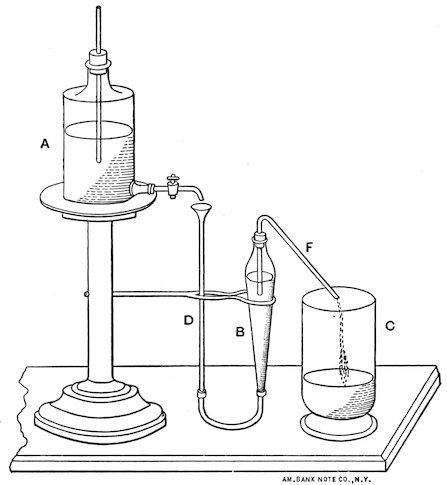
Figure 30. Masure’s Silt Apparatus.
The fine soil collected in C may also be separated and weighed, for control, after drying as above.
The pebbles and coarse sand separated by the sieves should also be weighed. By this process the soil is separated into four portions; viz.,
(1) Pebbles. (2) Coarse sand. (3) Fine sand and other materials not carried off by the current of water. (4) Fine soil, carried into the receiver C.
205217. Method of Schöne.—The method of Schöne[149] is based on the combination of a cylindrical and conical separatory tube through which the flow of water is regulated by a piezometer.
If, in the process of silt separation, the water move perpendicularly upward with a given velocity, e.g. = v the separation is dependent:
(1) On the volume of the silt particles, (2) On their specific gravity, and, (3) On their state of disintegration.
If it be assumed that the silt particle is a sphere with a diameter = d, then according to Newton’s law of gravity, the following formula would be applied: d = v² (3Z 4g (S − 1)).
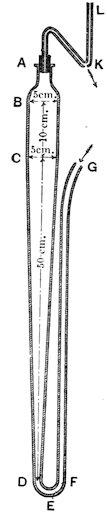
Figure 31. Schöne’s Elutriator.
In the above formula Z = a coefficient which depends on the condition of the surface against which the hydraulic pressure or resistance works, in this case a sphere; g = the acceleration of gravity equivalent to 9.81 meter; and S = the specific gravity of the particle.
This expression signifies that in a given case, the velocity of the current in the apparatus is just sufficient to counteract the tendency of a given particle to sink. All particles of a smaller diameter, in such a case, will be carried on by the current, while all of a greater diameter would separate by sedimentation. These theoretical conditions are not met with in practice where silt particles of all shapes and degrees of aggregation abound. These particles, whatever their shape, may be said to have the same hydraulic value when carried by the same current. It is necessary, therefore, to secure some uniform standard of expression to assume a normal form of particle and a normal specific gravity. For the form, a sphere is evidently the normal which must be considered and for specific gravity that of quartz is taken; viz., 2.65. The mean coefficient for Z may also be placed at 0.55, although slightly different values are ascribed to it. Substituting these values in the formula, it is reduced to the expression; d = v² × 0.0000255 millimeters. It can, therefore, be said that by this or that velocity of the current, silt particles will be 206removed of this or that diameter, it being understood that all particles of equal hydraulic value to spherules of quartz of the given diameter are included in each class. In order to have the theoretical formula agree with the results of analysis it is necessary to modify it empirically to read d = v⁷⁄₁₁ × 0.0314 millimeters.
This formula is found to agree well with the results obtained for all velocities between 0.1 millimeter and twelve millimeters per second, the ordinary limits of silt separation.
The Apparatus.—The conic-cylindrical elutriating vessel A, B, C, D, E, F, G, Fig. 31, is of glass. The part B, C, is cylindrical, ten centimeters in length and as nearly as possible five centimeters in diameter.
The conical part C, D, is fifty centimeters in length. Its inner diameter at D must not be greater than five centimeters nor smaller than four centimeters.
The bend, D, E, F, should have the same diameter; viz., four to five centimeters.
The part A, B, C, D, and D, E, F, G, may be made of separate parts and joined by a rubber tube.
Outflow Tube and Piezometer.—The outflow tube and piezometer, H, J, K, L, is constructed as shown in Fig. 32. It should be made of barometer tubing having an internal diameter of about three millimeters. The tube is bent at J at an angle of forty to forty-five degrees. The knee J must be as acute as possible not to interfere with the inner diameter. The form and especially the magnitude of the outlet are of great importance. It must be circular and nearly 1.5 millimeter in diameter. It must not be larger than 1.67 millimeter nor smaller than 1.5 millimeter. The opening should be so made as to direct the stream of outflowing liquid in the direction shown by the arrow.
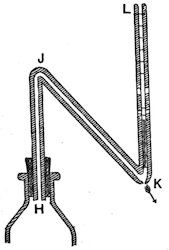
Figure 32. Schöne’s Elutriator, Outflow Tube.
The piezometer L, K is parallel to the arm H, J, of the delivery tube. Its graduation has its zero point in the center of the outlet K. It commences with the one centimeter mark. From 207one to five centimeters it is divided into millimeters, from five to ten centimeters into one-fourth centimeter, from ten to fifty centimeters into one-half centimeter, and from fifty to 100 centimeters into centimeters. The dimensions given are those required for ordinary soils and for velocities ranging from two-tenths millimeter to four millimeters per second.
For greater velocities, a delivery tube with a larger outlet must be used and the piezometer must be of greater internal diameter than indicated.
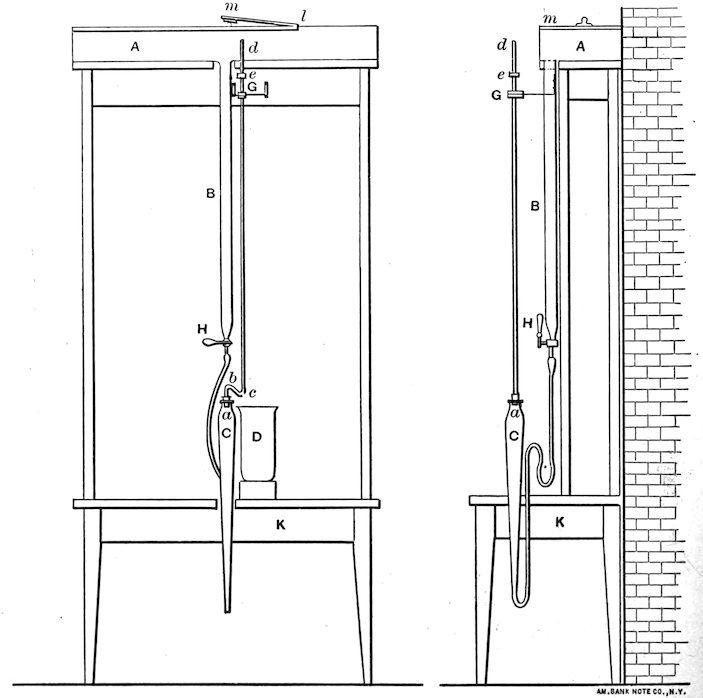
Figure 33. Schöne’s Elutriator, Arrangement of Apparatus.
Arrangement of the Apparatus.—The apparatus is conveniently mounted as shown in Fig. 33, giving front and side views 208of all parts of apparatus in position ready for use. When numerous analyses are to be made much time is saved by having a number of apparatus arranged en batterie.
The Sieve.—The soil, before being subjected to elutriation, should be passed through a sieve of which the meshes are 0.2 millimeter square.
The Process.—To measure the diameter of the cylinder, two marks are made with a diamond upon the glass which are distant from each other a certain space, for instance, h centimeters. The space between these two marks is filled with water exactly measured. Suppose that a cubic centimeters were used, then the diameter is determined by the formula:
D = √4a πh centimeters.
In order to determine that the elutriating cylinder is strictly comparable in all its parts this measurement should be made upon several parts thereof.
The apparatus should now be tested in regard to the quantity of liquid which it will deliver under a given pressure in the piezometer. By means of the stop-cock H the flow of water is so regulated that the outflow at c can be measured at a given height of the water in the piezometer. Suppose that a cubic centimeters of water flow in t seconds, then the quantity which would flow in one second is determined by the formula, Q = a t cubic centimeters. Since according to the law of hydraulic outflow the quantities are proportional to the square root of the height of the column it is easy to compute from any given height the quantity which will flow from any other one desired. For the retardation due to capillary attraction, it is sufficient, in general, to take it in a constant quantity; if this constant quantity be represented by C, the observed height of the water in the piezometer by h, and the quantity of water flowing out by Q, the data required for any given velocity can be calculated from the following proportion:
√h₁ − C : √h₂ − C = Q₁ : Q₂.
It is necessary to compute the magnitude of this constant C 209which is to be subtracted. This is accomplished by measuring the quantity of water which flows out at two different heights of the column in the piezometer. From the foregoing proportion, the value of C is as follows:
C = Q₁² h₂ − Q₂² h₁ Q₁² − Q₂²) centimeters.
The value of C can be the more exactly determined as h₁ is greater and h₂ smaller. It is best to choose the lowest height from which an exact reading can be made; that is, by which the regular rise and fall of the level of the water in the piezometer (in consequence of the formation of drops) just begins to disappear. This usually takes place when h₂ = 1.5 centimeter to 1.7 centimeter. For the higher value h₁ it is best to take about 100 centimeters. Suppose, for example, the following results are obtained:
Observed height. Observed quantity of outflow. Height of column to be subtracted due to capillary attraction.
h₂ centimeters. h₁ centimeters. Q₁ cubic centimeters. Q₂ cubic centimeters. centimeters.
80 1.6 5.53 0.406 1.21
100 1.6 6.13 0.484 1.17
80 1.8 5.53 0.406 1.19
100 1.8 6.13 0.484 1.19
The same quantity of water which flows out in a unit of time passes also at the same time over a cross section of the elutriating cylinder. The diameter of this cylinder being D the equation is derived
v = Q4 πD² centimeters.
Since the velocity in the elutriating cylinder v is directly as the quantity of water overflowing so is
v : vₙ = √h − C : √hₙ − C;
vₙ = √(hₙ − C) v √(h − C)
and hₙ = vₙ²(h − C v² + C. The constant h − C v²
210is obtained from the means of a number of estimations; for example as illustrated in the following data:
Observed height, centimeters. Observed quantity of outflow, cubic centimeters. Corresponding velocity in elutriating cylinder of 4.489 centimeters diameter, millimeters. Constant. h − C 2
1.6 0.406 0.0257 621
1.8 0.484 0.0306 652
80.0 5.530 0.3490 647
100.0 6.130 0.3870 660
Mean 645
Then are obtained the following values of hₙ and vₙ:
hₙ = 645(Vₙ²) + 1.19 centimeters.
and vₙ = √hₙ − 1.19 × 0.0394 centimeters.
In order to be able easily and rapidly to judge under what pressure the outflow has taken place in any particular instance, a larger number of values are computed with the help of the formula given and placed together in tabular form. As an example the following table may serve which was computed for one of the apparatus used. Usually it will be sufficient to test the apparatus for four different heights and then to interpolate the values for all the others. The numbers marked with a star in the table are those which were determined by experiment; the others were calculated.