Volume 1 / Part 7 — PART SEVENTH. THE ORIGIN AND ESTIMATION OF OXIDIZED NITROGEN IN SOILS, RAIN AND DRAINAGE WATERS. (continued 2)
Reading edition
The flask containing the nitric oxid is now connected with a reservoir of oxygen. The oxygen is allowed to enter, bubble by bubble, by means of cooling the flask by immersion in water. The transformation of nitric oxid into nitric acid is not entirely complete for twenty-four hours. It is necessary, therefore, to wait that long after the introduction of the oxygen before determining the amount of nitric acid produced.
The contents of the flask are placed in a titration-jar, the flask being washed two or three times and a few drops of tincture of litmus being added. The nitric acid is then determined by a standard solution of calcium hydroxid or some other standard alkali. From the titration the content of nitric acid is calculated.
The French Committee further suggests that this method may be modified in the way of making it more rapid by collecting 497the nitric acid in a graduated tube filled with mercury and containing some potash. The volume of the gas is determined and the pressure of the barometer and the temperature observed, and the usual calculations made to reduce the volume to zero and to a pressure of 760 millimeters of mercury. Each cubic centimeter of nitric oxid thus measured corresponds to 2.417 milligrams of nitric acid. The presence of organic matter does not interfere with the determination of nitric acid by either of the methods given above.
462. Modification of Warington.—The method of procedure and description of apparatus used, as employed by Warington, are as follows:
The vessel in which the reaction takes place is a small tubulated receiver, A (Fig. 76), about four centimeters in diameter, mounted and connected as shown in the illustration. The delivery-tube dips into a jar of mercury in a trough containing the same liquid. The long supply funnel-tube a is of small bore, holding in all only one-half cubic centimeter. The connecting tube F, carrying a clamp, is also of small diameter and serves to connect the apparatus with a supply of carbon dioxid.
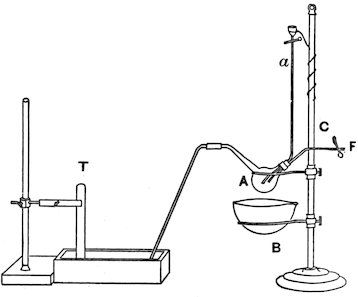
Figure 76. Warington’s Apparatus for Nitric Acid.
In practice, the supply-tube a is first filled with strong hydrochloric acid and carbon dioxid passed through the apparatus until the air is all expelled. This is indicated when a portion of the gas collected over the mercury, is entirely absorbed by caustic alkali.
At this point the current of carbon dioxid is stopped by the clamp C, and a bath of calcium chlorid, B, heated to 140° is brought under the bulb A, until the latter is half immersed therein. The temperature of the bath is maintained by a lamp. By allowing a few drops of hydrochloric acid to enter the receiver, the carbon dioxid is almost wholly expelled. The end of the 498delivery-tube is then connected with the tube, T, filled with mercury, and the apparatus is ready for use.
The nitrate, in which the nitric acid is to be determined, in a dry state, is dissolved in two cubic centimeters of the ferrous chlorid solution (one gram of iron in ten cubic centimeters), one cubic centimeter of strong hydrochloric acid is added, and the whole is then introduced into the receiver through the supply-tube, being followed by successive rinsings with hydrochloric acid, each rinsing not exceeding one-half cubic centimeter. The contents of the receiver are, in a few moments, boiled to dryness; a little carbon dioxid is admitted before dryness is reached, and again afterwards to drive over all remains of nitric oxid. In the recovered gas the carbon dioxid is first absorbed by caustic potash, and afterwards the nitric oxid by ferrous chlorid. All measurements of the gas are made in Frankland’s modification of Regnault’s apparatus. The carbon dioxid should be as free as possible from oxygen. The carbon dioxid generator is formed of two vessels, the lower one consisting of a bottle with a tubule in the side near the bottom; this bottle is supported in an inverted position and contains the marble from which the gas is generated. The upper vessel consists of a similar bottle standing upright and containing the hydrochloric acid required to act on the marble. The two vessels are connected by a glass tube passing from the side tubule of the upper vessel to the inverted mouth of the lower vessel. The acid from the upper vessel thus enters below the marble. Carbon dioxid is generated and removed at pleasure by opening a stop-cock attached to the side tubule of the lower vessel thus allowing hydrochloric acid to descend and come in contact with the marble. A good Kipp’s generator of any approved form may also be used instead of the simple apparatus, above described.
The fragments of marble used are previously boiled in water in a strong flask. After boiling has proceeded for some time, a rubber stopper is fixed in the neck of the flask and the flame removed. Boiling will then continue for some time in a partial vacuum.
The hydrochloric acid is also well boiled and has dissolved in it a moderate quantity of cuprous chlorid. As soon as the acid 499has been placed in the upper reservoir, it is covered by a layer of oil. The apparatus being thus charged is at once set in active work by opening the stop-cock of the marble reservoir; the acid descends, enters the marble reservoir, and the carbon dioxid produced drives out the air. As the acid reservoir is kept on a higher level than the marble reservoir, the latter is always under internal pressure, and leakage of air from without, into the apparatus, cannot occur.
The presence of the cuprous chlorid in the hydrochloric acid not only insures the removal of dissolved oxygen, but affords an indication to the eye of the maintenance of this condition. While the acid remains of an olive tint, oxygen is absent; but should the color change to a blue-green, more cuprous chlorid must be added. All the reagents employed should be previously boiled.
In order to secure absolute freedom from air, the following modifications on the above process have been adopted by Warington: The apparatus having been mounted as described, the funnel-tube attached to the bulb retort is filled with water, and the apparatus connected with the carbon dioxid generator. Carbon dioxid is then passed through the apparatus until a moderate stream of bubbles rises in the mercury trough. The stop-cock is left in this position, and the admission of gas is controlled by the pinch-cock. The bath of calcium chlorid is so adjusted as to cause the bulb retort to be almost entirely submerged, and the temperature of the bath is kept at 130° to 140°. Small quantities of water are next admitted into the bulb and expelled as steam in the current of carbon dioxid, the supply of this gas being shut off before the evaporation is entirely completed, so as to leave as little carbon dioxid as possible in the apparatus. Previous to very delicate experiments it is advisable to introduce through the funnel-tube a small quantity of potassium nitrate, ferrous chlorid, and hydrochloric acid, rinsing the tube with the latter reagent. Any trace of oxygen remaining in the apparatus is then consumed by the nitric oxid formed; and after boiling to dryness and driving out the nitric acid with carbon dioxid, the apparatus is in a perfect condition for a quantitative experiment.
500463. Preparation of the Materials to be Analyzed.—According to Warington, soil extracts may be used without other preparation than concentration.
Vegetable juices which coagulate when heated, require to be boiled and filtered or else evaporated to a thin sirup, treated with alcohol, and filtered. A clear solution being thus obtained, it is concentrated over a water-bath to a minimum volume in a beaker of small size. As soon as cool, it is mixed with one cubic centimeter of a cold saturated solution of ferrous chlorid and one cubic centimeter of hydrochloric acid, both reagents having been boiled and cooled immediately before use.
In mixing with the reagents, care must be taken that bubbles of air are not entangled, which is apt to occur with viscid extracts.
The quantity of ferrous chlorid mentioned is amply sufficient for most soil extracts, but it is well to use two cubic centimeters in the first experiment, the presence of a considerable excess of ferrous chlorid in the retort being thus insured. With bulky vegetable extracts more ferrous chlorid should be employed. To the sirup from twenty grams of mangel-wurzel sap, five cubic centimeters of ferrous chlorid and two cubic centimeters of hydrochloric acid are usually added.
464. Measurement of the Gas.—The measurement of the gas was for some time conducted by the use of concentrated potash for absorbing the carbon dioxid, and ferrous chlorid for absorbing the nitric oxid. The use of the ferrous chlorid, however, was found to introduce a source of error. The treatment of the gas with oxygen and pyrogallol over potash has therefore been substituted by Warington for its absorption by ferrous chlorid.
The chief source of error attending the oxygen process lies in the small quantity of carbon monoxid produced during the absorption with pyrogallol; this error becomes negligible if the oxygen be only used in small excess. The amount of oxygen employed can be regulated by the use of Bischof’s gas delivery-tube. This may be made of a test-tube having a small perforation half an inch from the mouth. The tube is partly filled with oxygen over mercury, and its mouth is then closed by a finely perforated stopper made from a piece of wide tube and fitted tightly into the test-tube by means of a covering of rubber. When this tube is inclined, the side perforation being downwards, 501the oxygen is discharged in small bubbles from the perforated stopper, while mercury enters through the opening. Using this tube, the supply of oxygen is perfectly under control and can be stopped as soon as a fresh bubble ceases to produce a red tinge on entering. Warington concludes his description by stating that in the reaction proposed by Schloesing the analyst has a means of determining a very small quantity of nitric acid with considerable accuracy, even in the presence of organic matter; but to accomplish this, the various simplifications consisting in the omission of the stream of carbon dioxid, and the collection of the gas over caustic soda must be abandoned, and special precautions must be taken to exclude all traces of oxygen from the apparatus.
465. Spiegel’s Modification.—Spiegel noticed inaccuracies in the results of the ferrous chlorid method of estimating nitric acid when carbon dioxid is used, which sometimes amounted to three per cent of the nitric acid present in the sample. The following suggestions are made by him for the improvement of the process:[297]
As regards the use of carbon dioxid in the operation, the first difficulty consists in obtaining it entirely free from air. By the use of small pieces of marble, which, before being placed in the Kipp apparatus, are kept for a long while in boiling water, a product is obtained which, after thirty minutes of moderate evolution, leaves only a trace of unabsorbed gas in contact with potash-lye. The apparatus used is illustrated in Fig. 77.
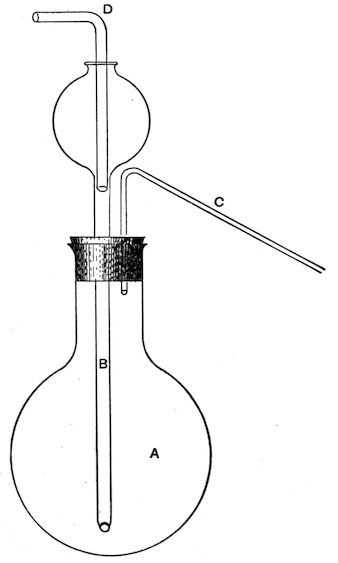
Figure 77. Spiegel’s Apparatus for Nitric Acid.
502A is a round flask of about 150 cubic centimeters capacity, furnished with a well-fitting rubber stopper provided with two holes, one for the entrance of the funnel-tube B and the other for the delivery-tube C. The tube B ends about two centimeters above the bottom of A and carries a bulb-shaped funnel at its top capable of holding about fifty cubic centimeters. The gas-tube D is ground into the bulb of B as shown in the figure.
After the flask had been filled with the solution to be examined, carbon dioxid is conducted through D and the flask is heated to boiling until the gas which escapes through C no longer contains any air. The measuring tube is brought over the end of the delivery-tube C, in the usual manner, but not shown in the figure. In the funnel of B are placed twenty cubic centimeters of previously prepared and boiled ferrous chlorid solution and this liquid is allowed to flow partly into A by lifting slightly the gas-tube, D. About forty cubic centimeters of concentrated, boiled hydrochloric acid are afterwards added to it in the same way. As soon as the liquid in the flask A is again boiling, the stream of carbon dioxid is shut off and allowed to flow again only towards the end of the operation, when the contents of the flask are reduced almost to dryness. As will be seen from the above directions no unboiled liquids of any kind are to be used as reagents in the apparatus described. If the flask A were made much smaller the efficiency of this apparatus would be increased. It appears to have few, if any, advantages over Warington’s process.
466. Schulze-Tiemann Method.—The modification of Schulze-Tiemann in the ferrous salt method consists chiefly in the omission of the use of carbon dioxid, and in the simplified form of apparatus, which permits rapid work and gives, also, according to some authorities, very exact and reliable results.[298] The extract, representing 500 grams of the fine soil, is reduced by evaporation to 100 cubic centimeters and placed in a glass flask, A (Fig. 78), of 500 cubic centimeters capacity. The flask is closed with a rubber stopper, carrying two bent glass tubes which pass through it. The tube a b c is drawn out into a point at a and reaches about two centimeters below the surface of the rubber stopper. The tube e f g passes just to the 503lower surface of the rubber stopper. The two tubes mentioned are connected, by means of rubber tubes and pinch-cocks, with the tubes d and h. The pinch-cocks at c and g must be capable of closing the tubes air-tight. The end of the tube g h passes into a crystallizing dish, B, and is bent upward to a point passing two to three centimeters into the measuring tube C. The point within the tube is covered with a piece of rubber tubing. The measuring tube C is divided into tenths of a cubic centimeter, and together with the crystallizing dish B, is filled with a ten per cent solution of boiled soda-lye, which is obtained by dissolving 12.9 parts of sodium hydroxid in 100 parts of water.
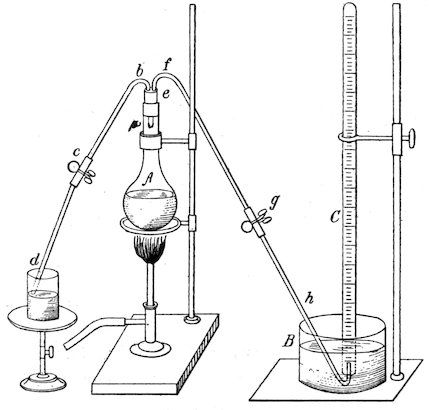
Figure 78. Schulze-Tiemann’s Nitric Acid Apparatus.
The liquid which is to be examined for nitric acid, the pinch-cocks being opened and the tube g h not dipping into the crystallizing dish, is boiled for one hour in order to drive the air out of the flask A. The end of the tube e f g h is then brought into the crystallizing dish containing the sodium hydroxid solution so that the steam escaping from the flask A, escapes partly through the tube b c d, and partly through the tube f g h, not allowing, however, the bubbles to enter the measuring tube C. To determine whether the air is all expelled, the pinch-cock at g is closed and the soda-lye will thereupon rise to g in case no air interferes. It is best to close the tube at g first with the thumb and finger and then the rise of the soda-lye to that point can be determined by the impulse felt. The tube is then firmly closed by means of the pinch-cock g. The rest of the steam is allowed to escape through the tube a b c d, and the evaporation is continued until the contents of the flask 504are evaporated to about ten cubic centimeters. The flask into which the tube c d dips, is filled with freshly boiled water. The lamp is removed from the flask A, the pinch-cock is closed, whereupon the tube c d becomes filled with the freshly boiled water. The measuring tube C, filled with freshly boiled soda-lye is closed with the thumb and brought into the dish B, care being taken that no bubble of air enters. It is placed over the end of the tube g h.
The pressure of the external air will now flatten the rubber tubes at c and g. The flask at the end of c d holding freshly boiled water is then replaced with one filled with a nearly saturated solution of ferrous chlorid containing some hydrochloric acid. The flask containing the ferrous chlorid solution should be graduated so that the amount which is sucked into the flask A can be determined. The pinch-cock c is opened and from fifteen to twenty cubic centimeters of the ferrous chlorid solution allowed to flow into A. The end of the tube c d is then placed in another flask containing strong hydrochloric acid, and the latter allowed to flow into the tube in small quantities at a time until all the ferrous chlorid is washed out of the tube b c d into A. At the point b there is sometimes formed a little bubble of hydrochloric acid in the state of gas, which by heating the flask A completely disappears.
The flask A is next warmed gently until the rubber tubes at the pinch-cocks begin to assume their normal condition. The pinch-cock at g is now replaced by the thumb and finger, and as soon as the pressure within the flask A is somewhat stronger, caused by the nitric oxid gas evolved from the mixture, it is allowed to pass through the tube e f g h and escape into the measuring cylinder C. By a manipulation of the finger and thumb at g, it is possible to prevent regurgitation of the sodium hydroxid into A, and at the same time to relieve the pressure of the nitric oxid in A, which would be difficult to do by means of the pinch-cock alone.
The boiling of the liquid is continued until there is no longer any increase of the volume of gas in the measuring cylinder C. After the end of the operation the tube g h is removed from the dish B and the measuring tube C is closed by means of the 505thumb while its end is still beneath the surface of the soda-lye, and it is shaken until all traces of any hydrochloric acid, which may have escaped absorption, are removed. It is then placed in a large glass cylinder filled with water at the temperature at which the volume of gas is to be read. After being kept at this constant temperature for about half an hour the volume of the nitric oxid can be read. For this purpose the measuring cylinder C is sunk into the water of the large cylinder until the level of the liquids within and without the tube is the same. The usual correction for pressure of the atmosphere, as determined by the barometer, and for the tension of the aqueous vapor at the temperature at which the reading is made, is applied. The correction is made by means of the following formula:
V′ = (V × 273 × (B − f)) ÷ ((273 + t) × 760)
In this formula V′ denotes the volume of the gas at the temperature of zero, and at 760 millimeters barometric pressure; V the volume of the gas as read at the barometric pressure observed, B, and the temperature observed, t, while f denotes the tension of the aqueous vapor in millimeters of mercury pressure at the observed temperature t. The tension of the aqueous vapor at temperatures from zero to 26°, expressed in millimeters of mercury, is given in the following table:
Temp. ° Tension in mm. mercury.
0 4.6
1 4.9
2 5.3
3 5.7
4 6.1
5 6.5
6 6.9
7 7.4
8 8.0
9 8.5
10 9.1
11 9.7
12 10.4
13 11.1
14 11.9
15 12.7
16 13.5
17 14.4
18 15.3
19 16.3
20 17.4
21 18.5
22 19.6
23 20.9
24 22.2
25 23.5
26 25.0
From the gas volume reduced by the above formula the nitric acid is calculated as follows:
One cubic centimeter of nitric oxid weighs at 0° and 760 millimeters barometric pressure 1.343 milligrams.
Since two molecules of NO (molecular weight sixty) correspond to one molecule of N₂O₅ (108) we have the following equation: 60 : 108 = 1.343 : x. Whence x = 2.417 milligrams, the 506weight of nitric acid corresponding to one cubic centimeter of nitric oxid.
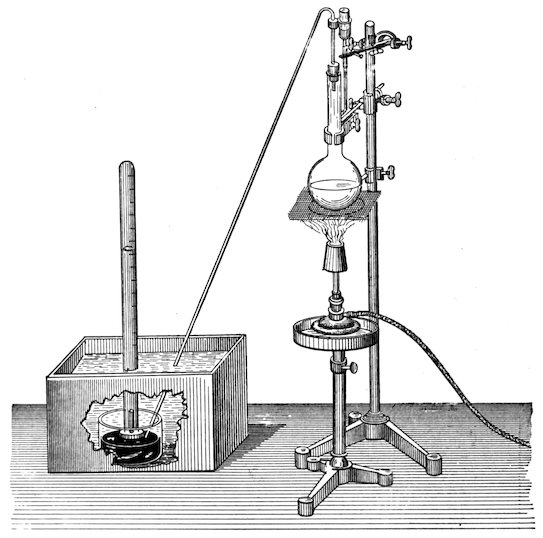
Figure 79. De Konick’s Apparatus.
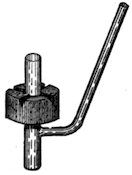
Figure 80. End of Delivery-Tube.
467. DeKonick’s Modification of Schloesing’s Method.—This modification consists in an arrangement of the gas delivery-tube, whereby the regurgitation of the water in the measuring burette into the evolution flask is prevented by a device for sealing the delivery-tube with mercury.[299] The apparatus is arranged as shown in Fig. 79. The flask in which the decomposition takes place is provided with a long neck, into which a side tube is sealed and bent upwards, carrying a small funnel attached to it by rubber tubing. The piece of rubber tubing carries a pinch-cock, by means of which the solution containing the nitrate and hydrochloric acid can be introduced into the flask. The small gas delivery-tube is arranged as shown in the figure, and carries at the end next the burette a device shown in Fig. 80. The cork represented in this device has radial notches cut in it, so as to permit 507of a free communication between the water in the burette and in the pneumatic trough. The open end of the burette, when the apparatus is mounted ready for use, rests on the notched surface of the cork, and the end of the delivery-tube is placed in the crystallizing dish resting on the bottom of the pneumatic trough.
The end of the delivery-tube, as indicated, has fused onto it a vertical tube open at both ends and six to seven centimeters in length, and carrying the notched cork already described. The crystallizing dish in the bottom of the pneumatic trough is filled with mercury until the point of union of the delivery-tube with the vertical end is sealed to the depth of a few millimeters. As the gas is evolved it bubbles up through the mercury into the measuring tube and the displaced water passes out through the notches in the cork. Should any back pressure supervene the mercury at once rises in the delivery-tube which is of such a length as to prevent its entrance into the flask. The operation can then be carried on with absolute safety.
To make an estimation there are placed in the flask about forty cubic centimeters of ferrous chlorid solution containing about 200 grams of iron to the liter, and also an equal volume of hydrochloric acid of one and one-tenth specific gravity. The side tube is also filled up to the funnel with the acid. The contents of the flask are boiled until all air is expelled, which can be determined by holding a test-tube filled with water over the end of the delivery-tube. The solution containing the nitrate is next placed in the funnel, the pinch-cock opened and the liquid allowed to run into the flask by means of the partial vacuum produced by stopping the boiling and allowing the mercury to rise in the delivery-tube. All the solution is washed into the flask by successive rinsings of the funnel with hydrochloric acid, being careful to allow no bubble of air to enter. The contents of the flask are again raised to the boiling-point and the nitric oxid evolved collected in the nitrometer. The solution examined should contain enough nitrate to afford from sixty to eighty cubic centimeters of gas. Without refilling the flask, from eight to nine determinations can be made by regenerating the ferrous chlorid by treatment with zinc chlorid. Care must be exercised not to add the zinc chlorid in excess, otherwise 508ammonia and not nitric oxid will be produced. The side tube and funnel must also be carefully freed from zinc chlorid by washing with hydrochloric acid.
468. Schmidt’s Process.—In the case of a water, or the aqueous extract of a soil, according to the content of nitric acid, from fifty to one hundred cubic centimeters are evaporated to thirty cubic centimeters, and the residue sucked into the generating flask of the apparatus, Fig. 81, and, with the rinsings with distilled water, evaporated again to from twenty to thirty cubic centimeters, and the flask then connected, as shown in the figure, to a Schliff measuring apparatus, B.[300] This apparatus is previously filled to i with mercury, and the bulb g connected with k by a rubber tube.
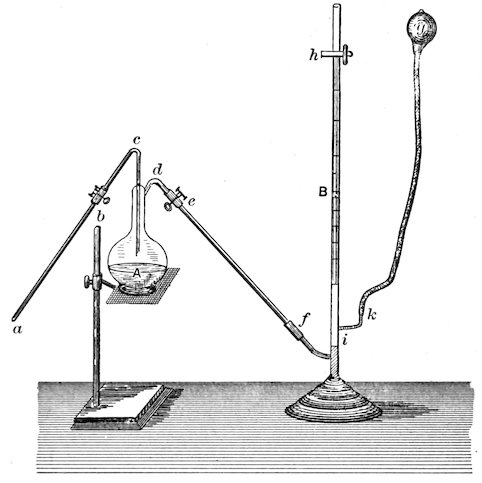
Figure 81. Schmidt’s Apparatus.
The apparatus is then filled with a twenty per cent, previously boiled and still warm, caustic soda solution until the bulb g is partially filled when raised a little above the cock h. Then h is closed and g held, by an appropriate support, on about the same level with h. The cock at b is then closed and e opened. Meanwhile the ebullition in the flask is continued, and the air bubbles rising in the Schliff apparatus are removed, from time to time, by carefully opening h and raising g. When bubbles no longer come over, the cock at e is closed and at b opened, and the steam issuing at a is conducted through a mixture of 509ferrous chlorid and strong hydrochloric acid to free it, as far as possible, from air. When the contents of the flask have been evaporated to about five cubic centimeters, b is closed and the lamp at once removed.
By carefully opening b about ten cubic centimeters of a mixture of ferrous chlorid and hydrochloric acid are allowed to enter the flask, when b is closed and the flask slowly heated until the positive pressure is restored. The pinch-cock e is then opened and the contents of the flask evaporated nearly to dryness. The cock e is again closed and the flame removed. Another quantity (fifteen cubic centimeters) of ferrous chlorid and hydrochloric acid solution is sucked into the flask and the process of distillation repeated, whereby the whole of the nitric oxid is collected in h. The nitric oxid evolved is measured in the usual way and calculated to nitric acid, one cubic centimeter of nitrogen dioxid being equal to 2.417 milligrams of nitric acid.
469. Merits of the Ferrous Chlorid Process.—The possibility of an accurate determination of nitrates; by decomposition with a ferrous salt in presence of an excess of acid, has been established by many years of experience and by the testimony of many analysts. The method is applicable especially where the quantity of nitrate is not too small and when organic matter is present. In the case of minute quantities of nitrate, however, the process is inapplicable and must give way to some of the colorimetric methods to be hereafter described.
In respect of the apparatus modern practice has led to the preference of that form which does not require the use of carbon dioxid for displacing the air. Steam appears to be quite as effective as carbon dioxid and is much more easily employed. That form of apparatus should be used which is the simplest in construction and has the least cubical content.
The measurement of the evolved gas is most simply made by collecting over lye in an azotometer, reading the volume, noting the reading of the barometer and thermometer and then reducing to standard conditions of pressure and temperature by the customary calculations. Where a very strong lye is used the tension of the aqueous vapor may be neglected. While every analyst should have a thorough knowledge of the ferrous chlorid 510method and the principles on which it is based it can not be compared in simplicity to the later methods with pure nitrates which are based on the conversion of the nitric acid into ammonia by the action of nascent hydrogen. In accuracy, moreover, it does not appear to have any marked advantage over the reduction methods.
470. Mercury and Sulfuric Acid Method.—This simple and accurate method of determining nitric acid in the absence of organic matter is known as the Crum-Frankland process.[301]
The method rests on the principle of converting nitric acid into nitric oxid by the action of mercury in the presence of sulfuric acid. The operation as at first described is conducted in a glass jar eight inches long by one and a half inches in diameter filled with mercury and inverted in a trough containing the same liquid. The nitrate to be examined, in a solid form, is passed into the tube together with three cubic centimeters of water and five of sulfuric acid. With occasional shaking, two hours are allowed for the disengagement of the gas, which is then measured.
471. Warington’s Modification.—A graduated shaking tube is employed which allows the nitrate solution and oil of vitriol to be brought to a definite volume. The nitrate solution, with rinsings, is always two cubic centimeters and enough sulfuric acid is added to increase the volume to five cubic centimeters. The sulfuric acid should give no gas when shaken with distilled water. Any gas given off in the apparatus before shaking, is not expelled but is included in the final result. The persistent froth sometimes noticed where some kinds of organic matter are present, is reduced by the addition of a few drops of hot water through the stop-cock of the apparatus. The nitric oxid is finally measured in Frankland’s modification of Regnault’s apparatus.
This method, accurate for pure nitrates, unfortunately fails in the presence of any considerable amount of organic matter.
According to Warington’s observations the presence of chlorids is no hindrance to the accurate determination of both nitric and nitrous acids by the mercury method. This simplifies the operation as carried on by Frankland who directs that any chlorin 511present, be removed before the determination of the nitric acid is commenced.
472. Noyes’ Method.—In the analyses made by Noyes for the National Board of Health, the Crum-Frankland method was employed.[302] The apparatus used was essentially that which is now known as Lunge’s nitrometer and it will be described in the next paragraph. No correction is made by Noyes for the tension of aqueous vapor in the measurement of the nitric oxid because of the moderate dilution of the sulfuric acid by the liquid holding the nitric compounds in solution. The chlorin was not removed from the dry residue of the evaporated water as its presence in moderate quantity does not interfere with the accuracy of the process. In order to obtain the amount of nitrogen in the form of nitrates, the total volume of nitric oxid must be diminished by that due to nitrites present, which must be determined in a separate analysis. The method of manipulation is given in the following paragraph.
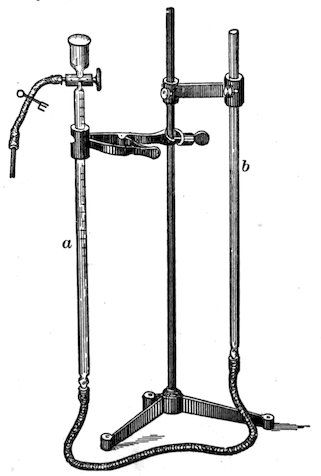
Figure 82. Lunge’s Nitrometer.
473. Lunge’s Nitrometer.—The apparatus employed by Noyes, in a somewhat more elaborate form, is known as Lunge’s nitrometer.[303] This apparatus is shown in Fig. 82. It consists of a burette, a, divided into one-fifth cubic centimeters. At its upper end it is expanded into a cup-shaped funnel attached by a three-way glass stop-cock. Below, the burette is joined to a plain tube, b, of similar size, by means of rubber tubing. The apparatus is first filled with mercury through the tube b, the stop-cock being so adjusted as to allow the mercury to fill the cup at the top of a. The cock is then turned until the mercury in the cup flows out through the side tube carrying the rubber tube and clamp. The three-way cock is closed, and the solution containing the nitrate placed in 512the cup. By lowering the tube b and opening the cock the liquid is carefully passed into a, being careful to close the cock before all the liquid has passed out of the cup. By repeated rinsings with pure concentrated sulfuric acid, every particle of the nitric compound is finally introduced into a, together with a large excess of sulfuric acid. The total volume of the introduced liquid should not exceed ten cubic centimeters. The mixture of the mercury, nitric compound, and sulfuric acid is effected by detaching a from its support, compressing the rubber connection between a and b, placing a nearly in a horizontal position, and quickly bringing it into a vertical position with vigorous shaking.
After about five minutes the reaction is complete, and the level of the liquids in the two tubes is so adjusted as to compensate for the difference in specific gravity between the acid mixture in a and the mercury in b; in other words, the mercury column in b should stand above the mercury column in a one-seventh of the length of the acid mixture in a. This secures atmospheric pressure on the nitric oxid which has been collected in a. The measured volume of nitric oxid should be reduced to 0° and 760 millimeters barometric pressure. Each cubic centimeter of nitric oxid thus obtained corresponds to 1.343 milligrams NO; 2.417 milligrams N₂O₅; 4.521 milligrams KNO₃; 1.701 milligrams N₂O₃; 2.820 milligrams HNO₃; and 3.805 milligrams NaNO₃.
474. Lunge’s Improved Apparatus.—Lunge has lately improved his apparatus for generating and measuring gases and extended its applicability.[304] The part of it designed to measure the volume of a gas is the same in all cases. For generating the gas, the apparatus varies according to the character of the substance under examination.
The measuring apparatus is shown in Fig. 83. It is composed essentially of three tubes, conveniently mounted on a wooden holder with a box base for securing any spilled mercury. The support is not shown in the illustration.
The tubes A, B, C, are mutually connected by means of a three-way tube and rubber tubing with very thick walls to safely hold the mercury without expansion. In the middle of the 513measuring tube A, is found a bulb of seventy cubic centimeters capacity. Above and below the bulb the tube is divided into tenths of a cubic centimeter, and its diameter is such, viz., 11.3 millimeters, that each cubic centimeter occupies a length of one centimeter. The upper end of A is closed with a glass cock with two oblique perforations, by means of which communication can be established at will, either through e with the apparatus for generating the gas, or through d with the absorption apparatus, or the opening be completely closed.
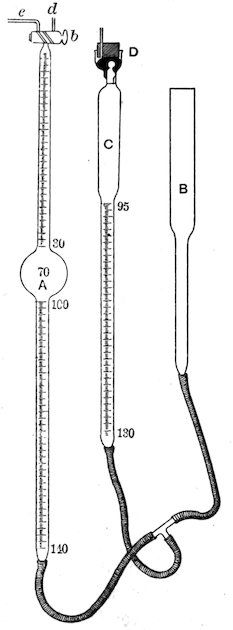
Figure. 83. Lunge’s Improved Apparatus.
The volume of air under the observed conditions which would measure exactly 100 cubic centimeters at 0° and 760 millimeters pressure of mercury, is calculated by the formula
V = 100(273 + t)760 273(b − f);
where t equals observed temperature, b the barometric pressure less the correction noted above and f the tension of the vapor of water under existing conditions. For example:
Let the temperature be 18°
Barometric reading 755
Correction for t 2
Corrected barometer 753
Vapor of water tension 16
Then V = 100(273 + 18)760 273(753 − 16) = 109.9.
This indicates that 109.9 cubic centimeters of air would occupy a volume of 100 cubic centimeters when subjected to standard conditions.
The tubes A, B, and C are filled with mercury of which about 514two and a half kilograms will be required. By means of the leveling tube B, the stopper in C being opened, the mercury in C is brought exactly to 109.9 cubic centimeters. The stopper in C is then closed, mercury poured into D, which is then closed with a rubber stopper, carrying a small glass tube as indicated in the figure.
The leveling tube B serves to regulate the pressure on the gas in A and this is secured by depressing or elevating it as the case may require.
The tube for reducing the volume to standard conditions of temperature and pressure, viz., 0° and 760 millimeters of mercury, is shown in C. In its narrow part which has the same internal diameter as A it is graduated into tenths of a cubic centimeter. The upper end of C is furnished with a heavy glass neck D surmounted by a glass cup. In the neck is placed a ground-glass stopper, carrying a groove below, which corresponds to a similar groove above in the side of the neck whereby communication can be established at will between the interior of C and the exterior. The joint is also sealed by pouring mercury into D as is shown in the figure. When the stopper is well ground and greased the reduction tube may be raised or lowered as much as may be necessary without any danger of escape or entrance of gas. To determine the position of the reduction tube C the reading of the barometer and thermometer at room temperature is taken. From the reading of the barometer subtract one millimeter if the temperature be below 12°, two millimeters at a temperature from 12° to 19°, three from 20° to 25°, and four above 25°.
When a gas has been introduced into the measuring tube A it is brought to the volume which it would assume under standard conditions by adjusting the tube C in such a way as to bring the level of mercury in C and A to the same point and the level of the mercury in C is exactly at 100 cubic centimeters. The gas in A is then at the volume which it would occupy under standard conditions and this volume can be directly read. This adjustment is secured by moving the tubes B and C up or down. If gases are to be measured wet, a drop of water should be put on the side of the upper part of C, and, if dry, of sulfuric acid, before the adjustment for temperature and pressure.
515475. Method of Manipulation.—By the action of mercury in the presence of sulfuric acid, the nitrogen in nitrates, nitrites, nitrosulfates, nitroses, nitrocellulose, nitroglycerol, and the greater number of explosives, may be obtained and measured as nitric oxid. The nitrogen compounds are decomposed in the apparatus shown in Fig. 84.
To make an analysis, the apparatus is filled with mercury, through F, until the two openings in the cock and i are entirely occupied with that liquid. The cock h is then closed, and the nitrogen compound, in solution, introduced through g, care being taken that no air enters g when F is depressed and h opened to admit the sample. The funnel g is washed several times with a few drops of sulfuric acid, which are successively introduced into G. The total liquid introduced should not exceed ten to fifteen cubic centimeters, of which the greater part should be sulfuric acid. The rubber tube connecting G and F is carefully closed with a clamp and G violently shaken for a few minutes until no further evolution of nitric oxid takes place. In shaking, the apparatus should be so held as to prevent the escape of the mercury from the small tube i by keeping it closed with the finger or drawing over it a rubber cap.
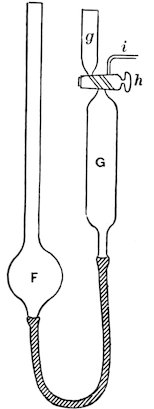
Figure 84. Lunge’s Analytic Apparatus.
After the evolution of the gas has ceased, the tube e, Fig. 83, is brought into contact with i, Fig. 84, and the two are joined by a tight-fitting piece of rubber tubing in such a way as to exclude any particle of air. The tube F, Fig. 84, is lifted and B and C, Fig. 83, depressed. On carefully opening the cocks h and b and bringing i and e into union, the gas is passed from G into A. When all the gas has entered A and the acid mixture from G has reached b the latter is closed, and also h. The apparatus G is disconnected and removed. The gas in A is then reduced to normal conditions by manipulating the reduction tube C in the manner already described.
The gas in A is measured dry by reason of having been generated in presence of rather strong sulfuric acid. Consequently, 516for this operation the adjustment of the volume of gas in C should be made in contact with a drop of strong sulfuric acid. In order to make the readings, a quantity of material must be taken which will give less than thirty or from 100 to 140 cubic centimeters of nitric oxid.
The quantities of the different compounds of nitric acid corresponding to the number of cubic centimeters of nitric oxid, measured under standard conditions, are shown in the following table:
CORRESPONDING TO
———————————— ———————————— ————————————
Cubic centimeters of NO. Weight in milligrams. N₂O₃ in milligrams. HNO₃ in milligrams. NaNO₃ in milligrams.
1 1.343 1.701 2.820 3.805
2 2.682 3.402 5.640 7.610
3 4.029 5.103 8.460 11.415
4 5.372 6.804 11.280 15.220
5 6.715 8.506 14.100 19.025
6 8.058 10.206 16.920 22.830
7 9.401 11.907 19.740 26.635
8 10.744 13.608 22.560 30.440
9 12.087 15.309 25.380 34.245
476. Utility of the Method.—Where it is desirable that the nitric oxid method be used, and at the same time heating be avoided, the decomposition of a nitrate by means of metallic mercury and sulfuric acid affords a convenient and accurate procedure. But, as a rule, there is no objection to the application of the lamp, and in such cases the mercury method appears to have no advantage over the ferrous chlorid process. Nevertheless, in the hands of a skilled worker the results are reliable, and the process is a quicker one, on the whole, than by distillation with ferrous chlorid and hydrochloric acid. This method, however, can not be recommended as in any way superior to the reduction methods to be hereinafter described.
ESTIMATION OF NITRIC ACID BY OXIDATION OF A COLORED SOLUTION.
477. Method of Boussingault.—The process for the estimation of nitric acid by the decoloration of a solution of indigo is due originally to Boussingault.[305] In this method the extract, obtained by washing slowly 200 grams of soil until the filtrate 517amounts to 300 cubic centimeters, is evaporated until its volume is no greater than two or three cubic centimeters, and it is transferred to a test-tube, with washings, and again evaporated in the tube until the volume is not greater than that last mentioned. A few drops of solution of indigo are added, and then two cubic centimeters of pure hydrochloric acid; the whole is then heated. As the color of the indigo disappears more is added. When the color ceases to fade, the liquid in the test-tube is concentrated by boiling. If concentration fail to destroy the blue or green color, another one-half cubic centimeter of hydrochloric acid is introduced. The reaction is completed when neither concentration nor fresh addition of hydrochloric acid destroys the excess of indigo present. The color produced by a small excess of indigo is a bright sap-green; this tint is the final reaction sought. The small excess of indigo necessary to produce a green color is deducted in every experiment.
When more than mere traces of organic matter are present, Boussingault advises that the nitric acid be first separated by distillation and then reduced by the indigo solution. For this purpose the concentrated solution of the nitrate, two or three cubic centimeters, is placed in a small tubulated retort with two grams of manganese dioxid in fine powder. The retort is next half filled with fragments of broken glass, over which is poured one cubic centimeter of concentrated sulfuric acid. The retort is heated carefully by means of a small flame, which is kept in motion so as to successively come in contact with all parts of the bottom of the retort. The distillate is received in a graduated test-tube which is kept cool. The distillation is continued until the vapors of sulfuric acid begin to appear. The apparatus is allowed to cool, the stopper of the retort removed, two cubic centimeters of water introduced, and the distillation again made until fumes of sulfuric acid are again seen. The distillation with water is made twice in order to remove every trace of nitric acid from the retort. The distillate is neutralized with a solution of potassium hydroxid and concentrated to two cubic centimeters, and the nitric acid estimated in the manner already described. The manganese dioxid used should be previously well washed and the sulfuric must be free of nitric acid.
518Preparation of the Indigo Solution.—Fifty grams of indigo in fine powder are digested for twenty-four hours, at 40°, in a liter of distilled water. The water is then poured off and replaced with a fresh supply. After the second decantation the residue is treated with 750 cubic centimeters of equal parts of water and pure concentrated hydrochloric acid and boiled for an hour. After cooling, the undissolved portion is collected on a filter and washed at first with hot, and afterwards with cold water, until the filtrate is no longer colored and is free of acid. The dried residue is treated with ether under a bell-jar, or in a continuous extraction apparatus, until the ether is only of a faint blue tint. The fifty grams of indigo at first taken will give about twenty-five grams of the purified article, which, however, will still leave a little ash on combustion.
Solution in Sulfuric Acid.—Five grams of the purified indigo are placed in a flask having a ground-glass stopper, treated with twenty-five grams of fuming sulfuric acid, and allowed to digest two or three days at a temperature of from 50° to 60°. From seventy to 200 drops of the solution thus made are placed in 100 cubic centimeters of water for use in the process.
Standardization of the Indigo Solution.—The solution as prepared above is standardized by a solution of one gram of pure potassium nitrate in 1,000 cubic centimeters of distilled water. The oxidation of the indigo solution is accomplished as described above. For this strength of standard nitrate solution two cubic centimeters are taken corresponding to two milligrams of potassium nitrate. The indigo solution for this strength should have only twenty drops of the sulfuric acid solution of indigo to 100 cubic centimeters of water. If twenty grams of potassium nitrate are taken for 1,000 cubic centimeters of the standard solution then 200 drops of the sulfindigotic acid should be used to 100 cubic centimeters of water.
478. Method of Marx.—As usually practiced, the indigo method is conducted according to the variation described by Marx.[306] There are required for the process the following reagents and apparatus:
a. A solution of pure potassium nitrate containing 1.8724 grams per liter. One cubic centimeter of the solution is equivalent to one milligram of nitric anhydrid (N₂O₅).
519b. A solution of the best indigo carmine in water which should be approximately standardized by solution in the manner described hereafter, and then diluted so that six to eight cubic centimeters equal one milligram of nitric acid.
c. Chemically pure sulfuric acid of specific gravity 1.842, perfectly free from sulfurous and arsenious acids and nitrogen oxids.
d. Several thin flasks of about 200 cubic centimeters capacity.
e. A small cylindrical measure holding fifty cubic centimeters and divided into cubic centimeters.
f. A Mohr’s burette divided into tenths of a cubic centimeter.
g. A twenty-five cubic centimeter pipette or another burette.
h. A five cubic centimeter pipette divided into cubic centimeters or half cubic centimeters.
i. A measuring flask of 250 cubic centimeters capacity.
Preliminary Trial.—Twenty-five cubic centimeters of the sample are transferred to a flask; the fifty cubic centimeter measure is filled with sulfuric acid and the burette with indigo solution. The sulfuric acid is added to the sample all at once, shaken for a moment, and the indigo run in as quickly as possible with shaking until a permanent greenish tint is produced. If the sample do not require more than twenty cubic centimeters of indigo solution of the above strength, it can be titrated directly, otherwise it must be diluted with a proper quantity of pure water, and subjected again to the preliminary trial.
The Actual Titration.—(1) Twenty-five cubic centimeters of the sample properly diluted if necessary, are measured and poured into a flask, and as much indigo as was used in the preliminary trial, is added; a quantity of sulfuric acid, equal in volume to the liquid in the flask, is added all at once, the mixture shaken, and indigo solution run in quickly out of the burette until the liquid remains permanently of a greenish tint.
(2) The last experiment is repeated as often as may be necessary adding to the water at first half a cubic centimeter less indigo than the total quantity used previously, afterwards proceeding as in (1) until the final test shows too little indigo used.
(3) From the rough titration of the indigo, calculate the amount of potassium nitrate solution corresponding with the indigo 520solution used in (2), multiply the result by ten, transfer this quantity of the standard nitrate solution to a 250 cubic centimeter flask, fill with pure water to the mark, and titrate twenty-five cubic centimeters of this fluid with indigo as in (2). If the quantity of indigo solution used is nearly the same as that required in (2), its exact value may be calculated, but if it is not, another nitrate solution may be made up in the 250 cubic centimeter flask, more closely resembling the sample in strength, and the titration with the indigo solution must be repeated.
(4) If the water contain any considerable amount of organic matter, it must first be destroyed by potassium permanganate. In this case, the estimation of the organic matter and nitric acid may be conveniently combined.
The use of permanganate in the above case is likely to introduce an error as has been shown by Warington. The method therefore can not be recommended in the presence of organic matter.
479. Method of Warington.—The modification of the indigo method as used by Warington, applicable only in absence of organic matter, is the one chiefly employed in England.[307]
Instead of the ordinary indigo of commerce, indigotin is used. The normal solution of the coloring matter is made of such a strength as to be equivalent to a solution of potassium nitrate containing 0.14 gram of nitrogen per liter. Where large quantities of the coloring matter are to be used it is advisable to prepare it about four times the strength given above and then dilute it as required. Four grams of sublimed indigotin will furnish more than two liters of the color solution.
The solution is prepared as follows:
Four grams of indigotin are digested for a few hours with five times that weight of Nordhausen sulfuric acid, diluted with water, filtered, and made up to a volume of two liters. The strength of the indigotin solution is determined with a solution of potassium nitrate of the strength mentioned above. The process is performed as follows:
From ten to twenty cubic centimeters of the standard nitrate solution are placed in a wide-mouthed flask of about 150 cubic centimeters capacity. A portion of the indigotin solution is next 521added, such as will be deemed sufficient for the process, and the whole is well mixed. Strong sulfuric acid is next measured out from a burette into a test-tube, in volume equal to the united volumes of the nitrate solution and indigotin. The whole of the sulfuric acid is then poured as quickly as possible, into the solution in the flask and rapidly mixed, and the flask transferred to a calcium chlorid bath, the temperature of which should be maintained at 140°. It is essential to the success of the operation that the sulfuric acid should be mixed with the greatest rapidity. It should be poured in at once and the whole well shaken without waiting for the test-tube containing the acid, to drain. The flask should be covered by a watch-glass while it is held in the bath. As soon as the larger part of the indigotin is oxidized the flask in the bath should be gently rotated. With very weak solutions of nitrate it may be necessary sometimes to keep the flask in the bath for five minutes. When the indigo color is quickly discharged it shows the presence of nitric acid in considerable excess and a considerably larger quantity of indigo must be taken in the next experiment. The experiments are continued until just the quantity of indigo necessary to consume the nitric acid is taken, the amount of indigo being in very slight excess, not exceeding one-tenth cubic centimeter of the indigo solution used. The tint produced by the small excess of indigo remaining is best seen by filling the flask with water. On substances of approximately known strength about four experiments are usually necessary to determine the amount of indigo to be taken, but with unknown substances a larger number may be necessary.
Usually in determinations of this kind it is directed to use double the volume of sulfuric acid mentioned above. In this case not only is the quantity of indigo oxidized much greater than with a smaller portion of acid, but the prejudicial effect of organic matter is also greater than when the smaller quantity of acid is employed.
An indigo solution standardized as above is strictly to be used for a solution of nitrate of the strength employed during the standardization. The quantity of indigo oxidized in proportion to the nitric acid present diminishes as the nitrate solution 522becomes more dilute. Instead of determining this during each series of experiments it may be estimated once for all and a table of corrections used.
The following table is based upon experimental determinations:
Strength of niter solution used. Indigo required, cubic centimeters. Difference between amounts of indigo, cubic centimeters. Nitrogen corresponding to one cubic centimeter of indigo, gram. Difference between the nitrogen values, gram. Difference in the nitrogen values for a difference of one cubic centimeter in the amount of indigo, gram.
⁸⁄₆₄ Normal 10.00 0.000035000
⁷⁄₆₄ „ 8.71 1.29 0.000035161 0.000000161 0.000000125
⁶⁄₆₄ „ 7.43 1.28 0.000035330 0.000000169 0.000000132
⁵⁄₆₄ „ 6.14 1.29 0.000035627 0.000000298 0.000000231
⁴⁄₆₄ „ 4.86 1.28 0.000036008 0.000000381 0.000000298
³⁄₆₄ „ 3.57 1.29 0.000036763 0.000000756 0.000000586
²⁄₆₄ „ 2.29 1.28 0.000038209 0.000001445 0.000001129
¹⁄₆₄ „ 1.00 1.29 0.000043750 0.000005541 0.000004295
The table is used as follows:
Suppose that twenty cubic centimeters of water under examination have required 5.36 cubic centimeters of indigo solution for the oxidation of the nitric acid contained therein. By inspection of the table it is seen that this number is five-tenths cubic centimeter above the nearest quantity given; viz., 4.86 cubic centimeters. From the last column in the table it is found that the correction for five-tenths cubic centimeter of indigo solution is 0.000000149 cubic centimeter, being half that for the one cubic centimeter given in the table. This is to be subtracted from the unit value in nitrogen given in the first “gram” column of the table; viz., 0.000036008. It is thus seen that the 5.86 cubic centimeters of indigo solution are equivalent to 0.000035859 gram of nitrogen per cubic centimeter. The water under examination, therefore, contains nine and six-tenths parts of nitrogen as nitric acid per million.
Attention must also be paid in standardizing indigo solutions to the initial temperature of the solutions. A rise in the initial temperature will be attended by a diminution in the quantity of indigo oxidized. Experiments with a room temperature of 10° and a room temperature of 20°, being the initial temperatures of the experiments, showed that at the higher temperature the amount of indigo consumed was about five per cent less when 523the strong solutions of nitrate were employed. The indigo solution should, therefore, be standardized at the same temperature at which the determinations are made.
If twenty cubic centimeters of the standard nitrate solution employed be used in setting the indigo solution, this standard will enable the operator to determine nitric acid up to 17.5 parts of nitrogen per million in water or soil extracts.
The presence of an abundance of chlorids in the water under examination tends to diminish the content of nitric acid found, and also tends to introduce an error, which is sometimes of a plus and sometimes of a minus quantity, according to the strength of the nitric acid present. The reaction is shortened in weak solutions by the presence of chlorids, and the quantity of indigo consumed is consequently increased. The error introduced by chlorids is usually of an insignificant nature.
On account of the interference of organic matters with the reaction of indigo it is not of much use in the examination of nitrates washed out of soils, although in some cases the results may be quite accurate. This method must, therefore, be considered as applicable, in general, to waters or soil extracts which contain little or no organic matter.
In analytical work pertaining particularly to agriculture, the use of the indigo method for determining nitric acid has been largely employed, both in the analyses of soil extracts and drainage and irrigation waters. The method, however, can hardly survive as an important one in such work in competition with more modern and speedy processes of analysis.
DETERMINATION OF NITRIC NITROGEN BY REDUCTION TO AMMONIA.
480. Classification of Methods.—When nitrogen is present in a highly oxidized state, e. g., as nitric acid, it may be quickly and accurately estimated by reduction to ammonia. This action is effected by the reducing power of nascent hydrogen, and this substance may be secured in the active state by the action of an acid or alkali on a metal, or by means of an electric current. The processes depending on the use of a finely divided metal in the presence of an acid or alkali have come into general use 524within a few years, and are now employed generally instead of the more elaborate estimations depending on the use of copper oxid or indigo.
The typical reaction which takes place in all cases is represented by the following equation:
2HNO₃ + 8H₂ = 2NH₃ + 6H₂O.
The method will be considered under three heads; viz., 1. Reduction in an alkaline solution; 2. Reduction in an acid solution; 3. Reduction by means of an electric current.
In the first class of processes the reduction and distillation may go on together. In the second class the reduction is accomplished first and the distillation effected afterwards, with the addition of an alkali. In the third class of operations the reduction is accomplished by means of an electric current and the ammonia subsequently obtained by distillation, or determined by nesslerizing. These processes may be applied to rain and drainage waters, and to soil extracts. On account of the ease with which the analyses are accomplished, the short time required and the accuracy of the results, the reduction methods for nitrates have already commended themselves to analysts, and are quite likely to supersede all others for practical use where weighable quantities of nitrates are present. For the minute traces of nitrates found in rain and drainage waters, and in some soil extracts, the reduction method may also be applied, but in these cases the ammonia which is formed must be determined by colorimetry (nesslerizing) and not by distillation. The processes about to be described are especially applicable to the examination of soils and waters rich in nitrates.
REDUCTION IN ALKALINE SOLUTIONS.
481. Provisional Method of the Association of Official Agricultural Chemists.[308]—
Extraction of the Nitrates.—Place one kilogram of the dried soil, calculated to water-free substance, on a percolator of glass or tin. Moisten the soil thoroughly with pure distilled water, and allow to stand for half an hour. Add fresh portions of pure distilled water until the filtrate secured amounts to one liter. If the first filtrate be cloudy before use it may be refiltered.
525Qualitative Test for Nitrates.—Evaporate five cubic centimeters of the soil extract in a porcelain crucible, having first dissolved a small quantity of pure brucin sulfate therein. When dry, add to the residue a drop of concentrated sulfuric acid free of nitrates. If the nitrate calculated as potassium nitrate does not exceed the two-thousandth part of a milligram only a pink color will be developed; with the three-thousandth part of a milligram a pink color with reddish lines; with the four-thousandth part of a milligram a reddish color; with the five-thousandth part of a milligram a distinct red color.
Estimation of the Nitrates.—Evaporate 100 cubic centimeters of the soil extract to dryness on a steam-bath. Dissolve the soluble portions of the residue in 100 cubic centimeters of ammonia-free distilled water, filtering out any insoluble residue. Place the solution in a flask, add ten cubic centimeters of sodium amalgam, stopper the flask with a valve which will permit the escape of hydrogen, and allow to stand in a cool room for twenty-four hours. Add fifty cubic centimeters of milk of lime and titrate the ammonia produced by distillation, with standard acid and estimate as nitrogen pentoxid. Where the amount of ammonia is small, nesslerizing may be substituted for titration.
Preparation of Sodium Amalgam.—Place 100 cubic centimeters of mercury in a flask of half a liter capacity; warm until paraffin will remain melted over the surface; drop successively in the paraffin-covered mercury, pieces of metallic sodium of the size of a pea until 6.75 grams have united with the mercury. The amalgam contains then 0.5 per cent of metallic sodium and may be preserved indefinitely under the covering of paraffin.
482. Method of the Experiment Station at Möckern.[309]—The principle of this reaction is based on the reducing action exercised by nascent hydrogen on a nitrate, the hydrogen being generated by the action of soda-lye on a mixture of zinc dust and finely divided iron.
Ten grams of nitrate are dissolved in 500 cubic centimeters of water. Of this solution twenty-five cubic centimeters, corresponding to one-half gram, are placed in a distillation flask of about 400 cubic centimeters capacity, 120 cubic centimeters of water added, and about five grams of well-washed and 526dried zinc dust and an equal weight of reduced iron. To the solution are added eighty cubic centimeters of soda-lye of 32° B. The flask is then connected with the condensing apparatus and the distillation carried on synchronously with the reduction, the ammonia being collected in twenty cubic centimeters of titrated sulfuric acid. The distillation is continued from one to two hours, or until 100 cubic centimeters have been distilled, and the remaining sulfuric acid is titrated in the usual way. Soil extracts and sewage waters should be concentrated until they have approximately the proportion of nitrates given above.
483. Method of Devarda.—The inconvenience due to slow action and other causes, arising from the use of pure metals in the reduction of nitrates to ammonia, has been overcome, to some extent, by Devarda, by use of an alloy, in a state of fine powder, consisting of aluminum, copper, and zinc.[310] The alloy consists of forty-five per cent of aluminum, fifty per cent of copper, and five per cent of zinc. In dissolving, the copper is left in a finely divided state, which is a great help in distillation in preventing bumping.
The analytical process is carried out as follows: The solution containing the nitrate, in quantity equivalent to about one-half gram of potassium nitrate, is placed in a flask having a capacity of about one liter, and diluted with sixty cubic centimeters of water and five cubic centimeters of alcohol, and then forty cubic centimeters of caustic potash solution added of specific gravity one and three-tenths. From two to two and one-half grams of the alloy, described above, are introduced, and the flask attached to a condenser with a receiver containing standard acid. The connection between the flask and the condenser is made by means of a tube having on the limb next the flask a bulb filled with glass beads to prevent the contents of the flask splashing over into the receiver, and on the other limb another bulb to prevent the acid in the receiver finding its way into the distillation flask, should regurgitation occur. When the flask has been thus connected with the condenser it is gently heated for half an hour, at the end of which time the evolution of hydrogen will have slackened or ceased, and then the distillation is begun, at first cautiously, until the zinc of the alloy has completely dissolved, and then more vigorously, the time necessary being about twenty 527minutes from the time when the contents of the flask begin to boil. The distillate is caught in standard acid and the ammonia determined by backward titration in the ordinary way. It is to be noted that the strength of the alkali used is of importance, as if it be too strong, the action on the alloy is unduly vigorous at the beginning of the operation, and if too weak, the contents of the flask have to be heated overmuch, the result in both cases being the formation of a fine spray of caustic solution, which is very difficult to stop, even with complicated washing attachments to the distilling flask. The test analyses on pure nitrates are satisfactory. This method has been used with satisfaction in the laboratory of the Department of Agriculture, but does not appear to have any special advantage over the process of Ulsch, to be described further on.
484. Variation of Stoklassa.—Stoklassa has subjected the method of Devarda to a comparative test with the following methods:[311]
1. Wagner’s Schloesing-Grandeau method.
2. Lunge’s nitrometer method.
3. Stutzer’s method.
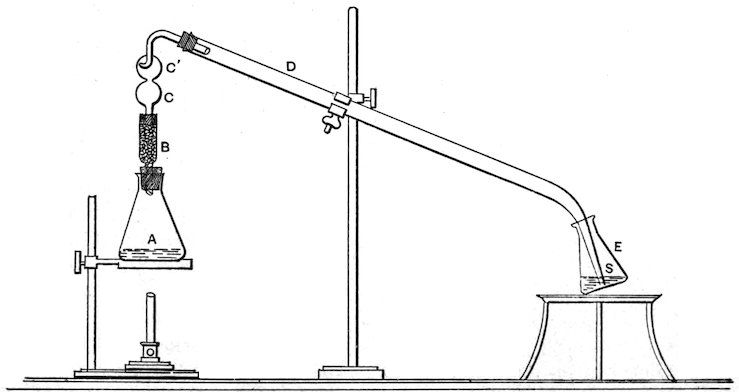
Figure 85. Stoklassa’s Nitric Acid Apparatus.
The reduction takes place in a copper erlenmeyer, A, Fig. 85, in which, in addition to the solution containing the nitrate, are placed 528200 cubic centimeters of water, forty cubic centimeters of potassium hydroxid solution of 33° B., five cubic centimeters of alcohol, and finally two and one-half grams of the finely powdered Devarda alloy. The distillate passes through a tube, B, filled with glass pearls and into the condenser D, through the bulbs, C C′.
After the flask is connected with the distilling apparatus, it is gently warmed and the reduction is ended in about twenty minutes. The ammonia which is formed is then distilled into E, containing the standard acid, S, requiring about twenty minutes more. The comparative results given, show that the Devarda method is equally as accurate as any of the other methods mentioned, giving practically theoretical results.
In so far, however, as speed of an analysis, is concerned the first place is awarded to the Lunge nitrometer method, with which a complete analysis can be made in from thirty to forty minutes. In the second rank, so far as speed is concerned, the Devarda method is recommended. All the methods give accurate results.
485. Method of Sievert.[312]—Two grams of potassium or sodium nitrate are dissolved and made up to 1,000 cubic centimeters. Fifty cubic centimeters of the solution are placed in a 600 cubic centimeter flask and diluted with fifty cubic centimeters of water, and from eighteen to twenty grams of caustic alkali added. After the alkali is dissolved, seventy-five cubic centimeters of ninety-six per cent alcohol are added and a few pieces of bone-black to prevent foaming. From ten to fifteen grams of zinc or iron dust are then added to the flask which is closed and connected with a ᥩ tube holding about 200 cubic centimeters, which contains about ten cubic centimeters of normal sulfuric acid. This ᥩ tube is kept cool by being immersed in water. The whole mixture is now allowed to stand for three or four hours and then the alcohol is distilled slowly and the ammonia formed by the reduction of the nitrates is carried over with it. The distillation lasts for about two hours. The contents of the ᥩ tube are carefully rinsed into a dish and the excess of sulfuric acid titrated with one-fourth normal soda-lye.
For soil extracts and substances containing unknown quantities of nitric acid, a preliminary test will indicate approximately 529the amount thereof, and this will be an indication for the quantity to be used in the analysis.
The method of Stutzer differs from the foregoing in the substitution of aluminum dust instead of iron or zinc.[313] The reducing power of aluminum, however, varies greatly according to the method in which the metal has been prepared. Pure aluminum prepared by the electric method, reduces the nitric acid much less vigorously than the metal prepared by the older methods of fusion with sodium. For this reason the method of Stutzer is not to be preferred to that of Sievert.
REDUCTION IN AN ACID SOLUTION.
486. Variation of the Sodium Amalgam Process.—This method is described by Monnier and Auriol.[314]
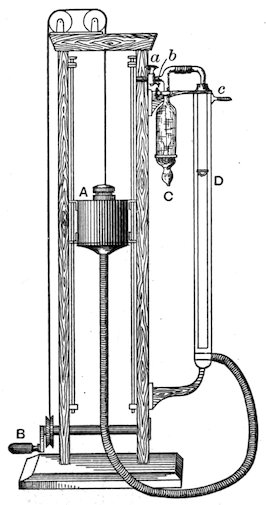
Figure 86. Variation of the Sodium Amalgam Process.
The principle of the operation depends on the reduction of the dissolved nitrate by titrated sodium amalgam in presence of an acid, and the estimation of the quantity of nitric acid present from the deficit in the volume of hydrogen. The apparatus employed is conveniently mounted as shown in Fig. 86. The brass vessel A is movable by means of the cord on the pulley B, in such a way as to be fixed at any required altitude. It is filled with water and connected by a rubber tube to the cooling tube D. Within the cooling tube there is a graduated cylinder open at its lower end. Its upper end is connected directly with the apparatus C. The cooling tube D has a small side tube, c, near its upper end, by means of which the air can enter or escape when the position of A is changed. The apparatus C, in which the reaction takes place, is a glass cylinder. Its upper end is continuous with the ⟙ tube provided with the stop-cocks a and b. 530One arm of the ⟙ permits connection with the graduated measuring tube by means of a rubber union. The lower end of C is closed with a large hollow ground-glass stopper, carrying a small receptacle within, so that it forms two separate water-tight compartments, open at the top.
The sodium amalgam is prepared as follows:
In a clay crucible are heated 400 grams of mercury, and, little by little, with constant stirring, four grams of dry sodium are added. When cold, the amalgam is placed in a burette, having a ground-glass stopper, and covered with petroleum. The strength of the amalgam is established in the following manner. A small glass thimble, ground even at the top, is filled with the amalgam and struck off even with a ground-glass straight edge. In this way the same quantity of amalgam is taken for each test. This measured portion of the amalgam is placed in the inner vessel of the glass stopper to C. Ten cubic centimeters of water, containing sixty centigrams of tartaric acid, are placed on the outer ring of the glass stopper, which is then inserted, well oiled, in C, closing it air- and water-tight. The tartaric acid solution also carries a piece of litmus paper, so that its constant acidity may be insured. The vessel A is then fixed in a position which brings the water in the graduated burette and tube D exactly to the 0 mark. The cock a is next closed, b opened, and C is inverted until all the amalgam is poured into the solution of tartaric acid. The evolved hydrogen mixed with the air contained in the apparatus, is passed into the graduated burette. After fifteen minutes, the reaction is ended. The water level within and without the graduated tube is restored and the volume of gas evolved noted and reduced by the usual tables to 0° and 760 millimeters pressure of the barometer.
An amalgam prepared as above will give about three cubic centimeters of hydrogen for each gram. The thimble should hold from twelve to fifteen grams.
The estimation of nitric acid should be made in a solution containing about one-tenth per cent of nitrate. Ten cubic centimeters are taken, to which six-tenths gram of tartaric acid is added, and placed in the outer part of the glass stopper. The 531rest of the process is conducted exactly as described above. The deficit in hydrogen is calculated to nitrogen pentoxid.
The reduction by sodium amalgam is not so convenient a form of estimating nitric acid as many of the other forms of using nascent hydrogen. As practiced by calculating from the deficit of hydrogen, however, it has some advantages by reason of the fact that no heating is required. The presence of organic neutral bodies, or even those of an acid nature, like humus, does not, therefore, interfere with the work. Likewise, mineral bodies in solution, which are not reduced by nascent hydrogen, do not interfere with the accuracy of the reaction.
487. Method of Schmitt.—In the method of Schmitt forty cubic centimeters of glacial acetic acid are placed in a flask of 600 cubic centimeters content, and fifteen grams of a mixture of zinc and iron dust added.[315] To this a quantity of the solution containing the nitrate, representing about half a gram of the pure nitrate, is added with constant shaking, in portions which do not evolve hydrogen too rapidly. After about fifteen minutes when the evolution of nitrogen has somewhat diminished, an additional fifteen grams of the metal dust are added. If the contents of the flask should become thick they can be diluted with thirty cubic centimeters of water. The reduction is complete in from thirty to forty minutes. The contents of the flask are now saturated with enough soda-lye not only to neutralize the excess of acetic acid, but to keep the zinc hydroxid also in solution. For this purpose about 200 cubic centimeters of soda-lye of 1.25 specific gravity are necessary. The ammonia is obtained by distillation into standard acid in the usual way.
488. Method of Ulsch.—In practice the method of Ulsch has come into general use.[316]
For the determination of nitrogen by this method half a gram of saltpeter or four-tenths gram of sodium nitrate is taken and dissolved in twenty five cubic centimeters of water, in a flask with a content of about 600 cubic centimeters. Five grams of iron reduced by hydrogen, and ten cubic centimeters of sulfuric acid diluted with two volumes of water are then added to the flask. To avoid mechanical losses during the evolution of hydrogen a pear-shaped glass stopper is hung in the neck 532of the flask. After the first violent evolution of hydrogen has passed, the flask is slowly heated until in about four minutes it is brought to a gentle boil. The boiling is continued for about six minutes when the reduction is complete. About fifty cubic centimeters of water are then added; also an excess of soda-lye and a few particles of zinc and the ammonia is distilled and collected in standard acid in the usual way.
The method of Ulsch can also be applied, according to Fricke, to the analysis of nitrates contained in drinking and drainage waters, and it is regarded by him as one of the best methods to be employed in such investigations.[317]
The method of Ulsch in this laboratory has given entirely satisfactory results, and is generally used in preference to other methods in cases where a considerable quantity of nitrates is present. It is based on the following reactions:
2KNO₃ + H₂SO₄ = K₂SO₄ + 2HNO₃
2HNO₃ + 8H₂ = 2NH₃ + 6H₂O
2NH₃ + H₂SO₄ = (NH₄)₂SO₄.
REDUCTION BY THE ELECTRIC CURRENT.
489. Method of Williams-Warington.—From the losses which naturally occur during the evaporation of water, even with all the precautions noted, Warington was led to try some method for the determination of nitrates and nitrites in waters without previous concentration.[318] The reduction of these bodies by the copper-zinc couple formed the basis of these experiments, and they resulted in the following method of manipulation, which is based on a process devised by Williams.[319]
The method consists in boiling rapidly one liter of the rain water in a retort, with a little magnesia previously raised to a low red heat and then washed, until 250 cubic centimeters have distilled over. The residue is then made up to 800 cubic centimeters, transferred to a wide-mouthed, stoppered bottle supplied with strips of copper and zinc forming electric couples, and set aside, at a constant temperature of from 21°–24°, for three days. A measured portion of the solution is then distilled, and the ammonia determined in the distillate by nesslerizing.
533This plan has two advantages: First, the ammonia, as well as the nitrogen as nitrates and nitrites, can be determined in the course of the same operation and in the same sample of water. For this purpose it is only necessary to fit the retort to an efficient condenser and to remove all ammonia from the apparatus by boiling distilled water in the retort before introducing the rain water. The distillate of 250 cubic centimeters from the rain water, as described above, is well mixed and the ammonia determined, in from twenty-five to one hundred cubic centimeters thereof, diluted to 150 cubic centimeters with ammonia-free water. Second, the nitrogen, as nitrates and nitrites, is determined directly and alone; the error of the determination is as small as nesslerizing admits of, since it is possible, if necessary, to distill 600 cubic centimeters of the boiled rain water corresponding to 750 cubic centimeters of the original, and thus obtain a full amount of ammonia for determination, even when the rain water has been poor in nitrates.
The determination of nitric nitrogen, in a given sample, by the above method gave a mean quantity of product of 0.162 part per million, while the determination, in the same lot of samples, by the modified Schloesing method gave 0.125 part per million. This result confirms the supposition that in the complete evaporation necessary to the manipulation of the Schloesing method there is a loss of nitrogen. The amount of nitrogen as nitrates and nitrites in the rain water at Rothamstead, for the twelve months ending April 1, 1888, was found, by the Schloesing method, to be 0.614 pound per acre, the total rain-fall being 21.96 inches. For the year ending April 1, 1889, by the copper-zinc method, it amounted to 0.917 pound per acre, the total rain-fall being 29.27 inches.
The amounts found in other localities are quite different from the above, as for instance, the mean of seven stations in Germany for thirteen years, beginning in 1864, showed 10.18 pounds of nitrogen per acre. The average amount for ten years at the observatory of Mont Sauris, near Paris, showed 12.36 pounds of nitrogen per acre. The average for three years at Lincoln, as determined by Professor G. Gray, shows one and six-tenths 534pounds of nitrogen per acre per annum. At Tokio, in Japan, Kellner found, for one year, 1.02 pounds per acre.
490. Determination of the Ammonia.—The method used at Rothamstead is to make one determination of ammonia in the whole of the distillate obtained, the strength of which is regulated by varying the amount introduced into the retort, so that it shall be equal to about two cubic centimeters of the standard ammonia solution. A 150 cubic centimeter cylinder is first filled with the rain water, and fifty cubic centimeters of nessler reagent added. The depth of tint indicates what quantity of rain water will be required for distillation. This having been determined, the appropriate volume of the rain water, provided it do not exceed 600 cubic centimeters, is placed in the retort described above, and the distillation continued until the 150 cubic centimeter cylinder is filled. The titration is made in the usual way.
491. Preparation of the Copper-Zinc Couple.—For 800 cubic centimeters of boiled rain water, prepared as described, six strips of zinc foil, four inches long by one and a quarter inches wide, are taken and bent at right angles along their center to obtain stiffness. The couple is cleansed and coated by washing in a series of five beakers containing, respectively, dilute solution of sodium hydroxid, very dilute sulfuric acid, a three per cent solution of copper sulfate, ordinary distilled water, and distilled water free from ammonia. Through these five beakers the zinc foil is successively passed. It is rinsed both after the alkali and the acid. But after the copper has been deposited, the strips are simply drained and carefully placed in the distilled water, it being difficult to rinse without removing the copper. The couples should be entirely submerged when placed in the rain water. The strips should remain in the copper sulfate solution long enough to be well covered with copper.
492. Substitution of an Aluminum-Mercury Couple for Copper-Zinc.—Ormandy and Cohen have proposed to use an aluminum-mercury couple for the copper-zinc in the process described above.[320]
This couple acts more quickly than the copper-zinc, and the 535results are equally as accurate. Nitrites are reduced in about one hour by this apparatus, while the zinc-copper couple of Gladstone and Tribe requires about six times as long. Aluminum foil, free of grease, should be used. The foil should be heated over a bunsen just before amalgamation. The clean, very thin foil is coated with mercury by shaking with a concentrated solution of mercuric chlorid. It should be prepared immediately before use.
The amalgamated foil is introduced into the sample of water to be analyzed, and left until all the aluminum is converted into oxid. The presence of the oxid favors the prevention of bumping during the subsequent distillation. The distilled ammonia, collected in dilute acid, is determined by nesslerizing, the free ammonia in the sample having been previously determined. The increase in ammonia is due to nitrates or nitrites reduced by the couple.
IODOMETRIC ESTIMATION OF NITRIC ACID IN NITRATES.
493. Method of De Koninck and Nihoul.—This process is applicable only in the absence of organic bodies and other reducing agents.
The principle on which it rests, as applied by McGowan, is as follows:[321]
When a fairly concentrated solution of a nitrate is warmed with an excess of pure, strong hydrochloric acid, the nitrate is completely decomposed, and the production of nitrosyl chlorid and chlorin is quantitative. The reaction, as shown by Tilden, is represented by the following equation:[322]
HNO₃ + 3HCl = NOCl + Cl₂ + 2H₂O.
One molecule of nitric acid thus yields two atoms of chlorin and one molecule of nitrosyl chlorid capable of setting free three atoms of iodin. The iodin can be estimated in the usual manner by titration with sodium thiosulfate. The nitrosyl chlorid is decomposed by the potassium iodid, nitric oxid escaping.
The apparatus employed is shown in Fig. 87.
A is a small, round-bottomed flask, into the neck of which a 536glass stopper, x, is accurately ground (with fine emery and oil). The capacity of the bulb is about forty-six cubic centimeters, and the length of the neck, from x to y, ninety millimeters. The first condenser is a simple tube, slightly enlarged at the foot into two small bulbs.[323] The length from a to b is 300 millimeters, from b to c 180 millimeters, and from e to f thirty millimeters. The capacity of the bulb B is twenty-five cubic centimeters, and the total capacity of the two bulbs and tube, up to the top of C, forty-one cubic centimeters. This condenser is immersed, up to the level of c, in a beaker full of water. D is a geissler bulb apparatus, E is a calcium chlorid tube, filled with broken glass, which acts as a tower and g is a small funnel, attached by rubber and clip to the branch ⟙ tube h. Between the ⟙ tube i and the wash-bottle for the carbon dioxid is placed a short piece of glass tubing, s, containing a strip of filter paper, slightly moistened with iodid of starch solution. This tube s is really hardly necessary, as no chlorin escapes backwards if a moderate current of carbon dioxid is kept passing, but it serves as a check. A glance at the joints o, p, and q, which are of narrow india-rubber tubing, is sufficient to show that, by using this arrangement, practically no rubber is exposed to the action of the chlorin. The tiny piece of rubber tubing at the joint o may be done away with, the narrower tube there being accurately ground into the wider one; this makes the condensing apparatus practically perfect.
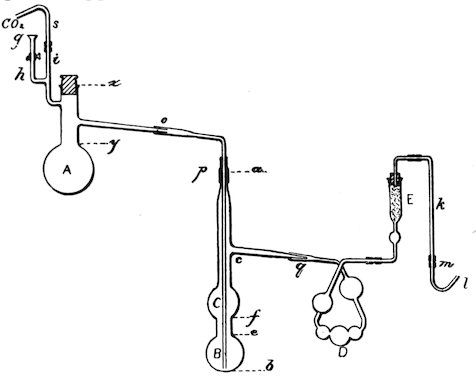
Figure 87. McGowan’s Apparatus for the Iodometric Estimation of Nitric Acid.
The actual operation is performed in the following manner:
537The evolution flask is washed and thoroughly dried, and the nitrate (say, about 0.25 gram of potassium nitrate) is tapped into it from the weighing tube. Two cubic centimeters of water are now added, and the bulb is gently warmed, so as to bring the nitrate into solution, after which the stopper of the flask is firmly inserted. About fifteen cubic centimeters of a solution of potassium iodid (one in four) are run into the first condensing tube, any iodid adhering to the upper portion of the tube being washed down with a little water, and five cubic centimeters of the same solution, mixed with eight to ten cubic centimeters of water, are sucked into the geissler bulbs whilst the glass in the tower E is also thoroughly moistened with the iodid. The geissler bulbs should be so arranged that gas only bubbles through the last of them, the liquid in the others remaining quiescent.
All the joints having been made tight the carbon dioxid is turned on briskly and passed through the apparatus until a small tubeful collected at l, over caustic potash solution, shows that no appreciable amount of air is left in it. The small outlet tube l, is now replaced by a calcium chlorid tube, filled with broken glass which has been moistened with the above-mentioned iodid solution, and closed by a cork through which an outlet tube passes, the object of this trap tube being to prevent any air getting back into the apparatus. The brisk current of carbon dioxid is continued for a minute or two longer, so as to practically expel all the air from this last tube. The stream of gas is now stopped for an instant, and about fifteen cubic centimeters of pure concentrated hydrochloric acid, free from chlorin, run into A through the funnel g (into the tube of which it is well to have run a few drops of water before beginning to expel the air from the apparatus), and A is shaken so as to mix its contents thoroughly. A slow current of carbon dioxid is now again turned on (one to two bubbles through the wash-bottle per second), and A is gently warmed over a burner. It is a distinct advantage that the reaction does not begin until the mixed solutions are warmed, when the liquid becomes orange-colored, the color again disappearing after the nitrosyl chlorid and chlorin have been expelled. The warming should 538be very gentle at first in order to make sure of the conversion of all the nitric acid, and also because the first escaping vapors are relatively very rich in chlorin; afterwards the liquid in A is briskly boiled. A very little practice enables the operator to judge as to the proper rate of warming. When the volume of liquid in A has been reduced to about seven cubic centimeters (by which time it is again colorless) the stream of carbon dioxid is slightly quickened and the apparatus allowed to cool a little. The burner is now set aside for a few minutes, and two cubic centimeters more of hydrochloric acid, previously warmed in a test-tube, run in gently through g; there is no fear either of the iodid solution running back, or of any bubbles of air escaping through y if this is done carefully. This is a precautionary measure, in case a trace of the liberated chlorin might have lodged in the comparatively cool liquid in the tube h. The carbon dioxid is once more turned on slowly and the liquid in A is boiled again until it is reduced to about five cubic centimeters. It is now only necessary to allow the apparatus to cool, passing carbon dioxid all the time, after which the contents of the condensers are transferred to a flask and titrated with thiosulfate. At the end of a properly conducted experiment, the glass in the upper part of tower E should be quite colorless and there should be only a mere trace of iodin showing in the lower part of the tower, while the liquid in the last bulb of the geissler apparatus ought to be pale yellow. During the operation, the stopper of A and the various joints can be tested from time to time by means of a piece of iodid of starch paper, and before disjointing it is well to test the escaping gas (say at m) in the same way, to make sure that all nitric oxid has been thoroughly expelled.
The method is capable of giving accurate results, but it can not be preferred to the reduction or colorimetric processes.
494. Method of Gooch and Gruener.—The principle on which this method rests depends on the decomposition of a nitrate in presence of a hot saturated solution of manganous chlorid and hydrochloric acid in an atmosphere of carbon dioxid.[324] The products of decomposition are passed into a solution of potassium iodid and the liberated iodin is titrated with standard sodium thiosulfate. The products of the reaction 539are chlorin, nitric oxid, and possibly nitrosyl chlorid, and under proper precautions the iodin set free is quantitively proportional to the weight of nitrate decomposed. The manganous mixture is acted on slowly at ordinary temperatures, but on heating, the nitrate is decomposed with the formation of a higher manganese chlorid and nitric oxid. When the heat is continued a sufficient length of time the chlorin from the higher chlorids is evolved and only manganous chlorid remains. During the heating the color of the solution passes from green to black and at the end the green color is restored. The apparatus employed is shown in Fig. 88.
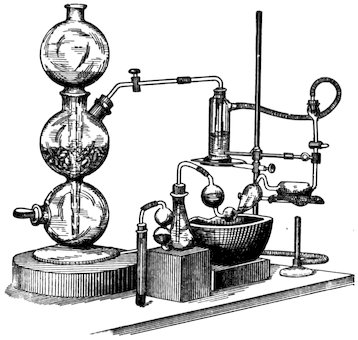
Figure 88. Apparatus of Gooch and Gruener.
A plain pipette bent as is shown in the figure serves as the generating flask and for the attachment on the one hand to the carbon dioxid apparatus and on the other to the system of absorption bulbs for containing the potassium iodid. The latter should be glass, sealed to the evolution bulb of the pipette to prevent the action of the evolved gases on organic materials. The point of the potassium iodid apparatus is drawn out so as to be pushed well into the second receiver, being held in place by a piece of rubber tubing. The third tube acts simply as a trap to exclude the air from the absorption apparatus. The first receiver contains in solution three grams, the second two, and the third one gram of potassium iodid. During the reaction the first receiver is kept cool by immersion in water. Before connecting the apparatus with the carbon dioxid generator the solution of manganous chlorid and afterwards the nitrate solution are drawn into the bulb of the pipette by gentle suction. After connecting the apparatus the current of carbon dioxid is started and kept up until all the air is expelled. Heat is then applied to the bulb of the pipette and the distillation continued until all the 540liquid has passed over. At the end of the reaction the contents of the receivers are united by disconnecting the apparatus from the carbon dioxid generator and passing water through the pipette. The introduction of the manganous chlorid into the mixture does not interfere with the titration of the iodin. This is accomplished in the usual way with sodium thiosulfate using starch as an indicator. The quantity of material used should contain about the amount of nitric acid that is found in two-tenths of a gram of potassium nitrate. This method, so similar to the preceding, is somewhat less complex, and, to that extent, preferable to it.
ESTIMATION OF NITRIC ACID BY COLORIMETRIC COMPARISON.
495. Delicacy of the Method.—The remarkable delicacy of those methods of chemical analysis, which depend on the production of a pronounced color, which can be compared with that produced by a known quantity of a given substance, has been long illustrated by the nesslerizing process for the estimation of ammonia. By such methods minute qualities of substances can be quantitively determined with great accuracy, when they would escape all effort for their estimation by gravimetric methods. Processes based on this principle are, therefore, peculiarly applicable to the detection and estimation of oxidized nitrogen in waters and soil extracts, whether they be present as nitric, nitrous, or ammoniacal compounds.
In the following paragraphs will be given with sufficient detail for the needs of the analyst, the principles and practice of the colorimetric comparison methods which have been approved as best by the experience of analysts. These methods are applicable especially to cases in which only minute quantities of the substances looked for are present, and where celerity of determination is especially desirable. They are, therefore, of especial value in the analysis of rain, drainage, and irrigation waters, and of soil extracts poor in oxidized nitrogen.
496. Hooker’s Method.—The quantitive action depends upon the deep green coloration given by nitric acid, when dissolved in sulfuric acid and carbazol.[325] Other oxidizing bodies, such 541as iron, chlorin, bromin, chromic acid, etc., give the same reaction, but not in such a prominent manner. Such bodies with the exception of chlorin and iron, are not often found in waters. In the application of the process, iron, if present in quantities greater than one-tenth part per one hundred thousand, must be removed. Chlorids also, even when present in very small quantities, interfere with the delicacy of the reaction and must be removed. Easily destructible organic matter tends to lower the result, but not materially, unless present in large excess. Calcium carbonate and sulfate, soda, and other alkalies, in the quantities in which they are usually present in water, do not affect the result. The following reagents are required:
1.
Concentrated sulfuric acid.
2.
An acetic acid solution of carbazol; diphenylimid, (C₆H₄<br>C₆H₄/ NH.)
3.
A sulfuric acid solution of carbazol.
4.
Standard solutions of potassium nitrate.
5.
A solution of aluminum sulfate.
6.
A solution of silver sulfate.
1. The sulfuric acid, used for all purposes in the process, should be entirely free from nitrogen oxids. It may be readily tested by dissolving in it a small quantity of carbazol. If the solution be at first golden-yellow or brown, the acid is sufficiently pure; if it be green or greenish, another and better sample must be taken. It is essential also that the specific gravity of the acid be fully 1.84, and it is well to ascertain that this is really the case.
2. The acetic acid solution of carbazol is prepared by dissolving six-tenths gram in about ninety cubic centimeters of strongest acetic acid, by the aid of gentle heat. It is allowed to cool, and is then made up to 100 cubic centimeters by the further addition of acetic acid. The exact strength of this solution, is of no material importance to the success of the process, and the above proportions have been selected principally because they are convenient. The solution will remain unchanged for several months. The use of this solution merely facilitates the preparation of that next described, which will not keep, and has, consequently, 542to be freshly prepared for each series of determinations.
3. The sulfuric acid solution of carbazol is easily made in a few seconds, but it is advisable to allow it to stand from one and one-half to two hours before using. It is prepared by rapidly adding fifteen cubic centimeters of sulfuric acid, to one cubic centimeter of the above-described acetic acid solution. This quantity usually suffices for from two to three nitrate estimations. When freshly prepared it is golden-yellow or brown; it changes gradually, however, and in the course of one and one-half or two hours it becomes olive-green. This change is probably due to traces of oxidizing agents, which occur in the sulfuric and acetic acids, and which, although not present in sufficient quantity to act immediately, gradually bring about the reaction described. The greenish color does not interfere with the process, as might at first be supposed; on the contrary, the solution is not sensitive to small quantities of nitric acid until it has undergone the change to olive-green, and it is for this reason, that it should be prepared about two hours before required for use. This solution may be thoroughly depended on for six hours after preparation. The intensities of color produced by the more concentrated solutions of nitrates after this time, gradually approach each other and become ultimately the same.