Volume 1 / Part 6 — PART SIXTH.
Reading edition
290. Preliminary Considerations.—The sample of soil intended for chemical analysis should consist of the fine earth which has passed at least a one-millimeter mesh sieve and subsequently been completely air-dried. According to Petermann the air-drying of a soil should continue for about four days for an ordinary arable soil, and about six days for one very rich in organic matter. With peat and muck soils I have found that ten or twelve days with frequent stirring, even when in thin layers, are necessary to attain approximately a constant weight.
The soil is conveniently spread on a zinc or other metal sheet of sufficient area so that the layer will be only one or two centimeters in thickness. The weight before and after desiccation will give the percentage of moisture lost on air-drying, which, of course, will depend chiefly on the degree of saturation of the sample when taken and the atmospheric conditions prevailing during drying.
If samples of soil are taken in very dry times it is often necessary to moisten them with distilled water in order to prepare them properly for air-drying.
The quantity of hygroscopic water which the sample loses at 100°–105° should be determined, and all subsequent calculations of the percentages of the various constituents be based on the water-free material. When a soil which has been dried at 100°–105° to a constant weight is heated to 140°–150° it loses additional weight not due to loss of water of constitution. A part of this loss may be due to hygroscopic moisture which is not given off at 100°–105°, and a part may be hydrocarbons, or other easily 295volatile organic or inorganic bodies. Before estimating the total loss on ignition it is recommended by most chemists to dry at 140°–150°. The samples of soil, however, intended for chemical examination should never be dried beyond the point which is reached by exposure in thin layers at ordinary room temperatures. The state of aggregation, degree of solubility, and general properties of a soil, may be so changed by absolute desiccation as to render the subsequent results of chemical investigation misleading. In the methods which follow the actual processes employed have been given, which in some instances transgress the general principle stated above, but in all cases standard and approved methods are given in detail, even if some of their provisions seem unnecessary or imperfect.
291. Order of Examination.—First of all in a chemical study of the soil should be determined, its reaction (with litmus), its water-holding power in the air-dried state (hygroscopicity), its content of combined water (giving hydrous silicates of alumina), its organic matter (humus and organic nitrogen), its content of carbon dioxid (carbonates of the alkaline earths), and the part of it soluble in acids. A determination of these values gives the analyst a general view of the type of soil with which he is engaged, and leads him to adopt such a method of more extended analysis as the circumstances of the case may demand.
For this reason those operations which relate to the above determinations are placed first in the processes to be performed, while the estimation of the more particular ingredients of the soil is left for subsequent elaboration.
Next follows a description of the standard methods of estimating the more important elements passing into solution on treatment of a soil sample with an acid. The method of treating the insoluble residue, and the detection and estimation of rare or unimportant soil constituents, closes the analytical study of the soils.
With respect to the determination of nitrogen as nitric or nitrous acid in the soil and drainage waters, it has been thought proper to collect all standard methods relating particularly thereto into one group, and they will appear separate from the methods under nitrogen analysis in fertilizers.
296The question of the utility of chemical soil analyses is one which has been the subject of vigorous discussion, a discussion which finds no proper place in a work of this character. Unless, however, intelligent soil analysis be productive of some good it would be a thankless task to collect and arrange the details of the processes employed. An accurate determination of the constituents of a soil may not enable the chemist to recommend a proper course of treatment, but it will help in many ways to develop a rational soil diagnosis which will permit the physician in charge of the case, who last of all is the farmer, to follow a rational treatment which in the end will be productive of good.
The analyst will find in the methods given all that are approved by bodies of official or affiliated chemists, or by individual experience, and among them some method may be found which, it is hoped, will be suited, in the light of our present knowledge, to each case which may arise.
292. Reaction of the Soil.—In soils rich in decaying vegetable matter the excess of acid is often great enough to produce a distinct acid reaction.
On the contrary, in arid regions the accumulation of salts near the surface may produce the opposite effect.
The reaction of the soil may be determined with a large number of indicators among which, for convenience, sensitive litmus paper, both red and blue, stand in the front rank. A sample of the soil, from fifteen to thirty grams, is mixed with water to a paste and allowed to settle. The litmus paper is then dipped into the supernatant liquid.
293. Determination of Water in Soil.—The following problems are presented:
(a) The Determination of Water in Fresh Samples taken in situ.—The content of water in this case varies with the date and amount of rain-fall, the capacity of the soil for holding water, the temperature and degree of saturation of the atmosphere, and many other conditions, all of which should be noted at the time the samples are taken.
(b) The Determination of Water in Air-Dried Samples.—In this case the soil is allowed to remain in thin layers, and exposed to the air until it ceases to lose weight. The quantity of water 297left is dependent on the capacity of the soil to hold hygroscopic water and to the temperature and degree of saturation of the air.
(c) The Determination of the Total Water by Ignition.—This process not only gives the free and hygroscopic moisture, but also combined water present in the hydrous silicates and otherwise. The estimation is complicated by the presence of carbonates and organic matter.
294. Determination of Water in Fresh Samples.—This determination requires that the sample, when taken in the field, should be so secured as to be weighed before any loss of moisture can take place. For this purpose it can be sealed up in tubes or bottles and preserved for examination in the laboratory.
According to Whitney, the relations of soils to moisture and heat are such prominent factors in the distribution and development of agricultural crops, that the determination of the actual moisture content of soils in the fields should be considered a necessary part of the meteorological observations, and of far more importance, indeed, or having far more meaning to the agriculturist than the simple record of the rain-fall.
In order to determine the relation of the soil to moisture, uninfluenced by the varying conditions of cultivation and of the different size of crop, he recommends that a small plot of ground be reserved at each station, adjacent to the soil thermometers, where the samples may be taken for the moisture determinations. No crops should be allowed to grow on this area and the soil is not to be disturbed, except that weeds and grass are carefully removed by hand when necessary. Samples of the soil should be taken every morning at 8 o’clock, by correspondents in the principal soil formations from the different parts of the area under observation, and sent by mail to the laboratory.
The samples should be taken as described in paragraph 65. The locality and date are written on a label attached to the tube. The tube contains about sixty or seventy grams of soil, and the moisture determination is made on this in the laboratory in the usual way.
It would be desirable to have this sample represent a depth of from six to nine inches, thus rejecting the surface three inches which are more liable to sudden and accidental changes. 298These tubes are very inexpensive, and a sufficient number should be purchased to keep each station supplied. The sample represents a definite depth, and it does not have to be subsampled or even transferred in the field. This record of the moisture of the soil will show the amount of moisture which the different soils can maintain at the disposal of the plants, which, together with the temperature of the soil, is believed to be a most important factor in crop distribution and development.
295. Method of Berthelot and André.—The estimation of the water according to Berthelot and André[189] should be made under three forms; viz.,
1. Water eliminated spontaneously at ordinary temperatures.
2. Water eliminated by drying to constant weight at 110°.
3. Water eliminated at a red heat.
The water may be determined directly on a sample weighed at the time of taking and afterwards dried in the open air, and finally, if necessary, in a desiccator. For a general idea the desiccation should be made on a sample of 100 grams, for exact work on ten grams. The dish in which the drying takes place should be shallow, and during the time the sample should be frequently stirred and thoroughly pulverized with a spatula which is weighed with the dish. The drying in the air should continue several days. The data obtained are not fixed since they depend on the temperature and the degree of saturation of the air with aqueous vapor. The variations due to these causes, however, are not very wide. The process may be regarded as practically finished when successive weights sensibly constant are obtained. In this state the soils contain very little water eliminable at 110°.
296. Estimation of Water Remaining after Air-Drying.—The sifted sample is placed in quantities of five or ten grams in a flat-bottomed dish and dried at 110° to constant weight. This treatment not only removes the moisture, but all matters volatile at that temperature.
Petermann,[190] in the Agricultural Station, at Gembloux, practices drying the sample to constant weight at 150°.
It is further recommended by Petermann to determine total 299volatile and combustible matters by igniting to incipient redness, allowing to cool, moistening with distilled water, and drying at 150°.
The German experiment stations[3] estimate hygroscopic moisture for analytical calculations by drying to constant weight at 100°. In determining loss on ignition, however, the preliminary drying is made at 140°, with the exception of peaty samples where so high a temperature is not admissible.
The Official Agricultural Chemists[191] place five grams of air-dried soil in a flat-bottomed and tared platinum dish; heat in an air-bath to 110° for eight hours; cool in a desiccator, and weigh; repeat the heating, cooling, and weighing, at intervals of an hour till constant weight is found, and estimate the hygroscopic moisture by the loss of weight. Weigh rapidly to avoid absorption of moisture from the air.
In the German laboratories, according to König,[192] from ten to twenty grams of the fine earth, properly prepared by air-drying and sifting, for analysis, are heated at 100° to constant weight. For control, five grams are placed in a desiccator over sulfuric acid for two or three days.
Wolff directs that a small portion of the well-mixed earth, for example, twenty grams, be spread out on a flat zinc plate, and its changes in weight observed through several days. These observations are continued until the variations are so slight that the means can be determined with sufficient exactness from the last weighings. The soil is then dried at 125° in a hot air-chamber. The loss in weight will give the mean hygroscopic moisture in the soil under the conditions in which the experiment is made.
297. Drying in a Desiccator.—The sample dried as indicated previously by the method of Berthelot and André is placed in a desiccator over sulfuric acid. It is better to have the sample traversed by a current of perfectly dry air, and in this case it should be placed in a tube, which is closed while weighing, to prevent absorption of moisture. Much time is also required for this operation, and it does not possess the practical value of the method of drying in the free air.
298. Water Set Free at 110°.—This is determined by 300Berthelot and André on a weight of five to ten grams of soil. The sample which has been employed for the preceding determination may be used. While this is going on in an air-bath heated to 110°, about ten times as much soil should be dried for the same time at the same temperature, and this should be preserved in a well-stoppered flask. All subsequent determinations are to be made with the soil dried at 110°.
The loss of weight in a soil increases with the temperature to which it is exposed. The apparent quantity of water, therefore, determined at 140° or 180° is always greater than that obtained at 110°. But when the temperature exceeds 110° there is danger of decomposing organic bodies with the loss of a part of their constituent elements. Carbon dioxid and ammonia may also be lost, as well as acetic acid and other volatile bodies.
299. Loss on Ignition.—The loss on ignition represents any hygroscopic moisture not removed by previous drying, all water in combination with mineral matters as water of constitution, all organic acids and ammoniacal compounds, all organic matter when the ignition is continued until the carbon is burned away, all or nearly all of the carbon dioxid present in carbonates, and, finally, some of the chlorids of the alkalies, if the temperature have been carried too high or been continued too long.
The loss of carbon dioxid in carbonates may be mostly restored by moistening the ignited mass two or three times with ammonium carbonate, followed by gentle ignition for a few minutes to incipient redness, to remove excess of the reagent. The apportionment of the rest of the loss justly among the remaining volatile constituents of the original sample is a matter of some difficulty but may be approximately effected by the methods to be submitted.
300. Determination of Loss on Ignition.—Method of the Official Agricultural Chemists. The platinum crucible and five grams of soil used to determine the hygroscopic moisture may be employed to determine the volatile matter. Heat the crucible and dry soil to low redness. The heating should be prolonged till all organic material is burned away, but below the temperature at which alkaline chlorids volatilize. Moisten the cold mass 301with a few drops of a saturated solution of ammonium carbonate, dry, and heat to 150° to expel excess of ammonia. The loss in weight of the sample represents organic matter, water of combination, salts of ammonia, etc.
According to Knop[193] the total loss on ignition is determined as follows: About two grams of the fine earth are carefully ignited until all organic matter is consumed. The sample is then mixed with an equal volume of finely powdered, pure oxalic acid, and again heated until all the oxalic acid is decomposed. After cooling, the sample is weighed, again mixed with oxalic acid, ignited, cooled, weighed, and the process continued until the weight is constant.
The method recommended by König consists in igniting about ten grams of the fine earth at the lowest possible temperature until all the humus is destroyed. Thereafter the sample is repeatedly moistened with a solution of ammonium carbonate and ignited after drying at 100°, until constant weight is obtained. In soils rich in carbonates some carbon dioxid may be lost by the above process. For this a proper correction can be made by estimating the carbon dioxid in the sample, both before and after the execution of the above described process.
The method described by Frühling as much used in the German laboratories, consists in igniting ten grams of the fine earth, previously dried at 140° in a crucible placed obliquely on its support and with the cover so adjusted over its mouth as to give a draft within the body of the crucible. The ignition, at a gentle heat is continued until on stirring with a platinum wire no evidence of unconsumed carbon is found. The moistening with solution of ammonium carbonate, should not take place until the contents of the crucible are cool. Subsequent ignition, at a low heat for a short time, will remove the excess of ammonium salt.
301. Method of Berthelot and André.[194]—The earth dried at 110° contains still a greater or less quantity of combined water. This is the water united with alumina, silica and certain salts, but not the water of constitution belonging to organic bodies. The exact estimation of this water offers many difficulties. The determination of loss obtained at a red heat embraces:
302(1) The water combined with zeolitic silicates, with alumina and with organic compounds.
(2) The water produced by the combustion of the organic compounds.
(3) The carbon dioxid resulting from the partial decomposition of the calcium and magnesium carbonates.
(4) The carbon burned and the nitrogen lost during ignition. The measure of the loss of weight in an earth heated to redness in contact with the air is not therefore, an exact process of estimating water or even volatile matters.
A better defined result is obtained in carefully burning a known weight of earth either in a current of free oxygen, or with lead chromate. The water produced in such a combustion is secured in a ᥩ tube filled with pumice stone saturated with sulfuric acid, the carbon dioxid being absorbed afterwards in potash bulbs and by solid potash. The weight of earth burned is chosen so as to furnish a convenient weight of both water and carbon dioxid. In general about five grams are sufficient. When the combustion is made with oxygen, the soil is contained in a boat and the products of the combustion are carried over a long column of copper oxid heated to redness. The residue left in the boat is weighed at the end of the operation, and in this residue it is advisable to determine any undecomposed carbonate. Should the sample burn badly and be mixed with carbonaceous matter at the end of the operation, it will be necessary to substitute the lead chromate method. In this case, of course, the residue left after combustion is not weighed. Whichever method is employed gives a quantity of water originally combined with the soil, plus the quantity arising from the combustion of the hydrogen of the organic matter. The details of the processes for organic combustion, will be given in a subsequent part of this manual. It is not possible to divide the water between these two sources directly, but this can be done by calculation, which gives results lying within the limits of probability. The method follows:
The organic nitrogen, determined separately, by soda-lime, the method of Kjeldahl, or volumetrically, is derived from proteid principles resembling albuminoids containing about one-sixteenth 303of their weight of nitrogen. The nitrates contained in the earth are in such feeble proportion, as to be negligible in this calculation. The total weight of these nitrogenous principles in the soil is therefore easily calculated. The carbon contained in the proteids is then calculated on a basis of 53 per cent of their total weight, and the hydrogen on a basis of 7.2 per cent. From the weight of the total organic carbon (determined as described further on) is subtracted the carbon present in the proteids. The remainder corresponds to the organic carbon present as carbohydrates, (ligneous principles) containing 44.4 per cent carbon and 6.2 per cent hydrogen. By adding together the weight of the hydrogen contained in the ligneous principles, and the hydrogen contained in the proteids, and multiplying the sum by 9, the weight of water formed by the combustion of all the organic matter in the sample is obtained. This is subtracted from the weight of the total water obtained by direct determination as described above. The difference represents the weight of water combined with the silicates, etc., as well as with organic matters.
302. Method of Von Bemmelén.[195]—According to the view of Von Bemmelén, the soil contains colloidal humus and colloidal silicate, which complicate the determination of water. The colloids retain water in varying quantities, depending upon the following conditions:
(1) Upon their composition and state of molecular equilibrium.
(2) Upon the pressure of the aqueous vapor of the room.
(3) Upon the temperature.
At each degree of temperature, the quantity of absorbed water which a colloid can retain in a room saturated with aqueous vapor, is different. The quantity of water which air-dried earth gives off at 100°, has therefore, no special significance unless all conditions are known.
In addition to the estimation of the quantity of water which soils, in their natural condition, are capable of taking up and holding, at ordinary temperatures, the estimation of the quantity of water which they can take up in different temperatures in rooms saturated with aqueous vapor should be of interest. It 304follows, therefore, that there is no special value in data obtained by drying earth at 100° or 110°. For the purpose of comparison, he prefers to select that point at which the soil is dried over sulfuric acid, the point at which the tension of the water vapor in the earth, at a temperature of plus or minus 15°, approaches zero. The water which still remains in the earth under these conditions is characterized as firmly combined water.
Von Bemmelén truly observes that only in soils which contain no carbonates and no chlorids and sulfids, can the loss on ignition be regarded as the sum of the humus and water content. By moistening with ammonium carbonate, the correction for lime or carbon dioxid cannot be correctly made as has been the custom up to the present time. In the first place, ignited magnesia, when it has lost its carbon dioxid, does not take this up completely on moistening with ammonium carbonate; in the second place, reactions with the chlorids may take place; and in the third place, the lime which is in the humus will be converted into calcium carbonate. Chlorids on ignition may be volatilized or oxidized. The sulfuric acid formed from the sulfids, on ignition, can expel carbon dioxid; further than this the iron of pyrites takes up oxygen on ignition. All these influences make the numbers obtained from loss on ignition extremely variable.
With sea soils, Von Bemmelén has weighed the soil after the elementary analysis and estimated, in addition to the carbon dioxid, both chlorin and sulfuric acid therein. The comparison of these estimations with those of CO₂, Cl, SO₃ and S, made in the original soil, gave the necessary corrections; viz., for the increase in the weight through oxidation of sulfur and iron, and for the decrease in weight through the volatilization of sodium chlorid, sulfur, and carbon dioxid. A trace of chlorin was evolved as ferric chlorid, nevertheless, the molecular weight of sodium chlorid, 58.5, is scarcely different from the equivalent quantity of ferric chlorid 54.1. For this reason the estimation of loss of water, on ignition, of sea soils is less exact than that of soils which are free from carbonates and sulfids and which, as is usually the case with tillable soils, contain only small quantities of chlorids and sulfates.
The Strongly Combined Water.—Water which, at a temperature 305of plus or minus 15°, in a dry room, still remains in the soil, is chiefly combined according to Von Bemmelén with the colloidal bodies therein. Its estimation, presents, naturally, difficulties and is not capable of any great exactness. The quantity of strongly combined water, on the one hand is determined from the difference between the loss on ignition and the quantity of humus present, calculated from the content of carbon; on the other hand, from the difference between the water obtained by elementary analysis and the water which corresponds to the calculated quantity of humus. If the hydrogen content of humus is correctly taken and no appreciable error is introduced through the factor 1.724, both of these differences must agree. On the other hand the hydrogen content of the humus can be computed from the difference between the water found and the calculated content of the firmly combined water.
The hydrogen content of humus bodies, dried at 100°, varies between four and five per cent. Eggertz has found the content from 4.3 to 6.6 per cent of hydrogen in thirteen soils which he first treated with dilute hydrochloric acid then extracted with ammonia or potash lye and precipitated this alkaline extract with acid. The method of applying these principles to soil analysis is indicated in the following scheme:
A volcanic earth from Deli gave, on elementary analysis:
Per cent.
Carbon 2.94
Water 14.78
Nitrogen 0.28
Loss on ignition 17.54
First Calculation.
Per cent.
Loss on ignition 17.54
Humus = carbon, 2.94 × 1.724 = 5.07
Difference = firmly combined water 12.47
Assuming that a humus dried over sulfuric acid contains five per cent of hydrogen, the second calculation is made as follows.
Second Calculation.
5.00 humus × 5 per cent = 0.25 per cent of hydrogen in humus corresponding to 2.28 per cent of water.
Per cent.
Water found 14.79
Difference = firmly combined water 12.51
306
Third Calculation.
Per cent.
Firmly combined water 12.47
Water from the hydrogen in humus 2.28
Total water 14.75
Found 14.79
In this way, in three other volcanic earths and in an ordinary alluvial clay from Rembang, there were found by analysis and by calculation the following percentages of water:
1. 2. 3. 4. 5.
Percentage of water calculated 14.75 7.74 8.06 4.90 6.01
„ „ „ found 14.97 7.63 8.05 4.70 6.00
On the contrary, when the calculation is made from sea-slime taken from under the water a higher content of hydrogen must be assumed; viz., about six per cent. In two samples of sea-slime calculated in this way the following numbers were obtained:
Percentage of water calculated 8.61 3.71
„ „ „ found 8.53 3.57
It is, therefore, quite evident that the organic compounds of soil taken from under the sea-water are richer in hydrogen than those exposed to the air or in cultivation.
303. General Conclusions.—In the foregoing paragraphs have been collected the most widely practiced methods of determining moisture in soil in both a free and combined state. The following conclusions may serve to guide the analyst who endeavors to determine the water in any or all of its conditions:
(1) In determining water in fresh samples the method of Whitney is satisfactory. Although the samples taken by this method are small they may be easily secured in great numbers over widely scattered areas, and can be easily transported without change. These samples should be dried at 100° to 110° for rapid work, or where time can be spared may be air-dried.
(2) For a simple determination of the water left in the soil after air-drying (hygroscopic water) the method of the Association of Official Agricultural Chemists may be followed. There is much difference of opinion in respect of the proper temperature at which this moisture is to be determined. Much here depends on the nature of the soil. An almost purely mineral soil may safely be dried at 140° or 150°. A peaty soil, on the contrary, should not be exposed to a temperature above 100°. For general 307purposes the temperature chosen by the official chemists is to be recommended.
(3) Water of composition can only be determined by ignition. As has been fully shown, this process not only eliminates the water, but also destroys organic matter, decomposes carbonates and sulfids, and, to some extent, chlorids. Subsequent repeated treatment with ammonium carbonate may restore the loss due to carbon dioxid, but in many cases not entirely. The water which comes from organic matter may be approximately calculated from the humus content of the sample, but as will be seen further on the methods of estimating humus itself are only approximate. Nevertheless, in distributing the losses on ignition properly to the several compounds of the soil there is no better method now known than that of taking into consideration the humus content and carbonates present. The principles of procedure established by Berthelot and André, and Von Bemmelén, are to be applied in all such cases, modified as circumstances may arise according to the judgment of the analyst.
304. Estimation of the Organic Matter of the Soil.—The organic matter in the soil may be divided into two classes. First, the undecayed roots and other remains of plant and animal life, and the living organisms existing in the soil. The study of the organisms which are active in the condition of plant growth will be the subject of a special chapter. Second, the decayed or partially decayed remnants of organic matter in the soil known as humus. Such matter may be present in only minute traces, as in barren sand soils, or it may form the great mass of the soil under examination, as in the case of peat, muck, and vegetable mold. It is with the investigation of the second class of matter that the analyst has chiefly to do at present. The problems which are to be elucidated by the analytical study of such bodies are the following: (1) The total quantity of such matter in the soil. (2) The determination of the organic carbon and hydrogen therein. (3) The determination of total nitrogen. (4) The determination of the availability of the nitrogen for plant growth. (5) The estimation of the humic bodies (humus, humic acid, ulmic acid, etc.).
The importance of humus in the promotion of plant growth is 308sufficient excuse for the somewhat extended study of the principles which underlie the analytical methods, and the methods themselves, which follow.
305. Total Quantity of Organic Matter.—The total approximate quantity of organic matter in the soil can be determined by simple ignition, in the manner noted in paragraphs 294 and 295. The proper correction for free and combined water being applied by the further copper oxid or lead chromate combustion of the sample, and for carbonates and volatile chlorids, the approximate total of the organic matter of all kinds is obtained.
306. Estimation of the Organic Carbon.—To estimate the organic carbon in an earth the sample may be burned in a current of oxygen, or after mixing with lead chromate.
In a Current of Oxygen.—When burned in a current of oxygen the sample is held in a boat and the gases arising from the combustion directed over copper oxid at a red heat. The carbon thus disappears as carbon dioxid and is absorbed and weighed in the usual way.
With Lead Chromate.—The lead chromate employed should be previously tested since it often contains other compounds, especially lead acetate and nitrate, furnishing in the one case both carbon dioxid and water, and in the other hyponitric acid.
From two to ten grams of earth are employed, according to its richness in organic matter. The total carbon dioxid is obtained in this process both from carbonates and organic bodies. The water and carbon dioxid are secured and weighed in the usual manner.
The oxygen method should be used in all cases possible. Although it does not always give the whole of the carbon dioxid present as carbonates, the rest can be easily estimated by treating the residue in the boat with hydrochloric acid, in an apparatus for estimating that gas.
Calculation of Results.—The whole of the carbon dioxid is determined either by direct combustion with lead chromate, or by taking the sum of the amounts by burning in a stream of oxygen and treating the residue in a carbon dioxid apparatus.
The carbon dioxid contained in the original carbonates should 309be determined by direct treatment of the sample in the usual way.
The carbon in organic compounds is determined by subtracting the carbon present as carbonates from the total.
From the organic carbon contained in the soil the humus is calculated by Wolff on the supposition that it contains fifty-eight per cent of carbon. It is, therefore, only necessary to multiply the percentage of carbon found by 1.724, or the carbon dioxid found by 0.471, to determine the quantity of humus in the dried soil.
307. Details of the Direct Estimation of Carbon in Soils by Various Methods.—(1) Oxidation by Chromic Acid.—The method of Wolff by oxidation with chromic acid has been worked out in detail by Warington and Peake.[196] It consists in treating the soil with sulfuric acid and potassium bichromate, or by preference with a mixture of sulfuric and chromic acids, the carbon dioxid evolved being estimated in the usual way. This method is recommended by Fresenius as an alternative to a combustion of the soil with copper oxid or lead chromate. It is apparently the method which has been most generally employed in agricultural investigations.
Ten grams of the finely powdered soil are placed in a flask of about 250 cubic centimeters capacity, provided with a caoutchouc stopper, through which pass two tubes, one for the supply of liquids, the other for the delivery of gas. The soil is treated with twenty cubic centimeters of water and thirty cubic centimeters of oil of vitriol; and the whole, after being thoroughly mixed, is heated for a short time in a water-bath, the object in view being the decomposition of any carbonates existing in the soil. Air is next drawn through the flask to remove any carbon dioxid which has been evolved. The stopper is next removed, and coarsely powdered potassium bichromate introduced. In the case of a soil containing three per cent of carbon, six grams of bichromate will be found sufficient, a portion remaining undissolved at the end of the experiment. The stopper is then replaced, its supply-tube closed by a clamp, and the delivery-tube connected with a series of absorbents contained in ᥩ tubes. The first of these tubes contains solid calcium chlorid; the second, 310fragments of glass moistened with oil of vitriol; the third and fourth are nearly filled with soda-lime, a little calcium chlorid being placed on the top of the soda-lime at each extremity. The last named tubes are for the absorption of carbon dioxid, and have been previously weighed. The series is closed by a guard-tube containing soda-lime, with calcium chlorid at the two ends.
The flask containing the soil and bichromate is now gradually heated in a water-bath, the contents of the flask being from time to time mixed by agitation. A brisk reaction occurs, carbon dioxid being evolved in proportion as the soil is rich in organic matter. The temperature of the water-bath is slowly raised to boiling as the action becomes weaker, and is maintained at that point till all action ceases. As bubbles of gas are slowly evolved for some time, it has been usual in these experiments to prolong the digestion for four or five hours. When the operation is concluded the source of heat is removed, an aspirator is attached to the guard-tube at the end of the absorbent vessels, and air freed from carbon dioxid is drawn through the flask and through the whole series of ᥩ tubes. The ᥩ tubes filled with soda-lime are finally weighed, the increase in weight showing the amount of carbon dioxid produced. The object of the calcium chlorid placed on the surface of the soda-lime is to retain the water which is freely given up when the soda-lime absorbs carbon dioxid. The second ᥩ tube filled with soda-lime does not gain in weight till the first is nearly saturated; it thus serves to indicate when the first tube requires refilling. The same tubes may be used several times in succession.
No increase in the carbon dioxid evolved is obtained by substituting chromic acid for potassium bichromate.
The organic matter of the soil appears to the eye to be completely destroyed by the digestion with sulfuric acid and potassium bichromate; the residue of soil remaining in the flask when washed with water is perfectly white, or the dark particles, if any, are found to be unaltered by ignition, and therefore to be inorganic in their nature. Under these circumstances considerable confidence has naturally been felt in this method. The complete destruction of the humic matter of the soil does not, 311however, necessarily imply that the carbon has been entirely converted into carbon dioxid as has been pointed out by Wanklyn. According to his demonstration of the action of chromic acid on organic matter the oxidation frequently stops short of the production of carbon dioxid. While oxidation with chromic acid apparently leads to a complete reaction when the carbon is in the form of graphite, it would probably yield other products than carbon dioxid when the carbon exists as a carbohydrate. The doubt thus raised as to the correctness of the results yielded by the chromate method makes it desirable to check the work by the use of other methods for the determination of carbon. For this purpose Warington and Peake recommend:
(2) Oxidation with Potassium Permanganate.—In the trials with this method ten grams of soil are digested in a closed flask with a measured quantity of solution of caustic potash containing five grams of potash for each twenty cubic centimeters, and crystals of potassium permanganate. Seven grams of the permanganate are found to be sufficient for a soil containing 3.3 per cent of carbon. The flask is heated for half an hour in boiling water, and then for one hour in a salt-bath. The flask during this digestion is connected with a small receiver containing a little potash solution, to preserve an atmosphere free from carbon dioxid; distillation to a limited extent is allowed during the digestion in the salt-bath.
The first part of the operation being completed a rubber stopper, carrying a delivery and supply-tube, is fitted to the flask, which is then connected with the system of ᥩ tubes already described. Dilute sulfuric acid is then poured down the supply-tube, a water-bath surrounding the flask is brought to boiling, and maintained thus for one hour, after which air, free from carbon dioxid, is drawn through the apparatus, the ᥩ tubes containing soda-lime being finally disconnected and weighed.
In the first stage of this method the carbon of the organic matter is converted into carbonate, and probably also into potassium oxalate.[197] In the second stage the oxalate is decomposed by the sulfuric acid and permanganate, and the carbon existing, both as oxalate and carbonate, is evolved as carbon dioxid, and absorbed by the weighed soda-lime tubes. Both F. Schulze and 312Wanklyn have employed potassium permanganate for the determination of organic carbon, but they have preferred to calculate the amount of carbon from the quantity of permanganate consumed, as, however, by so doing everything oxidizable by permanganate is reckoned as carbon, it seems better to make a direct determination of the carbon dioxid formed.
From the amount of carbon dioxid found, is to be subtracted that existing as carbonates in the soil, and in the solution of potash used. For this purpose an experiment is made with the same quantities of soil and potash previously employed, but without permanganate, and the carbon dioxid obtained is deducted from that yielded in the experiment with permanganate. If the potash used contains organic matter two blank experiments will be necessary, one with potash and permanganate, and one with soil alone.
A further difficulty arises from the presence of chlorids in the materials, which occasions an evolution of free chlorin when the permanganate solution is heated with sulfuric acid. This error occurs also with the chromic acid method, but in that case the quantity of chlorid is merely that contained in the soil, which is usually very small; in the permanganate method we have also the chlorid present in the caustic potash, and this is often considerable. Corrections for chlorin by blank experiments are unsatisfactory, the amount of chlorin which reaches the soda-lime tubes depending in part on the degree to which the calcium chlorid tube has become saturated with chlorin. It is better therefore to remove the chlorin in every experiment by the plan which Perkin has suggested, by inserting a tube containing silver foil, maintained at a low red heat, between the flask and the absorbent ᥩ tubes.
The amount of carbon dioxid yielded by oxidation with potassium permanganate is found to be considerably in excess of that obtained by oxidation with chromic acid; to ascertain whether these higher results really represented the whole of the carbon present in the soil, trials were next made by actual combustion of the soil in oxygen.
(3) Combustion in Oxygen.—The most convenient mode of carrying out the combustion of soil is to place the soil in a platinum 313boat, and ignite it in a current of oxygen in a combustion tube partly filled with cupric oxid. A wide combustion tube is employed, about twenty inches long, and drawn out at one end; the front of the tube is filled for eight inches with coarse cupric oxid, the hind part is left empty to receive the platinum boat. The drawn out end of the combustion tube is connected with a series of absorbent ᥩ tubes, quite similar to those employed for the estimation of carbon dioxid in the chromic acid method. Between these absorbent vessels and the combustion tube is placed a three-bulbed Geissler tube filled with oil of vitriol. The oil of vitriol is quite effective in retaining nitrous fumes. The wide end of the combustion tube is connected with a gas-holder of oxygen; the oxygen gas is made to pass through a ᥩ tube of soda-lime before entering the combustion tube, to remove any possible contamination of carbon dioxid.
In starting a combustion the part of the combustion tube containing the cupric oxid is brought to a red heat, and oxygen is passed for some time through the apparatus. Ten grams of soil, previously dried, are placed in a large platinum boat, which is next introduced at the wide end of the combustion tube. The combustion is conducted in the usual manner, a current of oxygen being maintained throughout the whole operation. It is very useful to terminate the whole series of absorbent vessels with a glass tube dipping into water; the rate at which the gas is seen to bubble, serves as a guide to the supply of oxygen from the gas-holder, the consumption of oxygen varying, of course, with different soils, and at different stages of the combustion. At the close of the combustion, oxygen, or air freed from carbon dioxid, is passed for some time through the apparatus to drive all carbon dioxid into the absorbent vessels. One experiment can be followed by another as soon as the hind part of the combustion tube has cooled sufficiently to admit a second platinum boat. The same combustion tube can be employed for several days, if packed in the usual manner in asbestos.
The presence of carbonates in the soil occasions some difficulty in working the combustion method, as a part of this carbon dioxid will, of course, be given up on ignition, and be reckoned as carbon. The simplest mode of meeting this difficulty is to 314expel the carbon dioxid belonging to the carbonates before the combustion commences. The method of Manning; namely, treatment with a strong solution of sulfurous acid, may be employed for this purpose. The ten grams of soil taken for combustion are placed in a flat-bottomed basin, covered with a thin layer of sulfurous acid, and frequently stirred. After a time the action is assisted by a gentle heat. When the carbonates have been completely decomposed the contents of the basin are evaporated to dryness on a water-bath; the dry mass is then pulverized, and removed to the platinum boat for combustion in oxygen. For the action of the sulfurous acid to be complete it is essential that the carbonates should be in very fine powder, since even chalk is but imperfectly attacked when present in coarse particles.
308. Comparison of Methods.—A considerable number of soils analyzed by the chromic acid method and by the combustion, method, by Warington and Peake, with the assistance of Cathcart, shows the following comparisons:
Percentage of Carbon Found by Two Methods in Soils Dried at 100°.
Chromic acid method. Combustion method.
No. Kind of soil. Exp. 1. Exp. 2. Mean. Exp. 1. Exp. 2. Mean. Per cent. yielded by chromic acid.
1. Old pasture 2.85 2.79 2.82 3.58 3.55 3.57 79.0
2. „ „ 2.83 2.79 2.81 3.57 3.53 3.55 79.1
3. „ „ 2.76 2.76 2.76 3.46 3.46 3.46 79.7
4. „ „ 2.74 2.76 2.75 3.37 3.38 3.38 81.4
5. „ „ 2.64 2.54 2.59 3.31 3.36 3.34 77.5
6. „ „ 2.51 2.43 2.47 3.15 3.15 3.15 78.4
7. „ „ 2.40 2.44 2.42 3.09 3.13 3.11 77.8
8. New pasture 1.92 1.93 1.93 2.41 2.40 2.41 80.1
9. „ „ 1.66 1.81 1.74 2.39 2.43 2.41 72.2
10. Arable soil 1.78 1.78 1.78 2.14 2.13 2.14 83.2
11. „ „ 1.21 1.14 1.18 1.40 1.43 1.42 83.1
12. Subsoil 0.28 0.27 0.28 0.37 0.38 0.38 73.7
Of the above soils the arable soils, Nos. 10 and 11, were the only ones containing carbonates in any quantity exceeding a minute trace. The two soils in question were treated with sulfurous acid before combustion, the others not.
All the determinations by the chromic acid method were made by Mr. P. H. Cathcart, with the exception of Nos. 9 and 12, which were executed by another experimenter, and are seen to 315give distinctly lower results. Excluding these two analyses the relation of the carbon found by the two methods is tolerably constant, the average being 79.9 of carbon found by oxidation with chromic acid for 100 yielded by combustion in oxygen. The results obtained by the chromic acid method thus appear to be very considerably below the truth.
Four typical soils were analyzed by the permanganate, as well as by the chromic acid and combustion methods. The results obtained were as follows:
Percentage of Carbon Found by Three Methods in Soils Dried at 100°.
Permanganate method.
Kind of soil. Combustion method. Mean. Per cent. Chromic acid method. Mean. Per cent. Exp. 1. Per cent. Exp. 2. Per cent. Mean. Per cent. Yielded by permanganate if carbon by combustion = 100. Per cent.
Old pasture 3.55 2.81 3.26 3.30 3.28 92.4
New pasture 2.41 1.93 2.29 2.30 2.30 95.4
Arable soil 1.42 1.18 1.28 1.33 1.31 92.3
Subsoil 0.38 0.28 0.34 0.34 0.34 89.5
Oxidation by permanganate thus gives a much higher result than oxidation with chromic acid; but even the permanganate fails to convert the whole of the carbon into carbon dioxid, the product with permanganate being on an average of the four soils 92.4 per cent of that yielded by combustion in oxygen.
Wanklyn states that a temperature of 160°–180° is necessary in some cases to effect complete oxidation with permanganate and caustic potash. Such a temperature is found impracticable when dealing with soil, from the action of the potash on the silicates present; hence possibly the low results obtained.
Combustion in oxygen appears from these experiments to be the most satisfactory method for determining carbon in soil, nor is this method, on the whole, longer or more troublesome than the other methods investigated.
Warington and Peake have further determined the loss on ignition of the four soils mentioned above, with the view of comparing this loss with the amount of organic matter calculated from the carbon actually present. In making this calculation they have taken as the amount of carbon in the soil, that found by combustion in oxygen, and have assumed with Schulze, Wolff, 316and Fresenius, that fifty-eight per cent of carbon will be present in the organic matter of soils. The four soils were heated successively at 100°, 120°, and 150°, till they ceased to lose weight; the loss on ignition in each of these stages of dryness is shown in the following table:
Percentage Loss on Ignition Compared with Organic Matter Calculated from Carbon.
Between 100° and ignition. Between 120° and ignition. Between 150° and ignition. Organic matter at fifty-eight per cent carbon.
Kind of soil. Per cent. Per cent. Per cent. Per cent.
Old pasture 9.27 9.06 8.50 6.12
New pasture 7.07 6.88 6.55 4.16
Arable soil 5.95 5.70 5.61 2.44
Clay subsoil 5.82 5.39 4.76 0.65
The loss on ignition is seen to be in all cases very considerably in excess of the organic matter calculated from the carbon, even when the soil has been dried at as high a temperature as 150°. The error of the ignition method is least in soils rich in organic matter, as, for instance, the old pasture soil in the above table. The error reaches its maximum in the case of the clay subsoil, which contains very little carbonaceous matter, but is naturally rich in hydrated silicates, which part with their water only at a very high temperature.
The above methods of Warington and Peake have been given in detail, and in almost the verbiage of the authors for the reason that the working directions are clearly set forth, and may serve, therefore, as guides to the previous methods where only general indications of manipulation have been given.
309. Estimation of Organic Hydrogen.—The estimation of the total hydrogen is made without difficulty either by burning the sample in a current of oxygen or with lead chromate, and weighing the water produced. This water comes from two sources, the pre-existing water and organic hydrogen. There is no direct method of distinguishing one from the other. They may, however, be estimated indirectly. The method of calculating the organic hydrogen has already been given (paragraph 299). Experience shows that the hydrogen thus calculated is a little greater than is necessary to form water with the whole of the oxygen found in the organic matters.
317310. Estimation of Organic Oxygen.—The determination of this oxygen cannot be made directly. It is obtained by calculation, according to Berthelot and André,[198] from the oxygen in the proteid and ligneous matters.
Let p represent the weight of the proteid bodies in a sample of soil.
Then O = p × 33.5 100
Let p′ = weight of ligneous bodies.
Then O′ = p′ × 49.4 100
The total oxygen = O + O′.
An approximate result is thus obtained, very useful to have when account is taken of the oxidizing processes which go on in the soil during agricultural operations.
311. Estimation of Humus (Matière Noire).—The original method of determining this substance is due to Grandeau.[199] It is carried on as follows: Ten grams of the fine earth are mixed with coarse sand previously washed with acids and ignited. The mixture is placed in a small funnel, the bottom of which is filled with fragments of glass or porcelain. The mass is moistened with ammonia diluted with an equal volume of distilled water, and allowed to digest for three or four hours. The ammonia dissolves the dark matter without attacking the silica. The ammoniacal solution is displaced by treating the mass with pure water, or water to which some ammonia has been added, and the whole of the dark matter is thus obtained in a volume of twenty to fifty cubic centimeters of filtrate. The filtrate is evaporated to dryness in a weighed platinum dish, and the weight of residue is determined and the percentage of matière noire calculated therefrom. The residue is incinerated, and when in sufficient quantity the phosphoric acid is determined in the ash. In soils poor in humus a larger quantity than ten grams may be taken. If the soil be previously treated with hydrochloric acid, Grandeau recommends that the phosphoric acid be determined always in the ash of the dark matter.
The method has undergone various modifications and, as given by Hilgard, is now practiced as follows:
318About ten grams of soil are weighed into a prepared filter. The soil should be covered with a piece of paper (a filter) so as to prevent it from packing when solvents are poured on it. It is now treated with hydrochloric acid from five-tenths per cent to one per cent strong (twenty-five and one-third cubic centimeters of strong acid and 808 cubic centimeters of water) to dissolve the lime and magnesia which prevent the humus from dissolving in the ammonia. Treat with the acid until there is no reaction for lime; then wash out the acid with water to neutral reaction. Dissolve the humus with weak ammonia water, prepared by diluting common saturated ammonia water (178 cubic centimeters of ammonia to 422 cubic centimeters of water). Evaporate the humus solution to dryness in a weighed platinum dish at 100°; weigh, then ignite; the loss of weight gives the weight of humus.
The residue from ignition is carbonated with carbon dioxid, heated and weighed, thus giving the ash. It is then moistened with nitric acid and evaporated to dryness. The residue is treated with nitric acid and water, allowed to stand a few hours, and the solution filtered from the insoluble residue, which is ignited and weighed, giving the silica.
The soluble phosphoric acid is determined in the solution by the usual method, as magnesium pyrophosphate. It usually amounts to a fraction, varying from one-half to as little as one-tenth of the total in the soil. While the phosphoric acid so determined is manifestly more soluble and more available to vegetation than the rest of that found by extraction with stronger acid, it is clearly not as available as that which, when introduced in the form of superphosphates, exerts such striking effects even though forming a much smaller percentage of the whole soil. Nevertheless, very striking agreement with actual practice is often found in making this determination.
The estimation of humus by combustion, in any form, of the total organic matter in the soil, gives results varying according to the season, and having no direct relation to the active humus of the soil. The same objection lies against extraction with strong caustic lye.
319312. Modification of Grandeau’s Method for Determining Humus in Soils.—According to Huston and McBride[200] the function of the vegetable matter in the soil has long been a matter of contention among those interested in the science of agriculture. Two factors have contributed to the uncertainty existing in this matter: First, the very complex and varying nature of the compounds resulting from the decomposition of vegetable matter in the soils; and second, the lack of uniformity in the methods of determining either the total amount of organic matter present in a soil, or the amount that has been so far decomposed as to be of any immediate agricultural value. Prominent among these methods are the methods in which a combustion is resorted to, the substance being either burned in air or in a combustion tube with some agent supplying oxygen. The loss on ignition is no measure of the amount of organic matter present since it is practically impossible to remove all the water from the soil previous to ignition, and neither of the methods gives information regarding the extent of the decomposition of the organic matter. Pure cellulose and the black matter of a fertile soil are of very different agricultural value.
Determinations of carbon in soils by oxidation with chromic and sulfuric acid, and with alkaline permanganate have been used. The method with alkaline permanganate agrees fairly well with combustion with copper oxid or lead chromate, but the chromic sulfuric acid method gives only about eighty per cent of the carbon found by combustion processes. However valuable these processes may be for determining the total carbon in the soil, they furnish no information regarding the condition of the carbonaceous soil constituents, and as the determination is really one of carbon, the organic matter must be calculated by using an arbitrary factor. Generally the organic matter of the soil is considered to have fifty-eight per cent carbon; yet different values are given from forty to seventy-two per cent.
There is a general opinion that the black or dark brown material of the soil, resulting from the decay of vegetable matter, has a much higher agricultural value than the undecomposed vegetable matter. No very sharp dividing line can be drawn, for changes in the soil are continually going on, and material may 320be found in almost every stage between pure cellulose and carbon dioxid. The character of the intermediate products will vary according to the conditions of tillage and the supply of air and water.
For agricultural purposes some means of determining the amount of decomposed matter is very desirable. Several solvents have been tried for this purpose. The earlier attempts were made by treating the soil with successive quantities of boiling half-saturated solution of sodium carbonate until the soil appeared to yield no more coloring matter to the solvent. The solutions were then united, rendered acid with HCl, which precipitated the humic acid, which was then washed, dried, and weighed. This was considered the more soluble portion of the humic acid. The soil was afterward treated with caustic potash solution in the same manner, and the humus thus extracted was called insoluble humus. This last process was really more in the nature of manufacturing humus, for sawdust treated with caustic potash yields humic acid, and the inert organic matter in the soil was decomposed to some extent by the caustic alkali. Neither of the processes provided for the separation of the humic acid from the lime, magnesia, alumina, and iron with which it is usually combined in the soil.
In case results of different workers are to be compared, it is of the greatest importance that methods should be used that are of such a nature that errors resulting from difference of manipulation, and from difficulty of reproducing duplicate work can be reduced to a minimum.
Hence, a simple modification of the Grandeau method has been tried which has the advantage of keeping a definite amount of the soil in contact with a definite volume of ammonia for a fixed time, the strength of the ammonia remaining constant.
The process is as follows: The soil is washed with acid and water as usual. It is then washed into a 500 cubic centimeter cylinder with ammonia, the cylinder closed and well shaken and allowed to remain for a definite time, usually thirty-six hours. The material is shaken at regular intervals. The cylinder is left inclined as much as possible without having the fluid touch the glass stopper, thus allowing the soil to settle on the side of 321the cylinder and exposing a very large surface to the action of the ammonia. During the last twelve hours the cylinder is placed in a vertical position to allow the soil to settle well before taking out the aliquot part of the solution.
The process of washing the soil with hydrochloric acid, water and ammonia, is very tedious when performed in the usual way with the wash-bottle. A simple automatic washing apparatus was devised by which a fixed volume of the washing fluid can be delivered at regular intervals, giving ample time for the thorough draining between each addition of the fluid, and requiring no attention. By this apparatus work can be continued day and night. Instead of washing on the usual form of filter paper in funnels, it is preferable with this apparatus to hold the soils on a disk of filter paper resting on a perforated porcelain disk in the bottom of the funnel. This removes the necessity of washing out the filter papers, does not permit of the accumulation of humus on the edge of the filter paper when the Grandeau process is used, and insures that all the washing fluids pass through the soil and not around it. This form of apparatus reduces the labor to a minimum and permits many determinations to be carried on at once.
This form of apparatus was only lately devised and has only been used long enough to test it and to show its advantages. The reported results were obtained by the ordinary methods of washing.
In all the work reported, five grams were used, as the soils contained so much humus that this amount gave enough humus for good work in the final weighings. The results obtained so far appear in the following tables:
Table I.
Comparison of Method of Grandeau with Huston’s Modification and of Influence of Strength of Ammonia Solution. Time of Digestion in Modified Method Thirty-Six Hours.
Two per cent NH₃. Four per cent NH₃. Seven per cent NH₃. Eight per cent NH₃.
Grandeau. Huston. Grandeau. Huston. Grandeau. Huston. Grandeau. Huston.
1. Peat soil, 16.40 20.06
Bogus „ 13.98 20.80
„ „ 17.43
Mean 15.94 20.43
322
2. Peat subsoil, 13.98 19.38
Bogus „ 13.85 20.30
Mean 13.92 19.84
3. Peat soil, 9.05 15.60 14.71 21.24 19.77 21.70 16.05 21.42
Good „ 10.27 15.88 15.34 20.20 19.85 21.90 15.40 21.80
Mean 9.61 15.74 15.03 20.72 19.81 21.80 15.73 21.61
4. Peat subsoil, 16.75 24.34
Good „ 18.60 23.52
Mean 17.68 23.93
5. Black soil, A 3.90 6.90 (1.86) 7.42
„ „ „ (1.67) 6.98
„ „ B 3.88 7.00 4.42
„ „ „ 4.20
Mean 3.99 6.95 (3.05) 7.20
„ 4.31
6. Clay loam, 1.86 4.20 2.40 4.26 2.14 4.02 1.85 4.12
West side, A 4.28
„ „ B 1.76 4.36 2.48 (3.40) 2.13 4.48 1.90 4.40
„ „ „ (3.10)
Mean 1.81 4.28 2.44 (3.76) 2.14 4.25 1.88 4.26
„ 4.27
7. Clay loam, A 1.90 4.12 (1.60) (4.59)
Lysimeter soil, B 1.61 4.22 (1.41) (4.58)
„ „ C 1.80 4.12
„ „ D 1.95 4.04
„ „ E 1.92 3.85
„ „ F 1.95 4.08
„ „ G 1.90 3.93
„ „ H 1.90 3.80
Mean 1.76 4.17 (1.80) (4.12)
„ 1.90 3.97
Note.—Numbers in parentheses indicate results, generally the earliest ones, which the authors do not consider strictly comparable with the rest of the work. They are given solely for the purpose of exhibiting all the work that has been done to date. When a mean is included in parentheses it indicates that it is calculated from all the results obtained, including those not considered strictly comparable. Bogus is a name given to a peaty soil which is very sterile.
323
Table II.
Influence of Time of Digestion. Four Per Cent of Ammonia Used Throughout. Huston’s Method.
Thirty-six hours. Forty-eight hours. Sixty-eight hours. Ninety-eight hours.
Peat Soil, 21.24 22.28 24.04
Good „ 20.20 21.70 23.94
Mean 20.72 21.99 23.99
Clay loam, 4.28 4.00 4.40
„ 4.26 4.01 4.85
West side (3.40)
„ „ (3.05)
Mean 4.27 4.01 4.63
Table III.
Influence of Time of Extraction. Time, Ten Days. Grandeau’s Method, Four Per Cent Ammonia. Peat Soil.
A. Per cent. B. Per cent. Mean. Per cent. Remarks.
1st extraction, 750 cc 16.90 18.96 17.93
2nd „ 250 „ 2.80 2.38 2.59
3rd „ 250 „ 1.77 1.10 1.44
4th „ 250 „ 1.34 1.30 1.32 Stood over night.
5th „ 250 „ 0.89 0.85 0.87
6th „ 250 „ 1.41 1.65 1.53 Stood overnight.
7th „ 250 „ 2.10 1.80 1.95 Washed again with HCl for Ca. Trace found. HCl washed out, but trace of chlorids found in ash. Probably HCl absorbed from air as humus showed small quantity of a white volatile solid on evaporation.
8th „ 250 „ 0.67 0.65 0.66
9th „ 250 „ 0.57 0.50 0.53
Total 2750 „ 28.45 29.19 28.82
313. Summary of Results.—1. The modified method gives much higher results than the original method of Grandeau.
2. In the Grandeau method marked irregularities follow a change in the strength of the ammonia solution. These differences in results bear no relation to the strength of the solution used. They seem to be errors due to the difficulty of securing uniform and complete washing of the soil by the ammonia solution.
In the modified method the change in the strength of the ammonia solution makes practically no difference in the amount 324of humus extracted, except in the case of the peat soil where two per cent ammonia failed to extract all the humus. But the results show no considerable increase when the strength is increased to over four per cent.
3. The factor of time has not been fully investigated, but the results so far obtained indicate that the time exerts less influence in the modified than in the Grandeau method.
4. Table III shows that considerable quantities of the peat soil are still passing into solution in the Grandeau method at the end of ten days. With ordinary soils this is not true; but in the case of soil No. 5, a black soil, the solutions were colored at the end of a week. On the peat soil the modified method extracted from ten to fifty per cent more than the Grandeau, and on the ordinary soil from two to three times as much humus.
5. In comparing duplicate results by both methods it is found that with soil No. 3, peat soil, the following differences appear calculated to percentage of the total amount involved in the determination:
Per cent. Per cent. Per cent. Per cent.
Strength of ammonia 2. 4. 7. 8.
Modified 1.7 5. 1.0 1.8
Grandeau 13.0 4.3 0.5 3.4
Special attention was paid to this point in case of soil No. 7, an ordinary soil; taking all results into consideration the greatest difference in percentage of total amount involved was, by the modified method, nineteen per cent, and by the Grandeau, thirty per cent. In the set of six special determinations made by both methods to test this point and which are strictly comparable with each other, the maximum range was by the modified method 7.8 per cent and by the Grandeau 8.3 per cent of the total amount involved in the determination. From which it appears that the modified method is on the whole capable of yielding rather more concordant results than the Grandeau.
314. Estimation of Free Humic Acids.—This process, due to Müntz[201] is essentially that of Huston and McBride. Twenty grams of the soil are reduced to a fine powder and saturated with fifty cubic centimeters of concentrated ammonia and allowed to digest two or three days in a warm place. The volume is then made up to one liter with water, well shaken, and set aside for 325one day in order to permit the subsidence of the solid matter. At the end of this time 500 cubic centimeters of the supernatant liquor are taken and acidified with hydrochloric acid in order to precipitate the humic bodies. The humus is collected on a filter, dried and weighed. It is then ignited and the weight of ash deducted from the first weight thus giving the actual weight of the humus obtained, free from mineral matter. This process gives the free humic acids. By previous treatment of the sample with hydrochloric acid as in the process of Huston and McBride, the total humus is obtained. The estimation of the free humic acids is of importance in determining the quantity of lime or marl which should be added to acid lands.
315. Humus Method of Von Bemmelén.[202]—Von Bemmelén obtains the content of humus by the multiplication of the content of carbon in the soil by the factor of Wolff; viz., 1.724. The estimation of carbon, water, and of the loss on ignition is conducted in combustion tubes in a current of oxygen. The nitrogen estimation is carried on according to the method of Dumas.
In soils containing calcium carbonate the carbon content is derived from the carbon dioxid taken up by the potash bulbs during combustion (a); from other carbonates not decomposed on ignition and which are subsequently determined in the residue by treatment with hydrochloric acid in a carbon dioxid apparatus, (b) and the total carbon dioxid derived from the carbonates in the soil (c).
For each estimation from three to five grams of the soil are taken, because with smaller quantities the errors of analysis too strongly influence the results. The carbon is then calculated according to the formula:
Carbon = ³⁄₁₁ (a + b − c).
The Carbon Dioxid of Carbonates.—It is necessary to expel the carbon dioxid at ordinary temperatures, because on heating to boiling, carbon dioxid would be formed from the humus. In a flask, as small as possible, the soil is treated at ordinary temperature, with dilute sulfuric or citric acid, the escaping gas dried over sulfuric acid and taken up with soda-lime. Behind the soda-lime is a small tube filled with pieces of glass and moistened 326with sulfuric acid, which retains any moisture taken out of the soda-lime. A stream of about one liter of air, free from carbon dioxid, is sufficient to drive out all of the carbon dioxid when the estimation is made at ordinary temperatures.
A volcanic earth from Deli, which contained five per cent of humus, gave, at a temperature plus or minus 15°, 0.01 per cent CO₂. At boiling temperature two analyses gave 0.54 and 0.56 CO₂. This soil contained no carbonate, and the carbon dioxid found at the boiling temperature, must have come from the humus substances under the influence of the dilute acids.
A heavy clay containing 6.9 per cent of humus gave, at plus or minus 15°, 3.60 per cent CO₂; at 100° without boiling, it gave an additional 0.53 per cent, and with boiling an additional 0.11 per cent, or a total of 4.24 per cent CO₂. A light clay containing 3.2 per cent of humus, gave, at 15°, 5.09 per cent CO₂; at a boiling temperature an additional 0.43 per cent, and by continued boiling an additional 0.27 per cent.
316. Estimation of Humus by the German Method.—The German experiment stations follow the method of Loges,[203] depending on the oxidation of the humic bodies with copper oxid after evaporation of the sample with phosphoric acid. The object of the preliminary evaporation is to set the humic acids free in order that they may be better and more easily oxidized than when burned in the combined state.
The sample of soil is placed in a Hoffmeister dish (Schälchen), moistened with dilute phosphoric acid and evaporated to complete dryness. The dish and its contents are rubbed up with pulverized copper oxid and placed in a combustion tube of sixty centimeters in length, open at both ends. There is then placed in the tube, and held in place by asbestos plugs, granular copper oxid to a length of twenty centimeters.
The combustion tube is placed in a proper furnace and one end connected with two washing-flasks, the first containing potash lye, and the other a solution of barium hydroxid. These flasks are to free the aspirated air from carbon dioxid. The other end of the combustion tube is connected with an appropriate apparatus for absorbing the carbon dioxid. Loges recommends the Pettenkofer absorption tube and a Fresenius drying cylinder.
327Between the absorption apparatus and the aspirator, is also placed a washing-flask containing barium hydroxid solution, serving to detect any unabsorbed carbon dioxid. The layer of granular copper oxid is first heated, the air being slowly aspirated through the apparatus meanwhile, but not through the absorption bulbs. All the carbon dioxid is thus removed from the apparatus.
The absorption system being connected, the tube is heated slowly from the front, backwards, and after the tube is well heated a slow current of air is drawn through and continued until the combustion is complete, which is usually in about three-quarters of an hour.
After the tube is cool the powdered copper oxid and residue of combustion are removed, and for this reason the tube is stopped with a cork at both ends instead of being drawn out and sealed at one end. The tube can thus be refilled without disturbing the granular layer of copper oxid.
The drying cylinder used between the combustion tube and the absorption system has its upper part filled with cotton to avoid the deleterious effects of the nitric oxid produced in the combustion. With this arrangement the use of metallic copper in the combustion tube to reduce the nitric oxid can be dispensed with, the moist cotton holding back the acid fumes. The per cent of humus is obtained by multiplying the per cent of carbon found by 1.724.
317. Method of Raulin for the Estimation of Humus.[204]—The volumetric estimation of humus in soil by a solution of potassium permanganate would be convenient and practical if the combustion of the organic matter were complete, and if the browning of the liquor did not render the end of the reaction uncertain. The process of Schmidt, modified as below, has given satisfactory results.
In a small flask, with flat bottom, containing about 250 cubic centimeters, are introduced ten cubic centimeters of a solution of manganese sulfate containing sixteen grams of the anhydrous salt per liter, and ten cubic centimeters of a ten per cent solution of potassium permanganate. The solution is heated for a few minutes, the liquor is decolorized and manganese bronze is 328precipitated. One hundred cubic centimeters of water are added, and four cubic centimeters of sulfuric acid containing 150 cubic centimeters of monohydrated acid per liter. There is now added an exactly measured volume of the humic liquid properly prepared, so that in oxidizing completely it destroys at most only half of the manganese dioxid. The mixture is submitted to gentle ebullition for eight hours, the water being kept at a constant volume. The excess of manganese dioxid remaining is dissolved hot by a measured portion of decinormal oxalic acid in slight excess, and the excess of oxalic acid is removed by a solution of potassium permanganate containing one gram per liter. The volume of oxalic acid not destroyed by manganese dioxid is calculated from the amount of permanganate consumed. The volume of oxalic acid, which corresponds to the same quantity of dioxid as the introduced humus, is also calculated by taking the difference between the volume of oxalic acid necessary to destroy all the dioxid formed by ten cubic centimeters of the ten per cent permanganate solution, and the volume of the oxalic acid which has destroyed the dioxid remaining after the action of the humus. The first volume of oxalic acid, that is to say, that which destroys the dioxid formed by ten cubic centimeters of ten per cent permanganate is determined in a preliminary titration.
In regard to the humic liquor, it is prepared by treating ten grams of earth with soda solution in the usual manner. It will be easy to calculate the volume of the oxalic solution equivalent to the total volume of the humic solution, of which a determined fraction has been assayed, and consequently the volume of oxalic solution equivalent to the humus in ten grams of the dry earth. This number of cubic centimeters of the decinormal oxalic solution multiplied by 0.8 will express in milligrams the weight of oxygen necessary to burn the humus from ten grams of dry earth. Humus not being a definite compound, but a residue of complex organic matters partially oxidized, it will require as much more oxygen to complete the combustion as the previous oxidation has been less pronounced. This weight of oxygen necessary to burn the humus from ten grams of dry earth may serve to detect the total value as well as the weight of the 329humus itself. However, if we wish to have directly the weight of the humus, resource can be had to a table which, without being rigorous, can be regarded as sufficiently exact when the variability of the constitution of humus is taken into account.
Volume of decinormal oxalic acid for ten grams of earth. Corresponding humus, directly determined.
Cubic centimeters. Milligrams.
50 80
100 150
200 280
300 400
400 510
500 610
600 705
700 790
800 885
900 975
1,000 1,060
1,200 1,225
1,400 1,390
1,600 1,560
1,800 1,720
2,000 1,890
2,500 2,315
3,000 2,735
3,500 3,170
4,000 3,605
4,500 4,035
5,000 4,460
5,500 4,890
6,000 5,310
6,500 5,745
318. Pasturel’s Method.—According to Pasturel[205] the process of Raulin does not furnish figures that are rigorously exact only with soil of which the humus contains forty-five per cent of carbon. When the richness in organic carbon is less, the results of the estimation are too high. Pasturel modifies the process as follows:
Manganese Sulfate.—Dissolve sixteen grams of the pure anhydrous manganese sulfate in distilled water and make the solution up to one liter.
Potassium Permanganate.—Make a solution of ten grams of potassium permanganate in one liter of water; 100 cubic centimeters of the liquor just mentioned are diluted to one liter and constitute the potassium permanganate solution one to ten.
Oxalic and Sulfuric Acids.—A solution of oxalic acid is prepared containing 6.3 grams of the acid in one liter of water, and a dilute solution of sulfuric acid, by dissolving 150 grams of the monohydrated acid in one liter of water.
Humus Solution.—The solution of humus is prepared by the following process: Ten grams of fine earth are freed from all their carbonates by dilute hydrochloric acid. After washing, the 330filter is broken and the dirt is washed into a small flask. Not more than twenty or thirty cubic centimeters of water should be employed for this purpose. Twenty cubic centimeters of a liquor containing two grams of caustic soda are added, and the flask is placed upon a sand-bath and maintained at a boiling temperature for six hours. It is then diluted with water, filtered and washed as long as the waters are colored. The liquor is treated with dilute sulfuric acid until almost the whole of the soda is saturated. It is indispensable, however, to maintain a slight alkalinity in order that the organic matter may rest totally dissolved. The precipitation of silica which is almost always produced is without inconvenience. Afterward the volume is completed to 500 cubic centimeters and the humus solution is then ready for use.
Estimation of the Humus.—Ten cubic centimeters of the manganese sulfate are placed in a flask and ten cubic centimeters of the permanganate added, and the whole is then slightly heated, and afterward 100 cubic centimeters of water and four cubic centimeters of sulfuric acid are added. The humic liquor is now introduced in such proportion that the humus which it contains dissolves at the greatest, a half of the precipitated manganese and the rest of the process is continued as described by Raulin.
319. Estimation of Carbonates in Arable Soil.—The principle of the determination depends on the liberation of the carbon dioxid from its compounds in the soil by acting on them with strong acid, and the desiccation, absorption, and weighing of the evolved gas. Any of the ordinary forms of apparatus for estimating carbon dioxid may be used in this determination.
The apparatus of Knorr[206] has been used with satisfaction for many years in the laboratory of the Department of Agriculture.
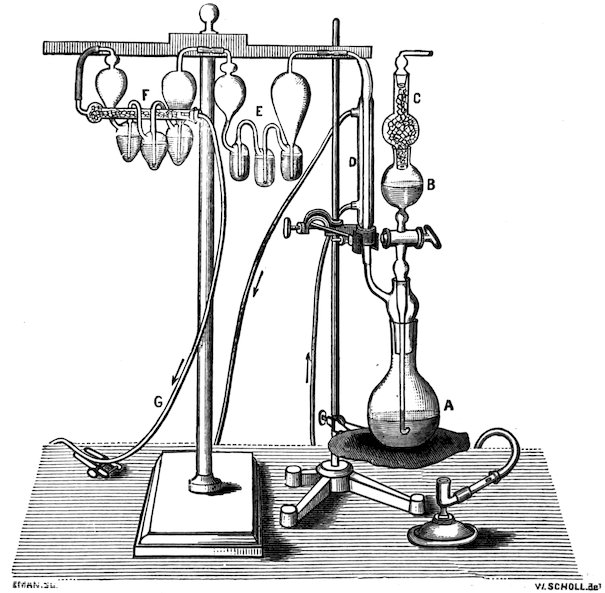
Figure 65. Knorr’s Apparatus for the Determination of Carbon Dioxid.
The apparatus consists of a flask A, Fig. 65, in which the carbon dioxid in the soil is liberated. A condenser, D, fits by means of a ground-glass joint into the neck of the flask in which the liberated gas, together with any air or aqueous vapor which may be carried forward, is cooled. This prevents any excess of vapor of water from entering the absorbing bulbs, which could easily happen at the end of the experiments when the contents of A are raised to the boiling point. The bulb B contains the acid, usually hydrochloric, which is employed for decomposing the carbonates. It is provided with a guard bulb-tube, C, which serves to absorb any carbon dioxid which might enter the apparatus with the air during aspiration at the close of the determination. The carbon dioxid is dried in the bulb-tube, E, in oil of vitriol, and absorbed in the potash solution in F. It is advisable to aspirate a slow current of air through the apparatus by means of the tube G during the whole of the operation. The quantity of the sample to be taken depends on its richness in carbonates. Many soils are so poor in carbonates as to render any attempt at exact determination nugatory. On the other hand, a comparatively small sample of marls will be sufficient. A preliminary qualitative test will indicate, in a general way, the quantity of the sample to be taken. The sample of soil, five to fifty grams, having been transferred to A, which should be perfectly dry, is 331made into a batter with freshly boiled distilled water. When all the parts of the apparatus are properly connected gas-tight, the cock between B and A is slowly opened and the hydrochloric (nitric) acid in B allowed to flow into A at such a rate as will secure a moderate evolution of gas.
When the carbonate is entirely decomposed, a lamp is brought under A and its contents gradually raised to the boiling point. The aspiration of air, free from carbon dioxid, is meanwhile continued until all the liberated gas has been absorbed in F. Usually about fifteen minutes will be sufficient to accomplish this purpose.
320. Bernard’s Calcimeter.—For a rapid and approximately accurate method of determining the amount of carbonate in the soil, estimated as calcium carbonate, Bernard makes use of the well-known method of the volumetric estimation of carbon dioxid. The sample to be examined should not be powdered in any way. The sample in a natural state, but well air-dried, is gently broken up by the fingers and passed through a sieve having ten meshes to the centimeter. Of the fine earth thus obtained, one gram is taken, for the determination. If the percentage of carbonate in the soil exceeds fifty then only half a gram is taken.
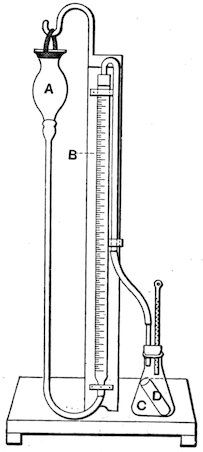
Figure 66. Bernard’s Calcimeter.
The apparatus employed is one well known. The small erlenmeyer C is fitted with a rubber stopper carrying an exit tube for the gas and a small thermometer. This flask is connected by means of a rubber tube and small glass tube to the measuring burette B. This burette is graduated from 0 to 100 cubic centimeters. Below, by means of a rubber tube, it is connected with the open bulb A, which, by means of a cord about its neck, can be suspended by the hook as shown in the figure. The measuring tube is filled with water through A until the level of the liquid in B is slightly above the zero mark. Meanwhile the one gram of earth has been placed in C, 332together with the tube D three-fourths filled with an equal mixture of water and strong hydrochloric acid. The greatest care must be taken that no part of the acid be spilled.
The rubber stopper is now forced into C until the level of the water in B is just at the zero mark. Grasping C in the right hand and A in the left, the operator inclines C until the contents of D are emptied. Meanwhile as the gas is evolved, A is lowered at such a rate as to always keep the level of the water in B and A on the same plane. In a few moments the evolution of gas is complete, and the volume given off is read at once without correction. This volume multiplied by 0.4 gives the percentage of carbonate in the sample examined. It is understood that the determination is made at ordinary temperatures; viz., 17° to 22°. Example:
One gram of a soil treated as above, gave of carbon dioxid (uncorrected) 65 cubic centimeters. 65 × 0.4 = 26.00 = per cent calcium carbonate in sample.
The above method is useful in the classification of soils and in determining approximately the quantity of calcium carbonate which they contain. The practical use of this method is of great value in determining the character of fertilizer to be applied. It is well to know the percentage of carbonate in selecting mineral fertilizers.
321. Soils Deficient in Carbonates.—When a soil contains but a small quantity of carbonates, Müller[207] has called attention to the fact that the carbon dioxid absorbed by the water in which the soil is rubbed up may vitiate the result. Instead of water a titrated solution of sodium carbonate is employed. The apparatus is composed of a flask containing the mixture of the sodium carbonate and the soil on which the hydrochloric acid is to act. The hydrochloric acid is contained in a small tube, as in Scheibler’s apparatus. The gas is received in a rubber tube 1.5 meters long and three to four millimeters interior diameter, and connected with a burette, the open mouth of which dips into the water of a cylinder of proper length. The volume of gas is read when the burette is raised or lowered in the cylinder until the liquid within and without stands at the same level.
During the action of the acid on the carbonates the flask is constantly shaken.
333Several readings of the volume of gas are made, the evolution flask being vigorously shaken before each one. Finally, in order to allow for the variations in temperature and pressure of the exterior air which may take place between the beginning and the end of the reaction, a second flask containing air is placed by the side of the evolution flask and communicating with a narrow ᥩ tube half filled with water. Any variations in the volume of the air in the flask will be shown by variations in the height of the liquid in the two arms of the ᥩ tube, and the volume of the variation can be easily determined by having the ᥩ tube calibrated.
If now a equals the volume per cent of carbon dioxid in the atmosphere of the evolution flask at the end of the reaction, v the volume of gas disengaged, and V the volume of the atmosphere in the evolution flask, the per cent of carbon dioxid contained in a given length of the rubber tube will be equal to a 2. This arises from the fact that the first gas which passes into the rubber tube is composed solely of air, while the last contains a per cent of carbon dioxid. By reason of the shaking of the flask the mean richness of the contents of the tube in carbon dioxid, will be sensibly a 2.
From the above data the following equations are derived:
1. va 2 + Va = v.
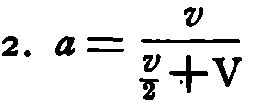
If the weight of the carbon dioxid dissolved in V′ cubic centimeters of the liquid in the evolution flask be represented by q, the coefficient of the solubility of pure carbon dioxid in this liquid will be, according to the law of the solubility of a gas, equal to k = q V′a
The volume of k has been determined for various strengths of the sodium carbonate solution, using five cubic centimeters of hydrochloric acid containing 1.6 grams pure hydrochloric acid. For solutions disengaging from five to fifty milligrams of carbon dioxid, the mean value of k was found to be 1.8 milligrams in the absence of calcium chlorid. When calcium chlorid was present in quantities varying from 0.03 to 0.07 gram per cubic centimeter 334of liquid in the evolution flask, the value of k was 1.4 milligrams.
By adopting, according to circumstances, the one or the other of the above numbers and multiplying it by Va, as determined by experiment, results are obtained differing only 0.2 to 0.3 milligram from those secured by direct weighing of the evolved gas.
Dietrich[208] has called attention to the necessity of adding the volume of the dissolved gas to the measured volume in such determinations, and this volume or weight is easily determined by the above formulas.
322. Belgian Method.—The method pursued at the Gembloux Station[209] consists in taking from five to fifty grams of the sample of soil, according to its content in carbonate, rubbing it up in a porcelain dish with distilled water in order to make a thin paste. The mass is worked to drive out all the air, the whole washed into a flask of 300 cubic centimeters capacity, and the amount of carbon dioxid estimated by setting free with an acid, and collecting the carbon dioxid evolved in potash bulbs.
DIGESTION OF SOILS WITH SOLVENTS.
323. General Considerations.—There are two points in connection with the determination of mineral matters in the soil which must always be kept in view; viz., first, the estimation of the total quantities of material in the soil, and second, the study of those materials which are more easily brought into solution and thus made available for the food of plants.
It is well understood that the soil particles do not give up entirely to the plant the food materials which they contain. The practical value therefore of an analysis of a soil depends more upon the exact determination of the plant food available than upon its total quantity. From a mineral and geological point of view, on the other hand, an idea of the total composition of the soil is the object to be attained.
For the determination of the available plant food, various solvents have been proposed, none of which, perhaps, imitates very accurately the natural solvent action of organic life and moisture on the soil materials. A description of the standard methods 335of preparing soil extracts will be the subject of a few succeeding paragraphs.
324. Estimation of the Quantity of Materials Soluble in Water.[210]—Five hundred grams of the air-dried soil are treated in a flask with 1,500 cubic centimeters of water, less the quantity of water already contained in the air-dried soil, which is volatile at 125°. The mass is frequently shaken and, after seventy-two hours, 750 cubic centimeters of the liquid filtered. The filtrate is evaporated to dryness in a platinum dish, dried at 120° and weighed. This is then incinerated and, after treatment with ammonium carbonate and gentle ignition, is again weighed. The further examination of the residue for acids and bases is made by some of the methods hereafter described.
325. Treatment with Water Saturated with Carbon Dioxid.—Two thousand five hundred grams of the air-dried soil are treated with 8000 cubic centimeters of distilled, and afterwards with 2000 cubic centimeters of water, which have previously, at room temperature, been saturated with carbon dioxid. The mixture is left in a closed flask for seven days, frequently shaken, after which 7,500 cubic centimeters of the liquid are filtered. The clear filtrate, after treatment with a little hydrochloric acid and a few drops of nitric acid, is evaporated to dryness. After the separation of the silica the traces of iron, alumina, lime, sulfuric acid, magnesia, potash, and soda, are estimated in the liquid in the manner hereinafter to be described. Phosphoric acid is always present in such a case, in such small quantities as to make its estimation unnecessary.
326. Treatment with Water Containing Ammonium Chlorid.—In the flask containing the residue from the last experiment; viz., the soil with 2,500 cubic centimeters of liquid, are added 1,500 cubic centimeters of water saturated with carbon dioxid, and 8,000 cubic centimeters of pure water in which five grams of ammonium chlorid are dissolved. The mixture is then left for seven days, with frequent shaking, and 7,500 cubic centimeters of the liquid are then filtered, and the substances dissolved, determined in the filtrate. In addition to the usual quantities of lime and magnesia, from two to four times as much 336alkali is dissolved by this treatment as is found in the solution from the water containing carbon dioxid alone.
327. Treatment with Water Containing Acetic Acid.—The acetic acid should be of such a strength that after it has fully acted on the soil it should still contain twenty per cent of free acid. 1000 grams of the soil dried at 100° are taken and the acid added in proper proportions and treated in the manner to be described for determining the solvent action of hydrochloric acid.
328. Treatment with Citric Acid Solution.—In ascertaining the quantities of soil materials soluble in a solution of citric acid, Dyer[211] recommends the use of a carefully prepared citric acid solution. The digestion is carried on as follows: Place in a flask or bottle, holding about three liters, 200 grams of air-dried soil and two liters of distilled water, in which are dissolved twenty grams of pure citric acid. The soil is left, at room temperature, in contact with the one per cent acid for seven days, with thorough shaking several times a day. At the end of the digestion the solution is filtered and 500 cubic centimeters of the filtrate, corresponding to fifty grams of the soil, are taken for analysis for each ingredient to be determined.
The digestion in citric acid is especially recommended by Dyer because of its supposed near resemblance to the methods of solution of plant food practiced by the rootlets of plants. It is evident, however, that this process is in no sense an imitation of natural methods. The solution is to be used exclusively for the estimation of potash and phosphoric acid. Dyer concludes, from a comparison of the action of a solution of citric acid on soils of known fertility, that when as little as 0.01 per cent of phosphoric acid is dissolved from a soil by this treatment it is justifiable to assume that it stands in immediate need of phosphatic manure. The methods used by Dyer to determine the phosphoric acid and potash in the citric acid solution will be given in their appropriate place.
329. Treatment with Hydrochloric Acid.—The solutions of soils usually subjected to chemical analysis are those obtained by long treatment with hot mineral acids, among which the most common is hydrochloric.
It has long been assumed by soil analysts, perhaps not with 337justness, that such treatment removed from the soil, all those elements of plant food which could possibly be available for the needs of the growing crop. In this connection, however, the analyst must not forget that nature, in a series of years, with her own methods may easily accomplish what he in five days, even with the help of a hot mineral acid, may not be able to secure. Since, however, this method of solution has been so long practiced it is not the place here to throw doubt on its effectiveness without being able to suggest a better way. Of the mineral acids available no one possesses solvent powers for soils in a higher degree than hydrochloric. A somewhat detailed description will therefore be given of the methods of its use.
330. Strength of Acid to be Employed.—The fact that hydrochloric acid of nearly constant strength; viz., specific gravity 1.115, equivalent to 22.9 per cent hydrochloric acid, may be obtained by distillation, led Owen to use acid of this density in his classic work on soil analysis. Hilgard has lately reviewed the conditions of constant strength in the solvent with results confirming the statements of Owen.[212] He evaporated on a steam-bath, to one-half its bulk, fifty cubic centimeters of hydrochloric acid, specific gravity 1.116, obtained by using the distillate from a stronger acid after rejecting the first third. The same operation was conducted with similar acid diluted with ten per cent of water. The acid used contained 22.96 per cent hydrochloric acid. The residual acid contained 21.49 per cent hydrochloric acid. These results lead Hilgard to believe that the changes arising from evaporation in hydrochloric acid during soil digestion are insignificant, compared with those due to its action on the soluble matters, and that evaporation during digestion is effective in maintaining a definite strength in the solvent. For this reason it is contended that evaporation in a porcelain beaker covered by a watch-glass is more effective in constancy of conditions than digestion in a closed flask under pressure.