Chapter IX · MNEMONIC. (continued 2)
Reading edition
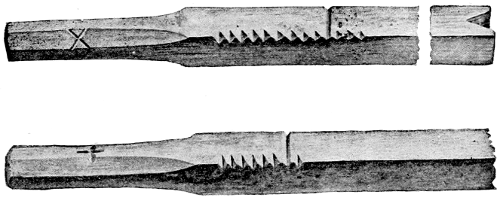
Fig. 181.—Notched sticks.
Upon each of the beveled surfaces on the handle are marks to indicate the kind of horned cattle referred to. The cross indicates that the corner of the stick upon which it is incised relates to heifers, each notch designating one head, the long transverse cut denoting ten, with an additional three cuts signifying that the herder has in charge thirteen heifers. Upon the next beveled edge appears an arrow-pointed mark, to denote in like manner which edge of the stick is to be notched for indicating the oxen. Upon the third beveled surface is one transverse cut for the record of the number of bulls in the herd, while upon the fourth bevel of the handle are two notches to note the number of cows.
The stick is notched at the end opposite the handle to signify that it refers only to horned cattle. That used to designate horses is sharpened from two sides only, so that the end is wedge-shaped, or exactly the reverse of the one first mentioned. The marks upon the handle would be the same, however, with this exception—that one cut would mean a stallion, two cuts a mare, the cross a gelding, and the arrow-shaped figure a colt. Sticks were also marked to denote the several kinds of stock and to record those which had been branded.
Another class of sticks were also used by the overseers, copies of which were likewise preserved by the laborers and herders, to keep an account of the number of days on which labor was performed, and to record the sums of money received by the workman.
The lower character of Fig. 181 represents a stick, upon the beveled edge of the handle of which is a cross to denote work. The short notches upon the corner of the stick denote days, each seventh day or week being designated by a cut extending across the stick.
Upon the opposite side of the handle is a circle or a circle with a cross within it to denote the number of reals paid, each real being indicated upon the edge of the stick by a notch, while each ten reals or peso is noted by making the cut all the way across that face of the stick.
Mr. Dall (a) says that the Innuit frequently keep accounts by tying knots in a string or notching a stick. Capt. Bourke (c) reports:
In the Mexican state of Sonora I was shown, some twenty years ago, a piece of buckskin, upon which certain Opata or Yaqui Indians—I forget exactly which tribe, but it matters very little, as they are both industrious and honest—had kept account of the days of their labor. There was a horizontal datum line as before, with complete circles to indicate full days and half circles to indicate half days, a long heavy black line for Sundays and holidays, and a crescent moon for each new month. These accounts had to be drawn up by the overseer or superintendent of the rancho at which the Indians were employed before the latter left for home each night.
Terrien de Lacouperie (e) says of the Sonthals of Bengal:
Their accounts are either notches on a stick, like those formerly used by the rustics for keeping scores at cricket matches in country villages in England, or knots on a piece of grass string, or a number of bits of straw tied together. I well remember my astonishment while trying my first case between a grasping Mahajun and a Sonthal when I ordered them to produce their accounts. * * * The Sonthal produced from his back hair, where it had been kept, I suppose, for ornament, a dirty bit of knotted grass string and threw it on the table, requesting the court to count that, as it had got too long for him. Each knot represented a rupee, a longer space between two knots represented the lapse of a year.
Many modes of accounting in a pictorial manner are noted in Europe and America among people classed as civilized. Some of these are very curious, but want of space prevents their recital here. A valuable description of the survival of the system in Brittany is given by M. Armand Landrin (a), translated and condensed as follows:
In the department of Finisterre the farmers, in keeping accounts, made bags of their old socks and coat sleeves, of different colors, each color representing one of the divisions of farm outlay or receipt, as cows, butter, milk, and corn. Each amount received was placed in coin in the appropriate bag. When any coins were taken out the same number of small stones or of peas or beans was put in to replace the coins. Other farmers substituted for the bags small sticks of different length and thickness in which they made cuts representing the receipts.
In the accounts with the laborers and farm hands the women were designated by the triangle, intended to represent the Breton head dress á grandes barbes. The kind of work performed was expressed by the tool connected with it, e. g., a horseshoe denoted the blacksmith, a scythe the mower, an ax the carpenter, a saddle the harness-maker, and a tub the cooper. The bill of a veterinary surgeon was rendered by drawing the figures of the several animals treated united in one group by a line.
Until quite recently the important accounts of the British exchequer were kept by wooden tallies, and some bakers in the United States yet persevere in keeping their accounts with their customers by duplicate tallies, one of which is rendered as a bill and is verified by the other.