Chapter XVIII · IDEOGRAPHY.
Reading edition
The imagination is stimulated and developed by the sense of sight more than by any other sense, perhaps more than by all of the other senses combined. The American Indians, and probably all savages, are remarkable for acute and critical vision, and also for their retentive memory of what they have once seen. When significance is once attached to an object seen, it will always be recalled, though often with false deductions. Therefore, like deaf-mutes, who depend mainly on sight, the American Indians have developed great facility in communicating by signs, and also in expressing their ideas in pictures which are ideographic though seldom artistic. This tendency has likewise affected their spoken languages. Their terms express with wonderful particularity the characters and relations of visible objects, and their speeches, which are in a high degree metaphoric, become so by the figurative presentation in words of such objects accompanied generally by imitative signs for them, and often by their bodily exhibition.
The statement once made that the aboriginal languages of North America are not capable of expressing abstract ideas is incorrect, but the tendency to use tangible and visible forms for such ideas is apparent. This practice was most marked in reference to religious subjects, which were often presented under the veil of symbols, as has been the common expedient of most peoples who have emerged from the very lowest known stages of human culture, but have not attained the highest.
Many instances appear in this work in which pictures expressive of an idea present more than mere portraitures of objects, which latter method has been styled imitative or iconographic writing.
It is, however, impossible to classify with scientific precision the pictured ideograms collected, for the reason that many of them occupy intermediate points in any scheme that would be succinct enough to be practically useful. In the arrangement of the present chapter the division is made into: 1st. Abstract ideas expressed pictorially. 2d. Signs, symbols, and emblems. 3d. Significance of colors. 4th. Gesture and posture signs depicted. When any of the graphic representations of ideas have become successful, i. e., commonly adopted, it soon becomes more or less conventionalized. Chapter XIX is devoted specially to that branch of the general subject.
SECTION 1. ABSTRACT IDEAS EXPRESSED PICTORIALLY.
The first stage of picture-writing, as considered in the present chapter, was the representation of a material object in such style or connection as determined it not to be a mere portraiture of that object, but figurative of some other object or person. This stage is abundantly exhibited among the American Indians. Indeed, their personal and tribal names thus objectively represented constitute the largest part of their picture-writing so far thoroughly understood.
The second step was when a special quality or characteristic of an object, generally an animal, became employed to express a general quality, i. e., an abstract idea. It can be readily seen how, among the Egyptians, a hawk with bright eye and lofty flight might be selected to express divinity and royalty, and that the crocodile should denote darkness, while a slightly further advance in metaphors made the ostrich feather, from the equality of its filaments, typical of truth. All peoples whose rulers used special objective designations of their rank, made those objects the signs for power, whether they were crowns or umbrellas, eagle feathers, or colored buttons. A horse meant swiftness, a serpent life—or immortality when drawn as a circle—a dog was watchfulness, and a rabbit was fecundity. It is evident from examples given in the present paper that the American tribes at the time of the Columbian discovery had entered upon this second step of picture-writing, though with marked inequality between tribes and regions in advance therein. None of them appear to have reached such proficiency in the expression of connected ideas by picture, as is shown in the sign-language existing among some of them, which may be accounted for by its more frequent use required by the constant meeting of many persons speaking different languages. There is no more necessary connection between abstract ideas and sounds, the mere signs of thought that strike the ear, than there is between the same ideas and signs addressed only to the eye. The success and scope of either mode of expression depends mainly upon the amount of its exercise, in which oral language undoubtedly has surpassed both sign-language and picture-writing.
The examples now following in this chapter are by no means all the graphic representations of abstract ideas collected. Indeed many others are contained in the work under other headings, but the following are selected for grouping here with an attempt at order. In the popular definition, or want of definition, some of them would be classed as symbols.
AFTER.
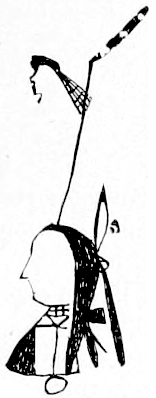
Fig. 845.—Charge after.
Fig. 845.—Charge after; Red-Cloud’s Census.
Here is suggested the order in a charge upon an enemy, apparently a Crow. The concept is not the general charge of a number of warriors upon the Crows, but the succession between themselves of the men who made that charge. The person whose name is represented probably followed in but did not lead some celebrated charge.
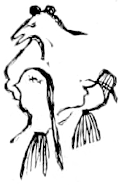
Fig. 846.—Killed after.
Fig. 846.—John Richard shot and killed an Oglala named Yellow-Bear, and the Oglalas killed Richard before he could get out of the lodge; American-Horse’s Winter Count, 1871-’72. This occurred in the spring of 1872. As the white man was killed after the Indian, he is placed behind him in the figure. The bear’s head is shown.
AGE—OLD AND YOUNG.
OLD.
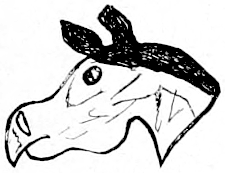
Fig. 847.—Old-Horse.
Fig. 847.—Old-Horse; Red-Cloud’s Census. Here the old age is shown by the wrinkles and projecting lips.
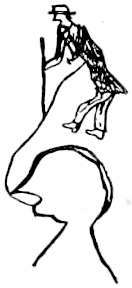
Fig. 848.—Old-Mexican.
Fig. 848.—Old-Mexican; Red-Cloud’s Census. The man in European dress is bent and supported by a staff, thus depicting the gesture-sign mentioned in connection with Fig. 994. The Dakota had probably received his name from killing an aged Mexican.
YOUNG.
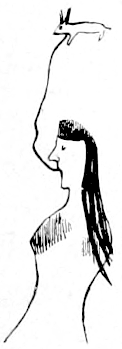
Fig. 849.—Young-Rabbit.
Fig. 849.—Young-Rabbit, a Crow, was killed in battle by Red-Cloud. Cloud-Shield’s Winter Count, 1861-’62. Here the youth of the Rabbit is expressed by diminutive size and short legs.
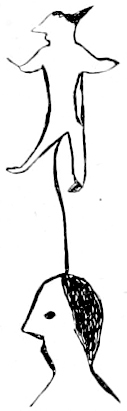
Fig. 850.—Bad-Boy.
Fig. 850.—Bad-Boy. Red-Cloud’s Census. The boyhood is expressed by the short hair and short scalp lock.
BAD.
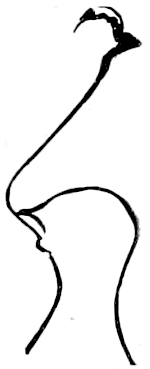
Fig. 851.—Bad-Horn.
Fig. 851.—Bad-Horn. Red-Cloud’s Census. The bad quality of the horn is expressed by its decayed and broken condition and its distorted curve.
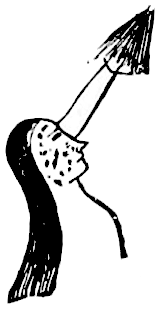
Fig. 852.—Bad-Face.
Fig. 852.—Bad-Face, a Dakota, was shot in the face. Cloud-Shield’s Winter Count, 1794-’95. The bad face may have been broken out with blotches of disease before the shot, or the scars may have been the result of the shot, which gave occasion for a new name, as is common. The idea of “bad” is often expressed by an abnormality, especially one which disfigures.
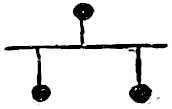
Fig. 853.—Bad. Ojibwa.
Fig. 853, taken from Copway (d), represents “bad.” The concept appears to be the preponderance of “below” to “above.”
BEFORE.
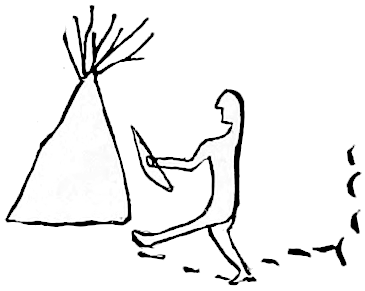
Fig. 854.—Got there first.
Fig. 854.—Got there first. Red-Cloud’s Census. The figure portrays a successful escape of an unmounted Indian from a chase by enemies on horseback. The chased man gets home to his tipi before being overtaken by his pursuers, whose horses’ tracks are shown.
BIG.
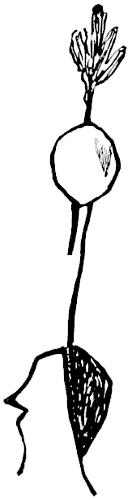
Fig. 855.—Big-Turnip.
Fig. 855.—Big-Turnip. Red-Cloud’s Census. The plant is also known as the navet de prairie. The large size of the specimen, as compared with the human head, is apparent.
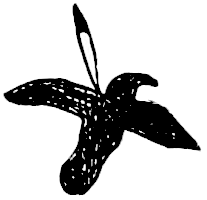
Fig. 856.—Big-Crow.
Fig. 856.—A Minneconjou Dakota, named Big-Crow, was killed by the Crow Indians. Swan’s Winter Count, 1859-’60. He had received his name from killing a Crow Indian of unusual size. The bird is portrayed much larger than similar objects in the Winter Count, from which it is taken.
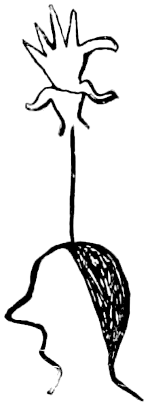
Fig. 857.—Grasp.
Fig. 857.—Grasp. Red-Cloud’s Census. Here the indication of size and strength of the hand is suggested by one hand growing out from another, a species of duplication. To have drawn two distinct hands would only have been normal and not suggestive of unusual power of grip.
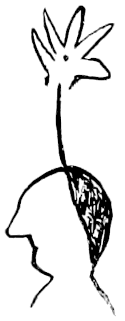
Fig. 858.—Big-Hand.
Fig. 858.—Big-Hand. From Red-Cloud’s Census. Here the fingers are widely separated and displayed.
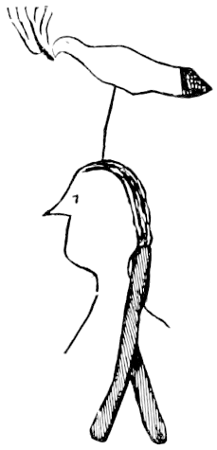
Fig. 859.—Big-Thunder.
Fig. 859.—Big-Thunder. From Red-Cloud’s Census. Here the size or power is suggested by implication. The double or two-voiced thunder is big thunder.
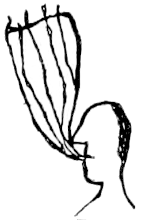
Fig. 860.—Big-Voice.
Fig. 860.—Big-Voice. From Red-Cloud’s Census. In this figure there are still more voices than in the preceding.
CENTER.
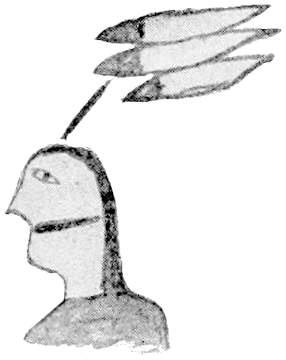
Fig. 861.—Center-Feather.
Fig. 861.—Upi-Yaslate. Center-Feather. The Oglala Roster. This is the indication of a particular feather, i. e., the middle tail feather of a bird, probably of an eagle, the tail feathers of which bird are represented in many pictographs in this paper. There was some reason for the selection of the center feather for the name, and to indicate the center three feathers were depicted with a line touching the middle one.
DEAF.
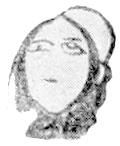
Fig. 862.—Deaf-Woman.
Fig. 862.—Wi-nugin-kpa, Deaf-Woman. The Oglala Roster. The ears are covered by a line, i. e., are closed, and the ear most in view is connected with the crown of the head, to show that the name is expressed.
DIRECTION.
This title has been selected as being the most comprehensive one for the five following figures. The first shows a moccasin with a serpentine track, at the farthest end of which is an angular design, indicating leadership as well as the direction taken. This suggests the leader of a war party conducting his band over an uncertain trail. The second is explanatory of the first. That the chief goes in front is indicated in a manner the reverse of that which would appear in the designs common in our military text-books. He is supposed to be in the opening in the angle of the advance and not at its apex. The third figure shows a steadfast leadership in the determined straight direction of attack against the enemy. This is still more ideographically represented by the single strong straight line showing that he “Don’t turn” in the fourth figure of this group.
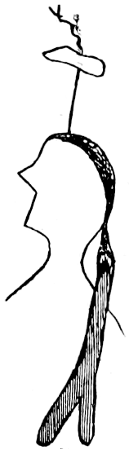
Fig. 863.—Direction.
Fig. 863.—Warrior. Red-Cloud’s Census. The name does not give any idea of the design.
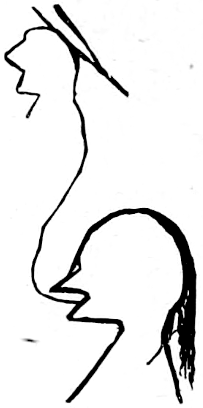
Fig. 864.—Goes-in-Front.
Fig. 864.—Goes-in-Front. Red-Cloud’s Census.
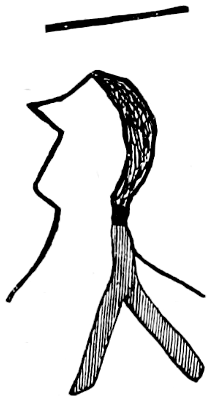
Fig. 865.—Don’t-turn.
Fig. 865.—Don’t-turn. Red-Cloud’s Census. This means that the warrior don’t—that is, won’t—turn from his direct course.
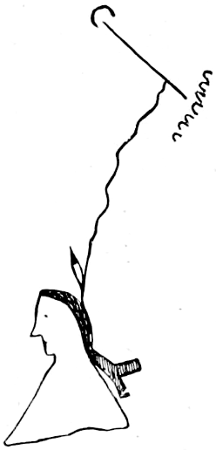
Fig. 866.—Don’t-turn.
Fig. 866.—Don’t-turn. Red Cloud’s Census. This figure is a variant of the last, and a body of mounted men following the leader, all on horseback as shown by the lunules.
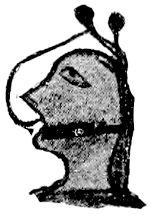
Fig. 867.—Returning Scout.
Fig. 867.—Tunweya-gli, Returning-Scout. The Oglala Roster. The returning is ingeniously represented by the line curving backward and returning to the point of starting. The two balls above the head are simply two fixed points, which establish the course of the line.
DISEASE.
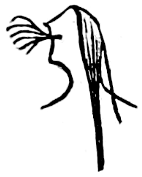
Fig. 868.—Whooping cough.
Fig. 868.—Many had the whooping cough. American-Horse’s Winter Count, 1813-’14. The cough is represented by the lines issuing from the man’s mouth, but the characteristics of the disease are better expressed in the three charts of the Lone-Dog system, Figs. 196, 197, and 198.
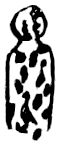
Fig. 869.—Measles.
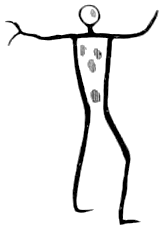
Fig. 870.—Measles or smallpox.
Fig. 869.—All the Dakotas had measles, very fatal. Swan’s Winter Count, 1818-’19. Battiste Good says: “Smallpox-used-them-up-again winter.” They, i. e., the Dakotas, at this time lived on the Little White river, about 20 miles above the Rosebud agency. The character in Battiste Good’s chart is presented here in Fig. 870 as a variant.
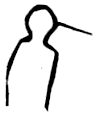
Fig. 871.—Ate buffalo and died.
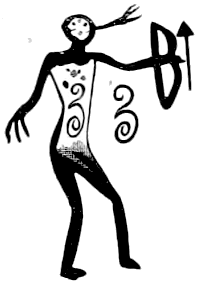
Fig. 872.—Died of “whistle.”
Fig. 871.—Dakota war party ate a buffalo and all died. Swan’s Winter Count, 1826-’27. Battiste Good calls the same year, “Ate-a-whistle-and-died winter,” Fig. 872, and explains that six Dakotas on the warpath had nearly perished with hunger, when they found and ate the rotting carcass of an old buffalo, on which the wolves had been feeding. They were seized soon after with pains in the stomach, their bellies swelled, and gas poured from the mouth and the anus, and they “died of a whistle,” or from eating a whistle. The sound of gas escaping from the mouth is illustrated in the figure. The character on the abdomen and on its right may be considered to be the ideograph for pain in that part of the body.
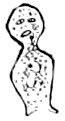
Fig. 873.—Smallpox.
Fig. 873.—Many people died of smallpox. Cloud-Shield’s Winter Count, 1782-’83. The charts all record two successive winters of smallpox, but American-Horse makes the first year of the epidemic one year later than that of Battiste Good, and Cloud-Shield makes it two years later.
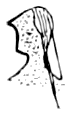
Fig. 874.—Smallpox.
Fig. 874.—Many died of smallpox. American-Horse’s Winter Count, 1780-’81. Here the smallpox marks are on the face and neck of a Dakota, as indicated by the arrangement of the hair.
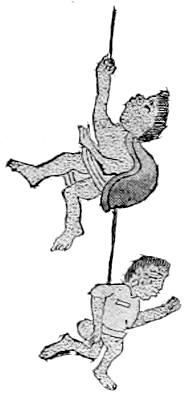
Fig. 875.—Smallpox. Mexican.
Kingsborough (e) explains Fig. 875 by these words in the text: “In the year of Seven Rabbits, or in 1538, many of the people died of the smallpox.” This may be compared with the two preceding figures.
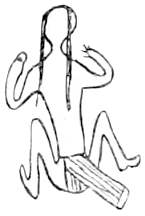
Fig. 876.—Died of cramps.
Fig. 876.—Many died of the cramps. American-Horse’s Winter Count, 1849-’50. The cramps were those of Asiatic cholera, which was epidemic in the United States at that time, and was carried to the plains by the California and Oregon emigrants. The position of the man is very suggestive of cholera.
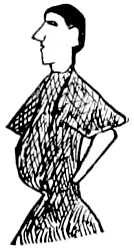
Fig. 877.—Died in childbirth.
Fig. 877.—Many women died in childbirth. Cloud-Shield’s Winter Count, 1798-’99.
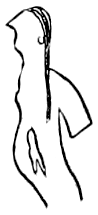
Fig. 878.—Died in childbirth.
Fig. 878.—Many women died in childbirth. American-Horse’s Winter Count, 1792-’93.

Fig. 879.—Sickness. Ojibwa.
Fig. 879, from Copway (e), represents sickness. It evidently refers to the loss of flesh consequent thereon. The sick man is a European.

Fig. 880.—Sickness. Chinese.
Edkins (a) gives Fig. 880 as “sickness,” and calls it a picture of a sick man leaning against a support. All words connected with diseases are arranged under this head.
FAST.
The following figures clearly indicate rapidity of motion:
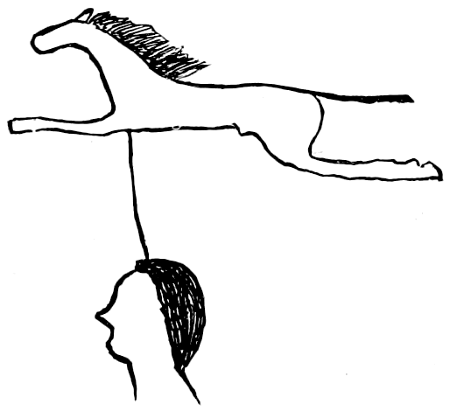
Fig. 881.—Fast-Horse.
Fig. 881.—Fast-Horse. Red-Cloud’s Census.
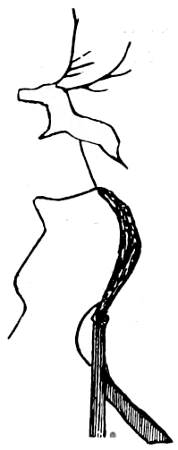
Fig. 882.—Fast-Elk.
Fig. 882.—Fast-Elk. Red-Cloud’s Census.
FEAR.
The following ideograms for the concept of fear show respectively an elk, a bear, and a bull surrounded by a circle of hunters. It would seem that the latter were supposed to be afraid to attack the animals when at bay in hand-to-hand fight, but stood off in a circle until they had killed the enraged beast, or at least wounded it sufficiently to allow of approach without danger.
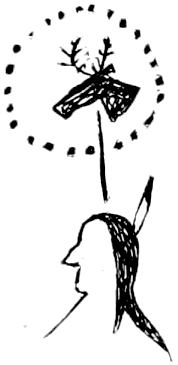
Fig. 883.—Afraid-of-Elk.
Fig. 883.—Afraid-of-Elk. Red-Cloud’s Census.
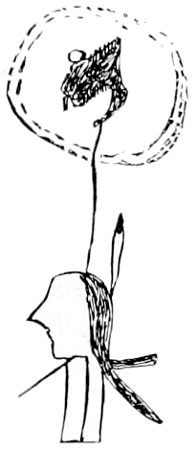
Fig. 884.—Afraid-of-Bull.
Fig. 884.—Afraid-of-Bull. Red-Cloud’s Census.
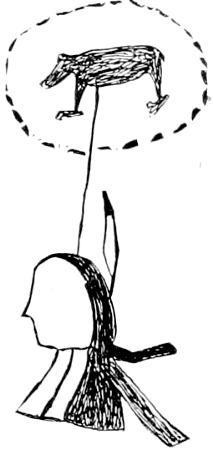
Fig. 885.—Afraid-of-Bear.
Fig. 885.—Afraid-of-Bear. Red-Cloud’s Census.
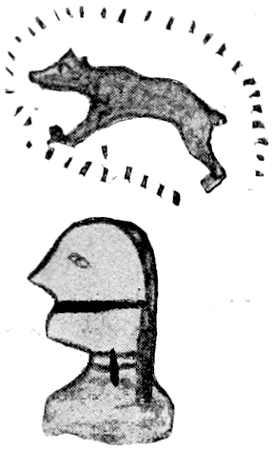
Fig. 886.—The Bear-stops.
Fig. 886.—Matokinajin, The-Bear-Stops. The Oglala Roster. The bear is surrounded by a circle of hunters, so is forced to stop. This figure is in no essential respect different from the one preceding, yet the name is suggestive of the converse of the fact expressed. In this case the bear is forced to stop, and doubtless fear is exhibited by that animal and not his hunters. Each of the ideas is appropriately expressed, the point of consideration being changed.
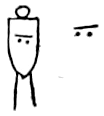
Fig. 887.
Fig. 887 is taken from Copway, loc. cit. It probably represents “fear,” the concept being the imagined sinking or depression of the heart and vital organs, as is correspondingly expressed in several languages.
FRESHET.
This small group shows the Dakotan modes of portraying the freshets of the rivers on the banks of which they lived, which were often disastrous. Each of the three figures pictures differently the same event.
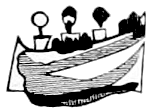
Fig. 888.—River freshet.
Fig. 888.—“Many-Yanktonais-drowned winter.” The river bottom on a bend of the Missouri river, where they were encamped, was suddenly submerged, when the ice broke and many women and children were drowned. Battiste Good’s Winter Count 1825-’26.
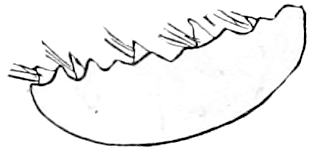
Fig. 889.—River freshet.
Fig. 889.—Many of the Dakotas were drowned in a flood caused by a rise in the Missouri river, in a bend of which they were encamped. Cloud-Shield’s Winter Count, 1825-’26. The curved line is the bend in the river; the waved line is the water, above which the tops of the tipis are shown.
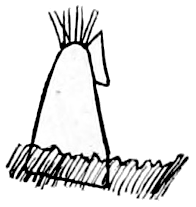
Fig. 890.—River freshet.
Fig. 890.—Some of the Dakotas were living on the bottom lands of the Missouri river, below the Whetstone, when the river, which was filled with broken ice, rose and flooded their village. Many were drowned or else killed by the floating ice. Many of those that escaped climbed on cakes of ice or into trees. American-Horse’s Winter Count, 1825-’26.
GOOD.
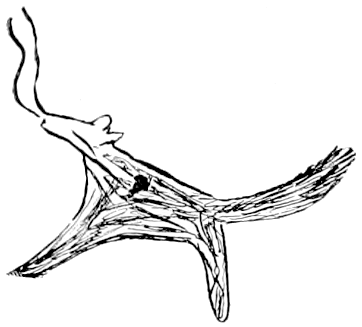
Fig. 891.—Good weasel.
Fig. 891.—Good-Weasel. Red-Cloud’s Census. The character is represented with two waving lines passing upward from the mouth in imitation of the gesture sign, good talk, as made by passing two extended and separated fingers (or all fingers separated) upward and forward from the mouth. This gesture is made when referring either to a shaman or to a Christian clergyman. It is connected with the idea of “mystic” frequently mentioned in this work.
HIGH.
Various modes of delineating this idea are represented as follows:
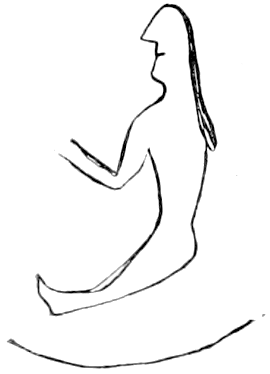
Fig. 892.—Top-man.
Fig. 892.—Top-man. Red-Cloud’s Census. This character for Top-man, or more properly “man above,” is drawn a short distance above a curved line, which represents the character for sky inverted. The gesture for sky is sometimes made by passing the hand from east to west, describing an arc. Other pictographs for sky are shown in Fig. 1117.
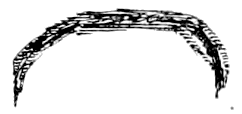
Fig. 893.—High-Cloud.
Fig. 893.—High-Cloud. Red-Cloud’s Census. The light and horizontal character of the cloud suggests that it is one of those classed by meteorologists as belonging to the higher regions of the atmosphere. This differs from all the varieties of clouds depicted in the Dakotan system.
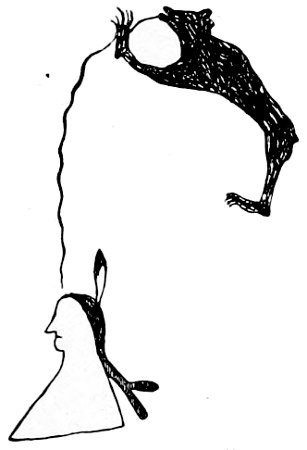
Fig. 894.—High-Bear.
Fig. 894—High-Bear. Red-Cloud’s Census. The length of the line and the animal’s stretch of attitude suggest the altitude.
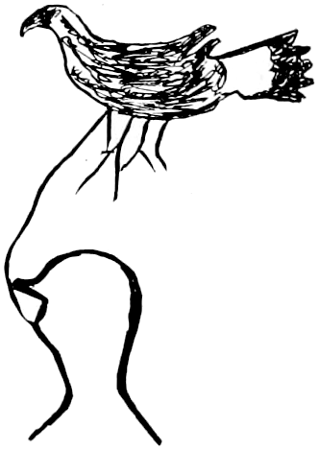
Fig. 895.—High-Eagle.
Fig. 895.—High-Eagle. Red-Cloud’s Census. Here there is an additional suggestion of elevation from the upward angle or pointer delineated below the eagle’s body and in front of its legs.
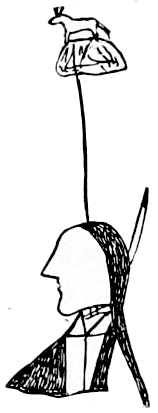
Fig. 896.—Wolf on height.
Fig. 896.—Wolf-stands-on-a-hill. Red-Cloud’s Census. This and the following representation of the same name show variation in execution. The first, which is faint, as if distant vertically, is connected with a straight line. The second shows the hill, appearing from vertical distance too small to be the support of the wolf, which requires an imaginary support for its hind legs.
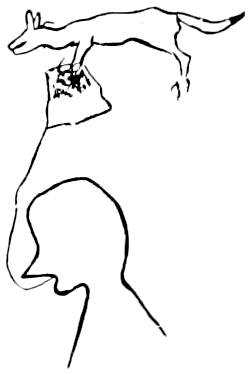
Fig. 897.—Wolf on height.
Fig. 897.—Wolf-stands-on-hill. Red-Cloud’s Census.
LEAN.
In the five figures next following the leanness of the several animals is objectively portrayed. In Fig. 903 the idea is conveyed of “nothing inside.”
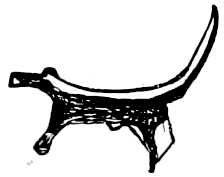
Fig. 898.—Lean-Skunk.
Fig. 898.—Lean-Skunk. Red-Cloud’s Census.
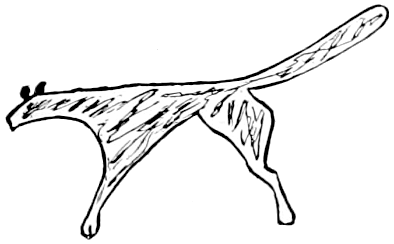
Fig. 899.—Lean-Dog.
Fig. 899.—Lean-Dog. Red-Cloud’s Census.
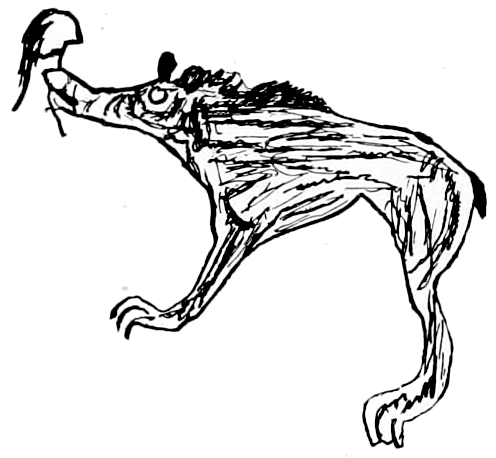
Fig. 900.—Lean-Bear.
Fig. 900.—Lean-Bear. Red-Cloud’s Census. This bear being excessively hungry is rendered ferocious by devouring unpalatable provender.
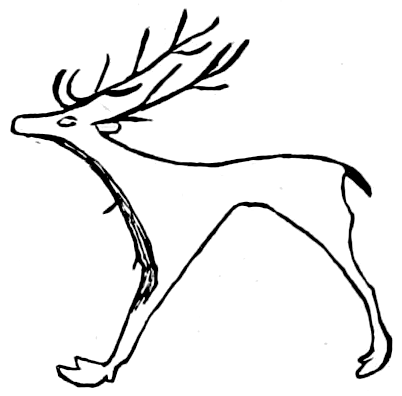
Fig. 901.—Lean-Elk.
Fig. 901.—Lean-Elk. Red-Cloud’s Census.
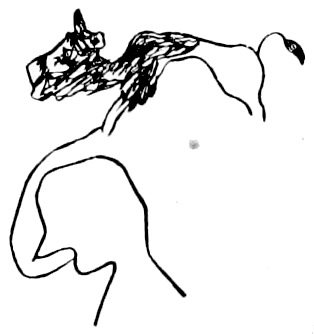
Fig. 902.—Lean-Bull.
Fig. 902.—Lean-Bull. Red-Cloud’s Census.
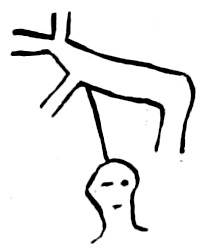
Fig. 903.—Lean-Wolf.
The original of Fig. 903 was made by Lean-Wolf, second chief of the Hidatsa, in 1881, and represents the method which he had employed to designate himself for many years past. During his boyhood he had another name. This is a current, or perhaps it may be called cursive, form of the name, which is given more elaborately in Fig. 548.
LITTLE.
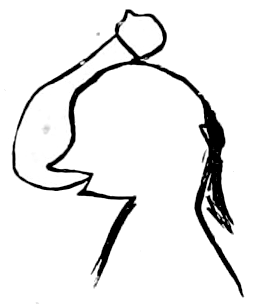
Fig. 904.—Little-Ring.
Fig. 904.—Little-Ring. Red-Cloud’s Census. This and the six following figures express smallness by their minute size relative to the other characterizing figures among nearly three hundred in the census.

Fig. 905.—Little-Ring.
Fig. 905.—Little-Ring. Red-Cloud’s Census.
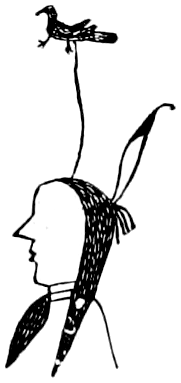
Fig. 906.—Little-Crow.
Fig. 906.—Little-Crow. Red-Cloud’s Census.
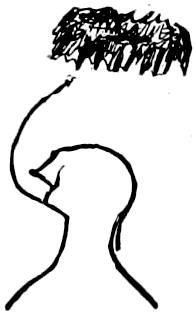
Fig. 907.—Little-Cloud.
Fig. 907.—Little-Cloud. Red-Cloud’s Census.
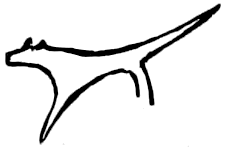
Fig. 908.—Little-Dog.
Fig. 908.—Little-Dog. Red-Cloud’s Census.
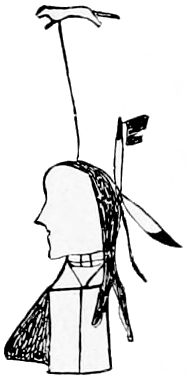
Fig. 909.—Little-Wolf.
Fig. 909.—Little-Wolf. Red-Cloud’s Census.
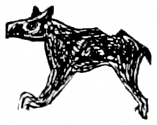
Fig. 910.—Little-Bear.
Fig. 910.—Little-Bear. Red-Cloud’s Census.
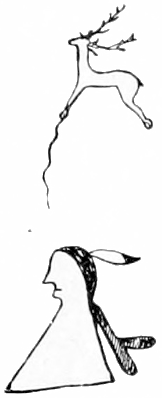
Fig. 911.—Little-Elk.
Fig. 911.—Little-Elk. Red-Cloud’s Census. Here there is an ideogram explained by the sign-language for small, little, as follows:
Hold imaginary object between left thumb and index; point (carrying right index close to tips) to the last. In the original appears a small round spot over the back of the deer representing the imaginary point made in the gesture.
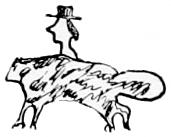
Fig. 912.—Little-Beaver.
Fig. 912.—Little-Beaver and three other white men came to trade. American-Horse’s Winter Count, 1797-’98. In this figure the man is small and the beaver abnormally large.
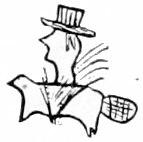
Fig. 913.—Little-Beaver.
Fig. 913.—Little-Beaver’s trading house was burned down. American-Horse’s Winter Count, 1808-’09. The beaver is not comparatively so large as in the preceding figure, but still much too large for a proper proportion with the human head. It is indicated that the man is small.
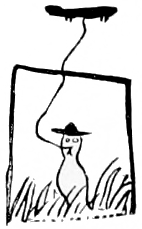
Fig. 914.—Little-Beaver.
Fig. 914.—Little-Beaver’s house was burned. Cloud-Shield’s Winter Count, 1809-’10. White-Cow-Killer says, “Little-Beaver’s (the white man) house-burned-down winter.” This is a third method of representing the same name.
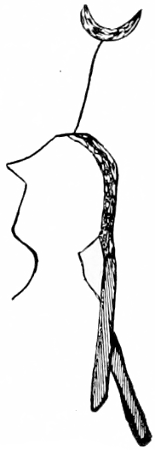
Fig. 915.—Little-Moon.
Fig. 915.—Little-Moon. Red-Cloud’s Census. This figure shows a phase of the moon when the bright part of its disk is small.
LONE.
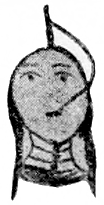
Fig. 916.—Lone-woman.
Fig. 916.—Winyan-isnala, Lone-Woman. The Oglala Roster. It is possible that the single straight line above the woman’s head shows unity, loneliness, or independence, as it may be interpreted.
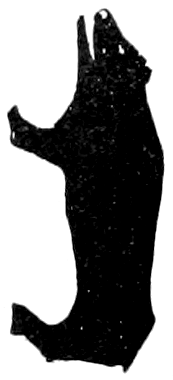
Fig. 917.—Lone-Bear.
Fig. 917.—Lone-Bear was killed in battle. Cloud-Shield’s Winter Count, 1866-’67. This figure is perhaps to be explained by the one preceding. The bear is drawn sitting upright and solitary, not standing as it would be with the device turned, feet to ground, as might be suspected to be the intended attitude instead of that here shown.
MANY, MUCH.
In the two following figures the idea of “many” is conveyed by repetition.
In the third, Fig. 920, the representation is that of a heap, for much.
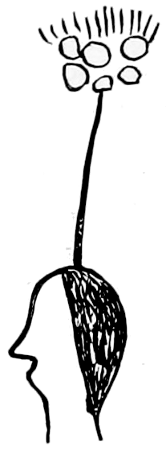
Fig. 918.—Many-Shells.
Fig. 918.—Many-Shells. Red Cloud’s Census.
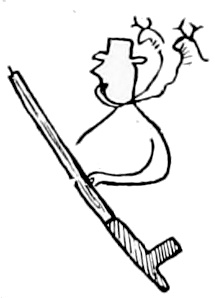
Fig. 919.—Many deer.
Fig. 919.—General Maynadier made peace with the Oglalas and Brulés. American-Horse’s Winter Count, 1865-’66. The general’s name (the sound of which resembles the words “many deer”) is indicated by the two deer heads connected with his mouth by lines. The pictographers represented his name in the same manner as they do their own. It is not an example of rebus, but of misunderstanding the significance of the word as spoken and heard by such Indians as had some knowledge of English. The official interpreters would be likely to commit the error as they seldom understand more than the colloquial English phrases.
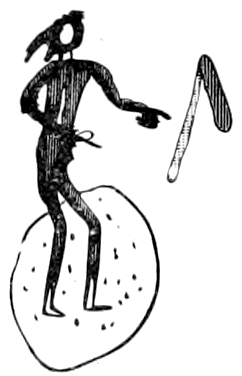
Fig. 920.—Much snow.
Fig. 920 is taken from the winter count of Battiste Good for the year 1841-’42. He calls the year “Pointer-made-a-commemoration-of-the-dead winter.” Also “Deep-snow winter.”
The extended index denotes the man’s name, “Pointer,” the circular line and spots, deep snow.
The spots denoting snow occur also in other portions of this count, and the circle, denoting much, is in Fig. 260 connected with a forked stick and incloses a buffalo head to signify “much meat.” That the circle is intended to signify much is made probable, by the fact that a gesture for “much” is made by passing the hands upward from both sides and together before the body, describing the upper half of a circle, i. e., showing a heap.
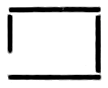
Fig. 921.-Great, much.
Fig. 921, from Copway, gives the character meaning “great,” really “much.” See the above mentioned gesture.
OBSCURE.
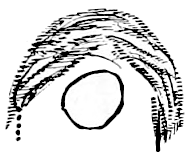
Fig. 922.—Ring-Cloud.
Fig. 922.—Ring-Cloud. Red-Cloud’s Census. The semicircle for cloud is the reverse in execution to that shown in Fig. 893. The ring is partially surrounded by the cloud.

Fig. 923.—Cloud-Ring.
Fig. 923.—Cloud-Ring. Red-Cloud’s Census. Here the outline of the ring is intentionally contorted and blurred, thus becoming obscure.
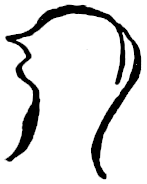
Fig. 924.—Fog.
Fig. 924.—Fog. Red-Cloud’s Census. The obscurity here can only be appreciated by comparison with the other figures of the chart. The outline is drawn broad and with a blurred and in part double line, and there is no distinguishing mark of identity, as if to suggest that the man was so much obscured in the fog as not to be recognizable.
OPPOSITION.
The following two figures, 925 and 926, are introduced to show the opposition in attitude, which would not be understood without knowledge of the fact that these are perhaps the only instances in a collection of nearly three hundred in which the characterizing faces are turned to the right, all others being turned to the left. This shows the opposite of normality, i. e., opposition, as suggested in each case, with a different shade of meaning.
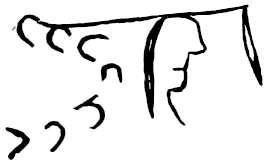
Fig. 925.—Kills-Back.
Fig. 925.—Kills-Back. Red-Cloud’s Census. Here the backward concept is presented by the unusual attitude. The coup stick or lance is supposed to be wielded in the reverse manner.
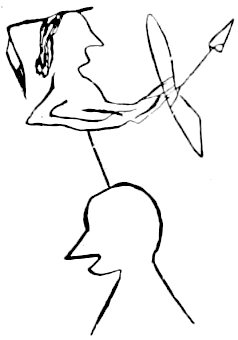
Fig. 926.—Keeps-the-Battle.
Fig. 926.—Keeps-the-Battle. Red-Cloud’s Census. The concept is that of stubborn retreat while fighting against the advancing foe.
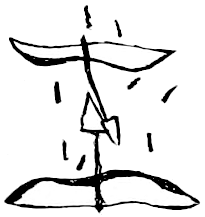
Fig. 927.—Keeps-the-Battle.
Fig. 927.—Keeps-the-Battle. Red-Cloud’s Census. This is the same name as the preceding, but the opposition suggested is that which is usual in pictographs of a battle, with the important addition of the opposed arrow points being attached together by striking the same object, and possibly being connected by an imaginary knot. This keeps or continues the struggle.
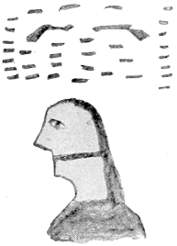
Fig. 928.—His-Fight.
Fig. 928.—Okicize-tawa, His-Fight. The Oglala Roster. The opposed guns and tracks indicate the fight in which this warrior was conspicuous and probably victorious. This figure is introduced here as typical of simple opposition in battle.
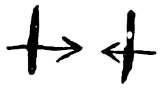
Fig. 929.—River fight.
Fig. 929.—Battiste Good’s Winter Count, 1836-’37. An encounter is represented between two tribes, separated by the banks of a river, from which arrows are fired across the water at the opposing party. The vertical lines represent the banks, while the opposing arrows denote a fight or an encounter.
POSSESSION.
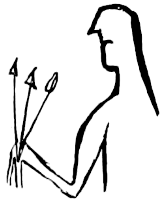
Fig. 930.—Owns the arrows.
Fig. 930.—Owns-the-Arrows. Red-Cloud’s Census. This is a common mode of expressing possession by exhibition in hand.
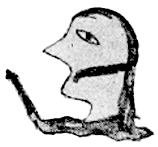
Fig. 931.—Has something sharp.
Fig. 931.—Pesto-yuha, Has-something-sharp (weapon). Oglala Roster. The weapon or sharp utensil is held in front to denote its possession.
PRISONER.
This group shows the several modes of expressing the idea of a prisoner.
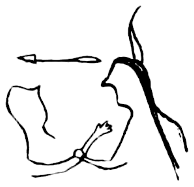
Fig. 932.—Prisoner. Dakota.
Fig. 932.—The Ponkas attacked two lodges of Oglalas, killed some of the people, and made the rest prisoners. The Oglalas went to the Ponka village a short time afterward and took their people from the Ponkas. American-Horse’s Winter Count, 1802-’03.
In the figure an Oglala has a prisoner by the arm leading him away. The arrow indicates that they were ready to fight. The hand grasping the fore arm is the ideogram of prisoner.
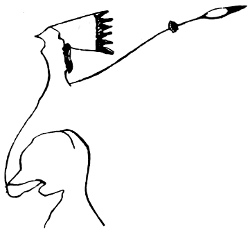
Fig. 933.—Takes enemy.
Fig. 933.—Takes-Enemy. Red-Cloud’s Census. This man is represented as not killed nor even wounded. He is touched by the coup stick or feathered lance, when he can not escape, and becomes a prisoner.
Lafitau (d) gives the following account descriptive of Fig. 934, which reminds of the classic Roman parade of prisoners in triumph:
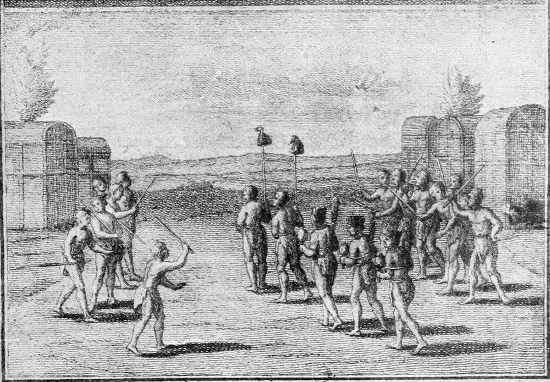
Fig. 934.—Iroquois triumph.
Those who have charge of the prisoners prepare them for this ceremony, which is a sort of triumph, having for them something of glory and of sorrow at the same time; for, whether it is desired to do them honor or to enhance the triumph of the conquerors, they paint their faces black and red as on a solemn feast day. Their heads are decorated with a crown, embellished with feathers; in the left hand is placed a white stick covered with swan skin, which is a sort of commander’s baton or scepter, as if they represented the chief of the nation [sic] or the nation itself which had been vanquished; in the right hand is placed the rattle, and around the neck of the most prominent of the slaves the wampum necklace which the war chief has given or received when he raised the party and on which the other warriors have sealed their engagement. But if on one hand the prisoners are honored, on the other, to make them feel their miserable situation, they are deprived of everything else; so that they are left entirely naked and made to walk with the arms tied behind the back above the elbow.
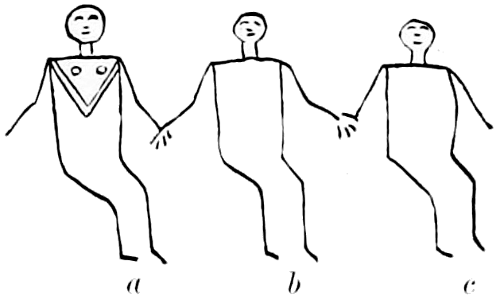
Fig. 935.—Prisoners. Dakota.
Fig. 935 is taken from Mrs. Eastman (d), and shows a Dakota method of recording the taking of prisoners. a and c are the prisoners, a being a female as denoted by the presence of mammæ, and c a male; b is the person making the capture. It is to be noted that the prisoners are without hands, to signify their helplessness.
In Doc. Hist. New York (c) is the following description of Fig. 936:
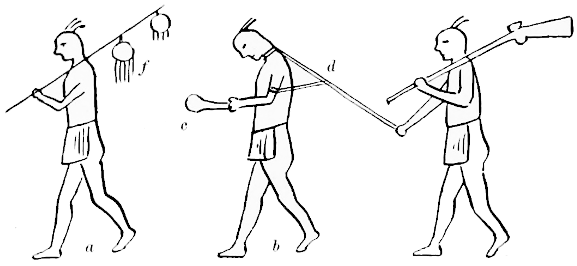
Fig. 936.—Prisoners. Iroquois.
On their return, the Iroquois, if they have prisoners or scalps, paint the animal of the tribe to which they belong rampant (debout), with a staff on the shoulder along which are strung the scalps they may have and in the same number. After the animal are the prisoners they have made, with a chichicois (or gourd filled with beans which rattle) in the right hand. If they be women, they represent them with a cadenette or queue and a waistcloth.
a. This is a person returning from war who has taken a prisoner, killed a man and woman, whose scalps hang from the end of a stick that he carries. b. The prisoner. c. Chichicois (or a gourd), which he holds in the hand. d. These are cords attached to his neck, arms, and girdle. e. This is the scalp of a man; what is joined on one side is the scalp-lock. f. This is the scalp of a woman; they paint it with the hair thin.
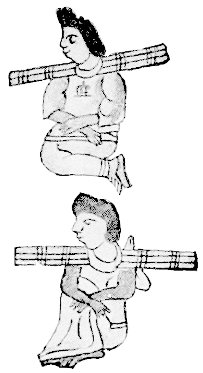
Fig. 937.—Prisoners. Mexico.
The expression prisoner and slave are often convertible. The following from Kingsborough (f), explaining this illustration reproduced as Fig. 937, refers in terms to slavery. “The figures are those of the wife and son of a cacique who rebelled against Montezuma, and who, having been conquered, was strangled. The ‘collars’ upon their necks show that they have been reduced to slavery.”
SHORT.
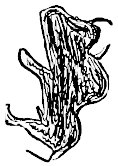
Fig. 938.—Short-Bull.
Fig. 938.—Short-Bull. Red-Cloud’s Census, No. 16. The buffalo is markedly short even to distortion.
SIGHT.
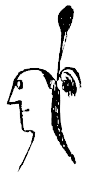
Fig. 939.—Sees-the-Enemy.
Fig. 939.—Sees-the-Enemy. Red-Cloud’s Census. In this collection the eye is not indicated except where that organ is directly connected with the significance of the name. Here its mere presence suggests that vision is the subject matter. But, in addition, the object above the head is probably a hand mirror, which by its reflection is supposed to “see” the objects reflected. The plains Indians make use of such mirrors not only in their face painting but in flash signaling.
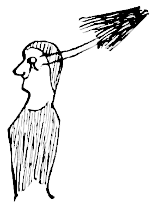
Fig. 940.—Crier.
Fig. 940.—In a fight with the Mandans, Crier was shot in the head with a gun. Cloud-Shield’s Winter Count, 1827-’28. This figure is introduced to present another rare instance in which the eye is delineated. Here the act is that of weeping.

Fig. 941.—Comes-in-Sight.
Fig. 941.—Comes-in-Sight. Red-Cloud’s Census, No. 235. Distant objects, probably buffalo or other animals of the chase, are observed coming into the line of vision.
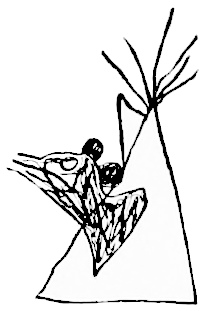
Fig. 942.—Bear-comes-out.
Fig. 942.—Bear-comes-out. Red-Cloud’s Census. Here the bear is supposed to come into sight through a hole in the tipi.
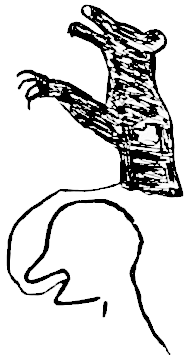
Fig. 943.—Bear-comes-out.
Fig. 943.—Bear-comes-out. Red-Cloud’s Census. This figure is explained by the one preceding. Only half of the bear—the fore part—is to be seen as if emerging through some orifice. Heads and other parts of animals are frequently portrayed as signifying the whole, by synechdoche, but in this case the presentation of the head and forequarters has special significance.
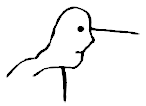
Fig. 944.
Fig. 944.—Taken from Copway, p. 136, is the character which is employed to represent “see.”
SLOW.
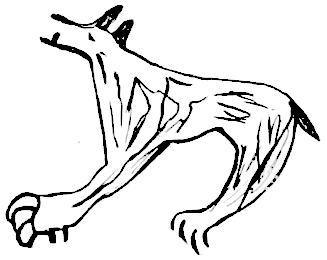
Fig. 945.—Slow-Bear.
Fig. 945.—Slow-Bear. Red-Cloud’s Census. In this figure the bear seems to be in backing or retrograde motion, which is slower than any normal advance, and is therefore ideographically suggestive of slowness.
TALL.
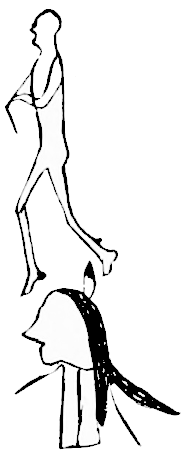
Fig. 946.—Tall-Man.
Fig. 946.—Tall-Man. Red-Cloud’s Census. This and the five following animal figures show length and individual height objectively.
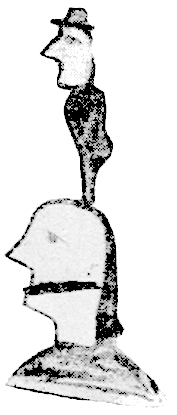
Fig. 947.—Tall-White-Man.
Fig. 947.—Wasicun-wankatuya, Tall-White-Man. The Oglala Roster. The hat shows the man of European origin, but his figure is large in the face and short in the legs; so not tall in a usual sense. He was probably killed by the Oglala.
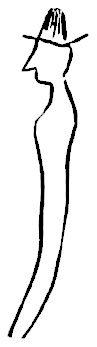
Fig. 948.—Tall-White-Man.
Fig. 948.—Tall-White-Man. Red-Cloud’s Census. This expresses the height much more graphically than the one preceding.
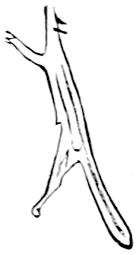
Fig. 949.—Long-Panther.
Fig. 949.—Long-Panther. Red-Cloud’s Census.
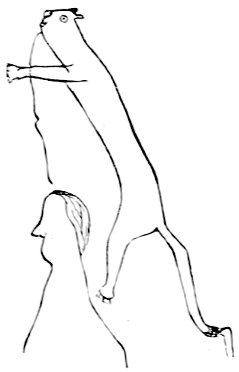
Fig. 950.—Tall-Panther.
Fig. 950.—Tall-Panther. Red-Cloud’s Census.
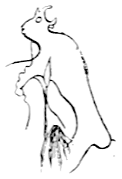
Fig. 951.—Tall-Bull.
Fig. 951.—Tall-Bull was killed by white soldiers and Pawnees on the south side of the South Platte river. American-Horse’s Winter Count, 1869-’70. The combined arrangement of the human head and the buffalo so as to produce the effect of abnormal height in the latter is ingenious. The plan of this chart did not allow of long lines above the head, so the effect is attained by comparison of the standing buffalo with the height of the man.
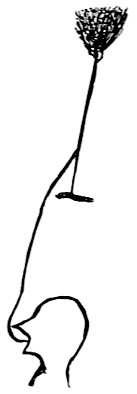
Fig. 952.—Tall-Pine.
Fig. 952.—Tall-Pine. Red-Cloud’s Census. In this as in the two next figures the length of the trunk of the tree is apparent.
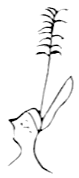
Fig. 953.—Long-Pine.
Fig. 953.—Long-Pine was killed in a fight with the Crows. American-Horse’s Winter Count, 1879-’80. The absence of his scalp denotes that he was killed by an enemy. The fatal wound was made with the bow and arrow.
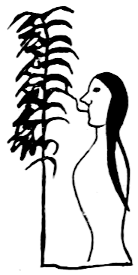
Fig. 954.—Long-Pine.
Fig. 954.—Long-Pine, a Dakota, was killed by Dakotas, perhaps accidentally or perhaps in a personal quarrel. Cloud-Shield’s Winter Count, 1846-’47. He was not killed by a tribal enemy, as he has not lost his scalp.
TRADE.
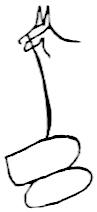
Fig. 955.—Trade.
Fig. 955.—They were compelled to sell many mules and horses to enable them to procure food, as they were in a starving condition. They willingly gave a mule for a sack of flour. American-Horse’s Winter Count, 1868-’69. The mule’s halter is connected with two sacks of flour.
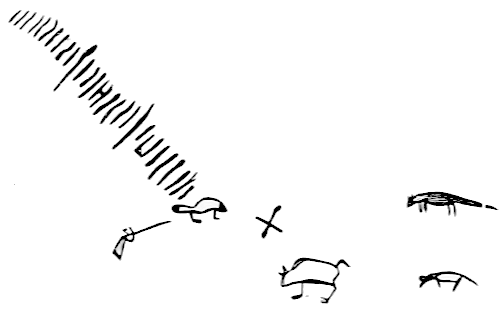
Fig. 956.—Trade.
Fig. 956 is taken from Prince Maximilian, of Wied’s (h) Travels. The cross signifies, I will barter or trade. Three animals are drawn on the right hand of the cross; one is a buffalo (probably albino); the two others, a weasel (Mustela Canadensis) and an otter. The pictographer offers in exchange for the skins of these animals the articles which he has drawn on the left side of the cross. He has there, in the first place, depicted a beaver very plainly, behind which there is a gun; to the left of the beaver are thirty strokes, each ten separated by a longer line; this means: I will give thirty beaver skins and a gun for the skins of the three animals on the right hand of the cross.
The ideographic character of the design consists in the use of the cross—being a drawing of the gesture-sign for “trade”—the arms being interchanged in position. Of the two things each one is put in the place before occupied by the other thing, the idea of exchange.
UNION.
The Dakotas often express this concept by uniting two or more figures by a distinct inclusive line below the figures. This sometimes means family relationship and sometimes common membership in the same tribe.
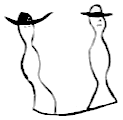
Fig. 957.—Brothers.
Fig. 957.—Antoine Janis’s two boys were killed by John Richard. Cloud-Shield’s Winter Count, 1872-’73. The line of union shows them to be intimately connected; in fact, they were brothers.
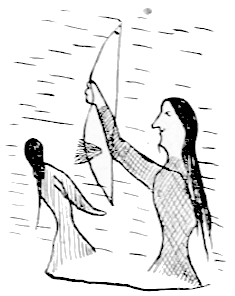
Fig. 958.—Same tribe.
Fig. 958.—The Oglalas got drunk at Chug creek and engaged in a quarrel among themselves, in which Red-Cloud’s brother was killed and Red-Cloud killed three men. Cloud-Shield’s Winter Count, 1841-’42. The union line shows that the quarrel was in the tribe.
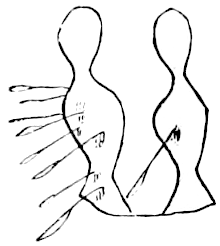
Fig. 959.—Man and wife.
Fig. 959.—Torn-Belly and his wife were killed by some of their own people in a quarrel. Cloud-Shield’s Winter Count, 1855-’56. Here the man and wife are united by the inclusive line.

Fig. 960.—Same tribe.
Fig. 960.—Eight Minneconjou Dakotas were killed by Crow Indians at the mouth of Powder river. The-Swan’s Winter Count, 1805-’06. This device is very frequently used to denote the death of the Dakotas. The black strokes indicate the death of persons of the number delineated and the union line shows that they were of the same tribe.
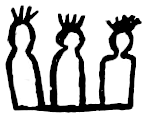
Fig. 961.—Same tribe.
Fig. 961.—Blackfeet Dakotas kill three Rees. The-Flame’s Winter Count for 1798-’99. Here the uniting line of death refers to others than Dakotas, which does not often appear, but the principle is maintained that the dead are of the same tribe.
WHIRLWIND.
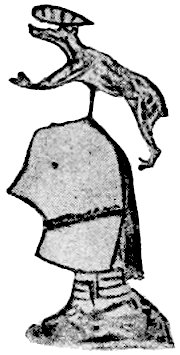
Fig. 962.—Bear-Whirlwind.
Fig. 962.—Mato-wamniyomni, Bear-Whirlwind. The Oglala Roster. This figure shows over the bear’s head a variant of the character given in Red-Cloud’s Census, Fig. 963. The figure appears, according to the explanation given by several Oglala Dakota Indians, to signify the course of a whirlwind with the transverse lines in imitation of the circular movement of the air, conveying dirt and leaves, observed during such aerial disturbances.
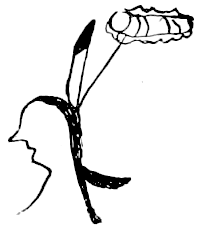
Fig. 963.—White-Whirlwind.
Fig. 963.—Represents White-Whirlwind, above referred to, from Red-Cloud’s Census. In this the designating character is more distinct.
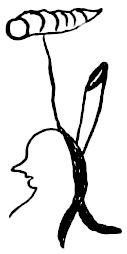
Fig. 964.—Leafing.
Fig. 964.—Leafing. Red-Cloud’s Census. This seems to be of the same description. It is said to be drawn in imitation of a number of fallen leaves packed against one another and whirled along the ground. It also has reference to the season when leaves fall—autumn.
Mr. Keam’s MS. describing Fig. 965, says:
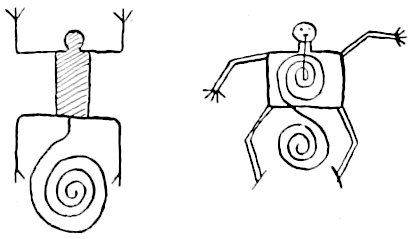
Fig. 965.—Whirlwind.
It is a decoration of great frequency and consisting of the single and double spirals. The single spiral is the symbol of Ho-bo-bo, the twister, who manifests his power by the whirlwind. It is also of frequent occurrence as a rock etching in the vicinity of ruins, where also the symbol of the Ho-bo-bo is seen. But the figure does not appear upon any of the pottery. The myth explains that a stranger came among the people, when a great whirlwind blew all the vegetation from the surface of the earth and all the water from its courses. With a flint he caught these symbols upon a rock, the etching of which is now in Keam’s Cañon, Arizona Territory. It is 17 inches long and 8 inches across. He told them that he was the keeper of breath. The whirlwind and the air which men breathe comes from this keeper’s mouth.

Fig. 966.—Whirlwind.
Fig. 966 is a copy of part of the decoration on a pot taken from a mound in Missouri, published in Second Annual Report of the Bureau Ethnology, Pl. LIII, fig. 11. On the authority of Rev. S. D. Hinman, it is the conventional device among the Dakotas to represent a whirlwind.
WINTER—COLD—SNOW.
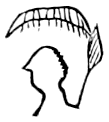
Fig 967.—Froze to death.
Fig. 967.—Glue, an Oglala, froze to death on his way to a Brulé village. American-Horse’s Winter Count, 1791-’92. A glue-stick is represented back of his head. Glue, made from the hoofs of buffalo, is used to fasten arrowheads to the shaft and is carried about on sticks. The cloud from which hail or snow is falling represents winter.
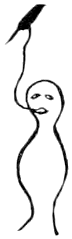
Fig. 968.—Froze to death.
Fig. 968.—A Dakota, named Glue, froze to death. Cloud-Shield’s Winter Count, 1820-’21. This figure is introduced to corroborate of the preceding one as regards the name Glue. It gives another representation of the glue stick.
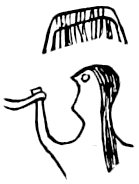
Fig. 969.—Crows froze.
Fig. 969.—A Dakota named Stabber froze to death. American-Horse’s Winter Count, 1782-’83. The sign for winter is the same as before, but doubled, as if of twofold power or excessively severe.
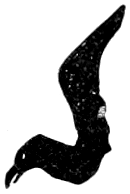
Fig. 970.—Froze to death.
Fig. 970.—The winter was so cold that many crows froze to death. Cloud-Shield’s Winter Count, 1788-’89. White-Cow-Killer says “Many-black-crows-died winter.”
The Crow falling stiff and motionless is a good symbol for the effect of excessive cold.
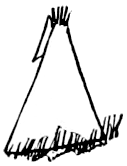
Fig. 971.
Fig. 971.—The snow was very deep. American-Horse’s Winter Count, 1827-’28. The piled-up snow around the bottoms of the tipis is graphic; no other material than snow could make that kind of surrounding heap.
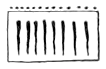
Fig. 972.—Cold, snow.
Fig. 972.—From Copway, page 135, is the representation of “cold,” “snow.”
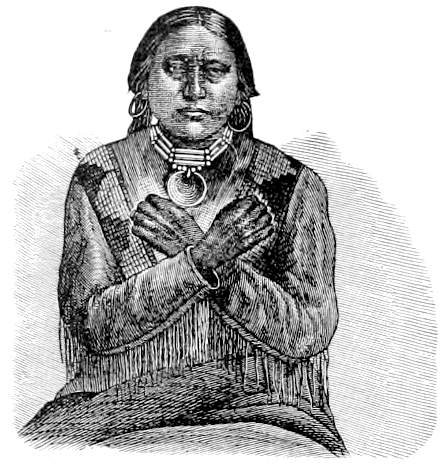
Fig. 973.
The Shoshoni and Banak sign for cold, winter, is: Clinch both hands and cross the forearms before the breast with a trembling motion. It is represented in Fig. 973. Cf. Battiste Good’s Winter count for 1747-’48 and 1783-’84.
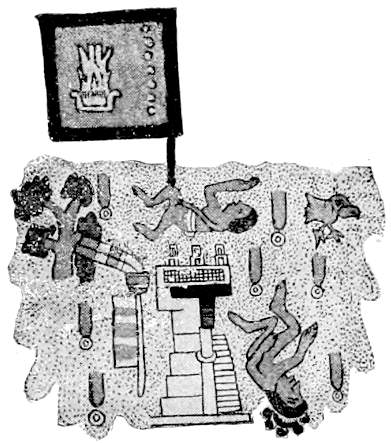
Fig. 974.
In Kingsborough (g) is the painting reproduced in Fig. 974 with this description: “In the year of seven Canes and 1447 according to our calculation, it snowed so heavily that lives were lost.”
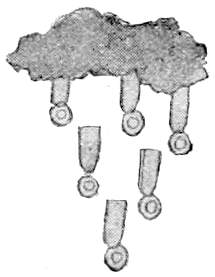
Fig. 975.
In the same work and volumes, p. 146 and Pl. 26, is the original of Fig. 975, with the explanation that: “In this year of seven Flints, or 1512, there were heavy falls of snow.”
Wiener, op. cit., p. 762, gives the following description (condensed) of Fig. 976, a remarkable example of ideography:
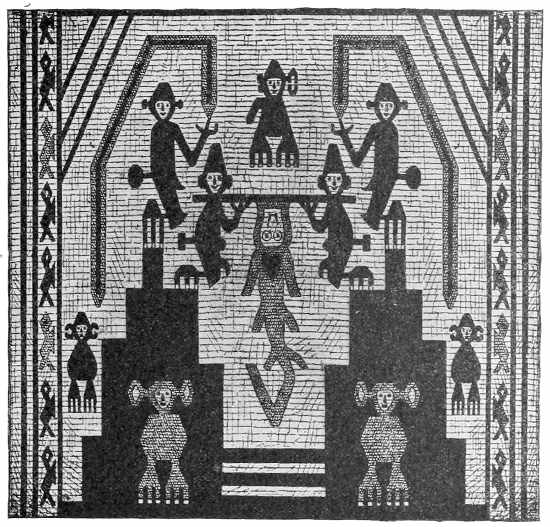
Fig. 976.—Peruvian garrison.
This is on a cloth on which the eight fortresses of Paramonga were presented. Between these bridges are drawn; these forts are of three stages and on each stage is a representation of a man or of two men. The men who are down on the plain had clothing of another color and even another colored face from those who appear on the different stages. Those who are on the plain at the foot of the fortress have no arms, but they have highly developed ears. The same is true of those who appear on the first stage. Those of the following stage are provided with arms, and the ears are of normal size. On the highest platform appear individuals with arms and they have ears like those on the second stage. In the middle a figure is provided with one arm and only one developed ear, which are on opposite sides. The men without arms are also without weapons. Those of the second stage carry at the height of the belt a kind of hatchet and those of the upper platform have each a club.
Considering the character of the locality where this cloth was found, the number of forts there, the marshy land which prevented dry-shod communication between them, it can not be doubted that the subject matter was the representation of that region, but this representation is not a drawing on a plan, but is a description which does not only treat of the nature of the place and of the work that man raised there, but it also indicates the rôle that the inhabitants played there.
The function of the men with exaggerated ears and no arms was that of scouts. The armed men with normal ears were guards or warriors bearing different weapons, ax and club, and differently uniformed. The highest figure with one large ear was the chief of the garrison.
It will be noticed that the scouts have enormous feet which do not rest on the ground. This in connection with their exaggerated ears implies that their duty is to listen and when they hear the enemy not to engage him, as they have no arms or weapons, but to fly to the headquarters and make the report. The duty of the warriors is not to listen, so their ears are not abnormal, but to fight, and therefore they have arms, one of which is exposed and the other holds a weapon. Their feet are attached to their several stations. The chief must both listen and direct, wherefore he is drawn with one exaggerated ear and one arm. His feet do not touch the platform, which signifies that he has no special station, but must move wherever he is most needed.
SECTION 2. SIGNS, SYMBOLS, AND EMBLEMS.
The terms sign, symbol, and emblem are often used interchangeably and therefore incorrectly. Many persons ascribe an occult and mystic signification to symbols, probably from their general religious and esoteric employment. All characters in Indian picture-writing have been loosely styled symbols, and, as there is no logical distinction between the characters impressed with enduring form and when merely outlined in the ambient air, all Indian gestures, motions, and attitudes, intended to be significant, might with equal appropriateness be called symbolic. But an Indian sign-talker or a deaf-mute represents a person by mimicry, and an object by the outline of some striking part of its form, or by the pantomime of some peculiarity in its actions or relations. Their attempt is to bring to mind the person or thing through its characteristics, not to distinguish the characteristics themselves, which is a second step. In the same manner a simple pictorial sign attempts to express an object, idea, or fact without any approach to symbolism. Symbols are less obvious and more artificial than mere signs, are not only abstract, but metaphysical, and often need explanation from history, religion, and customs. They do not depict, but suggest subjects; do not speak directly through the eye to the intelligence, but presuppose in the mind knowledge of an event or fact which the sign recalls. The symbols of the ark, dove, olive branch, and rainbow would be wholly meaningless to people unfamiliar with the Mosaic or some similar cosmology, as would the cross and the crescent be to those ignorant of history.
The loose classification by which symbols would include every gesture or pictorial sign that naturally or conventionally recalls a corresponding idea, only recognizes the fact that every action and object can, under some circumstances, become a symbol. And indeed lovers of the symbolic live in, on, and by the symbols which they manufacture.
A curious instance of the successful manufacture of a symbol by the ingenuity of one man is in the one now commonly pictured of a fish to represent Christ. The fish for obvious reasons has been connected with Eurasian mythology, and therefore was a heathen symbol many centuries before the Christian era; indeed, probably before the creed of the Israelites had become formulated. It was used metaphorically or emblematically by the early Christians without the apparent propriety of the lamb-bearing shepherd, the dove, and other emblems or symbols found in the catacombs, and Didron (b) says that only in the middle of the fourth century Optatus, bishop of Milesia, in Africa, declared the significance of the letters of the Greek word for fish, ΙΧΘΥΣ, to be the initials of Ἰησοῦς Χριστὸς Θεοῦ Ὑιος Σωτηρ, which acrostic was received with acclamation, and new characteristics were from time to time invented, adding force to the thenceforth commonly displayed symbol. It may be noted that when symbols, which were generally religious, received acceptance, they were soon used objectively as amulets or talismans.
This chapter is not intended to be a treatise on symbolism, but it is proper to mention the distinction in the writer’s mind between a pictorial sign, an emblem, and a symbol; though it is not easy to preserve accurate discrimination in classification of ideographic characters. To partly express the distinction, nearly all of the characters in the Winter Counts in this work are regarded as pictorial signs, and the class represented by tribal and clan designations, insignia, etc., is considered to belong to the category of emblems. There is no doubt, however, that true symbols exist among the Indians, as they must exist to some extent among all peoples not devoid of poetic imagination. Some of them are shown in this work. The pipe is generally a symbol of peace, although in certain positions and connections it signifies preparation for war, and, again, subsequent victory. The hatchet is a common symbol for war, and joined hands or approaching palms denote peace. The tortoise has been clearly used as a symbol for land, and many other examples can be admitted. Apart from the exaggerations of Schoolcraft, true symbolism is found among the Ojibwa, of which illustrations are presented. The accounts of the Zuñi, Moki, and Navajo, before mentioned, show the constant employment of symbolic devices by those tribes which are notably devoted to mystic ceremonies. Nevertheless the writer’s personal experience is that when he has at first supposed a character to be a genuine symbol, better means of understanding has often proved it to be not even an ideograph, but a mere objective representation. In this connection the remarks on the circle, in Lone-Dog’s Winter Count for 1811-’12, and those on the cross infra, may be in point.
The connection, to the unlettered Indian, between printed words, pictures, and signs, was well illustrated through the spontaneous copial, by a Cheyenne, of the ornate labels on packages of sugar and coffee, which he had seen at a reservation, and the lines of which he rather skillfully and very ingeniously repeated on a piece of paper when sending to a post-trader to purchase more of the articles. The printed label was to him the pictorial sign for those articles.
The following remarks are quoted from D’Alviella (a):
There is a symbolism so natural, that, like certain implements peculiar to the stone age, it does not belong to any particular race, but constitutes a characteristic trait of mankind at a certain phase of its development. Of this class are representations of the sun by a disk or radiating face, of the moon by a crescent, of the air by birds, of water by fishes or a broken line, of thunder by an arrow or a club, etc. We ought, perhaps, to add a few more complicated analogies, as those which lead to symbolizing the different phases of human life by the growth of a tree, the generative forces of nature by phallic emblems, the divine triads by an equilateral triangle, or in general by any triple combination the members of which are equal, and the four principal directions of space by a cross. How many theories have been built upon the presence of the cross as an object of veneration among nearly all the peoples of the Old and New Worlds? Roman Catholic writers have justly protested, in recent years, against attributing a pagan origin to the cross of the Christians, because there were cruciform signs in the symbolism of religions anterior to Christianity. It is also right, by the same reason, to refuse to accept the attempts to seek for infiltrations of Christianity in foreign religions because they also possess the sign of redemption. * * * Nearly all peoples have represented the fire from the sky by an arm and, sometimes also, by a bird of strong and rapid flight. It was symbolized among the Chaldeans by a trident. Cylinders going back to the most ancient ages of Chaldean art exhibit a water jet gushing from a trident which is held by the god of the sky or of the storm. The Assyrian artist who first, on the bas-reliefs of Nimroud or Malthai, doubled the trident or transformed it into a trifid fascicle, docile to the refinements and elegancies of classic art, by that means secured for the ancient Mesopotamian symbol the advantage over all the other representations of thunder with which it could compete. The Greeks, like the other Indo-European nations, seem to have represented the storm-fire under the features of a bird of prey. When they received the Asiatic figure of the thunderbolt, they put it in the eagle’s claws and made of it the scepter of Zeus, explaining the combination, after their habit, by the story of the eagles bringing thunder to Zeus when he was preparing for the war against the Titans. Latin Italy transmitted the thunderbolt to Gaul, where, in the last centuries of paganism, it alternated on the Gallo-Roman monuments with the two-headed hammer.
The emblem writers, so designated, have furnished an immense body of literature, and apparently have considered such pictures as those of the Winter Counts in the present work and also all symbols to be included in their proper scope. The best summary on the subject is by Henry Greene (a), from which the following condensed extract is taken:
Of the changes through which a word may pass the word emblem presents one of the most remarkable instances. Its present signification, type, or allusive representation is of comparatively modern use, while its original meaning is obsolete. Among the Greeks an emblem meant something thrown in or inserted after the fashion of what we now call marquetry and mosaic work, or in the form of a detached ornament to be affixed to a pillar, a tablet, or a vase, and put off or on as there might be occasion.
Quintilian (lib. 2, cap. 4), in enumerating the arts of oratory used by the pleaders of his day, describes some of them as in the habit of preparing and committing to memory certain highly finished clauses, to be inserted (as occasion might arise) like emblems in the body of their orations. Such was the meaning of the term in the classical ages of Greece and Rome; nor was its signification altered until some time after the revival of literature in the fifteenth century.
Thus, in their origin, emblems were the figures or ornaments fashioned by the tools of the artists, in metal or wood, independent of the vase, or the column, or the furniture they were intended to adorn; they might be affixed or detached at the promptings of the owner’s fancy. Then they were formed, as in mosaic, by placing side by side little blocks of colored stone, or tiles, or small sections of variegated wood. Raised or carved figures, however produced, came next to be considered as emblems; and afterwards any kind of figured ornament or device, whether carved or engraved or simply traced, on the walls and floors of houses or on vessels of wood, clay, stone, or metal.
By a very easy and natural step figures and ornaments of many kinds, when placed on smooth surfaces, were named emblems; and as these figures and ornaments were very often symbolical, i. e., signs or tokens of a thought, a sentiment, a saying, or an event, the term emblem was applied to any painting, drawing, or print that was representative of an action, of a quality of the mind, or of any peculiarity or attribute of character. Emblems in fact were and are a species of hieroglyphics, in which the figures or pictures, besides denoting the natural objects to which they bear resemblances, were employed to express properties of the mind, virtues and abstract ideas, and all the operations of the soul.
The following remarks of the same author (b) are presented in this connection, though they pass beyond the scope of either symbols or emblems into other divisions of pictography, as classified in the present work:
Coins and medals furnish most valuable examples of emblematical figures; indeed some of the emblem writers, as Sambucus, in 1564, were among the earliest to publish impressions or engravings of ancient Roman money, on which are frequently given very interesting representations of customs and symbolical acts. On Grecian coins we find, to use heraldic language, that the owl is the crest of Athens, a wolf’s head that of Argos, and a tortoise the badge of the Peloponnesus. The whole history of Louis XIV and that of his great adversary, William III, is represented in volumes containing the medals that were struck to commemorate the leading events of their reigns, and, though outrageously untrue to nature and reality by the adoption of Roman costumes and classic symbols, they serve as records of remarkable occurrences.
Heraldry throughout employs the language of emblems; it is the picture-history of families, of tribes, and of nations, of princes and emperors. Many a legend and many a strange fancy may be mixed up with it, and demand almost the credulity of simplest childhood in order to obtain our credence; yet in the literature of chivalry and honors there are enshrined abundant records of the glory that belonged to mighty names.
The custom of taking a device or badge, if not a motto, is traced to the earliest times of history. It is a point not to be doubted that the ancients used to bear crests and ornaments in the helmets and on the shields; for we see this clearly in Virgil, when he made the catalogue of the nations which came in favor of Turnus against the Trojans, in the eighth book of the Æneid; Amphiaraus then (as Pindar says), at the war of Thebes, bore a dragon on his shield. Similarly Statius writes of Capaneus and of Polinices that the one bore the Hydra and the other the Sphynx.
Emblems do not necessarily require any analogy between the objects representing and the objects or qualities represented, but may arise from pure accident. They may bear any meaning that men may choose to attach to them, so their value still more than that of symbols depends upon extrinsic facts and not intrinsic features. After a scurrilous jest the beggar’s wallet became the emblem of the confederated nobles, the Gueux of the Netherlands; and a sling, in the early minority of Louis XIV, was adopted from the refrain of a song by the Frondeur opponents of Mazarin.
The several tribal designations for Sioux, Arapaho, Cheyenne, etc., are their emblems, precisely as the star-spangled flag is that of the United States, but there is no intrinsic symbolism in them. So the designs for individuals, when not merely translations of their names, are emblematic of their family totems or personal distinctions, and are no more symbols than are the distinctive shoulder-straps of an army officer.
The point urged is that while many signs can be used as emblems and both can be converted by convention into symbols or be explained as such by perverted ingenuity, it is futile to seek for that form of psychological exuberance in the stage of development attained by the greater part of the American tribes. All predetermination to interpret their pictographs on the principles of symbolism as understood or pretended to be understood by its admirers, and as are sometimes properly applied not only to Egyptian hieroglyphics, but to Mexican, Maya, and some other southern pictographs, results in mooning mysticism.
The following examples are presented as being either symbols or emblems, according to the definition of those terms, and therefore appropriate to this section. More will be found in Chapter XX, on Special Comparisons, and indeed may appear under different headings; e. g., Battiste Good symbolizes hunting by a buffalo head and arrow, Fig. 321, and war by a special head-dress, Fig. 395.
Sir A. Mackenzie (c) narrates that in 1793 he found among the Athabascans an emblem of a country abounding in animals. This was a small round piece of green wood chewed at one end in the form of a brush, which the Indians use to pick the marrow out of bones.
Mr. Frank H. Cushing, in notes not yet reduced to final shape for publication, gives two excellent examples of symbols among the Zuñi:
(1) The circle or halo around the sun is supposed to be and is called by the Zuñi the House of the Sun-God. This is explained by analogy. A man seeks shelter on the approach of a rainstorm. As the sun circle almost invariably appears only with the coming of a storm, the Sun, like his child, the man, seeks shelter in his house, which the circle has thus come to be.
The influence of this simple inference myth on the folklore of the Zuñi shows itself in the perpetuation, until within recent generations, of the round sun towers and circular estufas so intimately associated with sun worship, yet which were at first but survivals of the round medicine lodge.
(2) The rainbow is a deified animal having the attributes of a human being, yet also the body and some of the functions of a measuring worm. Obviously, the striped back and arched attitude of the measuring worm, its sudden appearance and disappearance among the leaves of the plants which it inhabits, are the analogies on which this personification is based. As the measuring worm consumes the herbage of the plants and causes them to dry up, so the rainbow, which appears only after rains, is supposed to cause a cessation of rains, consequently to be the originator of droughts, under the influence of which latter plants parch and wither away as they do under the ravages of the measuring worms. Here it will be seen that the visible phenomenon called the rainbow gets by analogy the personality of the measuring worm, while from the measuring worm in turn the rainbow gets its functions as a god. Of this the cessation of rain on the appearance of the rainbow is adduced as proof.
The following is reported by Dr. W. H. Dall (e), and explains how the otter protruding his tongue is the emblem of Shaman:
The carvings on the rattles of the Tlinkit are matters belonging particularly to the shaman or medicine man, and characteristic of his profession. Among these very generally, if not invariably, the rattle is composed of the figure of a bird, from which, near the head of the bird or carved upon the back of the bird’s head, is represented a human face with the tongue protruding.
This tongue is bent downward and usually meets the mouth of a frog or an otter, the tongue of either appearing continuous with that of the human face. In case it is a frog it usually appears impaled upon the tongue of a kingfisher, whose head and variegated plumage are represented near the handle in a conventional way. It is asserted that this represents the medicine man absorbing from the frog, which has been brought to him by the kingfisher, either poison or the power of producing evil effects on other people.
In case it is an otter the tongue of the otter touches the tongue of the medicine man, as represented on the carving. * * *
This carving is represented, not only on rattles, but on totem posts, fronts of houses, and other objects associated with the medicine man, the myth being that when the young aspirant for the position of medicine man goes out into the woods after fasting for a considerable period, in order that his to be familiar spirit may seek him, and that he may become possessed of the power to communicate with supernatural beings; if successful he meets with a river otter, which is a supernatural animal. The otter approaches him and he seizes it, kills it with the blow of a club, and takes out the tongue, after which he is able to understand the language of all inanimate objects, of birds, animals, and other living creatures. * * *
This ceremony or occurrence happens to every real medicine man. Consequently the otter presenting his tongue is the most universal type of the profession as such, and is sure to be found somewhere in the paraphernalia of every individual of that profession.
With this account from the Pacific coast a similar determination of emblems by the Indians in the northeastern parts of the United States may be compared. The objects seen by them in their fasting visions not only were decisive of their names but were held to show the course of their lives. If a youth saw an eagle or bear he was destined to be a warrior; if a deer he would be a man of peace; and a turkey buzzard or serpent was the sign that he would be a medicine man. The figures of those animals therefore were respectively the emblems of the qualities and dispositions implied. See Fig. 159, supra, for a drawing of the Sci-Manzi or “Mescal Woman” of the Kaiowa as it appears on a sacred gourd rattle used in the mescal ceremony of that tribe, with description.
In Kingsborough (h) is the record that “in the year of Ten Houses, or 1489, a very large comet, which they name Xihuitli, appeared.”
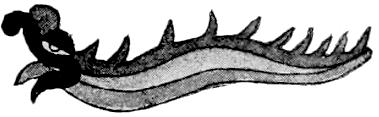
Fig. 977.—Comet. Mexican.
The comet is represented in the plate by the symbol of a caterpillar, in allusion, perhaps, to its supposed influence in causing blights. This may be compared with the measuring worm, symbol of the rainbow, supra. The character is reproduced in Fig. 977.
In the same work and Codex, Pls. 10, 12, and 33, are three characters, somewhat differing, representing earthquakes, which, according to the text in Vol. VI, p. 137, et seq., occurred in Mexico in the years A. D. 1461, 1467, and 1542. The concept appears to be that of the disruption and change of the position of the several strata of soil, which are indicated by the diverse coloration. These characters are reproduced in the present work in Pl. XLIX as the three on the right hand in the lower line.
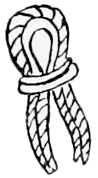
Fig. 978.—Robbery. Mexican.
Fig. 978 is from the same work (i), Codex Mendoza, and is the symbol for robbery, in allusion to the punishment of the convicted robber.
In the same work (k), Codex Vaticanus, is the following description, in quaint language, of the plate now reproduced in Pl. XLIX:
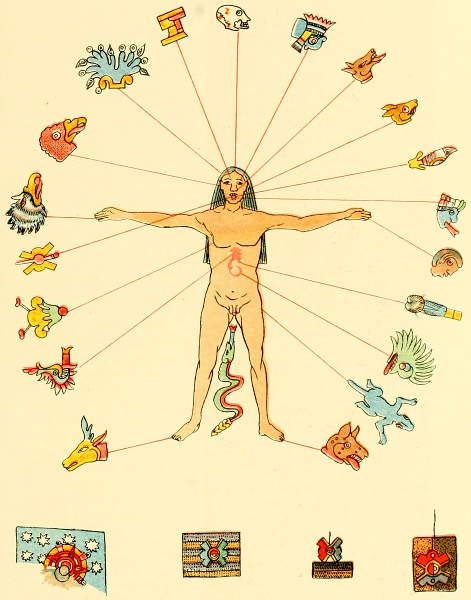
BUREAU OF ETHNOLOGY TENTH ANNUAL REPORT PL. XLIX MEXICAN SYMBOLS.
These are the twenty letters or figures which they employed in all their calculations, which they supposed ruled over men, as the figure shows, and they cured in a corresponding manner those who became ill or suffered pains in any part of the body. The sign of the wind was assigned to the liver; the rose to the breast; the earthquake to the tongue; the eagle to the right arm; the vulture to the right ear; the rabbit to the left ear; the flint to the teeth; the air to the breath; the monkey to the left arm; the cane to the heart; the herb, to the bowels; the lizard to the womb of women; the tiger to the left foot; the serpent to the male organ of generation, as that from which their diseases proceeded in their commencement; for in this manner they considered the serpent, wherever it occurred, as the most ominous of all their signs. Even still physicians continue to use this figure when they perform cures, and, according to the sign and hour in which the patient became ill, they examined whether the disease corresponded with the ruling sign; from which it is plain that this nation is not as brutal as some persons pretend, since they observed so much method and order in their affairs and employed the same means as our astrologers and physicians use, as this figure still obtains amongst them and may be found in their repertoires.
a, deer or stag; b, wind; c, rose; d, earthquake; e, eagle; f, eagle of a different species; g, water; h, house; i, skull or death; j, rain; k, dog; l, rabbit; m, flint; n, air; o, monkey; p, cane; q, grass or herb; r, lizard; s, tiger; t, serpent.
Dr. S. Habel (d) gives the description concerning Fig. 979, which is presented here on account of the several symbols and gestures exhibited:
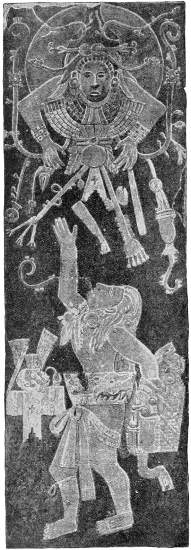
Fig. 979.—Guatemalan symbols.
This is a block of dark gray porphyry (vulcanite) 12 feet long, 3 feet broad and 2 feet thick, the upper left corner of which is slightly broken off. The sculpture occupies 9 feet of its upper part. The upper portion represents the head and breast of a female, surrounded by a circle, from which the arms project. Besides the stereotyped frill surrounding the forehead, the only ornament of the head consists of two entwined rattlesnakes. The hair is of medium length and descends in tresses to the shoulders and breast. The ear is ornamented with circular disks inclosing smaller ones. Around the neck is a broad necklace of irregularly-shaped stones of extraordinary size. Below the necklace the breast is covered with a kind of scarf or textile fabric, the upper ends of which are fastened by buttons. To the center of this scarf seems to be attached a globe, the upper part of which is adorned by a knotted band from which four others ascend. From the lower part of the globe descends another band, with incisions characteristic of Mexican sculpture, while its sides are adorned by wreaths like wings. The wrists of both hands are covered with strings of large stones perforated in the center. From the semicircular bands emanate two of the twining staves; to the staves are attached knots, leaves, flowers, and various other emblems of a mythical character. The most conspicuous of these is the representation of a human face in a circle resembling the ordinary pictures of the full moon. The two central staves, originating from the neck, pass downward, and are differently ornamented. The fact that the head and part of the breast are surrounded by a circle, and that the image of the moon forms one of its ornaments, induces us to believe that this is the figure of the moon goddess. In the lower part of the sculpture appears, again, an individual imploring the deity with face upturned and elevated hand. The supplication is indicated by a curved staff knotted on the sides. Excepting a circular disk attached to the hair, the head is without ornament; the long hair hangs down to the breast and back, ending in a complicated ornament extending below the knees. In the lobe of the ear is a small ring from which a larger one depends. The breast is adorned with a globe similar to that on the breast of the goddess, only it is smaller. Around the wrist of the right hand is a plain cuff, while the left hand is covered by a skull; a stiff girdle, with a boar’s head ornamenting its back part, surrounds the waist. This girdle differs from the previous ones by being ornamented with circular depressions. From the front of the girdle descend two twisted cords surrounding the thigh, and a band tied in bow and ends. Below the right knee is a kind of garter with a pear-shaped pendant. The left foot, with the exception of the toes, is inclosed in a sort of shoe.
In front of the adorer is a small altar, the cover of which has incisions similar to those in the pendant of the globe on the breast of the deity. On the altar is a human head, from the mouth of which issues a curved staff, while other staves in the shape of arrows appear on the side of the head.
Fig. 980 is reproduced by permission from Lieut. H. R. Lemly (a), U. S. Army, who calls it a “stone calendar.” It is the work of the Chibcha Indians of the United States of Colombia, and its several parts, some of which are to be compared with similar designs in other regions, are explained as follows:
a, Ata, a small frog in the act of leaping. This animal was the base of the system, and in this attitude denoted the abundance of water. b, Bosa, a rectangular figure with various divisions, imitating cultivated fields. c, Mica, a bicephalous figure, with the eyes distended, as if to examine minutely. It signified the selection and planting of seed. d, Muihica, similar to the preceding, but with the eyes almost closed. It represented the dark and tempestuous epoch in which, favored by the rain, the seed began to sprout. e, Hisca, resembling c and d of the stone, but larger, with no division between the heads. It was the symbol of the conjunction of the sun and moon, which the Chibchas considered the nuptials or actual union of these celestial spouses—one of the cardinal dogmas of their creed. f, Ta, almost identical with b. It represented the harvest month. g, Cuhupcua, an earless human head upon one of the lateral faces of the stone. It was the symbol of the useless or so-called deaf month of the Chibchan year. h, Suhuza, perhaps a tadpole, and probably referred to the generation of these animals. i, Aca, a figure of a frog, larger than a, but in a similar posture. It announced the approach of the rainy season. j, Ulchihica, two united rhomboids—a fruit or seed, and perhaps an ear. It referred to their invitations and feasts. k, Guesa, a human figure in an humble attitude, the hands folded, and a halo about the head. It is supposed to represent the unfortunate youth selected as the victim of the sacrifice made every twenty Chibchan years to the god of the harvest.
The characters b and f below, markedly resemble one given by Pipart (a), with the same signification. It referred to the preparation of the ground for sowing.
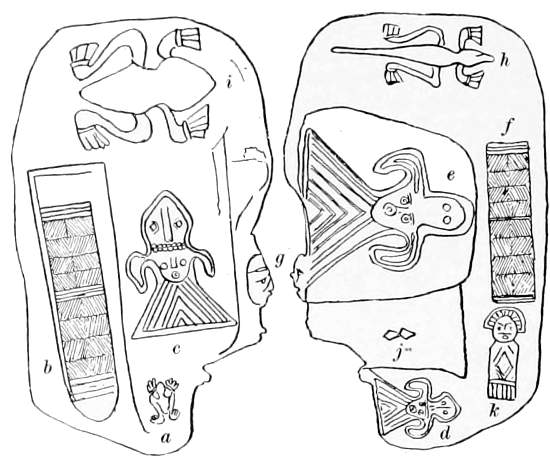
Fig. 980.—Chibcha symbols.
Wiener (f) gives the following summary of prominent Peruvian symbols:
In the conventional system of the Peruvians a bird indicates velocity, a lion strength, the lion and the bird united in one figure strength and velocity together, and, deductively, power. The meander indicates fertility and the pyramid with degrees or steps indicates defense. A bird combined with the meander indicates rapid production. A rectangular oblong figure (the mouth) indicates speech and discourse. A circle with a depression almost in the form of a heart means a female child, a circle with a small blade or stalk a male child. The circle with two stalks is the symbol of a man—the worker. The circle with four stalks means a married couple, marriage, etc.
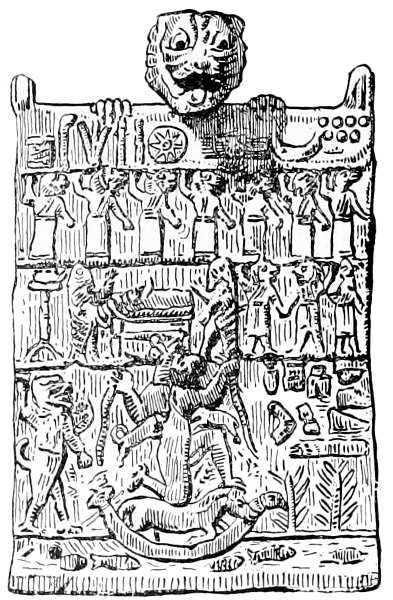
Fig. 981.—Syrian symbols.
Fig. 981 is presented to show another collection of engraved symbols, some of which with different execution resemble some found in North America. It is a bronze tablet found in Syria in the collection of M. Péretié, and is described by Maj. Claude R. Conder, R. F. (a):
It measures 4½ inches in height by 3¼ in width. The design is supposed to represent the fate of the soul according to Assyrian or Phenician belief. The tablet is divided into four compartments horizontally, the lowest being the largest and highest the most narrow. In the top compartment various astronomical symbols occur, many of which, as M. Canneau points out, occur on other Assyrian monuments. On the extreme right are the seven stars, next to these the crescent, next the winged solar disk, then an eight-rayed star in a circle. The remaining symbols are less easily explained, but the last is called by M. Canneau a “cidaris” or Persian tiara, while another appears to approach most nearly to the Trisul, or symbol of “fire,” the emblem of the Indian Siva.
Below these symbols stand seven deities facing to the right, with long robes, and the heads of various animals. The first to the left resembles a lion, the second a wolf or hound, the fourth a ram, the sixth a bird, the seventh a serpent, while the third and fifth are less easily recognized. In the third compartment a body lies on a bier, with a deity at the head, and another at the feet. These deities have the right hand held up, and the left down (a common feature of Indian symbolism also observable in the attitude of the Mâlawiyeh dervishes), and the figure to the left appears to hold a branch or three ears of corn. Both are robed in the peculiar fish-headed costume, with a scaly body and fish tail, which is supposed to be symbolical of the mythical Oannes, who according to Berosus, issued from the Persian gulf and taught laws and arts to the early dwellers on the Euphrates. Behind the left-hand fish-god is a tripod stand, on which is an indefinite object; to the right of the other fish-god are two lion-headed human figures with eagles’ claws, apparently contending with one another, the right arms being raised, the left holding hand by hand. To the right of these is another figure of Assyrian type, with a domed headdress and beard.
In the lowest compartment the infernal river fringed with rushes, and full of fish, is represented. A fearful lion-headed goddess with eagles’ claws kneels on one knee on a horse (the emblem of death) which is carried in a kneeling attitude on a boat with bird-headed prow. The goddess crushes a serpent in either hand, and two lion cubs are represented sucking her breasts. To the left is a demon bearing a close resemblance to the one which supports the tablet itself, and which appears to urge on the boat from the bank; to the right are various objects, mostly of an indefinite character, among which M. Ganneau recognizes a vase, and a bottle, a horse’s leg with hoof, etc.; possibly offerings to appease the infernal deities. The lion-headed goddess might well be taken for the terrible infernal deity Kali or Durga, the worship of whose consort, Yama, was the original source of that of the later Serapis, whose dog was the ancestor of Cerberus. There is also a general resemblance between this design and the well-known Egyptian picture representing the wicked soul conveyed to hell in the form of a pig.
The Oannes figures take the place of the two goddesses who in Egyptian designs stand at either end of the mummy and who form the prototype of the two angels for whom the pious Moslem provides seats at the head and foot of his tombstone. Perhaps the miserable horse who stumbles under the weight of the gigantic lion goddess may represent the unhappy soul itself, while the three ears of corn remind us of the grains of corn which have been found in skulls dug up in Syria by Capt. Burton. Corn is intimately connected with Dagon, the Syrian fish-god.
As a tentative suggestion I may, perhaps, be allowed to propose that the seven deities in the second compartment are the planets, and that the symbols above belong to them as follows, commencing on the right:
Planet. Assyrian name. Head of deity. Symbol.
1. Saturn Chiun Serpent Seven stars.
2. Moon Nannar Bird Crescent.
3. Sun Shamash Boar (?) Winged Disc.
4. Mars Marduk Ram Rayed disc.
5. Mercury Nebo (?) Two columns.
6. Venus Ishtar Wolf (?) Trisul.
7. Jupiter Ishn Lion Cidaris (?).
The serpent is often the emblem of Saturn, who, as the eldest of the seven (“the great serpent father of the gods”), naturally comes first and therefore on the right, and has seven stars for his symbol.
The moon, according to Lenormant, was always an older divinity than the sun.
The boar is often an emblem of the sun in its strength.
The disc (litu) was the weapon employed by Marduk, the warrior god, as mentioned by Lenormant.
The two pillars of Hermes are the proper emblem of the ancient Set or Thoth, the planet Mercury.
The trisul belongs properly to the Asherah, god or goddess of fertility—the planet Venus.
The Cidaris occurs in the Bavian sculptures in connection with a similar emblem. In the Chaldean system, Jupiter and Venus occur together as the youngest of the planets.
It should also be noted that the position of the arms and the long robe covering the feet resemble the attitudes and dress of the Mâlawîyeh dervishes in their sacred dance, symbolic of the seven planets revolving (according to the Ptolemaic system) round the earth.
Didron (c) thus remarks upon the emblems in the Roman catacombs:
The large fish marks the fisher who catches it or the manufacturer who extracts the oil from it. The trident indicates the sailor, as the pick the digger. The trade of digger in the catacombs was quite elevated; the primitive monuments thus represent these men who are of the lower class among us, and who in the beginning of the Christian era, when they dug the graves of saints and martyrs, were interred side by side with the rich and even beside saints, and were represented holding a pickaxe in one hand and a lamp in the other; the lamp lighted them in their subterranean labors. The hatchet indicates a carpenter, and the capital a sculptor or an architect. As to the dove, it probably designates the duties of the mother of a family who nourishes the domestic birdlings as would appear to be indicated by a mortuary design in Bosis. It is possible, moreover, that it originated from a symbolic idea, but this idea would be borrowed from profane rather than religious sentiments, and I would more willingly see in it the memorial of the good qualities of the dead, man or woman, the fidelity of the wife, or of the dove, which returning to the ark after the deluge announced that the waters had retired and the land had again appeared; from this we can not conclude that the fish filled a rôle analogous to it, nor above all that it is the symbol of Christ; the dove is in the Old Testament, the fish neither in the old nor in the new.
Edkins (b) says respecting the Chinese:
It is easy to trace the process of symbol-making in the words used for the crenelated top of city walls, which are ya and c’hi, both meaning “teeth” and both being pictures of the object, and further, when the former is found also to be used for “tree buds” and “to bud.” Such instances of word creation show how considerable has been the prevalence of analogy and the association of ideas. The picture writing of the Chinese is to a large extent a continuation of the process of forming analogies to which the human mind had already become accustomed in the earlier stages of the history of language.
D’Alviella (b) furnishes this poetical and truthful suggestion:
It is not surprising that the Hindoos and Egyptians should both have adopted as the symbol of the sun the lotus flower, which opens its petals to the dawn and infolds them on the approach of night, and which seems to be born of itself on the surface of the still waters.
SECTION 3. SIGNIFICANCE OF COLORS.
The use of color to be considered in studies of pictography is probably to be traced to the practice of painting on the surface of the human body. This use is very ancient. The Ethiopians in the army of Xerxes applied vermillion and white plaster to their skins, and the German tribes when first known in history inscribed their breasts with the figures of divers animals. The North British clans were so much addicted to paint (or perhaps tattoo) that the epithet Picti was applied to them by the Romans. In this respect comparisons may be made with the Wichita, who were called by the French Pawnees Piqués, commonly rendered in English Pawnee Picts, and Marco de Niça, in Hakluyt, (e) says that Indians in the region of Arizona and New Mexico were called Pintados “because they painted their faces, breasts, and arms.” The general belief with regard to the employment of paint in the above and similar cases is that the colors had a tribal significance by which men became their own flags; the present form of flag not having great antiquity, as Clovis was the first among western monarchs to adopt it. Then the theory became current that colored devices, such as appeared on ensigns and on clothing, e. g., tartans, were imitated from the painted marks on the skin of the tribesmen. In this connection remarks made supra about tattoo designs are applicable. There is but little evidence in favor of the theory, save that fashions in colored decorations probably in time became tribal practices and so might have been evolved into emblems. But it is proper to regard such colorations as primarily ornamental, and to remember that even in England as late as the eighth century some bands of men were so proud of their decorated bodies that they refused to conceal them by clothes.
This topic may be divided into: 1. Decorative use of color. 2. Idiocrasy of colors. 3. Color in ceremonies. 4. Color relative to death and mourning. 5. Colors for war and peace. 6. Colors designating social status.
DECORATIVE USE OF COLOR.
The following notes give instances of the use of painting which appear to be purely decorative:
Fernando Alarchon, in Hakluyt, (f) says of the Indians of the Bay of California: “These Indians came decked after sundry fashions, some came with a painting that couered their face all ouer, some had their faces halfe couered, but all besmouched with cole and euery one as it liked him best.”
John Hawkins, in Hakluyt, (g) speaking of the Florida Indians, tells of “Colours both red, blacke, yellow, and russet, very perfect, wherewith they so paint their bodies and Deere skinnes which they weare about them, that with water it neither faded away nor altereth in color.”
Maximilian of Wied (f), reports:
Even in the midst of winter the Mandans wear nothing on the upper part of the body, under their buffalo robe. They paint their bodies of a reddish brown colour, on some occasions with white clay, and frequently draw red or black figures on their arms. The face is, for the most part, painted all over with vermillion or yellow, in which latter case the circumference of the eyes and the chin are red. There are, however, no set rules for painting, and it depends on the taste of the Indian dandy; yet, still, a general similarity is observed. The bands, in their dances and also after battles, and when they have performed some exploit, follow the established rule. In ordinary festivals and dances, and whenever they wish to look particularly fine, the young Mandans paint themselves in every variety of way, and each endeavors to find out some new mode. Should he find another dandy painted just like himself, he immediately retires and makes a change in the pattern, which may happen three or four times during the festival. If they have performed an exploit, the entire face is painted jet black.
A colored plate in the report of the Pacific Railroad Expedition (f) shows the designs adopted by the Mojave Indians for painting the body. These designs consist of transverse lines extending around the body, arms, and legs, or horizontal lines or different parts may partake of different designs. Clay is now generally used.
Everard F. im Thurn (h) describes the painting of the Indians of Guiana as follows:
The paint is applied either in large masses or in patterns. For example, a man, when he wants to dress well, perhaps entirely coats both his feet up to the ankles with a crust of red; his whole trunk he sometimes stains uniformly with blue-black, more rarely with red, or covers it with an intricate pattern of lines of either color; he puts a streak of red along the bridge of his nose; where his eyebrows were till he pulled them out he puts two red lines; at the top of the arch of his forehead he puts a big lump of red paint, and probably he scatters other spots and lines somewhere on his face. The women, especially among the Ackawoi, who use more body-paint than other ornament, are more fond of blue-black than of red; and one very favorite ornament with them is a broad band of this, which edges the mouth, and passes from the corners of that to the ears. Some women especially affect certain little figures, like Chinese characters, which look as if some meaning were attached to them, but which the Indians are either unable or unwilling to explain.
Kohl (a) says of the Indians met by him around Lake Superior that “The young men only paint—no women. When they become old they stop and cease to pluck out their beards which are an obstacle in painting.” It is probable that the custom of plucking the hairs originated in the attempt to facilitate face and body painting.
Herndon (b) gives the following report from the valley of the Amazon:
Met a Conibo on the beach. This man was evidently the dandy of his tribe. He was painted with a broad stripe of red under each eye; three narrow stripes of blue were carried from one ear, across the upper lip to the other—the two lower stripes plain, and the upper one bordered with figures. The whole of the lower jaw and chin were painted with a blue chain-work of figures, something resembling Chinese figures.
According to Dr. J. J. von Tschudi (b):
The uncivilized Indians of Peru paint their bodies, but not exactly in the tattoo manner; they confine themselves to single stripes. The Sensis women draw two stripes from the shoulder, over each breast, down to the pit of the stomach; the Pirras women paint a band in a form of a girdle round the waist, and they have three of a darker color round each thigh. These stripes, when once laid on, can never be removed by washing. They are made with the unripe fruit of one of the Rubiacaceæ. Some tribes paint the face only; others, on the contrary, do not touch that part; but bedaub with colors their arms, feet, and breasts.
F. J. Mouat, M. D., in Jour. Roy. Geogr. Soc., (a) says that Andaman Islanders rub red earth on the top of the head, probably for the purpose of ornamentation. This fashion is similar to that of some North American Indian tribes which rub red pigment on the parting of the hair.
Marcano (e) says:
The present Piaroas of Venezuela are in the habit of painting their bodies, but by a different process. They make stamps out of wood, which they apply to their skins after covering them with coloring matter.
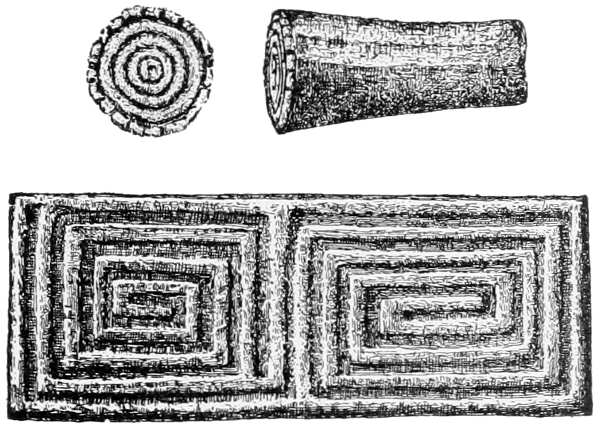
Fig. 982.—Piaroa color stamps.
Fig. 982 shows examples of these stamps. The most noteworthy thing about them is that they reproduce the types of certain petroglyphs, particularly of those of the upper Cuchivero (see Figs. 152 and 153, supra).
The Piaroas either copied the models they found carved on the rocks by peoples who preceded them, or they are aware of their meaning and preserved the tradition of it. The former hypothesis is the only tenable one. Not being endowed with inventive faculties, it seems more natural that they should simply have copied the only models they found. The Indians of French Guiana paint themselves in order to drive away the devil when they start on a journey or for war, whence Crevaux concludes that the petroglyphs must have been carved for a religious purpose. But painting is to the Piaroas a question of ornamentation and of necessity. It is a sort of garment that protects them against insects, and which, applied with extra care, becomes a fancy costume to grace their feasts and meetings.
It is to be noted that at least one instance is found of the converse of the Piaroa practice, by which the face-marks are used as the designs of pictographs on inanimate objects. The Serranos, near Los Angeles, California, formerly cut lines upon the trees and posts marking boundaries of land, these lines corresponding to those adopted by the owner as facial decorations.
A suggestion appropriate to this branch of the topic is presented in the answer communicated in a personal conversation of a Japanese lady who was asked why she blackened her teeth: “Any dog has white teeth!” An alteration of the physical appearance is itself a distinction, and the greater the difference between the decorated person and the want of decoration in others the greater the distinction. Modern milliners, dressmakers, tailors and hatters, and their patrons pursue the same ends of fashionable distinction which are exhibited in rivalry for priority and singularity. These arbitrary fluctuations of fashion, which are seen equally in the Mandan and the millionaire, the Pueblan and the Parisian, are to be considered with reference to the supposed tribal significance of colors before mentioned. So far as they originated in fashion they changed with fashion, and the studies made in the preparation of this paper tend to a disbelief in their distinctness and stability. The conservatism of religious and of other ceremonial practices and of social customs preserved, however, a certain amount of consistency and continuity.
IDEOCRASY OF COLORS.
It has often been asserted that there was and is an intrinsic significance in the several colors. A traditional recognition of this among the civilizations connected with modern Europe is shown by the associations of death and mourning with black, of innocence and peace with white, danger with red, and epidemic disease officially with yellow. A comparison of the diverse conceptions attached to the colors will show great variety in their several attributions.
The Babylonians represented the sun and its sphere of motion by gold, the moon by silver, Saturn by black, Jupiter by orange, Mars by red, Venus by pale yellow, and Mercury by deep blue. Red was anciently and generally connected with divinity and power both priestly and royal. The tabernacle of the Israelites was covered with skins dyed red, and the gods and images of Egypt and Chaldea were of that color, which to this day is the one distinguishing the Roman Pontiff and the cardinals.
In ancient art each color had a mystic sense or symbolism, and its proper use was an essential consideration. With regard to early Christian art Mrs. Clement (a) furnishes the following account:
White is worn by the Saviour after his resurrection; by the Virgin in representations of the Assumption; by women as the emblem of chastity; by rich men to indicate humility; and by the judge as the symbol of integrity. It is represented sometimes by silver or the diamond, and its sentiment is purity, virginity, innocence, faith, joy, and light.
Red, the color of the ruby, speaks of royalty, fire, divine love, the holy spirit, creative power, and heat. In an opposite sense it symbolized blood, war, and hatred. Red and black combined were the colors of Satan, purgatory, and evil spirits. Red and white roses are emblems of love and innocence or love and wisdom, as in the garland of St. Cecilia.
Blue, that of the sapphire, signified heaven, heavenly love and truth, constancy and fidelity. Christ and the Virgin Mary wear the blue mantle; St. John a blue tunic.
Green, the emerald, the color of spring, expressed hope and victory.
Yellow or gold was the emblem of the sun, the goodness of God, marriage and fruitfulness. St. Joseph and St. Peter wear yellow. Yellow has also a bad signification when it has a dirty, dingy hue, such as the usual dress of Judas, and then signifies jealousy, inconstancy, and deceit.
Violet or amethyst signified passion and suffering or love and truth. Penitents, as the Magdalene, wear it. The Madonna wears it after the crucifixion, and Christ after the resurrection.
Gray is the color of penance, mourning, humility, or accused innocence.
Black with white signified humility, mourning, and purity of life. Alone, it spoke of darkness, wickedness, and death, and belonged to Satan. In pictures of the Temptation Jesus sometimes wears black.
The associations with the several colors above mentioned differ widely from those in modern folk-lore; for instance, those with green and yellow, the same colors being stigmatized in the old song that “green’s forsaken and yellow’s forsworn.”
The Hist. de Dieu, by Didron (d), contains the following:
The hierarchy of colors could well, in the ideas of the Middle Ages, have been allied at the same time to symbolism. The most brilliant color is gold, and here it is given to the greatest saints. Silver, color of the moon, which is inferior to the sun, but its companion, however, should follow; then red, or the color of fire, attribute of those who struggle against passion, and which is inferior to the two metals, gold and silver, to the sun and moon, of which it is but an emanation; next green, which symbolizes hope, and which is appropriate to married people; lastly, the uncertain yellowish color, half white and half yellow, a modified color, which is given to saints who were formerly sinners, but who have succeeded in reforming themselves and are made somewhat bright in the sight of God by penitence.
A note in the Am. Journal of Psychology, Vol. I, November, 1887, p. 190, gives another list substantially as follows:
Yellow, the color of gold and fire, symbolizes reason.
Green, the color of vegetable life, symbolizes utility and labor.
Red, the color of blood, symbolizes war and love.
Blue, the color of the sky, symbolizes spiritual life, duty, religion.
COLOR IN CEREMONIES.
The colors attributed to the cardinal points have been the subject of much discussion. Some of these special color schemes of the North American Indians are now mentioned.
Mr. James Stevenson, in an address before the Anthropological Society of Washington, D. C.; Dr. Washington Matthews, U. S. Army, in the Fifth Ann. Rep. of the Bureau of Ethnology, p. 449; and Mr. Thomas V. Keam, in a MS. contribution, severally report the tribes mentioned below as using in their ceremonial dances the respective colors designated to represent the four cardinal points, viz:
N.S.E.W.
Stevenson—ZuñiYellow.Red.White.Black.
Matthews—NavajoBlack.Blue.White.Yellow.
Keam—MokiWhite.Red.Yellow.Blue.
Mr. Stevenson, in his paper on the Ceremonial of Hasjelti Dailjis, in the Eighth Ann. Rep. of the Bureau of Ethnology, agrees with Dr. Matthews regarding the ceremonial scheme of the Navajo colors symbolic of the cardinal points, as follows: “The eagle plumes were laid to the east, and near by them white corn and white shell; the blue feathers were laid to the south, with blue corn and turquoise; the hawk feathers were laid to the west, with yellow corn and abalone shell; and to the north were laid the whippoorwill feathers, with black beads and corn of all the several colors.”