Chapter X · CHRONOLOGY. (continued 2)
Reading edition
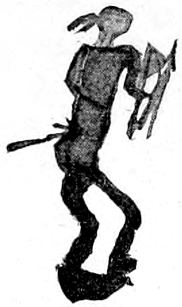
Fig. 343.
Fig. 343, 1786-’87.—“Iron-Head-Band-killed-on-warpath winter.” They formerly carried burdens on their backs, hung from a band passed across the forehead. This man had a band of iron which is shown on his head. So said the interpreter, but probably the band was not of the metal iron. The word so translated has a double meaning and is connected with religious ideas of water, spirit, and the color blue.
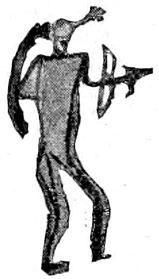
Fig. 344.
Fig. 344, 1787-’88.—“Left-the-heyoka-man-behind winter.” A certain man was heyoka—that is, his mind was disordered and he went about the village bedecked with feathers singing to himself, and, while so, joined a war party. On sighting the enemy the party fled, and called to him to turn back also; as he was heyoka, he construed everything that was said to him as meaning the very opposite, and therefore, instead of turning back, he went forward and was killed. If they had only had sense enough to tell him to go on, he would then have run away, but the thoughtless people talked to him just as if he had been in an ordinary condition and of course were responsible for his death. The mental condition of this man and another device for the event are explained by other records (see Fig. 651).
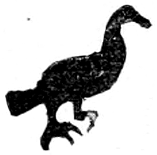
Fig. 345.
Fig. 345, 1788-’89.—“Many-crows-died winter.” Other records for the same year give as the explanation of the figure and the reason for its selection that the crows froze to death because of the intense cold.
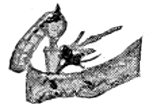
Fig. 346.
Fig. 346, 1789-’90.—“Killed-two-Gros-Ventres-on-the-ice winter.”
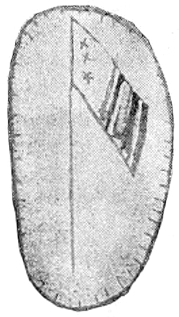
Fig. 347.
Fig. 347, 1790-’91.—“Carried-a-flag-about-with-them winter.” They went to all the surrounding tribes with the flag, but for what purpose is unknown. So said the interpreter, but The-Flame’s chart explains the figure by the statement: “The first United States flags in the country brought by United States troops.”
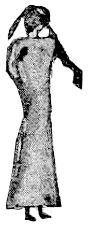
Fig. 348.
Fig. 348, 1791-’92.—“Saw-a-white-woman winter.” The dress of the woman indicates that she was not an Indian. This is obviously noted as being the first occasion when the Dakotas, or at least the bands which this record concerns, saw a white woman.
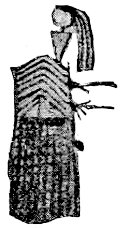
Fig. 349.
Fig. 349, 1792-’93.—“Camped-near-the-Gros-Ventres winter.” They were engaged in a constant warfare during this time. A Gros Ventre dirt lodge, with the entrance in front, is depicted in the figure and on its roof is a Gros Ventre head.
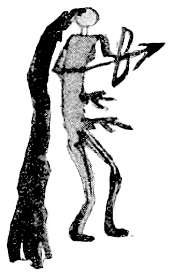
Fig. 350.
Fig. 350, 1793-’94.—“Killed-a-long-haired-man-at-Rawhide-butte winter.” The Dakotas attacked a village of 58 lodges and killed every soul in it. After the fight they found the body of a man whose hair was done up with deer-hide in large rolls, and, on cutting them open, found it was all real hair, very thick, and as long as a lodge-pole. [Mem. Catlin tells of a Crow called Long-Hair whose hair, by actual measurement, was 10 feet and 7 inches long.] The fight was at Rawhide butte (now so called by the whites), which the Dakotas named Buffalo-Hide butte, because they found so many buffalo hides in the lodges. According to Cloud-Shield, Long-Hair was killed in 1786-’87, and according to American-Horse, Long-Hair, a Cheyenne, was killed in 1796-’97.
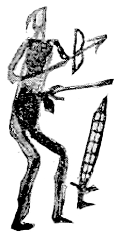
Fig. 351.
Fig. 351, 1794-’95.—“Killed-the-little-faced-Pawnee winter.” The Pawnee’s face was long, flat, and narrow, like a man’s hand, but he had the body of a large man.
White-Cow-Killer calls it: “Little-Face-killed winter.”
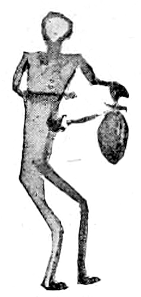
Fig. 352.
Fig. 352, 1795-’96.—“The-Rees-stood-the-frozen-man-up-with-the-buffalo-stomach-in-his-hand winter.” The body of a Dakota who had been killed in an encounter with the Rees (Pawnees), and had been left behind, frozen. The Rees dragged it into their village, propped it up with a stick, and hung a buffalo stomach filled with ice in one hand to make sport of it. The buffalo stomach was in common use at that time as a water-jug.
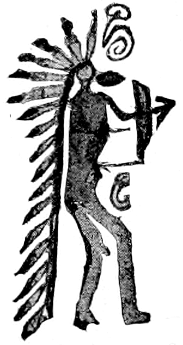
Fig. 353.
Fig. 353, 1796-’97.—“Wears-the-War-Bonnet-died winter.” He did not die this winter, but received a wound in the abdomen from which the arrowhead could not be extracted, and he died of the “bellyache” years after.
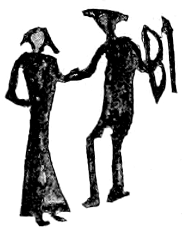
Fig. 354.
Fig. 354, 1897-’98.—“Took-the-God-Woman-captive winter.” A Dakota war party captured a woman—tribe unknown—who, in order to gain their respect, cried out, “I am a Wakan-Tanka,” meaning that she belonged to God, whereupon they let her go unharmed. This is the origin of their name for God (Wakan Tanka, the Great Holy, or Supernatural One). They had never heard of a Supernatural Being before, but had offered their prayers to the sun, the earth, and many other objects, believing they were endowed with spirits. [Those are the remarks of Battiste Good, who is only half correct, being doubtless influenced by missionary teaching. The term is much older and signifies mystic or unknown.]
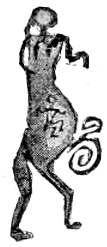
Fig. 355.
Fig. 355, 1798-’99.—“Many-women-died-in-childbirth winter.” They died of bellyache. The convoluted sign for pain in the abdominal region has appeared before. Cloud-Shield’s winter count for the same year records the same mortality among the women which was perhaps an epidemic of puerperal fever.
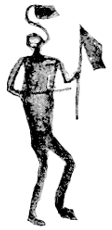
Fig. 356.
Fig. 356, 1799-1800.—“Don’t-Eat-Buffalo-Heart-made-a-commemoration-of-the-dead winter.” A buffalo heart is represented above the man. Don’t Eat is expressed by the gesture sign for negation, a part of which is indicated, and the line connecting the heart with his month. The red flag which is used in the ceremony is employed as its symbol. The name Don’t-Eat-Buffalo-Heart refers to the man for whom that viand is taboo, either by gentile rules or from personal visions. The religious ceremony of commemoration of the dead is mentioned elsewhere in this work, see Chapter XIV, section 6.
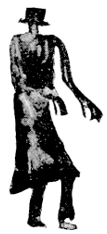
Fig. 357.
Fig. 357, 1800-’01.—“The-Good-White-Man-came winter.” Seven white men came in the spring of the year to their village in a starving condition; after feeding them and treating them well, they allowed them to go on their way unmolested. The Dakotas [of the recorder’s band] had heard of the whites, but had never seen any before. In the fall some more came, and with them, The-Good-White-Man, who is represented in the figure, and who was the first one to trade with them. They became very fond of him because of his fair dealings with them. The gesture made by his hands is similar to benediction, and suggests a part of the Indian gesture sign for “good.”
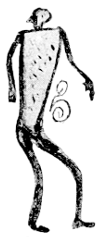
Fig. 358.
Fig. 358, 1801-’02.—“Smallpox-used-them-up-again winter.” The man figure is making a part of a common gesture sign for death, which consists substantially in changing the index from a perpendicular to a horizontal position and then pointing to the ground.
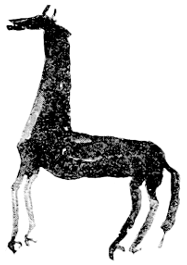
Fig. 359.
Fig. 359, 1802-’03.—“Brought-home-Pawnee-horses-with-iron-shoes-on winter.” The Dakotas had not seen horseshoes before. This agrees with and explains Lone-Dog’s Winter Count for the same year.
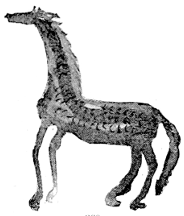
Fig. 360.
Fig. 360, 1803-’04.—“Brought-home-Pawnee-horses-with-their-hair-rough-and-curly winter.” The curly hair is indicated by the curved marks. Lone-Dog’s Winter Count for the same year records the same incident, but states that the curly horses were stolen from the Crows.
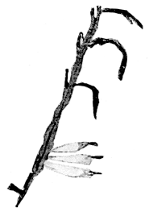
Fig. 361.
Fig. 361, 1804-’05.—“Sung-over-each-other-while-on-the-war-path winter.” A war party while out made a large pipe and sang each other’s praises. The use of an ornamented pipe in connection with the ceremonies of organizing a war party is mentioned in Chapter XV.
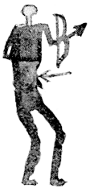
Fig. 362.
Fig. 362, 1805-’06.—“They-came-and-killed-eight winter.” The enemy killed eight Dakotas, as shown by the arrow and the eight marks beneath it.
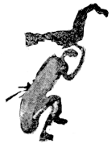
Fig. 363.
Fig. 363, 1806-’07.—“Killed-them-while-hunting-eagles winter.” Some Dakota eagle-hunters were killed by enemies. See Lone-Dog’s Winter Count for the same year.
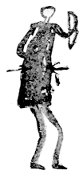
Fig. 364.
Fig. 364, 1807-’08.—“Came-and-killed-man-with-red-shirt-on winter.” Other records say that Red-Shirt killed in this year was an Uncpapa Dakota, and that he was killed by Arikaras.
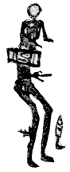
Fig. 365.
Fig. 365, 1808-’09.—“Pawnees-(Rees)-killed-Blue-Blanket’s-father winter.” A blanket, which in the original record is blue, is represented above the arrow and across the man’s body.
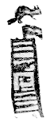
Fig. 366.
Fig. 366, 1809-’10.—“Little-Beaver’s-house-burned winter.” Little-Beaver was an English trader, and his trading house was a log one.
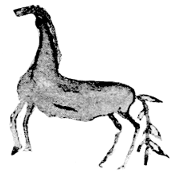
Fig. 367.
Fig. 367, 1810-’11.—“Brought-home-horse-with-his-tail-braided-with-eagle-feathers winter.” They stole a band of horses beyond the South Platte. One of them was very fleet, and had his tail ornamented as described.
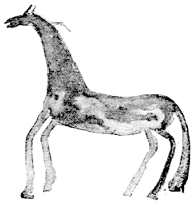
Fig. 368.
Fig. 368, 1811-’12.—“First-hunted-horses winter.” The Dakotas caught wild horses in the Sand Hills with braided lariats.
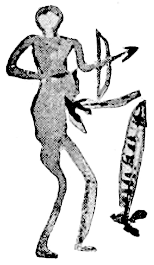
Fig. 369.
Fig. 369, 1812-’13.—“Rees-killed-Big-in-the-Middle’s-father winter.” Other records call this warrior Big-Waist and Big-Belly.
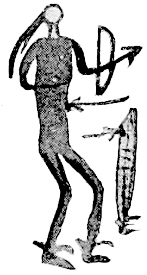
Fig. 370.
Fig. 370, 1813-’14.—“Killed-six-Pawnees (Rees) winter.” Six strokes are under the arrow, but are not shown in the copy.
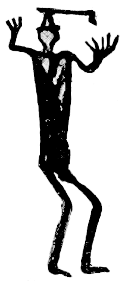
Fig. 371.
Fig. 371, 1814-’15.—“Smashed-a-Kiowa’s-head-in winter.” The tomahawk with which it was done is sticking in the Kiowa’s head.
Fig. 372.
Fig. 372, 1815-’16.-“The-Sans-Arcs-made-large-houses winter.”
Fig. 373.
Fig. 373, 1816-’17.—“Lived-again-in-their-large-houses winter.”
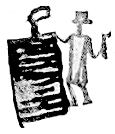
Fig. 374.
Fig. 374, 1817-’18.—“Chozé-built-a-house-of-dead-logs winter.” The house was for trading purposes. The Frenchman’s name is evidently a corruption.
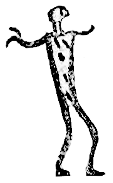
Fig. 375.
Fig. 375, 1818-’19.—“Smallpox-used-them-up-again winter.” They at this time lived on the Little White river, about 20 miles above the Rosebud agency. The two fingers held up may mean the second time the fatal epidemic appeared in the particular body of Indians concerned in the record.
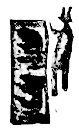
Fig. 376.
Fig. 376, 1819-’20.—“Chozé-built-a-house-of-rotten-wood winter.” Another trading house was built.
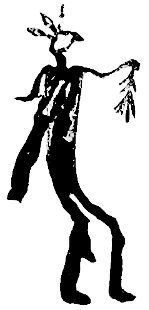
Fig. 377.
Fig. 377, 1820-’21.—“They-made-bands-of-strips-of-blanket-in-the-winter.” These bands were of mixed colors and reached from the shoulders to the heels. They also made rattles of deer’s hoofs by tying them to sticks with bead-covered strings. The man has a sash over his shoulders and a rattle in his hand.
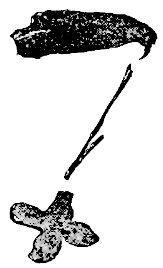
Fig. 378.
Fig. 378, 1821-’22.—“Star-passed-by-with-loud-noise winter,” “Much-whisky winter,” and “Used-up-the-Omahas winter.” In the figure the meteor, its pathway, and the cloud from which it came are shown. Whisky was furnished to them for the first time and without stint. It brought death to them in a new form, many since then having died from the excessive use of it, Red-Cloud’s father among the number. Battiste Good, alias Wa-po’stan-gi, more accurately Wa-po-ctan-xi (Brown-Hat), historian and chief, was born. He says that Omaha bullets were whizzing through the village and striking and piercing his mother’s lodge as she brought him forth. Red-Cloud was also born. In the count of American-Horse for this year he makes no mention of the meteor, but strongly marks the whisky as the important figure for the winter.
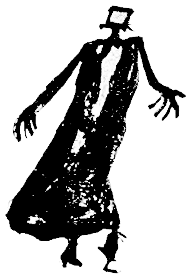
Fig. 379.
Fig. 379, 1822-’23.—“Peeler-froze-his-leg winter.” Peeler was a white trader, and his leg was frozen while he was on his way to or from the Missouri river. The name is explained by White Cow Killer’s record as follows: “White-man-peels-the-stick-in-his-hand-broke-his-leg winter.” He was probably a Yankee, addicted to whittling.
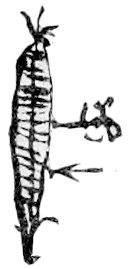
Fig. 380.
Fig. 380, 1823-’24.—“General-——-first-appeared-and-the-Dakotas-aided-in-an-attack-on-the-Rees winter.” Also “Much-corn winter”. The gun and the arrow in contact with the ear of corn show that both whites and Indians fought the Rees. This refers to Gen. Leavenworth’s expedition against the Arikara in 1823, when several hundred Dakotas were his allies. This expedition is mentioned several times in this work.
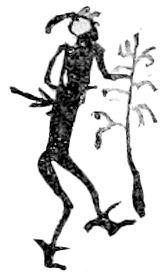
Fig. 381.
Fig. 381, 1824-’25.—“Killed-two-picking-plums winter.” A Dakota war party surprised and killed two Pawnees who were gathering plums.
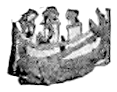
Fig. 382.
Fig. 382, 1825-’26.—“Many-Yanktonais-drowned winter.” The river bottom on a bend of the Missouri river, where they were encamped, was suddenly submerged, when the ice broke and many women and children were drowned. All the Winter Counts refer to this flood.
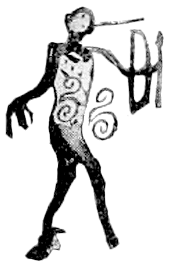
Fig. 383.
Fig. 383, 1826-’27.—“Ate-a-whistle-and-died winter.” Six Dakotas on the war path (shown by bow and arrow) had nearly perished with hunger, when they found and ate the rotting carcass of an old buffalo, on which the wolves had been feeding. They were seized soon after with pains in the stomach, the abdomen swelled, and gas poured from mouth and anus, and they died of a whistle or from eating a whistle. The sound of gas escaping from the mouth is illustrated in the figure.
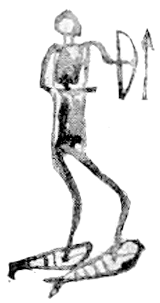
Fig. 384.
Fig. 384, 1827-’28.—“Wore-snowshoes winter.” The snow was very deep.
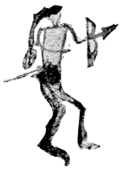
Fig. 385.
Fig. 385, 1828-’29.—“Killed-two-hundred-Gros Ventres (Hidatsas) winter.”
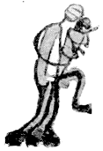
Fig. 386.
Fig. 386, 1829-’30.—“Old-Speckled-Face-clung-to-his-son-in-law winter.” The daughter of Speckled-Face, who was coming out second best in an altercation with her husband, called to her father for help. The latter ran and grabbed his son-in-law around the waist, and, crying “That is my daughter,” stabbed him. The son-in-law fell and the old man fell on top of him, and, clinging to him, begged the lookers on to put an end to him also, as he wished to bear his beloved son-in-law company to the spirit land. No one, however, was in the humor to speed him on the journey, and he remained with the living.
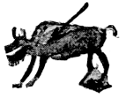
Fig. 387.
Fig. 387, 1830-’31.—“Shot-many-white-buffalo-cows winter.”
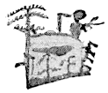
Fig. 388.
Fig. 388, 1831-’32.—“Killed-him-while-looking-about-on-the-hill winter.” A Dakota, while watching for buffalo at Buffalo Gap, in the Black Hills, was shot by the Crows. The man is represented on a hill, which is dotted with pine trees and patches of grass. Battiste makes the grass blue. Blue and green are frequently confounded by other Indians than Battiste, and some tribes have but one name for the two colors.
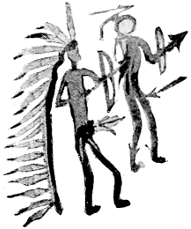
Fig. 389.
Fig. 389, 1832-’33.—“Stiff-Leg-with-War-Bonnet-on-died winter.” He was killed in an engagement with the Pawnees on the Platte river, in which the Brulés killed one hundred Pawnees.
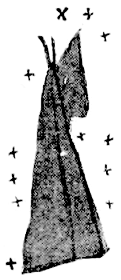
Fig. 390.
Fig. 390, 1833-’34.—“Storm-of-stars winter.” All the Winter Counts refer to this great meteoric display, which occurred on the night of November 12, 1833, and was seen over most of the United States.
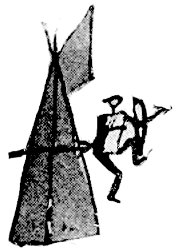
Fig. 391.
Fig. 391, 1834-’35.—“Killed-the-Cheyenne-who-came-to-the-camp winter.” A Cheyenne who stole into the village by night was detected and killed. The village was near what is now the Pine Ridge agency.
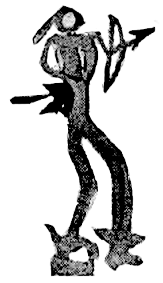
Fig. 392.
Fig. 392, 1835-’36.—“Killed-the-two-war-party-leaders winter.” A Dakota war party met one of Pawnees and killed two of their leaders, whereupon the rest ran.
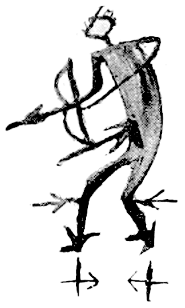
Fig. 393.
Fig. 393, 1836-’37.—“Fight-on-the-ice winter.” They fought with the Pawnees on the ice, on the Platte river, and killed seven of them. The two vertical marks, which are for the banks of the river, and the two opposed arrows, signify that the tribes were on opposite sides of the river.
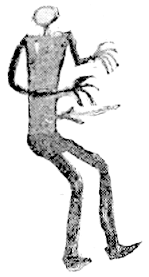
Fig. 394.
Fig. 394, 1837-’38.—“Spread-out-killed winter.” A Santee man, whose name is indicated by his spread hands, was killed by soldiers.
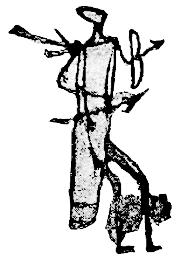
Fig. 395.
Fig. 395, 1838-’39.—“Came-and-killed-five-Oglálas winter.” They were killed by Pawnees. The man in the figure has on a capote, the hood of which is drawn over his head. This garment is used here as a sign for war, as the Dakotas commonly wear it on their war expeditions.
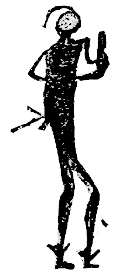
Fig. 396.
Fig. 396, 1839-’40.—“Came-home-from-the-starve-to-death-war-path winter.” All of the Dakota tribes united in an expedition against the Pawnees. They killed one hundred Pawnees, but nearly perished with hunger.
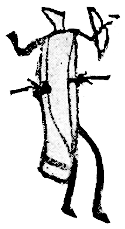
Fig. 397.
Fig. 397, 1840-’41—“Came-and-killed-five-of-Little-Thunder’s-brothers winter,” and “Battiste-alone-returns winter.” The five were killed in an encounter with the Pawnees. Battiste Good was the only one of the party to escape. The capote is shown again.
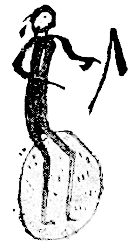
Fig. 398.
Fig. 398, 1841-’42.—“Pointer-made-a-commemoration-of-the-dead winter.” Also “Deep-snow winter.” The extended index denotes the man’s name, the ring and spots deep snow.
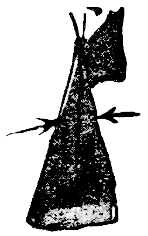
Fig. 399.
Fig. 399, 1842-’43.—“Killed-four-lodges-of-Shoshoni-and-brought-home-many-horses winter.”
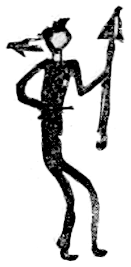
Fig. 400.
Fig. 400, 1843-’44.—“Brought-home-the-magic-arrow winter.” This arrow originally belonged to the Cheyennes from whom the Pawnees stole it. The Dakotas captured it this winter from the Pawnees and the Cheyennes then redeemed it for one hundred horses.
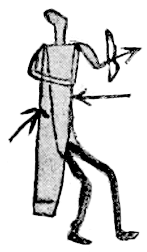
Fig. 401.
Fig. 401, 1844-’45.—“The-Crows-came-and-killed-thirty-eight-Oglálas winter.” The Oglálas were on the warpath, as indicated by the capote.
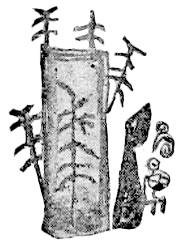
Fig. 402.
Fig. 402, 1845-’46.—“Broke-out-on-faces-had-sore-throats-and-camped-under-the-bluff winter.” “Also-had-bellyache.” The position of the camp is shown, also the suggestive attitude of the man.
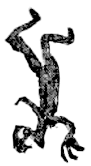
Fig. 403.
Fig. 403, 1846-’47.—“Winter-camp-broke-his-neck winter.” He was thrown from his horse while on a hunt. The red on his neck is the break.
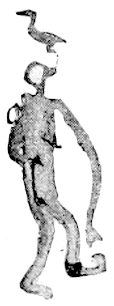
Fig. 404.
Fig. 404, 1847-’48.—“The-Teal-broke-his-leg winter.” His arm is lengthened to direct attention to his leg. The Chinese radical and phonetic character for the same concept, Fig. 1193, infra, may be compared, as also Fig. 231, supra.
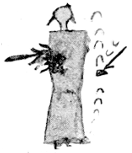
Fig. 405.
Fig. 405, 1848-’49.—“Killed-the-hermaphrodite winter” and “Big-horse-stealing winter.” They captured a Crow who pretended to be a woman, but who proved to be a man, and they killed him. It is probable that this was one of the men, not uncommon among the Indian tribes, who adopt the dress and occupation of women. This is sometimes compulsory from failure to pass an ordeal or from exhibition of cowardice. Eight hundred horses were stolen from the Dakotas, but seven hundred of them were recovered. The Crows killed one Dakota, as is indicated by the arrow in contact with the red spot in the hoof print.
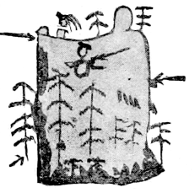
Fig. 406.
Fig. 406, 1849-’50.—“Brought-the-Crows-to-a-stand winter.” This was done at Crow Butte, near Camp Robinson, Nebraska. It is said that a party of Crows, who were flying from the Dakotas, took refuge on the Butte about dark and that the Dakotas surrounded them, confident of capturing them the next morning, but the Crows escaped during the night, very much to the chagrin of the Dakotas. The Crow’s head is just visible on the summit of the hill, as if the body had gone down.
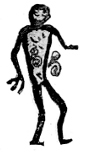
Fig. 407.
Fig. 407, 1850-’51.—“The-big-smallpox winter.”
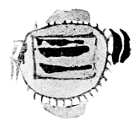
Fig. 408.
Fig. 408, 1851-’52.—“First-issue-of-goods winter.” The colored patches outside the circle are at the four cardinal points, the colored patches inside the circle are meant for blankets and the other articles issued, and the circle of strokes the people sitting. The Dakotas were told that fifty-five years after that issue they would have to cultivate the ground, and they understood that they would not be required to do it before.

Fig. 409.
Fig. 409, 1852-’53.—“Deep-snow-used-up-the-horses winter.” The spots around the horses represent snow.
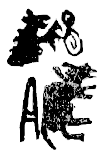
Fig. 410.
Fig. 410, 1853-’54.—“Cross-Bear-died-on-the-hunt winter.” The travail means they moved; the buffalo, to hunt buffalo; the bear with mouth open and paw advanced, Cross-Bear; the stomach and intestines, took the bellyache and died. The gesture sign for bear is made as follows: Slightly crook the thumbs and little fingers, and nearly close the other fingers; then, with their backs upward, hold the hands a little in advance of the body or throw them several times quickly forward a few inches. The sign is sometimes made with one hand only.
For explanation of the word “travail,” applied to the Indian sledge made of the joined tent poles, see Fig. 764 and accompanying remarks.
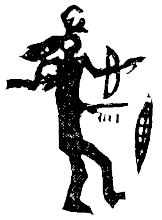
Fig. 411.
Fig. 411, 1854-’55.—“Killed-five-Assiniboins winter.” The Dakotas are ashamed of the part they took in the following deplorable occurrence and it is not therefore noted in the record, although it really marks the year. In consequence of a misunderstanding in regard to an old foot-sore cow, which had been abandoned on the road by some emigrants and which the Dakotas had innocently appropriated, Lieut. Grattan, Sixth U. S. Infantry, killed Conquering Bear (Mato-way'uhi, Startling Bear properly) about ten miles east of Fort Laramie, August 19, 1854. The Dakotas then, in retaliation, massacred Lieut. Grattan and the thirty men of Company G, Sixth U. S. Infantry, he had with him.
The figure without the above statement tells the simple story about the killing of five Assiniboins who are denoted by the usual tribal sign, the number being designated by the five strokes below the arrow.
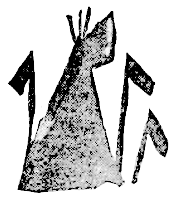
Fig. 412.
Fig. 412, 1855-’56.—“Little-Thunder-and-Battiste-Good-and-others-taken-prisoners-at-Ash-Hollow-on-the-Blue-creek winter,” and one hundred and thirty Dakotas were killed by the white soldiers. Also called “Many-sacrificial-flags winter.” The last-mentioned name for the winter is explained by other records and by Executive Document No. 94, Thirty-fourth Congress, first session, Senate, to refer to a council held on March 18, 1856, by Brevet Brig. Gen. W. S. Harney, U. S. Army, with nine of the bands of the Dakotas.
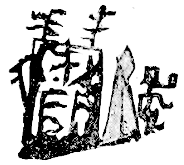
Fig. 413.
Fig. 413, 1856-’57.—“Bad-Four-Bear-trades-with-Battiste-Good-for-furs-all winter.” Bad-Four-Bear, a white trader, is represented sitting smoking a pipe in front of Battiste’s tipi under a bluff at Fort Robinson, Nebraska.
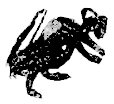
Fig. 414.
Fig. 414, 1857-’58.—“Hunted-bulls-only winter.” They found but few cows, the buffalo being composed principally of bulls. The travail is shown.

Fig. 415.
Fig. 415, 1858-’59.—“Many-Navajo-blankets winter.” A Navajo blanket is shown in the figure. Several of the records agree in the explanation about the bringing of these blankets at that time.
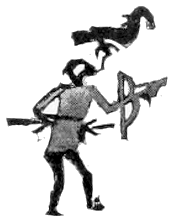
Fig. 416.
Fig. 416, 1859-’60.—“Came-and-killed-Big-Crow winter.” The two marks under the arrow indicate that two were killed.
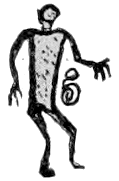
Fig. 417.
Fig. 417, 1860-’61.—“Broke-out-with-rash-and-died-with-pains-in-the-stomach winter.”
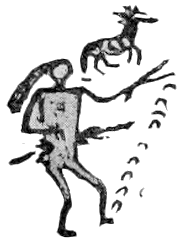
Fig. 418.
Fig. 418, 1861-’62.—“Killed-Spotted-Horse winter.” Spotted Horse and another Crow came and stole many horses from the Dakotas, who followed them, killed them, and recovered their horses.
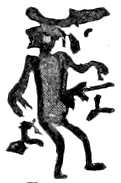
Fig. 419.
Fig. 419, 1862-’63—“Cut-up-the-boy-in-the-camp winter.” The Crows came to the lodges and cut up the boy while the people were away. The knife above his head shows that he was cut to pieces.
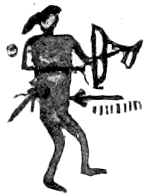
Fig. 420.
Fig. 420, 1863-’64.—“Crows-came-and-killed-eight winter.” Some of the eight were Cheyennes. The marks below the arrow represent the killed.
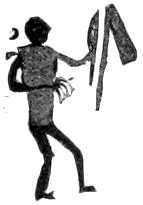
Fig. 421.
Fig. 421, 1864-’65.—“Roaster-made-a-commemoration-of-the-dead winter.” A piece of roasted meat is shown on the stick in the man’s hand. The Dakotas roast meat on a stick held in front of the fire.
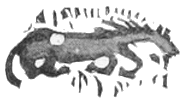
Fig. 422.
Fig. 422, 1865-’66.—“Deep-snow-used-up-the-horses winter.” The horse is obviously in a deplorable condition.
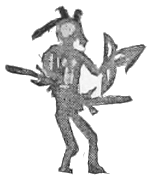
Fig. 423.
Fig. 423, 1866-’67.—“Beaver’s-Ears-killed winter.”
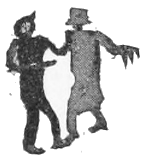
Fig. 424.
Fig. 424, 1867-’68.—“Battiste-Good-made-peace-with-General-Harney-for-the-people winter.” This refers to the great Dakota treaty of 1868 in which other general officers besides Gen. Harney were active and other Indian chiefs much more important than Battiste took part. The assumption of his intercession is an exhibition of boasting.
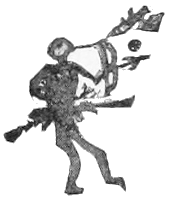
Fig. 425.
Fig. 425, 1868-’69.—“Killed-Long-Fish winter” and “Killed-fifteen winter.” The Crows killed fifteen Sans Arcs and Long-Fish also, a Lower Brulé. The long fish is shown attached by a line to the mouth of the man figure in the manner that personal names are frequently portrayed in this paper.
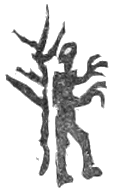
Fig. 426.
Fig. 426, 1869-’70.—“Trees-killed-them winter.” A tree falling on a lodge killed a woman.
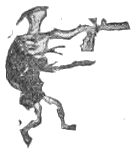
Fig. 427.
Fig. 427, 1870-’71.—“Came-and-killed-High-Back-Bone winter.” He was a chief. The Crows and Shoshoni shot him at long range, and the pistol with which he was armed was of no service to him.
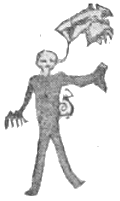
Fig. 428.
Fig. 428, 1871-’72.—“Gray-Bear-died winter.” He died of the bellyache.
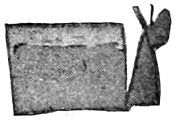
Fig. 429.
Fig. 429, 1872-’73.—“Issue-year winter.” A blanket is shown near the tipi. A blanket is often used as the symbol for issue of goods by the United States Government.
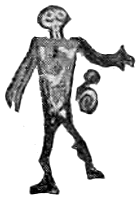
Fig. 430.
Fig. 430, 1873-’74.—“Measles-and-sickness-used-up-the-people winter.”
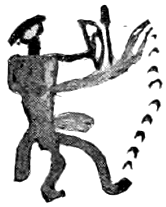
Fig. 431.
Fig. 431, 1874-’75.—“Utes-stole-horses winter.” They stole five hundred horses. The Utes are called “black men,” hence the man in the figure is represented as black. He is throwing his lariat in the direction of the hoof prints.
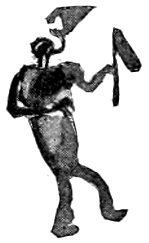
Fig. 432.
Fig. 432, 1875-’76.—“Bull-Head-made-a-commemoration-of-the-dead winter.”
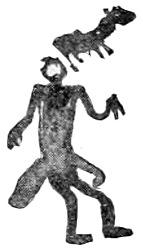
Fig. 433.
Fig. 433, 1876-’77.—“Female-Elk-Walks-Crying-died winter.” For some explanation of this figure see Lone Dog’s Winter Count for 1860-’61.
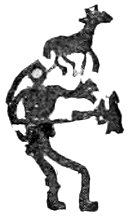
Fig. 434.
Fig. 434, 1877-’78.—“Crazy-Horse-came-to-make-peace-and-was-killed-with-his-hands-stretched-out winter.” This refers to the well-known killing of the chief Crazy-Horse while a prisoner.
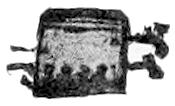
Fig. 435.
Fig. 435, 1878-’79.—“Brought-the-Cheyennes-back-and-killed-them-in-the-house winter.” The Cheyennes are shown in prison surrounded by blood stains, and with guns pointing toward them. The Cheyennes referred to are those who left the Indian Territory in 1878 and made such a determined effort to reach their people in the north, and who, after committing many atrocities, were captured and taken to Fort Robinson, Nebraska. They broke from the house in which they were confined and attempted to escape January 9, 1879. Many of them were killed; it was reported at the time among the Dakotas that they were massacred in their prison by the troops.
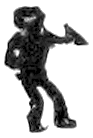
Fig. 436.
Fig. 436, 1879-’80.—“Sent-the-boys-and-girls-to-school winter.” A boy with a pen in his hand is represented in the picture.