Chapter II · PETROGLYPHS IN NORTH AMERICA. (continued 3)
Reading edition
b represents a hunter, with a boy behind him, in the act of shooting an animal with his bow and arrow weapon. The whole representation is 25 inches long; the animal from tip of tail to end of horn or proboscis 12 inches, and from top of head to feet 7 inches; the hunter 11 inches high, the boy 4½.
c represents a wounded animal, with the arrow or weapon near the wound. This figure is 21¾ inches from the lower extremity of the nose to the tip of the tail, 8¾ inches from fore shoulders to front feet, and 8 inches from the rump to the hind feet. The weapon is 4½ inches long by 5 inches broad from the tip of one prong or barb to that of the other.
d represents a chief with eight plumes and a war club, 11 inches from top of head to the lower extremity, and 6¾ inches from the tip of the upper finger to the end of the opposite arm; the war club 6½ inches long.
Dr. Hoffman made a visit to this cave in August, 1888, to compare the pictographic characters with others of apparently similar outline and of known signification. He found but a limited number of the figures distinct, and these only in part, owing to the rapid disintegration of the sandstone upon which they were drawn. Many names and inscriptions had been incised in the soft surface by visitors, who also, by means of the smoke of candles, added grotesque and meaningless figures over and between the original paintings, so as to seriously injure the latter.
Mr. T. H. Lewis (d) describes the petroglyphs, a part of which is reproduced in Fig. 92, as follows:
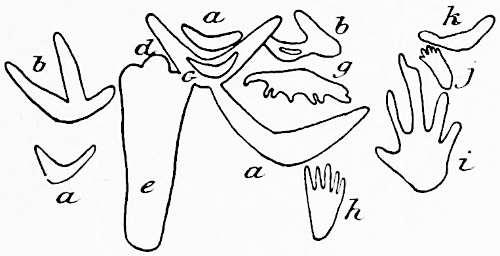
Fig. 92.—Petroglyphs at Trempealeau, Wisconsin.
Last November my attention was called to some rock sculptures located about 2½ miles northwest from Trempealeau, Wisconsin. There is at the point in question an exposed ledge of the Potsdam sandstone extending nearly one-eighth of a mile along the east side of the lower mouth of the Trempealeau river, now known as the bay. Near its north end there is a projection extending out about 7 feet from the top of the ledge and overhanging the base about 10 feet. The base of the ledge is 40 feet back from the shore, and the top of the cliff at this point is 30 feet above the water. On the face of the projection, and near the top, are the sculpture figures referred to.
The characters designated a a are two so-called canoes, somewhat crescent-shaped, but with some variation in outline; b has the same form, but the additional upright portion overlaps it; c and d are also of the same form as a, but c is cut in the bottom of d; e probably represents a fort, and its length is 18½ inches; f is a nondescript, and it partly overlaps d; g is a nondescript four-legged animal, its length in a straight line from the end of the nose to the tip of the tail being 10½ inches; h may be intended to represent a foot, but possibly it may be a hand; it is 7½ inches in length; i is an outspread hand, a little over 13 inches long; j undoubtedly represents a foot and is 4½ inches long; k k are of the same class as a.
The figures are not mere outlines, but intaglio, varying in depth from a quarter of an inch to fully 1 inch. Although the surface of the rock is rough the intaglios were rubbed perfectly smooth after they had been engraved by pecking or cutting.
WYOMING.
Several pictographs in Wyoming are described by Capt. William A. Jones, U. S. Army (a). They are reproduced here as Figs. 93, 94, and 95.
Fig. 93, found in the Wind river valley, Wyoming, was interpreted by members of a Shoshoni and Banak delegation to Washington in 1880 as “an Indian killed another.” The latter is very roughly delineated in the horizontal figure, but is also represented by the line under the hand of the upright figure, meaning the same dead person. At the right is the scalp taken and the two feathers showing the dead warrior’s rank. The arm nearest the prostrate foe shows the gesture for killed; concept, to put down, flat.
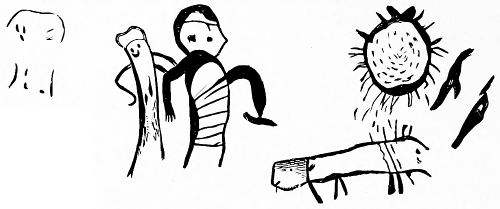
Fig. 93.—Petroglyph in Wind river valley, Wyoming.
The same gesture appears in Fig. 94, from the same authority and locality. The scalp is here held forth, and the numeral (1) is indicated by the lowest stroke.
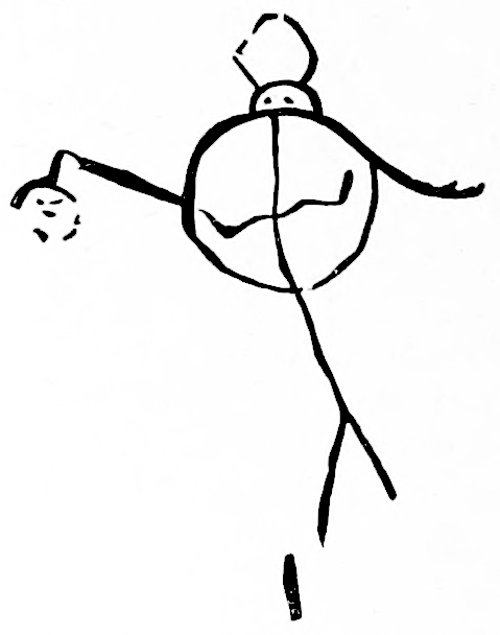
Fig. 94.—Petroglyph in Wind river valley, Wyoming.
Fig. 95, from the same locality and authority, was also interpreted by the Shoshoni and Banak. It appears from their description that a Blackfoot had attacked the habitation of some of his own people. The right-hand upper figure represents his horse, with the lance suspended from the side. The lower figure illustrates the log house built against a stream. The dots are the prints of the horse’s hoofs, while the two lines running outward from the upper inclosure show that two thrusts of the lance were made over the wall of the house, thus killing the occupant and securing two bows and five arrows, as represented in the left-hand group. The right-hand figure of that group shows the hand raised in the attitude of making the gesture for kill.
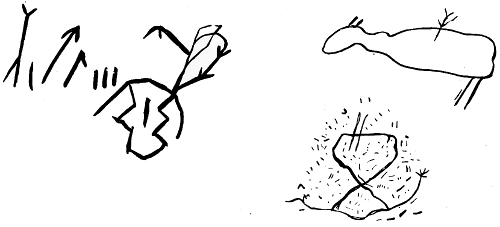
Fig. 95.—Petroglyphs in Wind river valley, Wyoming.
The Blackfeet, according to the interpreters, were the only Indians in the locality mentioned who constructed log houses, and therefore the drawing becomes additionally interesting, as an attempt appears to have been made to illustrate the crossing of the logs at the corners, the gesture for which (log house) is as follows:
Both hands are held edgewise before the body, palms facing, spread the fingers, and place those of one hand into the spaces between those of the other, so that the tips of each protrude about an inch beyond.
Another and more important petroglyph was discovered on Little Popo-Agie, northwestern Wyoming, by members of Capt. Jones’s party in 1873. The glyphs are upon a nearly vertical wall of the yellow sandstone in the rear of Murphy’s ranch, and appear to be of some antiquity. Further remarks, with specimens of the characters, are presented below in this paper. (See Fig. 1091.)
Dr. William H. Corbusier, U. S. Army, in a letter to the writer, mentions the discovery of drawings on a sandstone rock near the headwaters of Sage creek, in the vicinity of Fort Washakie, Wyoming, and gives a copy which is presented as Fig. 96. Dr. Corbusier remarks that neither the Shoshoni nor the Arapaho Indians know who made the drawings. The two chief figures appear to be those of the human form, with the hands and arms partly uplifted the whole being inclosed above and on either side by an irregular line.
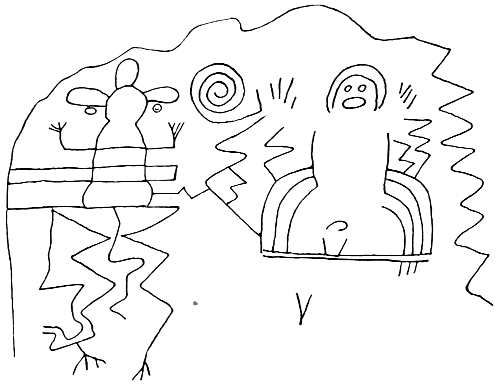
Fig. 96.—Petroglyph near Sage creek, Wyoming.
The method of grouping, together with various accompanying appendages, as irregular lines, spirals, etc., observed in Dr. Corbusier’s drawing, show great similarity to the Algonquian type, and resemble some engravings found near the Wind river mountains, which were the work of Blackfeet (Satsika) Indians, who, in comparatively recent times, occupied portions of the country in question, and probably also sketched the designs near Fort Washakie.
Fig. 97 is also reported from the same locality.
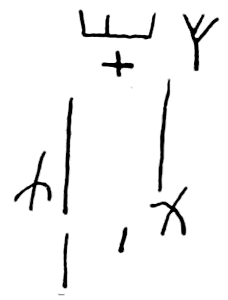
Fig. 97.—Petroglyph near Sage creek, Wyoming.
SECTION 3. MEXICO.
No adequate attention can be given in the present paper to the distribution and description of the petroglyphs of Mexico. In fact very little accurate information is accessible regarding them. The distinguished explorer, Mr. A. Bandelier, in a conversation mentioned that he had sketched but not published two petroglyphs in Sonora. One, very large and interesting, was at Cara Pintada, 3 miles southwest of Huassavas, and a smaller one was at Las Flechas, 1 mile west of Huassavas. He also sketched one in Chihuahua on the trail from Casas Grandes to the Cerro de Montezuma. From the accounts of persons met in his Mexican travels he gave it as his opinion that a large number of petroglyphs still remained in the region of the Sierra Madre.
The following mention of the paintings of the ancient inhabitants of Lower California is translated from an anonymous account, in Documentos para la Historia de Mexico (a), purporting to have been written in 1790:
Throughout civilized California, from south to north, and especially in the caves and smooth rocks, there remain various rude paintings. Notwithstanding their disproportion and lack of art, the representations of men, fish, bows and arrows, can be distinguished and with them different kind of strokes, something like characters. The colors of these paintings are of four kinds; yellow, a reddish color, green and black. The greater part of them are painted in high places, and from this it is inferred by some that the old tradition is true, that there were giants among the ancient Californians. Be this as it may, in the Mission of Santiago, which is at the south, was discovered on a smooth rock of great height, a row of hands stamped in red. On the high cliffs facing the shore are seen fish painted in various shapes and sizes, bows, arrows, and some unknown characters. In other parts are Indians armed with bows and arrows, and various kinds of insects, snakes, and mice, with lines and characters of other forms. On a flat rock about 2 yards in length were stamped insignia or escutcheons of rank and inscriptions of various characters.
Towards Purmo, about 30 leagues beyond the Mission of Santiago del Sur, is a bluff 8 yards in height and on the center of it is seen an inscription which resembles Gothic letters interspersed with Hebrew and Chaldean characters [?].
Though the Californian Indians have often been asked concerning the significance of the figures, lines, and characters, no satisfactory answer has been obtained. The most that has been established by their information is that the paintings were their predecessors, and that they are absolutely ignorant of the signification of them. It is evident that the paintings and drawings of the Californians are significant symbols and landmarks by which they intended to leave to posterity the memory, either of their establishment in this country, or of certain wars or political or natural triumphs. These pictures are not like those of the Mexicans, but might have the same purpose.
Several petroglyphs in Sonora are described and illustrated infra in Chapter XX on Special Comparisons. The following copies of petroglyphs are presented here as specimens and are markedly different from those in the northwestern states of Mexico, which represent the Aztec culture.
The description of Fig. 98 is extracted from Viages de Guillelmo Dupaix (a):
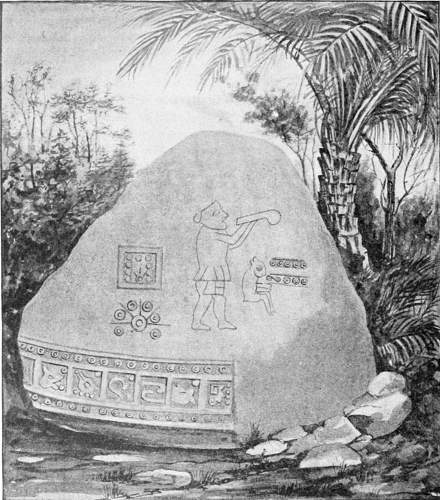
Fig. 98.—Petroglyphs in Mexico.
Going from the town of Tlalmanalco to that of Mecamecan, at a distance of a league to the east of the latter and in the confines of the estate of Señor Don José Tepatolco, is an isolated rock of granitic stone artificially cut into a conical form with a series of six steps cut in the solid rock itself on the eastern side, the summit forming a platform or horizontal section suitable for the purpose of observing the stars at all points of the compass. It is, therefore, most evident that this ancient monument or observatory was employed solely for astronomical observations, and it is further proved by various hieroglyphs cut in the south side of the cone; but the most interesting feature of this side is the figure of a man standing upright and in profile directing his gaze to the east with the arms raised, holding in the hands a tube or species of optical instrument. Beneath his feet is seen a carved frieze with six compartments or squares and other symbols of a celestial nature are engraved on their surfaces, evidently the product of observation and calculation. Some of them have connection with those found symmetrically arranged in circles on the ancient Mexican calendar, exposed in this capital to general admiration. In front of the observer is a rabbit seated and confronted by two parallel rows of numerical figures; lastly two other symbols relating to the same science are seen at the back.
Prof. Daniel G. Brinton (a), gives an account of the illustration here produced on Pl. XIV A, which may be thus condensed:
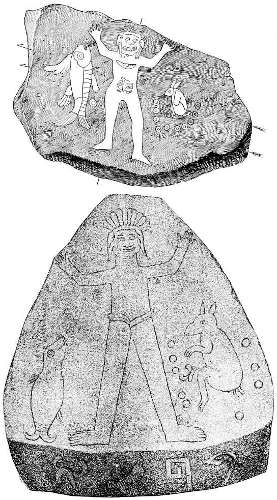
BUREAU OF ETHNOLOGY TENTH ANNUAL REPORT PL. XIV THE STONE OF THE GIANTS, MEXICO.
The “Stone of the Giants” at Escamela near the city of Orizaba, Mexico, has been the subject of much discussion. Father Damaso Sotomayor sees in the inscribed figures a mystical allusion to the coming of Christ to the Gentiles and to the occurrences supposed in Hebrew myth to have taken place in the Garden of Eden. This stone was examined by Capt. Dupaix in the year 1808 and is figured in the illustrations to his voluminous narrative. The figure he gives [now presented as B on Pl. XIV] is, however, so erroneous that it yields but a faint idea of the real character and meaning of the drawing. It omits the ornament on the breast and also the lines along the right of the giant’s face, which as I shall show are distinctive traits. It gives him a girdle where none is delineated, and the relative size and proportions of all the three figures are quite distorted.
The rock on which the inscription is found is roughly triangular in shape, presenting a nearly straight border of 30 feet on each side. It is hard and uniform in texture and of a dark color. The length or height of the principal figure is 27 feet, and the incised lines which designate the various objects are deeply and clearly cut.
I now approach the decipherment of the inscriptions. Any one versed in the signs of the Mexican calendar will at once perceive that it contains the date of a certain year and day. On the left of the giant is seen a rabbit surrounded with ten circular depressions. These depressions are the well-known Aztec marks for numerals, and the rabbit represents one of the four astronomic signs by which they adjusted their chronologic cycles of fifty-two years. The stone bears a carefully dated record, with year and day clearly set forth. The year is represented to the left of the figure and is that numbered “ten” under the sign of the rabbit; the day of the year is number “one” under the sign of the fish.
These precise dates recurred once, and only once, every fifty-two years, and had recurred only once between the year of our era, 1450, and the Spanish conquest of Mexico in 1519-’20. Within the period named the year “ten rabbit” of the Aztec calendar corresponded with the year 1502 of the Gregorian calendar. It is more difficult to fix the day, but it is, I think, safe to say that, according to the most probable computations, the day, “one fish,” occurred in the first month of the year 1502, which month coincided in whole or in part with our February.
Such is the date on the inscription. Now, what is intimated to have occurred on that date? The clew to this is furnished by the figure of the giant. It represents an ogre of horrid mien with a death’s-head grin and formidable teeth, his hair wild and long, the locks falling down upon the neck. Suspended on the breast as an ornament is the bone of a human lower jaw, with its incisor teeth. The left leg is thrown forward as in the act of walking, and the arms are uplifted, the hands open, and the fingers extended as at the moment of seizing the prey or the victim. The lines about the umbilicus represent the knot of the girdle which supported the maxtli or breechcloth.
There is no doubt as to which personage of the Aztec pantheon this fear-inspiring figure represents. It is Tzontemoc Mictlantecutli, “the Lord of the Realm of the Dead, He of the Falling Hair,” the dread god of death and the dead. His distinctive marks are there, the death’s-head, the falling hair, the jaw bone, the terrible aspect, the giant size.
We possess several chronicles of the empire before Cortes destroyed it, written in the hieroglyphs which the inventive genius of the natives had devised. Taking two of these chronicles, one known as the Codex Telleriano-Remensis, the other as the Codex Vaticanus, I turn to the year numbered “ten” under the sign of the rabbit and I find that both present the same record which I copy in the following figure.
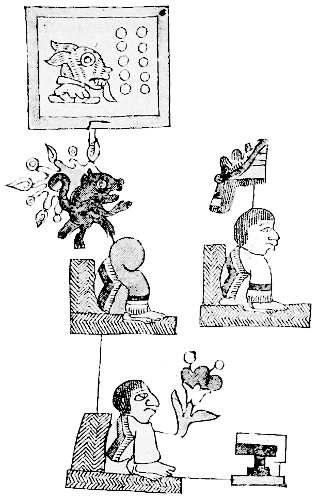
Fig. 99.—The Emperor Ahuitzotzin.
The figure so copied is entitled “Extract from the Vatican Codex,” which is a slight error. It is a copy from the Codex Telleriano-Remensis, Kingsborough, I, Pt. 4, p. 23, year 1502, which is here reproduced as Fig. 99. The record in the Vatican Codex, Kingsborough, II, p. 130, differs in some unimportant details. It may also be noted that in the text relating to the Codex Telleriano-Remensis, Kingsborough, VI, p. 141, the word Ahuitzotl is given as “the name of an aquatic animal famous in Mexican mythology.” The present opportunity is embraced to recognize the acumen displayed by Prof. Brinton in his interpretation of the petroglyph. He proceeds as follows:
The sign of the year (the rabbit) is shown merely by his head for brevity. The ten dots, which give its number, are beside it. Immediately beneath is a curious quadruped, with what are intended as water-drops dripping from him. The animal is the hedgehog, and the figure is to be constructed iconomatically; that is, it must be read as a rebus through the medium of the Nahuatl language. In that language water is atl, in composition a, and hedgehog is uitzotl. Combine these and you get ahuitzotl, or, with the reverential termination, ahuitzotzin. This was the name of the ruler or emperor, if you allow the word, of ancient Mexico before the accession to the throne of that Montezuma whom the Spanish conquistador, Cortes, put to death.
Returning to the page from the chronicle, we observe that the hieroglyph of Ahuitzotzin is placed immediately over a corpse swathed in its mummy cloths, as was the custom of interment with the highest classes in Mexico. This signifies that the death of Ahuitzotzin took place in that year. Adjacent to it is the figure of his successor, his name iconomatically represented by the headdress of the nobles, the tecuhtli, giving the middle syllables of “Mo-tecuh-zoma.” No doubt is left that La Piedra de los Gigantes of Escamela is a necrologic tablet commemorating the death of the Emperor Ahuitzotzin, some time in February, 1502.
Mr. Eugène Boban (a) mentions manuscript copies, dating from the beginning of the century, of various sculptured stones in Mexico. These sculpturings represent native ideographic characters, among them the teocalli, the tepetl, the sign ollin, etc.
On several of the plates which compose this collection are notes indicating the place where the monument, fragment, or ruin is found, from which the characters are copied; for example, one of them bears the note: “de la calle Rl de la villa de Cuernabaca.” Several others bear annotations which show that they have been copied in the cemetery, in the streets of that town, or in its environs.
Aside from these notes the plates are not accompanied by any information which could give a trace of the person who drew them, or the purpose for which they were intended.
The same author (b) describes a large sculptured stone of Mexico, the designs on which have been reproduced in paintings on deerskin. After giving a detailed description of the copied MS. he speaks of the stone as follows:
We deem it of interest to give some notes concerning the famous cylindrical stone, both sculptured and painted, known by the name Teocuauhxicalli (the sacred drinking vase of the eagles) on which are found the themes of all the designs which have been above described. This stone, buried at the time of the Spanish Conquest, was discovered in the first half of this century at the close of a series of excavations made in the soil of the Place d’Armes, Mexico. The director of the national museum, who was then M. Rafael Gondra, contented himself with taking the dimensions and making a hurried sketch of it. It was then reinterred, as the necessary funds were lacking to exhume it entirely and transport it to the museum.
The name Teocuauhxicalli is composed of: Teotl, god; cuauhili, eagle, and xicalli, hemispherical vase formed from the half of a gourd. It may be translated by, “The vase of god and the eagles,” or, rather, “The sacred drinking cup of the eagles.”
“The Mexican monarch Axayacatl, jealous of his predecessor Motecuhzoma I, took down the Teocuauhxicalli which was in the upper part of the Great Temple of Mexico, and replaced it by another, sculptured by his order;” so says the eminent Mexican archæologist and historian, Don Manuel Orozco y Berra, in his excellent work, Historia Antigua y de la Conquesta de Mexico (t. III, p. 348). This monument was also dedicated to the god of war, Huitzilopochtli.
According to Duran and Tezozomoc, those stones on which gods were represented were designated by the name Teocuauhxicalli; i. e., divine cuauhxicalli. They belonged to the class of painted stones, for they were covered with several colors.
Orozco y Berra adds the following: “It is evident that the figures sculptured and painted do not represent armed warriors preparing for combat. On the contrary, we see that they represent gods. Among them is found Huitzilopochtli (god of war) with his arms and attributes, having before him another deity or high priest who holds in his hands the emblems of the holocaust.
“The figures of the upper part are not fighting and could not have known how to fight, if we judge by their positions; the chest is turned back, the face raised toward the sky, in which appears an object which resembles the astronomical sign cipactli.
“Everywhere on the surface of this stone are noticed symbols, birds, quadrupeds, fantastic reptiles, signs of the sun, days, months, and a quantity of objects whose character is imitated in manuscripts and rituals. There can be no doubt that we are in the presence of a monument devoted to the gods and bearing legends relative to their worship. M. the minister of Fomento, D. Vicente Rivera Palacio, in 1877 made several attempts at excavation in the Plaza Mayor of Mexico, to recover this important monument, but all search remained unfruitful.”
This stone is supposed to be buried beneath the Place d’Armes at Mexico.
Mexican petroglyphs are also discussed and figured by Chavero (a).
It would seem from these and other descriptions of and allusions to petroglyphs in Mexico, that at the time of the Spanish conquest they were extant in large numbers, though now seldom found. Perhaps the Spaniards destroyed them in the same spirit which led them to burn up many of the Mexican pictographs on paper and other substances.
A number of illustrations of the Mexican pictographic writings are given below under various headings.
SECTION 4. WEST INDIES.
The valuable paper of A. L. Pinart (a), giving a description of the petroglyphs found by him in the Greater and Lesser Antilles, is received too late for reproduction of the illustrations. He explored a number of the groups of the West Indies with varying success, but found that the island of Puerto Rico was the one which now furnishes the greatest amount of evidence of development in the pictographic art. His marks translated with condensation appear below.
PUERTO RICO.
The first petroglyph to be mentioned is found at la Cueva del Islote, on Punta Braba, about 5 leagues east from Arecibo and on the north side of the island of Puerto Rico. The grotto is found in an immense blackish mass of igneous rock, forming a point projecting into the sea, which beats furiously against it; it communicates with the sea at the foot, and the water entering this passage, which is quite narrow, produces a terrific roaring followed soon after by veritable thunder claps. The people of the neighborhood have a superstitious fear of it, and it is only with great difficulty that anyone can be found to accompany one there. The entrance on the land side is toward the east—a yawning crevasse, filled partly with rubbish and partly by the stunted vegetation of the coast. On penetrating to the interior we find, after following a short but wide passage, a pyriform chamber 20 meters in diameter. In the ceiling a very narrow crack admits a ray of light which, reflected in the water of the sea, filling the bottom of the cave, produces a bluish twilight. Notwithstanding this twilight, we are obliged to carry torches to distinguish objects. All around us, but especially over the point where the sea enters in, are to be seen the inscriptions represented here. The incisions are very deep, and the edges are generally dulled by the blows of the hammer; in certain spots, toward the lower part of the grotto, several inscriptions are partially effaced by the action of the sea, but those of the upper part are in a remarkable state of preservation. Beneath certain principal figures of the groups are little circular basin-like depressions cut in the rock with a trench running down toward the bottom.
I will not attempt here to give a formal explanation of these inscriptions, but may we not regard the spot in which they are found as having served for a rendezvous for the ancient Borrinqueños where they performed their sacrifices or the ceremonies of their religion? On the other hand, the appearance of these inscriptions is very peculiar. One of them might be considered a representation of those little figurines and statuettes of stone found in Mexico, in Mixteca, and in the country to the south. In another a head is curiously decorated with a diadem of feathers, and apparently represents one presiding at a feast served in the small circular basin set before him. The most noticeable thing in this group of inscriptions is the frequency of the grinning faces in a circle, often alone, often accompanied by two others placed at the sides, which are universally met with in every inscription found in the Greater and Lesser Antilles. The same may be said of the human figure apparently swaddled in cloths like a very young infant, the head and body more or less decorated, which is also very frequently found.
Following these petroglyphs of Islote, we present a list of others discovered at Puerto Rico, hastily describing them and giving a particular description only of those which are of the greatest interest.
In the above-mentioned grotto of Cueva de los Archillas, near the village of Ciales, we observed the curious figures bearing traces of a crown and peculiar ear ornaments. In la Cueva de los Conejos, some distance from Arecibo, on the road from Utauado, we found a figure partly incised and partly painted in a dark red; it is very artistically fashioned, and represents the famous “guava,” the monster spider of the Greater Antilles, of which the natives have a great dread. It is probable that the ancient Borrinqueños also considered it with a certain awe, and we find images of the same animal in la Cueva del Templo on the coast of Haiti, at Santo Domingo. A solitary rock of a reddish color, in a field of the hacienda of Don Pedro Pavez at la Carolina, a short distance from the Rio Pedras, bears a series of grimacing faces in circles. On a granitic rock of large dimensions, superimposed on a heap of rocks of the same character, in the midst of a grove of Indian trees and at the entrance of the Cano del Indio into Rio la Ceiba, near Fajardo, on the east side, are found three swaddled human figures, the heads decorated with various ornaments. On a black rock in the Rio Arriba, one of the branches of the Rio de la Ceiba, is a petroglyph which presents but little that is of interest.
On the Loma Muñoz, near the Rio Arriba above mentioned, and on the summit of the hill, stands a dark rock with smooth face protected by another mass of rock, forming a sort of shelter on which is an inscription composed of a number of incised grinning faces. At the confluence of the Rio Blanco and the Rio de la Ceiba, in the district of Fajardo, is a series of violent rapids formed by immense rocks of a granitic character, on which are cut a large number of other grimacing faces and also some swaddled figures, and other incisions which are not of interest.
BAHAMA ISLANDS.
Lady Edith Blake, wife of Sir Henry Arthur Blake, formerly governor of the Bahama islands, has kindly furnished the following information and sketches (Figs. 100, 101, and 102), relating to petroglyphs in the Bahama islands. Lady Blake says:
The carvings are on the walls of an “Indian hole,” also called Hartford cave, in the northern shore of a small island in Rum Cay, one of the Bahama group. Rum Cay measures 5 miles from north to south and about 8 or 9 from east to west. It lies 20 miles northwest of Watlings island, the San Salvador of Columbus.
The cave is situated on the seashore about a mile and a half from the western point of the island to the eastward of a bluff, close to which is a “puffing hole,” through which the waves blow when the seas roll in from the north. The cave is semicircular in shape and about 20 yards in depth, and is partially filled with debris of rocks, earth, and sand.
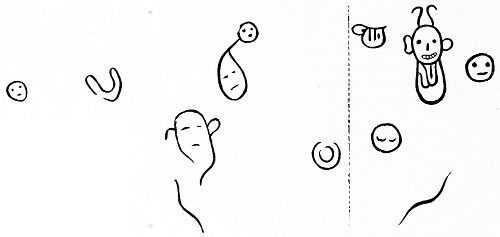
Fig. 100.—Petroglyphs in the Bahamas.
Like all rocks of which the Bahamas are formed, those in Hartford cave are a mixture of coral, detritus, and shell, very rough and full of cracks and indentations, and in this cave, from the constant damp of filtration and spray, the walls were coated with a deposit of lime and salt, so that it would be impossible to say if the carvings had been colored. If ever they had been, any traces of coloring must long have disappeared. Besides the markings copied there were others scattered over the walls of the cave, most of which were circles apparently resembling human faces. Unfortunately, we neglected to measure the carvings, but I should judge the circles or faces to be 10 inches or more across, while others of the figures must have been a foot and a half in length, and the markings must have been nearly half an inch in depth, cut into the face of the rock, and seemed to us such as might have been made with a sharp stone implement. Although we visited numerous caves in the various islands of the Bahamas, in no other did we find any appearance of markings or carvings on the walls, nor could we hear of any reported to have such markings.
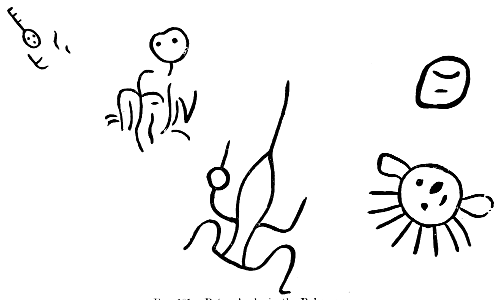
Fig. 101.—Petroglyphs in the Bahamas.
The absence of any traces of carvings in other caves whose situation was better adapted for the preservation of markings, had such ever existed, and the proof that their contents afforded that most of those caves had been known to the Lucayans and used by them as burying places or otherwise, and the close proximity of Hartford cave to the sea, taken in connection with the great number of markings on its walls, led me to think that possibly this cave had been the resort of the marauding tribes whom the Lucayans gave Columbus to understand were their enemies, and who were in the habit of making war upon them; and if so, the Caribs, or whatever tribe it may have been, had left these rock markings as mementos of their various expeditions and guides to succeeding ones.
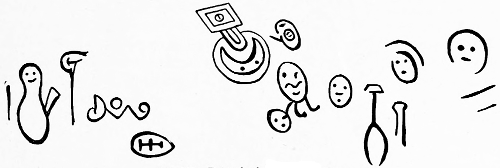
Fig. 102.—Petroglyphs in the Bahamas.
The above-mentioned petroglyphs bear a remarkable similarity to those in British Guiana figured and described below, and the authorship would seem to relate to the same group of natives, the Caribs.
GUADELOUPE.
In the Guesde collection of antiquities, described in the Smithsonian report for 1884, p. 834, Fig. 208, here reproduced as Fig. 103, is an inscribed slab found in Guadeloupe. It weighs several tons and it is impossible to remove it. In the vicinity are to be seen many other rocks bearing inscriptions, but this is the most elaborate of the group.
The inscriptions may be compared with those from Guiana presented in this work.
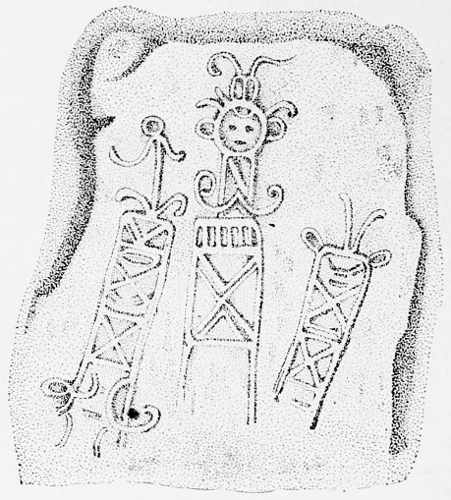
Fig. 103.—Petroglyph in Guadeloupe.
ARUBA.
Pinart (b) gives the following account, translated and condensed:
The island of Aruba forms one of the group of the islands of Curaçao, on the north coast of Venezuela. This group consists of three principal islands, Curaçao, Buen Ayre, Aruba, and some isolated rocks. It belongs to Holland.
Aruba is the most western island of the group and is situated opposite the peninsula of Paraguana, on the mainland. The distance between the two is about 10 leagues, and from the island the shores of the continent can be seen very distinctly.
These islands, at the time of the discovery by the Spaniards, were inhabited by an Indian race which has left numerous traces of its occupancy; pottery, stone objects, petroglyphs, etc., are met with in large numbers in Aruba and in a less quantity on Buen Ayre and Curaçao. * * * These petroglyphs are quite different in character from those which I have recently described in a brief study of the Greater and Lesser Antilles, and their appearance brings to mind those found in Orinoco, in Venezuela, in the peninsula of Paraguana, on the border of the Magdalena river, and as far as Chiriqui. They differ from these, however, in several respects, and especially in that they are almost always multi-colored. The colors usually employed are red, blue, a yellowish white, and black. They are, moreover, painted and not cut in the rock. They show the same degree of variance as I have already noticed in North America—in Sonora, Arizona, and Chihuahua—between the petroglyphs which I have designated as Pimos, which are always incised, and those in the mountains which I designated as Comanche, and which are always painted and in many colors. The petroglyphs are, as has already been said, very numerous on the island of Aruba. I have personal knowledge of thirty, but, according to my friend Père van Kolwsjk, there must be more than fifty. The most important groups are as follows:
(1) Avikok. An enormous dark rock forms the summit of a wooded knob, and in this rock are two large cavities, one above the other, on the walls of which are the petroglyphs represented.
(2) Fontein. On the border of a fresh-water lagoon, a short distance from the northeast part of the island, near the sea, is a grotto of coralline origin, whose walls are of remarkable whiteness. This grotto is composed of a principal passage, quite wide, cut off toward the lower end by a row of stalactites and stalagmites, which, joining together, form a curious grimacing figure. On the wall to the left, as we look toward the bottom of the grotto, are found some petroglyphs. They are well preserved, thanks to their situation and the shelter from inclement weather, and they show no indication of painting, being distinctly traced on the walls.
(3) Chiribana. On some granitic spurs of a hill of the same name are found curious petroglyphs.
(4) At Lero de Wajukan, near Avikok, and at the foot of a hill, petroglyphs are found on some blocks of granite. I notice specially the human figure which in the original is outlined in red and bears on the shoulder a hatchet of the Carib type with a haft.
(5) At Ayo I discovered petroglyphs with figures in blue and red.
(6) At Woeboeri inscriptions are found on the wall of an immense mass of granite.
(7) Some petroglyphs on the walls of a grotto at Karasito.