Chapter XIV · RELIGION.
Reading edition
The most surprising fact relating to the North American Indians, which until lately had not been realized, is that they habitually lived in and by religion to a degree comparable with the old Israelites under the theocracy. This was sometimes ignored, and sometimes denied in terms, by many of the early missionaries and explorers. The aboriginal religion was not their religion, and therefore was not recognized to have an existence or was pronounced to be satanic. Many pictorial representations are given in this chapter of concepts of the supernatural, as operative in this world, which is popularly styled religion when it is not condemned as superstition. The pictographic examples presented from the Siouan stock are generally explained as they appear. Those from the Ojibwa and other tribes are not so fully discussed. It is therefore proper to mention explicitly that, in the several localities where the tribes are now found which have been the least affected by civilization, they in a marked degree live a life of religious practices, and their shamans have a profound influence over their social character. A careful study of these people has already given indication of facts corresponding in interest with those which have recently surprised the world as reported by Mr. Cushing from among the Zuñi and Dr. Matthews from among the Navajo.
The most extensive and important publications on the subject have been made by Maj. J. W. Powell (a), Director of the Bureau of Ethnology. These have been made at many times and in various shapes, from the Outlines of the Philosophy of the North American Indians, read in 1876, to the present year.
A considerable amount of detail respecting religion appears in Chap. IX, Sections 4 and 5, in the present work.
The discussion of the religions and religious practices of the tribes of America is not germane to the present work, except so far as it elucidates their pictographs. In that connection it may be mentioned that the tribes of Indians in the territory of the United States, which have been converted to Christianity, seem not to have spontaneously turned their pictographic skill to the representation of objects connected with the religion to which they have been converted. This might be explained by the statement, often true, that the converts have been taught to read and write the languages of their teachers in religion, and therefore ceased to be pictographers. But where they have not been so instructed, indeed have been encouraged to retain their own language and to write it in a special manner supposed to be adapted to their ancient methods, the same result is observed. The Micmacs still with delight draw on bark their stories of Glooscap and Lox, and scenes from the myths of their old faith, but unless paid as for a piece of work, do not produce Christian pictures. This assertion does not conflict with the account of the “Micmac hieroglyphs” in Chap. XIX, Sec. 2. All the existing specimens of these were made by Europeans, and the action of the first Indian converts, which was imitated by Europeans, was the simple use of their old scheme of mnemotechny to assist in memorizing the lessons required of them by missionaries. It is also to be noted that some tribes for convenience have adopted Christian emblems into their own ceremonial pictographs (see Fig. 159).
It has been found convenient to divide this chapter into the following sections: (1) Symbols of the supernatural. (2) Myths and mythic animals. (3) Shamanism. (4) Charms and amulets. (5) Religious ceremonies. (6) Mortuary practices.
SECTION 1. SYMBOLS OF THE SUPERNATURAL.
This group shows the modes of expressing the idea of the supernatural, holy, sacred, or, more correctly, the mystic or unknown (perhaps unknowable), that being the true translation of the Dakota word wakan. The concept of “crazy,” in the sense of influenced by superior powers or inspired, is in the same connection. Not only the North American Indians, but many tribes of Asia and Africa, consider a demented person to be sacred and therefore inviolable. The spiral line is but a pictorial representation of the sign for wakan, which is: With its index finger extended and pointing upward, or all the fingers extended, back of hand outward, move the right hand from just in front of the forehead spirally upward nearly to arm’s length from left to right.
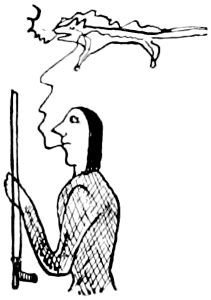
Fig. 640.
Fig. 640.—Crazy-Dog, a Dakota, carried the pipe around and took the war path. Cloud-Shield’s Winter Count, 1838-’39.
The waved or spiral lines denote crazy or mystic, as above explained.
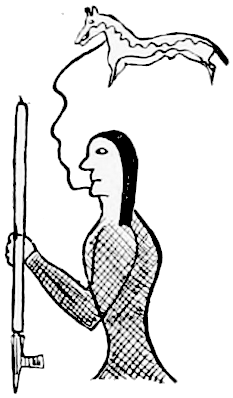
Fig. 641.
Fig. 641.—Crazy-Horse says his prayers and goes on the war-path. Cloud-Shield’s Winter Count, 1844-’45.
The waved lines are used again for crazy. “Says his prayers,” which are the words of the interpreter, would be more properly rendered by referring to the ceremonies of organizing a war party.
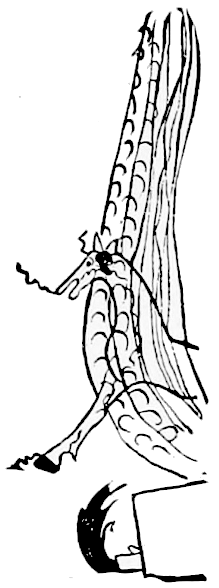
Fig. 642.
Fig. 642.—Crazy-Horse’s band left the Spotted-Tail agency (at Camp Sheridan, Nebraska) and went north, after Crazy-Horse was killed at Fort Robinson, Nebraska. Cloud-Shield’s Winter Count, 1877-’78.
Hoofprints and lodge-pole tracks run northward from the house, which represents the agency. That the horse is “crazy” is shown by the waved or spiral lines on his body, running from his nose, hoof, and forehead. The band is named from its deceased chief, and is designated by his personal device, a distinct and unusual departure among Indians tending towards the evolution of band or party emblems unconnected with the gentile system.
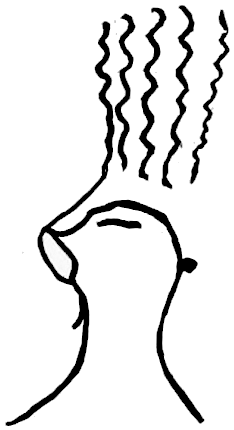
Fig. 643.
Fig. 643.—Medicine. Red-Cloud’s Census. The full rendering should be medicine-man or shaman. The waving lines above the head again signify mystic or sacred, and are made in gesture in a similar manner as that before described, with some differentiation, for prayer or incantation. The shut or half-closed eye may be noted.
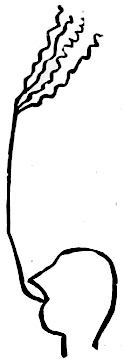
Fig. 644.
Fig. 644.—Medicine-man. Red-Cloud’s Census. This is a rude variant of the foregoing.
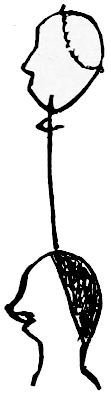
Fig. 645.
Fig. 645.—Crazy-Head. Red-Cloud’s Census. The wavy lines here form a circle around the head to suggest the personal name as well as the quality.
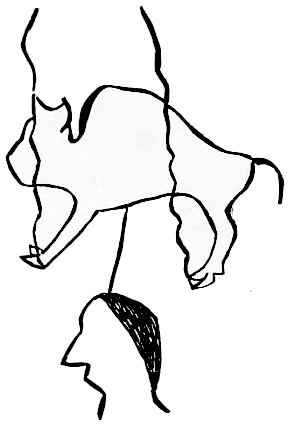
Fig. 646.
Fig. 646.—Medicine-Buffalo. Red-Cloud’s Census. This is probably an albino buffalo, and may refer to the man who possessed one who is venerated therefor. See Chap. XIII.
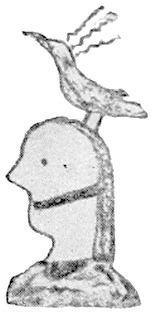
Fig. 647.
Fig. 647.—Kangi-wakan, Sacred-Crow. The Oglala Roster. The lines above the bird’s head signify sacred, mystic, sometimes termed “medicine,” as above.
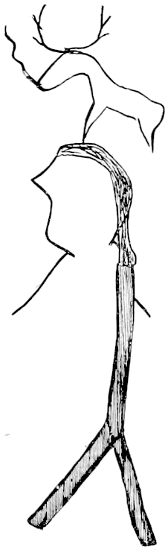
Fig. 648.
Fig. 648.—White-Elk. Red-Cloud’s Census. This is an albino elk which partakes in sacredness with the albino buffalo. The elk was an important article of food, though not so much a reliance as the buffalo, and the practices relating to the latter would naturally, and in fact did, measurably, apply to the former.
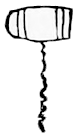
Fig. 649.
Fig. 649.—The Dakotas had all the mini wakan (spirit water, or whisky) they could drink. American-Horse’s Winter Count, 1821-’22. A barrel with a waved or spiral line running from it represents the whisky, the waved line signifying wakan, or spirit, in the double sense of the English word.
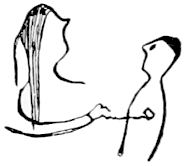
Fig. 650.
Fig. 650.—Cloud-Bear, a Dakota, killed a Dakota, who was a long distance off, by throwing a bullet from his hand and striking him in the heart. American-Horse’s Winter Count, 1824-’25. The spiral line is used for wakan.
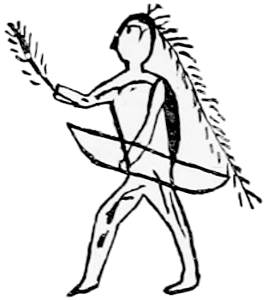
Fig. 651.
Fig. 651.—A Minneconjou clown, well known to the Indians. The-Flame’s Winter Count, 1787-’88. His accouterments are fantastic. The character is explained by Battiste Good’s Winter Count for the same year as follows:
“Left-the-heyoka-man-behind winter.” A certain man was heyoka, that is, in a disordered frame of mind, and went about the village bedecked with feathers singing to himself, and while so joined a war party. On sighting the enemy the party fled and called to him to turn back also, but as he was heyoka he construed everything that was said to him as meaning the very opposite, and, therefore, instead of turning back he went forward and was killed. This conception of a man under superhuman influence being obliged to believe or speak the reverse of the truth is not uncommon among the Indians. See Leland (a) Algonquin Legends.
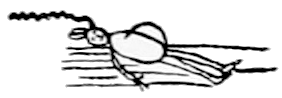
Fig. 652.—Dream. Ojibwa.
Fig. 652, from Copway (b), gives the representation of “dream”. The recumbent human figure naturally suggests sleep, and the wavy lines to the head indicate the spiritual or mythic concept of a dream.
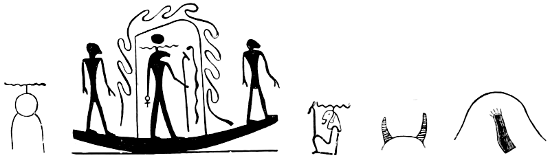
Fig. 653.—Religious symbols.
Fig. 653: a is an Ojibwa pictograph taken from Schoolcraft representing “medicine man,” “meda.” With these horns and spiral may be collated b in the same figure, which portrays the ram-headed Egyptian god Knuphis, or Chnum, the spirit, in a shrine on the boat of the sun, canopied by the serpent goddess Ranno, who is also seen facing him inside the shrine. This is reproduced from Cooper’s Serpent Myths (a). The same deity is represented in Champollion (a) as reproduced in Fig. 653, c.
d is an Ojibwa pictograph found in Schoolcraft (i) and given as “power.” It corresponds with the Absaroka sign for “medicine man” made by passing the extended and separated index and second finger of the right hand upward from the forehead, spirally, and is considered to indicate “superior knowledge.” Among the Otos, as part of the sign with the same meaning, both hands are raised to the side of the head and the extended indices pressing the temples.
e is also an Ojibwa pictograph from Schoolcraft, same volume, Pl. 59, and is said to signify Meda’s power. It corresponds with another sign made for “medicine man” by the Absaroka and Comanche, viz, the hand passed upward before the forehead, with index loosely extended. Combined with the sign for “sky” it means knowledge of superior matters, spiritual power.
In many parts of the United States and Canada rocks and large stones are found which generally were decorated with paint and were regarded as possessing supernatural power, yet, so far as ascertained, were not directly connected with any special personage of Indian mythology. One of the earliest accounts of these painted stones was made by the Abbé de Gallinée and is published in Margry (d). The Abbé, with La Salle’s party in 1669, found on the Detroit river, six leagues above Lake Erie, a large stone remotely resembling a human figure and painted, the face made with red paint. All the Indians of the region—Algonquian and Iroquoian—believed that the rock-image could give safety in the passage of the lake, if properly placated, and they never ventured on the passage without offering to it presents of skins, food, tobacco, or like sacrifices. La Salle’s party, which had met with misfortune, seems to have been so much impressed with the evil powers of the image that they broke it into pieces.
Keating’s Long (e) tells:
At one of the landing places of the St. Peters river, in the Sioux country, we observed a block of granite of about eighty pounds weight; it was painted red and covered with a grass fillet, in which were placed twists of tobacco offered up in sacrifice. Feathers were stuck in the ground all round the stone.
Mrs. Eastman (a) also describes a stone painted red, which the Dakotas called grandfather, in reverence, at or near which they placed as offerings their most valuable articles. They also killed dogs and horses before it as sacrifices.
In “A study of Pueblo Architecture,” by Victor Mindeleff, in the Eighth Annual Report of the Bureau of Ethnology, is an account of the cosmology of the Pueblos as symbolized in their architecture and figured devices, as follows:
In the beginning all men lived together in the lowest depths, in a region of darkness and moisture; their bodies were misshapen and horrible and they suffered great misery, moaning and bewailing continually. Through the intervention of Myuingwa (a vague conception known as the god of the interior) and of Baholikonga (a crested serpent of enormous size, the genius of water) “the old man” obtained a seed from which sprang a magic growth of cane. It penetrated through a crevice in the roof overhead and mankind climbed to a higher plane. A dim light appeared in this stage and vegetation was produced. Another magic growth of cane afforded the means of rising to a still higher plane, on which the light was brighter; vegetation was reproduced and the animal kingdom was created. The final ascent to this present or fourth plane was effected by similar magic growths and was led by mythic twins, according to some of the myths, by climbing a great pine tree, in others by climbing the cane, Phragmites communis, the alternate leaves of which afforded steps as of a ladder, and in still others it is said to have been a rush, through the interior of which the people passed up to the surface. The twins sang as they pulled the people out, and when their song was ended no more were allowed to come, and hence many more were left below than were permitted to come above; but the outlet through which mankind came has never been closed, and Myuingwa sends through it the germs of all living things. It is still symbolized by the peculiar construction of the hatchway of the kiva and in the designs on the sand altars in these underground chambers, by the unconnected circle painted on pottery, and by devices on basketry and other textile fabrics.
SECTION 2. MYTHS AND MYTHIC ANIMALS.
Among the hundreds of figures and characters seen by the present writer on the slate rocks that abound on the shores and islands of Kejimkoojik Lake, Queen’s county, Nova Scotia, described in Chap. II, Sec. 1, there appears a class of incised figures illustrating the religious myths and folk lore of the Indian tribes which inhabited the neighborhood within historic times. It is probable that in other parts of America, and, indeed, in all lands, the pictographic impulses and habits of the people have induced them to represent the scenes and characters of their myths on such rocks as were adapted to the purpose, as they are known to have done on bark, skins, and other objects. But these exhibitions of the favorite or prevalent myths in the shape of petroglyphs, though doubtless existing, have seldom been understood and deciphered by modern students. Sometimes they have not originally been sufficiently distinct or have become indefinite by age, and frequently their artists have been people of languages, religions, and customs different from the tribes now or lately found in the localities and from whom the significance of the petroglyphs has been sought in vain. The conditions of the characters at Kejimkoojik, now mentioned, are perhaps unique. They are drawn with great distinctness and sufficient skill, so that when traced on the rocks they immediately struck the present writer as illustrative of the myths and tales of the Abnaki. Many of these myths had been recently repeated to him by Mrs. W. Wallace Brown, of Calais, Maine, the highest authority in that line of study, and by other persons visited in Maine, New Brunswick, Nova Scotia, and in Cape Breton and Prince Edwards Islands, who were familiar with the Penobscot, Passamaquoddy, Amalecite, and Micmac tribes. A number of these myths and tales had before been collected in variant forms by Mr. Charles G. Leland (a). It is a more important and convincing fact that the printed impressions of the figures now presented were at once recognized by individual Indians of the several Abnaki tribes above mentioned to have the signification explained below. It is also to be noted that these Abnaki have preserved the habit of making illustrations from their stories by scratchings and scrapings on birch bark. The writer saw several such figures on bark ornaments and utensils which exhibited parts of the identical myths indicated in the petroglyphs but not the precise scenes or characters depicted on the rocks. The selection of themes and their treatment were not conventional and showed some originality and individuality both in design and execution. From the appearance and surroundings of the rock drawings now specially under discussion they were probably of considerable antiquity and suggested that the Micmacs, who doubtless were the artists, had gained the idea of practicing art for itself, not merely using the devices of pictography for practical purposes, such as to record the past or to convey information.
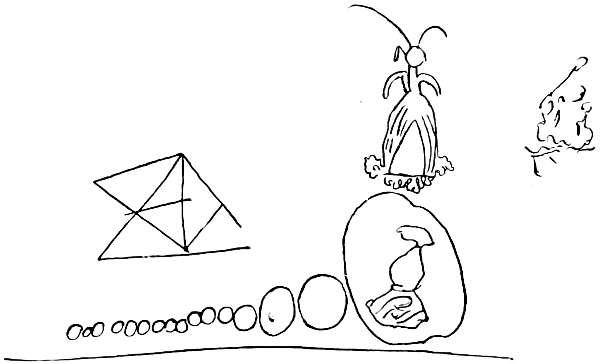
Fig. 654.—Myth of Pokinsquss.
Fig. 654 is one of the drawings mentioned, and indicates one episode among the very numerous adventures of Glooscap, the Hero-God of the Abnaki, several of which are connected with a powerful witch called by Mr. Leland Pook-jin-skwess, or the Evil Pitcher, and by Mrs. W. Wallace Brown, Pokinsquss, the Jug Woman. She is also called the toad woman, from one of her transformations, and often appeared in a male form to fight Glooscap after he had disdained her love proffered as a female. Among the multitude of tales on this general theme, one narrates how Glooscap was at one time a Pogumk, or the small animal of the weasel family commonly called Fisher (Mustela Canadensis), also translated as Black Cat, and was the son of the chief of a village of Indians who were all Black Cats, his mother being a bear. Doubtless these animal names and the attributes of the animals in the tales refer to the origin of totemic divisions among the Abnaki. Pokinsquss was also of the Black Cat village, and hated the chief and contrived long how she could kill him and take his place. Now, one day when the camp had packed up to travel, the witch asked the chief Pogumk to go with her to gather gull’s eggs; and they went far away in a canoe to an island where the gulls were breeding and landed there, and then she hid herself to spy, and having found out that the Pogumk was Glooscap, ran to the canoe and paddled away singing:
Nikhed-ha Pogumk min nekuk, Netswil sāgāmawin!
Which being translated from the Passamaquoddy language means—
I have left the Black Cat on an island, I shall be chief of the Fishers now!
The continuation of the story is found in many variant shapes. In one of them Glooscap’s friend the Fox came to his rescue, as through Glooscap’s m’toulin or magic power he heard the song of appeal though miles away beyond forests and mountains. In others the Sea Serpent appears in answer to the Hero-God’s call, and the latter, mounting the serpent’s back, takes a load of stones as his cargo to throw at the serpent’s horns when the latter did not swim fast enough. In the figure the island is shown at the lower right hand as a roundish outline with Glooscap inside. The small round objects to the left are probably the gull’s eggs, but may be the stimulating stones above mentioned. Pokinsquss stands rejoicing in the stern of a canoe, which points in the wavy water away from the island. The device to the left of the witch may be the dismantled camp of the Black Cats, and the one to her right is perhaps where the Fox “beyond forests and mountains” heard Glooscap’s song of distress.
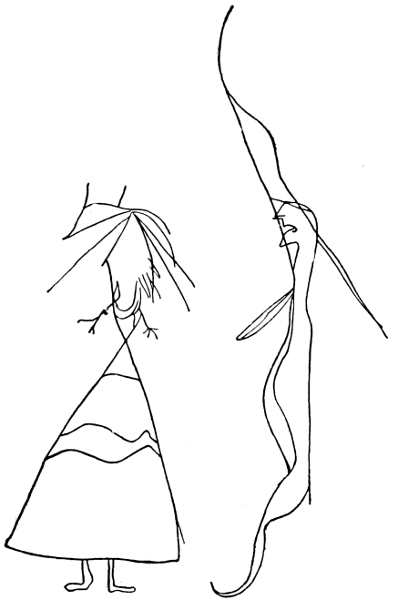
Fig. 655.—Myth of Atosis.
Fig. 655, another specimen of the same class, refers to one of the tales about At-o-sis, the Snake, who was the lover of a beautiful Abnaki woman. He appeared to her from out the surface of a lake as a young hunter with a large shining silvery plate on his heart and covered with brilliant white brooches as fish are covered with scales. He provided her with all animals for food. The bow attached to the semi-human head in the illustration may refer to this expertness in the chase. The head of the female figure is covered or masked by one of the insignia of rank and power mentioned in Chap. XIII, Sec. 2. She became the mother of the Black Snakes.
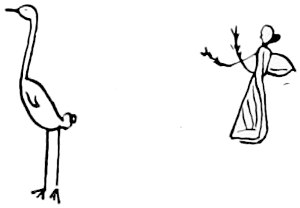
Fig. 656.—Myth of the Weasel girls.
Fig. 656, from the same locality, shows simply a crane, and a woman who bears in her hand two branches; but this is a sufficient indication of the tale of the Weasel girls, who had come down from Star-land by means of a diminishing hemlock tree, and flying from Lox had come to a broad river which they could not cross. But in the edge of the water stood motionless a large crane, or the Tum-gwo-lig-unach, who was the ferryman. “Now, truly, this is esteemed to be the least beautiful of all the birds, for which cause he is greedy of good words and fondest of flattery. And of all beings there were none who had more bear’s oil ready to annoint every one’s hair with—that is to say, more compliments ready for everybody—than the Weasels. So, seeing the Crane, they sang:
Wa wela quis kip pat kasqu', Wa wela quis kip pat kasqu'. The Crane has a very beautiful long neck, The Crane has a very beautiful long neck.
“This charmed the old ferryman very much, and when they said: ‘please, grandfather, hurry along,’ he came quickly. Seeing this, they began to chant in chorus sweetly as the Seven Stars themselves:
Wa wela quig nat kasqu', Wa wela quig nat kasqu'. The crane has very beautiful long legs, The crane has very beautiful long legs.
“Hearing this the good crane wanted more; so when they asked him to give them a lift across he answered, slowly, that to do so he must be well paid, but that good praise would answer as well. Now they who had abundance of this and to spare for everybody were these very girls. ‘Have I not a beautiful form?’ he inquired; and they both cried aloud: ‘Oh, uncle, it is indeed beautiful!’ ‘And my feathers?’ ‘Ah, pegeakopchu.’ ‘Beautiful and straight feathers, indeed!’ ‘And have I not a charming long, straight, neck?’ ‘Truly our uncle has it straight and long.’ ‘And will ye not acknowledge, oh maidens, that my legs are fine?’ ‘Fine! oh, uncle, they are perfection. Never in this life did we see such legs!’ So, being well pleased, the crane put them across, and then the two little weasels scampered like mice into the bush.”
Though but one woman figure is drawn, the two boughs borne by her suggest the two weasel girls, who had come down the hemlock tree and had also been water fairies until their garments were stolen by the marten, and thereupon they had lost their fairy powers and become women in a manner at once reminding of the Old World swan-maiden myth.
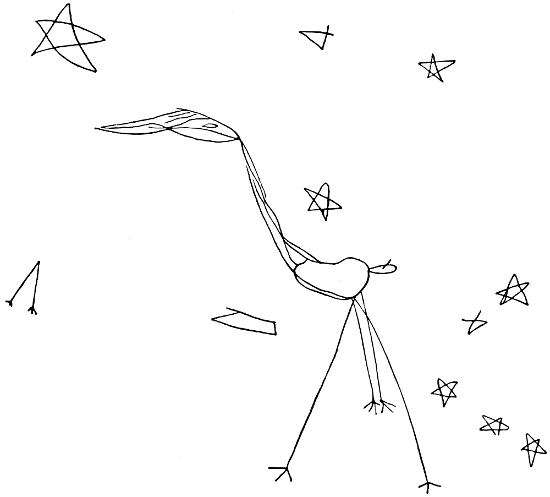
Fig. 657.—The Giant Bird Kaloo.
Fig. 657 is a sketch of the Giant Bird Kaloo, or, in the literation of Mr. Leland, Culloo. He was the most terrible of all creatures. He it was who caught up the mischievous Lox in his claws and, mounting to the top of the sky among the stars, let him drop, and he fell from dawn to sunset. Lox was often a badger in the Micmac stories, and was more Puck-like than the devilish character he showed among the Passamaquoddy, being then generally in the form of a wolverine, though sometimes in that of a lynx. In the illustration Kaloo is soaring among the stars, and appears to possess an extra pair of legs armed with claws. Perhaps one of the objects beneath his beak represents Lox or some other victim falling through the air. There is another story of Lox’s two feet talking and acting independently of the rest of his body, and the two feet and legs without any body may be a symbol of the tricksy demigod.
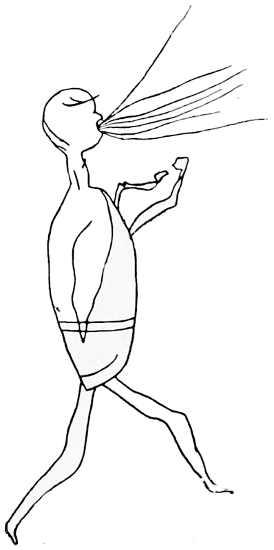
Fig. 658.—Kiwach, the Strong Blower.
Fig. 658 represents Kiwach, the Strong Blower, a giant who kills people with his violent breath. Tales of him seem to be more current or better preserved among the Amalecites than among the other Abnaki.
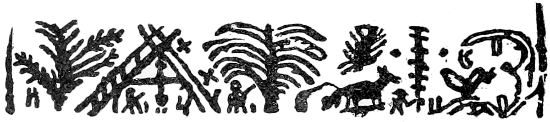
Fig. 659.—Story of Glooscap.
Fig. 659 is an exact copy of the design on a birch-bark jewel box made by the Passamaquoddy of Maine, amiably contributed by Mrs. W. W. Brown, together with the description of that part of the myth which is illustrated on the box. There are several variants of this myth, the nearest to the form now presented being published by Mr. J. Walter Fewkes (a).
The Sable and the Black Cat wanted some maple sugar, and went to a wood where the maple trees grew. Toward night they lost their way and separated from each other to find it, agreeing to call to each other by m’toulin power. These animals were as frequently in human form as in that designated by their names, and could change to the forms of other animals. It is not certain, from anything in the present version of the myth, which one of the daimons was represented by the Sable, but the Black Cat afterward appears as Glooscap. Sable, in his wanderings, came to a wigwam in which was a large fire with a kettle boiling over it, tended by a great Snake. The Snake said he was glad the Sable had come, as he was very hungry and would eat him, but in gratitude for his coming would put him to as little pain as was possible. The Snake told him to go into the woods and get a straight stick, so that when he pierced him he would not tear open his entrails. Sable then went out and sang in a loud voice a m’toulin song for the Black Cat to hear and come to his aid. The Black Cat heard him and came to him. Then the Sable told the Black Cat how the Snake was going to kill him. The Black Cat told Sable not to be afraid, but that he would kill the big Snake. He told him that he would lie down behind the trunk of a hemlock tree which had fallen and that Sable should search out a stick that was very crooked, only pretending to obey the commands of the great Snake. After finding such a stick he should carry it to the Snake, who would complain that the stick was not straight enough, and then Sable should reply that he would straighten it in the fire, holding it there until the steam came out of the end. Then while the Snake watched the new mode of straightening sticks Sable should strike the Snake over the eyes. The Sable sought out the most crooked stick he could find and then returned to the wigwam where the Snake was. The Snake said the stick was too crooked. The Sable replied as directed and held it in the fire. When it was burning he struck the Snake with it over the eyes, blinded him, and ran away. The Snake followed the Sable, and as he passed over the hemlock trunk the Black Cat killed him and they cut him into small pieces.
The two human figures on the left show the animals under the forest trees in human form bidding good-bye before they parted in search of the right trail. Their diminutive size gives the suggestion of distance from the main scene. Next comes the great Snake’s wigwam, the stars outside showing that night had come, and inside the kettle hung over a fire, and on its right appear the wide-open jaws and an indication of the head of the great Snake. The very crooked stick is on the other side. Farther on the Black Cat comes responsive to the Sable’s call. Next is shown, the Black Cat and the Sable, who is in human form, near the hemlock tree. The fact that the tree is fallen is suggested, without any attempt at perspective, by the broken-off branches and the thick part of the trunk being upturned. The illustration ends with the Black Cat sitting upon the Snake, clawing and throwing around pieces of it.
The illustration above presented gives an excellent example of the art of the Passamaquoddy in producing pictures by the simple scraping of birch bark.
The characters in Fig. 660 are reproduced from Schoolcraft (k).

Fig. 660.—Ojibwa shamanistic symbols.
The first device, beginning at the left, is used by the Ojibwa to denote a spirit or man enlightened from on high, having the head of the sun.
The second device is drawn by the Ojibwa for a “wabeno” or shaman.
The third is the Ojibwa “symbol” for an evil or one-sided “meda” or higher-grade shaman.
The fourth is the Ojibwa general “symbol” for a meda.
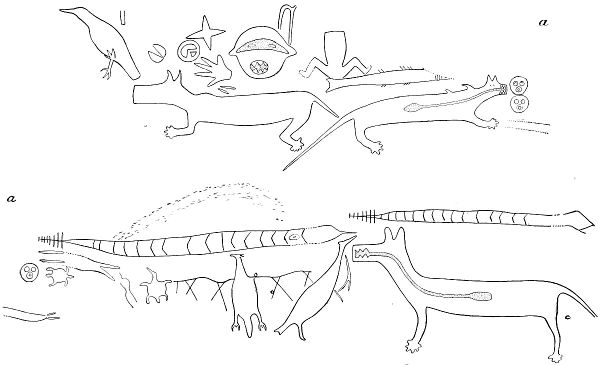
Mr. William H. Holmes, of the Bureau of Ethnology, gives the following account (condensed from the American Anthropologist, July, 1890) of a West Virginia rock shelter (shown in Pl. XXXI). The copy is in two rows of figures, but in the original there is only one row, the parts marked a and a being united:
In Harrison county, West Virginia, a small stream, Two-Lick creek, heading near the Little Kanawha divide, descends into the west fork of the Monongahela about 4 miles west of Lost Creek station, on the Clarksburg and Weston railroad. Ascending the stream for a little more than 2 miles and turning to the right up a tributary called Campbells run, is a recess in the rocks, the result of local surface undermining of an outcrop of sandstone assisted by roof degradation, which therefore is a typical rock shelter. At the opening it is about 20 feet long and in the deepest part extends back 16 feet.
The rock sculptures, of which simplified outlines are given in Pl. XXXI, occupy the greater part of the back wall of the recess, covering a space of some 20 feet long by about 4 feet in height. At the left the line of figures approaches the outer face of the rock, but at the right it terminates in the depths of the chamber, beyond which the space is too low and uneven to be utilized. There are indications that engravings have existed above and below those shown, but their traces are too indistinct to be followed.
BUREAU OF ETHNOLOGY TENTH ANNUAL REPORT PL. XXXI PICTOGRAPH IN ROCK SHELTER, WEST VIRGINIA.
The more legible designs comprise three heads, resembling death’s-heads, one human head or face, one obscure human figure, three birds resembling cranes or turkeys (one with outspread wings), three mountain lions or beasts of like character, two rattlesnakes, one turtle, one turtle-like figure with bird’s head, parts of several unidentified creatures (one resembling a fish), and four conventional figures or devices resembling, one a hand, one a star, one the track of a horse, and the fourth the track of an elk, buffalo, deer, or domestic cow.
The serpents, placed above and toward the right of the picture, are much larger than life, but the other subjects are represented somewhat nearly natural size. The animal figure facing the two death’s-heads is drawn with considerable vigor and very decidedly suggests the panther. A notable feature is the two back-curving spines or spine-like tufts seen upon its shoulder; it is possible that these represent some mythical character of the creature. Two of the animal figures, in accordance with a widespread Indian practice, exhibit the heart and the life line, the latter connecting the heart with the mouth; these features are, as usual, drawn in red.
The human head or face is somewhat larger than life; it is neatly hollowed out to the nearly uniform depth of one-fourth of an inch, and is slightly polished over most of the surface. Ear lobes are seen at the right and left, and an arched line, possibly intended for a plume, rises from the left side of the head. A crescent-shaped band of red extends across the face, and within this the eyes are indistinctly marked. The mouth is encircled by a dark line and shows six teeth, the spaces between being filled in with red.
Probably the most remarkable members of the series are the three death’s-heads seen near the middle of the line. That they are intended to represent skulls and not the living face or head is clear, and the treatment is decidedly suggestive of that exhibited in similar work of the more cultured southern nations. The eye spaces are large and deep, the cheek bones project, the nose is depressed, and the mouth is a mere node depressed in the center.
All the figures are clearly and deeply engraved, and all save the serpents are in full intaglio, being excavated over the entire space within the outlines and to the depth of from one-eighth to one-fourth of an inch. The serpents are outlined in deep unsteady lines, ranging from one-fourth of an inch to 1 inch in width, and in parts are as much as one-half an inch in depth. The example at the left is rather carefully executed, but the other is very rude. It is proper to notice a wing-like feature which forms a partial arch over the larger serpent. It consists of a broad line of irregular pick marks, which are rather new looking and may not have formed a part of the original design; aside from this, there are few indications of the use of hard or sharp tools, and, although picking or striking must have been resorted to in excavating the figures, the lines and surfaces were evidently finished by rubbing. The friable character of the coarse, soft sandstone makes excavation by rubbing quite easy, and at the same time renders it impossible to produce any considerable degree of polish.
The red color used upon the large face and in delineating the life line and heart of the animal figures is a red ocher or hematite, bits of which, exhibiting the effects of rubbing, were found in the floor deposits of the recess. The exact manner of its application is not known (perhaps the mere rubbing was sufficient), but the color is so fixed that it can not be removed save by the removal of the rock surface.
Regarding the origin and purpose of these sculptures, it seems probable that they are connected with religious practices and myths. If the inscriptions were mnemonic records or notices it is reasonable to suppose that they would have been placed so as to meet the eye of others than those who made or were acquainted with them. But these works are hidden in a mountain cave, and even yet, when the forest is cleared and the surrounding slopes are cultivated, this secluded recess is invisible from almost every side. The spot was evidently the resort of a chosen few, such as a religious society. Such sequestered art gives evidence of a mystic purpose.
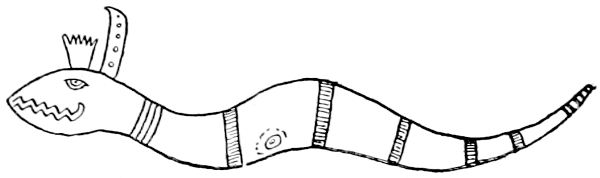
Fig. 661.—Baho-li-kong-ya. Arizona.
In this connection it may be noted that a rock drawing in the Canyon Segy, Arizona (Fig. 661), shows Baho li-kong-ya, a god, the genius of fructification, worshipped by living Moki priests. It is a great crested serpent with mammæ, which are the source of the blood of all the animals and of all the waters of the land.
The serpents in the last-mentioned plate and figure may be compared with two Ojibway forms published by Schoolcraft (l).
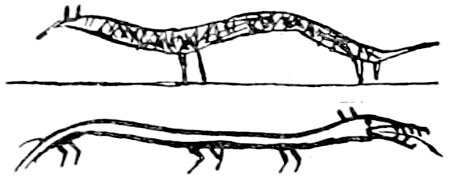
Fig. 662.—Mythic serpents, Innuits.
The upper design of Fig. 662 undoubtedly represents a mythical animal, referred to in the myths of some of the Innuits. It is reproduced from a drawing on walrus ivory, bearing Museum No. 40054, obtained at Port Clarence, Alaska. This form is not so close in detail to that form usually described and more fully outlined in the lower design of the same figure, which is reproduced from a specimen of reindeer horn drill-bow, from Alaska, marked No. 24557, collected by L. Turner.
Ensign Niblack, U. S. Navy (d), gives the following description of the illustration reproduced here as Fig. 663.
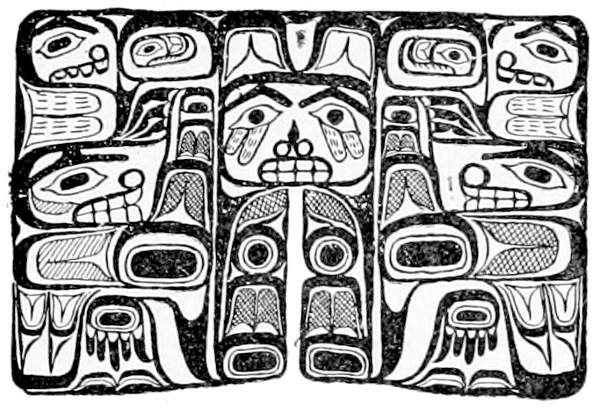
Fig. 663.—Haida Wind Spirit.
It represents T’kul, the wind spirit, and the cirrus clouds, explaining the Haida belief in the causes of the changes in the weather. The center figure is T’kul, the wind spirit. On the right and left are his feet, which are indicated by long streaming clouds; above are the wings, and on each side are the different winds, each designated by an eye, and represented by the patches of cirrus clouds. When T’kul determines which wind is to blow, he gives the word and the other winds retire. The change in the weather is usually followed by rain, which is indicated by the tears which stream from the eyes of T’kul.
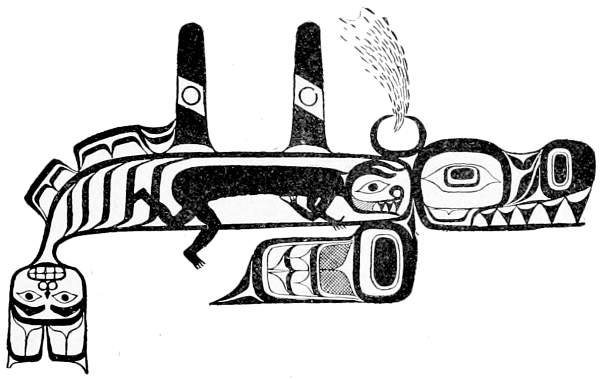
Fig. 664.—Orca. Haida.
The same author, p. 322, thus describes Fig. 664:
It represents the orca or whale-killer, which the Haida believe to be a demon called Skana. Judge Swan says that, according to their belief—
“He can change into any desired form, and many are the legends about him. One which was related to me was that ages ago the Indians were out seal-hunting. The weather was calm and the sea smooth. One of these killers, or blackfish, a species of porpoise, kept alongside of a canoe, and the young men amused themselves by throwing stones from the canoe ballast and hitting the fin of the killer. After some pretty hard blows from these rocks the creature made for the shore, where it grounded on the beach. Soon a smoke was seen, and their curiosity prompted them to ascertain the cause, but when they reached the shore they discovered, to their surprise, that it was a large canoe, and not the Skana that was in the beach, and that a man was on shore cooking some food. He asked them why they threw stones at his canoe. ‘You have broken it,’ he said, ‘and now go into the woods and get some cedar withes and mend it.’ They did so, and when they had finished the man said, ‘Turn your backs to the water and cover your heads with your skin blankets and don’t look till I call you.’ They did so, and heard the canoe grate on the beach as it was hauled down to the surf. Then the man said, ‘Look, now.’ They looked, but when it came to the second breaker it went under and presently came up outside of the breaker a killer and not a canoe, and the man or demon was in its belly. This allegory is common among all the tribes on the Northwest Coast, and even with the interior tribes with whom the salmon takes the place of the orca, which never ascends the fresh-water rivers. The Chilcat and other tribes of Alaska carve figures of salmon, inside of which is the full length figure of a nude Indian. * * * Casual observers without inquiry will at once pronounce it to be Jonah in the fish’s belly, but the allegory is of ancient origin, far antedating the advent of the white man or the teachings of the missionary.”
The same author, Pl. XLIX, gives an explanation of Fig. 665, which is a copy of a Haida slate carving, representing the “Bear-Mother.”
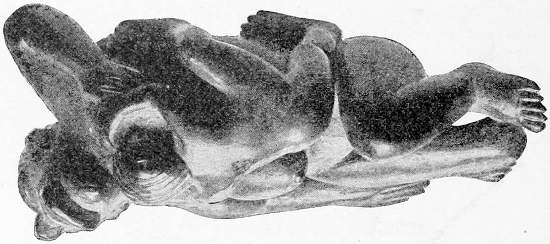
Fig. 665.—Bear-Mother. Haida.
The Haida version of the myth is as follows:
A number of Indian squaws were in the woods gathering berries when one of them, the daughter of a chief, spoke in terms of ridicule of the whole bear species. The bears descended on them and killed all but the chief’s daughter, whom the king of the bears took to wife. She bore him a child half human and half bear. The carving represents the agony of the mother in suckling this rough and uncouth offspring. One day a party of Indian bear hunters discovered her up a tree and were about to kill her, thinking her a bear, but she made them understand that she was human. They took her home and she afterwards became the progenitor of all Indians belonging to the bear totem. They believe that the bear are men transformed for the time being. This carving was made by Skaows-ke'ay, a Haida. Cat. No. 73117, U. S. Nat. Museum. Skidegate village, Queen Charlotte Islands, British Columbia. Collected by James G. Swan.
Dr. F. Boas (d) gives the following account of a myth of the Kwakiut Indians illustrated on a house front at Alert Bay, copied here as Fig. 666.
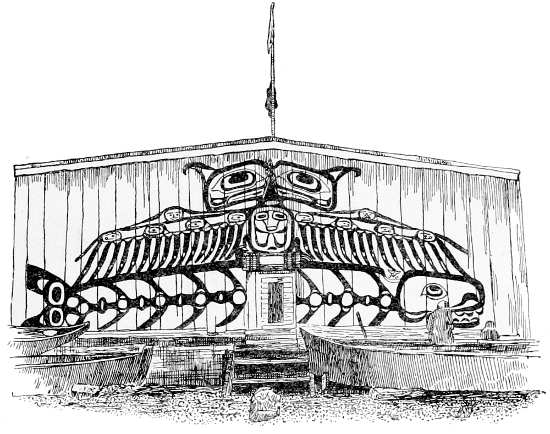
Fig. 666.—Thunder-bird grasping whale.
The house front shows how Kunkunquilikya (the thunder-bird) tried to lift the whale. The legend says that he had stolen the son of the raven, who in order to recover him, carried a whale out of a huge cedar that he covered with a coating of gum. Then he let all kinds of animals go into the whale, and they went to the land of the thunder-bird. When the bird saw the whale he sent out his youngest son to catch it. He was unable to lift it. He stuck to the gum and the animals killed him. In this way the whole family was slaughtered.
On Pl. XXXII is shown a reproduction of a native Haida drawing, representing the Wasko, a mythologic animal partaking of the characteristics of both the bear and the orca, or killer. It is one of the totems of the Haidas.
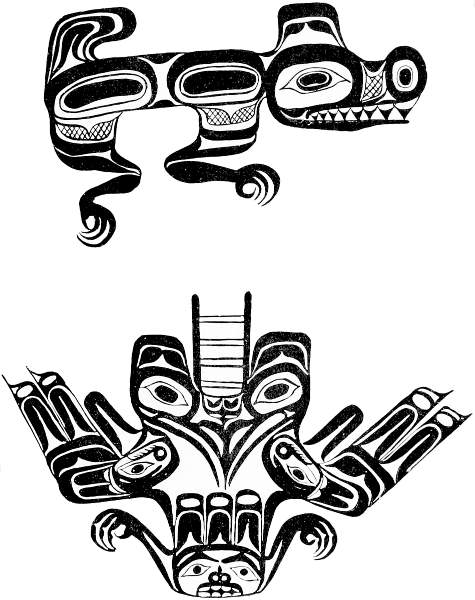
BUREAU OF ETHNOLOGY TENTH ANNUAL REPORT PL. XXXII WASCO AND MYTHIC RAVEN, HAIDA.
On the same plate is a figure representing the Hooyeh, or mythic raven. The character is also reproduced from a sketch made by a Haida Indian. Both of these figures were obtained from Haida Indians who visited Port Townsend, Washington, in the summer of 1884.
The following is extracted from Mrs. Eastman’s (b) Dahcotah. The picture, reproduced here in Fig. 667, is that of Haokah, the antinatural god, one of the giants of the Dakotas, drawn by White-Deer, a Sioux warrior, living near Fort Snelling about 1840.
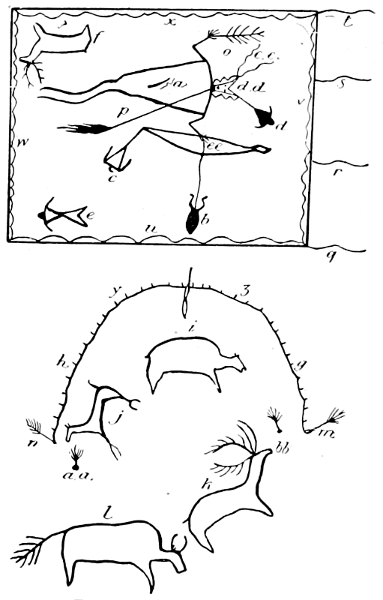
Fig. 667.—Haokah. Dakota giant.
Explanation of the drawing.—a, the giant; b, a frog that the giant uses for an arrow point; c, a large bird that the giant keeps in his court; d, another bird; e, an ornament over the door leading into the court; f, an ornament over a door; g, part of court ornamented with down; h, part of court ornamented with red down; i, a bear; j, a deer; k, an elk; l, a buffalo; m, n, incense-offering; o, a rattle of deer’s claws, used when singing; p, a long flute, or whistle; q, r, s, t, are meteors that the giant sends out for his defense, or to protect him from invasion; u, v, w, x, the giant surrounded with lightnings, with which he kills all kinds of animals that molest him; y, red down in small bunches fastened to the railing of the court; z, the same. One of these bunches of red down disappears every time an animal is found dead inside the court; aa, bb, touchwood, and a large fungus that grows on trees. These are eaten by any animal that enters the court, and this food causes their death; cc, a streak of lightning going from the giant’s hat; dd, giant’s head and hat; ee, his bow and arrow.
Mrs. Eastman’s explanation of the drawing would have been better if she had known more about the mystery lodges. It is given here in her own words.

Fig. 668.—Ojibwa Ma'nidō.
Fig. 668, from Copway (c), shows the representations, beginning from the left, of spirits above, spirits under water, and animals under ground, all of which are called ma'nidōs.
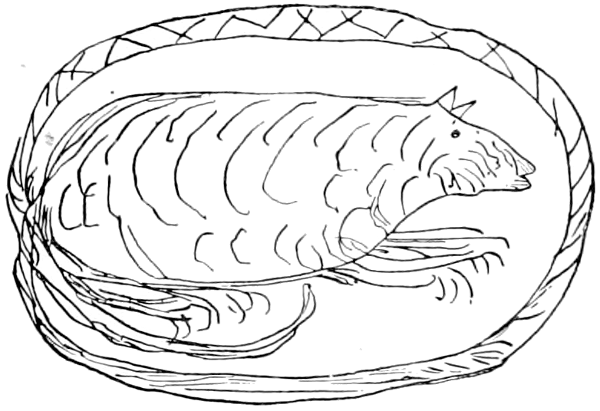
Fig. 669.—Menomoni. White Bear Ma'nidō.
Fig. 669 is a reproduction of a drawing made by Niópet, chief of the Menomoni Indians, and represents the white bear spirit who guards the deposits of native copper of Lake Superior. According to the myth the animal is covered with silvery hair, and the tail, which is of great length and extends completely around the body, is composed of bright, burnished copper. This spirit lives in the earth, where he guards the metal from discovery.
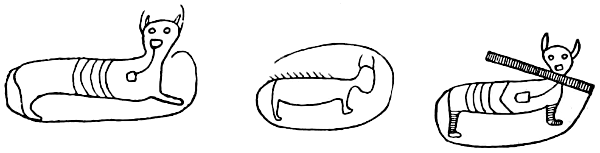
Fig. 670.—Mythic wild-cats. Ojibway.
In a midē' song, given by James Tanner (f), is the representation of an animal resembling the preceding, viz, the middle character of Fig. 670, to which is attached the Ojibway phrase and explanation as follows:
Che-be-gau-ze-naung gwit-to-i-ah-na maun-dah-ween ah-kee-ge neen-wa-nah gua-kwaik ke-nah gwit-to-i-ah-na.
I come to change the appearance of the ground, this ground; I make it look different each season.
This is a Manito who, on account of his immensity of tail, and other peculiarities, has no prototype. He claims to be the ruler over the seasons. He is probably Gitche-a-nah-mi-e-be-zhew (great underground wild-cat).
The “underground wild-cat” is again mentioned in the same work, page 377, with an illustration now presented as the left-hand character of the same Fig. 670, slightly different from the above, described as follows:
A-nah-me be-zhe ne-kau-naw.
Underground wild-cat is my friend.
At the fourth verse he exhibits his medicines, which he says are the roots of shrubs and of We-ug-gusk-oan, or herbs, and from these he derives his power, at least in part; but lest his claim, founded on a knowledge of these, should not be considered of sufficient importance, he proceeds to say, in the fifth and sixth verses, that the snakes and the underground wild-cat are among his helpers and friends. The ferocity and cunning, as well as the activity of the feline animals have not escaped the notice of the Indians, and very commonly they give the form of animals of this family to those imaginary beings whose attributes bear, in their opinion, some resemblance to the qualities of these animals. Most of them have heard of the lion, the largest of the cats known to white men, and all have heard of the devil; they consider them the same. The wild-cat here figured has horns, and his residence is under the ground; but he has a master, Gitche-a-nah-mi-e-be-zhew (the great underground wild-cat), who is, as some think, Matche-Manito himself, their evil spirit, or devil. Of this last they speak but rarely.
In another song from Tanner, p. 345, sung only by the midē', is the drawing, the right hand character of the same figure, of a similar animal with a bar across the throat, signifying, no doubt, its emerging or appearance from the surface of the ground.
Nah-ne-bah o-sa ann neen-no ne-mah-che oos-sa ya-ah-ne-no. [Twice.]
I walk about in the nighttime.
This first figure represents the wild-cat, to whom, on account of his vigilance, the medicines for the cure of diseases were committed. The meaning probably is that to those who have the shrewdness, the watchfulness, and intelligence of the wild-cat, is intrusted the knowledge of those powerful remedies, which, in the opinion of the Indians, not only control life and avail to the restoration of health but give an almost unlimited power over animals and birds.
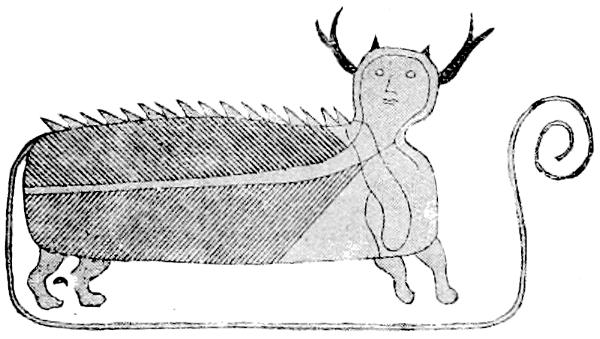
Fig. 671.—Winnebago magic animal.
Schoolcraft, part II, p. 224, describes Fig. 671 as follows:
It was drawn by Little Hill, a Winnebago chief of the upper Mississippi, west. He represents it as their medicine animal. He says that this animal is seldom seen; that it is only seen by medicine men after severe fasting. He has a piece of bone which he asserts was taken from this animal. He considers it a potent medicine and uses it by filing a small piece in water. He has also a small piece of native copper which he uses in the same manner, and entertains like notions of its sovereign virtues.
The four preceding figures are to be compared with those relating to the Piasa rock. See Figs. 40 and 41, supra.
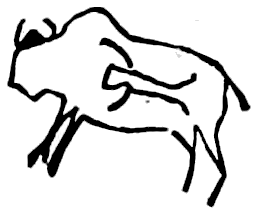
Fig. 672.—Mythic buffalo.
Fig. 672.—A Minneconjou Dakota, having killed a buffalo cow, found an old woman inside of her. The-Swan’s Winter Count, 1850-’51.
For remarks upon this statement see Lone-Dog’s Winter Count for 1850-’51, supra.
Graphic representations of Atotarka and of the Great Heads are shown in Mrs. Erminie A. Smith’s Myths of the Iroquois, in the Second Annual Report of the Bureau of Ethnology. Several illustrations of myths and mythic animals appear in the present work in Chap. IX, Secs. 4 and 5.
THUNDER BIRDS.
Some forms of the thunder bird are here presented:
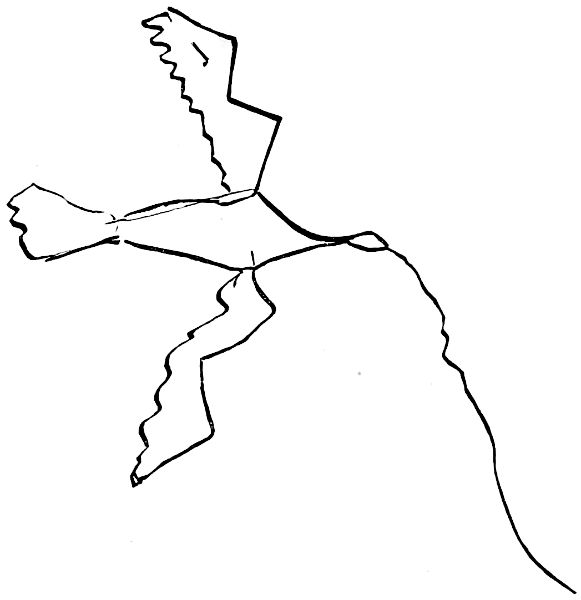
Fig. 673.—Thunder-bird, Dakota.
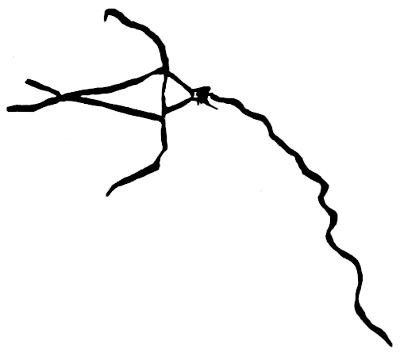
Fig. 674.—Thunder-bird, Dakota.
Figs. 673 and 674 are forms of the thunder bird found in 1883 among the Dakotas near Fort Snelling, drawn and interpreted by themselves. They are both winged, and have waving lines extending from the mouth downward, signifying lightning. It is noticeable that Fig. 673 placed vertically, then appearing roughly as an upright human figure, is almost identically the same as some of the Ojibwa meda or spirit figures represented in Schoolcraft, and also on a bark Ojibwa record in the possession of the writer.
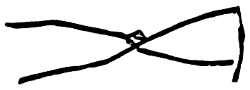
Fig. 675.—Wingless thunder-bird, Dakota.
Fig. 675 is another and more cursive form of the thunder bird obtained at the same place and time as those immediately preceding. It is wingless, and, with changed position or point of view, would suggest a headless human figure.
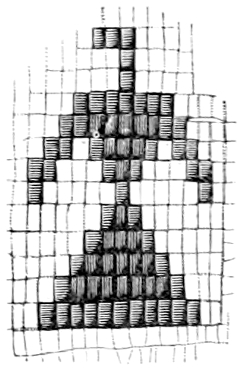
Fig. 676.—Thunder-bird, Dakota.
The thunder-bird, Fig. 676, is blue, with red breast and tail. It is a copy of one worked in beads found at Mendota, Minnesota.
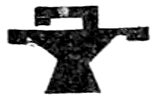
Fig. 677.—Dakota thunder-bird.
The Sioux believe that thunder is a large bird, and represent it thus, Fig. 677, according to Mrs. Eastman (c), who adds details condensed as follows:
This figure is often seen worked with porcupine quills on their ornaments. U-mi-ne wah-chippe is a dance given by some one who fears thunder and thus endeavors to propitiate the god and save his own life.
A ring is made of about 60 feet in circumference by sticking saplings in the ground and bending their tops down, fastening them together. In the center of this ring a pole is placed, about 15 feet in height and painted red. From this swings a piece of birch bark cut so as to represent thunder. At the foot of the pole stand two boys and two girls. The boys represent war; they are painted red and hold war clubs in their hands. The girls have their faces painted with blue clay; they represent peace.
On one side of the circle a kind of booth is erected, and about 20 feet from it a wigwam. There are four entrances. When all arrangements for the dance are concluded the man who gives it emerges from his wigwam, dressed up hideously, crawling on all fours toward the booth. He must sing four tunes before reaching it.
In the meantime the medicine men, who are seated in the wigwam, beat time on the drum, and the young men and squaws keep time to the music by hopping on one foot and then on the other, moving around inside the ring as fast as they can. This is continued for about five minutes, until the music stops. After resting a few moments the second tune commences and lasts the same length of time, then the third and the fourth; the Indian meanwhile making his way toward the booth. At the end of each tune a whoop is raised by the men dancers.
After the Indian has reached his booth inside the ring he must sing four more tunes. At the end of the fourth tune the squaws all run out of the ring as fast as possible, and must leave by the same way that they entered, the other three entrances being reserved for the men, who, carrying their war implements, might be accidentally touched by one of the squaws, and the war implements of the Sioux warrior have from time immemorial been held sacred from the touch of woman. For the same reason the men form the inner ring in dancing round the pole, their war implements being placed at the foot of the pole.
When the last tune is ended the young men shoot at the image of thunder, which is hanging to the pole, and when it falls a general rush is made by the warriors to get hold of it. There is placed at the foot of the pole a bowl of water colored with blue clay. While the men are trying to seize the parts of the bark representation of their god they at the same time are eagerly endeavoring to drink the water in the bowl, every drop of which must be drank.
The warriors then seize on the two boys and girls (the representations of war and peace) and use them as roughly as possible, taking their pipes and war-clubs from them and rolling them in the dirt until the paint is entirely rubbed off from their faces. Much as they dislike this part of the dance, they submit to it through fear, believing that after this performance the power of thunder is destroyed.
James’s Long (f) says:
When a Kansas Indian is killed in battle the thunder is supposed to take him up they do not know where. In going to battle each man traces an imaginary figure of the thunder on the soil, and he who represents it incorrectly is killed by the thunder.
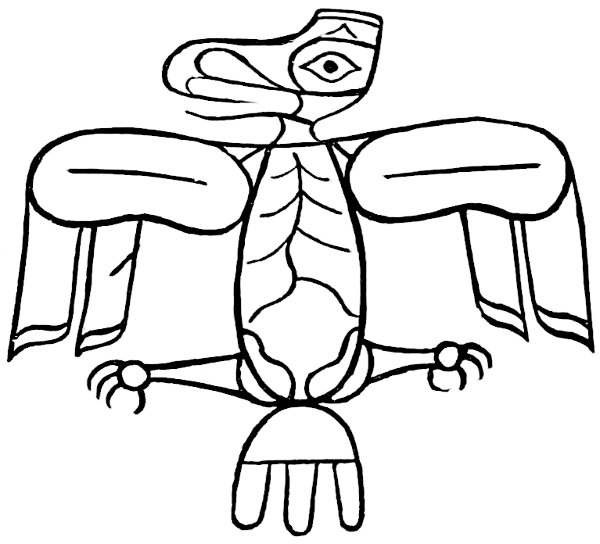
Fig. 678.—Thunder-bird. Haida.
Fig. 678 is “Skam-son,” the thunder-bird, a tattoo mark copied from the back of an Indian belonging to the Laskeek village of the Haida tribe, Queen Charlotte islands, by Mr. James G. Swan.
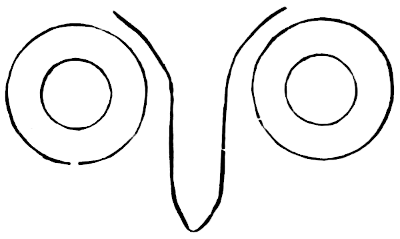
Fig. 679.—Thunder-bird. Twana.
Fig. 679 is a Twana thunder-bird, as reported by Rev. M. Eells in Bull. U. S. Geol. and Geog. Survey, III, p. 112.
There is at Eneti, on the reservation [Washington Territory], an irregular basaltic rock, about 3 feet by 3 feet and 4 inches, and a foot and a half high. On one side there has been hammered a face, said to be the representation of the face of the thunder-bird, which could also cause storms.
The two eyes are about 6 inches in diameter and 4 inches apart and the nose about 9 inches long. It is said to have been made by some man a long time ago, who felt very badly, and went and sat on the rock and with another stone hammered out the eyes and nose. For a long time they believed that if the rock was shaken it would cause rain, probably because the thunder-bird was angry.
The three following figures, taken from Red-Cloud’s Census, are connected with the thunder-bird myth:
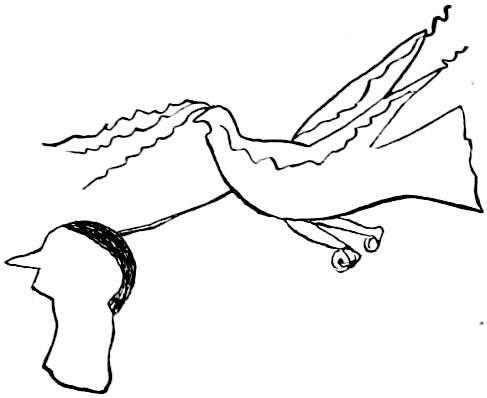
Fig. 680.—Medicine bird. Dakota.
Fig. 680.—Medicine bird. Red-Cloud’s Census. The word medicine is in the Indian sense, before explained, and would be more correctly expressed by the word sacred or mystic, as is also indicated by the waving lines issuing from the mouth.
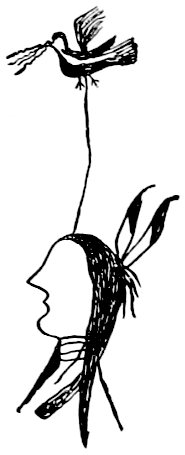
Fig. 681.—Five thunders. Dakota.
Fig. 681.—Five thunders. Red-Cloud’s Census. The thunder-bird is here drawn with five lines (voices) issuing from the mouth, which may mean many voices or loud sound, but is connected with the above mentioned wavy or spiral lines, which form the conventional sign for wakan.
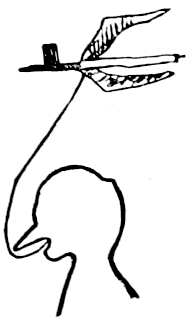
Fig. 682.—Thunder pipe. Dakota.
Fig. 682.—Thunder pipe. Red-Cloud’s Census. This is a pipe to which are attached the wings of the thunder-bird.
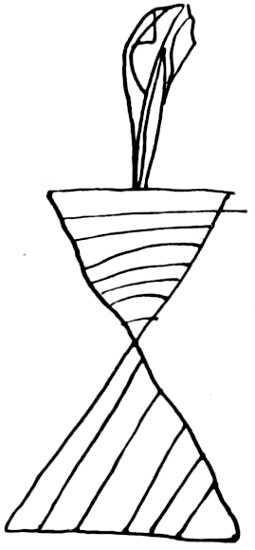
Fig. 683.—Micmac thunder-bird.
Fig. 683, one of the drawings from the Kejimkoojik rocks of Nova Scotia, may be compared with the other designs of the thunder-bird and also with the Ojibwa type of device for woman. As regards the head, which appears to have a non-human form, it may also be compared with the many totemic designations in Chapter XIII, on Totems, Titles, and Names.
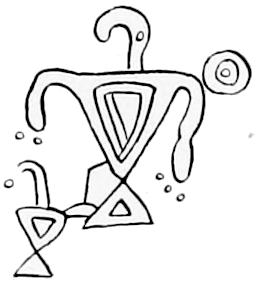
Fig. 684.—Venezuelan thunder-bird.
Marcano (d), describing Fig. 684, reports:
At Boca del Infierno (mouth of hell), on a plain, there are found stones, separated from each other by spaces of 7 meters, on which are found inscriptions nearly a centimeter in depth. One of them represents a great bird similar to those which the Oyampis (Crevaux) are in the habit of drawing. On its left shoulder are seen three concentric circles arranged like those that form the eyes of the jaguars of Calcara. This figure is often reproduced in Venezuelan Guiana and beyond the Esequibo. The bird is united at the right by a double connecting stroke with another which is incomplete and much smaller. Furthermore, three small circles are seen below the left wing; three others, farther apart, separate its right wing from the neck of the lower bird. The triangles which form the breast and the tail of the two birds are worthy of note.
Mr. A. Ernst (b) describes the same figure:
From the same place (“Boca del Infierno,” a rapid of the Orinoco, 35 kilometers below the mouth of the Caura) is easily recognized a rough representation of two birds; from the feathers of the larger one water seems to be dropping; above, to the right, is seen a picture of the sun. This may be symbolic, and would then remind one of the representation of the wind and rain gods on the ruins of Central America.
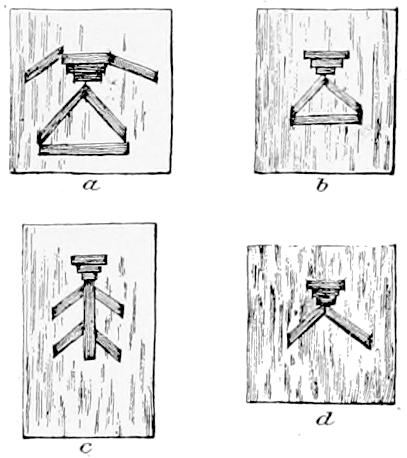
Fig. 685.—Ojibwa thunder-bird.
Fig. 685 is a copy of four specimens of Indian workmanship in the collection of the Academy of Natural Sciences of Philadelphia. The objects are depicted by porcupine quills worked on pieces of birch bark, and represent various forms of the thunder-bird. The specimens are reported as having been obtained from a northwestern tribe, which may safely be designated as the Ojibwa, because the figures relate to one of the most important mythic animals of that tribe, and also because birch bark is used, a material exceedingly scarce in the country of the Sioux, among whom also the thunder-bird has a prominent religious position.
a. Made of neutral-tinted quills upon yellow bark, as is also b, which is without the projecting pieces to designate wings. In c, made of yellow quills on faded red bark, the head is shown with the wings and legs beneath, while in the two preceding figures the head takes the place of the bird’s body. d. Here is still more abbreviation, the body and legs being absent, leaving only the head and wings. This is made of neutral-tint quills on straw-yellow bark.
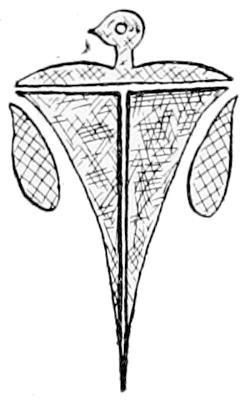
Fig. 686.—Moki Rain bird.
Fig. 686 is a copy of a painting on a jar, probably of old Moki work, thus described in the manuscript catalogue of Mr. T. V. Keam:
It is the “Rain bird” (Tci-zur), the upper portion surrounded by inclosing cloud symbols, arranged so as to convey the idea of the germinative symbol implying the generative power of rain. The crosshatching, still water, in the wings denotes rain water in volume. The body or tail of the bird divided into two tapering prolongations is a very common occurrence. As a cloud emblem in the modern ware, the Tci-zur is not like the Um-tokina (Thunder-bird) in mythical creation, but is the comprehensive name used by the women for any small bird. Explained as a rain emblem by the fact that during seasons of sufficient rainfall flocks of small birds surround the villages and gardens, while during drought they take flight to the distant water courses.
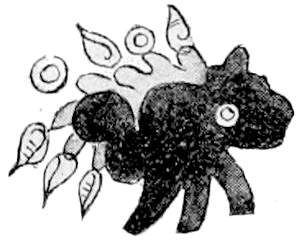
Fig. 687.—Ahuitzotl.
Fig. 687 is reproduced from Kingsborough (c). It represents Ahuitzotl, which is the name of an aquatic animal famous in Mexican mythology. The conventional sign for water is connected with this animal which Dr. Brinton (c) calls a hedgehog.
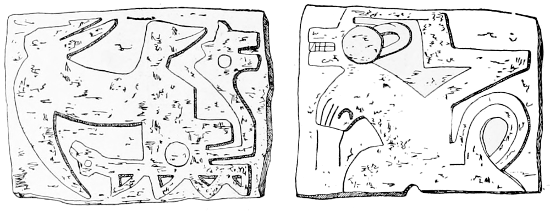
Fig. 688.—Peruvian fabulous animals.
Wiener (c) gives a copy, here reproduced as the left-hand character in Fig. 688, of a bas-relief found at Cabana, Peru, representing a fabulous animal, a quadruped, the hair of which is floating and its tongue hanging out of the mouth and ending in serpents’ heads. One-sixth actual size.
The same author, loc. cit., gives a copy, now reproduced as the right-hand character in the same Fig. 688, of another bas-relief in granite found at Cabana, Peru, representing a fabulous animal, perhaps the alcoce, sitting like a dog. One-sixth natural size.
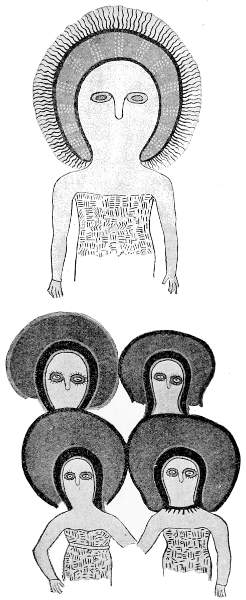
Fig. 689.—Australian mythic personages.
Mr. Thomas Worsnop (a) gives an account of Fig. 689, abbreviated as follows:
Sir George Grey, between 1836 and 1839, saw on a sandstone rock a most extraordinary large figure. Upon examination this proved to be a drawing at the entrance to a cave, which he found to contain besides many remarkable paintings. On the sloping roof the principal character, i. e., the upper one of Fig. 689, was drawn. In order to produce the greater effect the rock about it was painted black and the figure itself colored with the most vivid red and white. It thus appeared to stand out from the rock, and Sir George Grey says he was surprised at the moment that he first saw this gigantic head and upper part of a body bending over and staring grimly down at him. He adds that it would be impossible to convey in words an adequate idea of this uncouth and savage figure, and therefore he only gives such a succinct account as will serve as a sort of description.
Its head was encircled by bright red rays, something like the rays one sees proceeding from the sun, when depicted on the signboard of a public house; inside of this came a broad stripe of very brilliant red, which was crossed by lines of white; but both inside and outside of this red space were narrow stripes of a still deeper red, intended probably to mark its boundaries; the face was painted vividly white and the eyes black, being, however, surrounded by red and yellow lines; the body, hands, and arms were outlined in red, the body being curiously painted with red stripes and bars.
Upon the rock which formed the left-hand wall of this cave, and which partly faced you on entering, was a very singular painting, the lower character of the same figure, vividly colored, representing four heads joined together. From the mild expression of the countenances they appeared to represent females, and to be drawn in such a manner, and in such a position, as to look up at the principal figure, before described; each had a very remarkable head-dress, colored bright blue, and one had a necklace on. Both of the lower figures had a sort of dress painted with red in the same manner as that of the principal figure, and one of them had a band round her waist. In Sir George Grey’s opinion each of the four faces was marked by a totally distinct expression of countenance, and none of them had mouths.
SECTION 3. SHAMANISM.
The term “shaman” is a corrupted form of the Sanscrit word meaning ascetic. Its original application was to the religion of certain tribes of northern Asia, but now shamanism is generally used to express several forms of religion which are founded in the supposed communion with and influence over supernatural beings by means of magic arts. The shaman or priest pretends to control by incantations and ceremonies the evil spirits to whom death, sickness, and other misfortunes are ascribed. This form or stage of religion was so prevalent among the North American Indians that the adoption of the term “shaman” here is substantially correct, and it avoids both the stupid expression “medicine man” of current literature and the indefinite title “priest,” the associations with which are not appropriate to the Indian religious practitioner. The statement that the Indians worship, or ever have worshiped, one “Great Spirit” or single overruling personal god is erroneous. That philosophical conception is beyond the stage of culture reached by them, and was not found in any tribe previous to missionary influence. Their actual philosophy can be expressed far more objectively and therefore pictorially.
The special feature of the notes now collected under the present heading relates to the claims and practices of shamans, but the immediately succeeding headings of “Charms and Amulets” and of “Religious Ceremonies” are closely connected with the same topic. It must be confessed that, as now presented, they have been arranged chiefly for mechanical convenience, to which convenience also in other parts of the present work scientific discrimination has sometimes been forced to yield without, it is hoped, much injury. Individual intercomparison, with or without cross references, is besought from any critical reader of this paper.
Feats of jugglery or pretended magic rivaling or surpassing the best of spiritualistic séances have been recounted to the present writer in many places by independent and intelligent Indian witnesses, not operators, generally of advanced age. The cumulated evidence gives an opportunity for spiritualists to argue for the genuineness of their own manifestations or manipulations as, in accordance with the degree of credence, they may be styled. Others will contend that these remarkable performances in which this hemisphere was rich before the Columbian discovery—the occidental rivaling the oriental Indians—belong to a culture stage below civilization. They will observe that the age of miracles among barbaric people has not expired, and that it still exists among outwardly civilized persons who are yet subject to superstition in its true etymologic sense of “remaining over from the past.”
The most elaborate and interesting of these stories which are known relate to a time about forty years ago, shortly before the Davenport brothers and the Fox sisters had excited interest in the civilized portions of the United States; but exhibitions of a magic character are still given among the tribes, though secretly, from fear of the Indian agents and missionaries. It is an important fact that the first French missionaries in Canada and the early settlers of New England described substantially the same performances when they first met the Indians, all of whom belonged to the Algonquian or Iroquoian stocks. So remarkable and frequent were these performances of jugglery that the French, in 1613, called the whole body of Indians on the Ottawa River, whom they met at a very early period, “The Sorcerers.” They were the tribes afterwards called Nipissing, and were the typical Algonquians. No suspicion of prestidigitation or other form of charlatanry appears to have been entertained by any of the earliest French and English writers on the subject. The severe Puritan and the ardent Catholic both considered that the exhibitions were real, and the work of Satan. It is also worth mentioning that one of the derivations of the name “Micmac” is connected with the word meaning sorcerer. The early known practices of this character, which had an important effect upon the life of the people, extended from the extreme east of the continent to the Great Lakes. They have been found later far to the south, and in a higher state of evolution.
It was obvious in cross-examining the old men of the Algonquians that the performances of jugglery were exhibitions of the pretended miraculous power of an adventurer whereby he obtained a reputation above his rivals and derived subsistence and authority by the selling of charms and pretended superhuman information. The charms and fetiches which still are bought from the few shamans who yet have a credulous clientele are of three kinds—to bring death or disease on an enemy, to lure an enemy into an ambush, and to excite a return to sexual love.
Among the Ojibwa three distinct secret societies are extant, the members of which are termed, respectively and in order of their importance, the Midē', the Jĕs'sakīd, and the Wâbĕnō. The oldest and most influential society is known as the Midē'wiwin', or Grand Medicine, and the structure in which the ceremonies are conducted is called the Midē'wigân, or Grand Medicine lodge.
The following statement of the White Earth Midē' shaman presents his views upon the origin of the rite and the objects employed in connection with ceremonies, as well as in the practices connected with medical magic and sorcery:
When Minabō'sho, the first man, had been for some time upon the earth, two great spirits told him that to be of service to his successors they would give to him several gifts, which he was to employ in prolonging life and extending assistance to those who might apply for it.
The first present consisted of a sacred drum, which was to be used at the side of the sick and when invoking the presence and assistance of the spirits. The second was a sacred rattle, with which he was enabled to prolong the life of a patient. The third gift was tobacco, which was to be an emblem of peace; and as a companion he also received a dog. He was then told to build a lodge, where he was to practice the rites of which he would receive further instruction.
All the knowledge which the Midē' have, and more, Minabō'sho received from the spirits. Then he built a long lodge, as he had been directed, and now even at this day he is present at the Sacred Medicine lodge when the Grand Medicine rite is performed.
In the rite is incorporated most that is ancient amongst them, songs and traditions that have descended, not orally alone, but by pictographs, for a long line of generations. In this rite is also perpetuated the purest and most ancient idioms of their language, which differs somewhat from that of the common, every-day use.
It is desirable to explain the mode of using the Midē' and other bark records of the Ojibwa and also those of other tribes mentioned in this paper. A comparison made by Dr. Tyler of the pictorial alphabet to teach children, “A was an archer,” etc., is not strictly appropriate in this case. The devices are not only mnemonic, but are also ideographic and descriptive. They are not merely invented to express or memorize the subject, but are evolved therefrom. To persons acquainted with secret societies a good comparison for the charts or rolls is what is called the trestle board of the Masonic order, which is printed and published and publicly exposed without exhibiting any of the secrets of the order, yet through its ideography it is practically useful to the esoteric members by assisting memory in details of ceremony and it also prevents deviation from the established ritual.
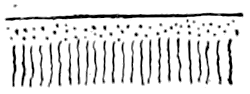
Fig. 690.—Ojibwa Midē' wigwam.
Fig. 690, from Copway (d), gives the Ojibway character for Grand Medicine lodge.
Fig. 171, supra, is a reproduction, with description, of a birch-bark record illustrating the alleged power of a Jĕssakkī'd, one who is also a Midē' of the four degrees of the Medicine Society.
Fig. 172, supra, represents, with explanations, a Jĕssakkī'd named Niwi'kki, curing a sick woman by sucking the demon through a bone tube.
When the method of procedure of a Midē' goes beyond the ordinary ceremonies, such as chanting prayers and drumming, the use of the rattle, and the administration of magic medicines and exorcisms, it overlaps the prescribed formulæ of the Midē'win and partakes of the rites of the Jĕssakkī'd or “Juggler.”
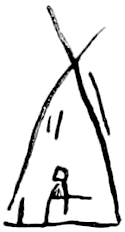
Fig. 691.—Lodge of a Midē'.
The lodge of the Midē' is represented as in Fig. 691, the shaman himself being indicated as sitting inside.
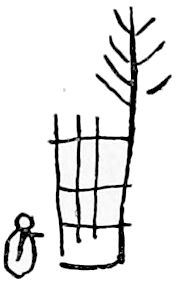
Fig. 692.—Lodge of Jĕssakkī'd.
The Jĕssakkī'd represents his lodge or jugglery as shown in Fig. 692, the shaman being represented as sitting on the outside. The chief feature of the jugglery lodge is that the branch is always seen projecting from the top of one of the vertical poles, which peculiarity exists in no other religious structure represented in pictorial records.
The following group, including Figs. 693 to 697, gives several modes of illustrating the “making buffalo medicine” by the Dakotas and other tribes of the Great Plains. The main object was to bring the buffalo to where they could be hunted successfully, and incantations, with dancing and many ceremonies, were resorted to, as upon the buffalo the tribes depended not only for food but for most of the necessaries and conveniences of their daily life. The topic is referred to elsewhere in this paper, especially in Lone-Dog’s Winter Count for the year 1810-’11.
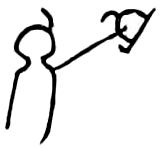
Fig. 693.—Making medicine. Dakota.
Fig. 693.—A Minneconjou chief named Lone-Horn made medicine with a white buffalo cow skin. The-Swan’s Winter Count, 1858-’59.
The horned head of the animal is connected with the man figure. An albino buffalo was much more prized for ceremonial purposes than any other. Lone-Horn, chief of the Minneconjous, died in 1874, in his camp on the Big Cheyenne.
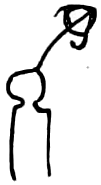
Fig. 694.—Making medicine. Dakota.
Fig. 694.—A Minneconjou Dakota named Little-Tail first made “medicine” with white buffalo cow skin. The-Swan’s Winter Count, 1810-’11. Again the head of an albino buffalo.
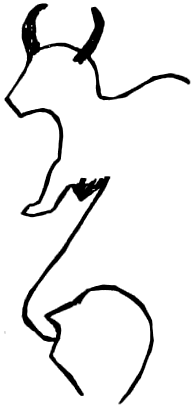
Fig. 695.—Making medicine. Dakota.
Fig. 695.—White-Cow-Man. Red-Cloud’s Census. The mere possession of an albino buffalo conferred dignity and honor. To have once owned such an animal, even though it had died or been lost, gave specific rank.
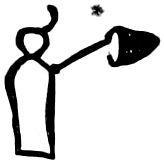
Fig. 696.—Making medicine. Dakota.
Fig. 696.—Lone-Horn makes medicine. “At such times Indians sacrifice ponies and fast.” The-Flame’s Winter Count, 1858-’59. In this figure the buffalo head is black.
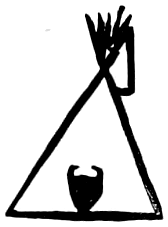
Fig. 697.—Making medicine.
Fig. 697. Buffalo is scarce; an Indian makes medicine and brings a herd to the suffering. The-Flame’s Winter Count, 1843-’44.
Here the incantation is shown by a tipi with the buffalo head drawn upon it. It is the “medicine” or sacred tipi where the rites are held.
A curious variant of divination with regard to the use of songs in the removal of disease was found among the Choctaws. Each of the songs of this class bore reference to some herb or form of treatment, each of which was represented objectively or pictorially and produced simultaneously with the chanting of the appropriate song by the shaman. The remedy or treatment to be adopted was decided upon by the degree of pleasure or relief afforded to the patient by the respective songs.
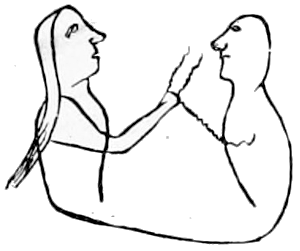
Fig. 698.—Magic Killing.
Fig. 698. Cat-Owner was killed with a spider-web thrown at him by a Dakota. Cloud-Shield’s Winter Count, 1824-’25. The spider-web is shown reaching to the heart of the victim from the hand of the man who threw it and two spiral wakan lines are also shown. Blood issuing from his nose, colored red in the original, indicates that he bled to death. It is a common belief among Indians that certain “medicine men” possess the power of taking life by shooting needles, straws, spider-webs, bullets, and other objects, however distant the person may be against whom they are directed.
It may be noted that the union line connecting the two figures at the base signifies that they belong to the same tribe which the hair on the figure of the left shows to be Dakota. The victim is not scalped, but has no hair or other designation, being shown only in outline.
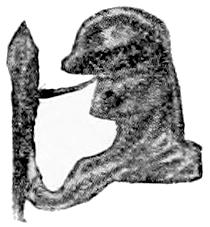
Fig. 699.—Held a ghost lodge.
Fig. 699. Cannaksa-Yuha, Has-a-war-club; from the Oglala Roster. This man has his father’s name “war-club,” and is therefore set by the ghosts in his stead as a warrior. He is supposed to be invulnerable to any mortal weapon, and the children and even women fear him as they would a ghost. He holds the war club before his face, as it partakes of the nature of insignia. In the original the whole of the man’s face is painted red. This is to show that he has a wakicagapi-ecokicoupe, which means that he has put up a ghost tent, concerning which there are many and complicated ceremonies and details narrated by Rev. J. Owen Dorsey in the American Anthropologist, II, 145 et seq.
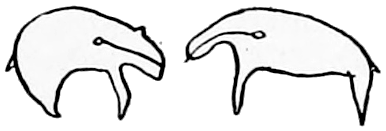
Fig. 700.—Muzzin-ne-neen. Ojibwa.
John Tanner (g) gives an account of sorcery among the Ojibwa, with illustrations copied as Fig. 700, being nearly identical with those recently obtained by Dr. Hoffman, and published in the Seventh Ann. Rep., Bureau of Ethnology, as Figs. 20 and 21.
It was thought necessary to have recourse to a medicine hunt. Nah-gitch-e-gum-me [a “medicine” maker] sent to me and O-ge-mah-we-ninne, the best two hunters of the band, each a little leather sack of medicine, consisting of certain roots pounded fine and mixed with red paint, to be applied to the little images or figures of the animals we wish to kill. Precisely the same method is practiced in this kind of hunting, at least as far as the use of medicine is concerned, as in those instances where one Indian attempts to inflict disease or suffering on another. A drawing or a little image is made to represent the man, the woman, or the animal on which the power of the medicine is to be tried; then the part representing the heart is punctured with a sharp instrument, if the design be to cause death, and a little of the medicine is applied. The drawing or image of an animal used in this case is called muzzin-ne-neen, and the same name is applicable to the little figures of a man or women, and is sometime rudely traced on birch bark, in other instances more carefully carved of wood. These little images or drawings, for they are called by the same names, whether of carved wood or rags or only rudely sketched on birch bark, or even traced in sand, are much in use among several and probably all the Algonquin tribes. Their use is not confined to hunting, but extends to the making of love, and the gratification of hatred, revenge, and all malignant passions.
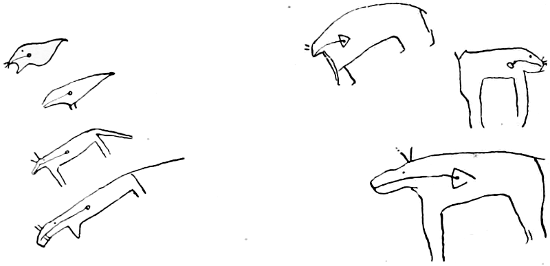
Fig. 701.—Muzzin-ne-neen. Ojibwa.
It is a prevailing belief that the necromancers, men or women of medicine, or those who are acquainted with the hidden powers of their wusks, can, by practicing upon the muzzin-ne-neence, exercise an unlimited control over the body and mind of the person represented. Many a simple Indian girl gives to some crafty old squaw her most valued ornaments, or whatever property she may possess, to purchase from her the love of the man she is most anxious to please. The old woman, in a case of this kind, commonly makes up a little image of stained wood and rags, to which she gives the name of the person whose inclinations she is expected to control; and to the heart, the eyes, or to some other part of this she, from time to time, applies her medicines, or professes to have done so, as she may find necessary to dupe and encourage her credulous employer.
But the influence of these images and conjurations is more frequently tested in cases of an opposite character, where the inciting cause is not love, but hatred, and the object to be attained the gratification of a deadly revenge. In cases of this kind the practices are similar to those above mentioned, only different medicines are used Sometimes the muzzin-ne-neence is pricked with a pin or needle in various parts, and pain or disease is supposed to be produced in the corresponding part of the person practiced upon. Sometimes they blacken the hands and mouth of the image, and the effect expected is the change which marks the near approach of death.
The similarity, approaching identity, of these practices to those common in Europe during the middle ages and continuing in some regions until the present time will be noticed.
The same author, pp. 197, 198, gives an account of Ojibwa divination in the following address of a shaman, illustrated by Fig. 702.
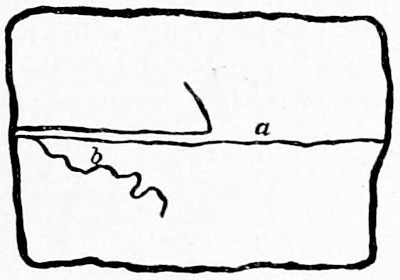
Fig. 702.—Ojibwa divination.
For you, my friends, who have been careful to regard and obey the injunctions of the Great Spirit, as communicated by me, to each of you he has given to live to the full age of man: this long and straight line a is the image of your several lives. For you, Shaw-shaw-wa ne-ba-se, who have turned aside from the right path, and despised the admonitions you have received, this short and crooked line b represents your life. You are to attain only to half of the full age of man. This line, turning off on the other side, is that which shows what is determined in relation to the young wife of Ba-po-wash. As he said this, he showed us the marks he had made on the ground, as below. The long, straight middle line represented, as he said, the life of the Indians, Sha-gwaw-koo-sink, Wau-zhe-gaw-maish-koon, etc. The short, crooked one below showed the irregular course and short continuance of mine; and the abruptly terminating one on the other side showed the life of the favorite wife of Ba-po-wash.
Fig. 703 was copied from a piece of walrus ivory in the museum of the Alaska Commercial Company, of San Francisco, California, in 1882, by Dr. Hoffman, and the interpretation is as obtained from a native Alaskan.

Fig. 703.—Shaman exorcising demon. Alaska.
a, b. The shaman’s summer habitations, trees growing in the vicinity. c. The shaman, who is represented in the act of holding one of his “demons.” These are considered as under the control of the shaman, who employs them to drive others out of the bodies of sick men. d. The demon or aid. e. The same shaman exorcising the demons causing the sickness. f, g. Sick men, who have been under treatment, and from whose bodies the “evil beings” or sickness has been expelled. h. Two “evil spirits” which have left the bodies of f and g.
Fig. 704 was copied by Dr. Hoffman from an ivory bow in the same museum. The interpretation was also obtained at the same time from the same Alaskan.
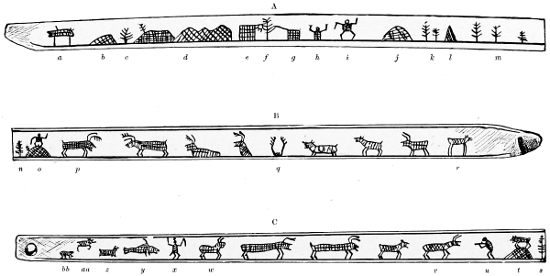
Fig. 704.—Supplication for success. Alaska.
The rod of the bow upon which the characters occur is here represented in three sections, A, B, and C. A bears the beginning of the narrative, extending over only one-half of the length of the rod. The course of the inscription is then continued on the adjacent side of the rod at the middle, and reading in both directions (sections B and C), toward the two files of approaching animals. B and C occupy the whole of one side.
The following is the explanation of the characters:
A. a, baidarka or skin boat resting on poles; b, winter habitation; c, tree; d, winter habitations; e, storehouse; f, tree. Between this and the storehouse is placed a piece of timber, from which is suspended fish for drying. g, storehouse. The characters from a to g represent a group of dwellings, which signifies a settlement, the home of the person to whom the history relates. h, the hunter sitting on the ground, asking for aid, and making the gesture for supplication. i, the shaman to whom application is made by the hunter desiring success in the chase. The shaman has just finished his incantations, and while still retaining his left arm in the position for that ceremony, holds the right toward the hunter, giving him the success requested. j, the shaman’s winter lodge; k, trees; l, summer habitation of the shaman; m, trees near the shaman’s home.
B. n, tree; o, a shaman standing upon his lodge, driving back game which had approached against his wish. To this shaman the hunter had also made application for success in the chase, but was denied, hence the act of driving back. p, deer leaving at the shaman’s order; q, horns of a deer swimming a river; r, young deer, apparently, from the smaller size of the body and unusually long legs.
C. s, a tree; t, the lodge of the hunter (A. h), who, after having been granted the request for success, placed his totem upon the lodge as a mark of gratification and to insure greater luck in his undertaking; u, the hunter in the act of shooting; v-w, the game killed, consisting of five deer; x, the demon sent out by the shaman (A. i), to drive the game in the way of the hunter; y-bb, the demon’s assistants.
The following description and illustration, Fig. 705, is kindly contributed by the Rev. M. Eells, of Skokomish, Washington:
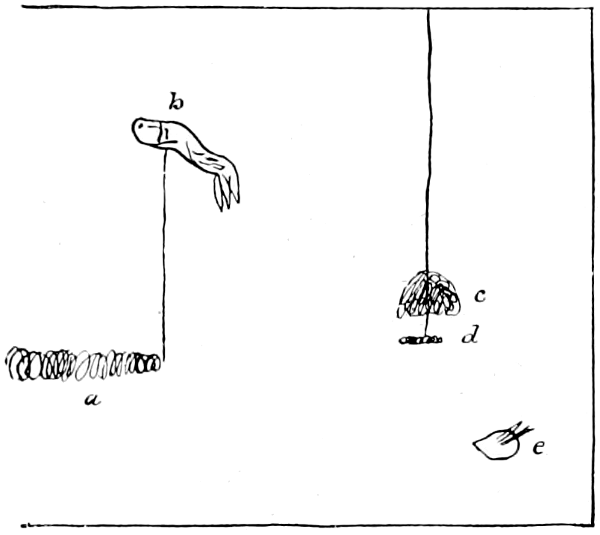
Fig. 705.—Skokomish tamahnous.
Your figure of a shaman’s lodge in Alaska [Fig. 714 in this work] reminds me of a drawing made of the same character on this reservation by one of our best educated Indian boys. His description of it is as follows: “When I was at Dr. Charley’s house (the shaman or medicine man), they tamahnoused [performed incantations] over [my brother] Frank. They saw that he was under a kind of sickness. Dr. Charley took it, and just a little after that Frank shook and became stiff, and while I sat I heard my father say that his breath was gone. I went out, as I did not want to see my brother lay dead before me. When I came back he was breathing a little and his eyes were closed. Dr. Charley was taking care of his breath with his own tamahnous [guardian spirit] and waiting for more folks to come, so as to have enough folks to beat on sticks when he should tamahnous and see what was the matter with Frank. So he went on and saw that there was another kind of sickness besides the one he took first. The other one went over Frank and almost killed him. Dr. Charley took it again and went (travel) [in spirit] with another kind of tamahnous to see where Frank’s spirit was. He found him at Humahuma [18 or 20 miles distant], where they had camped [some time previous]. So Frank got better after a hard tamahnous. From the drawing you will see how Dr. Charley fixed the kind of sickness. b shows the first sickness which Dr. Charley took. It has tails, which, when they come close to the sick person, makes him worse. a is the way it goes when it kills a person and stays in his home. c is the second one and is hanging over Frank, d. e is another sickness which is in Frank.”
In Kingsborough (d) is the following: “In the year of Eleven Houses, or in 1529, Nuño de Guzman set out for Yalisco on his march to subdue that territory. They pretend that a serpent descended from the sky, exclaiming that troubles were preparing for the natives, since the Christians were directing their course hither.” The illustration for this account is presented as Fig. 1224, Chap. XX, on Special Comparisons.
SECTION 4. CHARMS AND AMULETS.
The use of material objects for the magic purposes suggested by this title is well known. Their graphic representation is not so familiar, though it is to be supposed that the objects of this character would be pictorially represented in pictographs connected with religion. The following is an instance where the use of a charm or fetich in action was certainly portrayed in a pictograph.
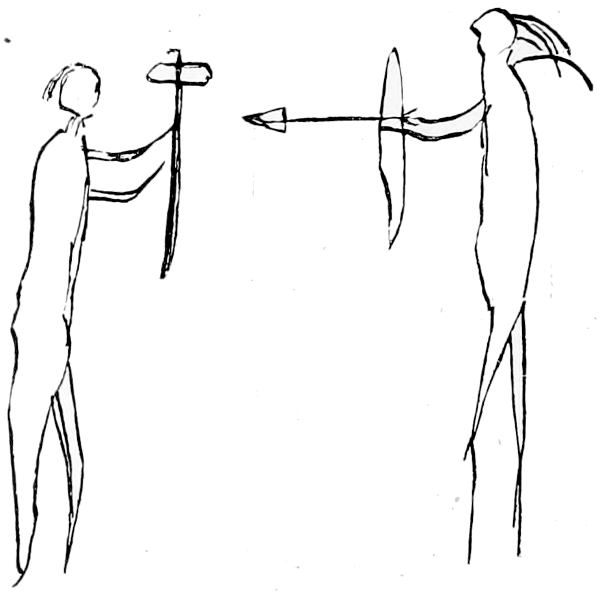
Fig. 706.—Mdewakantawan fetich.
Fig. 706, drawn by the Dakota Indians, near Fort Snelling, Minnesota, exhibits the use as a charm or talisman of an instrument fashioned in imitation of a war club, though it is not adapted to offensive employment. The head of the talisman is a grooved stone hammer from an inch and a half to 5 inches in length. A withe is tied about the middle of the hammer, in the groove binding on a handle of from 2 to 4 feet in length. The latter is frequently wrapped with buckskin or rawhide to strengthen it, as well as for ornamental purposes. Feathers attached bear designs indicating marks of distinction, perhaps sometimes fetichistic devices not understood.
It is believed that these objects possess the charm of warding off an enemy’s missiles when held upright before the body, as shown in the pictograph. The interpretation was explained by the draftsman himself.
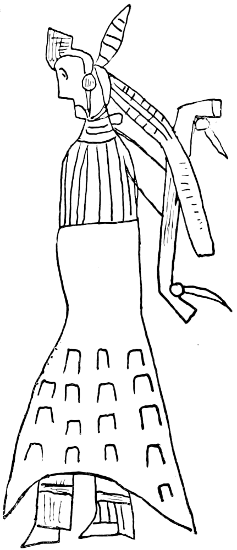
Fig. 707.—Medicine bag as worn.
“Medicine bags,” as they are termed by frontiersmen, are worn as amulets. They are sometimes filled by the owner in obedience to the suggestions of visions, but more frequently are prepared by the shaman. They are carried suspended from the neck by means of string or buckskin cords, as shown in Fig. 707, drawn in 1889 by I-teup'-de-tĭ, No-Shin-Bone, a Crow Indian, to represent himself with his insignia, and was extracted from a record kindly communicated by Dr. R. B. Holden, physician at the Crow Agency, Montana.
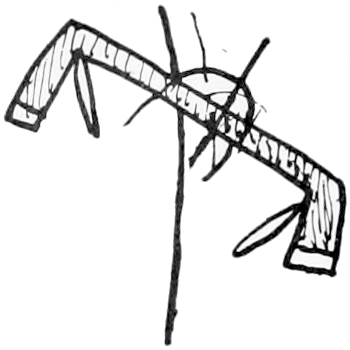
Fig. 708.—Medicine bag hung up.
Fig. 708, drawn by the same hand, shows the same medicine bag temporarily hung on a forked stick. When the bag is carried on a war party it is never allowed to touch the ground. Also among the Ojibwa some of the bags which are considered to have the greatest fetichistic power are not kept in the lodges, as too dangerous, but are suspended from trees.
Capt. Bourke (d) gives the following account of the medicine hat of the Apache:
The medicine hat of the old and blind Apache medicine man, Nan-ta-do-tash, was an antique affair of buckskin, much begrimed with soot and soiled by long use. Nevertheless it gave life and strength to him who wore it, enabled the owner to peer into the future, to tell who had stolen ponies from other people, to foresee the approach of an enemy, and to aid in the cure of the sick. * * * This same old man gave me an explanation of all the symbolism depicted upon the hat, and a great deal of valuable information in regard to the profession of medicine men, their specialization, the prayers they recited, etc. The material of the hat, as already stated, was buckskin. How that was obtained I can not assert positively, but from an incident occurring under my personal observation in the Sierra Madre, in Mexico, in 1883, where our Indian scouts and the medicine men with them surrounded a nearly grown fawn and tried to capture it alive, as well as from other circumstances too long to be here inserted, I am of the opinion that the buckskin to be used for sacred purposes among the Apache must, whenever possible, be that of a strangled animal, as is the case, according to Dr. Matthews, among the Navajo.
The body of Nan-ta-do-tash’s cap was unpainted, but the figures upon it were in two colors, a brownish yellow and an earthy blue, resembling a dirty Prussian blue. The ornamentation was of the downy feathers and black-tipped plumes of the eagle, pieces of abalone shell and chalchihuitl, and a snake’s rattle on the apex.
Nan-ta-do-tash explained that the characters on the medicine hat meant: A, clouds; B, rainbow; C, hail; E, morning star; F, the god of wind, with his lungs; G, the black “kan;” H, the great stars or suns. “Kan” is the name given to their principal gods. The appearance of the kan himself and of the tail of the hat suggest the centipede, an important animal god of the Apache. The old man said that the figures represented the powers to which he appealed for aid in his “medicine” and the kan upon whom he called for help.
The same author says, op. cit., p. 587:
The Apache, both men and women, wear amulets, called tzidaltai, made of lightning-riven wood, generally pine or cedar or fir from the mountain tops, which are highly valued and are not to be sold. These are shaved very thin and rudely cut in the semblance of the human form. They are in fact the duplicates, on a small scale, of the rhombus. Like it they are decorated with incised lines representing the lightning. Very often these are to be found attached to the necks of children or to their cradles.
Four of the several winter counts described in the present work unite in specifying for the year 1843-’44 the recapture of a fetich called the great medicine arrow.
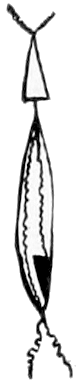
Fig. 709.—Magic arrow.
Fig. 709.—In a great fight with the Pawnees the Dakotas captured the great medicine arrow which had been taken from the Cheyennes, who made it, by the Pawnees. Cloud-Shield’s Winter Count, 1843-’44.
The head of the arrow projects from the bag which contains it. The delicate waved or spiral lines show that it is sacred.
White-Cow-Killer calls it “The Great-medicine-arrow-comes-in winter.”
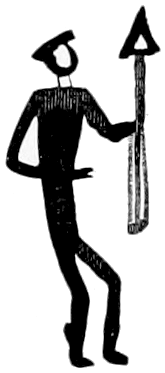
Fig. 710.—Magic arrow.
Battiste Good’s record gives the following for the same year:
“Brought-home-the-magic-arrow winter. This arrow originally belonged to the Cheyennes, from whom the Pawnees stole it. The Dakotas captured it this winter from the Pawnees, and the Cheyennes then redeemed it for one hundred horses.” His sign for the year is shown in Fig. 710. An attempt was made to distinguish colors by the heraldic scheme, which in this cut did not succeed. The upper part of the man’s body is sable or black, the feathers on the arrow are azure or blue, and the shaft, gules or red. The remainder of the figure is of an undecided color not requiring specification.
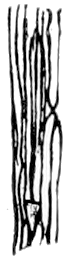
Fig. 711.—Magic arrow.
Fig. 711.—The great medicine arrow was taken from the Pawnees by the Oglalas and Brulés, and returned to the Cheyennes to whom it rightly belonged. American-Horse’s Winter Count, 1843-’44. The arrow appears to be in a case marked over with the lines meaning sacredness.
Another account of a magic arrow and illustrations of other fetichistic objects are in Chap. IX.
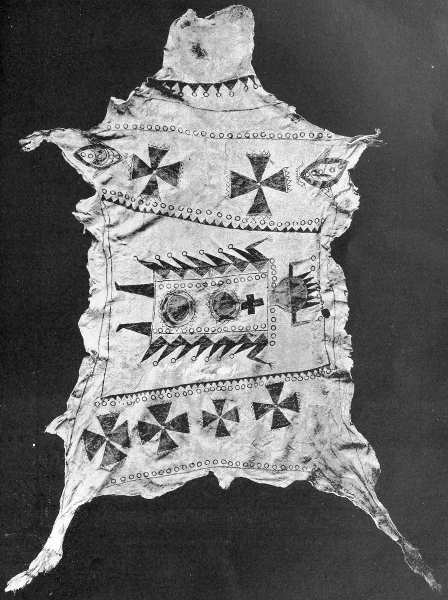
BUREAU OF ETHNOLOGY TENTH ANNUAL REPORT PL. XXXIII MANTLE OF INVISIBILITY.
Pl. XXXIII is a copy of a cloak or mantle made from the skin of a deer, and covered with various mystic paintings. It was made and used by the Apaches as a mantle of invisibility, that is, a charmed covering for spies which would enable them to pass with impunity through the country, and even through the camp of their enemies. In this instance the fetichistic power depends upon the devices drawn. A similar but not identical pictographic fetich or charm is described and illustrated by Capt. Bourke (e) as obtained from a Chicarahua Apache which told when his ponies were lost, and which brought rain. The symbols show, inter alia, the rain cloud, and the serpent lightning, the raindrops and the cross of the winds of the four cardinal points.
Lewis and Clarke (b) say that the Chilluckittequaw, a Chinook tribe, had a “medicine” bag colored red 2 feet long, suspended in the middle of the lodge. It was held sacred, containing pounded dirt, roots, and such mysterious objects. From the chief’s bag he brought out fourteen forefingers of enemies—Snakes—whom he had killed.
A remarkable drawing in an Australian cave, described by Sir George Grey, in Worsnop, op. cit., was an ellipse, 3 feet in length and 1 foot 10 inches in breadth. The outside line of the painting was of deep blue color, the body of the ellipse being of a bright yellow dotted over with red lines and spots, whilst across it ran two transverse lines of blue. The portion of the painting above described formed the ground, or main part of the picture, and upon this ground was painted a kangaroo in the act of feeding; two stone spear heads, and two black balls; one of the spear heads was flying to the kangaroo, and one away from it; so that the whole subject probably constituted a sort of charm by which the luck of an inquirer in killing game can be ascertained. This cave drawing is copied in Fig. 712.
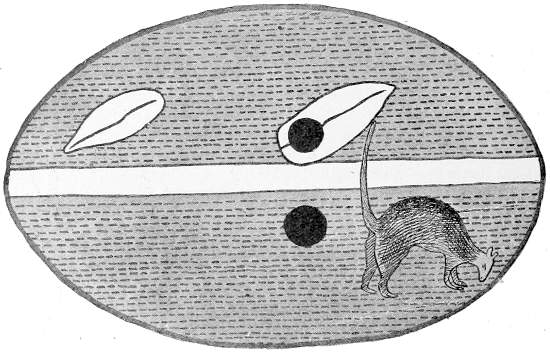
Fig. 712.—Hunter’s charm. Australia.
George Turner (c) gives account of hieroglyphic taboos, as he calls them, which are connected with the present subject:
The sea-pike taboo. If a man wished that a sea-pike might run into the body of the person who attempted to steal, say, his bread fruits, he would plait some cocoanut leaflets in the form of a sea-pike, and suspend it from one or more of the trees which he wished to protect.
The white-shark taboo was another object of terror to a thief. This was done by plaiting a cocoanut leaf in the form of a shark, adding fins, etc., and this they suspended from the tree. It was tantamount to an expressed imprecation, that the thief might be devoured by the white shark the next time he went to fish.
The cross-stick taboo. This was a piece of any sort of stick suspended horizontally from the tree. It expressed the wish of the owner of the tree, that any thief touching it might have a disease running right across his body, and remaining fixed there till he died.
The ulcer taboo. This was made by burying in the ground some pieces of clam shell, and erecting at the spot three or four reeds, tied together at the top in a bunch like the head of a man. This was to express the wish and prayer of the owner that any thief might be laid down with ulcerous sores all over his body.
The death taboo. This was made by pouring some oil into a small calabash, and burying it near the tree. The spot was marked by a little hillock of white sand.