Chapter XIV · RELIGION. (continued 2)
Reading edition
The thunder taboo. If a man wished that lightning might strike any who should steal from his land, he would plait some cocoanut leaflets in the form of a small square mat, and suspend it from a tree, with the addition of some white streamers of native cloth flying. A thief believed that if he trespassed, he, or some of his children, would be struck with lightning, or perhaps his own trees struck and blasted from the same cause. They were not, however, in the habit of talking about the effects of lightning. It was the thunder they thought did the mischief; hence they called that to which I have just referred the thunder taboo.
SECTION 5. RELIGIOUS CEREMONIES.
Many examples of masks, dance ornaments, and fetiches used in ceremonies are reported and illustrated in the several papers of Messrs. Cushing, Holmes, and Stevenson in the Second Annual Report of the Bureau of Ethnology. Paintings or drawings of many of them have been found on pottery, on shells, and on rocks.
An admirable article by Mr. J. Walter Fewkes (b) on Tusayan Pictographs explains many of the petroglyphs of that region as depicting objects used in dances and ceremonies.
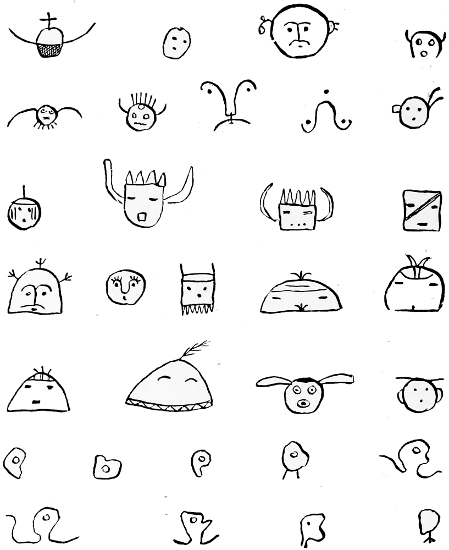
Fig. 713.—Moki masks traced on rocks. Arizona.
Fig. 713 exhibits drawings of various masks used in dancing, the characters of which were obtained by Mr. G. K. Gilbert from rocks at Oakley springs and were explained to him by Tubi, the chief of the Oraibi Pueblos. They are representations of masks as used by the Moki, Zuñi, and Rio Grande Pueblos.
Dr. W. H. Corbusier, U. S. Army, writing from Camp Verde, Arizona, kindly furnished the following account of Yuman ceremonies, in which the making of sand pictures was prominent:
All the medicine men meet occasionally and with considerable ceremony “make medicine.” They went through the performance early in the summer of 1874 on the reservation for the purpose of averting the diseases with which the Indians were afflicted the summer previous. In the middle of one of the villages they made a round ramada, or house of boughs, some 10 feet in diameter, and under it, on the sand, illustrated the spirit land in a picture about 7 feet across, made in colors by sprinkling powdered leaves and grass, red clay, charcoal, and ashes on the smoothed sand. In the center was a round spot of red clay about 10 inches in diameter, and around it several successive rings of green and red alternately, each ring being an inch and a half wide. Projecting from the outer ring were four somewhat triangular-shaped figures, each one of which corresponded to one of the cardinal points of the compass, giving the whole the appearance of a Maltese cross. Around this cross and between its arms were the figures of men with their feet toward the center, some made of charcoal, with ashes for eyes and hair, others of red clay and ashes, etc. These figures were 8 or 9 inches long, and nearly all of them lacked some portion of the body, some an arm, others a leg or the head. The medicine men seated themselves around the picture on the ground in a circle, and the Indians from the different bands crowded around them, the old men squatting close by and the young men standing back of them. After they had invoked the aid of the spirits in a number of chants, one of their number, apparently the oldest, a toothless, gray-haired man, solemnly arose and, carefully stepping between the figures of the men, dropped on each one a pinch of the yellow powder which he took from a small buckskin bag which had been handed to him. He put the powder on the heads of some, on the chests of others, and on other parts of the body, one of the other men sometimes telling him where to put it. After going all around, skipping three figures, however, he put up the bag, and then went around again and took from each figure a large pinch of powder, taking up the yellow powder also, and in this way collected a heaping handful. After doing this he stepped back and another medicine man collected a handful in the same way, others following him. Some of the laymen, in their eagerness to get some, pressed forward, but were ordered back. But after the medicine men had supplied themselves the ramada was torn down and a rush was made by men and boys; handfuls of the dirt were grabbed and rubbed on their bodies or carried away. The women and children, who were waiting for an invitation, were then called. They rushed to the spot in a crowd, and grabbing handfuls of dirt tossed it up in the air so that it would fall on them, or they rubbed their bodies with it, mothers throwing it over their children and rubbing it on their heads. This ended the performance.
According to Stephen Powers (in Contrib. to N. A. Ethnol., III, p. 140), there is at the head of Potter valley, California, “a singular knoll of red earth which the Tatu or Hūchnom believe to have furnished the material for the erection of the original coyote-man. They mix this red earth into their acorn bread, and employ it for painting their bodies on divers mystic occasions.”
Descriptions of ceremonies in medicine lodges and in the initiation of candidates to secret associations have been published with and without illustrations. The most striking of these are graphic ceremonial charts made by the Indians themselves, a number of which besides those immediately following appear in different parts of the present work.
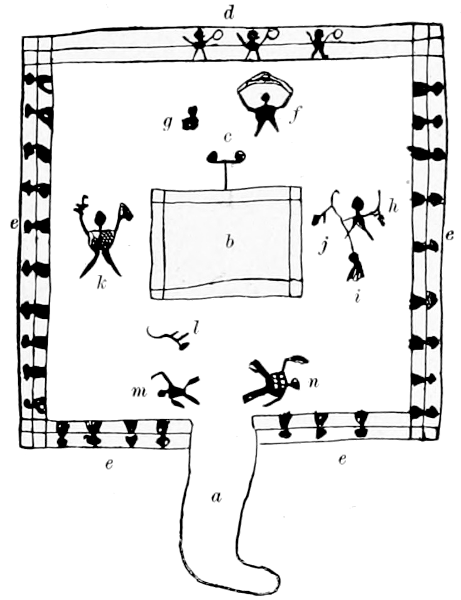
Fig. 714.—Shaman’s lodge. Alaska.
Fig. 714 was drawn and interpreted by Naumoff, a Kadiak native, in San Francisco, California, in 1882. It represents the ground plan of a shaman’s lodge, with the shaman curing a sick man.
The following is the explanation:
a, the entrance to the lodge; b, the fireplace; c, a vertical piece of wood upon which is placed a crosspiece, upon each end of which is a lamp; d, the musicians upon the raised seats drumming and producing music to the movements of the shaman during his incantations in exorcising the “evil spirit” supposed to have possession of the patient; e, visitors and friends of the afflicted seated around the walls of the lodge; f, the shaman represented in making his incantations; g, the patient seated upon the floor of the lodge; h represents the shaman in another stage of the ceremonies, driving out of the patient the “evil being”; i, another figure of the patient—from his head is seen to issue a line connecting it with j; j, the “evil spirit” causing the sickness; k, the shaman in the act of driving the “evil being” out of the lodge—in his hands are sacred objects, his personal fetich, in which the power lies; l, the flying “evil one”; m, n, are assistants to the shaman stationed at the entrance to hit and hasten the departure of the evil being.
The writer in examination at three reservations in Wisconsin obtained information concerning the Midē' ceremonies additional to the details described by Dr. Hoffman (a) and by others quoted in the present work. The full ceremonies of the Midē' lodges, which the more southern Ojibwa, who speak English, translate as “grand medicine,” were performed twice a year—in the fall and in the spring. Those in the spring were of a rejoicing character, to welcome the return of the good spirits; those in the fall were in lamentation for the departure of the beneficent and the arrival of the maleficent spirits. The drums were beaten four days and nights before the dance, which lasted for a whole day. After the dance twelve selected persons built a lodge, about the center of which they placed stones which had been heated, and dancing went on around it until the stones were moistened and cooled by the sweat of the performers. Singing, or more properly chanting, regulated the rhythm of the dances, although, perhaps, in the order of evolution the dance was prior to the chant. These ceremonies were performed by the body of the people, and were independent of the initiations in the secret order. With regard to the candidates who passed the initiations, it was mentioned as an undisputed fact that they always became stronger and better men, perhaps because only those succeeded who had the requisite strength of mind and body to endure the various ordeals and to pass examination in the mysteries. In pictography the spring and the fall, the drums and the steaming stones, the dancing forms and the open chanting mouth are shown.
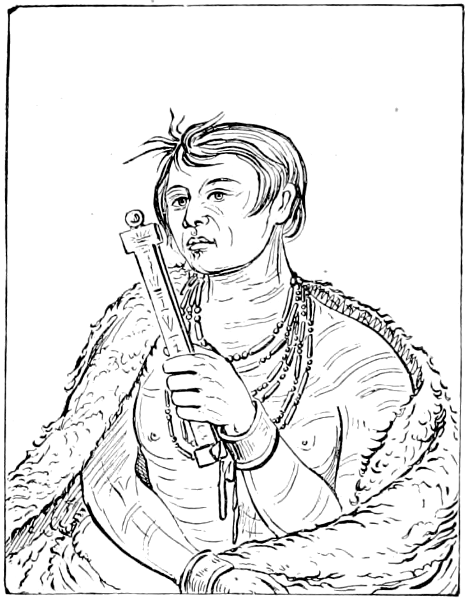
Fig. 715.—Ah-tón-we-tuck.
Catlin (a) gives an account of Kee-an-ne-kuk, the foremost man, who, though a Kickapoo, was commonly called the Shawnee Prophet, and also the following description relating to Fig. 715, painted by that author in 1831:
Ah-tón-we-tuck, The-Cock-Turkey, is another Kickapoo of some distinction and a disciple of the [Shawnee] Prophet, in the attitude of prayer, which he is reading off from characters cut upon a stick that he holds in his hand. It was told to me in the tribe by the traders (though I am afraid to vouch for the whole truth of it) that while a Methodist preacher was soliciting him for permission to preach in his village, the Prophet refused him the privilege, but secretly took him aside and supported him until he learned from him his creed and his system of teaching it to others, when he discharged him and commenced preaching amongst his people himself, pretending to have had an interview with some superhuman mission or inspired personage, ingeniously resolving that if there was any honor or emolument or influence to be gained by the promulgation of it, he might as well have it as another person; and with this view he commenced preaching and instituted a prayer, which he ingeniously carved on a maple stick of an inch and a half in breadth, in characters somewhat resembling Chinese letters. These sticks, with the prayers on them, he has introduced into every family of the tribe and into the hands of every individual; and as he has necessarily the manufacturing of them all, he sells them at his own price and has thus added lucre to fame, and in two essential and effective ways augmented his influence in his tribe. Every man, woman, and child in the tribe, so far as I saw them, were in the habit of saying their prayer from this stick when going to bed at night and also when rising in the morning, which was invariably done by placing the forefinger of the right hand under the upper character until they repeat a sentence or two, which it suggests to them, and then slipping it under the next and the next, and so on to the bottom of the stick, which altogether required about ten minutes, as it was sung over in a sort of a chant to the end.
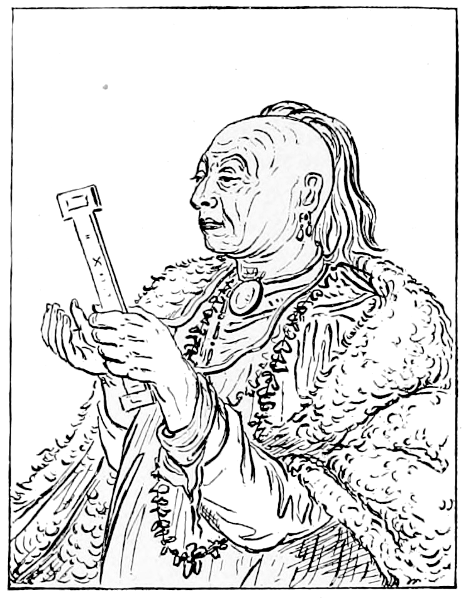
Fig. 716.—On-sáw-kie.
Fig. 716, from the same volume, opposite page 100, is a portrait of On-sáw-kie, The-Sac, a Pottawatomie, using one of these prayer sticks, which had been procured from the Shawnee Prophet.
Figs. 715 and 716 with their descriptions exhibit an intermediate condition between the aboriginal mnemonic method and the Christian formula of prayer by the use of printed books. They should be considered in comparison with the remarks on the “Micmac Hieroglyphs,” Chap. XIX, Sec. 2.
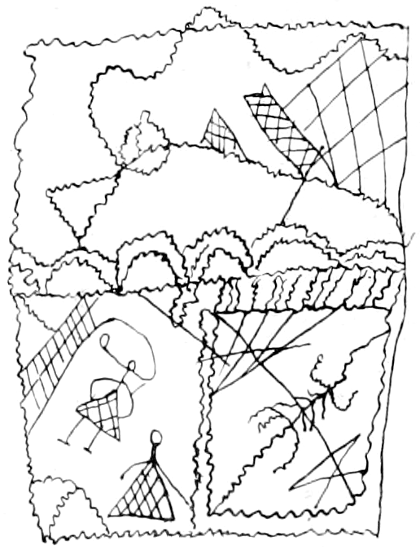
Fig. 717.—Medicine lodge. Micmac.
Fig. 717, incised on the Kejimkoojik rocks in Nova Scotia, suggests the midē' lodge, sometimes called the medicine lodge, of the Ojibwa, which is described above. The ground plan indicated in this figure seems to be divided by partitions, which, together with the human figures and designs, probably refer to the rites of initiation and celebration performed in them. Some of the Micmacs examined had a vague recollection of these ceremonies, which, at the time of the European discovery of the northeastern part of North America, probably were as widely prevalent, as they continued to be much later, among the regions farther in the interior, also occupied by the Algonquian tribes.
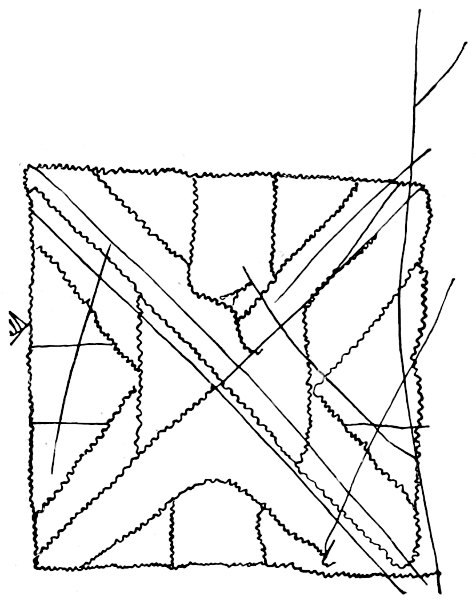
Fig. 718.—Juggler lodge. Micmac.
Fig. 718, from the same locality, is a drawing of the ground plan of another description of ceremonial wigwam or lodge which is remarkably similar to that now called by the Ojibwa “the jessăkân.” Its distinguishing feature is the branch of a tree erected on the outside, and it is the wigwam of a juggler or wizard, and not the lodge belonging to the regular order of the Midē'. Such wigwams of jugglers, who performed wonderful feats similar to those of modern spiritualistic exhibitions, are frequently mentioned by the early French and English writers, who gave accounts of the provinces of New France and New England. The figure now presented is not suggestive without comparison, and would not have been selected for the foregoing description without the authority of living Micmac and Abnaki Indians, to whom it was significant.
Figs. 717 and 718, however, when studied, recall the use of branches and prayer plumes in the descriptions of the houses, and especially of the kivas of the Pueblos and the forms of their consecration mentioned in the study of the Pueblo Architecture, by Mr. Victor Mindeleff, in the Eighth Annual Report of the Bureau of Ethnology, as follows:
It is difficult to elicit intelligent explanation of the theory of the baho and the prayer ceremonies in either kiva or house construction. The baho is a prayer token; the petitioner is not satisfied by merely speaking or singing his prayer; he must have some tangible thing upon which to transmit it. He regards his prayer as a mysterious, impalpable portion of his own substance, and hence he seeks to embody it in some object which thus becomes consecrated. The baho, which is inserted in the roof of the kiva, is a piece of willow twig about 6 inches long, stripped of its bark and painted. From it hang four small feathers suspended by short cotton strings tied at equal distances along the twig. In order to obtain recognition from the powers especially addressed, different colored feathers and distinct methods of attaching them to bits of wood and string are resorted to.
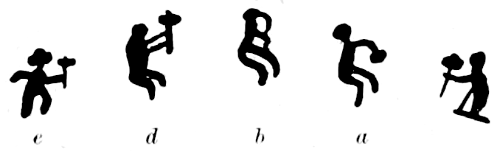
Fig. 719.—Moki ceremonial.
The characters in Fig. 719 are copied from a drawing on the rocks in the Canyon Segy. They have been submitted to the most intelligent of the old Moki priests, and are said to represent the primitive sun priests. They watched for the sunrise every morning and the chief sun priest kept a reckoning of the equinoxes. The chief sun priest, a, made the daily sacrifices to the sun by scattering consecrated meal and singing a prayer to the sun just as it rose. His assistant, b, lit a pipe of tobacco at the same time, and exhaled puffs of smoke, one toward each of the cardinal points, one to the zenith, and one to the nadir. The three other figures are flageolet priests, and the skins of different kinds of foxes were attached to their reed flageolets. c played to the morning star, typified by the skin of the gray fox. d played to the dawn, typified by the skin of the red fox. e played to the daylight, typified by the skin of the yellow fox.
Dr. Franz Boas (e) reported as follows:
The Tsimshian have four secret societies, which have evidently been borrowed from the Kwākiutl, the Olala or Wihalait, Nō'ntlem, Mē'itla, and Semhalait.
The candidate is taken to the house of his parents and a bunch of cedar bark is fastened over the door, to show that the place is tabooed, and nobody is allowed to enter. The chief sings while it is being fastened. In the afternoon the sacred house is prepared for the dance. A section in the rear of the house is divided off by means of curtains; it is to serve as a stage, on which the dancers and the novice appear. When all is ready messengers carrying large carved batons are sent around to invite the members of the society, the chief first. The women sit down in one row, nicely dressed up in button blankets and their faces painted red. The chief wears the amhalait, a carving rising from the forehead, set with sea-lion barbs and with a long drapery of ermine skins; the others, the cedar bark rings of the society. * * *
The Mēitla have a red head ring and red eagle downs, the Nōntlem a neck ring plaited of white and red cedar bark, the Olala a similar but far larger one. The members of the societies receive a head ring for each time they pass through these ceremonies. These are fastened one on top of the other.
Mr. James W. Lynd (d) says:
In the worship of their deities paint (with the Dakotas), forms an important feature. Scarlet or red is the religious color for sacrifices, whilst blue is used by the women in many of the ceremonies in which they participate. This, however, is not a constant distinction of sex, for the women frequently use red and scarlet. The use of paints, the Dakotas aver, was taught them by the gods. Unktehi taught the first medicine men how to paint themselves when they worshiped him and what colors to use. Takushkanshkan (the moving god), whispers to his favorites what colors are most acceptable to him. Heyoka hovers over them in dreams, and informs them how many streaks to employ upon their bodies and the tinge they must have. No ceremony of worship is complete without the wakan or sacred application of paint. The down of the female swan is colored scarlet and forms a necessary part of sacrifices.
Wiener (d) gives a description of Peruvian ceremonies, with an illustration reproduced here as Fig. 720.
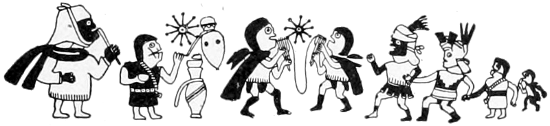
Fig. 720.—Peruvian ceremony.
The paintings on this vase, found by Dr. Macedo in the excavations at Pachacamac, show the principal practices of the exoteric worship of the sun. In this painting there are three entirely distinct groups. The central one is composed of the solar image surrounded by nine rays, terminating in symbols of fecundity. Two men placed at its right and left seem to play on pandean pipes. The group on the left is formed of four individuals, two of whom have head-dresses of royal feathers. This group is performing a dance, while the third group represents the same solar disk and the sacrifice accompanied by music performed in its honor. There are also vases of different forms containing, probably, the sacred drink, and the officiator approaching one hand to one of the great urns, while with the other he holds the vase or the bowl from which he is about to drink the chica consecrated to the sun. The princely personages who have the right to approach the sun wear casques with royal plumes, chemisettes extending below the middle, and ornaments at the lower part of the legs and on the feet. The musicians, four in number (two of whom play upon the pandean pipes and two upon the henna), are distinguished by bonnets without feathers and by a kind of cloak tied around the neck by a band which floats behind them. Finally, the priests, one of whom is an officiator, and the other dancers in the suite of the princely personages, wear bonnets like that of the musicians (who very probably belong to the same class). They have their faces painted.
A. W. Howitt, in MS. Notes on Australian Pictographs, contributes the following:
Among the most interesting of the pictorial markings used by the aborigines are those which are made in connection with the ceremonies of initiation. I now take as an instance the Murring tribe of the southern coast of New South Wales, whose ceremonies I have described elsewhere. The humming instrument, which is known in England as a child’s toy called the bull roarer, has a sacred character with all the Australian tribes. The Murring call it Mŭdji, and the loud roaring sound made when it is swung around at the end of a cord is considered to be the voice of Daramūlŭn, the great supernatural being by whom, according to their tradition, these ceremonies were first instituted.
On this instrument there are marked two notches, one at each end, representing the gap left in the upper jaw of the novice after his teeth have been knocked out during the rites; there is also figured on it the rude representations of Daramūlŭn.
A similar rude outline of a man in the attitude of the magic dance, being also Daramūlŭn, is cut by the old men (wizards) at the ceremonies, upon the bark of a tree at the spot where one of them knocks out the tooth of the novice. This pictograph is then carefully cut out and obliterated after the ceremonies are over.
At a subsequent stage of the proceedings a similar figure is molded on the ground in clay, and is surrounded by the native weapons which Daramūlŭn is said to have invented. This figure, after having been exhibited to the novice, is also destroyed, and they are strictly forbidden under pain of death to make them known in any manner to “women or children;” that is to say, to the uninitiated.
The Mŭdji is not destroyed, but is carefully and secretly preserved by the principal headman who had caused the ceremonies to be held.
The ceremonies of the Wirajuri tribe in New South Wales are substantially the same as those of the Murring, although the tribes are several hundred miles apart. The details, however, differ in some respects.
For instance, at one part of the ceremonies certain carvings are made upon the tree adjoining the place of the ceremonies and upon the ground, as follows:
(1) A piece of bark is stripped off the tree from the branches spirally down the bole to the ground. This represents the path along which Daramūlŭn is supposed to descend from the sky to the place where the initiation is held.
(2) The figure of Daramūlŭn is cut upon the ground, resembling that which the Murring cut upon the tree at the place where in their ceremonies the tooth is knocked out. The figure represents a naked black fellow dancing, his arms being slightly extended and the legs somewhat bent outwards (sideways) at the knee, as in the well known “corroboree” attitude.
(3) The representation of his tomahawk cut on the ground, where he let it fall on reaching the earth.
(4) The footsteps of an emu of which Daramūlŭn was in chase.
(5) The figure of the emu extended on the ground where it fell when struck down by Daramūlŭn.
The same author (f) remarks as follows:
Speaking generally, it may be asserted with safety that initiation ceremonies of some kind or other, and all having a certain fundamental identity, are practiced by the aboriginal tribes over the whole of the Australian continent. * * *
Here, then, the novices for the first time witness the actual exhibition of those magical powers of the old men of which they have heard since their earliest years. They have been told how these men can produce from within themselves certain deadly things which they are then able to project invisibly into those whom they desire to injure or to kill; and now the boys see during the impressive magical dances these very things, as they express it, “pulled out of themselves” by the wizards.
Figs. 721, 722, and 723 are copies of the designs upon Tartar and Mongol drums, taken from G. N. Potanin (b). They are used in religious ceremonies with the belief that the sounds emanating from the surface upon which the designs are made, or, to carry the concept a little further, the sounds coming from the designs themselves, produce special influences or powers. Some of these designs are notably similar to some of those found in America and reproduced in the present paper.
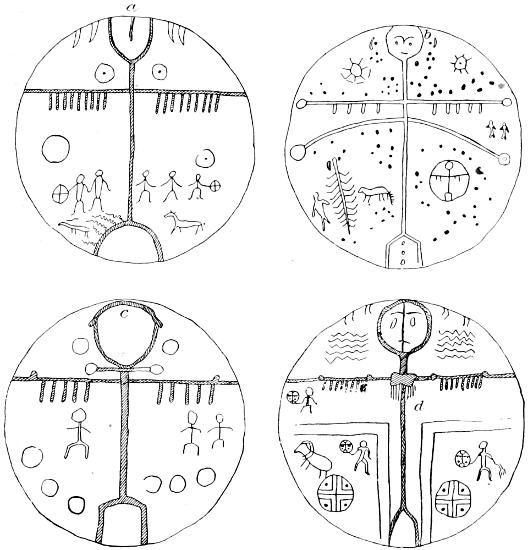
Fig. 721.—Tartar and Mongol drums.
The upper left-hand design (a) in Fig. 721, on the outside of the drum, represents the sun and the moon in the form of circles with a central dot. Below the crossbar were two other such figures with central dot. Besides, were represented below, on the left side, two shamans, and under them a wild goat and serpent in the form of wavy lines; on the right side three shamans and a deer.
The upper right-hand design (b) on the same figure is a group representing the bringing of a horse to sacrifice. Under a rainbow, dots represent stars, and two heavenly maidens who the shamans said were the daughters of Ulgen and who were playing. They come down to the mountains and rise up to the skies.
A bow with a knob at each end is made to represent a rainbow in the lower part of a shaman’s drum.
The lower left-hand design (c) on the same figure on a drum of the telengit shaman is the external delineation of a head without eyes and nose. The lower end of the line coming from the head represents a bifurcation. Under the head is a short horizontal line like an extended arm. Above a line extending from side to side of the drum are two circles, and below six circles, all empty. According to the owner of the drum these circles are representations of drums, and the three human figures are masters or spirits of localities.
The lower right-hand design (d) in the same figure has in the upper section five zigzag lines represented similar to those with which lightning is often represented. According to the shaman these are serpents.
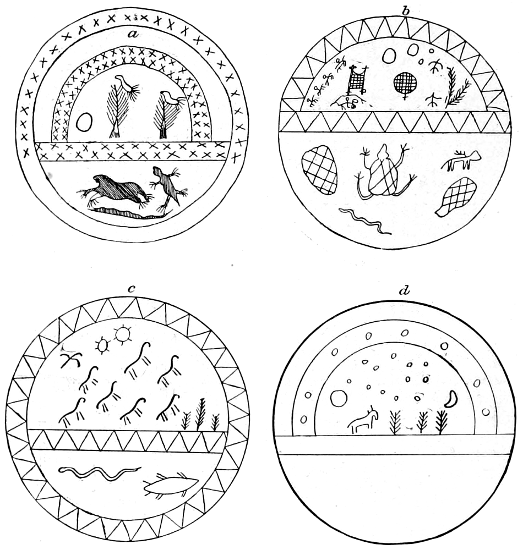
Fig. 722.—Tartar and Mongol drums.
The upper left-hand design (a) in Fig. 722 inside the drum has painted two trees. On each of them sits the bird karagush, with bill turned to the left. On the left of the trees are two circles, one dark (the moon), the other light (the sun). Below a horizontal line are depicted a frog, a lizard, and a serpent.
The upper right-hand design (b) in the same figure has on the upper half two circles, the sun and moon; on the left side four horsemen; under them a bowman, also on horseback. The center is occupied by a picture of a net and a sieve for winnowing the nuts and seeds of the cedar tree. On the right side are two trees, baigazuin (literally the rich birch), over which two birds, the karagush, are floating. Under a division on the right and on the left side are oval objects with latticed-figured or scaly skin. These are two whales. In the middle, between them, are a frog and a deer, and below a serpent. Above, toward the hoop of the drum, is fastened an owl’s feather.
The lower left hand design (c) in the same figure has represented in the upper half seven figures reminding one of horses. These are the horses, bura, going to heaven, i. e., their sacrifice. Above them are two circles emitting light, the sun and the moon; on the right of the horses are three trees; under a horizontal line on the left is a serpent; on the right a fish, the kerbuleik, the whale according to Verbitski, literally the bay-fish.
The lower right-hand design (d) in the same figure has a drawing on the outside, a circle divided by horizontal bars into halves. The field of the upper half is divided into three strata, the first stratum of which is heaven, the second the rainbow, and in the lower stratum the stars. On the left side the sun, and the crescent moon on the right side; the goat, trees, and an undefined figure, which is not given in the drawing, underneath. The kam, a kind of shaman, called it the bura. Some said that it meant a cloud; others that it meant heavenly horses.
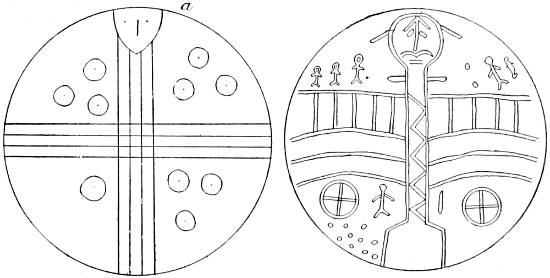
Fig. 723.—Tartar and Mongol drums.
The left-hand design (a) in Fig. 723 shows four vertical and four horizontal lines. The latter represent the rainbow; the vertical lines borsui. Circles with dots in the center are represented in three sections, and in the fourth one circle.
The right-hand design in the same figure: On the upper sections are represented a number of human figures. These, according to the shaman’s own explanation, are heavenly maidens (in the original Turkish, tengriduing kuiz). Below, under a rainbow, which is represented by three arched lines, are portrayed two serpents, each having a cross inside. These are kurmos nuing tyungurey, i. e., the drums are kurmos’s. Kurmos is the Alti word for spirits, which the shamans summon.
Bastian (a) makes remarks as follows concerning the magic drum of the Shamans in the Altai, which should be considered in this connection:
The Shamans admit three worlds (among the Yakuts), the world of the heavens (hallan jurda), the middle one of the earth (outo-doidu) and the lower world or hell (jedän tügara), the former the realm of light, the latter the realm of darkness, while the earth has for a time been given over by the Creator (Jüt-tas-olbohtah Jürdän-Ai-Tojan) to the will of the devil or tempter, and the souls of men at their death, according to the measure of their merit, are sent into one or the other realm. When, however, the earth world has come to an end, the souls of the two realms will wage a war against each other, and victory must remain on the side of the good souls.
SECTION 6. MORTUARY PRACTICES.
Champlain (f) in his voyage of 1603, says of the Northeastern Algonquins that their graves were covered with large pieces of wood, and one post was erected upon them, the upper part of which was painted red.
The same author, in 1613, writing of the Algonquins of the Ottawa river, at the Isle des Alumettes, gives more details of the pictures on their grave posts:
On it the likeness of the man or woman who is buried there is roughly engraved. If a man, they put on a buckler, a spear, war club, and bows and arrows. If he is a chief he will have a plume on his head and some other designs or ornaments. If a boy, they give him one bow and a single arrow. If a woman or girl, they put on a kettle, an earthen pot, a wooden spoon, and a paddle. The wooden tomb is 6 or 7 feet long and 4 wide, painted yellow and red.
Some northern tribes—probably Cree—according to the Jesuit Relations (a), gave a notice of death to absent relations or dear friends of the deceased by hanging the object signifying his name on the path by which the traveler must return, e. g., if the name of the deceased was Piré (Partridge) the skin of a partridge was suspended. The main object of the notice was that the traveler, thereby knowing of the death, should not on his return to the lodge or village ask after or mention the deceased. Perhaps this explains the custom of placing pictographs of personal names and totemic marks on some prominent point or on trails without any apparent incident.
The same Relation describes a custom of the same Indians of shaping out of wood a portraiture of the more distinguished dead and inserting it over their graves, afterwards painting and greasing it as if it were the live man.
In Keating’s Long (g) it is told that the Sac Indians are particular in their demonstrations of grief for departed friends. These consist in darkening their faces with charcoal, fasting, abstaining from the use of vermillion and other ornaments in dress, etc. They also make incisions in their arms, legs, and other parts of the body; these are not made for the purposes of mortification, or to create a pain which shall by dividing their attention efface the recollection of their loss, but entirely from a belief that their grief is internal and that the only way of dispelling it is to give it a vent through which to escape.
This is an explanation of the practice which has been verified in the field work of the Bureau of Ethnology and corresponds with the concept of finding relief from disease and pain by similar incisions, to let out the supposed invading entity that causes distress.
The same authority, p. 332, gives the following account of Dakota burial scaffolds:
On these scaffolds, which are from 8 to 10 feet high, corpses were deposited in a box made from part of a broken canoe. Some hair was suspended which we at first mistook for a scalp; but our guide informed us that these were locks of hair torn from their heads by the relations to testify their grief. In the center, between the four posts which supported the scaffold, a stake was planted in the ground; it was about 6 feet high, and bore an imitation of human figures; five of which had a design of a petticoat, indicating them to be females; the rest, amounting to seven, were naked, and were intended for male figures. Of the latter, four were headless, showing that they had been slain; the three other male figures were unmutilated but held a staff in their hands which, as our guide informed us, designated that they were slaves. The post, which is an usual accompaniment to the scaffold that supports a warrior’s remains, does not represent the achievements of the deceased, but those of the warriors that assembled near his remains, danced the dance of the post, and related their martial exploits.
Maximilian, Prince of Wied (d), tells that as a sign of mourning the Sioux daub themselves with white clay.
According to Powers, (d) “A Yokaia widow’s style of mourning is peculiar. In addition to the usual evidence of grief she mingles the ashes of the dead husband with pitch, making a white tar or ungent with which she smears a band about two inches wide all around the edge of her hair (which is previously cut off close to the head), so that at a little distance she appears to be wearing a white chaplet.”
Mr. Dorsey reports that mud is used by a mourner in the sacred-bag war party among the Osages. Several modes of showing mourning by styles of paint and markings are presented in this paper under the headings of Color and of Tattooing. Other practices connected with the present topic, and which may explain some pictographs, are described in the work of Dr. H. C. Yarrow, acting assistant surgeon, U. S. Army, on The Mortuary Customs of the North American Indians, in the First Annual Report of the Bureau of Ethnology.
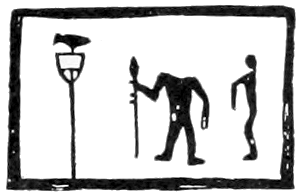
Fig. 724.—Votive offering. Alaska.
Fig. 724 is copied from a piece of ivory in the museum of the Alaska Commercial Company, San Francisco, California, and was interpreted by an Alaskan native in San Francisco in 1882.
First is a votive offering or “shaman stick,” erected to the memory of one departed. The “bird” carvings are considered typical of “good spirits,” and the above was erected by the remorse-stricken individual, who had killed the person shown.
The headless body represents the man who was killed. In this respect the Ojibwa manner of drawing a person “killed” is similar.
The right hand Indian represents the homicide who erected the “grave-post” or “sacred stick.” The arm is thrown earthward, resembling the Blackfeet and Dakota gesture for “kill.”
That portion of the Kauvuya tribe of Indians in Southern California known as the Playsanos, or lowlanders, formerly inscribed characters upon the gravestones of their dead, relating to the pursuits or good qualities of the deceased. Dr. W. J. Hoffman obtained several pieces or slabs of finely-grained sandstone near Los Angeles, California, during the summer of 1884, which had been used for this purpose. Upon these were the drawings, in incised lines, of the fin back whale, with figures of men pursuing them with harpoons. Around the drawings were close parallel lines with cross lines similar to those made on ivory by the southern Innuit of Alaska.
Figs. 725 to 727 were procured from a native Alaskan by Dr. Hoffman in 1882, and explained to him to be drawings made upon grave posts.
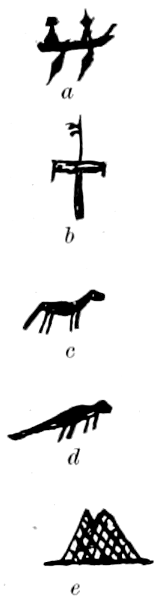
Fig. 725.—Grave post. Alaska.
Fig. 725 commemorates a hunter, as land animals are shown to be his chief pursuit. The following is the explanation of the characters:
a. The baidarka, or boat, holding two persons; the occupants are shown, as are also the paddles, which project below the horizontal body of the vessel.
b. A rack for drying skins and fish. A pole is added above it, from which are seen floating streamers of calico or cloth.
c. A fox.
d. A land otter.
e. The hunter’s summer habitation. These are temporary dwellings and usually constructed at a distance from home. This also indicates the profession of a skin-hunter, as the permanent lodges, indicated as winter houses, i. e., with round or dome-like roof, are located near the seashore, and summer houses are only needed when at some distance from home, where a considerable length of time is spent in hunting.
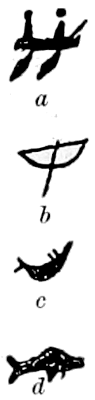
Fig. 726.—Grave post. Alaska.
The following is the explanation of Fig. 726. It is another design for a grave post, but is erected in memory of a fisherman:
a. The double-seated baidarka, or skin canoe.
b. The bow used in shooting seal and other marine animals.
c. A seal.
d. A whale.
The summer lodge is absent in this, as the fisherman did not leave the seashore in the pursuit of game on land.

Fig. 727.—Village and burial grounds. Alaska.
Fig. 727 is a drawing of a village and neighboring burial-ground, prepared by an Alaskan native in imitation of originals seen by him among the natives of the mainland of Alaska, especially the Aigalúqamut. Carvings are generally on walrus ivory; sometimes on wooden slats. In the figure, g is a representation of a grave post in position, bearing an inscription similar in general character to those in the last two preceding figures.
The details are explained as follows:
a, b, c, d. Various styles of habitations, denoting a settlement.
e. An elevated structure used for the storage of food.
f. A box with wrappings, containing the corpse of a child. The small lines, with ball attached, are ornamental appendages consisting of strips of cloth or skin, with charms, or, sometimes, tassels.
g. Grave post, bearing rude illustrations of the weapons or implements used by the deceased during his life.
h. A grave scaffold, containing adult. Besides the ornamental appendages, as in f preceding, there is a “Shaman stick” erected over the box containing the corpse as a mark of good wishes of a sorrowing survivor. See object a, in Fig. 724.
Schoolcraft (m) gives a good account, with illustration, of the burial posts used by the Sioux and Chippewas. It has been quoted so frequently that it is not reproduced here. The most notable feature connected with the posts is that the totems depicted on them are reversed, to signify the death of the persons buried.
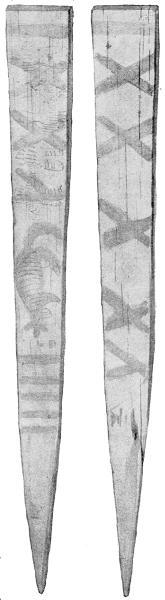
Fig. 728.—Menomoni grave post.
Fig. 728 represents the grave post of a Menomoni Indian of the bear totem. The stick is a piece of pine board 2½ inches wide at the top, gradually narrowing down to a point; three-fourths of an inch thick, and about 2 feet long. On one side are two sets of characters, the oldest being incised with a sharp-pointed nail, while over these are a later set of drawings made with red ocher, represented in the illustration by shading. The figure of the bear, drawn with head to the ground, denotes the totem of which the deceased was a member, the remaining incised figures relating to some exploits the signification of which was not known. The red marks were put upon the stick at the time of the holding of a memorial service, when the father of the deceased furnished a feast to the medicine priests just previous to his being received into the society of shamans to fill the vacancy caused by the death. The number of red crosses denote the number of speeches made at the grave upon that occasion, while the band at the top refers to the person acting as master of ceremonies, who had been requested to make all the arrangements for the medicine ceremonies and initiation. So said some Menomoni in the neighborhood, but later the Indian who actually painted the red crosses came to Washington and explained that they signified the number of war parties in which the deceased had taken part.
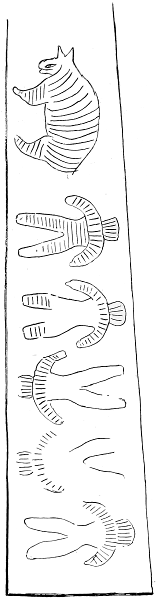
Fig. 729.—Incised lines on Menomoni grave post.
Fig. 729 shows the incised lines on the front of the post before color was applied. The manner of placing the grave posts at the head of the grave box is shown in Fig. 730, the left-hand grave being that of Oshkosh, the late head chief of the Menomoni in Wisconsin, after whom the city of Oshkosh was named.
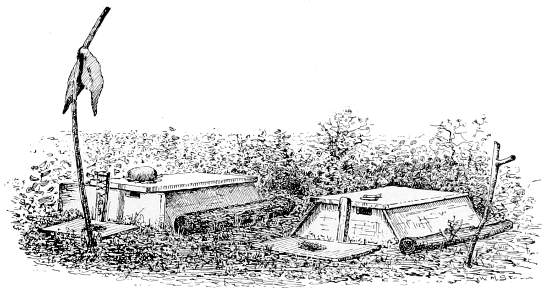
Fig. 730.—Grave boxes and posts.
Before the grave is a small board, upon which tobacco is placed to gratify the taste of the dead, and during the season of sugar making pieces of that delicacy are pushed through the small openings in the head board, that the spirit of the deceased may be gratified and give success to the donors at future seasons.
The right-hand grave box is that of another member of the family of Oshkosh, at which the board, with tobacco, is also placed, as well as the grave post. This, however, does not bear any indications of characters, which probably had been washed off by the rain.
Pieces of bark, stones, and sticks are also placed upon the grave boxes, but the signification of this practice could not be ascertained.
The next two figures come from the Dakotas.
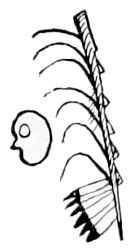
Fig. 731.—Commemoration of dead. Dakota.
Fig. 731.—Held a commemoration of the dead. Cloud-Shield’s Winter Count, 1826-’27. The ceremonial pipe-stem and the skull indicate the mortuary practice, which is further explained by the next figure.
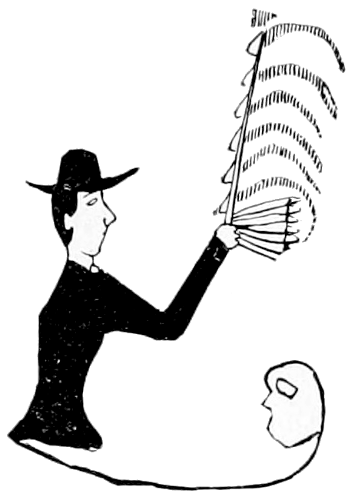
Fig. 732.—Ossuary ceremonial. Dakota.
Fig. 732.—A white man made medicine over the skull of Crazy-Horse’s brother. Cloud-Shield’s Winter Count, 1852-’53. He holds a pipe-stem in his hand. This figure refers to the custom of gathering periodically the bones of the dead that have been placed on scaffolds and burying them. It appears that a white man made himself conspicuous by conducting the ceremonies on the occasion noted.
Lewis and Clarke (c) mention the Chilluckittequaws, a division of the Chinooks of the Columbia river, as having for burial purposes vaults made of pine or cedar boards, closely connected, about 8 feet square and 6 in height. The walls as well as the door were decorated with strange figures cut and painted on them; besides these there were several wooden images of men, some of them so old and decayed as to have almost lost their shape, which were all placed against the sides of the vaults. These images do not appear to be at all the objects of adoration, but were probably intended as resemblances of those whose decease they indicate.
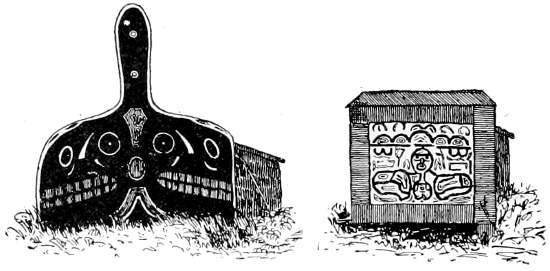
Fig. 733.—Kalosh graves.
Whymper (a) reports that the Kalosh Indians of Alaska construct grave boxes or tombs which contain only the ashes of the dead. These people invariably burn the deceased. On one of the boxes he saw a number of faces painted, long tresses of human hair depending therefrom. Each head represented a victim of the deceased man’s ferocity. Thus the pictures are not likenesses or totemic marks of the cremated Kalosh, but of enemies whom he had killed, being in the nature of trophies or proofs of valor. Fig. 733 is a reproduction of the illustration.
Dall (c) says of the Yukon Indians:
Some wore hoops of birch wood around the neck and wrists, with various patterns and figures cut on them. These were said to be emblems of mourning for the dead.
Dr. Franz Boas (f) gives the following account of the funeral customs practiced by the Snanaimuq, a Salish tribe:
The face of the deceased is painted with red and black paint. * * * A chief’s body is put in a carved box and the front posts supporting his coffin are carved. His mask is placed between these posts. The graves of great warriors are marked by a statue representing a warrior with a war club. * * * After the death of husband or wife, the survivor must paint his legs and his blanket red. * * * At the end of the mourning period the red blanket is given to an old man, who deposits it in the woods.
Didron (a) speaks of emblems on tombstones:
Even today, at Constantinople, in the cemetery of the Armenians, every tombstone is marked with the insignia of the profession followed by the defunct which the stone covers. For an Armenian tailor there is a pair of shears, thread, and needles; for a mason, hammer and trowel; for a shoemaker, a last, leather, and a leather cutter; for a grocer, a pair of scales; for a banker, pieces of money. It is the same with others. Among us [Frenchmen], in the middle ages, a compass, a rule, and square are engraved on the tomb of Hugues Libergier. In the cemetery of L’Est, at Paris, a palette indicates the grave of a painter, a chisel and hammer mark that of a sculptor. Animals are represented as talking and acting, masks grimace and smile, to announce in the same inclosure the tombs of La Fontaine and of Molière. Among the Romans it was the same: a fisher had a boat on his tomb; a shepard, a sheep; a digger, a pickaxe; a navigator, an anchor or a trident; a vine-dresser, a cask; an architect, a capital or the instruments of his art.
Hewitt (g) says of the Dieri, a tribe of Central Australia:
A messenger who is sent to convey the intelligence of a death is smeared all over with white clay. On his approach to the camp the women all commence screaming and crying most passionately. After a time the particulars of the death are made known to the camp. The near relations and friends then only weep. Old men even cry bitterly, and their friends comfort them as if they were children. On the following day the near relations dress in mourning by smearing themselves over with white clay. Widows and widowers are prohibited by custom from uttering a word until the clay has worn off, however long it may remain on them. They do not, however, rub it off, as doing so would be considered a bad omen. It must absolutely wear off of itself. During this period they communicate by means of gesture language.
Dr. Ferdinand von Hochstetter (a) says:
The carved Maori figures which are met with on the road are the memorials of chiefs who, while journeying to the restorative baths of Rotorua, succumbed to their ills on the road. Some of the figures are decked out with pieces of clothing or kerchiefs; and the most remarkable feature in them is the close imitation of the tattooing of the deceased, by which the Maoris are able to recognize for whom the monument has been erected. Certain lines are peculiar to the tribe, others to the family, and again others to the individual. A close imitation of the tattooing of the face, therefore, is to the Maori the same as to us a photographic likeness; it does not require any description of name.
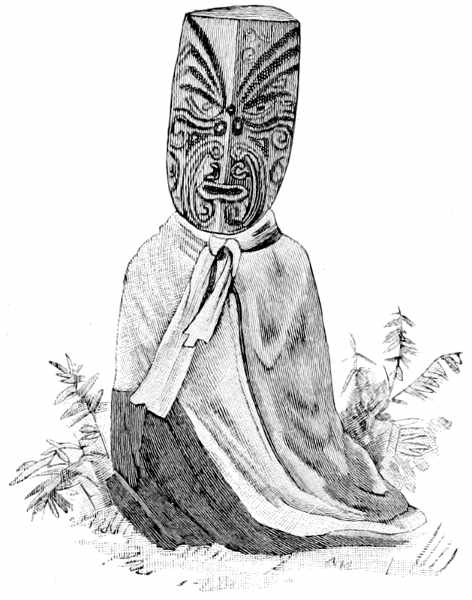
Fig. 734.—New Zealand grave effigy.
A representation of one of these carved posts is given in Fig. 734.
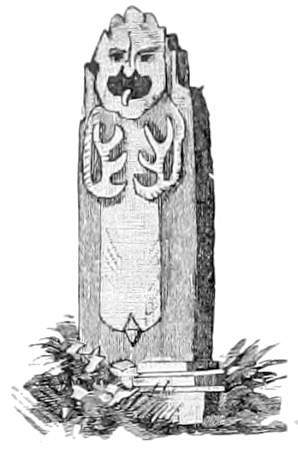
Fig. 735.—New Zealand grave-post.
Another carved post of like character is represented in Fig. 735, concerning which the same author says, p. 338: “Beside my tent, at Tahuahu, on the right bank of the Mangapu, there stood an odd, half-decomposed figure carved of wood; it was designated to me by the natives as a Tiki, marking the tomb of a chief.”
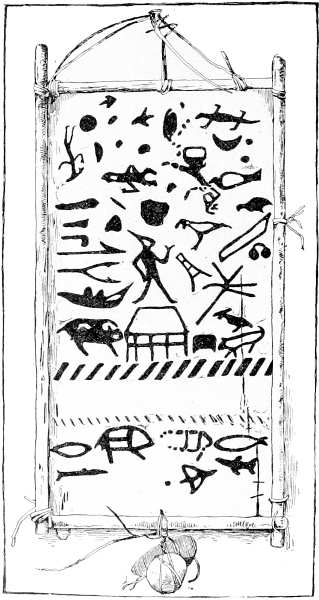
Fig. 736.—Nicobarese mortuary tablet.
Ball, on Nicobarese Ideographs, in Jour. Anthrop. Inst. of Gr. Br. & I. (d), says, describing Fig. 736, which appears to be connected with mortuary observances:
The example of Nicobarese picture writing in Fig. 736 was obtained in the year 1873 on the island of Kondul, where I found it hanging in the house of a man who was said to have died a short time previously. * * *
The material of which it is made is either the glume of a bamboo or the spathe of a palm which has been flattened out and framed with split bamboos.
It is about 3 feet long by 18 inches broad. The objects are painted with vermilion, their outlines being surrounded with punctures, which allow the light to pass through. * * *
As in all such Nicobarese paintings, figures of the sun, moon, and stars occupy prominent positions. Now, the sun and moon are stated, by those who have known the Nicobarese best, to be especial objects of adoration, and therefore these paintings may have some religious significance.
At first it occurred to me that this was merely an inventory of the property of the deceased, but as some of the objects are certainly not such as we should expect to find in an enumeration of property, e. g., the lizard, while the figures of men appear to portray particular emotions, it seems probable that the objects represented have a more or less conventional meaning, and that we have here a document of as bona fide and translatable a character as an Egyptian hieroglyphic inscription.
My own efforts to discover an interpretation from the natives on the spot were not crowned with success. * * *
Mr. De Röepstorff, extra assistant superintendent of the Andamans and Nicobars, to whom I applied for such information as he might be able to collect upon the subject, assured me by letter, in 1873, that the screens had a religious significance and were used to exorcise spirits, but he did not seem to regard them as capable of being interpreted. * * *
The following is a list of the objects depicted, besides animals; many of the common utensils in use in a Nicobarese household are included:
(1) The sun and stars; (2) the moon and stars; (3) swallows or (?) flying fish; (4) impression of the forepart of a human foot; (5) a lizard (Hydrosaurus?); (6) four men in various attitudes; (7) two dás for cutting jungle; (8) two earthen cooking vessels; (9) two birds; (10) an ax; (11) two spears; (12) a ladder (?); (13) dish for food; (14) cocoanut water-vessels; (15) palm tree; (16) a canoe; (17) three pigs; (18) shed; (19) domestic fowl; (20) seaman’s chest; (21) dog; (22) fish of different kinds; (23) turtle.