Chapter XIII · TOTEMS, TITLES, AND NAMES. (continued 2)
Reading edition
The use of tattoo marks as certificates and records of prowess in war is considered to be of special importance in any discussion of their origin. A warrior returns from the field stained with blood from an honorable wound, the scars of which he afterwards proudly displays. It would be strictly in the line of ideography to make artificial scars or to paint the semblance of wounds on the person as designations of honor, and from such origin quite as well as from a totemic representation all other forms and uses may have been evolved. For instance, the vigor of manhood being thus signified, the similar use would show the maturity of women. Yet some of the practices of tattoo may have originated independently of either totem or glory mark. The mere idea of decoration as shown in what civilized people call deformations of nose, lip, ear, teeth, and in fact all parts of the body, is sufficient to account for the inception of any form of tattoo. Primitive man never seemed to be content to leave the surface of his body in its natural condition, and from recognition of that discontent studies of clothing and of ornament should take their point of departure.
In this paper many examples are presented of the use, especially by the North American Indians, of tribal signs carved or painted on rock, tree, bark, skin, and other materials, and suggestion is made of an interesting connection between these designs and those of heraldry in Europe. It would, therefore, seem natural that the same Indians who probably for ages used such totemic and tribal devices should paint or tattoo them on their own persons, and the meagerness of the evidence that they actually did so is surprising. Undoubtedly the statement has been made in a general way by some of the earlier explorers and travelers, but when analyzed it is frequently little more than a vague expression of opinion, perhaps based on a preconceived theory. Nearly all the Indian tribes have peculiarities of arrangement of the hair and of some article of apparel and accouterment by which they can always be distinguished. These are not totemic, nor are they by design expressions of a tribal character. They come under the heading of fashion, and such fashions in clothing and in arrangement of the hair still exist among civilized peoples, so that the people of one nation or province can at once be distinguished from others. Very little appears from the account of actual observers to show that the character of the tattoo marks of the North American Indians, perhaps excluding those of the northwest coast, was more than a tribal fashion. Such styles or fashions with no intent or deliberate purpose that they should serve as tribal signs prevail to-day in Africa and in some other regions, and have been introduced by the professional artists who had several styles. Besides the necessary influence of a school of artists, it is obvious that people living together would contract and maintain the same custom and fashion in their cutaneous decoration.
SECTION 4. DESIGNATIONS OF INDIVIDUALS.
These are divided into: (1) Insignia or tokens of authority. (2) Signs of individual achievements. (3) Property marks. (4) Personal names.
INSIGNIA OR TOKENS OF AUTHORITY.
Champlain (e) says of the Iroquois in 1609:
Those who wore three large “pannaches” [plumes] were the chiefs, and the three chiefs delineated have their plumes much larger than those of their companions who were simple warriors.
In Travels of Lewis and Clarke (a) it is said:
Among the Teton Sioux the interior police of a village is confided to two or three officers who are named by the chief for the purpose of preserving order, and remain in power some days, at least till the chief appoints a successor; they seem to be a sort of constable or sentinel, since they are always on the watch to keep tranquility during the day and guarding the camp in the night. * * * Their distinguishing mark is a collection of two or three raven skins fixed to the girdle behind the back in such a way that the tails stick out horizontally from the body. On the head too is a raven skin split into two parts and tied so as to let the beak project from the forehead.
In James’s Long (d) it is reported that—
Among the Omaha on all occasions of public rejoicings, festivals, dances, or general hunts, a certain number of resolute warriors are previously appointed to preserve order and keep the peace. In token of their office they paint themselves entirely black; usually wear the crow, and arm themselves with a whip or war-club with which they punish on the spot those who misbehave, and are at once both judges and executioners.
Prince Maximilian of Wied (a) says:
In every numerous war party there are four leaders (partisans, karokkanakah) sometimes seven, but only four are reckoned as the real partisans; the others are called bad partisans (karokkanakah-chakohosch, literally, partisans galeux). All partisans carry on their backs a medicine pipe in a case which other warriors dare not have. To become a chief (Numakschi) a man must have been a partisan and then kill an enemy when he is not a partisan. If he follows another partisan for the second time he must have first discovered the enemy, have killed one and then possessed the hide of a white buffalo cow complete with the horns to pretend to the title of chief (Numakschi). * * * All the warriors wear small war pipes round their necks, which are often very elegantly ornamented with porcupine quills.
Pls. XXVI and XXVII are illustrations specially relating to insignia of office selected from an important and unique pictorial roster of the heads of Oglala families, eighty-four in number, in the band of Chief Big-Road, which were obtained by Rev. S. D. Hinman at Standing Rock Agency, Dakota, in 1883, from the United States Indian agent, Maj. McLaughlin, to whom the original had been delivered by Chief Big-Road when brought to that agency and required to give an account of his followers. Other selections from this Oglala Roster appear under the headings of Ideography, Personal names, Comparisons, Customs, Gestures, Religion, and Conventionalizing.
Chief Big Road and his people belong to the northern Oglala, and at the time mentioned had been lately associated with Sitting-Bull in various depredations and hostilities against settlers and the United States authorities. The translations of the names have been verified and the Oglala name attached. At the date of the roster Chief Big-Road was above 50 years old, and was as ignorant and uncompromising a savage in mind and appearance, as one could well find.
The drawings in the original are on a single sheet of foolscap paper, made with black and colored pencils, and a few characters are in yellow-ocher waters color paint. They were made for the occasion with the materials procured at the agency.
Pl. XXVI exhibits the five principal chiefs with their insignia. Each has before him a decorated pipe and pouch, the design of each being distinct from the others. The use of pipes as insignia for leaders is frequently mentioned in this work. The five chiefs do not have the war club, their rank being shown by pipe and pouch. Each of the five chiefs has at least three transverse bands on the cheek, with differentiations of the pattern.
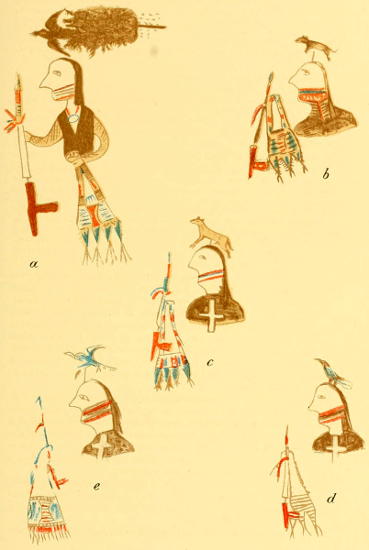
BUREAU OF ETHNOLOGY TENTH ANNUAL REPORT PL. XXVI OGLALA CHIEFS.
Pl. XXVII shows the subchiefs of the band. The three red bands are the sign that they are Akicita-itacanpi, which means head soldiers—captains in war, and captains of police in civil administration. Each of them is decorated with three red transverse bands on the cheek and carries a war club held vertically before the person.
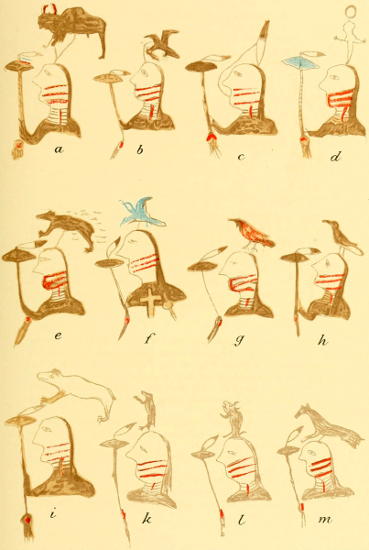
BUREAU OF ETHNOLOGY TENTH ANNUAL REPORT PL. XXVII OGLALA SUB-CHIEFS.
The other male figures not represented in the plates have in general each but a single red band on the cheek; others, two bands, red and blue. These are merely ornamental and without significance.
It will be noticed that in this series the device indicating the name is not generally connected by lines with the mouth but only when there is a natural connection with it. It appears attached by a line to the crown of the head, but sometimes without any connecting line.
Pl. XXVI shows the five principal chiefs of the Oglala in 1883, who are severally designated as follows:
a. Cankutanka, Big-Road. Big-Road is often called Good-Road because a road that is big or broad and well traveled is good. The tracks on both sides of the line indicating a mere path show that the road is big. The bird flying through the dusk indicates the rapidity of travel which the good road allows. This is the same chief as the following:
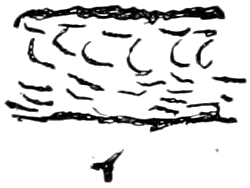
Fig. 540.—Big-Road.
Fig. 540, Big-Road as appearing in Red-Cloud’s Census, No. 96. The broad and big road is indicated by the artist of that series as having distinctly marked sides and horsetracks between these roadsides. In this instance as in several others it is obvious that the ideographic device was not fixed but elastic and subject to variation, the intention being solely to preserve the idea.
b. Sunka-kuciyela, Low-Dog. The dog figure is represented as “low” by the shortness of the legs as compared with the next figure of Long-Dog.
c. Sunka-hanska, Long-Dog. This term “long” is in the pictography of the Siouan tribes, but is differently translated as tall. There is a marked variation in the length of the legs between this and the next foregoing.
d. Kangi-maza, Iron-Crow. The term “iron” is explained above. The color blue is always used in Dakotan pictography for the word translated as iron.
e. Cetan-cigala, Little-Hawk.
Pl. XXVII shows the subchiefs or partisans of the Oglala at the time of the roster in 1883.
a. Represents Tatanka-he-luta, Red-horn-Bull. The bull’s horns have been made bloody by goring.
b. Represents Cetan-watakpe, Charging-Hawk. This subchief also appears with a slightly different form of “charging” in Red-Cloud’s Census, in which the bird is represented head downward.
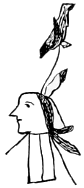
Fig. 541.—Charging-Hawk.
Fig. 541.—Charging-Hawk, from Red-Cloud’s Census, No. 142. On careful examination the bird is seen to be not erect, as at first appears, but is swooping down.
c. Represents Wiyaka-aopazan, Wears-the-Feather. The feather in its conventional form is presented twice, once connected by a line with the mouth and also over the war club as in common with other pictures of this series. The same person is represented next below.

Fig. 542.—Feather-on-his-Head.
Fig. 542.—Feather-on-his-Head, from Red-Cloud’s Census, No. 86. In this case the feather droops while it is erect in the figure next above. No significance is indicated in the slight variation.
d. Represents Pankeskahoksila, Shell-Boy. The shell is the circular object over the head of the small human figure, which is without the proper number of legs, showing perhaps that he can not march, and his open, weaponless hands say that he is not a warrior, i. e., he is a boy. The object, now translated shell, was originally a large excrescence on the trunk of a tree which was often cut away by the Dakotas, hollowed out and used as a bowl.
e. Mato-niyanpi, The-Bear-spares-him. The bear passing through the marks of several tracks indicates an incident not explained, in which the subchief was in danger.
f. Represents Cetan-maza, Iron-Hawk. The bird is colored blue, as before explained.
g. Represents Kangi-luta, Red-Crow.
h. Represents Situpi-ska, White-Tail. The bird is probably one of the hawks, as is more distinctly indicated in the representation of the same name as follows:
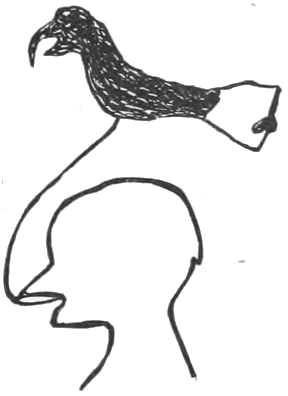
Fig. 543.—White-Tail.
Fig. 543.—White-Tail; from Red-Cloud’s Census, No. 190. This is inserted for convenient comparison with the foregoing, being a slightly variant device for the same person.
i. Represents Mato-ska, White-Bear.
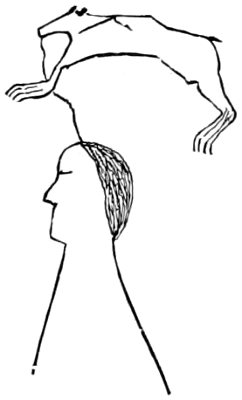
Fig. 544.—White-Bear.
Fig. 544.—White-Bear; from Red-Cloud’s Census, No. 252. This is inserted here for comparison of the drawings. The characteristics of the animal appear in both.
k. Represents Mato-najin, Standing-Grizzly-Bear. The differentiations of these and other similar positions of the same object remind one of the heraldic devices “statant,” “regardant,” “passant,” and the like.
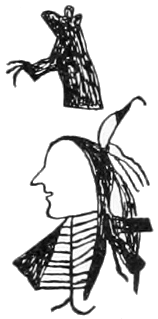
Fig. 545.—Standing-Bear.
Fig. 545.—Standing-Bear; from Red-Cloud’s Census, No. 140. This is probably the same man as in the last-mentioned figure, though the fancy of the artist has blazoned the bear as demi. This was, however, for convenience and without special significance, as the forequarters are not indicated in the name. But that might well have been done if the device were strictly totemic and connected with the taboo. Some of the bear gens are only allowed to eat the fore quarters of the animal, others the hind quarters.
l. Represents Tatanka-najin, Standing-Buffalo-Bull.
m. Represents Tasunke-inyanke, His-Running-Horse. This man was probably the owner of a well known racing pony.
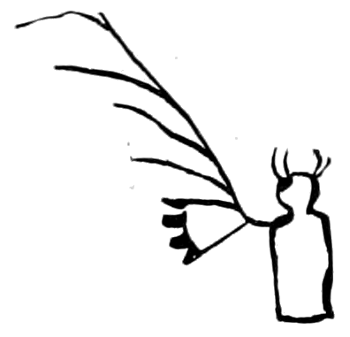
Fig. 546.—Four-Horn calumet.
Fig. 546.—A Minneconjou Dakota, named Red-Fish’s-Son, danced the calumet dance. The-Swan’s Winter Count, 1856-’57.
Maj. Bush says: “A Minneconjou, Red-Fish’s-Son, The-Ass, danced the Four-Horn calumet.”
The peculiarly ornamented pipe, frequently portrayed and mentioned in the parts of the paper relative to the Dakotas, is, at least for the time of the duration of the ceremonies, the sign of the person who leads them.
In connection with the display of pipes as insignia of authority and rank, Figs. 547 and 548 are introduced here.
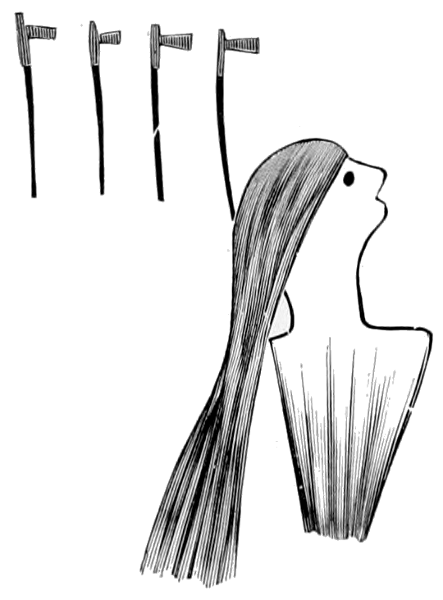
Fig. 547.—Two-Strike as partisan.
Fig. 547, drawn and explained by an Oglala Dakota, exhibits four erect pipes, to show that he had led four war parties.
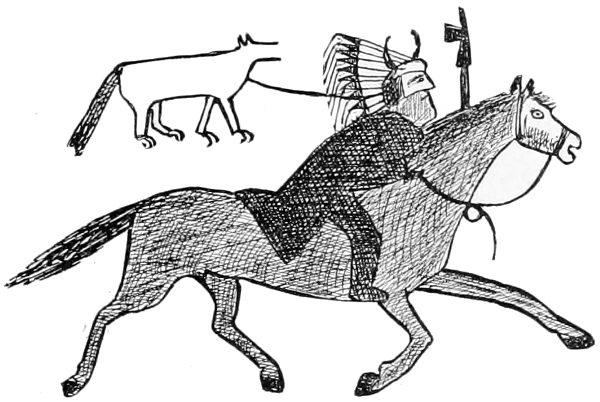
Fig. 548.—Lean-Wolf as partisan.
Fig. 548 is a copy of a drawing made by Lean-Wolf, when second chief of the Hidatsa, to represent himself. The horns on his head-dress show that he is a chief. The eagle feathers on his war bonnet, arranged in the special manner portrayed, also show high distinction as a warrior. His authority as “partisan,” or leader of a war party, is represented by the elevated pipe. His name is also added, with the usual line drawn from the head. He explained the outline character of the wolf, having a white body with the mouth unfinished, to show that it was hollow, nothing there; i. e., lean. The animal’s tail is drawn in detail and dark, to distinguish it from the body.
The character for “partisan” is also shown in Lone-Dog’s Winter Count for the year 1842-’43.
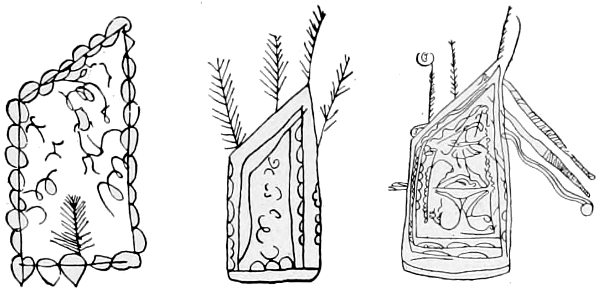
Fig. 549.—Micmac head dress in pictographs.
Fig. 549 gives three examples, actual size, of a large number of similar designs scratched on the rocks of Kejimkoojik lake, Nova Scotia. They were at first considered to be connected with the ceremonial or mystery lodges, many sketches of which appear on the same rocks, and examples of which are given in Figs. 717 and 718. Undoubtedly there is some connection between the designs, but those now under consideration are recognized by the Indians of the general locality as the elaborate forms of head dress sometimes so extended as to become masks, which are still worn by a few of the Micmac and Abnaki women. Those women are or were of special authority and held positions in social and religious ceremonies. Their ornamental head coverings therefore were insignia of their rank. The modern specimens seen by the present writer are elaborately wrought with beads, quills, and embroidery on fine cloth, velvet or satin, but were originally of skin. The patterns still used show some fantastic connection with those of the rock drawings of this class, and again the latter reproduce some of the tracings on the ground plans of the mystery lodges before mentioned. The feathery branches of trees appearing on both of the two classes of illustrations are in the modern head coverings actual feathers. The first of the three figures shows the branch or feather inside of the pattern, and the other two have them outside, in which variation the bushes or branches of the medicine lodges show a similar proportion. The third sketch, in addition to the exterior feathers, shows flags or streamers, which in the ceremonial head gear in present use is imitated by ribbons.
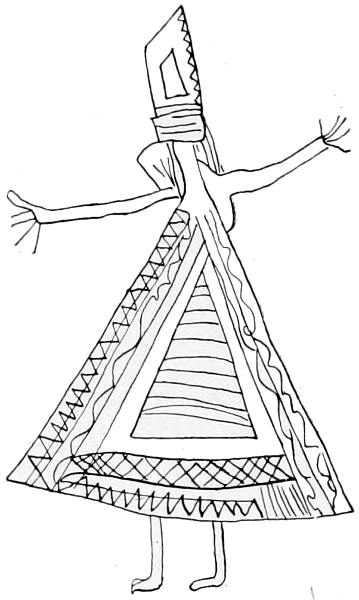
Fig. 550.—Micmac chieftainess in pictograph.
If there had been any doubt remaining of the interpretation of this class of drawing it would be removed by the presence of a number of contiguous and obviously contemporary sketches of which Fig. 550 is an example. Here the female chieftain or, perhaps, priestess appears in a ceremonial robe, with her head completely covered by one of these capote masks. The researches made not only establish the significance of this puzzling class of designs, but also show that their authors were of the Abnaki or Micmac branches of the Algonquian linguistic family.
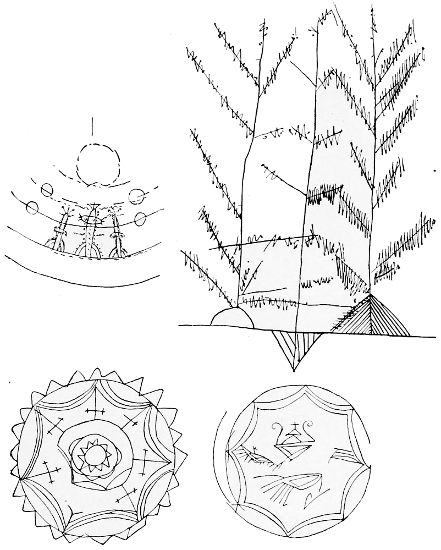
Fig. 551.—Insignia traced on rocks, Nova Scotia.
The two lower drawings in Fig. 551 were printed from the Kejimkoojik slate rocks, Nova Scotia, and are recognized by Micmacs of that peninsula as copies of insignia which they say their chiefs used to wear. The designs show some marks suggesting the artistic devices used in the Roman Catholic Church, though the figuration of the cross is by no means conclusive of European origin. The use of gorgets and other ornaments bearing special designs, as insignia of rank and authority, was well established, and it is quite possible that some of the Micmac designs were affected by the influence of the early missionaries, who indeed may have issued to the chiefs of their flock medals which adopted the general aboriginal style, but were redeemed by Christian symbols. There is no intrinsic evidence to decide whether these particular drawings were or were not made before the arrival of the earliest French missionaries.
The upper right-hand drawing of the three trees with peculiar devices near their several roots was also printed from one of the Kejimkoojik rocks. It became intelligible to the present writer after examination of a silver disk in the possession of Mrs. W. Wallace Brown, of Calais, Maine, which, not long before, had been owned by the head chief of the Passamaquoddy tribe, whose title had been modernized into “governor.” The disk, which is copied in the upper left-hand corner, was probably not of Indian workmanship, but appeared to have been ordered from a silversmith to be made from a Passamaquoddy design. It was known to represent the three superior officers of the tribe mentioned and had been worn by a former governor as a prized sign of his rank. The middle device is for the governor and the right and left for the officers next in rank to him. The devices at the roots of the trees of the drawing before mentioned are noticeably similar. They may have been made, as were most of the other characters on the Kejimkoojik rocks, by the Micmacs, in which case it would seem that they designated their chiefs by emblems similar to those used by their congeners of the Passamaquoddy tribe or some member of the last-named tribe may have drawn the emblem on the rocks in the Micmac territory. In any case there is encouragement in the attempt to decipher petroglyphs from the fact that the tree drawing in Nova Scotia, which seemed without significance, was readily elucidated by a metal inscription found in Maine, the interpretation being verified through living Indians, not only in the two geographic divisions mentioned, but also by the Amalecites in New Brunswick.
Father P. J. De Smet (b), referring to the Piegan and Blackfeet or Satsika, describes the great Tail-Bearer:
His tail, composed of buffalo and horse hair, is about 7 or 8 feet long, and instead of wearing it behind, according to the usual fashion, it is fastened above his forehead and there formed into a spiral coil resembling a rhinoceros’s horn. Such a tail among the Blackfeet is a mark of greater distinction and bravery—in all probability the larger the tail the braver the person.
The following description of a Chilkat ceremonial shirt, with the illustration reproduced in Fig. 552, is taken from Niblack (c):
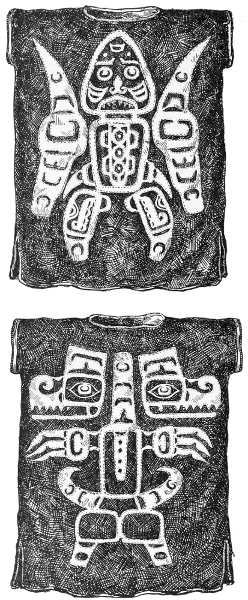
Fig. 552.—Chilkat ceremonial shirt.
The upper character in the figure represents the sea lion, and that below is a rear view of the same shirt ornamented with a design of wasko, a mythological animal of the wolf species. The edges and arm holes are bordered with red cloth and the whole garment is neatly made.
The same authority describes a Chilkat cloak, with the illustration reproduced as Fig. 553, as follows:
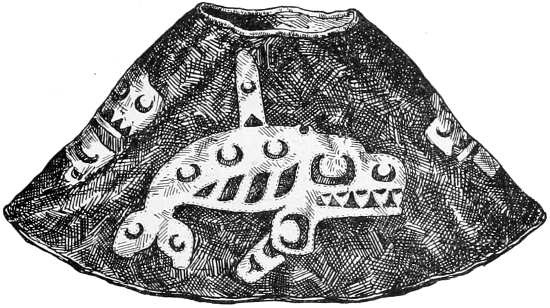
Fig. 553.—Chilkat ceremonial cloak.
It represents a cloak with a neck opening, ornamented in red cloth with the totemic design of the Orca or Killer. It is in the form of a truncated cone, with no openings for the arms.
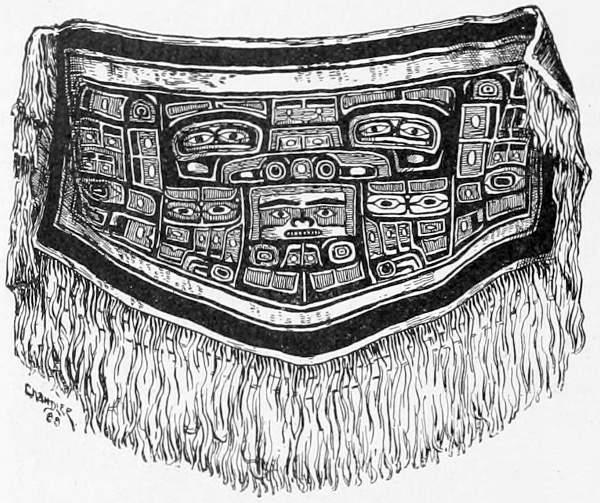
Fig. 554.—Chilkat ceremonial blanket.
The same author gives description accompanying Pl. X, Figs. 33 and 34, of ceremonial blankets and coats. The first-mentioned drawing is reproduced here as Fig. 554:
It is worn by Indians of rank and wealth on the northwest coast, commonly called a “Chilkat blanket,” because the best specimens come from the Chilkat country, although other tribes are more or less expert in weaving them. The warp is composed of twisted cord or twine of cedar bark fiber, and the woof of worsted spun from the wool of the mountain goat. Brown, yellow, black, and white are the colors used, and these are skillfully wrought into a pattern representing the totem or a totemic legend of the owner.
The design on the blanket shown represents Hoorts, the bear.
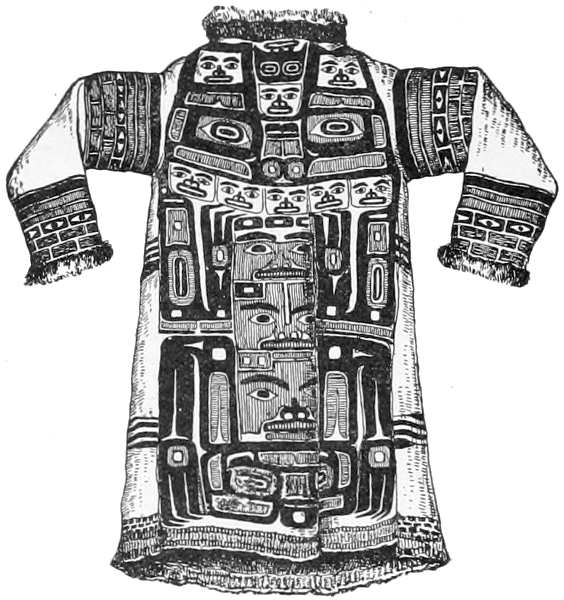
Fig. 555.—Chilkat ceremonial coat.
Fig. 555 is described thus: “A ceremonial shirt or coat of similar workmanship as the blanket just described, is trimmed on the collar and cuffs with sea-otter fur.”
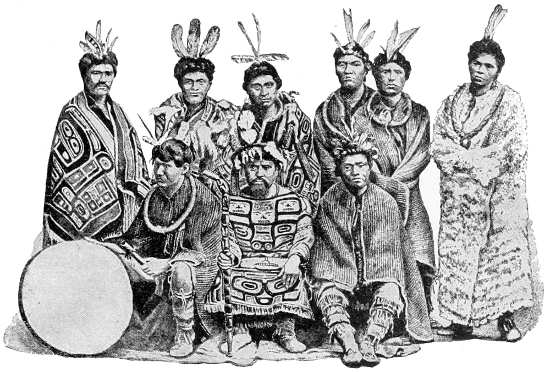
Fig. 556.—Bella Coola Indians.
In the Verhandl. der Berliner Gesellsch. für Anthrop. (a) is the illustration from which Fig. 556 is reproduced. It shows a group of Bella Coola Indians, which is made interesting by the elaborate ceremonial coat worn by the middle figure in the foreground.
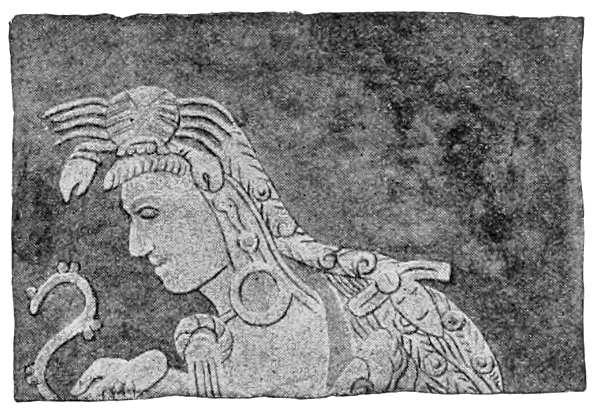
Fig. 557.—Guatemala priest.
Dr. S. Habel (c) gives the following description of Fig. 557, which reproduces only the upper part of the sculpture:
The design represents in low relief an erect human figure in profile, with the head and shoulders slightly inclined forward. The body is apparently naked, excepting those portions which are concealed by elaborate ornaments, the most prominent of which is a crab covering the head. Since there is every reason to believe the figure to represent a priest, the crab may be taken as the emblem of priestly rank.
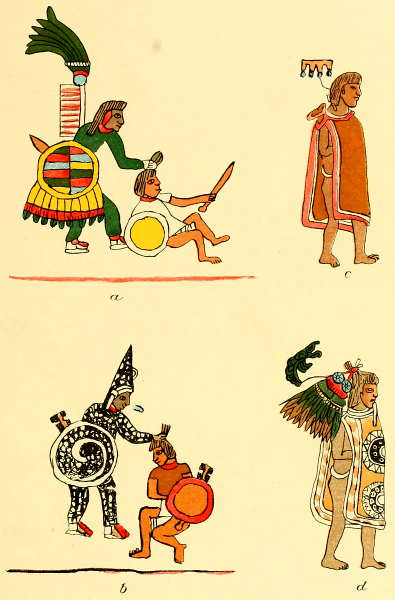
Pls. LXV and LXVI of the Codex Mendoza, in Vol. I of Lord Kingsborough’s Antiquities of Mexico, exhibit the devices and insignia of the soldiers who advanced step by step to higher command, according to their military achievements. The chief criterion, indeed the only one mentioned for these steps and promotions, was the number of prisoners severally taken by the soldiers in war. From the large number of degrees in rank and titles of valor expressed in the above-mentioned plates, a number have been selected and copies of them, exact in drawing, size, and coloration, are presented here in Pls. XXVIII and XXIX. The quaint text relating to them is in Kingsborough (p).
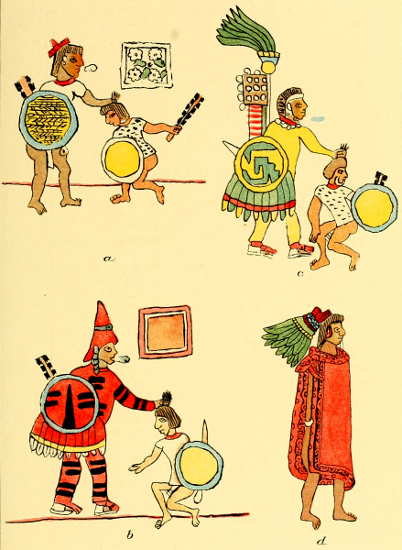
BUREAU OF ETHNOLOGY TENTH ANNUAL REPORT PL. XXVIII MEXICAN MILITARY INSIGNIA.
Pl. XXVIII.—a represents a young man who if he took any prisoners was presented with a square mantle bearing a device of flowers as a sign of valor. He holds a prisoner by the hair. b: This brave man has been presented with a device of arms, which he wears, and with a square orange-colored mantle with a scarlet fringe besides, as a sign of valor, on account of his having taken prisoner two of the enemy, one of whom he holds by the hair. c: This brave man, whose title is that of Quachie, and device of arms such as he wears, bears proof that he has captured five prisoners in war, besides having taken many other prisoners from the enemy in other wars. He also is drawn holding a prisoner. d: This brave man, whose title is Tlacatecatl and device the robe which he wears, with his braided hair and the insignia of a rich plume, declares by his presence that he has obtained the title of a valiant and distinguished person, by merit surpassing that of the others who are represented behind him.
BUREAU OF ETHNOLOGY TENTH ANNUAL REPORT PL. XXIX MEXICAN MILITARY INSIGNIA.
In Pl. XXIX.—a: An Alfaqui or superior officer, who merits further promotion and to whom has been presented as a reward for his valor, on account of his having taken three prisoners in war, the device and arms which he wears. He grasps a prisoner by the hair. b: The same Alfaqui, who, as a sign of valor on account of his having captured four of the enemy, has been presented with the device of arms which he wears. He holds a prisoner as before.
Each one of the remaining figures in the plate of Kingsborough declares the titles which officers gained and acquired in the exercise of arms, by which they rose to higher rank, the kings of Mexico creating them captains and generals of their forces or as officers of dispatch [similar to aids-de-camp] to execute their orders, whether they related to the affairs of their own kingdom or to those of the other vassal states, who promptly obeyed without in any manner deviating from the commands which they had received. The two selected are shown in the present Pl. XXIX, viz: c, Ezguaguacatl, an officer of dispatch, and d, Tocinltecatl, a man of distinguished courage in war and one of the officers who filled the post of generals of the Mexican armies.
Wiener (b), p. 763, says:
Passing in review the numerous delineations of men on the different tissues in the Peruvian graves, it is to be remarked that a chief is always recognized by a panache, which for the decurion has two plumes, for the centurion four, for the chief of a thousand men six, and the colors of these plumes indicate civil or military functions.
A. W. Howitt (e) says:
Messengers in central Australia sent to form a Pinya to avenge a death wear a kind of net on the head and a white frontlet in which is stuck a feather. The messenger is painted with yellow ochre and pipeclay and bears a bunch of emu feathers stuck in his girdle at the back, at the spine. He carries part of the deceased’s beard or some balls of pipeclay from the head of one of those mourning for him. These are shown at the destination of the messenger and are at once understood.
The same author, p. 78, reports:
A third party which the Dieri sent out was the dreaded Pinya. It was the avenger of the dead, of those who were believed to have been done to death by sorcery.
The appearance at a camp of one or more men marked each with a white band round the head, with diagonal white and red stripes across the breast and stomach, and with the point of the beard tied up and tipped with human hair, is the sign of a Pinya being about. These men do not converse on ordinary matters, and their appearance is a warning to the camp to listen attentively and to reply truly to such questions as may be put concerning the whereabouts of the condemned man. Knowing the remorseless spirit of the Pinya, any and every question is answered in terror.
SIGNS OF INDIVIDUAL ACHIEVEMENTS.
Prince Maximilian of Wied, (b) gives an account explanatory of Figs. 558 and 559:
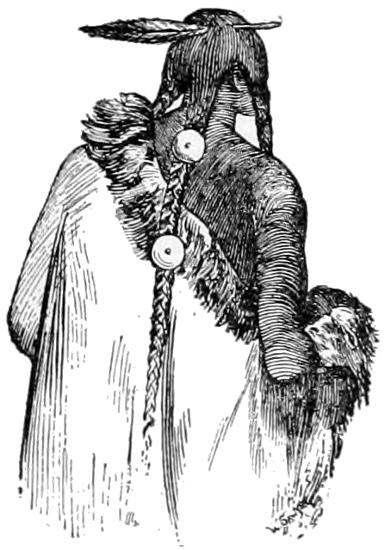
Fig. 558.—Mark of exploit. Dakota.
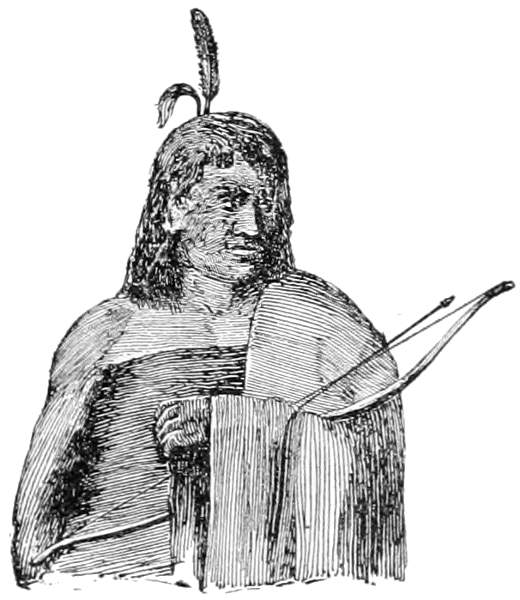
Fig. 559.—Killed with fist. Dakota.
The Sioux highly prize personal bravery, and therefore constantly wear the marks of distinction which they have received for their exploits; among these are, especially, tufts of human hair attached to the arms and legs, and feathers on their heads. He who, in the sight of the adversaries, touches a slain or living enemy places a feather horizontally in his hair for this exploit.
They look upon this as a very distinguished act, for many are killed in the attempt before the object is attained. He who kills an enemy by a blow with his fist sticks a feather upright in his hair.
If the enemy is killed with a musket a small piece of wood is put in the hair, which is intended to represent a ramrod. If a warrior is distinguished by many deeds he has a right to wear the great feather-cap with ox-horns. This cap, composed of eagle feathers, which are fastened to a long strip of red cloth hanging down the back, is highly valued by all the tribes on the Missouri. * * * Whoever first discovers the enemy and gives notice to his comrades of their approach is allowed to wear a small feather which is stripped except towards the top.
The following scheme, used by the Dakotas, is taken from Mrs. Eastman’s Dahcotah. Colors are not given, but red undoubtedly predominates, as is known from personal observation.
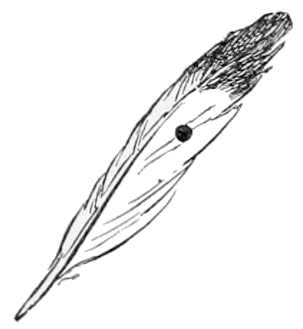
Fig. 560.—Killed an enemy. Dakota.
A spot upon the larger web denotes that the wearer has killed an enemy. Fig. 560.
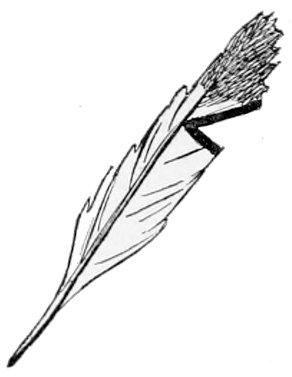
Fig. 561.—Cut throat and scalped. Dakota.
Fig. 561 denotes that the wearer has cut the throat of his enemy and taken his scalp.
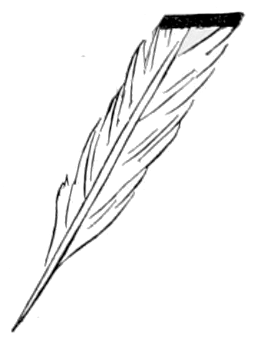
Fig. 562.—Cut enemy’s throat. Dakota.
Fig. 562 denotes that the wearer has cut the throat of his enemy.
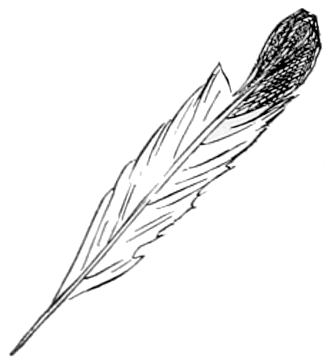
Fig. 563.—Third to strike. Dakota.
Fig. 563 denotes that the wearer was the third that touched the body of his enemy after he was killed.
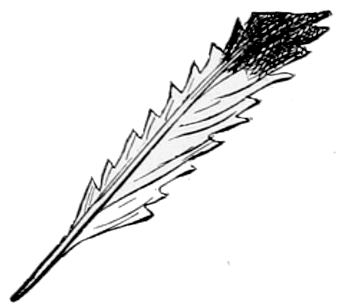
Fig. 564.—Fourth to strike. Dakota.
Fig. 564 denotes that the wearer was the fourth that touched the body of his enemy after he was killed.
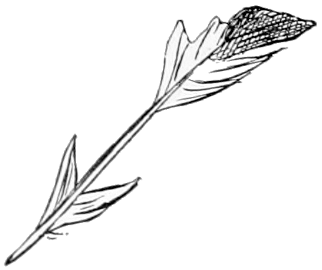
Fig. 565.—Fifth to strike. Dakota.
Fig. 565 denotes that the wearer was the fifth that touched the body of his enemy after he was killed.
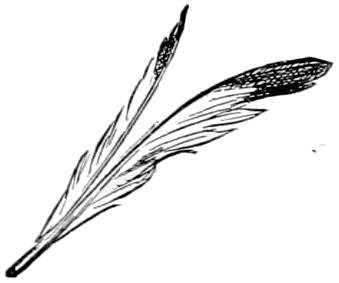
Fig. 566.—Many wounds. Dakota.
Fig. 566 denotes that the wearer has been wounded in many places by the enemy.
The following variations in the scheme were noticed in 1883 among the Mdewakantanwan Dakotas, near Fort Snelling, Minnesota.
Feathers of the eagle are used as among the other bands of Dakotas.
A plain feather is used to signify that the wearer has killed an enemy, without regard to the manner in which he was slain.
When the end is clipped transversely, and the edge colored red, it signifies that the throat of the enemy was cut.
A black feather denotes that an Ojibwa woman was killed. Enemies are considered as Ojibwas, that being the tribe with which the Mdewakantanwan Dakotas have been most in collision.
When a warrior has been wounded a red spot is painted upon the broad side of a feather. If the wearer has been shot in the body, arms, or legs, a red spot is painted upon his clothing or blanket, immediately over the locality of the wound. These red spots are sometimes worked in porcupine quills, or in cotton fiber as now obtained from the traders.
Belden (a) says:
Among the Sioux an eagle’s feather with a red spot painted on it, worn by a warrior in the village, denotes that on the last war-path he killed an enemy, and for every additional enemy he has slain he carries another feather painted with an additional red spot about the size of a silver quarter.
A red hand painted on a warrior’s blanket denotes that he has been wounded by the enemy, and a black one that he has been unfortunate in some way.
Boller (a) in Among the Indians, p. 284, describes a Sioux as wearing a number of small wood shavings stained with vermilion in his hair, each the symbol of a wound received.
Lynd (c) gives a device differing from all the foregoing, with an explanation:
To the human body the Dakotas give four spirits. The first is supposed to be a spirit of the body, and dies with the body. The second is a spirit which always remains with or near the body. Another is the soul which accounts for the deeds of the body, and is supposed by some to go to the south, by others to the west, after the death of the body. The fourth always lingers with the small bundle of the hair of the deceased kept by the relatives until they have a chance to throw it into the enemy’s country, when it becomes a roving, restless spirit, bringing death and disease to the enemy whose country it is in.
From this belief arose the practice of wearing four scalp-feathers for each enemy slain in battle, one for each soul.
It should be noted that all the foregoing signs of individual achievements are given by the several authorities as used by the same body of Indians, the Dakota or Sioux. This, however, is a large body, divided into tribes, and it is possible that a different scheme was used in the several tribes. But the accounts are so conflicting that error in either observation or description or both is to be suspected.
Rev. J. Owen Dorsey (b) explains the devices on the shield of a Teton Dakota:
* * * The three pipes on the shield, in a colored sketch prepared by Bushotter, denote that on so many expeditions he carried a war pipe. The red stripes declare how many of the enemy were wounded by him, and the human heads show the number of foes that he killed. The half moon means that he shouted at his foes on a certain night. Once he threw aside his arms and engaged in a hand-to-hand struggle with a foe; this is shown by the human hand. The horse tracks indicate that he ran off with so many horses. If his name was Black Hawk, for instance, a black hawk was painted in the middle of his shield.
Irving (a), in Astoria, says of the Arikara:
He who has killed an enemy in his own land is entitled to drag at his heels a fox skin attached to each moccasin; and he who has slain a grizzly bear wears a necklace of his claws, the most glorious trophy that a hunter can exhibit.
Prince Maximilian, of Wied (c), thus reports on the designations of the Mandans connected with the present topic:
The Mandans wear the large horned feather cap; this is a cap consisting of strips of white ermine with pieces of red cloth hanging down behind as far as the calves of the legs, to which is attached an upright row of black and white eagle feathers, beginning at the head and reaching to the whole length. Only distinguished warriors who have performed many exploits may wear this headdress.
If the Mandans give away one or more of these headdresses, which they estimate very highly, they are immediately considered men of great importance. * * * On their buffalo robes they often represent this feather cap under the image of a sun. Very celebrated and eminent warriors, when most highly decorated, wear in their hair various pieces of wood as signals of their wounds and heroic deeds. Thus Mato-Topé had fastened transversely in his hair a wooden knife painted red and about the length of a hand, because he had killed a Cheyenne chief with his knife; then six wooden sticks, painted red, blue, and yellow, with a brass nail at one end, indicating so many musket wounds which he had received. For an arrow wound he fastened in his hair the wing feather of a wild turkey; at the back of his head he wore a large bunch of owl’s feathers, dyed yellow, with red tips, as the badge of the Meniss-Ochata (the dog band). The half of his face was painted red and the other yellow; his body was painted reddish-brown, with narrow stripes, which were produced by taking off the color with the tip of the finger wetted. On his arms, from the shoulder downwards, he had seventeen yellow stripes, which indicated his warlike deeds, and on his breast the figure of a hand, of a yellow color, as a sign that he had captured some prisoners.
* * * A Mandan may have performed many exploits and yet not be allowed to wear tufts of hair on his clothes, unless he carries a medicine pipe and has been the leader of a war party. When a young man who has never performed an exploit is the first to kill an enemy on a warlike expedition he paints a spiral line round his arm, of whatever color he pleases, and he may then wear a whole wolf’s tail at the ankle or heel of one foot. If he has first killed and touched the enemy he paints a line running obliquely round the arm and another crossing it in the opposite direction, with three transverse stripes. On killing the second enemy he paints his left leg (that is, the leggin) a reddish-brown. If he kills the second enemy before another is killed by his comrades he may wear two entire wolves’ tails at his heels. On his third exploit he paints two longitudinal stripes on his arms and three transverse stripes. This is the exploit that is esteemed the highest; after the third exploit no more marks are made. If he kills an enemy after others of the party have done the same he may wear on his heel one wolf’s tail, the tip of which is cut off.
The Hidatsa scheme of designating achievements was obtained by Dr. Hoffman, at Fort Berthold, North Dakota, during 1881, and now follows:
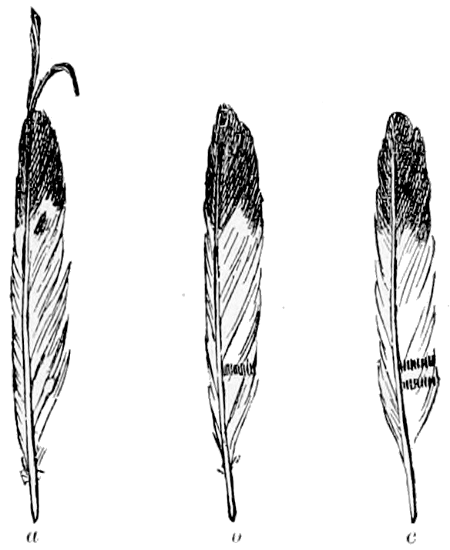
Fig. 567.—Marks of exploits, Hidatsa.
A feather, to the tip of which is attached a tuft of down or several strands of horse hair, dyed red, denotes that the wearer has killed an enemy and that he was the first to touch or strike him with the coup stick. Fig. 567 a.
A feather bearing one red bar made with vermillion, signifies the wearer to have been the second person to strike the fallen enemy with the coup stick. Same Fig. b.
A feather bearing two red bars signifies that the wearer was the third person to strike the body. Same Fig. c.
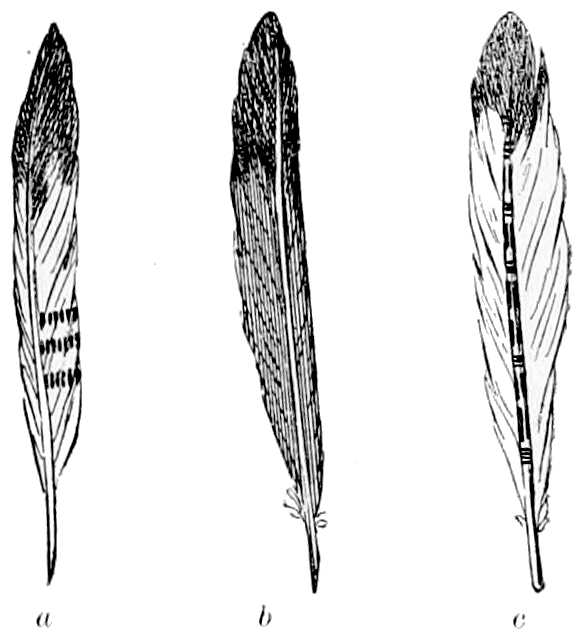
Fig. 568.—Marks of exploits, Hidatsa.
A feather with three bars signifies that the wearer was the fourth to strike the fallen enemy. Fig. 568 a. Beyond this number honors are not counted.
A red feather denotes that the wearer was wounded in an encounter with an enemy. Fig. 568 b.
A narrow strip of rawhide or buckskin is wrapped from end to end with porcupine quills dyed red, though sometimes a few white ones are inserted to break the monotony of color. This strip is attached to the inner surface of the rib or shaft of the quill by means of very thin fibers of sinew, and signifies that the wearer killed a woman belonging to a hostile tribe. It is shown in Fig. 568 c. In very fine specimens the quills are directly applied to the shaft without resorting to the strap of leather.
Similar marks denoting exploits are used by the Hidatsa, Mandan, and Arikara Indians. The Hidatsa claim to have been the originators of the devices.
The following characters are marked upon robes and blankets, usually in red or blue colors, and often upon the boat paddles. Frequently an Indian has them painted upon his thighs, though this is generally resorted to only on festal occasions or for dancing.
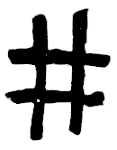
Fig. 569.—Successful defense. Hidatsa, etc.
Fig. 569 denotes that the wearer successfully defended himself against the enemy by throwing up a ridge of earth or sand to protect the body. The manner of depicting this mark upon the person or clothing is shown in Pl. XXX upon the shirt of the third figure in the lower row.
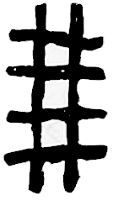
Fig. 570.—Two successful defenses. Hidatsa, etc.
Fig. 570 signifies that the wearer has upon two different occasions defended himself by hiding his body within low earthworks. The character is merely a compound of two of the preceding marks placed together. Both of the devices shown in Figs. 569 and 570 are displayed on the clothing in Fig. 575, drawn by a Hidatsa.

Fig. 571.—Captured a horse. Hidatsa, etc.
Fig. 571 signifies that the one who carries this mark upon his blanket, leggings, boat paddle, or any other property, or upon his person, has distinguished himself by capturing a horse belonging to a hostile tribe. This character appears upon the garments and legs of several of the human figures in Pl. XXX, drawn by a Hidatsa, at Fort Berthold, North Dakota.
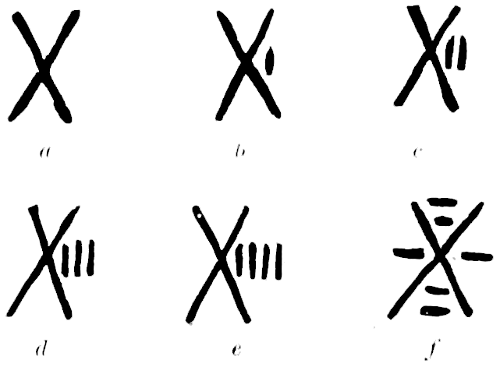
Fig. 572.—Exploit marks, Hidatsa.
In Fig. 572, a signifies among the Hidatsa and Mandans that the wearer was the first person to strike a fallen enemy with a coup stick. It signifies among the Arikara simply that the wearer killed an enemy.
b represents among the Hidatsa and Mandans the second person to strike a fallen enemy. It represents among the Arikara the first person to strike the fallen enemy.
c denotes the third person to strike the enemy, according to the Hidatsa and Mandan; the second person to strike him according to the Arikara.
d shows among the Hidatsa and Mandan the fourth person to strike the fallen enemy. This is the highest and last number; the fifth person to risk the danger is considered brave for venturing so near the ground held by the enemy, but has no right to wear a mark therefor.
The same mark among the Arikara represents the person to be the third to strike the enemy.
e, according to the Arikara, represents the fourth person to strike the enemy.
According to the Hidatsa, the wearer of the mark f had figured in four encounters; in those recorded by the marks in each of the two lateral spaces he was the second to strike the fallen enemy, and the marks in the upper and lower spaces signify that he was the third person upon two other occasions.
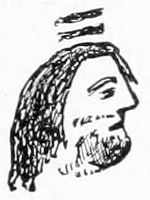
Fig. 573.—Record of exploits.
The marks at c, in Fig. 572, may be compared with Fig. 573. The head of the victim in this instance is a white man. Such drawings are not made upon the person or clothing of the hero, but upon buffalo robes or other substances used for record of biographical events.
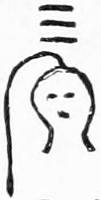
Fig. 574.—Record of exploits.
The marks at d, in Fig. 572, are drawn on records in the mode shown in Fig. 574.
Illustrations of the actual mode of wearing several of the above devices appear in Fig. 575, drawn by a Hidatsa.
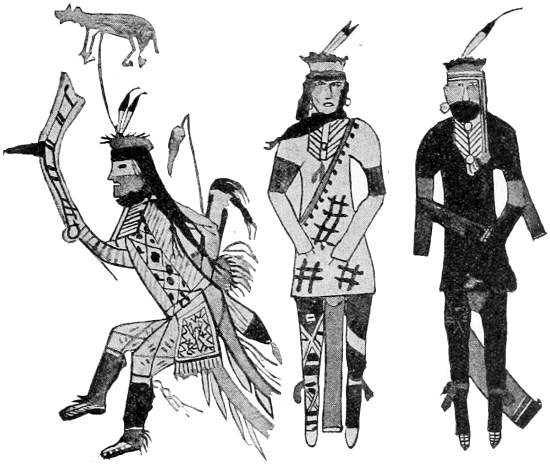
Fig. 575.—Exploit marks as worn.
The mark of a black hand, sometimes made by the impress of an actually blackened palm or drawn of natural size, or less, signifies that the person authorized to wear the mark has killed an enemy.
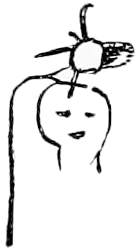
Fig. 576.—Scalp taken.
Fig. 576, drawn by a Hidatsa, means that the owner of the robe or record on which it appears had taken a scalp. Fig. 577, also drawn by a Hidatsa, means that the bearer struck the enemy in the order above mentioned and took his scalp and his gun.
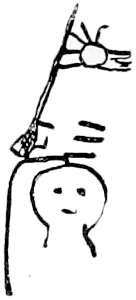
Fig. 577.—Scalp and gun taken.
The drawing reproduced on Pl. XXX was made by a Hidatsa at Fort Berthold, North Dakota. It represents several dancing figures, upon which the several marks of personal achievements can be recognized. The fourth figure of the upper row shows the wearer to have been the second person to strike an enemy upon four different occasions. Upon the right-hand figure of the lower row two distinct marks will be observed; that upon the wearer’s left leg indicating him to have been the second to strike an enemy upon two different occasions; and the mark upon the right leg, that he was twice the second person to strike enemies, and twice the third person to perform that exploit.
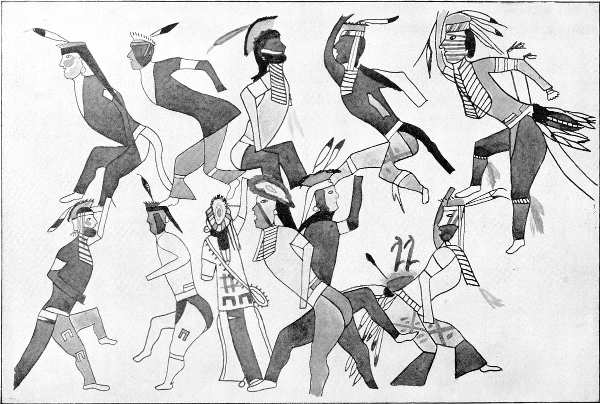
BUREAU OF ETHNOLOGY TENTH ANNUAL REPORT PL. XXX HIDATSA DANCERS BEARING EXPLOIT MARKS.
Miss Agnes Crane (a), in an article on Ancient Mexican Heraldry, seems to assert that the evidence of emblems in the western hemisphere as boastful records of individual achievements is confined to Mexico. The present section may supply the evidence lacking.
The following information regarding Winnebago devices of the character now under consideration was given by St. Cyr, a mixed blood Winnebago, in April, 1886.
To show that the wearer killed a man, strike the muddy hand upon the body or horse. Clay of any kind is used. When 20 men have been killed, an otter skin is worn on the back. A skunk skin worn on the calf signifies a man killed.
Scented grass worn on the neck or the wrist shows that a prisoner had been captured and tied with grass in the absence of other cords.
To show that the wearer had been wounded, cover the part of the body with white clay, and indicate the spot with red paint.
Paul Kane (a) says that among the Cree Indians red earth was spotted on a leg to indicate that the wearer had been wounded.
Prof. Dall (b) tells of the Sitka-Kwan:
They perforate their noses, wearing a ring adorned with feathers. They make a succession of perforations all around the edge of the ears, which are ornamented with scarlet thread, shark’s teeth, or pieces of shell. Each hole is usually the record of a deed performed or a feast given by the person so adorned.
PROPERTY MARKS.
This topic, upon which much interesting material has been collected in many geographic and ethnologic divisions of the earth, can not include objectively or pictorially many genuine and distinctive illustrations from the North American Indians. The reason for this paucity is that the individual Indian had very little property. Nearly everything which could be classed as personal property belonged to his tribe or, more generally, to his clan or gens. Yet articles of a man’s personal manufacture, such as arrows, were often marked in such a manner as to be distinguished. Those marks, many examples of which are upon arrows in the U. S. National Museum, are not of sufficient general interest to be reproduced here. They are not valuable unless they are connected with the makers or owners by a concurrence of the devices with the signs adopted by persons or by classes, the evidence of which can not now except in rare instances be procured. Most of the devices mentioned seem to have degenerated into mere ornamentation, which might be expected, because the arrows are not of great antiquity, and during recent years the records which could have been used for their identification have decayed as authorities even when they have remained in the immediate family, having escaped sale and robbery.
As a general rule neither a man nor a family, in the modern sense, had any property in land, which belonged to a much larger sociologic division, but on their arrival in California Europeans noticed among the Indians there a device to assert rights in realty by the use of distinctive marks. It is not clear whether these marks were merely personal or were tribal or gentile.
According to Mr. A. F. Coronel, of Los Angeles, California, the Serrano Indians in that vicinity formerly practiced a method of marking trees to indicate the corner boundaries of patches of land. The Indians owning areas of territory of whatever size would cut lines upon the bark of the tree corresponding to lines drawn on their own faces, i. e., lines running outward and downward over the cheeks, or perhaps over the chin only, tattooed in color. These lines were made on the trees on the side facing the property, and were understandingly recognized by the whole tribe. This custom still prevailed when Mr. Coronel first located in southern California about the year 1843.
Among the Arikara Indians a custom prevails of drawing upon the blade of a canoe or bull-boat paddle such designs as are worn by the chief and owner to suggest his personal exploits. This has to great extent been adopted by the Hidatsa and Mandans. The marks are chiefly horseshoes and crosses, as in Fig. 578, referring to the capture of the enemy’s ponies and to coups in warfare. The entire tribe being intimately acquainted with the courage and actions of all its members, imposition and fraud in the delineation of any character are not attempted, as such would surely be detected, and the impostor would be ridiculed if not ostracised.

Fig. 578.—Boat paddle. Arikara.
The brands upon cattle in Texas and other regions of the United States where ranches are common illustrate the modern use of property marks. A collection of these brands made by the writer compares unfavorably for individuality and ideography with the genuine marks of Indians for similar purposes.

Fig. 579.—African property mark.
The following translation from Kunst and Witz der Neger in Das Ausland (a), describing Fig. 579, is inserted for comparison:
Whenever a pumpkin of surprisingly fine appearance is growing, which promises to furnish a desirable water vase, the proprietor hurries to distinguish it by cutting into it some special mark with his knife, and probably superstitious feelings may coöperate in this act. I have reproduced herewith the best types of such property marks which I have been able to discover.
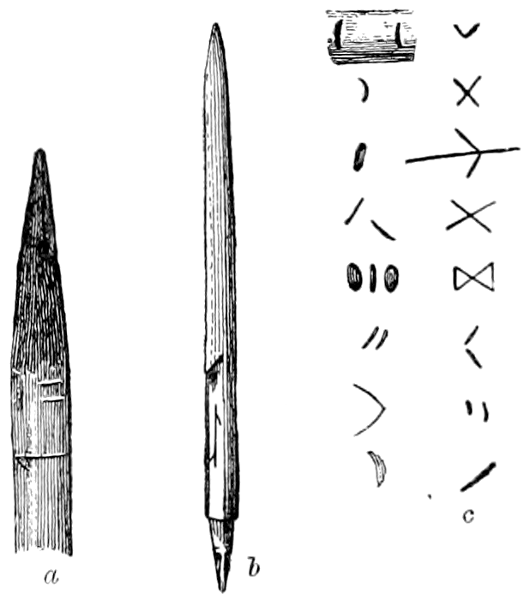
Fig. 580.—Owner’s marks, Slesvick.
Sir John Lubbock (a) tells that many of the arrows found at Nydam, Slesvick, had owner’s marks on them, now reproduced in Fig. 580 as a and c, resembling those on the modern Esquimaux arrows shown in the same figure as b.
Prof. Anton Schiefner (b) gives a remarkable parallel between the Runic alphabet and the property marks of the Finns, Lapps, and Samoyeds.
PERSONAL NAMES.
The names of Indians as formerly adopted by or bestowed among themselves were generally connotive. They very often refer to some animal and predicate an attribute or position of that animal. On account of their sometimes objective and sometimes ideographic nature, they almost invariably admit of being expressed in sign language; and for the same reason they can readily be portrayed in pictographs. The device generally adopted by the Dakotan tribes to signify that an object drawn in connection with a human figure was a totemic or a personal name of the individual, is to connect that object with the figure by a line drawn to the head or, more frequently, to the mouth of the latter. The same tribes make a distinction to manifest that the gesture sign for an object gestured is intended to be the name of a person and not introduced for any other purpose by passing the index forward from the mouth in a direct line after the conclusion of the sign for the object. This signifies “that is his name,” the name of the person referred to.
As a general rule, Indians were named in early infancy according to a tribal system, but in later life each generally acquired a new name, or perhaps several names in succession, from some special exploits or adventures. Frequently a sobriquet is given which is not complimentary. All of the names subsequently acquired as well as the original names are so connected with material objects or with substantive actions as to be expressible in a graphic picture and also in a pictorial sign. In the want of alphabet or syllabary they used the same expedient to distinguish the European invaders. A Virginian was styled Assarigoa, “Big Knife.” The authorities of Massachusetts were called by the Iroquois, Kinshon, “a fish,” doubtless in allusion to the cod industry and the fact that a wooden codfish then hung, as it did long afterwards, in the state house at Boston, as an emblem of the colony and state.
The determination to use names of this connotive character is shown by the objective translation, whenever possible, of such European names as it became necessary for them to introduce frequently into their speech. William Penn was called Onas, that being the word for feather-quill in the Mohawk dialect. The name of the second French governor of Canada was De Montmagny, erroneously translated to be “great mountain,” which words were correctly translated by the Iroquois into Onontio, and this expression becoming associated with the title has been applied to all successive Canadian governors, though the origin having been generally forgotten, it has been considered to be a metaphorical compliment.
The persistence of titles is shown by the fact that the Abnaki of New Brunswick to-day call Queen Victoria, “King James,” with a feminine addition.
Gov. Fletcher was named by the Iroquois Cajenquiragoe, “the great swift arrow,” not because of his speedy arrival at a critical time, as has been supposed, but because they had somehow been informed of the etymology of his name, “arrow-maker” (Fr. fléchier). A notable example of the adoption of a graphic illustration from a similarity in the sound of the name to known English words is given in the present paper, in Fig. 919, where Gen. Maynadier is represented as “many deer.”
While, as before said, some tribes give names to children from considerations of birth and kinship according to a fixed rule, others conferred them after solemn deliberation. Even these were not necessarily permanent. A diminutive form is frequently bestowed by the affection of the parent. On initiation into one of the cult associations a name is generally received. Until this is established a warrior is liable to change his name after every fight or hunt. He will sometimes only acknowledge the name he has himself assumed, perhaps from a dream or vision, though he may be habitually called by an entirely different name. From that reason the same man is sometimes known under several different epithets. Personal peculiarity, deformity, or accident is sure to fix a name against which it is vain to struggle. Girls do not often change names bestowed in their childhood. The same precise name is often given to different individuals in the same tribe, but not so frequently in the same band, whereby the inconvenience would be increased. For this reason it is often necessary to specify the band, sometimes also the father. For instance, when the writer asked an Indian who Black-Stone, a chief mentioned in the Lone-Dog winter counts, was, the Indian asked, first, what tribe was he; then, what band; then, who was his father; and, except in the case of very noted persons, the identity is not proved without an answer to these questions. A striking instance of this plurality of names among the Dakotas was connected with the name Sitting-Bull, belonging to the leader of the hostile band, while one of that name was almost equally noted as being the head soldier of the friendly Dakotas at Red-Cloud Agency.
The northeastern tribes sometimes formally resurrected the name of the dead and also revived it by adoption. See Jes. Rel., 1639, p. 45, and 1642, p. 53.
Among the peculiarities connected with Indian personal names, far too many for discussion here, is their avoidance of them in direct address, terms of kinship or relative age taking their place. Maj. J. W. Powell states that at one time he had the Kaibab Indians, a small tribe of northern Arizona, traveling with him. The young chief was called by white men “Frank.” For several weeks he refused to give his Indian name and Maj. Powell endeavored to discover it by noticing the term by which he was addressed by the other Indians, but invariably some kinship term was employed. One day in a quarrel his wife called him Chuarumpik (“Yucca-heart”). Subsequently Maj. Powell questioned the young chief about the matter, who explained and apologized for the great insult which his wife had given him and said that she was excused by great provocation. The insult consisted in calling the man by his real name.
Everard F. im Thurn (g) gives the following account of the name-system of the Indians of Guiana, which might have been written with equal truth about some tribes of North America:
The system under which the Indians have their personal names is intricate and difficult to explain. In the first place, a name, which may be called the proper name, is always given to a young child soon after birth. It is said to be proper that the peaiman, or medicine-man, should choose and give this name, but, at any rate now, the naming seems more often left to the parents. The word selected is generally the name of some plant, bird, or other natural object. But these names seem of little use, in that owners have a very strong objection to telling or using them, apparently on the ground that the name is part of the man, and that he who knows the name has part of the owner of that name in his power. One Indian, therefore, generally addresses another only according to the relationship of the caller and the called, as brother, sister, father, mother, and so on. These terms, therefore, practically form the names actually used by Indians amongst themselves. But an Indian is just as unwilling to tell his proper name to a white man as to an Indian, and, of course, between the Indian and the white man there is no relationship the term for which can serve as a proper name. An Indian, therefore, when he has to do with a European, asks the latter to give him a name, and if one is given to him always afterwards uses this. The names given in this way are generally simple enough—John, Peter, Thomas, and so on.
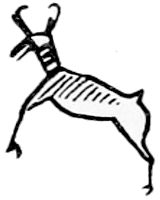
Fig. 581.—Signature of Running Antelope, Dakota.
The original of Fig. 581 was made in 1873 by Running Antelope, chief of the Uncapapa Dakota, in the style of a signature instead of being attached to his head by a line as is the usual method of the tribe in designating personal names.
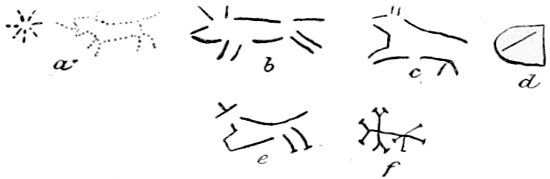
Fig. 582.—Solinger sword-makers’ marks.
Fig. 582 presents a curious comparison with Figs. 548 and 903 showing the manner in which the wolf, proverbially a lean animal, was delineated by Germans in the thirteenth and fourteenth centuries. It is taken from Rudolf Cronau (b), whose remarks are translated and condensed as follows:
a. The oldest representation known to me of the “wolf” occurs on a Gothic sword of the thirteenth century, in the Historical Museum of Dresden.
b. Is more primitive, from a sword of the last half of the fourteenth century, in the “Berliner Zeughause;” also similar to c, of the same period, from a specimen in the Züricher Zeughaus.
d and e. Signatures on two specimens in the collection in Feste Coburg; e is a rare representation of the figure of the wolf of 1490, in the Germanic Museum at Nürnberg, and still more intricate (verzwickter) is the drawing f on a Dresden specimen of the year 1559.
A large proportion of the pictographs of several names next to be presented are from Red-Cloud’s Census, the history of which is as follows:
A pictorial census was prepared in 1884 under the direction of Red-Cloud, chief of the Dakota at Pine Ridge Agency, Dakota Territory. The 289 persons enumerated, many of whom were heads of families, were the adherents of Red-Cloud and did not represent all the Indians at that agency. Owing to a disagreement the agent refused to acknowledge that chief as head of the Indians at the agency, and named another as the official chief. Many of the Indians exhibited their allegiance to Red-Cloud by having their names attached in their own pictorial style to a document showing their votes and number. This filled seven sheets of ordinary manila paper and was sent to Washington. While in the custody of Dr. T. A. Bland, of that city, it was loaned by him to the Bureau of Ethnology to be copied by photography. The different sheets were apparently drawn by different persons, as the drawings of human heads vary enough to indicate individuality. This arrangement seems to imply seven bands or, perhaps, gentes.
Dr. V. T. McGillicuddy, who at the time was Indian agent at Pine Ridge Agency, Dakota, in correspondence gives the impression that the several pictographs representing names were attached as signatures by the several individuals to a subscription list for Dr. Bland, before mentioned, who was the editor of The Council Fire, in support of that publication and with an agreement that each should give 25 cents. The document in that view would be a subscription list, but the subscribers were, in fact, the adherents of Red-Cloud. Whatever was the motive for this collection of pictured names, its interest consists in the mode of their portrayal, together with the assurance that they were the spontaneous and genuine work of the Indians concerned.
In addition to the personal names which immediately follow, a considerable number of the 289 pictographic names appear elsewhere in this paper under the various heads of Tribal Designations, Ideography, Conventionalizing, Customs, special Comparison, etc.
Interspersed among the personal names taken from the above mentioned list are others selected from the Oglala Roster, the origin of which is explained above, and the several winter counts of The-Flame, The-Swan, American-Horse, and Cloud-Shield, mentioned, respectively, in Chap. X, Sec. 2. The authority is in each case attached to the pictograph with the translation of the Indian name, and in some cases with the name in the original.
Rev. J. Owen Dorsey, in Vol. XXXIV of the Proceedings of the American Association for the Advancement of Science and in the American Anthropologist for July, 1890, gives valuable notes on the subject of Indian personal names and also has made oral suggestions to the present writer. Some of those may be considered with reference to the list now presented. He thinks that the frequent use of color names is from a mythical or symbolic significance attributed to the colors. Also the word translated “iron,” or “metal,” is connected with the color blue, the object called iron being always painted blue when colors are used, and that color is mystically connected with the water powers of the Dakotan mythology. The frequent use of the terms “Little” and “Big,” with or without graphic differentiation, may be as the terms young and old, junior and senior, are employed by civilized people, but the expressions in other cases may refer to the size of the animals seen in the visions of fasting which have determined the names.
Explanations on parts of the pictographs not strictly connected with the personal name are annexed for the reason before indicated and the objects connected by the names are to some extent arranged in classes.
OBJECTIVE.
In the figures immediately following the delineation is objective. It is sometimes interesting to note the different modes of representing the same object or concept.
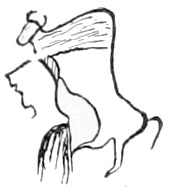
Fig. 583.
Fig. 583.—High-Back-Bone, a very brave Oglala, was killed by the Shoshoni. They also shot another man, who died after he reached home. American-Horse’s Winter Count, 1870-’71.
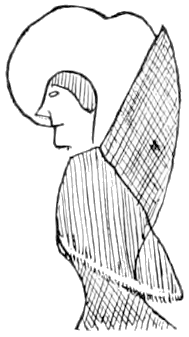
Fig. 584.
Fig. 584.—High-Back-Bone was killed in a fight with the Snakes (Shoshoni). Cloud-Shield’s Winter Count, 1870-’71. White-Cow-Killer calls it “High-Back-Bone-killed-by-Snake-Indians winter.”
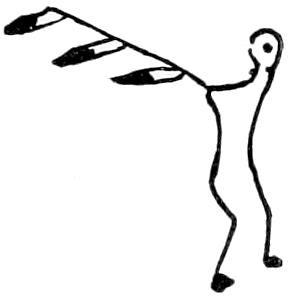
Fig. 585.
Fig. 585.—A Minneconjou Dakota named Broken-Back was killed by the Crow Indians at Black Hills. Swan’s Winter Count, 1848-’49.
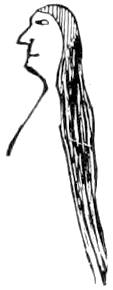
Fig. 586.
Fig. 586.—Long-Hair was killed. Cloud-Shield’s Winter Count, 1786-’87. To what tribe he belonged is not known. The tribes, such as the Crows, in which it is a tribal custom to wear the hair to an enormous length, eke it out by artificial means and ornament it with beads and streamers. In this case the length of the hair seems to have been a personal peculiarity, not a tribal mark.
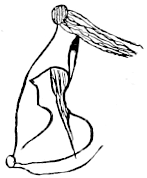
Fig. 587.
Fig. 587.—They killed the long-haired man in a fight with the Cheyennes while on an expedition to avenge the death of The-Man-Who-Owns-The-Flute, who was killed by the Cheyennes the year before. American-Horse’s Winter Count, 1796-’97. This may be the same man who is referred to in the last preceding figure, as the expression “killed,” given in translation by the interpreters, does not always mean wounded to death, but severely wounded—Hibernicé “kilt.” Here the scalp shows the length of the hair, and the victim is called a Cheyenne.
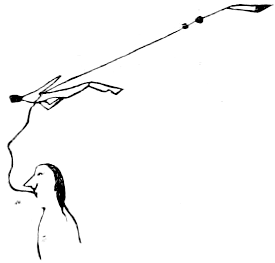
Fig. 588.
Fig. 588.—The Stabber. Cloud-Shield’s Winter Count, 1783-’84. The man’s name is suggested by the spear in the body over his head, which is connected with his mouth by a line.
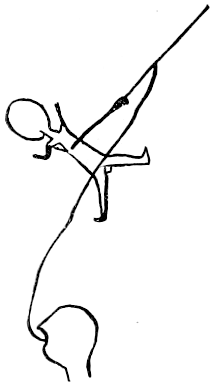
Fig. 589.
Fig. 589.—Stabber. Red-Cloud’s Census. This figure is substantially the same as the preceding, though more rude.
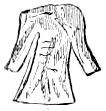
Fig. 590.
Fig. 590.—Red-Shirt. Red-Cloud’s Census. This and the following figure exhibit the name, the first showing only the garment and the second exhibiting it as worn.
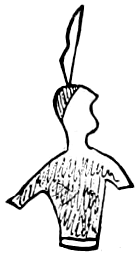
Fig. 591.
Fig. 591.—Red-Shirt, a Dakota, was killed by the Crows while looking for his ponies near Old Woman’s fork. American-Horse’s Winter Count, 1810-’11. The bow over the head and the absence of scalp-lock signifies death by the arrow of enemies.
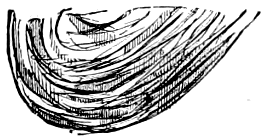
Fig. 592.
Fig. 592.—Chief Red-Cloud. Red-Cloud’s Census. This and the next figure give two modes of expressing the name of the celebrated chief, Red-Cloud.
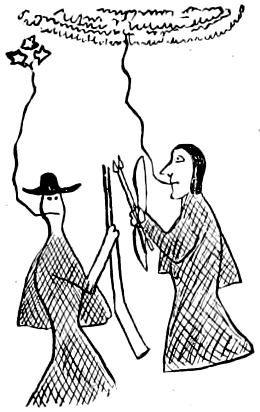
Fig. 593.
Fig. 593.—Three-Stars (General Crook) took Red-Cloud’s young men to help him fight the Cheyennes. Cloud-Shield’s Winter Count, 1876-’77.
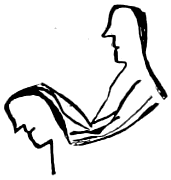
Fig. 594.
Fig. 594.—Caught-the-Enemy. Red-Cloud’s Census. The enemy seems to be caught by his hair.
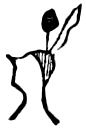
Fig. 595.
Fig. 595.—Black-Rock was killed by the Crows. His brother, whose name he had taken, was killed by the Crows three years before. American-Horse’s Winter Count, 1809-’10.
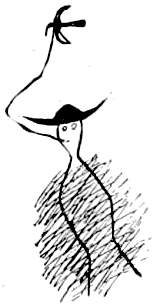
Fig. 596.
Fig. 596.—Bird, a white trader, was burned to death by the Cheyennes. Cloud-Shield’s Winter Count, 1864-’65. He is surrounded by flames in the picture. His name was probably Bird, which was pictorially represented as usual.
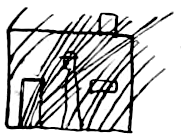
Fig. 597.
Fig. 597.—Red-Lake’s house, which he had recently built, was destroyed by fire, and he was killed by the accidental explosion of some powder. American-Horse’s Winter Count, 1831-’32. This figure is introduced here in connection with the simple fire on the one preceding to show the artistic portrayal separately of a steady flame and of an explosion.
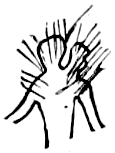
Fig. 598.
Fig. 598.—Two-Face, an Oglala, was badly burnt by the explosion of his powder horn. American-Horse’s Winter Count, 1860-’61. Here is another view of the explosion of gunpowder.
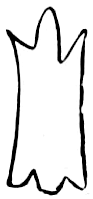
Fig. 599.
Fig. 599.—A Two-Kettle Dakota, named The-Breast, died. Swan’s Winter Count, 1836-’37.
Mato Sapa says: A Two-Kettle, named The-Breast, died. This is the same character as is given elsewhere for abundance, plenty of buffalo. But here it has a wholly personal application.
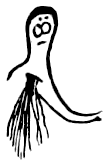
Fig. 600.
Fig. 600.—Left-Handed-Big-Nose was killed by the Shoshoni. American-Horse’s Winter Count, 1839-’40. His left arm is represented extended, and his nose is grotesquely conspicuous.
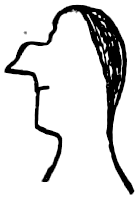
Fig. 601.
Fig. 601.—Roman-Nose. Red-Cloud’s Census. The large and aquiline nose is exhibited, which was very liberally translated “Roman Nose,” and the term became the popular name of a celebrated chief of the Dakotas.
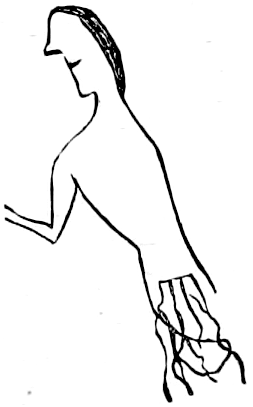
Fig. 602.
Fig. 602.—Torn-Belly. Red-Cloud’s Census.
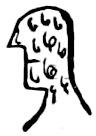
Fig. 603.
Fig. 603.—Spotted-Face. Red-Cloud’s Census.
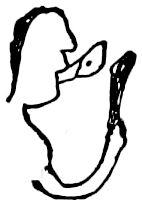
Fig. 604.
Fig. 604.—Licks-with-his-tongue. Red-Cloud’s Census. The tongue is exaggerated as well as protruded, and without explanation might be mistaken for a large object bitten off for eating in a gluttonous manner.
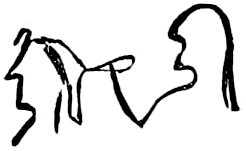
Fig. 605.
Fig. 605.—Knock-a-hole-in-the-head. Red-Cloud’s Census.
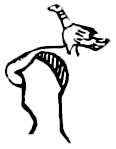
Fig. 606.
Fig. 606.—Broken-Leg-Duck, an Oglala, went to a Crow village to steal horses and was killed. American-Horse’s Winter Count, 1786-’87. A line connects the bird, one of whose legs is out of order, with the mouth of the man’s head, which is without scalp-lock.
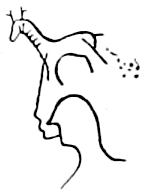
Fig. 607.
Fig. 607.—Antelope-Dung broke his neck while surrounding buffalo. American-Horse’s Winter Count, 1853-’54.
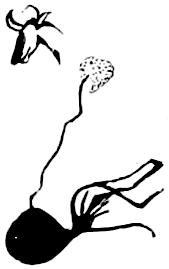
Fig. 608.
Fig. 608.—Antelope-Dung broke his neck while running antelope. Cloud-Shield’s Winter Count, 1853-’54. His head is the only part of his body that is shown, and it is bleeding copiously. Without the preceding figure this one would not be intelligible.
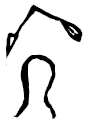
Fig. 609.
Fig. 609.—Broken-Arrow fell from his horse while running buffalo and broke his neck. American-Horse’s Winter Count, 1859-’60.
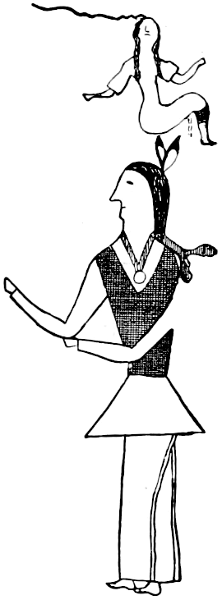
Fig. 610.
Fig. 610.—Sits-like-a-Woman. Red-Cloud’s Census. This person is also portrayed in a recent Dakota record, where the character is represented by the “woman seated” only. The name of this man is not “Sits-like-a-Woman,” but High-Wolf—shunkmanitu (wolf), wankantuya (up above). This is an instance of giving one name in a pictograph as if the correct or official name and retaining another by which the man is known in camp to his companions.
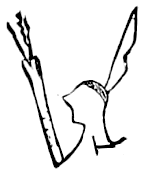
Fig. 611.
Fig. 611.—The-Man-Who-Owns-the-Flute was killed by the Cheyennes. American-Horse’s Winter Count, 1795-’96. His flute is represented in front of him with sounds coming from it. A bullet mark is on his neck. In reference to this character, see Chap. XX, Sec. 2.
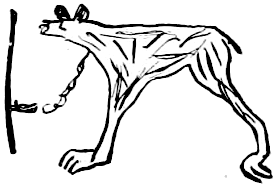
Fig. 612.
Fig. 612.—Smoking-Bear. Red-Cloud’s Census. The bear does not appear to be smoking the pipe, but the smoke of the latter is mounting to the animal’s neck, so the bear is smoking in a passive sense.
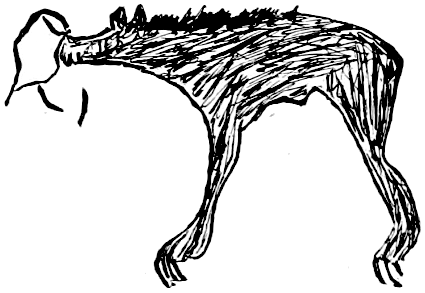
Fig. 613.
Fig. 613.—Biting-Bear. Red-Cloud’s Census. The bear seems to be biting at the bark on the limb of a tree, which shows the marks of his claws. This animal, as is well known, eats the bark of certain trees.
METAPHORIC.
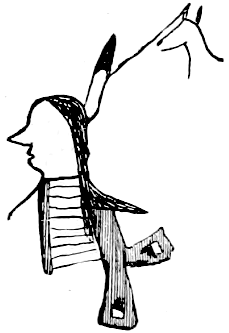
Fig. 614.
Fig. 614—Wolf-Ear. Red-Cloud’s Census. The designation of the ear of a wolf probably refers to size, and is substantially the same as big-ear.
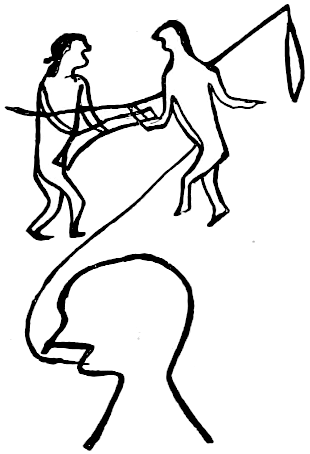
Fig. 615.
Fig. 615.—Fighting-Cuss. Red-Cloud’s Census. This warrior appears, while only armed with a lance, to be successfully fighting an enemy who has a gun.
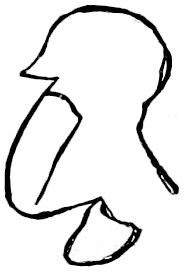
Fig. 616.
Fig. 616.—Man-with-hearts. Red-Cloud’s Census. There is no information as to the significance of this drawing, but it is conjectured that the warrior had eaten the heart of one or more enemies, as was frequently done. This was not cannibalism, but a superstitious and sometimes ceremonial performance, by which the eater acquired the qualities of the victim, and in this case would be supposed to have more than one heart, i. e., the courage attributed to those hearts.
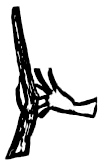
Fig. 617.
Fig. 617.—Takes-the-Gun. Red-Cloud’s Census. It appears from the name that the man is not handling his own gun, but is on the point of grasping and taking away the weapon of another person.
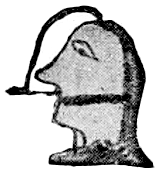
Fig. 618.
Fig. 618.—Jola, Whistler. The Oglala Roster. This is one of the instances where the usual rule in the Oglala Roster, of representing the name above the head, is abandoned, because it is essential to connect it with the mouth to express the whistle. Without this arrangement the musical instrument would not be suggested.
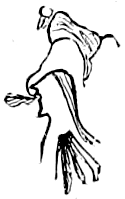
Fig. 619.
Fig. 619.—American-Horse’s Winter Count for 1872-’73 gives the pictograph of Whistler, also named Little-Bull. Both of his names appear; that of Whistler is expressed by the sounds blown from the mouth. He whistles without an instrument.
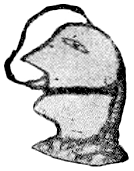
Fig. 620.
Fig. 620.—Ceji, Tongue. The Oglala Roster. This man was not necessarily an orator, but probably the nickname was given in derision as orally “tonguey” might be. Again the line is from the crown of the head to the protruded tongue.
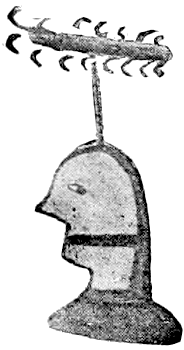
Fig. 621.
Fig. 621.—Canku-sapa, Black-Road. The Oglala Roster. This road, on which horse tracks are shown, is distinguished from that of the head chief Big-Road (a, on Pl. XXVI) as being much more narrow and obscure, therefore black.
ANIMALS.
The following figures are selected from a large number to show the variety of animals, and the differentiation by marks and attitudes found necessary to present the names. A similar multiplication of the animals by different coloration is exhibited, but can not be repeated in the text figures.
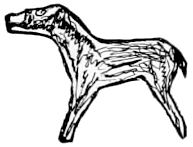
Fig. 622.
Fig. 622.—Bob-tail-Horse. Red-Cloud’s Census. The translation of the Indian’s name is rather liberal, but the device is graphic.
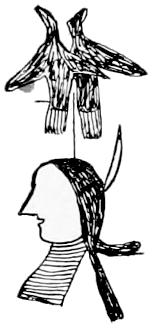
Fig. 623.
Fig. 623.—Two-Eagles. Red-Cloud’s Census.
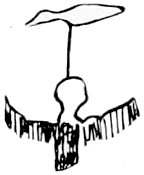
Fig. 624.
Fig. 624.—Minneconjou Dakota chief, named Swan, died. The-Swan’s Winter Count, 1866-’67. This bird is supposed to be swimming on the water, its legs not being visible.
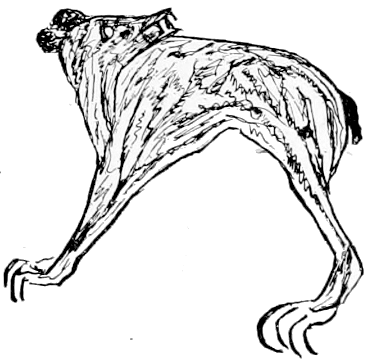
Fig. 625.
Fig. 625.—Bear-Looks-Back. Red-Cloud’s Census.
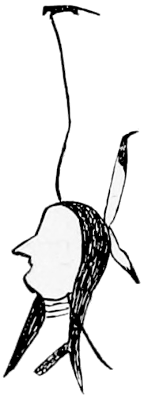
Fig. 626.
Fig. 626.—Mouse. Red-Cloud’s Census.
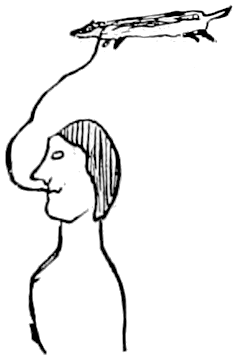
Fig. 627.
Fig. 627.—Badger, a Dakota, was killed by enemies, as shown by the absence of his scalp. Cloud-Shield’s Winter Count, 1796-’97.
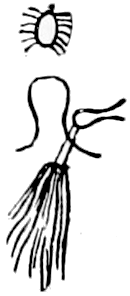
Fig. 628.
Fig. 628.—Spider was killed (stabbed) in a fight with the Pawnees. American-Horse’s Winter Count, 1861-’62. An immense effusion of blood is depicted flowing from the wound.
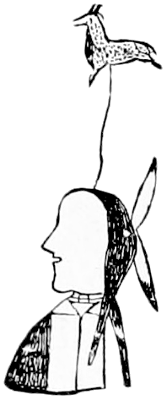
Fig. 629.
Fig. 629.—Spotted-Elk. Red-Cloud’s Census.
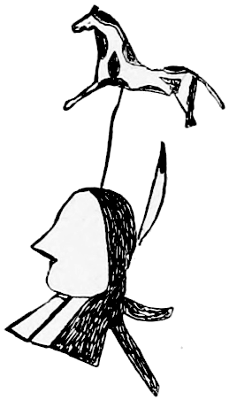
Fig. 630.
Fig. 630.—Spotted-Horse. Red-Cloud’s Census.
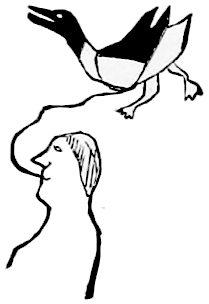
Fig. 631.
Fig. 631.—White-Goose was killed in an attack made by some enemies. Cloud-Shield’s Winter Count, 1789-’90. White-Cow-Killer calls it, “Goose-Feather-killed winter.”
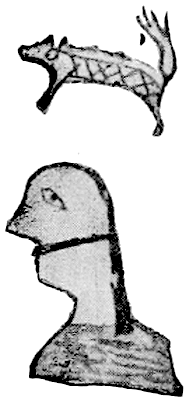
Fig. 632.
Fig. 632.—Maka-gleska, Spotted-Skunk. The Oglala Roster. The special characteristic of the animal is suggested.
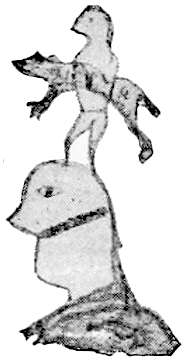
Fig. 633.
Fig. 633.—Hoka-qin, Carried-the-Badger. The Oglala Roster. The design explains itself. The animal is exaggerated in size and some of its features are accentuated.
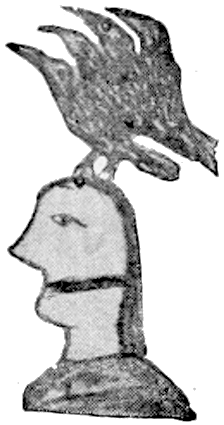
Fig. 634.
Fig. 634.—Kangi-topa, Four-Crows. The Oglala Roster. The four crows are cawing forth such explanation as they can give of the reasons, probably coming from visions, why they were used to form a name for an Oglala.
VEGETABLE.
The products of the vegetable kingdom are not often used by the Dakotas in their personal designations. The three following figures, however, are examples of such use.
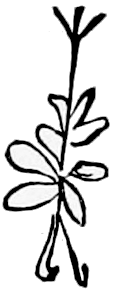
Fig. 635.
Fig. 635.—Tree-in-the-Face. Red-Cloud’s Census. This man probably painted a tree on his face.
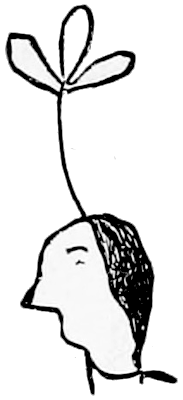
Fig. 636.
Fig. 636.—Leaves. Red-Cloud’s Census. This and the following figure represent two different men of the same name and the devices are distinctly individual.
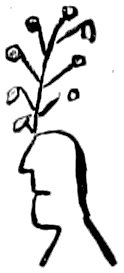
Fig. 637.
Fig. 637.—Leaves. Red-Cloud’s Census.
With regard to the errors arising from bad translation, an example may be given, relating to a name the explanation of which has often been asked. A former chief of the Oglala was called “Old-man-afraid-of-his-Horses,” by the whites, and his son is known as “Young-man-afraid-of-his-Horses.” A common interpretation about “afraid-of-his-horses” is that the man valued his horses so much that he was afraid of losing them. The representative of the name, however, stated to the writer that the correct name was Ta-shunka Kokipapi, and that the true meaning was “He-whose-horse-they-fear”; literally “His-horse-they-fear-it.”
A large number of pictorially rendered Indian names attached to deeds and treaties have been published, e. g., in Documents relating to the Colonial History of New York (b). Few of them are of interest, and they generally suggest the assistance of practiced penmen. In the collections mentioned some of the Dutch marks are in the same general style as those of the Indians.
Mr. P. W. Norris, late of the Bureau of Ethnology, had a buffalo robe containing a record of exploits, which was drawn by Black-Crow, a Dakota warrior. The successful warrior is represented in each instance upright, the accompanying figure being always in a recumbent posture, representing the enemy who was slain. The peculiar feature of these pictographs is that instead of depicting the victim’s personal name with a connecting line, the object denoting his name is placed above the head of the victor in each instance, and a line connects the character with his mouth. The latter thus seems to proclaim the name of his victim. A pipe is also figured between the victor and the vanquished, showing that he is entitled to smoke a pipe of celebration.
A copy of the whole record was shown to the Mdewakantanwan Dakotas, near Fort Snelling, Minnesota, in 1883, and the character reproduced in Fig. 638, about which there was the most doubt, was explained as signifying “many tongues,” or Loud-Talker.
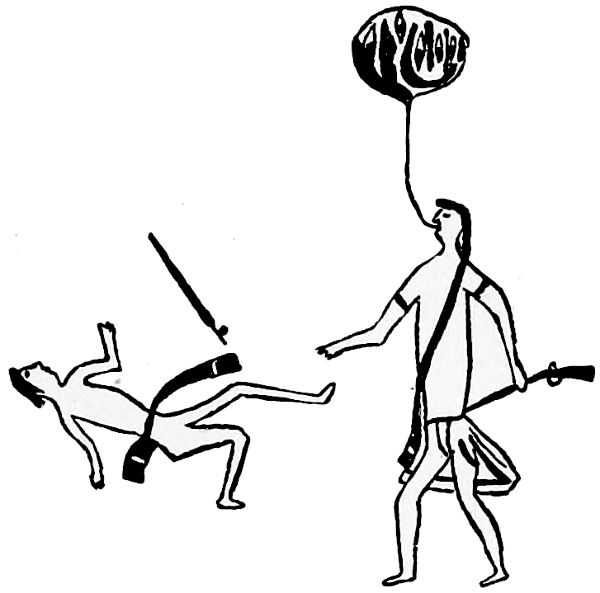
Fig. 638.—Loud-Talker.
The circle at the end of the line running from the mouth contains a number of lanceolate forms, one-half of each of which is black, the other white. They have the appearance of feathers, but also may represent tongues and signify voice, sound issuing from the mouth, and correspond in some respect to those drawn by the Mexicans with that significance, of which examples are given in this work, Chap. XX, Sec. 2. The considerable number of these tongue-like figures suggests intensity and denotes loud voice, or, as given literally, “loud talker,” that being the name of the victim.
It is, however, to be noted that “Shield,” an Oglala Dakota, contends that the character signifies Feather-Shield, the name of a warrior formerly living at the Pine Ridge Agency, Dakota.
Designation of an object, as a name, by means of a connecting line is mentioned in Kingsborough (a). Pedro de Alvarado, one of the companions of Cortez, was red-headed. Designating him, the Mexicans called him Tonatihu, the “Sun,” and in their picture-writing his name was represented by their conventional character for the sun attached to his person by a line.
Other examples are now presented both of the linear connection and of the iconographic figuration by the old Mexicans.
In Kingsborough (b) is a pictograph of Chimalpopoca, which name signifies a smoking shield, here reproduced as Fig. 639 (a). The smoking shield is connected with the head by a line, and the form of smoke should be noticed in comparison with the representation of flame and of voice by the same pictors.
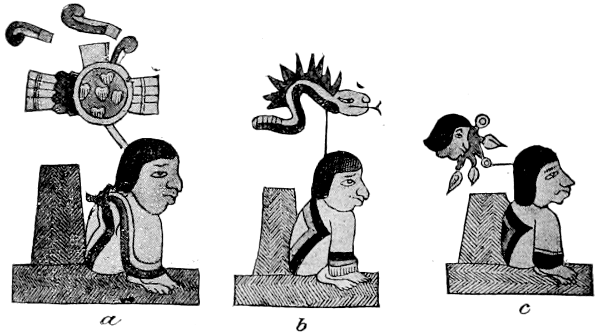
Fig. 639.—Mexican names.
The same authority and volume, p. 135 (illustration in Vol. I, Pt. 4, Pl. V), gives the name and illustration (reproduced in the same Fig., b) of Ytzcohuatl, the signification of which name is a serpent armed with knives. The knives refer to the Itzli stone.
In the same volume, p. 137, is the name Face of Water, with the corresponding illustration in Vol. I, Pt. 4, Pl. 12 (here Pl. XII c). The drops of water are falling profusely from the face.