Chapter XIII · TOTEMS, TITLES, AND NAMES.
Reading edition
The employment of pictographs to designate tribes, groups within tribes, and individual persons has been the most frequent of all the uses to which they have been applied. Indeed, the constant need that devices to represent the terms styled by grammarians proper names should be readily understood for identification has, more than any other cause, maintained and advanced pictography as an art, and in some parts of the world has evolved from it syllabaries and afterwards alphabets. From the same origin came heraldry, which in time designated with absolute accuracy persons and families for the benefit of letterless people. Trade-marks have the same history.
From the earliest times men have used emblems to indicate their tribes or clans. Homer makes no clear allusion to their manifestation at the poetic siege of Troy; but even if his Greeks did not bear them, other nations of the period did. The earlier Egyptians carried images of bulls and crocodiles into battle, probably at first with religious sentiments. Each of the twelve tribes of Israel had a special ensign of its own, which is now generally considered to have been totemic. The subjects of Semiramis adopted doves and pigeons as their token in deference to their queen, whose name meant “dove.”
At later dates Athens chose an owl for her sign, as a compliment to Minerva; Corinth, a winged horse, in memory of Pegasus and his fountain; Carthage, a horse’s head, in homage to Neptune; Persia, the sun, because its people worshiped fire; Rome, an eagle, in deference to Jupiter. These objects appear to have been carved in wood or metal. There is no evidence of anything resembling modern flags, except, perhaps, in parts of Asia, until the Romans began to use something like them about the time of Cæsar. But these small signs had no national or public character so as to be comparable with the eagles on the Roman standard; nor was any floating banner associated with ruling power until Constantine gave a religious meaning to the labarum.
Emblems also were often adopted by political and religious parties, e. g., the cornstalks and slings of the Mazarinists and anti-Mazarinists during the Fronde, the caps and hats in the Swedish diet in 1788, the scarf of the Armagnacs, and the cross of the Burgundians. The topic of emblems is further discussed in Chapter XVIII.
As with increased culture clans and tribes have become nations, so there has been an evolution by which the ensigns of bands and orders have been discontinued and replaced by the emblems of nationalities. Frederic Marshall (a) well says: “Images of animals, badges, war cries, cockades, liveries, coats of arms, tokens, tattooing, are all replaced practically by national ensigns.” This change is toward the higher and nobler significance and employment, all members of the community being protected and designated by the simple exhibition of a single emblem.
This chapter is naturally divided into (1) Pictorial tribal designations, (2) Gentile and clan designations, (3) Significance of tattoo, (4) Designations of individuals.
SECTION 1. PICTORIAL TRIBAL DESIGNATIONS.
Capt. de Lamothe Cadillac (a) writing in the year 1696 of the Algonquians of the Great Lake region near Mackinac, etc., describes the emblems on their canoes as follows: “On y voit la natte de guerre le corbeau, l’ours on quelque autre animal * * * estant l’esprit qui doit conduire cette enterprise.”
This, however, was a mistake as applicable to the time when it was written. The animals used as emblems may originally have been regarded as supernatural totemic beings, but had probably become tribal designations.
IROQUOIAN TRIBAL DESIGNATIONS.
Bacqueville de la Potherie (c) says that a treaty with the French in Canada, about 1700, was “sealed” with the “proper arms,” pictorially drawn, of the Indian tribes which were parties to it. The following is a copy of the original statement in its archaic form:
Monsieur de Callieres, de Champigni, & de Vaudreüil, en signerent le Traité, que chaque Nation scella de ses propres armes. Les Tsonnontouans & les Onnontaguez designerent une araignée, le Goyogouin un calumet, les Onneyouts un morceau de bois en fourche, une pierre au milieu, un Onnontagué mit un Ours pour les Aniez, quoi qu’ils ne vinrent pas. Le Rat mit un Castor, les Abenaguis un Chevreüil, les Outaouaks un Liévre, ainsi des autres.
From this it appears that—
The Seneca and Onondaga tribes were represented by a “spider.” [This was doubtless a branching tree, so badly drawn as to be mistaken for a spider.]
The Cayuga tribe, by a calumet.
The Oneida tribe, by a forked stick with a stone in the fork. [The forked stick was really designed for the fork of a tree.]
The Mohawk tribe, by a bear.
Le Rat, who was a representative Huron of Mackinaw, by a beaver.
The Abnaki, by a deer.
The Ottawa, by a hare.
Several other accounts of the tribal signs of the Iroquois are published, often with illustrations, e. g., in Documents relating to the Colonial History of New York (a), with the following remarks:
When they go to war, and wish to inform those of the party who may pass their path, they make a representation of the animal of their tribe, with a hatchet in his dexter paw; sometimes a saber or a club; and if there be a number of tribes together of the same party, each draws the animal of his tribe, and their number, all on a tree, from which they remove the bark. The animal of the tribe which heads the expedition is always the foremost.
Another account of interest, which does not appear to have been published, was traced and contributed by Mr. William Young, of Philadelphia. It is a deed from the representatives of the Six Nations (the Tuscaroras then being admitted) to the King of Great Britain, dated November 4, 1768, and recorded at the recorder’s office, Philadelphia, in Deed Book I, vol. 5, p. 241. Nearly all of these accounts and illustrations are confused and imperfect. An instructive blunder occurs in the translated signature representing the Mohawk tribe in the above mentioned deed. It is called “The Steel,” which could hardly have been an ancient tribal name, but after study it was remembered that the Mohawks have sometimes been called by a name properly translated the “Flint people.” By some confusion about flint and steel, which were still used in the middle of the last century to produce sparks of fire, perhaps assisted by the pantomime of striking those objects together, the one intended to be indicated, viz, the flint, was understood to be the other, the steel, and so these words were written under the figure, which was so roughly drawn that it might have been taken for a piece of flint or of steel or, indeed, anything else.
EASTERN ALGONQUIAN TRIBAL DESIGNATIONS.
The illustrations in Fig. 483 were drawn in 1888 by a Passamaquoddy Indian, in Maine, near the Canada border. The Passamaquoddy, Penobscot, and Amalecite are tribal divisions of the Abnaki, who formerly were also called Tarrateens by the more southern New England tribes and Owenunga by the Iroquois. The Micmacs are congeners of the Abnaki, but not classed in their tribal divisions. All the four tribes belong to the Algonquian linguistic stock.
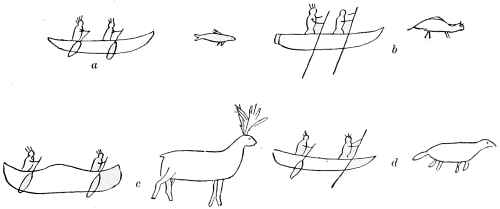
Fig. 483.—Eastern Algonquian tribal designations.
Fig. 483 a is the tribal emblem of the Passamaquoddy. It shows two Indians in a canoe, both using paddles and not poles, following a fish, the pollock. The variation which will appear in the represented use of poles and paddles in the marks of the Algonquian tribes in Maine, Nova Scotia, New Brunswick, etc., is said to have originated in the differing character of the waters, shoal or deep, sluggish or rapid, of the regions of the four bodies of Indians whose totems are indicated as next follows, thus requiring the use of pole and paddle, respectively, in a greater or less degree. The animals figured are in all cases repeated consistently by each one of the several delineators, and in all cases there is some device to show a difference between the four canoes, either in their structure or in their mode of propulsion, but these devices are not always consistent. It is therefore probable that the several animals designated constitute the true and ancient totemic emblems, and that the accompaniment of the canoes is a modern differentiation.
b The Maresquite or Amalecite emblem. Two Indians in a canoe, both with poles, following a muskrat.
c The Micmac emblem. Two Indians, both with paddles, in a canoe built with high middle parts familiarly called “humpback,” following a deer.
d The Penobscot emblem. Two Indians in a canoe, one with a paddle and the other with a pole, following an otter.
In Margry (a) is an account, written about 1722, of the “Principal divisions of the Sioux and their distinctive marks,” thus translated:
There are from twenty to twenty-six villages of Scioux and they comprise the nations of the prairies:
(1) The Ouatabatonha, or Scioux des Rivières, living on the St. Croix river or Lake de la Folle-Avoine which is below, and 15 leagues from the Serpent river. Their distinctive sign is a bear wounded in the neck.
(2) The Menesouhatoba, or Scioux des Lacs, having for their mark a bear wounded in the neck.
(3) The Matatoba, or Scioux des Prairies, having for their mark a fox with an arrow in its mouth.
(4) The Hictoba, or Scioux de la Chasse, having for their symbol the elk.
(5) The Titoba, or Scioux des Prairies, whose emblem is the deer. It bears a bow on its horns.
We have as yet had no commerce save with five nations. The Titoba live 80 leagues west of Sault Saint-Antoine.
The above early, though meager, notice will serve as an introduction to the following series of pictorial tribal signs, all drawn by Sioux Indians, and many of them representing tribal divisions of the Siouan linguistic stock. The history and authority of the several “Winter Counts” mentioned are referred to supra, chapter X, section 2. Red-Cloud’s census and the Oglala roster are also described below. Explanations of some figures are added which have no reference to the present topic, but which seemed necessary and could not be separated and transferred to more appropriate division without undue multiplication of figures and text.
ABSAROKA OR CROW.
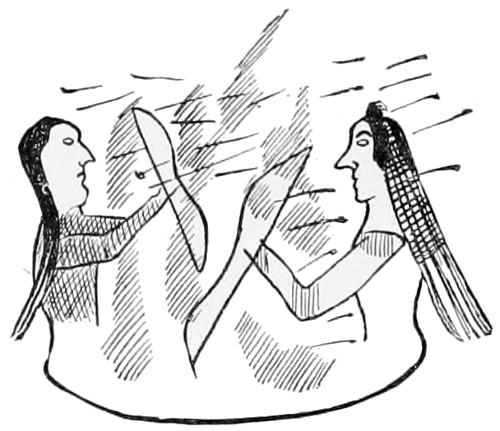
Fig. 484.—Absaroka.
Fig. 484.—Dakota and Crow, Cloud-Shield’s Winter Count, 1819-’20. In an engagement between the Dakotas and the Crows both sides expended all of their arrows, and then threw dirt at each other. A Crow is represented on the right, and is distinguished by the manner in which the hair is worn. Hidatsa and Absaroka are represented with striped or spotted hair, which denotes the red clay they apply to it.
The custom which prevails among these tribes, and is said to have originated with the Crows, is to wear a wig of horse hair attached to the occiput, thus resembling the natural growth, but much increased in length. These wigs are made in strands having the thickness of a finger, varying from eight to fifteen in number, and held apart and in place by means of thin cross strands, thus resembling coarse network. At every intersection of strands of hair and crossties, lumps of pine gum are attached to prevent disarrangement and as in itself ornamental, and to these lumps dry vermilion clay is applied by the richer classes and red ocher or powdered clay by the poorer people.
Pictures drawn by some of the northern tribes of the Dakota show the characteristic and distinctive features for a Crow Indian to be the distribution of the red war paint which covers the forehead.
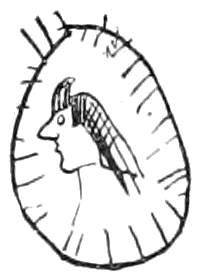
Fig. 485.—Absaroka.
Fig. 485.—Cloud-Shield’s Winter Count, 1830-’31. The Crows were approaching a village at a time when there was a great deal of snow on the ground and intended to surprise it, but, some herders discovering them, the Dakotas went out, laid in wait for the Crows, surprised them, and killed many. A Crow’s head is represented in the figure.
The Crow is designated not only by the arrangement of back hair, before mentioned, but by a topknot of hair extending upward from the forehead, brushed upward and slightly backward. See also the seated figure in the record of Running Antelope, in Fig. 820, infra.
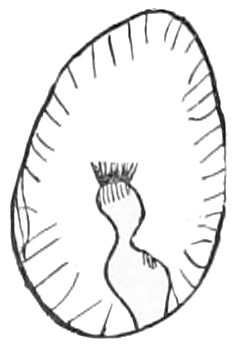
Fig. 486.—Absaroka.
Fig. 486.—The Dakotas surrounded and killed ten Crows. Cloud-Shield’s Winter Count, 1857-’58.
The hair is somewhat shortened and not intentionally foreshortened, which was beyond the artist’s skill.
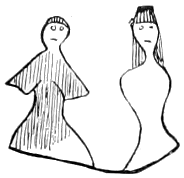
Fig. 487.—Absaroka.
Fig. 487.—The Dakotas killed a Crow and his squaw who were found on a trail. Cloud-Shield’s Winter Count, 1839-’40.
This is a front view. The union line signifies husband and wife.
ARAPAHO.
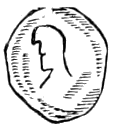
Fig. 488.—Arapaho.
Fig. 488.—Arapaho, in the Dakota language, magpi-yato, blue cloud, is here shown by a circular cloud, drawn in blue in the original, inclosing the head of a man. Red-Cloud’s census.
ARIKARA OR REE.
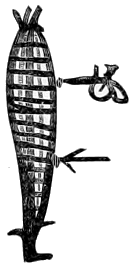
Fig. 489.—Arikara.
Fig. 489 is the tribal sign of the Arikara, made by the Dakota, taken from the Winter Count of Battiste Good for the year 1823-’24, which he calls “General-——-first-appeared-and-the-Dakotas-aided-in-an-attack-on-the-Rees winter,” also “Much corn winter.”
The gun and the arrow in contact with the ear of corn show that both whites and Indians fought the Rees. The ear of corn signifies “Ree” or Arikara Indians, who are designated in gesture language as “corn shellers.”
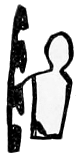
Fig. 490.—Arikara.
Fig. 490.—A Dakota kills one Ree. The-Flame’s Winter Count, 1874-’75. Here the ear of corn, the conventional sign for Arikara, has become abbreviated.
ASSINIBOIN.

Fig. 491.—Assiniboin.
Fig. 491 is the tribal designation for Assiniboin or Hohe made by the Dakota, as taken from the Winter Count of Battiste Good for the year 1709-’10.
The Hohe means the voice, or, as some say, the voice of the musk ox, and the device is the outline of the vocal organs, according to the Dakota concept, and represents the upper lip and roof of the mouth, the tongue, the lower lip, and chin and neck. The view is lateral, and resembles the sectional aspect of the mouth and tongue.
BRULÉ.
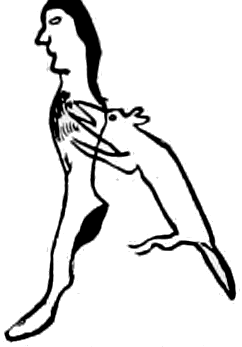
Fig. 492.—Brulé.
Fig. 492.—A Brulé, who had left the village the night before, was found dead in the morning outside the village, and the dogs were eating his body. Cloud-Shield’s Winter Count, 1822-’23.
The black spot on the upper part of the thigh shows he was a Brulé.
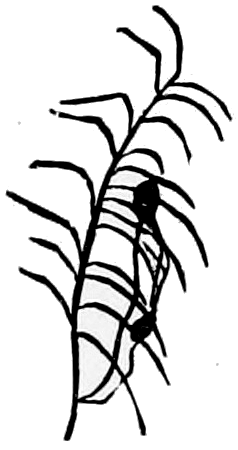
Fig. 493.—Brulé.
Fig. 493.—A Brulé was found dead under a tree, which had fallen on him. Cloud-Shield’s Winter Count, 1808-’10.
Again the burnt thigh is suggested by the black spot.
The significance of these two figures is explained by the gesture sign for Brulé as follows: Rub the upper and outer part of the right thigh in a small circle with the open right hand, fingers pointing downward. These Indians were once caught in a prairie fire, many burned to death, and others badly burned about the thighs; hence the name Si-can-gu, burnt thigh, and the sign. According to the Brulé chronology, this fire occurred in 1763, which they call “The-people-were-burned winter.”
CHEYENNE.
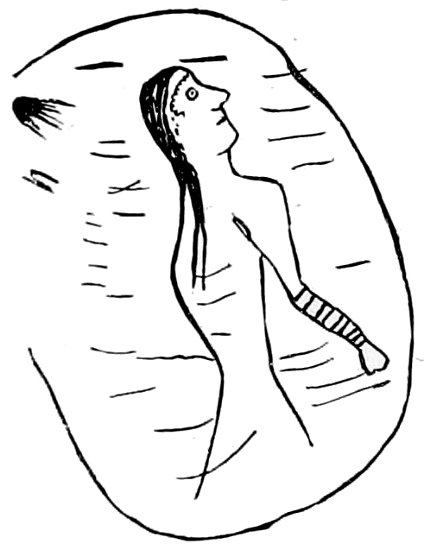
Fig. 494.—Cheyenne.
Fig. 494.—The Cheyenne who boasted that he was bullet and arrow proof was killed by white soldiers, near Fort Robinson, Nebraska, in the intrenchments behind which the Cheyennes were defending themselves after they had escaped from the fort. Cloud-Shield’s Winter Count, 1878-’79.
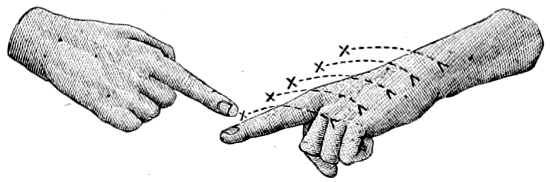
Fig. 495.—Cheyenne.
The marks on the arm constitute the tribal pictographic emblem. It is explained by the gesture sign as follows: Pass the ulnar side of the extended index finger repeatedly across extended finger and back of the left hand. Fig. 495 illustrates this gesture sign. Frequently, however, the index is drawn across the wrist or forearm, or the extended index, palm upward, is drawn across the forefinger of the left hand (palm inward), several times, left hand stationary, right hand is drawn toward the body until the index is drawn clear off; then repeat. Some Cheyennes believe this to have reference to the former custom of cutting the arms as offerings to spirits, while others think it refers to a more ancient custom of cutting off the enemy’s fingers for necklaces, and sometimes to cutting off the whole hand or forearm as a trophy to be displayed as scalps more generally are.
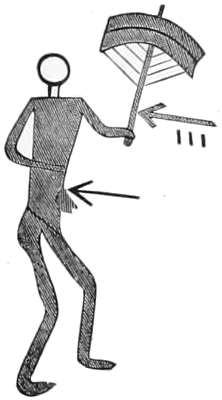
Fig. 496.—Cheyenne.
Fig. 496 is from the Winter Count of Battiste Good for the year 1785-’86. In that record this is the only instance where the short vertical lines below the arrow signify Cheyenne. In all others those marks are numerical and denote the number of persons killed. That these short lines here signify Cheyenne is explained by the foregoing remarks.
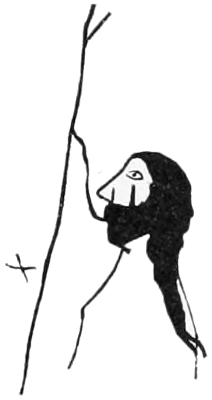
Fig. 497.—Cheyenne.
Fig. 497.—Picket-Pin went against the Cheyennes. A picket-pin is represented in front of him and is connected with his mouth by the usual line. Cloud-Shield’s Winter Count, 1790-’91.
The black band across his face denotes that he was brave and had killed enemies. The cross is the symbol for Cheyenne. This mark stands for the scars on their arms or stripes on their sleeves, and also to the gesture sign for this tribe. The cross is, therefore, the conventionalized form both for the emblem and the gesture.
DAKOTA OR SIOUX.
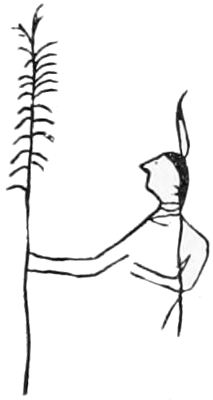
Fig. 498.—Dakota.
Fig. 498.—Standing-Bull, the great grandfather of the present Standing-Bull, discovered the Black Hills. American-Horse’s Winter Count, 1775-’76. He carried home with him a pine tree of a species he had never seen before. In this count the Dakotas are usually distinguished by the braided scalp lock and the feather they wear at the crown of the head, or by the manner in which they brush back and tie the hair with ornamented strips. Many illustrations are given in the present paper in which this arrangement of the hair is shown more distinctly.
With regard to the designation of this tribe by paint it seems that pictures made by the northern Dakotas represent themselves as distinguished from other Indians by being painted red from below the eyes to the end of the chin. But this is probably rather a special war painting than a tribal design.
HIDATSA, GROS VENTRE, OR MINITARI.
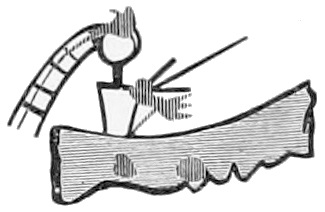
Fig. 499.—Hidatsa.
Fig. 499 shows the tribal designation of the Gros Ventres by the Dakotas, on the authority of Battiste Good, 1789-’90.
Two Gros Ventres were killed on the ice by the Dakotas. The two are designated by two spots of blood on the ice, and killed is expressed by a blood-tipped arrow against the figure of the man above. The long hair, with a red forehead, denotes the Gros Ventre. In other Dakota records the same style of painting the forehead red designates the Arikara and Absaroka Indians. The horizontal band, which is blue in the original, signifies ice.
KAIOWA.
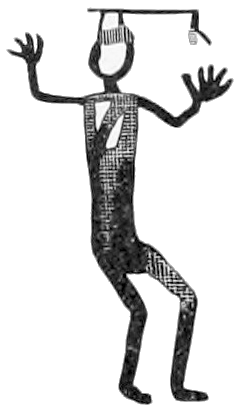
Fig. 500.—Kaiowa.
Fig. 500 shows the tribal designation of the Kaiowa by the Dakota, taken from the Winter Count of Battiste Good, 1814-’15. He calls the winter “Smashed-a-Kaiowa’s-head-in winter.” The tomahawk with which it was done is in contact with the Kaiowa’s head.
The sign for Kaiowa is sometimes made by passing one or both hands, naturally extended, in short horizontal circles on either side of the head, together with a shaking motion, the conception being “rattle-brained” or “crazy heads.” The picture is drawn to represent the man in the attitude of making this gesture, and not the involuntary raising of the hands upon receiving the blow, such attitudes not appearing in Battiste Good’s system.
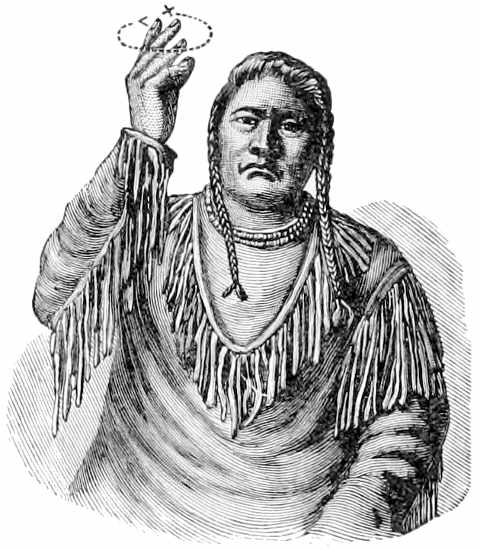
Fig. 501.—Kaiowa.
This gesture is illustrated in Fig. 501.
MANDAN.
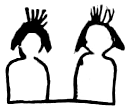
Fig. 502.—Mandan.
Fig. 502.—Two Mandans killed by Minneconjous. The peculiar arrangement of the hair distinguishes the tribe. The-Flame’s Winter Count, 1789-’90.
MANDAN AND ARIKARA.
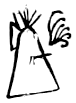
Fig. 503.—Mandan and Arikara.
Fig. 503.—The Mandans and Rees made a charge on a Dakota village. An eagle’s tail, which is worn on the head, stands for Mandan and Ree. American-Horse’s Winter Count, 1783-’84.
The mark on the tipi, which represents a village, is not, as it at first sight appears, a hatchet, but a conventional sign for “it hit.” See Fig. 987 and accompanying remarks.
OJIBWA.
Carver (a), writing in 1776-’78, tells that an Ojibwa drew the designation of his own tribe as a deer. The honest captain of provincial troops may have mistaken a clan mark to be a tribal mark, but the account is mentioned for what it is worth, and the context serves to support the statement.
OMAHA.

Fig. 504.—Omaha.
Fig. 504 is the tribal designation of the Omahas by the Dakotas, taken from the Winter Count of Battiste Good, for the year 1744-’45. The pictograph is a human head with cropped hair and red cheeks. It is a front view. This tribe cuts the hair short and uses red paint upon the cheeks very extensively. This character is of frequent occurrence in Battiste Good’s count.
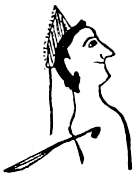
Fig. 505.—Omaha.
Fig. 505.—The Dakotas killed an Omaha in the night. Cloud-Shield’s Winter Count, 1806-’07.
This is a side view of the same. The illustration does not show the color of the cheeks.
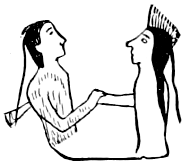
Fig. 506.—Omaha.
Fig. 506.—The Dakotas and Omahas made peace. Cloud-Shield’s Winter Count, 1791-’92.
The Omaha is on the right and the Dakota on the left.
PAWNEE.
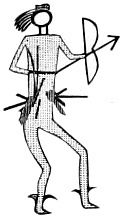
Fig. 507.—Pawnee.
Fig. 507 is the tribal designation of the Pawnee by the Dakotas, taken from Battiste Good’s Winter Count for the year 1704-’05.
He says: The lower part of the legs are ornamented with slight projections resembling the husks on the bottom of an ear of corn.
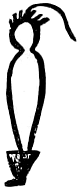
Fig. 508.—Pawnee.
Fig. 508.—Brulés kill a number of Pawnees. The-Flame’s Winter Count, 1873-’74.
This is the abbreviated or conventionalized form of the one preceding.
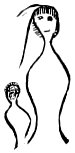
Fig. 509.—Pawnee.
Fig. 509.—They killed many Pawnees on the Republican river. Cloud-Shield’s Winter Count, 1873-’74.
Here the arrangement of the hair makes the distinction.
In this connection it is useful to quote Dunbar (a):
The tribal mark of the Pawnees in their pictographic or historic painting was the scalp lock dressed to stand nearly erect or curving slightly backwards, somewhat like a horn. This, in order that it should retain its position, was filled with vermillion or other pigment, and sometimes lengthened by means of a tuft of horse hair skillfully appended so as to form a trail back over the shoulders. This usage was undoubtedly the origin of the name Pawnee. * * * It is most probably derived from pá-rĭk-ĭ, a horn, and seems to have been once used by the Pawnees themselves to designate their peculiar scalp lock. From the fact that this was the most noticeable feature in their costume, the name came naturally to be the denominative term of the tribe.
PONKA.
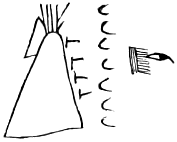
Fig. 510.—Ponka.
Fig. 510.—The Ponkas came and attacked a village, notwithstanding peace had just been made with them. American-Horse’s Winter Count, 1778-’79.
Some elk hair which is used to form a ridge about 8 inches long and 2 in breadth, worn from the forehead to the back of the neck, and a feather, represent Ponka. Horse tracks are used for horses. Attack is indicated by marks which represent bullet marks, and which convey the idea that the bullet struck. The marks are derived from the gesture-sign “it struck.” See Chapter XVIII, section 4.
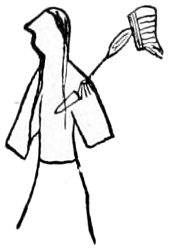
Fig. 511.—Ponka.
Fig. 511.—An Indian woman, who had been unfaithful to a white man to whom she was married, was killed by an Indian named Ponka. American-Horse’s Winter Count, 1804-’05.
The emblem for Ponka is the straight elk hair ridge.
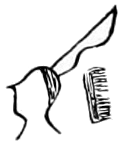
Fig. 512.—Ponka.
Fig. 512.—A Ponka, who was captured when a boy by the Oglalas, was killed while outside the village by a war party of Ponkas. American-Horse’s Winter Count, 1793-’94.
The artificial headdress, consisting of a ridge of elk hair, is again portrayed.
SHOSHONI.
Dr. George Gibbs (b) describes a pictograph made by one of the Indian tribes of Oregon and Washington, upon which “the figure of a man with a long queue or scalp lock reached to his heels denoted a Shoshoni, that tribe being in the habit of braiding horse or other hair into their own in that manner.”
This may be correct regarding the Shoshoni Indians among the extreme northwestern tribes, but the mark of identification could not be based upon the custom of braiding with their own hair that of animals, to increase the length and appearance of the queue, as this custom also prevails among the Absaroka, Hidatsa, and Arikaa Indians, respectively, as before mentioned in this work.
Tanner’s Narrative (e) gives additional information on this topic regarding the absence of any tribal sign in connection with a human figure.
The men of the same tribe are extensively acquainted with the totems which belong to each, and if on any record of this kind the figure of a man appears without any designatory mark, it is immediately understood that he is a Sioux or at least a stranger. Indeed, in most instances the figures of men are not used at all, merely the totem or surname, being given. * * * It may be observed that the Algonkins believe all other Indians to have totems, though from the necessity they are in general under of remaining ignorant of those hostile bands, the omission of the totem in their picture writing serves to designate an enemy. Thus, those bands of Ojibbeways who border on the country of the Dahcotah or Sioux, always understand the figure of a man without totem to mean one of that people.
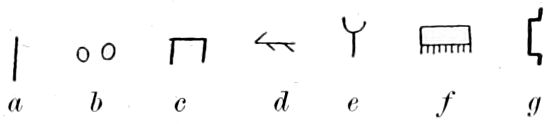
Fig. 513.—Tamga of Kirghise tribes.
In Sketches of Northwestern Mongolia, (a) are the tamga or seals of Kirghise tribes, of which Fig. 513 is a copy.
The explanation given is as follows: a. Kipchaktamga: letter alip. b. Arguin tamga: eyes. c. Naiman tamga: posts (of door). d. Kong-rat, Kirei, tamga: vine. e. Nak tamga: prop. f. Tarakti tamga: comb. g. Tyulimgut tamga: pike.
SECTION 2. GENTILE AND CLAN DESIGNATIONS.
The clan and totemic system formerly called the gentile system undoubtedly prevailed anciently in Europe and Asia, but first became understood by observations of its existence in actual force among the aborigines of America and Australia, and typical representations of it are still found among them. In Australia it is called kobong. An animal or a plant, or sometimes a heavenly body was mythologically at first and at last sociologically connected with all persons of a certain stock, who believe, or once believed, that it was their tutelar god and they bear its name.
Each clan or gens took as a badge or objective totem the representation of the tutelar daimon from which it was named. As most Indian tribes were zootheistic, the object of their devotion was generally an animal—e. g., an eagle, a panther, a buffalo, a bear, a deer, a raccoon, a tortoise, a snake, or a fish, but sometimes was one of the winds, a celestial body, or other impressive object or phenomenon.
American Indians once generally observed a prohibition against killing the animal connected with their totem or eating any part of it. For instance, most of the southern Indians abstained from killing the wolf; the Navajo do not kill bears; the Osage never killed the beaver until the skins became valuable for sale. Afterward some of the animals previously held sacred were killed; but apologies were made to them at the time, and in almost all cases the prohibition or taboo survived with regard to certain parts of those animals which were not to be eaten on the principle of synecdoche, the temptation to use the food being too strong to permit entire abstinence. The Cherokee forbade the use of the tongues of the deer and bear for food. They cut these members out and cast them into the fire sacramentally. A practice still exists among the Ojibwa as follows: There is a formal restriction against members of the bear clan eating the animal, yet by a subdivision within the same clan an arrangement is made so that sub-clans may among them eat the whole animal. When a bear is killed, the head and paws are eaten by those who form one branch of the bear totem, and the remainder is reserved for the others. Other Indian tribes have invented a differentiation in which some clansmen may eat the ham and not the shoulder of certain animals, and others the shoulder and not the ham.
It follows, therefore, that sometimes the whole animal is designated as a clan totem, and also that sometimes only parts of it is selected. Many of the devices given in this paper under the heading of personal names have this origin. The following figures show a selection of parts of animals that may further illustrate the subject. It must, however, be borne in mind that some of the cases may be connected with individual visions or with personal adventures and not directly with the clan system. In the absence of detailed information in each instance discrimination is impossible.
Schoolcraft says that the Ojibwa always placed the totemic or clan pictorial mark upon the adjedatig or grave-post, thereby sinking the personal name which is not generally indicative of the totem. The same practice is found in other tribes. The Pueblos depict the gentile or totemic pictorial sign upon their various styles of ceramic work.
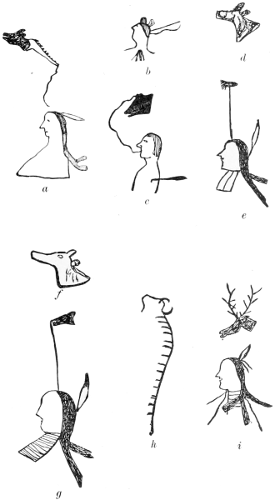
Fig. 514.—Dakota gentile designations.
Fig. 514, gives examples taken from Dakota drawings, which appear to be pictured totemic marks of gentes or clans. If not in every instance veritable examples, they illustrate the mode of their representation as distinct from the mere personal designations mentioned below, and yet without positive information in each case, it is not possible to decide on their correct assignment to this section of the present chapter.
a. Bear-Back. Red-Cloud’s Census.
This and the six following figures exhibit respectively the portions of the bear, viz, the back or chine, the ears, the head, the paw, the brains, and the nostrils or muzzle, which are probably the subject of taboo and are the sign of a clan or subclan.
b. Bear’s-Ears, a Brulé, was killed in an Oglala village by the Crows. American-Horse’s Winter Count, 1785-’86.
c. Bear’s-Ears was killed in a fight with the Rees. Cloud-Shield’s Winter Count, 1793-’94.
This is another and more graphic delineation of the animal’s ears.
d. Bear-Head. Red-Cloud’s Census.
e. Bear-Paw. Red-Cloud’s Census. The paws of the bear are considered to be a delicacy.
f. Bear-Brains. Red-Cloud’s Census.
g. Bear-Nostrils. Red-Cloud’s Census.
h. Hump. Red-Cloud’s Census. The hump of the buffalo has been often praised as a delicious dish.
i. Elk-Head. Red-Cloud’s Census.
Fig. 515 represents carved uprights in a house of the Kwakiutl Indians, British Columbia, taken from a work of Dr. Franz Boas (b).
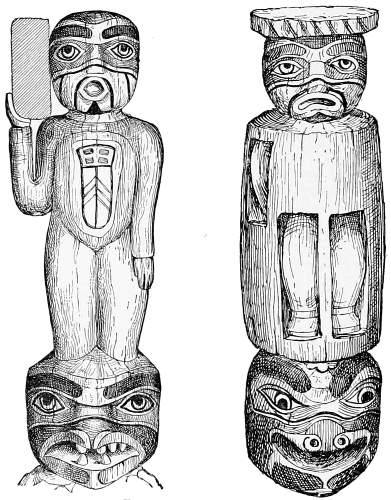
Fig. 515.—Kwakiutl carvings.
The author says that these uprights are always carved according to the crest of the gens of the house owner, and represent men standing on the heads of animals. This use of the term “crest” is not heraldically correct, as literally it would require the men to be standing on the coverings of their own heads, but the idea is plain, the word being used for a device similar in nature and significance to the crest in heraldry, and it was adopted by the ancestors of the Kwakiutl gentes in relation to certain exploits that they had made. Both human figures show painting and probably also tattooing on their faces.
The character on the left hand also shows a design on the breast. That on the right hand presents a curious artifice of carving by which the legs and an arm are exhibited while preserving the solidity of the upright.
SECTION 3. SIGNIFICANCE OF TATTOO.
Tattooing proper is a permanent marking of the skin accomplished by the introduction of coloring matter under the cutaneous epidermis. In popular expression and often in literature it includes penetration of the skin by cuts, gashes, or sometimes burns, without the insertion of coloring matter, the cicatrix being generally whiter than the sound skin of the people, most frequently of the dark races, among whom the practice is found. This form of figuration is distinguished as scarification and some examples of it are given below. The two varieties of tattoo may, however, for the purpose of this paper, be considered together and also in relation to painting the human body, which in its early use differs from them only in duration.
Mr. Herbert Spencer (a) considers all forms of tattoo to be originally tribal marks, and draws from that assumption additional evidence for his favorite theory of the deification of a dead tribal chief. Miss A. W. Buckland (a), in her essay on tattooing, follows in the same track, although recognizing modern deviations from the rule. A valuable article in the literature of the subject entitled “Tattooing among civilized people,” by Dr. Robert Fletcher should be consulted. Also A tatuagem em Portugal, by Rocha Peixoto.
Dr. C. N. Starcke (a) lays down the law still more distinctly, thus:
The tattoo-marks make it possible to discover the remote connection between clans, and this token has such a powerful influence on the mind that there is no feud between tribes which are tattooed in the same way. * * * Tattooing may also lead to the formation of a group within the tribe.
Prof. Frederick Starr (a) makes these remarks:
As a sign of war prowess the gash of the Kaffir warrior may be described. After an act of bravery the priest cuts a deep gash in the hero’s thigh. This heals blue and is a prized honor. To realize the value of a tribal mark think for a moment of the savage man’s relation to the world outside. He is a very Ishmaelite. So long as he remains on his own tribal territory he is safe; when on the land of another tribe his life is the legitimate prey of the first man he meets. To men in such social relations the tribal mark is the only safety at home; without it he would be slain unrecognized by his own tribesmen. There must have been a time when the old Hebrews knew all about this matter of tribe marks. By this custom only can we fully understand the story of Cain (Gen. IV, 14, 15), who fears to be sent from his own territory lest he be slain by the first stranger he meets, but is protected by the tribal mark of those among whom he is to wander being put upon him. But in scarring, as in so many other cases, the original idea is often lost and the mark becomes merely ornamental. This is particularly true among women. Among men it more frequently retains its tribal significance.
After careful study of the topic, less positive and conclusive authority is found for this explanation of tattooing than was expected, considering its general admission.
The great antiquity of tattooing is shown by reference to it in the Old Testament, and in Herodotus, Xenophon, Tacitus, Ammianus, and Herodian. The publications on the topic are so numerous that the notes now to be presented are by no means exhaustive. They mainly refer to the Indian tribes of North America with only such comparatively recent reports from other lands as seem to afford elucidation.
TATTOO IN NORTH AMERICA.
G. Holm (b) says of the Greenland Innuit that geometric figures consisting of streaks and points, are used in tattooing on the breasts, arms, and legs of the females.
H. H. Bancroft (b) says:
The Eskimo females tattoo lines on their chins; the plebeian female of certain bands has one vertical line in the center and one parallel to it on either side. The higher classes mark two vertical lines from each corner of the mouth. * * * Young Kadiak wives tattoo the breast and adorn the face with black lines. The Kuskoquim women sew into their chin two parallel blue lines.
William H. Gilder (a) reports:
The Esquimau wife has her face tattooed with lampblack and is regarded as a matron in society. * * * The forehead is decorated with the letter V in double lines, the angle very acute, passing down between the eyes almost to the bridge of the nose, and sloping gracefully to the right and left before reaching the roots of the hair. Each cheek is adorned with an egg-shaped pattern, commencing near the wing of the nose and sloping upward toward the corner of the eye; these lines are also double. The most ornamented part, however, is the chin, which receives a gridiron pattern; the lines double from the edge of the lower lip, and reaching to the throat toward the corners of the mouth, sloping outward to the angle of the lower jaw. This is all that is required by custom, but some of the belles do not stop here. * * * None of the men are tattooed.
An early notice of tattooing in the territory now occupied by the United States, mentioned in Hakluyt (d), is in the visit of the Florida chief, Satouriona, in 1564, to Réné Laudonnière. His tattooed figure was drawn by Le Moyne, Tabulæ VIII, IX.
Capt. John Smith (a) is made to say of the Virginia Indians:
They adorne themselues most with copper beads and paintings. Their women, some haue their legs, hands, breasts and face cunningly imbrodered with divers workes, as beasts, serpents, artificially wrought into their flesh with blacke spots.
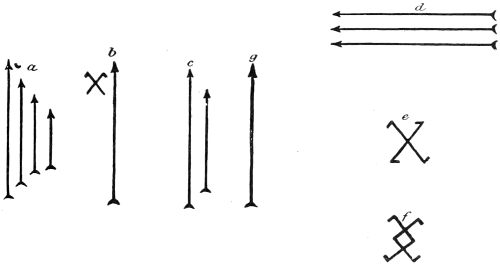
Fig. 516.—Virginian tattoo designs.
Thomas Hariot (a), in Pl. XXIII, here reproduced as Fig. 516, Discoveries of 1585, discussing “The Marckes of sundrye of the Chief mene of Virginia,” says:
The inhabitats of all the cuntrie for the most parte haue marks rased on their backs, wherby yt may be knowen what Princes subiects they bee, or of what place they haue their originall. For which cause we haue set downe those marks in this figure, and haue annexed the names of the places, that they might more easelye be discerned. Which industrie hath god indued them withal although they be verye simple, and rude. And to confesse a truthe I cannot remember, that euer I saw a better or quietter people than they.
The marks which I observed amonge them, are heere put downe in order folowinge.
The marke which is expressed by A. belongeth tho Wingino, the cheefe lorde of Roanoac.
That which hath B. is the marke of Wingino his sisters husbande.
Those which be noted with the letters of C. and D. belonge vnto diverse chefe lordes in Secotan.
Those which haue the letters E. F. G. are certaine cheefe men of Pomeiooc, and Aquascogoc.
Frère Gabriel Sagard (b) says (about 1636) of the Hurons that they tattooed by scratching with a bone of bird or fish, a black powder being applied to the bleeding wounds. The operation was not completed at once, but required several renewals. The object was to show bravery by supporting great pain as well as to terrify enemies.
In the Jesuit Relation for 1641, p. 75, it is said of the Neuter Nation that on their bodies from head to foot they marked a thousand diverse figures with charcoal pricked into the flesh on which beforehand they have traced lines for them.
Lemoyne D’Iberville, in 1649, Margry (b), remarked among the Bayogoulas that some of the young women had their faces and breasts pricked and marked with black.
In the Jesuit Relation for 1663, p. 28, there is an account that the head chief of the Iroquois, called by the French Nero, had killed sixty enemies with his own hand, the marks of which he bears printed on his thigh, which, therefore, appears covered over with black characters.
Joutel, in Margry (c), speaks of tattooing among the Texas Indians in 1687. Some women make a streak from the top of the forehead to chin, some make a triangle at the corners of their eyes, others on the breast and shoulders, others prick the lips. The marks are indelible.
Bacqueville de la Potherie (b) says of the Iroquois:
They paint several colors on the face, as black, white, yellow, blue, and vermillion. Men paint snakes from the forehead to the nose, but they prick the greater part of the body with a needle to draw blood. Bruised gunpowder makes the first coat to receive the other colors, of which they make such figures as they desire and they are never effaced.
M. Bossu (a) says of tatooing among the Osages in 1756:
It is a kind of knighthood to which they are only entitled by great actions; they suffer with pleasure in order to pass for men of courage.
If one of them should get himself marked without having previously distinguished himself in battle he would be degraded, and looked upon as a coward, unworthy of an honor. * * *
I saw an Indian, who, though he had never signalized himself in defense of the nation, got a mark made on his body in order to deceive those who only judged from appearance. The council agreed that, to obviate such an abuse, which would confound brave men with cowards, he who had wrongfully adorned himself with the figure of a club on his skin, without ever having struck a blow at war, should have the mark torn off; that is, the place should be flayed, and that the same should be done to all who would offend in the same case.
The Indian women are allowed to make marks all over their body, without any bad consequences; they endure it firmly, like the men, in order to please them, and to appear handsomer to them.
James Adair (a) says of the Chikasas in 1720:
They readily know achievements in war by the blue marks over their breasts and arms, they being as legible as our alphabetical characters are to us. Their ink is made of the root of pitch pine, which sticks to the inside of a greased earthen pot; then delineating the parts, they break through the skin with gairfish teeth, and rub over them that dark composition, to register them among the brave, and the impression is lasting. I have been told by the Chikasah that they formerly erased any false marks their warriors proudly and privately gave themselves, in order to engage them to give real proofs of their martial virtue, being surrounded by the French and their red allies; and that they degraded them in a public manner, by stretching the marked parts, and rubbing them with the juice of green corn, which in a great degree took out the impression.
Sir Alex. Mackenzie (b) tells that the Slave and Dog Rib Indians of the Athabaskan stock practiced tatooing. The men had two double lines, either black or blue, tattooed upon each cheek from the ear to the nose.
In James’s Long (c) it is reported that—
The Omahas are often neatly tattooed in straight lines, and in angles on the breast, neck, and arms. The daughters of chiefs and those of wealthy Indians generally are denoted by a small round spot tattooed on the forehead. The process of tattooing is performed by persons who make it a business of profit.
Rev. J. Owen Dorsey (a) says:
In order that the ghost may travel the ghost-road in safety it is necessary for each Dakota, during his life, to be tattooed either in the middle of the forehead or on the wrists. In that event his spirit will go directly to the “Many Lodges.”
The female Midē' of the Ojibwa frequently tattoo the temples, forehead, or cheeks of sufferers from headache or toothache, which varieties of pain are believed to be caused by some malevolent manido or spirit. By this operation such demons are expelled, the ceremony being also accompanied by songs and gesticulations of exorcism. Relief is sometimes actually obtained through the counterirritant action of the tattooing, which is effected by using a small bunch of needles, though formerly several spicules of bone were tied together or used singly.
One old Ojibwa woman who was observed in 1887 had a round spot over each temple, made there to cure headache. The spots were of a bluish-black color, and about five-eighths of an inch in diameter. Another had a similar spot upon the nasal eminence, and a line of small dots running from the nostrils, horizontally outward over either cheek, two-thirds of the distance to the ears.
The men of the Wichita wore tattoo lines from the lips downward, and it is a significant fact that their tribal sign means “tattooed people,” the same expression being used to designate them in the language of several neighboring tribes. This would imply that tattooing was not common in that region. The Kaiowa women, however, frequently had small circles tattooed on their foreheads, and the Sixtown Choctaws still are distinguished by perpendicular lines tatooed on the chin.
Mr. John Murdoch (b) reports of the Eskimo:
The custom of tattooing is almost universal among the women, but the marks are confined almost exclusively to the chin, and form a very simple pattern. This consists of one, three, five, or perhaps as many as seven vertical lines from the under lip to the tip of the chin, slightly radiating when there are more than one. When there is a single line, which is rather rare, it is generally broad, and the middle line is sometimes broader than the others. The women, as a rule, are not tattooed until they reach a marriageable age, though there were a few little girls in the two villages who had a single line on the chin. I remember seeing but one married woman in either village who was not tattooed, and she had come from a distant settlement, from Point Hope, as well as we could understand.
Tattooing on a man is a mark of distinction. Those men who are, or have been, captains of whaling umiaks that have taken whales have marks to indicate this tattooed somewhere on their persons, sometimes forming a definite tally. For instance, An̄oru had a broad band across each cheek from the corners of the mouth, made up of many indistinct lines, which was said to indicate “many whales.” Amaiyuna had the “flukes” of seven whales in a line across his chest, and Mû'n̄ialu had a couple of small marks on one forearm. Niăksára, the wife of An̄oru, also had a little mark tattooed in each corner of her mouth, which she said were “whale marks,” indicating that she was the wife of a successful whaleman. Such marks, according to Petitot (Monographie, etc., p. 15), are a part of the usual pattern in the Mackenzie district—“deux traits aux commissures de la bouche.” One or two men at Nuwŭk had each a narrow line across the face over the bridge of the nose, which were probably also “whale marks,” though we never could get a definite answer concerning them.
The tattooing is done with a needle and thread, smeared with soot or gunpowder, giving a peculiar pitted appearance to the lines. It is rather a painful operation, producing considerable inflammation and swelling, which lasts several days. The practice of tattooing the women is almost universal among the Eskimo from Greenland to Kadiak, including the Eskimo of Siberia, the only exception being the natives of Smith sound, though the custom is falling into disuse among the Eskimo who have much intercourse with the whites.
The simple pattern of straight, slightly diverging lines on the chin seems to prevail from the Mackenzie district to Kadiak, and similar chin lines appear always to form part of the more elaborate patterns, sometimes extending to the arms and other parts of the body, in fashion among the eastern Eskimo and those of Siberia, St. Lawrence island, and the Diomedes.
TATTOO ON THE PACIFIC COAST.
During the summer of 1884 Dr. Hoffman met, at Port Townsend, Washington, a party of Haida Indians from Queen Charlottes island, who were encamped there for a short time. Most of them were tattooed after the manner of the Haidas, the breast, back, forearm, and legs bearing partial or complete designs of animate forms relating to totems or myths. Some of the persons had been tattooed only in part, the figures upon the forearms, for instance, being incomplete, because the operation at a previous “potlatch” or festival had to be suspended on account of the great length of time required, or on account of an extra inflammatory condition of the affected parts.
Among this party of Haidas was Makdē'gos, the tattooer of the tribe, whose work is truly remarkable. The designs made by him are symmetrical, while the lines are uniform in width and regular and graceful in every respect. In persons tattooed upon the breast or back the part operated upon is first divided into halves by an imaginary vertical line upon the breast through the middle of the sternum and upon the back along the middle of the vertebral column. Such designs are drawn double, facing outward from this imaginary line. One side is first drawn and completed, while the other is merely a reverse transfer, made immediately afterwards or at such future time as the operation of tattooing may be renewed.
The colors are black and red, the former consisting of finely powdered charcoal, gunpowder, or India ink, while the latter is Chinese vermilion. The operation was formerly performed with sharp thorns, spines of certain fishes, or spicules of bone; but recently a small bunch of needles is used, which serves the purpose to better effect.
As is well known, the black pigments, when picked into the human skin, become rather bluish, which tint, when beneath the yellowish tinge of the Indian’s cuticle, appears of an olive or sometimes a greenish-blue shade. The colors, immediately after being tattooed upon the skin, retain more or less of the blue-black shade; but by absorption of the pigment and the persistence of the coloring matter of the pigmentary membrane the greenish tint soon appears, becoming gradually less conspicuous as time progresses, so that in some of the oldest tattooed Indians the designs are greatly weakened in coloration.
Upon the bodies of some persons examined the results of ulceration are conspicuous. This destruction of tissue is the result of inflammation caused by the tattooing and the introduction under the skin of so great a quantity of irritating foreign matter that, instead of designs in color, there are distinct, sharply defined figures in white or nearly white cicatrices, the pigmentary membrane having been totally destroyed by the ulceration.
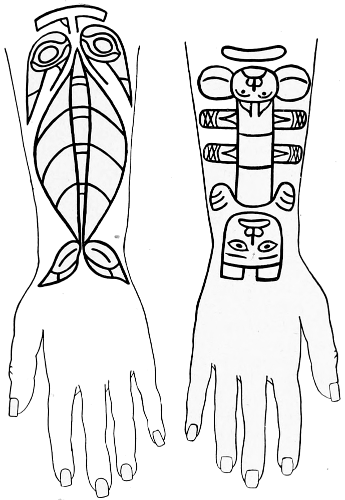
Fig. 517.—Haida tattoo, sculpin and dragon fly.
The figures represented upon the several Indians met with, as above-mentioned, were not all of totemic signification, one arm, for instance, bearing the figure of the totem of which the person is a member, while the other arm presents the outline of a mythic being, as shown in Fig. 517, copied from the arms of a woman. The left device is taken from the left forearm, and represents kul, the skulpin, a totemic animal, whereas the right hand device, taken from the right arm of the same subject, represents mamathlóna, the dragon fly, a mythic insect.
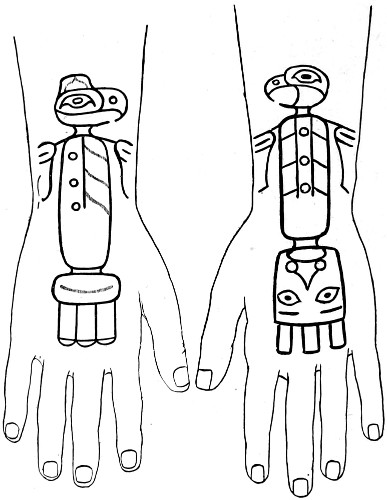
Fig. 518.—Haida tattoo, thunder-bird.
In Fig. 518 two forms of the thunderbird are presented, copied from the right and left forearms and hands, respectively, of a Haida woman. The right hand device is complete, but that on the left, copied from the opposite forearm and hand, is incomplete, and it was expected that the design would be entirely finished at the “potlatch” which was to be held in the autumn of 1884. In the completed design the transverse curve in the body of the tail was red, as also the three diagonal lines upon the body of the bird running outward from the central vertical toward the radial side of the hand. The brace-shaped lines within the head ornament had also been tattooed in red.
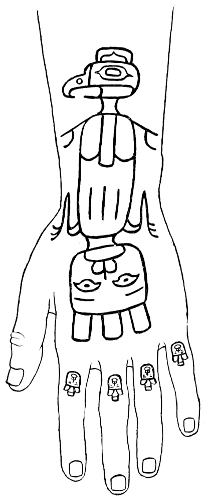
Fig. 519.—Haida tattoo, thunder-bird and tshimō's.
In some instances the totem and mythic character are shown upon the same member, as is represented in Fig. 519. This tattooing was copied from the left arm of a woman, the complete figure upon the forearm and hand being that of a thunder bird, while the four heads upon the fingers represent that of the tshimō's, a mythic animal. The thunder-bird had been tattooed upon the arms a number of years before the heads were added, probably because the protracted and painful operation of tattooing so large a figure deterred the sufferer from further sitting. Sometimes, however, such, postponement or noncompletion of an operation is the result of inability on the part of the subject to defray the expense.
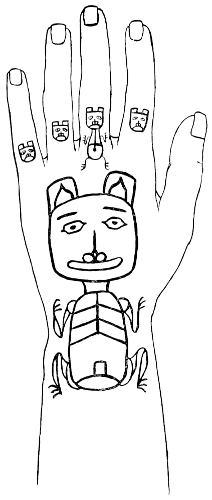
Fig. 520.—Haida tattoo, bear.
Another instance of the interrupted condition of tattooed designs is presented in Fig. 520. The figure upon the forearm and hand is that of the bear totem, and was made first. At a subsequent festival the bear heads were tattooed upon the fingers, and, last of all, the body was tattoed upon the middle finger, leaving three yet to be completed.
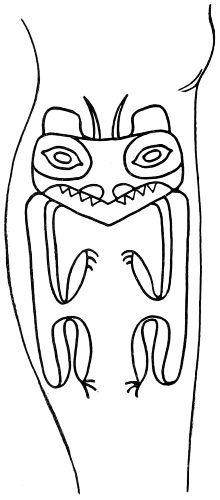
Fig. 521.—Haida tattoo, mountain goat.
Fig. 521 shows tattoo designs upon the leg. These represent mēt, the mountain goat.
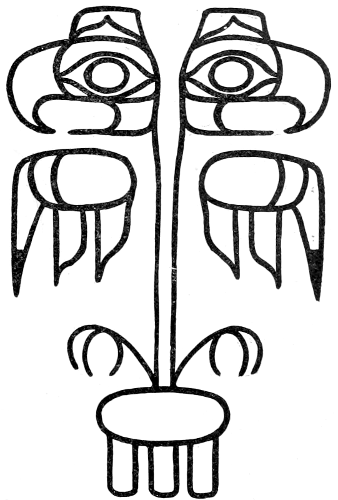
Fig. 522.—Haida tattoo, double thunder-bird.
It is seldom that double designs occur on the extremities, such being reserved for the breast and back, but an instance was noted, represented in Fig. 522, which is a representation of hélinga, the thunder-bird, and was on the left arm of a man.
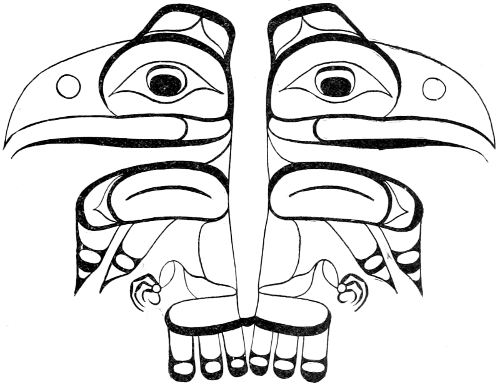
Fig. 523.—Haida tattoo, double raven.
One of the most conspicuous examples of the art observed among the party of traveling Haidas mentioned, was that of a double raven tattooed upon the breast of Makdē'gos, copied here as Fig. 523.
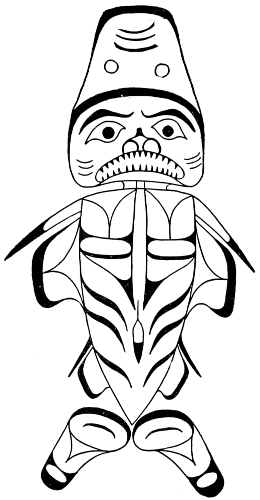
Fig. 524.—Haida tattoo, dogfish.
Upon the back of this Indian is also the figure of kahátta, the dog-fish, Fig. 524. In addition to these marks he bears also upon his extremities totemic and mythic animals.
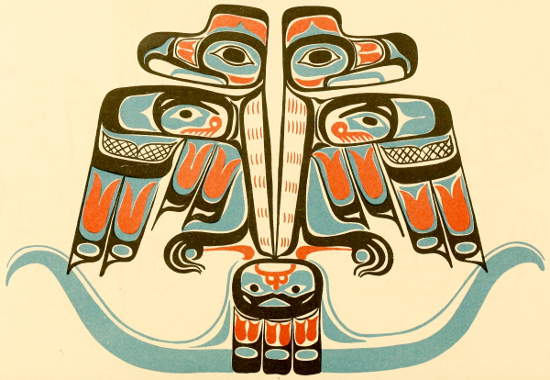
BUREAU OF ETHNOLOGY TENTH ANNUAL REPORT PL. XXIV HAIDA DOUBLE THUNDERBIRD.
Sometimes the simple outline designs employed in tattooing are painted upon property belonging to various persons, such as boats, housefronts, etc. In such instances colors are employed that could not be used in tattooing. One fine example of such is presented in Pl. XXIV and another of more elaborate design in Pl. XXV.
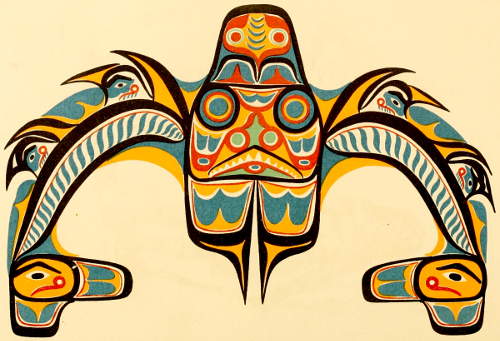
BUREAU OF ETHNOLOGY TENTH ANNUAL REPORT PL. XXV HAIDA DOG-FISH.
Mr. James G. Swan made a valuable contribution on tattoo marks of the Haida Indians of Queen Charlotte islands, British Columbia, and the Prince of Wales archipelago, Alaska, published in the Fourth Annual Report of the Bureau of Ethnology, which, much condensed, is reproduced as follows:
Among all the tribes or bands belonging to the Haida family, the practice of tattooing the person in some manner is common; but the most marked are the Haidas proper, or those living on Queen Charlotte islands, and the Kaiganis, of Prince of Wales archipelago, Alaska.
I am of the opinion, judging from my own observation of over twenty years among the coast tribes, that but few females can be found among the Indians, not only on Vancouvers island, but all along the coast to the Columbia river, and perhaps even to California, that are not marked with some device tattooed on their hands, arms, or ankles, either dots or straight lines; but of all of the tribes mentioned, the Haidas stand preeminent for tattooing, and seem to be excelled only by the natives of the Fiji islands or the King’s Mills group in the south seas. The tattoo marks of the Haidas are heraldic designs or the family totem, or crests of the wearers, and are similar to the carvings depicted on the pillars and monuments around the homes of the chiefs, which casual observers have thought were idols.
These designs are invariably placed on the men between the shoulders just below the back of the neck, on the breast, on the front part of both thighs, and on the legs below the knee. On the women they are marked on the breast, on both shoulders, on both forearms, from the elbow down over the back of the hands to the knuckles, and on both legs below the knee to the ankle.
Almost all of the Indian women of the northwest coast have tattoo marks on their hands and arms, and some on the face; but as a general thing these marks are mere dots or straight lines having no particular significance. With the Haidas, however, every mark has its meaning; those on the hands and arms of the women indicate the family name, whether they belong to the bear, beaver, wolf, or eagle totems, or any of the family of fishes. As one of them quaintly remarked to me, “If you were tattooed with the design of a swan, the Indians would know your family name.”
In order to illustrate this tattooing as correctly as possible I inclose herewith sketches of the tattoo marks on two women and their husbands, taken by me at Port Townsend.
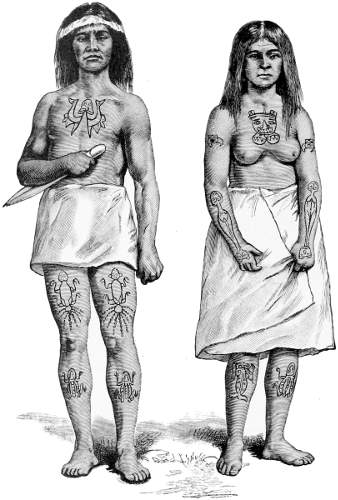
Fig. 525.—Tattooed Haidas.
The man on the left hand of Fig. 525 is a tattooed Haida. On his breast is the cod (kahátta), split from the head to the tail and laid open; on each thigh is the octopus (noo), and below each knee is the frog (flkamkostan).
The woman in the same figure has on her breast the head and forepaws of the beaver (tsching); on each shoulder is the head of the eagle or thunder-bird (skamskwin); on each arm, extending to and covering the back of the hand, is the halibut (hargo); on the right leg is the skulpin (kull); on the left leg is the frog (flkamkostan).
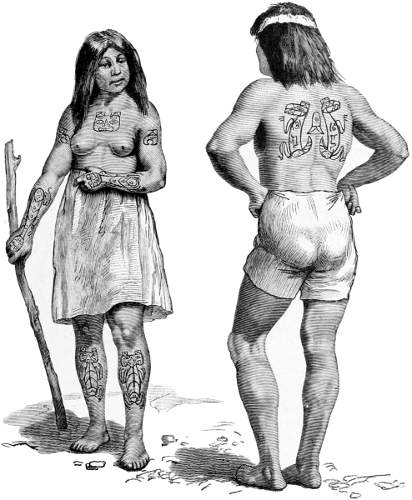
Fig. 526.—Tattooed Haidas.
The woman in Fig. 526 has a bear’s head (hoorts) on her breast. On each shoulder is the eagle’s head, and on her arms and legs are figures of the bear.
The back of the man in the same figure has the wolf (wasko), split in halves and tattooed between his shoulders, which is shown enlarged in Fig. 531. Wasko is a mythological being of the wolf species, similar to the chu-chu-hmexl of the Makah Indians, an antediluvian demon supposed to live in the mountains.
Fig. 527.—Two forms of skulpin, Haida.
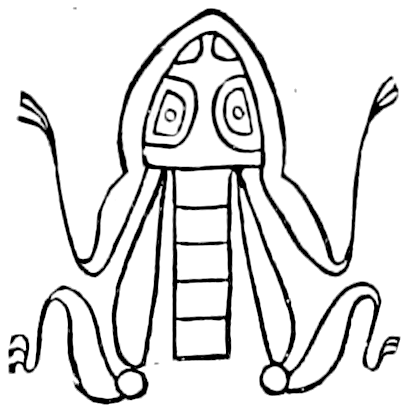
Fig. 528.—Frog, Haida.
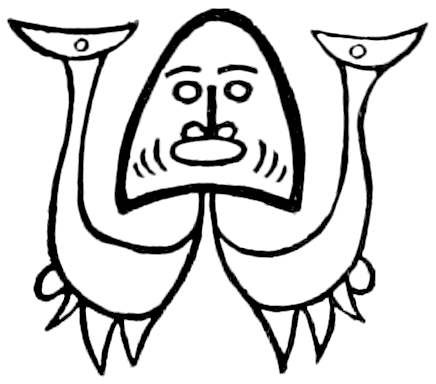
Fig. 529.—Cod, Haida.
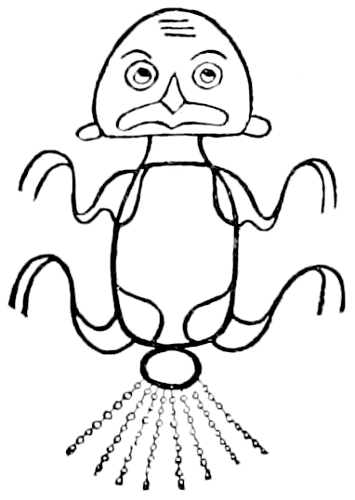
Fig. 530.—Squid, Haida.
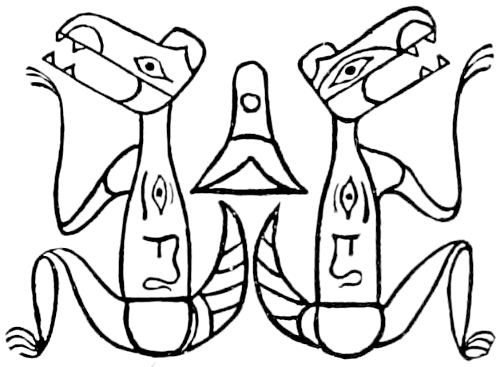
Fig. 531.—Wolf, Haida.
The skulpin, on the right leg of the woman in Fig. 525, is shown enlarged in Fig. 527; the frog on the left leg in Fig. 528. The codfish on the man in Fig. 525 is shown enlarged in Fig. 529; the octopus or squid in Fig. 530.
As the Haidas, both men and women, are very light-colored, some of the latter—full blooded Indians, too—having their skins as fair as Europeans, the tattoo marks show very distinct.
The same author continues:
This tattooing is not all done at one time, nor is it everyone who can tattoo. Certain ones, almost always men, have a natural gift which enables them to excel in this kind of work. One of the young chiefs, named Geneskelos, was the best designer I knew, and ranked among his tribe as a tattooer.
He told me the plan he adopted was first to draw the design carefully on the person with some dark pigment, then prick it in with needles, and then rub over the wound with some more coloring matter till it acquired the proper hue. He had a variety of instruments composed of needles tied neatly to sticks. His favorite one was a flat strip of ivory or bone, to which he had firmly tied five or six needles, with their points projecting beyond the end just far enough to raise the skin without inflicting a dangerous wound, but these needle points stuck out quite sufficiently to make the operation very painful, and although he applied some substance to deaden the sensation of the skin, yet the effect was on some to make them quite sick for a few days; consequently, the whole process of tattooing was not done at one time. As this tattooing is a mark of honor, it is generally done at or just prior to a Tomanawos performance and at the time of raising the heraldic columns in front of the chief’s houses. The tattooing is done in open lodge and is witnessed by the company assembled. Sometimes it takes several years before all the tattooing is done, but when completed and the person well ornamented, then they are happy and can take their seats among the elders.
Other notices about the tattooing of the Indians of the Pacific slope of North America are subjoined.
Stephen Powers (c) says the Karok (California) squaws tattoo in blue three narrow fern leaves perpendicularly on the chin, one falling from each corner of the mouth and one in the middle.
The same author reports, page 76:
Nearly every (Hupâ, California) man has ten lines tattooed across the inside of the left arm about halfway between the wrist and the elbow; and in measuring shell money he takes the string in his right hand, draws one end over his left thumb nail, and if the other end reaches to the uppermost of the tattoo lines the five shells are worth $25 in gold, or $5 a shell. Of course, it is only one in ten thousand that is long enough to reach this high value.
Also on page 96:
The Pátawāt (California) squaws tattoo in blue three narrow pinnate leaves perpendicularly on their chins, and also lines of small dots on the backs of their hands.
On page 148, of the Kástel Pomo:
The women of this and other tribes of the Coast range frequently tattoo a rude representation of a tree or other object covering nearly the whole abdomen and breast.
Of the Wintūns he says, page 233: “The squaws all tattoo three narrow lines, one falling from each corner of the mouth and one between.”
The same author says, on page 109:
The Mattoal, of California, differ from other tribes in that the men tattoo. Their distinctive mark is a round blue spot in the center of the forehead. The women tattoo pretty much all over their faces.
In respect to this matter of tattooing there is a theory entertained by some old pioneers which may be worth the mention. They hold that the reason why the women alone tattoo in all other tribes is that in case they are taken captives their own people may be able to recognize them when there comes an opportunity of ransom. There are two facts which give some color of probability to this reasoning. One is that the California Indians are rent into such infinitesimal divisions, any one of which may be arrayed in deadly feud against another at any moment, that the slight differences in their dialects would not suffice to distinguish the captive squaws. The second is that the squaws almost never attempt any ornamental tattooing, but adhere closely to the plain regulation mark of the tribe.
Blue marks tattooed upon a Mohave woman’s chin denote that she is married. See Whipple (f).
Mr. Gatschet reports that very few Klamath men now tattoo their faces, but such as are still observed have but a single line of black running from the middle of the lower lip to the chin. Half-breed girls appear to have but one perpendicular line tattooed down over the chin while the full-blood women have four perpendicular lines on the chin.
In Bancroft’s Native Races (c), it is stated that the Modoc women tattoo three blue lines, extending perpendicularly from the center and corners of the lower lip to the chin.
The same author on pages 117 and 127 of the same volume says:
The Chippewas have tattooed cheeks and foreheads. Both sexes have blue or black bars or from one to four straight lines to distinguish the tribe to which they belong. They tattoo by entering an awl or needle under the skin and drawing it out, immediately rubbing powdered charcoal into the wounds. * * * On the Yukon river among the Kutchins, the men draw a black stripe down the forehead and the nose, frequently crossing the forehead and cheeks with red lines and streaking the chin alternately with red and black, and the women tattoo the chin with a black pigment.
Stephen Powers, in Overland Monthly, XII, 537, 1874, says of the Normocs:
I saw a squaw who had executed on her cheeks the only representation of a living object which I ever saw done in tattooing. It was a couple of bird’s wings, one on each cheek, done in blue, bottom-edge up, the butt of the wing at the corner of the mouth, and the tip near the ear. It was quite well wrought, both in correctness of form and in delicateness of execution, not only separate feathers but even the filaments of the vane, being finely pricked in.
Dr. Franz Boas (c) says:
Tattooings are found on arms, breast, back, legs, and feet among the Haida; on arms and feet among the Tshimshian, Kwakiutl and Bilqula; on breast and arms among the Nootka; on the jaw among the Coast Salish women.
Among the Nootka scars may frequently be seen running at regular intervals from the shoulder down the breast to the belly, and in the same way down the legs and arms. * * *
Members of tribes practicing the Hamats'a ceremonies show remarkable scars produced by biting. At certain festivals it is the duty of the Hamats'a to bite a piece of flesh out of the arms, leg, or breast of a man.
TATTOO IN SOUTH AMERICA.
Dr. im Thurn (c) says:
Tattooing or any other permanent interference with the surface of the skin by way of ornament is practiced only to a very limited extent by the Indians; is used, in fact, only to produce the small distinctive tribal mark which many of them bear at the corners of their mouths or on their arms. It is true that an adult Indian is hardly to be found on whose thighs and arms, or on other parts of whose body are not a greater or less number of indelibly incised straight lines; but these are scars originally made for surgical, not ornamental purposes.
Herndon and Gibbon (a), p. 319, report:
Following the example of the other nations of Brazil (who tattoo themselves with thorns, or pierce their nose, the lips, and the ears,) and obeying an ancient law which commands these different tortures, this baptism of blood, * * * the Mahués have preserved * * * the great festival of the Tocandeira.
Paul Marcoy (b) says of the Passés, Yuris, Barrés, and Chumanas, of Brazil, that they mark their faces (in tattoo) with the totem, or emblem of the nation to which they belong. It is possible at a few steps distant to distinguish one nation from another.
EXTRA-LIMITAL TATTOO.
Ancient monarchs adopted special marks to distinguish slaves; likewise for vengeance as an indelible and humiliating brand, a certain tattoo denounced him who had fallen into disgrace with a sovereign. Two monks having censured the iconoclastic frenzy of the emperor Theophilus, he ordered to be imprinted on their foreheads eleven iambic verses; Philip of Macedon, from whom a soldier had solicited the possession of a man saved by him from shipwreck, ordered that on his forehead should be drawn signs indicative of his base greed; Caligula, without any object, commanded the tattooing of the Roman nobles.
In the period of the decline of Rome, tattooing was extensively practiced. Regulative laws prescribed the adopted symbols which were a proof of enlistment in the ranks and on which the military oath was taken. The purpose of this ordinance, which continued in force for a long time, was similar to that which authorized the marking of the slaves, since, the spirit of the people having become degenerated, the army was composed of mercenaries who, if they should run away, must be recognized, pursued, and captured. Until recently the practice, though more as a mark of manhood, was followed by the soldiers of the Piedmontese army.
Élisée Reclus (a) says:
Tattooing was in Polynesia widespread, and so highly developed that the artistic designs covering the body served also to clothe it. In certain islands the operation lasted so long that it had to be begun before the children were six years old, and the pattern was largely left to the skill and cunning of the professional tattooers. Still traditional motives recurred in the ornamental devices of the several tribes, who could usually be recognized by their special tracings, curved or parallel lines, diamond forms and the like. The artists were grouped in schools like the old masters in Europe, and they worked not by incision as in most Melanesian islands, but by punctures with a small comb-like instrument slightly tapped with a mallet. The pigment used in the painful and even dangerous operation was usually the fine charcoal yielded by the nut of Aleurites triloba, an oleaginous plant used for illuminating purposes throughout eastern Polynesia.
The following is from Rev. Richard Taylor (c) about the New Zealanders, Te Ika a Maui:
Before they went to fight, the youth were accustomed to mark their countenances with charcoal in different lines, and their traditions state that this was the beginning of the tattoo, for their wars became so continuous, that to save the trouble of thus constantly painting the face, they made the lines permanent by the moko; it is, however, a question whether it did not arise from a different cause; formerly the grand mass of men who went to fight were the black slaves, and when they fought side by side with their lighter colored masters, the latter on those occasions used charcoal to make it appear they were all one.
Whilst the males had every part of the face tattooed, and the thighs as well, the females had chiefly the chin and the lips, although occasionally they also had their thighs and breasts, with a few smaller marks on different parts of the body as well. There were regular rules for tattooing, and the artist always went systematically to work, beginning at one spot and gradually proceeding to another, each particular part having its distinguishing name.
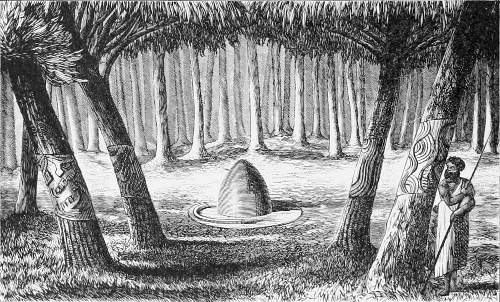
Fig. 532.—Australian grave and carved trees.
Fig. 532 is an illustration from the same work, facing page 378. It shows the “grave of an Australian native, with his name, rank, tribe, etc., cut in hieroglyphics on the trees,” which “hieroglyphics” are supposed to be connected with his tattoo marks.
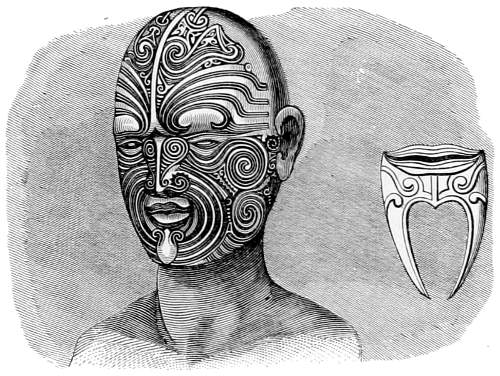
Fig. 533.—New Zealand tattooed head and chin mark.
Fig. 533 is a copy of a tattooed head carved by Hongi, and also of the tattooing on a woman’s chin, taken from the work last cited.

Fig. 534.—Tattoo design on bone, New Zealand.
The accompanying illustration, Fig. 534, is taken from a bone obtained from a mound in New Zealand, by Prof. I. C. Russell, formerly of the U. S. Geological Survey. He says that the Maori formerly tattooed the bones of enemies, though the custom now seems to have been abandoned. The work consists of sharp, shallow lines, as if made with a sharp-pointed steel instrument, into which some blackish pigment has been rubbed, filling up some of the markings, while in others scarcely a trace remains.
In connection with the use of the tattoo marks as reproduced on artificial objects see Fig. 734.
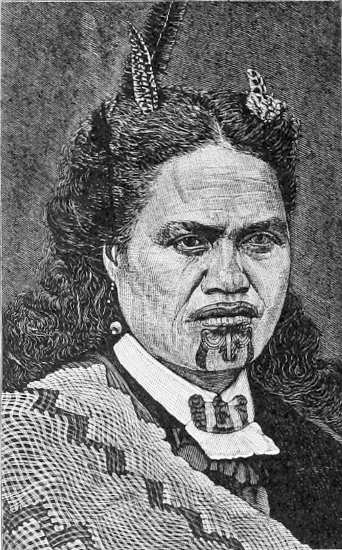
Fig. 535.—Tattooed woman, New Zealand.
Fig. 535 is a copy of a photograph obtained in New Zealand by Prof. Russell. It shows tattooing upon the chin.
Prof. Russell, in his sketch of New Zealand, published in the Am. Naturalist, XIII, 72, Feb., 1879, remarks, that the desire of the Maori for ornament is so great that they covered their features with tattooing, transferring indelibly to their faces complicated patterns of curved and spiral lines, similar to the designs with which they decorated their canoes and their houses.
E. J. Wakefield (a) reports of a man observed in New Zealand that he was a tangata tabu or sacred personage, and consequently was not adorned with tatu. He adds, p. 155, that the deeds of the natives are signed with elaborate drawings of the moko or tatu on the chiefs’ faces.
Dr. George Turner (b) says:
Herodotus found among the Thracians that the man who was not tattooed was not respected. It was the same in Samoa. Until a young man was tattooed he was considered in his minority. He could not think of marriage, and he was constantly exposed to taunts and ridicule, as being poor and of low birth, and as having no right to speak in the society of men. But as soon as he was tattooed he passed into his majority, and considered himself entitled to the respect and privileges of mature years. When a youth, therefore, reached the age of 16, he and his friends were all anxiety that he should be tattooed. He was then on the outlook for the tattooing of some young chief with whom he might unite. On these occasions six or a dozen young men would be tattooed at one time, and for these there might be four or five tattooers employed. Tattooing is still kept up to some extent and is a regular profession, just as house-building, and well paid. The custom is traced to mythologic times and has its presiding deities.
In Révue d’Ethnographie (a) (translated) it is published that—
Tattoo marks of Papuan men in New Guinea can be worn on the chest only when the man has killed an enemy. Fig. 26, p. 101, shows the marks upon the chest of Waara, who had killed five men.
Tattoo marks upon parts other than the chest of the bodies of men and women do not seem to have significance. They are made according to the fancy of the designer. Frequently the professional tattooers have styles of their own, which, being popular and generally applied, become customary to a tribe.
The illustration above mentioned is reproduced as Fig. 536.
Fig. 536.—Tattoo on Papuan chief.
In the same article, p. 112, is the following, referring to Fig. 537:
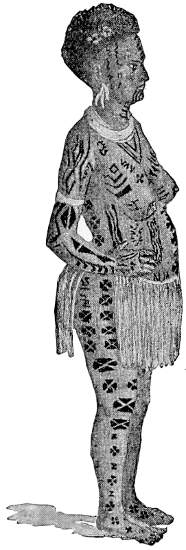
Fig. 537.—Tattooed Papuan woman.
Among the Papuans of New Guinea tattooing the chest of females denotes that they are married, though all other parts of the body, including the face and legs, may be tattooed long before; indeed the tattooing of girls may begin at 5 years of age. Fig. 39, p. 112, gives an illustration of a married woman. * * * The different forms of tattoo depend upon the style of the several artists. Family marks are not recognizable, but exist.
De Clercq (a) gives further particulars about tattooing among the Papuans of New Guinea. Among the Sègèt it is only on women. They call it “fadjan,” and the figures consist of two rows of little circles, on each side of the abdomen toward the region of the arm-pit, with a few cross strokes on the outer edge; it is done by pricking with a needle and afterwards the spots are fumigated with the smoke of burning resin. It is said to be intended as an ornament instead of dress, and that young girls do it because young men like to see it.
At Roembati tattooing is called “gomanroeri” and at Sĕkar “béti.” They do it there with bones of fish, with which they prick many holes in the skin until the blood flows, and then smear on it in spots the soot from pans and pots, which, after the staunching of the blood, leaves an ineffaceable bluish spot or streak. Besides the breast and upper arm they also tattoo in the same way the calf of the leg, and in some cases the forehead, as a mere ornamentation, both of men and women—children only in very exceptional cases.
The Bonggose and Sirito are much tattooed over the breast and shoulder. At Saoekorèm, a Doré settlement, a few women were seen tattooed on the breast and in the face. At Doré it is called “pa,” and is done with thorns, and charcoal is rubbed over the bloody spots; only here and at Mansinam is it a sign of mourning; everywhere else it merely serves as ornamentation.
At Ansoes it does not occur much, and is principally in the face; it is there called “toi.” It is found somewhat more commonly on Noord-Japèn, and then on shoulder and upper arm. In Tarfia, Tana-mérah, and Humboldt bay but few persons were tattooed, mostly on the forehead.
The tattooing is always the work of women, generally members of the family, both on men and on women. First the figure is drawn with charcoal, and if it suits the taste then begins the pricking with the thorn of a citrus or a fine bone of some animal. It is very painful and only a small spot can be pricked at one time, so long as the tattooee can stand it. If the pain is too violent, the wounds are gently pressed with a certain leaf that has been warmed, in order to soothe the pain, and the work is continued only after three or four days. No special names are given to the figures; those are chosen which suit the taste. Children are never tattooed at the wish of the parents; it is entirely a matter of individual choice.
Mr. Forbes, in Journ. Anthrop. Inst. G. B. and I., August, 1883, p. 10, says that in Timor Laut, an island of the Malay archipelago—
Both sexes tattoo a few simple devices, circles, stars, and pointed crosses, on the breast, on the brow, on the cheek, and on the wrists, and scar themselves on the arms and shoulders with red-hot stones, in imitation of immense smallpox marks, in order to ward off that disease. * * * I have, however, seen no one variola-marked, nor can I learn of any epidemic of this disease among them.
Prof. Brauns, of Halle, reports, Science, III, No. 50, p. 69, that among the Ainos of Yazo the women tattoo their chins to imitate the beards of the men.
Carl Bock (a) says:
All the married women here are tattooed on the hands and feet and sometimes on the thighs. The decoration is one of the privileges of matrimony and is not permitted to unmarried girls.
In Myths and Songs from the South Pacific, London, 1876, p. 94, it is said that in Mangaia, of the Hervey group, the tattoo is in imitation of the stripes on the two kinds of fish, avini and paoro, the color of which is blue. The legend of this is kept in the song of Iná.
Elisée Reclus (b) says:
Most of the Dayaks tattoo the arms, hands, feet, and thighs; occasionally also breast and temples. The designs, generally of a beautiful blue color on the coppery ground of the body, display great taste, and are nearly always disposed in odd numbers, which, as among so many other peoples, are supposed to be lucky.
In L’Anthropologie (a), 1890, T. I, No. 6, p. 693, it is thus reported:
Tradition tells that the Giao chi, the alleged ancestors of the Annamites, were fishermen and in danger from marine monsters. To prevent disasters from the genii of the waters the king directed the people to tattoo their bodies with the forms of the marine monsters, and afterwards the dragons, crocodiles, etc., ceased their persecution. The custom became universal, and even the kings tattooed a dragon on their thighs as a sign of power and nobility. The same idea was in the painting of eyes, etc., on the prows of Annamite boats, which strongly resembled the sea monsters.
Mr. O’Reilly, the professional tattooer of New York, in a letter, says that he is familiar with the tattoo system of Burmah, and that, besides the ruling principle of ordeal, the Burmese use special tattoo marks to charm and to bring love. They also believe that tattooing the whole person renders the skin impenetrable to weapons.
In Zeitschrift für Ethnologie (a) it is recounted of the Badagas in the Nilgiri mountains, India:
All the women are tattooed on the forehead. The following [Fig. 538] a is the most usual form:
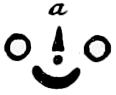
Besides this there occur the following (same Fig., b, c, d, and e):

Besides the forehead, the tattooing of which is obligatory for women, other parts of the body are often tattooed thus (same Fig., f)

Fig. 538.—Badaga tattoo marks.
on each shoulder. Other forms not infrequently found are variously grouped dots, also those shown in the same Fig., g, on the forearm and the back of the hand.
Nordenskiöld (a) gives the following account of tattooing among the Chukchis of Siberia:
It is principally the women that tattoo. The operation is performed by means of pins and soot; perhaps also graphite is employed, which the Chukchis gather. The tattooing of the women seems to be the same along the whole Chukchi coast from Cape Shelagskoy to Bering strait. The usual mode of tattooing is found represented in Nordenskiöld’s “Voyage of the Vega around Asia and Europe,” second part, p. 104. Still the tattooing on the cheek is not rarely more compound than is there shown. The picture given below [Fig. 539] represents a design of tattooing on the cheek.
Girls under nine or ten years are never tattooed. On reaching that age they gradually receive the two streaks running from the point of the nose to the root of the hair; next follow the vertical chin streaks and lastly the tattooing on the cheeks, of which the anterior arches are first formed and the posterior part of the design last. The last named in fact is the part of the design which is oftenest wanting.
The accompanying picture (the left hand of the same Fig.) represents the tattooing of the arms of a woman from the town of T’ápka. The design of the tattooing extends from the shoulder joint, where the upper triple ring is situated, to the hand joint at the bottom. As appears from the drawing, the tattooing on the right and left arm is different.
The men at the winter station of the Vega tattooed themselves only with two short horizontal streaks across the root of the nose. Some of the men at Rerkaypiya (C. North), on the other hand, had a cross tattooed on each cheek bone; others had merely painted similar ones with red mold. Some Chukchis at the latter place had also the upper lip tattooed.
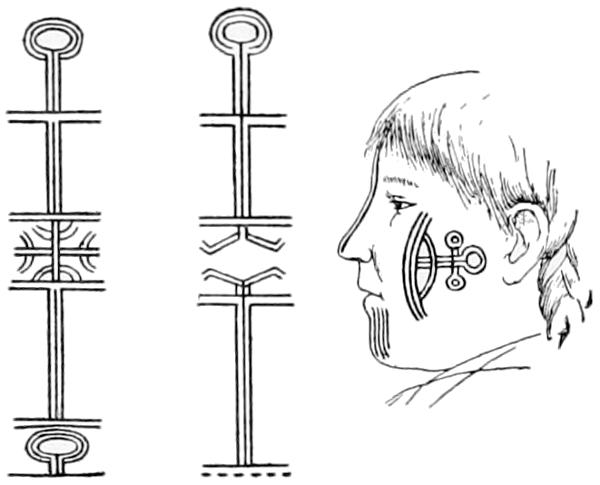
Fig. 539.—Chukchi tattoo marks.
The Chukchi designs are much simpler than those of the Eskimo.
Dr. Bazin, in “Étude sur le Tatouage dans la Régence de Tunis,” in L’Anthropologie (b), tells that the practice of tattooing is very widespread and elaborate in Tunisia, but chiefly among the natives of Arab race, who are nomads, workmen in the towns, and laborers, and also among the fellahs. The Berbers, on the contrary, who have remained mountaineers, the merchants of the coast towns, and the rich proprietors are little or not at all tattooed. In regard to the last class this proves that tattooing has become nothing but an ornament, since the members of this class are clothed in such a way that the legs and arms are completely covered, so that it would be useless to draw figures which would be invisible or almost entirely hidden. He adds that the notables “du Tinge” do not disfigure themselves by incisions. The distinctive sign of the lower classes is the presence of three incisions on the temples, three on the cheeks, and three also on the lower part of the face.
Notes on East-Equatorial Africa, in Bull. Soc. d’Anthro. de Bruxelles (a) contains the following memoranda: Tattooing is done by traveling artists. Perhaps at first it showed tribal characteristics, but now it is difficult to distinguish more than fancy. The exception is that Wawenba alone tattoo the face. The local fetiches bear marks of tattoo.
Gordon Cumming (a) says:
One of the “generals” of Mosielely, King of the Bakatlas group of the Bechuana tribe, had killed about twenty men in battle with his own hand, and bore a mark of honor for every man. This mark was a line tattooed on his ribs.
David Greig Rutherford (a) makes remarks on the people of Batanga, West Tropical Africa, from which the following is extracted:
Tattooing evidently originated in certain marks being applied to the face and other parts of the body in order to distinguish the members of one tribe from those of another. The same marks would be used for both sexes, but as the tendency to ornamentation became developed, they would be apt to observe some artistic method in making them. Among the Dualles the custom at one time appears to have obtained with both sexes, with a preponderance, however, in the practice of it on the side of the women. The men did not always see the force of giving themselves needless pain, but the women, with a shrewd idea that it added to their charms, persisted in having it done. The men (and it is significant that in places where the men have ceased to tattoo themselves they continue to do it for the women) tattooed their children at an early age, but as the girls approached a marriageable age they added, on their own account, various ornamentations to those already existing. As an example that tattooing in its later stages is regarded as an increase of beauty, I may mention an instance given me by the wife of a missionary here. A woman belonging to some neighboring tribe having come to stay at the mission, was presented with a dress of some showy material as an inducement to her to discard the loin cloth she had been in the habit of wearing and as an introduction to the habits of civilized life. She objected to wear the dress, however, upon the ground that if she did so she would thereby hide her beauty. It appears certain that the unmarried woman who is most finely tattooed wins most admiration from the men.
Oscar Peschel (a) describes tattooing as another substitute for raiment and remarks: “That it actually takes away from the impression of nudity is declared by all who have seen fully tattooed Albanese.” As bearing in the same direction Mr. Darwin, in “Voyage of the Beagle,” may be quoted, who, when at New Zealand, speaking of the clean, tidy, and healthy appearance of the young women who acted as servants within the houses, remarks: “The wives of the missionaries tried to persuade them not to be tattooed, but a famous operator having arrived from the south they said: ‘We really must have a few lines on our lips, else when we grow old our lips will shrivel, and we shall be so very ugly.’”
In September, 1891, a Zulu, claiming to be a son of the late Cetewayo, gave to a reporter of the Memphis Avalanche the following account:
When some one expressed a doubt of his coming from Zululand he promptly rolled up his sleeve and showed on his right arm the brand of the tribe. The brand is just below the elbow-joint, and it is of a bright red color, showing conclusively that it had been burned into the flesh. The design is very much on the principle of a double heart with a cross running through the center. The same design has been branded over his left eye in a somewhat smaller shape. When questioned about these brands he said:
“In our country all the men have to have the brand of their tribe burned into their skin so that they can never desert us, and no matter where they are found, you can always tell a Zulu by the brand. Always look for it just over the left eye and on the inside of the right arm. Does it hurt? Oh, no: you see they just take the skin together in their fingers and when the brand is red hot touch it once to the skin and it is all done, and the brand can never wear away.”
SCARIFICATION.
The following notes regarding scarification are presented:
Edward M. Curr (b), p. 94, says:
The principal and most general ornament throughout Australia consists of a number of scars raised on the skin. They are made by deep incisions with a flint or shell, which are kept powdered with charcoal or ashes. The wounds thus made remain open for about three months, and, when covered with skin, scars sometimes almost as thick and long as one’s middle finger remain raised above the natural surface of the skin. The incisions are made in rows on various parts of the body, principally on the chest, back, and on the upper muscle of the arm, and less frequently on the thighs and stomach. The breasts of the female are often surrounded with smaller scars. In some tribes dots cut in the skin take the place of scars. The operation is a very painful one, and is often carried out amidst yells of torture. Both sexes are marked in this manner, but the male more extensively than the female.
In the same volume, p. 338, is the following:
When, as often happens, a young man and girl of the Whajook tribe in Australia elope and remain away from the tribe for a time, it is not unusual for them to scar each other in the interim as a memorial of their illicit loves; a singular proceeding when one remembers the agony caused by the operation and the length of time required to get over it. This proceeding is a great aggravation of the original offense in the eyes of husbands.
In Vol. II, p. 414, the same author says:
Men of the Cape river tribe scar their backs and shoulders in this way. Scars are made generally on the left thigh both of the men and women, continues Mr. Chatfield, but occasionally on the right, for the purpose of denoting the particular class to which they belong; but as such a practice would conflict with the custom prevalent throughout the continent as far as known, which is to make these marks for ornament alone, the statement cannot be received without further evidence.
Thomas Worsnop, in the Prehistoric Arts of the Aborigines of Australia, says:
This practice of tattooing by scarification was common all over the continent, varying in character amongst the respective tribes, each having its own distinctive marks, although all patterned upon one monotonous idea.
This is far from evidence of distinct tribal marks, the slight varieties of which may be only local or tribal fashions.
Alfred C. Haddon (a), p. 366, says:
Tattooing is unknown, but the body used to be ornamented with raised cicatrices. * * * The Torres strait islanders are distinguished by a large, complicated, oval scar, only slightly raised and of neat construction. This, which I have been told has some connection with a turtle, occupies the right shoulder and is occasionally repeated on the left. I suspect that a young man was not allowed to bear a cicatrice until he had killed his first turtle or dugong.
The same author, op. cit., says of the Mabuiag of Torres straits:
The people were formerly divided up into a number of clans. * * * A man belonging to one clan could not wear the badge of the totem of another clan. * * * All the totems appear to have been animals—as the crocodile, snake, turtle, dugong, dog, cassowary, shark, sting-ray, kingfish, etc.
The same writer, in Notes on Mr. Beardsmore’s paper, in Jour. Anthrop. Inst. of Gr. Br. and I. (a), says:
A large number of the women of Mowat, New Guinea, have a Λ-shaped scar above the breasts. * * * Maino of Tud told me that it was cut when the brother leaves the father’s house and goes to live with the men; and another informant’s story was that it was made when a brother harpooned his first dugong or turtle. Maino (who, by the by, married a Mowat woman) said that a mark on the cheek recorded the brother’s prowess.
D’Albertis (c) tells that the people of New Guinea produced scars “by making an incision in the skin and then for a lengthened period irritating it with lime and soot. * * * They use some scars as a sign that they have traveled, and tattoo an additional figure above the right breast on the accomplishment of every additional journey. * * * In Yuli island women have nearly the whole body covered with marks. Children are seldom tattooed; slaves never. Men are hardly ever tattooed, though they have frequently marks on the chest and shoulders; rarely on the face. Tribes and families are recognized by tattoo marks.”
Mr. Griffith, in his paper on Sierra Leone, in Jour. Anthrop. Inst. of Gr. Br. and I. (b), says:
The girls are cut on their backs and loins in such a manner as to leave raised scars, which project above the surface of the skin about one-eighth of an inch. They then receive Boondoo names, and after recovery from the painful operation are released from Boondoo with great ceremony and gesticulation by some who personate Boondoo devils. They are then publicly pronounced marriageable.
Dr. Holub (b), speaking of three cuts on the breast of a Koranna of Central South Africa, says:
They have among themselves a kind of freemasonry. Some of them have on their chest three cuts. When they were asked what was the reason of it they generally refused to answer, but after gaining their confidence they confessed that they belonged to something like a secret society, and they said, “I can go through all the valleys inhabited by Korannas and Griquas, and wherever I go when I open my coat and show these three cuts I am sure to be well received.”
Mr. H. H. Johnston (a) tells us that scarification is practiced right along the course of the Congo up to the Stanley falls. The marks thus made are tribal. Thus the Bateke are always distinguished by five or six striated lines across the cheek bones, while the Bayansi scar their foreheads with a horizontal or vertical band.
E. Brussaux, in L’Anthropologie (c), reports that scarifications in Congo, which are chiefly on the back, are made for therapeutic reasons.
Julian Thomas (a) gives the following description of a New Hebrides woman:
She had a pattern traced over her throat and breast like a scarf. It was done with a shark’s tooth when a child. The women’s skins are blistered up into flowers and ferns. The skin is cut and earth and ashes placed inside the gashes, and the flesh grows into these forms. Of course they do not cover up these beauties by clothing.
According to Mr. Man, Journ. Anthrop. Inst. of Gr. Br. and I. (c), the Andamanese, who also tattoo by means of gashing, do so first by way of ornament, and, secondly, to prove the courage of the individual operated upon and his or her power of enduring pain.
SUMMARY OF STUDIES ON TATTOOING.
Many notes on the topic are omitted, especially those relating mainly to the methods of and the instruments used in the operation. But from those presented above it appears that tattooing still is or very recently was used in various parts of the world for many purposes besides the specific object of designating a tribe, clan, or family, and also apart from the general intent of personal ornament. The most notable of those purposes are as follows: 1, to distinguish between free and slave without reference to the tribe of the latter; 2, to distinguish between a high and low status in the same tribe; 3, as a certificate of bravery exhibited by supporting the ordeal of pain; 4, as marks of personal prowess, particularly, 5, as a record of achievements in war; 6, to show religious symbols; 7, as a therapeutic remedy for disease, and 8, as a prophylactic against disease; 9, as a brand of disgrace; 10, as a token of a woman’s marriage, or, sometimes, 11, of her marriageable condition; 12, identification of the person, not as tribesman or clansman, but as an individual; 13, to charm the other sex magically; 14, to inspire fear in the enemy; 15, to magically render the skin impenetrable by weapons; 16, to bring good fortune; and 17, as the device of a secret society.