Chapter IV · VICTOR STATUES REPRESENTED IN MOTION.
Reading edition
Plates 22–25 and Figures 32–62.
Just when the important step of representing the victor in motion instead of at rest was taken in Greek athletic sculpture we can not definitely say. The statement of Cornelius Nepos that the statues of athletes were first represented in movement in the fourth century B. C., after the time of the Athenian general Chabrias—whose image he describes as representing Chabrias in his favorite posture with his spear pointed at the enemy and his shield on his knee—has long since been shown to be worthless.1278 Nor is the assumption of many archæologists1279 that this advance in the plastic art was taken over into athletic sculpture soon after the statues of the Tyrannicides were set up at Athens, which represented them in the midst of their impetuous onslaught on Hipparchos, to be relied upon. These statues, however, occupy so important a place in the history of Greek sculpture that we shall consider them briefly in this connection.
THE TYRANNICIDES.
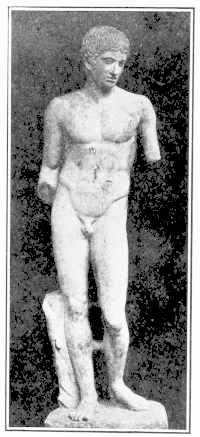
The bronze statues of the popular heroes Harmodios and Aristogeiton, by the sculptor Antenor, were, in all probability, set up in the Athenian agora in 506–5 B. C.1280 The group was carried off to Susa by Xerxes in 480 B. C., and to replace it a new group, doubtless a free imitation of the older one, and probably also of bronze, was set up in 477 B. C., the work of the sculptors Kritios and Nesiotes.1281 Nearly a century and a half later the stolen group was restored to Athens by Alexander the Great1282 and the two continued to stand side by side in Athens down to the time of Pausanias. Neither of these groups has survived to our time, but a late Roman marble copy of one, somewhat over lifesize, found in the ruins of Hadrian’s villa and now in Naples, gives us a good idea of the original, despite restorations (Fig. 32, Harmodios).1283
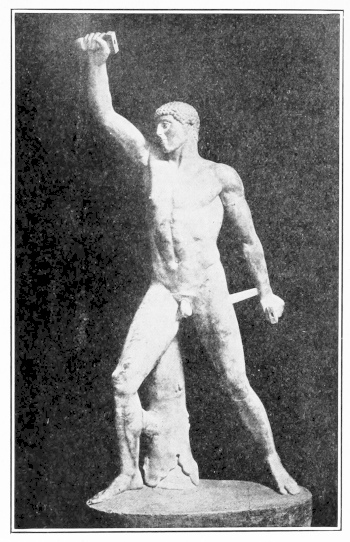
Fig. 32.—Statue of Harmodios. Museum of Naples.
The reconstruction of this group is aided by several minor works of art, reliefs, vase-paintings, coins, lead marks, etc., the number of which shows that it was a common subject for Athenian artists. Botho Graef, by a careful study of the female statue found on the Akropolis in 1886 and inscribed as the work of Antenor, has shown that the stylistic contrast between it and the Naples group is too great for the latter to be assigned to Antenor.1284 It is now, therefore, the prevailing view that the Naples group reproduces the later statues of Kritios and his associate.1285 We do not know, then, how the older group looked, but we are certain that it was different from the later one, for, in the years elapsing between the dates of the two, Attic sculptors had become entirely free from the Ionic influence which we discussed in the preceding chapter and which characterizes the female statue of Antenor. Archaic stiffness, however, is still traceable in the later group, for in the copy we see a work which is “concise, sinewy, hard, and with strained lines,” in harmony with Lucian’s characterization of the works of Hegias, Kritios, and Nesiotes.1286
The restorations of the Naples group, though right in the main, make us doubtful as to the exact pose of the original figures.1287 Harmodios has new arms, new right leg, and left leg below the knee, while Aristogeiton has a Lysippan head in place of the original bearded one, to correspond better with that of his companion. His left arm, with the drapery hanging down, has been put on at a wrong angle, as he should be represented holding a scabbard in the left hand and a sword in the right. On a vase fragment (oinochoe) in Boston1288 both heroes are making the onset, the younger one (Harmodios) in front of the other, but in the original statues, they were probably making the onset abreast, something that the vase-painter could not represent.1289
While the Akropolis ephebe, already discussed as showing Argive influence (Fig. 17), still shows but little break with the law of “frontality” formulated by J. Lange,1290 whereby an “imaginary line passing through the skull, nose, backbone, and navel, dividing the body into two symmetrical halves, is invariably straight, never bending to either side,” the Tyrannicides have broken it completely. The ephebe has his head slightly turned to one side, and, because of resemblances in head and body to the figure of Harmodios, has been assigned to Kritios or his school.1291 Another statue at rest ascribed to the same school is the athlete in the Somzée collection, which reminds us of the Pelops of the East Gable at Olympia.1292 We have record of one more statue by Kritios himself, which was represented in motion only less violent than that of the Tyrannicides. Pausanias saw on the Akropolis of Athens a statue by him of the hoplite runner Epicharinos, which represented the athlete in the attitude of one practicing starts, perhaps in the very pose of the Tuebingen statuette (Fig. 42).1293
In the statues of the Tyrannicides, then, which might pass equally well for typical athletes of the time, we have examples of statues in motion at the end of the sixth century B. C.; for the same violent action must have characterized the earlier group of Antenor as the later one. We have seen that the Aeginetan sculptors not only made pediment groups in action at a date not later than that of the group by Kritios and Nesiotes, but single figures still earlier. Thus the sculptor Glaukias represented the Karystian boy boxer Glaukos in the act of sparring with an imaginary opponent.1294 Though Glaukos won in Ol. 65 ( = 520 B. C.), his statue was set up later by his son, perhaps as late as the end of the sixth century B. C., or the beginning of the fifth, as the floruit of the sculptor would show.1295 This is the oldest example attested by literary evidence of an athlete statue in motion at Olympia. Whether Glaukias got his motive from Antenor’s Tyrannicides, or whether his work was the older, we can not determine, but it is safe to say that this genre of statuary must have existed at Olympia long before, as we know it did elsewhere. The Rampin head, already discussed as a fragment of a victor statue, shows by the turn of its neck that athlete statues represented in motion existed at least as far back as the first half of the sixth century B. C.1296
ANTIQUITY OF MOTION STATUES IN GREECE.
Apart from specifically athletic types, we know that statues in motion, especially those representing winged figures, antedated the sixth century B. C. in Greece, and were, perhaps, coeval with the very origin of Greek art.1297 We know that the oldest Egyptian art attempted to render the human body in motion. We may instance the limestone funerary statuette dating from the Old Kingdom, which represents a slave woman grinding corn,1298 and similar figures found in the graves of Memphis. In fact, the making of such statues ceased in Egyptian art after the end of the Old Kingdom. While Assyro-Babylonian art represented figures in motion only on reliefs, Cretan art, as we have seen in the first chapter, showed the utmost skill in representing movement in figures in the round. It used to be assumed that in Greek art motion statues developed out of the archaic “Apollo” type through the gradual freeing of legs and arms. Any such assumption is easily disproved by the fact that figures in motion exist, which date back almost as far as figures at rest. It is equally fallacious to argue that slight movement was easier for the early artist to represent than violent movement, for just the contrary was the case, so that in general the greater the movement represented, the greater is the age of the given monument. Early vase-paintings show that the early painter delighted in portraying free movement.1299 It may be that the vase-painter preceded the sculptor in portraying movement, for it was easier to effect this in two dimensions than in three. But that statues in motion were already known at the beginning of the sixth century B. C., at least, is shown by the winged flying figure known as the Nike of Archermos,1300 unearthed on the island of Delos by the French in 1877, which is a masterpiece of early Chian sculpture, perhaps coeval with the statue dedicated to Artemis by Nikandre of Naxos, found a year later on Delos,1301 even though the latter appears more archaic. This earliest example of treating a flying figure in Greek sculpture we find repeated almost unchanged for a long time after, especially for akroteria figures on temples and in the minor arts. We might mention the bronze statuette of the end of the sixth century B. C., found on the Akropolis, which comes from the edge of a vessel and represents a winged Nike springing through the air, the legs in profile and the head and upper body turned to the front, just as in the figure of Archermos.1302 Such figures completely disprove the contention of Sikes that the Greek idea of a winged Nike did not antedate the fifth century B. C.1303 The early date of statues represented in a lunging attitude, like the Tyrannicides, is also shown by the story that Herakles destroyed his own statue by Daidalos in the agora of Elis, because in the night he mistook it for an enemy lunging at him. The scheme of combatants fighting with lances seems to have been native to Rhodian art at the end of the seventh century B. C., for we see it first on a painted terra-cotta plate in the British Museum, which represents Hektor and Menelaos fighting for the body of Euphorbos.1304 This pose was taken over into other arts, as we see it in the bronze statuette of a warrior found in Dodona in 1880, now in the Antiquarium in Berlin, which dates from the end of the sixth century B. C., or the beginning of the fifth.1305 All these examples are sufficient to show that representing the human figure in motion was an ancient motive in Greek art.
PYTHAGORAS AND MYRON.
Besides Kritios, two other sculptors of the transitional period—Pythagoras and Myron—gave a great impetus to the type of statue in motion in the first half of the fifth century B. C. Before proceeding further we shall briefly consider their artistic activity.
The attempt to ascribe something tangible to Pythagoras of Rhegion has often been made.1306 Practically all we really know about him is that he was celebrated for his statues of athletes. Pausanias mentions seven statues at Olympia of victors who won in many different events, in running (including the hoplite-race), wrestling, boxing, and the chariot-race; and Pliny, in giving a list of his works, praises the statue of a pancratiast at Delphi.1307 Thus Pausanias records the statues of the Sicilian wrestler Leontiskos, who won two victories in Ols. 81 and 82 ( = 456 and 452 B. C.);1308 of the boy boxer Protolaos of Mantinea, who won in Ol. (?) 74 ( = 484 B. C.);1309 of the boxer Euthymos of Lokroi, who won three times in Ols. 74, 76, 77 ( = 484, 476, 472 B. C.);1310 of Dromeus of Stymphalos, who won the long foot-race (δόλιχος) twice in Ols. (?) 80 and 81 ( = 460 and 456 B. C.);1311 of Astylos of Kroton, who won the stade-race, the double foot-race (δίαυλος) three times, and the hoplite-race twice in Ols. 73, 74, 75, 76 ( = 488–476 B. C.);1312 of the hoplite victor Mnaseas of Kyrene, victor in Ol. 81 ( = 456 B. C.);1313 and of the latter’s son Kratisthenes, who won the chariot-race in Ol. (?) 83 ( = 448 B. C.).1314 Some of these statues at Olympia must have been represented at rest, while others appear to have been represented in motion. Thus the statue of Mnaseas—though it is possible that it was represented in motion like that of Epicharinos by Kritios already mentioned—was probably represented at rest, since Pausanias described it simply as that of an ὁπλίτης ἀνήρ.1315 When we inquire into the style of Pythagoras we do not find much that is definite to guide us. Besides the bare list of his works, we have little except the statement of Diogenes Laertios that he was the first to aim at rhythm and symmetry.1316 Nevertheless many attempts have been made to identify his athlete statues with existing copies. Waldstein’s interpretation of the Choiseul-Gouffier statue in the British Museum (Pl. 7A), and of the so-called Apollo-on-the-Omphalos in Athens (Pl. 7B), as copies of an original athlete statue, is, as we have shown in the second chapter, well-founded, since the muscular build and the coiffure of these statues betoken the athlete. But his further attempt to show that the original was by Pythagoras, and his identifying it with the statue of the boxer Euthymos at Olympia, is not so reasonable.1317
The attempt to ascribe the head of a pancratiast from Perinthos in Dresden (Fig. 33)1318 to Pythagoras is not convincing, though Furtwaengler has included it in his provisional Pythagorean group,1319 as he does the boxer in the Louvre known as Pollux (Fig. 58),1320 the athlete of the Boboli Gardens in Florence formerly called Harmodios by Benndorf,1321 and the statue of an athlete of later style in Lansdowne House, London.1322 Other Fig. 33.—Head of an Athlete, from Perinthos. Albertinum, Dresden. scholars have also connected the Perinthos head with Pythagoras.1323 Hermann brought it into relation with the bust in the Riccardi Palace in Florence, which, despite its swollen ears, we have already classed as representing a hero and not an athlete, because of the garment thrown over the shoulder.1324 Furtwaengler tried to show that this bust was Myronian in style, classing it and the head of an athlete in Ince Blundell Hall, Lancashire, England,1325 along with that of the earlier Diskobolos, explaining the acknowledged differences in the three by Pliny’s statement that Myron primus multiplicasse veritatem videtur.1326 Arndt lists the Perinthos, Riccardi, and Ince Blundell heads, together with two others in the Jakobsen collection in Copenhagen,1327 the head of the so-called Pollux of the Louvre, a bearded head in Petrograd,1328 and the so-called head of Peisistratos in the Villa Albani, Rome,1329 as works emanating from one school of sculptors—the differences being explained by the many copyists. But to attempt to differentiate within the group two different sculptors, Myron or Pythagoras, he finds impossible, chiefly because we are dealing in every case with copies and not with originals, and because in no case are we certain that the head belongs to the torso on which it is set.1330 Still another critic, A. Schober, classes together as more or less related works the Riccardi, Ince Blundell, Perinthos, and Ny-Carlsberg heads, the Louvre boxer (Pollux), Chinnery Hermes in the British Museum,1331 the Boboli athlete, the athlete metamorphosed into a Hermes in the Loggia Scoperta of the Vatican, and the Lansdowne athlete, and finds them all Myronian. He believes the Perinthos head to be the prototype of the Riccardi and Ince Blundell heads.1332
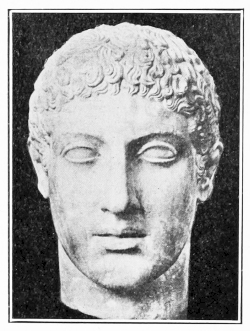
In all this confusion of opinion as to the style of Pythagoras, and in the absence of any fixed criterion of judgment furnished by an original authenticated work, it seems hazardous to ascribe this or that sculpture to this little-known artist. The difficulty of separating Myron and Pythagoras is even greater than that which confronts us in trying to distinguish works of Lysippos and Skopas in the next century. We may some day recover a genuine Pythagorean athlete statue, though this is extremely improbable now that we have no more to expect from Olympia and Delphi, where most of his statues appear to have stood. But despite the difficulty, many identifications of his Olympia statues have been suggested, some of which we shall now mention.
As Pausanias says that the victor Mnaseas was surnamed Libys, the Libyan, and that his statue was by Pythagoras, it may be that this is the statue mentioned by Pliny in the words: [Pythagoras] fecit ... et Libyn, puerum tenentem tabellam eodem loco (= Olympiae) et mala ferentem nudum.1333 However, in that case we can not connect the words Libyn and puerum, since one represented a man and the other a boy.1334 Consequently, Pliny is speaking of three different statues, and not two, by this artist. Reisch believes that the statues of the boy and the nude man were represented at rest,1335 the boy bearing a tablet (i. e., an iconic πινάκιον) in his hand, like the Athenian youth appearing on a vase-painting in Munich.1336 Another scholar, L. von Urlichs, formerly identified the boy carrying the tablet with the statue of Protolaos at Olympia,1337 explaining the tablet as a means of characterizing the young learner. He changed his theory later,1338 when, in consequence of the discovery of the Corinthian tablets, he called it a votive tablet. His son, H. L. von Urlichs, agreed with him because of a passage in the collection of Proverbs by Zenobios, the sophist of Hadrian’s age,1339 according to which the marble statue of Nemesis at Rhamnous by Pheidias’ favorite pupil, the Parian sculptor Agorakritos,1340 held an apple-branch in her left hand, from which a small tablet containing the artist’s name was suspended, and also because certain coins of Syracuse and Catania represent Nike as carrying a tablet hung by a ribbon, on which the coin-striker’s name was engraved.1341 The same scholar further identified the nude man carrying the apples with the statue of Dromeus at Olympia. Since Pliny does not expressly say that the statue of the nude man was at Olympia, even though the sense of the passage inclines us to think it was, L. von Urlichs interprets the apples in the hand as an additional prize at Delphi, and so makes the statue that of a Pythian victor.1342 All such identifications are based on too uncertain premises.
That Pythagoras did make statues in motion is proved by his statue of a limping man at Syracuse mentioned by Pliny1343 in very realistic terms. We know of other statues by him representing athletes in motion only by inference. Thus, in the passage just quoted, Pliny says that he surpassed Myron with his Delphian pancratiast, which appears, inasmuch as Pliny merely calls the statue a pancratiast without mentioning any attribute, to have been represented in the characteristic lunging pose.1344 However, we can not say definitely, since the contemporary statue of the pancratiast Kallias, by Mikon of Athens, was represented in the attitude of rest, as we learn from the footprints on its recovered base.1345 Pliny also says that Pythagoras surpassed with his Delphian pancratiast his own statue of Leontiskos,1346 a statement which similarly appears to mark the latter as a statue in motion. Reisch assumes that the statue of Euthymos was in motion, since Pausanias says it was an ἀνδριὰς θέας ἐς τὰ μάλιστα ἄξιος.1347 On the whole, then, we may assume that Pythagoras was a sculptor who represented many of his victors in the attitude of motion.
Love of movement also characterized the artistic temperament of Myron, even though we know that he represented gods, heroes, and even athletes, at rest. Thus coins show that Athena in his Marsyas group was represented as standing in a tranquil pose.1348 Similarly the Riccardi bust in Florence, already discussed, which may be Myronian, comes from a statue of a hero shown in an attitude of rest. Myron was the first Greek sculptor to make his statues and groups self-sufficient,1349 that is, he gave to them a concentration which does not allow the spectator’s attention to wander. We readily see this new principle in art when we compare the Diskobolos and the group of the Tyrannicides. In the latter our attention is not concentrated, for a third figure, that of the tyrant on whom the onset is being made, is required in imagination to complete the group. We have no originals from Myron’s hand, but we are in far better case in regard to his work than in regard to that of Pythagoras, since we have unmistakable copies of two of his greatest works, the Marsyas and the Diskobolos. In them there is little trace of the archaic stiffness that is still visible in the Tyrannicides. Both of these works are represented in violent action, and in both there is complete concentration. While the Diskobolos represents a trained palæstra athlete executing a graceful movement, the Marsyas represents a wild Satyr of the woods, wholly untrained and controlled by savage passions, in the moment of fear.1350 In the Diskobolos the face is impassive, being little affected by the violent movement of the body—a contrast only partly to be explained as due to the copyist; in the Marsyas, on the contrary, there is complete harmony between the facial expression and the violent action of the body.
PLATE 22
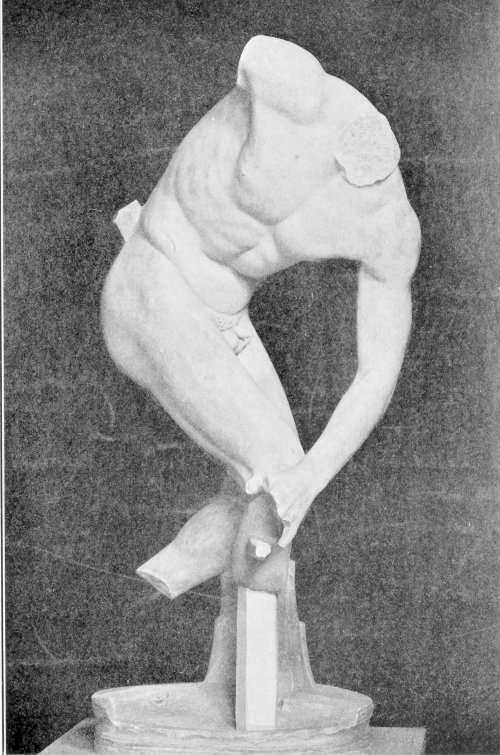
Statue of the Diskobolos, from Castel Porziano, after Myron. Museo delle Terme, Rome.
Since we are chiefly dependent for our knowledge of Myron’s athletic work on the marble copies of the Diskobolos, which represents a new era in athletic art, and since this statue is perhaps the most famous athletic statue of all times, it will be well to speak of it here at some length. It is not, so far as we know, the statue of any particular victor, but rather a study in athletic sculpture.1351 Of this work there are twelve full size replicas and several statuettes. We shall discuss only those which give us the best idea of the lost original. The most faithful copy is the superb marble statue in the Palazzo Lancellotti, Rome, discovered on the Esquiline in 1781 (head seen in Pl. 23).1352 As the head has never been broken away from the body, this copy preserves the original pose, whereas all other copies have the head turned in the wrong direction.1353 The head and face preserve Attic proportions and the treatment of the hair and muscles differs from that of the other copies, which disclose later elements. The hair, in particular, shows signs of archaism, just as it must have been treated in the original, as evinced by Pliny’s criticism.1354 The most carefully worked copy, however, is the Parian marble torso, which was found in 1906 at Castel Porziano, the site of the ancient Laurentum, and is now in the Museo delle Terme, Rome (Pl. 22).1355 This torso was already restored in antiquity. Since the villa in which it was found was built in Augustus’ day and was restored in the second century A. D., we have the approximate dates both of the origin and restoration of the statue. A weak copy, discovered in Tivoli in 1791, is in the Sala della Biga of the Vatican; the head, left arm, and right leg below the knee have been restored, the head wrongly (Fig. 34).1356 A Græco-Roman copy discovered also in 1791, in Hadrian’s villa, is in the British Museum (Fig. 35).1357 Here the head, although antique, belongs to another copy, and has been set upon the torso wrongly, in such a way that the throat has two Adam’s apples. It looks straight to the ground and not upward as in the Lancellotti copy. There is a better replica of the torso in the Capitoline Museum, which formerly belonged to the French sculptor Étienne Mounot (1658–1733), who wrongly restored it as a falling warrior. It agrees in accuracy with the Lancellotti copy, though it is dry and lifeless, and is a better guide to the original than either the Vatican or British Museum replicas.1358 A combination of these and other copies gives us an excellent idea of the original bronze. In Pl. 23 we give a combination of the Vatican torso and the Lancellotti head from a cast in Munich.1359 Perhaps a better combination is that given by Bulle1360 from a cast made up of the delle Terme body, the Lancellotti head, the right arm and the diskos from the Casa Buonarroti in Florence, the feet from the British Museum copy and the fingers of the left hand being freely restored.
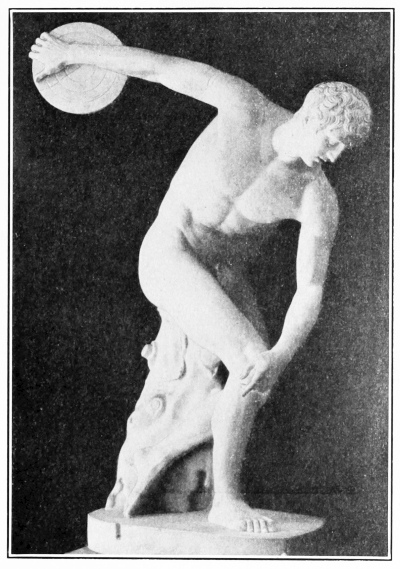
Fig. 34.—Statue of the Diskobolos, after Myron. Vatican Museum, Rome.
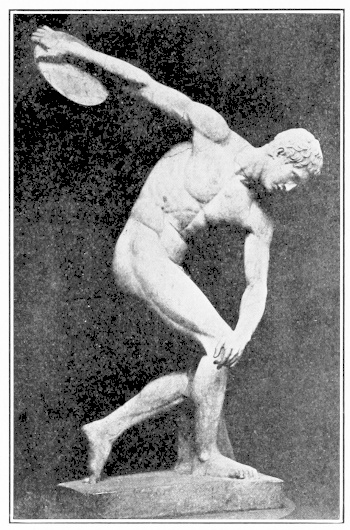
Fig. 35.—Statue of the Diskobolos, after Myron. British Museum, London.
PLATE 23
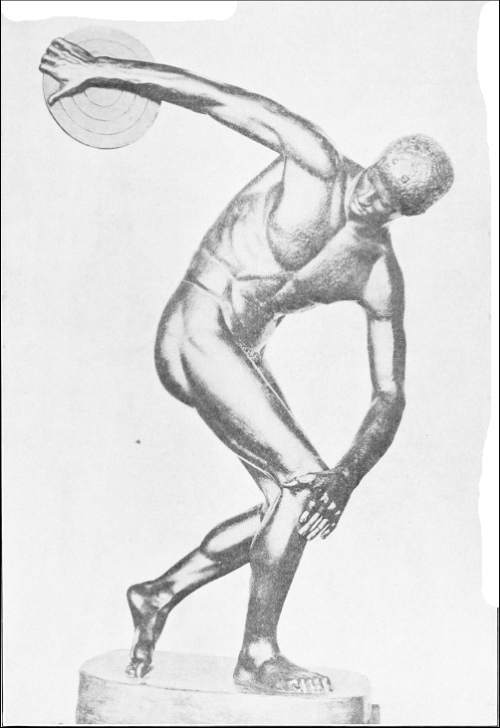
Statue of the Diskobolos, after Myron. A bronzed Cast from the Statue in the Vatican and Head from the Statue in the Palazzo Lancellotti, Rome.
The pose of the Lancellotti copy agrees with Lucian’s description of the original: “Surely, said I, you do not speak of the quoit-thrower who stoops in the attitude of one who is making his cast, turning round toward the hand that holds the quoit, and bending the other knee gently beneath him, like one who will rise erect as he hurls the quoit?”1361 That the head of the original was turned back as in the Lancellotti copy, and not downwards, as in the Vatican, British Museum and other replicas, is shown by this description, which is corroborated by two bronze statuettes in Munich and Arolsen1362 and by a gem in the British Museum.1363 Myron chose the most difficult, but at the same time the most characteristic, moment in swinging the diskos, the moment which combines the idea of rest and motion. The quoit has been swung back as far as it will go. The momentary pause before it is hurled forward suggests rest and at the same time implies motion, both that which has preceded and that which is to follow. It is this short pause at the end of the backward swing which the sculptor has fixed in the bronze. The right arm is stretched backwards as far as possible and draws with it the body with the left arm and head; in another instant the diskos will be hurled and the tension on the right leg relaxed. The original statue rested upon the right foot; the tree trunk is a necessary addition to the marble copies. As Greek art was mostly characterized by repose, we are not surprised that such a daring effect received the censure of the ancient critics. Quintilian says that if any one blames the statue for its labored effect, he is wrong, since the novelty and the difficulty of the work are its chief merits.1364 For a statue of the transitional stage of Greek sculpture it is remarkably bold; only in imagination can we see the action by which the body has got into this position and by which it will recover its equilibrium. It illustrates a principle laid down by Lessing in the Laokoön: “Of ever changing nature the artist can use only a single moment and this from a single point of view. And as his work is meant to be looked at not for an instant, but with long consideration, he must choose the most fruitful moment, and the most fruitful point of view, that, to wit, which leaves the power of imagination free.”1365
Myron was the sculptor of five statues for four victors at Olympia, one of a pancratiast, another of a boxer, a third of a runner, and two of a victor in the hoplite-race and the chariot-race.1366 Pliny also says that Myron made statues of pentathletes and pancratiasts at Delphi.1367 Thus he showed as much versatility as Pythagoras in the representation of victors in different contests. None of these statues has survived and the identification of existing Roman copies with any of them is, of course, highly problematical. Thus, a little further on we make the suggestion that the statue of the boxer in the Louvre, commonly known as Pollux (Fig. 58), may be, because of its Myronian character, the statue of the unknown Arkadian boxer at Olympia mentioned by Pausanias (in connection with the boy boxer Philippos) as the work of Myron.1368 Pliny, in the passage just cited, also mentions statues of pristae by Myron, a word which has given rise to many interpretations: e. g., sea-monsters (pristes or pistres), men working with a cross-cut saw (pristae), players at see-saw (pristae?),1369 and boxers (pyctae).1370 The manuscripts are unanimous for pristae, and hence it is probable that a realistic group by Myron is meant, since Myron is often classed as a realist in opposition to Polykleitos, the idealist. Long ago Dalecampius, followed in recent years by Furtwaengler,1371 believed that these pristae formed a votive offering, and H. L. von Urlichs has shown that a group of sawyers as the dedication of some master-builder is quite in harmony with fifth-century traditions.1372 H. Stuart Jones1373 connects the words Perseum et pristas of Pliny’s text, and follows the theory of Mayer1374 that the carpenters or sawyers were a part of a group, which represented the inclosure of Danaë and Perseus in the chest.
While the athletic statues in motion by Pythagoras and Myron became models for later sculptors, especially in the following century,1375 the rest statues of Polykleitos still remained in vogue in works by members of his family and school down through the fourth century, as we have seen in our treatment of the Argive-Sikyonian sculptors at Olympia.
MOTION STATUES REPRESENTING VICTORS IN VARIOUS CONTESTS.
We shall now review the types of victor statues, which reproduced in their pose the various contests, i. e., statues in motion. We shall find it convenient to follow in the main the order of contests as they appear on the Oxyrhynchus Papyrus1376—the stade-race (στάδιον), double race (δίαυλος), long race (δόλιχος), pentathlon (πένταθλον), wrestling, (πάλη), boxing (πύξ), pankration (παγκράτιον), hoplite-race (ὁπλίτης), chariot-race (τέθριππον), and horse-race (κέλης)—except that we shall class the four running races (nos. 1, 2, 3, and 11) together and include the three boys’ contests (παίδων στάδιον, πάλη, πύξ, nos. 8, 9, 10) under the corresponding men’s events. The classification of competitors by ages (ἡλικίαι), which varied at different festivals, will need a word of explanation. While athletes at Nemea, the Isthmus, and Delphi were divided into three classes, παῖδες, ἀγένειοι, and ἄνδρες,1377 at Olympia they were divided into two, παῖδες and ἄνδρες.1378 At local competitions there was a more elaborate classification. Thus at the Bœotian Erotidia, boys were divided into younger and older;1379 at the games held on the island of Chios there were five divisions, boys, younger, middle, and older ephebes, and men;1380 and at the Athenian Theseia, the boys were divided into first, second, and third classes, while an open contest also existed for boys of any age.1381 Girls at the Heraia at Olympia were similarly divided into three classes.1382 Plato proposed three classes of athletes in his Laws—παιδικοί, ἄνδρες, and a third class, ἀγένειοι, between boys and men.1383 The classification of athletes at Athens into παῖδες and ἄνδρες, adopted by Boeckh, Dittenberger, and Dumont,1384 is now the one generally followed. According to it the παῖδες were subdivided into three classes, those τῆς πρώτης ἡλικίας, τῆς δευτέρας, and τῆς τρίτης; and so the ἀγένειοι were merely the παῖδες της τρίτης ἡλικίας. The boys, including the ἀγένειοι, ranged from 12 to 18 years old; at 18 they became ἔφηβοι or ἄνδρες.1385 We have already seen that the age of boy victors at Olympia was over 17 and under 20.1386
As we have already remarked in an earlier chapter, we are mostly indebted to Pausanias for our knowledge of the victor statues at Olympia.1387 He mentions in his periegesis of the Altis 192 monuments, which were erected to 187 victors.1388 Some of these victors won in more than one contest, so that there are 258 different victories recorded in all. In the following sections we shall see how these were distributed among the various contests.
Runners: Stadiodromoi, Diaulodromoi, Dolichodromoi.
Running races formed at all times a part of the Greek games and of the exercises of the youth in the gymnasia and palæstræ. A scholiast on Pindar1389 says that the running race had its origin in the first celebration of the Eleusinian mysteries. It figures largely in mythology, especially at Olympia, which also shows its antiquity.1390 In historic times many varieties of running developed, but four chief ones were practised at the great games.1391 First there was the simple stade-race (στάδιον, δρόμος), which was merely the length of the stadion or 600 Greek feet, corresponding with the running race of Homer.1392 Then there was the double race (δίαυλος), twice as long as the preceding, to the end of the course and back again.1393 The long race (δόλιχος, ὁ μακρὸς δρόμος), which Philostratos derives from the institution of messenger runners (hemerodromoi),1394 is variously given as seven, twelve, fourteen, twenty, and twenty-four stades in length, i. e., from about four-fifths of a mile to nearly three miles.1395 Lastly there was the race in armor (ὁπλιτοδρόμος,1396 ὁπλίτης,1397 ἀσπίς.1398) The long race was instituted not so much as a contest of fleetness as of endurance. At Olympia only men were admitted, though there was such a race for boys at Delphi.1399 The Cretans were famed in this style of running.1400 The race in armor, which was a double race or two stades at Olympia, we shall discuss further on. Probably the boys’ stade-race at Olympia was shorter than that of the men. Plato, who gives the historic division of running races outlined above, has the boys run one-half of the men’s course and the ephebes (ἀγένειοι) two-thirds.1401 Just so Pausanias has the girl runners at the Olympia Heraia run one-sixth of the men’s stadion.1402
At Olympia, as at the Panathenaia in Athens and probably elsewhere, the first event preceding all others was the stade-race. Pausanias says that it was the oldest event at Olympia,1403 and it existed there all through antiquity from the first recorded Olympiad ( = 776 B. C.), when Koroibos of Elis won.1404 But the notion generally held1405 that the stade-race for men was honored above all other events at Olympia, because the winner became ἐπώνυμος for the Olympiad and because his name occurs in the lists of Africanus for every Olympiad, is incorrect. In two passages Thukydides cites Olympic pancratiasts for dates,1406 and in the earliest inscription which makes use of Olympiads for chronology the later introduced pankration is the event used.1407 The literary supremacy of Athens, where, at the Panathenaia, the stade-race was the most important event, doubtless helped later in making the stade runner at Olympia eponymous. This custom, however, was not generally employed before the third century B. C.
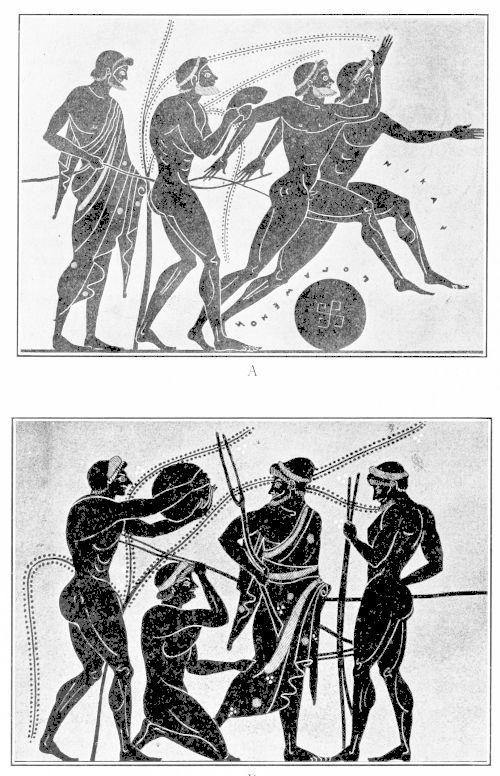
Fig. 36.—Athletic Scenes from a Bacchic Amphora in Rome. A. Stadiodromoi and Leaper. B. Diskobolos and Akontistai.
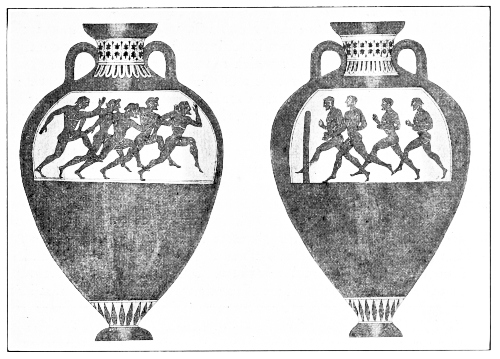
Fig. 37.—Athletic Scenes from a Sixth-century B. C. Panathenaic Amphora. Stadiodromoi (left) and Dolichodromoi (right).
Pausanias dates the introduction of the double foot-race at Olympia in Ol. 14 ( = 724 B. C.).1408 He does not say when the long race was instituted, but Eusebios says that it was in Ol. 15 ( = 720 B. C.).1409 The boys’ stade-race was introduced there in Ol. 37 ( = 632 B. C.).1410 The hoplite-race was inaugurated at the end of the sixth century B. C., in Ol. 65 ( = 520 B. C.).1411 Pausanias mentions 24 stadiodromoi at Olympia, who won 32 victories, which makes this event third in importance, next after boxing and wrestling. He mentions 7 victors in the double race with 11 victories, and 5 victors in the long race with 8 victories. He also mentions 12 hoplite victors with 14 victories. Consequently, in all four running events there, he records 48 victors with 65 victories, which brings the running races only to second place in importance at Olympia, ranking next after boxing.1412 The ordinary sprinter or stadiodromos, and the double sprinter, diaulodromos or hoplitodromos, naturally ran differently from the endurance runner or dolichodromos. Panathenaic vases clearly show this difference. Thus while the sprinter swung his arms violently, spreading the fingers apart and touching the ground only with his toes1413 (Figs. 36A and 37, left), the endurance runner, who had to conserve his strength to the last, ran with a long stride, holding his arms bent at the elbow and close to the body, his fists doubled and his body slightly bent forward, its weight resting on the ball of the foot, the heel being raised only a little. Thus Philostratos says that the dolichodromoi ran with their hands extended and with their fists balled, but that at the finish they also swung their arms violently like wings.1414 The race (showing balled fists) is seen on a Panathenaic amphora dating from the archonship of Nikeratos (333 B. C.), now in the British Museum, and on another of the sixth century B. C., pictured in Fig. 37 (right).1415 In the diaulos the movement was less violent. Thus on an Athens vase inscribed, “I am a diaulos runner,”1416 the movement is between that of a sprinter and an endurance runner. It seems probable that this difference in the style of running was similarly shown in sculpture.1417 We shall next consider certain sculptural monuments which represent runners.
The typical scheme for archaic and archaistic art was to represent the runner with one knee nearly touching the ground, the upper log forming a right angle with the lower, the other leg being perpendicular to the upper. This scheme appears on many vases and reliefs and in statuettes and statues.1418 This old method of depicting runners was kept up by vase-painters down to the time of the red-figured masters.1419 We see them on many reliefs, e. g., on the Ionic-Greek reliefs on the three archaic bronze tripods of the middle of the sixth century B. C. in the possession of Mr. James Loeb;1420 on a small bronze relief in the Metropolitan Museum in New York which represents a winged Boreas;1421 and on the marble funerary stele of the so-called dying hoplite runner found in 1902 near the Theseion, and now in the National Museum in Athens.1422 Almost the same position as that of the figure on this Athenian relief is seen in a small bronze in the Metropolitan Museum, whose primitive features and solidly massed hair date it in the early part of the sixth century B. C.1423 Another slightly larger bronze in the same museum represents Herakles running in a kneeling posture.1424 Because a spearman is incongruous behind a bowman, Kalkmann1425 and Furtwaengler1426 have interpreted the two kneeling figures near either end of the West gable of the temple on Aegina as archaic runners (see Fig. 21, left). We may further compare with these figures the positions, though not the motives, of two others from the West gable at Olympia,1427 as well as that of the kneeling bowman Herakles from the East gable of the temple on Aegina.1428 In this connection we shall also mention the life-size marble torso of a kneeling youth found in Nero’s villa at Subiaco in 1884 and now in the Museo delle Terme, Rome (Pl. 24).1429 This statue, representing a boy of delicate build apparently striding forward with the right leg and bending the left so that the knee nearly touches the ground, has been regarded by some scholars1430 as a runner, whose pose copies the archaic manner, being historically the last example known of its use in sculpture. The right shoulder is turned backward and the head, now missing, was turned back and upwards; the right arm is raised high and twisted about with the palm of the hand facing backward, the left arm extended with its hand in some way related to the right knee. The impression made on the spectator is that of a boy bending aside as if to ward off some danger. It is an excellent piece of work, evidently the marble copy of an original bronze. This has been variously assigned to the fifth, fourth, and even later centuries B. C.,1431 and interpreted in various ways1432—as a Niobid,1433 as Ganymedes swooped down upon by the eagle,1434 as Hylas drawn into the water by nymphs when he was filling his pitcher,1435 as a ball-player,1436 as a boy throwing a lasso,1437 as a gable figure,1438 as a runner at the games, etc. Many of these interpretations are purely fanciful; the last is, perhaps, as good as any, though the strongly turned upper body seems not quite fitted to it. If it represents a runner, the sculptor has reproduced the well-known archaic pose.
The Statue of the Runner Ladas.
We shall next consider the famous statue of the runner Ladas by Myron, which is unfortunately known to us only from literary evidence, but which attained in antiquity an even greater fame than his nameless Diskobolos, since it portrayed even more tension than that wonderful work. Its fame was partly due to the picturesque story how the victory cost the runner his life, for he died of strain while on his way home to Sparta; it was also due in no less degree to the striking way in which the victor was depicted.1439
Two fourth-century epigrams tell us of the statue. The first of these runs:
Λάδας τὸ στάδιον εἴθ’ ἥλατο, εἴτε διέπτη, οὐδὲ φράσαι δυνατόν· δαιμόνιον τὸ τάχος. [ὁ ψόφος ἦν ὕσπληγγος ἐν οὔασι, καὶ στεφανοῦτο Λάδας καὶ κάμνων δάκτυλον οὐ προέβη.]1440
The second epigram, naming Myron as the sculptor, runs:
Οἷος ἔης φεύγων τὸν ὑπήνεμον, ἔμπνοε Λάδα, Θῦμον, ἐπ’ ἀκροτάτῳ πνεύματι θεὶς ὄνυχα, τοῖον ἐχάλκευσέν σε Μύρων, ἐπὶ παντὶ χαράξας σώματι Πισαίου προσδοκίην στεφάνου.
PLATE 24
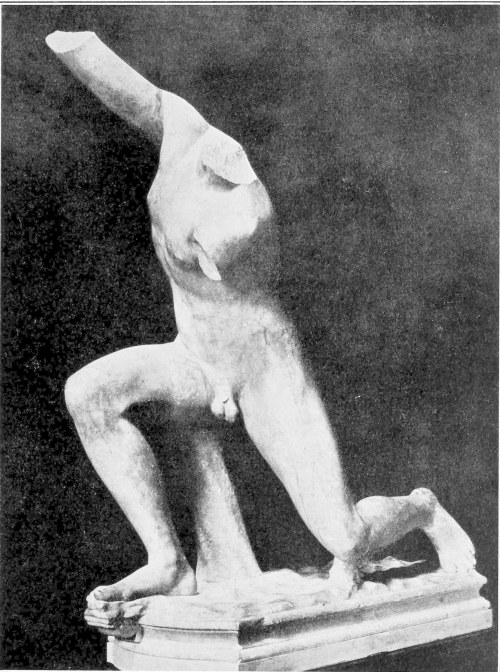
Statue of a Kneeling Youth, from Subiaco. Museo delle Terme, Rome.
To these verses are added the following, which Benndorf thinks belonged to another epigram on the same statue:
πλήρης ἐλπίδος ἐστίν, ἄκροις δ’ ἐπὶ χείλεσιν ἆσθμα ἐμφαίνει κοίλων ἔνδοθεν ἐκ λαγόνων. πηδήσει τάχα χαλκὸς ἐπὶ στέφος, οὐδὲ καθέξει ἁ βάσις· ὢ τέχνη πνεύματος ὠκυτέρα.1441
Professor Ernest Gardner translates the two parts of the second epigram as follows:
“Like as thou wast in life, Ladas, breathing forth thy panting soul,1442 on tip-toe, with every sinew at full strain, such hath Myron wrought thee in bronze, stamping on thy whole body thy eagerness for the victor’s crown of Pisa.”
“He is filled with hope, and you may see the breath caught on his lips from deep within his flanks; surely the bronze will leave its pedestal and leap to the crown. Such art is swifter than the wind.”1443
Even if part of the epigram is rhetorical, we can not doubt that Ladas was represented in the final spurt just before he arrived at the goal. His eagerness was not confined to the face—though the panting breath could have been indicated by half opened lips, but was visible in the whole body.1444 Whereas the girl runner of the Vatican (Pl. 2) is represented at the beginning of the race, Myron’s statue represented Ladas at the end of it. Probably the victor was represented with his weight thrown on the advanced foot and with the arms close to the sides and bent at the elbows—a treatment which would have been easy for the sculptor of the Diskobolos. Mahler tried to identify the statue with one of the Naples group of so-called runners (Fig. 51).1445 However, as we shall see, these probably represent wrestlers, and not runners, and neither of them shows any such tension as we should expect from the description of the statue of Ladas. Though Foerster believes that the statue of Ladas stood in Olympia, in honor of his victory in the long race there,1446 we can not say definitely where it was.1447
Fig. 38.—Statue of a Runner. Palazzo dei Conservatori, Rome. Fig. 39.—Statue of a Runner. Palazzo dei Conservatori, Rome.
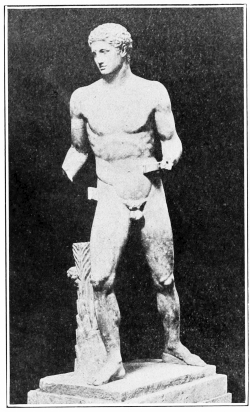
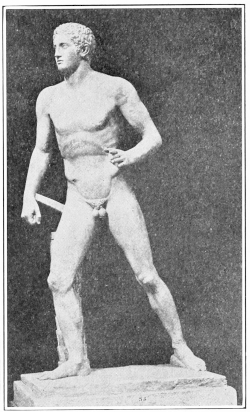
Perhaps our best representation of runners is to be seen in the two marble statues discovered near Velletri and now in the Palazzo dei Conservatori, Rome (Figs. 38 and 39).1448 The hair and the sharp edges of the modeling of the flesh, as well as the tree-stumps near the right legs, show that these statues are copies of bronze originals. They were at first interpreted as runners, but later were regarded as forming a group of wrestlers, who were standing opposite one another and holding their hands out for an opening. However, there is nothing in the pose or the expression of these statues to show the tension of two opponents. Moreover, they certainly never formed a group, for stylistic differences reveal that they are copies of statues by different artists who lived at different times; one belongs to the severe style of the last quarter of the fifth century,1449 while the other, with its softer forms, smaller head, and deeper-set eyes, is a product of the fourth century B. C.1450 The prominent edge of the chest is doubtless meant to indicate the hard breathing of a runner.1451 Just in front of the tree-stump on the older statue is to be seen a round hole in the plinth, which may have been made for the end of a club held in the right hand, as such an object is found in other works of art, notably in a statuette from Palermo, which is the copy of a fifth-century B. C. original, and on a second-century B. C. grave-stele from Crete.1452 Its use, however, is not certainly known.
Furtwaengler, by an ingenious process of reasoning, argued that he had recovered an actual statue of an Olympic runner in the so-called Alkibiades, formerly in the Villa Mattei, but now in the Sala della Biga of the Vatican.1453 This torso he ascribed to the sculptor Kresilas, because of its likeness to the Perikles of that master, which once stood on the Akropolis,1454 and to a marble torso in Naples representing a wounded man ready to fall, which he thinks is a copy of the Volneratus deficiens of Kresilas mentioned by Pliny.1455 The Alkibiades is very similar to the Naples gladiator, though later in date; the bearded head, drawn-in stomach, and muscular chest, and the veins in the upper arm are common to both. The restorer of the Vatican statue has placed a helmet under the right foot. But the deep-breathing chest may indicate a runner, as we saw in the case of the statues of the Conservatori just discussed. Furtwaengler has the body bend further forward, so that the right foot may rest upon the ground and the glance be fixed upon the goal, with the arms extended at the elbows, a position proved for the right arm, at least, by the puntello above the hip. As the head shows portrait-like features and only those athletes who had won three victories had portrait statues, he has identified the original of the Alkibiades with the statue of the famous stade-runner Krison of Himera, who won his victories at Olympia just after the middle of the fifth century B. C., the approximate date of the Vatican copy.1456 Such an identification appears, however, to be too far-fetched to be convincing.
Statues of Boy Runners.
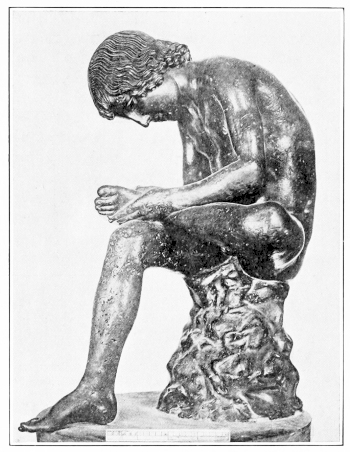
Fig. 40.—Statue of the Thorn-puller (Spinario). Palazzo dei Conservatori, Rome.
Probably the statues of boy runners did not differ essentially from those of men. That they were sometimes represented in motion is shown by the footprints on the recovered base of the statue of Sosikrates by an unknown artist. Here the right foot touched the ground only with the front portion.1457 The view has often been expressed that the bronze statue in the Palazzo dei Conservatori, Rome, known as the Spinario (Thorn-puller) portrays a runner (Fig. 40).1458 It represents a boy, from twelve to fifteen years old, seated upon a rock bending over and engrossed in extracting a thorn from his left foot, which rests upon the right knee. The severe hair treatment, low forehead, full cheeks, and strong chin appear to show the ideal beauty of a boy of the period of about 460 B. C. The motive seems to have been inspired directly by nature—witness the supple bend of the back, the delicate arms, the naïve, though not too realistic, concentration of interest in the act portrayed. Few pieces of ancient sculpture have given rise to more discussion and extraordinary difference of opinion than this popular work. One school of archæologists1459 believes it a late adaptation of a Hellenistic original, a more accurate copy being the one in the British Museum, and consequently views it as a purely genre statue impossible of conception before Alexander’s time. According to this view the London copy was an archaistic work of the time of Pasiteles. Another school, however, including Helbig, Wolters, Kekulé, and many others, sees in the Roman statue an original work of 460 to 450 B. C., chiefly because the face shows great similarity to those of the statues of the Olympia gables (especially to that of Apollo)1460. According to this view the statue can not have been a genre work, as such works of decorative character were of later origin, but the motive must be sought in some definite incident—in some myth or historical event. Thus it has been referred to the colonization of the Ozolian Lokroi, whose ancestor Lokros is said to have got a thorn in his foot and to have founded cities near where this occurred in fulfilment of an oracle. Many others, on the other hand, have seen in its motive that of a boy victor in running, who has gained his victory despite a thorn, which he is now pulling out, and who has dedicated his statue to commemorate both the victory and the untoward circumstances under which it was won. It has been assigned to various sculptors and schools—to Myron, Pythagoras, and Kalamis, and to Peloponnesian, Bœotian, and even Sicilian art.1461 The boy’s absorption in his task certainly reminds us of the concentration so characteristic of the Diskobolos of Myron. In determining its age and artistic affiliations several things must be considered. In the first place, the Roman statue is a copy, as the rock on which the boy sits is cast with the figure, which would have been impossible in the fifth century B. C. The long hair on this copy, which is short on the one in the British Museum, falls down the neck, but not over the cheeks, as it should on a head which is thus bent downwards. Pasiteles almost certainly would have tied it with a ribbon. This shows that the original was the work of an artist who was used to making standing statues, and was not aware of the change in the representation of the hair brought about by drooping ones. Such considerations, in conjunction with the archaic facial characteristics, almost certainly refer the original work to the fifth century B. C., a date when genre statues, produced for adornment, did not exist. Consequently a definite incident must be represented by it, and it is quite possible that this incident should be sought in athletic sculpture in the representation of a boy runner.
The Thorn-puller became a model for many imitations from the beginning of Hellenistic times on. These imitations tended to greater realism and consequently to the debasement of the original conception, for they were made to represent peasants, shepherds, satyrs, and even negroes. The motif was also transferred to figures of girls, as, e. g., in the fragment of a terra-cotta statuette found in 1912 at Nida-Haddernheim.1462 In the early Empire it was frequently copied in marble, and again, during the Renaissance, the motive was used for small bronzes.1463 Of Hellenistic copies, showing how the motive deteriorated, we shall mention only two: the marble one found on the Esquiline, in 1874, and known as the Castellani copy, now in the British Museum,1464 the sculptor of which has made it into a truly genre fountain figure by transforming the noble features of the beautiful Greek runner into the snub nose and thick lips of a street Arab, and the still later bronze statuette found near Sparta and now in the Paris collection of Baron Edmund de Rothschild,1465 which represents the boy extracting the thorn in anger.
Similarly the so-called Sandal-binder—with replicas in Paris (Fig. 8), London, Athens, Munich, and elsewhere, has been looked upon, without decisive grounds, to be sure, as a runner who is tying on his sandals after the race.1466 We have already discussed this statue in Chapter II, in connection with the subject of assimilation.
Hoplitodromoi.
The race in armor had a practical value in the training of soldiers, and so became a popular sport, since it appealed not only to the trained athlete, but to the citizen in general. It belonged to “mixed athletics,”1467 i. e., to competitions which were conducted under handicap conditions, such as our obstacle races, and consequently it never attained the prestige of the strictly athletic events. It came last among the gymnic contests at Olympia and elsewhere,1468 being followed by the equestrian events. It seems to have varied in different places in the distance run, in the armor of the runner, and in the rules which governed the race. At Olympia, as at Athens, it appears to have been a diaulos or a race of two stadia.1469 The most strenuous race of the sort was run at the Eleutheria at Platæa, where the contestants were completely enveloped in armor1470 and were subject to peculiar rules. At Olympia the competitors originally ran with helmets, greaves, and round shields, as we infer from scenes on archaic vases and from the statement of Pausanias that the statue of the first victor in this event, Damaretos of Heraia, was represented with these arms.1471 In this passage Pausanias adds that the Eleans and other Greeks later (ἀνὰ χρόνον) gave up the greaves, and we find that they disappear on the vase-paintings.1472 Hauser has shown that the vase-paintings, which, however, mostly illustrate the Athenian practice, display a varied custom in respect of the use of the greaves before about 520 B. C., the general use of them until about 450 B. C., and after that date their disuse.1473 The helmet disappeared after the greaves, but the shield was never given up.1474 Thus the bronze statue of Mnesiboulos of Elateia, a victor (σὺν τῇ ἀσπίδι) of Pausanias’ day, which stood in “Runner Street” of his native city, appears to have been represented with the shield.1475 It was for this reason that the event was later sometimes called merely ἀσπίς.1476 The shields that appear on the vases are always round and the helmets are Attic.1477 The gradual reduction in the amount of the armor may have been a concession to the regular athletes, who probably looked upon the contest as a spurious sort of athletics. As for the style of the race, the hoplite runners seem to have run somewhat as the stade and double-course runners, i. e., with their right hands up and their arms violently swinging.1478
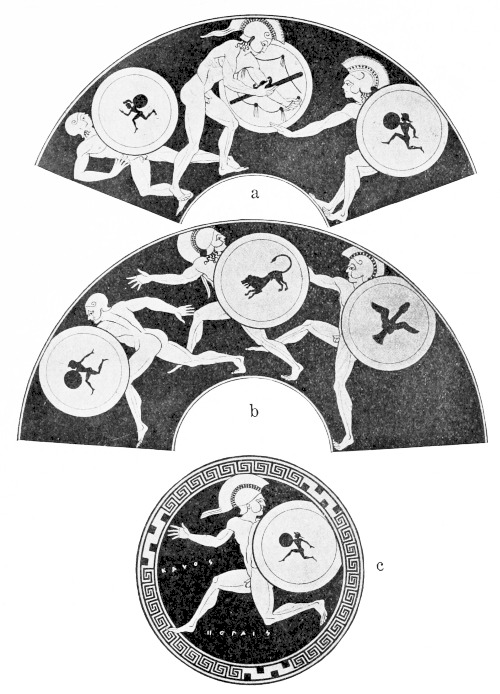
Fig. 41.—Hoplitodromes. Scenes from a r.-f. Kylix. Museum of Berlin.
The picturesqueness of such a race appealed especially to vase-painters, who have given us all the details of the event. The preparations for the race are seen on a red-figured kylix from Vulci, now in Paris, ascribed to Euphronios (Panaitios), on which one runner is donning his armor, while others are practising preliminary runs.1479 The start is seen in the right-hand figure depicted on a r.-f. kylix in Berlin (Fig. 41, a).1480 On another r.-f. kylix we see a pair of hoplites, one slowing up before reaching the central post, the other turning it.1481 The finish is seen on an obscene r.-f. kylix from Vulci in the style of Brygos, in the British Museum, where the bearded winner, with his helmet in his hand, looks back on his rival, and the latter, apparently in disgust, drops his shield.1482 The most complete illustration of the race is to be seen on the r.-f. Berlin kylix just mentioned (Fig. 41, a, b, c.) Here on one side is a group of three runners; the right-hand one is bending over, ready to start; the one at the left is about to turn the central post, and the one in the centre, who is turned in an opposite direction, is on the home stretch; on the other side of the vase are three runners in full course, while another appears on the interior of the vase.1483 Some vases seem to show that the contest often had a semi-comic character, the variations in running being used to amuse the spectators. Thus the shield might be dropped and picked up again,1484 or it might be held in a peculiar manner.1485 This comic element is brought out in the Aves of Aristophanes, in a scene in which Peisthetairos, while observing the chorus of birds advancing with their crests (λόφωσις), compares them with hoplite runners advancing to begin the race.1486 The regular painter outdid the vase-painter Fig. 42.—Bronze Statuette of a Hoplitodrome (?). University Museum, Tuebingen. in representing the runner in violent motion, if we may rely on Pliny’s description of two paintings of hoplites by Parrhasios.1487 In one of these the runner was represented as perspiring as he ran, while in the other he was represented as having laid aside his arms and panting so realistically that the observer seemed to hear him.
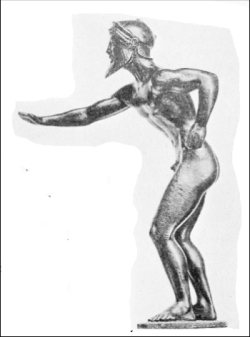
We have few representations of hoplitodromes in sculpture. In the preceding chapter we discussed the two marble helmeted heads found at Olympia (Fig. 30), one of which shows that the statue of which it was a part was represented at rest, while the other, because of the twist in the neck, seems to have come from a statue which represented the runner in violent motion. Pausanias saw on the Athenian Akropolis the statue of the hoplite runner Epicharinos, the work of the sculptor Kritios, represented as practising starts (ὁπλιτοδρομεῖν ἀσκήσαντος).1488 In the well-known Tux bronze in the University Museum at Tuebingen, we have a statuette in which the position of the statue of Epicharinos is probably reproduced. This little bronze, which is only 0.16 meter tall (Fig. 42),1489 represents a bearded man, entirely nude, except for the Attic helmet on his head, standing with feet close together, knees slightly bent, and body inclined forward. The right arm is extended, while the left, crooked at the elbow, rests upon the hip. While Schwabe and Wolters, following the early theory of Hirt and of the sculptor Dannecker, interpreted the bronze as the figure of a charioteer, whose left hand was drawn back to hold the reins and whose right was outstretched in a gesture intended to quiet the horses, Hauser, de Ridder, Bulle, and many other archæologists have interpreted it better as a hoplitodrome. The left arm, then, carried a round shield, such as we have seen on Attic vases. The next moment the right leg will be advanced, the shield, held back to get a better start, will be pushed forward, and the runner will race to the goal in a series of leaps, since the weight of the shield would prevent him from following the more regular motion of the ordinary runner. It probably represents, therefore, a hoplite runner, not in the actual course, as Hauser thought, but practicing a preliminary start, as de Ridder argued. If the figure represented a charioteer, the legs would have been set farther apart, in order to give a firmer position, and it would not be represented as standing on a base, nor would it be wearing a helmet. The statuette stylistically belongs to the opening years of the fifth century B. C., and may well be a free imitation of a life-size original of such statues of hoplites as stood in the Altis at Olympia. Despite the energy depicted in this figure, it is rash to connect it with the Aeginetan sculptures, as Wolters and Collignon have done, since a comparison between it and the Champion of the East gable1490 will show great differences. Brunn ascribed the original to Pythagoras; de Ridder, with reservations, to Kritios and Nesiotes; while Bulle is more reasonable in referring it to an important though unnamed artist of the early fifth century B. C.
Hartwig has published a bronze statuette from Capua,1491 now in the Imperial collection at Vienna, representing a nude youth with a crested helmet on his head. There is no trace of a shield, but the helmet and the similarity of the pose to that of the Tuebingen bronze make it probable that this statuette also represents a hoplitodrome starting. The so-called Diomedes of Myronian style in the Palazzo Valentini, Rome,1492 whose stooping posture recalls the Diskobolos and accordingly has been interpreted as one by Matz and von Duhn, more probably also represents a hoplite-runner, as Furtwaengler maintained, because of the similarity of its pose to that of the Tux bronze and because of its helmeted head.1493
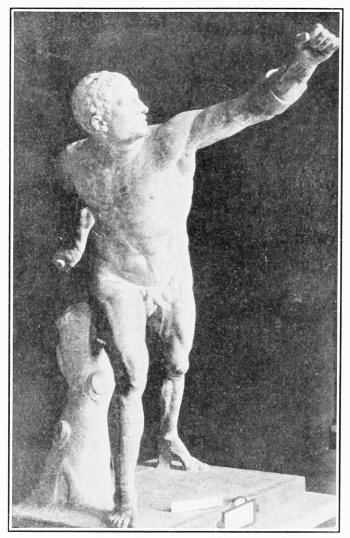
Fig. 43.—Statue of the so-called Borghese Warrior. Louvre, Paris.
Some other attempts to see hoplite runners in existing works of sculpture have not been so successful. Thus Rayet’s attempt to resuscitate the old interpretation of Quatremère de Quincy, who had explained the statue of the so-called Borghese Warrior by Agasias of Ephesos (Fig. 43) as that of a hoplitodrome just before reaching the goal, has been recently revived again by Six.1494 This famous marble statue of the Louvre, belonging to late Greek art, is an example of the last development in the Argive-Sikyonian school, which for centuries had been devoted to athletic sculpture.1495 Since the statue has no helmet, there seems to be no valid reason for not adhering to the usual interpretation, according to which it represents a warrior—by restoring the lost right arm and hand with a sword—who is defending himself against a foe above him, conceived of as seated upon a horse. The attitude and the upward gaze are certainly not those of a runner. Though Collignon, following Visconti, believes the figure to be one of a group, the man actually defending himself against a horseman and covering himself with his shield as he looks up, it is doubtful whether a second figure ever existed. The artist seems to have contented himself with representing, not a fight, but only a fighting pose. We are beginning to understand that the Greek sculptor left something to the imagination of the beholder.
An attempt has also been made to see a dying hoplite runner in the Parian marble archaic grave-relief in the National Museum in Athens, which has already been mentioned as an example of the archaic scheme of representing running.1496 It represents a beardless youth running in a half-kneeling posture, even though the head is bent and turned in the opposite direction. The eyes appear to be closed—due, perhaps, to the faulty sculptor—and the two hands are touching the breast. While no shield is represented (it is contended that its presence would nearly hide the figure), still, because of the helmet and the position of the arm, which latter is obviously that of a long-distance runner, Philios, followed by Perrot-Chipiez and Bulle, explained it as the representation of a hoplite runner who is expiring at the end of his course. They date it about 520 B. C.,1497 the date of the introduction of this race at Olympia. However, the absence of the shield, to say nothing of the greaves, seems an insuperable objection to such an hypothesis, as the shield was never omitted in this race, but was invariably its symbol. Svoronos is therefore more probably right in interpreting the relief as the monument of a military runner (δρομοκῆρυξ), even if his dating (490–480 B. C.) is somewhat too late,1498 and if his identifying it with some particular messenger (such as the Athenian runner Pheidippides, who ran to Sparta for aid just prior to the battle of Marathon) is fanciful.
Pentathletes.
The peculiar features of the pentathlon (πένταθλον) were the three events, jumping, diskos-throwing, and javelin-throwing. All five events are summed up in Simonides’ epigram on the pentathlete Diophon, who won at Delphi and on the Isthmus, the second line of which runs: ἅλμα, ποδωκείην, δίσκον, ἄκοντα, πάλην.1499
The pentathlon did not exist in Homer’s time. Pindar expressly says that it did not exist in heroic days, but that then a separate prize was given for each feat.1500 At the games on Scheria, King Alkinoos boasts to Odysseus of the superiority of his countrymen in πύξ τε παλαισμοσύνῃ τε καὶ ἅλμασιν ἠδὲ πόδεσσιν.1501 The pentathlon for men was introduced at Olympia at the same time as wrestling toward the end of the eighth century, in Ol. 18 ( = 708 B. C.),1502 and the pentathlon for boys eighty years later, in Ol. 38 ( = 628 B. C.), only to be stopped soon after.1503 Pausanias mentions fifteen victors at Olympia, who had statues erected in their honor, for seventeen victories in the pentathlon, thus giving the pentathletes sixth rank there in point of number.
The b.-f. Bacchic amphora in Rome already discussed represents four events out of the five: running, leaping, diskos-throwing, and akontion-throwing (Figs. 36 A and 36 B).1504 On several Panathenaic vases we find one or more events, and the three characteristic ones on several, one of which we here reproduce (Fig. 44).1505
The various events are common on r.-f. vases,1506 though these may not represent the pentathlon contests, but merely gymnasium scenes, showing that such contests were important. We have already said that the pentathlon represented the whole physical training of Greek youths; consequently the pentathlete was looked upon as the typical athlete, being superior to all others in all-round development, even if surpassed by them in certain special events. It was for this reason that Polykleitos, in order to embody the principles of his athlete canon, made a statue of a javelin-thrower (the Doryphoros) as the best example of an all-round man.
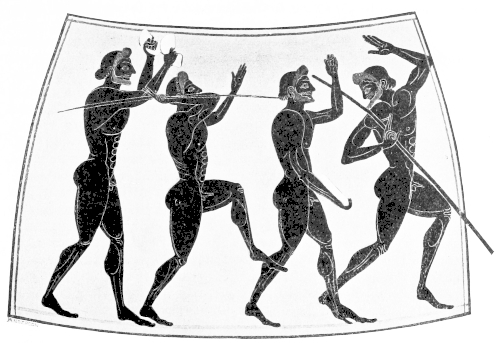
Fig. 44.—Pentathletes. Scene from a Panathenaic Amphora in the British Museum, London.
None of the statues of pentathletes at Olympia has been recovered with certainty in Roman copies. That some of them were represented at rest is shown by the base of the statue of the victor Pythokles of Elis, by the elder Polykleitos, which has been recovered.1507 This base supported two different statues in succession. The feet of the earlier one by Polykleitos were riveted into circular holes, and behind the right foot on the upper surface of the base was inscribed the artist’s name, while the victor’s appeared on the vertical front. This statue was later removed and was replaced by another, whose pose was different, as we see from the footmarks, which show that the feet were attached with lead in hollows. Probably the old inscription was renewed in archaic letters when this second statue was set up, the older letters being retained, perhaps, to conceal the theft. The original statue was removed by the first century B. C., or perhaps under Nero;1508 the new one was also inscribed as the work of Polykleitos. A base of the Hadrianic or Antonine age has been found in Rome, inscribed with the names Polykleitos and Pythokles.1509 Since the footmarks do not agree with those of either one of the Olympia statues, Petersen believes that the existing footmarks are due to an older use of the base and that they have nothing to do with the statue of Pythokles. Perhaps the statue on the Roman base was the original one by Polykleitos removed from Olympia to Rome, though it is possible that it was only a copy, the original being elsewhere in Rome. While the later statue at Olympia had the feet squarely on the ground, the original one stood on the right foot, the left being drawn back and turned out, touching the ground only with the ball. Hence the left knee must have turned outwards, a natural position, if the head of the statue was turned slightly to the left. In other words, this is the usual Polykleitan scheme. Furtwaengler has made a strong though hardly convincing attempt to identify this original statue with a copy surviving in two replicas at Rome and Munich, which, as he believes, fit the conditions of the statue of Pythokles.1510 These copies represent a nude youth standing with the weight of the body on the right leg, the left drawn back and outwards. The head is turned to the left, the right arm is held close to the side (the hand, perhaps, once holding a fillet), and the left forearm is outstretched from the elbow and holds an aryballos in the hand. The two works are manifestly Polykleitan in style—the body, head, and hair treatment resembling that of the Doryphoros. He assumed that the feet corresponded in scale with the footmarks on the Olympia base.
Helbig, in the first edition of his Fuehrer, recognized the kinship between the Vatican statuette and the Doryphoros of Polykleitos, and was prone to accept Furtwaengler’s identification; but later on, in the third edition, he ascribed the statuette only to the Polykleitan circle and denied that its foot position corresponded with that of the Pythokles base. Amelung also, while accepting its Polykleitan character, has shown that the feet of the statuette are closer together than those on the Olympia base and are placed at a slightly different angle. As for the Munich statue, both Helbig and Amelung have ruled it out of the evidence. The head, though similar to that of the statuette, also discloses marked differences, and the legs of the two works do not have the same pose. Loewy agrees with Amelung that the statue of Pythokles conformed with the type of the Diadoumenos—especially Fig. 45.—Statue of a Boy Victor (the Dresden Boy). Albertinum, Dresden. with the Vaison copy (see Fig. 28)—and with that of the Doryphoros.1511 We can not, therefore, safely assume that the statue of Pythokles has been recovered in any existing copy.1512 A further variant of the works just discussed should be mentioned here—the beautiful marble statue of a boy victor in Dresden, known as the Dresden Boy (Fig. 45).1513 In this statue the leg position is nearly like that indicated by the marks on the Pythokles basis, though the left foot is not set so far back nor its tip so far out. The head is turned to the left and slightly lowered, the right arm hung to the side, and the left forearm was outstretched, the hand doubtless holding some athletic article, at which the boy is looking down, perhaps a diskos1514 or a fillet. This beautiful athlete statue has many stylistic points in common with the Diadoumenos, and shows similar Attic influence, and its original may be referred with Furtwaengler to the later period of the master himself. It gives us an excellent idea how Polykleitos may have made his Olympia boy victors appear. A more remote variant seems to be furnished by a fourth-century B. C. bronze statuette of a youthful athlete in the Louvre.1515 Here the position of the feet, the turn of the head, and the direction of the gaze are the same as in the Dresden Boy. However, as the right arm is raised horizontally, Furtwaengler believed that the right hand held a fillet which the youth is letting fall into the palm of the left.
That statues of pentathletes at Olympia were also represented in motion is shown by the footmarks on the recovered base of one of the two statues mentioned by Pausanias as set up in honor of the Elean Aischines, who won two victories some time between Ols. 126 and 132 ( = 276 and 252 B. C.).1516 These marks show that the statue represented the victor in violent movement, since the left foot was turned outwards and the right one was brought almost to the edge of the base.
We shall next consider in some detail how the pentathlete may have been represented at Olympia in the three characteristic contests of jumping, diskos-throwing, and javelin-throwing. We have already discussed the runner, and in a future section we shall discuss the wrestler, both of whom contended in these events not only in the pentathlon, but also in the corresponding independent competitions.
Jumpers.
Jumping was a well-known contest in heroic days. In Homer, however, it did not take place at the games of Patroklos, but only at those held by King Alkinoos.1517 Quintus Smyrnæus has the Trojan heroes contend in jumping,1518 and the contest goes back to mythology.1519 Though Plato does not mention it, Aristotle does.1520 Later it became an essential part of the pentathlon, though never an independent contest at the great games. It was probably considered to be the most representative feature of the pentathlon, perhaps because of the customary use of the halteres in the physical exercises of the gymnasium. Jumping-weights were, in fact, the special symbol of the pentathlon, and, as we saw in the preceding chapter, were often the definitive attributes indicated on statues of pentathletes.1521 We shall next discuss the appearance and use of such jumping-weights. Their form is often a sure indication of the date of a statue.
Juethner has made a careful study of the different shapes of halteres and his conclusions have been followed, for the most part, by Gardiner.1522 The halteres do not appear in Homer, but were in existence at least by the beginning of the sixth century B. C., and a little later they probably appeared on pentathlete statues. To this period belongs the lead weight from Eleusis now in Athens, whose inscription records that it was dedicated by one Epainetos to commemorate his victory in jumping.1523 On vase-paintings of the sixth and fifth centuries B. C., we see numerous types, but two main ones. Early b.-f. vases show a semicircular piece of metal or stone with a deep depression on one side for a finger grip, the two club-like ends being equal (as in Figs. 36A and 44). In the early fifth century B. C., a club-like type came in, which shows many modifications in the size and shape of the ends.1524 In the fifth century B. C., the second main type appeared, of an elongated semispherical form, thickest in the middle and with the ends pointed or rounded. These correspond with the “archaic” ones, which Pausanias saw on the figure of Agon in the dedicatory group of Mikythos at Olympia1525 and describes as forming half an elongated circle and so fastened as to let the fingers pass through. We have two stone examples of this type: one found at Corinth, now in the Polytechnic Institute in Athens,1526 in which a hole is cut behind the middle for the fingers and thumbs, and a more primitive single one from Olympia.1527 Philostratos divides the Greek jumping-weights into “long” and “spherical,”1528 which Juethner identifies with the two types just discussed. Gardiner, however, finds this impossible, since Pausanias speaks of one type as “archaic,” and he consequently thinks that these were no longer in use in the time of Philostratos. After the fifth century B. C. we have little evidence about halteres until Roman days, when a cylindrical type appears on Roman copies of Greek statues of athletes, on mosaics and wall-paintings.1529 Thus it appears on the tree-trunk in two athlete statues in Dresden1530 and the Pitti Gallery in Florence,1531 and on the Lateran athlete mosaic from Tusculum of the imperial period.1532 In Roman days jumping-weights were used for the most part in medical gymnastics, like our dumb-bells.1533
Philostratos says that the jump was the most difficult part of the pentathlon.1534 It never existed as an independent competition despite its popularity in Greece. This popularity is attested by the frequency with which it is depicted on vases from the sixth century B. C. onward. Here the jumper is regularly shown with weights, and we can assume that many pentathlete statues were so represented, the sculptor ordinarily copying the kind of weight which was in use in his own age. While Philostratos in his day thought that the use of weights was merely to aid in exercise, Aristotle long before had rightly understood that the jumper could make a longer jump with than without them,1535 a fact easily proved by the feats of modern jumpers. While the modern record for the running broad jump is 25 feet 3 inches,1536 an English athlete jumped 29 feet 7 inches with the use of 5-pound weights,1537 and a German officer in full uniform jumped 23 feet from a springboard.1538 The recorded jumps of Phaÿllos at Delphi and of Chionis at Olympia, the former 55 feet and the latter 52, can not, however, be explained as ordinary broad jumps, even if we assume that the Greek jumper was far superior to the modern one. Such jumps would be impossible even with springboards or raised platforms, and we have no evidence that the Greeks used such devices. We might explain them on the theory of triple jumps1539—though the difficulty of such a solution is very great—or simply as mistakes in the records. Thus the record of Phaÿllos is found in a late epigram, in which this athlete is also said to have thrown the diskos 105 feet.1540 That of Chionis is, to be sure, given by Africanus.1541 But it is more than probable that νβʹ (52) of his record should read κβʹ (22), since the Armenian Latin text reads duos et viginti cubitus.1542
Vase-paintings tell us how the halteres were used.1543 The jumper swung them forward and upward until they were level with or higher than the head; then he brought them down, bending the body forward until the hands were below the knees, the jump taking place on the return swing. We find the preliminary swing represented most commonly on the vases;1544 we also see on them the top of the upward swing,1545 the bottom of the downward swing,1546 the jumper in midair,1547 and the moment just before alighting.1548 The act of landing is seen on an Etruscan wall-painting from a tomb at Chiusi.1549 Running jumps are the ones most commonly depicted.1550
The representation of the jump, therefore, was specially adapted to the vase-painter and not to the sculptor. If any movement in the jump could have been represented to advantage in sculpture, it would have been the early position in which the weights were swung forward and upwards. This is the one represented on an incised bronze diskos from Sicily now in the British Museum,1551 where an athlete, with his right leg drawn back for the spring, is holding the weights in his outstretched hands. A small finely modelled bronze statuette dating from the middle of the fifth century B. C., in the Metropolitan Museum, New York, may represent a jumper either just taking off, or perhaps just finishing the jump.1552 The athlete is standing with his left foot advanced, his knees bent back, and his body leaning forward, and is holding both arms in front, the palms downwards. Such a concentrated attitude reminds us strongly of Myron, under whose influence this statuette must have been made. Some have interpreted it as the representation of a diver, though the hands seem to be held too far apart and the body wrongly poised for that position, as we see it in a statuette of a diver from Perugia.1553 More likely a jumper is intended, as the attitude is very similar to that depicted on several vases.1554 However, as the jumper has no halteres, it can not represent a pentathlete, but must be an ordinary gymnasium athlete.
Diskoboloi.
The diskos-throw (δισκοβολία) goes back to mythology and heroic days.1555 In Homer, at the games of Patroklos, Achilles casts a metal mass called the σόλος.1556 This was the primitive type of diskos. Of such early contests and feats of strength we have a good record in the red-sandstone mass, weighing 143.5 kilograms ( = 315 pounds), which has been found at Olympia, marked with a sixth-century inscription to the effect that one Bybon threw it over his head.1557 There is nothing athletic, however, about the use of such a stone or of the Homeric solos. The diskos was also known to Homer.1558 It was of stone, and in Pindar the heroes Nikeus, Kastor, and Iolaos still hurl the stone diskos instead of the metal one of the poet’s day.1559 The stone diskos appears on sixth-century vases as a white object,1560 but metal ones were introduced at the end of the sixth century B. C. A bronze one from Kephallenia (?) in the British Museum has a sixth-century inscription in the Doric dialect and in the alphabet of the Ionian Islands, which gives the dedication of Exoïdas to the Dioskouroi.1561 Several others have been found in different parts of Greece, especially at Olympia.1562 Pausanias says that boys used a lighter diskos than men.1563
While only unimportant monuments outside of vase-paintings illustrate the jump, those illustrating the diskos-throw are rich and varied, including not only vases, but statues, statuettes, small bronzes, reliefs, coins, and gems.1564
In his careful attempt at reconstructing the method of casting the diskos, E. N. Gardiner has distinguished seven different positions, which are illustrated by the monuments.1565 He shows that while the swing of the quoit was always the same, i. e., in a vertical and not in a horizontal arc, and the throw was invariably made from a position like that of Myron’s statue, the preliminary and certain other movements varied. It will be well, before discussing representations of the diskos-thrower in sculpture, very briefly to recapitulate his summary of positions, using the evidence which he and others have collected. First, the preliminary position or stance, with three variations: either the position of the Standing Diskobolos of the Vatican (Pl. 6), which occurs in bronzes, but not on vases; or the position in which the diskobolos raises the quoit with the left hand level with the shoulder, which occurs on vase-paintings;1566 or that in which the diskos is held outwards in both hands level with the waist.1567 From any of these stance positions, either with or without change of feet, we reach the second position, in which the diskos is raised in both hands and extended either horizontally to the front and level with the head,1568 or held above the head.1569 Thirdly the diskos is swung downwards and rests upon the right forearm, with either foot forward.1570 This position leads up to that of Myron’s statue, in which the diskos is swung as far back as possible (Pls. 22, 23, and Figs. 34, 35).1571 The fifth position is the beginning of the forward swing, when the body is straightened.1572 As the diskos swings downwards and the left foot advances, the sixth position is reached.1573 Lastly the right foot is advanced after the diskos is cast.1574
A victor statue of a diskobolos might conceivably have taken Fig. 46.—Bronze Statuette of a Diskobolos. Metropolitan Museum, New York. any one of these seven positions. We have already considered the two statues, the Standing Diskobolos of Naukydes in the Vatican (Pl. 6) and that of Myron (Pls. 22, 23, and Figs. 34, 35), the two most important works in sculpture to illustrate positions of the throw. The statue of Naukydes is not taking aim, as Juethner maintains, nor looking down the course. The head is inclined a little to the right and downwards, and the eyes are directed to the ground only a short distance away, thus measuring the distance the left foot is to be advanced, when the diskos is finally swung forward for the cast, which takes place off the left and not off the right foot. The right forearm is rightly restored, as it thus appears on bronzes which imitate this stance.1575 A different stance is shown in a fine bronze statuette in the Metropolitan Museum (Fig. 46),1576 dating from about 480 B. C. This little masterpiece of the transition period of Attic art, still disclosing archaic traits, represents a diskobolos standing firmly on both legs, the right being slightly advanced, and holding with the left hand the diskos level with the head. That he is preparing for intense action is seen by the way in which the toes catch the ground. Though the right arm is broken off from below the shoulder, we can infer from vase-paintings which show diskoboloi in the same position1577 that it was lowered and bent at the elbow and the hand left open. From this position the diskos will be raised high above the head with both hands, as in a bronze in Athens,1578 which illustrates Gardiner’s second position.
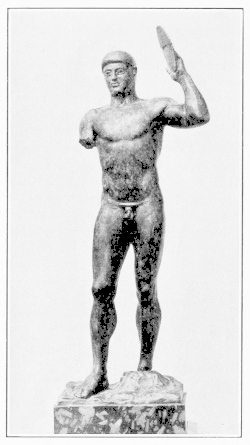
The movement is carried a little further—showing the moment of transition to the downward swing or third position—in a fifth-century B. C. bronze in the British Museum.1579 Here a nude, beardless athlete is represented standing with the right foot advanced and holding the diskos in both hands before him above the head. The right hand grasps the quoit underneath and the left at the top.1580 The third position is well illustrated by the tiny archaic bronze on the cover of a lebes in the British Museum,1581 which represents a nude and beardless youth standing with the left foot advanced and with the left hand raised, while the right holds the diskos. Almost the same pose is also seen in a small bronze in the Antiquarium, Berlin.1582
Two archaic statuettes from the Akropolis, now in the National Museum in Athens, and recently published, should be mentioned in this connection.1583 The more archaic of these represents a youth in an attitude which has been misunderstood. De Ridder interpreted it as a dancing man, while Staïs thought it represented a youth walking along with his left hand raised as if to ward off a blow. White, however, showed that it (like another less perfect example from the Akropolis, no. 6594) represents a diskobolos standing with the right foot advanced and holding the diskos in front of the body with the right hand, resting it against the flat of the forearm, while the left arm is raised above the head. Thus it is another example illustrating the initial stage of Gardiner’s third position. The other statuette, wrongly mounted, should, according to White, be made to lean further forward; the knees are bent, the body swung forward from the hips, the head thrown back and upward, the right arm stretched forth with the flat of the forearm uppermost and the left similarly placed. Gardiner and Staïs interpreted this figure as a charioteer, and de Ridder as either a jumper, who has raised his halteres preparatory to the leap, or a diskobolos. White has shown that the position of the right arm proves it to be a diskobolos, represented in a movement between Gardiner’s third and fourth positions, just prior to that of Myron’s statue. De Ridder believed both statues to be Aeginetan, but no. 6614, when compared with Myron’s statue, is certainly Attic, and resemblances in the treatment of the hair, eyes, and mouth show that both statuettes are of the same school. It has often been said that Myron’s great statue had no predecessor, as it certainly had no successor. Its fame was enhanced by the assumption that Myron passed at one stride from such statues as the Tyrannicides to that complex work. Such works, however, as these statuettes—especially no. 6614—show that the preliminary problems had been solved on a humble scale before Myron undertook his consummate work. Here, then, we have works by artists who belonged to the very movement which produced Myron.
For the last three positions analyzed by Gardiner (nos. 5, 6, 7) our only illustrations appear to be vase-paintings.
Akontistai.
Javelin-throwing (ἀκοντίζειν, ἀκοντισμός) was very old and was universal in Greece, its origin being traced back to mythology.1584 Stassoff tried to trace it to Oriental sources,1585 but inasmuch as no such contest is shown on the monuments of Egypt or Assyria, Juethner is probably right in assuming that it was Greek in origin. In Homer it was a separate contest at the games of Patroklos.1586 Juethner has distinguished two types of javelin-throwing in the historical period: one in which the spear or akontion was pointed more or less upwards,1587 the other in which it was held horizontally.1588 Only the former type is represented in illustrations of purely athletic competitions, the latter type referring to illustrations of the practical use of javelin-throwing, i. e., in war or in the chase. Vase-paintings of palæstra scenes almost invariably show javelins with blunt points; the throwers’ heads are frequently turned back before the throw, and there is no sign of any target. On vase-paintings, however, which represent practical javelin-throwing from horseback, the javelins are pointed. This proves that in athletic contests the throw was for distance and not at a mark.1589 The javelin used in Greek games had several names, ἄκων, ἀκόντιον, etc.1590 It was about the height of a man, as we know from its appearance on a Spartan relief,1591 and from many vase-paintings representing palæstra scenes (Fig. 44). It was thrown by means of a thong (ἀγκύλη, Lat. amentum), which was fastened near the centre and consisted of a detachable leathern strip from 12 to 18 inches long. This was bound tight, with a loop left, into which the thrower inserted his first and middle fingers.1592 The method of casting is seen on many vases.1593 Gardiner has analyzed three different positions from vase-paintings. Usually the throw was made with a short run, though standing throws are also pictured.1594 First the thrower extends the right arm back to its full length and, with the left hand opposite the right breast, holds the end of the spear and pushes it back, holding it downwards or horizontally.1595 Next he starts to run, turning his body sidewise and extending his left arm to the front. On a r.-f. Munich kylix1596 we see the first and second positions. The youth on the left is steadying the javelin with the left hand, while the one on the right has just let it go. A further turn of the body to the right takes place and the right knee is bent, while the right shoulder is dropped and the hand is turned outwards.1597 The actual cast is very uncommon on vase-paintings, because of difficulty in representing it.1598
Because of the assumed lack of sculptural monuments, Reisch1599 and Fig. 47.—Bust of the Doryphoros, after Polykleitos, by Apollonios. Museum of Naples. others have wrongly doubted whether javelin-throwers were represented in sculpture as victors. There certainly is no a priori reason why athletic sculptors might not have made statues in any one of the three poses which Gardiner has distinguished on vase-paintings, even if this contest, like jumping, was better adapted to the painter than to the sculptor. Furthermore, we shall attempt to show that such monuments actually did exist.
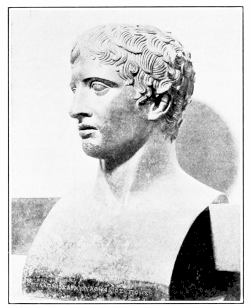
The best example of such a javelin-thrower seems to be the Doryphoros, the most famous statue of Polykleitos, in which he illustrated his canon of athletic forms. The Doryphoros exists in many copies, all of which agree fairly well in style and proportions. K. Friedrichs, in his monograph Der Doryphoros des Polyklets, which appeared in 1863,1600 was the first to show that the statue found in 1797 in the Palaistra at Pompeii, and now in the Naples Museum (Pl. 4), was a copy of the original bronze, as it shows all the peculiarities of the master’s style known to us from tradition.1601 Mahler enumerates 7 statues, 17 torsos, and 36 heads copied from the original, and the fine, but expressionless, Augustan bronze bust from the villa of the Pisos, Herculaneum, inscribed as the work of the sculptor Apollonios, son of Archios, of Athens, which is now in Naples (Fig. 47).1602 The best-preserved Fig. 48.—Statue of the Doryphoros, after Polykleitos. Vatican Museum, Rome. copy of the statue, the one in Naples, is surpassed in workmanship by the green basalt torso in the Uffizi Gallery in Florence1603 and by the marble one formerly in the possession of Count Pourtalès in Berlin.1604 A poorer copy is to be found in the Braccio Nuovo of the Vatican (Fig. 48).1605 In these copies we see a thick-set youth standing with the weight of the body on the right leg, the left one thrown back and touching the ground only with the toes, seemingly ready to advance, though the shoulders do not partake of the walking action. He is represented, therefore, at the moment of transition from walking to a rest position—in other words in a purely theoretical pose—at rest, indeed, but just ready again to advance.1606 His left hand held a short akontion over the shoulder and not the long spear (δόρυ), whence the name Doryphoros or spear-bearer is derived.1607 The head is turned to the same side as the advanced foot, which perhaps is an example of the monotony in the work of the master complained of by ancient critics; variety would have been attained by turning it in the opposite direction. In the carefully worked bronze original, which, however, must have had an insignificant intellectual aspect, the apparently simple problem—hitherto vainly attempted in Greek art—of representing a man standing almost motionless, but full of life, was for the first time solved. It is a long way from the motionless figures known as “Apollos,” with their arms glued to the sides and their legs close together, to this vigorous athlete. As we have already indicated, Greek art developed the first step beyond the “Apollos” by further advancing one leg of a statue and, it may be, extending one forearm horizontally. The next step was to place one foot slightly sidewise and thus relieve it of the weight of the body—the well-known scheme of the “free” and “rest” leg. At first the relaxation was slight, the “free” leg not being intended to move forward, nor the parts of the body to be much shifted. Polykleitos’ innovation consisted in having the legs so placed, one behind the other, that the figure, while apparently resting on one,1608 seemed to be advancing. On the ground of the familiar passage in Pliny cited, it has been generally assumed that Polykleitos introduced the walking motive into sculpture. However, this motive was probably the invention of the earlier Argive school, borrowed by Polykleitos for his canon, as seen in the statue of the so-called Munich King (Zeus?), of the Glyptothek, which Furtwaengler has shown to be a work of about 460 B. C.1609
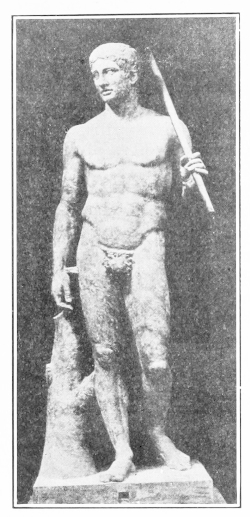
Does the Doryphoros represent a pentathlete victor? Since Quintilian says that it appears ready for war or for the exercises of the palæstra,1610 Helbig and others have classed it as a warrior, perhaps one of the Achilleae mentioned by Pliny1611 as set up in the Greek gymnasia. Furtwaengler stressed the incorrectness of calling an athlete a Doryphoros1612—a name originally given to an attendant bearing a lance (δόρυ), and so inapplicable to the statue of Polykleitos, which represented not a server, but an athlete carrying an akontion (witness the Berlin gem already mentioned)—but later1613 concluded that an athlete statue with the akontion might have been vaguely described in late art jargon as a spear-bearer. Consequently he found probable the interpretation of the various doryphoroi mentioned by Pliny1614 as victor statues, and thought that the original of the Doryphoros of Polykleitos might very well have represented an Olympic pentathlete, which was originally set up at Argos, where it was also adopted for a figure on the heroic grave-relief already mentioned, which represented the youth with a spear over his shoulder standing beside a horse. Bulle also thinks that the statue represented a victor athlete set up in some sacred spot.
For its interpretation as the statue of a pentathlete victor, an added proof is furnished by the discovery of a late Roman copy of it at Olympia.1615 This may very well have been the dedication of an athlete of late date—of the first century B. C. or of the first A. D.—who preferred to be represented by a copy of the famous work of Polykleitos rather than by a new statue. Treu’s contention that the torso is too large for a victor statue,1616 because Lucian says that the Hellanodikai did not allow statues of victors to be over life-size,1617 falls to the ground, since we know that exceptions to the rule existed at Olympia.1618 He agrees with Collignon1619 in interpreting it as a decorative statue, which surely involves an anachronism in the middle of the fifth century B. C.; and his argument that its good preservation shows it to have been set up in an interior room, perhaps of the Bouleuterion, in whose ruins it was found, adducing this as additional evidence of its decorative character, is no proof, since victor statues at Olympia seem sometimes to have been housed.1620 Thus the theory that the Doryphoros represents a pentathlete victor is well within the range of possibilities.