Chapter III · VICTOR STATUES REPRESENTED AT REST.
Reading edition
Plates 8–21 and Figures 9–31.
We have seen816 that it was a very old custom in Greece to dedicate statues of victors at the great national games to the god in whose honor the games were held. On many sites, especially at Olympia, tiny statuettes of clay or bronze of very primitive technique have been found in great numbers, which represent victors in many attitudes and ways—as horsemen, warriors, charioteers, etc. By the sixth century B. C. this ancient custom, as we learn from literary, epigraphical, and monumental sources, had developed, with the rapid progress attained by the sculptor’s art, into the regular practice of erecting life-size statues of athletes at the site of the games or in the native city of the victor. Especially at Olympia hundreds of such monuments were gradually collected, whose numbers and beauty must have exerted an overwhelming impression on the visitor to the Altis. We shall now begin the consideration of these monuments in detail.
The victor statues at Olympia, as elsewhere, may be conveniently divided into two main groups—those which represent the victor as standing or seated at rest, before or after the contest, and those which represent him in movement, i. e., in some contest schema.817 Examples of statues of athletes represented at rest are common in Greek athletic sculpture. We need only mention the so-called Oil-pourer of Munich (Pl. 11), who is represented as pouring oil over his body to make his limbs more supple for the coming wrestling bout; the Diadoumenos of Polykleitos (Pls. 17, 18, and Fig. 28), who is binding a victor fillet around his head after a successful encounter; the Apoxyomenos of the school of Lysippos (Pl. 29), representing an athlete scraping off the oil and dirt from his body after his victory. In this class of statues, which forms by far the greater number and shows the richer motives, the poses are quiet and reserved, the figures are compact, and the expression earnest and even thoughtful. As examples of statues represented in movement we need only recall such well-known works as the Diskobolos of Myron with its rhythmic lines and vivacious expression (Pls. 22, 23, and Figs. 34, 35); the bronze wrestlers of Naples, who are bending eagerly forward watching for a grip (Fig. 51); or the artistically intertwined pancratiast group of Florence (Pl. 25). Such monuments show us the varied poses, the choice of the critical moment, the truth to life, and the masterly rhythm attained by certain sculptors.
THE APOLLO TYPE.
In this chapter we shall confine ourselves almost entirely to the statues of victors represented at rest, discussing those represented in motion chiefly in the next. Most of the oldest statues at Olympia, dating from a time when there were few variations in the sculptural type, must have been represented at rest and in the schema of the so-called “Apollos.” Ever since the discovery of the Apollo of Thera in 1836 (Fig. 9), this genre of sculpture, the most characteristic of the early period, extending from the end of the seventh century B. C. to the time of the gable groups of Aegina, has been carefully studied. Though we now know that the type passed equally well for gods and mortals,818 we still keep the name, because of its familiarity and for the sake of having a common designation. That this type actually represented Olympic victors we have indubitable proof. Pausanias mentions the stone victor statue of the pancratiast Arrhachion, dating from the first half of the sixth century B. C., which stood in the agora of his native town Phigalia. He describes it as archaic in pose, with the feet close together and the arms hanging down the sides to the hips—the typical “Apollo” schema.819 Moreover, this very statue has survived to our time (Fig. 79).820 A study, therefore, of this type of statue will give us an idea of how some of the early statues at Olympia looked.
The “Apollo” statues,821 because of differences in facial expression, have been conveniently divided into two groups: those represented by the examples from Thera, Melos, Volomandra, Tenea, etc., sometimes named the “grinning” group, because the corners of the mouth are turned upwards into the so-called “archaic smile,” and those represented by the examples from Orchomenos, the precinct of Mount Ptoion, and elsewhere, named the “stolid” group, because in them the mouth forms a straight line.822 There are, however, essential differences Fig. 9.—Statue of so-called Apollo of Thera. National Museum, Athens. between the statues of each group. Thus, while some of both groups—e. g., the examples from Melos, Volomandra, and Orchomenos—have square shoulders, most of the others have sloping ones. The type gradually improved, as in each successive attempt the sculptor overcame difficulties, until finally revolutionary changes had taken place in the original form. This improvement is seen in the treatment of the hair, in the modeling of the face and body, and in the proportions of the statues. In a head of a statue from Mount Ptoion823—which is broken off at the neck—we seem to see the sculptor in wood making his first attempt in stone. In the archaic example from Thera824 (Fig. 9) the arms hang straight down close to the sides, as in the statue of Arrhachion, being detached only slightly from the body at the elbows, showing that the artist was afraid that they might break off. In other examples, as in the one from Orchomenos825 (Fig. 10) and one from Mount Ptoion826 (Fig. 11), the space between the arms and the body has become larger, while in the example from Melos827 (Fig. 12) only the hands are glued to the thighs. In the “Apollo” found at Tenea in 1846, and now in Munich828 (Pl. 8A), the arms are free, but the hands are held fast to the body by the retention of small marble bridges between them and the thighs. The final step has been taken in two examples from Mount Ptoion (Fig. 13), in which the arms from the shoulders down are free from the bodies.829 The bridges shown on the photograph in the figure to the left, which connect the forearms with the thighs, are of plaster, being added at the time the statue was set up in Athens.830 The figure to the right is smaller and clearly discloses Aeginetan influence. The audacity of the sculptor in entirely freeing the arms in both examples was rewarded by the arms being broken off. Similarly, in the Strangford Apollo of the British Museum (Fig. 14),831 the arms, which hung loose from the shoulders, are broken away. The larger statue from Mount Ptoion just mentioned also has the arms slightly crooked at the elbows, the forearms being extended at an oblique angle to the body. This represents an intermediate stage between the earlier “Apollos,” in which the arms adhered vertically to the sides of the body (as e. g., in the ones from Orchomenos, Thera, Melos, and Tenea), and the later ones, in which the arms were bent, the forearms being extended at right angles to the body (see Figs. 15 and 19).832
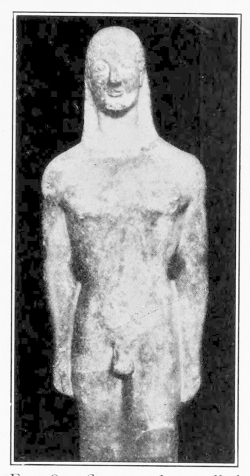
Fig. 10.—Statue of so-called Apollo of Orchomenos. National Museum, Athens. Fig. 11.—Statue of so-called Apollo, from Mount Ptoion, Bœotia. National Museum, Athens.
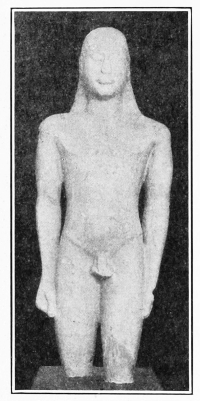
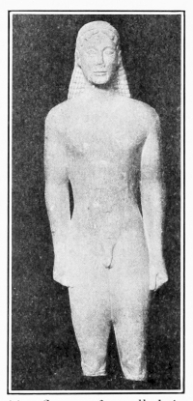
Fig. 12.—Statue of so-called Apollo of Melos. National Museum, Athens. The example from Thera shows the archaic method of working in planes parallel to front and side and at right angles to one another, the corners of the square block being merely rounded off. The outlines of muscles are indicated by shallow grooves, which do not affect the flatness of the surface, and there is but little facial expression. We see the chest outlined in some examples from Aktion.833 In the Melian example the rectangular form is modified by cutting away the sides obliquely in arms and body; here there is more expression in the face, and the treatment of the hair and the proportions of the body are more developed. In the example from Orchomenos we see a great improvement in form. Here, as in later Bœotian examples, the original rectangular form of the example from Thera has become round, so that a horizontal cross-section through the waist is almost circular; the muscles of the abdomen are indicated and the skin is naturalistically shown in the back and at the elbows. In later Bœotian examples from Mount Ptoion, which are directly developed from the Orchomenos type,834 the form is lighter and the proportions more graceful. In one example (Fig. 13, left) even the veins are shown. In the example mentioned above as showing Aeginetan influence, and dated about 500 B. C.,835 the muscles are clearly marked, just as in the Strangford example and in the statues from the temple at Aegina, showing that foreign art had been introduced into Bœotia by that time. In the example from Volomandra in Attica,836 we see affinity to the examples from Thera and Melos, but Attic softness in the carving of the shoulders and in the proportions. In the Apollo of Tenea (Pl. 8A), “by far the most beautiful preserved statue of archaic sculpture,”837 a statue most carefully worked, we see a Peloponnesian example of the beginning of the sixth or even of the end of the seventh century B. C. Here the sculptor has shown great care in executing details and in the proportions. The eyes are not flat, but convex, and are wide open as in most of the earlier examples. The downward flow of the lines of the statue is striking, which is caused by the sloping shoulders and the elongated triangular-shaped abdomen. The slimness of the figure, with the contour of bones and muscles, is remarkable at so early a date. The fashioning of the knees is detailed. When we contrast this tall, slim, agile statue with the massively square-built Argive type found at Delphi (Pl. 8B), we find it reasonable to suspect that the Apollo of Tenea is an imported work, coming probably from the islands.838 The two statues of (?) Kleobis and Biton, discovered at Delphi in 1893 and 1894, and inscribed with the name of the sculptor Polymedes of Argos, have added much to our knowledge of early Argive sculpture (Pl. 8B, = Statue A).839 This Polymedes may have been one of the predecessors acknowledged by Eutelidas and Chrysothemis, among the first victor statuaries known to us by name, in the epigram preserved by Pausanias from the base of the monument of Damaretos and his son Theopompos at Olympia.840 The epigram, in any case, implies that the reputation of the Argive school in athletic sculpture was already well established by the end of the sixth century B. C. These massively built statues, dating from the beginning of the sixth century B. C., outline the muscles to a certain extent, even showing the line of the false ribs by incised lines. They display, however, but little detail in modeling, except in the knees, where the artist has tried to indicate the bones and muscles. The features of the large heads are without expression; the large eyes are flat and not convex, as in the example from Tenea, though the Argive artist was, perhaps, later than the Corinthian one, and a long distance removed from the later artist of the Ligourió bronze (Fig. 16), to be discussed later.
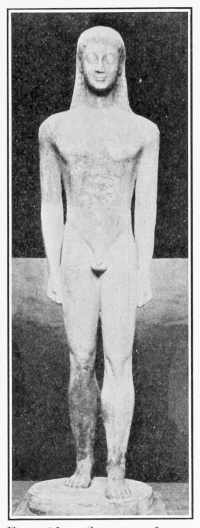
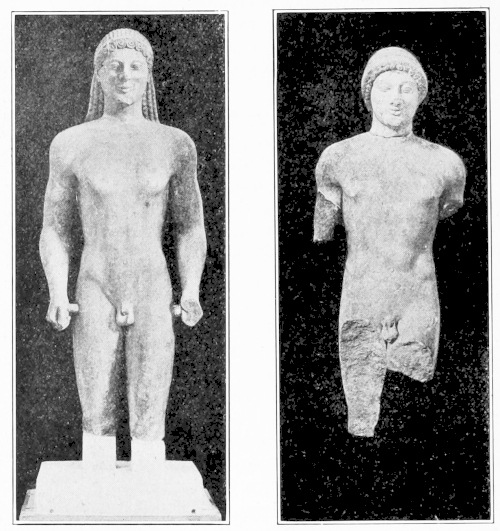
Fig. 13.—Statues of so-called Apollos from Mount Ptoion. National Museum, Athens.
PLATE 8A A. Statue of so-called Apollo of Tenea. Glyptothek, Munich. PLATE 8B So-called Argive Apollo from Delphi. Museum of Delphi.
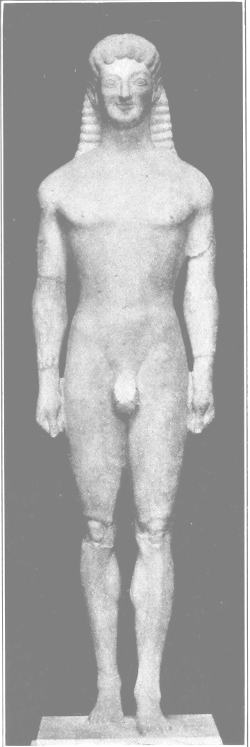
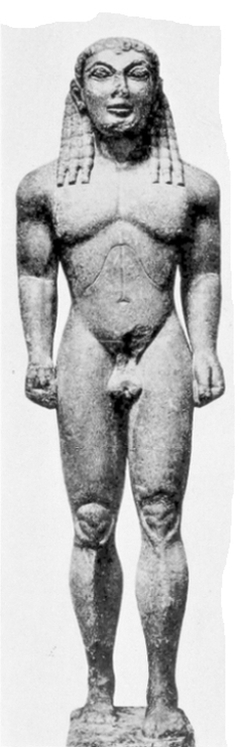
Fig. 14.—Statue known as the Strangford Apollo. British Museum, London. In all these “Apollos,” which have been found all over the Greek world from Naukratis in Egypt to Ambrakia, and along the Asian coast and on the Aegean Isles, the archaic artists have attempted, by their modeling of the muscles, especially of the chest and abdomen, to express trained strength. The heavy Argive examples, which may be said to be the prototypes of the Ligourió bronze and of the Doryphoros of Polykleitos (Pl. 4 and Fig. 48), are in strong contrast with the lighter type best represented by the example from Tenea. In the former, with their big heads and shoulders and their powerful arms and legs, we may see early boxers or pancratiasts; in the latter a long-limbed runner, with powerful chest, but slim and supple legs. In the Apollo of Tenea there is no flabbiness nor softness, and yet no emaciation. We see very similar runners on Panathenaic vases. Between the two extremes we have a long series, those from Mount Ptoion and elsewhere.
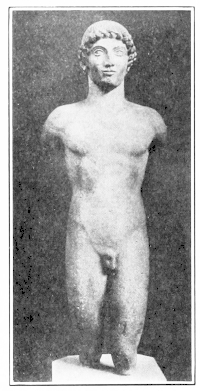
We do not doubt that the early statues of athletes at Olympia showed all the variations we have discussed in these “Apollos.” Of this type, then, were the statues at Olympia of the Spartan Eutelidas, the oldest mentioned by Pausanias,841 those of Phrikias of Pelinna in Thessaly,842 and of Phanas of Pellene in Achæa,843 to whom, later on in this chapter, we shall ascribe the two archaic marble helmeted heads found at Olympia (Fig. 30), the wooden statues of Praxidamas and Rhexibios,844 the statue of Kylon on the Akropolis of Athens,845 and that of Hetoimokles at Sparta.846 The statue of the famous wrestler Milo of Kroton by the sculptor Dameas, mentioned by Pausanias847 and described by Philostratos,848 must also have conformed with the “Apollo” type, though it showed a step in advance of the earlier ones by having its arms bent at the elbow, the forearms being extended horizontally outward. This statue needs a somewhat detailed account. The description of Philostratos seems to have been founded on the account in Pausanias849 of Milo’s prowess, which, in turn, may have arisen from the appearance of the statue and the cicerone’s description. Philostratos says that it stood on a quoit with the feet close together and with the left hand grasping a pomegranate, the fingers of the right hand being extended straight out, and a fillet encircling the brows.850 Philostratos has Apollonios explain the attributes of the statue on the ground that the people of Kroton represented their famous victor in the guise of a priest of Hera. This would explain the priestly fillet and the pomegranate sacred to the goddess, while the diskos, on which the statue rested, would be the shield on which Hera’s priest stood when praying. Scherer, however, rightly pointed out that the statue in the Altis was of Milo the victor and not the priest. He therefore explained the diskos851 merely as a round basis on which the statue, of the archaic “Apollo” type with its feet close together, stood, and the tainia as a victor band. He followed Philostratos in believing that the gesture of the right hand was one of adoration.852 He looked upon the object in the left hand not as a pomegranate at all, but as an alabastron, a toilet article adapted to a victor. He, therefore, believed that the Apollo of the elder Kanachos of Sikyon,853 the so-called Philesian Apollo,854 represented nude and holding a tiny fawn in the right hand and a bow in the left, would give a good idea of the pose of Milo’s statue.855 Hitzig and Bluemner believe this explanation of Scherer probable, although they rightly disagree with him in his exchanging the pomegranate for an alabastron, since Pausanias expressly mentions a pomegranate in the hand of another victor statue at Olympia.856 Pliny speaks of a male figure by Pythagoras, mala ferentem nudum,857 and Lucian says apples were prizes at Delphi,858 and we know that Milo was also a Pythian victor. The same commentators believe that Pausanias’ story of Milo bursting a cord drawn round his brow by swelling his veins arose from the victor band on the statue, and the story of the strength of his fingers from the position of the fingers on it.
We have seen in the “Apollo” statues a considerable variety of physical types. In the sixth century B. C. the artist was feeling his way and was hampered by local school tendencies. At first he knew only how to produce rigid statues in the conventional Egyptian attitude with the arms glued to the sides, the two halves of the body being symmetrical and the hips on the same level. He gradually improved on this Fig. 15.—Bronze Statuette of a Palæstra Victor, from the Akropolis. Akropolis Museum, Athens. model, making the position more elastic—as in the statue of Milo—rightly indicating bones and muscles and giving to the figure natural proportions. Bulle has shown on one plate859 three statuettes which illustrate the improvements reached in bronze in various parts of Greece by the end of the sixth century B. C. To the left is represented a victorious palæstra gymnast—as is indicated by the remnants of akontia in the hands—in the Akropolis Museum (Fig. 15);860 in the center is the Payne Knight statuette of the British Museum,861 carrying a fawn in the right hand, which is a copy of the Philesian Apollo which stood in the Didymaion near Miletos; to the right is Hermes with the petasos, short-girded tunic, and winged sandals, holding a ram in the left and probably a kerykeion in the right hand.862 The attributes of the three, then, attest respectively a victor, Apollo, and Hermes. In all three the arms are freed from the body, and the muscles of the breast, chest, and abdomen are indicated, though carelessly in the case of the victor. The proportions of the three vary greatly; the Attic victor has a large head, broad shoulders, powerful chest, long body, and short legs; the Apollo has long legs, shorter though slimmer body, and small head;863 the Hermes has a clearly outlined figure and shows the careful modeling so characteristic of the schools of Argos and Sikyon in the fifth century B. C. Bulle shows that the further development of the “Apollo” type was halted by the Argive school, which, while continuing the restful pose of these figures, counteracted their rigidity by inclining the head to the side and throwing the weight unevenly on the legs by lowering one hip and further advancing one foot. The central line was no longer vertical, but curved, and it was now possible to give greater detail to chest and abdomen. Polykleitos finally perfected this curve and threw back the left foot, resting the weight of the body on the right—from which time on we have the regular scheme of “free” and “rest” legs. Despite all these later improvements, Olympic victors continued to set up statues in the rest attitude of the “Apollo” type down perhaps into the third century B. C. Such dedications were the result both of school tendencies and economy, especially in the case of equestrian victors, who frequently were content to use such “actionless” statues in place of groups. We have only to mention the monuments of Timon of Elis, whose statue was the work of the Sikyonian Daidalos,864 and of Telemachos of Elis, whose statue was made by the otherwise unknown sculptor Philonides.865
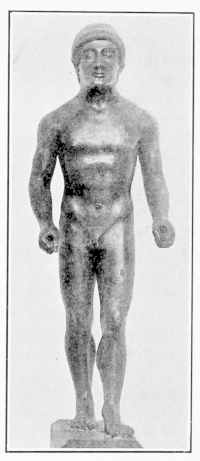
Before systematically considering victor statues at Olympia and elsewhere with general motives, i. e., represented at rest, we shall now rapidly sketch the development of athletic sculpture in four great centres, Argos, Sikyon, Aegina, and Athens, even though some of the works mentioned were represented in motion. Sculptors of other schools known at Olympia will be treated incidentally in both this and the following chapters.
THE AFFILIATED SCHOOLS OF ARGOS AND SIKYON.
While in general it is unprofitable to discuss sculptors who have not surely left any example of their art behind, there are two early schools of Peloponnesian sculpture, those of Argos and Sikyon, which, though we may assign work to them only by conjecture, can not be summarily passed over, owing to their great importance in the history of Greek athletic art. The bronze used in their works was too valuable to escape the barbarians, and, furthermore, the monotony, which must have characterized early Peloponnesian sculpture, militated against these works being reproduced to any great degree by later copyists.
The School of Argos.
The Argive school was devoted mainly to athletic statuary. The greatest name in old Argive art is that of Ageladas or Hagelaïdas,866 the reputed teacher of Myron and Polykleitos, who lived from the third quarter of the sixth century into the second quarter of the fifth century B. C. While his connection with Myron and Polykleitos is scarcely to be doubted,867 his supposed connection with Pheidias has made the chronology of the life of this sculptor one of the difficult problems of the ancient history of art. A scholion on Aristophanes’ Ranae, 504, dates the statue known as the Herakles Alexikakos in the Attic deme Melite by Hagelaïdas after the pestilence in Athens of 431–430 B. C., and makes the Argive sculptor (Gelados = Hagelaïdas) the teacher of Pheidias. As his statue of the Olympic victor Anochos commemorated a victory won in Ol. 65 ( = 520 B. C.), this late date is manifestly impossible.868 Furthermore, a better tradition says that Hegias was the teacher of the Attic master.869 Furtwaengler’s attempt to show that these two divergent traditions were really in accord, by the assumption that Hegias was the pupil of Hagelaïdas and that his art came from the latter—thus explaining certain similarities in the work of Hagelaïdas and Pheidias,—does not solve the problem.870 As the scholion is based on a good tradition,871 the best solution of the difficulty is that of Kalkmann872 and others, that the Alexikakos was the work of a younger Hagelaïdas, the grandson of the famous master, by the intermediate Argeiadas. For a lower limit to the activity of Hagelaïdas there seems to be no good reason for distrusting the evidence that he made a bronze Zeus for the Messenians to be set up at Naupaktos, whither they moved in 455 B. C.873 This makes quite possible a period of collaboration of four or five years at least between Polykleitos and Hagelaïdas.
Pausanias mentions the monuments of three victors at Olympia by Hagelaïdas: the statues of the pancratiast Timasitheos of Delphi, who won two victories some time between Ols. (?) 65 and 67 (520 and 512 B. C.);874 of the runner Anochos of Tarentum, who won in the stade- and double-race in Ols. 65 and (?) 66 ( = 520 and 516 B. C.);875 and the chariot-group of Kleosthenes of Epidamnos, who won in Ol. 66 ( = 516 B. C.).876
None of the works of Hagelaïdas at Olympia or elsewhere is known. Messenian coins of the fourth century B. C. show the motives of two of his statues, that of his Zeus Ithomatas just mentioned as being made for the Messenians,877 and the beardless Zeus παῖς at Aigion.878 However, we infer the characteristics of his style from the bronze statuette in Berlin which was found at Ligourió near Epidauros (Fig. 16).879 This is undoubtedly an Argive work contemporary with the later period of Hagelaïdas. Furtwaengler and Frost are right in looking upon it as showing the prototype of the canon of Polykleitos. Though too small to count as a characteristic work of the early Argive school, it shows us that the style of that school was a short and stocky type, similar to Aeginetan works, only somewhat fleshier and heavier. The straight mouth and heavy chin, the treatment of the eyelids, and the clumsy limbs are all archaic features to be expected in the period preceding Polykleitos. The modeling is carefully executed, showing a knowledge of anatomy. If such excellence is found in a statuette, we can form some idea of the perfection of a statue by the master.
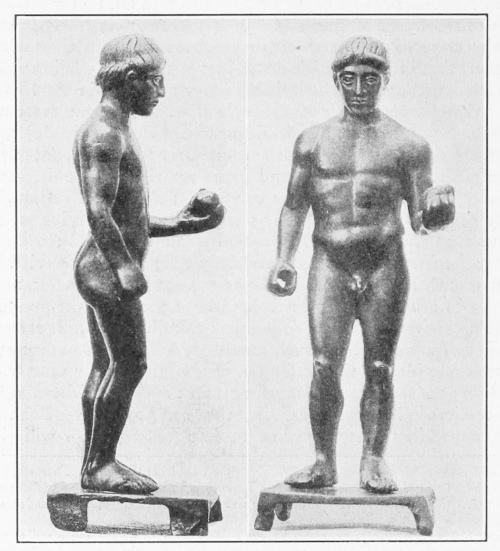
Fig. 16.—Bronze Statuette, from Ligourió. Museum of Berlin.
The bronze Apollo from Pompeii now in the Naples Museum,880 with marble replicas in Mantua and Paris,881 shows us how Hagelaïdas treated a god type, while the statue of an athlete by Stephanos will give us some idea of how he treated his victor statues, as it seems to have been modeled after an athlete statue of the early fifth century B. C., perhaps after a work by some pupil of the master. Stephanos belonged to the school of Pasiteles, a group of sculptors flourishing at Rome at the end of the Republic and the beginning of the Empire. They devoted themselves to the reproduction of early fifth-century statues. They were not ordinary copyists, for their works show individual mannerisms and a system of proportions foreign to the originals. Thus their statues have the square shoulders of the Argive school, but the slim bodies and slender legs of the period of Lysippos and his scholars. Apart from such mannerisms, then, in the male figure signed Stephanos, pupil of Pasiteles, in the Villa Albani in Rome (Pl. 9),882 which reappears in a very similar statue in groups combined with a female figure of related style,883 or with another male figure,884 we may see a copy of a bronze original of the Argive school before Polykleitos. The standing motive and the body forms are the same in both the Mantuan Apollo and the Stephanos figure, although the former is more developed and the head type is different in both; this shows that the two, while displaying the same basic ideal, were not works of the same master.885 As the statue by Stephanos has a fillet around the hair, it may well represent an ideal athlete, who in the original held an aryballos or similar palæstra attribute in the raised left hand. It is interesting to compare the copies of this group with those of another representing mother and son, the work of Menelaos, the pupil of Stephanos, which, though transferred from Greek to Roman taste in respect of drapery and forms, is merely a variation of the same theme without any heroic traits.886
PLATE 9
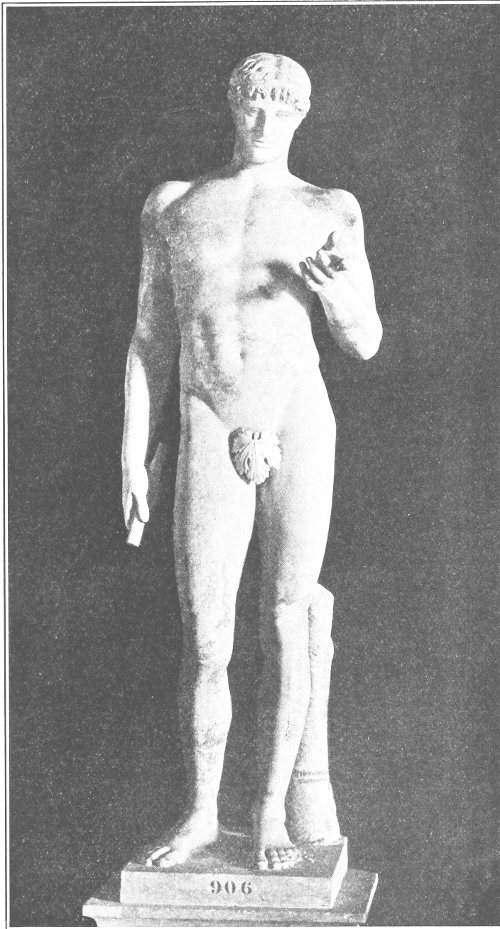
Statue of an Athlete, by Stephanos. Villa Albani, Rome.
The influence of Hagelaïdas can be easily traced in other schools of art, especially in the Attic School and in the sculptures of the temple of Zeus at Olympia, whether these latter be Peloponnesian in origin or not. It will be convenient in this connection to discuss briefly the style of these important sculptures, which we have already mentioned several times. The statement of Pausanias,887 that the sculptors of the East and West Gables were Paionios of Mende in Thrace and Alkamenes respectively—the latter being known as the pupil of Pheidias888—was not doubted until the discovery of the Olympia sculptures.889 Then doubts arose both on chronological and stylistic grounds, and now only a few archæologists would maintain that either artist had anything to do with these groups. The style of the two gables (as well as that of the metopes) is so similar that many have assigned them to one and the same artist.890 They have been referred to many schools from Ionia to Sicily, even including a local Elean one. Thus Brunn assigned them to a North Greek-Thracian school; Flasch891 and (more recently) Joubin892 to the Attic; Kekulé893 and Friedrichs-Wolters894 to a West Greek (Sicilian) one, because of their similarity to the metopes of temple E at Selinos; Furtwaengler895 to an Ionic one (Parian masters). Most scholars, however, including K. Lange,896 Treu,897 Studniczka,898 Collignon,899 and Overbeck,900 have referred them to Peloponnesian sculptors.901
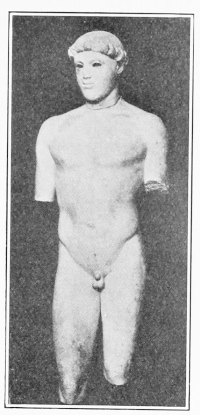
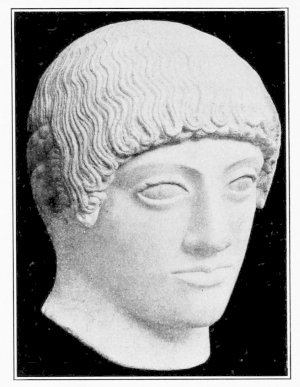
To return to the art of Hagelaïdas: if we assume that the Ligourió bronze comes from the school of that Argive master certain conclusions must be drawn. The figure is archaic, but does not have the archaic smile. In Athens at the end of the archaic period there was a reaction against this smile, and doubtless the Athenian artists were strongly influenced by Argive models. Thus an archaic bronze head of a youth, found on the Akropolis and dating from about 480 B. C., shows a serious mouth, a strong chin, heavy upper eyelids, and finely worked hair, characteristics which we found in the Ligourió statuette. These traits show that the statuette and the head were the forerunners of the Apollo of the West Gable at Olympia. So finished a bronze as this one from the Akropolis, at the beginning of the fifth century B. C., has inclined Richardson to look upon it as “not improbably a work of Hagelaïdas,”902 though here again Furtwaengler would ascribe it to Hegias.903 The Parian marble statue of an ephebe found on the Akropolis (Fig. 17)904—one of the most beautiful recovered during the excavations Fig. 17.—Statue of an Ephebe, from the Akropolis. Akropolis Museum, Athens. there—shows the same Argive influence. This statue is chronologically the first masterpiece, thus far recovered, which marks the break with archaism by having its head turned slightly to one side.905 It has the same pose as the Athlete by Stephanos and probably represents a palæstra victor. The head, with its heavy chin, and the muscular body strikingly resemble the Harmodios (Fig. 32), which has led Furtwaengler and others to ascribe it to Kritios or his school.906 At the same time a similarity is seen between this head and that of the Apollo of the West Gable at Olympia, and so with Bulle and others we ascribe it to the Argive school.
One of the female statues (Korai) found on the Akropolis, and approximately of the same date as the ephebe, viz, the fragmentary one consisting of head and bust and known popularly as la petite boudeuse, shows the same revolt against Ionism.907 In many respects this statue is very different from most of the other Akropolis Korai. The eyes are not yet set back naturally, but the appearance of depth is attained by thickening the eyelids, quite in contrast with the modeling of the eyeball in most of the other statues. The corners of the mouth turn down, which gives it the appearance of pouting. This statue is also our first example in sculpture of the so-called Greek profile—the nose continuing the line of the forehead. The same Argive influence in Athenian art is also discernible in the Parian marble head of an athlete with traces of yellow in the hair (Fig. 18),908 which may be dated a little later than the Akropolis ephebe—about 470 B. C. Because of its resemblance to the Fig. 18.—Head of an Ephebe, from the Akropolis. Akropolis Museum, Athens. Apollo of Olympia, its Attic-Peloponnesian origin seems clear.909 Its expression is comparable with that of the Kore just discussed—as it has the same mouth, eyes, and nose, both monuments showing the reaction against the archaic smile, which characterized the Ionian period of Attic art. This same Ionic reaction also may be seen in the bronze statuette of a diskobolos in the Metropolitan Museum (Fig. 46),910 which resembles in style that of the Tyrannicides, but shows also Argive traits. These Argive traits, small head and slender limbs, are easily seen by comparing this statuette with the Ligourió bronze.
We have already mentioned the monumental group of the hoplite victor Damaretos and of the pentathlete Theopompos, which was made about 500 B. C. by the Argive sculptors Chrysothemis and Eutelidas.911 These artists were known to later antiquity only by the epigram inscribed on the base of this monument at Olympia, and the probable dates of the two victories of Theopompos, Ols. (?) 69 and 70 ( = 504 and 500 B. C.), show that they were contemporaries of Hagelaïdas, and not, as formerly was believed, the forerunners of his school.912
Polykleitos, a Sikyonian by birth,913 migrated early to Argos to become the pupil of Hagelaïdas, and became the great master of the Argive school in the next generation after him. We have four statues by him at Olympia. His earliest work probably was the statue of the boxer Kyniskos of Mantinea, who won in Ol. (?) 80 ( = 460 B. C.); he made the statues of the Elean pentathlete Pythokles and of the Epidamnian boxer Aristion, both of whom won their victories in Ol. 82 ( = 452 B. C.); and lastly he made the statue of the boy boxer Thersilochos from Kerkyra, who won in Ol. (?) 87 ( = 432 B. C.)914 The footprints on the three recovered bases of the statues of the first three show that all were represented at rest. Of Patrokles, the brother of Polykleitos, Pausanias mentions no statues at Olympia, though Pliny says that he made athlete statues.915 Of Naukydes,916 the nephew or brother of Polykleitos, we have record of three athlete statues at Olympia: those of the wrestlers Cheimon of Argos, who won in Ol. 83 ( = 448 B. C.), and Baukis of Trœzen, who won some time between Ols. (?) 85 and 90 ( = 440 and 420 B. C.); also one of the boxer Eukles of Rhodes, who won some time between Ols. 90 and 93 ( = 420 and 408 B. C.).917 A contemporary of Naukydes was the sculptor Phradmon, who, according to Pliny, was a contemporary of Polykleitos;918 he made the statue of the boy wrestler Amertas of Elis, who won a victory some time between Ols. 84 and 90 ( = 444 and 420 B. C.).919 In the next century, Polykleitos Minor, the grandson or grandnephew of the great Polykleitos, and the pupil of Naukydes,920 had three statues at Olympia: those of the boy boxer Antipatros of Miletos, whose victory is given by Africanus as Ol. 98 ( = 388 B. C.); of the two boy wrestlers Agenor of Thebes, who won some time between Ols. 93 and 103 ( = 408 and 368 B. C.), and Xenokles of Mainalos, who won some time between Ols. 94 and 100 ( = 404 and 380 B. C.).921 The inscribed base of the latter has been recovered and the footprints show that the statue was represented at rest, the body resting equally on both feet, the left slightly advanced. Andreas, a second-century B. C. Argive sculptor, made a statue at Olympia of the boy wrestler Lysippos of Elis, who won some time between Ols. 149 and 157 ( = 184 and 152 B. C.).922
The School of Sikyon.
The Sikyonian school of bronze founders was closely affiliated with the one at Argos. Early in the archaic period the brothers Dipoinos and Skyllis, sons or pupils of the mythical Daidalos of Crete, migrated to Sikyon.923 A generation later another Cretan sculptor, Aristokles, founded there an artist family which lasted through seven or eight generations.924 His two grandsons Aristokles and Kanachos are known to have collaborated with Hagelaïdas on a group of three Muses.925 Many have seen in the small bronze found in the sea off Piombino, Tuscany, and now in the Louvre (Fig. 19),926 a copy of the Apollo Philesios, the best-known work of Kanachos. This gem of the bronze art, in true archaic style, may very well represent the Apollo, which, according to the description of Pliny927 and the evidence of Milesian copper coins of all periods,928 had as attributes a fawn in the outstretched right hand and a bow in the left. However, Overbeck,929 followed by von Mach, believes that it is not a copy of Kanachos’ Apollo, but merely Fig. 19.—Bronze Statuette of Apollo, found in the Sea off Piombino. Louvre, Paris. represents a boy assisting at a sacrifice, and that the original held a cup in the left hand and a saucer in the right. In any case the statuette is too inaccurate to give us more than the pose of the Apollo of Kanachos, even if it were proved to be a copy. It may be merely a reproduction of the mythological type of Apollo, which the artist himself followed, and so we can not say definitely to what school it belongs. The Payne Knight bronze in the British Museum,930 which holds a tiny fawn in the right hand, the bow originally in the left hand being lost, has better pretensions, perhaps, to be a copy of the Apollo. Another archaic half life-size bronze, formerly in the Palazzo Sciarra,931 is of a similar type, though its style is different. Another bronze statuette from Naxos, now in Berlin,932 shows the same position of the hands, but has an aryballos or pomegranate in the right hand. We have already classed it as an example of the conversion of an original god-type into that of a victor. We might also mention the mutilated torso found by Holleaux at the sanctuary of Apollo Ptoios in Bœotia (Fig. 12, right), which has a similar pose to that of the statuette from Piombino, and whose hair technique shows that it is an imitation of a bronze work.933 However, as we shall see later, it may be rather representative of the Aeginetan school of sculptors. All these works may tell us of the general character of the Apollo, but little of its style.934
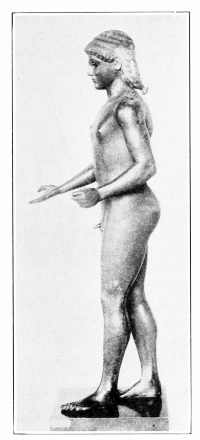
No athlete statue by Aristokles or his brother Kanachos is known to have stood at Olympia. That the latter actually made victor statues, however, is proved by Pliny’s statement (l. c.) that he made celetizontas pueros. Of the later Sikyonian school we have twenty-seven statues of victors made by eleven different sculptors, whose dates range from near the end of the fourth down into the third century B. C., of whom we shall give a chronological list. Alypos, the pupil of the Argive Naukydes, had four statues at Olympia: those of the wrestler Symmachos of Elis, of the boy boxer Neolaïdas of Pheneus, of the boy wrestler Archedamos of Elis, and of the boy and man wrestler Euthymenes of Mainalos, all of whom must have won their victories some time between Ols. 94 and 104 ( = 404 and 364 B. C.).935 Kanachos, the Younger, made one statue, that of the boy boxer Bykelos of Sikyon, who won some time between Ols. 92 and 105 ( = 412 and 360 B. C.).936 Olympos made the statue of the pancratiast Xenophon of Aigion, who won some time between Ols. 95 and 105 ( = 400 and 360 B. C.).937 The sculptor Daidalos, the son and pupil of Patrokles, and probably the nephew of Polykleitos, made four monuments for four victors: the equestrian group of the Elean charioteer Timon and his son Aigyptos, a victor in horse-racing, and statues of the Elean wrestler Aristodemos and the stade-runner Eupolemos. Their victories fell between Ols. 96 and 103 ( = 396 and 368 B. C.).938 Damokritos made the statue of the Elean boy boxer Hippos, who won between Ols. 96 and 107 ( = 396 and 352 B. C.).939 Kleon had five statues credited to him, all but one being of boy victors: those of the boy runner Deinolochos of Elis, the pentathlete Hysmon of Elis, the two boy boxers Kritodamos, and of Alketos of Kleitor, and of the boy runner Lykinos of Heraia. Their victories fell between Ols. 94 and 103 ( = 404 and 368 B. C.).940 The great Lysippos had the same number of victor statues as Kleon, and also two honor statues at Olympia: those of the equestrian victor Troilos of Elis, of the Akarnanian pancratiast Philandridas, of the wrestler Cheilon of Patrai, of the pancratiast Polydamas of Skotoussa, and of the hoplite-runner Kallikrates. Their victories occurred between Ols. 102 and 115 ( = 372 and 320 B. C.).941 The son of Lysippos, Daïppos, made two statues, one for the Elean boy boxer Kallon and the other for the Elean Nikandros, who won the double foot-race. Their victories fell within the activity of the sculptor, Ols. 115 and 125 ( = 320 and 280 B. C.).942 Daitondas made the statue of the Elean boy boxer Theotimos, who won his victory some time between Ols. 116 and 120 ( = 316 and 300 B. C.).943 Eutychides, the most famous pupil of Lysippos, famed alike as a bronze founder, statuary, and painter, carved the statue of the boy runner Timosthenes of Elis, who won some time between Ols. 115 and 125 ( = 320 and 280 B. C.).944 Pliny gives Ol. 121 ( = 296 B. C.) as the floruit of this sculptor, which was probably the date of the erection of his most famous work, the colossal bronze Tyche, as tutelary deity of the city of Antioch on the Orontes, which was founded by Seleukos I in Ol. 119.3 ( = 302 B. C.).945 This shows that Eutychides was already by that date a famed sculptor, having begun his career by 330–320 B. C. Kantharos, the pupil of Eutychides, made the statues of the two boy wrestlers Kratinos of Aigira and Alexinikos of Elis, who won their victories some time between Ols. 120 and 130 ( = 300 and 260 B. C.).946
ÆGINETAN SCULPTORS.
We have but little left of the prominent early Aeginetan school of bronze sculptors. Of Kallon, the earliest historical sculptor of the school, the reputed pupil of Tektaios and Angelion (who in turn were the pupils of Dipoinos and Skyllis), we have only literary evidence. He was typical of archaic severity just prior to the era of transition, and therefore should be compared with Hegias of Athens and Kanachos of Sikyon. For Onatas, the most famous of the Aeginetan sculptors, whose floruit was in the first half of the fifth century B. C., we have evidence of many monuments at Olympia. Besides the colossal Herakles dedicated by the Thasians,947 a Hermes dedicated by the people of Pheneus,948 and a large group of nine statues of Greek heroes standing on a curved base faced by a statue of Nestor on another, the group being dedicated by the Achaians,949 he made a chariot and charioteer to commemorate the victory of Hiero of Syracuse at Olympia in 468 B. C., for which monument Kalamis furnished two horses.950 Glaukias made a bronze chariot for Hiero’s brother Gelo of Gela, who later became tyrant of Syracuse, and who won a chariot victory in Ol. 73 ( = 488 B. C.).951 This sculptor also excelled in fashioning statues of boxers and pancratiasts, making the monuments of the boxers Philon of Kerkyra and Glaukos of Karystos, and that of the renowned boxer and pancratiast Theagenes of Thasos.952 The statue of Glaukos was represented in the schema of one “sparring” (σκιαμαχῶν),953 and so was in movement and not at rest. We have athlete statues by three other Aeginetan sculptors at Olympia. Thus Ptolichos, the pupil of the Sikyonian Aristokles, set up statues of the Aeginetan boy wrestler Theognetos, who won in Ol. 76 ( = 476 B. C.), and of the boy boxer Epikradios of Mantinea, who won between Ols. (?) 72 and 74 ( = 492 and 484 B. C.);954 Serambos made the statue of the boy boxer Agiadas of Elis, who won between Ols. (?) 72 and 74;955 Philotimos made the horse for the horse-racing victory of Xenombrotos of Kos, who won in Ol. (?) 83 ( = 448 B. C.).956 All of these sculptors appear to have used bronze exclusively, and their art, though independent, showed a bias toward Peloponnesian work. There are few examples left of this art. The bronze head of a bearded warrior or hoplite victor found on the Akropolis, if we are justified in classing it as Aeginetan and not Attic, shows the excellence which we associate with this school.957 The delicate execution of its hair and beard, as well as the strength and precision of this head, makes it not unworthy of being ascribed to one of the best artists of the school, perhaps to Onatas himself. The beardless bronze head discovered in 1756 in the villa of the Pisos in Herculaneum, now in Naples, has also been assigned to Onatas, as its features are similar to those of the one under discussion.958 The Tux bronze statuette of a hoplitodrome, to be discussed in Ch. IV (Fig. 42), has also been assigned to an Aeginetan master.959 The marble statue known as the Strangford Apollo in the British Museum, already mentioned (Fig. 14),960 may show the characteristics of the early school in marble, though it is impossible to say whether it is a copy of a bronze original or a minor work in stone under Aeginetan influence. The smaller “Apollo” from Mount Ptoion, already discussed (Fig. 13, right),961 appears to show in exaggerated form the same Aeginetan traits. However, we get out best notion of Aeginetan work in marble from the gable statues in the Munich Museum, representing Homeric warriors fighting, which adorned the temple of Aphaia in the northeastern corner of the island. Their importance in this connection calls for a brief account of them.
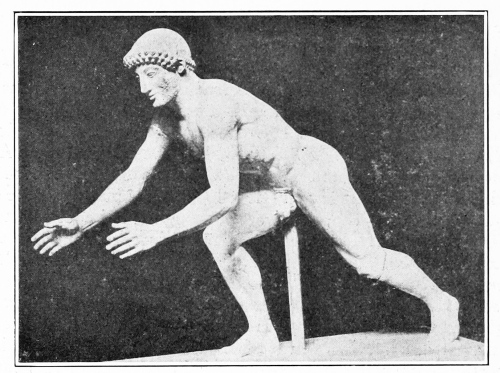
Fig. 20.—Figure, from the East Pediment of the Temple on Aegina. Glyptothek, Munich.
Since the discovery of these groups by an international party of Englishmen and Germans in 1811, and their restoration soon after their arrival in Munich by the sculptor Thorwaldsen, many new fragments have been discovered by Furtwaengler during his excavations of the temple site in 1901, and have been incorporated into the existing figures in the Glyptothek. His reconstruction, though not definitive, is more in accord with artistic probability than any that preceded.962 As we should expect from the athletic tradition of the Aeginetan school of sculpture just outlined, these sculptures represent finely trained nude athletes, whose modeling shows great observation of nature, especially in the treatment of muscles and veins. In fact it has been truly said that anatomical knowledge was never expressed again in Greek art so simply and naturally. The figures, without any excess of flesh, are slightly under life-size, short and stocky—shoulders square, but the waists slender and the legs long in proportion to the bodies—and withal are very compact and full of strength. The figures of the two pediments differ slightly, the eastern being more developed than the western. Brunn, long ago, arguing from the stele of Aristion, which then was the best example extant of archaic Attic art, showed how that art was characterized by grace and dignity of effect, while Aeginetan art was characterized by a finer study of nature. This generalization is no longer a matter of inference, but of knowledge.
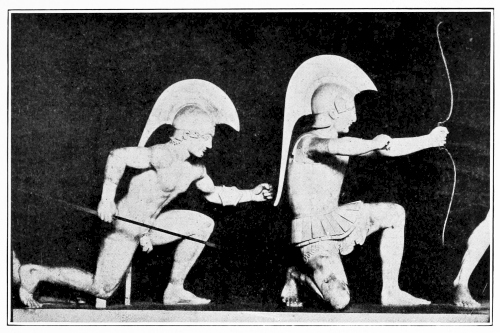
Fig. 21.—Two Figures, from the West Pediment of the Temple on Aegina. Glyptothek, Munich.
These groups represent the highest period of Aeginetan art. They have been dated anywhere from the end of the sixth century B. C. down to a period after the battle of Salamis.963 Probably a date just after that battle is correct, as Aeginetans won prizes of valor there.964 Any attempt to assign them to this or that artist is merely conjectural. The general similarity in subject to that of the Delphi group by Onatas, which represented the death in battle of Opis, the king of the barbarian Iapygians, at the hands of the Tarentines,965 and the group at Olympia already mentioned as representing a Trojan subject, led earlier scholars to assign the slightly more advanced statues of the East Pediment to Onatas and the more archaic ones of the West Pediment to Kallon. But we know both these sculptors only as bronze workers. The violent action of some of the figures reminds us at once of Pausanias’ description of the statue of the boxer Glaukos by the sculptor Glaukias, which we have already mentioned. But on the whole, though they are violent, the slight proportions of these athletic figures do not fit the appearance of boxers and pancratiasts, which, as we have seen, formed the staple of Aeginetan sculptors, but rather those of runners. We see a good wrestler in the Snatcher of the East Gable (Fig. 20),966 and the corresponding figure in the right half of the same gable.967 The Champion of the West gable (Fig. 21, left),968 of the finest Parian marble, represented as lunging forward, pressing on the enemy armed with helm, spear, and shield, would pass as a good example of a hoplitodrome, far freer and more individual than the warrior from Dodona.
ATTIC SCULPTORS.
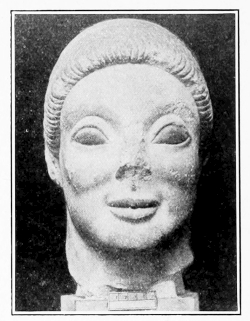
Owing to the Persian sack of the Athenian Akropolis in 480 and 479 B. C., and the subsequent burial of works of art there and their rediscovery by the excavations of 1885–1889, we know more of archaic Attic sculpture (600–480 B. C.) than of any other early school.969 We have already mentioned certain Attic works which show the influence of the severer Argive school—la petite boudeuse, the head of the yellow-haired ephebe (Fig. 18), the Akropolis athlete statue (Fig. 17), etc.—which was prominent at the beginning of the fifth century B. C., works which can be attributed to Hegias, Kritios, and their associates. They illustrate the reaction against Ionic taste, an influence which came from Asia Minor and the islands, especially after the fall of the Lydian Empire of Crœsus, and which for a time submerged native Attic art. This Ionic art was characterized by great technical ability, and by rich draperies and decorative effect. The archaic smile was its special feature. Ionism is best represented by some of the Akropolis Korai.970 In athletic art we see Ionism at its flood tide in the Rampin head found in Athens in 1877, now in the Louvre, which corresponds in style with some of the earlier female statues of the Akropolis.971 This head has a more elaborate frisure than any of the female heads and, in fact, the elaborate treatment of the hair of the crown and forehead is more suitable to a female than a male statue. The beard is carefully plaited, while traces of red seem to show that the mustache was painted on. Similar traces of color appear on the beard and hair. The smiling mouth, high ears, and almond eyes recall many archaic works, but especially the Apollo of Tenea (Pl. 8A). The garland of oak leaves above the frisure of the forehead may suggest a victor,972 or perhaps a priest or assistant on some religious embassy.973 The turning of the neck—as in the ephebe statue of the Akropolis (Fig. 17)—shows a break at this early time with archaism. Another work illustrating Ionism is the fragment of a grave-stele found near the Dipylon gate in 1873 and dating from the second half of the sixth century B. C.974 It represents the head of an athlete in profile, the youth holding a diskos in his left hand, so placed that his head is projected upon it in relief as on a nimbus. The top of the head is broken off, but we see the usual archaic features in the face—the almond-shaped eye (in profile), big nose with knob-like nostrils, thick lips with the archaic smile, retreating chin and forehead, and high ear with a huge lobe. The neck and chin, however, are full of grace and strength, as is also the slender thumb outlined against the diskos. As the stele broadens downward,975 the figure appears to have been represented with the feet apart, and so may have represented a palæstra diskobolos on parade,976 and is, therefore, our earliest representation of such an athlete. A similar dress-parade pose is seen on the stele of Aristion in the National Museum at Athens, the work of the sculptor Aristokles, which represents a warrior with a spear in the left hand.977 Another torso of an ephebe in the Akropolis Museum represents Ionic work from Paros.978 Another head, the so-called Rayet head in the Jakobsen collection in Copenhagen, one of the most remarkable specimens of Greek archaic art979 (Fig. 22), somewhat later in date than the Rampin head, represents quite a different tendency in Attic art. While the Rampin head represents Ionic influence, this head represents pure Attic work untrammeled by foreign influence, a true development of the old Attic sculpture in poros, Fig. 22.—Archaic Marble Head of a Youth. Jakobsen Collection, Ny-Carlsberg Museum, Copenhagen. the best examples of which are to be found in the decorative sculptures of the Old Temple of Athena on the Akropolis, enlarged by the Peisistratidai. Comparing it with the head of the Athena of the gable of that temple,980 we see great similarity in the simple execution and reserve in the treatment of details—characteristics of pure Attic sculpture—especially in the deep lines on either side of the mouth in the Jakobsen head. The hair is pictorially treated like a cap, traces of red appearing on it as well as on the lips and eyes. The Copenhagen and Rampin heads, together with the famous portrait head in the old Sabouroff collection,981 and the head of a woman in the Louvre,982 form our best examples of old Attic art outside of the museums of Athens.983 The swollen ears of the Jakobsen head show that it is from the funerary statue of a victor, perhaps a boxer. Furtwaengler wrongly classed it as a portrait head.984 A much discussed Attic work is the archaic relief of a charioteer in the Akropolis Museum (Fig. 63).985 This was formerly thought (e. g., by Schrader) to be a block from the later Ionic frieze of the old Hekatompedon which many believe survived the Persian sack, but it is more likely a part of a frieze belonging to a small shrine or altar. It represents a draped person entering a two-horse chariot with the left foot, the hands outstretched to hold the reins, the head and body leaning forward. Because of the krobylos treatment of the hair, fitted for both sexes, and the long flowing robe, the sex has been needlessly doubted, some calling it an Apollo or a mortal charioteer, others an Athena or a Nike, even though the line of the breast, so far as it is visible, shows no fullness, and the long chiton is common in representations of male charioteers.986 However, for the appreciation of the relief it is of no consequence whether the figure is male or female. It may be merely a dedicatory offering of a Panathenaic victor in chariot racing, very possibly assimilated to the type of Apollo,987 as the god often appears in vase-paintings of the same period in similar costume mounting a chariot.988 We shall discuss its interpretation more fully later on.989 While Ionism was prone to represent richly draped figures which concealed the form of the body, we see in this relief, with its fine modeling, a suggestion of the form beneath the folds of the garment, and so, perhaps, only another example of an Attic master rebelling against alien influence.990
At Olympia we have no names of Athenian sculptors prior to the Persian war period. Kalamis helped Onatas with the monument of King Hiero already mentioned. Mikon made a statue of a pancratiast, Kallias of Athens, who won in Ol. 77 ( = 472 B. C.).991 The great Myron, of whom we shall speak at length in the next chapter, made five statues of victors, which were erected between Ols. 77 and 84 ( = 472 and 444 B. C.).992 Only four later Athenian artists are mentioned: Silanion of the fourth century, who made statues for three victors, whose victories ranged from Ols. 102 to 114 ( = 372 to 324 B. C.);993 Polykles the Elder, who made the statue of the boy pancratiast Amyntas of Eresos, who won in Ol. (?) 146 ( = 196 B. C.);994 Timarchides and Timokles, the sons of Polykles, who in common made the statue of the boxer Agesarchos of Tritaia in Achaia, who won in Ol. (?) 143 ( = 208 B. C.)995
GENERAL MOTIVES OF STATUES AT REST.
The victor represented as standing at rest was often characterized by general motives, such as praying, anointing or scraping himself, offering libations, and the like. We shall now consider such motives in detail.
Adoration and Prayer.
Prayer was a common motive represented in votive monuments. Pliny mentions many such works by Greek sculptors.996 The custom of raising the arms in prayer is found all through Greek literature, from Homer down.997 Pausanias says that the people of Akragas made an offering in the form of bronze statues of boys placed on the walls of the Altis, προτείνοντάς τε τὰς δεξιὰς καὶ εἰκασμένους εὐχομένοις τῷ θεῷ, these statues being the work of Kalamis.998 In the Athenian Asklepieion there were many τύποι καταμακτοὶ πρὸς πινακίῳ, among which were representations of men and women in the praying attitude.999 The motive was used at Olympia in victor statues, representing the victor as raising the hand in prayer to invoke victory.1000 The statue of the wrestler Milo, already discussed at length, shows that this motive was employed at Olympia in the improved “Apollo” type in the second half of the sixth century B. C.1001 From the next century we may cite the statue of the Spartan chariot victor Anaxandros, which was represented as “praying to the god,”1002 and the statues of the Rhodian boxers Diagoras and Akousilaos, as we learn from a scholion on Pindar,1003 which is based on a fragment of Aristotle1004 and on one of Apollas.1005 Of the statue of Diagoras it says: τὴν δεξιὰν ἀνατείνων χεῖρα, τὴν δὲ ἀριστερὰν εἰς ἑαυτὸν ἐπικλίνων; of that of Akousilaos: τῇ μὲν ἀριστερᾷ ἱμάντα ἔχων πυκτινόν, τὴν δὲ δεξιὰν ὡς πρὸς προσευχὴν ἀνατείνων.1006 The bronze statue from Athens, now in the Antiquarium, Berlin,1007 which represents a nude boy with the right hand raised as if in prayer and the left lowered and holding a leaping-weight—therefore a pentathlete—seems to correspond with this description of the statue of Akousilaos. The same motive may have been used in the statue of the chariot victress Kyniska, a princess of Sparta, whose statue along with that of her charioteer and the chariot was the work of the sculptor Apellas.1008 This is the interpretation of Furtwaengler,1009 based on a passage in Pliny, which mentions statues of adornantes se feminas1010 by Apellas, which he reads adorantes feminas. However, adornantes may be right, for in another passage, Pliny speaks of Praxiteles’ statue of a ψελιουμένη, i. e., of a woman clasping a bracelet on her arm.1011 Two notable bronze statues will illustrate this motive of Olympic victor statues. The statue found in 1502 at Zellfeld in Carinthia, now in Vienna,1012 has been interpreted both as a Hermes Logios and a votive statue in the attitude of prayer,1013 which latter interpretation the inscription on the leg, giving a list of dedications,1014 favors. However, Furtwaengler believes it a free imitation of an Argive victor statue, though not in the Polykleitan style. Because of its similarity to the Idolino (Pl. 14), he has ascribed its original to the sculptor Patrokles. From technical considerations he believes it is not a Greek original dedicated by Romans of a later period, but a Roman work (after Patrokles) of the period of the inscription.1015 The bronze statue of the Praying Boy in Berlin1016 (Pl. 10) is one of our most beautiful Greek bronzes and comes from the circle of Lysippos.1017 We now know that the uplifted arms of this statue, in which most scholars saw the Greek attitude of prayer, are restorations which were probably made in the time of Louis XIV, when the statue was in France. Of the original motive we only can say that the action of the shoulders shows that both arms were raised, but we do not know how far, or the position of the hands. Monumental evidence shows that the hands in prayer should have the palms turned away from the face instead of upwards, as in the present statue, since the Greek position was the outgrowth of an old apotropaic gesture, i. e., one directed against an evil spirit. Mau’s idea1018 that the figure represented a player catching a ball is certainly inconsistent with the calm attitude of the statue. Furtwaengler rejected it,1019 and he has restored the arms and hands on the basis of a Berlin gem1020 and an ex voto relief found by the French excavators at Nemea in 1884.1021 On this relief a youth crowned with a woolen fillet is represented. On both relief and gem the figures are in the same attitude, the arms raised over the head manibus supinis, which confirms the restoration of the Berlin statue. Many other monuments give the more usual attitude of prayer, not as in the relief and gem discussed, but with only one hand extended as high as the breast. Older writers thought that such monuments did not represent the gesture of adoration, but one of adlocutio,1022 an opinion disproved by Pausanias’ statement about the bronze statues of the Akragantines at Olympia, already mentioned. We may cite a relief from Kleitor, now in Berlin,1023 and a fine one of the fourth century B. C. from Lamia (?),1024 as well as a red-figured Etruscan stamnos in Vienna representing, probably, Ajax praying before committing suicide.1025 We shall mention also two little statuettes in New York which represent youths in the praying attitude.1026 The first, dating from the second half of the fifth century B. C., and showing Polykleitan influence, represents a nude youth standing erect with the forearms bent, showing that the two hands were extended in prayer. The second, which dates from the first half of the fifth century B. C. (after the date of the Myronian Diskobolos), represents a nude youth standing with the right hand raised to the lips in an attitude usual in saluting a divinity, while the left is by the side, with the palm to the front.
PLATE 10
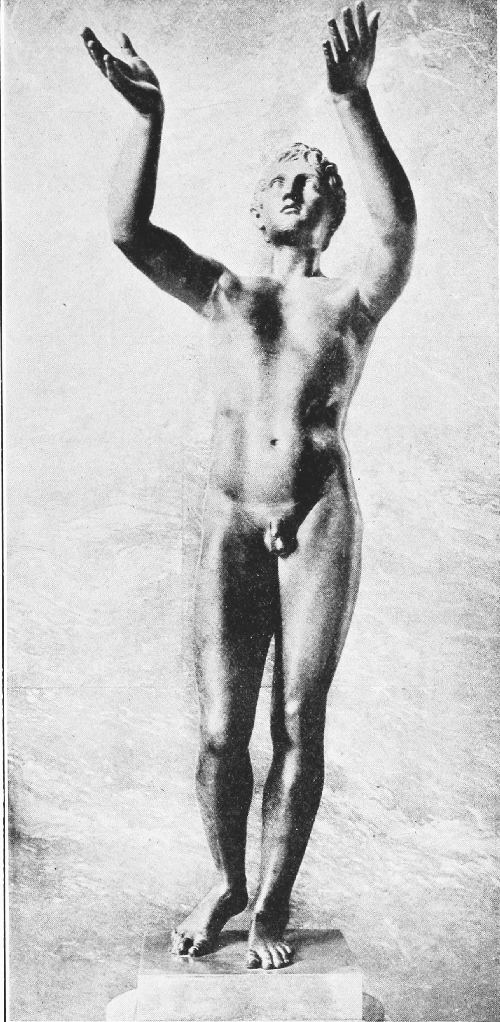
Bronze Statue of the Praying Boy. Museum of Berlin.
Anointing.
Various familiar motives from the everyday life of the gymnasium and palæstra were reproduced in the statues of athletes. One of the commonest methods was to represent the victor anointing his body with oil. The use of oil was indispensable in all athletic exercises, in order to make the body and limbs more supple, and especially in wrestling and the pankration, to make it difficult for one’s antagonist to get a grip.1027 Pliny mentions a painting by Theoros, representing a man se inunguentem,1028 which appears to have been a votive portrait of an athlete. The motive was common in vase-paintings and statuary. Several red-figured vases of the severe style, antedating the statues to be considered, show from realistic representations of palæstra scenes that it was customary for athletes to hold a round aryballos high in the right hand and pour oil from it into the left, which was placed across the body horizontally.1029 The same motive appears with variations in statues.1030 Thus the statue of an ephebe in Petworth House, Sussex, England,1031 a statue, as Furtwaengler says, to be praised more for its excellent preservation than for its workmanship, represents an athlete, who holds a globular aryballos in his right hand raised over the shoulder, while the left arm is held across the abdomen. On the nearby tree-trunk are small cylindrical objects which seem to be boxing pads. This statue, and especially its head, have been regarded by Michaelis and Furtwaengler as unmistakably Polykleitan in style.1032 Several other copies of original statues representing athletes pouring oil have been wrongly classed as replicas of one original,1033 though they merely have essential features alike, due chiefly to the subject. First is the famous statue in the Glyptothek known as the Oelgiesser (Oil-pourer), a Roman copy of an Attic bronze of about the middle of the fifth century B. C. (Pl. 11).1034 Though the right arm and left hand are lost, it is clear that the athlete held in his raised right hand an oil flask, as in the Petworth statue.1035 Notwithstanding that the head resembles the Praxitelian Hermes,1036 this does not show that the statue is of fourth-century origin, for its original is older; it merely shows that the art of Praxiteles was deeply rooted in that of his fifth-century Fig. 23.—Head of so-called Oil-pourer. Museum of Fine Arts, Boston. predecessors. Because of its Attic affiliations, Klein tried to identify it with the Ἐγκρινόμενος of Alkamenes mentioned by Pliny,1037 by amending that title to Ἐγχριόμενος, the “Anointer.” Brunn, however, rightly saw the analogy of the body forms to Myron’s Marsyas,1038 and Furtwaengler and Bulle have ascribed it to Lykios, the son and pupil of that master, who worked about 440 B. C., the approximate date of the original of the statue. A fragmentary head in the Boston Museum of Fine Arts (Fig. 23),1039 formerly in private possession in England, is a copy of the same original as the Munich statue. Its special interest is that it is not an exact copy of the original, as the Munich statue is, but a freer one, showing a fuller mouth, fleshier cheeks, and deeper-set eyes. While the Munich statue is the dry work of a Roman copyist of Augustus’ time, this head is by a far abler Greek copyist of the second century B. C. A torso in the Albertinum in Dresden, without a head,1040 is similar to the Munich statue, but hardly a replica. It probably goes back to an original by an Attic master of the end of the fifth or beginning of the fourth century B. C. Other under life-size statues related to this torso show the same motive.1041 A black-marble statue found at Porto d’Anzio in 1758, and now in the Glyptothek,1042 has the Polykleitan standing motive. The left arm, which is stretched out, holds an oil flask in the hand, while the right arm is lowered. The band, which the position of the fingers shows that the right hand probably held, indicates it is the statue of a victor. A bronze statuette from South Italy, now in the British Museum,1043 represents a nude youth holding an alabastron in his right hand, while the left has the palm open to receive the oil. The hair fashion (κρωβύλος) seems to point to an Attic sculptor of about 470 B. C.1044 The same motive is found on terra-cotta statuettes from Myrina,1045 on reliefs,1046 and on gems.1047
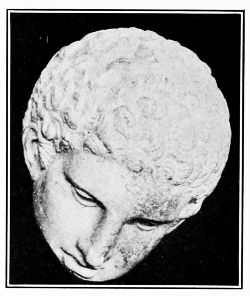
PLATE 11
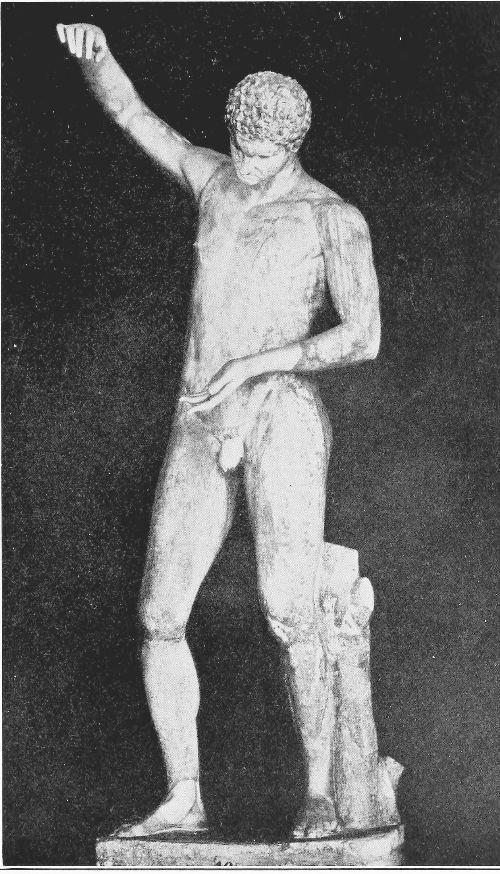
Statue of the so-called Oil-pourer. Glyptothek, Munich.
Oil-scraping.
Another ordinary palæstra motive was employed in representing the athlete after the contest, scraping oil and dirt from his body and arms with the scraping-blade or strigil (στλεγγίς, strigilis).1048 This motive is not uncommon on r.-f. vase-paintings of the fifth century B. C.1049 It was treated in sculpture by many masters. Pliny mentions such statues of athletes destringentes se (ἀποξυόμενοι), by Polykleitos, Lysippos, and Daidalos of Sikyon.1050 Perhaps the perixyomenoi by Antignotos and Daïppos, the latter the son of Lysippos, had the same motive.1051 Of the Apoxyomenos of Polykleitos we have no authenticated copies in sculpture, though Furtwaengler believes that he has found reminiscences of it on gems which represent a youth resting the weight of his body on the left leg, the right being drawn back (i. e., in the attitude of the Doryphoros), the right forearm extended, and the left holding a strigil. The similarity of these gem-designs makes it certain that they are all derived from a well-known work of art.1052 Perhaps the fine bronze statuette, dating from the middle of the fifth century B. C., and now in the Loeb collection in Munich, represents the pose of the destringens se by Polykleitos.1053 It represents a nude youth resting the weight of the body on the soles of both feet, the left one slightly advanced, and holding a strigil in the raised right hand. The famous marble copy of an Apoxyomenos in the Vatican1054 (Pl. 29), which, because of its long slim legs and graceful ankles, might well represent a runner, has long been held to represent the canon of Lysippos, as it exhibits proportions widely different from those employed by Polykleitos, and agreeing with Pliny’s account of Lysippos’ innovations.1055 However, the doubts arising in recent years as to whether this statue is a copy of Lysippos’ statue or a later work will be considered at length in Chapter VI.1056
PLATE 12
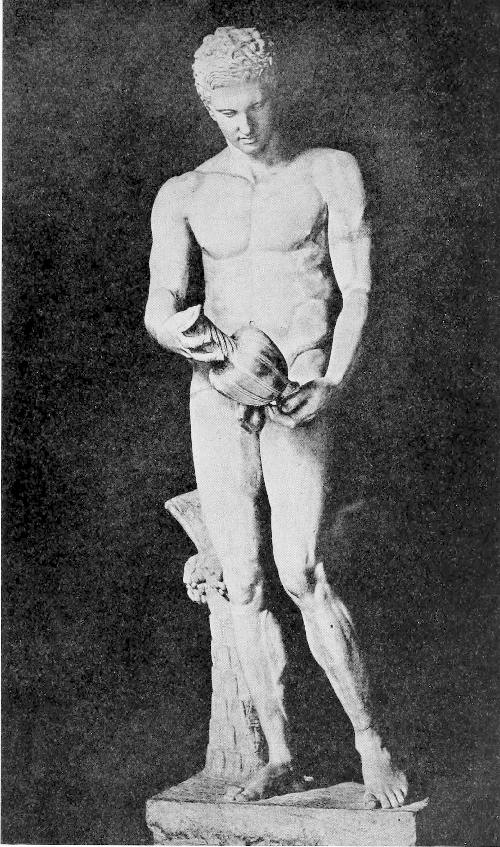
Statue of an Apoxyomenos. Uffizi Gallery, Florence.
The same motive is exemplified by many existing statues, statuettes, reliefs, etc. The marble statue of an athlete in the Uffizi, Florence, (Pl. 12),1057 a copy of an original of the end of the fifth century B. C., wrongly restored as holding in both hands a vase at which the athlete is looking down, was interpreted by Bloch as an ephebe pouring oil from a lekythos held in the right hand into an aryballos held in the left. This action for an athlete has been characterized by Furtwaengler as “unparallelled, unclassical and, above all, absurd.” Through recent discoveries we now know that it represents an apoxyomenos, and that it should be restored with the left forearm close to the thigh, and with the right crossing the abdomen diagonally in the direction of the left hand. This attitude so closely corresponds with that of a figure on a gem as to make it probable that both gem and statue are copies of the same original. The figure on the gem1058 holds a strigil in both hands and is generally explained as scraping the dirt from the left thigh; the light hand holds the handle and the left the blade. A hydria, palm-branch, and crown are pictured to the right—showing that the figure represents an athlete, just as the statue has the swollen ears of one. The attention of the athlete in both monuments is concentrated on the operation involved—a concentration reminding us of Myron’s Diskobolos. While, however, in the latter work the concentration is momentary, it is less transient in the Florence statue and also in the Munich Oil-pourer. This pose is too conscious in the Florentine statue to be the work of Myron. Arndt names no artist, but as the similarity between the head of the statue and that of the Oil-pourer is so marked, and as every one now regards the latter as Attic—even if not by Alkamenes—he thinks that the two must be by the same Attic sculptor, although the Uffizi statue is somewhat later than the Munich one.1059 The original of the Florence statue was famous, if we may judge by the existing number of replicas with variations.1060
Among statues showing the same motive and pose, we may note the bronze statue of an athlete over life-size—pieced together from 234 fragments—found by the Austrians at Ephesos and now in Vienna.1061 The subject, pose, and heavy proportions recall the Argive school of Polykleitos, and its original has been assigned by Hauser to the Sikyonian Daidalos, the son and pupil of Patrokles, who was the pupil of Polykleitos. As further reproductions of the same type of figure, we may cite a bronze statuette in Paris,1062 and a marble one found at Frascati in 1896 and now in the Museum of Fine Arts, Boston.1063
A chalcedony scarab of archaic type in the British Museum represents a nude athlete with a lekythos slung over the left arm and a strigil in the left hand, which rests on the hip.1064 A beautiful marble grave-relief, much mutilated, in the museum at Delphi,1065 which dates from the middle of the fifth century B. C., represents a palæstra victor, with his arms extended to the right, cleansing himself with a strigil, which is held in the right hand, while a slave boy, holding the remnant of an aryballos in his right hand, looks up at him from the right. The careful anatomy of this relief may point to Pythagoras of Samos, as its author, though we have no certain work of his, for it fits the description of that artist by Pliny, who says that he was the first to express sinews and veins.1066
Libation-pouring.
PLATE 13
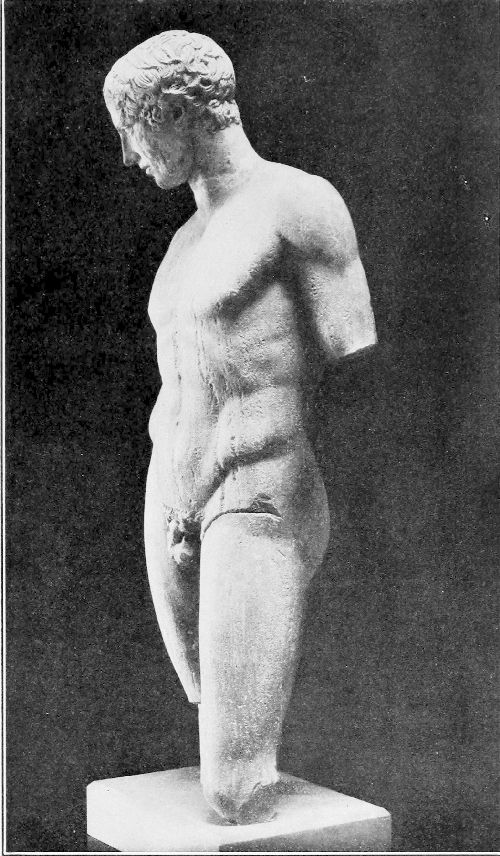
Statue of an Athlete, after Polykleitos. Farnsworth Museum, Wellesley College, U. S. A.
An original Greek bronze statuette in Paris (Fig. 24)1067 reproduces the motive of the statue of the boy wrestler Xenokles by the sculptor Polykleitos Minor at Olympia, as a comparison with the footprints on the recovered base of the latter shows.1068 As the forms correspond with those of the Doryphoros and Diadoumenos, and as its execution is so marvelous, Furtwaengler has ascribed the statuette to the circle of Polykleitos’ pupils. The position of the right hand, which has the thumbs drawn in, corresponds with that of the Idolino (Pl. 14), which we are to discuss, and can best be explained by assuming that it similarly held a kylix; the left hand carried a staff-like attribute. Fig. 24.—Bronze Statuette of an Athlete. Louvre, Paris. The head is bent and looks to the right. Furtwaengler believed that, inasmuch as the act of pouring a libation does not occur in art or literature as an athletic motive, the statuette represented a hero or god. Many Roman marble copies show the same motive and preserve to us a Polykleitan work which corresponds in all essentials with the Louvre statuette.1069 We mention two, the only ones of the type in which the heads are on the trunks, one in the Galleria delle Statue of the Vatican,1070 the other in the Farnsworth Museum at Wellesley College (Pl. 13).1071 These copies represent a youth standing with both feet flat upon the ground, the weight of the body resting upon the right one, while the left is turned a little to the side. He is looking downwards to the right. Doubtless we should restore these copies after the Paris bronze, with a kylix in the right hand. The palm-branch in a similar statue, to be mentioned further on, shows that in all probability the origin statue was that of an athlete; and that he was a famous athlete is shown by the number of copies of the torso and head.1072 A bronze head from Herculaneum (Fig. 25)1073 so strongly resembles in its forms the type under discussion—which Furtwaengler has called the “Vatican athlete standing at rest”1074—and corresponds with it so closely in its measurements, that it might be regarded as a copy of the same original, if certain differences, not due to the copyist, did not rather show that it comes from a closely allied work. This head shows an intense melancholy, which has been explained by Furtwaengler as due to the lack of skill on the part of the copyist, who fashioned it slightly askew. Amelung very properly explains the absence of the motive of libation-pouring in athletic art as merely a lacuna in our sources.1075 If the original of these copies and variations represented an athlete, he was certainly pouring a libation before victory; if a warrior, he was doing the same thing before going on a campaign. In the latter case the left hand should be restored with a spear.
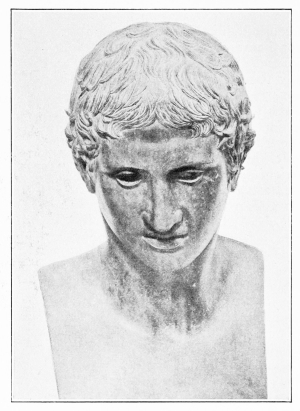
Fig. 25.—Bronze Head of an Athlete, from Herculaneum. Museum of Naples.
We must also place here the life-size original Greek bronze in Florence, discovered at Pesaro, near Ancona, in 1530, and known from the early eighteenth century as the Idolino (Pl. 14),1076 for its motive connects it with the series just discussed. This is, perhaps, our finest bronze statue from antiquity, as it represents the highest ideal of boy beauty, just as the Doryphoros does of manly beauty. The chief characteristics—the positions of the feet, head, and arms, though essentially those of the statues discussed, offer certain differences. Thus the left leg is placed more to one side and turned further outwards than in the statue of Xenokles and kindred works; the left hand hangs down at an angle to the leg differently from the others. In other words, by comparing it with the Paris statuette, we see a slightly different rhythm from that found in Polykleitan works. The Idolino has been looked upon as Myronic by Kekulé,1077 Studniczka,1078 and hesitatingly Klein,1079 while Mahler regarded it as Pheidian.1080 Furtwaengler, however, by a careful analysis, has shown its Polykleitan characteristics—especially the shape of the head and the features, and the treatment of the hair, which reminds us of the Naples copy of the Doryphoros. Owing to differences, however, he did not assign it to the master himself, but suggested that it was the work of his pupil Patrokles.1081 Bulle found the head Polykleitan, but the body Attic, and assigned the figure to an unknown Attic sculptor working in the Polykleitan circle. In this controversy on its style, a statue found in 1916 in the excavations of the Baths at Kyrene should be of use, for it is the most faithful of all the Roman copies known of the bronze original and clearly shows a Polykleitan character influenced by Attic art.1082 By a comparison of this marble copy with the Florentine bronze we see that the latter was a subsequent rendition of the same original, and doubtless by some artist of lesser fame from the Polykleitan school, who was influenced by Attic art.
But it is the interpretation of the Idolino which chiefly interests us here. While Longpérier called the similar Paris statuette a Mercure aptère, and the publisher of the statue from Kyrene called that copy a Hermes, yet Kekulé, Bulle, and most other archæologists have seen in the Idolino an athlete. The inner surface of its outstretched right hand is left rough, and the fingers are in the same position as those of the Paris bronze. Such a position can be explained satisfactorily by restoring the hand with a kylix or a φιάλη, such as was commonly used in libations. The left hand is smooth and evidently empty, though Bulle restores it with a victor’s fillet, and so, following Kekulé, calls the statue that of a boy victor, who is bringing an offering to the altar in honor of his victory. The marble statue in the Galleria delle Statue has the right forearm restored; in the Kyrene statue the right hand is preserved and has a thick object held downwards at a greater angle than in the Idolino. The photograph does not let us judge decisively, but it seems to be too thick an object for the remnants of a kylix. A marble statue in the Barberini Palace, Rome,1083 which resembles the Idolino so closely as to be considered a copy of it, though with variations of pose and technique, has the arms broken off, and so adds nothing to the solution of the motive of the Idolino. The fact that a palm-stem stands beside the right leg, however, adds weight to the interpretation as victor. Furtwaengler interprets the Idolino and kindred works as divinities. Though boys serve at libations, he thinks they never perform the ritual act of pouring the libation.1084 That a libation-pourer should appear in the guise of a boy victor (that of Xenokles) he calls a genuine Argive trait. Svoronos, also, has recently tried to show that the Idolino is not a victor,1085 but represents the hero Herakles. He compares the figure with a fourth-century Pentelic marble relief in Athens,1086 which represents Herakles standing at the door of Hades and beside him a father leading his son up to the open air. The pose of the figure of Herakles resembles that of the Idolino in a remarkable way. In the relief Herakles holds a kylix in the right hand1087 and a club in the left, and a lion skin is thrown over the left arm. Svoronos believes that the left hand in the relief explains the turning in of the left hand of the Idolino—for he believes that the latter also held a club. We must, however, leave the final solution of the motive of the Idolino and kindred works open, although inclining to the belief that they represent a victor.
PLATE 14
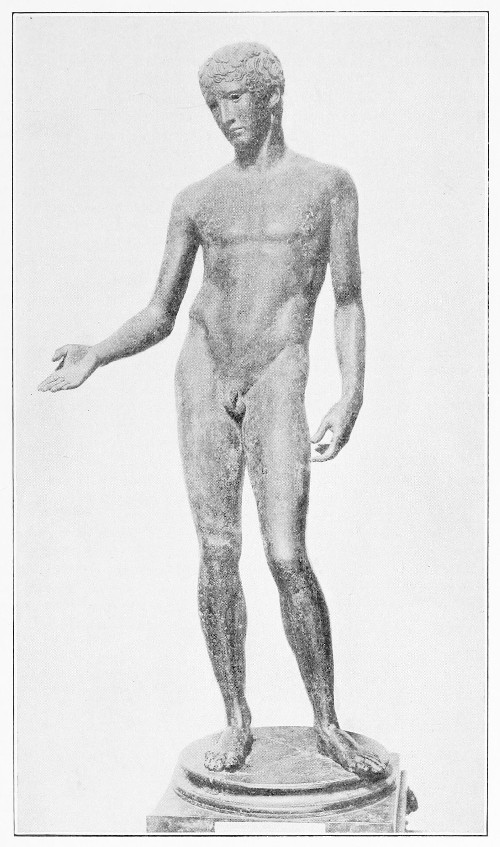
Bronze Statue known as the Idolino. Museo Archeologico, Florence.
A statue in Athens, which was found in 1888 in the Roman ruins at the Olympieion, may represent a boy victor pouring a libation (Fig. 26).1088 It is a poor Roman copy, dry and lifeless, Fig. 26.—Marble Statue of an Athlete(?). National Museum, Athens. of a bronze original of the middle of the fifth century B. C.1089 In this statue Mayer has seen the motive, and probably the copy, of the Splanchnoptes (Roaster of Entrails) by the sculptor Styphax (or Styppax) of Cyprus, which, according to Pliny,1090 represented Perikles’ slave “roasting entrails and blowing hard on the fire, to kindle it, till his cheeks swell.” He thinks that the position of the broken arms and a comparison of the figure with similar ones on vases make the identification possible. Von Salis concurs in his restoration and interpretation and publishes a small statuette in Athens from Dodona,1091 which has a similar pose, and holds a three-pronged fork in the left hand, which he believes should be restored in the statue. Although statue and statuette have much in common (e. g., the position of the breast and shoulders, the treatment of the hair, etc.), which shows that both may be copies of one original, the conception of the two is somewhat different. The statue from Athens represents a boy standing busily engaged at the altar; the statuette represents one standing at rest merely looking on, the fork not being held in position for use.1092 In any case the face of the Athens statue can not correspond with Pliny’s description—ignemque oris pleni spiritu accendens. Quite a different explanation of the statue is possible—one which Mayer thought improbable. The right arm—broken above the wrist—was raised to the height of the shoulder and may have held an object in the hand; the left arm—broken off below the shoulder—seems to have been held close to the body and appears to have corresponded in movement with the other. The boy, therefore, may have held a cup in the right hand and a branch or a victor fillet in the left. Thus it may merely be another example of a boy victor pouring a libation.
Certain other statues have been mistaken either for libation-pourers or oil-pourers, when they are really wine-pourers and have nothing to do with the athletic motives under discussion. A good example is the marble statue of a Satyr in Dresden,1093 which represents the youthful demi-god lifting a can with his right hand, out of which he is pouring wine into a drinking-horn held in the left. There are many copies of this work,1094 a fact which shows that the original bronze was famous. An attempt has therefore been made to identify it with the bronze Satyr of Praxiteles mentioned by Pliny as the Periboëtos or “far-famed,”1095 which seems to have been grouped with a Dionysos and a figure of Drunkenness—a grouping which might fit the Dresden Satyr, since a second figure should be imagined, for which the horn is being filled. However, it differs stylistically so much from the Hermes of Olympia that the ascription has been given up, though its graceful form shows Praxitelean influence and certainly emanates from the fourth century B. C.
PLATE 15
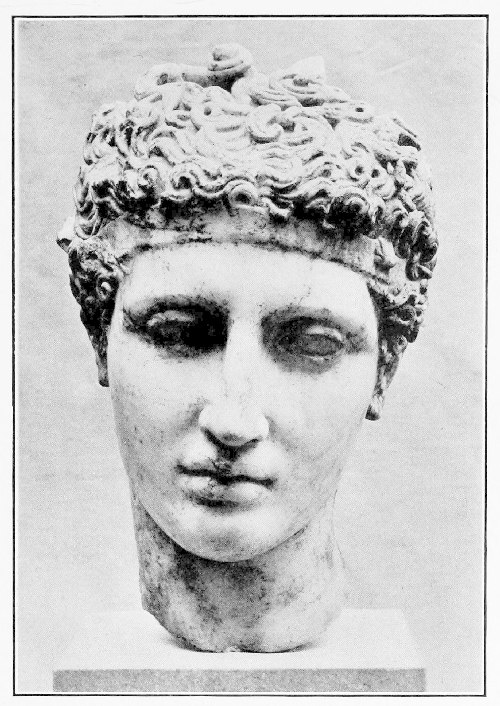
Marble Head of an Athlete, after Kresilas (?). Metropolitan Museum, New York.
Resting After the Contest.
A very favorite motive was to represent a victor, either standing or seated, resting after the exertions of the contest (ἀναπαυόμενος). An excellent example of this motive in a standing posture is the fourth-century B. C. statue of Attic workmanship found at Porto d’Anzio and now in the Vatican,1096 which reproduces the type of the Apollo Lykeios.1097 Many of the statues, by various sculptors, which represent the victor standing at rest may be intended to represent him as resting after the contest. The well-known head of a youth adorned with the victor’s chaplet, and preserved in four copies in European museums, appears to come from a statue which represented a victor in this manner. The best of these copies is in the collection of Lord Leconfield at Petworth House, Sussex.1098 We should add a fifth, a Roman copy of the head, in the Metropolitan Museum, New York (Pl. 15).1099 In these copies the ears are not swollen, and a certain refinement and gentleness show that the original was not from the statue of a boxer or pancratiast, but from that of another type of athlete, perhaps a pentathlete. Since Pliny mentions the statue of a Doryphoros by Kresilas,1100 and because of its supposed Kresilæan style, Furtwaengler, albeit on slender grounds, has attempted to identify the original of these heads with that work.1101 The expression is certainly one of complete repose. On the crown of the head, and on the left side over the fillet, is a rectangular broken surface,1102 apparently the remnant of a support for the right arm, which, as Conze thought, proves that the athlete stood with one arm resting on the head, the hand hanging over the left side. Furtwaengler admitted that such an attitude might be that of an apoxyomenos,1103 but pointed out that the expression of the face in all the copies seems too tranquil for such an interpretation. Since the victor was in repose and the left arm required a slight support, he believed that this support might have been an akontion. He therefore reconstructed the original statue as that of a resting pentathlete, and assigned it to the great Cretan contemporary of Pheidias, who worked in Athens.1104 The number of replicas at least shows that the original was a famous work.
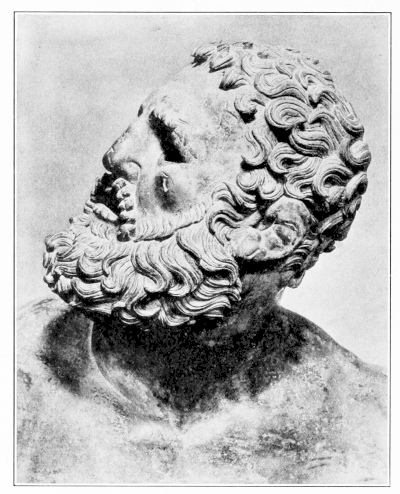
Fig. 27.—Head from Statue of the Seated Boxer. Museo delle Terme, Rome.
Perhaps our best example of the motive of a seated victor resting after the contest is the bronze statue of a boxer found in Rome in 1884 and now in the Museo delle Terme there (Pl. 16 and Fig. 27).1105 This is a masterpiece in the portrayal of brute strength in the most naturalistic and revolting way. If we like to think of victors as having noble forms, we are rudely startled on looking at this brutal prize-fighter. If we compare it with works of the fifth and fourth centuries B. C., we see in it, as in no other example of Greek sculpture, the great change which professionalism had later wrought in the Greek ideal of athletics. Here are massive proportions, bulging muscles, arms and legs hard and muscle-bound. We can compare it only with the bronze head of a boxer found at Olympia (Fig. 61 A and B) of similar style and age.1106 But there we have only the head, while here we have a complete statue almost perfectly preserved, the only restorations being a portion of the left thumb, a piece of the right flank, and the base.
PLATE 16
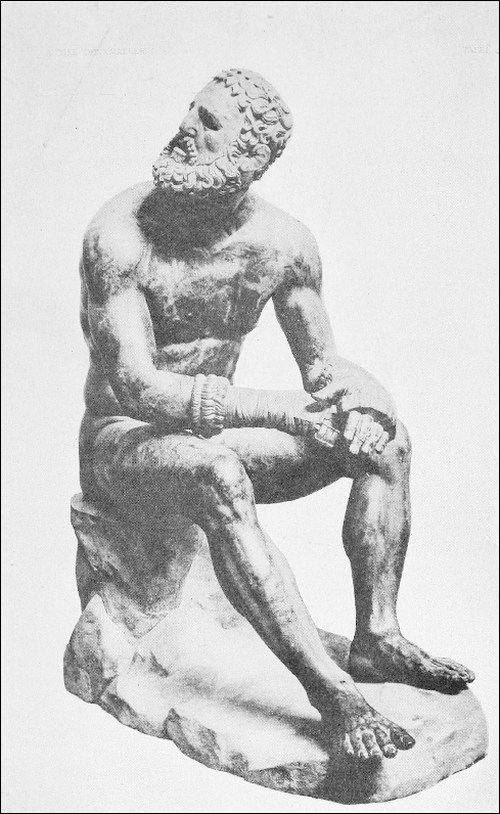
Bronze Statue of the Seated Boxer. Museo delle Terme, Rome.
It represents a professional boxer, who is seated exhausted at the close of the bout, the severity of which is indicated by every part of the body. He leans forward, his arms rest on his thighs, and his head, sunk between his shoulders, is raised and turned to the right, as he stupidly looks around at the applauding spectators. His nose is broken and his ears are swollen and scars of the contest show on his face and limbs. Beneath his retreating upper lip some of his teeth appear to have been knocked out as the result of previous fights, while indications of the recent struggle are to be seen in the blood dripping from his ears and the deep lacerations in face and shoulder, which may have once been filled with red paint to make his appearance even more realistic. The right eye is swollen and the lower lid and the cheek imperceptibly sink into each other. The mustache shows flecks of blood and the swollen back of the right hand protrudes through the glove. His nose is clotted with blood and he seems to be struggling to get his breath.
Such realism and delight in depicting the hideous show that the work, like the Olympia head, belongs to the Hellenistic age. The careful workmanship, especially visible in the hair and beard and in the hair on the chest1107, proves that the statue is not a Roman copy, but a Greek original of the beginning of the Hellenistic age, of the end of the fourth or beginning of the third century B. C. Nor is it a portrait, as Winter maintained,1108 since it is an adaptation of a late type of Herakles. It certainly is a victor statue from one of the great Greek games, and is, perhaps, from Olympia itself. Since the head is turned toward the right shoulder and the mouth is open, as if speaking, Wunderer tried, on the basis of a passage in the history of Polybios,1109 to identify it with the statue of the famous Theban boxer and pancratiast Kleitomachos at Olympia by an unknown artist.1110 The historian states that Kleitomachos, while fighting with the Egyptian Aristonikos, was angered by the acclaim given the foreigner and, stepping aside, chided the spectators for not cheering one who was fighting for the honor of Greece. The speech caused a revulsion in the popular feeling, which helped, even more than the fists of Kleitomachos, to vanquish Aristonikos. However, the motive of the statue does not fit the incident, as the boxer is not speaking, but breathing hard, nor is the seated posture that of one haranguing a crowd. Moreover, the date of the Theban’s victory is too late for the statue.1111
ATTRIBUTES OF VICTOR STATUES.
At the beginning of the fifth century B. C. athletic training tended to produce a uniform standard of physical development, which was reflected in sculpture. At this date we do not find the divergence of style which we saw in our review of the “Apollo” type of the sixth century. Vase-paintings show the change better than sculpture. On black-figured vases of the sixth century B. C., we see a good deal of variety in groups of boxers and wrestlers, while on red-figured vases of the early fifth century the number of types is far less. In sculpture, however, differences in physical type did exist in the various schools at the beginning of the fifth century. We have, for example, the heavy, square-shouldered type in the Apollo Choiseul-Gouffier (Pl. 7A), which we have classed as a victor statue, and the tall, rawboned type in the Tyrannicides by Kritios and Nesiotes (Fig. 32, Harmodios).1112 We have, on the other hand, a very different physical type in the short, stocky Aeginetan pedimental figures (Figs. 20 and 21). Between such extremes there are, of course, many gradations. We might instance the archaic bronze statuette of a diskobolos in the Metropolitan Museum (Fig. 46).1113 However, notwithstanding the diversity in type, it is often difficult to distinguish runners from wrestlers, boxers from pentathletes. Thus few early fifth-century statues show the type of runner as well as the Apollo of Tenea (Pl. 8A), or that of a boxer as well as the “Apollo” from Delphi (Pl. 8B). The reason for this is the ideal element, which entered into all these statues and which was a reflection of the uniform development of athletics long before specialization had set in. Out of this uniformity grew the canon of Polykleitos, developed from that of Hagelaïdas.
The sculptor of the sixth century B. C. was incapable of differentiating between god and mortal. This was especially the case, as we have seen, with Apollo, as the “Apollo” type was a model of manly vigor. In the early fifth century the sculptor had largely overcome this difficulty, but still showed little diversity of type in treating statues of different kinds of athletes. A method of differentiation which was essential to athlete sculptors of the sixth century was found convenient of retention by those of the fifth—i. e., characterizing the statue of the victor by some attribute, in order, on the one hand, to differentiate it from the nude god or hero, and on the other to distinguish between different types of victors.
PRIMARY ATTRIBUTES OF VICTOR STATUES.
The Victor Fillet.
In the first place, the sculptor would characterize the victor statue as such. The easiest way to do this would be to represent it with a fillet or chaplet (ταινία)1114 bound round the head, as we saw was the case in the statue of Milo. This fillet was merely a band or riband of wool which was given the Olympic victor in addition to the garland of olive leaves, or the palm-branch, as a symbol of victory. Waldstein has argued that this fillet originally was not an essential attribute of the victor, but that the crown and palm were the prizes, and the fillet merely a decoration used on various occasions, such as at symposia,1115 which only later became a general athletic attribute.1116 Though the presence of the fillet on statues should not, therefore, be proof that the given statue is that of a victor,1117 there is no defense for the contention of Passow1118 that the tainia was in no sense a symbol of victory, but merely a toilet article among the gifts presented by the public to a victor at the ovation of the crowning. Pausanias says that the victor Lichas of Sparta was scourged by order of the umpires at Olympia for having set the tainia on the head of his victorious charioteer.1119 This is sufficient evidence that it was not a mere toilet article, but rather a part of the official prize of victory. Similarly the tainia in the hand of Nike upon the right hand of the statue of Zeus by Pheidias at Olympia can not have been a toilet article.1120
We have many examples from athletic sculpture of the use of the fillet. Thus it appears on the bronze head of a boxer in the Glyptothek (Pl. 3)1121 and on the bronze head from Herculaneum in Naples (Fig. 4),1122 both of which have been discussed in Chapter II, as fragments of Greek original statues of Olympic victors. It also appears on the marble head of a youthful victor—not necessarily Olympic—from the Akropolis,1123 which, because of the similarity in cheeks, mouth, and eyes to heads on the metopes of the Parthenon, should be dated somewhere between 450 and 440 B. C. It occurs on the Olympia marble head (Frontispiece and Fig. 69),1124 which we ascribe in Chapter VI to Lysippos, and likewise on the statue of the pancratiast Agias in Delphi (Pl. 28, Fig. 68). In most athlete heads the fillet is twisted into a knot at the back of the head. In one case, on the Petworth head of a pentathlete already discussed,1125 which, because of the curve of the neck, must come from a statue represented at rest, it is not so tied, but is wound round the head with the two ends tucked in and pushed through the fillet on either side over the temples.1126 Though so practical an arrangement as the latter must have been common enough in real life, this seems to be the only example of its representation in sculpture.
The fillet, instead of encircling the head, was sometimes held in the hand, as in the case of the Spartan chariot victor Polykles at Olympia.1127 A curious life-size statue of the Roman period, found in the Peiræus, represents a nude boy holding in his right hand over the breast a bundle of books and in the left an alabastron. The body is covered with fillets—fifteen in all—which appear to have been prizes won in gymnic contests, probably at the gymnasium or palæstra.1128
Fillet-binders.
Statues representing victors binding fillets in their hair (diadoumenoi) are common to all periods of Greek art.1129 We shall discuss only two—those of Pheidias and of Polykleitos.
PLATE 17
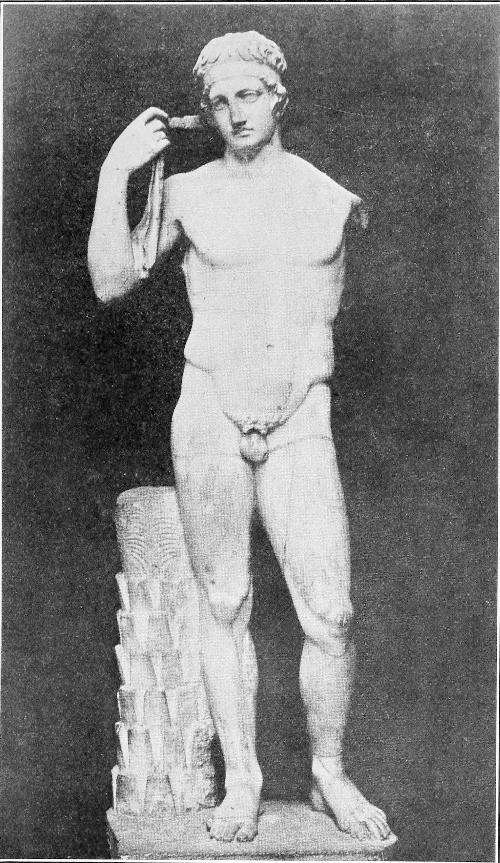
Statue known as the Farnese Diadoumenos. British Museum, London.
Pausanias mentions a statue by Pheidias, representing a Boy Binding on a Fillet, as standing in the Altis at Olympia.1130 Robert has argued that this figure was the one of similar motive mentioned by Pausanias as on the throne of Zeus there.1131 However, the figure on the throne was very probably in relief and not in the round.1132 The cicerones at Olympia seem to have been imposing on the periegete when they said that a likeness to Pantarkes, the boy favorite of Pheidias, was to be seen in the face of this figure on the throne. The mention of Pantarkes has given rise to the usual identification of the παῖς ἀναδούμενος with the victor statue of the Elean Pantarkes mentioned by Pausanias as standing in the Altis.1133 However, the assumption1134 is far-fetched and must be rejected, because Pausanias mentions the two statues in two different parts of his periegesis of the Altis.1135 Of the παῖς we know only the artist’s name. It was probably merely a votive gift,1136 and the name of the person so honored was unknown to Pausanias. Of the statue of the victor Pantarkes we know only the name, and neither the artist nor the motive of the statue. It seems clear, therefore, that we have to do with three distinct monuments: the boy with the fillet, the throne figure by Pheidias, and the victor by an unknown sculptor.1137