Chapter III · VICTOR STATUES REPRESENTED AT REST. (continued 2)
Reading edition
The small marble statue in the British Museum known as the Diadoumenos Farnese1138 (Pl. 17), which is now almost universally regarded as an Attic work,1139 has been assumed by many archæologists to be a copy of Pheidias’ statue.1140 Since Pausanias tells us that a statue by Pheidias stood in Olympia, representing an unknown boy binding a fillet around his head, and since the style of the Farnese statue shows great similarity in head and body forms and general bearing to certain figures on the Parthenon frieze,1141 and its motive agrees with that of the Olympia statue, it seems reasonable to see in this little work a copy of the statue in the Altis by the great master. Furtwaengler and Bulle have shown that the motive of this work was initiated by Pheidias and not by Polykleitos, since the latter’s great statue was several years younger than the work of Pheidias at Olympia. That Pheidias was pleased with the motive is disclosed by the fact that he repeated it on the throne of Zeus.
PLATE 18
Statue of the Diadoumenos, from Delos, after Polykleitos. National Museum, Athens.
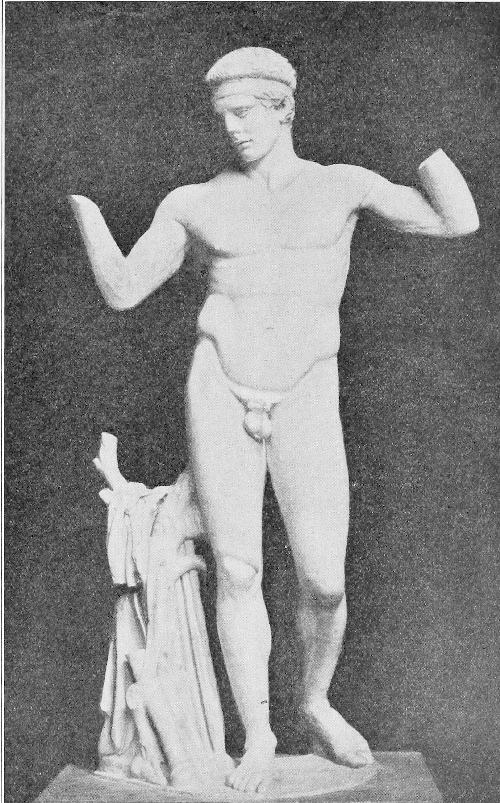
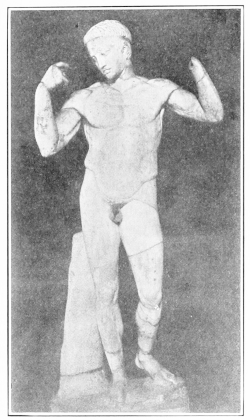
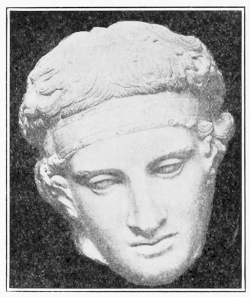
The Diadoumenos of Polykleitos was little less famous than his Doryphoros, if we may judge by the number of copies which have survived and from literary notices of it.1142 In all the copies of this work we see the well-known Polykleitan characteristics—powerful build, heavy proportions, and fidelity to nature; but none of the ideal tendency prominent in the works of Pheidias and his school, nor of the violent energy characteristic of Myron’s art. In all of them the pose of the earlier Doryphoros is retained, except that the arms are differently employed and the build of the body is more slender. Pliny, despite his statement—which is probably taken from some Greek authority—that monotony was the characteristic of Polykleitos’ works (paene ad unum exemplum),1143 emphasizes this slenderness by calling the Doryphoros viriliter puer—Lessing’s Juengling wie ein Mann—and the Diadoumenos molliter juvenis—a youth of gentle form. This judgment of Pliny was difficult to understand so long as we had only the Vaison copy of the Diadoumenos to study. The Delian copy showed that supple grace was characteristic of the original, even if modified to suit the taste of three centuries later. Although the body forms and the attitudes of the Doryphoros and the Diadoumenos are very similar, the head of the latter, usually assigned to Polykleitos, is of a different type from that of the Doryphoros. While the head of the Doryphoros is square in profile, flat on top, and long from front to back, that of the Diadoumenos is rounder and softer and can best be explained on the assumption that Polykleitos later in life came under Attic influence. The copies of this work are many and varied.1144 For a long time the marble copy in the British Museum found in 1862, at Vaison, France,1145 was, despite its poor workmanship, considered our best copy (Fig. 28). It was made perhaps five hundred years after the original, at a time when sculpture was in its decline, and consequently can give us merely a suggestion of the character of Polykleitos’ statue. As it is a direct marble translation of the bronze, the muscular treatment appears exaggerated. Another marble copy was found in 1894 by the French excavators on the island of Delos, and is now in Athens (Pl. 18).1146 The Delian artist added a mantle and a quiver to the nearby tree-trunk and thus converted an original victor statue into one of a god.1147 Though its hands are lost, it is easy to see that the athlete is pulling the ends of the fillet together so as to tighten the knot at the back of the head. As this is a Hellenistic Greek copy, it comes far nearer to the original than the Fig. 28.—Statue of the Diadoumenos, from Vaison, after Polykleitos. British Museum, London. imperial Roman one from Vaison. The lighter proportions and softer modeling show the Attic influence on Polykleitos’ later career, although the fleshy forms are out of harmony with his art and evidently introduced by the copyist. One of the best preserved and most beautiful copies is the one in the Prado at Madrid.1148 Although a Roman copy, like the one in the British Museum, it comes very near the original because of the precision in its details. There are many good copies of the head alone.1149 Marble heads in Kassel and Dresden, evidently the works of Attic sculptors, show the pure Polykleitan traits. The one in Dresden1150 (Fig. 29) surpasses all others in the beauty of its finish, being a careful and exact copy. The proportions and structure of the head are those of the Doryphoros, although the surface is differently treated. The Kassel head1151 is not so exact in its details, but has more expression. Furtwaengler rightly calls it the better of the two as a work of art, but inferior as a copy. A marble head in the British Museum1152 is a direct copy from the original bronze, like the Vaison statue. The clear-cut eyelids and wiry hair reproduce the original material, and its resemblance to the head of the Doryphoros is greater than that of any other copy.
A later variant of the statue is seen in a small terra-cotta statuette from Smyrna in private possession in London.1153 Fig. 29.—Head of the Diadoumenos, after Polykleitos. Albertinum, Dresden. It shows the Polykleitan type so completely assimilated to the style of Praxiteles that its genuineness has been doubted. Perhaps, with its Attic softness, it gives us a better idea of the beauty of the original than many of the other copies. Finally, we must mention the original bronze head of the fifth century B. C. in the Ashmolean Museum, Oxford, recently published by Percy Gardner.1154 This head, put together from nine fragments, and restored as that of a boy fillet-binder, and rivaling in delicacy and beauty such original bronzes as the Beneventum head (Fig. 3) and the Idolino (Pl. 14), not only gives us the best idea of the technical ability attained by bronze workers in the middle of the fifth century B. C., but also helps us to understand the ancient repute of Polykleitos’ athletes. Here the headband and “starfish” arrangement of the hair have their close parallels in the Dresden, Kassel, and British Museum heads already discussed, which essentially reproduce the head of the Vaison statue (Fig. 28). As Gardner points out, it closely agrees with the type of the Farnese Diadoumenos (Pl. 17) only in one particular, the mode of tying the knot. While the Vaison athlete is preparing to tie it, the Farnese one has just finished the operation, the boy still holding the ends of the fillet in his hands. But only the treatment of the hair, the eye, and the ear offers a contrast. Despite these differences Gardner follows the older view of Brunn in regarding the Vaison and Farnese types as two variants of Polykleitan originals; but the pose, style, and proportions of the latter seem to us to be too thoroughly Attic to warrant us in bringing it into relation with the work of Polykleitos. Though the heads of the two are not so dissimilar, the pose, as Gardner also points out, is quite different. The Vaison figure is represented as walking, i. e., in the very act of changing the weight of the body from one leg to the other, while the Farnese athlete stands at rest with both feet flat upon the ground. Gardner rightly regards this exquisite head not as the original of the statue mentioned by Pliny, since the Vaison and Delian copies show that the latter represented a fully developed man, somewhat over life-size, and not a boy, but rather as a work of the Polykleitan school, though he does not exclude the possibility that it may come from one of the many boy athletes of the master.
Furtwaengler connects with the Diadoumenos the statue of a youthful boxer, slightly under life-size, which shows a similar motive. It is known to us in two copies, one in Kassel,1155 the other in Lansdowne House, London.1156 That it is a work of Polykleitos is shown by the correspondence of its body forms with those of both the Diadoumenos and the Doryphoros. A bronze statuette, dating from about 400 B. C., in the Akropolis Museum, also repeats the motive without being an exact copy.1157
The Crown of Wild Olive.
The crown of wild olive1158 in the hair is another general but not customary attribute of Olympic victor statues. Fewer sculptured heads show it than show the tainia, and in most of these the leaves have fallen off. Examples of its presence are afforded by the bronze head from Beneventum (Fig. 3) in the Louvre,1159 and on the realistic bronze head of a boxer found at Olympia (Fig. 61 A and B).1160 A good illustration of a boy victor crowning himself is on a fourth-century B. C. funerary relief, found in 1873 at the Dipylon gate, and now in the Athens Museum.1161 The victor is holding or placing a crown of leaves on his head. In the Museo delle Terme, Rome, is a mediocre headless copy of an original statue of the end of the fifth century B. C., the work of an artist of the Polykleitan school, the restoration of which as a victor engaged in wreathing his head is probable.1162 A protuberance on the right shoulder seems to have been left by the end of the lemniskos or ribbon with which the wreath was adorned.1163 The left hand carried an attribute, but probably not a palm-branch as Helbig assumed, since such a branch, if of metal, would have left traces on the shoulder. The same restoration has been proposed for another statue.1164 A crown on the head, together with the remains of fingers near it, has been noticed on a bronze statue of Eros, of Hellenistic workmanship, found off Tunis in the sea,1165 which shows Polykleitan influence.
PLATE 19
Statue known as the Westmacott Athlete. British Museum, London.
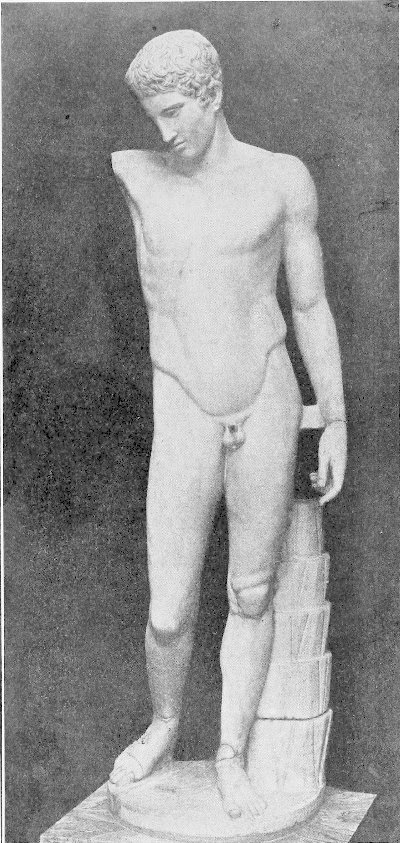
The statue of a Boy Crowning Himself, which has survived in many Roman copies and variant Greek originals, notably in the so-called Westmacott Athlete of the British Museum (Pl. 19),1166 a fragmentary statue of poorer workmanship in the Barracco collection in Rome,1167 and a Greek copy from Eleusis now in the National Museum in Athens,1168 and identified by many archæologists with the statue of the boy boxer Kyniskos by Polykleitos at Olympia, should be discussed here. While the Westmacott Athlete appears to be a copy from the original bronze, the Barracco statue, though showing the same pose, is unlike it in the treatment of hair and muscles, and with its Attic head, seems to be a carelessly executed variant, more or less Myronian in style, of the Polykleitan original. While its original may be assigned to the end of the fifth century B. C., the Eleusis variant, with its head differently placed, is not a Roman copy, but a Greek original statue showing the Polykleitan motive carried into the soft Attic style of the fourth century B. C.1169 A fine copy of the head alone is in the possession of Sir Edgar Vincent, in his Constantinople collection.1170 This should be associated with another head in Dresden, both being closely related to that of the Westmacott Athlete.1171 The best copy of the head is in the Hermitage, in which the treatment of the hair approaches nearest to that of the bronze original.1172 A marble head from Apollonia in Epeiros, now in the British Museum, which so closely resembles the head of the Westmacott Athlete that the missing sections of the neck and shoulders were restored by a cast from the latter, is somewhat different in style. For while the Westmacott head is a mechanical copy, this Greek head is full of vigor, disclosing Attic characteristics of the early fourth century B. C., and obviously is an Athenian imitation of the original, like the statue from Eleusis.1173 A more remote variant is the beautiful marble head formerly in the possession of Dr. Philip Nelson in Liverpool, but now in America, which is not an exact copy of any of the known variants, but so closely resembles the Capitoline type of Wounded Amazon, assigned first by Otto Jahn and later by Furtwaengler to Kresilas, that it must be by the same hand.1174 This head also reminds us of that of the Kresilæan Diomedes of the Munich Glyptothek (Pl. 21),1175 though the hair-treatment is Polykleitan.1176 Both show a modification of Polykleitan forms under Attic influence. The numerous fine copies indicate that the original was a well-known work. That it was Polykleitan is clear from a study of the heads, which show a great resemblance to that of the Doryphoros, and of the body forms, which resemble those of both the Doryphoros and the Diadoumenos. While some believe this original a work of Polykleitos himself,1177 others think that it was by one of his pupils or successors, who imitated the master’s early style. If the original, however, was not the statue of Kyniskos, there is little evidence that it was by Polykleitos himself.
The palm-trunk in the Westmacott copy certainly argues that the original was an athlete statue. The gesture of the right hand has given rise to different interpretations. The Barracco copy furnishes the best evidence, as on it the right arm is preserved to the wrist, the hand only being lost. Helbig at first (in the Barracco Catalogue) expressed the opinion that the right hand might have held an oil-flask, from which oil was being poured into the left. However, the position of the left hand, as shown by the puntello on the left hip, must have been the same as that on the Westmacott copy, i. e., hanging close to the left side. Helbig later (in the Fuehrer) explained the motive as that of a boy setting a crown on his head, as in the bronze Eros already mentioned. This interpretation, first suggested by Winnefeld,1178 has been the favorite one among archæologists. But all sorts of other explanations of the motive of the original have been offered, as that the athlete was scraping his forehead or shoulders with the strigil,1179 that the statue represented Narkissos looking into the pool and shading his eyes with his right hand,1180 that it was an athlete standing at rest and holding an akontion in his right hand—a theory harmonizing with the poise of the head, but not with the turn of the wrist, which shows that the hand was held downwards1181—and that it was, in fact, the nudus talo incessens of Pliny.1182 On the head of the Eleusis statue there is a mass of marble left over the right ear just opposite the place where the hand would be, if it were setting a wreath on the head. The fact that no marks are visible where the crown was attached is explained by the assumption that the wreath was of metal even in the marble copies. That this motive, moreover, was known to both Attic and Peloponnesian art in the second half of the fifth century B. C. is well attested. Thus we see on the Parthenon frieze a youth crowning himself with one hand, while holding the horse’s bridle with the other.1183 The pose of this figure—especially the legs—recalls the Myronian Oil-pourer already discussed (Pl. 11). On the other hand, one of the figures of the Ildefonso group in Madrid, which is Polykleitan in style, represents a boy wearing a wreath, a figure closely akin to the Westmacott Athlete, the leg position being the same in both and the poise of the head nearly so, although the arms are different, the left one being raised and the right hanging down.1184 It is probable that the raised right hand of the original of the Westmacott and other replicas touched the wreath and the lowered left held a fillet. The best explanation, then, of the Westmacott Athlete and kindred works is that the motive of the original was allied to that of the Diadoumenos of Polykleitos, though the modeling is too soft for Polykleitos, showing that the copyists changed the original of the Argive master to suit a later and different taste. Whereas the Diadoumenos is tying on a victor’s fillet, the other is presumably placing a victor’s wreath on his head. Certainly no better restoration can be made for the Barracco copy. Furthermore, many other monuments, which show a similar attitude, and which must be regarded as very free imitations of the original, seem to show that the boy was represented as placing a wreath on his head.1185
Whether the original of the series was an actual victor statue at Olympia or not is an interesting question. It has been repeatedly suggested that it was the very statue of the boy boxer Kyniskos there, mentioned by Pausanias, the base of which has been recovered.1186 The external evidence for the identity consists altogether in the similarity in the position of the feet on this base and in the series of copies, which argues a similar pose. The base shows that the left leg bore the weight of the statue; it was slightly advanced and rested on the sole, while the right leg was set back and rested on the ball only. Thus the statue of Kyniskos was represented in the characteristic Polykleitan schema of rest, except that the position of the legs is reversed from that of the Doryphoros, Diadoumenos, Amazon, and other works of the master. We might add that this same reversal appears on two other bases found at Olympia, which held victor statues by the elder Polykleitos1187 and one by the younger.1188 Moreover, the leg position of the canon does not occur in the works of the master’s pupils Naukydes and Daidalos, and only in one work of Kleon.1189 This shows that teacher and pupils also used another motive, i. e., the old canon of Hagelaïdas, besides the one associated with the Doryphoros. The similarity in the position of the feet on the Olympia base and in the series of statues discussed has led some scholars, e. g., Petersen and Collignon, to accept the proposed identity. This similarity in foot position, the probability that the statue on the basis was life-size, like those of the Westmacott series, and the palm-tree support in the British Museum replica, all pointing to a victor statue, make the identity well within the range of possibility, but by no means certain. It is necessary only to rehearse the objections to this view. In the first place the length of the foot on the Olympia basis can not be accurately measured for purposes of comparison. In the next place Polykleitos, as we have just seen, made other statues of victors at Olympia with almost the identical foot position of that of Kyniskos. Furthermore, it seems very unlikely that so celebrated an original as that of these many replicas could have been standing in the Altis so late as the time of Pausanias.1190 It is difficult, also, to understand why an imitative Attic sculptor of the fourth century B. C., should make a copy of an Arkadian boy victor statue for Eleusis. And lastly we must not forget that up to the present time not a single Roman copy has been conclusively identified with that of a victor statue at Olympia. If the date of the victory of Kyniskos were definitely fixed, the question of identity would be better substantiated. By a process of exclusion, to be sure, Robert reached the date Ol. 80 ( = 460 B. C.),1191 but other dates are possible. Under these circumstances there seems to be little more than the possibility that we have recovered an actual victor statue at Olympia in these copies.1192
The Palm-branch.
The palm-branch, either woven into a wreath or held in the hand, was a victor attribute. Pausanias says that a crown of palm leaves was common to many contests, and that the victor everywhere in Greece carried a palm-branch in his right hand.1193 He refers the custom to mythical times, tracing it back to the contest held by Theseus on Delos in honor of Apollo.1194 Pliny mentions a painting by the Sikyonian Eupompos, which represented a victor certamine gymnico palmam tenens.1195 While Milchhoefer1196 believed that the motive of an athlete setting a crown on his head with his right hand and holding a palm in his left, which is repeated frequently and with variation in many works of art, went back to this painting of Eupompos, Furtwaengler1197 goes further in assuming that the painter derived the motive from the statue of Polykleitos represented by the Westmacott Athlete and kindred works just discussed. The pupils of the great sculptor appear to have transferred his school from Argos to Sikyon, and were, therefore, associated with Eupompos. This attribute of the palm, permanent in bronze statues, has been broken off for the most part in marble ones. We see it in an unfinished statue of a young athlete in the National Museum, Athens, who holds the palm-branch in his hand. Here it has survived, since the statue was only blocked out.1198 It is prominent in the funerary stele from the Dipylon representing a victor, which has been mentioned in a preceding section;1199 here the palm extends from the left hand, which is held down close to the side, up to the shoulder. We have already noted that the copyist added a palm-branch to the stump placed beside the Vatican girl runner (Pl. 2). In the Choiseul-Gouffier Apollo (Pl. 7A) the left hand should doubtless be restored with the palm-branch, because of the projecting notch of marble on the side of the left leg near the knee.1200 A similar notch appears also on the Apollo-on-the-Omphalos in Athens (Pl. 7B), which shows that the left hand held a long attribute, which was doubtless a palm-branch. This attribute occurs frequently on vases.1201 We see it on a marble statue found at Formiae and now in the Glyptothek Ny-Carlsberg in Copenhagen, which shows the same motive as that of the statue by Stephanos (Pl. 9), though in a freer style of execution. Here the lowered right hand holds a palm-branch, which is shown in low relief against the right arm.1202
SECONDARY ATTRIBUTES OF VICTOR STATUES.
In course of time the sculptor was not content to represent victor statues merely as victors, but differentiated the various kinds of victors by special attributes.
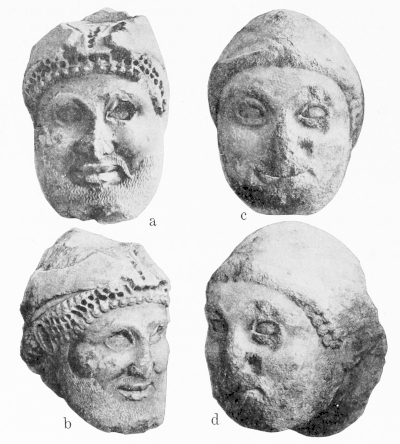
Fig. 30.—Marble heads of two Hoplitodromoi, from Olympia. Museum of Olympia.
Hoplitodromoi.
Thus a hoplite victor would be represented with his usual weapons. Pausanias, in mentioning the statue at Olympia of the hoplite runner Damaretos of Heraia by the Argive sculptors Eutelidas and Chrysothemis, says that it “has not only a shield, as the armed runners still have, but also a helmet on his head and greaves on his legs.”1203 He adds that the helmet and greaves were gradually abolished at Olympia and elsewhere. We have seen that the statue of Damaretos was set up at the beginning of the fifth century B. C., when his son Theopompos, the pentathlete, won his second victory, the monuments of the two being in common.1204 Toward the middle of the fifth century the hoplite victor Mnaseas of Kyrene had a statue at Olympia, the work of Pythagoras of Rhegion, which represented him as an armed man.1205 A Pythian victor, Telesikrates, of the fifth century B. C., had a statue at Delphi, which represented him with a helmet.1206 We have actual remnants of two hoplite victor statues of the sixth century B. C., in the two bearded and helmeted life-size heads of Parian marble found at Olympia (Fig. 30, a, b = A; c, d = B).1207 The younger of these heads (A), to which probably belong either an arm and the remnants of a shield attached with a ram and a representation of Phrixos upon it in relief,1208 or a shield fragment with a siren’s wing upon it1209 and the fragment of a shield edge1210 and right foot of fine workmanship,1211 I assigned long ago to the statue of the Thessalian hoplitodrome Phrikias of Pelinna, who won two victories in Ols. 68 and 69 ( = 508 and 504 B. C.).1212 R. Foerster had referred this head to the statue of the hoplite runner Damaretos of Heraia, whose monument, in common with that of his son, the pentathlete Theopompos, was the work of the early Argive sculptors Chrysothemis and Eutelidas.1213 But this fresh and vigorous head is not Peloponnesian, but shows strongly marked Attic traits in its round face, full cheeks, and soft lips, and in the rows of regularly wound locks of hair. The arm and foot similarly disclose Attic softness and grace. Because of its Attic character, Treu and Overbeck,1214 in opposition to Foerster, ascribed it to the statue of the Elean hoplite victor Eperastos mentioned by Pausanias.1215 Though the date of his victory is unknown, it certainly fell some time after Ol. 111 ( = 336 B. C.)—a date far too late for so archaic a sculpture. Furtwaengler1216 referred this and the more archaic head B to the group of Phormis at Olympia, mentioned by Pausanias.1217 However, Treu1218 showed that there was no stylistic connection between the two heads. The slightly more archaic head B, badly injured from weathering, I have referred to the Achaian hoplitodrome Phanas of Pellene, who won Ol. 67 ( = 512 B. C.).1219 In this carefully executed head the hair and beard are arranged in small locks and the archaic smile is prominent. While the younger head is Attic, this one is unmistakably Peloponnesian; and while the former comes from a statue represented at rest, the latter, because of the twist of the neck, seems to have come from one represented in violent motion. For this reason Wolters believed that it came from the statue of a warrior represented as thrown to the ground and defending himself.
The Myronic statue in the Palazzo Valentini, Rome, known as Diomedes,1220 whose pose recalls the Diskobolos, may represent a hoplitodrome, because of its marked resemblance in attitude to the Tuebingen bronze to be discussed in the next chapter (Fig. 42), and because of the helmet on its head.1221
Pentathletes.
Pentathletes were represented by attributes taken from three of the five contests—jumping, and throwing the diskos and the javelin. All these attributes appear in gymnasium scenes pictured on red-figured vases. Thus a kylix of the severe style in Munich1222 gives us a general picture of the exercises of the gymnasium. On the walls hang diskoi in slings, strigils, leaping-weights, oil-flasks, sponges, and javelins. Archaic leaping-weights (ἁλτῆρες) appeared in the hands of the statue of the Elean Hysmon at Olympia by the Sikyonian sculptor Kleon.1223 Similarly, a figure of Contest (Ἀγών) in the group set up there by Mikythos had weights.1224 The offering of the people of Mende at Olympia very nearly deceived Pausanias into thinking it the statue of a pentathlete, because of its ancient halteres.1225 This shows that these weights formed a regular attribute of pentathlete statues there. A relief from Sparta1226 represents an athlete leaning on his spear and holding a pair of leaping-weights in his right hand. There is a bronze statue of such a victor in the Berlin Antiquarium.1227 Halteres hang on a tree-trunk to the right of the statue of an athlete in the Pitti palace in Florence.1228 The breast of a marble torso, less than life-size, of a boy statue found at Olympia, shows that the hands were stretched forward, and very possibly the objects which they held were leaping-weights.1229
We have no direct literary reference to a victor statue at Olympia of a pentathlete with the attributes of the diskos or javelin. That they existed there, however, seems probable enough. Such a work as the Diskobolos of Myron, which displays the youthful victor in its every line, other statues, statuettes, reliefs, and vase-paintings, show us how the artist represented the different steps in the casting of the quoit. Similarly, the famous Doryphoros of Polykleitos, copies of which have been identified in many museums (Pl. 4 and Fig. 48), will give us an idea how a javelin thrower might have been represented at rest. The akontion or victor’s casting-spear, was, as we see from the Spartan relief of a pentathlete just mentioned, about the height of a man. The attitude of the diskobolos and doryphoros will be discussed at length in the next chapter.
Boxers.
The statue of a boxer would be sufficiently characterized by thongs, which he might carry in his hand, as in the statue of the Rhodian Akousilaos at Olympia,1230 or wound round his forearm, as in the statue of a boxer in the Palazzo Albani, Rome,1231 or on a near-by prop, as on the tree-stump beside the Choiseul-Gouffier Apollo in the British Museum (Pl. 7A).1232
Wrestlers.
Long ago Scherer tried to show that the aryballos was a wrestler-attribute, since oil was so important in wrestling.1233 He interpreted as aryballoi the pomegranates mentioned by Pausanias as held in the hands of the statues of the wrestlers Milo1234 and Theognetos1235 at Olympia, assuming that the Periegete mistook oil-flasks for pomegranates (ῥοιαί). But it hardly seems reasonable that such a small utensil, which was used by athletes in general, could ever have been regarded as a peculiar attribute of the wrestler. A similar attribute may have been held in the outstretched hand of the half life-size archaic bronze “Apollo” of the Sciarra Palace in Rome,1236 and it occurs on other statues.1237
Caps for Boxers, Pancratiasts, and Wrestlers.
Often the boxer and pancratiast (and even wrestler)1238 are represented as wearing close-fitting caps, made up of thongs of leather or of solid leather. This, however, can scarcely be called a determining attribute. Our best example of such a cap is afforded by an athlete head dating from the first half of the fifth century B. C., in the Capitoline Museum, Rome,1239 formerly called a portrait of Juba II, who was the king of Numidia and Mauretania from 25 B. C. to 23 A. D. This ascription was based on the barbarous look of the head and the fact that another head, discovered in the Gymnasion of Ptolemy in Athens and thought to resemble it, was assumed to be that of Juba, since Pausanias mentions one of that prince there.1240 It is rather the head of an athlete engaged in putting on a cap. This cap consists of three transverse leather pieces crossing the head from side to side, one over the forehead, one over the crown, and the third over the occiput, all three converging above the ears. A fourth strap fastens them together and is drawn over the crown from forehead to occiput. In the complete statue doubtless the hands were raised to the head, grasping the straps near the ears to fasten them. This is, therefore, an anticipation of the later Diadoumenos motive. We see it in a statuette formerly in the Stroganoff collection in Rome, but now in private possession in England,1241 which represents an athlete putting on a similar headdress. Though the arms of the statuette are gone, remains of the two hands are seen touching the left ear and tying the straps, one of which runs around the cranium above the swollen right ear. With this complicated head-dress we may compare the close-fitting cap—evidently of leather—pictured on an archaistic Greek votive relief-in the Palazzo dei Conservatori, in Rome, which represents an athlete washing his hands in a basin, which stands on a tripod.1242 Here the cap is fastened by two bands, one around and the other under the chin. An object in the upper left corner of the relief, enclosed in a frame, appears to be a victor crown adorned with bow-knots. Such caps, used in wrestling, would make it impossible for an opponent to grasp the hair; in boxing and the pankration it would protect the head from injury. We saw that such a cap was pictured on a Munich kylix of the early fifth century B. C. It is probable that such caps were customary at a period before athletes lost their long hair and that it was continued afterwards for various reasons. The little statuette from Autun now in the Louvre (Fig. 60), representing a pancratiast, has a close-fitting cap. The ring at the top shows that this statuette was hung up—perhaps being used as a weight in a Roman scale, or perhaps for adornment. In later days boys while practising in the palæstra, but never at the public games, wore ear-lappets (ἀμφωτίδες or ἐπωτίδες) to protect their ears, not dissimilar to those worn in our day for protection against the cold. We see them on a marble head, formerly in the possession of Fabretti.1243
The Swollen Ear.
We have lastly to speak of the swollen ear, which was an attribute of victor statues, both primary and secondary, since it characterized victors as such, and also early differentiated victors in various contests. Swollen ears may have played a role as a characteristic attribute of pugilists in early times.1244 We found them on the Rayet head in the Jacobsen collection (Fig. 22), which belongs to the last quarter of the sixth century B. C. and comes from the funerary statue of an athlete, probably a boxer. In course of time, however, they came to characterize pancratiasts, wrestlers,1245 and athletes in general. The assumption, then, that heads with swollen ears come from statues of boxers,1246 and that the boxer was known throughout Greek history as the “man with the crushed ear” is erroneous.1247 The earliest literary reference to the bruised ear is in Plato.1248 The philosopher used the term slightingly of those who imitated Spartan customs, especially Spartan boxing. The Lacedæmonians never boxed scientifically, but fought with bare fists and without rules. Literary evidence, furthermore, shows that bruised ears did not play the part in boxing matches which other bruised features of the face did—the eyes, nose, mouth, teeth, and chin. Vase-paintings sustain this evidence, for we often see bloody noses and cuts on the cheeks and chin, but no crushed ears.1249 In short, the crushed ear was merely a professional characteristic, a realistic detail, common to athletes of various sorts, and, as we shall see, to warriors, gods, and heroes. To quote Homolle: “La bouffissure des oreilles ellemême n’est pas un trait personnel, mais un caractère professionnel; elle ne désigne pas Agias, mais en général le lutteur. Cette déformation peut atteindre même un dieu, s’il a pratiqué les exercices gymnastiques et passé sa vie dans les luttes”.1250 It is found constantly on athletic types of heads in sculpture, whether these represent gods or mortals. A few examples will make this clear. The following heads of athletes show the swollen ears: the bronze portrait head of a boxer or pancratiast from Olympia, dating from the end of the fourth century B. C. or the beginning of the third (Fig. 61 A and B);1251 the marble head from the statue of the boxer Philandridas set up among the victor statues at Olympia, the work of Lysippos (Frontispiece and Fig. 69);1252 the head of the statue of the pancratiast Agias at Delphi (Pl. 28 and Fig. 68) ;1253 that of the Seated Boxer in the Museo delle Terme in Rome (Pl. 16 and Fig. 27);1254 that of the Apoxyomenos of the Uffizi in Florence (Pl. 12);1255 the bronze head from an athlete statue found at Tarsos and now in Constantinople, an Attic work of the end of the fifth century B. C.;1256 the beautiful bronze head of a boxer in the Glyptothek (Pl. 3);1257 the head of the so-called Apollo-on-the-Omphalos in Athens (Pl. 7B);1258 the athlete head from Perinthos (Fig. 33);1259 the bronze copy of the head of the Doryphoros, found in Herculaneum and now in Naples, by the Attic artist Apollonios (Fig. 47);1260 the Ince-Blundell head in England, to be discussed; four heads in Copenhagen;1261 the remarkably beautiful bust of an athlete in the Metropolitan Museum, New York (Pl. 20), whose rounded skull, oval face, projecting lower forehead, and dreamy, half-closed eyes place it in the fourth century B. C., a work influenced by the art of Praxiteles.1262
PLATE 20
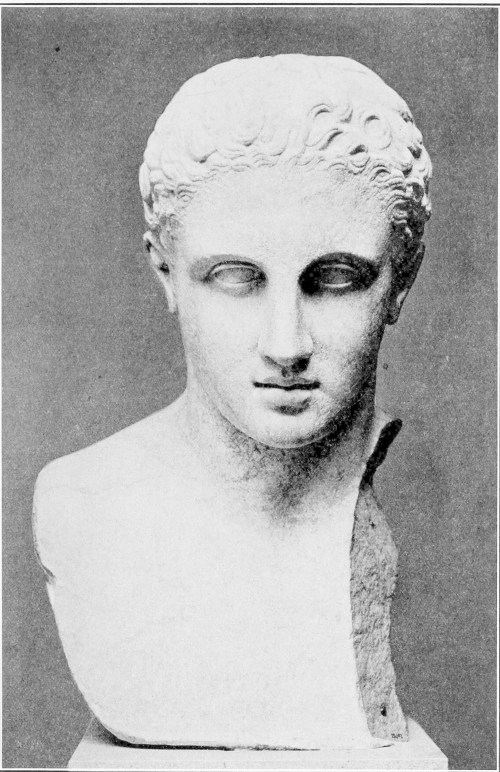
Head of an Athlete, School of Praxiteles. Metropolitan Museum, New York.
When we consider heads of gods and heroes we find the swollen ears on a variety of types. We see them on the so-called Borghese Warrior of the Louvre (Fig. 43),1263 formerly called a Gladiator, and on the marble statue of Kresilæan style in Munich, which has been known since Brunn’s interpretation as Diomedes (carrying off the Palladion from Troy) (Pl. 21).1264 This latter statue is a careful, though inexact, Hadrianic copy of a famous work and is shown to represent the hero, and not an athlete, by the mantle thrown over the arm. Skill in the boxing match, the roughest and most dangerous of sports, is as appropriate to Diomedes as to Herakles himself. The crushed ears appear on the Dresden replica of this statue, a cast from the Mengs collection, the original of which was once probably in England,1265 but do not appear on the poor copy in the Louvre.1266 They also appear on the Myronian bust in the Riccardi Palace, Florence, which is a copy of an original that was, perhaps, the forerunner of the Kresilæan Diomedes.1267 Here again the garment thrown over the left shoulder shows that a youthful hero, and not an athlete, is intended.
On heads of Herakles the swollen ears are very common. The first dated representation of the hero with battered ears appears to be Fig. 31.—Head of Herakles, from Genzano. British Museum London. on coins of Euagoras I, the king of Salamis in Cyprus during the years 410–374 B. C.1268 We have several examples in sculpture from the fourth century B. C. Thus swollen ears and the victor fillet appear on the Skopaic head in the Capitoline Museum.1269 Another example is the terminal bust of the youthful hero found in 1777 at Genzano, and now in the British Museum (Fig. 31).1270 This head wreathed with poplar leaves, is probably a Græco-Roman copy of an original of the fourth century B. C., by an artist of the school of Lysippos. In the group representing Herakles and his son Telephos, a Roman copy in the Museo Chiaramonti of the Vatican, the hero is represented with fillet and battered ears.1271 A Parian marble head, encircled by a crown, in the Glyptothek, going back to a Lysippan bronze original, seems to come from the statue of the hero represented as a victor.1272 Another life-size head, of poor workmanship, in the Chiaramonti collection of the Vatican, sometimes confused with the Doryphoros head-type, seems to come from a statue of Herakles, as shown by the broken ears and rolled fillet, the latter a well-known attribute of the hero taken from the symposium.1273 A much finer replica is the bust from Herculaneum now in Naples.1274 Swollen ears appear also on heads of Ares. We may instance the helmeted one in the Louvre,1275 and especially the replica in the Palazzo Torlonia in Rome.1276 They are less prominent on a Parian marble head of the god in the Glyptothek, which appears to be a copy of an original of which the Ares Ludovisi is a more complete one.1277
PLATE 21
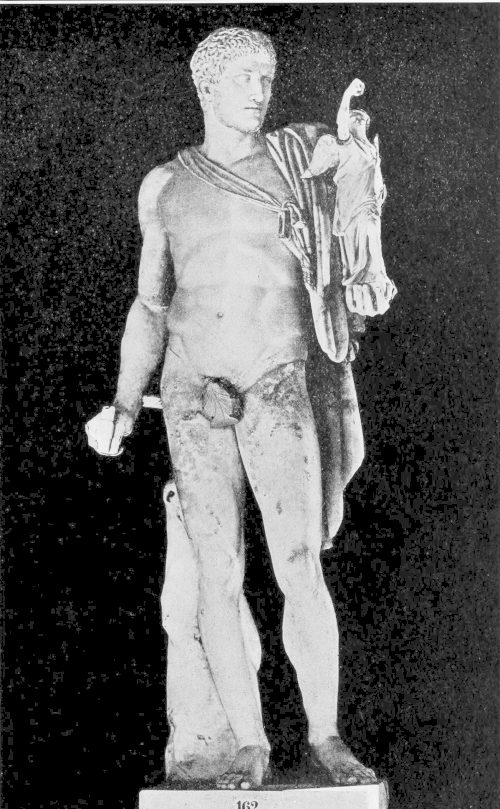
Statue of Diomedes with the Palladion. Glyptothek, Munich.
So far as we know, the statues of wrestlers, runners (except hoplitodromes), and probably pancratiasts were not distinguished by special attributes. In these cases the sculptor was obliged to express the type of contest in the figure itself. His problem, therefore, was to represent the victor in the characteristic pose of the contest in which he had won his victory, that is, by representing the statue as if in movement. This brings us to the second division of our treatment of victor statues, those which represented the victor not at rest, but in motion, a scheme which, in course of time, was extended not only to victors in wrestling and running, but to those in all contests, by representing them in the very act of contending. The treatment of this class of monuments will occupy the chief portion of Chapter IV.