Chapter VIII · POSITIONS OF VICTOR STATUES IN THE ALTIS; OLYMPIC VICTOR MONUMENTS ERECTED OUTSIDE OLYMPIA; STATISTICS OF OLYMPIC VICTOR STATUARIES.2293
Reading edition
CHAPTER VIII. POSITIONS OF VICTOR STATUES IN THE ALTIS; OLYMPIC VICTOR MONUMENTS ERECTED OUTSIDE OLYMPIA; STATISTICS OF OLYMPIC VICTOR STATUARIES.2293
Plans A and B.
The first part of this final chapter is a special study in the topography of the Altis at Olympia. It is an attempt to fix, more or less exactly, the positions of victor statues erected there, so far as these can be determined from the data furnished by Pausanias, and from the locations of the inscribed fragmentary bases of the statues which have been recovered during the excavations at Olympia.
STATUES MENTIONED BY PAUSANIAS.
We shall first attempt to give the positions of the statues mentioned by Pausanias, who is our chief source of information. After describing the votive offerings (ἀναθήματα) at the end of Book V, he begins the enumeration of the monuments of “race-horses ... and athletes and private individuals” at the beginning of Book VI.2294 This description falls into two routes (ἔφοδοι), the first of which is concerned with the statues of 168 victors,2295 and the second with those of 19.2296 Both accounts also include many “honor” monuments erected to private persons. The first route begins at the Heraion in the northwestern part of the sacred enclosure, while the second begins—manifestly where the first ends—at the Leonidaion at its southwestern corner, and extends to a point near the so-called Great Altar of Zeus near the centre of the Altis (see Plans A and B).2297 Besides these meagre indications of his two routes furnished by Pausanias himself, we are fortunate in knowing exactly the position of one statue, that of Telemachos, the 122d victor mentioned, the base of which still stands in situ near the South wall of the Altis, a little southeast of the temple of Zeus, showing that the route passed before the eastern front of this temple and thence westward to the Leonidaion. With these data and with the help of some forty inscribed bases of statues and other monuments mentioned by Pausanias, many of which were found in or near their original positions, it is possible to trace yet more definitely his routes. Several attempts have been made, since the German excavations, to define topographically the positions of these statues, especially by Hirschfeld,2298 Scherer,2299 Flasch,2300 Doerpfeld,2301 and the present writer.2302
The position of several inscribed base-fragments of statues, corresponding with Pausanias’ order of presentation, should alone be sufficient to confute the doubts raised by some scholars that these routes through the Altis were not topographical.2303 But in any attempt to reconstruct them we must constantly be on our guard against assuming that Pausanias describes a continuous line or row of monuments, as both Hirschfeld and Scherer have done. Though here and there this may have been true, still, generally speaking, we must conceive of these statues as being strewn about the Altis in no other order than that they stood in groups, and that these groups had only a general direction; for we shall see that Pausanias sometimes returns to the same spot without mentioning it and often leaves long spaces unnoticed. Apart from the indication of such groups in the description itself, as attested by the use of such words as παρά, ἐφεξῆς, μετά, πλησίον, ἀνάκειται ἐπί, ἐγγύτατα, ὄπισθεν, μεταξύ, οὐ πόρρω, οὐ πρόσω, κ.τ.λ., I have already shown in my previous work that it is possible to reconstruct many other groups, for abundant proof is there given that statues of nearly contemporaneous victors were often grouped together, as were those of the same family or state, or those victorious in the same contest, or those whose statues were made by the same artist.2304 So, in general, we can group only certain statues in belts or “zones” around some building or monument which is still in situ. Further than this we can seldom go. W. Gurlitt has thus well expressed the difficulty of following these routes of Pausanias: “Jede folgende Statue ist nach der vorhergehenden orientirt zu denken ... Beziehungen auf frueher oder spaeter erwaehnte Monumente waren ueberfluessig ... wir sind ... auf wenige Fixpunkte angewiesen und verfallen daher leicht in den Fehler, die Wegrichtungen in den Plan zu schematisch einzuzeichnen.... Das Hin und Her auf den viel verschlungenen Wegen der Altis koennen wir nicht mehr controllieren”.2305 In his description of the scattered altars (V, 14.4–15.12), Pausanias had not the same problem to meet as in that of the victor statues. As there was so little continuity in describing the altars, which were strewn all over the Altis, he had to introduce many other monuments to make their locations known; but in the case of the victor statues there was great continuity, and consequently such indications would have been superfluous.2306 And, in general, owing to the number and variety of monuments crowded together in the circumscribed area of the Altis, he was not compelled to describe Olympia with such definite detail as Athens. That these victor statues, however, are described in topographical order is not only attested by the internal evidence of Pausanias’ words,2307 but also by the finding of many of their bases in the order of his presentation. With this introductory warning, let us take up the routes of Pausanias in detail.
The First Ephodos of Pausanias.
Pausanias begins his enumeration in the northeastern part of the Altis: ἐν δεξιᾷ τοῦ ναοῦ τῆς Ἥρας2308—words which have been the subject of much discussion as to whether they are to be understood of the temple pro persona, i.e., the southern side,2309 or of the viewpoint of one facing it, i.e., the space (especially the northern or right hand half) before the eastern front.2310 From the immediate whereabouts of Pausanias we get no clue; for at the end of Book V (27.11) he says that he is in the middle of the Altis, and yet in the following paragraph (27.12)—evidently added as a transition from the account of the altars to that of the victors—he mentions the trophy of the people of Mende, in Thrace, which he says he nearly mistook for the statue of the pancratiast Anauchidas (131), and this, as we shall see, stood near the South wall of the Altis far from the centre. Doerpfeld’s contention, therefore, that Pausanias approached the Heraion from this point, and that consequently the words ἐν δεξιᾷ must refer to its eastern front, is untenable, and we are left dependent on the meaning of these words as gathered from other passages in Pausanias’ work. An examination of several such passages seems to be convincing that they are used here of the Heraion pro persona.2311 Furthermore, the finding of the inscribed tablet from the base of the statue of Troilos (6) and the pedestal of that of Kyniska (7) in the ruins of the Prytaneion, i. e., not far from the western end of the Heraion, and the base of that of Sophios (22) in the bed of the Kladeos still further west,2312 makes it reasonable to conclude that the first statues mentioned (VI, 1.3–3.7), those of the Spartan group (Kyniska-Lichas, 7–14), all of the fifth century, B. C., flanked on either side by statues of the fourth, mostly of Eleans (Symmachos-Troilos, 1–6, and Timosthenes-Eupolemos, 15–28), originally stood in the order named by Pausanias along the southern front of the temple.2313
Leaving the Heraion, we get no further fixed point until we arrive opposite the eastern front of the temple of Zeus. For here around the foundation of the statue of the Eretrian Bull—still in situ 32 meters east of the northeastern corner of the temple (see Plans A and B)2314—have been found fragments of the pedestals of the statues of Narykidas (49) and Hellanikos (65) to the south, of Kallias (50) and Eukles (52), beneath that of Kallias, to the north, of Euthymos (56) and Charmides (58) close together to the east.2315 So it is clear that the series of statues from Narykidas to Charmides (49–58, P., VI, 6. 1–7.1) stood in this neighborhood. Now the statues of the family of Diagoras, the Rhodian athlete, stood together (59–63), as Pausanias says (VI, 7.1–2); one of them, that of Eukles (52), seems to have been moved from its original position later, as we learn from a scholiast on Pindar’s seventh Olympian ode,2316 who, on the authority of the lost works of Aristotle and Apollas on the Olympic victors,2317 enumerates these statues in an order different from that adopted by Pausanias, showing that a change in their positions must have taken place some time between the date of Aristotle and that of the Periegete.2318 The statues of Alkainetos and his son Hellanikos (64–65) must also have stood together. Inasmuch as the victors from Euthymos to Lykinos (56–68) are, with one exception, all pugilists or pancratiasts and of the fifth century B. C., they must have been grouped together, with the family groups of Diagoras and Alkainetos in the centre.2319 We may also add the statues of Dromeus and Pythokles2320 (69–70) of nearly the same date, and we can also extend the group in the other direction; for the same scholiast says that the statue of Diagoras stood near that of the Spartan Lysandros (35 a).2321 Pausanias (VI, 3.14 and 4.1) says that the statue of Lysandros stood between those of Pyrilampes and Athenaios (35–36). Thus we can conclude that the 36 statues (35–70, VI, 3.13–7.10) stood in the zone of the Eretrian Bull, extending perhaps across the Altis to the vicinity of the Echo Colonnade along its eastern boundary.
It would follow, then, that the intervening statues from Oibotas to Xenophon (29–34, P., VI, 3.8–3.13) stood somewhere between the Heraion and the Eretrian Bull. It is idle to discuss the route between these two monuments more definitely.2322
Our next fixed point is the Victory of Paionios, whose foundation is still standing in its original position, 37 meters due east of the southeast corner of the temple of Zeus.2323 For, of the next few statues mentioned, the base of that of Sosikrates (71) was found “somewhere” east of the temple, that of Kritodamos (80) before the “Southeast Building,” and that of Xenokles (85), 4 meters to the northeast of the Victory base, presumably near its original position.2324 Pausanias groups the three Arkadian athletes, Euthymenes-Kritodamos (78–80, P., VI, 8.5); then, after naming four statues of victors from other states, he mentions two more Arkadians together, Xenokles and Alketos (85–86, VI, 9.2); and he continues by saying that the statues of the Argives Aristeus and Cheimon (87–88, VI, 9.3) stood together. One more statue, that of Phillen or Philys2325 of Elis (89), is named before he comes to the chariot of Gelo. Thus we may conclude that the series of statues denoted by the numbers 71–89 (P., VI, 8.1–9.4) stood to the south of the Eretrian Bull in the parallel zone of the Victory.
We next come to the series of statues mentioned between the chariots of Gelo and Kleosthenes (90–99). The position of the bases of these chariots is practically certain. In describing the statues of Zeus in Book V, Pausanias says he is proceeding north from the Council-house (23.1), and first mentions a statue of Zeus set up by the Greeks who fought at Platæa; in describing the victor statues he says that the chariot of Kleosthenes stands behind this statue of Zeus (P., VI, 10.6). After describing the Zeus of Platæa, he mentions a bronze inscribed tablet as standing in front of it (V, 23.4), which recorded the thirty years’ treaty of peace between Sparta and Athens, and then says that the statue of the Zeus of the Megarians stands near the chariot of Kleosthenes (23.5). As he is proceeding north, this Megarian Zeus must have stood north of the Platæan one; thus in one group we have the two statues of Zeus and the chariot of Kleosthenes. Immediately to the north he next mentions the chariot of the Syracusan tyrant Gelo (90), which he says is near the statue of the Zeus of the Hyblæans (23.6). Now in coming south, in the athlete periegesis, he names eight statues between these chariots. Doerpfeld2326 has identified the base of the Platæan Zeus with a large pedestal to the northwest of that of the victor Telemachos (122) found in situ near the South Altis wall,2327 a position which is in harmony with the description of the statues of Zeus; just behind it he has identified two large foundations near together as those of the two chariots. So the eight intervening statues stood here. Of the statues between the chariot of Kleosthenes and the base of the statue of Telemachos, the base of that of Tellon (102) was found in the East Byzantine wall near the South Altis wall; that of Aristion (115) nearby, embedded in the same wall; that of Akestorides (119), whose name I have inserted in the lacuna in the text of Pausanias (VI, 13.7),2328 just northeast of the base of Telemachos.2329 Thus the series of statues from that of Gelo to that of Agathinos (90–121a, P., VI, 9.4–13.11) can be grouped in the zone of the Chariots.
As the fragment of the base of the statue of the Athenian pancratiast Aristophon (123) was found near the base of Telemachos, but to the east of it, and likewise that which supported the equestrian monument of Xenombrotos and Xenodikos (133–134) still further to the east near the Echo Colonnade,2330 we can conclude that the twenty-one statues from Aristophon to Prokles (123–138, P., VI, 13.11–14.13), mostly of the fifth century B. C., stood near the South Altis wall to the east (and not to the west of the base of Telemachos, where all other investigators have wrongly placed them),2331 and thus form a group which we can call the zone of Telemachos. So we conclude that the long list of statues from Pyrilampes to Prokles (35–138), nearly two-thirds of all those mentioned in the first ἔφοδος of Pausanias, stood in the space to the east and southeast of the temple of Zeus, grouped in the parallel zones of the Bull, Victory, Chariots, and Telemachos.
On the other hand, the statues beginning with the two of Aischines (139) and extending to that of Philonides (154 a) (P., VI, 14.13–16.5) must have stood to the west of the base of Telemachos and along the South Terrace wall some 20 meters south of the temple of Zeus, where many of the following pedestals were found in the order named by Pausanias: that of Aischines (139) was found in the Council-house; that of Archippos (140) nearby between the South Terrace wall and the north wing of the Council-house; that of Epitherses (147) opposite the sixth column of the temple from the west, some eleven paces from the South Terrace wall, and the fragment of the base of the honor statue of Antigonos (147 f) very near it; the bronze foot of one of the statues of Kapros (150) was found in the South Terrace wall, 24.40 meters from the southwest corner of the temple; and lastly, the base of the “honor” statue of Philonides (154 a), Alexander’s courier, was found in the southwest corner of the Altis at the extreme west end of the South Terrace wall, almost, if not exactly, in its original position.2332 Thus Pausanias, after coming south to the statue of Telemachos, first goes eastward as far as the statue of Prokles, then returns, repassing the two chariots on the way without remark, and then continues westward to the southwestern corner of the Altis. All statues west of that of Telemachos are of the fifth and fourth centuries B. C., with the exception of one, that of Eutelidas (148), who won in Ol. 38. This is the oldest statue in the Altis, despite Pausanias’ statement,2333 and it doubtless originally stood in the area occupied later toward the middle of the fifth century B. C. by the temple of Zeus, but was then transferred to its new position south of the temple.
After the statue of Philonides, there are still 19 statues of victors and “honor” men to dispose of in this first ἔφοδος, those from Brimias to Glaukon (155–169, P., VI, 16.5–16.9). Of these statues, the base of that of Leonidas of Naxos (155a), the founder of the great building just outside the southwestern corner of the Altis named after him, was discovered in a Byzantine wall before the eastern end of the north front of that building, while that of Seleadas (159) was unearthed within the ruins of the same building; the base which supported the group-monument of Polypeithes and Kalliteles (160–161)—which, owing to the early dates of their victories, some time between Ols. (?) 66 and 70 ( = 516 and 500 B. C.), must have stood originally in the area later occupied by the temple of Zeus, like that of the above-mentioned Eutelidas—a little to the south of the Byzantine church, between the bases of the statues of Leonidas and Glaukon; two fragments of the base of the statue of Deinosthenes (163) have been found, one east of the apse of the church, the other in the ruins of the Palaistra further north; and lastly, that of Glaukon, built into late walls northwest of the church.2334 As the statue of Philonides stood at the extreme western end of the South Altis wall, and as most of these fragments were found in the vicinity of the Leonidaion, it would be natural to conclude that the majority of these later statues stood in the spaces just outside the West Altis wall. But at the end of the first ἔφοδος (VI, 17.1) Pausanias says that he has so far named statues “within the Altis”; hence most investigators have placed these 19 statues either west of the temple of Zeus or in the space at the southwestern corner of the Altis. A little further on we shall see that many other victor statues, not mentioned by Pausanias, stood just outside the West Altis wall, and it is doubtful whether his words ἐν τῇ Ἄλτει (VI, 17.1) should be taken thus literally, especially on any theory of his use of earlier accounts in the final compiling of his own. If they were “within” the Altis, they could scarcely have stood to the west or southwest of the temple of Zeus, for the second ἔφοδος, as we shall see, passed there.
A better alternative can be found. In describing the Leonidaion (V, 15.2), Pausanias says that this building stood “outside the sacred enclosure at the processional entrance into the Altis ... separated from this entrance by a street; for what the Athenians call lanes, the Eleans name streets.”2335 Now Doerpfeld has shown that inside the West Altis wall and parallel to it—just south of the base of Philonides’ statue—is a line of bases ending in the later South wall of the Altis, so that this West wall and row of pedestals form a cul de sac (see Plan B).2336 It is clear that no such row of statues would have been placed leading up to a dead wall; therefore these statues must have stood there before the wall was built, and must once have formed the eastern boundary of a broad street skirting the eastern side of the Leonidaion, which was twice as wide as later, when the wall cut off half its breadth and made it a “lane,” though the older name “street” was retained. The later Roman enlargement of the Altis is well known. The long row of pedestals to the south of and parallel to those already discussed as standing along the line of the South Terrace wall, westward of the base of Telemachos, once constituted the southern boundary of the “Processional Way” (ὁδὸς πομπική), which ran from the Leonidaion to where it debouched into the Altis at its southeastern corner. Originally outside the Altis, they were later, together with the road itself, included in it. The pedestals, then, in the above-mentioned cul de sac, and also the fourteen (among them that of Metellus Macedonicus; see Plan B) that adorned the south side of the Processional Way, may be the remains of some of these last statues mentioned by Pausanias.
The Second Ephodos of Pausanias.
We next come to the second ἔφοδος, which is introduced by these words: Εἰ δὲ ἀπὸ τοῦ Λεωνιδαίου πρὸς τὸν βωμὸν τὸν μέγαν ἀφικέσθαι τῇ δεξιᾷ θελήσειας, τοσάδε ἔστι σοὶ τῶν ἀνηκόντων ἐς μνήμην.2337 The Leonidaion, the site of which was still in dispute till after the close of the excavations, was finally identified by Treu2338 with the so-called Suedwestbau, as had been already assumed by many investigators.2339 The site of the Great Altar, however, is still undetermined. The elliptical depression to the east of the Pelopion, whose dimensions (125 feet in circumference) agree with the figures of Pausanias2340 for the prothysis, or lowest stage of the altar, identified with it by most scholars,2341 must now be given up since the more recent excavations of Doerpfeld, which prove it to be the remains of two prehistoric dwelling houses with apse-like ends.2342 Nor can the remains of walls lying between the Heraion and the Pelopion, formerly supposed to be those of an altar, any longer be referred to the Great Altar (as Puchstein and Wernicke referred them)2343 since Doerpfeld’s recent discoveries. So we are dependent on the words of Pausanias alone for its location, who says that it stood “equidistant from the Pelopion and the sanctuary of Hera, but in front of both,”2344 therefore somewhat northwest of the elliptical depression nearer the centre of the Altis.2345 Our problem, then, is to find Pausanias’ route between these two points, and here again, as at the beginning of the first ἔφοδος, we must rightly interpret the words ἐν δεξιᾷ. Michaelis, in his article on the use of ἐν δεξιᾷ and ἐν ἀριστερᾷ in Pausanias’ work, made these words refer to the southern side of the Processional Way, i. e., to the side at the right of Pausanias, who was facing east after arriving at the Leonidaion.2346 Thus the statues already mentioned along the South Terrace wall (Aischines to Philonides, 139–154a) would now be on his left side. On this interpretation both Hirschfeld and Doerpfeld had the second ἔφοδος follow the Processional Way eastward parallel to the first—thus including the line of pedestals, which we have referred to the end of the first—and then, near the Councilhouse, curve northward in front of the temple of Zeus, which virtually would be a repetition of the first ἔφοδος. On this theory Doerpfeld2347 wrongly explained the first route as containing statues ἐν τῇ Ἄλτει, while the second was outside the older Altis, and so, though equally long, contained fewer statues. But against this interpretation it must be urged that the Periegete is describing the Altis of his day, when the road in question was included within its boundaries, and that the Great Altar and the two last statues mentioned (187, 188) as standing near the pillar of Oinomaos were always inside.2348 And neither this Processional Way nor the space before the eastern front of the temple of Zeus were localities for “unimportant mixed statues.”2349 Furthermore, if he had merely retraced his steps after arriving at the Leonidaion—and he says nothing of returning—he would not have begun a new route2350, but would have said something like this: Εί δὲ ὀπίσω ἀναστρέψας ἀπὸ τοῦ Λεωνιδαίου πρὸς τὸν βωμὸν αὐθις ἀφικέσθαι τῇ δεξιᾷ θελήσειας.2351 So it is simpler to conclude that the new route wound around the western and northern sides of the temple of Zeus over the temple terrace.2352 As no building is mentioned on the way, and as the north side of the temple would probably have been called ἀριστερὰ πλευρά (in accordance with the usage discussed above in connection with the Heraion), and as the Pelopion faces southwest, the words ἐν δεξιᾷ can refer only to the right hand of Pausanias, i. e., the right side of the road followed. If we assume that these words originally stood after τοσάδε ἔστι σοί and were transferred by a later copyist, the difficulty is resolved.2353
Of the nineteen victor statues in this second route (170–188, VI, 17.1–18.7) no bases have been found.2354 But of the three “honor” statues included, one base, that of the rhetorician Gorgias of Leontini (184a), was recovered 10 meters northeast of the temple of Zeus, and so probably not very far from its original position;2355 for Pausanias mentions only three more statues, before he comes to the last two in this ἔφοδος, which two stood in this vicinity. The parts of the Altis to the west and north of the temple were unimportant till the time of Alexander the Great, and were, therefore, remarkably free of monuments. In the whole description of Pausanias, we know of only three altars (those of Aphrodite, the Seasons, and the Nymphs) and a wild olive tree (the “Olive of the Beautiful Crown”) to the west of the temple (V, 15.3), and only of the votive offerings of a certain Mikythos or Smikythos to the north of it (V, 26.2).2356 As the statue of Gorgias stood among the “unimportant mixed statues” already mentioned (184–186), these must have stood somewhere north of the temple near its eastern end. Finally, the two ancient wooden statues of Praxidamas and Rhexibios (187–188, P., VI, 18.7) are mentioned by themselves as near the column of Oinomaos, which Pausanias elsewhere2357 says stood near the Great Altar of Zeus to the left of a road running south from it to the temple. Pausanias, after describing these “mixed” statues, may have finally left the route thus far followed and introduced these last two statues as quite distinct from the second ἔφοδος.2358 But he does not seem to have gone far from his route, for immediately after ending his account of the victor statues, he begins his account of the Treasuries, which lay beyond the Great Altar farther north.2359 (Plans A and B.)
Thus Pausanias ends his second route somewhere short of the Great Altar, and it appears after all to be only a continuation of the first, forming with it one unbroken “Rundgang,” though in quite a different sense of the word from that intended by Doerpfeld.
SUMMARY OF RESULTS.
From a study of these two routes, and a comparison of the dates of the victorious athletes,2360 we can draw the following conclusions as to the positions of the victor statues mentioned by Pausanias as standing in the Altis at Olympia:
1. The twenty-eight oldest statues—exclusive of the five already mentioned as having been removed from the area of the later temple of Zeus2361—dating from Ol. 58 ( = 548 B. C., Pythokritos, 128 b) to Ol. 76 ( = 476 B. C., Theognetos, 83), i. e., approximately down to the date of the founding of the temple,2362 stood in the space between the eastern front of the temple and the Echo Colonnade, or to the south of it near the South Altis wall. Only one statue (that of Protolaos, 48) stood as far north as the Eretrian Bull. Thus the southeastern part of the Altis was the oldest part dedicated to victor statues.
2. After this space was mostly filled, the next statues, those dating from Ol. 77 ( = 472 B. C., Kallias, 50) to Ol. 93 ( = 408 B. C., Eubotas, 75), i. e., from about the time of the foundation of the temple to near the date of the battle of Aigospotamoi, fifty-one in number, stood between the Heraion and the Victory of Paionios; only one stood as far south as the Altis wall, while seven stood around the Chariots, ten around the Victory, twenty around the Bull, and the rest further north (including 176, 185 of the second ἔφοδος, which stood north of the eastern end of the temple). Diagoras and his family (59–63), boxers and pancratiasts, had their statues near the older famous boxer Euthymos (56); Alkainetos and his sons (64–66), boxers, besides many other pugilists, had theirs near the Diagorids; Tellon (102) had his near that of his compatriot Epikradios (101); later Achæans had theirs near that of their countryman Oibotas (29), and Spartans near that of Chionis (111); some, as the three victors from Heraia (176, 177, 32),2363 stood far apart only apparently, for the last one had his statue near the Bull, and so not far from the other two, though these are named in the second ἔφοδος.
3. From near the date of the battle of Aigospotamoi, down to about the birth of Alexander the Great, i. e., from Ol. 94 to Ol. 106 ( = 404 to 356 B. C.), thirty-six statues filled in the intervals left among these older statues; fifteen stood near the Heraion; five between it and the Bull, seven around the Bull, five around the Victory, one near the Chariots, and three along the South Altis wall. Euthymenes and Kritodamos (78, 80) had their monuments near that of their older countryman (79), whose statue was made by Myron; the Ephesians, Pyrilampes and Athenaios (35, 36), had their statues beside that of their benefactor Lysandros (35 a).
4. After Alexander’s time, in consequence of the recent building of the Philippeion, Leonidaion, and Theekoleon to the west of the Altis, the western side of the temple of Zeus (and, to a lesser extent, the northern) became important, and henceforth statues surrounded the temple on all sides. Of the thirty-three statues of this epoch, nine stood to the west of the temple, four to the north, and seven to the south, while the rest stood either to the east, or, perhaps, near the Heraion. We shall see also that many later statues, known to us from inscriptions only, stood outside the Altis, to the west and northwest.
STATUES NOT MENTIONED BY PAUSANIAS, BUT KNOWN FROM RECOVERED BASES.
Having established these data, it is not difficult, from the positions of the many inscribed fragmentary bases found at Olympia and referred to victor statues not mentioned by Pausanias, from the approximate dates of the victories as gained from the age of the inscriptions, and by again employing the system of groups already mentioned, to state quite definitely where many of these other statues stood. Pausanias, who mentions 187 victors with 192 monuments in his two ἔφοδοι, expressly states that he enumerates only those “who had some title to fame or whose statues were better made.”2364 The reasons for his selection and the fact that he mentions the statue of no athlete certainly later than the middle of the second century B. C. (although we know from inscriptions that statues were set up far into the third century A. D., at least)2365 have been subjects of much discussion, but hardly concern us here.2366 The three latest statues of victors mentioned by Pausanias, whose dates are fixed, may be given: those of Kleitomachos, who won παγκράτιον and πύξ in Ols. 141 and 142 ( = 216 and 212 B. C.);2367 of Kapros, victor in παγκράτιον and πάλη in Ol. 142 ( = 212 B. C.);2368 and of Akestorides, victor πώλων ἅρματι sometime between Ols. 142 and 144 ( = 212 and 204 B. C.).2369 Still later statues of victors named by Pausanias, whose dates can not be exactly determined, are those of Sodamas, who won παίδων στάδιον some time between Ols. 142 and 145 ( = 212 and 200 B. C.);2370 of Amyntas, victor in παίδων παγκράτιον in Ol. (?) 146 ( = 196 B. C.);2371 of Timon, victor in πένταθλον in Ols. 146 or 147 ( = 196 or 192 B. C.);2372 and of Lysippos, victor in παίδων πάλη some time between Ols. 149 and 157 ( = 184 and 152 B. C.).2373 Of the first century A. D., Pausanias mentions three victors without statues: Artemidoros, who won παγκράτιον in Ol. 212 ( = 69 A. D.);2374 Polites, victor in στάδιον, δίαυλος and δόλιχος in Ol. 212;2375 and Hermogenes, victor in στάδιον twice, δίαυλος once, and as ὁπλίτης thrice, in Ols. 215, 216, 217 ( = 81–89 A. D.).2376 The words of Pliny, Olympiae, ubi omnium qui vicissent statuas dicari mos erat2377 refer, of course, as we have already pointed out, only to the privilege and not to the actual fact, for many victors would have no statues, as it was necessary for them or their relatives or city-states to meet the expenses of their erection.2378 No more is the rest of his statement to be taken literally, i. e., that those victors who were victorious three times had the right to erect portrait statues in their honor; for we have, as has already been shown, at least one exception.2379 Besides we know that portrait statues were practically unknown before the fourth century B. C. Most of the victor statues were mere types—those of Hermes and Herakles being common—without individualized features, simply representing the various contests by position or some characteristic, e. g., the helmet and shield for “hoplite” victors.2380
Five of these inscriptions have been referred to the sixth and fifth centuries B. C.2381 Of these the inscribed base of Pantares was found near the South Altis wall, and the statue must originally have stood east of the temple of Zeus, near the chariot of Gelo (90), for these two were the only victors from Gela, and won in the same kind of contest and at nearly the same date.2382 The statues of Phrikias of Pelinna and Phanas of Pellene, both representing victors in the heavy-armed race, to which I have ascribed the two archaic marble heads (Fig. 30), the former found west of the temple of Zeus and the latter to the south of it, must originally have stood in the area of the later temple and then have been removed.2383 That of an unknown victor, whose name ended in ... αδας,2384 the two fragments of whose base were found, one near the Heraion and the other to the east of the temple of Zeus, should have stood near the statues of the only other pancratiasts of a similar age, either near those of Dorieus (61), who won in Ols. 87 to 89 ( = 432 to 424 B. C.), and Damagetos (62), who won in Ols. 82 and 83 ( = 452 and 448 B. C.), in the zone of the Bull, or near that of Timasitheos (82), who won some time between Ols. (?) 65 and 67 inclusive ( = 520 and 512 B. C.), in the zone of the Victory. Lastly, the second inscribed base of Xenombrotos (133), found near the Council-house outside the South Altis wall, doubtless once stood near the first (the epigram from which is preserved by Pausanias, VI, 14.12), along this wall to the east of the base of Telemachos.2385
No inscribed fragments of bases dating from the fourth century B. C. have been found.
Beginning with the third century B. C., we shall see that most of the recovered bases were found either in the western part of the Altis, in the neighborhood of the Philippeion, Theekoleon, and Leonidaion, on both sides of the West Altis wall, or still farther west and northwest, especially in or near the Palaistra and Prytaneion. We have already seen that most of the statues named by Pausanias dating from Alexander’s time stood to the west (and north) of the temple of Zeus. As Pausanias enumerates only statues ἐν δεξιᾷ of his route around the temple to the Great Altar, these statues farther west and northwest are omitted from his account. Of the four bases of statues referred to the third century, all belong to Elean victors; three were found west and northwest of the Prytaneion and beyond, showing that these statues once stood in the vicinity of this building, and the fourth was found farther south, by the Palaistra, where it probably stood. Thus the base of the wrestler Nikarchos, son of Physsias, was found in a late wall west of the Prytaneion;2386 that of the statue of an unknown victor, son of Taurinos, was found at the southeast corner of the Palaistra;2387 that of another unknown victor, the son of ... phinos, was found in the Nordwestgraben;2388 the base of the statue of Thersonides, son of Paianodoros, victor κέλητι πωλικῷ, was found northwest of the Prytaneion, between the Roman baths and east hall of the Gymnasion.2389
Of the four statues referred with certainty to the second century B. C., all but one were found to the west of the Altis, in a region ranging from the Philippeion, northwest of the temple of Zeus, to the Leonidaion southwest of it. Two of them were found outside the West Altis wall, between the Leonidaion and the Byzantine church. Thus the base of the statue of D ... gonos, twice victor in πύξ, was found outside the apse of the Byzantine church and west of the West Altis wall;2390 the fragments of that of an unknown boy victor in wrestling or the pankration were found in the East Byzantine wall;2391 that of an unknown victor, συνωρίδι τελείᾳ (twice), and ἅρματι τελείῳ, was found south of the Philippeion.2392 The fragment of the base of the statue of another unknown victor in wrestling, the son of the Elean Aigyptos, was found to the northeast of the Leonidaion.2393
Of the seven bases referred to the second and first centuries B. C., three were found in or near the Byzantine church, showing that such statues may have stood in the Greek building which was later converted into the church.2394 Two more were found near the southwest corner of the Altis, and therefore may once have stood near the statue of Philonides, which Pausanias mentions as standing in that vicinity. Two others stood farther away, one inside the Prytaneion, the other northeast of the temple of Zeus. Thus the base of an unknown victor, the son of Aristotle, συνωρίδι πωλικῇ, was found in front of the north side of the Byzantine church;2395 that of Aristodamos, the son of Aleximachos of Elis, was found in the floor of the church;2396 that of an unknown victor was found northeast of the temple of Zeus;2397 that of a victor συνωρίδι πωλικῇ, whose name ended in ... chos, the son of the Elean Nikodromos, was found southwest of the Altis before the West Altis wall;2398 the base of two unknown victors from Elis were found respectively in the Prytaneion2399 and northwest of the Byzantine church,2400 while that of another Elean, Antigenes, the son of Jason, victor συνωρίδι πωλικῇ, was found in the southwest corner of the Altis.2401
The positions of the twenty-four bases (belonging to monuments of twenty-two victors) with certainty referred to the first pre-Christian century were very scattered. One large Pentelic marble bathron, supporting the monuments of seven victors of the family of Philistos, must have stood just south of the Philippeion, where most of the fragments were found. The bases of the statues of two other sons and a grandson of the same victor have been recovered, and doubtless stood near by, thus forming a family group of ten, outnumbering that of Diagoras (59–63 and 52) mentioned by Pausanias. The omission of so important a monument in the description of the Periegete has, of course, been used as an indication of his employment of earlier lists. Of the other bases, two were found outside the South Altis wall, west of the Council-house, and two east of it; two east of the temple of Zeus (one of them that of the youthful Tiberius, afterwards Roman emperor, which must have stood near the Eretrian Bull, where it was found); one southwest of the temple, along the South Terrace wall, pointing to a position among the statues there named by Pausanias; one east of the Byzantine church, pointing to a position south of the Theekoleon, two to the northwest of the Altis in the vicinity of the Prytaneion; while the others were found scattered all the way from the northeastern part of the Altis to the bed of the Kladeos. Thus over half (13) of these statue-bases were found in the west and northwest of the Altis and beyond; the space to the east of the temple of Zeus—called frequentissimus celeberrimusque by Scherer—seems now not to have been greatly prized. Most of these victories were gained in hippic contests. Horse-racing had early been discontinued, but was revived at the end of the first century B. C., when members of the imperial family, emulating the earlier triumphs of the princes of Sicily and Macedonia, became competitors. Thus Tiberius won in the chariot-race, and a few years later his nephew Germanicus in the same event. The list of these bases of victor statues of the first century B. C. and their provenience follows. A fragment of the base of the victor Agilochos, son of Nikeas of Elis, victor κέλητι πωλικῷ, was found in the East Byzantine wall.2402 One fragment of the bathron of the family group of the Elean Philistos,2403 victors in hippic contests, was found southwest of the Pelopion, while four others were discovered south of the Philippeion; the base of the statue of Philonikos, a son of Philistos, was also found south of the Philippeion,2404 and that of another unnamed son was discovered to the west of the Prytaneion,2405 while the place of finding of that of Charops, the son of Telemachos, has not been recorded.2406 The base of the monument of Aristarchos was found east of the Byzantine church,2407 that of Damaithidas, son of Menippos of Elis, a victor συνωρίδι πωλικῇ, west of the Council-house (south building),2408 and that of Thrasymachos (or Thrasymedes) in the Nordostgraben.2409 A fragment of the base of the statue of Demokrates of Antioch in Karia was found in the bed of the river Kladeos,2410 that of a victor whose name began with Demo..., northeast of the Prytaneion,2411 while that of Thaliarchos, the son of Soterichos of Elis, victor πὺξ παίδων καὶ ἀνδρῶν, was found east of the Council-house.2412 Bases from two statues of Menedemos, son of Menedemos of Elis, victor συνωρίδι πωλικῇ, were found, one east of the temple of Zeus, the other inside the Heraion.2413 Lykomedes, the son of Aristodemos of Elis, victor συνωρίδι πωλικῇ, also had two statues; the base of one was found in front of the West Byzantine wall on the south side of the temple of Zeus, that of the other in the Westgraben.2414 The front part of the base of the statue of Archiadas, the son of Timolas of Elis, who won κέλητι πωλικῷ, was discovered southwest of the temple of Zeus, on the Terrace wall.2415 That of an unknown victor in the δίαυλος, the son of ... krates of Miletos, was found near the Osthalle,2416 while that inscribed with the name of Tiberius Claudius Nero of Rome, who won a victory τεθρίππῳ just before the end of the century, was found south of the Eretrian Bull.2417
Nineteen inscribed base-fragments have been referred to the post-Christian centuries, thirteen to the first, three to the second, and three to the third. The spaces around the temple of Zeus (especially its eastern front) are again the favorite ones. Thus the bases of three statues were found east of the temple (one in situ), two near its southeastern corner, three at the northeastern corner (one, that of Germanicus Cæsar, the nephew of Tiberius, just to the north of the Eretrian Bull, and so originally standing here near that of his uncle), while another stood opposite the fifth column from the east on the north side of the temple. Most of these statues must have been passed by Pausanias in his first ἔφοδος, which is, perhaps, another evidence of his dependence on older lists in compiling his own. Two other bases were found to the southwest of the temple, one of them near its corner, and the other nearer the corner of the Altis, i. e., near the base of the statue of Philonides (154a). Thus eleven statues stood near the temple. Of the others, four were found in the vicinity of the Palaistra (one inside in situ), one to the northeast of the Prytaneion, another northeast of the Byzantine church, while the two remaining ones were found in the eastern part of the Altis, near the entrance to the Stadion and before the Echo Colonnade respectively. The base of the last statue of a victor known to have been erected at Olympia, that of Valerios Eklektos of Sinope, previously mentioned, was found in situ in the Palaistra. We append a detailed list of these bases, giving the provenience of each.
Of the first century A. D., the fore part of the base of the monument of Germanicus, son of Nero Claudius Drusus, was found east of the temple of Zeus, north of the Eretrian Bull;2418 the base of that of Gnaios Markios was found opposite the southeast corner of the temple;2419 that of Markos Antonios Kallippos Peisanos, son of M. Antonios Alexion of Elis, who won κέλητι πωλικῷ in Ol. 177 ( = 72 A. D.), was found in the West Byzantine wall at the southwest corner of the temple.2420 The base of the monument of Polyxenos, son of Apollophanes of Zakynthos, victor in πάλη παίδων, was discovered at the southwest corner of the Altis far from its probable original location;2421 that of P. Kornelios Ariston, son of Eirenaios of Ephesos, victor in παγκράτιον παίδων in Ol. 207 = 49 A. D.), in front of the north wall of the Palaistra;2422 the marble plate from that of Tiberios Klaudios Aphrodeisios of Elis (?), who won κέλητι τελείῳ in Ol. 208 ( = 53 A. D.), was unearthed near its semicircular base, which was found in situ east of the temple.2423 Four fragments of the base of the monument of the boy pancratiast Nikanor, son of Sokles of Ephesos, were recovered east of the temple, and another one near its southeastern corner.2424 The base of that of Markos Deida of Antioch, victor in πάλη παίδων in Ol. 219 ( = 97 A. D.), was found southeast of the temple;2425 that of an unknown victor in the δίαυλος and as ὁπλίτης (three times) in the North Byzantine wall;2426 that of Hermas, son of Ision of Antioch, a victor in παγκράτιον, between the West Altis wall and the southeastern corner of the Palaistra;2427 that of Diogenes, son of Dionysios of Ephesos, victor σαλπίγγι five times, before the centre of the Echo Colonnade.2428 The inscribed fragments of the bronze legs of the statues of two unknown victors have also been excavated, the one near the starting-place in the Stadion,2429 the other near the fifth column from the east on the north side of the temple of Zeus.2430
Of the second century A. D., we have the following bases: that of Kasia M[nasithea], daughter of M. Betilenos (or Vetulenos) Laitos of Elis, who won ἅρματι πωλικῷ, was found northeast of the Prytaneion;2431 the upper part of the pedestal of the quadriga of L. Minicius Natalis of Rome, victor ἅρματι τελείῳ in Ol. 227 ( = 129 A. D.), was unearthed in the east wall of the Palaistra.2432 The base of the statue erected to the herald P. Ailios Artemas of Laodikeia (in Phrygia?) was found 20 meters north of the northeastern corner of the temple of Zeus.2433
Of the third century A. D., i. e., after the time of Pausanias, we have these bases: that of P. Ailios Alkandridas, son of Damokratidas of Sparta, twice victor in (?) πάλη, was found northeast of the Byzantine church;2434 that of Theopropos of Rhodes, who won κέλητι, was unearthed east of the temple of Zeus, just south of the basis of the Nike of Paionios;2435 the base of the statue of Valerios Eklektos of Sinope, victor as κῆρυξ in Ols. 256, 258–260 ( = 245, 253–261 A. D.), was found in situ in the Palaistra.2436 We should add for this century also the inscribed bronze diskos, the votive (not victor) offering of Poplios (Publius) Asklepiades of Corinth, which was found 2.5 meters south of the Southwest gate of the Altis.2437
A study of these inscriptions shows that the practice of setting up victor statues decreased in the fourth and third centuries B. C., but was revived in the second and first, only to decrease again after the first century A. D. On the other hand, the inscriptions show that the number of “honor” statues correspondingly increased. Of the later statues, most were erected to Eleans; names of victors from Sicily and Italy, and from the older Greek states, as Sparta and Athens, are rare, being replaced by those from Asia Minor and the newer towns of the Greek mainland. This falling off of interest in the games was largely due to professionalism. In the second century B. C., we begin to read in the inscriptions of περιοδονῖκαι, i. e., victors winning prizes at all the four national games, a sure indication of the professional spirit. Even Pausanias mentions two such victors.2438
From these inscribed base-fragments, we have knowledge of 61 victors (63 monuments)2439 who had statues erected to them, though they are not named in the lists of Pausanias. Of the 192 monuments mentioned by Pausanias, 40 are known to us from recovered fragments of bases and statues. So if we assume the same ratio between known and unknown for those not mentioned by Pausanias, we should have the proportion 40 : 192 : : 63 : x, where x would equal 302, making a grand total of 494 monuments, which number can not be far from the actual number of victor statues adorning the Altis.2440
OLYMPIC VICTOR MONUMENTS ERECTED OUTSIDE OLYMPIA.
In Chapter I, we showed that frequently statues or other monuments were erected in their native towns as a part of the honor paid to Olympic victors. We shall now give a list of all such monuments set up in various parts of the Greek world which are known to us from notices in ancient literature and from inscriptions.2441 These, like the statues in the Altis, range in date from the seventh century B. C. to the fourth A. D., and offer still greater variety in the kinds of dedication. It will be best to arrange the list as far as possible chronologically and in numerical sequence, adding the authorities for the dates of the various victories in the footnotes.2442
Victors with monuments of the seventh century B. C.:
1. Chionis, of Sparta.2443 Besides his statue by Myron and the tablet containing a list of his victories at Olympia mentioned by Pausanias (VI, 13.2), the same writer records a similar tablet in Sparta, erected near the royal tomb of the Agids, likewise set up by his townspeople (III, 14.3). The Spartan tablet, like the monuments in his honor at Olympia, was doubtless set up long after the victory, about Ols. 77 or 78 ( = 472 or 468 B. C.).
2. Kylon, of Athens.2444 Pausanias records that a bronze statue of this victor stood upon the Athenian Akropolis, erected, as he supposes, in honor of his beauty and reputation as an Olympic victor (I, 28.1). Kylon was the leader of the well-known conspiracy of 632 B. C., when he tried to make himself tyrant of Athens.2445 Furtwaengler has proposed the theory that this monument was not set up in honor of Kylon by the Athenians, as Pausanias says, but that it was a dedication by his family after his Olympic victory.2446 A. Schaefer,2447 however, more justly believed that the statue was an expiatory offering for the massacre of Kylon’s companions on the Akropolis,2448 set up in the time of Perikles, the date of which would account for the “beauty” of the statue. Still another scholar2449 believes that Pausanias’ remark was called forth by the epigram on the statue.2450
3. Hipposthenes, of Sparta.2451 Pausanias records that a temple was dedicated to him in Sparta, where he received divine worship (III, 15.7). It has been argued that the words of Pausanias (l. c.) show that Hipposthenes here was worshiped only in the character of Poseidon, whose epithet was ἵππιος (cf. P., I, 30.4).2452
Of the sixth century B. C.:
4. Hetoimokles, son of Hipposthenes of Sparta.2453 Pausanias mentions a statue of this victor at Sparta (III, 13.9).
5. Arrhachion, of Phigalia.2454 Pausanias records the stone statue in the archaic pose, and with weathered inscription, erected to this victor in the market-place at Phigalia (VIII, 40.1), which we have discussed at length in the preceding chapter (Fig. 79).
6. Kimon, the son of Stesagoras, of Athens.2455 Aelian mentions αἱ Κίμωνος ἵπποι χαλκαῖ, very true to the originals, in Athens,2456 which seem to have been set up in honor of his three chariot victories at Olympia. His first victory was won when he was in banishment at the hands of the tyrant Peisistratos, son of Hippokrates. Having entered his horses under the tyrant’s name for the second contest, he was in consequence recalled, and a third time entered them and won under his own name.2457 The pseudo-Andokides confuses this older Kimon with the younger, when he calls the latter an Olympic victor.2458 Similarly a scholiast on Aristophanes2459 confuses him with Megakles, who won a victory τεθρίππῳ in Ol. 47 ( = 592 B. C.).2460
7. Philippos, son of Boutakides, of Kroton.2461 The people of Egesta in Sicily erected a shrine over his grave in their town, and paid him divine honors on account of his beauty, in which he surpassed all his contemporaries.2462
Of the fifth century B. C.:
8. Astylos, or Astyalos, of Kroton.2463 Besides mentioning his statue by Pythagoras of Rhegion at Olympia, Pausanias in the same passage (VI, 13.1) mentions another in the temple of Lakinian Hera near Kroton, which his fellow-townsmen pulled down in anger, because he had called himself a Syracusan in order to please the Sicilian tyrant Hiero.2464 Collignon believes that the statue at Kroton was also a copy of the work of Pythagoras at Olympia.2465
9. Euthymos, son of Astykles, of Lokroi Epizephyrioi in South Italy.2466 In addition to his statue at Olympia by Pythagoras, mentioned by Pausanias (VI, 6.4–6),2467 we know of another statue by Pythagoras set up in Lokroi in honor of this victor.2468 According to Kallimachos, both statues were struck by lightning at the same time. Other writers tell wondrous tales of this boxer.2469
10. Theagenes, son of Timosthenes, of Thasos, one of the most famous Olympic victors.2470 Besides his statue at Olympia by Glaukias of Aegina (VI, 11.2 and 9), Pausanias says that he knows of many other places in Greece and elsewhere where images of this victor were set up (VI, 11.9), and records one at Thasos to which the Thasians sacrificed as to a god (VI, 11.6). The story which he tells about this Thasian statue being scourged and falling on the enemy of Theagenes is also recounted at greater length by Dio Chrysostom2471 and is mentioned by Eusebios.2472 Lucian says that the statue cured fevers, just as did that of Polydamas at Olympia.2473 Studniczka has argued that the statues at Thasos and elsewhere were set up to honor the hero and not the victor.2474
11. Ladas, of Sparta.2475 Two fourth-century epigrams celebrate the fleetness of Ladas, and the second names Myron as the statuary of a bronze statue of him.2476 Pausanias mentions a statue of the same victor in the temple of Apollo Lykios in Argos (II, 19.7). Whether the latter statue was identical with the one named in the epigram can not be finally determined.2477 Pausanias refers to a stadion of Ladas, situated between Mantinea and Orchomenos in Arkadia, in which Ladas practiced running (VIII, 12.5), and also to his grave between Belemina and Sparta (III, 21.1).
12. Kallias, son of Didymias of Athens.2478 Apart from his statue at Olympia made by the Athenian painter and sculptor Mikon, mentioned by Pausanias (VI, 6.1),2479 there was a dedication to him at Athens, as we learn from the preserved inscription, which enumerates his thirteen victories at Olympia and elsewhere.2480
13. Diagoras, son of Damagetos, of Rhodes, the most famous of Greek boxers.2481 In addition to his statue at Olympia by Kallikles, son of Theokosmos of Megara, mentioned by Pausanias (VI, 7.1–2) as standing among the group of statues of his sons and grandsons, we learn from the scholiast on Pindar, Ol. VII, Argum., who quotes Gorgon as his authority,2482 that this ode, which celebrated the Olympic victory of Diagoras, was attached in golden letters to the walls of the temple of Athena at Lindos.
14. Agias, of Pharsalos.2483 We have already, in Ch. VI, discussed the group of marble statues set up at Delphi by Daochos of Pharsalos in honor of his ancestors who had won in various athletic contests, which was discovered by the French excavators there in 1894. We there mentioned that Preuner found the same metrical inscription which appeared on the base of the statue of Agias, the best preserved of the group (Pl. 28 and Fig. 68), in the journal of Stackelberg,2484 who had copied it in the early part of the nineteenth century from a base in Pharsalos which has since disappeared. This Thessalian inscription contained the additional words that Lysippos of Sikyon was the sculptor. In both inscriptions the victories of Agias at Olympia and elsewhere are noted. Thus we know of two statues of Agias, one at Delphi, the other at Pharsalos, both presumably by Lysippos. Preuner also thinks that a third statue may have stood in Olympia.
15. Cheimon, of Argos.2485 In mentioning the statue of Cheimon at Olympia by the sculptor Naukydes of Argos, Pausanias, in the same passage (VI, 9.3), records another which once stood in Argos, but was later removed to the temple of Peace in Rome.2486
16. Leon, son of Antikleidas (or Antalkidas), of Sparta.2487 A fragment of Polemon2488 mentions a statue of this victor. It may have stood in Olympia, as Foerster without good grounds assumes, or it may have stood elsewhere.
17. Eubotas (Eubatas or Eubatos), of Kyrene.2489 Besides his statue at Olympia recorded by Pausanias (VI, 8.3), we learn of another set up at Kyrene by the victor’s wife for his devotion.2490
18. Promachos, son of Dryon, of Pellene in Achaia.2491 Pausanias not only mentions a bronze statue of this victor at Olympia (VI, 8.5–6), but also records one of stone dedicated likewise by his townsmen in the Old Gymnasion of Pellene (VII, 27.5).
Of the fifth or fourth centuries B. C.:
19. An unknown victor, of Argos or (?) Tegea.2492 Aristotle mentions an inscription from a statue of an Olympic victor in two passages of his Rhetoric.2493 This epigram was repeated by Aristophanes of Byzantion,2494 who wrongly ascribed it to Simonides.2495 Where this statue stood can not be determined.
Of the fourth century B. C.:
20. Kyniska, daughter of Archidamos I, of Sparta.2496 Pausanias, before mentioning the monumental group at Olympia by Apellas of Megara, which consisted of the statues of Kyniska and her charioteer standing beside a huge bronze chariot and horses (VI. 1.6), and the small bronze chariot by the same sculptor, set up in her honor in the vestibule of the temple of Zeus (V, 12.5), records that there was a shrine in Sparta at Plane-tree Grove, near the youths’ exercise ground, erected to the heroine Kyniska (III, 15.1). This latter dedication, therefore, was not properly a victor monument, though Pausanias in the same book says that Kyniska was the first Greek woman to train horses and to win a prize at Olympia (III, 8.1).
21. Euryleonis, a victress of Sparta.2497 Pausanias says that she had a statue in her native city near the so-called Σκήνωμα, “Tent” (III, 17.6). Curtius has suggested that this may be the small building mentioned by Thukydides as the place where King Pausanias took refuge when pursued by the ephors.2498
22. Archias, son of Eukles, of Hybla.2499 An epigram in the Greek Anthology2500 speaks of a statue of this victor at Delphi.
23. [Phil]okrates, son of Antiphon, of Athens (deme of Krioa).2501 An inscribed base of the statue of this victor has been found in Athens.2502
24. An unknown victor. An inscribed base, found near the Portico of Attalos in Athens, records the victories of an unknown athlete at several games, including one in the παγκράτιον ἀνδρῶν at Olympia.2503
25. Phorystas, son of Thriax (or Triax), of (?) Tanagra.2504 The inscribed base of the statue of this victor, giving Kaphisias of Bœotia as the sculptor, has been discovered in the ruins of Tanagra.2505 His brother Pammachos won παγκράτιον παίδων at Nemea, and had a statue at Thebes, the work of Teisikrates, the inscribed base of which has been recovered.2506
Of the fourth or third centuries B. C.:
26. Aristophon, son of Lysinos, of Athens.2507 Besides his statue at Olympia, set up at the cost of the people of Athens, mentioned by Pausanias (VI, 13.11; cf. VI, 14.1), we have the inscription from the base of another which was set up on the Athenian Akropolis.2508
27. Attalos, father of King Attalos I,2509 of Pergamon.2510 The inscribed base of his great victor monument, erected by Epigonos, has been dis- covered at Pergamon.2511
Of the second century B. C.: none.
Of the first century B. C.: none.
Of the first century A. D.:
28. Xenodamos, of Antikyra in Phokis.2512 Pausanias mentions a bronze statue of this victor in the Old Gymnasion at Antikyra (X, 36.9). G. Hirschfeld2513 had objected to the statement of Pausanias, in the passage cited, “that this was the only Olympiad omitted in the Elean register,” because of its inconsistency with other passages which state that in the 8th Olympiad,2514 in the 34th,2515 and in the 104th,2516 the games were celebrated by intruders, and not by the Eleans, and hence these Olympiads were regarded as invalid and were not entered in the Elean registers. However, as Frazer points out,2517 the case with Ol. 211 was different. It was doubtless celebrated by the Eleans themselves and its validity was not questioned, but either it was never entered in the register, or, if entered, was later struck out. Africanus (cf. Philostratos)2518 says that the celebration of this Olympiad, which should have fallen 65 A. D., was deferred two years to favor Nero, who in 67 A. D. received prizes in six events, including the ten-horse chariot-race.2519 The Eleans, later being ashamed of thus favoring the tyrant, probably removed Ol. 211 from the register after his death. It may be that for the same reason statues of victors of that Olympiad were not set up in the Altis, which would explain why that of Xenodamos was set up in his native city, where Pausanias saw it. Not finding his name in the Elean register, Pausanias would reason that this victory fell in the disgraced Ol. 211.2520
28a. Titos Phlabios Artemidoros, son of Artemidoros, of Adana in Kilikia.2521 The inscribed marble tablet from the base of the statue which this victor erected in Naples in honor of his father Artemidoros, son of Athenodoros, is preserved. It contains a list of his own many victories in παγκράτιον and πάλη in games held in Greece, Italy, Asia Minor, and Egypt. Though the statue was erected to his father, the long inscription shows that it was intended quite as much to celebrate his own athletic prowess.2522
29. Titos Phlabios Metrobios, son of Demetrios, of Iasos, Karia.2523 The inscribed base of his statue has been found in Iasos.2524
30. Sarapion, of Alexandria, Egypt.2525 Pausanias mentions two statues of this victor, which stood on either side of the entrance to the Gymnasion in Elis known as the Maltho. He adds that they were erected by the Eleans in gratitude for the bestowal of corn in a time of famine (VI, 23.6). He is not to be confounded with other victors of the same name.2526
Of the second century A. D.:
31. Markos Aurelios Demetrios, of Alexandria, Egypt.2527 His son, M. Aurelios Asklepiades, dedicated a statue to him in Rome, the inscription from the base of which has been recovered.2528
32. Unknown victor, from Magnesia ad Sipylum, in Lydia.2529 His statue in Magnesia is known from the recovered inscribed base.2530
33. Kranaos or Granianos, of Sikyon.2531 Pausanias mentions a bronze statue of this victor as standing in the precincts of the temple of Asklepios, on the hill of Titane, near Sikyon (II, 11.8).
34. Titos Ailios Aurelios Apollonios, of Tarsos.2532 A statue of this victor stood in Athens, as we learn from its preserved inscribed base.2533
35. Mnasiboulos, of Elateia in Phokis.2534 His fellow citizens erected a bronze statue in honor of his repelling the robber horde of the Kostobokoi, who overran Greece in the days of Pausanias (X, 34.5). The statue stood in “Runner” street.
Of the third century A. D.:
36. Aurelios Toalios, of (?) Oinoanda, Lykia.2535 The inscribed base of the statue of this victor has been found in Oinoanda.2536
37. Aurelios Metrodoros, of Kyzikos.2537 The inscribed base of his statue was found in Kyzikos, and is now in Constantinople.2538
38. Valerios Eklektos, of Sinope.2539 Besides his monument at Olympia, which was erected immediately after 261 A. D.,2540 we know, from an inscription, of another statue dedicated to him in Athens some time between 253 and 257 A. D.2541
Of the fourth century A. D.:
39. Klaudios Rhouphos, also called Apollonios the Pisan, son of Klaudios Apollonios, of Smyrna.2542 We learn from an inscription found in the Baths of Titus in Rome that his statue stood in the council-chamber of the Guild of Athletes of Hercules at Rome.2543
40. Philoumenos, of Philadelphia, in Lydia.2544 The closing verse of an inscription belonging to the base of his statue is preserved in Panodoros.2545 Where the statue stood can not be determined.
Of unknown dates:
41. Ainetos, of (?) Amyklai.2546 Pausanias mentions the portrait statue of this victor at Amyklai (III, 18. 7). He says that he expired even while the crown was being placed on his head.
42. Nikokles, of Akriai in Lakonia.2547 Pausanias mentions a monument (μνῆμα) erected in his honor at Akriai, between the Gymnasion and the sea-wall (III, 22.5).
43. Aigistratos, son of Polykreon, of Lindos in Rhodes.2548 A statue of this victor was set up at Lindos, as we learn from the preserved inscription on its base found there.2549 He is called in the inscription the first Lindian victor at Olympia.
44. An unknown victor, of (?) Delphi.2550 The inscribed base of his statue, with remains of the dedication, was found many years ago at Delphi by Cockerell.2551
We have records of other monuments erected to victors, but it is not clear whether the victories recorded were won at Olympia or elsewhere. We list the following three doubtful cases, which have already been noted in earlier chapters:
1. Epicharinos. Pausanias mentions the statue Ἐπιχαρίνου ὁπλιτοδρομεῖν ἀσκήσαντος, by the sculptor Kritios, as standing upon the Athenian Akropolis (I, 23.9). The inscribed base of this monument was found in 1839, between the Propylaia and the Parthenon.2552 The inscription states that the statue was the joint work of Kritios (thus correcting the spelling Κριτίας of Pausanias) and Nesiotes. It was, therefore, a work of the first half of the fifth century B. C., the date of the sculptors of the Tyrannicides (Fig. 32). Ross added the word ὁπλιτοδρόμος after the name in the inscription. Michaelis,2553 however, has inserted the name of the victor’s father. Wilamowitz2554 went further and assumed that Polemon, from whom Pausanias derived the account, had already falsely restored the inscription and that the statue did not represent Epicharinos, but another victor. This theory has been rightly controverted by many scholars.2555 It is clear that Pausanias got his information from the monument, and not from the inscription.
2. Hermolykos, son of Euthoinos or Euthynos. Pausanias mentions the statue of the pancratiast Hermolykos as standing on the Akropolis at Athens (I, 23.10). This was probably Hermolykos the pancratiast, who is recorded by Herodotos as having distinguished himself at the battle of Mykale in 479 B. C., and as having been afterwards killed in battle at Kyrnos in Euboia and buried at Geraistos.2556 Some scholars have advocated the theory that the portrait statue here mentioned by Pausanias was none other than the statue which stood on the Akropolis on the base which was discovered in 1839, dedicated by Hermolykos, the son of Diitrephes, the work of the sculptor Kresilas,2557 and that the Periegete mistook the latter for the one mentioned by Herodotos.2558 However, Frazer finds this explanation “arbitrary and highly improbable,” and believes that the base in question supported the statue of Diitrephes, pierced with arrows, also mentioned by Pausanias (I, 23.3).2559 Kirchhoff distinguished not only the statue of Hermolykos mentioned by Pausanias and the dedication of Hermolykos revealed by the recovered base, but both of these from the statue of the wounded man mentioned by Pliny (H. N., XXXIV, 74). While J. Six assumed that Hermolykos, son of Diitrephes, dedicated the Kresilæan statue in honor of his grandfather Hermolykos, son of Euthoinos, and that Pausanias wrongly gathered from the inscribed base that the statue represented Diitrephes,2560 Furtwaengler believed that Diitrephes was the older warrior of the name, mentioned by Thukydides,2561 and that Pausanias, who knew nothing of him, wrongly connected his statue with the younger one of that name.2562
3. Isokrates, son of Theodoros, of Athens. The pseudo-Plutarch mentions a bronze statue of Isokrates, in the form of a παῖς κελητίζων, on the Athenian Akropolis.2563 As the orator was born in 436 B. C., his youthful victory among the horse-racers must have occurred about 420 B. C.
SUMMARY OF RESULTS.
We have found, then, from the literary sources examined, that there are at least 44 Olympic victors, to whom a total of 47 monuments were erected outside Olympia.2564 These monuments were of various kinds—1 inscribed tablet, 1 Pindaric ode engrossed on a temple wall, 3 temples or shrines, 37 statues (one of them apparently iconic), bronze horses (? quadriga), and 4 dedications which are not further described. Thus the bulk of these monuments, as of those at Olympia, consisted of statues. Of the 29 monuments erected to 27 victors in the pre-Christian centuries, 3 were dedicated in the seventh,2565 4 in the sixth, 13 (to 11 victors) in the fifth, 1 in the fifth or fourth, 6 in the fourth,2566 1 in the fourth or third, and 1 in the third. There is no record of such a dedication in the second and first centuries B. C. Of the 14 monuments erected to 13 victors known to belong to the post-Christian centuries, 4 (to 3 victors) belong to the first, 5 to the second, 3 to the third and 2 to the fourth; 4 others were set up to 4 victors whose dates can not be determined. Of other monuments mentioned (though not included in our figures) 3 may or may not have been erected to Olympic victors. We find that the greatest number of dedications was made in the fifth century B. C., just as we found was the case in regard to those at Olympia.2567 Of these victors, 10 also had monuments at Olympia. The total number of Olympic victor monuments, therefore, at Olympia and elsewhere of which we have record, amounts to 302.2568
STATISTICS OF OLYMPIC VICTOR STATUARIES.
In conclusion, we shall briefly summarize the number and dates of the sculptors of Olympic victor monuments who are known to us from all sources.2569 Pausanias names 52 such sculptors, who made 102 of the 192 monuments listed by him. Of the 42 “honor” statues erected in the Altis to 35 men, Pausanias mentions only two sculptors, Lysippos, who also appears among the victor statuaries, and Mikon of Syracuse, who does not.2570 Pliny names 24, or nearly one-half of the athlete sculptors mentioned by Pausanias.2571 No new name of an artist appears either on the inscribed bases found at Olympia and referred to the monuments recorded by Pausanias, or on the 63 bases discovered there, which can not be so referred. Of the 52 sculptors known to us from Pausanias and inscriptions, the dates can be assigned definitely or approximately thus: of the seventh century B. C., none; of the sixth century B. C., second half, 2; end, 2; of the end of the sixth and beginning of the fifth centuries B. C., 1; of the fifth century B. C., first half, 9; middle, 4; second half, 3; end, 2; of the fourth century B. C., first half, 11; middle, 1; second half, 2; end, 3; of the end of the fourth and beginning of the third centuries B. C., 3; of the third century B. C., first half, 1; second half, 1; end, 2; of the end of the third and beginning of the second centuries B. C., 1; of the second century B. C., first half, 2. No sculptor is named who lived certainly later than the second century B. C. In addition to these results, 1 sculptor can be assigned only roughly to the period subsequent to Alexander the Great, and the epoch of still another can not be determined. Of the 37 statues listed above as erected to Olympic victors outside Olympia—i. e.>, the major portion of the whole number of 47 monuments of various sorts set up in honor of 44 victors—the names of only four artists are known. Three of these—Myron, Pythagoras of Rhegion, and Lysippos—also worked at Olympia. The name, therefore, of only one new sculptor, Kaphisias of Bœotia, who lived in the fourth century B. C., can be added from this source, which makes the grand total of victor statuaries known to us 53.
PLAN A
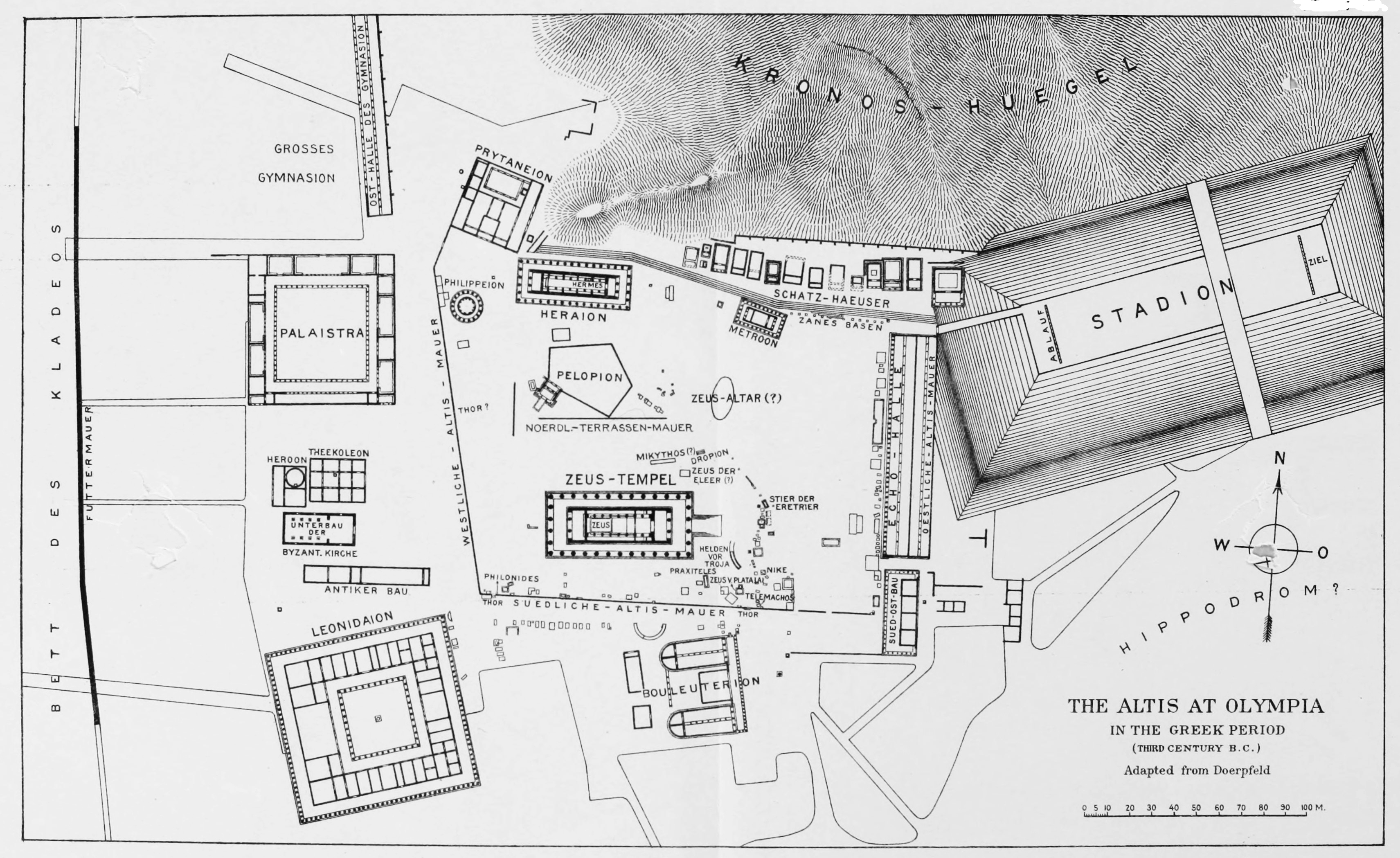
THE ALTIS AT OLYMPIA IN THE GREEK PERIOD (THIRD CENTURY B. C.) Adapted from Doerpfeld
zoom
PLAN B
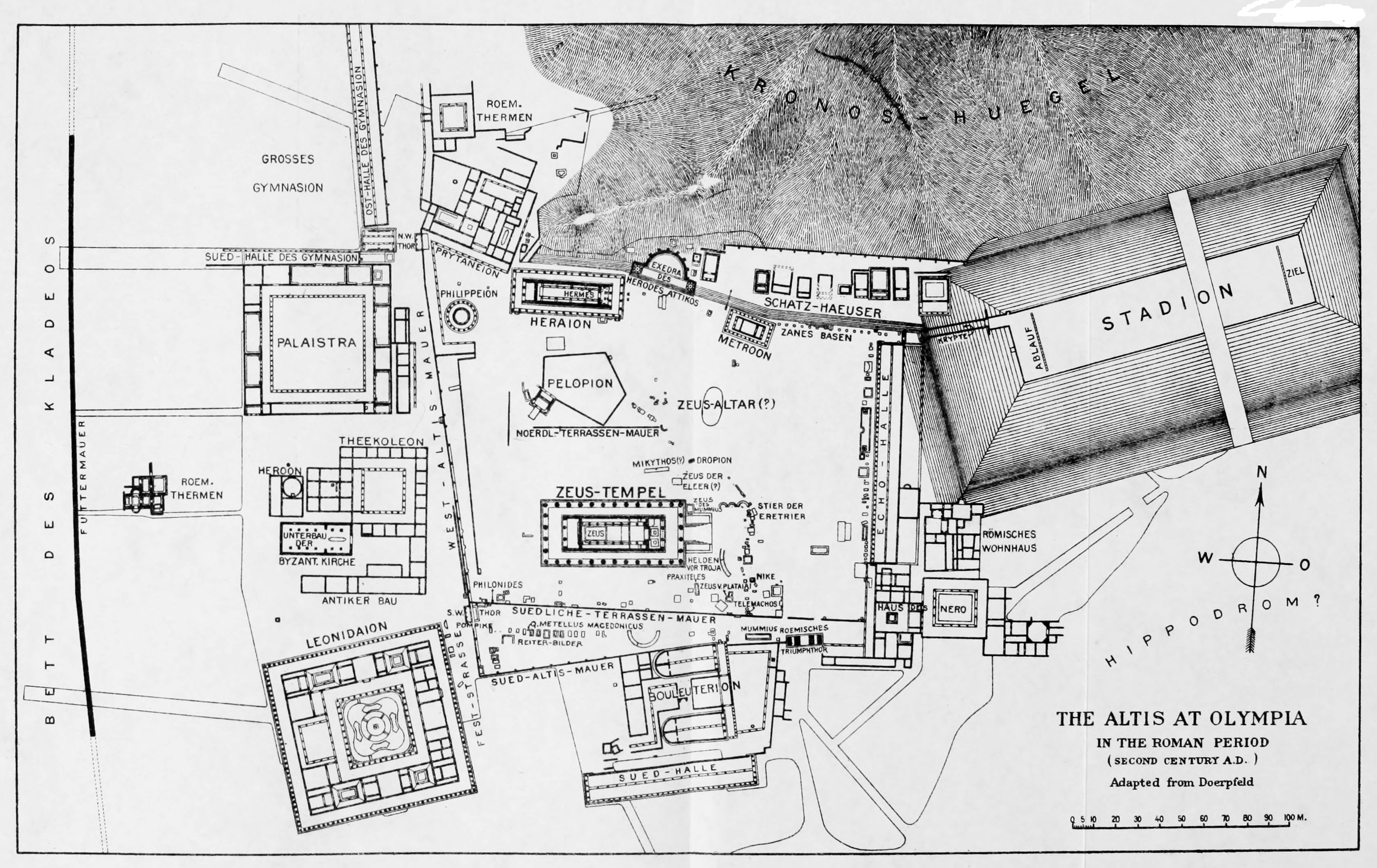
THE ALTIS AT OLYMPIA IN THE ROMAN PERIOD (SECOND CENTURY A. D.) Adapted from Doerpfeld
zoom