Chapter IV · VICTOR STATUES REPRESENTED IN MOTION. (continued 2)
Reading edition
Two bronze statuettes in the Metropolitan Museum,1621 New York, belonging to the second half of the fifth century B. C., may be representations on a small scale of pentathletes with the akontion. The first shows a youth standing with the weight of the body on the left foot, the right drawn slightly back. The left hand, held close to the side, may have carried an akontion, the right arm being extended. The other, more carelessly executed, represents a youth standing similarly with his weight on the left foot, the right being drawn back. Here again the left arm is hanging by the side, and probably held the same attribute as the first statuette. The right arm is also bent at the elbow. A patera may have been held in the outstretched hand of each. The square build, short thighs, flat abdomen, long skull, and oval face are all Polykleitan characteristics, and remind us of the series of kindred works already discussed, which, as Furtwaengler believed, went back to the original statue of the boy wrestler Xenokles at Olympia, the work of the younger Polykleitos.1622
Wrestlers.
Wrestling (πάλη) is perhaps the oldest, and in any case is the most universal, of athletic sports. Wall-paintings at Beni-Hasan on the Nile, dating from about 2000 B. C., show nearly all the grips and throws now known.1623 Plato says that this sport was instituted in mythical times.1624 In Greece its origin is lost in mythology.1625 The very name palaistra, “wrestling school,” indicates the early importance of the contest. It was one of the most popular of Greek sports from the time of Homer down.1626 This popularity is shown by the frequency with which it appears in mythology and art. Early b.-f. vases picture Herakles wrestling with giants and monsters. Here we see the same holds and throws as in the palæstra scenes on later r.-f. vases. The whole history of coins down to imperial days shows such scenes. No other exercise required so much strength and agility, and consequently wrestling matches early became a part of the great games. At Olympia wrestling was introduced in Ol. 18 ( = 708 B. C.), the same year in which the pentathlon was instituted.1627 The boys’ match appeared there less than a century later in Ol. 37 ( = 632 B. C.).1628 Pausanias mentions statues erected to 36 victors (for 45 victories), which makes this contest second only in importance to boxing there.
There were two sorts of wrestling in Greece, wrestling in the proper sense (ὀρθὴ πάλη), where each tried to throw his antagonist to the ground, making his shoulders touch three times, and ground wrestling (κύλισις, ἁλίνδησις), where the fight was continued on the ground by using every means, except biting and gouging, till one was exhausted. The first kind was the only one used in the event called πάλη at Olympia, as well as in the pentathlon; the other was used only in the pankration. In this section we shall discuss only the first.1629 A recently discovered papyrus of the second century A. D., containing brief instructions for wrestling lessons intended to help the παιδοτρίβης, indicates that every movement in the contest was systematically taught.1630 The various positions used—grips and throws—are shown by many monuments, vase-paintings, gems, coins,1631 statuettes, and statues. The vases1632 especially illustrate the various holds assumed by wrestlers during a bout—front (σύστασις), side (παράθεσις), wrist, arm, neck (τραχηλίζειν), and body holds. Still others illustrate the various throws—flying mare,1633 heave,1634 buttocks and cross-buttocks (ἕδραν στρέφειν), and tripping (ὑποσκελίζειν). We here reproduce two such paintings. The first, the obverse of a r.-f. amphora from Vulci, signed by Andokides and now in Berlin (Fig. 49),1635 shows two positions. In the central group the wrestler on the left side has grasped his opponent’s left wrist with his right hand. The latter, however, has rendered the grip useless by passing his own right hand behind his opponent’s back and grasping his right arm just below the elbow. In this way he keeps his opponent from turning round, which movement would not have been possible if the latter had grasped him by the upper arm. In the group of wrestlers to the right we see an illustration of a body hold. Here a youthful athlete has lifted his bearded antagonist clear off his feet preliminary to throwing him. However, the one lifted from the ground has caught his foot around his opponent’s leg, which is an illustration of tripping. On a r.-f. kylix in the University of Pennsylvania Museum in Philadelphia (Fig. 50a),1636 we see a body hold preparatory to the heave; here to the right are two youths wrestling, and to the left stands a bearded trainer with his rod. One wrestler has already lost his balance and is supporting himself with both hands on the ground, while the other with his left hand holds the other’s right arm down, and with his right prepares to throw him over his head.
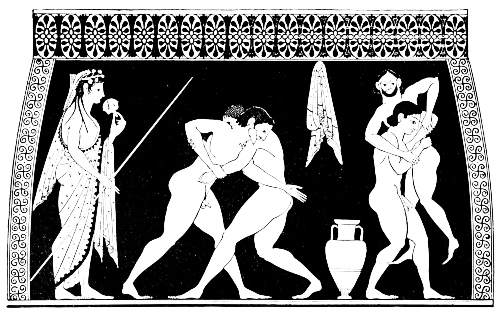
Fig. 49.—Wrestling Scenes. From Obverse of an Amphora, by Andokides. Museum of Berlin.
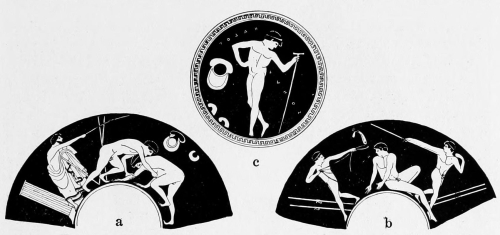
Fig. 50.—Wrestling and Boxing Scenes. From a r.-f. Kylix. University of Pennsylvania Museum, Philadelphia.
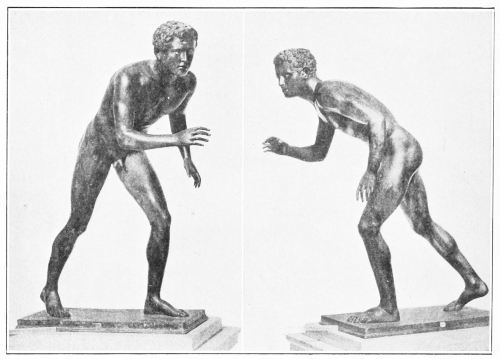
Fig. 51.—Bronze Statues of Wrestlers. Museum of Naples.
From vase-paintings, then, we can see what positions the sculptor might have used in representing groups of wrestlers. For the positions of individual figures of wrestlers, we are guided by several statues and small bronzes. The preliminary position (σύστασις) seems to be best represented by the bronze statues of wrestling boys discovered at Herculaneum in 1754, and now in the Museum of Naples (Fig. 51).1637 These figures have been variously interpreted as runners,1638 diskoboloi,1639 and wrestlers. Their attitude, bent forward with outstretched hands, implies the utmost expectancy. If they were runners, they would lean further forward; as they are standing, they could not begin to run without loss of time in raising the heels of the forward feet. If, on the other hand, they represented diskos-throwers at the moment just subsequent to the throw, their right feet would be advanced and not their left, in order to recover their balance, as we have seen above in considering Gardiner’s seventh position. The position of their arms, however, and the expression of their faces make it almost certain that they are wrestlers eagerly watching for an opening. The two statues certainly belong together, and may have been set up as antagonists in the villa in whose ruins they were found. F. Hauser was the first to show that the form of body and head in both was the same.1640 While most critics believe that they are Hellenistic in origin, Bulle is certainly right in showing that the body ideal expressed is Lysippan—i. e., long legs and slender trunk—even if he goes too far in ascribing them to the master himself, basing his conclusion chiefly on the similarity of their ears with those of the Apoxyomenos (Pl. 29). A good illustration of a hand or wrist grip is afforded by a small wrestler group, which decorates the rim of a bronze bowl from Borsdorf.1641 This is a poorly wrought Etruscan work of fifth-century B. C. Greek origin. The two wrestlers have already gripped and their heads are close together, though the lunge in each case is much exaggerated. Similar are the two groups on the rim of a bronze bowl in the Museum of Fine Arts, Boston.1642 A third-century B. C. Etruscan cista in the Metropolitan Museum,1643 has a handle on the lid in the form of two nude wrestlers, whose bodies are inclined toward one another, their heads in contact, and their arms locked behind their heads. Groups of wrestlers in similar attitudes commonly appear as cista handles.1644 A portion of a bronze group of wrestlers was dredged from the sea near Kythera and is now in Athens.1645 The heave is represented by a metope from the Theseion representing the wrestling bout between Theseus and Kerkyon.1646 A later moment is seen in a bronze wrestling-group in Paris.1647 The cross-buttocks is illustrated by a small Hellenistic bronze group in the collection of James Loeb in Munich, of which five other copies are known.1648 Here two athletes, one bearded and the other beardless, are just ending the bout. The youth is in the power of the man, who stands behind him and presses him down by holding his arms backward. All the other replicas differ from the Loeb example in that the victor has both legs and not one in front of the right leg of the vanquished wrestler. A good illustration of tripping is seen in another related series of groups known to us in five bronze copies. These represent a wrestler on the ground supporting himself on his left arm, while over him stands the victor, whose left foot is twisted around the other’s right. These groups are, like the preceding, also Roman provincial copies of a Hellenistic original.1649 The two groups are very similar, the only real difference being that the vanquished wrestler in the second series still has his left arm free and holds himself up on his right knee. Both series seem to have been influenced by the marble pancratiast group in the Uffizi (Pl. 25).1650 The head of an athlete in the Museo delle Terme, Rome,1651 shows by its strongly projecting neck that it comes from the statue either of a runner ready to start or of a wrestler about to grip his adversary. The face is fourth-century B. C. Attic in character and the head may, therefore, come from Euphranor’s circle. Pliny speaks of a panting wrestler (luctator anhelans) by the statuary Naukeros, which must have exhibited the contestant in intense movement.1652 It might have represented him after victory, as in the painting of Parrhasios discussed above, which pictured a hoplitodrome after the race, breathing hard.1653 Pliny also mentions a painting of a wrestler by Antidotos without describing it.1654 As we have already remarked, doubtless some of the apoxyomenoi and perixyomenoi mentioned by Pliny were also wrestlers.
Whether wrestling-groups were set up at Olympia is doubtful. Chariot-groups were indeed common, but there is no reason why the victorious wrestler should have had himself coupled with his defeated opponent. Pausanias, moreover, mentions no such groups. We are therefore safe in inferring that in most, if not in all, cases the wrestler would content himself with a single statue, and this might represent him in any position in which he was not actually interlocked with his adversary. That such statues represented him both in repose and in motion is attested by recovered bases. The footprints on the base of the statue of the Elean wrestler Paianios, a victor of the early third century B. C.,1655 shows us that he was represented as standing in repose, the weight of the body resting on the right leg, the left being drawn back and touching the ground with the toes only. A hole in the base may have been for a spear on which the victor’s hand rested, though the statue is not that of a pentathlete. The perfectly preserved footprints on the base of the statue of the boy wrestler Xenokles by Polykleitos the Younger show that he was represented as standing with his weight on the right leg, the left being slightly advanced and to one side, though resting flat on the ground. The head was probably turned a little to the right. Thus the wrestler was poised ready to grip his adversary.1656 This statue must have been a favorite among athlete monuments, since the same motive appears in various Roman copies, which Furtwaengler assigns to the immediate circle of the pupils of Polykleitos. The statue of the Argive wrestler Cheimon by Naukydes may have represented him in motion, since Pausanias, in mentioning two statues of the victor, one in Olympia and the other in the temple of Concord at Rome, says that they were among the most famous works of that sculptor. From this encomium Reisch has assumed that the one at Olympia was represented in lively motion.1657
Boxers.
Boxing, like wrestling, was one of the oldest sports in Greece, as it has been everywhere else. The fist is the simplest and most natural of all weapons.1658 Boxing was popular already in Homer, matches being described both in the Iliad and the Odyssey.1659 Homer speaks of it as πυγμαχίη ἀλεγεινή,1660 and this “painful” character is also mentioned by Xenophanes.1661 However, boxing was far older than epic poetry. We have already seen that it was the only form of real athletics in Aegean Crete. One of the oldest representations of a boxing match is seen on the fragments of a bronze shield discovered there in the grotto of Zeus on Mount Ida. Here on a single concentric ring are seen two warriors, armed like Assyrians with corslets, shields, and helmets, fighting with doubled fists.1662 The high antiquity of boxing in Greece is also shown by myths.1663 At Olympia Apollo is said to have beaten Ares,1664 and Polydeukes won a victory there.1665 Apollo appears as the god of boxing in the Iliad,1666 and the Delphians sacrificed to Apollo Πύκτης.1667 Herakles, Polydeukes, Tydeus, and Theseus were all famed boxers; the latter was said to have invented the art.1668 The historical boxing match was introduced at Olympia in Ol. 23 ( = 688 B. C.), and Onomastos of Smyrna, the first victor, instituted the rules of the contest.1669 The boys’ contest was instituted in Ol. 41 ( = 616 B. C.).1670 It was by far the most popular contest there. Of the 192 monuments erected to 187 victors mentioned by Pausanias, 56, or nearly one-third, were erected to men and boy boxers for 63 victories.
Greek boxing1671 is conveniently divided into two periods by the kind of glove used in the matches. From Homer down to the end of the fifth century B. C., soft gloves (ἱμάντες, ἱμάντες λεπτοί or μειλίχαι) were used; from then to late Roman days the heavy gloves (σφαῖραι or ἱμάντες ὀξεῖς) were the fashion. The weighted Roman cestus was not used in the Greek contest. Before discussing representations of boxers in art, we shall devote a few words to these two kinds of boxing-gloves, which frequently give us the date of a given monument.1672 The Cretans are thought to have worn boxing-gloves, as they seem to be visible on the so-called Boxer Vase from Hagia Triada (Fig. 1). Here, on the top and lower two rows, a leather gauntlet appears to cover the arm to beyond the elbow, being padded over the fist and confined at the wrist by a strap. Mosso derives the later Greek glove, which appears on athlete statues, from this primitive thong.1673 In any case the antiquity of the glove in Greece is attested by its origin being ascribed to the myth of Amykos, king of the Bebrykes.1674 Gloves were already known to Homer, who speaks of “well-cut thongs of ox-hide.”1675 They are not mentioned in any detail before the time of Pausanias and Philostratos, so that we are mostly dependent for our knowledge of them on the monuments. The simplest form consisted of long, thin ox-hide thongs, which were wound round the hands, the soft gloves (ἱμάντες μαλακώτεροι or μειλίχαι) of later writers.1676 They were used, not to deaden the blow, but to increase its force. Vase-paintings show that the thongs were about 10 or 12 feet long before being wound.1677 On the exterior of a r.-f. kylix from Vulci by Douris, in the British Museum, showing chiefly boxing scenes, we see two youths standing before a paidotribes preparing to put on the thongs (Fig. 54).1678 One of them is holding the unwound thong in his outstretched hands. A similar figure appears on the r.-f. vase in Philadelphia already discussed (Fig. 50b), which represents a palæstra scene.1679 This scene has been wrongly interpreted as an illustration of the game of σκαπέρδη described by Pollux1680 as a sort of tug-of-war, the unwound thong being explained as the rope used in this game,1681 and the hurling-sticks stuck in the ground at either end as goals instead of akontia. A wound thong is seen hanging on the wall to the left. Philostratos describes how the boxing thongs were put on,1682 and vase-paintings illustrate the method.1683 The best example of the thongs on statuary is afforded by the bronze arm found in the sea off Antikythera (Cerigotto) (Fig. 52), which Svoronos1684 believes to be a remnant of the statue of the Nemean victor Kreugas of Epidamnos, which stood in the temple of Apollo Lykios in Argos.1685 Pausanias says that Kreugas was crowned notwithstanding that he was killed by his adversary Damoxenos, and his description of the soft glove corresponds so closely with the one on the recovered arm that it seems as if it had been written in the presence of the statue: “In those days boxers did not yet wear the sharp thong (ἱμὰς ὀξύς) on each wrist, but boxed with the soft straps (μειλίχαις), which they fastened under the hollow of the hand in order that the fingers might be left bare; these soft straps were thin thongs (ἱμάντες λεπτοί) of raw cowhide, plaited together in an ancient fashion.”1686 The strap allowed the ends of the fingers to project, and was held together by a cord wound around the forearm, just as Philostratos says. These μειλίχαι were used at the great games through the fifth century B. C., and were continued in the palæstra in the fourth. Early in the latter century the σφαῖραι mentioned by Plato1687 and other writers appeared. We see them on Panathenaic vases of that century and on Etruscan cistæ of the following one.1688 About the same time the regular ἱμάντες ὀξεῖς came in,1689 but the old μειλίχαι or something similar were still used in the exercises of the palæstra.1690
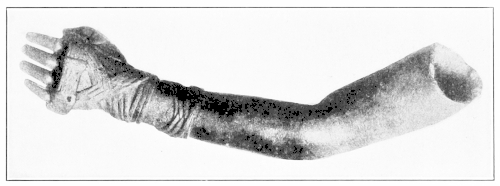
Fig. 52.—Bronze Arm of Statue of a Boxer, found in the Sea off Antikythera. National Museum, Athens.
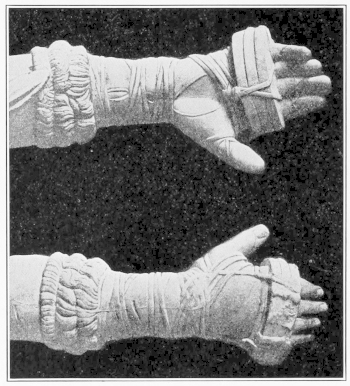
Fig. 53.—Forearm with Glove. From the Statue of the Seated Boxer (Pl. 16). Museo delle Terme, Rome.
Our best illustration of these more formidable gloves on statuary is the gauntlet clearly represented on the forearms of the Seated Boxer of the Museo delle Terme (Fig. 53). Here a close-fitting glove covers each forearm, leaving the upper joints of the fingers free and the palm open. It extends to above the wrist and ends in a rim of fur. Over it are drawn three thick bands of leather, which cover the first joints of the fingers and are fastened together on the outside of the hands with metal clasps. A soft pad keeps these bands from chafing the fingers. They are kept in place and the wrists are strengthened by two narrow straps which are interlaced several times around hand and wrist. Similar gloves appear on the Sorrento boxer in Naples (Fig. 57),1691 on the bronze forearm of a statue from Herculaneum in Naples,1692 on a left fist found in 1887 in the arena at Verona,1693 and on many other statues and fragments. The last representation in art of this sort of glove appears on the Roman relief in the Lateran, which dates from the time of Trajan, and represents a fight between two pugilists.1694 The metal cestus was a Roman invention. None of the late Greek writers—neither Plutarch, nor Pausanias, nor Philostratos—makes any mention of this loaded glove. The “sharp thongs” were enough to cause all the injuries mentioned by the writers of the Greek Anthology.1695 The cestus, perhaps used in the later gladiatorial shows in Greece, but never in the great games there, gave the death blow to real boxing. Virgil describes it and the vicious results of its use.1696
There are fewer representations of boxing matches on vases than of almost any other Greek sport, despite its great popularity. Gardiner has collected a number of vase-paintings dating from the sixth to the fourth centuries B. C., which illustrate the different positions assumed by boxers in action—attack, slipping, ducking, and leg and arm movements. We reproduce two from r.-f. kylikes in the British Museum. In one by Douris (Fig. 54)1697 we have, besides the group already mentioned of two athletes preparing to put on thongs, three pairs of boxers engaged in a bout. In two groups one of the contestants is seen from behind; in all three the boxers extend their left arms for guarding and draw the right back for hitting—the fists being level with the shoulders. In one group we see the beginning of the fight, in the other two the middle, perhaps, and the end of it, respectively. In the last scene one contestant has fallen to the ground on his knee, and his conqueror has swung his right hand far back for a final blow, only to be stopped by the other, who raises his finger in token of defeat. On the other vase we see, besides a scene from the pankration, two pairs of boxers sparring (Fig. 55).1698 Here in one group the contestants do not have their fists doubled, but keep their fingers opened. On an Attic b.-f. Panathenaic panel-amphora in the University Museum in Philadelphia (Fig. 56),1699 we see bearded boxers sparring, while a boxer with thongs in his right hand stands to the right, and a trainer with his rod at the left. Statues of victorious boxers at Olympia were represented either in motion, i. e., probably in the position of sparring, or in repose, like that of the boy boxer Kyniskos by the elder Polykleitos discussed in the preceding chapter. The same foot position visible on the Kyniskos base1700 occurs on two other Olympia bases, which, therefore, must have supported Polykleitan statues represented in repose. One of these, in the form of an astragalos, will be discussed further on in our treatment of pancratiast statues; the other supported the statue of the boy boxer Hellanikos of Lepreon, who won a victory in Ol. 89 ( = 424 B. C.).1701 In this case the statue was also life-size, the left foot was firmly placed, and the right was set back resting on the ball, the stride being a little longer than in the case of the Kyniskos. Three other Olympia bases supported statues of boxers represented in repose, those of the boy Tellon from the Arkadian town Oresthasion,1702 of the Epidaurian Aristion by the elder Polykleitos,1703 and of the Rhodian Eukles by Naukydes of the Polykleitan circle.1704 Furtwaengler believed that a number of existing statues of the Hermes type reproduced the statue of Aristion, because of a similar foot position. Among them the Pentelic marble one in Lansdowne House, London, is the best preserved, and most faithfully reproduces the Polykleitan style.1705
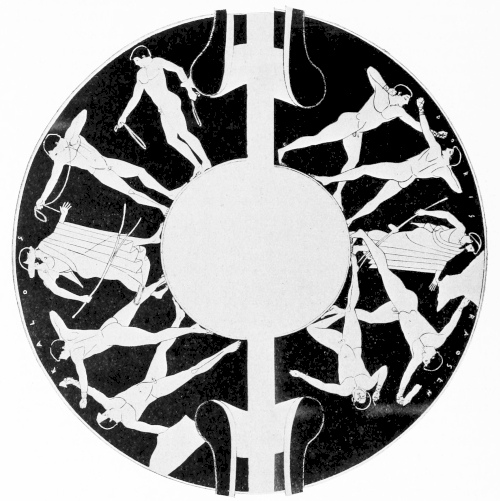
Fig. 54.—Boxing Scenes. From a r.-f. Kylix by Douris. British Museum, London.
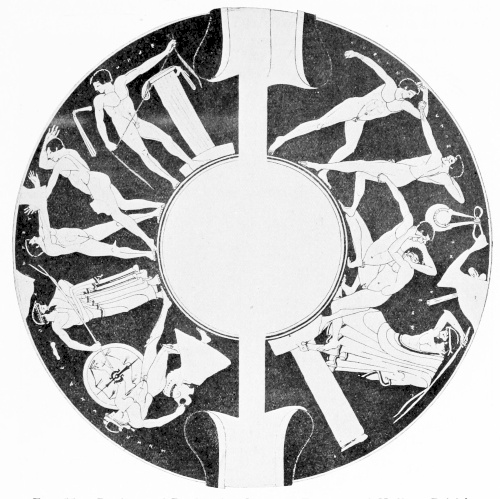
Fig. 55.—Boxing and Pankration Scenes. From a r.-f. Kylix. British Museum, London.
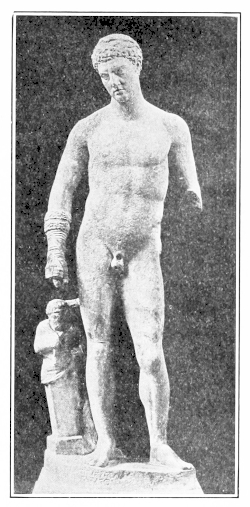
We may infer how a Polykleitan statue of a boxer at rest looked, from the Roman copy of one in Kassel.1706 Here a youth just out of boyhood is represented as standing with the weight of the body resting upon the right leg and the head turned to the right. The forearms are covered with gloves, the right fist being raised for attack and the left for defense. Fig. 57.—Statue of a Boxer, from Sorrento. By Koblanos of Aphrodisias. Museum of Naples. Another marble statue, representing a boxer in repose, was found in a fragmentary condition in Sorrento in 1888, and is now in the National Museum at Naples (Fig. 57).1707 It is inscribed as the work of Koblanos of Aphrodisias in Karia, whom Fig. 56.—Boxing Scene. From a b.-f. Panathenaic Panel-Amphora. University of Pennsylvania Museum, Philadelphia. we know as a copyist of the first century A. D., and who was active in reproducing Greek works for the Roman market.1708 The body forms are too badly injured for us accurately to date the original from which this copy was made, but the head gives us the clue, as its style appears to be a connecting link between that of the seated statue of Herakles, in the Palazzo Altemps in Rome1709 and the Munich Oil-pourer (Pl. 11),1710 as it shows affinity to both. Though Sogliano referred it to the school of Lysippos and Juethner to the beginning of the fourth century B. C., it shows indubitable Myronian characteristics and may have been the work of Myron’s pupil Lykios, who is known to us as an athlete sculptor.1711 In this statue the youth is resting his weight on his right leg, the left, with full sole on the ground, being turned to one side. The left forearm is extended outwards and to the side, the head leaning toward the right leg—in other words, the athlete is represented in an attitude similar to that of the Idolino (Pl. 14). As there is an olive crown in the hair, it seems reasonable to conclude that the original statue was that of an Olympic victor.
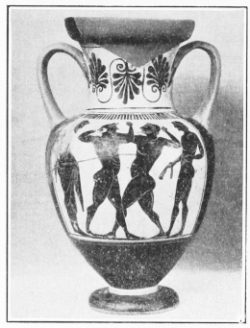
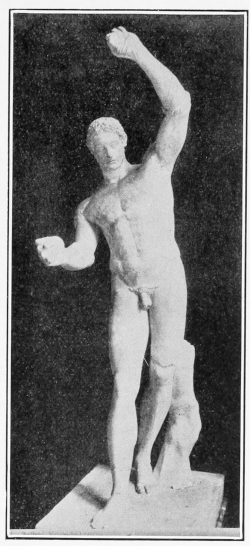
By the beginning of the fifth century B. C., if not earlier, boxers were represented in violent motion, as we saw in the case of the statue of the boy boxer Glaukos, by the Aeginetan sculptor Glaukias,1712 represented in the act of sparring (σκιαμαχῶν). Whether he was represented as facing an imaginary antagonist or as merely punching a bag we can not say, though the latter seems the more probable. The motive is depicted in many art works, notably in the figure of a youth punching a bag which hangs from a tree on the Ficoroni cista in the Museo Kircheriano, Rome,1713 and in that of another represented on the so-called Peter cista in the Museo Gregoriano Etrusco of the Vatican, whose engraved scenes show exercises of the palæstra.1714 The same motive is seen also in a statuette in the Museo Chiaramonti of the Vatican, which is proved to be that of a boy boxer by the glove on the right hand.1715 Here the boy is represented with the right foot far advanced and rising on the toes of both feet, the right shoulder being drawn back, the right forearm raised, and the left extended forwards. The marble torso of a copy of the same original on a large scale is in Berlin.1716 While Amelung believes that the original of both statuette and torso was a bronze of the second half of the fourth century B. C., Furtwaengler thought that the torso went back to the severe style of the fifth century, and that this original once stood in Olympia, where it might have served as the inspiration for a carelessly worked bronze statuette of a boxer found there, which repeats the motive of the torso and similarly belongs to the fifth century B. C. (Fig. 2).1717 The Olympia statuette also has the right foot advanced, the upper part of the body leans backward, and the left arm with open palm is outstretched for defense, while the right with balled fist is held up ready to strike. It certainly is a votive offering of an Olympic victor—doubtless one of the small reductions, which were not uncommonly erected for economy’s sake.1718 Whether the Aeginetan Glaukias also made victor statues in repose is doubtful.
Waldstein, on insufficient grounds, has argued that the so-called Strangford Apollo in the British Museum (Fig. 14)1719 is a copy of the statue at Olympia of the famous Thasian boxer and pancratiast Theagenes by Glaukias. Its close observation of nature finds its analogy in the statues of the Aeginetan pediment groups (see Figs. 20, 21). The statue of the boy boxer Athenaios of Ephesos, by an unknown sculptor, was represented as lunging at his adversary, as we see from the footmarks on the recovered base. The left foot was advanced and turned outwards, while the right one touched the ground only with the toes.1720 Similarly the statue of the boxer Damoxenidas by Nikodamos of Arkadia was represented as about to strike. On its recovered base the left foot stood solidly upon the ground, while the right foot was drawn back and touched the ground only with the toes—if we judge rightly from the size of the missing part of the stone.1721 The statue of the Ionian boxer Epitherses by Pythokritos of Rhodes seems to have had but one foot flat upon the ground, and consequently must have been represented in motion, though we are not sure of the position of the other, since one stone of the base is missing.1722
The bronze plate from the base of the statue of the boy boxer Philippos, an Azanian of Pellene, was found at Olympia and has been referred to the end of the fourth or beginning of the third century B. C.1723 However, since Pausanias says that Myron made the statue,1724 various attempts have been made to reconcile the discrepancy in dates. Our own solution is that the statue seen by Pausanias did not represent Philippos at all, but some earlier unnamed Arkadian boxer, who was contemporary with Myron.1725 Years later the Azanian boy Philippos Fig. 58.—Statue known as Pollux. Louvre, Paris. won a victory at Olympia and attached the recovered epigram to the old base, in which he implored Zeus to let the ancient glory of Arkadia be revived in him, and also a newer one in which he said that he had restored the statue of Myron.1726 Pausanias saw the newer one, but omitted to mention the older, which was probably illegible from weathering. He therefore thought that the original Myronian statue used by Philippos represented the latter victor.1727 The words on the affixed plate beginning ὧδε στὰς ὁ Πελασγὸς ἐπ’ Ἀλφειῷ ποκα πύκτας κ. τ. λ., may refer to the position of the boxer rather than to a portrait of the victor.1728 We have long ago hazarded the suggestion1729 that the so-called Pollux of the Louvre (Fig. 58),1730 whose body forms recall the Marsyas and whose head recalls the Diskobolos, may go back to the statue of the unnamed Arkadian by Myron.1731 But the uncertainty which we have found in a former section1732 in assigning this and kindred works to Myron or to Pythagoras leaves it only a suggestion.
Pancratiasts.
The pankration (παγκράτιον)1733 was a combination of boxing and wrestling, in which the contestants fought either standing, or prone on the ground. While the wrestler merely tried to throw his opponent in a series of bouts, the pancratiast continued the fight on the ground until one or the other acknowledged defeat. The etymology of the word shows that it was a contest in which every power of the contestants was exerted to the utmost.1734 Strangling, pummeling, kicking, and, in fact, everything but biting and gouging were allowed. Both Lucian1735 and Philostratos1736 speak of the prohibition against biting and gouging, which statements Gardiner thinks are quotations from the rules governing the contest at Olympia, as they are twice quoted by Aristophanes.1737 Philostratos, however, says that the Spartans allowed both biting and gouging, but that the Eleans allowed only strangling. A case of gouging the eye of an opponent with the thumb is seen on the r.-f. kylix in the British Museum, already mentioned (Fig. 55).1738 Here the official is rushing up with his rod to punish such a breach of the rules. Philostratos calls the men’s pankration the “fairest” of contests at Olympia, probably in reference to the impression made on the spectators by the various positions of the contestants, who had to rely quite as much on skill as on strength. Pindar wrote eight odes in praise of this contest.1739 However, even though it was carefully regulated at Olympia by rules, it was a dangerous sport—τὸ δεινὸν ἄεθλον ὅ παγκράτιον καλέουσιν, in the words of the protesting philosopher Xenophanes.1740 But it was never the brutal sport which some modern writers have pictured it.1741 Plato, to be sure, kept it out of his ideal State,1742 not, however, because of its brutality, but merely because its distinctive feature, the struggle on the ground, was of no service in training a soldier. The Greeks themselves considered the boxing match far more dangerous. Inasmuch as gloves were not used in the pankration, this seems reasonable.1743 We have in the preceding section mentioned the epithets applied to boxing. Pausanias, in speaking of the boxing match between Theagenes and Euthymos, says that the former was too much wearied by that contest to enter the pankration, and was in consequence compelled to pay a talent to the god and another to Euthymos.1744 In speaking of another contest, between Kapros and Kleitomachos, he records that the latter told the umpires that the pankration should be brought on before he had received hurts from boxing.1745 Artemidoros states that no wounds resulted from the pankration.1746 However, death by strangulation was often the result of the bout. Thus the pancratiast Arrhachion was crowned after he had been throttled by his adversary, for just before expiring he was able to put one of the toes of his opponent out of joint and the pain caused the latter to let go his grip.1747 Pausanias tells also how the boxer Kreugas was slain by Damoxenos in the pankration at Nemea, but adds that the body of the former was proclaimed victor.1748
The pankration was not known to Homer, though later writers ascribed its invention either to Theseus or Herakles, the typical mythical examples of skill as opposed to brute force.1749 It was introduced at Olympia in Ol. 33 ( = 648 B. C.),1750 long after the separate events, wrestling and boxing, had appeared there. The boys’ contest was instituted at Olympia in Ol. 145 ( = 200 B. C.),1751 though it had appeared elsewhere much earlier.1752 It must have been a popular sport at Olympia, since Pausanias records statues erected to twenty victors for thirty victories in this contest.
Vase-paintings1753 show many grips and throws of the pankration—the flying mare, leg hold,1754 tilting backwards by holding the antagonist’s foot, “chancery” (i. e. catching the adversary around the neck with one arm and hitting his face with the other fist), stomach throw (i. e., seizing the adversary by the arms or shoulders and at the same time planting one’s foot in the other’s stomach, and then throwing him over one’s head),1755 jumping on the back of one’s opponent,1756 strangling, wrestling and boxing combined, and kicking and boxing combined. Ground wrestling is very commonly depicted on vases and especially on gems, since such groups were adapted to oblong or oval spaces.1757 We reproduce a pancratiast scene from a Panathenaic amphora of Kittos, dating from the fourth century B. C., in the British Museum (Fig. 59).1758 This is a conventional representation of wrestling and boxing combined. The pancratiast at the right of the group has rushed in with his head down and has been caught around the neck by his adversary’s arm, a hopeless position, from which he can not escape. The latter is either about to complete the neck hold (if it be an actual case of “chancery”), or perhaps to hit him with his right hand. A third pancratiast is looking on from the extreme right, while a paidotribes, switch in hand, appears at the left. The fight on the ground is well depicted on the r.-f. kylix of the British Museum already discussed as showing boxing scenes (Fig. 55).1759
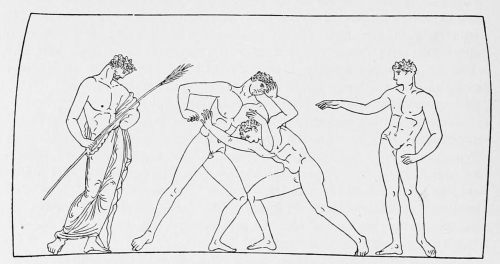
Fig. 59.—Pankration Scene. From a Panathenaic Amphora by Kittos. British Museum, London.
We have but few representations of pancratiasts in sculpture. The preliminary sparring—known as ἀκροχειρισμός1760—must have characterized the statue of the Sikyonian pancratiast Sostratos at Olympia by an unknown sculptor, since Pausanias says that this victor was known as ὁ ἀκροχερσίτης, explaining the epithet as that of one who gained his victories by seizing and bending his adversaries’ fingers, holding them fast till he yielded.1761 Since a Delphian inscribed base1762 gives the same number of victories as Pausanias, we infer that they were given also on the Olympia base, the source of Pausanias’ information. Since nothing is said, however, of Sostratos’ mode of fighting in the Delphi inscription, Pausanias must have argued it from the pose of the statue. The Sicilian wrestler Leontiskos of a century earlier, whose statue was by Pythagoras, had, according to Pausanias, used similar tactics, for “he vanquished his adversaries by bending back their fingers.”1763 These cases show that statues of pancratiasts and wrestlers were frequently represented in vigorous lunging attitudes as well as in groups. The epigram on the base of the monument of the pancratiast Teisikrates at Delphi shows that the statue was represented in a similar way.1764 The same lunging attitude is also shown on the Halimous grave-relief.1765 Sometimes the contest ended with the preliminary sparring, though usually it developed into wrestling and boxing.
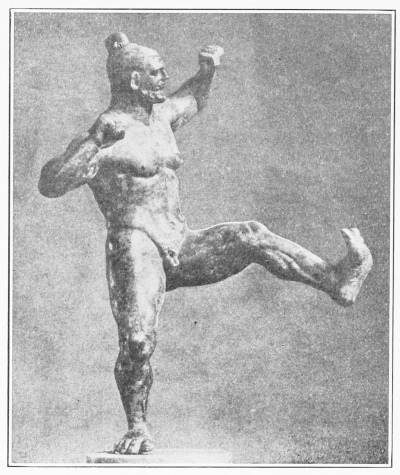
Fig. 60.—Bronze Statuette of a Pancratiast (?), from Autun, France. Louvre, Paris.
A good representation of a pancratiast trying to kick his antagonist seems to be furnished by the small bronze statuette from Autun, South France, now in the Louvre (Fig. 60).1766 This statuette is of mediocre workmanship, its hard muscles, imperfect proportions, and realism showing that it comes from the Hellenistic period of Greek art. It represents a bearded athlete, who holds his hands ready to strike and his left foot raised apparently to kick his adversary’s leg. The foot is just ready to return to its original position, so that the motive of this poor little statuette discloses a transient period of time between two movements, just as the Diskobolos and Marsyas of Myron did. We have already noted1767 that on the head is a cap with a ring in the top, by which it could be suspended as a decorative piece, or perhaps as part of a steelyard. Hauser believes that this motive was known to the elder Polykleitos and that this is the interpretation of that sculptor’s statue of a nudus talo incessens mentioned by Pliny, a statue which has formed the basis for much discussion among archæologists.1768 The Plinian passage, therefore, is to be translated as “the nude man attacking with his heel (talo)”—in other words, it describes a statue represented as kicking, which was allowable in the pankration. The manuscripts of Pliny all read talo, which Benndorf1769 thought could be retained only by assuming that the naturalist mistranslated his Greek source γυμνὸς ἀστραγάλῳ ἐπικείμενος, translating the word ἐπικείμενος “standing upon,” as incessens “pursuing.” He therefore assumed that Polykleitos’ statue stood upon an astragalos (talus) basis, which he believed was the forerunner of the statue of Opportunity (Καιρός) by Lysippos,1770 and he referred it to the knuckle-bone basis found at Olympia.1771 Woelfflin,1772 however, has shown that talo incessens can only mean “mit einem Knochel nach Jemand einwerfen.” Following this, Furtwaengler showed1773 how impossible on grammatical and other grounds it was to read talo in Benndorf’s sense, since the passage then would mean “advancing towards” or “pursuing,” by means of a knuckle-bone, which is manifestly nonsense. The word could be only instrumental in use, as Woefflin said, i. e., the weapon by means of which the man was attacking. Furtwaengler, therefore, followed Benndorf’s earlier alternative reading telo, assuming that Pliny mistakenly wrote talo because he was influenced by the presence of the same word in the passage immediately following: duosque pueros item nudos talis ludentes qui vocantur astragalizontes.1774 But Hauser’s interpretation of talo meets all the conditions better, since it keeps the manuscript readings, makes grammatical Latin, and seems to be illustrated by the statuette in question.
Sometimes the statues of Olympic pancratiasts were represented at rest with the weight of the body equally on both legs, as we see from the recovered basis of the statue of the Athenian Kallias by the Athenian sculptor Mikon.1775 Furtwaengler has identified a statue in the Somzée Collection as a copy of this work.1776 The footprints on the recovered base of the statue of the Rhodian Dorieus show that it was represented at rest with one leg slightly advanced.1777 We have actual remnants of statues of Olympic pancratiasts in the marble head found at Olympia, which we are to assign to the statue of the Akarnanian Philandridas by Lysippos, mentioned by Pausanias (Frontispiece and Fig. 69),1778 and the beautiful statue of Agias discovered by the French at Delphi in 1894, a work by the same sculptor (Pl. 28 and Fig. 68).1779
The struggle on the ground implies groups and not single statues. Our best representation of such a group is furnished by the famous marble one in the Uffizi, Florence (Pl. 25).1780 Though having no pretensions to be a victor monument, this group is the most important monument extant connected with the pankration, a fine anatomical study from Hellenistic times, evincing the direct influence of Lysippos in its proportions.1781 It shows affinity of design to certain sculptures from the frieze of the Great Altar at Pergamon.1782 Pliny speaks of a symplegma by Kephisodotos, the son of Praxiteles, at Pergamon, but that group was of an erotic character and can not have had anything to do with the Florentine one.1783 Unfortunately the group in question has been much restored, though the restoration in the main is right. The heads, though probably antique, do not seem to belong to the statues, but both appear to be copies of the head of one of the Niobids, with which group the pancratiasts were discovered in 1583. The right arm of the uppermost athlete seems to have been wrongly restored; in any case this athlete is not strangling his opponent. One youth has thrown the other down on to his knee, and his left leg is intertwined with the left leg of the other, and he is drawing back his arm to aim a blow. The wrestler underneath supports himself upon his left arm, and the intention of his opponent is to destroy this support by a blow of the fist, which would bring the contest to a sudden conclusion, since the right arm of the under youth is fast and he must defend himself with the left. As Gardiner points out, such a situation is illustrated by Heliodoros’ description of the match between Theagenes and an Aethiopian champion.1784 The under man’s position, however, may suddenly change and the issue yet be in his favor. Many writers have explained the group as ordinary wrestlers,1785 but Gardiner has conclusively shown that it belongs to the pankration, since in wrestling the contest is ended when one of the contestants has been thrown, while here the struggle is continuing on the ground.1786
PLATE 25
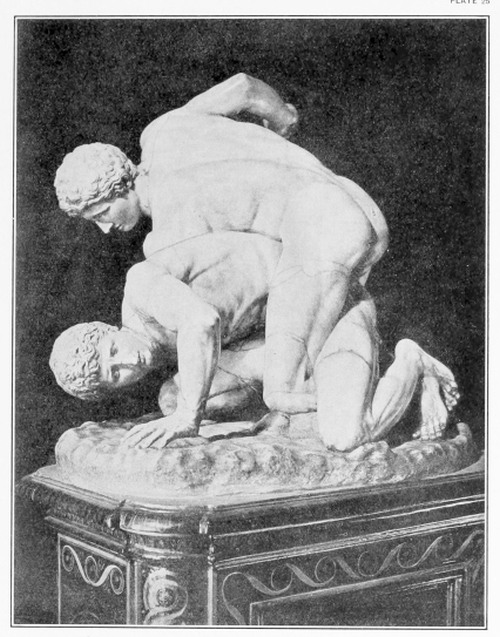
Marble Group of Pancratiasts. Uffizi Gallery, Florence.
Kapros of Elis was the first of seven Olympic victors to emulate the fabled feat of Herakles by winning the pankration and wrestling matches on the same day—that is, he was the first professional strong man.1787 The other six all came from the East. It has been suggested1788 that the colossal Farnese Herakles found in Rome in the ruins of the Baths of Caracalla in 1540 and now in Naples, inscribed as the work of the Athenian Glykon, which represents the hero leaning wearily on his club against a rock,1789 may represent the type of these professional strong men, who called themselves the successors of Herakles. But such a suggestion is as unfounded as the one already examined, which identifies the original of the Seated Boxer of the Museo delle Terme (Pl. 16 and Fig. 27) with Kleitomachos of Thebes, the redoubtable opponent of Kapros, since the dates in both cases are against such identifications. The Farnese statue and other replicas of the same original1790 obviously revert to a Lysippan original, though they are considerably metamorphosed by the taste of a later age. Such big swollen muscles at first sight appear to be alien to the sculptor of the graceful Agias, but that the Naples copy by Glykon—who, from the inscription on the base, must be referred to the first century B. C.1791—really represents the work of Lysippos seems well established by the fact that a smaller copy, though still over life-size, of poorer workmanship, in the Pitti Gallery in Florence, is inscribed as Λυσίππου ἔργον.1792 This type of weary hero appears in the Telephos group on the small Pergamene frieze, but is even earlier, since the latter seems to have been borrowed from a statue which is reproduced on a coin of Alexander, which was struck at least as early as 300 B. C.1793 The type of Herakles wearied by his superhuman labors was inaugurated still earlier by Lysippos, who was fond of representing the hero in many poses, seated and standing, resting and laboring. We might mention his colossal bronze statue of Herakles, which was set up in Tarentum and then carried to Rome and placed on the Capitol by Q. Fabius Maximus, when Tarentum was captured in 209 B. C., and was later transferred to the Hippodrome at Constantinople, where it remained until the sack of that city by the Franks in 1202.1794 It is hazardous, therefore, to reject the evidence, and it will be best to see in the original a genuine Lysippan work, as do Bulle, Overbeck, von Mach, Schnaase,1795 and others, and so to make Glykon responsible only for the exaggerations of his own copy. Thus we have to face the fact of divergent styles in the great bronze founder of the fourth century B. C., even if we admit with Richardson that “for our peace of mind this statue might well have been sunk in the sea.”1796
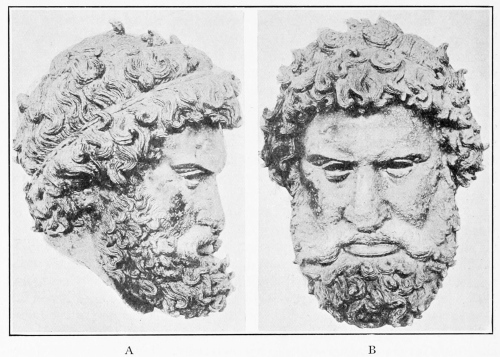
Fig. 61.—Bronze Head of Boxer (?), from Olympia. National Museum, Athens.
Long ago, I referred the life-size bronze portrait-like head of a boxer or pancratiast found at Olympia, now in the Athens Museum (Figs. 61A and B),1797 to one of two statues of the pancratiast Kapros mentioned by Pausanias.1798 The remnant of a wild-olive crown in the hair proves that it comes from the statue of an Olympic victor. Its bruised appearance may, however, betoken the punishment administered by the gloves of a boxer rather than by the bare fists of a pancratiast. That Greek sculpture was not always ideal we have seen from the description of the Seated Boxer of the Museo delle Terme (Pl. 16 and Fig. 27). This peculiarly life-like head is another example of the same realism; it would be hard to name a more brutal and repellent piece from the whole range of Greek sculpture. The profession of this bruiser is evident in every feature, for the sculptor has betrayed it by the swollen ears, flat nose, thick neck, swollen cheeks, projecting under lip, frowning brows, and unkempt hair and beard. All these traits—especially the treatment of the eyes—give to it the sullen gloomy look so characteristic of boxers and pancratiasts.1799 The man appears to be awaiting the attack, his contracted brows showing alert expectation, and his closed lips great determination. Furtwaengler, Bulle, Flasch, and others have dated it in the fourth century B. C., and are fain to see in it the work of an artist of the immediate circle of Lysippos or Lysistratos;1800 but its exaggerated realism seems rather to point to a later period, not earlier than the third century B. C.1801 The bronze foot of a victor statue also found at Olympia (Fig. 62)1802 has been assigned by Furtwaengler to one of the statues of Kapros, an ascription which we also have followed.1803 The position of this foot shows—as an experiment with a living model has disclosed—great movement, which makes it obvious that it comes from a statue in lively motion, probably of a boxer or pancratiast. It belongs to the statue of a strong man of coarse build; there is not the slightest trace of unnecessary flesh on it, but the whole is vigorous muscle, even the swollen veins being clearly visible in the photograph. While Furtwaengler finds its stylistic parallels in the copies of the Pergamene works of the third century B. C., e. g., the Dying Gaul statues, the material and form of the base fitting that period, Wolters emphasizes its stylistic analogy to the bronze head just discussed.
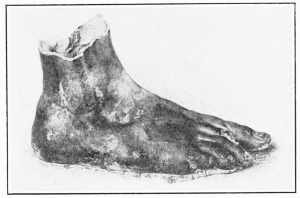
Fig. 62.—Bronze Foot of a Victor Statue, from Olympia. Museum of Olympia.
The monuments which represent equestrian victors will be left for another chapter.