Chapter II · GENERAL CHARACTERISTICS OF VICTOR STATUES AT OLYMPIA.
Reading edition
Plates 2–7 and Figures 3–8.
Only a few insignificant remnants of the forest of victor statues which once stood in the Altis at Olympia were unearthed by the German excavators. Most of these statues already in antiquity had been carried off to Italy,416 while those which escaped the spoliation of the Roman masters of Greece were destroyed at the hands of the invading hordes of barbarians in the early Dark Ages. Consequently only here and there in modern museums can isolated fragments of these originals be discovered, which have accidentally survived the ravages of time and man.
In the almost complete absence of originals, therefore, we depend for our knowledge of them on a variety of sources. In attempting to reconstruct them we have two main sources of information to aid us, the literary and the archæological. To the former belong the many inscriptions found on the statue bases recovered at Olympia, which contain the name and native city of the victor, the athletic contest in which his victory was won, and frequently some account of his former athletic history; epigrams preserved in the Greek anthologies and elsewhere, some of which agree with those inscribed on the statue bases; more or less definite statements of scholiasts and the classical writers in general, especially the detailed account of the monuments of Olympia contained in the fifth and sixth books of the Ἑλλάδος περιήγησις of Pausanias, who visited the Altis during the reign of Marcus Aurelius Antoninus,417 and also the somewhat systematic treatment of Greek sculptors and their works in the elder Pliny’s chapters on the History of Art.418 To the latter source belong the remnants of statues in bronze and marble found at Olympia, as well as the recovered bases, on many of which the extant footmarks enable us to recover the pose of the statues which formerly stood upon them. Finally, in reconstructing these athlete statues, an intimate knowledge of Greek sculpture in all its phases and periods is essential. Here, as in the general study of Greek sculpture, where the destruction of originals has been almost complete, we are largely dependent on Roman copies which were executed by more or less skilled workmen, chiefly for wealthy Roman patrons of art who wished to use them to decorate the public buildings, baths, palaces, and villas of Rome and other Italian cities. A careful study of these copies has evolved a series of groups, which have been assigned with more or less probability to this or that artist.419 Representations of the various poses of the athlete statues of Olympia and elsewhere are found also on every sort of sculptured and painted works—reliefs, vases, coins, gems—which are, therefore, valuable in any attempt to reconstruct the attitude of a given statue.
Taking into account all these sources of knowledge, it has been possible to reach tolerable certainty in reconstructing the main types of these victor monuments, and in identifying schools, masters, and individual works. This identification of athlete statues, especially those belonging to the fifth and fourth centuries B. C., among the countless Roman works which people modern museums, has already been achieved in many cases by archælogical investigations. The work of many masters of the archaic period and of the most important bronze sculptors of the great period of Greek art has been illustrated by such ascriptions; especially that of Myron, who represented figures in rhythmic action full of life and vigor; of the elder Polykleitos, who was a master in representing standing figures at rest fashioned according to a mathematical system of proportions; of Lysippos, who introduced a new canon of proportions in opposition to that of his predecessor Polykleitos, and who inaugurated the naturalistic tendency in Greek art, which was destined to he carried to such unbecoming lengths in succeeding centuries. The further identification of such statues, as our knowledge of the tendencies and traditions of the schools of Greek sculpture and our sources of information about athletic art become more and more extended, will be one of the most important tasks of the archæologist in the future.
Before discussing the appearance of individual types of these monuments, we shall consider certain general characteristics common to all of them. Long ago K. O. Mueller420 summed up the common features of victor statues in these words: Kurzgelocktes Haar, tuechtige Glieder, eine kraeftige Ausbildung der Gestalt und verhaeltnissmaessig kleine Koepfe characterisiren die ganze Gattung von Figuren; die zerschlagenen Ohren und die hervorgetriebenen Muskeln insbesondere die Faustkaempfer und Pankratiasten. Though in the main this excellent summary still holds good, we are now in a position to correct it in part and to add other equally characteristic features to it. We shall briefly discuss, therefore, in the light of recent investigations, certain of the characteristics common to this genre of sculpture—the material and size of these statues, their nudity and fashion of wearing the hair, their twofold division into iconic and aniconic, their proportions, and, lastly, the assimilation of their appearance to well-known types of hero or god.
SIZE OF VICTOR STATUES.
In another section421 we show that the overwhelming majority of the statues in the Altis were of bronze, though other materials, stone and wood, were also used in some cases. As to the size of these statues, no hard and fast rule seems to have been followed, but we may assume from the evidence at hand that they were in general life-size.422 Lucian would have us believe that the Hellanodikai did not allow victors to set up statues larger than life.423 We know, however, that there were exceptions to such a rule. In all probability the statue of Polydamas of Skotoussa by Lysippos, which Pausanias says stood on a high pedestal, was larger than life-size, if we may conjecture from its elevated position and the probable source of Pausanias’ remark that he “was the tallest of men, if we except the so-called heroes and the mortal race which preceded the heroes.”424 The traces of footprints on the recovered pedestal of the statue of the Athenian pancratiast Kallias by the sculptor Mikon show that the statue was larger than life-size.425 The footprints on the base of the statue of the Rhodian boxer Eukles by the Argive Naukydes are about 33 cm. long, and so the statue was slightly over life-size.426 We know the actual size of at least two of these Olympic statues. The scholiast on Pindar, Ol. VII, Argum., on the basis of a fragment from Aristotle’s lost work on the Olympic victors and one from the little-known writer Apollas Ponticus,427 says that the statue of the Rhodian boxer Diagoras was 4 cubits and 5 fingers tall,428 i. e., about 6 feet 4.5 inches, somewhat over life-size.429 From the same scholiast we learn that the statue of the son of Diagoras, the pancratiast Damagetos, was 4 cubits high, or less than that of the father by 5 fingers, and consequently just under 6 feet.430 The footprints on the base of the statue of the boxer Aristion by the elder Polykleitos are 29 cm. long, and so the statue was just life-size.431 There are several examples of such life-size statues,432 while others are slightly below life-size.433 The Polykleitan statue of a boxer in Kassel is under life-size.434 The marble head of a statue found at Olympia, which we ascribe to Philandridas, the Akarnanian pancratiast, by Lysippos, (Frontispiece and Fig. 69) is also under life-size,435 as is also that of the pancratiast Agias found at Delphi (Pl. 27 and Fig. 68). These two are in harmony with Pliny’s statement that Lysippos made the heads of his statues relatively small.436 Perhaps this statement of Pliny was the basis of the opinion of Mueller recorded above that “comparatively small heads” characterize the whole genre of victor statues. We have in the preceding chapter mentioned the marble fragments of the statues of boy victors, two-fifths to two-thirds life-size, found at Olympia.437 The two marble helmeted heads of the archaic period found there, which we shall later ascribe to hoplite victors (Fig. 30), are exactly life-size.438 Of the bronze fragments recovered at Olympia,439 the head of a boxer of the fourth century B. C. (Fig. 61, A and B) is life-size,440 while the extraordinarily beautifully sculptured right arm ascribed to a boy victor by Furtwaengler441 is a little under life-size.
NUDITY OF VICTOR STATUES.
Most of the victor statues at Olympia were nude.442 In the early period all athletes wore the loin-cloth. Cretan frescoes show it was the custom in the early Mediterranean world. The athletes of Homer girded themselves on entering the games of Patroklos,443 and the girdle appears in the earliest athletic scenes on vases.444 Throughout the historic period, however, the Greeks entered their contests in complete nudity, and this nudity naturally was carried over into athletic sculpture. Pliny’s445 statement, Graeca res nihil velare, is, therefore, correct, despite another of Philostratos to the effect that at Delphi, at the Isthmus, and everywhere except at Olympia, the athlete wore the coarse mantle.446 The beginning of the change from wearing the loin-cloth to complete nudity was ascribed to an accident. The Megarian runner Orsippos in the 15th Ol. ( = 720 B. C.) dropped his loin-cloth while running, either accidentally or because it impeded him.447 The story was commemorated by an epigram, perhaps by Simonides, which was inscribed on his tomb at Megara.448 A copy of this epigram in the Megarian dialect, executed in late Roman or Byzantine times, when the original had become illegible, was discovered at Megara in 1769 and shows that its original was the source of Pausanias’ remarks.449 Philostratos says that athletes contended nude at Olympia, either because of the summer heat or a mishap which befell the woman Pherenike of Rhodes. She accompanied her son, the boy boxer Peisirhodos, to Olympia disguised as a trainer, and in her joy at his victory she leaped over the barrier and disclosed her sex.450 The practice does not appear to have become universal with all athletes in all the competitions at Olympia until some time after Orsippos’ day, since Thukydides says the abandonment of the girdle took place shortly before his time and that in his day it was still retained by certain foreigners, notably Asiatics, in boxing and wrestling matches.451 The change is not illustrated in sculpture. The earliest victor statues, i. e., those of the “Apollo” type, are all nude. The nudity of this type shows an essential difference between Greek and foreigner and also between the later Greek and his rude ancestor. Plato gives the use of the loin-cloth as an example of convention, by which what seems peculiar to one generation becomes usual to another.452 We see the change, however, in vase-paintings. The loin-cloth is common on seventh-century vases, but is gradually left off in later ones.
There were exceptions to the rule of nudity. Statues of charioteers were usually partly or wholly dressed in the long chiton, a custom explained in various ways.453 The Delphi bronze Charioteer (Fig. 66) is a good example of a draped one. Another auriga almost nude is shown on a decadrachm of Akragas in the British Museum, dating from the end of the fifth century B. C.454 There are also several examples of nude charioteers.455 The Olympic runners and athletes generally were also bareheaded and barefoot. The only exceptions were the hoplite-runners, who wore helmets, and possibly charioteers, who wore sandals.456 Statues of women victors also were draped. Though Ionian women could witness games,457 and Spartan girls took part in athletic contests with boys,458 women were rigorously excluded from crossing the Alpheios during the festival at Olympia.459 They were allowed, however, to enter horses for the chariot-race and, if victorious, to set up monuments.460 Only one woman was allowed to witness the games, the priestess of the old earth cult of Demeter Chamyne, who could sit at the altar in the stadion during the contests.461 Pausanias notes but one exception of a woman infringing the rule of admission, Pherenike, the mother of the Rhodian victor Peisirhodos already mentioned. She was pardoned because her father, brothers, and son were victors, but the umpires passed a law that thereafter even trainers should be nude.462 While excluded from the games proper, women had their own festival at Olympia in honor of Hera, which was known as the Heraia. These games occurred every four years463 and included a foot-race between virgins, in which the course was one-sixth less than the stadion. The victress received an olive crown and also a share of the cow sacrificed to Hera, and was allowed to set up a painted picture of herself in the Heraion.464 It has been generally assumed that the statue of a girl runner in the Galleria dei Candelabri of the Vatican represents one of these victresses (Plate 2),465 since Pausanias says they ran with their hair down and wore a tunic which reached to just above the knees, leaving the right shoulder bare to the breast. That the statue represents a girl runner seems certain,466 but that it can be referred to one of the Olympic girl victresses is doubtful. The description of Pausanias fits it in many respects, except that the chiton of the statue is too short, and he does not mention the girdle just below the bosom. Furthermore, he does not mention statues of girl victresses, but only pictures. Nothing can be argued from the palm-branch on the tree-stump, except that the Roman copyist thought it the statue of a victress. It does not necessarily refer to a victress at Olympia, for Pausanias elsewhere says that the palm-branch was given at many contests.467 The statue represents a young girl leaning forward awaiting the signal to start,468 but it is impossible to say to what games we should refer it. There were girls’ contests in and out of Greece—such as at the Dionysia in Sparta469 and in her colony Kyrene.470 Such games were also held in the stadion of Domitian at Rome.471 In fact the Palatine estate of the Barberini, from whom the Vatican acquired the statue, embraced the area of the old stadion of Domitian on the Palatine. It is probably of Doric workmanship, as it certainly represents a Dorian victress, though not necessarily by a Peloponnesian sculptor.472
THE ATHLETIC HAIR-FASHION.
PLATE 2
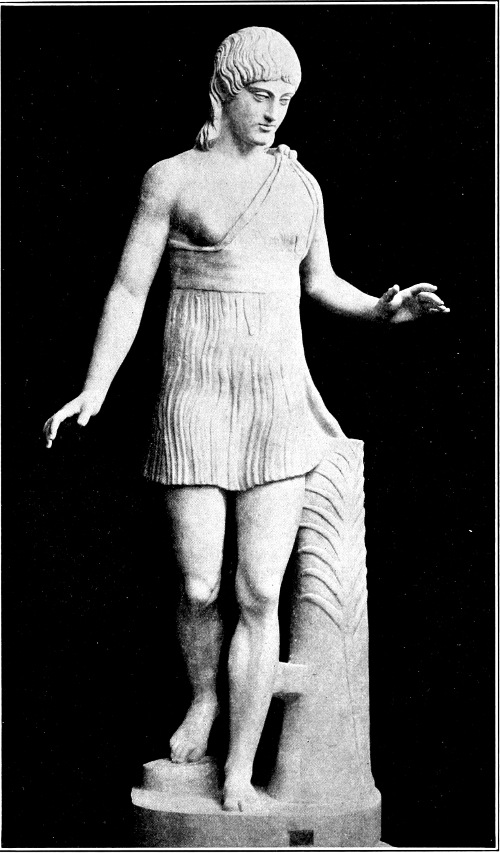
Marble Statue of a Girl Runner. Vatican Museum, Rome.
The assumption long held that short hair was always characteristic of the athlete is incorrect.473 It is controverted equally by literary evidence and by the monuments. The Homeric Greek took pride in his long hair,474 and doubtless the contestants at the games of Patroklos in the Iliad had long hair. Long hair was worn by some Athenians throughout Athenian history. From the end of the fifth century B. C., long hair was regarded as a mark of effeminacy475 and was regularly worn only by the knights.476 Short hair was worn as a sign of mourning in Athens from early days down.477 Only the slaves regularly wore very short hair in the fifth century B. C.478 The change to short hair in Athens was certainly due to the influence of the palæstra and to athletics in general.479 We see just the opposite custom in vogue in Sparta. There, according to the code of Lykourgos,480 men were compelled to wear long hair and children short hair. Thus the heroes of Leonidas entered the battle of Thermopylæ after combing their long locks.481 After the Persian wars only children and men with laconizing or aristocratic sympathies482 wore their hair long at Athens. When boys arrived at the age of ἔφηβοι, they had their hair cut at the feast of the οἰνιστήρια483 and dedicated it to a god.484 Soon after the Persian war period, athletes wore their hair short. Before that time, the wearing of long hair had already been discarded for obvious reasons in wrestling.485 Similarly, in boxing and the pankration long hair was in the way, and was therefore early braided into two long plaits which were wound around the head in a peculiar way and tied into a knot at the top, the so-called Attic κρωβύλος, the oftenest mentioned manner of dressing the hair in Greek literature.486 The oldest notice of this style of wearing the hair is found in a fragment of Asios.487 Herakleides Ponticus488 says it was used up to the time of the Persian wars. The locus classicus is in Thukydides, who says it was worn in his day by old people only.489 Earlier young men wore it,490 but it went out of fashion between 470 and 460 B. C. In this connection we should mention that the professional athlete under the Roman Empire wore his hair uncut and tied up in an unsightly topknot known as the cirrus.491
The monumental evidence bears out the literary. Thus, on old Corinthian clay tablets freemen are represented with long hair, while slaves have short hair.492 Hydrias from Caere (Cerveteri) and paintings from Klazomenai show that the Ionians wore their hair short for the first time in the sixth century B. C., the custom not becoming general until the fifth. Older Spartan monuments represent the hair long.493 Attic vases show long hair on men until the second half of the sixth century B. C., when the black-figured vase masters began to represent them with short hair, a custom becoming general in the first half of the fifth. In statuary the Diskobolos of Myron (Pls. 21, 26, and Figs. 34, 35) has short hair, and most statues of athletes before it have long hair, while most after it have short. Before the time of the Diskobolos, b.-f. and early r.-f. vase-painters often represented athletes with braided hair in the fashion of the warriors on the Aegina pediments. When short hair began to be used on athlete statues, these older braids were often replaced by victor bands.494 We may roughly summarize by saying that statues before the date of the Diskobolos which do not have long hair are probably those of athletes and not of gods, and, in any case, if they have braids bound up in the fashion of the κρωβύλος, they are almost always statues of athletes.495 As for short hair on representations of gods, Furtwaengler has shown that it appears only after the middle of the fifth century B. C.496 Prior to that date the hair of divinities fell over the neck and shoulders in curls, as in the statue of the Olympian Zeus by Pheidias. By the time of Perikles, however, short curly hair reached only to the nape of the neck on statues of Zeus, and this style frequently appears on figures of the god on Attic vases of that period. Dionysos has short hair for the first time on the Parthenon frieze.497 Furtwaengler has shown that Pheidias did not invent the short bound-up hair for goddess types, as we see it in the Lemnian Athena, but that he borrowed it from works already in existence.498 Though the style was unknown in the archaic period, it appears on helmeted heads of Athena of the early fifth century B. C. showing Peloponnesian style—on coins, statuettes, reliefs, etc. It appears in Attic art exclusively on bareheaded types of Athena of the period just prior to that of the Lemnia.
Bulle499 has gone carefully into the technique of the hair by different Greek artists. In archaic times this was “ein, man darf sagen, unmoegliches Problem.” The primitive means at the disposal of the early artist made it impossible to render the hair naturally and hence it was conventionalized. Two styles arose in archaic times, which endured with modifications all through Greek art. The one was the pictorial (malerisch), where only the general appearance of the hair was represented, the merest necessary plastic form being added.500 Painting here helped the shortcomings of the sculptor to some extent. The second style was the plastic (plastisch), where individual locks were attempted. The plastic use of light and shade made the use of color now less necessary. Such examples as the Korai of the Akropolis Museum and the Rampin head in the Louvre show the difficulty which the early artist encountered in representing hair plastically. In the Rampin head501 we see examples of three sorts of plastic hair treatment: the pearl-string (Perlschnuerre) on the neck, grained hair (Koerner) in the beard, and snail-volutes (geperlte Schnecken) on the forehead. None of the three seems to belong integrally to the head, but each appears to have been pasted on. The pearl-string fashion was first used in the soft poros stone and was only later successfully transferred to marble. During the severe style of Greek sculpture, both fashions, pictorial and plastic, were used, as we see them in the pediment groups from the temple of Zeus at Olympia. In the period of Pheidias the plastic treatment was used almost exclusively, as we see in the Lemnian Athena. In the next century impressionism came in, though the plastic treatment still continued, for we see it in the bronze work of Lysippos and the marble work of Praxiteles. The old pictorial treatment was revived again in the later Hellenistic age.
ICONIC AND ANICONIC STATUES.
In a well-known passage Pliny says that “the ancients did not make any statue of individuals unless they deserved immortality by some distinction, originally by a victory at some sacred games, especially those of Olympia, where it was the custom to dedicate statues of all those who had conquered, and portrait statues if they had conquered three times. These are called iconic.”502 Many solutions of this passage have been offered. Older commentators, as Hirt and Visconti,503 interpreted Pliny’s word iconicas as life-size statues. Scherer, however, easily refuted this idea and showed that the adjective εἰκονικός, though ambiguous in its meaning, had nothing to do with size, but referred rather to an individual as opposed to a typical sense in relation to statuary. In his explanation he referred to the words of Lessing in the Laokoön: es ist das Ideal eines gewissen Menschen, nicht das Ideal eines Menschen ueberhaupt.504 Nowadays all scholars agree that Pliny’s word refers to portrait statues.505 However, Pliny’s dictum about the right of setting up portrait statues is certainly open to doubt.506 It can not have been true of monuments erected before the fourth century B. C., when portrait statues were rare. Portraiture was a form of realism and was a product of the later period of Greek art—especially after the time of Lysippos. In the fourth century B. C. we find one well-attested exception to Pliny’s rule. The discovered inscription from the base of a monument erected to the horse-racer Xenombrotos of Cos,507 reads (fifth line): τοῖ[ος], ὁποῖο[ν] ὁ[ρ]ᾷς Ξεινόμβροτο[ς]. These words indubitably point to a portrait statue. However, neither the recovered epigram nor Pausanias indicates anything about this victor being a τρισολυμπιονίκης, and consequently he appears not to have merited a portrait statue.508 Pliny’s statement can be explained in many ways: it may be apocryphal, or different usages may have fitted different periods; or the rule may have held good only for gymnic victors and not for equestrian ones, which, being strictly votive in character, may not have been restricted to its operation.509
Portrait Statues.
Pausanias mentions the monuments of several victors at Olympia who were entitled to portrait statues on the strength of Pliny’s rule, though we have no indication that they were so honored. Thus he mentions the statues of Dikon,510 Sostratos,511 Philinos,512 and Gorgos.513 The early fifth-century boxer Euthymos514 also won three victories, but at a time before we should expect a portrait statue. The Periegete also mentions several victors who won three or more times, though he does not say that they had any statues, portrait or otherwise.515 Percy Gardner516 has shown how erroneous is the prevailing view that the Greeks neglected portraiture in their art and left it for the Romans to develop. He shows that Greek artists of the third and second centuries B. C. left a great many portraits of the highest artistic value and that portraits of Romans before the time of Augustus, and the best Roman examples during the Empire, were made by Greek sculptors. The number of Greek portraits in our museums, especially in Rome, is very great.517 From archaic times down to the middle of the fifth century B. C. we should not expect portraiture. In the earlier period, therefore, it is difficult to distinguish between statues of gods and those of men. In the great period of Greek art, from the time of Perikles on to that of Alexander, the general tendency of Greek sculpture was so ideal that portraits, when they existed, seem impersonal. The later copyists of portraits also idealized them. Thus Pliny, in speaking of Kresilas’ portrait of Perikles, says that this artist nobiles viros nobiliores fecit—in other words, that he idealized them.518 The portraits of Alexander were especially idealized. In the first half of the fourth century we first hear of realistic portraiture. Thus Demetrios, who flourished 380–360 B. C.,519 made a “very beautiful” statue of a Corinthian general named Pelichos, which Lucian520 says had a fat belly, bald head, hair floating in the wind, and prominent veins, “like the man himself.”521 Except for the hair this description by the satirist seems to have been correct. At the end of the fourth century B. C. anatomical detail began to be shown in sculpture. Largely under the influence of Lysippos, the personality of victors began to be emphasized in figure and face in a very realistic way. We can distinguish between such portraits of victors before and after the time of Lysippos.522 Pliny523 says that Lysistratos, the brother of Lysippos, was the first to obtain portraits by making a plaster mould on the features and so to render likenesses exactly, as “previous artists had only tried to make them as beautiful as possible.” In any case, by the time of Lysippos realistic portraiture began to be emphasized. We see it at Olympia in the later bronze pancratiast’s head found there (Fig. 61, A and B), and in a still more revolting style in the Seated Boxer of the Museo delle Terme (Pl. 16, and Fig. 27).
The reason why the privilege of erecting portrait statues was given so seldom to Olympic victors was probably not because it was a highly esteemed honor. The real reason seems to have been that portraiture, with its tendency to realism, subordinated beauty to that realism and so conflicted with the Greek artistic ideal. The Thebans had a law which forbade caricature and commanded artists to make their statues more beautiful than the models. The Greeks worshiped beauty and hated ugliness. Many games in Greece were held in honor of personal beauty. Thus a contest of manly beauty among old men (ἀγὼν εὐανδρίας) was a part of the Panathenaic games at Athens.524 A contest of beauty among women, originating in the time of Kypselos, king of Arkadia, was kept up until the time of Athenæus.525 We hear of contests of beauty in Elis, at which three prizes were given,526 and of similar ones on the islands of Tenedos and Lesbos.527 The Crotonian Philippos, who won at Olympia in an unknown contest about 520 B. C., was honored after his death by the people of Egesta with a heroön and sacrifices because of his beauty.528 At Tanagra, in Bœotia, the most beautiful ephebe was chosen to carry a ram on his shoulders around the city wall at the festival of Hermes Kriophoros.529 At Aigion in Achaia the most beautiful boy was anciently chosen to be priest of Zeus.530 The most beautiful youths among the Spartans and Cretans dedicated offerings to Eros before battle.531 These and similar examples show the Greek feeling for beauty. The representation of passion and violence was foreign to the spirit of the best Greek art; it was rather the “quiet grandeur” (Stille Groesse) or “repose,” of which Winckelmann made so much, that was characteristic of that art. In Homer both men and gods, when wounded, shriek. Philoktetes, in the drama of Sophokles, wails throughout a whole act, when suffering from a gangrened foot. With the poets Zeus casts his thunderbolt in anger, but Pheidias has him hold it quietly in his hand. So we can see why portrait statues were rare at Olympia, where the representation of manly beauty and vigor was the rule. They were ruled out, not because of their increasing the honor accorded to the victor, but rather because they honored his egotism.532
Aniconic Statues.
Accordingly, since only victors who had won three or more contests at Olympia could set up iconic statues, the great majority of statues there represented some ideal type of common applicability, in which there was no attempt to show the individual features of this or that victor, but rather the typical athlete of muscular build. The older statues were merely variations of a few types which were held to be appropriate to the purpose. In process of time these few types in their treatment of details gradually approached truth to nature; this was especially characteristic of the Peloponnesian schools, which adopted the Doryphoros of Polykleitos as their norm of proportions. Statues of victors were the stock subject of the closely related schools of Argos and Sikyon.533 Doubtless, as E. A. Gardner says,534 there existed at Olympia itself a school of subordinate artists, who filled the regular demand for victor statues. However, some of these statues, especially those of the fifth and fourth centuries B. C., as we see them in originals and in Roman copies, and read the æsthetic judgments of them in Greek writers, were real works of art.
ÆSTHETIC JUDGMENTS OF CLASSICAL WRITERS.
The literary evidence for Greek sculpture is, for the most part, very unsatisfactory. Though classical writers were uncritical and not fond of analysis, still they have left us some useful opinions about works of sculpture and painting. The history and criticism of sculpture began in Greece, in the fourth century B. C., with the Peripatetics. Aristotle, whose observations on painting and sculpture were slight, did not despise the “mimetic” arts as did the Socrates of Plato.535 In the Rhetoric536 he speaks of the beautiful bodies of youths who trained as pentathletes, since the varied exercises of the pentathlon made them so. We have a similar opinion expressed by Xenophon in what is, perhaps, the most interesting passage in Greek literature on criticism of art.537 He has Sokrates go to the sculptor Kleito and compliment him on his power of representing different physical types produced by various contests, noting differences between statues of runners and wrestlers and between those of boxers and pancratiasts. When asked how he makes statues lifelike, Kleito has no answer, and the philosopher says it is by the imitation of real men, i. e., nature. He adds: “Must you not then imitate the threatening eyes of those who are fighting and the triumphant expression of those who are victorious?” Though some have thought that these words refer to portrait statues, which were spoken of as a matter of course at the beginning of the fourth century B. C., it is more reasonable to suspect that Sokrates was speaking of the older sculptors—for we may recognize Polykleitos in Kleito538—and consequently that he is not referring to portraiture. In the Symposium of Xenophon539 Sokrates also complains that the long-distance runners (δολιχοδρόμοι) have thick legs and narrow shoulders, while boxers have broad shoulders and small legs, and he therefore recommends dancing as a better exercise than athletics. As such differences in physique occur in vase-paintings of the date, but not in statuary, the philosopher seems to be speaking of athletics and not of sculpture. From these quotations of Aristotle and Xenophon, we gather that the all-round development of the pentathlon made beautiful athletes, and this beauty must have been carried over into their statues. It is essentially the young man’s contest,540 and some of the pentathlete victors at Olympia and elsewhere were noted for their strength in after life. Thus Ikkos of Tarentum, who won at Olympia in Ol. 76 ( = 476 B. C.), was the best teacher of gymnastics of his day.541 Gorgos of Elis was the only athlete to win the pentathlon four times at Olympia, besides winning in two running races.542 Another Elean, Stomios, who won three prizes at Olympia and Nemea, later became a leader of cavalry and beat his enemy in single combat.543 The Argive Eurybates, victor in the pentathlon at Nemea, was very strong, and later, in a battle with the Aeginetans, killed three opponents in single combats, but succumbed to the fourth.544 The Spartans and Krotonians seem to have been the best pentathletes.545 Noted sculptors made statues of these athletes.546 Plato, in the de Leg.,547 has the Athenian stranger praise Egyptian art because of its stationary character. This bespeaks but little artistic insight for the philosopher, though he was surrounded by the wonderful artistic creations of the end of the great fifth century B. C. The later classical writers were fond of expressing criticisms of art. Thus Pasiteles, a Greek sculptor living in Rome in the first century B. C., wrote five books on celebrated works of art throughout the world.548 The opinions on art of the Roman Varro appear in the pages of Pliny.549 Of all the ancient critics, Cicero was perhaps the most superficial. In a passage in the Brutus550 he gives us his judgment of several sculptors. He finds the works of Kanachos too rigid to imitate nature truthfully, while those of Kalamis, though softer than those of Kanachos, are hard; Myron, though not completely faithful to nature, produced beautiful works and Polykleitos was quite perfect. The most trustworthy critic of sculpture in antiquity, on the other hand, was certainly Lucian, as we see from many of his utterances, especially from his account of an ideal statue, which combined the highest excellences of several noted sculptures.551 His criticism of Hegias, Kritios, and Nesiotes, to the effect that their works were “concise, sinewy, hard, and exactly strained in their lines,” might have been made in the presence of the group of the Tyrannicides (Fig. 32).552 Unfortunately he touches the subject only casually, though he might have written a fine history of Greek art. We must also refer to two other imperial writers, the elder Pliny and Pausanias. Pliny’s abstracts on art, though our chief ancient literary authority on Greek sculpture and painting, are neither critical nor trustworthy. A careful analysis of his chapters shows that he was a borrower many times removed, though he seldom acknowledged it. This is excusable when we consider the custom of literary borrowing in antiquity and also the fact that his chapters on art form merely an appendix to his Natural History, being joined on to it by a very artificial bond, for his abstract on bronze statuary (Bk. XXXIV) is brought in merely to complete his account of the metals. His knowledge of the older periods of Greek art is small and his bias in favor of the two Sikyonian sculptors Lysippos and Xenokrates is very evident. His worst mistakes are in chronology. He puts Pythagoras after Myron, and both after Polykleitos, while Hagelaïdas, who is made the teacher of Myron and Polykleitos, lives on to the beginning of the Peloponnesian war. His real criticism of sculpture is seen in his dictum of the Laokoön group, that it is a “work superior to all the pictures and bronzes of the world.”553 Our debt to Pausanias, especially for our knowledge of the victor monuments at Olympia, is immense. This debt may be gauged by the fact that he mentions in his work many times more statues than any other writer and that a large portion of the Schriftquellen of Overbeck is concerned with him. However, he shows little real understanding for art. His interest in statues is confined almost entirely to those which are noted for their antiquity or sanctity, and his account of them is usually the pivot around which he spins religious or mythological stories. Throughout his work his chief interest is religious; his interest in art for its own sake is very small. He devotes many pages to the throne of Zeus at Olympia, and describes the temple sculptures merely because the statue of Zeus is within. His detailed account of the athlete statues in the Altis is made chiefly because of his religious and antiquarian interest. Though imitating the style of Herodotos, he does it badly, so that his book is without much charm. In concluding this rough estimate of the ancient criticism of art, we might mention the fragmentary information to be gathered from many other writers, Dio Chrysostom, Quintilian,554 Plutarch, and others, whose names occur frequently in the footnotes. All such references to works of art in ancient writers are conveniently collected in the great compilation of Overbeck so often quoted.555
As for æsthetic judgments of the statues of victors at Olympia we have a few direct hints from different writers. The epigram from the base of the statue of the boy wrestler Theognetos by Ptolichos of Aegina reads in part: Κάλλιστον μὲν ἰδεῖν, ἀθλεῖν δ’ οὐ χείρονα μόρ[φης].556 Pliny says of the sculptor Mikon, who made the statue of the Athenian pancratiast Kallias: Micon athletis spectatur.557 The same writer says of the horses of Kalamis: equis sine aemulo expressis.558 Kalamis with Onatas of Aegina made a chariot-group for the Syracusan king Hiero.559 Pausanias, in mentioning the statue of the boxer Euthymos by Pythagoras, says that it is καὶ θέας ἐς τὰ μάλιστα ἄξιος.560 In mentioning the statue by the same sculptor of the wrestler Leontiskos, he says: εἴπερ τις καὶ ἄλλος ἀγαθὸς τὰ ἐς πλαστικήν.561 Of the Argive sculptor Naukydes he says, when speaking of the statue of the wrestler Cheimon, that it is among the finest works of that artist.562 In another passage, in which he describes the dedication of Phormis at Olympia, he speaks of an ugly horse, which, besides being smaller than other sculptured horses in the Altis, has “its tail cut off, and this makes it still uglier.”563 However, here he is not so much interested in its lack of beauty as in the curious fact which he adds, that despite its ugliness this bronze mare attracted stallions.
GREEK ORIGINALS OF VICTOR STATUES.
PLATE 3
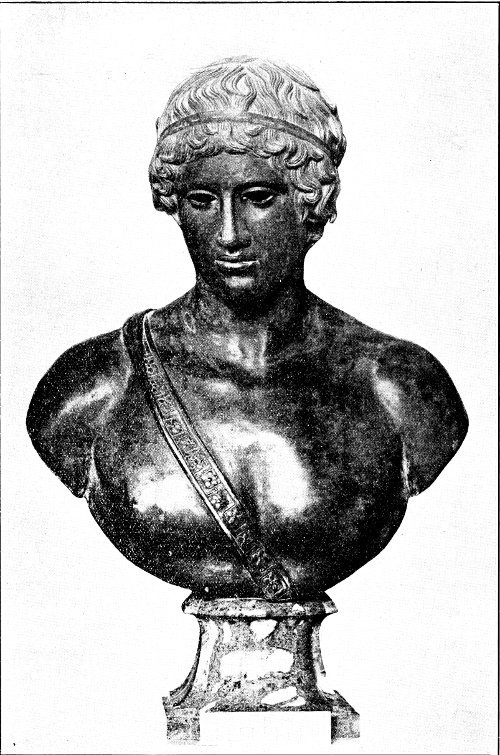
Bronze Head of an Olympic Victor. Glyptothek, Munich.
We are not, however, dependent upon such meagre scraps of evidence from classical writers, nor upon contested Roman copies,564 for an idea of the workmanship of some of the Olympic victor statues. We can judge it in no uncertain way by the few originals found at Olympia and by others which are to be found in European museums. As an example of the former we have only to recall the life-size bronze bearded head of a boxer or pancratiast of the third century B. C., which is now in the National Museum at Athens565 (Fig. 61, A and B). Its only decoration, an olive crown whose leaves have disappeared, proves it to be from the statue of a victor, and its wild locks, brutal look, flattened nose, and wide mouth represent a naturalistic study of the utmost strength and fineness, which could only have been produced after the time of Lysippos. We shall discuss this remarkable head more fully in Chapter IV. As examples of original victor monuments in European museums we shall mention three. The bronze head of a boxer in the Glyptothek at Munich (Pl. 3) is an original of the first rank.566 It is from a statue found near Naples in 1730, which was later destroyed, and it probably represents the head of a boy of about twelve years, a victor in boxing, to judge from the victor band in the hair and the fact that the visible part of the right ear is swollen. Like the head of the Diadoumenos of Polykleitos (Figs. 28, 29) this beautiful head exemplifies fully the “ethical grace” or modesty567 so characteristic of the best Greek art, and it certainly merits Furtwaengler’s praise of being the “most precious treasure of the Glyptothek.”568 Another head, found in Beneventum and now in the Louvre (Fig. 3)569 is a splendid Greek original of the last decade of the fifth century B. C., and, as Mrs. Strong says, should arouse in us a sense of what precious relics may still lie hidden in our museums.570 The victor fillet in the hair, consisting of two sprays of what seems to be wild olive (remnants of which appear in front), shows that the statue must once have ornamented the Altis. Like the one in Munich, this head shows Polykleitan inspiration tempered by Attic influence.571 Lastly, the bronze head of a youth from the tablinum, of the so-called villa of the Pisos at Herculaneum, now in Naples,572 is, to judge from its technique, an excellent original Greek work (Fig. 4). Here again the hair fillet shows it is from a victor statue, though its provenience from Olympia can not be established.
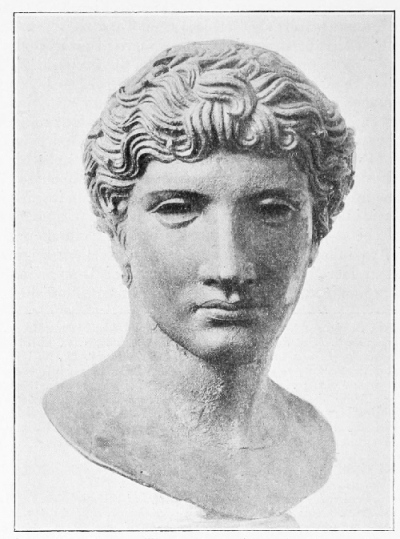
Fig. 3.—Bronze Head of an Olympic Victor, from Beneventum. Louvre, Paris.
Such beautiful works of art as these last show the influence which the great athletic festivals, and especially the Olympian, exerted on the development of Greek sculpture. In the gymnastic training carried on in the gymnasium and palæstra, which culminated in these festivals, the Greek sculptor found an unrivaled opportunity to study the naked human figure in its best muscular development and in every pose. In fact, we may say with Furtwaengler that without athletics Greek art would be inconceivable.573 To quote from another work of the same scholar:
“The gymnastically trained bodies of these slim boys and youths and vigorous men are evidence of the ennobling effect of athletics. Presented in complete nudity they are not faithful portraits from life, but motives or models from the palæstra transformed and exalted to the highest ideal of physical beauty and strength. They are the most splendid human beings that the art of any period has created.”574
CANONS OF PROPORTION.
In attempting to identify a given statue as the copy of a work by this or that master, certain well-known canons of proportion, which were taught and practiced by various Greek sculptors and schools, must be taken into consideration.
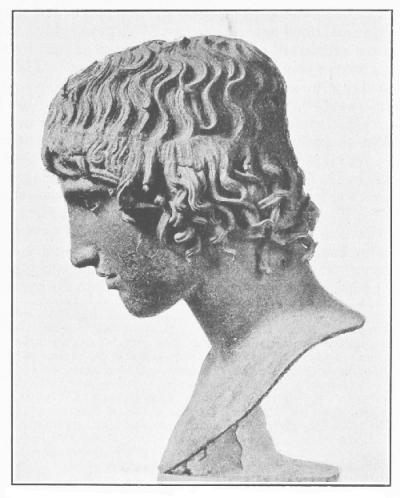
Fig. 4.—Bronze Head of an Olympic Victor, from Herculaneum. Museum of Naples.
Greek art may, like Greek philosophy and poetry, be summarized under the names of three qualities which constantly occur in classical literature—συμμετρία, εὐρυθμία or ῥυθμός, and ἀναλογία.575 Symmetry may be defined as “that technical regard for the placing of the parts to the best advantage,” the symmetrical arrangement of the parts of a statue or group of figures.576 Rhythm, following Vitruvius,577 is that tertium quid which is indispensable to true art. Analogy (Latin proportio)578 refers to the measured ratio of part to part in any given work of art, whether in architecture, painting, or sculpture. Most scholars nowadays interpret symmetry and analogy as the same thing. Pliny579 says that symmetria has no Latin equivalent, and in several passages580 keeps the Greek word, as does Vitruvius. Here Otto Jahn rightly says proportio or commensus would have adequately translated it.581 P. Gardner explains the word properly as “the proportion of one part of the body as measured against another.”582 Brunn held that, as symmetry was the relation of part to part in a statue at rest, rhythm expressed this relationship in one represented in motion.583 The simplest illustration of rhythm is seen in walking: when the right foot is advanced the left arm swings out in rhythm, and so the balance of the body is kept. Rhythm, therefore, has to do with balance in motion, and may refer equally to cadence in poetry and music and to movement in sculpture. An excellent example in sculpture is afforded by Myron’s Diskobolos (Pls. 21, 22, and Figs. 34, 35), while the balancing of figures on many Greek reliefs—especially on Attic funerary stelæ—illustrates symmetry (cf. Fig. 75). Pliny characterizes certain artists by their success in effecting symmetry and rhythm. Thus Myron surpassed Polykleitos in being more rhythmic and in paying more attention to symmetry.584 He says that Lysippos most diligently preserved symmetry by bringing unthought-of innovations into the square canon of earlier artists.585 Parrhasios was the first to introduce symmetry into painting.586 Diogenes Laertios says that the sculptor Pythagoras was the first to aim at rhythm as well as symmetry.587 In all such passages it is clear that canons of proportion are meant.
The doctrine of human proportions is very ancient, originating in Egyptian art.588 It appears early in Greek architecture in the proportions of columns and other members of a temple,589 and it was soon transferred to sculpture. As Greek sculpture evolved on traditional lines,590 we should assume that it paid attention to the doctrine of proportions in the human figure, based on numerical ratios, and that such a doctrine would vary from age to age in the various schools of sculpture. Such an assumption is borne out by both literary and archæological evidence. Toward the end of Hellenism many writers refer to just such a measured basis of proportion in Greek art.591 Archæologists have shown by the careful study of multitudes of statues that such proportions exist in Greek sculpture. Thus A. Kalkmann592 has proved that there are sets of ratios in the treatment of the face used by successive schools of sculpture, which were canonical, whether formulated or not. G. Fritsch593 has done for the whole body what Kalkman has done for the face. In fact, anthropometry in relation to Greek sculpture has now become an exact science.594
The greatest artists—architects, painters, and sculptors—of all times have taught and practised the doctrine that certain proportions are beautiful, e. g., the proportion of the height of the head or the length of the foot to the whole body, or the length of parts of the head or body to other parts. In modern times we have only to mention such names as those of da Vinci, Duerer, Raphael Mengs, and Flaxman.595 In Greek days there were many artists who formulated such canons of proportions. Greek sculptors followed ratios of proportions so closely that we have statues of various schools, which are distinguished by fixed proportions of parts, such as the Old Attic, Old Argive, Polykleitan, Argive-Sikyonian or Lysippan, etc. Some of these schools used the foot as the common measure, while others used the palm, finger, or other member.596 The earliest works on Greek art were treatises, now lost, by artists in which they worked out their theories of the principles underlying the proportions of the human figure.597 We shall briefly consider a few of these canons, together with the usual pose of body which conformed with them. The earliest Peloponnesian canon, which we can analyze, was that followed by Hagelaïdas of Argos and his school, a canon which was still used in the Polykleitan circle. Here the weight of the body rested upon the left leg, while the right one was slightly bent at the knee, its foot resting flat on the ground; the right arm hung by the side and the left was usually in action, and the head was slightly inclined to the left side; the shoulders were extraordinarily broad in comparison with the hips, the right one being slightly raised. These qualities produced a short stocky figure, firmly placed.598 In the middle of the fifth century B. C., Polykleitos worked out a theory of proportions in the form of a commentary on his famous statue known as the Doryphoros. This canon was characterized by squareness and massiveness of build. The weight of the body generally rested on the right foot, while the left was drawn back, its foot touching the ground with the ball only. Sometimes this pose was reversed, the left foot carrying the body-weight, as in the three bases of statues by the master found at Olympia (i. e., those of the athletes Pythokles, Aristion, and Kyniskos, to be discussed later), and in the works of some of his pupils, notably in those of Naukydes, Daidalos, and Kleon.599 Euphranor, who flourished, according to Pliny, in Ol. 104 ( = 364–361 B. C.), and wrote works on symmetry and color, was the “first” to master the theory of symmetry.600 Pliny, however, found his bodies too slender and his heads and limbs too large, a criticism of his painting which must have been equally applicable to his sculpture. His canon did not make much headway, as the majority of sculptors in his century were still under the domination of the canon of Polykleitos. It was left for Lysippos, in the second half of the fourth century B. C., finally to break this domination of the great fifth-century sculptor. Pliny quotes Douris as saying that he was the pupil of no man, and that because of the advice of the painter Eupompos he was a follower of nature—which appears to be a cut at the schools which mechanically followed fixed rules.601 His statues had smaller heads, and more slender and less fleshy limbs, than those of his predecessors, in order that the apparent height of the figure might be increased.602 While Polykleitos made his heads one-seventh of the total height of the statue, Lysippos made his one-eighth—if this change may be seen in the Apoxyomenos (Pl. 28), which is certainly a work of his school, if not of the master himself. Pliny further records his saying that while his predecessors represented men as they were, Lysippos represented them as they appeared to be. This means that Pliny regarded him as the first impressionistic artist.603 Pliny mentions other artists who wrote on art, and it is probable that theories of proportions formed the main element of such works.604
The best example of symmetry, i. e., of the ratio of proportions, in Greek sculpture is afforded by the Doryphoros of Polykleitos, which Pliny says was called the Canon, and he adds that this sculptor was the only one who embodied his art in a single work.605 The identity of the canon with this statue seems to be attested by the anecdote told of Lysippos that the Doryphoros was his master,606 and by Quintilian’s statement that sculptors took it as a model.607 The best-preserved copy of the Doryphoros, despite its rather lifeless character, is the one discovered in Pompeii and now in Naples (Pl. 4).608 As other late Roman copies do not conform to the identical proportions of this copy, it is perhaps difficult to say exactly what the canon of Polykleitos was. Possibly the original, if it had been preserved, would also strike us as somewhat lifeless; but we must remember that the statue was made merely to illustrate a theory of proportions. The dimensions of the Naples statue are known from very careful measurements and the proportions agree with those given in the description by Galen to be mentioned. It is almost exactly 2 meters, or 6 feet 8 inches, high.609 The length of the foot is 0.33 meter, or one-sixth of the total height, while the length of the face is 0.20 meter, or one-tenth of the height. E. Guillaume610 has made a careful analysis of it in reference to Galen’s611 statement that Chrysippos found beauty in the proportion of the parts, “of finger to finger, and of all the fingers to the palm and wrist, and of these to the forearm, and of the forearm to the upper arm, and of all the parts to each other, as they are set forth in the canon of Polykleitos.” He has found that the palm, i. e., the breadth of the hand at the base of the fingers, is a common measure of the proportions of the body. This palm is one-third the length of the foot, one-sixth that of the lower leg, one-sixth that of the thigh, and one-sixth that of the distance from the navel to the ear, etc. Such a remarkable correspondence in measurements would seem to show, if we had no other proofs, that the Naples statue reproduces the canon of Polykleitos more closely than any other.
PLATE 4
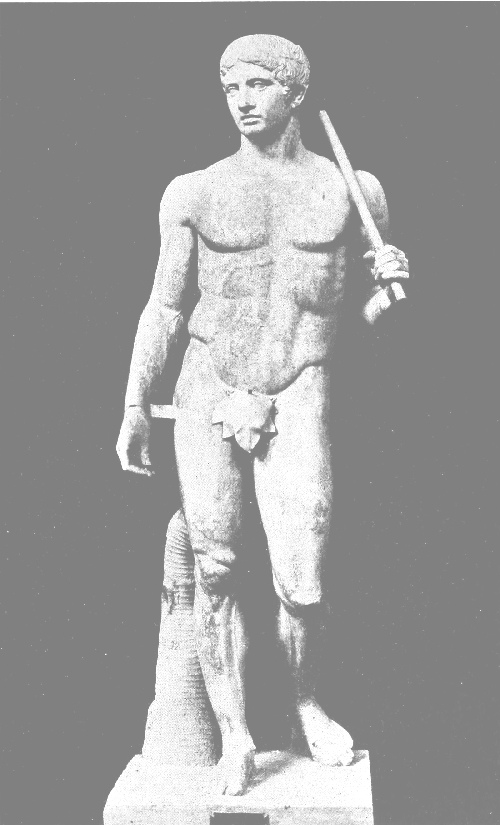
Statue of the Doryphoros, after Polykleitos. Museum of Naples.
A good example of asymmetry is afforded by the so-called Spinario of the Palazzo dei Conservatori in Rome612 (Fig. 40). This justly prized statue shows more asymmetry, perhaps, than any other down to its date—just before the middle of the fifth century B. C. Though its composition is such that there is no vantage-point from which it forms a harmonious whole, still its effect on the beholder is far from displeasing. Such a creation shows that a Greek artist, even without paying attention to the symmetrical arrangement of parts, could at times produce an attractive piece of sculpture.
ASSIMILATION OF OLYMPIC VICTOR STATUES TO TYPES OF GODS AND HEROES.
Since Greek art in the main was idealistic, we should not be surprised to discover in athletic sculpture a tendency toward assimilating victor statues to well-known types of gods or heroes, especially to those of Hermes, Apollo, and Herakles, who presided over contests or gymnasia and palæstræ. This phenomenon is only a further example of the extraordinary, almost superhuman, honors which were paid to victors at the great games. In the absence of sufficient means of identification, it is often very difficult to distinguish with certainty between statues of victors and those of the gods and heroes to whom they were assimilated. This difficulty, as we shall see, is especially observable in the case of Herakles. Even later antiquity recognized that statues of athletes were sometimes confused with those of heroes, just as those of heroes were with those of gods, as we learn from a passage in Dio Chrysostom’s oration on Rhodian affairs.613 This difficulty is one of the most perplexing problems that still face the student of Greek sculpture.
It was not an uncommon custom in Greece to heroize in this way an ordinary dead man.614 One of the most striking instances of this custom is afforded by the so-called Hermes of Andros, a statue found in a grave-chamber on the island in 1833 and now in Athens615 (Pl. 5). It has been a matter of dispute among archæologists whether this statue represents the god Hermes or a mortal in his guise. Although Staïs616 looks on it as un problème peut-être à jamais insoluble, there seems little reason for doubting that it represents a defunct mortal. Its place of finding in a tomb along with the statue of a woman of the Muse type, which probably represents the man’s consort,617 the presence of a snake on the adjacent tree trunk, the absence of sandals and kerykeion, and the portrait—like features—all point to the conclusion that a man and not a god is represented. The downcast, almost melancholy, look seems also to make it a funereal figure. The powerful proportions of a perfectly developed athlete, displaying no tendency toward the representation of brute force, show that the man is idealized into the type of Hermes, the god of the palæstra, rather than into the light-winged messenger of Olympos. The Belvedere Hermes of the Vatican,618 and a better one known as the Farnese Hermes of the British Museum,619 are noteworthy replicas of the type. The latter carries the kerykeion in the left hand and wears sandals, with a small chlamys over the left arm and shoulder. These attributes show that Hermes was intended in this copy. Probably the original of these various replicas, a work dating from the end of the fourth century B. C., and ascribed to Praxiteles or his school in consequence of similarity in pose and build of body and head to the Hermes of Olympia, was intended to represent Hermes. In the one from Andros, at least, the copyist intended to heroize a mortal under the type of the god. Similarly, the statue known as the Standing Hermes in the Galleria delle Statue of the Vatican,620 which has the kerykeion and chlamys, whether its original represented Hermes, hero or mortal, has been made by the copyist to represent Hermes, the god of athletics, as the late attribute of wings in the hair proves. Other examples of dead men represented as Hermes are not uncommon. Thus a Greek grave-stele in Verona621 shows the dead portrayed as a winged Hermes, and a similar figure appears on a stele from Tanagra.622 The so-called Commodus in Mantua623 is interpreted by Conze and Duetschke as the figure of a dead youth in Hermes’ guise. But this custom of representing defunct mortals as gods was less common in Roman art. The bust of a dead youth on a Roman grave-stone in Turin,624 set up in honor of L. Mussius, is a good example. Here the cock, sheep, and kerykeion, symbols of the god, show that the youth is represented as Hermes.
PLATE 5
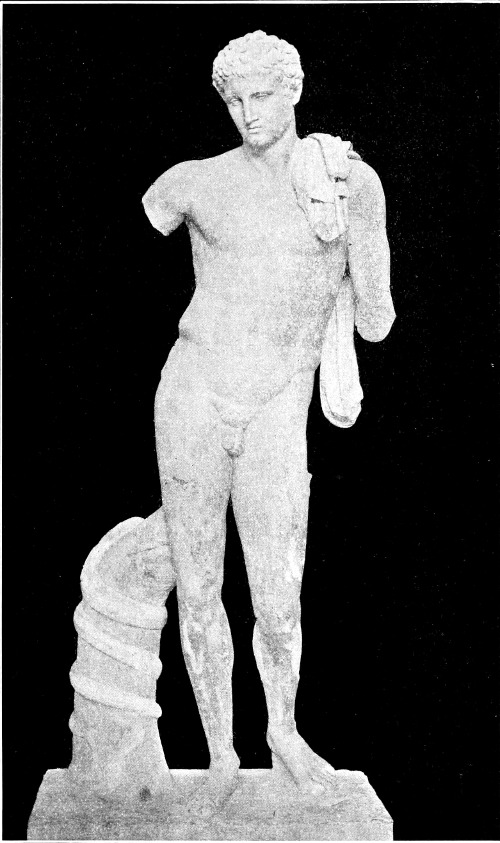
Statue of Hermes, from Andros. National Museum, Athens.
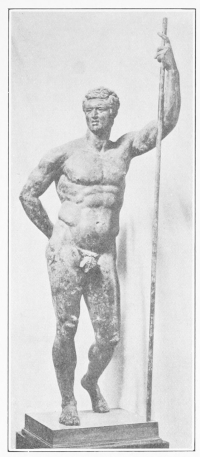
Not only dead men, however, were heroized in this manner. It was not an uncommon practice in later Greece for living men, especially princes, to have their statues assimilated to types of gods and heroes, a practice which was very common in imperial Rome.625 Thus many of the Hellenistic princes were pleased to have their statues assimilated to those of the heroic Alexander. One of the best examples of this process is furnished by the original Fig. 5.—Bronze Portrait-statue of a Hellenistic Prince. Museo delle Terme, Rome. bronze portrait statue of such a prince, which was unearthed in Rome in 1884 and is now in the Museo delle Terme there (Fig. 5).626 It has been identified as the portrait of several kings of Macedon and elsewhere,627 but the similarity of the head of the statue to heads portrayed on Macedonian coins is only superficial.628 All that we can say is that this beautiful work, representing the prince in the heroic guise of a nude athlete of about thirty years, belongs to the third century B. C., the epoch following Lysippos. The sculptor, wishing to combine the ideal with the real, appears to have copied the motive directly from a bronze statue by Lysippos, which represented Alexander leaning with his left hand high on a staff.629 The pose also recalls that of the third-century B. C. statue of Poseidon found on Melos and now in Athens.630 The free leg, body, and head modeling correspond so nearly with the Apoxyomenos (Pl. 28) that it was at first called a work of Lysippos, but its lack of repose631 shows that it must be a continuation of the work of that sculptor by some pupil, who wished to outdo his master in both form and expression.
Before discussing the subject of the assimilation of victor statues to types of god and hero, we must make it clear that often, for certain reasons, statues of athletes were later converted into those of gods, and vice versa. Such examples of metamorphosing statues have nothing to do with the process of assimilation under discussion. A few examples will make this clear. An archaic bronze statuette from Naxos,632 reproducing the type of the Philesian Apollo of Kanachos, since it has the same position of hands as in the original, as we see it later reproduced on coins of Miletos and in other copies,633 holds an aryballos in the right hand instead of a fawn. As it is absurd to represent Apollo with the bow in one hand and an oil-flask in the other, it seems clear that in this statuette the copyist has converted a well-known Apollo into an athlete by addition of an athletic attribute. Famous statues were put to many different uses by later copyists. Thus Furtwaengler has shown that the statue of the boy boxer Kyniskos by Polykleitos at Olympia,634 which represented the athlete crowning himself, was modified to represent various deities, heroes, etc. Thus a copy from Eleusis of the fourth century B. C., because of its provenience and the soft lines of the face, suggests a divinity, perhaps Triptolemos.635 A copy of the same type in the Villa Albani (no. 222) has an antique piece of a boar’s head on the nearby tree-stump and, consequently, may represent Adonis or Meleager. A torso in the Museo Torlonia (no. 22) represents Dionysos, another in the Museo delle Terme has a mantle and caduceus and so represents Hermes, while on coins of Commodus the same figure, with the lion’s skin and club, represents Herakles.636 No ancient statue was used more extensively as a model for other types than the famous Doryphoros of Polykleitos. Furtwaengler637 has collected a long list of later conversions of this work into statues both marble and bronze, statuettes, reliefs, etc., representing Pan, Ares, Hermes, and in one case an ordinary mortal.638 Other examples of the conversion of statues will be given in our treatment of assimilation.
Athlete Statues Assimilated to Types of Hermes.
Hermes was one of the principal ἐναγώνιοι or ἀγώνιοι θεοί, i. e., gods who presided over contests, or who were overseers of gymnasia and palæstræ, or were teachers of gymnastics (γυμνάσται).639 Greek writers often mention these athletic gods. Thus Aischylos640 often uses the term, not in the sense of ἀγοραῖοι θεοί, “the great assembled gods,” (ἀγὼν = ἀγορά),641 but in the sense of gods who presided over contests.642 This is evident from the fact that Zeus, Apollo, Poseidon, and Hermes are the gods especially mentioned by Aischylos in this sense, and the first three correspond with the Olympian and Nemean games (Zeus), the Pythian (Apollo), and the Isthmian (Poseidon), while Hermes is concerned in them all. Thus the epithet ἀγώνιοι, in the Agamemnon of Aischylos refers to Zeus,643 Apollo,644 and Hermes.645 If the word referred to the twelve greater gods, as some have thought, other deities more important than Hermes would have been included. Elsewhere the word ἀγώνιος always refers to contests.646 Hermes was worshipped at Athens and elsewhere as a god of contests.647 The agonistic character of this god is shown by the fact that statues and altars were erected to him all over Greece.648 He was sometimes coupled with Herakles as the protector of contests,649 and the images of the two often stood in gymnasia.650 A fragmentary votive relief of the second century A. D. is inscribed with a dedication to both by a certain Horarios, victor in torch-racing.651 Athenian ephebes made offerings to Hermes,652 and to Hermes and Herakles in common, after their training was over. Thus Dorykleides of Thera, a victor in boxing and the pankration at unknown games, dedicated a thank-offering to the two.653 Hermes was early the god of youthful life and sports, especially those of the palæstra. He is said to have founded wrestling654 and inaugurated the sports of the palæstra.655 Pausanias mentions a Gymnasion of Hermes at Athens656 and an altar of Hermes ἐναγώνιος together with one of Opportunity (Καιρός) at the entrance to the Stadion at Olympia.657 He says that the people of Pheneus in Arkadia held games in his honor called the Hermaia,658 and he records the defeat of the god by Apollo in running.659 With such an athletic record there is little wonder that the Greek sculptor would often take his ideal of Hermes from the god of the palæstra and gymnasium, representing him as an athletic youth harmoniously developed by gymnastic exercises. It was but natural that a victor at Olympia or elsewhere should wish to have his statue—which rarely could be a portrait—conform with that athletic type.
PLATE 6
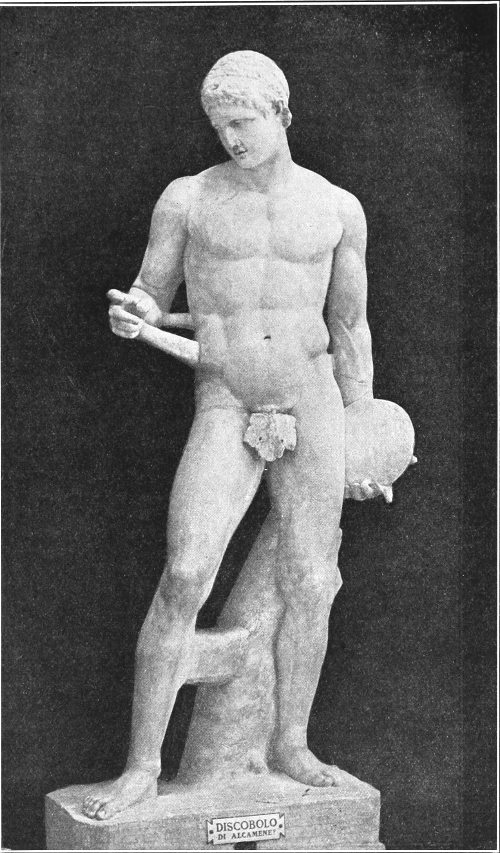
Statue of the Standing Diskobolos, after Naukydes (?). Vatican Museum, Rome.
An excellent instance of this tendency seems to be afforded by the so-called Standing Diskobolos in the Sala della Biga of the Vatican (Pl. 6),660 known since its discovery by Gavin Hamilton in 1792. It represents a youth who is apparently taking position for throwing the diskos, the weight of the body resting on the left leg, the knees slightly bent, the feet firmly planted, and the diskos held in the left hand, just prior to its being passed to the right. This position is one which immediately precedes that of Myron’s great statue. The bronze original dates from the second half of the fifth century B. C., and has been variously assigned to Myron by Brunn, to Alkamenes by Kekulé, followed by Overbeck, Michaelis and Furtwaengler,661 and to Naukydes, the brother and pupil of Polykleitos.662 The head of the Vatican statue shows no trace of Peloponnesian art, but rather resembles Attic types of the end of the fifth century B. C. However, as we shall see, this head does not appear to belong to the statue. Among the works of Alkamenes Pliny mentions a bronze pentathlete,663 called the Enkrinomenos, and this work has been identified with the statue under discussion.664 Such an assumption is tenable only if the statue fits Pliny’s epithet. This epithet appears to mean “undergoing a test,” and should refer not to the statue, for we know nothing of any principle of selecting statues, but to the athlete represented, the ἔγκρισις referring to the selection of athletes before the contest.665 Pliny’s statue, then, presumably, represented a pentathlete, not in action as the Vatican statue does, but standing at rest before his judges. An all-round athlete like a pentathlete would especially fit such an ordeal, and his statue, albeit lighter and more graceful, would be an ideal one like the Doryphoros of Polykleitos.666 We know how Alkamenes treated Hermes from the bearded herma of that god found in Pergamon in 1903 and inscribed with his name.667 Its massive features, broad forehead, and wide-opened eyes bear no analogy to the head on the Vatican statue, nor to the one with which Helbig would replace it. The ascription of the statue to Naukydes is better founded. As the head of the statue is Attic and not Argive, it is difficult to connect the work with a Peloponnesian artist. However, the present head of the statue can not be shown to belong to it, and no other replica has a head which can be proved to belong to the body. A fragmentary replica of the statue, of good workmanship, was found in Rome in 1910, and nearby a head, which must belong to the torso.668 This head fits the Vatican statue better than the head now on it, and certainly comes from the Polykleitan circle—both head and body showing elements of Polykleitan style. This new head represents the transition from Polykleitan art to that of the next century, i. e., to the head-types of Skopas, Praxiteles, and other Attic masters. Presumably, then, in the original of this fragment and its replicas, we have a famous statue—the one by Naukydes mentioned by Pliny.669
A more important question for our discussion is whether the Vatican statue represents a victor (diskobolos) or Hermes. G. Habich has argued that the pose of the statue, standing with the right foot advanced, is not that of a diskobolos taking position. He quotes Kietz670 to the effect that no vase-painting or other monument has the exact position of this statue, and that the natural position for such a motive is to advance the left foot.671 Moreover, the fingers of the right hand, which are supposed especially to uphold the diskobolos theory, are modern in all the replicas. On a coin of Amastris in Paphlagonia, dating from the Antonines, and on one of Commodus struck at Philippopolis in Thrace, a figure of Hermes is pictured, which, in all essentials, reproduces the Vatican statue.672 Since the figure on the coins has a kerykeion or training-rod in the right hand and a diskos as a minor attribute in the left—merely a symbol of the god’s patronage of athletics—we should see in the Vatican statue a representation of Hermes as overseer of the palæstra. Pliny’s words—if we omit or transpose the first et—refer, therefore, to a statue of Hermes-Diskobolos and to the Ram-offerer which stood on the Athenian Akropolis, to two, therefore, and not to three different monuments. We should restore all the replicas of the statue, then, with the caduceus, to represent Hermes as gymnasiarch. Though this interpretation of the statue has found opponents,673 the evidence is strong that in it and its replicas we have an athlete in the guise of Hermes. If we think that the caduceus can not be brought into harmony with the chief motive of the statue, we must conclude with Helbig that the copyist in one isolated case—the one copied on the coins—changed an original victor statue into Hermes by adding the herald staff. This would make it an instance, not of assimilation of type, but of conversion.
A small bronze statuette standing upon a cylindrical base, which was found in the sea off Antikythera (Cerigotto), reproduces almost exactly the attitude of the statue of Naukydes (Fig. 6).674 Here the left hand is stretched out horizontally at the elbow, but the right arm is lost, so that we get no additional evidence as to the attribute carried. Because of its correspondence with the aforementioned coins675 even in detail, Bosanquet, followed by Svoronos, looks upon this “little masterpiece” as a copy of the Argive master.
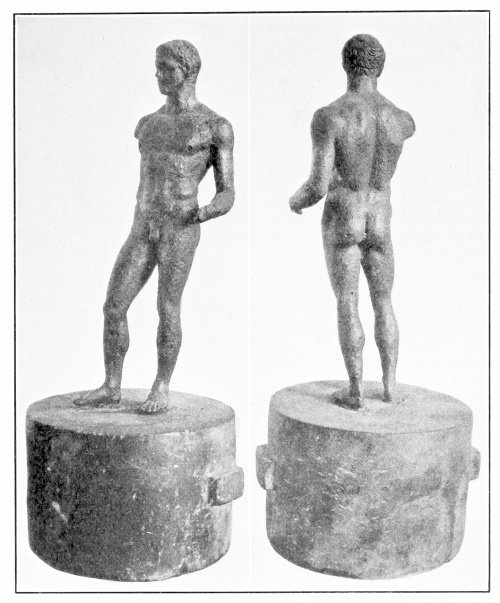
Fig. 6.—Bronze Statuette of Hermes-Diskobolos, found in the Sea off Antikythera. National Museum, Athens.
The statue discovered in the ruins of Hadrian’s villa in 1742 and now in the Capitoline Museum,676 which represents an ephebe nude, except for a chlamys thrown around the middle of his body, standing in an easy attitude with his left foot resting upon a rock and bending forward with the right arm extended in a gesture, was formerly looked Fig. 7.—Bronze Statue of a Youth, found in the Sea off Antikythera. National Museum, Athens. upon as a resting pancratiast. Because of its general likeness to Praxitelean figures—the head is especially like the Olympia Hermes—Furtwaengler interpreted the figure as that of Hermes Logios or Agoraios, the god of eloquence, and assigned it to an artist near to Praxiteles. However, it is probably nothing else than an idealized portrait of the age of Hadrian or the Antonines, and represents an ephebe, probably a victor, assimilated to the type of Hermes.677
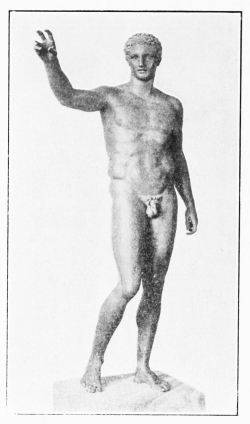
Another example of assimilation may be the much-discussed bronze statue in the National Museum at Athens, which was accidentally discovered in 1901, along with the rest of a cargo of sculptures which had been wrecked off the island of Antikythera as it was on its way to Rome about the beginning of the first century B. C. (Fig. 7).678 This statue, the best preserved of the cargo, is a little over lifesize and represents a nude youth standing with languid grace, the weight of his body resting upon the left leg, while the right is slightly bent and the right arm is extended horizontally, the hand holding a round object now lost and variously interpreted. In short, the pose strongly resembles that of the Vatican Apoxyomenos (Pl. 29). Opinions as to the age and authorship of this statue have been very diverse, ranging from the fifth century B. C. down to Hellenistic times and ascribing it to many masters and schools. Kabbadias, who published it, in conjunction with the other objects, directly after their discovery,679 thought it would prove to “rank as high among statues of bronze as does the Hermes of Praxiteles among those of marble,” and characterized it as “the most beautiful bronze statue that we possess.” Waldstein praised it in no less exaggerated terms, and classed it along with the Charioteer from Delphi (Fig. 66) as among the first Greek bronzes, if not among the finest specimens of Greek sculpture.680 He followed Kabbadias in assigning it to the fourth century B. C. and in interpreting it as Hermes. He at first ascribed it to Praxiteles or his school, but later he thought it more Skopaic.681 Th. Reinach placed it in the early fourth century B. C., but regarded it as the work of a sculptor influenced by Polykleitos, naming the youthful Praxiteles or Euphranor.682 He explained the pose as that of a man amusing a dog or a child with some round object. A Greek scholar, A. S. Arvanitopoulos, assigned the work to the fifth century B. C. and to the Attic school, referring it possibly to Alkamenes.683 However, as soon as the statue was properly cleansed and pieced together, its early dating was seen to be untenable, and its Hellenistic character became evident.684 E. A. Gardner found little resemblance in the head to that of the Praxitelean Hermes, but more in the treatment of hair and eyes to that of the Lansdowne Herakles (Pl. 30, Fig. 71,), which he ascribes to Skopas.685 He saw in its labored and even anatomical modeling similarity to the Apoxyomenos of the Vatican and concluded that it was, therefore, later than the fourth century B. C., being an eclectic piece disclosing influences of several fourth-century sculptors, the work of an imitator especially of Praxiteles and Skopas. K. T. Frost also assigned the work to the Hellenistic age, but believed it was the statue of a god and not of a mortal, and so followed Kabbadias and Waldstein in interpreting it as a Hermes Logios.686 Gardner had interpreted it as probably the statue of an athlete “in a somewhat theatrical pose,” though admitting it might be a genre figure representing an athlete catching a ball, even if its pose were against such an interpretation. In any case he was right in saying that the pose, even if incapable of solution, was chosen by the sculptor with a desire for display, as the centre of attraction is outside and not inside the statue, and so is against the αὐτάρκεια of earlier works. More recently, Bulle has asserted that it is not an original work at all, but, as evinced by the hard treatment of the hair, merely a copy. He also interprets it as a Hermes, restoring a kerykeion in the left hand, and he likens its oratorical pose to that of the Etruscan Orator found near Lago di Trasimeno in 1566 and now in the Museo Archeologico in Florence, or the Augustus from Primaporta in the Vatican.687 For its date he believes the statue marks the end of the Polykleitan “Standmotif” (the breadth of the body showing Polykleitan influence, the head, however, being too small and slender for the Argive master), and the inception of the Lysippan (the free leg not drawn back, but placed further out), as we see it in the Apoxyomenos. He concludes that its author can not have been a great master.688 Doubtless, the statue, which is the pride of the Athenian museum, is merely a representative example of the kind of bronze statues made in great numbers in the early Hellenistic age; but it shows the high degree of excellence attained at that time by very mediocre artists.689
Apart from its period, our chief interest in the statue is to determine whether a god or a mortal is portrayed. As there are no certain remnants of the round object held in the right hand, and no other accessories, many interpretations have been possible. Especially the gesture of the right arm has been the centre for such interpretations. Some have looked upon this gesture as “transitory,” i. e., the sweeping gesture of an orator or god of orators, and this has led to the interpretation of the statue as Hermes Logios.690 However, the round object in the fingers is against this assumption. Others have therefore regarded the gesture as “stationary,” i. e., the figure is holding an object in the hand, which is the main interest of the statue, and this view has therefore also given rise to many different explanations. Among mythological interpretations two have received careful attention. Svoronos has reasoned most ingeniously that the statue represents Perseus holding the head of Medusa in his hand, and finds a similar type on coins, gems, and rings. Thus, almost the identical pose of the statue is seen on an engraved stone in Florence, which shows Perseus holding the Gorgon’s head, and Svoronos has restored the bronze similarly.691 But certainly the right arm of the statue was not intended to carry so great a weight. Others have seen in it the statue of Paris by Euphranor, mentioned by Pliny as offering the apple as prize of beauty to Aphrodite.692 But the statue scarcely reflects the description of the Paris by Pliny. Other scholars have interpreted the statue as that of a mortal. S. Reinach believes that it may be a youth sacrificing.693 Kabbadias and E. A. Gardner admitted it might be the statue of a ball-player as well as of Hermes. Since this latter interpretation has become popular, let us consider its possibility at some length in reference to ball-playing in antiquity. Now we know that ball-playing (σφαιρίζειν, ἡ σφαιρικὴ τέχνη) was a favorite amusement of the Greeks from the time of Nausikaa and her brothers in the Odyssey694 to the end of Greek history, and that it was practiced at Rome from the end of the Republic to the end of the Empire.695 It seems to have been regarded less as a game than as a gymnastic exercise. Its origin is ascribed to the Spartans and to others.696 A special sort of ball-playing was known as φαινίνδα,697 and this is described in a treatise by the physician Galen, of the second century A. D., in which he recommended ball-playing as one of the best exercises.698 Because of his ability in the art of ball-playing, Aristonikos of Karystos, the ball-player of Alexander the Great, received Athenian citizenship and was honored with a statue.699 The philosopher Ktesibios of Chalkis was fond of the game.700 A special room, called the σφαιριστήριον, was a part of the later gymnasium.701 The game was specially indulged in at Sparta. Several inscriptions, mostly from the age of the Antonines, commemorate victories by teams of ball-players there.702 The name σφαιρεῖς was given to Spartan youths in the first year of manhood. These competitions took place in the Δρόμος at Sparta.703 Though, then, we should naturally expect statues of ball-players, like the one in Athens of Aristonikos already mentioned, the calm mien of the Cerigotto bronze and the direction of the gaze are certainly, as Th. Reinach said earlier, against interpreting it as the statue of one engaged in so active a sport. Von Mach, because of its voluptuous appearance, thought it might represent merely a bon vivant. While Lechat interpreted it as possibly an athlete receiving a crown from Nike,704 Arvanitopoulos would have the right hand either hold a lekythion or be quite empty, and the left a strigil, thus restoring the statue as an apoxyomenos. S. Reinach would regard it merely as a funerary monument.
In all this discrepancy of opinion it is not difficult to recognize elements of both god and mortal blended. The resemblance in the expression and features of the face to those of the Praxitelean Hermes, even though superficial, as well as the pose of the right arm recall the god; the muscular build of the figure fits either the god Hermes, in his character of overseer of the sports of the palæstra, or an athlete. It therefore seems reasonable to see in this Hellenistic statue of varied artistic tendencies merely the representation of an athlete, perhaps of a pentathlete, who is holding a crown or possibly an apple as a prize of victory in the right hand, whose form and features have been assimilated to those of Hermes.
How the statue of an indisputable Hermes Logios, on the other hand, appears, may be seen in the Hermes Ludovisi of the Museo delle Terme, Rome,705 and in its replica in the Louvre. The original of this marble copy, dating from the middle of the fifth century B. C., has been variously ascribed to Pheidias,706 Myron,707 and others. In this statue the petasos, chlamys, and kerykeion indicate the god, while the position of the right arm raised toward the head708 and the earnest expression of concentration in the face bespeak the god of oratory. The careful replica of the statue, except the head, in the Louvre, is the work of Kleomenes of Athens, a sculptor of the first century B. C. The copyist, however, has given to the original a Roman portrait-head, whence it has been falsely called Germanicus.709 The Paris statue, then, is merely another example of the conversion of an original god-type, for the sculptor wished to represent a Roman under the guise of Hermes Logios, since the inscribed tortoise shell retained at the feet is a well-known attribute of the god.
Another excellent example of a true Hermes head is the fine Polykleitan one in the Museum of Fine Arts in Boston, which is a copy of a well-known type represented by the Boboli Hermes in Florence and other replicas.710 Though S. Reinach classed this head as Kresilæan,711 its true Polykleitan character has been established,712 even if it does not merit the praise formerly given it by Robinson, of being “easily the best extant copy of a work by Polykleitos.”713
The so-called Jason of the Louvre and its many replicas714 (Fig. 8) probably represent athletes in the guise of Hermes. These statues are copies of an original of the end of the fourth century B. C., when Fig. 8.—Statue of the so-called Jason (Sandal-binder). Louvre, Paris. the favorite motive originated—probably with Lysippos—of representing a figure, as in this case, with one foot on a rock, bending over and tying a sandal. Since the replicas in Munich and Paris extend both arms to the right foot, while those in London and Athens extend the left arm over the breast, with the hand resting on the right knee, Klein has argued two different versions of a common type. He compares the former with figures on the west frieze of the Parthenon, the latter with the well-known relief of Nike tying her sandal, from the Nike balustrade now in the Akropolis Museum. The one type he assigns to Lysippos, the other (with both arms down) to an earlier artist. However, the proportions of both groups agree with the Lysippan canon and so we should assume only one artist. The discussion whether the figure is tying or untying the sandal is as barren as the similar one raised about the Athena from the Nike balustrade;715 but the question as to who is represented by the type is worthy of careful consideration. The statue in the Louvre at first was believed to represent Cincinnatus called from the plough, but Winckelmann, without evidence, gave it its present name of Jason. In recent years it has been interpreted as Hermes tying on his sandals, his head raised to hearken to the behest of Zeus before going forth from Olympos on his duties as messenger. This interpretation was based on the description of a statue of the god by Christodoros,716 and the fact that the type conforms with a representation of Hermes on a coin of Markianopolis in Mœsia.717 Arndt has argued from the coin and from the motive of the statue that Hermes and not an athlete is intended; thus the inclination of the head, he thinks, is not that of an athlete looking out over the theatre, since the regard is not far off, but merely upward; the presence of the chlamys and the sandals also fits the god. He therefore refers the copies to a Hermes-type originated by Lysippos. But Froehner’s idea that they represent athletes, even if the type were invented for Hermes, is in line with our idea of the assimilation of athlete types to that of Hermes. In this connection it may be added that the head of an athlete in Turin,718 dating from the late third or early second century B. C., is very similar to that of the Louvre figure, and especially to the Fagan head in London. The pose of an athlete binding on a sandal was doubtless chosen by the sculptor merely to show the play of the muscles.
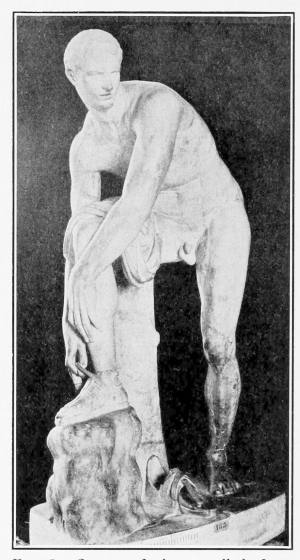
Heads of Hermes are often found with victor fillets,719 and some of these doubtless are from statues of victors. The beautiful fourth-century B. C. Parian marble head of a beardless youth in the British Museum, known as the Aberdeen head,720 which resembles so strongly the Praxitelean Hermes, although lacking its delicacy, may be from a victor statue assimilated to the god, for holes show that it once wore a metal wreath. In Roman days the Doryphoros of Polykleitos, as we have seen, was adapted to represent Hermes, and was set up in various palæstræ and gymnasia. The Naples copy of the Doryphoros stood in the Palaistra of Pompeii,721 and statues of ephebes carrying lances (hastae, δόρατα) and called Achilleae by Pliny,722 which must have been largely copies of Polykleitos’ great statue, were set up in gymnasia. A later type of Hermes-head often appeared on bodies of the Doryphoros,723 while other statues, showing the body of the Doryphoros draped with the chlamys,724 and many torsos following the attitude and form of this statue, have the chlamys, which shows that they were intended for the god.725 Hermes in the Doryphoros pose, in a bronze of the British Museum,726 is probably intended for an athlete. Furtwaengler has shown727 that the old Argive schema of the boxer Aristion at Olympia by Polykleitos728 was used in the master’s circle for statues of Hermes. The best preserved example of a number of existing statues of this type is one in Lansdowne House, London,729 in the pose of the Aristion, holding an object—probably a kerykeion—in the hand and a chlamys over the left shoulder.
Athlete Statues Assimilated to Types of Apollo.
Apollo figures in mythology as an athlete. In the Iliad, at the opening of the boxing match between Epeios and Euryalos,730 he is mentioned as the god of boxing, which refers, perhaps, to his presiding over the education of youths (κουροτρόφος) and to his gift of manly prowess. Pausanias records that he overcame Hermes in running and Ares in boxing.731 He gives these victories of the god as the reason why the flute played a Pythian air at the later pentathlon. Plutarch says that the Delphians sacrificed to Apollo the boxer (πύκτης), and the Cretans and Spartans to Apollo the runner (δρομαῖος).732 Apollo’s fight with Herakles to wrest from the hero the stolen tripod of Delphi,733 which is the subject of many surviving works of art,734 is outside the realm of athletics. As with Hermes, it is often difficult to distinguish between statues of Apollo and those of victors assimilated to his type. A good instance of this doubt is afforded by the long and indecisive discussion of the monument represented by several replicas, especially by the Choiseul-Gouffier statue in the British Museum (Pl. 7A), and the so-called Apollo-on-the-Omphalos (Pl. 7B) found in 1862 in the ruins of the theatre of Dionysos at Athens, and now in the National Museum there.735 The bronze original of these marble copies must have been famous, to judge from the number of replicas of it. It has been ascribed to many different artists—to Kalamis, Pythagoras, Alkamenes, Pasiteles,736 to one on more, to another on less probability. As A. H. Smith has pointed out, the krobylos treatment of the hair almost certainly indicates an Attic sculptor of the first half of the fifth century B. C. But here again the main interest in these copies is to determine whether the original represented Apollo or an athlete. The connection between the Athens replica and the omphalos found with it is all but disproved737 and can not be used as evidence that the statue represents the god. However, the original has been called an Apollo because of the presence of a quiver on certain of the copies. Thus, while we have a tree-trunk beside the Choiseul-Gouffier example, we have a quiver on the copy in the Palazzo Torlonia in Rome,738 and on a similar statue in the Fridericianum in Kassel,739 and both tree and quiver on the fragment of a leg from the Palatine now in the Museo delle Terme.740 The Ventnor head in the British Museum741 has long locks suited to Apollo, and the head from Kyrene there742 was actually found in a temple of Apollo. It has also been pointed out that the head of a similar figure, undoubtedly an Apollo, appears on a relief in the Capitoline Museum,743 and a similar figure is found on a red-figured krater in Bologna, which shows the god standing on a pillar with a laurel wreath in the lowered left hand and a bowl in the right.744 On coins of Athens, moreover, we see the figure of Apollo in a similar attitude with a laurel wreath in the lowered right hand and a bow in the left.745 From such evidence a good case for an Apollo has been made out by many scholars—A. H. Smith, Winter,746 Helbig,747 Conze,748 Furtwaengler,749 Schreiber,750 Dickins, and others. The evidence of the quiver in the delle Terme fragment and the Torlonia replica is looked upon as a deliberate device of the copyist to indicate the god. The attempt especially to connect it with the Apollo Alexikakos of Kalamis751 must certainly fall, since the date is about the only thing in its favor. In the long list of statues ascribed to this sculptor,752 there is none of an athlete, and the Choiseul-Gouffier type, whether it represents Apollo or an athlete, has a markedly athletic character. If the Delphi Charioteer (Fig. 66) be ascribed to Kalamis, certainly this type of statue can have nothing to do with him or his school. Nor is the type at all identical with the Alexikakos appearing on coins of Athens,753 in which the locks of hair, in the true archaic fashion of a cultus statue, fall down over the god’s shoulders. Besides, the work of Kalamis, characterized by λεπτότης and χάρις,754 must have been of the delicate later archaic style of the transition period.
PLATE 7A Statue of the so-called Apollo Choiseul-Gouffier. British Museum, London. PLATE 7B Statue of the so-called Apollo-on-the-Omphalos. National Museum, Athens.
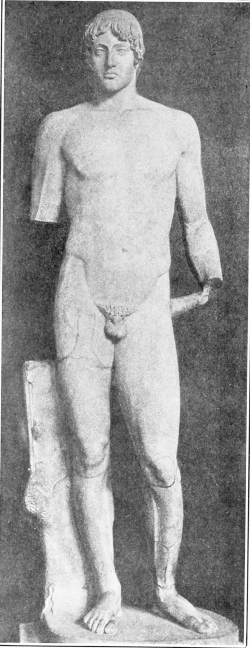
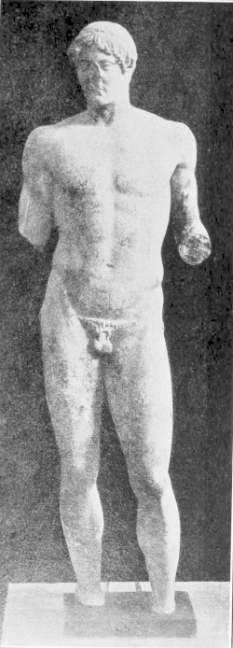
Waldstein, however, has made a good case against the evidence adduced for interpreting the original as Apollo and he believes that the statue represents an athlete.755 The thongs thrown over the stump in the Choiseul-Gouffier statue, doubtless those of a boxer, seem to point to an athlete for that copy at least. The muscular form and athletic coiffure of all the copies also point to the same conclusion, even if Waldstein’s ascription of the original statue to the boxer Euthymos, whose statue by Pythagoras of Rhegion stood in the Altis at Olympia,756 is only a guess. Wolters thinks the Choiseul-Gouffier statue may represent an athlete, but is against Waldstein’s ascription of the work to Pythagoras.757
Though differing in detail, the rendering of the hair, common to all the replicas, is a purely athletic coiffure. The argument for attributing the original to Apollo, based on the curls around the face, is of no importance, since a similar coiffure appears on many ephebe heads by various Attic masters of the same or a slightly earlier period. The hair treatment on a little-known replica of the head in the British Museum758 gives us an additional argument in determining whether the original was an Apollo or not. On this head there are two corkscrew curls side by side just back of the ears, which are so inorganically attached and so unsuited to the style of head as to make us believe that they were added by the copyist, even if their absence in other copies were not proof enough of this fact. Apparently the copyist adopted a well-known type of athlete and tried to convert it into an Apollo by the use of this Apolline hair attribute. The only other Apolline attribute, the quiver on the copies in the Palazzo Torlonia759 and Museo delle Terme, may have been added as a fortuitous adjunct by the copyists, who were converting an original athlete statue into one of Apollo. It may be added, also, that the quiver does not always indicate the god, as we shall see in discussing the Delian Diadoumenos (Pl. 18). When we consider, therefore, the athletic pose, the massive outline and proportions, the high-arched chest, the muscular arms and thighs, the accentuation of the veins,760 the fashion of the hair, and the relatively small size of the head, together with the presence of the boxing-thongs on the London example, it seems reasonable to conclude that in this series of copies we may see an original athlete statue, which in certain cases was later transformed into statues of Apollo. Even if the original was actually an Apollo, its proportions were far better suited to the patron of athletic exercises than to the leader of a celestial choir.
An instance of the similar use of the same type of head is shown by the colossal statue of Apollo unearthed at Olympia.761 Here we see the same coiffure as in the heads discussed, but the presence of the remnants of a lyre indubitably shows that this copy was intended for Apollo, and so it has been rightly assigned by Treu, not to the fifth, but to a later century. When long hair was no longer the fashion for athletes, a later artist might mistakenly think that the earlier plaits were genuinely Apolline, though we know that they were common to all early athletic art. Another head in the British Museum has been ably discussed by Mrs. Strong,762 who shows that it comes from an Apollo and not from an athlete statue. It is similar to an Apollo pictured on a stater struck at Mytilene about 400 B. C.,763 and consequently, like the statue from Olympia, it is merely an instance of the process of converting an athlete statue into that of an Apollo.
The marble copy of the Diadoumenos of Polykleitos, found on the island of Delos in 1894, and now in the National Museum in Athens764 (Pl. 18), has a chlamys and a quiver introduced on the marble support against the right leg. Until recently these attributes were regarded as the arbitrary introductions of the Hellenistic copyist, who wished to convert the famous athlete statue into one of Apollo, but lately it has been suggested that they belonged to the original statue, which is assumed to have represented Apollo. Thus, Hauser has propounded the theory that the Diadoumenos was originally an Apollo.765 He does not believe that the Delian sculptor could have transformed a short-haired athlete into an Apollo, since the typical Apollo after the time of Praxiteles was never represented as athletic. He later supported his theory that the Diadoumenos was originally an Apollo by the evidence of a bronze statuette and a Delphian coin, and reasserted his view that so virile a short-haired Apollo did not originate with the later copyist, but in the fifth century B. C.766 Hauser’s argument that Apollo was the original of the Diadoumenos seems as unsuccessful as his contention that Polykleitos’ other great creation, the Doryphoros, is to be classed as an Achilles.767 Loewy has sufficiently opposed Hauser’s theory of the Diadoumenos, by showing that the palm-tree prop in all the marble replicas of that statue points to athletic victories.768 He rightly explains the Apolline attributes of the Delian copy as the perfectly natural additions of an artist who lived on the island reputed to be the birthplace of the god. His ascription of the Polykleitan statue to the pentathlete Pythokles, the base of whose statue at Olympia has been found,769 is doubtful. More recently Ada Maviglia has shown the literary grounds for regarding the Diadoumenos as an athlete, and not an Apollo.770