Chapter I · EARLY GREEK GAMES AND PRIZES.
Reading edition
Plate 1 and Figures 1 and 2.
Before attempting to trace historically the development of monuments of victors in the gymnic and hippic contests at Olympia, and before attempting to reconstruct their different types, it will be useful to devote a preliminary chapter to the early history of Greek athletics and victor prizes in general.
It is a truism that the origin of Greek athletics is not to be found in the recently discovered Aegean civilization of Crete, nor in the latest phase of the same culture on Mycenæan sites of the mainland of Greece. Their origin is not to be sought in the indigenous Mediterranean stock which produced that culture, but rather among the northern invaders of Greece, the fair-haired Achæans of the Homeric poems, and especially among the later Dorians in the Peloponnesus. It was to the physical vigor of these strangers rather than to the more artistic nature of the Mediterraneans that the later Greeks owed their interest in sports. As these invaders settled themselves most firmly in the Peloponnesus, Greek athletics may be said to be chiefly the product of South Greece. It was here that three of the four national festivals grew up—at Olympia, Nemea, and on the Corinthian Isthmus. It was in the schools of Argos and Sikyon that athletic sculpture flourished best and in later Greek history physical exercise was most fully developed among the Dorian Spartans.1
SPORTS IN CRETE.
Centuries before the Achæan civilization of Greece had bloomed, there developed among the Minoans of Crete a passion for certain acrobatic performances and for gymnastics. These Cretans, though strongly influenced by Egypt and the East, did not borrow their love of sport from outside any more than did the later Achæans. On the walls of the tombs of Beni-Hasan on the Nile are pictured many athletic sports, including a series of several hundred wrestling groups,2 but these sports did not influence, so far as we know, Cretan athletics. At Knossos bull-grappling seems to have been the national sport, as we see from the frescoes on the palace walls. In the absence of the horse, which did not appear in early Aegean times in Crete, it is not difficult to understand the development of gymnastic sports with bulls. At Knossos a seal has been found which shows the rude drawing of a vessel with rowers seated under a canopy, superimposed on which is drawn the greater portion of a huge horse. In this design, dating from about 1600 B. C. and synchronizing with the earlier part of the eighteenth Egyptian dynasty, we doubtless see a graphic way of indicating the cargo, and consequently a contemporary record, it may be, of the first importation of horses from Libya into Crete.3
The Cretan bull seems to have been a much larger animal than the species found upon the island to-day.4 Bull-grappling at Knossos was the sport of female as well as male toreadors. A fragmentary rectangular fresco, dating from about 1500 B. C. (Pl. 1), was discovered there by Sir Arthur Evans in 1901 and is now in the Candia museum. It is executed with extraordinary spirit and shows a huge bull rushing forward with lowered head and tail straight out. A man is in the act of turning a somersault on its back, his legs in the air, his arms grasping the bull’s body and his head raised, looking back to the rear of the animal, where a cowgirl is standing, holding out her arms to catch his flying figure as soon as his feat is concluded. Another cowgirl, at the extreme left, seems to be suspended from the bull’s horns, which pass under her armpits, while she catches hold further up. However, she is not being tossed, but is taking position preliminary to leaping over the bull’s back. Both the man and the women wear striped boots and bracelets; the women are apparently distinguished by their white skin, short drawers, yellow sashes embroidered with red, and the red-and-blue diadems around their brows.[5] On the opposite wall a similar scene was pictured; among its stucco fragments was found the representation of the arm and shoulder of a woman grasping a bull by the horns. The fragmentary representation of another woman and man was also found.
PLATE 1
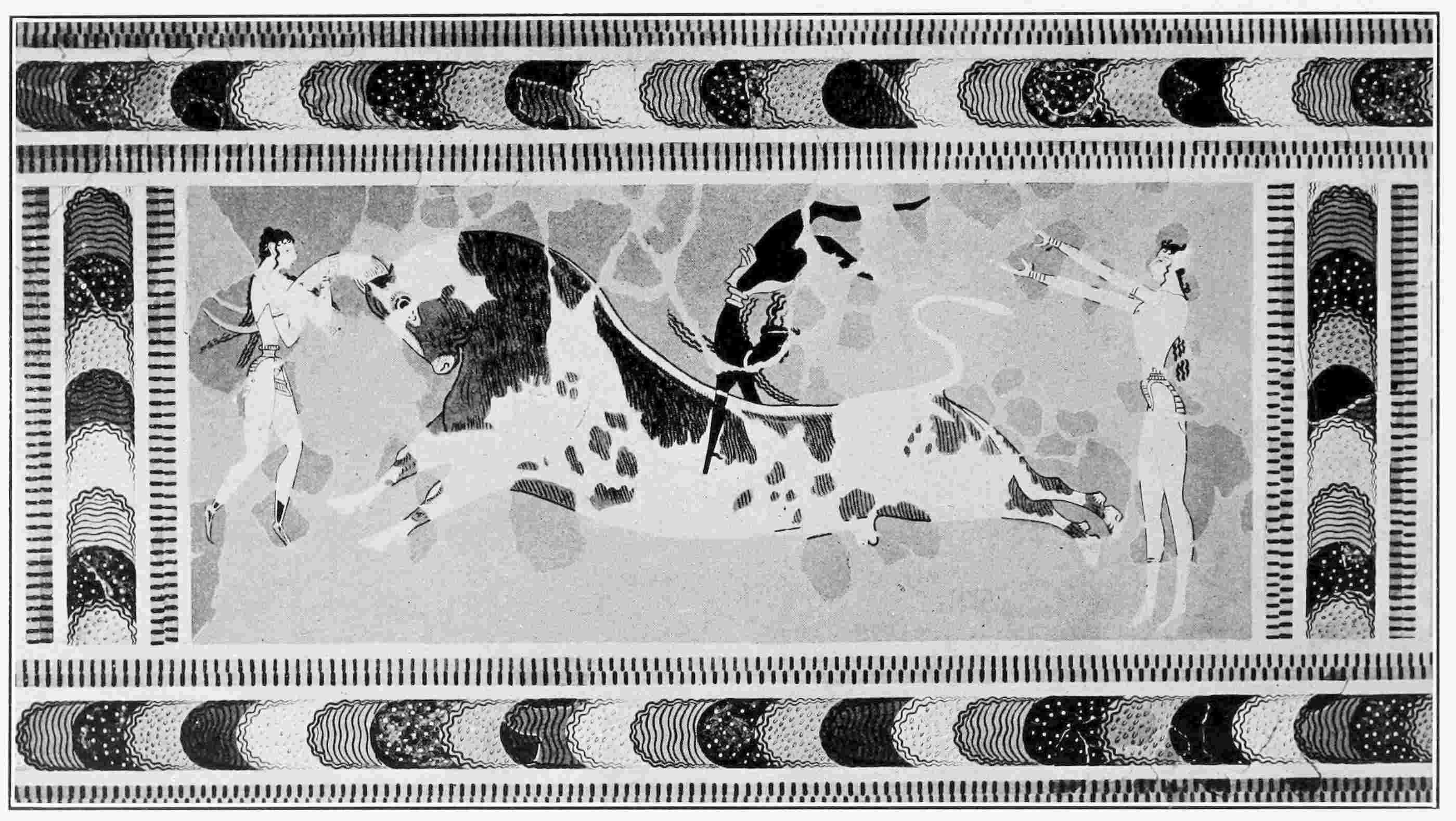
Bull-grappling Scene. Wall-painting from Knossos. Museum of Candia.
A very similar scene has long been known from a fresco painting from Tiryns, now in Athens.6 A bull is represented galloping to the left, while a man7 clings to its horns with his right hand and is swept along with one foot lightly touching the bull’s back and the other swung aloft. Most early writers interpreted this scene as a bull-hunt, the artist having drawn the hunter above the bull through ignorance of perspective. The execution is very inferior, three attempts of the bungling painter being visible in the painting of the tail and the front legs. Others saw in it the representation of an acrobat showing his dexterity by leaping upon the back of an animal in full career, recalling the description of such a trick in the Iliad, where Ajax is represented as rushing over the plain like a man who, while driving four horses, leaps from horse to horse.8 But this figure must take its place side by side with the one from Knossos just described as another bull-grappling scene. That such sports were not held in the open air, but in an enclosed courtyard, is shown by the seal from Praisos now in the Candia Museum, which depicts a man vaulting on the back of a gigantic ox within a paved enclosure.9 Doubtless the theatral areas discovered at Phaistos by the Italian Archæological Mission10 and at Knossos by Sir Arthur Evans in 190311 were not large enough for bull scenes and were used merely for ceremonial dancing and perhaps for the boxing matches to be described.12 Similar acrobats are doubtless to be recognized in the two beautiful ivory statuettes, only 11.5 inches in height, of so-called leapers, found by Dr. Evans at Knossos in 1901.13 These masterpieces of the late Minoan II period represent acrobats (one is probably a woman) darting through the air. “The life, the freedom, the élan of these figures is nothing short of marvellous,” writes Dr. Evans, who calls attention to the careful physical training shown in their slender legs and in the muscles, even the veins on the back of the hands and the finger-nails being plainly indicated as well as the details of the skinfolds at the joints. They doubtless formed a part of an ivory model of the bull-ring and are meant for miniature toreadors, who were hung in the air by fine gold wires14 over the backs of ivory bulls who stood on the solid ground. The heads of the figures are thrown backwards, a posture suitable for such vaulters, but not for leapers or divers. Minoan art culminated in these statuettes and in certain stucco figures in half relief found also at Knossos. Only a few fragments of these reliefs have survived, most of which were decorative or architectonic in character, though among them were also found human disjecta membra in high relief, such as the fragment of a left forearm holding a horn, and not a pointed vase, as Dr. Evans thought. Here the muscles are well indicated, though the veins are exaggerated.15 This fragment may well be a part of the same bull-grappling scenes as those in the frescoes, as also the life-like image of a bull, the details of whose head, mouth, eyes, and nostrils are full of expression, and whose muscles are perfectly indicated.
When compared with the monuments described, the similarity of details on the design of the Vapheio cups ornamented in repoussé, the “most splendid specimens known of the work of the Minoan goldsmith,”16 never again equalled until the Italian Renaissance, makes it more than possible that here again we have scenes of bull-grappling rather than of bull-hunting. On one cup is represented a quiet pastoral scene—a man tying the legs of a bull with a rope, while two other bulls stand near, amicably licking one another, and a third is quietly grazing. On the other, however, are represented scenes of a very different character. In the centre is a furious bull entangled in a net, which is fastened to a tree; to the left a figure, doubtless a woman, is holding on to a bull’s head, while a man has fallen on his head beside the animal, both man and woman being dressed in the Cretan fashion. A third bull rushes furiously by to the right. Most commentators have seen bull-hunting scenes on both these cups. Thus, on the first cup were represented three scenes in the drama of trapping a bull by means of a tame decoy cow; to the right the bull is starting to go to the rendezvous, while in the center the bull stands by the cow’s side and to the left he is finally trapped and tied.17 On the other cup the furious animal at the left was supposed to have thrown one hunter and to have caught another on its horns. But Mosso’s interpretation of this design seems to be the right one.18 The two persons struggling with the bull have no lasso and so can hardly be hunters; besides, if the bull had impaled a hunter with its horns, the hunter would have been represented with his head up and not down. The figure is, however, uninjured and holds on with its knee bent over one horn and its shoulder against the other; it is merely, therefore, intended for a woman acrobat. The net shown in the centre was never used for hunting wild bulls; more probably it was intended as an obstacle in racing. The fallen man has been standing on the netted bull, which, with the gymnast on its back, was expected to have leaped over the net, but has not succeeded; consequently, the acrobat has been tumbled over the bull’s head.
This ancient Cretan sport seems to have been similar to that known in Thessaly and elsewhere in historical days as τὰ ταυροκαθάψια.19 A survival of it still persists to our day in certain parts of Italy, as, e. g., in the province of Viterbo.20
Acrobatic feats of various sorts were attractive to the later Greeks from the time of Homer down. We have already mentioned one passage from the Iliad in which a driver of four horses leaps from horse to horse in motion. On the shield of Achilles tumblers appeared among the dancers on the dancing-place.21 Patroklos ironically remarks over the body of Kebriones, as the charioteer falls headlong like a diver from his chariot when hit by a missile, that there are tumblers also among the Trojans.22 In later centuries the Athenians evinced a great attraction to acrobatic feats. The story told of Hippokleides23 reveals that high-born Athenians did not disdain to practice them. They appear to have formed a sort of side-show attraction at the Panathenaic festival, as such scenes occur frequently on Attic vases. Thus on an early (imitation?) Panathenaic vase from Kameiros in the Bibliothèque Nationale in Paris,24 there is represented behind the driver a man standing on the back of a horse, armed with a helmet and two shields, while in front another appears to be balancing himself on a pole.
But such acrobatic scenes as those of Crete and later Greece can not properly be classed as athletic. They betoken more the love of excitement than of true sport. The only form of real athletics represented on Minoan monuments, one which was classed in later Greece as one of the national sports, was that of boxing, which seems to have been the favorite gymnastic contest of the Cretans, as it always was of the later Greeks. Boxing scenes appear on seals,25 on a steatite fragment of a pyxis found in 1901 at Knossos and, in conjunction with a bull-grappling Fig. 1.—So-called Boxer Vase, from Hagia Triada (Cast). Museum of Candia. scene, on the so-called Boxer Vase found by the Italians at Hagia Triada (Fig. 1). The vase is a cone-shaped rhyton of steatite, 18 inches high, originally overlaid with gold foil. It belongs to the best period of Cretan art, late Minoan I.26 This vase alone, if no other monumental evidence were at hand, would suffice to show the physical prowess and love of sport of the Minoans. Because of its scenes of boxing and bull-grappling Mosso calls it “the most complete monument that we have of gymnastic exercise in the Mediterranean civilization.”27 The later Greek tradition of the high degree of physical development attained by the Cretans is proved by this monument.28
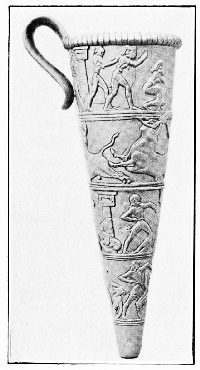
The reliefs are arranged in four horizontal zones.29 One of these, the second from the top, represents a bull-grappling scene, showing two racing bulls, upon the head and horns of one of which a gymnast has vaulted (not being tossed and helpless, as most interpreters think).30 The other three represent boxers in all attitudes of the prize-ring, hitting, guarding, falling, and even kicking, as in the later Greek pankration. Some are victorious, the left arm being extended on guard and the right drawn back to strike; one (in the top zone) is ready to spring, just as Hector was ready to spring on Achilles;31 others are prostrate on the ground with their feet in the air. The violence of the action recalls the boast of Epeios in the famous match in the Iliad that he will break his adversary’s bones.32
The method of attack by the right arm and defense by the left is the same as that formerly used by English pugilists. In the topmost zone the combatants wear helmets with visors, cheek-pieces, and horse-hair plumes, and also shoes; in the third zone down the pugilists also wear helmets, though of a different pattern, while the bottom zone shows figures, perhaps youths, with bare heads. Some of the boxers appear to wear boxing-gloves. In the lowest zone we see the well-known feat of swinging the antagonist up by the legs and throwing him—if we may so conclude from the contorted position of the vanquished, whose legs are in the air.
A similar figure appears in relief on the fragment of a pyxis found at Knossos.33 A youth with clenched fists stands with left arm extended as if to ward off a blow, while his right arm is drawn back and rests on his hip; below we see the bent knee of a prostrate figure, evidently that of his vanquished opponent. The boxer has a wasp-like waist and wears a metal girdle. His left leg is well modeled, the muscles not being exaggerated.
ATHLETICS IN HOMER.
We have evidence, therefore, that the love of sport existed in Crete as it has existed in all countries since. But the comparatively unathletic character of the Aegean culture is shown by the complete absence of athletic representations—apart from bull-grappling scenes—in the art of its last phase at Mycenæ and Tiryns on the mainland. This is an independent argument for the view that the civilization of the mainland was chiefly the product of the old Mediterranean stock, which was finally conquered by the invading Achæans, who are represented in Homer as skilled gymnasts. In Homer we are immediately conscious of being in another world, for here we are in an atmosphere of true athletics, which are fully developed and quite secular in character.34 They are, however, wholly spontaneous, for there are as yet neither meets nor organized training, neither stadia, gymnasia, nor palæstræ; for such an organization of athletics did not exist until the sixth century B. C. But Homer’s account of the funeral games of Patroklos is pervaded by a spirit of true athletics and has a perennial attraction for every lover of sport. Walter Leaf says of the chariot-race, which is the culminating feature of the description, that it is “a piece of narrative as truthful in its characters as it is dramatic and masterly in description.”35 Such a description could have been composed only by a poet who belonged to a people long acquainted with athletics and intensely interested in them. Nestor often speaks of a remoter past, when the gods and heroes contended. Odysseus says he could not have fought with Herakles nor Eurytos, heroes of the olden time, “who contended with the immortal gods.” The Homeric warrior was distinguished from the merchant by his knowledge of sport. Thus Euryalos of the Phaiakians says in no complimentary tone to Odysseus: “No truly, stranger, nor do I think thee at all like one that is skilled in games ... rather art thou such an one as comes and goes in a benched ship, a master of sailors that are merchantmen, one with a memory for his freight, or that hath charge of a cargo homeward bound, and of greedily gotten gains.”36 It is beside the point whether the chief passages in the poems which relate to sports are late in origin or not, even if they are later than 776 B. C., the traditional first Olympiad. In any case the later poet merely followed an older tradition. At the funeral games of Patroklos all the events are practical in character, the natural amusements of men chiefly interested in war. They are, however, not merely military, but are truly athletic. The oldest and most aristocratic of all the events described is the chariot-race—in which the war-chariot is used—the monopoly of the nobles then, as it was always later the sport of kings and the rich.37 Boxing and wrestling come next in importance, already occupying the position of preëminence which they hold in the poems of Pindar. The foot-race between Ajax, the son of Oileus, and Odysseus follows. Of the last four events, three—the single combat between Ajax and Diomedes, the throwing of the solos, and the contest in archery—are admitted to be late additions. The last event of all, the casting of the spear, may be earlier, but we know little about it, as the contest did not take place, Achilles yielding the first prize to Agamemnon. Most of these later events are described in a lifeless manner and have not the vim and compelling interest of the earlier ones. Indeed the contest in archery seems to be treated with a certain amount of ridicule, which shows the contempt of the great nobles for so plebeian a sport. The armed contest, though it is pictured in art certainly as early as the sixth century B. C.,38 never had a place in the later Greek games.39 Jumping, an important part of the later pentathlon, is mentioned but once in the poems, as a feature of the sports of the Phaiakians. But the later pentathlon, as Gardiner says, is certainly not suggested in Homer’s account, though many have assumed it,40 merely because Nestor mentions his former contests at Bouprasion in boxing, in running, in hurling the spear, and in the chariot-race.41 This, however, is not the combination of contests known much later as the pentathlon, in which the same contestants had to compete in the series of events—running, jumping, wrestling, diskos-throwing, and javelin-throwing.
ORIGIN OF GREEK GAMES IN THE CULT OF THE DEAD.
In these games described in the Iliad we see an example of the origin of the later athletic festivals in the cult of the dead. Homer knows only of funeral games42 and there is no trace in the poems of the later athletic meetings held in honor of a god.43 However, the association of the later games with religious festivals held at stated times can be traced to the games with which the funeral of the Homeric chief was celebrated. The oldest example of periodic funeral games in Greece of which we have knowledge were those held in Arkadia in honor of the dead Azan, the father of Kleitor and son of Arkas, at which prizes were offered at least for horse-racing.44
Though the origin of the four national religious festivals in Greece—at Olympia, Delphi, Nemea, and on the Isthmus—is buried in a mass of conflicting legend, certain writers agree in saying that all of them were founded on funeral games, though they were later dedicated to gods.45 Thus the Isthmian were instituted in honor of the dead Melikertes,46 the Nemean in honor of Opheltes or Archemoros,47 the Pythian in honor of the slain Python,48 the Olympian in honor of the hero Pelops.49 To both Pindar and Bacchylides the Olympian games were associated with the tomb of Pelops; Pausanias, on the other hand, records that the ancient Elean writers ascribed their origin to the Idæan Herakles of Crete.50 It was a common tradition that Herakles founded the games, some writers saying that it was the Cretan, others that it was the Greek hero, the son of Zeus and Alkmena.51
Despite the variation in legends relative to the institution of the four national games, we should not doubt the universal tradition that all were funerary in origin. The tradition is confirmed by many lines of argument: by the survival of funeral customs in their later rituals, by the later custom of instituting funeral games in honor of dead warriors both in antiquity and in modern times, and by the testimony of early athletic art in Greece.52 We shall now briefly consider these arguments.
As an example of the survival of funeral customs in later ritual, Pausanias says that the annual officers at Olympia, even in his day, sacrificed a black ram to Pelops.53 The fact that a black victim was offered over a trench instead of on an altar proves that Pelops was still worshipped as a hero and not as a god. The scholiast on Pindar, Ol., I, 146, says that all Peloponnesian lads each year lashed themselves on the grave of Pelops until the blood ran down their backs as a libation to the hero. Furthermore, all the contestants at Olympia sacrificed first to Pelops and then to Zeus.54
Funeral games were held in honor of departed warriors and eminent men all over the Greek world and at all periods, from the legendary games of Patroklos and Pelias and others to those celebrated at Thessalonika in Valerian’s time.55 Thus Miltiades was honored by games on the Thracian Chersonesus,56 Leonidas and Pausanias at Sparta,57 Brasidas at Amphipolis,58 Timoleon at Syracuse,59 and Mausolos at Halikarnassos.60 Alexander instituted games in honor of the dead Hephaistion61 and the conqueror himself was honored in a similar way.62 The Eleutheria were celebrated at Platæa at stated times in honor of the soldiers who fell there against the Medes in 479 B. C.,63 and in the Academy a festival was held under the direction of the polemarch in honor of the Athenian soldiers who had died for their country and were buried in the Kerameikos.64 Funeral games were also common in Italy. We find athletic scenes decorating Etruscan tombs—including boxing, wrestling, horse-racing, and chariot-racing.65 The Romans borrowed their funeral games from Etruria as well as their gladiatorial shows, which were doubtless also funerary in origin.66 Frazer cites examples of the custom of instituting games in honor of dead warriors among many modern peoples, Circassians, Chewsurs of the Caucasus, Siamese, Kirghiz, in India, and among the North American Indian tribes. Gardiner notes the Irish fairs in honor of a departed chief, which existed from pagan days down to the last century.67
The testimony of early Greek athletic art also points to the same funerary origin of the games. The funeral games of Pelias and those held by Akastos in honor of his father were depicted respectively on the two most famous monuments of early Greek decorative art, on the chest of Kypselos dedicated in the Heraion at Olympia and on the throne of Apollo at Amyklai in Lakonia, the latter being the work of the Ionian sculptor Bathykles. Though both these works are lost, the description of one of them at least, that of the chest, by Pausanias,68 is so detailed and precise that the scenes represented upon it have been paralleled figure for figure on early Ionian (especially Chalkidian) and Corinthian vases, contemporary or later, and on Corinthian and Argive decorative bronze reliefs. Many attempts have been made, therefore, to restore the chest, and as more monuments become known, which throw light on the composition and types, these attempts are constantly growing in certainty, even though conjecture may continue to enter in.69
The figures were wrought in relief, partly in ivory and gold and partly in the cedar wood itself, deployed on its surface in a series of bands, such as we commonly see on early vases. This use of gold and ivory is the first example in Greek art of the custom employed by Pheidias and other sculptors of the great age of Greek sculpture. We have already noted its use in the ivory acrobats from Crete, which were made, perhaps, a thousand years before the chest.70 Out of the thirty-three scenes depicted on its surface all but two or three were mythological, and among these were scenes from the funeral games of Pelias, including a two-horse chariot-race (P., §9), a boxing and wrestling match (§10), a foot-race, quoit-throwing, and a victor represented as being crowned (§10), and prize tripods (§11).
The most valuable parallel to some of the scenes described by Pausanias is found on the Amphiaraos vase in Berlin,71 dating from the sixth century B. C., on which the wrestling match and chariot-race correspond surprisingly well with the descriptions of Pausanias, despite certain differences in detail. Another archaic vase depicts a two-horse chariot-race and the parting of Amphiaraos and Eriphyle.72 The scenes on this latter vase appear to have been copied from those on the chest, and it is possible that the scenes on the Berlin vase had the same origin.
Funeral games are commonly pictured on early vases. Thus on a proto-Attic amphora, discovered by the British School of Athens in excavating the Gymnasion of Kynosarges, there are groups of wrestlers and chariot-racers. The wrestling bout here, however, seems to be to the death, as the victor has his adversary by the throat with both hands. It may be a mythological scene, perhaps representing the bout between Herakles and Antaios. A still earlier representation of funeral games is shown by a Dipylon geometric vase from the Akropolis now in Copenhagen, dating back possibly to the eighth century B. C.73 On one side two nude men, who have grasped each other by the arms, are ready to stab one another with swords. This may represent, however, as Gardiner suggests, only a mimic contest. On the other side are two boxers standing between groups of warriors and dancers. A similar scene in repoussé appears on a Cypriote silver vase from Etruria now in the Uffizi in Florence.74 We should also, in this connection, note again the reliefs representing funeral games, which appear on the sixth-century sarcophagus from Klazomenai already mentioned.75 Here is represented a combat of armed men; amid chariots stand groups of men armed with helmets, shields, and spears, while flute-players stand between them; at either end is a pillar with a prize vase upon it; against one leans a naked man with a staff, doubtless intended to represent the spirit of the deceased in whose honor the games are being held.
Games in honor of the dead tended to become periodic. The tomb of the honored warriors became a rallying-point for neighboring people, who would convene to see the games. While some of these games were destined never to transcend local importance, others developed into the Panhellenic festivals. As the worship of ancestors became metamorphosed into that of heroes, the games became part of hero cults, which antedated those of the Olympian gods. But as the gods gradually superseded the heroes in the popular religion, they usurped the sanctuaries and the games held there, which had long been a part of the earlier worship. We are not here concerned, however, with the difficult question of the origin of funeral games. They may have taken the place of earlier human sacrifices, which would explain the armed fight at the games of Patroklos and its appearance on archaic vases and sarcophagi; or they may have commemorated early contests of succession, which would explain many mythical contests like the chariot-race between Pelops and Oinomaos for Hippodameia, or the wrestling match between Zeus and Kronos. In any case such games would never have attained the importance which they did attain in Greece, if it had not been for the athletic spirit and love of competition so characteristic of the Hellenic race. Whatever their origin, therefore, there is little doubt that out of them developed the great games of historic Greece. The constant relationship between Greek religion and Greek athletics can be explained in no other way.76
EARLY HISTORY OF THE FOUR NATIONAL GAMES.
By the beginning of the sixth century B. C. the athletic spirit displayed in the Homeric poems had given rise to the four national festivals—at Olympia, Delphi, Nemea, and on the Isthmus. On these four, many lesser games were modeled.77 The origin of all these, as we have already remarked, is lost in a mass of legend. The myths of the origin of Olympia are particularly conflicting. We are practically certain, however, that Olympia as a sanctuary preceded the advent of the Achæans into the Peloponnesus, and that the foundation of the games preceded the coming of the Dorians, but was probably later than that of the Achæans. The importance of the games dates from the time after the Dorian invasion of the Peloponnesus, when the warring peoples finally became pacified.78 For centuries Olympia was overshadowed by Delphi and the Ionian festival on Delos. The importance of the latter festival in the eighth and seventh centuries B. C. is shown by the Homeric Hymn to the Delian Apollo. Only by the beginning of the seventh century had Olympia begun to gain its prestige. The pre-Dorian Pisatai, in whose territory the sanctuary was situated, probably controlled it early. The Dorian allies, the Eleans, whom legend had King Oxylos lead into the Peloponnesus from Aitolia,79 tried to wrest this control from the Pisatai, who, however, aided by religious reverence for the sanctuary, were able to maintain their rights. On account of the conflict the games languished, until finally a truce was made by the two factions and the games were re-established under their common management. This work was ascribed to Iphitos and Kleosthenes, kings respectively of Elis and Pisa, and to Lykourgos of Sparta.80 The dual control was not successful, as the jealous Pisatai constantly tried to regain their old honor; but the Eleans, supported by the Spartans, prevailed and finally, after the Persian wars, destroyed Pisa and the other revolting cities of Triphylia and henceforth remained in sole control. The restoration of the games under Iphitos and his colleagues took place in 776 B. C., from which date the festival was celebrated every fourth year, until it was finally abolished by the Roman emperor Theodosius at the end of the fourth century A. D. In 776 Koroibos of Elis won the foot-race and this was the first dated Olympiad in the Olympian register,81 and from it, as Pausanias says,82 the unbroken tradition of the Olympiads began. This history of Olympia is very different from the orthodox mythical story told by Pausanias and Strabo and based on the “ancient writings of the Eleans.”83 According to it the games were originally instituted by the Eleans under Oxylos and refounded by Iphitos, his descendant, together with Lykourgos, still under the management of the Eleans. In Ol. 8 the Pisatans invoked the aid of the Argive king Pheidon and dispossessed the Eleans, but they lost the control of Olympia in the next Olympiad. In Ol. 28 Elis, during a war with Dyme, allowed the Pisatans to celebrate the games. Six Olympiads later the king of Pisa came to Olympia with an army and took charge. The story leaves the Pisatans in control from about Olympiads 30 to 51, but some time between Ols. 48 and 52 the Eleans defeated Pisa and destroyed it, and henceforth controlled the games. Such a story was manifestly a contrivance by the later priests of Elis to justify their control of the games through a prior claim. It is contradicted by all the evidence.84 The antiquity of Olympia is known to us from the results of excavations and from its religious history. The latest excavations on the site have disclosed the remains of six prehistoric buildings with apsidal endings, below the geometric stratum, upon the site of what used to be considered the remnants of the great altar of Zeus.85 Such an inference is borne out by many primitive features in the religious history of the sanctuary. The altar of Kronos on the hill to the north of the Altis was earlier than that of Zeus; an earth altar antedated that of Zeus, while a survival of the earlier worship of the powers of the underworld is seen in the custom, lasting through later centuries, of allowing only one woman, the priestess of Demeter Chamyne, to witness the games. We also know that the worship of the Pelasgian Hera antedated that of the Hellenic Zeus; her temple, the Heraion, is the most ancient of which the foundations still stand, a temple built of stone, wood, and sun-dried bricks, whose origin is to be referred to the tenth, if not to the eleventh, century B. C.86 We have already remarked that the worship of the hero Pelops preceded that of the god Zeus.87 All such indications attest the high antiquity of Olympia. That it is not mentioned in Homer, while Delphi and Dodona are, only proves that in the poet’s time it was still merely a local shrine. Not until the beginning of the sixth century B. C. did it attain the distinction, which it retained ever afterwards, of being the foremost national festival of Hellas.88
The periodical celebration of the three other national festivals was not dated—except in legend—before the early years of the sixth century B. C., though local festivals must have existed also on these sites long before.89 The old music festival at Delphi, which finally was held every eight years,90 was changed in 586 B. C., in consequence of the Sacred War,91 into a Panhellenic festival celebrated thereafter every four years (pentaëteris). It was under the presidency of the Amphiktyonic League, which introduced athletic and equestrian events copied from those at Olympia92 and replaced the older money prizes with the simple bay wreath. About the same time the Nemean and Isthmian games were instituted. The local games at Nemea, said to have been founded by Adrastos in honor of a child, were reorganized some time before 573 B. C., the first Nemead.93 Thereafter they were celebrated every two years, in the second and fourth of the corresponding Olympiads.94 They were administered in honor of Zeus by the small town of Kleonai under Argive influence. The games were transferred to Argos some time between 460 B. C. and the close of the third century B. C. Centuries later, Hadrian revived the prestige of the games at Argos. The games held on the Isthmus also originated as an old local festival, which was revived in 586 or 582 B. C. We are not sure whether they were refounded in Poseidon’s honor by Periandros or after the death of Psammetichos in commemoration of the ending of the tyranny at Corinth. The geographical location of Corinth, the meeting-place of East and West, involved it in many wars, and therefore the Isthmian games never attained the prestige of the other national festivals; they were held every two years in the spring of the second and fourth years of the corresponding Olympiads and were administered by Corinth.95
Besides the four national games, many Greek cities had purely local ones, some of which originated in prehistoric days in honor of hero cults, while others were founded at historical dates. Athens was particularly favored in having many such local festivals. The most important of these were the Panathenaic games in honor of Athena, which developed from earlier annual Athenaia or Panathenaia. The festival was remodeled, or perhaps founded, just before Peisistratos seized the tyranny (561–560 B. C.), possibly by Solon, who died 560–559 B. C. The name certainly points to the unity of Athens promoted by Solon, if not to the earlier unification of the village communities of Attika ascribed to Theseus. In any case, under Peisistratos it became something more than a local festival, as the recitation of Homer became a feature of it. Following the games at Delphi and Olympia, the Great Panathenaia were held every four years (the third year of each Olympiad) in the month of Hekatombaion (July), while the more ancient annual festival continued yearly under the name of the Little Panathenaia. There were musical, literary, and athletic contests. The central feature of the festival was the procession which ascended from the lower city to the Parthenon on the Akropolis to offer the goddess a robe woven by noble Athenian maidens and matrons.96 This procession is known to us in detail from the great Parthenon frieze. The Theseia exemplify a festival whose origin can be definitely dated. Kimon, the son of the hero of Marathon, in 469 B. C., discovered the supposed bones of the national hero Theseus on the island of Skyros. The Delphic oracle counseled the Athenians to place them in an honorable resting-place. Perhaps there was a legend that the hero was buried on Skyros; in any case a grave was found there which contained the corpse of a warrior of great size, and this was brought back to Athens as the actual remains of Theseus. Thereafter an annual festival was celebrated by the Athenian epheboi, comprising military contests and athletic events—stade, dolichos, and diaulos running races, wrestling, boxing, pankration, hoplite running, etc. It began on the sixth of Pyanepsion (October), and was followed by the Epitaphia, a funeral festival in honor of national heroes and youths who had fallen fighting for Athens.97 Athletic games were held at the Herakleia in honor of Herakles at Marathon in the month of Metageitnion, and had attained great popularity by the time of Pindar.98 The Eleusinia, in honor of Demeter, took place annually in Athens in the month of Boëdromion, when horse-races and musical and other contests were held. This Attic festival claimed a greater antiquity even than Olympia. The great national festivals encouraged these smaller local ones, so that they attracted competitors from the whole Greek world.
EARLY PRIZES FOR ATHLETES.
The prizes which were offered at the early games in Greece were uniformly articles of value. Their value, however, was regarded not so much in the light of rewards to the victors as proofs of the generous spirit of the holders of the games, who thereby celebrated the dead in whose honor the contest was held. In Homer’s account of the funeral games of Patroklos, each contestant, whether victorious or not, received a prize. In one case a prize was given where the contest was not held. In the chariot-race five prizes were offered: for the winner a slave girl and a tripod; for the second best a six-year-old mare in foal; for the third a cauldron; for the fourth two talents of gold; and for the last a two-handled cup.99 For the wrestling match the winner received a tripod worth twelve oxen, while the vanquished received a skilled slave woman worth four oxen.100 For the boxing match a mule was the first prize and a two-handled cup the second.101 For the foot-race a silver bowl of Sidonian make, an ox, and half a talent of gold were the prizes.102
Hesiod records his winning a tripod for a victory gained in singing at the games of Amphidamas at Chalkis.103 Tripods were the commonest prizes at all early games and it was not till later that they became connected especially with Apollo’s worship. They were presented for all sorts of contests, for chariot-racing,104 horse-racing,105 the foot-race,106 boxing,107 and wrestling.108 They were presented at various games in honor of different gods and heroes: e. g., those in honor of Apollo at the Triopia109 and Panionia of Mykale;110 of Dionysos at Athens and Rhodes;111 of Herakles at the Herakleia of Thebes and elsewhere;112 of Pelias;113 of Patroklos.114 They were kept in temples dedicated to various gods: e. g., in those of Apollo at Delphi, at Amyklai,115 and on Delos,116 at the Ptoian sanctuary117 and in the Ismenion at Thebes;118 in the temples of Zeus at Olympia and Dodona;119 of Herakles at Thebes;120 at the Hierothesion in Messene,121 etc. Later, because it served the Pythian priestess, the tripod became a part of the Apolline cult and the special attribute of that god.122 Gold and silver vessels and articles of bronze were everywhere used as prizes. In early days bronze was very valuable. Pindar proves this for games held in Achaia and Arkadia;123 and it continued to be used in later times, as, e. g., at the Panathenaia, where a hydria of bronze was a prize in the torch-race.124 At the lesser games all sorts of articles were offered, merely for their value. Thus a shield was offered at the Argive Heraia,125 a bowl at the games in honor of Aiakos on Aegina,126 silver cups at the Marathonian Herakleia127 and at the Sikyonian Pythia,128 a cloak at Pellene,129 apparently a cuirass at Argos,130 and jars of oil from sacred trees at the Panathenaia.131 A kettle is mentioned in the Anthology;132 an inscribed cauldron from Cumae, which was a prize at the games there in honor of Onomastos, is in the British Museum,133 while measures of barley and corn were prizes at the Eleusinia.134 While presents of value continued to be given at the local games,135 a simple wreath of leaves gradually came to be the prize offered the victor at the great national festivals. Pausanias136 says that this was composed of wild olive (κότινος) at Olympia, of laurel (δάφνη) at Delphi, of pine (πίτυς) at the Isthmus, and of celery (σέλινον) at Nemea. Phlegon says that the olive wreath was first used by Iphitos in Ol. 7 ( = 752 B. C.), when it was given to the Messenian runner Daïkles,137 and that for the preceding Olympiads there was no crown.138 Probably before that date tripods and other articles of value were the prizes at Olympia, as we know they were elsewhere. Pausanias says that the wild olive came from the land of the Hyperboreans.139 Pindar calls it merely olive (ἐλαία), and not wild olive.140 The Athenian tradition was that the olive which Herakles planted at Olympia was a shoot of a sacred tree which grew on the banks of the Ilissos in Attica.141 Phlegon also says that the first crown came from Attika. In later days the Olympic wreaths were cut from the “Olive of the Faircrown”;142 its branches were cut with a golden sickle by a boy whose parents must be living;143 it grew at Olympia in a spot near the so-called Pantheion,144 which was probably a grove behind the temple of Zeus.145 The laurel prize at the Pythian games replaced the older articles of value or money in 582 B. C.146 It came from Tempe and was plucked by a boy whose parents must be living.147 The wreath is seen on late Delphian coins of the imperial age.148 Lucian also states that apples were given as prizes at Delphi.149 Wild celery was the prize at the Isthmus in the time of Pindar.150 It was dried or withered to differentiate it from the fresh celery used at Nemea.151 Later writers say that the wreath was of the leaves of the pine,152 which was the tree sacred to Poseidon. Probably pine leaves composed the older wreath, a practice certainly revived again in later Roman imperial days;153 for while on coins of Augustus and Nero celery is represented, those of Antoninus Pius and Lucius Verus show pine.154 A row of pine trees lined the approach to Poseidon’s sanctuary.155 The prize at Nemea was celery and not parsley, as many wrongly interpret the wreath appearing on Selinuntian coins.156 Pausanias also states that at most Greek games a palm wreath was placed in the victor’s right hand.157 The palm as a symbol of victory occurs first toward the end of the fifth century B. C.158
DEDICATION OF ATHLETE PRIZES.
Just as soldiers on returning from successful campaigns might dedicate their spoils of victory, victors in athletic contests might consecrate to the gods their prizes. In the Homeric poems we have no certain evidence of such a custom. A Delphic tripod was ascribed to Diomedes and possibly this was a prize won at the funeral games in honor of Patroklos.159 The first literary example of such a dedication of which we are certain is the prize tripod dedicated to the Helikonian Muses by Hesiod.160 Frequently such dedications were tripods; thus a Pythian tripod was dedicated to Herakles at Thebes by the Arkadian musician Echembrotos in 586 B. C.;161 a tripod was dedicated in the sixth century B. C. or perhaps earlier at Athens for some acrobatic or juggling trick;162 a victorious boxer dedicated one at Thebes.163 It became customary by the fifth century B. C. for victors at the Triopia to offer prize tripods to Apollo.164 Tripods or fragments of them have been found at Olympia165 and elsewhere. Many other objects were also offered.166 Sometimes a victor would dedicate the object by which he won his victory instead of his prize, just as a soldier might dedicate his arms instead of his spoils of war. Certain types of victors, e. g., those especially in running, the race in armor, singing, etc., would be excluded from making such dedications owing to the nature of the contest. Pausanias167 tells us, for instance, that twenty-five bronze shields were kept in the temple of Zeus at Olympia for the use of hoplite runners, which shows that these runners did not use all at least of their own armor. In some cases diskoi were lent to pentathletes. Pausanias168 says that three quoits were kept in the treasury of the Sikyonians at Olympia for use in the pentathlon. There are, however, as we shall see, instances of quoits being dedicated by victors. The pentathlete might consecrate either his diskos, javelin, or jumping-weights.169 Perhaps the huge red-sandstone block of the sixth century B. C., weighing 315 pounds and inscribed with the name and feat of Bybon, may have been such an ex voto,170 since Pausanias says the contestants at Olympia originally used stones for quoits.171 A stone, weighing 480 kilograms (about 1,056 pounds), was found on Thera, inscribed “Eumastos raised me from the ground.”172 Poplios (Publius) Asklepiades, who won the pentathlon at Olympia in the third century A. D.,173 dedicated a bronze diskos to Zeus, showing the old custom was kept up till late. Many bronze diskoi have been found in the excavations of the Altis.174 We have instances of the dedication of jumping-weights (ἁλτῆρες).175 Examples of dedicated strigils have been found at Olympia.176 Torches were dedicated at Athens.177 Actors dedicated their masks,178 while some of the ivory lyres and plectra conserved in the Parthenon were probably offerings of musical victors at the Panathenaic games.179 Equestrian victors dedicated their chariots, or models of them, and their horses. These models might be large or small. We have notices of large chariot-groups at Olympia of Kleosthenes,180 Gelo,181 and Hiero of Syracuse;182 of small ones of Euagoras,183 Glaukon,184 Kyniska,185 and Polypeithes.186 A large number of miniature models of chariots and horses in bronze and terra cotta have been found at Olympia,187 some of which have no wheels. Many very thin foil wheels have also been found.188 Furtwaengler189 believes that these wheels are conventional reductions of whole chariots. Some of them are cast190 and they are generally four-spoked, but two mule-car wheels are five-spoked.191 These various models are so common and of so little value, however, that they may have had nothing to do with chariot-races.192
Many great artists, e. g., Kalamis,193 Euphranor,194 and Lysippos,195 are known to have made chariot-groups and it is reasonable to assume that some of these were votive in character. Besides dedications of chariot victors, we find at Olympia also those of horse-racers. These were similarly both large and small, with and without jockeys. Thus jockeys on horseback by Kalamis stood on either side of Hiero’s chariot.196 Krokon of Eretria, who won the horse-race at the end of the sixth century B. C.,197 dedicated a small bronze horse at Olympia.198 The monument of the sons of Pheidolas of Corinth,199 representing a horse on the top of a column, must have been small. Pausanias, in mentioning the two statues of the Spartan chariot victor Lykinos by Myron,200 says that one of the horses which the victor brought to Olympia was not allowed to enter the foal-race, and therefore was entered in the horse-race. This story was probably told Pausanias by the Olympia guides and may have arisen from the smallness of one of the horses in the monument.201 The sculptors Kalamis,202 Kanachos,203 and Hegias204 are known to have made groups representing horse-victors, and Pliny derives the whole genre of equestrian monuments from the Greeks.205 Great numbers of small figures of horses and riders have been excavated at Olympia206 and elsewhere.207 Equestrian groups of various kinds were also known outside Olympia. Thus Arkesilas IV of Kyrene offered a chariot model at Delphi for a victory in 466 B. C;208 the base found on the Akropolis of Athens and inscribed with the name Onatas probably upheld such a group;209 the equestrian statue of Isokrates on the Akropolis was also probably a dedication for a victory in horse-racing.210
DEDICATION OF STATUES AT OLYMPIA AND ELSEWHERE.
Not only did equestrian contests and the pentathlon give the victor an opportunity to represent the means by which he gained his prize, but any victorious athlete could set up a statue of himself in his own honor, which might either represent him in the characteristic attitude of his contest (perhaps with its distinguishing attributes) or might be a simple monument showing neither action nor attribute. This brings us to the main subject of the present work—the discussion of the different types of victor statues at Olympia.
Of all the national games of Hellas, our knowledge of Olympia is fullest, both because of the detailed account of its monuments by Pausanias, who visited Elis in 173 or 174 A. D., and because of the systematic excavation of the Altis by the German government in the seventies of the last century. We shall not be concerned, except incidentally, with monuments set up at the other national games, which are known to us in no such degree as those of Olympia. The interest of Pausanias in Delphi was almost entirely of a religious nature, and the lesser renown of both Nemea and the Isthmus caused him to treat their topography and monuments in a most summary manner. Though the Pythia as a festival were second only to the Olympia, as an athletic meet they scarcely equalled the Nemea or the Isthmia. From the earliest days music was the chief competition at Delphi; the oldest and most important event in the musical programme there all through Greek history was the Hymn to Apollo, sung with the accompaniment of the lyre, in which was celebrated the victory of the god over the Python. By 582 B. C. singing to the flute (αὐλῳδία) was also added, but was almost immediately discontinued. In the same year a flute solo was also inaugurated.211 In 558 B. C. lyre-playing was introduced. Under the Roman Empire poetic and dramatic competitions were prominent, but the date of their introduction is not known. Pliny mentions contests in painting.212 After music the equestrian contests were the most important, even rivalling those of Olympia. By 586 B. C., as we have seen, athletic events were inaugurated. The athletic importance of the games on the Isthmus was inferior to that of Olympia and its religious character to that of Delphi, though these games were the most frequented of all the great national ones, because of the accessibility of the place and its nearness to Corinth.213 The inferiority of the athletics here may be judged by the fact that Solon assigned only 100 drachmæ to an Isthmian victor, while 500 were given to one from Olympia.214 We have little knowledge of these games through the great period of Greek history, only a reference here and there to a victor.215 We know much more of them under the Romans, when the prosperity of Corinth was revived; at that time, however, there was little true interest in athletics. Corinth then spent great sums in procuring wild animals for the arena.216 Excavations have added little to our knowledge of these games.217 The interest at Nemea in athletics was second only to that of Olympia.218 While music was the most important feature at Delphi, and the Isthmian games were attended chiefly for the attractions of the neighboring Corinth, there was nothing but the games themselves to attract people to the retired valley of Nemea. Athletic contests were the only feature here until late times and great attention was paid to those of boys.219 The records of the victors at these games are very scanty.220
At all these three games victor monuments were set up, though in no such profusion as at Olympia.
Of those set up at Delphi, Pausanias shows his disdain by these words: “As to the athletes and musical competitors who have attracted no notice from the majority of mankind, I hold them hardly worthy of attention; and the athletes who have made themselves a name have already been set forth by me in my account of Elis.”221 He mentions the statue of only one victor, that of Phaÿllos, who won at Delphi twice in the pentathlon and once in running. A score or more of inscriptions in honor of these men whom Pausanias treats so contemptuously have been recovered. Some of them record offerings dedicated for victories, though most of them record decrees passed by the Delphians, who voted the victors not only wreaths of laurel, but seats of honor at the games and other privileges.222 Victor statues seem to have stood outside the sacred precinct at Delphi and not within it, as at Olympia, since Pausanias mentions the sanctuary after mentioning the statue of Phaÿllos.223 Other Greek and Roman writers give us stray hints of these statues. Thus, Pliny mentions a statue at Delphi of a pancratiastes by Pythagoras of Rhegion224 and says that Myron made Delphicos pentathlos, pancratiastas.225 A scholion on Pindar226 mentions the helmeted statue of the hoplite runner Telisikrates as standing in the precinct. Justin, in speaking of the Gallic invasion of Delphi, mentions statuasque cum quadrigis, quarum ingens copia procul visebatur, thus referring to large chariot-groups, which would be very sightly on the slope of the precinct.227 An idea of the beauty of such groups may be gathered from the remnant of one, the bronze Charioteer discovered by the French excavators, which is one of the most important archaic sculptures from antiquity (Fig. 66).228
We know from the words of Pausanias229 that victor statues also stood on the Isthmus, and we should assume the same for Nemea, though in both places they must have been few in number. At the various local games it was customary for victors to erect statues of themselves. Thus we know of such dedications at the Bœotian games in Thebes,230 at the Didymaion,231 and at the Lykaia in Arkadia.232 Many such victor statues decorated different localities of Athens. Thus, on the Akropolis, we know of the statues of the hoplite runner Epicharinos,233 of the pancratiast Hermolykos,234 of a helmeted man by the sculptor Kleoitas,235 of a παῖς κελητίζων representing Isokrates;236 in the Prytaneion, of the statue of the pancratiast Autolykos.237 Lykourgos, the rhetor, mentions victor statues in the agora of Athens.238 Some of these Athenian statues may have been those of Olympic victors;239 and of victors certainly Olympic we know of the statues of Kallias the pancratiast,240 of the charioteer Hermokrates,241 and of the bronze mares of Kimon.242 Of the statues of Nemean victors at Athens we know of that of Hegestratos, victor in an unknown contest.243 Of Isthmian victors there we know of that of the pancratiast Diophanes,244 and of other examples.245 We have inscriptional record of the statues at Athens of a boy victor at the Panathenaia and the Thargelia in chariot-racing,246 of a victor at the Pythia, Isthmia, Nemea, and the Panathenaia,247 of one at the Nemea and Herakleia at Thebes,248 of one at the Eleusinia,249 of one at the Panathenaia and Dionysia,250 and of others at several games.251
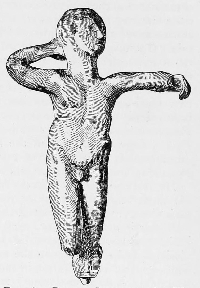
The erection of a statue in the Altis at Olympia was an honor which the Elean officers in charge of the games252 gave to victors to glorify their victory.253 Pliny, in a well-known passage of the Historia Naturalis,254 says it was customary for all victors to set up statues, while Pausanias255 says not all athletes did this, for “some of those who specially distinguished themselves in the games ... have had no statues.” This apparent contradiction in the statements of the two writers is to be explained, as Dittenberger256 and others have pointed out, on the ground that Pliny states the general privilege extended to the victor, while Pausanias states its practical working out, since the setting up of a statue was an undertaking which would be limited by the early death, poverty, or some other disability of the victorious athlete. The cost of making, transporting, and setting up a statue was considerable, and very often a victor must have been too poor to do it. In such a case he would often be contented to set up merely a statuette or small figure in bronze or marble. Several such bronze figures have been unearthed at Olympia,257 one of which we reproduce in Fig. 2, and we have many examples found outside the Altis: e. g., a group of wrestlers,258 Fig. 2.—Bronze Statuette of a Victor, from Olympia. Museum of Olympia. a boxer,259 and the arm of a quoit-thrower260 from the Athenian Akropolis, an archaic girl runner from Dodona,261 an archaic statuette from Delphi with a loin-cloth,262 a bronze quoit-thrower dedicated in the Kabeirion,263 the Tuebingen bronze hoplite runner264 (Fig. 42), and the statuette of a παῖς κέλης from Dodona.265 We should also mention the great number of statuettes of diskos-throwers in modern museums.266 Boy victors especially would use the less expensive marble for such statuettes and we have the remnants of many such found in the excavations of the Altis.267 Pausanias mentions several monuments which were less than life-size, e. g., a horse among the offerings of Phormis, which he says was “much inferior in size and shape to all other statues of horses in the Altis,”268 and the equestrian monuments already discussed. Even reliefs and paintings, in some cases, were offered in lieu of larger monuments, not only for reasons of economy, but also because they gave a better representation of the contest. This custom was common at the lesser games, especially at the Panathenaia.269 Pausanias mentions painted iconic reliefs vowed by girl runners at the games in honor of Hera at Olympia.270 On an Attic vase in Munich a victor is represented as holding an iconic votive pinax in his hands.271 Pausanias speaks of a painting by Timainetos at Athens, which represented a boy carrying hydriæ,272 and one of a wrestler by the same artist in the Pinakotheke on the Akropolis. Pliny mentions paintings, the works of great masters, representing victors: thus the currentes quadrigae by the elder Aristeides of Thebes,273 a victor certamine gymnico palmam tenens by Eupompos,274 an athlete by Zeuxis,275 the victor Aratos with a trophy by Leontiskos,276 an athlete by Protogenes,277 two hoplite runners by Parrhasios,278 a luctator tubicenque by Antidotos and a warrior by the same artist, in Athens,279 which represented a man fighting with a shield, and a man anointing himself, the work of the painter Theoros.280
Apparently the Hellanodikai allowed but one statue for each victory. Aischines the Elean had two victories and two statues.281 Dikon of Kaulonia and Syracuse had three victories and three statues.282 The Spartan Lykinos had two victories and two statues by Myron, but we have already said that the second statue was probably that of his charioteer, the two forming part of an equestrian group.283 Kapros of Elis won two victories and had as many statues.284 On the other hand Troilos of Elis, who won in two events, had only one statue.285 Similarly Arkesilaos of Sparta had two victories in the chariot-race and only one statue.286 Xenombrotos of Cos, who appears to have won once only, had, however, two monuments, one mentioned by Pausanias and the other known to us from the recovered inscription.287 But this last case seems to be the only known exception.
When the victor was unable to set up his monument, whether because of youth, poverty, early death, or other reason, sometimes the privilege was utilized by a relative, a friend, or by his native city. In any case it was a private affair with which the Elean officials had no concern. We have examples, consequently, of the statue being set up by the son,288 father (especially in recovered inscriptions after the time of Augustus),289 mother,290 and brother;291 also several examples of statues reared in honor of athletes by fellow citizens.292 There are cases in which the trainer set up the statue.293 Frequently the native city performed the duty, dedicating the statue either at Olympia or in the victor’s city. Thus Oibotas, who won the stade-race in Ol. 6 ( = 756 B. C.), had a statue at Olympia which was erected by the Achæan state out of deference to a command of the Delphian oracle in Ol. 80 ( = 460 B. C.).294 The statue of Agenor, by Polykleitos the Younger, a boy wrestler from Thebes, was dedicated by the confederacy of Phokis, because his father was a public friend of the nation.295 The boy runner Herodotos of Klazomenai had a statue erected by his native town at Olympia because he was the first victor from there.296 Philinos of Kos had a statue set up by the people of Kos at Olympia “because of glory won,” for he was victor five times in running at Olympia, four at Delphi, four at Nemea, and eleven at the Isthmus.297 Hermesianax of Kolophon had a statue at Olympia erected by his city.298 The pancratiast Promachos of Pellene had two statues erected to him by his fellow citizens, one at Olympia, the other in Pellene.299 We know of three state dedications of statues at Olympia from inscriptions, those of Aristophon of Athens,300 of Epitherses of Erythrai,301 and of Polyxenos by the people of Zakynthos.302 Lichas of Sparta, at a date when the Spartans were excluded from the games, entered his chariot in the name of the Theban people, and Pausanias says that his victory was so entered on the Elean register.303 We learn from the OxyrhynchusPapyri that the public horse of the Argives won at Olympia in Ol. 75 ( = 480 B. C.) and the public chariot in Ol. 77 ( = 472 B. C.).304 In these latter two cases the public was directly interested, and had there been monuments erected to commemorate the victories they would naturally have been set up by the state.
It has been wrongly assumed that monuments of boy victors were dedicated in the name of their parents or relatives.305 On the contrary, we have examples dating back to the fifth century B. C. of boys setting up statues at Olympia. Thus the inscription from the base of the statue of Tellon, who won in the boys’ boxing match in Ol. 77 ( = 472 B. C.), states that he dedicated his own statue.306 Pausanias says that the Eleans allowed the boy wrestler Kratinos from Aigeira to erect a statue of his trainer.307 Of course the boy might need assistance in the undertaking, but this again was no concern of the Elean officials, who granted the privilege to the victor and not to his relatives. Usually the statue of a victor was erected soon after the victory. We have some examples of the statue being erected immediately after the victory, especially in the case of men victors. Thus Pausanias says that the victor Eubotas of Kyrene, in consequence of a Libyan oracle foretelling his victory in the foot-race, had his statue made before coming to Olympia and erected it “the very day on which he was proclaimed victor.”308 The famous Milo of Kroton spectacularly carried his statue into the Altis on his back before he entered the contest.309 There are also examples of statues being erected long after the victory, sometimes centuries later. We have already mentioned that a statue was erected to Oibotas in Ol. 80, though his victory was won in Ol. 6. Chionis, who won in running races in Ols. 28–31 ( = 668–656 B. C.) had a statue by Myron erected to his memory Ol. 77 or 78 ( = 472 or 468 B. C.).310 Cheilon of Patrai, twice victor in wrestling between Ols. (?) 103 and 115 ( = 368 and 320 B. C.), had his statue set up after his death.311 Polydamas of Skotoussa won his victory in the pankration in Ol. 93 ( = 408 B. C.), but his statue by Lysippos could not have been erected until many years later.312 Glaukos, who won the boys’ boxing-match in Ol. 65 ( = 520 B. C.), had a statue by the Aeginetan sculptor Glaukias much later.313 In the case of boy victors, the time between boyhood and coming of age was often so short that in many cases we may assume that the statue was set up some time after the victory.314
HONORS PAID TO VICTORS BY THEIR NATIVE CITIES.
Since the victor was deemed the representative of the state, he often received a more substantial reward than a statue erected at the cost of his fellow citizens. The herald, in proclaiming his victory, proclaimed also the name of his town, which thus shared in his success. At Athens it was customary for a victor at the great games to receive a reward of money. To encourage an interest in athletics there, Solon established money prizes for victorious athletes. We have already said that 100 drachmæ were given to a victor at the Isthmus, while 500 were allotted to one at Olympia. Solon further ordained that victors should eat at the Prytaneion at the public expense.315 Probably other Greek states followed the Athenian custom. We know from an inscription that the Panathenaic victors in the stade-race received 50 amphoræ of oil, the pancratiast 40, and others 30.316 Later, in Rome, victors had special privileges granted them, including maintenance at the public expense, a privilege which Mæcenas advised the emperor Augustus to limit to victors at Olympia, Delphi, and Rome.317 Augustus in other ways enlarged the privileges of athletes.318 When we consider the intimate connection between religion and athletics and the Panhellenic fame of a victor at the great games, we can easily understand the indignation of the native town when its athletes did anything dishonorable. Sometimes a victor was bribed to appear as the citizen of some other state. Thus Astylos of Kroton, who won in running races in Ols. 73–76 ( = 488–476 B. C.), had himself proclaimed in his last two contests a Syracusan to please King Hiero. The citizens of his native town burned his house and pulled down his statue, which had been placed there in the temple of Hera.319 The Cretan Sotades, who won the long running race in Ol. 99 ( = 384 B. C.), was bribed at the next Olympiad by the city of Ephesos to proclaim himself an Ephesian, and was in consequence exiled.320 Dikon, a victor in running races at the beginning of the fourth century B. C., proclaimed himself first a citizen of Kaulonia, but later, “for a sum of money,” entered the men’s contest as a Syracusan.321 Sometimes such attempts at bribery proved unsuccessful. Thus the father of the boy boxer Antipatros of Miletos, who won in Ol. 98 ( = 388 B. C.), accepted a bribe from some Syracusans, who were bringing an offering to Olympia from Dionysios, to let the boy be proclaimed a Syracusan. But the boy himself refused the bribe and had inscribed on his statue by the younger Polykleitos that he was a Milesian, the first Ionian to dedicate a statue at Olympia.322 The Spartan chariot victor Lichas has already been mentioned as having entered his chariot in the name of Thebes. The reason was that at the time the Spartans were excluded from entering the games at Olympia. He won, and in his excitement tied a ribbon on his charioteer with his own hands, thereby showing that the horses belonged to him and not to Thebes. For this infraction of the rules he, though an aged man, was punished by the umpires by scourging.323 A more disgraceful act was selling out, of which we have two examples at Olympia. The Thessalian Eupolos bribed his three adversaries in boxing to let him win. All four were fined and from the money six bronze statues of Zeus, known as Zanes, were erected at the entrance to the stadion, inscribed with elegiac verses which warned future athletes against repeating such attempts.324 More than fifty years later Kallippos, a pentathlete of Athens, bribed his opponents and, being detected, all were fined and from the money, finally collected from the recalcitrant Athenians through the influence of the oracle at Delphi, six more Zanes were erected.325 Straton (or Stratonikos), of Alexandria, won in wrestling and the pankration on the same day in Ol. 178 ( = 68 B. C.). In the wrestling match he had two adversaries, Eudelos and Philostratos of Rhodes. The latter had bribed Eudelos to sell out and, being detected, had to pay a fine. Out of this money another Zan was set up and still another at the cost of the Rhodians.326 In Ol. 192 ( = 12 B. C.) and in Ol. 226 ( = 125 A. D.), we hear of fines for such corruption out of which additional Zanes were erected.327 In Ol. 201 ( = 25 A. D.) Sarapion, a pancratiast from Alexandria, became so afraid of his antagonist that he fled the day before the contest and was fined—the only case recorded of an athlete being fined for cowardice at Olympia.328 In Ol. 218 ( = 93 A. D.) another Alexandrine, named Apollonios, was fined for arriving too late for the games at Olympia. His excuse of being detained by winds was found to be false, and it was discovered that he had been making money on the games in Ionia.329
Cases of bribery were known at other games. A third-century B. C. inscription from Epidauros records how three athletes were fined one thousand staters each διὰ τὸ φθείρειν τοὺς ἀγῶνας.330 The venality of Isthmian victors is shown by the account of a competitor who promised a rival three thousand drachmæ to let him win and then, on winning on his merits, refused to pay, though the defeated contestant swore on the altar of Poseidon that he had been promised the amount.331 The emperor Nero, in order to win in singing at the Isthmus, had to resort to force. A certain Epeirote singer refused to withdraw unless he received ten talents. Nero, to save himself from defeat, sent a band of men who pummelled his antagonist so that he could not sing.332
Often the home-coming of a victor at one of the national games was the occasion for a public celebration. Sometimes the whole city turned out to meet the hero.333 The victory was recorded on pillars, and poets composed songs in its honor which were sung by choruses of girls and boys. Sometimes a statue was set up in the agora or on the Akropolis. In the cities of Magna Græcia and Sicily such adulation of Olympic victors became at times very extravagant. Thus Exainetos of Akragas, who won the stade-race in Ols. 91 and 92 ( = 416–412 B. C.), was brought into the city in a four-horse chariot drawn by his fellow-citizens, and was escorted by 300 men in two-horse chariots drawn by white horses.334 It is also in the West that we first hear of victors being worshipped as heroes or gods, though the custom soon took root in Greece. It was but natural to account for the great strength of famous athletes by assigning to them divine origin and by worshipping them after death.335 Philippos of Kroton, who won in an unknown contest about Ol. 65 ( = 520 B. C.), had a heroön erected in his honor by the people of Egesta in Sicily on account of his beauty, in which he surpassed all his contemporaries, and he was worshipped after his death as a hero.336 The famous boxer Euthymos of Lokroi Epizephyrioi, who won in Ols. 74, 76, 77 ( = 484, 476, 472 B. C.), was worshipped even before his death and was looked upon as the son of no earthly father, but of the river-god Kaikinos.337 Fabulous feats were ascribed to him, e. g., the expulsion of the Black Spirit from Temessa.338 During and after his lifetime sacrifices were offered in his honor.339 The equally famed boxer and pancratiast Theagenes of Thasos, the opponent of Euthymos, who won in Ols. 75 and 76 ( = 480 and 476 B. C.), was heroized after his death.340 The Thasians maintained that his father was Herakles.341 The boxer Kleomedes of Astypalaia, who won in Ol. 71 ( = 496 B. C.), was honored as a hero after death.342 Having killed Ikkos, his opponent, he became crazed with grief. Pausanias recounts his curious death.343 The worship of such athletes was supposed to bestow physical strength on their adorers and consequently statues were erected to them in many places and were thought to be able to cure illnesses.344 The life of a successful athlete was looked upon as especially happy. In Aristophanes’ Plutus, Hermes deserts the gods and serves Plutus “the presider over contests,” thinking no service more profitable to the god of wealth than holding contests in music and athletics.345 Plato thought an Olympic victor’s life was the most blessed of all from a material point of view.346 In the myth of Er the soul of Atalanta chooses the body of an athlete, on seeing “the great rewards bestowed on an athlete.”347 The great Rhodian pancratiast Dorieus, who won in Ols. 87, 88, 89 ( = 432–424 B. C.), was taken prisoner by Athens during the Peloponnesian war, but was freed because of his exploits at Olympia.348 The honor in which a victor was held may also be judged by the story of the Spartan ephor Cheilon, who died of joy while embracing his victorious son Damagetos.349 To quote from Ernest Gardner: “The extraordinary, almost superhuman honours paid to the victors at the great national contests made them a theme for the sculptor hardly less noble than gods and heroes, and more adapted for the display of his skill, as trained by the observation of those exercises which led to the victory.”350 Some of the greatest artists were employed, and great poets from Simonides of Keos down, including such names as Bacchylides and Pindar, were employed in singing their praises. Although it must be confessed that the majority of the artists of victor statues at Olympia are little known or wholly unknown masters, Pausanias mentions among them such renowned names as Hagelaïdas, Pythagoras, Kalamis, Myron, Polykleitos, Lysippos, and possibly Pheidias. Certain other great names, however, are absent from his lists, e. g., Euphranor, Kresilas, Praxiteles, and Skopas. Such extravagant reverence of Olympic and other victors as we have outlined met, of course, with violent protests all through Greek history, just as the excessive popularity of athletics has in our time. The philosopher Xenophanes of Kolophon, who died 480 B. C., was scandalized at the offering of divine honors to athletes.351 While he denounced the popularity of athletics, Euripides later denounced the professionalism which had begun to creep in after the middle of the fifth century B. C.352 Plato, though a strong advocate of practical physical training for war, was opposed to the vain spirit of competition in the athletics of his day. He complained that professional athletes paid excessive attention to diet, slept their lives away, and were in danger of becoming brutalized.353 The last attack on professional athletics in point of time was made in the second century A. D. by Galen, in his Exhortation to the Arts.354 In this essay the eminent physician contended that the athlete was a benefit neither to himself nor to the state. When we study the brutal portraits of prize-fighters on the contemporary mosaics of the Baths of Caracalla at Rome, we can see to what depths the old athletic ideal had sunk, and the justness of his rebuke.355
VOTIVE CHARACTER OF VICTOR DEDICATIONS.
That chariot and hippic monuments were votive in character can scarcely be doubted. Pausanias distinguishes between gymnic victors and equestrian ones.356 All authorities agree that equestrian monuments were different in origin and character from those of other victors.357 Gardiner believes that if the Olympic games developed out of a single event, it was not the stade-race, but the chariot-race or heavy-armed-race. He shows that the custom of making the stade runner eponymous for the Olympiad is not earlier than the third century B. C., and did not arise from the importance of that event, but from the accident of its coming first on the program and first on the list of victors.358 Equestrian monuments were dedicated at Olympia all through antiquity, from the sixth century B. C. to the second A. D. The oldest was that of the Spartan Euagoras already mentioned, who won in the chariot-race three times in Ols. (?) 58–60 ( = 548–540 B. C.).359 The latest dated example is that of L. Minicius Natalis of Rome, who won in Ol. 227 ( = 129 A. D.).360 Some of the inscriptions pertaining to equestrian groups are in verse,361 while others are in prose.362 Most of them have the usual dedicatory word ἀνέθηκε,363 or the formula Διὶ Ὀλυμπίῳ,364 while others have the word ἔστησε365 and a few have no dedicatory word at all.366
The question arises, then, whether ordinary victor monuments in the Altis were votive in the sense that these equestrian ones were, or merely honors granted to the victors. The crown of wild olive was merely a temporary reward suiting the occasion of the victory. The privilege of setting up a statue was granted in order to perpetuate the fame of that occasion. In a well-known passage Pausanias makes a sweeping generalization about monuments at Athens and Olympia.367 He says that all objects on the Akropolis—including statues—were ἀναθήματα or votive offerings, while some of those at Olympia were dedicated to the god, but that the statues of athletes were mere prizes of victory. In another passage368 also, in distinguishing the various sorts of monuments at Olympia, he expressly says that the statues of athletes were not devoted to Zeus, but were marks of honor (ἐν ἄθλου λόγῳ) bestowed on the victors. These statements of the Periegete have given rise to a good deal of fruitless discussion. Furtwaengler follows Pausanias in saying that the right of setting up statues was ein wesentlicher Theil des Siegespreises.369 That such erections at Olympia were considered as high honors is implied by the wording of many of the inscriptions which have been recovered from the bases of the statues. Thus on that of the boxer Euthymos are the words εἰκόνα δ’ ἔστησεν τήνδε βροτοῖς ἐσορᾶν.370 Furtwaengler, therefore, has promulgated the theory that the victor statues at Olympia were in no sense votive, though they were considered to be the property of the god in whose grove they stood. He cites the fact that the inscribed bases of such monuments down to the first century B. C., with the exception of a few metrical epigrams, make no mention of dedications, and that in these exceptions the word ἀνέθηκε was added for metrical reasons,371 while during the same centuries regular votive offerings (ἀναθῆματα) invariably have the word ἀνέθηκε.372 One inscription, that from the base of the statue of Euthymos of Lokroi, is both metrical and in prose;373 but it seems to have been changed later in two places, the second line originally ending in a pentameter, and the third line, with ἀνέθηκε, being added afterwards.374 Also the prose inscription375 referred by Roehl to the statue of the wrestler Milo is rejected by Dittenberger. The oldest prose inscription which makes a votive offering out of a victor statue at Olympia is that of Thaliarchos, who won his second victory in boxing some time between 40 and 30 B. C.376 Then follow certain prose inscriptions of imperial times.377 Dittenberger concludes that for four hundred years there is no case of such a dedication.378 From the evidence of the inscriptions from statue bases, therefore, it is clear that the distinction made by Pausanias between honor and victor statues did not hold good in his day, since the words ἀνάθημα and ἀνέθηκε were then used on victor monuments at Olympia, as the inscriptions of the imperial age just cited show, but that it did hold good for centuries before the Roman period. Pausanias must have based his statement, therefore, not on observation, but on the words of some earlier writer.379 Furtwaengler’s reasoning has been followed pretty generally by archæologists.380 While some, however, leave the question in doubt,381 others are opposed to the idea that these statues were not votive. Thus R. Schoell believes that the victor monuments were as truly ἀναθήματα as the olive crowns.382 Reisch, who has discussed the question at length,383 believes, in opposition to the earlier view of Furtwaengler, that everything within the Altis must always ipso facto have been regarded as dedications to the god. This would explain the frequent omission of the name of the god, which would be superfluous, the victor being content with inscribing his own name and the contest in which he was victorious. Even the name of the contest does not always appear.384 Reisch explains the omission of the formula ἀνέθηκε in earlier inscriptions on the ground of epigrammatic brevity.385
The truth must lie somewhere between the extremes represented by the views of Furtwaengler and Reisch. Some athlete statues may have been votive, while others were not. Thus Rouse argues386 that originally all victor statues at Olympia were as truly votive as equestrian groups, and as truly as those athlete statues continued to be, which were dedicated in the victors’ native towns. Those inscribed with ἀνέθηκε at Olympia must have been votive, for we should take the dedicator at his word, instead of believing the formula to be added merely to make the verse scan.387 There is no reason why an athlete should not dedicate a statue of himself, representing himself as forever standing in the presence of the god, as well as a diskos or jumping-weights; for it was customary to make votive offerings representative of the events, and this could be done best by presenting the athlete in a statue which showed the characteristic attitude or the appropriate attributes. Rouse furthermore believes that a change was slowly wrought in the course of centuries, by which the original votive offering became a means of self-glorification. Equestrian victors owed their victories not to themselves, but to their horses, cars, drivers, and jockeys; in such cases the group was a thing apart from the owner. Only seldom did such victors dedicate statues of themselves alone. Even when the victor added a statue of himself to the group, still it was the chariot and not the statue which was emphasized.388 On the other hand the ordinary gymnic victor relied on himself—on his strength, endurance, courage, and other qualities; and in representing the contest the victor himself had to be represented. Consequently, by the fifth century B. C., if not earlier, the statues of athletes had become memorials of personal glory.
MISCELLANEOUS MEMORIALS TO VICTORS.
A statue was not the only memorial erected in honor of an Olympic victor, though it was by far the commonest. We have already mentioned the bronze inscribed diskos dedicated by the pentathlete P. Asklepiades in the third century A. D.389 A green stone leaping-weight inscribed with the name Κῳδίας appears to have been dedicated by a victor.390 In two cases stelæ were set up in honor of victors.391 A curious dedication was a bronze chapel, which the Sikyonian tyrant Myron dedicated to Apollo at Olympia.392 In later days it became part of the treasury of the Sikyonians.393 Outside Olympia various monuments commemorating Olympic victors were set up. These will be discussed in Chapter VIII.
HONORARY STATUES.
At Olympia, as elsewhere in Greece, statues were set up to men honoris causa. Such statues would be dedicated by admirers, either individuals or states. They were in no sense intended to honor the god, though at Olympia they might be classed as ἀναθήματα, just as victor statues, merely because they were erected in the sacred precinct. They were granted to individuals not as a privilege, as victor statues were, but as free gifts. Dio Chrysostom gives the difference between victor statues—which he classes as ἀναθήματα—and such honor statues in these words: ταῦτα (i. e., victor statues) γάρ ἐστιν ἀναθήματα· αἱ δ’ εἰκόνες τιμαί· κἀκεῖνα (victor statues) δέδοται τοῖς θεοῖς, ταῦτα δὲ (honor statues) τοῖς ἀγαθοῖς ἀνδράσιν οἵπερ εἰσὶν ἔγγιστα αὐτῶν.394 Pliny records that the Athenians inaugurated the custom of a state setting up statues in honor of men at the public expense with the statues of the tyrannicides Harmodios and Aristogeiton by the sculptor Antenor, which were erected in 509 B. C., the year in which the tyrants were expelled.395 He adds that a “refined ambition” led to a universal adoption of the custom and that statues began to adorn public places everywhere and later on even private houses. The custom grew apace in the later history of Greece. Demetrios of Phaleron is said to have had over three hundred statues erected in his honor during his short régime of about a year in Athens. The Diadochoi and the Roman emperors enthusiastically took over the custom. Pliny gives several Roman examples of it.396
At Olympia Pausanias mentions honorary statues erected to thirty-five men for various reasons.397 To several of these men more than one statue was erected.398 The greater number of these statues were erected to kings and princes, to those of Sparta,399 Athens,400 Epeiros,401 Sicily,402 Macedonia, and Alexander’s Empire.403 One was erected in honor of the philosopher Aristotle,404 one in honor of the rhetorician Gorgias of Leontini,405 one in honor of a hunter,406 another in honor of a flute-player,407 and many others in honor of public and private men. These statues were set up for various reasons. Archidamas III of Sparta had his statues erected to his memory because he was the only Spartan king who died abroad and did not receive a formal burial. Kylon had a statue erected by the Aitolians because he freed the Eleans from the tyranny of Aristotimos.408 Pythes of Abdera was thus honored by his soldiers because of his military prowess.409 Philonides of Crete was, as we learn from the recovered inscription on his statue base, the courier of Alexander the Great.410 Pythokritos was honored for his flute-playing, though he does not appear to have been a victor.411 The Palaians of Kephallenia honored Timoptolis of Elis,412 and the Aitolians honored the Elean Olaidas413 for unknown reasons. At least seven, if not eight, of those thus honored with statues were Eleans. Some of the men who had honor statues were also victors at Olympia, a fact which would appear on the inscribed base. Thus Aratos, the son of Kleinias of Sikyon, the statesman, had a statue erected to him by the Corinthians. This was doubtless an honor statue, though Pausanias also says he was a chariot-victor.414 On the other hand, the statue erected in honor of the pentathlete Stomios was probably a victor monument, though Pausanias says that its inscription records that he was an Elean cavalry general who challenged the enemy to a duel, in which he was slain.415 In some cases it is hard to decide whether the statue is honorary or victor in character. In the course of time honor statues multiplied, while those of athletes decreased. The recovered inscriptions on the latter decrease steadily in the fourth and third centuries B. C., revive again in the second and first, and decrease in the first Christian century. They cease almost entirely after the middle of the second century A. D.