Part 2 — CHAPTER VI. (continued 3)
Reading edition
Morgan finds it difficult to dissociate the mounds with his favorite theory of communal life.[1738] There is no readier way of marking the development of opinion on this question than to follow the series of the Annual Reports of the Smithsonian Institution, as hardly a year has passed since 1861 but these Reports have had in them contributions on the subject.[1739] Among periodicals, the more constant attention to the mounds is conspicuous in the American Antiquarian.[1740]
The basis for estimating the age of the mounds is threefold. In the first place, there are very few found on the last of the river terraces to be reclaimed from the stream. In the second place, the decay of the skeletons found in them can be taken as of some indication, if due regard be had to the kind of earth in which they are buried. Third, the age of trees upon them has been accepted as carrying them back a certain period, at least, though this may widely vary, if you assume their growth to be subsequent to the abandonment of the mounds, or if, as Brinton holds,[1741] the trees were planted immediately upon the building. The dependence upon counting the rings is by no means a settled opinion as to all climes; but in the temperate zone the best authorities place dependence upon it. Unfortunately it cannot carry us back much over 600 years.[1742]
The early attempts to disclose the ethnological relations of the moundbuilders on cranial evidence were embarrassed by the fewness of the skulls then known. Morton (Crania Americana) called the four examined by him identical with those of the red Indian.[1743] At present, considerable numbers are available; but still Wilson (Prehistoric Man, ii. 128) holds that “we lack sufficient data,” and in the consideration of them sufficient care has not always been taken to distinguish intrusive burials of a later date.[1744]
J. W. Foster (Prehist. Races, ch. 8; Amer. Assoc. Adv. Sci. Trans., 1872; and Amer. Naturalist, vi. 738) held to a lower type of skull, on this evidence, than Wilson (Prehist. Man, ii. ch. 20) contended for. There are examples of the wide difference of views (MacLean, 142), when some, like Morgan, connect them with the Pueblo skulls (No. Amer. Rev., cix., Oct., 1869), and others, like Morton, Winchell, Wilson, Brasseur, and Foster, find their correspondences in those of Mexico and Peru.[1745] Putnam, whose experience with mound skulls is greatest of all, holds to the southern short head and the northern long head (Rept. 1888). Probably we have no better enumeration of the variety of objects and relics found in the mounds, though much has since been added to the collection, than in Rau’s Catalogue of the Archæological Collection of the National Museum (Washington, 1876).[1746] Unfortunately he shows little or no discrimination between discoveries in the mounds and those of the surface. The interest in such collections has naturally brought prominently to the attention of every student of such collections the tricks of fraudulent imitators, and there are several well-known instances of protracted controversies on the genuineness of certain relics.[1747]
There remains in this survey of the literature of the mounds in all their varieties, to go over it, finally, in relation to their geographical distribution:[1748]—
New England is almost destitute of these antiquities. The one that has attracted some attention is what is described as a fortification in Sanbornton, in New Hampshire, which when found was faced with stone externally, and the walls were six feet thick and breast-high, when described about one hundred and fifteen years ago. There is a plan of it, with a descriptive account, preserved in the library of the American Antiq. Society,[1749] and another plan and description in M. T. Runnels’s Hist. of Sanbornton (Boston, 1882), i. ch. 4. Squier also figured it.
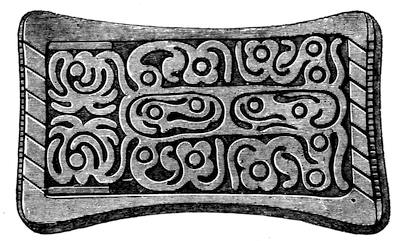
CINCINNATI TABLET.
After a cut in Wilson’s Prehistoric Man, i. 274, engraved from a rubbing taken from the original. Wilson adds: “Mr. Whittlesey has included this tablet among his Archæological Frauds; but the result of inquiries made by me has removed from my mind any doubt of its genuineness.” Cf. other cuts in M. C. Read, Archæol. of Ohio (1888); Squier and Davis, fig. 195; Short, p. 45; MacLean, 107; and Second Rept. Bur. of Ethnol., pp. 133-34.
As we move westward, the mounds begin to be numerous in the State of New York, and particularly in the western part of it. One of the earliest descriptions of them, after that of the missionary Kirkland (about 1788), is in the “Journal of the Rev. John Taylor while on a mission through the Mohawk and Black River Country in 1802,” which was first printed, with plans of the works examined, in the Documentary Hist. New York (vol. iii. quarto ed.). In 1818 DeWitt Clinton published at Albany his Memoir on the Antiquities of the western part of New York, in which he attributes their origin to the Scandinavians.[1750] They were again described in David Thomas’s Travels through the western country in 1816 (Auburn, 1819). There is not much else to note for twenty-five years. In 1845, Schoolcraft made to the N. Y. Senate his Report on the Census of the Iroquois Indians (Albany and N. Y., 1846, 1847, 1848), which is better known, perhaps, in the trade edition, Notes on the Iroquois; or Contributions to the Statistics, Aboriginal History, Antiquities and General Ethnology of Western New York (N. Y. 1846). In 1850, the Third Report of the Regents of the University of the State of N. Y. contains F. B. Hough’s paper on the earthwork enclosures in the State, with cuts. The same year (1850) came the essential authority on the New York mounds, E. G. Squier’s Aboriginal Monuments of the State of N. Y., comprising the results of original surveys and explorations, with an illustrative appendix (Washington, 1850), which the next year made part of the second volume of the Smithsonian Contributions.[1751] He enumerates in New York about 250 defensive structures, beside burial mounds and in his appendix describes those in New Hampshire and some in Pennsylvania.[1752] Some new explorations of the New York mounds were made in 1859 by T. Apoleon Cheney, who describes them, giving plans and cuts, in the Thirteenth Report of the Regents of the University.[1753]
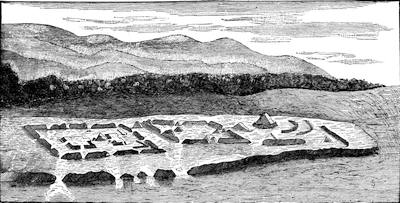
ANCIENT WORKS ON THE MUSKINGUM.
Reduced from an early engraving in T. M. Harris’s Journal of a Tour into the territory northwest of the Alleghany, 1803 (Boston, 1805). Harris’s plan in relation to the new town of Marietta is given in Vol. VII. p. 540. To follow down the plans chronologically, we find that of Winthrop Sargent, communicated to the Amer. Academy in 1787, reproduced in their Memoirs, new ser. v. part i. The Columbian Mag., May, 1787, vol. i. 425, and the N. Y. Mag. (1791) had plans. One was in Schultz’s Travels (1807), 146. Atwater, of course, gave one in 1820. A survey by S. Dewitt, 1822, is in Josiah Priest’s Amer. Antiquities, 3d ed., Albany, 1833. Others are in the Amer. Pioneer, Oct., 1842, June 1843, and in S. P. Hildreth’s Pioneer History, 212 (Jan., 1843). Whittlesey made the survey in Squier and Davis (who also give a colored view), and it is reduced in Foster. Cf. also Amer. Antiquarian, Jan., 1880; Mag. Amer. Hist., 1885, p. 547; Henry A. Shepard’s Antiquities of Ohio (Cinn., 1887); Nadaillac’s L’Amérique préhistorique, 105, and Les prem. Hommes, ii. 33.
It was, however, in Ohio that the interest in these mounds was first incited, and that the more thorough exploration has been made.[1754] The earliest pioneers reported upon them. Cutler described them in 1789 in a letter to Jeremy Belknap.[1755] Benj. S. Barton described a mound at Cincinnati in 1799.[1756] Dr. Harris in 1805 was seemingly the earliest traveller to note them in Journal of a Tour, where he gives one of the earliest engravings. A plan of those at Circleville, with description by J. Kilbourne, is given in the Ohio Gazetteer (Columbus, 1817). Caleb Atwater, in 1820, was more familiar with them than with others of his broader field. Warden in his Recherches noted the early describers. Gen. Harrison discussed the mounds in his Discourse on the Aborigines of the Valley of the Ohio (Cincinnati, 1838). Squier and Davis, of course, brought them within their range,[1757] and Col. Whittlesey supplemented their work in the third volume of the Smithsonian Contributions. Whittlesey and Matthew C. Read contributed the Report on the Archæology of Ohio, which forms the second portion of the Final Report of the Ohio State Board of Centennial Managers (Columbus, 1877), and in it is a list of the ancient enclosures, which is not, as Short says (p. 82), as complete as it should be. A survey of the mounds was made by E. B. Andrews, and published in the Peabody Mus. Repts. (no. x.), 1877. The Ohio State Archæological and Historical Society started in June, 1887, the Ohio archæological and historical Quarterly, which has vigorously entered the field, and in it (March, 1888) G. F. Wright has reported on the present condition of the mounds. M. C. Read’s Archæology of Ohio (Cleveland, 1888) was published by the Western Reserve Historical Society, whose series of Tracts is of importance for the study of the mounds.[1758] Henry A. Shepard’s Antiquities of the State of Ohio (Cincinnati, 1887) summarizes the discoveries to date.[1759] Thomas (Fifth Rept. Bur. Ethnol.) claims that the Ohio mounds were built by Indians, but not by the Indians, nor by the ancestors of them, who inhabited this region at the coming of the whites; but by an Indian race driven south, of whom he finds the modern representatives in the Cherokees.
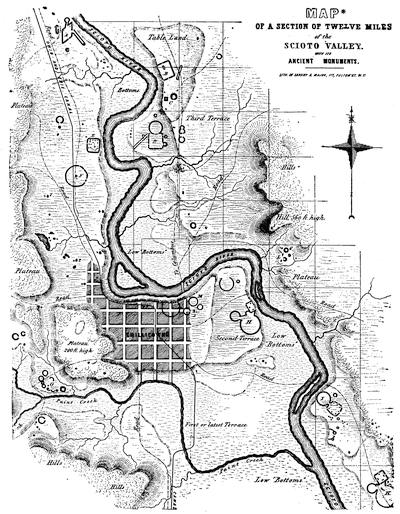
From E. G. Squier’s Aboriginal Monuments of the Mississippi Valley (N. Y., 1847), taken from Amer. Ethnol. Soc. Trans., ii. The letters A, B, C, etc. mark the ancient works. Enclosures are shown by broken lines. The mounds are designated by small dots. Some of the best maps which we have showing the geographical positions of groups of mounds accompany Thomas’s paper in the Fifth Rept., Bur. Ethnol.
The works at Marietta, on the Muskingum River, were the earliest observed. Taking the southern and southeastern counties, there are no very conspicuous examples elsewhere, though the region is well dotted with earthworks.[1760] Those at Cincinnati were, after those at Marietta, the earliest to be noticed.[1761] The adjacent Little Miami Valley is the region which Professor Putnam and Dr. Metz have been of late so successfully working.[1762]
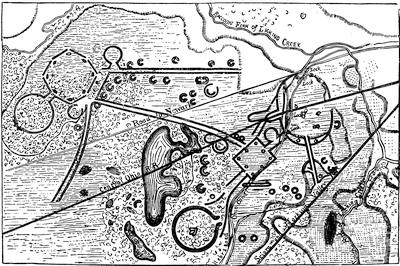
THE WORKS AT NEWARK, OHIO.
After a cut in Wilson’s Prehistoric Man, i. 269, made from surveys “executed while the chief earthworks could still be traced in all their integrity;” and they “illustrate rites and customs of an ancient American people, without a parallel among the monumental memorials of the old world.” Cf. Atwater, Warden, Squier and Davis, and MacLean.
Of all the works in the central portions of Ohio, and indeed of all in any region, those at Newark, in Licking County, are the most extensive, and have been often described.[1763] In the east[1764] and west[1765] there are other of these earthworks; but those in the north have been particularly examined by Col. Whittlesey and others.[1766] The enclosure called Fort Azatlan, at Merom on the Wabash River, is the most noticeable in Indiana.[1767] In Illinois, the great Cahokia truncated pyramid, 700 feet long by 500 wide and 90 high, is the most important.[1768]
Henry Gillman, of Detroit, has been the leading writer on the mounds of Michigan.[1769] The supposed connection of their builders with the ancient copper mines of Lake Superior is considered in another place. Thomas (Fifth Rept., Bur. Ethnol.) contends that much of the copper found in the mounds was of European make, and had no relation to any aboriginal mining.
Wisconsin is the central region of what are known as the animal, effigy, symbolic, or emblematic mounds. Mention has been made elsewhere of the earliest notices of this kind of earthwork. The most extensive examination of them is the Antiquities of Wisconsin as surveyed and described by I. A. Lapham (Washington, 1855), with a map showing the sites.[1770] The consideration of these effigy mounds has given rise to various theories regarding their significance, whether as symbols or to totems.[1771] It is Thomas’s conclusion that the effigy mounds and the burial mounds of Wisconsin were the work of the same people (Fifth Rept., Bur. Ethnol.).
The existence of what is called an elephant or mastodon mound in Grant County has been sometimes taken to point to the age of those extinct animals as that of the erection of the mounds.[1772] Putnam, referring to the confined area in which these effigy mounds are found, says that the serpent mound, the alligator mound,[1773] and Whittlesey’s effigy mound in Ohio, and two bird mounds in Georgia,[1774] are the only other works in North America to which they are at all comparable.[1775]
When Lewis and Clark explored the Missouri River in 1804-6, they discovered mounds in different parts of its valley; but their statements were not altogether confirmed till the parties of the United States surveyors traversed the region after the civil war, as is particularly shown in Hayden’s Geological Survey, 6th Rept., in 1872. Within the present State of Missouri the mounds which have attracted most notice are those near the modern St. Louis.[1776] In Iowa (Clayton County) there is said to be the largest group of effigy mounds west of the Mississippi.[1777] The mounds of Iowa and the neighboring region are also discussed by Thomas in the Fifth Rept. Bur. Ethnol. O. H. Kelley has reported on the remains of an ancient town in Minnesota.[1778] In Kansas there is little noticeable,[1779] and there is not much to record in Dacotah,[1780] Utah,[1781] California,[1782] and Montana.[1783] We find scant accounts of the mounds in Oregon and Washington in the narrative of the Wilkes Exploring Expedition and in the earlier story of Lewis and Clark. Some of the mounds are of doubtful artificiality.[1784]
Along the lower portion of the Mississippi, but not within three hundred miles of its mouth, we find in Louisiana other mound constructions, but not of unusual significance.[1785]
The first effigy mound, a bear, which was observed south of the Ohio, is near an old earthwork in Greenup County, Kentucky.[1786] The mounds of this State early attracted notice.[1787] Bishop Madison[1788] thought them sepulchral rather than military. In the Western Review (Dec., 1819) one was described near Lexington. Rafinesque added a not very sane account of them to Marshall’s History of Kentucky, in 1824, which was also published separately, and since then all the general histories of Kentucky have given some attention to these antiquities.[1789]
In Tennessee we find in connection with the earthworks the stone graves, which the explorations of Putnam, about ten years ago, brought into prominence.[1790] The chief student of the aboriginal mounds in Georgia has been Col. C. C. Jones, Jr., who has been writing on the subject for nearly forty years.[1791] The mounds in the State of Mississippi, as including the region of the Natchez Indians, derive some added interest because of the connection sometimes supposed to exist between them and the race of the mounds.[1792] The same characteristics of the mounds extend into Alabama.[1793] The mounds in Florida attracted the early notice of John and William Bartram, and are described by them in their Travels, and have been dwelt upon by later writers.[1794] The seaboard above Georgia has not much of interest.[1795] Concerning the mounds along the Canadian belt there is hardly more to be said.[1796]
Lubbock classes the signs of successive periods in North America thus: original barbarism, mounds, garden beds, and then the relapse into barbarism of the red Indian. The agricultural age thus follows that of the mound erection, in his view, though, as Putnam says, there seems enough evidence that the constructors of the old earthworks were an agricultural race.[1797]
There is another class of relics which, outside the hieroglyphics of Central America, has as yet had little comprehensive study, though the general books on American archæology enumerate some of the inscriptions on rocks, which are so widely scattered throughout the continent.[1798]
Out of all this discussion has risen the new science of Anthropology, broad enough in its scope to include not only archæology in its general acceptation, but to sweep into its range of observation various aspects of ethnology and of geology. It is a new science as at present formulated; but under other conditions it is traced from its origin with the ancients in a paper by T. Bendyshe in the Memoirs of the Anthropological Society of London (vol. i. 335). Its progress in America is treated by O. T. Mason in the American Naturalist (xiv. 348; xv. 616). The most approved methods of modern research are explained in Emil Schmidt’s Anthropologische Methoden; Anleitung zum beobachten und sammeln für Laboratorium und Reise (Leipzig, 1888). “The methods of archæological investigation are as trustworthy as those of any natural science,” says Lubbock (Scientific Lectures, 139). Beside the publications of the various Archæological, Anthropological, and Ethnological Societies and Congresses[1799] of both hemispheres, we find for Europe a considerable centre of information in the Materiaux pour l’histoire primitive et naturelle (philosophique) de l’homme,[1800] and for America in the publications of the Smithsonian Institution,[1801] in the Comptes rendus of the successive Congresses of Américanistes, and in such periodicals as the American Antiquarian, the American Anthropologist, and the Folk Lore Journal.
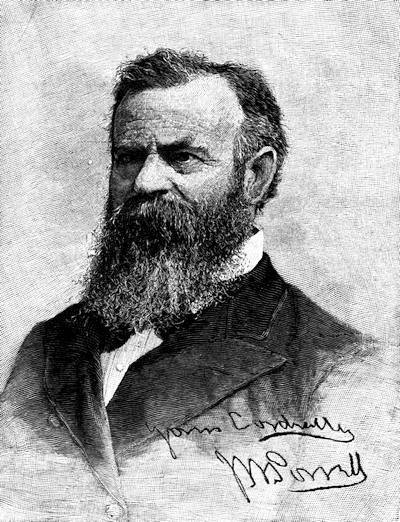
MAJOR POWELL.
The broad subject of prehistoric archæology is covered in a paper by Lubbock, which is included in his Scientific Lectures (Lond., 1879);[1802] in H. M. Westropp’s Prehistoric Phases, or Introductory Essays on Prehistoric Archæology (Lond., 1872); in Stevens’s Flint Chips (1870); by Dr. Brinton in the Iconographic Encyclopædia, vol. ii.; and more popularly in Charles F. Keary’s Dawn of History, an introd. to prehistoric study (N. Y., 1879), and in Davenport Adams’s Beneath the Surface, or the Underground World.
The French have contributed a corresponding literature in Louis Figuier’s L’Homme Primitif (Paris, 1870);[1803] in Zaborowski’s L’homme préhistorique (Paris, 1878); and in the Marquis de Nadaillac’s Les premiers hommes et les temps préhistoriques (Paris, 1881), and his Mœurs et monuments des peuples préhistoriques (Paris, 1888), not to mention others.[1804]
The principal comprehensive works covering the prehistoric period in North America, are J. T. Short’s North Americans of Antiquity (N. Y., 1879, and later); the L’Amérique préhistorique of Nadaillac (Paris, 1883);[1805] Foster’s Prehistoric Races of the United States (Chicago, 1873; 6th ed., 1887); and the compact popular Ancient America (N. Y., 1871) of John D. Baldwin. Beside Bancroft’s Native Races, there are various treatises of confined nominal scope, but covering in some degree the whole North American field, which are noted in other pages.[1806]
The purely ethnological aspects of the American side of the subject are summarily surveyed in A. H. Keane’s “Ethnology of America,” appended to Stanford’s Compendium of Geography, Cent. America, etc. (London, 2nd ed., 1882), and there are papers on Ethnographical Collections in the Smithsonian Report (1862).[1807] The great repository of material, however, is in the Contributions to North American Ethnology, being a section of Major Powell’s Survey of the Rocky Mountain Region, and in the Annual Reports of the Bureau of Ethnology since 1879, made under Major Powell’s directions, and in the Reports of the Peabody Museum.[1808]
APPENDIX.
I.
BIBLIOGRAPHY OF ABORIGINAL AMERICA.
By the Editor.
The student will find a general survey of “Les Sources de l’histoire anté-Colombienne du nouveau monde, par Léon de Rosny,” in the Revue Orientale et Américaine (Mém. de la soc. d’ethnographie) session de 1877 (p. 139). Bancroft in his Native Races (v. 136) makes a similar grouping of the classes of sources relating to the primitive Americans.[1809] These classes are defined in Daniel G. Brinton’s Review of the data for the study of the prehistoric chronology of America (Salem, 1887), from the Proceedings of the Amer. Asso. for the Advancement of Science (vol. xxxvi.), as conveniently divided into groups pertaining to legendary, monumental, industrial, linguistic, physical, and geological phenomena.
There have been given in the Introduction of the present volume the titles of general bibliographies of American histories, most of which include more or less of the titles pertaining to aboriginal times. It is the purpose of the present brief essay to enumerate, in an approximately chronological order, the titles of some of those and of others which are useful to the archæologist. So far as they are of service to the student of the American languages, an extended list will be found prefixed to Pilling’s Proof-Sheets (p. xi).
The earliest American bibliography was that of Antonio de Leon, usually called Pinelo,—Epitome de la Biblioteca oriental y occidental náutica y Geográfica (Madrid, 1629),—but which is usually found in the edition of Gonzales de Barcía, “Añadido y enmendado nuevamente” (Paris, 1737-1738), in which the American titles, including numerous manuscripts, are given in the second volume.[1810]
The Bibliotheca Hispana Nova of Nicolás Antonio was first published at Rome in 1672, but in a second edition at Madrid in 1783-88.[1811]
Passing by the Bibliotheca Mexicana of Eguiara y Eguren,[1812] and the early edition of Beristain, we note the new edition of the latter, prepared not by Juan Evangelista Guadalajara, as Brasseur notes,[1813] but by another, as the title shows,—Biblioteca Hispano-Americana Septentrional, ó catalogo y noticia de los Literatos que ó nacidos, ó educados, ó florecientes en la America Septentrional Española, han dado á luz algun escrito ó lo han dexado preparado para la prensa por José Mariano Beristain y Martin de Souza. Segunda edicion, por Fortino Hipólito Vera (Amecameca, 1883).
Dr. Robertson intimates that the lists of books which writers of the seventeenth century had been in the habit of prefixing to their books as evidence of their industry had come to be regarded as an ostentatious expression of their learning, and with some hesitancy he counted out to the reader his 717 titles; but Clavigero, as elsewhere pointed out,[1814] was richer in such resources. Humboldt, in his Vues,[1815] gives a list of the authors which he cites.
The class of dealers’ catalogues—we cite only such as have decided bibliographical value—begins to be conspicuous in Paul Trömel’s Bibliothèque Américaine (Leipzig, 1861), the best of the German ones, and in Charles Leclerc’s Bibliotheca Americana (Paris, 1867), much improved in his Bibliotheca Americana. Histoire, géographie, voyages, archéologie et linguistique des deux Amériques et des îles Philippines (Paris, 1878), with later supplements, constituting the best of the French catalogues, provided with an excellent index and a linguistic table, rendered necessary by the classified plan of the list.
The list formed by students in this field begins with the Bibliotheca Americana Vetustissima of Harrisse (New York, 1866; additions, Paris, 1872), and includes the Bibliothèque Mexico-Guatémalienne, précédée d’un coup d’œil sur les études américaines dans leurs rapports avec les études classiques, et suivie du tableau, par ordre alphabétique, des ouvrages de linguistique Américaine contenus dans le même volume (Paris, 1871) of the Abbé Brasseur de Bourbourg, who at that time had been twenty-five years engaged in the studies and travels which led to the gathering of his collection. The library, almost entire, was later joined to that of Alphonse L. Pinart, and was included in the latter’s Catalogue de livres rares et précieux, manuscrits et imprimés (Paris, 1883).
In 1866, Icazbalceta published at Mexico his Apuntes para un Catálogo de Escritores en lenguas indígenas de América,[1816] but of his great bibliographical work only one volume has as yet appeared: Bibliografía Américana del Siglo xvi. Primera parte. Catálogo razonado de libros impresos en México de 1539 à 1600, con biografías de autores y otras ilustraciones, precedido de una noticia acerca de la introducción de la imprenta en México (México, 1886).
Bandelier has embodied some of the results of his study in his “Notes on the Bibliography of Yucatan and Central America,” in the Amer. Antiq. Soc. Proc., n. s., i. pp. 82-118.
The catalogues of collections having special reference to aboriginal America are the following:—
Catalogue de la Bibliothèque de José Maria Andrade, 7,000 pièces et volumes, ayant rapport au Méxique ou imprimés dans ce pays (Leipzig, 1869).[1817]
Bibliotheca Mejicana: Books and manuscripts almost wholly relating to the history and literature of North and South America, particularly Mexico (London, 1869). This collection was formed by Augustin Fischer, chaplain to the Emperor Maximilian; but there were added to the catalogue some titles from the collection of Dr. C. H. Berendt.
Catalogue of the library of E. G. Squier, edited by Joseph Sabin (N. Y., 1876).
Bibliotheca Mexicana, or A Catalogue of the library of the rare books and important MSS. relating to Mexico and other parts of Spanish America, formed by the late Señor Don José Fernando Ramirez (London, 1880). This catalogue was edited by the Abbé Fischer.[1818]
The most useful guides to the literature of aboriginal America, however, are some compiled in this country. First, the comprehensive though not yet complete bibliography, Joseph Sabin’s Dictionary of books relating to America, now being continued since Sabin’s death, and with much skill, by Wilberforce Eames. Second, the voluminous Proof-sheets of a Bibliography of the languages of the North American Indians (Washington, 1885), prepared by James Constantine Pilling, tentatively, in a large quarto volume, distributed only to collaborators, and out of which, with emendations and additions, he is now publishing special sections of it, of which have already appeared those relating to the Eskimo and Siouan tongues. His enumeration so much exceeds the range of purely linguistic monographs that the treatises become in effect general bibliographies of aboriginal America.
Third, An Essay towards an Indian bibliography, being a Catalogue of books relating to the history, antiquities, languages, customs, religion, wars, literature and origin of the American Indians, in the library of Thos. W. Field, with bibliographical and historical notes and synopses of the contents of some of the works least known (N. Y., 1873). The sale of Mr. Field’s library took place in New York, May, 1875, from a Catalogue not so elaborate, but still of use. These books are not so accurately compiled as to be wholly trustworthy as final resorts.
Finally, the list prefixed to Bancroft’s Native Races, vol. i., and the references of his foot-notes, throughout his five volumes (condensed often in Short’s North Americans of Antiquity), are on the whole the most serviceable aids to the general student, but unfortunately the index of the set is of no use in searching for bibliographical detail.
The reader will remember that the bibliographies of sectional or partial import in the field of American archæology are referred to elsewhere in the present volume.
II.
THE COMPREHENSIVE TREATISES ON AMERICAN ANTIQUITIES.
By the Editor.
At the time when Bancroft published his Native Races (1875), he referred to John D. Baldwin’s Ancient America (N. Y., 1871) as the only preceding, comprehensive book on America before the Spaniards.[1819] It still remains a convenient book of small compass; but its absence of references to sources precludes its usefulness for purposes of study, and it is not altogether abreast of the latest views. To the popular element a moderate share of the indexical character, rendering the book passably serviceable to the average reader, has been added in the somewhat larger North Americans of Antiquity, their origin, migrations, and type of civilization considered, by John T. Short (N. Y., 1880,—somewhat improved in later editions), though it will be observed that the Peruvian and other South American antiquities have not come within his plan. The latest of these comprehensive books is the Marquis de Nadaillac’s (Jean F. A. du Pouget’s) L’Amérique préhistorique (Paris, 1883), which in an English version by N. D’Anvers was published with the author’s sanction in London in 1882. With revision and some modifications by W. H. Dall, which have not met the author’s sanction, it was republished as Prehistoric America (N. Y., 1884). It is a work of more theoretical tendency than the student wishes to find at the opening stage of his inquiry.
But as a compend of every department of archæological knowledge up to about fifteen years ago no advance has yet been made upon Bancroft’s Native Races as indicative of every channel of investigation which the student can pursue. Upon the monuments of the moundbuilders (iv. ch. 13) and the antiquities of Peru (iv. ch. 14) the treatment is condensed and without references, as occupying a field beyond his primary purpose of covering the Pacific slope of North America and the immediately adjacent regions. Mention is made elsewhere of Bancroft’s methods of compilation, and it may suffice to say that in the five volumes of his Native Races he has drawn and condensed his matter from the writings of about 1200 writers, whose titles he gives in a preliminary list.[1820] The method of arranging the departments of the work is perhaps too far geographical to be always satisfactory to the special student,[1821] and he seems to be aware of it (for instance, i. ch. 2); but it may be questioned if, while writing with, or engrafting upon, an encyclopædic system, what might pass for a continuous narrative, any more scientific plan would have been more successful. Bancroft’s opinions are not always as satisfactory as his material. The student who uses the Native Races for its groups and references will accordingly find a complemental service in Sir Daniel Wilson’s Prehistoric Man (London, 1876), in which the Toronto professor conducts his “researches into the origin of civilization in the old and the new world,” by primarily treating of the early American man, as the readiest way of understanding early man in Europe. His system is to connect man’s development topically in the directions induced by his habits, industries, dwellings, art, records, migrations, and physical characterizations.
Another and older book, in some respects embodying like purposes, and though produced at a time when archæological studies were much less advanced than at present, is Alexander W. Bradford’s American Antiquities and researches into the origin and history of the red race (N. Y., 1841).[1822] The first section of the book is strictly a record of results; but in the final portion the author indulges more in speculative inquiry. Even in this he has not transcended the bounds of legitimate hypothesis, though some of his postulates will hardly be accepted nowadays, as when he contends that the red Indians are the degraded descendants of the people who were connected with the so-called civilization of Central America.[1823]
The periodical literature of a comprehensive sort is not so extensive as treatments of special aspects; but the student will find Poole’s Index and Rhee’s Catalogue and Index of the Smithsonian publications serviceable.
III.
BIBLIOGRAPHICAL NOTES ON THE INDUSTRIES AND TRADE OF THE AMERICAN ABORIGINES.
By the Editor.
While we have a moderate list of works on the general subject of prehistoric art and industries,[1824] we lack any comprehensive survey of the subject as respects the American continent, and must depend on sectional and local treatment. Humboldt in the introduction to his Atlas of his Essai politique (Paris, 1813) was among the earliest to grasp the material which illustrates the origin and first progress of the arts in America. The arts of the southern regions and western coasts of North America are best followed in those portions of the chapters on the Wild Tribes, devoted to the subject, which make up the first volume of Bancroft’s Native Races,[1825] and for Mexican and Maya productions some chapters (ch. 15, 24) in the second volume. Prescott’s treatment of the more advanced peoples of this region is scant (Mexico, i., introd., ch. 5). The art in stone of the Pueblo Indians is beautifully illustrated in Putnam’s portion of Wheeler’s Report of his survey, and comparison may be made with Hayden’s Annual Rept. (1876) of the U. S. Geol. and Geographical Survey. The work of Putnam and his collaborators in the archæological volume (vii.) of Wheeler’s Survey is probably the most complete account of the implements, ornaments and utensils of any one people (those of Southern California) yet produced; and its illustrations have not been surpassed. Passing north, we shall get some help from E. L. Berthoud’s paper on the “Prehistoric human art from Wyoming and Colorado,” in his “Journal of a reconnaissance in Creek Valley, Col.,” published by the Colorado Acad. of Nat. Sciences (Proceedings, 1872, p. 46). In the Pacific Rail Road Reports (vol. iii. in 1856) there is a paper by Thomas Ewbank in “Illustrations of Indian antiquities and arts.” S. S. Haldeman has described the relics of human industry found in a rock shelter in southeastern Pennsylvania (Compte Rendu, Cong. des Amér., Luxembourg, ii. 319; and Transactions Amer. Philos. Soc., 1878). The best of all the more comprehensive monographs is Charles C. Abbott’s Primitive industry: or illustrations of the handiwork, in stone, bone and clay, of the native races of the Northern Atlantic seaboard of America (Salem, 1881). Morgan’s League of the Iroquois touches in some measure of the arts of that confederacy, his earliest study being in the Fifth Report of the Regents of the State of New York (1852).
For the Canada regions, the Annual Reports of the Canadian Institute, appended to the Reports of the Minister of Education, Ontario, contain accounts of the discovery of objects of stone, horn, and shell. (See particularly the sessions of 1886-87.) Dawson in his Fossil men (ch. 6) considers what he accounts the lost arts of the primitive races of North America. On the other hand, Professor Leidy found still in use among the present Shoshones split pebbles resembling the rudest stone implements of the palæolithic period (U. S. Geological Survey, 1872, p. 652).
Many archæologists have remarked on the uniform character of many prehistoric implements, wherever found, as precluding their being held as ethnical evidences. The system of quarrying[1826] for flint best fitted for the tool-maker’s art has been observed by Wilson (Prehistoric man, i. 68) both in the old and new world, and in his third chapter (vol. i.) we have a treatise on the ancient stone-worker’s art.[1827]
Treating the subject topically, we find the late Charles Rau making some special studies of the implements used in native agriculture[1828] in the Smithsonian Reports for 1863, 1868, and 1869.[1829] The agriculture of the Aztecs and Mayas is treated in Max Steffen’s Die Landwirtschaft bei den altamerikanischen Kulturvölkern (Leipzig, 1883).[1830]
The working of flint or obsidian into arrowpoints or cutting implements is a process by pressure that has not been wholly lost. Old workshops, or the chips of them, have been discovered, and they are found in numerous localities (Wilson’s Prehistoric Man, i. 75, 79; Abbott’s Primitive Industry, and Putnam in the Bull. Essex Institute), but Powell in his Report of Explorations of the Colorado of the West (1873) does not, as Wilson says he does, describe the present ways.[1831]
Wilson (Prehistoric Man, i. ch. 4 and 7) in an essay on the bone and ivory workers substitutes for the corresponding words usually employed in classifying stone implements the terms palæotechnic and neotechnic, as indicating periods of progress, in order that the art of making tools in horn, bone, shell, and ivory might have a better recognition, as of equal importance with that of making such in stone. Separate treatises are few. Morgan has a paper on the bone implements of the Arickarees in the 21st Rept. of the Regents of the University of the State of N. Y. (1871), and Rau’s monograph on Prehistoric fishing in Europe and North America, one of the Smithsonian Contributions (1884), involves the making of fish-hooks of bone. See also Putnam in the Peabody Museum Reports, and in Wheeler’s Survey, vol. vii.; Wyman’s contributions on the shell heaps, and the Journal of the Cincinnati Soc. of Nat. Hist. for such as have been found in the ash-pits of Madisonville. On shell-work there is a section in Foster’s Prehistoric Races (p. 234); a paper by W. H. Holmes in the Second Rept. of the Bureau of Ethnology (p. 179); and one on American shell-work and its affinities by Miss Buckland in the Journal Anthropol. Inst., xvi. 155.
From the primitive materials of stone, bone, horn, or shell, we pass to metals; but as Wilson (i. p. 174) says, “if metal could be found capable of being wrought and fashioned without smelting or moulding, its use was perfectly compatible with the simple arts of the stone period, as a mere malleable stone;” and to the present day, he adds, the rude American race has no knowledge of working metal, except by pounding or grinding it cold.[1832] The story which Brereton tells in his account of Gosnold’s visit (1602) to New England, about the finding of abundant metal implements in use among the natives, is questioned (Baldwin’s Ancient America, p. 62). We have the evidences of the early mining[1833] of copper extending for over a hundred miles along the southern shores of Lake Superior and on Isle Royale, in the abandoned trenches and tools first discovered in 1847; and in one case there was found a mass of native copper (ten feet by three and two, and weighing over six tons) which had been elevated on a wooden frame prior to removal, and was discovered in this condition.[1834] There are also indications that the manufacture of copper tools was carried on in the neighborhood of the mines (Wilson, i. 213); and chemical tests have shown that a popular belief in the tempering of metal by these early peoples is without foundation.[1835]
It seems to be a fact that while in the use of metals an intermediate stage of pure copper, as coming between the use of bone and stone and the use of alloyed metals, was not until comparatively recently suspected in Great Britain, the “peculiar interest attaches to the metallurgy of the new world that there all the earlier stages are clearly defined: the pure native metal wrought by the hammer without the aid of fire; the melted and moulded copper; the alloyed bronze; and the smelting, soldering, graving, and other processes resulting from accumulating experience and matured skill” (Wilson, i. 230). It is in the regions extending from Mexico to Peru that the art of alloying introduces us to the American bronze age. Columbus in his fourth voyage found in a vessel which had come alongside from Yucatan crucibles to melt copper, as Herrera tells us; and Humboldt was among the earliest to discover tools alloyed of copper and tin, and many such alloys have since been recognized among Peruvian bronzes (Wilson, i. 239). In Mexico, metallurgic arts were carried perhaps even farther in casting and engraving, and not only the results but the evidences of their mining places have remained to our day (Ibid. i. 248). It seems evident, however, that experimenting with them had not carried them so near the perfect combination for tool-making (one part tin to nine parts copper) as the bronze people of Europe had reached, though they fell considerably short of the exact standard (Ibid. i. 234). Doubt has sometimes been expressed of Mexican mining for copper, as by Frederick von Hellwald (Compte Rendu, Cong. des Américanistes, 1877, i. 51); but Rau indicated the references[1836] to Short (p. 94), which forcibly led him to the conclusion that the Mexicans mined copper to turn into tools.[1837] Among the Mayas, Nadaillac (p. 269) contends that only copper and gold were in use. Bancroft (ii. 749) thinks the use of copper doubtful, and if used, that it must have been got from the north. He cites the evidences of the use of gold. William H. Holmes discusses The use of gold and other metals among the ancient inhabitants of Chiriqui, Isthmus of Darien (Washington, 1887). As to iron, that found in the Ohio mounds, only of late years, has been proved to be meteoric iron by Professor Putnam (Amer. Antiq. Soc. Proc., Apr., 1883). Bancroft (i. 164) says iron was in use among the British Columbian tribes before contact with the whites, but it was probably derived through some indirect means from the whites. Though iron ore abounds in Peru, and the character of the Peruvian stone-cutting would seem to indicate its use, and though there is a native word for it, no iron implements have been found.[1838] There is not much recorded of the use of silver. It has been found by Putnam in the mounds in thin sheets, used as plating for other metals.[1839] He has also found native silver in masses, and in one case a small bit of hammered gold.
Wilson, in 1876, while regretting the dispersion of the William Bullock collection of pottery, the destruction of that formed by Stephens and Catherwood, and the transference to an English museum of most of the specimens gathered by Squier and Davis, lamented that no American collection[1840] had been yet formed adequate to the requirements of the students of American archæology and ethnology. Since that date, however, the collections in the National Museum (Smithsonian Institution) at Washington and in the Peabody Museum at Cambridge have largely grown; and especially for the fictile art and work in stone of Spanish North America the Museo Nacional in Mexico has assumed importance. The collection in the possession of the American Philosophical Society in Philadelphia,[1841] since transferred to the Philadelphia Academy, is also of value for the study of the pottery of middle America.
Rau has supplied a leading paper on American pottery in the Smithsonian Report, 1866; and E. A. Barber has touched the subject in papers at the Copenhagen, Luxembourg, and Madrid meetings of the Congrès des Américanistes, and in the American Antiquarian (viii. 76).[1842] W. H. Holmes has a paper on the origin and development of form and of ornament in ceramic art in the Fourth Report, Bureau of Ethnology, p. 437.
For local characters there are various monographs.[1843]
There is no satisfactory evidence that the potter’s wheel was known to any American tribe; but Wilson, in his chapter on ceramic art (Prehistoric Man, ii. ch. 16), feels convinced that the early potter employed some sort of mechanical process, giving a revolving motion to his clay.
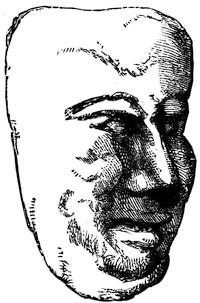
MEXICAN CLAY MASK.
After a cut in Wilson’s Prehistoric Man, ii. p. 33, of an example in the collections of the American Philosophical Society, in a totally different style from the usual Mexican terra-cottas; and Wilson remarks of it that one will look in vain in it for the Indian physiognomy. Tyler, Anahuac, 230, considers it a forgery.
Modelling in clay for other purposes than the making of vessels is also considered in this same seventeenth chapter of Wilson, and the subject runs, as respects masks, figurines, and general ornamentation, into the wide range of aboriginal art, which necessarily makes part of all comprehensive histories of art. W. H. Dall has a paper on Indian masks in the Third Report, Bureau of Ethnology, p. 73. The subject is further treated by Wilson in a paper on “The artistic faculty in the aboriginal races,” in the Proceedings (iii., 2d part, 67, 119) of the Royal Society of Canada, and again in a general way by Nadaillac on L’art préhistorique en Amérique (Paris, 1883), taken from the Revue des deux Mondes, Nov. 1, 1883.[1844]
As regards the textile art in prehistoric times, see for a general view W. H. Holmes in the American Antiquarian, viii. 261; and the same archæologist has treated the subject on the evidences of the impression of textures as preserved in pottery, in the Third Rept. Bur. of Ethnology, p. 393. Cf. Sellers in Popular Science Journal, and Wyman in Peabody Museum Reports.
J. W. Foster first made (1838) the discovery of relics of textile fabrics of the moundbuilders; but he did not announce his discovery till at the Albany meeting (1851) of the American Association for the Advancement of Science (Transactions, 1852, vol. vi. p. 375). He tells the story in his Prehistoric Races, p. 222, and figures the implements, found in the mounds, supposed to be employed in the making their cloth with warp and woof. Putnam has since made similar discoveries (Peabody Museum Reports). The subject is also treated in the Proceedings of the Davenport Academy and of the American Association for the Advancement of Science. The fabrics were preserved by being placed in contact with copper implements.
The Indians of New Mexico were found by the Spaniards in possession of the art of weaving. Cf. Washington Matthews on the Navajo weavers, in the Third Rept. Bur. of Ethnology, p. 371, and Bancroft (i. 582), who also records the making of fabrics by the wild tribes of Central America (Ibid. i. 766-67). He also notes the references to the textile manufactures of the Nahuas and Mayas (ii. 484, 752). The richest accumulation of graphic data relative to the fabrics of Peru is contained in the great work on the Necropolis of Ancon.
Feather-work was an important industry in some parts of the continent. The subject is studied in Ferdinand Denis’ Arte plumaria: Les plumes, leur valeur et leur emploi dans les arts au Méxique, au Pérou, au Brésil et dans les Indes et dans l’Océanie (Paris, 1875).[1845]
Lewis H. Morgan’s Houses and House-life of the American Aborigines (Washington, 1881) is the completest study of the habitations of the early peoples; but it is written too exclusively in the light of universal communal custom, and this must be borne in mind in using it. The edifices of middle America and Peru have been given a bibliographical apparatus in another part of the present volume; but references may be made to Wilson’s Prehistoric Man (ii. ch. 16), Viollet le Duc’s Habitations of Man, translated by R. Bucknall (Boston, 1876), and to Bandelier’s Archæological Tour, 226, where he quotes as typical the description of a native house in 1583, drawn by Juan Bautista Pomar.
There is no good comprehensive account of American prehistoric trade. The T-shaped pieces of copper in use by the Mexicans came nearest to currency as we understand it, unless it be the wampum of the North American Indians, and the shell money in use on the Pacific coast; but it should be remembered that copper axes and copper plates served such a purpose with some tribes.[1846] The Peruvians used weights, but the Mexicans did not. The latter had, however, a system of measures of length.[1847] The canoe was a great intermediary in the practice of barter.[1848] The Peruvians alone understood the use of sails, and the earliest Spanish navigators on the Pacific were surprised at what they thought were civilized predecessors in those seas when they espied in the distance the large white sails of the Peruvian rafts of burden.[1849] The chief source of trade in such conditions was barter, and we know how the Mexican travelling merchants got information that was availed of by the Mexican marauders in their invasions. Bandelier[1850] gives us the references on the barter system, the traders, and the currency in that country, and we need to consult Dr. W. Behrnauer’s Essai sur le Commerce dans l’ancien Méxique et en Pérou, in the Archives de la Soc. Amér. de France (n. s., vol. i.).
All the treatises on the mounds of the Ohio Valley derive illustrations of intertribal traffic from the shells of the coast, the copper of Lake Superior, the mica of the Alleghanies, the obsidian of the Rocky Mountains or of Mexico, and the unique figurines which the explorations of the mounds have disclosed. Charles Rau has a paper on this aboriginal trade in North America, published in the Archiv für Anthroplogie (Braunschweig, 1872, vol. iv.), which was republished in English in the Smithsonian Report, 1872, p. 249. Bancroft’s references under “Commerce” (v. p. 668) will help the student out in various particulars.
IV.
BIBLIOGRAPHICAL NOTES ON AMERICAN LINGUISTICS.
By the Editor.
It cannot be said that the study of American linguistics has advanced to a position wholly satisfactory. It is beset with all the difficulties belonging to a subject that has not been embraced in written records for long periods, and it is open to the hazards of articulation and hearing, acting without entire mutual confidence. And yet we may not dispute Max Müller’s belief,[1851] that it is the science of language which has given the first comprehensive impulse to the study of mankind.
Out of the twenty distinct sounds which it is said the voice of man can produce,[1852] there have been built up from roots and combinations a great diversity of vocabularies. Comparisons of these, as well as of the methods of forming sentences, have been much used in investigations of ethnical relations. Of these opposing methods, neither is sufficiently strong, it is probable, to be pressed without the aid of the other, though the belief of the Bureau of Ethnology at Washington, under the influence of Major Powell, practically discards all tests but the vocabulary, in tracing ethnological relations. It is held that this one test of words satisfies, as to customs, myths, and other ethnological traits, more demands of classifications than any other. Granted that it does, there are questions yet unsolvable by it; and many ethnologists hold that there are still other tests, physiological, for instance,[1853] which cannot safely be neglected in settling such complex questions. The favorite claim of the Bureau is that its officers are studying man as a human being, and not as an animal; but it is by no means sure that the physical qualities of man are so disconnected with his mind and soul as to be unnecessary to his interpretation. Even if language be given the chief place in such studies, there is still the doubt if the vocabulary can in all ways be safely followed to the exclusion of the structure of the language; and it is not to be forgotten, as Haven recognized thirty years ago, that “one of the greatest obstacles to a successful and satisfactory comparison of Indian vocabularies is caused by the capricious and ever-varying orthography applied by writers of different nations.” This is a chance of error that cannot be eliminated when we have to deal with lists of words made in the past, by persons not to be communicated with, in whom both national and personal peculiarities of ear and vocal organs may exist to perplex. A part of the difficulty is of course removed by trained assistants acting in concert, though in different fields; but the individual sharpness or dulness of ear and purity and obscurity of articulation will still cause diversity of results,—to say nothing of corresponding differences in the persons questioned. There is still the problem, broader than all these divisionary tests, whether language is at all a safe test of race, and on this point there is room for different opinions, as is shown in the discussions of Sayce, Whitney, and others.[1854] “Any attempt,” says Max Müller, “at squaring the classification of races and tongues must necessarily fail.”[1855] On the other hand, George Bancroft (Final revision, ii. 90) says that “the aspect of the red men was so uniform that there is no method of grouping them into families but by their languages.”
It is the wide margin for error, already indicated, that vitiates much that has already been done in philological comparisons, and the over-eager recognition at all times of what is thought to be the word-shunting of “Grimm’s Law” has doubtless been responsible for other confusions.[1856]
Most of the general philological treatises touch more or less intimately the question of language as a test of race,[1857] and all of them engage in tracing affinities, each with confidence in a method that others with equal assurance may belittle.[1858] Thus Bancroft,[1859] reflecting an opinion long prevalent, says that “positive grammatical rules carry with them much more weight than mere word likenesses,”[1860] while, on the contrary, Dawson[1861] says that “grammar is, after all, only the clothing of language. The science consists in its root-words; and multitudes of root-words are identical in the American languages over vast areas.” This last proposition is, as we have seen, the principle on which this inquiry is now conducted with governmental patronage. “Each American language,” says George Bancroft, in his chapter on the dialects of North America, “was competent of itself, without improvement of scholars, to exemplify every rule of the logician and give utterance to every passion.” In accordance with such perhaps extreme views, it has been usually said that the American languages are in development in advance of aboriginal progress in other respects. It is another common observation that while a certain resemblance runs through all the native tongues,[1862] there is no such general resemblance to the old-world languages;[1863] but at the same time the linguistic proof of the unity of the American race is not irrefragable,[1864] and it would take tens of thousands of years, as Brinton holds, if there had been a single source, for the eighty stocks of the North American and for the hundred South American speeches to have developed themselves in all their varieties.[1865] Proceeding beyond stocks to dialects, and counting varieties, Ludewig, in his Literature of the American Languages, gave 1,100 different American languages; but an alphabetical list given by H. W. Bates in his Central America, West Indies and South America (London, 1882, 2d ed.)[1866] affords 1,700 names of such. The number, of course, depends on how exclusive we are in grouping dialects. Squier, for instance, gives only 400 tongues for both North and South America; for, as Nadaillac says, “philology has no precise definition of what constitutes a language.”[1867]
The most comprehensive survey of the bibliography of American linguistics, excluding South America, is in Pilling’s Proof-sheets of a bibliography of the languages of the North American Indians (Washington, 1885), a tentative issue of the Bureau of Ethnology, already mentioned. Pilling also earlier catalogued the linguistic MSS. in the library of the Bureau of Ethnology, in Powell’s First Report of that Bureau (p. 553), in which that bibliographer also gave a sketch of the history of gathering such collections. A section of the Bibliotheca Americana of Charles Leclerc (Paris, 1878) is given to linguistics, and it affords by groups one of the best keys to the literature of the aboriginal languages which we yet have, and it has been supplemented by additional lists issued since by Maisonneuve of Paris. Ludewig’s Literature of American Aboriginal Languages, with additions by W. Turner (London, 1858), was up to date, thirty years ago, a good list of grammars and dictionaries, but the increase has been considerable in this field since then (Pilling’s Eskimo Languages, p. 62). The libraries of collectors of Spanish-American history, as enumerated elsewhere,[1868] have usually included much on the linguistic history, and the most important of the printed lists for Mexico and Central America is that of Brasseur de Bourbourg’s Bibliothèque Mexico-Guatémalienne, précédée d’un coup d’œil sur les études américaines dans leurs rapports avec les études classiques, et suivi du tableau, par ordre alphabétique, des ouvrages de linguistique américaine contenus dans le même volume (Paris, 1871). This list is repeated with additions in the Catalogue de Alphonse L. Pinart et ... de Brasseur de Bourbourg (Paris, 1883). Field’s Indian Bibliography characterizes some of the leading books up to 1873; but the best source up to about the same date for a large part of North America is found in the notes in that section of Bancroft’s Native Races, vol. iii., given to linguistics.[1869] The several Comptes Rendus of the Congrès des Américanistes have sections on the same subject, and the second volume of the Contributions to North American Ethnology, published by the U. S. Geological Survey (Powell’s), has been kept back for the completion of the linguistic studies of the government officials, which will ultimately, under the care of A. S. Gatschet, compose that belated volume. Major Powell, in his conduct of ethnological investigations for the United States government, has found efficient helpers in James C. Pilling, J. Owen Dorsey, S. R. Riggs, A. S. Gatschet, not to name others. Powell outlined some of his own views in an address on the evolution of language before the Anthropological Society of Washington, of which there is an abstract in their Transactions (1881), while the paper can be found in perfected shape as “The evolution of language from a study of the Indian languages,” in the First Report of the Bureau of Ethnology.
Among the earliest of the students of the native languages in the north were the Catholic missionaries in Canada and in the northwest, and there is much of interest in their observations as recorded in the Jesuit Relations. We find a Dictionnaire de la langue huronne in the Grand Voyage du Pays des Hurons (Paris, 1632, etc.).
The most conspicuous of the English publications of the seventeenth century was the Natick rendering of the Bible for the Massachusetts Indians, undertaken by the Apostle John Eliot, as he was called, at the expense of the London Society for the Propagation of the Gospel. Eliot also published a Grammar of the Massachusetts Indian Language (Cambridge, 1666), which, with notes by Peter S. Duponceau and an introduction by John Pickering, was printed for the Mass. Hist. Society in 1822, as was John Cotton’s Vocabulary of the Massachusetts Indian Language (Cambridge, 1830). Roger Williams’ Key into the language of America has been elsewhere referred to.[1870] The Rev. Jonathan Edwards wrote a paper on the language of the Mohegan Indians, which, with annotations by Pickering, was printed in the Mass. Hist. Soc. Coll. in 1823, and is called by Haven (Archæol. U. S., 29) the earliest exposition of the radical connection of the American languages. Dr. James Hammond Trumbull, the most learned of the students of these eastern languages, has furnished various papers on them in the publications of the American Philological Association and of the American Antiquarian Society,[1871] and has summarized the literature of the subject, with references, in the Memorial Hist. of Boston (vol. i.).
In the eighteenth century there were several philological recorders among the missionaries. Sebastian Rasle made a Dictionary of the Abnake Language, now preserved in MS. in Harvard College library, which, edited by John Pickering, was published as a volume of the Memoirs of the Amer. Academy of Arts and Sciences in 1833. A grammatical sketch of the Abnake as outlined in Rasle’s Dictionary is given by M. C. O’Brien in the Maine Hist. Soc. Coll., vol. ix. The publications of the American Philosophical Society in Philadelphia have preserved for us the vocabularies and grammars of the Delaware language, collected and arranged by John Heckewelder[1872] and David Zeisberger, while the latter Moravian missionary collected a considerable MS. store of linguistic traces of the Indian tongues, a part of which is now preserved in Harvard College library.[1873] One of this last collection, an Indian Dictionary; English, German, Iroquois (the Onondaga), and Algonquin (the Delaware) (Cambridge, 1887,) has been carefully edited for the press by Eben Norton Horsford. Dr. John G. Shea published a Dictionnaire Français-Onontagué, édité d’après un manuscrit du 17e siècle (N. Y., 1859), which is preserved in the Mazarin library in Paris.
There was no attempt made to treat the study of the American languages in what would now be termed a scientific spirit by any English scholar till towards the end of the eighteenth century. The whole question of the origin of the Indians had for a long time been the subject of discussion, and it had of necessity taken more or less of a philological turn from the beginning; but the inquiry had been simply a theoretical one, with efforts to substantiate preconceived beliefs rather than to formulate inductive ones, as in such works as—not to name others—Adair’s American Indians (London, 1775), where every trace was referable to the Jews, and Count de Gebelin’s Monde Primitif (Paris, 1781), where a comparison of American and European vocabularies is given.[1874]
A much closer student appeared in Benjamin Smith Barton, of Philadelphia, though he was not wholly emancipated from these same prevalent notions of connecting the Indian tongues with the old-world speeches. He says that he was instigated to the study by Pallas’ Linguarum totius orbis Vocabularia comparativa (Petropolis, 1786, 1789), and the result was his New View of the Origin of the tribes and nations of America (Philad., 1797; again, 1798). He sets forth in his introduction his methods of study. Charlevoix had suggested that the linguistic test was the only one in studying the ethnological connections of these peoples; but Barton asserted that there were other manifestations, equally important, like the physical aspects, the modes of worship, and the myths. He examined forty different Indian languages, and thinks they show a common origin, and that remotely a connection existed between the old and new continents.
The most eminent American student[1875] of this field in the early half of this century was Albert Gallatin. He began his observations in 1823, at the instance of Humboldt, and two years later he took advantage of a representative convocation of Indian tribes, then held in Washington, to continue his studies of their speech. In 81 tribes brought under his notice he found what he thought to be 27 or 28 linguistic families. This was a wider survey than had before been made, and he regretted that he was not privileged to profit by the vocabularies collected by Lewis and Clark, which had unfortunately been lost. At the request of the Amer. Antiquarian Society, he wrote out and enlarged this study in the second volume of their Collections in 1836, and advanced views that he never materially changed, believing in a very remote Asiatic origin of the tongues, and without excepting the Eskimos from his conclusions. In 1845, in his Notes on the semi-civilized nations of Mexico, his conclusions were much the same, but he made an exception in favor of the Otomis. At this time he counted more than a hundred languages, similar in structure but different in vocabularies, and he argued that a very long period was necessary thus to differentiate the tongues. At the age of eighty-seven Gallatin gave his final results in vol. ii. of the Transactions of the American Ethnological Society (1848). Gallatin published a review[1876] of the volume on Ethnography and Philology, which had been prepared by Horatio Hale as the seventh volume of the Publications of the Wilkes United States Exploring Expedition (1838-42), and Hale himself, then in the beginning of his reputation as a linguistic scholar,[1877] published some papers of his own in the same volume of the Transactions.[1878]
The two Americans who have done more than others, without the aid of the government, to organize aboriginal linguistic studies are Dr. John Gilmary Shea of Elizabeth, New Jersey, and Dr. Daniel Garrison Brinton of Philadelphia. Of Shea’s Library of American Linguistics he has given an account in the Smithsonian Rept., 1861.[1879]
Dr. Brinton has set forth the purposes of his linguistic studies in an address before the Pennsylvania Historical Society, American Aboriginal Languages and why we should study them (Philad., 1885,—from the Pennsylvania Magazine of History, 1885, p. 15). In starting his Library of Aboriginal American Literature, he announced his purpose to put within the reach of scholars authentic materials for the study of the languages and culture of the native races, each work to be the production of the native mind, and to be printed in the original tongue, with a translation and notes, and to have some intrinsic historical or ethnological importance.[1880]
The other considerable collections are both French. Alphonse L. Pinart published a Bibliothèque de linguistique et d’ethnographie Américaines (Paris and San Francisco, 1875-82).[1881]
The publishing house of Maisonneuve et Compagnie of Paris, which has done more than any other business firm to advance these studies, has conducted a Collection linguistique Américaine, of much value to American philologists.[1882]
Other French studies have attracted attention. Pierre Etienne Duponceau published a Mémoire sur le système grammatical des langues de quelques nations indiennes de l’Amérique du Nord (Paris, 1838).[1883] He conducted a correspondence with the Rev. John Heckewelder respecting the American tongues, which is published in the Transactions of the Amer. Philosophical Society (Phil., 1819), and he translated Zeisberger’s Delaware Grammar.
The studies of the Abbé Jean André Cuoq have been upon the Algonquin dialects,[1884] and published mainly in the Actes de la Société philologique (Paris, 1869 and later). His monographic Etudes philologiques sur quelques langues sauvages de l’Amérique was printed at Montreal, 1866. It was the result of twenty years’ missionary work among the Iroquois and Algonquins, and besides a grammar contains a critical examination of the works of Duponceau and Schoolcraft. Lucien Adam has been very comprehensive in his researches, his studies being collected under the titles of Etudes sur six langues Américaines (Paris, 1878) and Examen grammatical comparé de seize langues Américaines (Paris, 1878).[1885]
The papers of the Count Hyacinthe de Charencey have been in the first instance for the most part printed in the Revue de Linguistique, the Annales de Philosophie Chrétienne, and the Mémoires de l’Académie de Caen, and have wholly pertained to the tongues south of New Mexico; but his principal studies are collected in his Mélanges de philologie et de paléographie Américaines (Paris, 1883).[1886]
The most distinguished German worker in this field, if we except the incidental labors of Alexander and William von Humboldt,[1887] is J. C. E. Buschmann, whose various linguistic labors cover the wide field of the west coast of North America from Alaska to the Isthmus, with some of the regions adjacent on the east. He published his papers in Berlin between 1853 and 1864, and many of them in the Mémoires de l’Académie de Berlin.[1888]
Dr. Carl Hermann Berendt has published his papers in Spanish, English, and German, and some of them will be found in the Smithsonian Reports, in the Berlin Zeitschrift für Ethnologie, and in the Revista de Mérida. Under the auspices of the American Ethnological Society, a fac-simile reproduction of his graphic Analytical Alphabet for the Mexican and Central American languages was published in 1869, the result of twelve years’ study in those countries.[1889]
The languages of what are called the civilized nations of the central regions of America deserve more particular attention.
In the Mexican empire the Aztec was largely predominant, but not exclusively spoken, for about twenty other tongues were more or less in vogue in different parts. Humboldt and others have found occasional traces in words of an earlier language than the Aztec or Nahua, but different from the Maya, which in Brasseur’s opinion was the language of the country in those pre-Nahua days. Bancroft, contrary to some recent philologists, holds the speech of the Toltec, Chichimec, and Aztec times to be one and the same.[1890] It was perhaps the most copious and most perfected of all the aboriginal tongues; and in proof of this are cited the opinions of the early Spanish scholars, the successes of the missionaries in the use of it in imparting the subtleties of their faith, and the literary use which was made of it by the native scholars, as soon as they had adapted the Roman alphabet to its vocabulary and forms.[1891]
The Maya has much the same prominence farther south that the Nahua has in the northerly parts of the territory of the Spanish conquest, and a dialect of it, the Tzendal, still spoken near Palenqué, is considered to be the oldest form of it, though probably this dialect was a departure from the original stock. It is one of the evidences that the early Mayas may have come by way of the West India islands that modern philologists say the native tongues of those islands were allied to the Maya. Bancroft (iii. 759, with other references, 760) refers to the list of spoken tongues given in Palacio’s Carta al Rey de España (1576) as the best enumeration of the early Spanish writers.[1892] For its literary value we must consult some of the authorities like Orozco y Berra, mentioned in connection with the Aztec. Squier published a Monograph of authors who have written on the languages of Central America, and collected vocabularies and composed works in the native dialects of that country (Albany, 1861,—100 copies), in which he mentions 110 such authors, and gives a list of their printed and MS. works. Those who have used these native tongues for written productions are named in Ludewig’s Literature of the Amer. Aborig. Languages (London, 1858) and in Brinton’s Aboriginal American Authors (Phila., 1883).[1893]
The philology of the South American peoples has not been so well compassed as that of the northern continent. The classified bibliographies show the range of it under such heads as Ande (or Campa), Araucanians (Chilena), Arrawak, Aymara, Brazil (the principal work being F. P. von Martius’s Beiträge zur Ethnographie und Sprachenkunde Amerika’s, zumal Brasiliens, Leipzig, 1867, with a second part called Glossaria linguarum brasiliensium, Erlangen, 1863), Chama, Chibcha (or Muysca, Mosca), Cumanagota, Galibi, Goajira, Guarani, Kiriri (Kariri), Lule, Moxa, Paez, Quichua, Tehuelhet, Tonocote, Tupi, etc.