Part 2 — CHAPTER IV. (continued 2)
Reading edition
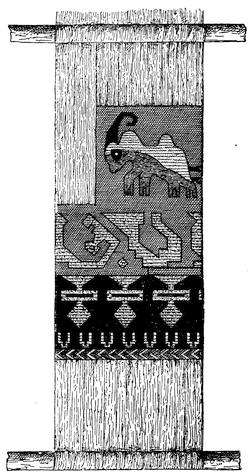
UNFINISHED CLOTH FOUND AT PACHACAMAC.
[After a cut in Wiener, Pérou et Bolivie, p. 65.—Ed.]
Spinning, weaving, and dyeing were arts which were sources of employment to a great number of people, owing to the quantity and variety of the fabrics for which there was a demand. There were rich dresses interwoven with gold or made of gold thread; fine woollen mantles, or tunics, ornamented with borders of small square gold and silver plates; colored cotton cloths worked in complicated patterns; and fabrics of aloe fibre and sheeps’ sinews for breeches. Coarser cloths of llama wool were also made in vast quantities. But the potters art was perhaps the one which exercised the inventive faculties of the Peruvian artist to the greatest extent. The silver and gold utensils, with the exception of a very few cups and vases, have nearly all been melted down. But specimens of pottery, found buried with the dead in great profusion, are abundant. They are to be seen in every museum, and at Berlin and Madrid the collections are very large.[1223] Varied as are the forms to be found in the pottery of the Incas, and elegant as are many of the designs, it must be acknowledged that they are inferior in these respects to the specimens of the plastic art of the Chimu and other people of the Peruvian coast. The Incas, however, displayed a considerable play of fancy in their designs. Many of the vases were moulded into forms to represent animals, fruit, and corn, and were used as conopas, or household gods. Others took the shape of human heads or feet, or were made double or quadruple, with a single neck branching from below. Some were for interment with the malquis, others for household use.[1224] Professor Wilson, who carefully examined several collections of ancient Peruvian pottery, formed a high opinion of their merit. “Some of the specimens,” he wrote, “are purposely grotesque, and by no means devoid of true comic fancy; while, in the greater number, the endless variety of combinations of animate and inanimate forms, ingeniously rendered subservient to the requirements of utility, exhibit fertility of thought in the designer, and a lively perceptive faculty in those for whom he wrought.”[1225]
There is a great deal more to learn respecting this marvellous Inca civilization. Recent publications have, within the last few years, thrown fresh and unexpected light upon it. There may be more information still undiscovered or inedited. As yet we can understand the wonderful story only imperfectly, and see it by doubtful lights. Respecting some questions, even of the first importance, we are still able only to make guesses and weigh probabilities. Yet, though there is much that is uncertain as regards historical and other points, we have before us the clear general outlines of a very extraordinary picture. In no other part of America had civilization attained to such a height among indigenous races. In no other part of the world has the administration of a purely socialistic government been attempted. The Incas not only made the attempt, but succeeded.

CRITICAL ESSAY ON THE SOURCES OF INFORMATION.
THE student of Inca civilization will first seek for information from those Spanish writers who lived during or immediately after the Spanish conquest. They were able to converse with natives who actually flourished before the disruption of the Inca empire, and who saw the working of the Inca system before the destruction and ruin had well commenced. He will next turn to those laborious inquirers and commentators who, although not living so near the time, were able to collect traditions and other information from natives who had carefully preserved all that had been handed down by their fathers.[1226] These two classes include the writers of the sixteenth and seventeenth centuries. The authors who have occupied themselves with the Quichua language and the literature of the Incas have produced works a knowledge of which is essential to an adequate study of the subject.[1227] Lastly, a consideration of the publications of modern travellers and scholars, who throw light on the writings of early chroniclers, or describe the present appearance of ancient remains, will show the existing position of a survey still far from complete, and the interest and charm of which invite further investigation and research.
Foremost in the first class of writers on Peru is Pedro de Cieza de Leon. A general account of his works will be found elsewhere,[1228] and the present notice will therefore be confined to an estimate of the labors of this author, so far as they relate to Inca history and civilization. Cieza de Leon conceived the desire to write an account of the strange things that were to be seen in the New World, at an early period of his service as a soldier. “Neither fatigue,” he tells us, “nor the ruggedness of the country, nor the mountains and rivers, nor intolerable hunger and suffering, have ever been sufficient to obstruct my two duties, namely, writing and following my flag and my captain without fault.” He finished the First Part of his chronicle in September, 1550, when he was thirty-two years of age. It is mainly a geographical description of the country, containing many pieces of information, such as the account of the Inca roads and bridges, which are of great value. But it is to the Second Part that we owe much of our knowledge of Inca civilization. From incidental notices we learn how diligently young Cieza de Leon studied the history and government of the Incas, after he had written his picturesque description of the country in his First Part. He often asked the Indians what they knew of their condition before the Incas became their lords. He inquired into the traditions of the people from the chiefs of the villages. In 1550 he went to Cuzco with the express purpose of collecting information, and conferred diligently with one of the surviving descendants of the Inca Huayna Ccapac. Cieza de Leon’s plan, for the second part of his work, was first to review the system of government of the Incas, and then to narrate the events of the reign of each sovereign. He spared no pains to obtain the best and most authentic information, and his sympathy with the conquered people, and generous appreciation of their many good and noble qualities, give a special charm to his narrative. He bears striking evidence to the historical faculty possessed by the learned men at the court of the Incas. After saying that on the death of a sovereign the chroniclers related the events of his reign to his successor, he adds: “They could well do this, for there were among them some men with good memories, sound judgments, and subtle genius, and full of reasoning power, as we can bear witness who have heard them even in these our days.” Cieza de Leon is certainly one of the most important authorities on Inca history and civilization, whether we consider his peculiar advantages, his diligence and ability, or his character as a conscientious historian.
Juan José de Betanzos, like Cieza de Leon, was one of the soldiers of the conquest. He married a daughter of Atahualpa, and became a citizen at Cuzco, where he devoted his time to the study of Quichua. He was appointed official interpreter to the Audience and to successive viceroys, and he wrote a Doctrina and two vocabularies which are now lost. In 1558 he was appointed by the viceroy Marquis of Cañete, to treat with the Inca Sayri Tupac,[1229] who had taken refuge in the fastness of Vilcabamba; and by the Governor Lope Garcia de Castro, to conduct a similar negotiation with Titu Cusi Yupanqui, the brother of Sayri Tupac. He was successful in both missions. He wrote his most valuable work, the Suma y Narracion de los Incas, which was finished in the year 1551, by order of the Viceroy Don Antonio de Mendoza, but its publication was prevented by the death of the viceroy. It remained in manuscript, and its existence was first made known by the Dominican monk Gregorio Garcia in 1607, whose own work will be referred to presently. Garcia said that the history of Betanzos relating to the origin, descent, succession, and wars of the Incas was in his possession, and had been of great use to him. Leon Pinelo and Antonio also gave brief notices of the manuscript, but it is only twice cited by Prescott. The great historian probably obtained a copy of a manuscript in the Escurial, through Obadiah Rich. This manuscript is bound up with the second part of Cieza de Leon. It is not, however, the whole work which Garcia appears to have possessed, but only the first eighteen chapters, and the last incomplete. Such as it is, it was edited and printed for the Biblioteca Hispano-Ultramarina, by Don Márcos Jiménez de la Espada, in 1880.[1230]
The work of Betanzos differs from that of Cieza de Leon, because while the latter displays a diligence and discretion in collecting information which give it great weight as an authority, the former is imbued with the very spirit of the natives. The narrative of the preparation of young Yupanqui for the death-struggle with the Chancas is life-like in its picturesque vigor. Betanzos has portrayed native feeling and character as no other Spaniard has, or probably could have done. Married to an Inca princess, and intimately conversant with the language, this most scholarly of the conquerors is only second to Cieza de Leon as an authority. The date of his death is unknown.
Betanzos and Cieza de Leon, with Pedro Pizarro, are the writers among the conquerors whose works have been preserved. But these three martial scholars by no means stand alone among their comrades as authors. Several other companions of Pizarro wrote narratives, which unfortunately have been lost.[1231] It is indeed surprising that the desire to record some account of the native civilization they had discovered should have been so prevalent among the conquerors. The fact scarcely justifies the term “rude soldiery,” which is so often applied to the discoverers of Peru.
The works of the soldier conquerors are certainly not less valuable than those of the lawyers and priests who followed on their heels. Yet these latter treat the subject from somewhat different points of view, and thus furnish supplemental information. The works of four lawyers of the era of the conquest have been preserved, and those of another are lost. Of these, the writings of the Licentiate Polo de Ondegardo are undoubtedly the most important. This learned jurist accompanied the president, La Gasca, in his campaign against Gonzalo Pizarro, having arrived in Peru a few years previously, and he subsequently occupied the post of corregidor at Cuzco. Serving under the Viceroy Don Francisco de Toledo, he was constantly consulted by that acute but narrow-minded statesman. His duties thus led Polo de Ondegardo to make diligent researches into the laws and administration of the Incas, with a view to the adoption of all that was applicable to the new régime. But his knowledge of the language was limited, and it is necessary to receive many of his statements with caution. His two Relaciones, the first dedicated to the Viceroy Marques de Cañete (1561), and the second finished in 1570,[1232] are in the form of answers to questions on financial revenue and other administrative points. They include information respecting the social customs, religious rites, and laws of the Incas. These Relaciones are still in manuscript. Another report by Polo de Ondegardo exists in the National Library at Madrid,[1233] and has been translated into English for the Hakluyt Society.[1234] In this treatise the learned corregidor describes the principles on which the Inca conquests were made, the division and tenures of land, the system of tribute, the regulations for preserving game and for forest conservancy, and the administrative details. Here and there he points out a way in which the legislation of the Incas might be imitated and utilized by their conquerors.[1235]
Agustin de Zarate, though a lawyer by profession, had been employed for some years in the financial department of the Spanish government before he went out to Peru with the Viceroy Blasco Nuñez to examine into the accounts of the colony. On his return to Spain he was entrusted with a similar mission in Flanders. His Provincìa del Peru was first published at Antwerp in 1555.[1236] Unacquainted with the native languages, and ignorant of the true significance of much that he was told, Zarate was yet a shrewd observer, and his evidence is valuable as regards what came under his own immediate observation. He gives one of the best descriptions of the Inca roads.
The Relacion of Fernando de Santillan is a work which may be classed with the reports of Polo de Ondegardo, and its author had equal advantages in collecting information. Going out to Peru as one of the judges of the Audiencia in 1550,[1237] Santillan was for a short time at the head of the government, after the death of the Viceroy Mendoza, and he took the field to suppress the rebellion of Giron. He afterwards served in Chile and at Quito, where he was commissioned to establish the court of justice. Returning to Spain, he took orders, and was appointed Bishop of the La Plata, but died at Lima, on his way to his distant see, in 1576. The Relacion of Santillan remained in manuscript, in the library of the Escurial, until it was edited by Don Márcos Jiménez de la Espada in 1879. This report appears to have been prepared in obedience to a decree desiring the judges of Lima to examine aged and learned Indians regarding the administrative system of the Incas. The report of Santillan is mainly devoted to a discussion of the laws and customs relating to the collection of tribute. He bears testimony to the excellence of the Inca government, and to the wretched condition to which the country had since been reduced by Spanish misrule.
The work of the Licentiate Juan de Matienzo, a contemporary of Ondegardo, entitled Gobierno de el Peru, is still in manuscript. Like Santillan and Ondegardo, Matienzo discusses the ancient institutions with a view to the organization of the best possible system under Spanish rule.[1238]
Melchor Bravo de Saravia, another judge of the Royal Audience at Lima, and a contemporary of Santillan, is said to have written a work on the antiquities of Peru; but it is either lost or has not yet been placed within reach of the student. It is referred to by Velasco. Cieza de Leon mentions, at the end of his Second Part, that his own work had been perused by the learned judges Hernando de Santillan and Bravo de Saravia.
While the lawyers turned their attention chiefly to the civil administration of the conquered people, the priests naturally studied the religious beliefs and languages of the various tribes, and collected their historical traditions. The best and most accomplished of these sacerdotal authors appears to have been Blas Valera, judging from the fragments of his writings which have escaped destruction. He was a native of Peru, born at Chachapoyas in 1551, where his father, Luis Valera,[1239] one of the early conquerors, had settled. Young Blas was received into the Company of Jesus at Lima when only seventeen years of age, and, as he was of Inca race on the mother’s side, he soon became useful at the College in Cuzco from his proficiency in the native languages. He did missionary work in the surrounding villages, and acquired a profound knowledge of the history and institutions of the Incas. Eventually he completed a work on the subject in Latin, and was sent to Spain by his Jesuit superiors with a view to its publication. Unfortunately the greater part of his manuscript was burnt at the sack of Cadiz by the Earl of Essex in 1596, and Blas Valera himself died shortly afterwards. The fragments that were rescued fell into the hands of Garcilasso de la Vega, who translated them into Spanish, and printed them in his Commentaries. It is to Blas Valera that we owe the preservation of two specimens of Inca poetry and an estimate of Inca chronology. He has also recorded the traditional sayings of several Inca sovereigns, and among his fragments there are very interesting chapters on the religion, the laws and ordinances, and the language of the Incas, and on the vegetable products and medicinal drugs of Peru. These fragments are evidence that Blas Valera was an elegant scholar, a keen observer, and thoroughly master of his subject. They enhance the feeling of regret at the irreparable loss that we have sustained by the destruction of the rest of his work.
Next to Blas Valera, the most important authority on Inca civilization, among the Spanish priests who were in Peru during the sixteenth century, is undoubtedly Christoval de Molina. He was chaplain to the hospital for natives at Cuzco, and his work was written between 1570 and 1584, the period embraced by the episcopate of Dr. Sebastian de Artaun, to whom it is dedicated. Molina gives minute and detailed accounts of the ceremonies performed at all the religious festivals throughout the year, with the prayers used by the priests on each occasion. Out of the fourteen prayers preserved by Molina, four are addressed to the Supreme Being, two to the sun, the rest to these and other deities combined. His mastery of the Quichua language, his intimacy with the native chiefs and learned men, and his long residence at Cuzco give Molina a very high place as an authority on Inca civilization. His work has remained in manuscript,[1240] but it has been translated into English and printed for the Hakluyt Society.[1241]
Molina, in his dedicatory address to Bishop Artaun, mentions a previous narrative which he had submitted, on the origin, history, and government of the Incas. Fortunately this account was preserved by Miguel Cavello Balboa, an author who wrote at Quito between 1576 and 1586. Balboa, a soldier who had taken orders late in life, went out to America in 1566, and settled at Quito, where he devoted himself to the preparation and writing of a work which he entitled Miscellanea Austral. It is in three parts; but only the third, comprising about half the work, relates to Peru. Balboa tells us that his authority for the early Inca traditions and history was the learned Christoval de Molina, and this gives special value to Balboa’s work. Moreover, Balboa is the only authority who gives any account of the origin of the coast people, and he also supplies a detailed narrative of the war between Huascar and Atahualpa. The portion relating to Peru was translated into French and published by Ternaux Compans in 1840.[1242]
The Jesuits who arrived in Peru during the latter part of the sixteenth century were devoted to missionary labors, and gave an impetus to the study of the native languages and history. Among the most learned was José de Acosta, who sailed for Peru in 1570. At the early age of thirty-five, Acosta was chosen to be Provincial of the Jesuits in Peru, and his duties required him to travel over every part of the country. His great learning, which is displayed in his various theological works, qualified him for the task of writing his Natural and Moral History of the Indies, the value of which is increased by the author’s personal acquaintance with the countries and their inhabitants. Acosta went home in the Spanish fleet of 1587, and his first care, on his return to Spain, was to make arrangements for the publication of his manuscripts. The results of his South American researches first saw the light at Salamanca, in Latin, in 1588 and 1589. The complete work in Spanish, Historia Natural y Moral de las Indias, was published at Seville in 1590. Its success was never doubtful.[1243] In his latter years Acosta presided over the Jesuits’ College at Salamanca, where he died in his sixtieth year, on February 15, 1600.[1244] In spite of the learning and diligence of Acosta and of the great popularity of his work, it cannot be considered one of the most valuable contributions towards a knowledge of Inca civilization. The information it contains is often inaccurate, the details are less complete than in most of the other works written soon after the conquest,[1245] and a want of knowledge of the language is frequently made apparent. The best chapters are those devoted to the animal and vegetable products of Peru; and Feyjoo calls Acosta the Pliny of the New World.[1246]
The Licentiate Fernando Montesinos, a native of Osuna, was one of the most diligent of all those who in early times made researches into the history and traditions of the Incas. Montesinos went out in the fleet which took the Viceroy Count of Chinchon to Peru, arriving early in the year 1629. Having landed at Payta, Montesinos travelled southwards towards the capital until he reached the city of Truxillo. At that time Dr. Carlos Marcelino Corni was Bishop of Truxillo.[1247] Hearing of the virtue and learning of Montesinos, Dr. Corni begged that he might be allowed to stop at Truxillo, and take charge of the Jesuits’ College which the good bishop had established there. Montesinos remained at Truxillo until the death of Bishop Corni, in October, 1629,[1248] and then proceeded to Potosi, where he gave his attention to improvements in the methods of extracting silver. He wrote a book on the subject, which was printed at Lima, and also compiled a code of ordinances for mines with a view to lessening disputes, which was officially approved. Returning to the capital, he lived for several years at Lima as chaplain of one of the smaller churches, and devoted all his energies to the preparation of a history of Peru. Making Lima his headquarters, the indefatigable student undertook excursions into all parts of the country, wherever he heard of learned natives to be consulted, of historical documents to be copied, or of information to be found. He travelled over 1,500 leagues, from Quito to Potosi. In 1639 he was employed to write an account of the famous Auto de Fé which was celebrated at Lima in that year. His two great historical works are entitled Memorias Antiguas Historiales del Peru, and Anales ó Memorias Nuevas del Peru.[1249] From Lima Montesinos proceeded to Quito as “Visitador General,” with very full powers conferred by the bishop.
The work of Montesinos remained in manuscript until it was translated into French by M. Ternaux Compans in 1840, with the title Mémoires Historiques sur l’ancien Pérou. In 1882 the Spanish text was very ably edited by Don Márcos Jiménez de la Espada.[1250] Montesinos gives the history of several dynasties which preceded the rise of the Incas, enumerating upwards of a hundred sovereigns. He professes to have acquired a knowledge of the ancient records through the interpretations of the quipus, communicated to him by learned natives. It was long supposed that the accounts of these earlier sovereigns received no corroboration from any other authority. This furnished legitimate grounds for discrediting Montesinos. But a narrative, as old or older than that of the licentiate, has recently been brought to light, in which at least two of the ancient sovereigns in the lists of Montesinos are incidentally referred to. This circumstance alters the aspect of the question, and places the Memorias Antiquas del Peru in a higher position as an authority; for it proves that the very ancient traditions which Montesinos professed to have received from the natives had previously been communicated to one other independent inquirer at least.
This independent inquirer is an author whose valuable work has recently been edited by Don Márcos Jiménez de la Espada.[1251] His narrative is anonymous, but internal evidence establishes the fact that he was a Jesuit, and probably one of the first who arrived in Peru in 1568, although he appears to have written his work many years afterwards. The anonymous Jesuit supplies information respecting works on Peruvian civilization which are lost to us. He describes the temples, the orders of the priesthood, the sacrifices and religious ceremonies, explaining the origin of the erroneous statement that human sacrifices were offered up. He also gives the code of criminal law and the customs which prevailed in civil life, and concludes his work with a short treatise on the conversion of the Indians.
The efforts of the viceroys and archbishops of Lima during the early part of the seventeenth century to extirpate idolatry, particularly in the province of Lima, led to the preparation of reports by the priests who were entrusted with the duty of extirpation, which contain much curious information. These were the Fathers Hernando de Avendaño, Francisco de Avila, Luis de Teruel, and Pablo José de Arriaga. Avendaño, in addition to his sermons in Quichua, wrote an account of the idolatries of the Indians,—Relacion de las Idolatrias de los Indios,—which is still in manuscript. Avila was employed in the province of Huarochiri, and in 1608 he wrote a report on the idols and superstitions of the people, including some exceedingly curious religious legends. He appears to have written down the original evidence from the mouths of the Indians in Quichua, intending to translate it into Spanish. But he seems to have completed only six chapters in Spanish; or perhaps the translation is by another hand. There are still thirty-one chapters in Quichua awaiting the labors of some learned Peruvian scholar. Rising Quichua students, of whom there are not a few in Peru, could undertake no more useful work. This important report of Avila is comprised in a manuscript volume in the National Library at Madrid, and the six Spanish chapters have been translated and printed for the Hakluyt Society.[1252] Teruel was the friend and companion of Avila. He also wrote a treatise on native idolatries,[1253] and another against idolatry,[1254] in which he discusses the origin of the coast people. Arriaga wrote a still more valuable work on the extirpation of idolatry, which was printed at Lima in 1621, and which relates the religious beliefs and practices of the people in minute detail.[1255]
Antiquarian treasures of great value are buried in the works of ecclesiastics, the principal objects of which are the record of the deeds of one or other of the religious fraternities. The most important of these is the Coronica Moralizada del orden de San Augustin en el Peru; del Padre Antonio de la Calancha (1638-1653),[1256] which is a precious storehouse of details respecting the manners and customs of the Indians and the topography of the country. Calancha also gives the most accurate Inca calendar. Of less value is the chronicle of the Franciscans, by Diego de Cordova y Salinas, published at Madrid in 1643.
A work, the title of which gives even less promise of containing profitable information, is the history of the miraculous image of a virgin at Copacabana, by Fray Alonso Ramos Gavilan. Yet it throws unexpected light on the movements of the mitimaes, or Inca colonists; it gives fresh details respecting the consecrated virgins, the sacrifices, and the deities worshipped in the Collao, and supplies another version of the Inca calendar.[1257]
The work on the origin of the Indians of the New World, by Fray Gregorio Garcia,[1258] who travelled extensively in the Spanish colonies, is valuable, and to Garcia we owe the first notice of the priceless narrative of Betanzos. His separate work on the Incas is lost to us.[1259] Friar Martin de Múrua, a native of Guernica, in Biscay, was an ecclesiastic of some eminence in Peru. He wrote a general history of the Incas, which was copied by Dr. Muñoz for his collection, and Leon Pinelo says that the manuscript was illustrated with colored drawings of insignia and dresses, and portraits of the Incas.[1260]
The principal writers on Inca civilization in the century immediately succeeding the conquest, of the three different professions,—soldiers, lawyers, and priests,—have now been passed in review. Attention must next be given to the native writers who followed in the wake of Blas Valera. First among these is the Inca Garcilasso de la Vega, an author whose name is probably better known to the general reader than that of any other who has written on the same subject. Among the Spanish conquerors who arrived in Peru in 1534 was Garcilasso de la Vega, a cavalier of very noble lineage,[1261] who settled at Cuzco, and was married to an Inca princess named Chimpa Ocllo, niece of the Inca Huayna Ccapac. Their son, the future historian, was born at Cuzco in 1539, and his earliest recollections were connected with the stirring events of the civil war between Gonzalo Pizarro and the president La Gasca, in 1548. His mother died soon afterwards, probably in 1550, and his father married again. The boy was much in the society of his mother’s kindred, and he often heard them talk over the times of the Incas, and repeat their historical traditions. Nor was his education neglected; for the good Canon Juan de Cuellar read Latin with the half-caste sons of the citizens of Cuzco for nearly two years, amidst all the turmoil of the civil wars. As he grew up, he was employed by his father to visit his estates, and he travelled over most parts of Peru. The elder Garcilasso de la Vega died in 1560, and the young orphan resolved to seek his fortune in the land of his fathers. On his arrival in Spain he received patronage and kindness from his paternal relatives, became a captain in the army of Philip II, and when he retired, late in life, he took up his abode in lodgings at Cordova, and devoted himself to literary pursuits. His first production was a translation from the Italian of “The Dialogues of Love,” and in 1591 he completed his narrative of the expedition of Hernando de Soto to Florida.[1262]
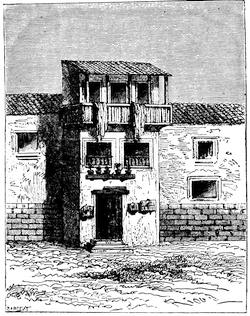
HOUSE IN CUZCO IN WHICH GARCILASSO WAS BORN.
[After a cut in Marcoy, i. 219. Cf. Squier’s Peru, p. 449.—Ed.]
As years rolled on, the Inca began to think more and more of the land of his birth. The memory of his boyish days, of the long evening chats with his Inca relations, came back to him in his old age. He was as proud of his maternal descent from the mighty potentates of Peru as of the old Castilian connection on his father’s side. It would seem that the appearance of several books on the subject of his native land finally induced him to undertake a work in which, while recording its own reminiscences and the information he might collect, he could also comment on the statements of other authors. Hence the title of Commentaries which he gave to his work. Besides the fragments of the writings of Blas Valera, which enrich the pages of Garcilasso, the Inca quotes from Acosta, from Gomara, from Zarate, and from the First Part of Cieza de Leon.[1263] He was fortunate in getting possession of the chapters of Blas Valera rescued from the sack of Cadiz. He also wrote to all his surviving schoolfellows for assistance, and received many traditions and detailed replies on other subjects from them. Thus Alcobasa forwarded an account of the ruins at Tiahuanacu, and another friend sent him the measurements of the great fortress at Cuzco.
The Inca Garcilasso de la Vega is, without doubt, the first authority on the civilization of his ancestors; but it is necessary to consider his qualifications and the exact value of his evidence. He had lived in Peru until his twentieth year; Quichua was his native language, and he had constantly heard the traditions of the Incas related and discussed by his mother’s relations. But when he began to write he had been separated from these associations for upwards of thirty years. He received materials from Peru, enabling him to compose a connected historical narrative, which is not, however, very reliable. The true value of his work is derived from his own reminiscences, aroused by reading the books which are the subjects of his Commentary, and from his correspondence with friends in Peru. His memory was excellent, as is often proved when he corrects the mistakes of Acosta and others with diffidence, and is invariably right. He was not credulous, having regard to the age in which he lived; nor was he inclined to give the rein to his imagination. More than once we find him rejecting the fanciful etymologies of the authors whose works he criticises. His narratives of the battles and conquests of the early Incas often become tedious, and of this he is himself aware. He therefore intersperses them with more interesting chapters on the religious ceremonies, the domestic habits and customs, of the people, and on their advances in poetry, astronomy, music, medicine, and the arts. He often inserts an anecdote from the storehouse of his memory, or some personal reminiscence called forth by the subject on which he happens to be writing. His statements frequently receive undesigned corroboration from authors whose works he never saw. Thus his curious account of the water sacrifices, not mentioned by any other published authority, is verified by the full description of the same rite in the manuscript of Molina. On the other hand, the long absence of the Inca from his native country entailed upon him grave disadvantages. His boyish recollections, though deeply interesting, could not, from the nature of the case, provide him with critical knowledge. Hence the mistakes in his work are serious and of frequent occurrence. Dr. Villar has pointed out his total misconception of the Supreme Being of the Peruvians, and of the significance of the word “Uira-cocha.”[1264] But, with all its shortcomings,[1265] the work of the Inca Garcilasso de la Vega must ever be the main source of our knowledge, and without his pious labors the story of the Incas would lose more than half its interest.
The first part of his Commentarios Reales, which alone concerns the present subject, was published at Lisbon in 1607.[1266] The author died at Cordova at the age of seventy-six, and was buried in the cathedral in 1616. He lived just long enough to accomplish his most cherished wish, and to complete the work at which he had steadily and lovingly labored for so many years.
Another Indian author wrote an account of the antiquities of Peru, at a time when the grandchildren of those who witnessed the conquest by the Spaniards were living. Unlike Garcilasso, this author never left the land of his birth, but he was not of Inca lineage. Don Juan de Santacruz Pachacuti Yamqui Salcamayhua was a native of the Collao, and descended from a family of local chiefs. His work is entitled Relacion de Antigüedades deste Reyno del Peru. It long remained in manuscript in the National Library at Madrid, until it was edited by Don Márcos Jiménez de la Espada in 1879. It had previously been translated into English and edited for the Hakluyt Society.[1267] Salcamayhua gives the traditions of Inca history as they were handed down to the third generation after the conquest. Intimately acquainted with the language, and in a position to converse with the oldest recipients of native lore, he is able to record much that is untold elsewhere, and to confirm a great deal that is related by former authors. He has also preserved two prayers in Quichua, attributed to Manco Ccapac, the first Inca, and some others, which add to the number given by Molina. He also corroborates the important statement of Molina, that the great gold plate in the temple at Cuzco was intended to represent the Supreme Being, and not the sun. Salcamayhua is certainly a valuable addition to the authorities on Peruvian history.
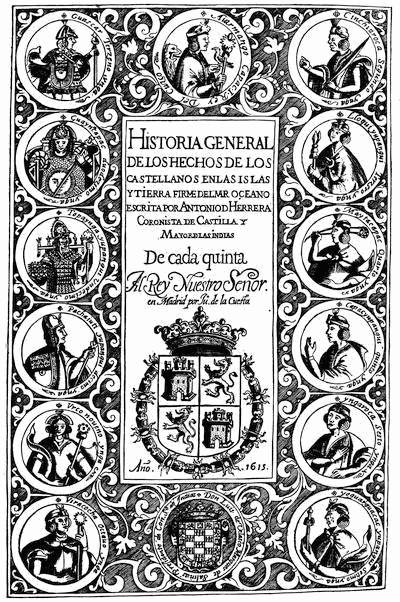
Note.—The title-page of the fifth decade Herrera, showing the Inca portraits, is given above. Cf. the plate in Stevens’s English translation of Herrera, vol. iv., London, 1740, 2d edition.—Ed.
While so many soldiers and priests and lawyers did their best to preserve a knowledge of Inca civilization, the Spanish government itself was not idle. The kings of Spain and their official advisers showed an anxiety to prevent the destruction of monuments and to collect historical and topographical information which is worthy of all praise. In 1585, orders were given to all the local authorities in Spanish America to transmit such information, and a circular, containing a series of interrogatories, was issued for their guidance. The result of this measure was, that a great number of Relaciones descriptivas were received in Spain, and stored up in the archives of the Indies. Herrera had these reports before him when he was writing his history, but it is certain that he did not make use of half the material they contain.[1268] Another very curious and valuable source of information consists of the reports on the origin of Inca sovereignty, which were prepared by order of the Viceroy Don Francisco de Toledo, and forwarded to the council of the Indies. They consist of twenty documents, forming a large volume, and preceded by an introductory letter. The viceroy’s object was to establish the fact that the Incas had originally been usurpers, in forcibly acquiring authority over the different provinces of the empire, and dispossessing the native chiefs. His inference was, that, as usurpers, they were rightfully dethroned by the Spaniards. He failed to see that such an argument was equally fatal to a Spanish claim, based on anything but the sword. Nevertheless, the traditions collected with this object, not only from the Incas at Cuzco, but also from the chiefs of several provinces, are very important and interesting.[1269]
The Viceroy Toledo also sent home four cloths on which the pedigree of the Incas was represented. The figures of the successive sovereigns were depicted, with medallions of their wives, and their respective lineages. The events of each reign were recorded on the borders, the traditions of Paccari-tampu, and of the creation by Uira-cocha, occupying the first cloth. It is probable that the Inca portraits given by Herrera were copied from those on the cloths sent home by the viceroy. The head-dresses in Herrera are very like that of the high-priest in the Relacion of the anonymous Jesuit. A map seems to have accompanied the pedigree, which was drawn under the superintendence of the distinguished sailor and cosmographer, Don Pedro Sarmiento de Gamboa.[1270]
Much curious information respecting the laws and customs of the Incas and the beliefs of the people is to be found in ordinances and decrees of the Spanish authorities, both civil and ecclesiastical. These ordinances are contained in the Ordenanzas del Peru, of the Licentiate Tomas de Ballesteros, in the Politica Indiana of Juan de Solorzano (Madrid, 1649),[1271] in the Concilium Limense of Acosta, and in the Constituciones Synodales of Dr. Lobo Guerrero, Archbishop of Lima, printed in that city in 1614, and again in 1754.
The kingdom of Quito received attention from several early writers, but most of their manuscripts are lost to us. Quito was fortunate, however, in finding a later historian to devote himself to the work of chronicling the story of his native land. Juan de Velasco was a native of Riobamba. He resided for forty years in the kingdom of Quito as a Jesuit priest, he taught and preached in the native language of the people, and he diligently studied all the works on the subject that were accessible to him. He spent six years in travelling over the country, twenty years in collecting books and manuscripts; and when the Jesuits were banished he took refuge in Italy, where he wrote his Historia del Reino de Quito. Velasco used several authorities which are now lost. One of these was the Conquista de la Provincia del Quito, by Fray Marco de Niza, a companion of Pizarro. Another was the Historia de las guerras civiles del Inca Atahualpa, by Jacinto Collahuaso. He also refers to the Antigüedades del Peru by Bravo de Saravia. As a native of Quito, Velasco is a strong partisan of Atahualpa; and he is the only historian who gives an account of the traditions respecting the early kings of Quito. The work was completed in 1789, brought from Europe, and printed at Quito in 1844, and M. Ternaux Compans brought out a French edition in 1840.[1272]
Recent authors have written introductory essays on Peruvian civilization to precede the story of the Spanish conquest, have described the ruins in various parts of the country after personal inspection, or have devoted their labors to editing the early authorities, or to bringing previously unknown manuscripts to light, and thus widening and strengthening the foundation on which future histories may be raised.
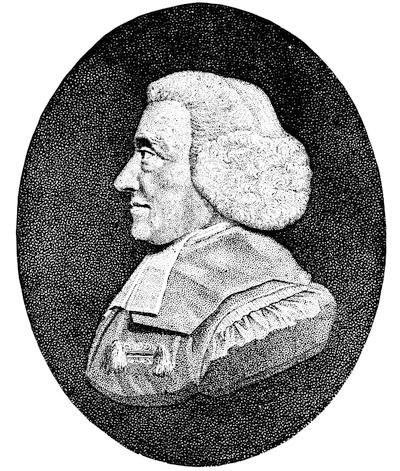
WILLIAM ROBERTSON.
[After a print in the European Mag. (1802), vol. xli.—Ed.]
Robertson’s excellent view of the story of the Incas in his History of America[1273] was for many years the sole source of information on the subject for the general English public; but since 1848 it has been superseded by Prescott’s charming narrative contained in the opening book of his Conquest of Peru.[1274] The knowledge of the present generation on the subject of the Incas is derived almost entirely from Prescott, and, so far as it goes, there can be no better authority. But much has come to light since his time. Prescott’s narrative, occupying 159 pages, is founded on the works of Garcilasso de la Vega, who is the authority most frequently cited by him, Cieza de Leon, Ondegardo, and Acosta.[1275] Helps, in the chapter of his Spanish Conquest on Inca civilization, which covers forty-five pages, only cited two early authorities not used by Prescott,[1276] and his sketch is much more superficial than that of his predecessor.[1277]
The publication of the Antigüedades Peruanas by Don Mariano Eduardo de Rivero (the director of the National Museum at Lima) and Juan Diego de Tschudi at Vienna, in 1851, marked an important turning-point in the progress of investigation. One of the authors was himself a Peruvian, and from that time some of the best educated natives of the country have given their attention to its early history. The Antigüedades for the first time gives due prominence to an estimate of the language and literature of the Incas, and to descriptions of ruins throughout Peru. The work is accompanied by a large atlas of engravings; but it contains grave inaccuracies, and the map of Pachacamac is a serious blemish to the work.[1278] The Antigüedades were followed by the Annals of Cuzco,[1279] and in 1860 the Ancient History of Peru, by Don Sebastian Lorente, was published at Lima.[1280] In a series of essays in the Revista Peruana,[1281] Lorente gave the results of many years of further study of the subject, which appear to have been the concluding labors of a useful life. When he died, in November, 1884, Sebastian Lorente had been engaged for upwards of forty years in the instruction of the Peruvian youth at Lima and in other useful labors. A curious genealogical work on the Incarial family was published at Paris in 1850, by Dr. Justo Sahuaraura Inca, a canon of the cathedral of Cuzco, but it is of no historical value.[1282]
Several scholars, both in Europe and America, have published the results of their studies relating to the problems of Inca history. Ernest Desjardins has written on the state of Peru before the Spanish conquest,[1283] J. G. Müller on the religious beliefs of the people,[1284] and Waitz on Peruvian anthropology.[1285] The writings of Dr. Brinton, of Philadelphia, also contain valuable reflections and useful information respecting the mythology and native literature of Peru.[1286] Mr. Bollaert had been interested in Peruvian researches during the greater part of his lifetime (b. 1807; d. 1876), and had visited several provinces of Peru, especially Tarapaca. He accumulated many notes. His work, at first sight, appears to be merely a confused mass of jottings, and certainly there is an absence of method and arrangement; but closer examination will lead to the discovery of many facts which are not to be met with elsewhere.[1287]
A critical study of early authorities and a knowledge of the Quichua language are two essential qualifications for a writer on Inca civilization. But it is almost equally important that he should have access to intelligent and accurate descriptions of the remains of ancient edifices and public works throughout Peru. For this he is dependent on travellers, and it must be confessed that no descriptions at all meeting the requirements were in existence before the opening of the present century. Humboldt was the first traveller in South America who pursued his antiquarian researches on a scientific basis. His works are models for all future travellers. It is to Humboldt,[1288] and his predecessors the Ulloas,[1289] that we owe graphic descriptions of Inca ruins in the kingdom of Quito and in northern Peru as far as Caxamarca. French travellers have contributed three works of importance to the same department of research. M. Alcide D’Orbigny examined and described the ruins of Tiahuanacu with great care.[1290] M. François de Castelnau was the leader of a scientific expedition sent out by the French government, and his work contains descriptions of ruins illustrated by plates.[1291] The work of M. Wiener is more complete, and is intended to be exhaustive. He was also employed by the French government on an archæological and ethnographic mission to Peru, from 1875 to 1877, and he has performed his task with diligence and ability, while no cost seems to have been spared in the production of his work.[1292] The maps and illustrations are numerous and well executed, and M. Wiener visited nearly every part of Peru where archæological remains are to be met with. There is only one fault to be found with the praiseworthy and elaborate works of D’Orbigny and Wiener. The authors are too apt to adopt theories on insufficient grounds, and to confuse their otherwise admirable descriptions with imaginative speculations. An example of this kind has been pointed out by the Peruvian scholar Dr. Villar, with reference to M. Wiener’s erroneous ideas respecting Culte de l’eau ou de la pluie, et le dieu Quonn.[1293] M. Wiener is the only modern traveller who has visited and described the interesting ruins of Vilcashuaman.
The present writer has published two books recording his travels in Peru. In the first he described the fortress of Hervay, the ancient irrigation channels at Nasca on the Peruvian coast, and the ruins at and around Cuzco, including Ollantay-tampu.[1294] In the second there are descriptions of the chulpas at Sillustani in the Collao, and of the Inca roof over the Sunturhuasi at Azangaro.[1295]
The work of E. G. Squier is, on the whole, the most valuable result of antiquarian researches in Peru that has ever been presented to the public.[1296] Mr. Squier had special qualifications for the task. He had already been engaged on similar work in Nicaragua, and he was well versed in the history of his subject. He visited nearly all the ruins of importance in the country, constructed plans, and took numerous photographs. Avoiding theoretical disquisitions, he gives most accurate descriptions of the architectural remains, which are invaluable to the student. His style is agreeable and interesting, while it inspires confidence in the reader; and his admirable book is in all respects thoroughly workmanlike.[1297]
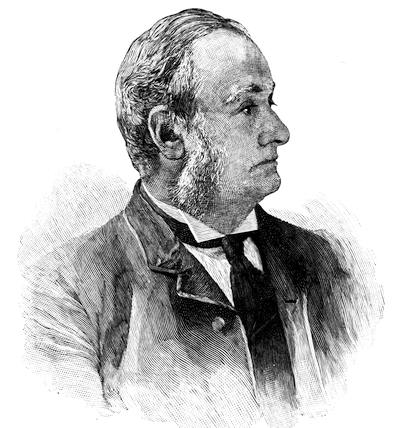
CLEMENTS R. MARKHAM.
[After a photograph kindly furnished by himself at the editor’s request.—Ed.]
Tiahuanacu is minutely described by D’Orbigny, Wiener, and Squier, and the famous ruins have also been the objects of special attention from other investigators. Mr. Helsby of Liverpool took careful photographs of the monolithic doorway in 1857, which were engraved and published, with a descriptive article by Mr. Bollaert.[1298] Don Modesto Basadre has also written an account of the ruins, with measurements.[1299] But the most complete monograph on Tiahuanacu is by Mr. Inwards, who surveyed the ground, photographed all the ruins, made enlarged drawings of the sculptures on the monolithic doorway, and even attempted an ideal restoration of the palace. In the letter-press, Mr. Inwards quotes from the only authorities who give any account of Tiahuanacu, and on this particular point his monograph entitles him to be considered as the highest modern authority.[1300]
Another special investigation of equal interest, and even greater completeness, is represented by the superb work on the burial-ground of Ancon, being the results of excavations made on the spot by Wilhelm Reiss and Alphonso Stübel. The researches of these painstaking and talented antiquaries have thrown a flood of light on the social habits and daily life of the civilized people of the Peruvian coast.[1301]
The great work of Don Antonio Raimondi on Peru is still incomplete. The learned Italian has already devoted thirty-eight years to the study of the natural history of his adopted country, and the results of his prolonged scientific labors are now gradually being given to the public. The plan of this exhaustive monograph is a division into six parts, devoted to the geography, geology, mineralogy, botany, zoölogy, and ethnology of Peru. The geographical division will contain a description of the principal ancient monuments and their ruins, while the ethnology will include a treatise on the ancient races, their origin and civilization. But as yet only three volumes have been published. The first is entitled Parte Preliminar, describing the plan of the work and the extent of the author’s travels throughout the country. The second and third volumes comprise a history of the progress of geographical discovery in Peru since the conquest by Pizarro. The completion of this great work, undertaken under the auspices of the government of Peru, has been long delayed.[1302]
The labors of explorers are supplemented by the editorial work of scholars, who bring to light the precious relics of early authorities, hitherto buried in scarcely accessible old volumes or in manuscript. First in the ranks of these laborers in the cause of knowledge, as regards ancient Peruvian history, stands the name of M. Ternaux Compans. He has furnished to the student carefully edited French editions of the narrative of Xeres, of the history of Peru by Balboa, of the Mémoires Historiques of Montesinos, and of the history of Quito by Velasco.[1303]
The present writer has translated into English and edited the works of Cieza de Leon, Garcilasso de la Vega, Molina, Salcamayhua, Avila, Xeres, Andagoya, and one of the reports of Ondegardo, and has edited the old translation of Acosta.
Dr. M. Gonzalez de la Rosa, an accomplished Peruvian scholar, brought to light and edited, in 1879, the curious Historia de Lima of Father Bernabé Cobo. It was published in successive numbers of the Revista Peruana, at Lima.
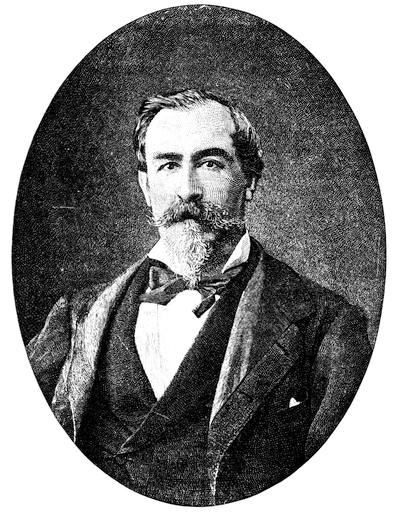
MÁRCOS JIMÉNEZ DE LA ESPADA.
[After a photograph, kindly furnished by himself, at the editor’s request.—Ed.]
But in this department students are most indebted to the learned Spanish editor, Don Márcos Jiménez de la Espada; for he has placed within our reach the works of important authorities, which were previously not only inaccessible, but unknown. He has edited the second part of Cieza de Leon, the anonymous Jesuit, Montesinos, Santillana, the reports to the Viceroy Toledo, the Suma y Narracion of Betanzos, and the War of Quito, by Cieza de Leon. Moreover, there is every reason to hope that his career of literary usefulness is by no means ended.
Although so much has been accomplished in the field of Peruvian research, yet much remains to be done, both by explorers and in the study. The Quichua chapters of the work of Avila, containing curious myths and legends, remain untranslated and in manuscript. A satisfactory text of the Ollantay drama, after collation of all accessible manuscripts, has not yet been secured. Numerous precious manuscripts have yet to be unearthed in Spain. Songs of the times of the Incas exist in Peru, which should be collected and edited. There are scientific excavations to be undertaken, and secluded districts to be explored. The Yunca grammar of Carrera requires expert comparative study, and comparison with the Eten dialect. Remnants of archaic languages, such as the Puquina of the Urus, must be investigated. When all this, and much more, has been added to existing means of knowledge, the labors of pioneers will approach completion. Then the time will have arrived for the preparation of a history of ancient Peruvian civilization which will be worthy of the subject.[1304]

———————————————
NOTES.
The numerous valleys on the Peruvian coast, separated by sandy deserts of varying width, required only careful irrigation to render them capable of sustaining a large population. The aboriginal inhabitants were probably a diminutive race of fishermen. Driven southwards by invaders, they eventually sought refuge in Arica and Tarapaca. D’Orbigny described their descendants as a gentle, hospitable race of fishermen, never exceeding five feet in height, with flat noses, fishing in boats of inflated sealskins, and sleeping in huts of sealskin on heaps of dried seaweed. They are called Changos. Bollaert mentions that they buried their dead lengthways. Bodies found in this unusual posture near Cañete form a slight link connecting the Changos to the south with the early aboriginal race of the more northern valleys.
The Chimu people drove out the aborigines and occupied the valleys of the coast from Payta nearly to Lima, forming distinct communities, each under a chief more or less independent. The Chimu himself ruled over the five valleys of Parmunca, Hualli, Huanapu, Santa, and Chimu, where the city of Truxillo now stands. The total difference of their language from Quichua makes it clear that the Chimus did not come from the Andes or from the Quito country. The only other alternative is that they arrived from the sea. Balboa, indeed, gives a detailed account of the statements made by the coast Indians of Lambayeque, at the time of the conquest. They declared that a great fleet arrived on the coast some generations earlier, commanded by a chief named Noymlap, who had with him a green-stone idol, and that he founded a dynasty of chiefs.
The Chimu and his subjects, let their origin be what it may, had certainly made considerable advances in civilization. The vast palaces of the Chimu near the seashore, with a surrounding city, and great mounds or artificial hills, are astonishing even in their decay. The principal hall of the palace was 100 feet long by 52. The walls are covered with an intricate and very effective series of arabesques on stucco, worked in relief. A neighboring hall, with walls stuccoed in color, is entered by passages and skirted by openings leading to small rooms seven feet square, which may have been used as dormitories. A long corridor leads from the back of the arabesque hall to some recesses where gold and silver vessels have been found. At a short distance from this palace there is a sepulchral mound where many relics have been discovered. The bodies were wrapped in cloths woven in ornamental figures and patterns of different colors. On some of the cloths plates of silver were sewn, and they were edged with borders of feathers, the silver plates being occasionally cut in the shapes of fishes and birds. Among the ruins of the city there are great rectangular areas enclosed by massive walls, containing buildings, courts, streets, and reservoirs for water.[1306] The largest is about a mile south of the palace, and is 550 yards long by 400. The outer wall is about 30 feet high and 10 feet thick at the base, with sides inclining towards each other. Some of the interior walls are highly ornamented in stuccoed patterns; and in one part there is an edifice containing 45 chambers or cells, which is supposed to have been a prison. The enclosure also contained a reservoir 450 feet long by 195, and 60 feet deep.
The dry climate favored the adornment of outer walls by color, and those of the Chimu palaces were covered with very tasteful sculptured patterns. Figures of colored birds and animals are said to have been painted on the walls of temples and palaces. Silver and gold ornaments and utensils, mantles richly embroidered, robes of feathers, cotton cloths of fine texture, and vases of an infinite variety of curious designs, are found in the tombs.
Cieza de Leon gives us a momentary glimpse at the life of the Chimu chiefs. Each ruler of a valley, he tells us, had a great house with adobe pillars, and doorways hung with matting, built on extensive terraces. He adds that the chiefs dressed in cotton shirts and long mantles, and were fond of drinking-bouts, dancing and singing. The walls of their houses were painted with bright colored patterns and figures. Such places, rising out of the groves of fruit-trees, with the Andes bounding the view in one direction and the ocean in the other, must have been suitable abodes for joy and feasting. Around them were the fertile valleys, peopled by industrious cultivators, and carefully irrigated. Their irrigation works were indeed stupendous. “In the valley of Nepeña the reservoir is three fourths of a mile long by more than half a mile broad, and consists of a massive dam of stone 80 feet thick at the base, carried across a gorge between two rocky hills. It was supplied by two canals at different elevations; one starting fourteen miles up the valley, and the other from springs five miles distant.”[1307]
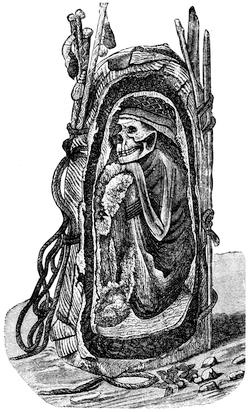
SECTION OF A MUMMY-CASE FROM ANCON.
[After a cut given by Ruge, following a plate in The Necropolis of Ancon. Wiener (p. 44) gives a section of one of the Ancon tombs. See a cut in Squier’s Peru, p. 73.—Ed.]
The custom prevalent among the Chimus of depositing with their dead all objects of daily use, as well as ornaments and garments worn by them during life, has enabled us to gain a further insight into the social history of this interesting people. The researches of Reuss and Stübel at the necropolis of Ancon, near Lima, have been most important. Numerous garments, interwoven with work of a decorative character, cloths of many colors and complicated patterns, implements used in spinning and sewing, work-baskets of plaited grass, balls of thread, fingerrings, wooden and clay toys, are found with the mummies. The spindles are richly carved and painted, and attached to them are terra cotta cylinders aglow with ornamental colorings which were used as wheels. Fine earthenware vases of varied patterns, and wooden or clay dishes, also occur.
Turning to the language of the coast people, we find that no Mochica dictionary was ever made; but there is a grammar and a short list of words by Carrera, and the Lord’s prayer in Mochica, by Bishop Oré. The grammar was composed by a priest who had settled at Truxillo, near the ruins of the Chimu palace, and who was a great-grandson of one of the first Spanish conquerors. It was published at Lima in 1644. At that time the Mochica language was spoken in the valleys of Truxillo, Chicama, Chocope, Sana, Lambayeque, Chiclayo, Huacabamba, Olmos, and Motupè. When the Mercurio Peruano[1308] was published in 1793, this language is said to have entirely disappeared. Father Carrera tells us that the Mochica was so very difficult that he was the only Spaniard who had ever been able to learn it. The words bear no resemblance whatever to Quichua. Mochica has three different declensions, Quichua only one. Mochica has no transitive verbs, and no exclusive and inclusive plurals, which are among the chief characteristics of Quichua. The Mochica conjugations are formed in quite a different way from those in the Quichua language. The Mochica system of numerals appears to have been very complete. With the language, the people have now almost if not entirely disappeared. Possibly the people of Eten, south of Lambayeque, who still speak a peculiar language, may be descendants of the Chimus.
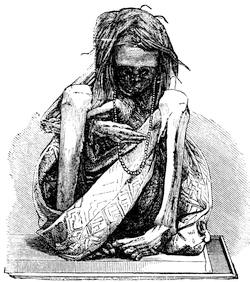
MUMMY FROM A HUACA AT PISCO.
[After a cut in T. J. Hutchinson’s Two Years in Peru (London, 1873), vol. i. p. 113. The Peruvian mummies are almost invariably simply desiccated. Only the royal personages were embalmed (Markham’s Cieza de Leon, 226). Cf. Wilson’s Prehistoric Man, ii. 135.—Ed.]
The Chimu dominion extended probably from Tumbez, in the extreme north of the Peruvian coast, to Ancon, north of Lima. The Chimus also had a strong colony in the valley of Huarcu, now called Cañete. But the valleys of the Rimac, of Lurin, Chilca, and Mala, north of Cañete; and those of Chincha, Yca, and Nasca, south of Cañete; were not Chimu territory. The names of places in those valleys are all Quichua, as well as the names of their chiefs, as recorded by Garcilasso de la Vega and others. The inhabitants were, therefore, of Inca race, probably colonists from the Huanca nation. Their superstitions as told by Arriaga, and the curious mythological legends recorded by Avila as being believed by the people of Huarochiri and the neighboring coast, all point to an Inca origin. These Inca coast people are said to have had a famous oracle near the present site of Lima, called “Rimac,” or “He who speaks.” But more probably it was merely the name given to the noisy river Rimac, babbling over its stones. It is true that there was a temple on the coast with an oracle, the fame of which had been widely spread. The idol called Pachacamac, or “The world-creator,” was described by the first Spanish visitor, Miguel Estete, as being made of wood and very dirty. The town was then half in ruins, for the worship of this local deity was neglected after the conquest by the Incas. These coast people of Inca race were as industrious as their Chimu neighbors. In the Nasca valley there is a complete network of underground watercourses for irrigation. At Yca “they removed the sand from vast areas, until they reached the requisite moisture, then put in guano from the islands, and thus formed sunken gardens of extraordinary richness.”[1309] Similar methods were adopted in the valleys of Pisco and Chilca.
When the Inca Pachacutec began to annex the coast valleys, he met with slight opposition only from the people of Inca origin, who soon submitted to his rule. But the Chimus struggled hard to retain their independence. Those of the Huarcu (Cañete) valley made a desperate and prolonged resistance. When at length they submitted, the Inca built a fortress and palace on a rocky eminence overlooking the sea to overawe them. The ruins now called Hervai are particularly interesting, because they are the principal and most imposing example of Inca architecture in which the building material is adobes and not stone. The conquest of the valleys to the north of Lima and of the grand Chimu himself was a still more difficult undertaking, necessitating more than one hard-fought campaign. When it was completed, great numbers of the best fighting-men among the Chimus were deported to the interior as mitimaes. More than a century had elapsed since this conquest when the Spaniards arrived, so that there was but slight chance of the history of the Chimus being even partially preserved. Cieza de Leon and Balboa alone supply us with notices of any value.[1310] The southern valleys of the coast, Arequipa, Moquegua, and Tacna, were occupied by mitimaes or colonists from the Collao. The Incas gave the general name of yuncas, or dwellers in the warm valleys, to all the people of the coast.
Much mystery surrounds the history and origin of the Chimu people. That they were wholly separate and unconnected with the other races of Peru seems almost certain. That they were far advanced in civilization is clear. Difficulties surround any further prosecution of researches concerning them. They have themselves disappeared from the face of the earth. Their language has gone with them. But there are the magnificent ruins of their palaces and temples. There are numerous tombs and cemeteries which have never been scientifically examined. There is a grammar and a small vocabulary of words calling for close comparative examination. There are crania awaiting similar comparative study. There is a possibility that further information may be gleaned from inedited Spanish manuscripts. The subject is a most interesting one, and it is by no means exhausted.
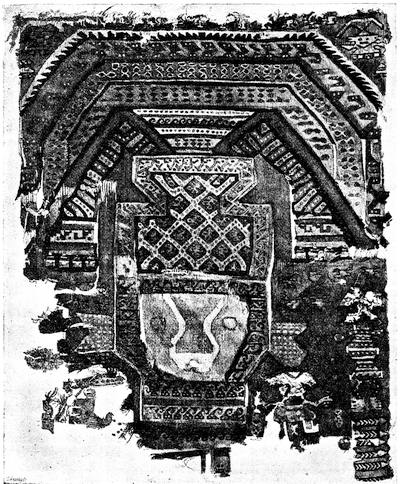
TAPESTRY FROM THE GRAVES OF ANCON.
[After a cut in Ruge’s Geschichte des Zeitalters der Entdeckungen, p. 429, following the colored plate in The Necropolis of Ancon. Wiener reproduces in black and white many of the Ancon specimens.—Ed.]
Fray Domingo de San Tomas, a Dominican monk, was the first author who composed a grammar and vocabulary of the language of the Incas. He gave it the name of Quichua, probably because he had studied with members of that tribe, who were of pure Inca race, and whose territory lies to the westward of Cuzco. The name has since been generally adopted for the language of the Peruvian empire.[1311]
Diego de Torres Rubio was born in 1547, in a village near Toledo, became a Jesuit at the age of nineteen, and went out to Peru in 1577. He studied the native languages with great diligence, and composed grammars and vocabularies. His grammar and vocabulary of Quichua first appeared at Saville in 1603, and passed through four editions.[1312] A long residence in Chuquisaca enabled him to acquire the Aymara language, and in 1616 he published a short grammar and vocabulary of Aymara. In 1627 he also published a grammar of the Guarani language. Torres Rubio was rector of the college at Potosi for a short time, but his principal labors were connected with missionary work at Chuquisaca. He died in that city at the great age of ninety-one, on the 13th of April, 1638. Juan de Figueredo, whose Chinchaysuyu vocabulary is bound up with later editions of Torres Rubio, was born at Huancavelica in 1648, of Spanish parents, and after a long and useful missionary life he died at Lima in 1724.
The most voluminous grammatical work on the language of the Incas had for its author the Jesuit Diego Gonzales Holguin. This learned missionary was the scion of a distinguished family in Estremadura, and was befriended in his youth by his relation, Don Juan de Obando, President of the Council of the Indies. After graduating at Alcalá de Henares he became a member of the Society of Jesus in 1568, and went out to Peru in 1581. He resided for several years in the Jesuit college at Juli, near the banks of Lake Titicaca, where the fathers had established a printing-press, and here he studied the Quichua language. He was entrusted with important missions to Quito and Chili, and was nominated interpreter by the Viceroy Toledo. His later years were passed in Paraguay, and when he died at the age of sixty-six, in 1618, he was rector of the college at Asuncion. His Quichua dictionary was published at Lima in 1586, and a second edition appeared in 1607,[1313] the same year in which the grammar first saw the light.[1314] The Quichua grammar of Holguin is the most complete and elaborate that has been written, and his dictionary is also the best in every respect.
While Holguin was studiously preparing these valuable works on the Quichua language in the college at Juli, a colleague was laboring with equal zeal and assiduity at the dialect spoken by the people of the Collao, to which the Jesuits gave the name of Aymara. Ludovico Bertonio was an Italian, a native of the marches of Ancona. Arriving in Peru in 1581, he resided at Juli for many years, studying the Aymara language, until, attacked by gout, he was sent to Lima, where he died at the age of seventy-three, in 1625. His Aymara grammar was first published at Rome in 1603,[1315] but a very much improved second edition,[1316] and a large dictionary of Aymara,[1317] were products of the Jesuit press at Juli in 1612. Bertonio also wrote a catechism and a life of Christ in Aymara, which were printed at Juli.
A vocabulary of Quichua by Fray Juan Martinez was printed at Lima in 1604, and another in 1614. Four Quichua grammars followed during the seventeenth century. That of Alonso de Huerta was published at Lima in 1616; the grammar of the Franciscan Diego de Olmos appeared in 1633; Don Juan Roxo Mexia y Ocon, a native of Cuzco, and professor of Quichua at the University of Lima, published his grammar in 1648; and the grammar of Estevan Sancho de Melgar saw the light in 1691.[1318] Leon Pinelo also mentions a Quichua grammar by Juan de Vega. The anonymous Jesuit refers to a Quichua dictionary by Melchior Fernandez, which is lost to us.
In 1644 Don Fernando de la Carrera, the Cura of Reque, near Chiclayo, published his grammar of the Yunca language, at Lima. This is the language which was once spoken in the valleys of the Peruvian coast by the civilized people whose ruler was the grand Chimu. Now the language is extinct, or spoken only by a few Indians in the coast village of Eten. The work of Carrera is therefore important, as, with the exception of a specimen of the language preserved by Bishop Oré, it is the only book in which the student can now obtain any linguistic knowledge of the lost civilization. The Yunca grammar was reprinted in numbers in the Revista de Lima of 1880 and following years.[1319]
There was a professorial chair for the study of Quichua in the University of San Márcos at Lima, and the language was cultivated, during the two centuries after the conquest, as well by educated natives as by many Spanish ecclesiastics. The sermons of Dr. Don Fernando de Avendaño have already been referred to.[1320] Dr. Lunarejo, of Cuzco, was another famous Quichuan preacher, and the Confesionarios and catechisms in the language were very numerous. Bishop Louis Geronimo Oré, of Guamanga, in his ritualistic manual, gives the Lord’s prayer and commandments, not only in Quichua and Aymara, but also in the Puquina language spoken by the Urus on Lake Titicaca, and in the Yunca language of the coast, which he calls Mochica.[1321]
A very curious book was published at Lima in 1602, which, among other things, treats of the Quichua language and of the derivations of names of places. The author, Don Diego D’Avalos y Figueroa, appears to have been a native of La Paz. He was possessed of sprightly wit, was well read, and a close observer of nature. We gather from his Miscelanea Austral[1322] the names of birds and animals, and of fishes in Lake Titicaca, as well as the opinions of the author on the cause of the absence of rain on the Peruvian coast, on the lacustrine system of the Collao, and on other interesting points of physical geography.[1323]
In modern times the language of the Incas has received attention from students of Peruvian history. The joint authors, Dr. Von Tschudi and Don Mariano Eduardo de Rivero, in their work entitled Antigüedades Peruanas, published at Vienna in 1851, devote a chapter to the Quichua language. Two years afterwards Dr. Von Tschudi published a Quichua grammar and dictionary, with the text of the Inca drama of Ollantay, and other specimens of the language.[1324] The present writer’s contributions towards a grammar and dictionary of Quichua were published by Trübner in 1864, and a few years previously a more complete and elaborate work had seen the light at Sucre, the capital of Bolivia. This was the grammar and dictionary by Father Honorio Mossi, of Potosi, a large volume containing thorough and excellent work.[1325] Lastly a Quichua grammar by José Dionisio Anchorena was published at Lima in 1874.[1326]
The curious publication of Don José Fernandez Nodal in 1874 is not so much a grammar of the Quichua Language as a heterogeneous collection of notes on all sorts of subjects, and can scarcely take a place among serious works. The author was a native of Arequipa, of good family, but he was carried away by enthusiasm and allowed his imagination to run riot.[1327]
The gospel of St. Luke, with Aymara and Spanish in parallel columns, was translated from the vulgate by Don Vicente Pazos-kanki, a graduate of the University of Cuzco, and published in London in 1829;[1328] and more recently a Quichua version of the gospel of St. John, translated by Mr. Spilsbury, an English missionary, has appeared at Buenos Ayres.[1329] These publications and others of the same kind have a tendency to preserve the purity of the language, and are therefore welcome to the student of Incarial history.
Quichua has been the subject of detailed comparative study by more than one modern philologist of eminence. The discussion of the Quichua roots by the learned Dr. Vicente Fidel Lopez is a most valuable addition to the literature of the subject; while the historical section of his work is a great aid to a critical consideration of Montesinos and other early authorities. Whatever may be thought of his theoretical opinions, and of the considerations by which he maintains them, there can be no doubt that Dr. Lopez has rendered most important service to all students of Peruvian history.[1330] The theoretical identification of Quichuan roots with those of Turanian and Iberian languages, as it has been elaborated by Mr. Ellis, is also not without its use, quite apart from the truth or otherwise of any linguistic theory.[1331]
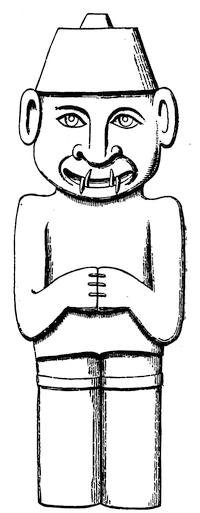
FROM TIMANÁ.
[After a cut in William Bollaert’s Antiquarian Researches, etc., p. 41, showing a stone figure from Timana in New Granada, an antiquity of the Muiscas, found in a dense forest, with no tradition attached.—Ed.]
Editorial labors connected with the publication of the text and of translations of the Inca drama of Ollantay have recently conduced, in an eminent degree, to the scholarly study of Quichua, while they have sensibly contributed to a better knowledge of the subject. Von Tschudi was the first to publish the text of Ollantay, in the second part of his Kechua Sprache, having given extracts from the drama in the chapter on the Quichua language in the Antigüedades Peruanas. After a long interval he brought out a revised text with a parallel German translation,[1332] from his former manuscript, collated with another bearing the date of La Paz, 1735.
The drama, in the exact form that it existed when represented before the Incas, is of course lost to us. It was handed down by tradition until it was arranged for representation, divided into scenes, and supplied with stage directions in Spanish times. Several manuscripts were preserved, which differ only slightly from each other; and they were looked upon as very precious literary treasures by their owners. The drama was first publicly brought to notice by Don Manuel Palacios, in the Museo Erudito, a periodical published at Cuzco in 1837; but it was not until 1853 that the text was printed by Von Tschudi. His manuscript was copied from one preserved in the Dominican monastery at Cuzco by one of the monks. The transcription was made between 1840 and 1845 for the artist Rugendas, of Munich, who gave it to Von Tschudi. There was another old manuscript in the possession of Dr. Antonio Valdez, the priest of Sicuani, who lived in the last century, and was a friend of the unfortunate Tupac Amaru. Dr. Valdez died in 1816; and copies of his manuscript were possessed by Dr. Pablo Justiniani, the aged priest of Laris, a village in the heart of the eastern Andes, and by Dr. Rosas, the priest of Chinchero. The present writer made a copy of the Justiniani manuscript at Laris, which he collated with that of Dr. Rosas. In 1871 he published the text of his copy, with an attempt at a literal English translation.[1333] In 1868 Dr. Barranca published a Spanish translation from the text of Von Tschudi, now called the Dominican text.[1334] The Peruvian poet Constantino Carrasco afterwards brought out a version of the drama of Ollantay in verse, paraphrased from the translation of Barranca.[1335] The enthusiastic Peruvian student, Dr. Nodal, printed a different Quichua text with a Spanish translation, in parallel columns, in 1874.[1336]
There are other manuscripts, and a text has not yet been derived from a scholarly collation of the whole of them. There is one in the possession of Dr. Gonzalez de la Rosa, which belonged to Dr. Justo Sahuaraura Inca, Archdeacon of Cuzco, and descendant of Paullu, the younger son of Huayna Ccapac. In 1878 the Quichua scholar and native of Cuzco, Don Gavino Pacheco Zegarra, published the text of Ollantay at Paris, from a manuscript found among the books of his great-uncle, Don Pedro Zegarra. He added a very free translation in French, and numerous valuable notes. The work of Zegarra is by far the most important that has appeared on this subject, for the accomplished Peruvian has the great advantage of knowing Quichua from his earliest childhood. With this advantage, not possessed by any previous writer, he unites extensive learning and considerable critical sagacity.[1337]
The reasons for assigning an ancient date to this drama of Ollantay are conclusive in the judgment of all Quichua scholars. On this point there is a consensus of opinion. But General Mitre, the ex-President of the Argentine Republic, published an essay in 1881, to prove that Ollantay was of Spanish origin and was written in comparatively modern times.[1338] The present writer replied to his arguments in the introduction (p. xxix) to the English translation of the second part of Cieza de Leon (1883), and this reply was translated into Spanish and published at Buenos Ayres in the same year, by Don Adolfo F. Olivares, accompanied by a critical note from the pen of Dr. Vicente Lopez.[1339] The latest publication on the subject of Ollantay consists of a series of articles in the Ateneo de Lima, by Don E. Larrabure y Unanue, the accomplished author of a history of the conquest of Peru, not yet published. The general conclusion which has been arrived at by Quichua scholars, after this thorough sifting of the question, is that, although the division into scenes and the stage directions are due to some Spanish hand, and although some few Hispanicisms may have crept into some of the texts, owing to the carelessness or ignorance of transcribers, yet that the drama of Ollantay, in all essential points, is of Inca origin. Several old songs are imbedded in it, and others have been preserved by Quichua scholars at Cuzco and Ayacucho, and in the neighborhood of those cities. The editing of these remains of Inca literature will, at some future time, throw further light on the history of the past. There are several learned Peruvians who devote themselves to Incarial studies, besides Señor Zegarra, who now resides in Spain. Among them may be mentioned Dr. Villar of Cuzco, a ripe scholar, who has recently published a closely reasoned essay on the word Uira-cocha, Don Luis Carranza, and Don Martin A. Mujica, a native of Huancavelica.
III. The New Granada Tribes.—The incipient civilization of the Chibchas or Muiscas of New Granada was first made generally known by Humboldt (Vues des Cordillères, octavo ed., ii. 220-67; Views of Nature, Eng. trans., 425). Cf. also, E. Uricoechea’s Memorias sobre las Antigüedades néo-granadinas (Berlin, 1854); Bollaert; Rivero and Von Tschudi; Nadaillac, 459; and Joseph Acosta’s Compendio historico del Descubrimiento de la Nueva Granada (Paris, 1848; with transl. in Bollaert).