Part 2 — CHAPTER IV.
Reading edition
THE INCA CIVILIZATION IN PERU.
BY CLEMENTS R. MARKHAM, C. B.
THE civilization of the Incas of Peru is the most important, because it is the highest, phase in the development of progress among the American races. It represents the combined efforts, during long periods, of several peoples who eventually became welded into one nation. The especial interest attaching to the study of this civilization consists in the fact that it was self-developed, and that, so far as can be ascertained, it received no aid and no impulse from foreign contact.
It is necessary, however, to bear in mind that the empire of the Incas, in its final development, was formed of several nations which had, during long periods, worked out their destinies apart from each other; and that one, at least, appears to have been entirely distinct from the Incas in race and language.[1138] These facts must be carefully borne in mind in pursuing inquiries relating to the history of Inca civilization. It is also essential that the nature and value of the evidence on which conclusions must be based should be understood and carefully weighed. This evidence is of several kinds. Besides the testimony of Spanish writers who witnessed the conquest of Peru, or who lived a generation afterwards, there is the evidence derived from a study of the characteristics of descendants of the Inca people, of their languages and literature, and of their architectural and other remains. These various kinds of evidence must be compared, their respective values must be considered, and thus alone, in our time, can the nearest approximation to the truth be reached.
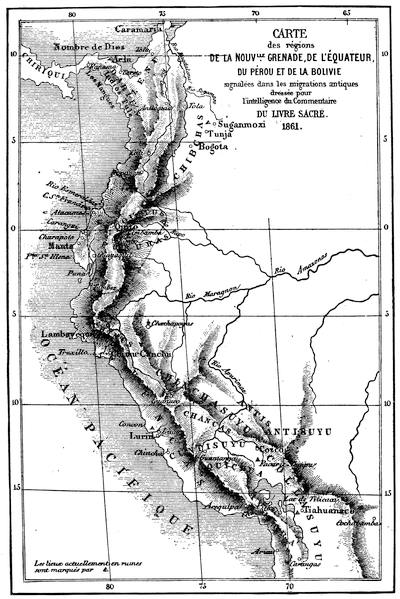
MAP IN BRASSEUR’S POPUL VUH.
The testimony of writers in the sixteenth century, who had the advantage of being able to see the workings of Inca institutions, to examine the outcome of their civilization in all its branches, and to converse with the Incas themselves respecting the history and the traditions of their people, is the most important evidence. Much of this testimony has been preserved, but unfortunately a great deal is lost. The sack of Cadiz by the Earl of Essex, in 1595, was the occasion of the loss of Blas Valera’s priceless work.[1139] Other valuable writings have been left in manuscript, and have been mislaid through neglect and carelessness. Authors are mentioned, or even quoted, whose books have disappeared. The contemplation of the fallen Inca empire excited the curiosity and interest of a great number of intelligent men among the Spanish conquerors. Many wrote narratives of what they saw and heard. A few studied the language and traditions of the people with close attention. And these authors were not confined to the clerical and legal professions; they included several of the soldier-conquerors themselves.[1140]
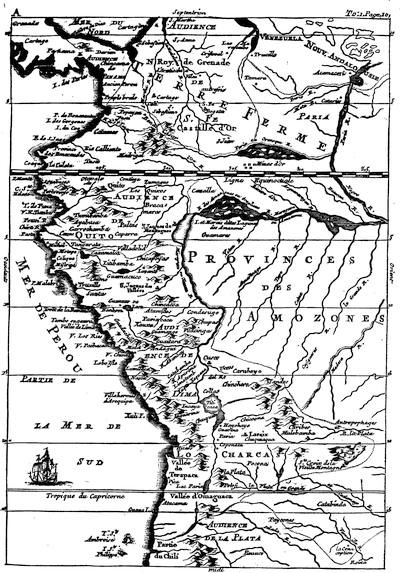
EARLY SPANISH MAP OF PERU.
[From the Paris (1774) edition of Zarate. The development of Peruvian cartography under the Spanish explorations is traced in a note in Vol. II. p. 509; but the best map for the student is a map of the empire of the Incas, showing all except the provinces of Quito and Chili, with the routes of the successive Inca conquerors marked on it, given in the Journal of the Roy. Geog. Soc. (1872), vol. xlii. p. 513, compiled by Mr. Trelawny Saunders to illustrate Mr. Markham’s paper of the previous year, on the empire of the Incas. The map was republished by the Hakluyt Society in 1880. The map of Wiener in his Pérou et Bolivie is also a good one. Cf. Squier’s map in his Peru.—Ed.]
The nature of the country and climate was a potent agent in forming the character of the people, and in enabling them to make advances in civilization. In the dense forests of the Amazonian valleys, in the boundless prairies and savannas, we only meet with wandering tribes of hunters and fishers. It is on the lofty plateaux of the Andes, where extensive tracts of land are adapted for tillage, or in the comparatively temperate valleys of the western coast, that we find nations advanced in civilization.[1141]
The region comprised in the empire of the Incas during its greatest extension is bounded on the east by the forest-covered Amazonian plains, on the west by the Pacific Ocean, and its length along the line of the Cordilleras was upwards of 1,500 miles, from 2° N. to 20° S. This vast tract comprises every temperature and every variety of physical feature. The inhabitants of the plains and valleys of the Andes enjoyed a temperate and generally bracing climate, and their energies were called forth by the physical difficulties which had to be overcome through their skill and hardihood. Such a region was suited for the gradual development of a vigorous race, capable of reaching to a high state of culture. The different valleys and plateaux are separated by lofty mountain chains or by profound gorges, so that the inhabitants would, in the earliest period of their history, make their own slow progress in comparative isolation, and would have little intercommunication. When at last they were brought together as one people, and thus combined their efforts in forming one system, it is likely that such a union would have a tendency to be of long duration, owing to the great difficulties which must have been overcome in its creation. On the other hand, if, in course of time, disintegration once began, it might last long, and great efforts would be required to build up another united empire. The evidence seems to point to the recurrence of these processes more than once, in the course of ages, and to their commencement in a very remote antiquity.
One strong piece of evidence pointing to the great length of time during which the Inca nations had been a settled and partially civilized race, is to be found in the plants that had been brought under cultivation, and in the animals that had been domesticated. Maize is unknown in a wild state,[1142] and many centuries must have elapsed before the Peruvians could have produced numerous cultivated varieties, and have brought the plant to such a high state of perfection. The peculiar edible roots, called oca and aracacha, also exist only as cultivated plants. There is no wild variety of the chirimoya, and the Peruvian species of the cotton plant is known only under cultivation.[1143] The potato is found wild in Chile, and probably in Peru, as a very insignificant tuber. But the Peruvians, after cultivating it for centuries, increased its size and produced a great number of edible varieties.[1144] Another proof of the great antiquity of Peruvian civilization is to be found in the llama and alpaca, which are domesticated animals, with individuals varying in color: the one a beast of burden yielding coarse wool, and the other bearing a thick fleece of the softest silken fibres. Their prototypes are the wild huanaco and vicuña, of uniform color, and untameable. Many centuries must have elapsed before the wild creatures of the Andean solitudes, with the habits of chamois, could have been converted into the Peruvian sheep which cannot exist apart from men.[1145]
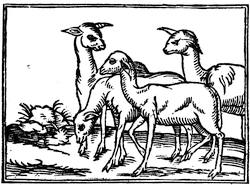
LLAMAS.
[One of the cuts which did service in the Antwerp edition of Cieza de Leon. Cf. Bollaert on the llama, alpaca, huanaco, and vicuña species in the Sporting Review, Feb., 1863; the cuts in Squier, pp. 246, 250; Dr. Van Tschudi, in the Zeitschrift für Ethnologie, 1885.—Ed.]
These considerations point to so vast a period during which the existing race had dwelt in the Peruvian Andes, that any speculation respecting its origin would necessarily be futile in the present state of our knowledge.[1146] The weight of tradition indicates the south as the quarter whence the people came whose descendants built the edifices at Tiahuanacu.
The most ancient remains of a primitive people in the Peruvian Andes consist of rude cromlechs, or burial-places, which are met with in various localities. Don Modesto Basadre has described some by the roadside, in the descent from Umabamba to Charasani, in Bolivia. These cromlechs are formed of four great slabs of slate, each slab being about five feet high, four or five in width, and more than an inch thick. The four slabs are perfectly shaped and worked so as to fit into each other at the corners. A fifth slab is placed over them, and over the whole a pyramid of clay and rough stones is piled. These cromlechs are the early memorials of a race which was succeeded by the people who constructed the cyclopean edifices of the Andean plateaux.
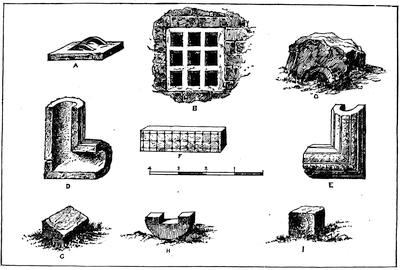
DETAILS AT TIAHUANACU.
KEY:— A, Lid or cover of some aperture, of stone, with two handles neatly undercut. B, A window of trachyte, of careful workmanship, in one piece. C, Block of masonry with carving. D, E, Two views of a corner-piece to some stone conduit, carefully ornamented with projecting lines. F, G, H, I, Other pieces of cut masonry lying about.
For there is reason to believe that a powerful empire had existed in Peru centuries before the rise of the Inca dynasty. Cyclopean ruins, quite foreign to the genius of Inca architecture, point to this conclusion. The wide area over which they are found is an indication that the government which caused them to be built ruled over an extensive empire, while their cyclopean character is a proof that their projectors had an almost unlimited supply of labor. Religious myths and dynastic traditions throw some doubtful light on that remote past, which has left its silent memorials in the huge stones of Tiahuanacu, Sacsahuaman, and Ollantay, and in the altar of Concacha.
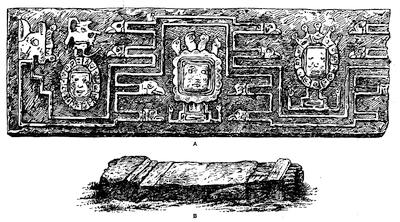
CARVINGS AT TIAHUANACU.
KEY:— A, Portion of the ornament which runs along the base of the rows of figures on the monolithic doorway. B, Prostrate idol lying on its face near the ruins; about 9 feet long.
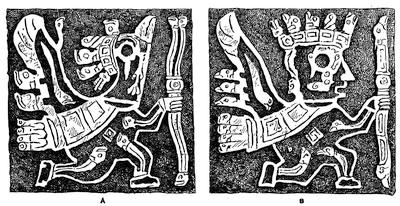
BAS-RELIEFS AT TIAHUANACU.
KEY:— A, A winged human figure with the crowned head of a condor, from the central row on the monolithic doorway. B, A winged human figure with human head crowned, from the upper row on the monolithic doorway.
[There are well-executed cuts of these sculptures in Ruge’s Geschichte des Zeitalters der Entdeckungen, pp. 430, 431. Cf. Squier’s Peru, p. 292.—Ed.]
The most interesting ruins in Peru are those of the palace or temple near the village of Tiahuanacu,[1147] on the southern side of Lake Titicaca. They are 12,930 feet above the level of the sea, and 130 above that of the lake, which is about twelve miles off.
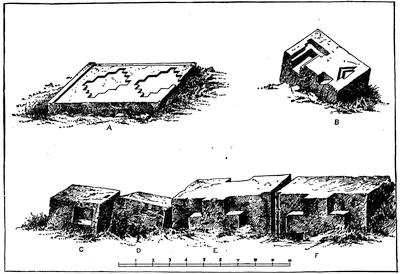
FRAGMENTS AT TIAHUANACU.
Various curiously carved stones found scattered about the ruins.
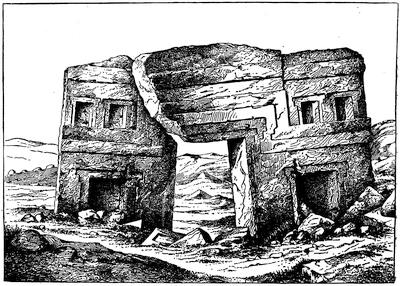
REVERSE OF THE DOORWAY AT TIAHUANACU.
[Cf. view in Squier’s Peru, p. 289, with other particulars of the ruins, p. 276, etc.—Ed.]
They consist of a quadrangular space, entered by the famous monolithic doorway, and surrounded by large stones standing on end; and of a hill or mound encircled by remains of a wall, consisting of enormous blocks of stone. The whole covers an area about 400 yards long by 350 broad. There is a lesser temple, about a quarter of a mile distant, containing stones 36 feet long by 7, and 26 by 16, with recesses in them which have been compared to seats of judgment. The weight of the two great stones has been estimated at from 140 to 200 tons each, and the distance of the quarries whence they could have been brought is from 15 to 40 miles.
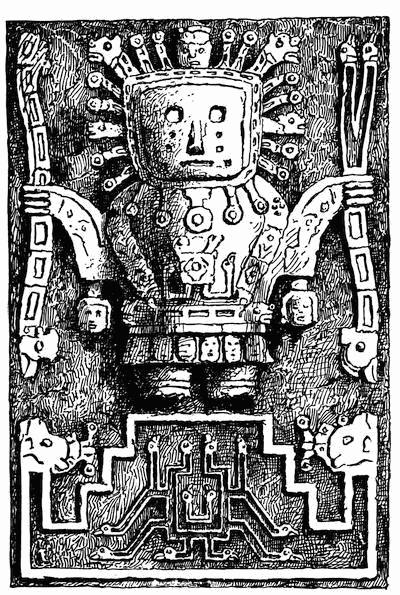
IMAGE AT TIAHUANACU.
[This is an enlarged drawing of the bas-relief shown in the picture of the broken doorway (p. 218). Cf. the cuts in the article on the ruins of Tiahuanacu in the Revue d’Architecture des Travaux publics, vol. xxiv.; in Ch. Wiener’s L’Empire des Incas, pl. iii.; in D’Orbigny’s Atlas to his L’Homme Américain; and in Squier’s Peru, p. 291.—Ed.]
The monolithic portal is one block of hard trachytic rock, now deeply sunk in the ground. Its height above ground is 7 ft. 2 in., width 13 ft. 5 in., thickness 1 ft. 6 in., and the opening is 4 ft. 6 in. by 2 ft. 9 in. The outer side is ornamented by accurately cut niches and rectangular mouldings. The whole of the inner side, from a line level with the upper lintel of the doorway to the top, is a mass of sculpture, which speaks to us, in difficult riddles, alas! of the customs and art-culture, of the beliefs and traditions, of an ancient and lost civilization.
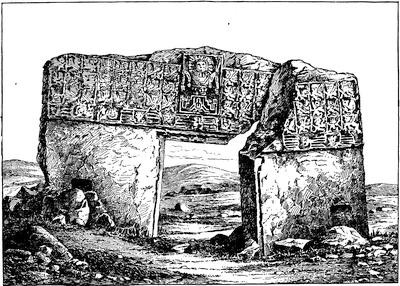
BROKEN MONOLITH DOORWAY AT TIAHUANACU.
[An enlarged drawing of the image over the arch is given in another cut. This same ruin is well represented in Ruge’s Gesch. des Zeitalters der Entdeckungen; and not so well in Wiener’s Pérou et Bolivie, p. 419. Cf. Squier’s Peru, p. 288.—Ed.]
In the centre there is a figure carved in high relief, in an oblong compartment, 2 ft. 2 in. long by 1 ft. 6 in.[1148] Squier describes this figure as angularly but boldly cut. The head is surrounded by rays, each terminating in a circle or the head of an animal. The breast is adorned with two serpents united by a square band. Another band, divided into ornamented compartments, passes round the neck, and the ends are brought down to the girdle, from which hang six human heads. Human heads also hang from the elbows, and the hands clasp sceptres which terminate in the heads of condors. The legs are cut off near the girdle, and below there are a series of frieze-like ornaments, each ending with a condor’s head. On either side of this central sculpture there are three tiers of figures, 16 in each tier, or 48 in all, each in a kneeling posture, and facing towards the large central figure. Each figure is in a square, the sides of which measure eight inches. All are winged, and hold sceptres ending in condors’ heads; but while those in the upper and lower tiers have crowned human heads, those in the central tier have the heads of condors. There is a profusion of ornament on all these figures, consisting of heads of birds and fishes. An ornamental frieze runs along the base of the lowest tier of figures, consisting of an elaborate pattern of angular lines ending in condors’ heads, with larger human heads surrounded by rays, in the intervals of the pattern. Cieza de Leon and Alcobasa[1149] mention that, besides this sculpture over the doorway, there were richly carved statues at Tiahuanacu, which have since been destroyed, and many cylindrical pillars with capitals. The head of one statue, with a peculiar head-dress, which is 3 ft. 6 in. long, still lies by the roadside.
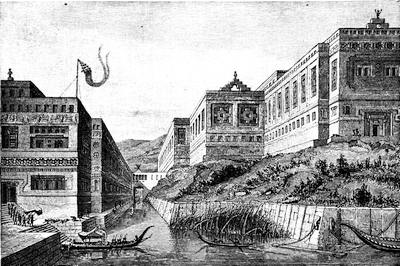
TIAHUANACU RESTORED.
After a drawing given in The Temple of the Andes by Richard Inwards (London, 1884).
The masonry of the ruins is admirably worked, according to the testimony of all visitors. Squier says: “The stone itself is a dark and exceedingly hard trachyte. It is faced with a precision that no skill can excel. Its lines are perfectly drawn, and its right angles turned with an accuracy that the most careful geometer could not surpass. I do not believe there exists a better piece of stone-cutting, the material considered, on this or the other continent.”
It is desirable to describe these ruins, and especially the sculpture over the monolithic doorway, with some minuteness, because, with the probable exception of the cromlechs, they are the most ancient, and, without any exception, the most interesting that have been met with in Peru. There is nothing elsewhere that at all resembles the sculpture on the monolithic doorway at Tiahuanacu.[1150] The central figure, with rows of kneeling worshippers on either side, all covered with symbolic designs, represents, it may be conjectured, either the sovereign and his vassals, or, more probably, the Deity, with representatives of all the nations bowing down before him. The sculpture and the most ancient traditions should throw light upon each other.
Further north there are other examples of prehistoric cyclopean remains. Such is the great wall, with its “stone of 12 corners,” in the Calle del Triunfo at Cuzco. Such is the famous fortress of Cuzco, on the Sacsahuaman Hill. Such, too, are portions of the ruins at Ollantay-tampu. Still farther north there are cyclopean ruins at Concacha, at Huiñaque, and at Huaraz.
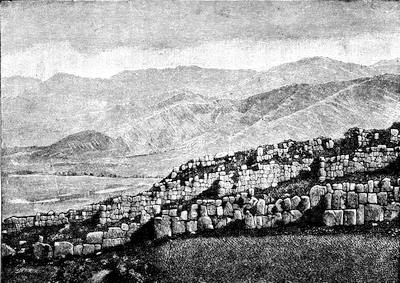
RUINS OF SACSAHUAMAN.
[After a cut in Ruge’s Geschichte des Zeitalters der Entdeckungen. Markham has elsewhere described these ruins,—Cieza de Leon, 259, 324; 2d part, 160; Royal Commentaries of the Incas, ii., with a plan, reproduced in Vol. II. p. 521, and another plan of Cuzco, showing the position of the fortress in its relations to the city. There are plans and views in Squier’s Peru, ch. 23.—Ed.]
Tiahuanacu is interesting because it is possible that the elaborate character of its symbolic sculpture may throw glimmerings of light on remote history; but Sacsahuaman, the fortress overlooking the city of Cuzco, is, without comparison, the grandest monument of an ancient civilization in the New World. Like the Pyramids and the Coliseum, it is imperishable. It consists of a fortified work 600 yards in length, built of gigantic stones, in three lines, forming walls supporting terraces and parapets arranged in salient and retiring angles. This work defends the only assailable side of a position which is impregnable, owing to the steepness of the ascent in all other directions. The outer wall averages a height of 26 feet. Then there is a terrace 16 yards across, whence the second wall rises to 18 feet. The second terrace is six yards across, and the third wall averages a height of 12 feet. The total height of the fortification is 56 feet. The stones are of blue limestone, of enormous size and irregular in shape, but fitted into each other with rare precision. One of the stones is 27 feet high by 14, and stones 15 feet high by 12 are common throughout the work.
At Ollantay-tampu the ruins are of various styles, but the later works are raised on ancient cyclopean foundations.[1151] There are six porphyry slabs 12 feet high by 6 or 7; stone beams 15 and 20 feet long; stairs and recesses hewn out of the solid rock. Here, as at Tiahuanacu, there were, according to Cieza de Leon,[1152] men and animals carved on the stones, but they have disappeared. The same style of architecture, though only in fragments, is met with further north.
East of the river Apurimac, and not far from the town of Abancay, there are three groups of ancient monuments in a deep valley surrounded by lofty spurs of the Andes. There is a great cyclopean wall, a series of seats or thrones of various forms hewn out of the solid stone, and a huge block carved on five sides, called the Rumi-huasi. The northern face of this monolith is cut into the form of a staircase; on the east there are two enormous seats separated by thick partitions, and on the south there is a sort of lookout place, with a seat. Collecting channels traverse the block, and join trenches or grooves leading to two deep excavations on the western side. On this western side there is also a series of steps, apparently for the fall of a cascade of water connected with the sacrificial rites. Molina gives a curious account of the water sacrifices of the Incas.[1153] The Rumi-huasi seems to have been the centre of a great sanctuary, and to have been used as an altar. Its surface is carved with animals amidst a labyrinth of cavities and partition ridges. Its length is 20 feet by 14 broad, and 12 feet high. Here we have, no doubt, a sacrificial altar of the ancient people, on which the blood of animals and libations of chicha flowed in torrents.[1154]
Spanish writers received statements from the Indians that one or other of these cyclopean ruins was built by some particular Inca. Garcilasso de la Vega even names the architects of the Cuzco fortress. But it is clear from the evidence of the most careful investigators, such as Cieza de Leon, that there was no real knowledge of their origin, and that memory of the builders was either quite lost, or preserved in vague, uncertain traditions.
The most ancient myth points to the region of Lake Titicaca as the scene of the creative operations of a Deity, or miracle-working Lord.[1155] This Deity is said to have created the sun, moon, and stars, or to have caused them to rise out of Lake Titicaca. He also created men of stone at Tiahuanacu, or of clay; making them pass under the earth, and appear again out of caves, tree-trunks, rocks, or fountains in the different provinces which were to be peopled by their descendants. But this seems to be a later attempt to reconcile the ancient Titicaca myth with the local worship of natural objects as ancestors or founders of their race, among the numerous subjugated tribes; as well as to account for the colossal statues of unknown origin at Tiahuanacu. There are variations of the story, but there is general concurrence in the main points: that the Deity created the heavenly bodies and the human race, and that the ancient people, or their rulers, were called Pirua. Tradition also seems to point to regions south of the lake as the quarter whence the first settlers came who worked out the earliest civilization.[1156] We may, in accordance with all the indications that are left to us, connect the great god Illa Ticsi with the central figure of the Tiahuanacu sculpture, and the kneeling worshippers with the rulers of all the nations and tribes which had been subjugated by the Hatun-runa,[1157]—the great men who had Pirua for their king, and who originally came from the distant south. The Piruas governed a vast empire, erected imperishable cyclopean edifices, and developed a complicated civilization, which is dimly indicated to us by the numerous symbolical sculptures on the monolith. They also, in a long course of years, brought wild plants under cultivation, and domesticated the animals of the lofty Andean plateau. But it is remarkable that the shores of Lake Titicaca, which are almost treeless, and where corn will not ripen, should have been chosen as the centre of this most ancient civilization. Yet the ruins of Tiahuanacu conclusively establish the fact that the capital of the Piruas was on the loftiest site ever selected for the seat of a great empire.
The Amautas, or learned men of the later Inca period, preserved the names of sovereigns of the Pirua dynasty, commencing with Pirua Manco, and continuing for sixty-five generations. Lopez conjectures that there was a change of dynasty after the eighteenth Pirua king, because hitherto Montesinos, who has recorded the list, had always called each successor son and heir, but after the eighteenth only heir. Hence he thinks that a new dynasty of Amautas, or kings of the learned caste, succeeded the Piruas. The only deeds recorded of this long line of kings are their success in repelling invasions and their alterations of the calendar. At length there appears to have been a general disruption of the empire: Cuzco was nearly deserted, rebel leaders rose up in all directions, the various tribes became independent, and the chief who claimed to be the representative of the old dynasties was reduced to a small territory to the south of Cuzco, in the valley of the Vilcamayu, and was called “King of Tampu Tocco.” This state of disintegration is said to have continued for twenty-eight generations, at the end of which time a new empire began to be consolidated under the Incas, which inherited the civilization and traditions of the ancient dynasties, and succeeded to their power and dominion.
It was long believed that the lists of kings of the earlier dynasties rested solely on the authority of Montesinos, and they consequently received little credit. But recent research has brought to light the work of another writer, who studied before Montesinos, and who incidentally refers to two of the sovereigns in his lists.[1158] This furnishes independent evidence that the catalogues of early kings had been preserved orally or by means of quipus, and that they were in existence when the Spaniards conquered Peru; thus giving weight to the testimony of Montesinos.
The second myth of the Peruvians refers to the origin of the Incas, who derived their descent from the kings of Tampu Tocco, and had their original home at Paccari-tampu, in the valley of the Vilcamayu, south of Cuzco. It is, therefore, an ancestral myth. It is related that four brothers, with their four sisters, issued forth from apertures (Tocco) in a cave at Paccari-tampu, a name which means “the abode of dawn.” The brothers were called Ayar Manco, Ayar Cachi, Ayar Uchu, and Ayar Sauca, names to which the Incas, in the time of Garcilasso de la Vega, gave a fanciful meaning.[1159] One of the brothers showed extraordinary prowess in hurling a stone from a sling. The others became jealous, and, persuading Ayar Auca, the expert slingsman, to return into the cave, they blocked the entrance with rocks. Ayar Uchu was converted into a stone idol, on the summit of a hill near Cuzco, called Huanacauri. Manco then advanced to Cuzco with his youngest brother, and found that the place was occupied by a chief named Alcaviza and his people. Here Manco established the seat of his government, and the Alcaviza tribe appears to have submitted to him, and to have lived side by side with the Incas for some generations. The Huanacauri hill was considered the most sacred place in Peru; while the Tampu-tocco, or cave at Paccari-tampu, was, through the piety of descendants, faced with a masonry wall, having three windows lined with plates of gold.
There is a third myth which seems to connect the ancient tradition of Titicaca with the ancestral myth of the Incas. It is said that long after the creation by the Deity, a great and beneficent being appeared at Tiahuanacu, who divided the world among four kings: Manco Ccapac, Colla, Tocay[1160] or Tocapo,[1161] and Pinahua.[1162] The names Tuapaca, Arnauan,[1163] Tonapa,[1164] and Tarapaca occur in connection with this being, while some authorities tell us that his name was unknown. Betanzos says that he went from Titicaca to Cuzco, where he set up a chief named Alcaviza, and that he advanced through the country until he disappeared over the sea at Puerto Viejo. It is also related that the people of Canas attacked him, but were converted by a miracle, and that they built a great temple, with an image, at Cacha, in honor of this being, or of his god Illa Ticsi Uira-cocha. This temple now forms a ruin which in its structure and arrangement is unique in Peru, and therefore deserves special attention.
The ruins of the temple of Cacha are in the valley of the Vilcamayu, south of Cuzco. They were described by Garcilasso de la Vega, and have been visited and carefully examined by Squier. The main temple was 330 feet long by 87 broad, with wrought-stone walls and a steep pitched roof. A high wall extended longitudinally through the centre of the structure, consisting of a wrought-stone foundation, 8 feet high and 5½ feet thick on the level of the ground, supporting an adobe superstructure, the whole being 40 feet high. This wall was pierced by 12 lofty doorways, 14 feet high. But midway there are sockets for the reception of beams, showing the existence of a second story, as described by Garcilasso. Between the transverse and outer walls there were two series of pillars, 12 on each side, built like the transverse wall, with 8 feet of wrought stone, and completed to a height of 22 feet with adobes. These pillars appear to have supported the second floor, where, according to Garcilasso, there was a shrine containing the statue of Uira-cocha. At right angles to the temple, Squier discovered the remains of a series of supplemental edifices surrounding courts, and built upon a terrace 260 yards long.
The peculiarities of the temple of Cacha consist in the use of rows of columns to support a second floor, and in the great height of the walls. In these respects it is unique, and if similar edifices ever existed, they appear to have been destroyed previous to the rise of the Inca empire. The Cacha temple belongs neither to the cyclopean period of the Piruas nor to the Inca style of architecture. Connected with the strange myth of the wandering prophet of Viracocha, it stands by itself, as one of those unsolved problems which await future investigation. The statue in the shrine on the upper story is described by Cieza de Leon, who saw it.
Both the Titicaca and the Cacha myths have, in later times, been connected and more or less amalgamated with the ancestral myth of the Incas. Thus Garcilasso de la Vega makes Manco Ccapac come direct from Titicaca; while Molina refers to him as one of the beings created there, who went down through the earth and came up at Paccari-tampu. Salcamayhua makes the being Tonapa, of the Cacha myth, arrive at Apu Tampu, or Paccari-tampu, and leave a sacred sceptre there, called tupac yauri, for Manco Ccapac. These are later interpolations, made with the object of connecting the family myth of the Incas with more ancient traditions. The wise men of the Inca system, through the care of Spanish writers of the time of the conquest, have handed down these three traditions and the catalogue of kings. The Titicaca myth tells us of the Deity worshipped by the builders of Tiahuanacu, and the story of the creation. The Cacha myth has reference to some great reformer of very ancient times. The Paccari-tampu myth records the origin of the Inca dynasty. Although they are overlaid with fables and miraculous occurrences, the main facts touching the original home of Manco Ccapac and his march to Cuzco are probably historical.
The catalogue of kings given by Montesinos, allowing an average of twenty years for each, would place the commencement of the Pirua dynasty in about 470 b.c.; in the days when the Greeks, under Cimon, were defeating the Persians, and nearly a century after the death of Sakya Muni in India. This early empire flourished for about 1,200 years, and the disruption took place in 830 a.d., in the days of King Egbert. The disintegration continued for 500 years, and the rise of the Incas under Manco was probably coeval with the days of St. Louis and Henry III of England.[1165] By that time the country had been broken up into separate tribes for 500 years, and the work of reunion, so splendidly achieved by the Incas, was most arduous. At the same time, the ancient civilization of the Piruas was partially inherited by the various peoples whose ancestors composed their empire; so that the Inca civilization was a revival rather than a creation.
The various tribes and nations of the Andes, separated from each other by uninhabited wildernesses and lofty mountain chains, were clearly of the same origin, speaking dialects of the same language. Since the fall of the Piruas they had led an independent existence. Some had formed powerful confederations, others were isolated in their valleys. But it was only through much hard fighting and by consummate statesmanship that the one small Inca lineage established, in a period of less than three centuries, imperial dominion over the rest. It will be well, in this place, to take a brief survey of the different nations which were to form the empire of the Incas, and of their territories.
The central Andean region, which was the home of the imperial race of Incas, extends from the water-parting between the sources of the Ucayali and the basin of Lake Titicaca to the river Apurimac. It includes wild mountain fastnesses, wide expanses of upland, grassy slopes, lofty valleys such as that in which the city of Cuzco is built, and fertile ravines, with the most lovely scenery. The inhabitants composed four tribes: that of the Incas in the valley of the Vilcamayu, of the Quichuas in the secluded ravines of the Apurimac tributaries, and those of the Canas and Cauchis in the mountains bordering on the Titicaca basin. These people average a height of 5 ft. 4 in., and are strongly built. The nose is invariably aquiline, the mouth rather large; the eyes black or deep brown, bright, and generally deep set, with long fine lashes. The hair is abundant and long, fine, and of a deep black-brown. The men have no beards. The skin is very smooth and soft, and of a light coppery-brown color, the neck thick, and the shoulders broad, with great depth of chest. The legs are well formed, feet and hands very small. The Incas have the build and physique of mountaineers.
To the south of this cradle of the Inca race extended the region of the Collas[1166] and allied tribes, including the whole basin of Lake Titicaca, which is 12,000 feet above the level of the sea. The Collas dwelt in stone huts, tended their flocks of llamas, and raised crops of ocas, quinoas, and potatoes. They were divided into several tribes, and were engaged in constant feuds, their arms being slings and ayllos, or bolas. The Collas are remarkable for great length of body compared with the thigh and leg, and they are the only people whose thighs are shorter than their legs. Their build fits them for excellence in mountain climbing and pedestrianism, and for the exercise of extraordinary endurance.[1167] The homes of the Collas were around the seat of ancient civilization at Tiahuanacu.
A remarkable race, apart from the Incas and Collas, of darker complexion and more savage habits, dwelt and still dwell among the vast beds of reeds in the southwestern angle of Lake Titicaca. They are called Urus, and are probably descendants of an aboriginal people who occupied the Titicaca basin before the arrival of the Hatun-runas from the south. The Urus spoke a distinct language, called Puquina, specimens of which have been preserved by Bishop Oré.[1168] The ancestors of the Urus may have been the cromlech builders, driven into the fastnesses of the lake when their country was occupied by the more powerful invaders, who erected the imperishable monuments at Tiahuanacu. These Urus are now lake-dwellers. Their homes consist of large canoes, made of the tough reeds which cover the shallow parts of the lake, and they live on fish, and on quinua and potatoes, which they obtain by barter.
North of Cuzco there were several allied tribes, resembling the Incas in physique and language, in a similar stage of civilization, and their rivals in power. Beyond the Apurimac, and inhabiting the valleys of the Andes thence to the Mantaro, was the important nation of the Chancas; and still further north and west, in the valley of the Xauxa, was the Huanca nation. Agricultural people and shepherds, forming ayllus, or tribes of the Chancas and Huancas, occupied the ravines of the maritime cordillera, and extended their settlements into several valleys of the seacoast, between the Rimac and Nasca. These coast people of Inca race, known as Chinchas, held their own against an entirely different nation, of distinct origin and language, who occupied the northern coast valleys from the Rimac to Payta, and also the great valley of Huarca (the modern Cañete), where they had Chincha enemies both to the north and south of them. These people were called Yuncas by their Inca conquerors. Their own name was Chimu, and the language spoken by them was called Mochica. But this question relating to the early inhabitants of the coast valleys of Peru, their origin and civilization, is the most difficult in ancient Peruvian history, and will require separate consideration.[1169]
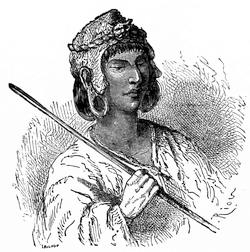
INCA MANCO CCAPAC.
[After a cut in Marcoy’s South America, i. 210 (also in Tour du Monde, 1863, p. 261), purporting to be drawn from a copy of the taffeta roll containing the pedigree of the Incas, which, in evidence of their claims, was sent by their descendants to the Spanish king in 1603. This genealogical record contained the likenesses of the successive Incas and their wives, and the original is said to have disappeared. Mr. Markham supposes this roll to have been the original of the portraits given in Herrera (see cut on p. 267 of the present volume); but they are not the same, if Marcoy’s cuts are trustworthy. A set of likenesses appeared in Ulloa’s Relacion Histórica (Madrid, 1748), iv. 604; and these were the originals of the series copied in the Gentleman’s Mag., 1751-1752, and thence are copied those in Ranking. These do not correspond with those given by Marcoy. See post, Vol. II., for a note on different series of portraits, and in the same volume, pp. 515, 516, are portraits of Atahualpa. A portrait of Manco Inca, killed 1546, is given in A. de Beauchamp’s Histoire de la Conquête du Pérou (Paris, 1808).—Ed.]
North of the Huanca nation, along the basin of the Marañon, there were tribes which were known to the Incas by their head-dresses. These were the Conchucus, Huamachucus, and Huacrachucus.[1170] Still further north, in the region of the equator, was the powerful nation of Quitus.
All these nations of the Peruvian Andes appear to have once formed part of the mighty prehistoric empire of the Pirhuas, and to have retained much of the civilization of their ancestors during the subsequent centuries of separate existence and isolation. This probably accounts for the ease with which the Incas established their system of religion and government throughout their new empire, after the conquests were completed. The subjugated nations spoke dialects of the same language, and inherited many of the usages and ideas of their conquerors. For the same reason they were pretty equally matched as foes, and the Incas secured the mastery only by dint of desperate fighting and great political sagacity. But finally they did establish their superiority, and founded a second great empire in Peru.
The history of the rise and progress of Inca power, as recorded by native historians in their quipus, and retailed to us by Spanish writers, is, on the whole, coherent and intelligible. Many blunders were inevitable in conveying the information from the mouths of natives to the Spanish inquirers, who understood the language imperfectly, and whose objects often were to reach foregone conclusions. But certain broad historical facts are brought out by a comparison of the different authorities, the succession of the last ten sovereigns is determined by a nearly complete consensus of evidence, and we can now relate the general features of the rise of Inca ascendency in Peru with a certain amount of confidence.
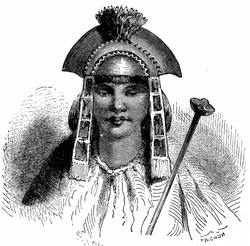
INCA YUPANQUI.
[After a cut in Marcoy, i. 214.—Ed.]
The Inca people were divided into small ayllus, or lineages, when Manco Ccapac advanced down the valley of the Vilcamayu, from Paccari-tampu, and forced the ayllu of Alcaviza and the ayllu of Antasayac to submit to his sway. He formed the nucleus of his power at Cuzco, the land of these conquered ayllus, and from this point his descendants slowly extended their dominion. The chiefs of the surrounding ayllus, called Sinchi (literally, “strong”), either submitted willingly to the Incas, or were subjugated. Sinchi Rocca, the son, and Lloque Yupanqui, the grandson, of Manco, filled up a swamp on the site of the present cathedral of Cuzco, planned out the city,[1171] and their reigns were mainly occupied in consolidating the small kingdom founded by their predecessor. Mayta Ccapac, the fourth Inca, was also occupied in consolidating his power round Cuzco; but his son, Ccapac Yupanqui, subdued the Quichuas to the westward, and extended his sway as far as the pass of Vilcañota, overlooking the Collao, or basin of Lake Titicaca. Inca Rocca, the next sovereign, made few conquests, devoting his attention to the foundation of schools, the organization of festivals and administrative government, and to the construction of public works. His son, named Yahuar-huaccac, appears to have been unfortunate. One authority says that he was surprised and killed, and all agree that his reign was disastrous. For seven generations the power and the admirable internal polity of the Incarial government had been gradually organized and consolidated within a limited area. The succeeding sovereigns were great conquerors, and their empire was rapidly extended to the vast area which it had reached when the Spaniards first appeared on the scene.
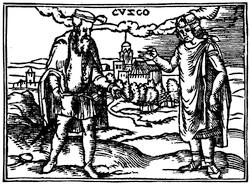
CUZCO.
[One of the cuts which did service in the Antwerp editions of Cieza de Leon. There are various views in Squier’s Peru, pp. 427-445.—Ed.]
The son of Yahuar-huaccac assumed the name of the Deity, and called himself Uira-cocha.[1172] Intervening in a war between the two principal chiefs of the Collas, named Cari and Zapaña, Uira-cocha defeated them in detail, and annexed the whole basin of Lake Titicaca to his dominions. He also conquered the lovely valley of Yucay, on the lower course of the Vilcamayu, whither he retired to end his days. The eldest son of Uira-cocha, named Urco, was incompetent or unworthy, and was either obliged to abdicate[1173] in favor of his brother Yupanqui, the favorite hero of Inca history, or was slain.[1174] It was a moment when the rising empire needed the services of her ablest sons. She was about to engage in a death-struggle with a neighbor as powerful and as civilized as herself. The kingdom of the Chancas, commencing on the banks of the Apurimac, extended far to the east and north, including many of the richest valleys of the Andes. Their warlike king, Uscavilca, had already subdued the Quichuas, who dwelt in the upper valleys of the Apurimac tributaries to the southward, and was advancing on Cuzco, when Yupanqui pushed aside the imbecile Urco, and seized the helm. The fate of the Incas was hanging on a thread. The story is one of thrilling interest as told in the pages of Betanzos, but all authorities dwell more or less on this famous Chanca war. The decisive battle was fought outside the Huaca-puncu, the sacred gate of Cuzco. The result was long doubtful. Suddenly, as the shades of evening were closing over the Yahuar-pampa,—“the field of blood,”—a fresh army fell upon the right flank of the Chanca host, and the Incas won a great victory. So unexpected was this onslaught that the very stones on the mountain sides were believed to have been turned into men. It was the armed array of the insurgent Quichuas who had come by forced marches to the help of their old masters. The memory of this great struggle was fresh in men’s minds when the Spaniards arrived, and as the new conquerors passed over the battlefield, on their way to Cuzco, they saw the stuffed skins of the vanquished Chancas set up as memorials by the roadside.
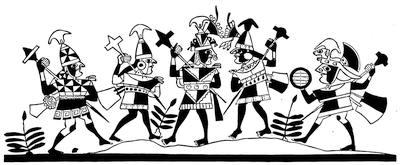
WARRIORS OF THE INCA PERIOD.
[After a cut given by Ruge, and showing figures from an old Peruvian painting.—Ed.]
The subjugation of the Chancas, with their allies the Huancas, led to a vast extension of the Inca empire, which now reached to the shores of the Pacific; and the last years of Yupanqui were passed in the conquest of the alien coast nation, ruled over by a sovereign known as the Chimu. Thus the reign of the Inca Yupanqui marks a great epoch. He beat down all rivals, and converted the Cuzco kingdom into a vast empire. He received the name of Pachacutec, or “he who changes the world,” a name which, according to Montesinos, had on eight previous occasions been conferred upon sovereigns of the more ancient dynasties.
Tupac Inca Yupanqui, the son and successor of Pachacutec, completed the subjugation of the coast valleys, extended his conquests beyond Quito on the north and to Chile as far as the river Maule in the south, besides penetrating far into the eastern forests.
Huayna Ccapac, the son of Tupac Inca Yupanqui, completed and consolidated the conquests of his father. He traversed the valleys of the coast, penetrated to the southern limit of Chile, and fought a memorable battle on the banks of the “lake of blood” (Yahuar-cocha), near the northern frontier of Quito. After a long reign,[1175] the last years of which were passed in Quito, Huayna Ccapac died in November, 1525. His eldest legitimate son, named Huascar, succeeded him at Cuzco. But Atahualpa, his father’s favorite, was at Quito with the most experienced generals. Haughty messages passed between the brothers, which were followed by war. Huascar’s armies were defeated in detail, and eventually the generals of Atahualpa took the legitimate Inca prisoner, entered Cuzco, and massacred the family and adherents of Huascar.[1176] The successful aspirant to the throne was on his way to Cuzco, in the wake of his generals, when he encountered Pizarro and the Spanish invaders at Caxamarca. This war of succession would not, it is probable, have led to any revolutionary change in the general policy of the empire. Atahualpa would have established his power and continued to rule, just as his ancestor Pachacutec did, after the dethronement of his brother Urco.[1177]
The succession of the Incas from Manco Ccapac to Atahualpa was evidently well known to the Amautas, or learned men of the empire, and was recorded in their quipus with precision, together with less certain materials respecting the more ancient dynasties. Many blunders were committed by the Spanish inquirers in putting down the historical information received from the Amautas, but on the whole there is general concurrence among them.[1178] Practically the Spanish authorities agree, and it is clear that the native annalists possessed a single record, while the apparent discrepancies are due to blunders of the Spanish transcribers. The twelve Incas from Manco Ccapac to Huascar may be received as historical personages whose deeds were had in memory at the time of the Spanish invasion, and were narrated to those among the conquerors who sought for information from the Amautas.
a.d. 1240—Manco Ccapac. 1260—Sinchi Rocca. 1280—Lloque Yupanqui. 1300—Mayta Ccapac. 1320—Ccapac Yupanqui. 1340—Inca Rocca. a.d. 1360—Yahuar-huaccac. 1380—Uira-cocha. 1400—Pachacutec Yupanqui. 1440—Tupac Yupanqui. 1480—Huayna Ccapac. 1523—Inti Cusi Hualpa, or Huascar.
The religion of the Incas consisted in the worship of the supreme being of the earlier dynasties, the Illa Ticsi Uira-cocha of the Pirhuas. This simple faith was overlaid by a vast mass of superstition, represented by the cult of ancestors and the cult of natural objects. To this was superadded the belief in the ideals or souls of all animated things, which ruled and guided them, and to which men might pray for help. The exact nature of this belief in ideals, as it presented itself to the people themselves, is not at all clear. It prevailed among the uneducated. Probably it was the idea to which dreams give rise,—the idea of a double nature, of a tangible and a phantom being, the latter mysterious and powerful, and to be propitiated. The belief in this double being was extended to all animated nature, for even the crops had their spiritual doubles, which it was necessary to worship and propitiate.
But the religion of the Incas and of learned men, or Amautas, was a worship of the Supreme Cause of all things, the ancient God of the Titicaca myth, combined with veneration for the sun[1179] as the ancestor of the reigning dynasty, for the other heavenly bodies, and for the malqui, or remains of their forefathers. This feeling of veneration for the sun, closely connected with the beneficent work of the venerated object as displayed in the course of the seasons, led to the growth of an elaborate ritual and to the celebration of periodical festivals.
The weight of evidence is decisively in the direction of a belief on the part of the Incas that a Supreme Being existed, which the sun must obey, as well as all other parts of the universe. This subordination of the sun to the Creator of all things was inculcated by successive Incas. Molina says, “They did not know the sun as their Creator, but as created by the Creator.” Salcamayhua tells us how the Inca Mayta Ccapac taught that the sun and moon were made for the service of men, and that the chief of the Collas, addressing the Inca Uira-cocha, exclaimed, “Thou, O powerful lord of Cuzco, dost worship the teacher of the universe, while I, the chief of the Collas, worship the Sun.” The evidence on the subject of the religion of the Incas, collected by the Viceroy Toledo, showed that they worshipped the Creator of all things, though they also venerated the sun; and Montesinos mentions an edict of the Inca Pachacutec, promulgated with the object of enforcing the worship of the Supreme God above all other deities. The speech of Tupac Inca Yupanqui, showing that the sun was not God, but was obeying laws ordained by God, is recorded by Acosta, Blas Valera, and Balboa, and was evidently deeply impressed on the minds of their Inca informers. This Inca compared the sun to a tethered beast, which always makes the same round; or to a dart, which goes where it is sent, and not where it wishes. The prayers from the Inca ritual, given by Molina, are addressed to the god Ticsi Uira-cocha; the Sun, Moon, and Thunder being occasionally invoked in conjunction with the principal deity.
The worship of this creating God, the Dweller in Space, the Teacher and Ruler of the Universe, was, then, the religion of the Incas which had been inherited from their distant ancestry of the cyclopean age. Around this primitive cult had grown up a supplemental worship of creatures created by the Deity, such as the heavenly bodies, and of objects supposed to represent the first ancestors of ayllus, or tribes, as well as of the prototypes of things on whom man’s welfare depended, such as flocks and animals of the chase, fruit and corn. It has been asserted that the Deity, the Uira-cocha himself, did not generally receive worship, and that there was only one temple in honor of God throughout the empire, at a place called Pachacamac, on the coast. But this is clearly a mistake. The great temple at Cuzco, with its gorgeous display of riches, was called the “Ccuri-cancha Pacha-yachachicpa huasin,” which means “the place of gold, the abode of the Teacher of the Universe.” An elliptical plate of gold was fixed on the wall to represent the Deity, flanked on either side by metal representations of his creatures, the Sun and Moon. The chief festival in the middle of the year, called Ccapac Raymi, was instituted in honor of the supreme Creator, and when, from time to time, his worship began to be neglected by the people, who were apt to run after the numerous local deities, it was again and again enforced by their more enlightened rulers. There were Ccuri-canchas for the service of God, at Vilca and in other centres of vice-regal rule, besides the grand fane of Cuzco.[1180]
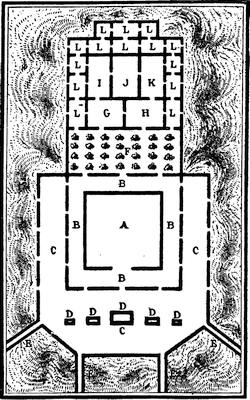
TEMPLE OF THE SUN.
[After a cut in Marcoy, i. p. 234, where it is said to be drawn from existing remains and printed and manuscript authorities. The modern structure of the convent of Santo Domingo, built in 1534, is at A, which contains in its construction some remains of the walls of the older edifice. B is a cloister. C, an outer court. D, fountains for purification. E are streets leading to the great square of Cuzco. F, the garden where golden flowers were once placed; now used as a kitchen garden. G, the chapel dedicated to the moon. H, chapel dedicated to Venus and the Milky Way. I, chapel dedicated to thunder and lightning. J, chapel dedicated to the rainbow. K, council hall of the grand pontiff and priests of the sun. L, the apartments of the priests and servants. See the view of the temple from Montanus in Vol. II. p. 555, and a modern view in Wiener’s. Pérou et Bolivie, p. 318. Other plans and views are in Squier’s Peru, pp. 430-445.—Ed.]
Although the first and principal invocations were addressed to the Creator, prayers were also offered up to the Sun and Moon, to the Thunder, and to ancestors who were called upon to intercede with the Deity.[1181] The latter worship formed a very distinctive feature in the religious observances of nearly all the Incarial tribes. The Paccarina, or forefather of the ayllu, or lineage, was often some natural object converted into a huaca, or deity. The Paccarina of the Inca family was the Sun; with his sister and spouse, the Moon. A vast hierarchy was set apart to conduct the ceremonies connected with their worship, and hundreds of virgins, called Aclla-cuna, were secluded and devoted to duties relating to the observances in the Sun temples. Worship was also offered to the actual bodies of the ancestors, called malqui, which were preserved with the greatest care, in caves called machay. On solemn festivals each ayllu assembled with its malqui. The bodies of the Incas were all preserved, clothed as when alive, and surrounded by their special furniture and utensils. Three of these Inca mummies, with two mummies of queens, were discovered by Polo de Ondegardo, then corregidor of Cuzco, in 1559, and were sent by him to Lima for interment. Those who saw them[1182] reported that they were so well preserved that they appeared to be alive; that they were in a sitting posture; that the eyes were made of gold, and that they were arrayed in the insignia of their rank.[1183] The Paccarina, or founder of the family, and the malquis, or mummies of ancestors, thus formed the objects of a distinct belief and religion, based undoubtedly on the conviction that every human being has a spiritual as well as a corporeal existence; that the former is immortal, and that it is represented by the malqui. The appearance of the departed in dreams and visions was not an unreasonable ground for this belief, which certainly was the most deeply rooted of all the religious ideas of the Peruvian people. The paccarina, or ancestral deities, were innumerable. There was one or more that received worship in every tribe, and was represented by a rock, or some other natural object. Many were believed to be oracles. Some, such as Catequilla, or Apu-catequilla,[1184] the oracle of the Conchucu tribe, have been brought into undue prominence through being mentioned by Spanish writers.
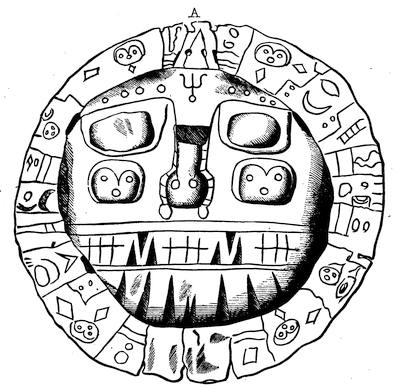
ZODIAC OF GOLD FOUND AT CUZCO.
[After a drawing by Mr. Markham of the plate itself, made at Lima in 1853. Mr. Markham’s drawing is reproduced in Bollaert’s Antiquarian Researches, p. 146. The disk is 53/10 inches in diameter. The signs in the outer ring are supposed to represent the months.—Ed.]
Religious ceremonials were closely connected with the daily life of the people, and especially with the course of the seasons and the succession of months, as they affected the operations of agriculture. It was important to fix the equinoxes and solstices, and astronomical knowledge was a part of the priestly office. There were names for many of the stars; their motions were watched as well as those of the sun and moon; and though a record of the extent of the astronomical knowledge of the Incas has not been preserved, it is certain that they watched the time of the solstices and equinoxes with great care, and that they distinguished between the lunar and solar years. Pillars were erected to determine the time of the solstices, eight on the east and eight on the west side of Cuzco, in double rows, four and four, two low between two higher ones, twenty feet apart. They were called Sucanca, from suca, a ridge or furrow, the alternate light and shade between the pillars appearing like furrows. A stone column in the centre of a level platform, called Inti-huatana, was used to ascertain the time of the equinoxes. A line was drawn across the platform from east to west, and watch was kept to observe when the shadow of the pillar was on this line from sunrise to sunset, and there was no shadow at noon. The principal Inti-huatana was in the square before the great temple at Cuzco; but there are several others in different parts of Peru. The most perfect of these observatories is at Pissac, in the valley of Vilcamayu.[1185] There is another at Ollantay-tampu, a fourth near Abancay, and a fifth at Sillustani in the Collao.
There is reason to believe that the Incas used a zodiac with twelve signs, corresponding with the months of their solar year. The gold plates which they wore on their breasts were stamped with features representing the sun, surrounded by a border of what are probably either zodiacal signs or signs for the months. Whether the ecliptic, or huatana, was thus divided or not, it is certain that the sun’s motion was observed with great care, and that the calendar was thus fixed with some approach to accuracy.[1186] The year, or Huata, was divided into twelve Quilla, or moon revolutions, and these were made to correspond with the solar year by adding five days, which were divided among the twelve months. A further correction was made every fourth year. Solar observations were taken and recorded every month.
The year commenced on the 22d of June, with the winter solstice, and there were four great festivals at the occurrence of the solstices and equinoxes.[1187]
The celebrations of the solar year and of the seasons, in their bearings on agriculture, were identical with the chief religious observances. The Raymi, or festival of the winter solstice, in the first month, when the granaries were filled after harvest, was established in special honor of the Sun. Sacrifices of llamas and lambs, and of the first-fruits of the earth, were offered up to the images of the Supreme Being, of the Sun, and of Thunder, which were placed in the open space in front of the great temple; as well as to the huaca, or stone representing the brother of Manco Ccapac, on the hill of Huanacauri. There was also a procession of the priests and people as far as the pass of Vilcañota, leading into the basin of Lake Titicaca, sacrifices being offered up at various spots on the road. The sacrifices were accompanied by prayers, and concluded with songs, called huayllina, and dancing. Then followed the ploughing month, when it is said that the Inca himself opened the season by ploughing a furrow with a golden plough in the field behind the Colcampata palace, on the height above Cuzco.
The question here arises whether human sacrifices were offered up, in the Inca ritual. This has been stated by Molina, Cieza de Leon, Montesinos, Balboa, Ondegardo, and Acosta, and indignantly denied by Garcilasso de la Vega. Cieza de Leon admits that there were occasional human sacrifices, but adds that their numbers and the frequency of such offerings have been grossly exaggerated by the Spaniards. If the sacrifices had been offered under the idea of atonement or expiation, it might well be expected that human sacrifices would be included. Under such ideas, men offered up what they valued most, just as Abraham was prepared to sacrifice his son, as Jephthah dedicated his daughter as a burnt-offering to Jehovah, and as the king of Moab sacrificed his eldest son to Chemosh.[1188] But, except in the Situa, when the idea was to efface sins by washing, the sacrifices of the Incas were offerings of thanksgiving, not of expiation or atonement. The mistake of the five writers who supposed that the Incas offered human sacrifices was due to their ignorance of the language.[1189] The perpetration of human sacrifice was opposed to the religious ideas of the ancient Peruvians, and formed no part of their ceremonial worship. Their ritual was almost exclusively devoted to thanksgiving and rejoicings over the beneficence of their Deity. The notion of expiation formed no part of their creed, while the destruction involved in such a system was opposed to their economic and carefully regulated civil polity.[1190]
The second great festival, called Situa, was celebrated at the vernal equinox. This was the commencement of the rainy season, when sickness prevailed, and the object of the ceremony was to pray to the Creator to drive diseases and evils from the land. In the centre of the great square of Cuzco a body of four hundred warriors was assembled, fully armed for war. One hundred faced towards the Chincha-suyu road, one hundred faced towards Anti-suyu, one hundred towards Colla-suyu, and one hundred towards Cunti-suyu,—the four great divisions of the empire. The Inca and the high-priest, with their attendants, then came from the temple, and shouted, “Go forth all evils!” On the instant the warriors ran at great speed towards the four quarters, shouting the same sentence as they went, until they each came to another party, which took up the cry, and the last parties reached the banks of great rivers, the Apurimac or Vilcamayu, where they bathed and washed their arms. The rivers were supposed to carry the evils away to the ocean. As the warriors ran through the streets of Cuzco, all the people came to their doors, shaking their clothes, and shouting, “Let the evils be gone!” In the evening they all bathed; then they lighted great torches of straw, called pancurcu, and, marching in procession out of the city, they threw them into the rivers, believing that thus nocturnal evils were banished. At night, each family partook of a supper consisting of pudding made of coarsely ground maize, called sancu, which was also smeared over their faces and the lintels of their doorways, then washed off and thrown into the rivers with the cry, “May we be free from sickness, and may no maladies enter our houses!” The huacas and malquis were also bathed at the feast of Situa. In the following days all the malquis were paraded, and there were sacrifices, with feasting and dancing. A stone fountain, plated with gold, stood in the great square of Cuzco, and the Inca, on this and other solemn festivals, poured chicha into it from a golden vase, which was conducted by subterranean pipes to the temple.
The third great festival at the summer solstice, called Huaracu, was the occasion on which the youths of the empire were admitted to a rank equivalent to knighthood, after passing through a severe ordeal. The Inca and his court were assembled in front of the temple. Thither the youths were conducted by their relations, with heads closely shorn, and attired in shirts of fine yellow wool edged with black, and white mantles fastened round their necks by woollen cords with red tassels. They made their reverences to the Inca, offered up prayers, and each presented a llama for sacrifice.[1191] Proceeding thence to the hill of Huanacauri, where the venerated huaca to Ayar Uchu was erected, they there received huaras, or breeches made of aloe fibres, from the priest. This completed their manly attire, and they returned home to prepare for the ordeal. A few days afterwards they were assembled in the great square, received a spear, called yauri, and usutas or sandals, and were severely whipped to prove their endurance. The young candidates were then sent forth to pass the night in a desert about a league from Cuzco. Next day they had to run a race. At the farther end of the course young girls were stationed, called ñusta-calli-sapa,[1192] with jars of chicha, who cried, “Come quickly, youths, for we are waiting!” but the course was a long one, and many fell before they reached the goal. They also had to rival each other in assaults and feats of arms. Finally their ears were bored, and they received ear-pieces of gold and other marks of distinction from the Inca. The last ceremony was that of bathing in the fountain called Calli-puquio. About eight hundred youths annually passed through this ordeal, and became adult warriors, at Cuzco, and similar ceremonies were performed in all the provinces of the empire.
In the month following on the summer solstice, there was a curious religious ceremony known as the water sacrifice. The cinders and ashes of all the numerous sacrifices throughout the year were preserved. Dams were constructed across the rivers which flow through Cuzco, in order that the water might rush down with great force when they were taken away. Prayers and sacrifices were offered up, and then a little after sunset all the ashes were thrown into the rivers and the dams were removed. Then the burnt-sacrifices were hurried down with the stream, closely followed by crowds of people on either bank, with blazing torches, as far as the bridge at Ollantay-tampu. There two bags of coca were offered up by being hurled into the river, and thence the sacrifices were allowed to flow onwards to the sea. This curious ceremony seems to have been intended not only as a thank-offering to the Deity, but as an acknowledgment of his omnipresence. As the offerings flowed with the stream, they knew not whither, yet went to Him, so his pervading spirit was everywhere, alike in parts unknown as in the visible world of the Incas.
A sacred fire was kept alive throughout the year by the virgins of the sun, and the ceremony of its annual renewal at the autumnal equinox was the fourth great festival, called Mosoc-nina, or the “new fire.” Fire was produced by collecting the sun’s rays on a burnished metal mirror, and the ceremony was the occasion of prayers and sacrifices. The year ended with the rejoicing of the harvest months, accompanied by songs, dances, and other festivities.
Besides the periodical festivals, there were also religious observances which entered into the life of each family. Every household had one or more lares, called Conopa, representing maize, fruit, a llama, or other object on which its welfare depended. The belief in divination and soothsaying, the practice of fasting followed by confession, and worship of the family malqui, all gave employment to the priesthood.
The complicated religious ceremonies connected with the periodical festivals, the daily worship, and the requirements of private families gave rise to the growth of a very numerous caste of priests and diviners. The pope of this hierarchy, the chief pontiff, was called Uillac Umu, words meaning “The head which gives counsel,” he who repeats to the people the utterances of the Deity. He was the most learned and virtuous of the priestly caste, always a member of the reigning family, and next in rank to the Inca. The Villcas, equivalent to the bishops of a Christian hierarchy, were the chief priests in the provinces, and during the greatest extension of the empire they numbered ten. The ordinary ministers of religion were divided into sacrificers, worshippers and confessors, diviners, and recluses.[1193] It was indeed inevitable that, with a complicated ritual and a gorgeous ceremonial worship, a populous class of priests and their assistants, of numerous grades and callings, should come into existence.[1194]
But the intellectual movement and vigor of the Incas were not confined to the priesthood. The Amautas or learned men, the poets and reciters of history, the musical and dramatic composers, the Quipu-camayoc, or recorders and accountants, were not necessarily, nor indeed generally, of the priestly caste. It is probable that the Amautas, or men of learning, formed a separate caste devoted to the cultivation of literature and the extension of the language. Our knowledge of their progress and of the character of their traditions and poetic culture is very limited, owing to the destruction of records and the loss of oral testimony. The language has been preserved, and that will tell us much; but only a few literary compositions have been saved from the wreck of the Inca empire. Quichua was the name given to the general language of the Incas by Friar Domingo de San Tomas, the first Spaniard who studied it grammatically, possibly owing to his having acquired it from people belonging to the Quichua tribe. The name continued to be used, and has been generally adopted.[1195] Garcilasso de la Vega speaks of a separate court language of the Incas, but the eleven words he gives as belonging to it are ordinary Quichua words, and I concur with Hervas and William von Humboldt in the conclusion that this court language of Garcilasso had no real existence.[1196] It is not mentioned by any other authority.
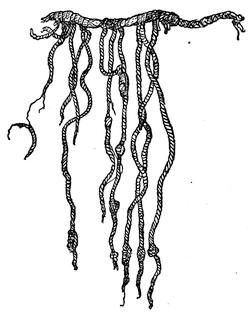
THE QUIPUS.
[Following a sketch in Rivero and Tschudi, as reproduced by Helps. It shows a quipu found in an ancient cemetery near Pachacamac. There are other cuts in Wiener’s Pérou et Bolivie, p. 777; Tylor’s Early Hist. Mankind, 156; Kingsborough’s Mexico, vol. iv.; Silvestre’s Universal Palæography; and Léon de Rosny’s Écritures figuratives, Paris, 180. Cf. Acosta, vi. cap. 8, and other early authorities mentioned in Prescott (Kirk’s ed. i. 125); Markham’s Cieza, 291; D. Wilson’s Prehistoric Man, ii. ch. 18; Fourth Rept. Bureau of Ethnology (Washington), p. 79; Bollaert’s description in Memoirs read before the Anthropological Society of London, i. 188, and iii. 351; A. Bastian’s Culturländer des alten America, iii. 73; Brasseur de Bourbourg’s MS. Troano, i. 18; Stevens’s Flint Chips, 465; T. P. Thompson’s “Knot Records of Peru” in Westminster Review, xi. 228; but in the separate print called History of the Quipos, or Peruvian Knot-records, as given by the early Spanish Historians, with a Description of a supposed Specimen, assigned to Al. Strong by Leclerc, No. 2413. The description in Frezier’s Voyage to the South Sea (1717) is one of the earliest among Europeans. Leclerc, No. 2412, mentions a Letter a apologetica (Napoli, 1750), pertaining to the quipus, but seems uncertain as to its value.—Ed.]
It was the custom for the Yaravecs or Bards to recite the deeds of former Incas on public occasions, and these rhythmical narratives were orally preserved and handed down by the learned men. Cieza de Leon tells us that “by this plan, from the mouths of one generation the succeeding one was taught, and they could relate what took place five hundred years ago as if only ten years had passed. This was the order that was taken to prevent the great events of the empire from falling into oblivion.” These historical recitations and songs must have formed the most important part of Inca literature. One specimen of imaginative poetry has been preserved by Blas Valero, in which the thunder, followed by rain, is likened to a brother breaking his sister’s pitcher; just as in the Scandinavian mythology the legend which is the original source of our nursery rhyme of Jack and Jill employs the same imagery. Pastoral duties are embodied in some of the later Quichuan dramatic literature, and numerous love songs and yaravies, or elegies, have been handed down orally, or preserved in old manuscripts. The dances were numerous and complicated, and the Incas had many musical instruments.[1197] Dramatic representations, both of a tragic and comic character, were performed before the Inca court. The statement of Garcilasso de la Vega to this effect is supported by the independent evidence of Cieza de Leon and of Salcamayhua, and is placed beyond a doubt by the sentence of the judge, Areche, in 1781, who prohibited the celebration of these dramas by the Indians. Father Iteri also speaks of the “Quichua dramas transmitted to this day (1790) by an unbroken tradition.” But only one such drama has been handed down to our own time. It is entitled Ollantay, and records an historical event of the time of Yupanqui Pachacutec. In its present form, as regards division into scenes and stage directions, it shows later Spanish manipulation. The question of its antiquity has been much discussed; but the final result is that Quichua scholars believe most of its dialogues and speeches and all the songs to be remnants of the Inca period.
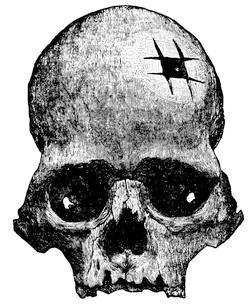
INCA SKULL.
[After the plate in the Contrib. to N. Am. Ethnology, vol. v. (Powell’s survey, 1882), showing the trephined skull brought from Peru by Squier, in the Army Med. Museum, Washington. Squier in his Peru, p. 457, gives another cut, with comments of Broca and others in the appendix. Cf. in the same volume a paper on “Prehistoric Trephining and Cranial Amulets,” by R. Fletcher, and a paper on “Trephining in the Neolithic Period,” in the Journal of the Anthropological Institute, Nov., 1887. Cf. on Peruvian skulls Rudolf Virchow, in the third volume of the Necropolis of Ancon; T. J. Hutchinson in the Journal of the Anthropological Institute, iii. 311; iv. 2; Busk and Davis in Ibid. iii. 86, 94; Wilson’s Prehistoric Man, ii. ch. 20; C. C. Blake, in Transactions Ethnolog. Soc., n. s., ii. There are two collections of Peruvian skulls in the Peabody Museum at Cambridge, Mass.,—one presented by Squier, the other secured by the Haasler Expedition. (Cf. Reports VII. and IX. of the museum.) Wiener (L’Empire des Incas, p. 81) cites a long list of writers on the artificial deforming of the skull.—Ed.]
The system of record by the use of quipus, or knots, was primarily a method of numeration and of keeping accounts. To cords of various colors smaller lines were attached in the form of fringe, on which there were knots in an almost infinite variety of combination. The Quipu-camayoc, or accountant, could by this means keep records under numerous heads, and preserve the accounts of the empire. The quipus represented a far better system of keeping accounts than the exchequer tallies which were used in England for the same purpose as late as the early part of the present century. But the question of the extent to which historical events could be recorded by this system of knots is a difficult one. We have the direct assertions of Montesinos, Salcamayhua, the anonymous Jesuit, Blas Valera, and others, that not only narratives, but songs, were preserved by means of the quipus. Von Tschudi believed that by dint of the uninterrupted studies of experts during several generations, the power of expression became developed more and more, and that eventually the art of the Quipu-camayoc reached a high state of perfection. It may reasonably be assumed that with some help from oral commentary, codes of laws, historical events, and even poems were preserved in the quipus. It was through this substitute for writing that Montesinos and the anonymous Jesuit received their lists of ancient dynasties, and Blas Valera distinctly says that the poem he has preserved was taken from quipus. Still it must have been rather a system of mnemonics than of complete record. Molina tells us that the events in the reigns of all the Incas, as well as early traditions, were represented by paintings on boards, in a temple near Cuzco, called Poquen cancha.
The diviners used certain incantations to cure the sick, but the healing art among the Incas was really in the hands of learned men. Those Amautas who devoted themselves to the study of medicine had, as Acosta bears testimony, a knowledge of the properties of many plants. The febrifuge virtues of the precious quinquina were, it is true, unknown, or only locally known. But the Amautas used plants with tonic properties for curing fevers; and they were provided with these and other drugs by an itinerant caste, called Calahuayas or Charisanis, who went into the forests to procure them. The descendants of these itinerant doctors still wander over South America, selling drugs.[1198] The discovery of a skull in a cemetery at Yucay, which exhibits clear evidence of a case of trepanning before death, proves the marvellous advances made by the Incas in surgical science.
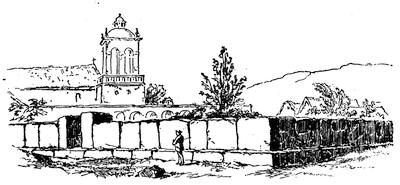
RUINS AT CHUCUITO.
[After a drawing in Squier’s Primeval Monuments of Peru, p. 17, showing a wall of hewn stones, with an entrance. The enclosed rectangle is 65 feet on each side,—“a type of an advanced class of megalithic monuments by no means uncommon in the highlands of Peru.” Cf. Squier’s Peru, p. 354.—Ed.]
The sovereign was the centre of all civilization and all knowledge. All literary culture, all the religious ceremonial which had grown up with the extension of the empire, had the Inca for their centre, as well as all the military operations and all laws connected with civil administration. Originally but the Sinchi, or chief of a small ayllu, the greatness of successive Incas grew with the extension of their power, until at last they were looked upon almost as deities by their subjects. The greatest lords entered their presence in a stooping position and with a small burden on their backs. The imperial family rapidly increased. Each Inca left behind him numerous younger sons, whose descendants formed an ayllu, so that the later sovereigns were surrounded by a numerous following of their own kindred, from among whom able public servants were selected. The sovereign was the “Sapallan Inca,” the sole and sovereign lord, and with good reason he was called Huaccha-cuyac, or friend of the poor.
Enormous wealth was sent to Cuzco as tribute from all parts of the empire, for the service of the court and of the temples. The special insignia of the sovereign were the llautu, or crimson fringe round the forehead, the wing feathers (black and white) of the alcamari, an Andean vulture, on the head, forming together the suntu paucar or sacred head-dress; the huaman champi, or mace, and the ccapac-yauri, or sceptre. His dress consisted of shirts of cotton, tunics of dyed cotton in patterns, with borders of small gold and silver plates or feathers, and mantles of fine vicuña wool woven and dyed. The Incas, as represented in the pictures at Cuzco,[1199] painted soon after the conquest, wore golden breastplates suspended round their necks, with the image of the sun stamped upon them;[1200] and the Ccoya, or queen, wore a large golden topu, or pin, with figures engraved on the head, which secured her lliclla, or mantle. All the utensils of the palace were of gold; and so exclusively was that precious metal used in the service of the court and the temple that a garden outside the Ccuri-cancha was planted with models of leaves, fruit, and stalks made of pure gold.[1201]
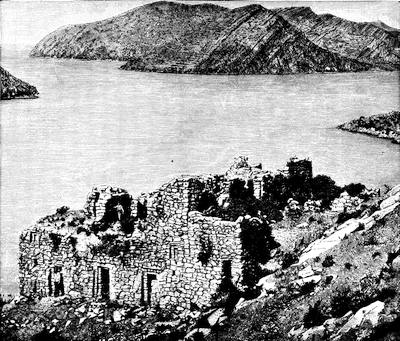
TITICACA.
[After a cut in Ruge’s Gesch. des Zeital. der Entdeckungen. Squier explored the lake with Raimond in 1864-65, and bears testimony to the general accuracy of the survey by J. B. Pentland, British consul in Bolivia (1827-28 and 1837), published by the British admiralty; but Squier points out some defects of his survey in his Remarques sur la Géog. du Pérou, p. 14, and in Journal Amer. Geog. Soc., iii. There is another view in Wiener’s Pérou et Bolivie, p. 441. Cf. Markham’s Cieza de Leon, 370; Marcoy’s Voyage; Baldwin’s Ancient America, 228; and Philippson’s Gesch. des neu. Zeit., i. 240. Squier in his Peru (pp. 308-370) gives various views, plans of the ruins, and a map of the lake.—Ed.]
Two styles are discernible in Inca architecture. The earliest is an imitation of the cyclopean works of their ancestors on a smaller scale. The walls were built with polygonal-shaped stones with rough surfaces, but the stones were much reduced in size. Rows of doorways with slanting sides and monolithic lintels adorn the façades; while recesses for huacas, shaped like the doorways, occur in the interior walls. Part of the palace called the Collcampata, at the foot of the Cuzco fortress, the buildings which were added to the cyclopean work at Ollantay tampu, the older portion of the Ccuri-cancha temple at Cuzco, the palaces at Chinchero and Rimac-tampu, are in this earlier style. The later style is seen mainly at Cuzco, where the stones are laid in regular courses. No one has described this superb masonry better than Squier.[1202] No cement or mortar of any kind was used, the edifices depending entirely on the accuracy of their stone-fitting for their stability. The palaces and temples were built round a court-yard, and a hall of vast dimensions, large enough for ceremonies on an extensive scale, was included in the plan of most of the edifices. These halls were 200 paces long by 50 to 60 broad. The dimensions of the Ccuri-cancha temple were 296 feet by 52, and the southwest end was apsidal. Serpents are carved in relief on some of the stones and lintels of the Cuzco palaces. Hence the palace of Huayna Ccapac is called Amaru-cancha.[1203] At Hatun-colla, near Lake Titicaca, there are two sandstone pillars, probably of Inca origin, which are very richly carved. They are covered with figures of serpents, lizards, and frogs, and with elaborate geometrical patterns. The height of the walls of the Cuzco edifices was from 35 to 40 feet, and the roofs were thatched. One specimen of the admirable thatching of the Incas is still preserved at Azangaro.
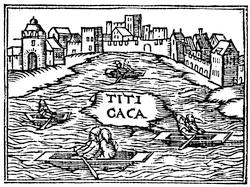
LAKE TITICACA.
[One of the cuts which did service in the Antwerp editions of Cieza de Leon.—Ed.]
There are many ruins throughout Peru both in the earlier and later styles; some of them, such as those at Vilcashuaman and Huanuco el viejo, being of great interest. The Inca palace on the island in Lake Titicaca is a rectangular two-storied edifice, with numerous rooms having ceilings formed of flat overlapping stones, laid with great regularity. With its esplanade, beautiful terraced gardens, baths, and fountains, this Titicaca palace must have been intended for the enjoyment of beautiful scenery in comparative seclusion, like the now destroyed palace at Yucay, in the valley of the Vilcamayu.
An example of the improvement of architecture after Inca subjugation is shown in the curious burial-places, or chulpas, of the Collao, in the basin of Lake Titicaca. The earliest, as seen at Acora near the lake, closely resemble the rude cromlechs of Brittany. Next, roughly built square towers are met with, with vaults inside. Lastly, the chulpas at Sillustani are well-built circular towers, about 40 feet high and 16 feet in diameter at the base, widening as they rise. A cornice runs round each tower, about three fourths of the distance from the base to the summit. The stones are admirably cut and fitted in nearly even courses, like the walls at Cuzco. The interior circular vaults, which contained the bodies, were arched with overlapping stones, and a similar dome formed the roof of the towers.
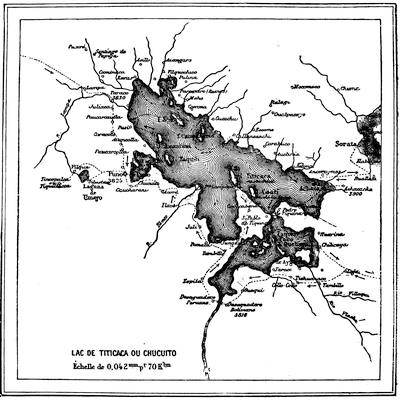
MAP OF TITICACA, WITH WIENER’S ROUTE.
The architectural excellence reached by the Incas, their advances in the other arts and in literature, and the imperial magnificence of their court and religious worship, imply the existence of an orderly and well-regulated administrative system. An examination of their social polity will not disappoint even high expectations. The Inca, though despotic in theory, was bound by the complicated code of rules and customs which had gradually developed itself during the reigns of his ancestors. In his own extensive family, composed of Auqui[1204] and Atauchi,[1205] Palla[1206] and Ñusta,[1207] to the number of many hundreds,[1208] and in the Curacas[1209] and Apu-curacas[1210] of the conquered tribes, he had a host of able public servants to govern provinces, enter the priesthood, or command armies.
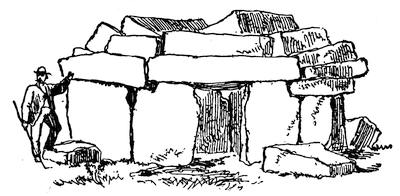
PRIMEVAL TOMB, ACORA.
[After a sketch in Squier’s Primeval Monuments of Peru, Salem, 1870. He considers it an example of some of the oldest of human monuments, and is inclined to believe these chulpas, or burial monuments, to have been built by the ancestors of the Peruvians of the conquest in their earliest development.—Ed.]
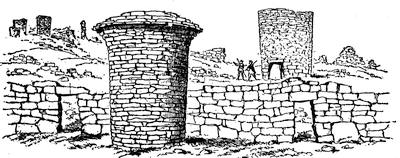
RUINS AT QUELLENATA.
[Reduced from a sketch in Squier’s Primeval Monuments of Peru, p. 7. They are situated in Bolivia, northeast of Lake Titicaca, and the cut shows a hill-fortress (pucura) and the round, flaring-top burial towers (chulpas). Cf. cut in Wiener’s Pérou et Bolivie, p. 538.—Ed.]
The empire was marked out into four great divisions, corresponding with the four cardinal points of a compass placed at Cuzco. To the north was Chinchaysuyu, to the east Anti-suyu, to the west Cunti-suyu, and to the south Colla-suyu.
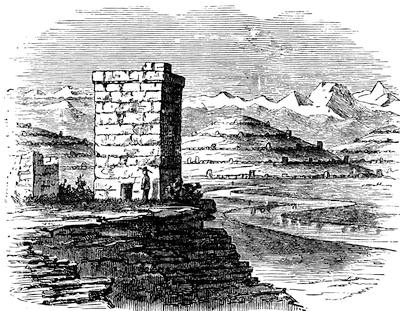
RUINS AT ESCOMA, BOLIVIA.
[After a cut in Squier’s Primeval Monuments of Peru, p. 9,—a square two-storied burial tower (chulpa) with hill-fortress (pucura) in the distance, situated east of Lake Titicaca. Cf. Squier’s Peru, p. 373.—Ed.]
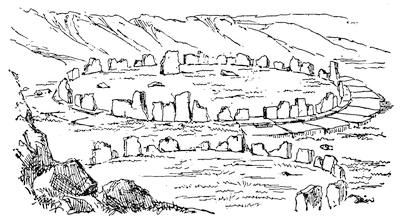
SILLUSTANI, PERU.
[Sun-circles (Inti-huatana, where the sun is tied up), after a cut in Squier’s Primeval Monuments of Peru, p. 15. The nearer circle is 90 feet; the farther, which has a grooved outlying platform, is 150 feet in diameter. Cf. plan and views in Squier’s Peru, ch. 20.—Ed.]
The whole empire was called Ttahuantin-suyu, or the four united provinces. Each great province was governed by an Inca viceroy, whose title was Ccapac, or Tucuyricoc.[1211] The latter word means “He who sees all.” Garcilasso describes the office as merely that of an inspector, whose duty it was to visit the province and report. Under the viceroy were the native Curacas, who governed the ayllus, or lineages. Each ayllu was divided into sections of ten families, under an officer called Chunca (10) camayu. Ten of these came under a Pachaca (100) camayu. Ten Pachacas formed a Huaranca (1,000) camayu, and the Hunu (10,000) camayu ruled over ten Huarancas. The Chunca of ten families was the unit of government, and each Chunca formed a complete community.[1212]
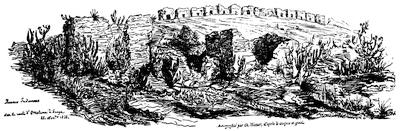
RUINS OF AN INCARIAL VILLAGE.
[Situated on the road from Milo to Huancayo. Reduced from an ink drawing given by Wiener in his L’Empire des Incas, pl. v.—Ed.]
The cultivable land belonged to the people in their ayllus, each Chunca being allotted a sufficient area to support its ten Purics and their dependants.[1213] The produce was divided between the government (Inca), the priesthood (Huaca), and the cultivators or poor (Huaccha), but not in equal shares.[1214] In some parts the three shares were kept apart in cultivation, but as a rule the produce was divided at harvest time. The flocks of llamas were divided into Ccapac-llama, belonging to the state, and Huaccha-llama, owned by the people. Thus the land belonged to the ayllu, or tribe, and each puric, or able-bodied man, had a right to his share of the crop, provided that he had been present at the sowing. All those who were absent must have been employed in the service of the Inca or Huaca, and subsisted on the government or priestly share. Shepherds and mechanics were also dependent on those shares. Officers called Runay-pachaca annually revised the allotments, made the census, prepared statistics for the Quipu-camayoc, and sent reports to the Tucuyricoc. The Llacta-camayoc, or village overseer, announced the turns for irrigation and the fields to be cultivated when the shares were grown apart. These daily notices were usually given from a tower or terrace. There were also judges or examiners, called Taripasac,[1215] who investigated serious offences and settled disputes. Punishments for crimes were severe, and inexorably inflicted. It was also the duty of these officers, when a particular ayllu suffered any calamity through wars or natural causes, to allot contingents from surrounding ayllus to assist the neighbor in distress. There were similar arrangements when the completion or repair of any public work was urgent. The most cruel tax on the people consisted in the selection of the Aclla-cuna, or chosen maidens for the service of the Inca, and the church, or Huaca. This was done once a year by an ecclesiastical dignitary called the Apu-Panaca,[1216] or, according to one authority, the Hatun-uilca,[1217] who was deputy of the high-priest. Service under the Inca in all other capacities was eagerly sought for.
The industry and skill of the Peruvian husbandmen can scarcely alone account for the perfection to which they brought the science of agriculture. The administrative system of the Incas must share the credit. Not a spot of cultivable land was neglected. Towns and villages were built on rocky ground. Even their dead were buried in waste places. Dry wastes were irrigated, and terraces were constructed, sometimes a hundred deep, up the sides of the mountains. The most beautiful example of this terrace cultivation may still be seen in the “Andeneria,” or hanging gardens of the valley of Vilcamayu, near Cuzco. There the terraces, commencing with broad fields at the edge of the level ground, rise to a height of 1,500 feet, narrowing as they rise, until the loftiest terraces against the perpendicular mountain side are not more than two feet wide, just room for three or four rows of maize. An irrigation canal, starting high up some narrow ravine at the snow level, is carried along the mountain side and through the terraces, flowing down from one to another.
Irrigation on a larger scale was employed not only on the desert coast, but to water the pastures and arable lands in the mountains, where there is rain for several months in the year. The channels were often of considerable size and great length. Mr. Squier says that he has followed them for days together, winding amidst the projections of hills, here sustained by high masonry walls, there cut into the living rock, and in some places conducted in tunnels through sharp spurs of an obstructing mountain. An officer knew the space of time necessary for irrigating each tupu, and each cultivator received a flow of water in accordance with the requirements of his land. The manuring of crops was also carefully attended to.[1218]
The result of all this intelligent labor was fully commensurate with the thought and skill expended. The Incas produced the finest potato crops the world has ever seen. The white maize of Cuzco has never been approached in size or in yield. Coca, now so highly prized, is a product peculiar to Inca agriculture, and its cultivation required extreme care, especially in the picking and drying processes. Ajï, or Chile pepper, furnished a new condiment to the Old World. Peruvian cotton is excelled only by Sea Island and Egyptian in length of fibre, and for strength and length of fibre combined is without an equal. Quinua, oca, aracacha, and several fruits are also peculiar to Peruvian agriculture.[1219]
The vast flocks of llamas[1220] and alpacas supplied meat for the people, dried charqui for soldiers and travellers, and wool for weaving cloth of every degree of fineness. The alpacas, whose unrivalled wool is now in such large demand, may almost be said to have been the creation of the Inca shepherds. They can only be reared by the bestowal on them of the most constant and devoted care. The wild huanacus and vicuñas were also sources of food and wool supply. No man was allowed to kill any wild animal in Peru, but there were periodical hunts, called chacu, in the different provinces, which were ordered by the Inca. On these occasions a wide area was surrounded by thousands of people, who gradually closed in towards the centre. They advanced, shouting and starting the game before them, and closed in, forming in several ranks until a great bag was secured. The females were released, with a few of the best and finest males. The rest were then shorn and also released, a certain proportion being killed for the sake of their flesh. The huanacu wool was divided among the people of the district, while the silky fleeces of the vicuña were reserved for the Inca. The Quipu-camayoc kept a careful record of the number caught, shorn, and killed.
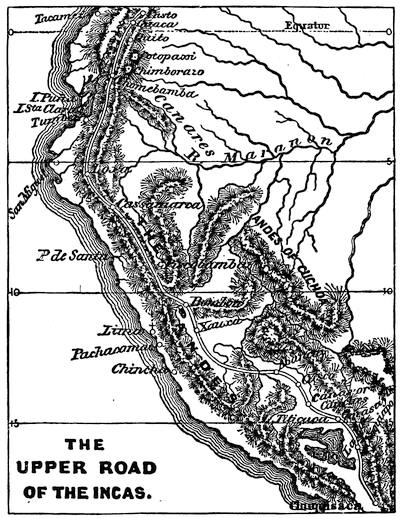
FROM HELPS.
[Cf. Humboldt’s account in Views of Nature, English transl., 393-95, 407-9, 412. Marcoy says the usual descriptions of the ancient roads are exaggerations (vol. i. 206).—Ed.]
The means of communication in so mountainous a country were an important department in the administration of the Incas. Excellent roads for foot passengers radiated from Cuzco to the remotest portions of the empire. The Inca roads were level and well paved, and continued for hundreds of leagues. Rocks were broken up and levelled when it was necessary, ravines were filled, and excavations were made in mountain sides. Velasco measured the width of the Inca roads, and found them to be from six to seven yards, sufficiently wide when only foot passengers used them. Gomara gives them a breadth of twenty-five feet, and says that they were paved with smooth stones. These measurements were confirmed by Humboldt as regards the roads in the Andes. The road along the coast was forty feet wide, according to Zarate. The Inca himself travelled in a litter, borne by mountaineers from the districts of Soras and Lucanas. Corpa-huasi, or rest-houses, were erected at intervals, and the government messengers, or chasquis, ran with wonderful celerity from one of these stations to another, where he delivered his message, or quipu, to the next runner. Thus news was brought to the central government from all parts of The empire with extraordinary rapidity, and the Inca ate fresh fish at Cuzco which had been caught in the Pacific, three hundred miles away, on the previous day. Store-houses, with arms, clothing, and provisions for the soldiers, were also built at intervals along the roads, so that an army could be concentrated at any point without previous preparation.
Closely connected with the facilities for communication, which were so admirably established by the Incas, was the system of moving colonies from one part of the empire to another. The evils of minute subdivision were thus avoided, political objects were often secured, and the comfort of the people was increased by the exchange of products. The colonists were called mitimaes. For example, the people of the Collao, round Lake Titicaca, lived in a region where corn would not ripen, and if confined to the products of their native land they must have subsisted solely on potatoes, quinua, and llama flesh. But the Incas established colonies from their villages in the coast valleys of Tacna and Moquegua, and in the forests to the eastward. There was constant intercourse, and while the mother country supplied chuñus or preserved potatoes, charqui or dried meat, and wool to the colonists, there came back in return, corn and fruits and cotton cloth from the coast, and the beloved coca from the forests.
Military colonies were also established on the frontiers, and the armies of the Incas, in their marches and extensive travels, promoted the circulation of knowledge, while this service also gave employment to the surplus agricultural population. Soldiers were brought from all parts of the empire, and each tribe or ayllu was distinguished by its arms, but more especially by its head-dress. The Inca wore the crimson llautu, or fringe; the Apu, or general, wore a yellow llautu. One tribe wore a puma’s head; the Cañaris were adorned with the feathers of macaws, the Huacrachucus with the horns of deer, the Pocras and Huamanchucus with a falcon’s wing feathers. The arms of the Incas and Chancas consisted of a copper axe, called champi; a lance pointed with bronze, called chuqui; and a pole with a bronze or stone head in the shape of a six-pointed star, used as a club, called macana. The Collas and Quichuas came with slings and bolas, the Antis with bows and arrows. Defensive armor consisted of a hualcanca or shield, the umachucu or head-dress, and sometimes a breastplate. The perfect order prevailing in civil life was part of the same system which enforced strict discipline in the army; and ultimately the Inca troops were irresistible against any enemy that could bring an opposing force into the field. Only when the Incas fought against each other, as in the last civil war, could the result be long doubtful.
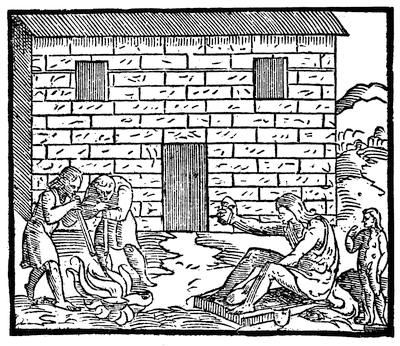
PERUVIAN METAL WORKERS.
[Reproduction of a cut in Benzoni’s Historia del Mondo Nuovo (1565). Cf. D. Wilson’s Prehistoric Man, i. ch. 9, on the Peruvian metal-workers.—Ed.]
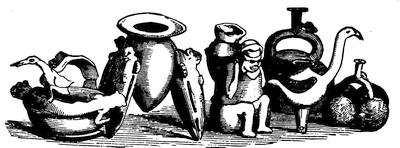
PERUVIAN POTTERY.
[The tripod in this group is from Panama, the others are Peruvian. This cut follows an engraving in Wilson’s Prehistoric Man, ii. 41. There are numerous cuts in Wiener, p. 589, etc. Cf. Stevens’s Flint Chips, p. 271.—Ed.]
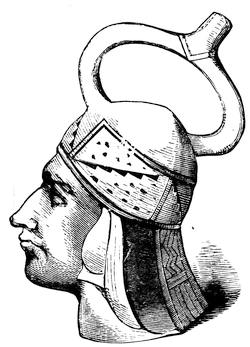
PERUVIAN DRINKING VESSEL.
[After a cut in Wilson’s Prehistoric Man, ii. 45; showing a cup of the Beckford collection. “There is an individuality in the head, at once suggestive of portraiture.”—Ed.]
The artificers engaged in the numerous arts and on public works subsisted on the government share of the produce. The artists who fashioned the stones of the Sillustani towers or of the Cuzco temple with scientific accuracy before they were fixed in their places, were wholly devoted to their art. Food and clothing had to be provided for them, and for the miners, weavers, and potters. Gold was obtained by the Incas in immense quantities by washing the sands of the rivers which flowed through the forest-covered province of Caravaya. Silver was extracted from the ore by means of blasting-furnaces called huayra; for, although quicksilver was known and used as a coloring material, its properties for refining silver do not appear to have been discovered. Copper was abundant in the Collao and in Charcas, and tin was found in the hills on the east side of Lake Titicaca, which enabled the Peruvians to use bronze very extensively.[1221] Lead was also known to them. Skilful workers in metals fashioned the vases and other utensils for the use of the Inca and of the temples, forged the arms of the soldiers and the implements of husbandry, and stamped or chased the ceremonial breastplates, topus, girdles, and chains. The bronze and copper warlike instruments, which were star-shaped and used as clubs, fixed at the ends of staves, were cast in moulds. One of these club-heads, now in the Cambridge collection, has six rays, broad and flat, and terminating in rounded points. Each ray represents a human head, the face on one surface and the hair and back of the head on the other. This specimen was undoubtedly cast in a mould. “It is,” says Professor Putnam, “a good illustration of the knowledge which the ancient Peruvians had of the methods of working metals and of the difficult art of casting copper.”[1222]