Part 2 — CHAPTER VI. (continued 2)
Reading edition
A further argument in respect to the relation which argillite implements bear to those made of jasper and quartz is derived from the relative proportion in which they occur in localities which are believed to have been occupied first by the users of argillite, and subsequently by the Indians. “Of a series of twenty thousand objects gathered in Mercer County, New Jersey, forty-four hundred were of argillite, and of such rude forms and in such limited varieties as would be expected of the productions of a less cultured people than the Indian of the stone age. Of this series of forty-four hundred, two hundred and thirty-three are well-designed drills or perforators and scrapers; the others being spear-points, fishing-spears, arrow-heads, and knife-like implements.”[1555] This is supplemented by negative evidence drawn from “the character of the sites of arrow-makers’ open-air workshops, or those spots whereon the professional chipper of flint pursued his calling. In the locality where I have pursued my studies several such sites have been discovered and carefully examined. In no one of these workshop sites has there been found any trace of argillite mingled with the flint-chips that form the characteristic feature of such spots. On the other hand, no similar sites have been discovered, to my knowledge, where argillite was used exclusively. The absence of this mineral cannot be explained on the ground that it was difficult to procure, for such is not the case. It constitutes, in fact, a considerable percentage of the pebbles and boulders of the drift from which the Indians gathered their jasper and quartz pebbles for working into implements and weapons. If the absence of argillite from such heaps of selected stones is explained by the assertion that the Indians had recognized the superiority of jasper, then the belief that argillite was used prior to jasper receives tacit assent. If, however, it was the earlier Indians who used argillite, and gradually discarded it for the various forms of flint, then we ought to find workshop sites older than the time of flint-chipping, and others where the two minerals are associated. This, as has been stated, has not been done.”[1556]
Professor Putnam has found a confirmation of these views of Dr. Abbott in the contents of a great shell-heap at Keyport, in New Jersey, investigated over thirty years ago by Rev. Samuel Lockwood, and now placed in the Peabody Museum at Cambridge. “As the shell-heap at Keyport, once covering a mile or more in length along a narrow strip bordered upon one side by the ocean and on the other by Raritan Bay, is entirely obliterated, it is of importance that the materials obtained from it are now in the museum for comparison with our very extensive collections from the shell-heaps of New England. The fact that at certain places on this narrow strip between the bay and the sea the prevailing implements were of argillite and of great antiquity has a peculiar significance in connection with those from Trenton, and again points to an intermediate period between the palæolithic and the late Indian occupation of New Jersey.”[1557]
To these various arguments the writer wishes to add the statement that to his personal knowledge argillite spear-points, and especially those of the fish-spear type, are occasionally found in other parts of our country besides New Jersey. In his own researches, which have been principally carried on upon the seacoast of New England, he has never found an example of them in the shell-heaps proper, which are universally recognized by archæologists as relics of the Indians. The few which he has found himself, or has obtained from others, have come from meadows by the side of rivers or ponds, where they might very well have been used as fish-spears.
A further confirmation of Dr. Abbott’s opinions in regard to the descendants of palæolithic man is derived from certain discoveries made by Mr. Hilborne T. Cresson in the alluvial deposits at Naaman’s Creek, in Delaware. These were first made known in November, 1887, by a letter to the editor of the American Antiquarian. “In 1870, a fisherman living in the village of Marcus Hook, Pennsylvania, gave me some spear and arrow heads flaked from a dense argillite, as well as other rude implements of a prehistoric people, which he had found on some extensive mud flats near the mouth of Naaman’s Creek, a small tributary of the Delaware. The finder stated that while fishing ... he had noticed here and there the ends of logs or stakes protruding from the mud, and that they seemed to him to have been placed in rows.... A visit made a few days afterward to the place ... disclosed the ends of much-decayed stakes or piles protruding here and there above the mud.... On my return from France in 1880 I again visited the spot.... While abroad I studied in spare moments many archæological collections, especially those from the Swiss Lake Dwellings, and visited the various lake stations of Switzerland. The rude dressings of the ends of the piles in some places were evidently made with blunt stone implements, and recalled those I had seen on the ends of the posts in the Delaware River marshes. Since 1880 I have quietly examined the remains, excavating what pile ends remained in situ (preserving a few that did not crumble to pieces), preserving careful notes of the dredging and excavations (at low tides), carried on principally by myself, aided at times by interested friends. The results so far seem to indicate that the ends of the piles imbedded in the mud, judging from the implements and other débris scattered around them, once supported shelters of early man that were erected a few feet above the water,—the upper portion of the piles having disappeared in the long lapse of time that must have ensued since they were placed there. (The flats are covered by four and one half feet of water on the flood tide; on the ebb the marsh is dry, and covered with slimy ooze several feet in depth, varying in different places.) Three different dwellings have been located, all that exist in the flats referred to, after a careful examination within the last four years of nearly every inch of ground carefully laid off and examined in sections. The implements found in two of ‘the supposed river dwelling sites’ are very rude in type, and generally made of dense argillite, not unlike the palæoliths found by my friend Dr. C. C. Abbott in the Trenton gravels. The character of the implements from the other or third supposed river dwelling on the Delaware marshes is better finished objects made of argillite.”[1558]
The greater portion of the objects obtained by Mr. Cresson has been placed in the Peabody Museum, to which he is at present attached as a special assistant; but he has also kindly sent to the writer a small illustrative collection from each site, for his study.
The writer would hesitate to draw the inference from this single discovery that the custom of living in pile-dwellings ever prevailed in North America, although there is evidence that such a practice was not unknown in South America. This is to be found in the account of the voyage of Alonso de Ojeda along the north coast of that country, in the year 1499, in which he was accompanied by Vespucius.[1559] I will quote the language of Washington Irving: “Proceeding along the coast, he arrived at a vast, deep gulf resembling a tranquil lake, entering which he beheld on the eastern side a village whose construction struck him with surprise. It consisted of twenty large houses, shaped like bells, and built on piles driven into the bottom of the lake, which in this part was limpid and of but little depth. Each house was provided with a drawbridge, and with canoes by which the communication was carried on. From these resemblances to the Italian city, Ojeda gave to the bay the name of the Gulf of Venice, and it is called at the present day Venezuela, or Little Venice.”[1560] There is no inherent improbability that such a custom may have prevailed upon the shores of Delaware Bay, and for the same reason that has caused it to be followed elsewhere. “It has been stated that the natives living near Lake Maracaybo, in South America, erect pile dwellings over the lake, to which they resort in order to escape from the mosquitoes which infest the shore. Lord also mentions that the Indians of the Suman prairie, British Columbia, on the subsidence of the annual floods in May and June, build pile dwellings over a lake there, to which they retire to escape from the mosquitoes which at that period infest the prairie in dense clouds, but will not cross the water.”[1561]
But it would be safer, probably, to consider these discoveries of Mr. Cresson’s as marking the site of ancient aboriginal fish-weirs, such as are described by Captain Ribault and other early explorers as made by the natives.[1562] The writer agrees with Professor Putnam in thinking that “the fact that at only one station pottery occurs, and, also, that at this station the stone implements are largely of jasper and quartz, with few of argillite, while at the two other stations many rude stone implements are associated with chipped points of argillite, with few of jasper and other flint-like material, is of great interest.”[1563]
Still further confirmation of the progress of the palæolithic man in this region is afforded by discoveries made in a rock-shelter near the headwaters of Naaman’s Creek, as early as 1866, for an account of which, and the preservation of the objects then found, we are also indebted to Mr. Cresson: “The remains of the Naaman’s Creek rock-shelter luckily fell into hands that have preserved them.... To give a detailed account of how the rock-shelter was discovered would consume too much time. Let us rather consider briefly the ... contents of the shelter’s various layers.... Fortunately careful drawings of the shelter were made during its excavation between the years 1866 and 1867.... A glance shows the outcrop of the rock as it appeared before the excavations were begun in 1866. The trees show that the ground was then covered by a thick wood.... From the point that marks the innermost edge of the outcrop, overhanging the hollow, a perpendicular line dropped to the ground would measure five and one eighth feet, the height of the projection of the rock above the ground before the excavations were commenced.
“Twenty-two feet eight inches from the outcrop, measured from its inner face, there is still another outcrop.... This marks the opposite side of the hollow.... It is evident how admirably the place was adapted to the wants of the early hunters of the Delaware valley, whether it be as a shelter, or as a place of defence against their enemies.... Let us look at the layers of earth that filled it, these being intermingled with rude implements, broken bones, and charcoal, indicating that man at times had resorted to the spot.
“Layer C [the lowest]. This was composed of schist, resting on the bedrock of the shelter. A layer of aqueous gravel, of the same type as that underlying Philadelphia, rested on the decomposed schist. The greatest depth of the red gravel layer was four feet two and one fourth inches, measured from the layer of decomposed schist. Least depth of gravel observed, one foot three inches....
“Layer A [next above]. This was a layer of grayish-white brick clay mixed with yellow clay, similar to that underlying Philadelphia, on top of which was a layer mixed with sand.... Stone implements were discovered in this layer. They were but few in number and very rude, exclusively of argillite, and palæolithic in type. Greatest depth of layer, two feet one and one half inches. No implements of bone were found....
“Layer T [next above]. This was of reddish gravel, intermingled with decomposed schist, cinders, and broken bones of animals. Fragments of a human skull were found ... in this layer. A fragment of a human rib was also preserved. The fragments of the skull are covered here and there by dendritic incrustations. Rude spears and implements of argillite were found in this layer. Depth of layer, thirteen to eighteen inches.
“Layer D [next above]. Composed of reddish-yellow clay. Depth, two feet three inches. No implements.
“Layer M [next above]. In this layer were numerous implements of argillite and some of bone, intermingled with rude implements of quartzite and jasper and fragments of rude pottery, with charcoal. Greatest depth, one foot one and one half inches. Least depth, three inches.
“Layer R [next above]. Yellow clay. Greatest depth, two feet one and one half inches; least depth, eight inches. No implements.
“Layer W [next above]. This contained chipped implements; those made of jasper and quartzite predominating over those of argillite. In the lowest part of this layer were fragments of rude pottery. In the upper portion of the layer were potsherds decidedly superior in decoration and technique to those from the lower portion. Geological composition of this layer, yellow clay loam. Greatest depth, three feet four inches. Least depth, two and one half inches.
“Layer L [top]. This consists of leaf mould seven inches thick, converted into swamp muck by decomposing action of water from springs. No implements.... No remains of extinct animals were found.”[1564]
Professor Putnam thus proceeded to comment upon these discoveries: “We have a series of objects, taken from the several layers of the shelter, giving us a chronology of the utmost importance, as each period of occupation of the shelter was followed by a natural deposition, separating the different periods of occupation. The stone implements ... are taken from the lowest layer, indicating the earliest period of occupation of the rock-shelter; and ... they correspond in shape and rudeness of execution with those taken from the gravel-bed at Trenton; and like most of the latter they are all of argillite. The specimens from the second period are of argillite, and while many are chipped into slender points, they are still of very rude forms; and these in turn correspond with the argillite points found by Dr. Abbott deep down in the black soil, or resting upon the gravel, at Trenton. In the upper layers of the cave we observe ... the gradual introduction of implements chipped from jasper and quartz, and corresponding in form with those found upon the surface throughout the valley. And as a further indication of this later development, it was only in the upper layers that pottery, bone implements, and ornaments were found; the three distinct periods of occupation of the Delaware valley are thus distinctly shown; and this cave-shelter is a perfect exemplification of the results which Dr. Abbott had obtained from a study of the specimens which he has collected upon the surface, deep in the black soil, and in the gravel, at Trenton.”
From the accumulative force of these various lines of reasoning, the writer thinks that there is a strong probability that here, on the waters of the Delaware, man developed from the palæolithic to the neolithic stage of culture. But we cannot follow Dr. Abbott in his further conclusion (if, indeed, he still holds to it) that we are to seek the descendants of this primitive population in the Eskimos, driven north after contact with the Indians. We have failed to discover the slightest evidence to sustain this position. The hereditary enmity existing between the Eskimos and the Indians may be equally well explained upon the theory that the former are later comers to this continent, and are therefore hated by the Indian races as intruders. The two races are certainly markedly unlike.
In the absence of any evidence tending to show the development of the argillite-using people into the Indian races, with their perfected implements and weapons of the age of polished stone, it seems more reasonable to hold with Professor Dawkins that the earlier and ruder race perished before or were absorbed by a people furnished with a better equipment in the struggle for the “survival of the fittest.” The palæolithic man of the river gravels of Trenton and his argillite-using posterity the writer believes to be completely extinct.[1565]
It only remains for the writer to express his regret that he has been prevented from setting forth in detail, at the present time, the grounds upon which he has come to other conclusions which were briefly indicated at the beginning of this chapter. He can only repeat here his belief that the so-called Indians, with their many divisions into numerous linguistic families, were later comers to our shores than the primitive population, whose development he has attempted to trace; that the so-called “moundbuilders” were the ancestors of tribes found in the occupation of the soil; and that the Pueblos and the Aztecs were only peoples relatively farther advanced than the others.
The writer further thinks that these are propositions capable, if not of being demonstrated, at least of being made to appear in a very high degree probable by means of authorities which will be found amply referred to in other chapters of this volume.


THE PROGRESS OF OPINION RESPECTING THE ORIGIN AND ANTIQUITY OF MAN IN AMERICA.
BY THE EDITOR.
THE literature respecting the origin and early condition of the American aborigines is very extensive; and, as a rule, especially in the earlier period, it is not characterized by much reserve in connecting races by historical analogies.[1566] Few before Dr. Robertson, in discussing the problem, could say: “I have ventured to inquire without presuming to decide.”
The question was one that allured many of the earlier Spanish writers like Herrera and Torquemada. Among the earlier English discussions is that of Wm. Bourne in his Booke called the Treasure for Travellers (London, 1578), where a section is given to “The Peopling of America.” The most famous of the early discussions of the various theories was that of Gregorio Garciá, a missionary for twenty years in South America, who reviewed the question in his Origen de los Indios de el Nuevo Mundo (Valencia, 1607).[1567] He goes over the supposed navigations of the Phœnicians, the identity of Peru with Solomon’s Ophir, and the chances of African, Roman, and Jewish migrations,—only to reject them all, and to favor a coming of Tartars and Chinese. Clavigero thinks his evidences the merest conjectures. E. Brerewood, in his Enquiries touching the diversity of languages and religions (London, 1632, 1635), claimed a Tartar origin. In New England, where many were believers in the Jewish analogies, it is somewhat amusing to find not long after this the quizzical Thomas Morton, with what seems like mock gravity, finding the aboriginal source in “the scattered Trojans, after such time as Brutus departed from Latium.”[1568] The reader, however, is referred to other sections of the present volume for the literature bearing upon the distinct ethnical connections of the early American peoples.
The chief literary controversy over the question began in 1642, when Hugo Grotius published his De Origine Gentium Americanarum Dissertatio (Paris and Amsterdam, 1642).[1569] He argued that all North America except Yucatan (which had an Ethiopian stock) was peopled from the Scandinavian North; that the Peruvians were from China, and that the Moluccans peopled the regions below Peru. Grotius aroused an antagonist in Johannes de Laet, whose challenge appeared the next year: Joannis de Laet Antwerpiani notae ad dissertationem Hugonis Grotii de origine gentium Americanarum: et observationes aliquot ad meliorem indaginem difficillimæ illius quæstionis (Amsterdam, 1643).[1570] He combated his brother Dutchman at all points, and contended that the Scythian race furnished the predominant population of America. The Spaniards went to the Canaries, and thence some of their vessels drifted to Brazil. He is inclined to accept the story of Madoc’s Welshmen, and think it not unlikely that the people of the Pacific islands may have floated to the western coast of South America, and that minor migrations may have come from other lands. He supports his views by comparisons of the Irish, Gallic, Icelandic, Huron, Iroquois, and Mexican tongues.
To all this Grotius replied in a second Dissertatio, and De Laet again renewed the attack: Ioannis de Laet Antwerpiani responsio ad dissertationem secundam Hvgonis Grotii, de origine gentium Americanarum. Cum indice ad utrumque libellum (Amsterdam, 1644).[1571]
De Laet, not content with his own onset, incited another to take part in the controversy, and so George Horn (Hornius) published his De Originibus Americanis, libri quatuor (Hagæ Comitis, i. e. The Hague, 1652; again, Hemipoli, i. e. Halberstadt, 1669).[1572] His view was the Scythian one, but he held to later additions from the Phœnicians and Carthaginians on the Atlantic side, and from the Chinese on the Pacific.
For the next fifty years there were a number of writers on the subject, who are barely names to the present generation;[1573] but towards the middle of the eighteenth century the question was considered in The American Traveller (London, 1741), and by Charlevoix in his Nouvelle France (1744). The author of an Enquiry into the Origin of the Cherokees (Oxford, 1762) makes them the descendants of Meshek, son of Japhet. In 1767, however, the question was again brought into the range of a learned and disputatious discussion, reviving all the arguments of Grotius, De Laet, and Horn, when E. Bailli d’Engel published his Essai sur cette question: Quand et comment l’America a-t-elle été peuplée d’hommes et d’Animaux? (5 vols., Amsterdam, 1767, 2d ed., 1768). He argues for an antediluvian origin.[1574] The controversy which now followed was aroused by C. De Pauw’s characterization of all American products, man, animals, vegetation, as degraded and inferior to nature in the old world, in an essay which passed through various editions, and was attacked and defended in turn.[1575] An Italian, Count Carli, some years later, controverted De Pauw, and using every resource of mythology, tradition, geology, and astronomy, claimed for the Americans a descent from the Atlantides.[1576] It was not till after reports had come from the Ohio Valley of the extensive earthworks in that region that the question of the earlier peoples of America attracted much general attention throughout America; and the most conspicuous spokesman was President Stiles of Yale College, in an address which he delivered before the General Assembly of Connecticut, in 1783, on the future of the new republic.[1577] In this, while arguing for the unity of the American tribes and for their affinity with the Tartars, he held to their being in the main the descendants of the Canaanites expelled by Joshua, whether finding their way hither by the Asiatic route and establishing the northern Sachemdoms, or coming in Phœnician ships across the Atlantic to settle Mexico and Peru.[1578] Lafitau in 1724 (Mœurs de Sauvages) had contended for a Tartar origin. We have examples of the reasoning of a missionary in the views of the Moravian Loskiel, and of a learned controversialist in the treatise of Fritsch, in 1794 and 1796 respectively.[1579]
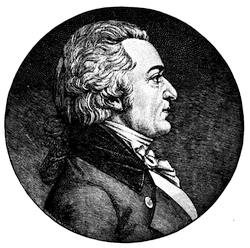
BENJAMIN SMITH BARTON
The earliest American with a scientific training to discuss the question was a professor in the University of Pennsylvania, Benjamin Smith Barton, a man who acquired one of the best reputations in his day among Americans for studies in this and other questions of natural history. His father was an English clergyman settled in America, and his mother a sister of David Rittenhouse. It was while he was a student of medicine in Edinburgh that he first approached the subject of the origin of the Americans, in a little treatise on American Antiquities, which he never completed.[1580] His Papers relating to certain American Antiquities (Philad., 1796) consists of those read to the Amer. Philos. Soc., and printed in their Transactions (vol. iv.). They were published as the earnest of his later work on American Antiquities. He argues against De Pauw, and contends that the Americans are descended—at least some of them—from Asiatic peoples still recognized. The Papers include a letter from Col. Winthrop Sargent, Sept. 8, 1794, describing certain articles found in a mound at Cincinnati, and a letter upon them from Barton to Dr. Priestley. He in the end gave more careful attention to the subject, mainly on its linguistic side, and went farther than any one had gone before him in his New Views of the Origin of the Tribes and Nations of America (Philad., 1797; 2d ed., enlarged, 1798).[1581] The book attracted much notice, and engaged the attention in some degree of European philologists, and made Barton at that time the most conspicuous student on these matters in America. Jefferson was at that time gathering material in similar studies, but his collections were finally burned in 1801. Barton, in dedicating his treatise to Jefferson, recognized the latter’s advance in the same direction. He believed his own gathering of original MS. material to be at that time more extensive than any other student had collected in America. His views had something of the comprehensiveness of his material, and he could not feel that he could point to any one special source of the indigenous population.
During the early years of the present century old theories and new were abundant. The powerful intellect and vast knowledge of Alexander von Humboldt were applied to the problem as he found it in Middle America. He announced some views on the primitive peoples in 1806, in the Neue Berlinische Monatsschrift (vol. xv.); but his ripened opinions found record in his Vues de Cordillères et monumens des peuples indigènes de l’Amérique (Paris, 1816), and the Asiatic theory got a conservative yet definite advocate.
Hugh Williamson[1582] thought he found traces of the Hindoo in the higher arts of the Mexicans, and marks of the ruder Asiatics in the more northern American peoples. A conspicuous littérateur of the day, Samuel L. Mitchell, veered somewhat wildly about in his notions of a Malay, Tartar, and Scandinavian origin.[1583] Meanwhile something like organized efforts were making. The American Antiquarian Society was formed in 1812.[1584] Silliman began his Journal of Arts and Sciences in 1819, and both society and periodical proved instruments of wider inquiry. In the first volume published by the Antiquarian Society, Caleb Atwater, in his treatise on the Western Antiquities, gave the earliest sustained study of the subject, and believed in a general rather than in a particular Asiatic source. The man first to attract attention for his grouping of ascertained results, unaided by personal explorations, however, was Dr. James H. McCulloh, who published his Researches on America at Baltimore in 1816. The book passed to a second edition the next year, but received its final shape in the Researches, philosophical and antiquarian, concerning the aboriginal history of America (1829), a book which Prescott[1585] praised for its accumulated erudition, and Haven[1586] ranked high for its manifestations of industry and research, calling it encyclopædic in character. McCulloh examines the native traditions, but can evolve no satisfactory conclusion from them as to the origin of the Americans. The public mind, however, was not ripe for scholarly inquiry, and there was not that in McCulloh’s style to invite attention; and greater popularity followed upon the fanciful and dogmatic confidence of John Haywood,[1587] upon the somewhat vivid if unsteady speculations of C. S. Rafinesque,[1588] and even upon the itinerant Josiah Priest, who boasted of the circulation of thousands of copies of his popular books.[1589] John Delafield’s Inquiry into the Origin of the Antiquities of America (N. Y., 1839) revived the theory, never quite dormant, of the descent of the Mexicans from the riper peoples of Hindostan and Egypt; while the more barbarous red men came of the Mongol stock. The author ran through the whole range of philology, mythology, and many of the customs of the races, in reaching this conclusion. A little book by John McIntosh, Discovery of America and Origin of the North American Indians, published in Toronto, 1836, was reissued in N. Y. in 1843, and with enlargements in 1846, Origin of the North American Indians, continued down to 1859 to be repeatedly issued, or to have a seeming success by new dates.[1590]
When Columbus, approaching the main land of South America, imagined it a large island, he associated it with that belief so long current in the Old World, which placed the cradle of the race in the Indian Ocean,—a belief which in our day has been advocated by Haeckel, Caspari and Winchell,—and imagined he was on the coasts, skirting an interior, where lay the Garden of Eden.[1591] No one had then ventured on the belief that the doctrine of Genesis must be reconciled with any supposed counter-testimony by holding it to be but the record of the Jewish race. Columbus was not long in his grave when Theophrastus Paracelsus, in 1520, and before the belief in the continuity of North America with Asia was dispelled, and consequently before the question of how man and animals could have reached the New World was raised, first broached the heterodox view of the plurality of the human race. All the early disputants on the question of the origin of the American man looked either across the Atlantic or the Pacific for the primitive seed; nor was there any necessary connection between the arguments for an autochthonous American man and a diversity of race, when Fabricius, in 1721, published his Dissertatio Critica[1592] on the opinions of those who held that different races had been created. From that day the old orthodox interpretation of the record in Genesis found no contestant of mark till the question came up in relation to the American man, it being held quite sufficient to account for the inferiority or other distinguishing characteristics of race by assigning them to the influence of climate and physical causes.[1593]
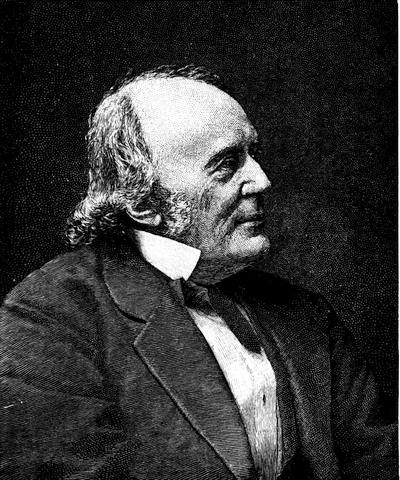
LOUIS AGASSIZ.
After a photograph, hanging in the Somerset Club, Boston; suggested to the editor by Mr. Alexander Agassiz as a satisfactory likeness.
The strongest presentation of the case, in considering the American man a distinct product of the American soil, with no connection with the Old World[1594] except in the case of the Eskimos, was made when S. G. Morton, in 1839, printed his Crania Americana, or a comparative view of the skulls of various aboriginal nations of North and South America, of which there was a second edition in 1844.[1595] Here was a new test, and applied, very likely, in ignorance of the fact that Governor Pownal, in 1766, in Knox’s New Collection of Voyages, had suggested it.[1596] Dr. Morton had gathered a collection of near a thousand skulls from all parts of the world,[1597] and based his deductions on these,—a process hardly safe, as many of his successors have determined.[1598] The views of Morton respecting the autochthonous origin of the Indian found an able upholder when Louis Agassiz, taking the broader view of the independent creation of higher and inferior races,[1599] gave in his adhesion to the original American man (Christian Examiner, July, 1850, vol. xlix. p. 110). These views got more extensive expression in a publication which appeared in Philadelphia in 1854, in which some unpublished papers of Morton are accompanied by a contribution from Agassiz, and all are grouped together and augmented by material of the editors, Dr. Josiah Clark Nott[1600] of Mobile, and Mr. George R. Gliddon, long a resident in Cairo. The Types of Mankind, or Ethnological Researches (Philad., 1854, 1859, 1871), met with a divided reception; the conservative theologians called it pretentious and false, and there was some color for their detraction in some rather jejune expositions of the Hebrew Scriptures contained in the book. The physiologists thought it brought new vigor to a question which properly belonged to science.[1601] Other fresh material, with some discussions, made up a new book by the same editors, published three years later, Indigenous Races of the Earth, or New Chapters of Ethnological Inquiry (Philad. and London, 1857; 2d ed., 1857).[1602]
The theological attacks were not always void of a contempt that ill befitted the work of refutation. The most important of them were John Bachman’s Doctrine of the Unity of the Human Race (Charleston, S. C., 1850), with his Notice of the Types of Mankind (Charleston, 1854-55); and Thomas Smyth’s Unity of the Human Race proved by Scripture, Reason and Science (N. Y., 1850).[1603]
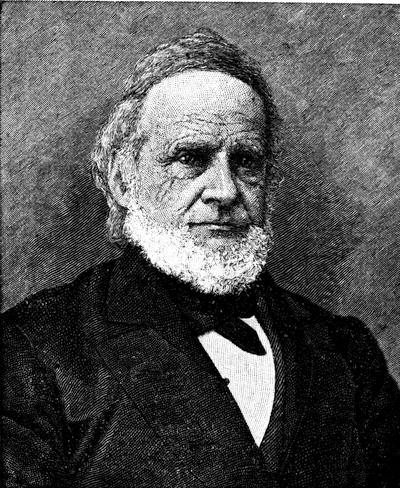
SAMUEL FOSTER HAVEN.
After a photograph. A heliotype of a portrait by Custer is in the Amer. Antiq. Soc. Proc., Ap., 1879. Haven’s Annual Reports, as librarian of the Amer. Antiq. Soc., furnish a good chronological conspectus of the progress of anthropological discovery.
The scientific attack on Morton and Agassiz, and the views they represented, was an active one, and embraced such writers as Wilson, Latham, Pickering, and Quatrefages.[1604] The same collection of skulls which had furnished Morton with his proofs yielded exactly opposite evidence to Dr. J. A. Meigs in his Observations upon the Cranial Forms of the American Aborigines (Philad., 1866).[1605] Two of the most celebrated of the evolutionists reject the autochthonous view, for Darwin’s Descent of Man and Haeckel’s Hist. of Creation consider the American man an emigrant from the old world, in whatever way the race may have developed.[1606]
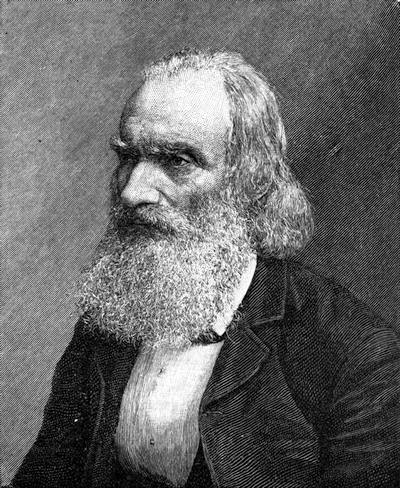
SIR DANIEL WILSON, LL. D., F.R.S.E.
From a photograph kindly furnished, on request, by Professor Wilson’s family.
Of the leading historians of the early American peoples, Prescott, dealing with the Mexicans, is inclined to agree with Humboldt’s arguments as to their primitive connection with Asia.[1607] Geo. Bancroft, in the third volume of his Hist. of the United States (1840), surveying the field, found little in the linguistic affinities, little in what Humboldt gathered from the Mexican calendars and from other developments, nothing from the Western mounds, which he was sure were natural earth-knobs and water-worn passages,[1608] and decides upon some transmission by the Pacific route from Asia, but so remote as to make the American tribes practically indigenous, so far as their character is concerned.
In 1843 another compiler of existing evidence appeared in Alexander W. Bradford in his American Antiquities, or Researches into the origin and history of the Red Race. His views were new. He connects the higher organized life of middle America with the corresponding culture of Southern Asia, the Polynesian islands probably furnishing the avenue of migrations; while the ruder and more northern peoples of both shores of the Pacific represent the same stock degraded by northern migrations.
In 1845 the American Ethnological Society began its publications, and in Albert Gallatin it had a vigorous helper in unravelling some of these mysteries. A few years later (1853) the United States government lent its patronage and prestige to the huge conglomerate publication of Schoolcraft, his Indian Tribes of the United States, which leaves the bewildered reader in a puzzling maze,—the inevitable result of a work undertaken beyond the ambitious powers of an untrained mind. The work is not without value if the user of it has more systematic knowledge than its compiler, to select, discard, and arrange, and if he can weigh the importance of the separate papers.[1609]
In 1856 Samuel F. Haven, the librarian and guiding spirit of the American Antiquarian Society, summed up, as it had never been done before, for comprehensiveness, and with a striking prescience, the progress and results of studies in this field, in his Archæology of the United States (Smithsonian Contributions, viii., Washington, 1856).
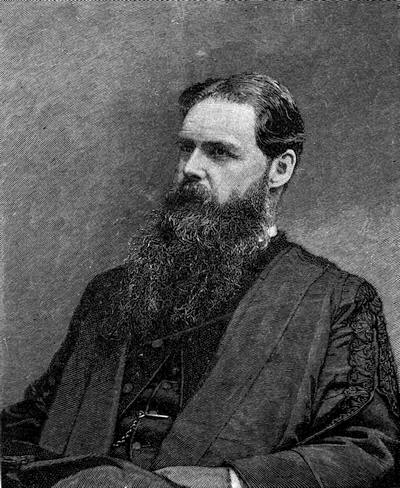
EDWARD B. TYLOR.
After a photograph.
In 1851 Professor Daniel Wilson, in his Prehistoric Annals of Scotland, first brought into use the designation “prehistoric” as expressing “the whole period disclosed to us by means of archæological evidence, as distinguished from what is known through written records; and in this sense the term was speedily adopted by the archæologists of Europe.”[1610] Eleven years later he published his Prehistoric Man: Researches into the origin of civilization in the old and new world.[1611] The book unfortunately is not well fortified with references, but it is the result of long study, partly in the field, and written with a commendable reserve of judgment. It is in the main concerned with the western hemisphere, which he assumes with little hesitation “began its human period subsequent to that of the old world, and so started later in the race of civilization.” While thus in effect a study of early man in America, its scope makes it in good degree a complement to the Origin of Civilization of Lubbock.
The comparative study of ethnological traces, to enable us to depict the earliest condition of human society, owes a special indebtedness to Edward B. Tylor, among writers in English. It is nearly twenty-five years since he first published his Researches into the Early History of Mankind and the Development of Civilization,[1612] the work almost, if not quite, of a pioneer in this interesting field, and he has supplied the reader with all the references necessary to test his examples. Max Müller (Chips, ii. 262) has pointed out how he has vitalized his vast accumulation of facts by coherent classifications instead of leaving them an oppressive burden by simple aggregation, as his precursors in Germany, Gustav Klemm[1613] and Adolf Bastian, had done; and it is remarked that while thus classifying, he has not been lured into pronounced theory, which future accession of material might serve to modify or change. He shortly afterwards touched a phase of the subject which he had not developed in his book in a paper on “Traces of the Early Mental Condition of Man,”[1614] and illustrated the methods he was pursuing in another on “The Condition of Prehistoric Races as inferred from observations of modern tribes.”[1615]
The postulate of which he has been a distinguished expounder, that man has progressed from barbarism to civilization, was a main deduction to be drawn from his next sustained work, Primitive Culture: researches into the development of mythology, philosophy, religion, art, and custom.[1616] The chief points of this further study of the thought, belief, art, and custom of the primitive man had been advanced tentatively in various other papers beside those already mentioned,[1617] and in this new work he further acknowledges his obligations to Adolf Bastian’s Mensch in der Geschichte and Theodor Waitz’s Anthropologie der Naturvölker.[1618] He still pursued his plan of collecting wide and minute evidence from the writers on ethnography and kindred sciences, and from historians, travellers, and missionaries, as his foot-notes abundantly testify.
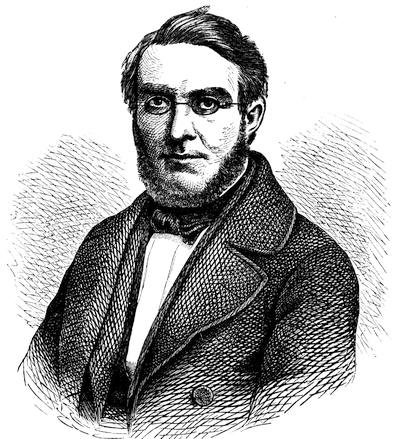
THEODOR WAITZ.
After a likeness in Otto Caspari’s Urgeschichte der Menschheit, 2d ed., vol. i. (Leipzig, 1877).
These studies of Professor Tylor abundantly qualified him to give a condensed exposition of the science of anthropology, which he had done so much to place within the range of scientific studies, by a primary search for facts and laws; and having contributed the article on that subject to the ninth edition of the Encyclopædia Britannica, he published in 1881 his Anthropology: an Introduction to the study of man and civilization (London and N. Y., 1881 and 1888). He maps out the new science, which has now received of late years so many new students in the scientific method, without references, but with the authority of a teacher, tracing what man has been and is under the differences of sex, race, beliefs, habits, and society.[1619] Again, at the Montreal meeting (August, 1884) of the British Association for the Advancement of Science, he set down in an address the bounds of the “American Aspects of Anthropology.”[1620]
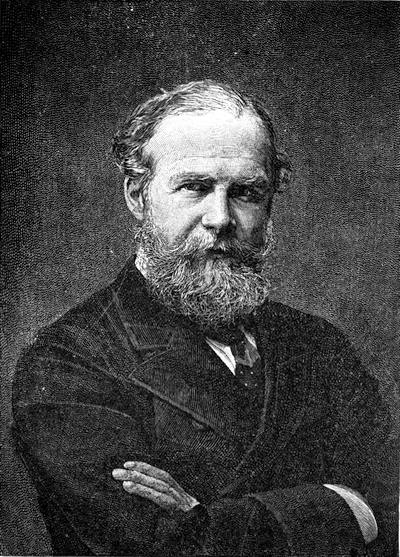
SIR JOHN LUBBOCK.
After a photograph.
Closely following upon Tylor in this field, and gathering his material with much the same assiduity, and presenting it with similar beliefs, though with enough individuality to mark a distinction, was another Englishman, who probably shares with Tylor the leading position in this department of study. Sir John Lubbock, in his Prehistoric Times as illustrated by ancient remains, and the manners and customs of modern savages,[1621] gathered the evidence which exists of the primitive condition of man, embracing some chapters on modern savages so far as they are ignorant of the use of metals, as the best study we can follow, to fill out the picture of races only archæologically known to us. This study of modern savage life, in arts, marriages, and relationships, morals, religion, and laws, is, as he holds, a necessary avenue to the knowledge of a condition of the early man, from which by various influences the race has advanced to what is called civilization. His result in this comparative study—not indeed covering all the phases of savage life—he made known in his Origin of Civilization and the Primitive Condition of Man.[1622] While referring to Tylor’s Early Hist. of Mankind as more nearly like his own than any existing treatise, but showing, as compared with his own book, “that no two minds would view the subject in the same manner,” he instanced previous treatments of certain phases of the subject, like Müller’s Geschichte der Amerikanischen Urreligionen, J. F. M’Lennan’s Primitive Marriage,[1623] and J. J. Bachofen’s Das Mutterrecht (Stuttgart, 1861); and even Lord Kames’ History of Man, and Montesquieu’s Esprit des Lois, notwithstanding the absence in them of much of the minute knowledge now necessary to the study of the subject. These data, of course, are largely obtained from travellers and missionaries, and Lubbock complains of their unsatisfactory extent and accuracy. “Travellers,” he adds, “find it easier to describe the houses, boats, food, dress, weapons, and implements of savages than to understand their thoughts and feelings.”
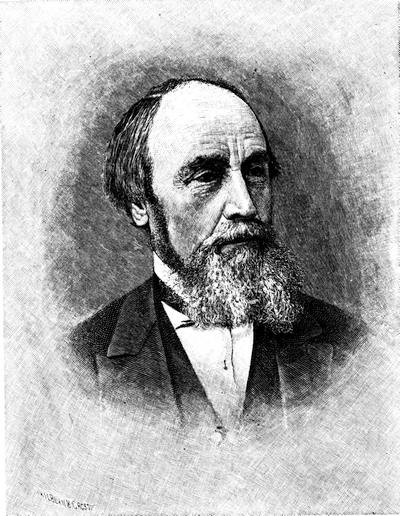
SIR JOHN WILLIAM DAWSON.
After a photograph.
The main controversial point arising out of all this study is the one already adverted to,—whether man has advanced from savagery to his present condition, or has preserved, with occasional retrogressions, his original elevated character; and this causes the other question, whether the modern savage is the degenerate descendant of the same civilized first men. “There is no scientific evidence which would justify us,” says Lubbock (Prehist. Times, 417), “in asserting that this kind of degradation applies to savages in general.”[1624] The most distinguished advocate of the affirmative of this proposition is Richard Whately, Archbishop of Dublin, both in his Political Economy and in his lecture on the Origin of Civilization (1855), in which he undertook to affirm that no nation, unaided by a superior race, ever succeeded in raising itself out of savagery, and that nations can become degraded. Lubbock, who, with Tylor, holds the converse of this proposition, answered Whately in an appendix to his Origin of Civilization, which was originally given as a paper at the Dundee meeting of the British Association.[1625] The Duke of Argyle, while not prepared to go to the extent of Whately’s views, attacked, in his Primeval Man, Lubbock’s argument,[1626] and was in turn reviewed adversely by Lubbock, in a paper read at the Exeter meeting of the same association (1869), which is also included in the appendix of his Origin of Civilization. Lubbock seems to show, in some instances at least, that the duke did not possess himself correctly of some of the views of his opponents.
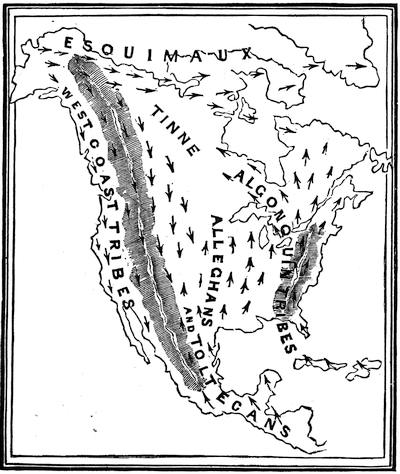
MIGRATIONS.
A sketch map given in Dawson’s Fossil Men, p. 48, showing his view of the probable lines of migration and distribution of the American tribes. Morgan (Ancient Society) makes what he calls three centres of subsistence, whence the migration proceeded which overran America. Cf. Hellwald in Smithsonian Rept., 1866, p. 328. The question is more or less discussed in Latham’s Man and his migrations (London, 1851); Chas. Pickering’s Men and their geog. distribution; and Oscar Peschel’s Races of Man (Eng. transl., London, 1876). On the passage from the valley of the Columbia to that of the Missouri, see Humboldt’s Views of Nature, 35. Morgan (No. Am. Rev., cix.) supposes the valley of the Columbia River to be the original centre where the streams diverged, and (Systems of Consanguinity, 251) says there are reasons for believing that the Shoshone migration was the last which left the Columbia valley, and that it was pending at the epoch of European colonization. Morgan’s papers in the No. Am. Rev., Oct. 1868 and Jan. 1870, are reprinted in Beach’s Indian Miscellany, p. 158. On a general belief in a migration from the north, see Congrès des Amér. (1877), ii. 50, 51. L. Simonin, in “L’homme Américain, notes d’ethnologie et de linguistique sur les indiens des Etats-Unis,” gives a map of the tribes of North America in the Bull. de la Soc. de Géog. Feb. 1870.
In the researches of Tylor and Lubbock, and of all the others cited above, the American Indian is the source of many of their illustrations. Of all writers on this continent, Sir John Wm. Dawson in his Fossil Men, and Southall in his Recent Origin of Man, are probably the most eminent advocates of the views of Whately and Argyle, however modified, and both have declared it an unfounded assumption that the primitive man was a savage.[1627] Morgan, in his Ancient Society (N. Y., 1877), has, on the other hand, sketched the lines of human progress from savagery through barbarism to civilization.
One of the defenders of the supposed Bible limits best equipped by reading, if not in the scientific spirit, has been a Virginian, James C. Southall, who published a large octavo in 1875, The Recent Origin of Man as illustrated by geology and the modern science of prehistoric archæology (Philad., 1875). Three years later,—leaving out some irrelevant matters as touching the antiquity of man, condensing his collations of detail, sparing the men of science an attack for what in his earlier volume he called their fickleness, and somewhat veiling his set purpose of sustaining the Bible record,—he published a more effective little book, The Epoch of the Mammoth and the Apparition of Man upon Earth (Philad., 1878). Barring its essentially controversial character, and waiving judgment on its scientific decisions, it is one of the best condensed accumulations of data which has been made. His belief in the literal worth of the Bible narrative is emphatic. He thinks that man, abruptly and fully civilized, appeared in the East, and gave rise to the Egyptian and Babylonian civilization, while the estrays that wandered westward are known to us by their remains, as the early savage denizens of Europe. To maintain this existence of the hunter-man of Europe within historic times, he rejects the prevailing opinions of the geologists and archæologists. He reverses the judgment that Lyell expresses (Student’s Elements of Geology, Am. ed., 162) of the historical period as not affording any appreciable measure for calculating the number of centuries necessary to produce so many extinct animals, to deepen and widen valleys, and to lay so deep stalagmite floors, and says it does. He contends that the stone age is not divided into the earlier and later periods with an interval, but that the mingling of the kinds of flints shows but different phases of the same period,[1628] and that what others call the palæolithic man was in reality the quaternary man, with conditions not much different from now.[1629] The time when the ice retreated from the now temperate regions he holds to have been about 2000 b.c., and he looks to the proofs of the action of which traces are left along the North American great lakes, as observed by Professor Edmund Andrews[1630] of Chicago, to confirm his judgment of the Glacial age being from 5,300 to 7,500 years ago.[1631] He claims that force has not been sufficiently recognized as an element in geological action, and that a great lapse of time was not necessary to effect geological changes (Ep. of the M., 194).[1632] He thinks the present drift of opinion, carrying back the appearance of man anywhere from 20,000 to 9,000,000 years, a mere fashion. The gravel of the Somme has been, he holds, a rapid deposit in valleys already formed and not necessarily old. The peat beds were a deposit from the flood that followed the glacial period, and accumulated rapidly (Ep. of the M., ch. 10). The extinct animals found with the tools of man in the caves simply show that such beasts survived to within historic times, as seems everywhere apparent as regards the mastodon when found in America. The stalagmites of the caves are of unequal growth, and it is an assumption to give them uniformly great age. The finely worked flints found among those called palæolithic; the skilfully free drawings of the cave-men; the bits of pottery discovered with the rude flints, and the great similarity of the implements to those in use to-day among the Eskimos; the finding of Roman coin in the Danish shell heaps and an English one in those of America (Proc. Philad. Acad. Nat. Sci., 1866, p. 291),—are all parts of the argument which satisfies him that the archæologists have been hasty and inconclusive in their deductions. They in turn will dispute both his facts and conclusions.[1633]
Southall’s arraignment of the opinions generally held may introduce us to a classification of the data upon which archæologists rely to reach conclusions upon the antiquity of man, and over some of which there is certainly no prevailing consensus of opinion. We may find a condensed summary of beliefs and data respecting the antiquity of man in J. P. Maclean’s Manual of the Antiquity of Man (Cincinnati, revised ed., 1877; again, 1880).[1634] The independent view and conservative spirit are placed respectively in juxtaposition in J. P. Lesley’s Origin and Decline of Man (ch. 3), and in Dawson’s Fossil Men (ch. 8).[1635] The opinions of leading English archæologists are found in Lubbock’s Prehistoric Times (ch. 12), Wallace’s Tropical Nature (ch. 7), and Huxley’s “Distribution of Races in Relation to the Antiquity of Man,” in Internat. Cong. of Prehist. Archæol. Trans. (1868). Dawkins has given some recent views in The Nation, xxvi. 434, and in Kansas City Review, vii. 344.[1636] Not to refer to special phases, the French school will be found represented in Nadaillac’s Les Premiers Hommes (ii. ch. 13); in Gabriel de Mortillet’s La préhistorique antiquité de l’homme (Paris, 1883); Hamy’s Précis de paléontologie humaine; Le Hon’s L’homme fossile (1867); Victor Meunier’s Les Ancêtres d’Adam (Paris, 1875); Joly’s L’homme avant métaux (Eng. transl. Man before Metals, N. Y., 1883); Revue des Questions historiques (vol. xvi.). The German school is represented in Haeckel’s Natürliche Schöpfungsgeschichte; Waitz’s Anthropologie; Carl Vogt’s Lectures on Man (Eng. transl., Lond., 1864); and L. Büchner’s Der Mensch und seine Stellung in der Natur (2d ed., Leipzig, 1872; or W. S. Dallas’s Eng. translation, Lond., 1872). The history of the growth of geological antagonism to the biblical record as once understood, and the several methods proposed for reconciling their respective teaching, is traced concisely in the article on geology in M’Clintock and Strong’s Cyclopædia, with references for further examination. The views there given are those propounded by Chalmers in 1804, that the geological record, ignored in the account of Genesis, finds its place in that book between the first and second verses,[1637] which have no dependence on one another, and that the biblical account of creation followed in six literal days. What may be considered the present theological attitude of churchmen may be noted in The Speaker’s Commentary (N. Y. ed., 1871, p. 61).
The question of the territorial connection of America with Asia under earlier geological conditions is necessarily considered in some of the discussions on the transplanting of the American man from the side of Asia.
Otto Caspari in his Urgeschichte der Menschheit (Leipzig, 1873), vol. i., gives a map of Asia and America in the post-tertiary period, as he understands it, which stretches the Asiatic and African continents over a large part of the Indian Ocean; and in this region, now beneath the sea, he places the home of the primeval man, and marks the lines of migration east, north, and west. This view is accepted by Winchell in his Preadamites (see his map). Haeckel (Nat. Schöpfungsgeschichte, 1868, 1873; Eng. transl. 1876) calls this region “Lemuria” in his map. Caspari places large continental islands between this region and South America, which rendered migration to South America easy. The eastern shore of the present Asia is extended beyond the Japanese islands, and similar convenient islands render the passage by other lines of immigration easy to the regions of British Columbia and of Mexico. (Cf. Short, 507; Baldwin, App.) Howorth, Mammoth and the Flood, supposes a connection at Behring’s Straits. The supposed similarity of the flora of the two shores of the Pacific has been used to support this theory, but botanists say that the language of Hooker and Gray has been given a meaning they did not intend. It is opposed by many eminent geologists. A. R. Wallace (Journal Amer. Geog. Soc., xix.) finds no ground to believe that any of the oceans contain sunken continents. (Cf. his Geographical Distribution of Animals and his Malay Archipelago.) James Croll in his Climate and Cosmology (p. 6) says: “There is no geological evidence to show that at least since Silurian times the Atlantic and Pacific were ever in their broad features otherwise than they now are.”[1638] Hyde Clarke has examined the legend of Atlantis in reference to protohistoric communication with America, in Royal Hist. Soc. Trans., n. s., iii. p. 1.[1639]
The arguments for the great antiquity of man[1640] are deduced in the main from the testimony of the river gravels, the bone caves, the peat deposits, the shell heaps, and the Lacustrine villages, for the mounds and other relics of defence, habitation, and worship are very likely not the records of a great antiquity. The whole field is surveyed with more fullness than anywhere else, and with a faith in the geological antiquity of the race, in Sir Charles Lyell’s Geological Evidences of the Antiquity of Man.[1641] With as firm a belief in the integrity of the biblical record, and in its not being impugned by the discoveries or inductions of science, we find a survey in Southall’s Recent Origin of Man. These two books constitute the extremes of the methods, both for and against the conservative interpretation of the Bible. The independent spirit of the scientist is nowhere more confidently expressed than by J. P. Lesley (Man’s Origin and Destiny, Philad., 1868, p. 45), who says: “There is no alliance possible between Jewish theology and modern science.... Geologists have won the right to be Christians without first becoming Jews.” Southall[1642] interprets this spirit in this wise: “I do not recollect that the Antiquity of Man ever recognizes that the book of Genesis is in existence; and yet every one is perfectly conscious that the author has it in mind, and is writing at it all the time.”[1643] The entire literature of the scientific interpretation shows that the canons of criticism are not yet secure enough to prevent the widest interpretations and inferences.
The intimations which are supposed to exist in the Bible of a race earlier than Adam have given rise to what is called the theory of the Preadamites, and there is little noteworthy upon it in European literature back of Isaac de La Peyrère’s Praeadamitae (Paris and Amsterdam, 1655), whose views were put into English in Man before Adam (London, 1656).[1644] The advocates of the theory from that day to this are enumerated in Alexander Winchell’s Preadamites (Chicago, 1880), and this book is the best known contribution to the subject by an American author. It is his opinion that the aboriginal American, with the Mongoloids in general, comes from some descendant of Adam earlier than Noah, and that the black races come from a stock earlier than Adam, whom Cain found when he went out of his native country.[1645]
The investigations of the great antiquity of man in America fall far short in extent of those which have been given to his geological remoteness in Europe; and yet, should we believe with Winchell that the American man represents the pre-Adamite, while the European man does not, we might reasonably hope to find in America earlier traces of the geological man, if, as Agassiz shows, the greater age of the American continent weighs in the question.[1646]
The explicit proofs, as advanced by different geologists, to give a great antiquity to the American man, and perhaps in some ways greater than to the European man,[1647] may now be briefly considered in detail.
Oldest of all may perhaps be placed the gold-drift of California, with its human remains, and chief among them the Calaveras skull, which is claimed to be of the Pliocene (tertiary) age; but it must be remembered that Powell and the government geologists call it quaternary. It was in February, 1866, that in a mining shaft in Calaveras County, California, a hundred and thirty feet below the surface, a skull was found imbedded in gravel, which under the name of the Calaveras skull has excited much interest. It was not the first time that human remains had been found in these California gravels, but it was the first discovery that attracted notice. It was not seen in situ by a professional geologist, and a few weeks elapsed before Professor Josiah Dwight Whitney, then state geologist of California, visited the spot, and satisfied himself that the geological conditions were such as to make it certain that the skull and the deposition of the gravel were of the same age. The relic subsequently passed into the possession of Professor Whitney, and the annexed cut is reproduced from the careful drawing made of it for the Memoirs of the Museum of Comp. Zoölogy (Harvard University), vol. vi. He had published earlier an account in the Revue d’Anthropologie (1872), p. 760.[1648] This interesting relic is now in Cambridge, coated with thin wax for preservation, but this coating interferes with any satisfactory photograph. The volume of Memoirs above named is made up of Whitney’s Auriferous Gravels of the Sierra Nevada of California (1880), and at p. ix he says: “There will undoubtedly be much hesitancy on the part of anthropologists and others in accepting the results regarding the Tertiary Age of man, to which our investigations seem so clearly to point.” He says that those who reject the evidence of the Calaveras skull because it was not seen in situ by a scientific observer forget the evidence of the fossil itself; and he adds that since 1866 the other evidence for tertiary man has so accumulated that “it would not be materially weakened by dropping that furnished by the Calaveras skull itself.”
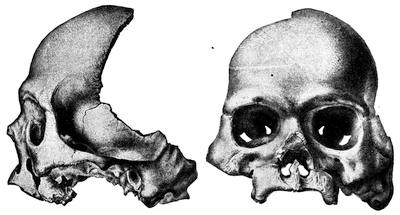
CALAVERAS SKULL. (Front and side view.)
What Whitney says of the history and authenticity of the skull will be found in his paper on “Human remains and works of art of the gravel series,” in Ibid. pp. 258-288. His conclusions are that it shows the existence of man with an extinct fauna and flora, and under geographical and physical conditions differing from the present,—in the Pliocene age certainly. This opinion has obtained the support of Marsh and Le Conte and other eminent geologists. Schmidt (Archiv für Anthropologie) thinks it signifies a pre-glacial man. Winchell (Preadamites, 428) says it is the best authenticated evidence of Pliocene man yet adduced. On the contrary, there are some confident doubters. Dawkins (No. Am. Rev., Oct., 1883) thinks that all but a few American geologists have given up the Pliocene man, and that the chances of later interments, of accidents, of ancient mines, and the presence of skulls of mustang ponies (introduced by the Spaniards) found in the same gravels, throw insuperable doubts. “Neither in the new world nor the old world,” he says, “is there any trace of Pliocene man revealed by modern discovery.” Southall and all the Bible advocates of course deny the bearing of all such evidence. Dawson (Fossil Men, 345) thinks the arguments of Whitney inconclusive. Nadaillac (L’Amérique préhistorique, 40, with a cut, and his Les Premiers Hommes, ii. 435) hesitates to accept the evidence, and enumerates the doubters.[1649]
Footprints have been found in a tufa bed, resting on yellow sand, in the neighborhood of an extinct volcano, Tizcapa, in Nicaragua. One of the prints is shown in the annexed cut, after a representation given by Dr. Brinton in the Amer. Philosoph. Soc. Proc. (xxiv. 1887, p. 437). Above this tufa bed were fourteen distinct strata of deposits before the surface soil was reached. Geologists have placed this yellow sand, bearing shells, from the post-Pliocene to the Eocene. The seventh stratum, going downwards, had remains of the mastodon.[1650]
Some ancient basket work discovered at Petit Anse Island, in Louisiana, has been figured in the Chicago Acad. of Sciences, Transactions (i. part 2). Cf. E. W. Hilgard, in Smithsonian Contributions, no. 248.
Foster rather strikingly likens what we know of the history of the human race to the apex of a pyramid, of which we know neither the height nor extent of base. Our efforts to trace man back to his beginning would be like following down the sides of that pyramid till it reaches a firm base, we know not where. Many geologists believe in a great ice-sheet which at one time had settled upon the northern parts of America, and covered it down to a line that extends across Pennsylvania, Ohio, and westerly in a direction of some variableness. There are some, like Sir William Dawson,[1651] who reject the evidence that persuades others. Prof. Whitney (Climatic Changes, 387) holds that it was a local phenomenon confined in America to the northeastern parts. The advocates look to Dr. James Geikie[1652] as having correlated the proofs of the proposition as well as any, while writers like Howorth[1653] trace the resulting phenomena largely to a flood.
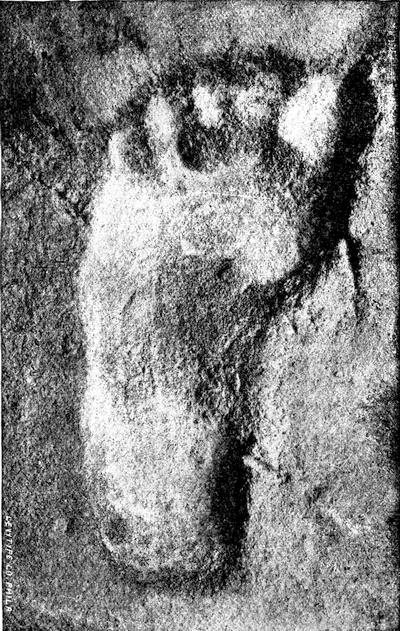
ANCIENT FOOTPRINT FROM NICARAGUA.
How long ago this was, the cautious geologist does not like to say;[1654] nor is he quite ready to aver what it all means.[1655] Perhaps, as some theorize, this prevailing ice showed the long winter brought about by the precession of the equinoxes, as has long been a favorite belief, with the swing of ten thousand years, more or less, from one extreme to the other.[1656]
Others believe that we must look back 200,000 years, as James Croll[1657] and Lubbock do, or 800,000 and more, as Lyell did at first, and find the cause in the variable eccentricity of the earth’s orbit, which shall account for all the climatic changes since the dawn of what is called the glacial epoch, accompanying the deflection of ocean currents, as Croll supposes, or the variations in the disposition of sea and land, as Lyell imagines.[1658] This great ice-sheet, however extensive, began for some reason to retreat, at a period as remote, according as we accept this or the other estimate, as from ten thousand to a hundred thousand years.
That the objects of stone, shaped and polished, which had been observed all over the civilized world, were celestial in origin seems to have been the prevalent opinion,[1659] when Mahudel in 1723 and even when Buffon in 1778 ventured to assign to them a human origin.[1660]
In the gravels which were deposited by the melting of this more or less extended ice-sheet, parts of the human frame and the work of human hands have been found, and mark the anterior limit of man’s residence on the globe, so far as we can confidently trace it.[1661] Few geologists have any doubt about the existence of human relics in these American glacial drifts, however widely they may differ about the age of them.[1662]
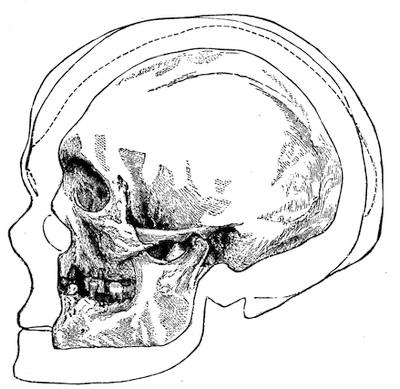
FROM DAWSON’S FOSSIL MEN.
The outer outline is that of the skull found in the cave of Cro-magnon, in France, belonging, as Dawson says, p. 189, to one of the oldest human inhabitants of western Europe, as shown in Lartet and Christy’s Reliquiae Aquitanicae. The second outline is that of the Enghis skull; the dotted outline that of the Neanderthal skull. The shaded skull is on a smaller scale, but preserving the true outline, and is one of the Hochelaga Indians (site of Montreal). Cuts of the Enghis and Neanderthal skulls are given in Lubbock’s Prehistoric Times, pp. 328, 329. Dawkins (Cave Hunters, 235) thinks the Enghis skull of doubtful age. On the Neanderthal skull see Quatrefages and Hamy, Crania Ethnica (Paris, 1873-75), and Dawkins (p. 240). Huxley gives it a great antiquity, and says it is the most ape-like one he ever saw. Quatrefages, Hommes fossiles, etc. (1884), says it is not below some later men. Southall (Epoch of the Mammoth, 80) says it has the average capacity of the negro, and double that of the gorilla, and doubts its antiquity.
It was in the American Naturalist (Mar. and Ap., 1872) that Dr. C. C. Abbott made an early communication respecting the discovery of rude human implements in the glacial gravels[1663] of the Delaware valley, and since then the Trenton gravels have been the subject of much interest. The rudeness of the flints has repeatedly raised doubts as to their artificial character; but Wilson (Prehistoric Man, i. 29) says that it is impossible to find in flints broken for the road, or in any other accumulation of rocky débris, a single specimen that looks like the rudest implement of the drift. Experts attest the exact correspondence of these Trenton tools with those of the European river drift. Abbott has explained the artificial cleavages of stone in the American Antiquarian (viii. 43). There are geologists like Shaler who question the artificial character of the Trenton implements. From time to time since this early announcement, Dr. Abbott has made public additional evidence as he has accumulated it, going to show, as he thinks, that we have in these deposits of the glacial action the signs of men contemporary with the glacial flow, and earlier than the red Indian stock of historic times.[1664] He summarizes the matter in his “Palæolithic implements of a people on the Atlantic coast anterior to the Indians,” in his Primitive Industry (1882).[1665]
Some discoveries of human bones in the loess or loam of the Mississippi Valley have not been generally accepted. Lyell (Second Visit, ii. 197; Antiq. of Man, 203) suspends judgment, as does Joseph Leidy in his Extinct Mammalia of North America (p. 365).
The existence of man in western Europe with extinct animals is a belief that, from the incredulity which accompanied the discovery by Kemp in London, in 1714, of a stone hatchet lying in contiguity to some elephant’s teeth,[1666] has long passed into indisputable fact, settled by the exploration of cave and shell heaps.[1667] In North America, this conjunction of man’s remains with those of the mastodon is very widely spread.[1668] The geological evidence is quite sufficient without resorting to what has been called an Elephant’s head in the architecture of Palenqué, the so-called Elephant Mound in Wisconsin, and the dubious if not fraudulent Elephant Pipe of Iowa.[1669] The positions of the skeletons have led many to believe that the interval since the mastodon ceased to roam in the Mississippi Valley is not geologically great. Shaler (Amer. Naturalist, iv. 162) places it at a few thousand years, and there is enough ground for it perhaps to justify Southall (Recent Origin, etc., 551; Ep. of the Mammoth, ch. 8) in claiming that these animals have lived into historic times.
A human skeleton was found sixteen feet below the surface, near New Orleans—(which is only nine feet above the Gulf of Mexico), and under four successive growths of cypress forests. Its antiquity, however, is questioned.[1670] The belief in human traces in the calcareous conglomerate of Florida seems to have been based (Haven, p. 87) on a misconception of Count Pourtalès’ statement (Amer. Naturalist, ii. 434), though it has got credence in many of the leading books on this subject. Col. Whittlesey has reported some not very ancient hearths in the Ohio Valley (Am. Ass. Arts and Sciences, Proc., Chicago, 1868, Meeting, vol. xvii. 268).
The testimony of the caves to the early existence of man has never had the importance in America that it has had in Europe.
It was in 1822 that Dr. Buckland, in his Reliquiae diluvianae (2d ed., 1824), first made something like a systematic gathering of the evidence of animal remains, as shown by cave explorations; but he was not prepared to believe that man’s remains were as old as the beasts. He later came to believe in the prehistoric man. In 1833-34, Dr. Schmerling found in the cave of Enghis, near Liége, a highly developed skull, and published his Recherches sur les ossemens fossiles découverts dans les cavernes de la province de Liége.[1671]
In 1841, Boucher de Perthes began his discoveries in the valley of the Somme,[1672] and finally discovered among the animal remains some flint implements, and formulated his views of the great antiquity of man in his Antiquités Celtiques (1847), rather for the derision than for the delectation of his brother geologists. In 1848, the Société Ethnographique de Paris ceased its sessions; but Boucher de Perthes had aroused a new feeling, and while his efforts were still in doubt his disciples[1673] gathered, and amid much ridicule founded the Société d’Anthropologie de Paris, which has had so numerous a following in allied associations in Europe and America.
He tells us of the struggles he endured to secure the recognition of his views in his De l’homme antédiluvien et de ses œuvres (Paris, 1860), and his trials were not over when, in 1863, he found at Moulin Quignon a human jaw-bone,[1674] which, as he felt, added much strength to the belief in the man of the glacial gravels.[1675]
The existence of man in the somewhat later period of the caves[1676] was also claiming constant recognition, and the new society was broad enough to cover all. In 1857, Dr. Fuhlrott had discovered the Neanderthal skull in a cave near Düsseldorf.
In 1858, the discovery of flint tools in the Brixham cave, in Devonshire, was more effective in turning the scientific mind to the proofs than earlier discoveries of much the same character by McEnery had been. In March, 1872, Emile Rivière investigated the Mentone caves, and found a large skeleton, unmistakably human, and the oldest yet found, supposed to be of the palæolithic period. (Cf. Découverte d’un Squelette humain de l’Epoque paléolithique, Paris, 1873.) All this evidence is best set forth in the collection of his periodical studies on the mammals of the Pleistocene, which were collected by William Boyd Dawkins in his Cave Hunting: researches on the evidence of caves, respecting the early inhabitants of Europe (London, 1874),[1677] a book which may be considered a sort of complement to Lyell’s Antiquity of Man and Lubbock’s Prehistoric Man; Dawkins (ch. 9, and Address, Salford, 1877, p. 3) and Lubbock (Scientific Lectures, 150) unite in holding the modern Eskimos to be the representative of this cave folk. No argument is quite sufficient to convince Southall that the archæologists do not place the denizens of the caves too far back (Recent Origin of Man, ch. 13), and he rejects a belief in the steady slowness of the formation of stalagmites (Epoch of the Mammoth, 90), upon which Evans, Geikie, Wallace, Lyell, and others rest much of their belief in the great antiquity of the remains found beneath the cave deposits.[1678]
The largest development of cave testimony in America has been made by Dr. Lund,[1679] a Danish naturalist, who examined several hundred Brazilian caves, finding in them the bones of man in connection with those of extinct animals.[1680] The remains of a race, held to be Indians, found in the caves of Coahuila (Mexico) are described by Cordelia A. Studley in the Peabody Mus. Reports, xv. 233. Edward D. Cope has studied the contents of a bone cave in the island of Anguilla (West Indies), in the Smithsonian Contributions to Knowledge, no. 489 (1883). J. D. Whitney describes a cave in Calaveras County, in the Smithsonian Rept. (1887), and Edward Palmer one in Utah (Peab. Mus. Rept., xi. 269). Putnam explored some in Kentucky (Ibid. viii.). Putnam’s first account of his cave work in Kentucky, showing the use of them as habitations and as receptacles for mummies, is in the Proc. Boston Soc. Nat. Hist., xvii. 319. J. P. Goodnow made similar explorations in Arizona (Kansas City Rev., viii. 647); E. T. Elliott in Colorado (Pop. Sci. Mo., Oct., 1879), and Leidy in the Hartman cave, in Pennsylvania (Philad. Acad. Nat. Sci. Proc., 1880, p. 348). Cf. also Haldeman in the Am. Philos. Soc. Trans. (1880) xv. 351. Col. Charles Whittlesey has discussed the “Evidences of the antiquity of man in the United States,” in describing some cave remains of doubtful age.[1681] W. H. Dall’s On the remains of later prehistoric man obtained from caves in the Catherine archipelago, Alaska territory, and especially from the caves of the Aleutian islands (Washington, 1878) is included in the Smithsonian contributions to knowledge, xxii.
Throughout the world, naturalists have found on streams and on the seacoast, heaps of the refuse of the daily life of primitive peoples. Beneath the loam which has covered them there are found the shells of edible mollusks and other relics of food, implements, ornaments and vessels, of stone, clay, and bone. Sometimes it happens that natural superposed accumulations will mark them off in layers, and distinguish the usages of successive periods.[1682]
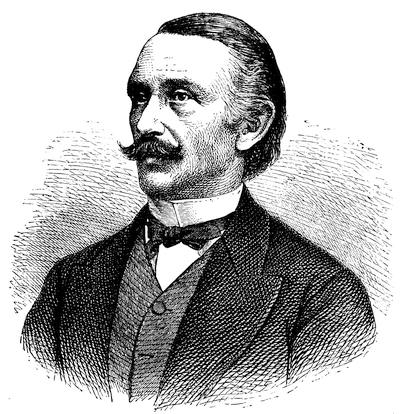
OSCAR PESCHEL.
From the engraving in the 1877 ed. of his Gesch. des Zeitalters der Entdeckungen. His Abhandlungen zur Erd-und Völker-Kunde, continuing his contributions to Das Ausland and other periodicals, and edited by J. Löwenberg, was published at Leipzig, in 3 vols. in 1877-79, the preface containing an account of Peschel’s services in this field.
In the Old World such heaps upon the Danish coast have attracted the most attention under the name of Kjœkkenmœddinger, or Kitchen-middens, and their teachings have enlivened the recitals of nearly all the European archæologists who have sought to picture the condition of these early races.
It seems to be the general opinion that in the Old World this shell-heap folk succeeded, if they do not in part constitute the contemporaries of, the men of the caves.[1683]
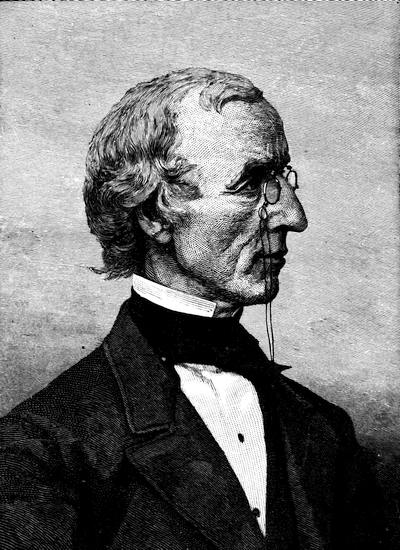
JEFFRIES WYMAN.
From a photograph taken in 1868, furnished by his family. The portrait in the Peabody Museum Report, no. viii., represents him somewhat later in life, with a beard. He died Sept. 4, 1874. There are accounts of Wyman in the same Report, by Asa Gray, who also made an address on Wyman before the Boston Society of Nat. Hist. (cf. Pop. Science Monthly, Jan., 1875), with commemorations by O. W. Holmes (Atlantic Monthly, Nov., 1874, and Mass. Hist. Soc. Proc., xiv. 4), by F. W. Putnam in the Proc. Amer. Acad. with a list of his publications; by Packard in the Mem. Nat. Acad., and B. G. Wilder (Old and New, Nov., 1874).
These accumulations are known usually in America as shell heaps, and it is generally characteristic of them that, while they contain pottery and bone implements, the stone instruments are far less numerous, and generally occur in the upper layers in those of Florida, but they are scattered through all the layers in those of New England. Professor Jeffries Wyman, whose name is in this country particularly associated with shell-heap investigations, could not find[1684] that any one had in the scientific spirit called attention to the subject in America earlier than Caleb Atwater in the Archæologia Americana (vol. i., 1820), who had observed such deposits on the Muskingum River in Ohio. They had not passed unnoticed, however, by some of the early explorers. Putnam (Essex Inst. Bulletin, xv. 86) notes that J. T. Ducatel observed those on the Chesapeake in 1834. The earliest more particular mention of the inland mounds seem to have been made in Prinz Maximilian’s Travels in the United States.[1685] Foster, in his Prehistoric Races of the U. S. (ch. 4,—a special survey of the American heaps), says that Professor Vanuxem was the first to describe the sea-side mounds in 1841, in the Proc. Amer. Asso. Geologists (i. 22).[1686]
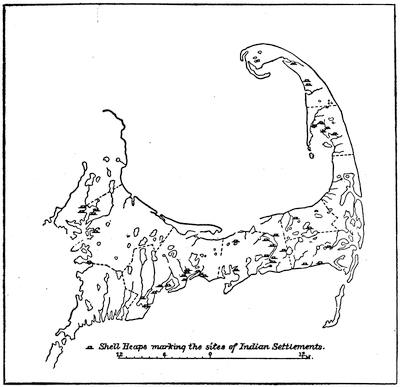
SHELL HEAPS ON CAPE COD.
There has been as yet little found in America from which to develop the evidence of early man from any lake or river dwellings, while so much has been done in Europe.[1687] In some parts of Florida the Indians are reported to have built houses on piles; and in South America tree-houses and those on platforms are well known. Mr. Hilborne T. Cresson has reported (Peabody Mus. Rept., xxii. for 1888) the discovery of pile ends in the Delaware River, and has shown that two of these river stations are earlier than the third, as is evident from the rude implements of argillite found in the two when compared with those discovered in the third, where implements of jasper and quartz and fragments of pottery were associated with those of argillite.
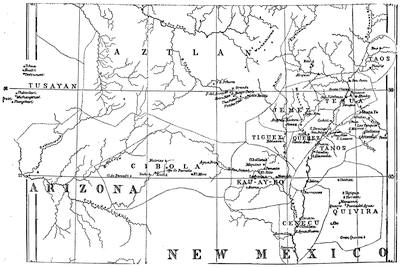
PUEBLO REGION.
From a map, “Originalkarte der Urwohnsitze der Azteken und Verwandten Pueblos in New Mexico, zusammengestellt von O. Loew,” in Petermann’s Mittheilungen über wichtige neue Erforschungen auf dem Gesammtgebiete der Geographie, xxii. (1876), table xii. The small dotted circles stand for inhabited pueblos; those with a perpendicular line attached are ruins; and when this perpendicular line is crossed it is a Mexicanized pueblo. See the map in Powell’s Second Rept. Bur. Ethnol. (1880-81) p. 318, which marks the several classes: inhabited, abandoned, ruined pueblos, cavate houses, cliff houses, and tower houses.
The earliest discoveries of the cliff houses of the Colorado region were made by Lieut. J. H. Simpson, and his descriptions appeared in his Journal of a Military Reconnoissance, in 1849.[1688] No considerable addition was made to our knowledge of the cliff dwellers till in 1874-75, when special parties of the Hayden Geological Survey were sent to explore them (Hayden’s Report, 1876), whence we got accounts of those of southwestern Colorado by W. H. Holmes, including the cavate-houses and cliff-dwellers of the San Juan, the Mancos, and the ruins in the McElmo cañon.[1689] W. H. Jackson gives a revised account of his 1874 expedition in the Bulletin of the Survey (vol. ii. no. 1), adding thereto an account of his explorations of 1875. Jackson also gives a chapter on the ruins of the Chaco cañon.[1690]
In coming to the class of ruins lying in a few instances just within, but mostly to the north of, the Mexican line, we encounter the Pueblo race, whose position in the ethnological chart is not quite certain, be their connection with the Nahuas and Aztecs,[1691] or with the moundbuilders,—red Indian if they be,—or with the cliff-dwellers, as perhaps is the better opinion. Their connection with savage nations farther north is not wholly determinable, as Morgan allows, on physical and social grounds, and perhaps not as definitely settled by their architecture as Cushing seems to think.[1692]
The Spaniard early encountered these ruins,[1693] and perhaps the best summary of the growth of our knowledge of them by successive explorations is in Bancroft’s Nat. Races, iv. ch. 11.[1694] In the century after the Spanish conquest, we have one of the best accounts in the Memorial of Fray Alonso Benavides, published at Madrid in 1630.[1695] The most famous of the ruins of this region, the Casa Grande of the Gila Valley in Arizona,[1696] is supposed to have been seen (1540) by Coronado, then in a state of ruin; but we get no clear description till that given by Padre Mange, who accompanied Padre Kino to see the ruins in 1697.[1697]
There are few descriptions[1698] of the antiquities of this country previous to the military examination of it which was made during the Mexican War. Such is recorded in W. H. Emory’s Notes of a Military Reconnoissance from Fort Leavenworth in Missouri to San Diego in California,[1699] which gives us some of the earliest representations of these antiquities, including the ruins of Pecos.[1700] In 1849, Col. Washington, the governor of New Mexico, organized an expedition against the Navajos, and Lieut. James H. Simpson gives us the first detailed account of the Chaco cañon in his Journal of a Military Reconnoissance (Philad., 1852).[1701] He also covered (p. 90), among the other ruins of this region, the old and present habitations of the Zuñi, but these received in some respects more detailed examination in Capt. L. Sitgreave’s Report of an Expedition down the Zuñi and Colorado rivers (Washington, 1853),[1702] accompanied by a map and other illustrations.[1703] New channels of information were opened when the United States government undertook to make surveys (1853) for a trans-continental line of railways; and a great deal of material is embodied in Whipple’s report on the Indian tribes in the Pacific R. R. Reports, vol. iii. The running of the boundary line between the United States and Mexico also contributed to our knowledge. The commissioner during 1850-53 was John Russell Bartlett, who, on the failure of the government promptly to publish his report, printed his Personal narrative of explorations and incidents (N. Y., 1854), and made in some parts of it an important contribution to our knowledge of the antiquities of this region.[1704]
No considerable advance was now made in this study for about a score of years. Major Powell first published his account of his adventurous exploration (1869) of the Colorado cañon in Scribner’s Monthly (Jan., Feb., Mar.) in 1875, and it was followed by his official Exploration of the Colorado River (Washington, 1875), making known the existence of ruins in the cañon’s gloomy depths. The Reports of the U. S. Geological Survey, including the accounts by W. H. Jackson and W. H. Holmes, give much valuable and original information; and a good deal of what has been included in the Reports of the Chief of Engineers (U. S. Army) for 1875 and 1876 will also be found in the seventh volume, edited by F. W. Putnam, of Wheeler’s Survey,[1705] including the pueblos of Acoma, Taos, San Juan, and the ruin[1706] on the Animas River.
The latest examinations of these Pueblo remains, of which we have published accounts, are those made by A. F. Bandelier for the Archæological Institute of America. He has given his results in his “Historical introduction to studies among the sedentary Indians of New Mexico,” and in his “Report on the ruins of Pecos,” which constitutes the initial volume of Papers, American series, of the Institute (Boston, 1881).[1707] He believes Pecos to be Cicuye, visited by Alvarado in 1541,—a huge pile with 585 compartments, finally abandoned in 1840. In October, 1880, he examined the region west of Santa Fé (Second Rept. Archæol. Inst.). His explorations also determined the eastern limits of the sedentary occupation of New Mexico (Fifth Report). He renewed his studies in 1882 (First Bull. Archæol. Inst., Jan., 1883), and thought the ruins showed successive occupiers, and divides them into cave dwellings, cliff houses, one-story buildings, and those of more than one, with each higher one retreating from the front of the next lower.
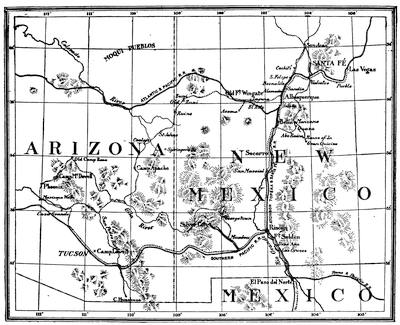
PUEBLO REGION.
A reduction of the map accompanying Bandelier’s report on his investigations in New Mexico, in the Fifth Rept. of the Archæological Institute of America (Cambridge, 1884).
The most essential sources of information have thus been enumerated, but there is not a little fugitive and comprehensive treatment of the subject worth the student’s attention who follows a course of investigation.[1708]
The literature of the moundbuilders, and of the controversies arising out of the mysterious relics of their life, is commensurate with the very wide extent of territory covered by their traces.[1709] It was long before any intelligent notice was taken of the mounds by those who traversed the wilderness. De Soto, in 1540, could get no traditions concerning them beyond the assurances that the peoples he encountered had built them, or some of them. We read of them also in Garcilasso de la Vega, Biedma and the Knight of Elvas, on the Spanish side; but on the French at a later day we learn little or nothing from Joutel, Tonti, and Hennepin, though something from Du Pratz, La Harpe and some of the missionaries. Kalm,[1710] the Swede, in 1749, was about the first to make any note of them. Carver found them near Lake Pepin in 1768. In 1772 the missionary David Jones[1711] made observations upon those in Ohio. Adair did not wholly overlook them in his American Indians in 1775. Prof. James Dunbar, of Aberdeen, in his Essays on the history of mankind in rude and uncultivated ages (Lond., 1780), uses what little Kalm and Carver afforded. Jefferson in his Notes on Virginia (1782) speaks of them as barrows “all over the country,” and “obvious repositories of the dead.”[1712] Arthur Lee makes reference to them in 1784. A map of the Northwest Territory, published by John Fitch about 1785, places in the territory which is now Wisconsin the following legend: “This country has once been settled by a people more expert in the art of war than the present inhabitants. Regular fortifications, and some of these incredibly large, are frequently to be found. Also many graves and towers like pyramids of earth.” In 1786 Franklin thought the works at Marietta might have been built by De Soto; and Noah Webster, in a paper in Roberts’ Florida, assented.[1713] B. S. Barton, in his Observations in some parts of Natural History (London, 1787), credited the Toltecs with building them, whom he considered the descendants of the Danes.
As the century draws to a close, we find occasional and rather bewildered expression of interest in the Observations on the Ancient Mounds by Major Jonathan Heart;[1714] in the Missions of Loskiel; in the New Views of Dr. Smith Barton; in the Carolina of William Bartram; and in the travels of Volney. In 1794 Winthrop Sargent reported in the Amer. Philos. Soc. Trans., iv., on the exploration of the mounds at Cincinnati. The present century soon elicited a variety of observations, but there was little of practical exploration. A New England minister, Thaddeus Mason Harris, passed judgment upon those in Ohio, when he journeyed thither in 1803.[1715] The commissioner of the United States to run the Florida boundary, Andrew Ellicott, describes some near Natchez in his Journal (1803). Bishop Madison communicated through Professor Barton some opinions about those in Western Virginia, which appear in the Transaction of the American Philosophical Society, taking different grounds from Dr. Harris, who had thought them works of defence. The explorations of Lewis and Clark (1804-6) up the Missouri, and of Pike (1805-7) up the Mississippi, produced little. Robin, the French naturalist, in 1805,[1716] Major Stoddard[1717] and Breckenridge[1718] later, saw some in Louisiana, Missouri, and Illinois. A leading periodical, The Portfolio, contributed something to the common stock in 1810 and 1814, giving plans of some of the mounds. Those in Ohio were again the subject of inquiry by F. Cuming in his Sketches of a Tour to the Western Country (Pittsburg, 1810), and by Dr. Daniel Drake in his Picture of Cincinnati and the Miami Valley (Cinn., 1815). John Heckewelder, the Moravian missionary, accounted for the ancient fortifications through the traditions of the Delawares, who professed once to have inhabited this country, but it has been suspected that the worthy missionary was imposed upon.[1719] DeWitt Clinton, in 1811, before the New York Historical Society, and again in 1817, before the Literary and Philosophical Society of New York, had given some theories in which the Scandinavians figured as builders of the mounds in that State.
It was thus at a time when there was much speculation and not much real experimental knowledge respecting these remains that, under the auspices of the then newly founded American Antiquarian Society, Mr. Caleb Atwater, of Ohio, was employed to explore and survey a considerable number of these works. He embodied his results in the initial volume of the publication of that society, the Archæologia Americana.[1720] After pointing out scattered evidences of the traces of European peoples, found in coins and other relics throughout the country, Atwater proceeds to his description of the earthworks, mainly of Ohio; and beside giving many plans,[1721] he enters into the question of their origin, and expresses a belief in the Asiatic origin of their builders, and in their subsequent migration south to lay, as he thinks, the foundations of the Mexican and Peruvian civilizations.
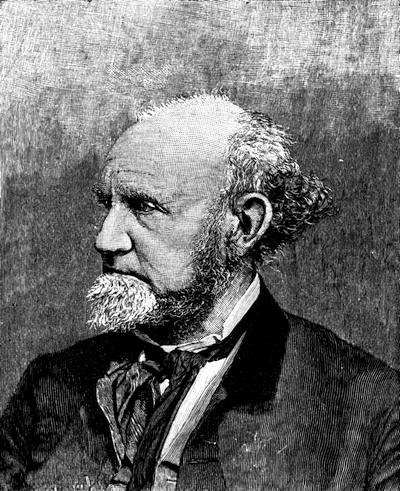
COL. CHARLES WHITTLESEY.
After a photograph kindly furnished by the Hon. C. C. Baldwin, of Cleveland, Ohio, who has printed a memorial of his friend with a list of his writings in Tract 68 of the Western Reserve Hist. Soc.
During the next twenty-five years there cannot be said to have been much added to a real knowledge of the subject. Yates and Moulton in their Hist. New York (1824) borrowed mainly from Kirkland (1788) the missionary. Humboldt had no personal contact with the remains to give his views any value (1825). Warden in his Recherches (1827) gave some new plans and rearranged the old descriptions. There was some sober observation in M’Culloh’s Researches (3d ed., 1829); some far from sober in Rafinesque (1838); some compiled descriptions with worthless comment in Josiah Priest’s American Antiquities (Albany, 1838); something like scientific deductions in S. G. Morton’s study of the few moundbuilders’ skulls then known, in his Cranea Americana (1839); with an attempt at summing up in Delafield (1839) and Bradford (1841). This is about all that had been added to what Atwater did, when E. G. Squier and E. H. Davis eclipsed all labors preceding theirs, and began the series of the Smithsonian Contributions with their Ancient Monuments of the Mississippi Valley (Washington, 1847 and 1848).[1722] During the preceding two years they had opened over two hundred mounds, and explored about a hundred earthwork enclosures, and had gathered a considerable collection of specimens of moundbuilders’ relics.[1723] They had begun their work under the auspices of the American Ethnological Society, but the cost of the production of the volume exceeded the society’s resources, and the transfer was made to the Smithsonian Institution. The work took a commanding position at once, and still remains of essential value, though some of the grounds of its authors are not acceptable to present observers; and indeed in his work on the mounds of New York, which the Smithsonian Institution included in the second volume of their Contributions, Squier found occasion to alter some of his opinions in his earlier work, or at least to ascribe the mounds of that State to the Iroquois. The third volume of the same Contributions (1852) introduces to us one of the ablest of the local investigators in a paper by Charles Whittlesey, of “Descriptions of Ancient Works in Ohio,”—the forerunner of numerous papers which he has given to the public in elucidation of the mounds.[1724] Three years later (1855), in the seventh volume of the Smithsonian Contributions, a new field in the emblematic and animal mounds of the northwest was for the first time brought to any considerable extent to public attention in the paper by Increase A. Lapham, on the “Antiquities of Wisconsin.” Lapham had made his explorations under the auspices of the American Antiquarian Society,[1725] and his manuscript had been revised by Haven, when it was decided to consign it for publication to the Smithsonian Institution.
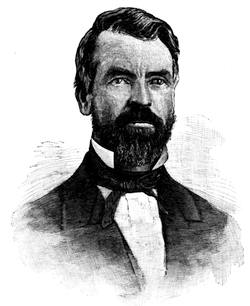
INCREASE A. LAPHAM.
Engraved from a photograph dated 1863, kindly furnished by his friend, Prof. J. D. Whitney. Lapham died in 1875. Cf. Amer. Journal of Science, x. 320; xi. 326, 333; Trans. Wisc. Acad. Science, iii. 264.
The animal mounds had been indeed earlier mentioned, and the great serpent mound of Ohio had long attracted attention; but it was in the territory now known as Wisconsin that these mounds were found chiefly to abound. Long, in 1823, speaks of mounds in this region; but the forest coverings seem to have prevented any observer detecting their shapes till Lapham first noted this peculiarity in 1836. In April, 1838, R. C. Taylor was the earliest to figure them in the Amer. Journal of Science (Silliman’s), and again they were described by S. Taylor in Ibid., 1842. Prof. John Locke referred to them in a Report on the mineral lands of the United States, made to Congress in 1844. William Pidgeon, who had been a trader among the Indians, published in his Traditions of De-coo-dah, and Antiquarian researches: comprising extensive exploration, surveys and excavations of the Mound Builders in America; the traditions of the last Prophet of the Elk Nation, relative to their origin and use, and the evidences of an ancient population more numerous than the present Aborigines (N. Y., 1853; again 1858) what he pretended was in large part the results of his intercourse with an Indian chief, involving some theories as to the symbolism of the mounds. The book contained so many palpable perversions, not to say undisguised fictions, that the Smithsonian Institution refused to publish it;[1726] and the book has never gained any credit, though some unguarded writers have unwittingly borrowed from it.[1727]
In the eighth volume of the Smithsonian Contributions,[1728] Haven, the librarian of the Amer. Antiq. Soc., summed up the results of mound exploration as they then stood. The steady and circumspect habit of Haven’s mind was conspicuous in his treatment of the mounds. It is to him that the later advocates of the identity of their builders with the race of the red Indians look as the first sensibly to affect public opinion in the matter.[1729] He argued against their being a more advanced race (p. 154), and in his Report of the Am. Antiq. Soc., in 1877 (p. 37), he held that it might yet be proved that the moundbuilders and red Indians were one in race, as M’Culloh had already suggested.
At the time when Haven was first intimating (1856) that this view might yet become accepted, it was doubtless held to be best established that those who built the mounds were quite another race from those who lived among them when Europeans first knew the country. The fact that the Indians had no tradition of their origin was held to be almost conclusive, though it is alleged that the southern Indians in later times retained no recollections of the expedition of De Soto, and Dr. Brinton thinks that it is common for Indian traditions to die out.[1730] It is not till recent years that any considerable number of moundbuilder skulls have been known, and from the scant data which the early craniologists had, their opinion seems to have coincided with those in favor of a vanished race.[1731] It was a favorite theory, not yet wholly departed, that they were in some way connected with the more southern peoples, the Pueblo Indians, the Aztecs, or the Peruvians; either that they came from them, or migrated south and became one with them.[1732] The bolder theory, that we see their descendants in the red Indians, is perhaps gaining ground, and it has had the support of the Bureau of Ethnology and some able expounders.[1733]
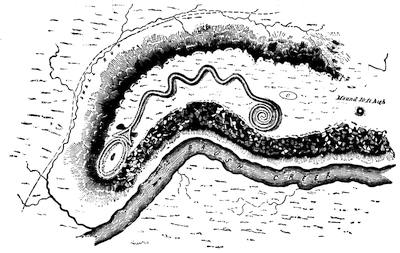
THE GREAT SERPENT MOUND.
This follows a survey given in Squier’s Serpent Symbol (N. Y., 1851), p. 137. It is criticised by Putnam in Peabody Museum Reports, xviii. 348, and Amer. Antiq. Soc. Proc., Oct., 1883. Putnam has recently purchased over sixty acres about the effigy, which is to be held by the trustees of the Peabody Museum as a park (Repts., xxi. 14); and his recent explorations show that the projections in the side of the head (shaded dark in the cut) are not a part of the construction. He also finds two distinct periods of occupation in this region, to the oldest of which he attributes this work (Peab. Mus. Rept. 1888). W. H. Holmes made a survey in 1886 (Amer. Antiquarian, May, 1887, ix. 141; Science, viii. 624, Dec. 31, 1886). Cf. J. P. MacLean, in Amer. Antiquarian, vii. 44, and his Moundbuilders, p. 56; Baldwin’s Anc. America, 29. T. H. Lewis describes a snake mound in Minnesota (Science, ix. 393). On the serpent symbol see S. D. Peet, in Amer. Antiquarian, viii. 197; ix. 13, where he manifests a somewhat omnivorous appetite.
Of the opposing theory of a disappeared race, Capt. Heart in reply to Barton (Amer. Philolog. Asso. Proc. iii.) gave, as Thomas thinks, “the earliest clear and distinct expression,” but Squier and Davis may be considered as first giving it definite meaning; and though Squier does not seem to have actually revoked this judgment as respects the mounds in the Mississippi valley, he finally reached the conclusion that those in New York were really the work of the Iroquois.[1734] This ancient-race theory, sometimes amounting to a belief in their autochthonous origin, has impressed the public through some of the best known summaries of American antiquities, like those of Baldwin, Wilson, and Short,[1735] and has been adopted by men of such reputation as Lyell.[1736] The position taken by Professor F. W. Putnam, the curator of the Peabody Museum of Archæology at Cambridge, is much like that taken earlier by Warden in his Recherches, that both views are, within their own limitations, correct, and, as Putnam expresses it, “that many Indian tribes built mounds and earthworks is beyond doubt; but that all the mounds and earthworks of North America are by these same tribes, or their immediate ancestors, is not thereby proved.”[1737] Thomas (Fifth Report, Bureau Ethnol.) holds this statement to be too vague. It is certainly shown in the whole history of archæological study that uncompromising demarcations have sooner or later to be abandoned.