Part 2 — CHAPTER II.
Reading edition
PRE-COLUMBIAN EXPLORATIONS.
BY JUSTIN WINSOR, THE EDITOR.
IN the previous chapter, in attempting to trace the possible connection of the new world with the old in the dimmest past, it was hard, if not hopeless, to find among the entangled myths a path that we could follow with any confidence into the field of demonstrable history. It is still a doubt how far we exchange myths for assured records, when we enter upon the problems of pre-Columbian explorations, which it is the object of the present chapter to discuss. We are to deal with supposable colonizations, from which the indigenous population of America, as the Spaniards found it, was sprung, wholly or in part; and we are to follow the venturesome habits of navigators, who sought experience and commerce in a strange country, and only incidentally left possible traces of their blood in the peoples they surprised. If Spain, Italy, and England gained consequence by the discoveries of Columbus and Cabot, there were other national prides to be gratified by the priority which the Basques, the Normans, the Welsh, the Irish, and the Scandinavians, to say nothing of Asiatic peoples, claimed as their share in the gift of a new world to the old. The records which these peoples present as evidences of their right to be considered the forerunners of the Spanish and English expeditions have in every case been questioned by those who are destitute of the sympathetic credence of a common kinship. The claims which Columbus and Cabot fastened upon Spain and England, to the disadvantage of Italy, who gave to those rival countries their maritime leaders, were only too readily rejected by Italy herself, when the opportunity was given to her of paling such borrowed glories before the trust which she placed in the stories of the Zeni brothers.
There is not a race of eastern Asia—Siberian, Tartar, Chinese, Japanese, Malay, with the Polynesians—which has not been claimed as discoverers, intending or accidental, of American shores, or as progenitors, more or less perfect or remote, of American peoples; and there is no good reason why any one of them may not have done all that is claimed. The historical evidence, however, is not such as is based on documentary proofs of indisputable character, and the recitals advanced are often far from precise enough to be convincing in details, if their general authenticity is allowed. Nevertheless, it is much more than barely probable that the ice of Behring Straits or the line of the Aleutian Islands was the pathway of successive immigrations, on occasions perhaps far apart, or may be near together; and there is hardly a stronger demonstration of such a connection between the two continents than the physical resemblances of the peoples now living on opposite sides of the Pacific Ocean in these upper latitudes, with the similarity of the flora which environs them on either shore.[510] It is quite as conceivable that the great northern current, setting east athwart the Pacific, should from time to time have carried along disabled vessels, and stranded them on the shores of California and farther north, leading to the infusion of Asiatic blood among whatever there may have been antecedent or autochthonous in the coast peoples. It is certainly in this way possible that the Chinese or Japanese may have helped populate the western slopes of the American continent. There is no improbability even in the Malays of southeastern Asia extending step by step to the Polynesian islands, and among them and beyond them, till the shores of a new world finally received the impress of their footsteps and of their ethnic characteristics. We may very likely recognize not proofs, but indications, along the shores of South America, that its original people constituted such a stock, or were increased by it.
As respects the possible early connections of America on the side of Europe, there is an equally extensive array of claims, and they have been set forth, first and last, with more persistency than effect.[511]
Leaving the old world by the northern passage, Iceland lies at the threshold of America. It is nearer to Greenland than to Norway, and Greenland is but one of the large islands into which the arctic currents divide the North American continent. Thither, to Iceland, if we identify the localities in Geoffrey of Monmouth, King Arthur sailed as early as the beginning of the sixth century, and overcame whatever inhabitants he may have found there. Here too an occasional wandering pirate or adventurous Dane had glimpsed the coast.[512] Thither, among others, came the Irish, and in the ninth century we find Irish monks and a small colony of their countrymen in possession.[513] Thither the Gulf Stream carries the southern driftwood, suggesting sunnier lands to whatever race had been allured or driven to its shelter.[514] Here Columbus, when, as he tells us,[515] he visited the island in 1477, found no ice. So that, if we may place reliance on the appreciable change of climate by the precession of the equinoxes, a thousand years ago and more, when the Norwegians crossed from Scandinavia and found these Christian Irish there,[516] the island was not the forbidding spot that it seems with the lapse of centuries to be becoming.
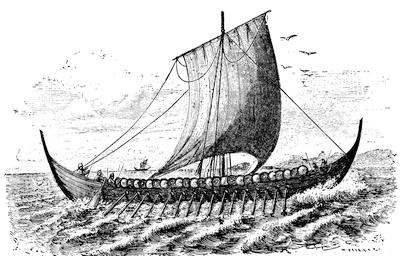
NORSE SHIP.
This cut is copied from one in Nordenskiöld’s Voyage of the Vega (London, 1881), vol. i. p. 50, where it is given as representing the vessel found at Sandefjord in 1880. It is drawn from the restoration given in The Viking ship discovered at Gokstad in Norway (Langskibet fra Gokstad ved Sandefjord) described by N. Nicholaysen (Christiania, 1882). The original vessel owed its preservation to being used as a receptacle for the body of a Viking chief, when he was buried under a mound. When exhumed, its form, with the sepulchral chamber midships, could be made out, excepting that the prow and stern in their extremities had to be restored. In the ship and about it were found, beside some of the bones of a man, various appurtenances of the vessel, and the remains of horses buried with him. They are all described in the book above cited, from which the other cuts herewith given of the plan of the vessel and one of its rowlocks are taken. The Popular Science Monthly, May, 1881, borrowing from La Nature, gives a view of the ship as when found in situ. There are other accounts in The Antiquary, Aug., 1880; Dec., 1881; 1882, p. 87; Scribner’s Magazine, Nov., 1887, by John S. White; Potter’s American Monthly, Mar., 1882. Cf. the illustrated paper, “Les navires des peuples du nord,” by Otto Jorell, in Congrès Internat. des Sciences géographiques (Paris, 1875; pub. 1878), i. 318.
Of an earlier discovery in 1872 there is an account in The ancient vessel found in the parish of Tune, Norway (Christiania, 1872). This is a translation by Mr. Gerhard Gadé of a Report in the Proceedings of the Society for preserving Norwegian Antiquities. (Cf. Mass. Hist. Soc. Proc., xiii. p. 10.) This vessel was also buried under a mound, and she was 43½ feet long and four feet deep.
There is in the Nicholaysen volume a detailed account of the naval architecture of the Viking period, and other references may be made to Otto Jorell’s Les navires des peuples du Nord, in the Congrès internat. des sciences géog., compte rendu, 1875 (1878, i. 318); Mémoires de la Soc. royal des Antiquaires du Nord (1887, p. 280); Preble, in United Service (May, 1883, p. 463), and in his Amer. Flag, p. 159; De Costa’s Pre-Columbian Discovery of America, p. xxxvii; Fox’s Landfall of Columbus, p. 3; Pop. Science Monthly, xix. 80; Van Nostrand’s Eclectic Engineering Mag., xxiii. 320; Good Words, xxii. 759; Higginson’s Larger History U. S. for cuts; and J. J. A. Worsaae’s Prehistory of the North (Eng. transl., London,1886) for the burial in ships.
There is a paper on the daring of the Norsemen as navigators by G. Brynjalfson (Compte Rendu , Congrès des Américanistes, Copenhagen, p. 140), entitled “Jusqu’où les anciens Scandinaves ont-ils pénétré vers le pôle arctique dans leurs expéditions à la mer glaciale?”
It was in a.d. 875 that Ingolf, a jarl[517] of Norway, came to Iceland with Norse settlers. They built their habitation at first where a pleasant headland seemed attractive, the present Ingolfshofdi, and later founded Reikjavik, where the signs had directed them; for certain carved posts, which they had thrown overboard as they approached the island, were found to have drifted to that spot. The Christian Irish preferred to leave their asylum rather than consort with the new-comers, and so the island was left to be occupied by successive immigrations of the Norse, which their king could not prevent. In the end, and within half a century, a hardy little republic—as for a while it was—of near seventy thousand inhabitants was established almost under the arctic circle. The very next year (a.d. 876) after Ingolf had come to Iceland, a sea-rover, Gunnbiorn, driven in his ship westerly, sighted a strange land, and the report that he made was not forgotten.[518] Fifty years later, more or less, for we must treat the dates of the Icelandic sagas with some reservation, we learn that a wind-tossed vessel was thrown upon a coast far away, which was called Ireland the Great. Then again we read of a young Norwegian, Eric the Red, not apparently averse to a brawl, who killed his man in Norway and fled to Iceland, where he kept his dubious character; and again outraging the laws, he was sent into temporary banishment,—this time in a ship which he fitted out for discovery; and so he sailed away in the direction of Gunnbiorn’s land, and found it. He whiled away three years on its coast, and as soon as he was allowed ventured back with the tidings, while, to propitiate intending settlers, he said he had been to Greenland, and so the land got a sunny name. The next year, which seems to have been a.d. 985, he started on his return with thirty-five ships, but only fourteen of them reached the land. Wherever there was a habitable fiord, a settlement grew up, and the stream of immigrants was for a while constant and considerable. Just at the end of the century (a.d. 999), Leif, a son of Eric, sailed back to Norway, and found the country in the early fervor of a new religion; for King Olaf Tryggvesson had embraced Christianity and was imposing it on his people. Leif accepted the new faith, and a priest was assigned to him to take back to Greenland; and thus Christianity was introduced into arctic America. So they began to build churches[519] in Greenland, the considerable ruins of one of which stand to this day.[520] The winning of Iceland to the Church was accomplished at the same time.
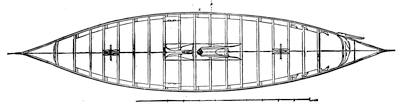
PLAN OF VIKING SHIP.
There were two centres of settlement on the Greenland coast, not where they were long suspected to be, on the coast opposite Iceland, nor as supposed after the explorations of Baffin’s Bay, on both the east and west side of the country; but the settlers seem to have reached and doubled Cape Farewell, and so formed what was called their eastern settlement (Eystribygd), near the cape, while farther to the north they formed their western colony (Westribygd).[521] Their relative positions are still involved in doubt.
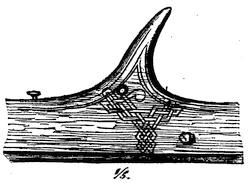
ROWLOCK OF THE VIKING SHIP.
In the next year after the second voyage of Eric the Red, one of the ships which were sailing from Iceland to the new settlement, was driven far off her course, according to the sagas, and Bjarni Herjulfson, who commanded the vessel, reported that he had come upon a land, away to the southwest, where the coast country was level; and he added that when he turned north it took him nine days to reach Greenland.[522] Fourteen years later than this voyage of Bjarni, which is said to have been in a.d. 986,—that is, in the year 1000 or thereabouts,—Leif, the same who had brought the Christian priest to Greenland, taking with him thirty-five companions, sailed from Greenland in quest of the land seen by Bjarni, which Leif first found, where a barren shore stretched back to ice-covered mountains, and because of the stones there he called the region Hellu land. Proceeding farther south, he found a sandy shore, with a level forest-country back of it, and because of the woods it was named Markland. Two days later they came upon other land, and tasting the dew upon the grass they found it sweet. Farther south and westerly they went, and going up a river came into an expanse of water, where on the shores they built huts to lodge in for the winter, and sent out exploring parties. In one of these, Tyrker, a native of a part of Europe where grapes grew, found vines hung with their fruit, which induced Leif to call the country Vinland.
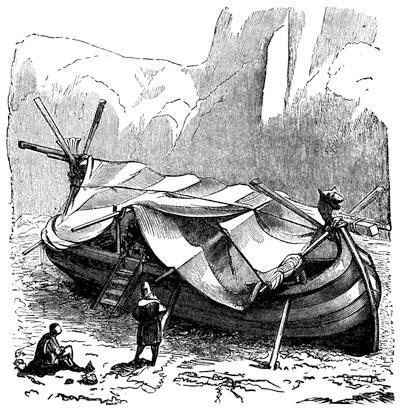
NORSE BOAT USED AS A HABITATION.
From Viollet-le-Duc’s Habitation humaine (Paris, 1875).
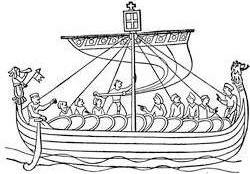
NORMAN SHIP FROM THE BAYEUX TAPESTRY.
From Worsaae’s Danes and Norwegians in England, etc. “With the exception of very imperfect representation carved on rocks and runic stones [see Higginson’s Larger History, p. 27], there are no images left in the countries of Scandinavia of ships of the olden times; but the tapestry at Bayeux, in Normandy, is a contemporary evidence of the appearance of the Normanic ships.”
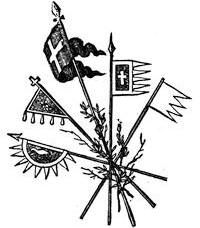
SCANDINAVIAN FLAGS.
This group from Worsaae’s Danes and Norwegians in England, etc., p. 64, shows the transition from the raven to the cross.
————
Attempts have been made to identify these various regions by the inexact accounts of the direction of their sailing, by the very general descriptions of the country, by the number of days occupied in going from one point to another, with the uncertainty if the ship sailed at night, and by the length of the shortest day in Vinland,—the last a statement that might help us, if it could be interpreted with a reasonable concurrence of opinion, and if it were not confused with other inexplicable statements. The next year Leif’s brother, Thorvald, went to Vinland with a single ship, and passed three winters there, making explorations meanwhile, south and north. Thorfinn Karlsefne, arriving in Greenland in a.d. 1006, married a courageous widow named Gudrid, who induced him to sail with his ships to Vinland and make there a permanent settlement, taking with him livestock and other necessaries for colonization. Their first winter in the place was a severe one; but Gudrid gave birth to a son, Snorre, from whom it is claimed Thorwaldsen, the Danish sculptor, was descended. The next season they removed to the spot where Leif had wintered, and called the bay Hóp. Having spent a third winter in the country, Karlsefne, with a part of the colony, returned to Greenland.
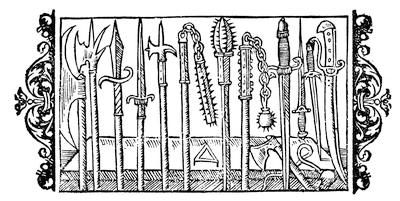
FROM OLAUS MAGNUS.
Fac-simile of Norse weapons from the Historia of Olaus Magnus (b. 1490; d. 1568), Rome, 1555, p. 222.
The saga then goes on to say that trading voyages to the settlement which had been formed by Karlsefne now became frequent, and that the chief lading of the return voyages was timber, which was much needed in Greenland. A bishop of Greenland, Eric Upsi, is also said to have gone to Vinland in a.d. 1121. In 1347 the last ship of which we have any record in these sagas went to Vinland after timber. After this all is oblivion.
There are in all these narratives many details beyond this outline, and those who have sought to identify localities have made the most they could of the mention of a rock here or a bluff there, of an island where they killed a bear, of others where they found eggs, of a headland where they buried a leader who had been killed, of a cape shaped like a keel, of broadfaced natives who offered furs for red cloths, of beaches where they hauled up their ships, and of tides that were strong; but the more these details are scanned in the different sagas the more they confuse the investigator, and the more successive relators try to enlighten us the more our doubts are strengthened, till we end with the conviction that all attempts at consistent unravelment leave nothing but a vague sense of something somewhere done.
FULL-SIZE FAC-SIMILE OF THE TABLET, engraved by Prof. Magnus Petersen, with the Runes as he sees them.
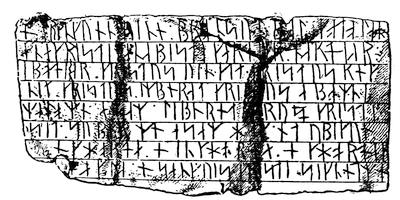
(TRANSLITERATION OF THE LEADEN TABLET.),
+ (AT) Þ(E)R KUEN(E) SINE PRINSINED (B)AD (M)OTO LANANA KRISTI DONAVISTI GARDIAR IARDIAR IBODIAR KRISTUS UINKIT KRISTUS REGNAT KRISTUS IMPERAT KRISTUS AB OMNI MALO ME ASAM LIPERET KRUX KRISTI SIT SUPER ME ASAM HIK ET UBIQUE + KHORDA + IN KHORDA + KHORDAE (t) (M)AGLA + SANGUIS KRISTI SIGNET ME
RUNES, A.D. 1000.
This cut is of some of the oldest runes known, giving two lines in Danish and the rest in Latin, as the transliteration shows. It is copied from The oldest yet found Document in Danish, by Prof Dr. George Stephens (Copenhagen, 1888,—from the Mémoires des Antiquaires du Nord, 1887). The author says that the leaden tablet on which the runes were cut was found in Odense, Fyn, Denmark, in 1883, and he places the date of it about the year a.d. 1000. George Stephens’s Handbook of the old Northern Runic Monuments of Scandinavia and England is a condensation, preserving all the cuts, and making some additions to his larger folio work in 3 vols., The old-northern Runic monuments of Scandinavia and England, now first collected and deciphered (London, etc., 1866-68). It does not contain either Icelandic or Greenland runes. He says that by the time of the colonization of Iceland “the old northern runes as a system had died out on the Scandinavian main, and were followed by the later runic alphabet. But even this modern Icelandic of the tenth century has not come down to us. If it had, it would be very different from what is now vulgarly so called, which is the greatly altered Icelandic of the thirteenth and fourteenth centuries.... The oldest written Icelandic known to us is said to date from about the year 1200.... The whole modern doctrine of one uniform Icelandic language all over the immense north in the first one thousand winters after Christ is an impossible absurdity.... It is very seldom that any of the Scandinavian runic stones bear a date.... No Christian runic gravestone is older than the fourteenth century.” On runes in general, see Mallet, Bohn’s ed., pp. 227, 248, following the cut of the Kingektorsoak stone, in Rafn’s Antiq. Americanæ; Wilson’s Prehist. Man, ii. 88; Wollheim’s Nat. Lit. der Scandinavier (Berlin, 1875), vol. i. pp. 2-15; Legis-Glueckselig’s Die Runen and ihre Denkmäler (Leipzig, 1829); De Costa’s Pre-Columb. Disc., pp. xxx; Revue polit. et lit., Jan. 10, 1880. It is held that runes are an outgrowth of the Latin alphabet. (L. F. A. Wimmer’s Runeskriftens Oprindelse og Udvikling i norden, Copenhagen, 1874.)
Everywhere else where the Northmen went they left proofs of their occupation on the soil, but nowhere in America, except on an island on the east shore of Baffin’s Bay,[523] has any authentic runic inscription been found outside of Greenland. Not a single indisputable grave has been discovered to attest their alleged centuries of fitful occupation. The consistent and natural proof of any occupation of America south of Davis Straits is therefore lacking; and there is not sufficient particularity in the descriptions[524] to remove the suspicion that the story-telling of the fireside has overlaid the reports of the explorer. Our historic sense is accordingly left to consider, as respects the most general interpretation, what weight of confidence should be yielded to the sagas, pre-Columbian as they doubtless are. But beyond this is perhaps, what is after all the most satisfactory way of solving the problem, a dependence on the geographical and ethnical probabilities of the case. The Norsemen have passed into credible history as the most hardy and venturesome of races. That they colonized Iceland and Greenland is indisputable. That their eager and daring nature should have deserted them at this point is hardly conceivable. Skirting the Greenland shores and inuring themselves to the hardships and excitements of northern voyaging, there was not a long stretch of open sea before they could strike the Labrador coast. It was a voyage for which their ships, with courageous crews, were not unfitted. Nothing is more likely than that some ship of theirs may have been blown westerly and unwillingly in the first instance, just as Greenland was in like manner first made known to the Icelanders. The coast once found, to follow it to the south would have been their most consistent action.
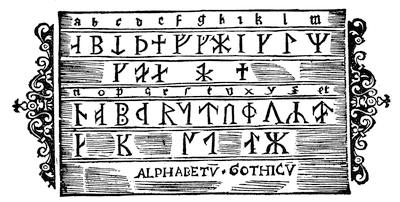
FROM OLAUS MAGNUS.
Fac-simile of a cut to the chapter “De Alphabeto Gothorum” in the Historia de Gentibus Septentrionalibus (Romæ, M.D.LV.).
We may consider, then, that the weight of probability[525] is in favor of a Northman descent upon the coast of the American mainland at some point, or at several, somewhere to the south of Greenland; but the evidence is hardly that which attaches to well-established historical records.
The archæological traces, which are lacking farther south, are abundant in Greenland, and confirm in the most positive way the Norse occupation. The ruins of churches and baptisteries give a color of truth to the ecclesiastical annals which have come down to us, and which indicate that after having been for more than a century under the Bishop of Iceland, a succession of bishops of its own was established there early in the twelfth century. The names of seventeen prelates are given by Torfæus, though it is not quite certain that the bishops invariably visited their see. The last known to have filled the office went thither in the early years of the fifteenth century. The last trace of him is in the celebration of a marriage at Gardar in 1409.
The Greenland colonists were equipped with all the necessities of a permanent life. They had horses, sheep, and oxen, and beef is said to have been a regular article of export to Norway. They had buildings of stone, of which the remains still exist. They doubtless brought timber from the south, and we have in runic records evidence of their explorations far to the north. They maintained as late as the thirteenth century a regular commercial intercourse with the mother country,[526] but this trade fell into disuse when a royal mandate constituted such ventures a monopoly of the throne; and probably nothing so much conduced to the decadence and final extinction of the colonies as this usurped and exclusive trade, which cut off all personal or conjoined intercourse.
The direct cause of the final extinction of the Greenland colonies is involved in obscurity, though a variety of causes, easily presumable, would have been sufficient, when we take into consideration the moribund condition into which they naturally fell after commercial restriction had put a stop to free intercourse with the home government.
The Eskimos are said to have appeared in Greenland about the middle of the fourteenth century, and to have manifested hostility to such a degree that about 1342 the imperilled western colony was abandoned. The eastern colony survived perhaps seventy years longer, or possibly to a still later period. We know they had a new bishop in 1387, but before the end of that century the voyages to their relief were conducted only after long intervals.
Before communication was wholly cut off, the attacks of the Skrælings, and possibly famine and the black death, had carried the struggling colonists to the verge of destruction. Bergen, in Norway, upon which they depended for succor, had at one time been almost depopulated by the same virulent disease, and again had been ravaged by a Hanseatic fleet. Thus such intercourse as the royal monopoly permitted had become precarious, and the marauding of freebooters, then prevalent in northern waters, still further served to impede the communications, till at last they wholly ceased, during the early years of the fifteenth century.
It has sometimes been maintained that the closing in of ice-packs was the final stroke which extinguished the last hopes of the expiring colonists.[527] This view, however, meets with little favor among the more enlightened students of climatic changes, like Humboldt.[528]
There has been published what purports to be a bull of Pope Nicholas V,[529] directing the Bishop of Iceland to learn what he could of the condition of the Greenland colonies, and in this document it is stated that part of the colonists had been destroyed by barbarians thirty years before,—the bull bearing date in 1448. There is no record that any expedition followed upon this urging, and there is some question as to the authenticity of the document.[530] In the Relation of La Peyrère there is a story of some sailors visiting Greenland so late as 1484; but it is open to question.
Early in the sixteenth century fitful efforts to learn the fate of the colonies began, and these were continued, without result, well into the seventeenth century; but nothing explicable was ascertained till, in 1721, Hans Egede, a Norwegian priest, prevailed upon the Danish government to send him on a mission to the Eskimos. He went, accompanied by wife and children; and the colony of Godthaab, and the later history of the missions, and the revival of trade with Europe, attest the constancy of his purpose and the fruits of his earnestness. In a year he began to report upon certain remains which indicated the former occupation of the country by people who built such buildings as was the habit in Europe. He and his son Paul Egede, and their successors in the missions, gathered for us, first among modern searchers, the threads of the history of this former people; and, as time went on, the researches of Graah, Nordenskjöld, and other explorers, and the studious habits of Major, Rink, and the rest among the investigators, have enabled us to read the old sagas of the colonization of Greenland with renewed interest and with the light of corroborating evidence.[531]
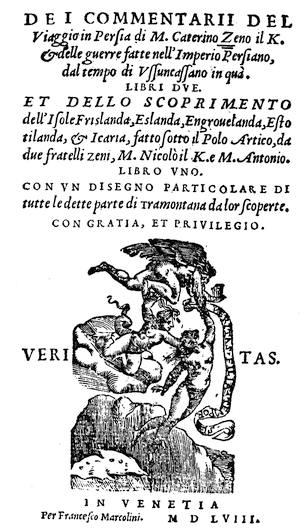
We are told that it was one result of these Northman voyages that the fame of them spread to other countries, and became known among the Welsh, at a time when, upon the death of Owen Gwynedd, who ruled in the northern parts of that country, the people were embroiled in civil strife. That chieftain’s son, Prince Madoc, a man bred to the sea, was discontented with the unstable state of society, and resolved to lead a colony to these western lands, where they could live more in peace.
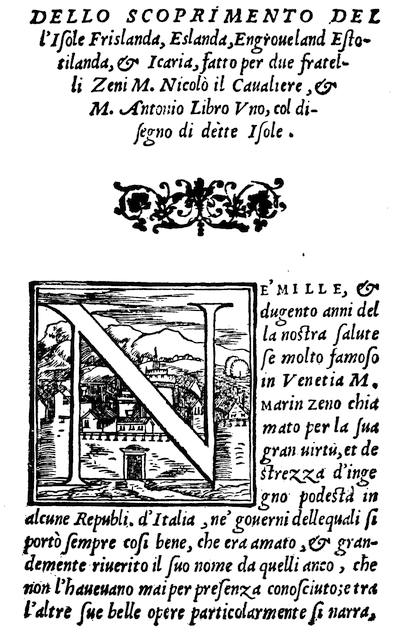
Note.—The cuts above are facsimiles of the title and of the first page of the section on Frisland, etc., from the Harvard College copy. The book is rare. The Beckford copy brought £50; the Hamilton, £38; the Tross catalogue (1882) price one at 150 francs; the Tweitmeyer, Leipzig, 1888, at 250 marks; Quaritch (1885), at £25. Cf. Court Catalogue, no. 378; Leclerc, no. 3002; Dufossé, no. 4965; Carter-Brown, i. 226; Murphy, nos. 2798-99. The map is often in fac-simile, as in the Harvard College copy.
Accordingly, in a.d. 1170, going seaward on a preliminary exploration by the south of Ireland, he steered west, and established a pioneer colony in a fertile land. Leaving here 120 persons, he returned to Wales, and fitted out a larger expedition of ten ships, with which he again sailed, and passed out of view forever. The evidence in support of this story is that it is mentioned in early annals, and that sundry persons have discovered traces of the Welsh tongue among the lighter-colored American Indians, to say nothing of manifold legends among the Indians of an original people, white in color, coming from afar towards the northeast,—proofs not sufficient to attract the confidence of those who look for historical tests, though, as Humboldt contends,[532] there may be no impossibility in the story.
There seems to be a general agreement that a crew of Arabs, somewhere about the eleventh or twelfth century, explored the Atlantic westward, with the adventurous purpose of finding its further limits, and that they reached land, which may have been the Canaries, or possibly the Azores, though the theory that they succeeded in reaching America is not without advocates. The main source of the belief is the historical treatise of the Arab geographer Edrisi, whose work was composed about the middle of the twelfth century.[533]
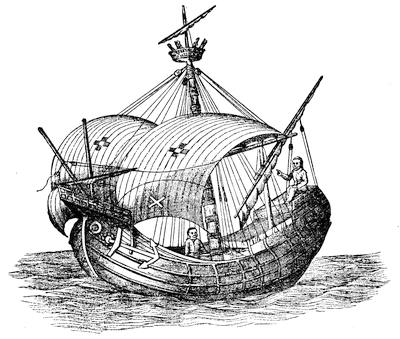
SHIP OF THE FIFTEENTH CENTURY.
From the Isolario (Venice, 1547).
In the latter part of the fourteenth century,[534] as the story goes, two brothers of Venice, Nicolo and Antonio Zeno, being on a voyage in the North Atlantic were wrecked there, and lived for some years at Frislanda, and visited Engroneland. During this northern sojourn they encountered a sailor, who, after twenty-six years of absence, had returned, and reported that the ship in which he was had been driven west in a gale to an island, where he found civilized people, who possessed books in Latin and could not speak Norse, and whose country was called Estotiland; while a region on the mainland, farther south, to which he had also gone, was called Drogeo, and that here he had encountered cannibals. Still farther south was a great country with towns and temples. This information, picked up by these exiled Zeni, was finally conveyed to another brother in Venice, accompanied by a map of these distant regions. These documents long remained in the family palace in Venice, and were finally neglected and became obscured, until at last a descendant of the family compiled from them, as best he could, a book, which was printed in Venice in 1558 as Dei Commentarii del Viaggio, which was accompanied by a map drawn with difficulty from the half obliterated original which had been sent from Frislanda.[535] The original documents were never produced, and the publication took place opportunely to satisfy current curiosity, continually incited by the Spanish discoveries. It was also calculated to appeal to the national pride of Italy, which had seen Spain gain the glory of her own sons, Columbus and Vespucius, if it could be established that these distant regions, of which the Zeni brothers so early reported tidings, were really the great new world.[536] The cartography of the sixteenth century shows that the narrative and its accompanying map made an impression on the public mind, but from that day to this it has been apparent that there can be no concurrence of opinion as to what island the Frislanda of the Zeni was, if it existed at all except in some disordered or audacious mind; and, as a matter of course, the distant regions of Estotiland and Drogeo have been equally the subject of belief and derision. No one can be said wholly to have taken the story out of the category of the uncertain.
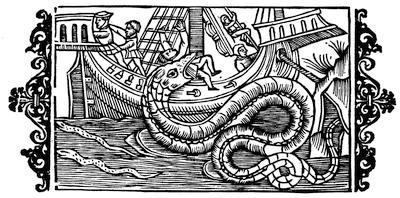
THE SEA OF DARKNESS.
(From Olaus Magnus.)
The presence of the Basques on the coasts of North America long before the voyage of Columbus is often asserted,[537] and there is no improbability in a daring race of seamen, in search of whales, finding a way to the American waters. There are some indications in the early cartography which can perhaps be easily explained on this hypothesis;[538] there are said to be unusual linguistic correspondences in the American tongues with those of this strange people.[539] There are the reports of the earliest navigators, who have left indisputable records that earlier visitors from Europe had been before them, and Cabot may have found some reminders of such;[540] and it is even asserted that it was a Basque mariner, who had been on the Newfoundland banks, and gave to Columbus some premonitions of the New World.[541]
Certain claims of the Dutch have also been advanced;[542] and one for an early discovery of Newfoundland, in 1463-64, by John Vas Costa Cortereal was set forth by Barrow in his Chronological Hist. of Voyages into the Arctic Regions (London, 1818); but he stands almost alone in his belief.[543] Biddle in his Cabot has shown its great improbability.
In the years while Columbus was nourishing his purpose of a western voyage, there were two adventurous navigators, as alleged, who were breasting the dangers of the Sea of Darkness both to the north and to the south. It cannot be said that either the Pole Skolno, in his skirting the Labrador coasts in 1476,[544] or the Norman Cousin, who is thought to have traversed a part of the South American coast in 1488-89,[545] have passed with their exploits into the accepted truths of history; but there was nothing improbable in what was said of them, and they flourish as counter-rumors always survive when attendant upon some great revelation like that of Columbus.

CRITICAL NOTES ON THE SOURCES OF INFORMATION.
The ethnic unity of the American races, as urged by Morton and others, hardly meets the requirements of the problem in the opinion of most later students, like Sir Daniel Wilson, for instance; and yet, if A. H. Keane represents, as he claims, the latest ethnological beliefs, the connection with Asia, of the kind that forms ethnic traces, must have been before the history of the present Asiatic races, since the correspondence of customs, etc. is not sufficient for more recent affiliation.[546] It should be remembered also, that if this is true, and if there is the strong physical resemblance between Asiatics and the indigenous tribes of the northwest coast which early travellers and physiologists have dwelt on, we have in such a correspondence strong evidence of the persistency of types.[547]
The Asiatic theory was long a favorite one. So popular a book as Lafitau’s Mœurs des Sauvages (Paris, 1724) advocated it. J. B. Scherer’s Recherches historiques et géographiques sur le nouveau monde (Paris, 1777) was on the same side. One of the earliest in this country, Benj. Smith Barton, to give expression to American scholarship in this field held like opinions in his New Views of the Origin of the Tribes of America (Philad., 1797).[548] Twenty years later (1816) one of the most active of the American men of letters advocated the same views,—Samuel L. Mitchell in the Archæologia Americana (i. 325, 338, 346). The weightiest authority of his time, Alex. von Humboldt, formulated his belief in several of his books: Vues des Cordillères; Ansichten der Natur; Cosmos.[549]
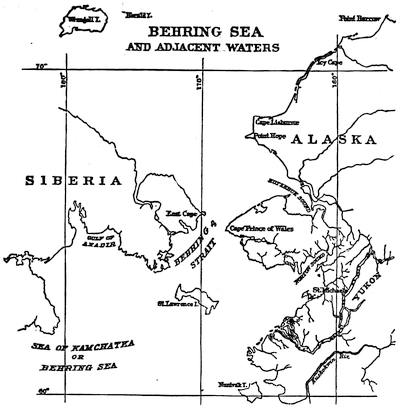
Note.—Sketch map from the U. S. Geodetic Survey, 1880, App. xvi; also in Journal Amer. Geog. Soc., xv. p. 114. Cf. Bancroft’s Nat. Races, i. 35.
Of the northern routes, that by Behring’s Straits is the most apparent, and Lyell says that when half-way over Dover Straits, which have not far from the same dimensions, he saw both the English and French shores at the same time, he was easily convinced that the passage by Behring’s Straits solved many of the difficulties of the American problem.[550]
The problem as to the passage by the Aleutian Islands is converted into the question whether primitive people could have successfully crossed an interval from Asia of 130 miles to reach the island Miedna, 126 more to Behring’s Island, and then 235 to Attu, the westernmost of the Aleutian Islands, or nearly 500 miles in all, and to have crossed in such numbers as to affect the peopling of the new continent. There are some, like Winchell, who see no difficulty in the case.[551] There are no authenticated relics, it is believed, to prove the Tartar occupancy of the northwest of America.[552] That there have been occasional estrays upon the coasts of British Columbia, Oregon, and California, by the drifting thither of Chinese and Japanese junks, is certainly to be believed; but the argument against their crews peopling the country is usually based upon the probable absence of women in them,—an argument that certainly does not invalidate the belief in an infusion of Asiatic blood in a previous race.[553]
The easterly passage which has elicited most interest is one alleged to have been made by some Buddhist priests to a country called Fusang, and in proof of it there is cited the narrative of one Hœi-Shin, who is reported to have returned to China in a.d. 499. Beside much in the story that is ridiculous and impossible, there are certain features which have led some commentators to believe that the coast of Mexico was intended, and that the Mexican maguey plant was the tree fusang, after which the country is said to have been called. The story was first brought to the attention of Europeans in 1761, when De Guignes published his paper on the subject in the 28th volume (pp. 505-26) of the Academy of Inscriptions.[554] It seems to have attracted little attention till J. H. von Klaproth, in 1831, discredited the American theory in his “Recherches sur le pays de Fousang,” published in the Nouvelles Annales des Voyages (2d ser., vol. xxi.), accompanied by a chart. In 1834 there appeared at Paris a French translation, Annales des Empereurs du Japon (Nipon o dai itsi rau), to which (vol. iv.) Klaproth appended an “Aperçu de l’histoire mythologique du Japon,” in which he returned to the subject, and convinced Humboldt at least,[555] that the country visited was Japan, and not Mexico, though he could but see striking analogies, as he thought, in the Mexican myths and customs to those of the Chinese.[556]
In 1841, Karl Friedrich Neumann, in the Zeitschrift für allgemeine Erdkunde (new series, vol. xvi.), published a paper on “Ost Asien und West Amerika nach Chinesischen Quellen aus dem fünften, sechsten und siebenten Jahrhundert,” in which he gave a version of the Hœi-shin (Hœi-schin, Hui-shën) narrative, which Chas. G. Leland, considering it a more perfect form of the original than that given by De Guignes, translated into English in The Knickerbocker Mag. (1850), xxxvi. 301, as “California and Mexico in the fifth century.”[557]
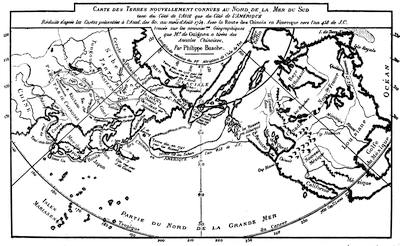
Note.—The map of Buache, 1752, showing De Guignes’ route of the Chinese emigration to Fusang. Reduced from the copy in the Congrès internationale des Américanistes, Compte Rendu, Nancy, 1875.
The next to discuss the question, and in an affirmative spirit, was Charles Hippolyte de Paravey, in the Annales de Philosophie Chrétienne (Feb., 1844), whose paper was published separately as L’Amérique sous le nom de pays de Fou-Sang, est elle citée dès le 5e siècle de notre ère, dans les grandes annales de la Chine, etc. Discussion ou dissertation abrégée, où l’affirmative est prouvée (Paris, 1844); and in 1847 he published Nouvelles preuves que le pays du Fousang est l’Amérique.[558]
The controversy as between De Guignes and Klaproth was shared, in 1862, by Gustave d’Eichthal, taking the Frenchman’s side, in the Revue Archéologique (vol. ii.), and finally in his Etudes sur les origines Bouddhiques de la civilisation Américaine (Paris, 1865).[559]
In 1870, E. Bretschneider, in his “Fusang, or who discovered America?” in the Chinese Recorder and Missionary Journal (Foochow, Oct., 1870), contended that the whole story was the fabrication of a lying priest.[560]
In 1875 there was new activity in discussing the question. Two French writers of considerable repute in such studies attracted attention: the one, Lucien Adam, in the Congrès des Américanistes at Nancy (Compte Rendu, i. 145); and the other, Léon de Rosny, entered the discussions at the same session (Ibid. i. p. 131).[561]
The most conspicuous study for the English reader was Charles Godfrey Leland’s Fusang, or The discovery of America by Chinese Buddhist priests in the fifth century (London, 1875).[562]
The Marquis d’Hervey de Saint Denis published in the Actes de la Soc. d’Ethnographie (1869), vol. vi., and later in the Comptes Rendus of the French Academy of Inscriptions, a Mémoire sur le pays connu des anciens Chinois sous le nom de Fousang, et sur quelques documents inédits pour servir à l’identifier, which was afterwards published separately in Paris, 1876, in which he assented to the American theory. The student of the subject need hardly go, however, beyond E. P. Vining’s An inglorious Columbus: or, Evidence that Hwui Shăn and a party of Buddhist monks from Afghanistan discovered America in the fifth century a.d. (New York, 1885), since the compiler has made it a repository of all the essential contributions to the question from De Guignes down. He gives the geographical reasons for believing Fusang to be Mexico (ch. 20), comparing the original description of Fusang with the early accounts of aboriginal Mexico, and rehearsing the traditions, as is claimed, of the Buddhists still found by the Spaniards pervading the memories of the natives, and at last (ch. 37) summarizing all the grounds of his belief.[563]
The consideration of the Polynesian route as a possible avenue for peopling America involves the relations of the Malays to the inhabitants of the Oceanic Islands and the capacity of early man to traverse long distances by water.[564]
E. B. Tylor has pointed out the Asiatic relations of the Polynesians in the Journal of the Anthropological Inst., xi. 401. Pickering, in the ethnological chart accompanying the reports of the Wilkes Expedition, makes the original people of Chili and Peru to be Malay, and he connects the Californians with the Polynesians.[565]
The earliest elaboration of this theory was in John Dunmore Lang’s View of the origin and migrations of the Polynesian nations, demonstrating their ancient discovery and progressive settlement of the continent of America (London, 1834; 2d ed., Sydney, 1877). /Francis A. Allen has advanced similar views at the meetings of the Congrès des Américanistes at Luxembourg and at Copenhagen.[566]
The Mongol theory of the occupation of Peru, which John Ranking so enthusiastically pressed in his Historical researches on the conquest of Peru, Mexico, Bogota, Natchez, and Talomeco, in the thirteenth century, by the Mongols, accompanied with elephants; and the local agreement of history and tradition, with the remains of elephants and mastodontes found in the new world [etc.] (London, 1827), implies that in the thirteenth century the Mongol emperor Kublai Khan sent a fleet against Japan, which, being scattered in a storm, finally in part reached the coasts of Peru, where the son of Kublai Khan became the first Inca.[567] The book hardly takes rank as a sensible contribution to ethnology, and Prescott says of it that it embodies “many curious details of Oriental history and manners in support of a whimsical theory.”[568]
There have been of late years two considerable attempts to establish the historical verity of some of these alleged Irish visits.[577]
Respecting the body of the sagas, Laing (Heimskringla, i. 23) says: “It does not appear that any saga manuscript now existing has been written before the fourteenth century, however old the saga itself may be. It is known that in the twelfth century, Are Frode, Sæmund and others began to take the sagas out of the traditionary state and fix them in writing; but none of the original skins appear to have come down to our time, but only some of the numerous copies of them.” Laing (p. 24) also instances numerous sagas known to have existed, but they are not now recognized;[581] and he gives us (p. 30) the substance of what is known respecting the writers and transcribers of this early saga literature. It is held that by the beginning of the thirteenth century the sagas of the discoveries and settlements had all been put in writing, and thus the history, as it exists, of mediæval Iceland is, as Burton says (Ultima Thule, i. 237), more complete than that of any European country.[582]
Among the secondary writers, using either at first or second hand the early MS. sources, the following may be mentioned:—
One of the earliest brought to the attention of the English public was A Compendious Hist. of the Goths, Swedes and Vandals, and other northern powers (London, 1650 and 1658), translated in an abridged form from the Latin of Olaus Magnus, which had been for more than a hundred years the leading comprehensive authority on the northern nations. The Svearikes Historia (Stockholm, 1746-62) of Olof von Dalin and the similar work of Sven Lagerbring (1769-1788), covering the early history of the north, are of interest for the comparative study of the north, rather than as elucidating the history of Iceland in particular.[583] More direct aid will be got from Mallet’s Northern Antiquities (London edition, 1847) and from Wheaton’s Northmen. More special is the Histoire de l’Island of Xavier Marmier; and the German historian F. C. Dahlman also touches Iceland with particular attention in his Geschichte von Dänemark bis zur Reformation, mit Inbegriff von Norwegen und Island (Hamburg, 1840-43).
A history of more importance than any other yet published, and of the widest scope, was that of Sweden by E. J. Geijer (continued by F. F. Carlson), which for the early period (down to 1654) is accessible in English in a translation by J. H. Turner (London, 1845).[584]
Prominent among the later school of northern historians, all touching the Icelandic annals more or less, have been Peter Andreas Munch in his Det Norske Folks Historie (Christiania, 1852-63);[585] N. M. Petersen in his Danmarks Historie i Hedenold (Copenhagen, 1854-55); K. Keyser in his Norges Historie (Christiania, 1866-67); J. E. Sars in his Udsigt over den Norske Historie (Christiania, 1873-77); but all are surpassed by Konrad Maurer’s Island von seiner ersten Entdeckung bis zum Untergange des Freistaates,—a.d. 800-1262 (Munich, 1874), published as commemorating the thousandth anniversary of the settlement of Iceland, and it has the repute of being the best book on early Icelandic history.[586]
The change from Paganism to Christianity necessarily enters into all the histories covering the tenth and eleventh centuries; but it has special treatment in C. Merivale’s Conversion of the Northern Nations (Boyle lectures,—London, 1866).[587]
There is a considerable body of the later literature upon Iceland, retrospective in character, and affording the results of study more or less patient as to the life in the early Norse days in Iceland.[588]
G.W. Dasent’s introduction to his Story of Burnt Njal (Edinburgh, 1861)[589] and his Norsemen in Iceland (Oxford Essays, 1858) give what Max Müller (Chips from a German Workshop, ii. 191) calls “a vigorous and lively sketch of primitive northern life;” and are well supplemented by Sabine Baring-Gould’s Iceland, its scenes and sagas (London, 1863 and later), and Richard F. Burton’s Ultima Thule, with an historical introduction (London, 1875).[590]
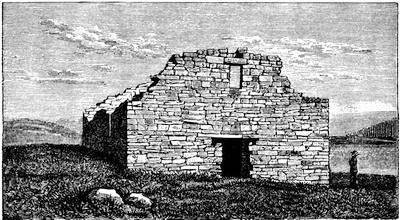
RUINS OF THE CHURCH AT KATORTOK.
After a cut in Nordenskjöld’s Den Andra Dicksonska Expeditionen till Grönland, p. 369, following one in Efter Meddelelser om Grönland.
Crantz says of his own historic aims, referring to Torfæus and to the accounts given by the Eskimos of the east coast, that he has tried to investigate “where the savage inhabitants came from, and how the ancient Norwegian inhabitants came to be so totally extirpated,” while at the same time he looks upon the history of the Moravian missions as his chiefest theme.
The principal source for the identification of the ruins of Greenland is the work compiled by Rafn and Finn Magnusen, Grönlands Historiske Mindesmærker,[594] with original texts and Danish versions. Useful summaries and observations will be found in the paper by K. Steenstrup on “Old Scandinavian ruins in South Greenland” in the Compte Rendu, Congrès des Américanistes (Copenhagen, 1883, p. 108), and in one on “Les Voyages des Danois au Greenland” in the same (p. 196). Steenstrup’s paper is accompanied by photographs and cuts, and a map marking the site of the ruins. The latest account of them is by Lieut. Holm in the Meddelelser om Grönland (Copenhagen, 1883), vol. vi. Other views and plans showing the arrangement of their dwellings and the curious circular ruins,[595] which seems to have usually been near their churches, are shown in the Baron Nordenskjöld’s Den andra dicksonska expeditionen till Grönland, dess inre isöken och dess ostkust, utförd år 1883 (Stockholm, 1885), the result of the ripest study and closest contact.
We need also to scan the narratives of Hans Egede and Graah. Parry found in 1824, on an island on the Baltic coast, a runic stone, commemorating the occupancy of the spot in 1135 (Antiquitates Americanæ; Mallet’s Northern Antiquities, 248); and in 1830 and 1831 other runes were found on old gravestones (Rink’s Danish Greenland, app. v.; Laing’s Heimskringla, i. 151). These last are in the Museum at Copenhagen. Most of these imperishable relics have been found in the district of Julianeshaab.[596]
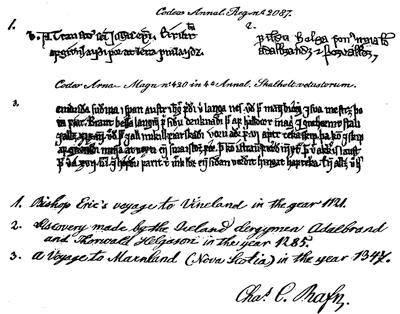
SAGA MANUSCRIPT.
This is a portion of one of the plates in the Antiquitates Americanæ, given by Rafn to Charles Sumner, with a key in manuscript by Rafn himself. His signature is from a copy of his Mémoire given by him to Edward Everett, and now in Harvard College library.
In regard to the credibility of the sagas, the northern writers recognize the change which came over the oral traditionary chronicles when the romancing spirit was introduced from the more southern countries, at a time while the copies of the sagas which we now have were making, after having been for so long a time orally handed down; but they are not so successful in making plain what influence this imported spirit had on particular sagas, which we are asked to receive as historical records. They seem sometimes to forget that it is not necessary to have culture, heroes, and impossible occurrences to constitute a myth. A blending of history and myth prompts Horn to say “that some of the sagas were doubtless originally based on facts, but the telling and re-telling have changed them into pure myths.” The unsympathetic stranger sees this in stories that the patriotic Scandinavians are over-anxious to make appear as genuine chronicles.[597] It is certainly unfortunate that the period of recording the older sagas coincides mainly with the age of this southern romancing influence.[598] It is a somewhat anomalous condition when long-transmitted oral stories are assigned to history, and certain other written ones of the age of the recorded sagas are relegated to myth. If we would believe some of the northern writers, what appears to be difference in kind of embellishment was in reality the sign that separated history from fable.[599] Of the interpreters of this olden lore, Torfæus has been long looked upon as a characteristic exemplar, and Horn[600] says of his works that they are “perceptibly lacking in criticism. Torfæus was upon the whole incapable of distinguishing between myth and history.”[601]
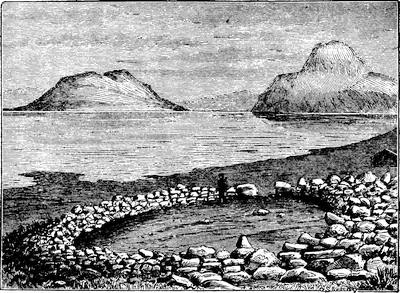
RUIN AT KATORTOK.
After a cut in Nordenskjöld’s Exped. till Grönland, p. 371, following the Meddel. om Grönland, vi. 98.
Erasmus Rask, in writing to Wheaton in 1831,[602] enumerates eight of the early manuscripts which mention Vinland and the voyages; but Rafn, in 1837, counted eighteen such manuscripts.[603] We know little or nothing about the recorders or date of any of these copies, excepting the Heimskringla,[604] nor how long they had existed orally. Some of them were doubtless put into writing soon after the time when such recording was introduced, and this date is sometimes put as early as a.d. 1120, and sometimes as late as the middle or even end of that century. Meanwhile, Adam of Bremen, in the latter part of the eleventh century (a.d. 1073), prepared his Historia Ecclesiastica, an account of the spread of Christianity in the north, in which he says he was told by the Danish king that his subjects had found a country to the west, called Winland.[605] A reference is also supposed to be made in the Historia Ecclesiastica of Ordericus Vitalis, written about the middle (say a.d. 1140) of the twelfth century. But it was not until somewhere between a.d. 1385 and 1400 that the oldest Icelandic manuscript which exists, touching the voyages, was compiled,—the so-called Codex Flatoyensis,[606] though how much earlier copies of it were made is not known. It is in this manuscript that we find the saga of Olaf Tryggvesson,[607] wherein the voyages of Leif Ericson are described, and it is only by a comparison of circumstances detailed here and in other sagas that the year a.d. 1000 has been approximately determined as the date.[608] In this same codex we find the saga of Eric the Red, one of the chief narratives depended upon by the advocates of the Norse discovery, and in Rask’s judgment it “appears to be somewhat fabulous, written long after the event, and taken from tradition.”[609]
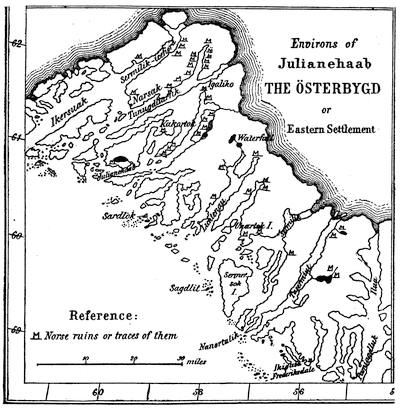
Note.—The above is a reproduction of a corner map in the map of Danish Greenland given in Rink’s book of that name. The sea in the southwest corner of the cut is not shaded; but shading is given to the interior ice field on the northern and northeastern part of the map. Rink gives a similar map of the Westerbygd.
The other principal saga is that of Thorfinn Karlsefne, which with some differences and with the same lack of authenticity, goes over the ground covered by that of Eric the Red.[610]
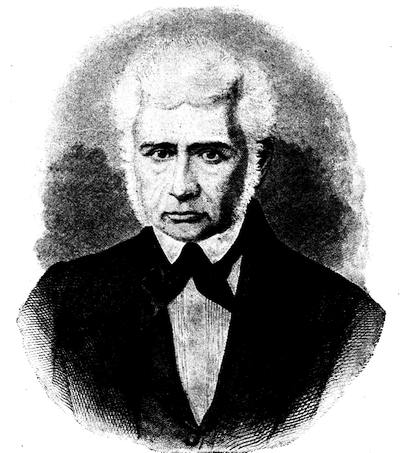
RAFN.
Of all the early manuscripts, the well-known Heimskringla of Snorro Sturleson (b. 1178; d. 1241), purporting to be a history of the Norse kings down to a.d. 1177, is the most entitled to be received as an historical record, and all that it says is in these words: “Leif also found Vinland the Good.”[611]
Saxo Grammaticus (d. about 1208) in his Historia Danica begins with myths, and evidently follows the sagas, but does not refer to them except in his preface.[612]
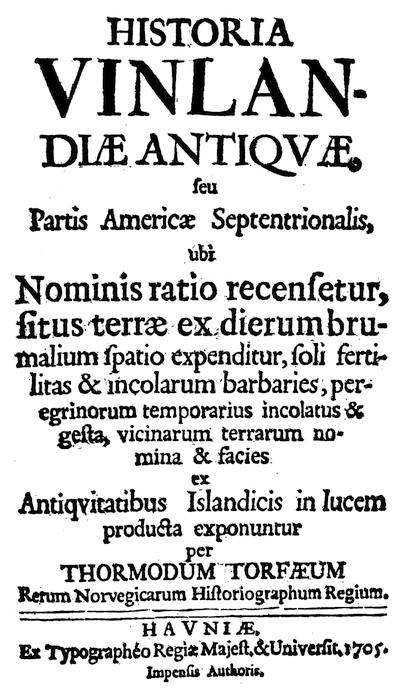
For about five hundred years after this the stories attracted little or no attention.[613] We have seen that Peringskiöld produced these sagas in 1697. Montanus in his Nieuwe en onbekende Weereld (Amsterdam, 1671), and Campanius, in 1702, in his Kort Beskrifning om Provincien Nya Swerige uti America (Stockholm),[614] gave some details. The account which did most, however, to revive an interest in the subject was that of Torfæus in his Historia Vinlandiæ Antiquæ (Copenhagen, 1705), but he was quite content to place the scene of his narrative in America, without attempting to identify localities.[615] The voyages were, a few years later, the subject of a dissertation at the University of Upsala in Sweden.[616] J. P. Cassell, of Bremen, discusses the Adam of Bremen story in another Latin essay, still later.[617]
About 1750, Pieter Kalm, a Swede, brought the matter to the attention of Dr. Franklin, as the latter remembered twenty-five years later, when he wrote to Samuel Mather that “the circumstances gave the account a great appearance of authenticity.”[618] In 1755, Paul Henri Mallet (1730-1807), in his Histoire de Dannemarc, determines the localities to be Labrador and Newfoundland.[619]
In 1769, Gerhard Schöning, in his Norges Riges Historie, established the scene in America. Robertson, in 1777, briefly mentions the voyages in his Hist. of America (note xvii.), and, referring to the accounts given by Peringskiöld, calls them rude and confused, and says that it is impossible to identify the landfalls, though he thinks Newfoundland may have been the scene of Vinland. This is also the belief of J. R. Forster in his Geschichte der Entdeckungen im Norden (Frankfurt, 1784).[620] M. C. Sprengel, in his Geschichte der Europäer in Nordamerika (Leipzig, 1782), thinks they went as far south as Carolina. Pontoppidan’s History of Norway was mainly followed by Dr. Jeremy Belknap in his American Biography (Boston, 1794), who recognizes “circumstances to confirm and none to disprove the relations.” In 1793, Muñoz, in his Historia del Nuevo Mundo, put Vinland in Greenland. In 1796 there was a brief account in Fritsch’s Disputatio historico-geographica in qua quæritur utrum veteres Americam noverint necne. H. Stenström published at Lund, in 1801, a short dissertation, De America Norvegis ante tempora Columbi adita. Boucher de la Richarderie, in his Bibliothèque Universelle des Voyages (Paris, 1808), gives a short account, and cites some of the authorities. Some of the earlier American histories of this century, like Williamson’s North Carolina, took advantage of the recitals of Torfæus and Mallet. Ebenezer Henderson’s Residence in Iceland (1814-15)[621] presented the evidence anew. Barrow, in his Voyages to the Arctic Regions (London, 1818), places Vinland in Labrador or Newfoundland; but J. W. Moulton, in his History of the State of New York (N. Y., 1824), brings that State within the region supposed to have been visited.
A writer more likely to cause a determinate opinion in the public mind came in Washington Irving, who in his Columbus (London, 1828) dismissed the accounts as untrustworthy; though later, under the influence of Wheaton and Rafn, he was inclined to consider them of possible importance; and finally in his condensed edition he thinks the facts “established to the conviction of most minds.”[622] Hugh Murray, in his Discoveries and Travels in North America (London, 1829), regards the sagas as an authority; but he doubts the assigning of Vinland to America. In 1830, W. D. Cooley, in his History of Maritime and Inland Discovery,[623] thought it impossible to shake the authenticity of the sagas.
While Henry Wheaton was the minister of the United States at Copenhagen, and having access to the collections of that city, he prepared his History of the Northmen, which was published in London and Philadelphia in 1831.[624] The high character of the man gave unusual force to his opinions, and his epitome of the sagas in his second chapter contributed much to increase the interest in the Northmen story. He was the first who much impressed the New England antiquaries with the view that Vinland should be looked for in New England; and a French version by Paul Guillot, issued in Paris in 1844, is stated to have been “revue et augmentée par l’auteur, avec cartes, inscriptions, et alphabet runique.”[625] The opinions of Wheaton, however, had no effect upon the leading historian of the United States, nor have any subsequent developments caused any change in the opinion of Bancroft, first advanced in 1834, in the opening volume of his United States, where he dismissed the sagas as “mythological in form and obscure in meaning; ancient yet not contemporary.” He adds that “the intrepid mariners who colonized Greenland could easily have extended their voyage to Labrador; but no clear historical evidence establishes the natural probability that they accomplished the passage.”[626] All this is omitted by Bancroft in his last revised edition; but a paragraph in his original third volume (1840), to the intent that, though “Scandinavians may have reached the shores of Labrador, the soil of the United States has not one vestige of their presence,” is allowed to remain,[627] and is true now as when first written.
The chief apostle of the Norseman belief, however, is Carl Christian Rafn, whose work was accomplished under the auspices of the Royal Society of Northern Antiquaries at Copenhagen.[628]
Rafn was born in 1795, and died at Copenhagen in 1864.[629] At the University, as well as later as an officer of its library, he had bent his attention to the early Norse manuscripts and literature,[630] so that in 1825 he was the natural founder of the Royal Society of Northern Antiquaries; and much of the value of its long series of publications is due to his active and unflagging interest.[631] The summit of his American interest, however, was reached in the great folio Antiquitates Americanæ,[632] in which he for the first time put the mass of original Norse documents before the student, and with a larger accumulation of proofs than had ever been adduced before, he commented on the narratives and came to conclusions respecting traces of their occupancy to which few will adhere to-day.
The effect of Rafn’s volume, however, was marked, and we see it in the numerous presentations of the subject which followed; and every writer since has been greatly indebted to him.
Alexander von Humboldt in his Examen Critique (Paris, 1837) gave a synopsis of the sagas, and believed the scene of the discoveries to be between Newfoundland and New York; and in his Cosmos (1844) he reiterated his views, holding to “the undoubted first discovery by the Northmen as far south as 41° 30’.”[633]
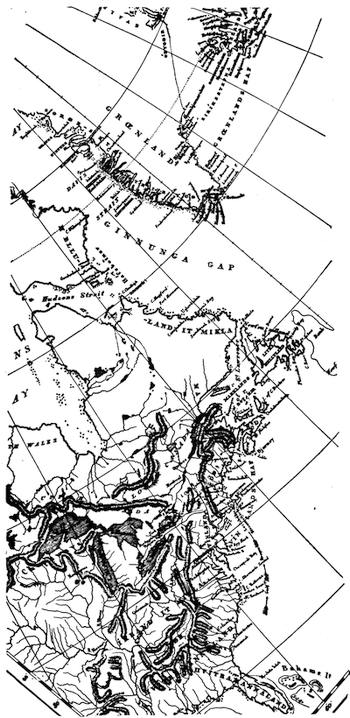
NORSE AMERICA.
Opposite is a section of Rafn’s map in the Antiquitates Americanæ, giving his identification of the Norse localities. This and the other map by Rafn is reproduced in his Cabinet d’Antiquités Américaines (Copenhagen, 1858). The map in the atlas of St. Martin’s Hist. de la Géographie does not track them below Newfoundland. The map in J. T. Smith’s Northmen in New England (Boston, 1839) shows eleven voyages to America from Scandinavia, a.d. 861-1285. Cf. map in Wilhelmi’s Island, etc. (Heidelberg, 1842).
Two books which for a while were the popular treatises on the subject were the immediate outcome of Rafn’s book. The first of these was The Northmen in New England, giving the stories in the form of a dialogue, by Joshua Toulmin Smith (Boston, 1839), which in a second edition (London, 1842) was called The Discovery of America by the Northmen in the Tenth Century.
The other book was largely an English version of parts of Rafn’s book, translating the chief sagas, and reproducing the maps: Nathaniel Ludlow Beamish’s Discovery of America by the Northmen in the Tenth Century (London, 1841).[634] Two German books owed almost as much to Rafn, those of K. Wilhelmi[635] and K. H. Hermes.[636] Prescott, at this time publishing the third volume of his Mexico (1843), accords to Rafn the credit of taking the matter out of the category of doubt, but he hesitates to accept the Dane’s identifications of localities; but R. H. Major, in considering the question in the introduction to his Select letters of Columbus (1847), finds little hesitation in accepting the views of Rafn, and thinks “no room is left for disputing the main fact of discovery.”
When Hildreth, in 1849, published his United States, he ranged himself, with his distrusts, by the side of Bancroft but J. Elliot Cabot, in making a capital summary of the evidence in the Mass. Quarterly Review (vol. ii.), accords with the believers, but places the locality visited about Labrador and Newfoundland. Haven in his Archæology of the United States (Washington, 1856) regards the discovery as well attested, and that the region was most likely that of Narragansett Bay. C. W. Elliott in his New England History (N. Y., 1857) holds the story to be “in some degree mythical.” Palfrey in his Hist. of New England (Boston, 1858) goes no farther than to consider the Norse voyage as in “nowise unlikely,” and Oscar F. Peschel in his Geschichte des Zeitalters der Entdeckungen (Stuttgart, 1858) is on the affirmative side. Paul K. Sinding goes over the story with assent in his History of Scandinavia,—a book not much changed in his Scandinavian Races (N. Y., 1878).[637] Eugène Beauvois did little more than translate from Rafn in his Découvertes des Scandinaves en Amérique,—fragments de Sagas Islandaises traduits pour la première fois en français (Paris, 1859)—an extract from the Revue Orientale et Américaine (vol. ii.).[638]
Professor Daniel Wilson, of Toronto, has discussed the subject at different times, and with these conclusions: “With all reasonable doubts as to the accuracy of details, there is the strongest probability in favor of the authenticity of the American Vinland.... The data are the mere vague allusions of a traveller’s tale, and it is indeed the most unsatisfactory feature of the sagas that the later the voyages the more confused and inconsistent their narratives become in every point of detail.”[639]
Dr. B. F. De Costa’s first book on the subject was his Pre-Columbian Discovery of America by the Northmen, illustrated by Translations from the Icelandic Sagas, edited with notes and a general introduction (Albany, 1868). It is a convenient gathering of the essential parts of the sagas; but the introduction rather opposes than disproves some of the “feeble paragraphs, pointed with a sneer,” which he charges upon leading opponents of the faith. Professor J. L. Diman, in the North American Review (July, 1869), made De Costa’s book the occasion of an essay setting forth the grounds of a disbelief in the historical value of the sagas. De Costa replied in Notes on a Review, etc. (Charlestown, 1869). In the same year, Dr. Kohl, following the identifications of Rafn, rehearsed the narratives in his Discovery of Maine (Portland, 1869), and tracked Karlsefne through the gulf of Maine. De Costa took issue with him on this latter point in his Northmen in Maine (Albany, 1870).[640] In the introduction to his Sailing Directions of Henry Hudson, De Costa argues that these mariners’ guides are the same used by the Northmen, and in his Columbus and the Geographers of the North (Hartford, 1872,—cf. Amer. Church Review, xxiv. 418) he recapitulates the sagas once more with reference to the knowledge which he supposes Columbus to have had of them. Paul Gaffarel, in his Etudes sur les rapports de l’Amérique et de l’ancien Continent avant Colomb (Paris, 1869), entered more particularly into the evidence of the commerce of Vinland and its relations to Europe.
Gabriel Gravier, another French author, was rather too credulous in his Découverte de l’Amérique par les normands au Xe Siècle (Paris, 1874), when he assumed with as much confidence as Rafn ever did everything that the most ardent advocate had sought to prove.[641]
There were two American writers soon to follow, hardly less intemperate. These were Aaron Goodrich, in A History of the Character and Achievements of the so-called Christopher Columbus (N. Y., 1874), who took the full complement of Rafn’s belief with no hesitancy; and Rasmus B. Anderson in his America not discovered by Columbus (Chicago, 1874; improved, 1877; again with Watson’s bibliography, 1883),[642] in which even the Skeleton in Armor is made to play a part. Excluding such vagaries, the book is not without use as displaying the excessive views entertained in some quarters on the subject. The author is, we believe, a Scandinavian, and shows the tendency of his race to a facility rather than felicity in accepting evidence on this subject.
The narratives were first detailed among our leading general histories when the Popular History of the United States of Bryant and Gay appeared in 1876. The claims were presented decidedly, and in the main in the directions indicated by Rafn; but the wildest pretensions of that antiquary were considerately dismissed.
During the last score years the subject has been often made prominent by travellers like Kneeland[643] and Hayes,[644] who have recapitulated the evidence; by lecturers like Charles Kingsley;[645] by monographists like Moosmüller;[646] by the minor historians like Higginson,[647] who has none of the fervor of the inspired identifiers of localities, and Weise,[648] who is inclined to believe the sea-rovers did not even pass Davis’s Straits; and by contributors to the successive sessions of the Congrès des Américanistes[649] and to other learned societies.[650]
The question was brought to a practical issue in Massachusetts by a proposition raised—at first in Wisconsin—by the well-known musician Ole Bull, to erect in Boston a statue to Leif Ericson.[651] The project, though ultimately carried out, was long delayed, and was discouraged by members of the Massachusetts Historical Society on the ground that no satisfactory evidence existed to show that any spot in New England had been reached by the Northmen.[652] The sense of the society was finally expressed in the report of their committee, Henry W. Haynes and Abner C. Goodell, Jr., in language which seems to be the result of the best historical criticism; for it is not a question of the fact of discovery, but to decide how far we can place reliance on the details of the sagas. There is likely to remain a difference of opinion on this point. The committee say: “There is the same sort of reason for believing in the existence of Leif Ericson that there is for believing in the existence of Agamemnon,—they are both traditions accepted by later writers; but there is no more reason for regarding as true the details related about his discoveries than there is for accepting as historic truth the narratives contained in the Homeric poems. It is antecedently probable that the Northmen discovered America in the early part of the eleventh century; and this discovery is confirmed by the same sort of historical tradition, not strong enough to be called evidence, upon which our belief in many of the accepted facts of history rests.”[653]
In running down the history of the literature of the subject, the present aim has been simply to pick out such contributions as have been in some way significant, and reference must be made to the bibliographies for a more perfect record.[654]
Irrespective of the natural probability of the Northmen visits to the American main, other evidence has been often adduced to support the sagas. This proof has been linguistic, ethnological, physical, geographical, and monumental.
Nothing could be slenderer than the alleged correspondences of languages, and we can see in Horsford’s Discovery of America by Northmen to what a fanciful extent a confident enthusiasm can carry it.[655]
The ethnological traces are only less shadowy. Hugo Grotius[656] contended that the people of Central America were of Scandinavian descent. Brasseur found remnants of Norse civilization in the same region.[657] Viollet le Duc[658] discovers great resemblances in the northern religious ceremonials to those described in the Popul Vuh. A general resemblance did not escape the notice of Humboldt. Gravier[659] is certain that the Aztec civilization is Norse.[660] Chas. Godfrey Leland claims that the old Norse spirit pervades the myths and legends of the Algonkins, and that it is impossible not to admit that there must have been at one time “extensive intercourse between the Northmen and the Algonkins;” and in proof he points out resemblances between the Eddas and the Algonkin mythology.[661] It is even stated that the Micmacs have a tradition of a people called Chenooks, who in ships visited their coast in the tenth century.
The physical and geographical evidences are held to exist in the correspondences of the coast line to the descriptions of the sagas, including the phenomena of the tides[662] and the length of the summer day.[663] Laing and others, who make no question of the main fact, readily recognize the too great generality and contradictions of the descriptions to be relied upon.[664]
George Bancroft, in showing his distrust, has said that the advocates of identification can no farther agree than to place Vinland anywhere from Greenland to Africa.[665]
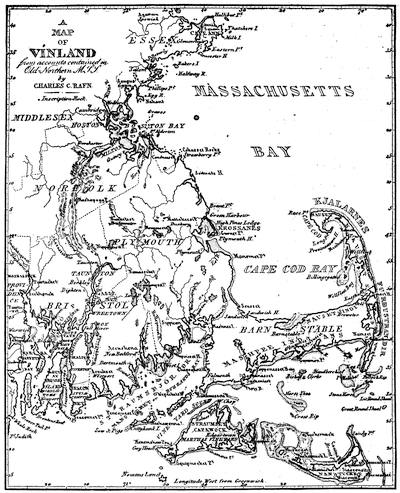
Note.—The above map is a fac-simile of one of C. C. Rafn’s maps. Cf. the maps in Smith, Beamish, Gravier, Slafter, Preble’s Amer. Flag, etc.
The earliest to go so far as to establish to a certainty[666] the sites of the sagas was Rafn, who placed them on the coast of Massachusetts and Rhode Island, wherein nearly all those have followed him who have thought it worth while to be thus particular as to headland and bay.
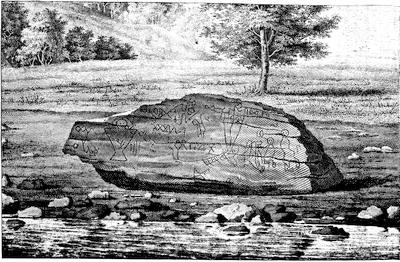
DIGHTON ROCK.[667]
In applying the saga names they have, however, by no means agreed, for Krossanes is with some Point Alderton, at the entrance of Boston Harbor, and with others the Gurnet Head; the island where honey dew was found is Nantucket with Rafn, and with De Costa an insular region, Nauset, now under water near the elbow of Cape Cod;[668] the Vinland of Rafn is in Narragansett Bay, that of Dr. A. C. Hamlin is at Merry Meeting Bay on the coast of Maine,[669] and that of Horsford is north of Cape Cod,[670]—not to mention other disagreements of other disputants.
We get something more tangible, if not more decisive, when we come to the monumental evidences. DeWitt Clinton and Samuel L. Mitchell found little difficulty at one time in making many people believe that the earthworks of Onondaga were Scandinavian. A pretended runic inscription on a stone said to have been found in the Grave Creek mound was sedulously ascribed to the Northmen.[671] What some have called a runic inscription exists on a rock near Yarmouth in Nova Scotia, which is interpreted “Hako’s son addressed the men,” and is supposed to commemorate the expedition of Thorfinn in a.d. 1007.[672] A rock on the little islet of Menana, close to Monhegan, on the coast of Maine, and usually referred to as the Monhegan Rock, bears certain weather marks, and there have been those to call them runes.[673] A similar claim is made for a rock in the Merrimac Valley.[674] Rafn describes such rocks as situated in Tiverton and Portsmouth Grove, R. I., but the markings were Indian, and when Dr. S. A. Green visited the region in 1868 some of them had disappeared.[675]
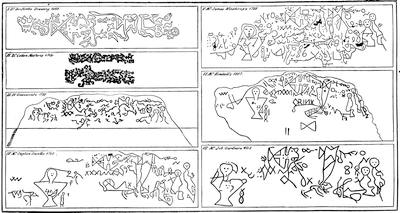
INSCRIPTION ON DIGHTON ROCK.
Note.—The opposite plate is reduced from one in the Antiq. Americanæ. They show the difficulty, even before later weathering, of different persons in discerning the same things on the rock, and in discriminating between fissures and incisions. Col. Garrick Mallery (4th Rept. Bureau of Ethnology, p. 250) asserts that the inscription has been “so manipulated that it is difficult now to determine the original details.” The drawings represented are enumerated in the text. Later ones are numerous. Rafn also gives that of Dr. Baylies and Mr. Gooding in 1790, and that made for the Rhode Island Hist. Society in 1830. The last has perhaps been more commonly copied than the others. Photographs of late years are common; but almost invariably the photographer has chalked what he deems to be the design,—in this they do not agree, of course,—in order to make his picture clearer. I think Schoolcraft in making his daguerreotype was the first to do this. The most careful drawing made of late years is that by Professor Seager of the Naval Academy, under the direction of Commodore Blake; and there is in the Cabinet of the American Antiquarian Society a MS. essay on the rock, written at Blake’s request by Chaplain Chas. R. Hale of the U. S. Navy. Haven disputes Blake’s statement that a change in the river’s bed more nearly submerges the rock at high tide than was formerly the case. Cf. Am. Antiq. Soc. Proc., Oct., 1864, p. 41, where a history of the rock is given; and in Wilson’s Prehistoric Man, ii. 93.
The most famous of all these alleged memorials[676] is the Dighton Rock, lying in the tide on the side of Taunton River, in the town of Berkeley, in Massachusetts.[677] Dr. De Costa thinks it possible that the central portion may be runic. This part is what has been interpreted to mean that Thorfinn with 151 men took possession of the country, and it is said to be this portion of the inscription which modern Indians discard when giving their interpretations.[678] That it is the work of the Indian of historic times seems now to be the opinion common to the best trained archæologists.[679]
Rafn was also the first to proclaim the stone tower now standing at Newport, R. I., as a work of the Northmen; but the recent antiquaries without any exception worth considering, believe that the investigations have shown that it was erected by Governor Arnold of Rhode Island as a windmill, sometime between 1670 and 1680; and Palfrey in his New England is thought to have put this view beyond doubt in showing the close correspondence in design of the tower to a mill at Chesterton, in England.[680]
Certain hearthstones which were discovered over twenty-five years ago under a peat bed on Cape Cod were held at the time to be a Norse relic.[681] In 1831 there was exhumed in Fall River, Mass., a skeleton, which had with it what seemed to be an ornamental belt made of metal tubes, formed by rolling fragments of flat brass and an oblong plate of the same metal,—not of bronze, as is usually said,—with some arrow-heads, cut evidently from the same material. The other concomitants of the burial indicated an Indian of the days since the English contact. The skeleton attracted notice in this country by being connected with the Norsemen in Longfellow’s ballad, The Skeleton in Armor, and Dr. Webb sent such an account of it to the Royal Society of Northern Antiquaries that it was looked upon as another and distinct proof of the identification of Vinland. Later antiquaries have dismissed all beliefs of that nature.[682]
There is not a single item of all the evidence thus advanced from time to time which can be said to connect by archæological traces the presence of the Northmen on the soil of North America south of Davis’ Straits. Arguments of this kind have been abandoned except by a few enthusiastic advocates.
That the Northmen voyaging to Vinland encountered natives, and that they were called Skraelings, may be taken as a sufficiently broad statement in the sagas to be classed with those concomitants of the voyages which it is reasonable to accept. Sir William Dawson (Fossil Men, 49) finds it easy to believe that these natives were our red Indians; and Gallatin saw no reason to dissociate the Eskimos with other American tribes.[683] That they were Eskimos seems to be the more commonly accepted view.[684]
That the climate of the Atlantic coast of the United States and the British provinces was such as was favorable to the present Arctic dwellers is held to be shown by such evidences as tusks of the walrus found in phosphate beds in South Carolina. Rude implements found in the interglacial Jersey drift have been held by C. C. Abbott to have been associated with a people of the Eskimo stock, and some have noted that palæolithic implements found in Pennsylvania closely resemble the work of the modern Eskimos (Amer. Antiquarian, i. 10).[685] Dall remarks upon implements of Innuit origin being found four hundred miles south of the present range of the Eskimos of the northwest coast (Contributions to Amer. Ethnology, i. p. 98). Charlevoix says that Eskimos were occasionally seen in Newfoundland in the beginning of the last century; and ethnologists recognize to-day the same stock in the Eskimos of Labrador and Greenland.
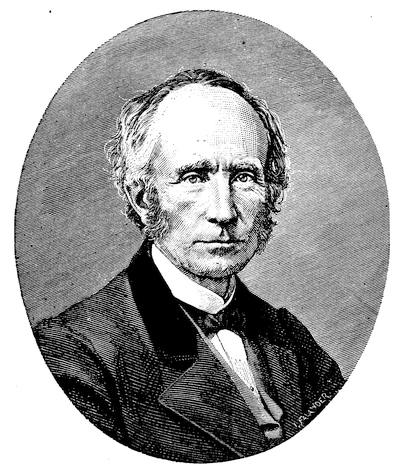
HINRIK RINK.
After a likeness given by Nordenskjöld in his Exped. till Grönland, p. 121.
The best authority on the Eskimos is generally held to be Hinrich Rink, and he contends that they formerly occupied the interior of the continent, and have been pressed north and across Behring’s Straits.[686] W. H. Dall holds similar views.[687] C. R. Markham, who dates their first appearance in Greenland in 1349, contends, on the other hand, that they came from the west (Siberia) along the polar regions (Wrangell Land), and drove out the Norse settlers in Greenland.[688] The most active of the later students of the Eskimos is Dr. Franz Boas, now of New York, who has discussed their tribal boundaries.[689]
The mission of the priest Hans Egede gave the first real glimmer of light.[691] He was the earliest to describe the ruins and relics observable on the west coast, but he continued to regard the east settlements as belonging to the east coast, and so placed them on the map. Anderson (Hamburg, 1746) went so far as to place on his map the cathedral of Gardar in a fixed location on the east coast, and his map was variously copied in the following years.
In 1786 an expedition left Copenhagen to explore the east coast for traces of the colonies, but the ice prevented the approach to the coast, and after attempts in that year and in 1787 the effort was abandoned. Heinrich Peter von Eggers, in his Om Grönlands österbygds sande Beliggenhed (1792), and Ueber die wahre Lage des alten Ostgrönlands (Kiel, 1794), a German translation, first advanced the opinion that the eastern colony as well as the western must have been on the west coast, and his views were generally accepted; but Wormskjöld in the Skandinavisk Litteraturselskab’s Skrifter, vol. x. (Copenhagen, 1814), still adhered to the earlier opinions, and Saabye still believed it possible to reach the east coast.
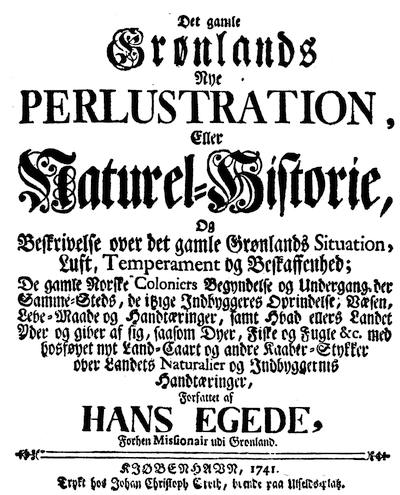
REDUCED FAC-SIMILE.
[Harvard College Library copy.]
Some years later (1828-31) W. A. Graah made, by order of the king of Denmark, a thorough examination of the east coast, and in his Undersögelses Reise til Ostkysten af Grönland (Copenhagen, 1832)[692] he was generally thought to establish the great improbability of any traces of a colony ever existing on that coast. Of late years Graah’s conclusions have been questioned, for there have been some sites of buildings discovered on the east side.[693] The Reverend J. Brodbeck, a missionary, described some in The Moravian Quarterly, July and Aug., 1882. Nordenskjöld has held that when the east coast is explored from 65° to 69°, there is a chance of discovering the site of an east colony.[694]
R. H. Major, in a paper (Journal Roy. Geog. Soc., 1873, p. 184) on the site of the lost colony, questioned Graah’s conclusions, and gave a sketch map, in which he placed its site near Cape Farewell; and he based his geographical data largely upon the chorography of Greenland and the sailing directions of Ivan Bardsen, who was probably an Icelander living in Greenland some time in the fifteenth century.[695]
The linguistic evidences were not brought into prominence till after one Morgan Jones had fallen among the Tuscaroras[699] in 1660, and found, as he asserted, that they could understand his Welsh. He wrote a statement of his experience in 1685-6, which was not printed till 1740.[700]
During the eighteenth century we find Campanius in his Nye Swerige (1702) repeating the story; Torfæus (Hist. Vinlandiæ, 1705) not rejecting it; Carte (England, 1747) thinking it probable; while Campbell (Admirals, 1742), Lyttleton (Henry the Second, 1767), and Robertson (America, 1777) thought there was no ground, at least, for connecting the story with America.
It was reported that in 1764 a man, Griffeth, was taken by the Shawnees to a tribe of Indians who spoke Welsh.[701] In 1768, Charles Beatty published his Journal of a two months’ Tour in America (London), in which he repeated information of Indians speaking Welsh in Pennsylvania and beyond the Mississippi, and of the finding of a Welsh Bible among them.
In 1772-73, David Jones wandered among the tribes west of the Ohio, and in 1774, at Burlington, published his Journal of two visits, in which he enumerates the correspondence of words which he found in their tongues with his native Welsh.[702]
Without noting other casual mentions, some of which will be found in Paul Barron Watson’s bibliography (in Anderson’s America not discovered by Columbus, p. 142), it is enough to say that towards the end of the century the papers of John Williams[703] and George Burder[704] gave more special examination to the subject than had been applied before.
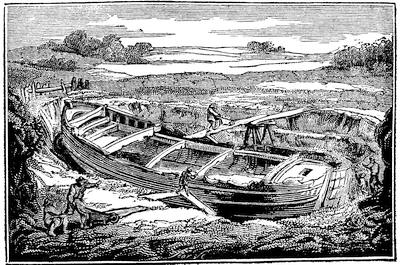
A BRITISH SHIP.
After a cut in The Mirror of Literature, etc. (London, 1823), vol. i. p. 177, showing a vessel then recently exhumed in Kent, and supposed to be of the time of Edward I, or the thirteenth century. The vessel was sixty-four feet long.
The renewed interest in the matter seems to have prompted Southey to the writing of his poem Madoc, though he refrained from publishing it for some years. If one may judge from his introductory note, Southey held to the historical basis of the narrative. Meanwhile, reports were published of this and the other tribes being found speaking Welsh.[705] In 1816, Henry Kerr printed at Elizabethtown, New Jersey, his Travels through the Western interior of the United States, 1808-16, with some account of a tribe whose customs are similar to those of the ancient Welsh. In 1824, Yates and Moulton (State of New York) went over the ground rather fully, but without conviction. Hugh Murray (Travels in North America, London, 1829) believes the Welsh went to Spain. In 1834, the different sides of the case were discussed by Farcy and Warden in Dupaix’s Antiquités Méxicaines. Some years later the publication of George Catlin[706] probably gave more conviction than had been before felt,[707] arising from his statements of positive linguistic correspondences in the language of the so-called White[708] Mandans[709] on the Missouri River, the similarity of their boats to the old Welsh coracles, and other parallelisms of custom. He believed that Madoc landed at Florida, or perhaps passed up the Mississippi River. His conclusions were a reinforcement of those reached by Williams.[710] The opinion reached by Major in his edition of Columbus’ Letters (London, 1847) that the Welsh discovery was quite possible, while it was by no means probable, is with little doubt the view most generally accepted to-day; while the most that can be made out of the claim is presented with the latest survey in B. F. Bowen’s America discovered by the Welsh in 1170 a.d. (Philad., 1876). He gathers up, as helping his proposition, such widely scattered evidences as the Lake Superior copper mines and the Newport tower, both of which he appropriates; and while following the discoverers from New England south and west, he does not hesitate to point out the resemblance of the Ohio Valley mounds[711] to those depicted in Pennant’s Tour of Wales; and he even is at no loss for proofs among the relics of the Aztecs.[712]
The story got further currency in Ramusio (1574, vol. ii.), Ortelius (1575), Hakluyt (1600, vol. iii.), Megiser’s Septentrio Novantiquus (1613), Purchas (1625), Pontanus’ Rerum Danicarum (1631), Luke Fox’s North-West Fox (1633), and in De Laet’s Notæ (1644), who, as well as Hornius, De Originibus Americanis (1644), thinks the story suspicious. It was repeated by Montanus in 1671, and by Capel, Vorstellungen des Norden, in 1676. Some of the features of the map had likewise become pretty constant in the attendant cartographical records. But from the close of the seventeenth century for about a hundred years, the story was for the most part ignored, and it was not till 1784 that the interest in it was revived by the publications of Forster[714] and Buache,[715] who each expressed their belief in the story.
A more important inquiry in behalf of the narrative took place at Venice in 1808, when Cardinal Zurla republished the map in an essay, and marked out the track of the Zeni on a modern chart.[716]
In 1810, Malte-Brun accorded his belief in the verity of the narrative, and was inclined to believe that the Latin books found in Estotiland were carried there by colonists from Greenland.[717] A reactionary view was taken by Biddle in his Sebastian Cabot, in 1831, who believed the publication of 1558 a fraud; but the most effective denial of its authenticity came a few years later in sundry essays by Zahrtmann.[718]
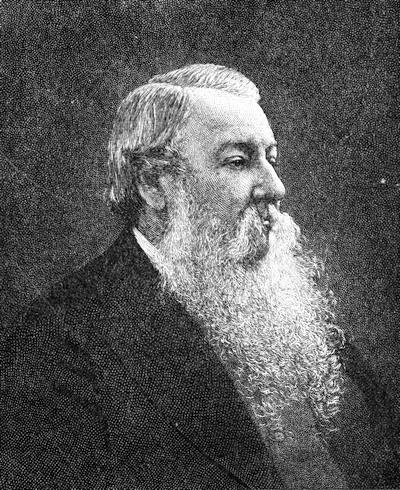
RICHARD H. MAJOR.
[After a photograph kindly furnished by himself at the editor’s request.—Ed.]
The story got a strong advocate, after nearly forty years of comparative rest, when R. H. Major, of the map department of the British Museum, gave it an English dress and annexed a commentary, all of which was published by the Hakluyt Society in 1873. In this critic’s view, the good parts of the map are of the fourteenth century, gathered on the spot, while the false parts arose from the misapprehensions of the young Zeno, who put together the book of 1558.[719] The method of this later Zeno was in the same year (1873) held by Professor Konrad Maurer to be hardly removed from a fraudulent compilation of other existing material. There has been a marked display of learning, of late years, in some of the discussions.
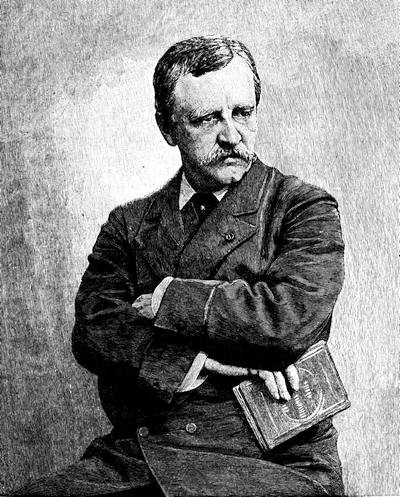
BARON NORDENSKJÖLD.
[From a recent photograph. There is another engraved likeness in the second volume of his Vega.]
Cornelio Desimoni, the archivist of Genoa, has printed two elaborate papers.[720] The Danish archivist Frederik Krarup published (1878) a sceptical paper in the Geografisk Tidsskrift (ii. 145).[721] The most exhaustive examination, however, has come from a practical navigator, the Baron A. E. Nordenskjöld, who in working up the results of his own Arctic explorations was easily led into the intricacies of the Zeno controversy. The results which he reaches are that the Zeni narratives are substantially true; that there was no published material in 1558 which could have furnished so nearly an accurate account of the actual condition of those northern waters; that the map which Zahrtmann saw in the University library at Copenhagen, and which he represented to be an original from which the young Zeno of 1558 made his pretended original, was in reality nothing but the Donis map in the Ptolemy of 1482, while the Zeno map is much more like the map of the north made by Claudius Clavis in 1427, which was discovered by Nordenskjöld in a codex of Ptolemy at Nancy.[722]
Since Nordenskjöld advanced his views there have been two other examinations: the one by Professor Japetus Steenstrup of Copenhagen,[723] and the other by the secretary of the Danish Geographical Society, Professor Ed. Erslef, who offered some new illustrations in his Nye Oplysninger om Broedrene Zenis Rejser (Copenhagen, 1885).[724]
Among those who accept the narratives there is no general agreement in identifying the principal geographical points of the Zeno map. The main dispute is upon Frislanda, the island where the Zeni were wrecked. That it was Iceland has been maintained by Admiral Irminger,[725] and Steenstrup (who finds, however, the text not to agree with the map), while the map accompanying the Studi biografici e bibliografici sulla storia della geografia in Italia (Rome, 1882) traces the route of the Zeni from Iceland to Greenland, under 70° of latitude.
On the other hand, Major has contended for the Faröe islands, arguing that while the engraved Zeno map shows a single large island, it might have been an archipelago in the original, with outlines run together by the obscurities of its dilapidation, and that the Faröes by their preserved names and by their position correspond best with the Frislanda of the Zeni.[726] Major’s views have been adopted by most later writers, perhaps, and a similar identification had earlier been made by Lelewel,[727] Kohl,[728] and others.
The identification of Estotiland involves the question if the returned fisherman of the narrative ever reached America. It is not uncommon for even believers in the story to deny that Estotiland and Drogeo were America. That they were parts of the New World was, however, the apparent belief of Mercator and of many of the cartographers following the publication of 1558, and of such speculators as Hugo Grotius, but there was little common consent in their exact position.[729]
After the middle of the last century we begin to find new signs of the belief. Charles Beatty, in his Journal of a two months’ tour with a view of promoting religion among the frontier inhabitants of Pennsylvania (Lond., 1768), finds traces of the lost tribes among the Delawares, and repeats a story of the Indians long ago selling the same sacred book to the whites with which the missionaries in the end aimed to make them acquainted. Gerard de Brahm and Richard Peters, both familiar with the Southern Indians, found grounds for accepting the belief. The most elaborate statement drawn from this region is that of James Adair, who for forty years had been a trader among the Southern Indians.[735] Jonathan Edwards in 1788 pointed out in the Hebrew some analogies to the native speech.[736] Charles Crawford in 1799 undertook the proof.[737] In 1816 Elias Boudinot, a man eminent in his day, contributed further arguments.[738] Ethan Smith based his advocacy largely on the linguistic elements.[739] A few years later an Englishman, Israel Worsley, worked over the material gathered by Boudinot and Smith, and added something.[740] A prominent American Jew, M. M. Noah, published in 1837 an address on the subject which hardly added to the weight of testimony.[741] J. B. Finlay, a mulatto missionary among the Wyandots, was satisfied with the Hebrew traces which he observed in that tribe.[742] Geo. Catlin, working also among the Western Indians, while he could not go to the length of believing in the lost tribes, was struck with the many analogies which he saw.[743] The most elaborate of all expositions of the belief was made by Lord Kingsborough in his Mexican Antiquities (1830-48).[744] Since this book there has been no pressing of the question with any claims to consideration.[745]
The African and even Egyptian origin of the Caribs has had some special advocates.[746] Peter Martyr, and Grotius following him, contended for the people of Yucatan being Ethiopian Christians. Stories of blackamoors being found by the early Spaniards are not without corroboration.[747] The correspondence of the African and South American flora has been brought into requisition as confirmatory.[748]
THE CARTOGRAPHY OF GREENLAND.
The oldest map yet discovered to show any part of Greenland, and consequently of America,[749] is one found by Baron Nordenskjöld attached to a Ptolemy Codex in the Stadtbibliothek at Nancy. He presented a colored fac-simile of it in 1883 at the Copenhagen Congrès des Américanistes, in his little brochure Trois Cartes. It was also used in illustration of his paper on the Zeni Voyages, published both in Swedish and German. It will be seen by the fac-simile given herewith, and marked with the author’s name, Claudius Clavus, that “Gronlandia Provincia” is an extension of a great arctic region, so as to lie over against the Scandinavian peninsula of Europe, with “Islandia,” or Iceland, midway between the two lands. Up to the time of this discovery by Nordenskjöld, the map generally recognized as the oldest to show Greenland is a Genovese portolano, preserved in the Pitti Palace at Florence, about which there is some doubt as to its date, which is said to be 1417 by Santarem (Hist. de la Cartog., iii., p. xix), but Lelewel (Epilogue, p. 167) is held to be trustier in giving it as 1447.[750] It shows how little influence the Norse stories of their Greenland colonization exerted at this time on the cartography of the north, that few of the map-makers deemed it worth while to break the usual terminal circle of the world by including anything west or beyond Iceland. It was, further, not easy to convince them that Greenland, when they gave it, lay in the direction which the Sagas indicated. The map of Fra Mauro, for instance, in 1459 cuts off a part of Iceland by its incorrigible terminal circle, as will be seen in a bit of it given herewith, the reader remembering as he looks at it that the bottom of the segment is to the north.[751] We again owe to Nordenskjöld the discovery of another map of the north, Tabula Regionum Septentrionalium, which he found in a Codex of Ptolemy in Warsaw a few years since, and which he places about 1467. The accompanying partial sketch is reproduced from a fac-simile kindly furnished by the discoverer. The peninsula of “Gronlandia,” with its indicated glaciers, is placed with tolerable accuracy as the western extremity of an arctic region, which to the north of Europe is separated from the Scandinavian peninsula by a channel from the “Mare Gotticum” (Baltic Sea), which sweeps above Norway into the “Mare Congelatum.” The confused notions arising from an attempt by the compiler of the map to harmonize different drafts is shown by his drawing a second Greenland (“Engronelant”) to his “Norbegia,” or Norway, and placing just under it the “Thile”[752] of the ancients, which he makes a different island from “Islandia,” placed in proper relations to his larger Greenland.
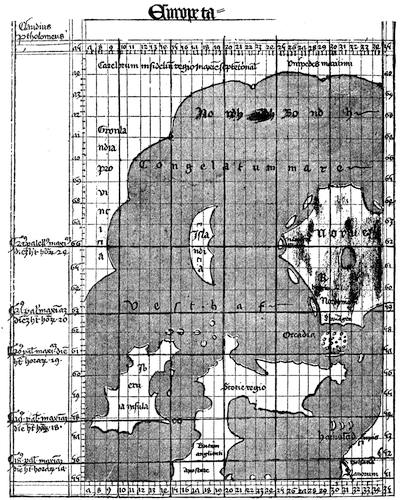
CLAUDIUS CLAVUS, 1427.
A few years later, or perhaps about the same time, and before 1471, the earliest engraved map which shows Greenland is that of Nicolas Donis, in the Ulm edition of Ptolemy in 1482. It will be seen from the little sketch which is annexed that the same doubling of Greenland is adhered to.[753] With the usual perversion put upon the Norse stories, Iceland is made to lie due west of Greenland, though not shown in the present sketch.
At a date not much later, say 1486, it is supposed the Laon globe, dated in 1493, was actually made, or at least it is shown that in some parts the knowledge was rather of the earlier date, and here we have “Grolandia,” a small island off the Norway coast.[754]
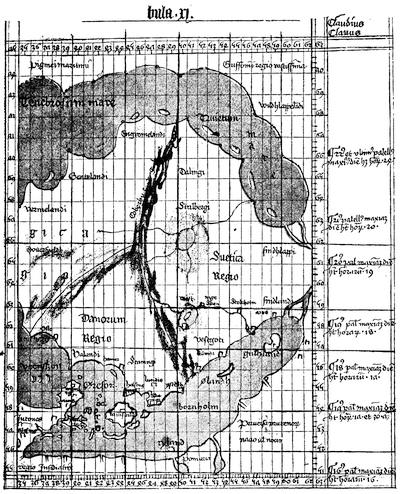
CLAUDIUS CLAVUS, 1427.
We have in 1489-90 a type of configuration, which later became prevalent. It is taken from an Insularium illustratum Henrici Martelli Germani, a manuscript preserved in the British Museum, and shows, as seen by the annexed extract, a long narrow peninsula, running southwest from the northern verge of Europe. A sketch of the whole map is given elsewhere.[755]
This seems to have been the prevailing notion of what and where Greenland was at the time of Columbus’ voyage, and it could have carried no significance to his mind that the explorations of the Norse had found the Asiatic main, which he started to discover. How far this notion was departed from by Behaim in his globe of 1492 depends upon the interpretation to be given to a group of islands, northwest of Iceland and northeast of Asia, upon the larger of which he writes among its mountains, “Hi man weise Volker.”[756]