Part 2 — CHAPTER VI.
Reading edition
THE PREHISTORIC ARCHÆOLOGY OF NORTH AMERICA.
BY HENRY W. HAYNES,
Archæological Institute of America.
BY the discovery of America a new continent was brought to light, inhabited by many distinct tribes, differing in language and in customs, but strikingly alike in physical appearance. All that can be learned in regard to their condition, and that of their ancestors, prior to the coming of Columbus, falls within the domain of the prehistoric archæology of America. This recent science of Prehistoric Archæology deals mainly with facts, not surmises. In studying the past of forgotten races, “hid from the world in the low-delved tomb,” her chief agent is the spade, not the pen. Her leading principles, the lamps by which her path is guided, are superposition, association, and style. Does this new science teach us that the tribes found in possession of the soil were the descendants of its original occupants, or does she rather furnish reasons for inferring that these had been preceded by some extinct race or races? The first question, therefore, that presents itself to us relates to the antiquity of man upon this continent; and in respect to this the progress of archæological investigation has brought about a marked change of opinion. Modern speculation, based upon recent discoveries, inclines to favor the view that this continent was inhabited at least as early as in the later portion of the quaternary or pleistocene period. Whether this primitive people was autochthonous or not, is a problem that probably will never be solved; but it is now generally held that this earliest population was intruded upon by other races, coming either from Asia or from the Pacific Islands, from whom were descended the various tribes which have occupied the soil down to the present time.
The writer believes also that the majority of American archæologists now sees no sufficient reason for supposing that any mysterious, superior race has ever lived in any portion of our continent. They find no archæological evidence proving that at the time of its discovery any tribe had reached a stage of culture that can properly be called civilization. Even if we accept the exaggerated statements of the Spanish conquerors, the most intelligent and advanced peoples found here were only semi-barbarians, in the stage of transition from the stone to the bronze age, possessing no written language, or what can properly be styled an alphabet, and not yet having even learned the use of beasts of burden.
By a large and growing school of archæologists, moreover, it is maintained that all the various tribes upon this continent, notwithstanding their different degrees of advancement, were living under substantially similar institutions; and that even the different forms of house construction practised by them were only stages in the development of the same general conceptions. Without attempting to dogmatize about such difficult problems, the object of this chapter is to set forth concisely such views as recommend themselves to the writer’s judgment. He is profoundly conscious of the limitations of his knowledge, and fully aware that his opinions will be at variance with those of other competent and learned investigators. Non nostrum tantas componere lites.
The controversy in regard to the antiquity of man in the old world may be regarded as substantially settled. Scarcely any one now denies that man was in existence there during the close of the quaternary or pleistocene period; but there is a great difference of opinion as to the sufficiency of the evidence thus far brought forward to prove that he had made his appearance in Europe in the previous tertiary period, or even in the earlier part of the quaternary. What is the present state of opinion in regard to the correlative question about the antiquity of man in America? Less than ten years ago the latest treatise published in this country, in which this subject came under discussion, met the question with the sweeping reply that “no truly scientific proof of man’s great antiquity in America exists.”[1477] But we think if the author of that thorough and “truly scientific” work were living now his belief would be different. After a careful consideration of all the former evidence that had been adduced in proof of man’s early existence upon this continent, none of which seemed to him conclusive, he goes on to state that “Dr. C. C. Abbott has unquestionably discovered many palæolithic implements in the glacial drift in the valley of the Delaware River, near Trenton, New Jersey.”[1478] Now a single discovery of this character, if it were unquestionable, or incapable of any other explanation, would be sufficient to prove that man existed upon this continent in quaternary times. The establishment, therefore, of the antiquity of man in America, according to this latest authority, seems to rest mainly upon the fact of the discovery by Dr. Abbott of palæolithic implements in the valley of the Delaware. To quote the language of an eminent European man of science, “This gentleman appears to stand in a somewhat similar relation to this great question in America as did Boucher de Perthes in Europe.”[1479] The opinion of the majority of American geologists upon this point is clearly indicated in a very recent article by Mr. W. J. McGee, of the U. S. Geological Survey: “But it is in the aqueo-glacial gravels of the Delaware River, at Trenton, which were laid down contemporaneously with the terminal moraine one hundred miles further northward, and which have been so thoroughly studied by Abbott, that the most conclusive proof of the existence of glacial man is found.”[1480] It will accordingly be necessary to give in considerable detail an account of the discovery of palæolithic implements by Dr. Abbott in the Delaware valley, and of its confirmation by different investigators, as well as of such other discoveries in different parts of our country as tend to substantiate the conclusions that have been drawn from them by archæologists.
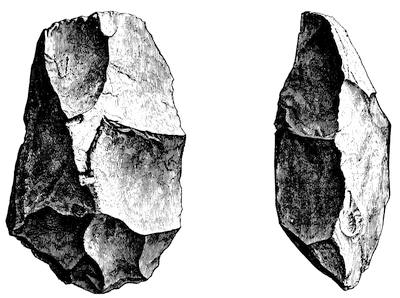
PALÆOLITHIC IMPLEMENT FROM THE TRENTON GRAVELS.
Side and edge view, of natural size. From the Peabody Museum Reports, vol. ii. p. 33.
By the term palæolithic implements we are to understand certain rude stone objects, of varying size, roughly fashioned into shape by a process of chipping away fragments from a larger mass so as to produce cutting edges, with convex sides, massive, and suited to be held at one end, and usually pointed at the other. These have never afterwards been subjected to any smoothing or polishing process by rubbing them against another stone. But it is only when such rude tools have been found buried in beds of gravel or other deposits, which have been laid down by great floods towards the close of what is known to geologists as the quaternary or pleistocene period, that they can be regarded as really palæolithic.[1481] At that epoch which immediately preceded the present period, certain rivers flowed with a volume of water much greater than now, owing to the melting of the thick ice-cap once covering large portions of the northern hemisphere, which was accompanied by a climate of great humidity. Vast quantities of gravels were washed down from the débris of the great terminal moraine of this ice-sheet, and were accumulated in beds of great thickness, extending in some instances as high as two hundred feet up the slopes of the river valleys. In such deposits, side by side with the rude products of human industry we have thus described, and deposited by the same natural forces, are found the fossil remains of several species of animals, which have subsequently either become extinct, like the mammoth and the tichorhine rhinoceros, or, driven southwards by the encroaching ice, have since its disappearance migrated to arctic regions, like the musk-sheep and the reindeer, or to the higher Alpine slopes, like the marmot. Such a discovery establishes the fact that man must have been living as the contemporary of these extinct animals, and this is the only proof of his antiquity that is at present universally accepted.
There has been much discussion among geologists in regard to both the duration and the conditions of the glacial period, but it is now the settled opinion that there have been two distinct times of glacial action, separated by a long interval of warmer climate, as is proved by the occurrence of intercalated fossiliferous beds; this was followed by the final retreat of the glacier.[1482] The great terminal moraine stretching across the United States from Cape Cod to Dakota, and thence northward to the foot of the Rocky Mountains, marks the limit of the ice invasion in the second glacial epoch. South of this, extending in its farthest boundary as low as the 38th degree of latitude, is a deposit which thins out as we go west and northwest, and which is called the drift-area. The drift graduates into a peculiar mud deposit, for which the name of “loess” has been adopted from the geologists of Europe, by whom it was given to a thick alluvial stratum of fine sand and loam, of glacial origin. This attenuated drift represents the first glacial invasion. From Massachusetts as far as northern New Jersey, and in some other places, the deposits of the two epochs seem to coalesce.[1483]
The interval of time that separated the two glacial periods can be best imagined by considering the great erosions that have taken place in the valleys of the Missouri and of the upper Ohio. “Glacial river deposits of the earlier epoch form the capping of fragmentary terraces that stand 250 to 300 feet above the present rivers;” while those of the second epoch stretch down through a trough excavated to that depth by the river through these earlier deposits and the rock below.[1484]
As to the probable time that has elapsed since the close of the glacial period, the tendency of recent speculation is to restrict the vast extent that was at first suggested for it to a period of from twenty thousand to thirty thousand years. The most conservative view maintains that it need not have been more than ten thousand years, or even less.[1485] This lowest estimate, however, can only be regarded as fixing a minimum point, and an antiquity vastly greater than this must be assigned to man, as of necessity he must have been in existence long before the final events occurred in order to have left his implements buried in the beds of débris which they occasioned.
In April, 1873, Dr. C. C. Abbott, who was already well known as an investigator of the antiquities of the Indian races, which he believed had passed from “a palæolithic to a neolithic condition” while occupying the Atlantic seaboard, published an article on the “Occurrence of implements in the river-drift at Trenton, New Jersey.”[1486] In this he described and figured three rude implements, which he had found buried at a depth as great in one instance as sixteen feet in the gravels of a bluff overlooking the Delaware River. He argued that these must be of greater antiquity than relics found on the surface, from the fact of their occurring in place in undisturbed deposits; that they could not have reached such a depth by any natural means; and that they must be of human origin, and not accidental formations, because as many as three had been discovered of a like character. His conclusion is that they are “true drift implements, fashioned and used by a people far antedating the people who subsequently occupied this same territory.”
After two years of further research he returned to the subject, publishing in the same journal, in June, 1876, an account of the discovery of seven similar objects near the same locality. Of these he said: “My studies of these palæolithic specimens and of their positions in the gravel-beds and overlying soil have led me to conclude that not long after the close of the last glacial epoch man appeared in the valley of the Delaware.”[1487]
Most of these specimens were deposited by Dr. Abbott in the Peabody Museum of American Archæology and Ethnology at Cambridge, Massachusetts; and the curator of that institution, Professor Frederick W. Putnam, in September, 1876, visited the locality in company with Dr. Abbott. Together they succeeded in finding two examples in place. Having been commissioned to continue his investigations, Dr. Abbott presented to the trustees, in November of the same year, a detailed report On the Discovery of Supposed Palæolithic Implements from the Glacial Drift in the Valley of the Delaware River, near Trenton, New Jersey.[1488] In this, three of the most characteristic specimens were figured, which had been submitted to Mr. M. E. Wadsworth of Cambridge, to determine their lithological character. He pronounced them to be made of argillite, and declared that the chipping upon them could not be attributed to any natural cause, and that the weathering of their surfaces indicated their very great antiquity. The question “how and when these implements came to be in the gravel” is discussed by Dr. Abbott at some length. He argued that the same forces which spread the beds of gravel over the wide area now covered carried them also; and he predicted that they will be met with wherever such gravels occur in other parts of the State. He specially dwells upon the circumstances that the implements were found in undisturbed portions of the freshly exposed surface of the bluff, and not in the mass of talus accumulated at its base, into which they might have fallen from the surface; and that they have been found at great depths, “varying from five to over twenty feet below the overlying soil.” He also insisted upon the marked difference between their appearance and the materials of which they are fashioned and the customary relics of the Indians. The conditions under which the gravel-beds were accumulated are then studied in connection with a report upon them by Professor N. S. Shaler, which concludes, from the absence of stratification and of pebbles marked with glacial scratches, that they were “formed in the sea near the foot of the retreating ice-sheet, when the sub-glacial rivers were pouring out the vast quantities of water and waste that clearly were released during the breaking up of the great ice-time.” This view regards the deposits as of glacial origin, and as laid down during that period, but considers that they were subsequently modified in their arrangement by the action of water. In such gravel-beds there have also been found rolled fragments of reindeer-horns, and skulls of the walrus, as well as the relics of man. Dr. Abbott accordingly drew the conclusion that “man dwelt at the foot of the glacier, or at least wandered over the open sea, during the accumulation of this mass of gravel;” that he was contemporary of these arctic animals; and that this early race was driven southward by the encroaching ice, leaving its rude implements behind. Thus it will be seen that Dr. Abbott no longer considers man in this country as belonging to post-glacial, but to interglacial times.
Continuing his investigations, in the following year Dr. Abbott gave a much more elaborate account of his work and its results, in which he announced his discovery of some sixty additional specimens.[1489] To the objection that had been raised, that these supposed implements might have been produced by the action of frost, he replied that a single fractured surface might have originated in that way or from an accidental blow; but when we find upon the same object from twenty to forty planes of cleavage, all equally weathered (which shows that the fragments were all detached at or about the same time), it is impossible not to recognize in this the result of intentional action. Four such implements are described and figured, of shapes much more specialized than those previously published, and resembling very closely objects which European archæologists style stone axes of “the Chellean type,” whose artificial origin cannot be doubted.
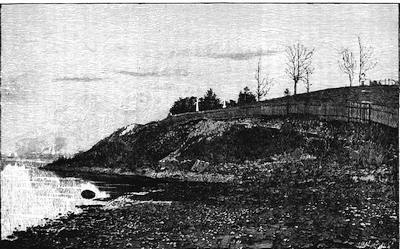
THE TRENTON GRAVEL BLUFF.
From a photograph kindly furnished by Professor F. W. Putnam, showing the Delaware and its bluff of gravel, where many of the rude implements have been found.
As some geologists were still inclined to insist upon the post-glacial character of the débris in which the implements were found, Dr. Abbott, admitting that the great terminal moraine of the northern ice-sheet does not approach nearer than forty miles to the bluff at Trenton, nevertheless insists that the character of the deposits there much more resembles a mass of material accumulated in the sea at the foot of the glacier than it does beds that have been subjected to the modifying arrangement of water. He finds an explanation of this condition of things in a prolongation of the glacier down the valley of the Delaware as far as Trenton, at a time when the lower portions of the State had suffered a considerable depression, and before the retreat of the ice-sheet. But besides the comparatively unmodified material of the bluff, in which the greater portion of the palæolithic implements has been found, there also occur limited areas of stratified drift, such as are to be seen in railway cuttings near Trenton, in which similar implements are also occasionally found. These, however, present a more worn appearance than the others. But it will be found that these tracts of clearly stratified material are so very limited in extent that they seem to imply some peculiar local condition of the glacier. This position is illustrated by certain remarkable effects once witnessed after a very severe rainfall, by which two palæolithic implements were brought into immediate contact with ordinary Indian relics such as are common on the surface. This leads to an examination of the question of the origin of this surface soil, and a discussion of the problem how true palæolithic implements sometimes occur in it. This soil is known to be a purely sedimentary deposit, consisting almost exclusively of sand, or of such finely comminuted gravels as would readily be transported by rapid currents of water. But imbedded in it and making a part of it are numerous huge boulders, too heavy to be moved by water. Dr. Abbott accounted for their presence from their having been dropped by ice-rafts, while the process of deposition of the soil was going on. The same sort of agency could not have put in place both the soil and the boulders contained in it, and the same force which transported the latter may equally well have brought along such implements as occur in the beds of clearly stratified origin. The wearing effect upon these of gravels swept along by post-glacial floods will account for that worn appearance which sometimes almost disguises their artificial origin.
In conclusion Dr. Abbott attempted to determine what was the early race which preceded the Indians in the occupation of this continent. From the peculiar nature and qualities of palæolithic implements he argues that they are adapted to the needs of a people “living in a country of vastly different character, and with a different fauna,” from the densely wooded regions of the Atlantic seaboard, where the red man found his home. The physical conditions of the glacial times much more nearly resembled those now prevailing in the extreme north. Accordingly he finds the descendants of the early race in the Eskimos of North America, driven northwards after contact with the invading Indian race. In this he is following the opinion of Professor William Boyd Dawkins, who considers that people to be of the same blood as the palæolithic cave-dwellers of southern France, and that of Mr. Dall and Dr. Rink, who believed that they once occupied this continent as far south as New Jersey. In confirmation of this view he asserts that the Eskimos “until recently used stone implements of the rudest patterns.” But unfortunately for this theory the implements of the Eskimos bear no greater resemblance to palæolithic implements than do those of any other people in the later stone age; and subsequent discoveries of human crania in the Trenton gravels have led Dr. Abbott to question its soundness.[1490]
These discoveries of Dr. Abbott are not liable to the imputation of possible errors of observation or record, as would be the case if they rested upon the testimony of a single person only. As has been already stated, in September, 1876, Professor Putnam was present at the finding in place of two palæolithic implements, and in all has taken five with his own hands from the gravel at various depths.[1491] Mr. Lucien Carr also visited the locality in company with Professor J. D. Whitney, in September, 1878, and found several in place.[1492] Since then Professors Shaler, Dawkins, Wright, Lewis, and others, including the writer, have all succeeded in finding specimens either in place or in the talus along the face of the bluff, from which they had washed out from freshly exposed surfaces of the gravel.[1493] The whole number thus far discovered by Dr. Abbott amounts to about four hundred specimens.[1494] Meanwhile, the problem of the conditions under which the Trenton gravels had been accumulated was made the subject of careful study by other competent geologists, besides Professor Shaler, to whose opinion reference has already been made. In October, 1877, the late Thomas Belt, F. G. S., visited the locality, and shortly afterwards published an account of Dr. Abbott’s discoveries, illustrated by several geological sections of the gravel. His conclusion is, “that after the land-ice retired, or whilst it was retiring, and before the coast was submerged to such a depth as to permit the flotation of icebergs from the north, the upper pebble-beds containing the stone implements were formed.”[1495] The geologists of the New Jersey Survey had already recognized the distinction between the drift gravels of Trenton and the earlier yellow marine gravels which cover the lower part of the State. But it was the late Professor Henry Carvill Lewis, of Philadelphia, who first accurately described the character and limits of the Trenton gravels.[1496] This he had carefully mapped before he was informed of Dr. Abbott’s discoveries, and it has been found (with only one possible very recent exception) that the implements occur solely in these newer gravels of the glacial period.
Professor Lewis’s matured conclusions in regard to the geological character and the age of the Trenton gravel cliff are thus expressed: “The presence of large boulders in the bluff at Trenton, and the extent and depth of the gravel at this place, have led to the supposition that there was here the extremity of a glacial moraine. Yet the absence of ‘till’ and of scratched boulders, the absence of glacial striæ upon the rocks of the valley, and the stratified character of the gravel, all point to water action alone as the agent of deposition. The depth of the gravel and the presence of the bluff at this point are explained by the peculiar position that Trenton occupies relatively to the river, ... in a position where naturally the largest amount of a river gravel would be deposited, and where its best exposures would be exhibited.... Any drift material which the flooded river swept down its channel would here, upon meeting tide-water, be in great part deposited. Boulders which had been rolled down the inclined floor of the upper valley would here stop in their course, and all be heaped up with the coarser gravel in the more slowly flowing water, except such as cakes of floating ice could carry oceanward.... Having heaped up a mass of detritus in the old river channel as an obstruction at the mouth of the gorge, the river, so soon as its volume diminished, would immediately begin wearing away a new channel for itself down to ocean level. This would be readily accomplished through the loose material, and would be stopped only when rock was reached.... It has been thought that to account for the high bank at Trenton an elevation of the land must have occurred.... An increase in the volume of the river will explain all the facts. The accompanying diagram will render this more clear.
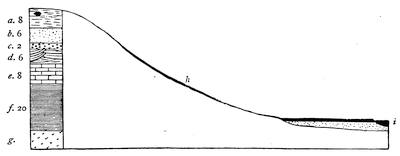
Section of bluff two miles south of Trenton, New Jersey. a b, Trenton gravel; Implements—a, fine gray sand (boulder); b, coarse sandy gravel; c, red gravel; d, yellow gravel (pre-glacial); e, plastic clay (Wealden); f, fine yellow sand (Hastings?); g, gneiss; h, alluvial mud; i, Delaware River.
A From a cut in Primitive Industry, p. 535.
“The Trenton gravel, now confined to the sandy flat borders of the river, corresponds to the ‘intervale’ of New England rivers, ... and exhibits a topography peculiar to a true river gravel. Frequently instead of forming a flat plain it forms higher ground close to the present river channel than it does near its ancient bank. Moreover, not only does the ground thus slope downward on retreating from the river, but the boulders become smaller and less abundant. Both of these facts are in accordance with the facts of river deposits. In time of flood the rapidly flowing water in the main channel, bearing detritus, is checked by the more quiet waters at the side of the river, and is forced to deposit its gravel and boulders as a kind of bank.... Having shown that the Trenton gravel is a true river gravel of comparatively recent age, it remains to point out the relation it bears to the glacial epoch.... Two hypotheses only can be applied to the Trenton gravel. It is either post-glacial, or it belongs to the very last portion of the glacial period. The view held by the late Thomas Belt can no longer be maintained.... He fails to recognize any distinction between the gravels. As we have seen, the Trenton gravel is truly post-glacial. It only remains to define more strictly the meaning of that term. There is evidence to support both of these hypotheses.”[1497]
After discussing them both at considerable length, he concludes as follows: “A second glacial period in Europe, known as the ‘Reindeer Period,’ has long been recognized. It appears to have followed that in which the clays were deposited and the terraces formed, and may therefore correspond with the period of the Trenton gravel. If there have been two glacial epochs in this country, the Trenton gravel cannot be earlier than the close of the later one. If there has been but one, traces of the glacier must have continued into comparatively recent times, or long after the period of submergence. The Trenton gravel, whether made by long-continued floods which followed a first or second glacial epoch,—whether separated from all true glacial action or the result of the glacier’s final melting,—is truly a post-glacial deposit, but still a phenomenon of essentially glacial times,—times more nearly related to the Great Ice Age than to the present.”
He then goes on to consider the bearings of the age of this gravel upon the question of the antiquity of man. “When we find that the Trenton gravel contains implements of human workmanship so placed with reference to it that it is evident that at or soon after the time of its deposition man had appeared on its borders, and when the question of the antiquity of man in America is thus before us, we are tempted to inquire still further into the age of the deposit under discussion. It has been clearly shown by several competent archæologists that the implements that have been found are a constituent part of the gravel, and not intrusive objects. It was of peculiar interest to find that it has been only within the limits of the Trenton gravel, precisely traced out by the writer, that Dr. Abbott, Professor F. W. Putnam, Mr. Lucien Carr, and others, have discovered these implements in situ.... At the localities on the Pennsylvania Railroad, where extensive exposures of these gravels have been made, the deposit is undoubtedly undisturbed. No implements could have come into this gravel except at a time when the river flowed upon it, and when they might have sunk through the loose and shifting material. All the evidence points to the conclusion that at the time of the Trenton gravel flood man ... lived upon the banks of the ancient Delaware, and lost his stone implements in the shifting sands and gravel of the bed of that stream.... The actual age of the Trenton gravel, and the consequent date to which the antiquity of man on the Delaware should be assigned, is a question which geological data alone are insufficient to solve. The only clew, and that a most unsatisfactory one, is afforded by calculations based upon the amount of erosion. This, like all geological considerations, is relative rather than absolute, yet several calculations have been made, which, based either upon the rate of erosion of river channels or the rate of accumulation of sediment, have attempted to fix the date of the close of the glacial epoch. By assuming that the Trenton gravel was deposited immediately after the close of this epoch, an account of such calculations may be of interest. If the Trenton gravel is post-glacial in the widest acceptation of the term, a yet later date must be assigned to it.”
After going carefully through them all, he concludes: “Thus we find that if any reliance is to be placed upon such calculations, even if we assume that the Trenton gravel is of glacial age, it is not necessary to make it more than ten thousand years old. The time necessary for the Delaware to cut through the gravel down to the rock is by no means great. When it is noted that the gravel cliff at Trenton was made by a side wearing away at a bank, and when it is remembered that the erosive power of the Delaware River was formerly greater than at present, it will be conceded that the presence of the cliff at Trenton will not necessarily infer its high antiquity; nor in the character of the gravel is there any evidence that the time of its deposition need have been long. It may be that, as investigations are carried further, it will result not so much in proving man of very great antiquity as in showing how much more recent than usually supposed was the final disappearance of the glacier.”
Professor Lewis’s studies of the great terminal moraine of the northern ice-sheet were still further prosecuted in conjunction with Professor George Frederick Wright, of Oberlin, Ohio, whose labors have been of the highest importance in shedding light upon the question of the antiquity of man in America.[1498] Together they traced the southern boundary of the glacial region across the State of Pennsylvania, and subsequently Professor Wright has continued his researches through the States of Ohio, Indiana, and Kentucky, as far as the Mississippi River and even beyond. He has found that glacial floods similar to those of the Delaware valley have deposited similar beds of drift gravel in the valleys of all the southerly flowing rivers, and he has called attention to the importance of searching in them for palæolithic implements. As early as March, 1883, he predicted that traces of early man would be found in the extensive terraces and gravel deposits of the southern portion of Ohio.[1499] This prediction was speedily fulfilled, and upon November 4, 1885, Professor Putnam reported to the Boston Society of Natural History that Dr. C. L. Metz, of Madisonville, Ohio, had found in the gravels of the valley of the Little Miami River, at that place, eight feet below the surface, a rude implement made of black flint, of about the same size and shape as one of the same material found by Dr. Abbott in the Trenton gravels. This was followed by the announcement from Dr. Metz that he had discovered another specimen (a chipped pebble) in the gravels at Loveland, in the same valley, at a depth of nearly thirty feet from the surface. Professor Wright has visited both localities, and given a detailed description of them, illustrated by a map. He finds that the deposit at Madisonville clearly belongs to the glacial-terrace epoch, and is underlain by “till,” while in that at Loveland it is known that the bones of the mastodon have been discovered. He closes his account with these words: “In the light of the exposition just given, these implements will at once be recognized as among the most important archæological discoveries yet made in America, ranking on a par with those of Dr. Abbott at Trenton, New Jersey. They show that in Ohio, as well as on the Atlantic coast, man was an inhabitant before the close of the glacial period.”[1500] Further confirmation of these predictions was received at the meeting of the American Association for the Advancement of Science, at Cleveland, Ohio, in August, 1888, when Mr. Hilborne T. Cresson reported his discovery of a large flint implement in the glacial gravels of Jackson County, Indiana, as well as of two chipped implements made of argillite, which he had found in place at a depth of several feet in the ancient terrace of the Delaware River, in Claymont, Newcastle County, Delaware.[1501]
This discovery of Mr. Cresson’s has assumed a great geological importance, and it is thus reported by him: “Toward midday of July 13, 1887, while lying upon the edge of the railroad cut, sketching the boulder line, my eye chanced to notice a piece of steel-gray substance, strongly relieved in the sunlight against the red-colored gravel, just above where it joined the lower grayish-red portion. It seemed to me like argillite, and being firmly imbedded in the gravel was decidedly interesting. Descending the steep bank as rapidly as possible, the specimen was secured.... Upon examining my specimen I found that it was unquestionably a chipped implement. There is no doubt about its being firmly imbedded in the gravel, for the delay I made in extricating it with my pocket-knife nearly caused me the unpleasant position of being covered by several tons of gravel.... Having duly reported my find to Professor Putnam, I began, at his request, a thorough examination of the locality, and on May 25, 1888, the year following, discovered another implement four feet below the surface, at a place about one eighth of a mile from the first discovery.... The geological formation in which the implement was found seems to be a reddish gravel mixed with schist.”[1502]
Professor Wright thus comments upon these discoveries and their geological situation: “The discovery of palæolithic implements, as described by Mr. Cresson, near Claymont, Del., unfolds a new chapter in the history of man in America. It was my privilege in November last to visit the spot with him, and to spend a day examining the various features of the locality.... The cut in the Baltimore and Ohio railroad in which this implement was found is about one mile and a half west of the Delaware River, and about one hundred and fifty feet above it. The river is here quite broad. Indeed, it has ceased to be a river, and is already merging into Delaware Bay; the New Jersey shore being about three miles distant from the Delaware side. The ascent from the bay at Claymont to the locality under consideration is by three or four well-marked benches. These probably are not terraces in the strict sense of the word, but shelves marking different periods of erosion when the land stood at these several levels, but now thinly covered with old river deposits. Upon reaching the locality of Mr. Cresson’s recent discovery, we find a well-marked superficial water deposit containing pebbles and small boulders up to two or three feet in diameter, and resting unconformably upon other deposits, different in character, and in some places directly upon the decomposed schists which characterize the locality. This is without question the Philadelphia Red Gravel and Brick Clay of Lewis. The implement submitted to us was found near the bottom of this upper deposit, and eight feet below the surface.... As Mr. Cresson was on the ground when the implement was uncovered, and took it out with his own hands, there would seem to be no reasonable doubt that it was originally a part of the deposit; for Mr. Cresson is no novice in these matters, but has had unusual opportunities, both in this country and in the old world, to study the localities where similar discoveries have heretofore been made. The absorbing question concerning the age of this deposit is therefore forced upon our attention as archæologists.... The determination of the age of these particular deposits at Claymont involves a discussion of the whole question of the Ice Age in North America, and especially that of the duality of the glacial epoch. At a meeting of this society on January 19, 1881, I discussed the age of the Trenton gravel, in which Dr. Abbott has found so many palæoliths, and was led also incidentally at the same time to discuss the relative age of what Professor Lewis called the Philadelphia Red Gravel. I had at that time recently made repeated trips to Trenton, and with Professor Lewis had been over considerable portions of the Delaware valley for the express purpose of determining these questions. The conclusions to which we—that is, Professor Lewis and myself—came were thus expressed in the paper above referred to (Proc. Boston Soc. of Nat. Hist., vol. xxi. pp. 137-145), namely, that the Philadelphia Brick Clay and Red Gravel (which are essentially one formation) marked the period when the ice had its greatest extension, and when there was a considerable depression of the land in that vicinity; perhaps, however, less than a hundred feet in the neighborhood of the moraine, though increasing towards the northwest. During this period of greatest extension and depression, the Philadelphia Red Gravel and Brick Clay were deposited by the ice-laden floods which annually poured down the valley in the summer seasons. As the ice retreated towards the headwaters of the valley, the period was marked also by a reëlevation of the land to about its present height, when the later deposits of gravel at Trenton took place. Dr. Abbott’s discoveries at Trenton prove the presence of man on the continent at that stage of the glacial epoch. Mr. Cresson’s discoveries prove the presence of man at a far earlier stage. How much earlier, will depend upon our interpretation of the general facts bearing on the question of the duality of the glacial epoch.
“Mr. McGee, of the United States Geological Survey, has recently published the results of extensive investigations carried on by him respecting the superficial deposits of the Atlantic coast. (See Amer. Jour. of Science, vol. xxxv., 1888.) He finds that on all the rivers south of the Delaware there are deposits corresponding in character to what Professor Lewis had denominated Philadelphia Red Gravel and Brick Clay.... From the extent to which this deposit is developed at Washington, in the District of Columbia, Mr. McGee prefers to designate it the Columbia formation. But the period is regarded by him as identical with that of the Philadelphia Red Gravel and Brick Clay, which Professor Lewis had attributed to the period of maximum glacial development on the Atlantic coast.
“It is observable that the boulders in this Columbia formation belong, so far as we know, in every case, to the valleys in which they are now found.... It is observable also that it is not necessary in any case to suppose that these deposits were the direct result of glacial ice. Mr. McGee does not suppose that glaciers extended down these valleys to any great distance. Indeed, so far as we are aware, there is no evidence of even local glaciers in the Alleghany Mountains south of Harrisburg. But it is easy to see that an incidental result of the glacial period was a great increase of ice and snow in the headwaters of all these streams, so as to add greatly to the extent of the deposits in which floating ice is concerned. And this Columbia formation is, as we understand it, supposed by Mr. McGee to be the result of this incidental effect of the glacial period in increasing the accumulations of snow and ice along the headwaters of all the streams that rise in the Alleghanies. In this we are probably agreed. But Mr. McGee differs from the interpretation of the facts given by Professor Lewis and myself, in that he postulates, largely, however, on the basis of facts outside of this region, two distinct glacial epochs, and attributes the Columbia formation to the first epoch, which he believes to be from three to ten times as remote as the period in which the Trenton gravels were deposited. If, therefore, Dr. Abbott’s implements are, as from the lowest estimate would seem to be the case, from ten thousand to fifteen thousand years old, the implements discovered by Mr. Cresson in the Baltimore and Ohio cut at Claymont, which is certainly in Mr. McGee’s Columbia formation, would be from thirty thousand to one hundred and fifty thousand years old.
“But as I review the evidence which has come to my knowledge since writing the paper in 1881, I do not yet see the necessity of making so complete a separation between the glacial epochs as Mr. McGee and others feel compelled to do. But, on the other hand, the unity of the epoch (with, however, a marked period of amelioration in climate accompanied by extensive recession of the ice, and followed by a subsequent re-advance over a portion of the territory) seems more and more evident. All the facts which Mr. McGee adduces from the eastern side of the Alleghanies comport, apparently, as readily with the idea of one glacial period as with that of two.... Until further examination of the district with these suggestions in view, or until a more specific statement of facts than we find in Mr. McGee’s papers, it would therefore seem unnecessary to postulate a distinct glacial period to account for the Columbia formation.... But no matter which view prevails, whether that of two distinct glacial epochs, or of one prolonged epoch with a mild period intervening, the Columbia deposits at Claymont, in which these discoveries of Mr. Cresson have been made, long antedate (perhaps by many thousand years) the deposits at Trenton, N. J., at Loveland and Madison, Ohio, at Little Falls, Minn., ... and at Medora, Ind.... Those all belong to the later portion of the glacial period, while these at Claymont belong to the earlier portion of that period, if they are not to be classed, according to Mr. McGee, as belonging to an entirely distinct epoch.”[1503]
The objects discovered by both Dr. Metz and Mr. Cresson have been deposited in the Peabody Museum at Cambridge, and their artificial character cannot be disputed.
At nearly the same date at which Dr. Abbott published the account of his discoveries, Col. Charles C. Jones, of Augusta, Georgia, recorded the finding of “some rudely-chipped, triangular-shaped implements in Nacoochee valley under circumstances which seemingly assign to them very remote antiquity. In material, manner of construction, and in general appearance, so nearly do they resemble some of the rough, so-called flint hatchets belonging to the drift type, as described by M. Boucher de Perthes, that they might very readily be mistaken the one for the other.”[1504] They were met with in the course of mining operations, in which a cutting had been made through the soil and the underlying sands, gravels, and boulders down to the bedrock. Resting upon this, at a depth of some nine feet from the surface, were the three implements described. But it is plain that this deposit can scarcely be regarded as a true glacial drift, since the great terminal moraine lies more than four hundred miles away to the north, and the region where it occurs does not fall within the drift area. It must be of local origin, and few geologists would be willing to admit the existence of local glaciers in the Alleghanies so far to the south during the glacial period. Consequently these objects do not fall within our definition of true palæolithic implements.
The same thing may be said in a less degree of the implements discovered by C. M. Wallace, in 1876, in the gravels and clays of the valley of the James River.[1505]
A different character attaches to certain objects discovered in 1877 by Professor N. H. Winchell, at Little Falls, Minnesota, in the valley of the Mississippi River.[1506] These consisted mainly of pieces of chipped white quartz, perfectly sharp, although occurring in a water-worn deposit, and they were found to extend over quite a large area. Their artificial character has been vouched for by Professor Putnam, and among them were a few rude implements which are well represented in an accompanying plate. A geological section given in the report shows that they occur in the terrace some sixty feet above the bank of the river, and were found to extend about four feet below the surface. In the words of Professor Winchell: “The interest that centres in these chips ... involves the question of the age of man and his work in the Mississippi Valley.... The chipping race ... preceded the spreading of the material of the plain, and must have been pre-glacial, since the plain was spread out by that flood stage of the Mississippi River that existed during the prevalence of the ice-period, or resulted from the dissolution of the glacial winter.... The wonderful abundance of these chips indicates an astonishing amount of work done, as if there had been a great manufactory in the neighborhood, or an enormous lapse of time for its performance.”
This discovery of Professor Winchell was followed up by researches prosecuted in 1879 in the vicinity of Little Falls by Miss F. E. Babbit, of that place.[1507] She discovered a similar stratum of chipped quartz in the ancient terrace, of a mile or more in width, about forty rods to the east of the river, and elevated some twenty-five feet above it. This had been brought to light by the wearing of a wagon track, leading down a natural drainage channel, which had cut through the quartz stratum down to a level below it. The result of her prolonged investigations showed that “the stratum of quartz chips lay at a level some twelve or fifteen feet lower than the plane of the terrace top.”[1508] While the quartz chips discovered by Professor Winchell were contained in the upper surface of the terrace plain, these were strictly confined to a lower level, and cannot be synchronous with them. They must be older “by at least the lapse of time required for the deposition of the twelve or fifteen feet of modified drift forming the upper part of the terrace plain above the quartz-bearing stratum.”
This conclusion is abundantly confirmed by Mr. Warren Upham, of the U. S. Geological Survey, in his study of “The recession of the ice-sheet in Minnesota in its relation to the gravel deposits overlying the quartz implements found by Miss Babbit at Little Falls, Minnesota.”[1509] The great ice-sheet of the latest glacial epoch at its maximum extension pushed out vast lobes of ice, one of which crossed western and central Minnesota and extended into Iowa. Different stages of its retreat are marked by eleven distinct marginal moraines, and this deposit of modified drift at Little Falls Mr. Upham believes occurred in the interval between the formation of the eighth and the ninth. “It is,” he says, “upon the till, or direct deposit of the ice, and forms a surface over which the ice never re-advanced.” An examination of the terraces and plains of the Mississippi Valley from St. Paul to twenty-five miles above Little Falls shows them to be similar in composition and origin to the terraces of modified drift in the river valleys of New England. In his judgment, “the rude implements and fragments of quartz discovered at Little Falls were overspread by the glacial flood-plain of the Mississippi River, while most of the northern half of Minnesota was still covered by the ice.... It may be that the chief cause leading men to occupy this locality so soon after it was uncovered from the ice was their discovery of the quartz veins in the slate there, ... affording suitable material for making sharp-edged stone implements of the best quality. Quartz veins are absent, or very rare and unsuitable for this, in all the rock outcrops of the south half of Minnesota, that had become uncovered from the ice, as well as of the whole Mississippi basin southward, and this was the first spot accessible whence quartz for implement-making could be obtained.”
According to this view the upper deposit at Little Falls would appear to be more recent than those laid down by the immediate wasting of the great terminal moraine at Trenton and in Ohio; but the occupation of the spot by man upon the lower terrace may well have been at a much earlier time.
Many of the objects discovered by Miss Babbitt have been placed in the Peabody Museum, and as their artificial character has been questioned, the writer wishes to repeat his opinion, formed upon the study of numerous specimens that have been submitted to him, but not the same as those upon which Professor Putnam based his similar conclusions, that they are undoubtedly of human origin.
Implements of palæolithic form have been discovered in several other localities, but as none of them have been found in place, in undisturbed gravel-beds, either those which have been derived from the terminal moraine of the second extension of the great northern ice-sheet, or those which are included within the drift area, they cannot be considered as proved to be true palæolithic implements, although it is highly probable that many of them are such.[1510]
We have now to consider the claim to high antiquity of objects which have been discovered in several places in certain deposits, equally regarded as of glacial origin, which occur in the central and western portions of the United States. These are the so-called “lacustrine deposits,” which are believed to have had their origin from the former presence of vast lakes, now either extinct or represented by comparatively small bodies of water. The largest of such lakes occupied a great depression which once existed between the Rocky Mountains and the chain of the Sierra Nevada during the quaternary period. The existing lakes represent the lowest part of two basins, into which this depression was divided; of these, the western one, represented by certain smaller lakes, has received the name of Lake Lahontan. This never had any communication with the sea, and its deposits consequently register the greater or less amount of rain and snow during the period of its existence. To the eastern the name of Lake Bonneville has been given, and it is at present represented by the Great Salt Lake in Utah. This formerly had an outlet through the valley of the Columbia River. These lakes are believed to have been produced by the melting of local glaciers existing during the quaternary times in the above-named mountains; and similar consequences seem to have followed from the like presence of ancient glaciers in the Wahsatch and Uintah mountains, where no lake now exists.
In the ancient deposits of such an immense fresh-water lake, derived from the melting of glaciers in the last-mentioned mountains, which once existed in southern Wyoming, Professor Joseph Leidy first reported, in 1872, the discovery near Fort Bridger of “mingled implements of the rudest construction, together with a few of the highest finish.... Some of the specimens are as sharp and fresh in appearance as if they had been but recently broken from the parent block. Others are worn and have their sharpness removed, and are so deeply altered in color as to look exceedingly ancient.”[1511] The plates accompanying the report show that some of these objects are of palæolithic form, but as no further information is given in regard to the conditions under which they were discovered, we cannot pronounce them to be really palæolithic.
In 1874, Dr. Samuel Aughey made known the existence in Nebraska of “hundreds of miles of similar lacustrine deposits, almost level or gently rolling.”[1512] To these the name of “loess” has also been given, as well as to the mud deposits derived from the northern drift. Aughey states that these beds are perfectly homogeneous throughout, and of almost uniform color, ranging in thickness from five to one hundred and fifty feet. Generally they lie above a true drift formation derived from glaciers in the Black Hills, and represent “the final retreat of the glaciers, and that era of depression of the surface of the State when the greater part of it constituted a great fresh-water lake, into which the Missouri, the Platte, and the Republican rivers poured their waters.” The Missouri and its tributaries, flowing for more than one thousand miles through these deposits, gradually filled up this great lake with sediment. The rising of the land by degrees converted the lake-bottom into marshes, through which the rivers began to cut new channels, and to form the bluffs which now bound them. “The Missouri, during the closing centuries of the lacustrine age, must have been from five to thirty miles in breadth, forming a stream which for size and majesty rivalled the Amazon.” Many remains of mastodons and elephants are found in this so-called loess, as well as those of the animals now living in that region, together with the fresh-water and land shells peculiar to it. In it Aughey has also discovered an arrow-point and a spear-head, of which he gives well-executed figures. Both are excellent examples of those well-chipped implements which are regarded as typical of the Neolithic age or the age of polished stone, and are absolutely different from the palæolithic implements of which we have hitherto spoken. They were both found in railroad cuttings on the Iowa side of the Missouri River, and within three miles of it. The first lay at a depth of fifteen feet below the top of the deposit. Of the second he says it was “twenty feet below the top of the loess, and at least six inches from the edge of the cut, so that it could not have slid into that place.... Thirteen inches above the point where it was found, and within three inches of being on a line with it, in undisturbed loess, there was a lumbar vertebra of an elephant.”[1513]
This intermingling in these deposits of the bones of extinct and living animals appears to have been brought about by the shifting of the beds of the vast rivers he has described, which have been flowing for ages through the slight and easily moved material. It seems to be analogous to what has taken place in recent times in the valley of the Mississippi and in its delta. The finding, therefore, of arrow-heads of recent Indian type, even in place under twenty feet of loess and below a fossil elephant-bone, cannot be considered as affording any stronger proof of the antiquity of man than the oft-cited instances of the discovery of basket-work and pottery underneath similar fossils at Petite Anse Island in Louisiana, or of pottery and mastodon-bones on the banks of the Ashley River in South Carolina. No such discovery can be considered of consequence as bearing upon the question of palæolithic man.
The late Thomas Belt wrote to Professor Putnam, in 1878, that he had discovered “a small human skull in an undisturbed loess in a railway cutting about two miles from Denver (Colorado). All the plains are covered with a drift deposit of granitic and quartzose pebbles overlaid by a sandy and calcareous loam closely resembling the diluvial clay and the loess of Europe. It was in the upper part of the drift series that I found the skull. Just the tip of it was visible in the cutting about three and one half feet below the surface.”[1514] Not long after this Mr. Belt died, and we are without further information in regard to the locality. It would seem, however, that the loess in which the skull occurred belongs to the latest in the lacustrine series, and consequently does not imply any very great antiquity for it.
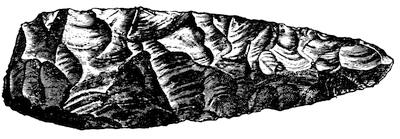
OBSIDIAN SPEAR-HEAD
Found in the Lahontan sediments,—from a cut in Russell’s Lake Lahontan, monograph xi. of Powell’s U. S. Geological Survey, p. 247.
In 1882 Mr. W. J. McGee, of the U. S. Geological Survey, obtained from the upper lacustral clays of the basin of the ancient Lake Lahontan, where they are exposed in the walls of Walker River Cañon, a spear-head, made of obsidian, beautifully chipped, and perfectly resembling those found on the surface throughout the southwest. “It was discovered projecting point outwards from a vertical scarp of lacustral clays twenty-five feet below the top of the section, at a locality where there were no signs of recent disturbance.”[1515] This is said to have been “associated in such a manner with the bones of an elephant or mastodon as to leave no doubt of their having been buried at approximately the same time.” But we are also told that these lakes are of very recent date, and that they have “left the very latest of all the complete geological records to be observed in the Great Basin.”[1516] The fossil shells obtained from these deposits all belong to living species; while the mammalian remains, which have been found in only very limited numbers, and all, with a single exception, in the upper beds, “are the same as occur elsewhere in tertiary or quaternary strata.” Mr. McGee says: “If the obsidian implement ... was really in situ (as all appearances indicated), it must have been dropped in a shallow and quiet bay of the saline and alkaline Lake Lahontan, and gradually buried beneath its fine mechanical deposits and chemical precipitates.”[1517]
In Mr. Russell’s opinion, this single implement, although supported by no other finds of a similar character, is sufficient to prove that “man inhabited this continent during the last great rise of the former lake.” But if this last great rise occurred in recent times, the presence of the bones of tertiary mammals in the upper beds shows that great natural forces must have been in operation at that time to have washed these out of their original place of deposit. The principal organic remains found, we are told, are those of living shells, and the intermingling of these with the bones of tertiary mammals could scarcely have taken place in “shallow and quiet bays.” To the writer this discovery seems rather to prove that an Indian spear-head was in some manner washed down and buried in the clays of the Walker River Cañon than that man was the contemporary there of the tertiary or quaternary mammalia. This fairly seems to be a case where, in the language of Dr. Brinton, “Archæology may at times correct Geology.”[1518]
It is almost paralleled by the discovery made by Mr. P. A. Scott, in Kansas, of a broken knife or lance-head, measuring in its present condition two inches and one eighth in length. Sir Daniel Wilson, who reports it, says: “The spot where the discovery was made is in the Blue Range of the Rocky Mountains, in an alluvial bottom, and distant several hundred feet from a small stream called Clear Creek. A shaft was sunk, passing through four feet of rich, black soil, and below this through upward of ten feet of gravel, reddish clay, and rounded quartz. Here the flint was found.... The actual object corresponds more to the small and slighter productions of the modern Indian tool-maker than to the rude and massive drift implement.” But this most careful and conscientious observer goes on to remark, “Under any circumstances it would be rash to build up comprehensive theories on a solitary case like this.”[1519]
If the discovery by Mr. McGee of this spear-head be insisted upon as establishing that man inhabited this continent during the last great rise of the lake, it would be easier to believe that that event occurred in recent and not in quaternary times, than to admit that the distinction between palæolithic and neolithic implements, established by so many discoveries in this country and in Europe, is thereby utterly overthrown.
The only alternative left is to believe that neolithic man was the contemporary of the tertiary mammals. To this conclusion we are asked to come by Professor Josiah D. Whitney, on account of the discovery of the remains of man and of his works in the auriferous gravels of California. The famous “Calaveras skull” is figured upon another page of this volume, where the circumstances attending its discovery are briefly referred to.[1520] It is astonishing to see how frail is the foundation upon which such a surprising superstructure has been raised, as it is found set forth in detail in the section entitled Human remains and works of art of the gravel series, in the third chapter of Professor Whitney’s memoir on The auriferous gravels of the Sierra Nevada of California.[1521] All is hearsay testimony, and entirely uncontrolled by any such careful scrutiny as marks the work of the British Association in the explorations carried on for fifteen years at Kent’s Hole, near Torquay. There can be no question that human bones and human implements have often been discovered in these gravels, but according to the accounts as given these are mingled in them in inextricable confusion. What is the character of these objects of human workmanship? So far are they from being, as Professor Whitney describes them, “always the same kind of implements, ... namely, the coarsest and the least finished which one would suppose could be made and still be implements.” One account speaks of “a spear or lance head of obsidian, five inches long and one and a half broad, quite regularly formed.” Others mention “spear and arrow heads made of obsidian;” or “certain discoidal stones from three to four inches in diameter, and about an inch and a half thick, concave on both sides, with perforated centre.” Still another witness speaks of “a large stone bead, made perhaps of alabaster, about one and a half inches long and about one and one fourth inches in diameter, with a hole through it one fourth of an inch in size.” We are also told of a “stone hatchet of a triangular shape, with a hole through it for a handle, near the middle. Its size was four inches across the edge, and length about six inches.” So also oval stones with continuous “grooves cut around them,” and “grooved oval disks,” are more than once mentioned. We think these quotations will be sufficient to convince the archæologist that here is no question of palæolithic implements, but that we have to do simply with the common Indian objects found on the surface all over our country. Besides the rude cuts in Bancroft,[1522] I know of only one example of these California discoveries which has been figured. This is the “beautiful relic” described by Mr. J. W. Foster, of which he says: “When we consider its symmetry of form ... and the delicate drilling of the hole through a material so liable to fracture, we are free to say it affords an exhibition of the lapidary’s skill superior to anything yet furnished by the Stone age of either continent.”[1523] Mr. Foster doubtfully suggests that this object was “used as a plummet for the purpose of determining the perpendicular to the horizon.” It has been shown, however, by Mr. W. H. Henshaw, that among the Indians of Southern California similar objects have long been used by their medicine-men as “medicine or sorcery stones.”[1524] Whichever may be held to be the true explanation of its use, either is more likely to be a characteristic of the Indian race than of primitive man.
But the objects whose presence in the gravels is most repeatedly spoken of are stone mortars, which Professor Whitney supposes were “used by the race inhabiting this region in prehistoric times ... for providing food.” One of these is stated to have been “found standing upright, and the pestle was in it, in its proper place, apparently just as it had been left by the owner.” It was taken out of a shaft, according to the testimony, twelve feet underneath undisturbed strata. This was certainly a very marvellous thing to have happened if all the objects found in the gravels are supposed to have been brought there by the action of floods of water. But it is a very simple matter, if the supposition of Mr. Southall be correct, who thinks that “these mortars have been left in these positions by the ancient inhabitants in their search for gold.”[1525] The Spaniards found gold in abundance in Mexico, and the locality from which it came is believed by Mr. Southall to be indicated by a discovery made in 1849 by some gold-diggers at one of the mountain diggings called Murphy’s, in the region in which Professor Whitney’s discoveries have taken place. In examining a high barren district of mountain, they were surprised to come upon the abandoned site of an ancient mine. At the bottom of a shaft two hundred and ten feet deep a human skeleton was found, with an altar for worship and other evidences of ancient labor by the aborigines.[1526] Mr. Southall believes that these mortars were used “for crushing the cemented gravel of the auriferous beds.” Some corroboration is afforded for this suggestion by the fact that stone mortars of a like character are found in the ancient gold mines, worked by the early Egyptian monarchs, in the Gebel Allakee Mountains near the Red Sea, which were used in pulverizing the gold-bearing quartz.
As to the authenticity of the “Calaveras skull,”
“Great contest followed and much learned dust.”
The probabilities seem in favor of its being a genuine human fossil, and the question recurs as to its character and the presumable age of the deposits from which it came. The latest geologist who has studied the locality, so far as the writer is aware, says of these deposits: “Even before visiting California I had suspected these old river gravels might be contemporaneous with the glacial epoch, and I still think this possible. This area was not glaciated, and these old gravels, hundreds of feet in thickness, may very well represent that great interval of time occupied in other regions by the glacial periods.”[1527] In discussing this question from the point of view of the character of the fossil animal remains contained in the gravels, we must continually bear in mind what Professor E. D. Cope says of the Mesozoic and Cænozoic of North America: “The faunæ of these periods have not yet been discriminated.... Many questions of the exact contemporaneity of these different beds are as yet unsettled.”[1528] Professor Cope has previously pointed out how marked a difference there is between the quaternary fauna of North America and that of Europe; we have no Hippopotamus or Rhinoceros Tichorinus, and they no Megatherium, Megalonyx, and other species. Under the varying conditions of animal existence thus implied, to assail established ideas upon the sequence in man’s development, or to maintain that he has had a long career on the Pacific slope of our continent before he had made his appearance in Western Europe, seems to the writer to be an attempt to explain “ignotum per ignotius.”
What is really to be understood by the assumption that man existed in tertiary times? So profound a palæontologist as Professor William Boyd Dawkins thinks “it is impossible to believe that man should have been an exception to the law of change. In the Pliocene age we cannot expect to find traces of man upon the earth. The living placental mammals had only then begun to appear, and seeing that the higher animals have invariably appeared in the rocks according to their place in the zoölogical scale, fishes, amphibians, reptiles, placental mammals, it is hardly reasonable to suppose that the highest of all should then have been upon the earth.”[1529] When, therefore, some of the geologists of our country support Professor Whitney’s claim that these discoveries of human fossils have actually proved man’s existence in the Pliocene period, by arguments mainly based upon the effects of erosion and the immense periods of time which these imply, or favor his inference from the animal fossils contained in these deposits that there has been “a total change in the fauna and flora of the region,” and that “the fauna of the gravel deposits is almost exclusively made up of extinct species,” we may well insist, with Dawkins, that the human remains should not be regarded as standing upon a different basis from those of the horse, since both occur under similar conditions. Dr. Leidy reports the finding of remains of four different species of fossil Equus. But among them “we may note the skull of a mustang, identical with that of Mexico and California, which could not have been buried in the gravels of Sierra County before the time of the Spanish Conquest, when the living race of horses was introduced.” Professor Jeffries Wyman says of the Calaveras skull: “Any conclusions based upon a single skull are liable to prove erroneous, unless we have sufficient grounds for the belief that such a skull is a representative one of the race to which it belongs.... We have no sufficient reason for assuming in the present instance that the skull is a representative one.... The skull presents no signs of having belonged to an inferior race. In its breadth it agrees with the other crania from California, except those of the Diggers, but surpasses them in the other particulars in which comparisons have been made.”[1530] As, therefore, what appear to be the skulls of a California Indian and that of a Mexican mustang have been found to occur in the same deposits, this circumstance, instead of proving that man was an inhabitant of pliocene America, would seem to the writer to imply either that these deposits are comparatively recent, or that the fossil bones found in them are so commingled that arguments based upon purely palæontological considerations can be regarded as entitled to very little weight.
But although some American palæontologists are inclined to argue that these deposits belong to the Pliocene, on account of the character of the vertebrate fossils found in them, it must not be forgotten that geologists generally prefer to refer them to the Pleistocene. They believe that even the superimposition of lava beds upon the gravels does not establish a very high antiquity for them, and question whether the time that has elapsed since the outflow of the lava, as measured by the amount of erosion that has taken place in the gravels, is to be regarded as much greater than can properly be assigned to the Pleistocene period elsewhere. Professor Whitney himself admits the difficulty of distinguishing whether “deposits have been accumulated in the place where we find them previous to the cessation of the period of volcanic activity. The gravels which have not been protected by a capping of basalt, or only thinly or not at all covered by erupted materials, may in some places have been overlain by recent deposits in such a way that the line between volcanic and post-volcanic cannot be distinctly drawn.... It must not unfrequently have happened that fossils have been washed out of the less coherent detrital beds belonging to the volcanic series, carried far from their original resting-place, and deposited in such a position that they seem to belong to the present epoch.”[1531] In one of the reports of Hayden’s survey can be seen a plate representing “Modern Lake Deposits capped with Basalt.”[1532] There is sufficient ground for believing that the volcanic activity of the regions of the Sierras has continued down to very recent times, geologically speaking, and that there is no such great difference of age between the lava-cappings and the other beds as Professor Whitney supposes. Hayden thinks “the main portion of the volcanic material of the West has been thrown out at a comparatively modern date.”[1533] Undoubtedly the amount of erosion that has taken place in these river gravels implies a great lapse of time, but so do the other facts of physical geography which have been employed as chronometers by which to measure the time since the close of the quaternary period. To carry this erosion back to the tertiary times, and to assign man his place in the world then on that ground, in face of the arguments to the contrary drawn from archæology, palæontology, and geology, in view of the essential weakness of the testimony upon which the arguments in its favor are based, would seem to be a most hazardous assumption. It is only equalled by the statement that “the discoveries made in Europe, which have already obtained general credence, carry man close to the verge of the tertiary; if not, indeed, a little the other side of the line.”[1534] In the writer’s opinion, this is the belief of only a small number of the most extreme evolutionists in Europe, while the great body of cautious and critical observers think that it has not been proved, and a few are willing to hold their judgment in suspense.
Professor Whitney’s conclusions, however, are supported by Mr. Wallace in the article quoted at the beginning of this chapter, in his character as an evolutionist of the most advanced school. He says: “Believing that the whole bearing of the comparative anatomy of man and of the anthropoid apes, together with the absence of indications of any essential change in his structure during the quaternary period, lead to the conclusion that he must have existed, as man, in pliocene times, and that the intermediate forms connecting him with the higher apes probably lived during the early pliocene or the miocene period, it is urged that all such discoveries ... are in themselves probable and such as we have a right to expect.”[1535] In such a frame of mind it is very easy for him to wave aside every objection raised by the archæologist to the character of the evidence brought forward to sustain the alleged discoveries. To the objection that the objects accompanying the human remains, for which such a great antiquity is claimed, are too similar to those of comparatively recent times, he has a ready answer: “The same may be said of the most ancient bow and spear-heads and those made by modern Indians. The use of the articles has in both cases been continuous, and the objects themselves are so necessary and so comparatively simple that there is no room for any great modification of form.” The writer can only state here that no archæologist holds this opinion, and will refer for a detailed statement of his reasons for the contrary view to an article by him upon The Bow and Arrow unknown to Palæolithic Man.[1536]
It is not easy to believe that so vast a difference in age can be attributed to the deposits upon the opposite sides of the chain of the Sierra Nevada, as would follow if we are to hold that the auriferous gravels belong to the tertiary, while the Lahontan deposits belong to the quaternary period. Far more reasonable does it seem to suppose that they both fall within the two divisions into which we have seen that the pleistocene has been divided. To the writer it appears, from what study he has made of the evidences alleged of man’s existence in North America in early times, that proof is wanting that he made his appearance here earlier than in interglacial times. Dr. Abbott’s discoveries seem to be worthy of all the importance which has been assigned to them, and the more so from the fact that they are in accord with similar discoveries made in the Old World. The evidence adduced appears to be altogether too fragmentary and strained to warrant the conclusion that has been drawn that there is no proper correlation between the geological calendars of the two hemispheres.
Besides the numerous palæolithic implements which the Trenton gravels have yielded, there have been found in them three human crania, more or less complete, and portions of others.[1537] Professor Putnam is inclined to the opinion that these may be veritable remains of the makers of the palæolithic implements. But it is difficult to conceive how such fragile objects as human skulls, in this period and at this locality, could have survived the destructive forces to which they must have been subjected. We must recollect that the bones of man are very seldom met with in the river gravels of the Old World, and such crania as are accepted as belonging to these deposits are dolichocephalic, and not, like these, brachycephalic.[1538] The circumstances under which these three have been found are not reported with sufficient detail to enable us to account satisfactorily for their presence, nor can we admit that the fact that they “are not of the Delaware Indian type” affords any adequate criterion for our judgment. It is well established that “in America we find extreme brachycephaly, as well among the prehistoric as among the historic peoples from British America to Patagonia. At the same time, dolichocephaly is found, besides among the Eskimos, throughout the American Indian tribes from north to south; but it cannot be considered an American craniologic characteristic.”[1539] The various forms of skulls, moreover, are found to be so intermingled that they have been compared to “what might be looked for in a collection made from the potter’s field of London or New York.”[1540] The problem is still further complicated by the widespread custom among the American tribes of altering the natural shape of the skull, sometimes by flattening it, sometimes by making it as round as possible.[1541] Taking all these matters into consideration, we are compelled to regard craniology by itself as an insufficient guide.
We have now passed in review such evidences of man’s early existence in North America as seem to be sufficiently substantiated by satisfactory proof, and have intentionally left out of consideration many former examples, which were accustomed to be cited before the science of prehistoric archæology had formulated her laws and established her general conclusions, as well as some more recent ones in which the evidence seems to be weak.
It only remains for the writer to express his own conclusions on the question. But first let him draw attention to the state of public opinion upon this subject as it is well expressed by an English writer: “The evidence for the existence of palæolithic man in America has been more fiercely contested even than in Europe, and the problem there is certainly more complicated. In Europe we can test the age of the remains not merely by their actual character, but also by the presence or absence of associated domestic animals. In America this test is absent, for there were virtually no domestic animals save the dog known to the pre-European inhabitants. We are therefore remitted to less direct evidence, namely, the provenance of the remains from beds of distinctly Pleistocene age, the fabric of the remains, and their association with animals, we have reason to believe, become extinct at the termination of that period.”[1542]
As an example of the spirit in which this “fierce contest” is waged in America, it will be sufficient to quote a few passages from a work by one of her most eminent men of science. He is speaking of “what seems to be a village site in Europe, of far greater antiquity than the Swiss lake-villages, and which may be a veritable ‘Palæolithic’ antediluvian town. It occurs at Solutré, near Mâcon, in eastern France, and has given rise to much discussion and controversy, as described by Messrs. De Ferry and Arcelin.... It destroys utterly the pretension that the men of the mammoth age were an inferior race, or ruder than their successors in the later stone age.... Lastly, many of the flint weapons of Solutré are of the palæolithic type characteristic of the river gravels, ... while other implements and weapons are as well worked as those of the later stone age. Thus this singular deposit connects these two so-called ages, and fuses them into one.”[1543] The only comment the writer will make upon this statement is to say that he has twice visited the station at Solutré in company with M. Arcelin; that he has examined the collection of the late M. De Ferry at his house; and that he has before him the work which is supposed to be quoted from,[1544] and he accordingly feels warranted in asserting with confidence that not one “flint implement of the palæolithic type characteristic of the river gravels” was ever found at Solutré. A note appended to Sir J. W. Dawson’s rash statement adds: “Recent discoveries by M. Prunières, in caves at Beaumes Chaudes, seem to show that the older cave-men were in contact with more advanced tribes, as arrow-heads of the so-called neolithic type are found sticking in their bones, or associated with them. This would form another evidence of the little value to be attached to the distinction of the two ages of stone.” The writer has already indicated his conviction that palæolithic man had not advanced sufficiently to invent the bow and arrow, and he wishes to add here that “arrow-heads of the so-called neolithic type” continued to be ordinary weapons employed during the Age of Bronze. He is only surprised that Dr. Prunières’ discoveries are not quoted to prove that there is no distinction between the Age of Stone and the Age of Bronze.
Tested by the canons of prehistoric archæology, superposition, association, and style, in the judgment of the writer the fact of the existence of palæolithic man upon this continent, and the distinction between the rude palæolithic implement and the skilfully chipped obsidian objects which belong to what is called in Europe the Solutré type (a development of the later period in the early stone age, which cannot be overlooked in discussing the question of the antiquity of man), are truths as firmly established as any taught by modern science. The small minority who refuse to admit the last stated proposition are laggards in her march, and the few doubters who still question the genuineness of the palæolithic implements from the Trenton gravels are not entitled by their knowledge of the processes of manufacturing stone implements to have much weight attached to their opinions.
Regarding, then, the existence of palæolithic man as established by the finding of four hundred of his relics in the Delaware valley near Trenton, we have next to inquire whether there is evidence that in that region man made any progress towards the neolithic condition. For an answer to this question we have only to study the immense collection of objects gathered by Dr. Abbott, and now deposited in the Peabody Museum at Cambridge. This seems to warrant a conclusion exactly the opposite to Professor Whitney’s, who states that “so far as California is concerned ... the implements, tools, and works of art obtained are throughout in harmony with each other, all being the simplest and least artistic of which it is possible to conceive;” and his further statement that the “rude tools required but little more skill than is indicated by the chipped obsidian implements which are now, and have been from all time, in use among the aborigines of this continent.”[1545]
We have already seen that Professor Whitney’s inferences about the relics of man occurring in the gravels of California are not at all justified by the facts relating to their discovery as reported by him; and as he offers no proof of his other assertion that “chipped obsidian implements have been for all time in use among the aborigines of this continent,” we will venture to question its accuracy, even should he argue that his loose statement was intended to apply only to the aborigines of California. Consequently we are somewhat at a loss to understand why Dr. Abbott should feel called upon to refute his conclusions. He does this, however, successfully in his Primitive Industry, which is so largely based upon this great collection as to answer satisfactorily as a catalogue for it. In his own words, “the careful and systematic examination of the surface geology of New Jersey, of itself, it is believed, shows as abundant and unmistakable evidence of the transition from a true palæolithic to a neolithic condition as is exhibited in the traces of human handiwork found in the valley of any European river.”[1546] The arguments upon which this conclusion is based are drawn from each of the three canons of prehistoric archæology. A certain class of objects, superior in form and finish to the rude palæolithic implement, but decidedly inferior in every respect to the common types of Indian manufacture, with which collectors of such objects all over our country are perfectly familiar, is found occurring principally in deposits which occupy a position intermediate between the drift gravels, from which come the palæolithic implements, and the cultivable surface-soil, in which the former implements of the Indians are constantly brought to light by the ordinary operations of agriculture. In other instances, where these peculiar objects are found on or near the surface, not only do they not always occur there in association with the common Indian relics, but the material of which they are made, argillite, is the same as that out of which all the four hundred palæolithic implements are fabricated, with the exception of “two of quartz, one of quartzite, and one made from a black chert pebble.”[1547] This peculiar material occurs in place only a few miles north of Trenton, and as the ice-sheet withdrew it afforded “the first available mineral for effective implements other than pebbles, and these were largely covered with water, and not so readily obtained as at present; while the dry land of that day, the Columbia gravel, contained almost exclusively in this region small quartzite pebbles an inch or two in length.”[1548] The objects thus referred to exhibit only a few simple types. There is a rudely chipped spear-head, about three or four inches in length and from one to two in breadth, characterized by the same kind of decomposition of the surface which is seen upon the palæolithic implements. These occur in large numbers; “as many as a thousand have been found in an area of fifty acres.... A peculiarity ... is their frequent occurrence ... at a depth that suggests that they were lost when the face of the country was different from what it now is.”[1549] An implement is often found which was probably used as a knife, also very rudely chipped, and shaped somewhat like a spear-head, but never having a sharp point. The argillite, of which these are made, “is very hard and susceptible of being brought to a very sharp edge,” but they are now all much decomposed upon the surface, and “are frequently brought to light through land-slides and the uprooting of trees from depths greater than it is usual to find jasper implements”[1550] of the Indians.
The most common object of all, however, and one that occurs in very large numbers, is a slender argillite spear-point, about three inches in length, of nearly uniform size, and having little or no finish at the base. These are found at various depths up to five feet, principally in the alluvial mud that has accumulated upon the meadows skirting the Delaware River, that are liable to be overflowed occasionally by the tide. From this circumstance, in addition to their shape, Dr. Abbott has conjectured that they were used as fish-spears.[1551] “This deposit of mud is of a deep blue-black color, stiff in consistency, and almost wholly free from pebbles. It is composed of decomposed vegetable matter and a large percentage of very fine sand. It varies in depth from four to twenty feet, and rests on an old gravel of an origin antedating the river gravels that contain palæolithic implements. This mud is the geological formation next succeeding the palæolithic implement-bearing gravels.... A careful survey of this mud deposit, made at several distant points, leads to the conclusion that its formation dates from the exposure of the older gravel upon which it rests, through the gradual lessening of the bulk of the river, until it occupied only its present channel.... The indications are that the present volume and channel of the river have been essentially as they now are for a very long period; and the character of the deposit is such that its accumulation, if principally from decomposition of vegetable matter, must necessarily be very gradual. Since its accumulation to a depth sufficient to sustain tree growth, forests have grown, decayed, and been replaced by a growth of other timber. While so recent in origin that it seems scarcely to warrant the attention of the geologist, its years of growth are nevertheless to be numbered by centuries, and the traces of man found at all depths through it hint of a distant, shadowy past that is difficult to realize.
“The same objection, it may be, will be urged in this instance as in others where the comparative antiquity of man is based upon the depth at which stone implements are found,—that all these traces have been left upon the present surface of the ground, and subsequently have gotten, by unexplained means, to the various depths at which they now occur. It is, indeed, difficult to realize how some of these argillite spear-points have finally sunk through a compact peaty mass until they have reached the very base of the deposit. For those who urge that this sinking process explains the occurrence of implements at great depths, it remains to demonstrate that the people who made these argillite fish-spears either made only these, or were careful to take no other evidences of their handicraft with them when they wandered about these meadows; for certainly nothing else appears to have shared the fate of sinking deeply into the mud. In fact, the objection mentioned is met in this case, as in that of the palæolithic implements, that if these fish-spears are of the same age and origin as the ordinary Indian relics of the surface, then all alike should be found at great depths. This, we know, is not the case. Furthermore, the character of the deposit is not that of a loose mud or quicksand, but more like that of peat. It has a close texture, is tough and unyielding to a degree, and offers decided resistance to the sinking of comparatively light objects deeply into it. This is, of course, lessened when the deposit is subject to tidal overflows, and in the immediate vicinity of springs, which, bubbling through it, have caused a deposit of quicksand. While here an object sinks instantly out of sight, it is not here that we must judge of the character of the formation as a whole; and over the greater portion of its area we find no evidence of objects disappearing beneath the surface at a more rapid rate than the accumulation of decomposing vegetable matter would explain. Efforts have been made to determine the rate of progress of this growth of mould, but they are not wholly satisfactory; nevertheless the indications are sufficient to warrant our belief that the rate is so gradual as to invest with great archæological interest the characteristic traces of man found in these alluvial deposits.”
Although these argillite spear-points seem principally to occur, as has been stated, in the alluvial mud along the banks of the Delaware, yet they are often found upon the surface, and associated with objects of Indian origin. This circumstance Dr. Abbott attempts to explain by the following considerations: “One marked result of the deforesting of the country and its constant cultivation has been to remove in great part the many inequalities of the surface and to dry up many of the smaller brooks. The hillocks have been worn down, the valleys filled up, and this of course has resulted in bringing to the surface, on the higher ground, the argillite implements which were at considerable depths, and in burying in the valleys the more recent jasper and quartz implements of Indian origin that were left upon the soil when lost or discarded by the red man. In the remnants of forests still remaining, where no such disturbance of the soil has occurred, the relative depths at which argillite and jasper respectively occur indicate the greater age of the former.”[1552]
He recurs to this subject in another place:[1553] “The telling fact with reference to these argillite spear-points is that they are not, in the same sense as jasper arrow-heads, surface-found implements. They occur also, and even more abundantly, beneath the surface-soil. The celebrated Swedish naturalist, Peter Kalm, travelled throughout central and southern New Jersey in 1748-50, and in his description of the country remarks: ‘We find great woods here, but when the trees in them have stood a hundred and fifty or a hundred and eighty years, they are either rotting within or losing their crown, or their wood becomes quite soft, or their roots are no longer able to draw in sufficient nourishment, or they die from some other cause. Therefore, when storms blow, which sometimes happens here, the trees are broken off either just above the roots, or in the middle, or at the summit. Several trees are likewise torn out with their roots by the power of the winds.... In this manner the old trees die away continually, and are succeeded by a younger generation. Those which are thrown down lie on the ground and putrefy, sooner or later, and by that means increase the black soil, into which the leaves are likewise finally changed, which drop abundantly in autumn, are blown about by the winds for some time, but are heaped up and lie on both sides of the trees which are fallen down. It requires several years before a tree is entirely reduced to dust.’[1554] This quotation has a direct bearing on that which follows. It is clear that the surface-soil was forming during the occupancy of the country by the Indians. The entire area of the State was covered with a dense forest, which century after century was increasing the black soil to which Kalm refers. If, now, an opportunity occurs to examine a section of virgin soil and underlying strata, as occasionally happens on the bluffs facing the river, the limit in depth of this black soil may be approximately determined. An average derived from several such sections leads me to infer that the depth is not much over one foot, and the proportion of vegetable matter increases as the surface is approached. Of this depth of superficial soil probably not over one half has been derived from decomposition of vegetable growths. While no positive data are determinable in this matter beyond the naked fact that rotting trees increase the bulk of top-soil, one archæological fact that we do derive is that flint implements known as Indian relics belong to this superficial or ‘black soil,’ as Kalm terms it. Abundantly are they found on the surface; more sparingly are they found near the surface; more sparingly still the deeper we go; while at the base of this deposit of soil the argillite implements occur in greatest abundance. Here, then, we have the whole matter in a nut-shell. The two forms were dissociated until by the deforesting of the country and subsequent cultivation of the soil, except in a few instances, they became commingled.”