TROY.ToC
Reading edition
TROY.ToC
As Excavated by Dr. Schliemann.
No words can describe the interest which belongs to such a contribution to the history of the world as the discovery of Troy by Dr. Schliemann. The belief of a large part of the classic world for centuries has been embodied in a saying quite common among the Greeks: "I know of but one Ilion, and that is the Ilion as sung by Homer, which is not to be found except among the muses who dwell on Olympus." To-day is given to the world a description of the fire-scathed ruins of that city whose fate inspired the immortal first-fruits of Greek poetry, and from these remains are brought to light thousands of facts bearing upon the origin and history of the inhabitants, and illustrating their religion and language, their wealth and civilization. He has supplied the missing link, long testified by tradition as well as poetry, between the famous Greeks and their kindred in the East.
The satisfaction which the discovery of Troy gives to the Greeks especially is, perhaps, nearly commensurate with the joy that a discovery would bring to the Christian which would so confirm the truth of the Bible as to forever silence its critics and the skepticism of the day. The Iliad was the Greek Bible, and every page of it was full of accounts of Troy, its people and its heroes. It was the ultimate standard of appeal on all matters of religious doctrine and early history. It was learned by the boys at school. It was the study of men in their riper years, and even in the time of Socrates there were Athenian gentlemen who could repeat both the Iliad and Odyssey by heart. In whatever part of the ancient world a Greek settled he carried with him a love for the great poet, just as much as the Christian family takes the Bible to its new frontier home. No work of profane literature has exercised so wide and long-continued an influence.
The site of Troy is upon a plateau on the eastern shore of the Ægean Sea, about 4 miles from the coast and 4½ miles southeast from the port of Sigeum. The plateau lies on an average about 80 feet above the plain, and descending very abruptly on the north side. Its northwestern corner is formed by a hill about 26 feet higher still, which is about 705 feet in breadth and 984 in length, and from its imposing situation and natural fortifications this hill of Hissarlik seems specially suited to be the Acropolis of the town.
Like the other great Oriental capitals of the Old World, the present condition of Troy is that of a mound, such as those in the plain of the Tigris and Euphrates, offering for ages the invitation to research, which has only been accepted and rewarded in our own day. The resemblance is so striking as to raise a strong presumption that, as the mounds of Nimrud and Hillah have been found to contain the palaces of the Assyrian and Babylonian kings, so we may accept the ruins found in the mound of Hissarlik as those of the capital of that primeval empire in Asia Minor.
As the mounds opened by Layard and his fellow laborers contained only the "royal quarters," which towered above the rude buildings of cities, the magnitude of which is attested by abundant proofs, so it is reasonable to believe that the ruins at Hissarlik are those of the royal quarter, the only really permanent part of the city built on the hill capping the lower plateau which lifted the huts of the common people above the marshes and inundations of the Scamander and the Simois. In both cases the fragile dwellings of the multitude have perished, and the pottery and other remains, which were left in the surface of the plateau of Ilium, would naturally be cleared away by the succeeding settlers. Homer's poetical exaggeration exalted the mean dwellings that clustered about the acropolis into the "well-built city" with her "wide streets."
The erroneous theory which assigns Troy to the heights of Bunarbashi could, in fact, never have gained ground, had its advocates employed the few hours which they spent on the heights, and in Bunarbashi itself, in making small holes, with the aid of even a single workman. No one can conceive how it is possible that the solution of the great problem, "ubi Troja fait"—which is surely one of the greatest interest to the whole civilized world—should have been treated so superficially that, after a few hours' visit to the Plain of Troy, men have sat down at home and written voluminous works to defend a theory, the worthlessness of which they would have perceived had they but made excavations for a single hour.
The view from the hill of Hissarlik is extremely magnificent. Before it lies the glorious Plain of Troy, which is covered with grass and yellow buttercups; on the north northwest, at about an hour's distance, it is bounded by the Hellespont. The peninsula of Gallipoli here runs out to a point, upon which stands a lighthouse. To the left of it is the island of Imbros, above which rises Mount Ida of the island of Samothrace, at present covered with snow; a little more to the west, on the Macedonian peninsula, lies the celebrated Mount Athos, or Monte Santo, with its monasteries, at the northwestern side of which there are still to be seen traces of that great canal, which, according to Herodotus (vii. 22, 23), was made by Xerxes, in order to avoid sailing round the stormy Cape Athos.
Returning to the Plain of Troy we see to the right of it, upon a spur of the promontory of Rhœteum, the sepulchral mound of Ajax, at the foot of the opposite Cape of Sigeum that of Patroclus, and upon a spur of the same cape the sepulchre of Achilles; to the left of the latter, on the promontory itself, is the Village of Yenishehr. The Plain, which is about two hours' journey in breadth, is thence bounded on the west by the shores of the Ægean, which are, on an average, about 131 feet high, and upon which we see first the sepulchral mound of Festus, the confidential friend of Caracalla, whom the Emperor (according to Herodian IV.) caused to be poisoned on his visit to Ilium, that he might be able to imitate the funeral rites which Achilles celebrated in honor of his friend Patroclus, as described by Homer. Then upon the same coast there is another sepulchral mound, called Udjek-Tepe, rather more than 78½ feet in height, which most archæologists consider to be that of the old man Æsyetes, from which Polites, trusting to the swiftness of his feet, watched to see when the Greek army would set forth from the ships.
"Swift Iris stood amidst them, and the voice Assuming of Polites, Priam's son, The Trojan scout, who, trusting to his speed, Was posted on the summit of the mound Of ancient Æsyetes, there to watch Till from their ships the Grecian troops should march—"
Between the last-named mounds we see projecting above the high shores of the Ægean Sea the island of Tenedos, to which the crafty Greeks withdrew their fleet when they pretended to abandon the siege. To the south we see the Plain of Troy, extending again to a distance of two hours, as far as the heights of Bunarbashi, above which rises majestically the snow-capped Gargarus of Mt. Ida, from which Jupiter witnessed the battles between the Trojans and the Greeks.
One of the greatest difficulties has been to make the enormous accumulation of debris at Troy agree with chronology; and in this Dr. Schliemann only partially succeeded. According to Herodotus (vii. 43): "Xerxes in his march through the Troad, before invading Greece (B.C. 480) arrived at the Scamander and went up to Priam's Pergamus, as he wished to see that citadel; and, after having seen it, and inquired into its past fortunes, he sacrificed 1,000 oxen to the Ilian Athena, and the Magi poured libations to the manes of the heroes."
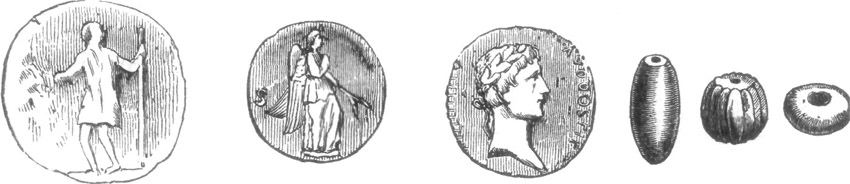
METALS AND BEADS.ToList
This passage tacitly implies that at that time a Greek colony had long since held possession of the town, and according to Strabo's testimony (XIII. i. 42), such a colony built Ilium during the dominion of the Lydians. Now, as the commencement of the Lydian dominion dates from the year 797 B.C., and as the Ilians seem to have been completely established there long before the arrival of Xerxes in 480 B.C., we may fairly assume that their first settlement in Troy took place about 700 B.C. Now, there are found no inscriptions later than those belonging to the second century after Christ, and no coins of later date than Constantine II., but very many belonging to Constantine the Great, who, as is well known, intended to build Constantinople on that site, but it remained an uninhabited place till about the end of the reign of Constans II., that is till about A.D. 361. Since the accumulation of debris during this long period of 1061 years amounts only to six and one-half feet, whereas we have still to dig to a depth of forty feet, and in places to forty-six and one-half below this, before reaching the native soil, how many years did it require to form a layer of forty to forty-six and one-half feet? The formation of the uppermost one, the Greek layer of six and one-half feet required 1061. The time required to cover the foundations of Troy to a depth of forty-six and one-half feet of debris must have been very long. The first layer of from thirteen to twenty feet on this hill of Hissarlik belonged to the Aryan race, of whom very little can be said. The second layer was formed by the Trojans of Homer, and are supposed, by Dr. Schliemann and others to have flourished here about 1400 years before Christ. We have only the general supposition of antiquity that the Trojan war occurred about B.C. 1200, and Homer's statement that Dardanus, the first Trojan King, founded Dardania, which town Virgil and Euripides consider identical with Ilium, and that after him it was governed by his son Erichthonius, and then by his grandson Tros, by his great-grandson Ilus, and then by his son Laomedon, and by his grandson Priam. Even if we allow every one of these six kings a long reign of thirty-three years, we nevertheless scarcely carry the foundation of the town beyond 1400 B.C., that is 700 years before the Greek colony.
During Dr. Schliemann's three-year excavations in the depths of Troy, he has had daily and hourly opportunities of convincing himself that, from the standard of our own or of the ancient Greek mode of life, we can form no idea of the life and doings of the four nations which successively inhabited this hill before the time of the Greek settlement. They must have had a terrible time of it, otherwise we should not find the walls of one house upon the ruined remains of another, in continuous but irregular succession; and it is just because we can form no idea of the way in which these nations lived and what calamities they had to endure, that it is impossible to calculate the duration of their existence, even approximately, from the thickness of their ruins. It is extremely remarkable, but perfectly intelligible from the continual calamities which befel the town, that the civilization of all the four nations constantly declined; the terra-cottas, which show continuous decadence, leave no doubt of this.
The first settlement on this hill of Hissarlik seems to have been of the longest duration, for its ruins cover the rock to a height of from thirteen to twenty feet. Its houses and walls of fortification were built of stones, large and small, joined with earth, and manifold remains of these may be seen in the excavations. It was supposed that these settlers were identical with the Trojans of whom Homer sang, which is not the case.
All that can be said of the first settlers is that they belonged to the Aryan race, as is sufficiently proved by the Aryan religious symbols met with in the strata of their ruins, both upon the pieces of pottery and upon the small curious terra-cottas with a hole in the centre, which have the form of the crater of a volcano or of a carrousel, i.e., a top.
The excavations made have sufficiently proved that the second nation which built a town on this hill, upon the debris of the first settlers (which is from 13 to 20 feet deep), are the Trojans of whom Homer sings. Their debris lies from 23 to 33 feet below the surface. This Trojan stratum, which, without exception, bears marks of great heat, consists mainly of red ashes of wood, which rise from 5 to 10 feet above the Great Tower of Ilium, the double Scæan Gate, and the great enclosing Wall, the construction of which Homer ascribes to Poseidon and Apollo, and they show that the town was destroyed by a fearful conflagration. How great the heat must have been is clear also from the large slabs of stone upon the road leading from the double Scæan Gate down to the Plain; for when the road was laid open all the slabs appeared as uninjured as if they had been put down quite recently; but after they had been exposed to the air for a few days, the slabs of the upper part of the road, to the extent of some 10 feet, which had been exposed to the heat, began to crumble away, and they have now almost disappeared, while those of the lower portion of the road, which had not been touched by the fire, have remained uninjured, and seem to be indestructible. A further proof of the terrible catastrophe is furnished by a stratum of scoriæ of melted lead and copper, from one fifth to one and one fifth of an inch thick, which extends nearly through the whole hill at a depth of from 28 to 29½ feet. That Troy was destroyed by enemies after a bloody war is further attested by the many human bones which were found in these heaps of debris, and above all the skeletons with helmets, found in the depths of the Temple of Athena, for, as we know from Homer, all corpses were burned and the ashes were preserved in urns. Of such urns were found an immense number in all the pre-Hellenic strata on the hill. Lastly, the Treasure, which some member of the royal family had probably endeavored to save during the destruction of the city, but was forced to abandon, leaves no doubt that the city was destroyed by the hands of enemies. This Treasure was found on the large enclosing wall by the side of the royal palace, at a depth of 27½ feet, and covered with red Trojan ashes from 5 to 6½ feet in depth, above which was a post-Trojan wall of fortification 19½ feet high.
As Homer is so well informed about the topography and the climatic conditions of the Troad, there can surely be no doubt that he had himself visited Troy. But, as he was there long after its destruction, and its site had moreover been buried deep in the debris of the ruined town, and had for centuries been built over by a new town, Homer could neither have seen the Great Tower of Ilium nor the Scæan Gate, nor the great enclosing Wall, nor the palace of Priam; for, as every visitor to the Troad may convince himself by the excavations, the ruins and red ashes of Troy alone—forming a layer of from five to ten feet thick—covered all these remains of immortal fame, and this accumulation of debris must have been much more considerable at the time of Homer's visit. Homer made no excavations so as to bring those remains to light, but he knew of them from tradition; for the tragic fate of Troy had for centuries been in the mouths of all minstrels, and the interest attached to it was so great that tradition itself gave the exact truth in many details.
"Say now, ye Nine, who on Olympus dwell, Muses—for ye are Goddesses, and ye Were present and know all things; we ourselves But hear from Rumor's voice, and nothing know— Who were the chiefs and mighty lords of Greece."
Such, for instance, is the memory of the Scæan Gate in the Great Tower of Ilium, and the constant use of the name Scæan Gate in the plural, because it had to be described as double, and in fact it has been proved to be a double gate. According to the lines of the Iliad, it now seems extremely probable that, at the time of Homer's visit, the King of Troy declared that his race was descended in a direct line from Æneas.
"But o'er the Trojans shall Æneas reign, And his sons' sons, through ages yet unborn."
Now, as Homer never saw Ilium's Great Tower, nor the Scæan Gate, and could not imagine that these buildings lay buried deep beneath his feet, and as he probably imagined Troy to have been very large—according to the then existing poetical legends—and perhaps wished to describe it as still larger, we can not be surprised that he makes Hector descend from the palace in the Pergamus and hurry through the town in order to arrive at the Scæan Gate; whereas that gate and Ilium's Great Tower, in which it stands, are in reality directly in front of the royal house. That this house is really the king's palace seems evident from its size, from the thickness of its stone walls, in contrast to those of the other houses of the town, which are built almost exclusively of unburned bricks, and from its imposing situation upon an artificial hill directly in front of or beside the Scæan Gate, the Great Tower, and the great surrounding Wall. This is confirmed by the many splendid objects found in its ruins, especially the enormous royally ornamented vase with the picture of the owl-headed goddess Athena, the tutelary divinity of Ilium; and lastly, above all other things, the rich Treasure found close by it. It can not, of course, be proved that the name of this king, the owner of this Treasure, was really Priam; but he is so called by Homer and in all the traditions. All that can be proved is, that the palace of the owner of this Treasure, this last Trojan king, perished in the great catastrophe, which destroyed the Scæan Gate, the great surrounding Wall, and the Great Tower, and which desolated the whole city. It can be proved, by the enormous quantities of red and yellow calcined Trojan ruins, from five to ten feet in height, which covered and enveloped these edifices, and by the many post-Trojan buildings, which were again erected upon these calcined heaps of ruins, that neither the palace of the owner of the Treasure, nor the Scæan Gate, nor the great surrounding Wall, nor Ilium's Great Tower, were ever again brought to light. A city, whose king possessed such a Treasure, was immensely wealthy, considering the circumstances of these times; and because Troy was rich it was powerful, had many subjects, and obtained auxiliaries from all quarters.
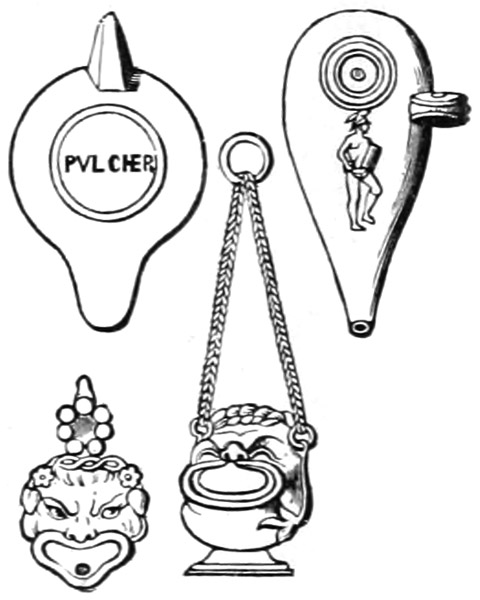
TERRA-COTTA LAMPS.ToList
This Treasure of the supposed mythical king Priam, of the mythical heroic age, is, at all events, a discovery which stands alone in archæology, revealing great wealth, great civilization and great taste for art, in an age preceding the discovery of bronze, when weapons and implements of pure copper were employed contemporaneously with enormous quantities of stone weapons and implements. This Treasure further leaves no doubt that Homer must have actually seen gold and silver articles, such as he continually describes; it is, in every respect, of inestimable value to science, and will for centuries remain the object of careful investigation.
While the Trojan war was the last it was also the greatest of all the achievements of the heroic age, and was immortalized by the genius of Homer. Paris, son of Priam, king of Ilium or Troy, abused the hospitality of Menelaus, king of Sparta, by carrying off his wife Helen, the most beautiful woman of the age. All the Grecian princes looked upon the outrage as committed upon themselves. Responding to the call of Menelaus, they assemble in arms, elect his brother Agamemnon, king of Mycenæ, leader of the expedition, and sail across the Ægean in nearly 1,200 ships to recover the faithless fair one. Some, however, excelled Agamemnon in fame. Among them Achilles stands pre-eminent in strength, beauty and value, while Ulysses surpasses all the rest in the mental qualities of counsel, subtility and eloquence. Thus, by the opposite endowments, these two heroes form the centre of the group.
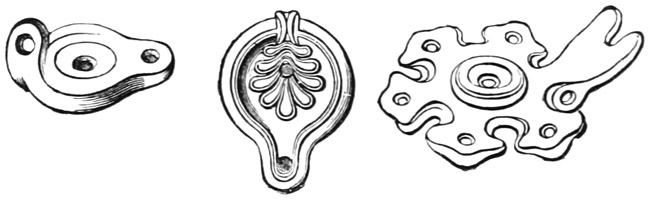
BRONZE LAMPS.ToList
Among the Trojans, Hector, one of the sons of Priam, is most distinguished for heroic qualities, and forms a striking contrast to his handsome, but effeminate brother, Paris. It is said that even the gods took part in the contest, encouraging their favorite heroes, and sometimes fighting by their side or in their stead. It was not until the tenth year that Troy yielded to the inevitable fate. It was delivered over to the sword and its glory sank in ashes.
The houses of Troy were all very high, and had several stories, as is obvious from the thickness of the walls, the construction and colossal heaps of debris. The city was immensely rich, and as it was wealthy, so was it powerful and its buildings large. The ruins are found in a badly decayed state, because of the great fires that occurred there, and the neighboring towns were largely built with stone from the ruins of Troy; Archæanax is said to have built a long wall around Sigeum with its stones.
A portion of a large building was laid bare, the walls of which are 6¼ feet thick, and consist for the most part of hewn blocks of limestone joined with clay. None of the stones seem to be more than 1 foot 9 inches long, and they are so skillfully put together, that the walls form a smooth surface. This house is built upon a layer of yellow and brown ashes and ruins, at a depth of 20 feet, and the portion of the walls preserved reaches up to within 10 feet below the surface of the hill. In the house, as far as has been excavated, only one vase, with two breasts in front and one breast at the side, has been found.
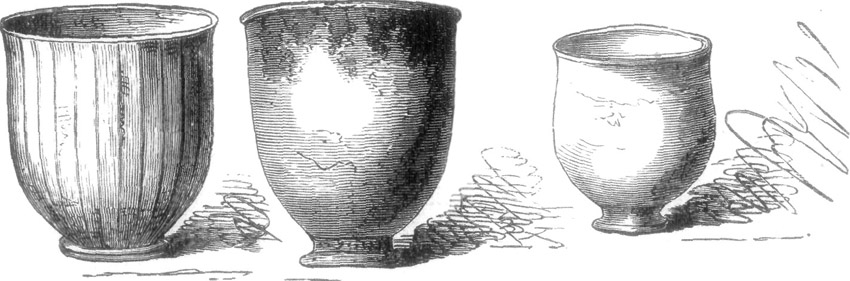
GOLDEN CUPS OF PRIAM.ToList
This is the first house that Dr. Schliemann excavated, which is quite evident by what he writes about it: "It is with a feeling of great interest that, from this great platform, that is, at a perpendicular height of from thirty-three to forty-two feet, I see this very ancient building (which may have been erected 1000 years before Christ) standing as it were in mid air."
A room was excavated which is ten feet high and eleven and one-fourth wide; it was at one time much higher; its length has not been ascertained.
One of the compartments of the uppermost houses, below the Temple of Athena and belonging to the pre-Hellenic period, appears to have been used as a wine-merchant's cellar or as a magazine, for in it there are nine enormous earthen jars of various forms, about five and three-fourths feet high and four and three-fourths feet across, their mouths being from twenty-nine and one-half to thirty-five and one-fourth inches broad. Each of these earthen jars has four handles, three and three-fourths inches broad, and the clay of which they are made has the enormous thickness of two and one-fourth inches.
A house of eight rooms was also brought to light at a depth of twenty-six feet. It stands upon the great Tower, directly below the Greek Temple of Athena. Its walls consist of small stones cemented with earth, and they appear to belong to different epochs; for, while some of them rest directly upon the stones of the Tower, others were not built till the Tower was covered with eight inches, and in several cases even with three and one-fourth feet, of debris. These walls also show differences in thickness; one of them is four and one-half feet, others are only twenty-five and one-half inches, and others again not more than nineteen and two-thirds inches thick. Several of these walls are ten feet high, and on some of them may be seen large remnants of the coatings of clay, painted yellow or white. Black marks, the result of fire, upon the lower portion of the walls of the other rooms which have been excavated, leave no doubt that their floors were of wood, and were destroyed by fire. In one room there is a wall in the form of a semicircle, which has been burnt as black as coal. All the rooms as yet laid open, and not resting directly upon the Tower, have been excavated down to the same level; and, without exception, the debris below them consists of red or yellow ashes and burnt ruins. Above these, even in the rooms themselves, were found nothing but either red or yellow wood-ashes, mixed with bricks that had been dried in the sun and subsequently burnt by the conflagration, or black debris, the remains of furniture, mixed with masses of small shells: in proof of this there are the many remains which are still hanging on the walls.
A very large ancient building was found standing upon the wall or buttress. At this place the wall appears to be about seventy-nine feet wide, or thick. The site of this building, upon an elevation, together with its solid structure, leave no doubt that it was the grandest building in Troy; nay, that it must have been the Palace of Priam. This edifice, now first laid open from beneath the ashes which covered it in the burning of the city, was found by Dr. Schliemann in the very state to which, in Homer, Agamemnon threatens to reduce it: "The house of Priam blackened with fire."
Upon this house, by the side of the double gate, upon Ilium's Great Tower, at the edge of the western slope of the Acropolis, sat Priam, the seven elders of the city, and Helen; and this is the scene of the most splendid passage in the Iliad:
"Attending there on aged Priam, sat The Elders of the city; . . . All these were gathered at the Scæan Gates. . . . so on Ilion's Tower Sat the sage chiefs and counselors of Troy. Helen they saw, as to the Tower she came."
From this spot the company surveyed the whole plain, and saw at the foot of the Acropolis the Trojan and the Achæan armies face to face, about to settle their agreement to let the war be decided by a single combat between Paris and Menelaus.
"Upon Seamander's flowery mead they stood Unnumbered as the vernal leaves and flowers."
The description which Homer gives of the Tower of Ilium, and the incidents connected with it, corresponds so closely to the tower which Dr. Schliemann found that it leaves no doubt that the two are identical.
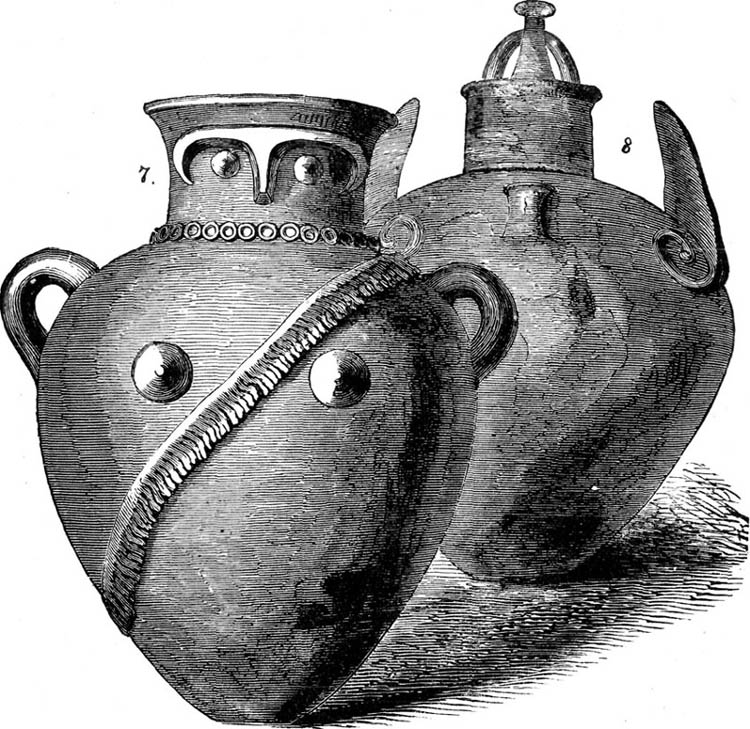
WONDERFUL VASES OF TERRA-COTTA. (From the Palace of Priam, at 24¼ feet.)ToList
"Now, with regard to the objects found in these houses, I must first of all mention having discovered, at a depth of twenty-six feet, in the Palace of Priam, a splendid and brilliant brown vase, twenty-four and one-fourth inches high, with a figure of the tutelar goddess of Troy, that is, with her owl's head, two breasts, a splendid necklace, indicated by an engraved pattern, a very broad and beautifully engraved girdle, and other very artistic decorations; there are no arms, nor are there any indications of them. Unfortunately this exquisite vase has suffered from the weight of stones which lay upon it. No. 4 resembles an owl's beak, and especially as this is seen between the ear-shaped ornaments, it was doubtless intended to represent the image of the owl with upraised wings on each side of the vases, which image received a noble appearance from the splendid lid with a coronet. I give a drawing of the largest vase of this type, which was found a few days ago in the royal palace at a depth of from twenty-eight to twenty-nine and one-half feet; on the top of it I have placed the bell-shaped lid with a coronet, which was discovered close by and appears to have belonged to it.
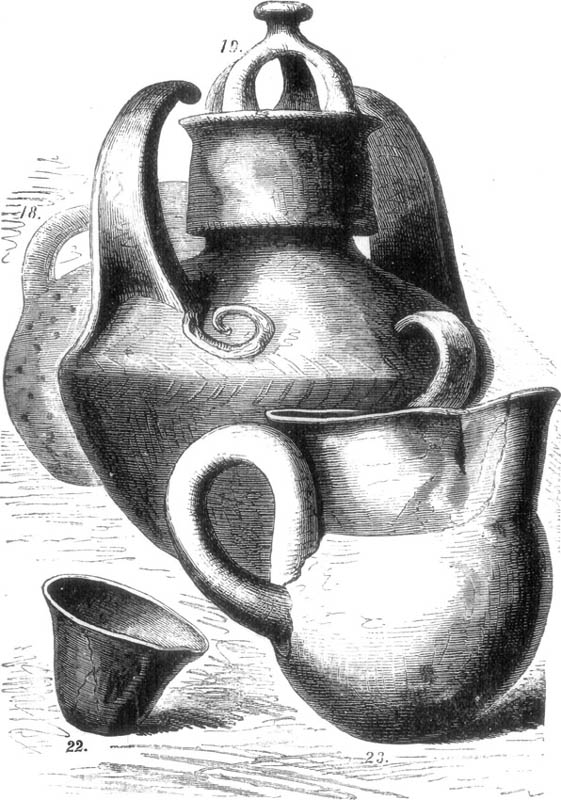
FROM PALACE OF PRIAM.ToList
"I also found in the Treasure three great silver vases, the largest of which is above eight and one-fourth inches high and nearly eight inches in diameter, and has a handle five and one-half inches in length and three and one-half in breadth. (No. 23.) The second vase is 6.9 inches high and nearly six inches in diameter; another silver vase is welded to the upper part of it (No. 22), of which, however, only portions have been preserved. No. 19 is a splendid Terra-cotta vase from the Palace of Priam. It is the largest vase of the type frequent in the ruins, with two small handles and two great upright wings. The cover was found near it.
LIDS AND METALS OF PRIAM.ToList
"On the south side of the hill, where, on account of the slight natural slope, I had to make my great trench with an inclination of fourteen degrees, I discovered, at a distance of 197 feet from the declivity, a Tower, forty feet thick, which I have uncovered on the north and south sides along the whole breadth of my trench, and have convinced myself that it is built on the rock at a depth of forty-six and a half feet.
"The Tower is at present only twenty feet high, but the nature of its surface, and the masses of stones lying on both sides, seem to prove that it was at one time much higher. For the preservation of what remains we have only to thank the ruins of Troy, which entirely covered the Tower as it now stands. It is probable that after the destruction of Troy much more of it remained standing, and that the part which rose above the ruins of the town was destroyed by the successors of the Trojans, who possessed neither walls nor fortifications. The western part of the Tower, so far as it is yet uncovered, is only from 121 to 124 feet distant from the steep western slope of the hill; and, considering the enormous accumulation of debris, I believe that the Tower once stood on the western edge of the Acropolis, where its situation would be most interesting and imposing, for its top would have commanded, not only a view of the whole Plain of Troy, but of the sea with the Islands of Tenedos, Imbros and Samothrace. There is not a more sublime situation in the area of Troy than this, and I therefore presume that it is the 'Great Tower of Ilium' which Andromache ascended because 'she had heard that the Trojans were hard pressed and that the power of the Achæans was great.'
"'But to the height of Ilion's topmost tower Andromache is gone; since tidings came The Trojan force was overmatched, and great The Grecian strength.'
"After having been buried for thirty-one centuries, and after successive nations have built their houses and palaces high above its summit during thousands of years, this Tower has now again been brought to light, and commands a view, if not of the whole Plain, at least of the northern part and of the Hellespont. May this sacred and sublime monument of Greek heroism forever attract the eyes of those who sail through the Hellespont! May it become a place to which the inquiring youth of all future generations shall make pilgrimage to fan their enthusiasms for knowledge, and above all for the noble language and literature of Greece!
"Directly by the side of the Palace of King Priam I came upon a large copper article of the most remarkable form, which attracted my attention all the more as I thought I saw gold behind it. On the top of this copper article lay a stratum of red and calcined ruins, from four and three-quarters to five and one-quarter feet thick, as hard as stone, and above this again lay a wall of fortification (six feet broad and twenty feet high) which was built of large stones and earth, and must have belonged to an early date after the destruction of Troy. In order to withdraw the Treasure from the greed of my workmen, and to save it for archæology, I had to be most expeditious, and although it was not yet time for breakfast, I immediately had breakfast called. While the men were eating and resting I cut out the Treasure with a large knife, which it was impossible to do without the very greatest exertion and the most fearful risk of my life, for the great fortification wall, beneath which I had to dig, threatened every moment to fall down upon me. But the sight of so many objects, every one of which is of inestimable value to archæology, made me foolhardy, and I never thought of any danger. It would, however, have been impossible for me to have removed the Treasure without the help of my dear wife, who stood by me ready to pack the things which I cut out in her shawl and to carry them away.
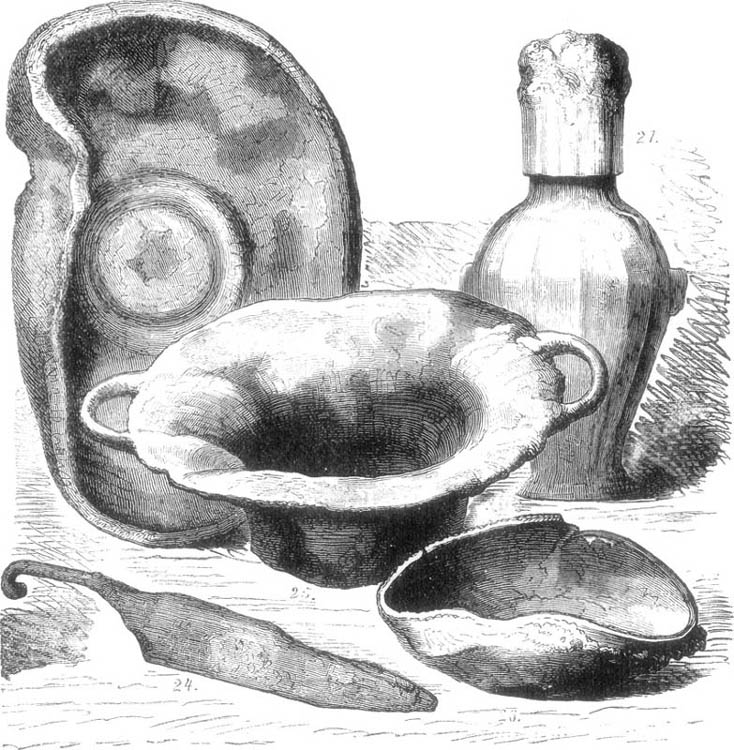
TREASURES OF PRIAM.ToList
"The first thing I found was a large copper shield, in the form of an oval salver, in the middle of which is a knob or boss encircled by a small furrow. It is a little less than twenty inches in length, is quite flat, and surrounded by a rim one and one-half inches high; the boss is two and one-third inches high and four and one-third inches in diameter; the furrow encircling it is seven inches in diameter and two-fifths of an inch deep. This round shield of copper (or bronze?) with its central boss, and the furrow and rim so suitable for holding together a covering of ox-hides, reminds one irresistibly of the seven-fold shield of Ajax (Iliad vii. 219-223):
"'Ajax approached; before him, as a tower, [405] His mighty shield he bore, seven-fold, brass-bound, The work of Tychius, best artificer That wrought in leather; he in Hyla dwelt. Of seven-fold hides the ponderous shield was wrought Of lusty bulls; the eighth was glittering brass.'
"It is equally striking to compare the shield of the Treasure with the description of Sarpedon's shield, with its round plate of hammered copper (or bronze), and its covering of ox-hides, fastened to the inner edge of the rim by gold wires or rivets (Iliad xii. 294-297):
"'His shield's broad orb before his breast he bore, Well wrought, of beaten brass, which the armorer's hand Had beaten out, and lined with stout bull's hide With golden rods, continuous, all around.'
"The second object which I got out was a copper caldron with two horizontal handles. It is sixteen and one-half inches in diameter and five and one-half inches high; the bottom is flat, and is nearly eight inches in diameter. In the Iliad this vessel is used almost always as a caldron, and is often given as a prize at games; in the Odyssey it is always used for washing the hands or feet. This one shows the marks of a fearful conflagration, and near the left handle are seen two fragments of copper weapons (a lance and a battle-ax) firmly molten on. (See No. 25.)
"The third object was a copper plate two-fifths of an inch thick, six and one-third inches broad, and seventeen and one-third inches long; it has a rim about one-twelfth of an inch high; at one end of it there are two immovable wheels with an axle-tree. This plate is very much bent in two places, but I believe that these curvatures have been produced by the heat to which the article was exposed in the conflagration; a silver vase four and three-fourths inches high and broad has been fused to it; I suppose, however, that this also happened by accident in the heat of the fire. (See No. 14.)
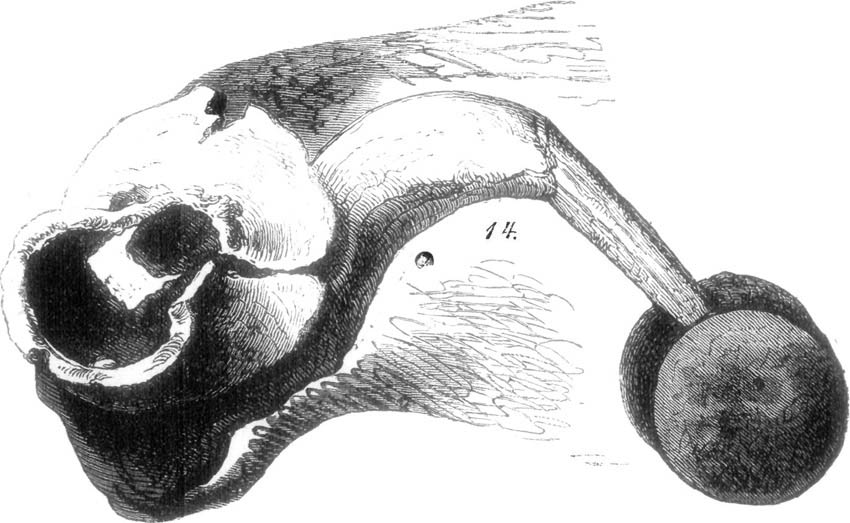
PART OF MACHINE OF PRIAM.ToList
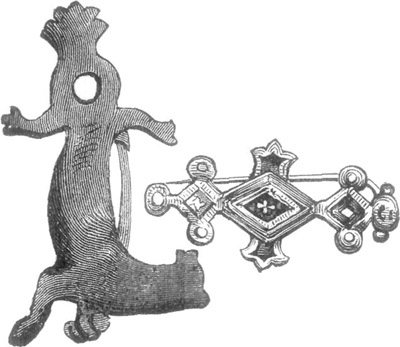
JEWELRY OF GOLD AND STONES.ToList
"This remarkable object lay at the top of the whole mass, and I suppose it to have formed a hasp to the lid of the wooden chest in which the Treasure was packed. The fourth article I brought out was a copper vase five and one-half inches high and four and one-third inches in diameter. Thereupon followed a globular bottle of the purest gold, weighing 6,220 grains, or above one pound troy; it is nearly six inches high and five and one-half inches in diameter, and has the commencement of a zigzag decoration on the neck, which, however, is not continued all round. Then came a cup, likewise of the purest gold, weighing seven and one-fourth oz. troy; it is three and one-half inches high and three inches broad. (See Nos. 4 and 12.)
"Next came another cup of purest gold, weighing about one pound and six oz. troy; it is three and one-half inches high, seven and one-fourth inches long, and seven and one-fifth inches broad; it is in the form of a ship, with two large handles; on one side there is a mouth one and one-fifth inches broad, for drinking out of, and another at the other side two and three-fourths inches broad. Prof. Stephanos Kumanudes, of Athens, remarks, the person who presented the filled cup may have first drank from the small mouth as a mark of respect, to let the guest drink from the larger mouth. (See No. 10.)
"The Treasure further contained a small cup of gold weighing two and one-fourth oz. troy; also six pieces of the purest silver in the form of large knife blades; they have all been wrought with a hammer.
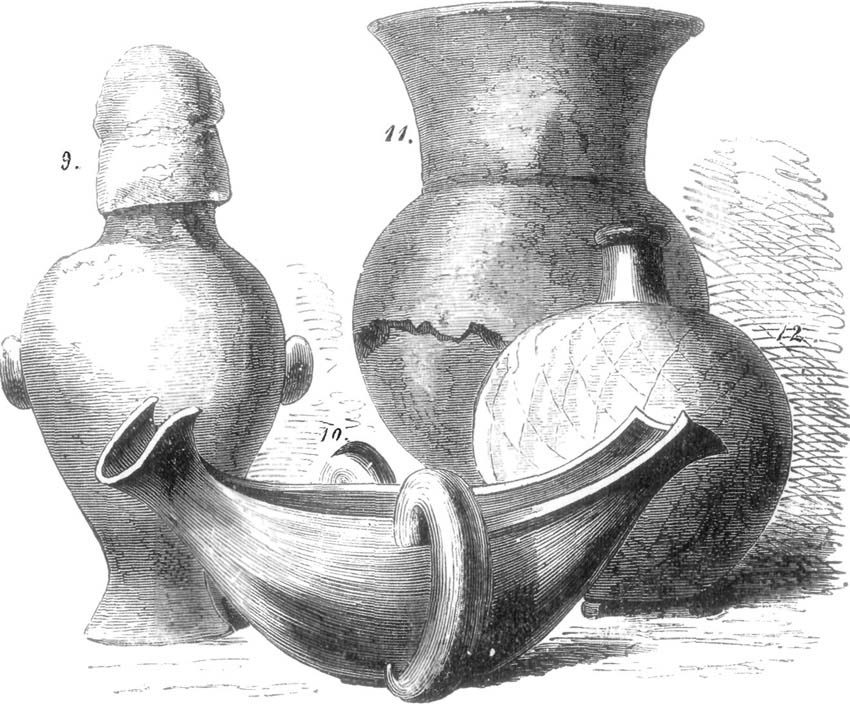
FOUND IN THE PALACE OF PRIAM.ToList

SHIELD OF THE PALACE OF PRIAM.ToList
"I also found in the Treasure three great silver vases, the largest of which is above eight and one-fourth inches high and nearly eight inches in diameter, and has a handle five and one-half inches in length and three and one-half in breadth; I found besides a number of silver goblets and cups. Upon and beside the gold and silver articles I found thirteen copper lances; also fourteen copper weapons, which are frequently met with here, and seven large double-edged copper daggers.
"As I found all these articles together, forming a rectangular mass, or packed into one another, it seems to be certain that they were placed on the city wall in a wooden chest, such as those mentioned by Homer as being in the Palace of King Priam. This appears to be the more certain, as close by the side of these articles I found a copper key above four inches long, the head of which (about two inches long and broad) greatly resembles a large safe-key of a bank. Curiously enough this key has had a wooden handle.
"That the Treasure was packed together at terrible risk of life, and in the greatest anxiety, is proved among other things also by the contents of a large silver vase, at the bottom of which I found two gold diadems, a fillet and four beautiful ear-rings of most exquisite workmanship; upon these lay fifty-six gold ear-rings of exceedingly curious form, and 8,750 small gold rings, perforated prisms and dice, gold buttons and similar jewels; then followed six gold bracelets, and, on the top of all, the two small gold goblets. Some of these are mentioned by Homer:
"'Far off were flung the adornments of her head; The net, the fillet, and the woven band, The nuptial-veil by golden Venus given.'
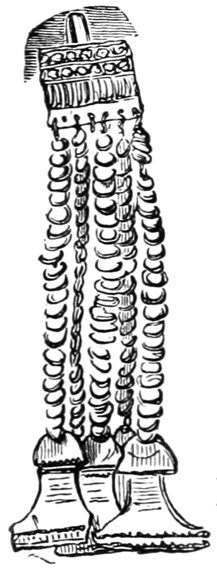
GOLD NECKLACE OF TROY.ToList
"The one diadem consists of a gold fillet, twenty-one and two-thirds inches long and nearly half an inch broad, from which there hang on either side seven little chains to cover the temples, each of which has eleven square leaves with a groove; these chains are joined to one another by four little cross chains, at the end of which hangs a glittering golden idol of the tutelar goddess of Troy, nearly an inch long. The entire length of each of these chains, with the idols, amounts to ten and one-quarter inches. Almost all these idols have something of the human form, but the owl's head with the two large eyes can not be mistaken; their breadth at the lower end is about nine-tenths of an inch. Between these ornaments for the temples there are forty-seven little pendant chains adorned with square leaves; at the end of each little chain is an idol of the tutelar goddess of Ilium, about three-quarters of an inch long; the length of these little chains with the idols is not quite four inches. The fillet is above eighteen inches long and two-fifths of an inch broad, and has three perforations at each end. Eight quadruple rows of dots divide it into nine compartments, in each of which there are two large dots, and an uninterrupted row of dots adorns the whole edge. (See Fig. 1.) Of the four ear-rings only two are exactly alike; from the upper part, which is almost in the shape of a basket, and is ornamented with two rows of decorations in the form of beads, there hang six small chains on which are three little cylinders; attached to the end of the chains are small idols of the tutelar goddess of Troy. The length of each ear-ring is three and one-half inches. The upper part of the other two ear-rings is larger and thicker, but likewise almost in the shape of a basket; from it are suspended five little chains entirely covered with small round leaves, on which are likewise fastened small but more imposing idols of the Ilian tutelar divinity; the length of one of these pendants is three and one-half inches, that of the other a little over three inches. (See Fig. 17.)
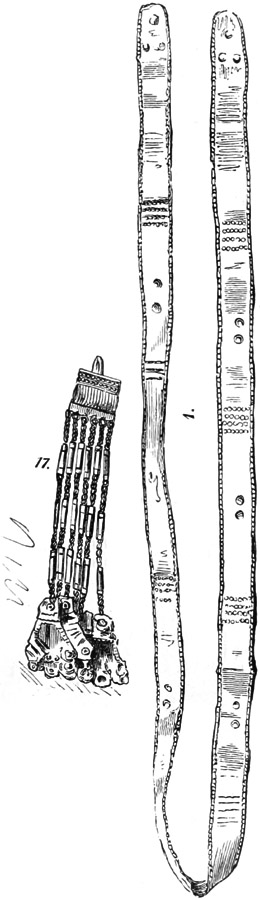
GOLD TASSELS OF TROY.ToList
"Homer, in the Iliad, sings of 'beautifully twined tassels of solid gold' which adorned Athene:
"'All around A hundred tassels hung, rare works of art, All gold, each one a hundred oxen's price.'
"Again, when Hera adorns herself to captivate Jove, her zone is fringed with a hundred tassels, and her ear-rings are described in terms corresponding exactly to the triple leaves above described:
"'Her zone, from which a hundred tassels hung, She girt above her; and, in three bright drops, Her glittering gems suspended from her ears, And all around her grace and beauty shone.'
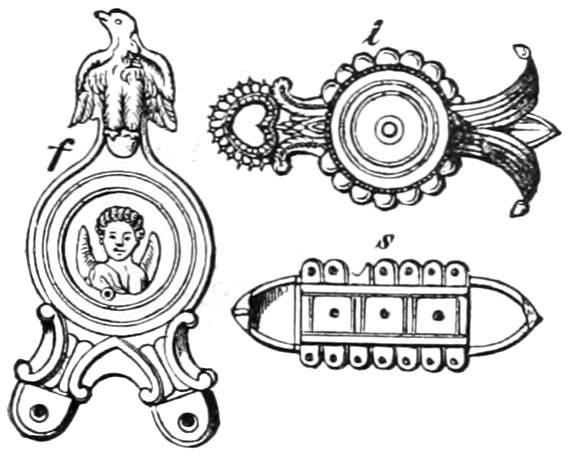
LAMPS FOUND AT TROY.ToList
"Of the six gold bracelets two are quite simple, and closed, but consist of an ornamented band one-twenty-fifth of an inch thick and one-fourth of an inch broad. The other three are double, and the ends are turned round and furnished with a head. The princess who wore these bracelets must have had unusually small hands, for they are so small that a girl of ten would have difficulty in putting them on.
"The fifty-six other gold ear-rings are of various sizes, and three of them appear to have also been used by the princesses of the royal family as finger-rings. Also gold buttons were found, or studs, one-sixth of an inch high, in the cavity of which is a ring above one-tenth of an inch broad for sewing them on; gold double buttons, exactly like our shirt studs, three-tenths of an inch long, which, however, are not soldered, but simply stuck together, for from the cavity of the button there projects a tube, nearly one-fourth of an inch long, and from the other a pin of the same length, and the pin is merely stuck into the tube to form a double stud. (See Fig. No. 16.) These double buttons or studs can only have been used, probably, as ornament upon leather articles, for instance upon the handle-straps of swords, shields, or knives. I found in the vase also two gold cylinders above one-tenth of an inch long; also a small peg above four-fifths of an inch in length, and from six one-hundreths to eight one-hundreths of an inch thick; it has at one end a perforated hole for hanging it up, and on the other side six encircling incisions, which give the article the appearance of a screw; it is only by means of a magnifying glass that it is found not to be really a screw. I also found in the same vase two pieces of gold, one of which is one-seventh of an inch, the other above two inches long; each of them has twenty-one perforations.
"The persons who endeavored to save the Treasure had fortunately the presence of mind to stand the silver vase, containing the valuable articles described above, upright in the chest, so that not so much as a bead could fall out, and everything has been preserved uninjured.
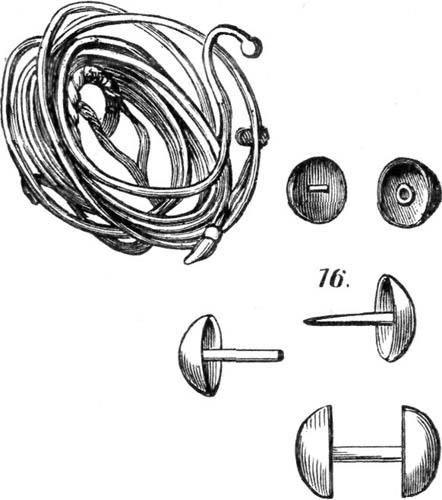
SIX GOLDEN BRACELETS WELDED TOGETHER BY THE CONFLAGRATION.ToList
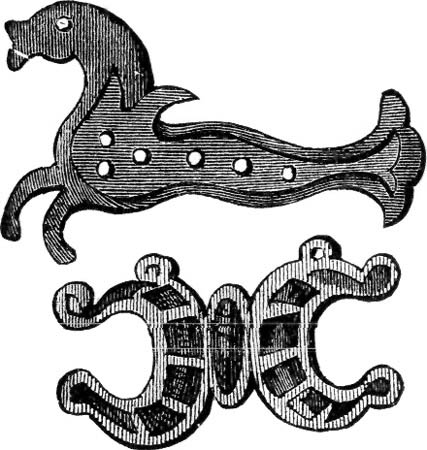
GOLD PINS WITH SET GEMS.ToList
"M. Landerer, of Athens, a chemist well known through his discoveries and writings, who has most carefully examined all the copper articles of the Treasure, and analyzed the fragments, finds that all of them consist of pure copper without any admixture of tin or zinc, and that, in order to make them more durable, they have been wrought with the hammer.
"As I hoped to find other treasures here, and also wished to bring to light the wall surrounding Troy, the erection of which Homer ascribes to Poseidon and Apollo, as far as the Scæan Gate, I have entirely cut away the upper wall, which rested partly upon the gate, to an extent of fifty-six feet. Visitors to the Troad can, however, still see part of it in the northwest earth-wall opposite the Scæan Gate. I have also broken down the enormous block of earth which separated my western and northwestern cutting from the Great Tower. The result of this new excavation is very important to archæology, for I have been able to uncover several walls, and also a room of the Royal Palace, twenty feet in length and breadth, upon which no buildings of a later period rest.

GOLD EAR-RINGS OF TROY.ToList
"Of the objects discovered there I have only to mention an excellently engraved inscription found upon a square piece of red slate, which has two holes not bored through it and an encircling incision, but neither can my learned friend Emile Burnouf nor I tell in what language the inscription is written. Further, there were some interesting terra-cottas, among which is a vessel, quite the form of a modern cask, and with a tube in the centre for pouring in and drawing off the liquid. There were also found upon the walls of Troy, one and three-fourths feet below the place where the Treasure was discovered, three silver dishes, two of which were broken to pieces in digging down the debris, they can, however, be repaired, as I have all the pieces. These dishes seem to have belonged to the Treasure, and the fact of the latter having otherwise escaped our pickaxes is due to the above mentioned large copper vessels which projected, so that I could cut everything out of the hard debris with a knife.
"I found, further, a silver goblet above three and one-third inches high, the mouth of which is nearly four inches in diameter; also a silver flat cup or dish five and one-half inches in diameter, and two beautiful small silver vases of most exquisite workmanship. The larger one, which has two rings on either side for hanging up by strings, is nearly eight inches high with its hat-shaped lid, and three and one-half inches in diameter across the bulge. The smaller silver vase, with a ring on either side for suspension by a string, is about six and three-fourths inches high, with its lid, and above three inches broad.
"I now perceive that the cutting which I made in April was exactly at the proper point, and that if I had only continued it I should in a few weeks have uncovered the most remarkable buildings in Troy, namely, the Palace of King Priam, the Scæan Gate, the Great Surrounding Wall, and the Great Tower of Ilium; whereas, in consequence of abandoning this cutting, I had to make colossal excavations from east to west and from north to south through the entire hill in order to find those most interesting buildings.
"In the upper strata of the north western and western excavations we came upon another great quantity of heads of beautiful terra-cotta figures of the best Hellenic period, and at a depth of twenty-three feet upon some idols, as well as the upper portion of a vase with the owl's face and a lid in the form of a helmet. Lids of this kind, upon the edge of which female hair is indicated by incisions, are frequently found in all the strata between thirteen and thirty-three feet deep, and as they belong to vases with owls' faces, the number of lids gives us an idea of the number of the vases with the figure of the owl-headed Athene, which existed here in Troy.
"Homer rarely mentions temples, and, although he speaks of the Temple of Athene, yet, considering the smallness of the city, it is very doubtful whether it actually existed. It is probable that the tutelar goddess at that time possessed only the sacrificial altar which I discovered, and the crescent form of which greatly resembles the upper portion of the ivory idol found in the lowest strata as well as the one end of the six talents contained among the Treasure.
"Valuable stones, such as those large flags which cover the road leading from the Scæan Gate to the Plain, as well as the stones of the enclosing wall and of the Great Tower, have been left untouched, and not a single stone of the Scæan Gate is wanting. Nay, with the exception of the houses which I myself destroyed, it would be quite possible to uncover the 'carcasses' of all the houses, as in the case of Pompeii. The houses must have been very high, and a great deal of wood must have been used in their construction, for otherwise the conflagration could not have produced such an enormous quantity of ashes and rubbish.
"Upon and beside the gold and silver articles, I found thirteen copper lances, from nearly seven to above twelve and one-half inches in length, and from above one and one-half to two and one-third inches broad at the broadest point; at the lower end of each is a hole, in which, in most cases, the nail or peg which fastened the lance to the wooden handle is still sticking. The pin-hole is clearly visible in a lance-head which the conflagration has welded to a battle-ax. The Trojan lances were therefore quite different from those of the Greeks and Romans.
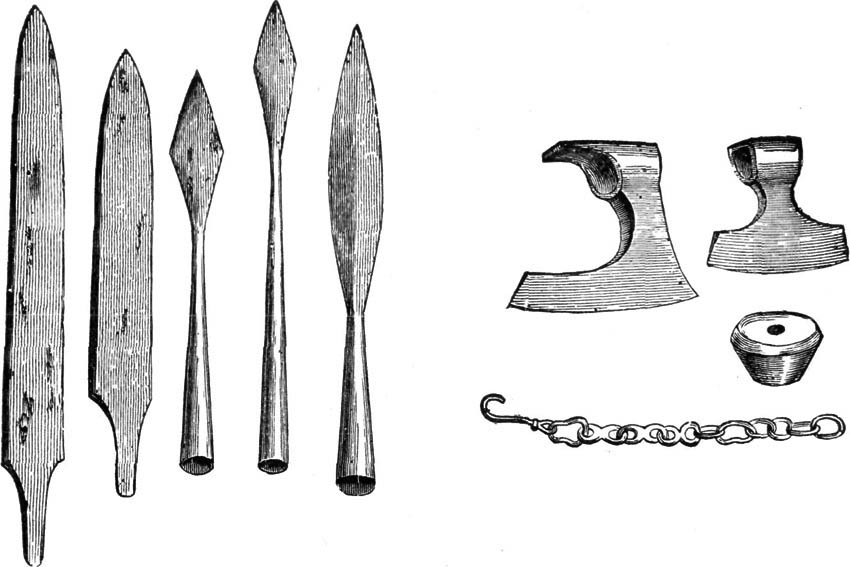
SPEARS, LANCES, AX AND CHAIN.ToList
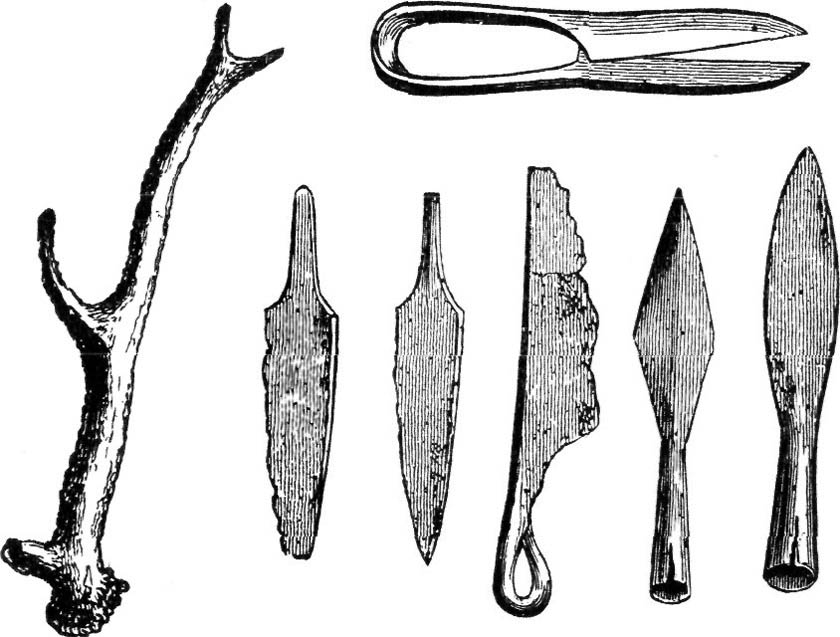
SHEARS, KNIVES AND SPEARS.ToList
"I also found fourteen of those copper weapons, which are frequently met with here, but which have never been discovered elsewhere; at one end they are pointed but blunt, and at the other they end in a broad edge. I formerly considered them to be a species of lance, but now, after mature consideration, I am convinced that they could have been used only as battle-axes. They are from above six to above twelve inches in length, from nearly one-half to above three-fourths of an inch thick, and from above one to nearly three inches broad; the largest of them weighs about three pounds avoirdupois.
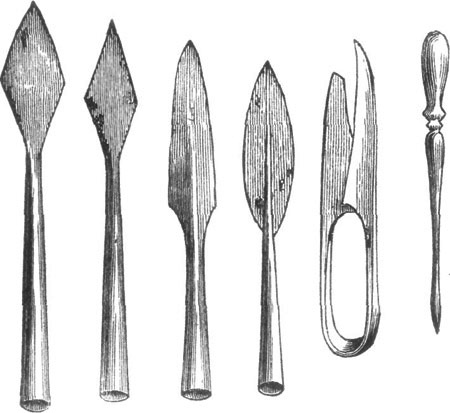
LANCES FOUND AT PALACE OF PRIAM, TROY.ToList
"There were also seven large double-edged copper daggers, with a handle from about two to two and three-fourths inches long, the end of which is bent round at a right angle. These handles must at one time have been encased in wood, for if the cases had been made of bone they would still have been wholly or partially preserved. The pointed handle was inserted into a piece of wood, so that the end projected about half an inch beyond it, and this end was simply bent round. The largest of these daggers is ten and two-thirds inches in length and above two inches broad at the broadest part; a second dagger, which is above one and three-fourths inches broad, has the point broken off, and is now less than nine inches long, but appears to have been eleven inches; a third dagger is eight and two-thirds inches long, and measures above one and one-fourth inches at the broadest point.
"On the north side of the hill I have now also uncovered several house-walls at a depth of forty-two and one-half feet, and also the beginning of a remarkable wall of fortification, the continuation of which may be seen in the labyrinth of the house-walls in the depths of the Temple of Athene. On the north side, above the primary soil, I have also brought to light a portion of the pavement already mentioned, composed of small, round, white sea-pebbles, below which are the calcined ruins of a building which formerly stood there.
"Among some very remarkable terra-cottas discovered since my last report I must mention two jugs found on the north side, at a depth of from twenty-three to twenty-six feet, each of which has two upright necks standing side by side, but their handles are united. One of them has also beside the mouths two small elevations, which may probably indicate eyes. Of a third jug of this kind I only found the upper portion. I must also mention an exceedingly curious cup, discovered at a depth of thirteen feet, which consists of a tube resting upon three feet and ending in one large and two small goblets; the larger goblet is connected with the opposite side of the tube by a handle. At the same depth I met with a large vase, from which projects a separate small vase; it is ornamented with incisions, and has three feet and two very pretty handles and rings for hanging it up. I found likewise, at the depth of thirteen feet, a vase with two female breasts, two large handles and engravings resembling letters. Among other extremely curious terra-cottas I must also mention three pots with three rows of perforations; they have the usual handle on one side and three feet on the other; also three large vases with perforations right round, on all sides, from the bottom to the top; their use is a riddle to me; can they have served as bee-hives? Also a vessel in the form of a pig, with four feet, which are, however, shorter than the belly, so that the vessel can not stand upon them; the neck of the vessel, which is attached to the back of the pig, is connected with the hinder part by a handle. I further found a pot in the form of a basket with a handle crossing the mouth, and a tube in the bulge for drawing off the liquid. Also two terra-cotta funnels, at a depth of ten feet, with a letter which I have repeatedly met with on some of the terra-cottas. At a depth of five feet I found one of those round twice-perforated terra-cottas with a stamp, in which there are Egyptian hieroglyphics; also a dozen of the same articles in the stamps of which are a crowned head, a bird, a dog's head, a flying man or an eagle and a stag. At a depth of sixteen and one-half feet I found the handle of a cup with the beautifully modeled head of a bull.
"Neither can I prove that the terra-cottas here frequently met with, in the form of horses' heads, represent the mother of Hera, Cybele or Rhea, but it is very likely, for, as it is well known, in Phrygia she was represented with a horse's head. Terra-cotta idols of the Ilian Athene are rarely met with, but we daily find marble idols of this goddess, most of which have almost a human form. We also frequently come upon oblong flat pieces of rough marble upon which the owl's face of the goddess is more or less deeply engraved. It is often so finely scratched that the aid of a magnifying glass is required to convince one that it actually exists; we found several such pieces of marble where the owl's head was painted in a black color. Since I have come to the conclusion that they are idols of the tutelar divinity of Troy I have carefully collected them.
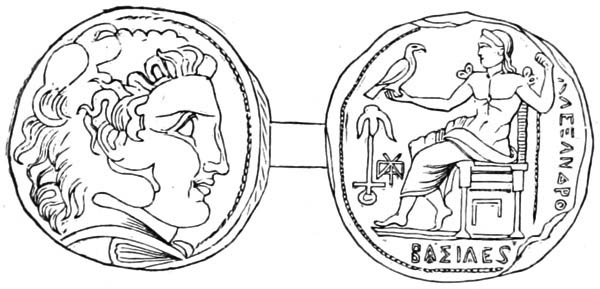
COINS OR METALS.ToList
"In excavating the ground upon which my wooden house had stood we found, at a depth of from nine to nineteen inches, eighteen copper and two silver medals; one of the latter is of Marcus Aurelius. The other is a tetra-drachm of the island of Tenedos; on the obverse, to the right, is the head of Jupiter, to the left that of Juno, both having one neck in common, like the heads of Janus. The head of Jupiter is crowned with laurels, that of Juno has a wreath or crown. Upon the reverse of the coin there is a laurel wreath round the edge, and in the centre a large double ax, above which stands the word Teneelion, below and to the right of the handle of the double ax there is a winged Eros, who is holding up an object which it is difficult to distinguish, to the left is a bunch of grapes and a monogram, which looks like the letter A.
"Of the copper coins five are of Alexandria Troas, two of Ophrynium, one of Tenedos, two of Abydos, and one of Dardania.
"When I uncovered the road paved with large flags of stone, which leads from the Scæan Gate to the Plain, the stones looked as new as if they had just been hewn. But since then, under the influence of the burning sun, the flags of the upper portion of the road, which have specially suffered from the conflagration that destroyed the city, are rapidly crumbling away, and will probably have quite disappeared in a few years. However, the flags of stone on the northwestern half of the road, which have been less exposed to the heat, may still last many centuries.
"In this day, closing the excavations at Ilium forever, I can not but fervently thank God for His great mercy, in that, notwithstanding the terrible danger to which we have been exposed owing to the continual hurricanes, during the last three years' gigantic excavations, no misfortune has happened, no one has been killed, and no one has been seriously hurt.
"In my last report I did not state the exact number of springs in front of the Ilium. I have now visited all the springs myself, and measured their distance from my excavations, and I can give the following account of them. The first spring, which is situated directly below the ruins of the ancient town-wall, is exactly 399 yards from my excavations; its water has a temperature of 60.8° Fahrenheit. It is enclosed to a height of six and-one-half feet by a wall of large stones joined with cement, nine and one-quarter feet in breadth, and in front of it there are two stone troughs for watering cattle. The second spring, which is likewise still below the ruins of the ancient town-wall, is exactly 793 yards distant from my excavations. It has a similar enclosure of large stones, seven feet high and five feet broad, and has the same temperature. But it is out of repair, and the water no longer runs through the stone pipe in the enclosure, but along the ground before it reaches the pipe. The double spring spoken of in my last report is exactly 1,033 yards from my excavations. It consists of two distinct springs, which run out through two stone pipes lying beside each other in the enclosure composed of large stones joined with earth, which rises to a height of seven feet and is twenty-three feet broad; its temperature is 62.6° Fahrenheit. In front of these two springs there are six stone troughs, which are placed in such a manner that the superfluous water always runs from the first trough through all the others. It is extremely probable that these are the two springs mentioned by Homer, beside which Hector was killed.
"'They (Hector and Achilles) in flight and pursuit, They by the watch-tower, and beneath the wall Where stood the wind-beat fig-tree, raced amain Along the public road, until they reached The fairly-flowing founts, whence issued forth, From double source, Scamander's eddying streams. One with hot current flows, and from beneath, As from a furnace, clouds of steam arise; 'Mid Summer's heat the other rises cold As hail, or snow, or water crystallized; Beside the fountains stood the washing-troughs Of well-wrought stone, where erst the wives of Troy And daughters fair their choicest garments washed, In peaceful times, ere came the sons of Greece.'
"In this new excavation I find four earthen pipes, from eighteen and three-quarters to twenty-two and one-quarter inches long, and from six and one-half to eleven and three-quarters inches thick, laid together for conducting water, which was brought from a distance of about seven miles from the upper Thymbrius. This river is now called the Kemar, from the Greek word kamara (vault), because an aqueduct of the Roman period crosses its lower course by a large arch. This aqueduct formerly supplied Ilium with drinking water from the upper portion of the river. But the Pergamus required special aqueducts, for it lies higher than the city.
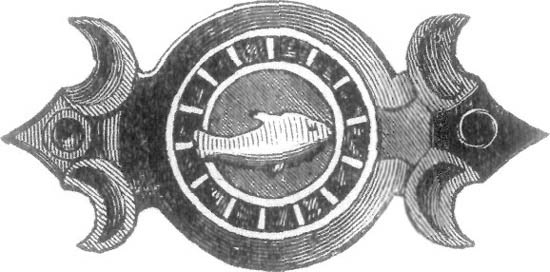
ELEGANT BROOCH OF TROY.ToList
"Unfortunately upon none of the articles of the Treasure of Priam are there found any inscriptions or any religious symbols except 100 idols of the Homeric 'owl-faced goddess Athene.' (Thea glaukopis Athene) which glitter upon the two diadems and the four ear-rings. These are, however, an undeniable proof that the Treasure belongs to the city and to the age of which Homer sings."
The question asked is: Has Schliemann found any inscriptions which throw the certain light of written testimony on the language, the history and social condition, the religion, science and literature of the old inhabitants of the hill, whose records form as yet no part of ancient history? Upon this point very little satisfaction can be given, yet the people of ancient Troy did have a written language. At a depth of twenty-six feet, in the royal palace, a vase with an inscription was found. One of the letters resembles the Greek P. This same letter occurs on a seal found at a depth of twenty-three feet; two other letters of this inscription occurred on one other terra-cotta, likewise found at a depth of twenty-three feet.
To Dr. Martin Haug belongs the honor of first deciphering the Trojan inscriptions on the above-mentioned vase. He, not without much research, interpreted it as a dedication "To the divine Sigo," a deity whose name was found in Sigeum. The transmutation, however, seemed forced; and, while Haug was right in his method, his results were pronounced at best,
"Fragments of broken words and thoughts, Yet glimpses of the true."
Prof. T. Gomperz, of Vienna, after making one correction in Haug's reading, still found it unsatisfactory, till the thought struck him of reading it from right to left round the vase, instead of from left to right, when the confused syllables flashed, as by sudden crystallization, into the pure Greek, and read: "To the divine Prince."
Another inscription was found which Prof. Max Muller read as the very name of Ilion. Others were found which are not as yet interpreted.
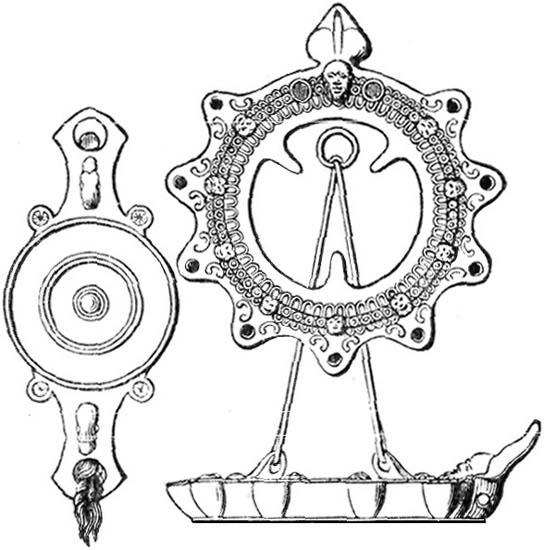
LAMP FOUND AT TROY.ToList