LITERATURE.ToC
Reading edition
LITERATURE.ToC
The perfection which the Greeks attained in literature and art is one of the most striking features in the history of the people. Their intellectual activity and their keen appreciation of the beautiful constantly gave birth to new forms of creative genius. There was an uninterrupted progress in the development of the Grecian mind from the earliest dawn of the history of the people to the downfall of their political independence, and each succeeding age saw the production of some of those master works of genius which have been the models and admiration of all subsequent time.
The poets were the popular writers of ancient Greece; prose writers appear no earlier than the sixth century before the Christian era, at which time the first literary prose essay was produced, for which three contemporary authors claim the honor. The Greeks had arrived at a high degree of civilization before they can be said to have possessed a history of their own. Nations far behind them in intellectual development have infinitely excelled them in this respect. The imagination seems to have been entirely dazzled and fascinated with the glories of the heroic ages, and to have taken but little interest in the events which were daily passing around them. Poetry constitutes the chief part of early Greek literature. We give specimens of both Greek poetry and prose. We will not attempt to give specimens of all, but only such as are considered, by common consent, the best.
HOMER.
Seven cities have contested for the honor of the birth-place of Homer. It is now generally agreed that he was born about 950 B.C., in the City of Melesigenes.
It is not a little strange that nothing should be known with certainty of the parentage or of the birth-place, or even of the era of the greatest poet of antiquity, of him who, next to Milton, ranks as the greatest epic poet of the world. In two respects, all the accounts concerning him agree—that he had traveled much, and that he was afflicted with blindness. From the first circumstance, it has been inferred that he was either rich or enjoyed the patronage of the wealthy; but this will not appear necessary when it is considered that, in his time, journeys were usually performed on foot, and that he probably traveled, with a view to his support, as an itinerant musician or reciter. From most of the traditions respecting him, it appears that he was poor, and it is to be feared that necessity, rather than the mere desire of gratifying curiosity, prompted his wanderings. All that has been advanced respecting the occasion of his blindness is mere conjecture. Certain it is, that this misfortune arose from accident or disease, and not from the operation of nature at his birth; for the character of his compositions seems rather to suppose him all eye, than destitute of sight; and if they were even framed during his blindness, they form a glorious proof of the vivid power of the imagination more than supplying the want of the bodily organs, and not merely throwing a variety of its own tints over the objects of nature, but presenting them to the mind in a clearer light than could be shed over them by one whose powers of immediate vision were perfectly free from blemish.
Of the incidents in the life of Homer, almost as little is known as of his parentage and birth-place. However, the general account is that he was for many years a school-master in Smyrna; that, being visited by one Mentes, the commander of a Leucadian ship, he was induced by him to leave his occupation and travel; that, in company with this captain, he visited the various countries around the shores of the Mediterranean, and at last was left at Ithaca, in consequence of a weakness in his eyes. While in this island, he was entertained by a man of fortune named Mentor, who narrated to him the stories upon which afterwards the Odyssey was founded. On the return of Mentes, he accompanied him to Colophon, where he became totally blind. He then returned to Smyrna, and afterwards removed to Cyme (called also Cuma), in Æolis, where he received great applause in the recitations of his poems, but no pecuniary reward; the people alleging that they could not maintain all the Homeroi, or blind men, and hence he obtained the name of Homer. Thence he went about from place to place, acquiring much wealth by his recitations, and died at the Island of Ios, one of the Cyclades, where he was buried.
The works attributed to Homer consist of the two epic poems, the Iliad and the Odyssey, of twenty-four books each, the Batrachomyomachia, or "Battle of the Frogs and Mice," a humorous, mock-heroic poem, and somewhat of a parody on the Iliad; the Margites, a satirical, personal satire, and about thirty Hymns. All of these but the two great epics are now, however, considered as spurious.
But it was left to modern skepticism (which seems to think that to doubt shows a higher order of intellect than to believe on evidence) to maintain the bold position that the "Iliad" and the "Odyssey" were a collection of separate lays by different authors, arranged and put together for the first time during the tyranny and by the order of Pisistratus, at Athens, about 550 B.C. The chief supporters of this theory are the celebrated German scholars, Wolf and Heyne, who flourished about the year 1800.
Those who may desire to go into the subject fully will read Wolf's "Prolegomena," and the strictures of his great opponent, G.W. Nitzsch; but a succinct account of the argument may be found in Browne's "Classical Literature," and in the "History of Greek Literature," by Sir Thomas Noon Talfourd.
Even Wolf himself candidly declares that when he reads the "Iliad" he finds such unity of design, such harmony of coloring, and such consistency of character, that he is ready to give up his theories, and to be angry with himself for doubting the common faith in the personality of Homer.
Professor Felton, in his excellent edition of the "Iliad," thus remarks in the preface: "For my part, I prefer to consider it, as we have received it from ancient editors, as one poem, the work of one author, and that author Homer—the first and greatest of minstrels. As I understand the 'Iliad,' there is a unity of plan, a harmony of parts, a consistency among the different situations of the same character, which mark it as the production of one mind; but of a mind as versatile as the forms of nature, the aspects of life, and the combinations of powers, propensities and passions in man are various." In these views, the literary world now very generally concurs.
"The hypothesis to which the antagonists of Homer's personality must resort implies something more wonderful than the theory which they impugn. They profess to cherish the deepest veneration for the genius displayed in the poems. They agree, also, in the antiquity usually assigned to them; and they make this genius and this antiquity the arguments to prove that one man could not have composed them. They suppose, then, that in a barbarous age, instead of one being marvelously gifted, there were many; a mighty race of bards, such as the world has never since seen—a number of miracles instead of one. All experience is against this opinion. In various periods of the world great men have arisen, under very different circumstances, to astonish and delight it; but that the intuitive power should be so strangely diffused, at any one period, among a great number, who should leave no successors behind them, is unworthy of credit. And we are requested to believe this to have occurred in an age which those who maintain the theory regard as unfavorable to the poetic art! The common theory, independent of other proofs, is prima facie the most probable. Since the early existence of the works can not be doubted, it is easier to believe in one than in twenty Homers."—Talfourd.
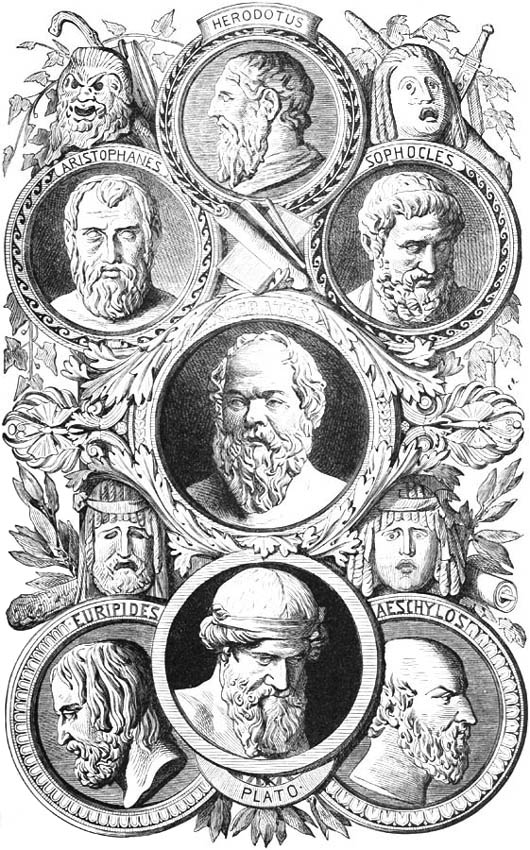
ANCIENT AUTHORS.ToList
OPENING ARGUMENT OF THE ILIAD. (By Homer.)
Achilles' wrath, to Greece the direful spring Of woes unnumbered, heavenly goddess sing! That wrath which hurl'd to Pluto's gloomy reign The souls of mighty chiefs untimely slain; Whose limbs, unburied on the naked shore, Devouring dogs and hungry vultures tore; Since great Achilles and Atrides strove. Such was the sov'reign doom, and such the will of Jove. Pope.
MINERVA ARMING HERSELF FOR BATTLE. (By Homer.)
Minerva wrapt her in the robe that curiously she wove With glorious colors, as she sate on th' azure floor of Jove; And wore the arms that he puts on, bent to the tearful field. About her broad-spread shoulders hung his huge and horrid shield, Fring'd round with ever-fighting snakes; though it was drawn to life The miseries and deaths of fight; in it frown'd bloody Strife; In it shin'd sacred Fortitude; in it fell Pursuit flew; [708] In it the monster Gorgon's head, in which held out to view Were all the dire ostents of Jove; on her big head she plac'd His four-plum'd glittering casque of gold, so admirably vast, It would an hundred garrisons of soldiers comprehend. Then to her shining chariot her vigorous feet ascend; And in her violent hand she takes his grave, huge, solid lance, With which the conquests of her wrath she useth to advance, And overturn whole fields of men; to show she was the seed Of him that thunders. Then heaven's queen, to urge her horses' speed, Takes up the scourge, and forth they fly; the ample gates of heaven Rung, and flew open of themselves; the charge whereof is given, With all Olympus and the sky, to the distinguish'd Hours; That clear or hide it all in clouds, or pour it down in showers. This way their scourge-obeying horse made haste, and soon they won The top of all the topful heavens, where aged Saturn's son Sate severed from the other gods. Chapman's translation, v.
PARTING OF HECTOR AND ANDROMACHE. (By Homer.)
Hector now pass'd, with sad presaging heart, To seek his spouse, his soul's far dearer part; At home he sought her, but he sought in vain: She, with one maid of all her menial train, Had thence retired; and with her second joy, The young Astyanax, the hope of Troy: Pensive she stood on Ilion's towery height, Beheld the war, and sicken'd at the sight; There her sad eyes in vain her lord explore, Or weep the wounds her bleeding country bore. Hector this heard, return'd without delay; Swift through the town he trod his former way, Through streets of palaces and walks of state, And met the mourner at the Scæan gate. With haste to meet him sprung the joyful fair, His blameless wife, Aetion's wealthy heir. [709] The nurse stood near, in whose embraces press'd, [710] His only hope hung smiling at her breast; Whom each soft charm and early grace adorn, Fair as the new-born star that gilds the morn. Silent the warrior smiled, and pleased resign'd To tender passions all his mighty mind: His beauteous princess cast a mournful look, Hung on his hand, and then dejected spoke; Her bosom labor'd with a boding sigh, And the big tear stood trembling in her eye. "Too darling prince! ah, whither dost thou run? Ah, too forgetful of thy wife and son! And think'st thou not how wretched we shall be, A widow I, a helpless orphan he! For sure such courage length of life denies, And thou must fall, thy virtues sacrifice. Greece in her single heroes strove in vain; Now hosts oppose thee, and thou must be slain! Oh grant me, gods! ere Hector meets his doom, All I can ask of heaven, an early tomb! So shall my days in one sad tenor run, And end with sorrows as they first begun. No parent now remains my griefs to share, No father's aid, no mother's tender care. The fierce Achilles wrapp'd our walls in fire, Laid Thebe waste, and slew my warlike sire! By the same arm my seven brave brothers fell, In one sad day beheld the gates of hell. My mother lived to bear the victor's bands, The queen of Hippoplacia's sylvan lands. Yet, while my Hector still survives, I see My father, mother, brethren, all in thee: Alas! my parents, brothers, kindred, all Once more will perish, if my Hector fall. Thy wife, thy infant, in thy danger share: O, prove a husband's and a father's care! That quarter most the skillful Greeks annoy Where yon wild fig-trees join the walls of Troy; Thou from this tower defend the important post; There Agamemnon points his dreadful host, [711] That pass Tydides, Ajax, strive to gain. And there the vengeful Spartan fires his train. Thrice our bold foes the fierce attack have given, Or led by hopes, or dictated from heaven. Let others in the field their arms employ, But stay my Hector here, and guard his Troy." The chief replied: "That post shall be my care, Nor that alone, but all the works of war. How would the sons of Troy, in arms renown'd, And Troy's proud dames, whose garments sweep the ground, Attaint the lustre of my former name, Should Hector basely quit the field of fame? My early youth was bred to martial pains, My soul impels me to the embattled plains; Let me be foremost to defend the throne, And guard my father's glories and my own. Yet come it will, the day decreed by fates; (How my heart trembles while my tongue relates!) The day when thou, imperial Troy! must bend, Must see thy warriors fall, thy glories end. And yet no dire presage so wounds my mind, My mother's death, the ruin of my kind, Not Priam's hoary hairs defiled with gore, Not all my brothers gasping on the shore, As thine, Andromache! thy griefs I dread; I see the trembling, weeping, captive led! In Argive looms our battles to design, And woes of which so large a part was thine! To bear the victor's hard commands, or bring The weight of waters from Hyperia's spring. There, while you groan beneath the load of life, They cry, 'Behold the mighty Hector's wife!' Some haughty Greek, who lives thy tears to see, Embitters all thy woes by naming me. The thoughts of glory past, and present shame, A thousand griefs shall waken at the name! May I lie cold before that dreadful day, Press'd with a load of monumental clay! Thy Hector, wrapt in everlasting sleep, [712] Shall neither hear thee sigh, nor see thee weep." Thus having spoke, the illustrious chief of Troy Stretch'd his fond arms to clasp the lovely boy. The babe clung crying to his nurse's breast, Scared at the dazzling helm and nodding crest. With secret pleasure each fond parent smiled, And Hector hasted to relieve his child; The glittering terrors from his brows unbound, And placed the gleaming helmet on the ground. Then kiss'd the child, and, lifting high in air, Thus to the gods preferr'd a father's prayer:— "O, thou whose glory fills the ethereal throne! And all ye deathless powers, protect my son! Grant him, like me, to purchase just renown, To guard the Trojans, to defend the crown; Against his country's foes the war to wage, And rise the Hector of the future age! So when, triumphant from successful toils Of heroes slain, he bears the reeking spoils, Whole hosts may hail him with deserved acclaim, And say, 'This chief transcends his father's fame;' While pleased, amidst the general shouts of Troy, His mother's conscious heart o'erflows with joy." He spoke, and fondly gazing on her charms, Restored the pleasing burden to her arms; Soft on her fragrant breast the babe he laid, Hush'd to repose, and with a smile survey'd. The troubled pleasure soon chastised by fear. She mingled with the smile a tender tear. The soften'd chief with kind compassion view'd, And dried the falling drops, and thus pursued:— "Andromache, my soul's far better part, Why with untimely sorrows heaves thy heart? No hostile hand can antedate my doom, Till fate condemns me to the silent tomb. Fix'd is the term to all the race of earth; And such the hard condition of our birth, No force can then resist, no flight can save, All sink alike, the fearful and the brave. [713] No more—but hasten to thy tasks at home, There guide the spindle, and direct the loom: Me glory summons to the martial scene, The field of combat is the sphere for men; Where heroes war, the foremost place I claim, The first in danger, as the first in fame." Thus having said, the glorious chief resumes His towery helmet black with shading plumes. His princess parts, with a prophetic sigh, Unwilling parts, and oft reverts her eye, That stream'd at every look; then, moving slow, Sought her own palace, and indulged her woe. There, while her tears deplored the god-like man, Through all her train the soft infection ran. The pious maids their mingled sorrows shed, And mourn the living Hector as the dead. Pope, Iliad, vi.
THE RACE OF MAN. (By Homer.)
Like leaves on trees the race of man is found, Now green in youth, now withering on the ground; Another race the following spring supplies; They fall successive, and successive rise: So generations in their course decay; So flourish these when those are past away. Pope, Iliad, vi.
COUNCIL OF THE GODS. (By Homer.)
Aurora now, fair daughter of the dawn, Sprinkled with rosy light the dewy lawn; When Jove convened the senate of the skies, Where high Olympus' cloudly tops arise. The Sire of Gods his awful silence broke, [714] The heavens attentive trembled as he spoke:— "Celestial states, immortal gods, give ear! Hear our decree, and reverence what ye hear; The fix'd decree, which not all heaven can move; Thou, Fate, fulfill it; and ye, Powers, approve! What god but enters yon forbidden field, Who yields assistance, or but wills to yield, Back to the skies with shame he shall be driven, Gash'd with dishonest wounds, the scorn of heaven: Or far, oh far, from steep Olympus thrown, Low in the dark Tartarean gulf shall groan, With burning chains fix'd to the brazen floors, And lock'd by hell's inexorable doors; As deep beneath the infernal center hurl'd, As from that center to the ethereal world. Let him who tempts me dread those dire abodes, And know the Almighty is the god of gods. League all your forces, then, ye powers above, Join all, and try the omnipotence of Jove: Let down our golden everlasting chain, Whose strong embrace holds heaven, and earth, and main; Strive all, of mortal and immortal birth, To drag, by this, the Thunderer down to earth: Ye strive in vain! If I but stretch this hand, I heave the gods, the ocean, and the land; I fix the chain to great Olympus' height, And the vast world hangs trembling in my sight! For such I reign, unbounded and above; And such are men and gods, compared to Jove." Pope, Iliad, viii.
NIGHT-SCENE. (By Homer.)
The troops exulting sat in order round, And beaming fires illumined all the ground. As when the moon, refulgent lamp of night! O'er heaven's clear azure spreads her sacred light, [715] When not a breath disturbs the deep serene, And not a cloud o'ercasts the solemn scene; Around her throne the vivid planets roll, And stars unnumber'd gild the glowing pole, O'er the dark trees a yellower verdure shed, And tip with silver every mountain's head; Then shine the vales, the rocks in prospect rise, A flood of glory bursts from all the skies: The conscious swains, rejoicing in the sight, Eye the blue vault, and bless the useful light. So many flames before proud Ilion blaze, And lighten glimmering Xanthus with their rays: The long reflections of the distant fires Gleam on the walls, and tremble on the spires. Pope, Iliad, viii.
HATEFULNESS OF WAR. (By Homer.)
Cursed is the man, and void of law and right, Unworthy property, unworthy light, Unfit for public rule, or private care; That wretch, that monster, who delights in war: Whose lust is murder, and whose horrid joy To tear his country, and his kind destroy! Pope, Iliad, ix.
FALSEHOOD. (By Homer.)
Who dares think one thing, and another tell, My heart detests him as the gates of hell. Pope, Iliad, ix.
SHOWERS OF ARROWS. (By Homer.)
As the feathery snows Fall frequent on some wintry day, when Jove Hath risen to shed them on the race of man, And show his arrowy stores; he lulls the wind Then shakes them down continual, covering thick Mountain tops, promontories, flowery meads, And cultured valleys rich, and ports and shores Along the margined deep; but there the wave Their further progress stays; while all besides Lies whelm'd beneath Jove's fast-descending shower; So thick, from side to side, by Trojans hurled Against the Greeks, and by the Greeks returned, The stony volleys flew. Cowper, Iliad, xii.
PRIAM BEGGING THE BODY OF HECTOR. (By Homer.)
"Think, O Achilles, semblance of the gods, On thine own father, full of days like me. And trembling on the gloomy verge of life. Some neighbor chief, it may be, even now Oppresses him, and there is none at hand, No friend to succor him in his distress. Yet, doubtless, hearing that Achilles lives, He still rejoices, hoping day by day, That one day he shall see the face again Of his own son, from distant Troy returned. But me no comfort cheers, whose bravest sons, So late the flowers of Ilium, are all slain. When Greece came hither, I had fifty sons; But fiery Mars hath thinn'd them. One I had, One, more than all my sons, the strength of Troy, Whom, standing for his country, thou hast slain— [717] Hector. His body to redeem I come Into Achaia's fleet, bringing myself, Ransom inestimable to thy tent. Rev'rence the gods, Achilles! recollect Thy father; for his sake compassion show To me, more pitiable still, who draw Home to my lips (humiliation yet Unseen on earth) his hand who slew my son!" So saying, he waken'd in his soul regret Of his own sire; softly he placed his hand On Priam's hand, and pushed him gently away, Remembrance melted both. Rolling before Achilles' feet, Priam his son deplored, Wide-slaughtering Hector, and Achilles wept By turns his father, and by turns his friend Patroclus: sounds of sorrow fill'd the tent. Cowper, Iliad, xxiv.
HELEN'S LAMENTATION OVER HECTOR. (By Homer.)
Grief fell on all around; Then Helen thus breathed forth her plaintive sound:— "Hector, to Helen's soul more lov'd than all Whom I in Ilion's walls dare brother call, Since Paris here to Troy his consort led, Who in the grave had found a happier bed. 'Tis now, since here I came, the twentieth year, Since left my land, and all I once held dear: But never from that hour has Helen heard From thee a harsh reproach or painful word; But if thy kindred blam'd me, if unkind The queen e'er glanc'd at Helen's fickle mind— (For Priam, still benevolently mild, Look'd on me as a father views his child)— Thy gentle speech, thy gentleness of soul, Would by thine own, their harsher minds control. [718] Hence, with a heart by torturing misery rent, Thee and my hapless self I thus lament; For no kind eye in Troy on Helen rests, But who beholds me shudders and detests." Sotheby, Iliad, xxi.
We will here give a few pages of the history of the Trojan war, giving some of the characters, subjects, etc., referred to in the preceding poems in a prose story.
PARIS.
There was sorrow, instead of gladness, in the halls of Priam, because a son was born unto him, and because the lady Hecuba had dreamed a dream, from which the seers knew that the child should bring ruin on the Ilion land. So his mother looked with cold, unloving eyes on the babe as he lay weak and helpless in his cradle, and Priam bade them take the child and leave him on rugged Ida, for the fountain of his love was closed against him.
For five days the dew fell on the babe by night, and the sun shone fiercely on him by day, as he lay on the desolate hill-side, and the shepherd who placed him there to sleep the sleep of death looked upon the child and said, "He sleeps as babes may slumber on silken couches; the gods will it not that he should die." So he took him to his home, and the child grew up with ruddy cheek and nimble feet, brave and hardy, so that none might be matched with him for strength and beauty. The fierce wolves came not near the flocks while Paris kept guard near the fold, the robber lurked not near the homestead when Paris sat by the hearth. So all sang of his strength and his great deeds, and they called him Alexandros, the helper of men.
Many years he tended the flocks on woody Ida, but Priam, his father, dwelt in Ilion, and thought not to see his face again, and he said within himself, "Surely my child is long since dead, and no feast has been given to the gods that Paris may dwell in peace in the dark kingdom of Hades." Then he charged his servants to fetch him a bull from the herd, which might be given to the man who should conquer in the games, and they chose out one which Paris loved above all others that he drove out to pasture. So he followed the servants of Priam in grief and anger, and he stood forth and strove with his brethren in the games, and in all of them Paris was the conqueror. Then one of his brothers was moved with wrath, and lifted up his sword against him, but Paris fled to the altar of Zeus, and the voice of Cassandra, his sister, was heard saying, "O blind of eye and heart, see ye not that this is Paris, whom ye sent to sleep the sleep of death on woody Ida?"
But Paris would not dwell in the sacred Ilion, for he loved not those who sought to slay him while he was yet a helpless child, and again he tended the flocks on the wide plains and up the rough hillsides. Strong he was of limb and stout of heart, and his face shone with a marvelous beauty, so that they who saw it thought him fair as the bright heroes. There, as he wandered in the woody dells of Ida, he saw and wooed the beautiful Œnone, the child of the river-god, Kebren. Many a time he sat with the maiden by the side of the stream, and the sound of their voices was mingled with the soft murmur of the waters. He talked to her of love, and Œnone looked up with a wondrous joy into his beautiful face, when the morning dew glistened white upon the grass and when the evening star looked out upon the pale sky.
So was Paris wedded to Œnone, and the heart of the maiden was full of happiness, for none was braver or more gentle—none so stout of heart, so lithe of limb, so tender and loving as Paris. Thus passed the days away in a swift dream of joy, for Œnone thought not of the change that was coming.
There was feasting and mirth among the gods and men, for the brave Peleus had won Thetis, the maiden of the sea, for his bride; and she rose from the depths of her coral caves to go to his home in Phthia. The banquet was spread in his ancient hall, and the goblets sparkled with the dark wine, for all the gods had come down from Olympus to share the feast in the house of Peleus. Only Eris was not bidden, for she was the child of War and Hatred, and they feared to see her face in the hours of laughter and mirth; but her evil heart rested not till she found a way to avenge herself for the wrong which they had done to her.
The gods were listening to the song of Phœbus Apollo as he made sweet music on the strings of his harp, when a golden apple was cast upon the table before them. They knew not whence it came, only they saw that it was to be a gift for the fairest in that great throng, for so was it written on the apple. Then the joy of the feast was gone, and the music of the song ceased, for there was a strife which should have the golden prize; and Here, the Queen, said, "The gods themselves do obeisance to me when I enter the halls of Olympus, and men sing of the glory of my majesty; therefore must the gift be mine." But Athene answered, and said, "Knowledge and goodness are better things than power; mine is the worthier title." Then the fair Aphrodite lifted her white arm, and a smile of triumph passed over her face as she said, "I am the child of love and beauty, and the stars danced in the heaven for joy as I sprang from the sea foam; I dread not the contest, for to me alone must the golden gift be given."
So the strife waxed hot in the banquet hall, till Zeus spake with a loud voice, and said, "It needs not to strive now. Amid the pine forest of Ida dwells Paris, the fairest of the sons of men; let him be judge, and the apple shall be hers to whom he shall give it." Then Hermes rose and led them quickly over land and sea, to go to the rough hillside where Paris wooed and won Œnone.
Presently the messenger of Zeus stood before Paris, and said, "Fairest of the sons of men, there is strife among the undying gods, for Here and Aphrodite and Athene seek each to have the golden apple which must be given to her who is most fair. Judge thou, therefore, between them when they come, and give peace again to the halls of Zeus."
In a dream of joy and love Œnone sate by the river-side, and she looked on her own fair face, which was shown to her in a still calm pool where the power of the stream came not, and she said to herself, "The gods are kind, for they have given to me a better gift than that of beauty, for the love of Paris sheds for me a wondrous beauty over the heaven above and the broad earth beneath." Then came Paris, and said, "See, Œnone, dearest child of the bright waters, Zeus hath called me to be judge in a weighty matter. Hither are coming Here, the Queen, and Aphrodite and Athene, seeking each the golden apple which must be given to her alone who is the fairest. Yet go not away, Œnone; the broad vine leaves have covered our summer bower; there tarry and listen to the judgment, where none may see thee."
So Paris sat in judgment, and Here spake to him, and said, "I know I am the fairest, for none other has beauty and majesty like mine. Hearken, then, to me, and I will give thee power to do great deeds among the sons of men, and a name which the minstrels shall sing of among those who shall be born in long time to come." But Athene answered, "Heed not her words, O Paris. Thy hand is strong and thy heart is pure, and the men among whom thou dwellest honor thee even now because thou hast done them good. There are better things than power and high renown; and if thou wilt hearken to me, I will give thee wisdom and strength; and pure love shall be thine, and the memory of happy days when thou drawest near to the dark land of Hades."
Then Paris thought that he heard the voice of Œnone, and it seemed to whisper to him, "Wisdom and right are better than power, give it to Athene." But Aphrodite gazed upon him with laughing eyes, as she came up closer to his side. Her dark curls fell waving over his shoulder, and he felt the breath from her rosy lips, as she laid her hand on his arm and whispered softly in his ear, "I talk not to thee of my beauty, for it may be thou seest that I am very fair, but hearken to me, and I will give thee for thy wife the fairest of all the daughters of men." But Paris answered, "I need not thy gift, O child of the bright sea foam, for fairer wife than Œnone no mortal man may hope to have. Yet art thou the fairest of all the daughters of the undying gods, and the gift of the fairest is thine."
So he placed the golden apple in the palm of her snow-white hand, and the touch of her slender fingers thrilled through the heart of Paris as she parted from him with smiling lip and laughing eye. But Here, the Queen, and Athene, the virgin child of Zeus, went away displeased, and evermore their wrath lay heavy on the city and land of Ilion.
Then went Paris to Œnone, and he twined his arms around her and said, "Didst thou see the dark countenance of the lady Here when I gave to the fairest the gift which the fairest alone may have? Yet what care I for the wrath of Here and Athene? One smile from the lips of Aphrodite is better than their favor for a whole life long." But Œnone answered sadly, "I would that thou mayest speak truly, Paris; yet in my eyes the lady Athene is fairer far, and Aphrodite is ever false as fair." Then Paris clasped her closer in his arms and kissed her pale cheek, and said nothing.
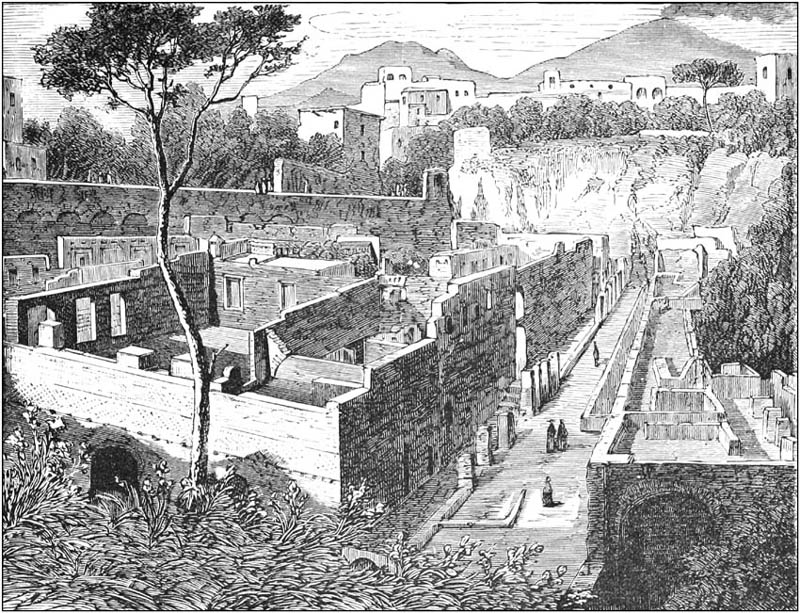
LIBRARY OF HERCULANEUM.ToList
But the fierce wrath of Eris was not ended yet. Far away in the western land, there was sore famine in the kingdom of the mighty Menelaus, the people died by the wayside, and the warriors had no strength to go forth to the battle or the huntsmen to the chase. Many times they sought to know the will of the gods, but they heard only dark words for answers, till Phœbus Apollo said that the famine should never cease from the land until they brought from Ilion the bones of the children of Prometheus, whom Zeus bound on the desolate crags of Caucasus. So Menelaus, the King, departed from his home and went to the city of Priam. There he saw the beautiful Paris, and took him to the Spartan land, for he said that Paris should return home rich and wealthy. So Paris believed his words, and sailed with him over the wide sea. Long time he abode in Sparta, and day by day he saw the lady Helen in the halls of Menelaus. At the first he thought within himself, "I would that Œnone were here to see the wife of Menelaus, for surely she is fairer than aught else on the earth." But soon he thought less and less of Œnone, who was sorrowing for his long sojourn in the strange land, as she wandered amid the pine forests of woody Ida.
Quickly sped the days for Paris, for his heart was filled with a strange love, and the will of Eris was being accomplished within him. He thought not of Œnone and her lonely wanderings on heathy Ida; he cared not for the kindly deeds of Menelaus; and so it came to pass that, when Menelaus was far away, Paris spoke words of evil love to Helen and beguiled her to leave her home. Stealthily they fled away, and sailed over the sea till they came to the Ilion land; and Helen dwelt with Paris in the house of his father, Priam.
But Œnone mourned for the love which she had lost, and her tears fell into the gentle stream of Kebren as she sat on its grassy banks. "Ah me," she said, "my love hath been stung by Aphrodite. O Paris, Paris! hast thou forgotten all thy words? Here thine arms were clasped around me, and here, as thy lips were pressed to mine, thou didst say that the wide earth had for thee no living thing so fair as Œnone. Sure am I that Helen hath brought to thee only a false joy; for her heart is not thine as the heart of a maiden when it is given to her first love; and sure am I, too, that Helen is not a fairer wife than I, for my heart is all thine, and the beauty of woman is marred when she yields herself to a lawless love. But the cloud is gathering round thee; and I am sprung from the race of the gods, and mine eyes are opened to behold the things that willingly I would not see. I see the waters black with ships, and the hosts of the Achaians gathered round the walls of Ilion. I see the moons roll round, while thy people strive in vain against the wrath of Here and the might of the son of Peleus; and far away I see the flames that shall burn the sacred Ilion. I see thy father smitten down in his own hall, and the spear that shall drink thy life-blood. Ah me! for the doom that is coming, and for the pleasant days when we loved and wandered among the dells of Ida."
So Paris dwelt with Helen in the house of Priam; but men said, "This is no more the brave Alexandros," for he lay at ease on silken couches, and his spear and shield hung idle on the wall. For him the wine sparkled in the goblet while the sun rose high in the heavens, and he cared only to listen to the voice of Helen, or the minstrels who sang of the love and the bowers of laughter-loving Aphrodite. And Helen sat by his side in sullen mood, for she thought of the former days and of the evil which she had done to the good King Menelaus. Then there came into her heart a deep hatred for Paris, and she loathed him for his false words and his fond looks, as he lay quaffing the wine and taking his rest by day and by night upon the silken couches.
But throughout the streets of Ilion there was hurrying and shouting of armed men, and terror and cries of women and children; for the hosts of the Achaians were come to take vengeance for the wrongs of Menelaus. Yet Paris heeded not the prayers of his brethren, that he should send back Helen; so she tarried by his side in his gilded chambers, and he went not forth to the battle, till all men reviled him for his evil love, because he had forsaken the fair Œnone.
So for Paris fell the mighty Hector; for him died the brave Sarpedon; and the women of Ilion mourned for their husbands who were smitten down by the Achaian warriors. Fiercer and fiercer grew the strife, for Here and Athene fought against the men of Troy, and no help came from the laughter-loving Aphrodite.
Many times the years went round, while yet the Achaians strove to take the city of Priam, till at last for very shame Paris took from the wall his spear and shield, and went forth to the battle, but the strength of his heart and of his arm was gone, and he trembled at the fierce war-cries, as a child trembles at the roaring of the storm. Then before the walls of Ilion there was fiercer strife, and the bodies of the slain lay in heaps upon the battle plain. Faint and weary, the people of Priam were shut up within the walls, until the Achaians burst into the gates and gave the city to sword and flame. Then the cry of men and women went up to the high heaven, and the blood ran in streams upon the ground. With a mighty blaze rose up the flames of the burning city, and the dream of Paris was ended.
Fast he fled from the wrath of Menelaus, and he cared not to look back on the Argive Helen or the slaughter of his kinsfolk and his people. But the arrow of Philoctetes came hissing through the air, and the barb was fixed in the side of Paris. Hastily he drew it from the wound, but the weapons of Herakles failed not to do their work, and the poison sped through his burning veins. Onwards he hastened to the pine forests of Ida, but his limbs trembled beneath him, and he sank down as he drew nigh to the grassy bank where he had tended his flocks in the former days. "Ah, Œnone," he said, "the evil dream is over, and thy voice comes back to mine ear, soft and loving as when I wooed and won thee among the dells of Ida. Thou hearest me not, Œnone, or else I know that, forgiving all the wrong, thou wouldst hasten to help me."
And even as he spoke Œnone stood before him, fair and beautiful as in the days that were past. The glory as of the pure evening time was shed upon her face, and her eye glistened with the light of an undying love. Then she laid her hand upon him and said, gently, "Dost thou know me, Paris? I am the same Œnone whom thou didst woo in the dells of woody Ida. My grief hath not changed me, but thou art not the same, O Paris, for thy love hath wandered far away, and thou hast yielded thyself long to an evil dream." But Paris said, "I have wronged thee, Œnone, fairest and sweetest, and what may atone for the wrong? The fire burns in my veins, my head reels, and mine eye is dim; look but upon me once, that thinking on our ancient love, I may fall asleep and die."
Then Œnone knelt by the side of Paris, and saw the wound which the arrow of Philoctetes had made; but soon she knew that neither gods nor men could stay the poison with which Herakles had steeped his mighty weapons. There she knelt, but Paris spoke not more. The coldness of death passed over him as Œnone looked down upon his face and thought of the days when they lived and loved amid the dells of Ida.
Long time she knelt by his side, until the stars looked forth in the sky. Then Œnone said, "O Eris, well hast thou worked thy will, and well hath Aphrodite done thy bidding. O Paris, we have loved and suffered, but I never did thee wrong, and now I follow thee to the dark land of Hades."
Presently the flame shot up to heaven from the funeral pile of Paris, and Œnone lay down to rest on the fiery couch by his side.
ACHILLES.
Nine years the Achaians had fought against Ilion to avenge the wrongs and woes of Helen, and still the war went on, and only the words of Kalchas, which he spoke long ago in Aulis, cheered them with the hope that the day of vengeance was near at hand. For strife had arisen between the King, Agamemnon, and the mighty son of Peleus, and it seemed to the men of Argos that all their toil must be for naught. In fierce anger Achilles vowed a vow that he would go forth no more to the battle, and he sat in sullen silence within his tent, or wandered gloomily along the sea-shore. With fresh courage the hosts of the Trojans poured out from their walls when they knew that Achilles fought no more on the side of the Achaians, and the chieftains sought in vain for his help when the battle went against them. Then the face of the war was changed, for the men of Ilion came forth from their city, and shut up the Achaians within their camp, and fought fiercely to take the ships. Many a chief and warrior was smitten down, and still Achilles sat within his tent, nursing his great wrath, and reviling all who came before him with gifts and prayers.
But dearer than all others to the child of the sea-nymph, Thetis, was Patroclus, the son of Menœtius, and the heart of Achilles was touched with pity when he saw the tears stream down his face, and he said, "Dear friend, tell me thy grief, and hide nothing from me. Hast thou evil tidings from our home at Phthia, or weepest thou for the troubles which vex us here?" Then Patroclus spoke out boldly, and said, "Be not angry at my words, Achilles. The strength of the Argives is wasted away, and the mightiest of their chieftains lie wounded or dead around their ships. They call thee the child of Peleus and of Thetis, but men will say that thou art sprung from the rugged rocks and the barren sea, if thou seest thy people undone and liftest not an arm to help them." Then Achilles answered, "My friend, the vow is on me, and I can not go, but put thou on my armor and go forth to the battle. Only take heed to my words, and go not in my chariot against the City of Ilion. Drive our enemies from the ships, and let them fight in the plain, and then do thou come back to my tent."
Then the hearts of the Achaians were cheered, for next to Achilles there was not in all the host a warrior more brave and mighty than Patroclus. At his word the Myrmidons started up from their long rest, and hastily snatched their arms to follow him to the battle. Presently Patroclus came forth. The glistening helmet of Achilles was on his head, and his armor was girt around his body. Only he bore not his mighty spear, for no mortal man might wield that spear in battle but Achilles. Before the tent stood the chariot, and harnessed to it were the horses, Xanthos and Balios, who grow not old nor die.
So Patroclus departed for the fight, and Achilles went into his tent, and as he poured out the dark wine from a golden goblet, he prayed to Zeus, and said, "O thou that dwellest far away in Dodona, where the Selloi do thy bidding and proclaim thy will, give strength and victory to Patroclus, my friend. Let him drive the men of Ilion from the ships and come back safe to me after the battle." But Zeus heard the prayer in part only, for the doom was that Achilles should see Patroclus alive no more.
Then the hosts of the Trojans trembled as Patroclus drew nigh on the chariot of Achilles, and none dared to go forth against him. Onward sped the undying horses, and wherever they went the ground was red with the blood of the Trojans who were smitten down by his spear. Then Sarpedon, the great chief of the Lykians, spake to Glaucus, and said, "O friend, I must go forth and do battle with Patroclus. The people fall beneath his sword, and it is not fit that the chieftains should be backward in the strife." But the doom of Sarpedon was sealed, and presently his body lay lifeless on the ground, while the men of Argos and of Ilion fought for his glittering arms.
Then the doom came on Patroclus also, for Phœbus Apollo fought against him in the battle, and in the dust was rolled the helmet which no enemy had touched when it rested on the head of Achilles. Before him flashed the spear of Hector, as he said, "The hour of thy death is come, Patroclus, and the aid of Achilles can not reach thee now." But Patroclus said only, "It is thy time for boasting now; wait yet a little while, and the sword of Achilles shall drink thy life-blood."
So Patroclus died, and there was a fierce fight over his body, and many fell on both sides, until there was a great heap of dead around it. But away from the fight, the horses Xanthos and Balios wept for their charioteer, and they would not stir with the chariot, but stood fixed firm as pillars on the ground, till Zeus looked down in pity on them, and said, "Was it for this that I gave you to Peleus, the chieftain of Phthia—horses who can not grow old or die, to a mortal man, the most wretched thing that crawls upon the earth? But fear not; no enemy shall lay hands on the chariot of Achilles, or on the immortal horses which bear it. Your limbs shall be filled with new strength, and ye shall fly like birds across the battle-field till ye come to the tent of your master." Then the horses wept no more, but swift as eagles they bore Automedon through the fight, while Hector and his people strove fiercely to seize them. At last the battle was over, and, while the Achaians bore the body of Patroclus to the ships, Antilochus, the son of Nestor, went to the tent of Achilles, and said, "Thy friend is slain, and Hector has his armor."
Then the dark cloud of woe fell on the soul of Achilles. In a fierce grief he threw earth with both hands into the air, and rent his clothes, and lay down weeping in the dust. Far away in her coral caves beneath the sea Thetis heard the deep groans of her child, and, like a white mist, she rose from the waters and went to comfort him; and she said, "Why weepest thou, my son? When Agamemnon did thee wrong, thou didst pray that the Achaians might sorely need thy aid in the battle, and thy wish has been accomplished. So may it be again." But Achilles answered, "Of what profit is it to me, my mother, that my prayer has been heard, since Patroclus, my friend, is slain, and Hector has my armor? One thing only remains to me now. I will slay Hector and avenge the slaughter of Patroclus." Then the tears ran down the cheeks of Thetis as she said, "Then is thine own doom accomplished, for when thou slayest Hector, thou hast not many days to live," "So then let it be," said Achilles; "the mighty Herakles tasted of death; therefore let me die also, so only Hector dies before me."
Then Thetis sought no more to turn him from his purpose, but she went to the house of Hephaistos to get armor for her child in place of that which Hector had taken from Patroclus. And Achilles vowed a vow that twelve sons of the Trojans should be slain at the grave of his friend, and that Hector should die before the funeral rites were done. Then Agamemnon sent him gifts, and spake kindly words, so that the strife between them might end, and Achilles now go forth to fight for the Achaians. So, in the armor which Hephaistos had wrought at the prayer of Thetis, he mounted his chariot, and bade his horses bring him back safe from the battle-field. Then the horse Xanthos bowed his head, and the long tresses of his mane flowed down to the earth as he made answer, "We will in very truth save thee, O mighty Achilles; but thy doom is near at hand, and the fault rests not with us now, or when we left Patroclus dead on the battle-field, for Phœbus Apollo slew him and gave the glory and the arms to Hector." And Achilles said, "Why speak to me of evil omens? I know that I shall see my father and my mother again no more; but if I must die in a strange land, I will first take my fill of vengeance."
Then the war-cry of Achilles was heard again, and a mighty life was poured into the hearts of the Achaians, as they seized their arms at the sound. Thick as withering leaves in autumn fell the Trojans beneath his unerring spear. Chief after chief was smitten down, until their hosts fell in terror within the walls of Ilion. Only Hector awaited his coming, but the shadow of death was stealing over him, for Phœbus Apollo had forsaken the great champion of Troy because Zeus so willed it. So in the strife the strength of Hector failed, and he sank down on the earth. The foot of Achilles rested on his breast, and the spear's point was on his neck, while Hector said, "Slay me if thou wilt, but give back my body to my people. Let not the beasts of the field devour it, and rich gifts shall be thine from my father and my mother for this kindly deed." But the eyes of Achilles flashed with a deadly hatred, as he answered, "Were Priam to give me thy weight in gold, it should not save thy carcass from the birds and dogs." And Hector said, "I thought not to persuade thee, for thy heart is made of iron, but see that thou pay not the penalty for thy deed on the day when Paris and Phœbus Apollo shall slay thee at the Scæan gates of Ilion." Then the life-blood of Hector reddened the ground as Achilles said, "Die, wretch! My fate I will meet in the hour when it may please the undying gods to send it."
But not yet was the vengeance of Achilles accomplished. At his feet lay Hector dead, but the rage in his heart was fierce as ever, and he tied the body to his chariot and dragged it furiously, till none who looked on it could say, "This was the brave and noble Hector." But things more fearful still came afterwards, for the funeral rites were done to Patroclus, and twelve sons of the Trojans were slain in the mighty sacrifice. Still the body of Hector lay on the ground, and the men of Ilion sought in vain to redeem it from Achilles. But Phœbus Apollo came down to guard it, and he spread over it his golden shield to keep away all unseemly things. At last the King, Priam, mounted his chariot, for he said, "Surely he will not scorn the prayer of a father when he begs the body of his son." Then Zeus sent Hermes to guide the old man to the tent of Achilles, so that none others of the Achaians might see him. Then he stood before the man who had slain his son, and he kissed his hands, and said, "Hear my prayer, Achilles. Thy father is an old man like me, but he hopes one day to see thee come back with great glory from Ilion. My sons are dead, and none had braver sons in Troy than I; and Hector, the flower and pride of all, has been smitten by thy spear. Fear the gods, Achilles, and pity me for the remembrance of thy father, for none has ever dared like me to kiss the hand of the man who has slain his son." So Priam wept for his dear child, Hector, and the tears flowed down the cheeks of Achilles as he thought of his father, Peleus, and his friend, Patroclus, and the cry of their mourning went up together.
So the body of Hector was borne back to Ilion, and a great sacrifice was done to the gods beneath the earth, that Hector might be welcomed in the kingdom of Hades and Persephone. But the time drew nigh that the doom of Achilles must be accomplished, and the spear of Phœbus Apollo pierced his heart as they fought near the Scæan gates of Ilion. In the dust lay the body of Achilles, while the Achaians fought the whole day around it, till a mighty storm burst forth from the heaven. Then they carried it away to the ships, and placed it on a couch, and washed it in pure water. And once more from her coral caves beneath the sea rose the silver-footed Thetis, and the cry of the nymphs who followed her filled the air, so that the Achaians who heard it trembled, and would have fled to the ships, but Nestor, the wise chief of the Pylians, said, "Flee not, ye Argives, for those come to mourn for the dead Achilles." So Thetis stood weeping by the body of her child, and the nymphs wrapped it in shining robes. Many days and nights they wept and watched around it, until at last they raised a great pile of wood on the sea-shore, and the flame went up to heaven. Then they gathered up the ashes, and placed them, with the ashes of Patroclus, in a golden urn which Hephaistos wrought and gave to Dionysus, and over it they raised a great cairn on the shore of the Sea of Helle, that men might see it afar off as they sailed on the broad waters.
THE VENGEANCE OF ODYSSEUS.
A fair breeze filled the sail of the Phæakian ship in which Odysseus lay asleep as in the dreamless slumber of the dead. The wild music of the waves rose on the air as the bark sped on its glistening pathway, but their murmur reached not the ear of the wanderer, for the spell of Athene was upon him, and all his cares and griefs were for a little while forgotten.
The dawn light was stealing across the eastern sky when the good ship rode into the haven of the sea-god, Phorkys, and rested without anchor or cable beneath the rocks which keep off the breath of the harsh winds. At the head of the little bay a broad-leaved olive tree spread its branches in front of a cave where the sea nymphs wove their beautiful purple robes. Gently the sailors raised Odysseus in their arms; gently they bore him from the ship, and placed him on the land with the gifts which Alkinous and Arete and Naosikaa had given to him when he set off to go to Ithaka. So the Phæakians went away, and Odysseus rested once more in his own land. But when he awoke from his sleep, he knew not where he was, for Athene had spread a mist on land and sea. The haven, the rocks, the trees, the pathways wore a strange look in the dim and gloomy light; but while Odysseus yet pondered where he should stow away the gifts lest thieves should find them, there stood before him a glorious form, and he heard a voice, which said, "Dost thou not know me, Odysseus? I am Pallas Athene, who have stood by thy side to guard thee in all thy wanderings and deliver thee from all thy enemies. And now that thou standest again on thine own land of Ithaka, I have come to thee once more, to bid thee make ready for the great vengeance, and to bear with patience all that may befall thee until the hour be come." But Odysseus could scarcely believe that he was in Ithaka, even though it was Athene who spake to him, until she scattered the mist and showed him the fair haven with its broad-spreading olive trees, and the home of the sea nymphs, and the old hill of Neritos with its wooded sides.
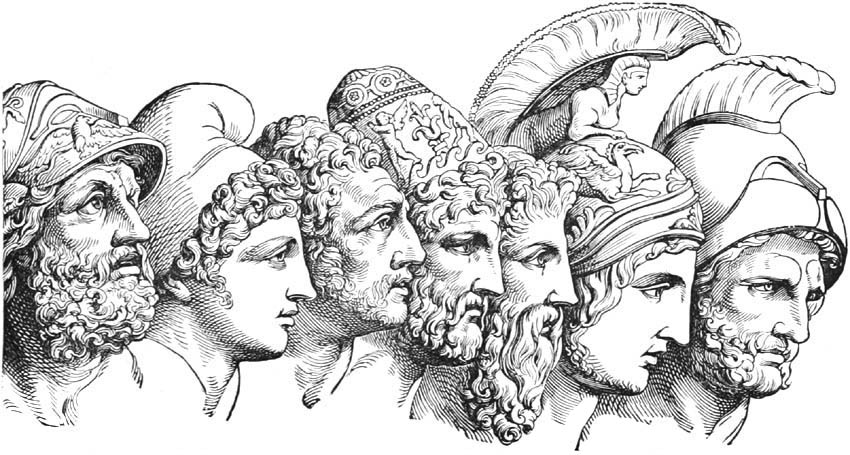
Menelaus. Paris. Diomedes. Odysseus. Nestor. Achilles. Agamemnon.
HEROES OF THE TROJAN WAR.ToList
Then they placed the gifts of the Phæakians in the cave hard by the stream of living waters which flowed through it to the sea, and Athene touched him with a staff, and all the beauty of his form was gone. His face became seamed with wrinkles, his flashing eyes grew dim, and the golden locks vanished from his shoulders. His glistening raiment turned to noisome rags, as Athene put a beggar's wallet on his shoulder and placed a walking staff in his hand, and showed him the path which led to the house of the swineherd Eumaius.
So Odysseus went his way, but when he entered the court-yard of Eumaius in his tattered raiment, the dogs flew at him with loud barkings, until the swineherd drove them away, and led the stranger into his dwelling, where he placed a shaggy goat-skin for him to lie on. "Thou hast welcomed me kindly," said Odysseus, "the gods grant thee in return thy heart's desire." Then Eumaius answered sadly, "My friend, I may not despise a stranger though he be even poorer and meaner than myself, for it is Zeus who sends to us the poor man and the beggar. Little indeed have I to give, for so it is with bondmen when the young chiefs lord it in the land. But he is far away who loved me well and gave me all my substance. I would that the whole kindred of Helen had been uprooted from the earth, for it was for her sake that my master went to fight with the Trojans at Ilion."
Then Eumaius placed meat and wine before him. "It is but a homely meal," he said, "and a poor draught, but the chiefs who throng about my master's wife eat all the fat of the land. A brave life they have of it, for rich were the treasures which my master left in his house when he went to take vengeance for the wrongs of Helen." "Tell me thy master's name, friend," said the stranger. "If he was indeed so rich and great, I may perhaps be able to tell you something about him, for I have been a wanderer in many lands." "Why, what would be the use?" answered the swineherd. "Many a vagabond comes here with trumped-up tales to my master's wife, who listens to them greedily, hoping against hope. No, he must long ago have died; but we love Odysseus still, and we call him our friend, though he is very far away." "Nay, but thou art wrong this time," said the stranger, "for I do know Odysseus, and I swear to thee that the sun shall not finish his journey through the heavens before thy lord returns." But Eumaius shook his head. "I have nothing to give you for your news. Sure I am that Odysseus will not come back. Say no more about him, for my heart is pained when any make me call to mind the friend whom I have lost. But what is your name, friend, and whence do you come?"
Then Odysseus was afraid to reveal himself, so he told him a long story how he had come from Crete, and been made a slave in Egypt, how after many years Phoinix had led him to the purple land, how Pheidon, the chief of the Thesprotians, had showed him the treasures of Odysseus, and how at last he had fallen into the hands of robbers, who had clothed him in beggarly rags and left him on the shore of Ithaka. But still Eumaius would not believe. "I can not trust your tale, my friend, when you tell me that Odysseus has sojourned in the Thesprotian land. I have had enough of such news since an Æolian came and told me that he had seen him in Crete with Idomeneus, mending the ships which had been hurt by a storm, and that he would come again to his home before that summer was ended. Many a year has passed since, and if I welcome you still, it is not for your false tidings about my master." "Well," said Odysseus, "I will make a covenant with you. If he returns this year, you shall clothe me in sound garments and send me home to Doulichion, if he does not, bid thy men hurl me from the cliffs, that beggars may learn not to tell lies." "Nay, how can I do that," said Eumaius, "when you have eaten bread in my house? Would Zeus ever hear my prayer again? Tell me no more false tales, and let us talk together as friends."
Meanwhile Telemachus was far away in Sparta, whither he had gone to seek his father, Odysseus, if haply he might find him; and one night as he lay sleepless on his couch, Athene stood before him and warned him to hasten home. "The suitors are eating up thy substance, and they lie in wait that they may slay thee before the ship reaches Ithaka; but the gods who guard thee will deliver thee from them, and when thou comest to the land, go straightway to the house of Eumaius."
Then in the morning Telemachus bade farewell to Menelaus, and the fair-haired Helen placed in his hands a beautiful robe which her own fingers had wrought. "Take it," she said, "as a memorial of Helen, and give it to thy bride when thy marriage day has come." So they set off from Sparta, and came to Pylos, and there, as Telemachus offered sacrifice, the wise seer Theoklymenus stood by his side, and asked him of his name and race, and when he knew that he was the son of Odysseus he besought Telemachus to take him with him to the ship, for he had slain a man in Argos and he was flying from the avenger of blood. So Theoklymenus, the seer, came with Telemachus to Ithaka.
Then again Odysseus made trial of the friendship of Eumaius, and when the meal was over, he said, "To-morrow, early in the morning, I must go to the house of Odysseus. Therefore, let some one guide me thither. It may be that Penelope will listen to my tidings, and that the suitors will give alms to the old man. For I can serve well, my friends, and none can light a fire and heap on wood, or hand a winecup, more deftly than myself." But Eumaius was angry, and said sharply, "Why not tarry here? You annoy neither me nor my friends, and when Odysseus comes home, be sure he will give you coat and cloak and all else that you may need." And the beggar said, "God reward thee, good friend, for succoring the stranger," and he asked him if the father and mother of Odysseus were yet alive. Then Eumaius told him how his mother had pined away and died after Odysseus went to Ilion, and how Laertes lingered on in a wretched and squalid old age.
But the ship of Telemachus had now reached the land, and he sent some of his men to tell Penelope that her son was come back, while he himself went to the house of Eumaius. Glad indeed was the swineherd to see him, for he had not thought to look upon his face again. And Telemachus said, "Is my mother yet in her home, or has she wedded another, and is the bridal couch of Odysseus covered with the webs of spiders?" "Nay, she is still in her home," said Eumaius; "but night and day she sheds bitter tears in her grievous sorrow." Then Telemachus spied the beggar; and when he learned his story from Eumaius, he was troubled. "What can we do with him? Shall I give him a cloak and a sword and send him away? I am afraid to take him to my father's house, for the suitors may flout and jeer him." Then the beggar put in his word: "Truly these suitors meet us at every turn. How comes it all about? Do you yield to them of your own free will, or do the people hate you, or have you a quarrel with your kinsfolk? If these withered arms of mine had but the strength of their youth, soon should some of these suitors smart for their misdeeds; and if their numbers were too great for me to deal with, better so to die than see them thus devour the land." "Nay, friend, your guesses are wrong," said Telemachus. "The people do not hate me, and I have no feud with my kindred; but these suitors have swarmed in upon us like bees from all the country round about."
Presently Eumaius rose up to go with tidings to Penelope, and when he was gone a glorious form stood before the door, but the eyes only of Odysseus saw her, and he knew that it was Pallas Athene. "The time is come," she said; "show thyself to Telemachus and make ready with him for the great vengeance." Then Athene passed her golden staff over his body, and straightway his tattered raiment became a white and glistening robe. Once more the hue of youth came back to his cheek and the golden locks flowed down over his shoulders, so that Telemachus marveled, and said, "Who art thou, stranger, that thou lookest like one of the bright gods? But now thy garment was torn, and thy hands shook with age." "Nay, I am no god," answered the man of many toils and sorrows, "I am thy father." Then Odysseus kissed his son, and the tears ran down his cheek, but Telemachus would not believe. "Men change not thus," he said, "from age to youth, from squalor and weakness to strength and splendor." "It is the work of Athene," said the stranger, "who can make all things fresh and fair, and if I be not Odysseus, none other will ever come to Ithaka." Then Telemachus put his arms around his father and wept, and the cry of their weeping went up together, and Odysseus said, "The time for vengeance draws nigh. How many are these suitors?" "They may be told by scores," said Telemachus, "and what are two against so many?" "They are enough," answered Odysseus, "if only Zeus and Athene be on their side."
Then Telemachus went to the house of Odysseus, where the suitors were greatly cast down because their messengers had not been able to kill him. And Penelope came forth from her chamber, beautiful as Artemis and Aphrodite, and she kissed her son, who told her how he had journeyed to Sparta, seeking in vain for his father. But Theoklymenus, the seer, put in a word, and said, "Odysseus is now in Ithaka, and is making ready for the day of the great vengeance."
Presently Eumaius went back to his house, and there he found the beggar, for Odysseus had laid aside his glistening robe and the glory of youth had faded away again from his face. So they went to the city together, and sat by the beautiful fountain, whither the people came to draw water, and Melanthius, the goatherd, as he drove the flock for the suitors, spied them out and reviled them. "Thieves love thieves, they say; where hast thou found this vagabond, friend swineherd?" and he pushed Odysseus with his heel. Then Odysseus was wroth, and would have slain him, but he restrained himself, and Eumaius prayed aloud to the nymphs that they would bring his master home. And Melanthius said, "Pray on, as thou wilt, but Telemachus shall soon lie low, for Odysseus shall see Ithaka no more." Then he drove the goats onwards to the house of Odysseus, and Eumaius and the beggar followed him, and as they communed by the way, the swineherd bade him go first into the house, lest any finding him without might jeer or hurt him. But the beggar would not. "Many a hard buffet have I had by land and by sea," he said, "and I am not soon cast down." Soon they stood before the door, and a dog worn with age strove to rise and welcome him, but his strength was gone, and Odysseus wept when he saw his hound, Argos, in such evil plight. Then, turning to Eumaius, he said, "The hound is comely in shape. Was he swift and strong in his youth?" "Never anything escaped him in the chase; but there are none to care for him now." It mattered not, for the twenty long years had come to an end, and when Argos had once more seen his master, he sank down upon the straw and died.
Then Odysseus passed into his house, and he stood a beggar in his own hall, and asked an alms from Antinous. "Give," said he, "for thou lookest like a King, and I will spread abroad thy name through the wide earth. For I, too, was rich once, and had a glorious home, and often I succored the wanderer; but Zeus took away all my wealth, and drove me forth to Cyprus and to Egypt." But Antinous thrust him aside. "What pest is this?" he said. "Stand off, old man, or thou shalt go again to an Egypt and a Cyprus which shall not be much to thy liking." Then Antinous struck him on the back; but Odysseus stood firm as a rock, and he shook his head for the vengeance that was coming. But the others were angry, and said, "Thou hast done an evil deed, if indeed there be a god in heaven; nay, often in the guise of strangers the gods themselves go through the earth, watching the evil and the good."
When the tidings were brought to Penelope, she said to Eumaius, "Go call me this stranger hither, for he may have something to tell me of Odysseus." But the beggar would not go then. "Tell her," he said, "that I know her husband well, and that I have shared his troubles; but I can not talk with her before the sun goes down. At eventide she shall see me."
Then, as Odysseus sate in the hall, there came up to him the beggar Arnaius, whom the suitors called Iros because he was their messenger, and he said, "Get up, old man, and go, for the chiefs have bidden me to cast thee out; yet I would rather see thee depart of thy own will." But Odysseus said, "Nay, friend, there is room enough here for both of us. You are a beggar like me, and let us pray the gods to help us; but lay not thine hand upon me, lest I be angry and smite thee; for if I do, thou wilt not, I take it, care to come again to the house of Odysseus, the son of Laertes." But Iros looked scornfully at him, and said, "Hear how the vagabond talks, just like an old furnace woman. Come now, and gird up thyself, and let us see which is the stronger." Then Antinous, who had heard them quarreling, smiled pleasantly and called to the other suitors: "See here, the stranger and Iros are challenging each other. Let us bring them together and look on." But Iros shrank back in fear as the beggar arose, and only one feeble blow had he given, when Odysseus dashed him to the ground. Then all the suitors held up their hands and almost died with laughter, as the stranger dragged Iros from the hall, and said, "Meddle not more with other men's matters, lest a worse thing befall thee." Then Odysseus gathered up his tattered garment and went and sat down again upon the threshold, while the suitors praised him with loud cheers for his exploit, and Amphinomus held out to him a goblet of rosy wine: "Drink, stranger, and mayest thou have good luck in time to come, for now thy lot is hard and gloomy enough." The kindly words stirred the beggar's heart, and he said, "Hear my counsel, Amphinomus, and trust me who have borne many griefs and sorrows and wandered in many lands since Zeus drove me from my home. Depart from these evil men who are wasting another's substance and heed not the woes that are coming, when Odysseus shall once more stand in his father's house." But Amphinomus would not hear, for so had Athene doomed that he should fall on the day of the great vengeance.
So, laughing at the beggar as he sat quietly on the threshold, the suitors feasted at the banquet table of Odysseus, till the stars looked forth in the sky. But when they were gone away to sleep, Odysseus bade Telemachus gather up their arms and place them in the inner chamber. And they carried in the spears and shields and helmets, while Athene went before with a golden lamp in her hand to light the way. And Telemachus said, "Surely some one of the blessed gods must be here, my father, for walls, beams and pillars all gleam as though they were full of eyes of blazing fire." But Odysseus bade him be silent and sleep, and Telemachus went his way, and Odysseus tarried to take counsel with Athene for the work of the coming vengeance.
Then, as he sat alone in the hall, Penelope came forth from her chamber, to hear what the stranger might tell her of Odysseus. But before she spake, Melantho reviled him as her father, Melanthius, had reviled him by the fountain, and Odysseus said, "Dost thou scorn me because my garments are torn and my face is seamed with age and sorrow? Well, I, too, have been young and strong. See, then, that the change come not on thee when Odysseus returns to his home." Then Penelope asked him straightly, "Who art thou, stranger, and whence hast thou come?" And the beggar said, "Ask me not, for I have had grievous troubles, and the thought of all my woes will force the tears into my eyes, so that ye may think I am mad with misery." But Penelope urged him: "Listen to me, old man. My beauty faded away when Odysseus left me to go to Ilion, and my life has been full of woe since the suitors came thronging round me, because my husband, as they said, lived no more upon the earth. So I prayed them to let me weave a shroud for Laertes, and every night I undid the web which I had woven in the day time. Thus three years passed away, but in the fourth the suitors found out my trick, and I know not how to avoid longer the marriage which I hate. Wherefore tell me who thou art, for thou didst not spring forth a full-grown man from a tree or a stone." Then Odysseus recounted to her the tale which he had told to the swineherd, Eumaius, and the eyes of Penelope were filled with tears as the stranger spoke of the exploits of Odysseus. "Good friend," she said, "thy kindly words fall soothingly on my ear. Here shalt thou sojourn, and I will give thee a robe which I had meant for him who will come back to me no more." But Odysseus would not take it, and he strove to comfort her, till at the last he swore to her that before the year's end her husband should stand before her.
And now, at the bidding of Penelope, his old nurse, Eurykleia, came with water to wash his feet, and looking hard at him she said, "Many a stranger has come to this house, but never one so like in form and voice to my child, Odysseus," and the stranger answered, smiling, "Most folk who have seen us both have marked the likeness." So she knelt down to wash his feet, but Odysseus turned himself as much as he could from the fire, for he feared that she might see the mark of the wound which the boar's tusk had made long ago when he went to Parnassus. But he strove in vain. For presently she saw the scar, and she let go his feet, and the water was spilt upon the ground, as she cried out, "It is Odysseus, and I knew him not until I saw the print of the deadly wound which Autolykus healed by his wondrous power." Then Odysseus bade her be silent, for Athene had dulled the ear of Penelope that she might not hear, and he would not that any should know that the chieftain had come back to his home.
ANCIENT METAL ENGRAVING.ToList
So all were gone, and Odysseus alone remained in the hall through the still hours of night. But when the morning came, the suitors again feasted at the banquet board, and many a time they reviled the beggar and Telemachus, until Penelope brought forth the bow which Iphitus, the son of Eurytus, had given to Odysseus. Then she stood before the chiefs and said, "Whoever of you can bend this bow, that man shall be my husband, and with him I will leave the home which I have loved, and which I shall still see in my dreams." But when Antinous saw it, his heart failed him, for he knew that none had ever bent the bow save Odysseus only, and he warned the suitors that it would sorely tax their strength. Then Telemachus would have made trial of the bow, but his father suffered him not. So Leiodes took it in his hand, and tried in vain to stretch it, till at last he threw it down in a rage, and said, "Penelope must find some other husband; for I am not the man." But Antinous reviled him for his faintheartedness, and made Melanthius bring fat to anoint the bow and make it supple; yet even thus they strove in vain to stretch it.
Then Odysseus went out into the courtyard, whither the cowherd and the swineherd had gone before him, and he said to them, "Friends, are ye minded to aid Odysseus if he should suddenly come to his home, or will ye take part with the men who devour his substance?" And they sware both of them that they would fight for their master to the death. Then Odysseus said, "I am that man, who after grievous woes has come back in the twentieth year to his own land; and if ye doubt, see here is the scar of the wound where the boar's tusk pierced my flesh, when I went to Parnassus in the days of my youth." When they saw the scar, they threw their arms round Odysseus, and they kissed him on his head and his shoulders and wept, until he said, "Stay, friends, lest any see us and tell the suitors in the house. And now hearken to me. These men will not let me take the bow; so do thou, Eumaius, place it in my hands, and let Philoitius bar the gates of the court-yard." But within the hall Eurymachus groaned with vexation because he could not stretch the bow; and he said, "It is not that I care for Penelope, for there are many Achaian women as fair as she; but that we are all so weak in comparison of Odysseus." Then the beggar besought them that he, too, might try, and see whether the strength of his youth still remained to him, or whether his long wanderings had taken away the force of his arm. But Antinous said, "Old man, wine hath done thee harm; still it is well to drink yet more than to strive with men who are thy betters." Then said Penelope, "What dost thou fear, Antinous? Vex not thyself with the thought that the beggar will lead me away as his bride, even if he should be able to stretch the bow of Odysseus." "Nay, lady," he answered, "it is not that; but I dread lest the Achaians should say, 'The suitors could not stretch the bow, but there came a wandering beggar, who did what they strove to do in vain.'"
Then the swineherd took up the bow, but the suitors bade him lay it down again, until at last Telemachus told Eumaius to bear it to Odysseus; and as the swineherd placed it in the beggar's hands, Eurykleia shut the doors of the hall and made them fast with the tackling of a ship. Then, as Odysseus raised the bow, the thunder pealed in the heaven, and his heart rejoiced because Zeus had given him a sign of his great victory. Presently the arrow sped from the string, and Antinous lay dead upon the floor.
Then the others spake in great wrath, and said, "The vultures shall tear thy flesh this day, because thou hast slain the greatest chief in Ithaka." But they knew not, as they spake thus, that the day of the great vengeance was come; and the voice of Odysseus was heard above the uproar, as he said, "Wretches, did ye fancy that I should never stand again in my own hall? Ye have wasted my substance, ye have sought to steal my wife from me, ye have feared neither gods nor men, and this is the day of your doom." The cheeks of the suitors turned ghastly pale through fear; but Eurymachus alone took courage and told Odysseus that Antinous only had done the mischief, because he wished to slay Telemachus and become King in Ithaka in the stead of Odysseus. "Spare, then, the rest, for they are thy people, and we will pay thee a large ransom." But Odysseus looked sternly at him, and said, "Not this house full of silver and gold shall stay my hand in the day of my great vengeance."
Then Eurymachus drew his sword and bade his comrades fight bravely for their lives; but again the clang of the bow was heard, and Eurymachus was stretched lifeless on the earth. So they fell, one after the other, until the floor of the hall was slippery with blood. But presently the arrows in the quiver of Odysseus were all spent, and laying his bow against the wall, he raised a great shield on his shoulder and placed a helmet on his head, and took two spears in his hand. Then Agelaus called to Melanthius, "Go up to the stair-door and shout to the people, that they may break into the hall and save us." But Melanthius said, "It can not be, for it is near the gate of the hall, and one man may guard it against a hundred. But I will bring you arms, for I know that Odysseus and his son have stowed them away in the inner chamber." Hastily he ran thither and brought forth shields and spears and helmets, and the heart of Odysseus failed him for fear as he saw the suitors donning their armor and brandishing the lances. "Who has done this?" he asked, and Telemachus answered, "It is my fault, my father. I left the door ajar, but Eumaius shall go and see whether some of the women have given this help to the suitors, or whether, as I think, it be Melanthius." So Eumaius and the cowherd placed themselves on one side of the chamber door, and when Melanthius came forth with more arms for the chieftains, they caught him, and binding him with stout cords they hoisted him up to the beams and left him dangling in the air. "Keep guard there, Melanthius, all night long in thy airy hammock, and when the golden Morning comes back from the stream of Ocean you will not fail to see her."
But in the hall the troop of suitors stood facing Odysseus and Telemachus in deadly rage, and presently Athene stood before them in the likeness of Mentor. Then all besought her help, and the suitors threatened her, and said, "Be not led astray, Mentor, by the words of Odysseus, for if you side with him, we will leave you neither house nor lands, wife nor children, when we have taken vengeance for the evil deeds of the son of Laertes." But the wrath of Athene was kindled more fiercely, and she said, "Where is thy strength, Odysseus? Many a year the Trojans fell beneath the stroke of thy sword, and by thy wisdom it was that the Achaians stormed the walls of breezy Ilion. And now dost thou stand trembling in thine own hall?" Then the form of Mentor vanished, and they saw a swallow fly away above the roof-tree. In great fear the suitors took council together, and six of them stood forth and hurled their spears at Odysseus and Telemachus. But all missed their mark except Amphimedon and Ktesippus, and these wounded Telemachus on the wrist and Eumaius on the shoulder.
But once again Athene came, and this time she held aloft her awful Ægis before the eyes of the suitors, and the hearts of all fainted for fear, so that they huddled together like cattle which have heard the lion's roar, and like cattle were they slain, and the floor of the hall was floated with blood.
So was the slaughter ended, and the house of Odysseus was hushed in a stillness more fearful than the din of battle, for the work of the great vengeance was accomplished.
But Penelope lay on her couch in a sweet slumber which Athene had sent to soothe her grief, and she heard not the footsteps of Eurykleia as she hastened joyously into the chamber. "Rise up, dear child, rise up. Thy heart's desire is come. Odysseus stands once more in his own home, the suitors are dead, and none are left to vex thee." But Penelope could not believe for joy and fear, even when Eurykleia told her of the mark of the boar's bite which Autolykus and his sons had healed. "Let us go, dear nurse," she said, "and see the bodies of the chieftains and the man who has slain them." So she went down into the hall, and sate down opposite to Odysseus, but she spake no word, and Odysseus also sat silent. And Telemachus said to his mother, "Hast thou no welcome for my father who has borne so many griefs since Zeus took him from his home twenty long years ago?"
And Penelope said, "My child, I can not speak, for my heart is as a stone within me; yet if it be indeed Odysseus, there are secret signs by which we shall know each other." But when she bade Eurykleia make ready the couch which lay outside the bridal chamber, Odysseus asked, hastily, "Who has moved the couch which I wrought with my own hands, when I made the chamber round the olive tree which stood in the courtyard? Scarcely could a mortal man move it, for it was heavy with gold and ivory and silver, and on it I spread a bull's hide gleaming with a purple dye."
Then Penelope wept for joy, as she sprang into his arms; for now she knew that it was indeed Odysseus who had come back in the twentieth year. Long time they wept in each other's arms; but the keen-eyed Athene kept back the bright and glistening horses of the morning, that the day might not return too soon.
Then the fair Eurynome anointed Odysseus, and clothed him in a royal robe; and Athene brought back all his ancient beauty as when he went forth in his youth to Ilion. So they sat together in the light of the blazing torches, and Penelope heard from Odysseus the story of his griefs and wanderings, and she told him of her own sorrows, while he was far away in Ilion avenging the wrongs and woes of Helen. But for all his deep joy and his calm peace, Odysseus knew that here was not the place of his rest.
"The time must come," he said, "when I must go to the land where there is no sea; but the seer who told me of the things that are to be, said that my last hour should be full of light, and that I should leave my people happy."
And Penelope said, "Yet we may rejoice, my husband, that the hateful chiefs are gone who darkened thy house and devoured thy substance, and that once again I hold thee in my arms. Twenty years has Zeus grudged me this deep happiness; but never has my heart swerved from thee, nor could aught stay thee from coming again to gladden my heart as in the morning of our life and joy."
SOLON. (636 B.C.)
REMEMBRANCE AFTER DEATH.
Let not a death unwept, unhonor'd, be The melancholy fate allotted me! But those who loved me living, when I die Still fondly keep some cherish'd memory.
TRUE HAPPINESS. (By Solon.)
The man that boasts of golden stores, Of grain, that loads his groaning floors, Of fields with freshening herbage green, Where bounding steeds and herds are seen, I call not happier than the swain, Whose limbs are sound, whose food is plain, Whose joys a blooming wife endears, Whose hours a smiling offspring cheers.
SOPHOCLES.
Sophocles was born at Athens B.C. 495. His father, though a poor mechanic, had the discrimination as well as generosity to bestow an excellent education upon his son, whose great powers began early to unfold themselves, and to attract the notice of the first citizens of Athens. Before he had attained his twenty-fifth year he carried off the prize in a dramatic contest against his senior, Æschylus, and his subsequent career corresponded to this splendid beginning. He is said to have composed one hundred and twenty tragedies, to have gained the first prize twenty-four times, and on other occasions to have ranked second in the list of competing poets. So excellent was his conduct, so majestic his wisdom, so exquisite his poetical capacities, so rare his skill in all the fine arts, and so uninterrupted his prosperity, that the Greeks regarded him as the peculiar favorite of heaven. He lived in the first city of Greece, and throughout her best times, commanding an admiration and love amounting to reverence. He died in extreme old age, without disease and without suffering, and was mourned with such a sincerity and depth of grief as were manifested at the death of no other citizen of Athens.
HERODOTUS.
Scarcely more is known of the celebrated historian, Herodotus, than of the illustrious poet, Homer. He was born in Asia Minor about 484 B.C.
After being well educated he commenced that course of patient and observant travel which was to render his name illustrious as a philosophic tourist and historian. The shores of the Hellespont, Scythia, and the Euxine Sea; the Isles of the Ægæan; Syria, Egypt, Palestine, Colchis, the northern parts of Africa, Ecbatana, and even Babylon were the objects of his unwearied research. On his return from his travels, after about twenty years, he settled for some time at Samos, where he wrote the nine books of his travels in those countries.
The charm of Herodotus' writings consists in the earnestness of a man who describes countries as an eye-witness, and events as one accustomed to participate in them. The life, the raciness, the vigor of an adventurer and a wanderer, glow in every page. He has none of the defining disquisitions that are born of the closet. He paints history, rather than descants on it; he throws the colorings of a mind, unconsciously poetic, over all he describes. Now a soldier—now a priest—now a patriot—he is always a poet, if rarely a philosopher. He narrates like a witness, unlike Thucydides, who sums up like a judge. No writer ever made so beautiful an application of superstitions to truths. His very credulities have a philosophy of their own; and modern historians have acted unwisely in disdaining the occasional repetition even of his fables. For if his truths record the events—his fables paint the manners and the opinions of the time; and the last fill up the history, of which events are only the skeleton.